The Mantra Repeated

Inflation has now been defeated
At least that’s the mantra repeated
By equity bulls
Who’re buying bagfuls
Of stocks which last week had depleted
 
But what if the data today
Does not show inflation’s at bay?
Will pundits still call
For Fed funds to fall
Or will cooler heads get their way?


As last week fades into the mists of memory, the narrative writers have been hard at work reimposing the soft-landing thesis and how the Fed is going to ride to the rescue of what seems to be slackening data across most aspects of the economy. The latest piece of information was yesterday’s PPI numbers that indicated, at the producer level, price pressures were ebbing further.  In fact, the core PPI reading for July was 0.0%, a huge victory for the Fed as it continues to add to the story that their timely behavior and strength of will have been having the desired effects.  And maybe they have been doing just that, although there is reason to believe that other things are happening.

Regardless, with the much more important CPI data set to be released this morning, if those PPI numbers are “confirmed” with lower than forecast CPI numbers, there will be no stopping the equity rebound/rally and expectations for a 50bp cut at the September meeting will run rampant.  The current median forecasts, according to tradingeconomics.com are: 

  • Headline (0.2%, 3.0% Y/Y); and 
  • Core (0.2% (3.2% Y/Y).  

Almost by definition, at least half of the punditry is looking for a headline print with a 2 handle, substantially closer to the Fed’s target than we have seen since March 2021.  The basis of this view is that shelter costs are going to continue to trend lower and there is a growing expectation that used car prices are also destined to head lower.  Given the way that shelter costs are implemented in the CPI calculations, I have no opinion on how recent activity will impact the overall results.  However, the anecdata that comes from my neighborhood shows that homes continue to sell over asking prices in short order and that there is no sign of prices declining yet.  I know that what happens here is not necessarily occurring elsewhere in the country, but it is unlikely to be entirely unique.  I guess we’ll all see the answer at 8:30.

In the meantime, the market story has been twofold, equity bulls are basking in the glow of the rebound from last week’s dramatic declines and the interest rate doves are completely willing to ignore actual Fed commentary and are increasing their bets that the Fed starts this cutting cycle with a 50bp reduction.  

As can be seen in the graphic below from the cmegroup.com website, the 50bp cut story is slightly more than a coin flip at the moment.  

A screenshot of a computer

Description automatically generated

But the interesting thing is to see how this pricing has evolved over the past month.  Looking at the table at the bottom of the graphic shows that last week, in the wake of the Japanese market selloff, the belief was much stronger that a 50bp cut was on the way (in fact, on July 5th, that probability was >90%), but a month ago, it was a very low probability event.  Back then, it was only the true believers in an upcoming recession that were looking for 50bps.  But now, it is mainstream thinking, at least among the punditry.  Yesterday, Atlanta Fed president Raphael Bostic explained, “we want to be absolutely sure.  It would be really bad if we started cutting rates and then had to turn around and raise them again.”  However, he did acknowledge that he is likely to be ready to cut “by the end of the year.”  While I have never met Mr Bostic, this does not sound like a man who is desperate to cut interest rates soon, narrative be damned.

Ok, away from all the huffing and puffing on US CPI, we did get some other important news overnight.  The first thing was the RBNZ surprised many folks by cutting their Official Cash Rate by 25bps.  Apparently, they are concerned with slowing growth and gratified that inflation appears to be slowing.  The upshot was that the NZD (-1.0%) fell sharply and the local stock market rallied more than 2%.

Elsewhere, UK inflation was released at a lower than expected 2.2% for July.  While that was an uptick from the June level of 2.0%, the fact that it was lower than both the BOE and Street expectations, and that services inflation rose “only” 5.2%, down from the 5.7% reading in June, has traders increasing their bets for a rate cut in September.  The pound (-0.2%) did slip slightly on the report but remains modestly higher on the year.  As to the FTSE 100, its 0.3% gain pales in comparison to the type of movements we have been seeing in equity markets elsewhere.

The zephyrs of change
Are blowing throughout Japan
Kishida’s leaving

One last piece of news is that Japanese PM, Fumio Kishida, has announced that he will not be running for LDP party leadership, the critical post to become (or in his case remain) Prime Minister.  A series of fundraising scandals has dogged his entire administration, and his approval rating remains below 30%.  The market take is that his leaving will enable the BOJ to act more aggressively, at least according to some local analysts and all depending on who wins the election.  While several of the mooted candidates are on record as calling for more monetary policy normalization (i.e. rate hikes), they are not the leading candidates at this time.  It seems early to make that case in my mind.  In the meantime, while the BOJ may want to raise rates, I think they are going to wait for more rate cutting in the rest of the G10, specifically from the Fed, before considering their next move.  Net, the yen’s response to this story has been nil, although we did see Japanese equities rally (Nikkei + 0.6%).

Elsewhere in equity markets, both the Hang Seng (-0.35%) and CSI 300 (-0.75%) continue to languish relative to other markets around the world as the prospects for the Chinese economy, and by extension its companies, remains lackluster, at best.  The absence of any significant Chinese stimulus remains a weight on the economy and the markets there.  However, most other markets in Asia rallied nicely overnight, following the US price action yesterday.  As to European bourses, they are all green, but the movements have been modest, on the order of 0.3% or so, as Eurozone economic data continues to disappoint (IP -0.1% in June, exp +0.5%).  As to US futures, ahead of the CPI data, they are essentially unchanged.

In the bond market, Treasury yields continue to grind lower, falling 7bps after the PPI data yesterday and down another basis point ahead of the CPI today.  European sovereign yields, though, are slightly higher this morning, between 1bp and 2bps, which based on the data makes no sense.  But the moves are small enough to be irrelevant.  One outlier here is UK Gilt yields, which have declined 4bps on the softer inflation print.

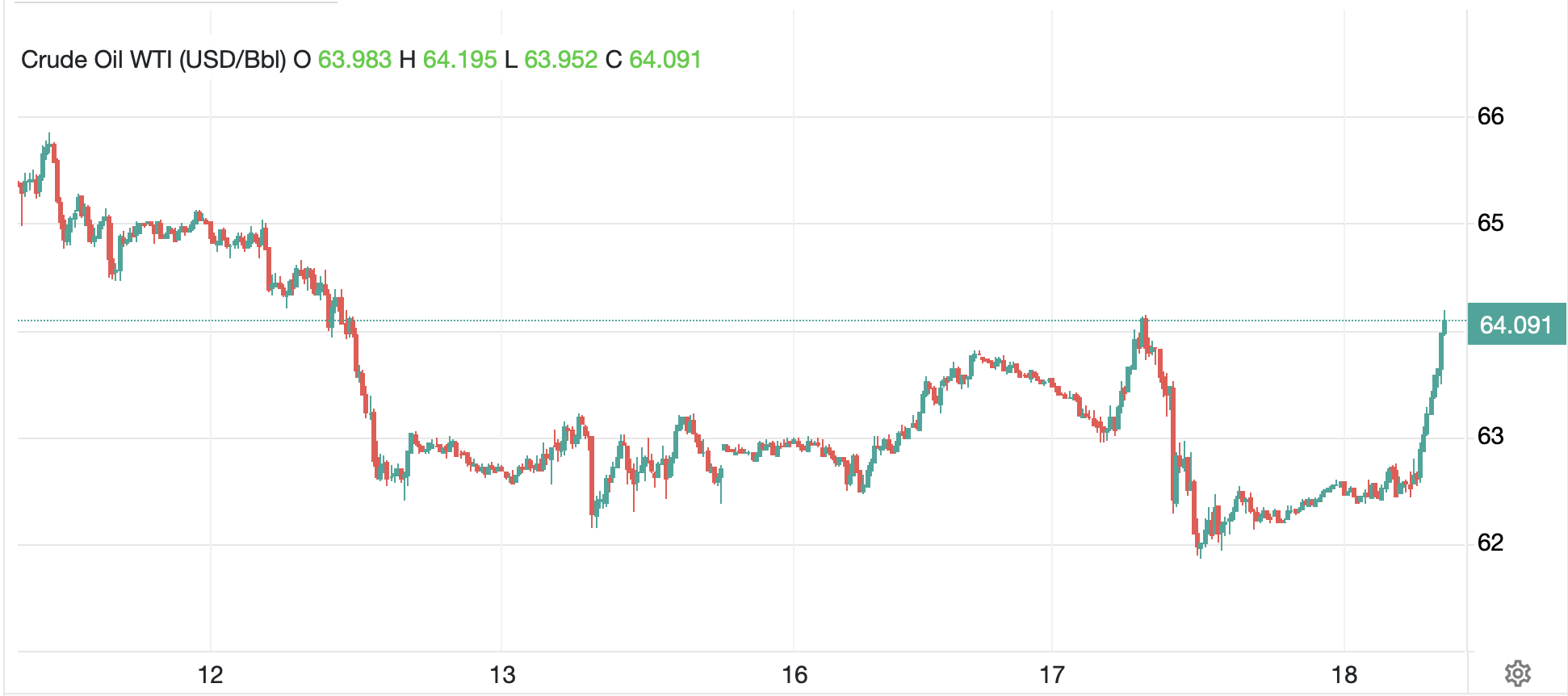
Oil (-0.2%) which suffered yesterday has stopped falling for the moment as the market remains on tenterhooks regarding a possible Iranian attack on Israel.  In the meantime, expectations are for a further draw of oil inventories in the US, although the industry continues to pump an extraordinary 13.4 million bpd despite all the efforts of the current administration to stifle it.  As to the metals markets, gold (+0.4%) continues to find support and is pushing toward new highs yet again.  This morning it is taking the rest of the metals complex with it, although that could be a result of the dollar’s modest weakness.

Finally, the dollar is a bit softer overall this morning, but there are several idiosyncratic stories.  We’ve already mentioned NZD, GBP and JPY.  However, the euro (+0.25%) is now at its highest level of 2024 and back above 1.10.  Meanwhile, the commodity currencies are mostly firmer vs. the dollar this morning (ZAR +0.3%, MXN +0.3%, NOK +0.6%, SEK +0.5%) although Aussie (-0.2%) is bucking that trend.  One other noteworthy mover is CNY (+0.2%) which has been showing far more volatility than normal in the past two weeks.  It seems it is still coming to grips with the Japanese story as well.

And that’s really it for the day.  There are no Fed speakers on the calendar, but we must always be aware of some unscheduled interview.  Remember, they love to talk.  Right now, I would say the market is looking for softer inflation data and is pricing accordingly.  As such, if this data is even modestly warm, let alone hot, be ready for some quick reversals, at least early in the session.  So, stocks lower with bonds while the dollar climbs.  But based on the current zeitgeist, I have to believe that any dip will be bought with reckless abandon.

Good luck

Adf

Less Keen

While holding our breath has been fun
For CPI, soon we’ll be done
So far through this year
Each reading’s been dear
Can’t wait to see how today’s spun
 
A hot reading’s likely to mean
On rate cuts, Jay will be less keen
But if the print’s cool
It’s likely to fuel
A rally like we’ve never seen!


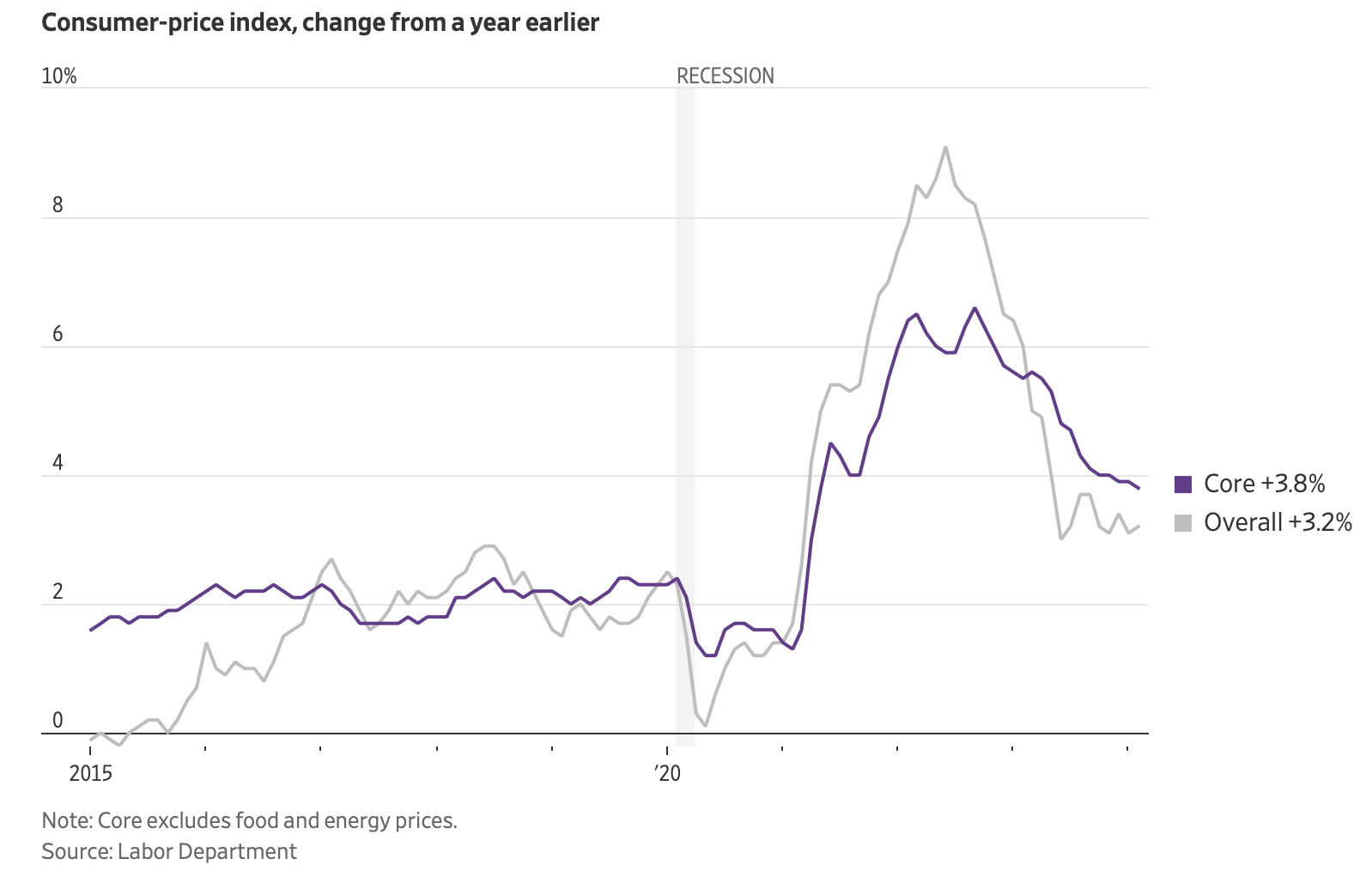
The number we have all been breathlessly awaiting is finally to arrive this morning at 8:30. The March CPI readings are expected as follows: Headline (0.3% M/M, 3.4% Y/Y) and core (0.3% M/M, 3.7% Y/Y).  As can be seen in the below chart from the WSJ, the question of whether inflation is continuing its slow decline or has bottomed is like a Rorschach Test.  Those who are all-in on the soft-landing thesis, notably every administration economist and spokesperson, see the ongoing decline of the core rate (the purple line) as the direction of travel.  However, those who are in the sticky inflation camp and who have made the case that the so-called last mile is going to take much longer than desired look at the headline rate (the gray line) and explain that the bottom seems to be in.

Source: WSJ

Perhaps the most frustrating part of this is that even after the release, neither side will be able to truly declare victory, although I’m sure one side will try to do so.  And to add insult to injury, the arguments are going to rely on the second decimal place, a level of precision that is meaningless in the context of economic data collection.  So, a 0.33% print will get the hawks all riled up while a 0.27% print will have the doves cooing that cuts are on their way soon.  But I challenge anyone to demonstrate that precision of that magnitude has any real meaning.  Clearly, the BLS can calculate numbers to whatever level of precision they desire but given the frequency or revisions to the big number, everything else is just narrative.

But this is where we are.  My take is that the market response will play out very much as expected, at least initially.  This means a hot print, even at the second decimal, will see bonds and equities sell off while the dollar rallies.  Funnily, my sense is that commodities will not suffer greatly on this as they are the current vogue for protecting against inflation.  Similarly, a cool number will lead to a risk asset rally and a dollar decline.  This will probably hurt commodities as well.

One of the interesting things is to observe positioning heading into big data points like this and there are two noteworthy items in the interest rate space.  First, yesterday there was a massive SOFR futures trade where one account bought 75,000 December contracts, the largest single trade ever in the contract according to the CME where it trades. (SOFR = Secured Overnight Funding Rate and is the replacement for LIBOR).  That is either a very large bet that the data is going to be soft, or somebody covered a very large short position, but either way, they are protecting against cooling inflation.  The other interesting thing has been the reduction in short bond positions.  There has been a significant decline in the number of short bond futures positions as well as short cash positions in the bond market, again an indication that many are looking for a benign reading this morning.

This poet has no formal inflation model and therefore can only estimate based on personal experience. Ultimately, nothing I have seen indicates that the rate of inflation is decreasing very rapidly at all.  As I remain in the sticky camp, my best guess is that we will lean toward the hot side this morning.

Turning to the overnight session, there was some interesting news to cover.  In Asia, Fitch put China on negative watch on its recent rise in debt.  Not surprisingly, Chinese shares suffered a bit on the news, but HK shares did not, as the Hang Seng (+1.9%) was the leading gainer in the time zone.  Elsewhere, the RBNZ left rates on hold, as expected, but the statement indicated zero rate cuts in 2024 and a continued hawkish bias.  Surprisingly, NZ equities rallied a bit on the news.  Finally, Ueda-san testified to the Diet again and the most interesting thing he said was that while they watch the FX rate, they will not adjust monetary policy simply to address any weakness in the yen.  Apparently, stock traders didn’t like that much as the Nikkei fell -0.5% on the session.

The story in Europe, though, is much better as all markets are firmer, somewhere between +0.4% and +0.7%. There was some data released, all of which pointed to slowing growth and inflation and therefore increasing the odds the ECB could act as soon as tomorrow, but certainly by June.  Norwegian CPI fell more than expected, Swedish GDP and IP were both quite weak as was Italian Retail Sales.  The point is the ongoing reduction in activity across the continent is going to allow (force?) Madame Lagarde to prove she isn’t waiting on the Fed.  After another limited movement day yesterday, US futures remain unchanged at this hour (7:00).

In the bond market, while Friday and Monday morning saw a sharp decline in prices and rise in yields, yesterday saw yields drift back further and this morning Treasuries are lower by -1bp with similar price action throughout Europe.  Thus far, the net retracement from the yield peak has been 10bps, with all eyes on this morning’s CPI print.  One other interesting tidbit is that the Treasury is auctioning $39 billion in 10-year notes today with the yield highly dependent on the CPI data.

Turning to the commodity market, oil (+0.6%) after a slight dip yesterday on a larger than expected inventory build, is rebounding.  The EIA released a report increasing expected supply and demand numbers for 2024 and 2025 as well.  Gold (-0.25%) is settling in just below its new highs although copper (+0.5%) and aluminum (+1.1%) continue to rally strongly on the rebounding manufacturing story as well as the structural supply shortages.

Finally, the dollar remains in the doldrums, little changed ahead of this morning’s data.  The biggest mover is MXN (+0.5%) which is a continuation of its yearlong price activity as Banxico maintains amongst the highest real interest rates around.  Surprisingly, NZD (+0.2%) is just barely higher despite the hawkish rhetoric from the central bank last night and after that, pretty much all the movement is +/- 0.1% or less.

In addition to the CPI data this morning, we get the Bank of Canada rate meeting where they are expected to leave policy on hold although given the slowing economy, they may set the table for a rate cut at the next meeting.  I would not be surprised to see them cut today, though, in an effort to get ahead of the curve.  The FOMC Minutes are also released this afternoon and we hear from Governor Bowman and Chicago Fed president Goolsbee, with both having been amongst the most hawkish Fed speakers lately.  Given all the talk from Fed speakers since the March meeting, it is hard to believe that the Minutes will matter that much.

And that’s what we have for today.  The CPI will set the tone and we will circle back tomorrow to see how things landed.

Good luck

Adf

Annoyed

Seems President Xi is annoyed
His stock market has been devoid
Of buyers, so he
Has banned, by decree
The strategies quant funds employed
 
But otherwise, markets are waiting
To see if inflation’s abating
The PCE print
Will give the next hint
If cuts, Jay will be advocating


Market activity remains on the quiet side of the spectrum as all eyes continue to focus on the Fed, and by extension all central banks.  As an indication, last night the RBNZ left their OCR rate on hold, as widely expected, but sounded less hawkish in their views, dramatically lowering the probability that they may need to hike rates again.  Prior to the meeting, there was a view hikes could be the case, but now, cuts are seen as the next step.  The upshot is the NZD fell -1.2% as all those bets were unwound.  One of the reasons this was so widely watched is there are some who believe that the RBNZ has actually led the cycle, not the Fed, so if hikes remained on the table there, then the Fed may follow suit.  However, at this stage, I would say all eyes are on tomorrow’s PCE print for the strongest clues of how things will evolve.

Before we discuss that, though, it is worth touching on China, where last night “unofficially” the Chinese government began explaining to hedge funds onshore that they could no longer run “Direct Market Access” (DMA) products for external clients.  This means preventing new inflows as well as winding down current portfolios.  In addition, the proprietary books using this strategy were told they could not use any leverage.  (DMA is the process by which non broker-dealers can trade directly with an exchange’s order book, bypassing the membership requirement, and in today’s world of algorithmic trading, cutting out a step in the transaction process, thus speeding things up.)  

Apparently, this was an important part of the volume of activity in China, but also had been identified as a key reason the shares in China have been declining so much lately.  Last night was no exception with the Hang Seng (-1.5%) and CSI 300 (-1.3%) both falling sharply and the small-cap CSI 1000 falling a more impressive -6.8%.  Once again, we need to ask why the CCP is so concerned about the most capitalist thing in China.  But clearly, they are.  I suppose that it has become a pride issue as how can Xi explain to the world how great China is if its stock market is collapsing and investment is flowing out of the country.  This is especially so given the opposite is happening in their greatest rival, the US. 

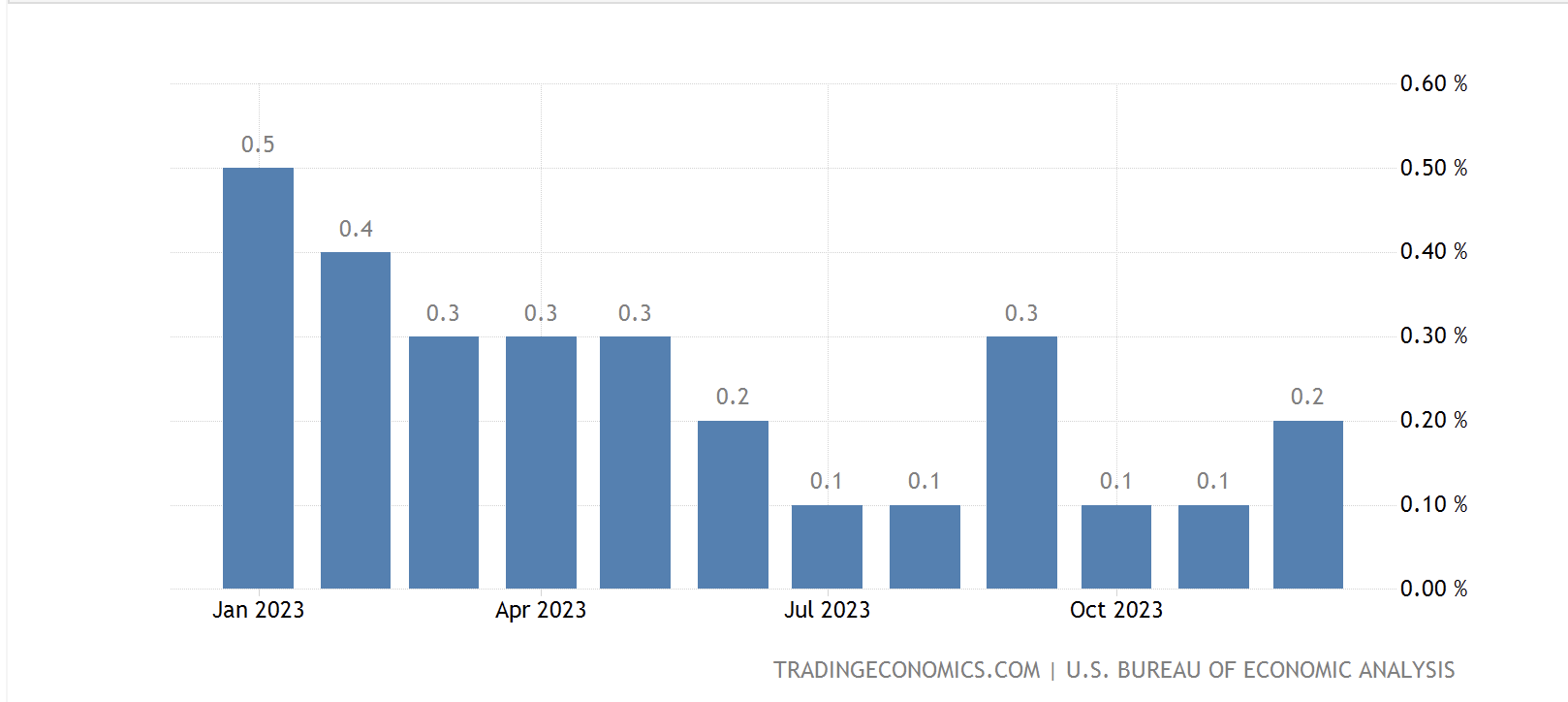
But back to PCE.  It appears that this PCE print has become pivotal to many macroeconomic views.  At least that is the case based on how much discussion surrounds it from both inflation hawks and doves.  As of now, and I don’t suppose it will change, the current consensus view of the M/M Core PCE print is 0.4% with a Y/Y of 2.8%.  As can be seen from the below chart from tradingeconomics.com, this will be the highest print in a year, and it would be easy to conclude that the trend here has turned upwards.

Of greater concern, though, is the idea that just like we saw the CPI data run hotter than expected earlier this month, what if this number prints at 0.5%?  Currently, the inflation doves are making the case that the trend is lower, and that if you look at the last 3 months or 6 months, the Fed has already achieved their target.  Their answer is the Fed should be cutting rates and soon.  For them, a 0.5% print would be much harder to explain and likely force a rethink of their thesis.

On the other side of the coin, the inflation hawks would feel right at home with that type of outcome and continue to point to the idea that the ‘last mile’ on the road back to 2.0% is extremely difficult and may not even be achievable without much tighter policy.  While housing is a much smaller part of the PCE data than the CPI data, remember, CPI saw strength throughout the services sector and that will be reflected.

One thing to consider here is the impact a hot number would have on the Treasury market.  Yields have already backed up from their euphoric lows at the beginning of the month by nearly 50bps.  Given the recent poor performance in Treasury auctions, where it seems buyers are demanding higher yields, if inflation is seen to be rising again, we could see much higher yields with the curve uninverting led by higher 10-year yields.  I’m not saying this is a given, just a risk on which few are focused.  In the end, tomorrow has the chance to be quite interesting and potentially change some longer-term views on the economy and the market’s direction.

But that is tomorrow.  Looking overnight, while Chinese stocks suffered, in Japan, equity markets were largely unchanged.  In Europe this morning, there is more weakness than strength with the FTSE 100 (-0.7%) and Spain’s IBEX (-0.7%) leading the way lower although other markets on the continent have seen far less movement.  As to US futures, at this hour (8:00), they are softer by about -0.3%.

In the bond market this morning, Treasury yields have fallen 2bps, while yield declines in Europe have generally been even smaller, mostly unchanged or just -1bp.  The biggest mover in this space was New Zealand, where their 10-year notes saw yields tumble 9bps after the aforementioned RBNZ meeting.

Oil prices (-0.3%) are giving back some of their gains yesterday, when the market rallied almost 2% on stories that OPEC+ was getting set to extend their production cuts into Q2.  It is very clear that they want to see Brent crude above $80/bbl these days.  In the metals markets, while precious metals are little changed, both copper and aluminum are softer by about -0.5% this morning.  I guess they are not feeling any positive economic vibes.

Finally, the dollar is much firmer this morning against pretty much all its counterparts.  While Kiwi is the laggard, AUD (-0.7%), NOK (-0.7%) and CAD (-0.4%) are all under pressure as well.  The same is true in the EMG bloc with EEMEA currencies really suffering (ZAR -0.5%, HUF -0.7%, CZK -0.4%) although there was weakness in APAC overnight as well (KRW -0.4%, PHP -0.6%).

On the data front, this morning brings the second look at Q4 GDP (exp unchanged at 3.3%), the Goods Trade Balance (-$88.46B) and then the EIA oil inventory data.  We also hear from Bostic, Collins and Williams from the Fed around lunchtime.  Yesterday’s data was generally not a good look for Powell and friends as Durable Goods tanked, even ex-transport, while Home Prices rose even more than expected to 6.1% and Consumer Confidence fell sharply to 106.7, well below the expected 115 reading.  

As we have been observing for a while now, the data continues to demonstrate limited consistency with respect to the economic direction.  Both bulls and bears can find data to support their theses, and I suspect this will continue.  With that in mind, to my eye, there are more things driving inflation higher rather than lower and that means that the Fed seems more likely to stand pat than anything else for quite a while.  Ultimately, I think we will see the ECB and BOE decide to ease policy sooner than the Fed and that will help the dollar.

Good luck

Adf

Beyond His Control

Next week look for Jay to extol
His record, when in Jackson Hole,
He offers the view
Equality’s skew
Is mostly beyond his control

Now keep that in mind when you hear
That China has also made clear
Division of wealth
Is better for health
Thus, taxes will soon be severe

In a market with muted price action across all asset classes overnight, two stories this morning seem to encapsulate the current zeitgeist.  First is the fact that, in what can only be described as extraordinarily ironic, when Chairman Powell regales us next week regarding the evils of inequality and all the things the Fed is heroically doing to right those wrongs, he will be doing so from the seat of the richest county in the United States.  That’s right, Teton County has the nation’s highest per capita income from wealth.  Apparently, irony is second only to hypocrisy when considering political commentary.  And make no mistake, the Fed is completely political.

The other story of note, and one that follows directly from the recent Chinese attacks on their own successful tech companies, is that China has now made clear that wealth in the country needs to be more evenly divided.  Given the fact that China is ostensibly a communist country, or at the very least clearly run by a communist party, it also seems a bit ironic that there is so much concern over wealth inequality.  One would have thought the Gini coefficient would have been far lower there.  But I guess, equality is the new freedom, a valuable political slogan if not an actual goal.  The reason this matters, however, is that it implies the recent Chinese efforts to rein in certain highly successful companies, and especially their high profile bosses, has no end in sight.  From an investment point of view, it appears the Chinese equity markets are going to have any gains severely impeded.  Look, too, for new taxes on estates and wealth there, all of which will have a decided impact on international investing.

Remarkably, beyond those stories, it is difficult to come up with anything that is truly meaningful regarding markets today.  The RBNZ did wind up leaving interest rates on hold, backing away from the expected 0.25% increase, as the fact that the nation has reverted to a complete and total lockdown due to the single case of Covid that was detected last week, has given them pause on their views of future growth.  NZD (-0.4%) is the worst G10 currency performer today on the back of that policy activity (or lack thereof), but given the tiny size of the nation, it has not had any other significant impact.

Inflation data was released in both Europe (2.2%, 0.7% core) as expected and the UK (CPI 2.0%, 1.9% core) with both of those readings 0.2% lower than forecast.  So, while inflation is seemingly running quite hot in the US, it appears to have potentially plateaued across the pond.  While we can be certain that the ECB is not going to change its current policy stance anytime soon, there has been a great deal more discussion regarding the BOE.  Hawkish vibes were emanating from Threadneedle Street recently, but if inflation is not going to rise further, then those views may soon be called into question.  However, there is a case to be made that this is a temporary lull in the CPI data and that looking ahead, readings will push up toward 4.0%, at least, as previously announced price increases start to be felt throughout the economy.  Thus far, the FX impact from this data has been essentially nil, but equity markets in Europe and the UK are all under modest pressure this morning (DAX -0.1%, CAC -0.35%, FTSE 100 -0.35%).

As to markets elsewhere, Asia saw some rebounding from its recent travails, with the Nikkei (+0.6%), Hang Seng (+0.5%) and Shanghai (+1.1%) all having their first positive day in five sessions.  We also saw a reversal in some currency activity there as KRW (+0.7%) was the best performer after comments from the central bank describing the recent weakness as an overshoot and that the Finance Ministry is monitoring things closely.

A look at bonds shows that Treasury yields have backed up 1.2bps this morning after having fallen by about 10bps in the prior three sessions.  European sovereigns, though, continue to find support as the ECB continues to hoover up virtually all the paper issued.  As such, Bunds, OATs and Gilts have all seen yields slip about 1 basis point.

Finally, the dollar can only be described as mixed this morning, with movement in the G10, aside from kiwi’s decline, pretty minimal, <0.2%, although with an equal number slightly lower and higher.  EMG currencies show the same pattern, with most movement quite limited and only one notable laggard (TRY -0.7%) which also seems to be a trading response to its recent strong rally (+3.3% in the past 5 sessions).  In other words, there is very little to discuss at all today.

On the data front, after yesterday’s disappointing Retail Sales number (-1.1%, exp -0.3%), this morning brings Housing Starts (exp 1600K) and Building Permits (1610K) and then this afternoon, we get the potentially most interesting news, the FOMC Minutes.

On the Fedspeak front, thus far, the only three FOMC members who have not advocated for tapering are Powell, Williams and Brainerd, as even Kashkari, yesterday, said he could see the case for tapering by early next year.  But Powell gave no indication he is ready to go down that road, so barring an insurrection at the Fed, one has to believe any tighter policy is still some ways away.  Today, we hear from Bullard, but he has already made his tapering bona fides known.

And that is really all there is today.  It truly has all the hallmarks of a summer doldrums day, with limited price action and limited news, unless something shocking comes from the Minutes.  My money is on nothing, and a range trading day ahead of us.

Good luck and stay safe
Adf

High Tide

The dollar continues to slide
But is risk approaching high tide?
Last night t’was the Kiwis
Who hinted that their ease
Of policy may soon subside

As well, from the Fed yesterday
Three speakers had two things to say
It soon may be time
To change paradigm
Inflation, though, ain’t here to stay

There will come a time in upcoming meetings, we’ll be at the point where we can begin to discuss scaling back the pace of asset purchases.”  So said, Fed Vice-Chairman Richard Clarida yesterday.  “We are talking about talking about tapering,” commented San Francisco Fed President Mary Daly in a CNBC interview yesterday.  And lastly, Chicago Fed President Charles Evans explained, “the recent increase in inflation does not appear to be the precursor of a persistent movement to undesirably high levels of inflation.  I have not seen anything yet to persuade me to change my full support of our accommodative stance for monetary policy or our forward guidance about the path for policy.”

The Fed’s onslaught of forward guidance continues at full speed as virtually every day at least two or three Fed speakers reiterate that policy is perfect for the current situation, but in a nod to the growing chorus of pundits about higher inflation, they are willing to indicate that there will come a time, at some uncertain point in the future, when it may be appropriate to consider rolling back their current policy initiatives.

But ask yourself this; if inflation is going to be transitory, that implies that the current policy settings are not a proximate cause of rising prices.  If that is the case, why discuss tapering?  After all, high growth and low inflation would seem to be exactly the outcome that a central bank wants to achieve, and according to their narrative, that is exactly what they have done.  Why change?

This is just one of the conundra that is attendant to the current Fed policy.  On the one hand, they claim that their policy is appropriate for the current circumstance and that they need to see substantial further progress toward their goals of maximum employment and average 2% inflation before considering changing that policy.  On the other hand, we have now heard from five separate FOMC members that a discussion about tapering asset purchases is coming, which implies that they are going to change their policy.  Allegedly, the Fed is not concerned with survey data, but want to see hard numbers showing they have achieved their goals before moving.  But those hard numbers aren’t here yet, so why discuss changing policy?

The cynical answer is that the Fed actually doesn’t focus on unemployment and inflation, but rather on the equity markets foremost and the bond market secondarily.  Consider, every time there has been a sharp dislocation lower in stocks, the Fed immediately cuts rates to try to support the S&P.  This has been the case since the Maestro himself, Alan Greenspan, responded to the 1987 stock market crash and has served to inflate numerous bubbles since then.

A more charitable explanation is that they have begun to realize that they are in an increasingly untenable position.  Since the GFC, the Fed has consistently been very slow to reduce policy accommodation when the opportunity arose and so the history shows that rates never regain their previous peak before the next recession comes along.  Recall, the peak in Fed funds since 2009 was just 2.50%, reached in December 2018 just before the Powell Pivot in the wake of a 20% drawdown in the S&P 500.  In fact, since 1980, every peak in Fed Funds has been lower than the previous one.  The outcome of this process is that the Fed will have very little room to cut rates to address the next recession, which is what led to QE in the first place and more importantly has served to reduce the Fed’s influence on the economy.  Arguably, then, a major reason the Fed is keen to normalize policy is to retain some importance in policymaking circles.  After all, if rates are permanently zero, what else can they do?

It is with this in mind that we turn our attention elsewhere in the world, specifically to New Zealand, where the RBNZ signaled that its Official Cash Rate (Fed funds equivalent) may begin to rise in mid-2022.  This is a full year before previous expectations and makes the RBNZ the 3rd G10 central bank to talk about tightening policy sooner than thought.  The Bank of Canada has already started to taper QE purchases and the BOE has explained they will be starting next year as well.  It should be no surprise that NZD (+1.15%) is the leading gainer in the FX market today, nor that kiwi bonds sold off sharply with 10-year yields rising 8bps.

Do not, however, mistake this for a universal change in policy paradigm, as not only is the Fed unwilling to commit to any changes, but the BOJ remains in stasis and the ECB, continues to protest against any idea that they will be tightening policy soon.  For instance, just this morning, ECB Executive Board Member and Bank of Italy President, Fabio Panetta, said, “Only a sustained increase in inflationary pressures, reflected in an upward trend in underlying inflation and bringing inflation and inflation expectations in line with our aim, could justify a reduction in our purchases.  But this is not what we projected in March.  And, since then, I have not seen changes in financing conditions or the economic outlook that would sift the inflation path upward.”

Investors and traders have been moving toward the view that the ECB would be tapering purchases before 2023 as evidenced by the rise in the euro as well as the rise in European sovereign yields.  But clearly, though there are some ECB members (Germany, the Netherlands) who would be very much in favor of that action, it is by no means a universal view.  Madame Lagarde will have her hands full trying to mediate this discussion.

For now, the situation remains that the central bank narrative is still the most important one for markets, and the fact that we are seeing a split amongst this august group is a key reason FX volatility remains under pressure.  The lack of an underlying theme to drive the dollar or any bloc of currencies in one direction or the other leaves price action beholden to short-term effects, large orders and the speculator community.  We need a new paradigm, or at least a reinvigoration of the old one to get real movement.

In the meantime, the dollar continues to drift lower as US yields continue to drift lower.  Right now, the bond market appears to have faith in the Fed narrative of transitory inflation, and as long as that is the case, then a weaker dollar and modestly higher stock prices are the likely outcome.

Today’s price action, NZD excepted, showed that to be the case, with APAC currencies performing well, but otherwise a mixed bag.  Equity markets are marginally higher and bond yields have largely fallen in Europe, although Treasuries are little changed after a 4bp decline yesterday.  Gold is actually the biggest winner lately, having traded back above $1900/oz as investors watch the slow destruction of fiat currency values.  But in the FX space, the USD-Treasury link remains the most important thing to watch.

Good luck and stay safe
Adf

Aged Like Bad Wine

While Veterans here are recalled
And politics has us enthralled
The dollar’s decline
Has aged like bad wine
With strategies soon overhauled

US markets are closed today in observance of the Veteran’s Day holiday, but the rest of the world remains at work.  That said, look for a far less active session than we have seen recently.  In the first place, with the Fed on holiday, the Treasury market is closed and price action there has been one of the biggest stories driving things lately.  Secondly, while US equity futures markets are trading, all three stock exchanges are closed for the day, so the opportunity for individual company excitement is absent.  And finally, with today being an official bank holiday, while FX staff will be available, staffing will be at skeleton levels and come noon in New York, when London goes home, things here will slow to a standstill.

However, with that as a caveat, the world continues to turn.  For instance, while last week saw meetings in three key central banks, with two of them (RBA and BOE) explaining that easier monetary policy was in store, although the Fed made no such claims, last night saw the smallest of G10 nations, New Zealand, make headlines when the RBNZ explained that they were not changing policy right now, but that the economy there has been far more resilient than expected and they would not likely need to ease monetary policy any further.  It should be no surprise that the market responded by selling New Zealand government bonds (10-year yields rose 14.5 basis points), while overnight rates rose 16 basis points and traders removed all expectations for NIRP. QED, the New Zealand dollar is today’s best performer, rising 0.8%.

Sticking with the central bank theme, and reinforcing my view that the dollar’s decline has likely run its course broadly, although certainly individual currencies can strengthen based on country specific news, were comments from the Bank of Spain’s chief economist, Oscar Arce, explaining that the ECB must do still more to combat the threat of deflation in the Eurozone and that the December meeting will bring an entirely new discussion to the table.  The takeaway from the ECB meeting two weeks ago was that they would be expanding their stimulus programs in December.  Literally every comment we have heard from a European banking official in the interim has, not merely reinforced this view, but has implied that actions then will be massive.

I will repeat my strongly held view that the ECB will not, nay cannot, allow the euro to rise very far in their efforts to reboot the Eurozone economy.  Remember, one of the major benefits expected from easing monetary policy is a weakening of the currency.  When an economy is struggling with growth and deflation issues, as the Eurozone is currently struggling, a weak currency is the primary prescription to fix things.  You can be certain that every time the euro starts to rally near 1.20, which seems to be their tolerance zone, we will hear even more from ECB members about the additional easing in store as Madame Lagarde does her level best to prevent a euro rally.  And if the euro declines, so will the CE4 as well as the pound, Swiss franc and the Scandies.  In other words, the dollar is unlikely to decline much further than we have already seen.

In truth, those are the most noteworthy stories of the session so far.  Virtually every other headline revolves around either the ongoing election questions in the US, both the contestation of the presidential outcome and the upcoming run-off elections in Georgia for two Senate seats and control of the Upper House, or the vaccine and how quickly it can be approved and then widely distributed.

So, a quick look around markets this morning shows that risk appetite is moderate, at best.  For instance, equity markets in Asia were mixed with the Nikkei (+1.8%) continuing its recent strong run, up more than 10% this month, but the Hang Seng (-0.3%) and Shanghai (-0.5%) couldn’t find the same support.  Europe, on the other hand, is all in the green, but the movement is pretty modest with the FTSE 100 (+0.7%) the leader and both the DAX and CAC up just 0.4% at this hour.  US futures, which are trading despite the fact that equity markets here will be closed today, are all higher as well, with the NASDAQ (+1.0%) leading the way after having been the laggard for the first part of the week, while the other two are showing solid gains of 0.65%.

Bond markets in Europe are rising slightly, with yields slipping between 1 and 3 basis points on prospects for further ECB policy ease courtesy of Senor Arce as highlighted above, as there was no new economic data nor other statements of note.  As I mentioned, the Treasury market will be closed today for the holiday.

But commodity markets continue to perform well, with oil prices higher yet again, this morning by 3.2% taking the gains this week to 15%!  Metals prices, both base and precious, are also firmer as the vaccine news continues to spread good cheer regarding economic prospects going forward.

And finally, the dollar is best described as mixed to stronger.  For instance, against its G10 brethren, only NZD is firmer, as explained above.  But the rest of the bloc is softer led by NOK (-0.65%) and EUR (-0.4%).  While the euro makes sense given the Arce comments and growing belief that the ECB will really be aggressive next month, with oil’s sharp rebound, one must be surprised at the krone’s performance.  In fact, this merely reinforces my view that as the euro goes (lower) it will drag many currencies along for the ride.

However, in the EMG bloc, movement has been pretty even (excepting TRY) with a few more losers than gainers, but generally speaking, no really large movement.  On the plus side we see THB (+0.5%) and KRW (+0.45%) leading while on the downside it is MXN (-0.6%) and HUF (-0.45%) in the worst shape.  Looking a bit more deeply, the baht has been rallying all quarter and we may be looking at the last hurrah as the government has asked the BOT to manage the currency’s strength in order to help export industries compete more effectively.  Meanwhile, the won was the beneficiary of a significant jump in preliminary export data, with a 20.1% Y/Y gain for the first ten days of November auguring well for the economy.  Meanwhile, on the downside, the peso, which would have been expected to rally on the back of oil prices, is actually serving as a proxy for Peruvian risk as the impeachment of the president there Monday night has thrown the nation into turmoil and investors are seeking a proxy that is more liquid than the sol.  As to HUF, it is simply tracking the euro’s decline, and we can expect to see the same behavior for the entire CE4 bloc.

And that’s really it for today.  There is no news and no scheduled speakers and the session will be short.  But the dollar is edging higher, so keep that in mind.

Good luck and stay safe
Adf

Uncertainty Reigns

Concerns over trade still remain,
For bullish investors, a bane
They want to believe
That Trump will achieve
His goals, so investments can gain

But right now uncertainty reigns
Resulting in stock market pains
When risk is reduced
Then bonds get a boost
While euros and pounds feel the strains

The one thing we know for sure is that the trade situation continues to be a major topic on investor minds, whether those investors are of the equity or fixed income persuasion. Despite the ostensible good news that Chinese vice-premier Liu He would still be coming to Washington later this week to continue the trade talks with Mnuchin and Lighthizer, it seems the market has become a bit less convinced that a deal is coming soon. As I have written several times over the past few weeks, it seems clear the market had fully priced in a successful completion of the trade talks and an (eventual) end to tariffs. But the President’s tweets on Sunday has caused a serious reconsideration of that pricing. Arguably, the 2% decline we have seen in US equity indices over the past two sessions is not nearly enough to offset the full risk, but it is a start. Ironically, I think the constant reiteration by financial heavyweights like Christine Lagarde and Mario Draghi, of how important it is to avoid a trade war, has set up a situation where in the event no deal is reached, the market reaction will be worse than if they had never piped up in the first place.

At any rate, the increased tensions have certainly reduced risk appetites across the board. Not only have equity markets suffered (Nikkei -1.5%, Shanghai -1.1% after yesterday’s US declines) but Treasury yields continue to fall. This morning 10-year Treasury yields have fallen to 2.43%, their lowest since late March and essentially flat to the 3-month T-Bill. Expect to hear more discussion about an inverted yield curve and the omens of a recession in the near future.

Away from the trade situation, it seems most other market stories are treading water. For example, the Brexit situation has been back page news for the past two weeks. PM May continues to negotiate with opposition leader Jeremy Corbyn, but there is no consistency to the reports of progress. Labour wants to join the customs union which is something the pro-Brexiteers are fiercely against. Depending on the source of the article you read, a deal is either imminent or increasingly unlikely, which tells me that nobody really knows anything. The pound, which had seen some strength last week, especially on Friday when rumors of a deal were rife, has fallen a further 0.45% this morning and is back near the 1.30 level. It seems increasingly likely to me there will be no solution before the EU elections, and that there will be no solution before the October 31 deadline. Parliament remains riven and leadership there has been completely absent. I expect this to be exhibit A in the long tradition of muddling through by European nations.

Elsewhere in the FX markets, the RBNZ did cut rates last night by 25bps, unlike their Australian brethren who stayed on hold. Kiwi is softer by 0.25% this morning on the back of the news and has helped drag the Aussie with it. Of course, part of the malaise in these currencies is the ongoing uncertainty over the trade talks, as well as the suspect Chinese data.

Speaking of that data, last night China released much worse than expected trade results with exports falling 2.7% and imports rising just 4.0% resulting in a trade surplus of ‘just’ $13.8B, well below expectations. It seems that the tariffs are starting to have a real impact now that inventories need to be replenished. Aside from the impact on the Shanghai exchange noted above, the renminbi also drifted modestly lower, -0.1%, and continues to push toward levels last seen in January. One thing of which I am confident is that if the trade talks fall apart completely, CNY will weaken sharply and test the 7.00 level in short order. Part of the recent stability in the currency has been due to a general malaise in the FX market as evidenced by the extremely low volatility across the board. But part of it, no doubt, is the result of the PBOC managing the currency and absorbing any significant selling in order to demonstrate they are not manipulating the currency lower to enhance their trade. But that will surely end if the talks end unsuccessfully.

Away from those stories it is much more about a modest risk-off scenario today with both JPY and CHF stronger by 0.2%, while EMG currencies are suffering (MXN -0.4%, TRY -0.5%). However, the overall market tone is, not unlike the Fed, one of patience for the next catalyst to arrive. Given the dearth of important data until Friday’s CPI, that should be no real surprise.

In fact, this morning there are no data releases in the US although we do hear from Fed Governor Lael Brainerd at 8:30. Yesterday’s comments from Governor Clarida were generally unenlightening, toeing the line that waiting was the best idea for now and that there were no preconceived notions as to the next rate move. As such, I expect Brainerd to be on the same page, and the FX market to continue to tread water at least until Friday’s CPI.

Good luck
Adf

Great Apprehensions

In England the rate of inflation
Has fallen despite expectation
By Carney and friends
That recent price trends
Would offer rate hike validation

But markets have turned their attentions
To news of two likely extensions
The deadline on trade
And Brexit charade
Have tempered some great apprehensions

Two key data points lead the morning news with UK inflation falling below the BOE’s 2.0% target for the first time since the Brexit vote while Eurozone IP fell far more sharply than expected. Headline CPI in the UK declined to 1.8% while core remained at 1.9%, with both printing lower than market expectations. Given the slowing economic picture in the UK (remember the slowest growth in six years was reported for Q4 and 2018 as a whole), this cannot be that much of a surprise. Except, perhaps, to Governor Carney and his BOE brethren. Carney continues to insist that the BOE may need to raise rates in the event of a hard Brexit given the possibility of an inflation spike. Certainly, there is no indication that is likely at the present time, but I guess anything is possible. Granted he has explained that nothing would be done until the “fog of Brexit” has lifted but given the overall global growth trajectory (lower) and the potential for disruption, it seems far more likely that the next BOE move is down, not up. The pound originally sold off on the news but has since reversed course and is higher by 0.3% as I type. Overriding the data seems to be a growing belief that both sides will blink in the Brexit negotiations resulting in a tentative agreement of a slightly modified deal with a few extra months made available to ratify everything. That’s probably not a bad bet, but it is by no means certain.

On the Continent, the data story was also lackluster, with Eurozone IP falling a much worse than expected -0.9% in December and -4.2% Y/Y. It is abundantly clear that Germany’s problems are not unique and that the probability of a Eurozone recession in 2019 is growing. After all, Italy is already there, and France has seen its survey data plummet in the wake of the ongoing Gilets Jaunes protests. However, despite this data, the euro has held onto yesterday’s modest gains and is little changed on the day. The thing is, I still cannot figure out a scenario where the ECB actually raises rates given the economic situation. Even ECB President Draghi has recognized that the risks are to the downside for the bloc’s economy, and yet he is fiercely holding onto the idea that the next move will be higher rates. It won’t be higher rates. The next move is to roll over the TLTRO’s and interest rates will remain negative for as far as the eye can see. There is a growing belief in the market that because the Fed has halted its policy tightening, the dollar will fall. But since every other central bank is in the same boat, the relative impact still seems to favor the US.

Away from those stories, the market continues to believe that a US-China trade deal is almost done. At least, that’s the way equity markets are trading. President Trump’s comment that he would consider extending the March 1 tariff deadline if there was sufficient progress and it looked like a deal was in the offing certainly helped sentiment. But as with the Brexit issue, where the Irish border situation does not offer a simple compromise, the US requests for ending forced technology transfer and IP theft as well as the reduction of non-tariff barriers strike at the heart of the Chinese economic model and will not be easily overcome. It seems that the most likely outcome will be a delay of some sort and then a deal that will have limited long-term impact but will get played up by both sides as win-win. In the meantime, the PBOC will continue to add stimulus to the economy, as will the fiscal authorities, as they seek to slow the rate of decline. And you can be sure that no matter how the economy actually performs, the GDP data will be firmly above expectations.

And those are the big stories. The dollar has had a mixed performance overnight with two currencies making substantial gains, NZD +1.25% and SEK +0.6%, both of which responded to surprises by their respective central banks. The RBNZ left rates on hold, as universally expected, but instead of offering signs of further rate cuts, simply explained that rates would remain on hold for two years before likely rising. This was taken as hawkish and the currency responded accordingly. Similarly, the Riksbank in Stockholm explained that they still see the need for rates to rise later this year despite the current slowing growth patterns throughout Europe. As I had written yesterday, expectations were growing that they would back away from any policy tightening, so the krone’s rally should be no real surprise. But beyond those two stories, movement has been much less substantial in both the G10 and EMG blocs.

This morning’s data brings CPI (exp 1.5% headline, 2.1% core) which will be closely watched by all markets. Any further weakness will likely see another leg higher in equity markets as it will cement the case for the Fed having reached the end of the tightening cycle. A surprise on the high side ought to have the opposite impact, as concerns the Fed might not yet be done will resurface. There are also three Fed speakers, but for now, that message of Fed on hold seems pretty unanimous across the FOMC.

Absent a surprise, my money is on a directionless day today. The dollar’s recent rally has stalled and without a new catalyst will have a hard time restarting. However, there is no good reason to think things have gotten worse for the buck either.

Good luck
Adf


Up To New Tricks

The nation that first tried to fix
Its price target’s up to new tricks
Last night it explained
That rates would remain
Unchanged til growth, up, finally ticks

You know it has been a relatively uneventful session when the most interesting story is about New Zealand! For those with a bent toward history, it was then-RBNZ Governor Donald Brash, who in 1988 set the first inflation target for a nation, 3.0% at that time, and who was able to maintain the RBNZ’s independence from government meddling ( a new philosophy then) to help achieve that target and eventually bring interest rates down from more than 15% to low single digits. Well, last night when the RBNZ met, they left rates on hold at a record low level of 1.75%, as was universally expected, but they added a sentence to their policy statement “…that rates will remain at this level through 2019 and into 2020”, adding forward guidance to the mix and surprising markets completely. The result was that the NZD fell a bit more than 1% instantly and has continued lower to currently trade down 1.4% on the session and back to its lowest level since March 2016.

This action simply underscores the policy divergence that we have seen over the past two and a half years. Since the Fed’s first, tentative steps towards tightening in December 2015, it has been clear that the US remains ahead of the global growth cycle. And now we find ourselves in a world where several countries are trending higher (US, Canada, India, Sweden) in growth and inflation, while others are seeing the opposite outcome (China, New Zealand, Australia). Of course there are those who are in between, like the Eurozone and Japan, where they want to believe that things are getting better so they can normalize policy, but just don’t quite have the confidence yet. Maybe soon. And it is these policy differences, as well as expectations for their evolution, that will continue to be the key drivers of currencies going forward.

However, away from New Zealand, the G10 has been a dull affair. There has been limited data released and currency movement has been extremely modest, generally less than 0.1% since yesterday’s closing levels.

Emerging markets, though, have been a different story, with several of them really taking a tumble. Starting with Turkey, which has, of course, been under pressure for the past several months, last night saw yet another significant decline of 2.2%, which makes 6.5% this week and more than 50% in the past year. Additional US sanctions driven by the arrest of a US pastor in Turkey have been the recent catalyst, but the reality is that there is an increasing sense of doom attached to President Erdogan’s economic management theories, which include the idea that high interest rates cause inflation; they don’t fight it. But high inflation is what they have there, with the annual rate now running above 16% and rising. The lira has further to fall, mark my words.

Next on the list is the Russian ruble, which has recovered as I write to only be down by 0.6%, after having been lower by as much as 1.3% earlier in the session. However, this week it is lower by 4.2% and nearly 7% this month. The story here is a combination of both new US sanctions as the latest response to the poisoning of an ex Russian agent in the UK earlier this year, as well as the sharp decline in oil prices yesterday, WTI fell 3.2% after storage data indicated there was much more oil and products around than expected. The Russian economy is definitely feeling the squeeze of US sanctions and I expect that the ruble will continue to be pressured lower for a while yet.

But once we get past those currencies, there is precious little to discuss in this space as well. Which takes us to the upcoming data releases. This morning we see Initial Claims (exp 220K) and PPI (3.4%, 2.8% core) at 8:30 and then we hear from Chicago Fed president Evans at 9:30. Evans is a known dove, so the only possibility of a newsworthy event would be if he sounded hawkish. Yesterday, Richmond Fed president Barkin said it was time to get rates back to ‘normal’ and that two more hikes this year seem reasonable. While the futures market is not yet pricing in great confidence in a December move by the Fed, it seems a foregone conclusion to me.

In the end, nothing has happened to alter my views that the Fed will continue to lead the way in tighter monetary policy and that the dollar will be the main beneficiary of that action.

Good luck
Adf