Trump’s Whirlwind

Markets have embraced
Trump’s whirlwind. Thus, Ueda
Is free to hike rates


Tonight, the BOJ is apparently set to hike rates by 25bps.  The market probability is essentially 100% and the key clue is that the Nikkei news organization wrote an article about it that was published after the first day of the BOJ’s two-day meeting.  At the December BOJ meeting, Ueda-san explained that if inflation remained at or above their 2.0% target (it has) and if there were no major ructions in markets after President Trump’s inauguration (there haven’t been), then the BOJ was likely to continue to move their policy rate toward what they believe is a neutral stance.  Currently, that neutral stance is mooted at 1.00%, so a 25bp hike tonight takes the overnight rate to 0.50%, somewhat closer.

With all this widely anticipated and markets pricing in the result, the key question is how what Ueda-san will say during his press conference that follows the meeting.  There are many who are looking for a so-called ‘dovish’ hike, where there is no indication of the timing of any further rate hikes and a benign view of the future.  Certainly, a look at the FX market, where the yen (unchanged today, -0.8% in the past week) doesn’t indicate a great deal of fear over a much tighter policy.
Source: tradingeconomics.com

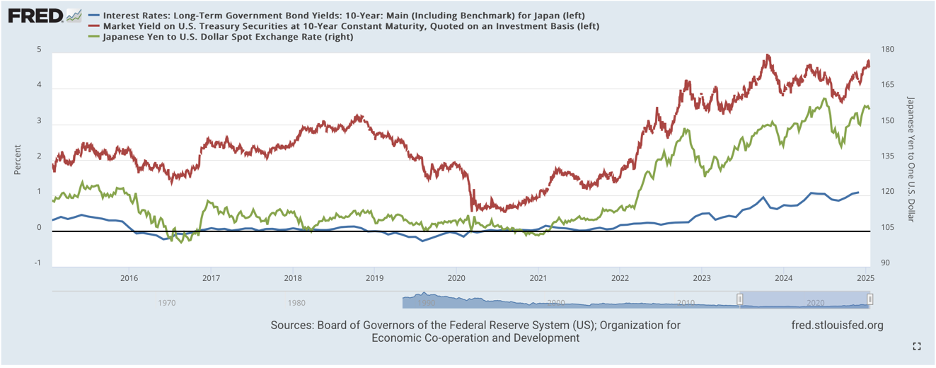
There has been a background narrative that explains the BOJ’s ongoing tightening is going to reach a point where Japanese investors are going to repatriate much of their overseas investment, driving a forceful upward move in the yen and having major negative impacts on risk assets around the world as liquidity retreats.  This is based on the idea that the Japanese are the largest exporters of capital in the world which is one of the key reasons equity markets are rallying everywhere, so if they bring that money home, that means they will sell their foreign equity holdings and buy yen.  While I believe this is a neatly wrapped idea, I would contend Japanese investment prospects are not yet near the same as in the US, so this idea may be premature.  In fact, a look at the chart below showing 10-year US Treasury and JGB yields overlaid with USDJPY indicates that the rate differential is nowhere near where it might need to be in order to encourage that type of behavior.  My take is absent some type of multilateral agreement to weaken the dollar, this will not happen organically.
Source: FRED database

In China, though communists rule
They favor the capital tool
Of equity bourses
And so, Xi endorses
A government stock buying pool

Elsewhere in the world, as we try to get outside the maelstrom that is Donald Trump, I couldn’t help but notice that, once again, Xi Jinping has called on his finance minions to do something, anything, to support the stock market.  And I cannot help but be struck by the irony of the Chinese Communist Party being so concerned about the situation in the most capitalistic institution of all.  The WSJ had an article discussing the latest measures that are on the board, including forcing encouraging insurance companies to increase the local equity portion of their portfolios and utilizing 30% of premium income to buy stocks.  This is on top of the PBOC reducing interest rates last year for companies that want to repurchase shares.

It continues to be very difficult for me to accept the idea that the Chinese are playing 4-D chess with long-term goals in mind while the US is playing checkers.  If that is the case, then the Chinese, or at least President Xi, is a really bad player.  His economy is under dramatic pressure because the property bubble he inflated has been shrinking for the past three years, undermining both the population’s wealth (property was their store of value) and confidence, while he ramps up more beggar thy neighbor trade policies at the same time the US has just elected a president whose middle name is Tariff.  Their population is shrinking because of the ‘foresight’ of their leadership to impose a one-child policy for two generations and while millions of people will risk their lives to immigrate to the US, people are looking to leave China.  Once again, I cannot look at this situation and conclude anything other than the CNY (-0.15%) is going to gradually decline all year long, and maybe not so gradually if pressure really builds.

Ok, let’s take a look at how markets are handling the latest set of Trumpian pronouncements and reactions by targets of his ire.  After yet another rally in the US, albeit on declining volumes so not as exciting as it might otherwise have been, Japanese shares rallied (+0.8%) as investors seem to believe that the interest rate hike tonight will be accompanied by a more dovish stance at the press conference.  Mainland Chinese shares (CSI 300 +0.2%) eked out a gain after the latest news discussed above, although Hong Kong shares (-0.4%) did not follow suit.  After all, the focus is on mainland shares.  The rest of the region was widely dispersed with gainers (Taiwan, Singapore, Philippines) and laggards (Korea, Australia, Thailand), many of these moves in excess of 1%.  It appears investors don’t know which way to turn yet given the speed of changes emanating from Washington.

In Europe, most bourses are modestly firmer (DAX +0.3%, CAC +0.5%) as we continue to hear more from ECB speakers that not only are rates going to be cut, but they are increasingly certain that they will achieve their inflation target.  Maybe they will.  As to US futures, at this hour (7:00) they are mixed to slightly softer with the NASDAQ (-0.4%) the laggard.

In the bond market, the decline in yields appears to be over, at least for now, as Treasuries (+3bps) continue to bounce from their recent lows at 4.54%.  As is almost always the case, this has carried European sovereign yields higher as well, by between 1bp and 3bps across the continent and UK and we saw JGB yields gain 1bp overnight.  I would contend there is still a great deal of uncertainty as to how the Trump administration is going to handle the conundrum of reducing inflation while expanding growth.  Outside of declining energy prices, which may be coming, it will be a tall task, and inquiring minds want to know.

Speaking of energy prices, oil (+0.35%) is edging higher after a lackluster session yesterday.  As with most markets, uncertainty is rife right now although this is clearly an area where Mr Trump is focused on expanding output.  NatGas (-0.3%) is a touch softer as forecasts for the end of the current Polar Vortex keep getting moved up. Metals markets are under some pressure this morning, with gold (-0.3%) backing away from that all-time high level and both silver and copper fading as well.  However, volumes remain light here implying not much interest overall.

Finally, the dollar is a touch stronger this morning, but there are few large movers in either the G10 or EMG blocs.  In fact, every G10 currency is within 0.2% of yesterday’s closing levels and none of them are at extremes.  The biggest loser today is ZAR (-0.6%) which seems to be responding to the precious metals complex backing off a bit overnight.  It remains very difficult to get a read on the dollar with all the other things ongoing.  As it happens, this is one market that has not received any Trumpian attention at all…yet.

We finally have a smattering of data this morning with the weekly Initial (exp 220K) and Continuing (1860K) Claims to be followed by the EIA’s oil inventory data where it appears a modest net build across products is forecast.  With the Fed quiet, and very little focus on Powell and company right now, today looks to be shaping up as another equity focused day with the dollar likely taking its cues there.  While we never know what will hit the tape these days, absent a new surprise vector, there is no reason to look for significant movement today at all.

Good luck

Adf

She Just Doesn’t Know

Though there was no change
Ueda-san hinted that
The future is known


Last night, the BOJ left policy unchanged, as universally expected, but indicated that “Our basic stance is that if our economic and price outlooks are realized, we’ll respond by raising rates.”  That seems pretty clear, and the market responded accordingly with the yen rallying nearly 1% in the immediate aftermath of the comments, although it has since retraced a bit and is now higher by just 0.5% on the session.  As well, he explained, “We’ve been looking at the downside risks to the US and overseas economies, but that fog is clearing somewhat. Needless to say, new risks could emerge depending on the policies coming from the new US president.”  The upshot is that market expectations are now for the next rate hike to take place at the January meeting (69% probability), although December cannot be ruled out.

Japanese equity markets fell modestly during the session (Nikkei -0.5%), but that could also have been more related to the US equity performance, where all three major indices fell yesterday (something that I thought had been made illegal 🤣).  As to JGB’s, they rallied slightly with the 10-year yield slipping 2bps on the session.

In the current market zeitgeist, I don’t believe the happenings in Japan are that crucial.  As Ueda-san said, US politics remains a key focus for every financial market around the world, as well as every economy, given the potential for a Trump victory and some very real changes to the current global trade and economic framework.  However, that doesn’t mean other things of note have stopped occurring.

The message from Madame Lagarde
Is further rate cuts aren’t barred
She just doesn’t know
How fast she should go
Though colleagues, more cuts, have pushed hard

The other story this morning, in the wake of some Eurozone data showing inflation ticked higher in October (headline 2.0%, core 2.7%), is the commentary from several ECB members.  Notably, Madame Lagarde explained “The objective is in sight, but I am not going to tell you that inflation is under control.  We also know that inflation will rise in the coming months, simply because of base effects.”  The punditry sees this as a middle ground between the more hawkish ECB members, like Nagel and Schnabel, who are calling for a “gradual approach” and that the ECB “mustn’t rush further steps,” and the doves, led by Panetta, who are concerned, “Monetary conditions are still tight and new cuts will be necessary.”  

The ECB is finding itself in a difficult position as they refuse to accept the idea that a recession is coming despite the lackluster economic data and the ongoing anecdotal evidence of trouble as evidenced by VW’s closing of factories and seeking wage cuts.  Meanwhile, they understand that inflation, at least optically, is due to rebound somewhat, and cutting rates while that is occurring may be more difficult to explain.

Ultimately, as we have seen repeatedly across all markets and nations, the biggest driver of almost everything is the combination of US economic activity and monetary policy.  However, that is not to say that other nations or blocs cannot demonstrate some independence for their own idiosyncratic reasons.  Regarding the euro, I find it interesting that I have seen more comments this morning about how the currency has found a bottom and is set to rebound.  However, I cannot help but look at the bigger picture (see chart below) and think nothing at all has changed.

Source: tradingeconomics.com

I continue to believe that in order for there to be any changes of substance, we will need to see the US policy change substantially.  That could take the form of an acknowledgement by the Fed that the economy remains strong and further cuts are not necessary (see yesterday’s ADP Employment number of 233K, twice expectations) or a decision by Chairman Jay that there are enough structural issues in the banking and financial system that further rate cuts are necessary despite what appears to be solid growth and still-high inflation.  If the former were to occur, I would look for the dollar to take another strong step higher and the euro to test parity along with other currencies declining commensurately.  If the opposite were to occur, the dollar would weaken substantially in my view, with the euro rising toward 1.15 or so.  However, I don’t see either of those scenarios playing out, so I believe the reality is we remain in the range we have traded in for the past two years as seen above.

And those were really the only stories to discuss away from the US election cacophony.  So, let’s see how markets behaved broadly overnight.  As mentioned above, US equities had a down day after some disappointing earnings results added to some overly long positioning.  Beyond Japanese shares, the rest of Asia was broadly negative as well, with Korea (-1.5%) and India (-0.7%) leading the way lower, but almost every market in the red.  We are seeing similar price action in Europe this morning as it appears Lagarde’s comments did not soothe any frazzled nerves, and the data was unhelpful as well.  As such, the CAC (-0.85%) is the lagging performer although the DAX (-0.5%) and FTSE 100 (-0.8%) are also under pressure.  Now, regarding the FTSE 100, that is also a product of the UK budget announcement yesterday which has been widely panned by most analysts.  It appears they have actually managed to create a situation where they increase spending and taxes but reduce growth substantially.  The upshot here is that there seems to be a little buyers’ remorse with the July election results.  Meanwhile, US futures are all pointing lower as well this morning, at least -0.5%.

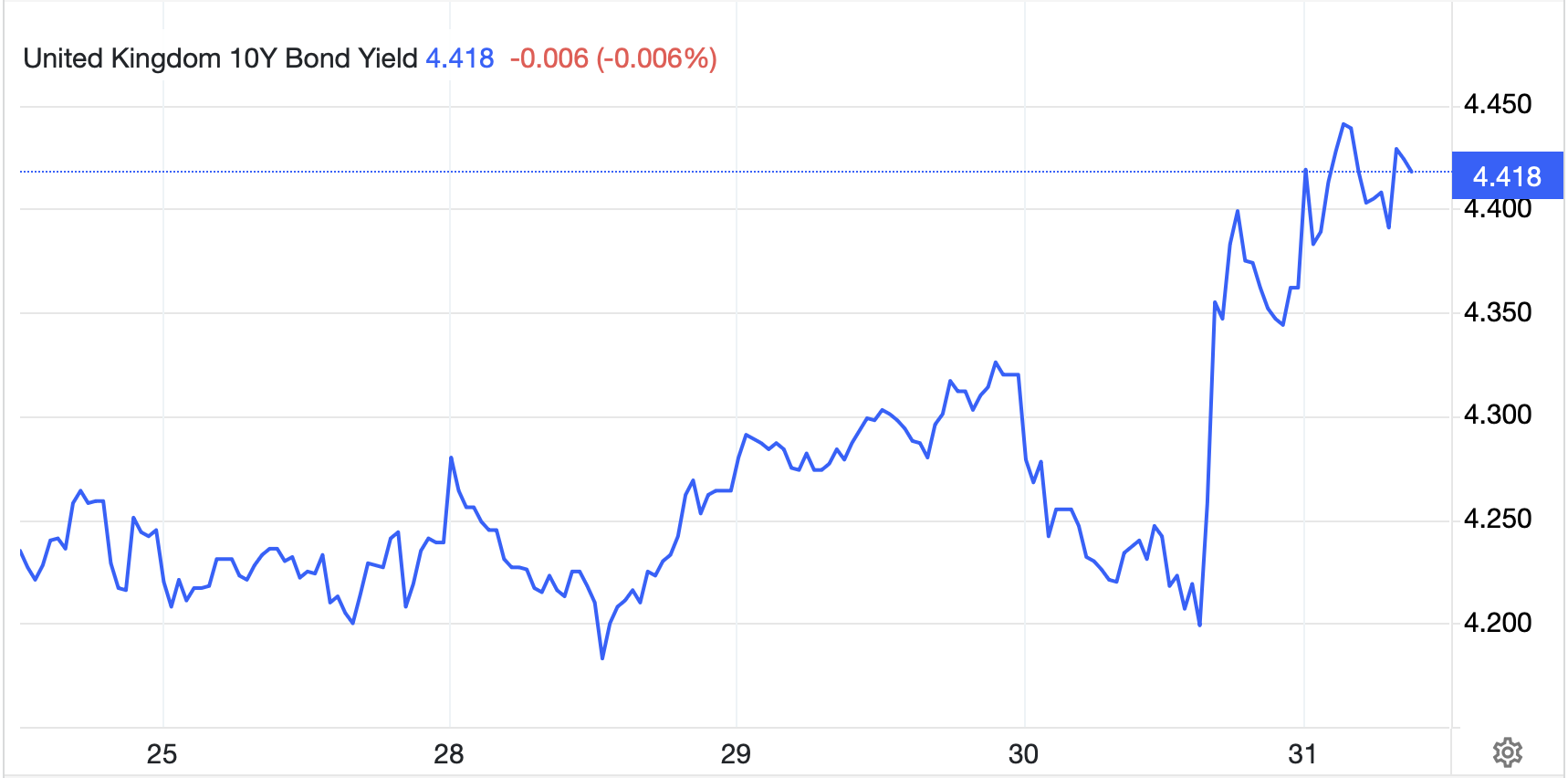
In the bond market, yesterday saw Treasury yields rebound to their recent highs at 4.30% but this morning they have slipped back lower by -2bps.  European sovereigns, however, are higher by those same 2bps as the market responds to the combination of yesterday’s Treasury movement and the higher than forecast Eurozone inflation report.  The outlier here is the UK, which after the budget has seen yields rise dramatically, a sign that markets are distinctly unimpressed with the proposals.  This is a case where a picture is truly worth 1000 words.

Source: tradingeconomics.com

I’ll let you determine when the budget was released, but one must be impressed with the more than 20bp response!

In the commodity space, oil (+0.5%) is continuing its rebound from its worst levels at the end of last week after EIA inventory saw surprising draws rather than modest builds.  As well, Chinese PMI data overnight was slightly better than expected and there are those now calling for a more robust Chinese economic rebound and increase in demand.  As to the metals markets, though, weakness is the order of the day with both precious and industrial metals slightly softer, although remember, these have rallied sharply over the course of the past month, so some trading movement lower is no surprise.

Finally, the dollar is mixed to slightly higher with only the MXN (+0.3%) showing any gains of note beyond the yen’s moves while there is more breadth in the decliners (NOK (-0.3%, ZAR -0.2%, AUD -0.2%) with almost no movement in Asian currencies overnight.

On the data front, this morning brings the weekly Initial (exp 230K) and Continuing (1890K) Claims data as well as Personal Income (0.3%), Personal Spending (0.4%) and PCE (0.2%/2.1%) and core PCE (0.3%/2.6%).  Already we are hearing that the impact of the recent hurricanes is likely to confuse the employment data, which makes sense, but I think much more attention will be paid to the Income/Spending data.  Certainly, Retail Sales have held up well, and if Personal Income continues to do well, it will call into question the need for that many more rate cuts by the Fed.  As of this morning, the futures market is pricing in a 94% probability of a cut next week and a 70% probability of another one in December.  Perhaps more interestingly, and where things could really change, is the fact the market is pricing in a total of 135bps of cuts by the end of next year.  We will need to keep an eye on how that changes for clues to the dollar’s future.

For now, the dollar appears on its back foot, but absent some much weaker than forecast data, it is hard for me to see a sharp decline.  Rather, I continue to see more reason for the dollar to maintain its broad strength going forward.

Good luck

Adf

Fednesday

Well, Fednesday is finally here
And traders, for fifty, still cheer
But arguably
The prices we see
Account for a half-point rate shear
 
So, if they just cut twenty-five
Prepare for a market nosedive
The doves will all scream
Jay’s killing the dream
While hawks everywhere all will thrive


First, I did not create the term Fednesday, I saw it on Twitter but thought it quite appropriate.  In fact, looking, I cannot determine who did create it but kudos to them.

As I have already written twice on the subject of today’s meeting, I will be brief this morning, especially because not much has changed.  Yesterday’s stronger than expected Retail Sales data resulted in Fed funds futures reducing the probability of a 50bp hike during the session, but overnight, we have returned to the 65%/35% probability spectrum for a 50bp cut.  I continue to believe that will be the case based on the number of articles we have seen in the mainstream media about the merits of a 50bp cut, mostly centering on the idea that rates are “too” high despite the fact that growth continues apace, the employment situation remains solid, if cooling somewhat, and inflation remains well above target.  Perhaps the big surprise will be that there will be a dissent on the vote, something we have not seen in two years.  (In fact, the last time a governor dissented was 2006 I believe).  

But something I have not touched on is the dot plot which will give us an idea as to the members’ collective belief for the rest of the year.  For instance, if the dot plot indicates Fed funds will be at 4.5% by year end, then 25bps today will be followed by at least one 50bp cut.  That should be net equity bullish and bearish for the dollar.  If the dot plot indicates only 75bps of cuts, so 4.75% at year end, my take is that will be seen as somewhat hawkish overall, and we should see risk assets decline while the dollar rallies.  Finally, if it is more than 100bps expected, I think that could be a situation of the market asking, what does the Fed know that we don’t?  That would not be a positive for risk assets but would also hammer the dollar.  Bonds would rally as would gold.  At least those are my views.

Moving on, tomorrow brings a BOE meeting where the current expectation is for no cut, although one is priced for the next meeting in the beginning of November.  Early this morning, the UK released its inflation report which showed headline CPI at 2.2%, as expected while the core rate rose to 3.6%, a tick more than expectations and up 0.3% from the July reading.  Arguably, that is what has the BOE concerned, the fact that despite the decline in energy prices which has taken headline CPI lower, the underlying stickiness of inflation remains extant within the UK.  As well, the UK also released its PPI data, all of which showed declines greater than expected, if nothing else implying that UK corporate margins should be healthy.  The pound (+0.35%) has rallied on the news, although the dollar is weaker overall, so just how much of this move is UK related is open to debate.  I guess we can say that the short-term differences in central bank stance is likely to continue to help the pound for a while.  In fact, the pound is back to levels last seen in summer 2022 and there is a growing bullish sentiment for the currency based on current perceptions of the divergence between the Fed and BOE.  My view is the BOE will fall in line pretty quickly so this will change, but for now, especially with the dollar under broad pressure, the pound has further to go.

On Friday we’ll learn
If Ueda can once more
Surprise one and all

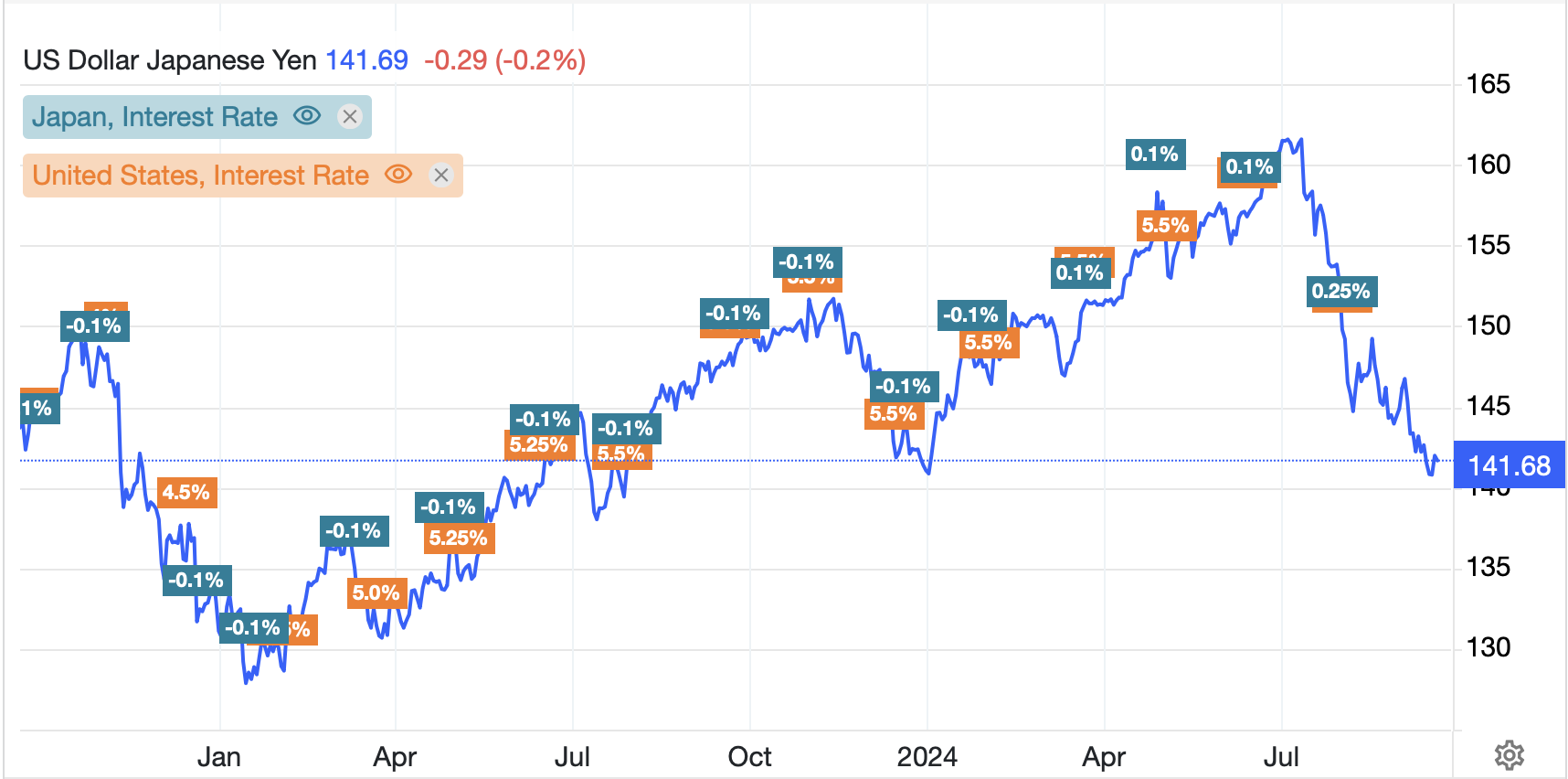
The other central bank meeting this week is the BOJ early Friday morning.  Currently, there is no expectation of a BOJ policy change although many analysts are looking for a rate hike by December.  However, I think it is worth looking at USDJPY in relation to the policy adjustments we have seen by both central banks over the past several years.  Hopefully you can see in the chart below that the exchange rate here has returned to the level when the Fed last raised rates in July 2023.  

Source: tradineconomics.com

Since then, after a dramatic further decline in the yen, with both policy rates on hold, the BOJ first adjusted the cap on YCC higher (from 0.50% to 1.0%) then eventually raised the policy rate from -0.1% to +0.25% where it is today.  During that time, Ueda-san has surprised markets several times, and has had help from the MOF regarding intervention, taking a completely different approach to the process than the Fed, who never wants to surprise markets. With this in mind, we must be prepared for another surprise on Friday.  One thing to remember is that the BOJ meeting announcement occurs after the market in Tokyo closes, so even though other markets, and of course the FX market will be able to respond, the Tokyo equity and JGB markets won’t be able to move until Monday.  The point is the reaction may take time to play out.  In this situation, I don’t have enough information to take a view, but I will say that if he tightens policy in any manner, USDJPY is likely to fall much further.

One other thing I realize is that I have not discussed QT/QE.  If the Fed changes that process, the current $25 billion/month of balance sheet runoff, that will be extremely dovish and be quite a boost for stocks, bonds and commodities while the dollar will get run over.

Ok, heading into this morning, and after a mixed and lackluster session yesterday in the US, Asian equity market all rallied with Japan (+0.5%) continuing its recent rally, while even mainland Chinese shares (CSI 300 +0.4%) managed a gain today.  However, European bourses are all softer this morning with the FTSE 100 (-0.6%) lagging after the higher-than-expected inflation data driving concerns the BOE won’t cut rates much.  But screens everywhere are red, albeit only modestly so.  US futures are currently (7:45) edging slightly higher as I continue to believe traders and investors are looking for a 50bp cut.

In the bond market, yields are higher across the board as the euphoria we have seen lately seems to be running into a bit of profit taking with Treasury yields higher by 3bps and European sovereign yields all higher by between 4bps and 6bps.  Perhaps the one surprise is that JGB yields are unchanged this morning as there seems to be no anticipation of a BOJ move, at least not yet.

In the commodity markets, oil (-1.0%) is giving back some of its recent gains but remains above $70/bbl.  It seems that the stories of a massive military strike by Ukraine deep in Russia have raised concerns amongst the punditry of an escalation of the war there, but it has not concerned energy markets, at least not yet.  In the metals markets, gold (+0.2%), which sold off yesterday, continues to find support while copper has been on a roll and has risen once again.  

Finally, as mentioned above, the dollar is softer overall against all its G10 counterparts and most EMG currencies as well. The one outlier here was KRW (-0.35%) where traders are starting to price in rate cuts by the BOK after yet another mild inflation report earlier this week.

Ahead of the Fed we see Housing Starts (exp 1.31M) and Building Permits (1.41M) as well as the EIA oil inventory data where expectations are for no real changes.  Until the FOMC release, look for quiet markets. Afterwards, I’ve given my views above.

Good luck

Adf

Unnerved

The Claims data last week preserved
The markets, which had been unnerved
By thoughts that Japan
Did not have a plan
To exit QE unobserved
 
Now yesterday’s data revisions
To Payrolls cemented decisions
That when Powell speaks
He’ll say, “in four weeks
Rate cuts are quite clear in my visions”


Well, the big news was that the BLS revised down the number of new jobs created between April 2023 and March 2024 by 818K, not far from the extreme calls of 1MM.  Alas, this has become more of a political talking point than an economic one with claims of subterfuge on the part of the current administration in an effort to flatter their record.  From an economic perspective, however, to the extent that we believe this data is accurate, it offers a far greater case for the Fed to cut rates next month.  After all, the strong labor market had been one of the key rationales for the Fed to maintain higher for longer, so if that market is not as strong as previously believed, lower rates would be appropriate.

In addition to the NFP revisions, which had gotten virtually all the press, the FOMC Minutes of the July 31stmeeting were also released.  It turns out that according to those Minutes, the discussions in the room included several members calling for a cut at that meeting, and unanimity in a cut by September.  That feels a bit more dovish than the post-meeting press conference where Powell wouldn’t commit to a September cut, seemingly trying to retain some optionality.  Now, the market has been pricing in a full 25bp cut since a week before the last meeting, so it’s not as though people have been fooled.  And we are still looking at a 30% probability of a 50bp cut in September, but to this poet, absent a negative NFP reading in two weeks’ time, September is going to bring a 25bp cut.

Here’s the thing, though, will it matter?  It certainly won’t have any impact on the economy for any appreciable time (remember those long and variable lags) although it could be a signaling event.  But exactly what does it signal?  If the economy is truly robust, why cut?  If the economy is weakening quickly, or not as strong as previously thought, then why just 25bps?  In the big scheme of things, 25bps has exactly zero marginal impact on economic activity.  If they were to explain they are entering a series of more aggressive rate cuts to accommodate weakening growth, well that seems like a signal they don’t want to send either, especially politically.  One final thought, when things are going well in the economy, nobody is talking about any kind of ‘landing’, whether soft or hard.  The very fact people are discussing a ‘soft-landing’ is recognition that the economy is slowing down.  I believe that most of us understand that is the case, but for the media to inadvertently admit that is the case in this manner speaks either to their stupidity or their cupidity.

Ok, so how did markets respond to these two stories?  The first thing to note is that while the NFP revisions were scheduled to be released at 10:00, they were a bit late.  As you can see in the chart below, there was an immediate jump in the equity market, which slowly retraced until the Minutes were released and then the dovishness was complete, and we saw a steadier appreciation.  

A green line graph with numbers and a black dot

Description automatically generated

Source: Bloomberg.com

Net, the clear belief from the investment community was that the Fed is more dovish than they have been letting on, and so equity markets in the US rallied on the day.  Once again, that followed through in Asia, where pretty much all markets except mainland China (CSI 300 -0.25%) followed suit with the Hang Seng (+1.45%) the leader, but strength throughout the region overall.  In Europe, Flash PMI data was released this morning showing that Germany continues to stumble, especially in the manufacturing sector, and that the whole of Europe is lackluster at best.  While the Olympics seemed to help French services output, net, there is not much excitement.  The upshot is that ECB members are talking up further rate cuts and the result is European bourses are gaining some ground this morning, but only on the order of 0.2%.  As to US futures, they are little changed at this hour (7:15).

In the bond market, yields are edging higher with Treasury yields up by 2bps and similar gains across Europe and the UK.  In truth, I would have expected European yields to slide a bit on the PMI data, but clearly that is not the case.  Interestingly, 10yr JGB yields slipped lower by another 1bp as the market there prepares for testimony by BOJ Governor Ueda tonight.  In a truly unusual event, the Diet (Japan’s congress) called him in to testify before both the Lower and Upper houses even though it is technically not in session.  It seems they are very concerned about his hawkishness and how it impacted Japanese stock markets and the yen two weeks ago.  (As an aside, I cannot imagine something like that happening in the US, it would be extraordinary given the ostensible independence of the Fed.)

Turning to commodity markets, after falling 1% further yesterday, oil (+0.5%) is bouncing slightly, although it remains far closer to the lower end of its trading range than even the center.  Gold (-0.3%) continues to hang around just above $2500/oz but has not made any real headway above since it first broke through that level last Friday.  A very interesting X thread on this subject by Jesse Colombo (@TheBubbleBubble), a pretty well-known commentator on markets (167K followers on X),  highlighted that while gold has made new all-time highs vs. the dollar, it has not done so vs. other currencies and that process needs to be completed to see a more significant move.  I raise this idea because if/when it occurs, it is likely to be a signal of far more distress in the economy and markets than we are currently seeing.  As to the rest of the metals complex, they are having lackluster sessions as well, with copper ceding -1.0% and silver (-0.15%) a touch softer.

Finally, the dollar refuses to collapse completely despite the growing view that the Fed is getting set to embark on a series of rate cuts.  While both the euro (-0.2%) and pound (+0.1%) are little changed this morning, both sit near 1-year highs vs. the dollar.  The thing about both these currencies that has me concerned is that energy policies currently being implemented in both Germany and the UK, with many other continental countries going down the same path, are almost guaranteed to destroy all manufacturing capability and force it to leave for somewhere with lower energy prices.  While both of those economies are clearly services driven, I assure you that the destruction of manufacturing capacity is going to have long-term devastating impacts on those nations, and by extension their currencies.  Just something to keep in mind.  Elsewhere, the yen (-0.6%) is slipping today and has been in a fairly tight range since the pyrotechnics from two weeks ago.  But we are also seeing weakness in ZAR (-0.75%), NOK (-0.5%) and SEK (-0.4%) to name a few, and general weakness, albeit in the -0.2% to -0.3% range across the rest of the G10 and EMG blocs.  The dollar is not dead yet.

On the data front, this morning brings Initial (exp 230K) and Continuing (1870K) Claims as well as the Chicago fed National Activity Index (.03) at 8:30.  Later this morning, Flash PMIs (manufacturing 49.6, services 53.5) are due and then Existing Home Sales (3.93M) finishes things off.  There are no scheduled Fed speakers but then all eyes are on Jackson Hole tomorrow when Chairman Powell speaks.

Given what we learned yesterday regarding both the labor market and the last FOMC meeting, it seems clear the Fed is going to cut 25bps next month.  Of more interest, I believe, will be the way Powell lays out his vision for what needs to occur for the Fed to continue the process and his guideposts.  Remember, they are still shrinking the balance sheet, albeit slowly, but cutting rates and reducing liquidity simultaneously may have unintended consequences.  If they stop shrinking the balance sheet, though, I believe the market will view that as a very dovish signal, and the dollar would fall sharply.  I’m not saying that’s what I expect, just that would be the result.  But for today, it is hard to believe we see a large move ahead of tomorrow’s speech.

Good luck

add

Ain’t

Ueda explained
Buying bonds is still our bag
But buying yen ain’t


The last of the major central banks met last night as the BOJ held their policy meeting.  As expected, they left the policy rate unchanged between 0.00% and 0.10%.  However, based on the April meeting comments, as well as a “leak” in the Nikkei news, the market was also anticipating guidance on the BOJ’s efforts to begin reducing its balance sheet.  Remember, they still buy a lot of JGBs every month, so as part of the overall normalization process, expectations were high they would indicate how much they would be reducing that quantity.

Oops!  Here is their statement on their continuing QQE program [emphasis added]:

Regarding purchases of Japanese government bonds (JGBs), CP, and corporate bonds for the intermeeting period, the Bank will conduct the purchases in accordance with the decisions made at the March 2024 MPM. The Bank decided, by an 8-1 majority vote, that it would reduce its purchase amount of JGBs thereafter to ensure that long-term interest rates would be formed more freely in financial markets. It will collect views from market participants and, at the next MPM, will decide on a detailed plan for the reduction of its purchase amount during the next one to two years or so. 

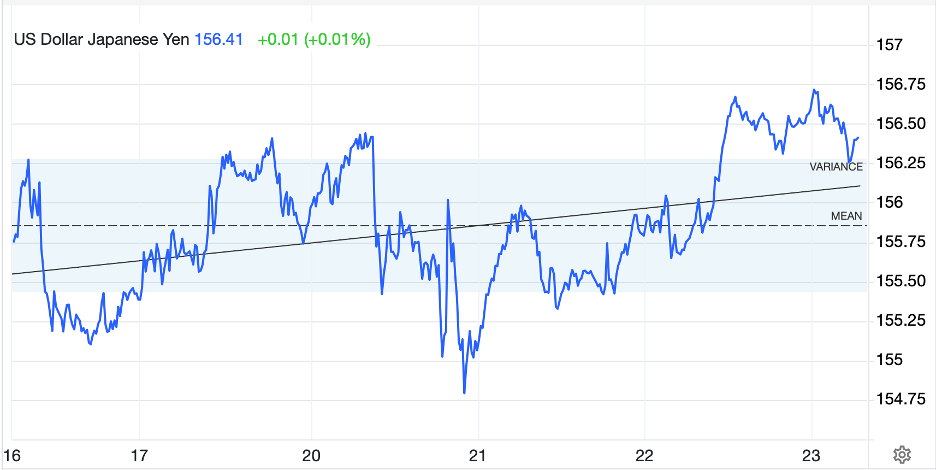
In other words, they have delayed the onset of their version of QT by another month and based on the nature of their process, where they pre-announce the bond buying schedule on a quarterly basis, it is entirely possible that the delay could be a bit longer.  You will not be surprised to know the yen fell sharply on the news, as per the below chart.

Source: tradingeconomics.com

In fact, it traded to its weakest (dollar’s highest) level since just prior to the intervention events in April.  However, as you can also see, that move was reversed during the press conference as it became clear to Ueda-san that his delay did not result in a desired outcome.  The issue was the belief that the BOJ cannot make decisions on interest rates and QT simultaneously (although for the life of me, I cannot figure out why that was the belief), and so Ueda addressed it directly, “We will present a concrete plan for long-term JGB buying operations in July. Of course, it’s possible for us to raise the short-term interest rate and adjust the degree of monetary easing at the same time depending on the information available then on the economy and prices.”

In the end, the only beneficiary of this was the Japanese stock market, which managed a modest rally of 0.25%.  Certainly, this did not help either Ueda’s or the BOJ’s credibility that they are prepared to normalize policy, and it also left the entirety of currency policy in the lap of the MOF.  The problem for Ueda-san is that until the Fed decides it is time to start cutting interest rates, a prospect which seems further and further distant, the yen is very likely to remain under pressure.  I am beginning to suspect that despite Ueda’s stated goal of normalizing monetary policy, the reality is that, just like every other central banker today, his bias is toward dovishness, and he cannot let go.  I fear the risk is that the yen could weaken further from here rather than it will strengthen dramatically, at least until there are real policy changes.  FYI, JGB yields closed 3bps lower after the drama.

Away from that, the overnight session informed us that Chinese economic activity appears to be slowing, at least based on their loan growth, or lack thereof.  Loans fell, as did the pace of M2 Money Supply and Vehicle Sales.  While none of these are typically seen as major data releases, when combined, it seems to point to slowing domestic activity.  The upshot is a growing belief that the PBOC will ease policy further thus supporting Chinese equities (+0.45%) and maintaining pressure on the renminbi which continues to trade at the limit of its 2% band vs. the daily CFETS fixing.

As to Europe, it is becoming clearer by the day that investors around the world have begun to grow concerned over what the future of Europe is going to look like.  Despite the ECB having cut their interest rates last week, the results of the European Parliament elections continue to be the hot topic and we are seeing European equity markets slide across the board, with France (-2.5% today, -5.8% this week) leading the way lower as President Macron’s Renaissance Party looks set to be decimated in the snap elections at the end of the month.  But the entire continent is under pressure with Italy (-2.8% today, -5.7% this week) showing similar losses and the other major nations coming in only slightly better (Germany -2.75% this week, Spain -3.9% this week).  You will not be surprised to know that the euro (-0.4%) is also under pressure this morning, extending its losses to -1.0% this week with thoughts it can now test the lows seen last October.

There is a great irony that the G7 is meeting this week as so many of the leaders there, Italy’s Giorgia Meloni and Japan’s Kishida-san excepted, looks highly likely to be out of office within a year.  Macron, Olaf Sholz, Justin Trudeau, President Biden and Rishi Sunak are all far behind in the polls.  One theory is that the blowback from the draconian policies put in place during the pandemic restricting freedom of movement and speech within these nations, as well as the ongoing immigration crisis, which is just as acute in Europe and the UK as it is in the US, has turned the tide on the belief that globalization is the best way forward.  

Earlier this year I forecast that there would be very severe repercussions during the multitude of elections that have already taken place and are yet to come.  Certainly, nothing has occurred that has changed that opinion, and in fact, I have a feeling the changes are going to be larger than I thought.  

The reason this matters is made clear by today’s market price action.  If the world is turning away from globalization, with a corresponding reduction in trade, equity markets which have been a huge beneficiary of this process (or at least large companies have directly) are very likely to come under further pressure.  As well, fiscal policies are going to put more pressure on central banks as the natural response of politicians is to spend more money when times are tough, and we could see some major realignments in market behaviors.   This will lead to ongoing inflationary pressures, thus weaker bond prices and higher yields, weaker equity prices, much strong commodity prices and the dollar, ironically, likely to do well as it retains its haven status.  Certainly, the euro is going to be under pressure, but very likely so will many other currencies.  This is a medium to long-term concept, certainly not something that is going to play out day-to-day right now, but I remain firmly in the camp that many changes are coming.

As to the rest of the markets overnight, yields are falling everywhere (Treasuries -5bps, Gilts -9bps, Bunds -12bps, OATs -6bps, Italian BTPs -1bp) as investors are seeking havens and for now, bonds seem better than stocks.  You will also notice that the spread between Bunds and other European sovereigns is widening as there is clear discernment about individual nation risk.  This is not a sign that everything is well.

Maintaining the risk-off thesis, gold (+1.25%) and silver (+1.00%) are rallying despite a much stronger dollar this morning and we are also seeing some strength in oil (+0.2%).

As to the dollar, it is stronger vs. almost every one of its counterparts this morning, most by 0.3% or more with CE4 currencies really under pressure (PLN -1.0%, HUF -0.8%).  However, there are two currencies that are bucking this trend, CHF (+0.25%) which is showing its haven characteristics and ZAR (+0.5%) where the market is responding to the news that the ANC has put together a coalition and that President Ramaphosa is going to remain in office.

Yesterday’s PPI data showed softness similar to the CPI on Wednesday but more surprisingly, the Initial Claims number jumped to 242K, its highest print since August 12, 2023, and a big surprise to one and all.  The combination of data certainly added to yesterday’s feel that growth and inflation were ebbing.  This morning, we get the Michigan Sentiment (exp 72.0) and then a couple of Fed speakers (Goolsbee and Cook) later on during the day.

I should note that equity futures are all in the red this morning, with the Dow continuing to lag the other markets, probably not a great signal of future strength.  Arguably, part of today’s price movement is some profit taking given US equity markets have rallied this week and month.  But do not discount the bigger issues discussed above as I believe they will be with us for quite a while to come and put increasing pressure on risk assets with support for havens.  As such, I think you have to like the dollar given both the geopolitical issues and the positive carry.

Good luck and good weekend

Adf

Dripping Lower

Like rain off a roof
The yen keeps dripping lower
Can it fall further?


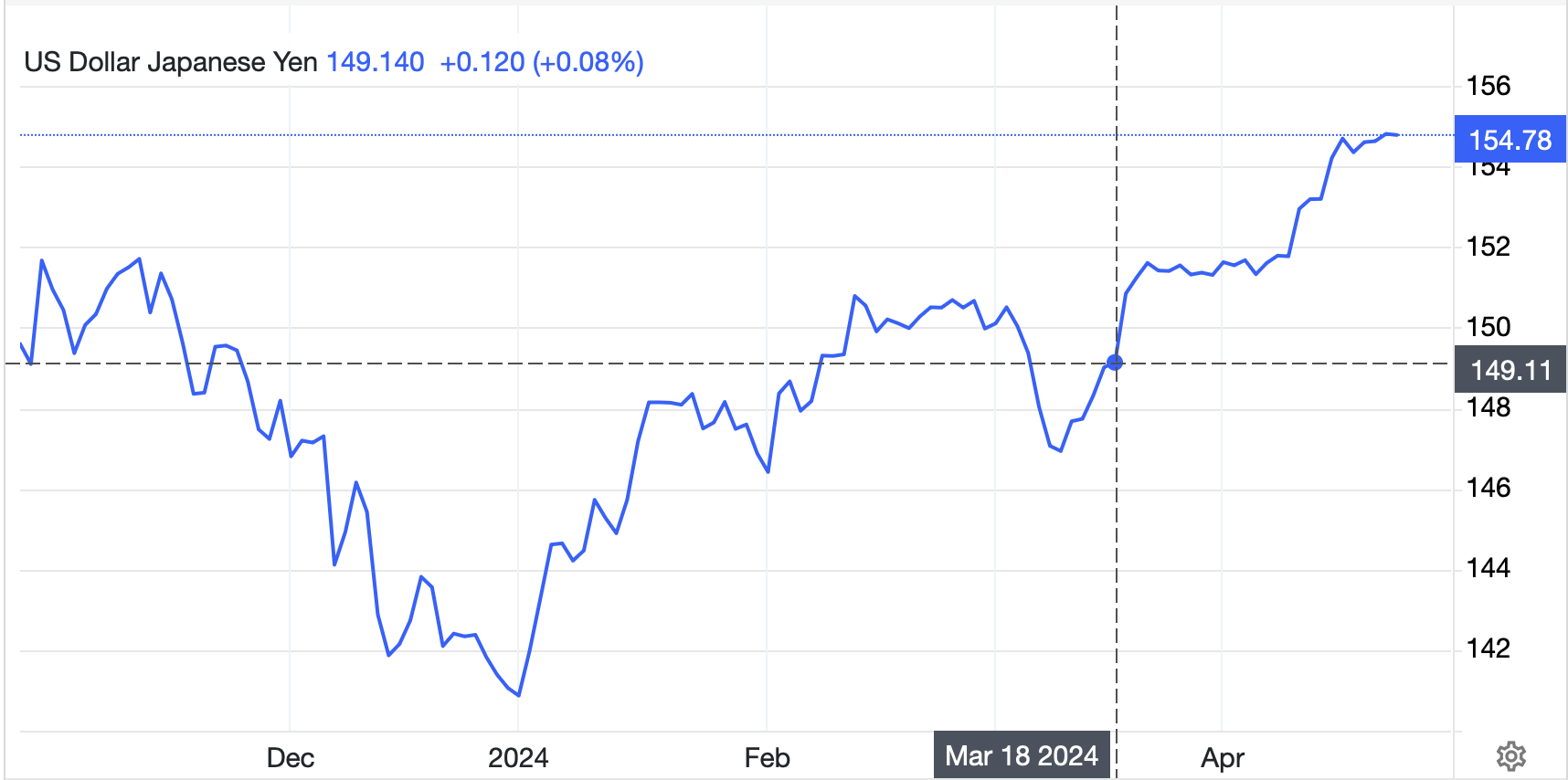
On a quiet morning after a welcome rebound in equity markets around the world, there has been an uptick in discussion regarding the yen, BOJ Governor Ueda and the upcoming BOJ meeting this Friday.  One of the things that seems to have Ueda-san and the rest of the BOJ confused is that after their last meeting on March 18, where they raised interest rates for the first time in forever, the yen has continued to weaken.  A quick look at the chart below shows the relatively steady decline in the currency since that date.

Source: tradingeconomics.com

Perhaps this is a sign that Japan’s monetary policy, at least given the enormous interest rate differentials with the US, just doesn’t really matter to the traders in the FX market.  A look at relative interest rate movements in the respective 10-year bonds shows that Treasury yields have rallied about 30bps while JGB yields have risen just half that amount since that BOJ meeting.  One thing that is becoming clearer is that the pressure on Ueda-san and FinMin Suzuki to do something about the weakening yen is growing.  It seems they have finally figured out that a weak yen has a direct link to rising yen prices of energy for both home and autos, and that the people in Japan are running out of patience with those rises.

Perhaps this explains the increase in the comments by these two critical players, with both threatening action if things get out of hand.  For instance, Suzuki explained, “I think it’s fair to assume that the environment for taking appropriate action on forex is in place, though I won’t say what the action is,” when speaking to Parliament last night.  His problem is he knows that intervention by Japan only will have no long-term impact and merely allow traders a better entry point to continue to pressure the yen lower. 

Meanwhile, Ueda-san was absolutely loquacious in his comments to Parliament, explaining, “we will set our short-term interest rate target at a level deemed appropriate to sustainably and stably achieve our 2% inflation target.  If underlying inflation rises toward 2% in line with our projections, we will adjust a degree of monetary easing. In that case, we will likely raise short-term interest rates.”  

Now, does this mean that they are going to do something at their meeting this week?  I think the probability of a policy change is vanishingly small.  Quite frankly, they are very aware that their current toolkit is not fit for the purpose of strengthening the yen and so jawboning is pretty much all they have.  In fact, to the extent that they would like to see the yen strengthen, their best bet is to call Chairman Powell and plead their case that the US should cut rates, and by a lot, or the world will end.  I don’t see that happening either.

Something worth noting is that Powell is facing pressure from multiple directions as foreign central bankers are desperate for the Fed to cut so they can too, and from the administration which believes that lower rates will help them in their quest to be reelected.  But, in the end, there is no evidence that the Fed is going to reverse their recent comments and turn dovish.  As long as that is the case, the trend higher in USDJPY remains quite clear and I see no reason to expect anything other than minor pullbacks in the near future.  However, if the Fed does cut rates despite the ongoing inflation pressures in the US, look for the dollar to fall sharply while risk assets explode higher.

So, while we all await both the BOJ and the PCE data on Friday, let’s recap the overnight session.  While green was the predominant color on screens overnight with Japan (+0.3%) and Hong Kong (+1.9%) leading the way, mainland Chinese stocks continue to suffer (-0.7%) dragging down Korean shares (-0.25%).  But otherwise, India, Taiwan, Australia, Singapore, etc., were all in the green.  In Europe, there is no question that things are looking up as every market is higher, most by 1% or more after the Flash PMI data was released showing that economic activity was picking up across the continent.  While manufacturing remains in contraction, and is hardly improving, the services sector is definitely stronger.  Meanwhile, at this hour (7:30) US futures are firmer by about 0.25%.

In the bond markets, price activity has been far more muted with Treasury yields recouping the 2bps they lost yesterday, while European sovereigns are higher by 1bp across the board.  The ECB commentary continue to highlight a June hike with the most dovish acolytes calling for 100bps of cuts this year (Portugal’s Centeno) while Spain’s de Guindos reminded everyone that the Fed was still driving the bus and they need to think about the whole world, not just the US.  As you can see, Powell faces pressure from all over.

On the commodity front, the retracement from the massive bull rally in metals prices is continuing apace with gold (-1.4%), silver (-1.4%) and copper (-1.1%) all under more pressure today after having fallen sharply for the past two sessions already.  My take is that this is an overdue correction from a remarkable move higher, but that the underlying story remains intact.  Certainly, the apparent lessening of tensions in the Israel-Iran issue has helped this movement as well as its impact on the price of oil (-0.75% today, -4.65% in past week).  However, the inflation story remains front and center when it comes to pricing commodities and there is no evidence whatsoever that prices are slipping back.  As we head toward summer, I do anticipate that metals demand will return, especially if the economy continues to perform at its current levels.

Finally, the dollar is slightly softer this morning but remains above 106 on the DXY.  We have already discussed the yen, which cannot find a bid anywhere, but the pound (+0.25%) is rebounding after PMI data in the UK was also a bit better.  However, overall, there are gainers and losers in both the G10 and EMG blocs, the largest of which is the ZAR (-0.3%) which is clearly suffering alongside the slide in metals prices.  Not surprisingly, NOK (-0.2%) is feeling pressure from oil’s decline.  But the euro has edged higher, and it has taken its CE4 counterparts higher while LATAM currencies seem to be taking the day off entirely.  We need real news to change the story here.

On the data front, we see the Flash PMI data (exp Manufacturing 52.0, Services 52.0) and New Home Sales (662K) and that’s really it.  With no Fed speakers, once again the market will take its cues from earnings releases with today’s biggest likely to be Google Alphabet and Tesla.  The dollar has been on a roll lately, so it would be no surprise to see a bit of a pullback, but as long as the Fed is seen as maintaining its current tightness, it will be hard-pressed to decline very much.

Good luck

Adf

A Suggestion

Nought point five percent
Is not a rigid limit
It’s a suggestion

At least that is the word we got last night from Kazuo Ueda, BOJ Governor when he announced some surprising policy changes.  No longer would 10-yr JGBs be targeted to yield 0.0% +/- 0.50%, which in practice had meant a 0.50% cap.  Going forward, the BOJ would buy an unlimited amount of JGBs at 1.0%, if necessary, as its new framework.  Perhaps the most humorous part of the concept was the suggestion that they always saw the 0.50% cap “as references, not as rigid limits, in its market operations.”  That’s right, after 7 years of a seemingly explicit cap on JGB yields, with the BOJ willing to buy unlimited amounts in order to prevent yields from climbing, now they mention it was merely a suggestion, a guideline rather than a hard limit.  It is commentary of this nature that tends to undermine investor trust in central bankers.

Given the surprising nature of the policy changes, although they left their O/N financing rate at -0.10%, it should be no surprise that the market had some large, short-term responses.  JGB yields jumped 10bps on the news, trading to a new 9-year high at 0.575% before slipping back a few bps to close the week.  The Nikkei, meanwhile, fell nearly 2.5% in the immediate aftermath of the decision, but rallied back all afternoon there to close lower by just -0.4%.  It turns out the financial sector benefitted greatly as higher rates really helps them.  As to the yen, it saw substantial short-term volatility, as ahead of the meeting it weakened nearly 1.75%, trading above 141.00, but very quickly reversed course and rallied > 2% as the dollar briefly fell to 138.00.  In the end, though, the yen is just a hair stronger on the day now, back near 139.50 where things started.

The lesson, I think, is that policy shifts tend to have very immediate consequences, but the longer term impacts, especially in the currency market where we have a lot of moving pieces between the Fed, ECB and BOJ, will take longer to play out.

In Europe, inflation remains
The issue that’s caused the most pains
But growth there is stalling
So, Christine is calling
For slowing the rate hike campaigns

“We have an open mind as to what decisions will be in September and subsequent meetings…We might hike, and we might hold. And what is decided in September is not definitive, it may vary from one meeting to another,” Lagarde said.It was with these words that Madame Lagarde informed us the rate hiking cycle in the Eurozone may have ended.  Despite the fact that core CPI remains above 5.0% while their deposit rate is now at 3.75%, seemingly not high enough to effectively combat the inflation situation, it is becoming ever clearer that the European growth story is starting to slide.  This is in direct contrast to the US growth story, which based on yesterday’s extremely robust data, shows no signs of fading.

But as I have written numerous times in the past, once the Fed is perceived to have stopped raising interest rates, it was clear the ECB would be right behind them.  The entire basis of my stronger dollar thesis has been that other central banks will find it very difficult to tighten policy aggressively to fight inflation if the Fed has stopped doing so.  

In the end, no country really wants a strong currency as the mercantilist tendencies of every country, seeking to increase exports at the expense of their domestic inflation situation, remains quite strong.  Faster growth with higher inflation is a much preferred economic outcome for essentially every government than slower growth with low inflation.  Inflation can always be blamed on someone else (greedy companies, Ukraine War, OPEC+, supply chain disruptions) while faster growth can be ‘owned’ by the government.

So, between the ECB and BOJ, we did see further policy tightening in line with the Fed’s actions on Wednesday.  Arguably, the difference is that the US economic data continues to be quite strong, at least on the surface.  Yesterday’s first look at Q2 GDP printed at 2.4%, much higher than expected and showing no signs of the ‘most widely anticipated recession in history.’  The strength was seen in Government spending (IRA and CHIPS Act), Private Domestic Investment (which is directly related to that as companies build out new plant infrastructure) and Services, i.e. travel and restaurants.  Once again, I will say that as long as the US economy continues to show growth of this nature, and especially as long as the Unemployment Rate doesn’t rise sharply, the Fed will have free rein to continue to raise rates going forward if inflation does not settle back to their 2% target.

One thing to consider regarding the central bank comments and guidance is that virtually every one of them has ended the strict forward guidance we had seen in the past.  Rather, data dependence is the new watchword as none of them want to be caught out doing the wrong thing.  Alas, the result is that, by definition, if they are looking at trailing data, they will always be doing the wrong thing.  I expect that one of the key features of the past 40 years, ever reducing volatility in markets, is going to be a victim of the current framework.  It is with this in mind that I suggest hedging financial exposures, whether FX, rates, or commodities, will be far more important to company balance sheets and bottom lines than they have been in the past.

Ok, let’s see how investors are behaving today as we head into the weekend.  We’ve already discussed the Japanese market, but Chinese shares, both onshore and in HK, had a very strong day as there was more talk of official policy support for the property market there.  Ultimately, it is very clear they are going to need to spend a lot more money to prevent an even larger calamity.  European shares, though, are generally little changed this morning with investors preparing to take the month of August off, as usual there.  Finally, US futures are higher this morning after what turned out to be a surprising fall in all three major indices yesterday.  The overall positive data plus indication that the Fed may be done seemed to be the right conditions for further gains.  But markets are perverse, that much we know.  We shall see if US markets can hold onto these premarket gains.  I would say that a lower close on the day would be quite a negative for the technicians.

In the bond market, yesterday saw US 10-year yields jump 15bps, its largest rise this year, although it is giving back about 4bps of that this morning.  European sovereigns, though, are little changed this morning and have not been subject to the same volatility as the Treasury market given the far less exciting economic picture there.  If the ECB is truly finished, my take is yields there could slide a little over time.

In the commodity markets, oil (-0.35%) is a touch lower this morning, but the uptrend continues.  This certainly seems to be more about reduced supply than increased demand, although with the US data, the demand picture looks better.  Interestingly, both gold (+0.6%) and copper (+1.0%) are higher this morning despite the dollar holding its own.  Yesterday saw a sharp decline in both and I think there is a realization that was overdone.

Speaking of the dollar, it is modestly softer today after a strong gain yesterday.  In the G10, GBP (+0.6%) is the leader followed by NOK (+0.5%) although AUD (-0.6%) and NZD (-0.3%) are taking the opposite tack.  The pound seems to be benefitting from anticipation of next weeks’ BOE meeting where 25bps is a given, but the probability of a 50bp hike seems to be creeping up.  Meanwhile, NOK is just following oil’s broad trend with WTI just below $80/bbl now.  Meanwhile, Aussie seems to be suffering some malaise from the BOJ actions, at least that’s what people are saying although I’m not sure I understand the connection.  Perhaps it is the idea that higher JPY yields will result in unwinding the large AUDJPY carry trades that are outstanding.  

However, the emerging markets have seen a much wider dispersion of performance with much of the APAC bloc under pressure last night on the back of the strong dollar performance yesterday, while we are seeing strength in LATAM and EEMEA currencies this morning, which really looks an awful lot like simple trading activity with positions getting reduced after yesterday’s dollar performance.

In addition to the GDP data yesterday, we saw a lower-than-expected Initial Claims print at 221K while Durable Goods orders blew out on the high side at 4.7%!  Again, lots to like about the US data right now.  Today we see Personal Income (exp 0.5%) and Spending (0.4%) along with the Core PCE Deflator (0.2% M/M, 4.2% Y/Y) and finally Michigan Sentiment (72.6).  based on yesterday’s results, I would expect the Income and Spending data to be strong along although PCE is probably finding a bottom here.

In the end, even if the Fed has stopped hiking, although with the economy still showing strength that is not a guaranty, I find it hard to believe that the ECB will go any further, and the tendency around the world will be to slow or stop tightening as well.  I still like the dollar in the medium term.

Good luck and good weekend

Adf

Double Secret Inflation

In Sintra, each central bank head
From Europe, Japan and the Fed
Explained all was well
Amongst their cartel
So, ideas of changing were dead

However, in Asia it seems
The PBOC’s latest schemes
To strengthen the yuan
Have failed to catch on
Look, now, for a change in regimes

The panel in Sintra that mattered had the three key central bank heads on the dais, Powell, Lagarde and Ueda, and each one held true to their recent word.  Both Powell and Lagarde insisted that inflation remains too high and that the surprising resilience in both the US and European (?) economies means that they would both be continuing their policy tightening going forward.  Powell hinted at a July hike and Lagarde promised one a few weeks ago.  At the same time, Ueda-san explained that while headline inflation was higher than their target, given the lack of wage growth, the BOJ’s ‘double-secret’ core inflation reading was still below 2% and so there would be no policy changes anytime soon.  He did explain that if this key reading moved sustainably above 2%, it would be appropriate to tighten monetary policy, but quite frankly, my take (and I’m not alone) is that all three of these central bank heads are very happy with the current situation.


Why, you may ask, are they happy?  Well, politically, inflation remains the biggest headache for both Powell and Lagarde, and quite frankly most of the rest of the world, while in Japan, recent rises in inflation have not raised the same political ire.  At the same time, as long as the BOJ continues YCC and QE with negative rates, the flood of liquidity into the market there helps offset the liquidity withdrawn by the Fed and ECB.  The result of this policy mix is a very gradual reduction in total global liquidity along with an ongoing demand for US and European sovereign issuance.  It should be no surprise that Japan is now the largest holder of US Treasuries outside the Fed.  As well, the policy dichotomy has resulted in a continued depreciation of the yen which supports the mercantilist aspects of the Japanese economy.  And finally, higher inflation in Japan helps erode the real value of the 250% of GDP worth of JGBs outstanding, allowing eventual repayment of that debt to proceed more smoothly.  Talk about a win, win, win!  Until we see a material change in the macroeconomic statistics in one of these three areas, it would be a huge surprise if policies changed.


The upshot of this analysis is that it seems unlikely that we are going to see any substantive movement in yields, either up or down, given the relative offsets in policy, and that the yen is likely to continue to erode in value.  Last autumn, the yen fell very sharply, breaching 150 for a short time and generating serous angst at the BOJ and MOF.  We saw intervention and the idea was there was a line in the sand at that level.  However, my take is that as long as the move remains gradual, and it has been gradual as the yen has steadily, but slowly depreciated for the past 5 months, about 2%/month, we are likely to see more verbal intervention, but not so much in the way of actual activity.  In the end, unless policies change, actual intervention simply serves to moderate the move.


Speaking of failed intervention, we can turn to China which has a similar problem to Japan, weakening growth and low inflation.  As I have written before, a weak renminbi is the best outlet valve they have, and the market has been doing the job.  However, here the movement has been a bit faster than the PBOC would like thus resulting in more overt and covert intervention.  On the overt side, we continue to see the PBOC try to fix the onshore currency strong (dollar lower) than the market would indicate as they try to get the message across that they don’t want the currency to collapse.  On the covert side, there has been an increase in the number of stories regarding Chinese banks, like China Construction Bank and Bank of China, actively selling USDCNH, the offshore renminbi in an effort to slow the currency’s depreciation.  But the story that is circulating is that all throughout Africa and Asia, nations that were encouraged to accept CNY for sales of commodities are now quite unhappy with the CNY’s weakness and are quickly selling as much as they can in order to preserve their reserve’s value.  My sense is this process will continue as the dichotomy between a stronger than expected US economy and a weaker than expected Chinese one continues to push the renminbi lower.  PS, for everyone who was concerned about the dollar losing its reserve currency status to the renminbi or some theoretical BRICS backed currency, this should help remind you of why any change to the dollar’s global status is very far in the future.


And those are today’s stories.  Yesterday’s mixed US risk picture has been followed overnight with Chinese shares, both Mainland and Hong Kong, suffering but the Nikkei eking out a gain.  In Europe, the FTSE 100 is under pressure, but we are seeing strength on the continent despite what I would consider slightly worse than expected data prints in German State CPIs as well as Eurozone Confidence measures.  However, the one place where inflation slowed sharply was Spain, where headline fell to 1.9%!  While that was a touch higher than forecast, it is the first reading of any country in the Eurozone below the 2% level since early 2021.  Alas, what is not getting much press is the fact that core CPI there fell far less than expected to 5.9% and remains well above targets.  The ECB has a long way to go.


Bonds are under pressure across the board today, with yields higher by about 3bps-4bps in Treasuries and across Europe.  This seems to be a response to the idea that a) neither the Fed nor ECB is going to stop raising rates and b) inflation is not falling as quickly as hoped.  JGB yields, though, remain well below the YCC cap at 0.38% so there is no pressure on Ueda-san to change his tune.


Oil prices are creeping higher this morning but remain below $70/bbl and in truth have not done very much lately.  The big picture of structural supply deficits vs. concerns over shorter term demand deficits due to the coming recession continue to play out as choppy markets but no direction.  Copper has fallen sharply this morning and is down more than 5% in the past week.  Its recent rally appears to have been a short squeeze more than a fundamental view.  Gold, meanwhile, continues to consolidate just above $1900/oz.


Finally, the dollar is mixed on the day, with both gainers and losers across the EMG space although it is broadly lower vs the G10.  AUD (+0.5%) is the leading major currency after better-than-expected Retail Sales data was released overnight but the rest of the bloc, while higher, is just barely so.  In the EMG, PLN (+0.75%) is the best performer, but that is very clearly a position rebalancing after a week of structural weakness.  On the downside, KRW (-0.75%) is the worst performer after weaker Chinese data impacted the view of Korea’s future.  Otherwise, most currencies are relatively unchanged on the day.


We get some important data today starting with Initial Claims (exp 265K) and Continuing Claims (1765K) as well as Q1 GDP (1.4%).  Frankly, since this is the third look at GDP, I expect that the Claims data, which has been trending higher lately, is the most critical piece.  If we see another strong print, be prepared for the recession narrative to come back with a vengeance, but if it is soft, then there will be nothing stopping the Fed going forward.


Powell made some comments this morning in Madrid, but they were about bank stability not economic policy, and we hear from Bostic this afternoon.  But frankly, I see little reason for a change in sentiment anywhere on the Fed given the data continues to show surprising economic strength.  As such, I still like the dollar medium term.


Good luck

Adf