Spinning More Heads

The speed of the change underway
In global relations today
Is spinning more heads
And tearing more threads
Than ever before, one might say
 
For markets, the question of note
Is how will investors all vote
Are bulls still in charge
Or bears now at large
Who seek, excess profits, to smote


It is becoming increasingly difficult to focus only on market activity given the extraordinary breadth of important, non-market activities that are ongoing.  When I think back to previous periods of significant market volatility and uncertainty, it was almost always driven by something endogenous to finance and the economy.  Going back to Black Monday in 1987, or the Thai baht crisis in 1997 or the Russia Default in 1998, the dot-com crash in 2000, and the GFC in the wake of the housing bubble (blown by the Fed) in 2008-09, all these periods of significant market volatility were inward looking.

But not today.  Trump 47 has become the most significant presidency since Ronald Reagan with respect to changing both domestic and international realities.  The key difference is that Mr Reagan worked within the then consensus view of international relations, merely pushing them to the limit while Mr Trump sees those views as constrictions needing to be removed.

In fairness, the world was a very different place in the 1980’s, notably for the fact that China was not a major player in any sphere of economic activity and was essentially ignored.  That is no longer the situation, and the entry of another power player has complicated things.  Arguably, this is why the president sees the old rules as obsolete, they were built for a different time with a different cast of characters.  Regardless, for those of us paying attention to markets, it is imperative to widen our view to include international relations as well as international finance.

With that as preamble, a look at today’s headlines reminds us that keeping up with the news is not for the faint of heart.  Starting with Venezuela and the impact on oil (+1.6%), news sources are littered with articles explaining why the US acted as we did and the potential implications for energy markets and energy producing countries.  From what I can tell, Venezuela recognizes that they are completely beholden to US demands at this point with respect to their oil industry (mining as well I presume although that gets less press).  And you can be sure that means they will be expected to pump more, with US corporate help, and direct their sales to the US, as opposed to Cuba, China and Iran.

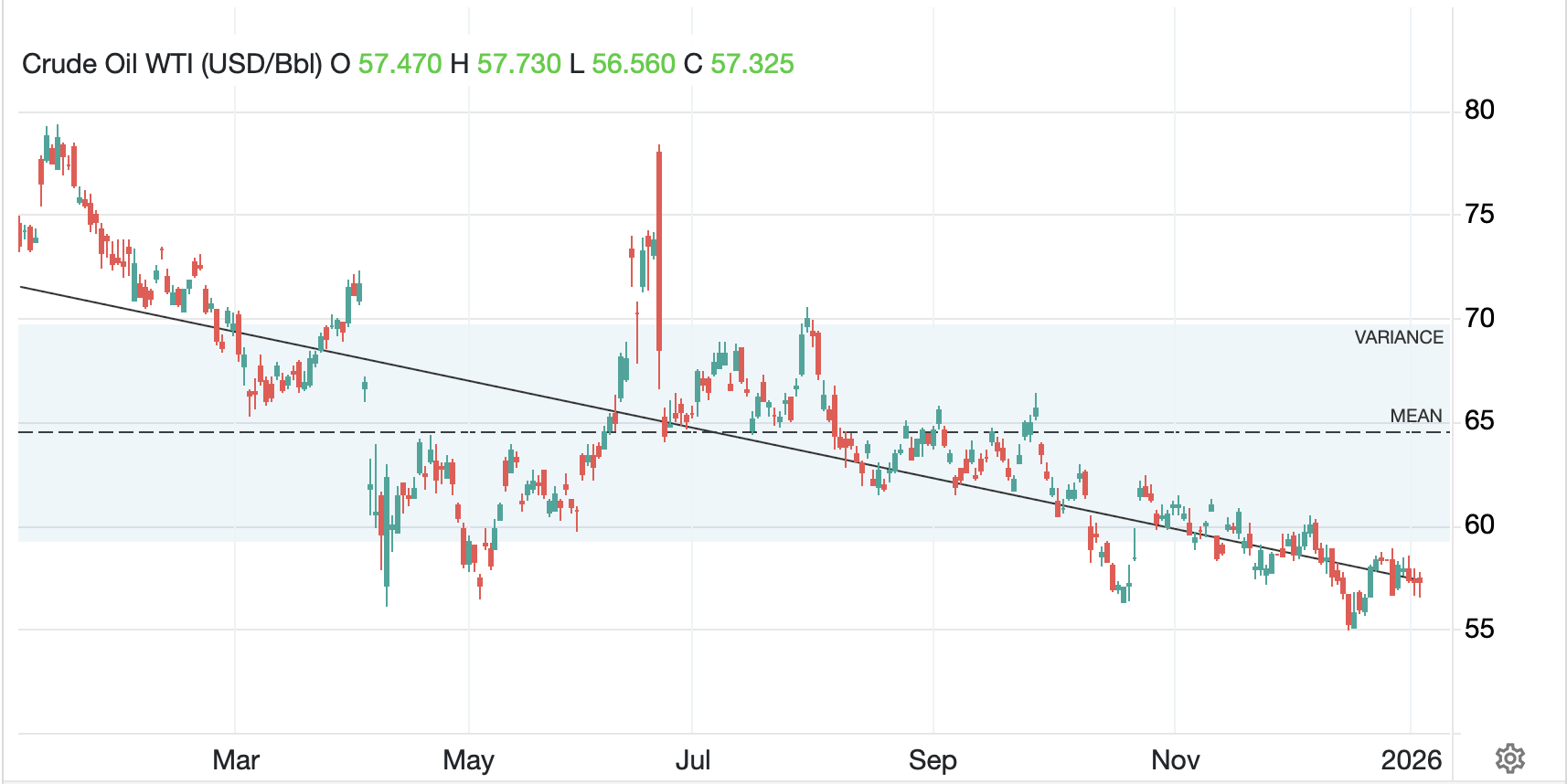
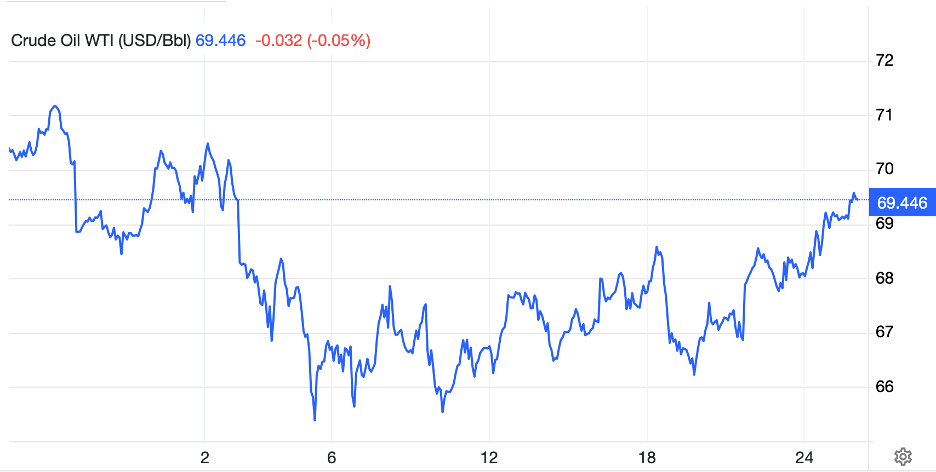
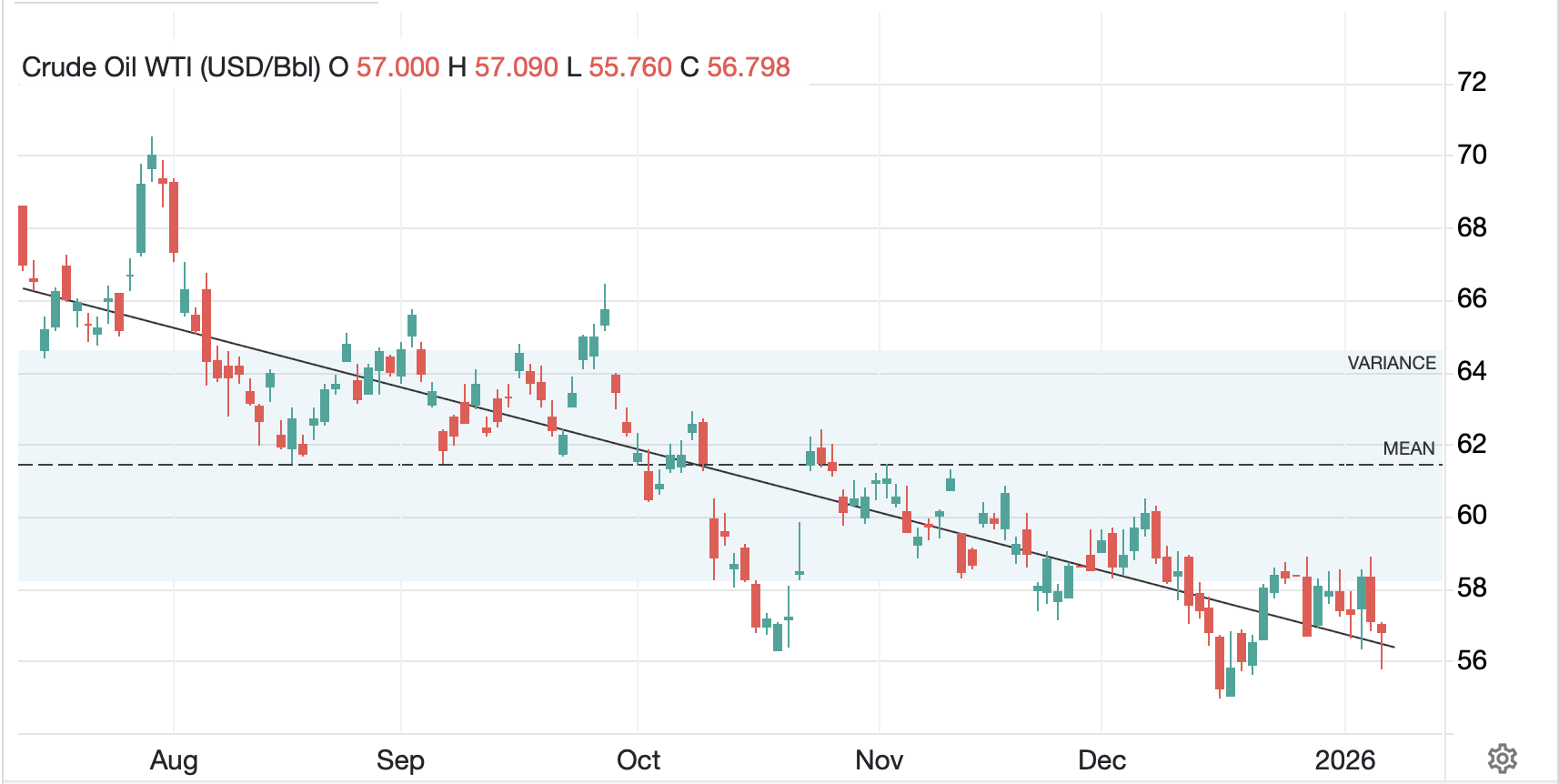
Despite today’s rally, it remains my strong opinion that the price of oil has further to decline.  The trend continues to be sharply lower, as per the below chart, and the domestic political demand of reducing gasoline prices is going to keep this particular trend intact, I believe.

Source: tradingeconomics.com

News overnight indicated that two more shadow fleet tankers have been apprehended which is simply all part of the same plan, bring Venezuela back online legitimately with a focus to sell to the US.  The other global issue that is going to weigh on the price of oil are the ongoing protests in Iran which if ultimately successful at overthrowing the Ayatollah’s theocracy, will almost certainly bring Iran back into the brotherhood of nations, and see the end of sanctions on Iranian oil.  While that is bad news for China (and India) who buy a lot of cheap sanctioned oil, it will increase production and weigh on market prices.

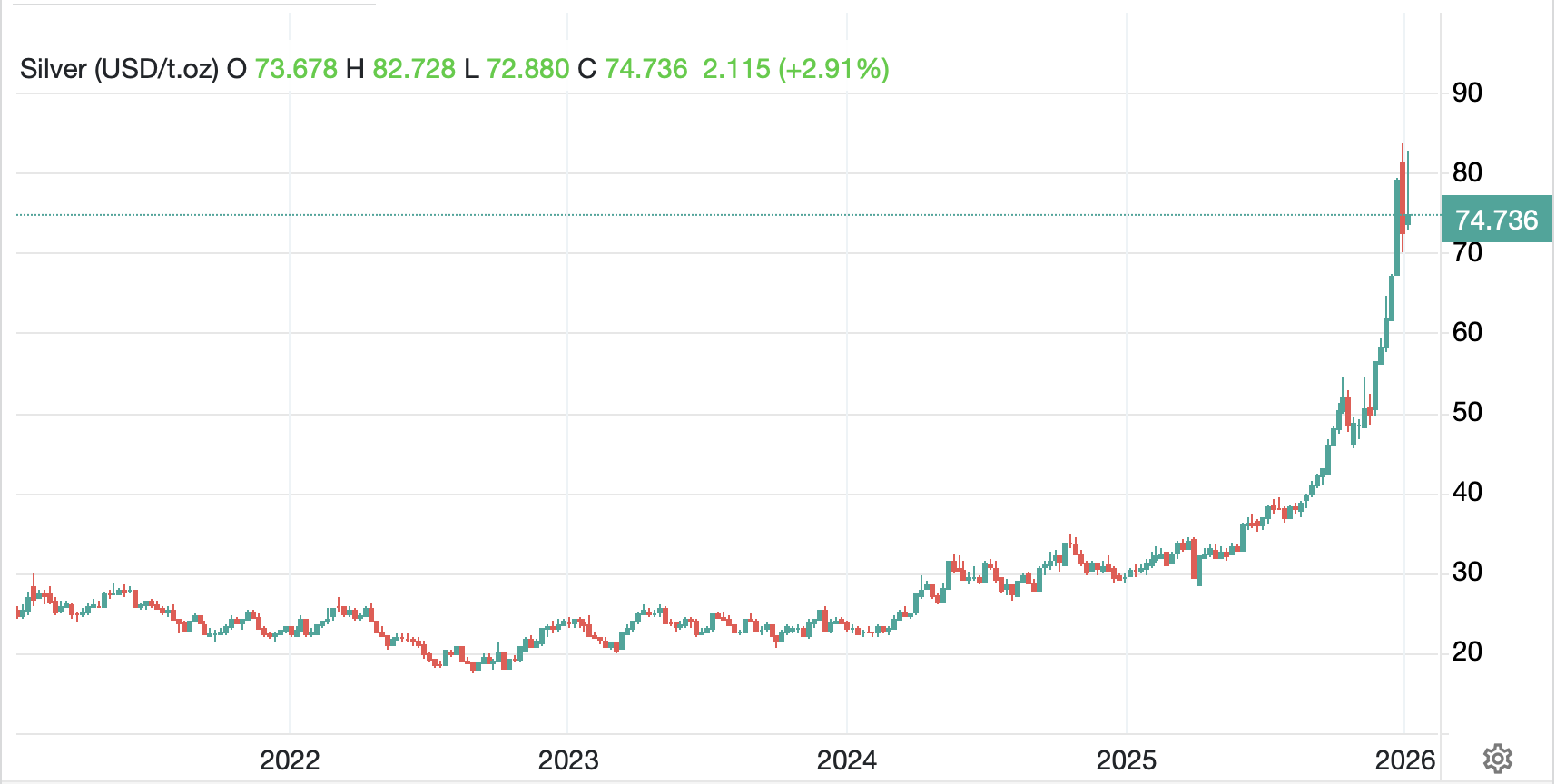
The other sector of the commodity markets, metals, have been their own roller coaster of late, with far more volatility than any other product, cryptocurrencies included.  It cannot be a surprise that we are seeing prices retrace after the extraordinary price action over the past several months.  The silver (-4.4%) chart below is the very definition of a parabolic move and history has shown that moves of this nature tend to see, at the very least, short-term sharp reversals, even if the ultimate trend is going to continue.  
Source: tradingeconomics.com

The underlying features in these markets remain supply shortages, meaning that there is more industrial demand for utilization than there is new supply that comes to market each year.  In silver, the number apparently is ~100 million ounces, and deliveries of physical metal remain the norm these days.  That is a telling feature of the market as historically, cash settlement was sufficient.  Given the recent run, it is no surprise that gold (-0.8%) and platinum (-6.5%) are also declining sharply, but nothing has changed my view that these will trend higher this year.  One last thing about silver (h/t Alyosha), the Bloomberg commodity index (BCOM) is rebalancing next week and given the huge moves in precious metals, along with the lack of change in percentage allocation, there will be significant selling over the course of the next week, upwards of 70 million ounces of silver, which will go a long way to satisfying the shortage this year.  It will be interesting to see if demand remains intact. 

If we turn to the dollar, rumors of its death remain exaggerated.  Certainly, the price action thus far this year, and even over the past six months, points to gradual strength (see chart below from tradingeconomics.com).

Again, I have a hard time understanding the argument that the dollar will decline this year based on the fact that the US economy continues to outperform the rest of the G10, there are substantial inward investment promises that are beginning to be seen (shipbuilding, semiconductors, steel) and the US interest rate structure remains higher than the rest of the G10.  While I understand markets look forward, it is becoming increasingly difficult for me to see the benefits of European monetary policy as a driver for owning the euro, and given their industrial/energy policies are disastrous, I don’t see the rationale.  The same can be said for the pound, I believe.

In today’s session, while the movement is mostly marginal (EUR 0.0%, GBP -0.1%, SEK -0.3%, AUD -0.4%), the trend remains intact and the movement is broad with almost all G10 and EMG currencies slipping a bit further.  Money goes where it is best treated, and I am hard pressed to find other nations that treat money better.  Although…

The equity markets are a bit shakier this morning after two presidential tweets yesterday regarding institutional ownership of housing (he wants to end that for single family homes) and defense company spending priorities (he wants defense companies to end stock buybacks and dividends and invest in R&D and production).  It is not clear to me whether he can successfully force these actions, but his bully pulpit is significant.  These resulted in sharp declines in directly impacted companies, but regarding defense, he also came out of a meeting with Congressional leaders and said he wants to budget there to grow to $1.5 trillion.  

The upshot is confusion here which was evidenced by more weakness than strength in the US session and similarly, declines in Asia (Japan -1.6%, China -0.8%, HK -1.2%).  Elsewhere in the region, India (-0.9%) continues to be the laggard, but there was more red than green overall.  In Europe, red is also today’s color, albeit not as bright as in Asia.  The DAX (-0.2%), CAC (-0.25%) and FTSE 100 (-0.3%) are emblematic of the situation as investors dismissed better than expected German Factory Order data (+5.6%) although the rest of the data released was mostly at expectations.  I guess the question is does Europe treat money better than the US?  I would argue not, but that’s just my view.  Meanwhile, at this hour (7:55), US futures are down slightly, about -0.1% across the board.

Finally, the bond market remains an afterthought almost everywhere.  Perhaps the most amazing thing President Trump has accomplished is to remove the focus on the latest tick in the 10-year bond as a key metric for the economy.  So, this morning, its 1bp rise just leaves it right in that 4.0% – 4.2% range that has existed for months.  Most European sovereign yields edged higher by about 3bps with Germany (+7bps) the outlier here after that strong Factory Orders data.  Also worth noting is that JGB yields slipped -5bps overnight as the market prepares for the first 30-year JGB auction of the year.  Recent 10-year auctions have been received quite well, hence the anticipation of something good here.

On the data front, Initial (exp 210K) and Continuing (1900K) Claims lead the way along with the Trade Balance (-$58.9B) and then Consumer Credit ($10.0B) this afternoon.  Yesterday’s ADP data was a touch softer than expected but the JOLTS data was much worse, showing a decline in job openings of 300K and falling well short of expectations of 7.6M.  At this point, though, to the extent that people are paying attention to the data, tomorrow’s NFP is of far more import I believe.  

The hardest thing about these markets is the White House bingo card and its surprises that can change working assumptions.  Absent something new there, I see the dollar drifting higher helped by both its recent trend and the short-term pullback in metals.  

Good luck

Adf
The Doctrine, Donroe

There once was a time in the past
When Vene-zu-ela was cast
As queen of the ball
With Maduro’s fall
But life around Trump moves so fast
 
He’s already moved to expand
His target to Denmark’s Greenland
The EU’s gone crazy
And called Trump fugazy
While claiming that they’ll take a stand
 
But really, the Doctrine, Donroe
Explains that the US most grow
Its regional strength
And keep at arm’s length
It’s foes from Beijing to Moscow


It is truly difficult to keep up with all the things that are ongoing in the world these days as so much is happening so quickly.  It is very easy to understand Lenin’s quote, “there are decades where nothing happens; and there are weeks where decades happen” given recent events.  This is clearly one of the latter weeks.

So, Trump, after successfully taking down Maduro has turned his sights on Greenland, something he has discussed from Day 1 of this administration, but apparently now, there seems to be a willingness to discuss things on the other side.  At the same time, from what I read on X, the city of Abadan in Iran has basically ‘fallen’, at least with respect to the Iranian regime’s control as the police are marching with the protestors now.  The rumors are that the Ayatollah has already made escape plans to Moscow.

From a geopolitical perspective, if Iran sees a regime change, which appears increasingly likely, and if the US throws its support behind the replacement regime, it would appear to be a significant power play against China.  After all, if sanctioned Iranian and Venezuelan oil was no longer being sold on the cheap to China, two places where they receive a significant amount of their daily requirements, (between 20% – 25% according to Grok) it would be a major blow.  

But from our lens in markets, if the Iranian regime falls and sanctions are lifted, suddenly there is much more unsanctioned oil available, and its price is likely to decline further.  This morning, oil (-0.6%) is slipping further after a sharp decline yesterday with Monday’s rally a wispy memory.  I have maintained the trend here remains lower, and that was without government changes in sanctioned nations.  As you can see from the chart below, nothing about this story has changed.

Source: tradingeconomics.com

In the meantime, be prepared for all those who had just shown their new bona fides about Venezuela to be explaining the Greenland story from their newly acquired “deep” knowledge.  This poet certainly doesn’t know enough about Greenland to make any prognostications, but it would not surprise me if within a matter of weeks, we reach an accord with the territory where the US plays a much greater role in its activities while increasing its military presence on the island.  

And to think, we are just finishing the first week of 2026.  Do not be surprised if, as the year progresses, there are more government changes in Europe as the current leadership there has been shown to be weak and ineffective, and an increasing number of people are unhappy with the situation.  While fears over the fall of NATO are rife now, if Germany, France and the UK wind up having snap elections, a distinct possibility at this point, and the new regimes are AfD, RN and Reform UK led, there could well be much greater agreement on the way forward for the alliance.

However, like most of you, I am neither a politician nor geopolitical analyst, I’m just a poet who watches the world and tries to make sense of how it impacts markets.  So, let’s go down that road.

After another strong equity session in the US, where both the DJIA and S&P 500 made new all-time highs, the story in Asia seemed to be one of some early profit-taking after strong rallies.  So, Japan (-1.1%), China (-0.3%) and HK (-0.9%) all slipped during the session with generally less excitement seen overnight than earlier in the week.  India (-0.1%) continues to lag, and while Korea (+0.6%) managed to maintain its upward momentum, the rest of the region was relegated to +/- 0.4% or less in their movement.  

As to Europe, only the DAX (+0.6%) is showing any positivity this morning, mostly on defense names still performing well, while the UK (-0.6%) is lagging after weaker than expected Construction PMI data (40.1 vs. 42.5 exp) and the rest of the continental bourses are little changed overall.  Eurozone inflation was confirmed at 2.0%, cementing the idea that the ECB will remain on hold, so I suspect opportunities here will rely on global trends.  As to US futures, at this hour (7:10) they are mixed, but with movement less than 0.2% in either direction.

In the bond market, yields are sliding around the world, perhaps on the understanding that oil prices are likely to slide given the potential for new, unsanctioned supply hitting the market.  Certainly, there is no indication that government spending anywhere in the world is going to slow down, so that avenue is still closed.  But, recapping, Treasury yields (-3bps) are not declining as much as most of Europe (-4bps to -5bps) or the UK (-8bps after the weak data).  I continue to believe that this year is going to be extremely dull in bond land as central bank support is going to offset additional issuance.

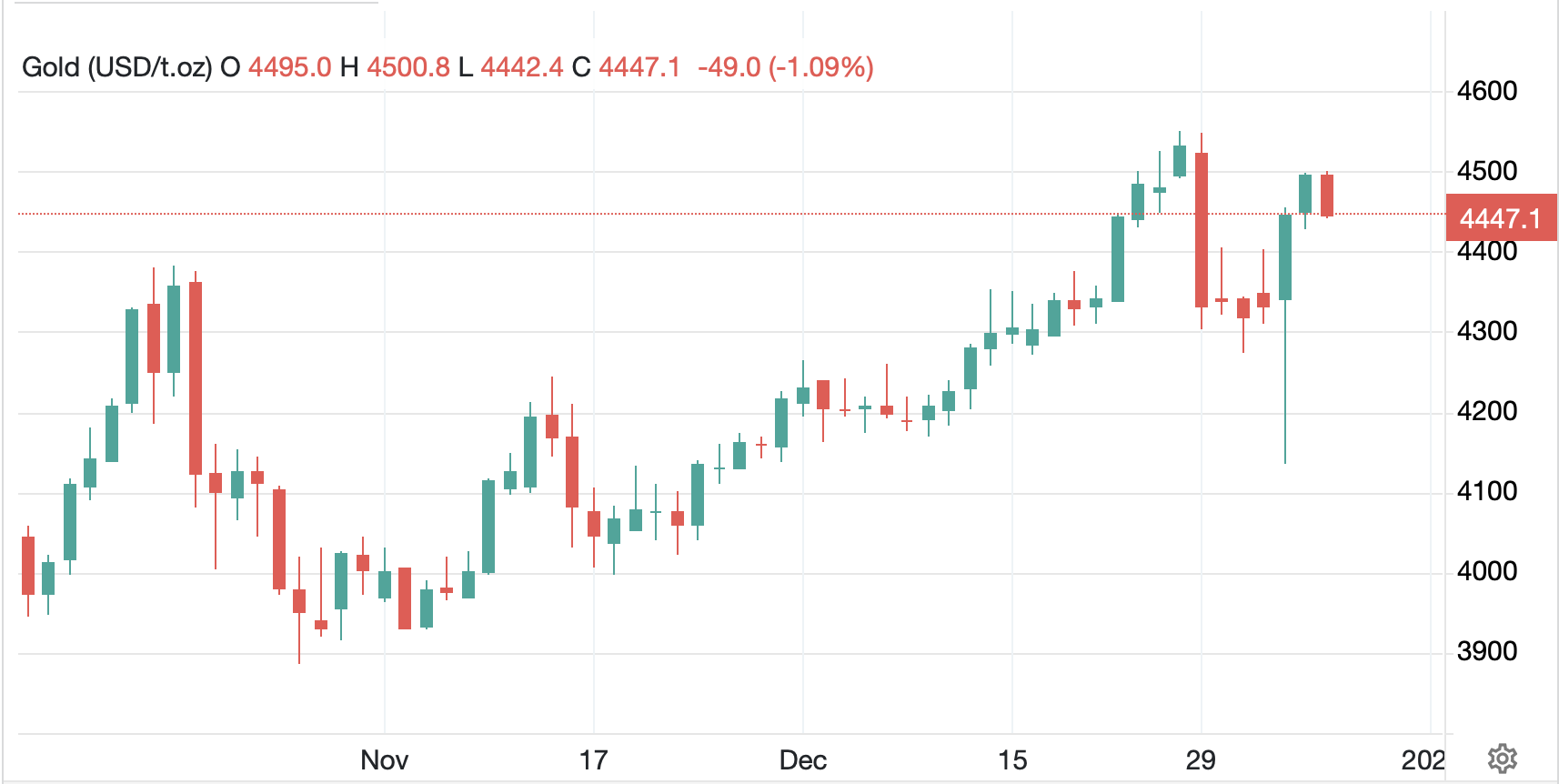
We’ve already discussed oil, but metals, which is where the real action has been, are all lower this morning, very clearly on profit taking activity.  Consider that gold (chart below from tradingeconomics.com) has been the least remarkable and still rallied 4% since the beginning of the year, so slipping -1.2% this morning can be no surprise.

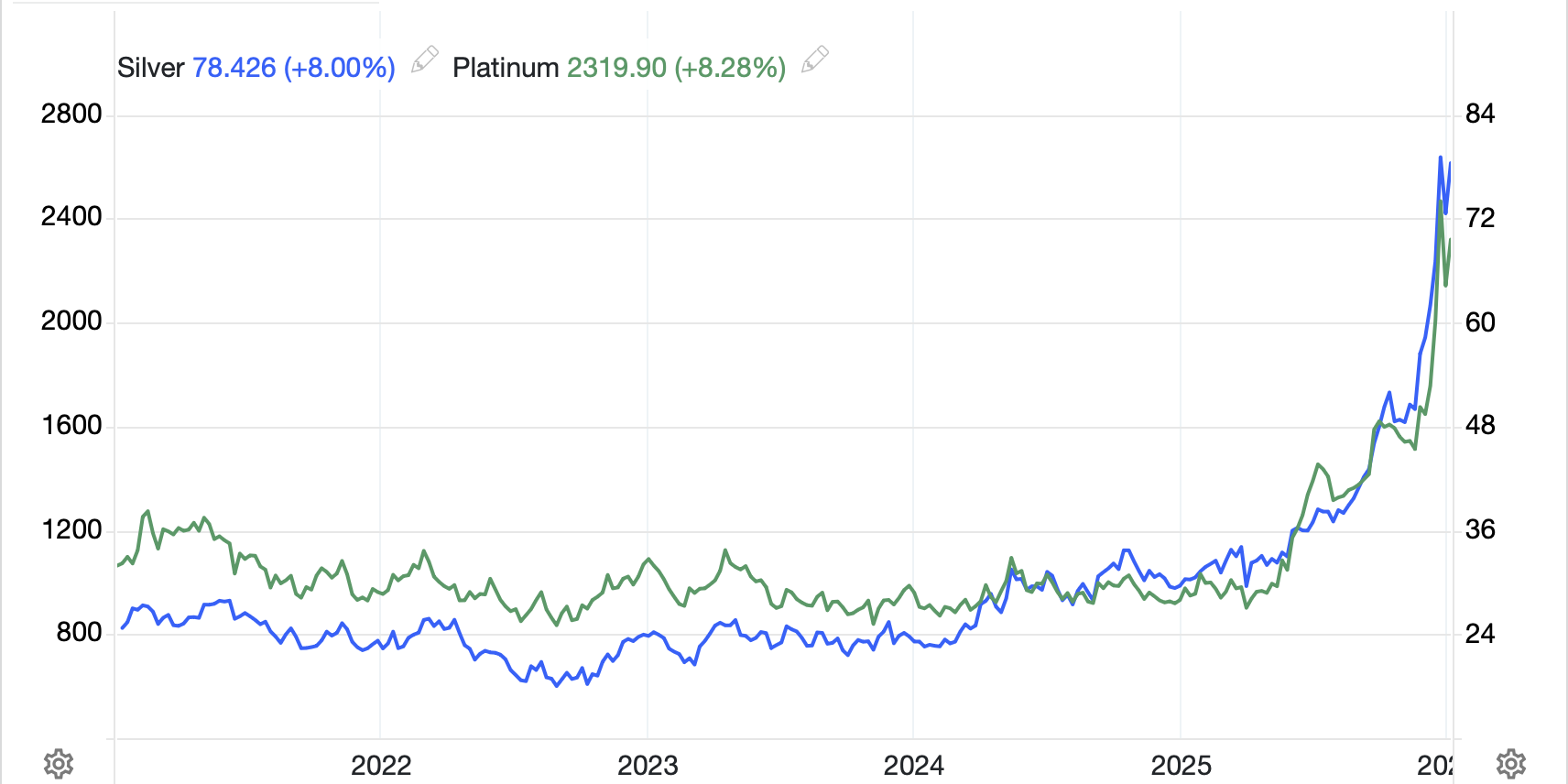
Meanwhile platinum (-6.1%) which is the least liquid of all the precious metals, saw a nearly 20% gain this week prior to today’s decline.  The chart below is not for the faint of heart!

Source: tradingeconmics.com

Silver (-3.1%) is somewhere in between these two, but the story has not changed at all.  There continues to be significant demand for physical metals with paper futures no longer able to control the price action.  One way to follow this is to look at the price on the Shanghai Futures Exchange where it is all delivery settlement and where the price trades at a substantial premium to the COMEX, on the order of $3-$4/oz.

Finally, the dollar is still there, and vs. most of its counterparts, doing very little this morning.  the outlier today is ZAR (-0.5%) which is obviously hurting on the back of gold and platinum’s weakness.  In fact, it is worth looking at the relationship between ZAR and gold, as per the below chart, to help you understand just how closely tied is the price action between the two.

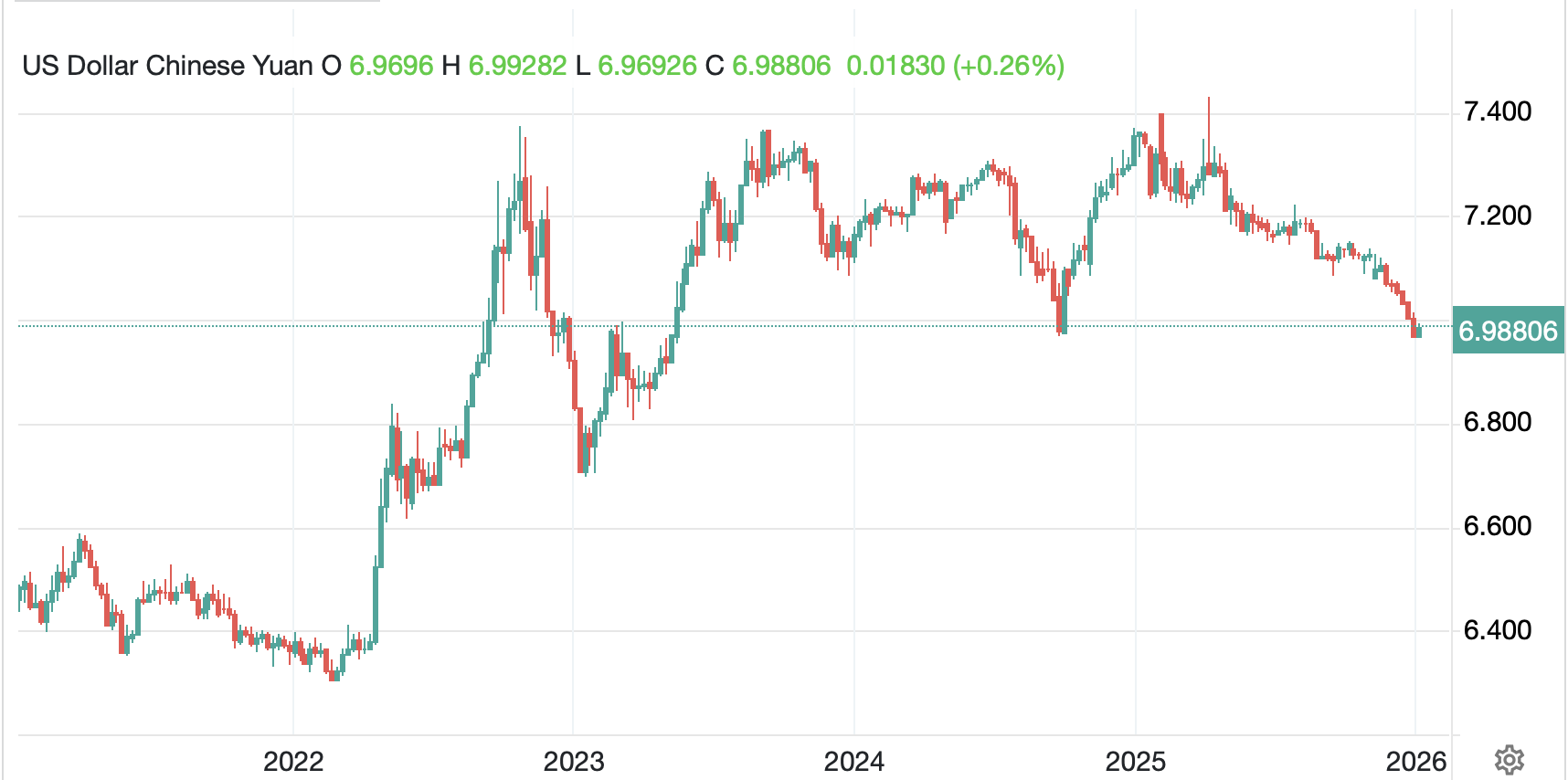
The other currency that has been trending steadily is CNY, with it breaching the 7.00 level at the end of 2025 for the first time since September 2024.  While this trend has been steady for the past year, a look at the longer-term chart shows the renminbi is nowhere near an extreme in either direction. 

Source: tradingeconomics.com

I maintain my view that if China really does create domestic demand for its products, the renminbi will continue this rally and strengthen further.  But we have heard this same story of Chinese government support for the domestic economy for at least a decade, and it hasn’t shown up yet.

On the data front, ADP Employment (exp 47K), JOLTs Job Openings (7.6M), ISM Services (52.3) and Factory Orders (-1.2%, -0.3% ex Transport) are the key releases this morning.  we also get EIA oil inventory data with expectations for a decent build.  There is only one Fed speaker, Governor Bowman, but the Fed just doesn’t seem as important this year as last.

The dollar is not the focus right now, neither are bonds.  Metals remain top of mind with oil a close second.  While recent price action in the former has been extremely volatile, nothing has changed my view that the long-term trend remains higher there.  Similarly for oil, the long-term trend remains lower with recent events simply adding to the weight.

Good luck

Adf

Overrun

We’ve not even gone through a week
Yet Trump, so much havoc did wreak
This poet will claim
That in this ballgame
It’s top first, one down, so to speak
 
The impact of what has been done
Is widespread and hits everyone
So, please understand
Whatever you’ve planned
May, by events, be overrun


Venezuela continues to be the primary discussion point in both the media and the markets.  Mostly along political lines there are calls that the weekend’s action was illegal or not, and as Brent Donnelly, a very good follow on X (@donnelly_brent), explained after reading voluminous material, the raid was either all about the oil or had nothing to do with the oil. I feel like that sums things up pretty well.

While this poet has views on the ongoing issues, they are set from afar with no inside knowledge so keep that in mind.  But ultimately, my take is the opportunity for real change has come to Venezuela, something that did not exist while Maduro was still there.  If nothing else, the ability for the US to exfiltrate him must have made a strong impression on acting president Rodriguez and the generals overseeing the army and police forces there and ought push decision making in a positive direction, at least for a while.  What seems abundantly clear, however, is that most of the population is ecstatic at his removal and have hope for a future, something missing for decades.

As to the oil, it is heavy, sour crude, something Gulf coast refineries are tuned to use, but the infrastructure there is a disaster.  My take is the one thing that is underestimated is just how remarkable the technology of oil exploration and production has become, and its ability to solve problems in efficiency to reduce the cost of extraction.  I will take the under on the time it takes to increase production there, although a key bottleneck is the electric grid which must be addressed as well.  Nonetheless, despite the rise in oil prices during yesterday’s session, I maintain my view that the trend is lower.

Other than domestic political news there seems little else to discuss but market activity, so let’s go there.  A strong session in the US yesterday was followed by plenty of strength in Asia with Japan (+1.3%), China (+1.6%) and HK (+1.4%) all having excellent outcomes.  Too, Korea (+1.7%) and Taiwan (+1.6%) had strong showings with many more gainers than losers in the region.  The one market that has not partaken in the early year rally is India (-0.4%), which I can only ascribe to the fact they may be losing a source of cheap oil.  Or perhaps, more accurately, all the buyers of sanctioned oil may find themselves in more difficult straits, paying full price, as the dark fleet of tankers is suddenly having more trouble making the rounds.

On this note, one other place to watch is Iran, where it appears that the regime may be set to collapse as protests grow and some cities may have been completely taken over by the protesters.  If the theocracy falls, I would expect that, too, will pressure oil prices lower, as sanctions could be swiftly lifted.

Turning to Europe, does anybody really care anymore?  No, seriously, markets there are mixed this morning with France (-0.4%) lagging while the UK (+0.7%) is gaining on the back of BP and Shell and the general euphoria about the oil majors now.  Meanwhile, other major markets have seen modest gains (Italy +0.4%, Spain +0.3%, Germany +0.2%) but there is one outlier, Denmark (+2.1%) which, given all the talk of the US seeking to take control of Greenland, seems odd to me.  I can find no specific news either for the economy or any companies (Novo Nordisk being the only one of note), but something is going on.  As to US futures, at this hour (6:50) they are little changed.

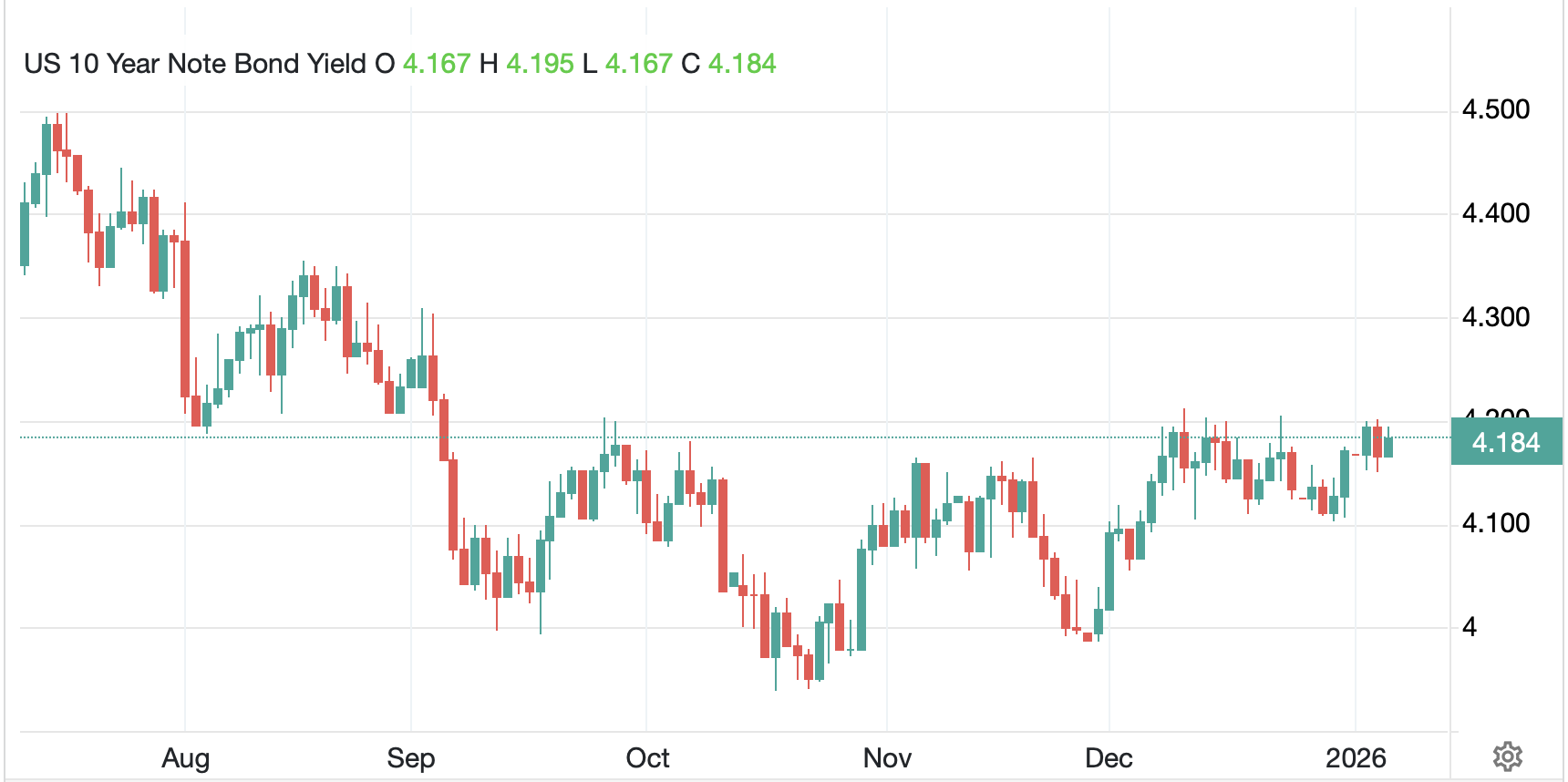
Turning to the bond market, the below chart of the 10-year offers a great picture of what it means when traders say nothing is going on.  Since early September, the bond has been trading within a 20 basis point range despite all the huffing and puffing of the punditry and the FOMC’s rate cuts.

Source: tradingeconomics.com

If bond investors are the “smart” money, I would argue that right now they have no opinion, or perhaps their opinion is that the economy is going to continue to tick along at a decent rate, with limited extra inflationary pressure.  To that last point, an article in the WSJ this morning explained that several recent studies, one by the SF Fed, demonstrated that tariffs have virtually no inflationary impact.  That probably doesn’t help Powell’s talking points.  While I continue to be concerned that inflation will maintain a 3+% level, I also believe the Fed is going to suppress interest rates going forward, net, bonds don’t seem that exciting.  As to the overnight price action, Treasury yields backed up 2bps, while European sovereigns slipped between -1bp and -2bps.  I couldn’t help but also notice that yesterday saw a massive issuance of USD bonds by non-US corporates, over $60 billion, an indication to me, at least, that calls for the death of the dollar are somewhat premature.

Commodities continue to be where all the action is, or perhaps more accurately, metals markets.  After massive rallies yesterday, we are seeing follow through with gold (+0.4%), silver (+2.4%), copper (+1.0%) and platinum (+3.2%) all strong again.  Unlike the bond market, and truly FX, which is also dull and boring, the below chart shows just how much things in the metals space have changed over time. 

Source: tradingeconomics.com

My take is that investors are still trying to figure out the implications of the fact that old relationships like the dollar falling when metals rise, or metals falling when real interest rates rise, are broken and what that implies for the future.  The reality is that other than gold, which is the calmest of them all, these metals are indicating actual shortages for users.  Consider that, according to Grok, the typical catalytic converter uses between 0.1 and 0.25 troy ounces of platinum, so at today’s price, between $230 and $575.  Given the average price of a new car is ~$50K, paying up for platinum is not going to change the equation that much, certainly relative to not having the platinum and therefore not being able to complete and sell the vehicle.  I suspect that metals, while likely to be volatile in their price action, have much further to run higher.

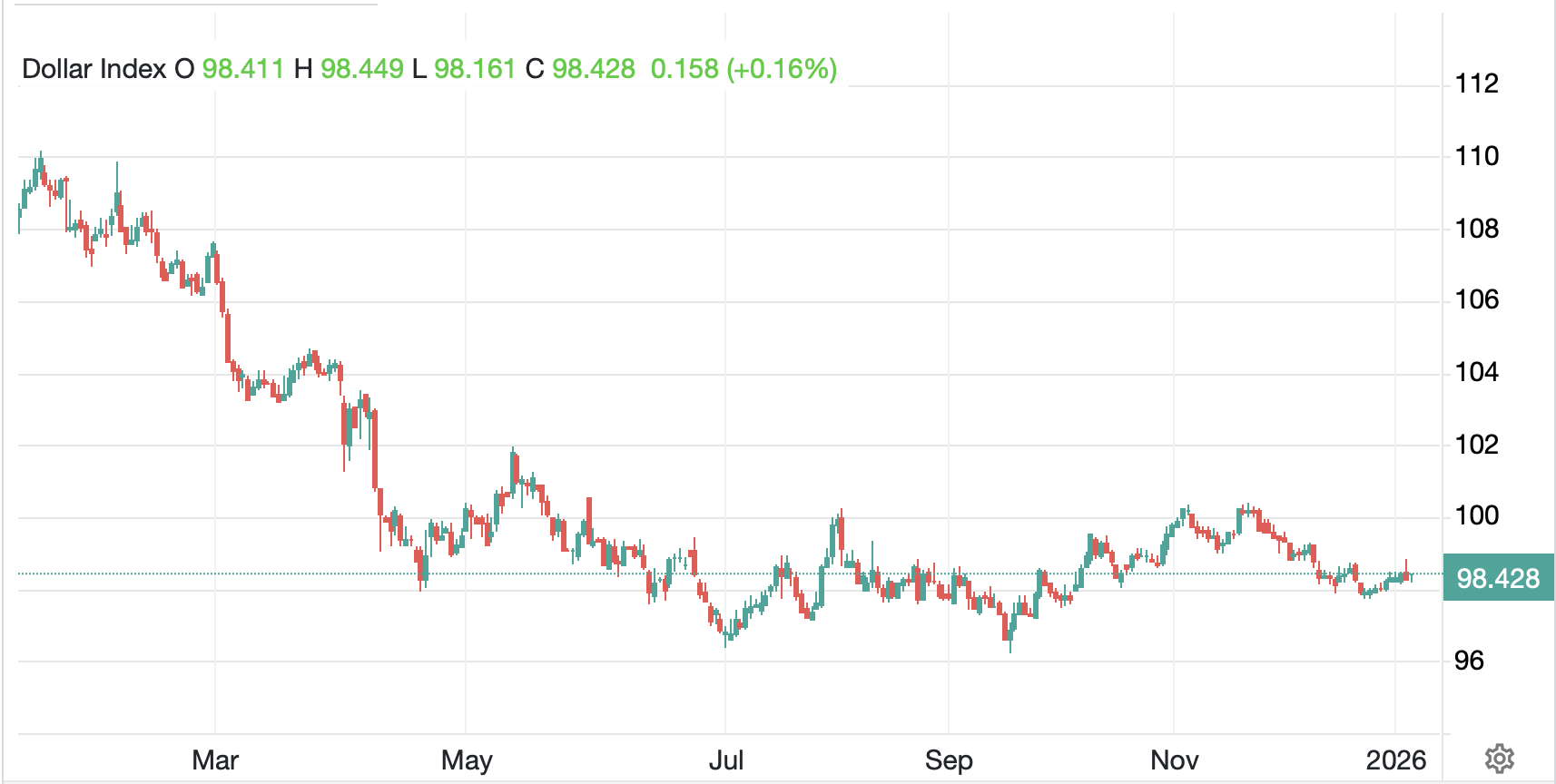
Lastly, the dollar…is still there.  Using the DXY as my proxy this morning, you can look at the chart below for the past year and see, it has basically not moved since it stopped declining in late April 2025.  It is hard to get excited about things right now.  However, I maintain that the US will remain the cleanest dirty shirt and benefit accordingly over time.

Source: tradingeconomics.com

On the data front, Services (exp 52.9) and Composite (53.0) PMI are released this morning with both expected lower than last month, but still in expansion territory.  We also hear from Richmond Fed governor Barkin, but it seems the Fed has taken a back seat to Venezuela lately, at least with respect to what is driving markets.  As of this morning, there is just a 16% probability of a rate cut priced in for the end of the month with a 53% probability priced for the March meeting.  But two more cuts are seen as a certainty by September, although if GDP continues to perform like it has, I imagine that will change.  According to the Atlanta Fed’s GDPNow model, Q4 is forecast at 2.7%.  We shall see how that evolves over time.

Summing it all up, the dollar is an afterthought in markets right now and seems unlikely to move very much in the near term.  Metals remain the place to be, and nothing indicates those trends have ended.

Good luck

Adf

Much Ado

The market response to the raid
In Vene has so far been staid
The black, sticky goo
Despite much ado
Shows traders have not yet been swayed
 
And frankly, that seems to make sense
‘Cause years will pass ere they commence
To pump much more oil
But that shouldn’t spoil
The truth their reserves are immense


As of 9:00 last night, oil futures are essentially unchanged from Friday’s, pre-Venezuelan news, close.  As you can see from the chart below, while there was an early blip higher of about 50¢, that quickly retraced.

Source: tradingeconomics.com

But, stepping back a bit, a look at the chart for the past year shows a very steady decline in the price and at this point, there seems to be little that will change that result.

Source: tradingeconomics.com

I have consistently made the case that oil supply exists all over the world, and that politics has been the chokepoint.  Arguably, a new government in Venezuela has just removed one of those chokepoints, although from everything I can gather, given the decrepit state of the oil infrastructure in Venezuela after nearly 20 years of Socialist neglect, it will take quite a while to hit the market.  But Guyana and Argentina are going to be growing their output considerably going forward, so, a slower rate of production here ought to not matter much.

One other thing I did read was that a key driver of the weekend’s events was growing concern by the US military that the Chinese were going to monopolize rare earth mining and processing from areas of southern Venezuela and that was too great a concern.  Even if the timeline is long, it appears, at this stage, that the future of Venezuela’s oil production should start to trend higher, and that will simply add to pressures on prices.  After all, we know that markets are forward looking.

One last thing to note is that acting president of Venezuela, Delcy Rodriguez, has called for “cooperation” with the US going forward, a very different tone than her initial comments of outrage.  Perhaps she has figured out that this is a sweet deal for her, or perhaps she is simply afraid that she is not safe if she doesn’t cooperate.  Whatever the reason, I suspect that things will progress positively from here.

In the meantime, let us try to turn our attention elsewhere, although it will be difficult as this action will clearly have many widespread, and at this point unforeseeable, impacts on markets other than oil.  But try we must.  With that in mind, let’s review markets overnight and see how the initial price action has evolved, and perhaps what it implies for the future.

Starting with equities, you’re hard pressed to find a market anywhere in the world that is suffering this morning despite the alleged increase in uncertainty.  In fact, it appears that investors are pretty certain that today is a better day than Friday was given the new world order that is developing.  Starting in Asia, the only market that fell overnight was India (-0.4%) seemingly on the idea that one source of their cheap oil may have been stopped.  But elsewhere, Japan (+3.0%), China (+1.9%), Korea (+3.4%) and Taiwan (+2.6%) all had extremely strong sessions with HK, Australia and other smaller exchanges showing little to no gains.  My only surprise here is China, which has invested significantly in Venezuela, lent them large sums of money and also had their advanced radar systems shown to be useless against US military aircraft.  But in the end, fear was not on the agenda in Asia.

What about Europe?  Well, here things are less excitable, with Germany (+0.65%) and Italy (+0.6%) the leaders as defense firms in both nations have performed well this morning.  But otherwise, Europe is a nonevent this morning, which given their increasing global irrelevance, should be no surprise.  The UK, France, and Spain have all barely moved and surprisingly, Switzerland (-0.7%) has fallen, although perhaps neutrality is not such a benefit anymore.  US futures, though, are continuing their ride higher with the NASDAQ (+0.8%) leading the way in a sea of green.    The net result here is, risk is still in vogue.

Turning to the bond market, only JGB yields (+6bps) are rising after PM Takaichi reiterated her call for more spending.  Yes, this is a new 29-year high in 10-year JGB yields, but I suspect they have further to go.  After all, as you can see from the below chart, yield suppression has been the game there for decades, so unwinding it will take some time.

Source: investing.com

But elsewhere in the fixed income world, yields are slipping across the board.  Treasury yields (-3bps) are leading the way with all of Europe seeing declines between -2bps and -3bps.  I might suggest this is a response to the prospect of declining oil and energy prices going forward, even though it will take time to see the increases in production.

As to commodities, as of this morning at 7:30, oil has bumped up 0.5%, although as you can see in the above chart, remains in a longer-term downtrend that shows no signs of breaking soon.  Metals, meanwhile, remain the story of stories with the entire periodic table looking good (Au +1.9%, Ag +3.3%, Cu +2.9%, Pt +2.5%).  I continue to read about reasons as to why this rally in metals is going to end soon, with most focused on the speed of the ascent last year.  But the difference in this market vs. any paper financial market is, physical supplies matter here, and by all accounts, Ag, Cu and Pt are all in short supply for their industrial uses (think catalytic converters for Pt) and as industrial users recognize the shortage, they continue to bid up the price.  While I expect all these markets to remain volatile this year, I suspect that the trend higher has a lot of runway yet.

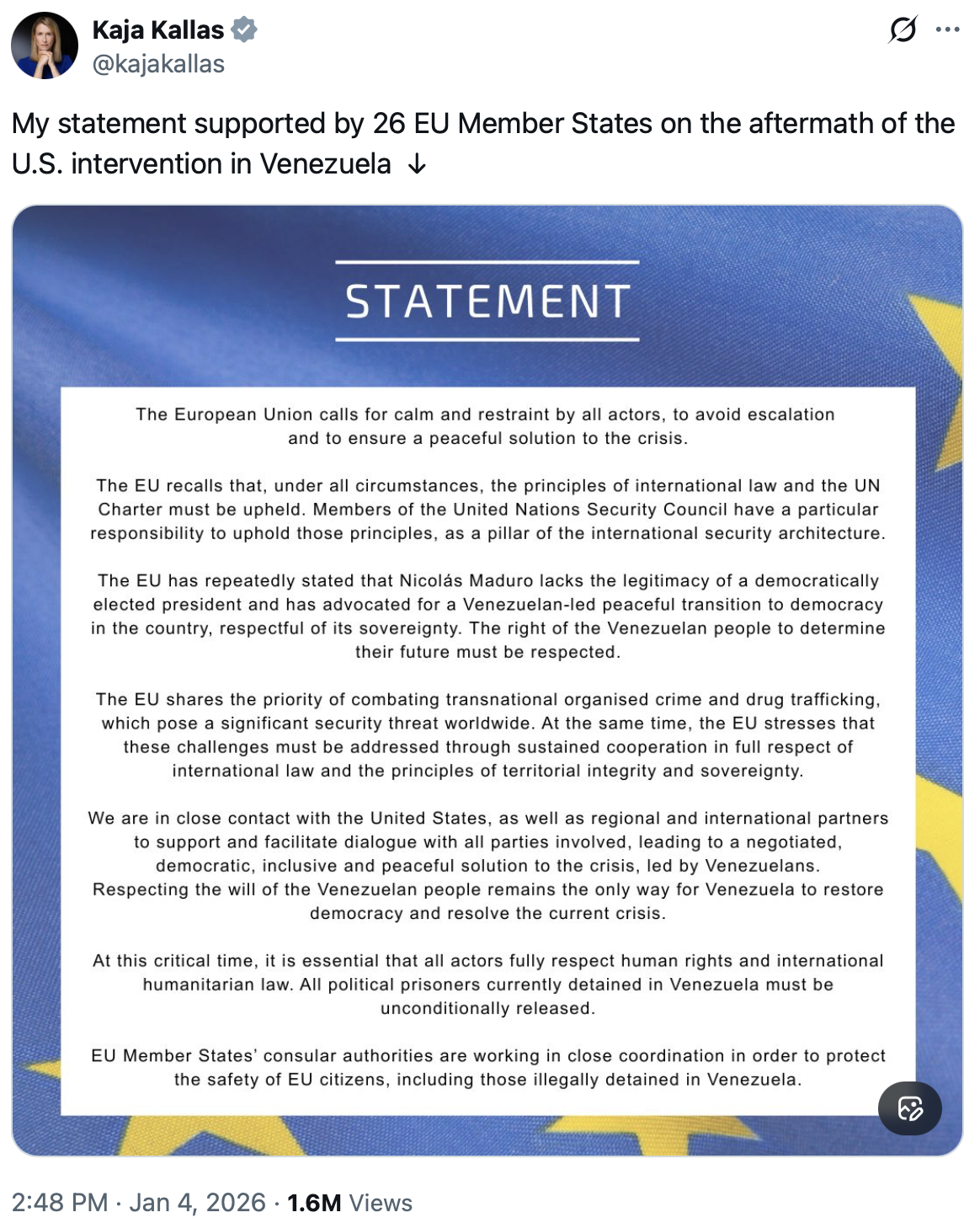
Finally, the dollar is firmer this morning, despite the rally in metals.  The euro (-0.3%) is the laggard in the G10 space as the EU was shown to be completely powerless, useless and irrelevant over the weekend.  However, they did issue a carefully considered statement to cement the idea that they are powerless, useless and irrelevant as seen below.

I know I feel safer now!  In addition to this demonstration, the timeline for a digital euro seems to be speeding up, a decision that will further undermine the single currency in my view.  Nothing has changed my opinion, except perhaps strengthening it, that the world is going to bifurcate into USD stablecoins and digital CNY over the next few years, with most of Europe opting for USD.  Elsewhere in the G10, movement has been less pronounced, +/-0.2% or less with nothing of note to mention.  In the EMG bloc, most of the currencies here are a bit weaker, -0.3% or so, with two key exceptions, ZAR (+0.1%) and CLP (+0.2%), both benefitting from the large gain in the metals complex.  Interestingly, MXN (-0.35%) is amongst the worst performers as the natural thought process seems to be, is President Sheinbaum next unless she effectively shuts down the cartels.  I keep searching for reasons to understand bearishness on the dollar but have yet to find any that make sense.  One other thing to note, there has been a resurgence in the discussion of how the dollar is losing its traction amongst central banks with respect to reserves held.  Many are highlighting that the percentage of reserves in USD has fallen to its lowest level since the mid 1990’s.  but a look at the chart below shows that while the recent trend has declined, it remains far above its lows, and far below its highs over time.  In fact, one might say it’s right in the middle of the range.

Turning to the data this week, with the government having been back in action for a while, we are back to a full slate of data for the first week of a month.

TodayISM Manufacturing48.3
 ISM Prices Paid59.0
TuesdayPMI Services52.9
 PMI Composite53.0
WednesdayADP Employment45K
 ISM Services52.3
 JOLYs Job Openings7.64M
 Factory Orders-1.2%
 -ex Transport-0.3%
ThursdayInitial Claims216K
 Continuing Claims1851K
 Trade Balance -$58.4B
 Nonfarm Productivity3.0%
 Unit Labor Costs1.0%
 Consumer Credit$10.2B
FridayNonfarm Payrolls55K
 Private Payrolls60K
 Manufacturing Payrolls-5K
 Unemployment Rate4.5%
 Average Weekly Hours34.3
 Average Hourly Earnings0.3% (3.6% Y/Y)
 Participation Rate62.6%
 Housing Starts (Sept)1.31M
 Building Permits (Sept)1.35M
 Michigan Sentiment53.2

Source: tradingeconomics.com

While some data remains stale (housing), the jobs data is December’s and will get a great deal of attention.  One thing to remember here is that if the deportation numbers discussed by the government are correct (~500K actual deportations and ~2.0MM self-deportations), then the economy doesn’t need to create that many new jobs to keep things ticking along.  I have seen estimates of somewhere between 0 and 20K jobs each month being sufficient to keep the Unemployment Rate steady to declining.  I am sure, however, this issue will be the subject of much discussion by the economics community going forward, but as I have said time and again, the models in use today do not seem to reasonably represent the reality today.  Expect a lot of huffing and puffing about this data, largely along political lines.

And that’s really it.  Obviously, Venezuela has changed a lot of calculations about many markets, but in the end, while I remain concerned over an eventual risk-off outcome, I don’t see that as an immediate threat.  Remember, too, the OBBB has taken effect and tax situations are going to be changing now, something that will undoubtedly help the economic data going forward.

Good luck

Adf

First Black Swan

‘Ought Twenty-Six barely got started
And Trump has already departed
From previous norms
Of post-Cold War forms
Now socialists are broken-hearted
 
Their man in Caracas is gone
With outrage from Beijing to Bonn
But folks on the street
Believe it’s a treat
Please welcome this year’s first black swan


I certainly didn’t have the exfiltration of Venezuelan strongman Nicholas Maduro from his palace in the middle of the night on my bingo card, did you?  But that is what we all woke up to Saturday morning.  In a way, we cannot be surprised as President Trump indicated several weeks ago that he spoke with Maduro, told him if he left, he could have safe passage, and be left alone, but ostensibly Maduro turned him down.  I’m guessing old Nick is questioning that decision right now.

As this all took place Saturday morning, no financial markets, other than cryptocurrencies, are open and based on Bitcoin’s movement of 0.1% as I type, it appears the issue is not seen as a major concern.  There is much discussion regarding what will happen to the price of oil, as unquestionably, Venezuelan oil was part of the decision equation.  But the Venezuelans have been producing less than 1 million bpd, far below their pre-socialist levels, and given they sit on the largest known oil reserves on the planet, far below what their ultimate capabilities can be.  If you’re Chevron’s CEO, you must be thrilled this morning, as they are already operating in country there.

Too, remember that Venezuelan crude is heavy and sour, which is what most Gulf Coast refineries are tuned to utilise to distill diesel, gasoline and other products.  It is too early to know what will happen to oil prices in the short run, but I would suggest that the longer-term view has to be lower prices going forward.  Consider that the US already is the largest producer of oil and oil equivalents (about 20mm bpd) in the world.  I would expect that Venezuela will be exiting OPEC under a new administration there, and with US oil expertise, will be seeking to expand that sector as rapidly as possible.  In fact, achieving 10mm bpd within a few years does not seem unrealistic. 

Now consider that by the end of the decade, the Western hemisphere could well be producing half the world’s oil supply, as already, despite degradation of capabilities in both Venezuela and Mexico, it produces more than one-third of the oil pumped.  That would certainly put a crimp in Russia’s war machine as the price seems far more likely to head toward $50/bbl than $80/bbl or higher, and by all accounts, that would be hard on Russia’s budget.

Too, consider the geopolitical ramifications if China were suddenly paying full price rather than whatever discounts they currently get for sanctioned oil purchases.  As well, what does a lower price do to the Iranian regime’s finances?  Probably not very helpful.

It is way too early to know how things will evolve, but between growth in production in Guyana and Argentina, and the prospects for significant growth in Venezuela going forward, it should become cheaper to fill up your tank going forward.

We will see how markets open Sunday night, and I would not be surprised to see oil rally at the start, but I would contend the politics points to lower prices not higher ones.  

Source: visualcapitalist.com

Note that neither Venezuela nor Argentina make this list individually.   I would wager that by 2027, both will be prominent producers, along with Guyana.

Welcome to 2026!  It is going to be an interesting year.

Good luck

Adf

Decidedly Glum

The mood is decidedly glum
In markets, as traders succumb
To views that the world
Is coming unfurled
And fears that the game’s zero-sum
 
So, stories ‘bout regional banks
With problems are joining the ranks
Of reasons to sell
Ere things go to hell
And why folks are buying Swiss francs


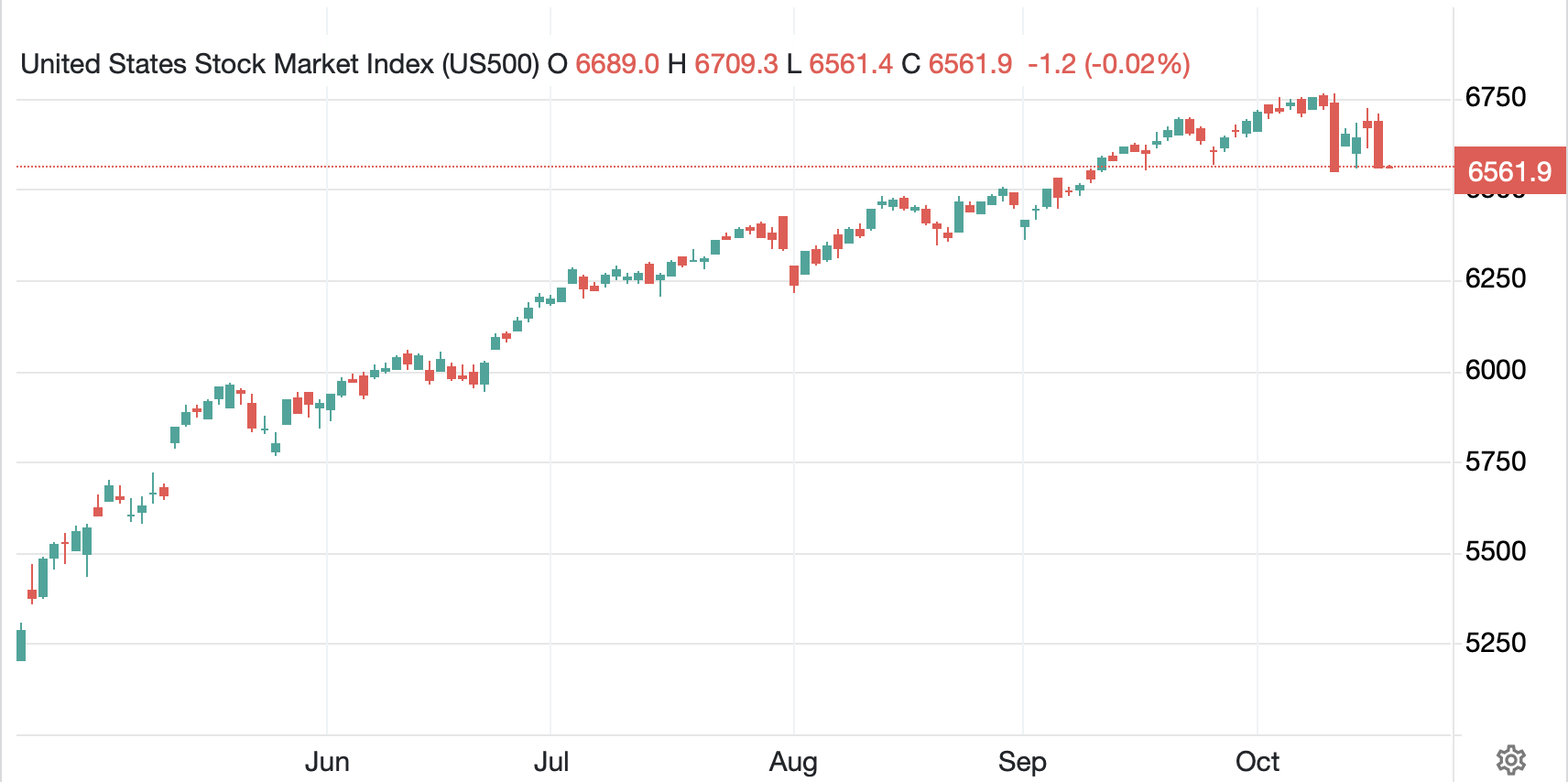
It doesn’t seem that long ago when equity markets were trading at all-time highs, arguably a sign of significant positive attitudes, and yet here we are this morning with equity markets around the world under significant pressure.  Of course, the reason it doesn’t feel like it was that long ago is BECAUSE IT WASN’T.  In fact, as you can see from the chart below, it was just last week!

Source: tradingeconomics.com

And understand, that even with futures pointing lower by -1.0% this morning, the S&P 500 is only 3% off its highs.  That hardly seems like a collapse, but the vibe I am getting is decidedly negative.  Certainly, haven assets are in demand this morning with both the yen (+0.5%) and the Swiss franc (+0.45%) rising sharply after bottoming on the same day as the S&P’s top, with both currencies back to their levels from a month ago.

Source: tradingeconomics.com

Is the world ending?  Probably not today but that doesn’t make it feel any better.  After all, we have been living through an unprecedented growth in leverage, with margin debt growing to new record highs every week, despite a backdrop of massive global uncertainty regarding trade, economic activity and kinetic conflict.  It is hard to believe that the fact that the FOMC is likely to cut rates by 25bps at the end of the month and again in December was enough to convince investors that future earnings were going to rise dramatically.

But that is where things stand this morning.  I must admit I have seen and read more stories about the idea that the AI hype train has run too far and needs to correct, and while that has probably been the case for a while, it is only in the past few days that those stances are becoming public.  There has also been an uptick in chatter about bad debt and more insidiously, fraud, that has been underlying some of the recent hype.  The First Brands bankruptcy is reverberating and now two regional banks, Zion and Western Alliance, have indicated that some recent loan losses may be tied to fraud.  While the amounts in question for the latter two are not enough to be a real problem for either institution, numbering in the $10’s of millions, history has shown that fraud tends to arise when money/lending standards are just too easy, and a sign that the end of good times may be nigh.

Again, it is a big leap to say that because some fraud was uncovered that signals the top.  But history has also shown that there is never just one cockroach, and if the lights are coming on, we are likely to see others.  While big bank earnings were solid, that was for last quarter.  And that’s just the market internal story for one industry.

If we add things like concerns over a potential conflict between the US and Venezuela, which is the top article in the WSJthis morning, or the idea that the US may send Tomahawk missiles, with ranges of up to 1500 miles, to Ukraine, it is unlikely to calm any fears.  And adding to that we continue to have the government shut down, although I personally tend to think of that as a benefit and since it doesn’t seem to be helping the Democrat party, the MSM stopped covering it, and we have the escalating trade conflict with China.  Looking at all the potential problems, it cannot be that surprising that some investors are a bit concerned about things and lightening their exposures.  Too, it is a Friday in October, and we have seen some particularly bad outcomes over weekends in October, notably in 1987!

I’m not forecasting anything like that, believe me, just reminding everyone that while history may not repeat, it often rhymes.  So, let’s look at the overnight session, which had a decidedly risk-off tone.  While the declines in the US markets weren’t that large, they left a bad taste everywhere in Asia with only India (+0.6%) managing to rise on the session.  Otherwise, Japan (-1.4%), China (-2.25%), HK (-2.5%), Taiwan (-1.25%), Australia (-0.8%) and virtually all the rest of the markets declined with Korea managing to close unchanged.  Fear was rampant, especially in China on the ongoing trade concerns.

In Europe, it should be no surprise that equity markets are also sharply lower led by the DAX (-2.1%) and FTSE 100 (-1.2%) with Paris (-0.7%) and Madrid (-0.95%) also under pressure.  The causes here are the same as everywhere, worries that things have gotten ahead of themselves while fears over escalations in both the trade and kinetic conflicts grow.  As well, the banking sector here is under pressure as credit concerns grow globally.  As to US futures, at this hour (7:15), they have bounced off their worst levels and are lower by just -0.25% to -0.5%.

Bond markets have been a major beneficiary of the growing fear with Treasury yields bouncing just 1bp this morning and sitting just below 4.00% after a -7bp decline yesterday.  European sovereign yields also fell sharply yesterday and are finding a near-term bottom as they retrace between 1bp and 2bps higher on the session.  If fear is growing, despite all the budget deficits, the default process is to buy bonds!

In the commodity markets, oil (-0.3%) has bounced off its lowest levels of the session which coincide with the lows seen back in April, post Liberation Day.  (see tradingeconomics.com chart below). It seems that not only are there economic concerns, but API inventory data showed a surprising build there.

Turning to the metals markets, gold (-0.2%) had a remarkable day yesterday, rising $100/oz, more than 2%, so a little consolidation here can be no surprise.  In fact, all the metals saw gains yesterday and are backing off a bit this morning in very volatile, and what appear to be illiquid markets.  Looking at the screen, the price is rising and falling $5/oz on a tick.  This 5-minute chart shows just how choppy things are.

Source: tradingeconomics.com

Finally, the dollar is softer, which on the one hand is surprising given its traditional haven status, but on the other hand, given the ongoing decline in yields and the fear pervading markets, is probably not that surprising.  Remember, one of the drivers for the dollar is capital flows and if US equity markets decline, we are going to see foreign investors sell, and then likely sell those dollars as well.  However, I would take exception with the Bloomberg headline explaining that the dollar is weakening because of Fed rate cut expectations given those expectations have been with us for several weeks.  At any rate, the weakness this morning is broad-based, but shallow with the two havens mentioned above the exception and most other currencies gaining 0.1% or 0.2% at most.  It seems President Trump has also made a comment about the trade war indicating that the current tariffs are unsustainable and he confirmed he would be meeting President Xi in a few weeks.

And that’s really all there is to end the week.  There is no data at all, and the only Fed speaker is KC Fed president Musalem.  The general takeaway from the Fedspeak this week is that they are prepared to cut rates but given the lack of data, will not be aggressive.

The world is a messy place.  No matter your political views, when viewing markets, it is important to focus on the reality of what is happening.  We know that leverage has been growing and helping to drive stock market indices to record highs.  We know that gold and other precious metals have been rallying on a combination of central bank (price insensitive) and growing retail buying as fears grow of impending inflation.  We have seen several instances of what appears to be lax lending standards, something that historically has led to substantial chaos in markets.  The advice I can offer here is maintain position hedges, especially those of you who are corporate risk managers.  Yes, volatility has risen a bit, but I assure you, if things really come undone, that will be insignificant compared to the benefit of the hedge.

And with those cheery words, I wish you all 

Good luck and a good weekend

Adf

Another Broadside

Investors don’t know where to hide
As Trump lands another broadside
Last night he did roil
All those who buy oil
From Vene, with tariffs applied
 
But yesterday, too, he amended
How tariffs would soon be extended
The lesson to learn
Is you’ll ne’er discern
His methods, so don’t be offended


Once again, the tariff game changed yesterday, although this time in two directions.  The first, and newest idea is that the US will impose “secondary” tariffs on all nations that buy oil from Venezuela.  The idea is to pressure Venezuela to concede to US demands by reducing the market for their one exportable commodity, at least the only one in demand (Tren de Aragua gang members, while a key export, have limited demand it seems).  This decision is being described as a new tool of statecraft, but it strikes me this is no different than previous international efforts like the apartheid movement, by isolating a nation for its behaviors.  Regardless, this was seen as bullish for oil prices.  The reason, as eloquently explained by Ole Hanson, Saxo Bank’s Head of Commodity Strategy, as per the below, is that Venezuelan and Iranian oil production has risen significantly over the past 4 years, offsetting the production cuts of the rest of OPEC+.  Take that oil out, and the demand/supply balance tips toward more demand.

It remains to be seen how this impacts specific countries, but apparently, China is the largest importer of sanctioned crude, so obviously, not a positive for President Xi.  Alas for Chevron, the deal they cut with the Biden administration to restart activity in Venezuela is looking shakier by the day.

But that is only one of the tariff stories.  The other was that there may be changes to previously expected actions come April 2nd, with imposition of tariffs being a bit more gradual nor as widespread as initially feared.  Recall, the idea of the reciprocal tariffs was almost every other nation charges higher tariffs on US goods than the US charges on their goods, so simply raising US tariffs to their levels would be effective.  The next step was focusing on the so-called “Dirty 15” nations that run the major trade surpluses with the US, but now he has indicated that some nations will get breaks.  I particularly loved this comment, “I may give a lot of countries breaks. They’ve charged us so much that I’m embarrassed to charge them what they’ve charged us, but it’ll be substantial, and you’ll be hearing about that on April 2.”

In any event, Trump’s specialty is his ability to think outside the box, or perhaps more accurately, break the box and move to a different container.  There is much consternation amongst business managers, and understandably, since planning is much more difficult in this environment.  However, as I have repeatedly written, the one thing on which we can count is continued higher volatility across all markets.  That condition requires a robust hedging plan for all those who have exposures, that is your only realistic protection.

Other than the tariff story, though, we have not seen much new information so let’s take a look at how markets have handled the latest tariff saga.  Yesterday’s broad US equity rally, on the back of a reduced tariff outlook, was followed by less positive price action in Asia.  While the Nikkei (+0.5%) rallied, potentially on the yen’s recent weakness, Hong Kong (-2.4%) was under great pressure on a weaker tech sector as earnings there were disappointing last quarter.  However, the CSI 300 (0.0%) which has far less tech in its makeup, didn’t budge.  As to the rest of the region, there were more gainers (Taiwan, Malaysia, New Zealand, Indonesia) than losers (Korea, Philippines, Thailand), so arguably the US rally and tariff story helped a bit.

In Europe, though, things are looking solid this morning with green everywhere on the screen and generally substantially so.  The DAX (+0.9%), CAC (+1.2%) and IBEX (+1.1%) are all having solid sessions after German Ifo Expectations data was released a touch better than expected at 87.7, but as importantly, 2 points better than last month.  However, a look at the history of this index shows that while recent data has turned mildly positive, compared to its long-term history, things in Germany remain in lousy shape.

Source: tradingeconomics.com

As to US futures, at this hour (7:10), they are little changed on the day as traders await the next pronouncements with great uncertainty.

In the bond market, though, yields have been climbing everywhere with Treasury yields higher by 2bps this morning after jumping 5bps yesterday.  In fact, we are back at the highest levels in a month, although still well below the peaks seen in early January or last spring.  But this move has dragged European sovereign yields along for the ride with across-the-board gains of 4bps-5bps and similar movement in JGBs overnight.  One of the alleged reasons for this bond weakness were hawkish comments from two ECB members, Slovakia’s Kazimir and Estonia’s Müller.  However, dovish comments from Greece’s Stournaras and Italy’s Cipollone would have seemed to offset that, and did so in the FX markets, but not in the bond market.

Turning to commodities, oil (+0.4%) continues to climb and is once again approaching $70/bbl.  In fact, since that fateful day, March 11th, it has rallied consistently as can be seen below.  I still don’t understand why that date seemed to offer a change of view, but there you go.

Source: tradingeconomics.com

In the metals markets, this morning is once again seeing a bullish tone with both precious and industrial metals in demand.  Gold (+0.5%) continues to be one of the best performing assets around, although so far this year silver (+1.5%) and copper (+1.15%) have been amongst the few things to beat it.  I believe this trend has legs.

Finally, the dollar is softer this morning, falling against both its G10 and EMG counterparts almost universally.  SEK (+0.9%) is the leader in the clubhouse, although we have seen solid gains from AUD (+0.5%) and NZD (+0.6%) with both the euro (+0.2%) and pound (+0.2%) lagging the pace but in the same direction.  JPY (+0.4%) which has suffered a bit lately, is following the broad dollar move this morning.  in the EMG bloc, the CE4 (+0.4% across all of them) is setting the tone with ZAR (+0.4%) right there.  Otherwise, the movement has been a bit more modest (MXN +0.2%, KRW +0.15%), but still putting pressure on the dollar.

Turning to the data, as I never got to show the week ahead, here we go:

TodayCase-Shiller Home Prices4.8%
 Consumer Confidence94
 New Home Sales680K
WednesdayDurable Goods-1.0%
 -ex Transport0.2%
ThursdayInitial Claims225K
 Continuing Claims1890K
 GDP Q4 Final2.3%
 GDP Final Sales Q43.2%
 Goods Trade Balance-$134.6B
FridayPersonal Income0.4%
 Personal Spending0.5%
 PCE0.3% (2.5% Y/Y)
 Core PCE0.3% (2.7% Y/Y)
 Michigan Sentiment57.9

Source: tradingeconomics.com

Obviously, the PCE data Friday will be the most interesting piece of data released, although we cannot ignore Case-Shiller today.  I keep looking at prices rising there at nearly 5% and wondering why economists expect inflation to fall.  If home prices are rising 5% per year, and they represent one-third of the CPI, it doesn’t leave much room for other prices to rise to achieve 2.0%.  Just sayin’.  In addition, we hear from seven different Fed speakers this week.  Now, I have been making a big deal about how Fedspeak doesn’t seem to matter as much anymore.  Perhaps this week, given the overall uncertainty across markets, it will matter.  However, the Fed funds futures market continues to price a bit more than two rate cuts for the rest of the year, which has not changed very much at all in the past month.  I still don’t think the Fed speakers matter right now.

Markets are highly attuned to whatever Trump says about tariffs.  Absent a new war, and maybe even if one starts, I suspect traders (or algos) will focus on that exclusively.  But despite all this, nothing has altered my longer-term view that the dollar will weaken, and commodities remain strong going forward.

Good luck

Adf