Fervent Dreams

The FX Poet will be in Nashville at the AFP Conference October 21-22, speaking about effective ways to use FX options in a hedging program.  Please come to the presentation on Monday at 1:45 in Grand Ballroom C2 if you are there.  I would love to meet and speak.
 
Said Governor Waller, inflation
Is falling and so there’s temptation
To cut really fast
And if our forecast
Is right, there will be celebration
 
The problem is, if we are wrong
And price rises we do prolong
We’ll get all the blame
At which point we’ll frame
Our mandate as “jobs must be strong”
 
Meanwhile, in China it seems
That President Xi’s fervent dreams
Of finding more growth
Is stuck cause he’s loath
To listen to Pan Gongsheng’s schemes


First, a mea culpa, as while banks and the bond market were closed yesterday, the equity market was open, and the rally continued.  Although, that doesn’t really change anything I wrote yesterday.  But the stories that got the press yesterday were about Fed Governor Chris Waller and his speech.  Waller is considered one of the key FOMC members as his policy research has been consistent and more accurate than most others, as well as because he doesn’t appear to be nearly as partisan as some other governors.

At any rate, he eloquently made the case that the Fed was going to continue to cut rates, albeit perhaps more slowly than previously expected, because even though economic activity remains strong and inflation is above our goals, we remain confident that we are still going to achieve our targets.  In fact, I think his words are worth reading directly [emphasis added]:

Whatever happens in the near term, my baseline still calls for reducing the policy rate gradually over the next year. The median rate for FOMC participants at the end of 2025 is 3.4 percent, so most of my colleagues likewise expect to reduce policy over the next year. There is less certainty about the final destination…While much attention is given to the size of cuts over the next meeting or two, I think the larger message of the SEP is that there is a considerable extent of policy restrictiveness to remove, and if the economy continues in its current sweet spot, this will happen gradually.”

On to the next story, China and the still-to-come stimulus package.  According to Bloomberg, there is a new plan to allow local governments to swap up to CNY 6 trillion (~$840B) of their outstanding “hidden” debt, which is in the name of special funding vehicles, to straight local government debt, which should carry lower interest rates.  The problem is that both the size of this program and its ultimate effect are seen as insufficient to address the issues.  Certainly, reducing interest payments will help a bit, but the debt problem, along with the property problems, are so much larger than this, at least 10X the proposed CNY 6 trillion, that this will barely make a dent. 

Ultimately, the only solution that seems viable is that the central government borrows more money (its current outstanding debt is at just 25% of GDP) and funds new projects, gives it out to citizens in a helicopter money drop, or something other than investing in more production for exports.  This seemed to be where PBOC Governor Pan Gongsheng was headed several weeks ago.  Alas, President Xi has spent a decade stripping power away from the private sector and amassing his own.  I find it highly unlikely he will willingly cede any of that power simply to help his citizens.  Recent analyst updates for Chinese GDP growth in 2024 have fallen back below his 5.0% target, and I imagine they are correct.

Which brings us to this morning, where the biggest market mover is oil (-5.1%) which is falling on a combination of several things.  First, news that President Biden has convinced Israeli PM Netanyahu to not strike Iran’s oil fields, thus removing a key supply issue and war premium.  Next, the fact that China’s stimulus efforts are so weak implies lower demand from the world’s largest oil importer, and finally, OPEC just cut its forecast for oil demand for 2024 and 2025 although they have not reduced their supply estimates.  The upshot is that oil has given back all its gains of the past month and is presently back at its longer-term technical support level of $70/bbl.  Where it goes from here is anybody’s guess, but absent a resurgence of the Middle East war premium, I suspect it has further to decline.

As to the metals complex, gold (+0.2%) continues to ignore all the signs that it should be falling and is holding within 1% of its recent all-time high prints amid stories that global central banks continue to acquire the barbarous relic.  However, both silver and copper are feeling some stress amid the weaker Chinese growth story.  

In fact, that weaker Chinese growth story hit equities there hard with the CSI 300 (-2.7%) and Hang Seng (-3.7%) both falling sharply on the disappointing fiscal plans.  However, the rest of Asia took their cues from the US rally, and we saw strength virtually across the board.  Interestingly, Taiwan’s TAIEX (+1.4%) completely ignored the China story, perhaps an indication its economy is not nearly so tightly linked as in the past.  In Europe, the picture is mixed with the DAX (+0.3%) rallying on a slightly better than expected German ZEW Economic Sentiment Index (13.1, up from 3.6), while Spain’s IBEX (+0.3%) rallied on better than expected inflation data.  However, weakness is evident in France (CAC -0.8%) on weakness in the luxury goods sector (the largest part of the index) suffering from weaker Chinese demand.  US futures are essentially unchanged at this hour (7:15) as we await Retail Sales later this week.

In the bond market, yields have fallen across the board (Treasuries -3bps, Bunds -4bps, OATs -5bps) as lower oil prices and concerns over slowing growth have investors thinking inflation will continue its downward trend.  Well, at least some investors.  One of the more interesting recent market conditions is the performance of inflation swaps, which have seen implicit inflation expectations rise more than 50bps in the past five weeks as per the chart below from @parrmenidies from X (fka Twitter).

This likely explains the sharp yield rally since the Fed cut rates, but does not bode well for future inflation declining.

Finally, the dollar is little changed net this morning.  Not surprisingly, given the ongoing disappointment of China’s stimulus ,CNY (-0.5%) is amongst the worst performers of the session.  But we have seen weakness in ZAR (-0.3%), CLP (-0.4%) and KRW (-0.4%) to show that EMG currencies are under pressure.  As to the G10, movement has been much smaller with JPY (+0.3%) the biggest mover overall and one of the few gainers.

On the data front, Empire State Manufacturing (exp 2.3) is the only number coming out and we hear from three more Fed speakers (Daly, Kugler and Bostic).  That cleanest shirt analogy remains the most apt these days with the US spending its way to better short-term results and adding long-term problems.  But the market is happy for now.  With that in mind, I don’t see a reason for the dollar to suffer much in the near term.

Good luck

Adf

Birds of a Feather

We all know that birds of a feather
Eventually will flock together
So, yesterday’s color
From Williams and Waller
Implied cuts are when and not whether


As I described yesterday morning, and have been observing since Chairman Powell’s Congressional testimony, all the members of the FOMC are on the same page.  Yesterday it was NY Fed president John Williams and Governor Chris Waller who explained that [Williams] “It is not really a story about a ‘last mile’ or some part that’s particularly sticky.”  [Different inflation measures are] “all moving in the right direction and doing that pretty consistently,” and [Waller] “The time to lower the policy rate is drawing closer.  Right now, the labor market is in a sweet spot.  We need to keep the labor market in this sweet spot.”

This is the same message Powell gave us in his testimony and on Monday.  It is what we have heard from Barkin, Kugler, Daly and Goolsbee so far this week and are likely to hear from Daly and Williams again today and Bowman and Bostic before they all go quiet ahead of the July 31st meeting.  While there are those who are calling for a cut at the July meeting (Goldman Sachs analysts explained their reasons and in this morning’s WSJpundit Greg Ip did the same), and, even though I think it is an interesting risk/reward opportunity, with less than a 5% probability currently priced into the market, I do not believe that the FOMC is going to cut even if next week’s PCE data is extremely soft.  

Consider, though, that between now and the September FOMC meeting, we will receive two more each of CPI, PCE and payroll reports as well as hear all the talk from the Jackson Hole Symposium.  If, and it’s a big if, the economy shows that it is slowing more rapidly than currently seems to be the case, I would not rule out a 50bp cut then, although that is clearly not my base case.

I think it says a great deal about the market’s narrative overall that the ECB is meeting as I write and will release their policy statement and actions, if any, shortly and it is not a top ten topic of conversation right now. There is no expectation of movement, and the market has lined up for a September cut there as well.  In other words, everything remains all about the Fed.

Well, the Fed and the US stock market.  Since its high print a week ago, the NASDAQ is down by 4% with some of its key constituents (NVDA -14.3%, MSFT -5.1%, GOOGL -5.6%) having fallen much further.  At the same time, the DJIA has rallied 3.7% as the new discussion is a rotation from growth to value stocks as the latter will ostensibly be better served by the Fed’s now-imminent rate cuts.  At least, that’s the story that has become the universal belief set.  It certainly sounds good and is logical so let’s go with it.  However, I guess the question we need to answer is, can it continue?  

Can it continue for another day or two?  Certainly, given positioning that exists and the fact this new idea has developed some momentum, it can go a bit further.  But is this the beginning of an entirely new trend?  Somehow, I do not see that being the case.  Remember, the Magnificent-7 story had evolved from an idea into a cult, not dissimilar to the Bitcoin story.  People believed and were rewarded for doing so.  Plus, they had the benefit of feeling like they were taking part in the cutting edge of technology and economic activity.  But buying the Dow Jones, the very definition of old-line manufacturing and traditional service companies, is not something that inspires that same fervor.  My take is this narrative will soon end.  The thing for which we must all watch out, though, is that investors have now seen that their golden stocks, specifically NVDA, can go down, and go down quickly.  The thing about momentum is that once it gets going in either direction, it can continue for quite a while.  Stay alert.

Ok, let’s see how all this has impacted markets elsewhere in the world.  In Asia, the Nikkei (-2.4%) continued its recent struggles even though the yen (-0.5%) has slipped a bit overnight.  But just like in the US, the momentum in the Nikkei seems to be pointing lower for now as it tracks the NASDAQ.  Meanwhile, Chinese stocks showed modest gains with the rest of the region showing wildly disparate outcomes, (Korea -0.7%, Taiwan -1.6%, India +0.8%, Indonesia +1.3%) so it is hard to take a consistent message from here.  However, European bourses are all in the green this morning as they resemble the DJIA far more than the NASDAQ.  Granted, the gains have been modest (CAC +0.5%, FTSE 100 +0.7%, DAX +0.2%) but that is better than the red they have been showing lately.  Lastly, US futures at this hour (7:15) are reverting to the DJIA under pressure while the NASDAQ futures are higher by 0.4%.

In the bond market, yields are edging higher, pretty much by 2bps across the board in both Treasuries and European sovereigns.  However, I would contend that price action here has been a mere consolidation over the past several sessions after a sharp decline in yields since the beginning of the month.  In truth, during the past 3 sessions, there has been no net movement.

Commodity markets are mostly little changed this morning as oil, which rallied yesterday on further inventory draws according to the EIA, is unchanged and gold and silver are also unchanged this morning.  The one outlier is copper (-1.8%) which is continuing its recent declines as it seems the market is calling into question the demand side of the story.  While supply is currently adequate, Chinese economic weakness has been a major drag on the perception of demand.  I suspect that will change over time, but right now, the chart looks awful.

Source: tradingeconomics.com

Finally, the dollar is rebounding a bit this morning with modest gains against most of its G10 counterparts, although other than the yen, those gains are on the order of 0.1% to 0.2%.  In the EMG bloc, it is basically the same story, very modest USD gains with no outliers of which to speak.  One broader picture comment is that there have been several analysts who have discussed the dollar selling off sharply recently and how that is a harbinger of the end of the dollar’s dominance as the world’s reserve currency.  To put things in context, using the DXY as our proxy (which is very imperfect), for the past year, the DXY has traded between 101 and 107 and this morning it is trading at 103.8.  This is neither the story of a major move in either direction, nor of a trend of any consequence.  In order for things to change, we will need to see the Fed change its policy at a much different pace than the rest of the world’s central banks, and that is not yet an obvious outcome.

On the data front this morning, we get the weekly Initial (exp 230K) and Continuing (1860K) Claims data as well as Philly Fed (2.9) and the Leading Indicators (-0.3%).  I think we already know what the Fed speakers are going to tell us, as per the opening monologue, so absent some new piece of news, today is shaping up to be a very dull one.  The summer doldrums are clearly here.

Good luck

Adf

Not In a Rush

Said Waller, I’m not in a rush
To cut, though some hopes that may crush
Inflation’s still sticky
And so, it’s quite tricky
For us to cut with prices flush
 
He also said that PCE
Tomorrow, may help him to see
If trends from Q4
Still hold anymore
Or whether its new home is three


Investors and traders have a problem, or perhaps several of them.  The timing of key data and events coincides with the Easter holiday weekend as well as month- and quarter-ends (and for Japan, fiscal year end).  Their problem is to discern how much movement is based on new information and the anticipation of tomorrow’s releases versus how much movement is a result of declining liquidity as trading desks throughout Europe see staff exit early for the holiday weekend.  If movement is due to new information, perhaps a response is required.  However, if it is due to illiquidity, sitting tight may well be the right thing to do.

The biggest news yesterday came from a speech by Fed Governor Chris Waller.  He certainly didn’t bury the lead as this was his opening paragraph:

“We made a lot of headway toward our inflation goal in 2023, and the labor market moved substantially into better balance, all while holding the unemployment rate below 4 percent for nearly two years. But the data we have received so far this year has made me uncertain about the speed of continued progress. Back in February, I noted that data on fourth quarter gross domestic product (GDP) as well as January data on job growth and inflation came in hotter than expected. I concluded then that we needed time to verify that the progress on inflation we saw in the second half of 2023 would continue, which meant there was no rush to begin cutting interest rates to normalize the stance of monetary policy.”

He spent the rest of the speech going through particular details about the labor market and the broad economic measures and data we have seen with the conclusion being, higher for longer (H4L) is still the correct policy.  While he did not explicitly say he moved his ‘dot’ to less than three cuts, I believe we can infer that he is now in the 2-cut camp based on the entirety of the speech.

Given the absence of other data released yesterday, as well as the dearth of other commentary, he was the main event.  Interestingly, despite what appears to have been a more hawkish tone to his comments, equity markets were sanguine about the news and rallied anyway.  To me, that indicates equity investors have made their peace with the current interest rate structure.  

What does this mean for markets going forward?  First, let’s assume that there are three potential ways the Fed funds discussion can evolve going forward; 1) raising rates from here, 2) status quo (H4L) and 3) starting to reduce rates.  Based on recent market price action in both equities and bonds, there is very little fear attached to number 2.  Investors have absorbed this information, are pricing a 61% probability of a June rate cut but are now pricing slightly less than 3 cuts in for the rest of the year.  In other words, H4L is no longer frightening.  The key near-term risk to markets is number 1; if the inflation data not merely drags on at current levels but starts to accelerate again.  I believe that is what would be necessary for the FOMC to consider tightening policy further and my take is that risk assets will not respond well to that situation.  Stocks would suffer on a valuation basis while bonds would likely sell off on the basis of still untamed inflation.

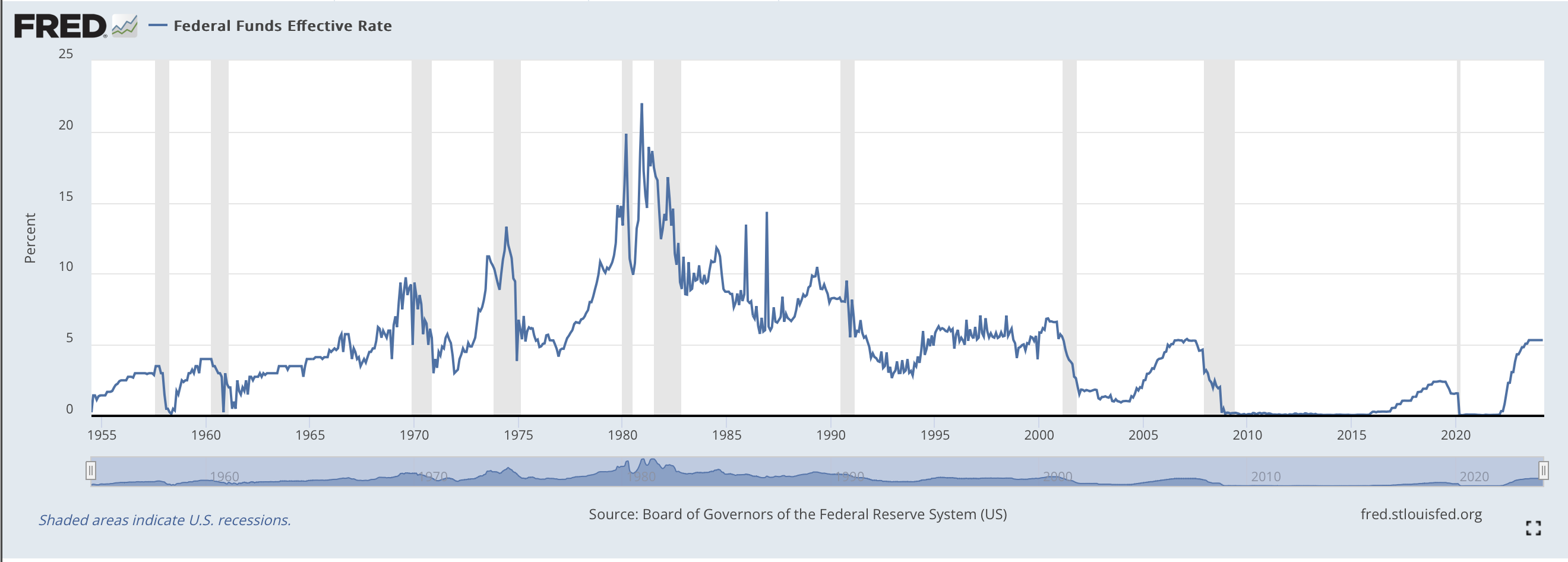
It is the third choice though, cutting rates, that is likely to generate the most fireworks.  Certainly, the initial movement will be a risk asset rally as investors will make the case that a lower discount rate means higher current values as well as invoke the idea that money currently invested in money-market funds will quickly move to stocks as interest rates decline.  At the same time, the front end of the yield curve will see yields decline amid what is likely to be a bull steepening of the curve.  And that’s the problem.  History has shown that when the curve re-steepens after a period of inversion, that is when trouble comes for markets.  As can be seen in the chart below from the St Louis Fed’s FRED database, the correlation between a declining Fed funds rate and a recession is very high (grey shaded areas represent recessions).  

This makes perfect sense as when the economy is heading into, or more likely already in, a recession, the Fed cuts rates to address the issue.  As such, the fervent desire to see rate cuts seems misplaced.  Strong economic activity comes alongside higher interest rates, not rate cuts.  If the Fed is cutting, that means there are problems as remember, whatever they say, they are always reactive, not proactive.  So, while the initial risk asset move may be positive, history has shown that during recessions, the average decline in the equity markets is on the order of 30%. Keep that in mind if you are hoping for the Fed to cut rates.

Ok, let’s tour the markets from overnight to see how things stand ahead of a bunch of data this morning. Japanese stocks suffered overnight, falling -1.5%, as the threat of intervention did little to strengthen the yen but certainly got some investors nervous.  As well, it is Fiscal year end there tonight, so I imagine we are seeing some profit taking given the remarkable run Japanese stocks have had in the past twelve months, rising 44% in yen terms.  The rest of Asia saw more gainers than losers with China, India and Australia all following the US markets higher although South Korea and Taiwan did lag.  In Europe, most bourses are higher this morning, but the gains have been more modest, on the order of 0.3% or so.  And as I write (7:30), US futures are unchanged on the day after yesterday’s gains.

In the bond market, yields are broadly higher with Treasuries (+3bps) reversing yesterday’s decline and similar price action in Europe with all sovereign yields higher by between 3bps and 5bps although Italy (+8bps) is an outlier as their finances are starting to look a bit dicier.  I would be remiss if I didn’t mention that JGB yields have edged down another basis point and are now at 0.70%.  There is no sign that yields are running away here.

Oil prices (+1.6%) continue to climb on the same story of reduced supply and ongoing demand.  Yesterday’s EIA data showed a smaller inventory build than forecast and there is no indication that OPEC+ is going to open the taps anytime soon.  Gold (+0.8%) is continuing its recent rally, following on yesterday’s move, as investors throughout Asia continue to hoard the barbarous relic.  As to the base metals, they are essentially unchanged over the past several sessions, seemingly waiting for the next economic data.

Finally, the dollar is feeling its oats this morning, rallying against every one of its G10 counterparts with this group (AUD -0.6%, NZD -0.6%, SEK -0.6%, NOK -0.6%) leading the way lower.  As well, the EMG bloc is also under pressure led by ZAR (-0.7%) and HUF (-0.6%) although the entire bloc is under pressure.  Of note is CNY (-0.15%) which the PBOC continues to struggle with as they cannot seem to decide if matching yen weakness is more important that maintaining stability.  It seems to me they are really hoping for BOJ intervention to reduce pressure on the renminbi.

On the data front, there is a bunch today starting with Initial (exp 215K) and Continuing (1808K) Claims, as well as the final look at Q4 GDP (3.2%).  As well we get Chicago PMI (46.0) and Michigan Sentiment (76.5) to finish out the morning.  There are no scheduled Fed speakers, but then, all eyes will be on Powell tomorrow.

It seems to me that Governor Waller made it clear that the tone in the Eccles Building is for more patience until they see inflation decline, or perhaps see the employment situation worse substantially.  With that as the backdrop, it is hard to see a good reason to sell dollars.  Keep that in mind for your hedging activities.

Good luck

Adf

What’s the Rush?

Said Waller, my god “what’s the rush?”
‘Cause things are OK at first blush
The ‘conomy’s roaring
The stock market’s soaring
And so, dreams of cuts, I must crush

But really, does anyone care
What Powell or Waller declare?
NVIDIA rallied
And gains have been tallied
So, rate cuts don’t have savoir faire

I am old enough to remember when the inherent strength of the US economy was based on its diversity of industry and geography as well as its bounty of abundant natural resources.  The governmental framework of property rights and the rule of law were critical aspects of what made this nation stand out.  But that is sooooo last week.  Instead, let me recount a famous scene from the movie, The Graduate, but updated for today:

Mr McGuire: I just want to say one word to you.  Just one word.
Benjamin: Yes, sir.
Mr McGuire: Are you listening?
Benjamin: Yes, I am.
Mr McGuire: Plastics NVIDIA

At this point, I might refute the idea of the Magnificent 7 stocks, first because Tesla hasn’t been following the script all year, but second because the reality is there is only one true god stock, NVIDIA.  It appears that the entire nation’s economy is reliant on that single company continuing to outperform analyst expectations and grow at 100% annually.  As long as it continues, the US will maintain its status as the world’s most important economy.  Seems pretty simple.  In fact, it is not clear to me why anyone would own any other stock than NVIDIA at this point, perhaps with a small percentage of assets in Bitcoin.  Only then will an investor be ready for the future!

Of course, this is not what I believe, nor would I ever suggest that someone consider this approach.  But, boy, if there is another piece of news that is remotely as important, I am still searching for it.  Every market seems to take its cues from the stock and government policies seem to be designed to either support its growth or inhibit its products from getting into the wrong hands.  Perhaps it is time to rename our nation to The United States of NVIDIA and be done with it.

Alas for this poet, equity markets are not my primary focus so I will try to look through the other scraps of information and see if there is anything interesting.  Top of the list were the assorted commentaries by four different Fed speakers yesterday, all of whom said essentially the same thing, while they expect rate cuts at some point this year, it is still too early as they are not yet confident that inflation will sustainably return to their 2% target.  That was the message from Wednesday’s FOMC Minutes, that was the message from Powell at the press conference and that has been the consistent message since the last meeting.

Happily, it appears that the markets are starting to understand this idea as a look at the Fed funds futures market shows the probabilities of rate cuts continues to decline, now 2.5% in March, 21% in May and just 66% in June.  In fact, for the full year, the market is now pricing just 85bps total, not much more than the last dot plot’s median outcome showed.

From my perspective, I remain uncertain as to why they are even considering cutting interest rates.  After all, GDP continues to power along, financial conditions continue to ease with a rising equity market, and inflation has many earmarks of remaining sticky.  Absent a collapse in the commercial real estate market that drags down a number of banks, or some other true black swan type event, it appears that the need to cut rates in the US is limited at best.  Do not be surprised to see the dot plot in March show just 2 rate cuts as the median end-2024 outcome as the hawks will have to reevaluate their stance given the economy’s strength since December.  And as I have said before, if inflation really does start to tick higher again, a rate hike seems possible, which is clearly not on very many bingo cards right now.

But really, the Fed discussion pales in comparison to the NVIDIA discussion and the impact on equity markets in general.  Since there has been very little other data even released, let’s recap the overnight session and head into the weekend.

After the massive rally in the US yesterday, with all 3 major indices setting new all-time highs, most markets in Asia were unable to follow through in any real manner, with very modest gains everywhere that was open (Japan was closed for a holiday).  In Europe, the picture is mixed with some gainers (CAC +0.6%), some losers (IBEX -0.5%) and some nothings (FTSE 100 and DAX unchanged). As there was limited data to drive things and the ECB speakers are trying to hew the line that they, too, will remain patient, nothing has changed there of late.  I continue to believe that the ECB will cut before the Fed because the Eurozone economy is in much worse shape than the US economy.  As to US futures, at this hour (7:30) they are basically unchanged.

In the bond market, after yields rising yesterday afternoon by some 6bps, Treasuries are unchanged this morning.  There are growing concerns that the supply question is going to begin to impact yields in the US, with more than $500 billion of new coupon issuance due over the rest of the year.  It is possible yields will need to rise to find buyers for all that.  As to Europe, yields there are higher by 3bps or so this morning as they missed most of the US move.

Commodity markets are under some pressure this morning with oil (-1.7%) giving up any recent strength and now lower on the week.  However, I believe it remains rangebound and need to see compelling evidence of something changing to see a real move here.  In the metals markets, gold, which slid a bit yesterday is edging higher this morning but both copper and aluminum are under pressure on demand concerns.

Finally, the dollar, which did recover yesterday to finish roughly flat on the session, is beginning to soften a bit as NY is walking in after an extremely quiet overnight session.  But overall, the movement here remains marginal with most currencies, both G10 and EMG, remaining within a +/-0.25% range from yesterday.  With monetary policies around the world seemingly on hold for now, it is unrealistic to look for large moves in the FX market.  We will need to see a change in central bank tunes to make this happen.  (either that or Jensen Huang, NVIDIA’s CEO, will need to explain that the dollar needs to move in one direction or another to boost earnings!)

There is no US data to be released and there are no Fed speakers on the calendar either.  With that in mind, equity markets are going to be the driver of note.  If the rally continues, and risk is embraced, I suspect the dollar can slide a bit further.  However, if there is any late week profit-taking, perhaps the dollar finds a bid.

Good luck and good weekend
Adf

As Good As It Gets

Said Waller, I have no regrets
For things are “as good as it gets”
We’ve been quite outstanding
And reached that soft landing
Though rate cut forecasts won’t be met

Wow is all I can say.  While Treasury Secretary Yellen was brasher last week by explicitly saying they have achieved the mythical soft landing, Governor Waller’s speech yesterday went into great detail about his work in 2022 on Beveridge curve analysis that almost perfectly forecast the current situation.  I certainly hope he didn’t sprain his arm patting himself on the back.  The certitude that has been coming from Fed speakers and their acolytes, like ex Fed economist @claudia_sahm, is remarkable to me.  After literally a century of having no great insight into the workings of inflation, the Fed has now declared they have it under control because the past 6 months have seen price increases rise at a slowing pace.

Key Waller comments were as follows, “By late November, the latest economic data left me encouraged that there were signs of moderating economic activity in the fourth quarter, but inflation was still too high.  As of today, the data has come in even better. Real gross domestic product (GDP) is expected to have grown between 1 and 2 percent in the fourth quarter, unemployment is still below 4 percent, and core personal consumption expenditure (PCE) inflation has been running close to 2 percent for the last 6 months. For a macroeconomist, this is almost as good as it gets.”

He finished with this comment, although interestingly, the market did not applaud, “As long as inflation doesn’t rebound and stay elevated, I believe the FOMC will be able to lower the target range for the federal funds rate this year. This view is consistent with the FOMC’s economic projections in December, in which the median projection was three 25-basis-point cuts in 2024.”

Maybe the Fed really has stuck the landing and inflation is going to smoothly slide back to 2% and stay there while the economy ticks over at 2%-3% GDP growth.  Certainly, if the fiscal impulse continues to run at deficit levels of 8% of GDP, I would hope we could get 3% growth.  But to my understanding of the way the economy responds to policy actions, that 8% deficit is going to find itself into rising prices across the economy.  But then again, I’m just an FX guy.

In the end, the market heard Waller and decided that maybe higher for longer was still a thing.  The Fed funds futures market reduced its probability of a March rate cut to 60% from 70% before the speech and the bond market sold off pretty hard with yields closing at 4.07%, their highest level since the day before that December FOMC meeting when everybody was certain that the Fed had pivoted.  It seems the question now is, have they actually pivoted?

One of the problems they have is that the inflation data last month indicated the pace of price increases could be stabilizing around the 3.0%-3.5% level, rather than their target 2.0% level.  We have very consistently heard from all the acolytes that if you annualize the past 3 or 6 months’ worth of data, the Y/Y rate is pushing to 2.0%.  This, they claim, means the Fed has achieved their goal.  The problem with this argument is that the Fed’s goal is not simply touching a 2.0% inflation rate, it is to maintain it at that level over time.  That is a much more difficult landing to stick, and there is no evidence things will work out that way especially given we haven’t even reached a Y/Y rate of 2.0%!

Here’s another problem for that crew, inflation elsewhere in the world is not continuing its recent decline.  Yesterday, Canadian CPI data showed that the trend numbers, Trimmed-Mean (3.7%) and Median (3.6%) were both higher than forecast and higher than last month.  This morning, from the UK we learned that CPI rose 0.4% M/M, far more than expected with the Y/Y data rising to 4.0% headline and 5.1% core.  In both these nations, the recent trend had been lower but has now reversed.  While we have seen a significant rebalancing of markets and measured inflation has clearly fallen from its levels of the past two years, I would argue the evidence is scant that this trend is necessarily going to continue.  Wage growth continues to hold up as employees try to catch up to the huge price increases since 2019.  With the Unemployment Rate remaining near multi-decade lows, absent a major recession it appears it will be very difficult to continue to squeeze prices lower.  And this doesn’t even consider the fact that increased tensions in the Middle East and the rerouting of ships around the Cape of Good Hope in South Africa, is adding weeks and costs to any movement of goods or oil, and could last for a considerable length of time.

We have consistently heard from ECB members that rate cuts are not coming soon.  We have had a lot of pushback lately from FOMC members about the timing of any rate cuts with both sets of speakers explicitly saying the market is overexuberant in their current pricing.  As I wrote yesterday, I think we are looking at a bimodal outcome, either virtually no rate cuts, or many more because we are in a recession.  In either case, I think equity markets will need to reprice lower.  However, the impact of these two situations will be different on the dollar, the bond market and commodities.  We will discuss those outcomes tomorrow.

In the meantime, overnight was a sea of red (as opposed to the Red Sea) in equity markets with the Hang Seng (-3.7%) leading the way lower but weakness on the mainland as well (CSI -2.2%) and throughout the region.  Japanese stocks (Nikkei -0.4%) were actually the leaders in the space.  The China story was informed by their monthly data dump which showed GDP grew at a slightly weaker than forecast 5.2%, while IP (6.8%), Retail Sales (7.4%) and Fixed Asset Investment (3.0%) were all around expectations, but still soft overall and compared to last month.  The Unemployment Rate there ticked higher to 5.1%, and they put out a new version of the youth unemployment rate at 14.9%, which they insist is a better measure than the old one which was screaming higher and was discontinued when it breached 21%.

European equity markets are also under pressure, mostly down about -1.0% on the continent and lower by -1.75% in the UK after the data releases.  As to the US, after a lackluster session that was saved by a late day rally yesterday, futures this morning are lower by about -0.25% at 7:30.

In the bond market, after the large move yesterday, Treasury yields are unchanged on the day and European yields have edged up by about 1bp across the board with UK Gilts the exception, having jumped 10bps after the inflation readings.  JGBs continue their lackluster activity and while they rose 2bps overnight, they remain below 0.60% overall.  Again, slowing inflation there indicates little reason to believe they are going to change their monetary policy anytime soon.

On the commodity front, oil (-1.8%) is showing a lot more concern over demand destruction after the modestly weaker Chinese data than concern over supply issues from Middle East tensions.  Plus, with US rates higher, commodity prices tend to suffer anyway.  Gold, which got crushed yesterday amid the repricing of interest rates is unchanged this morning, licking its wounds while copper and aluminum trade either side of unchanged as the economic situation remains so uncertain right now.

Finally, the dollar remains king of all it sees this morning, rallying further after yesterday’s rally and now has retraced virtually all the weakness that came from Powell’s December “pivot”.  This has been true in both the G10 and EMG blocs as the dollar is almost universally higher this morning.  The one exception is the pound, which has managed a 0.35% rally on the back of the move in UK interest rates after the higher inflation data print this morning.  The key to remember here is that despite a great deal of chatter about the dollar’s demise, the reality is that it has moved very little, net, over the past year and is far higher than where it was 5 years ago.  If the Fed really is going to maintain higher for longer, which if inflation continues its rebound seems likely to me, then the dollar has to benefit.

Turning to the data, this morning we see Retail Sales (exp 0.4%, 0.2% ex autos), IP (0.0%) and Capacity Utilization (78.7%).  In addition, we have three Fed speakers this morning and then this afternoon we get the Fed’s Beige Book and NY Fed president Williams speaks.  Given what appears to be a change in tone from Waller, it will be interesting to see if the others follow his lead or push back.  I have to believe that we are going to see more higher for longer talk and how it is premature to talk about rate cuts in March.  If that is the case, the dollar should retain its recent strength and I expect risk assets to come under further pressure.

Good luck
Adf

Nirvana Sans Prayer

The Fed has regaled us this week

With speakers who all tried to tweak
Their message on rates
And foster debates
On havoc their actions might wreak

Some told us their hiking was done
That, as to inflation, they’d won
But others explained
They’d not yet obtained
Relief from this price rising run

Now into this breech steps the Chair
Who later this morning will share
His views where they stand
And how he has planned
To reach rate nirvana sans prayer

As we enter the final month of 2023, the bulls are in the ascendancy.  The 60/40 portfolio, which had been declared obsolete last year and certainly behaved that way most of this year, just had its best month since 1985.  US equity markets rallied between 8%-10% and 10-year Treasury yields fell 40bps through the month.  In other words, the price of virtually everything went higher.  This includes gold (+3.0%), silver (+10.5%) and copper (+5.0%) with only oil (-7.5%) and the dollar (DXY -2.5%) as the losers in November.   

To what do we owe this remarkable performance across asset classes?  Or perhaps the question should be to whom do we owe this outcome?  My vote is for goldilocks!  Her story of everything winding up ‘just right’ remains the dominant market narrative.  This has been encouraged by a plethora of Fed, and other central bank, speakers harping on the fact that inflation readings continue to decline nicely, and although nobody is ready, yet, to begin cutting interest rates, there seems to be an implicit wink, wink, nod, nod that the market is sensing rate cuts are coming soon.  And maybe they are, but that is certainly not my base case.

However, my base case is not relevant here, the market viewpoint is the driver.  Interestingly, yesterday we heard from NY Fed President Williams and while he has been encouraged over the recent path of inflation readings, when asked about the market’s pricing of rate cuts early next year he explained, “he wasn’t losing any sleep over the issue.”  In other words, he is unconcerned with the market chatter and is focused on the data and his perception of the economy’s performance.  In fact, I believe that to be the case for all the FOMC members, despite the prevailing narrative that the Fed will never surprise the market if they can avoid doing so.

This brings us to this morning’s speech by Chairman Powell.  His is the last communication by a Fed member ahead of the FOMC meeting on the 13th.  At this point, it remains unknown if he will hew toward the idea that things look good and they have reached an appropriately tight level of monetary policy and financial conditions, or if he will try to continue with the higher for longer concept, highlighting that while progress has been made, the dangers of easing prematurely are grave and must be avoided at all costs.  The fact that Governor Waller, earlier this week, expressed that it might be appropriate for rates to decline in 3-4 months’ time has the equity and bond bulls pawing the ground and ready to charge again.  However, I would contend that Williams’s comments yesterday, indicating little concern over market pricing and greater concern that they finish the job to be just as important.  Powell clearly listens to both these gentlemen closely.  In the end, the one thing that Powell has explained time and again is that he will not make the Arthur Burns mistake of easing before inflation was well and truly dead.  It is this consistency in his communications that leads me to believe that the bulls are a bit ahead of themselves for today.

Remember, too, we will see the NFP report next Friday, and the November CPI report the day before the FOMC announcement, as well as a bunch of other data to help fill in some blanks.  In fact, yesterday’s PCE data, both headline and core, were right on expectations as was virtually everything else except Continuing Claims, which at 1927K, was the highest since early 2022, and another sign that the labor market is loosening up.  Countering that, though was a dramatically higher than expected Chicago PMI print of 55.8, pointing to strong growth.  Again, the data continues to lack a unifying direction at this stage.  And so, regardless of Powell’s comments today, the FOMC will still have much to digest before they decide.

As to how this will impact markets, my take is the following: goldilocks is still the predominant narrative which means that weaker economic data will be seen as bullish news for both stocks and bonds because it will cement the view that the Fed is not only finished but that cuts are coming soon.  Correspondingly, strong data will be much harder to swallow as it will renew concerns that the Fed is not done hiking yet.  But until Powell speaks this morning at 11:00, we are in the dark.

Reviewing the overnight activity shows that equity markets in Asia were mostly lower with the Hang Seng (-1.25%) continuing to feel the pressure of the weak Chinese property market.  The story is that China Evergrande has until Monday to avoid liquidation with further potential ramifications for other property developers.  Alas, President Xi has not been able to find a Chinese solution for taking on too much debt and blowing a bubble that does not include popping that bubble.  As to Europe, after a strong November in equity markets there as well, this morning is seeing gains across the board on the order of +0.7% while US futures are currently (8:00) ever so slightly softer, -0.2%.

In the bond market, after a rip-roaring month around the world as the prevailing narrative grew that the peak in inflation, and therefore, yields has been seen, this morning is starting off quietly.  The yield on the 10yr Treasury is higher by just 1bp and in Europe, we are actually seeing modest yield declines, 1bp-2bps, as investors respond to still weak PMI data across the continent.  While the uber-hawks on the ECB are unwilling to discuss rate cuts, given the slowing growth in the Eurozone and the fact that inflation readings there are declining much more rapidly than in the US, the market is quite confident that rate cuts are coming soon.

Oil prices are slightly softer this morning, -0.5%, which takes them right back to where they started the week.  However, they have fallen for the previous 5 weeks.  The OPEC+ meeting was something of a dud, with what appears to be a further production cut, but there was certainly no unanimity of action there.  Gold prices are unchanged on the day, maintaining most of their recent gains and copper prices (+0.6%) are actually edging higher again.  To the extent that copper is an accurate harbinger of future economic activity, it certainly seems that prospects are improving and a recession will be avoided.

Finally, the dollar, which has seen universal hatred based on the decline in 10yr Treasury yields as well as the narrative that the Fed is going to be cutting rates early next year, continues to hold its own.  In fact, it is slightly firmer in the past week overall, although we have seen a mix of movements depending on the currency.  Among the weakest has been the euro, which while it peaked above 1.10 earlier this week for a brief time, is now back below 1.09 as traders start to understand that whatever the Fed may do with interest rates, the ECB is going to be cutting sooner than the Fed.  At the same time, we have seen some strength in the commodity bloc over the past week, with AUD, NZD, CAD, NOK and ZAR all showing solid performances on the back of the recent commodity strength.  

And lastly, we cannot ignore the yen, the currency that everyone was certain was set for a major rally as the diverging paths of the Fed (imminent cuts) and the BOJ (ending QE and tighter money) would finally change the trend.  Oops!  While the yen is a bit stronger this week, about 0.8%, that barely covers the negative carry of the position and with 10yr JGB yields back in the 60bps range, there is really no evidence that Japan is actually preparing to tighten policy.  While I personally think they do need to start doing so as inflation has remained above their 2% target for more than a year, things work differently in Tokyo than elsewhere.  For hedgers, I have to believe that JPY puts are the best protection around, relatively inexpensive and allowing for any significant rallies in the yen without locking in bad rates.

Leading up to Powell’s speech this morning, we see ISM Manufacturing (exp 47.6) although after yesterday’s blowout Chicago PMI number, don’t be surprised to see a bit higher.  Canadian Employment data was just released, largely in line with expectations as the Unemployment Rate ticked up to 5.8% as forecast.  Again, we continue to see a mixed picture with regard to the future of the economy.  I think that is why we put so much stock into central bank speakers, but also why things remain so confused.  After all, they don’t have any better models or insight than the rest of us and are just winging it anyway!

Big picture is, if Powell is hawkish and pushing back on the narrative, I expect the dollar to edge back higher.  However, if he does not push back, look for another serious equity and bond rally and for the dollar to sink.

Good luck and good weekend

Adf

Now Estranged

“Something appears to be giving”
Said Waller, the true cost of living
So, bonds rallied hard
The dollar was scarred
But stocks were quite unreactive-ing

The narrative clearly has changed
With hawks on the Fed now estranged
Is everything better?
As world’s largest debtor
We need low rates to be arranged

Fed Governor Chris Waller, one of the erstwhile hawks on the FOMC was covered in white feathers yesterday as he explained his latest perception that the Fed was on a path to achieving their 2% inflation goal as Q3’s expansive GDP was clearly an outlier and the data he cited showed economic growth slowing toward trend just below 2%.  The other Fed speakers on the day did not back him up specifically, and in fact, Governor Bowman explained her base case was the Fed needed to hike still further to be certain inflation was under control.  However, the market only had eyes for Waller and has heard the following message from the Fed, ‘we have finished hiking, and the next move will be a cut.’  Although this had been a building narrative, until yesterday there had been consistent pushback from virtually every Fed speaker with the higher for longer mantra.  However, the current belief set is that higher for longer has just been buried and that lower rates are in our future.  Let the celebrations begin because the Fed has achieved the much discussed, though rarely achieved, soft-landing.

However…it is still a bit premature, to my mind, to celebrate accordingly.  In fact, just yesterday the Case Shiller Home Price Index showed an annual rise of 3.9%, which although 0.1% less than forecast, also shows that the widely claimed decline in house prices due to higher yields, has not materialized.  And consider, if yields are set to go lower, the idea that house prices are going to fall and feed into lower inflation seems absurd unlikely.

But logic has never been an important part of any market narrative, and this time is no different.  The fact that declining bond yields (Treasuries fell 6bps yesterday and a further 5bps in the aftermarket) and the fact that the dollar, as measured by the DX, fell 0.5% led by USDJPY falling nearly 1.5% to its lowest level since September, has eased financial conditions thus supporting economic activity and inflation, is of no importance to the narrative.  Once again, we have heard from some big-name traders, Bill Ackman in this case, claiming that the Fed is now going to cut well before the market is pricing, predicting the first cut in March 2024. The market response to this has been for Fed funds futures to price a 40% chance of a March cut and a 75% chance of one at the May meeting.

And maybe all this is correct.  However, as I wrote yesterday, I believe that we are going to see a significant additional amount of federal government largesse to help prop up the economy, and that is not going to push inflationary pressures lower, the opposite in fact.  As is always the case, nothing matters until it matters, and right now, the only thing that matters is that the narrative is all-in on rate cuts coming soon to a screen near you.  While we could easily see further short-term weakness in equity markets as portfolios rebalance after a huge equity rally this month, it certainly seems like a push higher in risk assets is on the cards into Christmas.

As we consider the price action from yesterday and overnight, the thing that really stands out is that the US equity markets did so little on this very clear change in tone from a key Fed speaker.  Had you told me this was going to be Waller’s attitude prior to the session, I would have expected US equity markets to rally by 1+% each, with the NASDAQ really embracing the idea of lower rates.  But while the three major indices all closed in the green, it was only at the margin, +0.1% – +0.3% with a very late day rally.  Yes, futures are pointing higher this morning, up about 0.3% across the board, but again, this is somewhat unimpressive.  Perhaps the market has already priced in this idea, hence the 10% rally in November.

There is another wrinkle in this narrative as well, and that is that APAC shares are underperforming in both China and Japan.  Regarding the former, the Hang Seng (-2.0%) fell again as continuing concerns over Chinese corporate growth and profitability weigh on the index with Meituan reporting poor results.  On the mainland, despite hopes that the government was going to do more to support the property market, thus far it has been all talk, and no action and investors are getting tired of waiting.  Europe, however, is having a better go of it this morning, excluding the UK, where continental indices are all nicely higher, at least 0.5% with some as much as 0.9%.  

Not surprisingly, European debt markets are rallying as European sovereigns are following the US lead, ignoring the pleas from ECB speakers that higher for longer remains the path forward.  As such, we are seeing further declines on the order of 4bps – 6bps across the continent, matching US yield declines for the past two days.  Yields in Asia, though, are quite interesting with some very different narratives playing out there.  Starting with Japan, which saw yields fall 9bps last night, back to their lowest level since September, we heard from BOJ member Seiji Adachi that it was premature to consider exiting ultra-loose monetary policy amid global economic uncertainties and the end of the aggressive rate hikes in the US.  That seems counter to what had been the building narrative regarding Ueda-san’s next move.  Australia saw yields decline 14bps but in New Zealand, the decline was much more muted, just 2bps, after the RBNZ left rates on hold, as expected, but was far more hawkish in their statement than expected and hinted at potential further rate hikes.  

Turning to the commodity markets, oil continues to rebound, rallying another 1.8% this morning and recouping all its recent losses as confusion still reigns over the OPEC+ meeting tomorrow, or perhaps to be delayed again.  As well, it seems that a massive early winter storm closed ports in the Baltic and so oil shipments have been interrupted there for the time being.  Gold, though, has been the big story in commodity markets as it exploded higher yesterday after the Waller comments, jumping $30/0z (1.5%) to levels last seen in May and once again approaching its all-time highs of $2085/oz.  The market technicians are getting quite excited as they see a break there as having potential for a much larger run higher.  A case can be made that this is not a vote of confidence in the Fed’s anticipated future handling of inflation, but for now, we can simply attribute it to lower interest rates around the world.

Finally, the dollar has taken a straight-right to the chin and is reeling against virtually all its counterparts, both G10 and EMG. While we have seen a bit of a rebound this morning, since Monday’s close, EUR (+0.3%), GBP (+0.5%) and JPY (0.65%) have all rallied nicely, and that is after giving up some of those gains overnight.  We saw similar movement in the EMG bloc with CNY (+0.3%), PLN (+0.3%) and BRL (+0.8%) all responding positively to the Waller comments.  As I have been saying recently, if the Fed is truly done, then the dollar is likely to suffer, at least until such time as the other central banks fall in line.

On the data front, in addition to the Case Shiller Home Prices yesterday, we saw Richmond Fed Manufacturing which disappointed at -5.0 (exp 1.0), yet another sign that growth is waning.  It is data like this that has Waller in the mindset that slowing growth will lead to lower inflation.  Of course, rising home prices would certainly be a crimp in that theory.  Today we see the second look at Q3 GDP (exp 5.0%) with Real Consumer Spending expected at +4.0%.  We also get the Fed’s Beige Bok at 2:00pm and Cleveland Fed president Mester speaks at that time.  It will be interesting to hear if Mester, a very clear hawk, confirms the Waller thoughts or tries to push back alongside Governor Bowman.

For now, while the dollar has bounced slightly this morning, as long as the narrative remains the Fed is done and that cuts are coming soon, you have to believe the dollar is going to fall further from here.  If pressed, I would suggest USDJPY has the furthest to decline, but the fact that we have already had pushback from the BOJ implies that they are not that unhappy it remains weak.  After all, it supports their corporate sector and helps keep inflation higher, which remains one of their goals.

Good luck

Adf

Five Percent

The number one story today
Is that 10-year bond yields soon may
Trade to five percent
As bond bulls lament
Their theory’s no longer in play

As I write this morning at 6:45, 10-year Treasury yields are now trading at 4.95% having touched 4.98% a few hours ago.  This has become the biggest story of the day given the psychological impact of yields rising to that level and the fact 5.00% is such a big round number.  There is a lot of sentiment regarding round numbers in markets, so things like parity in EURUSD or $100/bbl in oil or even stock indices (e.g., S&P at 4000) take on a life of their own whether or not there is any fundamental driver of a particular situation.  But let’s face it, the market is all about psychology, so if people care, it matters. 

If (when) we trade through 5.00% will anything have changed?  Unlikely, but it is definitely today’s narrative.  It appears that the drivers are anticipation of yet more supply next week as well as continued confirmation that the Fed is going to maintain Fed funds at current levels for quite a while, even if there are no more rate hikes.  We also continue to hear stories of selling by major holders although I addressed that yesterday.  Certainly, part of the market zeitgeist is the idea that the continued strong US economic data are the seeds for ongoing inflation pressures leading to higher yields.  But in the end, the only thing of which we are sure is that demand for paper, despite the highest yields in more than sixteen years, is underwhelming.  At least relative to the supply of paper that is available and due to come soon.

For now, I expect that as yields continue to climb, we are going to see ongoing struggles in the equity market, dollar strength and commodity prices struggling.  Of course, gold continues to buck that trend as it is holding up extremely well in the face of higher yields. 

In the meantime, it is worth remembering the Fed stance, which clearly still matters.  

Said Waller, we’ll “wait, watch and see”
How things in the broad ‘conomy
Evolve before moving
And if they’re improving
More rate hikes will be the decree

Said Williams, the time’s not arrived
To alter the rates we’ve contrived
Though, progress we’ve made
We’re still quite afraid
That falling inflation’s short-lived

It is becoming abundantly clear from the comments by all the Fed speakers during the past two weeks that there will be no policy rate movement at the next meeting.  Of course, Chairman Powell has yet to offer his views, which are due today at noon.  However, it seems difficult to believe that this overwhelming agreement of a pause to, as Governor Waller put it, “wait, watch and see,” the evolution of the economy has not been approved by the Chairman.  Nonetheless, you can be sure that his words will be parsed especially carefully later today.

Of course, the data continues to show that the economy is not slowing down in any substantive fashion and the bond vigilantes are out in force.  After yesterday’s 8bp yield rally above 4.90%, this morning’s movement should be no surprise.  We also saw European sovereign yields explode higher yesterday with UK Gilts up 15bps and continental bonds up between 5bps and 10bps.  As I have been consistently writing, this move is nowhere near over.  One other thing that has not yet garnered much attention is that the Bund-BTP spread is now at 206bps after the Italian government just passed a financing bill that includes a 4.2% government deficit, well above the 3.0% EU limit and above the promises made when PM Meloni first entered office.  Concerns are growing that Italian finances may soon become a real problem, not just for Italy, but for Europe as a whole.

We should also discuss the JGB market where the 10-year yield is now at 0.85%, creeping ever closer to their new alleged line in the sand at 1.00%.  Recall, the BOJ is the only major central bank that is explicitly buying bonds and has promised to buy an unlimited amount to prevent yields from rising above that 1.00% level. In fact, 1.00% JGB yields is the only round number that has any true significance.

Ultimately, the current interest rate / yield story is the key driver across all markets.  In addition to the dramatic movement we have seen in bond markets, yesterday saw pronounced weakness in equity markets and strength in the dollar.  After falling more than -1.0% here, Asian markets fell even more sharply, between -1.5% and -2.0%.  European bourses are also under pressure this morning, but not quite to the same extent as they suffered somewhat yesterday in their afternoon sessions.  As to US futures, they are unchanged at this hour (7:15) awaiting Powell’s comments.

Oil prices (-1.25%) are backing off a bit from their recent rally after news that the administration has relaxed sanctions on Venezuela indicating that there will be a bit more supply available.  However, yesterday’s inventory data showed significant drawdowns and cannot be ignored as a fundamental driver which would imply higher prices going forward.  Gold, after another spike yesterday of more than 1% is creeping still higher this morning with the best explanation a growing concern over a much more uncertain future.  After all, if investors are losing their faith in Treasury bonds, and as evidenced by the ongoing selling pressure, that is one possible explanation, gold has always served as the ultimate safe haven.  As to the base metals, they are also firmer this morning, arguably on the back of still surprisingly strong US economic data.

Finally, the dollar is mixed this morning, with gains vs. the pound and the commodity bloc while the euro has managed to edge higher.  USDJPY remains stuck just below the 150 level as though someone is working very hard to prevent that level from trading again.  In fact, we have traded between 149.40 and 149.85 for the past week, an extremely tight range that looks quite artificial.  Do not be surprised if we finally breech the 150 level for a time and then see another bout of intervention by the MOF/BOJ driving it back down again.  Ultimately, though, if the BOJ maintains its current stance, the yen is going to trend weaker.  

A quick look at the EMG bloc shows that CNY is trading to its weakest point in more than a month as news that Country Garden, the erstwhile largest property developer in China, failed to make a coupon payment yesterday for the second time and is set to file for bankruptcy has raised concerns over the entire economic process there.  Elsewhere, IDR (-0.5%) fell during its session although I would expect some strength tonight as the central bank there surprised the market and raised their base rate by 25bps after the market closed.  In general, the EMG bloc has seen weakness across the board with the dollar ‘wrecking ball’ wreaking havoc for those companies and countries that need to service their USD debt.

On the data front we see Initial (exp 212K) and Continuing (1710K) Claims as well as the Philly Fed (-6.4) and then Existing Home Sales (3.89M).  In addition to Chairman Powell, we hear from six other Fed speakers, although with Powell speaking and the second in the lineup, I don’t imagine the other comments will matter much.  Remember, after tomorrow, the Fed enters its quiet period as well.

Looking at the totality of the situation, it would be shocking if Powell added anything new to the debate.  At this point, I expect that the bond market will remain the driver of everything.  I also expect that 10-year yields above 5.00% are coming soon to a screen near you and that the normalization of the yield curve will be completed before the end of the year.  Right now, the 2yr-10yr spread is down to -28bps and an eventual move to +50bps – +100bps would put us back in ‘normal’ territory.  In other words, 10-year yields could rise much further!  In that situation, I still like the dollar overall.  I will need to see something substantial change before the dollar’s bullish trend turns around.

Good luck

Adf

Buying Will Stop

It seems nearly every day now
Some Fed members make the same vow
First buying will stop
Next Fed funds will pop
Then asset run-off we’ll allow

Thus far markets have been subdued
Though some players now have construed
That buying the dip
Has lost all its zip
While selling all rallies is shrewd

Another day, another series of Fed speakers explaining that inflation is the primary focus, that when QE stops in March it may (read will) be appropriate to raise the Fed Funds rate by 0.25% and that the Fed has powerful tools to prevent inflation from getting out of hand.  While it is encouraging that they have finally figured out inflation is a problem, the fact that they still don’t understand it is a problem of their own making is somewhat disconcerting.  However, moving in the right direction is clearly a positive.

So, after Brainerd, Waller, Barkin and Evans all basically said the same thing, here is what we know.  It seems a virtual certainty that the Fed Funds rate will be raised at the March meeting with a very high likelihood of at least two more hikes as the year progresses.  Mr Waller even suggested more than four total this year, although that is clearly a minority view, right now, on the FOMC.  The problem is that 25 basis point increments every 12 weeks is not going to make much of a dent in inflation running at 7.0%.  And, even if inflation falls back down to 4.0%, it will still take more than three years for the Fed to even reach a point where real yields are back to 0.0%.   Not only that, when Waller was asked about 0.50% increments, he dismissed the idea as being destabilizing for markets.  (Yet again we can read between the lines and recognize that preventing an equity market decline remains the Fed’s primary focus regardless of recent comments on inflation.)

But back to the real yield story.  It is important to understand that negative real yields are not a bug in their plans, they are the feature.  Negative real yields are the only way for the US (and every overly indebted nation) to reduce the value of their debt without a technical default.  The Fed knows this playbook from their actions in the wake of WWII, where they capped yields at 2.50% and inflation ran at 10.0%.  A few years later, the debt/GDP ratio had fallen from 125% to 35% and the country’s finances were back in order.  That process worked then because the US economy dominated the global economy and essentially everything was manufactured here.  Given the dramatic changes that have taken place in the ensuing 80 years, it is not clear that the citizenry in the US will be quite as patient this time, but that is almost certainly the Fed’s plan.

If we assume that real yields are set to remain negative for a long time into the future, what are the likely impacts going to be?  First and foremost, real assets like commodities and real estate should perform well and maintain their value if not appreciate.  Bonds, on the other hand, will have a tougher time, although there are many things which may help support them, not least of which would be a reversal of policy by central banks.  Equities are going to find themselves segregated into companies that have businesses and are profitable and those that have benefitted from the ongoing monetary largesse of the central banks and may find that funding their businesses will get more difficult.  In other words, credit is going to matter going forward in this environment.  Finally, the dollar’s behavior will be contingent on just how other nations approach the real yield question.  For those countries that follow sound money policies, and seek to end financial repression, their currencies should benefit.  However, all signs are pointing, at this time, to the fact the US will not be considering sound money policies as they are short-term politically unpalatable, and the dollar will underperform going forward.  I apologize for the dour message on a Friday, but the constant Fed blather becomes difficult to tune out after a while.

Ok, here’s what we have seen overnight.  Yesterday’s tech rout in the US took equity markets lower across the board and that was followed in Asia as well (Nikkei -1.3%, Hang Seng -0.2%, Shanghai -1.0%).  Europe, too, is in the red with fairly solid declines in the DAX (-0.6%) and CAC (-0.6%) although the FTSE 100 (-0.1%) is outperforming after November GDP data showed surprisingly strong growth in the UK across both manufacturing and services. Meanwhile, US futures are hovering either side of unchanged although NASDAQ futures have recently turned down a bit more aggressively.

An interesting feature of today’s price action is that not only are stocks being sold, but so are bonds, and everywhere.  Treasury yields are higher by 3.0bps, although that is simply unwinding yesterday’s rally where yields fell a similar amount.  European sovereigns are also selling off with yields higher across the board (Bunds +2.4bps, OATs +2.4bps, Gilts +2.8bps).  While the positive news from the UK seems a rationale for the Gilt market, German GDP actually fell in Q4 bringing their Y/Y number down to 2.7% and one would have thought that might support Bunds.

Where, you may ask, are investors hiding if they are selling both stocks and bonds?  Commodities are looking better this morning with oil (+0.7%) continuing its recent rally although NatGas (-2.6%) remains beholden to the winter weather.  A warmer day here in the Northeast is undermining the price.  Precious metals (Au +0.1%, Ag +0.2%) are both on the right side of unchanged and most industrial metals are doing well (Cu -0.7%, Zn +1.9%, Sn +2.3%).  Agricultural prices are also beholden to the weather so are seeing a mixed bag this morning.

Finally, the dollar is mixed this morning, with an equal set of gainers and losers in both the G10 and EMG blocs.  JPY (+0.3%) is the leader in the clubhouse as the very obvious risk-off sentiment is encouraging repatriation of funds while AUD (-0.3%) is the laggard, seemingly on the back of the hawkish Fed comments (or perhaps on the fact that Novak Djokovic will not be playing in the Australian Open after all!)  In the emerging markets RUB (-0.6%) is the worst performer on the back of fears of further sanctions as the Ukraine situation continues to escalate, while INR (-0.35%) has also suffered overnight, this more on the talk of Fed hawkishness.  However, after those two, decliners have moved very little, certainly not enough to make a case about anything in particular.  On the plus side, CLP (+0.5%) and ZAR (+0.4%) are the leaders.  The peso is following yesterday’s strength with more as traders anticipate more hawkishness from the central bank while the rand is trading on the back of some key technical levels having been breached and pointing to yet more strength short-term.

Data this morning brings Retail Sales (exp -0.1%, +0.1% ex autos) as well as IP (0.2%), Capacity Utilization (77.0%) and Michigan Sentiment (70.0).  Yesterday’s PPI data did nothing to dispel the idea that inflation is well entrenched in the US economy regardless of what Fed members say in testimony or commentary.

Using the dollar index (DXY) as a proxy, the dollar has fallen 1.5% since this time last week.  Heading into this year, dollar bullishness was rampant as expectations for much tighter Fed policy were seen as likely to push the dollar higher.  However, the early price action is beginning to dispel that notion.  I have a feeling that we are going to see investors sell dollar rallies at the same time they sell equity rallies.  This is a huge sentiment change from the previous “buy the dip” mentality that had been prevalent since Ben Bernanke first introduced QE all those years ago.  Caveat emptor is the new watchword, for both stocks and the dollar.

Good luck, good weekend and stay safe
Adf

A Touch of Despair

The Beige Book detected the fact
That bottom lines all have been whacked
As wages explode
While growth, somewhat, slowed
Inflation, it seems, ain’t abstract

Meanwhile we heard from a vice-Chair
Whose words had a touch of despair
It seems he now thinks
There just might be links
Twixt QE and price everywhere

Chairman Powell’s comments due tomorrow are taking on much greater importance than just a few days ago as the Fed narrative is seemingly in the middle of a change.  While many have been willing to dismiss the fact that the regional Fed presidents have been more hawkish lately, leading the charge for the beginning of tapering, the Fed governors had been far more sanguine on the subject, at least until very recently.  Tuesday, we heard from Governor Waller about his concerns that inflation could be more persistent, especially if one looked at the headline measures as he dismissed the other measures as efforts at manipulation.  Yesterday it was vice-Chair Quarles’ turn to put the market on notice that inflation’s persistence has begun to become troublesome and while he still felt price pressures would abate next year, his level of confidence in that forecast was clearly declining.  Both of them hinted at the possible need for rate hikes sooner than previously expected.

Yesterday, too, the release of the Fed’s Beige Book presented a clear picture of two issues: wages were rising rapidly, and growth was slowing.  The problem stems from the fact that despite wage increases of 20% or more, companies are still having a problem staffing up to desired levels and that has led to reduced output.  It has also led to business after business explaining that they would be raising prices to offset increased costs for not just wages, but raw materials and shipping.  In your Economics 101 textbook (likely Samuelson’s) this was the very definition of a wage-price spiral.

It is this recent hawkish turn by several Fed governors that brings even greater attention to Chairman Powell’s comments tomorrow.  The market is already assuming that tapering will begin next month, but the question remains, will the Fed be able to continue along that line if economic activity continues to slide?  I raise this issue because after Tuesday’s weaker than expected housing data, the Atlanta Fed’s GDPNow indicator has fallen to 0.533% for Q3.  And that’s an annual rate, down from Q2’s 6.8% GDP growth.  It appears the Fed may have a difficult decision to make in the near future; fight rapidly rising inflation or fight rapidly slowing growth. As I’ve written before, stagflation is a b*tch.

Adding to the economic problems is the continued slowing of growth in China where ongoing power shortages combined with a resurgence of Covid related shutdowns and the implosion of China Evergrande have resulted in the slowest, non-Covid, growth in decades.  At the same time, the PBOC continues to drain liquidity from the economy in an effort to reduce leverage which has the effect of further slowing activity there.  Given China has been the global growth engine for at least the past decade, a slowdown there means we are going to see slower activity everywhere else.  Alas, for the central banking community, it is not clear that will help price pressures abate, not as long as energy and raw material prices continue to rise.

Summing it all up shows that growth worldwide is falling from Q2’s peak while price pressures are flowing from commodities to shipping and now wages.  All this is occurring with interest rates broadly at their lowest levels in history. (I know some countries have raised rates a bit, but the reality is there is far less room to ease policy than tighten overall.)  Given this backdrop, it remains amazing to me that equity markets worldwide have been able to continue to perform well.  And yet, they continue to do so broadly, albeit not last night.  However, I believe that interest rate markets are beginning to recognize that the future may not be so rosy as we are seeing yields continue to climb and inflation breakevens rise to levels not seen in nearly a decade.  Remember, there is no perpetual motion machine and no free lunch.  Central banks have spent the entire post GFC period continually supporting markets while allowing significant imbalances to develop across all segments of the economy and, ironically, markets.  I have often said the Fed’s biggest problem will arrive when they announce a policy change and the market ignores the announcement.  I fear that time is growing much nearer.

With those cheery thoughts to support us, let’s take a look at the overnight session.  It seems that risk is having a bit of a struggle today with most of Asia (Nikkei -1.9%, Hang Seng -0.5%, Shanghai +0.2%) under pressure and Europe (DAX -0.1%, CAC -0.4%, FTSE 100 -0.6%), too, having difficulty this morning.  US futures are also pointing lower, -0.3% or so across the major ones, which implies pressure at the opening at the very least.  China continues to be a drag on the global markets as other Chinese real estate companies are starting to fall and the word is Evergrande’s sales have fallen 97%.  I guess buying from a bankrupt company is not that attractive a proposition.

In a bit of a surprise, European sovereign bond yields are rising this morning (Bunds +1.6bps, OATs +1.2bps, Gilts +3.7bps) as ordinarily one would expect a rush into safe havens when risk is on the run.  However, as the EU begins another summit, it is likely to simply highlight the ongoing problems across the continent, notably in energy, and that seems to be sapping confidence from investors.  Treasury yields are very marginally softer on the day, so far, but with more and more Fed members talking up inflation worries, I expect they are likely to continue to rise for a while yet.

Commodity markets are under pressure today as well with oil (WTI -0.8%) and NatGas (-1.7%) leading the way, but weakness, too, in copper (-2.9%), aluminum (-0.3%) and all the main agriculturals (soy -0.7%, wheat -0.7%, corn -0.5%).  By contrast, gold’s unchanged price is looking good!

As to the dollar, it is broadly, though not universally, stronger this morning.  In the G10, AUD (-0.3%) and NZD (-0.3%) lead the way down with the rest of the commodity bloc also suffering a bit.  On the plus side, JPY (+0.25%) is the only gainer, which given equity price action seems pretty standard.  In the emerging markets, TRY (-2.4%) is the outlier after the central bank cut interest rates by 2.0%, double the expected outcome, to 16.0%, despite inflation running at 19.6% in September.  You may recall that President Erdogan fired several central bankers last week as they were clearly not willing to do his bidding.  There is nothing promising about the lira these days.  Aside from that, the rest of the space is softer led by ZAR (-0.7%) on weaker commodity prices, and PLN (-0.4%) as investors’ concerns grow that the EU is going to try to punish Poland for its recent court ruling that said EU law does not reign supreme in Poland.  Other movers have been less significant but are spread across all three geographies.

On the data front, this morning brings the weekly Initial (exp 297K) and Continuing (2548K) Claims numbers as well as Philly Fed (25.0), Leading Indicators (+0.4%) and Existing Home Sales (6.09M).  Of this group, I expect the Philly number will give the most information, but in truth, I believe traders and investors are more interested in hearing from Chris Waller again as well as NY Fed president Williams this morning to try to get any more information about the evolving Fed story.

Broadly speaking, I believe the US interest rate story continues to underpin the dollar and I see nothing to change that view.  The dollar has been trending higher since summer and while the last week has seen marginal dollar softness, I believe it is merely a good time to take advantage and buy dollars for receivables hedgers.

Good luck and stay safe
Adf