No Quid

We have now a President Joe
Whose allies had asked him to go
Reject them, he did
For there was no quid
To pay him if he gave the quo
 
But Sunday, the news was revealed
That his campaign, he would now yield
It’s, therefore, not clear
Who’s running this year
‘Gainst Trump, it’s a wide-open field


Of course, you are all aware by now that President Biden has decided to abandon his re-election campaign and “to focus solely on fulfilling my duties as president for the remainder of my term.”  While he has endorsed Vice-president Kamala Harris, and since the announcment, there have been more endorsements for the VP, nothing is clear yet.  If nothing else, there has been no clarity whatsoever regrading who VP Harris would select as her running mate should she be the presidential nominee.

In the end, this adds uncertainty to the political situation and is likely to add some volatility to financial markets as well.  However, remember that political impact on financial markets tends to be relatively rare and if it is going to be significant, must be a genuine surprise.  Given the drumbeat from an increasing number of Democrat politicians and donors, this cannot be considered a real surprise.  I suspect that recent volatility will continue, but it is unlikely to increase substantially because of this.  However, if, say, the Fed were to cut rates next week, that would be a genuine surprise with a major market reaction.  (That is a hypothetical, I am not forecasting that.)  All told, the circus that is the US presidential campaign seems likely to simply continue for the next four months.

In China, the Plenum has ended
And rate cuts last night were extended
But is that enough
To help Xi rebuff
The weakness with which he’s contended

In the meantime, while all eyes around the world remain on the US as both allies and enemies try to determine what is happening, and likely to happen going forward, in the US regarding its presidential politics, China’s Third Plenum has ended, and the decisions have been made public.  Reuters has given an excellent, and succinct, description of what this meeting represents and why it is seen as so important.  The link above is a worthwhile, and quick read, but the money lines are [emphasis added]: “China’s ruling Communist Party commenced its so-called third plenum on Monday, a major meeting held roughly once every five years to map out the general direction of the country’s long-term social and economic policies,” and “This week’s third plenum, described by Chinese state media as “epoch-making”, is expected to deliver major initiatives to address the risks and obstacles related to China’s long-term social and economic progress.”  

So, in essence, this is the annual meeting where Xi and his fellow senior policymakers focus on the economy for the next decade.  This is quite timely given the economy in China has been consistently disappointing over the past several years with the most recent data releases showing that GDP growth declined to 4.7%, far below expectations as well as Xi’s target, in the second quarter.  Now, the law of large numbers would indicate it will be increasingly difficult for China, a $17 trillion economy, to continue to grow at previous rates, especially since its population is shrinking.  But that will not stop Xi from trying, or at least from having the government publish numbers that indicate he is succeeding.  

Ultimately, the problem in China remains that domestic consumer demand remains lackluster, largely because of the sharp decline in the Chinese property market.  In China, property had been a key store of personal wealth as there were limited vehicles in which citizens could invest.  But with that bubble having burst, and continuing to deflate, ordinary people do not feel the confidence to continue previous consumption patterns.  This is the underlying reason why China continues to focus on industry, and the genesis of the international angst over China’s manufacturing exports.  It is also the genesis of why tariffs are so prominent in discussions around Western policy circles.  The perception that China is dumping product offshore at a loss, undermining Western companies, and therefore Western job markets, is a powerful political motive to find some way to restrict said exports.  Tariffs are the most obvious first solution.

But China knows there are problems internally and that led to last night’s surprise cuts in the Loan Prime Rates for both 1-year and 5-year, with each being cut by 10 basis points.  I would look for further rate cuts shortly after the Fed starts to cut rates here (assuming they do so) whether that is next week or in September. Ultimately, I continue to believe that the PBOC will need to allow the renminbi to weaken, but it will be a long, drawn-out process as Xi remains steadfast in his view that the currency must be seen as a stable store of value.  Ironically, I believe we are entering a timeline when pretty much every nation will seek to weaken their currency to gain a trading advantage, but of course, if that is the case, then the only thing that will change is inflation will rise.  Oh well, policymakers around the world all have the same blind spots.

And those are really the only stories of note, although naturally, the first one is massive and will be the talk of the world for at least the next month until the Democratic convention produces a presidential ticket.  So, with all that in mind, let’s look at the market responses overnight.

Friday’s continued weakness in the US equity markets was mostly followed in Asia with the Nikkei (-1.2%) continuing its recent retracement from the highs made a week and a half ago.  And that red ink was seen throughout the region with one exception, the Hang Seng (+1.25%) as it responded to the PBOC’s rate cuts.  Interestingly, the onshore markets (CSI 300 -0.7%) did not.  However, in Europe, this morning, equities are having a great day with strong gains across the board.  While part of this is certainly simply a rebound from last week’s declines, it seems that there is a thesis brewing regarding Europeans now gaining confidence that Mr Trump will not be re-elected and so attracting some bullish views.  I don’t necessarily agree with that, but that seems to be the take.  As to US futures, they are firmer this morning as well, although given the sharp declines at the end of last week, this seems a reflexive bounce

In the bond markets, Treasury yields, which backed up despite the equity market declines on Friday, are softening a bit this morning, down 2bps, while European sovereign yields are mostly little changed from Friday’s levels, down about 1bp in most nations.  Right now, there is very little excitement in this space.

In the commodity space, oil prices are continuing their decline from last week with WTI back below $80/bbl as this market seems to believe that Mr Trump will win in November and that he is very serious about ‘drill baby, drill’.  Certainly, I would anticipate a Trump administration will be quite focused on increasing energy output and that should undermine prices.  As to the metals markets, gold (+0.5%) continues to find buyers although it did sell off sharply on Friday, but the rest of the space is under pressure, notably copper (-1.25%) as that Third Plenum did not encourage anyone that China would be subsidizing further economic activity and driving up demand for the red metal.

Finally, in the FX markets, the dollar is under modest pressure overall, although not universally so.  JPY (+0.4%) is the leading gainer in the G10 space as hopes for a Fed cut continue to impact views on the carry trade here.  However, the euro (+0.1%) and pound (+0.25%) are also edging higher, albeit on much less information.  Perhaps, the idea that Trump has been vocally calling for a weaker dollar is part of this movement, but that seems awfully early in the process.  On the flip side, AUD (-0.3%) is being weighed down by the decline in commodity prices.  In the EMG bloc, MXN (+0.35%) is the biggest gainer on the day although the CE4 currencies are all demonstrating their high beta with the euro as they have gained about 0.25% across the board.  Lacking new information, it appears that the peso is acting as a broad EMG proxy for traders wanting to short the dollar.

On the data front, the important stuff all comes at the end of the week with GDP on Thursday and PCE on Friday.

TodayChicago Fed National Activity0.3
TuesdayExisting Home Sales3.99M
WednesdayGoods Trade Balance-$98.0B
 Flash Mfg PMI51.7
 Flash Services PMI54.4
 New Home Sales640K
ThursdayInitial Claims239K
 Continuing Claims1869K
 GDP Q21.9%
 Durable Goods0.4%
 -ex Transport0.2%
FridayPersonal Income0.4%
 Personal Spending0.3%
 PCE0.1% (2.4% Y/Y)
 Core PCE0.1% (2.5% y/Y)
 Michigan Sentiment66.5
Source: tradingeconomics.com

Mercifully, there will be no Fedspeak at all this week as they remain in the quiet period.  The expected declines in PCE inflation will continue to support the September rate cut expectation which remains at a virtual 100% probability according to the CME Fed funds futures pricing.  That would be in concert with everything we heard from Fed speakers in the past several weeks, although the stronger than expected Retail Sales data has some claiming the Fed will remain on hold.  My read is there are fewer people discussing an impending recession, although that may be more about the cacophony of political discussion drowning things out, than a real change in sentiment.  Alas, I find myself far more concerned about an economic slowdown, although not necessarily with a corresponding decline in inflation.  Meanwhile, the dollar, while under some modest pressure, remains pretty solid and I wouldn’t look for a significant change, at least not until Friday’s data.

Good luck

Adf

A Bruising

While many consider AI
The future, and can’t wait to buy
The stocks that convey
The future’s today
Perhaps that result’s not yet nigh
 
For instance, today’s biggest news
Is Windows is stuck with, screen, blues
What’s happened is that
A bug, not a gnat
Disrupted what most people use

Oops!  That seems to be the response so far by Microsoft and Crowdstrike as they try to troubleshoot and fix an apparent bug in the most recent release of their software.  The result of this bug is that computers all over the world that use Microsoft Windows as their operating system have, this morning, the dreaded ‘blue screen of death’, something with which far too many of us are familiar.  This problem has affected airports, airlines, banks and businesses of all stripes, essentially shutting down key processes and by extension the businesses themselves.  And consider, this is allegedly because of a single bug in a new rollout of security software.
 
We all know that bugs are an inherent part of the computing world, and most of us have lived through glitches in the past.  The difference this time, though, is that as more and more businesses move more and more of their computing operations into the cloud, the impact of any imperfection in the computer code grows exponentially.  This will not stop the migration of business operations to the cloud, of that I am certain.  But perhaps it will force some businesses to rethink what it means to be secure.
 
Additionally, given the hype surrounding AI, and the growing belief amongst a subset of businesses and investors, that companies which are not utilizing AI are going to wither and die due to its absence, perhaps this situation will cause some to rethink the pace of that utilization.  Remember, the essence of the AI hype is that the computers will be able to replace humans in many jobs, thus increasing efficiency and with it, profitability.  However, not only is the jury still out, but I would contend it has not yet started deliberations as; to date, I have not seen a single application where the results from AI are so superior to human actions, that the vast expenses to train and run AI applications make economic sense.  There is no killer app. 
 
Rather, the best analogy I have seen is that AI represents an advance similar to Microsoft Excel, where prior to the existence of spreadsheets, calculations by hand were incredibly time consuming and correspondingly expensive, but once Excel came along, analyzing data became a routine and much less expensive task.  The difference is Excel was cheap to buy and didn’t use much power to run.  AI is hugely expensive to train and then to run as well.  And bringing this full circle, removing operations from human oversight opens the door to situations like today, where things just don’t work.  Also, consider that Nvidia has sold ~$60 billion of chips in the past year, which means that companies like Microsoft, Alphabet, Apple and Meta have spent that much money on those chips as they build out their AI capabilities.  However, their revenues have not increased by nearly that much, certainly not from any AI initiatives.  Maybe the “killer” in killer app refers to what it is going to do to company profitability for those firms trying to lead this charge.
 
And, since this is a note about money and finance, let’s consider one other issue, the drive by many governments to eliminate cash.  Consider how things would be if cash was gone and all payments were electronic, but then a bug in the system resulted in banking and payments software shutting down.  Exactly how will firms conduct business?  I’m not talking about large-scale manufacturing operations, but rather about the grocery store or the McDonalds or pizza place where you want to get something to eat.  If there is no cash, what do you do?  Money is truly a remarkable invention and until the point when computer systems work 100% of the time, not 99.9%, the absence of a physical medium of exchange has the potential to be devastating to many people if the network goes down.  Just sayin’.
 
For many it was quite confusing
That stocks could absorb such a bruising
But data keeps hinting
That nobody’s minting
More profits, they just might be losing
 
Ok, let’s take a look at markets as we try to prepare for today’s activities.  It seems that as of 7:00am in NY, the bug has been fixed and things are starting to get back to normal.  But this is going to leave a mark.  Yesterday saw the first down day across the board in US markets in weeks with the DJIA (-1.3%) leading the way lower.  Most of Asia followed this move although Japanese declines (Nikkei -0.2%) were mitigated by the release of CPI data that showed no acceleration in prices in Japan.  The Hang Seng (-2.0%) reflected the tech sell-off and equities throughout the region were lower with one exception, mainland Chinese shares rose 0.5% after the end of the Third Plenum.  While many had hoped for some new economic stimulus, it seems that President Xi believes he is already on the right path and will not change.  As to European bourses, they are all lower this morning, following the trend started in the US yesterday while US futures are little changed right now.
 
Treasury yields, which traded higher during yesterday’s session despite the sharp sell-off in stocks, are unchanged this morning and European sovereigns, which closed before the full move was complete in the US have edged up the last 1bp to 2bps to maintain their relative spreads.  The ECB left rates on hold, as universally expected, but Madame Lagarde disappointed the doves by not promising a cut in September.  Despite weakening growth on the continent, inflation remains uncomfortably high it seems.  The same is not true in the US, though, where more Fed speakers gave the same message that things are going well, they are watching unemployment, and a rate cut is likely coming in the not too distant future.
 
In the commodity markets, oil edged lower yesterday after a nice rally Wednesday, and is continuing that this morning, down a further -0.5%.  But the pain trade is in metals with gold (-1.2%) and silver (-1.8%) leading the way lower on what appears to be some market technical issues rather than specific fundamental questions.  Both copper and aluminum are also softer this morning, but that is reflective of the continued concerns over economic growth.
 
Finally, the dollar is firmer again this morning, despite the modestly more hawkish discussion from the ECB and despite the ongoing belief that the Fed is preparing to cut rates at the September meeting.  Yesterday saw some impressive movement with BRL (-1.0%) and CLP (-2.0%) amid that broad-based dollar strength.  However, this morning, the worst performers are SEK (-0.6%) and NOK (-0.4%) with the rest of both the G10 and EMG blocs within 0.2% of Thursday’s closing levels.  The NOK is clearly following oil lower, and SEK is following NOK, as there has been no news or commentary from either nation that would offer a solid rationale for the move.  As I often explain, sometimes currency markets are simply perverse.
 
There is no US data due this morning, but we do hear from two more Fed speakers, Williams and Bostic. However, both have already spoken this week and there certainly hasn’t been any data that would likely have changed their views.  It seems all eyes will be on the equity markets this morning.  If they follow yesterday’s moves lower, I think we may see a more traditional risk-off outcome, but even if stocks rebound, it is hard to get too negative on the greenback.
 
Good luck and good weekend
Adf


Birds of a Feather

We all know that birds of a feather
Eventually will flock together
So, yesterday’s color
From Williams and Waller
Implied cuts are when and not whether


As I described yesterday morning, and have been observing since Chairman Powell’s Congressional testimony, all the members of the FOMC are on the same page.  Yesterday it was NY Fed president John Williams and Governor Chris Waller who explained that [Williams] “It is not really a story about a ‘last mile’ or some part that’s particularly sticky.”  [Different inflation measures are] “all moving in the right direction and doing that pretty consistently,” and [Waller] “The time to lower the policy rate is drawing closer.  Right now, the labor market is in a sweet spot.  We need to keep the labor market in this sweet spot.”

This is the same message Powell gave us in his testimony and on Monday.  It is what we have heard from Barkin, Kugler, Daly and Goolsbee so far this week and are likely to hear from Daly and Williams again today and Bowman and Bostic before they all go quiet ahead of the July 31st meeting.  While there are those who are calling for a cut at the July meeting (Goldman Sachs analysts explained their reasons and in this morning’s WSJpundit Greg Ip did the same), and, even though I think it is an interesting risk/reward opportunity, with less than a 5% probability currently priced into the market, I do not believe that the FOMC is going to cut even if next week’s PCE data is extremely soft.  

Consider, though, that between now and the September FOMC meeting, we will receive two more each of CPI, PCE and payroll reports as well as hear all the talk from the Jackson Hole Symposium.  If, and it’s a big if, the economy shows that it is slowing more rapidly than currently seems to be the case, I would not rule out a 50bp cut then, although that is clearly not my base case.

I think it says a great deal about the market’s narrative overall that the ECB is meeting as I write and will release their policy statement and actions, if any, shortly and it is not a top ten topic of conversation right now. There is no expectation of movement, and the market has lined up for a September cut there as well.  In other words, everything remains all about the Fed.

Well, the Fed and the US stock market.  Since its high print a week ago, the NASDAQ is down by 4% with some of its key constituents (NVDA -14.3%, MSFT -5.1%, GOOGL -5.6%) having fallen much further.  At the same time, the DJIA has rallied 3.7% as the new discussion is a rotation from growth to value stocks as the latter will ostensibly be better served by the Fed’s now-imminent rate cuts.  At least, that’s the story that has become the universal belief set.  It certainly sounds good and is logical so let’s go with it.  However, I guess the question we need to answer is, can it continue?  

Can it continue for another day or two?  Certainly, given positioning that exists and the fact this new idea has developed some momentum, it can go a bit further.  But is this the beginning of an entirely new trend?  Somehow, I do not see that being the case.  Remember, the Magnificent-7 story had evolved from an idea into a cult, not dissimilar to the Bitcoin story.  People believed and were rewarded for doing so.  Plus, they had the benefit of feeling like they were taking part in the cutting edge of technology and economic activity.  But buying the Dow Jones, the very definition of old-line manufacturing and traditional service companies, is not something that inspires that same fervor.  My take is this narrative will soon end.  The thing for which we must all watch out, though, is that investors have now seen that their golden stocks, specifically NVDA, can go down, and go down quickly.  The thing about momentum is that once it gets going in either direction, it can continue for quite a while.  Stay alert.

Ok, let’s see how all this has impacted markets elsewhere in the world.  In Asia, the Nikkei (-2.4%) continued its recent struggles even though the yen (-0.5%) has slipped a bit overnight.  But just like in the US, the momentum in the Nikkei seems to be pointing lower for now as it tracks the NASDAQ.  Meanwhile, Chinese stocks showed modest gains with the rest of the region showing wildly disparate outcomes, (Korea -0.7%, Taiwan -1.6%, India +0.8%, Indonesia +1.3%) so it is hard to take a consistent message from here.  However, European bourses are all in the green this morning as they resemble the DJIA far more than the NASDAQ.  Granted, the gains have been modest (CAC +0.5%, FTSE 100 +0.7%, DAX +0.2%) but that is better than the red they have been showing lately.  Lastly, US futures at this hour (7:15) are reverting to the DJIA under pressure while the NASDAQ futures are higher by 0.4%.

In the bond market, yields are edging higher, pretty much by 2bps across the board in both Treasuries and European sovereigns.  However, I would contend that price action here has been a mere consolidation over the past several sessions after a sharp decline in yields since the beginning of the month.  In truth, during the past 3 sessions, there has been no net movement.

Commodity markets are mostly little changed this morning as oil, which rallied yesterday on further inventory draws according to the EIA, is unchanged and gold and silver are also unchanged this morning.  The one outlier is copper (-1.8%) which is continuing its recent declines as it seems the market is calling into question the demand side of the story.  While supply is currently adequate, Chinese economic weakness has been a major drag on the perception of demand.  I suspect that will change over time, but right now, the chart looks awful.

Source: tradingeconomics.com

Finally, the dollar is rebounding a bit this morning with modest gains against most of its G10 counterparts, although other than the yen, those gains are on the order of 0.1% to 0.2%.  In the EMG bloc, it is basically the same story, very modest USD gains with no outliers of which to speak.  One broader picture comment is that there have been several analysts who have discussed the dollar selling off sharply recently and how that is a harbinger of the end of the dollar’s dominance as the world’s reserve currency.  To put things in context, using the DXY as our proxy (which is very imperfect), for the past year, the DXY has traded between 101 and 107 and this morning it is trading at 103.8.  This is neither the story of a major move in either direction, nor of a trend of any consequence.  In order for things to change, we will need to see the Fed change its policy at a much different pace than the rest of the world’s central banks, and that is not yet an obvious outcome.

On the data front this morning, we get the weekly Initial (exp 230K) and Continuing (1860K) Claims data as well as Philly Fed (2.9) and the Leading Indicators (-0.3%).  I think we already know what the Fed speakers are going to tell us, as per the opening monologue, so absent some new piece of news, today is shaping up to be a very dull one.  The summer doldrums are clearly here.

Good luck

Adf

No Choice

Data indicates
The BOJ intervened
Did they have no choice?


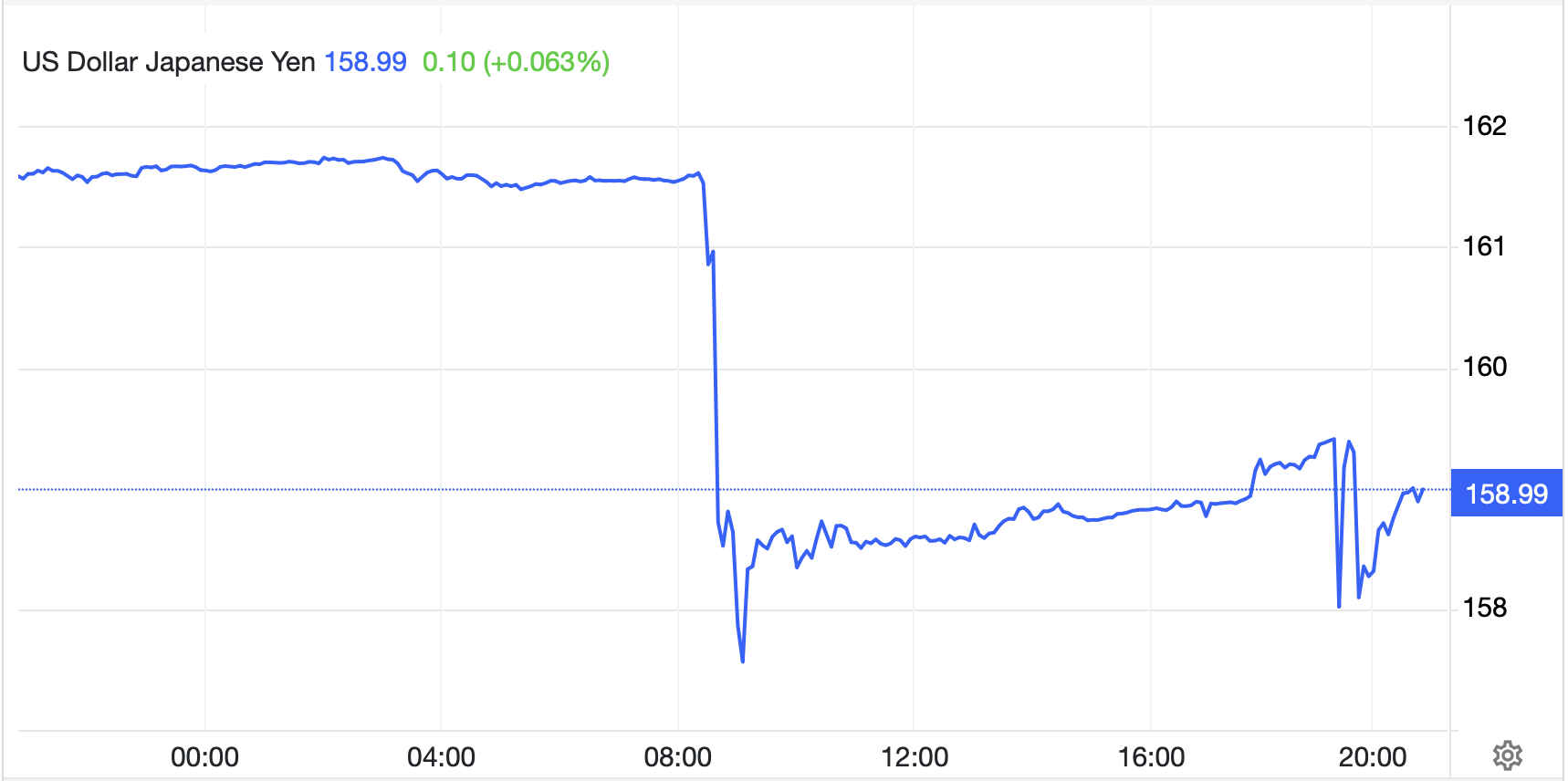
Last night, Masato Kanda, the Vice Minister of Finance for International Affairs, colloquially known as Mr Yen explained, “I have no choice but to respond appropriately if there are excessive moves caused by speculators.”  He also explained, “We are communicating very closely with the authorities of each country and complying with international agreements, so there has been no criticism from other countries.”  In other words, while he did not actually come out and say that the BOJ intervened on behalf of the MOF, it seems pretty clear that is the case.  Certainly, a look at the price action again last night, as per the below chart, shows that is a viable reality.

Source: tradingeconomics.com

You may recall that USDJPY fell sharply in the wake of the CPI data last week and there was substantial question as to whether there was intervention at the time.  My view was the BOJ would not have been able to act on a timely basis and attributed the move to an overly long dollar positioned market and some algorithmic selling.  However, it appears that data from the BOJ’s accounts have since been released showing approximately ¥6 trillion (~$38.4 billion) was spent at the end of last week.  Now, given the Kanda comments above, the reality is that the MOF is drawing a line in the sand at 162.  

In fairness, this seems a propitious time to do so given the growing certainty that the Fed is finally going to begin its policy easing.  Of course, the main reason that the yen had weakened so much is that, not only had the interest rate differential widened substantially, allowing for, and even encouraging, the growth of the ‘carry trade’ where investors were happy to simply hold long forward USDJPY positions and wait for the time to pass and the profits to roll in.  But as well, there was no indication that the Fed was going to change its stance while the BOJ, though it had threatened to begin tightening policy, was doing so at a glacial pace.  However, that CPI number has dramatically altered opinions, not only of the trading community, but more importantly, of the Fed.  All the Fed comments we have heard since that data point have indicated a much greater willingness to consider easing policy.  Talk about both the goods and labor markets coming into balance are indicators they are ready to roll.  

We still have seven more Fed speakers this week ahead of the quiet period and I would wager that to a (wo)man, they will all say their confidence is growing that price pressures are receding, and they are watching the employment situation carefully.  As I wrote yesterday, the CME Fed funds futures market is pricing a 100% probability of a 25bp cut in September with some folks looking for 50bps.  Given the totality of the recent data where the probability of a recession seems to be growing, I agree a September cut looks likely.  This is not to say every data point is going to be pointing to weaker economic activity (e.g., yesterday’s Retail Sales data was much stronger below the headline number), just that will be the broad trend.

In this situation, with the market starting to believe that higher for longer is truly dead, the initial reaction will be for further dollar weakness.  Of course, once it is clear the Fed has begun to ease policy, we will see other central banks increase their pace of policy ease at which point the dollar’s decline will likely slow or stop.  Remember, FX is a relative game, so if everybody is easing policy at the same time, those interest rate differentials are not going to change very much at all.  However, commodity prices, especially precious metals prices, are likely to be the biggest beneficiaries.  As to stocks and bonds, the former have a much less certain path given the impact of declining inflation on profits, especially for the mega cap names, but bonds should perform well (yields declining) at least as long as inflation remains tame.  Just beware of a slow reversal of the inflation story.  Nothing has changed my view that 3.0% is the new 2.0%.

Aside from the yen news, last night was decidedly lacking in new information.  We saw UK inflation data print at the expected levels showing it has fallen back close to their target of 2%.  We saw final Eurozone inflation also confirming a 2.5% inflation rate.  While the ECB has essentially ruled out a rate cut tomorrow, a September cut seems highly likely at this time, especially if they have confidence the Fed is going to cut then as well.

So, let’s look at the overnight session.  After more record highs in the US, with the DJIA approaching 41K, the tone in Asia was more mixed.  Japanese shares (Nikkei -0.4%) fell as the yen’s strength continues to hamper profit expectations for the many exporters in the index.  Chinese shares, both in Hong Kong and on the mainland, edged higher by less than 0.1% as investors continue to wait to hear the results of the Third Plenum.  As to the rest of the region, gains in Australia and New Zealand were offset by losses in South Korea with most other markets little changed.  however, in Europe this morning, the screens remain red with losses across the board, albeit not as significant as we have seen in the past several sessions.  The DAX (-0.4%) is the laggard although all the major markets are lower.  Finally, at this hour (7:20), US futures are suffering led by the NASDAQ (-1.5%) although they are all under pressure.  It seems that the story about increased tariffs on Chinese goods as well as a ban on selling additional semiconductors to China doesn’t help the prospects of semiconductor companies that rely on China for their sales.

Interestingly, the bond market has seen yields edge higher this morning with Treasuries higher by 2bps and most of Europe up by 1bp.  Given the small size of the movement, I wouldn’t attribute much fundamental thought to today’s price action, and after all, 10-year Treasury yields have fallen 30bps since the first of the month, so a lack of continuation is not that surprising.

In the commodity markets, oil (+0.5%) is rebounding after a rough couple of days.  The weakening economy story is weighing on perceived demand and there is ample supply around.  Gold (+0.1%) is continuing to rally after closing at another all-time high yesterday while silver (-0.9%), which followed gold yesterday, is giving back a bit this morning.  Industrial metals are little changed this morning as they await further confirmation of the economic situation.

Finally, the dollar is under pressure this morning, falling substantially against almost all of its major counterparts, both G10 and EMG.  Aside from the yen (+1.1%) which we discussed above, the pound (+0.5%) is leading the way along with SEK (+0.6%) although the euro (+0.35%) is also firm.  In fact, the pound has risen above 1.30 for the first time in a year while the euro pushes the top of its 1.0650/1.0950 2024 trading range.  The laggard in the G10 space is CAD, which is unchanged on the day as market participants tie its performance directly to the dollar and anticipate the BOC to match the Fed going forward.  In the EMG bloc, though, there are two outliers which have suffered today, despite the dollar’s broad weakness, MXN (-0.6%) and ZAR (-0.7%).  The peso seems to be feeling the effects of weaker than expected economic data lately which has put Banxico into a difficult position as inflation remains above their target.  Will they cut to support the economy and undermine the currency?  That is the question.  As to the rand, aside from its status as the most volatile currency, the market seems to be reacting to a sharp decline in Retail Sales last month, -0.7%.

On the data front, this morning brings Housing Starts (exp 1.3M), Building Permits (1.4M), IP (0.3%) and Capacity Utilization (78.4%) along with the EIA oil inventories.  In addition, we will hear from Richmond’s Thomas Barkin and Governor Waller and then at 2:00 the Fed’s Beige Book will be released.  The current market narrative has quickly shifted to rate cuts, and more tariffs.  The upshot is the dollar is likely to remain under pressure while equities will have a more difficult time going forward.  If inflation remains quiescent, then bonds can do well, but the big winner through it all should be commodities.

Good luck

Adf

Ending Debates

There once was a banker named Jay
Who lived deep inside the Beltway
His words, when he spoke
Would sometimes evoke
A dovish response on the day
 
On Monday, we all got to hear
His views, and to some he was clear
Quite soon he’ll cut rates
Thus, ending debates
‘Bout ‘flation the rest of the year


While the market awaits this morning’s Retail Sales data (exp 0.0%, 0.1% ex autos), the focus for most traders and investors has been on Chairman Powell’s speech and discussion yesterday at the Economic Club of Washington DC.  The following headlines came from his prepared remarks and were highlighted all over the tape:

*POWELL: LAST THREE INFLATION READINGS DO ADD TO CONFIDENCE 

*POWELL: LABOR MARKET ESSENTIALLY NO TIGHTER THAN PRE-PANDEMIC 

*POWELL: JOB MARKET DOESN’T HAVE SLACK, ESSENTIALLY EQUILIBRIUM 

Then, following up in a Q&A, the money lines were these, “Now that inflation has come down and the labor market has indeed cooled off, we’re going to be looking at both mandates.  They’re in much better balance.”  

Not surprisingly, the market took this as confirmation that rate cuts are coming soon, although the futures market continues to price September as the likely first move.  While the meeting in 2 weeks has only a 9% probability priced in for a 25bp cut, looking at September’s pricing, 25bps are guaranteed and there are now some traders/investors looking for a 50bp cut, with that probability at 12.5%.  

Personally, I think there is a better chance of a July cut, especially if the PCE data next week are as soft as the CPI data were last week, than a 50bp cut in September.  My sense is that to get 50bps in September we would need to see the Unemployment Rate rise to 4.7% by that meeting with NFP pushing toward zero.  And while anything is possible, that seems highly unlikely in terms of the speed of the adjustment for those economic data series.  Other than the pandemic, even during deep recessions in the past, the rate didn’t rise that quickly.

As such, the market is now quite comfortable with the idea that the long-awaited initial rate cut will be here before the Autumnal equinox.  So, if that is the case, what does it mean?

One cannot be surprised that equity markets remain buoyant as we continue along the goldilocks trail of solid growth with slowing inflation.  Cutting rates into this environment will just add fuel to the equity fire.  There has been much made in financial discussions about the recent performance of small-cap stocks during the past several sessions.  It seems they have finally awoken from their deep slumber and have performed quite well, better even than the mega-cap tech names.  This has generated great excitement and we have seen several analysts raise their equity forecasts ever higher.  It seems that S&P 500 at 6000 is now a conservative view!

In the Treasury market, the yield curve has been slowly reverting to its more normal shape with 2-year yields falling more rapidly than 10-year yields.  This is the bull steepening that many had been anticipating, where yields overall decline, it’s just that the front end of the curve falls faster than the back.  History has shown that this type of movement typically foreshadows a recession, as the steepening accelerates when the Fed is slashing rates as the economy heads into a tailspin.  But maybe this time is different.  Ultimately, it can be no surprise that the yield curve is moving back to its normal shape of long-term yields higher than short-term yields.  After all, this inversion has been the longest in history.  I am just concerned that the speed of the onset of the coming recession may be much faster than most people assume.

As to commodity markets and the dollar, if the Fed is moving into a policy easing cycle, then commodity prices, especially precious metals and energy, ought to rally from here.  There may be a delay in industrial metals as a weak economy will weigh on demand there.  And the dollar will likely have a considerable down leg as well, although it will be tempered as central banks elsewhere around the world feel emboldened to be more aggressive with their own policy easing.

So, with that as a framework ahead of any potential future Fed actions, let’s look at what happened in the immediate wake of the Powell comments.  (As an aside, SF Fed President Daly also spoke yesterday and reiterated her concerns over the rise in the Unemployment Rate, indicating she was ready to cut.  Too, Chicago Fed president Goolsbee explained he was on the same page.)

Of course, given the Powell commentary, it is no surprise that US equity markets rallied yesterday with a new record high close from the DJIA although neither the NASDAQ nor S&P 500 could hold their record highs into the close.  Nonetheless, it was a strong day in the US markets.  In Asia, though, the picture was more mixed with the Nikkei (+0.2%) edging higher alongside a small move higher in USDJPY, and mainland Chinese shares (CSI 300 +0.6%) also gaining on hopes for some positivity from the Third Plenum.  But the Hang Seng (-1.6%) fell on fears of a Trump victory and the imposition of more tariffs on goods from there. The rest of the APAC space saw mixed reviews with some gainers (Taiwan, New Zealand, Korea) and some laggards (Australia, Malaysia, Singapore) although most of this movement was in small increments, 0.25%-0.35%.

European bourses, though, are having a tougher day as they are all lower on the session.  It seems that concerns over a Trump victory are manifesting themselves in concerns over European sales into the US or the imposition of tariffs here as well.  Adding to the misery, German ZEW data revealed a turn back down after several positive months, as concerns over the political situation in France and declining exports there weighed on the reading.  The upshot is that there is weakness everywhere, led by the CAC (-0.8%) in Paris and the IBEX (-0.8%) in Madrid.  (I think I wrote that exact sentence yesterday!). In the end, after a nice run as investors started to bet on ECB rate cuts, that story seems to be diminishing.  As to US futures, at this hour (7:30) they are modestly firmer, 0.2% or so.

In the bond market this morning, it appears that everyone around the world is excited about the possibility of Fed rate cuts as yields are lower across the board.  Treasury yields are down 6bps and European sovereign yields have fallen between 3bps and 5bps.  Even JGB yields slid 3bps overnight.  As has been the case for quite a while, the US yield story leads the global yield story.  If the Fed is going to start to cut, I expect that yields around the world are going to decline further, at least until inflation returns.

In the commodity markets, oil (-1.6%) is under pressure after weak oil demand data from China overnight undermined hopes that the Third Plenum would result in more government stimulus from the Xi government. This weakness is evident in industrial metals as well with both Cu (-0.65%) and Al (-1.0%) sliding further. However, precious metals are responding as one would expect to rate cuts, especially with inflation still around, as both gold and silver higher by 0.7% this morning, taking gold to new all-time highs.

Finally, the dollar continues to range trade overall with the DXY little changed on the day and hanging out just above 104, which happens to be its 60-year average!  While most currencies in both the G10 and EMG blocs are within +/-0.2% of yesterday’s closes, the one outlier is ZAR (+0.8%), which seems to be responding to some domestic plans to increase infrastructure investment in conjunction with private companies.

Other than the Retail Sales data mentioned above, there is nothing of note on the calendar today, although we will hear from new Fed governor Adriana Kugler.  At this point, I think it is becoming clear that the entire FOMC is on the same page; higher for longer is dead, long live the beginning of policy ease.  It is setting up to be a quiet session although I expect to see continues support for rate sensitive products like equities and precious metals.  The dollar, though, seems stuck as every central bank is ready to cut!

Good luck

Adf

Fight!

When fired upon, his response
Was jumping back up at the nonce
His cry was to “Fight!”
And some on the right
Now claim he’s a man, renaissance!


As John Lennon told us in 1977:

Nobody told me there’d be days like these
Strange days indeed

While this poet tries to keep politics largely out of the discussion, during these strange days, it is THE story of note.  Of course, by now you all not only have heard of the assassination attempt on former President Trump’s life on Saturday at a political rally in Butler, PA, but you all almost certainly have your own opinions about all the different theories, conspiracy and otherwise, so I will not go down that road.  I will simply note that it speaks poorly of the current political zeitgeist.  And while cooler heads are calling for a step away from the abyss, I have not yet seen the public take that step backwards.  Maybe soon.

In the meantime, my efforts are designed to help make sense of how both the political and economic storylines may impact the markets, and correspondingly, try to help those of you who need to hedge financial exposures, with a little understanding.  But history shows, when politics leads the news, the degree of difficulty goes up significantly.

The first thing to note is that sometimes, when momentous things occur in the real world, any financial implications take some time to manifest themselves.  With that in mind, I thought I would take a 30,000 foot view of the macroeconomic situation as we head into the new week.

The data of late calls into question
If we are now in a recession
With joblessness rising
And prices downsizing
Perhaps growth is seeing regression
 
And it’s not just here in the States
Where growth appears in dire straits
In China, as well,
Things have gone to h*ll
As data of late demonstrates

The question that is being asked more frequently is, are we currently in a recession?  While the data that has been released of late has been slowing, in the US it has not generally reached levels consistent with inflation, although there are some outliers that do point in that direction.  For instance, Friday’s Michigan Sentiment reading was pretty lousy at 66.0, well below expectations, and as can be seen in the below chart from the FRED data base, seemingly heading toward, if not already at, levels consistent with recessions (gray shaded areas).

Source: FRED Data base

As well, a look at the Citibank Economic Surprise Index, an index that tracks the difference between the actual data releases and the consensus forecasts ahead of time, shows that data is consistently failing to meet expectations.

Source: Yardeni.com

Here, too, the data does not appear to have quite reached levels seen in the previous two recessions, but recall that those two recessions were not garden-variety, with the GFC the deepest recession since the global depression in 1929, and the Covid recession remarkably short and sharp in the wake of the unprecedented government shutdowns that occurred in early 2020.  But going back in time, it is generally true that if data released consistently underperform expectations, it is a signal of overall economic weakness.

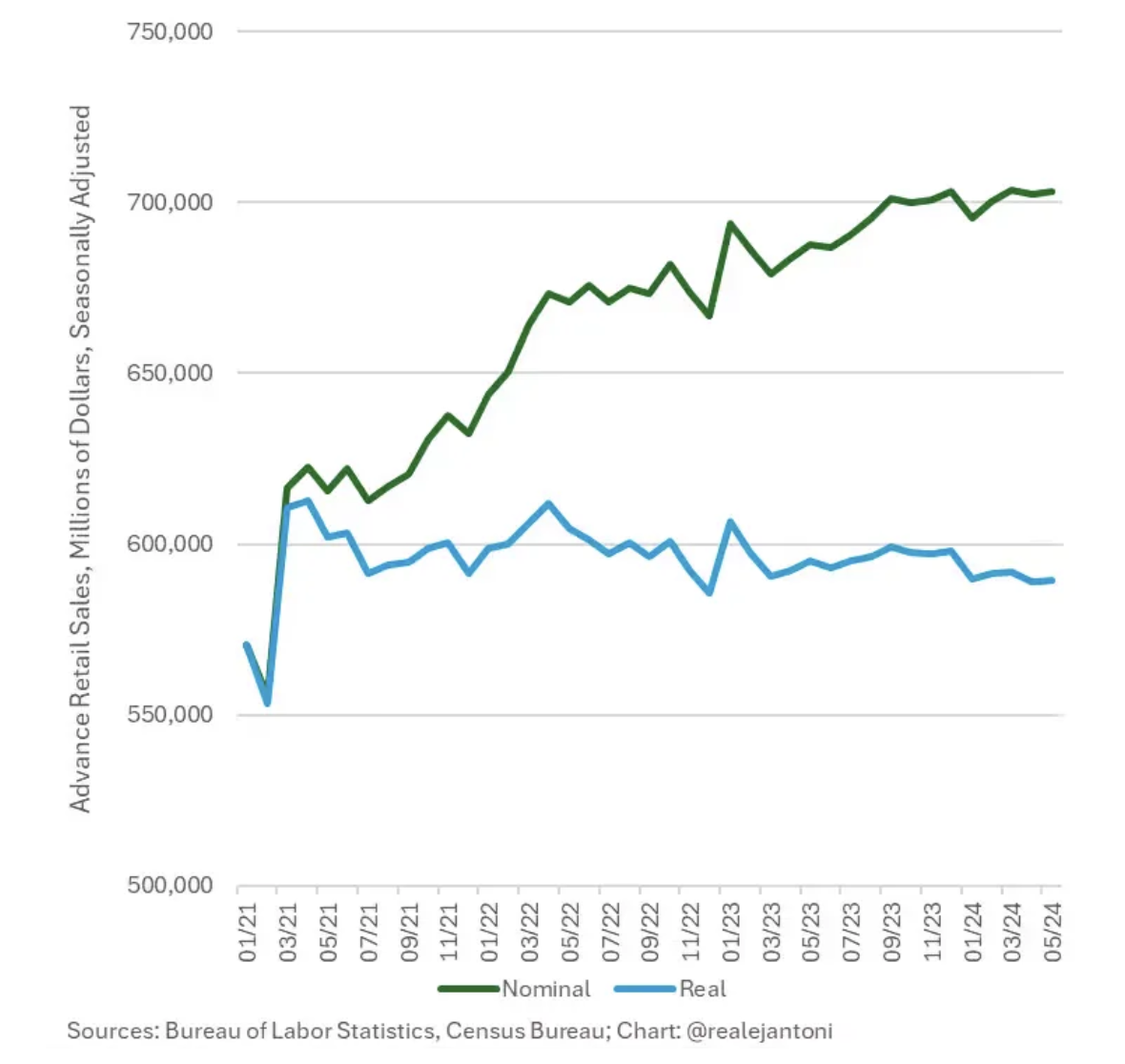
There are many other data points that are showing similar tendencies like the Unemployment Rate, which I have discussed lately, and is gaining momentum in its move higher.  As well, a look at almost all production factors or Retail Sales, which are reported in nominal terms, shows that when they are deflated by the inflation data of the past several years, real activity has been minimal or even declining.  A look at the below chart shows Retail Sales in both nominal and real terms with the latter actually declining since 2021 despite the rising nominal figures.  In other words, people are simply paying more for the same amount or less of stuff.

Source: brownstone.org

And this is not just a US situation.  As is typically the case, if the US is slowing, the rest of the world is going to suffer given its place as both the largest economy overall, and the largest mass consumer of everybody else’s stuff.  So, last night when China released its latest data, it showed the Q2 GDP disappointed, printing 4.7% while Retail Sales rose only 2.0%, far below Industrial Production, which grew 5.3%.  

Source: Bloomberg.com

In fact, this chart is the graphic representation of why nations around the world are calling for more tariffs on Chinese goods.  The combination of a still-collapsing property market there with the absence of significant government stimulus and a massive debt overhang has led President Xi to seek to increase industrial output and exports (remember the trade data from last week where exports soared, and imports actually declined) thus flooding other markets with goods and harming local manufacturing in other nations.  This is merely one more issue that policymakers must navigate amid a growing global concern over both political and economic unrest.

Summing it all up, I believe the case for there being a recession is growing strongly, and while nominal GDP is likely to remain positive, especially in the US given the government’s nonstop spending spree, real economic activity is suffering.  This has major implications for markets, especially as they appeared to still be priced for that perfect 10-point landing.  As I have written consistently, if (when) things turn more sharply, the Fed will respond quickly and cut rates and the impact on markets will be significant, especially for the dollar which will almost certainly decline sharply.  Just be nimble here.

I am sorry for the extended opening, but obviously, there is much ongoing.  So, let’s take a look at how things are behaving this morning.  At the opening of trading on Sunday evening, arguably the market that was showing the most impact was FX, where the dollar, which had fallen sharply at the end of last week in the wake of that CPI data, had rebounded a bit.  The narrative seems to be that the assassination attempt will secure President Trump’s reelection and the dollar will benefit from the economic policies that are believed to come with that.  As well, at this hour, (6:30) we are seeing US equity futures rallying, up 0.4% across the board.  That’s quite the contrast with the overnight session where the Nikkei (-2.5%) came under severe pressure as investors grow concerned over potential JPY strength.  Too, the Hang Seng (-1.5%) fell sharply although mainland shares have behaved better, little changed overnight, as investors look toward the Third Plenum with hopes that President Xi will unveil something to help the Chinese economy.

In Europe, though, this morning sees red across the screens, albeit not dramatically so.  The CAC (-0.4%) in Paris and the IBEX (-0.5%) in Madrid are the laggards, unwinding some of last week’s rebound, but every major market is under pressure this morning.  The lone piece of data released was Eurozone IP (-0.6%) which fell back into negative territory for the 6th time in the past twelve months.  Certainly, this is not pointing to a robust economy in Europe.

In the bond market, Treasury yields have backed up 4bps, also on the “Trump” trade, as investors believe that a Trump victory will result in more aggressive growth policies and higher US yields.  However, in the Eurozone, and in Asia, government bond yields are essentially unchanged from Friday’s levels as I don’t think foreign investors know what to think now about the US and how it may impact other nations going forward.  After all, if the US does grow more quickly in response to a Trump victory, will that mean more or fewer opportunities for tariffs and other mechanisms to affect foreign nations?

In the commodity markets, things are quiet with oil essentially unchanged this morning, as it consolidates at its recent highs.  Market technicians are looking for a break above $85.00/bbl, but I think that will require some substantially better economic data, which as explained above, does not seem to be in our immediate future.  In the metals markets, precious metals are little changed with gold consolidating above the $2400/oz level near its recent all-time highs, although copper (-0.9%) and aluminum (-0.8%) are both under pressure on the weaker economic picture.

Finally, the dollar is little changed overall this morning from Friday’s levels.  The early dollar strength seen last night has ebbed a bit although we still are seeing some strength against peripheral currencies like ZAR (-1.2%), NOK (-0.5%) and SEK (-0.5%).  The rand story seems to be more about local politics and the inability to get the new government up and running, while deeper investigation into the Skandies shows that this is a phantom move based on an unusual close on Friday.  My sense is there has really been no net movement here, as we have seen in the euro and the pound, both of which are mere pips from Friday’s closing levels.

On the data front this week, there is some important news as well as a series of Fed speeches starting with Chairman Powell this afternoon at 12:30.

TodayEmpire State Manufacturing-6.0
TuesdayRetail Sales0.0%
 -ex autos0.1%
 Business Inventories0.3%
WednesdayHousing Starts1.31M
 Building Permits1.39M
 IP0.3%
 Capacity Utilization78.6%
ThursdayECB Rate Decision4.25% (unchanged)
 Initial Claims235K
 Continuing Claims1855K
 Philly Fed2.9
 Leading Indicators-0.3%
Source: tradingeconomics.com

While there is not as much information due as we saw last week, I think the Retail Sales data will be instructive as another indicator of whether the economy is starting to roll over.  As well, watch for revisions from previous data releases as history shows that revisions to weaker numbers are another signal of a recession.  It will be quite interesting to see if Powell hints at a cut at the end of the month.  Certainly, the Fed funds futures market is not looking for that with <5% probability currently priced in although the September meeting is now a near-lock at 94%.  Remember, too, that after Friday’s speeches conclude this week’s group of 10 Fed comments, they will enter their quiet period and we won’t hear anything else until the FOMC meeting on July 31st.

While there is much to digest, my take is that we have rolled over in the economy.  The real question is about inflation and its ability to continue to decline.  Friday’s PPI data was the opposite of the CPI data on Thursday, showing hot prints for both headline and core, and indicative of resurging price issues.  Alas, I don’t rule out more stagflationary outcomes.  Funnily, I think that will ultimately help the dollar after an initial dip.

Good luck

Adf

Unfair-ish

Well, Jay and the doves got their wish
As CPI data went squish
In fact, it’s not clear
Why cuts aren’t here
Already, it’s just unfair-ish
 
But something surprising occurred
‘Cause rallies in stocks weren’t spurred
But yields and the buck
Got hit by a truck
While gold was both shaken and stirred
 
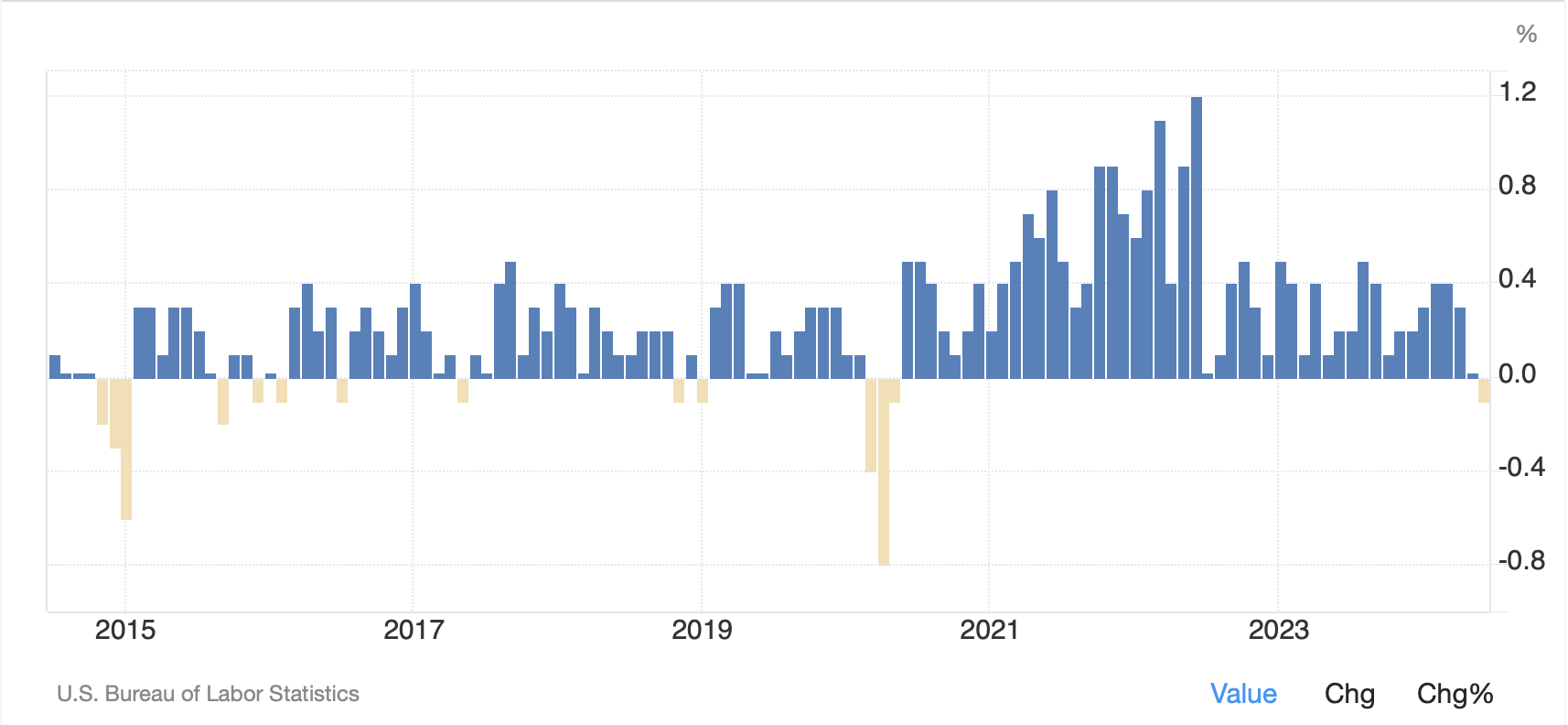
Chairman Powell must be doing his happy dance this morning as the CPI data was the softest seen since May 2020 during the height of the Covid shutdowns.  Now, after four years of steadily rising prices, the Fed is undoubtedly feeling better.  One look at the chart below, though, shows that the inflation rate since the end of Covid was clearly much higher than that to which the population became accustomed prior to Covid.


Source: tradingeconomics.com

While the annualized data for both core and headline readings remains above 3.0%, there was certainly good news in that shelter and rental costs rose more slowly than they have in nearly three years.  However, for market participants, they are far less concerned over the whys of the soft reading than in the fact that the reading was soft and so they can now anticipate a rate cut even sooner than before.  As of this morning, the Fed funds futures market is now pricing a 92.5% probability that the Fed cuts in September and a total of 61bpsof cuts by the end of the year.  

In truth, I was only partially joking at my surprise they didn’t call an emergency meeting and cut yesterday. While the market is only pricing a 6% chance of a cut at the end of this month, I think that is a pretty good bet. Speaking of bets, the trader(s) who established that big SOFR options position earlier in the week is set to have a really good weekend!

To recap, we’ve had the softest inflation reading in 4 years and the market is anticipating the end of higher for longer.  As I have written consistently, my take is when the Fed starts cutting, the dollar will fall, commodity prices will rise, yields will start to decline, but if (when?) inflation reasserts itself, those yields will head higher.  And finally, stocks are likely to see support, but a very good point was made today that if prices stop rising, then so to do profit margins at companies and profits in concert.  Perhaps, slowing inflation is not so good for the stock market, even if it means that rates can be lowered.  Ultimately, there is still a lot to learn, and this was just one number, but boy, is everyone excited!

Did the BOJ
Take advantage of the news
And sell more dollars?

In the FX markets, the biggest mover, by far, was the yen, which at its high point of the session (dollar’s lows) had risen 4 full yen, or 2.5%.  The move was virtually instantaneous as can be seen in the chart below, and it is for that reason that I do not believe the BOJ/MOF was involved in the market.

Source: tradingeconomics.com

While I understand that the BOJ is pretty good at their jobs, it seems highly unlikely that the MOF made a decision in seconds and was able to convey that decision to Ueda-san’s team to sell dollars.  Rather, my sense is that since the short yen trade is so incredibly widespread as the yen has served as a funding currency for virtually every asset on the planet, the fact that the story about higher for longer may be ending led to instant algorithmic selling by hedge funds everywhere and a massive rally in the yen.  When the MOF was asked about intervention, Kanda-san, the current Mr Yen, gave no hint they were in and said only that people will find out when they release their accounts at the end of the month, by which time this episode will have been forgotten.  Remember, too, the yen has fallen, even after today’s rally, nearly 13% thus far in 2024.  It needs to rally a great deal further before it has any macroeconomic impact on Japan’s economy.  For my money, this was just a market that was caught long dollars and weak hands got stopped out, although Bloomberg is out with an article this morning claiming data showing it was intervention.  One thing in favor of the intervention story, though, is that this morning, USDJPY is higher by 0.6% and pushing 160.00 again.

And lastly, the story in China
Continues to give Xi angina
Domestic demand
Is stuck in quicksand
So, trade is his only lifeline-a
 
The other story that is on market minds this morning is about the Chinese data that was released last night.  The Trade Balance there expanded to $99B, much larger than last month and forecast.  A deeper look also shows that not only did exports grow more than expected but imports actually declined.  Declining imports are a sign of weak domestic demand, a harbinger of weak economic growth.  Later, they released their monetary data showing that loan growth, along with M2 growth, continue to slide as Chinese companies are reluctant to take on debt to expand.  While Xi’s government is pushing some money into the system, it is apparent that the collapsing property market remains a major obstacle to any sense of balanced economic activity in China.
 
Of course, this is a problem because of the international relation problems it continues to raise, notably with respect to charges of Chinese dumping of manufactured goods, and the proposed responses from both the US and EU on the subject.  While my crystal ball is somewhat cloudy, when viewing potential future outcomes of this situation it seems increasingly likely that both the US, regardless of the election outcomes in November, and the EU are going to impose tariffs and other restrictions on Chinese goods, if not outright bans.  Neither of these two can afford the social disruption that comes with domestic companies being forced out of business by subsidized Chinese competition.  While inflation looks better this morning than it did last month, its future is far less certain given this growing political attitude.
 
Ok, let’s see how markets have behaved in the wake of all the new information.  Arguably, the biggest surprise is that the US equity markets did not really have a good day with the NASDAQ tumbling -2.0% although the DJIA eked out a 0.1% gain.  Given the yen’s strength, it is no surprise that the Nikkei (-2.5%) fell sharply, and given the Chinese trade data, it is no surprise that the Hang Seng (+2.6%) rallied sharply.  But mainland shares were lackluster, and the rest of APAC was mixed with some gainers (Australia, India, New Zealand) and some laggards (South Korea, Taiwan, Malaysia).  European bourses, though, are all in the green as traders and investors there look to the increased odds of the US finally cutting rates, therefore allowing the ECB and other central banks to do the same, as distinct positives.  As to US futures, at this hour (7:00), they are unchanged to slightly higher.
 
In the bond market, after US yields fell sharply yesterday, with 10yr yields closing lower by 8bps, although they traded as low as 4.17%, a 12bp decline from the pre-data level, this morning, we are seeing a modest rebound with yields 1bp higher.  European sovereign yields are all firmer this morning as well as markets there closed before the US yields started to creep back up.  So, this morning’s 4bp-5bp moves are simply catching up to the US activity.  Lastly, JGB yields dipped 2bps last night as traders sought comfort in the decline in US yields.
 
In the commodity markets, yesterday saw a sharp rally immediately after the CPI print with gold jumping nearly $40/oz and back above $2400/oz, while oil had a more gradual rise, although is higher by nearly $1/bbl since the release.  This is all perfectly in line with the idea that the Fed is going to start to cut rates soon.  However, gold (-0.4%) is giving back some of those gains today.
 
Finally, the dollar, which fell sharply against all currencies after the CPI print, notably against the yen, but also against the rest of the G10 and most EMG currencies, is slightly softer overall this morning with both the euro (+0.15%) and pound (+0.3%) doing well and offsetting the yen’s weakness this morning.  Elsewhere throughout the G10 and EMG blocs the picture is far less consistent with CE4 currencies all following the euro higher although ZAR is unchanged as it suffers on gold’s weakness this morning. 
 
On the data front, this morning brings PPI (exp 0.1% M/M, 2.3% Y/Y) and its core (0.2% M/M, 2.5% Y/Y) although given yesterday’s surprisingly low CPI data and the ensuing market movements, it doesn’t feel like this number has the potential for much surprise.  After all, a soft reading would already be accounted for by the CPI and a strong one would be ignored.  We also see Michigan Sentiment (exp 68.5) at 10:00, but that, too, seems unlikely to shake things up.  There are no Fed speakers scheduled and really, the big thing today is likely to be the Q2 earnings releases from the big banks.
 
It has been an eventful week with Powell’s testimony being overshadowed by yesterday’s CPI data.  While the market is almost fully priced for a September cut, I think the best risk reward is to expect the Fed to act at the end of July.  Next week we hear from 10 Fed speakers, including Chairman Powell on Monday afternoon.  I would not be surprised to hear them start to guide markets to a July cut which would bring dollar weakness alongside commodity price strength.  As to bonds and equities, the former should do well to start, but as yesterday showed, and history has shown, equities tend to underperform when the Fed starts cutting rates.
 
Good luck and good weekend
Adf
 

If Forecasts Ain’t True

Chair Powell repeated his views
That if Unemployment accrues
The time to cut rates
To meet their mandates
Could very well soon lead the news

Investors have taken this cue
And built up positions, beaucoup,
Designed for a peak
If CPI’s weak
Beware, though, if forecasts ain’t true

It is not clear to me why the punditry is more convinced this morning than they were yesterday morning that Chairman Powell and the Fed are now more focused on the Unemployment situation.  After all, Powell’s opening remarks in front of both the Senate on Tuesday and the House yesterday were identical, and everybody knew going in that would be the case.  But it seems, based on the commentary this morning, that suddenly things that were still blurry before became crystal clear.

Look, it can be no surprise that as the Unemployment Rate rises, the Fed is going to pay attention.  Not only is it part of their mandate, but it is also a touchpoint for politicians as they preen in front of their constituents.  But, in the end nothing has changed since Tuesday’s testimony when Powell highlighted that he and the FOMC were closely watching the evolution of the labor market as well as prices.

At least, nothing has changed on the policy front.  However, the market narrative, as is its wont, has suddenly turned to a far more bullish stance on fixed income in general, and on short-term rates in particular.  It appears that, not for the first time this year, there have been some very large options positions established in the SOFR market looking for a Fed funds rate cut sooner rather than later and a total of three cuts this year.  A quick look at the Fed funds futures market continues to show that the probability of a September cut remains just north of 71% with another cut likely by December.  As such, the fact that somebody is risking $2 million in premium on a third cut implies a great deal of conviction.  A key for this position’s success will be today’s CPI report as a benign outcome will very clearly drive more traders into the camp of more cuts this year.

So, let’s turn our attention to CPI.  Current median expectations are for a 0.1% M/M rise in the headline number, leading to a 3.1% Y/Y outcome and a 0.2% M/M rise in the core number leading to a 3.4% Y/Y outcome.  The broad story is the ongoing analyst belief that shelter costs are set to decline (although they have been incorrectly forecasting that for more than 2 years), along with the continued decline in used car prices and auto insurance, will more than offset any pesky things like food and energy costs rising.  This poet does not have an inflation model to tweak so I can only offer my lived experience, and that remains highly doubtful that prices have stopped rising.  But, the only thing that matters is the numbers, regardless of how we all feel about them, so we will be awaiting, with baited breath, to see if the BLS has determined if the pace of our cost of living has slowed.

As we turn our attention to the rest of the world, apparently everybody believes that to be the case, as risk assets are rising all over.  I cannot find an equity market anywhere that has sold off in the session with the Nikkei (+0.95%) rising to a new all-time high and the Hang Seng (+2.1%) rebounding smartly from yesterday’s levels.  The same is true throughout Asia with Chinese (+1.1%) and Australian (+0.9%) shares also having good days.  In Europe, the gains have been less impressive, on the order of +0.2% to 0.3%, but they are consistent as everybody followed yesterday’s strong US equity performance where all three major indices rose more than 1%.  While US futures this morning are tinged slightly red, the losses are tiny, less than -0.1%.  It seems that everybody is all-in on the idea that the Fed is cutting rates soon.

In the bond market, though, things are slightly different.  While Treasury yields have edged lower by 1bp this morning, all European sovereign yields are moving in the opposite direction, with rises of between 2bps and 3bps.  The inflation data that was released from the continent this morning certainly didn’t demonstrate a rebound, so this seems more akin to a trading response to recent yield declines.

In the commodity markets, oil prices (+0.3%) are continuing their rebound from yesterday after EIA data showed larger inventory draws than expected.  Precious metals markets are also benefitting this morning from the Fed story as the idea of rate cuts generally supports that sector.  The only laggards are industrial metals with both copper and aluminum under a bit of pressure today, but that is after a few solid sessions.

Finally, not surprisingly, the dollar is a touch softer on the idea that US yields may soon be declining.  While the bulk of the movement has been modest, it is fairly consistent with the euro and the pound both higher by 0.15% (the pound benefitting from somewhat stronger than expected GDP data this morning) while most of the rest of the G10 is little changed.  The one exception is NOK (-0.9%) which still seems to be suffering from yesterday’s softer than expected CPI data.  In the EMG bloc, the bulk of the movement has been for stronger currencies with the most notable, in my view, CNY (+0.2%) which has been steadily depreciating but has reversed course on the lower US rate narrative.  I maintain my view that if the Fed is prepping the market for cuts, the dollar has a good distance to fall.

In addition to the CPI data, we see the weekly Initial (exp 236K) and Continuing (1860K) Claims data at 8:30.  The Atlanta Fed’s Raphael Bostic speaks later this morning, but again, after Powell just opened the doors for easier policy based on the employment situation, I don’t foresee this having a big impact.

The risk today is that the CPI data is hotter than expected as everybody is lined up for a soft reading.  If the data is soft, look for the current trends to extend, so higher risk assets and lower yields.  But, if CPI prints higher than expected, there will be a very quick reversal of views, at least for the short run, and I expect we can see a pretty sharp correction, at least for today.

Good luck
Adf

Not Yet Diktat

The punditry’s now all atwitter
That joblessness is a transmitter
Of lower inflation
Thus, Powell’s flirtation
With turning into a rate slitter

But so far, the confidence that
Inflation is falling toward flat
Has not yet arrived
And could be short-lived
So, rate cuts are not yet diktat

As expected, Chairman Powell’s testimony to the Senate Banking Committee was THE story of the day yesterday.  However, it was not that interesting a story despite scads of digital ink spilled on the subject.  What was everybody so excited about?  Well, here are some key quotes and you can be the judge.  In his opening remarks, he explained, “Elevated inflation is not the only risk we face,” and “The latest data show that labor-market conditions have now cooled considerably from where they were two years ago—and I wouldn’t have said that until the last couple of readings.”  Scintillating, I know!

What does it mean?  The quick and dirty is that the Fed has become a bit more evenhanded in their views that the employment side of their mandate may soon force decisions that conflict with the inflation side of their mandate.  So, if the Unemployment Rate continues to rise going forward, even if inflation does not continue its recent downward trajectory, the Fed may decide employment is now more important and respond.

Doves everywhere are clamoring for the Fed to cut before it’s too late and the labor market collapses.  Meanwhile, hawks will explain that at 4.1%, while that is higher than the recent past, the Unemployment Rate remains quite well behaved, especially in the context of NFP results that have averaged 222K over the past six months.

But we really know that this was a nothingburger because a look at markets showed that nothing happened.  The major equity indices all closed +/- 0.15% while 10-year Treasury yields were unchanged from the morning and higher by 2bps from Monday.  Neither did the dollar or commodities move in any substantial way from their early morning levels.   So, now Powell will speak to the House Financial Services Committee today, give identical testimony and fend off whatever inane questions they ask there.  But he was clear that there would be no indications of the timing of any policy changes and that is certain to be true today as well.

And truly, that was the entire session yesterday.  There was no data released and aside from Powell, nobody cared about what other speakers said.  And as you can see above, Powell didn’t really say that much.  So, let’s take a look at the overnight session to see if there was anything interesting at all.

In equity markets, the one place that is trying to hang with the US tech sector is Japan, where the Nikkei rallied another 0.6% overnight and is now higher by 30% this year, second only to the NASDAQ’s 34% rise.  While some of this is excitement about tech, I believe a larger proportion of the gains is due to the yen’s ongoing weakness as many of the companies in the index have their JPY earnings benefit greatly from their export sales.  Elsewhere in the time zone, though, equities were under modest pressure with Chinese, Hong Kong and Australian shares all sliding a bit.  The news of note here was Chinese inflation data, which showed limited price pressures as consumption on the mainland remains lackluster, at best.

Europe, however, is in a much better mood as all the major indices around the continent are higher this morning led by Spain’s 1.0% rise but followed closely by France (+0.9%) and Germany (+0.75%).  Here, too, there has been a lack of data, so I guess the narrative has become that despite the electoral outcomes, investors have overcome their concerns that the new governments will destroy their respective economies.  I guess the one truth is that the new governments will try to spend as much money as possible as quickly as possible, and so support economic activity.  Meanwhile, the recent pattern in the US, higher NASDAQ, lower DJIA and limited movement in the S&P is playing out in the futures this morning as well.

In the bond market, Treasury yields have slipped back 2bps overnight, trading at the same levels as Monday, but there has been a much more aggressive bond rally in Europe with sovereign yields falling between 6bps and 9bps this morning.  It appears that investors are counting on the Fed to maintain its inflation fight, thus helping reduce global inflation pressures, and are responding to declining inflation from China as a rationale to add duration to their portfolios.  While the direction of travel is no surprise given the Treasury yield decline, it is a bit surprising the movement is this large.

In the commodity markets, oil (-0.2%) continues under pressure as the combination of relief that Hurricane Beryl had limited impacts and the potential for a cease-fire in Gaza have oil traders questioning the recent price action.  Arguably, a bigger concern is that slowing economic activity may begin to reduce demand, but that is not the main story today.  In the metals markets, both gold and silver are edging higher this morning while copper is essentially unchanged.  I continue to believe that the Fed is going to be the key driver in this space as if they do cut rates sooner than currently forecast, it seems likely that commodity prices will rise while the dollar declines.

But the dollar is not yet declining in any meaningful way with the DXY still trading above 105.00.  The big outlier today is NOK (-0.95%) which is not only suffering on oil’s recent declines but is also responding to this morning’s inflation data which showed more significant progress on returning it to target.  Core inflation printed at 3.4%, down from 4.1% last month and below the 3.6% estimates.  This has encouraged traders to believe the Norgesbank is going to cut rates sooner than previously expected, hence the krone’s decline.  As to the rest of the G10, NZD (-0.9%) is also under pressure as the RBNZ was less hawkish than anticipated last night, although they did leave rates unchanged.  After those two, though, the G10 is dead.  One thing to note is that USDJPY is back at 161.50, just a few pips below the most recent dollar highs seen last week, although, given the very calm nature of the move, we have not heard much from the MOF on the subject.

As to the EMG bloc, MXN (+0.45%) is continuing its rally after yesterday’s higher than expected CPI data from south of the border has traders looking for continuing policy tightness, pushing back any thoughts of an early ease.  Elsewhere, ZAR (-0.4%) continues its wild back and forth, so much so that it is difficult to pin any fundamentals to the movement.

There is no data of note today so all eyes will be on Chairman Powell when he testifies at 10:00 to the House.  In addition to Powell, we will hear from Governors Bowman and Cook as well as Chicago Fed president Goolsbee.  But really, can anything they say overshadow Powell?  I think not.

It is shaping up as another dull day as it seems unlikely Powell will tell us anything new.  As such, I would look for a quiet session as we all await tomorrow’s CPI data.

Good luck
Adf

Some Mystique

The Chairman is ready to speak
To Congress, and there’s some mystique
Will he indicate
The Fed’s favorite rate
Is likely soon in for a tweak?
 
Or will Chairman Powell explain
Inflation continues to drain
The ‘conomy’s health
And with it the wealth
He’s garnered through much of his reign


With recent elections behind us, market participants now turn their attention to Chairman Powell and his testimony today before the Senate Banking Committee and tomorrow before the House Financial Services Committee.  Of course, all eyes and ears will be searching for clues that the recent spate of softer than expected economic data has been sufficient to allow him, and his FOMC brethren, to gain the necessary confidence to cut the Fed funds rate.  Recall, to a (wo)man, every speaker has indicated that things were looking pretty good, but that they needed to see several months of this type of economic data before acting.

Lately, the punditry has become far more vocal about the possibility of a recession, with a number of well-known analysts claiming we are already in that state.  They point to the employment situation, notably the discrepancies between the establishment and household surveys.  Their argument revolves around the idea that the number of people working continues to decline despite the claim that there are more jobs being created.  It is true that job growth has been driven by an increase in part-time work, so this is not impossible.  And it is also true that when part-time work is ascendant, it typically signifies a weaker economy.

These same pundits point to the discrepancy between GDP and GDI (Gross Domestic Income) which ostensibly measure the same thing from different sides of the ledger.  Over the past year and change, as can be seen from the below chart, GDP has been growing at a faster rate than GDI with the difference between the two now at 2.3% of GDP.  

Source: St Louis Fed FRED data base

Putting that in context, the most recent Atlanta Fed GDPNow forecast for Q2 2024 has fallen to just 1.5% annual growth.  The implication is that GDP growth may well be negative.  Over time, these two measures get revised so that they are the same, but this particular discrepancy is both wider than normal and has been ongoing for a relatively long time in the history of the two.  Something is amiss and many pundits believe that the result will be GDP will be revised lower to match GDI rather than the other way around.  In other words, GDP growth is slower than reported and the chances we are currently in a recession are greater.

Of course, the other side of the story is also widely believed by other pundits who point to the consumer, which as evidenced by yesterday’s Consumer Credit data, continues to spend aggressively.  They also rely on the continued growth in the NFP data as a key indicator of economic activity and remain confident that the economy is simply in a slow patch during a continued growth period.

Now, it seems to me that the Fed are likely rooting for a bit more aggressive economic slowdown as that would give their models the signal that inflation is well and truly under control.  Perhaps Chairman Powell will give us those hints this morning, although he will certainly not explain that outright to the Senate.  (The one certainty from this morning’s testimony is that certain Senators from the Northeast are sure to rail at the current level of interest rates and berate Mr Powell for not having cut them already.)  In any event, that is really all we have on the calendar today, and likely the biggest news until Thursday’s CPI release.  After all, tomorrow’s House testimony will be identical by Powell, although we can look forward to even stupider questions from the likes of Representatives Maxine Waters and Ayanna Pressley.

And so, to markets.  Yesterday’s lackluster US session has seen a mix of results elsewhere in the world.  In Asia, the Nikkei (+2.0%) rallied sharply to new all-time highs, on the back of tech share enthusiasm and the AI story as well as the still weak JPY.  While the BOJ is slated to meet later this month, there is no clarity as to whether they will tighten policy given the still mixed data from Japan.  As well, Chinese shares (+1.1%) and Australian shares (+0.9%) both had solid performances although the Hang Seng was unable to gain any traction and was unchanged on the day.

In Europe, all is red this morning, led by the CAC (-0.8%) as it seems investors are beginning to understand that the electoral outcomes may not have been net beneficial for both the French and UK economies.  While the two nations have different issues (no leadership in France, a socialist one in the UK) I fear that both nations will have manifest economic problems going forward when it becomes clear that increased spending is unaffordable.  But for now, absent any additional data, investors are lightening up on exposures there.  US futures, though, are edging higher at this hour (8:00).

In the bond markets, yields are starting to turn higher again despite some lackluster economic data.  Treasury yields are higher by 2bps and across the UK and Europe, yields are higher by 3bps to 4bps universally.  This means there have been no changes to the spreads of OATs to Bunds, but it may not be that welcome overall.

In the commodity markets, oil (-0.4%) remains under pressure as concerns over US production being reduced by Hurricane Beryl have diminished now that wind speeds have fallen after landfall.  It did not impact the offshore drilling significantly.  As to metals markets, after a rough day yesterday, this morning both precious and industrial metals are little changed overall, arguably awaiting the next key catalyst, whether that is from Powell or CPI or something else.

Finally, the dollar is a bit firmer this morning across the board.  Both the euro (-0.15%) and the pound (-0.15%) have performed surprisingly well lately given the political backdrop.  Perhaps that is a hint that politics is not necessarily a key short-term driver of FX rates.  However, today, along with the rest of their G10 brethren, they are under pressure.  In the EMG bloc, ZAR (-0.6%) continues to demonstrate the greatest amount of volatility amongst the most traded currencies and is under pressure alongside metals prices.  As well, both HUF (-0.3%) and CZK (-0.4%) are showing their high beta response to the euro’s weakness.  However, today appears very much to be a dollar day, not a currency day.

The NFIB Survey was released at a better than expected 91.5, although that level remains in the lowest decile of readings in the history of the series.  In addition to Powell, we hear from Vice-chair for supervision Barr as well as Governor Bowman during the day, but really, it is all about Powell.  Personally, I doubt he tells us anything new and do not expect him to hint strongly at a rate cut coming soon.  However, if he does, look for the dollar to decline sharply.

Good luck

Adf