Fading

In Germany, growth has been fading
Down Under, inflation’s upgrading
Chair Jay gave his views
But it was old news
And Trump, for more cuts, is crusading


Some days, there is less to discuss than others, and this morning that seems to be the case.  Even my X feed had very little of interest.  Arguably, the top story is German Ifo readings came out much lower than expected and have now reversed most of the gains that occurred from front-running US tariff policy changes.  Germany’s bigger problem, though, is that the trend here is abysmal, as ever since Russia’s invasion of Ukraine and the dramatic rise in energy prices there, the German economy has been under significant pressure.  A look at the 5-year history of the Ifo series does an excellent job of explaining why growth has completely stalled there.

Source: tradingeconomics.com

In fact, if we look at the last three+ years of GDP activity in Germany, as per the below chart, we see that seven of the thirteen quarters were negative while two were exactly flat and the sum total of growth was -0.9%.  It’s amazing what happens to a nation that decides to impose extreme conditions on the production of energy domestically.  Or perhaps it’s not so amazing.  After all, economic activity is merely energy transformed.  If the cost of energy is high, economic activity is going to be slow.

Source: tradingeconomics.com

I highlight this because it runs counter to the narrative that Europe is a better place to invest than the US, which has been the thesis of the ‘end of American exceptionalism’ trade.  Germany is the largest European nation by far and had been a manufacturing powerhouse.  But those days appear to have passed.  If Germany is going to continue to lag, and I see no reason for that to change based on the current political dynamic there, please explain the idea behind long-term strength in the euro.  As I wrote yesterday, if the Fed cuts aggressively, the dollar will decline in the short run, but one cannot look at the trajectories of the relative economies and claim Europe is the place to be in the long run.

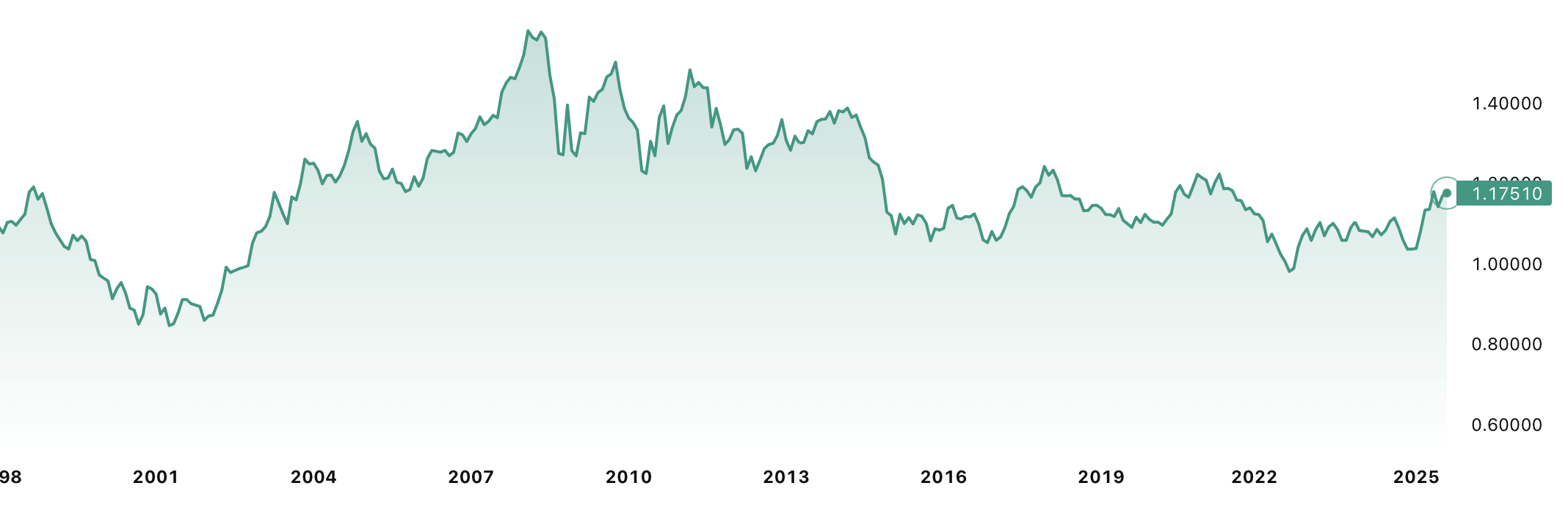
This morning, the euro (-0.5%) has responded logically to the data but the dollar is broadly stronger as well after Chair Powell’s speech yesterday where he continued the modestly hawkish tone from the FOMC press conference.  He continues to agonize over the fact that inflation won’t fall while unemployment is edging higher, although he finally admitted that tariffs would likely have a temporary, one-off impact on prices.  While there is no doubt the dollar has fallen since the beginning of the year, a 10% or 15% move is hardly unprecedented, but rather occurs pretty frequently.  A look at the below chart from the beginning of the euro’s existence in 1999 shows at least six or seven other instances when the euro rallied that much in a short period of time.
Source: tradingview.com

In fact, to demonstrate the politicization of the current world, one need only go back to the period in 2008 when the euro peaked at 1.60 or so to see that it was not seen as a global calamity, simply a period where US monetary policy had loosened dramatically relative to the rest of the world.

The other marginally interesting story this morning is Australia’s inflation rate, which came in at 3.0%, higher than expected and demonstrating what appears to be a break in the declining trend previously seen.

Source: tradingeconomics.com

This matters as AUD (+0.1%) is outperforming all its G10 peers this morning on the back of the idea that the RBA will be stuck on hold, rather than cutting rates again soon.  Too, this weighed on Australian equities (-0.9%) which underperformed other Asian markets overnight.

But that’s really all the interesting stuff, and it wasn’t that interesting, I fear.  So, let’s look at the rest of the market behavior overnight.  While I thought it was illegal, yesterday resulted in US equity markets declining on the session, albeit less than 1%.  And this morning, you’ll be happy to know, the futures are all modestly green.  As to Asian markets, Japan (+0.3%), China (+1.0%) and HK (+1.4%) all had strong sessions although it appears most of the other regional bourses declined.  The Chinese story making the rounds is the lessening in trade tensions between the US and China was seen as a key positive while HK survived Typhoon Ragasa without any major impacts.  But Korea, India, Taiwan and Singapore were all softer on the session.

In Europe, markets have generally done little with marginal declines the norm although, surprisingly, Germany’s DAX is unchanged on the day despite the weak Ifo data.  However, it is hard to get excited about anything happening there right now.

Bond yields fell yesterday with Treasuries declining -4bps although this morning they have edged back higher by 1bp.  Perhaps Powell’s tone yesterday was enough to keep the bond vigilantes on the sidelines, or perhaps there is simply not enough new information to change any views right now.  The Fed funds futures market continues to price a 94% probability of a cut at the end of next month and apparently bond investors are cool with that.  European yields are also little changed this morning as were JGB yields last night.

In the commodity space, oil (+1.1%) is heading back toward the top of the range I highlighted yesterday, but still more than $1 away and there have been no stories to drive things.  This is all just range trading in my view.  As to the metals markets, this morning gold and silver are essentially unchanged, consolidating their recent gains while copper (-.0.75%) is slipping slightly and has retraced some of its gains from earlier in the month.  Remember, copper is much more an economic play than a fear play or inflation play.

Finally, the dollar is firmer across the board this morning with gains against almost all G10 counterparts on the order of 0.5% and against EMG counterparts it is more like 0.8%.  Even CNY (-0.25%) is weakening as it appears Chinese state banks are selling renminbi in the spot market and hedging in the swap market to help mitigate its recent gains.  It is beginning to feel like the dollar’s decline this year, which has been widespread, is coming to an end.  

On the data front, today brings only New Home Sales (exp 650K) and EIA oil inventories.  Yesterday’s Flash PMI data was right in line with expectations, and my take is until NFP a week from Friday, there is going to be little of interest on the data front for markets overall.  Even PCE this week will have to be significantly different from expectations to have any impact.

It appears that absent Stephen Miran convincing the rest of the FOMC to cut rates aggressively, a very low probability event, the dollar is finding a bottom, and the next major move will be higher on the basis of stronger growth in the US vs. the rest of the world.  Of course, if the Fed does start to get more aggressive, then the dollar will suffer, I just don’t see that happening anytime soon.

Good luck

Adf

Kvetched

The story on everyone’s lips
A central bank apocalypse
If Trump fires Powell
The markets will howl
With yields rising numerous bips
 
However, said Trump, it’s farfetched
Despite plans that he’d clearly sketched
Thus, markets reversed
While bears, losses, nursed
And “right-thinking” people all kvetched


If you had Trump fires Powell on your White House Bingo card, congrats, it looked like a winner.  That was the story all morning yesterday, overshadowing PPI data that was quite benign, printing at 0.0% M/M for both headline and core, as the punditry postulated the problems with Trump doing that.  At this point, we are all familiar with the fact that the Fed Chair can only be fired for “cause” although exactly what “cause” represents is unclear.  Too, we know that in Trump’s efforts to reduce the size of the government, the Supreme Court gave him authority to remove the heads of many departments but explicitly carved out the Fed from that process.

In the end, though, despite rampant rumors that he had composed a letter for just such an occasion, at a press conference with Bahraini Crown Prince, Salman bin Hamad Al Khalifa, he said it was “highly unlikely” he was going to fire Powell, although he once again castigated him for not cutting rates. Most markets, after getting all excited about the prospects of this action, reverted to the previous solemnitude of doing nothing over the summer.  The below chart of the S&P 500 was replicated in virtually every market.

Source: finance.yahoo.com

It is also no surprise that the Fed Whisperer was out in the WSJ this morning defending his bread-and-butter relationship, but my take is this is just a feint on the president’s part to move the discussion away from issues he doesn’t like.  Given that Supreme Court protection and given that the Supreme Court has been very good for Mr Trump, I’m pretty confident that Powell will serve out his full term as Chair and be replaced next year.  I would, however, look for a candidate to be announced at the earliest possible time.

While that was the story that sucked up all the oxygen yesterday, life still goes on and this morning, arguably the biggest news is that UK Unemployment rose to 4.7% with earnings slipping and the Claimant count rising.  The punditry continues to harp on how the US is set to go into stagflation because of Trump’s tariffs which are driving inflation higher while weakening the economy (despite all evidence to the contrary) while ignoring the UK which saw inflation rise faster than expected yesterday, to 3.6% while Unemployment is rising.  That feels a lot closer to the stagflation story than in the US, and as we heard from BOE Governor Bailey yesterday, it’s all Trump’s fault because of the tariffs.  Talk about deflection.  However, a little sympathy for the Guv is in order as he really doesn’t know what to do.  After today’s data, there is more discussion of another rate cut by the BOE when they next meet on August 7th.  Certainly, the pound (-0.1%) is behaving as though a rate cut is coming as evidenced by the chart below.

Source: tradingeconomics.com

However, remember that the UK government of PM Starmer has proven its incompetence on virtually every issue it has addressed, both domestically and on an international basis, so the pound’s decline could well be a general exit from the UK by investors.  Speaking of currencies, the dollar is having quite a positive day across the board.  Aussie (-0.9%) is the laggard across both G10 and EMG blocs as its employment situation report showed a much weaker economy than expected, although the yen (-0.4%) is starting to feel real pressure as the Upper House Election approaches.  In fact, there is growing talk that USDJPY above 150 is likely if the PM Ishiba’s LDP loses their majority in the Upper House, or even if it wins given the amount of increased deficit spending they are promising.  Does anyone remember all the talk of the end of the yen carry trade and how the yen was going to rise dramatically?  There’s a theme that did not age well.  As to the rest of the currency market, the dollar is rising vs. everybody with a rough average gain of ~ 0.4%.  The dollar is not dead yet.

Heading back to equities, despite all the angst about Powell yesterday, US indices all managed a gain on the day.  In Asia, most markets performed well with Japan (+0.6%) and China (+0.7%) indicative of the movement.  Australia (+0.9%) responded to its jobs data with growing expectations of an RBA rate cut and there were many more regional exchange gainers than losers overnight.  In Europe, green is also today’s theme, with both the CAC (+0.9%) and DAX (+0.8%) having very nice sessions and most of the rest of the continent climbing around 0.5%.  The only data of note was the final CPI reading for the Eurozone, which was right on the button at 2.3% core.  However, at this hour (7:00) US futures are essentially unchanged.

Bonds were actually the biggest concern yesterday on the Powell news with a huge divergence between the 2-year and 30-year as the rumors flew, although most was forgiven after Mr Trump said he would not be firing Powell.  The Chart below shows that divergence and the retracement although 2-year notes did remain lower for the session.

Source: tradingeconomics.com

But that was yesterday.  This morning, 10-year Treasury yields have edged higher by 1bp, and European sovereigns have largely followed suit.  In Asia, though, it is noteworthy that Australian government bonds saw yields decline -5bps after the data, and JGB yields slid -2bps as election promises seem to imply more QE, not less.

Lastly, commodity prices also got the whipsaw treatment on the Powell story, but this morning, with the dollar showing strength across the board, we see metals prices slipping (Au -0.6
%, Ag -0.25%, Cu -0.15%) although oil (+0.5%) is finding a bottom it seems as per the below chart from tradingeconomics.com.

On the data front, in addition to the weekly Initial (exp 235K) and Continuing (1970K) Claims data, we also get Retail Sales (0.1%, 0.3% ex autos) and Philly Fed (-1.0).  We hear from one Fed speaker, Governor Kugler, but if anything, after yesterday’s Powell drama, I expect everybody we hear from to rally round the Chair, so there will be no talk of rate cuts.  Aside from yesterday’s PPI data, the Fed’s Beige Book indicated modest economic growth, again, not a reason to cut interest rates.

Let me leave you with a thought experiment though.  Last night, the Senate passed the first (of many we hope) rescission bill to actually reduce spending.  Tariff income has grown as evidenced by last month’s budget surplus.  What if Trump and his team are correct, and through reduced regulations as well as tariff and increased inward investment, the private economy grows more strongly and the budget deficit declines far more than current estimates, perhaps achieving Secretary Bessent’s goal of 2%?  Will yields rise or fall?  Will the dollar rise or fall?  Will equities rise or fall?  On the White House Bingo card, I would suggest very few believe in this outcome and are not managing their portfolios to address this.  But I would also suggest it is a non-zero probability, although not my base case.  Just remember, stranger things have happened.

Good luck

Adf

Has Bug Met Windshield?

So, once again, we were misled
By all those who told us, with dread,
The ratings reduction
Would cause much destruction
With both stocks and bonds, money, dead
 
Instead, what we saw yesterday
Was traders jumped into the fray
Despite all the gloom
It seems there’s still room
Where bullish investors hold sway


I know it is hard to believe, but it seems that all the angst that was fomented over the weekend following Moody’s ratings downgrade of US Treasury debt was for naught.  In fact, the decline in both stocks and bonds didn’t even last one session, let alone weeks or months as both markets closed the session essentially unchanged on the day, recouping the early losses seen.  A quick look at the chart below shows the price action in S&P 500 futures from the time of the announcement through yesterday’s close and then this morning.  It seems the market is concerned about things other than the US credit rating.

Source: tradingeconomics.com

In fact, I am willing to say that we are unlikely to hear anything more about the downgrade until such time that equity prices fall on some other catalyst, and the punditry will add in the ratings story to help bolster whatever claim they are making at that time.  Please remember, as well, that I am quite concerned that equity valuations remain rich and that a decline is quite possible, if not likely.  It’s just that the ratings downgrade story is not going to be the driver of that move.

In Japan, it seems
No one’s buying JGBs
Has bug met windshield?

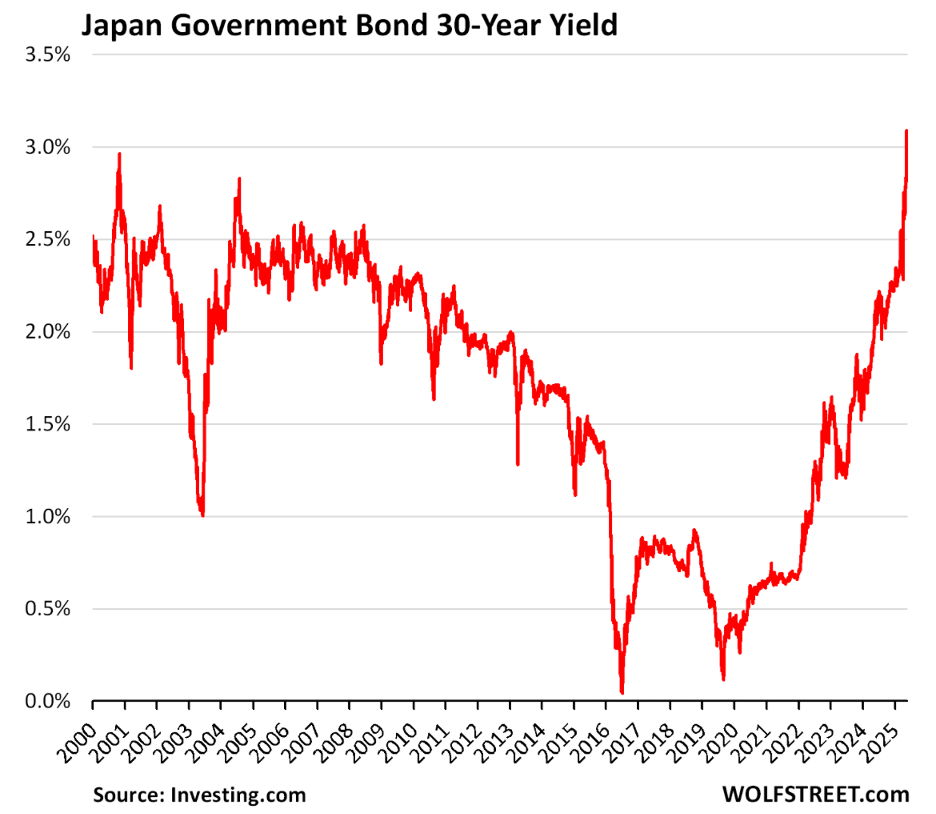
Last night, Japan auctioned 20-year JGBs with the yield coming at 2.52%, the highest since these bonds were first issued back in 1999.  As well, yields in 30-year and 40-year JGBs also soared, rising 12bps in each case to the highest yield in more than 25 years as per the below chart of the 30-year bond.

While the selloff in JGBs has been accelerating, real yields there are still negative with CPI running at 3.6%.  This presents quite a conundrum for Japanese investors as despite the negative real yield, the ability to borrow cheaply (remember short term rates in Japan are 0.50%) and invest in long-dated bonds and earn 3.0% is quite tempting.  250 basis points of carry with no currency risk is now going to compete with 450 basis points of carry (US 30-year yields of ~5.0% – 0.50% funding costs in Japan) with FX risk.

What makes this especially tricky for Japanese investors is that the dollar’s future path, which had been clearly higher for longer, appears to have adjusted.  It seems evident the Trump administration is keen to see the dollar decline, or perhaps more accurately, see other currencies appreciate, especially if those nations run significant trade surpluses with the US.  Japan certainly fits that bill.  And the thing about currency risk is that FX can move swiftly enough to wipe out any carry benefits before institutional investors can even organize meetings to determine if they want to change their strategy.

One of the things that we have heard regularly for the past several years (decades?) is that the US fiscal situation has put the nation in a precarious position, relying on investment by foreigners to fund the massive budget deficits that the government has been running.  The problem with these warnings is they have been ongoing for so long, nobody really pays them any attention.  It is not to say the theory is incorrect, just that there have been other things that have offset that factor and attracted capital to the US anyway.  It is also not apparent that Moody’s ratings cut has changed that dynamic.

But, if at the margin, Japanese investors start to focus more on the JGB market to reduce currency risk, rather than on the highest yield available in major nations, that would likely have a negative impact on the Treasury market.  That is, of course, a big IF and there is no evidence yet that is the situation.  It is something, though, we must watch closely.  

Remember, too, global debt/GDP is more than 300% across all types of debt, public and private.  That tells me it will never be repaid, only rolled over.  The question is at what point will investors decide that holding debt is too great a risk at current yields?  While I assure you governments around the world will work hard to prevent that outcome, including changing regulations to force purchases, it is not clear how much higher that ratio can go without more seriously negative consequences.  We will need to watch this closely.

With that in mind, let’s turn to markets and see how things have behaved in the wake of the reversal in US markets yesterday.  Asian equities were mixed with Japan essentially unchanged, China (+0.5%) and Hong Kong (+1.5%) showing the best performance in the region while India (-1.0%) was the laggard.  Otherwise, there were both gainers and losers of limited note.  In Europe, though, equity markets are rallying across the board led by Spain’s IBEX (+1.6%) despite another infrastructure disaster where half the nation lost telecoms for several hours as Telefonica (Spain’s major telecom company) messed up a systems upgrade.  The rest of the continent has seen shares rise on the order of 0.4% to 0.5% as ECB comments seem to be encouraging the idea of another rate cut coming soon and European Current Account data showed a greater surplus than expected.  US futures, though, are ever so slightly lower at this hour (7:15), down about -0.1% across the board.

In the bond market, in the 10-year space, yields are within 1bp of yesterday’s closing for Treasuries (+1bp), European sovereigns (-1bp) and JGBs (+1bp).  It seems that despite all the talk of the end of times, investors haven’t given up yet, at least not in the 10yr space.  However, the evidence is growing that fixed income investors are growing leery of tenors longer than that.

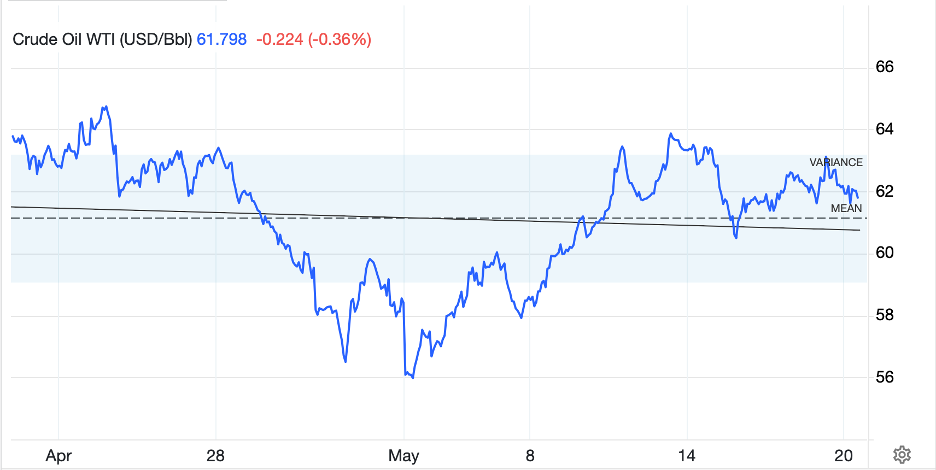
In the commodity markets, oil (-0.6%) is slightly softer but remains well within its recent trading range amid the slightest of downtrends.  In truth, I find this chart to be an excellent description of my feelings of this market, a really slow decline over time.

Source: tradingeconomics.com

As to the metals markets, gold (+0.6%) is continuing its rebound from the worst levels seen last Thursday and is currently more than $100/oz higher than those recent lows.  This has helped silver (+0.5%) as well although copper (-0.5%) is not playing along today.

Finally, the dollar, remarkably, did not collapse in the wake of the Moody’s downgrade.  In fact, similar to the price action in both stocks and bonds yesterday, the dollar retraced much of its early losses.  This morning, it remains on the soft side, but movement is much less pronounced across both the G10 and EMG blocs.  However, the worst performer today is AUD (-0.7%) which some may attribute to the fact that the RBA cut their base rate by 25bps last night (although that was widely expected).  But I would point to the law that was recently enacted by the Albanese government in Australia to begin taxing UNREALIZED capital gains.  This idea has been floated by other governments but never actually enacted.  I fear that the consequences for Australia will be dire as it becomes clear the policy is extraordinarily destructive.  Capital will flee and that bodes ill for the currency.  If they truly follow through with this, be very careful.

There is no data today, but we hear from six different Fed speakers as they are all participating in an Atlanta Fed symposium.  However, I do not expect anything other than patience is the watchword as they observe the Trump administration policies unfold.

In the end, the predicted doom did not come to pass.  However, for my money, I would pay closest attention to Australia.  I fear the negative consequences of this policy will be extreme.

Good luck

Adf

To Oblivion

The yen continues
To grind ever so slowly
To oblivion


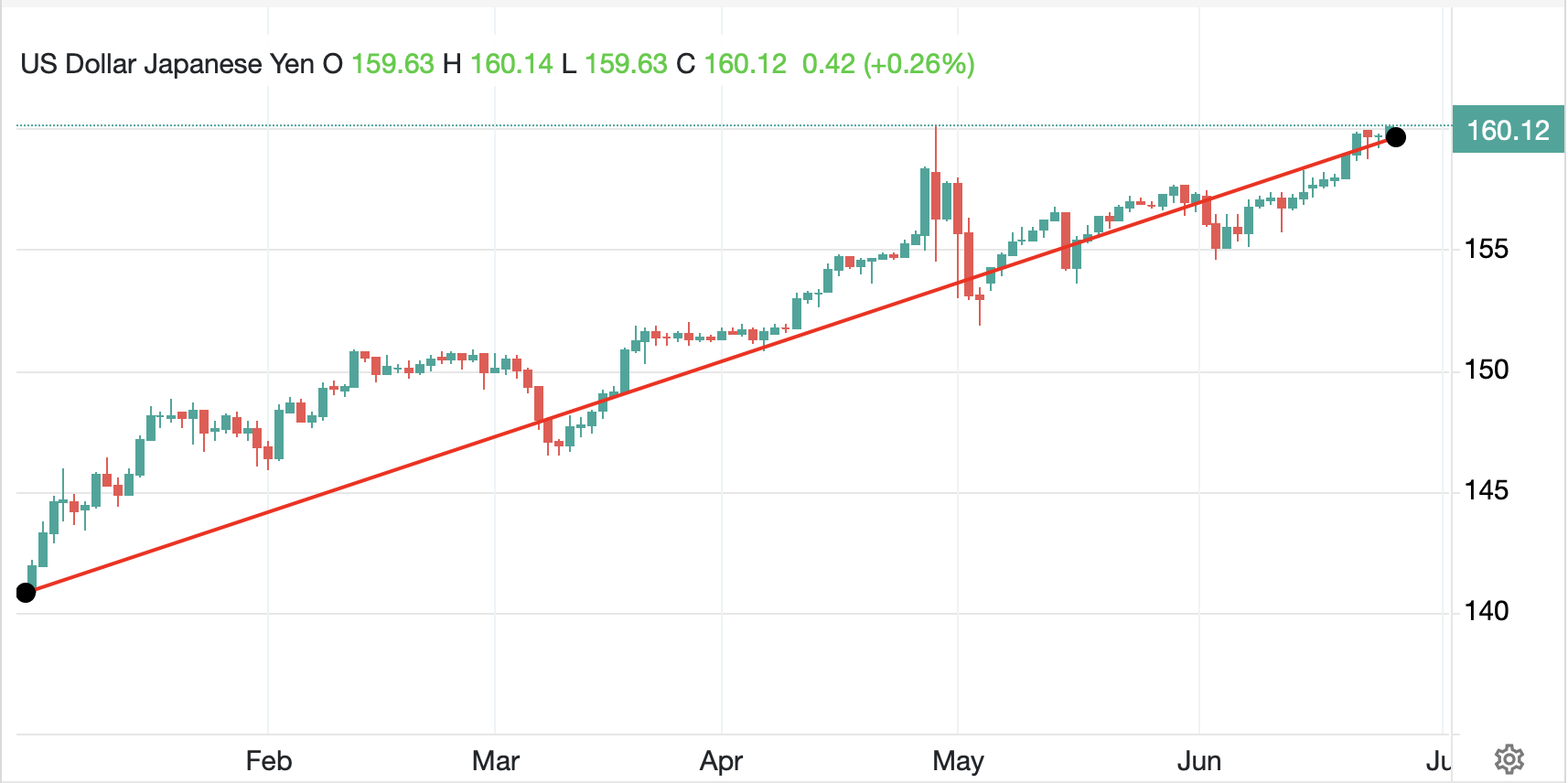
Well, for all those who were either concerned or anxiously awaiting USDJPY’s move to and above 160, we got there early this morning, and the world has not ended.  Not only that, but there is no sign of the BOJ/MOF, nor do I believe will there be for a while yet.  As I explained on Monday, history has shown, and the MOF has been explicit, that they are far more concerned with the pace of any movement in the currency, rather than the specific level at which it trades.  So this much more gradual decline in the yen, while potentially somewhat uncomfortable given its possible impact on inflation going forward, is just not alarming.  You can expect to hear Kanda-san or Suzuki-san reply when asked about the currency that they are watching it closely and prefer a stable currency, but I believe they are fairly relaxed about the situation this morning.

A look at the chart below from tradingeconomics.com shows the trend has been steady all year (which given the interest rate differential between the two currencies makes perfect sense) and that only when things accelerated back at the end of April did it generate enough concern for the MOF to act.  If we see another sharp movement like that, you can look for another round of intervention.  But, at the current pace, likely all we will get is some commentary about stable movement and vigilance.

Source: tradingeconomics.com

While many worldwide want to think
Inflation is starting to shrink
The data released
Shows it has increased
Down Under with Quebec in sync

With all eyes on Friday’s PCE data as a harbinger of the next Fed activity, it is worthwhile, I think, to mention what we have just seen from two other G10 nations regarding their inflation situation.  Starting north of the border, you may recall that earlier this month the Bank of Canada cut their base rate by 25bps in anticipation of achieving their 2% target given the prior direction of travel of their CPI statistics.  Oops!  Yesterday revealed that both the headline and core readings rose a much higher than forecast 0.6% in May, bringing the annual readings to 2.9% and 1.8% respectively.  As well, they focus on the Trimmed-Mean annual number, which also surprisingly rose to 2.9%.  now, one month does not a trend make, but Governor Macklem may have some ‘splainin’ to do the next time he speaks.  It is possible that inflation has not turned the corner after all.

Meanwhile, Down Under, the RBA must be feeling a bit better as they have maintained a more hawkish stance overall, arguably the most hawkish of any G10 member, and last night’s CPI reading of 4.0%, a 0.4% rise from the April data and 0.2% higher than forecast, is a reminder that inflation can be difficult to conquer for all central banks.  Since December, the readings Down Under had been in the low 3’s and many pundits were anticipating that the next leg was lower there as well.  Oops again!

With this in mind, it can be no surprise that the two Fed speakers yesterday, Bowman and Cook were both leaning toward the hawkish end of the spectrum.  In fact, Bowman even raised the possibility of future rate hikes as follows [emphasis added], “Reducing our policy rate too soon or too quickly could result in a rebound in inflation, requiring further future policy rate increases to return inflation to 2% over the longer run.”  At the same time (well actually, 2 hours earlier) Governor Cook did explain she sees rate cuts coming, just not the timing.  To wit, “With significant progress on inflation and the labor market cooling gradually, at some point it will be appropriate to reduce the level of policy restriction to maintain a healthy balance in the economy.  The timing of any such adjustment will depend on how economic data evolve and what they imply for the economic outlook and balance of risks.” 

It strikes me that no matter how you parse these comments, right now, there is no indication that pretty much anybody on the FOMC is considering rate cuts soon.  Futures markets have not really changed their pricing lately with a 10% probability of a July move and a 64% probability of a September cut.  However, one interesting tidbit is that in the SOFR futures options market, there has been a very substantial position building in March 2025 97.75 SOFR calls.  For these to pay off, Fed funds would need to fall about 300bps between now and March, far more than is discussed or priced right now.  While this could certainly be a position hedge of some sort, it does have many tongues wagging.

Ok, a review of the overnight session shows that we are still amid the summer doldrums overall, with some movement in markets, but nothing very dramatic and no real trends developing.  In Asia, the Nikkei (+1.25%) rallied on the back of the weak yen and is back approaching the 40K level, although a look at the chart shows simply choppy price action with no direction.  Hong Kong was flat, Shanghai (+0.65%) rose and Australia (-0.7%) fell on the back of that inflation data and the realization that the RBA is not cutting rates anytime soon.  In Europe, the movement has been weaker, rather than stronger, with French (-0.55%) and Spanish (-0.4%) shares both softer although German and UK shares are essentially unchanged today.  Finally, US futures are mixed with small gains for the NASDAQ and S&P while DJIA futures are following through on yesterday’s index declines.

In the bond markets, higher yields are the order of the day with Treasuries and virtually all of Europe higher by 3bps.  Overnight, JGBs saw a similar rise in yields which has now taken the 10yr yield there back above that 1.00% pivot.  The outlier here is Australia, which given the CPI data there, not surprisingly saw yields jump more, in this case by 11bps.

In the commodity markets, oil (+0.6%) is rebounding from yesterday’s modest declines which came about after API inventory data showed a modest build instead of the expected decline.  Gold (-0.4%) is under pressure along with most metals on the back of the dollar’s strength today.  In fact, my sense is the dollar is the driver right now.

So, speaking of the greenback, the only G10 currency to make a gain this morning is AUD (+0.15%) based on the higher yields Down Under.  Otherwise, the rest of the space is weaker between -0.2% and -0.5% with SEK the laggard.  In the EMG space, there is only one currency managing to hold its own, ZAR (+0.5%), which looks more like a trading bounce than a fundamental shift as there has been no data and no news yet on the political front regarding President Ramaphosa’s cabinet appointments.  Otherwise, the noteworthy move is that USDCNY has breached 7.30 for the first time since November as the pressure of higher US rates and an overall stronger dollar are too much to prevent continued weakness in the renminbi.

The only data this morning is New Home Sales (exp 640K) and the EIA oil inventories, which while important for the price of oil generally don’t have a macro impact otherwise.  As well, there are no Fed speakers on the calendar, but I cannot believe that at least one of them will want to hit the airways somehow.

So, the dollar has legs this morning and unless we get pushback that inflation is falling more clearly, I suspect that yields and the dollar will remain well bid.  It doesn’t feel like there is something that can change opinions due today.  Tomorrow and Friday, though, have that opportunity, so we shall see.

Good luck

Adf

The Citizen’s Pain

Last night, t’was Australia that showed
Employment growth had not yet slowed
And so, please expect
The central bank sect
To keep on the rate hiking road

They’ll not be content til they’ve slain
Inflation, and end this campaign
Yet, if all along
Their thesis is wrong
They’ll ne’er feel the citizen’s pain

On a very slow day in the markets, the most noteworthy news came from Down Under, where the Unemployment Rate fell back to 3.5% in a bit of a surprise while job growth continued at a speedier pace than analysts forecasted.  The market response was immediate with the Aussie dollar jumping sharply and it is now higher by 1.0% on the session, the leading gainer across all currencies, G10 or EMG today.  The rationale for the move is quite straightforward as market participants simply expect the RBA to maintain tighter policy than previously expected.  In the OIS market, the probability of a rate hike at the next RBA meeting on August 1st rose to 48% from just 27% prior to the release.  And correspondingly, Australian government bond yields jumped more than 8bps on the news.

Ultimately, the question that must be addressed is, does strong employment growth lead to higher prices overall?  As my good friend @inflation_guy has said consistently, we should all be ecstatic to have a wage-price spiral as the implication is prices rise AFTER our wages rise, so we are always ahead of the curve.  But we all know, and it has been made abundantly clear in this cycle, that wages follow prices higher.  One need only look at how prices continue to rise on a much more continuous basis than your salaries to see this clearly.  

However, this is gospel in the central banking sect of economists, that tight labor markets drive the general price level higher.  You may have heard of the Phillips Curve, which was a study done in 1958 regarding the relationship between the price of labor (i.e. wages) and the unemployment rate in the UK from 1861-1957.  William Phillips was the New Zealand economist who performed the analysis and basically it confirmed what we all learned in Economics 101, reduced supply of labor drove up wages while an increased supply of labor pushed wages lower.  Nowhere in the study did it discuss the general price level.  That came later with a litany of big name economists, finally with Milton Friedman explaining that in the long-run, there was no relation between wages and inflation, although on a short-term basis, it could evolve.

As so often happens in today’s world, it was easier to take the short-cut view, and that had an intuitive appeal, hence the current central bank mantra of we must bring wage growth down.  (Will they ever get concerned over bringing money growth down?  I fear not.).  At any rate, this is the widely accepted view of the world and so whatever its structural merits, when employment data shows a tighter labor market, the market response is to expect higher policy interest rates.  This was the story last night, hence the Aussie’s rally along with yields Down Under, and this has been the story consistently since the beginning of 2022, when global central banks embarked on the current round of policy tightening.  This is also why we consistently hear Chairman Powell explain that in order for the Fed to reach its 2% inflation target, there will need to be some pain, i.e. people need to lose their jobs.

But away from that, there has been very little of note ongoing.  Equity markets in Asia were unable to match yesterday’s modest gains in the US, with the Nikkei (-1.25%) the laggard of the bunch.  European bourses, however, have had a better go of it, with most of them higher on the order of 0.4% although Sweden’s OMX is down nearly -1.0% on the session bucking the trend.  US futures this morning are softer as there were several weaker than expected earnings numbers overnight including Netflix and Tesla.

In the bond market, Treasury yields have moved higher by 3bps this morning in the 10-year space, but even more in the 2-year space as the yield curve inversion gets deeper, now back above -101bps.  However, European sovereign bonds are little changed on the day with no data of note and the market trying to determine just how hawkish/dovish the ECB will be one week from today.  As to JGBs, their yields have stopped rising and they remain 5bps below the cap.  Do not expect any BOJ action next week.

Oil prices are a touch higher after a lackluster session yesterday, but remain above the key $75/bbl level.  Meanwhile, gold (+0.25%) continues to edge higher and is once again closing in on $2000/oz despite obvious catalysts or lower US interest rates.  As to the base metals, both copper and aluminum are nicely higher this morning as the entire commodity comlex is feeling some love.

Finally, the dollar is under pressure as not only is AUD firmer, but also NOK (+1.1%) on the back of oil’s gains, and virtually the entire bloc except for the pound (-0.3%) which still seems to be suffering from yesterday’s inflation data.  In the EMG bloc, CNY (+0.8%) is the leading gainer, a surprising outcome given its generally managed low volatility, but the fact that the PBOC did NOT reduce the Loan Prime Rate last night, in either the 1-year of 5-year term, was a bit of a surprise to the market as there is a growing belief the Chinese government will be adding more stimulus to a clearly slowing economy there.    But in this bloc, there are also a number of laggards with MXN (-0.4%) the worst of the bunch on what appears to be some profit-taking as traders start to position for the first rate cut since October 2020.

On the data front, yesterday’s housing data in the US was soft, with downward revisions to the previous month’s numbers.  This morning we see Initial (exp 240K) and Continuing (1722K) Claims as well as Philly Fed (-10.0), Existing Home Sales (4.20M) and Leading Indicators (-0.6%), the last of which have been pointing to recession for nearly a year.  However, once again, I expect the dollar will be beholden to the equity markets as none of these data points are likely to move the needle ahead of the FOMC next week.

For now, I think choppy price action is the likely outcome until we get more clarity from Powell and the Fed, as well as Lagarde and the ECB next week.  Who will be the most hawkish?  That is the $64 billion question.

Good luck
Adf

Far From Benign

Was yesterday’s market decline
A flash or a longer-term sign
Of things gone astray
That might well give way
To outcomes quite far from benign

Is this the end?  Have we seen the top in the equity markets?  That seems to be the question being asked this morning as both traders and investors try to determine if the first risk-off session in a number of months is the beginning of a trend, or merely a symptom of some short-term position excesses.  While Asian markets (Nikkei -1.0%, Hang Seng -0.85%, Shanghai -0.1%) continued along the theme of greater problems to come, Europe is not quite as worried, at least not in the equity space.  Interestingly, despite the rebound in Europe (DAX +0.1%, CAC +0.4%, FTSE 100 +0.3%) European sovereign debt has continued its rally with yields there lower by a pretty consistent 3 basis points across the board.

Meanwhile, after a tremendous rally in the Treasury market yesterday, where 10-year yields fell 10 basis points and the 2yr-10-yr spread flattened to below 100bps, buyers are still at large with the 10-year declining a further 1.2bps as I write.

It seems the narrative that is beginning to take hold is that the economic rebound from the Covid recession has reached its peak and that going forward, growth will quickly revert to trend.  This newer narrative has been reinforced by the spread of the delta variant of Covid throughout Asia and Europe (and the US, although lockdowns don’t seem to be on the agenda here) and the renewed closures being imposed around the world.  For instance, half of Australia has been put back under lockdown, as has New Zealand and growing parts of Southeast Asia including Singapore and Indonesia.  Europe, too, is feeling the pressure with rising caseloads n the UK, Spain and France resulting in calls for further restrictions.   The upshot of this is that earnings will struggle to rise as much as previously expected and that inflation pressures will quickly abate, and the concept of transitory inflation may be proven correct.

Chair Powell and friends are quite sure
Inflation, we won’t long endure
But pundits abound
Who’ll gladly expound
On why it’s the problem du jour

This brings us back to the big question hanging over markets, is inflation transitory or persistent?  Certainly, the recent trend in the data might argue for persistence as we continue to see higher prints than both the previous period as well as than forecasted.  As long as that is the case, it will be more and more difficult for the central banks to declare victory.  While commodity futures markets are well off their highs, a broad index of basic materials prices, things where there are no futures markets, is at all-time highs and rising.  Wages continue to rise as well, as the disconnect between the number of unemployed people and the number of job openings is forcing business to increase pay to get workers to come on board.  All of these things point to continued higher prices going forward, as do surveys of both consumers and businesses who virtually all agree higher prices are in our future.

However, the evidence from the bond market, the market that is historically seen as the most attuned to inflationary pressures, would argue that the inflation scare has passed.  With yields tumbling, US 10-year yields are more than 60 basis points off their late March highs, and the yield curve flattening.  All indications are that bond investors are sanguine over the inflation threat and are actually more worried about deflation.

The argument on this side remains that temporary bottlenecks have resulted in price pressures during the reopening of economies from the Covid lockdowns.  Economists’ models point to those very price pressures as the impetus for increased supply and, thus, lower prices in the future.  The problem is that the timeline for increasing supply is very different across different products.  Perhaps the most widely known shortage is semiconductors which has led to reductions in the production of cars, washing machines and consumer electronics.  But it takes at least 2 years to build a semiconductor factory, so it is quite possible the shortage will not be alleviated anytime soon.  Similarly, with mined raw materials, it takes multiple years to open up new mines, so shortages in copper or tin may not be alleviated for a number of years yet.  Of course, if growth is slowing, demand for these items will diminish and price pressures are likely to fade as well.

Let’s consider a few things about which we are certain.  First, securities prices do not travel in a straight line, and in fact, there are many short-term reversals involved in long-term trends.  Thus, if inflation is indeed persistent, the recent bond rally may well be the result of short-term factors and position reductions.  Recall, higher yields were the consensus Wall Street forecast three months ago, with expectations for the 10-year to be yielding between 2.0% and 2.5% in December.  Large fund managers were on board with that idea and built large positions, which take time to unwind.  It is entirely possible we are seeing the last throes of those position adjustments right now.

Another thing about which we are (pretty) certain is that during the Fed’s quiet period, we will not hear from any Fed speakers.  This means that in the event the market really does continue yesterday’s declines and starts to accelerate, the Fed will be hamstrung in their ability to try to jawbone things back to a smoother path.  Would Powell break the quiet period if markets fell 5% or 8% in a day?  My sense is he might, but that is exactly the type of thing that markets like to test.

Finally, let’s not forget that markets are hugely imperfect forecasters of the future.  After all, it was only 3 months ago when markets were forecasting much greater inflation while anticipating no change in Fed policy until 2024.  So, just because the current market view points to a potential slowing of economic growth and reduced inflation pressures, the economy behaves independently of the markets, and may well show us that the views from March were, in fact, correct.

Having already touched on equity and bond markets, a quick look at the FX markets shows that the dollar continues to power ahead vs. its G10 counterparts with NOK (-0.7%) and NZD (-0.65%) the laggards this morning.  NOK continues to suffer from oil’s remarkable 7.5% decline yesterday, while New Zealand is suffering on renewed lockdown fervor, and this after the RBNZ just last week explained they were about to tighten policy!  But we are seeing weakness in the pound (-0.45%) and AUD (-0.35%) both of which seem to be Covid shutdown related, while JPY (0.0%) is the only currency holding up in the bloc today despite further negative news regarding the Olympics and athletes contracting Covid as well as sponsors pulling out.

Emerging markets have been more varied with losers in Asia (SGD -0.35%, KRW -0.25%) on the back of Covid lockdowns, while gainers have included TRY (+0.4%), INR (+0.35%) and RUB (+0.3%).  The ruble seems to be reacting to the end of oil’s decline, unlike NOK, while INR saw equity market inflows driving the currency higher.  TRY, which is on holiday today, is benefitting from a higher inflation reading than expected and expectations of further policy tightening by the central bank there.

On the data front today we see Housing Starts (exp 1590K) and Building Permits (1696K).  We all know the housing market remains hot, so these data points are unlikely to move markets.  Rather, watch carefully for a continuation of yesterday’s risk off session and a stronger dollar.  I have a feeling that this morning’s price action is more pause than trend.

Good luck and stay safe
Adf

Fear Has Diminished

From Asia, last night, what we learned
Was China, the corner, has turned
The lockdowns are finished
And fear has diminished
Thus spending, in spades, has returned

The major news overnight comes from China, where the monthly release of data on IP, investment and Retail Sales showed that the Chinese economy is clearly regaining strength.  Arguably, the most noteworthy number was Retail Sales, which while still lower by -8.6% YTD, has rebounded to be 0.5% higher than August of last year.  Anecdotally, movie theaters there have seen attendance return to ~90% of pre-Covid levels, obviously far above anything seen here or in most of Europe.  In addition to the Retail Sales data, IP there rose 5.6% Y/Y and Property Investment rose a greater than forecast 4.6% on a YTD basis.  Overall, while these numbers are still well below the data China had been reporting pre-Covid, they point to Q3 GDP growth in excess of 3.0%, with some analysts now expecting GDP to grow as much as 6% in the third quarter.

With this unalloyed good economic news, it should be no surprise that the renminbi has performed well, and in fact, CNY is one of the top performers today, rising 0.5% and trading to levels not seen since May of last year.  While there are still numerous concerns regarding different aspects of China’s economy, notably that its banking sector is insolvent amid massively underreported bad loans, on the surface, things look better than almost anywhere else in the world.  Perhaps what is more surprising is that the equity market in Shanghai, which rose 0.5% overnight, did not have a better day.

Down Under, the RBA noted
That Aussie, though not really bloated
Would be better off
In more of a trough
Thus, helping growth there be promoted

Meanwhile, the Minutes of the most recent RBA meeting showed that while they couldn’t complain that the Aussie dollar was overvalued, especially given the recent rebound in commodity prices, they sure would like to see it lower to help the export sector of the economy.  However, despite reaffirming they would continue to support the economy, and that yield curve control wasn’t going anywhere, they gave no indication they were about to increase their support.  As such, AUD (+0.6%) is the top G10 performer of the session, and it is now pushing back to the 2-year highs seen earlier this month.

Turning to Europe, the two stories of note come from the UK and the ECB.  In Parliament, PM Johnson had the first reading of his bill that is set to unilaterally rewrite the Brexit deal with the EU, and it passed handily.  It appears that Boris believes he needs even more leverage to force the EU to accede to whatever demands remain in the negotiations, and he is comfortable playing hardball to achieve his ends.  The Europeans, however, continue to believe they have the upper hand and claim they are prepared to have the UK leave with no deal.  Politics being what it is, I imagine we won’t know the outcome until the last possible date, which is ostensibly next month at the EU Summit.

In the meantime, the market is starting to get concerned that a hard Brexit is back on the table and that the pound has much more to fall if that is the outcome.  While the market is not at record long GBP position levels, it is still quite long pounds.  The options market has been pricing more aggressively, with implied volatility around 12% for year-end (compared to 3-month historic volatility of just 9%) and risk reversals 2.5 points for the GBP puts.  While the pound has fallen a bit more than 4% since its peak on September 1st, it is still well above levels seen when fears of a hard Brexit were more prevalent.  As this new bill makes its way through Parliament, I suspect the pound will have further to decline.

As to the ECB, we have had yet more verbal intervention, this time from Italian Executive Board member, Fabio Panetta, who repeated that the ECB needs to remain vigilant and that though they have done a great job so far, they still may need to do more (i.e. ease further) in order to achieve their inflation goals.  The euro, however, continues to drift higher, up another 0.25% this morning, as the market appears to be preparing for a more aggressive FOMC statement and implicit further easing by the Fed.  While I believe it is too early for the Fed to more clearly outline their explicit plans on how to achieve average inflation of 2.0%, clearly there are many market participants who believe the Fed will be the most aggressive central bank going forward and that the dollar will suffer accordingly.  We shall see, but as I have repeatedly indicated, and Signor Panetta helped reiterate, the ECB will not stand idly by and allow the euro to rally unabated.

And those are really today’s stories.  Risk appetite continues to be fed by perceptions of further easy money from all central banks and we have seen equity markets continue their rebound from the short correction at the beginning of the month.  While Asia was mixed, Europe is in the green and US futures are pointing higher as well.  Treasuries are a touch lower, with yields up about 1 basis point, but the reality here is that yields have been in a very tight range for the past month.  In fact, the idea that the Fed needs to introduce yield control is laughable as it appears to already be in place.

As to the rest of the FX market, the dollar is under pressure everywhere, although Aussie and cable are the two leaders in the G10 space.  Elsewhere, there appears to be less conviction, or at least less rationale to buy the currency aggressively.  In the EMG bloc, ZAR is the leader, rising 1.2% this morning, continuing its strengthening trend that began back in August and has seen a nearly 7% appreciation in the interim.  Otherwise, there has been less excitement, with more modest gains on the back of generic USD weakness.

For today, we see Empire Manufacturing (exp 6.9) this morning as well as IP (1.0%) and Capacity Utilization (71.4%).  Alas, with the Fed meeting tomorrow and all eyes pointed to Washington, it seems unlikely that the market will respond to any of this data.  Instead, with the market clearly comfortable selling dollars right now, I see no reason for the buck to do anything but drift lower on the day.

Good luck and stay safe
Adf

Value, Nought

In college Econ 101
Professors described the long run
As when we all died
Like Keynes had replied
Debating a colleague for fun

However, the rest that they taught
Has turned out to have, value, nought
Their models have failed
While many have railed
That people won’t do what they ought

Observing market activity these days and trying to reconcile price action with the theories so many of us learned in college has become remarkably difficult. While supply and demand still seem to have meaning, pretty much every construct more complex than that turns out to have been a description of a special case and not a general model of behavior. At least, that’s one conclusion to be drawn from the fact that essentially every forecast made these days turns out wrong while major pronouncements, regarding the long-term effect of a given policy, by esteemed economists seem designed to advance a political view rather than enhance our knowledge and allow us to act in the most effective way going forward. Certainly, as merely an armchair economist, my track record is not any better. Of course, the difference is that I mostly try to highlight what is driving markets in the very short term rather than paint a picture of the future and influence policy.

I bring this up as I read yet another article this morning, this by Stephen Roach, a former Chairman of Morgan Stanley Asia and current professor at Yale, about the imminent collapse of the dollar and the end of its status as the world’s reserve currency. He is not the first to call for this, nor the first to call on the roster of models that describe economic activity and determine that because one variable has moved beyond previous boundaries, doom was to follow. In this case growth of the US current account deficit will lead to the end of the dollar’s previous role as reserve currency. Nor will he be the last to do so, but the consistent feature is that every apocalyptic forecast has been wrong over time.

This has been true in Japan, where massive debt issuance by the government and massive debt purchases by the BOJ were destined to drive inflation much higher and weaken the yen substantially. Of course, we all know that the exact opposite has occurred. This has been true around the world where negative interest rates were designed to encourage borrowing and spending, thus driving economic growth higher, when it only got half the equation right, the borrowing increase, but it turns out spending on shares was deemed a better use of funds than spending on investment, despite all the theories that said otherwise.

Ultimately, the point is that despite the economics community having built a long list of very impressive looking and sounding models that are supposed to describe the workings of the economy, those models were built based on observed data rather than on empirical truths. Now that the data has changed, those models are just no longer up for the task. In other words, when it comes to forecasting models, caveat emptor.

Turning to the markets this morning, equity markets seem to have stopped to catch their collective breath after having recouped all of their March losses. In fact, the NASDAQ actually set a new all-time high yesterday, amid an economy that is about to print a GDP number somewhere between -20% and -50% annualized in Q2.

I get the idea of looking past the short-run problems, but it still appears to me that equity traders are ignoring long-run problems that are growing on the horizon. These issues, like the wave of bankruptcies that will significantly reduce the number of available jobs, as well as the potential for behavioral changes that will dramatically reduce the value of entire industries like sports and entertainment, don’t appear to be part of the current investment thesis, or at least have been devalued greatly. And while in the long-run, new companies and activities will replace all these losses, it seems highly unlikely they will replace them by 2021. Yet, yesterday saw US equity indices rally for the 7th day in the past eight. While this morning, futures are pointing a bit lower (SPU’s and Dow both lower by 1.2%, NASDAQ down by 0.7%), that is but a minor hiccup in the recent activity.

European markets are softer this morning as well, with virtually every major index lower by nearly 2% though Asian markets had a bit better showing with the Hang Seng (+1.1%) and Shanghai (+0.6%) both managing gains although the Nikkei (-0.4%) edged lower.

Bond markets are clearly taking a closer look at the current risk euphoria and starting to register concern as Treasury yields have tumbled 5bps this morning after a 4bp decline yesterday. We are seeing similar price action in European markets, albeit to a much lesser extent with bunds seeing yields fall only 2bps since yesterday. But, in true risk-off fashion, bonds from the PIGS have all seen yields rise as they are clearly risk assets, not havens.

And finally, the dollar is broadly stronger this morning with only the other havens; CHF (+0.3%) and JPY (+0.4%) gaining vs. the buck. On the downside, AUD is the laggard, falling 1.4% as a combination of profit taking after a humongous rally, more than 27% from the lows in March, and a warning by China’s education ministry regarding the potential risks for Chinese students returning to university in Australia have weighed on the currency. Not surprisingly, NZD is lower as well, by 1.1%, and on this risk-off day, with oil prices falling 2.5%, NOK has fallen 1.0%. But these currencies’ weakness has an awful lot to do with the dollar’s broad strength.

In the emerging markets, the Mexican peso, which had been the market’s darling for the past month, rallying from 25.00 to below 21.50 (13.5%) has reversed course this morning and is down by 1.4%. But, here too, weakness is broad based with RUB (-0.95%), PLN (-0.7%) and ZAR (-0.6%) all leading the bloc lower. The one exception in this space was KRW (+0.6%) after the announcement of some significant shipbuilding orders for Daewoo and Samsung Heavy Industries improved opinions of the nation’s near-term trade situation.

Turning to the data, although it’s not clear to me it matters much yet, we did see some horrific trade data from Germany, where their surplus fell to €3.5 billion, its smallest surplus in twenty years, and a much worse reading than anticipated as exports collapsed. Meanwhile, Eurozone Q1 GDP data was revised ever so slightly higher, to -3.6% Q/Q, but really, everyone wants to see what is happening in Q2. At home, the NFIB Small Biz Index was just released at a modestly better than expected 94.4 but has been ignored. Later this morning we see the JOLT’s Jobs data (exp 5.75M), but that is for April so seems too backward-looking to matter.

Risk is on its heels today and while hopes are growing that the Fed may do something new tomorrow, for now, given how far risk assets have rallied over the past two weeks, a little more consolidation seems a pretty good bet.

Good luck and stay safe
Adf

To Aid and Abet

The treaties that built the EU
Explain what each nation should do
The German high court
Ruled that to comport
A challenge was in their purview

But politics trumps all the laws
And so Lagarde won’t even pause
In buying up debt
To aid and abet
The PIGS for a much greater cause

Arguably, the biggest story overnight was just not that big. The German Constitutional Court (GCC) ruled that the Bundesbank was wrong not to challenge the implementation of the first QE program in 2015 on the basis that the Asset Purchase Program (APP) was a form of monetary support explicitly prohibited. Back when the euro first came into existence, Germany’s biggest fear was that the ECB would finance profligate governments and that the Germans would ultimately have to pay the bill. In fact, this remains their biggest fear. While technically, QE is not actually debt monetization, that is only true if central banks allow their balance sheets to shrink back to pre-QE sizes. However, what we have learned since the GFC in 2008-09 is that central bank balance sheets are permanently larger, thus those emergency purchases of government debt now form an integral part of the ECB structure. In other words, that debt has effectively been monetized. The essence of this ruling is that the German government should have challenged QE from the start, as it is an explicit breach of the rules preventing the ECB from financing governments.

The funny thing is, while the court ruled in this manner, it is not clear to me what the outcome will be. At this point, it is very clear that the ECB is not going to be changing their programs, either APP or PEPP, and so no remedy is obvious. Arguably, the biggest risk in the ruling is that the GCC will have issued a binding opinion that will essentially be ignored, thus diminishing the power of their future rulings. Undoubtedly, there will be some comments within the three-month timeline laid out by the GCC, but there will be no effective changes to ECB policy. In other words, like every other central bank, the ECB has found themselves officially above the law.

While the actuality of the story may not have much impact on ECB activities, the FX market did respond by selling the euro. This morning it is lower by 0.5%, which takes its decline this month to 1.2% and earns it the crown, currently, of worst performing G10 currency. The thought process seems to be that there is nothing to stop the ECB in its efforts to debase the euro, so the path of least resistance remains lower.

Beyond the GCC story though, there is little new in the way of news. Equity markets have a better tone on the strength of oil’s continuing rebound, up nearly 10% this morning as I type, as production cuts begin to take hold, as well as, I would contend, the GCC ruling. In essence, despite numerous claims that central banks have overstepped their bounds, it is quite clear that nobody can stop them from buying up an ever larger group of financial assets and supporting markets. So, yesterday’s late day US rally led to a constructive tone overnight (Hang Seng +1.1%, Australia +1.6%, China and Japan are both closed for holidays) which has been extended through the European session (both DAX and CAC +1.8%, FTSE 100 +1.4%) with US futures pointing higher as well.

In the government bond market, Treasury yields are 3.5bps higher, but the real story seems to be in Europe. Bund yields have also rallied a bit, 2bps, but that can easily be attributed to the risk-on mentality that is permeating the market this morning. However, I would have expected Italian and Spanish yields to have fallen on the ruling. After all, they have become risk assets, not havens, and yet both have seen price declines of note with Italian yields higher by 10bps and Spanish (and Portuguese) higher by 5bps. Once again, we see the equity and bond markets looking at the same news in very different lights.

As to the FX market, it is a mixed picture this morning. While the Swiss franc is tracking the euro lower, also down by 0.5% this morning, we are seeing NOK (+0.4%) and CAD (+0.2%) seeming to benefit from the oil price rally. Aussie, too, is in better shape this morning, up 0.2% on the broad risk-on appetite and news that more countries are trying to reopen after their Covid inspired shutdowns.

The EMG space is similarly mixed with ZAR (+1.25%), RUB (+1.0%) and MXN (+0.6%) the leading gainers. While the ruble’s support is obviously oil, ZAR has benefitted from the overall risk appetite. This morning, the South African government issued ZAR 4.5 billion of bonds in three maturities and received bid-to-cover ratios of 6.8x on average. With yields there still so much higher than elsewhere (>8.0%), investors are willing to take the risk despite the recent credit rating downgrade. Finally, the peso is clearly benefitting from the oil price as well as the broad risk-on movement. The peso remains remarkably volatile these days, having gained and lost upwards of 5% several times in the past month, often seeing daily ranges of more than 3%. Today simply happens to be a plus day.

On the downside, the damage is far less severe with CE4 currencies all down around the same 0.5% as the euro. When there are no specific stories, those currencies tend to track the euro pretty tightly. As to the rest of APAC, there were very modest gains to be seen, but nothing of consequence.

On the data front, yesterday’s Factory Orders data was even worse than expected at -10.3% but did not have much impact. This morning brings the Trade Balance (exp -$44.2B) as well as ISM Non-Manufacturing (37.9). At this point, everybody knows that the data is going to look awful compared to historical releases, so it appears that bad numbers have lost their shock value. At least that is likely to be true until the payroll data later this week. The RBA left rates unchanged last night, as expected, although they have reduced the pace of QE according to their read of what is necessary to keep markets functioning well there. And finally, we will hear from three Fed speakers today, Evans, Bostic and Bullard, but again, it seems hard to believe they will say anything really new.

Overall, risk appetite has grown a bit overnight, but for the dollar, it is not clear to me that it has a short-term direction. Choppiness until the next key piece of news seems the most likely outcome. Let’s see how things behave come Friday.

Good luck and stay safe
Adf


A Bit Out of Sorts

The ECB stepped to the plate
Effectively cutting the rate
At which it will lend
To help countries spend
As well, to help prices inflate

But last night some earnings reports
Put traders a bit out of sorts
And too, from Down Under
It’s really no wonder
The data inspired some shorts

With many markets globally closed today for the May Day holiday, one would have expected fairly limited price action overall. One would have been wrong. In fact, despite the best efforts of the ECB yesterday to demonstrate further support for the European economies, it turns out that disappointing data has suddenly been recognized. This data story started last evening with key Tech earnings reports from two of the FAANG stocks, both disappointing on the profit side and calling into question the ability of even these companies to be able to withstand the remarkable demand shrinkage caused by Covid-19.

Then, though most of Asia was closed for the holiday, Australia (Manufacturing Index) and New Zealand (Consumer Confidence) both reported weaker than expected economic data. Suddenly, it seems that data was an important issue for markets, a change of recent heart. And there is one more thing to remember, the calendar turned the page. The calendar matters because, especially given the remarkable price action in April, there was a significant amount of month-end rebalancing in institutional portfolios. Remember, we saw a sharp rally in stocks, so it should be no surprise that they were sold off in order for portfolios to get back to desired asset allocations.

Taking it all together resulted in some serious equity market declines in the few markets open overnight, with the Nikkei (-2.85%) and Australia’s ASX 200 (-5.0%) putting in truly awful performances. Meanwhile, in Europe, only the FTSE 100 is trading today, and it is lower by 2.1%. US futures are following suit, currently down around 2.0% across the board.

So, what of the ECB’s actions? Well, they effectively cut interest rates by lowering the rate at which TLTRO funds are borrowed by 0.25%, to -0.25%. That means that Eurozone banks which lend new money to companies can earn to fund themselves. A pretty sweet deal if they charge a positive rate on the loans. In addition, they created yet another loan program, the PELTRO, which has even lower rates, as low as -1.0% funding costs for banks lending under this criterion. Of course, the problem remains that while many companies may borrow in order to try to get through the current ceasing of activity, future growth opportunities will simply be further hindered by the additional debt on corporate balance sheets. Two other things of note from the ECB are that they did not increase their QE programs as there remains considerable concern that the German Constitutional Court may rule next week that QE is illegal, essentially funding governments throughout the Eurozone, and that will call into question everything they have done. The second was the dire forecast from Madame Lagarde that Eurozone growth could see GDP shrink 12% in 2020, which if you consider yesterday’s Q1 data (-3.8% Q/Q) implies a modest rebound by year end.

Turning to the FX markets, it can be no surprise that both AUD (-1.0%) and NZD (-0.8%) are the worst performing currencies in the G10 space. Not only did both report lousy data, but both (AUD +17%, NZD +13%) have been rallying pretty steadily since their nadir on March 19. Thus, if the paradigm is changing back to the future is not as bright, I would look for both these currencies to give up much of last month’s rally. Meanwhile, the oil proxies, CAD (-0.6%) and NOK (-0.7%) are both suffering from oil’s modest declines this morning, with WTI ceding about 2.0% of its recent spectacular gains. After all, even ignoring the odd dip into negative territory two weeks ago, oil has rallied more than 200% since that fateful day, based on the June WTI contract. On the plus side, we see JPY (+0.35%) on what appears to be a modest risk-off trade, leading the way higher, with the rest of the bloc +/- 0.2% and lacking any new information.

EMG currencies have been largely spared movement overnight as the APAC bloc was closed for the holiday although CNH has managed to fall 0.6% in the absence of a domestic market. The three main deliverable EMG currencies, MXN (-1.4%), ZAR (-1.4%) and TRY (-0.7%) have a decidedly risk-off tone to their price action, with the peso being truly impressive. Since Tuesday, we have seen MXN first rally 5.0% then decline 4.1% from its peak. Net it is stronger, but the current trend seems to point to further weakness. Again, if the risk appetite from April begins to wane further, these currencies have the opportunity to fall significantly.

On the data front, this morning brings Construction Spending (exp -3.5%) and ISM Manufacturing (36.0) with the Prices Paid (33.0) and New Orders (30.0) indices looking equally dire. Yesterday we learned that Personal Income fell sharply, and Personal Spending fell even more sharply, a record-breaking 7.5% decline. Initial Claims data was a touch weaker than the median forecast at 3.84M with Continuing Claims (which lag the Initial claims data by a week) not rising quite as much as expected, to ‘just’ 18.0M.

Ultimately, the history of Covid-19’s impact will be written as the most extraordinary destruction of demand in history. The US (and global) economy had evolved from a manufacturing base a century ago, to a service-based economy par excellence. Nobody considered what shelter-in-place and social distancing would do to that construct. It is becoming increasingly clear that the answer to that is those restrictions will cause extreme economic damage that is likely to take several years to recoup. Alas, we are not done with this disease, and the restrictions will continue to wreak havoc on the global economy, and asset values, for a while yet. We have not seen the last of risk-off, nor the last of the dollar’s strength.

Good luck, good weekend and stay safe
Adf