Shortsighted

The CPI data delighted
Investors, who in a shortsighted
Response bought the bond
Of which they’re now fond
And did so in, time, expedited
 
But does this response make much sense?
Or is it just way too intense?
I’d offer the latter
Although that may shatter
The narrative’s current pretense


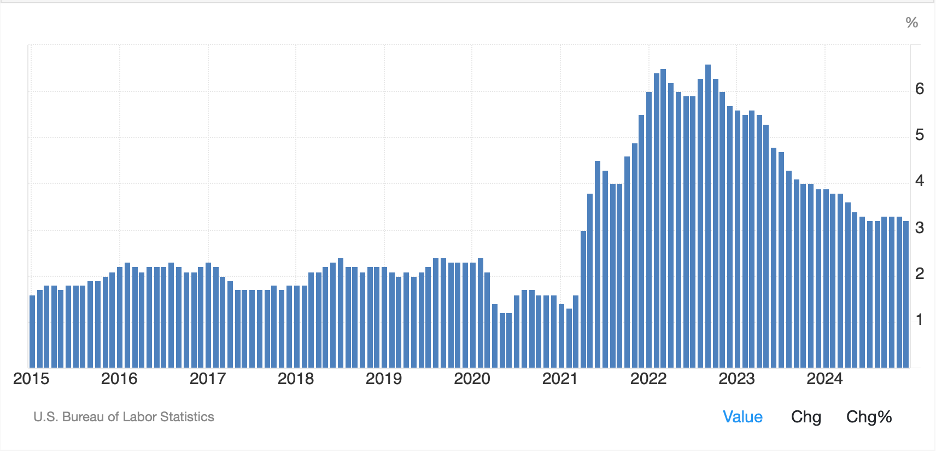
Leading up to yesterday’s CPI data, it appeared to me that despite a better (lower) than expected set of PPI readings on Tuesday, the market was still wary about inflation and concerned that if the recent trend of stubbornly sticky CPI prints continued, the Fed would soon change their tune about further rate cuts.  Heading into the release, the median expectations were for a 0.3% rise in the headline rate and a 0.2% rise in the core rate for the month of December which translated into Y/Y numbers of 2.9%% and 3.3% respectively. At least those were the widely reported expectations based on surveys.  

However, in this day and age, the precision of those outcomes seems to be lacking, and many analysts look at the underlying indices prepared by the BLS and calculate the numbers out several more decimal places.  This is one way in which analysts can claim to be looking under the hood, and it can, at times, demonstrate that a headline number, which is rounded to the first decimal place, may misrepresent the magnitude of any change.  I would submit that is what we saw yesterday, where the headline rate rose to the expected 2.9% despite a 0.4% monthly print, but the core rate was only 3.24% higher, which rounded down to 3.2% on the report. Voila!  Suddenly we had confirmation that inflation was falling, and the Fed was right back on track to cut rates again.

Source: tradingeconomics.com

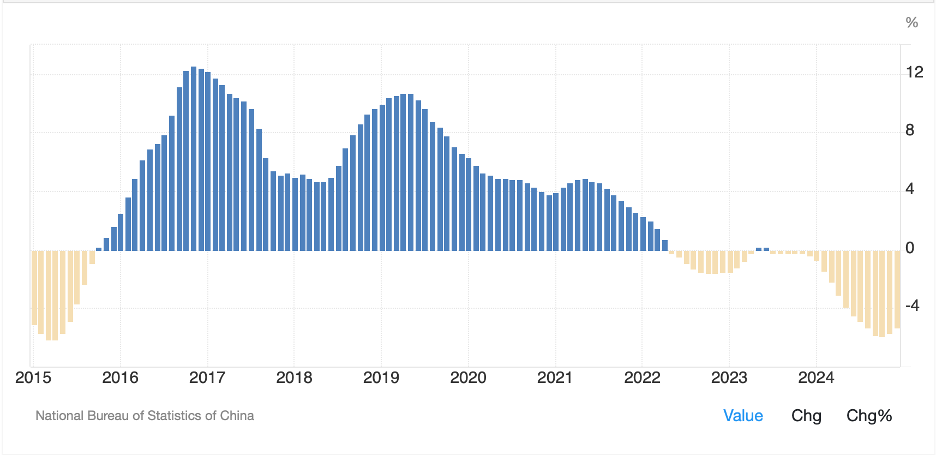
Now, I cannot look at the above chart of core CPI and take away that the rate of inflation is clearly heading back to 2% as the Fed claims to be the case.  But don’t just take my word for it.  On matters inflation I always refer to Mike Ashton (@inflation_guy) who has a better grasp on this stuff than anyone I know or read.  As he points out in his note yesterday, 3.5% is the new 2.0% and that did not change after yesterday’s data.

However, markets and investors did not see it that way and the response was impressive.  Treasury yields tumbled 13bps and took all European sovereign yields down by a similar amount, equity markets exploded higher with the NASDAQ soaring 2.5% and generally, the investment world is now in nirvana.  Growth remains robust but that pesky inflation is no longer a problem, thus the Fed can continue cutting rates to support equity prices even further.  At least that’s what the current narrative is.  

Remember all that concern over Treasury yields?  Just kidding!  Inflation is dying and Trump’s tariffs are not really a problem and… fill in your favorite rationale for remaining bullish on risk assets.  I guess this is where my skepticism comes to bear.  I do not believe yesterday’s data reset the clock on anything, at least not in the medium and long term.

Before I move on to the overnight, there is one other thesis which I read about regarding the recent (prior to yesterday) global bond market sell-off which has some elements of truth, although the timing is unclear to me.  It seems that if you look at the timing of the recent slide in bond markets, it occurred almost immediately after the fires in LA started and were realized to be out of control.  This thesis is that insurers, who initially were believed to be on the hook for $20 billion (although that has recently been raised to >$100 billion) recognized they would need cash and started selling their most liquid assets, namely Treasuries and US equities.  In fact, this thesis was focused on Japanese insurers, the three largest of which have significant exposure to California property, and how they were also selling JGB’s aggressively.  Now, the price action before yesterday was certainly consistent with that thesis, but correlation and causality are not the same thing.  If this is an important underlying driver, I would expect that there is more pressure to come on bond markets as almost certainly, most insurance companies don’t respond that quickly to claims that have not yet even been filed.

Ok, let’s see how the rest of the world responded to the end of inflation as we know it yesterday’s CPI data. Japanese equities (+0.3%) showed only a modest gain, perhaps those Japanese insurers were still out selling, or perhaps the fact that the yen (+0.3%) is continuing to grind higher has held back the Nikkei.  Hong Kong (+1.25%) stocks had a good day as did almost every other Asian market with the US inflation / Fed rate cuts story seemingly the driver.  The one market that did not participate was China (+0.1%) which managed only an anemic rally.  In Europe, the picture is mixed as the CAC (+2.0%) is roaring while the DAX (+0.2%) and IBEX (-0.4%) are both lagging as is the FTSE 100 (+0.65%).  The French are embracing the Fed story and assuming luxury goods will be back in demand although the rest of the continent is having trouble shaking off the weak overall economic data.  In the UK, GDP was released this morning at 1.0% Y/Y after just a 0.1% gain in November, slower than expected and adding pressure to the Starmer government who seems at a loss as to how to address the slowing economy.  As to US futures, at this hour (7:30) they are pointing slightly higher, about 0.2%.

In the bond market, after yesterday’s impressive rally, it is no surprise that there is consolidation across the board with Treasury yields higher by 2bps and similar gains seen across the continent.  Overnight, Asian government bond markets reacted to the Treasury rally with large gains (yield declines) across the board.  Even JGB yields fell 4bps.  The one market that didn’t move was China, where yields remain at 1.65% just above their recent historic lows.

In the commodity markets, oil (-1.0%) is backing off yesterday’s rally which saw WTI trade above $80/bbl for the first time since July as despite ongoing inventory builds in the US, and ostensibly peace in the Middle East, the market remains focused on the latest sanctions on Russia’s shadow tanker fleet and the likely inability of Russia (and Iran) to export as much as 2.5 million barrels/day going forward.  NatGas (+0.75%) remains as volatile as ever and given the polar vortex that seems set to settle over the US for the next two weeks, I expect will remain well bid.  On the metals side of things, yesterday’s rally across the board is being followed with modest gains this morning (Au +0.3%) as the barbarous relic now sits slightly above $2700/oz.

Finally, the dollar doesn’t seem to be following the correct trajectory lately as although there was a spike lower after the CPI print yesterday, it was recouped within a few hours, and we have held at that level ever since.  In fact, this morning we are seeing broader strength as the euro (-0.2%), pound (-0.4%) and AUD (-0.5%) are all leaking and we are seeing weakness in EMG (MXN -0.6%, ZAR -0.6%) as well.  My take is that the bond market, which had gotten quite short on a leveraged basis, washed out a bunch of positions yesterday and we are likely to see yields creep higher on the bigger picture supply issues going forward.  For now, this is going to continue to underpin the dollar.

On the data front, this morning opens with Retail Sales (exp 0.6%, 0.4% -ex autos) and Initial (210K) and Continuing (1870K) Claims.  We also see Philly Fed (-5.0) to round out the data.  There are no Fed speakers today, although in what cannot be a surprise, the three who spoke yesterday jumped all over the CPI print and reaffirmed their view that 2% was not only in sight, but imminent!  As well, today we hear from Scott Bessent, Trump’s pick to head the Treasury so that will be quite interesting.  In released remarks ahead of the hearings, he focused on the importance of the dollar remaining the world’s reserve currency, although did not explicitly say he would like to see it weaken as well.  The one thing I know is that he is so much smarter than every member of the Senate Finance committee, that it will be amusing to watch them try to take him down.

And that’s really it for now.  If Retail Sales are very strong, look for equities to see that as another boost in sentiment, but a weak number will just rev up the Fed cutting story.  Right now, the narrative is all is well, and risk assets are going higher.  I hope they are right; I fear they are not.

Good luck

Adf

Three-Three-Three

Apparently, everyone’s sure
Scott Bessent is wholesome and pure
As well, he will fix
The Treasury’s mix
Of policies for more allure
 
He’s focused on three, three and three
His shorthand for what we will see
The budget he’ll cut
Build up an oil glut
And push up the real GDP


President-elect Trump has named hedge fund manager Scott Bessent to be Treasury Secretary.  This appears to be one of his less controversial selections and has been widely approved by both the punditry and the markets, at least as evidenced by the fact that equity futures are rallying while Treasury yields are sliding.  An article in the WSJ this morning lays out his stated priorities which can be abbreviated as 3-3-3.  The 3’s represent the following:

  • Reduce the budget deficit to 3%
  • Pump an additional 3 million barrels/day of oil
  • Grow GDP at 3% on a real basis

The target is to have these three processes in place by the end of Trump’s term in 2028.  I certainly hope he is successful!  However, while 3-3-3 is a catchy way to define things, it is a heavy lift to achieve these goals.  In the article, he also explains that he will be seeking to make permanent the original Trump tax cuts from 2017 as well as uphold Trump’s promises of no tax on tips, overtime or Social Security.  

Now, the naysayers will claim this is impossible, especially the idea of cutting taxes and reducing the budget deficit, but then, naysayers make their living by saying such things.  While nothing about this will be easy, the one overriding rule, I believe, is that increasing the pace of real GDP growth is the only way to achieve any long-term sustainability.  It is in this space where I believe the synergies between Treasury and the newly created DOGE of Musk and Ramaswamy will be most critical.  Improved government efficiency (I know, that is truly an oxymoron) and reduced regulatory red tape will be what allows the real economy to perform above its currently believed potential growth rate.  And in truth, if Trump and his government are successful at that, the chances of overall success are quite high.  Yes, that’s a big ‘if’ but it’s all we’ve got right now.

And truthfully, this has been the only story of note overnight as the punditry churns out stories about what can be good or why he will fail.  While there was a note that a ceasefire in Lebanon may be close, I don’t believe that has been a major part of the market narrative regarding oil prices for a while.  After all, Lebanon doesn’t have any oil infrastructure and while Iran clearly funds Hezbollah, it doesn’t appear they have been willing to lay it all on the line for Hezbollah’s success.

So, market participants are very busy trying to determine the best investments in the new Trump administration and based on all we have seen so far, it appears that Bitcoin is at the top of the list followed by equities, especially value and small-cap and then the rest of the equity universe.  US markets remain more attractive than foreign markets while commodities, especially haven assets like precious metals, have lost their allure in this shiny new world.  At this point, the big Investment banks are busy increasing their equity market targets for 2025 and beyond with S&P 500 forecasts of 6700 and more already being put in place.

Oh yeah, one other thing is the dollar, which had been on a tear for the past two months, has at the very least paused and some are calling that it has topped.  While it is certainly softer this morning, calling a top may be a bit premature.  At any rate, let’s see how markets around the world have behaved in the wake of the newest US news.

Some are saying that Friday’s US equity rally was in anticipation of the Bessent pick, and certainly his name was on the short-list, but that’s a tough case to make in my eyes.  Nonetheless, rally it did and that was followed by strength in Japan (+1.3%) overnight as well as most of Asia (Korea +1.4%, India +1.25%, Australia +0.3%) although both China (-0.5%) and Hong Kong (-0.4%) lost ground as Bessent is very clear that tariffs are an important part of his strategy.  Meanwhile, in Europe, there are modest gains (DAX +0.1%, FTSE 100 +0.2%, IBEX +0.6%) although the DAX (-0.1%) is softer after weaker than forecast IFO data.  Europe remains stuck in a difficult situation as their energy policy is hamstringing the economy while services inflation remains stickier than they would like to see, thus potentially hindering more aggressive ECB policy.  In the end, though, prospects on the continent are just not as bright as in the US right now.  US futures are quite happy with the Bessent choice, rising 0.5% at this hour (7:30).

In the bond market, investors are also of the belief that Bessent will be able to solve some of the US’s problems and Treasury yields have slipped -4bps this morning, although remain near 4.40%.  However, European sovereign yields are all creeping higher, between 1bp and 3bps, as the prospects there seem less positive.  I would say that investors are willing to give Bessent a chance to try to improve the US fiscal situation and that should help encourage bond buying.

Commodity markets, though, are under pressure generally, although not completely. For instance, oil prices fell $1/bbl upon the Bessent news but have since regained the bulk of that as it appears the growth story is starting to take over.  Nat Gas (+4.8%) is continuing to rally strongly, especially in Europe as cold weather forces rapid inventory drawdowns and supplies remain a political, not market question.  Interestingly, upon inauguration, one of the first things Trump has promised is to take the pause off the LNG terminals which should raise demand in the US as exports increase and potentially reduce prices in Europe.  

However, as mentioned above, precious metals are under pressure (Au -1.2%, Ag -1.9%) as investors believe that a combination of less warmongering and an attack on the fiscal deficit will both reduce the need for a safe haven.  As well, given Trump’s well-known disdain for the climate change hysteria, it seems likely support for wind and solar will be reduced, if not eliminated, and silver is a critical need for solar panels.  

Finally, the dollar is under pressure this morning, lower versus almost all its counterparts, notably the euro (+0.6%), although also seeing losses (currency gains) against the entire G10, more on the order of 0.25% or so.  In the EMG bloc, CLP (+0.9%) is the leader as copper (+0.6%) is the outlier in the metals group gaining on the positive economic story.  But we are seeing strength in MXN (+0.45%), PLN (+0.8%) and CNY (+0.15%) as long dollar positions are reduced.  

On the data front this week, with the Thanksgiving holiday on Thursday, everything is crammed into the beginning of the week as follows:

TodayChicago Fed National Activity-0.15
TuesdayCase-Shiller Home Prices4.9%
 Consumer Confidence111.6
 New Home Sales730K
 FOMC Minutes 
WednesdayPCE0.2% (2.3% Y/Y)
 Core PCE0.3% (2.8% Y/Y)
 GDP2.8%
 Personal Income0.3%
 Personal Spending0.3%
 Durable Goods0.5%
 -ex transports0.2%
 Initial Claims217K
 Continuing Claims1910K
 Real Consumer Spending3.7%
 Chicago PMI44.7

 Source: tradingeconomics.com

Mercifully, the Fed seems to be taking the week off with no scheduled speakers although I suppose if something surprising happens, we will likely hear from someone.  

I guess the question is, does Scott Bessent really change everything by that much?  Obviously, we have no way of knowing until he is in the chair, and that is probably two months away at minimum and then it will take some months before anything of substance actually happens.

But, when I consider my long-term thesis which was that inflation is going to be with us for a while which will result in a steeper yield curve, especially if the Fed continues to cut rates, that would have helped both the dollar and gold while hurting both equities and bonds.  This morning, though, the probability of a December rate cut has fallen to 52%, and I imagine it will continue to decline, especially if the PCE data remains hotter than the Fed keeps expecting.  As well, questions about the Fed’s political bias will be raised again as the rationale for cutting rates 75bps given the headline data remained strong has always been unclear.  So, if the Fed is done cutting, that means the dollar is far more likely to rally from here than fall further, commodity prices will struggle (except maybe NatGas) and bond markets may not anticipate nearly as much future inflation with a tighter Fed and a new administration focused on more fiscal rectitude.  In that situation, equities certainly hold much more appeal, although pricing remains steep no matter how you slice it.

Good luck

Adf