Ain’t

Ueda explained
Buying bonds is still our bag
But buying yen ain’t


The last of the major central banks met last night as the BOJ held their policy meeting.  As expected, they left the policy rate unchanged between 0.00% and 0.10%.  However, based on the April meeting comments, as well as a “leak” in the Nikkei news, the market was also anticipating guidance on the BOJ’s efforts to begin reducing its balance sheet.  Remember, they still buy a lot of JGBs every month, so as part of the overall normalization process, expectations were high they would indicate how much they would be reducing that quantity.

Oops!  Here is their statement on their continuing QQE program [emphasis added]:

Regarding purchases of Japanese government bonds (JGBs), CP, and corporate bonds for the intermeeting period, the Bank will conduct the purchases in accordance with the decisions made at the March 2024 MPM. The Bank decided, by an 8-1 majority vote, that it would reduce its purchase amount of JGBs thereafter to ensure that long-term interest rates would be formed more freely in financial markets. It will collect views from market participants and, at the next MPM, will decide on a detailed plan for the reduction of its purchase amount during the next one to two years or so. 

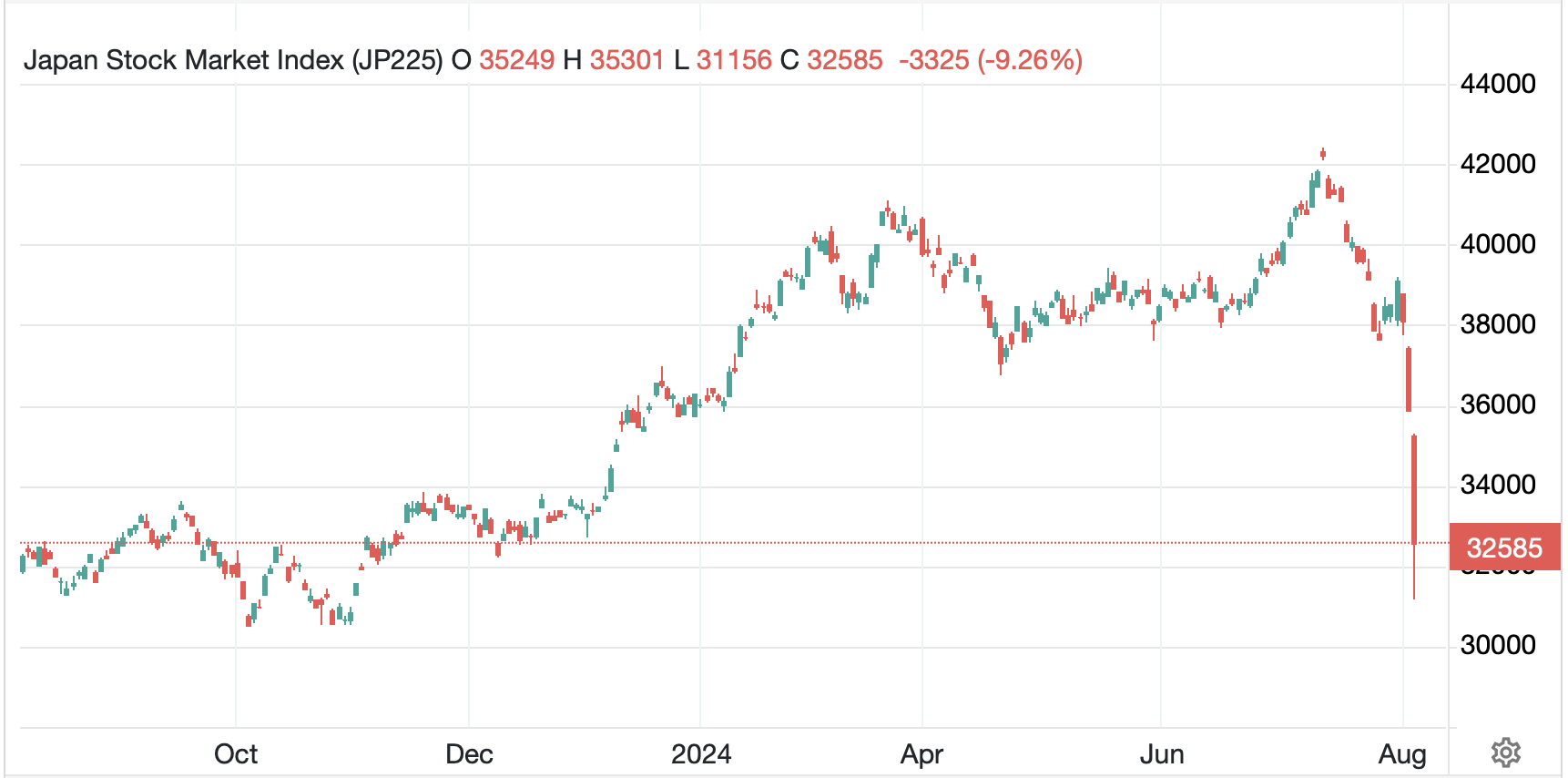
In other words, they have delayed the onset of their version of QT by another month and based on the nature of their process, where they pre-announce the bond buying schedule on a quarterly basis, it is entirely possible that the delay could be a bit longer.  You will not be surprised to know the yen fell sharply on the news, as per the below chart.

Source: tradingeconomics.com

In fact, it traded to its weakest (dollar’s highest) level since just prior to the intervention events in April.  However, as you can also see, that move was reversed during the press conference as it became clear to Ueda-san that his delay did not result in a desired outcome.  The issue was the belief that the BOJ cannot make decisions on interest rates and QT simultaneously (although for the life of me, I cannot figure out why that was the belief), and so Ueda addressed it directly, “We will present a concrete plan for long-term JGB buying operations in July. Of course, it’s possible for us to raise the short-term interest rate and adjust the degree of monetary easing at the same time depending on the information available then on the economy and prices.”

In the end, the only beneficiary of this was the Japanese stock market, which managed a modest rally of 0.25%.  Certainly, this did not help either Ueda’s or the BOJ’s credibility that they are prepared to normalize policy, and it also left the entirety of currency policy in the lap of the MOF.  The problem for Ueda-san is that until the Fed decides it is time to start cutting interest rates, a prospect which seems further and further distant, the yen is very likely to remain under pressure.  I am beginning to suspect that despite Ueda’s stated goal of normalizing monetary policy, the reality is that, just like every other central banker today, his bias is toward dovishness, and he cannot let go.  I fear the risk is that the yen could weaken further from here rather than it will strengthen dramatically, at least until there are real policy changes.  FYI, JGB yields closed 3bps lower after the drama.

Away from that, the overnight session informed us that Chinese economic activity appears to be slowing, at least based on their loan growth, or lack thereof.  Loans fell, as did the pace of M2 Money Supply and Vehicle Sales.  While none of these are typically seen as major data releases, when combined, it seems to point to slowing domestic activity.  The upshot is a growing belief that the PBOC will ease policy further thus supporting Chinese equities (+0.45%) and maintaining pressure on the renminbi which continues to trade at the limit of its 2% band vs. the daily CFETS fixing.

As to Europe, it is becoming clearer by the day that investors around the world have begun to grow concerned over what the future of Europe is going to look like.  Despite the ECB having cut their interest rates last week, the results of the European Parliament elections continue to be the hot topic and we are seeing European equity markets slide across the board, with France (-2.5% today, -5.8% this week) leading the way lower as President Macron’s Renaissance Party looks set to be decimated in the snap elections at the end of the month.  But the entire continent is under pressure with Italy (-2.8% today, -5.7% this week) showing similar losses and the other major nations coming in only slightly better (Germany -2.75% this week, Spain -3.9% this week).  You will not be surprised to know that the euro (-0.4%) is also under pressure this morning, extending its losses to -1.0% this week with thoughts it can now test the lows seen last October.

There is a great irony that the G7 is meeting this week as so many of the leaders there, Italy’s Giorgia Meloni and Japan’s Kishida-san excepted, looks highly likely to be out of office within a year.  Macron, Olaf Sholz, Justin Trudeau, President Biden and Rishi Sunak are all far behind in the polls.  One theory is that the blowback from the draconian policies put in place during the pandemic restricting freedom of movement and speech within these nations, as well as the ongoing immigration crisis, which is just as acute in Europe and the UK as it is in the US, has turned the tide on the belief that globalization is the best way forward.  

Earlier this year I forecast that there would be very severe repercussions during the multitude of elections that have already taken place and are yet to come.  Certainly, nothing has occurred that has changed that opinion, and in fact, I have a feeling the changes are going to be larger than I thought.  

The reason this matters is made clear by today’s market price action.  If the world is turning away from globalization, with a corresponding reduction in trade, equity markets which have been a huge beneficiary of this process (or at least large companies have directly) are very likely to come under further pressure.  As well, fiscal policies are going to put more pressure on central banks as the natural response of politicians is to spend more money when times are tough, and we could see some major realignments in market behaviors.   This will lead to ongoing inflationary pressures, thus weaker bond prices and higher yields, weaker equity prices, much strong commodity prices and the dollar, ironically, likely to do well as it retains its haven status.  Certainly, the euro is going to be under pressure, but very likely so will many other currencies.  This is a medium to long-term concept, certainly not something that is going to play out day-to-day right now, but I remain firmly in the camp that many changes are coming.

As to the rest of the markets overnight, yields are falling everywhere (Treasuries -5bps, Gilts -9bps, Bunds -12bps, OATs -6bps, Italian BTPs -1bp) as investors are seeking havens and for now, bonds seem better than stocks.  You will also notice that the spread between Bunds and other European sovereigns is widening as there is clear discernment about individual nation risk.  This is not a sign that everything is well.

Maintaining the risk-off thesis, gold (+1.25%) and silver (+1.00%) are rallying despite a much stronger dollar this morning and we are also seeing some strength in oil (+0.2%).

As to the dollar, it is stronger vs. almost every one of its counterparts this morning, most by 0.3% or more with CE4 currencies really under pressure (PLN -1.0%, HUF -0.8%).  However, there are two currencies that are bucking this trend, CHF (+0.25%) which is showing its haven characteristics and ZAR (+0.5%) where the market is responding to the news that the ANC has put together a coalition and that President Ramaphosa is going to remain in office.

Yesterday’s PPI data showed softness similar to the CPI on Wednesday but more surprisingly, the Initial Claims number jumped to 242K, its highest print since August 12, 2023, and a big surprise to one and all.  The combination of data certainly added to yesterday’s feel that growth and inflation were ebbing.  This morning, we get the Michigan Sentiment (exp 72.0) and then a couple of Fed speakers (Goolsbee and Cook) later on during the day.

I should note that equity futures are all in the red this morning, with the Dow continuing to lag the other markets, probably not a great signal of future strength.  Arguably, part of today’s price movement is some profit taking given US equity markets have rallied this week and month.  But do not discount the bigger issues discussed above as I believe they will be with us for quite a while to come and put increasing pressure on risk assets with support for havens.  As such, I think you have to like the dollar given both the geopolitical issues and the positive carry.

Good luck and good weekend

Adf

Crushed

On Friday, the NFP showed
That job growth has not really slowed
And wages were hot
So, pundits all thought
That ‘flation just might well explode
 
But under the NFP’s hood
Some things didn’t look quite so good
The joblessness rate
Itself did inflate
Though household jobs fell, understood?
 
Meanwhile across Europe the vote
For Parliament seems to denote
Incumbents were crushed
And governments flushed
While media seeks a scapegoat


Remember the narrative that had everyone feeling so good?  Inflation was drifting lower, albeit not in a straight line, but central bankers around the world were quite confident that their collective 2.0% targets were coming into view, and pretty soon at that.  This would lead to lower bond yields, continued strong performance in risk assets and slowing, but still solid economic activity.  In other words, many were invested in the Goldilocks thesis of a soft landing.  

Now, the data that we had seen last week seemed to indicate that was a viable process as the ADP Employment number was a touch soft, the JOLTS Job Openings number was definitely soft and although the ISM Services data was a lot stronger than anticipated, the ISM Manufacturing number was soft as well.  In addition, if we go back to the previous week, the Chicago PMI print was abysmal at 35.4.

This was all a prelude to Friday’s NFP data which confirmed confused everything.  While the headline number was much stronger than expected at 272K, the Unemployment Rate rose to 4.0% for the first time in more than two years, and Average Hourly Earnings rose 0.4% with an annual increase of 4.1%.  But even more confusing was the fact that looking at the Household survey, the survey that is used to calculate the Unemployment Rate, showed the number of jobs FELL by 408K while 250K people exited the workforce.  Now, if things were truly running smoothly, as the NFP number indicated, we would expect to see that household number of jobs rise, not fall.  Something is amiss.

Having read far too much about this over the weekend, it appears that the BLS data and its models are not a very accurate representation of the current reality, at least for the monthly data.  The BLS also produces a quarterly survey called the Quarterly Census of Employment and Wages (QCEW) which is a census of 11 odd million businesses in the US, rather than a survey of some 600k businesses for the NFP.  If one looks at the growing discrepancy between the number of jobs shown in that data vs. the NFP data, the NFP data has been rising far faster with the gap widening severely.   This can be seen in the below graph from the mishtalk.com website (from Mike Shedlock, an excellent economist/analyst).

The upshot is that while that headline NFP number has looked very good, there appears to be something else happening in the underlying data.  Early next year, the BLS will revise its NFP data, and you cannot be surprised if they reduce the readings significantly.  But revisions don’t have the same cachet as headlines, and so this is our current world. 

The market response was as you would expect; bonds got crushed with the entire yield curve jumping 15bps, the dollar rallied sharply, up nearly 1% on the DXY with several currencies falling farther than that (e.g., MXN -2.85%, NOK -1.5%, BRL -1.6%), and equity markets falling although not nearly as much as you might expect, only about -0.15% on average across the big indices.  But the notable moves were in commodities with gold (-2.2%), silver (-3.9%) and copper (-3.0%) just in the wake of the NFP data, with larger declines overall on the day.  Energy was the only space that held in on the day, but of course, it has been under pressure for several weeks.

What’s next?  Well, this week brings a great deal of new information including CPI, PPI, the FOMC Meeting and the BOJ meeting.  My take is many traders are licking their wounds right now, so given today’s calendar is quite benign, I imagine things will be a bit choppy as positions get adjusted, but direction will be hard to discern.  Except…

The European Parliament elections were held starting last Thursday but running through Sunday, with all 27 nations in the EU voting for their parliamentary representatives.  The story is, as you will clearly have heard by now, that the left wing, center-left and centrist parties got decimated while everyone on the right side of the aisle massively outperformed.  The Belgian PM resigned and there will be elections there.  French President Macron dissolved parliament for a snap election as his party won just 15% of the vote while Marine Le Pen, the conservative candidate leading the National Rally, won more than 31% of the votes.  As well, German Chancellor Olaf Sholz has been decimated as have the Green parties across the continent.  Times, they are a-changin’.  It is no surprise that the euro continues to falter after Friday’s declines as the European part of the equation just added to the woes from the US implication of higher interest rates.

What will these elections mean for markets?  The clearest message that I see is that the climate agenda is likely to be altered such that demand for oil and gas may well increase.  Do not be surprised to see more European nations abandon the Net Zero concept, at least reaching it by 2050.  Ironically, while the first move was seen as a negative for the euro, this may well be a harbinger of future euro strength if the Eurozone economies waste less money on impossible dreams and spend more on actual economic activity that generates benefits and income for its citizens without government subsidies.  But that will take a bit more time.

Perhaps the most important thing is that this election may well be a harbinger of the US election in November as the European people have clearly rejected the current themes and are looking for a change.  Far left Green policies that have been promulgated by the Biden administration have found no favor in Europe and certainly the current polling indicates it is equally unpopular in the US.

OK, a quick tour of the overnight session shows that Japanese equity markets performed well after GDP data there last night showed a less negative outcome in Q1 than originally reported, while most of the rest of Asia was closed for various holidays.  European bourses, however, are under pressure across the board led by France (-2.2%) although most of the rest of the continent has seen declines on the order of -1.0%.  As to the US futures markets, at this hour (6:15), they are lower by -0.3%.

Bond yields continue to climb with Treasuries up another 2bps and European sovereigns rising between 2bps (Germany) and 8bps (France and Italy) as the combination of higher US yields and some concerns over the future direction in Europe have come to the fore.  Overnight, JGB yields also jumped 7bps and are back above 1.00%, with the Japanese data and US data the drivers.  The BOJ meets Friday this week, so there is much speculation as to the outcome, although a rate hike is not forecast.

In the commodity markets, after Friday’s rout in the metals space, the big ones are all firmer this morning, although this looks like a trading bounce rather than a change of views.  Oil markets are little changed this morning, trading at the lower end of their recent ranges but NatGas, something I haven’t discussed in a while, is rallying again.  It is higher by 3% this morning and 26% in the past month, rising to $3.00/MMBtu, its highest price since November and double the lows seen in March.  Consider that if there is continued pushback against the Green agenda, as evidenced by the European elections, demand for NatGas is likely to grow quite strongly.

Finally, the dollar is continuing to gain strength this morning, with the euro down -0.6% following Friday’s declines and the EEMEA currencies all falling more than that.  Given the holidays in Asia, there was limited trading in the onshore markets there, and other than MXN, which is unchanged this morning, the rest of LATAM hasn’t opened yet.  However, remember that the peso has fallen 10% in the past week, so there is likely going to be some more movement in that space going forward.  Markets typically don’t dislocate by 10% and then just stop.

As if last week didn’t bring enough surprises between the NFP and election results in India, Mexico and Europe, this week we have a lot more to look for, although today is a blank slate.

TuesdayNFIB Small Biz Optimism89.8
WednesdayCPI0.1% (3.4% Y/Y)
 -ex food & energy0.3% (3.5% Y/Y)
 FOMC Rate Decision5.5% (unchanged)
ThursdayInitial Claims224K
 Continuing Claims1800K
 PPI0.1% (2.5% Y/Y)
 -ex food & energy0.3% (2.5% Y/Y)
FridayBOJ Rate Decision0.10% (unchanged)
 Michigan Sentiment72.0
Source: tradingeconomics.com

As this is a quarterly meeting of the FOMC, we will get new projections and a new dot plot, and of course, Chairman Powell will be speaking afterwards.  As of now, the market is pricing about a 50:50 chance of the first cut coming in September and a total of one and one-half cuts for the rest of the year.  It remains very difficult to discern what is really happening in the economy with all the conflicting data.  However, whatever the growth stories, nothing has indicated that inflation is going to decline very far.  I maintain the Fed is going to be higher for longer for even longer.  It continues to be difficult to see the benefits of many other currencies, although I would not be surprised to see MXN regain much of its lost ground as I doubt Banxico will be easing policy anytime soon, and president-elect Sheinbaum is not going to change things there that much and doesn’t take office until October.

Good luck

Adf

Not Soaring

It seems that prices
In Japan are not soaring
Like the hawks would want


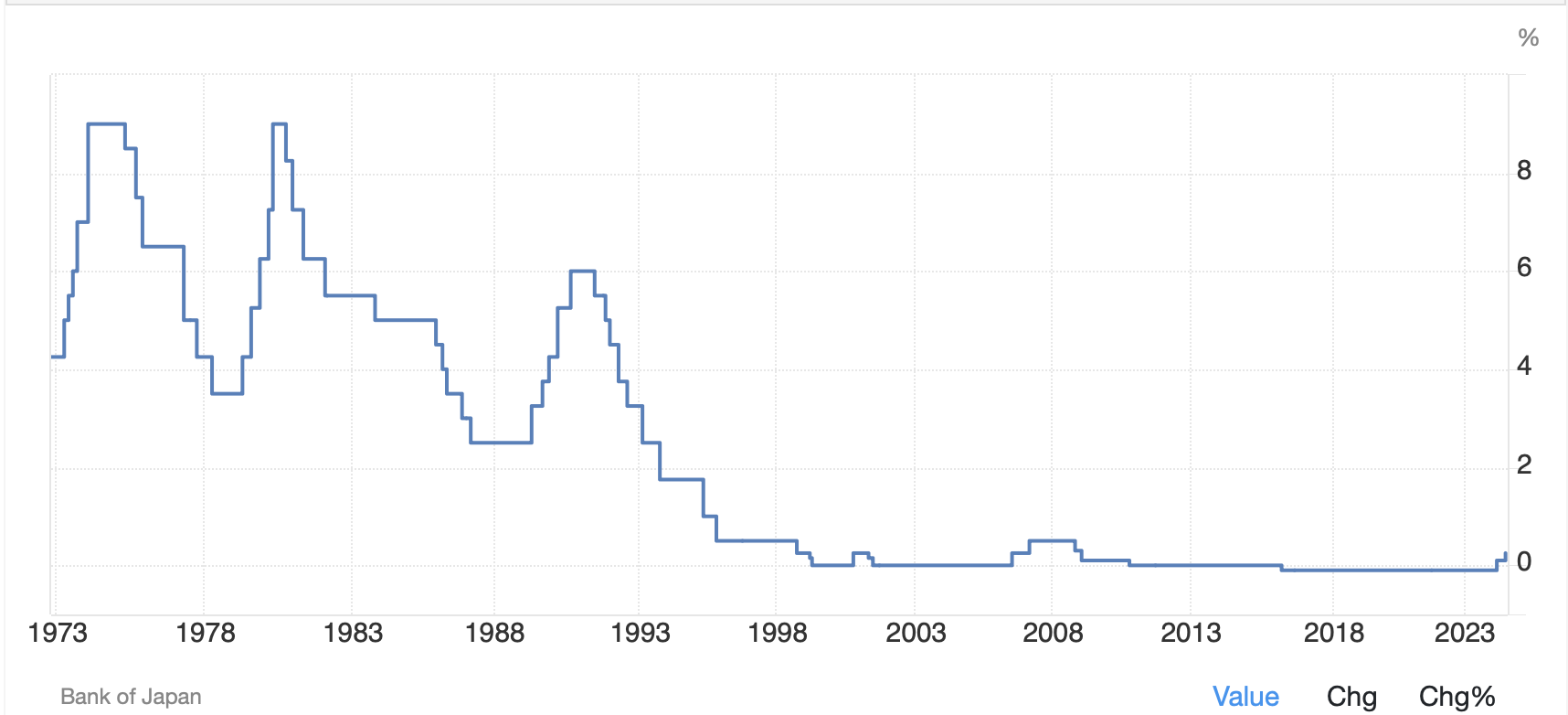
Japanese inflation data last night showed a continued decline as the Core rate fell to 2.2%, and the so-called super core rate slipped to 2.4%, its lowest level since October 2022.  As you can see in the super core chart below, the trend seems clearly to be downward although the current level remains far above inflation rates for most of the past 30 years.

Source: tradingeconomics.com

The irony here is that were this the chart of the inflation rate in any other G7 nation, the central bank would be crowing about how successful they had been at slaying the inflation dragon.  Alas, as the chart demonstrates, Japan’s dragon was a different species, and one that I’m pretty sure the 122 odd million people there were very comfortable having as a “pet”.  After all, I have never met a consumer who was seeking prices to rise before they bought something, have you?

From a market perspective, the continued decline in inflation rates calls into question just how much further Japanese interest rates need to rise in order to achieve the BOJ’s goals.  Again, remember the BOJ’s goals for the past decade has been to RAISE the inflation rate to 2% and their tactic has been to create the largest QE program in the world such that they now own more than 50% of the outstanding Japanese government debt across all maturities.  If inflation continues to decline back to, and below, 2%, while I’m confident the general population there will have no objections, Ueda-san may find himself in a difficult position.  

Arguably, if higher inflation is the goal (and politically that seems nuts) then the most effective tool the nation has is to allow the yen to continue to weaken and import inflation.  I continue to believe that this will be the process going forward, and while very sharp and quick declines will be addressed, a slow erosion will be just fine.  Absent a major change in US monetary policy to something much easier, I still don’t see a case for a much stronger yen.  However, as a hedger, I would continue to consider options to manage the risk of any further bouts of intervention.

While many are still of the view
That rate cuts are long overdue
What yesterday showed
Is growth hasn’t slowed
So, Jay and his friends won’t come through

Back home in the US, yesterday’s data releases did nothing to encourage the large contingent of people who are desperate looking for a rate cut before too long.  While New Home Sales were certainly lousy, falling from the previous month’s downwardly revised level, and the Chicago Fed’s National Activity Index was also quite soft, indicating economic activity had slowed last month, the Flash PMI data got all the attention with both Manufacturing (50.9) and Services (54.8) rising sharply, an indicator that there is still life in the economy yet.  The result was that we saw US yields rise (10yr +7bps), the dollar strengthen, and equity markets give back their early, Nvidia inspired, gains to close lower on the day.  While equity futures are rebounding slightly this morning, confidence that a rate cut is coming soon has clearly been shaken.

Adding to the gloom was a reiteration by Atlanta Fed president Bostic that it is going to take a lot longer for rates to impact inflation than in the past.  In a discussion with Stanford Business School students, he focused on the fact that so many people locked in low mortgage rates during the pandemic and recognized, “the sensitivity to our policy rate — the constraint and the degree of constraint that we’re going to put on is going to be a lot less.” For those reasons, Bostic said, “I would expect this to last a lot longer than you might expect.”  This discussion has been gaining more adherents as the punditry is grudgingly beginning to understand that their previous models are not necessarily relevant given all the changes the pandemic wrought.  Summing up, there continues to be no indication, especially in the wake of the more hawkish tone of the Minutes on Wednesday, that the Fed is going to cut rates soon.

So, with the new slightly less perfect world now coming into view, let’s take a look at market behavior overnight.  Yesterday’s US equity slide was continued everywhere else around the globe with Asian markets (Nikkei -1.2%, Hang Seng -1.4%, CSI 300 -1.1%) under uniform pressure and European bourses, this morning, also in the red, but by a lesser -0.4% or so across the board.  For many of these markets (China excepted) they have recently run to all-time highs, or at least very long-term highs, so it should be no surprise that there is some consolidation.  There is a G7 FinMin meeting this weekend and the comments we have heard so far indicate that the ECB is on track to cut rates next month, but there are no promises for further cuts.  Net, it seems clear that as much as most central banks want to cut interest rates, they are still terrified that inflation will return and then they have an even bigger problem.

In the bond market, it has been a very quiet session after yesterday’s yield rally with Treasury yields unchanged this morning and European sovereign yields similarly unmoved.  Even JGB yields are flat on the day as it appears bond traders and investors started their long weekend a day early.  Remember, not only Is Monday a US holiday, but it is a UK holiday as well, so there will be very little activity then.

In the commodity markets, oil prices remain under pressure and are drifting back toward the low end of their recent trading range.  One story I saw was that there is a renewed effort to get the ceasefire talks in Gaza back on track, but that seems tenuous at best.  Given the strength seen in the PMI data across Europe and the US, it would seem the demand side of the story would improve things here, but not yet.  As to the metals markets, after a serious two-day correction, this morning is bringing a respite with both gold and silver prices bouncing while copper prices remain unchanged.  I remain of the view that the longer-term picture for metals is still intact, so day-to-day trading activity should be taken with a grain of salt.  Ultimately, I continue to believe that the central banking community is going to cut rates before inflation is controlled and that will lead to much bigger problems going forward along with much higher commodity prices.

Finally, the dollar, which rallied alongside yields yesterday, is giving back some of those gains, albeit not very many of them.  The commodity currencies (AUD +0.2%, NZD +0.2%, ZAR +0.4%, NOK +0.6%) are the leading gainers this morning although the euro is also firmer as is the pound despite much weaker than expected UK Retail Sales data.  Alas, the poor yen can find no support and continues to drift a bit lower, with the dollar back above 157 this morning and keep an eye on CNY, which is now back above 7.25 for the first time in a month after Chinese FDI data showed larger than expected -27.9% decline.  It seems that President Xi has successfully scared off most foreign investment which is very likely a long-term problem for the nation.  While it has been very gradual, the fixing rate continues to weaken each day as it appears the PBOC is finally accepting the need for a weaker yuan.

On the data front, we see Durable Goods (exp -0.8%, +0.1% ex-Transports) and then Michigan Confidence (67.5) which continues to be a problem for President Biden’s reelection campaign as the people in this country are just not happy.  We also hear from Governor Waller this morning.  It will be very interesting to hear him as my anecdotal take is that the regional presidents have been much more hawkish than the governors and Chairman Powell, so if he leans dovish, it may demonstrate a bigger split between factions on the board than we have been led to believe.  We shall see.

Net, it remains very difficult for me to make a case for the dollar to weaken substantially at this time.  While it may not power ahead, a decline seems unlikely for as long as higher for longer remains the mantra.

Good luck and good long weekend

Adf

There will be no poetry on Monday due to the holiday.

Losing His Doubt

The jury is no longer out
And Jay may be losing his doubt
That ‘flation is slowing
So, bulls are now crowing
Let’s end, soon, this rate-cutting drought!

I am old enough to remember when Chairman Powell explained that he did not have confidence inflation was falling back to the target level and so maintaining the current, somewhat restrictive, policy stance would be appropriate for longer than had been originally anticipated.  In other words, higher for longer was still the operating thesis.  That is soooo two days ago!  Apparently, when CPI prints at 0.3% M/M for both headline and core with the Y/Y readings at 3.4% and 3.6% respectively, that means the inflation fight is won.  Now, I will grant that the headline monthly number was 0.1% below expectations, but everything else was right on the money.  On the surface, it is not clear to me that this signaled the all-clear for the end of inflation.  As my good friend Mike Ashton (@inflation_guy) said in his write-up yesterday, “the sticky stuff is not yet unstuck.”  But the market saw this news and combined with a clearly weaker than expected Retail Sales print (0.0%) and weaker than expected Empire State Manufacturing print (-15.6) and was off to the races.

So, risk is back in vogue and bond yields are tumbling.  Hooray!  This is the perfect encapsulation of how the actual data may not mean very much per se, but the framework of how investors and traders were positioned and anticipating the data is the key driving force.  So, not only did equity markets in the US rally 1% or more, but Treasury yields fell 10bps in the 10yr and 8bps in the 2yr.  Meanwhile, September is now the odds-on favorite for the first interest rate cut, politics be damned.

At this point, the question becomes will the Fed respond to this small sample of data in the same way the market has?  The first comments from Fed speakers seemed more circumspect than the market opinions.  Chicago Fed president Goolsbee, who was not on the calendar, said the following in an interview, “[inflation showed] some improvement from last time, pretty much what we expected, but still higher than we were running for the second half of last year, so there’s still room for improvement.”  Meanwhile, Minneapolis Fed president Kashkari explained, “The biggest uncertainty in my mind is how much downward pressure is monetary policy putting on the economy? That’s an unknown. And that tells me we probably need to sit here for a while longer until we figure out where underlying inflation is headed before we jump to any conclusions.”

To my eye, there is no indication that the Fed has changed their tune, at least not yet.  If we continue to see data that indicates the long-awaited recession is actually closing in, I expect that we will begin to hear more of a consensus view regarding the initial rate cuts other than the current higher for longer stance.  Of course, if a recession is making an appearance, my sense is that will not be a huge benefit for risk assets either, but what do I know, I’m just a poet. Ok, I don’t think we need to spend any more time on that subject for today so let’s see what is happening elsewhere. 

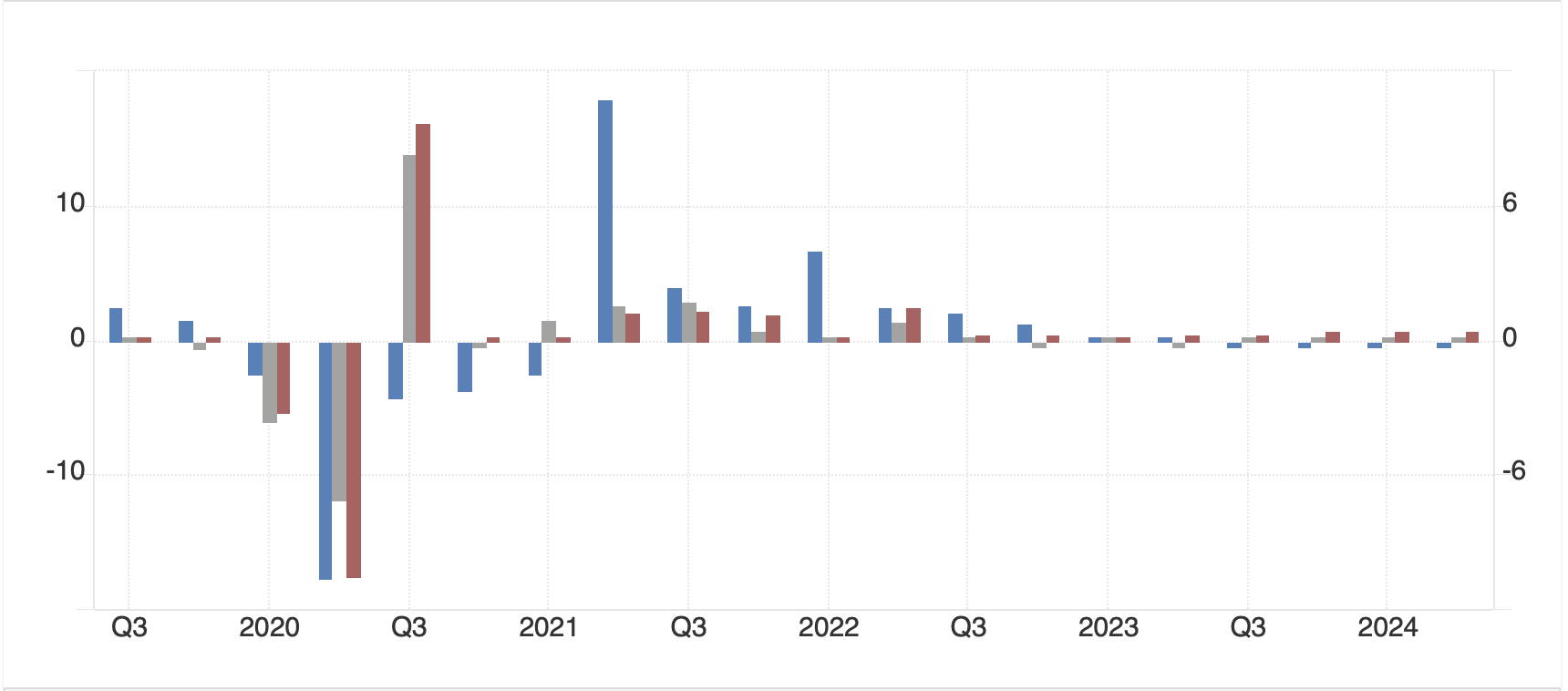
In Japan, the economic news remains less positive than the Kishida administration would like to see.  Last night, Q1 GDP was released at a worse than expected -0.5%, its second negative print in the past three quarters with Q4 a ‘robust’ 0.0% in between.  While not technically a recession, the situation there certainly does not have a positive feel.  Making things even worse, of course, is the fact that inflation remains higher than their target of 2%, although it has been slowly drifting lower over the past year. 

The interesting thing about this situation is that the BOJ does not have a dual mandate regarding prices and employment; but is focused only on price stability.  However, if economic activity continues to slow there, can Ueda-san really tighten policy further?  And what of the yen?  It has drifted higher (dollar lower) alongside the dollar’s broad down move on the back of the recent decline in US yields.  However, it feels to me like Ueda’s path to tighter policy just got a lot narrower if economic activity in Japan is going to remain so lackluster.  Many pundits have decided that the yen’s weakness reached its peak ahead of the recent bout of intervention two weeks ago.  I am not so sure.  Absent a significant slowdown in the US, I’m sensing that the policy divergence may even widen going forward, not narrow, and the yen would not respond well to that outcome.

With all that in mind, let’s survey the overnight session to see what else is happening.  Asian equity markets followed the US rally with solid gains across the board.  Clearly, the prospect of lower US rates was seen as a positive.  However, the same is not true in Europe, where bourses are all lower this morning albeit not dramatically so.  Declines of between -0.25% and -0.5% are universal.  My take is that this is a bout of profit-taking as to much less fanfare than US markets, many European bourses have just touched all-time high levels, so a little pullback should be no surprise.  This is especially true given there was neither data nor commentary that would indicate something in Europe has changed.  The situation remains slow growth, slowing inflation and rate cuts next month.  Lastly, US futures are essentially unchanged at this hour (6:45) as traders await more data and, perhaps more importantly, 4 more Fed speakers.  I think the trading community is looking for Fed confirmation of their response to the CPI data yesterday which, as mentioned above, was not forthcoming.

Bond markets, which all rallied yesterday following the Treasury move, are little changed this morning with virtually no movement in the US or Europe.  Overnight, JGB yields slipped 3bps in the wake of the US data, but this market is entirely focused on the US economy and the Treasury marker for its lead.

In the commodity markets, oil is a touch softer this morning, but remains firmly toward the middle of its recent trading range as conflicting reports regarding expected demand continue to confuse practitioners.  FWIW any report that indicates demand for oil is going to decrease makes no sense to me given how many people on this earth are energy poor and will do as much as they can to get hold of energy.  But that’s just my view.  The IEA continues to forecast reductions in demand because they are desperately pushing their transition thesis because their models are old and unreliable.  As to metals markets, yesterday saw a major rally in gold and silver, with the latter making a push for $30/oz for the first time since 2013.  Copper, however, may have seen a blow-off top yesterday as it has fallen back sharply from its peak and is now back below $5.00/lb.  In truth, the demand story here remains attractive, but the price action did seem to get out of hand there.

Finally, the dollar, which sold off hard yesterday on the CPI and Retail Sales news is bouncing slightly this morning.  Those sharply lower yields in the US, even though they were matched by Europe, were a signal to sell dollars across the board.  Thus, this morning’s 0.2% ish bounce should not be that surprising.  It is in this segment of the market that I believe the opportunity for the biggest structural changes exist.  After all, the dollar’s strength over the past 3 ½ years has been built on the Fed being the most hawkish central bank around as they belatedly fought inflation.  While they have made clear they want to start to cut interest rates, the data has not been supportive of that move.  If yesterday’s data is the beginning of a more consistent slowdown in the US, those rate cuts may be coming sooner than currently priced and regardless of what happens to risk assets, the dollar would suffer.  We shall see.

On the calendar today we have a bunch more data and four more Fed speakers (Barr, Harker, Mester and Bostic).  The data brings the weekly Initial (exp 220K) and Continuing (1780K) Claims, Housing Starts (1.42M), Building Permits (1.48M) and Philly Fed (8.0) all at 8:30 then IP (0.1%) and Capacity Utilization (78.4%) at 9:15.  As Chairman Powell has repeatedly explained, he and his colleagues look at the totality of the data, so another wave of soft numbers here would likely get risk asset markets excited.  However, listening to what they have all continued to say informs me that the Fed is not nearly ready to cut rates.  September remains the odds-on favorite for the first cut, but I still suspect that they could be here all year long.  If I am right about that, the dollar will retain its bid overall.

Good luck

Adf

Less Stout

Suzuki-san and
Ueda-san are clearly
Flocking together

Events continue to unfold in Japan that appear to point to a more concerted effort to address the still weakening yen.  The problem, thus far, is that it hasn’t yet really worked, absent the direct intervention we saw at the beginning of the month.  For instance, last night, 10-yr JGB yields rose to their highest level since June 2012, trading up to 0.969% and finally looking like they are going to breech that 1.00% level that had so much focus back in October.  At the same time, the two key players in this drama, FinMin Suzuki and BOJ Governor Ueda are actively speaking to each other as they try to coordinate policy.  The problem for Suzuki-san is that Q1 GDP fell back into negative territory again, thus bringing two of the past three quarters down below zero.  While that is not the technical definition of a recession, it certainly doesn’t look very good.

And yet, the yen remains under pressure, slipping another 0.1% last night, and as can be seen from the chart below, continuing its steady decline (dollar rise) from the levels seen immediately in the wake of the intervention.

Source: tradingeconomics.com

Another interesting thing is that our esteemed Treasury Secretary, Janet Yellen, seems to be concerned over any intervention carried out by the Japanese, at least based on comments she recently made in a Bloomberg interview, “It’s possible for countries to intervene.  It doesn’t always work without more fundamental changes in policy, but we believe that it should happen very rarely and be communicated to trade partners if it does.” 

There have been several analysts of late who have made the case that Yellen’s trip to Asia last month included a ‘secret’ Plaza Accord II type arrangement, where there was widespread agreement that the dollar needed to come down in value.  First off, secrets like that are extremely difficult to keep secret, and history shows that doesn’t happen very frequently.  But more importantly, based on the fact that inflation is one of the biggest problems that her boss has leading up to the election, a weaker dollar is the last thing she would want.  I suspect if we continue to see the yen decline, the BOJ/MOF will be back at the intervention game again, but the US will not be helping.  Keep in mind, though, Japanese yields.  If the BOJ is truly going to allow yields to rise in Japan, that would have a significant impact on the yen’s value in the FX markets.  While 1.00% is a big round number, I think we will need to see the BOJ demonstrate a more aggressive stance overall…or we need to see the data turn softer in the US to allow the Fed to get on with their much-desired rate cuts.  We will need to watch this closely going forward.

While everyone’s waiting to see
How high CPI just might be
One cannot rule out
An outcome less stout
Where bond and stock bulls are set free

Which brings us to the inflation story.  By this time, everyone is aware that tomorrow’s CPI data is seen as a critical piece of the puzzle.  I continue to read coherent arguments on both sides of the debate regarding the trend going forward.  (Let’s face it, the error bars are far too wide to be confident in a specific forecast.)  For the inflationistas, they continue to look at things like the housing market, which while frequently expected to see declining price pressures, has maintained an upward trend for the past several years.  As well, things like the dramatic rise in certain commodity prices (coffee comes to mind) and the substantial rise in the price of insurance (something of which I speak from personal experience!), there is ample evidence that prices continue to climb. 

Part of this puzzle may be the result of the fact that companies continue to successfully raise prices, or at least had been doing so for the past two years, as evidenced by the continued strong earnings, and more importantly, still high gross margins they are able to achieve.  So, as input prices have risen, they have passed those costs along to the consumer quite successfully.  Now, the comments from Starbucks and McDonalds at their earnings reports indicating business is slowing down and attributing that slowdown to rising prices may well be a harbinger that companies have lost the ability to keep this up.  But two companies, even large ones, are not nearly the whole economy.  As well, much has been made, lately, of the K-shaped economy, where the haves continue to benefit from the rise in asset prices and are far less impacted by rising prices as they can afford them.  This has led to continued strong demand for luxury goods, which while a smaller sector of the economy, remain highly visible. Meanwhile, the less fortunate lower 90% of the population find themselves struggling to make ends meet as real wages remain stagnant and there continues to be a switch from full-time to part-time employment ongoing as companies adjust their staffing needs.  PS, those part time jobs don’t pay as well and generally don’t have benefits, so any price increases are very tough to swallow.  In the end, it appears that housing, insurance services and food remain in upward price trends.

On the flipside, there are many who see that while Q1’s inflation data was sticky on the high side, things should begin to improve going forward.  They point to things like M2, which has fallen dramatically over the past two years, although has recently inflected higher again.  However, the argument is that the lag between the movement in M2 and inflation is somewhere in the 16-24-month period, and we are now due to see prices decline.  In addition, they point to things like loan impairments and credit card delinquencies rising as signs that companies have lost their pricing power and prices will reflect that by slowing their ascent.

Now, today we see the PPI, which may give clues as to tomorrow’s outcome and the following are the median expectations:  headline 0.3% M/M, 2.2% Y/Y; core 0.2% M/M, 2.4% Y/Y.  Looking at the chart, it certainly appears that this statistic has bottomed out just like CPI.

Source: tradingeconomics.com

But here’s the thing…I have a feeling that regardless of the outcome, the market is going to rally in both stocks and bonds.  Certainly, if it is a softer than forecast number, the rate cut narrative is going to be going gangbusters and stocks will rocket while yields fall.  If it is on the money, my sense is the market is still in the camp that despite what we continue to hear, especially with Powell having removed the possibility of a rate hike, that the view will turn to rate cuts are coming as the Fed’s underlying dovishness will prevail.  But if the numbers are hot, while the initial reaction will almost certainly be a decline in risk asset prices, I have a feeling it will be short-lived.  Positioning is not overly long here, at least according to the fear/greed indicators, and the theme that the administration will do all it can to get re-elected, meaning lots more fiscal support, is going to work in favor of risk assets.  One other thing, if there is some trouble in the bond market, the one thing we know for sure is that Powell will come to the rescue and support the whole structure.

Net, while the timing of each outcome may differ, I sense the end result will be the same.  As to the dollar, I remain in the camp that international investors will continue to buy dollars to buy the S&P.  As well, given it seems very clear that both the ECB and BOE are going to cut rates in June while the Fed remains a much lower probability to do so, that should prevent any sharp dollar decline, although it may not push it any higher.

Overnight, basically nothing happened as everybody is holding their collective breath for tomorrow.  Maybe today will be a harbinger, but I expect a generally slow session overall absent a HUGE surprise in PPI.

Good luck

adf

Adrift

Investors are biding their time
As Fedspeak continues to rhyme
It’s higher for longer
As long as growth’s stronger
Defining today’s paradigm

So, how might the narrative shift?
Are Jay and the Fed just adrift?
Next week’s CPI
If it prints too high
Might well, for the bears, be a gift

As promised on Monday, this week remains quite innocuous in terms of both market information and market movement.  There have been precious few pieces of news that have worked to alter the current situation.  The Fed speakers we have heard, when they discussed monetary policy, seem to be reading from the same text.  It can be boiled down to, the policy rate will remain at current levels until such time that something changes with respect to inflation or employment.  We will not rule out a hike, (despite the fact that Powell apparently did so last week) but are nowhere near ready to cut given the current inflation status.

With this in mind, it should be no surprise that markets remain extremely quiet.  After all, how can one change a view if nothing has changed?  So, the US story is pretty well understood for now and until CPI is released next Wednesday, I see no reason for any major movement in either equities or bonds here, and by extension elsewhere in the world.

Moving on from the US, Ueda-san continues to hint that the BOJ may do something, but last night’s Summary of Opinions from the BOJ (effectively their Minutes) almost implied, if you squint hard enough, that they could do it sometime soonish.  Clearly there is a bit of concern over the yen (-0.35%) which continues to drift back toward the levels seen when they intervened.  However, the very fact that just a week after they were aggressively selling dollars, it has pushed back to 156.00 tells you that absent a policy move, nothing is going to change.

As an aside here, this is quite important for the global economy, and certainly global markets.  Ultimately, Japanese monetary policy has been the driver of a huge amount of global liquidity flowing into asset markets around the world.  My understanding is that Japanese households also have somewhere on the order of $7 trillion in cash available to invest still at home, which historically was never a concern there given the complete absence of inflation in the country.  But now that inflation is rising there, and yields remain so paltry compared to elsewhere in the world, especially the US, if even a portion of that starts to flow more rapidly out of Japan, it will have an enormous impact everywhere.  On the flipside, Japan is also the largest international investor around, as a nation, and if the BOJ does allow rates to rise and that capital flows back home, that too would be a dramatic shift in global markets.  Ultimately, this is the reason we all care so much about what the BOJ does…it impacts us all.

The only other thing of note today is the BOE meeting where no change is expected in policy, but all will be searching for clues as to when they will cut rates.  The last vote was 8-1 to remain on hold with the lone holdout seeking a cut.  While expectations are for that to continue today, there is some discussion that a second dove may raise their hand for a cut.  It is widely accepted that cuts are the next move, and the real question is will they be following the ECB and cutting in June or wait until August.  FWIW, I expect a June cut by pretty much all the central banks other than the Fed (and of course the BOJ).  Economic activity is bumping along at effectively stagnation levels elsewhere in the G10 and inflation has been consistently softening everywhere except in the US.  While CPI is still higher than all their targets, central banks are desperate to get back to cutting rates and so will move with alacrity once they get started.

And that’s really all we have today.  Yesterday’s lackluster US session was followed up with a mixed bag in Asian equity markets (Nikkei -0.35%, Hang Seng +1.2%, CSI 300 +0.95%) and we are seeing a similar mixed picture in Europe with gainers (Germany, Switzerland) and laggards (Spain, Italy) while the rest are basically unchanged on the day.  However, at this hour (7:00), US futures are pointing a bit lower, down -0.3% across the board.

In the bond market, yesterday’s 10-year Treasury auction was met with mediocre demand and this morning yields are higher by 2bps.  There continues to be a great deal of discussion as to whether 10-year yields are going to head back above 5.0%, where they briefly touched last October as inflation reignites fears, or whether the oft mooted recession will finally arrive, and yields will tumble as the Fed cuts.  While my take is the former is more likely, at this point, there is no conclusive evidence for either view.  It should be no surprise, however, that European sovereign yields are also higher this morning, on the order of 3bps to 4bps, as they track Treasury yields closely.  Perhaps more surprising is that JGB yields rose 3bps overnight, and are now 0.91%, once again tracking toward their highs seen in October.  Clearly, there is a growing belief that the BOJ is going to do something sooner rather than later, but I will believe it when I see it.  Of course, if they do alter policy, that will change my views on many things.

In the commodity markets, oil (+0.85%) is rising again this morning and just about touching $80/bbl again. While some will say this is being driven by the Israeli incursion into Rafah, my take is this is simply the ebb and flow of a market that is in a trading range.  Since the summer of 2022, WTI has traded between $70/bbl and $90/bbl and I believe we will need to see some major changes in the situation for that to change.  Do not be surprised to see the Biden administration tap the SPR again in the lead up to the election in an effort to depress gasoline prices.  And do not be surprised to see OPEC+ cut production further if they do.  Consider this, though, if Trump is elected, there will be a major reversal in US energy policy and ‘drill baby drill’ will be back in vogue.  I suspect energy prices may decline then.

Turning to the metals markets, after a soft session yesterday, we are seeing a modest rebound led by silver (+1.3%) with gold, copper and aluminum all barely creeping higher by 0.1% or 0.2%.

Finally, the dollar cannot be held back.  As Treasury yields edge higher, the dollar is following and this morning is firmer against most of its counterparts, albeit not dramatically so.  Aside from the yen’s ongoing weakness, the pound (-0.3%) is not responding favorably to the fact that the BOE left rates on hold, and as I suspected, hinted at cuts to come with the vote coming out 7-2 as I proposed above.  Otherwise, most movement is extremely modest with one outlier, ZAR (+0.3%) rallying on the back of the metals rebound.

On the data front, this morning we see Initial (exp 210K) and Continuing (1790K) Claims and that is all she wrote.  We don’t even have any Fed speakers today, so it is shaping up as another very quiet session.  The big picture remains the same so until the Fed turns dovish, the dollar should hold its own.

Good luck
Adf

Towards the Stars

As the yen declines
Pressure on the BOJ
Climbs up towards the stars


Intervention in the currency markets has a long and undistinguished history.  At least that is true for nations that have open capital accounts.  In fact, a key reason that countries impose and maintain capital account restrictions is to avoid the situation of having their currency collapse when the locals fear future loss of purchasing power, i.e. inflation is rising. While there have been situations where a central bank has been able to prevent a significant movement in the past, it has almost always been in an effort to prevent too much currency strength, never weakness.  

A great example is Switzerland in January 2015.  As you can see from the chart below of the EURCHF cross, Switzerland was explicitly targeting a level, 1.20, in the cross as the strongest the Swiss franc could trade (lower numbers indicate a stronger CHF).  This was in an effort to support the export sectors of the economy during a period shortly after the Eurozone crisis when Europeans were quite keen to convert their funds to Swiss francs as a more effective store of value.  

Source: tradingeconommics.com

The upshot was that the Swiss National Bank wound up effectively printing and selling hundreds of billions of francs, receiving dollars and euros and then investing those proceeds into the US stock market.  At one point, they were the largest shareholder in Apple!  But even in this case, where you would expect a nation could prevent their currency from rising too far or too fast, the process overwhelmed the SNB and one day in January 2015 they simply said, enough.  That 25% appreciation in the franc took about 15 minutes to accomplish and as evidenced by today’s exchange rate of 0.9768, it has never been unwound.

And that’s what happened to a central bank that is trying to prevent its own currency from strengthening.  For central banks to prevent weakness is an entirely different story and a MUCH harder task.  As I have repeatedly explained, the only way to change the trajectory of a currency is to alter monetary policy.  At this time, given the Fed’s commitment to higher for even longer, the only way Japan can prevent more substantial yen weakness is for the BOJ to tighten policy even further.  This is made evident in the below chart of the price action in USDJPY for the past month.  In it, you can see when it spiked above 160 on April 28th, and the subsequent intervention that day and then two days later.  

Source: tradingeconomics.com

However, in both cases, despite spending upwards of $60 billion intervening, the yen immediately resumed its downtrend (dollar uptrend) and this morning it is back above 155.  It is this price action that appears to have finally awoken Ueda-san as last night, in an appearance at the Japanese parliament, he explained the following, “Foreign exchange rates make a significant impact on the economy and inflation.  Depending on those moves, a monetary policy response might be needed.”  Ya think!  Ueda-san was followed in parliament by FinMin Suzuki who repeated something he said last week, “Since Japan relies on overseas markets for food and energy, and a large portion of its transactions are denominated in dollars, a weaker yen could raise prices of imported goods.”  While those comments are self-evident, the fact that he needed to repeat them is indicative of the idea that Japan is getting increasingly uncomfortable with the current yen exchange rate.

So, will Ueda-san raise rates at the next meeting in June?  Will he alter their QQE policy and explicitly explain they will no longer be buying JGBs?  Certainly, the market is on edge right now given the two bouts of intervention from last week, but not so on edge that it isn’t continuing to sell the currency and capture the carry.  At this point, you cannot rule out a third wave of intervention, and certainly we should expect more jawboning.  But in the end, if they are serious about the yen being too weak, Ueda-san will have to move.  At this point, I am not convinced, but the meeting is on June 14th, so there is plenty of time for things to become clearer.

And other than that, quite frankly, not much is going on.  So, let’s take a tour of markets to see how things stand this morning.

Yesterday’s equity markets in the US were tantamount to being unchanged across the board, at least that is true of the major indices.  There were certainly individual equities that moved.  In Asia, it was a mixed picture with both Japanese (Nikkei -1.6%) and Chinese (CSI 300 -0.8%) shares in the red, which dragged down HK shares.  But elsewhere in the region, we saw more gains than losses, albeit none of the movement was that large overall.  Meanwhile, in Europe, all the markets are looking robust this morning with gains ranging from 0.5% (DAX, FTSE 100) to 1.0% (CAC) and everywhere in between.  The Swedish Riksbank cut rates by 25bps, as anticipated this morning, and perhaps that has encouraged investors to believe the ECB is going to embark on a more significant easing campaign starting next month.  Certainly, the limited data we saw this morning, (German IP -0.4%, Spanish IP -1.2%, Italian Retail Sales 0.0%) are not indicative of an economy that is growing strongly.  Finally, US futures are just a touch lower, -0.2%, at this hour (7:15).

Despite the weakness in Eurozone data, and the absence of US data, yields are rebounding a bit this morning with Treasuries higher by 3bps and the entire European sovereign spectrum seeing yields rise by 3bps to 4bps.  It seems unlikely that the weak Eurozone data is the driver and I suspect that this movement is more a trading reaction based on the recent decline in yields.  After all, just one week ago, yields were more than 20 basis points higher, so a little rebound can be no surprise.

In the commodity markets, oil (-1.1%) is under pressure as rising inventories outweigh ongoing concerns over Israel’s Rafah initiative.  While the EIA data is generally considered the most important, yesterday’s API data showed a build of more than 500K barrels vs. expectations of a 1.4M barrel draw.  At the end of the day, this is still a supply/demand driven price, and if supply is more ample, prices will fall.  In the metals markets, precious metals continue to trade choppily around recent levels, but we are starting to see some weakness in the industrial space with both copper (-1.25%) and aluminum (-1.6%) under pressure this morning.  Certainly, if economic activity is starting to wane, these metals are likely to suffer.

Finally, in the FX markets, the dollar is continuing to rebound from its recent selloff, gaining against virtually all its counterparts, both EMG and G10.  SEK (-0.5%) is the biggest mover in the G10 after the rate cut, but JPY (-0.45%) is not far behind.  We are also seeing weakness in AUD (-0.4%) on the back of those metal declines.  As to the EMG bloc, ZAR (-0.7%) is the laggard there, also on the metals weakness, but we saw KRW (-0.5%) suffer overnight as well amidst the general dollar strength.

Once again, there is no US data on the calendar although we hear from three more Fed speakers, Boston’s Collins as well as governor’s Cook and Jefferson.  Yesterday, Mr Kashkari did not give us any new information, indicating that higher for longer still makes the most sense and even questioning the level of the neutral rate, implying it may be higher than previously thought.  But there have been no cracks in the current story that the Fed is not going to alter policy soon.

While day-to-day movements remain subject to many vagaries, the reality is that the trend in the dollar has been higher all year and as long as monetary policies around the world remain as currently priced, with the Fed the most hawkish of all, the dollar should grind higher over time.

Good luck

Adf

Tortured

Intervention is
The last bastion of tortured
Finance ministers


Apparently, Japanese FinMin Suzuki did not want the spotlight to remain on Chairman Powell and the Fed so last night, in what was surprising timing given the absence of additional jawboning ahead of the move, it appears there was a second round of intervention orchestrated by the MOF and executed by the BOJ.  Looking at the chart below, courtesy of tradingeconomics.com, it is pretty clear as to the activity and timing, although as is often the case, 50% of the move has already been retraced.

According to Bloomberg’s calculations, they spent an additional ¥3.5 (~$22B) in the effort, so smaller than last time, but still a pretty decent amount of cash.  As of yet, there has been no affirmation by the MOF that they did intervene, although the price chart alone is strong evidence of the action.  Will it matter?  In the long run, not at all.  The only thing that will change the ultimate trajectory of the yen’s exchange rate is a policy change and based on last week’s BOJ meeting, there is no evidence a monetary policy change is in the offing.  Therefore, we need to see a US policy change and based on yesterday’s FOMC meeting and the following press conference, that doesn’t seem to be coming anytime soon either.  To my eye, the yen will continue to weaken until something changes.  This could take a few more years and USDJPY could wind up a lot higher than 160.

Said Jay, it is, frankly, absurd
A rate hike will soon be preferred
But neither will we
Soon cut, we agree
While ‘flation’s decline is deferred

To me, the encapsulation of the entire FOMC statement and Powell press conference can be summed up in the following two quotes from the Chairman while answering questions.  “I think it’s unlikely that the next policy rate move will be a hike,” and “inflation has shown a lack of further progress… and gaining confidence to cut will take longer than thought.”  In other words, we are not likely to change policy anytime soon absent a complete black swan event.

Since the press conference ended, there has been an enormous amount of speculation regarding what message Powell was trying to send.  I would argue the consensus is that he wants to cut but the data is just not in a place that would allow the Fed to go down that path without destroying what’s left of their credibility.  To me, the question is, why is he so anxious to cut rates?  Arguably, an unbiased Fed chair would simply ‘want’ to follow whatever is the appropriate course to achieve the mandate.  

One of the popular views is that there is substantial pressure from the White House to cut as the Biden administration believes lower rates will help Biden’s reelection bid, however Powell, when asked about the political issue, was explicit in rejecting that hypothesis and claiming that politics is never even part of the conversation, let alone the decision.  I accept that at face value, although certainly all 17 members of the FOMC have political biases that drive their actions.  But here is a take I have not heard elsewhere.  Perhaps Powell is keen to cut because it will help the private equity sphere, the place where he not only made his fortune, but where he also maintains a large social circle and he simply wants to help his friends.  There is no doubt that lower rates help the PE space!  Regardless of why, I have to agree that it appears he is leaning in that direction.

There was one other thing that was a minor surprise and that had to do with the balance sheet program.  As expected, the Fed explained they would be reducing the pace of QT starting in June, but they would be doing so by more than anticipated, slowing the runoff to $25 billion/month of Treasuries before reinvesting, down from the current level of $60 billion/month.  For MBS, the runoff remains at $35 billion/month, although if that number is exceeded, they would replace the MBS with Treasuries so allow the MBS portion of the portfolio (currently $2.38 trillion) to slowly disappear.  The operative word here, though, is slowly, as they have not come close to seeing that $35 billion since the program started.  After all, nobody is refinancing their mortgage with current rates thus reducing the churn in that part of the portfolio.  At any rate, that was very mildly dovish, I believe.

The market response to the entire show was quite positive with equity investors taking the dovish message to heart and equities and bonds both rallied in the immediate wake of the meeting, although the equity markets sold off on the close and wound up slightly lower for the session.  Not so bonds, where yields fell and continue at those levels, down about 5bps on the day.

So how have things fared overnight since the Fed?  Well, the Hang Seng (+2.5%) was the big winner as investors there took Powell’s dovishness to heart and that combined with confirmation that the Chinese Plenary meeting would be occurring in July, thus a chance for more stimulus to come, got investors excited.  However, the mainland was closed.  Japanese shares were basically unchanged after the intervention and the story throughout the rest of the region was mixed with some gainers (Australia, India) and some laggards (South Korea, Indonesia).  

In Europe, it is also a mixed picture as investors respond to the PMI data releases, which were also a mixed bag.  For instance, Spain saw a jump in PMI and the IBEX is firmer by 0.3% while France saw a 1-point decline in the index and the CAC is down by -0.7%.  Looking at the overall mix of data, it appears that European economic activity is bumping along the bottom, although not yet clearly turning higher.  Arguably that is a big reason the ECB has penciled in that June rate cut.  Finally, US futures are pointing higher at this hour (7:00) between 0.5% and 1.0%, so quite solidly so.

In the bond market, the doves are still in charge as Treasury yields have drifted lower by another 2bps and are back to 4.60%.  but in Europe, the story is even better with yields down between 4bps and 7bps as the modest growth outturn added to oil’s recent price declines has investors gaining confidence that inflation there, at least, is truly on its way back to target.  As to JGB’s, a 1bp rise overnight has yields back to 0.90%, obviously much closer to the previous limit at 1.0%, but still not moving there rapidly.

Going back to oil prices, while they have bounced 0.5% this morning, they are down more than 5.2% in the past week as rising inventories and growing hopes of a ceasefire in Gaza have been enough to get the CTAs and hedge funds to close their positions.  In something of a surprise to me based on the ostensible dovish tone of the Fed, metals markets are back under pressure after yesterday’s bounce so all of them, both precious and industrial, are lower by about -1.0% this morning.

Finally, the dollar, aside from the yen, is edging higher this morning, although edging is the key term here.  Against most majors it is firmer by just a bit, 0.15% or so, although in the G10 there are two outliers, CHF (+0.45%) which rallied after their CPI release this morning was much hotter than expected at 0.3% M/M indicating the SNB may be holding off on its next rate cut, and NOK (-0.6%) which is continuing to suffer from the oil decline in the past week.  It should also be no surprise that ZAR (-0.5%) is under pressure given the metals movement.  But elsewhere, things are far less interesting with modest dollar gains the rule today.  This seems at odds with the ostensible dovish Fed tone, but there you have it.

On the data front, we see Initial (exp 212K) and Continuing (1800K) Claims as always on a Thursday, as well as the Trade Balance (-$69.1B) and then Nonfarm Productivity (0.8%) and Unit Labor Costs (3.3%) all at 8:30 with Factory Orders (1.6%) coming at 10:00.  As of now, there are no Fed speakers on the docket, but I would not be surprised to see an interview pop up.  The Fed will be closely watching the productivity data as that is an important part of the macro equation regarding sustainable growth and inflation.  Certainly, the expectations do not bode well for a dovish stance.

Explain to me that policy has changed, and I will accept that it is time to change my view.  However, at this point, the dollar still gets the benefit of the doubt.

Good luck

Adf

Stagflation

Call rates will remain
Zero to Point-one percent
We’ll still purchase bonds


In a move that clearly captured my heart, the BOJ left policy on hold last night, as widely expected.  But the key is that the policy statement, in its entirety, is as follows:

I would contend they could have used my haiku above and completely gotten the message across!  This is the best central bank move I have seen in forever, an economy of words with limited discussion about their views of the future.  But that the Fed would be so terse in their statements.  By forcing investors and traders to consider all the issues and the best, or at least possible, ways in which the central bank can achieve their stated goals, positioning would be substantially reduced because nobody would think the central bank ‘had their back’.  This would prevent another SVB-type collapse, and probably go a long way to reducing the massive wealth inequalities that central banks have fostered since the GFC.  Just sayin’!

The market response to this, and the subsequent Ueda press conference was to sell the yen even more aggressively, with USDJPY touching yet further new 34-year highs at 156.80, higher by more than one full yen (0.7%) and JGB yields climbed to 0.92%, slowly approaching the big round number of 1.00%.  FinMin Suzuki was out trying to talk the yen higher (dollar lower) with the following comments, “the weak yen has both positive and negative impacts, but we are more concerned about the negative effects right now.”  Those comments were sufficient to drive USDJPY down about 90 pips in a few minutes, but as of right now (6:20), the dollar is back to its highs.  As long as the Fed and the BOJ remain on different wavelengths, the yen will not be able to rally, trust me.

The GDP data surprised
By showing less strength than surmised
But really, for Jay
The prob yesterday
Was PCE so energized

This brings us to the GDP data yesterday, which missed badly at 1.6%.  However, that was not the worst part of the report.  Alongside the GDP data, there is a PCE calculation, that while not the one on which the Fed focuses, is still a harbinger of how things are going.  That number was higher than expected with the Core rising 3.7% Q/Q, up from 2.0% in Q4.  The upshot of this data was that growth is slowing and inflation is rising, exactly the opposite of the Fed’s (and the administration’s) goals and moving toward the concept of stagflation.

While quoting oneself is not the best etiquette, I think it makes some sense here as I described this exact situation back in January as follows:

Stagflation is an awful word as it describes a state
Where prices rise too fast while growth just cannot germinate.
And this, dear friends, is what I fear will come to pass this year
By Christmas, bonds and stocks will fall while metals hit high gear.

It should be no surprise that both bonds and stocks fell yesterday as market participants are growing concerned that the Fed has lost control of the narrative.  After all, the last time we had stagflation, Chairman Volcker chose to fight inflation first by raising the Fed funds rate to 21% and driving the economy into a double-dip recession from 1980-1982.  But the debt/GDP ratio at the time was just 30% or so and the government could afford it.  That is not the case today, and quite frankly, there are exactly zero politicians on either side of the aisle who can tolerate a recession of any type, let alone a double dip.  My guess is that all hands will be pushing to increase the rate of growth and let inflation rip because given the current drivers of inflation (commodity prices, near-shoring and demographics), it is not clear the Fed can do anything about it anyway.  Don’t you feel better now?

All this leads us to this morning’s PCE data (exp 0.3% M/M for both headline and core, 2.6% Y/Y for both readings) as well as Personal Income (0.5%) and Personal Spending (0.6%).  Given yesterday’s outcomes and the fact that the Bureau of Economic Analysis produces both sets of numbers, the whisper number is clearly higher.  If that should manifest, I suspect that the price action from yesterday, lower stocks and bonds, is very likely to continue despite the after-market rally of both Google and Microsoft on better-than-expected earnings data.  I also suspect that before noon, the Fed whisperer, Nick Timiraos, will have an article out in the WSJ to give some Fed perspective as they are currently muzzled in their quiet period.            

I don’t think there’s anything else to say about this, so let me recap the overnight session, at least the parts I have not yet discussed.  While the US equity session did not finish on its lows, all three major indices were lower by at least -0.5% on the day.  However, the same was not true in Asia with the Nikkei (+0.8%) responding positively to the fact that tighter monetary policy was not on its way, while Chinese (+1.5%) and Hong Kong (+2.1%) shares positively ripped on the back of the strong tech earnings in the US.  As to European bourses, they are all in the green this morning, with Spain (+1.1%) leading the way but all higher by at least +0.5%.  Lastly, US futures are pointing higher as well after the strong earnings numbers overnight, up by +1.0% or so at this hour (7:20).

After jumping 8bps in the wake of the GDP data yesterday, 10-year Treasury yields slid a bit and finished the day up 5bps.  This morning, they have given back two more basis points, but still trade right at 4.70%.  If this morning’s data is 0.4%, watch for another sharp move higher in yields today.  European yields pretty much followed the US yesterday, all closing higher by between 4bps and 6bps, and this morning they are lower by similar amounts, right back to where they started.

Oil prices (+0.5%) are climbing higher again, seeming to have found a recent bottom and looking like they are set to push back toward $90/bbl by summer.  While the real GDP data was softer, nominal remains solid and that is what drives demand.  In the metals markets, they all jumped on the data release and this morning are continuing higher (Au +0.7%, Ag +0.8%, Cu +0.8%, Al +0.9%).  In the industrial metals, inventories are dropping while the precious space is clearly responding to the inflation fears.

Finally, the dollar is little changed overall this morning.  while it has rallied sharply vs. the yen, ZAR (+0.85%) is gaining on metal market strength as an offset and pretty much everything else is +/- 0.25% or less.  My take is everyone is waiting for this morning’s data to determine if the Fed is going to become even more hawkish, or if there will be a reprieve. 

In addition to the PCE data, we get Michigan Sentiment at 10:00 (exp 77.8, down from 79.4).  Right now, players are holding their collective breath for the numbers.  After the release, it’s all about the results.  Given that every recent inflation print has been on the high side, I expect this to be no different.  Bonds should suffer, commodities should outperform, and I expect the dollar to do well.

Good luck and good weekend

Adf

Piffling

The topic du jour
Is, will Japan intervene?
And will it matter?

History has shown
Until policy changes
All else is piffling

The next 30 hours have the chance to be quite meaningful for markets as we will learn a great deal about several very key issues.  While this morning’s Q1 US GDP data will be mildly interesting, I believe the real keys will be the following in order of their release: 1) earnings from Alphabet Google, Intel and Microsoft; 2) BOJ meeting and Ueda press conference; and 3) US Core PCE.

Let’s unpack them in order.

1)    Earnings for three key tech stocks are a critical data point to determine whether the current equity mulitples still make sense.  Already this week we saw Tesla miss estimates but give positive guidance and rally sharply on Tuesday, then Meta Facebook beat earnings nicely but gave negative guidance (they said costs were rising because of all the AI spending but revenues would not show a bump anytime soon on the back of that spending) and the stock fell sharply overnight and is called down -13% to open this morning.  Just remember, if the generals of the stock market rally are slipping, typically the market can follow lower.

2)    Now that USDJPY has breached the 155 level and has not even consolidated, but continues marching higher, all eyes are on Ueda-san to see if he will adjust policy to help mitigate the yen’s declines.  Of course, the BOJ is not in charge of yen policy, that is an MOF issue, but I assure you the two entities work closely together.  Ueda’s problem is that no matter what he does, it will not have enough of an impact to make a difference.  While no policy change is expected, even if the BOJ hikes rates 25bps, it would only have a very short-term effect because the interest rate differential remains huge and would still be in excess of 500 basis points.  While there are reasons for Ueda to consider a hike (rising wages, higher energy prices and the weak yen all can lead to further inflation), given they hiked at the last meeting and explicitly said they would be maintaining easy policy, it seems hard to believe anything will change.  (As an aside, the very fact that nobody is expecting a move would allow a disproportionate pop in the yen, although I believe it would be quite short-lived.)

3)    Finally, the release of the PCE data tomorrow morning will update both market participants and policymakers on the likelihood that the Fed is going to achieve their inflation target anytime soon.  Recall, we have seen three consecutive hotter than expected CPI monthly reports and the last two PCE reports were similarly hotter than expected.  If this one follows that pattern, any idea that a cut is coming before the election will dissipate even further.  As of this morning, the Fed funds futures market is pricing just 42bps of cuts for all of 2024 with the first cut not expected until September.  The options market is now pricing a 20% probability of a rate hike in the next twelve months.  I believe tomorrow’s data matters a great deal.

It is part 3 of my little exercise that is the key for USDJPY going forward.  Just like the ECB (and BOE and BOC), the BOJ was counting on the Fed to begin their rate cutting cycle initially by March, but certainly by June, and expecting quite a few rate cuts.  That would have been crucial to reduce the US yield advantage over the yen and likely would have seen the dollar slide against most currencies.  But it appears that the US economy, which continues to be propped up by massive deficit government spending, is not going to allow the Fed any leeway to reduce rates.  If that continues to be the case, and I see no reason for that to change ahead of the election, then the dollar is going to retain its bid.  In fact, this is exactly why yesterday I highlighted the conversations that are apparently ongoing within the Trump camp regarding ways to weaken the dollar.  Right now, it is not going to fall on its own.

So that’s how things stand as we head into a crucial period with disparate but important information.  In the meantime, let’s look at the overnight activity.

Yesterday’s US session was a wash as early declines were recovered into the close, but the Meta earnings have US futures pointing lower by about 0.7% at this hour (6:45).  Those earnings also seemed to impact Tokyo, which saw a sharp decline of -2.2% although Chinese and Hong Kong shares managed to rally on the session a bit, about 0.5%.  The rest of the time zone was mixed with some gainers (India, New Zealand, Thailand) and some laggards (South Korea, Taiwan).  The picture in Europe is also mixed with the FTSE 100 (+0.6%) having a solid session on the strength of an M&A deal regarding Anglo American, the mining giant receiving an unsolicited buyout offer from BHP Billiton.  However, pretty much the entire continent is under water this morning, sagging by 0.65% or so across the board.

In the bond market, Treasury yields are unchanged this morning, but 10yr still sit at 4.64%.  I expect that the data today and tomorrow will have quite an impact there.  European sovereign yields are all slipping 2bps this morning, as what little data that has been released, German GfK Confidence and French Business Confidence) have been on the soft side with a few comments that the June rate cut remains the favorite. Perhaps of more interest is that 10yr JGB yields rose 3bps overnight and are now at 0.89%, their highest level since November in the wake of the ostensible end of YCC.  Perhaps traders here are starting to bet on a BOJ move.

In the commodity space, oil (+0.3%) is bouncing from its worst levels recently, but in truth, remains in the middle of its trading range for the past week near $83/bbl.  Yesterday’s EIA data showed a very large net draw of inventories which has helped support the black sticky stuff.  As to the metals markets, it appears that the correction may be over with all the main players higher this morning (Au +0.5%, Ag +0.6%, Cu +1.7%, Al +0.2%).  Remember, if tomorrow’s PCE is hot, the metals should continue to rally.

Finally, the dollar is under a little pressure overall this morning, although it remains near its recent highs.  ZAR (+1.15%) is the leading gainer on the back of that metals strength, but we are seeing strength in AUD (+0.45%) and CLP (+0.6%) also helped by the metals markets.  However, it is not just that story as the euro (+0.2%) and pound (+0.4%) are both firmer and dragging their CE4 acolytes along for the ride as well.  The one exception remains the yen (-0.2%), which is above 155.50 as I type.  Of course, that story is told above.

Today’s data is as follows: Initial (exp 214K) and Continuing (1810K) Claims as well as Q1 GDP (2.5%) with its subsets of Real Consumer Spending (2.8%) and its measure of PCE (3.4%).  It is important to note that this PCE data is not the one the Fed tracks closely, although I am certain they pay attention.  FWIW, the Atlanta Fed’s GDPNow number is currently 2.7%.

Now we wait for the data to come.  When the dust settles, we should have a somewhat better idea of how things may play out, but right now there is a great deal of uncertainty.  In the end, nothing has altered the fact that the dollar continues to benefit from the relative tightness of the Fed vs. other nations, and that should continue to support the dollar.

Good luck
Adf