White House Bingo

At this point, investors don’t care
‘Bout tariffs and if they are there
The hype train is rolling
With pundits extolling
Nvidia’s four trillion share
 
So, Canada’s out in the cold
As Loonies, this morning, are sold
But energy’s boring
When folks are adoring
AI or, if bankers, then gold


The tariff machine has been switched back on with yesterday’s announcement that the US will now apply 35% tariffs to all imports from Canada that do not comply with the USMCA.  These tariffs are due to go into effect on August 1st.  It appears this is an effort by Mr Trump to push the progress of trade talks forward as they are not moving at a pace with which he is satisfied.  The Canadian response, by PM Carney, was to indicate they will redouble their efforts to get things done on a timely basis.

I understand that there are many who dislike the President’s bullying tactics as they are completely different than any previous president (or world leader really) and fall far afield from what had been previously accepted and expected in “polite” society.  Diplomats are horrified that he is forcing decisions to be made, something that has been anathema to the diplomatic community since the beginning of time.  But Mr Trump has his agenda firmly in mind and is very keen to use all the power he can to achieve it.  It turns out, the US has a great deal of power beyond its military might.

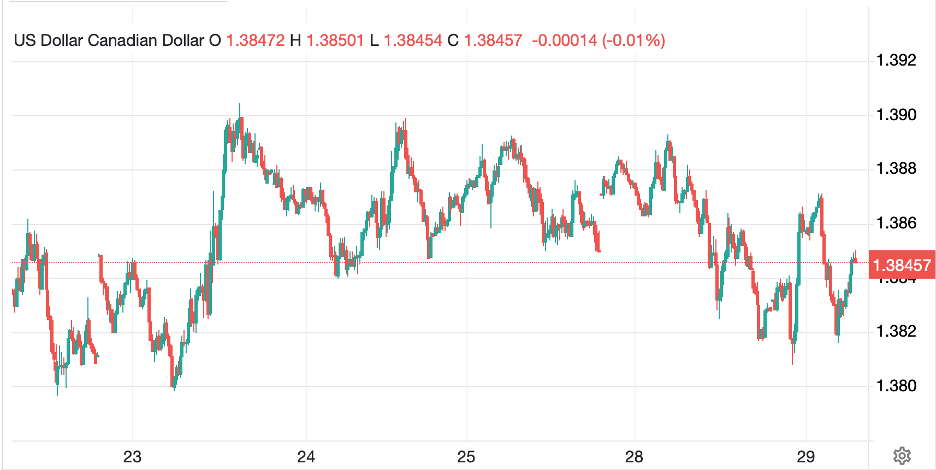
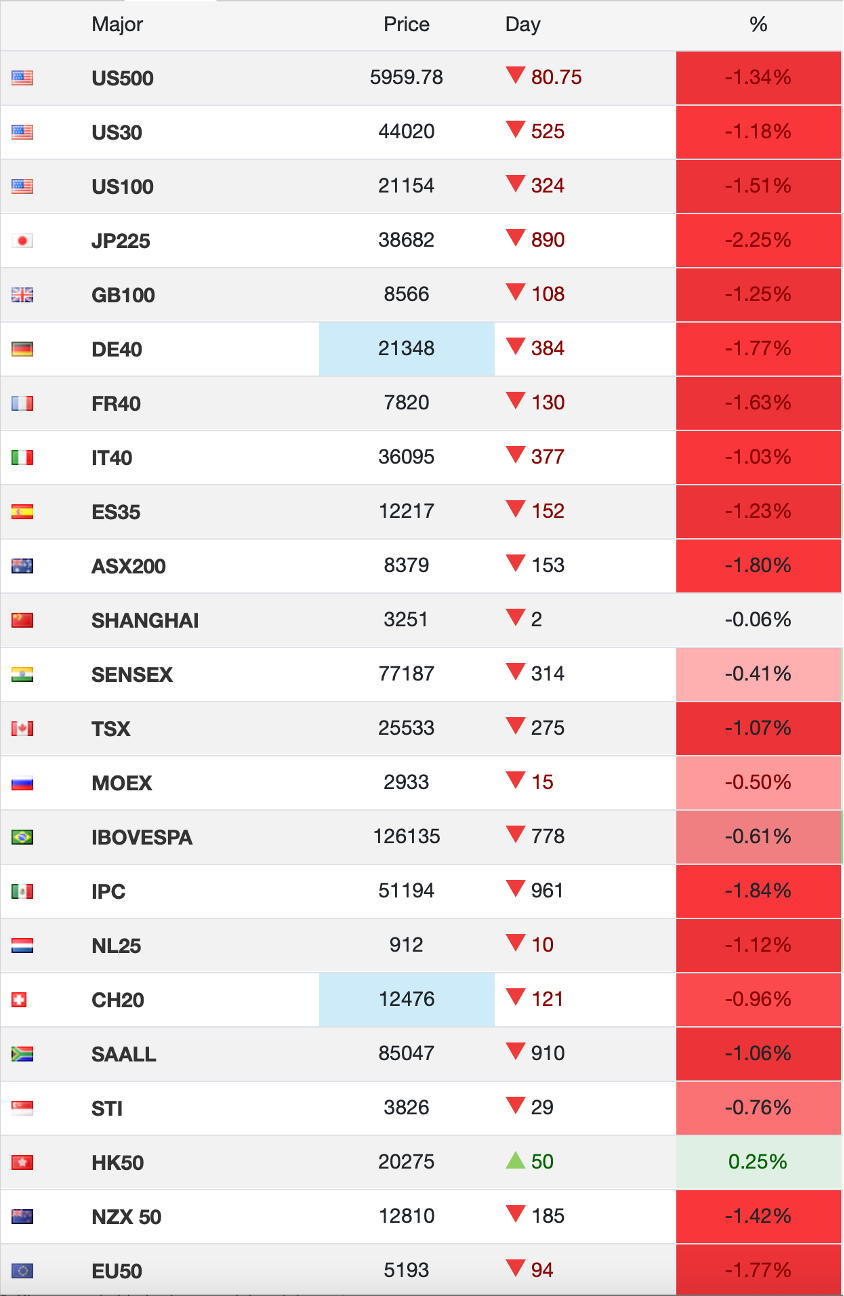
But for our purposes, the market response is the place we need to look.  First, it can be no surprise that the Canadian dollar quickly declined -0.5% on the announcement as that is the textbook response to tariffs, the country affected sees their currency weaken.  As to equity markets, as there are no TSX futures, we cannot tell exactly how stocks in Canada will be impacted but based on the fact that virtually every market is lower this morning, I expect to see weakness there as well.  in fact, a look at this listing of equity futures markets from 6:30 this morning shows exactly what is happening.  You will note that the Toronto market still reflects yesterday, but pretty much every other nation is feeling the heat of a new potential wave of tariffs from the US.

Source: tradingeconomics.com

I continue to read that European nations are getting closer to agreeing a deal with the US, something that has never occurred before and I suspect that there are a number of leaders in the EU that are growing nervous about the situation.  Again, the world was not anticipating the US to wield its power in such a brash and open manner, and many governing theories still need to be rewritten to address the new reality.

But yesterday’s story was all about Nvidia becoming the first $4 trillion market cap company, a remarkable achievement.  It seems Nvidia’s market cap is greater than the entire German stock market.  

For the longest time, I was convinced that the market concentration of the Mag7, which now account for just over 34% of the S&P 500, would ultimately lead to their demise and a major correction.  However, it is becoming harder to make the case that concentration alone is going to be the problem.  

Rather, I believe any correction will now come from a broader economic result, arguably the long forecast recession when it finally arrives.  If you recall, on Sunday I wrote about how the relative gain in corporate profits vs. labor has been a key driver in the bifurcation in the country.  I also strongly believe that President Trump is very serious about changing that situation.  The obvious solution is to reduce corporate profits.  One way to do that is to impose tariffs where companies wind up reducing their margins to maintain sales volumes. If inflation does not rise (and it has not done so yet) that is a step in the President’s direction of choice.  I have no idea whether this will work, and arguably neither does anybody else.  Virtually, every economic model is no longer viable as Mr Trump has changed the rules so completely that the underlying assumptions are almost certainly incorrect.  But remember this chart, if by the end of his term in 2028, the two lines have begun to converge more clearly, he will have changed a multi-decade trend and likely to the detriment of equity markets.

Ok, enough philosophizing, let’s see how other markets beyond equities have behaved overnight.  Bond markets have been under modest pressure with Treasury yields ticking higher by 3bps and all European sovereign yields higher by 1bp this morning.  We heard from Bundesbank, and ECB, member Isabel Schnabel that it was unlikely there would be further rate cuts from the ECB absent a major decline in Eurozone growth. Inflation has returned to their target, and she indicated her belief that current rates there were modestly accommodative, i.e. below neutral.  JGB yields have returned to 1.5% after having spent the past month below that level.  

Recall back in March and April when yields in Japan moved higher quite quickly with the 10yr touching 1.6% and the longer bonds trading above 3.0% to new all-time highs.   That panic subsided but it appears that yields are on the move again as the BOJ discusses selling its equity ETF’s in an effort to reduce their balance sheet further.  Interestingly, the yen (-0.4%) is under pressure this morning and trading back above 147 for the first time in two months.  Here’s what we know about the yen; the carry trade is still in place in significant amounts, inflation is running hot, and the BOJ clearly is uncomfortable raising rates further to address that situation.  My sense is that the yen could have further to weaken, especially if tariffs on Japanese exports are increased as per the recent letter from Mr Trump.  

Continuing with currencies, the dollar is having a good day all around, with only CNY (+0.15%) bucking the trend.  The pound (-0.45%) is under pressure after weaker than expected May GDP figures were released this morning (-0.1% vs. +0.1% expected).  We’re also seeing weakness in MXN (-0.5%) and ZAR (-0.7%) even though precious metals prices are rising this morning.  Here, too, we must keep in mind that many of the old relationships have broken down.

Finally, in the commodity space, gold (+0.65%) is back at its pivot level, taking silver (+1.4%) and platinum (+1.9%) along for the ride although copper (-2.2%) remains subject to the vagaries of exactly what those mooted 50% tariffs are going to cover.  Oil (+1.0%) which sold off yesterday after news that Saudi Arabia had been producing more than its OPEC quota, is rebounding this morning with all eyes on President Trump’s upcoming announcement regarding potential sanctions on Russia given President Putin’s unwillingness to talk peace.

And that’s all there is.  There is neither data nor scheduled Fed speakers on the calendar today, so we all await the next pronouncement from the White House.  Word is that Presidents Trump and Xi will soon be sitting down for a discussion with the opportunity to get more clarity on that situation a potential outcome.  However, White House bingo remains the game of the day, and my card has not been a winner lately.  How about yours?

Good luck and good weekend

Adf
Over the Hump

It’s beautiful and it’s quite big
Though more complicated than trig
But President Trump
Got over the hump
Though sans views that he is a Whig
 
As well, Friday’s Canada rift
Has ended, boy that was sure swift
Now, this week we’ll learn
If there’s still concern
‘Bout jobs, or if there’s been a shift


The weekend news revolves around the fact that the Senate has passed the BBB with a 51-49 vote, and it now moves to committee so both Houses of Congress can agree the final details before it gets to President Trump’s desk for signature and enactment.  This is another victory for the President, adding to last week’s wins and remarkably there have been several others as well.  The Supreme Court ended the ability of a single district court judge to injunct the entire nation based on a single case, a move that will prevent judges who disagree with the president from stopping his policy efforts.  Then, Canada announced they were going to impose a tax on US technology companies (the one that the Europeans just killed) and after Mr Trump ended the trade dialog quite vociferously, Canada backed down from that stance and is back at the negotiating table.

I mention this not to be political but as a backdrop to what is helping to drive the improved sentiment in US markets for both equities and bonds.  While a quick look at YTD performances of US equity indices vs. Europeans shows the US still lags, that gap is narrowing as the news cycle continues to point to positive things happening in the US.  Certainly, my understanding of the BBB is that it is quite stimulative, although it is changing priorities from the previous administration.

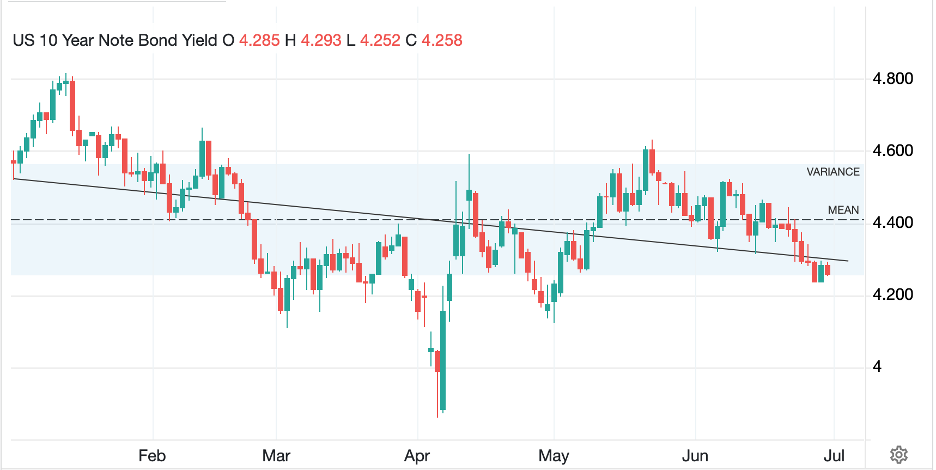
More interestingly, the Treasury market, which has been the subject of many slings and arrows lately from the part of the analyst community that continues to worry about refinancing the growing US debt pile, continues to behave remarkably well.  A quick look at the chart below shows that 10-year yields have been trending lower for the past 6 months, at least, and this morning are continuing that trend, slipping another -3bps.

Source: tradingeconomics.com

My point is that despite relentless doom porn regarding the economy, the big picture continues to point to ongoing growth in economic activity.  There are many anecdotes regarding the impending weakness, (the latest I saw was the increase in the number of credit card purchases that have been rejected is rising rapidly) and yet, the main data has yet to crack and roll over to point to a clear sign of significant slowing.  Perhaps this week when the NFP report is released on Thursday (Friday is July 4th holiday), we will see that long-awaited decline.  However, as of this morning, the Fed funds futures market continues to price just a 21% probability of a July rate cut as forecasts for NFP show the median to be 110K. 

While I completely understand the concerns that the doomers recite, I have come to understand that the idea of a recession is a policy choice, not a natural phenomenon.  While in the past, the business cycle was more powerful than the government, that is no longer the case.  Rather, what we have observed over the past 15 years at least, since the GFC and the onset of QE, is that the government has become a large enough part of the total economy to drive it at the margin.  And I assure you, if a recession is a policy choice, there is not a politician that is going to choose one.  Perhaps we will reach a point where the imbalances get beyond the control of the central banks and their finance ministries, but we are not there yet.

Ok, let’s take a peek at the overnight price action.  Despite all the spending promises by governments around the world, yields have slipped everywhere with all European sovereigns taking their lead from the US and lower this morning by -2bps to -3bps.  Even JGB yields (-1bp) have managed to decline slightly.  If inflation fears are building, they are not obvious this morning.

In the equity markets, Friday’s US rally was followed by most Asian bourses rising (Nikkei +0.8%, Australia +0.3%, China +0.4%) although HK (-0.9%) slipped after Chinese PMI data was released that indicated things weren’t collapsing, but that future monetary stimulus may not be coming after all.  The worst of both worlds for stocks.  Meanwhile, European exchanges are mostly a touch softer, but only on the order of -0.2%, so really very little changed amid light volume overall.  Interestingly, US futures are solidly higher at this hour (7:00), rising by 0.55% across the board.

In the commodity markets, oil (-0.35%) is slipping a bit, but is basically hanging around near its recent lows as the market remains unconcerned about an escalation of fighting between Iran and Israel and any possible closure of the Strait of Hormuz.  Meanwhile, gold (+0.4%) is bouncing from a weak performance Friday which appears to have been a bit oversold, although copper and silver are not following suit this morning with the former (Cu -0.7%) the laggard.  However, all the metals remain sharply higher this year and in strong up trends.

Finally, the dollar is modestly softer again this morning with KRW (+0.9%) the biggest mover, by far, while the entire G10 complex is showing gains on the order of 0.1% to 0.2%.  This trend lower in the dollar remains strong (see chart below), but as I continue to remind everyone, we are nowhere near an extreme valuation in the dollar.  If, and it’s a big if, we see substantial weakening in the employment data, I think the Fed could decide to act and that would increase the speed of the downtrend (as well as goose inflation higher), but absent that, I do not see a sharp decline, rather a slow descent.  Remember, this is exactly what Trump and Bessent want, a more competitive dollar for the manufacturing sector.

Source: tradingeconomics.com

As it is the first week of the month, there is plenty of data to digest.

TodayChicago PMI43.0
TuesdayISM Manufacturing48.8
 ISM Prices Paid69.0
 JOLTs Job Openings7.3M
WednesdayADP Employment 85K
ThursdayNonfarm Payrolls110K
 Private Payrolls110K
 Manufacturing Payrolls-6K
 Unemployment Rate4.3%
 Average Hourly Earnings0.3% (3.9% y/Y)
 Average Weekly Hours34.3
 Participation Rate62.3%
 Initial Claims240K
 Continuing Claims1960K
 ISM Services50.5
 Factory Orders8.0%
 -ex Transport0.9%

Source: tradingeconomics.com

In addition to the payrolls, we hear from Chairman Powell again on Tuesday and Atlanta Fed president Bostic twice.  I guess the rest of the FOMC took a long holiday week(end).

As it’s a holiday week, I expect that activity will be light, although headline bingo remains a key part of the markets today.  I feel like the trends are well entrenched though, with the dollar slipping, equities and commodities rallying and bonds currently leaning toward lower yields, although that seems out of sync with the other markets.  But in the summer, with less liquidity and activity, anomalies can continue for a while.

Good luck

Adf

Too Much Debt

In Spain, electricity failed
In Canada, Carney prevailed
But markets don’t care
As movement’s quite spare
It seems many traders have bailed
 
But problems, worldwide, still abound
Though right now, they’re in the background
There’s far too much debt
And still a real threat
That no true solutions are found


The two biggest stories of the past twenty-four hours were clearly the national scale blackout in Spain and Portugal yesterday, and the slim victory for Mark Carney in Canada, where the Liberal Party appears to have a plurality, but not a majority, and will oversee a minority government.

Touching on the second story first, in truth there is not much to discuss.  Much has been made of the vote being an anti-Trump statement with the idea that Carney is better placed to defend Canada from President Trump’s (imagined) predations.  However, given the lack of a majority government, it is not clear how effective this line of reasoning will prove.  As there is no futures market for the TSX, we really don’t have a sense yet of how the Canadian equity market will greet the news.  Yesterday’s modest gains of 0.35% amid a general atmosphere of modest gains doesn’t really tell much of a tale.  As to CAD (-0.1% today), a quick look at the past week shows it has done nothing even in the wake of the news. (see below).  My take is this is a nothingburger event, a perfect description for Mark Carney, a nothingburger of a politician.

Source: tradingeconomics.com

As to the story about Spain’s electricity, I think it may be more instructive on two levels.  The first is as a warning to the risks inherent of powering your electric grid with more than 25% – 30% intermittent, renewable energy sources like wind and solar.  It is somewhat ironic that just twelve days prior to the blackout, Spain’s entire electricity requirement was met by solar, wind and hydro power, the Green dream.  Alas, here we are now and while no answers have yet been forthcoming, and I assume the media will downplay any blame on too much renewable power, virtually every engineering study has shown that once a grid has more than that 25% renewables, it tends towards instability.  This issue will be argued by both sides for a while, although as always, physics will be the final arbiter.  

But I have to wonder if the sudden failure of the electric grid is an omen of sorts, for what may be happening in global markets.  If we analogize global supply chains to the electrical grid, over the course of the past 50 years, we have seen the world create a massively complex web of trade with raw materials, intermediate goods and final products all crisscrossing the world.  There have been myriad benefits to all involved with real per capita economic benefits abounding, and for everybody reading this note, the ability to essentially buy whatever you want/need with limited interference and trouble.  Certainly, the availability of everyday necessities like food and clothing is widespread.

However, underpinning that bounty were two networks.  The first being the obvious one, the supply chains which since Covid have been much discussed by the punditry.  But the second, which gets far less notice is the network of debt that is issued around the world by governments and companies, as well as taken on by individuals, and that has grown to be more than 3x the entire global economic output.  While we most often read about the US government debt which is quickly approaching $37 trillion, total global debt is much greater than that.  In fact, at this point, the debt market is not about issuing new debt to fund new investment, rather it is almost entirely a refinancing mechanism.  

It is this latter issue that should concern us all.  What happens if, one day, the ability to refinance some of that debt, whether US Treasuries, German bunds or Chinese government bonds, has a hiccup of some sort?  A failed US Treasury auction, where the Fed is required to purchase bonds, or a power outage in a key financial center that prevents trades from being confirmed/settled and moneys not moving as expected, or some other force majeure type event that disrupts the current smooth functioning of global debt markets.  

Frankly, the combination of the changes being wrought by President Trump to the global economy, where globalization is giving way to mercantilism, and the significant weight of global debt that hangs over the global economy and is given very little thought seems a potentially volatile mix.

Ironically, as much as I have lately been describing how the Fed’s role seems to have diminished, in the event that something upsets this apple cart, the Fed will be the only game in town.  While this is not a today event, it is something we must not forget.

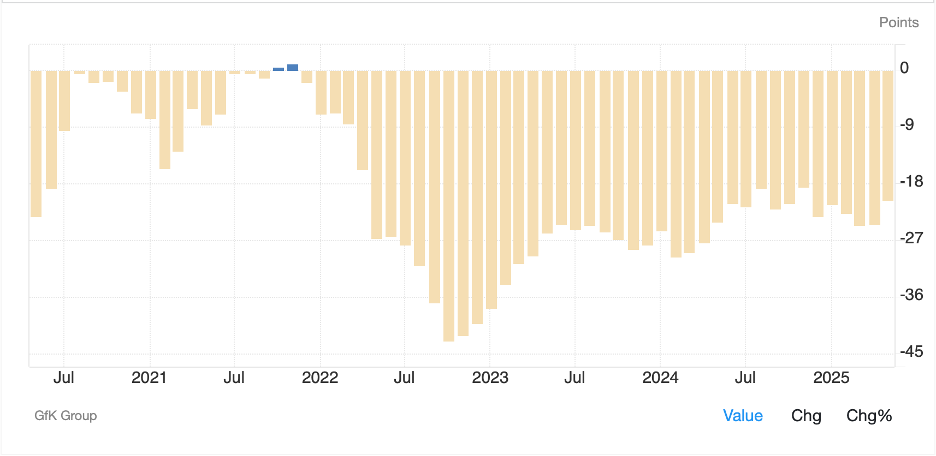
I apologize for my little diatribe, but with so little ongoing in markets, and the parallel to the Spanish electrical grid, it seemed timely.  Let’s look at markets.  Asian equity markets were mixed with the main markets very quiet but a couple of 1% gainers (Australia, Taiwan and Korea) although the rest of the region was +/- 0.3% or less.  Too, volumes were quite lethargic.  In Europe, it should be no surprise that Spain (-0.8%) is the laggard today as the first economists’ to opine on the impact of the blackout said it could be a hit of as much as 0.5% of GDP.  Germany (+0.6%) is the other side of the coin after the GfK Consumer Confidence reading came out at a better than expected -20.6.  Now, maybe it’s just me, but if I look at the past 5 years’ worth of this index, it is difficult to get excited about German economic prospects.

Source: tradingeconomics.com

Yes, this was a better reading, but either the people of Germany are manic depressive, or the index is indicative of major structural problems in the country.  Maybe a bit of both.  As to US futures, at this hour (7:10) they are basically unchanged after being basically unchanged yesterday.

In the bond market, Treasury yields have bounced 2bps this morning after touching their lowest level in 3 weeks yesterday.  European sovereign yields, though, are all softer by 1bp to 2bps this morning as comments from ECB members seem to highlight more rate cuts as Europe achieves their inflation target and are now getting concerned they will fall below the 2.0% rate.

In the commodity markets, oil (-1.7%) is under pressure this morning ostensibly on a combination of concerns over slowing growth and little movement in the US-China trade talks as well as a report that Kazakhstan is pushing up output and other OPEC+ members are talking about increasing production further when they meet next week.  Meanwhile, gold (-0.75%), which rallied back to unchanged in NY yesterday is once again finding sellers at its recent trading pivot of $3340ish (H/T Alyosha).  However, gold’s slide has not impacted either silver (+0.4%) or copper (+0.9%) at least so far in the session.

Finally, the dollar is firmer, largely across the board, this morning.  The euro (-0.3%), pound (-0.4%), JPY (-0.4%) and CHF (-0.6%) are all under some pressure, perhaps profit taking.  But in truth, other than INR (+0.15%) the rest of the major currencies, both G10 and EMG, are all softer vs. the greenback.  I guess the dollar’s demise will need to wait at least one more day.

On the data front, the Goods Trade Balance (exp -$146B), Case Shiller Home Prices (4.7%) and JOLTs Job Openings (7.48M) are the main numbers, although we also see Consumer Confidence (87.5).  But with no Fed discussions much more crucial data on Thursday (GDP, PCE) and Friday (NFP) it seems that today is setting up for not much excitement.

In fact, lack of excitement seems the best description of markets right now.  I don’t know what the next catalyst will be to change things, but absent peace in one of the wars, kinetic or trade, or another force majeure event, it feels like range trading is the order of the day for a while.  My big picture view of a slowly declining dollar is still intact, but day-to-day, it’s hard to see much right now.

Good luck

Adf

In a Trice

The calendar’s not e’en turned twice
Since Trump, with JD as his Vice
Have taken the reins
And beat up on Keynes
While weeding out waste in a trice
 
For markets, the problem, it seems
Is rallies are now merely dreams
So, equity buyers
Are putting out fires
While thinking up pump and dump schemes
 
For bondholders, it’s not so clear
If salvation truly is near
But one thing seems sure
The buck will endure
Much weakness throughout this whole year


We have not even reached 50 days of a Trump presidency as of this morning and nobody would fault you if you estimated we had three years of policies enacted to date.  The pace of changes has been blistering and clearly most politicians, let alone investors, have not been prepared for all that has occurred.

One of the things that I read regularly is that Trump is destroying the Rules Based Order (RBO) which was underpinned by the Pax Americana of the US essentially being the world’s policeman.  This is cast as a distinct negative under the premise that things were going great and now, he is upsetting the applecart for his own personal reasons.  Of course, market participants had grown quite accustomed to this framework, had built all sorts of models to profit from it and with the Fed’s help of monetization of debt, were able to gain significantly at the expense of those without market linked assets.  Hence, the K-shaped recovery.

But while that is a lovely narrative, is it really an accurate representation of the way of the world?  If the US was truly the world’s policeman, and we certainly spend enough on defense to earn that title, perhaps it was time for the US to be fired from that role anyway.  After all, there is currently raging military conflict in Ukraine, Lebanon, Syria, Congo, Sudan and the ongoing tensions in Gaza.  That’s a pretty long list of wars to claim that things were going great.

Secondly, the question of financing all this conflagration, as well as other economic goals, notably the alleged transition to net zero carbon energy production, appears to be reaching the end of the line.  While the US can still borrow as needed, (assuming the debt ceiling is raised), the reality is that the US gross national debt outstanding is greater than $36,000,000,000,000 relative to GDP that is a touch under $28,000,000,000,000.  On a global basis, total (not just government) debt is in excess of $300,000,000,000,000 while global GDP clocks in somewhere just north of $100,000,000,000,000.  Arguably, on a credit metric basis, the world is BB- or B+, a clear indication that all that debt is unlikely to be repaid.

If we consider things considering this information, perhaps the RBO had outlived its usefulness.  Arguably, the loudest complaints are coming from those who benefitted most greatly and are quite unhappy to see things change against them.  But as evidenced by the polls taken after President Trump’s speech last Tuesday evening, the bulk of the American public is still strongly supporting this agenda.  The idea that the president and his Treasury secretary are seeking to engineer a short-term recession early, blame it on fixing Biden’s mess, and having things revert to stronger growth in time for the 2026 mid-term elections is not crazy.  In fact, there have been several comments from both men that short-term pain would be necessary to achieve a stabler, long-term gain.

So, what does this mean for the markets?  You have no doubt already recognized that volatility is the main event in every market, and I don’t see that changing anytime soon.  But some of the themes that follow this agenda would be for US equities to suffer relative to other markets, as the last decade plus of American exceptionalism, led by massive deficit spending and borrowing, would reverse under this new thesis.  Add to this the sudden realization that other nations are going to be investing significantly more in their own defense, and money will be flowing out of the US into Europe, Japan and emerging markets around the world.

Bonds are a tougher call as a weaker economy would ordinarily mean lower yields, but the question of tariff impacts on prices, as well as reshoring, which, by definition, will raise prices, could mean we see the yield curve steepen with the Fed cutting rates more aggressively than currently priced, but 10-year and 30-year yields staying right where they are now.

I believe this will be a strong period for commodities as all that foreign capex will be a driver, as will the fact that, as I will discuss shortly, the dollar is likely to underperform significantly.  Gold will retain its haven characteristics as well as remain in demand for foreign central banks, while industrial metals should hold their own.  As to oil, my take is lower initially, as OPEC returns its production and slowing GDP weighs on demand, at least for a while, although eventually, I suspect it will rebound along with economic activity.

Finally, the dollar will remain under significant pressure across the board.  Clearly, Trump is seeking a weaker dollar to help the export industries, as well as discourage imports.  Add to this the potential for lower yields, lower short-term rates, and an exit of equity investors as US stocks underperform, and you have the making of at least another 15% decline in the greenback this year.

With this as backdrop, we need to touch on three key stories this morning.  First, Friday’s NFP report was pretty much in line with expectations at the headline level but seemed a bit weaker in some of the underlying bits, specifically in the Household Survey where a total of 588K jobs were lost and there was a large increase in the number of part-time workers doing so for economic reasons.  Basically, that means they wanted full-time work but couldn’t find a job.  Markets gyrated after the release, with yields initially sliding but then rebounding to close higher on the day.  Equities, too, closed higher on the day although that had the earmarks of a relief rally after a lousy week overall.  The thing about this report is that it did not include any of the government changes that have been in the press, so next month may offer more information regarding the impact of DOGE and their cuts.

The second story comes from north of the border where Mark Carney, former BOC and BOE head, was elected to lead the Labour Party in Canada and replace Justin Trudeau.  As is always the case, when there is new leadership, there is excitement and he said he will call for a general election in the next several weeks, ostensibly to take advantage of this new momentum.  It seems that President Trump’s derision of not only Trudeau, but Canada as well in many Canadian’s eyes, will play a large role with the two lead candidates, Carney and Poilievre, fighting to explain that they are each better placed to go toe-to-toe with Trump on critical issues.

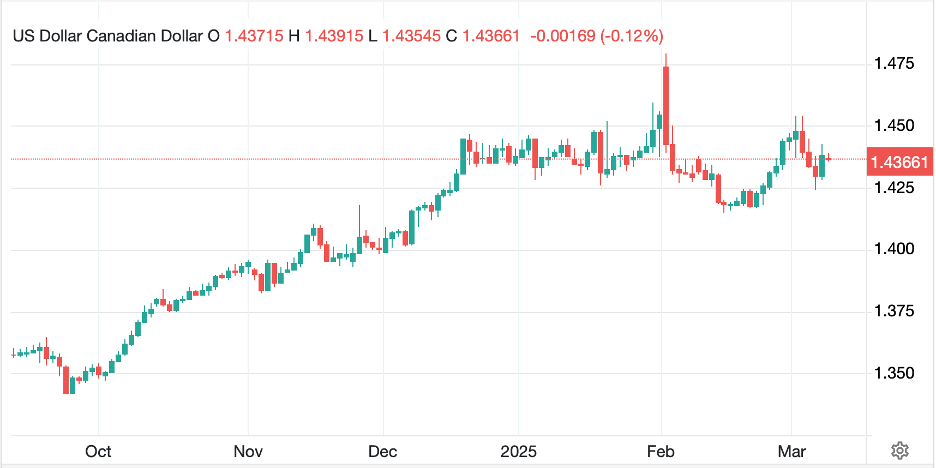
Here’s the thing, though.  Despite much angst about the US-Canada relationship on the Canadian side of the border, the market viewpoint is nothing has really changed.  a look at the chart below shows that after a bout of weakness for the Loonie in the wake of the US election and leading up to Trump’s tariff announcements, USDCAD is basically unchanged since mid-December, with one day showing a spike and reversal in early February.  My point is that the market has not, at least not yet, determined that the Canadian PM matters very much.

Source: tradingecoomics.com

The last story to discuss is Chinese inflation data which was released Saturday evening in the US and showed deflation in February (-0.7% Y/Y) for CPI and continuing deflation in PPI (-2.2%).  In fact, as you can see from the below chart, PPI in China has been in deflation for several years now.  Recently there have been several articles explaining this offers President Xi a great opportunity for significant stimulus because no matter how much the government spends and how much debt they monetize, inflation won’t be a problem for a long time to come.  I would counter that given deflation has been the norm for several years, they have had this opportunity for quite a while and done nothing with it.  Why will this time be different?  Ultimately, the default result in China is when things are not looking like they will achieve the targeted growth of “about 5%”, you can be sure there will be more investment to build things up adding still more downward pressure on prices as production facilities increase.  

Source: tradingeconomics.com

The renminbi’s response to this news has been modest, at best, with a tiny decline overnight of -0.25%.  And a look at the chart there shows it is remarkably similar to the CAD, with steady weakness through December and then no real movement since then.  Given the dollar’s recent weakness overall, this seems unusual.  Although, we also know that China prefers a weaker currency to help support their export industries, so perhaps this in not unusual at all.

Source: tradingeconomics.com

Ok, this note is already overly long, so will end it here.  We do have important data later this week with both CPI and Retail Sales coming.  As well, the consensus from the Fedspeak is that they are pretty happy right here and not planning to do anything for a while.

The big picture is best summarized, I believe, by the idea that we are at the beginnings of a regime change in markets as discussed above.  Volatility continues to be the driving force, so hedging remains crucial for those with natural exposures.

Good luckAdf

Rate Cuts Have Slowed

The story that’s driving the news
Is one on which most have strong views
Both neighbors have claimed
Their borders are tamed
So, tariffs, the Prez, will not use
 
Meanwhile, data yesterday showed
That managers are in growth mode
The ISM rose
And Fed speakers chose
To validate rate cuts have slowed


The major economic story is, of course, the news that both Canada and Mexico have altered their behavior in order to prevent the imposition of 25% tariffs on their exports to the US.  Both nations have now promised to police the border between themselves and the US more tightly, and it also seems that the US now has operational control, via military overflights, of the Mexican border.  While there are many pundits who believe all this activity was merely theater and could have been accomplished without tariff threats, none of them are in a position of power.  In the end, I think it is very difficult to conclude anything other than Trump got what he wanted and achieved it via his preferred means.

The market response was very much what you might expect.  The early sharp declines in the CAD and MXN were reversed and the day ended with both currencies at basically the same levels they closed on Friday.  However, as you can see from the chart below, there was clearly some excitement and panic during the session, with back and forth 2% movements.

Source: tradingeconomics.com

Here’s the thing, I think you all need to be prepared for this type of activity on a regular basis for the next four years.  Certainly, there is nothing to suggest that President Trump is going to change his style and as long as he is successful in achieving his aims in this manner, he will continue with these activities.  Consider this as well, no national leader wants to appear weak, especially to their electorate, and so when President Trump turns his focus to a smaller nation, those leaders are very likely to try to stand up to the pressure, at least in public.  But in the end, most nations are far more reliant on the US market to buy their stuff than the other way around.  After all, the US is basically the consumer of last resort globally.  As such, very few nations can truthfully withstand an onslaught of this magnitude.

Now, turning to the state of the US economy, President Trump got some very positive news from the ISM data which printed at 50.9, its highest level since September 2022 and far higher than forecasts.  In fact, it is not hard to look at the recent trend in this data series and believe we are going to see positive economic growth going forward

Source: tradingeconomics.com

However, the downside here was that the Prices Paid portion of the index also rose, back to 54.9, implying that inflation pressures remain extant within the economy.  Now, you and I both know that is the case as we all deal with these prices on a daily basis, but until the data starts to become more obvious, it appears the Fed is always the last to know.

Speaking of the Fed, while only one speaker was on the schedule, Atlanta Fed President Bostic, we heard from three of them anyway as it remains clear to me there is a strong belief in the Marriner Eccles building that a key part of their job is to never shut up constantly pitch their narrative to try to keep markets in line.  So, as well as Bostic, we heard from Chicago’s Goolsbee and Boston’s Collins and they all basically said the same thing, perhaps best stated by Ms Collins, “There’s no urgency for making additional adjustments.  The data is going to have to tell us.  At some point I certainly would see additional normalization in terms of what the policy stance is.”  The last part of her comment refers to the idea that she, and truthfully all three, believe that further rate cuts remain appropriate despite the ongoing growth and continued stickiness of prices.  And to think, some people believe that Trump and the Fed are not on the same page.   They all want lower rates!

Ok, let’s turn to markets and see how they have behaved overnight.  Yesterday, after a pretty horrible opening on the basis of tariffs, tariffs everywhere, the news that they would be postponed saw US markets rebound, although still close lower on the session.  In Asia, Japan (+0.7%) rallied as so far, Japan remains out of the tariff sightlines, and Hong Kong (+2.8%) traded much higher in its first post-holiday session although mainland Chinese share trading doesn’t reopen until tonight.  Elsewhere in Asia, the screens were largely green, perhaps on the thesis that tariffs are just a negotiating tactic.  In Europe, the picture is more mixed with the UK (-0.2%) lagging while Spain’s IBEX (+0.8%) is the leading gainer.  The rest of the continent, though, is seeing gains on the order of just 0.2%, so not much love.  And at this hour (7:10) US futures are little changed.

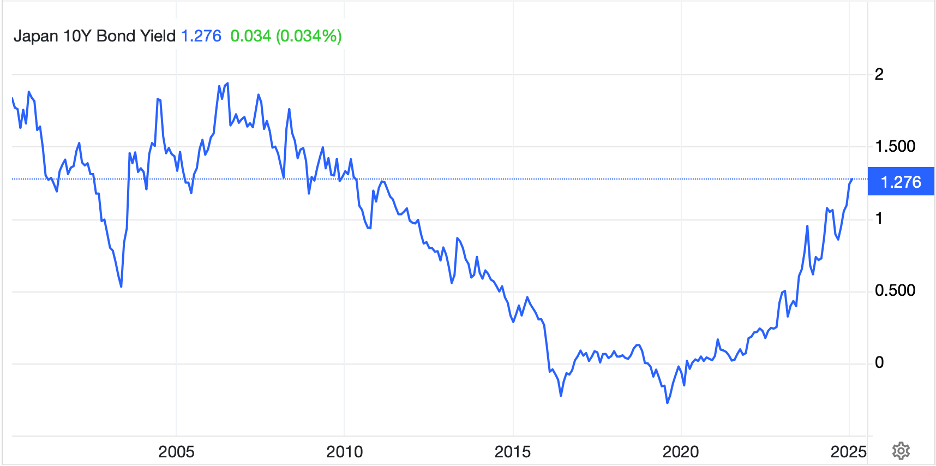
In the bond market, Treasury yields, after edging higher by a few bps yesterday, are up another 2bps this morning and pushing back to 4.60%.  In Europe, sovereign yields are also firmer this morning, up between 2bps and 4bps across the board, although this is after sharply lower yields yesterday on still weak PMI data from the continent.  As well, Mr Trump is hinting that he is going to turn his tariff sights on Europe soon, so there has to be some trepidation there.  After all, Europe, which is already a basket case due to self-inflicted energy-based wounds, really cannot afford a trade fight with the US, especially since they have a net trade surplus on the order of $200 billion with the US.  Finally, JGB yields rose 3bps and are now at their highest level since May 2010 and look for all the world like the trend remains strongly intact as per the below chart.

Source: tradingeconomics.com

In the commodity markets, confusion in energy reigns as yesterday’s initial rally on Canadian tariff news has been completely reversed with oil (-2.1%) and NatGas (-4.2%) both falling sharply today.  But what is not falling is gold (+0.1%) which made yet another new all-time high yesterday and continues to defy gravity.  This has helped the entire metals complex with both silver and copper higher by 0.5% this morning.

Finally, the dollar continues its general winning ways this morning.  Yesterday saw early gains, also on the tariff story, which as evidenced by the chart at the beginning of the note, reversed.  But in the other currencies, the euro and pound remain under modest pressure along with Aussie, as all three are softer by about -0.3% today, with the yen (-0.4%) along for the ride.  In the EMG bloc, MXN (-0.6%), BRL (-1.2%) and ZAR (-0.3%) are also under pressure as though the immediate tariff threat seems to have abated, fear remains the driving force in the space.  Add to the tariff fears the fact that the US economy continues to outperform its peers, and the Fed has basically put the kibosh on any rate cuts anytime soon and it is easy to understand why money is flowing this way.

On the data front, JOLTS Job Openings (exp 8.0M) and Factory Orders (-0.7%, +0.6% ex Transport) are today’s information, and we hear from more Fed speakers.  It seems clear, so far, that the Fed mantra is wait and see as things evolve under President Trump.  Unless one of these speakers (Bostic, Daly, Jefferson) offers a different view, which seems unlikely, then I suspect the dollar will continue to find more support than resistance for now.

Good luck

Adf

Run Amok

The price level, sadly, will jump
According to President Trump
Will Canada shrink?
Will Mexico blink?
As tariffs cause things to go thump
 
The first thing that moved was the buck
While stock markets were thunderstruck
So, who will blink first?
And who will hurt worst?
No matter, things have run amok


Whatever you think of the man, you must admit that President Trump knows how to maintain the spotlight on himself and his policies to the exclusion of virtually everything else in the news.  And so, in the wake of two terrible aviation disasters in short order, pretty much all eyes are now focused on the tariffs that Trump imposed this weekend on Canada, Mexico and China.  While there had been a large school of thought that the tariff talk was a cudgel to be used during negotiations but would never actually be imposed as they would be too damaging, that thesis has been destroyed.  It appears that President Trump believes his long-term goals of reshoring significant parts of US industry and leveling the playing field with trade partners is achievable via tariff policy and will more than offset any short-term pain that may come.  We shall see if he is correct, but certainly, the short-term pain is beginning to arrive.

The early movement in equity markets was uniform around the world, and it was not pretty.  The below snapshot of equity futures markets, taken at 6:00am this morning shows that the only two markets that have not fallen are China and Hong Kong, and that is only because they remain closed for the Chinese New Year holidays.  But there is plenty of fear all around the world, especially considering that markets throughout Europe and Japan, as well as other nations that have not been named targets of tariffs, have also fallen sharply.

Source: tradingeconomics.com

Too, the FX markets have also responded dramatically, with the dollar exploding higher vs. virtually all its counterpart currencies this morning as 1% gains are the norm.

Source: tradingeconomics.com

A special shoutout to ZAR (-1.55%) which while not directly impacted by tariffs, caught Trump’s ire by their recently enacted legislation to confiscate property as they deem fit, oftentimes without compensation.  While South African officials have claimed it is akin to eminent domain rules in the US, those require compensation at all times, a not insubstantial difference.  

So, what’s a hedger to do?  Well, this is why you maintain a hedge program in the first place.  Lots of things happen in the world, most of which are beyond any individual or companies’ control, yet the impacts are real.  Some of what I have read this morning highlights the idea that Canada and Europe and Mexico are going to stick together to fight these tariffs.  However, at the end of the day, the US economy, and by extension its market, is the largest by far, and losing the US as an export destination will be a very difficult pill for those nations and their economies to swallow.  

My sense is that Trump, especially if he continues to address the immigration and government waste issues, will have far more runway than most other nations, especially given the precarious situation of many ruling parties right now.   But the other thing to consider is that there is no going back to the way things were in the past.  Alliances and treaties are going to come under much greater scrutiny by all sides as governments everywhere re-evaluate what they are trying to achieve with various policies and how they can partner with other nations to work together.  In fact, I suspect that the EU is going to continue to come under even greater pressure as it becomes more evident that while many countries believe in the trade benefits of the EU, the recent focus by Brussels on other issues like climate activism and immigration run counter to some members’ views.  No matter what, the world is changing dramatically, and my take is the change is going to come faster than many will have anticipated.

OK, there are a thousand stories on how the tariffs are going to impact the US, with initial calculations regarding the negative impact on GDP and how much they are going to raise inflation, so I’m not going to go there.  Needless to say, the universal belief is things will get worse on those metrics.  But here’s something else to consider.  On Friday, the BLS will be revising the 2024 jobs data, including their population estimates and the birth/death model that describes the number of new businesses that are formed, net, each month. Early estimates show that the number of jobs created is going to fall by nearly 1 million while population, now taking into account more immigration, is going to rise.  I have seen estimates that the Unemployment Rate may rise, or be revised, to 4.5% or 4.6%.  If that is the case, it will certainly call into question exactly what the Fed has been doing.  It will also, almost certainly, result in a Trumpian tirade about how the BLS is political and was cooking the books to burnish Biden’s economic record.  I suspect it will not help equity markets if that is the case, but also probably hurt the dollar as the Fed will be right back onto their rate cutting discussions.

As I’ve already shown the equity and FX markets above, a look at bonds shows that Treasury yields are unchanged this morning, as they seem to be caught between concerns of slower growth and higher inflation due to the tariffs.  Remember, too, that Wednesday, the Treasury will issue its Quarterly Borrowing Estimate with all eyes on the mix that new Treasury Secretary Bessent will be seeking as things go forward.  Remember, he was quite vocal, before he took the job, as to the mistakes that Yellen made in not terming out more Treasury debt when rates were at extremely low levels.  Meanwhile, European sovereign yields are all lower this morning, between -2bps (Italy) and -6bps (Germany) as PMI data released showed that though things were better than last month, they remain well below the key 50.0 level.  However, on the inflation front, both Eurozone and Italian data printed higher than expected, clearly not what Madame Lagarde wants to see.

Finally, commodity markets have seen oil prices (+2.6%) rise sharply as the US will be imposing 10% tariffs on imports of Canadian oil products, while NatGas prices have jumped by 9.0% on concerns over supply disruptions from those tariffs.  Like I said, the world is a different place today!  In the metals markets, both gold and silver are little changed this morning although copper (-0.9%) prices are slipping, perhaps on the idea that these tariffs are going to slow economic activity.  And that is one of the key belief sets amongst economists.

As to the data this week, it is reasonably busy, but all eyes will be on Friday’s NFP report, especially with the rumors of a major revision.

TodayISM Manufacturing49.8
 ISM Prices Paid52.6
TuesdayJOLTS Job Openings8.0M
 Factory Orders-0.8%
 -ex Transport+0.6%
WednesdayADP Employment150K
 Trade Balance-$96.5B
 ISM Services54.2
ThursdayInitial Claims215K
 Continuing Claims1855K
 Nonfarm Productivity1.7%
 Unit Labor Costs3.5%
FridayNonfarm Payrolls170K
 Private Payrolls140K
 Manufacturing Payrolls-2K
 Unemployment Rate4.1%
 Average Hourly Earnings 0.3%(3.8% Y/Y)
 Average Weekly Hours34.3
 Participation Rate62.5%
 Michigan Sentiment70.9
 Consumer Credit$10.5B

Source: tradingeconomics.com

In addition to all of this, we will hear from nine different Fed speakers, at least, over 13 different venues this week.  Now, things could get quite interesting here given Chairman Powell did not speak to tariffs as they were not yet implemented when he delivered the FOMC news last week, but all of these speakers will have an opinion.  I wonder if there will be a unified set of talking points or if each one will truly give their own views.  Of course, given that each is a neo-Keynesian economist, I suspect their views will all be aligned anyway.

One other thing from last week that didn’t get much press is that the BOC, after cutting the base rate by 25bps as widely expected, has indicated they will be ending their QT program and, in fact, restarting their QE program over the next several months in order to grow their balance sheet in line with the economy.  Do not be surprised if we see other major central banks go down this road as well, regardless of sticky inflation.  

Summing it all up, the world is very different this morning compared to Friday morning.  Trade and economic disruptions are going to become evident and there is still a great deal of vitriol to be vented at Trump by others, while Trump will continue to decry other nations efforts to weaken the US.  As I have written in the past, volatility will be the main underlying thesis this year.  Meanwhile, the beauty of a good hedge program is it helps through all market conditions.  Do NOT slow things down waiting for a better entry point, be consistent, as that better entry point may not materialize for a long time.  My strongest cue will be the bond market as if yields start to decline in anticipation of a significant economic slump, I expect the dollar will suffer, but if they hold up, then there is nothing to stop the dollar from testing and breaking its recent highs.

Good luck

Adf

Forked Tongue

The major discussion today
Is tariffs and if they’re in play
While Trump thinks they’re great
Economists hate
Their impact and watch with dismay
 
Meanwhile it has not been a week
And questions are rife ‘bout DeepSeek
The most recent questions
Are making suggestions
That China, with forked tongue, did speak


President Trump has promised to impose 25% tariffs tomorrow on all Canadian and Mexican exports to the US if those nations do not agree to further efforts to tighten border security regarding the movement of both immigrants and drugs across the borders.  Even within his administration, there are many who do not want to see them imposed given the potential disruption they would cause in supply chains throughout the nation.  And of course, economists abhor tariffs as a pure deadweight loss to the economy.  But Trump sees the world through very different eyes, that much is clear, and as evidenced by the very short-term row with Colombia last weekend, believes they can be useful tools to achieve strategic, non-economic outcomes.

This poet is not fool enough to try to anticipate what will actually happen as the mercurial nature of President Trump’s actions is far beyond my ability to forecast.  However, if history is any guide, we will see both Mexico and Canada make some additional concessions and an announcement that because of that, the tariffs will be delayed until negotiations can be completed by some new deadline.  (Well, maybe I am fool enough 🤣)

From our perspective observing market reactions, the only consistent view is that US tariffs will drive the dollar higher, or more accurately, other currencies lower, as the FX market adjusts to compensate for the tariffs.  If we look back at Trump’s first term, the first tariffs were imposed on China in early 2018 on solar panels and washing machines and a few other things.  A look at the chart below shows that the yuan (the green line) did, in fact, weaken substantially following those tariffs, with the dollar rising from 6.25 to 6.95 over the course of the ensuing six months.  However, if we broaden our horizons beyond the renminbi to the dollar writ large, as seen by the Dollar Index (the blue line), which rose from 88 to 96 over the same period, the renminbi’s price action was directly in line with the dollar overall.  There was only limited additional impact to CNY.  Remember, too, that in 2018, the US equity market was performing quite well, and funds were flowing into the US, thus driving the dollar higher, not dissimilar to what we have seen over the past year.  The point is that while the tariffs may have some impact, it is also likely that the dollar will move based on its traditional drivers of interest rate differentials and capital flows regardless.

Source: tradingeconomics.com

Away from the tariff talk, though, there is precious little other market related news, at least on a macro basis.  Yesterday’s data showed that GDP grew a tick less than anticipated at 2.3% in Q4, but Real Consumer Spending, which is a critical part of the economic picture, rose at 4.2%, a very solid performance and an indication that things in the economy are still ticking along just fine.  (The difference between that number and the GDP number is due to inventory adjustments, which are seen to wash out over time.). In fact, arguably, that solid growth was a key reason that the equity markets in the US had another strong session yesterday, with gains across the board.

Well, there is one other thing on many people’s minds, and that is the veracity of the claims about DeepSeek.  You may recall I highlighted the question of all those Nvidia sales to Singapore earlier in the week as somewhat strange.  Well, I was not the only one asking that question and this morning in Bloomberg, there is an exclusive story about a US government investigation into whether China actually got the most advanced H100 chips via Singapore after all.  If that is the case, then perhaps the DeepSeek claims are not as impressive as they were initially made out.  I suspect if this turns out to be the case, that worries over the need for AI to no longer utilize the most advanced chips will dissipate and the tech rally will regain momentum.

So, let’s look at markets now.  China and Hong Kong remain closed for their New Year celebrations.  Japan (+0.15%) had a modest gain and the truth is that only two Asian bourses had strong sessions, Singapore (+1.45%) and India (+1.0%) with the rest of the region mostly a touch firmer.  In Europe, all markets are slightly stronger this morning, on the order of 0.3% or so, as the combination of yesterday’s ECB rate cut and hints at future cuts by Madame Lagarde, seem to be underpinning the markets.  Certainly, today’s Eurozone data, showing German Unemployment climbing a tick to 6.2% while Retail Sales there fell -1.6% in December don’t seem like a rationale to buy equities.  In the US futures market, though, we are seeing solid performance, 0.5% or more, as I believe many are jumping back on the AI bandwagon.

In the bond market, Treasury yields have edged higher by 1bp, and remain just north of 4.50% as the tension between solid growth and slowing inflation dreams keeps the market quiet.  In Europe, though, yields are continuing their decline from yesterday, with sovereign yields down by between -3bps and -4bps as investors look for further easing from the ECB as the Eurozone sinks slowly toward recession.  However, in Japan, JGB yields rose 3bps as data overnight showed inflation remains above target and expectations for another rate hike in the first half of the year rise.

In the commodity markets, oil (-0.35%) continues to chop around in the middle of its trading range with no strong directional impulse (see chart below).

Source: tradingeconomics.com

It is very difficult to know how to view this market in the short run given the potential for disruptions by tariffs and even more sanctions, but nothing has changed my long-term view that there is plenty of oil around and prices will remain here or decline.  In the metals markets, both gold and silver are little changed on the morning although both have been in the midst of a strong rally with gold making new all-time highs in the cash market yesterday.  Copper (-0.7%) is offered this morning but is still much higher than at the beginning of the month/year.

As to the dollar, it is modestly firmer this morning rallying against most of its G10 counterparts, but not by very much, 0.3% (JPY) at most.  Versus its EMG counterparts, though, there is more strength with PLN (-0.6%) and ZAR (-0.4%) both under a bit of pressure.  The latter is responding to ESKOM, the national electrical utility, announcing that they may need to impose rolling blackouts to help repair parts of the grid.

On the data front, this morning brings Personal Income (exp 0.4%) and Spending (0.5%) but of more importance it brings PCE (0.3%, 2.6% Y/Y) and core PCE (0.2%, 2.8% Y/Y) along with the Chicago PMI (40.0) release at 9:45.  We also hear our first post-meeting Fed speaker, Governor Bowman, this morning but it would be shocking if she said anything other than they are going to be patient to watch inflation slowly move toward their target, almost as if by magic.

Once again, tape bombs are the biggest risk, as they will be for the next four years, but I imagine all eyes will be on Trump and the tariffs as the key driver.  For now, nothing has dissuaded me from my view the dollar is more likely to rise than fall, but we need to see how things evolve.

Good luck and good weekend

Adf

No Reprieve

The scuttlebutt had it correct
Trudeau hit the button, eject
But he’s yet to leave
And there’s no reprieve
His legacy will be neglect


Those reports from yesterday morning were spot on as around 11:00am, PM Trudeau announced that he would, in fact, be stepping down.  There is a somewhat convoluted process involved which sees the Canadian Parliament prorogued until late March, while the ruling Liberal party seeks a new leader.  At that point, Parliament will be called back into session, and it seems likely a vote of no confidence will be held.  Assuming that vote goes against the new leader, an election will be called.  No matter how long the Liberals delay this process, and you can bet they will hang on for as long as possible, by October, an election is required.  As well, currently all things point to the Conservative party led by Pierre Poilievre winning that election and taking power with a significant majority.  Obviously, Poilievre would like the election to happen sooner, rather than later, but it seems hard to believe now, regardless of the new Liberal leader, that the Conservatives will fail to win.

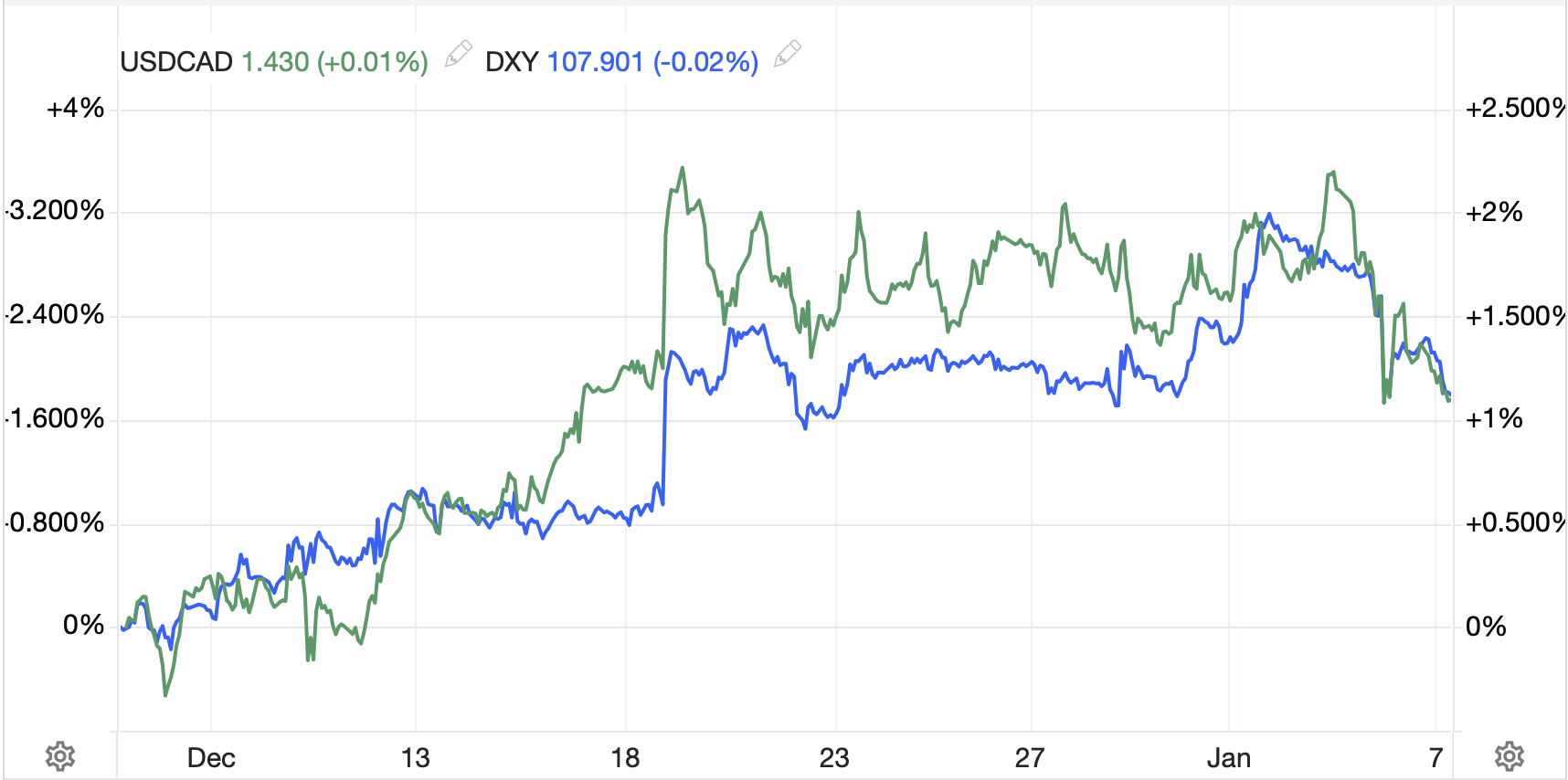
The market impact of this news needs to be separated from the broader drivers, but as I showed yesterday, CAD had been weakening more quickly than the dollar writ large, and now it seems to be moving back into line with the general movement as per the below chart showing the movements between the DXY and USDCAD right on top of each other. 

Source: tradingeconomics.com

My sense is that Canada has now had its day in the sun and will soon retreat to the background of most market consciousness going forward.  After all, despite it being our largest trading counterparty, it has a small population and small economy with limited impact on the global situation.

Certification’s complete
And Trump, in two weeks, takes his seat
Between now and then
Again and again
Prepare for a surfeit of Tweet(s)

In truth, aside from the Canadian story, the bulk of the discussion in both financial and political circles is focused on exactly what President Trump will do when he is inaugurated on the 20th.  The biggest financial discussion revolves around tariffs and exactly how he plans to utilize them going forward.  For the surface thinkers, tariffs are an unadulterated bad policy with significant negative consequences.  As well, the idea that tariffs = higher dollar is axiomatic to these people.  In fact, yesterday’s reversal in the dollar’s recent substantial gains was based entirely on a story that despite some campaign rhetoric of large tariffs imposed on Day 1 of the new Trump administration, in fact things would be far more nuanced.

While I understand the economic case behind tariffs driving the dollar higher (nations hit with tariffs will devalue their currency sufficiently to offset the tariff and allow their exports to remain competitive in the US), I have always been suspect of that theory and logic.  First, we can look at Trump’s first term and see how things played out.  The chart below of USDMXN, a tariff target, shows that, in fact, initially the peso strengthened upon Trump’s inauguration and range traded for the bulk of his term, only weakening substantially during the Covid market dislocations.

Source: tradingeconomics.com

We can look at USDCNY as well and see that over Trump’s first term, there were several large ebbs and flows in the yuan but that, in fact, CNY was stronger vs. the dollar at the end of his term than at the beginning.  Again, this assumption the dollar will appreciate strongly because of tariffs is a talking point, not an empirical reality.

Source: tradingeconomics.com

The other thing to remember about Trump (although it is not clear how you can forget it) is that he is a businessman, not a politician.  He is very transactional and wants to make deals.  I am a strong proponent of the idea that Trump sees tariffs as a negotiating tool and while he is a man of great bluster in his public pronouncements, his ultimate goal remains clearly to achieve his sense of fairness in trade relations.  If his belief is that a nation is maintaining a weak currency to enhance its mercantilist model, Trump will respond aggressively.  Ultimately, I believe a large part of the angst that is evident in governments around the world is that Trump will not behave in a diplomatic manner and will call out all the problems he sees or believes.  And other governments are uncomfortable with their own dirty laundry left to air dry.  While I continue to believe that inflation remains far stickier than the Fed is willing to admit now, nothing has changed my view that the Fed will not cut again and may be forced to raise rates before the year ends.  And that will support the dollar!

Ok, let’s turn to the overnight session.  After a mixed Wall Street performance, where the Mag7 continue to shine, but not so much else, we saw the Nikkei (+2.0%) rally sharply as well, following the NASDAQ.  Chinese shares (CSI 300 +0.7%, Hang Seng -1.2%) were split with the former benefitting from the reduced tariff story while the Hang Seng suffered largely on the back of Tencent Holdings being named a military contractor by the US DOD with its shares tumbling 8% in the US and HK.  Elsewhere in the region, there were both gainers and laggards but nothing of any note in either direction.  In Europe, UK shares (-0.3%) are under pressure as 30yr Gilt yields have risen to their highest level since 1998, an indication that investors are becoming concerned over the UK’s future path.  For context, current levels are 50bps above those which triggered the October 2022 gilt crisis and spelled the end of PM Liz Truss’s time in office.  Meanwhile, continental bourses are modestly higher led by the CAC (+0.6%) which seems to be benefitting from both the lower tariff story as well as hopes that Chinese stimulus will support the luxury goods sector.  As to US futures, at this hour (7:05) they are essentially unchanged.

In the bond market, yields are continuing to edge higher everywhere with Treasuries up 1bp and European sovereign yields higher by between 2bps and 4bps across the board.  Asian government bond markets continue to sell off as well, with yields there climbing in Japan and Australia and even Chinese 10yr yields edging higher by 1bp.  As long as central banks around the world insist that rate cuts are the future (and most of them do) look for bond yields to continue to climb.

In the commodity space, oil (+0.8%) continues to hold its own as trading activity remains modest and hopes are pinned on Chinese stimulus.  NatGas (-3.2%) is backing off its highs as the winter storm has passed (although it is still really cold here!) while the metals markets are performing well.  Gold (+0.5%) continues to trade either side of $2650/oz as speculators await the next major leg.  However, silver (+1.1%) and copper (+0.5%) have both bounced nicely from recent lows as specs look for another breakout higher.

Finally, the dollar is under modest pressure this morning compared to yesterday’s closing levels but is actually slightly firmer than when I wrote yesterday morning.  My point is that while it has been selling off from its peak late last week, there is no collapse coming and all eyes will be turning toward the data later this week to see if the Fed will have room to ease further, or if the NFP report will once again show strength and push any further rate cuts off in time.  The leading gainer in the G10 is NZD (+0.65%) which is benefitting from a combination of higher commodity prices, hopes for more Chinese stim and the tariff reduction story.  But for the rest of the market, 0.2% gains are the norm with only JPY (-0.15%) bucking the trend.

On the data front, this morning brings the Trade Balance (exp -$78.0B) as well as ISM Services (53.3) and JOLTS Job Openings (7.70M).  Yesterday’s PMI data while solid was softer than forecast and Factory Orders, too, were a tick lower than expected at -0.4%.  First thing this morning we will hear from Richmond Fed president Barkin who has been on the more hawkish side lately.  After the weekend chorus that cuts needed to be deliberate, I expect more of the same here.

For now, the broad themes remain unchanged, higher US yields on the back of inflation concerns forcing the Fed to reverse course this year.  But on a day-to-day basis, it would not be surprising to see the dollar continue to give back some of its recent gains given the significant size and speed with which they were attained.  I still like hedgers picking levels and leaving orders to buy dollars a bit cheaper from here.

Good luck

Adf

Active De-Bonding

Up north is a nation quite vast
Whose money, of late’s been, out, cast
But word that Trudeau
Is soon set to go
Has seen Loonies quickly amassed
 

One of the biggest stories over the weekend has been the sudden upsurge in articles and discussion regarding the remaining tenure for Canadian PM Justin Trudeau.  For the past several weeks, since his FinMin Krystia Freeland resigned and published a scathing resignation letter, pressure on Trudeau has increased dramatically.  It appears that it is coming to a head with articles from both Canadian and international sources indicating he may step down as soon as this week.  As well, his main political rival, conservative party leader Pierre Poilievre, is touted, according to the betting websites, as an 89% probability to be the next PM.
 
Now, we all know the dollar has been strong in its own right lately, and I suspect that while there will be bumps along the road, it will get stronger still over the year absent some major Fed rate cutting.  As such, USDCAD is higher along with everything else.  However, you can see in the chart below (the green line rising faster than the blue line since December) that it has been an underperformer for the past month, since that Freeland resignation, as investors have been shying away from Canada, given the combination of concerns over the incoming Trump administration imposing tariffs and no political leadership to address these issues.


Source: tradingeconomics.com

While no sitting politician is ever willing to cede power easily, and there are indications that Trudeau is going to go down kicking and screaming, ultimately, I expect that Poilievre will be the PM and will develop a strong relationship with the US.  As that becomes clearer, I expect to see the CAD appreciate modestly vs. the dollar, but much more so against other G10 currencies.

Once more, what the Chinese have said
Is stimulus is straight ahead
But so far, its talk
They ain’t walked the walk
So, bulls need take care where they tread

Another tidbit this morning comes from Beijing, where the economic planning agency there has indicated that they will expand subsidies for consumer purchases of electronic goods like cellphones, tablets and smart watches, as President Xi continues to watch his nation’s economy grind along far more slowly than he really needs to happen.  There was an excellent thread on X this morning by Michael Pettis, one of the best China analysts around, describing the fundamental problem that Xi has and why the slow motion collapse of the property market portends weakness for a long time going forward.  As is almost always the case, while tearing the proverbial band aid off quickly can hurt more at the instant, the pain dissipates more quickly.  President Xi believes he cannot afford to inflict that much pain, so their problems, which stem from decades of malinvestment in property that inflated a massive bubble, are going to last for a long time.  While CNY (+0.4%) is modestly firmer this morning, that is only because the dollar is weaker across the board, and in fact, it is significantly underperforming.

This week, the US Treasury’s Yellen
Much debt, will look forward to sellin’
The market’s responding
By active “de-bonding”
With dollars and bonds both rebellin’

The last big story of the day is clearly the upcoming Treasury auctions this week, where the US is set to sell $119 billion of debt, starting with $58 billions of 3-year notes today.  Arguably, market participants have been aware that this was going to be a necessary outcome given the massive deficits that continue to be run by the US.  Adding to the broad concept of deficits, the Biden administration appears to be trying to spend every appropriated dollar in the last two weeks in office and that requires actual cash, hence the auctions to raise that cash.  In addition, the debt ceiling comes back into force shortly, so they want to get this done before that serves to prevent further issuance.

Now, the yield curve has reverted back to a normal slope with the 2yr-10-yr spread at 34bps and 30yr bonds trading another 22bps higher than 10yr at 4.81% and bringing 5% into view.  Here’s the thing about the relationship between the dollar and yields; the dollar is typically far more correlated to short-term yield differentials, not long-term yields.  So rising 30yr bond yields is not likely to be a dollar benefit.  In fact, just the opposite as international investors will not want to suffer the pain of those bonds declining in price rapidly.  

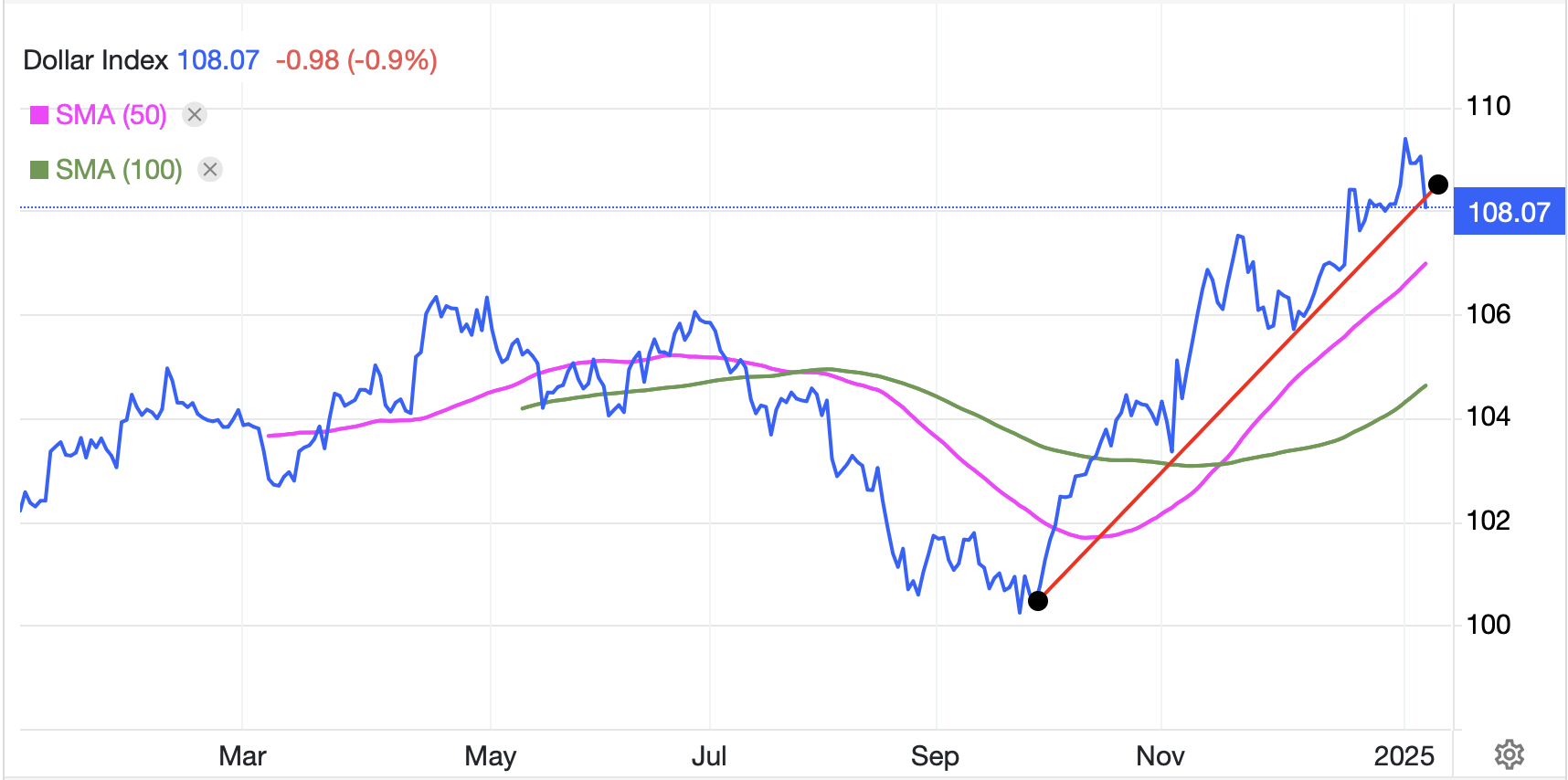
And this is what we are witnessing this morning as the dollar, which rallied sharply at the end of last week, is correcting in a hurry today.  As mentioned above, CNY is the laggard with the euro, pound, Aussie, Kiwi and Loonie all firmer by 1% or more this morning and similar gains seen across the emerging markets, with some extending those gains as far as 1.35% or so.  Is this the end of the dollar?  I would argue absolutely not.  However, that doesn’t mean that we won’t see a further decline in the buck before it heads higher again.  A quick look at the chart below, which shows the Dollar Index, while it has just touched the steep trend line higher, it remains far above its 50-day and 100-day moving averages.  Howe er, it seems that the big story here comes from a report from the Washington Post that Trump is considering much less widespread tariff impositions with only some critical imports to be addressed.  As such, given the tariffs = higher dollar consensus, if this is true, you can understand the dollar’s retreat.

Source: tradingeconomics.com

However, today’s story is that of a weak dollar and strong equity markets, well at least in some places. Friday’s US equity rally was not followed by similar enthusiasm in Asia with the Nikkei (-1.5%) leading the way lower while both the Hang Seng (-0.4%) and China (-0.2%) also lagged.  Perhaps the mooted China stimulus helped those markets on a relative basis.  Europe, however, is in fine fettle (CAC +2.3%, DAX +1.4%, IBEX +0.9%) as PMI data released this morning was solid, if not spectacular, and the weaker dollar seems to be having a net positive impact.  US futures are also firmer, with NASDAQ (+1.1%) leading the way.

In the bond market, the big movement was in Asia overnight as JGBs (+4bps) sold off alongside virtually every other Asian bond market except China, which saw yields edge lower by 1bp to a new record low of 1.59%.  In Europe, there has been very little movement with yields +/- 1bp at most and Treasury yields, which had been firmer earlier in the overnight session, have actually slipped back at this hour and are lower by 2bps to 4.58%.

In the commodity markets, the weak dollar has helped support prices here with oil (+1.0%) continuing its rally (+9% in the past month) as the combination of Chinese stimulus hopes and cold weather seem to be providing support.  Speaking of cold weather, NatGas (+7.4%) is also in demand this morning as winter storm Barrie makes its way across the country.  In the metals markets, gold (+0.3%) is the laggard this morning with both silver (+2.3%) and copper (+2.4%) really taking advantage of the dollar’s weakness.

On the data front, there is a ton of stuff this week, culminating in NFP on Friday.

TodayPMI Services58.5
 PMI composite56.6
 Factory Orders-0.3%
TuesdayTrade Balance-$78.0B
 ISM Services53.0
 JOLTS Job Openings7.70M
WednesdayADP Employment139K
 Initial Claims217K
 Continuing Claims1848K
 Consumer Credit$12.0B
 FOMC Minutes 
FridayNonfarm Payrolls160K
 Private Payrolls134K
 Manufacturing Payrolls10K
 Unemployment Rate4.2%
 Average Hourly Earnings0.3% (4.0% Y/Y0
 Average Weekly Hours34.3
 Participation Rate62.8%
 Michigan Sentiment73.9

Source: tradingeconomics.com

In addition to all this, we hear from six more Fed speakers over seven venues with Governor Waller likely the most impactful.  Over the weekend, we heard from Governor Kugler and SF President Daly, both explaining that they needed to see more progress on inflation before becoming comfortable that things were ok.

Clearly, the tariff story is the current market driver in the dollar.  As I never saw tariffs as the medium-term driver of dollar strength, I don’t think it has as much importance.  Plus, this is a report from the Washington Post.  There are still two weeks before inauguration and many things can happen between now and then.  Nothing has changed my longer-term view that the dollar will be supported as the Fed, which is not tipped to cut rates this month and is seen only to be cutting about 40bps all year will ultimately raise rates as inflation proves far more stubborn than desired.  But that is the future.  Today, pick spots to establish dollar buys and leave orders.

Good luck

Adf

Think More Than Twice

The verdict, as best I can tell
Is Trump and his new personnel
Are being embraced
So, buy risk, post-haste
Lest owners all choose not to sell!
 
And yet there seems always a price
Where owners will sell in a trice
But if it’s that high
It just might imply
It’s worth it to think more than twice


Euphoria is one way to describe what we have seen in markets over the past several sessions, with substantial gains across both equity and bond markets while havens like gold and the dollar have been discarded. Insanity may be a better way to do so.  Regardless of your description, the facts are that risk assets have been consistently higher since the election results and there is a palpable excitement about how the future, at least for markets, will unfold.  I hope all this excitement is not misplaced, but it is still early days.  Just remember, that whatever ideas are currently being bandied about regarding Trumpian policies, it is almost certain that the reality will not quite live up to the hype.

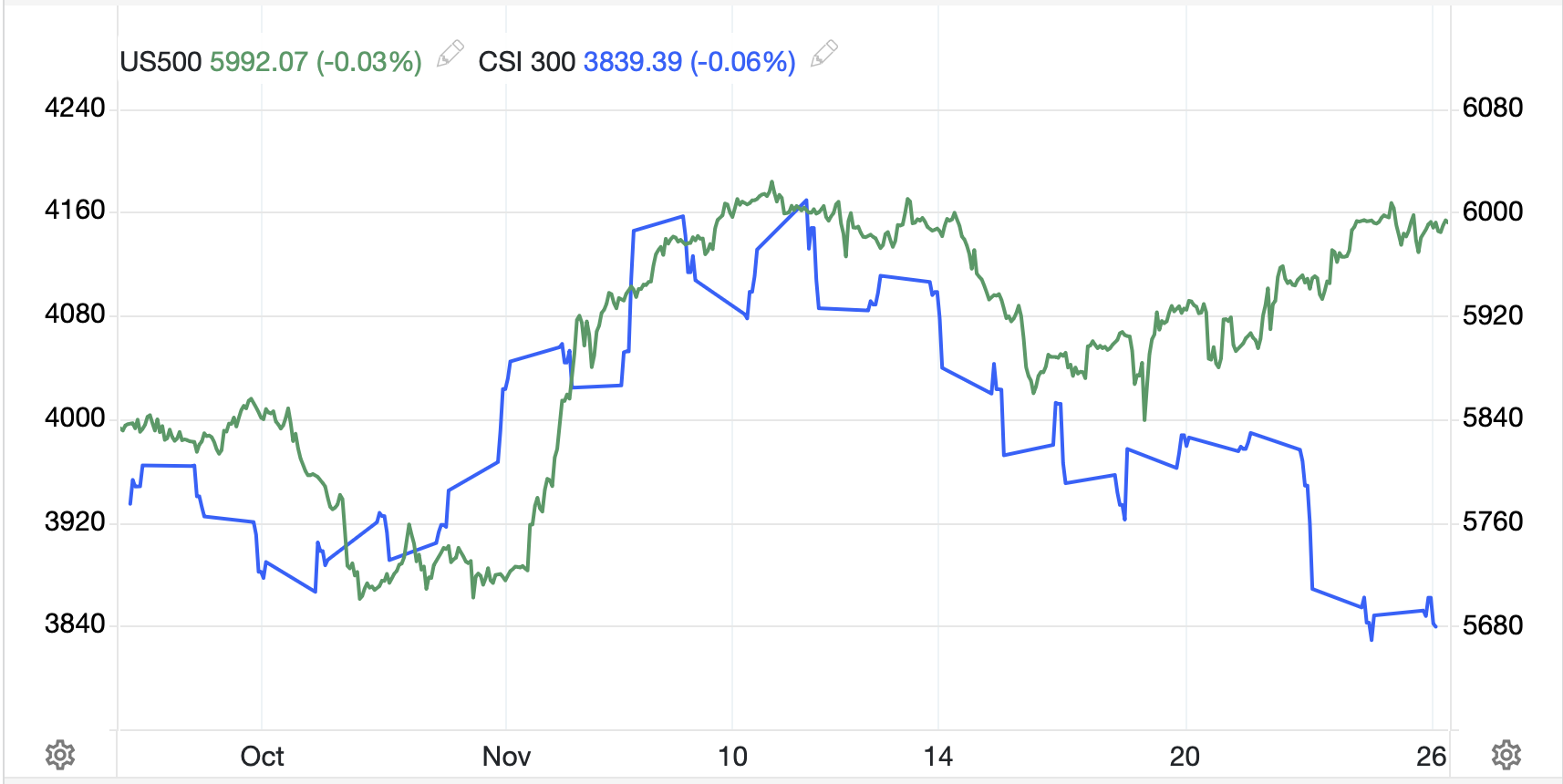
Consider, too, for a moment just how different the impact will be on different markets.  The obvious first thought is China, where we have seen a significant divergence between the S&P 500 and the CSI 300 over the past week as seen in the chart below.  

Source: tradingeconomics.com

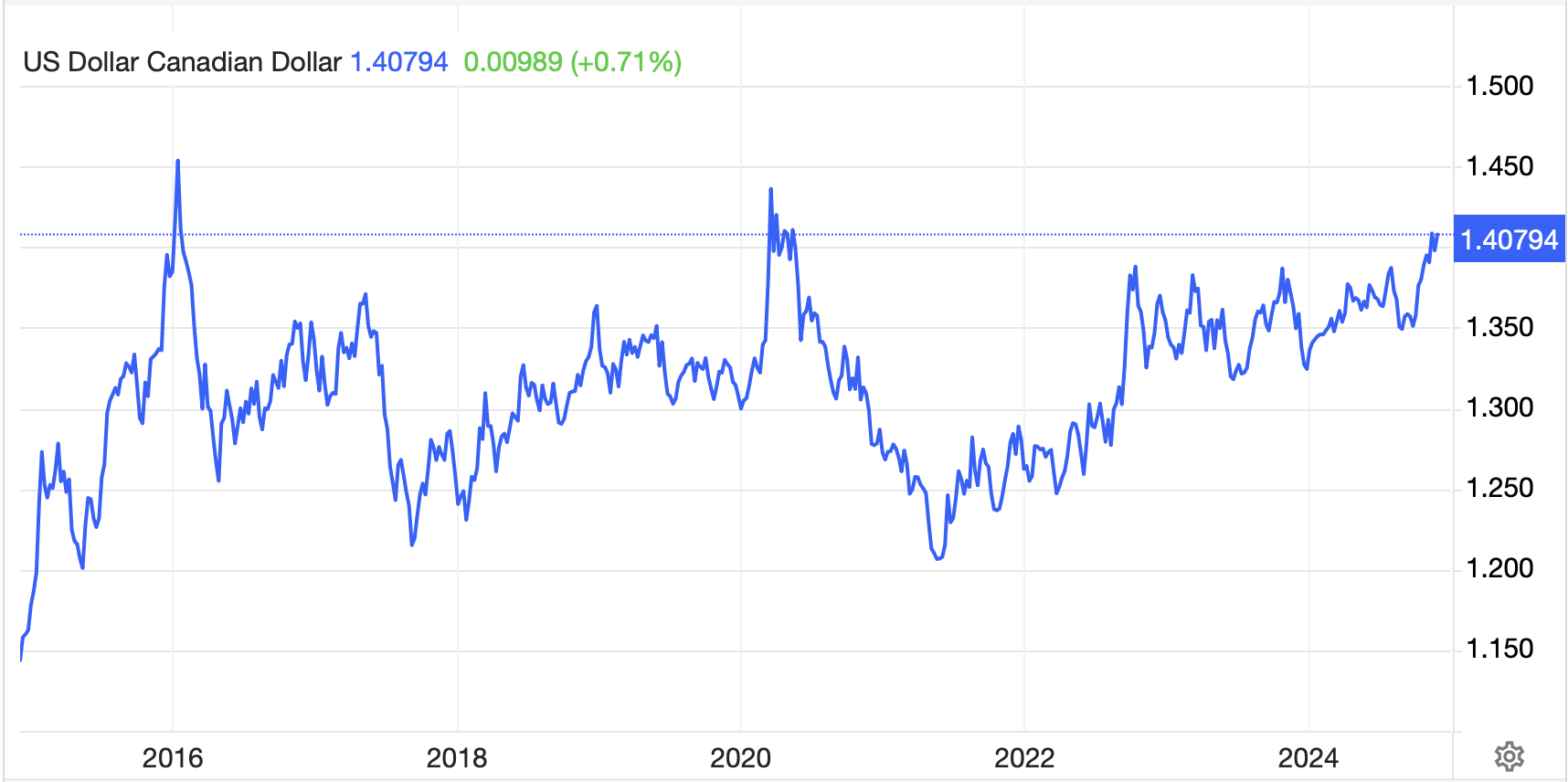
My point is all that euphoria is very country specific.  After all, yesterday’s comments by President-elect Trump that on day one he will impose tariffs of 25% on all imports from both Mexico and Canada had the expected impact on their currencies, weakening both substantially.  In fact, it is quite interesting to look at a longer-term chart of USDCAD and see that this is the third time in the past decade the exchange rate has traded above 1.40.  The previous two times were the beginnings of Covid, amid massive risk-off trading…and in 2016 when Mr Trump was previously elected president.

Source: tradingeconomics.com

I assure you that whatever China decides to do, and they have many inherent strengths as well as weaknesses, both Mexico and Canada are going to ultimately concede to whatever Trump wants as they cannot afford to ignore it.  In fact, my take is that the reason so many political leaders around the world are distraught is because they recognize that they are going to have to change their policies to keep in Trump’s good graces.  To me, the implication is that we are due for much more volatility as markets respond to all the changes that are coming.

And that should be our watchword going forward, volatility.  We live in a time where previous theories that led to previous policies are being questioned and upended.  We are also living through what appears to be the end of the Pax Americana era, where the US is turning its focus inward rather than concerning itself with pushing its brand globally.  These realignments are going to be ongoing for quite a while, and as new models will need to be developed and implemented, in both the public and private sectors, outcomes are going to remain quite uncertain for a while.  It is this that will drive all the volatility.  Once again, I urge hedgers to keep this in mind and maintain robust hedging programs as risk mitigation is going to be critical for future performance.

Ok, so let’s look at how things turned out overnight.  While the rally in the US equity market continues, especially in value and small-cap stocks, the story in Asia was far less positive with declines in Japan (-0.9%), China (-0.2%) and Australia (-0.7%) and almost every regional exchange in the red overnight.  This seems a direct response to the resurgence of tariff talk from Trump and I expect may be the guiding force for a while yet, perhaps even until the Inauguration.  Of course, we could also see some nations capitulating quickly in an effort to gain favor and I would expect those markets to reflect a more positive stance in that situation.  Neither is Europe immune from tariff talk as every bourse on the continent is weaker this morning amid concerns that tariffs are coming for them as well.  In addition, Trump has made it clear he is uninterested in supporting the Ukraine effort which means that either Europe will need to spend more money, or the map is going to change in an uncomfortable manner.  As to US futures, at this hour (7:20) they are modestly firmer.

In the bond market, yesterday saw the largest rally (-14bps) since the July NFP report showed Unemployment jumped to 4.3% in early August and triggered all sorts of claims that recession had started.  Yesterday’s catalyst was far more ambitious, ascribing success to Treasury Secretary selection Scott Bessent’s ability to rein in the fiscal deficit.  That bond rally dragged European sovereign yields lower, although a much smaller amount, 3bps-5bps, and this morning things are back to more normal trading with Treasury yields unchanged while Europeans are generally trading with yields lower by -2bps.  Certainly, if fiscal issues are successfully addressed, the opportunity for bond yields to decline exists, but this seems like a lot of hope right now.

In the commodity markets, gold had its worst day in forever, falling $110/oz although it is rebounding a bit this morning, up $21/oz or 0.8%.  That move seemed entirely driven by this same euphoria that has been underpinning both stocks and bonds, namely the future is bright, and havens are no longer needed.  Silver, too, had a rough day yesterday and is rebounding this morning, +1.4%, while copper sits the whole move out.  Oil (+0.8%) sold off yesterday amid the same risk thoughts as well as the news that an Israeli/Hezbollah ceasefire may be coming soon, reducing Middle East risk.  In the short-term, the day-to-day vicissitudes of oil’s price are inscrutable to all but the most connected traders, but nothing has changed my longer term view, which has only been enhanced by Trump’s drill, baby, drill thesis, that there is plenty of oil around and sharp price rises are unlikely going forward.

Finally, the dollar seems to have put in a top last Friday and has been selling off since the Bessent announcement.  I’m not sure I understand the logic here as Bessent is seeking to increase real GDP growth while reducing the deficit, both of which strike me as dollar positives.  Perhaps the idea is interest rates will be able to be lower in that situation, thus undermining the dollar, but again, on a relative basis, it seems quite clear that the US remains in far better macroeconomic condition than virtually every other nation.  So, if the US is cutting rates, others will be cutting even faster.  However, that is where we are this morning, with both the euro (+0.5%) and pound (+0.4%) climbing alongside the yen (+0.7%).  Offsetting that is the Loonie (-0.7%) and MXN (-0.8%) as both are the initial targets of those potential tariffs.  It strikes me that we are likely to see a number of previous relationships break down as the tariff talk adjusts views on different national outcomes.  Once again, volatility seems the watchword.

On the data front, this morning brings Case-Shiller Home Prices (exp 4.8%), Consumer Confidence (111.3) and New Home Sales (730K) and then the FOMC Minutes are released at 2:00.  All eyes will be there as things have so obviously changed since the meeting earlier this month, including Chairman Powell’s downshifting on the rate cutting cycle.  You remember, he is no longer in a hurry to do so.  Interestingly, as of this morning, the futures market is pricing in a 60% chance of a cut next month, up from 52% yesterday morning.  Perhaps that is a result of yesterday’s Chicago Fed National Activity Index, a meta index looking at numerous other indicators, which printed at -0.40, much worse than the expected -0.20, and as can be seen below, has shown a consistent trend that growth may not be what some of the headline data implies.

Source: tradingeconomics.com

Remember, too, with the holiday on Thursday, tomorrow brings a huge data dump so macro models will be waiting to respond.  As well, given the holiday, liquidity is likely to be less robust than normal meaning price dislocations are quite possible.

My sense is the dollar’s decline is more of a profit taking exercise (recall it rallied more than 7% in a few months) than a change in the long-term fundamentals.  But it is always possible that the new administration’s policies will be focused on pushing the dollar down, although funnily enough I don’t think Trump really cares about that this time.  My take is he is far less concerned about growing exports than reducing imports and bringing production home.  We shall see.

Good luck

Adf