On the Schneid

While data at home is robust
In Europe and China the thrust
Is weakness abounds
Which seems to be grounds
For traders, their risk, to adjust

So, equities are on the schneid
While bond yields have been amplified
The dollar’s on fire
Continuing higher
And oil’s climb won’t be denied

Another day, another wave of bad economic news from elsewhere in the world.  However, the US continues to surprise with better than expected results.  Yesterday’s ISM Services data was far better than forecast with a headline print of 54.5, 2 points above both last month and expectations for this month, while the sub-indices all showed significant strength, including the Prices Paid index.  The latter is clearly a concern for Chairman Powell and his crew as it is an indication that inflationary tendencies have not yet been snuffed out.  Ultimately, the market response was to sell stocks and bonds while increasing the probability of a November Fed funds rate hike a few points.  Interestingly, the market pricing for a September hike has fallen to just a 7% probability despite the hotter than expected data.  My sense is that the big market adjustment is going to come as traders come to understand that higher for longer means no cuts until 2025 on the current basis, especially if we continue to see data like the ISM print yesterday.

But the US storyline is clearly not the same as the storyline elsewhere in the world.  Last night, for example, Chinese trade data was released and both imports (-7.3%) and exports (-8.8%) fell sharply again, with the Trade Surplus falling to $68.3B.  Granted, the declines were not as bad as last month, nor quite as bad as expectations, but there is no way to spin the data as indicating a positive economic impulse in China right now.  While Chinese equity markets fell sharply (Hang Seng and CSI 300 both -1.4%) we also saw further weakness in the renminbi.  

The PBOC is still desperately trying to prevent the renminbi from weakening too quickly, but they are having a hard time at this stage.  The difference between the CFETS fixing and the onshore spot market is now 1.8%, dangerously close to the 2.0% boundary.  At the same time, the offshore renminbi, CNH, is pushing back to its highs from last October, now trading above 7.3400, which is 1.97% above the fixing.  This is a losing battle for the PBOC unless they change their monetary policy, but given the Chinese economy’s weakness, tighter money seems an unlikely step.  7.50 is still on the cards here.

China, though, is not the only problem.  European data this morning was uniformly lousy with German IP (-0.8%) and Eurozone GDP (Q2 revised lower to 0.1% Q/Q, 0.5% Y/Y) highlighting the problems facing the old world.  Alas, price pressures have not yet abated there, and stagflation is the new watchword on the continent.  

When the US was faced with stagflation in the 1970’s, Paul Volcker opted to fight inflation first, sending the country into a double dip recession in 1980 and 1981-82, before things turned around.  But that was a different time…and Christine Lagarde is no Paul Volcker!  Is it even possible for an “independent” central bank to knowingly create a recession to slay inflation these days?  I suspect inflation would need to be far higher, stable in double digits, before politicians would accept that it is a bigger problem than a recession, at least electorally.  The upshot of this scenario is that the ECB, despite ongoing higher than targeted inflation, is very likely at the end of its hiking cycle.  This, combined with the overall weak economy there, is going to continue to undermine support for the euro.  While the movement will be gradual, I expect that the single currency will slide below 1.05 and possibly get to parity by the end of the year.

And I would be remiss if I didn’t touch quickly on Japan, where they released their Leading Indicators at a weaker than expected 107.6, continuing the two-year downtrend.  Slowing growth in Japan and still extraordinarily loose monetary policy is going to continue to weigh on the yen.  While it has bounced slightly this morning, 0.2%, it continues to weaken steadily closer to the psychological 150.00 level.  

So, with all that happy news, let’s tour the overnight session to see the results.  The rest of the APAC equity markets also were under pressure overnight with Japan, Australia and South Korea all in the red as well.  In Europe this morning, the picture is more mixed with some gainers and some losers but no large movements overall, mostly +/- 0.2%.  US futures, after a lousy session yesterday, are all pointing lower at this hour (7:30) as well.

In the bond market, Treasury yields are essentially unchanged on the day, holding onto their gains for the past week and just below the 4.30% level.  European sovereigns, though, are seeing a bit of support as the weak economic data has engendered hope that inflation will stop rising and the ECB will be okay to pause.  The latter remains to be seen.  I cannot get over the idea that the uninversion of the yield curve is going to come because long rates are going to rise, not because short rates are going to be cut, and I’m pretty sure nobody is ready for that outcome.

Oil (-0.5%) is consolidating its recent gains with WTI north of $87/bbl and showing no signs of backing off.  If OPEC+ keeps a lid on production, you have to believe that prices will continue to rise.  In the metals markets, both copper and aluminum are soft today, responding to the weak Chinese and German data, while gold, after a selloff this week, is bouncing slightly.

Finally, the dollar remains king of the hill, stronger against virtually all its counterparts in both the G10 and EMG blocs.  I’m old enough to remember when the prevailing narrative was the dollar was dead and would be replaced by the euro, or the yuan, or a BRICS currency and yet, it continues to be subject to more demand than virtually every other currency around.  The broad story is the US economy continues to lead the global economy and the prospects for Fed rate cuts are diminished relative to other nations.  Tight monetary and loose fiscal policy combinations have historically been very supportive of a currency and clearly that is the current US state.

Two quick stories in the EMG bloc are from Poland (-0.7%), where yesterday’s surprising 75bp rate cut has undermined the zloty amid concerns that inflation is going to remain unhindered there, and MXN (+0.75%) where traders are unwinding some positions after a sharp decline over the past week.  The peso has been one of the few currencies that has outperformed the dollar this year as Banxico has been ahead of the curve on inflation and tight monetary policy.  However, with an election upcoming it appears there may be a change in attitude there.  If that is the case, then look for the dollar to regain some lost ground.

On the data front, Initial (exp 234K) and Continuing (1719K) Claims are released along with Nonfarm Productivity (3.4%) and Unit Labor Costs (1.9%).  As traders and investors bide their time ahead of next week’s CPI and the following week’s FOMC meeting, it is not clear that today’s numbers will have much impact.  As such, I see no reason for the dollar to cede its recent gains, especially if equities remain under pressure.

Good luck

Adf
A Crack in the Sheen

Ahead of the holiday flight
The payroll report is in sight
This week we have seen
A crack in the sheen
That everything still is alright

So right now, bad news is all good
But there seems a high likelihood
That worsening data
Could impact the beta
And bad news turn bad, understood?

As we wake up on this Payrolls Friday, the market is biding its time ahead of the release this morning.  As I have been writing for a number of months now, I continue to believe the NFP number is the most important on the Fed’s radar as its continued strength has given Chairman Powell all the cover he needs to continue tightening monetary policy.  If job growth is averaging near 200K per month and the Unemployment Rate has a 3 handle, the doves have no solid case to make that policy is too tight.  With that in mind, here are the current median analyst expectations according to Bloomberg:

Nonfarm Payrolls170K
Private Payrolls148K
Manufacturing Payrolls0K
Unemployment Rate3.5%
Average Hourly Earnings0.3% (4.3% y/Y)
Average Weekly Hours34.3
Participation Rate62.6%
ISM Manufacturing47.0
ISM Prices Paid44.0
Course: Bloomberg

So far this week, we have received three pieces of employment data with a mixed outcome.  JOLTS Job Openings was much lower than expected and that encouraged the bad news is good phenomenon.  ADP Employment was weaker on the headline by a bit but had a very large revision higher to last month, so mixed news.  Meanwhile, Initial Claims were lower than expected and any sense of a trend higher in this series is very difficult to discern.  Anecdotally, I have to say I expect a softer number today, not a firmer one, but I believe it is anybody’s guess.

With that in mind, I believe a weak number, whether lower payrolls or a jump in the Unemployment Rate, will be met with an equity rally into the holiday weekend.  Investors are looking for ‘proof’ that the Fed is done so they can get on with rate cuts and support the stock market.  However, remember, if the data is weak and we are heading into recession sooner rather than later, all that bad news will likely not be taken well by equity investors as money will flow back to bonds as a haven.  At least, that has been the history.  So, a really bad number could well result in ‘bad news is bad’ and an equity market decline.  Alas, nothing is straightforward in markets.

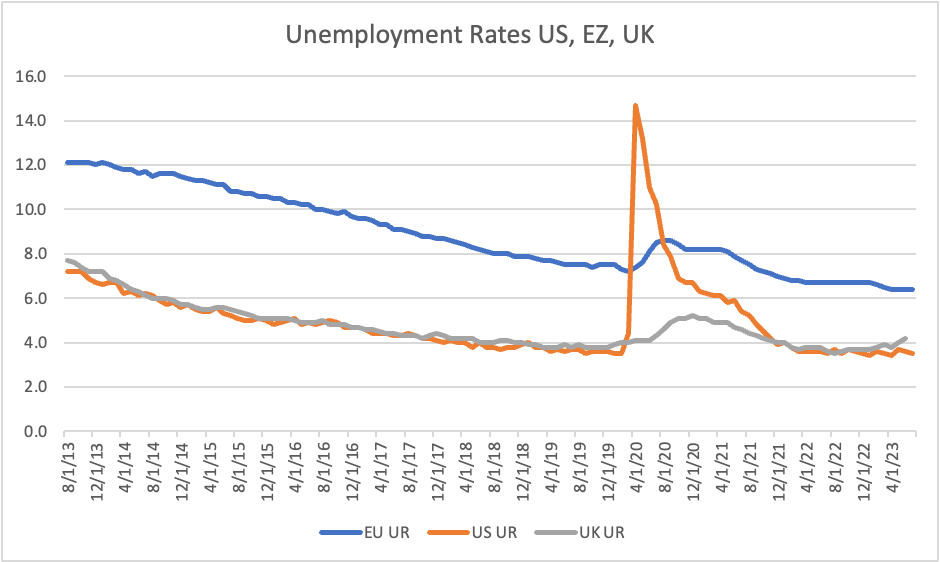
One other thing to keep in mind is the relative Unemployment situation which can be seen below in the chart created with data from Bloomberg.  Structural unemployment in the Eurozone remains substantially higher than in either the US or the UK.  If you are wondering why I continue to have a favorable outlook on the dollar, this is one part of that puzzle.  Despite all the policy blunders questions that have been raised, things in the US remain far better than elsewhere.

In China, despite what they’ve done
To try to support the short-run
It’s not been enough
So, they did more stuff
Last night, though investors still shun

It wouldn’t be a day in the markets if there wasn’t yet another action by the Chinese to try to fix their myriad problems.  Today is not different as last night the PBOC reduced the FX RRR to 4% from its previous level of 6%.  This required reserve ratio defines the amount of reserves Chinese banks need to hold against their FX positions.  Reducing that number effectively boosts the amount of foreign currency available locally, and therefore takes pressure off market participants to horde their dollars, thus weakening the buck.  

And it worked…for about an hour as the renminbi initially rallied about 0.5%.  However, it has since ceded all those gains and is essentially unchanged on the day.  At the same time, the government has reduced the size of the down payment needed to buy a home while encouraging banks to lend more to home buyers to try to support the crumbling property market.  While certainly welcome relief to an extent, it does not appear to be enough to change the current trajectory, which is definitely lower.  At this point, we know that the PBOC is quite concerned over potential renminbi weakness and the central government is quite concerned over broad economic weakness led by the property sector.  We have not seen the last of these moves.

President Xi did, however, get one piece of positive news overnight, the Caixin Manufacturing PMI rose to 51.0, up 2 points from last month and well above expectations.  The combination of those factors helped the CSI 300 gain 0.7% last night, but that seems weak sauce overall.  As to the rest of the market’s risk appetite, I guess you would consider things mildly bullish.  While Hong Kong was weaker, the Nikkei managed a small gain and most of Europe is in the green, notably the UK (+0.7%) after weaker than expected House Price data encouraged belief that inflation may be ebbing sooner than previously expected.  As well, the UK revised higher its GDP data to show that they have, in fact, recovered all the Covid related losses.  US futures, meanwhile, are edging higher at this hour (7:00).

Bond yields are mixed this morning, but the moves have been small, generally +/- 1bp from yesterday’s close.  And yesterday’s closing levels, at least in Treasuries, was little changed from Wednesday.  Granted, European sovereigns saw yields decline yesterday on the order of 5bps, so this morning’s 1bp rise is not that impactful I would contend.

Turning to the commodity markets, they have embraced the Chinese stimulus efforts with oil (+1.5%) rising again and pushing close to $85/bbl, while metals markets are also robust with gold (+0.25%), copper (+1.6%) and aluminum (+1.3%) all seeing demand this morning.  While I have doubts about the effectiveness of the Chinese moves, for now the market is quite pleased.

Finally, the dollar is mixed and little changed net this morning.  In the G10, not surprisingly, NOK (+0.3%) is the leading gainer on the back of oil’s rally, but the rest of the bloc is +/- 0.1% or less, so essentially unchanged.  In the EMG bloc, I guess there are a few more laggards than gainers with HUF (-0.6%) the worst performer as traders prepare for a ratings downgrade from Moody’s after the close today, while MXN (-0.6%) suffered after Banxico indicated it would be winding down its forward FX program where it consistently supplied the market with dollars, buying pesos.  On the plus side, ZAR (+0.8%) is the lone outlier on the back of the commodities rally.

We hear from Bostic and Mester today, with Bostic already having told us he thinks it’s time to pause, although I doubt we will hear the same from Mester.  But in reality, it is all about the employment report.  For now, I believe bad news is good and vice versa, but that is subject to change with enough bad news.

Good luck and have a good holiday weekend.  There will be no poetry on Monday.

Adf

Further Downhill

The data from China is still
Desultory and likely will
Result in support
In order, quite short,
Lest Xi’s plans go further downhill

Perhaps, though, he’ll find a reprieve
If Jay and his brethren perceive
Employment is slowing
And risks are now growing
Recession they’re soon to achieve

Poor President Xi.  Well, not really, but you have to admit his plans for widespread prosperity in China have certainly not lived up to the hype lately.  Last night, PMI data was released, and like the Flash PMI data we saw last week in Europe and the US, it remains quite weak.  Specifically, Manufacturing PMI printed at 49.7, slightly better than expectations but still below the key 50.0 level.  Non-manufacturing PMI printed at 51.0, continuing its slide toward recession and indicative that there is no strong growth impulse coming from any portion of the economy there.

Remember, manufacturing remains a much larger piece of the Chinese economy (28%) than that of the US economy (11%), so weakness there is really problematic for the overall economic situation.  And while the PBOC continues to try to prevent excessive weakness in the renminbi, Chinese exporters clearly need the support of a weaker currency to thrive.  Finally, given the slowing economic situation in Europe, which is now China’s largest export market, demand for their products is simply weak.  

To date, the Chinese government has not really provided substantial support to the economy, certainly there has been no fiscal ‘bazooka,’ and monetary efforts have been at the margin.  In the current environment, it remains hard to make a case for China’s natural rebound until the rest of the global economy rebounds.  And woe betide Xi if (when) the US goes into recession.  Things there will only get worse.  The FX market is uninterested in the PBOC’s views of where USDCNY should trade, maintaining a 1.5% dollar premium vs. the daily fixing rate.  At some point, the PBOC is going to have to relent and USDCNY will go higher, in my view to 7.50 or beyond.

Speaking of recession, while the Atlanta Fed’s GDPNow forecast for Q3 is at 5.90% (a remarkably high number in my view), yesterday we saw Q2 GDP revised lower to 2.1%, with the Personal Consumption component falling to 1.7%.  At the same time, Gross Domestic Income (GDI) in Q2 was released at +0.5%, substantially lower than GDP.  (GDI and GDP are supposed to measure the same thing from different sides of the equation.  GDP represents expenditures while GDI represents income.  Eventually, they must be equal, by definition, but the estimates until all the data is finally received can vary.  In fact, looking at GDI, it was negative in Q4 and Q1 and is just barely growing now.  This is another reason many are looking for a US recession soon.) 

In this vein, Richmond Fed president but non-voter, Raphael Bostic, in a speech overnight in South Africa said, “I feel policy is appropriately restrictive.  We should be cautious and patient and let restrictive policy continue to influence the economy, lest we risk tightening too much and inflicting unnecessary economic pain.  However, that does not mean I am for easing policy any time soon.”  So, this is not exactly the same message we heard from Chairman Powell last week, but the caveat of not cutting is certainly in line.  I suspect, especially if we start to see weaker labor market data, that more FOMC members are going to feel comfortable that rates have gone high enough.  At least that will be the case as long as inflation remains quiescent.  However, if it starts to pick up again, that will be a different story.

Ok, let’s look at the overnight session.  It should be no surprise, given the Chinese data, that equity markets there were underwater, with losses on the order of -0.6% in Hong Kong and on the mainland.  However, the Nikkei (+0.9%) was the star performer across all markets on the strength of strong Retail Sales data.  As to Europe, the DAX (+0.5%) is managing some gains, but the rest of the space is little changed on the day.  It seems the CPI data that has been released from Europe, showing higher prices in Germany, France and Italy despite weakening growth has raised concerns about another ECB rate hike.  As to US futures, at this hour (7:30) they are little changed to slightly higher.

Bond yields are falling today, especially in Europe where they are lower by about 5bp-6bp across the board.  It seems that there is more concern over the growth story, or lack thereof, than the inflation story right now.  In the Treasury market, yields are lower by 2bps as well, although remain well above the 4.0% level.  This has been a response to yet another weak headline labor number with yesterday’s ADP Employment figure reported at 177K.  It seems that the huge revision higher to the previous month, a 47K increase, was ignored.  However, this is setting the stage for tomorrow’s NFP, that’s for sure.

Oil prices (+0.8%) continue to rebound after another huge inventory draw last week and despite concerns over an impending recession.  Gold (+0.1%) has been performing extremely well given the dollar’s rebound, but the base metals remain recession focused, or at least focused on Chinese weakness, and are under pressure again today.

Finally, the dollar is firmer this morning, with only the yen (+0.2%) gaining in the G10 bloc as even NOK (-0.65%) is falling despite oil’s rally.  In fact, this move looks an awful lot like a risk-off move, especially when considering the rally in Treasuries, except the equity market didn’t get the memo.  In the emerging markets, the situation is similar, with many more laggards than gainers and much larger movement to the downside.  ZAR (-0.75%) is the worst performer followed by HUF (-07%) and CZK (-0.6%) although the entire EEMEA bloc is down sharply.  However, these currencies are simply showing their high beta attachment to the euro, which is lower by -0.5% this morning.  Again, given the data from Europe, this can be no surprise.

On the US data front, this morning brings the weekly Initial (exp 235K) and Continuing (1706K) Claims data as well as Personal Income (0.3%), Personal Spending (0.7%), the all-important Core PCE (0.2% M/M, 4.2% Y/Y) and finally Chicago PMI (44.2).  Yesterday’s data was soft and if that continues into today’s session, I suspect the ‘bad news is good’ theme will play out.  That should entail a further decline in yields and the dollar while equities continue higher.  However, any strength is likely to see the opposite.  Remember, too, tomorrow is the NFP report, so given the holiday weekend upcoming, it seems likely that positioning is already quite low and trading desks are thinly staffed.  In other words, liquidity could be reduced and moves more exaggerated accordingly.  However, until we see that recession and drop in inflation, my default view remains the dollar is better off than not.

Good luck

Adf

No Certitude

The efforts from Xi haven’t yet
For locals, their appetites whet
So, more were announced
And equities bounced
But still there is just too much debt

Meanwhile, elsewhere things are subdued
As traders have no certitude
‘Bout data this week
And if it will wreak
More havoc on everyone’s mood

As the week progresses, we will get a raft of data culminating in Friday’s payroll report.  But for now, the market is looking elsewhere for its catalysts and China continues to provide fodder for the trading community.  Last night, the news hit that Chinese banks were going to be reducing their mortgage rates for mortgages on first homes by up to 60 basis points in order to help support domestic consumption.  At the same time, they are also likely to reduce deposit rates by between 5bps and 20bps as they try to maintain their lending margins, but net, it appears the move should free up some cash for the Chinese consumer.

This should certainly be a positive for the nation’s economy and the equity market in China responded accordingly, with the CSI 300 rallying 1.0% while the Hang Seng jumped nearly 2.0%.  However, Xi’s actions continue to be small beer, tweaking policies at the margin, while he apparently remains adamantly opposed to any broad fiscal stimulus.  Now, in the long-term, this is probably a pretty sensible move for China as they already have a massive amount of debt outstanding, especially in the property market, and if national debt were piled on top, it could lead to much worse long-term outcomes.  However, in the short run, a 50bp cut in mortgage rates is unlikely to change consumption patterns by very much, and more domestic consumption is what they need.  This is especially true given the ongoing economic weakness in Europe, which has become their largest trading partner.

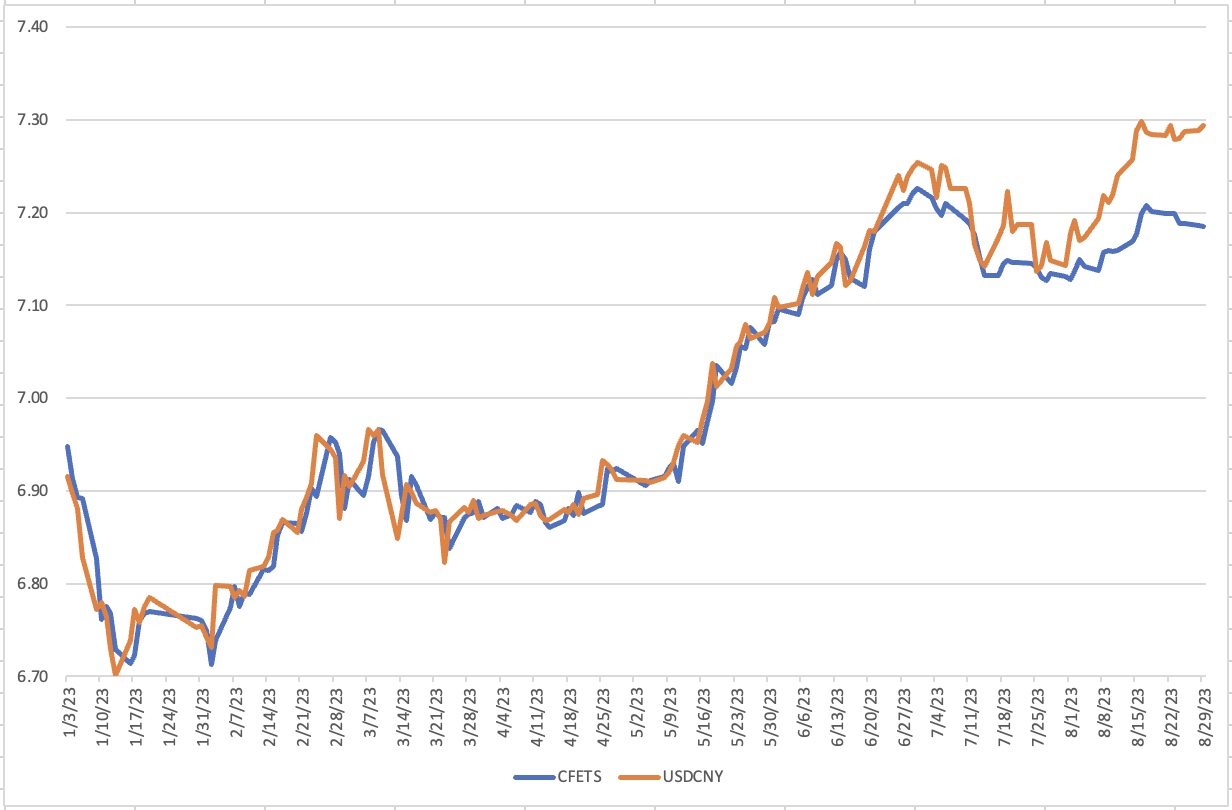
While Xi continues to fiddle with minor policy adjustments, the PBOC is desperately trying to prevent more severe weakness in the renminbi.  Last night, for instance, they fixed USDCNY at 7.1851, far below the market’s calculated expectations and 1.65% lower than the market is actually trading.  Remember, the onshore rules are that spot can only trade within a +/- 2.0% band compared to that CFETS fix, and it has been pushing that boundary for a while now as can be seen in the chart below (source Bloomberg):

The spread between the blue and orange lines continues to increase, but more importantly, the trends are moving in opposite directions.  Given how close the spread already is to the 2% limit, it appears that there is the potential for some fireworks in the future.  At this point, I cannot see how the PBOC will not ultimately allow a weaker CNY.  This is especially true if (when?) the Fed raises the Fed funds rate again.  Nothing has changed my view of 7.50 and beyond.

But, away from the ongoing recalibrations in the Chinese financial systems, there is precious little else on which to focus.  Generally, markets seem to have absorbed the idea that the Fed may continue to tighten further and remain resolutely bullish on risk.  It seems that the no-landing scenario is the current market fave.  And so, last night aside from the Chinese share gains, we saw green everywhere else as well, just not nearly as excited with rises on the order of 0.2% to 0.5%.  In Europe, it is also a positive morning with most gains relatively modest, of the 0.3% variety, with only the FTSE 100 (+1.45%) showing more substantial gains as the UK catches up with yesterday’s rally after their bank holiday.  Alas, US futures are actually leaning slightly negative this morning, but only just, as traders await the first pieces of data this week.  I would contend that the JOLTS data (exp 9.5M) is the most important as a key jobs indicator frequently mentioned by Powell, but we also see Case Shiller Home Prices (-1.60%) and Consumer Confidence (116.0).  Things pick up a bit tomorrow with ADP and then GDP on Thursday ahead of NFP on Friday.

In the bond market, lackluster describes things quite well with Treasury yields higher by 1 basis point and even lesser moves across the European sovereign space.  JGB’s, meanwhile are starting to drive a bit lower, but continue to hang around near 0.6%.  Traders and investors are awaiting this week’s data now that they have absorbed the Fed commentary.  If we see a surprisingly strong NFP print, do not be surprised to see yields back up toward their recent highs of 4.35% as many will assume at least one more hike is coming soon.  Correspondingly, a soft print will likely see a test of 4.00%, at least initially.

Oil prices continue to hold their own, perhaps getting a boost from the China story as any stimulus there is welcome and seen as a fillip for demand.  Metals prices, which had been a touch firmer earlier in the session, have given up those modest gains and at this hour (8:00), are basically flat on the day.

Finally, the dollar is mixed to slightly stronger this morning, but overall movement has been muted, like all the other markets.  While NOK (+0.15%) is managing some gains on oil’s strength, the rest of the G10 bloc is a touch softer, although other than JPY (-0.3%), which has managed to trade above 147 this morning, the movement is tiny.  In the EMG bloc, there is a more mixed view, but none of the movement is very large in either direction, with the biggest gainers and losers at +/- 0.3% on the day, effectively nothing in this space. Here, too, all eyes are on the data this week.

The only Fed speaker today is Michael Barr, and he is talking about banking services, with no policy discussions expected. Adding it all up leads to a conclusion of a pretty quiet session overall unless today’s data is dramatically surprising.  Remember, though, quiet sessions are good days to hedge.

Good luck

Adf

Alternate Ways

In Joburg a gath’ring of nations
Is trying to firm up foundations
For alternate ways
That each of them pays
The other with no complications

Meanwhile, we are starting to hear
A story that we should all fear
The calls have come forth
Inflation that’s north
Of two percent’s where Jay should steer

The BRICS nations are meeting in Johannesburg starting today with, ostensibly, a mission to exit the dollar financial system.  While Russia has already done so involuntarily, the biggest proponent of the move is China, although the other nations are certainly willing to listen.  In addition to this goal, they will hear from many other developing nations as to whether these other nations merit inclusion in the BRICS club.

Ultimately, the problem that this disparate group of nations has is that none of them really trust any of the others.  Certainly, the historical conflict between China and India is well-known and long-lasting.  It was not that long ago that their soldiers were shooting at each other in the Himalayas.  At the same time, both Brazil and South Africa are extremely remote from the other nations and have completely different economic and political systems.  In other words, the common ground of wanting to do something about the US and its dollar, while certainly a goal, is unlikely to be enough for any of them to risk potential negative consequences of a failed concept.  

Much will be made of this meeting in the press, but we have already heard from South Africa’s FinMin, Enoch Godongwana, that it is premature for South Africa to stop using the USD and SWIFT system.  Ultimately, my strong belief is this is much ado about nothing, at least for the foreseeable future.  Perhaps in 25 years, after the 4th Turning is complete, the global currency system will be different, but not anytime soon.

Which brings us to the other story which has me far more concerned about the dollar and the US economy, the substantial increase in calls by mainstream economists to raise the Fed’s inflation target.  Understand that I have never been a fan of the target to begin with, recognizing its arbitrary nature.  However, the world in which we live has been predicated on the idea that the Fed is focused on that target and its policies are designed to maintain a relatively low rate of inflation.  Raising that target, with 3% the new favored call, is just as arbitrary as the initial level, but it changes the dynamic in the economy as well as markets.

It seems these calls are coming from the hyper-Keynesians who lean toward MMT and believe that the risk of any economic growth slowdown should be addressed ahead of all other concerns.  (It could be argued that the current administration is quite concerned that a recession next year, heading into the presidential election, would not favor President Biden’s reelection.). Now, nobody is happy when the economy slows down as it makes life difficult for us all, but one of the reasons the nation is in its current situation, with unsustainable levels of debt outstanding, is because the willingness of any politician to allow markets to actually clear (meaning asset prices fall sufficiently to hurt the 1% club) is essentially nil.  This has been the underlying driver of constant spending programs and ultimately, the cause of the ballooning budget deficits and Federal debt.  

The unspoken piece of this concept is that permanently higher inflation will reduce the real value of the outstanding debt that much more quickly, hence allowing for even more deficit spending going forward.  The fact that higher inflation is an effective tax on the bottom 99% of the income brackets, with the pain increasing more rapidly the further down that scale you look, is of no concern it seems.

Thus far, Chairman Powell has been adamant that there is no change to the goal on the table.  But I assure you that the longer it takes for inflation to retreat to its former levels, the more we will hear about this idea.  When I combine this concept with my belief that inflation is going to remain sticky in the 3%-4% range going forward for quite a while, it does not paint a promising picture.  The Fed already has credibility issues; moving the goalposts in the middle of their inflation fight would really destroy any remaining credibility they have, and that would be a real problem for monetary policy activities going forward.

But these problems are far too forward looking for today’s markets.  Instead, the future is…Nvidia!  At least, that seems to be the case right now.  As investors await their Q2 earnings release tomorrow afternoon, the working thesis seems to be that they will beat the currently inflated analyst expectations and drive the next leg of the equity bull market higher.  Now, remember, they currently trade at a 228 P/E ratio, which seems pretty high in the scheme of things, regardless of the promise of AI going forward.  (You can tell AI didn’t write this as I call into question its value here).  There has been much talk of a big ‘beat’ in earnings and that has been the catalyst for today’s equity rally.  Well, that and the fact that the Chinese seem to have instructed their ‘plunge protection team’ to get back to buying Chinese stocks as well as the yuan.  Regardless of the rationale, though, risk is definitely in favor today.

Asian equity markets were higher across the board, with the big ones all higher by just under 1%.  European bourses are similarly situated, all higher by about 1% while US futures, at this hour (7:30) are lagging a bit, only up by about 0.5%, although that was after a pretty solid performance yesterday.  Woe betide the equity markets if Nvidia misses its numbers!

At the same time, bond yields are generally lower this morning with 10yr Treasuries down 2bps from yesterday’s new closing high near 4.35%.  European sovereign bonds have also seen demand with yields sliding between 4bps (Germany) and 7bps (Italy) as a combination of mildly positive UK Public Sector Finance news and a very large Eurozone Current Account surplus seem to have bond investors quite excited.  Asia, however, did not share this excitement with JGB yields rising 2bps and getting to their highest level (0.663%) since the change of policy last month.  

On the commodity front, oil (-0.2%) has edged back below $80/bbl, representing a sharp decline yesterday afternoon after signs of increased supply started to show up in the market.  The metals markets, however, are in much better shape this morning with gold (+0.4%) back above $1900/oz and the base metals both firmer as well.  It seems that mildly lower yields and a weaker dollar are having quite a positive effect.

Speaking of the dollar, it is under broader pressure this morning vs. most of its G10 and EMG counterparts.  In the G10, NZD, AUD and SEK have all gained about 0.5% with NOK +0.4% as commodity prices find some support, and the China renewal story helps the overall global growth story this morning.    While the euro is little changed on the day, the rest of the bloc has edged higher as well.  Meanwhile, in the EMG bloc, ZAR (+1.1%) is the biggest gainer on the day, perhaps getting a little boost from positive BRICS vibes, but more likely from positive commodity vibes.  As to the rest of the bloc, APAC currencies have benefitted from the China story and THB (+0.65%) has benefitted from the resolution of the political crisis with a new PM finally being named.

On the data front, we see Existing Home Sales (exp 4.15M) and Richmond Fed Manufacturing (-10) and we hear from several Fed speakers.  However, with Powell on the calendar for Friday morning, I don’t think a great deal of attention will be paid to any other Fed speaker until he’s done.  There is a strong belief he is going to lay out the policy framework going forward, but I have a suspicion that he is happy with the current ‘guidance’ of higher for longer and may not say much at all.

Right now, risk is to the fore, and as such, the dollar is likely to remain under pressure until that changes.  It may be this way all week, or if Nvidia misses its numbers, don’t be surprised to see the dollar reverse course higher after that.

Good luck

Adf

Simply a Bummer

As tiresome as it may be
To talk about China and Xi
The doldrums of summer
Are simply a bummer
With nothing else worthy to see

However, come Friday we’ll turn
To Jackson Hole where we should learn
If Jay and the Fed,
When looking ahead,
Decide rate hikes soon can adjourn

The biggest news overnight was that the PBOC cut interest rates again, but this time somewhat less than expected.  You may recall that last week, they cut the 1-yr Lending Facility rate by 15bps in a surprising move.  In fact, this is what started the entire chain of events last week that resulted in China dominating the macroeconomic news.  Well, last night they cut the 1yr Loan Prime rate by a less than expected 10bps with the market looking for a 15bp cut.  And they left the 5yr Loan Prime rate, the rate at which most mortgages in China are priced, unchanged at 4.20% rather than implementing the 15bp cut that the market had anticipated.  The result is that so far, Chinese support for their economy remains tepid at best.

At the same time, there continues to be a grave concern in Beijing regarding the exchange rate as, once again, the daily fixing was far below the market rate, and once again, the renminbi fell anyway.  It has become abundantly clear that the PBOC is quite concerned over a ‘too weak’ renminbi, hence the maintenance of the 5yr interest rate.  As well, it was widely reported that Chinese state-owned banks were actively selling USDCNY in the market to prevent further weakness in their currency.  

Perhaps this is a good time to briefly discuss the concept of the end of the dollar again, a topic that continues to make headlines.  One of the key pillars of this thesis is that the PBOC has reduced the number of dollars on its balance sheet substantially over the past several years which is seen as an indication that they are preparing to support some new reserve asset.  However, as last night’s price action indicated, it is quite possible, if not likely, that the only change has been one of location, rather than amount.  As the PBOC reduced the dollars on its balance sheet, the big state-owned banks all increased the amount on their balance sheets.  So now, the PBOC can direct those banks to intervene on their behalf whenever they want to do something.  At the same time, the PBOC has the appearance of decoupling, something they are clearly trying to demonstrate.  

This week is the big BRICS meeting where the stories are that they are going to unveil a new BRICS currency, allegedly to be gold-backed, as these nations try to undermine US power as well as offer an alternative to non-aligned nations.  The thing to remember about this group of widely disparate nations is that it has never been a cohesive bloc, it was simply an acronym created by a Goldman Sachs analyst in 2001 to describe a group of fast-growing emerging markets.  However, other than China and Russia, which have become closer since Russia’s invasion of Ukraine, they really have very little in common.  They are geographically widely diverse, have very different governing structures as well as very different financial and monetary policies.  In other words, there is nothing to suggest they can act as a cohesive group for any major decision.  While I am certain there will be some announcement of some sort at the end of the conference, an alternative to the dollar will not be coming anytime soon.

As to Jackson Hole, since Powell’s speech isn’t until Friday morning, we have plenty of time to touch on that topic later in the week.  In the meantime, risk is arguably in modest demand this morning.  While Chinese shares suffered significantly overnight on the disappointing rate news, European bourses are all nicely higher, generally between 0.75% and 1.00%.  Too, US futures are firmer this morning by about 0.5% after a late day rally Friday brought the major indices back near unchanged on the day from earlier lows in the session.

At the same time, bond yields continue to rally with 10-year Treasury yields back at 4.30%, up 4bps this morning, while European sovereign yields are all higher by between 4bps and 5bps.  It seems the bond market is not completely on board with the soft-landing narrative even though an increasing number of analysts are coming around to that view.  I think what we have learned thus far is that the US economy is not nearly as interest rate sensitive as it used to be.  The post-Covid period of QE and ZIRP saw a massive refinancing of debt, both mortgage and corporate, into longer-dated, low fixed rates.  With yields higher, there is much less need for refinancing, at least not yet, and so many of the problems that have been widely expected just have not happened yet.  At some point, when debt needs to be refinanced, if rates are still at current levels, it is likely to prove problematic for the companies and the economy writ large.  But that could still be some time from now.  In the meantime, I continue believe the yield curve inversion, which is now down to -67bps, could disappear completely by 10yr yields continuing to rise.  That is clearly not the consensus view.

Turning to commodities, they are generally looking good today led by oil (+1.2%) which has rebounded over the past several sessions and is back above $82/bbl.  The metals, too, are looking good with gold up at the margin, although hovering just below $1900/oz, while copper also has a bit of support today, up 0.3%.  For the industrial metals, China remains a key question mark.  If the Chinese economy continues to slow, then demand for these commodities is likely to be disappointing and prices seem likely to come under short-term pressure.  But remember, the long-term story remains one where many of these are essential for the mooted energy transition, and there simply is not enough of the stuff to satisfy the demand.  Longer term, prices still have room to rise.

Finally, the dollar is starting to slide as I type.  An earlier mixed picture has seen buyers of NOK (+0.75%) as oil continues to rebound, but also in essentially all of the G10 with only the yen (-0.3%) lagging.  In fairness, this is classic risk-on price action.  Turning to emerging market currencies, Asian currencies were mostly under pressure last night after the China rate news, but this morning EEMEA currencies are looking much better as they follow the euro (+0.3%) higher.  It appears that fear is taking a day off today.

On the data front, there is not much of real interest this week:

TuesdayExisting Home Sales4.15M
WednesdayFlash Manufacturing PMI49.0
 Flash Services PMI52.0
 New Home Sales704K
ThursdayInitial Claims240K
 Continuing Claims1700K
 Chicago Fed Nat’l Index-0.20
 Durable Goods-4.0%
 -ex transports0.2%
FridayMichigan Sentiment71.2
 Powell Speech 

Source: Bloomberg

Given the number of market participants on summer holiday, I suspect that there will be very little activity this week until we hear from Chairman Powell.  I would look for a little bit of choppiness, but no real directional moves until we know the Fed’s latest views.  And there is a real chance that he doesn’t tell us anything new, which means that we would then be waiting for NFP a week from Friday.  Net, until the Fed’s hawkishness breaks, I still like the dollar best.

Good luck

Adf

Problems Galore

The story continues to be
The China of President Xi
Has problems galore
With more still in store
So, traders, as such, want to flee

The issue for markets elsewhere
Is knock-on effects aren’t rare
Protecting the yuan
Means it is foregone
Bond sales will send yields on a tear

For yet another day, China is offering the biggest market stories.  In no particular order we have seen the following overnight; China Evergrande filed for Chapter 15 bankruptcy, a process by which foreign entities can access the US bankruptcy court system, regarding $19 billion of their offshore debt; the PBOC set their CFETS fixing more than 1000 pips lower than market expectations, the largest gap since the process began in 2018, in their effort to arrest the yuan’s consistent decline; and Chinese police visited the homes of the protesters who were complaining about Zhongzhi’s missed payments (I wrote about these Monday in Risks Were Inbred).  And this doesn’t include the fact that Country Garden, the largest property developer in China is losing money quite rapidly and may also be on the brink of bankruptcy.  It seems the Chinese property bubble is deflating.

Ultimately, there appear to be two main impacts of the gathering storm in China, market participants are increasingly leery of taking on risk in general, and the PBOC’s efforts to stem the decline of the yuan means they must sell their holdings of Treasuries to generate the dollars to deliver into the FX market thus adding downward pressure to the bond market.  Of course, one of the typical outcomes of a risk-off attitude is that bond markets rally as investors exit equities and run to bonds.  This stands at odds to the recent bond market behavior, although it is quite evident this morning.  In fact, after touching yields above 4.30% in the 10yr Treasury yesterday, this morning we have seen a half-point rally with yields declining about 5bps in the US.  In Europe, the yield declines have been even greater, mostly around -10bps, so this is a real reprieve for bond markets everywhere.

The key question here is whether we have seen the worst, or if other potential selling catalysts will appear.  Consider for a moment the fact that between China and Japan, they represent >26% of foreign owned US Treasury debt, and that both of these nations are dealing with rapidly weakening currencies.  Not only that, but both have demonstrated they are quite willing to intervene in FX markets to arrest those declines, and as mentioned above, that typically requires selling Treasuries.  It’s a self-reinforcing cycle as higher yields beget currency sales which beget Treasury sales to intervene, which results in higher yields starting the cycle all over.  

With this in mind, we need to consider, what can break the cycle?  Well, if the Fed were to turn dovish and indicate they agreed with the futures markets that rate cuts are coming early next year, I suspect the dollar would fall against most currencies, especially these two, and the cycle would break.  Alternatively, China could step up and guarantee the debt of Countrywide and Evergrande thus removing the investor risk and reduce pressure dramatically.  Finally, I suppose the Fed could make a deal with the BOJ and PBOC and directly absorb their bond sales, so they never hit the market while restarting QE.  That, too, would likely end the cycle.  It is possible there are other ways to break the cycle, but I doubt we will see any of these occurring anytime soon and so the cycle will have to wear out naturally.  That will occur when either or both of the currencies decline far enough so the market believes the trade has ended and unwinds their short positions.  In other words, none of this has changed my view that 7.50 is on the cards for USDCNY as the year progresses, very possibly with 10yr yields getting to 4.5% or more.  And don’t be surprised if we see another move to 150.00 in USDJPY.

But, away from the China connection, things are very much in the summer doldrums.  Equity markets have been treading fearfully and continue to do so this morning.  However, while we have seen several days of declines, there has been no panic selling of note.  So, yesterday’s US weakness was followed by selling throughout Asia and this morning in Europe with most markets down about -1.0%.  US futures, too, are softer, down about -0.5% at this hour (8:00).

Oil prices (-0.85%) which stabilized yesterday, are back under a bit of pressure on the overall negative risk sentiment as they continue to trade either side of $80/bbl.  Metals prices, meanwhile, are mixed with precious metals finding a bit of support while base metals suffer today.  The most interesting story here I saw today was that CODELCO, the world’s largest copper miner in Chile, may be going bankrupt as previous projects didn’t pan out.  That strikes me as a very large potential problem, but one for the future.  

Finally, the dollar is mixed this morning.  It had been softer overall in the overnight session, but as risk is getting marked down, the dollar is gaining strength.  The biggest mover has been PHP (+1.1%) which rallied after the central bank indicated they were going to put a floor under the currency and adjust rates accordingly.  After that, the EMG bloc has not done very much, +/- 0.25% type activity.  However, just recently, G10 currencies started to slide with NOK (-0.8%) the laggard as oil slides, but the entire bloc now coming under pressure.  This is all about risk off.  

There is no US data today nor are there any Fed speakers.  As such, the dollar will take its cues from the equity markets, and the bond market to some extent.  Right now, equity weakness is driving the risk attitude and that means the dollar is likely to remain bid into the weekend.  Next week brings the Fed’s Jackson Hole meeting where everybody will be looking for any policy hints by Chairman Powell on Friday morning.  But for now, the dollar is on top of the mountain.

Good luck and good weekend

Adf

A Raw Deal

The Minutes according to Jay
Explained more rate hikes are in play
At least that’s the spin
From media kin
But could that lead us all astray?

Yesterday’s key news was the release of the FOMC Minutes.  The market read, at least the headline read, was that they were hawkish which played a key role in the equity market decline in the afternoon, as well as the bond market decline leading to the highest 10yr yields since 2008.  Below is what I believe is the key paragraph from the Minutes with my emphasis.

“With inflation still well above the Committee’s longer-run goal and the labor market remaining tight, most participants continued to see significant upside risks to inflation, which could require further tightening of monetary policy. Some participants commented that even though economic activity had been resilient and the labor market had remained strong, there continued to be downside risks to economic activity and upside risks to the unemployment rate; these included the possibility that the macroeconomic effects of the tightening in financial conditions since the beginning of last year could prove more substantial than anticipated. A number of participants judged that, with the stance of monetary policy in restrictive territory, risks to the achievement of the Committee’s goals had become more two sided, and it was important that the Committee’s decisions balance the risk of an inadvertent overtightening of policy against the cost of an insufficient tightening.” 

It strikes me that based on the fact we have already heard from two FOMC voting members, Harker and Williams, that rate cuts are on their mind for 2024, and the lines I have highlighted above, the once unanimous view of a hawkish Fed is beginning to fall apart.  Now, if the data continues to outperform expectations like it has recently (consider the Retail Sales data from Tuesday) I expect the FOMC to maintain their hawkishness.  The Atlanta Fed’s GDPNow forecast has just risen to 5.75%, far above trend growth and certainly no implication for the end of tightening.  But remember, that is a volatile series, and we are a long way from the end of Q3.  Ultimately, I suspect that a growing number of FOMC members are starting to get queasy over the higher for longer mantra given the equity market’s recent shudders.  We shall see.

The Chinese are starting to feel
That Xi’s given them a raw deal
The yuan keeps on falling
While growth there is stalling
And values of homes are unreal

The PBOC was pretty vocal last night as they explained all the things they are going to do to manage a clearly deteriorating situation in China.  Here are some of the comments they released:

PBOC: TO MAKE CREDIT GROWTH MORE STABLE, SUSTAINABLE

PBOC: TO USE VARIOUS TOOLS TO KEEP REASONABLY AMPLE LIQUIDITY

PBOC: TO RESOLUTELY PREVENT OVER-ADJUSTMENT IN EXCHANGE RATE

PBOC: TO OPTIMIZE PROPERTY POLICIES AT APPROPRIATE TIME

PBOC: CHINA IS NOT IN DEFLATION RIGHT NOW

PBOC: LOCAL FISCAL BALANCE PRESSURE INCREASING

PBOC: HAS EXPERIENCES, TOOLS TO SAFGUARD STABLE FOREX MARKET

Which was followed by the following headline, CHINA TOLD STATE BANKS TO ESCALATE YUAN INTERVENTION THIS WEEK.

Add it all up and the Chinese are getting increasingly worried.  There is a great chart in Bloomberg today that shows the change in house prices across China, which puts paid to the official narrative that prices have fallen just 2.4% from the August 2021 highs.  They have clearly fallen a lot more as evidenced by this chart and the comments above.

In the end, the Chinese have a lot of work to do to keep their economy going.  While they remain concerned over the weakening CNY, it is clearly one of the best relief valves they have, and it will slowly weaken further.  Money is leaving the country.

An attitude change
Is becoming apparent
No JGBs please!

And finally last night the BOJ auctioned off some 20yr JGBs and the auction results were awful.  The tail was the widest, at nearly 8bps, since 1987, while the spread between 10yr and 20yr bonds widened by nearly 5bps.  It seems that demand was not nearly as robust as had been expected.  Given that nominal yields in the 20yr are 1.35% and CPI is 3.2% core, it is not that surprising.  Bonds everywhere are losing their luster, at least longer duration bonds, and I see no reason for that trend to end until economic activity is clearly declining.  China’s woes have not yet bled to either the US or Japan, while inflation remains sticky.  Today, globally yields are higher by between 4bps and 6bps.  This process still has more to go in my estimation.

Which brings us to the rest of the overnight session, where after another weak equity performance in the US, we saw Japan and non-China Asia soften, although Chinese markets held in on the back of the PBOC comments and promises of more support for the economy there.  European bourses are somewhat softer this morning but nothing dramatic and at this hour (7:30) US futures are higher by about 0.25% across the board.

Oil prices (+0.9%) have rebounded and after a brief foray below $80/bbl have recaptured that key level.  Metals prices are also firmer this morning across the board as both base and precious varieties see demand.  This seems largely in line with the fact the dollar is under modest pressure this morning.

And the dollar is under modest pressure this morning, at least vs. the G10, where every currency is firmer, but the moves are very small.  NOK (+0.4%) is the leader on the back of the oil move, but everything else is higher by between 0.1% and 0.25%.  In the emerging markets, the picture is a bit more mixed, with some gainers (ZAR +0.45%, HUF +0.35%) and some laggards (MYR -0.55%, PHP -0.5%) with both those currencies feeling pressure from concerns their respective central banks will not maintain the inflation fight.

On the data front, we see Initial (exp 240K) and Continuing (1700K) Claims as well as Philly Fed (-10.4) and Leading Indicators (-0.4%).  The data continues to have both highs and lows with yesterday’s IP jumping 1.0%, much better than expected, but the Empire Mfg data on Tuesday a very weak -19.  There are no Fed speakers today so I expect much will depend on whether or not dip buyers emerge in the equity markets.  It feels like we are teetering on the edge of a bigger risk-off move with another 10% down in equities entirely possible.  In that event, I do like the dollar to show resolve.

Good luck

Adf

Angina

This week all the problems in China
Have given the markets angina
Last night, we are told
Stocks oughtn’t be sold
While Xi tries to hold a hard line-a

For the third day in a row, China is the story du jour.  Two stories from last night illustrate the problems in the Chinese economy are either spreading more widely or simply becoming more widely known outside China.  The litany of issues are as follows: Chinese authorities requested that investment funds not be net sellers of equities this week; the PBOC added the most cash to the economy via reverse repos in six months; investors who have not been repaid by Zhongrong International Trust were seen outside the company’s Beijing HQ protesting openly; and the yuan continues to slide despite PBOC efforts to moderate the currency’s decline.

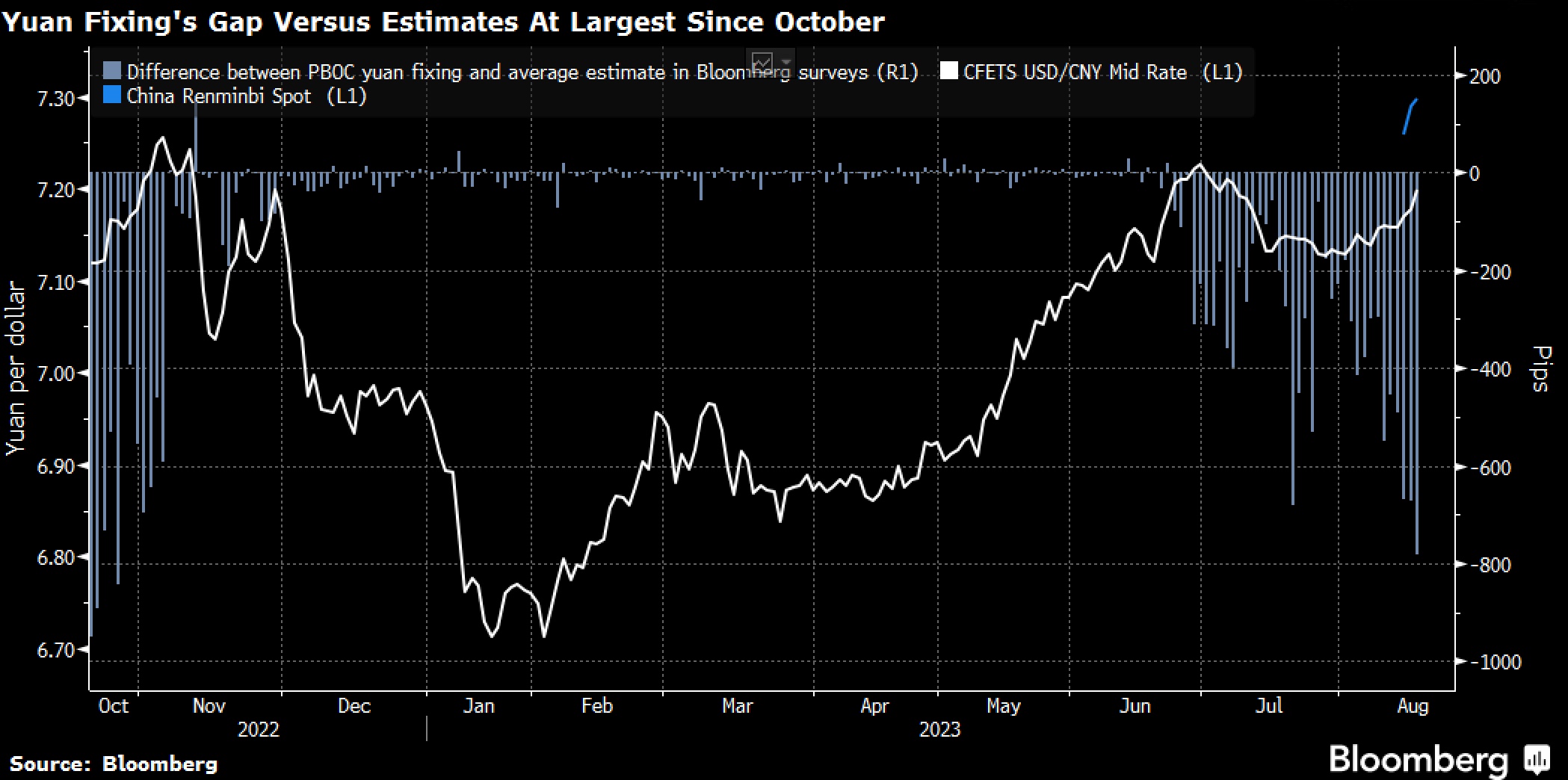
A brief recap of the process in the onshore CNY market shows that each morning the PBOC sets a central rate for the day (the CFETS rate), ostensibly based on a basket of currencies they follow, and when the market starts trading, it must remain within a +/- 2% band around that central rate.  Historically, when the PBOC wanted to signal that the currency was getting too strong or too weak, that CFETS rate would be set further in their desired direction than the model implied to help guide the market.  Well, lately, the PBOC has been setting the CFETS rate for a much stronger than expected CNY, but the market has largely been ignoring that. Bloomberg has an excellent chart showing the rising discrepancy that I have reprinted below.

The bars on the chart represent the difference, in pips on the RHS axis, between the actual CFETS fix and the estimates from analysts’ models.  Notice that from November 2022 through the beginning of July, that difference was virtually nil.  The point is the models have proven themselves over time to be accurate, so these big discrepancies are policy choices.

As the PBOC watches the currency of its closest ally, Russia, collapse in slow-motion, it is clearly concerned about its own situation.  The added pressure of slowing growth and the problems in the investment sector are making things more difficult.  The fact that China is on a monetary easing path while the rest of the world is still tightening is naturally going to undermine the value of the renminbi, but the great fear in China is a rapid devaluation.  

The biggest problem the PBOC has is that unlike the situation with youth unemployment, where they simply decided to stop publishing the data, they don’t really have that choice in this situation.  They cannot hide what they are doing and expect that the FX market will be able to function realistically.  And China needs an FX market because of the huge portion of their economy that is reliant on international trade.  

There is no easy answer for the Chinese here.  If they seek to support the domestic economy with easier monetary policy, the renminbi is very likely to continue to fall as locals seek to get their money out of the country and invest in higher yielding assets.  The fact that the Chinese equity markets have been slumping simply adds more pressure to the situation.  There is a well-known idea in international finance called the impossible trilemma which states that no country can have the following three things simultaneously:

  1. A fixed foreign exchange rate 
  2. Free capital movement
  3. Independent monetary policy

China’s situation is that while the FX rate is not actually fixed, it is carefully and closely managed; while there are significant capital controls, there is still a steady flow of funds leaving the country, often via international real estate investments, so there is some freedom of flows; although of course, there is no attempt at independence by the central bank.  However, what we can readily observe is that even maintaining control of the currency while there is any ability to move capital offshore is virtually impossible these days.  Nothing has changed my view that we are headed to 7.50 and beyond over time.  And, to think, I didn’t even have to discuss weak earnings from Tencent or further concerns about Country Garden going bankrupt.

With that as our backdrop, it cannot be surprising that risk is under some pressure.  After all, the Chinese economy remains the second largest in the world.  The big change for markets is that after two decades of China being the fastest growing major economy in the world, now it is much slower than both Japan and the US (Europe is still in the dumps) and portfolio adjustments are still being made.

Looking at the overnight session, after a weak US market, with all three major indices lower by more than -1.0%, Asia followed suit completely, with markets there also under significant pressure, falling by -1.0% or more pretty much throughout the time zone.  European bourses, though, have edged higher after a weak performance yesterday, but the gains are di minimis, and in the UK, after inflation data showed the BOE’s job is not nearly done, the FTSE is a bit softer.  US futures are little changed this morning as the market awaits the FOMC Minutes this afternoon.

Treasury yields have backed off a bit, down about 2bps, and we are seeing similar movements in Europe. However, 10yr Treasury yields remain well above 4.0% and certainly seem like they are trending higher.  In the wake of the much stronger than expected Retail Sales data yesterday morning, 10yr yields spiked to 4.26%, their highest level since last October, and tantalizingly close to the highest levels seen in more than 15 years.

Oil prices (+0.3%) which have been sliding for the past week, consolidating their strong move over the past two months, seem to be stabilizing above $80/bbl for now.  We are also seeing modest strength in the metals complex today, although the movement has been very tiny.  Gold has managed to hold the $1900/oz level, but its future performance will depend on the dollar writ large I think.

And finally, the dollar, which has been quite strong overall lately, is softening a touch this morning, with only two weaker currencies in the EMG bloc, KRW (-0.5%) and CNY (-0.1%) as both respond to the problems mentioned above.  But elsewhere, this seems to be a bit of a relief rally with the dollar sagging broadly.  The G10 space is seeing similar price action with only CHF (-0.2%) and JPY (-0.1%) lagging slightly, while the rest of the bloc edges higher.  But movement of this tiny magnitude tends to mean very little.

On the data front, Housing Starts (exp 1450K) and Building Permits (1463K) come first thing with IP (0.3%) and Capacity Utilization (79.1%) at 9:15.  Finally, at 2:00 the Minutes from the July FOMC meeting will be released and given the change in tone we have heard from several members lately, with cuts now on the table for next year, it will be interesting to see how that plays out.

Today feels like a consolidation day, without any significant catalysts, so I expect a quiet session overall.  Unless the Minutes change everyone’s views regarding the next steps by the Fed, I maintain my view of dollar strength over time.  At least until the Fed actually turns things around.

Good luck

Adf

Growth Will, Fall, Free

In China when data is weak
And nothing implies there’s a peak
The answer is to
Remove it from view
And henceforth, no more of it speak

But just because President Xi
Decided there’s nothing to see
That will not prevent
The wid’ning extent
Of views China’s growth will, fall, free

Last night China released their monthly series of economic statistics, all of which were lousy.  Briefly, Retail Sales (2.5%), IP (3.7%), Fixed Asset Investment (3.4%), Property Investment (-8.5%) and Unemployment (5.3%) all missed the mark with respect to economists’ forecasts and all indicated much weaker growth than previously expected.  Conspicuously there was one data point that was missing, youth unemployment, which had been rising rapidly over the past months and in June reached a record high of 21.3%.  However, given the amount of negative press coverage that particular data point was receiving, especially in the West, it seems that President Xi decided it was no longer relevant and it will not be published going forward.  Given the broad-based weakness in all the other data, as well as the fact that there are many new graduates who would have just entered the workforce, one can only assume the number was pretty substantially higher than 21.3%.

The other news from China was that the PBOC cut their 1yr Medium-Term Lending Facility rate by 15bps in a complete surprise to the market.  As well, the 1wk repo rate was also cut by 10bps as the government there tries to address the very evident weakening economic picture without blanket fiscal stimulus.  One cannot be surprised that the renminbi weakened further, falling another -0.4% onshore with the offshore version currently -0.5% on the session.  One also cannot be surprised that Chinese equity markets were all under pressure as prospects for near-term growth continue to erode.  FYI, the renminbi is within pips of its weakest point in more than 15 years and, quite frankly, there is no indication it is going to stop sliding anytime soon.  I continue to look for 7.50 before things really slow down.

As growth increases
And inflation remains high
Can QE remain?

In contrast to the Chinese economic data, we also saw Japanese data overnight and it was a completely different story.  Q2 GDP was estimated at 6.0% on an annual basis, much higher than expected and an indication that Japan is finally benefitting from its policy stance.  While inflation data will not be released until Thursday, the current forecasts are for little change from last month’s readings.  However, remember every inflation indicator in Japan is above the BOJ’s 2% target so the question remains at what point is QE going to end?  For the FX market this matters a great deal as USDJPY is back above 145 again, and if you recall the activities last October, when USDJPY spiked above 150 briefly and the BOJ/MOF felt forced to respond with significant intervention, we could be headed for some more fireworks.  However, despite the BOJ’s YCC policy adjustment at the last BOJ meeting in July, the JGB market has remained fairly well-behaved, so it doesn’t appear there is great internal pressure to do anything yet.  The flipside of that is the US treasury market, where 10yr yields are back above 4.20% and that spread to JGBs keeps widening.  As the Bloomberg chart below demonstrates, the relationship between 10yr Treasury yields and USDJPY remains pretty tight.  Given there is no indication 10yr yields are peaking, I suspect USDJPY has further to rise.

All this, and we haven’t even touched on Europe or the UK, where UK employment data showed higher wages and a higher Unemployment Rate, a somewhat incongruous outcome.  The Gilt market has sold off on the news, with yields climbing about 6bps, but the rest of the European sovereign market is much worse off, with yields rising between 8bps and 12bps.  Treasuries are the veritable winner with yields this morning only higher by 3.5bps.

What about equities, you may ask, after yesterday’s positive US performance.  The disconnect between the NASDAQ’s ongoing strength in the face of rising US yields remains confusing to many, this poet included, as the NASDAQ, with all its tech led growth names, seems to be an extremely long duration asset.  But, another 1% rally was seen yesterday, ostensibly on the strength of Nvidia which rallied after a number of analysts raised their price target on the company amid news that Saudi Arabia and the UAE both have been buying up the fastest processors the company makes.  Well, while Japanese equities managed gains after the strong data, all of Europe is in the red, all by more than 1% and US futures are currently (7:30) lower by about -0.5%.  If US yields continue to rise, and there is no indication they are going to stop doing so in the near future, I find it harder and harder to see equity prices continue to rise as well.  Something’s gotta give.

Interestingly, the commodity space seems to be out of step with the securities markets.  Or perhaps not.  Oil (-1.0%) is down for the third day in four, hardly the sign of economic strength, as arguably the combination of rising interest rates and slowing growth in China would seem to weigh on demand.  And yet, the soft-landing narrative remains the highest conviction case among so many analysts.  So, which is it?  Soft landing with continued growth and energy demand?  Or a hard landing with energy demand falling sharply?  My money is on a harder landing, although I think energy demand will surprise on the high side regardless.  Meanwhile, both base and precious metals are under pressure today with copper (-1.6%) the laggard of the group.  Remarkably, despite ongoing USD strength, gold is still above $1900/oz, but at this point, just barely.

Speaking of the dollar, today is a perfect indication of why the dollar index (DXY) is not a very good estimator of the overall trend.  As I type, DXY is lower by about -0.2%, yet the dollar has risen against virtually every APAC currency and the entire commodity bloc in the G10.  In fact, the only currencies rising today are the euro and pound, both higher by about 0.2%.  At any rate, there is no indication that the dollar’s rebound is ending either.  This is especially true for as long as US yields continue to climb.  Think of it this way, global investors need to buy dollars in order to buy the high yielding Treasuries we now have, so demand is likely to remain robust for now.  

On the data front, Retail Sales (exp 0.4%, 0.4% ex autos) is the big number but we also see Empire Manufacturing (-1.0) and the Import and Export Price Indices.  In addition, we hear from Minneapolis Fed President Kashkari at 11:00, which is likely to have taken on more importance now that we have seen the first split on the concept of higher for longer.  Which camp will he fall into and how vocal will he be regarding the potential to cut rates next year?

But, putting it all together right now, risk is under pressure, and I see no reason for that to change today.  I guess a blowout Retail Sales number, something like 1.0% could get the bulls juices flowing, but that would likely push yields even higher and that is going to be a drag.  Either way, I like the dollar to continue to perform well here overall, especially against EMG currencies.

Good luck

Adf