Inflation’s Not Dead

It turns out inflation’s not dead
Despite what we’ve heard from the Fed
Will Jay now admit
His forecasts are sh*t
Or are there more rate cuts ahead?
 
To listen to some of his friends
They’re still focused on the big trends
Which they claim are lower
Though falling much slower
If viewed through the right type of lens


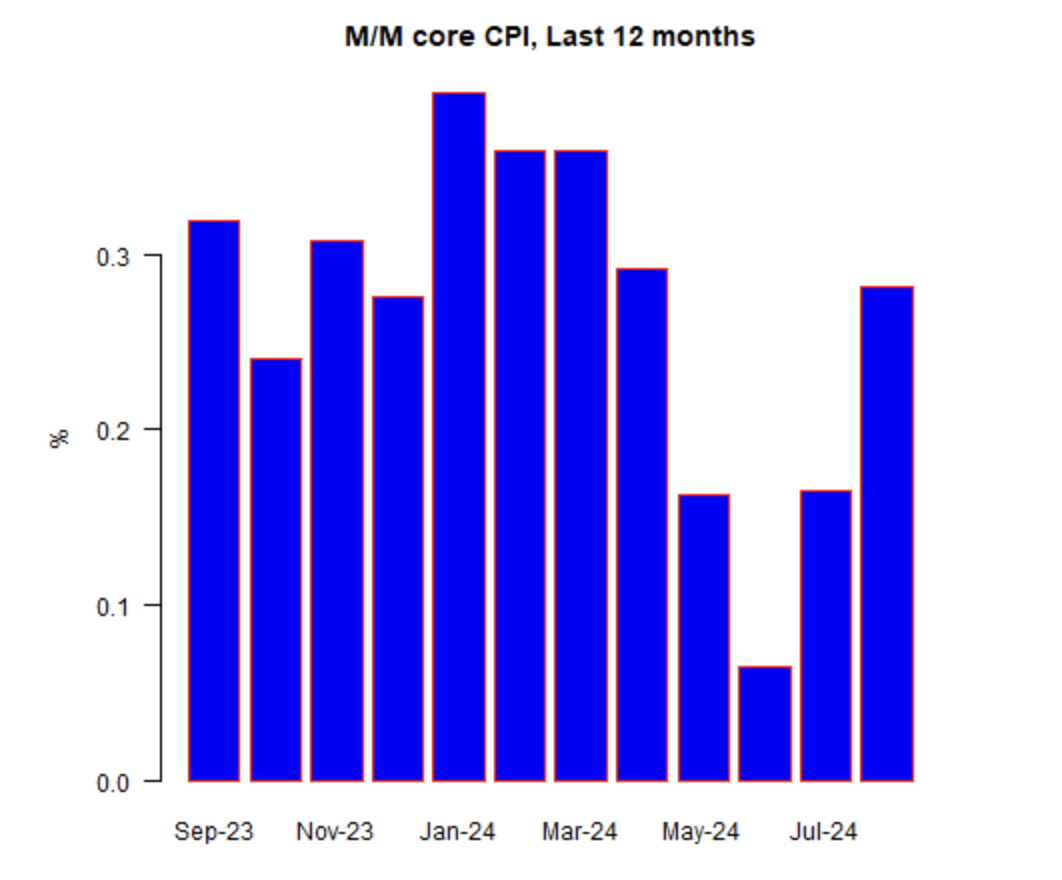
I guess if you squint just the right way, the trend in inflation remains lower.  I only guess that because that’s what we heard from three Fed speakers yesterday, Williams, Goolsbee and Barkin, but to my non-PhD trained eye, it doesn’t really look that way.  Borrowing the chart from my friend @inflation_guy, Mike Ashton, below are the monthly readings for the past twelve months for Core CPI.

As I said, and as he mentioned in his CPI report yesterday, it is much easier to believe that the outliers are May through July than the rest of the series.  But remember, I am not a trained PhD economist, so it is entirely possible that I simply don’t understand the situation.

At any rate, both the core and headline numbers printed higher than forecast which saw bonds sell off and the dollar rally while stocks edged lower.  Arguably, the big surprise was that commodity prices raced ahead with oil (+3.0% yesterday) and gold (+0.75% yesterday) both showing strength.  It seems that both of these markets, though, benefitted from rumors that Israel is getting set to finally retaliate against Iran for the missile bombardment last week, and fears of a significant disruption in oil markets, as well as a general rise in the level of uncertainty, has been sufficient to squeeze out a bunch of recent short positions.

In China, investors are waiting
For details on how stimulating
The plans Xi’s unveiled
Will truly be scaled
And if they’ll be growth generating

The other topic du jour is China, where tomorrow, FinMin Lan Fo’an is due to announce the details of the fiscal stimulus that was sketched out right before the Golden Week holiday, and which has been a key driver in the extraordinary rise in Chinese equities since then.  Alas, last night, as traders and investors prepared for these announcements, selling was the order of the day and the CSI 300 (-2.8%) fell sharply amid profit taking.  I find it telling that they are waiting to make these announcements while markets are not open, a sign, to me at least, that they are likely to be underwhelming.  Current expectations are for CNY 2 trillion (~$283 billion) of fiscal stimulus, which while a large number, is not that much relative to the size of the Chinese economy, currently measured at about $17 trillion.  And unless they address the elephant in the room, the decimated housing market, it seems unlikely to have a major positive impact over the long term. 

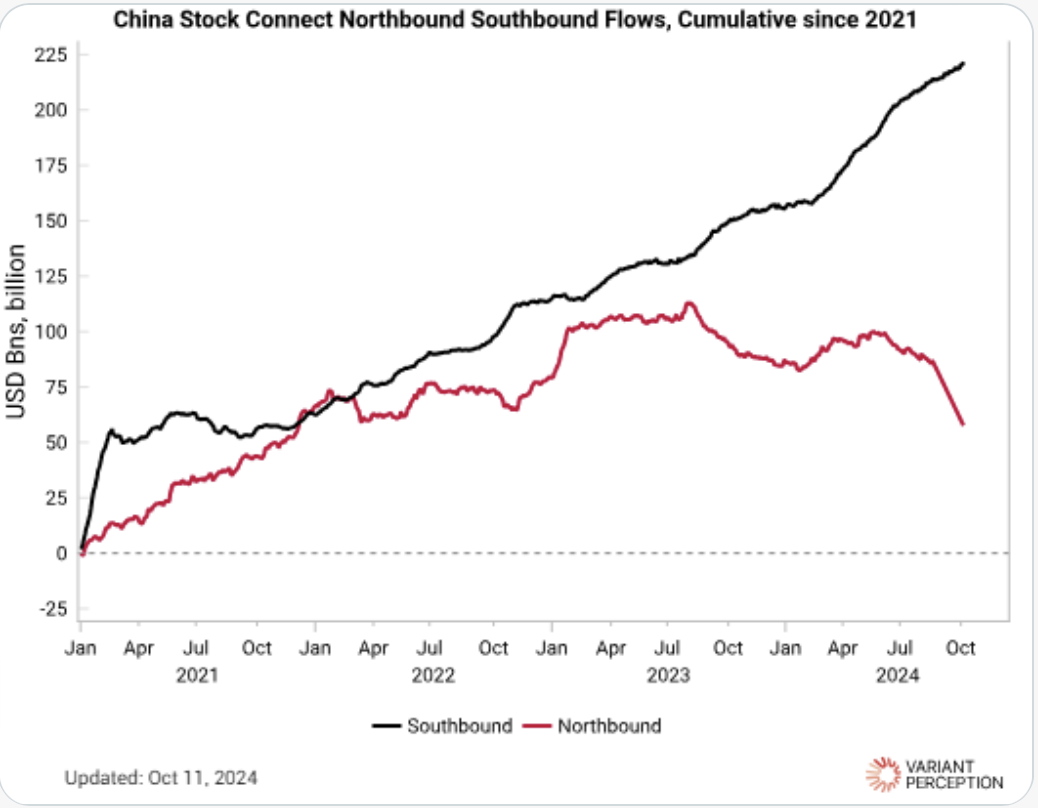
That said, Chinese stocks have become one of the hottest themes in the market with many analysts claiming they are vastly undervalued relative to US stocks.  However, I saw a telling chart this morning on X, showing that flows into Chinese stocks from outside the nation, the so-called northbound flows from Hong Kong, especially when compared to flows from the mainland to Hong Kong, have been awful, despite this recent rally.  As with many things regarding the Chinese economy and markets, the headlines can be deceiving at times in an effort to make things look better than they are.

While we did see the renminbi rally sharply after those initial stimulus announcements, it has since retraced most of those gains.  I cannot look at the situation there without seeing an economy that has serious structural imbalances and a terrible demographic future.  Meanwhile, the biggest problem is that President Xi has spent the past decade consolidating his power and eliminating much of the individual vibrancy that had helped the nation grow so rapidly.  Ultimately, I see CNY slowly depreciating as it remains the only relief valve the Chinese have on an international basis.

With that in mind, let’s take a look at how markets responded to the US CPI data and what other things may be having impacts.  Ultimately, US equity markets regained the bulk of their early losses yesterday to close marginally lower.  We’ve already mentioned China’s equity woes and Hong Kong was closed last night for a holiday.  Tokyo (+0.6%) managed a small gain, tracking the weakness in the yen (-0.25%) while the bulk of the region drifted modestly lower.  It seems many traders are awaiting this Chinese news to see how it will impact the rest of Asia.  As to European bourses, the movement here has also been di minimus with the FTSE 100 (-0.2%) the biggest mover after its data releases showing that GDP continues to trudge along slowly, growing only 1.0% Y/Y.  Continental exchanges are +/- 0.1% from yesterday, so no real movement there.  US futures, too, are essentially unchanged at this hour (7:00).

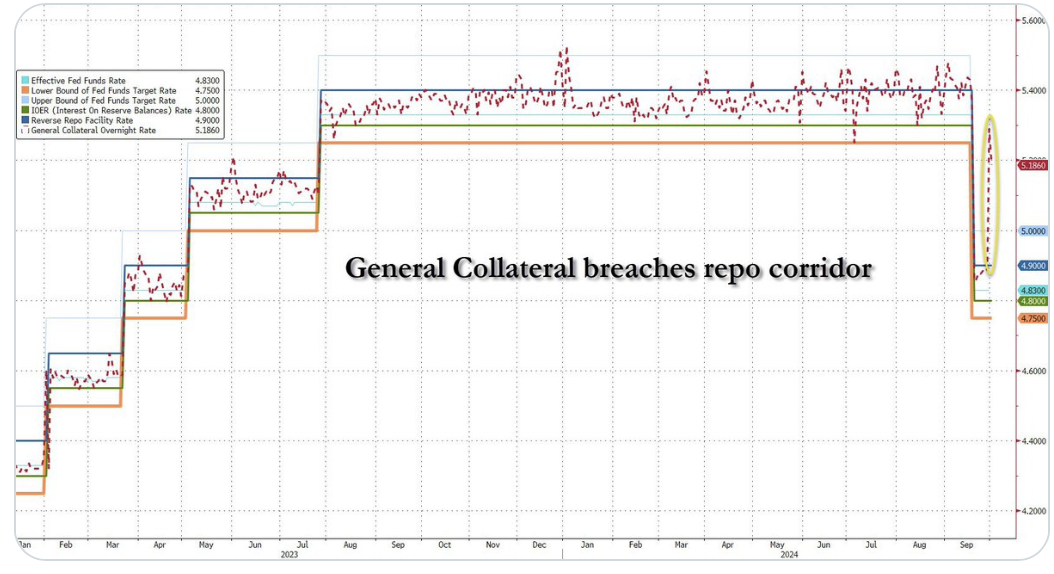
In the bond market, yields continue to edge higher with Treasuries gaining 3bps and European sovereigns all looking at gains of between 3bps and 5bps.  An interesting interest rate phenomenon that has not gotten much press is that the fact that at the end of September, the General Collateral Repo rate surged through the upper bound of the Fed funds rate, a condition that describes a potential dearth of liquidity in the markets.  

Source: zerohedge.com

The implication is that QT may well be ending soon in order for the Fed to be certain that there are sufficient bank reserves available for banks to meet their regulatory targets and not starve the economy of capital.  It has always been unclear how the Fed can start cutting rates while continuing to shrink the balance sheet as that was simultaneously tightening and easing policy, but it appears that we are much closer to universal policy ease, something else that will weigh on the dollar and support commodity prices over time.

Speaking of commodities, after yesterday’s rally, this morning, the metals complex is continuing modestly higher (Au +0.3%, cu +0.4%) but oil (-0.8%) is backing off a bit.  So much of the oil trade appears linked to the Middle East it is very difficult to discern the underlying supply/demand dynamics right now.

Finally, the dollar, after several days of strength, is consolidating and is little changed to slightly higher.  The DXY is trading right at 103 and the euro is hovering just above 1.09 with USDJPY at 149.00.  Several weeks ago, these numbers would have seemed ridiculous given the then current view of the Fed aggressively cutting rates.  But now, all that bearishness is fading, and it is true vs. almost every currency, G10 or EMG this morning.

On the data front, PPI leads the way this morning although given we already got the CPI data, it will have virtually no impact I would expect.  Estimates are for headline (0.1% M/M, 1.6% Y/Y) and core (0.2% M/M, 2.7% Y/Y).  As well, we get Michigan Sentiment (70.8) at 10:00 and we will hear from several more Fed speakers, including Governor Bowman, the dissenter at the FOMC meeting who looks quite prescient now.  One thing to note is yesterday’s Initial Claims data was much higher than expected at 258K, but that was attributed to the effects of Hurricane Helene, and now that Hurricane Milton has hit, I expect that those claims numbers will be a mess for a few more weeks before all the impact has passed through.

While Fedspeak remains far more dovish than the data, my take is if the data continues to show economic strength, especially if the next NFP release, which is just before the FOMC meeting, is strong again, the Fed will be hard pressed to cut even 25bps then.  For now, good economic news should support the dollar and weigh on bonds.

Good luck and good weekend

Adf

Clouded and Blurry

The Minutes explained twenty-five
Would likely still let markets thrive
But Powell demanded
A half, lest they landed
The ‘conomy in a crash dive


Yesterday’s release of the FOMC Minutes was enlightening to the extent it showed Chairman Powell did not have everybody in agreement for his 50bp rate cut last month.  In the Fed’s own words, “…a substantial majority of participants supported lowering the target range for the federal funds rate by 50 basis points to 4-3/4 to 5 percent.  However, noting that inflation was still somewhat elevated while economic growth remained solid and unemployment remained low, some participants observed that they would have preferred a 25 basis point reduction of the target range at this meeting, and a few others indicated that they could have supported such a decision.”  

Remember, too, that this meeting was held two days prior to the NFP report which changed a great deal of thinking on the subject, not least by the Fed funds futures market which as of this morning is pricing a 20% probability of no cut at the November meeting.  Looking at the GDPNow calculation from the Atlanta Fed, that NFP number increased the estimate to 3.4%, although recent inventory data has seen it slip back a tick as you can see below.  

Source: atlantafed.org

Despite that last little dip, though, the estimate remains far stronger than economists’ forecasts and paints a picture of a resilient economy.  (Perhaps adding $1.8 trillion via the budget deficit has something to do with that, but that is a story for a different time.). While the Fed is clearly anxious, if not desperate, to cut rates further, the economic case, with inflation remaining above their targets and the employment situation looking better amid solid economic growth, seems to be waning.

Three weeks ago, Jay and the Fed
Said joblessness was their, flag, red
Explaining inflation
Had taken vacation
So, more cutting rates was ahead
 
This morning we’ll learn if that’s true
Or if, like employment, their view
Is clouded and blurry
Which could cause some worry
For bulls and for Biden’s whole crew

Which leads us to the other key market story today (clearly the devastation from Hurricane Milton is the most important news of the day and my thoughts and prayers go to all those in its path), the CPI report.  Current consensus expectations are for a 0.1% rise in the monthly headline reading which translates to a 2.3% Y/Y increase and a 0.2% rise in the monthly core reading which translates into a 3.2% Y/Y increase.  

Looking at some obvious pieces of the puzzle, gasoline prices fell 8.4% in September, which is one of the reasons the headline number is below the core number.  The thing is, gasoline prices this morning are almost exactly where they were at the beginning of September, which informs us that the headline number could easily retrace somewhat next month.  The point is, we need to keep our eye on the core number (after all, the reason they created it was because food and energy prices were volatile and monetary policy’s impact on them virtually nonexistent, so they needed something that might give them a better feel for the reality elsewhere).  And I don’t know about you, but if the target is 2.0% then 3.2% doesn’t seem that close.  I know they are focused on core PCE, but even that remains well above their target.

One of the stories around this morning is that used car prices have stopped declining and that could have an outsized impact resulting in a higher than otherwise reading.  But in reality, I question whether this matters at all.  What we have learned from the Fed over the past month is that they are going to cut rates no matter what.  While the pace of those cuts may be faster or slower depending on some data, every Fed speaker this week, and even a review of the Minutes, points to the fact that they are all desperate to keep cutting rates.

But you know who is taking exception to that stance?  The bond market.  Perhaps the bond vigilantes of late 90’s fame have been resurrected, or perhaps investors are simply looking at the fiscal situation in the US, where deficit spending continues to increase which means more and more Treasury debt will need to be issued and decided that even 4.0% is no longer a reasonable nominal return on their investment.

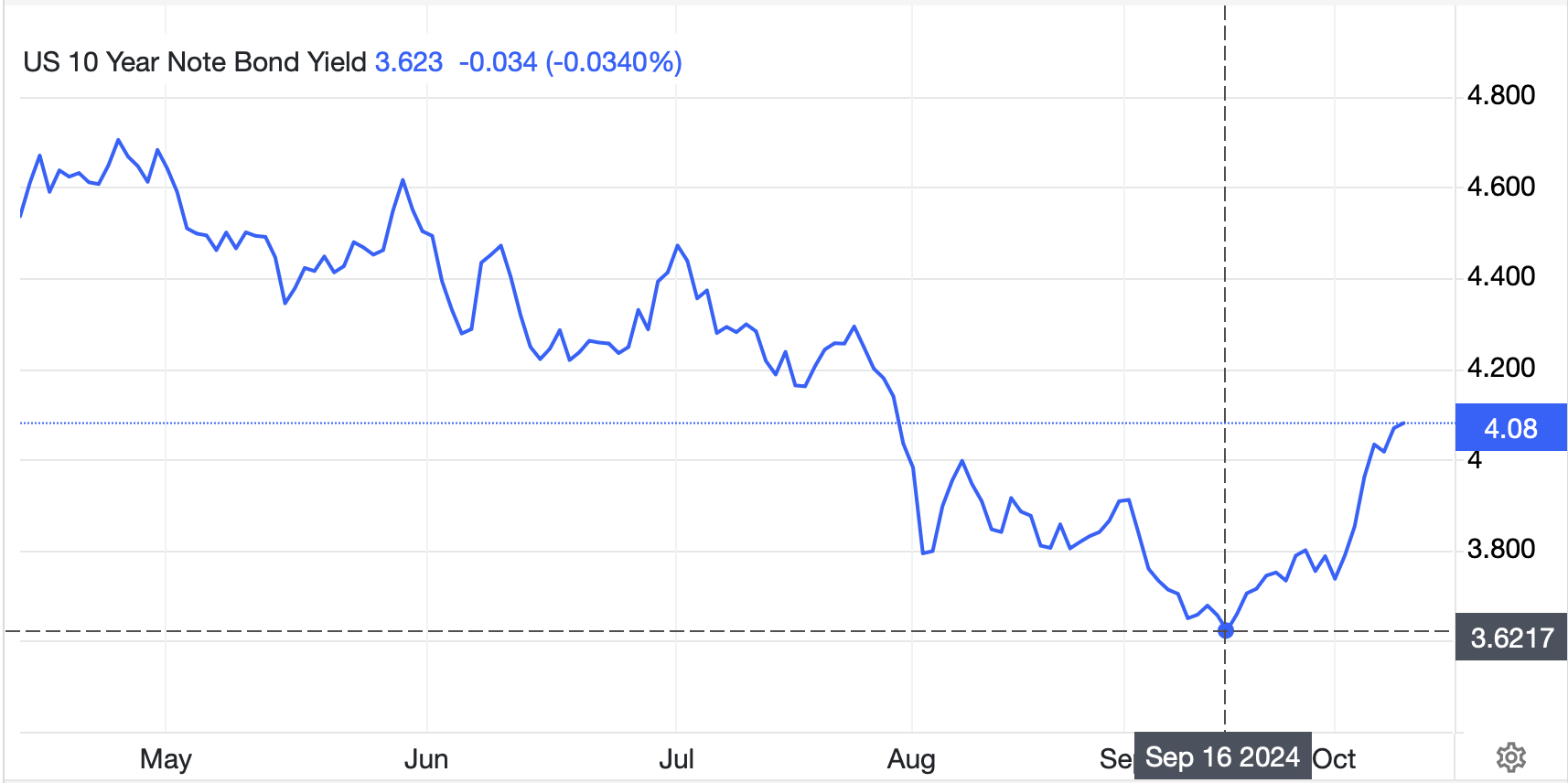
As you can see below, 10-year Treasury yields have risen 46bps since just before the last FOMC meeting as the stronger US data combined with the Fed’s clear focus on cutting rates has made investors nervous.  

Source: tradingeconomics.com

You may recall the discussion about the inverted yield curve, where 2yr yields traded above 10yr yields for more than two full years, a record amount of time.  This fostered many recession calls as historically this has been a harbinger of a future recession.  However, a key question was whether the disinversion would be a bull (falling 2yr yields) or bear (rising 10yr yields) steepener.  Things started as a bull steepener with the Fed cutting rates, but lately, as we watch 10yr yields rise, fears are growing that inflation is making a comeback and the bond bears are going to drive this process.  A bear steepening is not going to be a welcome result for Powell and friends, nor especially for Ms Yellen, as the cost of debt will continue to rise.  It also speaks to concerns that the Fed has lost control of the narrative.  It is still too early to declare the outcome, but the original, widely held view of a bull steepener is fraying at the seams.

Ok, let’s quickly touch on overnight markets.  Yesterday’s US rally saw follow through in Japan (+0.25%) alongside a weakening yen (-0.75% yesterday, +0.2% this morning) and in China (+1.1%) and Hong Kong (+3.0%) after the PBOC detailed the support they would be giving to equity market players and indicated that more could follow.  As to the rest of the region, there were more gainers than laggards but nothing of real note.  In Europe, although most markets are little changed on the day, if leaning slightly lower, Spain’s IBEX (-0.9%) is the outlier on what seems to be profit taking ahead of the US CPI number after a strong 5-day run higher.  And at this hour (7:10) US futures are pointing slightly lower, about -0.2%.

In the bond market, yields continue to climb around the world with Treasuries adding 1bp and most of Europe seeing yields rise 2bps – 3bps.  The largest mover there, though is the UK (+6bps) as the market there prepares for Chancellor Rachel Reeves’ first budget and implies they are not expecting fiscal prudence.  In Japan, JGB yields rose 2bps and are now at 0.94% as given the turnaround in rates globally, expectations are growing for the BOJ to consider another hike.  In fact, ex-BOJ member Kazuo Momma was quoted last night saying that if USDJPY goes back above 150, the BOJ is likely to move before the January meeting currently expected.

Commodity markets are taking a breather from their recent rout with oil (+1.4%) leading the energy group higher while gold (+0.4%) leads the metals complex.  It has been a rough week for commodity bulls (this poet included) but nothing has changed the long-term picture in my view.  This is especially true if the Fed does cut rates regardless of the stronger data.

Finally, the dollar is continuing to show strength with the DXY pushing back to 103 and the euro back down near 1.09.  It seems clear the market is adjusting its views as to how much the Fed is going to cut based on the data, not the Fedspeak, and that turn, from an uber dovish Fed to one less dovish is going to support the greenback.  ZAR (+0.45%) is this morning’s outlier as it follows gold prices higher, but that is the largest movement across either the G10 or EMG blocs.  It seems everybody is awaiting the CPI data.

In addition to the CPI, we see the weekly Initial (exp 230K) and Continuing (1830K) Claims data and we hear from Gvoernor Lisa Cook, one of the more dovish Fed governors.  But for now, it is all CPI all the time.  My take is a soft number will be seen as a signal the Fed will be cutting aggressively and help stocks and commodities while undermining the dollar with a strong number doing the opposite.  Bonds, though, are much trickier here as I think there are a lot of fiscal concerns being priced in, and lower inflation won’t solve that problem in the short run.

Good luck

Adf

Recalibration


All week we had heard many clues
That fifty is what Jay would choose
And that’s what he cut
With only one but
From Bowman, who shuns interviews
 
The key is now recalibration
In order to tackle inflation
Without driving higher
The joblessness spire
So, trust us, it’s all celebration


Recent indicators suggest that economic activity has continued to expand at a solid pace. Job gains have slowed, and the unemployment rate has moved up but remains lowInflation has made further progress toward the Committee’s 2 percent objective but remains somewhat elevated.” [emphasis added]

Reading the opening paragraph of the FOMC Statement, it might be confusing as to why they needed to cut rates 50bps.  After all, the economy is expanding at a solid pace (In fact, after the Retail Sales data on Tuesday, the Atlanta Fed’s GDPNow reading for Q3 is up to 3.0%!)  unemployment remains low and inflation is still somewhat elevated.  I know I am a simple poet, but the plain meaning of those words just doesn’t lead my thinking to, damn, we better cut 50 to get started.  But I guess that is just another reason I am not a member of the FOMC.

Perhaps the more interesting thing was the Summary of Economic Projections and the dot plot which showed that while expectations were for rates to fall far more dramatically than in June, the longer run expectations continue to rise.  In fact, Chairman Powell specifically addressed the SEP in the press conference, “If you look at the SEP you’ll see that it’s a process of recalibrating our policy stance away from where we had it a year ago when inflation was high and unemployment low to a place that’s more appropriate, given where we are now and where we expect to be, and that process will take place over time.” [emphasis added] In fact, there was a lot of recalibrating going on as that appears to be the Chairman’s new favorite word, using it 8 times in the press conference.

Source: federalreserve.cgov

Notice that their current forecasts are for GDP to slow to 2.0% with Unemployment edging only slightly higher while PCE inflation magically returns to their 2.0% target.  And take a look at the last two lines, with the Fed funds rate projections falling substantially for the next three years, far more quickly than their previous views, although they think the long-run level will be higher.  

I wonder about that last issue.  Historically, the thought was that the long run Fed funds rate would be inflation (2.0%) + real interest rate (0.5%) and they pegged it at 2.5% for years.  Now that they see it at 2.9%, is that because they think inflation is going to be higher (not according to their projections) which means that for some reason they think real interest rates are going to be higher.  However, when asked, Chairman Powell and every member of the board has been unable to explain this change.

But what really matters is how have markets responded to this earth-shattering news?  The initial movement was as expected, with stocks rallying sharply (see chart below) and yields sliding along with the dollar while commodities rallied.

Source: Bloomberg.com

But a funny thing happened on the way to the close, as can be seen in the chart.  Stocks gave back all their gains and then some, with all three major indices lower on the session while 10yr Treasury yields backed up 7bps and the dollar rebounded.  Arguably, this was a sell the news response, but we need to be careful.  Remember, there are many analysts who believe the economy is in deep trouble already and by starting off with a big cut, those with paranoia may be wondering what the Fed knows that the data, at least the headline data, is not really showing.

So much for yesterday, now let’s look at markets this morning beyond the initial knee-jerk responses.  Absent any other major news or data (Norgesbank leaving rates on hold doesn’t count as major), markets have played out far more along the lines of what would have been expected in the wake of a 50bp cut.  In other words, the dollar has fallen sharply against almost all its counterparts, equity markets have rallied around the world, commodity prices have rallied sharply, and bond yields are…unchanged? 

Which brings us to the question that has yet to be answered.  Which market is right, stocks or bonds?  They appear to be telling us different stories with stocks pushing to new highs amid rising multiples and rising profit growth expectations while bonds are pricing in another 200bps of rate cuts by the end of 2025, an outcome that would only seem to make sense in the event the economy fell into a recession.  But if we are in a recession, corporate earnings seem highly unlikely to rise as much as currently forecast and typically, P/E multiples contract.  Meanwhile, if the economy is humming along such that current equity pricing is warranted, what will be the driver for the Fed to cut rates as that will almost certainly reignite inflation.  

History has shown that the bond market tends to get these big questions right when they are pointing in different directions, but that doesn’t mean that risk assets will stop rallying right away.  In fact, this will likely take quite a while to play out.

Ok, so let’s put a little more detail on the market activity overnight.  Tokyo rocked (+2.0%) as did Hong Kong (+2.0%), Taiwan (+1.7%), Singapore (+1.1%) and even mainland China (+0.8%) managed to rally some.  It appears that investors around the world believe the Fed has opened the floodgates for a much lower interest rate environment everywhere.  European bourses, too, are sharply higher led by the CAC (+2.1%) but with strength across the board (DAX +1.5%, FTSE 100 +1.3%).  And US futures have shaken off the late selloff yesterday and are firmly higher this morning led by the NASDAQ (+2.2%).

Bond yields, though, are largely unchanged on the day, with yesterday’s backup in Treasury yields maintained and European sovereigns all within 1bp of yesterday’s close.  It appears that bond investors are less confident in a soft landing than equity investors.  Interestingly, JGB yields rose 2bps last night as Japanese markets prepare for the BOJ meeting tonight.

In the commodity markets, oil (0.75%) is continuing its recent rebound after another massive inventory draw was revealed by the EIA yesterday prior to the Fed meeting.  There is a growing concern that inventories in Cushing, Oklahoma are falling to a point where products like gasoline and diesel will not be able to be produced.  As an example, gasoline futures have risen far more than crude futures this week on that fear.  As to the metals markets, gold briefly touched $2600/oz yesterday immediately in the wake of the FOMC but sold off hard afterwards.  This morning, however, it is back pushing up to that level again and the entire metals complex is rising nicely.

Finally, the dollar, has been a whipsaw of late.  Post the FOMC, it fell sharply across the board, and then into yesterday’s close it rebounded to close higher on the day.  However, this morning it has given back all those late gains and then some, and is now sitting at its lowest level, at least per the DXY, since April 2022.  This morning, in the G10, we are seeing many currencies rally between 0.5% (EUR) and 1.3% (NOK) vs the dollar and everywhere in between.  The one exception to that is the yen (-0.2%) which is biding its time ahead of the BOJ meeting.  The working assumption is that the BOJ will do nothing tonight, but now that the Fed has cut 50bps, and given Ueda-san’s history of actively trying to surprise markets to achieve outcomes he wants, we cannot rule out another rate hike in Japan.  Monday morning, USDJPY fell below 140 for the first time in 18 months.  My take is Ueda-san is quite comfortable with it heading back to the 130 level, if not the 120 level.  If he were to surprise markets and raise the base rate by even 10bps tonight, I think we would see a sea change in sentiment and a much lower dollar.  And given inflation in Japan seems to have stalled at 2.8%, well above their 2.0% target, he has a built-in excuse.

Too, watch the CNY (+0.45%) as it is now trading at its highest level (weakest dollar) in more than a year, and is approaching the big, round number of 7.00.  the linkage between JPY and CNY is tight as they constantly compete in markets, especially now in autos and electronics.  If the Fed is really going to cut as much as markets are pricing, both these currencies should strengthen much further.

It is almost anticlimactic to discuss the data today but here goes.  First, the BOE left rates on hold, as expected and the market impact was limited.  Expectations are they will cut next in November.  As to data, we see Initial (exp 230K) and Continuing (1850K) Claims, Philly Fed (-1.0) and Existing Home Sales (3.90M).  None of that is likely to change any views.  Prior to the BOJ meeting, at 7:30 this evening we see Japanese CPI, which may change views there.

For now, the dollar is very likely to remain on its back foot as enthusiasm builds for multiple rate cuts by the Fed going forward.  However, if the data continues to impress like it has lately, that enthusiasm will need to be tempered.

Good luck

Adf

Fednesday

Well, Fednesday is finally here
And traders, for fifty, still cheer
But arguably
The prices we see
Account for a half-point rate shear
 
So, if they just cut twenty-five
Prepare for a market nosedive
The doves will all scream
Jay’s killing the dream
While hawks everywhere all will thrive


First, I did not create the term Fednesday, I saw it on Twitter but thought it quite appropriate.  In fact, looking, I cannot determine who did create it but kudos to them.

As I have already written twice on the subject of today’s meeting, I will be brief this morning, especially because not much has changed.  Yesterday’s stronger than expected Retail Sales data resulted in Fed funds futures reducing the probability of a 50bp hike during the session, but overnight, we have returned to the 65%/35% probability spectrum for a 50bp cut.  I continue to believe that will be the case based on the number of articles we have seen in the mainstream media about the merits of a 50bp cut, mostly centering on the idea that rates are “too” high despite the fact that growth continues apace, the employment situation remains solid, if cooling somewhat, and inflation remains well above target.  Perhaps the big surprise will be that there will be a dissent on the vote, something we have not seen in two years.  (In fact, the last time a governor dissented was 2006 I believe).  

But something I have not touched on is the dot plot which will give us an idea as to the members’ collective belief for the rest of the year.  For instance, if the dot plot indicates Fed funds will be at 4.5% by year end, then 25bps today will be followed by at least one 50bp cut.  That should be net equity bullish and bearish for the dollar.  If the dot plot indicates only 75bps of cuts, so 4.75% at year end, my take is that will be seen as somewhat hawkish overall, and we should see risk assets decline while the dollar rallies.  Finally, if it is more than 100bps expected, I think that could be a situation of the market asking, what does the Fed know that we don’t?  That would not be a positive for risk assets but would also hammer the dollar.  Bonds would rally as would gold.  At least those are my views.

Moving on, tomorrow brings a BOE meeting where the current expectation is for no cut, although one is priced for the next meeting in the beginning of November.  Early this morning, the UK released its inflation report which showed headline CPI at 2.2%, as expected while the core rate rose to 3.6%, a tick more than expectations and up 0.3% from the July reading.  Arguably, that is what has the BOE concerned, the fact that despite the decline in energy prices which has taken headline CPI lower, the underlying stickiness of inflation remains extant within the UK.  As well, the UK also released its PPI data, all of which showed declines greater than expected, if nothing else implying that UK corporate margins should be healthy.  The pound (+0.35%) has rallied on the news, although the dollar is weaker overall, so just how much of this move is UK related is open to debate.  I guess we can say that the short-term differences in central bank stance is likely to continue to help the pound for a while.  In fact, the pound is back to levels last seen in summer 2022 and there is a growing bullish sentiment for the currency based on current perceptions of the divergence between the Fed and BOE.  My view is the BOE will fall in line pretty quickly so this will change, but for now, especially with the dollar under broad pressure, the pound has further to go.

On Friday we’ll learn
If Ueda can once more
Surprise one and all

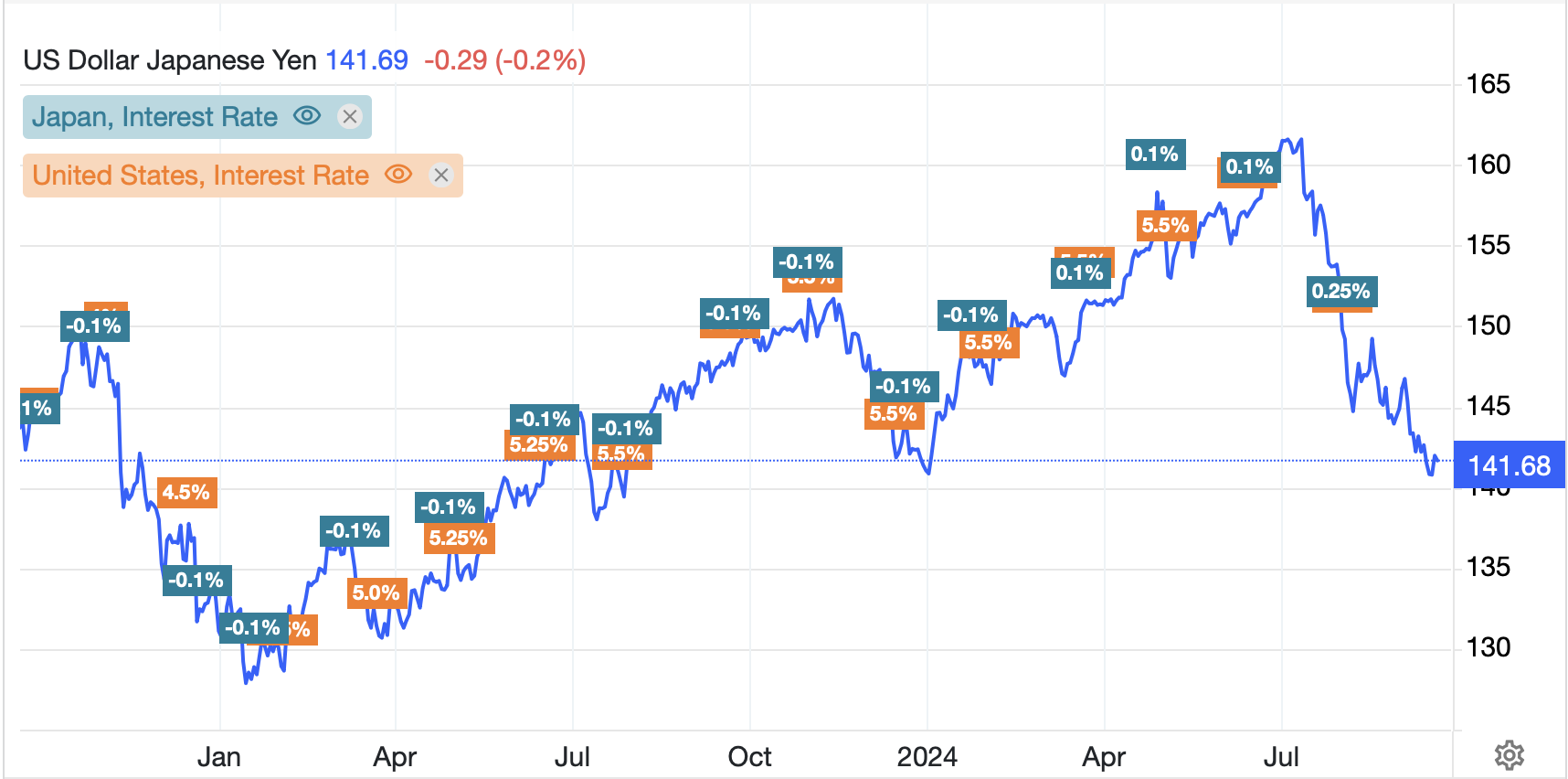
The other central bank meeting this week is the BOJ early Friday morning.  Currently, there is no expectation of a BOJ policy change although many analysts are looking for a rate hike by December.  However, I think it is worth looking at USDJPY in relation to the policy adjustments we have seen by both central banks over the past several years.  Hopefully you can see in the chart below that the exchange rate here has returned to the level when the Fed last raised rates in July 2023.  

Source: tradineconomics.com

Since then, after a dramatic further decline in the yen, with both policy rates on hold, the BOJ first adjusted the cap on YCC higher (from 0.50% to 1.0%) then eventually raised the policy rate from -0.1% to +0.25% where it is today.  During that time, Ueda-san has surprised markets several times, and has had help from the MOF regarding intervention, taking a completely different approach to the process than the Fed, who never wants to surprise markets. With this in mind, we must be prepared for another surprise on Friday.  One thing to remember is that the BOJ meeting announcement occurs after the market in Tokyo closes, so even though other markets, and of course the FX market will be able to respond, the Tokyo equity and JGB markets won’t be able to move until Monday.  The point is the reaction may take time to play out.  In this situation, I don’t have enough information to take a view, but I will say that if he tightens policy in any manner, USDJPY is likely to fall much further.

One other thing I realize is that I have not discussed QT/QE.  If the Fed changes that process, the current $25 billion/month of balance sheet runoff, that will be extremely dovish and be quite a boost for stocks, bonds and commodities while the dollar will get run over.

Ok, heading into this morning, and after a mixed and lackluster session yesterday in the US, Asian equity market all rallied with Japan (+0.5%) continuing its recent rally, while even mainland Chinese shares (CSI 300 +0.4%) managed a gain today.  However, European bourses are all softer this morning with the FTSE 100 (-0.6%) lagging after the higher-than-expected inflation data driving concerns the BOE won’t cut rates much.  But screens everywhere are red, albeit only modestly so.  US futures are currently (7:45) edging slightly higher as I continue to believe traders and investors are looking for a 50bp cut.

In the bond market, yields are higher across the board as the euphoria we have seen lately seems to be running into a bit of profit taking with Treasury yields higher by 3bps and European sovereign yields all higher by between 4bps and 6bps.  Perhaps the one surprise is that JGB yields are unchanged this morning as there seems to be no anticipation of a BOJ move, at least not yet.

In the commodity markets, oil (-1.0%) is giving back some of its recent gains but remains above $70/bbl.  It seems that the stories of a massive military strike by Ukraine deep in Russia have raised concerns amongst the punditry of an escalation of the war there, but it has not concerned energy markets, at least not yet.  In the metals markets, gold (+0.2%), which sold off yesterday, continues to find support while copper has been on a roll and has risen once again.  

Finally, as mentioned above, the dollar is softer overall against all its G10 counterparts and most EMG currencies as well. The one outlier here was KRW (-0.35%) where traders are starting to price in rate cuts by the BOK after yet another mild inflation report earlier this week.

Ahead of the Fed we see Housing Starts (exp 1.31M) and Building Permits (1.41M) as well as the EIA oil inventory data where expectations are for no real changes.  Until the FOMC release, look for quiet markets. Afterwards, I’ve given my views above.

Good luck

Adf

Lately Downturned

The story is still ‘bout the Fed
And whether, when looking ahead
They see skies are blue
And so, they eschew
A rate cut the bears will all dread
 
But if they are growing concerned
The ‘conomy’s lately downturned
Then fifty will be
What we all will see
And bears, once again, will be spurned


As we move closer to the FOMC announcement and Powell press conference, the nature of the discussion has focused entirely on the size of the rate cut that will be announced tomorrow.  Yet again this morning, the Fed whisperer, Nick Timiraos at the WSJpublished an article on the subject, once again making the case for 50 basis points.  The money quote is below:

“Fed officials aren’t likely to regret a larger rate cut this week if the economy chugs along between now and their next meeting, in early November, because rates will still be at a relatively high level, he said. But if the Fed makes a smaller move and the labor market deteriorates more rapidly, officials will feel greater regret.”

As well, the futures market is growing more and more certain 50bps is coming as evidenced by the pricing this morning as per the below chart from the CME:

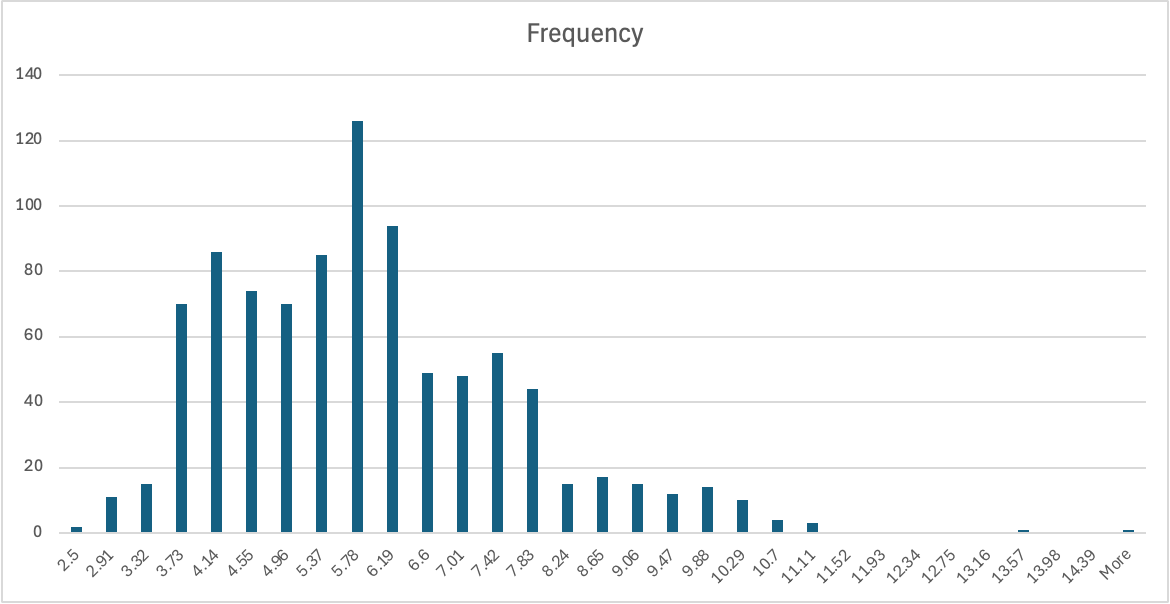
The interesting thing is that an unbiased (if such a thing exists) look at the data does not scream out to me that the economy is collapsing such that an aggressive start to an easing cycle is necessary.  Unemployment remains in the lowest quintile of outcomes over the past 76 years.  For reference, the median reading since January 1948 has been 5.5%, the average has been 5.7% and today it is at 4.2%.  The chart below shows the distribution of outcomes over the entire data series from the FRED database.

Data source: FRED database; calculation: fx_poetry.com

It is difficult to look at this chart and think the economy is imploding.  And let us consider another thing, the widely mentioned long and variable lags by which monetary policy impacts the economy.  Whatever the Fed does tomorrow, the impact on almost the entire economy will not be felt for at least a year, if not much longer than that.  After all, do companies really make a borrowing decision based on the marginal 25bps of interest cost per annum?  I would argue that most corporate borrowing is based entirely on their current schedule of maturing debt and any forecast needs for capex or other funding.  It strikes me that whether the Fed funds rate is 5.25% or 5.00% is not going to change much in the real economy.

Markets, of course, are a different kettle of fish in this discussion, but let’s face it, the bond market has already priced in 250 basis points of cuts in the next twelve months, so whether they start with 25 or 50 seems less relevant than the destination.  Certainly, the equity market will try to goose things on a 50bp cut, and will almost certainly fall if the cut is only 25bps, at least initially, but again, will corporate profits change that much in the short-run because of this move?

In the end, I fear we make far too much of the outcome, at least in this case.  Now, if Powell and the Fed were to decide that the recent call for a 75bp cut by three senators was an eloquent argument and did that, the market surprise would be substantial and the initial move in risky assets would be higher.  But something like that would also engender fears that the Fed knows something bad about the economy that the rest of us have missed, and that would result in its own negative consequences. I guess the good news is we only have another 30 hours or so before we find out.

As to the market activity overnight, yesterday’s mixed US equity performance, with the DJIA making new all-time highs while the NASDAQ fell -0.5%, led to weakness in Tokyo (Nikkei -1.0%) as tech shares underperformed, but strength in HK (+1.4%) and much of the rest of Asia that was open.  Both China and South Korea remained closed for holidays.  In Europe, though, given the virtual lack of technology shares available, the DJIA was the template with all markets higher this morning led by Spain’s IBEX (+1.25%)), but with robust gains elsewhere on the order of +0.6% to +0.8%.  As to US futures, at this hour (7:30), they are higher by about 0.25%.

In the bond market, yields continue to edge lower overall.  While Treasuries are unchanged this morning, that follows another 2bp decline yesterday afternoon.  In Europe this morning, sovereign yields are all lower by between -1bp and -3bps, catching up (down?) to the Treasury market as well as responding to pretty awful German ZEW numbers (Sentiment 3.6 vs. 17.0 expected and 19.2 last month; Current Conditions -84.5 vs. -80.0 expected and -77.3 last month).  Germany remains the sick man of Europe and there is no doubt that they need to see the ECB start to cut rates more aggressively to help support their withering manufacturing sector.  And one more thing, JGB yields fell -2bps last night and are now at 0.81% in the 10yr.  While the focus will turn to the BOJ at the end of the week after the FOMC announcement tomorrow, the market does not appear to be particularly concerned over aggressive tightening there.

In the commodity markets, WTI (+0.15%) has crept back above $70/bbl for the first time in nearly two weeks as the big story in the market revolves around the net speculative Comex positioning which has turned negative for the first time ever.  That means that hedge funds and speculators are net short oil futures.  While they may have a negative outlook, the positioning does indicate there is an opportunity for a massive short-squeeze sometime going forward.  As to the metals markets, they are little changed this morning, broadly holding their recent gains with both precious and industrial metals all showing healthy gains in the past week.  A 50bp cut should support prices across the board here.

Finally, the dollar is softer again this morning, but by a modest amount, about -0.1% across the board.  Those are the types of gains we have seen across the G10 and most of the EMG currencies with one outlier, MXN (-0.9%).  However, the peso, which had strengthened nearly one full peso in the past four trading sessions looks more like it is responding to that movement than to any fundamental changes.  The judicial review story is now old news although there may be some concerns that Banxico will cut more aggressively next week if the Fed does so tomorrow.

On the data front, this morning brings Retail Sales (exp -0.2%, ex autos +0.2%) as well as IP (0.2%) and Capacity Utilization (77.9%).  We also hear from Dallas Fed president Logan this morning.  It’s funny, a strong Retail Sales number could well weigh on the chances for a 50bp cut as further evidence that things continue to be moving along fine.  Remember, even though inflation has been trending lower, it is not yet nearly at its target.  Retail Sales strength would indicate that employment remains robust as people spend money more readily when they have a paycheck, so the need for more stimulus may just not be that critical.

In the end, my best take is the Fed is going to cut 50bps tomorrow and the market is going to increasingly price that in as the session unfolds.  This will be especially true if Retail Sales is weaker than forecast, but even if it surprises on the upside, I remain convinced Powell wants to cut 50bps based on the number of articles discussing the idea in the mainstream press.  Ultimately, I think the dollar will suffer a bit further on that move and commodities will be the big winners.

Good luck

Adf

More Than a Pen

Twas just about two months ago
When President Trump was laid low
As bullets were flying
With somebody trying
To end his campaign in one blow
 
And now, yesterday, once again
A shooter used more than a pen
To try to rewrite
The vote that’s so tight
Enthused to act by CNN
 
By now, you are all aware of the second assassination attempt on former president Donald Trump’s life, this time while he was playing golf at his course in Palm Beach.  The difference, this time, is the alleged shooter was caught alive, so it will be very interesting to hear what he says under questioning and as this situation progresses.  While this is obviously newsworthy, it did not have a major market impact as investors are far more focused on the Fed coming Wednesday and then the BOJ on Friday.  As such, as I write (6:20) US equity futures are mixed with modest movements of +/-0.2%.
 
In China, poor President Xi
Is finding that his ‘conomy
Is not really growing
In fact, it is slowing
Much faster than he’d like to see

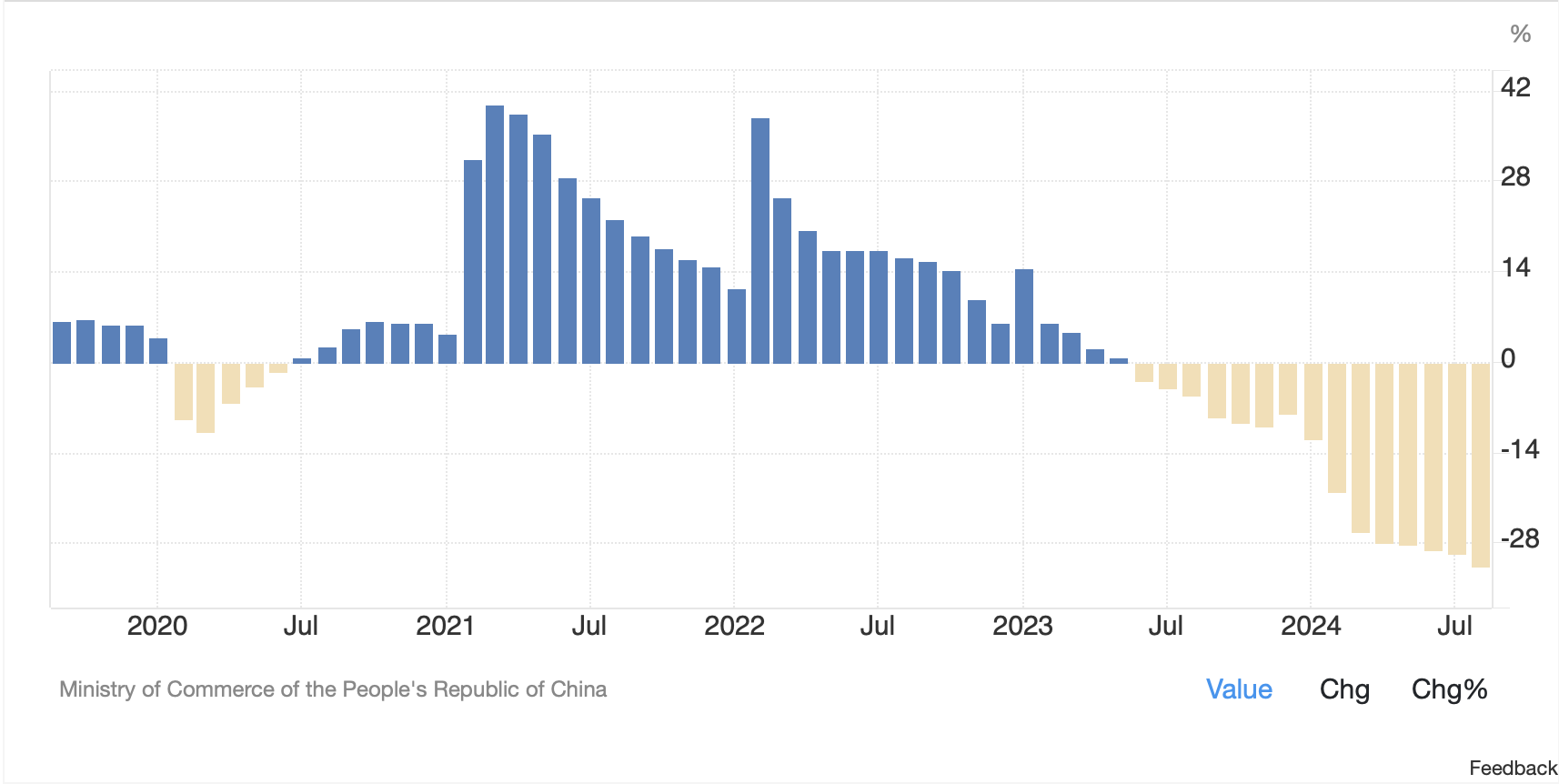
While last night there were different holidays in China, Japan and South Korea, causing all three markets to be closed, Saturday morning, the Chinese released their monthly data drop regarding IP (4.5%), Retail Sales (2.1%) and Fixed Asset Investment (3.4%) along with the Unemployment Rate (5.3%).  Then on Saturday evening here, they released their Foreign Direct Investment (-31.5%) with every one of those figures worse than the previous reading and worse than forecasts.  The evidence continues to show that the Chinese economy is slowing and seems to be slowing more quickly than previously anticipated.  In truth, from my perspective, the biggest concern Xi has is the FDI decline, which as can be seen below, has been falling (net, foreign investors are exiting China) for the past 15 months, and at an accelerating rate. 

Source: tradingeconomics.com

This bodes ill for President Xi’s 5.0% GDP growth target for 2024 and the working assumption amongst the market punditry is that he will soon announce fiscal stimulus in order to get things back on track.  Of course, one of the key problems is that not only are economies elsewhere in the world slowing down, thus reducing demand for Chinese exports, but as well, the expansion of tariffs on Chinese goods by the West continues apace, slowing that data even further.  I saw an estimate this morning that Chinese families have seen $18 trillion of wealth evaporate as the property market in China continues to decline which undoubtedly weighs on consumer sentiment and activity.  But Xi is going to have to do something to prevent a revolution, because remember, the basic Chinese Communist Party contract with the people is we will bring you economic betterment and you let us rule.  If they don’t achieve better economic growth, the population, especially the millions of unemployed young men, may get restless.  While I am not forecasting a revolution, this is typically a precursor to the process.

On Wednesday, the time will arrive
When Jay and his minions contrive
To try to explain
Their easing campaign
And hope stocks don’t take a swan dive

Now to the most important market story this week, will the Fed cut rates by 25bps or 50bps?  It’s funny, if you read independent economic analysis, both sides make their case, and not surprisingly, given the mixed data we have received over the past several months, each case makes some sense.  But…that is not the information you get when reading the press.  The WSJ, inparticular, is really banging the drum for a 50bp cut and many more to follow.  You will recall that Friday, the Fed whisperer was out with his latest piece discussing the merits of a 50bp cut.  Well, this morning there are two more articles, one by pundit Greg Ip basically begging for a 50bp cut, and one by a trio of authors laying out the case and coming down strongly on the side of 50bps.  

All this has helped push Fed funds futures to a 59% probability of a 50bp cut as of this morning.  As some have pointed out on X(fka Twitter), in the past, when there was uncertainty about a Fed move, they managed to get the word out as to what they wanted to do during the quiet period via articles like the ones above and sway markets to their preferred outcome.  As such, at this point I assume we are going to see a 50bp cut on Wednesday.

I guess the real question is what will the impact on markets be?  This morning, we are already seeing the impact in the FX market, with the dollar under pressure across the board.  Versus its G10 counterparts, it has declined by between 0.4% and 0.6% against all except CAD, which remains very tightly linked to the dollar and has gained just 0.1% this morning.  But this movement seems entirely a result of the belief that 50bps is coming.  In the EMG bloc, though, the picture is more mixed with some significant gainers (KRW +0.8%, CE4 +0.5%, ZAR +0.6%) but most other currencies little changed overall.  Nevertheless, the market is clearly pricing for 50bps across the board now and I expect that by Wednesday morning, the Fed funds futures market will reflect that as well.

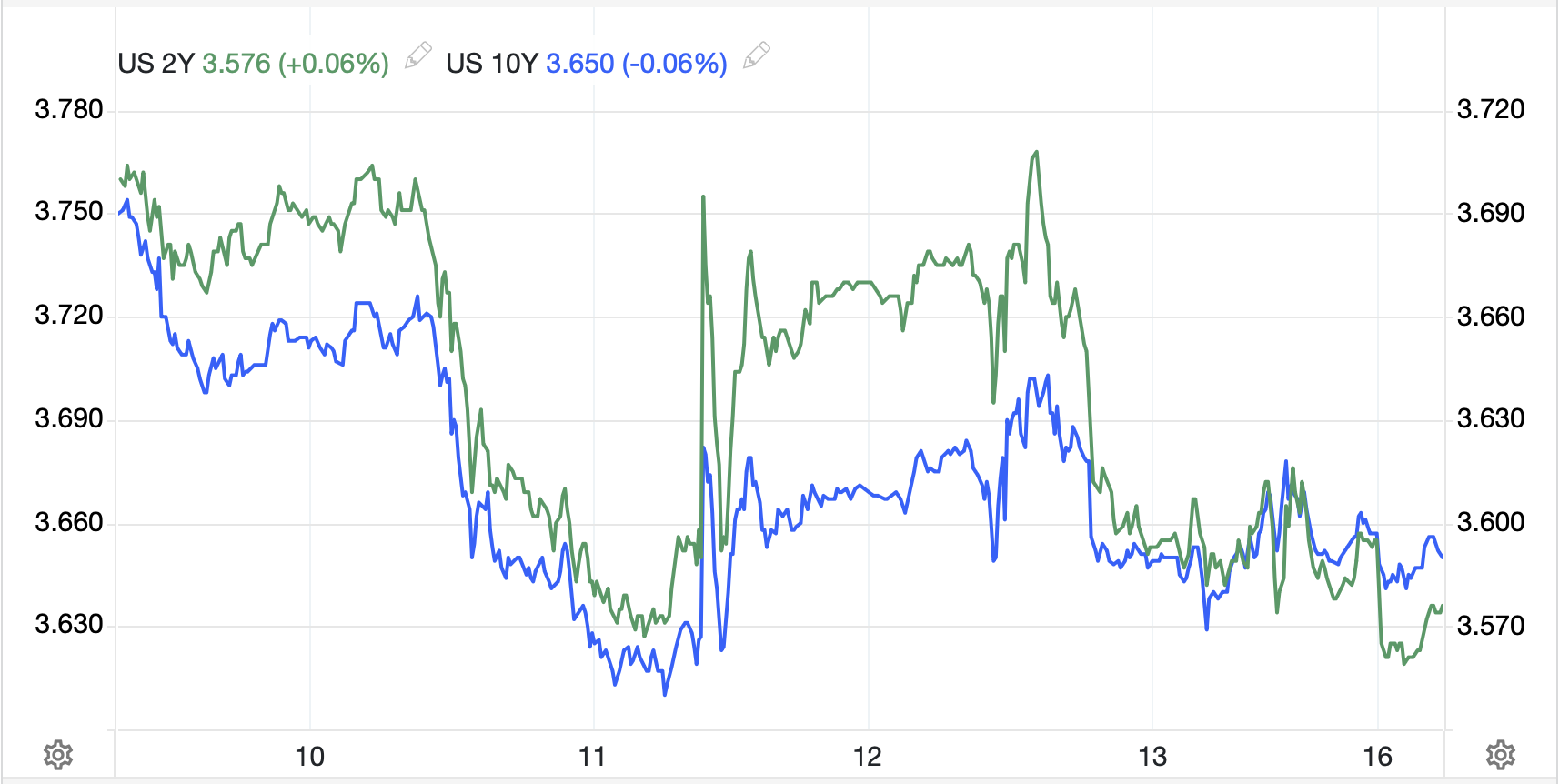
But a weaker dollar is probably not the Fed’s goal.  After all, dollar weakness can help reignite inflation, so they will be wary.  Of more interest to them is the bond market which also appears to be in agreement as the 2yr yield has now fallen to 3.56%, 10bps below the 10yr yield and a clearer sign that the two plus year inversion is behind us.  Of course, as I pointed out Friday, with 2yr yields nearly 200bps below Fed funds, it can be interpreted that the market is anticipating a recession, something I’m pretty sure the Fed wants to avoid if it can.  Perhaps you can see in the chart below how the 2yr yield (in green) fell sharply this morning, almost exactly when those WSJ articles were published.  Go figure!

Source: tradingeconomics.com

At any rate, that is the current zeitgeist, the Fed has leaked they want 50bps and are pushing the levers so when they cut 50bps on Wednesday afternoon, nobody is surprised.  The Fed hates surprises.  It will, however, be very interesting to hear Chairman Powell’s comments given that economic data remains pretty strong overall.

As to the other markets beyond bonds and FX, equity markets, after Friday’s US strength, were generally positive in those countries in Asia not celebrating a holiday (Hong Kong +0.3%, Australia +0.3%, Taiwan +0.4%).  In Europe, though, the picture is more mixed with the DAX (-0.3%) lagging while Spain’s IBEX (+0.3%) is higher although other major markets are virtually unchanged on the session.

Finally, in the commodity markets, oil prices (+0.4%) are edging higher this morning as Libya’s production has been completely shut in due to ongoing internal military conflict.  In the metals markets, gold (+0.2%) remains the biggest beneficiary of the global central bank rate cutting theme as it continues to trade at new all-time highs virtually every day.  Silver (+0.7%) is getting dragged along for the ride with many pundits calling for a much more substantial rally there and copper (+0.4%) is responding to a combination of lower rates and lower inventories in exchange warehouses raising the specter of supply shortages.

On the data front, this week is mostly about central banks, but we do get some other important numbers.

TodayEmpire State Manufacturing-3.9
TuesdayRetail Sales0.2%
 -ex autos0.3%
 IP0.0%
 Capacity Utilization77.9%
WednesdayHousing Starts1.25M
 Building Permits1.41M
 FOMC rate decision5.25% (-0.25% still median)
 Brazil interest rate decision10.75% (+0.25%!)
ThursdayBOE rate decision5.0% (no change)
 Initial Claims230K
 Continuing Claims1851K
 Philly Fed2.4
 Existing Home Sales3.85M
FridayBOJ rate decision0.25% (unchanged)

Source: tradingeconomics.com

Clearly Retail Sales will be closely scrutinized as evidence that the economy is still growing.  I would estimate that a weak number there would insure a 50bp cut, while a strong number may give some pause to those on the fence.  The other very interesting aspect of this week will be the BOJ’s communication in the wake of their meeting Friday.  They went from tough talk to just kidding in less than a week back in August.  What will Ueda-san try this time?  Japanese inflation data is released just hours before their announcement, and it remains well above the 2% target.  My sense here is they want to raise rates, they just need to prepare the market more effectively before doing so.

The dollar is already pricing a bunch of cuts as is the bond market.  If the Fed truly gets aggressive, I believe it can fall further, but if the Fed gets aggressive, you can be certain that so will the BOE, ECB and BOC at the very least.  When they start to catch up, the dollar’s decline will slow to a crawl at most.

Good luck

Adf

Scuppered

There once was a time many thought
That equities had to be bought
Then, darn it, Japan
It scuppered the plan
And havoc is all that they wrought
 
So, last week, not greed, but fear, won
And risk assets ended their run
But now folks are sure
In fact, it’s de jure
That rate cuts, next month, are, deal, done


Congratulations everyone.  You made it through the end of the world!  I must admit, though, that on this side of that extraordinary event, things don’t really seem that different.  A quick recap reminds us that on July 31st, the BOJ surprised markets and raised interest rates by 15bps, taking their overnight funding rate to 0.25%, its highest level in 15 years.  Twelve hours later, the FOMC did not cut rates, as some had been advocating, but seemed to promise that a cut was coming in September.  Then, two days later, the US employment report showed substantially weaker jobs activity than expected.  Over the ensuing several sessions, USDJPY declined dramatically, falling nearly 10 big figures as can be seen in the first chart below.

A graph with numbers and a line

Description automatically generated

Source: tradingeconomics.com

After an initial reflexive trading bounce, it was starting to slide again when, on August 6th, BOJ vice-governor Ichida explained that the BOJ would not, in fact, be aggressively tightening policy immediately.  The result was a relief rally and now USDJPY sits about halfway between the level prior to the rate hike and the low’s plumbed afterwards.

Perhaps just as interesting is the fact that the Nikkei 225 showed virtually the identical trading pattern, with its decline last Monday, August 5th, as the second largest single-day decline in its history.

Source: tradingeconomics.com

And yet, it is not hard to see that the trading pattern for both the Nikkei 225 and USDJPY are virtually identical, with the same catalysts.  In fact, we can look at other markets, 10yr Treasury yields and the NASDAQ come to mind, and see extremely similar price action.  (Alas, I couldn’t get the BOJ and Unemployment rate points on the combined chart, but you can see it is the same pattern.)

A graph of stock market

Description automatically generated

Source: tradingeconomics.com

The one truism that holds is that during a time of stress, all correlations go to one!

But perhaps it’s time to consider, once again, the idea of recession.  As of now, there are still two camps:

  1. Recession is already here and started sometime in the late spring.  This is based on the declining trend in manufacturing activity, the rise in the unemployment rate (the Sahm Rule), the rising number of bankruptcies and increasing size of household debt along with delinquencies.  Constant downward revisions of previous data releases also weigh on the view, and of course, the yield curve continues to point to lower interest rates going forward, the implication being growth is slowing.  One last feature is the dramatic difference between GDP and GDI, two different measures of US economic activity that should show the same thing, however currently, GDI (Gross Domestic Income) is printing below 1% real growth.
  • Meanwhile, the soft/no-landing scenario remains popular amongst a different set of analysts.  Perhaps the most comprehensive discussion comes from Apollo Research’s Torsten Slok as he highlights the fact that real-time indicators like air travel, restaurant seatings, income tax withholdings and Retail Sales remain quite strong.  As well, the Atlanta Fed’s GDPNow is currently running at 2.9%, which certainly doesn’t appear to be pointing to a recession.

So, which is it?  Of course, that’s the $1 trillion question.  However, let us consider a few incontrovertible truths.  First, business cycles still exist.  Despite all the efforts by finance ministries and central banks to create an ever upward trajectory in economic activity, or more accurately because of those efforts, excesses are created and at some point, that growth is no longer sustainable.  In other words, governments and central banks blow bubbles and eventually they pop.  Second, not all parts of the economy grow at the same pace and respond to the same catalysts in a similar manner.  So, certain parts of the economy may be under pressure while others are doing fine.  Third, trees don’t grow to the sky.  There are no magic beans which grow that beanstalk ever higher.  Rather, at some point, gravity becomes a stronger force, and things return to earth. 

From this poet’s viewpoint, we are continuing to see sectoral weakness that has not yet tipped into general weakness.  We’ve all heard about commercial real estate and the problems ongoing in that sector.  As well, we’ve all heard the excitement about AI and the massive (over)investment that has been focused on that sector, supporting the companies at the heart of the story.  In between, there are many shades of grey with some areas holding up better than others.  But on an economy-wide basis, it seems likely that given the amount of ongoing fiscal stimulus that is still being pumped into the economy, overall, a recession will still be delayed further.

Perhaps the bigger problem for the economy is that inflation remains a very real phenomenon. As the WSJnoted this morning, it is the prices of things with which we cannot do without (e.g., food, shelter, insurance) that continue to rise, rather than the discretionary items, which seem to see prices ebbing.  Ultimately, the downturn will come, but you can be sure that the government, and the Fed, will do all they can to prevent it happening, at least before the election.

Ok, with that in mind, let’s look at markets overnight as well as what this week’s data releases will bring.  After modest gains in the US on Friday, with the early part of last week’s dramatic declines essentially elimiated, Asian equity markets were generally stronger (Korea, Taiwan, Australia) although Chinese shares continue to lag (CSI 300 -0.2%) as data showed that investment into China has turned to divestment from China for the second quarter of the past four. (see chart below).  This is obviously not a positive story for the Chinese economy or its equity markets.  As an aside, Japanese markets were closed for a holiday last night.

A graph of a graph showing the value of a stock market

Description automatically generated with medium confidence

Source: Bloomberg.com

Meanwhile, European bourses are generally little changed, +/-0.15% or less except for the UK, where the FTSE 100 is higher by 0.5% despite hawkish comments from BOE member Catherine Mann warning against complacency on inflation and pushing back against the idea of consistent interest rate cuts.  Lastly, US futures are edging higher at this hour (7:15), up about 0.2% across the board.

In the bond market, yields are edging back up this morning, with Treasuries higher by 2bps and similar gains across all of Europe.  To the extent that government bonds are serving as havens again, the idea that equity markets are rebounding would certainly imply less demand for them.  The one place where yields continue to decline is in China, where 10-year yields are trading near the historic lows seen at the end of July, and clearly still trending lower, an indication that growth expectations are falling.

A graph with a line graph

Description automatically generated

Source: tradingeconomics.com

In the commodity markets, oil (+1.25%) is gaining on the growing expectation that Iran is set to finally respond to Israel and launch a significant assault with fears this can grow into a wider conflagration and impact supply.  That fear seems to be bleeding into gold (+0.5%) as well, which is back toward its historic highs, and taking the entire metals complex (Ag +1.8%, Cu +1.1%) with it.

Finally, the dollar is mixed this morning, rising strongly against the yen (-0.7%) and CHF (-0.5%) but lagging the commodity currencies (AUD +0.5%, NZD +0.5%, ZAR +0.6%).  As to the more financial currencies, like EUR, GBP, CAD, they are little changed on the session.  Ultimately, the story remains driven by expectations of Fed activity with the market currently pricing a 50:50 chance of a 50bp rate cut come September.

On the data front, we do see important things this week as follows:

TodayNY Fed Inflation Expectations3.0%
TuesdayNFIB Small Biz Confidence91.7
 PPI0.1% (2.3% Y/Y)
 -ex food & energy0.2% (2.7% Y/Y)
WednesdayCPI0.2% (2.9% Y/Y)
 -ex food & energy0.2% (3.2% Y/Y)
ThursdayInitial Claims235K
 Continuing Claims1880K
 Retail Sales0.3%
 -ex autos0.1%
 Empire State Mfg Index-6.0
 Philly Fed7.0
 IP0.1%
 Capacity Utilization78.6%
FridayHousing Starts1.35M
 Building Permits1.44M
 Michigan Sentiment66.7

Source: tradingeconomics.com

In addition, we hear from several Fed speakers, with at least three on the docket, but I imagine we will get more than that.  Last week’s fears have been memory-holed.  The vibe this morning is that it was all the BOJ’s fault and that everything is going to be great.  Maybe that will be the case, but I remain a skeptic.  Just consider, if everything is great, why would the Fed cut rates?  And the one thing that seems clear to me is that a Fed rate cut is the base case for virtually everyone. I maintain if they cut, especially 50bps, the dollar will fall sharply.  But if that recession data doesn’t start to appear soon, some folks are going to need to change their views, and positions, regarding how things unfold.

Good luck

Adf

A Stock Jamboree

Said Jay, there are two goals we seek
Strong job growth while prices are weak
And as I sit here
The way things appear
Come autumn, Fed funds we may tweak

The market responded with glee
Twas truly a stock jamboree
Plus, bonds joined the fun
And went on a run
The dollar, though, sank in the sea

At this point, the only question in market participants’ minds is whether the Fed will cut 25bps or 50bps in the September meeting.  Yesterday afternoon, as widely expected, the FOMC left rates unchanged and tried to offer a balanced view of the future, explaining that both of their dual mandate goals were normalizing.  Obviously, inflation, which has been their primary focus for the past two years, has been moving in the right direction and Chairman Powell reiterated that they are gaining ‘confidence’ that they will achieve their 2% target.  But this time, Powell spent more time describing the job market and how it was now coming into balance.  In other words, what had previously been a significant inflationary pressure in the Fed’s collective view, was now having less of an impact on prices.

At the press conference, Powell would not be pinned down on a September cut, although based on pricing in the Fed funds futures market, you would be hard pressed to believe that.  This morning, the market is pricing more than 28bps of rate cuts (a 13.5% probability of a 50bp cut) into the September meeting, so the key will be to watch how that probability of a 50bp cut evolves.  If we start to see hard data, like tomorrow’s NFP or CPI, in two weeks’ time, decline, I’m confident that the market will be calling for a 50bp cut before long.

In the end, the recent correction seen in risk asset markets seems to have been just that, a correction, and now the narrative is that there are blue skies ahead with lower rates to support things and the Fed is going to stick the soft landing.  This poet is less certain that the best case will obtain, but that’s what makes markets.

So, even though we have not yet heard from the third major central bank as I write (the BOE is due to announce in a few hours’ time), I don’t think that is going to impact the global narrative.  Let me start by saying that I believe they will cut rates in the UK as yesterday’s activities in the US make it all but certain a cut is coming here, and given the ECB, BOC and Riksbank have all cut already, they have plenty of company.  However, let’s recap where things are now and what the market narrative is now explaining to us all.

Policy normalization is the new watchword as we hear that the BOJ is normalizing policy by raising interest rates and tightening while the rest of the G10 are normalizing policy by cutting rates and ending activities like QT.  I guess the definition that the punditry ascribes to normal policy is, every country has the same interest rate!  In fact, I say that only half tongue in cheek, as there is some merit to the discussion.  While it is certainly true that global economies have evolved in greater synchronicity over the past decades, interest rate policy has always been based on the idiosyncrasies of each economic area.  For instance, money supplies and productive capacities differ widely amongst countries, so why should we believe that the “proper” monetary policy is the same level of interest rates across the board.  Of course, we shouldn’t, but for market participants, it is much easier if they have one target for everything rather than being forced to understand each economy in its own right.

But with that in mind, let’s recap where things currently stand around the major economies.

1.     US – economic activity is slowing, but the pace of that slowdown is very modest, at least based on the recent GDP reading.  Inflation is slowly receding but has not yet achieved the Fed’s target and the jobs market has, to date, held up reasonably well.  Of course, we will know more about that tomorrow.  On the flip side, the manufacturing portion of the economy has been the laggard, with PMI and regional Fed surveys pointing to subpar activity.  There seems to be a disconnect between the slowing economy and the roaring equity market, but markets have a life of their own.
2.     Europe – economic activity overall is modest with a reversal in the weak vs. strong players as Germany is the sick man of Europe and the PIGS economies are all faring far better.  Inflation here is a bit stickier than it seems in the US as evidenced by yesterday’s higher than expected readings and remains well above the 2% target here.  Most nations are seeing more substantial weakness in their manufacturing sectors, although for some (I’m looking at you Germany) it is self-inflicted based on insane energy policies driving energy costs much higher.
3.     Japan – recent growth signs have been quite poor with a negative GDP release just last week indicating things are not going well.  This has been accompanied by above target inflation, which while seeming to slow, is slowing very gradually.  In fact, this is the one place where the FX rate seems to really have had an impact, with the yen’s previous weakness adding to inflationary pressures and offsetting their very modest monetary policy tightening.  However, the combination of the BOJ hiking and the Fed seeming to promise a cut has led the yen to recoup nearly 8% over the past several weeks and now that USDJPY is below 150, I expect to see this move continue.  That should help ameliorate some of the inflation pressures, although it is not clear to me it will help economic growth.
4.     China – last night’s Caixin Manufacturing PMI was a disappointing 49.8, down two points and below expectations.  The indication is that economic activity in China remains hampered by the lack of consumer activity.  China’s long-term policy of mercantilism is running into its limits as nations around the world are unwilling to take their excess production freely, and the domestic economy remains in the doldrums, still suffering from the ongoing deflation of the property bubble.  While the PBOC did reduce interest rates recently, the fact that neither the Third Plenum nor the Politburo were willing to inject real stimulus into the economy indicates that things are going to remain lackluster going forward.

Arguably, the lesson from this recap is that economic activity is in a downtrend and that inflation is also in a downtrend, just a shallower one.  Policy makers around the world are struggling to find the right mix because oftentimes, the right mix means something politically difficult.  Net, I expect this process will continue and that we will see more and more efforts to turn around the economic trend while ignoring the inflation trend.

Ok, this has turned into more than I expected, so let’s be quick on markets today.  Yesterday’s Fed led to a huge tech sector rally in the US but that was not enough to help the rest of the world.  Despite that optimism, Japanese shares (-2.5%) were down sharply on the continued strength of the yen, while Chinese shares, in both Hong Kong (-0.25%) and the mainland (-0.7%) saw no love either.  In fact, the whole region was under water.  The same is true in Europe this morning with all the continental bourses lower on average by -0.65% or so after continued weak PMI data was released this morning.  The only exception here is the UK, where the FTSE 100 is now higher by 0.3% after the BOE, as I expected, cut rates by 25bps at 7:00am.  As to US futures, euphoria is still alive and they are all higher at this hour, just past 7:00.

In the bond market, yields are declining around the world led by Treasury yields which fell 10bps yesterday, although they have rebounded by 2bps this morning.  2yr yields also fell a similar amount so the yield curve’s inversion remains at -23bps this morning.  In Europe, yields also slid yesterday, albeit not as much as in the US and are a further 2bps lower this morning as they try to catch up.  The exception here is the UK, again, as 10yr Gilt yields are lower by 5bps this morning in the wake of the BOE cut.  JGB yields overnight fell 1bp, although given the move in Treasury yields, that gap has still narrowed substantially.

In the commodity markets, oil (+0.9%) continues to rally as fears over an Iranian retaliation against Israel grow with no clear idea where this will stop.  Consider, though, WTI remains below $80/bbl still, so right in the middle of its longer term range.  I imagine we could see a bump higher, but remember, OPEC has a lot of spare capacity, so if some countries are forced to stop producing, the Saudis can turn on the taps.  Gold (-0.4%) is backing off the new all-time highs it reached yesterday, but remains far above $2400/oz.  In fact, all the metals markets saw gains yesterday and this morning they are ceding some of those gains, but I don’t think this story has changed; if the Fed gets more aggressive, I expect these commodity prices to rise further.

Finally, the dollar is on fire this morning, rallying against everything but the Swiss franc right now.  The pound (-0.7%) is under the most pressure in the G10 after the rate cut, but we are seeing weakness everywhere else but Norway and Switzerland.  Even the yen, which had broken through the 150 level earlier this morning is now back below (dollar above) that level, although I expect there are further declines to come here in the dollar.  One other surprisingly large mover is CNY (-0.4%) which has given back more than half its gains from the activities last week involving the PBOC rate cuts and intervention.  Remember, if the yen continues to strengthen, the renminbi will be able to do so at a very gradual rate and maintain increased competitiveness vs. Japanese exports.

On the data front, this morning brings Initial (exp 236K) and Continuing (1860K) Claims, Nonfarm Productivity (1.7%), Unit Labor Costs (1.8%) and ISM Manufacturing (48.8).  Remarkably, there are no Fed speakers on the schedule, but I imagine they will not be able to keep quiet for long.  However, while there is a definite glow amongst investors, all eyes will turn to tomorrow’s NFP data, where a hot number will not be taken well, at least not at first, but if we print below NFP expectations, look for stocks to rock on a growing expectation of 50bps in September.  That will also hurt the dollar, which should retrace some of today’s gains.

Good luck
Adf

New Shibboleth

A second rate hike
By Japan has resulted
In strong like bull yen


Last night, Governor Kazuo Ueda and the BOJ raised their overnight call rate to 0.25% from the previous level of between 0.00% and 0.10%.  This move was forecast by several analysts but was certainly not the base case for most, nor what this poet expected.  However, it appears that the gradual slowing in inflation in Japan was not seen as sufficient and so they moved.  By far, the biggest reaction came in the FX markets where the yen jumped sharply, now higher by 1.5% compared to yesterday’s NY close.  A look at the longer-term chart of USDJPY below shows that at its current level just above 150.00 (obviously a big round number), the currency has reached a double support level based on its 50-week moving average (the curved line) and the trend line that starts from the time the Fed began raising interest rates in March 2022.

Source: tradingeconomics.com

Surprisingly, given the sharp move seen overnight, there has been virtually no discussion as to whether the MOF asked the BOJ to intervene and further push the yen higher (dollar lower) in concert with its recent strategy of pushing a market that is moving in its favor rather than fighting a market that is moving against its goals.  Regardless, the 150 level is going to be a very important technical support, and any break below may open up another 10 yen decline in the dollar.

What, you may ask, would lead to such a move?  How about the Fed?

The pundits are holding their breath
With “cut Jay” their new shibboleth
But will Chairman Powell
Now throw in the towel
On prices and channel Macbeth?

Of course, this afternoon, the big news is the FOMC meeting wraps up and at 2:00 they release their statement which is followed by the Chairman’s press conference at 2:30.  As of this morning, the probability of a cut today is down to 3.1% according to the CME’s futures market.  However, that market has a 25bp cut locked in for September with a further 10% probability of a 50bp cut then and is pricing in a total of 66bps of cuts by the December meeting, so, a bit more than a 60% probability of three 25bp cuts by the end of the year.  That pricing continues to feel aggressive to this poet as the data has not yet shown that the economy is clearly in trouble.  Remember, too, the Fed is always reactive, despite any of their comments on trying to get ahead of the curve.

Continuing our observations of mixed data, yesterday saw that home prices, as per the Case-Shiller Index, remain robust, rising 6.8% in May (this data is always lagging), but there is little indication that the shelter component of the inflation statistics is set to decline sharply.  As well, the JOLTs Job Openings data printed at a higher than expected 8.184M, indicating that there is still labor demand out there.  Finally, the Consumer Confidence number rose a touch more than expected to 100.3.  My point is there continues to be strength in many parts of the economy and prices are nowhere near declining.  Granted, this Friday’s NFP report will take on added importance as if the numbers there start to decline and Unemployment continues its recent trend higher, there will be far more urgency to cut rates.  Perhaps this morning’s ADP Employment report (exp 150K) will help clear up some things, but I’m not confident that is the case.

Interestingly, there are still a number of analysts who are clamoring for the Fed to cut today, claiming they can get ahead of the curve and stick the soft landing.  However, history has shown that the Fed lives its life behind the curve, and there is no indication that is about to change.

There is one other thing to consider, though, and that is the politics of the situation.  While the Fed is adamant they are apolitical and only trying to achieve their mandated goals, we all know that in order to even be considered to reach the FOMC as a named member of the committee, one needs to be highly political.  Does that mean that partisan politics enters the arena?  These days, it is almost impossible for that not to be the case.  

The current narrative on this subject is that a rate cut will help the current administration, and by extension the candidacy of VP Harris.  I’m not sure I understand that given inflation, which remains a major topic of conversation around the country, especially at the proverbial kitchen table, is so widely hated across the board.  The most interesting poll results I saw were that a majority of those questioned indicated they hated inflation far more than a recession.  This surprised the economic PhD set, but as inflation is an insidious cancer on everyone’s wellbeing, it is no surprise to this poet.  My point is that a rate cut now will do exactly zero to help support growth before the election, but it will almost certainly boost the price of commodities, notably energy and gasoline, and that will show up in inflation post haste.  Thus, does the narrative even make sense?  If Powell is truly partisan (and I don’t think that is the case), he would refrain from cutting rates until September as any impact, other than in financial markets, will not be felt until long after the election.  FWIW, I agree with the market there will be no cut today, but absent a major decline in the employment situation by September, I see only 25bps there.

Ok, a bit too long to start today, but obviously there is much of importance to understand.  So, let’s look at how markets have responded to the BOJ while they await the FOMC.  As earnings season continues, the tech sector in the US continues to struggle as evidenced by the sharp decline in the NASDAQ yesterday, although the DJIA managed to gain 0.5%.  In Asia, though, tech concerns were overwhelmed by the excitement of the BOJ’s action and the strength in the yen.  Perhaps the surprising thing is the Nikkei (+1.5%) rose so much given a strong yen generally undermines the index, but the rate hike boosted bank shares by 5% or more across the board.  And that strong yen was welcomed everywhere else in Asia with Chinese shares (Hang Seng +2.0%, CSI 300 +2.2%) and almost every regional exchange gaining real ground on the back of a less competitive Japan given the higher yen.

In Europe, most markets are much firmer as well this morning, led by the CAC (+1.4%) and FTSE 100 (+1.4%) although Spain’s IBEX (-1.0%) is lagging on uninspiring corporate earnings results.  I would contend these markets are being helped by that stronger yen as well, given Japan’s status as a major exporter.  Lastly, US futures are higher at this hour (7:20) after some better-than-expected results from chipmaker AMD, although MSFT’s numbers were less impressive.  Net, though, NASDAQ futures are up 1.6% this morning dragging everything else along for the ride.

In the bond market, Treasury yields continue to edge lower, down -1bp this morning and European sovereign yields are all lower by between -2bps and-3bps.  That is somewhat interesting given the flash Eurozone inflation data printed higher than expected at 2.6% headline, 2.9% core, but the market is clearly going all-in on the rate cutting narrative.  The big moves in this market, though, came in Asia with JGB yields jumping 5bps after the rate hike and the BOJ’s announcement they would be reducing their monthly purchases by 50%…OVER THE NEXT TWO YEARS!  They are not exactly rushing to tighten policy.  However, even more impressive was the -16bp decline in Australian 10yr bond yields after softer than expected inflation data overnight got the market thinking about rate cuts instead of the previous view of rate hikes being the next move.

In the commodity markets, things have really broken out.  Oil (+3.5%) is finally paying attention to the escalation of hostilities in the Middle East after Hamas leader Haniyeh was killed while in Iran.  While Israel has not officially claimed the act, that is the assumption and concerns are elevated that there will be a more dramatic response impacting many oil producing nations.  This has encouraged the rally in precious metals with gold (+0.4%) continuing its rally after a >1% gain yesterday, and support for both silver and copper as well.  Frankly, the copper story doesn’t make that much sense given the ongoing lackluster economic growth story, but with the metal’s recent sharp decline, this could simply be a trading bounce.

Finally, the dollar is all over the place this morning.  As mentioned above, the yen is today’s big winner, but we have seen strength in CNY (+0.25%) and KRW (+0.85%) as well, with both those currencies directly aided by yen strength.  Meanwhile, AUD (-0.5%) has responded to the quickly evolving rate story Down Under and is cementing its position as the worst performing G10 currency in July.  Not surprisingly, the commodity linked currencies are having a good day with ZAR (+0.6%) and NOK (+0.5%) both stronger, but after that, the financially linked currencies are not doing very much, so the euro, pound, Loonie and Swiss franc are all only marginally changed on the day.

In addition to the ADP and the FOMC, this morning also brings the Treasury’s QRA, although there is little interest in that report this time around as expectations remain that there will be no major change to the recent mix of debt, i.e., mostly T-bills.  We also see Chicago PMI (exp 44.5) and get the EIA oil data, although the latter will have a hard time competing with a pending war in the Middle East.

All told, not only has a lot happened, but there is also room for a lot more to occur before we go home today.  Quite frankly, I don’t see anything extraordinary coming from Powell, but the risk, to me, is he is more dovish than required and the dollar falls more broadly while commodity prices rise.  Keep your eye on that 150 level in USDJPY, as a break there can really get things moving.

Good luck

Adf

Jay’s Motivation

The Keynesian view of inflation
Claims growth is its major causation
If that is the case
Then given the pace
Of growth, what is Jay’s motivation?
 
Instead, ought he not be concerned
Inflation will soon have returned?
Or does he believe
That he can deceive
The market without getting burned?


Another week passed with another set of confusing data.  But more important than the data’s inconsistency is the inconsistency in the arguments made by those desperate for the Fed to cut rates.  For instance, former NY Fed president Bill Dudley wrote a widely read article for Bloomberg saying that he had suddenly become a convert and that the Fed needed to act this week and cut rates.  Granted, he wrote this article the day before the much hotter than expected GDP data was printed, but nonetheless, he had been a staunch hawk and changed his feathers.  And he is not alone, with a number of other high profile financial personalities (I’m looking at you Claudia Sahm) in the same camp.

But I would ask them the following: since you are strong proponents of Keynesianism which describes inflation as a direct result of strong growth and labor markets, given that GDP is running at 2.8% annualized, double Q1’s pace and above trend, and a federal government budget deficit that is approaching 7% despite that growth, and the latest PCE data showing that services inflation remains quite robust (the 6-month level has risen to 5.4%), why do you think the Fed should cut rates?  By your own thesis, inflation is more likely to rise than fall given the economic strength.  Alas, either no journalist will ask that question, or no Fed official will answer. 

At the same time, those analysts who have been calling for a recession in the near future, continue to dig through the better-than-expected data releases and find the weak points to make their case.  Here’s the thing, Powell and company cannot point to yet another subindex of the major data points and claim that is why they are cutting.  He remembers far too well his focus on so-called super core (core ex housing) with the expectation that housing was the problem and if he removed the part of the index that was rising, the rest of the index would be lower.  Alas for his finely tuned plans, that number continues to power along at 4.0% or higher.  He will not make the same mistake again and focus on some obscure view.  

At this point, there is certainly no reason for the Fed to act this Wednesday, and unless the economy essentially falls out of bed by September, it will be difficult to make that case as well.  This is not to say they won’t cut in September come hell or high water, just that if the economy proceeds as it currently appears to be doing, there will be no justification.  But just to put an exclamation point on the likelihood a cut is coming in September, this morning the Fed whisperer, Nick Timiraos, told us that is the case in his latest missive for the WSJ.

In addition to the Fed meeting this week, we also hear from Ueda-san and the BOJ on Tuesday night and Governor Bailey and the BOE on Thursday morning.  Given the near certainty that the Fed is going to remain on hold this week, arguably the BOJ is the far more interesting meeting, at least for financial market cues.  Remember, the narrative has been that the BOJ was finally going to start to “normalize” their policy, lifting interest rates above 0.0% and start to reduce their ongoing QQE program.  Now, this has been the story since last October, and while they did exit the NIRP stage back in March, there has been nothing since then.  Not only that, as I highlighted last week, inflation in Japan is already slowing with the current policy.  

In addition, the yen, while it has backed away from its recent highs (dollar lows) by about 1%, is far from its worst levels and appears to be trending slowly higher, exactly what they want.  I see no case for a rate hike here, although we will certainly hear about how they may modify their QQE actions going forward.  (As an aside, for those with JPY exposures, 152.00 is a very critical level in the market’s perception and a break below that level could well lead to a significant decline in the dollar.)

Lastly, the BOE is going to cut by 25bps.  Given that the ECB has already cut, as has Switzerland and Canada, they will not be able to hold out any further.  I don’t think we need any rationale beyond this to believe Bailey will act.

Ok, let’s look at the overnight market activities.  Friday, you may recall, US equities rebounded sharply from the short-term correction and Japanese shares (Nikkei +2.1%) followed right along, as did the Hang Seng (+1.3%) and almost every other major market in Asia save one, China (CS! 300 -0.5%) as there continues to be a distinct lack of progress on the economy there.  In Europe, the situation is mostly positive as both the DAX (+0.4%) and Spain’s IBEX (+0.6%) are rallying nicely but the French (CAC -0.1%) are suffering a bit, perhaps because of the seemingly constant mishaps regarding the Olympics and the nation’s infrastructure.  This morning, major internet connections were severed around the country, although backups are now working, which added to a dramatic blackout over the weekend and the high-speed rail terrorist arsonist attacks late last week.  But here at home, US futures are firmly in the green (+0.4%) at 6:15am.

In the bond market, euphoria is the story as virtually every major bond market has rallied with yields falling around the world.  Treasury yields are lower by -4bps while across European sovereigns, we are seeing declines of between -5bps and -7bps across the board.  Even JGB yields (-4bps) have fallen, perhaps another signal that the BOJ is unlikely to be acting this week.

In the commodity markets, oil (-0.3%) cannot seem to find any support of note despite a significant inventory draw last week and an escalation in events in the middle east over the weekend.  For the past year, oil has traded between $70/bbl and $90/bbl and we continue to trade in that range with no exit in sight.  We will need to see some very significant economic changes, either a sharp recession or a giant rebound in China, to break out of this range I believe, neither of which seems like a near-term phenomenon.  In the metals space, gold (+0.3%) continues to find support even after a sharp decline a couple of days last week, with spot hovering just below $2400/oz.  This morning, silver (+0.75%) is also rallying but copper (-1.1%) is in a sharp downtrend, despite the news that the workforce at the world’s largest copper mine, Escondida in Chile, is preparing to go on strike.  

Finally, in the currency markets, despite the lower yields everywhere and the generally positive risk environment, the dollar is higher nearly across the board.  Both the euro and pound are softer by about -0.2% and we are seeing the EEMEA currencies following suit with declines on the order of -0.4% across this bunch.  USDJPY is little changed this morning although CNY (-0.1%) is edging lower again after the PBOC’s recent efforts to prevent a sharp decline in the wake of their rate cuts.  Interestingly, the outlier this morning is NOK (+0.3%) despite oil’s decline and there is no obvious catalyst for this movement.  One other currency that is bucking this trend is AUD (+0.1%) which while not much higher this morning, given it has been falling sharply every day for the past two weeks, seems to have found a bottom.  That movement is highly linked to the JPY strength as AUDJPY is a favorite carry trade for many in both the institutional and retail spaces.  If USDJPY does break through that 152 level look for AUD to continue its decline.

On the data front, we know it is a big week, but here are the details:

TuesdayCase Shiller Home Prices6.6%
 JOLTS Job Openings8.03M
 Consumer Confidence99.5
WednesdayBOJ Interest Rate Decision0.1% (unchanged)
 ADP Employment149K
 Treasury QRA 
 Chicago PMI44.5
 FOMC Rate Decision5.5% (unchanged)
ThursdayBOE Rate Decision5.0% (-0.25%)
 Initial Claims236K
 Continuing Claims1860K
 Nonfarm Productivity1.7%
 Unit Labor Costs1.8%
 ISM Manufacturing49.5
 ISM Prices Paid52.5
FridayNonfarm Payrolls175K
 Private Payrolls150K
 Manufacturing Payrolls-2K
 Unemployment Rate4.1%
 Average Hourly Earnings0.3% (3.7% Y/Y)
 Average Weekly Hours34.3
 Participation Rate62.5%
 Factory Orders-3.0%
 -ex transport+0.3%

Source: tradingeconomics.com

Obviously, an awful lot to consume and digest this week with the central banks and then NFP.  In addition to all that, we have a significant amount of earnings data coming from some big names including Apple, Amazon, Meta and Microsoft.  Certainly, the strong expectation is for the Fed to remain on hold and prepare the market for a September cut.  That is already priced into the futures market, so much will depend on the tone of the statement and the press conference following the meeting.  As such, my sense is the real unknown is the BOJ early Wednesday morning, but I suspect they leave rates on hold.  If they do hike, I would look for USDJPY to break that key support level of 152, so that feels like the biggest risk heading into the week.

Good luck

Adf