Not Crashing

The data was pretty darn good
And so, it must be understood
The world is not crashing
Though some things are flashing
Red signs, where recession’s a ‘could’


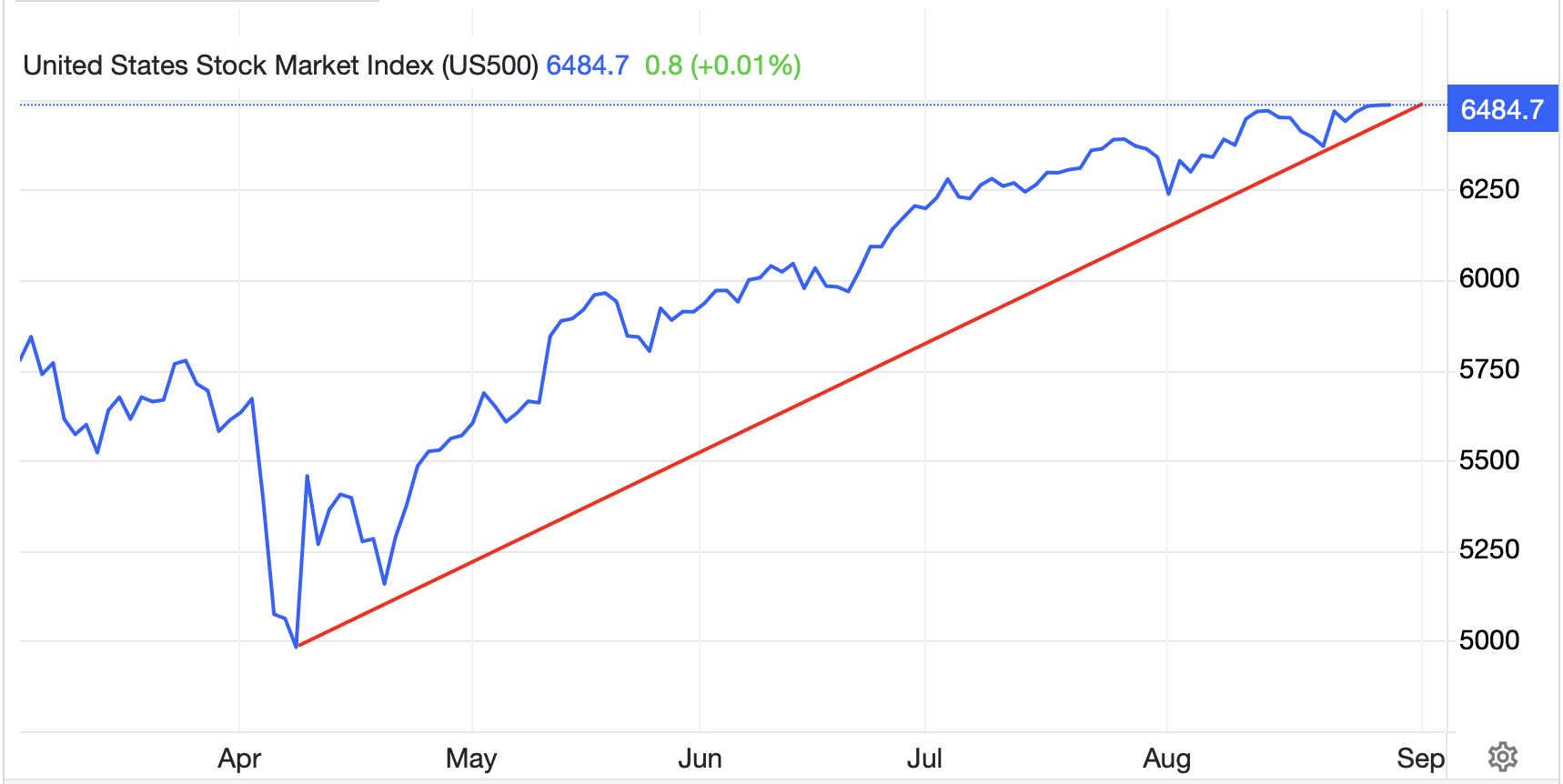
A review of yesterday’s economic data shows that Retail Sales were stronger than expected on every metric and subcomponent, Import Prices rose a scant 0.1%, the Philly Fed Index was much stronger than expected and Jobless Claims fell on both an Initial and Continuing basis.  In truth, it was a sweep of positive economic news.  As such, we cannot be surprised that equity markets responded positively, as did the dollar, while bonds held their ground, given the lack of inflationary signals.  But if we look at the movements in markets, they remain very modest overall.  Sure, the S&P 500 made a new high, by 2 points, but if you look at the chart below, since July 3rd, the rally has been 26 points, or 0.4%.  This is hardly the stuff of excitement.

Source: tradingecononmics.com

Of course, this did not stop the pundits who are calling for recession to highlight any negative subtext, nor did it prevent Fed Governor Waller from claiming that a rate cut in July was appropriate because the labor market is on the edge.  But the naysayers find themselves with diminishing attention these days as market price action has been quite positive.  In fact, most markets have shown similar behavior.  Whether gold or oil or other equity indices or bonds, we have been in a narrow range for a while now and it is not clear what it will take to break us out.  But here’s one thought…

On Sunday, Japan
Will vote for their Upper House
Is there change afoot?

While market insiders will discuss today’s options’ expirations as the key driver of things in the short-term, I think we need turn our eyes Eastward to Japan’s Upper House elections this Sunday.  PM Ishiba’s LDP-Komeito coalition is already in a minority status in the more powerful Lower House, a key reason why so little has been accomplished there.  But at least he had a majority in the Upper House to rubber stamp anything that was enacted.  However, signs are pointing to the LDP losing their majority in the Upper House which could well lead to Ishiba getting forced out.

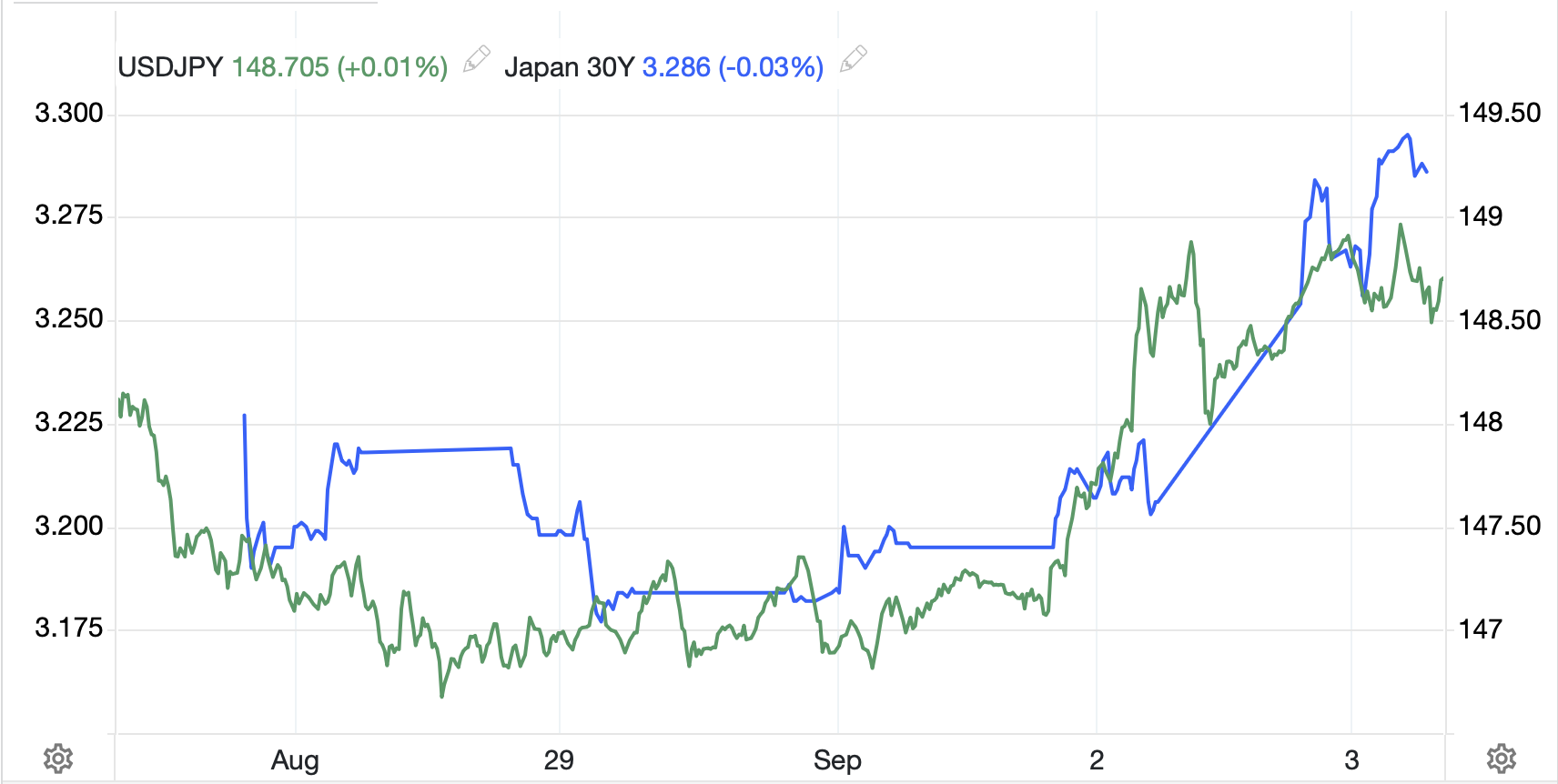
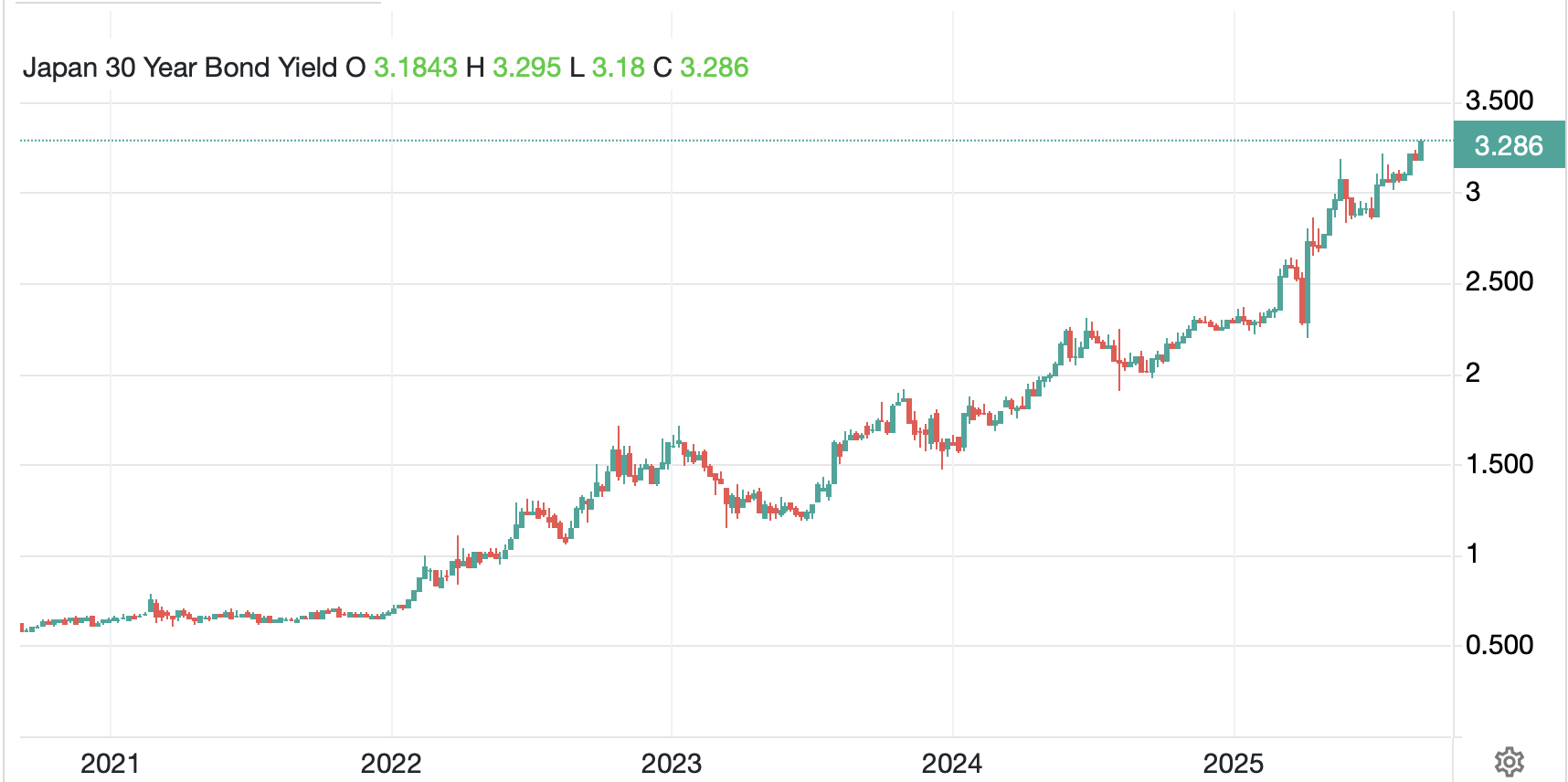
Now, why does this matter to the rest of us?  There is a case to be made that flows in the JGB market are an important driver of global bond flows, including Treasuries.  For instance, Japan is the second largest net creditor nation with about $3.73 trillion invested abroad (according to Grok), much of which is Japanese insurance companies searching for higher yields than have been available there for the past decades. You may remember back in May, when there was a spike in long-dated JGB yields as all maturities from 20 years on out reached new historic highs (see below chart), well above 3.0%. 

Source: tradingeconomics.com’

Now, consider if you were a Japanese life insurer looking to match your assets to your liabilities.  Historically, buying Treasury bonds, with their much higher yield, was the place to be, especially over the past several years when the yen weakened, adding to your JPY gains.  However, that is still a risky trade, and hedging the FX risk is expensive given the yield differential between the US and Japan.  (Hedgers need to sell USD forward and the FX points reduce the effective exchange rate and by extension the benefits of the higher bond yields.)

But now, for the first time ever, JGB yields are above 3.0%, and that can be earned by a Japanese life insurer with zero FX risk, a very attractive proposition.  In fact, Bloomberg has an article this morning discussing just such a situation with one of the larger insurers, Fukoku Life.

Circling back to the election, it appears that the key issues are the rising cost of living and what the government is going to do about it.  Apparently, there are two approaches; the LDP is talking about giving out cash bribes grants of ¥20,000 to individuals while the opposition is talking about reducing consumption taxes on necessities like food.  However, in either case, the reality is that fiscal policy would loosen further with the MOF needing to issue yet more JGBs to make up for either the increased outlays or reduced income.  Add to that the uncertainty over future Japanese policy if the LDP loses its majority, and the pressure from the US regarding tariff negotiations and suddenly, it makes a lot more sense that the knock-on effects of this election can be substantial, at least with respect to the global bond markets and the USDJPY exchange rate.  (It must be said that Japanese inflation data last night actually fell to 3.3%, but that was due entirely to declining oil prices as fresh food prices, the big issue there, continue to rise.)

An election outcome that weakens PM Ishiba, potentially leading to a fall of his government and new elections in the Lower House, would be a distinct negative for the yen, and likely for the JGB market.  The impact would be felt in global bond markets as yields in the back end would almost certainly rise everywhere around the world.  This is not to imply that yields would rise by 100bps or more, but rather that the current trend of rising long-dated yields would continue for the foreseeable future.  And that will make things tough on every government.

Ok, sorry, I went on a bit long there.  A quick turn through markets shows that other than Japan (-0.2%) Asian equity indices were mostly nicely in the green following the US lead with the biggest winners Australia (+1.4%), Hong Kong (+1.3%) and Taiwan (+1.2%).  Meanwhile, in Europe this morning, while green is the color, the movement has been miniscule, averaging about 0.1% gains.  And US futures are also modestly higher at this hour (7:00) about 0.15% across the board.

In the bond market, Treasury yields have edged lower by -2bps but European sovereign yields are all higher by 2bps across the board.  The talk in Europe is over concerns regarding the conclusion of a trade deal with the US, where concerns are growing nothing will be achieved by the end of the month.

In the commodity markets, oil (+1.3%) is continuing its rebound, perhaps on the beginnings of a belief that the economy is not going to crater in the US.  Certainly, yesterday’s data was positive.  As to the metals markets, they are in fine fettle this morning with both gold (+0.4%) and silver (+0.4%) trading back to the middle of their trading ranges and copper (+1.3%) pushing back toward its recent all-time highs.

Finally, the dollar is under pressure this morning, sliding against the euro (+0.25%), pound (+0.2%) and AUD (+0.4%).  But the real movement has been in the commodity space where NOK (+0.8%) and ZAR (+0.7%) are both having solid days.  There continues to be a great deal of discussion regarding President Trump’s desire to fire Chairman Powell with a multitude of articles describing how that would be the end of the world as we know it because the Fed cherishes their “independence”.  Let’s not have that discussion.

On the data front, this morning brings Housing Starts (exp 1.3M) and Building Permits (1.39M) and then Michigan Sentiment (61.5) at 10:00.  There are no Fed speakers on the slate for today although Governor Kugler, not surprisingly, explained that waiting was the right call for the Fed when she spoke yesterday.  

It is a Friday in the summer with relatively unimportant data.  Absent another surprise from the White House Bingo card, I expect a quiet session overall as most traders and investors leave the office early for the weekend.  The dollar’s biggest risk is the Fed does cut early, but if the data keeps cooperating, it will be much harder for dollar bears, especially since so many are already short, to sell it aggressively from here.

Good luck and good weekend

Adf

Kvetched

The story on everyone’s lips
A central bank apocalypse
If Trump fires Powell
The markets will howl
With yields rising numerous bips
 
However, said Trump, it’s farfetched
Despite plans that he’d clearly sketched
Thus, markets reversed
While bears, losses, nursed
And “right-thinking” people all kvetched


If you had Trump fires Powell on your White House Bingo card, congrats, it looked like a winner.  That was the story all morning yesterday, overshadowing PPI data that was quite benign, printing at 0.0% M/M for both headline and core, as the punditry postulated the problems with Trump doing that.  At this point, we are all familiar with the fact that the Fed Chair can only be fired for “cause” although exactly what “cause” represents is unclear.  Too, we know that in Trump’s efforts to reduce the size of the government, the Supreme Court gave him authority to remove the heads of many departments but explicitly carved out the Fed from that process.

In the end, though, despite rampant rumors that he had composed a letter for just such an occasion, at a press conference with Bahraini Crown Prince, Salman bin Hamad Al Khalifa, he said it was “highly unlikely” he was going to fire Powell, although he once again castigated him for not cutting rates. Most markets, after getting all excited about the prospects of this action, reverted to the previous solemnitude of doing nothing over the summer.  The below chart of the S&P 500 was replicated in virtually every market.

Source: finance.yahoo.com

It is also no surprise that the Fed Whisperer was out in the WSJ this morning defending his bread-and-butter relationship, but my take is this is just a feint on the president’s part to move the discussion away from issues he doesn’t like.  Given that Supreme Court protection and given that the Supreme Court has been very good for Mr Trump, I’m pretty confident that Powell will serve out his full term as Chair and be replaced next year.  I would, however, look for a candidate to be announced at the earliest possible time.

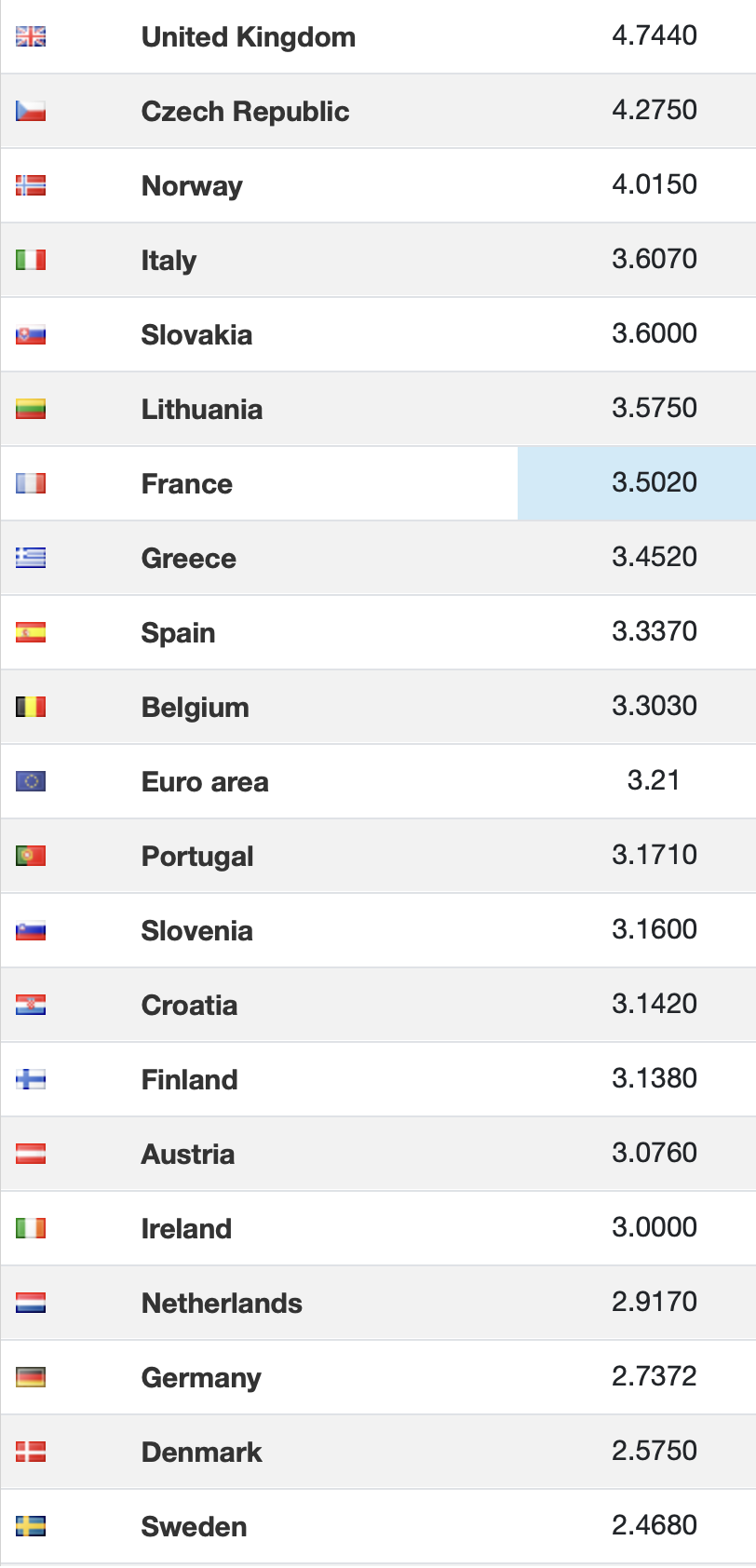
While that was the story that sucked up all the oxygen yesterday, life still goes on and this morning, arguably the biggest news is that UK Unemployment rose to 4.7% with earnings slipping and the Claimant count rising.  The punditry continues to harp on how the US is set to go into stagflation because of Trump’s tariffs which are driving inflation higher while weakening the economy (despite all evidence to the contrary) while ignoring the UK which saw inflation rise faster than expected yesterday, to 3.6% while Unemployment is rising.  That feels a lot closer to the stagflation story than in the US, and as we heard from BOE Governor Bailey yesterday, it’s all Trump’s fault because of the tariffs.  Talk about deflection.  However, a little sympathy for the Guv is in order as he really doesn’t know what to do.  After today’s data, there is more discussion of another rate cut by the BOE when they next meet on August 7th.  Certainly, the pound (-0.1%) is behaving as though a rate cut is coming as evidenced by the chart below.

Source: tradingeconomics.com

However, remember that the UK government of PM Starmer has proven its incompetence on virtually every issue it has addressed, both domestically and on an international basis, so the pound’s decline could well be a general exit from the UK by investors.  Speaking of currencies, the dollar is having quite a positive day across the board.  Aussie (-0.9%) is the laggard across both G10 and EMG blocs as its employment situation report showed a much weaker economy than expected, although the yen (-0.4%) is starting to feel real pressure as the Upper House Election approaches.  In fact, there is growing talk that USDJPY above 150 is likely if the PM Ishiba’s LDP loses their majority in the Upper House, or even if it wins given the amount of increased deficit spending they are promising.  Does anyone remember all the talk of the end of the yen carry trade and how the yen was going to rise dramatically?  There’s a theme that did not age well.  As to the rest of the currency market, the dollar is rising vs. everybody with a rough average gain of ~ 0.4%.  The dollar is not dead yet.

Heading back to equities, despite all the angst about Powell yesterday, US indices all managed a gain on the day.  In Asia, most markets performed well with Japan (+0.6%) and China (+0.7%) indicative of the movement.  Australia (+0.9%) responded to its jobs data with growing expectations of an RBA rate cut and there were many more regional exchange gainers than losers overnight.  In Europe, green is also today’s theme, with both the CAC (+0.9%) and DAX (+0.8%) having very nice sessions and most of the rest of the continent climbing around 0.5%.  The only data of note was the final CPI reading for the Eurozone, which was right on the button at 2.3% core.  However, at this hour (7:00) US futures are essentially unchanged.

Bonds were actually the biggest concern yesterday on the Powell news with a huge divergence between the 2-year and 30-year as the rumors flew, although most was forgiven after Mr Trump said he would not be firing Powell.  The Chart below shows that divergence and the retracement although 2-year notes did remain lower for the session.

Source: tradingeconomics.com

But that was yesterday.  This morning, 10-year Treasury yields have edged higher by 1bp, and European sovereigns have largely followed suit.  In Asia, though, it is noteworthy that Australian government bonds saw yields decline -5bps after the data, and JGB yields slid -2bps as election promises seem to imply more QE, not less.

Lastly, commodity prices also got the whipsaw treatment on the Powell story, but this morning, with the dollar showing strength across the board, we see metals prices slipping (Au -0.6
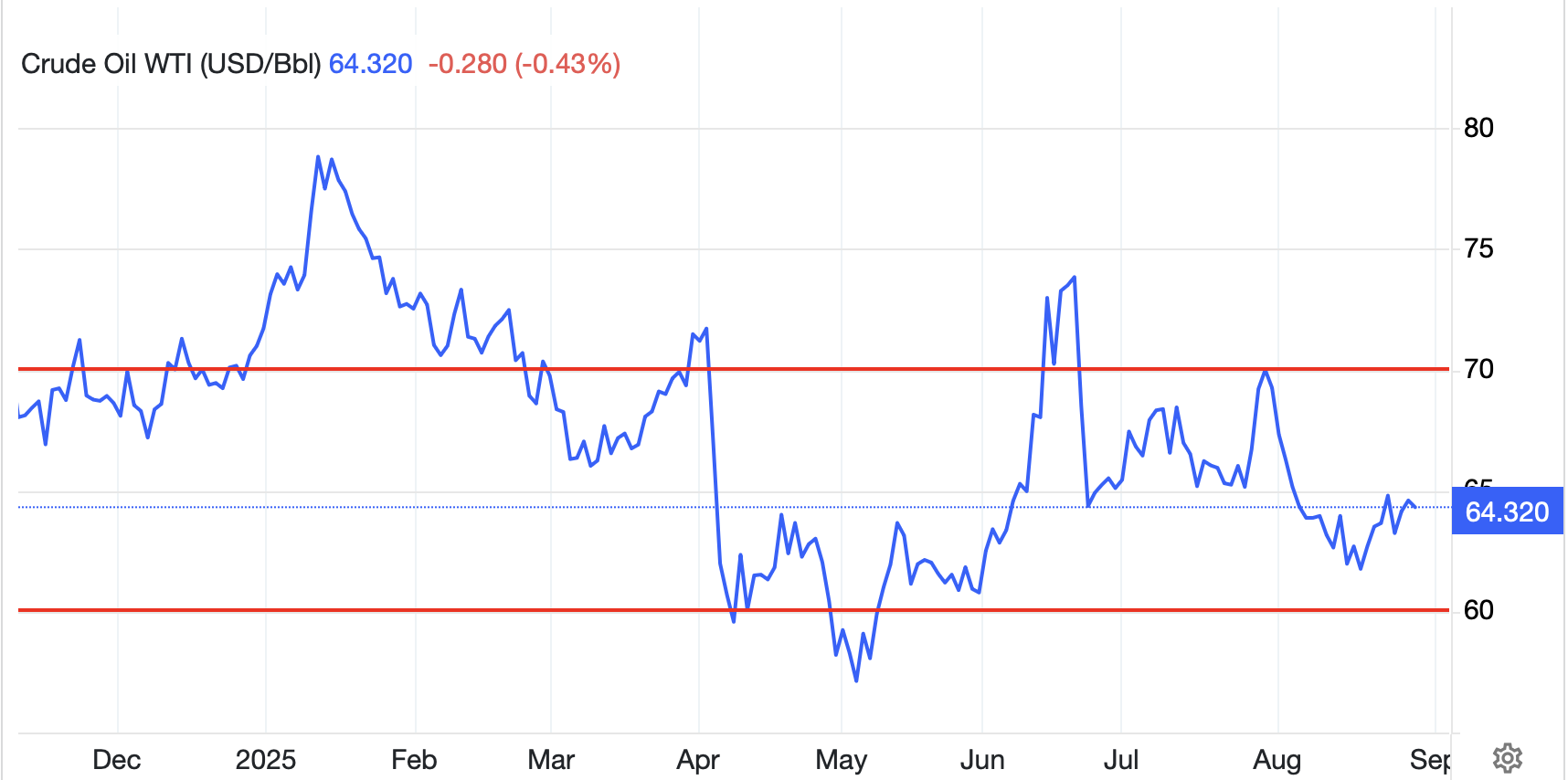
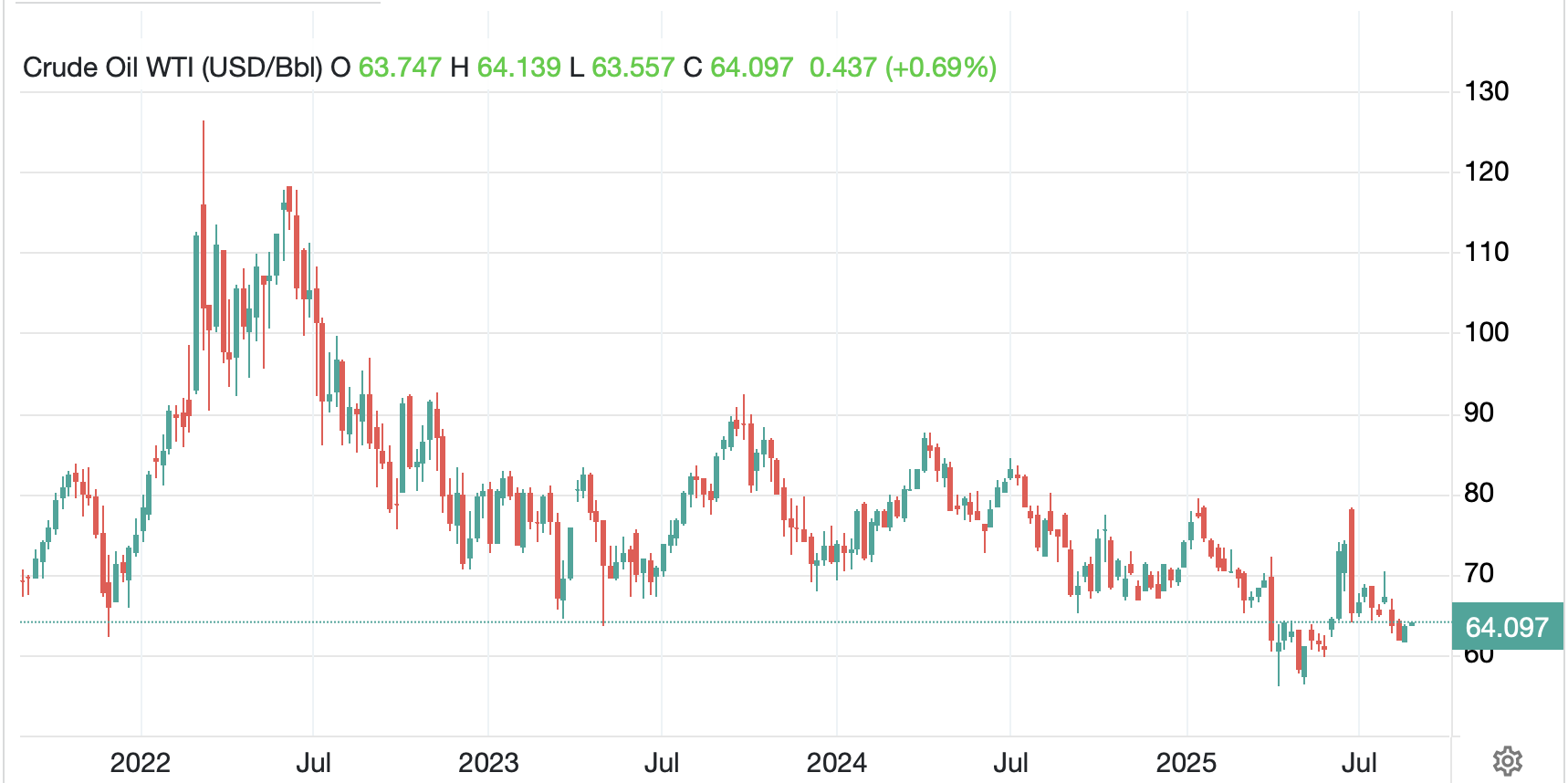
%, Ag -0.25%, Cu -0.15%) although oil (+0.5%) is finding a bottom it seems as per the below chart from tradingeconomics.com.

On the data front, in addition to the weekly Initial (exp 235K) and Continuing (1970K) Claims data, we also get Retail Sales (0.1%, 0.3% ex autos) and Philly Fed (-1.0).  We hear from one Fed speaker, Governor Kugler, but if anything, after yesterday’s Powell drama, I expect everybody we hear from to rally round the Chair, so there will be no talk of rate cuts.  Aside from yesterday’s PPI data, the Fed’s Beige Book indicated modest economic growth, again, not a reason to cut interest rates.

Let me leave you with a thought experiment though.  Last night, the Senate passed the first (of many we hope) rescission bill to actually reduce spending.  Tariff income has grown as evidenced by last month’s budget surplus.  What if Trump and his team are correct, and through reduced regulations as well as tariff and increased inward investment, the private economy grows more strongly and the budget deficit declines far more than current estimates, perhaps achieving Secretary Bessent’s goal of 2%?  Will yields rise or fall?  Will the dollar rise or fall?  Will equities rise or fall?  On the White House Bingo card, I would suggest very few believe in this outcome and are not managing their portfolios to address this.  But I would also suggest it is a non-zero probability, although not my base case.  Just remember, stranger things have happened.

Good luck

Adf

A Wing and a Prayer

The CPI data was hot
Or cool, all depending on what
It is that you buy
Though pundits will try
To tell you that Trump’s a tosspot
 
But stock markets don’t really care
Though bond markets are quite aware
Inflation’s not dead
Which means that the Fed
Relies on a wing and a prayer


These were the headlines yesterday in the wake of the CPI report:

WSJ – Inflation Picks Up to 2.7% as Tariffs Start to Seep Into Prices

NY Times – U.S. Inflation Accelerated in June as Trump’s Tariffs Pushed Up Prices

Washington Post – Inflation picked up in June as tariffs began to lift prices across the economy

And here are a couple from this morning:

WSJ – Trump Effect Starts to Show Up in Economy

Bloomberg – US Trade Wars Will Hit Households Worldwide, BOE’s Bailey Warns

As I forecast yesterday, the higher inflation would be blamed on President Trump’s actions regardless of the outcome.  In fairness, that was not a hard prediction to make given the current state of the mainstream media and their general views of the president.  But is that an accurate representation?  As always, on matters of CPI I turn to @inflation_guy, Mike Ashton, to get his take, which has generally been the least hysterical and most cogent of analysts around.  Here is his summary of yesterday’s CPI data.  

In essence, the higher Y/Y readings are partially due to base effects (the number twelve months ago that is leaving the calculation was very low so even a moderate number will result in a higher print) and partially due to ongoing price changes in the economy.  Goods prices did rise, but services prices were not as affected.  Notably lodging away from home (i.e. hotels) saw prices fall -2.5% on the month, likely perhaps a result of less illegal immigrants being housed in cities around the country.  In the end, as Mike explains, median inflation has been running at ~3.5% annually for the past several years and shows no signs of declining much further.  I fear, that is the new normal for inflation going forward.

(This is a good time to mention that one way to maintain the purchasing power of your money is to own USDi, the only inflation-linked stable coin around which accretes the rise in CPI to its price on an ongoing basis.  Below is a chart showing how this has performed (and by extension what has happened to inflation) since the coin was initiated on March 1st of this year.  (And yes, we know exactly where the price will be going forward through the rest of the summer based on the mechanics of the way CPI is reported.)

But the US is not the only place where inflation is starting higher.  Exhibit A here is the UK, which reported its CPI figures this morning where they rose to 3.6% headline and 3.7% core.  Now, looking at the chart of CPI in the UK, it is abundantly clear that prices have been consistently rising for the past twelve months, at least.  Interestingly, while the Starmer government has demonstrated remarkable incompetence across many factors, they have not been imposing tariffs on all their trade partners and yet inflation is still rising.  Perhaps tariffs are not necessarily the inflation driver that the punditry is keen to describe.  But a look at the last five years of core inflation in the UK shows pretty clearly that price rises, while having slowed from their fastest levels in the wake of the pandemic, have bottomed and appear to be accelerating again.  (Arguably, that is why BOE Governor Bailey was explaining Trump was to blame for his failures.)

Source: tradingeconomics.com

In the end, though, the market adjusted to the inflation data yesterday and overnight things have been far more muted.  This is true, even in the UK, where gilt yields have edged up only 2bps and the pound (+0.1%) is barely higher after having fallen more than 2% since the beginning of July.  In fact, my take is that markets are just not that interested in very much these days as evidenced by the much-reduced volumes that we see across all markets.

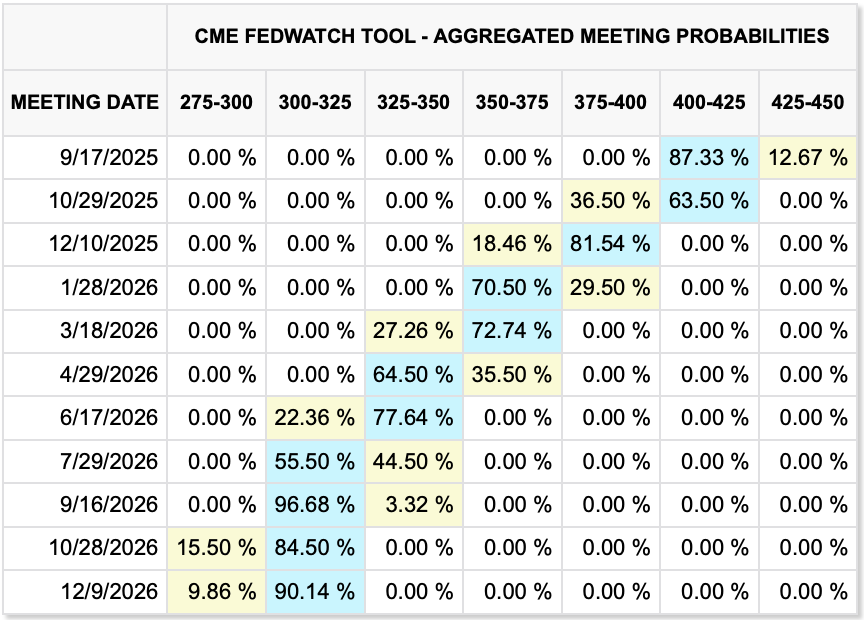
So, with that in mind, let’s see how things behaved overnight.  Starting with the bond market, treasury yields have slipped -1bp this morning, but that is after having gained 6bps yesterday after the data.  As well, Fed funds futures are now pricing less than a 3% probability of a rate cut at the end of this month with far less discussion about the Waller and Bowman comments regarding those cuts.  Meanwhile, in Europe, away from the UK, yields have also slipped -1bp across the board, although yields there did rise about 3bps after the US CPI report.  Remember, all these bond markets are tightly linked.  As to Asia, JGB yields edged higher by 1bp overnight.

In the equity markets, yesterday’s broad down session in the US (Nvidia rose on China sales news which propped up the NASDAQ) was followed by modest weakness throughout most of Asia (China -0.3%, HK -0.3%, Korea -0.9%, Australia -0.8%) although Japan was essentially unchanged.  European shares, though, are mostly a touch firmer led by the IBEX (+0.5%) although the DAX (+0.3%) and FTSE 100 (+0.2%) are also in the green despite there being no obvious catalysts here.  US futures are essentially unchanged at this hour (7:10).

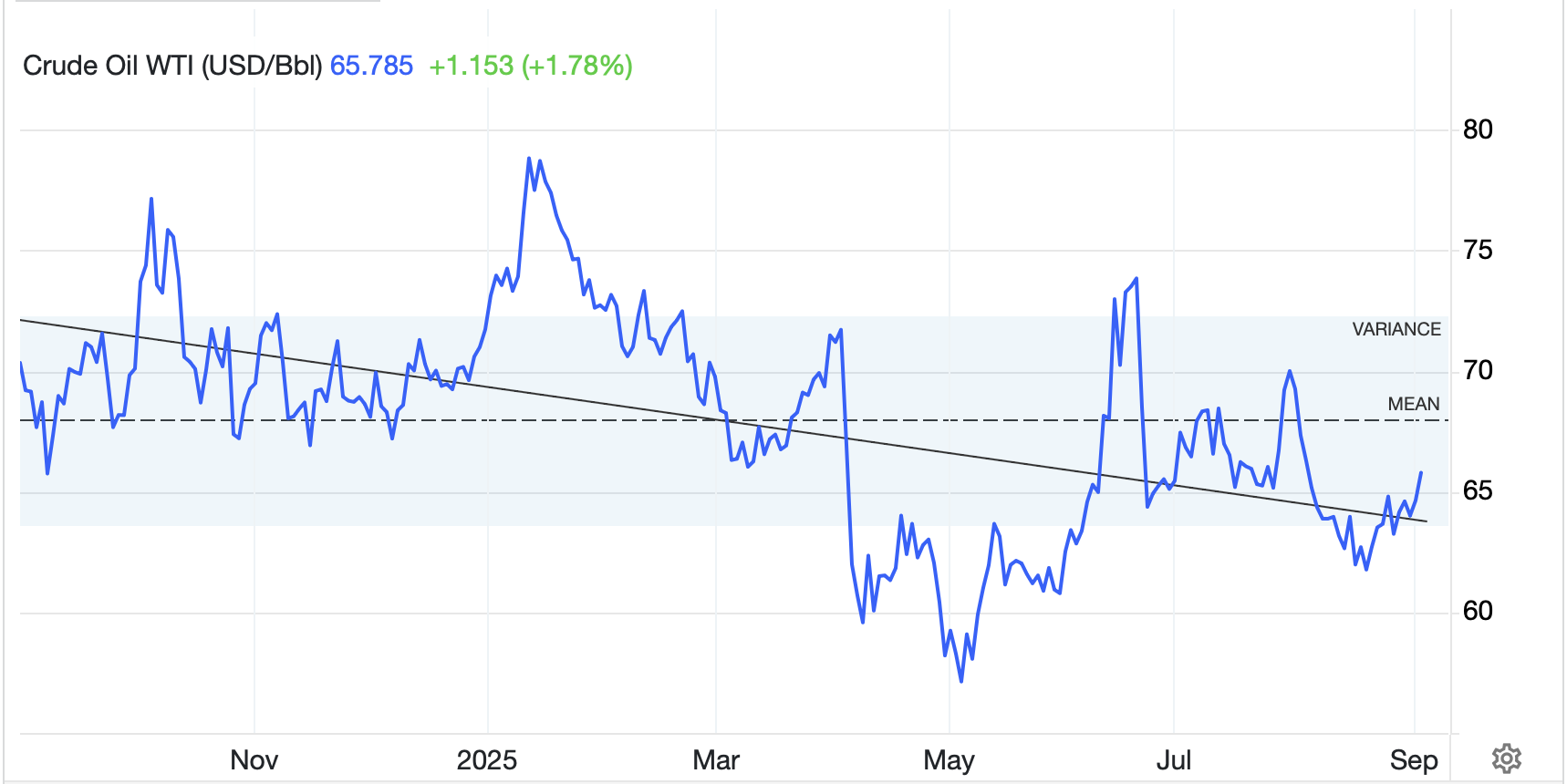
In the commodity space, oil (-0.9%) has been dragging lower over the past several sessions and is now down -3.5% in the past week.  This is a reversal of the recent price action and accords far better with the fundamentals of supply coming on from OPEC with the still strong belief that economic activity is set to slow given the Trumpian tariff impact around the world.  Metals markets continue to range trade as well, with gold (+0.3%) higher this morning, although it gave back yesterday morning’s gains and based on the way it has been trading, seems likely to do that again today.  In fact, the entire metals complex has been showing similar behavior, gains overnight that retrace in the US.

Finally, the dollar is little changed this morning although it has been trending ever so slightly higher over the past several weeks.  I haven’t discussed yen in a while, but all thoughts of the end of the carry trade have been banished as the yen has declined by more than 3% since the beginning of the month and is now back to levels last seen in April.  On the day, as I look across the screen, NOK (-0.5%) is the largest mover in either G10 or EMG space, arguably responding to the fact that oil has been sliding over the past week.  But here, as in the other markets, there is no excitement.

On the data front, this morning brings PPI (exp 0.2%,2.5% headline, 0.2%, 2.7% core) as well as IP (0.1%), Capacity Utilization (77.4%) and then the Fed’s Beige Book this afternoon.  We also hear from three more Fed speakers today although yesterday’s group gave no indication that a move was in the offing.  Instead, the only speaker with a differing opinion than the group, Waller, talked about stablecoins, not monetary policy.

I sincerely doubt that anything of note will happen today from either the data or market internals as pretty much the only thing that moves markets these days are White House announcements.  And I have no idea if any of those are coming.  Look for another quiet session overall.

Good luck

Adf

Misconstrue

Ahead of today’s CPI
The markets continue to fly
Though prices keep rising
The pace is surprising-
Ly slower than pundits decry
 
Perhaps now it’s time to review
How old models all misconstrue
The world of today
As their results stray
From outcomes we’re all living through


Let’s start with this morning’s CPI data where expectations are for M/M rises of 0.3% for both headline and core readings which translate to 2.7% and 3.0% for the annual numbers.  In both cases, that would be the highest reading since February and will put a crimp in the inflation slowing trend as both the 3-month and 6-month trend data will stop declining.  I assure you that the immediate culprit will be defined as the tariffs, although it is probably still too early to make an accurate reading on that.  Nonetheless, you can be sure that, especially if the bond market sells off, the cacophony will be extreme as to President Trump’s policies are destroying the nation.

Personally, I would disagree with that take.  In fact, something I theorized last week was that a likely impact of the tariffs was that corporate margins would be hit, not necessarily that prices would rise.  Apparently, somebody much smarter than me agrees with that view, a well-respected analyst, @super_macro on X, who made that point this morning.  But all we can do is wait and see the data and response.

Yesterday, as well, I touched on how bond yields around the world were rising which remarkably seems to be a theme in the mainstream media this morning.  I wonder if they’re secretly reading fxpoetry?

Ok, but let’s move on.  I have consistently expressed my view that the current macroeconomic models in use, which are almost entirely Keynesian based, are simply no longer relevant to the world as it currently exists.  I made the point about economic statecraft, as defined by Michael Every (@TheMichaelEvery), the Rabobank analyst who has been far more accurate in his forecasts of likely political outcomes.  Well, in the financial space, another Michael, Green (@profplum99), is also ahead of the pack in my view.  He was on a podcastlast week that is well worth the hour (40 minutes if you listen at 1.5X speed).  

The essence of his work is that the rise in passive investing has had major consequences for equity markets, and by extension other financial markets.  When John Bogle founded Vanguard with the goal of popularizing passive index investing, it represented a tiny fraction of the market and so, its low fees made it an excellent source of capturing market beta unobtrusively.  However, in the ensuing 50 years, and especially in the last 20 when 401K plans were flipped from opt-in to opt-out by government regulation, things have changed dramatically.

This is the most recent chart I can find showing how passive investments (e.g., index funds and target date funds) have grown dramatically in size relative to the overall market (notice the inflection in 2006 when the opt-in regs changed).  In fact, they currently represent about 50% of equity market assets.

The reason this matters is because the term passive is no longer very descriptive of what these funds do.  As Mr Green explains, they work on the following algorithm, if funds flow in, they buy more stocks and if funds flow out they sell them.  Since they are following cap weighted indices, they basically reflect that since funds flow from every 401K into the market throughout every day, they continue to buy the largest stocks (Mag7) out there regardless of any concept of value.  If you think this through, the main factor in the markets is no longer how a company performs, but how many people have jobs where they have some portion of their incomes allocated to 401K plans.  So, as long as people have jobs, and if employment is growing, equity prices have a price-insensitive base of support.  The upshot is equity markets are no longer forward-looking systems, as has been the belief since early financial market theories, but rather they are indicators of the employment situation.  And it is key to remember that the unemployment rate is a lagging macroeconomic indicator

This matters because the Fed, and frankly most major financial institutions and analysts, continue to model the economy with an input from equity markets.  Consider the Index of Leading Economic Indicators, which has the S&P 500 explicitly in the calculation as an example.  Now, if the Fed is looking at models which discount changes in the equity market, clearly a part of their process, it means they are looking in the rear-view mirror.  This is a very cogent explanation as to why the Fed’s models have grown so out of touch with reality, which if you consider how important they are to monetary policy, and by extension the economy as a whole, is quite concerning.  

Concluding, Mr Green has eloquently explained what I have observed over the past months and years, the Fed’s (and most of Wall Street’s) models are simply no longer fit for purpose.  Add to this the concept of fiscal dominance, where government spending overwhelms monetary policy as has been the case for the past several years, and we all can see why the Fed is flying blind.  

With that cheery thought, let’s see how markets are behaving.  Yesterday’s modest US rally was followed by some strength in Asia (Nikkei +0.55%, Hang Seng +1.6%) although mainland shares were unchanged.  Chinese data overnight surprised on the upside regarding GDP, with an annualized outcome of 5.2%, and it saw IP rise 6.8% Y/Y, also better than expected but Retail Sales (4.8%) and Fixed Asset Investment, which is housing driving (2.8%) both disappointed.  The upshot is that domestic demand continues to flag although they have been working hard to export lots of stuff.  The rest of the region saw a very positive day with almost all markets gaining.  In Europe, the picture is more mixed as tariff concerns continue to weigh on nations there with today’s price action a mix of small gains (CAC, DAX) and losses (IBEX, FTSE 100) and nothing more than 0.3%.  US futures, though, are pointing higher at this hour (7:20) by 0.5% or so.

In the bond market, yesterday’s modest rise in yields is seeing a reversal with Treasury yields slipping -1bp, but European sovereigns having a good day with yields down between -5bps and -6bps.  Inflation data from Spain confirmed that the overall inflation situation there is ebbing, and market participants are now pricing one more rate cut by the end of this year which would take the ECB rate down to 1.75%.  As it happens, JGB yields were unchanged overnight, but there is still growing angst over their recent rise.

In the commodity arena, oil (-0.5%) reversed course yesterday and sold off more than $2/bbl as per the below chart.

Source: tradingeconomics.com

This makes more sense to me given the apparent growth in supply, but there seems to be an awful lot of calendar and crack spread activity in the market, most of which I do not understand well enough to describe, but which can impact pricing of the front futures contract.  I would suggest looking on substack at market vibesfor a real education.  I keep trying to learn.  However, from a macro view, I continue to believe that prices have further to decline than rise from current levels.  As to the metals markets, gold (+0.5%) and silver (+0.4%) continue to find consistent support and I see no reason for them to reverse course anytime soon.

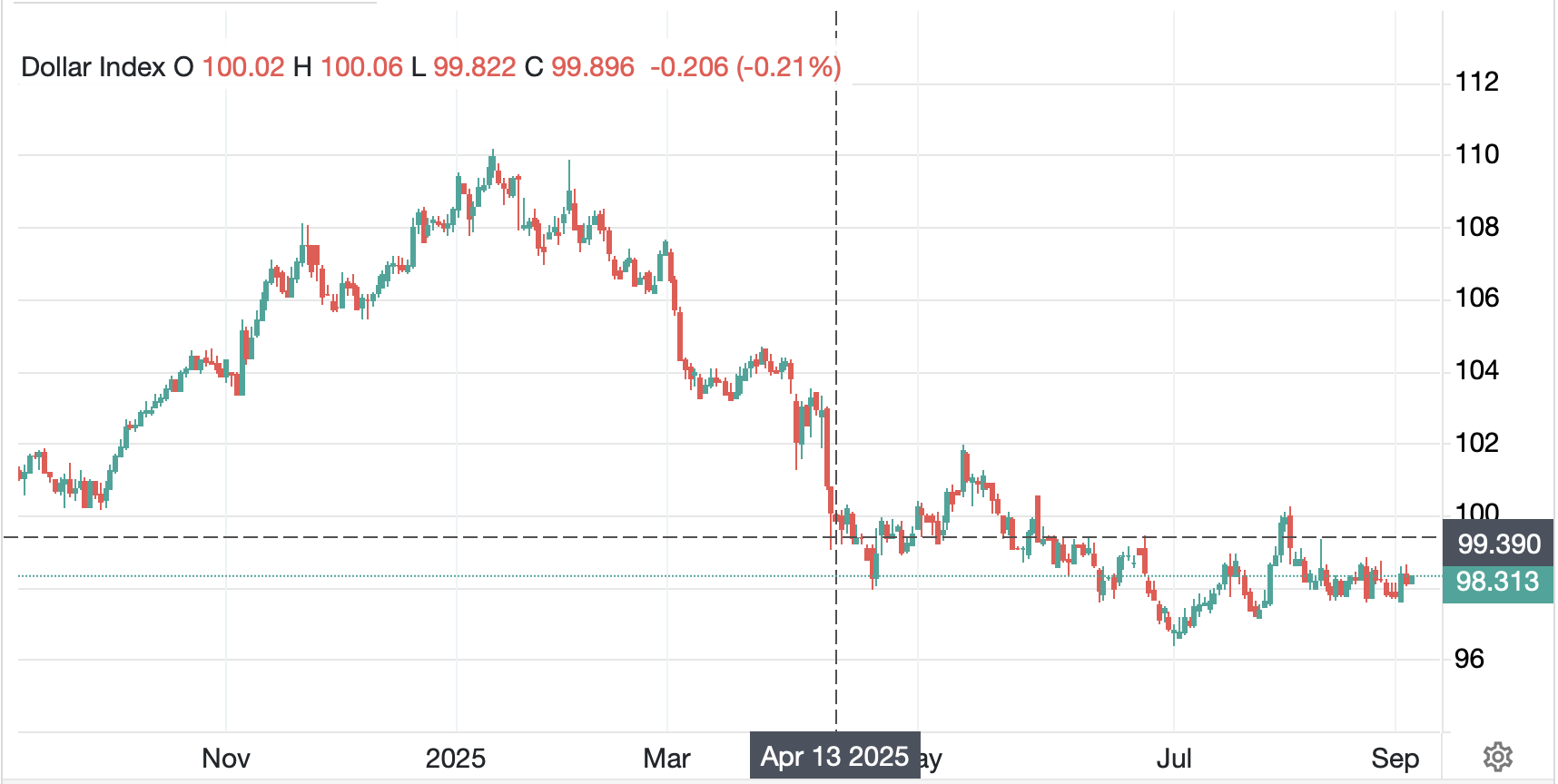
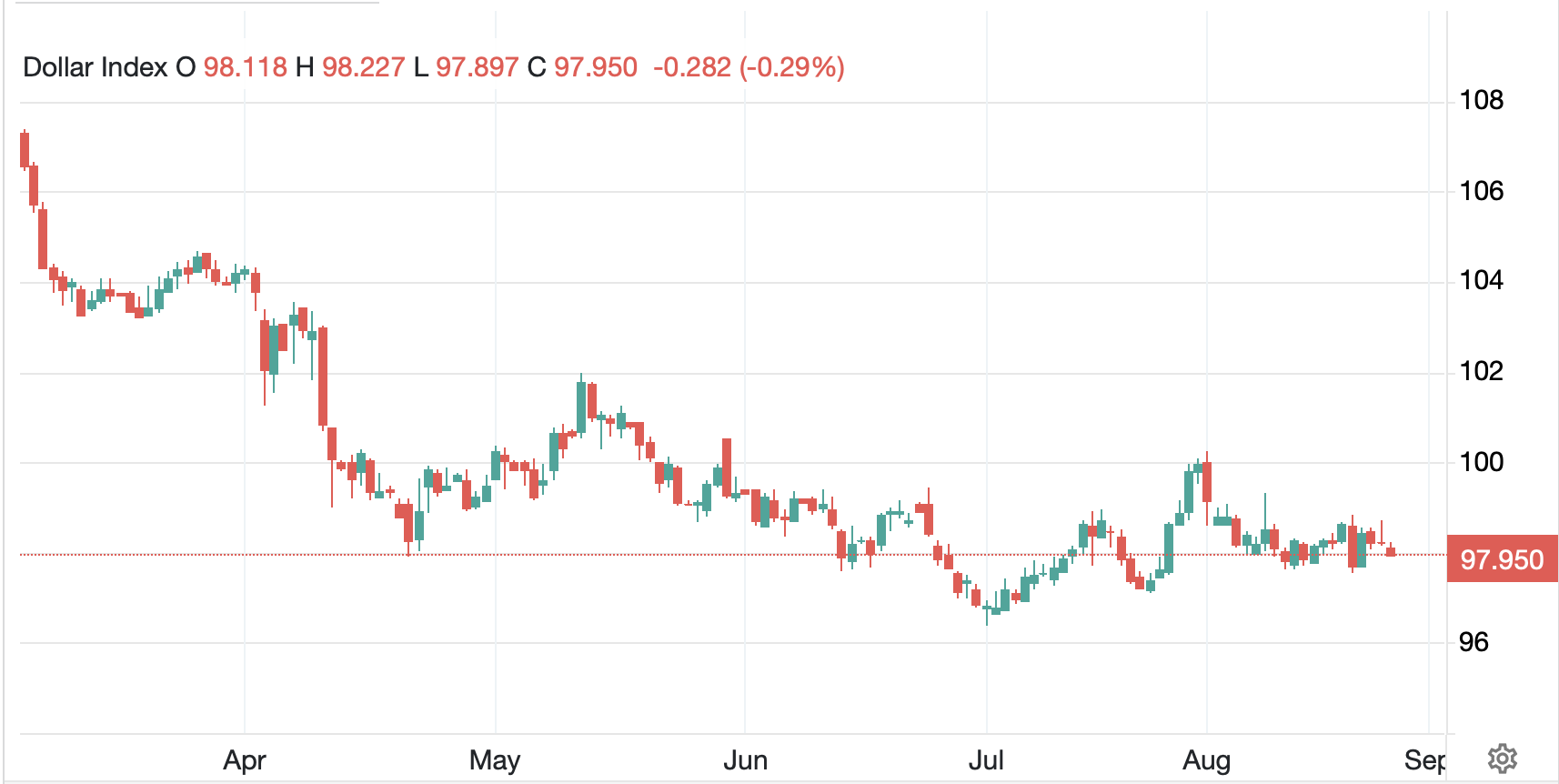
Finally, the dollar continues to do very little overall.  For now, the more aggressive downtrend appears to have been halted, as per the chart of the DXY below, but it is hard to get too excited about a significant rebound based on the macro data and interest rate outlook.  The one thing working in the favor of a dollar rebound is the extreme short dollar positions that exist in the hedge fund and CTA communities.

Source: tradingeconomics.com

In addition to the CPI data, we will see the Empire State Manufacturing Index (exp -9.0) and we will hear from four Fed speakers today (Bowman, Barr, Collins and Logan).  Absent a major shock in the CPI data, it strikes me that there is limited reason for any of these speakers to change their personal tune.  So, Bowman is calling for cuts, while the other three have not done so, at least not yet.  In fact, if we start to hear a more dovish take from any of them, that would be news.

And that’s it for this morning.  Market activity is pretty dull overall, and trends remain in place.  Remember, the trend is your friend.

Good luck

Adf

Heartburn

It seems bond investors are learning
That government spending’s concerning
As yields ‘cross the board
Have all really soared
While buyers become more discerning
 
Meanwhile, o’er the weekend we learned
That Tariff Man’s truly returned
More letters were sent
Designed to foment
Responses as well as heartburn


As we approach the middle of the summer, two things are becoming increasingly clear; the world today is very different from just a few years ago and it is getting harder and harder to pay for all the things that the world seems to want.  Taking the second point first, market headlines today have pointed to German 30-year yields which have traded to their highest level since October 2023, and appear set to breech that point and move to levels not seen since prior to the Eurozone bond crisis in 2011 (see MarketWatch chart below)

Similarly, we have seen 30-year yields rise in Japan, a story that gained legs back in late May, and yields overnight returned to those all-time highs from then.

Source: tradingeconomics.com

Not surprisingly, given the debt dynamics globally, US 30-year yields are also pushing back to the levels seen back in May, although have not quite reached those lofty levels and as I type this morning, are trading just below the 5.00% level.

Source: tradingeconomics.com

As Austin Powers might say, “What does it all mean, Basil?”  While I’m just a poet, so take it for what it’s worth, it seems pretty clear that the level of government borrowing is pushing the limits of what private sector investors are willing to absorb.  The below chart, created from FRED data tells an interesting tale.  Up through the GFC, government and private sector debt grew pretty much in step with each other, although after Black Monday in October 1987, government debt started to grow a bit more rapidly.  But the GFC completely changed the conversation and government debt took on a life of its own.  Essentially, the GFC took private losses and nationalized them and put them on the government’s balance sheet. (As an aside, this is why there is still so much anger at the fact that nobody was held accountable for that event, with the perpetrators getting larger bonuses after their banks were bailed out.). But in today’s context, the rise in yields is telling us, or me at least, that the market is losing its appetite for more government debt.

While this is the US graph, the situation is similar around the developed world.  This is why we are hearing more about Secretary Bessent’s sudden love of stablecoins as they will be a source of significant demand for Treasury paper that he needs to sell.  But in the end, do not be surprised if we see more than simply QE, whatever they call it, going forward, but outright financial repression and yield curve control.  While the US may be in the vanguard of this situation, the yields in Germany and Japan tell us that the same is happening there as well.  

As to the first point above, back in the day, it seemed that weekends were observed by one and all around the world with policy statements a weekday affair.  But no longer.  Over the weekend, President Trump sent letters to Mexico and the EU that 30% tariffs were on the way if they did not reach an agreement by August 1st.  For 80 years, most of the Western world operated on a genteel basis, with decorum more important than results.  It is not clear to me if this was because negotiations were more effective, or because most leaders didn’t have the stomach for confrontation.  But it is abundantly clear that President Trump is quite willing to be confrontational with other leaders in order to get his way.  The problem for other leaders is they are not used to dealing in this manner and find themselves uncertain as to how to proceed.  Thus far, whether they have been combative or conciliatory, it doesn’t seem to matter.  Remarkably, it is still just 6 months into this presidency, so things are going to continue to change, but the one thing that is unequivocally true is the world is a different place today than ever before.

Ok, let’s see how other markets are handling the latest tariff storms.  Equity markets are mostly unhappy with this new process as after Friday’s modest declines in the US, we saw more losers (Japan, India, Taiwan, Australia) than winners (Hong Kong, China, Korea) in Asia.  The salient news there was that the Chinese trade surplus grew to $114.8B, slightly more than expected as exports rose sharply while imports underperformed.  However, Chinese bank and lending data did show an increase in M2 and Loan Growth, so at least they are trying to add some monetary stimulus.  As to Europe, other than the UK (+0.4%) the continent is under pressure with Germany (-1.0%) the laggard of the bunch.  The UK story seems to be a single stock, AstraZeneca, which released strong trial results for a new drug.  But otherwise, the tariff story is weighing on the continent.  US futures are also softer at this hour (7:30), down around -0.3% across the board.

While my bond conversation was on the 30-year space, 10-year yields are only marginally higher, about 1bp, in the US and Europe although JGB yields did jump 6bps ahead of their Upper House elections this week. 

In commodities, oil (+1.2%) continues to find support despite the ongoing theme that the economy is soft and supply is growing significantly with OPEC increasing production and set to return even more to the market by the end of the summer.  As it happens, NatGas (+4.75%) is also higher this morning and continues to find substantial support as on a per BTU basis, it is desperately cheap vs. oil, something like one-seventh the price.  In the metals markets, while gold (+0.4%) continues to see support, the real action is in silver (+1.4%) which has rallied very consistently, gapping higher as you can see in the chart below, and has been the subject of much discussion as to how far it can rise.  Historically, silver lags the timing of gold rallies but far outperforms the gains in percentage terms.

Source: finance.yahoo.com

Finally, the dollar is little changed to a touch stronger this morning as traders cannot decide if tariffs are going to be a problem, or if deals are going to be struck.  However, in the dollar’s favor right now is the fact that most other countries are in a clear easing cycle while the Fed remains firmly on hold.  Fed funds futures are pricing less than a 7% chance of a cut this month and only a 61% chance of a September cut.  If US rates continue to run higher than the rest of the world, and there is limited belief they are going to fall, the dollar will find support.  However, given the pressure that President Trump continues to heap on Chairman Powell (there was a story this weekend that Powell is close to resigning, although my take is that is wishful thinking), it is hard to get excited about the dollar’s prospects.  Remember this, all the economists who tell us that an independent central bank is critical work for central banks.

On the data front, after virtually nothing last week, we do get some important numbers this week.

TuesdayCPI0.3% (2.7% Y/Y)
 -ex food & energy0.3% (3.0% Y/Y)
 Empire State Manufacturing-8.0
WednesdayPPI0.2% (2.5% Y/Y)
 -ex food & energy0.2% (2.7% Y/Y)
 IP0.1%
 Capacity Utilization77.4%
 Fed’s Beige Book 
ThursdayInitial Claims234K
 Continuing Claims1970K
 Retail Sales0.1%
 -ex autos0.3%
FridayHousing Starts1.30M
 Building Permits1.39M
 Michigan Sentiment61.4

Source: tradingeconomics.com

In addition to this, we hear from eight FOMC members, so it will be interesting to see if the erstwhile doves are willing to join Waller and Bowman in their call for a July rate cut.  If we start to see momentum build for a July cut, something which is not currently evident, look for the dollar to suffer substantially.  But absent that, I have a feeling we are going to range trade for the rest of the summer.

Good luck

Adf

Trump’s Latest Ire

The Minutes explained that in June
The Fed felt no need to impugn
Their previous view
Of nothing to do
Though two sang an alternate tune


Yesterday’s release of the FOMC Minutes from their June meeting confirmed what we have learned in the interim.  Governors Waller and Bowman have been clear that they see tariffs as a one-off impact on the rate of inflation, and not something on which to base policy.  If you think about it, tariffs are like food and energy, something that cannot be addressed effectively by monetary policy and which the Fed explicitly excludes from their decision-making process.  (For a really good read on the inflationary impact on tariffs, @inflation_guy published this yesterday).  To me, the salient comments from the Minutes are below:

“While a few participants noted that tariffs would lead to a one-time increase in prices and would not affect longer-term inflation expectations, most participants noted the risk that tariffs could have more persistent effects on inflation.”

“Participants agreed that although uncertainty about inflation and the economic outlook had decreased, it remained appropriate to take a careful approach in adjusting monetary policy.” 

In fact, it is not hard to conclude that the Fed’s intransigence on this issue is politically motivated as well since we have already established that the Fed is clearly political (and partisan).  I would estimate part of the reason they do not want to cut rates here is because they don’t want to be seen as caving into President Trump’s demands.  But whatever the reason, even the futures market is reducing the probability of a cut with the July probability having fallen from more than 20% two weeks ago to 6.7% as I type this morning.  We will need to see some seriously weak economic data to get the Fed to move, I believe, although I expect we will see Governors Waller and Bowman dissent at the July 30th meeting.

However, I would contend that the market has already sussed this out and there will be limited impact on any financial markets after the meeting absent a surprise cut.  So, let’s move on.

The target of Trump’s latest ire
Brazil, has now come under fire
The issue’s not trade
Instead, Trump was swayed
By lawfare ‘gainst one he admire(s)

The other news from yesterday (and there has been precious little overnight) was President Trump’s threat of 50% tariffs on all of Brazil’s exports to the US.  Now, the US runs a trade surplus with Brazil of about $10 billion, so clearly trade is not the issue here.  Rather, it seems that Mr Trump is seeking to help is friend, former Brazilian president Joao Bolsonaro, who is also a right-leaning populist and who is on trial for leading an insurrection after he lost the last election.  It is not hard to understand Mr Trump’s concern over the issue given the history in the US and the previous administration’s efforts to imprison Trump himself.  

However, this seems, at least to me, a bit over the top.  Brazil had been slated to get the minimum 10% tariff prior to yesterday’s outburst.  As well, the US is Brazil’s second largest trading partner, so this will have a significant impact on the country if these tariffs are imposed.  As such, it is no surprise that the market responded immediately.  

Source: tradingeconomics.com

As you can see from the chart above, the announcement at 1:30 yesterday afternoon had an immediate impact with the real falling -2.5% with minutes of the news.  Too, the IBOVESPA stock index fell more than -1.3% yesterday with Embraer, the airplane manufacturer down nearly 10%.  Right now, this is a threat, and the immediate Brazilian response was to say they would not be cowed by this action and will continue with their internal legal activities.  There is no way I will opine on how this will end, but if these tariffs are put in place, it will be a distinct negative for Brazil’s economy, and I would expect that the real could quickly head back toward 6.00 from its current levels.

Away from those two stories, though, issues impacting financial markets are sparse.  With that in mind, let’s see how markets behaved overnight.  Yesterday’s US equity rally was followed by a mixed picture in Asia with Japan (-0.4%) slipping a bit but gains in both China (+0.5%) and Hong Kong (+0.6%) after rumors came out that the Chinese government was getting set to add more support to the still-imploding Chinese property market.  Other regional bourses saw some gains (Korea, Taiwan, Australia) and some losses (India, Thailand, Philippines).  At this point, all eyes remain on the tariff story for most of these nations.  Meanwhile, in Europe, the FTSE 100 (+1.1%) is today’s leader on the strength of its mining sector which responded positively to President Trump’s mooted 50% tariffs on copper.  Elsewhere, though, things have been less robust with the CAC (+0.7%) having a nice day, the DAX (+0.2%) edging higher after inflation data was released as expected at 2.0% while the IBEX (-0.6%) is moving in the other direction absent a major catalyst.  However, remember it has been performing well, so this could just be some profit taking.  US futures are essentially unchanged at this hour (7:00).

In the bond market, yesterday’s 10-year auction went well with no tail and yields ultimately slipped 6bps during the session.  This morning, that yield has edged back higher by just 1bp.  As to European sovereigns, they are +/- 1bp this morning, showing no direction or new views on anything.  Readings from Europe this morning have confirmed that the rate of inflation is quiet and near the ECB’s target so there is little reason for investors to worry.  As well, the word is that a trade deal between the US and EU is getting close, which will almost certainly be seen as a benefit for markets on the continent.

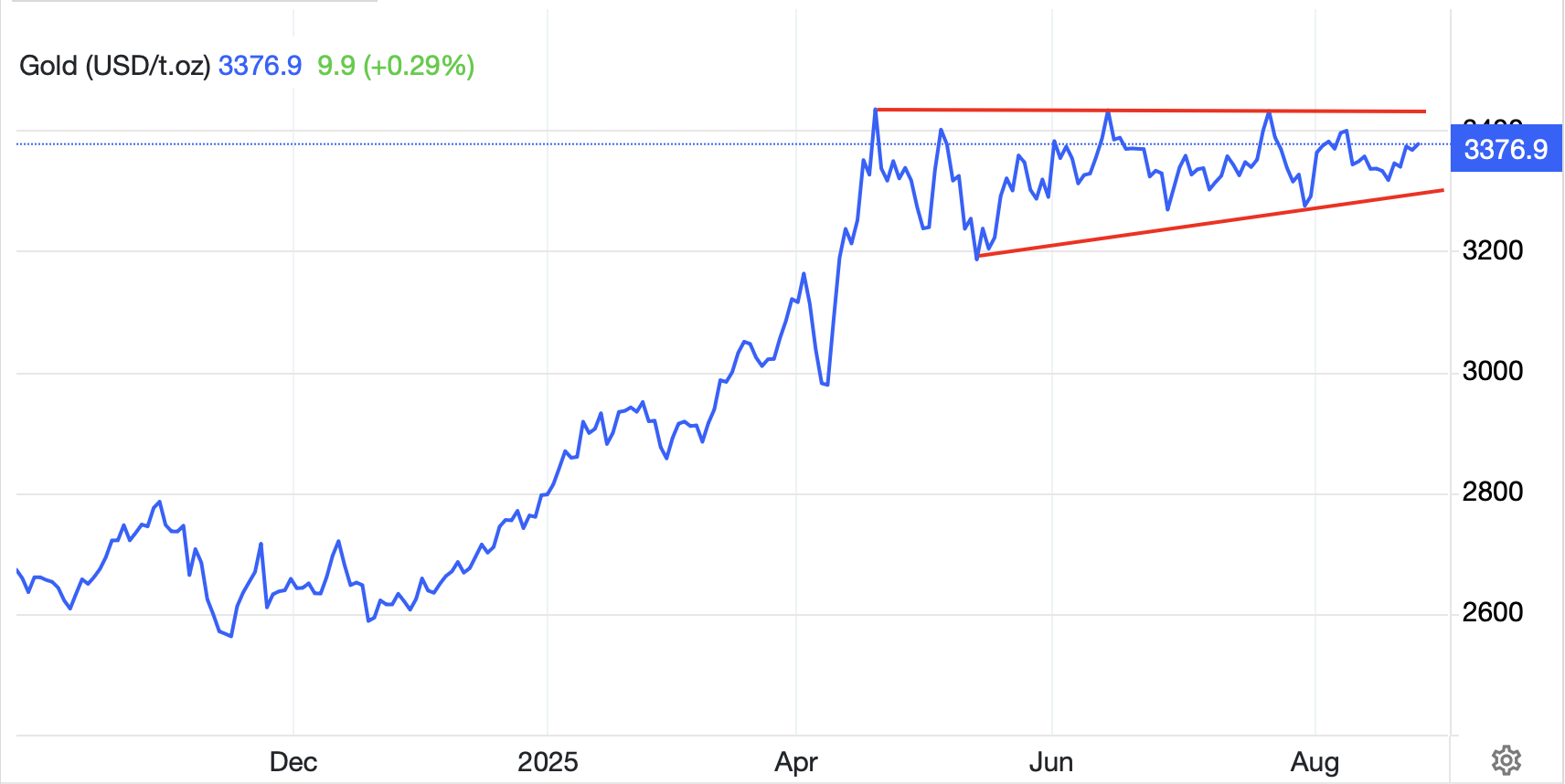
In the commodity markets, oil (-0.6%) is softer this morning but continues to hug the $68/bbl level despite EIA inventory data showing a net large build of nearly 4 mm barrels.  It appears that there is both ample supply and production and there continues to be concern over slowing economic activity, yet oil is in demand.  As I often say, sometimes markets are simply perverse.  In the metals markets, gold (+0.5%) continues to trade either side of $3350/oz and has done so since mid-April.  I continue to read about central banks buying the relic and replacing US Treasuries with gold in their reserve portfolios, but there is obviously enough supply to prevent further price appreciation for now.  But gold is leading gains across the entire metals complex (although copper is getting a boost from the tariff talk.)

Finally, in the FX markets, there is no direction this morning.  both the euro and pound are slightly softer, but AUD (+0.4%) and NZD (+0.35%) are firmer with the yen and CAD little changed.  ZAR (+0.4%) is also having a good day, arguably on the strength in the precious metals markets but otherwise, it is hard to find anything exciting to note.

Turning to this morning’s data, we get the weekly Initial (exp 235K) and Continuing (1980K) Claims and that’s it.  We do hear from three Fed speakers, Musalem, Daly and Waller, but since we already know Waller’s views, it will be far more interesting to hear the other two.  I do find it interesting that Ms Daly, one of the most dovish FOMC members, is not in the rate cut camp, a situation I attribute entirely to her political views.

And that’s what we’ve got today.  Nothing has changed any trends, and it seems highly unlikely that today’s data will.  However, if we hear dovish signals from both Daly and Musalem, that may indicate a turn at the Fed and perhaps we will see that narrative change.  I am confident the one thing Chairman Powell does not want is to have a 5-4 vote to leave rates unchanged.  I would contend that is the most intriguing thing on the horizon right now.

Good luck

Adf

Widely Abhorred

Most traders this summer are bored
Thus, markets are being ignored
Attention, instead
Is on a man, dead
For years, but still widely abhorred
 
So, even though President Trump
More tariffs on copper did pump
The outrage is such
That nothing else much
Is noticed, not gains nor a slump


This is not a political discussion piece but the only story getting any press today, overwhelming the terrible tragedy in Texas from the weekend, is the closing of the Jeffrey Epstein case by the Trump administration.  I will not go into the details here as they are not relevant to our focus, but it certainly has many people irate, although I imagine there are a small number who are relieved.  On the surface, though, it certainly doesn’t seem to be in accord with Trump’s remarkable transparency in all other facets of his governance.  I will leave it at that.

Regarding market issues, while there continue to be ongoing tariff negotiations with numerous countries, nothing new has been completed in that realm in the past several days.  The one new thing is copper, where the president mooted 50% tariffs on the red metal yesterday during a wide-ranging press conference.  See if you can determine when he mentioned this.

Source: tradingeconomics.com

The result is that copper is now trading at new all-time highs, although in fairness, this morning it has slipped back -2.6% from the peak it reached yesterday.  This move has also weighed on gold (-0.3%) and silver (-0.5%), although both those metals remain in longer term uptrends as well.

Away from those stories, perhaps the biggest news is that the Supreme Court overturned a lower court injunction against a Trump executive order from February that was designed to reduce the size of the government.  His cabinet secretaries now have the ability to reduce headcounts as they deem appropriate with estimates of several hundred thousand expected to be let go.  (If I recall correctly, immediately upon entering office Trump offered a buyout for government employees with a generous severance.  I suspect those laid off will not receive the same benefits now).  

I make the connection here as a reduced headcount seems likely to help reduce government spending at the margin, something that has been a key focus of everyone concerned about both inflation and the general growth of government.  Also consider, given the remarkable inefficiency of government processes, any other job these laid off employees take will almost certainly add more value to the economy than they are currently adding.

Otherwise, I’ve got nothing.  Things are just not very interesting right now.  So, let’s recap the overnight session.  Yesterday’s US session was the epitome of dull, with the DJIA the worst performer at just -0.4% and the other two essentially unchanged.  Asian markets saw a modest gain in Tokyo (+0.3%) as investors get used to the new tariffs.  Elsewhere in the region there was no consistency at all with gainers (Korea, Taiwan, Indonesia and Singapore) and laggards (China, Hong Kong, India and Australia).  In other words, there is no pattern here to note.  In Europe, however, gains are universal (DAX +1.0%, CAC +1.15%, IBEX +0.85%) as it appears trade talks are getting close to some sort of agreement.  Again, given the amount of time it has historically taken to reach agreement, the speed with which things are occurring right now is remarkable.  I guess sometimes a stick is needed rather than a carrot.  Lastly in the equity world, US futures at this hour (7:10) are slightly higher, 0.2% or so.

In the bond market, yields, which I pointed out yesterday have risen 20bps in the past week, are on hold this morning with Treasury yields (+1bp) edging higher ahead of today’s 10-year auction.  In Europe, sovereign yields are lower by -1bp across the board which appears to be a simple trading reaction to the recent rise.  JGB yields are also edged higher by 1bp overnight as Japan closes in on its election and comments from a BOJ member indicated they are not likely to hike rates again until March!  Remember, inflation in Japan is 3.6%!

Oil prices continue to edge higher, up 0.5% this morning despite the increased OPEC+ production and the alleged global slowdown in economic activity.  Something about this price action is out of kilter with the narrative and either we are going to see production numbers decline dramatically or the economic data is going to start to show that things are much better than the bears would have you believe.

Finally, the dollar is slightly firmer this morning, +0.2% on the DXY, but continues to trade well below its 50-day moving average and bump up against a very clear trendline lower as per the picture below.

Source: tradingeconomics.com

I am no technician as is obvious by my efforts on the chart, but the general thesis remains intact.  Right now, lower seems to be the direction of least resistance although positioning in the market remains quite net short dollars.  But looking at individual currencies this morning, KRW (-0.5%) is the biggest mover, as concerns over more tariffs on semiconductors undermined investor sentiment there, but other than that, you are hard pressed to find a currency move of 0.2% in either direction.  In essence, like every other market, there is just nothing going on right now.

On the data front, today brings only the EIA oil inventory data where a small draw is expected and the FOMC Minutes at 2:00, although my take is they are pretty stale at this point.  Yesterday saw a surprising decline in Consumer Inflation expectations to 3.0%, despite all the tariff talk, and a decline in Consumer Credit to $5.1B, not a good sign for spending.

As per the above chart, the dollar’s trend remains lower for now.  We will need to see some major changes in policy to alter that trajectory I think, and for now, that seems unlikely.  Everything continues to revolve around what the President says and where he focuses.  If you can anticipate that, good for you.  But this poet hasn’t a clue on the next target.  Stay hedged and nimble.

Good luck

Adf
Savants Disagree

The Senate completed their vote
And so, BBB, though there’s bloat
Will soon become law
As Dems say pshaw
While lacking a doctrine, keynote
 
So, eyes now turn to NFP
The key for the FOMC
The JOLTs showed that gobs
Of ‘vailable jobs
Exist, though savants disagree


Market activity continues to demonstrate lower volumes and despite several competing political narratives, price action remains muted overall.  The biggest news of late is the Senate passed their version of President Trump’s BBB last night and now it goes to committee for reconciliation before getting to the president for signing.  Of course, given the mainstream media’s complete antagonism toward the president, the headlines this morning refer to the problems the Republicans will have agreeing terms between the two houses, and I’m sure it will be difficult.  However, based on everything that President Trump has done to date, I expect it will get completed.  While perhaps not by Friday, probably by next week.

This matters to markets because it will help set the tone for government spending and the potential companies that will benefit, as well as those that will be negatively impacted, based on the change in focus from that of the Biden administration.  

At this point, it is impossible to forecast with any certainty how things will evolve, especially with respect to issues like the budget deficit and debt issuance.  While yesterday, Treasury Secretary Bessent did explain that they were going to continue to focus on short-term issuance, if (and it’s a big if) the bill does goose economic activity in the US, it is quite possible that faster GDP growth increases tax collections and reduces net government spending and the deficit.  I would estimate that view is not discounted at all in markets at this time given the constant messaging from media and the punditry that not only are people going to starve to death and lose their medical care because of this bill, but that it is unaffordable and will bankrupt the country.  Something tells me the results will be slow acting, although if the government does continue its deportations and stops subsidizing too-expensive green energy projects, we could see less government spending.  We shall see.

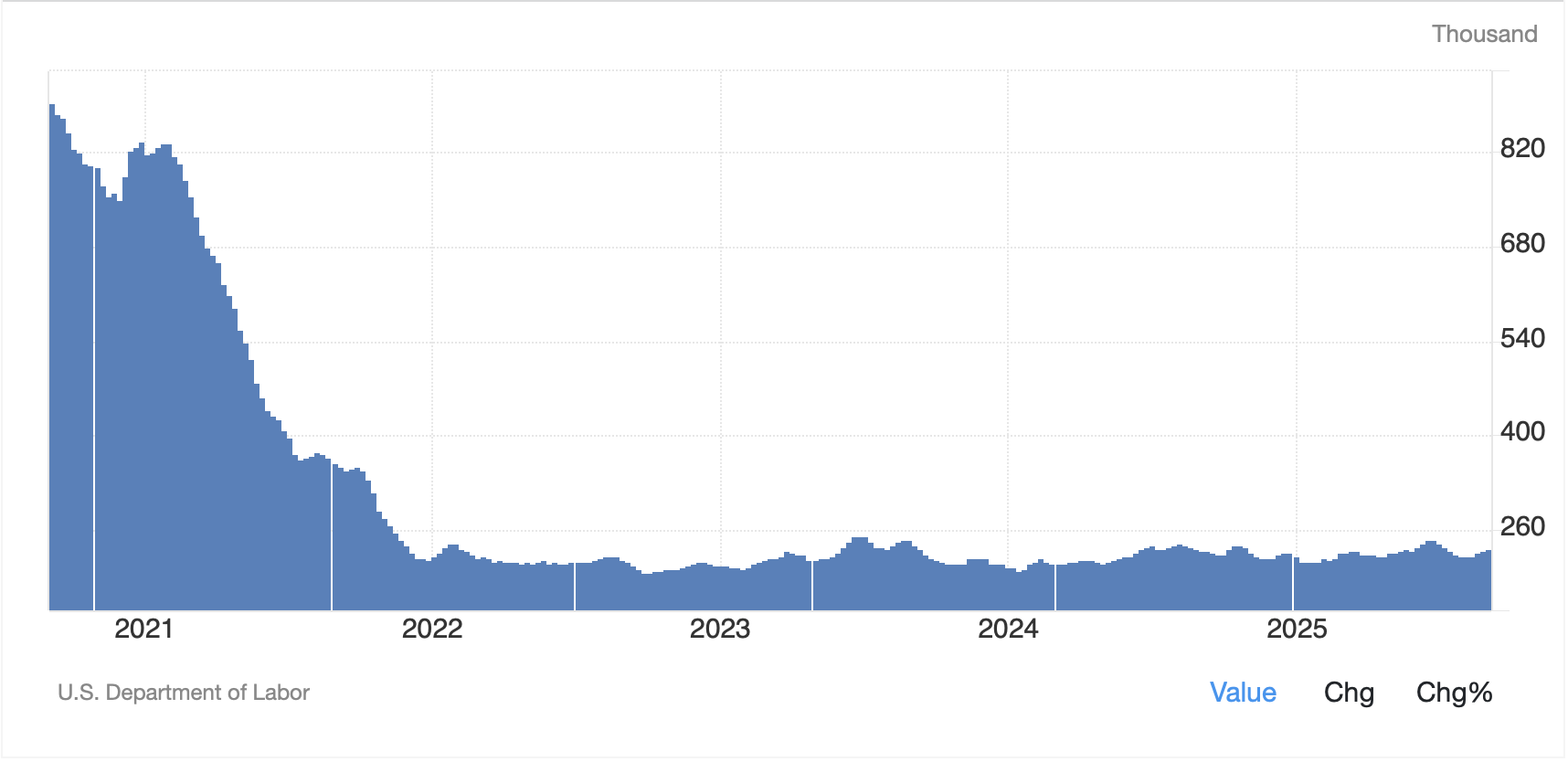
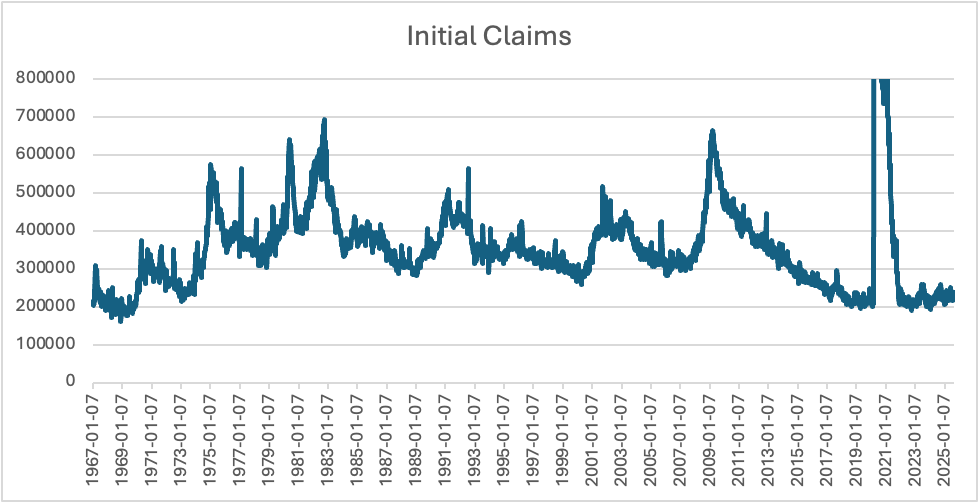
But markets need a focus and tomorrow’s NFP is as good as it gets.  Chairman Powell has been attending the ECB’s summer symposium and, in his speech, yesterday he essentially reiterated his views that the Fed will continue to watch and wait on rates as there is still concern that tariffs may drive inflation higher.  As to jobs, they are watching the situation closely, but thus far, the labor market has held up.  Proof of that idea was evident in yesterday’s JOLTs Job Openings data which showed a surprising jump of more than 300K new job listings available.  I haven’t seen a rationale yet, but perhaps it is related to the self-deportations by illegal immigrants who have left businesses with numerous vacancies.  The weekly claims data, while above its lowest levels lately, continues to run at very modest numbers on a long-term perspective as can be seen in the chart below with data from the Department of Labor.  If the job market holds up, I don’t see the Fed cutting rates despite President Trump’s ire.

Also, at Sintra was BOJ Governor Ueda who explained that Japanese policy rates were substantially lower than neutral and that inflation would likely continue creeping higher over time.  I guess we cannot be surprised that the yen (-0.5%) has slipped in the wake of those comments.  The final noteworthy comments from Sintra were from BOE governor Bailey who explained that despite sticky inflation, more rate cuts were on the way, helping to undermine the pound (-0.4%) this morning.

But there is one final thing to discuss regarding the Sintra meeting, and that is how many central bankers were suddenly concerned that their currencies were getting “too strong”!  We have been hearing about the dollar’s decline in the first half of the year as though it was a signal the US was in permanent decline.  Of course, given the nature of FX trading, a weaker dollar can also be seen as strength in other currencies. (To be clear, all fiat currencies continue to weaken vs. stuff as evidenced by the fact that inflation continues to be positive everywhere in the world, except perhaps Switzerland and China right now.)  However, I could not help but laugh at the ECB comments from several board members, that if the euro were to rise any further it could become a problem for the Eurozone economies.  All their models show that if a major export destination raises tariffs, their own currencies should decline to offset those tariffs.  Alas, once again, their models are not giving them answers that reflect the reality in markets.  And given Europe has built their economies on export reliance, a strong currency is a problem.

We must distinguish between a stronger exchange rate and a strong case to own a currency, especially as a reserve asset, but the two have historically been highly correlated.  As I have repeatedly explained, the dollar’s decline this year is neither anomalous nor particularly large in the broad scheme of things.  As well, it is exactly what the administration is seeking as it helps the competitiveness of US companies on the world stage.  However, my take is that at some point soon, the dollar will find a bottom.  I indicated a move to 90 on the DXY would be possible, and I think that is probably still true, although given the growing net short positions in USD vs. other currencies, the short squeeze will be spectacular when it arrives!

Ok, let’s see if we can get through the overnight activity without falling asleep.  Yesterday’s mixed US session was followed by a mixed session in Asia (Nikkei -0.6%, Hang Seng +0.6%, CSI 300 0.0%) with a mixture of modest gains and losses across the rest of the region, all on low volumes.  In Europe this morning, bourses are firmer led by the CAC (+1.1%) and Spain’s IBEX (+0.75%) as hopes for further rate cuts from the ECB dominate discussions.  As to US futures, they are modestly higher at this hour (7:30), about 0.15%.

In the bond market, after stronger than expected JOLTs data and ISM data, yields are backing up with Treasuries (+4bps) leading the way although both Germany (+5bps) and the UK (+6bps) are seeing selling pressure as well.  However, the rest of European sovereigns have only seen yields edge 1bp higher.  The only noteworthy comments I saw were from the Italian FinMin who explained Italy would be maintaining its fiscal prudence.  Not surprisingly, given Ueda-san’s comments, JGB yields rose 4bps overnight as well.

In the commodity space, oil (+1.25%) continues to drift higher as it tries to fill the gap seen last week.

Source: tradingeconomics.com

Apparently, the fact that supply seems to be rising rapidly has not dissuaded traders from the view that the ‘proper’ price range is $65-$75 rather than my belief of $50-$60.  But right now, they are looking smart.  In the metals markets, we continue to see support as the entire decline in the gold price at the end of June has been recouped and we are modestly higher this morning across all the metals (Au +0.1%, Ag +0.6%, Cu +0.4%, Pt +2.2%) with platinum merely showing its volatility due to lack of liquidity.

Finally, the dollar is firmer this morning against every one of its G10 and major EMG counterparts with the euro and pound (both -0.4% now) setting the tone.  Perhaps the best performer this morning is INR (-0.1%) which seems to be benefitting from the news that a trade deal is almost complete there.  As to trade with the Eurozone, that deal seems a bit further away, although I did see something about a European recognition that US tariffs would be, at a minimum, 10%.  At least for today, I haven’t read anything about the dollar’s ultimate demise!

On the data front, today brings ADP Employment (exp 95K) and then the EIA oil inventory data.  There are no Fed speakers either, so quite frankly, absent something newsworthy from DC, I suspect this will be a quiet session ahead of tomorrow’s NFP.  I guess the dollar is not dead yet.

Good luck

Adf
Over the Hump

It’s beautiful and it’s quite big
Though more complicated than trig
But President Trump
Got over the hump
Though sans views that he is a Whig
 
As well, Friday’s Canada rift
Has ended, boy that was sure swift
Now, this week we’ll learn
If there’s still concern
‘Bout jobs, or if there’s been a shift


The weekend news revolves around the fact that the Senate has passed the BBB with a 51-49 vote, and it now moves to committee so both Houses of Congress can agree the final details before it gets to President Trump’s desk for signature and enactment.  This is another victory for the President, adding to last week’s wins and remarkably there have been several others as well.  The Supreme Court ended the ability of a single district court judge to injunct the entire nation based on a single case, a move that will prevent judges who disagree with the president from stopping his policy efforts.  Then, Canada announced they were going to impose a tax on US technology companies (the one that the Europeans just killed) and after Mr Trump ended the trade dialog quite vociferously, Canada backed down from that stance and is back at the negotiating table.

I mention this not to be political but as a backdrop to what is helping to drive the improved sentiment in US markets for both equities and bonds.  While a quick look at YTD performances of US equity indices vs. Europeans shows the US still lags, that gap is narrowing as the news cycle continues to point to positive things happening in the US.  Certainly, my understanding of the BBB is that it is quite stimulative, although it is changing priorities from the previous administration.

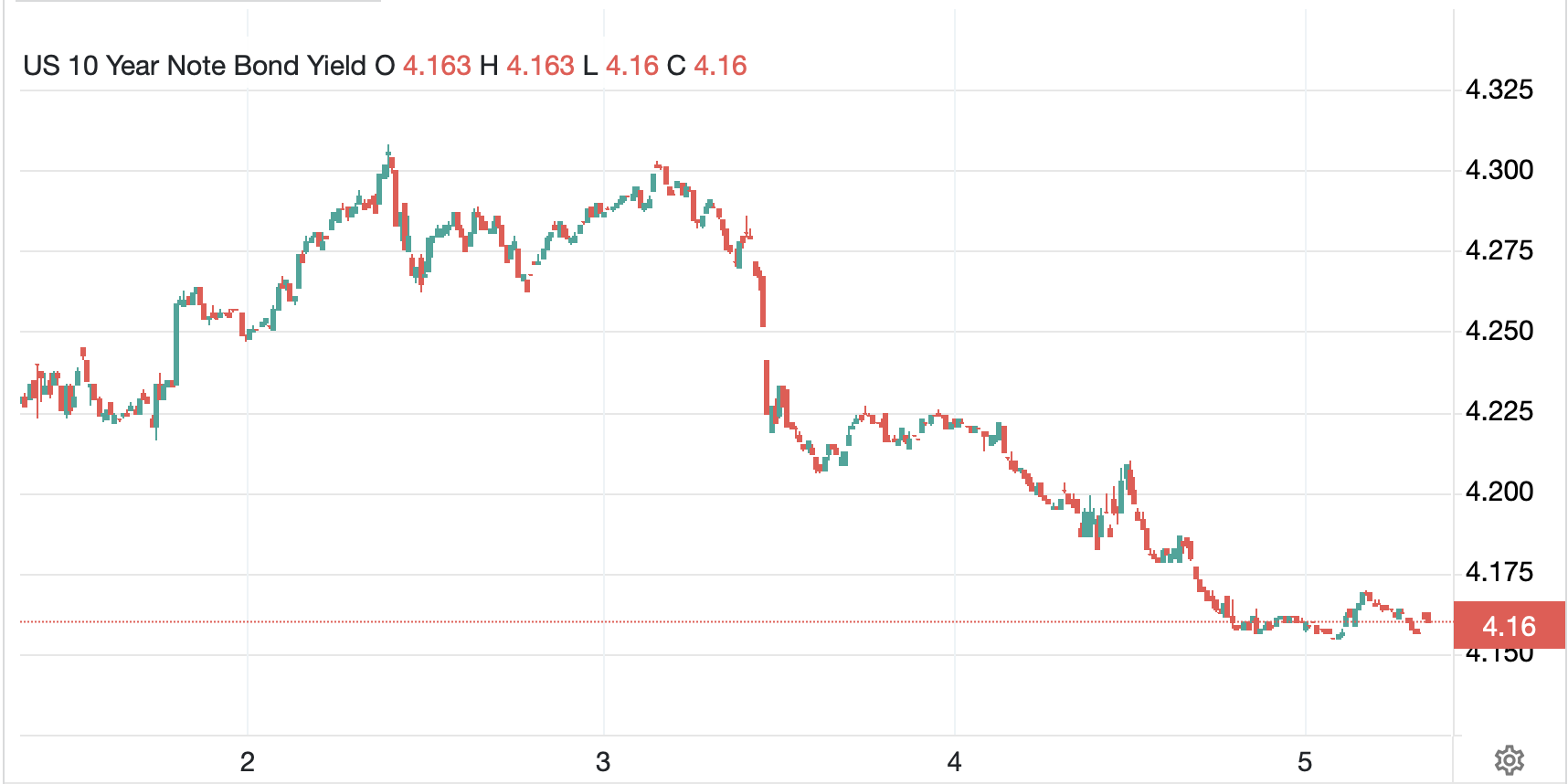
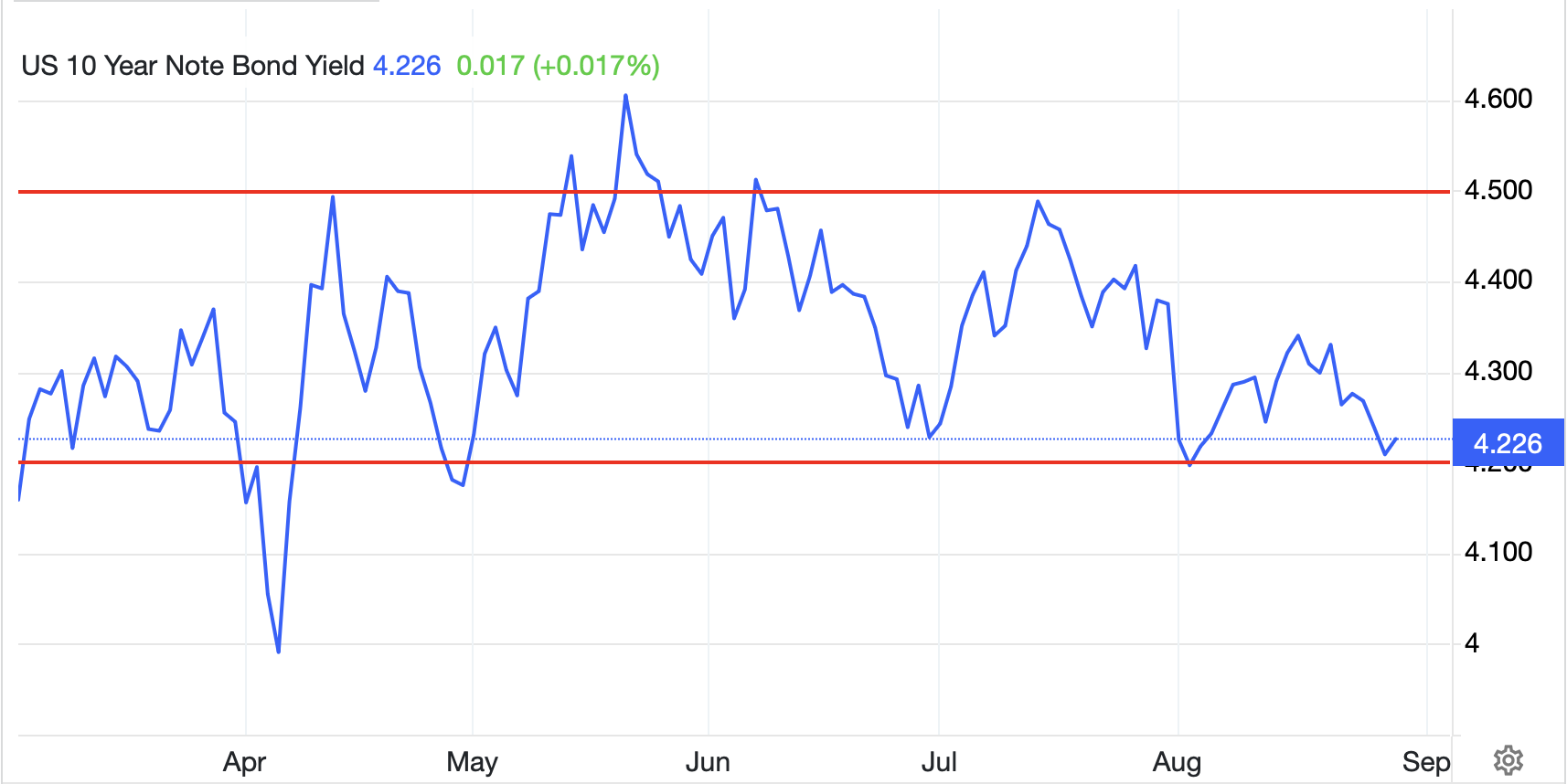
More interestingly, the Treasury market, which has been the subject of many slings and arrows lately from the part of the analyst community that continues to worry about refinancing the growing US debt pile, continues to behave remarkably well.  A quick look at the chart below shows that 10-year yields have been trending lower for the past 6 months, at least, and this morning are continuing that trend, slipping another -3bps.

Source: tradingeconomics.com

My point is that despite relentless doom porn regarding the economy, the big picture continues to point to ongoing growth in economic activity.  There are many anecdotes regarding the impending weakness, (the latest I saw was the increase in the number of credit card purchases that have been rejected is rising rapidly) and yet, the main data has yet to crack and roll over to point to a clear sign of significant slowing.  Perhaps this week when the NFP report is released on Thursday (Friday is July 4th holiday), we will see that long-awaited decline.  However, as of this morning, the Fed funds futures market continues to price just a 21% probability of a July rate cut as forecasts for NFP show the median to be 110K. 

While I completely understand the concerns that the doomers recite, I have come to understand that the idea of a recession is a policy choice, not a natural phenomenon.  While in the past, the business cycle was more powerful than the government, that is no longer the case.  Rather, what we have observed over the past 15 years at least, since the GFC and the onset of QE, is that the government has become a large enough part of the total economy to drive it at the margin.  And I assure you, if a recession is a policy choice, there is not a politician that is going to choose one.  Perhaps we will reach a point where the imbalances get beyond the control of the central banks and their finance ministries, but we are not there yet.

Ok, let’s take a peek at the overnight price action.  Despite all the spending promises by governments around the world, yields have slipped everywhere with all European sovereigns taking their lead from the US and lower this morning by -2bps to -3bps.  Even JGB yields (-1bp) have managed to decline slightly.  If inflation fears are building, they are not obvious this morning.

In the equity markets, Friday’s US rally was followed by most Asian bourses rising (Nikkei +0.8%, Australia +0.3%, China +0.4%) although HK (-0.9%) slipped after Chinese PMI data was released that indicated things weren’t collapsing, but that future monetary stimulus may not be coming after all.  The worst of both worlds for stocks.  Meanwhile, European exchanges are mostly a touch softer, but only on the order of -0.2%, so really very little changed amid light volume overall.  Interestingly, US futures are solidly higher at this hour (7:00), rising by 0.55% across the board.

In the commodity markets, oil (-0.35%) is slipping a bit, but is basically hanging around near its recent lows as the market remains unconcerned about an escalation of fighting between Iran and Israel and any possible closure of the Strait of Hormuz.  Meanwhile, gold (+0.4%) is bouncing from a weak performance Friday which appears to have been a bit oversold, although copper and silver are not following suit this morning with the former (Cu -0.7%) the laggard.  However, all the metals remain sharply higher this year and in strong up trends.

Finally, the dollar is modestly softer again this morning with KRW (+0.9%) the biggest mover, by far, while the entire G10 complex is showing gains on the order of 0.1% to 0.2%.  This trend lower in the dollar remains strong (see chart below), but as I continue to remind everyone, we are nowhere near an extreme valuation in the dollar.  If, and it’s a big if, we see substantial weakening in the employment data, I think the Fed could decide to act and that would increase the speed of the downtrend (as well as goose inflation higher), but absent that, I do not see a sharp decline, rather a slow descent.  Remember, this is exactly what Trump and Bessent want, a more competitive dollar for the manufacturing sector.

Source: tradingeconomics.com

As it is the first week of the month, there is plenty of data to digest.

TodayChicago PMI43.0
TuesdayISM Manufacturing48.8
 ISM Prices Paid69.0
 JOLTs Job Openings7.3M
WednesdayADP Employment 85K
ThursdayNonfarm Payrolls110K
 Private Payrolls110K
 Manufacturing Payrolls-6K
 Unemployment Rate4.3%
 Average Hourly Earnings0.3% (3.9% y/Y)
 Average Weekly Hours34.3
 Participation Rate62.3%
 Initial Claims240K
 Continuing Claims1960K
 ISM Services50.5
 Factory Orders8.0%
 -ex Transport0.9%

Source: tradingeconomics.com

In addition to the payrolls, we hear from Chairman Powell again on Tuesday and Atlanta Fed president Bostic twice.  I guess the rest of the FOMC took a long holiday week(end).

As it’s a holiday week, I expect that activity will be light, although headline bingo remains a key part of the markets today.  I feel like the trends are well entrenched though, with the dollar slipping, equities and commodities rallying and bonds currently leaning toward lower yields, although that seems out of sync with the other markets.  But in the summer, with less liquidity and activity, anomalies can continue for a while.

Good luck

Adf

Full Schmooze

The temperature’s starting to fall
With Israel and Iran’s brawl
On hold for the moment
Though either could foment
Resumption, and break protocol
 
But that truce combined with the news
That Trump’s team are pushing full schmooze
On trade, has the markets
Increasing their bull bets
While skeptics are singing the blues


President Trump is having a pretty remarkable week.  The successful attack and destruction of Iran’s nuclear enrichment facilities combined with the news that the US and China have agreed the details of the trade framework that was outlined in Geneva and followed up in London has market participants feeling a lot better about the world this morning.  Add to that the news that a particularly onerous part of the BBB, Section 899, which was nicknamed the Revenge clause for its tax targeting anybody from nations that imposed excess taxes on US companies internationally, being stripped after negotiations with European leaders, and the fact that NATO has gone all-in on increasing their spending, and Mr Trump must be feeling pretty good this morning.  Certainly, most markets are feeling that, except those that thrive on chaos and fear, like precious metals.

In fact, this morning it seems that the entire discussion is a rehash of what has occurred all week with very little new added to the mix.  Data from the US yesterday was mixed, with Claims a bit softer and Durable Goods quite strong while the third look at Q1 GDP was revised lower on more trade data showing imports were greater than first measured while Consumer Spending and Final Sales were a bit weaker than expected.  Net, there was not enough to push a view of either substantial strength or weakness in the economy, so investors and their algorithms continue to buy shares.

The other story that continues to get airplay is the pressure on Chairman Powell and questions about whether at the July meeting Fed governors are going to vote against the Chairman.  Apparently, it has been 32 years since that has occurred (and you thought they were actual votes!) and the punditry is ascribing the dissent to politics, not economics.  It should, of course, be no surprise that there is a political angle as there is a political angle to every story these days, but the press is particularly keen to point out that the two most vocal Fed governors discussing rate cuts were appointed by Trump.

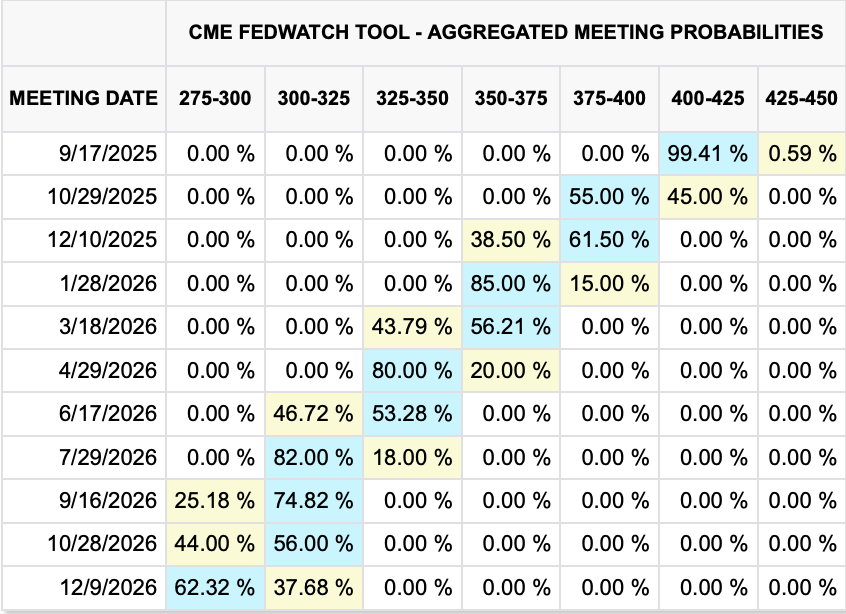
However, despite all the talk, the futures market does not appear to have adjusted its opinion all that much as evidenced by the CME chart of probabilities below.  In fact, over the past month, the probability of a cut has declined slightly.  Rather, I would contend that on a slow news Friday, the punditry is looking for a story to get clicks.

The last story of note is about the dollar and its ongoing weakness.  This is an extension of the Fed story as there is alleged concern that if the Fed is perceived to lose some of its independence, that will be a negative for the dollar in its own right, as well as the fact that the loss of independence would be confirmed by a rate cut when one is not necessary (sort of like last autumn prior to the election.  Interestingly, I don’t recall much discussion about the Fed’s loss of independence then.)

But, in fairness, the dollar has continued to decline with the euro trading to its highest level, above 1.17, in nearly four years.  It is hard to look at the story in Europe and think, damn, what a place to invest with high energy costs and massive regulatory impediments, so it is reasonable to accept that what had been a very long dollar position is getting unwound.  But look at the next two charts (source: tradingeconomics.com) of the euro, showing price action for one year and for five years, and more importantly notice the trend lines that the system has drawn.  There is no doubt the dollar is under pressure right now, but I am not in the camp that believes this is the beginning of the end of the dollar’s global status.  Remember, too, that President Trump would like to see the dollar soften to help the export competitiveness of the US, and so I would not expect to hear anything from the Treasury on the matter.

However, while these medium and long-term trends are clear, the overnight session was far less exciting with the largest move in any major currency the ZAR (+0.5%) which is despite the decline in gold and platinum prices.  Otherwise, today’s movement is basically +/- 0.2% across both G10 and EMG currencies.

Speaking of the metals, though, they are taking it on the chin this morning as we approach month end and futures roll action.  Gold (-1.3%), silver (-1.7%), copper (-0.9%) and platinum (-4.4%) are all under pressure, although all remain significantly higher YTD.  However, to the extent that they represent a haven and the fact that havens seem a little less necessary this morning seems to be the narrative driver adding to the month end positioning.  Meanwhile, oil (+0.5%) continues to bounce ever so slowly off the lows seen immediately in the wake of the bombing attacks.

Circling back to equity markets, after a nice day in the US yesterday, with gains across the board approaching 1% and the S&P 500 pushing to within points of a new all-time high, Japan (+1.4%) followed suit as did much of the region (India, Taiwan, New Zealand, Indonesia) but China (-0.6%) and Hong Kong (-0.2%) didn’t play along.  Europe, though, is having a positive session with gains ranging from 0.65% (DAX) to 1.3% (CAC) and everything in between.  It seems that the NATO spending news continues to support European arms manufacturers and the cooling of tensions in the Middle East has lessened energy concerns.  US futures are also bright this morning, up about 0.5% at this hour (7:40).

Finally, bond markets are selling off slightly after a further rally yesterday and yields since the close have risen basically 3bps in both Treasury and European sovereign markets.  There is still no indication that any government is going to stop spending, rather more increases are on the horizon, but there is also no indication that central banks are going to stop supporting this action.  No central bank is going to allow their nation’s bond market to become unglued, regardless of the theories of what they can do and what they control.  Ultimately, they control the entire yield curve.

On the data front, this morning brings Personal Income (exp 0.3%), Personal Spending (0.1%) the PCE data (Core 0.1%, 2.6% Y/Y; Headline 0.1%, 2.3% Y/Y) and at 10:00 Michigan Consumer Sentiment (60.5) and Inflation Expectations (1yr 5.1%, 5yr 4.1%).  There are several more Fed speakers, including Governor Cook, a Biden appointee who is a very clear dove, but has not yet agreed that rate cuts make sense.  It will be interesting to see what she has to say.

It is a summer Friday toward the end of the month.  Unless the data is dramatically different than forecast, I expect that the dollar will continue to slide slowly for now, although I do expect the metals complex to find a bottom and turn.  As to equities, apparently there is no reason not to buy them!

Good luck and good weekend

Adf