Not One Whit

Both headline and core PCE
Were softer, with both below three
But under the hood
It’s not quite as good
As housing and transport are key
 
The narrative, though, will not quit
Assuring us all this is it
Rate cuts will come soon
And stocks to the moon
But so far, for proof, not one whit.
 
There is a very good analyst who writes regularly on the macroeconomic story named Wolf Richter.  In the wake of Friday’s PCE data release, he published an article that had the following table:
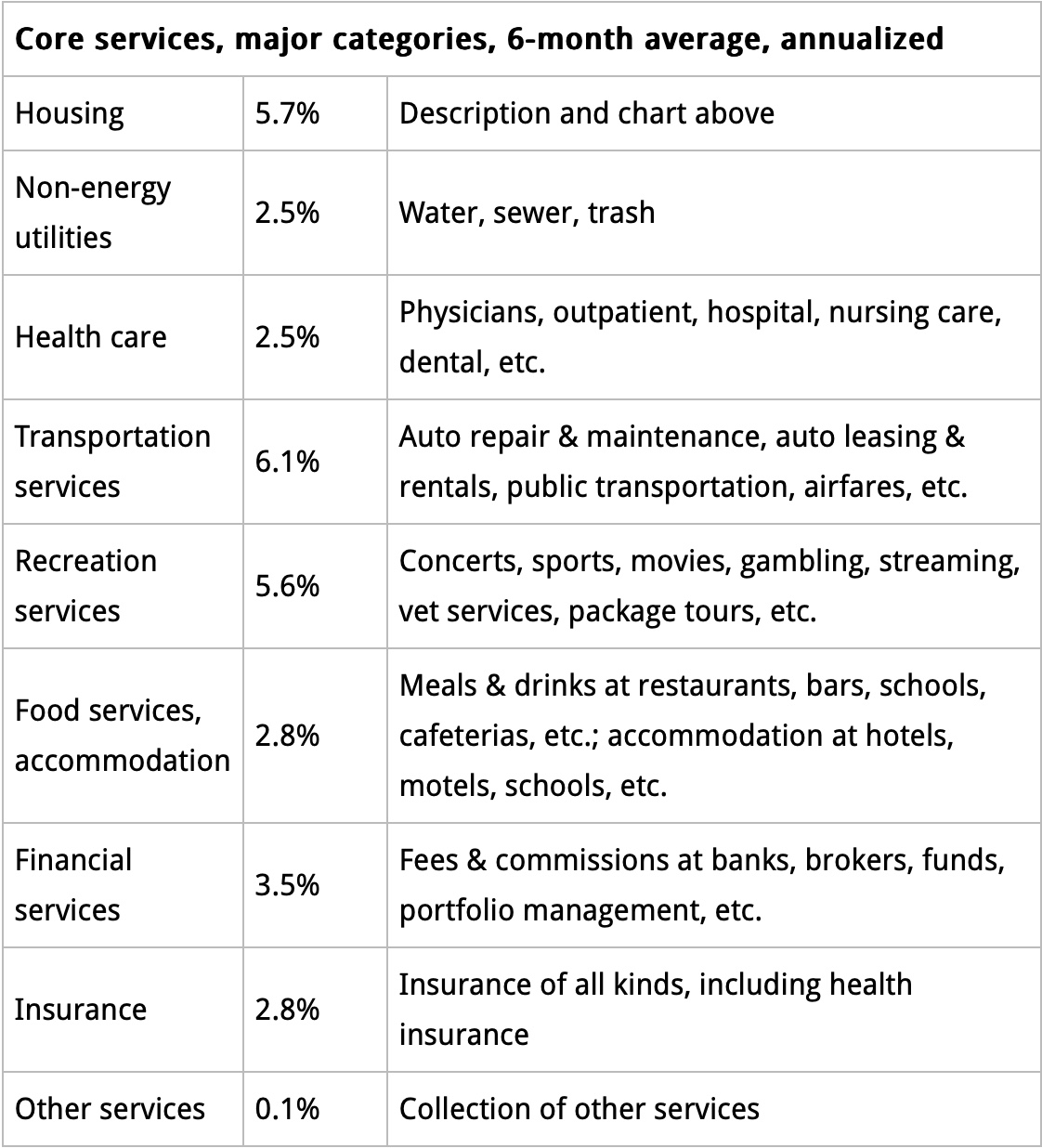
It is not hard to look at this table and see a bit of the reality we all face, rather than the widely touted headline numbers regarding inflation.  Housing continues to be sticky at much higher inflation rates than target, as well as transportation services, recreation services and financial services.  But even the other stuff, seems to be running above the elusive 2.0% level.  Now, this is the annualized rate of the past 6 months’ average readings.  But as I highlighted last week regarding CPI, this seems to be the new benchmark.  My point is that while the narrative is really working hard to convince us all that inflation is collapsing and the Fed is massively over-tight in its policy and needs to CUT RATES NOW, this breakdown doesn’t look quite the same.  My belief is the Fed remains on hold much longer than the market is expecting/hoping for, and that at some point, equity markets and risk assets are going to come to grips with that reality.  Just not quite yet.

Of course, maybe the narrative is spot on, and inflation is going to smoothly decline back to the 2% level while economic growth continues its recent above-trend course.  But personally, I have to fade that bet.  Based on the amount of continued fiscal stimulus, as well as the Fed’s discussion of slowing QT and their indication of rate cuts later this year, I believe that while the growth story is viable, it will be accompanied with much hotter inflation than is currently priced.  The fact that breakeven inflation rates are priced at 2.50% in the 10-year does not mean that is what is going to happen.  Just like the fact that the Fed funds futures market is currently pricing between 5 and 6 rate cuts in 2024 does not mean that is what is going to happen.  Let’s face it, nobody knows how the rest of the year is going to play out.  The one thing, however, of which we can be sure is that Treasury Secretary Yellen will spend as much money as possible in her effort to get President Biden re-elected.  That alone tells me that inflation is set to rebound.

And there is one other thing to remember, as things heat up in the Red Sea, and shipping avoids the area completely, the cost of transiting stuff from point A to point B continues to rise.  The cost is measured both in the dollars charged for the service and the extra 10-14 days it takes to complete the trip around the Cape of Good Hope in South Africa.  It seems that the Biden Administration’s foreign policy has unwittingly had a negative impact on its economic policy plans.  

In sum, when I look at both the data and the activities around the world, it remains very difficult to accept the narrative that inflation is collapsing so quickly that the Fed MUST cut rates and cut them soon.  The combination of still robust US growth on the back of excessive fiscal stimulus and the increased tensions in the oil market lead me to a very different conclusion.

With that in mind, let’s see what happened overnight.  Equity markets in Asia were mixed as Japan (Nikkei +0.8%) and Hong Kong (Hang Seng +0.8%) both rallied but mainland Chinese shares (CSI -0.9%) fell.  This was somewhat surprising as China, in their continuing efforts to prop up their stock markets, have restricted the lending of any securities for short sales while a HK court ruled Evergrande (remember them?) should be liquidated completely.  Perhaps the Chinese real estate situation is not quite fixed yet after all.  I suspect that we will see other liquidations as well before it is all over.  In the meantime, European bourses are mixed with the DAX (-0.4%) lagging while the FTSE 100 (+0.25%) is top dog today.  There’s been no news of which to speak so this seems like position adjustments ahead of the Fed’s activities later this week.  US futures, too, are mixed and little changed at this hour (7:15).

Bond markets, though, are really loving all the rate cut talk and are growing more confident that they will be coming soon as inflation collapses.  Treasury yields are lower by 3bps this morning and the entire European sovereign market has rallied with yields down an impressive 5bps-7bps today.  The only outlier is the JGB market, which saw the 10-year benchmark yield edge up 1bp.  It is much easier for me to believe that the ECB is going to cut as inflation in the Eurozone slows alongside the faltering growth story than to believe that the Fed is going to cut into an economy growing 3+%.  But that’s just me.

In the commodity markets, oil (+0.3%) continues to find support as the tensions in the Middle East expand after an attack in Jordan killed three US servicemen there.  Oil is higher by 5% in the past week and more than 11% in the past month.  It seems to me that will not help the inflation story.  At the same time, we are seeing demand for precious metals as gold (+0.5%) and sliver (+1.0%) are both rallying on the increased nervousness around the world.  Perhaps more interestingly is that copper is marginally higher this morning, something that would seem contra to the escalating tensions.

Finally, the dollar has rallied a bit this morning on net, although it is not a universal move by any stretch.  For instance, while European currencies are broadly weaker, in Asia and Oceania, we are seeing strength with AUD and NZD (both +0.4%) and JPY (+0.2%) fimer.  As to the rest of the world, it is a mixed session with minimal movement.  Feels like a wait and see situation given all the data and info coming this week.

Speaking of the data this week, there is much to absorb.

TodayTreasury Funding Amount$816B
 Dallas Fed Manufacturing-23
TuesdayCase Shiller Home Prices5.8%
 JOLTS Job Openings8.75M
 Consumer Confidence115
WednesdayADP Employment135K
 Treasury QRA 
 Employment Cost Index1.1%
 Chicago PMI48
 FOMC Meeting5.5% (unchanged)
ThursdayInitial Claims210K
 Continuing Claims1835K
 Nonfarm Productivity2.5%
 Unit Labor Costs1.7%
 ISM Manufacturing47.3
 Construction Spending0.5%
FridayNonfarm Payrolls173K
 Private Payrolls145K
 Manufacturing Payrolls2K
 Unemployment Rate3.8%
 Average Hourly Earnings0.3% (4.1% Y/Y)
 Average Weekly Hours34.3
 Participation Rate62.4%
 Factory Orders0.2%
 Michigan Confidence78.8

Source tradingeconomics.com

The first thing to understand is that this morning, the Treasury will be releasing how much funding they expect to need in Q1 of this year, currently expected at $816 billion, but Wednesday’s QRA will describe the mix of the borrowings.  Recall that last quarter, Secretary Yellen changed the mix of short-dated paper to long-dated coupons substantially and completely reversed the bond market rout that was ongoing at the time.  If she continues to issue far more bills than coupons, it should support the bond market and help continue to juice risk assets.  Any substantial increase in coupon issuance is likely to be met with a significant stock and bond market sell-off.  So, which do you think she will do?

Otherwise, looking at the other data, certainly there is no indication that housing prices are moderating.  The Fed will not change rates on Wednesday, but everyone is waiting to see if they will remove the line in their statement about potentially needing to raise rates going forward.  Perhaps there will be a little two-step where the QRA points to more bond issuance, but the Fed sounds more dovish to offset that news.  And of course, Friday’s NFP data will be keenly watched by all observers as any signs that the labor market is cracking will get the rate cut juices flowing even faster.

All in all, we have a lot of new information coming to our screens this week.  At this point, it is a mug’s game to try to guess how things will play out.  However, if we see dovishness from the Fed or the QRA (more bill issuance) then I expect risk assets to perform well and the dollar not so much.  The opposite should be true as well, a surprisingly hawkish Fed or more coupon issuance will not be welcomed by the bulls, at least not the equity bulls.  The dollar bulls will be happy.

Good luck

Adf
Quite Restrictive

The Fed keeps on spinning the tale
They’re watching like hawks so that they’ll
Be able to jump
In case Donald Trump
Does not look like going to jail
Be able to act
And not be attacked
If ‘flation forecasts start to fail
 
Twas Bostic’s turn yesterday to
Explain that the policy skew
Is still quite restrictive
Though that’s not predictive
Of what they may finally do
 
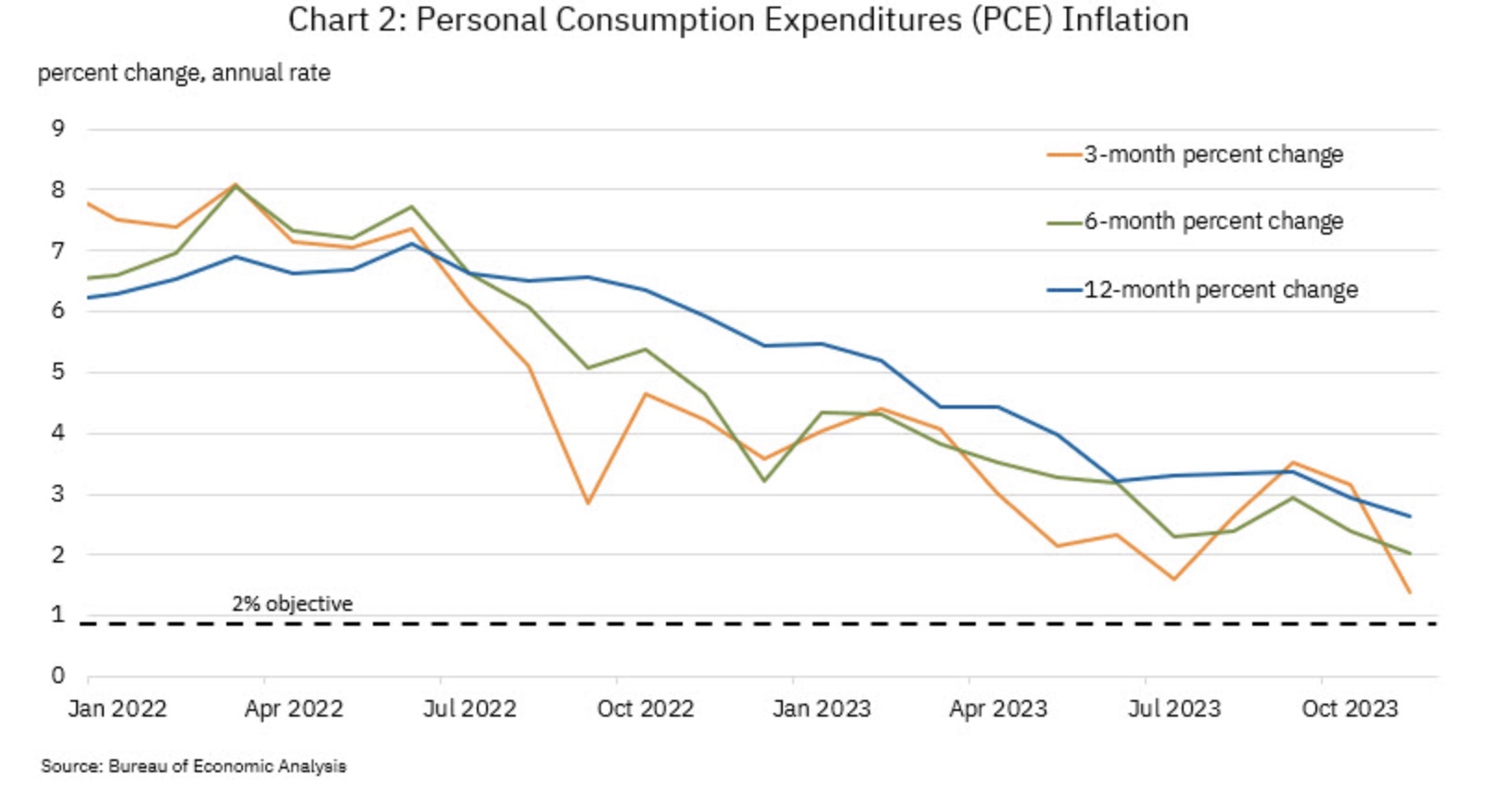
Atlanta Fed President Raphael Bostic was the latest FOMC member to regale us with his views on current policy settings amid two speeches yesterday.  The essence of his comments lines up with what we have heard for the past two weeks; policy is sufficiently restrictive to help drive inflation down to their 2% target, but they will be vigilant if that is not the outcome.  One of the things that he mentioned, and that has been a really popular chart crime over the past few months, at least for the doves, is he discussed annualizing the most recent three months of PCE data and the most recent 6 months of PCE data as proof that they are doing a good job.  In fact, in one of his two presentations, he used the following chart:

Unquestionably, if you look at the orange line, which represents the annualized value of the past 3 months, it shows that PCE is “now” running below their target.  But let me ask you a question, looking back to H1 of 2022, when inflation was peaking.  Both the 3-month and 6-month changes were well above the annual number at the time.  Do any of you remember the focus on those short-term nonsense numbers?  Me neither.  My point is the only number that matters is the actual annual one as that is their target.  Any indication that it is flattening or turning higher, just like the CPI data did earlier this month, is going to put paid to this story.  While I have no idea where next week’s data is going to print, we must be wary of the narrative spin on the actual data.  If we know one thing about the Fed, by definition, they are reactive.  That is what following the data means.  If they were predictive, they would move before the data, but they never do that. 
 
So, all this talk of cutting before inflation gets too low is not monetary policy.  However, we cannot rule out a cut based on the political implications as they view rate cuts as a way to boost the economy and try to ensure the current president is re-elected rather than the likely Republican candidate gets back in.  Alas, for now, we will have to live with the spin.  Today we hear from two more Fed speakers, SF’s Mary Daly and Governor Michael Barr.  I suspect we will hear exactly the same message from both.  Too early for cuts, but they are ready when the time comes.
 
Meanwhile, across the pond, the preponderance of ECB speakers has been very clear that March is off the table for a rate cut but June seems to be what they see as likely.  Here, too, they see the trend as their friend, but inflation readings are still nowhere near their 2.0% target.  However, it is clear that the pain of higher rates is having a much larger impact on Europe than on the US as GDP data continues to deteriorate.  Germany is in recession and much of the rest of the continent is on its way.  The benefit for Madame Lagarde is that the Europeans did not inject nearly as much stimulus during the Covid years as the US, so it is likely the Eurozone economy is following a better-known path.  In the end, though, they are very anxious for the Fed to get started as they really want to start cutting rates, I believe, but with inflation still far above target and the Fed still holding on, they would have no rational explanation for their actions.
 
One last thing to note is CPI in Japan was released last night and it fell to 2.6% headline and 2.3% core.  Any idea that the BOJ was going to need to tighten policy in the near-term to fight too high inflation has been dissipating quickly.  It turns out that they may have been correct to leave policy unchanged as now they do not need to do anything to be in the right spot.  The market response mostly made sense as the yen weakened with the dollar now above 148, while the Nikkei rose another 1.4% and is pushing those recent 30+ year highs.  The weird thing, though, was the JGB market which saw yields rally 4bps, back to their highest level in a month.  I have been unable to find any solid explanation for this move as certainly it is not fundamental.
 
Anyway, let’s look at the rest of the overnight session to see how things are feeling as we close the week.  After a solid US equity session yesterday, most of Asia had a good go of things with rallies pretty much everywhere except China and Hong Kong.  The equity markets in both those nations have been under significant pressure lately and show no signs of turning.  While the market is not the economy, President Xi has already called for the end of short sales and is now leaning on domestic institutions to not sell at all.  With the property market already in the tank, a rapidly declining stock market is not a good look for the concept of prosperity for all.  Europe, though, is modestly higher this morning and US futures are also in the green following yesterday’s session.
 
In the bond markets, Treasury yields are little changed on the day, but remain above the 4.10% level that some are calling a key technical spot.  European sovereigns, though, are all rallying more aggressively with yields falling between 3bps and 7bps despite what are continuous calls for the ECB to maintain tight policy for longer than the market is pricing.  Perhaps investors are feeling better about inflation prospects if the ECB holds the line.
 
After a rally yesterday, oil prices are essentially unchanged this morning.  The unrest in the Red Sea continues with the Houthis firing more missiles and fewer and fewer ships willing to transit the area while yesterday’s tit-for-tat Iran-Pakistan missile attacks are now merely history.  The fact that oil remains below $74/bbl implies it is not really pricing any possibility of a larger Middle East conflict.  That seems pretty hubristic to me as the probabilities seem to be far larger than zero.  As to the metals markets, both precious and base metals are firmer this morning in sync with softer yields and a softer dollar. 
 
Speaking of the dollar, while it is ever so slightly lower on a DXY basis this morning, it continues to hold the bulk of its gains for the past month.  Versus G10 currencies, the picture is mixed with GBP (-0.2%) underperforming after absolutely abysmal Retail Sales data was released this morning, but the rest of this bloc is higher by about 0.2% or so on average.  In the EMG space, the direction is broadly for currency strength, but the movement remains modest at best, on the order of 0.1%-0.3%.  In other words, not much is going on here.
 
On the data front, yesterday brought a mixed picture with Housing data slightly better than expectations, although starts fell compared to last month.  Initial Claims printed at 187K, their lowest in a very long time, but Philly Fed was at a worse than expected -10.6, not as bad as Empire State, but still not too bullish!  Today brings Michigan Sentiment (exp 70.0) and Existing Home Sales (3.82M) as well as the above-mentioned Fed speakers.  After today, the Fed is in their quiet period, so we will have to make up our own minds as to what the data means.
 
For now, the market seems quite comfortable buying dips and as evidenced by the Fed funds futures market, is still pricing a 55% chance of a March cut.  While that probability is shrinking slowly, there are still 6 cuts priced in for the year.  At this point, my thesis of the market fighting the Fed for the first half of the year before capitulating to higher inflation prospects and higher yields amid slowing growth remains my best guess.  But that is just me.  Absent something really surprising from Daly or Barr, I suspect that there will be limited price movement going into the weekend.
 
Good luck and good weekend
Adf
 

Looks Askance

On Wednesday, twas John Williams chance
To help explain, though at first glance
Inflation is sinking
No Kool-aid, he’s drinking
So, at cuts, he still looks askance

And backing him up in this view
Was Retail Sales, which really grew
There’s no indication
That US inflation
Is going to fall down near two

The pushback by FOMC speakers continued yesterday as NY Fed president Williams was the latest to explain that although things were heading in the right direction, the committee was unlikely to cut rates anywhere nearly as quickly as the market is pricing.  Here are the money lines, “My base case is that the current restrictive stance of monetary policy will continue to restore balance and bring inflation back to our 2 percent longer-run goal. I expect that we will need to maintain a restrictive stance of policy for some time to fully achieve our goals, and it will only be appropriate to dial back the degree of policy restraint when we are confident that inflation is moving toward 2 percent on a sustained basis.” [Emphasis added]. Once again, the idea that the Fed is going to cut rates in March seems awfully remote, at least based on what they are telling us.

Now, it is entirely possible that the data starts to deteriorate more rapidly with growth clearly falling and Unemployment starting to rise more rapidly and if that were to occur, I think a March cut would not be impossible.  But then yesterday we saw a much better than expected Retail Sales print, (headline +0.6%, ex autos +0.4%) with the Y/Y growth up to 5.6% (nominal).  Data like that is not indicative of a collapse in economic activity.  The fact that much of it is reliant on a combination of massive fiscal stimulus and increased credit card debt does not mean the growth is false.  It merely sets up for weakness later.

In the end, the Fed funds futures market is backing away a bit further from that March rate cut with the probability reduced to 61% now from 70% just a week ago.  It can be no surprise that between the Williams comments and the stronger data, Treasury yields backed up 5bps and equity markets suffered a bit more, down about -0.5%.

To me, the key question is, at what point will the market accept that 6 rate cuts are not the most likely outcome this year?  Clearly, they are not ready to do so yet, although based on the equity market performance so far this year, there is a little bit of nervousness, at least, making its way through the investment community.  Analyzing the price action over the past month and considering the information that we have gotten since the last FOMC meeting, the outlier seems to be Powell’s dovishness at the press conference, not the macroeconomic data nor the commentary from other Fed speakers.  Of course, Powell’s voice is clearly the most important, but when both Waller and Williams, his two top lieutenants, reiterate that maintaining restrictive policy is the right move for now, I have to believe that the next FOMC statement is going to reiterate that stance.

What does all this say about the future?  Well, since everything is data dependent, or at least that’s what they tell us, then we need to continue to watch the data to help understand the reaction function.  The problem is that there is no consistency in the data.  For instance, in addition to yesterday’s strong Retail Sales data, we saw stronger than expected NFP and higher than expected CPI readings, all three being critical real data points.  On the flip side, we have seen weaker than expected ISM data, both manufacturing and services and Tuesday’s Empire State Manufacturing Index fell to -43.7, a level only exceeded by the Covid readings in early 2020.  In fact, that index has fallen more than 50 points in the past two months.  The upshot is that we continue to see negative survey data and solid real data.  So, I ask you, which set of data is the Fed watching more closely?

FWIW my assessment of the situation is as follows: the Fed is aware of the goldilocks narrative but has not bought into it at this stage, at least not Powell and his two key lieutenants, and they are the ones that matter. Whatever the survey data, if the hard data holds up, they are going to maintain policy right where it is.  While we know they care about surveys (look at their focus on inflation expectations), I think Powell is still very afraid of being Arthur Burns redux.  Right now, it looks like the outlier was the Powell press conference, not all the push back.  I changed my entire thesis based on that pivot and that may have been a mistake.  However, if we start to see weaker hard data, so Housing softens, PCE is soft, GDP misses expectations or something like that, look for goldilocks to make a return.  Otherwise, regardless of the survey data, I fear risk assets are going to have trouble as are bond markets which have priced in a lot of rate cuts.

Speaking of push back, we continue to hear ECB speakers on the same page as the Fed, rate cuts are not coming on the market’s current timeline.  June seems to be the earliest it will happen there unless the Fed cuts sooner.  I continue to believe given the very weak growth profile in Europe that Madame Lagarde is quite anxious to get started cutting rates, but she knows she cannot do so yet.  I imagine that Interpol will have an APB out on goldilocks pretty soon as they want to capture her and keep her in the public’s eye.

One other thing to mention away from the financial markets is what appears to be a further escalation of fighting in the Middle East.  Last night, Pakistan retaliated against Iran with missile strikes of their own, ostensibly killing Pakistani militants who were based in Iran.  Whatever the rationale may be for these moves, the one truism is that things in the Middle East are getting more dangerous and that is going to pressure oil prices higher.  We have seen that this morning, with small gains, but I would suggest that will be the direction of travel if this keeps up.

Ok, on to markets where yesterday’s lackluster US equity performance was largely ignored as Japanese stocks were just barely lower, Chinese and Hong Kong stocks finally rebounded a bit and the rest of APAC saw more gainers than losers.  European markets are firmer this morning, in what could well be a trading bounce as there was no data to encourage the process and US futures are firmer at this hour (7:30) by about 0.5%.

After yesterday’s continuation bounce in yields, this morning we are seeing a bit of a pullback with Treasury and most European sovereign yields lower by about 2bps.  The one outlier is Japan, where JGB yields picked up 3bps, although that could well be a delayed response to yesterday’s Treasury price action as the Japanese data overnight was quite soft (Machinery Orders and IP both falling in November) and not indicative of tighter policy in the future.

Aside from oil’s modest gains, gold has rebounded a bit this morning, up 0.5%, arguably on the increased tensions in Iran/Pakistan but the base metals are under pressure today.  Lately, it is very difficult to glean much information from the base metals as confusion over whether Chinese growth is real, and how overall growth is progressing seems to be keeping traders on the sidelines.

Finally, the dollar is backing off its highs from yesterday, but the movement has not been large, about 0.2% broadly across both G10 and EMG currencies.  The most noteworthy outlier is ZAR, where the rand has rallied 0.85% on the back of that gold strength.

On the data front today, Housing Starts (exp 1.48M), Building Permits (1.426M), Initial Claims (207K), Continuing Claims (1845K) and Philly Fed (-7) all show up at 8:30.  As well, Atlanta Fed president Raphael Bostic speaks twice today, early and late, so it will be very interesting to hear if he is going to push back further on the Powell pivot or agree with it.

Today brings both hard and survey data, so if it all lines up one way or the other, perhaps it will be a driver.  But my take is we will continue to see a mixed picture and so will be highly reliant on Fedspeak as after Bostic today, we get Daly and Barr tomorrow and then the quiet period.  I think a risk rebound is in order just because things have been weak.  But I am worried about the longer-term trend now that Powell is seeming more and more like the outlier, not the driver.

Good luck
Adf

As Good As It Gets

Said Waller, I have no regrets
For things are “as good as it gets”
We’ve been quite outstanding
And reached that soft landing
Though rate cut forecasts won’t be met

Wow is all I can say.  While Treasury Secretary Yellen was brasher last week by explicitly saying they have achieved the mythical soft landing, Governor Waller’s speech yesterday went into great detail about his work in 2022 on Beveridge curve analysis that almost perfectly forecast the current situation.  I certainly hope he didn’t sprain his arm patting himself on the back.  The certitude that has been coming from Fed speakers and their acolytes, like ex Fed economist @claudia_sahm, is remarkable to me.  After literally a century of having no great insight into the workings of inflation, the Fed has now declared they have it under control because the past 6 months have seen price increases rise at a slowing pace.

Key Waller comments were as follows, “By late November, the latest economic data left me encouraged that there were signs of moderating economic activity in the fourth quarter, but inflation was still too high.  As of today, the data has come in even better. Real gross domestic product (GDP) is expected to have grown between 1 and 2 percent in the fourth quarter, unemployment is still below 4 percent, and core personal consumption expenditure (PCE) inflation has been running close to 2 percent for the last 6 months. For a macroeconomist, this is almost as good as it gets.”

He finished with this comment, although interestingly, the market did not applaud, “As long as inflation doesn’t rebound and stay elevated, I believe the FOMC will be able to lower the target range for the federal funds rate this year. This view is consistent with the FOMC’s economic projections in December, in which the median projection was three 25-basis-point cuts in 2024.”

Maybe the Fed really has stuck the landing and inflation is going to smoothly slide back to 2% and stay there while the economy ticks over at 2%-3% GDP growth.  Certainly, if the fiscal impulse continues to run at deficit levels of 8% of GDP, I would hope we could get 3% growth.  But to my understanding of the way the economy responds to policy actions, that 8% deficit is going to find itself into rising prices across the economy.  But then again, I’m just an FX guy.

In the end, the market heard Waller and decided that maybe higher for longer was still a thing.  The Fed funds futures market reduced its probability of a March rate cut to 60% from 70% before the speech and the bond market sold off pretty hard with yields closing at 4.07%, their highest level since the day before that December FOMC meeting when everybody was certain that the Fed had pivoted.  It seems the question now is, have they actually pivoted?

One of the problems they have is that the inflation data last month indicated the pace of price increases could be stabilizing around the 3.0%-3.5% level, rather than their target 2.0% level.  We have very consistently heard from all the acolytes that if you annualize the past 3 or 6 months’ worth of data, the Y/Y rate is pushing to 2.0%.  This, they claim, means the Fed has achieved their goal.  The problem with this argument is that the Fed’s goal is not simply touching a 2.0% inflation rate, it is to maintain it at that level over time.  That is a much more difficult landing to stick, and there is no evidence things will work out that way especially given we haven’t even reached a Y/Y rate of 2.0%!

Here’s another problem for that crew, inflation elsewhere in the world is not continuing its recent decline.  Yesterday, Canadian CPI data showed that the trend numbers, Trimmed-Mean (3.7%) and Median (3.6%) were both higher than forecast and higher than last month.  This morning, from the UK we learned that CPI rose 0.4% M/M, far more than expected with the Y/Y data rising to 4.0% headline and 5.1% core.  In both these nations, the recent trend had been lower but has now reversed.  While we have seen a significant rebalancing of markets and measured inflation has clearly fallen from its levels of the past two years, I would argue the evidence is scant that this trend is necessarily going to continue.  Wage growth continues to hold up as employees try to catch up to the huge price increases since 2019.  With the Unemployment Rate remaining near multi-decade lows, absent a major recession it appears it will be very difficult to continue to squeeze prices lower.  And this doesn’t even consider the fact that increased tensions in the Middle East and the rerouting of ships around the Cape of Good Hope in South Africa, is adding weeks and costs to any movement of goods or oil, and could last for a considerable length of time.

We have consistently heard from ECB members that rate cuts are not coming soon.  We have had a lot of pushback lately from FOMC members about the timing of any rate cuts with both sets of speakers explicitly saying the market is overexuberant in their current pricing.  As I wrote yesterday, I think we are looking at a bimodal outcome, either virtually no rate cuts, or many more because we are in a recession.  In either case, I think equity markets will need to reprice lower.  However, the impact of these two situations will be different on the dollar, the bond market and commodities.  We will discuss those outcomes tomorrow.

In the meantime, overnight was a sea of red (as opposed to the Red Sea) in equity markets with the Hang Seng (-3.7%) leading the way lower but weakness on the mainland as well (CSI -2.2%) and throughout the region.  Japanese stocks (Nikkei -0.4%) were actually the leaders in the space.  The China story was informed by their monthly data dump which showed GDP grew at a slightly weaker than forecast 5.2%, while IP (6.8%), Retail Sales (7.4%) and Fixed Asset Investment (3.0%) were all around expectations, but still soft overall and compared to last month.  The Unemployment Rate there ticked higher to 5.1%, and they put out a new version of the youth unemployment rate at 14.9%, which they insist is a better measure than the old one which was screaming higher and was discontinued when it breached 21%.

European equity markets are also under pressure, mostly down about -1.0% on the continent and lower by -1.75% in the UK after the data releases.  As to the US, after a lackluster session that was saved by a late day rally yesterday, futures this morning are lower by about -0.25% at 7:30.

In the bond market, after the large move yesterday, Treasury yields are unchanged on the day and European yields have edged up by about 1bp across the board with UK Gilts the exception, having jumped 10bps after the inflation readings.  JGBs continue their lackluster activity and while they rose 2bps overnight, they remain below 0.60% overall.  Again, slowing inflation there indicates little reason to believe they are going to change their monetary policy anytime soon.

On the commodity front, oil (-1.8%) is showing a lot more concern over demand destruction after the modestly weaker Chinese data than concern over supply issues from Middle East tensions.  Plus, with US rates higher, commodity prices tend to suffer anyway.  Gold, which got crushed yesterday amid the repricing of interest rates is unchanged this morning, licking its wounds while copper and aluminum trade either side of unchanged as the economic situation remains so uncertain right now.

Finally, the dollar remains king of all it sees this morning, rallying further after yesterday’s rally and now has retraced virtually all the weakness that came from Powell’s December “pivot”.  This has been true in both the G10 and EMG blocs as the dollar is almost universally higher this morning.  The one exception is the pound, which has managed a 0.35% rally on the back of the move in UK interest rates after the higher inflation data print this morning.  The key to remember here is that despite a great deal of chatter about the dollar’s demise, the reality is that it has moved very little, net, over the past year and is far higher than where it was 5 years ago.  If the Fed really is going to maintain higher for longer, which if inflation continues its rebound seems likely to me, then the dollar has to benefit.

Turning to the data, this morning we see Retail Sales (exp 0.4%, 0.2% ex autos), IP (0.0%) and Capacity Utilization (78.7%).  In addition, we have three Fed speakers this morning and then this afternoon we get the Fed’s Beige Book and NY Fed president Williams speaks.  Given what appears to be a change in tone from Waller, it will be interesting to see if the others follow his lead or push back.  I have to believe that we are going to see more higher for longer talk and how it is premature to talk about rate cuts in March.  If that is the case, the dollar should retain its recent strength and I expect risk assets to come under further pressure.

Good luck
Adf

Quite Frail

While everyone’s waiting to see
How high or low payrolls might be
The news from elsewhere
Is starting to wear
Quite thin, look at China’s Zhongzhi
 
This bankruptcy sounds the alarm
That others there might come to harm
The soft-landing tale
Which still is quite frail
Has started to lose its quaint charm

Before we start on the payroll report, I think it is important to mention a significant issue that was revealed last night in China, where Zhongzhi, one of the largest non-bank financial and investment companies on the mainland, filed for bankruptcy and liquidation.  It has been missing both interest and principal payments for the past several months and it simply became too great a problem to ignore any longer.  The data released indicates that the company had ~$31 billion more in liabilities than assets and has become one of the largest bankruptcies in China’s history.  

The company was a major player in the property market there, although its main business was high yielding investment products, essentially structured notes, where much of the property backed collateral has fallen dramatically in value and where cash flows that had underpinned the notes have now ceased amid the property collapse.  This is hardly an advertisement for the Chinese economy and another sign that things there remain in a downtrend.  While the renminbi is marginally firmer this morning, up 0.2%, that is a consequence of the PBOC establishing the CFETS fixing at a much stronger than expected level in their effort to prevent substantial weakness in the currency.  

The upshot is that the Chinese economy remains in difficult straits, and the government’s reluctance to increase fiscal support is being felt everywhere.  (On the other hand, the PBOC has added $600 billion in liquidity to the economy in the past week.)  Ongoing weakness in Europe is another problem for Chinese exporters and the ongoing disagreements and tariff wars with the US simply add additional pressure to President Xi.  Next Saturday the first big election of 2024 will be held, in Taiwan, and if the incumbent party retains control, currently the betting favorite, Xi may find himself with quite a few problems to address this year.  A weak economy, rising geopolitical tensions globally and a rejection of his entreaties to the people of Taiwan is a bad look for a megalomaniacal dictator like Xi.  Just sayin’.

OK, let’s turn to this morning’s big story, the NFP report.  Here are the analyst consensus estimates according to tradingeconomics.com:

Nonfarm Payrolls170K
Private Payrolls130K
Manufacturing Payrolls5K
Unemployment Rate3.8%
Average Hourly Earnings0.3% (3.9% Y/Y)
Average Weekly Hours34.4
Participation Rate62.7%
ISM Services 52.6
Factory Orders2.1%

Now, yesterday we saw two other pieces of employment data, the ADP (164K and much higher than expected) and Initial Claims (202K and much lower than expected).  These numbers have many in the market looking for a strong print although the correlation between ADP and NFP has been underwhelming for quite a while.  While we can discuss the merits of the estimates and the overall strength of the economy, I think we are better served, this morning, to focus on the potential impacts of a given number and how that has been evolving so far this week/year.

This morning, the 10-year yield is up to 4.04%, some 25bps above the lows touched post-Christmas, and starting to indicate that some people are having second thoughts on the idea of the Fed aggressively cutting rates this year.  As an example, while I never believed there to be a chance of a rate cut at the end of January, the market was pricing a 17.5% chance of that just a week ago.  This morning the probability is down to 4.7%.  As well, just last week the market was pricing in 6 rate cuts in 2024.  That is now down to 5 cuts and fading. One of the big stories around this morning is that someone has put on a very large option position expiring later today that the 10-year yield will be above 4.15%.  To profit, this trade will require one of the largest yield moves seen in months.

The point is that the nirvana belief set that had been driving markets since the beginning of November is clearly under a significant amount of pressure here.  After all, the NASDAQ has had 5 consecutive negative closes, bond yields, as mentioned, have rallied sharply and are breaking through short-term technical resistance, the dollar is rallying, and the bulls are feeling quite unloved.

Is this the end of the bull story?  Frankly I don’t believe that is the case.  However, risk assets got a bit overexuberant during November and December and have come a long way in a short time.  It is not surprising to see a retracement of prices to help unwind some of the froth.  Ultimately, I believe the question that matters in the medium and long term is the state of the economy and whether the recent growth trajectory will continue, or if we have peaked for now.

One of the things that has me concerned in the medium term is the fact that the government continues to run a massive fiscal deficit despite what appears to be a reasonably strong economy.  Recall, Keynes instructed governments to spend during recession, but tighten their belts during good times.  However, the new mantra is far more in line with Modern Monetary Theory, which is spend as much as you can at all times.  

A quick thought experiment regarding the underlying economy might look like this: GDP = $27 trillion, Federal spending = $10 trillion, Federal deficit = $1.7 trillion.  What if the government didn’t run a deficit, but was neutral?  Removing that much stimulus from the economy would have a significant negative impact on the US economy’s growth trajectory, which is the reason no politician wants to do that.  But the question at hand is how healthy is the economy on its own?  And are growth prospects there really that substantial?  One of the keys to the recent employment picture is that government jobs continue to grow rapidly (look at the gap between NFP and private payrolls).  As long as the US government can continue to borrow money cheaply to fund its profligate ways, it is completely realistic to expect the economy to continue to grow.  However, the reason the bond market story is so important is that the bond market is the place where it will become clear if this is possible.  If Treasury yields continue their recent climb, the pressure on the economy will increase, and the pressure from the government on the Fed to support the bond market will increase.  Forget ending QT.  If the Fed were to find itself in a place where they needed to restart QE to support the bond market, that would be an incredibly important signal that inflation was going to accelerate again, and likely commodity prices would follow.  That would also be a very negative sign for the dollar.  So, lower bonds, lower dollar, higher commodities and likely a nominal rise in equities, at least initially.  My point is there is much about which we need be concerned and wary.

In the quickest of recaps possible, equities around the world have mostly been under pressure with only Japan managing to rally but weakness in China and across all of Europe.  The same is true with US futures, all in the red this morning by about -0.3%.

Bond yields are also rising around the world (except in Japan) with gains on the order of 6bps-8bps across the continent, similar to what we saw in Australia overnight. 

Oil prices are rebounding this morning, up 1.3%, despite much larger than expected inventory builds shown in yesterday’s IEA data, but the metals markets are continuing under pressure for now with the base metals weak and gold edging lower.

And finally, the dollar is continuing its rebound led by USDJPY, where the yen is down a further 0.4% and back above 145 for the first time since early December.  In the G10 space, I would say the movement has been about -0.3% overall, but in the EMG space, things are a bit more active with average declines here of about -0.7% across the three main geographic blocs.

That’s really it.  Now we just wait for the payroll report and later this morning the ISM Services number, and then we get to hear from Tom Barkin again, but it would be shocking if his view changed from just two days ago.  For some reason, I have a feeling the payroll data will fall short this morning, but that’s just a feeling.

Good luck and good weekend

Adf

Miles Off Base

This poet was miles off base

As Powell, more growth, wants to chase
So, hawks have been shot
With nary a thought
While doves snap all stocks up apace.

It seems clear that Jay and the Fed
Decided inflation is dead
Through Q1 at least
Bulls will have a feast
Though after, take care where you tread

It turns out that not only were my tail risk ideas wrong, I was on the wrong side of the distribution!  Powell has decided that the soft-landing narrative is the best estimator of the future and wants to make sure the Fed is not responsible for a recession.  Concerns over inflation, while weakly voiced, have clearly dissipated within the Eccles Building.  I hope they are right.  I fear they are not.

In fairness, once again, yesterday I heard a very convincing argument that inflation was not only going to decline back to the Fed’s target of 2.0%, but it would have a 1 handle or lower by the middle of 2024 based on the weakening credit impulse that we have seen over the past 18 months.  And maybe it will.  But, while there is no question that money supply has been shrinking slowly of late, which has been a key part of that weakening credit impulse story, as can be seen from the chart below based on FRED data from the St Louis Fed, compared to the pace of M2 growth for decades, there are still an extra $3 trillion or so floating around the economy.  Iit seems to me prices will have a hard time falling with that much extra cash around.

Of course, there is one other place that money may find a home, and that is in financial assets.  So, perhaps the outcome will be a repeat of the post-GFC economy, with lackluster growth, and lots of money chasing financial assets while investors lever up to increase returns.  My guess is that almost every finance official in the world would take that situation in a heartbeat, slow growth, low inflation and rising asset prices.  The problem is that series of events cannot last forever.  As is usually the case with any negative outcome, the worst problems come from the leverage, not the idea.  When things are moving in one’s favor, leverage is fantastic.  But when they reverse, not so much.

A little data is in order here.  According to Statista, current global GDP is ~$103 trillion in current USD, current global stock market capitalization is ~$108 trillion, and the total amount of current global debt is ~$307 trillion according to the WEF.  In a broad view, the current debt/equity ratio is about 3:1 and the current debt/sales ratio is the same.  While this is not a perfect analogy, usually a debt/equity ratio of 3.0 is considered pretty high and a company that runs that level of debt would be considered quite risky.  Now, ask yourself this, if economic activity only generates $108 trillion, how will that >$300 trillion of debt ever be repaid?  The most likely answer is, it never will be repaid, at least not on a real basis.

If you wonder why central bankers favor lower interest rates, this is the primary reason.  However, at some point, there is going to be more discrimination between to whom lenders are willing to lend and who will be left out because they are either too risky, or the interest rate demanded will be too high to tolerate.  When considering these facts, it becomes much easier to understand the central bank desire to get back to the post-GFC world, doesn’t it?  And so, I would contend that Chairman Powell has just forfeited his efforts to be St Jerome, inflation slayer. 

The implication of this policy shift, and I would definitely call this a policy shift, is that the near future seems likely to see higher equity prices, higher commodity prices, higher inflation, first higher, then lower bond prices and a weaker dollar.  The one thing that can prevent the inflation outcome would be a significant uptick in productivity.  While last quarter we did see a terrific number there, +5.2%, the long-term average productivity growth, since 1948 is 2.1%.  Since the GFC, that number has fallen to 1.5%.  We will need to see a lot more productivity growth to keep goldilocks alive.  I hope AI is everything the hype claims!

Today, Madame Christine Lagarde

And friends are all partying hard
Now that Jay’s explained
Inflation’s restrained
And rate cuts are in the vanguard

This means that the ECB can
Lay out a new rate cutting plan
The doves are in flight
Which ought to ignite
A rally from Stuttgart to Cannes

Let’s turn to the ECB and BOE, as they are this morning’s big news, although, are they really big news anymore?  Both these central banks have been wrestling with the same thing as the Fed, inflation running far higher than target, although they have had the additional problem of a much weaker economic growth backdrop.  As long as the Fed was tightening policy, they knew that they could do so as well without having an excessively negative impact on their respective economies.  But given that pretty much all of Europe is already in recession, and the UK is on the verge, their preference would be to cut rates as soon as possible.  

But yesterday changed everything.  Powell’s bet on goldilocks has already been felt across European markets, with rallies in both equity and bond markets in every country.  The door is clearly wide open for Lagarde and Bailey to both be far more dovish than was anticipated before the FOMC meeting.  And you can be sure that both will be so.  While there will be no rate cuts in either London or Frankfurt today, they will be coming soon, likely early next year.  

At this point, the real question is which central bank will be cutting rates faster and further, not if they will be cutting them at all.  My money is on the ECB as there is a much larger contingent of doves there and the fact that Germany and northern European nations are already in recession means that the hawks there will be more inclined to go along for the ride.  Regardless, given the Fed has now reset the central bank tone to; policy ease is ok, look for it to happen everywhere.

Right now, this is all that matters.  Yesterday’s PPI data was soft, just adding fuel to the fire.  Inflation data that was released this morning in Sweden and Spain saw softer numbers and while Retail Sales (exp -0.1%, ex autos -0.1%) are due this morning along with initial Claims (220K), none of this is going to have a market impact unless it helps stoke the fire.  Any contra news will be ignored.

Before closing, there are two things I would note that are outliers here.  First, Japanese equity markets bucked the rally trend, with the Nikkei sliding -0.7% and the TOPIX even more (-1.4%) as they could not overcome the > 2% decline in USDJPY yesterday and the further 1% move overnight.  That very strong yen is clearly going to weigh on Japanese corporate profitability.  The other thing is that there is one country that is not all-in on the end of inflation, Norway.  This morning, in the wake of the Fed’s reversing course, the Norges Bank raisedrates by 25bps in a total surprise to the markets.  This has pushed the krone higher by a further 2.3% this morning and nearly 4% since the FOMC meeting.  

As we head toward the Christmas holidays and the beginning of a new year, it seems like the early going will be quite positive for risk assets and quite negative for the dollar.  Keep that in mind as you consider your hedging activities for 2024.

Good luck

adf

Not Quite Yet Dead

Inflation is not quite yet dead
And that has some thinking the Fed
May now have concern
That there’ll be no turn
And possibly more hikes instead

Last week, though, more Fedspeak, we heard
And three speakers’ comments sent word
That higher long rates
Have altered the fates
Now they think hikes could be deferred

Before I touch on the markets, I must acknowledge the heinous acts that occurred last weekend in Israel.  It is abundantly clear that this will not be ending soon, and it seems likely that it may ultimately have an impact on financial markets.  However, this commentary revolves around how global markets move, what new catalysts are driving things and how we might consider all the information when trying to determine the best way to hedge outstanding FX exposures.

So, before we talk about the overnight session, let’s quickly recap my week away.  Inflation, in both the guise of PPI and CPI, was a bit hotter than expected which has put a crimp in the Paul Krugman ‘inflation battle is won’ narrative.  I am constantly amazed at the disingenuity of analysts explaining that if you ignore food, energy, rent, used cars and any other thing that rose, then inflation is back at the Fed’s target.  It is not clear to me if they don’t eat, use energy, or pay for living expenses, but that is simply ridiculous.  The consumer confidence data makes clear that folks are extremely unhappy with the current economic situation and too high inflation remains the primary cause.  Regardless of the data points, people are feeling it when they buy gas and groceries, or if they go out for dinner, let alone buying other stuff.  

I have maintained this is not going to end soon and that 3.5% – 4.0% is going to be the new normal inflation rate.  While Daly, Logan and Jefferson all explained that the steepening of the yield curve with long end rates rising more rapidly than short end rates was helping the Fed’s cause, not one of them indicated they were even thinking about thinking about cutting rates.  In fact, my money is on at least one more hike, probably in December at this point, and I cannot rule out further hikes in 2024.  And folks, higher rates are going to wind up breaking more things.  Do not believe the soft-landing narrative, things are going to get worse, almost certainly.  Arguably, that sums up last week.

Turning to the overnight session, there was limited new news in the way of data or commentary.  Market participants continue to focus on central banks and any potential adjustments in their policies, economic data and clues as to whether the long-anticipated recession is finally coming, and the trajectory of inflation and whether the price of oil is going to have a longer-term impact on that trajectory.

Regarding the first of these issues, in addition to the above-mentioned Fedspeak, the market is anxiously awaiting Chairman Powell’s comments to be made Thursday afternoon just before the Fed’s quiet period begins.  While we will hear from ten other Fed speakers over sixteen different venues (!), the reality is that Powell’s words are the most important.  However, given the seeming unanimity in the new message about the long end of the curve helping the Fed, I suspect that Powell will touch on that subject as well.  To my mind, this is not an indication they are unhappy with the bond market selloff, rather that they are quite comfortable and will not do anything to stop it.  That could well give the bond market vigilantes a signal to sell even more aggressively so be prepared.

Last night we did hear from Kanda-san of the MOF who explained that rate hikes are one option when excessive forex moves are seen.  Now, that seems a bit of a surprise in that the BOJ is ostensibly the one controlling interest rates, but this shows that the concept of central bank independence is quite tenuous in Japan, and probably in most places.  You may recall a few weeks ago when USDJPY touched 150 and immediately reversed and fell 2% in mysterious fashion as no intervention was confirmed.  Do not be surprised if we see similar price action at various levels higher in the dollar, although helpfully, there was a comment that the fundamentals (meaning interest rate differentials) were responsible for much of the movement in FX.  Nothing has changed my view that USDJPY has higher to go.

On the economic data front, obviously last week’s inflation data had an impact with Treasury yields shaking off their safe-haven bid due to the Israeli-Palastinian conflict and rising again this morning.  While they are not yet back at the highest levels seen two weeks ago, I expect we will get back there and move higher still going forward.  This week’s Retail Sales data (exp 0.3%, 0.2% ex autos) is the big print and recall, it has been running hotter than expected for a while now.  Understand that Retail Sales counts the dollars spent, not the items bought, so rising inflation will drive this number higher even if things aren’t improving.  But for now, there is scant evidence that the economy is slowing rapidly, at least based on the headline data we have been seeing for the past months.

Finally, the inflation story is part and parcel of all the discussions.  Oil’s rise on the back of the Israeli-Palestinian conflict has been pronounced and this morning it remains some 7% higher than before things started there.  There is a growing concern that if the conflict widens, OPEC could consider an embargo of some sort, just like in 1973 in the wake of the Yom Kippur War, which would likely drive oil prices much higher, at least to $150/bbl.  Obviously, that would have a dramatic impact on financial markets as well as on our everyday lives.  It would also have a dramatic impact on inflationary readings.  But the other concern is that despite some of the more Pollyanna-ish narratives about the Fed has already achieved its goals, the reality appears to be that core inflation is simply not falling any further and ultimately, this is going to weigh on equity multiples and earnings as well as further on bond prices.  I would contend that inflation remains the primary issue for the foreseeable future.

With all this in mind, a quick look at the overnight session shows that after a mixed session in the US on Friday, Asian equity markets were all lower by at least -1.0%.  European bourses, however, have managed to eke out very modest gains, on the order of 0.2% and US futures are currently (7:30) higher by about 0.25%.

Meanwhile, Treasury yields are higher by 9bps this morning and we are seeing yields on European sovereigns all higher by between 4bps and 5bps.  Clearly inflation concerns are rampant, as are concerns over continuing increases in supply as every major nation runs a growing budget deficit.  Of course, the exception to this rule is Japan, where yields are unchanged on the day and currently sitting at 0.75%, their high point for the past decade, although still well below the current YCC cap of 1.00%.

Turning to commodities, with oil quiet this morning focus is turning to the metals markets where gold (-0.8%) is retracing some of last week’s 5.0% rally as the combination of rising inflation and fear seems to have underpinned the barbarous relic.  As to base metals, they are mixed this morning with copper a touch higher and aluminum a touch lower, a perfect metaphor for the confusion on the economic situation.

Finally, the dollar is clearly not dead yet.  While this morning it is consolidating last week’s gains and has edged lower about 0.15%, last week saw gains in excess of 1% vs. most major counterparts.  The dollar, despite all the problems in the US, continues to be the haven of choice for most investors.

On the data front, aside from Retail Sales and the remarkable amount of Fedspeak, we see the following:

TodayEmpire Manufacturing-7
TuesdayRetail Sales0.3%
 -ex autos0.2%
 IP0.0%
 Capacity Utilization79.6%
WednesdayHousing Starts1.38M
 Building Permits1.455M
ThursdayInitial Claims213K
 Continuing Claims1707K
 Philly Fed11.1
 Existing Home Sales3.89M

Source: TradingEconomics.com

For my money, barring something surprising from the Middle East, like an OPEC move, I expect that the market will be entirely focused on Powell’s speech Thursday at noon.  We are also at the beginning of earnings season, so we could get some surprises there.  However, the big picture remains sticky inflation, massive new supply of Treasuries and higher yields along with a higher dollar overall.

Good luck

Adf

Quickly Slowing

We will take action
Threatened Vice FinMin Kanda
If you speculate

If these moves continue, the government will deal with them appropriately without ruling out any options.”  So said Vice FinMin Masato Kanda, the current Mr Yen.  Based on these comments, one might conclude that ‘evil’ speculators were taking over the FX market and distorting the true value of the yen.  One would be wrong.  The below chart shows the yields for 10yr JGBs vs 10yr Treasuries.  You may be able to see that the most recent readings show a widening in that yield spread in the Treasury’s favor.  It cannot be a surprise that investors continue to seek the highest return and the yen most certainly does not offer that opportunity.

While I don’t doubt there is a place where the BOJ/MOF will intervene, they know full well that the yen’s weakness is a policy choice, not a speculative outcome.  They simply don’t want to admit it.  The upshot is that the yen edged a bit higher overnight, just 0.2%, as market realities are simply too much for words to overcome.  The yen has further to fall unless/until the BOJ changes its monetary policy and ends YCC while allowing yields in Japan to rise.  Until then, nothing they can say will prevent this move.

While ECB hawks keep on screeching
More rate hikes are not overreaching
The data keeps showing
That growth’s quickly slowing
So, comments from Knot are just preaching

I continue to think that hitting our inflation target of 2% at the end of 2025 is the bare minimum we have to deliver.  I would clearly be uncomfortable with any development that would shift that deadline even further out.  And I wouldn’t mind so much if it shifted forward a little bit.”   These are the words of Dutch central bank chief and ECB Governing Council member Klaas Knot.  As well, he intimated that the market might be underestimating the chance of a rate hike next week, which at the current time is showing a 33% probability. Another hawk, Slovak central bank chief Peter Kazimir also called for “one more step” next week on rates.  

The thing about these comments is they came in the wake of a German Factory Orders number that was the second worst of all time, -11.7%, which was only superseded by the Covid period in March 2020.  Otherwise, back to 1989, Factory Orders have never fallen so quickly in a month.  This is hardly indicative of an economy that is going to grow anytime soon.  Rather, it is indicative of an economy that has inflicted extraordinary harm to itself through terrible energy policies which have forced producers to leave the country.  

The key unknown is whether the slowing economic growth will also slow price growth.  Given oil’s continued recent strength, with no reason to think that process is going to change given the supply restrictions we have seen from the Saudis and Russia, I fear that Germany is setting up for a very long, cold winter in both meteorological and economic terms.  With the largest economy in the Eurozone set to decline further, it is very difficult to be excited at the prospect of a stronger euro at any point in time.  It feels to me like the late summer downtrend in the single currency has much further to go.  

This is especially true if the US economy is actually as resilient in Q3 as some economists are starting to say.  Yesterday, I mentioned the Atlanta Fed GDPNow number at 5.6%, but we are seeing mainstream economists start to raise their Q3 forecasts substantially at this point given the strength that was seen in July and August.  Not only will this weigh on the single currency, and support the dollar overall, but it may also put a crimp in the view that the Fed is done hiking rates.  Consider, if GDP in Q3 is 3.5% even, it will not encourage the Fed that inflation is going to slow naturally.  And while they may pause again this month, it seems highly likely they would hike again in November with that type of data.

Which takes us to the markets’ collective response to all this news.  Risk is definitely under some pressure as the combination of stickier inflation and slowing growth around the world is weighing on investors’ minds.  The only market to manage a gain overnight was the Nikkei (+0.6%) which continues to benefit from the weaker yen, ironically.  But China, which is also growing increasingly concerned over the renminbi’s slide, remains under pressure as do all the European bourses and US futures.  Good news is hard to find right now.

Meanwhile, bond investors are in a tough spot.  High inflation continues to weigh on prices, but softening growth, everywhere but in the US it seems, implies that yields should be softening with bond buyers more evident.  This morning, 10yr Treasury yields are lower by 2bp, but that is after rallying 16bps in the past 3 sessions, so it looks like a trading pullback, not a fundamental discussion.  But in Europe, sovereign yields are edging higher as concern grows the ECB will not be able to rein in inflation successfully.  As to JGB yields, they seem to have found a new home around 0.65%, certainly not high enough to encourage yen buying.

Oil prices (-0.1%) while consolidating this morning, continue to rally on the supply reduction story and WTI is back to its highest level since last November.  Truthfully, there is nothing that indicates oil prices are going to decline anytime soon, so keep that in mind for all needs.  At the same time, metals prices are mixed this morning with copper a bit softer and aluminum a bit firmer while gold is unchanged.  It seems like the base metals are torn between weak global economic activity and excess demand from the EV mandates that are proliferating around the world.  Lastly a word on uranium, which continues to trend higher as more and more countries recognize that if zero carbon emissions is the goal, nuclear power is the best, if not only, long term solution.  The price remains below the marginal cost of most production but is quickly climbing to a point where we may see new mining projects announced.  For now, though, it seems this price is going to continue to rise.

Finally, the dollar is mixed this morning, having fallen slightly vs. most G10 currencies, but rallied slightly vs. most EMG currencies.  This morning we will hear from the Bank of Canada, with expectations for another pause in their hiking cycle, but promises to hike again if needed.  Meanwhile, the outlier in the EMG bloc is MXN (-0.7%) which seems to be a victim of the overall risk situation as well as the belief that its remarkable strength over the past year might be a bit overdone.  In truth, this movement, five consecutive down days, looks corrective at this stage.

On the data front, we see the Trade Balance (exp -$68.0B) and ISM Services (52.5) ahead of the Beige Book this afternoon.  We also hear from two FOMC members, Boston’s Susan Collins and Dallas’s Lorrie Logan.  Yesterday, Fed Governor Waller indicated that while right now, the data doesn’t point to a compelling need to hike, he is also unwilling to say they have finished their task.  However, that is a far cry from the Harker comments about cutting in 2024 seems appropriate.  I suspect Harker is the outlier for now, at least until the data truly turns down.

Net, the big picture remains that the US economy is outperforming the rest of the world and the Fed is likely to retain the tightest monetary policy around, hence, the dollar still has legs in my view.

Good luck

Adf

Baked in the Cake

A quarter is baked in the cake
Ere next time, when Jay takes a break
At least that’s the view
Of so many who
Get paid for, such statements, to make

The question, of course, is why Jay
Would wait, lest inflation’s at bay
The narrative, though,
Is all-in that low
Inflation is now here to stay

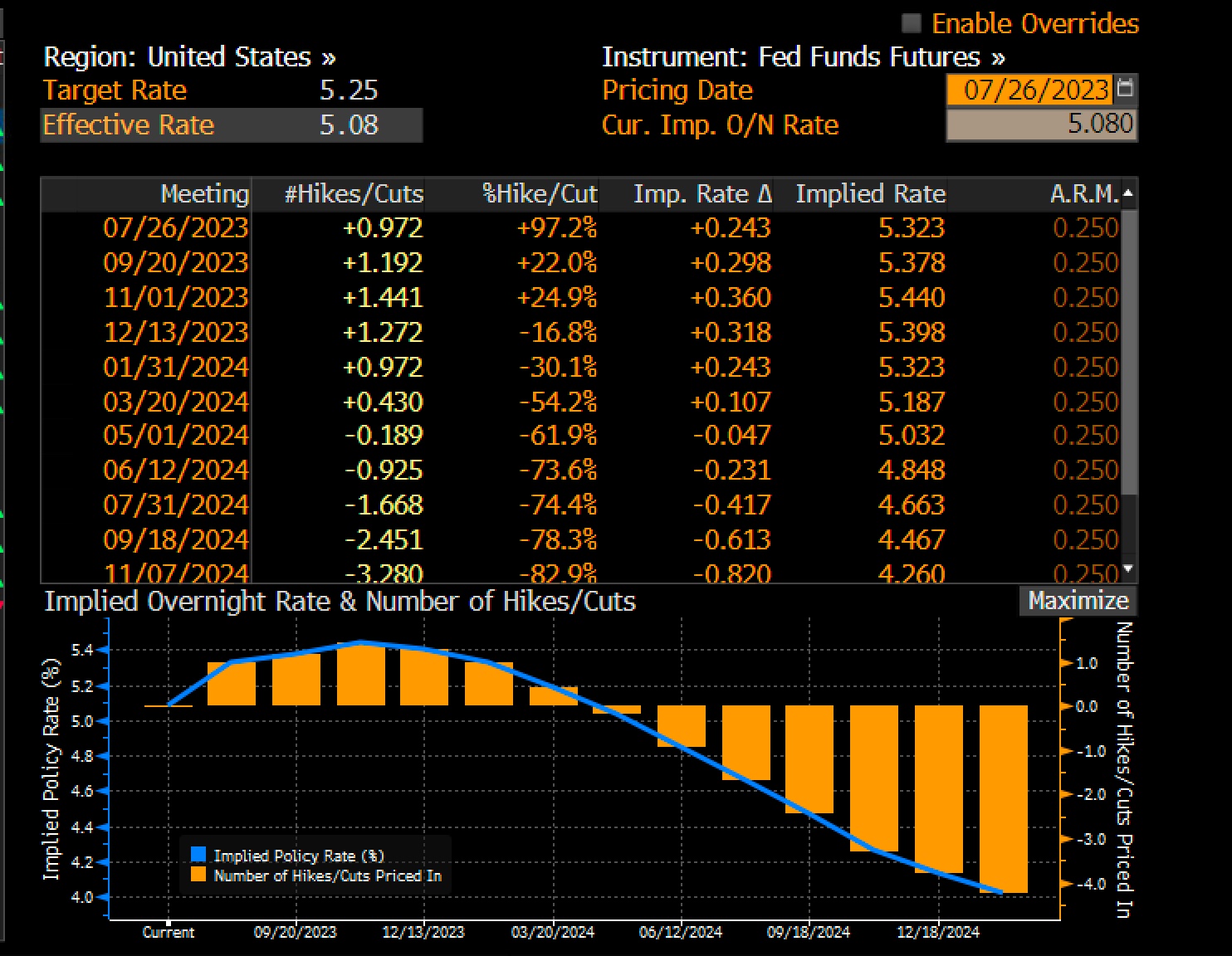
Well, it’s Fed Day so all focus will be there until this afternoon at 2:00 when the Statement is released and then, probably more importantly, at 2:30 when Chairman Powell begins his press conference.  Under the guise of a picture is worth a thousand words, I believe the next two charts, both unadulterated from Bloomberg are very effective at describing the current market expectations.  The first is a tabular and graphic depiction of the Fed funds futures market over the next year, which shows that today’s hike is fully priced in, and then there is a just under 50% probability of a hike either September or November.  After that, though, the market is convinced that Fed funds are going to fall, with more than 100 basis points of decline priced in through 2024.

Now, compare that to the second chart, the Dot Plot from the June FOMC meeting:

In truth, the two curves look pretty similar with perhaps the biggest difference the Fed’s current belief that they will absolutely hike twice before the end of 2023 rather than simply a 50% probability of such.  So, can we just assume this is the way things are going to be?  After all, if markets and the Fed agree on the same outcome, it seems likely to be realized, no?

Alas, this is where the narrative is based on crystal balls, not on data.  Whether it is the punditry or the Fed (or the FX Poet), nobody knows how things are actually going to play out.  One of the things that seems to be a throwaway line by every Fed speaker but is actually the most important part of the commentary is that their views are based on, ‘if the economy evolves as we expect it to.’  The problem is that the history of Fed prognostications is awful. 

Obviously, the most recent glaring error was the ‘inflation is transitory’ narrative that they peddled for a year while inflation was rising sharply for many very clear reasons.  Why we should think that their modelling prowess has improved since then is beyond me.  I have often opined that the problem for the Fed is that every one of their models is broken since they don’t accurately reflect the economy, not even a little bit.  Add to that the underlying premise which is that inflation is naturally at 2% and will head back there on its own, something with exactly zero empirical or theoretical support, and you have a recipe for policy errors.  

The latest policy error was the transitory delay, but perhaps the bigger problem for the Fed is the potential for a relatively unprecedented set of economic variables with higher than target inflation combined with slow economic activity yet low unemployment (due to the shrinkage of the labor force.). I don’t think their playbook has a play to address that problem and I fear that the politics of the outcome will have a disproportionate impact on any policies they implement.  If there is one thing of which we can be sure, it is that political solutions to economic problems are the worst kind with the longest-term negative impacts.  

It is for this reason that Powell’s press conference is so widely anticipated as that is where we will learn any new information.  But until then, I expect that markets will remain relatively benign.

A quick tour of the overnight session shows that there was no follow through to Monday night’s Chinese equity performance with the main exchanges in China and Japan all modestly lower.  Europe, however, is having a much tougher time this morning with the CAC (-2.0%) leading the way lower as concerns seem to be growing over the ongoing central bank tightening policies continuing into a recession.  There was vanishingly little data and no commentary of note, but we have seen some weaker than expected earnings numbers out of the continent, a sign that not all is well.  As to US futures, they are essentially unchanged at this hour (8:00) as investors await this afternoon’s Fed meeting.  I would be remiss, though, not to point out that there were several worse than expected earnings numbers, notably from Microsoft, which is a chink in the armor of the idea of infinite growth for AI.

Meanwhile, bond markets are under pressure in Europe with yields higher across the board there, on the order of 2.5bps to 3.5bps.  This appears to be a move based on expectations of continuing higher interest rates from the ECB.  Treasury yields, though, are unchanged on the day, and at 3.88%, currently sit right in the middle of the trading range we have seen for 2023.  As to JGB yields, they slipped 2bps last night with limited concern that Ueda-san is going to rock the boat tomorrow night.

Oil prices (-1.0%) are a bit softer, but this looks like a trading correction after a strong run higher rather than a fundamentally based story.  Base metals are also softer this morning as the Chinese inspired euphoria seems to have dissipated quickly while gold (+0.4%) is creeping higher despite rising yields and a modestly firmer dollar.  It appears to me there is an underlying bid to the yellow metal that will not go away regardless of the macro situation.

Finally, the dollar is slightly firmer this morning as risk aversion seems to be supporting the greenback.  JPY (+0.35%) is the G10 outlier on the plus side with the commodity bloc under the most pressure (AUD -0.7%, NOK -0.7%, SEK -0.5%).  In the emerging markets, THB (+0.7%) has been the best performer after a surprisingly positive Trade Balance with a large negative one anticipated.  However, the rest of the EMG space is mixed with some very weak currencies (HUF -1.0%, ZAR -0.9%) and some other modestly strong ones (BRL +0.4%, MYR +0.3%).  The forint story continues to revolve around central bank activity, with concerns they will ease policy with inflation still high, while the rand is simply suffering from its commodity basis.  Meanwhile, the real jumped after Fitch upgraded the country’s debt rating BB (stable) from BB-.

Ahead of the FOMC decision, we see New Home Sales (exp 725K) but that will be a nonevent given the afternoon’s agenda.  It is a fool’s errand to try to anticipate exactly how Powell will respond to the questions he receives, or even exactly how they will phrase their current views.  As such, today is one to watch and wait, then evaluate afterwards.

Good luck

Adf

The Citizen’s Pain

Last night, t’was Australia that showed
Employment growth had not yet slowed
And so, please expect
The central bank sect
To keep on the rate hiking road

They’ll not be content til they’ve slain
Inflation, and end this campaign
Yet, if all along
Their thesis is wrong
They’ll ne’er feel the citizen’s pain

On a very slow day in the markets, the most noteworthy news came from Down Under, where the Unemployment Rate fell back to 3.5% in a bit of a surprise while job growth continued at a speedier pace than analysts forecasted.  The market response was immediate with the Aussie dollar jumping sharply and it is now higher by 1.0% on the session, the leading gainer across all currencies, G10 or EMG today.  The rationale for the move is quite straightforward as market participants simply expect the RBA to maintain tighter policy than previously expected.  In the OIS market, the probability of a rate hike at the next RBA meeting on August 1st rose to 48% from just 27% prior to the release.  And correspondingly, Australian government bond yields jumped more than 8bps on the news.

Ultimately, the question that must be addressed is, does strong employment growth lead to higher prices overall?  As my good friend @inflation_guy has said consistently, we should all be ecstatic to have a wage-price spiral as the implication is prices rise AFTER our wages rise, so we are always ahead of the curve.  But we all know, and it has been made abundantly clear in this cycle, that wages follow prices higher.  One need only look at how prices continue to rise on a much more continuous basis than your salaries to see this clearly.  

However, this is gospel in the central banking sect of economists, that tight labor markets drive the general price level higher.  You may have heard of the Phillips Curve, which was a study done in 1958 regarding the relationship between the price of labor (i.e. wages) and the unemployment rate in the UK from 1861-1957.  William Phillips was the New Zealand economist who performed the analysis and basically it confirmed what we all learned in Economics 101, reduced supply of labor drove up wages while an increased supply of labor pushed wages lower.  Nowhere in the study did it discuss the general price level.  That came later with a litany of big name economists, finally with Milton Friedman explaining that in the long-run, there was no relation between wages and inflation, although on a short-term basis, it could evolve.

As so often happens in today’s world, it was easier to take the short-cut view, and that had an intuitive appeal, hence the current central bank mantra of we must bring wage growth down.  (Will they ever get concerned over bringing money growth down?  I fear not.).  At any rate, this is the widely accepted view of the world and so whatever its structural merits, when employment data shows a tighter labor market, the market response is to expect higher policy interest rates.  This was the story last night, hence the Aussie’s rally along with yields Down Under, and this has been the story consistently since the beginning of 2022, when global central banks embarked on the current round of policy tightening.  This is also why we consistently hear Chairman Powell explain that in order for the Fed to reach its 2% inflation target, there will need to be some pain, i.e. people need to lose their jobs.

But away from that, there has been very little of note ongoing.  Equity markets in Asia were unable to match yesterday’s modest gains in the US, with the Nikkei (-1.25%) the laggard of the bunch.  European bourses, however, have had a better go of it, with most of them higher on the order of 0.4% although Sweden’s OMX is down nearly -1.0% on the session bucking the trend.  US futures this morning are softer as there were several weaker than expected earnings numbers overnight including Netflix and Tesla.

In the bond market, Treasury yields have moved higher by 3bps this morning in the 10-year space, but even more in the 2-year space as the yield curve inversion gets deeper, now back above -101bps.  However, European sovereign bonds are little changed on the day with no data of note and the market trying to determine just how hawkish/dovish the ECB will be one week from today.  As to JGBs, their yields have stopped rising and they remain 5bps below the cap.  Do not expect any BOJ action next week.

Oil prices are a touch higher after a lackluster session yesterday, but remain above the key $75/bbl level.  Meanwhile, gold (+0.25%) continues to edge higher and is once again closing in on $2000/oz despite obvious catalysts or lower US interest rates.  As to the base metals, both copper and aluminum are nicely higher this morning as the entire commodity comlex is feeling some love.

Finally, the dollar is under pressure as not only is AUD firmer, but also NOK (+1.1%) on the back of oil’s gains, and virtually the entire bloc except for the pound (-0.3%) which still seems to be suffering from yesterday’s inflation data.  In the EMG bloc, CNY (+0.8%) is the leading gainer, a surprising outcome given its generally managed low volatility, but the fact that the PBOC did NOT reduce the Loan Prime Rate last night, in either the 1-year of 5-year term, was a bit of a surprise to the market as there is a growing belief the Chinese government will be adding more stimulus to a clearly slowing economy there.    But in this bloc, there are also a number of laggards with MXN (-0.4%) the worst of the bunch on what appears to be some profit-taking as traders start to position for the first rate cut since October 2020.

On the data front, yesterday’s housing data in the US was soft, with downward revisions to the previous month’s numbers.  This morning we see Initial (exp 240K) and Continuing (1722K) Claims as well as Philly Fed (-10.0), Existing Home Sales (4.20M) and Leading Indicators (-0.6%), the last of which have been pointing to recession for nearly a year.  However, once again, I expect the dollar will be beholden to the equity markets as none of these data points are likely to move the needle ahead of the FOMC next week.

For now, I think choppy price action is the likely outcome until we get more clarity from Powell and the Fed, as well as Lagarde and the ECB next week.  Who will be the most hawkish?  That is the $64 billion question.

Good luck
Adf