A Reprieve

Some nations have gained a reprieve
About a month left to achieve
A deal to prevent
The extra percent
Of tariffs that Trump can conceive


The news cycle continues to be bereft of new stories regarding finance and markets as there is continued focus on the tragedy in Texas after the flash floods that were responsible for over 100 deaths.  But in our little corner of the world, tariff redux is all we have.  So, to rehash, today marks 90 days since President Trump delayed the imposition of his Liberation Day tariffs back in April with the idea of negotiating many new trade deals.  Thus far, only two have been agreed, the UK and Vietnam, while there has clearly been progress made on several key deals including Japan, South Korea, the EU, India and Australia.  As such, the president has delayed the imposition of these tariffs now to August 1st, but we shall see what happens then.

It is worth noting that trade negotiations historically have taken a very long time, years if not decades, as evidenced by the fact that any time an agreement is reached, it is met with dramatic fanfare on both sides of the deal.  Consider, for a moment, that the EU and MERCOSUR finally agreed terms in 2024, after 25 years of negotiations, although the deal has not yet been ratified by both sides.  With this in mind, it is remarkable that as much ground has been covered in this short period of time as it has.

However, if I understand correctly, many other nations will be subject to tariffs starting today.  Of course, along with these tariffs are the resumed calls for a catastrophic outcome for the US with inflation now set to advance sharply while growth stagnates.  At least the naysayers are consistent.

Away from this story, though, the market is the very picture of the summer doldrums.  After all, nothing else has really changed.  The BBB solved the debt ceiling issue, with another $5 trillion added to the mix, so funding the government should not be a problem for several years at least.  Of course, this means the monetary hawks will re-emerge and complain that the government is spending too much (which it clearly is) and that the economy will collapse under the weight of all that debt.  After all, one needs a calamity to get one’s views aired these days, and doomporn is all the rage with President Trump in office.

So, I won’t waste any more time before heading into the market recap.  Yesterday’s US equity decline, catalyzed by the display of letters written to Japan and South Korea about the imposition of 25% tariffs, was halted after the delay was announced, but the markets still closed lower.  Overnight, Asian markets managed to rally a bit with the Nikkei (+0.3%) the laggard while Korea (+1.8%) really benefitted from that delay.  Meanwhile, China (+0.8%) and Hong Kong (+1.1%) were also solid as was most of the region although Thailand (-0.7%) which did not receive a reprieve, did suffer.

In Europe, the picture is somewhat mixed with the DAX (+0.45%) rising after a slightly wider than expected trade surplus was reported this morning while the CAC (-0.1%) has been under modest pressure after the French trade deficit rose slightly.  But the bulk of the market here is modestly higher on the reprieve concept, although only about 0.2%.  As to US futures, at this hour (7:05), they are basically unchanged to slightly higher.

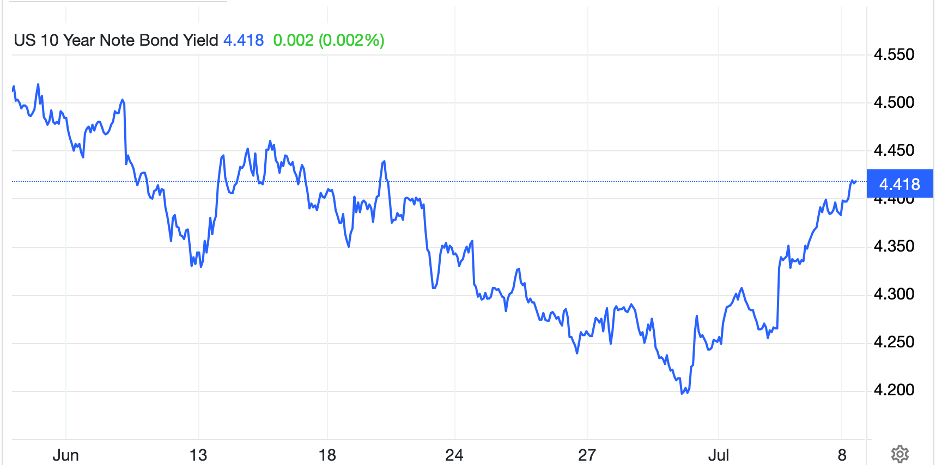
In the bond market, though, yields continue to rise around the world this morning as it appears investors are growing somewhat concerned that all the government spending that is being enacted around the world is becoming a concern.  Treasury yields have risen 3bps and European sovereigns are higher by between 4bps and 5bps.  JGB yields, too, are higher by 4bps and in Australia, an 8bp rise was seen after the RBA failed to cut their base rate last night as widely expected.  Since the beginning of the month, 10-year Treasury yields have risen by more than 20 basis points (as per the chart below) a sign that there may be concern over excess supply…or that the BBB is going to encourage faster growth.  I’m not willing to opine yet.

Source: tradingeconomics.com

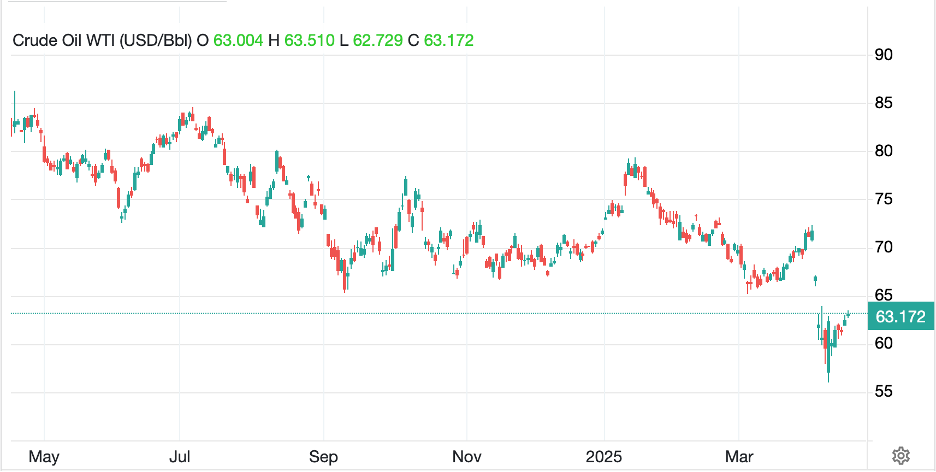
In the commodity markets, oil (-0.3%) has been trading in a $4/bbl range since the end of the 12-Day War and the US destruction of Iranian nuclear facilities removed the war premium from the market.  In truth, this is surprising given the ongoing increases in production from OPEC+ and the widespread belief that the economy is suffering and heading into a recession.  But it is difficult to look at the below chart and be confident of the next move in either direction.

Source: tradingeconomics.com

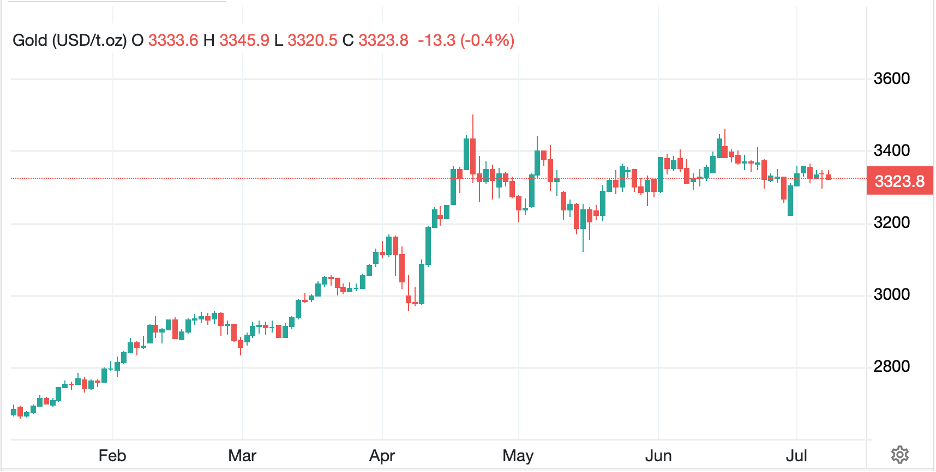
Meanwhile, metals markets this morning show gold (-0.35%) giving back some of its late day gains yesterday while silver and copper remain little changed.  Again, range trading defines the price action as gold has basically gone nowhere since late April.

Source: tradingeconomics.com

Finally, the dollar is mixed this morning with AUD (+0.6%) the leading gainer after the RBA no-action outcome, although ZAR (+0.6%) has gained a similar amount which appears to have been driven by Trump rescinding his threat to add a 10% additional tariff on all BRICS nations (the S is South Africa) that seek to avoid using the dollar for trade.  On the other side of the coin, the pound (-0.3%) and yen (-0.4%) are both slipping this morning with the former suffering from domestic finance problems as the Starmer government continues to flail in its efforts to pay for its promised spending.  In Japan, the Upper House elections, which are to be held July 20th, are a problem for PM Ishiba and his minority government.  One of the key issues is despite the fact that rice prices there have risen more than 100% in the past year, and the US is keen to export rice to Japan to help mitigate the problem, the farmers bloc in Japanese politics has outsized influence and is vehemently against the proposal.  If the government falls due to election losses, agreeing a trade deal will be impossible.  Perhaps this time, the yen will weaken in the wake of tariffs.  (As an aside, are any of you old enough to remember the death of the carry trade and how the yen was going to explode higher?  I seem to recall that was a strong narrative just a few months ago, but it is certainly not evident now.)

On the data front, the NFIB Survey was released this morning at 98.6, a tick lower than expected and 2 ticks lower than last month, but basically little changed.  I don’t think it provides much new information.  Later this afternoon we see Consumer Credit (exp $11.0B), potentially a harbinger of future spending outcomes.  But really, that’s it.

Headline bingo continues to drive markets with the narratives locked in place.  The dollar’s trend is clearly lower, but it remains to be seen if the oft-predicted collapse is on the cards.  Personally, while a bit further weakness seems reasonable, getting short here, with the market already significantly positioned that way, does not feel like the right trade.

Good luck

Adf

Mind-Numbing

According to those in the know
The BBB’s ready to go
The vote is this morning
So, this is your warning
That President Trump will soon crow
 
As well, ere the Fourth of July
The NFP may quantify
If rate cuts are coming
(A subject, mind-numbing)
Or whether Fed funds will stay high


Perhaps this will be the last day we hear about the Big Beautiful Bill, or at least the last day it leads the news, as it appears that by the time you read this, the House will have voted on the changes and by all accounts it is set to pass.  If so, the President will sign it tomorrow amidst great fanfare and then it will just be a secondary story when somebody complains about something that was in the bill.  However, the drama over passage will have finally ended.  

(I guess what has really led the news was that Diddy was found not guilty of the RICO charges and Kohburger in Idaho got a plea deal avoiding the death penalty, but neither of those are market related.)

At any rate, the question now to be asked is will the BBB perform as advertised by either side of the aisle?  Experience tells us that while the economy will not take off rapidly while inflation collpases, neither will there be people dropping in the streets because of the changes in Medicare, although if you listened to the pundits on both sides of the aisle, that is what you might expect.  While this is not quite as bad as Nancy Pelosi’s immortal words, “we have to pass the bill to find out what’s inside it”, the fact that it approaches 1000 pages in length implies there is a lot inside it.

From what I have read, and it has not been extensive, it appears that there is some stimulus in the bill in the form of tax relief on tips and overtime as well as reductions for seniors, and spending on defense and the border.  It also appears there have been several previous subsidies, notably for wind and solar, that are being removed.  The fact that the CBO is claiming it will increase the budget deficit by $1.5 trillion, and given the fact that Jim Cramer is the only one with a worse track record than the CBO, tells me it will have limited impact on the nation’s fiscal stance initially, although if growth does pick up, that will clearly help things.

Which takes us to the other story this morning, the payroll report.  Here are the current median forecasts by economists for the results, as well as the rest of the data to be released:

Nonfarm Payrolls110K
Private Payrolls105K
Manufacturing Payrolls-5K
Unemployment Rate4.3%
Average Hourly Earnings0.3% (3.9% Y/Y)
Average Weekly Hours34.3
Participation Rate62.3%
Initial Claims240K
Continuing Claims1960K
ISM Services50.5
Factory Orders8.2%
-ex Transport0.9%

Source: tradingeconomics.com

Some will point to yesterday’s ADP Employment report which showed a decline of -33K, the first decline in more than 2 years, as a harbinger of a bad number, but as you can see from the chart below, there has been a pretty big difference between ADP (grey bars) and NFP (blue bars) for a while now.

Source: tradingeconomics.com

Perhaps of more concern is the Unemployment Rate, which is forecast to rise a tick to 4.3%, which would be its highest print since October 2021 and if I look at the chart below, it is not hard to see a very gradual trend rising higher here.  While markets really focus on NFP, I learned a long time ago from a very smart economist, Larry Kantor, that the Unemployment Rate was the best single indicator of economic activity in the US, and that when it is rising, that bodes ill for the future.  

Source: tradingeconomics.com

You may recall there was a great deal of discussion about a year ago regarding the Sahm Rule, which hypothesized that when the Unemployment Rate rose more than 0.5% above its cycle average within 12 months, the US was already in a recession.  The discussion centered on whether it had been triggered although the final claim was it hadn’t when extending the readings out to the second decimal place.  Now, for the past year, the Unemployment Rate has hovered between 3.9% and 4.2%, so there doesn’t seem to be any chance of a trigger here, although if it does rise, you can be sure you will hear about it.

And that’s what is on tap ahead of the long holiday weekend.  With that in mind, let’s look at the market action overnight. Excitement is clearly lacking in the equity markets these days as the summer doldrums are universal.  Yesterday’s new closing highs in the S&P 500 seem like they should be exciting but were anything but amid low volume.  As to Asia, Japan was flat, China (+0.6%) and Hong Kong (-0.6%) offset each other and in the rest of the region, other than Korea (+1.3%) which is starting to see a steady stream of foreign investment on the premise that the country is set to improve the regulatory structure for equities there, things were +/- a bit.

Meanwhile, in Europe, there is little net movement on the continent but the UK (+0.4%) is bouncing off recent lows after PM Starmer reiterated his support for Chancellor Reeves.  A story I missed yesterday was that when she was trying to make a case in parliament for spending cuts, the back bench liberals revolted, literally bringing her to tears.  The market response was that the UK would blow up its fiscal situation which saw Gilts tumble and yields rise 15bps yesterday at one point, while stocks fell.  But that problem has been addressed for now.  However, looking at the statement Starmer made, it reminded me of a baseball GM’s comments supporting his manager right before he fires him.

In the bond market, yields are declining, led by Gilts (-9bps) which are retracing yesterday’s gains on the above story.  But Treasury yields are down (-2bps) and European sovereigns are all seeing yields lower by between -4bps and -5bps.  In Japan, JGB yields are unchanged as PM Ishiba grapples with a trade deal where the US is keen to be able to export rice to the nation and Japan has a rice shortage with prices rising sharply but doesn’t want to accept imports.  Go figure.

In the commodity markets, oil (-0.2%) is slipping slightly after a solid rally over the past seven sessions where it rose over $3.50/bbl.  Gold (-0.3%) continues to trade around its pivot level of $3350/oz while silver (+1.0%) continues its longer run rally.

Finally, the dollar, which fell during yesterday’s session after I wrote, is effectively unchanged net this morning ahead of the data with very modest moves of +/-0.2% or less almost universal.  KRW (+0.4%) is the outlier here and based on equity inflows discussed above, that makes sense.

So, that’s where we stand heading into the payroll report and the long weekend.  If pressed on the NFP outcome, I expect a weak outcome, 50K or so, as the birth/death model continues to be revised.  But remember, the error bars on this number are huge.  However, if it is weak, look for the probability of a July rate cut (currently 25.3%) to rise and the equity market to follow that higher.  As to the dollar, I think for now, lower is still the trend.

Good luck and have a wonderful long weekend

Adf

Not Persuaded

As tariff concerns are digested
By markets, Chair Powell’s been tested
Is cutting the move
They need to improve?
Or are they, to tightness, still vested
 
It sounds as though he’s not persuaded
A rate cut will soon be paraded
But markets still price
He’ll be cutting thrice
It could be that view should be fade


Perusing the WSJ this morning, I stumbled across the following article, “What the Weak Dollar Means for the Global Economy” and couldn’t help but chuckle.  It was not that long ago when the punditry was complaining about the strong dollar as a problem for the global economy.  The current thesis is that the weakening dollar will make foreign exports to the US more expensive, on top of the tariffs, and will reduce the number of US tourists traveling abroad.  Foreign companies will also suffer as they translate their US sales into their respective local currencies, negatively impacting their earnings.  A moment as I shed a tear.

Of course, when the dollar was strong, the concern for the global economy was that it was increasingly expensive in local currency terms to obtain the dollars necessary to service the massive amounts of USD debt that foreign companies and nations have issued, thus reducing their ability to spend money on other things to drive their domestic economy.

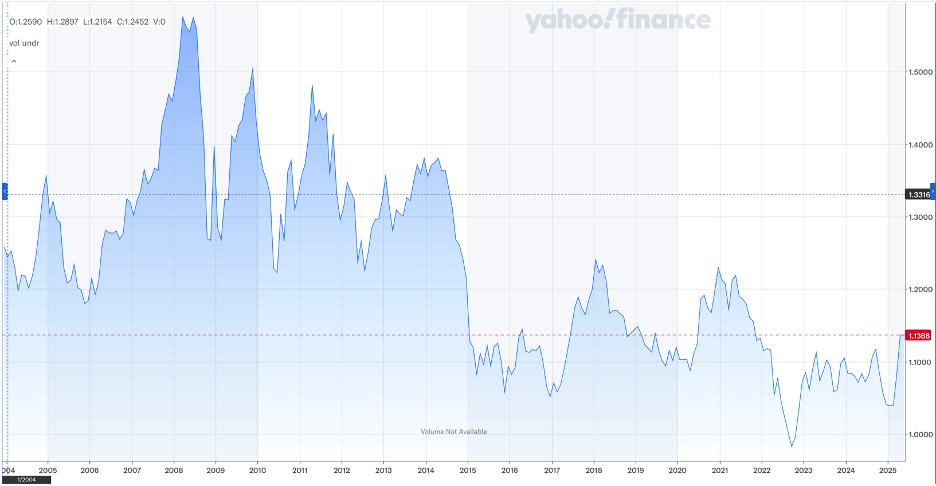
As they say, you can’t have it both ways.  While there is no doubt the dollar’s decline this year has been swift, it is important to remember we are nowhere near an extremely weak dollar.  As you can see from the below chart, the euro was trading near 1.60 back in 2008 and as high as 1.38 even in 2014.  When looking at today’s price of 1.1375, it is hard to feel overly concerned.

Source: finance.yahoo.com

As it happens, this morning the single currency has slipped back -0.3% from yesterday’s levels.  The dollar’s future remains highly uncertain given the potential policy changes that may unfold as the tariff situation becomes clearer.  Which leads us to the Fed.

For the first time in many weeks, the Fed became a topic of conversation for the market when Chairman Powell spoke to the Economic Club of Chicago.  “Our obligation is to keep longer-term inflation expectations well anchored and to make certain that a one-time increase in the price level does not become an ongoing inflation problem,” Powell explained.  “We may find ourselves in the challenging scenario in which our dual-mandate goals are in tension. If that were to occur, we would consider how far the economy is from each goal, and the potentially different time horizons over which those respective gaps would be anticipated to close.”  

Let me start by saying, the Fed’s track record in anticipating economic outcomes is not stellar.  Equity markets were not encouraged by these comments and sold off during the discussion, although they retraced some of those losses before the end of the session.  At the same time, the Fed funds futures market, while having reduced the probability of a rate cut next month to just 15%, continues to price 88bps of cuts into the market by the December meeting.  Assuming there is no cut in May, that leaves five meetings for between three and four cuts.  Based on Powell’s comments, that seems like aggressive market pricing.

It appears that there is a growing belief that a recession is on its way and that will both reduce inflationary pressures and force allow the Fed to start to reduce rates further.  Of course, there are those, Powell included, who seem to believe that stagflation is a strong possibility.  If that were the case, especially given Powell’s new-found belief that price stability matters, and his clear distaste for the president, my sense is they will focus on inflation not growth if financial conditions (aka bond markets) remain in good shape.  Will the dollar continue to decline under that scenario?  That is a very tough call as a US recession would almost certainly spread globally, and other central banks will likely ease policy.  If the Fed stands pat amidst a global reduction in interest rates, I don’t see the dollar declining.  If for no other reason, the cost of carrying short dollar positions would become too prohibitive.

As usual, the future remains quite cloudy.  Cases can be made for Fed cuts, and against them.  Cases can be made for dollar weakness and dollar strength.  Arguably, the biggest unknown is how the trade talks are going to resolve.  Yesterday, President Trump explained that “big progress” has been made on the Japanese tariff talks.  If Trump is successful in creating a coalition of nations that have closer trade relations with lower tariffs, I expect that would be taken quite positively by the markets.  On the other hand, if those talks fall apart, I expect equity markets to start the next leg lower, and that is a global phenomenon, while the dollar sinks further.  There is much yet to come.

Ok, let’s see how things played out overnight.  After yesterday’s US rout, Trump’s comments on trade talks with Japan clearly helped the market there as the Nikkei (+1.35%) rallied nicely as did the Hang Seng (+1.6%).  In fact, gains were widespread with Korea, India and Australia, to name three, all rising nicely.  Alas, Chinese shares did not participate, and Taiwan actually slipped a bit.  In Europe, investors await the ECB’s outcome this morning, where a 25bp cut is the median forecast, but there are those hinting at a 50bp cut to help moderate strength in the euro as well as support the economy given the tariff situation.  Remember, we have heard from a number of ECB members that they are confident inflation is heading back to their target.  Ahead of the news, shares are softer across the board with declines on the order of -0.5% to -0.8% throughout the continent and the UK.  Remember, too, their tariff talks are after Japan.  Interestingly, US futures are mixed with DJIA (-1.3%) the laggard while the other two are both higher about 0.5%.  It seems United Health shares have fallen enough to take the DJIA down with it.

In the bond market, Treasury yields have regained the 3bps they fell during yesterday’s US session, so are unchanged over two days.  We have also seen European sovereign yields climb between 2bps and 4bps, rising alongside Treasuries and JGB yields jumped 5bps, responding to confidence that the US-Japan trade dialog will be successful and support Japanese risk.

Despite all the reasons for oil to decline, including recession fears and continued pumping by pariahs like Iran and Venezuela, the black sticky stuff is higher by 1.1% this morning, its highest level in two weeks.  But as you can see in the chart below, there remains a huge gap to be filled more than $8/bbl higher than current prices.  It is difficult to see a significant rally on the horizon absent a major change in the supply situation.

Source: tradingeconomics.com

As to the metals markets, gold (-0.6%) blasted higher to another new high yesterday, above $3300/oz, and while it is backing off a bit today, shows no signs of stopping for now.  Both silver and copper rallied yesterday as well, and both are also falling back this morning (Ag -1.4%, Cu -2.1%).

Finally, the dollar is modestly firmer across the board this morning, with the DXY seeming to find 99.50 as a key trading pivot level.  In the G10, JPY (-0.45%) is the laggard along with CHF (-0.4%) while other currencies in the bloc have fallen around -0.2%.  The exception here is NOK (+0.3%) as it benefits from oil’s rebound.  In the EMG bloc, the dollar is mostly firmer, but most of the movement has been of the 0.3% variety, so especially given the overall decline in the dollar, this looks an awful lot like position adjustments ahead of the long weekend with no new trend to discern.

On the data front, yesterday’s Retail Sales was stronger than expected, and not just goods that were bought ahead of tariffs, but also services and dining out, which would seem less impacted.  This morning, we see a bunch of stuff as follows: Housing Starts (exp 1.42M), Building Permits (1.45M), Philly Fed (2.0), Initial Claims (225K) and Continuing Claims (1870K).  As long as the employment data continues to hold up, my take is the Fed will sit on the sidelines.  If that is the case, I sense we have found a new range for the dollar, 99/101 in the DXY and we will need a headline of note to break that.

As tomorrow is Good Friday and markets are essentially closed throughout Europe, as well as US exchanges, there will be no poetry.

Good luck and good weekend

Adf

The Tariff Explosion

In China, Xi’s ‘conomy grew
Quite nicely, but now in Q2
The tariff explosion
Ought lead to erosion
Of growth, lest we see a breakthrough


Chinese economic data was released last night, and the numbers were far better than expected, well most of them were.  The below table from tradingecoomics.com highlights the big numbers showing strength in GDP, IP and Retail Sales although Capacity Utilization was soft.

But this is Q1 data, and pretty early at that, just two weeks past the end of the quarter.  As well it reflected activity prior to the tariffs imposed by President Trump, and subsequently the Chinese themselves.  Just as we saw massive increases in the trade deficit here, as companies were front-running the tariff threat, I imagine we saw a lot more activity brought forward by the Chinese to both satisfy that front-running, as well as some front-running of their own.  I guess the question to ask is, how much information does this data provide regarding potential future outcomes and I suspect the answer is, not much.  

Already we are seeing global economists reducing their forecasts for Chinese annual GDP growth this year, with the lowest number I have seen at 3.5% (Goldman).  That is far below the ‘about 5%’ that President Xi targeted back in February and clearly assumes tariffs will remain in place.  And perhaps that is the biggest unknown.  The current state of play between Trump and Xi is that Trump said, call me, maybe and we can talk while Xi has said, show some respect and we can talk.

At this point, it is all theater, with both men playing to their bases and trying to show strength.  I do believe that Trump is seeking to isolate China, but the ultimate end game may well be to get them to alter their behavior.  If history is any guide, I imagine that this won’t be settled quickly, but that by summer, both sides will be feeling the heat on the economy.  Alas, that’s a long time from now and there is ample opportunity for significant market gyrations between now and then.

Like Fujiyama
Successful trade talks will be
A beautiful thing

On the other side of the tariff sheet is Japan, which is priority number one for the US.  PM Ishiba has sent his chief trade negotiator, Ryosei Akazawa, to the US to sit down with Treasury Secretary Bessent who has been named the lead in these negotiations.  While there is much discussion on autos, another very sticky subject is rice, on which Japan imposes a very high tariff.  President Trump claims it is 700%, others say less, more like 400%, but whatever it is, clearly the Japanese are protecting their rice farmers.  Ironically, Japan is in the middle of a rice shortage and has been pulling from strategic stockpiles to prevent prices there from rising too sharply.  Meanwhile, the US has ample export capacity.  It seems like a win-win opportunity, but politics is convoluted and from what I have read, the Japanese farmers don’t want to cede any market share to imports.  

Nonetheless, I expect that this will be a successful outcome as it is too important to fail.  While President Trump continues his bluster, he needs a win economically, and if Japanese talks are successful, we will see many more versions completed within the 90-day period in my view.  Things won’t go back to the way they were before Liberation Day, but if trade questions are answered, all eyes will turn to the budget, which is going to be a different kind of messy.  As I have written before, the greatest potential irony from this tariff war is that we could see lower tariffs around the world, something that all that WTO hobknobbing could never obtain.

One other mooted issue between the US and Japan is the exchange rate, which, while the yen has strengthened more than 10% since its low (dollar high) back just before the inauguration, remains far above levels seen before the Covid inspired inflation resulted in the Fed tightening policy aggressively.  The chart below is quite clear in displaying just how weak, relative to the past 30 years of history, the yen remains.  That last little dip is the move so far this year.

Of course, given the yen’s most recent bout of weakness dates from 2022, when US interest rates started to climb, if Treasury Secretary Bessent is successful in getting rates lower, that will be a natural driver of a weaker dollar, stronger yen.  Especially if Ueda-san does tighten policy further.

We have much to anticipate as the year progresses.  Ok, let’s turn to the overnight session and see what’s happening.  Yesterday’s lackluster US equity performance was followed by a terrible earnings discussion for Nvidia and much more extended weakness in Asia.  The Nikkei (-1.0%) and Hang Seng (-1.9%) fell sharply as did Korea (-1.2%) and Taiwan (-2.0%).  China (+0.3%), however, bucked the trend likely on the support of the plunge protection team there buying to prevent a rout.  Certainly, the positive data didn’t hurt, but I doubt that was enough.  In Europe, screens are all red as well, with declines on the order of -0.3% (UK and Spain) to -0.6% (Germany and France).  It is, however, universal with every market there declining.  As to US futures, while the DJIA is unchanged, both the NASDAQ and SPX are down sharply on that Nvidia news.

In the bond market, yields have been edging lower despite (because of?) all the tariff anxiety.  While Treasuries are unchanged this morning, they drifted off 3bps yesterday.  European sovereign yields are all lower by -2bps to -3bps and the big news was JGB yields tumbling -10bps last night.  There continues to be a great deal of discussion about China using its Treasury holdings as a weapon, but I find that highly unlikely.  Unless they could literally find a bid for all of them at once, to prevent further losses, it would self-inflict too much damage.  My take is they are essentially performing their own version of QT, allowing Treasuries to mature and slowly replacing them with other things, Bunds, gold, oil, copper.  One of the biggest problems is there are precious few asset classes that are large enough to absorb all that money, so they will continue to hold Treasuries in some relatively large amount, probably forever.

Turning to commodities, oil (+1.0%) continues to trade quietly and hang around just above $60/bbl.  It feels to me like there is a lot more room on the downside than the upside, but that is just me.  In the metals markets, gold (+1.5%) is glittering again, making yet another new all-time high this morning.  Remember a week ago when the market was correcting and there was discussion about gold losing its luster?  Me neither!

Source: tradingeconomics.com

This chart is a perfect example of the idea that nothing goes up in a straight line.  But the trend here is strong.  Silver (+1.6%) is following in gold’s footsteps today but copper (-0.4%) is lagging.  No matter, I continue to think commodities have more strength ahead.

One of the reasons is that the dollar remains under pressure.  Last night, further weakness was manifest with the euro trading back close to the highs touched on Friday at the 1.14 level.  Prior to Friday, the last time the euro was here was in February 2022.  But again, like the yen chart above, the euro’s strength is a very recent, short-term phenomenon.  A look at the chart below demonstrates just how “weak” the dollar is vs. the single currency on a long-term basis.  The answer is not very.

But overall, the dollar is weaker this morning across the board against both G10 and EMG currencies.  I do agree with the idea that foreign investors have been liquidating their US equity holdings slowly and repatriating the funds home.  If that continues, and it could, a continued decline in the dollar, especially if US yields slide, is likely.

On the data front, Retail Sales (exp 1.3%, 0.3% ex-autos) is the headliner at 8:30 then IP (-0.2%) and Capacity Utilization (78.0%) at 9:15.  We also hear from the BOC, although they are expected to leave their base rate on hold at 2.75%.  EIA oil inventory data is due later this morning with a decent sized draw of more than 5mm barrels across products expected.  There are Fed speakers including Chair Powell at 1:30 this afternoon, but they have just not had much sway lately, and I think they are ok with that.

Putting it all together, at least in the FX framework, my take is the dollar has further to fall.  There is no collapse coming, but steady weakness seems realistic.  However, given the overall uncertainty at the current time, I would be maintaining hedges rather than anticipating that weak dollar.

Good luck

Adf

Soaring Like Eagles

Soaring like eagles
Japanese growth beats forecasts
Are rate hikes coming?


On this President’s Day holiday, when US markets are closed, arguably the most interesting financial story around is in the Land of the Rising Sun where Q4 GDP was released last night at 0.7%, significantly higher than forecast (0.2%) and Q3’s outcome (0.4%).  Japanese markets responded about as might be expected with the yen (+0.6%) rising alongside JGB yields (+3bps) with the 10yr now at 1.38%, its highest level since March 2010.  As to equity markets, the Nikkei (+0.1%) was caught between the positive GDP news and the stronger JPY.  Of course, much has been made of the BOJ’s overnight rate, which now sits at 0.50% after several hikes during the past year.  As well, expectations are for further hikes this year, with several analysts calling for a rate over 1.00% before the end of 2025.

But let us consider, for a moment, what the Japanese rate structure looks like in the context of the current inflation story in Japan.  As can be seen below, this is the current shape of the Japanese government bond yield curve, with 2yr yields at 0.80% while 30yr yields are up to 2.30%.

Source: Bloomberg.com

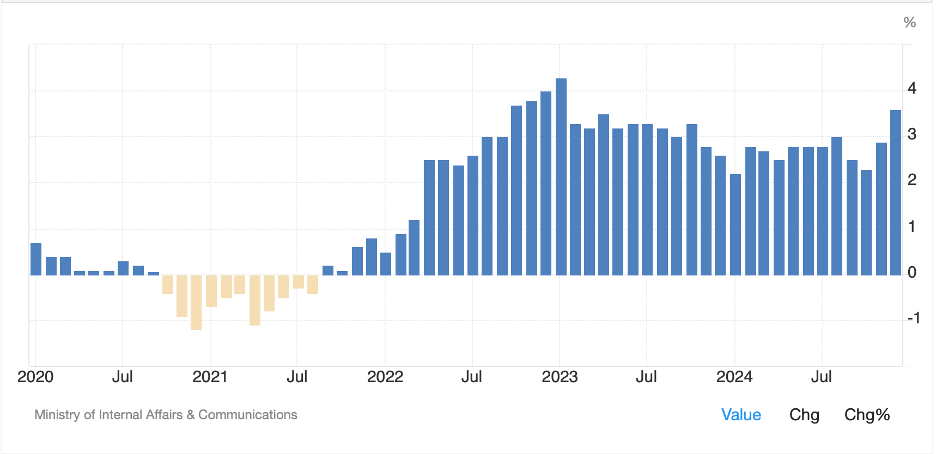
However, when looking at these yields, which as you can see from the column furthest to the right have risen substantially in the past 12 months, we must also remember the pace of inflation in Japan.  Since April 2022, every monthly CPI print in Japan has been above the target of 2.0%, with all but two of them above 2.5%.  In fact, as you can see from the chart below, the most recent data, as of December 2024 with the January data to be released Thursday night, shows the headline at 3.6%.  That is nearly three years of inflation data running above their target, yet the BOJ is unwilling to say inflation is stably at 2.0%.  I guess they are correct, it is stably at about 3.0%!

Source: tradingeconomics.com

But let’s add up this conundrum and perhaps we will better understand why GDP is growing so robustly in Japan.  If 10yr JGB yields are 1.38% and inflation is 3.60%, then real yields are running at… -2.22%.  That is a pretty loose monetary policy and one in which it is no surprise that economic activity is humming along.  In fact, unless we see a substantial decline in inflation, with no indication that is on the horizon, the BOJ has ample room to raise interest rates while maintaining accommodative monetary policy.

I know that there is much discussion regarding President Trump’s tariffs and whether Japan will be affected like other nations thus increasing uncertainty.  But the economic reality is that the BOJ remains highly stimulative to the economy which has been a driver of both economic growth and inflation.  I also know that this poet has been negative on the yen for a long time, in fact calling for USDJPY to reach 170 by the end of the year.  But as I observe the current situation, take into account the fact that President Trump very clearly wants the dollar to decline, and see more hints that the Japanese government is becoming more concerned over rising inflation in Japan, I am changing my tune here.  Add to these indications the fact that the yen, on any accounting, remains significantly undervalued, with estimates of as much as 50% (Big Mac Index claims it is 44% undervalued) and the case for yen strength is growing on me.

While over the past year, the yen has, net, done very little, the more recent trend is for yen strength as per the 1-month chart below.  My take is that we need to see a break below 150 before the fireworks start, but if that is the case, do not be surprised if we trade back to 130 before the year is over.

Source tradingeconomics.com

And really, that is the story of the evening.  The Chinese NPC will be meeting next week to discuss their economic plans and policies for the upcoming year, so that will be important.  As well, Europe has been put on notice by recent speeches from VP JD Vance and Secretary of State Marco Rubio that the relationship with the US is changing.  However, at this time, it is very difficult to discern if that means the euro will weaken further or rebound on increased internal activity.

Ok, let’s look at markets overnight.  It appears that with the US on holiday, many markets were reluctant to demonstrate leadership in any direction with not only Tokyo virtually unchanged, but the same being true throughout Asia (Hong Kong, 0.0%, China +0.2%, Australia -0.2%) and most of Europe with only the German DAX (+0.8%) showing any life at all.  It seems that several German defense contractors are benefitting from the idea that Europe may be increasing its defense expenditures locally.  US futures are little changed, although of course the market will not be open today.

Treasury bonds are also unchanged this morning with no trading but in Europe, yields are higher by between 3bps and 5bps, also on the rising defense expenditure story as there is an idea now floating around that there will be pan-European debt issuance to help fund that expenditure, thus adding supply to the market.  Certainly, despite the ECB maintaining a somewhat dovish stance, if European yields climb higher, that will likely support the single currency.

In the commodity markets, after Friday’s rout in the metals, where both precious and industrial metals sold off sharply, seemingly on no news, but more likely on position adjustments, this morning we are seeing a rebound, at least in gold (+0.5%) and silver (+0.6%) although copper (-1.3%) remains under pressure.  As to energy prices, oil (-0.35%) is continuing to hover closer to the bottom than top of its recent trading range as there is no clarity at all regarding how a potential Ukrainian peace will impact Russian production.  The one consistency is that European NatGas continues to decline on hopes that Russian gas deliveries will resume going forward.

Finally, the dollar is doing mixed this morning with the yen the outlier showing strength against the greenback, but ZAR (-0.5%) and MXN (-0.4%) showing weakness.  The rest of the G10 has seen only modest movement and that is generally true for the rest of the EMG bloc.  Traders remain highly uncertain over the future that President Trump will usher in.

On the data front, it is a pretty light calendar overall.

TuesdayEmpire State Manufacturing0.0
WednesdayHousing Starts1.4M
 Building Permits1.46M
 FOMC Minutes 
ThursdayInitial Claims215K
 Continuing Claims1860K
 Philly Fed16.3
 Leading Indicators-0.1%
FridayFlash Manufcturing PMI51.2
 Flash Services PMI53.2
 Existing Home Sales4.13M
 Michigan Sentiment67.8

Source: tradingeconomics.com

As well as this data, we see the EIA oil inventories and hear from 11 more Fed speakers.  But again, after Powell made clear they are on hold for now, and there has been no data to change that perception, and President Trump continues to dominate the spotlight, I don’t anticipate any new information here.

With the holiday today, I anticipate things will be quite slow.  Traders will take advantage of the time off to rest given the rising volatility we have seen.  Going forward, I will be reevaluating my longer-term views based potential changes in fiscal policies around the world.  But for now, other than the yen, I don’t see any clear changes yet.

Good luck

Adf

A Brand-New World

Even in Japan
Incumbency is questioned
It’s a brand-new world


Yesterday’s elections in Japan brought about the downfall of yet another incumbent government as people around the world continue to demonstrate they are tired of the status quo.  Recently appointed PM, Shigeru Ishiba called for a snap election within days of his appointment following the resignation of previous PM Kishida on the heels of a funding scandal.  Ishiba’s idea was to receive a fresh mandate from the electorate so he could implement his vision.  Oops!  It turns out that his vision was not in sync with the majority of the population.  Ultimately, the LDP and its key ally, Komeito, won only 215 seats in the Diet (Japan’s more powerful Lower House), well below the 233 necessary for a majority and even further from the 293 seats they held prior to the election.  The very fact that this occurred in Japan, the most homogenous of G10 nations, is indicative of just how strong the anti-incumbent bias has grown and just how tired people are of current leadership (keep that in mind for the US election).

Now, turning to the market impact, the tenuous hold any government formed from these disparate results means that Japan seems unlikely to have a clear, coherent vision going forward.  One of the key issues was the ongoing buildup in defense expenditures as the neighborhood there increasingly becomes more dangerous.  But now spending priorities may shift.  Ultimately, as the government loses its luster and ability to drive decisions, more power will accrue to Ueda-san and the BOJ.  This begs the question of whether the gradual tightening of monetary policy will continue, or if Ueda-san will see the need for more support by living with more inflation and potentially faster economic growth.The yen’s recent decline (-0.25% today, -8.5% since the Fed rate cut in September) shows no signs of slowing down as can be seen from the chart below.  As the burden of policy activity falls to the BOJ, I expect that we could see further yen weakness, especially when if the Fed’s rate cutting cycle slows or stops as December approaches.  If this process accelerates, I suspect the MOF will want to intervene, but that will only provide temporary respite.  Be prepared for further weakness in the yen.

Source: tradingeconomics.com
 
This weekend’s Israeli response
To missile attacks from Iran-ce
Left bulls long of oil
In massive turmoil
As prices collapsed at the nonce

The other major market story this morning was the oil market’s response to Israel’s much anticipated retaliation to the Iranian missile barrage from several weeks ago.  The precision attacks on military assets left the energy sector untouched and may have the potential to de-escalate the overall situation.  With this information, it cannot be surprising that more risk premium has been removed from the price of oil and this morning the black, sticky stuff has fallen by nearly 6% and is well below $70/bbl.  This has led the entire commodity sector lower in price with not only the entire energy sector falling, but also the entire metals sector where both precious (Au -0.6%, Ag -0.9%) and base (Cu -0.2%, Al -1.1%) have given back some of their recent gains.  While declining oil prices will certainly help reduce inflationary readings over time, at least at the headline level, I do not believe that the underlying fundamentals have changed, and we are likely to continue to see inflation climb slowly.  In fact, Treasury yields (+3bps) continue to signal concern on that very issue.

Which takes us to the rest of the overnight activity.  Friday’s mixed session in NY equity markets was followed by a lot more green than red in Asia with the Nikkei (+1.8%) leading the way on the back of both lower energy prices and the weaker yen, while Chinese stocks (+0.2%) managed a small gain along with Korea (+1.1%) and India (+0.8%).  However, most of the other regional markets wound up with modest declines.  In Europe, mixed is the description as well, with the CAC (+0.25%) and IBEX (+0.4%) in good spirits while both the DAX and FTSE 100 (-0.1%) are lagging.  Given the complete lack of data, the European markets appear to be responding to ECB chatter, which is showing huge variety on members’ views of the size of the next move, and questions about the results of the US election, with President Trump seeming to gain momentum and traders trying to figure out the best way to play that outcome.  As to US futures, this morning they are firmer by 0.5% at this hour (7:20).

Although Treasury yields have continued their recent climb, European sovereign yields are a touch softer this morning, although only by 1bp to 2bps, as clarity is missing with respect to ECB actions, Fed actions and the US elections.  My sense is that we will need to see some substantial new news to change the current trend of rising yields for more than a day.

Finally, the dollar is net, a little softer today although several currencies are suffering.  We have already discussed the yen, and we cannot be surprised that NOK (-0.4%) is weaker given oil’s decline, but we are also seeing MXN (-0.3% and back above 20.00 for the first time since July) under pressure as that appears to be a response to a potential Trump electoral victory.  But elsewhere, the dollar is under modest pressure with gains on the order of 0.1% – 0.3% across most of the rest of the G10 as well as many EMG currencies.  There are precious few other stories of note this morning.

On the data front, it is a very big week as we see not only NFP data but also PCE data.

TuesdayCase-Shiller Home Prices5.4%
 JOLTS Job Openings7.99M
 Consumer Confidence99.3
WednesdayADP Employment115K
 Q3 GDP3.0%
ThursdayInitial Claims233K
 Continuing Claims1880K
 Personal Income0.2%
 Personal Spending0.4%
 PCE0.1% (2.1% Y/Y)
 Core PCE 0.1% (2.7% Y/Y)
 Chicago PMI47.5
FridayNonfarm Payrolls180K
 Private Payrolls160K
 Manufacturing Payrolls-35K
 Unemployment Rate4.2%
 Average Hourly Earnings0.3% (4.0% Y/Y)
 Average Weekly Hours34.2
 Participation Rate62.5%
 ISM Manufacturing47.5
 ISM Prices Paid48.2

Source: tradingeconomics.com

Of course, with the FOMC meeting next week, we are now in the Fed’s quiet period, so there will be no more official commentary.  The one thing to watch is if something unexpected occurs, then look for an article from the Fed whisperer, Nick Timiraos of the WSJ.  But otherwise, this is shaping up as a week that starts slowly and builds to the back half when the data comes.

Regardless of the election outcome, I expect that the budget situation will only devolve into greater deficits.  I believe that will weigh on the bond market, driving yields higher and for now, I think that will likely help the dollar overall, but not too much.  It remains difficult for me to see the dollar reverse course lower absent a much more aggressive FOMC, and that just doesn’t seem to be on the cards.

Good luck

Adf

A Brand New Zeitgeist

Although it’s the number two nation
Of late its shown real desperation
Seems Xi did appraise
The recent malaise
And ordered growth maximization
 
So, mortgage rates there have been sliced
And refi’s are now getting priced
It’s different this time
The bulls, in sync, chime
As Xi seeks a brand new zeitgeist


As China gets set to head off for a week-long holiday, President Xi wanted to make sure everybody there felt great and would start to spend money again.  His latest move came via the PBOC where they loosened the regulations regarding refinancing of home mortgages, now allowing them for everybody starting November 1st.  The key housing rate in China is the 5-year Loan Prime Rate, and while that has fallen steadily over the past two years, down nearly 1%, all the people who were swept up in the property bubble that began to burst three years ago have not been able to take advantage of the lower rates.  This is what is changing, and I presume there will be quite a bit of refi activity for the rest of the year.

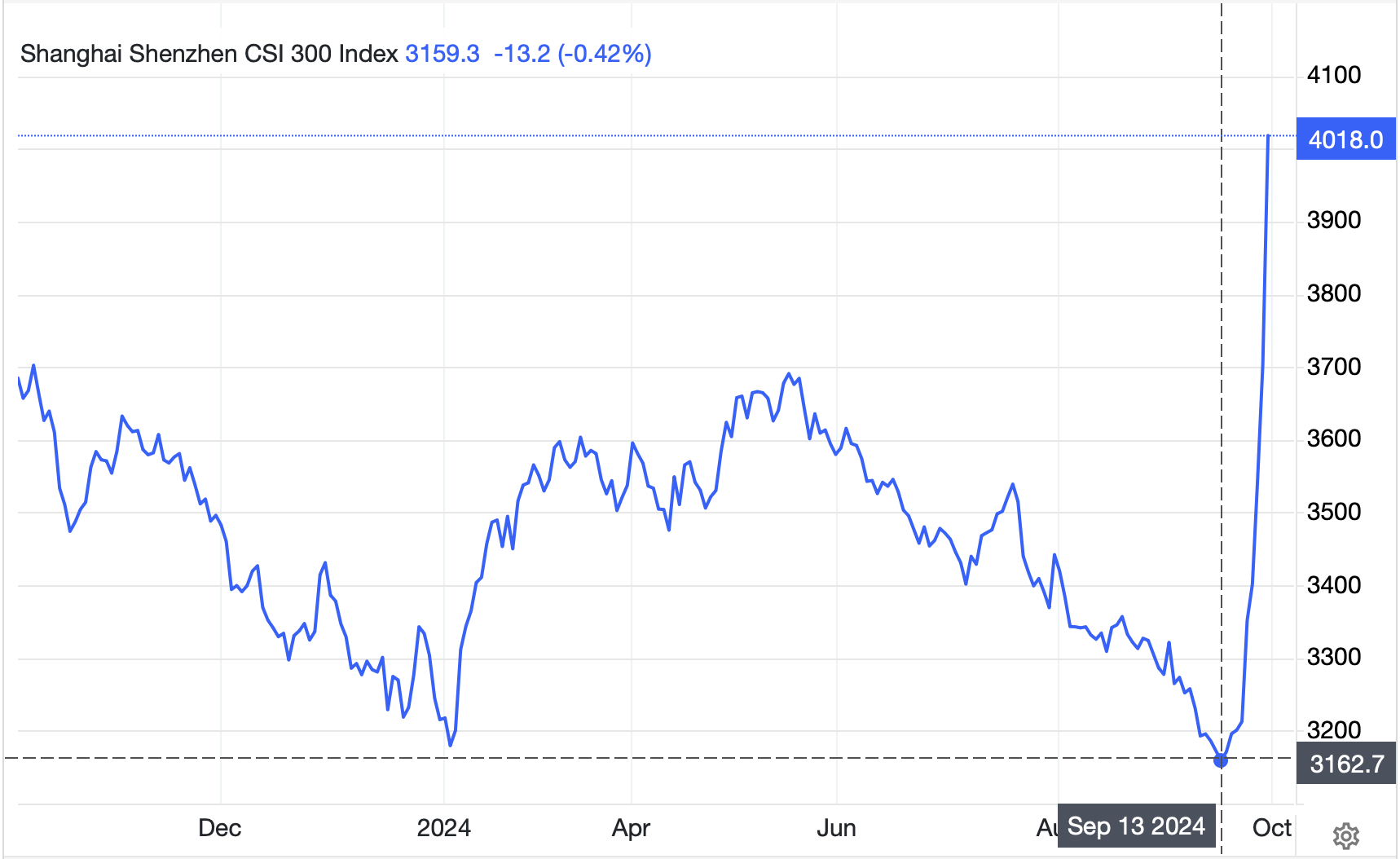
So, to recap what China has done in the past week, they have cut interest rates across the board, guaranteed loans to be used for stock repurchases, changed regulations to allow lower down payments on mortgages for first and second homes and now allowed more aggressive refinancing of existing mortgages.  As well, they reduced the RRR, freeing up capital for banks, and relaxed rules for regional governments to be able to spend more.  Now matter how this ultimately ends up, you must give Xi full marks for finally figuring out that in a command economy, he needed to command some more stimulus.  The latest mortgage news has simply excited the equity market even more and there was another huge rally last night (CSI 300 +8.5%), which when looking at a chart of that index shows an impressive rally in the past two weeks, slightly more than 27%!

Source: tradingeconomics.com

However, before we get too carried away, a little perspective may be in order.  The below chart is the 5-year view, and while the recent rebound is quite impressive, it simply takes us back to the level from July 2023 and remains more than 30% below the highs seen in February 2021.  I might argue that even if all of these policies work out as planned, something which rarely ever happens, until the economic data start to prove it out, things here feel a bit overbought for now.  Putting an exclamation on the last point, last night China released its monthly PMI data which showed just why Xi has become so aggressive.  Every reading, from both Caixin and the National Bureau of Statistics, was weaker than last month and weaker than expected.  Xi certainly needed to do something.

Source: tradingeconomics.com

Gravity remains
An unyielding force, even
For Japanese stocks

Now, a quick mea culpa from Friday’s note as I was in error on my analysis of the Japanese stock market in the wake of the election of Ishiba-san.  It seems that the announcement of his victory was not made until after the cash equity market was closed for the day. At that time, Sanae Takaichi remained the odds-on favorite to win the vote, and the market was anticipating a more dovish approach to things. Hence, the idea of the return to Abenomics and a much slower policy tightening was welcomed by the equity market at the same time the yen weakened.  But with Ishiba-san’s surprise victory, all of that got tossed out the window.  

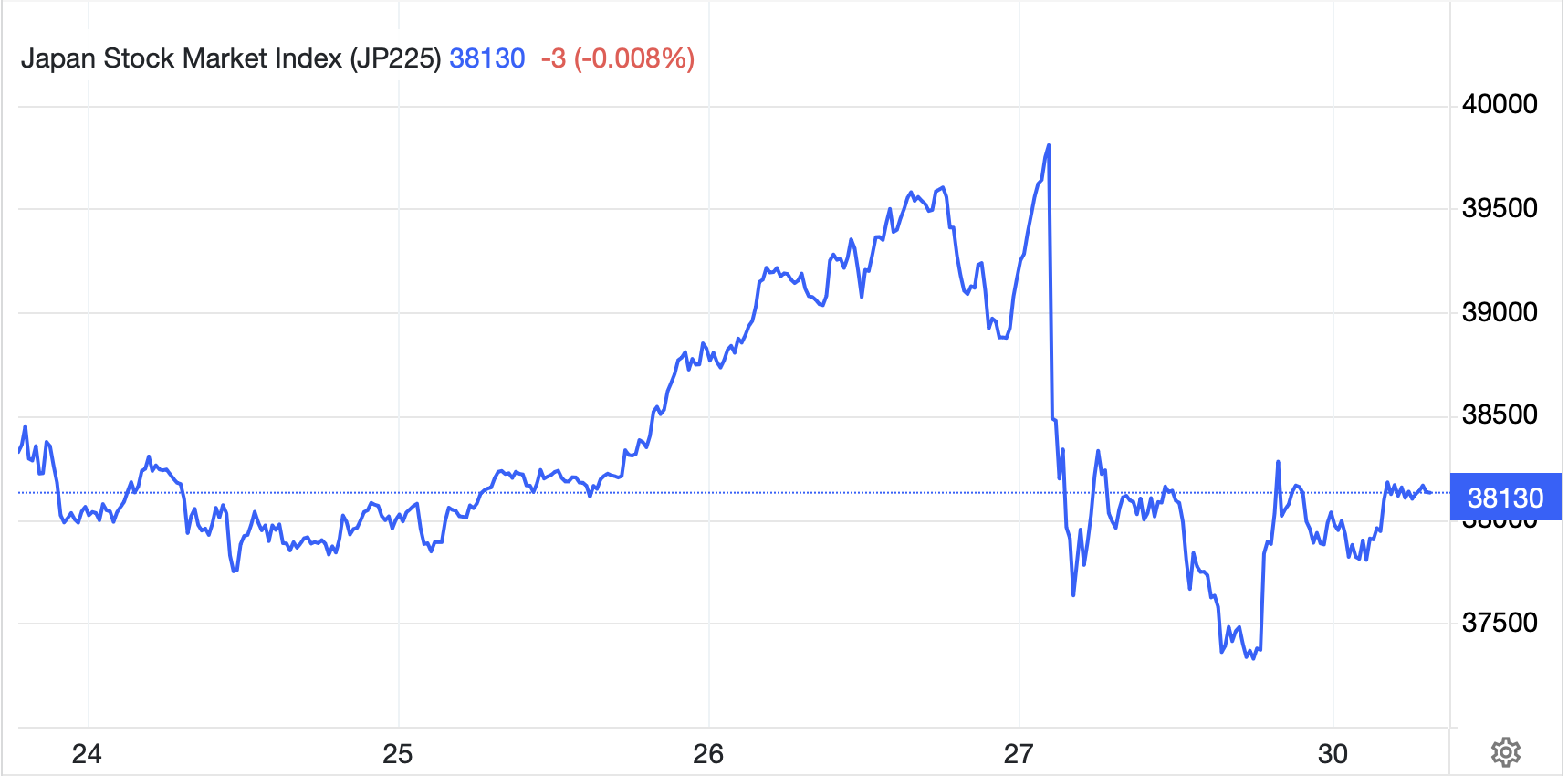
Of course, USDJPY was able to respond instantly, hence the sharp reversal in the market I showed in a chart on Friday.  However, the futures market sold off sharply on the election news and now that has been reflected in the overnight session with the Nikkei (-4.8%) giving back all the gains it had made in the previous two sessions in anticipation of a dovish turn.  So, as you can see in the below chart for the Nikkei 225 over the past week, we are basically exactly where things started before the Takaichi expectations built.  Truly much ado about nothing.

Source: tradingeconomics.com

As to the rest of the overnight session, beyond the Chinese data, we saw German state CPI readings which continue to fall as the German economy continues to slow appreciably.  We also saw UK GDP data, which was slightly softer than forecast, although at 0.9% Y/Y, still well ahead of Germany’s pace.  But otherwise, not very much else.  Last Friday’s PCE data was largely in line and quite frankly, most of the market seems to be focused on China right now, not the US, as that has become the newest idea on how to get rich quick.

So, here’s a quick recap of the session thus far.  Away from China and Japan, we saw more weakness than strength in Asia with both Korea and India falling more than -1.0%, although the rest of the region was mixed with much smaller moves.  Australia (+0.8%), though, benefitted from the China story as the price of iron ore, one of its major exports, rose 11% overnight on the idea that Chinese construction was coming back.  However, European bourses are under pressure this morning led by the CAC (-1.6%) with the rest of the continent also soft on the back of weaker earnings forecasts and announcements from European companies.  As to US futures, at this hour (7:20), they are pointing lower by -0.25%.

In the bond market, with all the excitement over renewed growth in China and continued tightening in Japan, yields are backing up slightly with virtually every G10 government seeing yields higher by 2bps this morning.  Ultimately, for Treasuries my fear is with the Fed cutting rates now and no real sign that the economy is slowing rapidly, we are going to see a quicker rebound in inflation than they are anticipating and that will not help the long end of the curve at all.

In the commodity markets, we are following Friday’s declines with further moves lower this morning as oil (-0.55%) continues to struggle on the weak demand story (this time from Europe, not China) while metals markets are also under pressure with all three biggies down (Au -0.75%, Ag -1.4%, Cu -0.7%).  This is a bit confusing for two reasons.  First, with the euphoria that the Chinese reflation story has generated, I would have expected copper to continue to rally alongside iron ore, but second, the dollar is softer today, and that generally supports the metals markets.

So, a quick look at the dollar shows the DXY is looking to test 100.00, a level it last briefly touched in July 2023 but spend most of 2020 and 2021 below.  This is concurrent with the euro (+0.3%) testing 1.12 and the pound (+0.3%) testing 1.35, with the former showing virtually the same pattern as the DXY and the latter making new highs for the past two years.  But there is some schizophrenia in the G10 with JPY (-0.2%), CHF (-0.3%), NOK (-0.35%) and SEK (-0.2%) all under pressure today.  While NOK and SEK make sense given the commodity moves, that doesn’t explain gains in AUD and NZD.  Some days are just like that.  In the EMG bloc, in truth, the dollar is showing more strength than weakness with ZAR (-0.35%), CNY (-0.2%) and KRW (-0.15%) although MXN (+0.3%) is bucking that trend.  On the one hand, it is quite confusing to see so many contrary moves amongst the currencies that typically track closely together.  On the other, though, none of the moves are very large, so there can be idiosyncratic explanations for all of this without changing the big picture story.

On the data front, we get a bunch of stuff culminating in NFP on Friday.

TodayChicago PMI46.2
 Dallas Fed Manufacturing-4.5
TuesdayISM Manufacturing47.5
 ISM Prices Paid53.7
 JOLTS Job Openings7.67M
WednesdayADP Employment120K
ThursdayInitial Claims220K
 Continuing Claims1837K
 ISM Services51.6
 Factory Orders0.1%
FridayNonfarm Payrolls140K
 Private Payrolls120K
 Manufacturing Payrolls-5K
 Unemployment Rate4.2%
 Average Hourly Earnings0.3% (3.8% Y/Y)
 Average Weekly Hours34.3
 Participation Rate62.9%

Source: tradingeconomics.com

As well as all that, we hear from nine different Fed speakers over 13 different speeches this week, including Chairman Powell this afternoon at 2:00pm.  It’s not clear that we have learned enough new information for Powell to change his tune although given all of China’s moves there could be some belief that the Fed doesn’t need to be so aggressive.  Now, as of this morning, the Fed funds futures market is pricing a 41% probability of a 50bp cut in November and a 50:50 chance of a total of 100bps by the end of the year.  but, if China is easing so aggressively, does the Fed need to as well?

Right now, the story is all China.  However, I still detect a lot of positive sentiment in the US and expectations that the Fed is going to continue to ease and boost growth, inflation be damned.  It still strikes me that you cannot be bullish both stocks and bonds here as they are going to respond quite differently to the future.  As to the dollar, it is clearly on its back foot as the pricing of further Fed ease undermines it for now, but remember, as other central banks follow the Fed more aggressively, any dollar declines will be muted.

Good luck

Adf

Harshly Depressed

The Payrolls report was a test
That Rorschach would clearly have blessed
The bears saw the data
As proof that the rate-a
Of growth would be harshly depressed
 
The bulls, though saw only the best
Of times and, their narrative, pressed
In their point of view
The Fed will come through
And stick the soft landing unstressed


With the Fed now in its quiet period, the market is trying to come to grips with what to expect going forward.  But before we look there, a quick recap of Friday’s NFP report, dubbed ‘the most important of all time’ by some hysterics, is in order.  By now you almost certainly know that the headline number was modestly weaker than expected, but that the revisions lower in the previous two months weighed on the report.  However, the Unemployment Rate ticked lower to 4.2% and wage growth edged higher by 0.1%.  Perhaps one of the worst pieces of the report was that the Manufacturing payrolls declined by -24K, the second worst outcome in the past 3 years, and hardly a sign of a strong economy.

The point is that depending on one’s underlying predispositions, it would be easy to come away with either a hopeful or dreary perspective after that report.  And, in fact, I would argue that the report changed exactly zero minds as to how the future is going to evolve, at least in the analyst community.  The biggest sentiment change came in the Fed funds futures markets where the probability of a 50bp cut next week fell to just 25%.  You may recall that particular probability has ranged from one-third up to one-half and now down to one-quarter just over the past week.  I think that is an excellent metaphor regarding both the uncertainty and the confidence in the economy’s growth and the Fed’s likely moves.  In other words, nobody has a clue (this poet included.)

One other observation is that reading headlines from various financial writers and publications shows that the world is still virtually split 50:50 on whether we are going to see a recession (with some calling for stagflation) or the Fed is going to stick the soft landing.  FWIW, which is probably not that much, my personal view is the recession is still going to arrive, but given how aggressively the government continues to spend money, we may need to redefine the concept of recession.  Consider if we look at only the private-sector and whether it is in recession and if that is enough to drag the overall economy, including the government spending, down with it.  In fact, given the 6+% deficits that the government is running, it may be realistic to consider this is exactly what is ongoing right now, although not to the extent that the totality of the economy is sinking.

Now that I’ve cleared that up 🤣, let’s look at how markets have been processing the NFP report and what we might expect going forward.  I’m sure you all know how poorly equity markets behaved on Friday, with US markets falling sharply led by the NASDAQ.  That negativity flowed into the Asian session with the Nikkei (-0.5%), Hang Seng (-1.4%) and CSI 300 (-1.2%) all under pressure.  While the Chinese data overnight, showing inflation rising slightly less than expected at 0.6% Y/Y while PPI there fell more than expected at -1.8%, continues to show that the Chinese economy is faltering and there is still no fiscal stimulus on the way, the Japanese data was generally solid with GDP growing 0.7% Q/Q, much higher than Q1 although a tick lower than the initial estimate.  The upshot is there is further slowing in China while Japan is rebounding.  I guess the question is why would both nations’ equity markets decline.  Arguably, the Chinese story is one of lost hope that the economy will be able to rebound in any timely fashion from an investor’s perspective while the Japanese story is that given the rebound in growth, the BOJ is far more likely to continue on the policy tightening path, thus undermining Japanese corporate earnings.

There once was a banker from Rome
Whose tenure preceded Jerome
“Whatever it takes”
Prevented the breaks
In Europe that would have hit home
 
But now he’s an eminence grise
Who answered the Eurozone’s pleas
To write a report
And help to exhort
Investment to beat the Chinese

But that was the Asian story.  In Europe, the story is far more optimistic with gains across the board on the order of 0.6% – 0.8% on all the major bourses.  The big news here is that Mario Draghi, he of “whatever it takes” fame from his time as President of the ECB and his famous comments that save the Eurozone and the euro back in 2012, was asked to evaluate the Eurozone and help come up with a plan to shake the economy from its current lethargy.  As a true technocrat, his view was that more government investment in key areas was critical.  On the positive side, he did suggest a reduction in regulations, although that really goes against the grain in Europe.  However, it appears that equity investors viewed the report positively as there has been no data or other commentary that might have catalyzed a rally there.  As to US futures, they are bouncing this morning after a rough week last week, with all three major indices higher by at least 0.6% at this hour (6:45).

In the bond market, after a week when yields fell around the world, we are seeing a bounce this morning everywhere.  Treasury yields (+4bps) are actually the laggard with European sovereigns all rising between 6pbs and 7bps and even JGB yields jumping 5bps overnight.  Of course, the Japan story is the solid growth numbers encouraging the belief that Ueda-san will raise rates again by December, while the European story is a combination of expectations of more European debt issuance (Draghi called for more European debt, rather than individual national debt) as well as the influence of Treasury yields.

In the commodity markets, oil (+0.8%) is bouncing this morning but remains well below $70/bbl and this looks far more like a trading bounce than a change in perspective.  The weak Chinese economic data continues to weigh on this market and if OPEC changes its stance and decides to restart production again later this year, it does appear that we could have a move much lower still.  As to the metals markets, they are firmer this morning although that is a bit surprising given the generally weak economic sentiment and the fact that the dollar is following yields higher.  Perhaps the biggest surprise is copper (+1.9%) which based on everything else, should be falling today.  Once again, markets are not mechanical and things occur, about which very few know, but have big consequences.

Finally, the dollar is much stronger this morning with the DXY (+0.5%) rejecting the push lower, at least for now.  This strength is broad-based with NOK (-1.1%) and JPY (-1.0%) the worst performers in the G10 despite the higher oil price and growing confidence that the BOJ will raise rates again.  But every G10 currency is weaker as are virtually every EMG currency with only MXN (+0.4%) bucking the trend, although that seems more of a trading response to the fact that the peso fell through 20.00 (dollar rose) for the first time in nearly two years on Friday.

As to the data this week, CPI is the biggest US number although we also hear from the ECB on Thursday.

WednesdayCPI0.2% M/M (2.6% Y/Y)
 -ex food & energy0.2% M/M (3.2% Y/Y)
ThursdayECB rate decision4.0% (current 4.25%)
 Initial Claims230K
 Continuing Claims1850K
 PPI0.1% (1.8% y/Y)
 -ex food & energy0.2% M/M (2.5% Y/Y)
FridayMichigan Sentiment68.0

Source: tradingeconomics.com

I guess the question is, does the CPI matter any more?  Given the Fed has essentially declared victory and turned its focus to employment, Wednesday’s number would have to be MUCH higher to matter.  With that in mind, I suspect that this week in FX will be far more focused on the equity market than on the macro situation.  If the equity rebound continues, I expect that the dollar will start to cede this morning’s gains, but if yields reverse their past two weeks’ sharp decline and the dollar continues this morning’s strength, then equity investors will feel some more pain.

Good luck

Adf

Not Even a Token

Like spring rains falling
So too, Japanese prices
Continue to slide


Once upon a time there was a tiny thought about Japan tightening monetary policy.  This thought, which had been seen lurking in the shadows of markets for the past thirty years, was largely ignored by all the ‘right’ people.  The illiterati economic gliteratti were all quite convinced that this would never happen as Japan was in a death spiral of rising debt and a shrinking population.  According to all the classical economic texts, interest rates could never rise again.

Then, one day there came along a virus that disrupted the world.  All the ‘important’ people in all the major nations determined that shutting down all economic activity while simultaneously printing trillions upon trillions of dollars, euros, pounds, and yen, and more importantly, giving that money to the people, was the best thing to do.  Not that surprisingly, with all that extra money chasing after fewer available goods and services, prices rose sharply almost everywhere.  Even in Japan, a nation that had suffered a generation-long deflationary bout, where companies literally apologized if they determined that a price rise was in order to cover rising expenses, prices started to go up more broadly.

This excited the policymakers in Japan as it was something they had been trying to achieve for the past 30 years.  It also excited the trading community as they became convinced that Japanese interest rates were set to explode higher.  And for a little while, Japanese inflation rates rose, surpassing the 2.0% target that had only been briefly brushed three times during that generation, the most recent being in the wake of the Covid actions.  Analysts were convinced that the new BOJ Governor, Kazuo Ueda, was getting set to raise the policy rate from its current level of -0.10%, its home for the past 8 years.  Traders positioned for JGB yields to rise and for the yen to strengthen against its currency counterparts.

Alas, so far this tale has not had that happy ending.  Instead, last night CPI in Japan printed at 2.2% headline, 2.0% core with both measures clearly trending lower for the past 18 months at least.  To be clear, in the very short term, these prints were marginally higher than market forecasts, which has resulted in a touch of strength in the yen (+0.3%), and a 1bp rise in 10-year JGB yields.  But bigger picture, this has further called into question the idea that Japanese inflation is going to remain stable at the BOJ’s 2% target.  In this situation, the idea the BOJ will tighten policy seems increasingly remote.  As such, all those delusions of tight money have been, once again, laid to rest.  The moral of this story is that; in Japan, the only money is easy money!

The newest Fed member has spoken
And Schmid said that things just ain’t broken
Thus, patience is needed
And so, he conceded
No rate cuts, not even a token
 
The Kansas City Fed’s new president, Jeffrey Schmid, made his first public comments yesterday but it could well have been his predecessor, uber-hawk Esther George, given that he hewed to the party line as follows:, “With inflation running above target, labor markets tight, and demand showing considerable momentum, my own view is that there is no need to preemptively adjust the stance of policy.  I believe that the best course of action is to be patient, continue to watch how the economy responds to the policy tightening that has occurred, and wait for convincing evidence that the inflation fight has been won.”  That’s pretty clear, and while he is not a current voter, it is simply another voice telling us that the Fed is not anxious to alter policy at all.  Even the market gets it now, with the March meeting down to a 0.5% probability of a cut, the May meeting down to a 16.3% probability and even the June meeting down to a 60% probability.  For all of 2024, the market is now pricing in just 3 ½ cuts, pretty darn close to the last dot plot.  Kudos to the Fed for getting their message across.
 
However, beyond those two stories, there is precious little to discuss this morning.  Data, beyond the Japanese CPI, has been sparse and the ECB speakers have also stayed true to their recent mantra of no reason to cut rates yet.  As such, it is not that surprising that markets remain mired in tight ranges overall.
 
Looking first at equity markets, after a lackluster session in the US yesterday, Japanese share prices were essentially unchanged although we did see some strength in Chinese shares with both the Hang Seng (+0.9%) and CSI 300 (+1.2%) rallying nicely on the back of increasing hopes for more Chinese stimulus coming in March at the annual plenary sessions.  As to the rest of Asia, activity was mixed with some countries seeing gains (India, Australia) and some losses (South Korea and Taiwan).  European bourses are also mixed with some gainers (Germany) and losers (Spain) while others have gone nowhere at all.  Finally, at this hour (6:45), US futures are ever so slightly firmer, just 0.1%.
 
In the bond market, both Treasuries and European sovereigns are seeing a bit of buying with yields lower by 1bp across the board.  Yesterday’s US 5-year auction was also somewhat unloved with a 0.8bp tail, quite large for that maturity.  It does appear that there is increasing pressure on the Treasury market as the pace of issuance picks up.  Over time, I believe this is going to matter a lot more to markets than it has thus far.
 
Oil prices, which rallied most of yesterday, are giving back some of those gains, down -0.4% this morning.  The rally was ostensibly based on further Red Sea concerns, but that really doesn’t make much sense given there were no new events there.  More likely, there was some short covering and analysts were looking for a story to tell.  Metals markets, though are in better shape this morning with gains in both precious (gold +0.3%) and base (copper +0.2%, aluminum +1.0%), largely on the back of the dollar’s modest weakness.
 
Which brings us to the dollar and the most confusing part of the session.  While it is true Treasury yields are lower by 1bp, that does not seem enough to weigh on the dollar, especially given the universal nature of yield declines.  The US curve actually inverted further, with the 2yr-10yr spread back to 42bps (it had been hanging around 25bps-30bps for several months), so that could be weighing on the greenback.  But whatever the cause, we are seeing pretty uniform weakness, although other than ZAR (+0.75%) which has clearly been helped by the metals rally, the rest of the movement is pretty modest, +/- 0.2% or less with more currencies gaining than losing.  I do not believe that the reaction function has changed here.  Rather, sometimes the FX market moves in funny ways.
 
On the data front, this morning brings Durable Goods (exp -4.5%, +0.2% ex transport) and Case-Shiller Home Prices (6.0%).  Yesterday saw a softer than expected New Home Sales and a weaker than expected Dallas Fed survey, although it was better than January’s print.  As well, we hear from Vice Chairman Barr, but there has been very little wavering from the message that patience is a virtue, and I don’t expect Mr Barr will change that tune.
 
The equity bulls took a rest yesterday but are clearly looking for more reasons to get back to buying.  To me, the potential problem will be home prices as, if they continue to rise, it will reduce hopes for any rate cuts at all, and there are still a number of pockets in the economy that are highly reliant on low interest rates to succeed.  Commercial real estate is simply the most frequently discussed, but consider much of the tech sector, where ideas that had been funded with free money that will not get the time of day if there is a cost of capital.  Ultimately, nothing has changed my idea of the dollar benefitting further as the market continues to understand that the Fed is not set to cut rates any time soon.  Of course, Thursday’s Core PCE could change a lot of views, mine included.
 
Good luck
Adf

Growth Will, Fall, Free

In China when data is weak
And nothing implies there’s a peak
The answer is to
Remove it from view
And henceforth, no more of it speak

But just because President Xi
Decided there’s nothing to see
That will not prevent
The wid’ning extent
Of views China’s growth will, fall, free

Last night China released their monthly series of economic statistics, all of which were lousy.  Briefly, Retail Sales (2.5%), IP (3.7%), Fixed Asset Investment (3.4%), Property Investment (-8.5%) and Unemployment (5.3%) all missed the mark with respect to economists’ forecasts and all indicated much weaker growth than previously expected.  Conspicuously there was one data point that was missing, youth unemployment, which had been rising rapidly over the past months and in June reached a record high of 21.3%.  However, given the amount of negative press coverage that particular data point was receiving, especially in the West, it seems that President Xi decided it was no longer relevant and it will not be published going forward.  Given the broad-based weakness in all the other data, as well as the fact that there are many new graduates who would have just entered the workforce, one can only assume the number was pretty substantially higher than 21.3%.

The other news from China was that the PBOC cut their 1yr Medium-Term Lending Facility rate by 15bps in a complete surprise to the market.  As well, the 1wk repo rate was also cut by 10bps as the government there tries to address the very evident weakening economic picture without blanket fiscal stimulus.  One cannot be surprised that the renminbi weakened further, falling another -0.4% onshore with the offshore version currently -0.5% on the session.  One also cannot be surprised that Chinese equity markets were all under pressure as prospects for near-term growth continue to erode.  FYI, the renminbi is within pips of its weakest point in more than 15 years and, quite frankly, there is no indication it is going to stop sliding anytime soon.  I continue to look for 7.50 before things really slow down.

As growth increases
And inflation remains high
Can QE remain?

In contrast to the Chinese economic data, we also saw Japanese data overnight and it was a completely different story.  Q2 GDP was estimated at 6.0% on an annual basis, much higher than expected and an indication that Japan is finally benefitting from its policy stance.  While inflation data will not be released until Thursday, the current forecasts are for little change from last month’s readings.  However, remember every inflation indicator in Japan is above the BOJ’s 2% target so the question remains at what point is QE going to end?  For the FX market this matters a great deal as USDJPY is back above 145 again, and if you recall the activities last October, when USDJPY spiked above 150 briefly and the BOJ/MOF felt forced to respond with significant intervention, we could be headed for some more fireworks.  However, despite the BOJ’s YCC policy adjustment at the last BOJ meeting in July, the JGB market has remained fairly well-behaved, so it doesn’t appear there is great internal pressure to do anything yet.  The flipside of that is the US treasury market, where 10yr yields are back above 4.20% and that spread to JGBs keeps widening.  As the Bloomberg chart below demonstrates, the relationship between 10yr Treasury yields and USDJPY remains pretty tight.  Given there is no indication 10yr yields are peaking, I suspect USDJPY has further to rise.

All this, and we haven’t even touched on Europe or the UK, where UK employment data showed higher wages and a higher Unemployment Rate, a somewhat incongruous outcome.  The Gilt market has sold off on the news, with yields climbing about 6bps, but the rest of the European sovereign market is much worse off, with yields rising between 8bps and 12bps.  Treasuries are the veritable winner with yields this morning only higher by 3.5bps.

What about equities, you may ask, after yesterday’s positive US performance.  The disconnect between the NASDAQ’s ongoing strength in the face of rising US yields remains confusing to many, this poet included, as the NASDAQ, with all its tech led growth names, seems to be an extremely long duration asset.  But, another 1% rally was seen yesterday, ostensibly on the strength of Nvidia which rallied after a number of analysts raised their price target on the company amid news that Saudi Arabia and the UAE both have been buying up the fastest processors the company makes.  Well, while Japanese equities managed gains after the strong data, all of Europe is in the red, all by more than 1% and US futures are currently (7:30) lower by about -0.5%.  If US yields continue to rise, and there is no indication they are going to stop doing so in the near future, I find it harder and harder to see equity prices continue to rise as well.  Something’s gotta give.

Interestingly, the commodity space seems to be out of step with the securities markets.  Or perhaps not.  Oil (-1.0%) is down for the third day in four, hardly the sign of economic strength, as arguably the combination of rising interest rates and slowing growth in China would seem to weigh on demand.  And yet, the soft-landing narrative remains the highest conviction case among so many analysts.  So, which is it?  Soft landing with continued growth and energy demand?  Or a hard landing with energy demand falling sharply?  My money is on a harder landing, although I think energy demand will surprise on the high side regardless.  Meanwhile, both base and precious metals are under pressure today with copper (-1.6%) the laggard of the group.  Remarkably, despite ongoing USD strength, gold is still above $1900/oz, but at this point, just barely.

Speaking of the dollar, today is a perfect indication of why the dollar index (DXY) is not a very good estimator of the overall trend.  As I type, DXY is lower by about -0.2%, yet the dollar has risen against virtually every APAC currency and the entire commodity bloc in the G10.  In fact, the only currencies rising today are the euro and pound, both higher by about 0.2%.  At any rate, there is no indication that the dollar’s rebound is ending either.  This is especially true for as long as US yields continue to climb.  Think of it this way, global investors need to buy dollars in order to buy the high yielding Treasuries we now have, so demand is likely to remain robust for now.  

On the data front, Retail Sales (exp 0.4%, 0.4% ex autos) is the big number but we also see Empire Manufacturing (-1.0) and the Import and Export Price Indices.  In addition, we hear from Minneapolis Fed President Kashkari at 11:00, which is likely to have taken on more importance now that we have seen the first split on the concept of higher for longer.  Which camp will he fall into and how vocal will he be regarding the potential to cut rates next year?

But, putting it all together right now, risk is under pressure, and I see no reason for that to change today.  I guess a blowout Retail Sales number, something like 1.0% could get the bulls juices flowing, but that would likely push yields even higher and that is going to be a drag.  Either way, I like the dollar to continue to perform well here overall, especially against EMG currencies.

Good luck

Adf