Will Not Be Quelled

Both sides in the trade war appear
To want nothing more than to steer
The narrative toward
A place where each scored
Political points, crystal clear
 
But markets, which yesterday felt
The problems would soon, away, melt
Are nervous today
And cannot allay
Their fear losses will not be quelled


It is becoming more difficult to discuss markets writ large as we have seen some historic relationships fall apart over the past 6 months.  For instance, the idea that both gold (and all precious metals) and the dollar would rise simultaneously is hard for old-timers like me to understand.  In ordinary times, the two had a very different relationship as gold was, essentially, just another currency.  If you look at the two charts below from tradingeconomics.com, you can see a longer-term chart that demonstrates, at best, independent behavior, and while the magnitudes of the movements are somewhat different, you can see that as the dollar peaked in late 2022, gold was bottoming and there is a general inverse correlation.
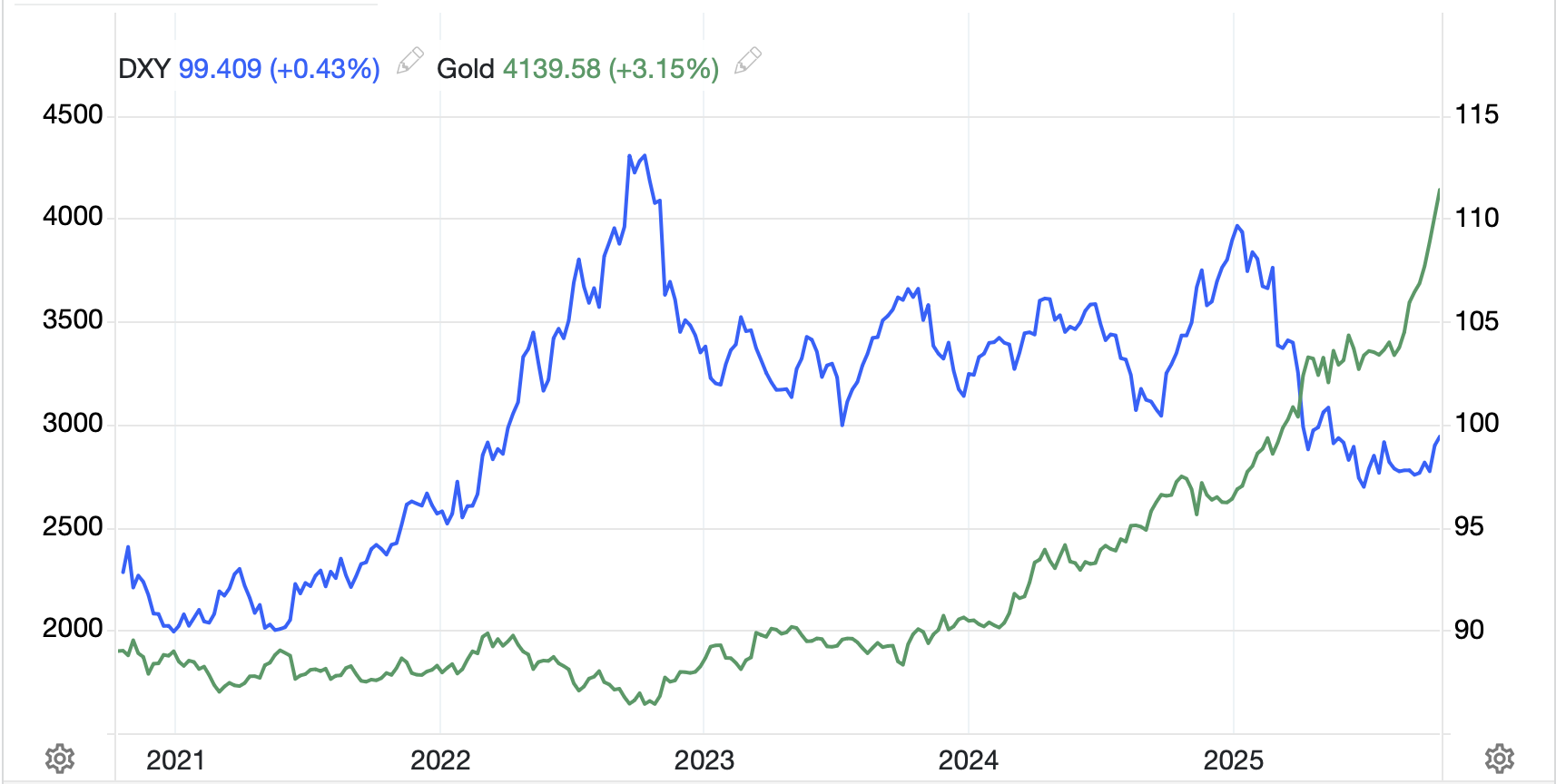
However, over the past month, that story is completely different as evidenced by this chart (which is based on percentage moves):

The other day I mentioned the debasement trade, the idea that investors were scooping up gold and bitcoin because they didn’t want to hold dollars.  However, it is harder to make that case about dollars, although fiat in general may be a different story.

I highlight this because I use the term ‘markets’ all the time as a generic concept, but lately, I need more specificity, I think.  So, Friday, when there appeared to be a sudden escalation in the trade war between China and the US, equity markets fell sharply, precious metals rallied, and bonds rallied while the dollar edged lower.  Yesterday, with the bond market closed, and a concerted effort by both sides to claim nothing had changed and that Presidents Trump and Xi would still be meeting at the ASEAN conference in two weeks, equity markets rebounded sharply, precious metals continued to rally, and the dollar rebounded.  Bringing us up to date now, equity markets are back under pressure (it appears that the trade situation is still an issue), precious metals are still rallying alongside the dollar, and as the bond market reopens, it, too, is rallying with yields slipping -3bps to 4.00%.

Some of this doesn’t make much sense, but I will try to address things, at least broadly speaking.  The constant across these moves has been precious metals rallying and I believe there are two stories working together here.  There is a fundamental story where central banks and, increasingly, individual investors are buying gold as they are seeking safe havens in an increasingly uncertain world.  Silver and platinum both benefit from this, as well as ongoing industrial demand, especially from the technology sphere.  But there is also a serious short squeeze unfolding in both the gold and silver markets as there is a mismatch between inventories held on exchanges and demand for physical metal.  

In the leadup to Liberation Day, you may remember the story of a huge inflow of gold and silver to the COMEX in the US ahead of feared tariffs on precious metals imports, although those tariffs never materialized.  However, all that metal sits in COMEX vaults today and is likely hedged with short futures contracts.  Meanwhile, London has a shortage of available metal and owners of LME contracts are seeking delivery, thus pushing the shorts to buy back at ever higher prices.  My friend JJ (Market Vibes on Substack) made the point there is a big difference between a bubble and a short squeeze, and a squeeze can go on much longer depending on the size of the short relative to the market’s overall size.  I think that’s what we are currently witnessing in both gold and silver.

As to the debasement trade idea, there are two things that call this theory into question, the dollar’s continued rebound and the bond market’s rally driving yields lower.  Arguably, the key concern in debasement is a dramatic increase in inflation, something I also fear.  But if that is the fear, how is it that bond yields, which are entirely reliant on pricing future inflation, are declining.  And that is what they have been doing since the beginning of the year, with 10-year yields falling ~80bps, and in truth, having gone nowhere since late 2022.

Source: tradingeconomics.com

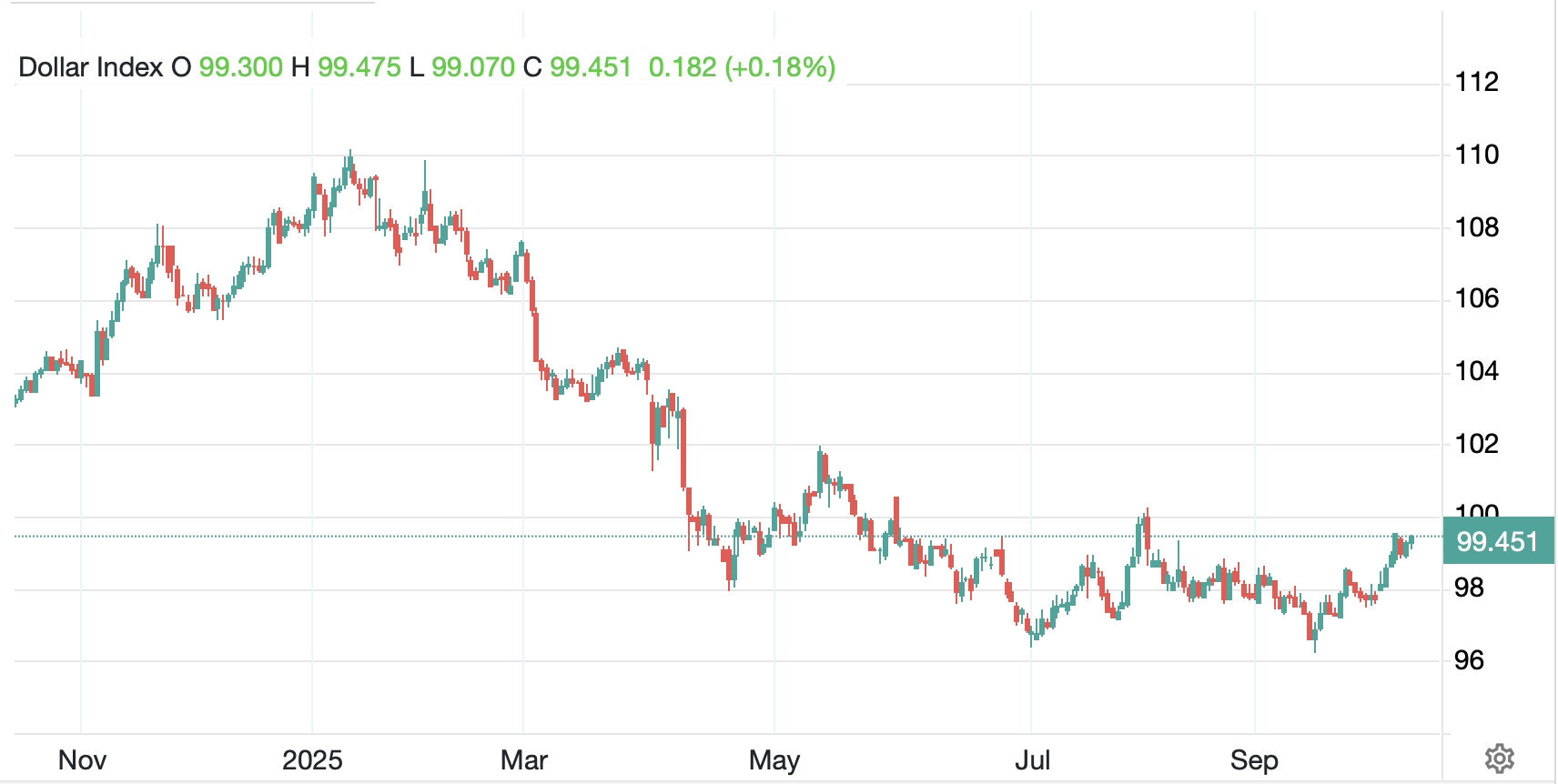
Meanwhile, the dollar, which did decline in the first half of the year, looks very much like it is forming a base here.  It is certainly not in a serious decline as evidenced by the chart below.
Source: tradingeconomics.com

What about equity markets?  Well, they have much that goes on away from macroeconomic issues, such as company earnings and more sector specific events, although the macro can have an impact.  We all know the AI story has been THE driver of the equity rally this year, really the past 2+ years, pushing everything else aside.  However, the trade tiff between China and the US, and growing around the world (the Netherlands just expropriated a Chinese owned chip company!) is highly focused on the AI story, and if trade is severely impacted, especially in chips and technology, that does not bode well for the drivers of the equity rally.  Whether that results in a rotation into other companies or a wholesale liquidation is far less clear.  

This morning, for instance, all European bourses are lower (DAX -1.6%, CAC -1.3%, FTSE 100 -0.6%, IBEX -0.6%) and overnight we saw significant weakness on Japan’s reopening (-2.6%) as well as China (-1.2%) and HK (-1.7%).  Too, US futures are lower across the board at this hour (7:15) by -1.0% or so.  The indication is that a rotation is not the story, rather a reduction of risk.  Of course, we could easily see more comments from both China and the White House (who are meeting at the IMF meetings in Washington right now) that things have de-escalated and turn the whole ship back around.  It should be no surprise that the VIX is rallying.

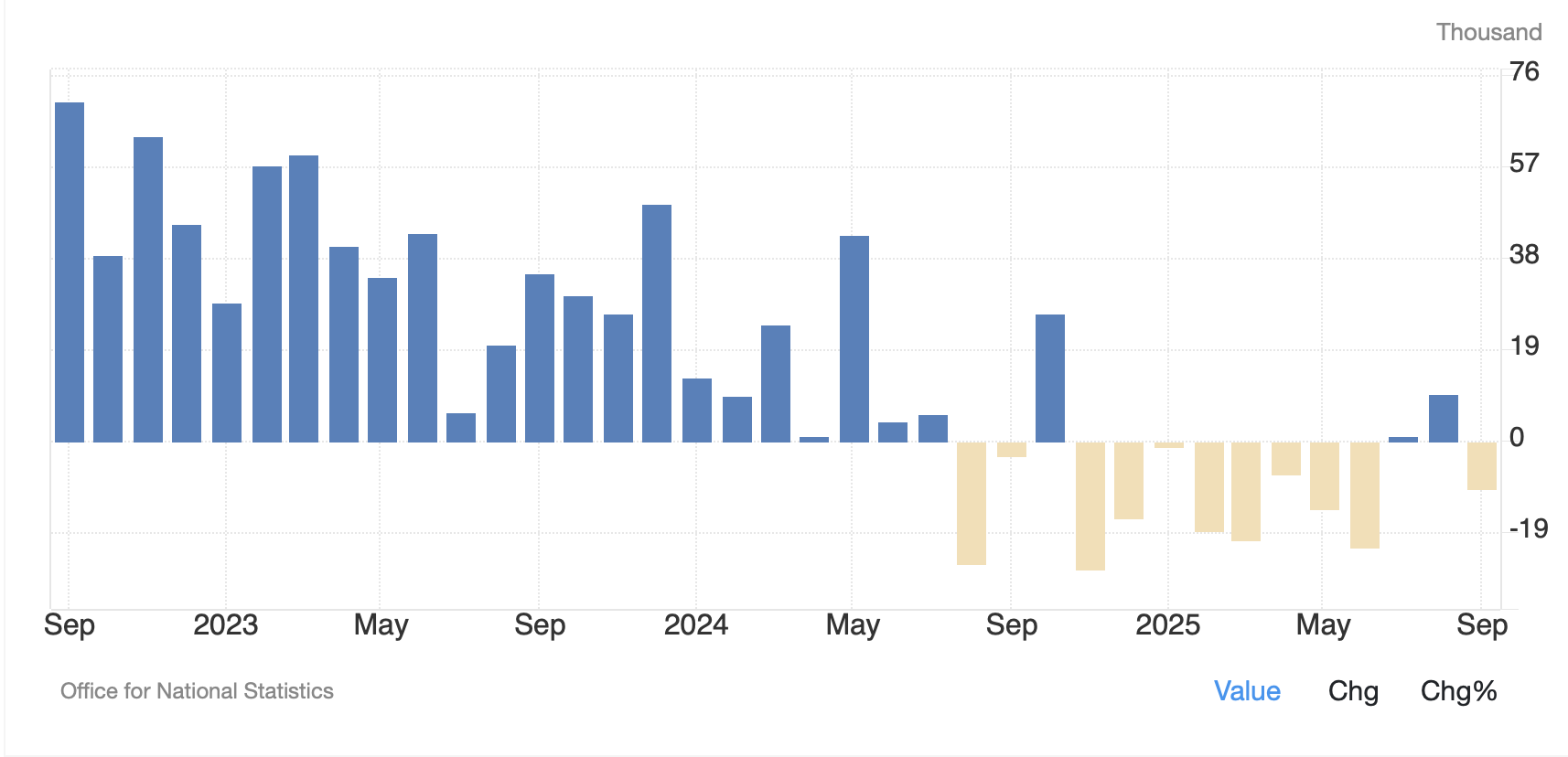
As to bonds, European sovereign yields have fallen by between -3bps and -4bps across the continent while UK gilts (-7bps) have fallen further after employment data there showed the Unemployment Rate ticked up to 4.8% unexpectedly while there were job losses as well.  In fact, looking at the chart below of Payroll Changes over the past three years, the trend seems pretty clear!
Source: tradingeconomics.com

Those UK employment figures also weighed on the pound (-0.45%) which is declining in line with most of the G10 bloc (NOK -1.1%, AUD -0.9%, NZD -0.5%) although the yen (+0.25%) is bucking the trend, perhaps because of its haven status.  NOK is suffering from oil’s (-2.2%) sharp decline after the IEA, once again, said there would be a supply surplus, although their forecasts have been wrong, and consistently overestimating supply and underestimating demand, for the past decade.  

As to the EMG bloc, despite the rally in precious metals, both ZAR (-0.9%) and MXN (-0.8%) are under pressure as is KRW (-0.6%) after the story that China is imposing restrictions on Korean ship builders in the US that are helping America try to reverse the decimation of our shipbuilding industry.  

Trying to recap all that is happening, fear is pervasive across investors of all stripes.  The hunt for havens continues and absent a more lasting trade truce between the US and China, something I think will be very difficult to achieve, volatility is likely to be the dominant feature in all markets.  In the end, though, there is no evidence that the dollar is being ‘dumped’ in any manner and while gold and precious metals may continue to rally, given 2 Fed rate cuts are already priced in for the rest of the year, we will need something completely outside the box to see the dollar fall in any meaningful manner, I believe.  For hedgers, markets like these are why you remain hedged!

Good luck

Adf
Misguided

On Friday, the news was a sign
Of imminent US decline
The Fed was a hawk
And all of the talk
Was Trump’s actions wiped off the shine
 
But yesterday, markets decided
That Friday’s response was misguided
They’ve come to believe
A Fed funds reprieve
By Powell will soon be provided


As I have frequently written in the past, markets are perverse.  The narrative Friday was about the dire straits in which the US found itself with the employment situation collapsing and the recession that has been forecast for the past three years finally upon us.  Part of this story was because of the Fed’s seeming intransigence regarding interest rates as made clear by Chairman Powell’s relatively hawkish comments at the FOMC press conference last week.

But that story is sooo twenty-four hours ago. In the new world, the huge bond market rally that was seen on Friday, and equally importantly, the changing pricing of Fed funds rate cuts has the new narrative as, the Fed is going to cut so buy stonks!  Confirmation of this new narrative was provided by SF Fed President Mary Daly who remarked yesterday evening, “time is nearing for rate cuts, may need more than two.”  All I can say is wow!  

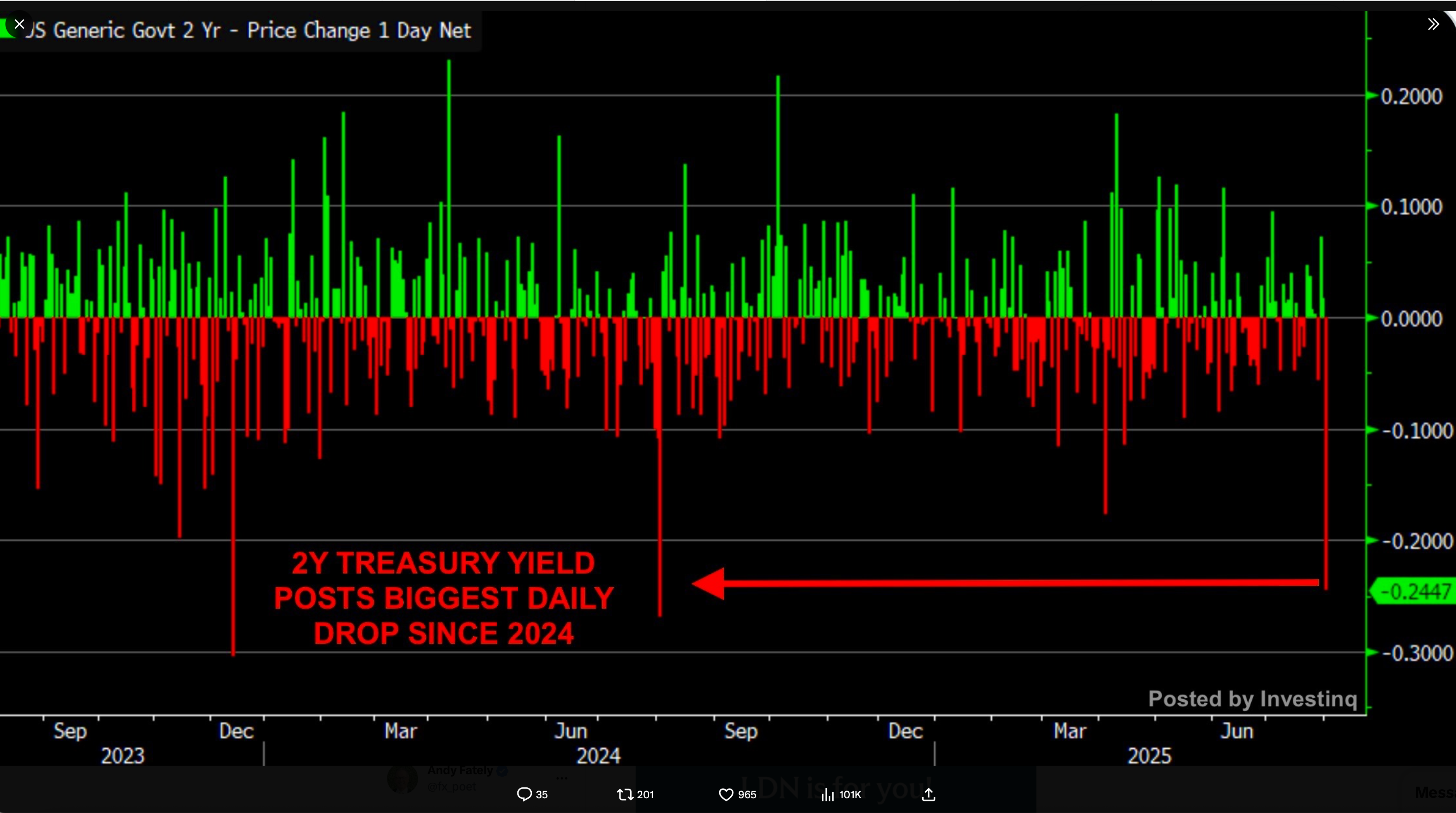
The below chart shows the daily moves, in basis points, of the 2-year Treasury note which is seen as the market’s best indicator or predictor of future Fed funds rates.  On Friday, the yield fell nearly 25bps, essentially pricing in one additional rate cut coming, and as we saw with the Fed funds futures market, that pricing is now anticipating three cuts this year.  Ms Daly merely reconfirmed that news.

Source: https://x.com/_investinq/status/1951356470877925408?s=46

Perhaps it is fair to ask why Daly has taken so long to come around to this view.  After all, she is a known dove and has been for her entire time at the Fed.  As I have asked before, why haven’t the other known doves, like Governors Cook and Jefferson, been out there talking about rate cuts?  For anyone who wants to continue to believe that the Fed is apolitical, nonpartisan or above politics, this is exhibit A as to why it is not.  In fact, if you look, only one Board member was considered a hawk in this analysis by In Touch Markets, and she just resigned.  The other hawks are all regional Fed presidents.  Perhaps this is why they were so slow to raise rates when inflation was roaring in 2022 and why they were so anxious to cut rates in 2024 on virtually no news other than the upcoming election. 

To be clear, until Friday’s NFP data, it was difficult to make the case, in my mind, for a cut because I continue to see inflationary pressures beyond any tariff impacts.  But if the labor market is weaker than had been assumed, that will certainly open the door to more cuts.  Of course, the conundrum is, if the economy is so weak that the Fed needs to cut, why are stocks rallying?  Arguably, a weak economy would foretell weaker earnings growth, a direct negative to equity valuations.  But that appears to be old-fashioned thinking.  I guess I am just an old-fashioned guy.

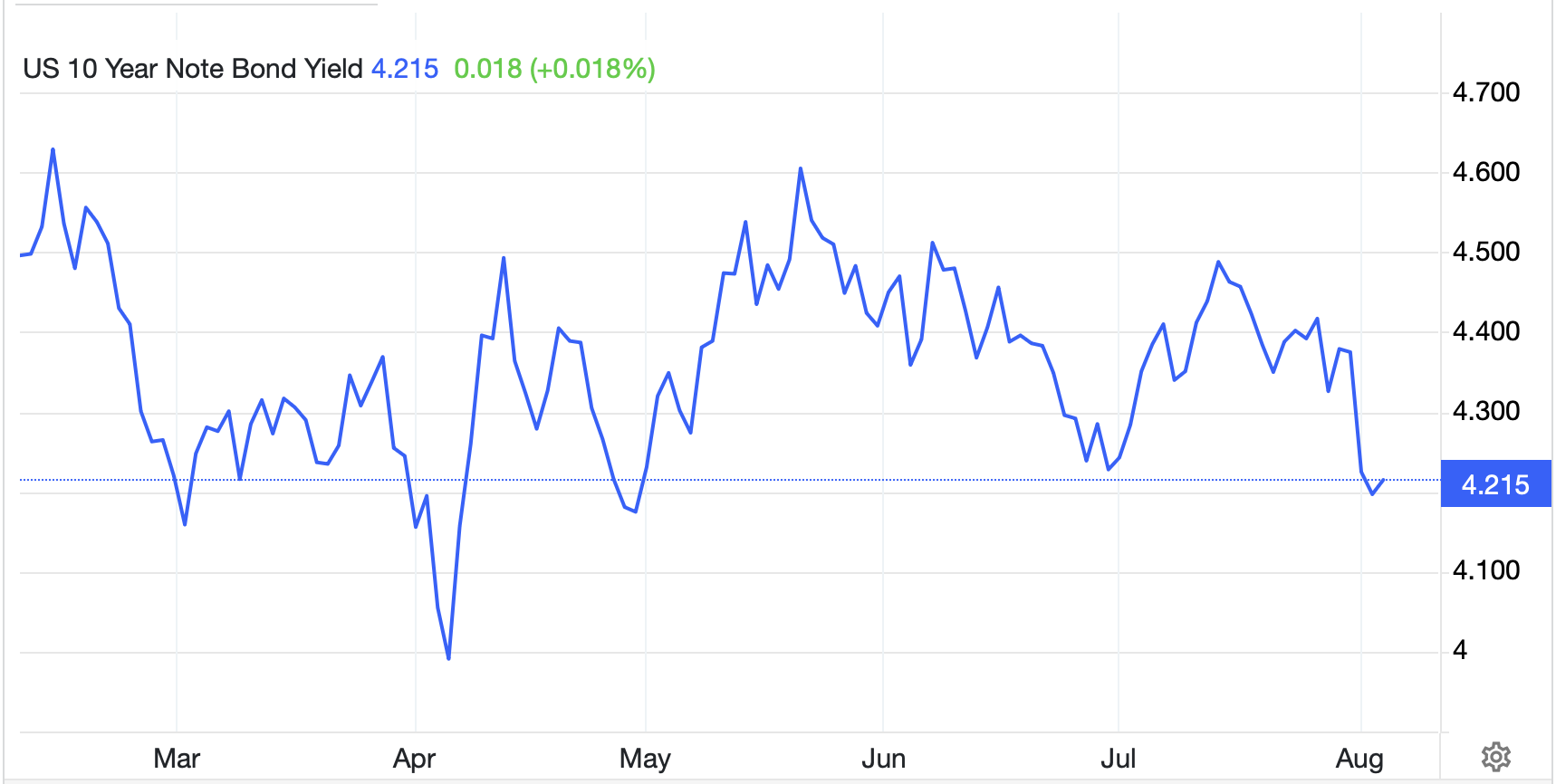
Ok, let’s turn to the overnight activity.  Starting with bonds, since the big move Friday, Treasury yields have been little changed, climbing 2bps overnight to 4.21%, but still hovering near the bottom of their recent trading range with only the Liberation Day announcement panic showing yields below the current level.  This is a great boon for the Treasury as auctions of 3-, 10-, and 30-year Treasuries are due this week starting with the 3-year today.

Source: tradingeconomics.com

European sovereign yields have also edged higher by 1bp across the board after PMI data was released this morning, pretty much exactly at expected levels.  The outlier last night was JGB yields which slipped -4bps and continue to slide away from designs of a BOJ rate hike.

In the equity markets, yesterday’s US rally was followed almost universally in Asia (Japan +0.65%, China +0.8%, Hong Kong +0.7%, Australia +1.2%) with only India (-0.3%) lagging there.  As to Europe, it too is having a good day with the DAX (+0.8%) leading the way although strength almost everywhere as the PMI data was good enough to keep spirits higher.

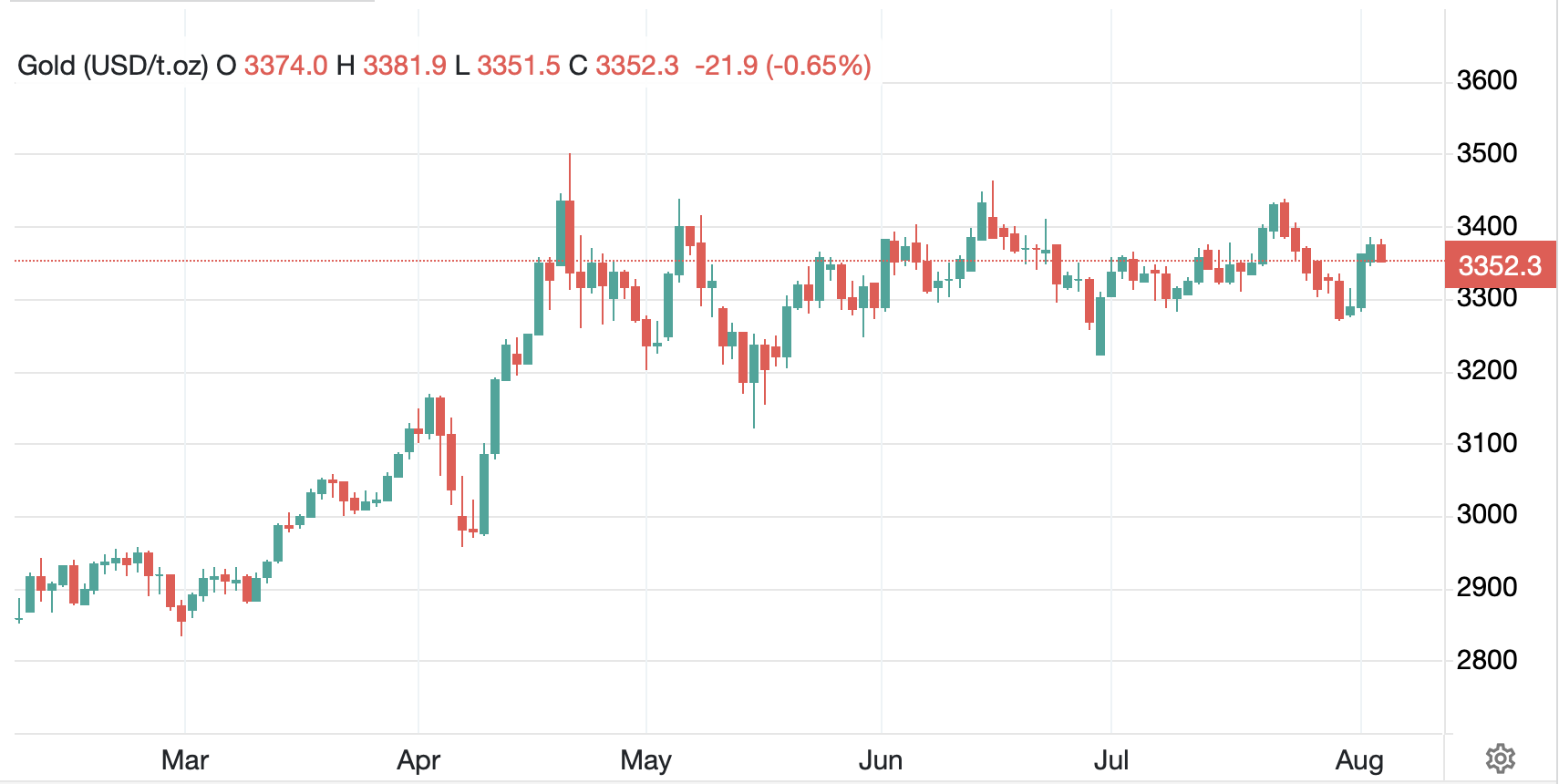
In the commodity markets, oil (-1.1%) is slipping for a fourth consecutive day, but is still right in the middle of its $60 – $70 trading range.  There remain so many potential geopolitical issues with saber rattling between the US and Russia and President Trump’s threatened excess tariffs on nations who buy Russian oil that it remains difficult to discern supply/demand characteristics.  Certainly, if the US is heading into a recession, that is likely to dampen demand for a while, but that remains unclear at this time.  As to the metals, gold (-0.65%) is giving back some of its post NFP gains but if I look at the chart below, all it shows is a relatively narrow trading range with no impetus in either direction.  

Source: tradingeconomics.com

The rest of the metals complex is being dragged lower by gold this morning, but not excessively so.

Finally, the dollar is a touch stronger today, despite the rate cut talk, as the euro (-0.4%) and yen (-0.55%) lead the G10 currencies down.  While I understand the rationale for the dollar to soften in the short- and medium-term vs its counterparts, it is very difficult for me to look at the political and economic situations elsewhere in the world and think I’d rather be investing there.  Europe is a mess as is Japan.  And don’t get me started on the emerging market bloc.  So, remember, while day-to-day movements can be all over the map and are impacted by things like data releases or announcements, structural strength or weakness remains largely in place, and the US situation appears stronger than most others for now.   Touching briefly on EMG currencies, the dollar is firmer vs. virtually all of them, mostly on the order of 0.4% or so.

On the data front, today brings the Trade Balance (exp -$61.4B) and then ISM Services (51.5) at 10:00.  We don’t get the first post-FOMC speech until tomorrow by Governor Cook, so it will be interesting to see if there are more doves who are willing to show their colors.  But in the end, as demonstrated by the quick reversal of the narrative from Friday to Monday, there remains an underlying bid to risk assets and we will need to see substantial economic weakness to remove that bid, even temporarily.

Good luck

Adf

Widow Maker

The widow maker
Looks like it is about to
Make some more widows

For those unacquainted with the term as it relates to the financial markets, the widow maker trade has been going short JGB’s and buying JPY under the assumption that at some point, the BOJ would normalize monetary policy.  Lately, this trade has been reinvigorated in a major way on the back of the belief that Ueda-san is going to raise the base rate from its current level of -0.10%.  Granted, 10-year JGB yields have risen about 35bps since last summer, which given their starting level of 0.35%, is quite a bit.  Simultaneously, the yen weakened dramatically, falling more than 8% over the same timeframe.  An unstated, but critical, underlying part of the idea was that the Japanese economy was chugging along nicely and would continue to do so.  This would pressure wages higher and force the BOJ to join the rest of the world in raising interest rates.

But a funny thing happened to those plans last night when the Japanese government released its latest GDP data showing that Q4 GDP fell -0.1% Q/Q, far below the expected +0.3% gain.  This, when combined with Q3’s revised decline of -0.8% Q/Q (also worse than before) is the very definition of a recession.  Hence, the problem for all those traders who are short JGB’s and long the yen.  If Japan is in recession, it seems highly unlikely that Ueda-san is going to be tightening monetary policy in the near-term.  Rather, I would expect more fiscal and monetary stimulus which ought to result in lower yields and a still weaker yen.  And this is why the trade is nicknamed the widow maker.  It has fooled traders for some 30 years so far, and many have lost fortunes on its back.

One other quirk of this outcome is that Japan, heretofore the world’s third largest economy, has now slipped into fourth place behind Germany.  Part of this outcome is due to the fact that the weak yen has altered the calculations such that a given yen amount is worth many fewer dollars.  Relatively speaking, the euro has not fallen nearly as much, hence the switch in the rankings.  Should the yen regain even a quarter of its losses over the past two years, the two economies are likely to switch back to their old places.

In Europe and in the UK
The story is growth’s gone away
Recession is nigh
And if you ask why
It’s policy blunders at play

It was not just the Japanese who have fallen into a technical recession, the UK has also managed the trick as Q4 GDP data released this morning showed Q/Q growth of -0.3%, which when following Q3’s -0.1% leaves us with two consecutive quarters of negative GDP growth, the same definition of a recession.  In fairness, the Eurozone managed to skirt recession, but is there for all intents and purposes.  Yesterday, they released their data which showed that Q4 GDP growth was a resounding 0.0% following Q3’s -0.1%, so not a recession, by definition, but certainly a lousy performance.

I highlight these outcomes to contrast them with the data from the US, which has shown massive GDP prints over Q3 and Q4 of 1.2% and 0.8% respectively.  Now, we have discussed that a key part of this growth is the extraordinary amount of deficit spending that is currently ongoing in the US, far more than anywhere in Europe.  But from a monetary policy perspective, it is much easier for the Fed to maintain its current policy stance than it is for either the BOE or the ECB.  It is for this reason that I believe we will see continued changes in market pricing for monetary policy easing going forward.  I expect that Fed funds futures will continue to reduce the number of cuts as well as push out the timing of the first cut while in both the Eurozone and the UK, we start to see pricing that indicates a cut before the US.

As this process plays out, the impact on financial markets will be significant.  Regarding the FX market, this will underpin further strength in the dollar overall.  Although it is certainly possible, if not likely, that the BOJ intervenes to prevent, or at least slow down, further weakness in the yen, there will be no such action by the other two banks.  Regarding bond markets, much will depend on the timing of the first cuts and the status of inflation.  If the pain of economic weakness rises enough to offset the pain of inflation, and cuts come before inflation is under control, look for much steeper yield curves and higher back-end yields.  However, if inflation really does decline as currently wished for projected by all these central banks, then look for those curves to bull steepen, with the front end of the curve rallying and the back remaining fairly static.  After all, 4% or less for 10-year yields does not seem in appropriate in a 2%-3% inflation world.

Summing it all up, there are many potential paths forward, and as has been the case since 2022, inflation remains the number one driver of everything.

Ok, let’s tour markets quickly.  The dip was bought in the US yesterday with decent rebounds in all the major indices.  That was followed by further solid gains in Japan (Nikkei +1.2%) and continuing to make new highs for the run, with most of Asia following suit.  In Europe, equities are doing pretty well, with gains on the order of +0.75% except in the UK which is flat on the day after the weaker GDP data.  As to US futures, at this hour (7:30) they are very slightly firmer, 0.2% across the board.

Bond markets are continuing to rebound from Tuesday’s dramatic declines with yields slipping back further this morning.  Treasury yields are lower by 4bps, and now approaching 4.20% from the high side with many traders expecting that level to be technical support.  European sovereigns are all seeing yields decline either 2bps or 3bps this morning and overnight we saw JGB yields slip 2bps.  Of more note were the moves in Australia (-13bps) and New Zealand (-14bps) after Australian employment data came in a bit soft (Unemployment Rate up to 4.1%) so thoughts of RBA tightening have faded a bit.

Oil prices are continuing yesterday’s slide, -0.7%, after inventory data printed much higher than expected on the back of record US oil production.  Meanwhile, metals prices are mixed with gold edging higher on the softer rates story but copper and aluminum giving opposite signals as the former is higher and the latter lower by about 0.6% each.

Finally, the dollar is a touch softer this morning as US yields drift lower.  Thus far, it has not returned below key perceived levels with USDJPY still above 150 and the DXY still above 104, but I suspect that if risk appetite continues to reassert itself, the dollar may slide further.  The greenback’s movement have been extremely closely tied to 10-year yields of late.

On the data front, we see a bunch of things this morning led by Retail Sales (exp -0.1%, +0.2% ex-autos), Initial Claims (220K), Continuing Claims (1880K), Empire State Manufacturing (-15.0), and Philly Fed (-8.0) all at 8:30.  Later on we see IP (0.3%) and Capacity Utilization (78.8%).  In addition, we hear from Governor Waller at 1:15 this afternoon, so it will be very interesting to get his take on how the recent data is going to impact the FOMC.  There have been no substantive changes in the futures pricing for Fed funds with still less than a 50% probability of a cut in May.

Risk markets were clearly shaken by the CPI data on Tuesday.  More hot data today will further impact those assets negatively in my view.  In fact, this will continue as long as the market is going to trade on interest rate expectations.  At some point, if economic activity manages to continue strongly, it is likely to turn into a positive catalyst for risk assets, but we are not there yet.

Good luck
Adf

Beware

It wasn’t all that long ago
When Powell commanded the show
At least so it seemed
But maybe we dreamed
Those attributes we did bestow
 
But now traders seem not to care
That Wednesday, Chair Jay said beware
No rate cuts next meeting
Instead, they are treating
That warning’s though it wasn’t there
 
The upshot is bonds are on fire
And stocks turned around and went higher
Today’s NFP
Will help us to see
If Jay is still leading the choir


Well, it seems that Chair Powell’s hawkish message resonated with investors for about 12 hours, at which point they decided to forget all he said and side with Treasury Secretary Yellen and her spending plans.  Or maybe the trading community just doesn’t believe he can pull it off, keep policy rates at 5.5% while the government needs to borrow so much money.

There are other possible explanations as well.  The NYCB meltdown yesterday may have opened some eyes regarding the commercial real estate (CRE) problems that certainly exist everywhere in the world, but notably here in the US.  If reclassifying just two loans was enough for a $100 billion bank to cut their dividend completely and increase loan loss reserves nine-fold, what about all the other CRE loans that are also under pressure on other bank balance sheets?  Perhaps the bond market is sniffing out the next banking crisis in front of our eyes.  For the conspiracy theorists, the Fed did remove the following line from their statement yesterday, “The U.S. banking system is sound and resilient.”  Perhaps that was a hint that it is not sound and resilient.

Regardless of the driver, yesterday saw a ripping rally in the bond market with the 10-year yield touching 3.82% before bouncing, nearly as low as it reached following Powell’s ultra-dovish performance in December.  That certainly doesn’t square easily with the hawkish statement and comments on Wednesday.

I have no good explanation for the movements, and I would argue neither does anyone else.  As has been the case for the past year, at least, economic data is simply a Rorschach test for your underlying views and biases.  Once again, the financial markets appear to be fighting the Fed tooth and nail.  Perhaps one clue was the fact that gold prices rallied yesterday, as did bitcoin.  Now, it is possible that is simply because lower yields enhance the willingness to hold those assets, or perhaps it is because the market smells a banking crisis coming and wants to hide.

Fortunately, we get new and important information this morning with the release of the NFP data at 8:30.  Here are the current median forecasts:

Nonfarm Payrolls180K
Private Payrolls155K
Manufacturing Payrolls5K
Unemployment Rate3.8%
Average Hourly Earnings0.3% (4.1% Y/Y)
Average Weekly Hours34.3
Participation Rate62.4%
Factory Orders0.2%
Michigan Sentiment78.9

Source: tradingeconomics.com

As well, the BLS will be releasing their annual revisions to their data, so everything will be a mess.  However, traders, and trading algorithms, only ever look at the headlines.  The fact that 11 of the past 12 NFP numbers have been revised lower over time seems not to be a major concern to investors, although it is certainly not a positive signal for the economy writ large.

In the end, we are all beholden to this data point and the market’s reaction function.  Based on what we have seen since the FOMC meeting I would suggest that a weak number will be seen as risk-on because it will encourage more rate cut talk and bring March back into view.  (FYI, the current probability of a March cut according to the futures market is 34.5%.  Sub 100K and I would look for that to go back to 50% at least.)  At the same time, a strong print, > 200K, and I expect a risk-on response as it will encourage the earnings growth story and reduce the probability of a recession.  In fact, after the strong earnings reports from Meta and Apple last night, the only way I think we see a risk-off outcome today is if NFP is sharply negative, enough so it forces people to put recession back on their bingo cards.  We shall see.

In the meantime, a quick look at the overnight session shows that Asian equity markets are back on the buy Japan / sell China train with the CSI 300 falling to its lowest level since 2019 as investors remain unimpressed by Xi’s efforts to fix things in China.  But away from China, the rest of the markets in Asia all had good session, up between 0.5% and 1.5%.  In Europe, green is the theme as well with every market higher on average by 0.7% or so.  Not surprisingly given the earnings reports, US futures are green as well, with the NASDAQ +1.0% at this hour (7:10).

Bond markets are all over the map this morning.  Treasury yields are unchanged from the closing level yesterday, although they bounced 5bps from that intraday low print mentioned above.  As to European sovereigns, yields have edged higher by 1bp-2bps on the continent although UK Gilts are higher by 6bps which is a bit strange given the BOE yesterday seemed far more dovish than many expected.  While leaving rates on hold, they explained they expected inflation to temporarily get back to their 2% target in Q2 before bouncing a bit, and the vote included one vote to cut rates, 6 to maintain and 2 to raise, a more dovish tilt.  And yet here we are, with Gilts selling off.  If you were interested, JGB yields have fallen as well, down 2bps and falling away from any ideas of policy changes in Tokyo.

Oil is little changed this morning after getting crushed yesterday on unconfirmed rumors of a cease-fire in the Israel-Gaza conflict.  It seems the betting is that if there is a cease-fire, the Houthis will stop attacking ships in the Red Sea and things will improve everywhere.  However, as of yet, no cease-fire has been reached.  As to the metals markets, gold is little changed after a more than 1% rally yesterday, while both copper and aluminum are softer this morning, although the movements have been small and may be meaningless.

Finally, the dollar is a bit softer this morning with AUD (+0.5%) the leading G10 gainer on the back of the ASX 200 reaching a new all-time high closing level overnight.  But the movement here is broad and shallow, most currencies are a bit stronger vs. the dollar, but that 0.5% move is the largest by far.  My take is that as long as US yields remain under pressure, the dollar will be on its back foot as well.  Hence, a strong NFP this morning could see yields bounce and the dollar along with it.

And that is all we have today.  It has been quite a week between the QRA, the FOMC and Powell presser and now today’s NFP.  While there was a great deal of uncertainty as the week began, at this point, it seems clear that the market has decided that rates are coming lower regardless of what Powell has to say.  We have yet to hear from any other Fed speakers, although I imagine we will be getting a full dose next week.  And Sunday night, on 60 Minutes, Powell will be interviewed so that will be closely watched for any clues.  Until then…

Good luck and good weekend

Adf

Now Estranged

“Something appears to be giving”
Said Waller, the true cost of living
So, bonds rallied hard
The dollar was scarred
But stocks were quite unreactive-ing

The narrative clearly has changed
With hawks on the Fed now estranged
Is everything better?
As world’s largest debtor
We need low rates to be arranged

Fed Governor Chris Waller, one of the erstwhile hawks on the FOMC was covered in white feathers yesterday as he explained his latest perception that the Fed was on a path to achieving their 2% inflation goal as Q3’s expansive GDP was clearly an outlier and the data he cited showed economic growth slowing toward trend just below 2%.  The other Fed speakers on the day did not back him up specifically, and in fact, Governor Bowman explained her base case was the Fed needed to hike still further to be certain inflation was under control.  However, the market only had eyes for Waller and has heard the following message from the Fed, ‘we have finished hiking, and the next move will be a cut.’  Although this had been a building narrative, until yesterday there had been consistent pushback from virtually every Fed speaker with the higher for longer mantra.  However, the current belief set is that higher for longer has just been buried and that lower rates are in our future.  Let the celebrations begin because the Fed has achieved the much discussed, though rarely achieved, soft-landing.

However…it is still a bit premature, to my mind, to celebrate accordingly.  In fact, just yesterday the Case Shiller Home Price Index showed an annual rise of 3.9%, which although 0.1% less than forecast, also shows that the widely claimed decline in house prices due to higher yields, has not materialized.  And consider, if yields are set to go lower, the idea that house prices are going to fall and feed into lower inflation seems absurd unlikely.

But logic has never been an important part of any market narrative, and this time is no different.  The fact that declining bond yields (Treasuries fell 6bps yesterday and a further 5bps in the aftermarket) and the fact that the dollar, as measured by the DX, fell 0.5% led by USDJPY falling nearly 1.5% to its lowest level since September, has eased financial conditions thus supporting economic activity and inflation, is of no importance to the narrative.  Once again, we have heard from some big-name traders, Bill Ackman in this case, claiming that the Fed is now going to cut well before the market is pricing, predicting the first cut in March 2024. The market response to this has been for Fed funds futures to price a 40% chance of a March cut and a 75% chance of one at the May meeting.

And maybe all this is correct.  However, as I wrote yesterday, I believe that we are going to see a significant additional amount of federal government largesse to help prop up the economy, and that is not going to push inflationary pressures lower, the opposite in fact.  As is always the case, nothing matters until it matters, and right now, the only thing that matters is that the narrative is all-in on rate cuts coming soon to a screen near you.  While we could easily see further short-term weakness in equity markets as portfolios rebalance after a huge equity rally this month, it certainly seems like a push higher in risk assets is on the cards into Christmas.

As we consider the price action from yesterday and overnight, the thing that really stands out is that the US equity markets did so little on this very clear change in tone from a key Fed speaker.  Had you told me this was going to be Waller’s attitude prior to the session, I would have expected US equity markets to rally by 1+% each, with the NASDAQ really embracing the idea of lower rates.  But while the three major indices all closed in the green, it was only at the margin, +0.1% – +0.3% with a very late day rally.  Yes, futures are pointing higher this morning, up about 0.3% across the board, but again, this is somewhat unimpressive.  Perhaps the market has already priced in this idea, hence the 10% rally in November.

There is another wrinkle in this narrative as well, and that is that APAC shares are underperforming in both China and Japan.  Regarding the former, the Hang Seng (-2.0%) fell again as continuing concerns over Chinese corporate growth and profitability weigh on the index with Meituan reporting poor results.  On the mainland, despite hopes that the government was going to do more to support the property market, thus far it has been all talk, and no action and investors are getting tired of waiting.  Europe, however, is having a better go of it this morning, excluding the UK, where continental indices are all nicely higher, at least 0.5% with some as much as 0.9%.  

Not surprisingly, European debt markets are rallying as European sovereigns are following the US lead, ignoring the pleas from ECB speakers that higher for longer remains the path forward.  As such, we are seeing further declines on the order of 4bps – 6bps across the continent, matching US yield declines for the past two days.  Yields in Asia, though, are quite interesting with some very different narratives playing out there.  Starting with Japan, which saw yields fall 9bps last night, back to their lowest level since September, we heard from BOJ member Seiji Adachi that it was premature to consider exiting ultra-loose monetary policy amid global economic uncertainties and the end of the aggressive rate hikes in the US.  That seems counter to what had been the building narrative regarding Ueda-san’s next move.  Australia saw yields decline 14bps but in New Zealand, the decline was much more muted, just 2bps, after the RBNZ left rates on hold, as expected, but was far more hawkish in their statement than expected and hinted at potential further rate hikes.  

Turning to the commodity markets, oil continues to rebound, rallying another 1.8% this morning and recouping all its recent losses as confusion still reigns over the OPEC+ meeting tomorrow, or perhaps to be delayed again.  As well, it seems that a massive early winter storm closed ports in the Baltic and so oil shipments have been interrupted there for the time being.  Gold, though, has been the big story in commodity markets as it exploded higher yesterday after the Waller comments, jumping $30/0z (1.5%) to levels last seen in May and once again approaching its all-time highs of $2085/oz.  The market technicians are getting quite excited as they see a break there as having potential for a much larger run higher.  A case can be made that this is not a vote of confidence in the Fed’s anticipated future handling of inflation, but for now, we can simply attribute it to lower interest rates around the world.

Finally, the dollar has taken a straight-right to the chin and is reeling against virtually all its counterparts, both G10 and EMG. While we have seen a bit of a rebound this morning, since Monday’s close, EUR (+0.3%), GBP (+0.5%) and JPY (0.65%) have all rallied nicely, and that is after giving up some of those gains overnight.  We saw similar movement in the EMG bloc with CNY (+0.3%), PLN (+0.3%) and BRL (+0.8%) all responding positively to the Waller comments.  As I have been saying recently, if the Fed is truly done, then the dollar is likely to suffer, at least until such time as the other central banks fall in line.

On the data front, in addition to the Case Shiller Home Prices yesterday, we saw Richmond Fed Manufacturing which disappointed at -5.0 (exp 1.0), yet another sign that growth is waning.  It is data like this that has Waller in the mindset that slowing growth will lead to lower inflation.  Of course, rising home prices would certainly be a crimp in that theory.  Today we see the second look at Q3 GDP (exp 5.0%) with Real Consumer Spending expected at +4.0%.  We also get the Fed’s Beige Bok at 2:00pm and Cleveland Fed president Mester speaks at that time.  It will be interesting to hear if Mester, a very clear hawk, confirms the Waller thoughts or tries to push back alongside Governor Bowman.

For now, while the dollar has bounced slightly this morning, as long as the narrative remains the Fed is done and that cuts are coming soon, you have to believe the dollar is going to fall further from here.  If pressed, I would suggest USDJPY has the furthest to decline, but the fact that we have already had pushback from the BOJ implies that they are not that unhappy it remains weak.  After all, it supports their corporate sector and helps keep inflation higher, which remains one of their goals.

Good luck

Adf

More Fun Than Blondes

In just the past week we have seen
That traders have changed their routine
They’re confident bonds
Have more fun than blondes
‘Cause rate cuts are what they now glean

Despite this, most central bank threads
Explain rate cuts ain’t in their heads
They all still maintain
Inflation’s not slain
And so now, they’re at loggerheads

There is only one story that continues to drive market activity lately, and that is bond yields.  They have become the best barometer of market sentiment we’ve seen in quite a while and the reaction function is quite clear; lower yields mean a soft landing, is coming and with it, central bank rate cuts to prevent a hard one.  While the US continues to lead the way, we are seeing yields decline around the world.  In essence, the bond markets worldwide have declared victory on behalf of the central banks.  In fact, as I look at my screen this morning, of the major economies in the world, only two, Mexico and South Africa, have seen 10yr yields climb today and that has been by 1.5bps and 0.5bps respectively.  In other words, virtually unchanged, while the rest of the world has seen declines of between 3bps and 7bps with even JGB yields lower by 5bps.

There are more and more adherents to the soft landing story as recent inflation readings have been declining steadily while economic activity is not slipping nearly as quickly.  Of course, this view is not universal as there remains a camp that points to underlying pieces of the economic puzzle like slowing bank lending growth or sliding manufacturing and are still looking for a more dramatic downturn in economic activity.  But generally, between the cheerleaders in finance ministries around the world and CNBC talking heads, all is right with the world.

Of course, if you are a central banker right now, all this positivity is working at cross purposes to your view that inflation is not actually dead and there is still further to go.  This is why we continue to hear that although progress has been made, it’s too early to take the victory lap.  We heard it from Cleveland Fed President Loretta Mester yesterday and from Austrian Central Bank chief and ECB Council Member Robert Holzmann this morning.  And we have been hearing it consistently for the past week, policy is somewhat restrictive, but we need to stay here until we are sure inflation is heading back to target.

Now, I am old enough to remember when the idea of tighter financial conditions doing the Fed’s job for them was a thing.  But in the month that has passed since that was first mooted, financial conditions are actually looser now than then.  The point is that the feedback loop between the data and the market response is now so dramatic, and occurring so rapidly, that the central bank reaction function is falling further behind the curve.  I have neither heard nor read a single thing in the past several days that implies there is a possibility the central banks are not done.  

But whether more rate hikes will do anything for inflation is no longer the issue, my sense is central banks want to make sure they are seen as in control.  I know things have been great lately with equities and bonds on fire and everybody’s 401Ks growing, but Jay doesn’t really care about your portfolio, and absent a complete collapse in economic activity in the next month, I would not be surprised by a December rate hike.  There is clearly no certainty on this, and the Fed funds futures market is currently pricing in just a 0.3% chance of it occurring.  I also know the Fed does not like to surprise markets, but I think the Fed fears the appearance of losing control more than anything else.  

However, until such time as they sound increasingly forceful, or the data starts to show inflation is not collapsing, it is hard to fight this move.  We have come a very long way in a very short period of time with respect to 10-year Treasury yields, a 60 basis point decline in slightly less than a month.  Be careful in assuming this will continue in a straight line.  As well, the fact that the yield curve’s inversion remains at -40bps is quite interesting.  Given the market is pricing 100bps of rate cuts by the end of 2024, I would have expected the front end of the curve to have fallen further in yield.

But that is where things stand as we get ready for another weekend and then, next week’s Thanksgiving holiday.  So, a quick tour of the overnight session shows that Chinese equities remain under pressure, especially in Hong Kong (-2.1%) as whatever they are doing over there is not solving their problems.  However, Japan is benefitting with modest gains and Europe is higher this morning across the board, about +0.8%.  As well, after a mixed day yesterday, US futures are pointing slightly higher, +0.2% or so at this hour (8:30).

We know the bond story so a look at commodities shows oil bouncing a bit, +1.3%, although it has been a horrific week and month for the black sticky stuff, down -15% in the past month.  Gold and silver, however, are huge beneficiaries of the decline in yields as they continue to rally and base metals are holding their own as well on the softer yield story.

Finally, it should be no surprise that the dollar remains under pressure, down 0.2% broadly (the DXY).  In the G10, JPY (+0.85%) is the leader followed by AUD (+0.5%) but all of them are firmer.  While there is a little more divergence in the EMG bloc, the broad trend remains for a softer dollar and as long as US yields remain under pressure, the dollar is likely to do so as well.  The one place I would watch carefully is the yen, as there is a growing belief it is set to rebound sharply.  On the plus side is the fact that US yields are falling, and the rate narrative is changing rapidly.  But remember, Japanese yields are also declining, and their recent GDP data was terrible, -2.1% in Q3, so the idea that the BOJ is going to tighten policy soon seems shaky at best.  There are many technical support levels on the way down, but do not be surprised of a test of 142.00 in the coming weeks if the current zeitgeist continues.

On the data front, Housing Starts (1.372M) and Building Permits (1.487M) were both released this morning pretty much on target and put paid to the idea that the housing market is collapsing. For the rest of the day, we have 5 more Fed speakers, but I doubt we hear anything new.  One other thing to remember is that Sunday, Argentina goes to the polls and the chances for the upstart candidate, Javier Milei, seem pretty good as the people there are fed up with the current government.  That could have some repercussions both financially and politically around the world, especially the latter, as it would be another step away from the current ruling class.  The point is, I do not believe that everything is better, and while right now things look good, there is more volatility in store.  Be careful and stay hedged, it is your best protection.

Good luck and good weekend

Adf

Inflation is Dead

For anyone who’s ever doubted
Inflation is falling and touted
The price of their food
Or Natgas and crude
The market has recently shouted

Inflation is dead, can’t you see?
The CPI’s back down to three
Soon Jay and the Fed
Will clearly have said
It’s time to cut rates, we agree

Another day, another soft inflation reading, two of them, actually.  First, the UK reported that CPI there fell to 4.6% in October, its lowest point in two years and a bit below expectations.  While that was quite a sharp decline from the September print of 6.7%, things there are still a bit problematic as the core rate remains much higher, at 5.7%, and is not declining at anywhere near the same rate as the headline.  What this tells us is that the energy component is a big driver as the price of oil is down about 10% in the past month.

Then, US PPI printed with the M/M number at -0.5%, much softer than expected which took the Y/Y down to 1.3%.  Core PPI is a bit higher, 2.4% Y/Y, but obviously, at a level that is not seen as a major problem.  Meanwhile, Retail Sales was released at a slightly less negative than expected -0.1% and last month’s print was revised up to 0.9%, the indication being that economic activity is not collapsing yet.  For the optimists, this has all the earmarks of a soft landing, declining inflation, modest growth, and still relatively strong employment.  As well for the optimists, they are all in on the idea that not only has the Fed, and every other central bank, finished their rate hiking cycle, but that rate cuts are coming soon!

In fact, that is the clear narrative this morning, rate hikes are dead, long live rate cuts.  There are numerous takes on this particular subject, but the general view is that now that inflation is finally heading back toward target, the central bank community will need to cut rates to prevent destruction in economic activity.  Europe is already teetering on the edge, if not currently in recession, and though GDP in Q3 here in the US printed at a robust 4.7%, Q4 appears to be slowing down somewhat with the latest GDPNow estimate at 2.2%.  However, given that growth in the US remains far better than many anticipated considering the speed and magnitude of the Fed’s rate hikes, my question is, why would the Fed cut?  At this point, there is limited evidence in the data that the economy is going to fall into recession, and based on their models, strong growth is likely to be inflationary, so maintaining the current levels should be fine.

At any rate, that is the crux of the bull/bear argument these days, and for now, the bulls are leading the dialog.  Equity markets continue to buy into that narrative as evidenced not just by Tuesday’s powerful rally, but the fact that yesterday saw a continuation of those gains, albeit at a much more muted pace.  Now, Asian markets didn’t really participate last night, with Japanese shares modestly lower but Chinese shares, especially the Hang Seng (-1.4%) suffering more broadly.  The data from China continues to show that the property market is crumbling, with home prices reported declining further last month despite Xi’s government pumping more money into the sector.  That is a bubble that is going to haunt President Xi for a very long time.  As to European bourses, they are mixed this morning with some (Germany and Spain) modestly firmer while others (UK and France) are modestly softer.  It is hard to get a read from this, especially given there has been no data released this morning.  Finally, US futures are ever so slightly softer at this hour (7:10), maybe on the order of -0.2%.  However, this seems a lot like a consolidation rather than a major retracement.

The bond market story, though, is probably more inciteful with regard to the overall narrative.  Given the softer inflation data, and the fact that futures and swaps markets are now pricing in the first interest rate cuts by May and 100bps of cuts over 2024, interest rates are still the key focus.  You will remember that in the wake of the CPI number, 10yr yields crashed 20bps.  Yesterday they did rebound a bit, rising 10bps at one point in the day before closing higher by about 7bp at 4.54%.  this morning, though, they are slipping back again, lower by 5bps as that 4.50% level remains the market’s trading pivot.  We are seeing similar yield declines throughout Europe as well, with investors there embracing the slowing inflation story.  In fact, UK yields are down 8bps this morning continuing the positive inflation story there.

Interestingly, the oil market is not embracing the goldilocks narrative as oil prices are softer again this morning, -0.75%, and have no real life in them.  Yesterday we did see EIA data describe a much larger than expected inventory build, and the US continues to pump out record amounts of oil, 13mm bbl/day, so in the short run, there is clearly ample supply.  Do not be surprised to see other OPEC members discuss voluntary production cuts in the near future.  On the other hand, gold and silver continue to rally, taking their cue from lower interest rates and the weaker dollar while this morning, the base metals are little changed.  One thing to remember is that if we truly are in a new, declining interest rate regime, look for the dollar to fall, and all the metals to rally.

Speaking of the dollar, it is very slightly firmer overall this morning, but remains well below levels seen prior to the CPI print on Tuesday.  In the G10, AUD (-0.4%) and NZD (-0.8%) are the laggards with the rest of the bloc seeing much smaller price action.  But, to demonstrate that things seem to be heading back to pre-CPI levels, USDJPY is back firmly above 151, although has not yet threatened the apparent line in the sand at 152.  In the EMG bloc, the story is far more mixed with KRW (+0.7%) seemingly benefitting from the warmer tone between Presidents Biden and Xi at yesterday’s APEC meeting, while ZAR (-0.7%) is suffering on the back of signs the economy there is slowing more rapidly based on construction activity reports.  The big picture remains that the dollar should continue to follow US yields broadly.  This means that if the Fed really is done and that cuts are coming, the dollar is going to fall further.  This is especially true if they start cutting before inflation is truly under control.  This is the key risk which we will need to watch going forward.

On the data front, today brings the weekly Initial (exp 220K) and Continuing (1847K) Claims data as well as the Philly Fed Manufacturing Index (-9.0).  Later we will see IP (-0.3%) and Capacity Utilization (79.4%) and we hear from four more Fed speakers before the day is through.  So far, the cacophony of Fedspeak has not wavered from the Powell idea that higher for longer is the game plan and that they will not hesitate to raise rates if they feel it is necessary.  Not one of them has cracked and acknowledged that rate cuts may happen next year, so keep an eye for that.

However, absent a Fed slip of the tongue, I suspect that today will be relatively quiet although this bullish equity/bullish bond/bearish dollar move does seem to have legs.  With the big data now behind us, until GDP and PCE at the end of the month, my take is the bulls are going to push as hard as they can.  Be prepared.

Good luck

Adf

Markets No Longer Have Fear

The CPI data made clear
That markets no longer have fear
But Jay and his team
Will still push the theme
That cuts in Fed funds just ain’t near

As such markets have been persuaded
It’s time for the Fed to be faded
The bulls are on top
And they just won’t stop
Til new record highs have been traded

By now, you are all well aware that yesterday’s CPI data came in a bit softer than the forecasts with the headline printing at 3.2% Y/Y while the core printed at 4.0% Y/Y.  Both of these were 0.1% lower which doesn’t seem to be that big a difference.  But the bulls are stampeding on the idea that if you look at the recent trend, the annualized rate for the past 6 months is lower still (3.0% and 3.1% respectively) and the implication is that inflation is dead and the Fed has achieved the impossible, reducing inflation without causing a recession.  And maybe they have, but boy, that is a lot to take away from a single data point that printed a smidge lower than expectations.

Two weeks ago, in the wake of the last FOMC meeting, I wrote (Bulls’ Fondest Dreams) that the Fed changed their tune and despite all the pushback we have received from Fed speakers in the interim, they definitely saw the end of the hiking path coming into view.  Yesterday’s data seemed to confirm this view, at least in the markets’ eyes.  As such, we saw a massive rally in both stocks and bonds, with 10-year yields falling 20 basis points at one point in the day before closing lower by about 17bps.  They are 2bps higher this morning on the bounce.  Interestingly, European sovereign yields also fell quite sharply despite the lack of local news as the price action once again proved that the 10yr Treasury yield is the only bond price that really matters in the world.

So, to me the question is now, is this view correct?  Has the Fed actually threaded the needle and successfully reduced inflationary pressures without causing a meaningful economic slowdown?  If so, Chairman Powell will rightly be hailed as a brilliant central banker, even if there was some luck involved.  How can we know, and more importantly, when will we be certain this is the case?

I think it is important to try to separate the markets and the economy as the two are really quite different.  The economy is where we all live.  From an individual perspective, I would contend it is a combination of one’s employment situation(and whether there is concern over losing one’s job or finding a new one), the true cost of living, meaning the ability to afford the mortgage/rent as well as put food on the table, and then to see if there is any additional money left to either save or spend on desires rather than necessities.  It seems abundantly clear that from this perspective, there is a large segment of the population that doesn’t feel great about things.  This was made clear in an FT survey that showed just 14% of those surveyed thought things had gotten better economically under the Biden Administration’s policies.

However, if this poet has learned nothing else in his time trading in, and observing, financial markets, it is that policymakers do not care one whit about those issues.  Despite periodic attempts to seem down-to-earth, the reality is they all exist within a policy bubble with no concerns about the rent or their next meal.  In this bubble exist only numbers like yesterday’s CPI or today’s Retail Sales (exp -0.3% headline, 0.0% ex autos).  GDP, to them, is not a measure of people’s confidence or belief in the state of the current world, it is a policy variable that they are trying to manage or manipulate so they can make positive pronouncements.

There is obviously quite a gulf between those two views of the world and the markets are the connection, trying to interpret the reality on the ground through the lens of the data.  Well, the policymakers must be thrilled today because the extraordinary bullishness that is now evident across all risk markets, in their minds, means that their jobs are secure.  When things are going well, reelection/reappointment are the expected outcomes.  However, that FT survey was clearly a warning shot across the bow of their Good Ship Lollipop that everything was going to be great going forward.

So, what’s it going to be?  As I wrote after the FOMC meeting, I believe the market is prepped to rally through the rest of the year.  After yesterday’s data, that seems even clearer.  But do not forget that one of the key rationales for the Fed’s change of heart was that the market was doing the Fed’s work for them, tightening policy by raising rates and watching risk assets drift lower, thus tightening financial conditions.  Let me tell you, financial conditions loosened a lot yesterday, and if this rally continues, you can be certain that Powell and friends will grow more concerned about a rebound in inflation.  The market has completely removed any probability of a December rate hike, or any further rate hikes by the Fed as of yesterday with the first cut now priced for May 2024.  At this stage, it seems probable that the October PCE data will be on the soft side so much will depend on the next NFP and CPI readings, both of which are released before the next FOMC meeting.

And there is one more thing that must be remembered when it comes to the bond market.  The US is still going to issue an enormous amount of debt going forward between refinancing ($8.3 trillion though 2024) the current debt and the new $2 trillion budget deficit that needs to be funded for next year.  Can bonds continue to rally in the face of that much supply?  Maybe they can, but it would seem to require a reengagement of foreign buyers rather than relying entirely on domestic savers.  Either that or the Fed will need to end QT and possibly even restart QE.  In the latter case, inflation would almost certainly become a major issue again.  The point is, while everyone is feeling great this morning, there are still numerous perils to be navigated in order to maintain economic growth with a low inflation regime.  I hope Jay and all the central bankers are up to the task, but a little skepticism seems in order.

Ok, the overnight session can be summed up in one word: BUY!  Equity markets everywhere rallied with strong gains in Asia (Hang Seng +3.9%) and Europe, after rallying yesterday, continuing higher by nearly 1% this morning.  US futures are also all green this morning, generally +0.5% at this hour (7:30).

Bond markets have mostly held onto yesterday’s impressive gains with some trading activity, but movements all within a basis point or two from yesterday’s close.  The exception was Asian government bond markets, where prices rallied sharply, and yields tumbled there as well, following the US lead.

Metals prices are ripping higher again this morning, with gold, silver, and copper all up nicely after strong gains yesterday.  The outlier here is oil, which is a touch lower (-0.4%) this morning after a very lackluster session yesterday.  Now, in fairness, it has been creeping higher for the past several sessions, but compared to other markets, oil is remarkably quiet right now.

Finally, the dollar got smoked yesterday, with the euro rallying 1.5% and similar moves across the other European currencies.  Meanwhile, AUD rallied more than 2% yesterday as the combination of rocketing metals prices and a broadly weaker dollar were just the ticket for the currency.  In the EMG bloc, ZAR (+3.0%) and MXN (+1.5%) were the big winners yesterday although, interestingly, most of the APAC currencies had much more muted runs, on the order of 0.5%-1.0% gains.  This morning, price activity is much more subdued as FX traders are trying to get their bearings again.  It was, however, a 3-sigma day, a rare occurrence.

On the data front, as well as Retail Sales, we also see PPI (exp 2.2% headline, 2.7% ex food & energy) and the Empire Manufacturing Survey (-2.8) along with EIA oil information where inventory builds are forecast.  There is only one Fed speaker, vice chairman of supervision Michael Barr, and I don’t expect he will be able to sway any views today.

For now, the die is cast, and the bulls are in the ascendancy.  We will need to see some very big changes in the data trajectory for the current momentum to stall, and quite frankly, I don’t see what that will be for now.  So, go with the flow here, higher stocks, lower yields and a softer dollar seem to be the trend for now.  There will be some trading back and forth, but you can’t fight City Hall.

Good luck

Adf

A Loose Upper Bound

One percent is now
A loose upper bound, rather
Than a key level

Yen participants
Saw a signal to sell.  Is
Intervention next?

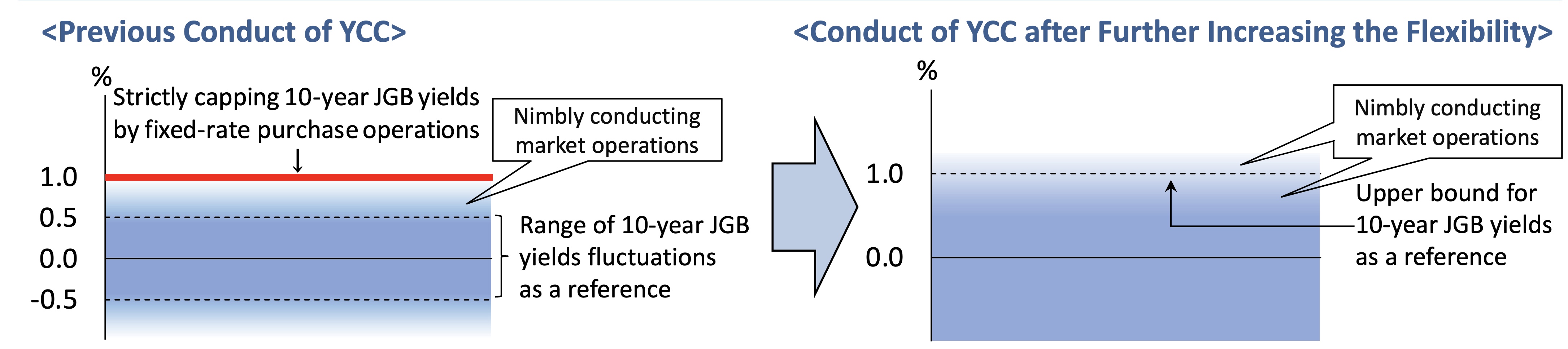
Below is what appears, to me at least, to be the critical comment from the BOJ after last night’s policy meeting.  As well, that graphic comes straight from the BOJ presentation.

“It is appropriate for the Bank to increase the flexibility in the conduct of yield-curve control, so that long-term interest rates will be formed smoothly in financial markets in response to future developments.”

The essence of this is that YCC as we knew it, where the control part was the key, is now dead.  Instead, Ueda-san is going to allow a great deal more leeway for the market to determine the yield on the 10-year JGB, and the entire yield curve there.  While they have not yet adjusted the policy rate, which remains at -0.10%, I imagine that change is only a matter of time.  Remember, though, the BOJ currently owns somewhere around 56% of the outstanding JGBs in the market.  It is very clear they are not going to sell any.  To me the question, which I did not see answered last night, is whether they will replace the bonds in their portfolio when old ones mature.  There was no mention of QT, but I guess we will have to see.  Based on their history, however, I would expect that the current balance of JGB’s they own will remain pretty constant going forward, at least on a nominal basis.  Given the Japanese government continues to run deficits, that will eventually reduce the percentage of holdings.  Of course, I suspect that this is subject to change if things get politically uncomfortable, but we shall see.

The market response was somewhat counter to what might have been expected.  Arguably, many were looking for a yen rally as higher yields in Japan would create a greater incentive for Japanese institutional investors to bring their money home.  But that is not what happened at all.  This morning, USDJPY is firmly above 150.00 with no hint that there is intervention coming anytime soon.  It seems, at least for now, that the MOF and BOJ are going to allow markets to find a new level by themselves.  If that is the case, I expect that USDJPY is going to revert to form and follow USD interest rates.  In fact, that is really the key, and something about which I have written in the past.  When the Fed turns their policy toward easier money, at that time the dollar will come under significant pressure.  However, until then, the dollar remains the place to be.

In China, the data has shown
The ‘conomy’s not really grown
Will Xi add more cash
To try for a splash
Or will he leave things on their own?

The other news overnight was from China where their PMI data proved weaker than expected for both manufacturing and services with the former falling back below the key 50.0 level at 49.5 and the latter falling to its lowest print since last December during the zero-Covid policy Xi had implemented.  It seems that slowing growth around most of the world plus a limited domestic economic impulse combined with the ongoing collapse of the Chinese property market is just too much to overcome right now.  Expectations are that Xi will agree to yet more stimulus (remember earlier this month they put forth a CNY 1 trillion (~$137 billion) plan, but that has not seemed to have had the desired impact.  At least not yet.  While Japanese equities rallied on the back of the BOJ activity, Chinese equities came under pressure, especially the Hang Seng (-1.6%) although mainland shares fell as well.  As to the renminbi, it continues to grind lower (dollar higher) and remains pegged at the 2% boundary vs. the PBOC’s daily fixing rate.  Nothing has changed my view of further weakness in the renminbi going forward, at least as long as the Fed retains its current policy stance.

If I were to sum up the situation in Asia at this time, I would suggest that the two major economies there are both very busy dealing with substantial domestic economic questions, although those questions are different in nature.  Japan is trying to come to grips with rising inflation absent substantial economic growth while China has a problem defined by weakening growth with inflation not a current issue.  But lack of growth is the common denominator here and as we have seen countless times around the world, I suspect we will see further fiscal stimulus in both nations before long.  

Of course, when it comes to fiscal stimulus, China and Japan are mere pikers compared to the US which has completely rewritten the record books on this matter.  And there is nothing that indicates the US is going to back off, at least while the current administration is in place, and likely the next regardless of the letter after the president’s name.  

On this subject, though, while yesterday I described the QRA as critical, the first part of the Treasury story was revealed yesterday morning when they announced that the funding requirement for Q4 would be $776 billion, some $75 billion less than the consensus estimates before the announcement.  But the key difference was that Secretary Yellen is aiming for an average TGA balance of “only” $750 billion, far less than some estimates of $1 trillion, and less than the current balance of $835 billion.  In fact, the difference between the current balance and the target is what makes up for the difference in the issuance estimates.  Under no circumstances should anyone believe that fiscal prudence is coming soon.

But this lower number has relieved some pressure in the bond market where we have seen yields slide a few more basis points this morning with the 10-year now trading at 4.83%.  This movement has been followed by the European sovereign market, where yields have fallen by between 4bps and 6bps across the board in sympathy.  In fact, the only major market that saw yields rise was the JGB market, where the 10yr yield is now at 0.93%, up 5 more bps from yesterday’s closing levels.  I suspect that we will be trading at 1.00% soon enough, and it will be quite interesting to see just how ‘nimble’ the BOJ will be if yields start to run higher more quickly.

As to equity markets, yesterday’s US rally has been followed by the European bourses, all up between 0.6% and 1.2% despite somewhat soft economic growth data released this morning.  However, Eurozone inflation data was also slightly softer than forecast and it seems traders are looking for the ECB to reverse to rate cuts sooner rather than later.  US futures, meanwhile, are very marginally firmer this morning as all eyes now turn toward tomorrow afternoon’s FOMC outcome.

Oil prices have bounced a bit, up 0.9%, but this seems to be a trading move rather than anything either fundamental or geopolitical.  Regarding the latter, the fact that the beginnings of the Israeli ground invasion of Gaza have not produced nearly the pyrotechnics feared, nor that the conflict has spread throughout the Middle East, at least not yet, has resulted in traders returning their attention to inventories and demand.  Slowing growth in most places around the world is likely the key driver right now.  As to gold, it has maintained its recent gains and is trading right at the $2000/oz level.  Clearly, there is a fear factor there, but remember, if the equity bulls are correct and the Fed is going to tell us they are done, that will be seen as dovish and we should see a reversal in the dollar, a rally in commodities, including gold, and an initial rally in stocks and bonds.  That is not my base case, but you cannot ignore the possibilities.

Finally, the dollar is best described as mixed today as the strength in USDJPY (+1.1%) has been offset by weakness in the greenback vs the euro (+0.4%) and the pound (+0.2%), as well as a number of EMG currencies (MXN +0.4%, PLN +0.5%, ZAR +0.6%).  If one considers the DXY, that is virtually unchanged on the day.

On the data front, this morning brings the Employment Cost Index (exp 1.0%), Case Shiller Home Prices (1.6%), Chicago PMI (45.0) and Consumer Confidence (100.0).  obviously, there are no Fed speakers as their meeting starts this morning and runs through tomorrow afternoon when we will see the statement and Powell will meet the press at 2:30.  

It seems to me like traders will be cautious ahead of the FOMC tomorrow.  I would think they would want more confirmation that the Fed has finished before running back into bonds as well as reversing the recent stock declines.  While the Fed is unlikely to do anything tomorrow, it will be all about the statement and press conference.  Til then, I suspect a quiet time.

Good luck

Adf