Misguided

On Friday, the news was a sign
Of imminent US decline
The Fed was a hawk
And all of the talk
Was Trump’s actions wiped off the shine
 
But yesterday, markets decided
That Friday’s response was misguided
They’ve come to believe
A Fed funds reprieve
By Powell will soon be provided


As I have frequently written in the past, markets are perverse.  The narrative Friday was about the dire straits in which the US found itself with the employment situation collapsing and the recession that has been forecast for the past three years finally upon us.  Part of this story was because of the Fed’s seeming intransigence regarding interest rates as made clear by Chairman Powell’s relatively hawkish comments at the FOMC press conference last week.

But that story is sooo twenty-four hours ago. In the new world, the huge bond market rally that was seen on Friday, and equally importantly, the changing pricing of Fed funds rate cuts has the new narrative as, the Fed is going to cut so buy stonks!  Confirmation of this new narrative was provided by SF Fed President Mary Daly who remarked yesterday evening, “time is nearing for rate cuts, may need more than two.”  All I can say is wow!  

The below chart shows the daily moves, in basis points, of the 2-year Treasury note which is seen as the market’s best indicator or predictor of future Fed funds rates.  On Friday, the yield fell nearly 25bps, essentially pricing in one additional rate cut coming, and as we saw with the Fed funds futures market, that pricing is now anticipating three cuts this year.  Ms Daly merely reconfirmed that news.
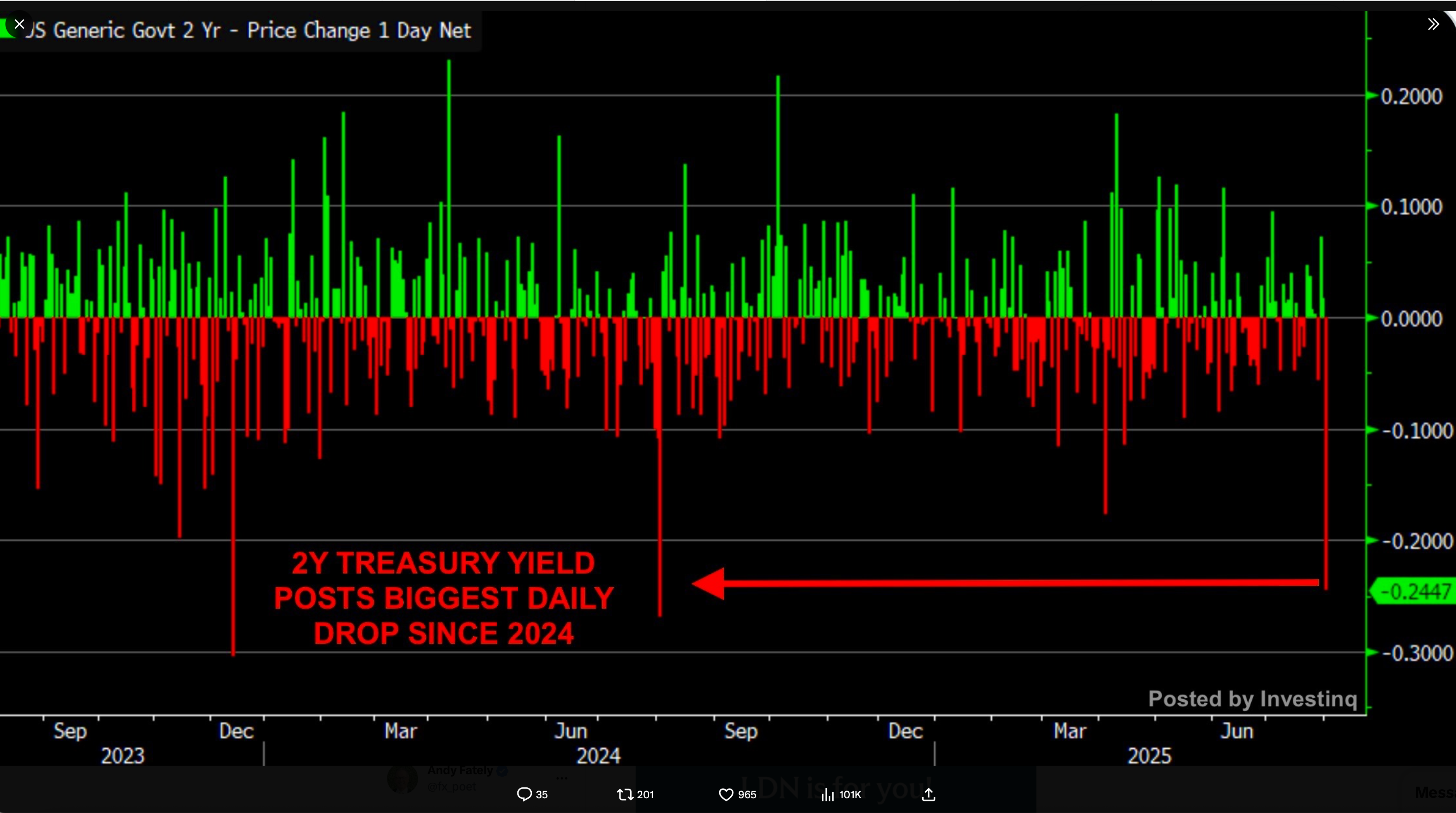
Source: https://x.com/_investinq/status/1951356470877925408?s=46

Perhaps it is fair to ask why Daly has taken so long to come around to this view.  After all, she is a known dove and has been for her entire time at the Fed.  As I have asked before, why haven’t the other known doves, like Governors Cook and Jefferson, been out there talking about rate cuts?  For anyone who wants to continue to believe that the Fed is apolitical, nonpartisan or above politics, this is exhibit A as to why it is not.  In fact, if you look, only one Board member was considered a hawk in this analysis by In Touch Markets, and she just resigned.  The other hawks are all regional Fed presidents.  Perhaps this is why they were so slow to raise rates when inflation was roaring in 2022 and why they were so anxious to cut rates in 2024 on virtually no news other than the upcoming election. 

To be clear, until Friday’s NFP data, it was difficult to make the case, in my mind, for a cut because I continue to see inflationary pressures beyond any tariff impacts.  But if the labor market is weaker than had been assumed, that will certainly open the door to more cuts.  Of course, the conundrum is, if the economy is so weak that the Fed needs to cut, why are stocks rallying?  Arguably, a weak economy would foretell weaker earnings growth, a direct negative to equity valuations.  But that appears to be old-fashioned thinking.  I guess I am just an old-fashioned guy.

Ok, let’s turn to the overnight activity.  Starting with bonds, since the big move Friday, Treasury yields have been little changed, climbing 2bps overnight to 4.21%, but still hovering near the bottom of their recent trading range with only the Liberation Day announcement panic showing yields below the current level.  This is a great boon for the Treasury as auctions of 3-, 10-, and 30-year Treasuries are due this week starting with the 3-year today.
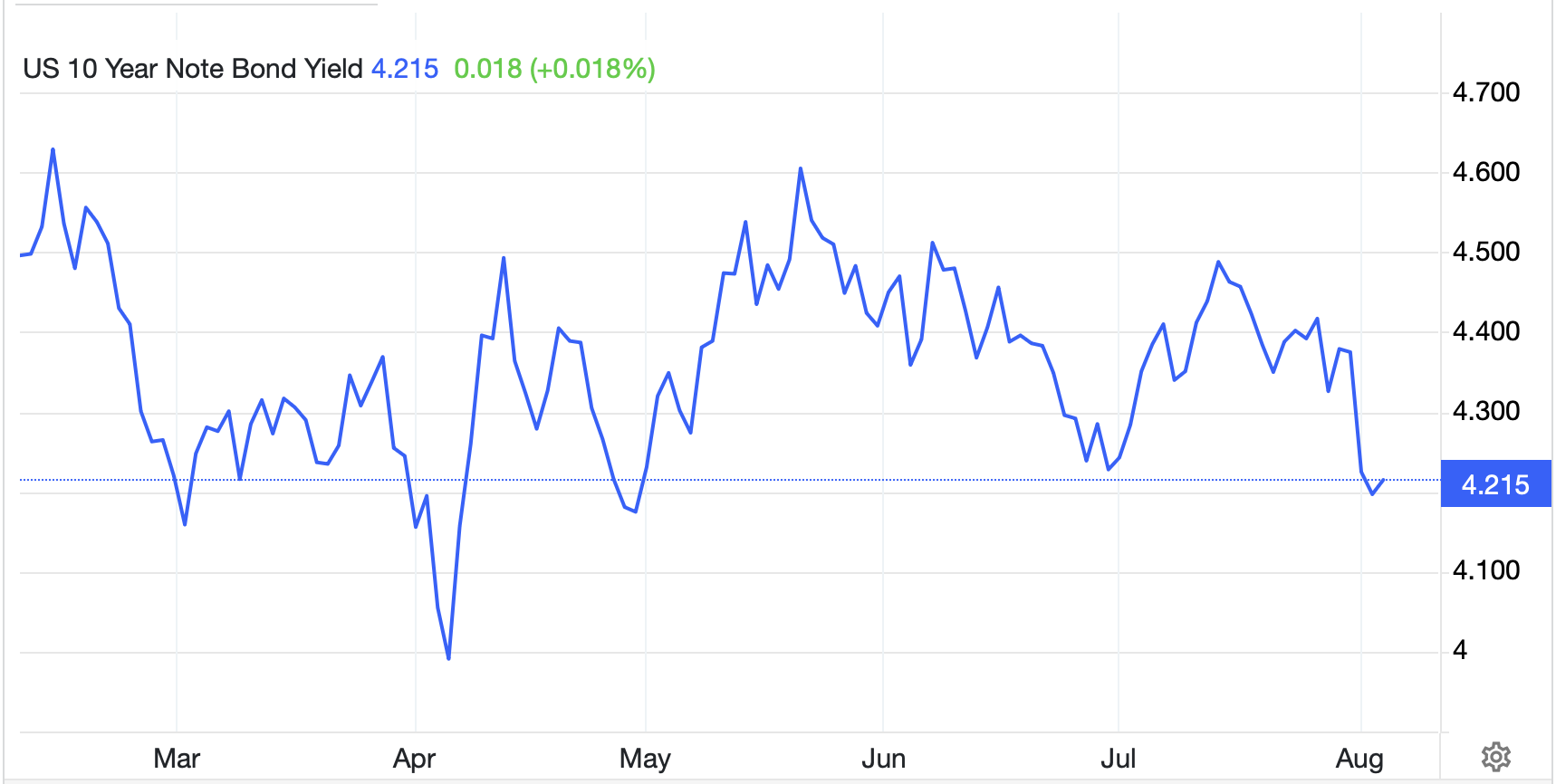
Source: tradingeconomics.com

European sovereign yields have also edged higher by 1bp across the board after PMI data was released this morning, pretty much exactly at expected levels.  The outlier last night was JGB yields which slipped -4bps and continue to slide away from designs of a BOJ rate hike.

In the equity markets, yesterday’s US rally was followed almost universally in Asia (Japan +0.65%, China +0.8%, Hong Kong +0.7%, Australia +1.2%) with only India (-0.3%) lagging there.  As to Europe, it too is having a good day with the DAX (+0.8%) leading the way although strength almost everywhere as the PMI data was good enough to keep spirits higher.

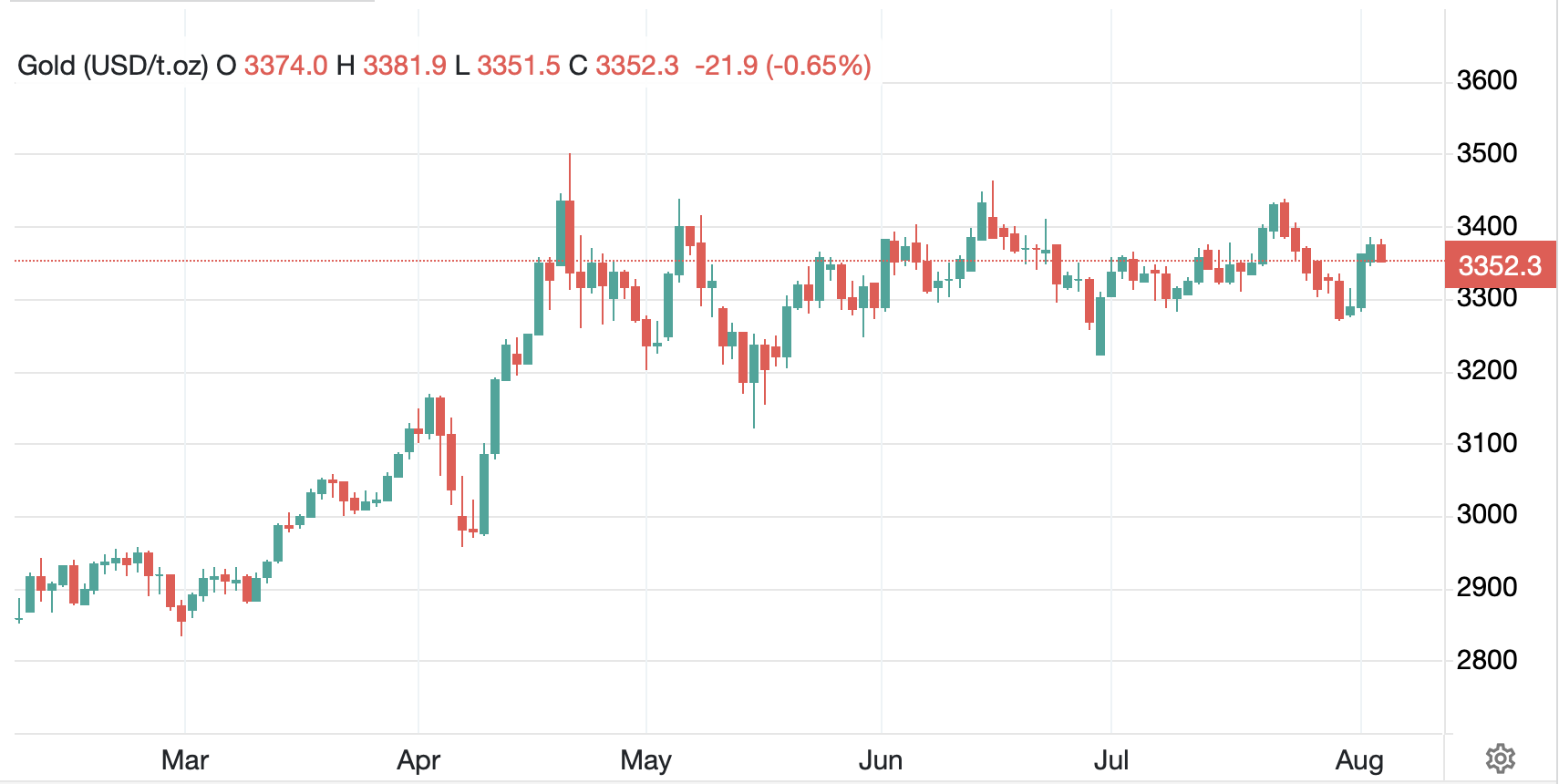
In the commodity markets, oil (-1.1%) is slipping for a fourth consecutive day, but is still right in the middle of its $60 – $70 trading range.  There remain so many potential geopolitical issues with saber rattling between the US and Russia and President Trump’s threatened excess tariffs on nations who buy Russian oil that it remains difficult to discern supply/demand characteristics.  Certainly, if the US is heading into a recession, that is likely to dampen demand for a while, but that remains unclear at this time.  As to the metals, gold (-0.65%) is giving back some of its post NFP gains but if I look at the chart below, all it shows is a relatively narrow trading range with no impetus in either direction.  
Source: tradingeconomics.com

The rest of the metals complex is being dragged lower by gold this morning, but not excessively so.

Finally, the dollar is a touch stronger today, despite the rate cut talk, as the euro (-0.4%) and yen (-0.55%) lead the G10 currencies down.  While I understand the rationale for the dollar to soften in the short- and medium-term vs its counterparts, it is very difficult for me to look at the political and economic situations elsewhere in the world and think I’d rather be investing there.  Europe is a mess as is Japan.  And don’t get me started on the emerging market bloc.  So, remember, while day-to-day movements can be all over the map and are impacted by things like data releases or announcements, structural strength or weakness remains largely in place, and the US situation appears stronger than most others for now.   Touching briefly on EMG currencies, the dollar is firmer vs. virtually all of them, mostly on the order of 0.4% or so.

On the data front, today brings the Trade Balance (exp -$61.4B) and then ISM Services (51.5) at 10:00.  We don’t get the first post-FOMC speech until tomorrow by Governor Cook, so it will be interesting to see if there are more doves who are willing to show their colors.  But in the end, as demonstrated by the quick reversal of the narrative from Friday to Monday, there remains an underlying bid to risk assets and we will need to see substantial economic weakness to remove that bid, even temporarily.

Good luck

Adf
Too Extreme

The year is now halfway completed
While narrative writers repeated
The story, same old,
The dollar’s been sold
‘Cause global investors retreated
 
As well, they continue to scream
Trump’s policies are too extreme
His tariffs will drive
Inflation to thrive
While growth will soon start to lose steam


I don’t know about you, but this poet is tired of reading the same stories over and over from different pundits when it comes to the current macroeconomic situation.  And so, I thought I might take a look at what the current narrative seems to be and, perhaps, analyze some of the reasons it will be wrong.  I have full confidence it will be wrong because…it always is.  Add to that the fact that the narratives continue to try to build on expectations of what President Trump wants to do and let’s face it, there is no more unpredictable political leader on the planet right now.

In fact, we can look at one of the key narratives that had been making the rounds right up until Thursday night when the House and Senate agreed the terms of the BBB which has since been signed into law.  Serious pundits were convinced that the president could never get this done and yet there it is.

But let’s discuss another popular narrative, the end of American exceptionalism.  First, I’d like to define the term American exceptionalism because I believe that the equity analysts borrowed the term from the Ronald Reagan.  For the longest time, I would contend the term referred to the American experiment, writ large, with the dynamic market economy that was created by the legal framework in the US.  After all, no other nation, certainly not these days, has anything like this framework.  The combination of the 1st and 2nd Amendments to the Constitution have been critical in not only creating this framework but keeping it from getting too far out of hand. 

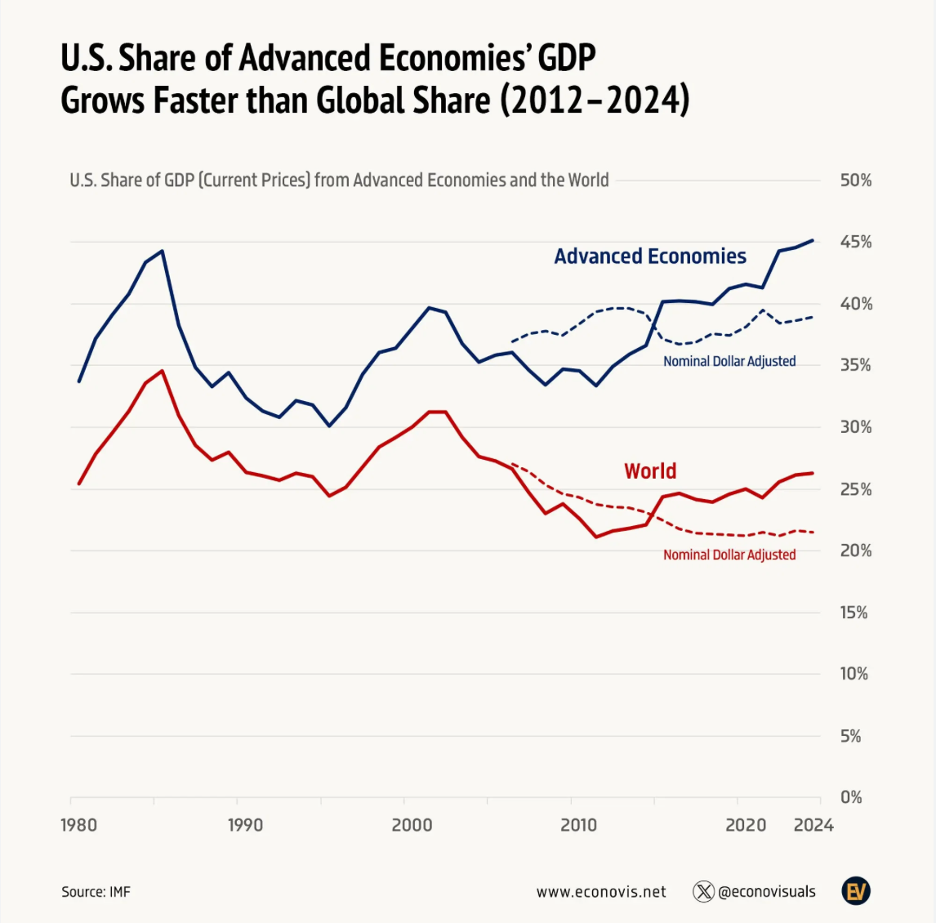
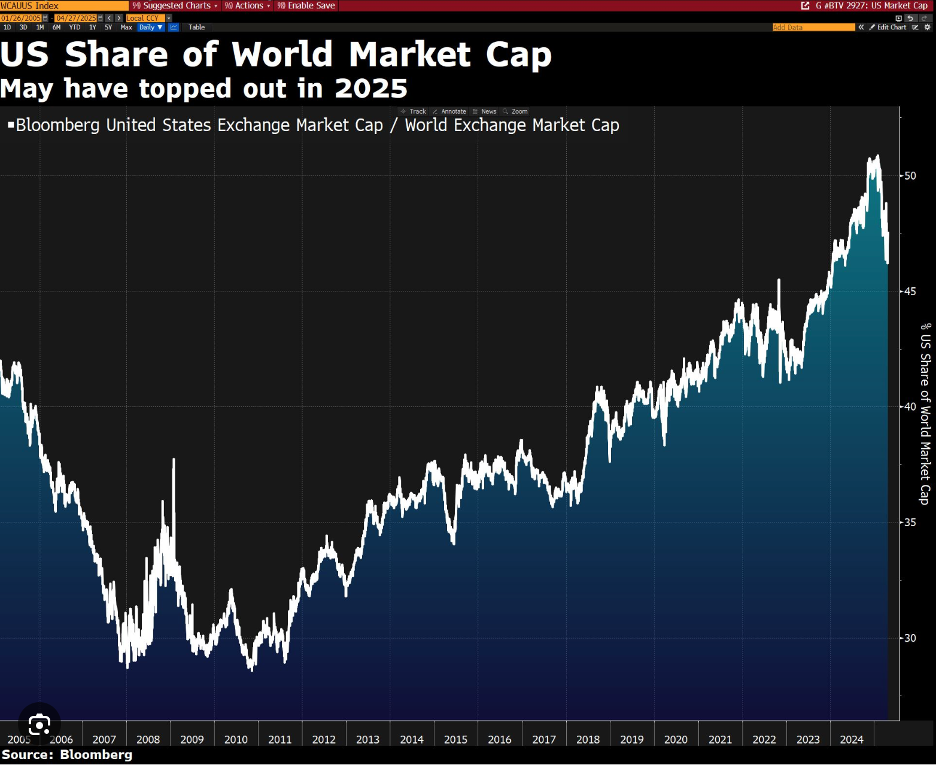
However, in the market context, American exceptionalism refers to the fact that the relative strength of the US economy drew investors from around the world into US equity markets, driving the value of US equities relative to both total global equities and the US proportion of global GDP to extreme heights.  While the chart below shows a peak just above 50% of global market cap and that number is declining right now, I have seen estimates that the number could be as high as 70% of global market cap.  I suppose it depends on how you define global market cap, but MSCI’s readings tend to be well respected.

In addition to the significant portion of equity market capitalization compared to the rest of the world is the fact that US GDP is a significantly smaller percentage, somewhere in the 23% – 26% range depending on how one calculates things with FX rates.  

The upshot is that heading into 2025, US equity valuation was at least twice the size of the US economy compared to the entire world.  Certainly, that is exceptional, and the term American exceptionalism seemed warranted.  But as you can see from the first chart, other markets have been outperforming the US thus far this year with the result that the US no longer represents quite as large a percentage of the world’s equity market capitalization.  So, is this the end of that form of American exceptionalism?  The pundits are nearly unanimous this is the case.

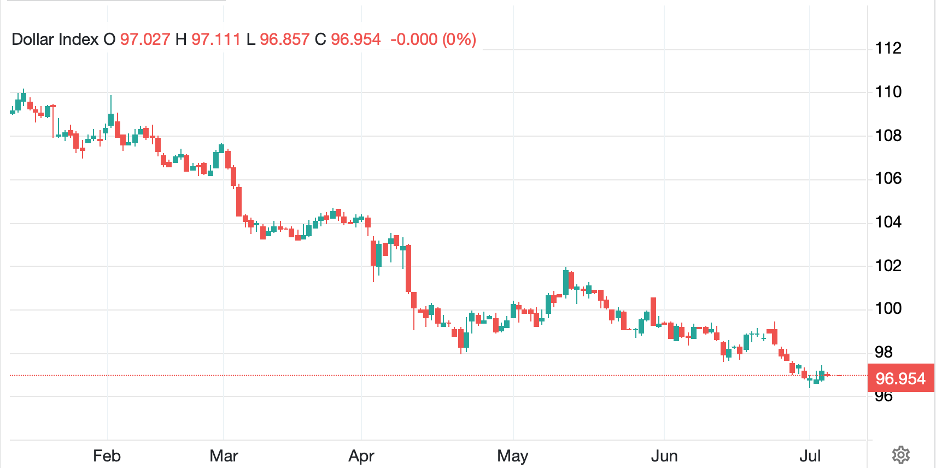
A knock-on effect of this is that the dollar has been under pressure all year, having declined more than 10% vs. the DXY and 13% vs. the euro.  In fact, a key factor in the weaker dollar thesis is that international investors are either selling their US stocks or hedging the FX exposure with either of those weighing on the dollar.

Source: tradingeconomics.com

Now, so far, that seems a logical conclusion and I cannot argue with it.  However, as we look forward, is it reasonable to expect that to continue?  In this instance, I think we need to head back to the BBB, which is undoubtedly going to provide significant economic stimulus to many parts of the economy (sorry green tech), and seems likely to help energy, tech and industrial companies continue to perform well.  Much has been made of the idea that American exceptionalism has peaked but I wouldn’t be so sure.  Net, I am not convinced the US ride is over, at least not for the economy, although segments of the equity market could well be in for a fall.

The other narrative that I continue to hear is that Trump’s policy mix, of tariffs and deportations is going to drive inflation much higher.  In fact, Dr Torsten Sløk, who does excellent work, explained this weekend that tariffs would raise US CPI a very precise 0.3% this year.  Of course, the problem with this story is that, thus far, inflation readings have been quite tame, falling since Liberation Day.  It is certainly early in the game, but it is not at all clear to me that tariffs are going to be a major driver of inflation.  First, many companies have decided to eat the cost themselves, notably Japanese car manufacturers.  Second, M2 in the US has basically flatlined since April 2022 (see chart below), and if money supply is not growing, inflation will be hard-pressed to rise too quickly.

Now, it is certainly possible that the Fed increases the supply of money, although given the antagonism between Powell and Trump, I sense that the Fed will remain tighter for longer as they will make no effort to help the president if the economy starts to visibly slow down.  

But, if I were to try to estimate what Trump’s end game is, I think the following chart is the most important.

This chart is the reason Donald Trump is our president, and it is one that the punditry does not understand.  It is also the reason that US equities have performed so well.  Corporate profit margins in the US have grown unabated since Covid.

Now, let’s put these two thoughts together.  Corporate profit margins have exploded higher, currently at an all-time high of 10.23%.  Meanwhile, the share of GDP that has gone toward labor has fallen dramatically since China entered the WTO.  The result has been workers in the US have seen their incomes decline relative to corporate income.  While it is true that, technically, the punditry is part of the work force, they are asset owners as opposed to Main Street who have far less invested in the equity markets.  Ask yourself, how did corporates improve their margins so significantly?  The combination of immigrant labor and moving production offshore weighed heavily on US wage growth.  If you want to understand why President Trump is speaking to Main Street and using tariffs with reckless abandon it is because he is trying to adjust this process.  

If he is successful, I expect that equity markets will lag other investments as those profit margins are likely to decline. If they just go back to pre-Covid levels of 6%, that represents a huge amount of money in the pockets of consumers.  Do not be surprised if the result is solid economic growth with lagging profits and lagging equity prices.  Too, a weaker dollar plays right into this game as it helps the competitiveness of US manufacturers both for domestic consumption and exports.

This is not the narrative, however.  The narrative continues to be that Trump’s tariffs are going to generate significant inflation and drive the economy into a recession.  In fact, just this morning I read that Professor Steven Hanke (a very smart fellow) now has a recession estimated at 80% to 90% probability.  All the uncertainty is preventing activity as corporate managers hold back on making decisions, allegedly.  Of course, now that the BBB is law, the tax situation is settled, and I will not be surprised to see investment return with clarity on that issue.

The narratives have been uniformly negative for a while.  Part of that is because many of the narrative writers objectively despise President Trump and cannot abide anything he does.  But part of that is because I believe the president is not focusing on the issues that market pundits have done for many years and instead is focusing on helping Main Street, not Wall Street.  Perhaps that is why Wall Street political donations were heavily biased toward VP Harris and every other Democrat.

I hope this made some sense to you all, as I try to keep things in context.  In addition, as it is Sunday evening, I expect tomorrow morning’s note to be quite brief.  Love him or hate him, President Trump clearly hears the sounds of a different drummer than the rest of the political class and has proven that he can get what he wants.  Do not ignore that fact.

Good luck

adf

Gnashing and Wailing

The narrative writers are failing
To keep their perspectives prevailing
They want to blame Trump
But if there’s no slump
They’ll find themselves gnashing and wailing
 
Economists have the same trouble
‘Cause most of their models are rubble
The change that’s been wrought
Requires more thought
Than counting on one more Fed bubble


Investors seem to be growing unhappier by the day as so many traditional signals regarding market movement no longer appear to work.  Nothing describes this better, I think, than the fact that forecasts for 10-year Treasury yields by major banks are so widely disparate.  While JPMorgan is calling for 5.00% by the end of the year, Morgan Stanley sees 2.75% by then.  What’s the right position to take advantage of that type of knowledge and foresight?

One of the most confusing things over the past months, has been the growing dichotomy between soft, survey data and hard numbers.  But even here, it is worth calling into question what we are learning.  For instance, this week we will see the NFP data along with the overall employment report.  That data comes from the establishment survey.  It seems that just 10 years ago, more than 60% of companies reported their hiring data.  Now, that is down to ~43%.  Does that number have the same predictive or explanatory power that it once did?  It doesn’t seem so.

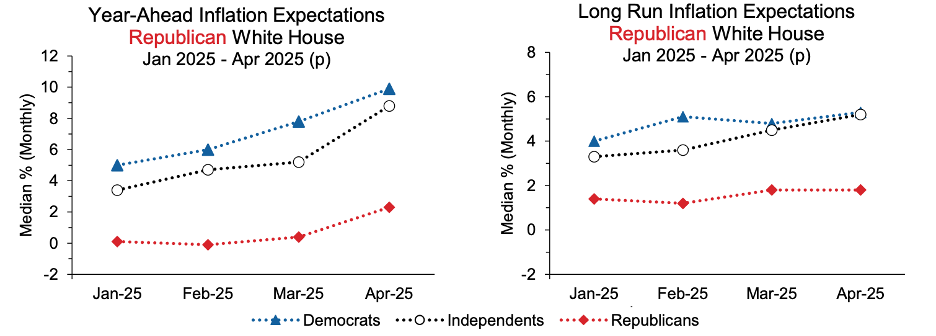
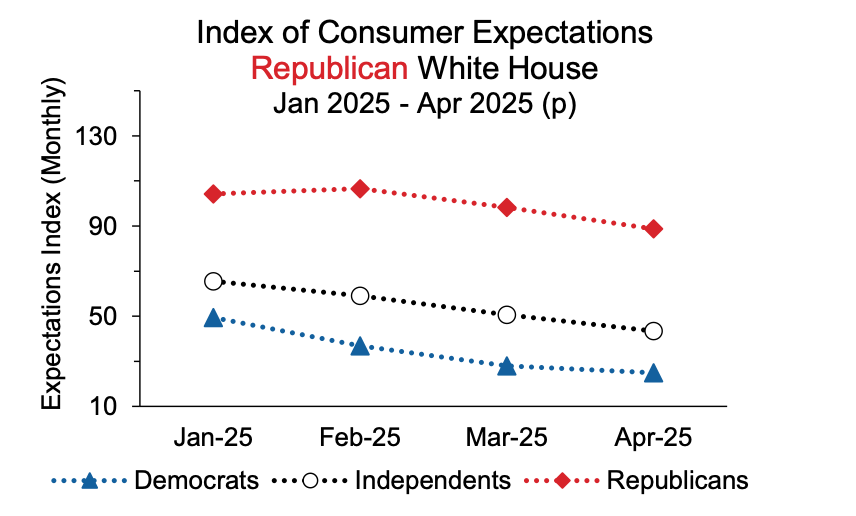
Too, if we consider the Michigan Sentiment data, it has become completely corrupted by the political angle, with the current situation being Democrats answering the survey anticipate high inflation and weak growth while Republicans see the opposite.  Is that actually telling us anything useful from an economic perspective let alone a market perspective?  (see charts below from sca.isr.unmich.edu)

But this phenomenon is not merely a survey issue, it is an analysis issue.  At this point, I would contend there are essentially zero analysts of the US economy (poets included) who do not have a political bias built into their analysis and forecasts.  Consider that if you are in a good mood generally, then your own perspective on things tends to be brighter than if you are in a bad mood.  Well, expand that on a political basis to, if you are a Democrat, President Trump has been defined as the essence of evil and therefore your viewpoint will see all potential outcomes as bad.  If you’re a Republican, you will see much better potential.  It is who we are and has always been the case, but it appears a combination of President Trump and social media has pushed this issue to heretofore unseen extremes.

There are two problems with this.  First, for most consumers of financial information, the decision matrix is opaque.  Who should you believe?  But perhaps more concerningly, as evidenced by the decline in the response rate to hard data, for policymakers like the Fed and Treasury, what should they believe?  Are they receiving accurate readings of the economic realities on the ground?  Is the job market as strong (or weak) as currently portrayed?  Is the uncertainty in ISM data a result of political bias?  And if politics is an issue in these situations, who is to say that answers to questions will be fact-based rather than crafted to present a political viewpoint?

I would contend that the reason the narrative is breaking down everywhere is that the willingness of investors, as well as the proverbial man on the street, to listen to pronouncements from on high has diminished greatly.  After all, the mainstream media, which had always been the purveyor of the narrative, or at least its main amplifier, has lost its luster.  Or perhaps, they have lost all their credibility.  Independent media, whether on X, Substack or simply blogs that are posted all over the internet, have demonstrated far more clarity and accuracy of situations than anything coming from the NYT, WSJ, BBG or WaPo, let alone the TV “news” programs.

We are on our own to determine what is actually happening in the world, and that is true of how markets will perform going forward.  I have frequently written that volatility is going to be higher going forward across all markets.  President Trump is the avatar of volatility.  As someone whose formative years in trading were in the mid 80’s, when inflation was high, and Paul Volcker never said a word to anyone about what the Fed was doing (and even better, nobody even knew who the other FOMC members were), the best way to thrive is to maintain modest positions with limited leverage.  The time of ZIRP and NIRP will be seen as the aberration it was.  As it fades, so, too, will the ability to maintain highly levered positions because any large move can be existential.

With that cheery opening, let’s take a look at what has happened overnight.  Friday’s US session was not very noteworthy with mixed data leading to mixed results but no real movement.  Alas, things have taken a turn lower since then.  Asian markets were weaker overnight (Nikkei -1.3%, Hang Seng -0.6%, CSI 300 -0.5%) with most other regional markets having a rough go of things as well.  Concerns over further tariffs by the US (steel tariffs have been raised to 50%) and claims by both sides of the US – China trade debate claiming the other side has already breached the temporary truce have weighed on sentiment overall.  Meanwhile, PMI data from the region was less than inspiring with China, Korea, Japan and Indonesia all showing sub 50 readings for Manufacturing surveys.

In Europe, equity markets are also generally softer (DAX -0.5%, CAC -0.7%) although the FTSE 100 (0.0%) has managed to buck the trend after data this morning showed Housing Prices firmed along side Credit growth.  As investors await the US ISM/PMI data, futures are pointing lower across the board, currently down around -0.4% at 7:15.

In the bond market, yields all around the world are backing up with Treasuries (+3bps) bouncing off the lows seen on Friday, although remaining below 4.50%, while European sovereigns have climbed between 3bps and 4bps across the board.  JGB’s overnight (+2bps) also rose, although the back end of that curve saw yields slip a few bps.  It seems the world isn’t ending quite yet, although there does not seem to be any cure for government spending and debt issuance anywhere in the world.

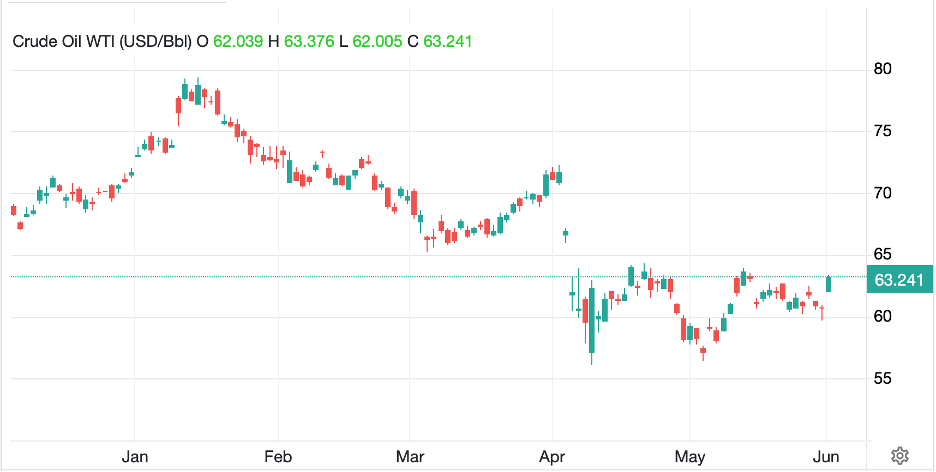
Commodity prices, though, are on the move as it appears investors are interested in acquiring stuff that hurts if you drop it on your foot.  Gold (+1.85%), silver (+0.9%) and copper (+3.6%) are all in demand this morning, the latter ostensibly benefitting from fears that the US will impose more tariffs on other metals thus driving prices higher.  But the real beneficiary overnight has been oil (+4.0%) which rose on the back of an intensification of the Russia – Ukraine war as well as the idea that OPEC+ ‘only’ raised production by 411K barrels/day, less than the whisper numbers of twice that amount.  As I watch the situation in Ukraine, it appears to have the hallmarks of an imminent peace process as both sides are pulling out all the stops to gain whatever advantage they can ahead of the ceasefire and both recognizing that the ceasefire is going to come soon.  But despite the big jump in the price of WTI, you cannot look at the chart below and expect a breakout in either direction.  If I were trading this, I would be more likely to fade the rally than jump on board the rise.

Source: tradingeconomics.com

Finally, the dollar is under the gun this morning, falling against pretty much all its major counterparts.  Both the euro (+0.7%) and pound (+0.6%) are having strong sessions although JPY (+1.0%) and NOK (+1.3%) are leading the way in the G10.  NOK is obviously benefitting from oil’s rally, while there remains an underlying belief that Japanese investors are slowing their international investments and bringing money home.  Now, the ECB meets this week and is widely anticipated to be cutting rates 25bps, but my take is, today is a dollar hatred day, not a euro love day.  As to the EMG bloc, gains are evident across regions with CZK and HUF (both +1.0%) demonstrating their beta to the euro although PLN (+0.5%) is lagging after the presidential election there disappointed the elites with the Right leaning candidate winning the job and likely frustrating Brussels in their attempts to widen the war in Ukraine.  In Asia, CNY (+0.1%) was relatively quiet but KRW (+0.5%), IDR (+0.8%) and THB (+0.9%) all benefitted from that broad dollar weakness.  So, too, did MXN (+0.65%) although BRL has not participated.

There is plenty of data this week culminating in the payroll report on Friday.

TodayISM Manufacturing49.5
 ISM Prices Paid70.2
 Construction Spending0.3%
TuesdayJOLTS Job Openings7.1M
 Factory Orders-3.0%
 -ex Transport0.2%
WednesdayADP Employment115K
 BOC Rate Decision2.75% (current 2.75%)
 ISM Services52.0
 Fed’s Beige Book 
ThursdayECB Rate Decision2.00% (current -2.25%)
 Initial Claims235K
 Continuing Claims1910K
 Trade Balance-$94.0B
 Nonfarm Productivity-0.7%
 Unit Labor Costs5.7%
FridayNonfarm Payrolls130K
 Private Payrolls120K
 Manufacturing Payrolls-1K
 Unemployment Rate4.2%
 Average Hourly Earnings0.3% (3.7% Y/Y)
 Average Weekly Hours34.3
 Participation Rate62.6%
 Consumer Credit$10.85B

Source: tradingeconomics.com

In addition, we hear from four more Fed speakers over five venues.  The thing about this is they continue to discuss patience as the driving force, except for Governor Waller, who explained overnight that he could see rate cuts if inflation stays low almost regardless of the other data.

The trade story remains the topic of most importance in most eyes it seems, although it remains a mystery where things will wind up.  The narrative is lost for all the reasons above, but I will say that it appears risk aversion is today’s theme.  The new part is that the dollar is considered a risk asset.  

Good luck

Adf

Eclipse

This morning, the question on lips
Is where did DeepSeek get their chips
As well, there’s concern
That China will learn
Our secrets, and so, us, eclipse


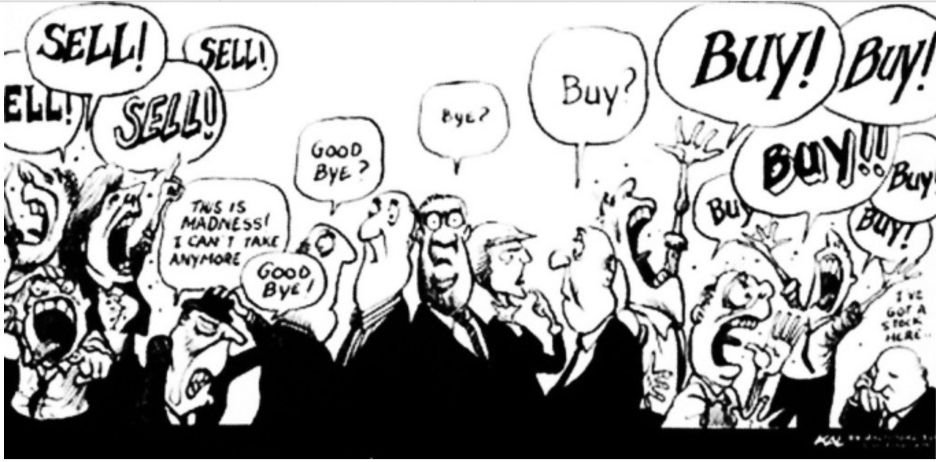
Narratives are funny things.  They seemingly evolve from nowhere, with no centralization, but somehow, they quickly become the only thing people discuss.  I’ve always been partial to the below comic as a perfect representation of how narratives evolve for no apparent reason.

Of course, yesterday’s narrative was that the Chinese LLM, DeepSeek, was built by a hedge fund manager with older NVDA chips and for far less money than the other announced models from OpenAI or Google and performed just as well if not better.  While equity traders were not going to wait around to determine if this was true or not, hence the remarkable selling on the open of all things AI, a little time has resulted in some very interesting questions being raised about the veracity of how DeepSeek was built, what type of chips they use and who actually built it.

For instance, a quick look at NVDA’s 10Q shows that, remarkably, Singapore is a major source of revenue, and it has been growing dramatically.

Source: SEC.gov

Now, it is entirely possible that Singapore is a hotbed of AI development, but from what I have read, that is not the case.  In fact, there is basically one lab there that has resources on the order of just $70mm.  But despite that lack of local investment, at least reported local investment, Nvidia shows that chip sales in Singapore nearly quadrupled in the last year.  Far be it from me to suggest that the narrative may change again, but who is buying those chips, more than $17 billion worth?  The idea that they have been trans shipped to China is quite plausible and they may well be what underpins DeepSeek.

Again, I have no first-hand knowledge of the situation but it is not beyond the pale to make the connection that China has been effectively circumventing US export controls through Singapore, have built their own LLM model using the exact same chips as OpenAI and others, but propagated a narrative that they have built something better for much less in order to undermine the US tech sector equity performance and call into question some underlying beliefs in the US market and economy.  Now, maybe this Chinese hedge fund manager did what he said.  But the one thing we know about China is, it is opaque in everything it does, so perhaps we need to take this story and dig deeper.  I am sure others will do so, and more information will be forthcoming, but it highlights that narratives continue to drive markets, but can also, at times, be constructed rather than simply evolve.

The thing is, this is still the only story of note in the market.  Scott Bessent was confirmed as Treasury Secretary yesterday, and indicated he was a fan of gradual tariff increases, perhaps 2.5% per month, rather than large initial tariffs, but that does not seem all that exciting.  And while Trump has not slowed down one iota, his focus has been on things like browbeating California into allowing reconstruction of LA rather than international issues, at least for the past twenty-four hours.  The upshot is that markets, which even yesterday closed far above their worst levels from the opening, are rebounding further today with many of yesterday’s moves reversing, at least to some extent.

Starting in the equity markets, despite the weakness in the tech sector, US market closes were far higher than the opens with the DJIA actually gaining 0.65% on the session.  However, while Japanese shares (-1.4%) definitely felt the pain of the tech sector, the rest of Asia saw some decent performance (Korea +0.85%, India +0.7%, Taiwan +1.0%) although Chinese shares (-0.4%) struggled.  Of course, one reason for that may be that the largest Chinese property company, Vanke, reported humongous losses and both the Chairman and CEO stepped down.

In Europe, though, all is well with every major exchange in the green led by Spain’s IBEX (+1.0%) although gains of 0.5% – 0.7% are the norm.  Now, remember, there is effectively no tech sector in Europe to be negatively impacted by the AI story, and it should be no surprise that these shares have followed the DJIA higher.  And this morning in the US futures market, at this hour (6:50), we are seeing gains on the order of 0.4% across the board.

In the bond market, yesterday’s early rally in prices (decline in yields) backed off as stocks bounced from their lows although Treasury yields still fell 10bps on the day.  This morning, the bounce in yields continues with Treasury yields higher by another 3bps and European sovereign yields rising between 1bp and 2bps on the session.  It will be very interesting to watch the bond market now that Bessent has been confirmed as Treasury Secretary given his goal to extend the maturity of the US debt outstanding.  Arguably, that should push up back-end yields, so we will see how effective he can be in reaching that goal.  

Turning to commodities, yesterday saw a rout there as well with both oil and the metals markets suffering greatly.  However, this morning, like many other markets, things are reversing course.  Oil (+0.75%) has bounced off its lows from yesterday, and despite a pretty rough past two weeks, is still higher than it was at the beginning of the year.  Gold and silver are unchanged from yesterday’s closing levels, and while off their recent highs, remain much higher in the past month.  Copper, too, is bouncing slightly and still much higher this month.  Perhaps yesterday’s price action was a catalyst for lightening up positions rather than changing views.

Finally, the dollar has rebounded vs. the G10 this morning, rising alongside US yields with the euro (-0.7%) and AUD (-0.8%) lagging the field, although dollar gains of 0.5% are the norm across the entire G10 this morning.  In the EMG bloc, the CE4 are all tracking the euro lower, with all down around -0.6% to -0.8%, but yesterday’s biggest laggards, MXN, COP and BRL are little changed this morning, not rebounding, but not falling further.  With the Fed expected to remain on hold while both the BOC tomorrow and ECB on Thursday are set to cut rates, perhaps the FX market is reverting to its more fundamental interest rate drivers than the hysteria of AI models.  If that is the case, then we are likely to turn our attention to Chairman Powell’s press conference as the next critical piece of news.

On the data front this morning, we see Durable Goods (exp 0.8%, 0.4% -ex Transport), Case Shiller Home Prices (+4.3%) and Consumer Confidence (105.6).  Yesterday saw New Home Sales rise more than expected but still resulted in the smallest number of sales for the year since 1995 when the population was far smaller.  

Once again, depending on where you look, you can find data that supports either economic strength or weakness.  It strikes me that today’s data will be of little consequence as traders will be focused on the equity market to see if the rebound has legs, as well as further news regarding DeepSeek.  Tomorrow, however, the Fed will take center stage.

Good luckAdf

Things Went to Hell

There once was a company, strong
Whose shares, everyone had gone long
But things went to hell
Nvidia fell
And folks wonder now, were they wrong?
 
The narrative hasn’t adjusted
Though certainly some are disgusted
AI, after all
To which they’re in thrall
Is perfect, so why’s it seem busted?


Times are tough for macro pundits and analysts, like this poet, as there is so little ongoing at the moment.  Data releases are sparse, and generally of a secondary nature and even commentary has been less active.  Truly, the summer doldrums have arrived.

With this in mind, perhaps it is a good time to consider what the broad risk asset narrative looks like these days, especially since the most recent version was exceedingly clear; Nvidia is the only company that matters in the world and its stock price should go to 10,000.  While there had been pushback on this idea, with the naysayers comparing the stock to Cisco and Qualcomm during the dot com bubble in 2000, the true believers countered with the fact that Nvidia was wildly profitable and given the race by companies all over the world to embrace AI, would continue to grow at its extraordinary recent pace.  But consider…

Back in the 1970’s, there was a group of companies described as the Nifty Fifty that represented the growth companies of the time.  And they were great companies, with most of them still around today including American Express, Coca-Cola, IBM and Walt Disney, to name just a few.  The thesis at the time was that these companies represented the future, and that if an investor didn’t own them, they were missing out.  The thing that was ignored at the time (and in truth is ignored in every bubble) is there is a difference between the company and its share price.  Overpaying for a good company can result in poor investment performance even if the underlying company continues to have magnificent results.

I mention this era as there are certainly parallels to the current mania for the Supremes (Nvidia, Apple, Microsoft) and the narrative at that time.  There is nothing inconsistent with understanding that these companies, and especially Nvidia, have created something special, but that they cannot possibly sustain their current valuations and so their share prices may fall.  And they can fall a lot.  After all, Nvidia has retraced 13% in just 3 sessions.  As much momentum as these shares have had on the way up, they can have that much and more on the way back down.  I’m not saying this is what is going to happen today, simply highlighting that trees don’t grow to the sky.  Perhaps we have now seen how tall they can grow.  

One thing I sense is that if this correction continues, it is likely to broaden out.  Perceptions are funny things, and if the zeitgeist changes, even if the companies continue to put up terrific numbers, the share prices can go a lot lower.  Consider that if the Supremes each fall 50%, they will still have market caps of $1.5 trillion and be amongst the largest companies in the world.  In fact, if they fall 50%, I’m pretty confident so would most of the rest of the market, so they would likely maintain their relative crowns of size, just at a smaller number. 

At any rate, this is an important discussion as the equity markets have been key drivers of all markets, and a change there will naturally result in some different opinions elsewhere.  Arguably, the biggest question is, if the stock market falls sharply, but the economic data don’t respond in the same way, will the Fed really cut rates?  There are many who remain firmly in the camp that the ‘Fed put’ is still intact, and they will come to the rescue.  Personally, my take is if there is a Fed put, the strike price is a lot lower, maybe S&P 3500, not S&P 5000.  Chairman Powell has enough other problems to address so that the value of the S&P is probably not job one.  In fact, it could become quite a political problem for him if the Fed is seen as rescuing Wall Street again while so many on Main Street struggle.

Ok, it’s time to look at the freshly painted wall and watch it dry overnight session.  Yesterday’s US session was unusual for its composition as the DJIA had a solid day, gaining 0.7%, while the NASDAQ suffered, falling -1.0%.  Asia, too, had an interesting session with the Nikkei (+1.0%) and Australia (+1.3%) both rallying while the Hang Seng was little changed and China (-0.5%) fell.  One possible explanation is that the tech sectors are getting unwound while money flows into less exciting areas like natural resources and manufacturing.  Of course, given there are no tech shares of which to speak in Europe, the fact that every bourse on the continent, and the UK as well, is lower, led by the DAX’s -1.0% decline, I am searching for another explanation.  At this hour (7:20) US futures are a touch firmer, 0.3%, but I don’t put much stock in this given the past several sessions.

In concert with the risk-off theme, bond markets are seeing a bid with corresponding yield declines.  Treasury yields are lower by 1bp with European sovereigns lower by between -2bps and -4bps.  There is still a great deal of anxiety, at least according to the press, about the French elections, but given the political bias of most mainstream media, which is decidedly against the idea that Marine Le Pen’s RN should win, it is possible that the actual situation is far less concerning.  The fact that the Bund-OAT spread continues to narrow at the margins tells me that there are fewer concerns than immediately following Macron’s call for the snap election.

Oil prices (-0.6%) are retracing yesterday’s modest gains as there continues to be uncertainty over the demand situation and whether economic activity is slowing offset by what appears to be a modest escalation in the Russia/Ukraine war with concerns that could impact supply.  As to the metals markets, prices there are little changed this morning after having edged higher yesterday.  My take here is that traders are keenly focused on Friday’s PCE data as an indication to whether the Fed will be cutting sooner rather than later.  The sooner the cut, the better metals prices should perform.

Finally, the dollar is almost unchanged this morning after having fallen modestly yesterday.  All eyes continue to focus on USDJPY, although it has slipped back this morning to 159.50.  Right now, my sense is there are many ‘tourists’ in the FX market trying to play for the next intervention, but as I said yesterday, I do not believe the MOF is going to be as concerned as they were in April/May given the pace of the move has been so much more modest.  For instance, last night FinMin Suzuki explained, “[the MOF] will continue to respond appropriately to excessive FX moves.  It is desirable for FX to move stably.”  Now, aside from the oxymoron of stable movement, this type of commentary is typically not indicative of any immediate concerns.  As to the rest of the G10, modest gains and losses define the day although we have seen both MXN (-0.65%) and ZAR (-0.4%) slide this morning, although given the amount of money involved in the carry trade for both these currencies, this is likely just positions adjusting rather than a fundamental change.

This morning brings more tertiary data with the Chicago Fed National Activity Index (exp -0.4), Case Shiller Home Prices (6.9%) and Consumer Confidence (100).  We also hear from two speakers, Governors Cook and Bowman.  Perhaps the most interesting thing yesterday was that SF Fed President Daly specifically touched on Unemployment in her comments, explaining that though there was still insufficient confidence that inflation was declining to target, she was paying close attention to the Unemployment rate, “so far, the labor market has adjusted slowly, and the unemployment rate has only edged up. But we are getting nearer to a point where that benign outcome could be less likely.”  I have a feeling that the employment report a week from Friday is going to have a lot more riding on it than in the recent past.  Any weakness there could really change the tone of the market regarding the economy and the Fed’s actions.

It is difficult to get too excited about today although if the recent correction in Nvidia continues and widens to some other names (a distinct possibility) do not be surprised if there are some fireworks later on.  In that case, I would look for a traditional risk-off session with the dollar higher while bond yields and stocks fall.

Good luck

Adf

Singing the Blues

Here’s what’s underlying most views
Inflation is yesterday’s news
But what if it’s not
And starts to turn hot?
Those bulls will be singing the blues
 
So, care must be taken, I think
As in the bulls’ armor, a chink
Is wages keep rising
While homes are surprising
Be careful, the Kool-Aid, you drink


Market activity has generally been benign as investors and traders await the next big news.  Arguably, that is next Tuesday’s US CPI data given the dearth of new information otherwise due to be released this week.  The one thing we have in spades this week is central bank speakers, with three from the Fed yesterday and four more today, including the first comments I have seen from the newest Governor, Adriana Kugler.  As well we have been regaled by ECB, BOE and BOC speakers and they will continue all week as well.

Thus far, the message has been pretty consistent with the general theme that inflation has fallen nicely and is expected to continue to do so.  However, in a great sign of some humility, they are unwilling to accept that because price levels have fallen for the past 3 months that their job is done.  Obviously, the recent NFP and ISM data have shown no indication that the economy is even teetering on the brink of a slowdown, let alone desperate for rate cuts for support.  And for this, I applaud them.

But in this case, the central bank community seems to be in a small minority of economic observers who are not all-in on the idea that rate cuts are necessary right now.  Because, damn, virtually every other analyst seems to be on that train.  

There is a very good analyst group that calls themselves Doomberg, which mostly write about energy policy and its impacts on everything else, but in this morning’s article, I want to highlight a more general comment they made which I think is really important:

“How can you tell the difference between an analyst and an advocate? It is all in the handling of data that runs counter to assertion. To an analyst, being wrong is disappointing, but it is primarily an opportunity to learn—an expected element in a feedback loop of continuous improvement. When knowledge is your only objective, there is no such thing as a bad fact, only one which you do not yet understand. Not so for the advocate. The advocate has tied their hopes (and often their livelihoods) to a specific outcome and feels compelled, whether consciously or not, to rationalize away or attack inconvenient realities. It is advocacy when every perturbation in the weather is tagged as evidence of climate change, each squiggle of unfavorable price action is declared market manipulation, and no act or utterance from a favored politician is disqualifying.”

First, I cannot recommend their writings highly enough as they are consistently thoughtful, well-researched and important.  But second, I think this point is exactly in tune with the Goldilocks welcoming committee as they will ignore every piece of data that runs counter to their narrative and double down by saying the Fed is overtightening because inflation is collapsing, and deflation is going to be the economic problem soon.

While I am often quite critical of the Fed and their comments, and still think they speak far too much, right now, I am very happy to see them maintain a reluctance to cut rates just because the market is pricing in those cuts.  Certainly, to my eye, looking at the totality of the data (as Chairman Powell likes to say) there is little indication that prices are collapsing.  In fact, the super-core data, which was all the rage last year, has turned higher.  I understand why Wall Street analysts are better described as Wall Street advocates, but for the independent analysts out there, and over the past several years those numbers have exploded higher, it is remarkable to me that more of them are not suspect on the idea that rates need to be cut and cut soon.  In fact, at this point, one month into the year, I continue to like my 2024 forecasts of perhaps one cut in the first half of the year, but a reversal as inflation reignites.

Yes, the futures market is now only pricing five cuts into 2024, but nothing has changed my view that the pricing is bimodal, either 0 or 10 cuts will be the outcome, with the former if the economy continues along its recent pace and the latter if the recession finally arrives.  Given that interest rates, led by Treasury yields, are the clear driver of global market movements, and given that inflation is going to play a critical role in their movement going forward, I have altered my view as to the most important piece of data.  Whereas I used to believe it was NFP, it is now entirely CPI/PCE.  As I wrote yesterday, if next week’s print is at 0.4% M/M, watch out for a significant repricing.

But now, let’s turn to today.  President Xi continues to have problems with his stock market and is seemingly getting a bit more desperate aggressive in his efforts to prevent a complete implosion.  Last night, the head of the CSRC (China’s SEC analog) was replaced as blame needs to be placed on others for Xi’s policy errors.  It ought not be surprising that Chinese shares, after a weak start, rebounded on the news and closed higher by about 1%.  However, the Hang Seng could not manage any gains and the Nikkei edged lower as well.  All in all, it was not a great session overnight.  In Europe this morning, the markets are lower by between -0.25% and -0.5% as once again we saw weak German data (IP -1.6%) continuing to point to a recession on the continent.  Finally, US futures are basically flat at this hour (7:30).

In the bond market, yields, which all slid a bit yesterday on what seemed to be a profit-taking move after that massive runup following the NFP and ISM data, are a bit higher this morning, with Treasury yields up by 3bps and most of Europe seeing similar movements, between 2bps and 4bps.  As I wrote above, this story remains all about inflation’s future, and as data comes in to add to the conversation, I suspect that will be the key mover going forward.

Oil prices (+1.0%) are continuing their modest recent rebound with WTI touching $74/bbl this morning and Brent above $79/bbl.  Comments by the Biden administration that they would continue to attack Iranian proxy groups seems to have traders worried about an escalation.  But a more concerning story is that Ukraine has been targeting Russian refineries in an effort to degrade Putin’s cash flow.  They have already hit several and reduced capacity by 4%-5%.  If that continues successfully, then oil prices are going to go much higher.  This doesn’t seem to be in the bigger narrative right now, so beware.  As to the metals markets, they are all slightly softer this morning, but movement has been tiny.

Finally, the dollar is under a modest amount of pressure this morning, which given the rising yields and softer commodities, seems out of character.  Granted, the movements are small, with most currencies just 0.1% – 0.2% firmer vs. the dollar.  And this could also be profit-taking given the dollar’s recent rally.  After all, the euro remains below 1.08 and USDJPY above 148.00 so this is hardly a collapse.

Turning to the data today, the Trade Balance (exp -$62.2B) is this morning’s release and then after oil inventories, at 3:00 we get Consumer Credit ($16.0B).  As mentioned above, we have many more Fed speakers as well, and I sense that will be of far more interest to market participants.  I don’t anticipate anybody straying from the current theme of inflation has been falling nicely but they are not yet convinced.  If someone strays, that could move markets, but again, I see little to drive things today, or this week.

Good luck

Adf

No Ceiling

The narrative’s taken a turn
As traders, for lower rates, yearn
Initial Claims jumped
And that, in turn, pumped
The idea that rate hikes, Jay’d spurn
To add to the positive feeling
Inflation in China is reeling
Now bulls are all in
And to bears’ chagrin
It seems that for stocks there’s no ceiling

Well, it seems that Initial Claims can have an impact after all!  Yesterday the data series printed at 261K, the highest level since October 2021 and significantly higher than all the economists’ forecasts.  The market impact was clear as it appears there is an evolution from the narrative preceding the data release to a newer version.  For clarity’s sake, I would argue the prevailing narrative went something like this:

  • Prices were falling sharply, and inflation would soon be back at or near the Fed’s 2% target.
  • Unemployment remains low because of a significant mismatch between job openings and potential employees so consumption would remain robust
  • This economic strength will overcome further Fed tightening…so
  • Buy stocks!


Arguably the newer narrative is something like this:

  • Initial Claims data shows that the employment situation may be deteriorating
  • Not only will the Fed skip hiking at next week’s meeting, but at any meeting going forward
  • Rising Unemployment will force the Fed to finally pivot and cut rates…so
  • Buy stocks!


Granted these may be somewhat simplistic descriptions, but I would argue that they are representative of the current zeitgeist.  If nothing else, I would argue that the algorithms that implement so much trading these days are written in this manner. 


At any rate, the impact was far more significant than would ordinarily be expected from an Initial Claims release.  Rate hike expectations by the Fed have begun to fade, not only for next week, but for the July meeting as well.  Treasury yields fell 8bps yesterday, although they have rebounded slightly this morning by 3bps along with European government bonds.  And, of course, equity markets all rallied further yesterday with the S&P 500 ticking up to a level 20% above the October lows so now “officially” in a bull market.  In fact, that equity rally continued through into Asia as all markets there were higher led by the Nikkei (+2.0%).  Life is good!


Is this sustainable?  I guess so, the market for risk assets has been willing to look through every potential problem and continue to rally.  Are there flaws in the argument?  I would argue there are, but as John Maynard Keynes explained to us all, the market can remain irrational far longer than you can remain solvent.


One other noteworthy data point was released overnight, Chinese CPI and PPI, both of which remain quite low.  CPI rose only 0.2% in the past year while PPI fell -4.6%.  These results have market participants looking for the Chinese to ease monetary policy still further to support the economy, continuing to widen the policy differential between China and the G10 nations which, at least for now, remain in tightening mode.  As such, it should not be that surprising that the renminbi (-0.3%) fell further last night.  Given the distinct lack of inflationary pressures currently evident in China, I suspect the PBOC will be quite comfortable watching CNY weaken further still, with another 3%-5% quite realistic as the year progresses.  After all, China remains a mercantilist economy highly reliant on exports and a weaker yuan will only help their cause.


Now, keep in mind that everything is not positive.  We continue to see weak economic activity throughout the Eurozone with this morning’s Italian IP data (-1.9% M/M, -7.2% Y/Y) showing there are still many problems on the continent.  It is no wonder that Italian PM Meloni is so unhappy with the ECB as the Italian economy continues to stumble while the ECB continues to tighten policy.  But it certainly appears that Madame Lagarde is unconcerned about Italy at least for the time being.  However, while the ECB will almost certainly raise rates next week, if the Fed truly has finished their rate hike cycle, the ECB will not be far behind.


So, as we head into the weekend, the equity markets that are actually trading at this hour (7:30) are in the red with all of Europe down on the order of -0.2% to -0.4% and US futures also slightly softer.  Meanwhile, oil prices (+0.25%) are edging higher this morning, although that was after a sharp afternoon decline yesterday on inventory data.  Meanwhile, gold, which rallied sharply yesterday amid a weak dollar session, is consolidating its gains and the base metals are mixed.


Finally, the dollar is mixed this morning with about a 50/50 split in the G10 led by NOK (+1.1%) after CPI printed at a higher than expected 6.7% in May and the market is now pricing in further policy tightening by the Norgesbank.  This seems to fly in the face of the inflation is collapsing narrative which should make next week’s US CPI data on Tuesday that much more interesting.  After that, the rest of the commodity bloc of currencies is slightly firmer vs. the greenback while the European currencies as well as the yen are all under a bit of pressure.  However, on the week, the dollar has definitely backed off its recent strength.


In the EMG bloc, the pattern is similar with KRW (+1.0%) the leading gainer on the view that more Chinese policy support will help the Korean economy substantially, while we continue to see ZAR (+0.5%) rally on the commodity price gains.  On the downside, TRY (-1.25%) continues to lag despite (because of?) the appointment of a new central bank chief, Hafize Gaye Erkan, within the new government.  Perhaps her background as co-CEO of First Republic Bank did not inspire confidence given its recent demise.  But regardless, TRY has fallen more than 10% this week alone and shows no signs of stopping the slide anytime soon.


And that, my friends, is all there is heading into the weekend.  There is neither data nor Fedspeak to look for so the FX market will almost certainly be taking its cues from the US equity markets for the day.  As such, if equity markets decline, I would look for the dollar to gain a bit and vice versa, but until we get at least through next Tuesday’s CPI, and more likely the FOMC on Wednesday, I see more range trading overall.


Good luck and good weekend

Adf

Fugacious

For months the Fed had been mendacious
In calling inflation fugacious
But that view’s expired
And Jay has retired
The word that had been so fallacious

So, later this morning we’ll see
The reason that transitory
Is out on its ear
As it will be clear
Inflation’s not hyperbole

Chairman Powell must be chomping at the bit this morning as he awaits, along with the rest of us, the release of the November CPI data.  For us, it will be the latest data point to which the inflationistas will point and say, ‘see? I told you so.’  But, given the timing of the release, just days before the FOMC is scheduled to meet and therefore during the Fed’s self-imposed quiet period, whether the print is higher than the expected (0.7% M/M, 6.8% Y/Y) number or lower, no Fed speaker will be able to try to shape the discussion.  Instead, they will be left to the mercy of the punditry and the markets, something with which they have never been comfortable, at least not since Paul Volcker retired from the Fed.

Of course, they are not completely without capabilities as you can be sure the WSJ is going to run an article later this morning by Nick Timiraos, the current Fed Whisperer, which will be designed to explain the Chairman’s views without attribution.  However, given the recent history of the median forecast, which have consistently underestimated the rise in CPI (and PCE for that matter), it seems likely the official narrative will fall further behind the curve.  Speaking of the curve, looking at the Fed funds futures markets, expectations are for the first rate hike to come in either May or June of next year, which means if the Fed truly wants to finish QE before raising rates, current expectations for a doubling of the speed of tapering may be underestimating the pace.

We have also heard recently from former Fed officials, who clearly remain in contact with the current group, and virtually every one of these has forecast that the dot plot will show a median of two rate hikes next year with a chance of three and then another four in 2023 with the eventual neutral rate still anchored at 2.50%.  And yet, this quasi-official view remains at odds with all the other information we have regarding inflation expectations.  For instance, later today we see the University of Michigan stack of data which last month showed 1-year inflation expectations at 4.9% and the 5-10-year figure at 3.0%.  Since the Fed is one of the greatest champions of the inflation expectations theory (i.e. inflation can be self-fulfilling, so higher expectations lead to higher actual inflation), it would seem that if the dot plot does indicate long-term rates ought be centered around 2.50%, the Fed believes the neutral rate is negative in real terms.  Either that, or they are willing to dismiss data that doesn’t suit the narrative.  However, it is more difficult to understand how they are willing to dismiss the data they themselves compile, like the NY Fed’s Consumer Expectations survey which indicates 1-year inflation is expected at 5.7% and 3-year at 4.2%.

Ultimately, there is nothing that we have seen of late that indicates either inflation or inflation expectations are peaking.  In addition, inflation continues to be a major topic on Capitol Hill, so for now, it seems clear the Fed will continue to preen its hawkish feathers.  This speaks to the dollar resuming its upward trend and calls into question the ability of the equity markets to maintain their euphoria.  In fact, a reversal in equity markets will pose a very real conundrum for the Fed as to how to behave going forward; fight inflation or save the stock market.  You already know my view is they will opt for the latter.

Anyway, with all eyes set to be on the tape at 8:30, here’s what we have seen overnight.  After a late sell-off in the US, equity markets in Asia (Nikkei-1.0%, Hang Seng -1.1%, Shanghai -0.2%) all suffered although European bourses have managed to recoup early weakness and are essentially unchanged across the board as I type.  The only data of note has come from the UK, where October GDP rose a less than expected 0.1% pouring some more cold water on the BOE rate hike thesis for next week.  US futures, however, are trading higher at this hour, with all three major indices looking at gains of 0.3% or so.

The bond market is under modest pressure this morning, with yields edging higher in the US (+1.4bps) as well as Europe (Bunds +2.4bps, OATs +1.9bps, Gilts +2.8bps) as investors around the world continue to prepare for a higher interest rate environment.  Remember, just because the G10 central banks have been slow to tighten policy doesn’t mean that is true everywhere in the world.  For instance, Brazil just hiked rates by 150 bps to 9.25% and strongly hinted they would be raising them another 150bps in February given inflation there just printed at 10.74% this morning.  Mexico, too, has been steadily raising rates with another 25bps expected next week, and throughout Eastern Europe that has been the norm.  The point is that bond markets have every chance of remaining under pressure as long as inflation runs rampant.  In fact, that is exactly what should happen.

In the commodity world, early weakness in the oil price has been reversed with WTI (+1.1%) now firmly higher on the day.  NatGas (+1.3%) is also firmer although we are seeing much less movement from the metals and agricultural spaces with virtually all of these products withing 0.1% or so of yesterday’s closing levels.

As to the dollar, it is broadly firmer again this morning, albeit not by very much.  NZD (-0.25%) and JPY (-0.25%) are the laggards in the G10, although one is hard-pressed to come up with a rationale other than position adjustments ahead of the data release this morning.  In fact, that is true with all the G10 currencies, with movements other than those two of less than 0.2%.

The same cannot be said for the EMG space, where TRY (-1.05%) continues to slide as the combination of rampant inflation and a leadership that is seeking to cut interest rates as a means to fight it is likely to undermine the lira for the foreseeable future.  Thus far, TRY has not quite reached 14.00 to the dollar, up from 9.00 in mid-October.  But there is nothing to prevent USDTRY from trading up to 20 or higher as long as this policy mix continues.  Elsewhere, KRW (-0.6%) fell on the news that Covid infections grew at their fastest pace in a year and concerns over potential government actions to slow its spread.  Otherwise, weakness in PLN (-0.4%), INR (-0.35%) and CLP (-0.3%), for instance, all seem to revolve around expectations for tighter US monetary policy rather than local weakness.

In addition to the headline CPI discussed above, expectations are for core (+0.5% M/M, +4.9% Y/Y) and Michigan Sentiment is expected at 68.0.  Until the data is released, there should be very little in the way of movement.  Afterwards, though, I would look for the dollar to rally on higher than expected data and vice versa.  We shall see.

Good luck, good weekend and stay safe
Adf

Resolute

The narrative is resolute
That though prices did overshoot
They’re certain to fall
And that, above all,
The Fed’s in control, absolute

However, concern is now growing
That growth round the world’s started slowing
Though Friday’s report
On jobs was the sort
To help the bull market keep going

Clearly, my concerns over a weak payroll report were misplaced as Friday’s data was strong on every front, although perhaps too strong on some.  Nonfarm payrolls grew a robust 943K with net revisions higher of 119K for the past two months.  The Unemployment Rate crashed to 5.4%, down one-half percent, and Average Hourly Earnings rose 4.0% Y/Y.  It is the last of these that may generate some concern, at least from the perspective of the transitory inflation story.

While it is unambiguously good news for the working population that their wages are rising, something that has been absent for the past two decades, as with Newton’s first law (every action has an equal and opposite reaction) the direct result of rising wages tends to be rising prices.  So, while getting paid more is good, if the things one buys cost more, the net impact may not be as positive.  And in fact, consider that while the 4.0% annual rise is the highest (excluding the distortions immediately following the  Covid-19 lockdowns) in the series since at least the turn of the century, when compared to the most recent CPI data (you remember, 5.4%) we find that the average employee continues to fall behind on a real basis.

When discussing inflation, notice that the Fed harps on things like used car prices or hotel prices as the key drivers of the recent rise in the data.  They also tend to explain that commodity prices play a role, and that is something they cannot control.  But when was the last time Chairman Powell talked about rapidly rising wages or housing prices as an underlying cause of inflation?  In fact, when asked about whether the Fed should begin tapering mortgage-backed securities purchases sooner because of rapidly rising house prices, he claimed the Fed’s purchases have no impact on house prices, but rather it was things like the temporary jump in lumber prices that were the problem.  Oh yeah, and see, lumber prices have fallen back down so there is nothing to worry about.

Of course, wages are not part of CPI directly.  Rising wages are reflected in the rising prices of everything as companies both large and small find it necessary to raise prices to maintain their profitability.  Certainly, there are some companies that have more pricing power than others and so are quicker to raise prices, but in the end, rising wages result in one of two things, higher prices or lower margins, and oftentimes both.  In the broad scheme of things, neither of these outcomes is particularly positive for generating real economic growth, which is arguably the goal of all monetary policies.

Consider, to the extent rising wages force companies to raise the price of their product or service, the result is an upward bias in inflation that is independent of the price of oil or lumber or copper.  In fact, one of the key features of the past 40 years of disinflation has been the fact that labor’s share of the economic pie has fallen substantially compared to that of capital.  This has been the result of the globalization of the workforce as the addition of more than 1 billion new workers from developing nations was sufficient to keep downward pressure on wages.

Arguably, this has also been one of the key reasons corporate profit margins have risen and stock prices along with them.  Now consider what would happen if that very long-term trend was in the process of reversing.  There is a likelihood of rising prices of goods and services, otherwise known as inflation.  There is also a likelihood of a revaluation of equity prices if margins start to decline. And nothing helps margins decline like rising labor costs.

Consider, also, this is the sticky type of inflation, exactly the opposite of all the transitory claims.  This is the widely (and rightly) feared wage-price spiral.  I am not saying this is the current situation, at least not yet, but that things are falling into place that could easily result in this outcome.

Now put yourself in Chairman Powell’s shoes.  Prices have begun rising more rapidly as companies respond to rising wage pressures.  The employment situation has been improving more rapidly so there is less concern over the attainment of that part of your mandate.  But…the amount of leverage in the system is astronomical with government debt running at record high levels (Federal government at 127%) and all debt, including household and corporate at 400% of GDP.  Do you believe that the economy can withstand higher interest rates of any substance?  After all, in order to tackle inflation, real rates need to be positive.  What do you think would happen if the Fed raised rates to 6%?  And this is my point as to why the Fed has painted themselves into the proverbial corner.  They cannot possibly respond to inflation with their “tools” because the negative ramifications would be far too large to withstand.  It is also why I don’t’ believe the Fed will make any substantive policy changes despite all the tapering talk.  They simply can’t afford to.

Ok, on to the markets.  One of the notable things overnight was the flash crash in the price of gold, which tumbled $73 as the session began on a huge sell order in the futures market, although has since regained $54 and is currently down 1.1% from Friday’s close.  The other things was the release of Chinese CPI (1.0%) and PPI (9.0%), both of which printed a few ticks higher than expected.  Obviously, there is not nearly as much pass-through domestically from producer to consumer prices in China, but that tends to be a result of the fact that consumption is a much smaller share of the Chinese economy.  However, higher prices on the production side, despite the government’s efforts to stop commodity speculation and hoarding, does not bode well for the transitory story.  And while discussing EMG inflation readings, early this morning we saw Brazil (1.45% M/M) and Mexico (5.86% Y/Y) both print higher than forecast results.  Certainly, it is no surprise that both central banks are in tightening mode.

A quick peak at equity markets showed Asia performed reasonably well (Nikkei +0.3%, Hang Seng +0.4%, Shanghai +1.0%) although Europe has been struggling a bit (DAX -0.2%, CAC -0.1%, FTSE 100 -0.4%).  US futures, meanwhile, are either side of unchanged with very modest moves.

Treasury yields have given back 2 basis points from Friday’s post-NFP surge of 7.5bps, although there are many who continue to believe the short-term down trend has been ended.  European sovereigns are also rallying a bit, with Bunds (-1.3bps), OATs (-1.3bps) and Gilts (-3.5bps) leading a screen that has seen every European bond rally today.

Commodity prices are perhaps the most interesting as oil prices have fallen quite sharply (-4.0%) with WTI back to $65.50/bbl, its lowest level since late May.  This appears to be a recognition of the growth of the Delta variant and how more and more nations are responding with another wave of lockdowns and restrictions on movement, thus less travel and overall economic activity.  As such, it should be no surprise that copper (-1.5%) is lower or that the metals space as a whole is under pressure.

Interestingly, the dollar is not showing a clear trend at all today, with gainers and losers about evenly mixed and no particularly large moves.  In the G10, NOK (-0.3%) is the laggard, clearly impacted by oil’s decline, but away from that, the mix is basically +/- 0.1%, in other words, no real change.  In the emerging markets, ZAR (+0.3%) is the leader, although this appears more to be a response to its sharp weakness last week than to any specific news.  And that is the only EMG currency that moved more than 0.2%, again, demonstrating very little in the way of new information.

Data this week brings CPI amongst a bunch of lesser numbers:

Today JOLTS Jobs Openings 9.27M
Tuesday NFIB Small Biz Optimism 102.0
Nonfarm Productivity 3.2%
Unit Labor Costs 0.9%
Wednesday CPI 0.5% (5.3% Y/Y)
-ex food & energy 0.4% (4.3% Y/Y)
Thursday Initial Claims 375K
Continuing Claims 2.88M
PPI 0.6% (7.1% Y/Y)
-ex food & energy 0.5% (5.6% Y/Y)
Friday Michigan Sentiment 81.2

Source: Bloomberg

At this point, the response to the CPI data will be either of the following; a high number will be ignored (transitory remember), and a low number will be proof they are correct.  So, while we may all be suffering, the narrative will have no such problems!

There are a handful of Fed speakers this week as well, with the two most hawkish voices (Mester and George) on the calendar.  Right now, the narrative has evolved to tapering is part of the conversation and Jackson Hole will give us more clarity.  The market is pricing the first rate hike by December 2022 based on the recent commentary.  We shall see.  Until then, I don’t anticipate a great deal as many desks will be thinly staffed due to summer vacations.  Just be careful if you have a large amount to execute.

Good luck and stay safe
Adf

A Popular View

It seems that a popular view

Explains that the Fed will pursue

A slowdown in buying

More bonds as they’re trying 

To bid, fondly, QE adieu


At least that’s what pundits all thought

The Powell press conference had wrought

They talked about talking

But are not yet walking

The path to where policy’s taut

It appears virtually unanimous that the punditry believes the FOMC is going to be tightening policy (i.e. tapering) in the ‘near future’.  Of course, the near future is just as imprecise as transitory, the Fed’s favorite word.  Neither of these words convey any specificity, which makes them very powerful in the narrative game, but perhaps not so powerful when directly addressed.  My take on transitory is as follows: initial expectations were it meant 2 or 3 quarters of price pressures which would then dissipate as supply chains were quickly reconnected.  However, it has since morphed into as much as 2 to 3 years given the reality that certain shortages, notably semiconductors, may take much longer to abate as the timeline to build out new capacity is typically 2 to 3 years.  I guess it all depends on your frame of reference as to what transitory means.  For instance, to a tortoise, 2 to 3 year is clearly but a blip in their lives, but to a fruit fly, it is beyond an eternity.  Sadly, the market’s attention span is much closer to that of a fruit fly’s than a tortoise’s so 2 to 3 years feels a lot more permanent than not.  This is especially so since there is no way to know if other, more persistent inflationary issues may arise in the interim.

As to the ‘near future’, that seems to mean somewhere between the middle of 2022 and the middle of 2024.  Here too, the timeline is extremely flexible to accommodate whatever story is trying to be sold told.  When puffing up the strength of the economic recovery, expectations tend toward the earliest estimates.  In fact, we continue to hear from several FOMC members that tapering will soon be appropriate.  However, if we look at who is making those comments (Bullard, Kaplan, Rosengren and Bostic), we find that only Raphael Bostic from Atlanta currently has a vote.  At the same time, those who are least interested in the idea of tapering include the leadership (Powell, Clarida and Williams) as well as the other governors (Bowman, Brainard, Quarles and Waller), and they have permanent votes.  In other words, my take on the FOMC meeting is it was far less hawkish than much of the punditry has described.  And there is one group, which really matters, that is apparently in agreement with me; the bond market!  Treasury prices after an initial sell-off (yield rally) have reversed that move and are essentially unchanged with a flatter yield curve.  It strikes me that if the Fed were to taper, yields would start to rise in the long end as the removal of that support would have a significant negative price impact.

So, if I were to piece together the narrative now it appears to be the following: inflation is still transitory if it remains well above target for the next 2 years and the bond market is convinced that is the case (ostensibly a survey showed that 70% of fixed income managers believe the transitory story).  Meanwhile, despite the transitory nature of inflation, the Fed is going to tighten its monetary policy sometime next year and potentially even raise the Fed Funds rate in 2023.  Personally, that seems somewhat contradictory to me, but apparently cognitive dissonance is a prerequisite to becoming an FOMC member these days.

At any rate, given the lack of actual policy changes by the Fed, all we have is the narrative.  This week we will have four more Fed speakers to continue to reiterate that narrative, that despite the transitory nature of inflation we are going to tighten policy in the future.  Of course, that begs the question, Why?  Why tighten policy if there is no inflation?  Cognitive dissonance indeed.

In the meantime, as markets continue to try to figure out what exactly is happening, we wind up with paralysis by analysis and relatively limited movement.  For instance, equity markets in Asia were all essentially unchanged overnight, with not one of them moving even 0.1%.  Europe, on the other hand is having a tougher go this morning with red across the screen (DAX -0.1%, CAC -0.5% and FTSE 100 -0.5%) with a real outlier as Spain’s IBEX (-1.5%).  There has been no data released but there is growing concern that the Delta variant of Covid is going to cause another lockdown in Europe before they finished reopening the first time.  This is based on the fact that we have seen lockdowns reimposed in Australia, Japan, Singapore and Israel after all those nations seemed to be moving forward.  As to US futures, they are either side of unchanged at this hour awaiting some clarity on anything.

It can be no surprise that bond markets are rallying slightly with Treasuries (-1.7bps) leading the way but small yield declines in Europe as well (Bunds -0.8bps, OATs -1.1bps, Gilts -1.8bps).  With equity markets under pressure, this is a natural reaction.  And if you consider the reasoning, worries over another Covid wave, then slower growth would be expected.

Funnily enough, Covid is having a currency impact today as well.  In the G10, the new Health Minister, Sajid Javid, has said he wants to see the country return to normal “as soon and as quickly as possible.”  Despite the equity market concerns, the FX market saw that as bullish and the pound (+0.2%) is the leading gainer in the G10 this morning.  But as the morning has progressed and risk sentiment has become less positive, the dollar is starting to asset itself against most of the rest of the bloc with NZD (-0.35%) and NOK (-0.3%) the laggards.  Both of these are under pressure from declining commodity prices as oil (-0.1%) is sagging a bit.

In the EMG bloc, ZAR (-0.8%) is in the worst condition this morning as the Delta Covid variant has increased its spread and the government is behind the curve in treating the issue.  But we saw weakness overnight in THB (-0.6%), and this morning the CE4 are all under the gun as well.  And the story seems to be the same everywhere, tighter Covid restrictions are undermining currencies while positivity is helping them.

It is a big data week as it culminates in the payroll report on Friday:

TuesdayCase Shiller Home Prices14.85%
 Consumer Confidence119.0
WednesdayADP Employment550K
 Chicago PMI70.0
ThursdayInitial Claims389K
 Continuing Claims3335K
 ISM Manufacturing61.0
 ISM Prices Paid86.0
FridayNonfarm Payrolls700K
 Private Payrolls600K
 Manufacturing Payrolls25K
 Unemployment Rate5.7%
 Average Hourly Earnings0.3% (3.6% y/Y)
 Average Weekly Hours34.9
 Participation Rate61.7%
 Trade Balance-$71.3B
 Factory Orders1.5%

Source: Bloomberg

Obviously, all eyes will be on the payroll data as the Fed has made it clear that employment is their key focus for now.  There was an interesting story in the WSJ this morning highlighting how the states that have ended the Federal Unemployment Insurance bonus have seen an immediate pickup in employment with jobs suddenly being filled.  That bodes well for the future, but it also means we will have this issue for another quarter if all the states that maintain the bonuses continue to do so.

As mentioned above, several Fed speakers will be out selling the narrative that inflation is transitory, but tapering may be coming anyway.  (A cynic might think they are not being totally honest in what they are saying, but only a cynic.)

A quick top down look at the FX market leads me to believe that individual national stories are currently the real drivers.  So those nations that are raising interest rates to fight inflation (Mexico, Brazil, Hungary, Russia) are likely to see their currencies hold up.  Those nations that are having serious relapses in Covid infections (South Africa, much of Europe) are likely to see their currencies come under pressure.  Where the two meet (South Korea), it seems to depend on the day as to which way the currency goes.  With that in mind, though, I would bet the monetary policy story will have more permanence will be the ultimate driver.

Today, the dollar seems to be in fine fettle as risk is on the back foot given the increasing Covid concerns over the Delta variant.  But do not be surprised if tomorrow is different.

Good luck and stay safe

Adf