In a Trice

While jobs data Friday was fine
The weekend has seen a decline
In positive news
As riots infuse
LA with a new storyline
 
The protestors don’t like that ICE
Is doing their job in a trice
So, Trump played a card,
The National Guard
As markets search for the right price


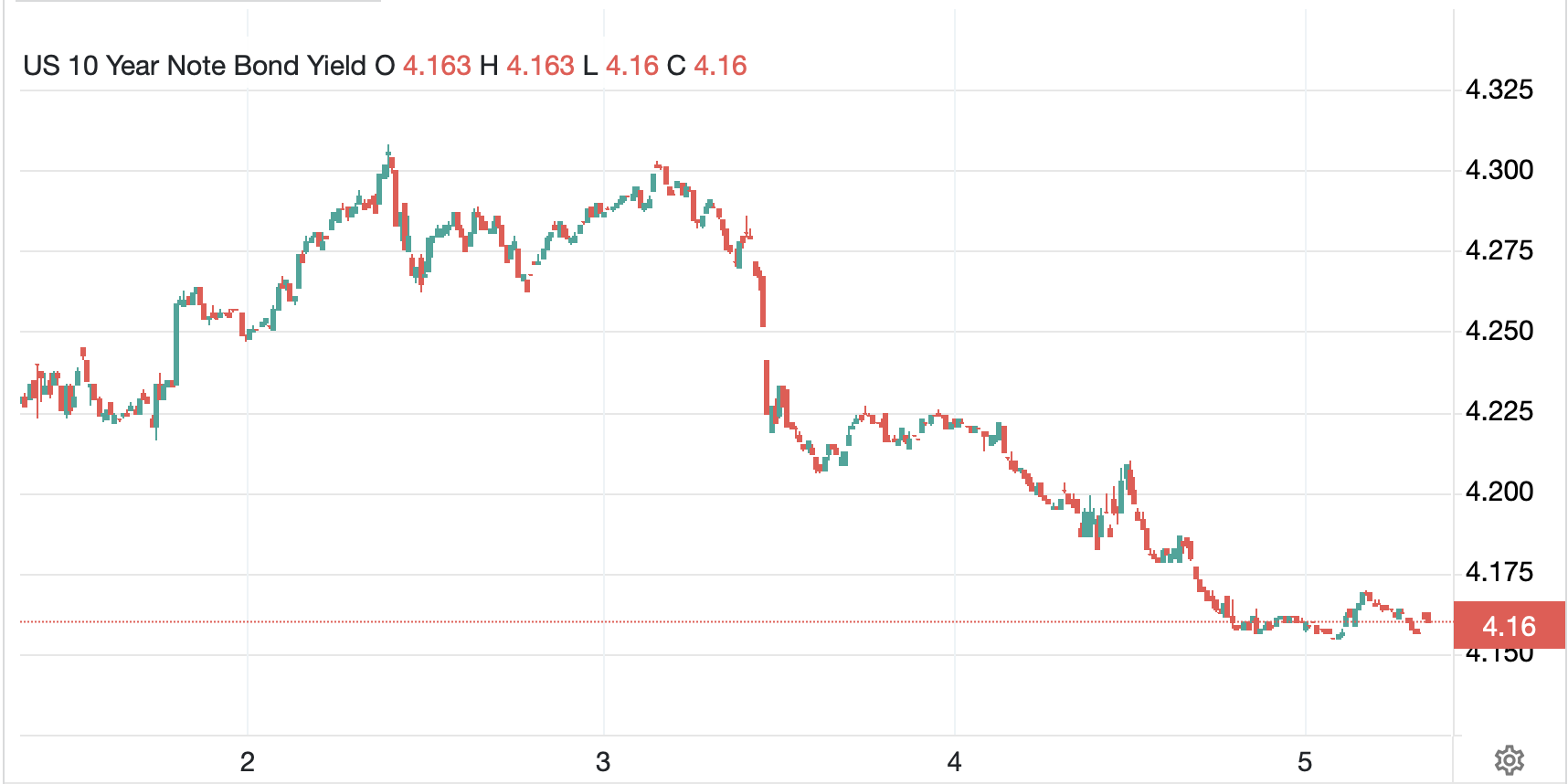
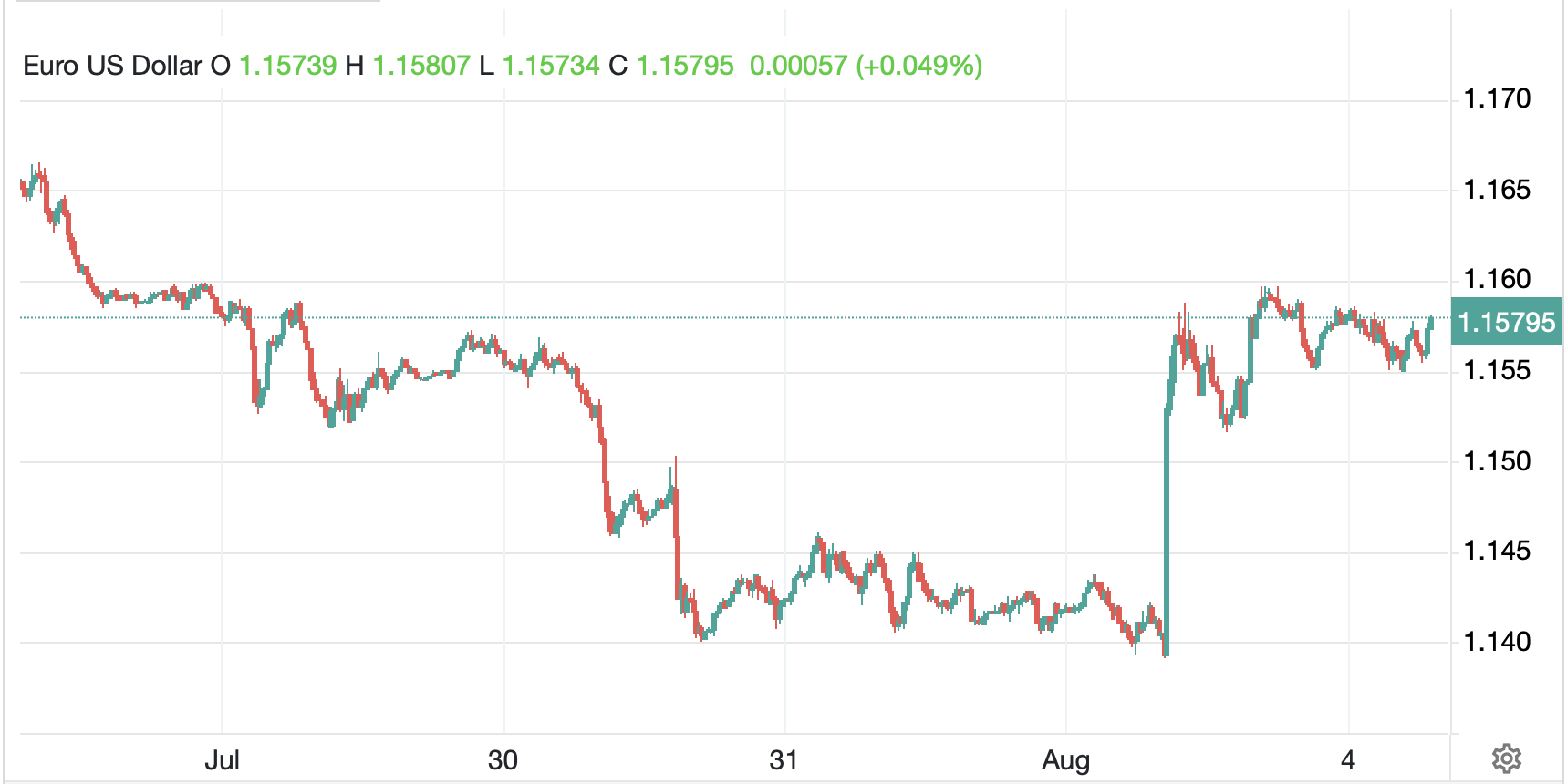
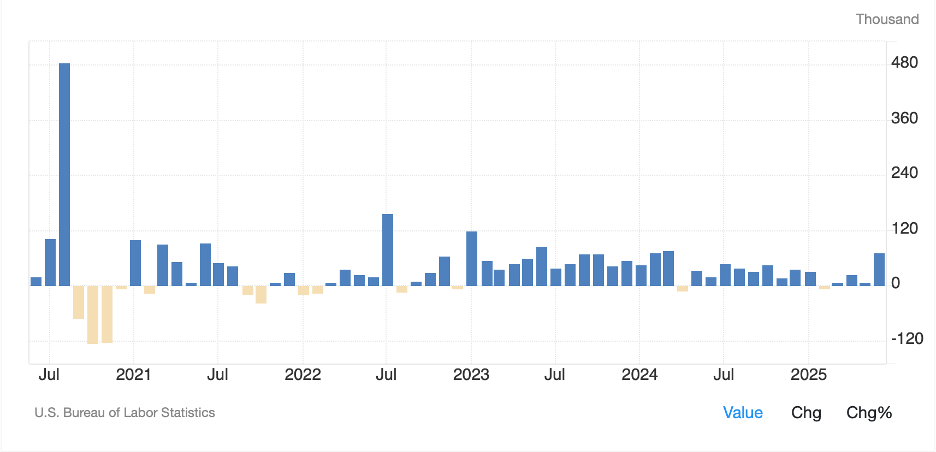
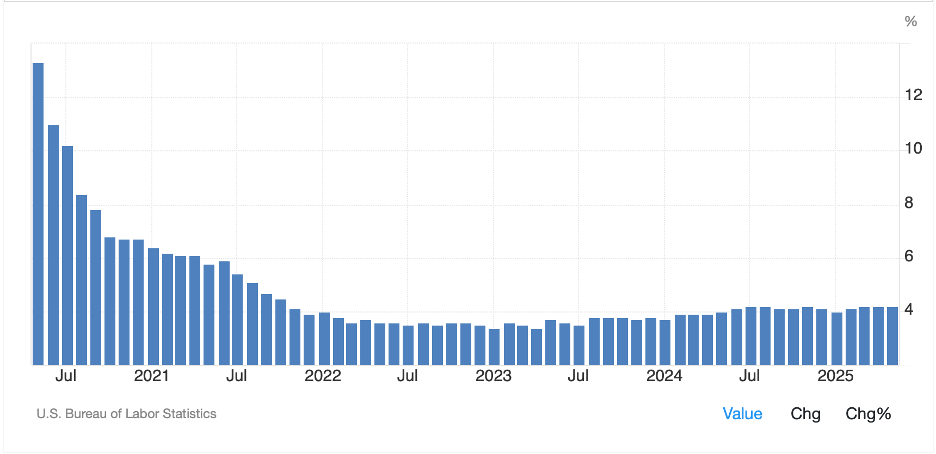
Despite all the anxiety regarding the state of the economy, with, once again, survey data like ISM showing things are looking bad, the most important piece of hard data, the Unemployment report, continues to show that the job market is in solid shape.  Friday’s NFP outcome of 139K was a few thousand more than forecast, but a lot more than the ADP result last Wednesday and much better than the ISM indices would have indicated.  Earnings rose, and government jobs shrunk for the first time in far too long with the only real negative the fact that manufacturing payrolls fell -8K.  But net, it is difficult to spin the data as anything other than better than expected.  Not surprisingly, the result was a strong US equity performance and a massive decline in the bond market with 10-year yields jumping 10bps in minutes (see below).

Source: tradingeconomics.com

But that is not the story that people are discussing.  Rather, the devolution of the situation in LA is the only story of note as ICE agents apparently carried out a series of court-warranted raids and those people affected took umbrage.  The face-off escalated as calls for violence against ICE officers rose while the LAPD was apparently told to stand down by the mayor.  President Trump called out the National Guard to protect the ICE agents and now we are at a point of both sides claiming the other side is acting illegally.  Certainly, the photos of the situation seem like it is out of hand, reminding me of Minneapolis in the wake of George Floyd, but I am not on site and can make no claims in either direction.  

It strikes me that for our purposes here, the question is how will this impact markets going forward.  A case could be made that the unrest is symptomatic of the chaos that appears to be growing around several cities in the US and could be blamed for investors seeking to move their capital elsewhere, thus selling US assets and the dollar.  Equally, a case could be made that haven assets remain in demand and while US equities do not fit that bill, Treasuries should.  In that case, precious metals and bonds are going to be in demand.  The one thing about which we can be sure is there will be lawsuits filed by Democratic governors against the federal government for overstepping their authority, but no injunctions have been issued yet.

However, let’s step back a few feet and see if we can appraise the broader situation.  The US fiscal situation remains cloudy as the Senate wrangles over the Big Beautiful Bill (BBB), although I expect it will be passed in some form by the end of the month.  The debt situation is not going to get any better in the near-term, although if the fiscal package can encourage faster nominal growth, it is possible to flatten the trajectory of that debt growth.  Meanwhile, the tariff situation is also unclear as to its results, with no nations other than the UK having announced a deal yet, although the administration continues to promise a number are coming soon.

If I look at these issues, it is easy to grow concerned over the future.  While it is not clear to me where in the world things are that much better, capital flows into the US could easily slow.  Yet, domestically, one need only look at the consumer, which continues to buy a lot of stuff, and borrow to do it (Consumer Credit rose by $17.9B in April) and recognize that the slowdown, if it comes, will take time to arrive.  Remember, too, that every government, everywhere, will always err on the side of reflating an economy to prevent economic weakness, and that means that the first cracks in the employment side could well lead to Fed cuts, and by extension more inflation.  (This note by StoneX macro guru Vincent Deluard discussing the Cancellation of Recessions is a must read).  I have spoken ad nauseum about the extraordinary amount of debt outstanding in the world, and how it will never be repaid.  Thus, it will be refinanced and devalued by EVERY nation.  The question is the relative pace of that adjustment.  In fact, I would argue, that is both the great unknown, and the most important question.

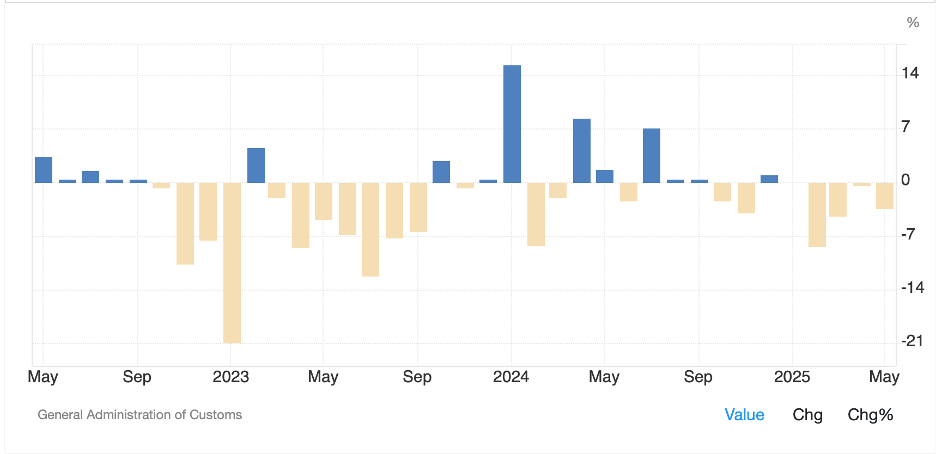
While answering this is impossible, a few observations from recent data are worth remembering.  US economic activity, at least per the Atlanta Fed’s GDPNow continues to rebound dramatically from Q1 with a current reading of 3.8%.  Meanwhile, Chinese trade data showed a dramatic decline in exports to the US (-35%) but an increased Trade Surplus of $103.2B as they shifted exports to other markets and more interestingly, imports declined-3.4%.  in fact, it is difficult to look at this chart of Chinese imports over the past 3 years and walk away thinking that their economy is doing that well.  Demand is clearly slowing to some extent, and while their Q1 GDP was robust, that appears to have been a response to the anticipated trade war.  Do not be surprised to see Chinese GDP slowing more substantially in Q2 and beyond.

Source: tradingeconomics.com

Europe has been having a moment as investors listen to the promises of €1 trillion or more to build up their defense industries and flock to European defense companies that had been relatively cheap compared to their US counterparts.  But as the continent continues to insist on energy suicide, the long-term prospects are suspect.  Canada just promised to raise its defense spending to 2% of GDP, finally, a sign of yet more fiscal stimulus entering the market and the UK, while also on energy suicide watch, has seen its service sector hold up well.

The common thread, which will be exacerbated by the BBB, is that more fiscal spending, and therefore increased debt are the future.  Which nation is best placed to handle that increase?  Despite everything that you might believe is going wrong in the US, ultimately the economic dynamism that exists in the US surpasses that of every other major nation/bloc.  I still fear that the Fed is going to cut rates, drive inflation higher and undermine the dollar before the year is over, but in the medium term, no other nation appears to have the combination of skills and political will to do anything other than what they have been doing already.  And that is why the long-term picture in the US remains the most enticing.  This is not to say that US asset prices will improve in a straight line higher, just that the broad direction remains clear, at least to me.

Ok, I went on way too long, sorry.  As there is no US data until Wednesday’s CPI, we will ignore that for now.  A market recap is as follows:  Asia had a broadly stronger session with Japan, China, HK, Korea and India all following in the US footsteps from Friday and showing solid gains.  Europe, though, is mostly in the red with only Spain’s 0.25% gain the outlier amongst major markets.  As to US futures, they are essentially unchanged at this hour (7:00).

Treasury yields have backed off -2bps from Friday’s sharp climb and European sovereign yields are softer by between -3bps and -4bps as although there has been no European data released; the discussion continues as to how much the ECB is going to cut rates going forward.  JGB yields were unchanged overnight.

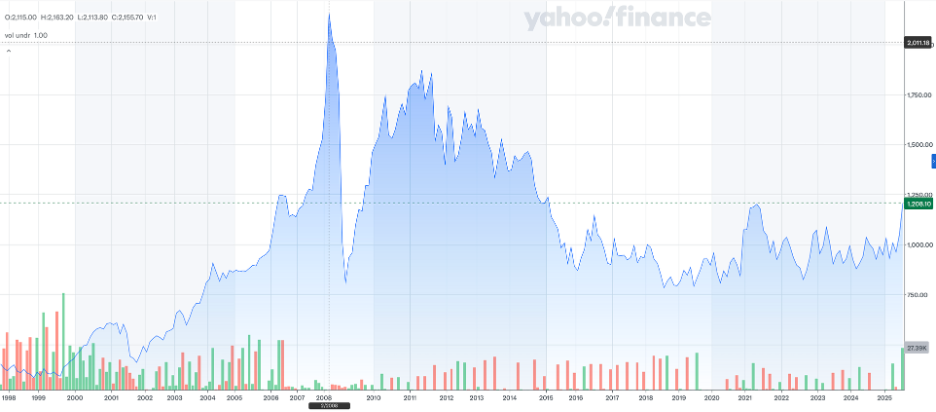
In the commodity space, while oil (+0.3%), gold (+0.1%) and even silver (+0.8%) are edging higher, platinum has become the new darling of speculators with a 2.8% climb overnight that has taken it up more than 13.5% in the past week and 35% YTD.  Remarkably, it is still priced about one-third of gold, although there are those who believe that is set to change dramatically.  A quick look at the chart below does offer the possibility of a break above current levels opening the door to a virtual doubling of the price.  And in this environment, a run at the February 2008 all-time highs seems possible.

Finally, the dollar is softer across the board this morning, against virtually all its G10 and EMG counterparts.  AUD (+0.55%) and NZD (+0.7%) are leading the way, but the yen (+0.5%) is having a solid session as are the euro and pound, both higher by 0.25%.  In the emerging markets, PLN (+0.7%) is the leader with the bulk of the rest of the space higher by between +0.2% and +0.4%.  BRL (-0.3%) is the outlier this morning, but that looks much more like a modest retracement of recent gains than a new story.

Absent both data and any Fedspeak (the quiet period started on Friday), we are left to our own devices.  My take is there are still an equal number of analysts who are confident a recession is around the corner as those who believe one will be avoided.  After reading the Deluard piece above, I am coming down on the side of no recession, at least not in a classical sense, as no politician anywhere can withstand the pain, at least not in the G10 and China.  That tells me that while Europe may be the equity flavor of the moment, commodities remain the best bet as they are undervalued overall, and all that debt and new money will continue to devalue fiat currencies.

Good luck

Adf

Mugwump

The feud between Elon and Trump
Show’s Musk has become a mugwump
But though there’s much drama
It’s not clear there’s trauma
As markets continue to pump
 
So, turning our eyes toward today’s
Report about jobs, let’s appraise
The call for recession
That’s been an obsession
Of some for six months of Sundays


Clearly the big headlines are all about the escalating war of words between President Trump and Elon Musk.  I guess it was inevitable that two men with immense wealth and power would ultimately have to demonstrate that one of them was king.  But other than the initial impact on Tesla’s stock price, it is not clear to me what the market impacts are going to be here.  After all, President Trump has attacked others aggressively in the past when they didn’t toe his line, and it is not a general market problem, only potentially the company with which that person is associated.  As such, I don’t think this is the place to hash out the issue.

However, I think it is worth addressing one point that Musk raised regarding the Big Beautiful Bill.  The thing about reconciliation is it only addresses non-discretionary spending, meaning Social Security, Medicare, Medicaid and the interest on the debt.  All the other stuff that DOGE made headlines for, USAID etc., could never be part of this bill.  That requires recission packages where Congress specifically passes laws rescinding the previously enacted payments.  So, if this was a part of the blowup, it was senseless.  I will say, though, that the Trump administration did not communicate this fact effectively as I read all over how people are upset that Congress is not addressing these other things.  At any rate, this is not a political commentary, but I thought it was worth understanding because I only learned of this in the past weeks and I don’t believe it is widely understood.

Onward to the major market news today, the payroll report.  As of this morning, according to tradingeconomics.com, here are the forecast outcomes:

Nonfarm Payrolls130K
Private Payrolls120K
Manufacturing Payrolls-1K
Unemployment Rate4.2%
Average Hourly Earnings0.3% (3.7% Y/Y)
Average Weekly Hours34.3
Participation Rate62.6%

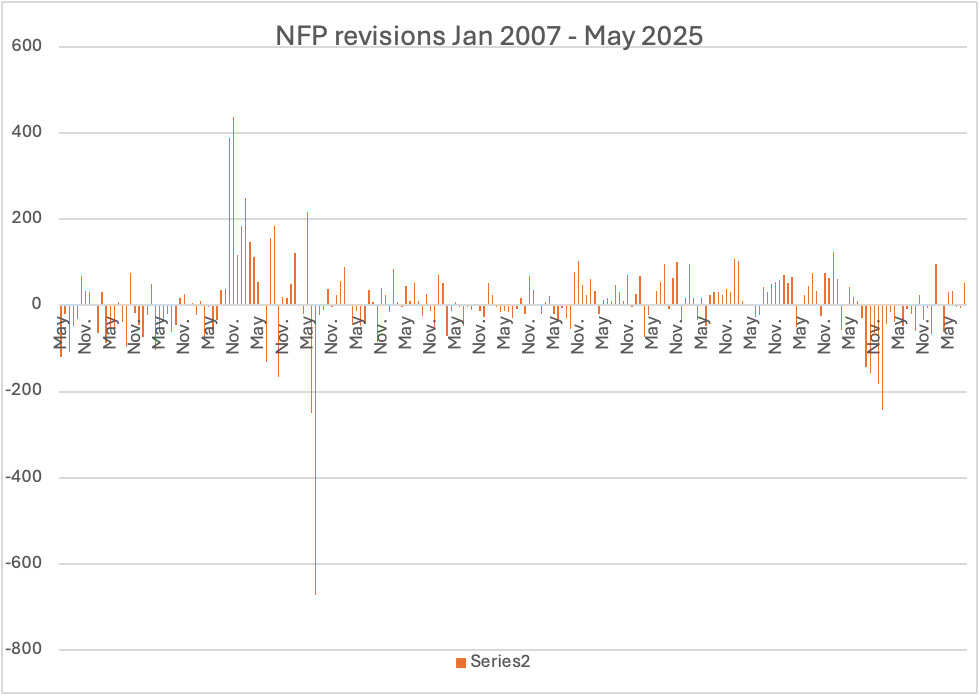
Of course, Wednesday’s ADP Employment number was MUCH lower than expected, so the whispers appear to be for a smaller outcome.  As well, the key wildcard in this data is the BLS Birth-Death model which is how the BLS estimates the number of jobs that have been created by small businesses which aren’t surveyed directly.  As with every model, especially post-Covid, what used to be is not necessarily what currently is.  The most accurate, after the fact, representation of employment is the Quarterly Census of Employment and Wages (QCEW) but that isn’t released until 6 months after the quarter it is addressing, so it is not much of a timing tool.  It is also the genesis of all the revisions.  

Here’s the thing, a look at the chart below shows that the BLS Birth-Death model appears to still be substantially overstating the payroll situation.  Given the datedness of its model, that cannot be a real surprise, but I assure you, if there is a major revision lower in that number, and NFP prints negative, it WILL be a surprise to markets.  I am not forecasting such an occurrence, merely highlighting the risk. 

If that were to be the case, I imagine the market reaction would be quite negative for stocks and the dollar, positive for bonds (lower yields) and likely continue to push precious metals higher, although oil would likely suffer.  I guess we will all have to wait and see at 8:30 how things go.

In the meantime, ahead of the weekend, let’s see how markets behaved overnight.  Yesterday’s modest sell-off in the US was followed by a mixed session in Asia (Nikkei +0.5%, Hang Seng -0.5%, CSI 300 -0.1%) but strength in Korea (+1.5%) and India (+0.9%).  Trade discussions still hang over the market and there are increasing bets that both India and Korea are going to be amongst the first to come to the table.  As well, the RBI cut rates by 50bps last night with the market only expecting 25bps, so that clearly supported the SENSEX.  In Europe, no major index has moved even 0.2% in either direction as positive European GDP data was unable to get people excited and there is now talk that the ECB will not cut rates again until September.  As to US futures, at this hour (6:50) they are pointing higher by about 0.3% across the board.  It appears that the Tesla fears are abating.

In the bond market, yields continue to slide with Treasuries falling -1bp and European sovereign yields down between -3bps and -5bps despite the stronger than expected Eurozone data which also included Retail Sales (+2.3%) growing more rapidly than expected.  But this is a global trend as recession discussions increase while we also saw JGB yields slip -2bps overnight.  It feels like the bond markets around the world are anticipating much slower economic activity.

In the commodity space, oil (0.0%) is unchanged this morning and continuing to hang around at its recent highs, but unable to break above that $63+ level.  It strikes me that if slower economic activity is on the horizon, that should push oil prices lower as there appears to be ample supply.  But I read that Spain has stopped importing Venezuelan crude as US secondary sanctions are about to come into effect there.  As to the metals markets, silver (+1.5%) and platinum (+2.6%) have been the leaders for the past few sessions although gold (+0.2%) continues to grind higher.  The loser here has been copper (-0.8%) which if the economic forecasts of slowing growth are correct, makes some sense.  Of course, there is a strong underlying narrative about insufficient copper supplies for the electrification of everything, but right now, payroll concerns are the story.

Finally, the dollar is a bit firmer this morning, but only just, with G10 currencies slipping between -0.2% and -0.3% while EMG currencies have shown even less movement.  INR (+0.25%) stands out for being the only currency strengthening vs. the dollar after the rate cut and positive growth story, but otherwise, this is a market waiting for its next cue.

In addition to the payroll report, we get Consumer Credit (exp $10.85B) a number which gets little attention but may grow in importance if economic activity does start to decline.  As well, I cannot ignore yesterday’s Trade data which saw the deficit fall much more than expected, to -$61.6B, its smallest outturn since September 2023.  While I didn’t see any White House comments on the subject, I expect that President Trump is happy about that number.

Are we headed into a recession or not?  Will today’s data give us a stronger sense of that?  These are the questions that we hope to answer later this morning.  FWIW, which is probably not that much, my take is while economic activity has likely slowed a bit, I do not believe a recession is upon us, and as I do believe the reconciliation bill will be passed which extends the tax cuts, as well as adds a few like no tax on tips or Social Security, I expect that will turn any weakness around quickly.  What does that mean for the dollar?  Right now, it is piling up haters so a further decline is possible, but I cannot rule out a reversal if/when the tax legislation is finalized.

Good luck and good weekend

Adf

In a Trice

The calendar’s not e’en turned twice
Since Trump, with JD as his Vice
Have taken the reins
And beat up on Keynes
While weeding out waste in a trice
 
For markets, the problem, it seems
Is rallies are now merely dreams
So, equity buyers
Are putting out fires
While thinking up pump and dump schemes
 
For bondholders, it’s not so clear
If salvation truly is near
But one thing seems sure
The buck will endure
Much weakness throughout this whole year


We have not even reached 50 days of a Trump presidency as of this morning and nobody would fault you if you estimated we had three years of policies enacted to date.  The pace of changes has been blistering and clearly most politicians, let alone investors, have not been prepared for all that has occurred.

One of the things that I read regularly is that Trump is destroying the Rules Based Order (RBO) which was underpinned by the Pax Americana of the US essentially being the world’s policeman.  This is cast as a distinct negative under the premise that things were going great and now, he is upsetting the applecart for his own personal reasons.  Of course, market participants had grown quite accustomed to this framework, had built all sorts of models to profit from it and with the Fed’s help of monetization of debt, were able to gain significantly at the expense of those without market linked assets.  Hence, the K-shaped recovery.

But while that is a lovely narrative, is it really an accurate representation of the way of the world?  If the US was truly the world’s policeman, and we certainly spend enough on defense to earn that title, perhaps it was time for the US to be fired from that role anyway.  After all, there is currently raging military conflict in Ukraine, Lebanon, Syria, Congo, Sudan and the ongoing tensions in Gaza.  That’s a pretty long list of wars to claim that things were going great.

Secondly, the question of financing all this conflagration, as well as other economic goals, notably the alleged transition to net zero carbon energy production, appears to be reaching the end of the line.  While the US can still borrow as needed, (assuming the debt ceiling is raised), the reality is that the US gross national debt outstanding is greater than $36,000,000,000,000 relative to GDP that is a touch under $28,000,000,000,000.  On a global basis, total (not just government) debt is in excess of $300,000,000,000,000 while global GDP clocks in somewhere just north of $100,000,000,000,000.  Arguably, on a credit metric basis, the world is BB- or B+, a clear indication that all that debt is unlikely to be repaid.

If we consider things considering this information, perhaps the RBO had outlived its usefulness.  Arguably, the loudest complaints are coming from those who benefitted most greatly and are quite unhappy to see things change against them.  But as evidenced by the polls taken after President Trump’s speech last Tuesday evening, the bulk of the American public is still strongly supporting this agenda.  The idea that the president and his Treasury secretary are seeking to engineer a short-term recession early, blame it on fixing Biden’s mess, and having things revert to stronger growth in time for the 2026 mid-term elections is not crazy.  In fact, there have been several comments from both men that short-term pain would be necessary to achieve a stabler, long-term gain.

So, what does this mean for the markets?  You have no doubt already recognized that volatility is the main event in every market, and I don’t see that changing anytime soon.  But some of the themes that follow this agenda would be for US equities to suffer relative to other markets, as the last decade plus of American exceptionalism, led by massive deficit spending and borrowing, would reverse under this new thesis.  Add to this the sudden realization that other nations are going to be investing significantly more in their own defense, and money will be flowing out of the US into Europe, Japan and emerging markets around the world.

Bonds are a tougher call as a weaker economy would ordinarily mean lower yields, but the question of tariff impacts on prices, as well as reshoring, which, by definition, will raise prices, could mean we see the yield curve steepen with the Fed cutting rates more aggressively than currently priced, but 10-year and 30-year yields staying right where they are now.

I believe this will be a strong period for commodities as all that foreign capex will be a driver, as will the fact that, as I will discuss shortly, the dollar is likely to underperform significantly.  Gold will retain its haven characteristics as well as remain in demand for foreign central banks, while industrial metals should hold their own.  As to oil, my take is lower initially, as OPEC returns its production and slowing GDP weighs on demand, at least for a while, although eventually, I suspect it will rebound along with economic activity.

Finally, the dollar will remain under significant pressure across the board.  Clearly, Trump is seeking a weaker dollar to help the export industries, as well as discourage imports.  Add to this the potential for lower yields, lower short-term rates, and an exit of equity investors as US stocks underperform, and you have the making of at least another 15% decline in the greenback this year.

With this as backdrop, we need to touch on three key stories this morning.  First, Friday’s NFP report was pretty much in line with expectations at the headline level but seemed a bit weaker in some of the underlying bits, specifically in the Household Survey where a total of 588K jobs were lost and there was a large increase in the number of part-time workers doing so for economic reasons.  Basically, that means they wanted full-time work but couldn’t find a job.  Markets gyrated after the release, with yields initially sliding but then rebounding to close higher on the day.  Equities, too, closed higher on the day although that had the earmarks of a relief rally after a lousy week overall.  The thing about this report is that it did not include any of the government changes that have been in the press, so next month may offer more information regarding the impact of DOGE and their cuts.

The second story comes from north of the border where Mark Carney, former BOC and BOE head, was elected to lead the Labour Party in Canada and replace Justin Trudeau.  As is always the case, when there is new leadership, there is excitement and he said he will call for a general election in the next several weeks, ostensibly to take advantage of this new momentum.  It seems that President Trump’s derision of not only Trudeau, but Canada as well in many Canadian’s eyes, will play a large role with the two lead candidates, Carney and Poilievre, fighting to explain that they are each better placed to go toe-to-toe with Trump on critical issues.

Here’s the thing, though.  Despite much angst about the US-Canada relationship on the Canadian side of the border, the market viewpoint is nothing has really changed.  a look at the chart below shows that after a bout of weakness for the Loonie in the wake of the US election and leading up to Trump’s tariff announcements, USDCAD is basically unchanged since mid-December, with one day showing a spike and reversal in early February.  My point is that the market has not, at least not yet, determined that the Canadian PM matters very much.

Source: tradingecoomics.com

The last story to discuss is Chinese inflation data which was released Saturday evening in the US and showed deflation in February (-0.7% Y/Y) for CPI and continuing deflation in PPI (-2.2%).  In fact, as you can see from the below chart, PPI in China has been in deflation for several years now.  Recently there have been several articles explaining this offers President Xi a great opportunity for significant stimulus because no matter how much the government spends and how much debt they monetize, inflation won’t be a problem for a long time to come.  I would counter that given deflation has been the norm for several years, they have had this opportunity for quite a while and done nothing with it.  Why will this time be different?  Ultimately, the default result in China is when things are not looking like they will achieve the targeted growth of “about 5%”, you can be sure there will be more investment to build things up adding still more downward pressure on prices as production facilities increase.  

Source: tradingeconomics.com

The renminbi’s response to this news has been modest, at best, with a tiny decline overnight of -0.25%.  And a look at the chart there shows it is remarkably similar to the CAD, with steady weakness through December and then no real movement since then.  Given the dollar’s recent weakness overall, this seems unusual.  Although, we also know that China prefers a weaker currency to help support their export industries, so perhaps this in not unusual at all.

Source: tradingeconomics.com

Ok, this note is already overly long, so will end it here.  We do have important data later this week with both CPI and Retail Sales coming.  As well, the consensus from the Fedspeak is that they are pretty happy right here and not planning to do anything for a while.

The big picture is best summarized, I believe, by the idea that we are at the beginnings of a regime change in markets as discussed above.  Volatility continues to be the driving force, so hedging remains crucial for those with natural exposures.

Good luckAdf

Inundated

Investors have been inundated
By news that has been unabated
There’s tariffs and war
Plus rate cuts and more
With stocks and bonds depreciated
 
Now looking ahead to today
The payroll report’s on its way
As well, later on
With nothing foregone
We’ll hear from our own Chairman Jay


It has certainly been an interesting week in both markets and the world writ large.  So much has happened and yet so much is still unclear as to how things may evolve going forward.  Through it all, volatility is the only constant.  To me, what has become abundantly clear is the post WWII order is being dismantled, and every nation is trying to determine its place in the future.  This is a grave threat to those who benefitted from flowery words and limited action, which covers a wide swath of government leaders around the world.  I’m not sure if this is the 4th Turning, or if this is merely the prelude, with the impacts of all these changes what brings the 4thTurning about.  Regardless, history is clearly in the making.

I do not have the bandwidth to continuously follow the tariff story, although yesterday’s news was there will be more delays for both Canada and Mexico.  China received no such relief and at their National People’s Congress they seemed resolute in their pushback and highlighted their own achievements.  The data from China, though, tells me that their goals for more domestic consumption remain far in the distance.  Last night they reported their Trade Balance for the January/February period (they always combine because of the Lunar New year disruptions) and it jumped to $170.5B, far greater than anticipated.  While exports underperformed slightly, growing only 2.3% compared to a 5% estimate, it was the imports that really tells the story.  Imports fell -8.4%, a significant shortfall from both last year and consensus estimates, and an indication that the Chinese consumer is not yet the type of force that President Xi would like to see.  

In fact, a look at the chart below showing imports for the past 10 years demonstrates that very little has changed on this front.  As I wrote yesterday, converting a mercantilist economy into a consumer-focused one is a huge lift, and one that the CCP has not yet figured out.  It is not clear that they ever will.  Meanwhile, the obvious explanation for the huge jump in the trade balance was companies pre-ordering things to get ahead of the tariffs.

Source: tradingeconomics.com

Moving on to the Ukraine situation, while yesterday’s news was of the “whatever it takes” moment for defending Europe, this morning it seems there are some caveats attached.  Of course, the first caveat is the changing of the German constitution to allow them to spend all that money.  The second seems to be that not every European nation is on board for the massive spending increase and continuation of the war.  There are many political and financial hurdles to overcome in this story in Europe, and this morning’s European equity markets are indicative of the idea that this is not a straight-line higher.  In fact, every equity market in Europe is lower this morning, led by the DAX (-1.5%) although with solid declines elsewhere as well (CAC -1.0%, FTSE 100 -0.5%).  This, too, is a story with no clear end in sight.  One unconfirmed story I saw was that the group convened by the UK last weekend has not been able to agree terms for additional support.

Meanwhile, yesterday the ECB cut their short-term rates by 25bps, as widely expected, with the Deposit Rate now down to 2.50%.  The funny thing is nobody really noticed.  This is of a piece with my observation that central bankers just don’t have that much sway on market activity these days, it is all about politics and statecraft, not monetary policy.  This morning, Eurozone GDP for Q4 was released at 0.2%, a tick higher than forecast but still lower than Q3’s 0.4%.  There is no doubt the financial mandarins of Europe are keen to get this defense spending going, because otherwise they will continue to preside over a stagnant economy.  

But here’s an interesting thing to consider.  Germany has made a big deal about this new willingness to spend €500 billion outside the bounds of their budget framework on defense.  However, they continue with their Energiewende policy which has been the Achilles Heel of the German economy and will prevent them from actually producing armaments if they seek to continuously reduce fossil fuel powered energy for renewables.  It is almost as if this is theater, rather than policy, but that may just be my cynicism speaking.

Moving on to the US, this morning brings the Payroll Report with the following current median estimates:

Nonfarm Payrolls160K
Private Payrolls111K
Manufacturing Payrolls5K
Unemployment Rate4.0%
Average Hourly Earnings0.3% (4.1% Y/Y)
Average Weekly Hours34.2
Participation Rate62.6%

Source: tradingeconomics.com          

As well, we hear from Chairman Powell at 12:30pm, along with Bowman, Williams and Kugler in the hours leading up to that.  But again, I ask, do they matter to the markets right now?  Certainly, there is much discussion that the US economic data is starting to show more weakness, and there are many who are saying that long-anticipated recession is going to become evident.  If that is the case, we could certainly see the Fed cut rates, but again, my take is markets are far more attuned to 10-year yields than Fed funds.  And remember, while 10-year yields are clearly quite inflation sensitive, what we also know that questions over budget deficits and supply are critical to their pricing as well.  This was made evident yesterday in Germany.

I have glossed over market activity overnight so will give a really short update here.  Yesterday’s weakness in the US was followed by broad weakness throughout Asia, with most markets there lower on the day, notably Japan (-2.2%), but declines almost everywhere.  We have already discussed European bourses and at this hour (7:30) US futures are basically unchanged ahead of the data.

In the bond market, Treasury yields are slipping back -3bps this morning and we are seeing similar price action across most of Europe although Spain (+1bp) is bucking the trend on some domestic issues.  It is easy to believe that the Germany story was a bit overblown, and remember, if they cannot change the constitution, I expect a rally in Bunds (lower yields) along with a selloff in the DAX and the euro.

Speaking of the euro, it is continuing its sharp ascent, up another 0.6% this morning.  however, something to keep in mind regarding all the huffing and puffing about the euro is that with this sharp move higher in the past week, it is merely back to the middle of its 3-year trading range.  So, is this as big a deal as some are saying?

Source: tradingeconomics.com

But the overall currency picture is more mixed with both AUD (-0.6%) and NZD (-0.5%) lower along with CAD (-0.2%).  There are other gainers (GBP +0.2%, SEK +0.7%) and other laggards (ZAR -0.2%) although I would say the broad direction is still for dollar weakness.  

Finally, oil (+1.5%) is bouncing this morning, although this could well be a trading bounce as I have seen no new news on the subject.  I guess the delay on Canadian tariffs probably played a role as well.  Gold (+0.4%) is also firmer although both silver (-0.4%) and copper (-1.2%) are lagging.  In fairness, the latter two have had significant up weeks so are likely seeing some profit taking.

Once again, I will remark that for those who have real flows and exposures, the current market situation is why hedging is critical to maintain financial performance.  Nobody really knows where anything is going to go, but right now, it feels like the one thing we know is prices will not remain where they currently are for very long.

Good luck and good weekendAdf

Positioning’s Fraught

The wonderful thing about Trump
Is traders no longer can pump
A market so high
That it can defy
Reality ere it goes bump
 
Since policies can change so fast
A long-term view just cannot last
So, Fed put or not
Positioning’s fraught
And larger ones won’t be amassed


As we await the NFP report this morning, I couldn’t help but ponder the uptick in complaints and concerns by traders that increased volatility in markets on the back of President Trump’s mercurial announcements has changed the trading game dramatically.  Let me say up front that I think this is a much healthier place to be and explain why.

Pretty much since the GFC and, more importantly, then Chairman Bernanke’s first utilization of QE and forward guidance, the nature of financial markets had evolved into hugely leveraged one-sided views based on whatever the Fed was guiding.  So, the initial idea behind QE and forward guidance was to assure all the traders and investors that make up the market that even though interest rates reached 0.0%, the Fed would continue to ease policy and would do so for as far out in time as you can imagine.  Lower for longer became the mantra and every time there was a hiccup in the market, the Fed rushed in, added yet more liquidity to calm things down, and put the market back on track for further gains.  This was true for both stocks and bonds, despite the fact that the Fed has no business or mandate involving the equity market.

This activity led to the ever-increasing size of trading firms as leverage was cheap and steadily rising securities prices led to lower volatility, both implied and real, in the markets.  Risk managers were comfortable allowing these positions to grow as the calculated risks were minimized by the low vol.  In fact, entire trading strategies were developed to take advantage of the situation with Risk Parity being a favorite.  

However, a negative result of these actions by the Fed was that investors no longer considered the fundamentals or macroeconomics behind an investment, only the Fed’s stance.  The only way to outperform was to take on more leverage than your competitors, and that was great while rates stayed at 0.0%.  Alas, this persisted for so long that many, if not most, traders who learned the business prior to the GFC wound up retiring or leaving the market, and the next generation of traders and investors lived by two credos, number go up and BTFD.

The Fed remained complicit in this process as FOMC members evolved from background players to a constant presence in our daily lives, virtually preening on screens and in front of audiences and reiterating the Fed’s views of what they were going to do, implicitly telling traders that taking large, leveraged bets would be fine because the Fed had their back.

Of course, the pandemic upset that apple cart as the combination of Fed and government response imbued the economy with significantly more inflation than expected and forced the Fed to change their tune.  The market was not prepared for that, hence the outcome in 2022 when both stocks and bonds fell sharply.  But the Fed would not be denied and calmed things down and created a coherent enough message so that markets recovered the past two years.  This has, naturally, led to increased position sizing and more leverage because that’s what this generation of traders understands and has worked.

Enter Donald J Trump as president, elected on a populist manifesto and despite his personal wealth, seemingly focused on Main Street, not Wall Street.  The thing about President Trump is if an idea he proffers doesn’t work, he will drop it in a heartbeat and move on.  As well, by wielding the full power of the United States when dealing in international situations, other nations can quickly find themselves in a difficult spot and, so far, have been willing to bend their knee.  As well, his focus on tariffs as a primary weapon, with little regard for the impact on markets, and the way with which he uses them, threatening to impose them, and holding off at the last minute when other nations alter their policy, has kept markets off-balance.

The result is large leveraged positions are very difficult to hold and manage when markets can move up and down 2% in a day, every day (like the NASDAQ 100 chart below), depending on the headlines.  

Source: tradingeconomics.com

The natural response is to reduce position size and leverage, and that, my friends, is a healthy turn in markets.  This is not to say that there are not still many significant imbalances, just that as they continue to blow up, whether Nvidia, or FX or metals, my take is the next set of positions will be smaller as nimble is more important than large.  It doesn’t matter how smart an algorithm is if there is no liquidity to adjust a position when the world changes.  This poet’s opinion is this is a much healthier place for markets to live.

Ok, let’s see what happened overnight ahead of today’s data.  Mixed is the best description as yesterday’s US closes saw a mixed outcome and overnight the Nikkei (-0.7%) fell while both Hong Kong (+1.2%) and China (+1.3%) gained ground.  Korea and India slid, Taiwan rose, the picture was one of uncertainty about the future.  That also describes Europe, where only Germany and Norway have managed any modest gains at all while the rest of the continent and the UK are all slightly lower.  Apparently, yesterday’s BOE rate cut has not comforted investors in the UK, nor has the talk of more rate cuts by the ECB bolstered attitudes in Europe.  As to US futures, at this hour (7:00) they are basically unchanged.

In the bond market, the biggest mover overnight was in Japan where JGB yields rose 3bps, once again touching that recent 30-year high.  While some BOJ comments indicated inflation remained well-behaved, the market is clearly of the view that Ueda-san is getting set to hike rates further.  In Europe, yields are basically lower by 1bp across the board and Treasury yields are unchanged on the session as investors and traders continue to focus on Treasury Secretary Bessent’s conversation that he cares about 10-year yields, not Fed funds.  Perhaps the Fed will cut rates to recapture the spotlight they have grown to love.

Oil (+0.5%) prices continue to drift lower overall, although this morning they are bouncing from yesterday’s closing levels.  Questions about sanctions policy on Iran, on Russia’s shadow fleet and about the state of the global economy and therefore oil demand remain unanswered.  However, the fact that oil has been sliding tells me that there is some belief that President Trump may get his way regarding a desire for lower oil prices.  In the metals markets, copper (+1.1%) is flying higher again, and seems to be telling us that the economy is in decent shape.  Either that or there is a major supply shortage, although if that is the case, I have not seen any reporting on the subject.  Both gold and silver are very modestly higher this morning after small declines yesterday as the London – NY arbitrage continues to be the hot topic and financing rates for both metals have gone parabolic.

Finally, the dollar is mixed this morning, perhaps slightly firmer as JPY (-0.5%) is actually the worst performer around, despite the rise in JGB yields.  There is a lot of chatter on how the yen is due to trade much higher, and it has rallied over the past month, but it is certainly not a straight line move.  As to the rest of the space, virtually every other currency is +/-0.2% from yesterday’s close with CLP (+0.5%) the lone exception as the Chilean peso benefits from copper’s huge rally.

On the data front, here are the latest expectations for this morning’s employment report:

Nonfarm Payrolls170K
Private Payrolls141K
Manufacturing Payrolls-2K
Unemployment Rate4.1%
Average Hourly Earnings0.3% (3.8% Y/Y)
Average Weekly Hours34.3
Participation Rate62.5%
Michigan Sentiment71.1

Source: tradingeconomics.com

Remember, though, the ADP number on Wednesday was much better than expected at 183K (exp 150K) with a major revision higher by 54K to the previous month).  As well, this month brings the BLS adjustments for 2024 which will not be broken down, just lumped into the data.  Recall, there are rumors of a significant reduction in the number of jobs created in 2024 as well as a significant increase in the population estimates with more complete immigration data, and that has led some pundits to call for a much higher Unemployment Rate.  I have no insight into how those adjustments will play out although the idea they will be large seems highly plausible.

Ahead of the number, nothing will happen.  If the number is strong, so NFP >200K, I expect that bonds will suffer, and the dollar will find some support.  A weak number should bring the opposite, but the revisions are a wild card.  As I stated this morning, the best idea is to maintain the smallest exposures possible for the time being, as volatility is the one thing on which we can count.

Good luck and good weekend

Adf

Run Amok

The price level, sadly, will jump
According to President Trump
Will Canada shrink?
Will Mexico blink?
As tariffs cause things to go thump
 
The first thing that moved was the buck
While stock markets were thunderstruck
So, who will blink first?
And who will hurt worst?
No matter, things have run amok


Whatever you think of the man, you must admit that President Trump knows how to maintain the spotlight on himself and his policies to the exclusion of virtually everything else in the news.  And so, in the wake of two terrible aviation disasters in short order, pretty much all eyes are now focused on the tariffs that Trump imposed this weekend on Canada, Mexico and China.  While there had been a large school of thought that the tariff talk was a cudgel to be used during negotiations but would never actually be imposed as they would be too damaging, that thesis has been destroyed.  It appears that President Trump believes his long-term goals of reshoring significant parts of US industry and leveling the playing field with trade partners is achievable via tariff policy and will more than offset any short-term pain that may come.  We shall see if he is correct, but certainly, the short-term pain is beginning to arrive.

The early movement in equity markets was uniform around the world, and it was not pretty.  The below snapshot of equity futures markets, taken at 6:00am this morning shows that the only two markets that have not fallen are China and Hong Kong, and that is only because they remain closed for the Chinese New Year holidays.  But there is plenty of fear all around the world, especially considering that markets throughout Europe and Japan, as well as other nations that have not been named targets of tariffs, have also fallen sharply.

Source: tradingeconomics.com

Too, the FX markets have also responded dramatically, with the dollar exploding higher vs. virtually all its counterpart currencies this morning as 1% gains are the norm.

Source: tradingeconomics.com

A special shoutout to ZAR (-1.55%) which while not directly impacted by tariffs, caught Trump’s ire by their recently enacted legislation to confiscate property as they deem fit, oftentimes without compensation.  While South African officials have claimed it is akin to eminent domain rules in the US, those require compensation at all times, a not insubstantial difference.  

So, what’s a hedger to do?  Well, this is why you maintain a hedge program in the first place.  Lots of things happen in the world, most of which are beyond any individual or companies’ control, yet the impacts are real.  Some of what I have read this morning highlights the idea that Canada and Europe and Mexico are going to stick together to fight these tariffs.  However, at the end of the day, the US economy, and by extension its market, is the largest by far, and losing the US as an export destination will be a very difficult pill for those nations and their economies to swallow.  

My sense is that Trump, especially if he continues to address the immigration and government waste issues, will have far more runway than most other nations, especially given the precarious situation of many ruling parties right now.   But the other thing to consider is that there is no going back to the way things were in the past.  Alliances and treaties are going to come under much greater scrutiny by all sides as governments everywhere re-evaluate what they are trying to achieve with various policies and how they can partner with other nations to work together.  In fact, I suspect that the EU is going to continue to come under even greater pressure as it becomes more evident that while many countries believe in the trade benefits of the EU, the recent focus by Brussels on other issues like climate activism and immigration run counter to some members’ views.  No matter what, the world is changing dramatically, and my take is the change is going to come faster than many will have anticipated.

OK, there are a thousand stories on how the tariffs are going to impact the US, with initial calculations regarding the negative impact on GDP and how much they are going to raise inflation, so I’m not going to go there.  Needless to say, the universal belief is things will get worse on those metrics.  But here’s something else to consider.  On Friday, the BLS will be revising the 2024 jobs data, including their population estimates and the birth/death model that describes the number of new businesses that are formed, net, each month. Early estimates show that the number of jobs created is going to fall by nearly 1 million while population, now taking into account more immigration, is going to rise.  I have seen estimates that the Unemployment Rate may rise, or be revised, to 4.5% or 4.6%.  If that is the case, it will certainly call into question exactly what the Fed has been doing.  It will also, almost certainly, result in a Trumpian tirade about how the BLS is political and was cooking the books to burnish Biden’s economic record.  I suspect it will not help equity markets if that is the case, but also probably hurt the dollar as the Fed will be right back onto their rate cutting discussions.

As I’ve already shown the equity and FX markets above, a look at bonds shows that Treasury yields are unchanged this morning, as they seem to be caught between concerns of slower growth and higher inflation due to the tariffs.  Remember, too, that Wednesday, the Treasury will issue its Quarterly Borrowing Estimate with all eyes on the mix that new Treasury Secretary Bessent will be seeking as things go forward.  Remember, he was quite vocal, before he took the job, as to the mistakes that Yellen made in not terming out more Treasury debt when rates were at extremely low levels.  Meanwhile, European sovereign yields are all lower this morning, between -2bps (Italy) and -6bps (Germany) as PMI data released showed that though things were better than last month, they remain well below the key 50.0 level.  However, on the inflation front, both Eurozone and Italian data printed higher than expected, clearly not what Madame Lagarde wants to see.

Finally, commodity markets have seen oil prices (+2.6%) rise sharply as the US will be imposing 10% tariffs on imports of Canadian oil products, while NatGas prices have jumped by 9.0% on concerns over supply disruptions from those tariffs.  Like I said, the world is a different place today!  In the metals markets, both gold and silver are little changed this morning although copper (-0.9%) prices are slipping, perhaps on the idea that these tariffs are going to slow economic activity.  And that is one of the key belief sets amongst economists.

As to the data this week, it is reasonably busy, but all eyes will be on Friday’s NFP report, especially with the rumors of a major revision.

TodayISM Manufacturing49.8
 ISM Prices Paid52.6
TuesdayJOLTS Job Openings8.0M
 Factory Orders-0.8%
 -ex Transport+0.6%
WednesdayADP Employment150K
 Trade Balance-$96.5B
 ISM Services54.2
ThursdayInitial Claims215K
 Continuing Claims1855K
 Nonfarm Productivity1.7%
 Unit Labor Costs3.5%
FridayNonfarm Payrolls170K
 Private Payrolls140K
 Manufacturing Payrolls-2K
 Unemployment Rate4.1%
 Average Hourly Earnings 0.3%(3.8% Y/Y)
 Average Weekly Hours34.3
 Participation Rate62.5%
 Michigan Sentiment70.9
 Consumer Credit$10.5B

Source: tradingeconomics.com

In addition to all of this, we will hear from nine different Fed speakers, at least, over 13 different venues this week.  Now, things could get quite interesting here given Chairman Powell did not speak to tariffs as they were not yet implemented when he delivered the FOMC news last week, but all of these speakers will have an opinion.  I wonder if there will be a unified set of talking points or if each one will truly give their own views.  Of course, given that each is a neo-Keynesian economist, I suspect their views will all be aligned anyway.

One other thing from last week that didn’t get much press is that the BOC, after cutting the base rate by 25bps as widely expected, has indicated they will be ending their QT program and, in fact, restarting their QE program over the next several months in order to grow their balance sheet in line with the economy.  Do not be surprised if we see other major central banks go down this road as well, regardless of sticky inflation.  

Summing it all up, the world is very different this morning compared to Friday morning.  Trade and economic disruptions are going to become evident and there is still a great deal of vitriol to be vented at Trump by others, while Trump will continue to decry other nations efforts to weaken the US.  As I have written in the past, volatility will be the main underlying thesis this year.  Meanwhile, the beauty of a good hedge program is it helps through all market conditions.  Do NOT slow things down waiting for a better entry point, be consistent, as that better entry point may not materialize for a long time.  My strongest cue will be the bond market as if yields start to decline in anticipation of a significant economic slump, I expect the dollar will suffer, but if they hold up, then there is nothing to stop the dollar from testing and breaking its recent highs.

Good luck

Adf

Quite Clearly Concerned

The data on Friday exceeded
All forecasts, and has now impeded
The idea the Fed
When looking ahead
Believes further rate cuts are needed
 
Meanwhile from the Chinese we learned
Their exports are still widely yearned
But imports are falling
As growth there is stalling
And Xi is quite clearly concerned


Under the rubric, even a blind squirrel finds an acorn occasionally, my prognostications on Friday morning turned out to be correct as the NFP number was much stronger than expected, the Unemployment Rate fell, and signs of labor market strength were everywhere.  One of the most interesting is the number of quits rose to 13.8%, its highest level in several years and an indication that there is growing confidence amongst the labor force that jobs are available if needed.  As well, as you all are certainly aware, the market responded by selling equities and bonds while reducing the probability of Fed rate cuts this year.  In fact, this morning, the market is pricing in just 24 basis points of cuts for all of 2025, in other words, one cut only.  

Meanwhile, the bond market continues to sell off with yields rising another 2bps this morning.  the chart below shows the dichotomy between Fed funds and 10-year Treasury yields.  Historically, when the Fed was cutting or raising rates, the bond market followed.  But not this time.

Source: tradingeconomics.com

There have been many explanations put forth by analysts as to why this is the case, but to me, the most compelling is that investors disagree with the Fed’s analysis of the economy and, more specifically, with their pollyannaish tone that inflation is going to magically return to 2% because their models say so.  In fact, when looking back over the past 50-years of data, this is the only time that I can see when this dichotomy even existed.

Source: tradingeconomics.com

If I had to guess, there is going to be a lot more volatility coming as previous market signals, and more importantly, Fed market tools, no longer seem to be working as desired.  Nothing has changed my view that 10-year yields head to 5.5%, and if I am correct, look for equity markets to suffer, perhaps quite a bit.

The other story of note overnight was the Chinese trade surplus, which expanded to $104.8 billion in December which took the 2024 surplus to $1.08 trillion.  Now, much of this seems to be preordering of Chinese goods ahead of Trump’s inauguration and the promised tariffs.  But China’s surplus with other Asian economies also grew dramatically last year.  Remember, President Xi is desperate to achieve 5% growth (even on their accounting) and since the Chinese public remains unenthusiastic about spending any money given the $10 trillion hole in their collective savings accounts due to the property market collapse, Xi is reliant on exporting as much as possible.  While this is not making him any friends anywhere else in the world, it is an existential issue for him, so he doesn’t really care.  It will be very interesting to see just how the Trump-Xi relationship moves forward and what concessions are made on either side.

In the end, while the renminbi is basically unchanged this morning, it remains pegged against its 2% limit vs. the CFETS fixing onshore and is 2.35% weaker in the offshore market.  That pressure is going to continue until either the Chinese step up, apply significant stimulus to the domestic economy and start to rebalance the trade process or the PBOC lets the currency go.  Remember, too, Xi is in a tough position because he continuously explained that the renminbi is a good store of value and has been asking his trading partners to use it rather than the dollar.  But if he lets it slide, that will destroy that entire narrative, a real loss of face at the very least, and potentially a much bigger economic problem.  Interesting times.

And so, let us turn to the overnight market activity and see how things are shaping up for today and the rest of the week.  Friday’s sharp decline in US equity indices was followed by similar price action throughout Asia (Nikkei -1.05%, Hang Seng -1.0%, CSI 300 -0.3%, Australia -1.25%) as the narrative is struggling to come up with a positive spin absent further US rate cuts.  European bourses have also come under pressure (DAX -0.7%, CAC -0.8%, IBEX -0.7%, FTSE 100 -0.4%) despite the fact that ECB talking heads continue to explain that more rate cuts are coming, they just won’t be coming quite as quickly as previously expected.  At this point, the market is pricing in 84bps of cuts by the ECB this year.  And yes, US futures are also in the red at this hour (7:00), falling between -0.5% (DJIA) and -1.1% (NASDAQ).

It seems that the narrative writers are struggling to put together a bullish story right now as inflation refuses to fall while growth, at least in Europe, continues to abate.  At least, a bullish story for equities and bonds.  The dollar, on the other hand, has gained many adherents.

Turning to bonds, yields continue to climb across the board with European sovereign yields rising between 2bps (Germany) and 8bps (Greece) and everything in between.  It seems nobody wants to hold bonds right now.  The same was true overnight in Asia where the best performer was the JGB, which was unchanged, but other regional bond markets all saw yields rise between 3bps (Korea) and 9bps (Australia).  Even Chinese yields edged higher by 1bp!

In the commodity space, oil (+2.0%) is en fuego, as the impact of further sanctions on the Russian tanker fleet is being felt worldwide.  It seems the Biden administration has added another 150 Russian tankers to the sanctions list along with insurance companies, and so China and India, who have been the main recipients of Russian oil, are seeking supplies elsewhere.  As long as this continues, it appears oil has further to run.  Meanwhile NatGas (+3.8%) has blasted through $4.00/MMBtu and is now at its highest level since December 2022.  Despite all those global warming fears, the recent arctic blast has increased demand dramatically!

As to the metals markets, the story is different with gold (-0.5%) sliding alongside silver (-2.1%) and copper also trickling lower (-0.15%).  Part of this is clearly the dollar’s strength, which is impressive again today, and part is likely concern over how things are going to play out going forward between the US and China as well as the overall global economy.  Certainly, a case can be made that growth is going to be much slower going forward.

Finally, the dollar is king again, rallying sharply against the euro (-0.5%) and pound (-0.8%) with smaller gains against the rest of the G10 (JPY excepted as it rallied 0.2% on haven flows).  But we are also seeing gains against virtually all EMG currencies (CLP -0.6%, PLN -0.7%, ZAR -0.4%, INR -0.6%) as concerns grow that these other nations will not be able to ably fund their dollar debt as the dollar continues to rise.  FYI, the DXY (+0.35% to 110.07) is at its highest level since October 2022 and looking for all the world like it is going to take out the highs of that autumn at 113.20.

On the data front, this week brings CPI and PPI as well as Retail Sales.  In addition, I was mistaken, and the Fed is not in their quiet period so we will hear a lot more from them this week as well.

TuesdayNFIB Small Biz Optimism100.8
 PPI0.3% (3.4% Y/Y)
 Ex food & energy0.3% (3.7% Y/Y)
WednesdayCPI0.3% (2.8% Y/Y)
 Ex food & energy0.2% (3.3% Y/Y)
 Empire State Manufacturing4.5
 Fed’s Beige Book 
ThursdayInitial Claims214K
 Continuing Claims1870K
 Retail Sales0.5%
 Ex autos0.4%
 Philly Fed-4.0
FridayHousing Starts1.32M
 Building Permits1.46M
 IP0.3%
 Capacity Utilization76.9%

Source: tradingeconomics.com

As well, we hear from five Fed speakers over six venues.  Now, the message from the Fed has been pretty unified lately, that caution and patience are appropriate regarding any further rate cuts but that to a (wo)man they all believe that inflation is heading back down to 2.0%.  I’m not sure why that is the case because if you look at the data, it certainly has the feeling that it has bottomed, and inflation rates are turning higher as you can see from the below chart of core CPI.

Source: tradingeconomics.com

And this is before taking into account that energy prices have been soaring lately!  I realize I’m not smart enough to be an FOMC member, but they certainly seem to be willfully blind on this issue.

At any rate, certainly all things still point to a higher dollar going forward, and I imagine we are going to test some big levels soon enough (parity in the euro, 1.20 in the pound) but I am beginning to get uncomfortable as so many analysts have come around to my view.  Historically, if everybody thinks something is going to happen, typically the opposite occurs.  Remember, markets are perverse!

Good luck

Adf

A Future Quite Noeth

All eyes will be on NFP
As pundits are hoping to see
A modest result
That can catapult
The market to its apogee
 
If strong, the concern is that growth
Will strengthen and Jay will be loath
To cut rates once more
Which bulls will deplore
Implying a future quite noeth
 
If weak, then the problem for stocks
Is earnings will suffer a pox
So even if rates
Are cut in the States
The NASDAQ may still hit the rocks


It’s payroll day and especially after yesterday’s day of respect for the late President Carter closed equity markets in the US, investors are anxious to get back to business.  Here are the latest consensus estimates for the key figures to be released

Nonfarm Payrolls160K
Private Payrolls135K
Manufacturing Payrolls5K
Unemployment Rate4.2%
Average Hourly Earnings0.3% (4.0% Y/Y)
Average Weekly Hours34.3
Participation Rate62.8%
Michigan Sentiment73.8

Source: tradingeconomics.com

As well, there will be annual revisions to the household report today, which is the portion of the process that calculates the Unemployment Rate.  Next month we will see the annual revisions to the NFP, where estimates are already circulating that the number of jobs created in 2024 will be revised down by more than 1 million, nearly one-half of the claimed number (~2.2 million) created.

But ultimately, the reason this data point gets so much press is that it is half of the Fed’s mandate and so is closely watched by the FOMC as they consider any policy stance.  Yesterday, St Louis Fed president Musalem became the seventh or eighth Fed speaker since the last meeting to explain that more caution was warranted as the Fed tries to reduce what they still believe is a modest tightening bias.  “… [rate reductions] have to be gradual – and more gradual than I thought in September,” according to Musalem.  So, caution remains the watchword for every member of the FOMC and accordingly, the market is pricing just a 5% probability of a rate cut later this month.

The thing that has really changed over the past several months is the market’s reaction function to the data.  Part of this is based on the fact that it appears the Fed’s reaction function has changed a bit, and part of this is because the economic situation remains so confusing.

Regarding the Fed, given the fact that the data since they started cutting rates in September has been quite robust and given the fact they no longer have a political/partisan motive to cut rates, it strikes me it will be far harder for Powell and friends to justify further rate cuts from here.  After all, if GDP is growing at 3.0% and inflation is running at 3.3%, absent all other information, that data would truthfully argue for rate hikes.  However, there remains a large camp of analysts that continue to expect a significant slowdown in economic activity, with a number of well-respected voices claiming that we are already in a recession and have been in one since sometime in 2024.  

My view is that this confusion remains best explained by the concept of the K-shaped recovery where a smaller portion of the population, notably those with assets and investments in the markets, have been huge beneficiaries of Fed policies as they not only have seen their portfolios climb in value, but their cash is earning a nice return.  Meanwhile, a much larger percentage of the population, although a group that receives far less press from the financial reporters, continues to struggle given still rising prices and less overall opportunity for advancement.  This is the genesis of the labor strife we have seen, but there are many who remain left behind.  The problem for the Fed is they don’t really see this second cohort as their constituents, at least based on their policy actions.

As to today’s release, if we look at the recent Initial Claims data, it is consistent with a stronger number rather than a weaker one.  However, from a market perspective, I believe that a strong NFP number, something like 200K, will see a risk sell-off as the market continues to remove pricing for any rate cuts in 2025.  This will hurt stocks and likely bonds, although it will help the dollar and, surprisingly, commodities, as the market is likely to see increased demand forthcoming.

Elsewhere, aside from the wildfires in LA, which are a terrible tragedy, the other story in markets today revolves around the ongoing, slow motion disintegration of any remaining credibility in the UK government and its ability to address the many problems there.  Gilt yields continue to rise sharply, although I continue to hear many rationales as to why this is NOT like the October 2022 Gilt crisis.  Alas, while certainly the speed of this decline in Gilts is not quite as dramatic as we saw back then, the duration of the problem is far greater, and we have moved further now than then.  As you can see from the below chart, Gilt yields have risen 110bps since the middle of September, outpacing even Treasury yields and 10yr Gilts now yield 15bps more than Treasuries.  

Source: tradingeconomics.com

In fact, UK 10-year yields are the highest in the G10, although in fairness, they are not yet approaching levels like Mexico (10.6%), Brazil (14.75%) or Turkey (26.4%).  Perhaps Chancellor Reeves has those targets in mind.

OK, let’s see how markets behaved in the lead-up to the data this morning.  There was no joy in Mudville Asia last night as the Nikkei (-1.05%) slid amid new stories that the odds of a BOJ rate hike in two weeks are rising, while Chinese shares (Hang Seng -0.9%, CSI 300 -1.2%) were also under pressure amid news that the PBOC would stop buying bonds (ending QE) and additionally might be selling some to reduce liquidity in Hong Kong as they attempt to slow the decline of the renminbi.  The rest of the region was similarly under pressure across the board. 

In Europe, the picture is more nuanced with the DAX (+0.4%) and CAC +0.3%) showing some modest gains after slightly better than expected French IP data.  However, the FTSE 100 (-0.4%) and other continental bourses (IBEX -0.9%) are not quite as positive, with the FTSE clearly feeling pressure from the overall negative sentiment on the UK, while mixed data elsewhere is undermining any investor sentiment.  US futures at this hour (7:15) are pointing lower by about -0.25% across the board.  Fears of a strong number?

In the bond market, Treasury yields continue to climb, as they are holding onto yesterday’s rise of 5bps and this morning we are seeing European sovereign yields all creep higher by 1bp to 2bps.  JGB yields also rose 2bps overnight as part of that BOJ rate hike story.  In fact, the only market that didn’t see yields rise is China, where they remain within 2bps of their recent all-time lows

In the commodity markets, oil (+3.2%) is skyrocketing as continued cold weather increases heating demand while the reduction in inventories in Cushing, Oklahoma (the main point for NYMEX contract settlements) has raised concern over available supply of crude.  Meanwhile, metals prices continue to climb steadily with gold (+0.3%) continuing its run alongside silver (+0.8%) and copper (+0.45%).  The demand for “stuff” remains strong as nations around the world slowly lose confidence in government bonds as an effective store of value.

Finally, the dollar is, net, little changed this morning with some gains and some losses although few large moves.  On the dollar’s plus side we see KRW (-0.5%), ZAR (-0.55%) and BRL (-0.35%) while the yen and renminbi have both seen modest gains (+0.1%) on the back of the liquidity reduction stories in both nations.  However, we must keep in mind the dollar, as measured by the DXY, remains above 109 and continues to strongly trend higher.  My take is the highs seen in autumn 2022 are the next target, so look for the euro to sink below parity and the pound well below 1.20, probably 1.15, before too long.

There are no Fed speakers on the schedule today, although I imagine we will hear from somebody after the data since they cannot seem to shut up.  However, after today, they head into their quiet period ahead of the next FOMC meeting, so until then we will need to rely on Nick Timiraos from the WSJ to understand what Powell is thinking.

While nothing is that clear, and we could easily see a weak NFP report, my take is we are far more likely to see a strong one with stocks and bonds selling off and the dollar rising further.

Good luck and good weekend

Adf

Boom and Bust

According to people we “trust”
The past which involved boom and bust
Will stay in the past
And now, at long last
The owning of stocks is a must
 
So, whether today’s NFP
Is weak or strong, what we foresee
Can best be expressed
By buying the best
That BlackRock will sell for a fee


Is it different this time?  Have stocks reached a “permanently high plateau”?  Has the global economy exited the cycle of ‘boom and bust’ which has existed since the beginning?  These questions are relevant today after the release of BlackRock’s 2025 Global Outlook which explained that “Historical trends are being permanently broken in real time as mega forces, like the rise of artificial intelligence (AI), transform economies.”

BlackRock’s claim is simply the latest by a well-known investor that stock prices will never retreat again, and the future is unbelievably bright.  “This time is different” has been said about virtually every bull market top, whether the real estate bubble, the tech bubble, the Japanese bubble, the Chinese real estate bubble or even the South Seas bubble hundreds of years ago.  In fact, in order to inflate a bubble, the narrative must be, this time is different.

That permanently high plateau comment came from Irving Fisher, who while a very well-respected economist for his work on debt deflation (which came after the Depression started), famously made that comment on October 21, 1929, just days before the crash that led to the Great Depression.

So, the question is, has BlackRock defined the top in equity markets this time?  I think it is worthwhile to take a longer-term perspective on market performance to try to answer that question, and more importantly, figure out what to do if this is the top.  A look at the chart below, the last 50 years of the S&P 500, shows that every one of the major downturns we have seen, at least in my lifetime, has been nothing more than a blip.

Source: tradingeconmics.com

For instance, the tech bubble was an anthill around 2000 on this chart, and the GFC crash, while described as the worst recession since the Great Depression, seems to be a pretty modest dip.  Covid in 2020 was almost nothing and the biggest was really 2022, which saw the index slide 25% through the first 9 months of the year.  Of course, part of this is the number itself.  A 25% decline now would be ~1500 S&P points (or 11,000 Dow points), the type of thing that would freak out nearly everybody.  

Is this possible?  Certainly, it is, 25% declines have occurred pretty regularly through the history of the market.  Is it likely?  This is a much tougher question.  BlackRock’s thesis is that this time is different; that AI is the game changer, and the future will be finally filled with flying cars and robots doing all our chores on the basis of unlimited free energy for everyone.  Ok, that may be a slight exaggeration, but they are extremely optimistic that technology will continue to move forward and solve what currently appear to be intractable problems.

The one thing working in their favor, I think, is that governments and central banks around the world have essentially lost their tolerance for market corrections, whether that is in equity or fixed income markets, and so will do whatever they can to prevent any small slide from becoming a large one.  Of course, the only thing they can do is print money to buy those assets that are falling in price.  If that is the plan of action, then the future will be highly inflationary, that is the only clear outcome.

I have no idea how things will turn out.  Perhaps BlackRock is correct, and we are about to embark on an entirely new segment of economic and financial history.  Perhaps Elon will successfully help restructure the US government so it is efficient and focused on a more limited role, and that process will inspire other nations to follow suit.  Perhaps pigs can fly as well.  I hate to be a curmudgeon, but trees still don’t grow to the sky, whether they are created by AI or nature.  Gravity remains undefeated.  But I am wary when I read reports claiming this time is different.  Forty plus years in the markets has taught me that is never the case.  Tools may change, timelines may change, but ultimate outcomes remain the same.

Ok, as we await this morning’s NFP report, let’s see what happened overnight.  Yesterday’s very modest declines in the US equity markets were followed by a slide in Japan (Nikkei -0.8%) and one in Australia (-0.6%) although this was predicated on weaker than expected GDP data, while Chinese shares (Hang Seng +1.6%, CSI 300 +1.3%) rallied on hopes that the economic conference next week is going to finally fire that long awaited Chinese bazooka!  In Europe, the most interesting aspect is the CAC (+1.4%) is having a wonderful day after the French government fell and prospects for managing the economy there remain extremely uncertain.  Perhaps that represents the idea that if the government is not interfering, French corporates can get on with the business of business unhindered and make more money.  Or perhaps it is an assumption that the ECB will ease more forcefully to prevent a major mishap.  After all, Madame Lagarde is French, so is likely not unbiased in the matter.  As to US futures, at this hour (7:15) they are lower by -0.1% across the board as we await the data.

In the bond market, there is nothing going on at all. Treasury yields are unchanged on the day which is true of virtually every European sovereign with one exception, French OATs which have seen more buying and have slipped 2bps lower in the session.  Here, too, it almost seems as though the market has decided the lack of a working government is better for France’s finances than when there is someone in power.  One other thing to note is that JGB yields have edged lower by 1bp this morning and have fallen 4bps this week as USDJPY has traded higher over the same period.  The most noteworthy thing here is that Toyoaki Nakamura, one of the most dovish BOJ members, explained that he was not against hiking rates, per se, and market participants took that as an opening for the BOJ to do just that and perhaps take a more pronounced stance against the ongoing inflation there.  I’ll believe it when I see it.

In the commodity markets, apparently nobody needs oil (-0.8%) anymore as it continues to sell off.  Remember just a few days ago we breached $70/bbl on the upside.  Well, this morning we are below $68/bbl amid fears(?) that peace is breaking out in the Middle East with talk that Hamas is willing to release the hostages to achieve a cease fire.  Arguably, a bigger issue is that much of the world (mostly China and Europe) have seen slowing economic activity and so demand estimates continue to decline along with the price.  As to the metals markets, they have been bouncing around lately, not making any headway in either direction as it appears traders are waiting for more concrete clues about demand here as well.  Gold (+0.2%) is the exception here, with demand not in question, just the timing of the next wave of central bank purchases.

Finally, the dollar is somewhat stronger overall this morning, notably vs. both AUD (-0.5%) and NZD (-0.4%) on the back of that weak GDP data.  Away from that, the rest of the G10 is mostly a bit softer, but not seeing large moves with NOK (-0.4%) excepted on the weak oil prices.  In the EMG bloc, declines are pretty consistent around the -0.2% range, but nothing really of note.

Now to the NFP data.  Here’s what is forecast:

Nonfarm Payrolls200K
Private Payrolls200K
Manufacturing Payrolls28K
Unemployment Rate4.2%
Average Hourly Earnings0.3% (3.9% y/Y)
Average Weekly Hours34.3
Participation Rate62.6%
Michigan Sentiment73.0

Source: tradingeconomics.com

In addition, we hear from four more Fed speakers (Bowman, Goolsbee, Hammack and Daly) so it will be interesting to see how they perceive the amount of caution that is appropriate going forward.  As a marker, this morning the Fed funds futures market is pricing a 70% probability of a December rate cut, down 4 points.

The big picture remains that the economy continues to outperform the naysayers, at least according to the official data.  The fact that performance is spread unevenly does not matter to markets at this time.  As such, it remains difficult for me to create the scenario where the dollar gives up substantial ground.  If the Fed does cut in two weeks, I think it will be the last for a while unless we start to see some major revisions lower in the data.  Maybe that starts this morning, but until then, you have to like the buck.

Good luck and good weekend

Adf
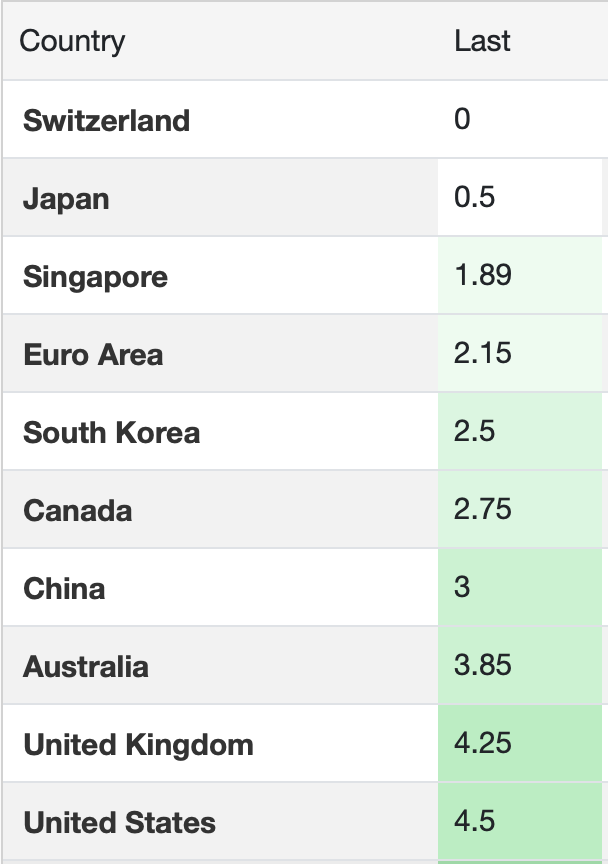
The Conundrum We Find

Tis nearly a month since the vote
When President Trump, Harris, smote
So maybe it’s time
To sample the clime
Of what all his plans now connote
 
To many, his claims are just talk
With pundits believing he’ll balk
But history shows
That Trump will bulldoze
Detractors as he walks the walk
 
So, tariffs are likely to be
The first part of his strategy
But if that’s the case
The dollar may chase
Much higher than he’d like to see
 
It seems the conundrum we find
Is not all his thoughts are aligned
And this, my good friends
Is why dividends
Are paid to a hedge, well designed


I have tried to stay away from forecasting how things will evolve once Mr Trump is inaugurated, but this weekend, listening to a podcast (Palisades Gold Radio) I got inspired as there was some interesting discussion regarding the dollar.  As I consider the issues, as well as what appears to be the current expectations, I thought it might be worthwhile to note my views, especially in the context of companies considering their hedging needs for 2025 and 2026.

Clearly, the watchword for Trump is tariffs as he has been boasting about implementing significant tariffs on trade counterparties on day 1.  The latest discussion is 25% on Canada and Mexico and 60% on China with Europe in the crosshairs as well.  (Remember, though, many believe these tariff threats are being used to encourage those countries to change their emigration policies and help stop the current influx of illegal immigration.  So, if countries do their part, those tariffs may never materialize.)

The classical economic view is that tariffs are a terrible policy as impeding free trade negatively impacts all players.  As well, you will hear a lot about how the countries in question will not pay them, but rather consumers in the US will pay those tariffs.  As such, there is a great deal of talk about how tariffs will feed immediately into inflation.  (Of course, this is in addition to the inflation that will allegedly come immediately on the heels of Trump’s promise to deport all illegal aliens in the country because it will decimate the workforce.  On this subject, simply remember that the deportation will result in a significant decline in demand for things like housing which remain quite sticky in the pricing process.)

But let’s consider what Trump’ stated goals really are.  I would boil them down to rebuilding America’s industrial capacity and creating good jobs throughout the nation for citizens and legal residents.  If he is successful, the result will be a dramatic reduction in the trade deficit which will reduce the need to import so much foreign capital to fund things.  And what are the knock-on effects there?  Well, classical economics tells us that tariffs will be met with foreign currency depreciation (higher dollar) in an effort to offset the higher prices of those imports.  However, one of Trump’s goals is to reduce the value of the dollar in order to make US exporters more competitive internationally while reducing demand for imports.  Now, it seems that those two goals are at odds.

I think the thing we need to consider, though, is that the timing of these changes is very uncertain.  My guess is Trump is thinking of a 4-year process, or at least a 3-year one, not a 6-month outcome.  After all, these are tectonic shifts which will take time to play out.  Based on his commentary, and I think we must pay it close attention as he is pretty clearly telling us what he wants to do, the market response to any tariffs imposed will likely be weakness in the currencies of the countries affected.  

But, over time, it would not be surprising to see Trump lean effectively on the Fed to reduce policy rates (remember, he was quite upset the Fed never went negative).  As well, if there is any success in the DOGE project, with significant reductions in spending and deficits, that seems likely to alleviate some of the concerns over the US fiscal stance.  After all, if debt grows more slowly than the nominal pace of the economy, it remains quite manageable and should help remove some of the current hysteria.  In fact, a look at the 10-year yield over the past month (see chart below) shows that it has fallen 25bps (although they are 4bps higher this morning) and may well be signaling a market that is willing to give DOGE a chance.  If that is the case, it seems quite possible that the dollar will eventually start to recede from its current loftier levels.

Source: tradingeconomics.com

Bringing this back to the hedging issue, I might suggest that given the uncertainty of the timing of any movements, receivables hedgers will be well-served by using optionality here, whether outright purchases or zero-premium structures as they look to address 2025 and 2026 exposures.  While the dollar may well continue its recent strengthening trend with the euro heading to parity or below for a time, and other currencies following, at some point in H2 25 or beyond, it is quite feasible that the dollar reverses course.  Consider what could happen if Trump convenes a Mar-a -Lago accord, similar to the Plaza Accord of 1985, which saw the dollar decline dramatically in the ensuing three years, falling nearly 50% against a broad mix of trading partners’ currencies by the end of 1987.

Source: tradingeconomics.com

In that situation, those out-month hedges will want to have optionality to allow the weaker dollar to benefit the revenue line.  Similarly, for those with payables hedges, care must be taken to hedge effectively there as well given the opportunity for much higher costs due to the potential dollar decline.  Current market pricing (implied volatilities) is quite reasonable from a long-term perspective.  While they are not near the lows seen in the past year, they very likely offer real value for hedgers of either persuasion.

I apologize for the extended opening, but it just seemed to be a good time to review the evolving Trump impact.  Now onto markets. The first thing to recall is that last Wednesday’s PCE data continued to show that inflation, even in this measurement, appears to have stopped declining and is beginning to head higher again.  This will continue to put pressure on the Fed as housing data was pretty dreadful last Wednesday.  Add to the data conundrum the unknown unknowns of a Trump presidency and Chairman Powell will have his hands full until his term ends.

Friday’s abbreviated session in the US saw two of the three major indices trade to new all-time highs (NASDAQ is < 1.0% below its recent high) and that seemed to help support the Asian time zone markets with green outcomes nearly universal.  Japan (+0.8%), China (+0.8%) and Hong Kong (+0.65%) all had solid sessions as did every regional exchange other than Indonesia (-0.95%) which has been suffering for the past several months in contrast to most other nations.  In Europe, the picture is more mixed with most bourses in the green (DAX +0.8%, IBEX +0.9%) although the CAC (-0.35%) is feeling pain from increased worries that the government there will fall, and the fiscal situation will be a disaster going forward.  French yields continue to climb vs. every other European nation as the country is leaderless for now.  For the rest of the continent, slightly softer PMI Manufacturing data seems to have investors increasing their bets that the ECB is going to become even more aggressive in their rate cutting going forward.  As to the US futures market, at this hour (7:00) it is mixed with the SPX (+0.5%) rising but the other indices little changed.

In the bond market, as mentioned above, US yields have rallied a bit although European yields are all lower by between -2bps and -4bps (France excepted at unchanged) as those hopes for an ECB rate cut are manifest here as well.  As to JGB’s, 10yr yields are higher by 2bps this morning as there is increasing chatter that Ueda-san will be hiking rates later this month.  One other interesting note here is that in the 30-year space, Chinese yields have fallen below Japanese yields for the first time ever.  This seems to be an indication that market expectations of a Chinese rebound (despite solid Caixin PMI data overnight at 51.5) are limited at best.

In the commodity markets, oil is little changed on the day, remaining below the $70/bbl level but potentially seeing some support after a story surfaced that China would be reducing its purchases of Iranian oil in an effort to avoid US sanctions and tariffs under the Trump administration.  If Trump is successful in isolating Iran again, that could well support prices.  In the metals markets, this morning is seeing a little profit-taking in the precious space after last week’s late rally, but industrial metals are little changed.

Finally, the dollar is stronger again this morning, rallying against all of its counterparts in various degrees.  The euro (-0.5%) is lagging along with SEK (-0.65%) in the G10 space as concerns over slowing growth weigh on the single currency.  But the dollar is stronger across the board.  In the EMG bloc, BRL (-0.75% and back above 6.00) is leading the way lower but we have seen declines across the board with MXN (-0.4%), KRW (-0.7%), ZAR (-0.6%) and HUF (-1.1%) just some of the examples.  Despite that hotter than expected PCE data last Wednesday, the market is still pricing a nearly 62% probability of a cut by the Fed later this month.

On the data front, there is much to learn this week, culminating in NFP data on Friday.

TodayISM Manufacturing47.5
 ISM Prices Paid55.2
TuesdayJOLTS Job Openings7.48M
WednesdayADP Employment150K
 ISM Services55.6
 Factory Orders0.3%
 Fed’s Beige Book 
ThursdayInitial Claims215K
 Continuing Claims1905K
 Trade Balance-$75.1B
FridayNonfarm Payrolls195K
 Private Payrolls200K
 Manufacturing Payrolls15K
 Unemployment Rate4.2%
 Average Hourly Earnings0.3% (3.9% Y/Y)
 Average Weekly Hours34.3
 Participation Rate62.6%
 Michigan Sentiment73.3

Source: tradingeconomics.com

In addition to all the data, we hear from 10 different Fed speakers, most notably Chairman Powell on Wednesday afternoon.  Given that the recent data does not seem to be going according to their plans, at least not the inflation data, it will be very interesting to hear what Powell has to say about things.

As the end of the year approaches with many changes certain to come alongside the Trump inauguration, I will once again express my view that hedging is crucial for risk managers here.  While I see the dollar benefitting in the near term, as discussed above, the longer-term situation is far less certain.

Good luck

Adf