Whispers in the Wind

Whispers in the wind
Imply rates may be rising
Sooner than we thought

In the wake of Friday’s noncommittal payroll data, which I will discuss below, the topic garnering the most interest this morning is the BOJ and whether they will be adjusting monetary policy one week from today rather than in April.  There have been several articles published on the topic which is usually a sign that the BOJ is floating trial balloons.  At this point, the market is pricing about a 2/3 probability of a move next week based on current Japanese OIS swap data.  That is a significant increase compared to the pricing just two weeks ago.  In addition, we have seen a number of analysts from the major Japanese banks move their call to March from April previously

You may recall that a key discussion point on this subject has been the Spring wage negotiations and whether the new round will embed higher wages into the economy.  Last week I mentioned that Rengo, one of the labor associations, was seeking a 5.85% increase, which would be the largest such move in more than 30 years.  As it happens, the results will be released this coming Friday, so if the outcome is high enough, arguably Ueda-san and the BOJ would have enough information for a move.

One other interesting tidbit was the fact that last night, the BOJ remained out of the equity market despite the fact that the TOPIX (Japan’s other major index) fell more than 2% in the morning session.  Ever since Covid and the market panics then, on every occasion when the morning session saw the index decline that much, the BOJ was a buyer in the afternoon.  While this was not an official policy per se, it was the reality.  The upshot is that the BOJ is the largest holder of Japanese stocks in the world, owning something on the order of 8% of the market.  The fact that despite that decline, they changed their response could well be a tell that other changes are coming.

In the end, I would argue it matters less whether the first adjustment happens in March or April and more about just how far they are going to adjust policy.  I remain unconvinced that this is the beginning of a true normalization of monetary policy, or perhaps more accurately, that the BOJ is going to raise rates to bring them in line with the rest of the G10.  Rather, my sense is we will get to 0.0% at the first move, and that over the ensuing years, a move to even 0.3% in the overnight market will be difficult to achieve absent a major explosion of economic growth alongside rapidly rising inflation.  And frankly, I just don’t see that happening at all.

Keep this in mind, 2-year JGB yields, which have been edging higher steadily for the past two months, are still at only 0.2%.  That is not a sign that the market is expecting a dramatic increase in Japanese policy rates anytime soon.  Since the beginning of the month, the yen has rallied about 2.65% on this story.  Can it go much further?  Certainly, there is room for further strength given its performance over the past several years.  However, I would argue that will rely on the Fed cutting rates, and doing so aggressively, to truly narrow the yield differential.  And right now, I just don’t see that happening.

On Friday, the payroll report
In some ways, came up rather short
While headlines were strong
Revisions felt wrong
For rate hikes, more folks, to exhort

By now, you are aware that despite a much stronger than forecast headline NFP print of 275K, (exp 200K), the revisions to the prior two months were -167K, which took the luster off the headline and reverted the revision story back to negative from the surprising positive result last month.  In addition, the Unemployment Rate rose 2 ticks to 3.9% and Average Hourly Earnings only rose 0.1% on the month.  The market response here was interesting, to say the least.  While Treasury yields continued their recent slide, perhaps anticipating Fed action sooner rather than later, the equity market sold off as well, although that easily could have been simple profit taking after a huge run higher.  Of more interest is the fact that NY Fed President Williams, the last Fed speaker before the quiet period started, sounded just a touch more dovish than a number of the speakers we heard last week.

At this point, market participants are focused on a couple of things I think, with the next big thing tomorrow’s CPI print.  Thursday brings Retail Sales and then, of course, the FOMC statement and Powell presser is the following Wednesday.  June remains the odds-on favorite for the first Fed cut but that is subject to change based on tomorrow’s data.  If CPI indicates that the January number was not an aberration, and that inflation is actually stickier than many (want to) believe, I would not be surprised to see the median dot plot expectations rise to only 2 rate cuts in 2024. That is substantially fewer than the current estimate of 4+.  That will have a significant impact on markets if that is the case.  Alternatively, a very soft number tomorrow could easily bring May back onto the table for the first rate cut and may alter the dot plot in the other direction.  We shall see,

As the market awaits all the upcoming news, here’s what happened overnight.  Along with the slide in Japanese shares, most Asian markets sold off, all in the wake of Friday’s weak US equity performance.  The one exception was China, where both the Hang Seng (+1.4%) and CSI 300 (+1.25%) rallied at the end of the Chinese National People’s Congress as hopes for more stimulus remain high. In Europe, bourses are all in the red, although the declines have not been excessive, just -0.25% to -0.5%.  And at this hour (7:45), US futures are pointing slightly lower, -0.2% across the board.

In the bond market, yields are generally little changed in both treasury and European sovereign markets with all eyes on tomorrow’s data.  Last week’s ECB meeting didn’t really add too much to the conversation although it appears that expectations are cementing around a June rate cut, regardless of the Fed’s actions.  Overnight, JGB yields edged another 2bp higher, which given the increased scrutiny on a March rate hike is not that surprising.

In the commodity markets, oil (-0.5%) is sliding a bit and generally remaining right in the middle of its $75-$80 trading range for the past month.  Meanwhile, gold, while little changed this morning, is holding onto its recent gains and showing no signs of slipping back soon.  As to the base metals, copper (+0.3%) is edging higher while aluminum is unchanged on the day.  These metals markets are looking toward China to get a sense of the chances for fresh new demand.

It can be no surprise that the dollar is largely unchanged this morning with very modest gains and losses across both the G10 and EMG blocs.  In the G10, JPY (+0.3%) is the biggest mover with the rest of the bloc +/-0.1% on the day and giving no signal.  In the EMG bloc, KRW (+0.5%) is the largest mover, although it is not clear what would have driven the move as equities there fell pretty sharply overnight.  Also, CNY (+0.15%) is rallying after CPI data released over the weekend showed a monthly rise of 1.0% and that brought the Y/Y number back into positive territory at +0.7%.

On the data front, there is some other interesting data aside from CPI as follows:

TuesdayCPI0.3% (3.1% Y/Y)
 -ex food & energy0.4% (3.7% Y/Y)
ThursdayInitial Claims218K
 Continuing Claims1911K
 Retail Sales0.7%
 -ex autos0.4%
 PPI0.3% (1.2% Y/Y)
 -ex food & energy0.2% (2.0% Y/Y)
 Business Inventories0.2%
FridayEmpire State Manufacturing-7.5
 IP0.0%
 Capacity Utilization78.4%
 Michigan Sentiment76.6

Source tradingeconomics.com

However, while there is a bunch of stuff coming out, I suspect that after CPI, it will all be anticlimactic.  As we are in the Fed quiet period, there will be no commentary, although in the wake of the CPI report, look for anything in the WSJ from the current Fed whisperer, Nick Timiraos.  This is especially so if the numbers are far from expectations.

In the end, today ought to be very quiet overall, with all eyes on tomorrow.  From there we shall see.

Good luck

Adf

Not Very Far

Said Jay, we are not very far
From when we can all wave au revoir
To higher for longer
With confidence, stronger,
Inflation will reach our lodestar
 
“We’re waiting to become more confident that inflation is moving sustainably at 2%.  When we do get that confidence — and we’re not far from it — it’ll be appropriate to begin to dial back the level of restriction.”  So said Chairman Powell yesterday in front of the Senate Banking Committee in response to some of the questions he received.  Nuff said!  Regardless of the fact that there has been limited indication of slowing economic activity (although this morning’s payroll report will be critical), it seems quite clear that Powell is under a great deal of pressure to reduce rates.  One must assume this pressure comes from the White House as in last night’s SOTU speech, President Biden even mentioned that mortgage rates were too high, and he was going to push them down.  Clearly, the only tool that Biden has is to lean on Powell to cut rates.
 
But despite what had appeared to be a concerted effort by every Fed speaker to push back against the proximity of the first interest rate cut for this cycle, it appears that Powell is blinking.  Interestingly, while the Fed funds futures markets didn’t really adjust very much, we did see the 2yr Treasury yield fall back 5bps and this morning it sits slightly below 4.50%, its first time back to this level since the surprising CPI print last month.  Of course, equity markets love the message, and we continue to see new highs on a daily basis.  But we are also continuing to see new highs in the anti-fiat monies, gold and bitcoin.  The world is not without risk.
 
An angry old fella named Joe
Last night tried explaining our woe
Was not his, to blame
Though he wouldn’t name
The culprit, throughout the whole show
 
While I try to leave politics out of this missive, the status of the SOTU is such that I don’t believe it can be completely ignored.  My takeaway from last night’s speech was that President Biden, in an attempt to show vigor, came across as the angry old man shaking his fist and yelling at the clouds.  He had a laundry list of things he claims to want to accomplish, all of which will cost trillions of dollars, and none of which are likely to be enacted before the election.  Many pundits pointed out this seemed more like a campaign speech than a SOTU and I think there is merit in that view.  In the end, while we understand where the pressure on Powell is coming from, I don’t believe this is going to change anything, certainly not from a market perspective.
 
And finally, it’s time to turn
To data for which we all yearn
The Payroll report
Which, if it falls short
Will likely give hawks great heartburn

Looking ahead, this morning brings the monthly payroll report.  Current median expectations are as follows:

Nonfarm Payrolls200K
Private Payrolls160K
Manufacturing Payrolls10K
Unemployment Rate3.7%
Average Hourly Earnings0.3% (4.4% Y/Y)
Average Weekly Hours34.3
Participation Rate62.6%

Source: tradingeconomics.com

Recall, last month’s number was massively higher than anticipated at 353K and had higher revisions as well.  The revisions were almost more surprising than the headline number as the trend for the entire previous year had been for revisions to be to softer data.  There will certainly be revisions to the January data as well, so there is a great deal of uncertainty.  My sense is, though, that the market really wants to see a softer number with downward revisions as that will work toward cementing the case for the Fed to cut rates even sooner.  Sub 150K and look for a bond and stock rally.  Above 250K and bonds will sell off, although stocks have a life of their own.  At least that’s one man’s view.

Ok, let’s look at how things played out overnight ahead of this key data.  Asian markets followed the US rally with green across the screen.  The Hang Seng, which is seen as the tech proxy in Asia, rallied most, 0.75%. Europe, on the other hand, is having a tougher day with most markets slightly softer although the FTSE 100 is down -0.5%, the clear laggard this morning.   Apparently, Madame Lagarde’s comments did nothing to support the hopes that rate cuts were coming soon as ostensibly, rate cuts were not even discussed in the meeting and all signs point to June as the first time by which they will have confidence in the inflation story, if it is to come.  Meanwhile, US futures are pointing a bit lower, -0.3%, at this hour (8:00).

In the bond markets, Treasuries have edged lower another 1bp this morning and we are seeing yields across the board in Europe decline by between 2bps and 4bps.  I can’t tell if that is confidence in the ECB (doubtful) or belief that the ongoing decline in economic activity (Eurozone GDP in Q4 was confirmed at 0.0% Q/Q and 0.1% Y/Y) has simply encouraged investors that rates are going to fall with no chance of a backup.  Meanwhile, JGB yields were unchanged overnight despite the ongoing excitement(?) that the BOJ may raise rates a week from Monday.

Oil prices have retreated a bit (-0.6%) but are essentially range trading and have been for the past month.  However, the star of the commodity space continues to be the barbarous relic, with gold rallying another 0.3% this morning to yet another new all-time high.  As to the base metals, copper is unchanged this morning, but has been on a roll lately while aluminum is higher by 0.65%.  Metals investors are gaining confidence that not only is there going to be no landing in the US, but that China is going to stimulate more.

Finally, the dollar remains under pressure overall as yields continue to decline.  While the euro is a touch softer this morning, virtually every other G10 currency is firmer with JPY (+0.55%) leading the way.  Remember, too, that with FY end approaching for Japan, we will begin to see Japanese corporates repatriating funds which typically sees further yen strength.  Combine that seasonal activity with the relatively new BOJ hawkishness/Fed dovishness combination and the yen could rally a lot more.  After all, it has fallen a lot in the past two years!  But, while the G10 currencies are generally having a good day, the picture in the EMG bloc is far more mixed with BRL (-0.6%) the laggard after total credit in Brazil was shown to have fallen in January for the first time since the pandemic.  On the flipside, CLP (+1.0%) is rallying after a higher-than-expected CPI report (4.5%) has traders looking for tighter monetary policy than previously anticipated.

Aside from the payroll report, there is no other data to be released and there are no Fed speakers on the calendar.  Yesterday we did hear Cleveland Fed president Mester sound more hawkish, becoming the third FOMC member to discuss only 2 cuts this year, and I maintain that when the dot plot comes out, that could be the median view.  But for now, markets and investors remain euphoric about the apparent Powell dovishness, so that will be the driver absent a huge NFP this morning.  For the dollar, that will be bad news.

Good luck and good weekend

Adf

What If?

What if inflation’s not dead
And set to go higher instead?
Can Fed funds still fall?
Well, that’s a tough call
If not, look for trouble ahead


As we await Tuesday’s latest CPI data, I thought it might be a good time to review how things currently stand on a macro basis.  As I am just an FX guy, I am not nearly smart enough to see through the headlines and determine what is wrong with the narrative story of Goldilocks.  However, I can look at the actual numbers and perhaps we can draw some conclusions from that data.

Let’s start with CPI, as that is the next shoe to drop.  Looking at the last twelve months of monthly data, we see the following results on both an original and adjusted basis:

 CPI m/mannualizedCPI m/m (adj)annualized
Dec-230.33.60.22.4
Nov-230.23.00.22.4
Oct-230.12.40.12.0
Sep-230.43.00.42.7
Aug-230.53.60.53.36
Jul-230.23.40.23.2
Jun-230.2 0.2 
May-230.1 0.1 
Apr-230.4 0.4 
Mar-230.1 0.1 
Feb-230.4 0.4 
Jan-230.5 0.5 
Data tradingeconomics.com, calculations @fx_poet

Since the January 2024 data hasn’t been released, there would ordinarily be no revision yet.  However, as I wrote last week, the BLS does an annual revision which lowered the December 2023 result by a tick.  

As you can see that one tick had a big impact on the annualization trend for the past 6 months, and especially the past 3 months (highlighted), reducing it substantially.  Now, given the imperfections of the measuring process, 0.1% is probably not significant in the broad scheme of things.  But oh boy, for the narrative, it is everything.  Prior to that revision, it was pretty easy for those who believe inflation has bottomed to highlight that turn higher in the annualization rate.  This was especially true given how much the ‘inflation is dead’ crowd was relying on just that point.  But now that turn looks like a dead-cat bounce and is not nearly so impressive.  Tuesday’s outcome will be quite interesting as anything that is soft will almost certainly encourage the doves to be calling for a March cut more aggressively, and just as certainly, we will see risk assets rally sharply as the dollar declines.  A hot print, though, 0.3 or more, will have the opposite impact.

What if the ‘conomy’s state
Was built by the deficit’s weight?
And actual growth
Ain’t fast, but more sloth
Will Janet, more spending create?


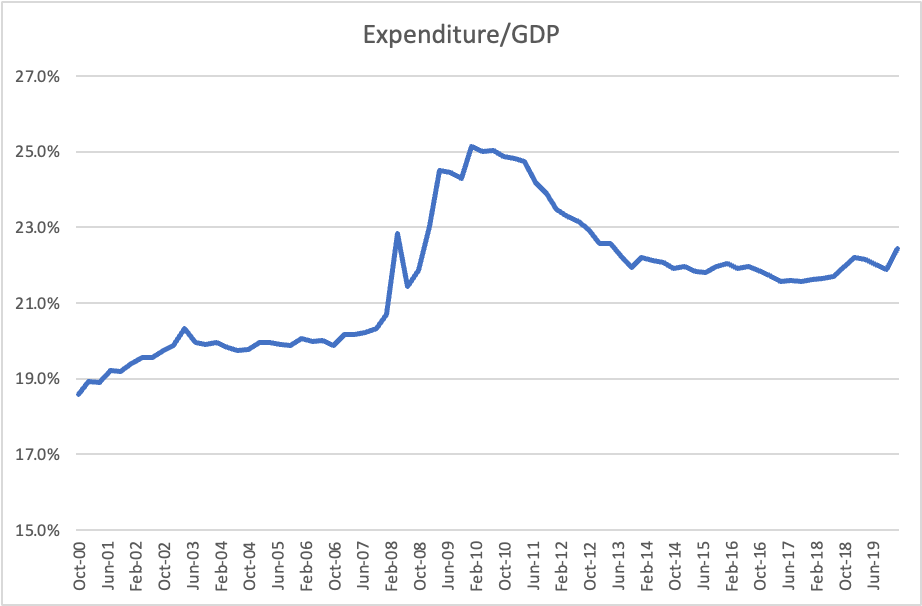
When looking at GDP data and Federal government expenditures, it becomes pretty easy to determine why GDP continues to percolate along so well.  Given that GDP = Consumption + Investment + Government + Net eXports (Y = C + I + G + NX), a quick look at the G component shows just how much support the government has been adding to the economy despite what has been recorded as strong growth.  Or perhaps, more accurately, this is why growth has been so strong.  The below chart shows the trend of government expenditures relative to total GDP growth.  I removed the Covid years because they are extremely volatile and confusing. However, looking at the trend since the GFC in 2008/2009, there has been a step change higher in the amount of government activity measured in the economy. 

Source: data FRED St Louis Fed, calculations @fx_poet

Given the current budget deficit is running > 7% of GDP and is projected to remain at least this high going forward, it is quite clear that there is a lot of nonorganic effort to raise the GDP measures.  Look at the sharp upward turn at the right side of the chart.  It appears that the administration will do everything they can to continue to show that the economy is strong.  

Of course, this is where the rubber meets the road.  If the administration continues to pump more government spending into the economy, can inflation really decline any further?  Remember, government spending is almost entirely consumption based, with limited investment at this time.  Even the CHIPS Act only created incentives for private companies to invest, it is not government investment per se.  The point is, pumping up consumption demand without adding productive capacity is very likely to drive prices higher.  And if anything, given this administration’s war on energy markets, they are discouraging investment in critical infrastructure.  It is hard to see how this plays out for a Goldilocks outcome.  Far more likely, in my view, is that they continue to pump as hard as possible, and prices start moving higher again.  Timing is everything in life, and perhaps they can work it out so price hikes are delayed until after the election, but I am skeptical given the vast incompetence this administration has shown in virtually every sphere in which it operates.

What if employment’s a mess
And actually in some distress?
Is JOLTS data real?
And what is the deal
With households, it’s hard to assess


The last big macro area is, of course, the employment situation.  We all know that the NFP report was much stronger than expected for January, rising 353K, but also seeing upward revisions of the previous months for the first time in quite a while.  In fact, one of the bearish stories had been that the revisions mattered more than the headline data, and if revisions were for the worse, that was indicative of a slowing economy.  

Remember, too, that the US employment situation is measured in two ways, via the establishment survey which is a survey of companies’ (both large and small) actual hiring activity and leads to the NFP number, and the household survey, which is a telephone survey of ~60,000 households and asks the question if someone is employed and if not, whether they are looking for work.  The Unemployment Rate is calculated from the household survey, so both are clearly critical in assessing the situation on the ground.  

The funny thing is that the numbers come across pretty differently when you dig down.  While in the long-term, both data series have shown a strong correlation (96% since January 2000), the Household survey is far more volatile and in the past year has been telling a somewhat different story than the establishment survey.  Look at this chart below mapping each since the beginning of 2023:

Source: data FRED St Louis Fed, calculations @fx_poet

Doing the math shows that the establishment survey claims that 3.409 million jobs were created while the Household survey comes in at just over half that amount, 1.852 million jobs.  Now, in a nation of 330 million people, especially given the expansion of the gig economy and the dramatic changes in employment overall, maybe that is not such a big deal.  As well, simply looking at the two lines shows that the Household survey is far more volatile than the Establishment survey.  Does this mean we should ignore the household survey, given it seems to have more noise and less signal?  The problem with this is the household survey drives the Unemployment Rate, and nobody is willing to ignore that.  And these differences beg the question, is the employment situation as rosy as it seems?  With the Unemployment rate remaining so low for so long, it certainly appears that there is ample demand for workers.  Of course, that also implies that the cost of labor seems unlikely to decline very much and could well increase further and faster.  If that is the case, the impact will be seen in the inflation data as well.

Trying to sum things up here, looking at the three critical macro variables, inflation, growth and employment, there is a strong case to be made that the combination of ongoing government support and continued demand for labor into an aging workforce can lead to solid nominal GDP growth with inflation remaining far stickier than many currently anticipate.  If that is the situation, all the hopes and dreams of the interest rate doves may be delayed, if not destroyed, as it will be increasingly difficult for the Fed to ease policy into an inflationary environment.  Arguably, this is why they are seeking greater confidence that inflation is really dead.  

Now, maybe Goldilocks is real, and inflation will continue to decline on its own because…well just because.  But I find it hard to look at the data and conclude that lower inflation is our future, at least for any length of time.

Ok, this has gotten much longer than I intended but fortunately, absolutely nothing of note happened overnight in markets.  Literally.  There has been de minimis movement in stocks, bonds, commodities and currencies, and there is a distinct lack of data to be released today.  Tomorrow’s CPI is THE number of the week, so perhaps that will get the juices flowing again and drive some movement.  Until then, a quiet day is usually a good one on which to establish hedges.

Good luck

Adf

Not Quite Mawkish

On Friday, in quite the surprise
Our payrolls did massively rise
At least that’s what printed
But where those jobs minted?
Or will, next month’s data revise?
 
Perhaps Chairman Jay had a sense
And that’s why his press confer-ence
Was ever so hawkish
Although not quite mawkish
So, traders, more buys, did commence


I would contend that nobody was anticipating the NFP data on Friday which printed so much higher than forecasts it was remarkable.  A headline number of 353K with a revision up for December of 116K is huge and certainly puts paid to any thoughts of the economy slowing.  As well, Average Hourly Earnings rose a more than expected 0.6%, certainly good for workers, but another nail in the coffin of a quick rate cut by the Fed.  Of course, none of that seems to matter anymore to equity investors as despite every indication that given the recent data, the Fed will remain higher for longer, stocks rocked higher.  Bonds did not fare quite as well, though, as 10-year yields rocketed 15bps higher by the close.

Another interesting anomaly was in the Fed funds futures market where in the immediate wake of the FOMC meeting, the probability of a March rate cut (which you may recall Powell specifically took off the table) fell to 20% from a coin toss earlier.  But Friday, that closed back at 38%! (PS, this morning it is down to 15.5%, so remains quite volatile.)  Rounding out the asset classes, the dollar followed yields, with the euro falling nearly 1% and other currencies close behind.  As to oil, that slid about $1, but it has been softening all week, so there are obviously other issues there.  What gives?

The first thing to recall is that January data tends to be pretty sloppy.  My good friend, Mike Ashton (aka @inflation_guy) made the point eloquently as follows:

This is not to say that the adjustments WILL be huge, just that over time, that has been the case.  Recall that almost every reading last year was revised lower in subsequent reports.  All I’m saying is that as terrific as that number was, add at least a pinch of salt, I think.

The other thing that doesn’t seem to square is that so many other employment indicators are trending in the opposite direction.  After all, ADP was only 107K, and the employment reading in the ISM fell last month along with the employment readings in many of the regional Fed surveys.  As well, continuing claims have been trending higher for the past several months, generally not a good sign for employment.  Again, all I am trying to highlight is that this number may not be quite as robust as it seems on the surface.  At the same time, for the Fed, if they need an excuse to leave policy at current levels, the combination of strong job growth and rising wages is plenty of ammunition.

Sunday night, Chairman Powell was interviewed on 60 Minutes but really didn’t tell us anything new.  Essentially, I would say he repeated his Wednesday press conference with one exception, he did, when asked, indicate that the current fiscal profligacy would be a problem in the long run.  To date, he has been reluctant to even discuss the issue, so perhaps that is a signal of something, but of what I have no idea.

Moving on from Friday, finally, the weekend saw the Biden administration’s retaliation for the deaths in Jordan of 3 US soldiers, however, that is not a market impactful event.  Coming into the new week, the Services PMI data has been released everywhere and we are awaiting ISM Services this morning in NY.  In aggregate, the data showed that some nations are doing better than others.  In the positive camp, India (61.8 final) was by far the nation with the highest reading, but Japan, China, Spain, Italy and the UK all showed growth above 50.  On the other side of the ledger, Australia, Germany, France and the Eurozone overall remain well below 50, although seem to have found a bottom for now.  As to the US, the current forecast is for a 52.0 print, up from December’s number of 50.6.

Is this really telling us that much?  Remember, the question that is asked in these surveys is, how do things compare this month to last month?  Remember, too, that recent data has shown weakness across the surveys with strength in the hard data.  Friday’s NFP is the perfect encapsulation of that idea.  Perhaps the one thing we can consider is that if today’s ISM is quite strong, it will be enough to completely remove March from the rate cut schedule.  Of course, my question is, if today’s data is strong, why exactly will the Fed feel the need to cut rates at all?  I simply do not understand this baseline assumption that interest rates are “too high”.  In fact, based on the evidence provided by GDP and NFP data, they seem to be just fine.  And, hey, isn’t it better for all of us to earn 5% in our Money Market Fund accounts than 0.0% like we did for years?  In fact, based on the common view that there are several trillion dollars of “excess” savings in the economy, it seems the holders of those savings must be quite happy with rates where they are.

Ok, let’s tour overnight market behavior quickly before we finish up.  In the equity space, Japanese stocks continue to rise with the Nikkei up another 0.5% while Chinese stocks continue to struggle.  While the CSI 300 managed a 0.6% gain, the small-cap CSI 1000 fell 8% as small cap stocks around the world remain unloved.  However, the Chinese government is definitely concerned as rumors of another rescue package are all over the tape.  As to Europe, modest gains are the order of the day, with most markets higher by about 0.25%.  meanwhile, US futures, they are ever so slightly softer at this hour (7:15), down about -0.1%.

Turning to the bond market, apparently everybody is turning away from the bond market!  Yields are higher across the board with Treasuries leading the way, up a further 7bps, but all European sovereign yields higher by between 3bps and 5bps as well.  The story in Asia was even more impressive with JGB’s (+5bps) and Australia (+12bps) all catching up to the Treasury story.  Ultimately, the issue I see is that while growth in the US remains strong, pretty much all of Europe is in recession.  This seems likely to lead to the ECB cutting rates before the Fed as they will have a reason to do so, while as I ask above, what is the Fed’s rationale for a cut?

The higher interest rate story has weighed heavily on commodity prices with oil sliding -0.8% this morning, although it has been falling for a week.  But we see metals prices under pressure as well with gold (-0.6%), copper (-0.4%) and aluminum (-0.6%) all sliding this morning amid the move in yields.

Not surprisingly, the dollar has been a major beneficiary of the higher yield story, following Friday’s sharp rally with a continuation across the board.  The euro is back to 1.0750, a level not seen since mid-November, while USDJPY is back above 148.50 and USDCNY above 7.21.  In fact, the only currency bucking the trend today is KRW (+0.4%) which managed to rally despite any obvious macro catalysts.  Equities fell there alongside Chinese stocks, so it was not investment inflow.  Sometimes, currencies just move, that much we know.

Turning to the data this week, there is much less on the docket than we saw last week with, arguably, today’s Services ISM the most important number.

TodayISM Services52.0
WednesdayTrade Balance-$62.2B
 Consumer Credit$15.0B
ThursdayInitial Claims220K
 Continuing Claims1902K

Source: tradingeconomics.com

However, we do hear from 10 different Fed speakers this week starting with Atlant’s Raphael Bostic and then inundated rhoguhout the week.  But I ask you, will they really stray far from Powell’s message?  Especially after the blowout NFP number?  Higher for longer still lives, and if we continue to get strong data, May will soon start losing its appeal for a rate cut.  This will not help the bond market, that’s for sure, but it will help the dollar.

Good luck

Adf

Beware

It wasn’t all that long ago
When Powell commanded the show
At least so it seemed
But maybe we dreamed
Those attributes we did bestow
 
But now traders seem not to care
That Wednesday, Chair Jay said beware
No rate cuts next meeting
Instead, they are treating
That warning’s though it wasn’t there
 
The upshot is bonds are on fire
And stocks turned around and went higher
Today’s NFP
Will help us to see
If Jay is still leading the choir


Well, it seems that Chair Powell’s hawkish message resonated with investors for about 12 hours, at which point they decided to forget all he said and side with Treasury Secretary Yellen and her spending plans.  Or maybe the trading community just doesn’t believe he can pull it off, keep policy rates at 5.5% while the government needs to borrow so much money.

There are other possible explanations as well.  The NYCB meltdown yesterday may have opened some eyes regarding the commercial real estate (CRE) problems that certainly exist everywhere in the world, but notably here in the US.  If reclassifying just two loans was enough for a $100 billion bank to cut their dividend completely and increase loan loss reserves nine-fold, what about all the other CRE loans that are also under pressure on other bank balance sheets?  Perhaps the bond market is sniffing out the next banking crisis in front of our eyes.  For the conspiracy theorists, the Fed did remove the following line from their statement yesterday, “The U.S. banking system is sound and resilient.”  Perhaps that was a hint that it is not sound and resilient.

Regardless of the driver, yesterday saw a ripping rally in the bond market with the 10-year yield touching 3.82% before bouncing, nearly as low as it reached following Powell’s ultra-dovish performance in December.  That certainly doesn’t square easily with the hawkish statement and comments on Wednesday.

I have no good explanation for the movements, and I would argue neither does anyone else.  As has been the case for the past year, at least, economic data is simply a Rorschach test for your underlying views and biases.  Once again, the financial markets appear to be fighting the Fed tooth and nail.  Perhaps one clue was the fact that gold prices rallied yesterday, as did bitcoin.  Now, it is possible that is simply because lower yields enhance the willingness to hold those assets, or perhaps it is because the market smells a banking crisis coming and wants to hide.

Fortunately, we get new and important information this morning with the release of the NFP data at 8:30.  Here are the current median forecasts:

Nonfarm Payrolls180K
Private Payrolls155K
Manufacturing Payrolls5K
Unemployment Rate3.8%
Average Hourly Earnings0.3% (4.1% Y/Y)
Average Weekly Hours34.3
Participation Rate62.4%
Factory Orders0.2%
Michigan Sentiment78.9

Source: tradingeconomics.com

As well, the BLS will be releasing their annual revisions to their data, so everything will be a mess.  However, traders, and trading algorithms, only ever look at the headlines.  The fact that 11 of the past 12 NFP numbers have been revised lower over time seems not to be a major concern to investors, although it is certainly not a positive signal for the economy writ large.

In the end, we are all beholden to this data point and the market’s reaction function.  Based on what we have seen since the FOMC meeting I would suggest that a weak number will be seen as risk-on because it will encourage more rate cut talk and bring March back into view.  (FYI, the current probability of a March cut according to the futures market is 34.5%.  Sub 100K and I would look for that to go back to 50% at least.)  At the same time, a strong print, > 200K, and I expect a risk-on response as it will encourage the earnings growth story and reduce the probability of a recession.  In fact, after the strong earnings reports from Meta and Apple last night, the only way I think we see a risk-off outcome today is if NFP is sharply negative, enough so it forces people to put recession back on their bingo cards.  We shall see.

In the meantime, a quick look at the overnight session shows that Asian equity markets are back on the buy Japan / sell China train with the CSI 300 falling to its lowest level since 2019 as investors remain unimpressed by Xi’s efforts to fix things in China.  But away from China, the rest of the markets in Asia all had good session, up between 0.5% and 1.5%.  In Europe, green is the theme as well with every market higher on average by 0.7% or so.  Not surprisingly given the earnings reports, US futures are green as well, with the NASDAQ +1.0% at this hour (7:10).

Bond markets are all over the map this morning.  Treasury yields are unchanged from the closing level yesterday, although they bounced 5bps from that intraday low print mentioned above.  As to European sovereigns, yields have edged higher by 1bp-2bps on the continent although UK Gilts are higher by 6bps which is a bit strange given the BOE yesterday seemed far more dovish than many expected.  While leaving rates on hold, they explained they expected inflation to temporarily get back to their 2% target in Q2 before bouncing a bit, and the vote included one vote to cut rates, 6 to maintain and 2 to raise, a more dovish tilt.  And yet here we are, with Gilts selling off.  If you were interested, JGB yields have fallen as well, down 2bps and falling away from any ideas of policy changes in Tokyo.

Oil is little changed this morning after getting crushed yesterday on unconfirmed rumors of a cease-fire in the Israel-Gaza conflict.  It seems the betting is that if there is a cease-fire, the Houthis will stop attacking ships in the Red Sea and things will improve everywhere.  However, as of yet, no cease-fire has been reached.  As to the metals markets, gold is little changed after a more than 1% rally yesterday, while both copper and aluminum are softer this morning, although the movements have been small and may be meaningless.

Finally, the dollar is a bit softer this morning with AUD (+0.5%) the leading G10 gainer on the back of the ASX 200 reaching a new all-time high closing level overnight.  But the movement here is broad and shallow, most currencies are a bit stronger vs. the dollar, but that 0.5% move is the largest by far.  My take is that as long as US yields remain under pressure, the dollar will be on its back foot as well.  Hence, a strong NFP this morning could see yields bounce and the dollar along with it.

And that is all we have today.  It has been quite a week between the QRA, the FOMC and Powell presser and now today’s NFP.  While there was a great deal of uncertainty as the week began, at this point, it seems clear that the market has decided that rates are coming lower regardless of what Powell has to say.  We have yet to hear from any other Fed speakers, although I imagine we will be getting a full dose next week.  And Sunday night, on 60 Minutes, Powell will be interviewed so that will be closely watched for any clues.  Until then…

Good luck and good weekend

Adf

Ending QT

The lady from Dallas explained
The balance sheet might be constrained
So, ending QT
Is likely to be
The way the Fed’s goals are attained
 
However, investors ain’t sure
That ending QT is the cure
So, worries abound
As traders have found
Most stocks have now lost their allure

Over the weekend, Dallas Fed President Lorie Logan, whose previous role was head of markets at the NY Fed and so knows a thing or two about the monetary plumbing, explained in a speech that QT, at its current pace, is likely going to be too restrictive going forward.  While she threw in the obligatory line about the idea the Fed may still need to raise the Fed funds rate if inflation remains too robust, I would contend that this is another sign the Fed is coming to the end of its tightening regime.  She explained that the swift decline in the Reverse Repo (RRP) facility indicated there may be a significant decline in liquidity in markets and that could have a detrimental impact on equity prices the economy’s future path and derail the widely assumed soft-landing scenario.

For some context, the RRP facility peaked almost exactly one year ago, touching about $2.55 trillion as the Fed was paying more on excess reserves than was available in short-term paper and Treasury bills.  But as the government has flooded the market with T-bills of late, and there is no indication that pace is going to slow down, the yield on bills rose above the IOER rate the Fed was paying.  As such, money market funds have pushed funds from the RRP into purchasing bills and the RRP facility now has “just” $694 billion as of Friday.  A look at the chart below from the FRED database of the St Louis Fed shows the sharp downward trajectory of the facility’s balances.  But also notice that prior to March 2021, this facility basically was at $0 for its entire history.  My point is that this facility does not have a long history of supporting market activities or liquidity, rather it is a recent construct designed to help smooth out temporary fluctuations.  It’s just that the concept of temporary here seems akin to the Fed’s concept of transitory when it comes to inflation.

At any rate, the FOMC Minutes also mentioned the idea that QT would likely need to slow down, and the committee needed to discuss the proper timing of these things.  Logan’s comments were exactly in this vein as the Fed seem like they are working very hard to prepare market participants for the beginning of an easing cycle.  It’s kind of funny that throughout November and December, the Fed seemed a bit concerned that markets were overexuberant, but after a modest equity market sell-off to start the year, much of which can probably be put down to profit-taking on a tax advantaged* basis, they seem suddenly concerned that things are falling apart.

Logan’s comments were in the wake of Friday’s data which showed NFP stronger than expected, although another month of downward revisions for previous readings, and showed wages gaining a bit more than expected.  The initial move here was that further tightening was on the way, or certainly that easing was delayed, but then the ISM Services index was released at 10:00am and it was much worse than expected, 50.6, with the Employment sub-index printing at a horrible 43.7, its lowest level excluding the Covid months, and indicative that perhaps the job market is not quite so robust.  This helped unwind the tightening discussion and Friday’s markets ultimately closed little changed.

Which brings us to this morning, where the most noteworthy price action is in the commodity space with oil (-2.8%) sharply lower after Saudi Arabia cut its pricing indicating that demand is slow, and gold (-1.25%) falling sharply although a rationale there is far harder to find given the dollar is essentially unchanged on the day and it certainly doesn’t appear that peace is breaking out in either Israel/Gaza or in Ukraine.

While there has been a bit of data released from Europe, none of it was substantially different from expectations and it showed that the status quo remains there, overall, a weak Eurozone economy with prices still on the sticky side.  As well, there have been no speakers this morning which just leaves us all unsure of the next big thing.

Now, in fairness, we do have the next big data point coming on Thursday, CPI in the US, which I am assured by so many analysts is THE critical data point.  I was also confident that NFP was critical, so perhaps CPI will be less exciting than forecast.  In the meantime, a look at the rest of the overnight session shows that Japan was on holiday so there was no market activity, but Chinese shares have continued their weak ways, falling more than -1.3% across all the indices there.  It seems to me that despite some very real efforts to inculcate fear of China by certain politicians, President Xi has an awful lot of domestic issues to address.  European shares, though, are little changed with a few very modest gainers (DAX +0.15%) and a few very modest decliners (FTSE 100 -0.2%) and everything else in between.  US futures are softer this morning as the weekend story regarding Boeing’s 737 Max being grounded is weighing on the stock and the market as a whole.

In the bond market, Treasuries are unchanged on the day while European sovereigns are all seeing yields climb between 4bps and 5bps.  This move seems like a catch-up to Friday’s US price action, which if you remember saw a sharp decline in yields early and a rebound later on.  Ultimately, this space will continue to be driven by the central banks with the Fed funds futures market still pricing in a > 60% probability of a 25bp cut in March with Europe seen likely to follow shortly thereafter.

Having already touched on commodities, a look at the dollar shows that while the euro, pound and yen are all little changed, there is a bit more movement in the dollar’s favor amongst some less liquid currencies with AUD (-0.4%), NOK (-0.85% on weak oil prices) and KRW (-0.4%) leading the way.  I continue to see the FX markets as an afterthought to the broad economic picture right now but have not changed my view that if the Fed does lead the way in easing policy, the dollar is likely to slide.

On the data front, here is what this week brings:

TodayConsumer Credit$9B
TuesdayNFIB Small Biz Optimism91.0
 Trade Balance-$65.0B
ThursdayInitial Claims210K
 Continuing Claims1853K
 CPI0.2% (3.2% Y/Y)
 -ex food & energy0.2% (3.8% Y/Y)
FridayPPI0.1% (1.3% Y/Y)
 -ex food & energy0.2% (1.9% y/Y)

Source: tradingeconomics.com

As well, we do hear from several Fed speakers this week starting with Bostic today and then Williams and Kashkari as the week progresses.  At this stage, I expect that we are likely to see less volatility as my guess is most profit adjustments have been made and all eyes are turned to CPI on Thursday.  Until then, it is likely to be a dull week (famous last words!)

Good luck

Adf

*This tax advantage is simply that taxes will not be due until April 2025, so perhaps tax deferred is a better description.

Quite Frail

While everyone’s waiting to see
How high or low payrolls might be
The news from elsewhere
Is starting to wear
Quite thin, look at China’s Zhongzhi
 
This bankruptcy sounds the alarm
That others there might come to harm
The soft-landing tale
Which still is quite frail
Has started to lose its quaint charm

Before we start on the payroll report, I think it is important to mention a significant issue that was revealed last night in China, where Zhongzhi, one of the largest non-bank financial and investment companies on the mainland, filed for bankruptcy and liquidation.  It has been missing both interest and principal payments for the past several months and it simply became too great a problem to ignore any longer.  The data released indicates that the company had ~$31 billion more in liabilities than assets and has become one of the largest bankruptcies in China’s history.  

The company was a major player in the property market there, although its main business was high yielding investment products, essentially structured notes, where much of the property backed collateral has fallen dramatically in value and where cash flows that had underpinned the notes have now ceased amid the property collapse.  This is hardly an advertisement for the Chinese economy and another sign that things there remain in a downtrend.  While the renminbi is marginally firmer this morning, up 0.2%, that is a consequence of the PBOC establishing the CFETS fixing at a much stronger than expected level in their effort to prevent substantial weakness in the currency.  

The upshot is that the Chinese economy remains in difficult straits, and the government’s reluctance to increase fiscal support is being felt everywhere.  (On the other hand, the PBOC has added $600 billion in liquidity to the economy in the past week.)  Ongoing weakness in Europe is another problem for Chinese exporters and the ongoing disagreements and tariff wars with the US simply add additional pressure to President Xi.  Next Saturday the first big election of 2024 will be held, in Taiwan, and if the incumbent party retains control, currently the betting favorite, Xi may find himself with quite a few problems to address this year.  A weak economy, rising geopolitical tensions globally and a rejection of his entreaties to the people of Taiwan is a bad look for a megalomaniacal dictator like Xi.  Just sayin’.

OK, let’s turn to this morning’s big story, the NFP report.  Here are the analyst consensus estimates according to tradingeconomics.com:

Nonfarm Payrolls170K
Private Payrolls130K
Manufacturing Payrolls5K
Unemployment Rate3.8%
Average Hourly Earnings0.3% (3.9% Y/Y)
Average Weekly Hours34.4
Participation Rate62.7%
ISM Services 52.6
Factory Orders2.1%

Now, yesterday we saw two other pieces of employment data, the ADP (164K and much higher than expected) and Initial Claims (202K and much lower than expected).  These numbers have many in the market looking for a strong print although the correlation between ADP and NFP has been underwhelming for quite a while.  While we can discuss the merits of the estimates and the overall strength of the economy, I think we are better served, this morning, to focus on the potential impacts of a given number and how that has been evolving so far this week/year.

This morning, the 10-year yield is up to 4.04%, some 25bps above the lows touched post-Christmas, and starting to indicate that some people are having second thoughts on the idea of the Fed aggressively cutting rates this year.  As an example, while I never believed there to be a chance of a rate cut at the end of January, the market was pricing a 17.5% chance of that just a week ago.  This morning the probability is down to 4.7%.  As well, just last week the market was pricing in 6 rate cuts in 2024.  That is now down to 5 cuts and fading. One of the big stories around this morning is that someone has put on a very large option position expiring later today that the 10-year yield will be above 4.15%.  To profit, this trade will require one of the largest yield moves seen in months.

The point is that the nirvana belief set that had been driving markets since the beginning of November is clearly under a significant amount of pressure here.  After all, the NASDAQ has had 5 consecutive negative closes, bond yields, as mentioned, have rallied sharply and are breaking through short-term technical resistance, the dollar is rallying, and the bulls are feeling quite unloved.

Is this the end of the bull story?  Frankly I don’t believe that is the case.  However, risk assets got a bit overexuberant during November and December and have come a long way in a short time.  It is not surprising to see a retracement of prices to help unwind some of the froth.  Ultimately, I believe the question that matters in the medium and long term is the state of the economy and whether the recent growth trajectory will continue, or if we have peaked for now.

One of the things that has me concerned in the medium term is the fact that the government continues to run a massive fiscal deficit despite what appears to be a reasonably strong economy.  Recall, Keynes instructed governments to spend during recession, but tighten their belts during good times.  However, the new mantra is far more in line with Modern Monetary Theory, which is spend as much as you can at all times.  

A quick thought experiment regarding the underlying economy might look like this: GDP = $27 trillion, Federal spending = $10 trillion, Federal deficit = $1.7 trillion.  What if the government didn’t run a deficit, but was neutral?  Removing that much stimulus from the economy would have a significant negative impact on the US economy’s growth trajectory, which is the reason no politician wants to do that.  But the question at hand is how healthy is the economy on its own?  And are growth prospects there really that substantial?  One of the keys to the recent employment picture is that government jobs continue to grow rapidly (look at the gap between NFP and private payrolls).  As long as the US government can continue to borrow money cheaply to fund its profligate ways, it is completely realistic to expect the economy to continue to grow.  However, the reason the bond market story is so important is that the bond market is the place where it will become clear if this is possible.  If Treasury yields continue their recent climb, the pressure on the economy will increase, and the pressure from the government on the Fed to support the bond market will increase.  Forget ending QT.  If the Fed were to find itself in a place where they needed to restart QE to support the bond market, that would be an incredibly important signal that inflation was going to accelerate again, and likely commodity prices would follow.  That would also be a very negative sign for the dollar.  So, lower bonds, lower dollar, higher commodities and likely a nominal rise in equities, at least initially.  My point is there is much about which we need be concerned and wary.

In the quickest of recaps possible, equities around the world have mostly been under pressure with only Japan managing to rally but weakness in China and across all of Europe.  The same is true with US futures, all in the red this morning by about -0.3%.

Bond yields are also rising around the world (except in Japan) with gains on the order of 6bps-8bps across the continent, similar to what we saw in Australia overnight. 

Oil prices are rebounding this morning, up 1.3%, despite much larger than expected inventory builds shown in yesterday’s IEA data, but the metals markets are continuing under pressure for now with the base metals weak and gold edging lower.

And finally, the dollar is continuing its rebound led by USDJPY, where the yen is down a further 0.4% and back above 145 for the first time since early December.  In the G10 space, I would say the movement has been about -0.3% overall, but in the EMG space, things are a bit more active with average declines here of about -0.7% across the three main geographic blocs.

That’s really it.  Now we just wait for the payroll report and later this morning the ISM Services number, and then we get to hear from Tom Barkin again, but it would be shocking if his view changed from just two days ago.  For some reason, I have a feeling the payroll data will fall short this morning, but that’s just a feeling.

Good luck and good weekend

Adf

Dragged Through the Mud

The year started out with a thud
As equity markets saw blood
The bond market fell
And oil’s death knell
Was sounded, whilst dragged through the mud
 
The question we now must address
Is, are markets set to regress?
Or, is this a blip
O’er which we can skip
Without adding too much new stress?


Has the narrative already changed?  That seems to be the question we really need to ask after just one day of trading in 2024.  It seems hard to believe that the macroeconomic fundamentals have changed very much, especially since we have not gotten any substantial data yet.  While ISM Manufacturing (exp 47.1) and JOLTS Job Openings (8.85M) are due later this morning, it beggar’s belief that the market is anticipating much there.  Sure, we get the payroll report on Friday, but given the goldilocks, soft-landing scenario had seemed to be the prevailing theory, have we actually seen anything that would change that view?

Of course, it is possible that market participants are fearful that the FOMC Minutes, which are released at 2:00 this afternoon are not going to reconfirm their broadly dovish views.  You may recall that at the December FOMC meeting, Chairman Powell did nothing to disabuse the markets of the idea that the Fed had not only finished tightening, but that it was getting set to ease.  From that point, the Fed funds futures market has priced in a total of six rate cuts for 2024, twice the number the median dot plot numbers showed and a pretty dramatic easing, especially if the economy does not fall into recession.

There is, of course, another possible rationale for yesterday’s weak start in risk assets; they were wildly overbought.  Since that Fed meeting in the middle of December, stocks had rallied sharply (S&P 500 +3.4% at its peak), 10-year yields fell 40bps at their trough and the dollar, as measured by the DXY, had fallen more than 2%.  The peak (trough) was seen immediately after Christmas, and we have been drifting back since then.  In fact, I think it is fair to say that markets got a bit exuberant in the wake of the FOMC meeting.

But as we get back to fully staffed trading desks and investment managers are back from their holiday breaks, I suspect that price action is going to moderate a bit while volumes improve.   As I tried to make clear yesterday, I believe that the recent uptrend in risk assets will continue broadly until we see enough data to change opinions.  There remains a pretty large group of analysts who are in the “inflation is going to 1%” camp and that will allow (force?) the Fed to cut rates more aggressively to prevent real interest rates from becoming too restrictive.  As that is a pleasing narrative, and one that the current administration would really like to see evolve, I expect that we will hear a lot about that for a while.  And maybe that is what will come to pass.

However, my suspicions and fears are that 2024 will be less idyllic than those goldilocks scenarios that are being painted by the soft-landing crowd.  I find it difficult to believe that amongst all the potential big picture problems, including escalation of the Middle East war, the Ukraine war, China’s recent threats about reunification of Taiwan, and the more than 40 elections that are due this year, culminating in the US election, there won’t be at least a few major hiccups.  In fact, the ongoing unhappiness in the US electorate is likely to be one of the biggest issues driving what I believe will be risk aversion before the year ends.  But that has not yet manifested itself, so we are likely to have interesting times ahead.

In the meantime, let’s look at the overnight price action.  After the weak US equity performance, APAC markets mostly fell, with only Japan (Nikkei -0.2%) really holding in well.  European bourses this morning are all lower, on the order of -1.0%, with the CAC (-1.5%) really suffering and US futures all in the red, led by the NASDAQ (-0.7%) although the others are down about -0.35% at this hour (7:45).  Clearly, there has been no joy yet.

As to the bond market, this morning has seen Treasury yields back up a further 4bps and they are now at 3.97%, well off the lows seen post-Christmas.  European bond markets have seen less aggressive rebounds in yields as the economic picture on the continent remains more dire than here in the US.  Arguably, the ECB has a much tougher job than the Fed right now as the inflation data in Europe remains higher than in the US while economic activity is clearly slowing much more rapidly.  (I guess if they had pumped as much fiscal stimulus into their economy as we did into ours, they wouldn’t be in this situation.  Of course, the debt situation might be worse…). Ultimately, however, I expect that the lack of growth is going to dominate the mindset in Europe and that Madame Lagarde will be cutting rates as soon as she can.  One last thing, Japan.  Remember all the stories in December about how the BOJ was getting set to normalize policy (i.e., return rates to positive territory) and that Japanese investors would be repatriating money soon?  Well, this morning 10-year JGB yields are at 0.60%, far below the 1.00% former YCC cap and the new reference rate and showing no signs of doing anything unusual.  

Turning to the oil market, while it is rebounding this morning, +0.8%, it has been under significant pressure lately despite what appears to be a serious increase in the military posture in the Red Sea amid Houthi rebel attacks on ships and the US Navy responding more aggressively.  In fact, Maersk, the largest shipping company in the world, has once again indicated it will not transit the Red Sea, an outcome that can only negatively impact the cost basis for shipping, and ultimately push upwards on inflation.  This is an area where we need to keep a close eye for new developments.  However, this morning the metals markets are under pressure as gold (-0.65%) is giving up some of its recent gains, although remains well above the $2000 level.  But we are seeing weakness in the base metals as well, with both copper and aluminum under pressure this morning.

Perhaps a key driver of the metals markets has been the fact that the dollar has continued its rebound with the DXY higher by 0.3% this morning, having rallied 1.5% from its recent post-Christmas nadir.  This has been a broad-based dollar rally with gains against both G10 and EMG currencies as it seems to be a dollar story.  The best I can figure is that there is concern/anticipation that the Minutes are going to sound more hawkish than people remember the meeting and press conference.

On the data front, we see the following:

TodayISM Manufacturing47.1
 ISM Prices Paid47.5
 ISM Employment 46.1
 JOLTS Jobs Openings8.85M
ThursdayADP Employment115K
 Initial Claims216K
 Continuing Claims1883K
FridayNonfarm Payrolls168K
 Private Payrolls130K
 Manufacturing Payrolls5K
 Unemployment Rate3.8%
 Average Hourly Earnings 0.3% (3.9% Y/Y)
 Average Weekly Hours34.4
 Participation Rate62.7%
 ISM Serv ices52.6
 Factory Orders2.1%

Source: Tradingeconomics.com

Interestingly, only Richmond’s Thomas Barkin is scheduled to speak this week, first this morning and then on Friday afternoon as well.  

Absent a new escalation in the Middle East, though, I would look for a little more profit-taking ahead of the payroll data.  However, I continue to believe the market is going to push for the bullish framework for a few months at least which means equities will rally, yields will slide, and the dollar will fall as well.

Good luck

Adf

The New Allegory

On Friday, the data surprised

With job growth more than advertised
So, bonds took a bath
And stocks strode a path
Where growth is what’s now emphasized

But what of the soft landing story?
Will rate cuts now be dilatory?
If Jay just stands pat
Will stocks all go splat?
Or is this the new allegory?

Well, this poet was clearly wrong-footed by Friday’s employment report where not only were non-farm payrolls stronger than anticipated at 199K, but hours worked rose and the Unemployment Rate fell 2 ticks to 3.7%.  While revisions to previous reports were lower, as they have been all year, the report did not point to an imminent slowing of the economy nor a recession in the near-term.  Arguably, the soft-landing crowd made out best, as equity markets, which initially plunged on the report following Treasury prices, rebounded as investors decided that growth is a better outcome than not.  Yields jumped higher, as would be expected, rising 8bps in the US with larger gains throughout Europe before they went home for the weekend.  And finally, the dollar flexed its muscles again, rallying universally with gains against 9 of the G10 currencies, averaging 0.4% (only CAD (+0.1%) managed to hold its own) and against most of the EMG bloc with a notable decline by ZAR (-1.1%), although MXN (+0.6%) bucked the trend.

Does this mean the soft landing is coming?  As we start the last real data intensive week of 2023, it remains the favored narrative, but is by no means assured.  After all, before the end of this week we will have seen the latest CPI reading in the US (exp 3.1% headline, 4.0% core) and we will have heard from the FOMC, ECB and BOE as well as several smaller central banks like the Norgesbank and the SNB.  And let us not forget that the BOJ meets next Monday.  So, there is plenty of new, important information that is coming soon and will almost certainly drive potential narrative changes.

Perhaps an important part of the discussion is to define what we mean by a soft landing, or at least what the ‘market’ means by the concept.  My best understanding is as follows: GDP slides to 1% or so, but never goes negative.  Unemployment may edge higher than 4.0%, but only just, with a cap at the 4.2% or 4.3% area, and inflation, as measured by Core PCE finds a home between 2.0% and 2.5%.  This result, measured inflation falling back close to target while the growth and employment story just wobbled a bit, would be nirvana for Powell and friends.  

How likely is this outcome?  Ultimately, history is not on their side as arguably the only time the Fed ‘engineered’ a soft landing was in 1995, and on an analogous basis they had already started cutting rates by this time in the cycle.  The fact that we are still discussing higher for longer implies that there is much more pain likely to come than the optimists believe.  We have already seen the first signs of trouble as the number of bankruptcies soar and stories about non-investment grade companies needing to refinance their debt at much higher interest rates than the previous round fill the news.  Certainly, Friday’s employment data is encouraging for the economic situation, but the chink in the armor was the wage data which showed more resilience (+0.4%) than expected.  Given the Fed’s focus on wages and their impact on inflation, the fact that wage growth remains well above the levels the Fed deems appropriate to meet their inflation target is not a sign that policy ease is coming soon.

And ultimately, I believe that is the critical feature here.  The economy has held in remarkably well considering the pace and size of the interest rate changes we have already seen.  The big unknown is how much of that interest rate change has really been felt by the economy.  Obviously, the housing market has felt the impact, and to some extent the auto industry, but otherwise, it is not as clear.  Do not be surprised if this period of slow economic activity extends for a much longer time than in the past as the drip of companies that find themselves unable to refinance at affordable rates slowly grows.  By 2025, about $1 trillion of corporate debt that was issued at much lower interest rates will need to be refinanced.  I’m not worried about Apple refinancing their debt, but all the high-yield debt that was snapped up with a 4% or 5% handle during the period of ZIRP will now be at 10% or so and it is an open question if those business models will be functional with financing that expensive.  

So, perhaps, the story will be as follows:  economic activity is going to muddle along at low rates for an extended period, another 2 or 3 quarters, until such time as the debt ‘time-bomb’ explodes with refinancing rates high enough to force many more bankruptcies and start a more aggressive recessionary cycle with layoffs leading to rapidly rising Unemployment rates and economic activity falling more sharply.  In this timeline, we are talking about the recession becoming clear in Q3 of 2024, a time when most of that $1 trillion of corporate debt will be current.    While interest rates will certainly be slashed at some point, this does not bode well for risk assets in the second half of 2024.  For now, though, it certainly seems like the current narrative is going to continue.

There’s no urgency

To change policy quite yet
But…some day we will

A quick story about the BOJ which last night pushed back firmly against the growing narrative that they were about to start normalizing interest rate policy with a rate hike in either December or January.  Instead, several stories were released that described the recent decline in both GDP and inflation as critical and the fact that they still don’t have enough information with respect to wages in Japan, given the big spring wage negotiation has not yet happened, to make a decision.  In other words, the BOJ was successful at convincing markets to behave as the BOJ wants, not as the rest of the world wants.  The upshot was that the yen weakened sharply (-0.9%) while the Nikkei rose 1.5% and JGB yields were unchanged.  The BOJ pivot remains one of the biggest themes in the macro community, mostly because it is seen as the place where the largest profits can be made by traders.  But my experience (4 years working for a Japanese bank) helps inform my view that whatever they do will take MUCH longer to happen than the optimists believe.

Ok, let’s try a quick trip around markets here for today.  Aside from Japan, most of Asia had a good equity session with Hong Kong (-0.8%) the only real laggard.  Remember, a key story there remains the Chinese property sector as many of those firms are listed in HK.  Meanwhile, European bourses are mixed although movements haven’t been very large in either direction.  The worst situation is the UK (FTSE 100 -0.5%), while we are seeing some gains in the CAC and DAX, albeit small gains.  Finally, US futures are pointing a bit lower, -0.2%, at this hour (7:45).

In the bond market, after Friday’s dramatic price action, Treasury yields are continuing to rise, up 5bps this morning, although European sovereign yields are little changed on the day, with the bulk of them slipping about 1bp.  Given most saw quite large moves on Friday, and given the imminent policy decisions by the big 3 central banks, I suspect traders are going to be quiet for now.  

Oil prices (-0.3%) are slipping slightly this morning but are mostly consolidating Friday’s gains.  On the metals front, though, everything is red with gold, silver, copper and aluminum all under pressure.  Again, this is the one market that has been pricing a recession consistently for the past several months while certainly equity markets have a completely different view.

Finally, the dollar is continuing to rebound on the strength of rising Treasury yields.  While the euro is little changed on the day, the yen is driving price action in Asia with weakness also seen in CNY, KRW and TWD.  As well, ZAR (-0.8%) continues to suffer on weaker commodity pricing and both MXN and BRL are under pressure leading the LATAM bloc lower.  At this point, I would say the FX market has more faith in Powell’s higher for longer mantra than some other markets.

As mentioned, there is a lot of data this week:

TodayNY Fed Inflation Expectations3.8%
TuesdayNFIB Small Biz Optimism90.9
 CPI0.0% (3.1% Y/Y)
 -ex food & energy0.3% (4.0% Y/Y)
WednesdayPPI0.1% (1.0% Y/Y)
 -ex food & energy0.2% (2.3% Y/Y)
 FOMC Rate Decision5.5% (unchanged)
ThursdayECB Rate Decision4.5% (unchanged)
 BOE Rate Decision5.25% (unchanged)
 Retail Sales-0.1%
 -ex autos-0.1%
 Initial Claims221K
 Continuing Claims1891K
FridayEmpire State Manufacturing2.0
 IP0.3%
 Capacity Utilization79.2%
 Flash PMI Manufacturing49.1
 Flash PMI Services50.5

Source tradingeconomics.com

Thursday also has the Norges Bank and SNB, both of whom are expected to leave rates on hold.  For today, it strikes me that the discussion will continue as pundits try to anticipate what the FOMC statement will say and how Powell sounds in the press conference.  As such, it is hard to get excited that there is going to be a big move in either direction.  With all that in mind, my overall read on the economy is that while we may muddle along in the US for a while yet, it will be better than many other places in the world, notably the EU, the UK and China, and so the dollar is likely to hold up far better than most expect…at least until Powell changes his tune.

Good luck

Adf

Jay Powell’s Dream

As markets await the release

Of Payrolls, all things are at peace
But once it’s revealed
We need watch the yield
In 10-years lest it should decrease

While Goldilocks is still the meme
And certainly, Jay Powell’s dream
The data’s beginning
To show growth is thinning
More quickly both down and upstream

So, here’s the scoop.  Today is payrolls day and that is the only thing that anybody cares about right now, ahead of the release, and it will be the topic du jour by all the talking heads for the rest of the day.  As of 7:00am, here are the latest consensus forecasts according to tradingeconomics.com:

Nonfarm Payrolls180K
Private Payrolls153K
Manufacturing Payrolls30K
Unemployment Rate3.9%
Average Hourly Earnings0.3% (4.0% Y/Y)
Average Weekly Hours34.3
Participation Rate62.7%

Now, looking at a chart of the past year’s releases, the numbers seem to show a very gradual decline, albeit hardly in a regular manner.

But let’s take a look at some underlying data that may help us understand the bigger picture a bit better.  First off, one of the things that draws a great deal of criticism is the birth/death model that the BLS uses to estimate the number of new companies that start up, hiring people, compared to the number of companies that close with the resulting job losses.  A key reason that every month this year has seen the data revised lower is because that portion of their data continues to be revised lower.  Historically, the birth/death model is at its worst during an inflection point, when the economy is either entering or exiting a recession.  Those downward revisions are a strong clue that things are not going that well.

But there is something else worth noting and that is the BLS breaks the payroll data down on a state-by-state basis as well.  This is not something that gets a lot of press but is nonetheless important.  While this data only goes back to 1976, that is still a fairly robust series.  I highlight this because every time in the past, when all 50 states + Washington DC have seen a decline in the number of employed workers, we have been in a recession already.  And shortly thereafter, the first negative NFP prints started showing up, usually withing 2-3 months.  Well, guess what?  Last month saw every state in the union report a decrease in the number of employed persons.  This is quite a negative signal for the economy, and one that is not getting much press, certainly not from the soft-landing set.  

I’m not saying that we are going to get a negative NFP print this morning, just that it seems one is coming to a screen near you soon.  If history is any guide, then sometime in Q1 seems realistic.  And ask yourself how Chairman Powell and his friends on the FOMC will respond to that type of data.  They had better hope that the recent trend in inflation, which has clearly been on a downward trajectory, continues, because otherwise, the Chairman will have nowhere to hide.  Cut rates to address economic weakness while stoking still firm inflation?  Leave rates on hold to fight inflation and let growth crater further?  Talk about a rock and a hard place.

It seems to me that the evidence continues to pile up on the side of a recession coming early next year.  Absent another wave of MMT or helicopter money or some type of direct fiscal stimulus by the federal government, this business cycle seems destined to end soon.  The bond market has been telling us that since the beginning of last month.  The oil market has been telling us that since the beginning of last month too.  The stock market has still not gotten the message.  It will, trust me, and it won’t be pretty.  However, I don’t think today is the day it will happen.  Just be prepared.

So, how have markets performed leading up to the NFP data?  Well, following yesterday’s rally in US stocks, Asia had a mixed picture.  Japanese equities continue to be pressured by a combination of concern over tighter monetary policy and a strengthening yen.  There was, however, a bump on the road to that tighter policy thesis as Q3 GDP was revised lower to -2.9% Y/Y, with the M/M falling -0.7%.  Will they really tighten policy into a shrinking economy?  Meanwhile, despite the word from the Chinese Politburo that they would be adding more fiscal stimulus in 2024, shares in Hong Kong and on the mainland barely eked out gains of 0.1%.  The rest of APAC, though, had a decent performance, with gains ranging from 0.3%-0.9%.

European bourses are in good shape today, with green across the board, albeit some just barely (DAX +0.1%) and some more robustly (CAC +0.7%).  Finally, US futures are edging lower, -0.2% or so, as I type (7:30am).

In the bond market, yields, which as we know have been trending sharply lower since early November, are rebounding slightly this morning with Treasuries up 3bps and European sovereigns all showing increases of between 5bps and 9bps. That seems a bit odd to me as there has been no data indicating inflation is rising or growth is impressive of late.  In fact, the Eurozone inflation data continues to point to deflation as Germany’s final reading came in at -0.4% in November.  In fact, as much as markets are expecting the Fed to cut rates soon, with a 60% probability now priced in for the March meeting, I suspect that the ECB is going to be cutting before the Fed as Eurozone growth and inflation are falling rapidly.  As to JGB’s, yields there edged higher by 1bp overnight and currently sit at 0.75%, certainly not pressing on the 1.00% cap.  

Turning to the commodity markets, oil (+2.2%) has finally found its footing with WTI back above $70/bbl.  While there continue to be rumors that OPEC+ is going to cut production further, this feels much more like a trading bounce than a structural move.  Interestingly, industrial metals are having a very good day with both copper and aluminum higher by 1% or more although gold is unchanged on the day.  Ordinarily, I might attribute that to a weaker dollar except that the dollar’s not weaker this morning.

Speaking of the dollar, if you remove the yen from the equation, it has, in truth, been reasonably strong.  Perhaps a better description is that other currencies have been weak as things like European economic doldrums weigh on those currencies while declining oil prices weigh on the petro-currencies.  Now, for all the JPY bulls out there, be careful as the weakening GDP growth and the fact that the most recent CPI data, while still above target, started to decline means that there is less pressure on Ueda-san to change policy.  Yes, they have started to discuss the idea of lifting rates out of negative territory, but they have also been quite clear that they need to see wage gains and the wage story really won’t be clear there until the March wage negotiations are completed.  All I’m saying here is that we have come quite a long way in less than a month.  Do not be surprised by a sharp rebound that wipes out a lot of profit and positions.

And that’s really it for the day.  At 10:00 we also see the first cut of the Michigan Sentiment Index (exp 62.0) as well as the concurrent inflation expectations indices (1yr 4.5%, 5yr 3.3%).  But by then, I expect that the excitement will have passed, and the market will be following whatever trend develops from the payrolls.  If pressed, I expect a softer number, something like 100K and a tick higher to 4.0% on Unemployment.  If that is correct, I expect that the market will continue with its ‘bad news is good’ concept and buy stocks in anticipation of Fed rate cuts.  But remember, virtually every time the Fed is cutting rates aggressively because economic activity is declining, risk assets are being sold, not bought.

Good luck and good weekend

Adf