Printing Up Gobs

The balance sheet, so said Chair Jay
Is really the very best way
For policy ease
And so, if you please,
QT is soon going away
 
Rate cuts are now back on the table
As we work quite hard to enable
Those folks lacking jobs
By printing up gobs
Of cash, just as fast as we’re able


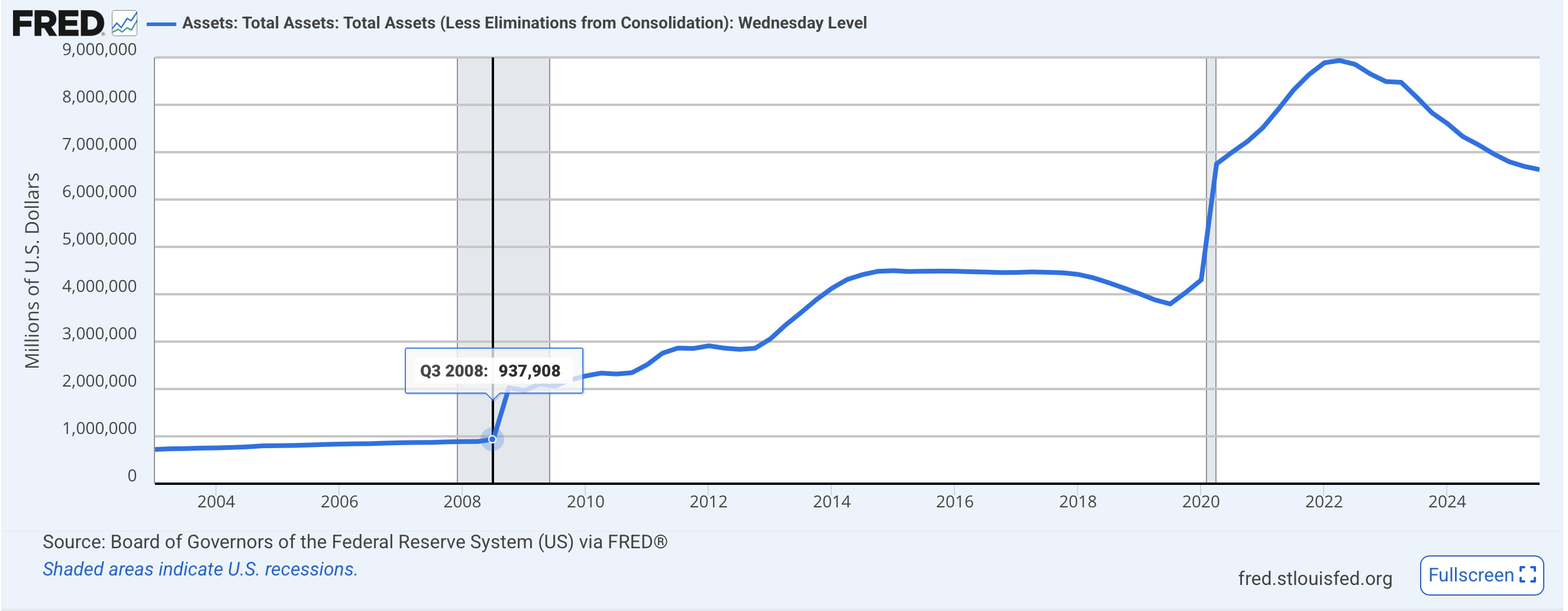
Chairman Powell spoke yesterday morning in Philadelphia at the NABE meeting and the TL; DR is that QT, the process of shrinking the Fed’s balance sheet, is coming to an end.  Below is a chart showing the Fed’s balance sheet assets over the past 20+ years.  I have highlighted the first foray into QE, during the financial crisis, and you can see how that balance sheet has grown and evolved since then.
And the below chart is one I created from FRED data showing the Fed’s balance sheet as a percentage of the nation’s GDP.
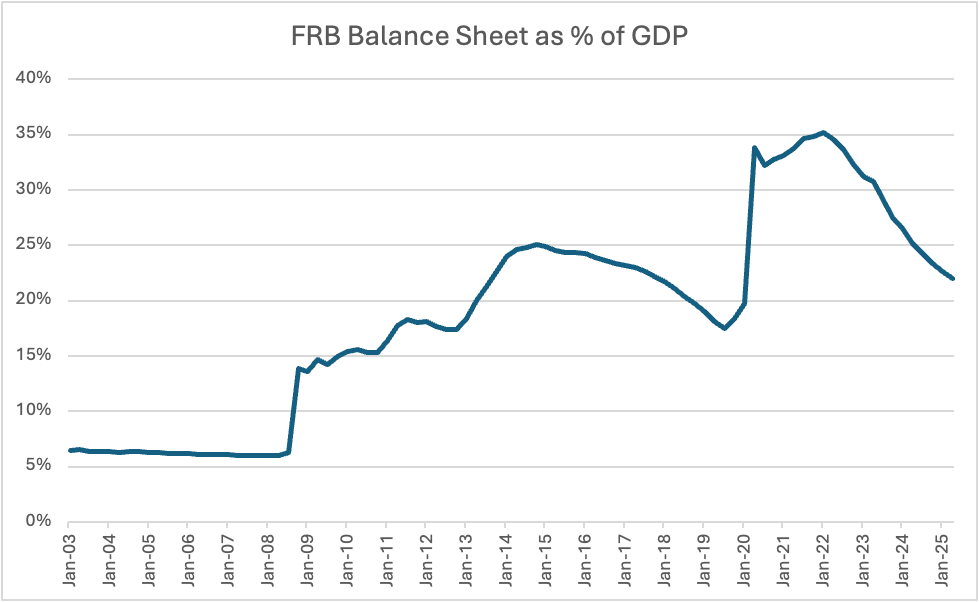
Pretty similar looking, right?  The history shows that the GFC qualitatively changed the way the Fed managed monetary policy, and by extension their efforts at managing the economy.  As is frequently the case, QE was envisioned as an emergency policy to address the unfolding financial crisis in 2008, but as Milton Friedman warned us in 1984, “Nothing is so permanent as a temporary government program.”  QE is now one of the key tools in the Fed’s toolkit as they try to achieve their mandates.

There has been a great deal of discussion regarding the issue of the size of the Fed’s balance sheet, paying interest on reserves, something that started back in 2008 as well, and what the proper role for the Fed should be.  But I assure you, this is not the venue to determine those answers. 

However, of more importance than the speech, per se, was that during the Q&A that followed, Mr Powell explained that the Fed was soon reaching the point where they were going to end QT, and that they were going to seek to change the tenor of the balance sheet to own more short-term assets, T-bills, than the current allocation of holding more long-term assets including T-bonds and MBS.  And this was what the market wanted to hear.  While both the NASDAQ and S&P 500 both closed slightly lower on the day, as you can see from the chart below, the response to Powell’s speech was immediate and impressive.
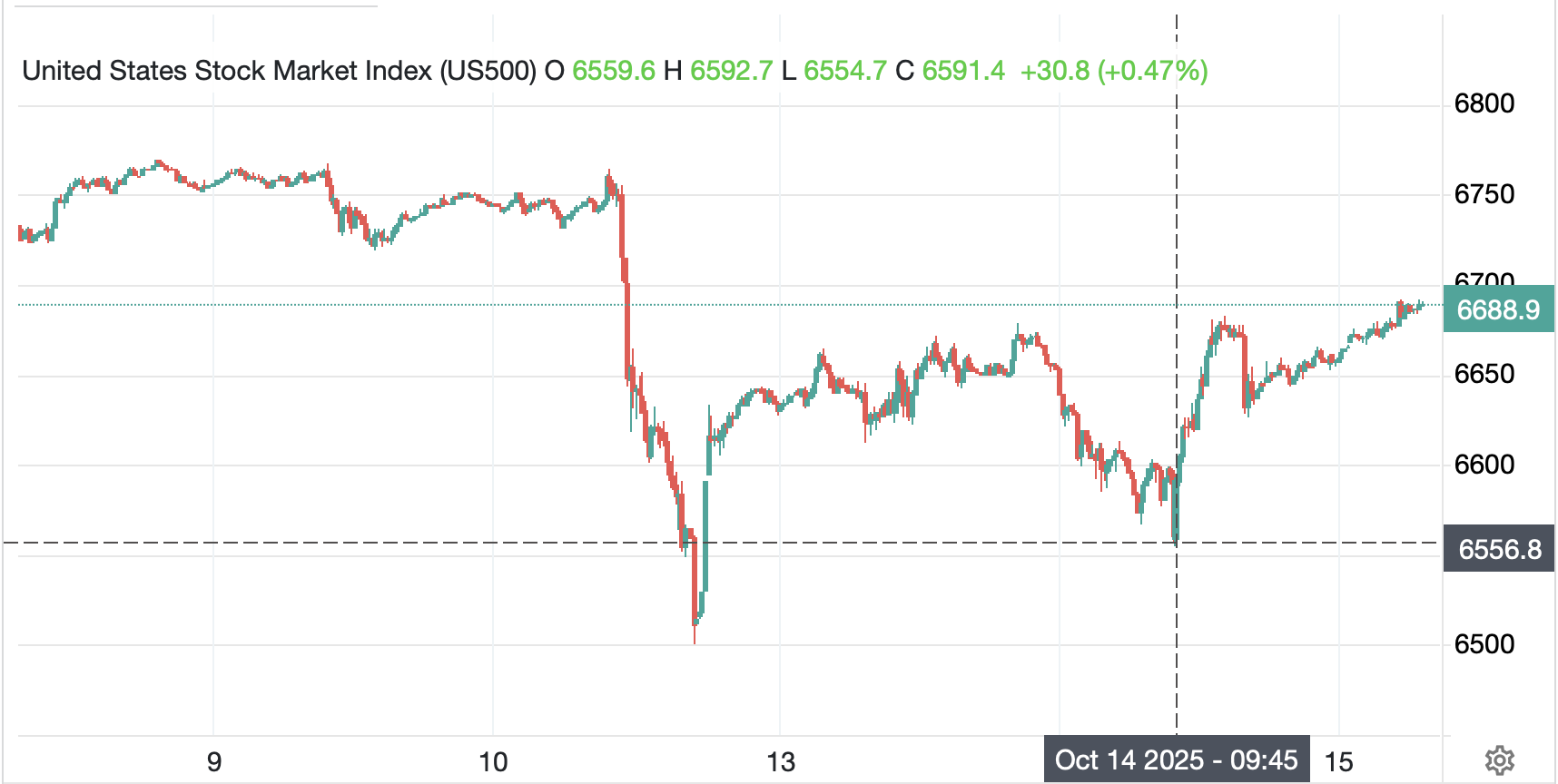
Source: tradingeconomics.com

Too, other markets also responded to the news in a similar manner, with gold, as per the below chart accelerating its move higher.

Source: tradingeconomics.com

While the dollar, as per the DXY, responded in an equally forceful manner, falling sharply at the same time.
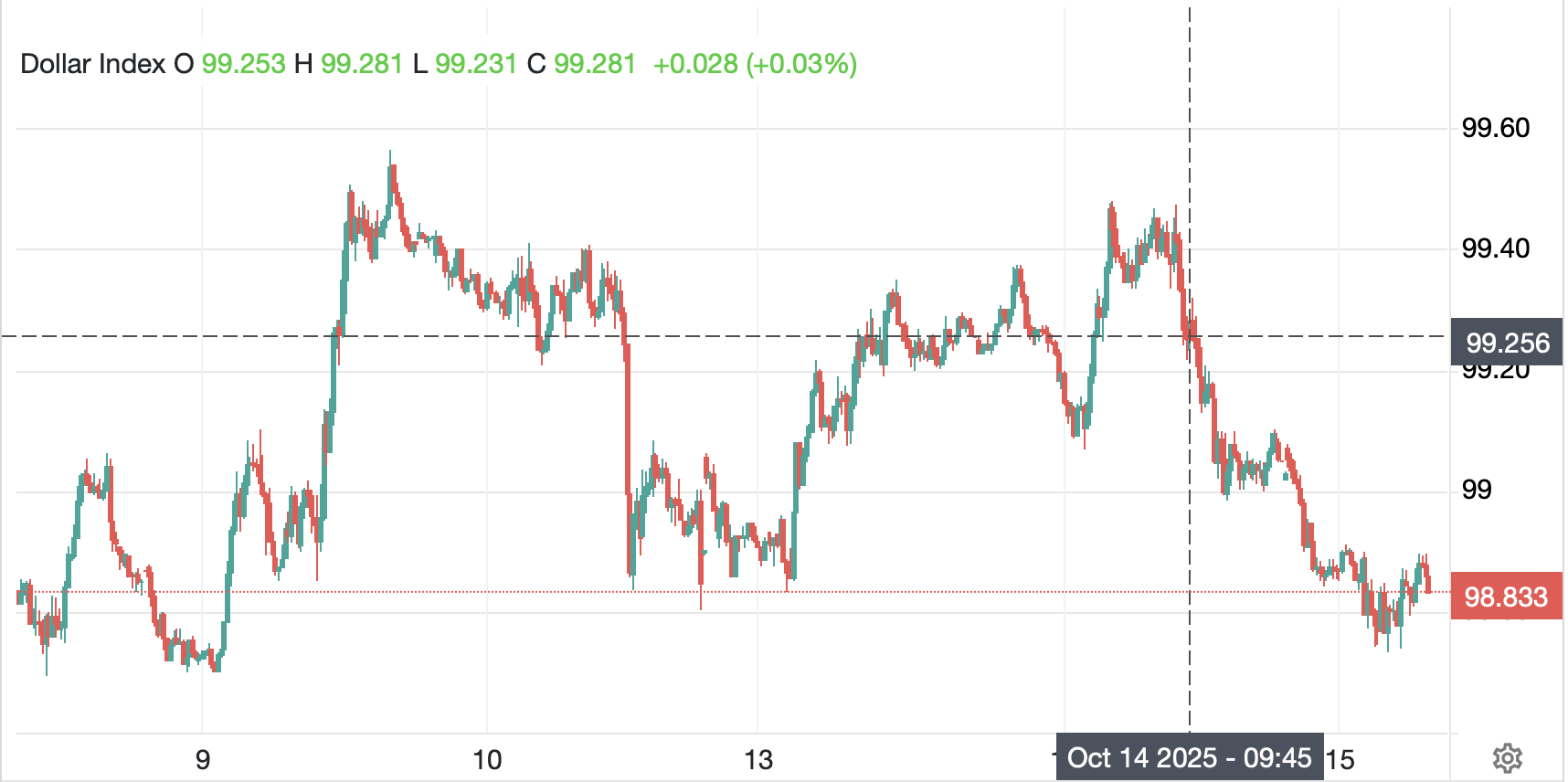
Source: tradingeconomics.com

Summing up, Chairman Powell basically just told us that inflation was no longer a fight they were willing to have and support of the economy and employment is Job #1.  Of course, this may not work out that well for long-term bond yields, which when if inflation rises are likely to rise as well, I think Powell knows that he will be gone by the time that becomes a problem, so maybe doesn’t care as much.

But here’s something to consider; there has been a great deal of talk about the animus between the Fed and the Treasury, or perhaps between Powell and Trump, but Treasury Secretary Bessent has already made clear they will be issuing more T-bills and less T-bonds going forward, which is a perfect fit for the Fed’s proposition to hold more T-bills and less T-bonds going forward.  This is not a coincidence.

Now, while that was the subject that got most tongues wagging in the market, the other story of note was the ongoing trade spat between the US and China.  It is hard to keep up with all the changes although it appears that soy oil imports from China are now on the menu of items to be tariffed, and the WSJ this morning explained that China is going to try to pressure President Trump by doing things to undermine the stock market as they see that as a vulnerability.  Funnily enough, I think Trump cares less about the stock market this time around than last time, as he is far more focused on issues like reindustrialization and jobs here and elevating labor relative to capital, which by its very nature implies stock market underperformance.

But that’s where things stand now. So, let’s take a turn around markets overnight.  Despite a mixed picture in the US, Asian equity markets had a fine time with Tokyo (+1.8%), China (+1.5%) and HK (+1.8%) all rallying sharply on the prospect of further Fed ease.  Regarding trade, given the meeting between Presidents Trump and Xi is still on the schedule, I think that many are watching the public back and forth and assuming it is posturing.  As well, Chinese inflation data was released showing deflation accelerating, -0.3% Y/Y, and that led to thoughts of further Chinese stimulus to support the economy there.  Of course, their stimulus so far has been underwhelming, at best.  Elsewhere in the region, green was also the theme with Korea (+2.7%), India (+0.7%), Taiwan (+1.8%) and Australia (+1.0%) all having strong sessions.  One other thing about India is the central bank there intervened aggressively in the FX market with the rupee (+0.9%) retracing to its strongest level in a month as the RBI starts to get more concerned over the inflationary impacts of a constantly weakening currency.

In Europe, the CAC (+2.4%) is leading the way higher after LVMH reported better than expected earnings (Isn’t it funny that the US market is dependent on NVDA while the French market is dependent on LVMH?  Talk about differences in the economy!), and while that has given a positive flavor to other markets, they have not seen the same type of movement with the DAX (+0.1%) and IBEX (+0.7%) holding up well while the FTSE 100 (-0.6%) continues to suffer from UK policies.  As to US futures, at this hour (7:40) they are all firmer by 0.5% to 0.9%.

In the bond market, yields continue to edge lower with Treasuries (-2bps) actually lagging the European sovereign market where yields have declined between -3bps and -4bps across the board.  In fact, UK gilts (-5bps) are doing best as investors are growing more comfortable with the idea the BOE is going to cut rates again after some dovish comments from Governor Bailey yesterday.

In the commodity space, oil (+0.2%) is consolidating after it fell again yesterday and is now lower by nearly -6% in the past week.  However, the story continues to be metals with gold (+1.3%), silver (+2.8%), copper (+0.5%) and platinum (+1.7%) all seeing continued demand as the theme of owning stuff that hurts if you drop it on your foot remains a driving force in the markets.  And as long as central banks are hinting that they are going to debase fiat currencies further, this trend will continue.

Finally, the dollar, as discussed above, is softer, down about -0.25% vs. most of its G10 counterparts this morning although NOK (+0.8%) is the leader in what appears to be some profit taking after an exaggerated decline on the back of oil’s decline.  In the EMG bloc, we have already discussed INR, and after that, quite frankly, it has not been all that impressive with the dollar broadly slipping about -0.2% against virtually the rest of the bloc.

On the data front, we see Empire State Manufacturing (exp -1.0) and get the Fed’s Beige Book at 2:00 this afternoon.  Four more Fed speakers are on the docket, with two, Miran and Waller, certainly on board for rate cuts, with the other two, Schmid and Bostic, likely to have a more moderated view.  Earlier this morning Eurozone IP (-1.2%) showed that Europe is hardly moving along that well.  Meanwhile, despite the excitement about Powell’s comments, the Fed funds futures market is essentially unchanged at 98% for an October cut and 95% for another in December.  I understand why the dollar slipped yesterday, but until those numbers start to move more aggressively, I suspect the dollar’s decline will be muted.

One other thing, rumor is that the BLS will be reporting the CPI data a week from Friday at 8:30am as they need it to calculate the COLA for Social Security for 2026.  If that is hot, and I understand that expectations are for 0.35% M/M, Chairman Powell and his crew may find they have a really tough choice to make the following week.

Good luck

Adf

A Third Fed Mandate

As Jay and his minions convene
A new man is making the scene
Now, Stephen Miran
A man with a plan
Will help restart Jay’s cash machine
 
But something that’s happened of late
Is talk of a third Fed mandate
Yes, jobs and inflation
Have been the fixation
But long-term yields need be sedate


As the FOMC begins their six-weekly meeting this morning, most market participants focus on the so-called ‘dual mandate’ of promoting the goals maximum employment and stable prices.  This, of course, is why everybody focuses on the tension between the inflation and unemployment rates and why the recent revisions to the NFP numbers have convinced one and all that a rate cut is coming tomorrow with the only question being its size.  But there is a third mandate as is clear from the below text of the Federal Reserve Act, which I have copied directly from federalreserve.gov [emphasis added]:

“Section 2A. Monetary policy objectives

The Board of Governors of the Federal Reserve System and the Federal Open Market Committee shall maintain long run growth of the monetary and credit aggregates commensurate with the economy’s long run potential to increase production, so as to promote effectively the goals of maximum employment, stable prices, and moderate long-term interest rates.

[12 USC 225a. As added by act of November 16, 1977 (91 Stat. 1387) and amended by acts of October 27, 1978 (92 Stat. 1897); Aug. 23, 1988 (102 Stat. 1375); and Dec. 27, 2000 (114 Stat. 3028).]”

One of the things we have heard consistently from Treasury Secretary Bessent is that he is highly focused on ensuring that longer-term yields do not get too high.  Lately, the market has been working to his advantage with both 10-year, and 30-year yields having declined by more than 25bps in the past month.  And more than 40bps since mid-July.  (Look at the yields listed on the top of the chart below to see their recent peaks, not just the line.)

Source: tradingeconomics.com

Now, with President Trump’s head of the CEA, Stephen Miran getting voted onto the board to fill the seat that had been held by Governor Adriana Kugler, but heretofore vacant, one would think that the tone of the conversation is going to turn more dovish.  What makes this so odd is that, by their nature, central bankers are doves and seemingly love to print money, so there should be no hesitation to cut rates further.  But…that third mandate opens an entirely different can of worms and brings into play the idea of yield curve control as a way to ensure the Fed “promote(s)…moderate long-term interest rates.”

It was Ben Bernanke, as Chair, who instigated QE during the GFC although he indicated it was an emergency measure.  It was Janet Yellen, as Chair, who normalized QE as one of the tools in the toolbox for the Fed to address its dual mandate.  I believe the case can be made that newly appointed Governor Miran will begin to bang the drum for the Fed to act to ensure moderate long-term interest rates, and there is no better policy to do that than QE/YCC.  Actually, there is a better policy, reduced government spending and less regulation that allows productivity to increase and balances the production-consumption equation, but that is out of the Fed’s hands.

At any rate, we cannot ignore that there could be a subtle change in focus to the statement and perhaps Chairman Powell will discuss this at the press conference.  If this has any validity, a big IF, the market impacts would be significant.  The dollar would start another leg lower, equities would rise sharply, and commodity prices would rise as well.  Bonds, of course, would be held in check regardless of the inflationary consequences.  Just something to keep on your bingo card!

Ok, let’s check out the overnight activity.  While it was quiet in the US yesterday, we did manage to make more new highs in the S&P 500 as all three major indices were higher.  As to Asia, Tokyo (+0.3%) had the same type of session, with modest gains as it takes aim at a new big, round number of 45,000.  China (-0.2%) and HK (0.0%) did little although there was a lot of positivity elsewhere in the region with Korea (+1.2%), India, (+0.7%) and Taiwan (+1.1%) leading the way amidst almost all markets, large and small, showing gains.  Europe, though, is a different story with red today’s color of the day, as Spain (-0.8%) and Germany (-0.6%) leading the down move despite better-than-expected German ZEW data (37.3 vs. 26.3 expected).  One of the things I read this morning was that German auto manufacturers have laid off 125,000 workers in the past 6 weeks.  That is a devastating number and bodes ill for German economic activity in the future.  As to other European bourses, -0.1% to -0.4% covers the lot.  US futures, though, continue to point higher, up 0.3% at this hour (7:30).

In the bond market, Treasury yields are unchanged this morning while European sovereign yields have edged higher by between 1bp and 2bps.  It doesn’t feel like investors there are thinking of better growth, but we did hear from several ECB members that while cuts are not impossible during the rest of the year, they are not certain.

In the commodity space, oil (+0.7%) is back in a modest upswing but still has shown no inclination to move outside that trading range of $60/$65.  It has been more than a month since that range has been broken and absent a major change in the Russia sanctions situation, where Europe actually stops buying Russian oil (as if!) I see no short-term catalyst on the horizon to change this situation.  Clearly, producers are happy enough to produce and sell at this level and demand remains robust.

Turning to the metals markets, I discuss gold (+0.4%) a lot, and given it is making historic highs, that makes sense, but silver (+0.4%) has been outperforming gold for the past month and looks ever more like it is going to make a run for its all-time highs of $49.95 set back in January 1980.  The more recent peak, set in 2011, of $48.50 looks like it is just days away based on the recent rate of climb.

Source: finance.yahoo.com

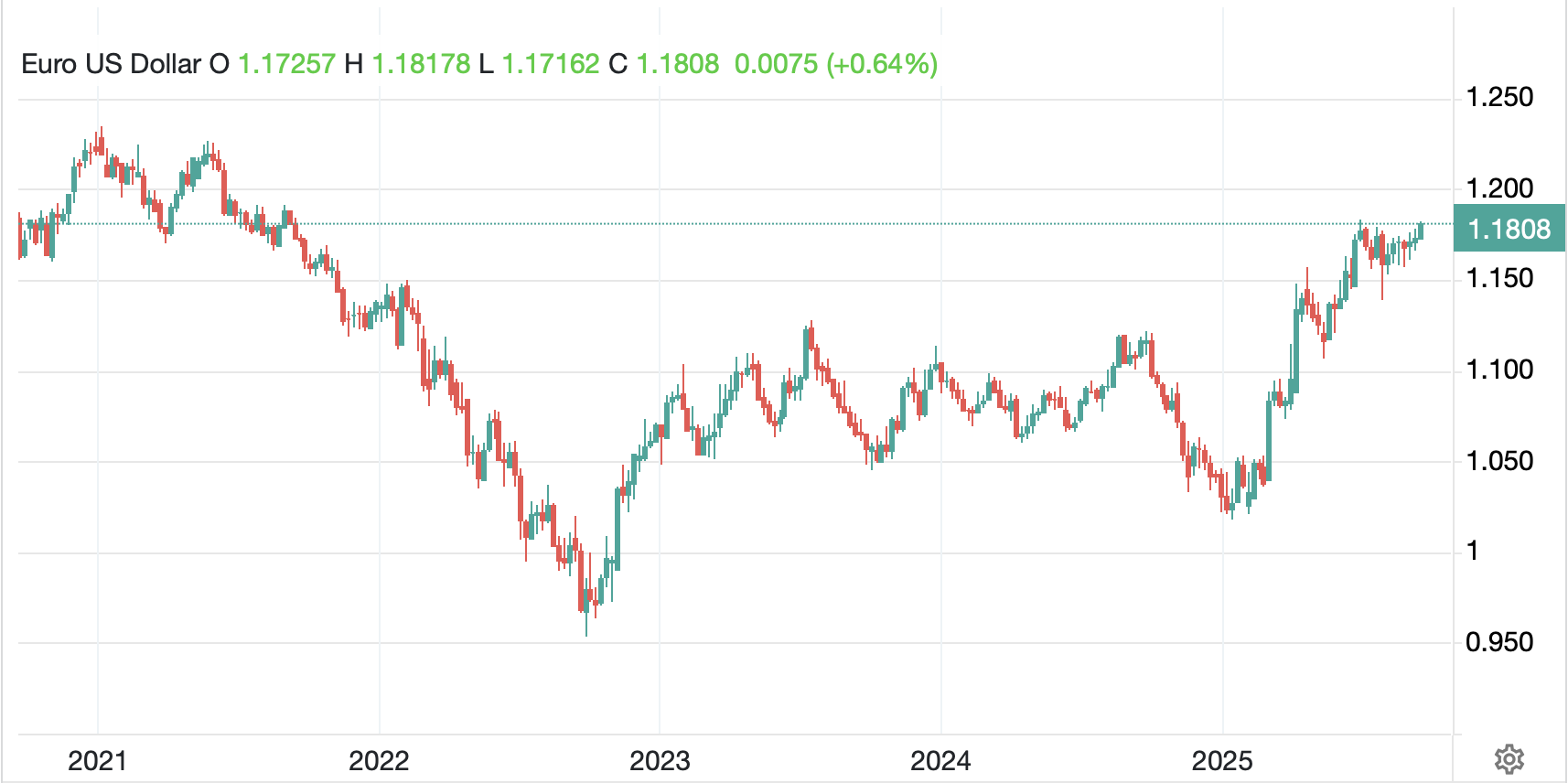
Finally, the dollar is under pressure this morning, with the euro (+0.4%) trading above 1.18 again for the first time since July 1st and there is a great deal of discussion as to how it is going to trade back to, and through, 1.20 soon, a level not seen since 2021.  

Source: tradingeconomics.com

The narrative is now that the Fed is set to begin cutting rates and the ECB is going to stand pat, the euro will rise.  This is true for GBP (+0.3%) as wel, with the Sterling chart largely the same as the euro one above.  Here’s the thing.  I understand the weak dollar thesis if the Fed gets aggressive, I discussed it above. However, if German manufacturing is contracting that aggressively, and the layoffs numbers are eye opening, can the ECB really stand pat?  Similarly, PM Starmer is under enormous, and growing, pressure to resign with the Labour party in the throes of looking to oust him for numerous reasons, not least of which is the economy is struggling.  So, please tell me why investors will flock to those currencies.  I see the dollar declining, just not as far as most.

Data this morning brings Retail Sales (exp 0.2%, 0.4% -ex autos) along with IP (-0.1%) and Capacity Utilization (77.4%).  However, it is not clear to me that markets will give this data much consideration given the imminence of the FOMC outcome tomorrow.  The current futures pricing has just a 4% probability of a 50bp cut.  I am waiting for the Timiraos article to see if that changes.  Look for it this afternoon.

Good luck

Adf

Powell’s Dream Team

The punditry’s dominant theme
Is whether Chair Powell’s dream team
Will cut twenty-five
And try to contrive
A reason a half’s a pipe dream
 
But there’s something getting no press
The balance sheet shrinking process
They’re still in QT
But what if QE
Is something they’ll now reassess?


With all the data of note now passed (PPI was largely in line although tending a bit higher than forecast) and the ECB having cut their deposit facility rate by 25bps, as widely expected, the market discussion is now on whether the Fed will cut by one-quarter or one-half percent next week.  The Fed funds futures market, which you may recall had been pricing as little as a 15% probability for that 50bp cut earlier this week, is currently a coin toss between the two outcomes.  In addition, the Fed whisperer, Nick Timiraos of the WSJ, had a front page article on the subject this morning, although he drew no conclusions.

But something that is getting virtually no airtime is the Fed’s balance sheet and its ongoing shrinkage.  You may recall that the current level of QT is $25 billion/month, which was reduced from the original amount of $60 billion/month back in June as the FOMC started to grow cautious regarding the appropriate amount of reserves and liquidity in the system.  

The issue is nobody knows what number constitutes the right amount of reserves.  Fed research is of the belief that somewhere between 10% and 12% of GDP (currently about $2.7 trillion to $3.3 trillion) should be sufficient to ensure that economic activity does not grind lower due to a lack of liquidity.  This has been the rationale behind the slow reduction in balance sheet assets.  But that research may not be accurate, and the underlying assumption was that the economy continued to grow at its trend rate.  In the event of a slowdown or recession, you can be sure that the Fed will add liquidity back as well as cut rates.

Now, working against my thesis is the Fed has not discussed this idea at all, at least publicly, and so a complete surprise is not their typical MO.  However, they have found themselves in a place where the market is pricing in more than 100 basis points of cuts over the next three meetings, including next week’s, which if they stick to their 25bp increments, means that one of these meetings needs a 50bp cut.  As I have written before, the bond market is pricing nearly 200bps of cuts in the next two years (see chart below), which would indicate that the likelihood of an economic slowdown is high.  

Source: tradingeconomics.com

At the same time, equity markets are trading near all-time highs with earnings estimates indicating that economic growth expectations remain quite robust.  Both of those scenarios cannot be true at the same time.

Source: LSEG

This is the landscape through which Chairman Powell must navigate the Fed’s policies as well as his communication of those policies.  In Jackson Hole, he virtually promised a rate cut was coming next week, and one is certainly on its way.  The magnitude of that cut, though, will offer the best clues as to the Fed’s thinking with respect to the future trajectory of the economy and which market, stocks or bonds, is right. 

There is one other thing to consider, though, as an investor. Given the bond market is pricing a significant slowdown, if that is your view, bonds will not offer much return if you are correct.  And if you are wrong, and growth is strong, it will be ugly.  Similarly, if you are of the view that there is no recession, but rather a soft- or no-landing is the likely outcome, then being long stocks, which have already priced for that outcome will likely have only a modest benefit.  However, in the event that the economy does fold and recession arrives, stocks are likely to sell-off sharply.  Arguably, the best positioning for a trader is to be short both stocks and bonds, as whichever outcome prevails, one asset will fall substantially while the other has limited upside, at least for a while.  For a hedger, this is the time that options make a lot of sense as the asymmetry they provide is what allows a hedger to prevent locking in the worst outcomes.

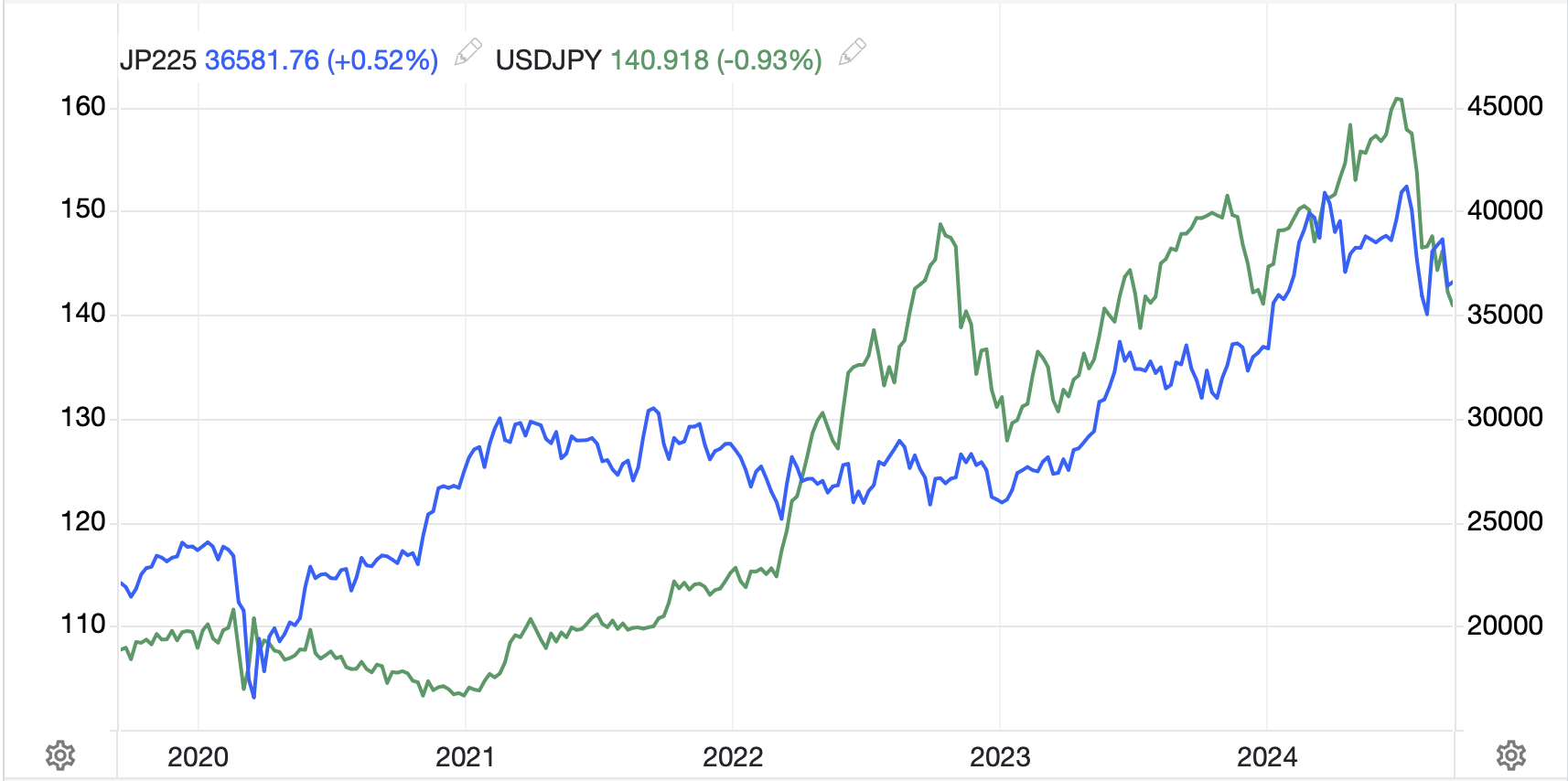
Ok, with that behind us, let’s look at the overnight session to see how things followed yesterday’s risk rally in the US.  In Asia, the Nikkei (-0.7%) has been struggling lately on the back of continued JPY strength.  As you can see from the below chart, that relationship has been pretty strong for a while, and last night, USDJPY traded to new lows for the year, erasing the entire gain (yen decline) that peaked at the end of June.

Source: tradingeconomics.com

As to the rest of Asia, mainland Chinese shares (CSI 300 -0.4%) continue to underperform although HK shares managed a rally (+0.75%) while most of the rest of the region showed very modest strength, certainly nothing like the US performance, but at least in the green.  In Europe, equity markets are all higher this morning with Spain’s IBEX (+0.8%) leading the way although solid gains of 0.3% – 0.5% prevalent elsewhere.  As to US futures, at this hour (7:45) they are creeping higher by about 0.1%.

In the bond market, Treasury yields are lower by 2bps this morning and European sovereign yields are generally little changed to lower by 2bps across the continent.  Yesterday’s ECB outcome was universally expected, and Madame Lagarde explained they remain data dependent and promised no timeline for potential further rate cuts, if they are even to come (they will).  As to JGB yields, they too fell 2bps last night, once again confusing those who are looking for policy tightening in Tokyo.

In the commodity markets, oil (+1.4%) is rallying for the third consecutive day as Hurricane Francine shut in about 40% of gulf production and the timing of its return is still uncertain.  Despite the US equity markets’ clear economic bullishness, the weak growth/demand story is still a major part of this discussion.  In the metals markets, gold (+0.3% overnight, +3.2% in the past week) continues to set new price records daily with a story making the rounds that SAMA, Saudi Arabia’s central bank, secretly bought 160 tons of gold last quarter, soaking up much supply.  This has helped drag silver back above $30/oz although copper (-0.5%) is stumbling a bit this morning.

Finally, it should be no surprise that the dollar is under some pressure this morning as the talk of more aggressive Fed easing grows.  While the euro and pound are little changed, JPY (+0.5%) is leading the way in the G10 with AUD (+0.45%), NZD (+0.4%), NOK (+0.2%) and SEK (+0.3%) all firmer on the back of commodity strength.  In the EMG bloc, the story is a bit more nuanced with ZAR (-0.15%) bucking the trend on domestic political concerns, although we saw strength in KRW (+0.5%) overnight and MXN (+0.35%) as the Fed rate cut story plays out across most currencies.

On the data front, only Michigan Sentiment (exp 68.0) is on the docket so once again, the dollar will be subject to the equity market behavior and the strength of narrative regarding just how dovish the Fed will wind up behaving next week.  I will say that a 50bp cut is likely to see some short-term dollar weakness, probably enough for it to fall to multi-year lows vs. its major counterparts.  But remember, if the Fed starts getting aggressive, other central banks will feel comfortable following that lead, so the dollar’s weakness may not be that long-lived.

Good luck and good weekend

Adf

Doves in Retreat

It seems the transition’s complete
As every Fed dove’s in retreat
From Powell to Daly,
And like Andrew Bailey,
They want to end QE tout de suite

Regarding the Fed’s hawks, Mester, George, Bostic and Bullard, we already knew they were ready to end QE.  They have been saying so since much earlier this year, before two of their kettle were forced to resign in disgrace (you remember Rosengren and Kaplan).  Just yesterday, Cleveland’s Loretta Mester reiterated she was “very open” to quickening the tapering process in order to give the Fed the option to raise rates early next year if they deem it necessary.  But of more interest has been the transition of the erstwhile dovish contingent with Mary Daly’s apparent desire to quicken the taper amongst the most surprising given her consistently dovish leanings.  In fact, the only holdout that I can determine is Neel Kashkari from Minneapolis, who has yet to agree inflation is a problem.  However, no one is more important than Chairman Powell, who over the past two days, in testimony to Congress, made it clear that come the FOMC meeting on December 15th, the pace of tapering will be increased.

At least, that is the view to which the market is turning.  Equity market weakness, a flattening yield curve and rising volatility all demonstrate that investors and traders are beginning to adjust the strategies they have been following since QE1 in the wake of the GFC.  This helps explain how the stock market could decline more than 1% two days in a row (!) and why it has fallen, already, nearly 5% from its all-time-high set back on November 22.  While I am being somewhat facetious with respect to dramatizing the recent declines, there are many in the market who seem to believe these are unprecedented moves.

And it is this last issue which is likely to become a major concern for the Fed going forward.  More than a decade of Fed easy money has taught people to buy every dip in asset prices.  Post Covid Fed policy has encouraged people to lever up when they buy those dips and so margin debt has reached historic highs on both a nominal ($581 billion) and percentage of GDP (2.5%) basis.  The problem here arises if when stock prices decline, and margin calls are made. Just like the Fed is a price insensitive buyer of Treasuries, and index funds are price insensitive buyers of equities, margin calls result in price insensitive selling of equities.  When this happens, equity prices can decline VERY quickly.  Know, too, that exchanges can raise margin requirements intra-day, so if a decline starts at the open, they can raise margin requirements by lunchtime to protect their members.  All this matters because the sudden hawkish tilt by the Fed could cause a very severe reaction in the financial markets.  And if there is one thing about which we should all be sure, it is that a very sharp decline, anything over 10% in a short period, will be met with a change in behavior by those very same Fed hawks.  Talk is cheap.  Sticking to their guns because they are trying to address rampant inflation will make them all very unpopular, something which the current denizens of the Marriner Eccles building seem unlikely to be able to handle very well.

Is this the beginning of the end?  I don’t believe so, especially as nothing has actually changed yet.  However, when it comes to sentiment shifts, they can occur in a heartbeat, so do not rule anything out.  Of more importance, though, is what we can expect if the shift comes.

In a classic risk-off scenario, where margin selling is rampant and equity prices are falling sharply, there is very likely to be contagion, so equities worldwide will decline.  We are very likely to see Treasuries, Bunds and Gilts in demand, with yields there declining sharply.  However, I would expect that the sovereign debt of the PIGS nations will more likely follow the equity market than Bunds, so spreads will widen.  Commodity prices will come under severe pressure as this will be seen as a precursor to a recession. And the dollar will rise sharply vs. its EMG counterparts as well as the commodity bloc of the G10.  JPY and CHF are both likely to do very well while the enigma is the euro, although my sense is the single currency would decline, just not as aggressively as, say, SEK.  We are not at that point but be aware that the current market setup is such that the opportunity for a move of that nature is quite real.  If you read Mark Buchanan’s terrific book, Ubiquity, you will recognize the “fingers of instability” described there as being present in every market.  It just seems that those fingers are more prevalent currently. (If you haven’t read the book, I cannot recommend it highly enough.)

Ok, let’s take a tour of markets today.  Yesterday’s late day US equity decline saw a continuation in Tokyo (Nikkei -0.65%) although the Hang Seng (+0.55%) managed to rally while Shanghai (-0.1%) was roughly flat.  I believe HK benefitted from the word that China was going to force the tech companies listed in the US to delist likely driving them to the HK market.  Europe, too, has been following that late day sell-off with the DAX (-1.3%) leading the major exchanges lower, followed by the CAC (-1.0%) and FTSE 100 (-0.8%).  However, US futures are all pointing higher led by the DOW (+0.9%) as it seems two down days in a row are enough.

Perhaps not surprisingly, the bond market is behaving in a split fashion as well, with Treasury yields (+3.4bps) rising while European sovereigns (Bunds -1.2bps, OATs -2.0bps, Gilts -1.4bps) all slipping as risk is shed on the Continent.

The rebound thesis is alive and well in oil markets with WTI (+0.4%) edging higher, although it is off its early session highs.  NatGas (+0.15%) is a touch firmer while precious metals are mixed (Au -0.3%, Ag +0.4%).  Mixed also defines the industrial space with copper (+0.5%) doing well while aluminum (-0.6%) is under a bit of pressure.  One thing that is universal today, though is the ags, all of which are higher by between 0.5% and 1.5%.

Finally, mixed describes the dollar as well, with half the G10 rising and the other half falling on the session.  NOK (-0.35%) is the laggard, while GBP (+0.3%) is the leader.  However, given the relatively modest movement, and the lack of news or data, there can be many things leading to these movements.  In the EMG bloc, ZAR (+1.1%) is the leader despite (because of?) the omicron variant spreading so rapidly there.  Information on the issue of omicron’s impact remains very difficult to come by, but the market appears to be taking the stance that it will not be a very big deal as the rand has rallied 3.5% from its lows seen last week when the news first hit.  Away from that, RUB (+0.7%) and MXN (+0.7%) are the next best performers although both are outperforming their key export, oil.  On the downside, TRY (-1.2%) continues to fall with no end in sight.  Yesterday, President Erdogan sacked his FinMin and replaced him with a new, more pliant deputy, in order to be certain the central bank will continue cutting interest rates in the face of quickly rising inflation.  This currency has much further to fall.  Away from this, the decliners have been far less impressive led by THB (-0.4%) as local traders see concerns over the impact of the omicron variant.

On the data front, Initial (exp 240K) and Continuing (2003K) Claims are on the docket as all eyes turn to tomorrow’s NFP report.  Yesterday’s ADP data was right on expectations which will give comfort to those looking for 545K in the NFP tomorrow.

Bostic, Quarles, Daly and Barkin take the stage today on behalf of the Fed and I would expect to hear more about a faster taper from all of them as this is clearly the new message.  Looking at the dollar with all this in mind, it still appears to be following the 10-year trade more than the 2-year trade.  As such, if the curve continues to flatten, I would look for the dollar to continue to consolidate its recent gains.

One last thing, I will be out tomorrow so there will be no poetry.  However, my take is the NFP data is likely to be in line with expectations so not have much impact overall.

Good luck, good weekend and stay safe
Adf

Risks They Have Wrought

It’s not clear why anyone thought
The ECB ever would not
Continue to buy
More bonds as they try
To safeguard ‘gainst risks they have wrought

So, when PEPP, next March, does expire
A new plan we’ll get to admire
As Christine will ne’er
Be set to foreswear
Her drive to push bond prices higher

If ever anyone was talking their own book, it was Greek central bank president Yannis Stournaras this morning on the subject of the ECB’s potential actions post-PEPP.  “Asset purchases aim at favorable financing conditions, at smooth transition of monetary policy to prevent any kind of fragmentation in jurisdictions in the euro area.  I’m sure that the Governing Council will continue to aim at this.” [author’s emphasis] These comments were in response to a report that the ECB is considering instituting a new asset purchase program when the emergency PEPP expires in March.  This is certainly no surprise as I posited this exact outcome a month ago (Severely Distraught – Sep 7) and the idea has gained credence since then.

One of the features of the ECB’s APP (original QE program from 2015) is that they are required to purchase bonds based on the so-called capital key in order to give the illusion they are not monetizing national debt.  This means that they must buy them in proportion to the relative size of each economy.  Another feature is that the bonds they purchase must be investment grade (IG).  This rules out Greek debt which currently is rated BB-, 3 notches below IG.  The PEPP, however, given the dire emergency created by governments shutting down their economies when Covid-19 first appeared, did away with those inconveniences and was empowered to buy anything deemed necessary.  Not surprisingly, purchases of bonds from the PIGS was far above their relative economic weight which has served to narrow credit spreads across the entire continent.  If the PEPP simply expires and is not replaced, it is unambiguous that PIGS’ debt would fall sharply in price with yields rising correspondingly, and those nations would find themselves in far worse fiscal shape.  In fairness, the ECB can hardly allow that to happen to just a few nations so they will continue their PEPP purchases in some manner or other.  And I assure you they will continue to purchase Greek debt regardless of its credit rating.

It is useful to compare this future to that of the Fed, where Chairman Powell has indicated that as long as the payroll number this Friday is not a complete disaster (currently expected 500K), a reduction in the pace of QE is appropriate. On the surface, it would be quite reasonable to expect the euro to decline further given what is likely to be a divergence in relative yields.  Yesterday’s ADP Employment report (568K) was better than expected and certainly seems to be of sufficient strength to support the Chairman’s view of continued strength in the labor market.  Thus, if the Fed does begin to taper while the ECB discusses its next version of QE, I would look for the euro’s recent decline to continue.

Of course, the big question is, will the Fed continue to taper if the economic situation in the US starts to show much less impetus?  For instance, the Atlanta Fed’s GDPNow forecast is estimating Q3 GDP growth at 1.333%, MUCH weaker than it had been in the past and a MUCH sharper slowdown than the Fed’s own forecasts.  While the number may well be higher than that, it does speak to a run of weaker than expected economic data in the US.  Inflation, meanwhile, shows no signs of abating soon.  The Fed looks set to find themselves in a very uncomfortable position with the following choices: tighten into slowing growth or let inflation run much hotter than targeted for much longer than anticipated.  (If I were Powell, given the trainwreck that is approaching, I don’t think I would accept the offer of reappointment should it be made!)

In sum, while the decision process in Europe is much easier with slower growth and lower inflation, extending monetary largesse still seems appropriate, in the States, some tough decisions will need to be made.  The problem is that there is not a single person in any Federal position who appears capable of making (and owning) a tough decision.  In fact, it is this lack of demonstrated decision-making prowess that leads to the idea that stagflation is the most likely outcome going forward.

But it is still a few weeks/months before these decisions will need to be made and, in the meantime, Buy Stonks!  Well, at least, that seems to be the investor mindset as fleeting fears over contagion from China Evergrande’s slow motion bankruptcy and comments from Vladimir Putin that Russia would, of course, supply the necessary NatGas for Europe, have been sufficient to remind the equity crowd that a 5% decline from an all-time high price level is an amazing opportunity to buy more stocks.  Hence, yesterday morning’s fears have abated and all is once again right with the world.

(As an aside, it strikes me that relying on a key geopolitical adversary to supply the life’s blood of your economy is a very risky strategy.  But Putin would never use this as leverage for something else, would he?  I fear it could be a very long cold winter in Europe.)

OK, with that in mind, let’s look at markets this morning.  Equity markets are green everywhere ranging from the Nikkei (+0.5%) to the Hang Seng (+3.1%) with all of Europe in between (DAX +1.2%, CAC +1.35%, FTSE 100 +1.0%) while China remains closed.  US futures are also firmer, currently pointing to a 0.75% rise on the open.

Bond markets are in pretty good shape as well.  Yesterday, after substantial early session weakness, they rebounded, and this morning are continuing on that trend.  While Treasuries are only lower by 0.2bps, in Europe we are seeing much better buying (Bunds -1.7bps, OATs -2.1bps, Gilts -1.2bps) with PIGS bonds (Italy -5.1bps, Greece -3.0bps) showing even more strength.

Commodity prices are consolidating after what has been a significant run higher with oil (-1.6%) and NatGas (-2.0%) both off highs seen yesterday morning.  Gold is unchanged on the day while copper (+1.1%) has bounced along with other base metals.  Ags, too, are a bit firmer this morning.

This positive risk attitude has seen the dollar cede some of its recent gains with AUD (+0.35%) leading the way in the G10 on the back of stronger commodity prices, followed by SEK (+0.3%) and NZD (+0.3%) both benefitting from better risk appetite as well.  Only NOK (-0.1%) is under pressure on the back of the oil price decline.  EMG currencies are universally stronger led by ZAR (+0.7%), PHP (+0.6%) and RUB (+0.5%).  ZAR is clearly benefitting from the commodity rally while PHP was higher on some positive growth comments from the central bank there.  The ruble seems to be benefitting from the view that a higher than expected CPI print there will force the central bank to raise rates more than previously anticipated.

On the data front, today brings only Initial (exp 348K) and Continuing (2762K) Claims.  Given tomorrow is payroll day, these are unlikely to move the market.  We also hear from Cleveland Fed president Mester, one of the more hawkish voices, discussing inflation, but my sense is all eyes are on tomorrow’s NFP to make sure that the taper is coming.  As such, today is likely to continue to see risk appetite with higher stock prices and a soft dollar.  But large moves seem unlikely.

Good luck and stay safe
Adf

No Exit

So, Powell and friends started talking

‘bout talking, and markets were rocking

Though they won’t stop buying

More bonds, they are trying

To exit QE, which is shocking

The question is how long they last

Ere haunted by all of their past

As Sartre made clear

No Exit is near

Be careful, the trouble is vast

Technically, I am out of the office today and tomorrow, but felt that I needed to quickly opine on yesterday’s FOMC meeting.

While the FOMC statement was virtually identical to the April statement, not really even mentioning the fact that inflation is running much hotter than they had obviously expected, the big news was the dot plot, where the median expectation changed to 0.50% of rate rises by the end of 2023.  Previously, that rate was still expected to be 0.00%, so clearly at least some FOMC members have figured out that inflation is rising.  Substantial further progress on their goal of maximum employment has not yet been made and remains “a way’s off.”

But the market focused on the dot plot as it is the first indication that tighter policy may be coming.  In fact, in the press conference, Powell explicitly said that this was the meeting where they began to talk about talking about policy changes, so perhaps that tired phraseology will be discarded.

The bond market reacted in quite an interesting manner, as every maturity up to the 10-year saw yields rise, but the 30-year was unchanged on the day.  The fact that the 30-year ignored all the fireworks implies that market opinions on growth and inflation have not really changed, just the timing of the eventual movement by the Fed has been altered.  Stock prices sold off a bit, but not very hard, far less than 1.0%, but boy did precious metals get whacked, with gold down nearly 3% on the day and a further 1% this morning.

And finally, the dollar was the star of the markets, rallying against everyone of its major counterparts, with the biggest laggards the commodity focused currencies like NOK (-2.7%), SEK (-2.5%), MXN (-2.5%) and ZAR (-2.3%).  But it was a universal rout.  Markets had been getting shorter and shorter dollars as the narrative had been the rest of the world was catching up to the US and trusting that the Fed was no nearer raising rates now than in April.  I’m guessing some of those opinions have changed.

However, my strong suspicion is that nothing really has changed and that the Fed is still a very long way from actually tapering, let alone raising rates.  Ultimately, the biggest risk they face, at least the biggest risk they perceive, is that if they start to tighten and equity prices decline sharply, they will not be able to sit back and let that happen.  They have well and truly painted themselves into a corner with No Exit.  Thus far, the movement has been insignificant.  But if it begins to build, just like the Powell Pivot on Boxing Day in 2018, the Fed will be back to promising unlimited liquidity forever.  And the dollar, at that point will suffer greatly.

For those who are dollar sellers, take advantage of this movement.  It may last a week or two but will not go on indefinitely.  At least sell some!

Good luck, good weekend and stay safe

Adf

‘Bout Enough

A storm in the bond market’s brewing

As some central banks start eschewing

The idea QE

Forever, should be

Thus, traders, their longs are undoing

Meanwhile, in the markets for stuff

The Chinese have had ‘bout enough

As prices there soar

Xi’s minions call for

Restraint, or they’ll have to get tough

Heading into the Memorial Day weekend in the US, there are two stories making the rounds this morning.  The first is the latest discussion regarding tapering of QE by central banks around the world while the second is a growing discussion on the commodity markets and the impact the Chinese are having via both economic growth and governmental efforts to prevent prices from rising further. 

During the past month we have gained more clarity from four key central banks on their future QE activities, but the big three (Fed, ECB and BOJ) have not yet come out with any real guidance.  Certainly, we have heard several members of the FOMC opining that the time is coming soon where they will start to consider the idea, if growth continues at its current accelerated pace and if the employment situation improves dramatically.  This is, however, by no means the universal view in Washington, at least not yet.  With respect to the BOJ, the next MPC member who talks about tapering JGB buying will be the first one to do so.  The Japanese have been so invested in this strategy for more than 20 years it will be extraordinarily difficult to even consider a change.

In Frankfurt, however, there is far more disagreement as to the proper steps forward.  Unfortunately for the ECB, the lack of a common fiscal framework in the Eurozone is becoming a bigger problem as they remain the only institution capable of supporting the entire group of nations.  This is made clear by recent data, which shows that there are very different growth and inflation scenarios, potentially requiring different monetary policy responses, in different countries.

For instance, inflation in Germany, at 2.3% is running a lot hotter than in Italy, at 1.0%.  And while the Continent’s average may be around 1.6% right now, it is the Germans that see things as more problematic.  Consider that while the Weimar hyperinflation of nearly 100 years ago may seem ancient to most, it was the most searing economic event in the nation’s history and has informed the entire German zeitgeist of thrift and frugality.  (Contrast this to the Great Depression, with the concomitant deflation that occurred in the US, and which has informed the US zeitgeist with respect to fear of prices and the economy collapsing.)  Remember, the only way to get the Germans to agree to the euro was to promise that the ECB would essentially be a clone of the Bundesbank.  That meant keeping a lid on inflation at all times.  However, the current situation, where the economic circumstances across the continent are so widely disparate, has put the ECB in a bind.  Efforts to support those economies that remain weak with a low inflationary impulse, like Italy, Ireland and Greece, will result in increasing price pressures on those economies that are further ahead in the economic rebound like Germany and the Netherlands.

It is this conundrum that has different ECB speakers saying different things.  On the one hand, we have recently heard from Italy’s Panetta, France’s Villeroy and Madame Lagarde that tapering is not appropriate.  Yet this morning, Germany’s Isabel Schnabel was far more circumspect with respect to maintaining current policy as she commented, “Rising yields are precisely what we want to see.”  That does not seem the comment of someone keen to keep buying bonds.  However, for now, the Germans remain in the minority and so the idea that the ECB will mention the tapering of asset purchases at the June meeting seems unlikely.

As to the commodity story, in the past two weeks we have heard from at least seven different Chinese officials and key organizations about the need for both reducing upward pressure on commodities as well as reducing upward pressure on the renminbi.  For the past twenty years, China has been the marginal buyer of most commodities as their economy has grown at a remarkable pace and they have built up extraordinary infrastructure of roads, airports and cities.  Thus, they have consumed countless tons of steel, copper and other industrial materials.  However, a little considered impact of the pandemic was the dramatic reduction in the capex of mining for industrial metals, which means that future supplies are likely to be less available as the world continues to reopen and growth expands.  The natural result has been rising prices as markets anticipate surplus demand relative to forecast supply. 

Apparently, the powers that be in China have figured out that rising prices are not conducive to their domestic plans and are now caught between a situation where they benefit from a stronger currency if it puts downward pressure on inflation, but suffer from a stronger currency if it reduces the attractiveness of their export sector.  They seem to believe that if they can prevent further strength in CNY while simultaneously talking down commodity prices, they can achieve both their ends.  While they have had some success over the past several weeks on the commodity front, CNY has steadily appreciated, gaining more than 3.25% since April 1st.  I guess this is one of the difficulties of trying to manage growth, inflation and your currency’s value simultaneously.  Something’s gotta give.  Right now, it looks like the currency and further strength there should not be a surprise.

As to our holiday shortened session, European equity markets are uniformly higher this morning (DAX +0.6%, CAC +0.7%, FTSE100 +0.3%) although Asia had a more mixed picture with the Nikkei (+2.1%) quite strong but the Hang Seng (0.0%) and Shanghai (-0.2%) less enthusiastic about things.  US futures are all green to the tune of about 0.5%, so pending this morning’s data, the rally should continue.

Bond markets are little changed this morning with Treasuries, which saw yields rise 3.5bps yesterday essentially unchanged this morning.  EGB’s are generally a tick or two higher with yields lower by less than 1 basis point, as there is much more focus on stocks today.

In the commodity space, oil (+0.5%) continues to rebound from last week’s dip while precious metals are modestly softer this morning (Au -0.2%, Ag -0.8%).  The Chinese seem to be having some success in their efforts to push down metals prices with Cu (-1.0%) and Al (-0.4%) leading the way lower.

The dollar, despite the positive risk sentiment in equities, is stronger vs. all its G10 peers, with NZD (-0.85%) and AUD (-0.6%) the worst performers on the day.  In truth, the magnitude of this move smacks of position adjustments after the RBNZ’s surprisingly hawkish tone earlier this week led to significant buying in both currencies.  But the dollar’s strength is universal as generally positive data releases throughout Europe have not been able to encourage currency buying. 

Emerging markets have seen a different picture as the dollar was universally soft overnight and APAC currencies all showed strength while those markets were open, but since then, EEMEA and LATAM currencies have come under pressure.  The most notable mover here has been TRY (-0.95%) as ongoing inflation worries continue to undermine faith in the currency both at home and internationally.

The data story today has the chance to be quite interesting with Personal Income (exp -14.2%), Personal Spending (0.5%) and Core PCE (0.6% M/M, 2.9% Y/Y) all coming at 8:30.  Then at 10:00 we see Chicago PMI (68.0) and Michigan Sentiment (83.0).  In my mind, Core PCE is the number that matters.  Given the current market discussion on tapering, a higher than anticipated number there could easily see a bond market sell-off and further support for the dollar.  Frankly, based on the fact that every inflation reading this month has been higher than forecast, I see no reason for this to be any different.  Look for a high print and the dollar to remain well-bid into the weekend.

Good luck, good weekend and stay safe

Adf

Lower Forever’s Outdated

A little bit later today
The FOMC will convey
Its thoughts about both
Inflation and growth
And when QE might fade away

The punditry’s view has migrated
Such that ‘Low Forever’s’ outdated
Instead, many think
That QE will shrink
By Christmas, when growth’s stimulated

Attention today is entirely on the Federal Reserve as they conclude their two-day meeting and release the latest statement at 2:00pm.  Thirty minutes later, Chairman Powell will begin his press conference and market activity will slow down dramatically as all eyes and ears will be focused on his latest musings.

What makes this situation so interesting is there is absolutely no expectation for a change to monetary policy today.  Fed funds will remain between 0.00% and 0.25% and asset purchases will continue at a pace of ‘at least’ $80 billion / month of Treasuries and $40 billion / month of mortgage backed securities.  So, what’s all the hubbub?

Recent economic data has been quite strong (Retail Sales +9.8%, Philly Fed at record high 50.2, Housing Starts +19.4%) and is forecast to continue to show strength going forward.  In addition, the first glimmers of rising prices are starting to be seen (Import Price Index +6.9%, Export Price Index +9.1%) which begs the question, how long can the Fed allow things to heat up before they start to remove monetary stimulus.  As the Fed has been in its quiet period for the past two weeks, we have not heard a peep regarding their thoughts in the wake of the most recent, very strong data.  Thus, with no new Fed guidance, the fertile minds of Wall Street economists have created a narrative that explains the continued robust US growth will lead the Fed to begin to remove policy accommodation by tapering asset purchases before the end of the year.  And they well could do so.

However, while Fed policy may or may not be appropriate, the one thing that has remained consistent throughout the Fed’s history is that when they say something, they generally stick to it.  And the last words we heard from Powell were that there was no reason to consider tapering until “substantial further progress” had been made toward their goals of maximum employment and average inflation of 2.0%.  No matter how great the data has been in the past two weeks, two weeks of data will not qualify as substantial.  In fact, I doubt two months will qualify.  If forced to anticipate a timeline for the Fed, it will not be before September, earliest, and more likely December that they will begin to lay the groundwork to potentially reduce asset purchases.  I think the market is way ahead of itself on this issue.

Consider, as well, this puzzle.  The market has pushed yields higher all year in anticipation of much faster growth and inflation generated by the combination of the end of lockdowns and federal stimulus money.  As federal spending continues to massively outstrip federal revenues, the Treasury continues to issue more and more new debt, also leading to higher yields.  Naturally, the higher the level of yields, the more expensive it is for the US government to service its debt which reduces its capacity to spend money on the things it is targeting with the new debt.  One of the key expectations of many of the same pundits calling for tapered purchases is yield curve control (YCC), which is exactly the opposite of tapering, it is unlimited purchasing of bonds.  So, how can we reconcile the idea of YCC with the idea of the Fed tapering purchases?  Personally, I cannot do so, it is one or the other.

Which brings us to what can we expect today?  Based on everything we have heard from Fed speakers in the past month, I believe talk of tapering is extremely premature and the Fed will not mention anything of the sort in the statement.  As well, I expect that Chairman Powell will be quite clear in the press conference when asked (and he will be asked) that the economy is not out of the woods and that they have much further to go before even considering altering monetary policy.

Arguably, this line of conversation should be risk positive, helping equities push higher and the dollar lower, but as we have seen for at least the past several months, the 10-year Treasury yield remains the absolute key driver in markets.  If supply concerns (too much supply) continue to grow and yields resume their march higher, I expect the dollar will rally and equities will come under pressure.  However, if the bond market is assuaged by Powell’s words, then I would expect a dollar decline and all other assets priced in dollars (stocks, bonds and commodities) to continue to climb in price.  We shall see starting at 2:00 today.

As to the markets leading up to the FOMC drama this afternoon, equities are generally firmer while bond yields are rising as well along with the dollar and base metals.  Overnight, the Nikkei (+0.2%), Hang Seng (+0.45%) and Shanghai (+0.4%) all had solid sessions.  Europe has seen gains through most markets (DAX +0.35%, CAC +0.5%, FTSE 100 +0.35%) although Sweden’s OMX (-1.3%) is significantly underperforming in what apparently is a hangover from yesterday’s mildly bearish economic views by the Riksbank.

Bond markets are uniformly lower this morning, with Treasury yields higher by 1.8 basis points after a 5 basis point rally yesterday.  In Europe, Gilts (+4.7bps) are the worst performers but we are seeing weakness of at least 3bps across the board (Bunds +3.2bps, OATS +3.3bps).  There has been precious little data released to explain these price declines, and if anything, the fact that German GfK Confidence (-8.8) was released at a much worse than expected level would have argued for lower rates.  By the way, that low print seems to be a consequence of the spread of Covid in Germany and reinstituted lockdowns.

On the commodity front, oil (+0.4%) is modestly firmer and remains well above the $60/bbl level.  While gold (-0.5%) and silver (-1.3%) are underperforming, we continue to see demand for industrial metals (Al +0.65%, Sn +1.8%) although copper (-0.15%) has given back a tiny amount of its recent gargantuan run higher.

The dollar is generally firmer vs. the G10 with GBP (-0.35%) today’s laggard followed by AUD (-0.25%) and JPY (-0.2%).  The market seems to have taken sides with the doves in the BOE as virtually every member spoke today and a majority implied that policy would remain accommodative despite expectations for faster growth.  Away from these 3 currencies, movements were extremely modest although leaned toward currency weakness.

EMG currencies are a bit more mixed, with a spread of gainers and losers this morning.  On the negative side, PLN (-0.5%) is in the worst shape as investors express concern over a judicial ruling due tomorrow on the status of Swiss franc mortgages that were taken out by Polish citizens a decade ago and have caused massive pain as the franc appreciated dramatically vs the zloty.  A negative ruling could have a major impact on Poland’s banking sector and by extension the economy.  Away from that, losses in CZK (-0.3%) and KRW (-0.2%) are next on the list, but it is hard to pin the movement to news.  On the positive side, TRY (+0.5%) continues to benefit from the perceived reduction in tension with the US while traders have seemingly embraced INR (+0.4%) on the idea that despite a horrific Covid situation, relief, in the form of massive vaccine imports, is on the way to help address the situation.

Ahead of the FOMC the only data point is the Advanced Goods Trade Balance (exp -$88.0B), but that is unlikely to have an impact.  Equity futures are biding their time as are most market participants as we all await Mr Powell.  Treasury yields continue to be the main driver in my view, so if they continue to rally, they are already 10bps clear of the recent lows, I expect the dollar will continue to regain some of its recent lost ground.

Good luck and stay safe
Adf

Will a New Normal Emerge?

Recovery this year is set
To be best in decades, and yet
The central bank’s thumb
Will drive the outcome
By buying quadrillions in debt

The question is, after this surge
Will there be a natural urge
For things to go back
To pre-Covid’s track
Or will a new normal emerge?

The Wall Street aphorism, buy the rumor, sell the news, remains as valid today as it ever was.  The idea behind this concept, something to which I regularly point, is that by the time a particular piece of information has been released, the market has already absorbed the information in the price and is looking forward to the next price driver.  The result is that markets rally into good news and fall upon the release, and vice versa.  The most recent evidence that this remains a key to price action was Friday’s payroll report, where the outcome, in an illiquid market, was a much better than expected 916K NFP number with upward revisions of the previous two months.  And yet Treasury yields, which might have been expected to rise further on the news, have done nothing but decline since then.  Including today’s 1 basis point decline, the 10-year yield is lower by 6bps from the release and is now 10bps lower than the peak hit on March 30.  Is this the end of the yield rally?  Almost certainly not, but no market moves in a straight line.

I highlight this idea to discuss the latest forecast by the IMF and how this news may impact markets going forward.  Yesterday the IMF raised its global growth forecasts again, this time up to 6.0% in 2021 and 4.4% in 2022, representing increases of 0.5% and 0.2% respectively from their January analysis. The leadership in this growth is the US, now forecast to grow 6.4% by the IMF, and China, now forecast to grow 8.4% this year.  These are the fastest GDP growth numbers for the US since 1984, and we certainly all hope they are accurate.  After all, life is certainly better for everyone when the economy is growing rapidly.

But we have now seen a wave of higher forecasts for US GDP from official sources, like the Fed and IMF, and from private forecasters like Wall Street firms, with a strong consensus that the US is looking at GDP expansion this year well in excess of 6.0% and possibly as high as 7.0% or more.  And so I ask, isn’t that already in the price of most assets?

The broad bullish argument for risk is that global GDP growth is going to be much stronger in 2021 as the world’s economy rebounds from the Covid inspired recession of 2020.  And we have seen remarkable rallies in risk assets during this time, with the S&P 500 rising just a bit more than 80% in the twelve months following its nadir on March 24 last year.  All that occurred during a period where the virus was rampant but hopes for a vaccine would lead to an end to the government ordered shutdowns and a return to pre-covid type of economic activity.  While I grant that we have not seen all the shutdowns ended, the vaccine rollout has been impressive and is speeding up every day.  In fact, despite a pretty horrendous start to the process for Europe, the European Commission now believes that the continent will achieve herd immunity by the end of June!

So, if we know that all this is going to happen, haven’t risky assets already priced in this good news?  The other question that hangs over the current situation is the fact that this growth is entirely a product of the multiple trillions of dollars of government stimulus led by the US $5 trillion of fiscal injections, but also inclusive of QE, PEPP and QQE from the Fed, ECB and BOJ respectively, which totaled trillions more dollars of support.  Again, it begs the question, how much better can things be expected to get?

For instance, it is not unreasonable to expect that there will be permanent changes in the economy, specifically in the types of jobs that are available, especially for lower skilled workers.  If anything, the pandemic and resulting government lockdowns will have accelerated this process.  Remember, Chairman Powell has been clear that the Fed’s task will not be complete until the 10 million jobs that were lost as a result of government edicts are replaced. But what if that takes 5 years due to the structural changes in the economy?  Can the Fed maintain ZIRP while GDP growth is surging and inflation is rising alongside?  Historically, the answer would be no, but in the post-Covid world, that is no longer clear.  In fact, the one thing that has been truly consistent is that every government and supranational organization has warned every central bank to make sure they do not remove policy ease too soon.  The entire global political leadership is ‘all-in’ on the idea that printing money and spending it has no negative consequences.  In other words, it is no longer appropriate to worry we might wind up in an MMT world, we are already there!

This leads to the final question, will risk acquisition be unstoppable as a result of this new global thesis?  The famous American economist, Herbert Stein (Ben Stein’s father) made the statement, “if something cannot go on forever, it will stop.”  My observation is that printing money and the illusory growth that it brings cannot go on forever.  When this music stops, it will be a devastating fall.  But, as policymakers will do everything they can to prevent the stopping, this can go on for a while longer.  Simply be careful to not fall into the trap of believing stock prices are at “a permanently high plateau,” a comment another famous economist, Irving Fisher, made just weeks before the Wall Street Crash of 1929.

Ok, a super brief recap of markets shows that both Asia (Nikkei +0.1%, Hang Seng -0.9%, Shanghai -0.1%) and Europe (DAX -0.1%, CAC 0.0%, FTSE 100 +0.6%) were mixed with modest movement.  US futures are essentially unchanged at 8:00 as I finish typing.  Sovereign yields in Europe have edged lower by roughly 1 basis point, matching the Treasury market, but really not showing much in the way of activity.  Commodity prices are mixed with oil (+0.9%) rallying while metals (Au -0.6%, Cu -1.0%) are softer.

Finally, the dollar is showing little direction today with G10 currencies showing gains (NOK +0.3%) on oil’s rally and losses (AUD -0.5%) on metals price weakness.  But there is no dollar trend here.  In emerging markets, INR (-1.5%) was the biggest loser after the RBI left policy rates on hold, but not merely increased QE, but put a number on it where they will be buying INR1 trillion over the next quarter, driving Indian bond yields lower along with the rupee.  But away from that story, here, too, there is nothing of note with a mixed picture in the space.

On the data front, we see the Trade Balance (exp -$70.5B) this morning and then the FOMC Minutes are released at 2:00.  Today also brings a great deal of Fedspeak, but I remain highly confident that nothing from that story is going to change.

The dollar is wandering aimlessly today but remains closely tied to Treasury yields.  If yields resume their rally, look for the dollar to rebound.  However, if this correction in yields continues, the dollar has further to fall.

Good luck and stay safe
Adf

Their Bond Vigilantes

Down Under, the RBA bought
Four billion in bonds as they fought
Their bond vigilantes
Who came back from Dante’s
Ninth circle with havoc they wrought

Investors responded by buying
More bonds and more stocks fortifying
The view central banks
All still deserve thanks
For making sure markets keep flying

Atop the reading list of every G10 central banker is the book written by Mario Draghi in 2012 and titled, How to Keep Interest Rates Lower for Longer*, and every one of those bankers is glued to page one.  At this point, there is no indication that higher interest rates will be tolerated for any length of time, and while jawboning is always the preferred method of moving markets in the desired direction, sometimes these bankers realize they must act.  And act they did, well at least Phillip Lowe, the RBA Governor, did.  Last night, the RBA bought $4 billion in 3-year ACGB’s, doubling the normal and expected amount of purchases as he fought back against the idea that the RBA would not be able to maintain control of the yield curve as they have announced.  The response must have been quite gratifying as not only did 3-year yields nose back below 0.10%, the target, but 10-year yields tumbled 0.25% as investors regained their confidence and took advantage of the sudden increase in yields available to increase their holdings.

So, last week’s price action is now deemed to have been nothing more than a hiccup, or a bad dream, with market activity today seen as the reality.  At least that is the story all the world’s central banks keep telling themselves, and arguably will continue to do for as long as possible.  It seems that the fact the RBA was willing to be so aggressive was seen by investors as a harbinger of what other central banks are willing and capable of enacting with the result being a massive asset rally worldwide.  Think about that for a moment, the purchase of an extra $1.5 billion of ACGBs has resulted in asset price increases on the order of $1 trillion worldwide.  That, my friends, is bang for your buck!

Of course, the question that remains is, will investors continue to accept this worldview, or will data, and ever-increasing debt supply, return us to last week’s market volatility and force a much bigger response by much bigger players?  My money is on the latter, as there is no sign that deficit spending is being reined in, and the signs of higher inflation remain clear, even in Europe!

But clearly, today is not one for calling out central bankers.  While ongoing conversations in Tokyo highlight the question of whether the BOJ needs to intervene ahead of their mid-month meeting when they are to present their Policy Review, and ECB members continue to warn about unwarranted tightening of financial conditions, thus far, we have not seen any increase in activity by either central bank.  However, at 9:45 this morning we will see the latest data from the ECB regarding their purchases during the last week in the PEPP, and it will be instructive to see if those purchases increased, or if they simply maintained their regular pace of activity.  An increase could be taken positively, shoring up investor belief that the ECB has their back, but given how poorly the European government bond market performed last week, it could also be seen as a sign that the ECB is losing its sway in markets.

The one truism is that market volatility, despite central banks’ fervent desire for it to decrease, remains on a higher trajectory as the possible economic outcomes for the world as a whole, as well as for individual countries, diverge.  And this is, perhaps, the hardest thing for investors to accept and understand; after a forty year period of declining inflation and volatility, if the cycle is turning back higher for both of these characteristics, which have a high correlation, then the future will be more difficult to navigate than the recent past.

So, just how impressive was the RBA’s action?  Pretty impressive.  For instance, equity markets in Asia all rose sharply (Nikkei +2.4%, Hang Sent +1.6%, Shanghai +1.2%) and are all higher in Europe as well (DAX +0.7%, CAC +1.1%, FTSE 100 +1.0%).  US futures, meanwhile, are powering ahead by approximately 1.0% across the board.

As to bonds, while the ACGB move was the most impressive, we did see a halt to the rise in 10-year JGB yields, and in Europe, the rally is powerful with Bunds (-5.0bps), OATs (-5.5bps) and Gilts (-4.1bps) all paring back those yield hikes from last week.  Interestingly, Treasury yields (+2.2bps) are not holding to this analysis, as perhaps the news that the $1.9 trillion stimulus package passed the House this weekend has investors a bit more nervous.  After all, passage implies increased issuance of $1.9 trillion, and it remains an open question as to how much demand there will be for these new bonds, especially after last week’s disastrous 7-year auction.  And that’s really the key question, will there be natural demand for all this additional paper, or will the Fed need to expand QE in order to prevent yields from rising further?

On the commodity front, we are seeing strength across the board with oil (+1.0%) leading energy higher on the reflation idea, both base and precious metals markets rallying and agricultural products seeing their ongoing rallies continue.  Stuff continues to cost more, despite the Fed’s claims of low inflation.

As to the dollar, it is mixed this morning, with commodity currencies performing well (NOK +0.4%, CAD +0.35%, AUD +0.3%) while the European commodity users are all under pressure (SEK -0.5%, CHF -0.5%, EUR -0.25%).  The euro’s weakness seems a bit strange given the manufacturing PMI data released this morning was positive and better than expected.  As well, German CPI, which is released on a state by state basis, is showing a continued gradual increase.

In the emerging markets, TRY (+2.5%) is the runaway leader as the lira offers the highest real yields around and as fear recedes, hot money flows there quickest.  But away from that, RUB (+0.6%) on the back of oil’s rally, and CLP (+0.45%) on the back of copper’s ongoing rally are the best performers.  With the euro softer, the CE4 are all weaker and we saw desultory price action in Asian currencies overnight.

On the data front, this is a big week, culminating in the payroll report.

Today ISM Manufacturing 58.6
ISM Prices Paid 80.0
Wednesday ADP Unemployment 180K
ISM Services 58.6
Fed’s Beige Book
Thursday Initial Claims 755K
Continuing Claims 4.3M
Nonfarm Productivity -4.7%
Unit Labor Costs 6.7%
Factory Orders 1.8%
Friday Nonfarm Payrolls 180K
Private Payrolls 190K
Manufacturing Payrolls 10K
Unemployment Rate 6.4%
Participation Rate 61.4%
Average Hourly Earnings 0.2% (5.3% Y/Y)
Average Weekly Hours 34.9
Trade Balance -$67.4B
Consumer Credit $12.0B

Source: Bloomberg

In addition to all this, we hear from Chairman Powell on Thursday, as well as six other Fed speakers a total of nine times this week.  But we already know what they are going to say, rising long end yields are a positive sign of growth and with unemployment so high, we are a long way from changing our policy.  History shows that the market will test those comments, especially once the Fed goes into its quiet period at the end of the week.

As for today, risk is quite clearly ‘on’ and it seems unlikely that will change without a completely new catalyst.  The RBA has fired the shot across the bow of the pessimists, and for now it is working.  While the euro seems to be under pressure on the assumption the ECB will act as well, as long as commodities continue to rally, that is likely to support the growth story and commodity currencies.

Good luck and stay safe
Adf

*a fictional work conceived by the author