More Pain

The data from China reflected
That tariffs have hurt, as expected
It’s likely more pain,
On China, will rain
As both nations are so connected
 
Meanwhile, in a German surprise
Herr Merz failed to get his allies
To name him to lead
Which seemed guaranteed
Could this presage his quick demise?

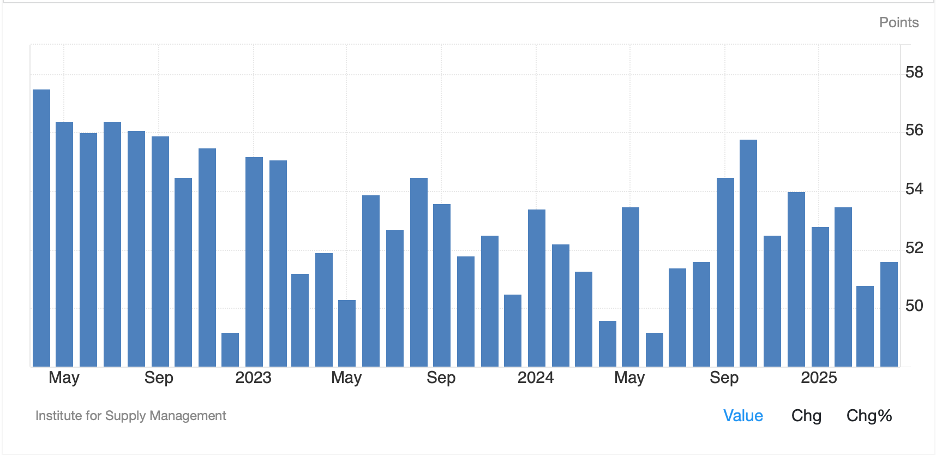
In the battle being waged between the US and China via tariffs, the first data indications have shown that the US is faring a bit better.  Yesterday’s ISM Services data was stronger than expected, remaining well above the 50 level although arguably slightly below the recent average reading.

Source: tradingeconomics.com

Meanwhile, last night, the Chinese Caixin Services PMI fell to 50.7, missing expectations and continuing its drift lower over time.  

Source: tradingeconmics.com

Are things really worse in China than the US, at least from the perspective of data releases?  I think both nations will suffer during this period as the impacts of the tariffs and reduced trade bleed into the data over the next months, but so far, it seems the US is holding its own.  One of the problems with analyzing the issue is that as the WSJ pointed out yesterday, when the data in China gets bad, they simply stop releasing it, so it may be difficult to see.

Now, last night, Chinese shares did manage a nice rally with the CSI 300 higher by 1.0% but that follows six consecutive down sessions, albeit of modest size.  

Source: tradingeconomics.com

As to the renminbi, after a 1% gain last Friday, it has done little and remains very much in line with its levels of the past year.  The thing about China is that nothing there moves quickly, so absent a policy announcement of some type, I expect this activity will continue to gradually adjust to the realities as they become clear to the market.  If President Trump reduces tariffs, as he implied he would eventually, things could work better, but again, given the time lags of moving products across the Pacific, we have a lot of time between now and whatever the new normal turns out to be.

But the more interesting story to me overnight was that Friedrich Merz, the ostensible winner of the German elections last month failed to achieve the votes to be named Chancellor despite his coalition having a 12-seat majority in the Bundestag.  As it was a secret ballot, nobody knows who didn’t support him, but this outcome certainly calls into question both his ability to lead Germany effectively, and correspondingly, Germany’s ability to lead Europe in the new world order.

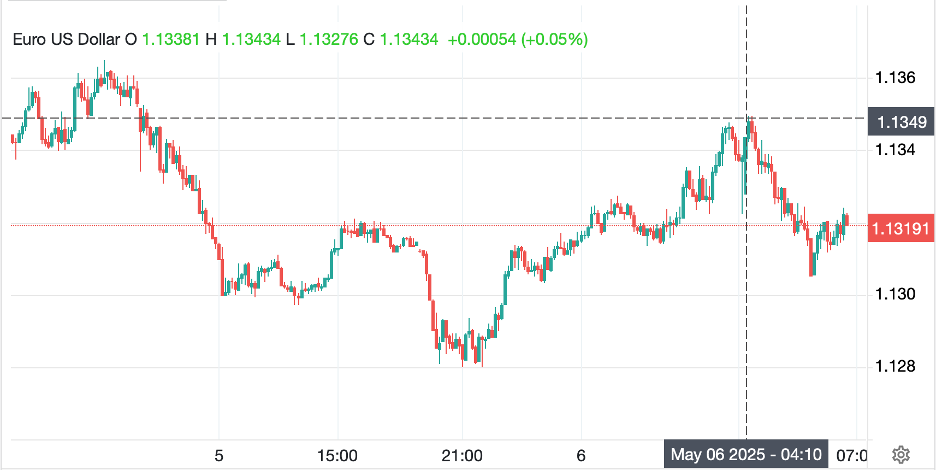
Recall, Germany remains keen to support Ukraine in its ongoing war with Russia and even destroyed their once sacrosanct fiscal responsibility in order to be able to pay for that support.  But if they do not have an effective leader, one who can command their parliament to enact his policies, it is not clear why other European nations would follow their lead on anything.  It should not be surprising that the DAX (-1.3%) fell sharply when the news was released, and that has helped drag most European shares lower (CAC -0.7%, IBEX -0.3%, Poland -3.3%).  As to the euro, you can see from the below chart that the response, when the news was announced, that it slipped about 0.5%, basically wiping out the gains it had achieved prior to the vote.

Source: tradingeconomics.com

Will this matter in the long run?  I believe that a weakened Germany, which is likely the outcome of this situation, will simply undermine the euro’s value.  As such, while I still believe the dollar has further to decline, the euro will probably not be a major winner.  Look for other currencies to outperform the euro going forward.

Ok, I think those are the real stories as we head into today’s session with most market participants remaining tentative in the face of the ongoing confusion over policies, counter policies and macroeconomic data.  Remember, too, we have the Fed tomorrow and the BOE on Thursday, so despite the fact that fiscal policy has been the driver, the Fed’s opinions still carry weight amongst the fixed income community, at the very least.

Looking at the price action overnight, the Nikkei (+1.0%) gained on some solid earnings data from Japanese companies as well as increased hopes that the US-Japan trade talks will be successfully completed by June.  Apparently, there is also some faith that the US and China will begin talking soon on this subject.  Hong Kong (+0.7%) also benefitted from these discussions, but the rest of the region showed very little movement overall, with gains or losses on the order of 0.3% or less.  As we have already discussed Europe, a look at US futures shows they are pointing lower by about -0.5% at this hour (7:10).

Bond markets remain very dull these days with Treasury yields edging higher by 1bp this morning after climbing 3bps yesterday.  European sovereign yields are also higher. By 1bp to 2bps although there is neither data nor a story that seems to have had much impact.  The Services PMI data that was released this morning was very much in line with expectations and continues to hover around 50.0 for the continent as a whole.  Meanwhile, JGB yields were unchanged last night and sit at 1.25%, well below the levels seen back in late March and having really gone nowhere for the past month.  It strikes me that JGB yields will respond to any trade deals but are likely to be quiet in the interim.

Commodity prices are rallying this morning with oil (+2.2%) rebounding from its level yesterday which happen to come quite close to touching the lows from April 9th.  It should be no surprise that there are up days in this market, but if the Saudis and OPEC are going to continue increasing production, I expect that prices have further to fall.  In the metals markets, gold (+1.4%) is having another blockbuster day, now having gained $150/oz in the past three sessions and bouncing off the correction lows.  Demand for the barbarous relic continues to come from Asia mostly with all signs showing that US investors are not interested in this trade.  As to silver (+1.7%) and copper (+0.6%), they are both still along for the ride.

It should be no surprise with the commodity markets showing strength that the dollar is under pressure this morning.  while we’ve discussed the euro already, the pound (+0.5%) is looking quite solid as it continues its rally from the lows seen in mid-January.  But the yen (+0.5%), SEK (+0.45%) and NOK (+0.35%) are all gaining today as well.  Interestingly, the impact in emerging markets is far less noticeable with none of the major EMG currencies moving even 0.2% this morning.

On the data front, there is very little hard data this week although we do have the Fed on Wednesday and then a whole bunch of Fed speakers on Friday.

TodayTrade Balance-$137.0B
WednesdayFOMC Rate Decision4.50% (unchanged)
 Consumer Credit$9.5B
ThursdayBOE Rate Decision4.25% (-0.25%)
 Initial Claims230K
 Continuing Claims1890K
 Nonfarm Productivity-0.7%
 Unit Labor Costs5.1%

Source: tradingeconomics.com

Today’s trade data is for March, prior to the tariff impositions, so will reflect significant tariff front-running.  But really, it’s about the Fed this week, and since they have lost much of their cachet lately, I think the market is really going to continue to look to the White House for trade news and react to that.  Net, I continue to believe that the dollar’s FX rate will be part of many trade discussions, like we saw with Taiwan (which by the way did reverse 3% of yesterday’s gain overnight) and that means further weakness is in our future.

Good luck

Adf

The Future As Fraught

Though I’ve been away near a week
From what I read things are still bleak
Two months have gone by
Since stocks touched the sky
And traders all want a new peak
 
Meanwhile, GDP fell ‘neath nought
And lots see the future as fraught
The popular claim
Is Trump is to blame
And rue all the things he has wrought


I worked hard not to pay close attention to markets while I was away last week in an effort to get some true relaxation.  And now that I’m back at my desk, I can see that I didn’t miss anything at all.  The narratives remain the same, the split between those who believe everything the president says/does is a disaster and those who believe everything he says/does is brilliant has not changed at all.  In other words, life continues as do all the arguments.

A review of the data last week showed two key outcomes, the labor market remains far more resilient than the recessionistas will accept and jobs continue to be created.  For some reason, that seems like good news to me, but then I am not a highly paid economist with a narrative to stoke.  On the other hand, Q1 GDP printed at -0.3%, the first negative print in 3 years, but also one that is easily explained by the rush of imports that occurred prior to the imposition of tariffs in early April.  Remember, imports subtract from Gross DomesticProduct.  However, a look under the hood of this number shows that the positive news was government activity declined while private sector investment exploded higher.  It strikes me that this is the best possible direction for the US economy going forward.

In China, it seems Xi’s decided
That data has been too one-sided
So, henceforth they’ll furnish
Just data to burnish
The views Xi and friends have provided

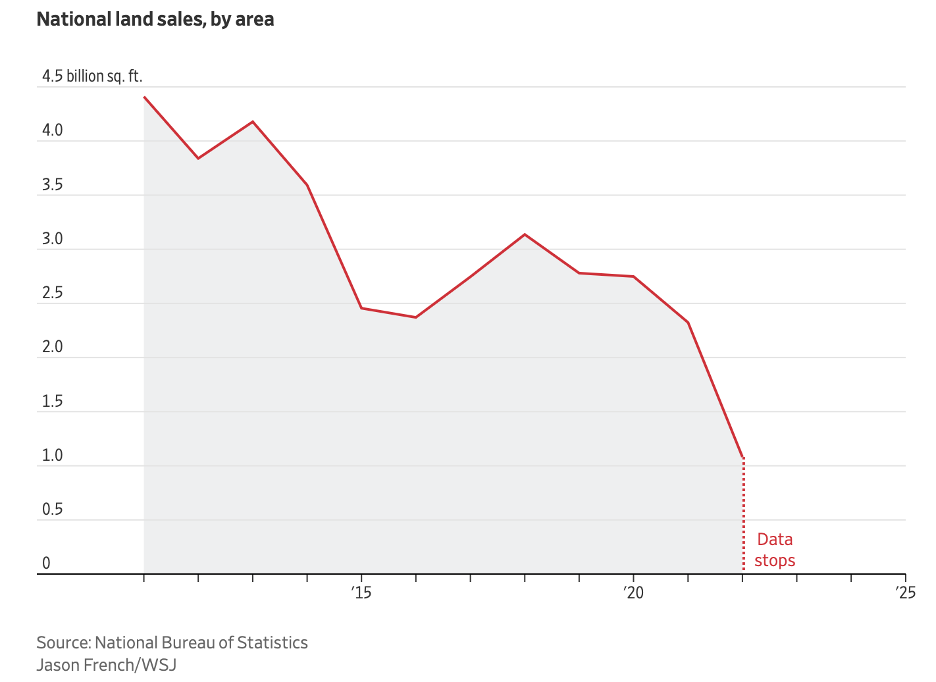
Turning to the more recent stories, though, the WSJ had a very interesting take on the fact that China’s statistical output is shrinking quite rapidly as data that has been trending lower suddenly stops being produced.  The below chart from the article on National Land Sales is an excellent depiction of things, and likely an indication that land sales, which are critical to local government finances, have become even a bigger problem over the past three years than when the property market first started melting down in early 2021.

It is worth noting that in this trade war between the US and China, while much of the punditry continues to insist that China has the upper hand as the stuff they sell to the US is more critical and less replaceable than the stuff the US sells to them, I have maintained things are not necessarily that easy.  The US is facing a supply shock, and will need time to work it through, but the US economy is the most dynamic in the world, and these issues will be resolved.  China faces a demand shock, which in economic theory should be easier to address, but which in China’s reality has not proven to be the case.  Consider that Xi and the CCP have been creating fiscal stimulus plans since Covid without any serious success.  In fact, the Chinese have openly stated that they are seeking to shift the production/consumption mix of the nation closer to Western standards of 60%-70% consumption from their current 45%-50% level.  It hasn’t worked yet, and I see no reason to believe that is going to change.  We must never forget the US is the consumer of last resort, and if China doesn’t have access to this market, it is a major problem for them.

I have no inside knowledge of how things are evolving on this issue, but here’s my take; while Xi doesn’t need to worry about being elected, he still needs to ensure that China’s economy grows sufficiently to increase the well-being of his population.  Whatever the official statistics have shown, it is clear that things in China are not what they would have the rest of the world believe and that is a problem for Xi.  Meanwhile, Trump will not face another election and was elected with a pretty broad mandate.  I believe given the timing of the mid-term elections, he has another 9-12 months to get things done and will play hardball with China to do so.  In fact, I have a feeling that Trump may have the upper hand.  This will be settled by the autumn is my view.

Ok, let’s turn to markets and what happened in the overnight session.  Looking first at currencies for a change, I couldn’t help but notice the following chart.

Source: tradingeconomics.com

I also couldn’t help but notice the following comment from the Taiwanese central bank in response to a question about whether the FX rate is on the table in the trade negotiations.  (As an aside, @PIQSuite is an excellent follow on X.  Key market headlines on a real-time basis with other things available as well.)

The question of whether FX rates would be part of the trade talks seems to have been answered, and the answer is yes.  Perhaps there will not need to be a Mar-a-Lago accord after all regarding revaluing gold and terming out bonds.  Instead, the pressures will be relieved on a country-by-country basis with each trade deal.  

While the TWD revaluation of 10% over the past 2 sessions is the most dramatic, the dollar is generally lower this morning against both G10 and EMG currencies.  In the G10, AUD (+0.85%) leads the way but JPY (+0.7%), NOK (+0.6%) and CHF (+0.5%) are all pushing higher.  This must be music to President Trump’s ears.  As to the emerging markets, KRW (+2.5%), is the next biggest mover although they admitted that FX rates were part of the trade discussions.  SGD (+0.8%) has also seen a relatively large move and INR (+0.4%) is moving in that direction.  It seems clear that Asia is the focus of both the administration and the markets this morning.  The rest of the EMG bloc has seen much smaller gains, between +0.25% and +0.5%, with CNY (+0.15%) really doing very little.

Turning to the equity markets, last week clearly finished on a strong note and, in fact, since I last wrote, the S&P 500 has rallied a bit more than 2% and is higher by more than 14% since April 8th.  Apparently, the world has not yet ended, but there hasn’t been a new high in the stock market in more than 3 months, and people are edgy!  As to the overnight session, the Nikkei (+1.0%) rallied along with the Hang Seng (+1.75%) although Mainland shares (CSI 300 -0.1%) showed little life.  Elsewhere in the region, Taiwan (-1.25%) and Australia (-1.0%) felt the most pressure and the rest were mixed with much smaller movements.  In Europe, indices are mixed as earnings data from each country are the drivers amid a lack of broad-based news.  So, the UK (+1.2%) and Germany (+0.6%) are firmer while France (-0.6%) is lagging on the back of some weaker earnings numbers.  As to the US, futures are pointing lower by about -0.7% across the board at this hour (7:15).

In the bond market, last week saw Treasury yields jump sharply after the better-than-expected payroll report, finishing the day 9bps higher, although still within the middle of the trading range since February and lower on the year.  This morning, they are basically unchanged while European sovereign yields have slipped by about -2bps across the board. The picture there continues to focus on the uptick in fiscal spending that is expected and the borrowing that will be needed to pay for it.  However, there is still a strong view that the ECB will be cutting rates going forward.

Lastly, in the commodity markets, oil (-1.15%) is sliding again as OPEC+ has promised to continue to increase production.  There are two takes on this activity, both of which probably have some truth.  First is the idea that President Trump has made a deal with MBS in Saudi Arabia to increase production and drive prices lower. Remember, lower energy prices are a boon to the US (and the world).  But added to that is the idea that MBS agreed so he can help force fracking production to pull back and regain market share for OPEC+.  However, regardless of the rationale, nothing has changed my view that oil prices are heading lower, and I still like the $50/bbl level as a target.  As to the metals, gold (+2.3%) which has been under pressure for several weeks in a correction, seems to have found support below $3300/oz and could well be setting up for another leg higher. This has taken silver (+1.3%) and copper (+.8%) along for the ride.  If the dollar is going to continue lower, metals prices should remain quite firm.

On the data front, today only brings ISM Services (exp 50.6), but really, all eyes will be on the FOMC meeting on Wednesday.  I will highlight the rest of the week’s data tomorrow morning.

The past month has seen significant volatility in markets as participants did not correctly estimate the potential moves in trade policy.  At this point, it seems those questions are being answered, with President Trump even hinting some deals could be finalized this week.  I believe we are going to see trade announcements that include new FX goals, and they will be pushing the dollar lower across the board.  While I don’t see a collapse coming, that is the trend for now.

Good luck

Adf
That Man is Our Bane

Apparently, back in the day
Investors and CEOs say
The future was clear
But now they all fear
Uncertainty is in their way
 
So, they will now clearly explain
When earnings and profits do wane
That they’re not to blame
Instead, they now claim
It’s Trump’s fault, that man is our bane


I’m having some difficulty understanding a number of the concerns about which I read every day as more and more corporate executives and investment managers have suddenly found a new scapegoat, uncertainty.  Apparently, I missed the time when the future was certain, as I have no recollection of that at all.  Perhaps you remember.  If so, could you remind me please?

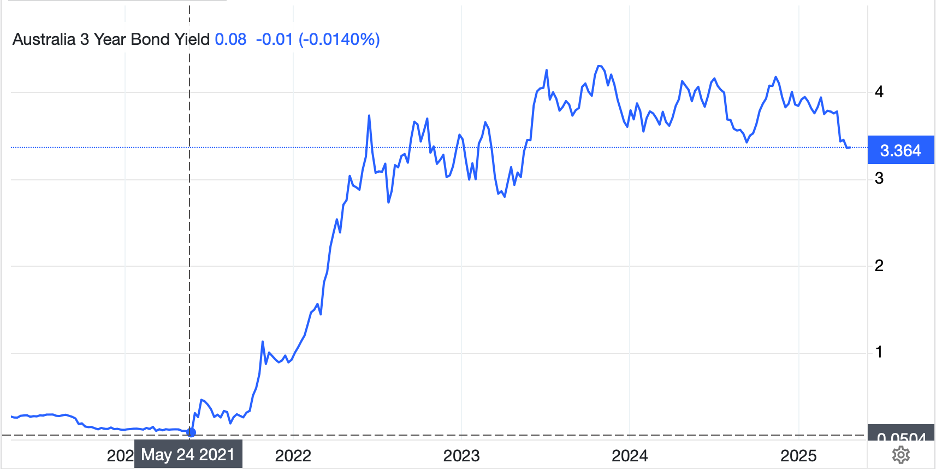
For instance, I remember the certitude of the comments from the RBA back in April 2021 that interest rates would remain lower for longer, and that it would be at least three years before they would need to raise interest rates.  I also remember, as the graph below demonstrates, that certainty was misplaced as less than two months after those comments, the RBA started raising interest rates despite the clear directive they would not need to do so for years.

Source: tradingeconomics.com

While this is just one example, in my experience, certainty is not part of the mix when running a business or a portfolio of assets or a position in any financial market.  So imagine my surprise when reading Bloomberg this morning and finding that suddenly, the world is awash in uncertainty.  Has it ever not been the case?  Pretty much once you get beyond the laws of physics or mathematics, it strikes me that certainty in the future just doesn’t exist. (Even at 4Imprint).  Nonetheless, uncertainty because of President Trump’s trade policies is the latest rationale for every problem at every company right now.  In truth, I suspect that many executives are quite happy with this as the Covid excuse was wearing thin.

In the markets, too, uncertainty is the favored excuse for underperformance as how can anyone manage money with tape bombs constantly appearing.  Powell is a loser one day to I’m not going to fire Powell the next.  Tariffs are forever to a 90-day pause.  And of course, there are many other political stories that have limited impact on markets but seem to change regularly.  While this gets back to my view that President Trump is the avatar of volatility, I seem to recall long before President Trump that there were numerous presidential statements that had major market impacts.  My point is, nothing has really changed folks, other than the media dislikes this president more than any other in my lifetime so amplifies anything they think makes him look bad.

However, the one thing about which we cannot be surprised is that trading activity is waning, at least compared to what we saw since Trump’s inauguration.  Volumes of activity on the exchanges are sliding (see chart of S&P 500 volume below from ycharts.com) which makes perfect sense in a volatile and uncertain market.  

Now, as per the above, I would contend that the future is always uncertain.  Rather the real culprit here is volatility.  My take is that the future is going to continue to be volatile which implies, to me at least, that trading activity is going to remain on the low side and with it, liquidity for those who have significant real flows to transact.  It’s funny, volatility begets lower volumes, and lower volumes beget volatility due to reduced liquidity.  I’m not sure what it will take to break us from this cycle, but I have a sense that it will be with us for a while.

With that in mind, let’s see what happened overnight.  Yesterday’s strength in the US was followed by strength in Tokyo (+1.9%) although both China (+0.1%) and Hong Kong (+0.3%) didn’t really participate.  Interestingly, this morning I read that China was exempting a number of imports from the US from tariffs as apparently, it was hurting their businesses so severely it could cause closures.  Elsewhere in Asia, the picture was mixed although there were more gainers (Korea, Taiwan, Philippines, Thailand) than laggards (India, Singapore).  I do believe the tariff story is impacting these markets more than any as they are directly in the line of fire.

Meanwhile, in Europe, most markets are firmer this morning (DAX +0.6%, CAC +0.4%, IBEX +0.9%) but the UK (-0.1%) is lagging despite much stronger than expected Retail Sales data there this morning.  As to US futures, at this hour (7:00) they are pointing lower by about -0.35%.

In the bond market, Treasury yields continue to slide, down another -3bps this morning although Europe is moving in the opposite direction, with yields climbing between 2bps and 3bps in the session.  It’s odd because I continue to hear about European growth forecasts being cut and the ECB preparing for more rate cuts while the talk around the markets is that the US is going to see inflation from the tariffs.  Today’s bond moves don’t really speak to those narratives, but it is just one day.  I need to mention JGB yields, which rose 3bps overnight after Tokyo CPI came in 2 ticks hotter than forecast at both headline and core levels.  

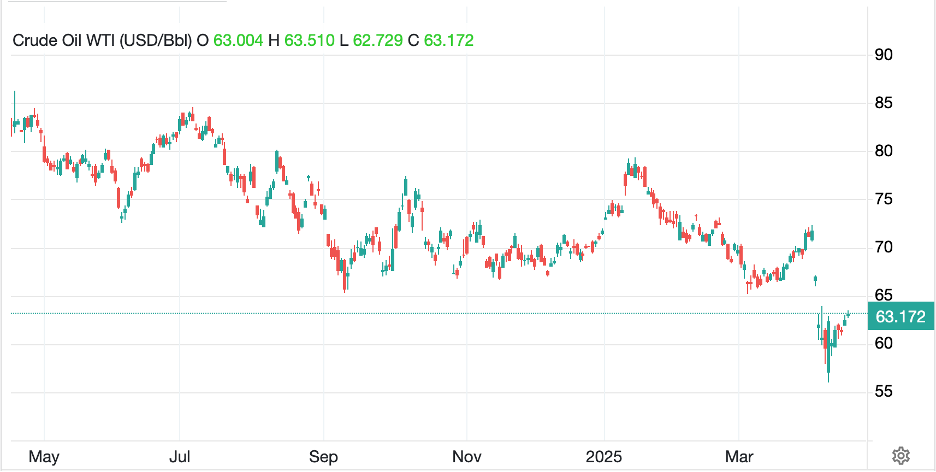
In the commodity markets, oil (-1.2%) is slipping again and has consistently demonstrated it is unable to make any dent in the major price gap above the market.  To close that gap, WTI will need to rally more than $8/bbl from current levels, something I just don’t see happening in the current environment.  That would require a war in Iran I think.  As to metals, yesterday’s gold rally has been reversed (-1.5%) and today it is impacting both silver (-0.75%) and copper (-2.1%) as is the stronger dollar it seems.

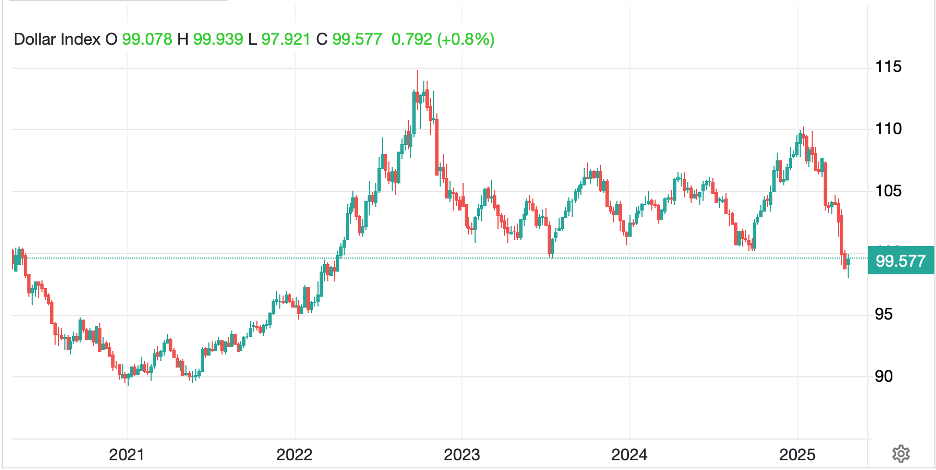
Speaking of the dollar, Monday’s narrative that the dollar was about to collapse will need at least another day to come to fruition as it is modestly higher again this morning.  looking at the DXY as a proxy, it is trading just below 100, a level that many are watching closely.  A quick look at the chart below shows this is the third time in the past two years it has traded to this level, although the first of those times it broke through.  Of course, it was much lower just a couple years earlier.

Source: tradingeconomics.com

Today’s dollar strength is modest but broad-based with only CLP (+0.6%) higher this morning which makes absolutely no sense given copper’s slide today.  The worst performer is SEK (-0.8%) but given it has been the best performer YTD amongst the G10, perhaps this is just corrective.  Otherwise, we are looking at movements on the order of 0.25% to 0.45% across the board.

The only data this morning is Michigan Sentiment (exp 50.8).  We continue to see a dichotomy between the ‘hard’ data, Claims, NFP, CPI, Factory Orders, and the ‘soft’ data, Michigan Sentiment, PMI, inflation expectations with the former holding in well while the latter weakens.  Many analysts believe that recession is coming our way by summer, but these same analysts have been predicting the recession for the past 3 years.  The one thing about the US economy is that it is extraordinarily resilient despite all the things governments try to do to disrupt it.  I understand the concern, at least if you watch/read the news, but I have a sense that many people across the nation do not really do that.  While I believe that equity valuations remain too high to be sustainable, it is not clear to me that the economy is heading into a recession at this time.  As to the dollar, I wouldn’t write its obituary just yet, although I do think it will soften further over time.

Good luck and good weekend

Adf

Not Persuaded

As tariff concerns are digested
By markets, Chair Powell’s been tested
Is cutting the move
They need to improve?
Or are they, to tightness, still vested
 
It sounds as though he’s not persuaded
A rate cut will soon be paraded
But markets still price
He’ll be cutting thrice
It could be that view should be fade


Perusing the WSJ this morning, I stumbled across the following article, “What the Weak Dollar Means for the Global Economy” and couldn’t help but chuckle.  It was not that long ago when the punditry was complaining about the strong dollar as a problem for the global economy.  The current thesis is that the weakening dollar will make foreign exports to the US more expensive, on top of the tariffs, and will reduce the number of US tourists traveling abroad.  Foreign companies will also suffer as they translate their US sales into their respective local currencies, negatively impacting their earnings.  A moment as I shed a tear.

Of course, when the dollar was strong, the concern for the global economy was that it was increasingly expensive in local currency terms to obtain the dollars necessary to service the massive amounts of USD debt that foreign companies and nations have issued, thus reducing their ability to spend money on other things to drive their domestic economy.

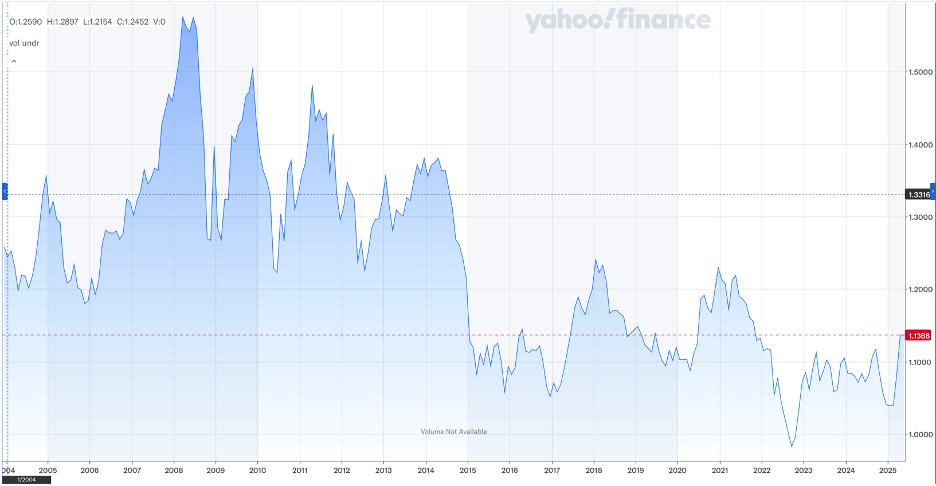
As they say, you can’t have it both ways.  While there is no doubt the dollar’s decline this year has been swift, it is important to remember we are nowhere near an extremely weak dollar.  As you can see from the below chart, the euro was trading near 1.60 back in 2008 and as high as 1.38 even in 2014.  When looking at today’s price of 1.1375, it is hard to feel overly concerned.

Source: finance.yahoo.com

As it happens, this morning the single currency has slipped back -0.3% from yesterday’s levels.  The dollar’s future remains highly uncertain given the potential policy changes that may unfold as the tariff situation becomes clearer.  Which leads us to the Fed.

For the first time in many weeks, the Fed became a topic of conversation for the market when Chairman Powell spoke to the Economic Club of Chicago.  “Our obligation is to keep longer-term inflation expectations well anchored and to make certain that a one-time increase in the price level does not become an ongoing inflation problem,” Powell explained.  “We may find ourselves in the challenging scenario in which our dual-mandate goals are in tension. If that were to occur, we would consider how far the economy is from each goal, and the potentially different time horizons over which those respective gaps would be anticipated to close.”  

Let me start by saying, the Fed’s track record in anticipating economic outcomes is not stellar.  Equity markets were not encouraged by these comments and sold off during the discussion, although they retraced some of those losses before the end of the session.  At the same time, the Fed funds futures market, while having reduced the probability of a rate cut next month to just 15%, continues to price 88bps of cuts into the market by the December meeting.  Assuming there is no cut in May, that leaves five meetings for between three and four cuts.  Based on Powell’s comments, that seems like aggressive market pricing.

It appears that there is a growing belief that a recession is on its way and that will both reduce inflationary pressures and force allow the Fed to start to reduce rates further.  Of course, there are those, Powell included, who seem to believe that stagflation is a strong possibility.  If that were the case, especially given Powell’s new-found belief that price stability matters, and his clear distaste for the president, my sense is they will focus on inflation not growth if financial conditions (aka bond markets) remain in good shape.  Will the dollar continue to decline under that scenario?  That is a very tough call as a US recession would almost certainly spread globally, and other central banks will likely ease policy.  If the Fed stands pat amidst a global reduction in interest rates, I don’t see the dollar declining.  If for no other reason, the cost of carrying short dollar positions would become too prohibitive.

As usual, the future remains quite cloudy.  Cases can be made for Fed cuts, and against them.  Cases can be made for dollar weakness and dollar strength.  Arguably, the biggest unknown is how the trade talks are going to resolve.  Yesterday, President Trump explained that “big progress” has been made on the Japanese tariff talks.  If Trump is successful in creating a coalition of nations that have closer trade relations with lower tariffs, I expect that would be taken quite positively by the markets.  On the other hand, if those talks fall apart, I expect equity markets to start the next leg lower, and that is a global phenomenon, while the dollar sinks further.  There is much yet to come.

Ok, let’s see how things played out overnight.  After yesterday’s US rout, Trump’s comments on trade talks with Japan clearly helped the market there as the Nikkei (+1.35%) rallied nicely as did the Hang Seng (+1.6%).  In fact, gains were widespread with Korea, India and Australia, to name three, all rising nicely.  Alas, Chinese shares did not participate, and Taiwan actually slipped a bit.  In Europe, investors await the ECB’s outcome this morning, where a 25bp cut is the median forecast, but there are those hinting at a 50bp cut to help moderate strength in the euro as well as support the economy given the tariff situation.  Remember, we have heard from a number of ECB members that they are confident inflation is heading back to their target.  Ahead of the news, shares are softer across the board with declines on the order of -0.5% to -0.8% throughout the continent and the UK.  Remember, too, their tariff talks are after Japan.  Interestingly, US futures are mixed with DJIA (-1.3%) the laggard while the other two are both higher about 0.5%.  It seems United Health shares have fallen enough to take the DJIA down with it.

In the bond market, Treasury yields have regained the 3bps they fell during yesterday’s US session, so are unchanged over two days.  We have also seen European sovereign yields climb between 2bps and 4bps, rising alongside Treasuries and JGB yields jumped 5bps, responding to confidence that the US-Japan trade dialog will be successful and support Japanese risk.

Despite all the reasons for oil to decline, including recession fears and continued pumping by pariahs like Iran and Venezuela, the black sticky stuff is higher by 1.1% this morning, its highest level in two weeks.  But as you can see in the chart below, there remains a huge gap to be filled more than $8/bbl higher than current prices.  It is difficult to see a significant rally on the horizon absent a major change in the supply situation.

Source: tradingeconomics.com

As to the metals markets, gold (-0.6%) blasted higher to another new high yesterday, above $3300/oz, and while it is backing off a bit today, shows no signs of stopping for now.  Both silver and copper rallied yesterday as well, and both are also falling back this morning (Ag -1.4%, Cu -2.1%).

Finally, the dollar is modestly firmer across the board this morning, with the DXY seeming to find 99.50 as a key trading pivot level.  In the G10, JPY (-0.45%) is the laggard along with CHF (-0.4%) while other currencies in the bloc have fallen around -0.2%.  The exception here is NOK (+0.3%) as it benefits from oil’s rebound.  In the EMG bloc, the dollar is mostly firmer, but most of the movement has been of the 0.3% variety, so especially given the overall decline in the dollar, this looks an awful lot like position adjustments ahead of the long weekend with no new trend to discern.

On the data front, yesterday’s Retail Sales was stronger than expected, and not just goods that were bought ahead of tariffs, but also services and dining out, which would seem less impacted.  This morning, we see a bunch of stuff as follows: Housing Starts (exp 1.42M), Building Permits (1.45M), Philly Fed (2.0), Initial Claims (225K) and Continuing Claims (1870K).  As long as the employment data continues to hold up, my take is the Fed will sit on the sidelines.  If that is the case, I sense we have found a new range for the dollar, 99/101 in the DXY and we will need a headline of note to break that.

As tomorrow is Good Friday and markets are essentially closed throughout Europe, as well as US exchanges, there will be no poetry.

Good luck and good weekend

Adf

The Tariff Explosion

In China, Xi’s ‘conomy grew
Quite nicely, but now in Q2
The tariff explosion
Ought lead to erosion
Of growth, lest we see a breakthrough


Chinese economic data was released last night, and the numbers were far better than expected, well most of them were.  The below table from tradingecoomics.com highlights the big numbers showing strength in GDP, IP and Retail Sales although Capacity Utilization was soft.

But this is Q1 data, and pretty early at that, just two weeks past the end of the quarter.  As well it reflected activity prior to the tariffs imposed by President Trump, and subsequently the Chinese themselves.  Just as we saw massive increases in the trade deficit here, as companies were front-running the tariff threat, I imagine we saw a lot more activity brought forward by the Chinese to both satisfy that front-running, as well as some front-running of their own.  I guess the question to ask is, how much information does this data provide regarding potential future outcomes and I suspect the answer is, not much.  

Already we are seeing global economists reducing their forecasts for Chinese annual GDP growth this year, with the lowest number I have seen at 3.5% (Goldman).  That is far below the ‘about 5%’ that President Xi targeted back in February and clearly assumes tariffs will remain in place.  And perhaps that is the biggest unknown.  The current state of play between Trump and Xi is that Trump said, call me, maybe and we can talk while Xi has said, show some respect and we can talk.

At this point, it is all theater, with both men playing to their bases and trying to show strength.  I do believe that Trump is seeking to isolate China, but the ultimate end game may well be to get them to alter their behavior.  If history is any guide, I imagine that this won’t be settled quickly, but that by summer, both sides will be feeling the heat on the economy.  Alas, that’s a long time from now and there is ample opportunity for significant market gyrations between now and then.

Like Fujiyama
Successful trade talks will be
A beautiful thing

On the other side of the tariff sheet is Japan, which is priority number one for the US.  PM Ishiba has sent his chief trade negotiator, Ryosei Akazawa, to the US to sit down with Treasury Secretary Bessent who has been named the lead in these negotiations.  While there is much discussion on autos, another very sticky subject is rice, on which Japan imposes a very high tariff.  President Trump claims it is 700%, others say less, more like 400%, but whatever it is, clearly the Japanese are protecting their rice farmers.  Ironically, Japan is in the middle of a rice shortage and has been pulling from strategic stockpiles to prevent prices there from rising too sharply.  Meanwhile, the US has ample export capacity.  It seems like a win-win opportunity, but politics is convoluted and from what I have read, the Japanese farmers don’t want to cede any market share to imports.  

Nonetheless, I expect that this will be a successful outcome as it is too important to fail.  While President Trump continues his bluster, he needs a win economically, and if Japanese talks are successful, we will see many more versions completed within the 90-day period in my view.  Things won’t go back to the way they were before Liberation Day, but if trade questions are answered, all eyes will turn to the budget, which is going to be a different kind of messy.  As I have written before, the greatest potential irony from this tariff war is that we could see lower tariffs around the world, something that all that WTO hobknobbing could never obtain.

One other mooted issue between the US and Japan is the exchange rate, which, while the yen has strengthened more than 10% since its low (dollar high) back just before the inauguration, remains far above levels seen before the Covid inspired inflation resulted in the Fed tightening policy aggressively.  The chart below is quite clear in displaying just how weak, relative to the past 30 years of history, the yen remains.  That last little dip is the move so far this year.

Of course, given the yen’s most recent bout of weakness dates from 2022, when US interest rates started to climb, if Treasury Secretary Bessent is successful in getting rates lower, that will be a natural driver of a weaker dollar, stronger yen.  Especially if Ueda-san does tighten policy further.

We have much to anticipate as the year progresses.  Ok, let’s turn to the overnight session and see what’s happening.  Yesterday’s lackluster US equity performance was followed by a terrible earnings discussion for Nvidia and much more extended weakness in Asia.  The Nikkei (-1.0%) and Hang Seng (-1.9%) fell sharply as did Korea (-1.2%) and Taiwan (-2.0%).  China (+0.3%), however, bucked the trend likely on the support of the plunge protection team there buying to prevent a rout.  Certainly, the positive data didn’t hurt, but I doubt that was enough.  In Europe, screens are all red as well, with declines on the order of -0.3% (UK and Spain) to -0.6% (Germany and France).  It is, however, universal with every market there declining.  As to US futures, while the DJIA is unchanged, both the NASDAQ and SPX are down sharply on that Nvidia news.

In the bond market, yields have been edging lower despite (because of?) all the tariff anxiety.  While Treasuries are unchanged this morning, they drifted off 3bps yesterday.  European sovereign yields are all lower by -2bps to -3bps and the big news was JGB yields tumbling -10bps last night.  There continues to be a great deal of discussion about China using its Treasury holdings as a weapon, but I find that highly unlikely.  Unless they could literally find a bid for all of them at once, to prevent further losses, it would self-inflict too much damage.  My take is they are essentially performing their own version of QT, allowing Treasuries to mature and slowly replacing them with other things, Bunds, gold, oil, copper.  One of the biggest problems is there are precious few asset classes that are large enough to absorb all that money, so they will continue to hold Treasuries in some relatively large amount, probably forever.

Turning to commodities, oil (+1.0%) continues to trade quietly and hang around just above $60/bbl.  It feels to me like there is a lot more room on the downside than the upside, but that is just me.  In the metals markets, gold (+1.5%) is glittering again, making yet another new all-time high this morning.  Remember a week ago when the market was correcting and there was discussion about gold losing its luster?  Me neither!

Source: tradingeconomics.com

This chart is a perfect example of the idea that nothing goes up in a straight line.  But the trend here is strong.  Silver (+1.6%) is following in gold’s footsteps today but copper (-0.4%) is lagging.  No matter, I continue to think commodities have more strength ahead.

One of the reasons is that the dollar remains under pressure.  Last night, further weakness was manifest with the euro trading back close to the highs touched on Friday at the 1.14 level.  Prior to Friday, the last time the euro was here was in February 2022.  But again, like the yen chart above, the euro’s strength is a very recent, short-term phenomenon.  A look at the chart below demonstrates just how “weak” the dollar is vs. the single currency on a long-term basis.  The answer is not very.

But overall, the dollar is weaker this morning across the board against both G10 and EMG currencies.  I do agree with the idea that foreign investors have been liquidating their US equity holdings slowly and repatriating the funds home.  If that continues, and it could, a continued decline in the dollar, especially if US yields slide, is likely.

On the data front, Retail Sales (exp 1.3%, 0.3% ex-autos) is the headliner at 8:30 then IP (-0.2%) and Capacity Utilization (78.0%) at 9:15.  We also hear from the BOC, although they are expected to leave their base rate on hold at 2.75%.  EIA oil inventory data is due later this morning with a decent sized draw of more than 5mm barrels across products expected.  There are Fed speakers including Chair Powell at 1:30 this afternoon, but they have just not had much sway lately, and I think they are ok with that.

Putting it all together, at least in the FX framework, my take is the dollar has further to fall.  There is no collapse coming, but steady weakness seems realistic.  However, given the overall uncertainty at the current time, I would be maintaining hedges rather than anticipating that weak dollar.

Good luck

Adf
Likely to Bleed

By now, everyone is aware
The world we had known is not there
While populist views
Are turning the screws
On governments ‘bout everywhere
 
The upshot is capital’s lead
O’er labor is like to recede
So, wages will rise
With yields, and surprise
Risk assets are likely to bleed


For the first time in quite a few sessions, certainly since ‘Liberation Day’, market activity has calmed down a bit.  It is not that markets have stopped moving, just that the wild gyrations have disappeared for the moment.  I would estimate that for most investors, and certainly for risk managers with hedging requirements, this is a blessing.  However, for the trading desks at Wall Street firms, maybe not so much.  I couldn’t help but notice the lead headline in the WSJ this morning, “Bank Trading Desks Are Minting Money From Tariff Chaos”  

Now, we cannot be surprised by this, as volatile markets are what traders, especially bank traders with customer flow, live for.  This is where they truly have an edge, even over the algos, because they have information the algos don’t have, the order flow.  This got me to thinking about the idea, one which I have embraced, that President Trump is concerned with Main Street, not Wall Street.  Well, if Wall Street is going to play second fiddle, I’m sure many there are perfectly comfortable with this situation.  Arguably, if this continues, we are going to see many internecine battles at the big Investment Banks as traders gain power at the expense of bankers, but the firms overall will be just fine.  (I know you were all worried 🤣.)

But let’s go back to the Main Street, Wall Street question.  Someone who I have been following on Substack, Russell Clark, a UK hedge fund manager, has described this point very well.  In the battle between labor and capital for corporate resources, Wall Street benefits when capital is favored by legislation/regulation while Main Street benefits when the rules turn in labor’s favor.  

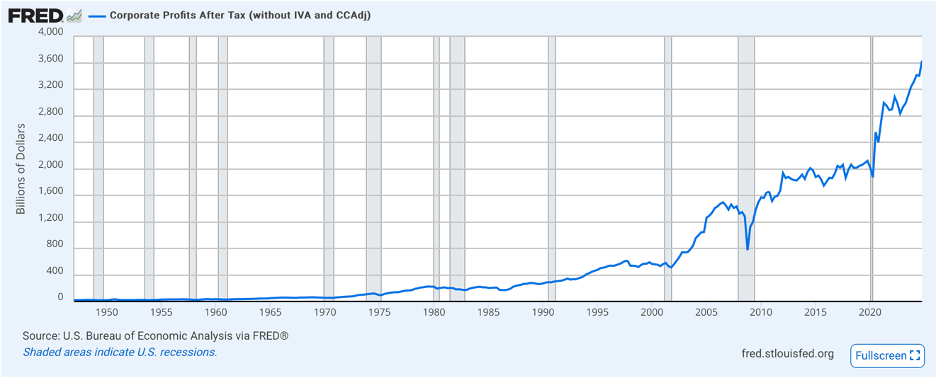
For the past 25 years, the rules have been helping capital at labor’s expense.  Especially since the GFC, when the financialization of the economy really took off, this has been the case.  Just look at the extraordinary rise in corporate profits during this period compared to the long history.  This is a direct result of the globalization effort, with the outsourcing of much manufacturing to China and other low-wage nations.

Source: fred.stlouisfed.org

But let us consider what we have seen fomenting for the past decade, arguably since President Trump’s first election and Brexit occurred in 2016.  Those were populist outcomes.  And we have seen populism rise around the world.  It is couched as right-wing fascism by many in the media, but whether in Germany, France, Italy, the Netherlands, here in the US or many other Western nations, the people’s voice is being heard.  And what they are saying is, labor wants a bigger piece of the pie.

This idea offers solid explanations for several current situations.  Labor, aka Main Street, wants government to work for them, to protect their jobs and incomes.  They care far less about a company’s share price and far more about the company investing in the business and expanding.  Capital, aka Wall Street, wants the government to work for them, to keep financing costs down to increase capital productivity and drive share prices higher, whether through share repurchase or reduced expenses (aka job cuts).  

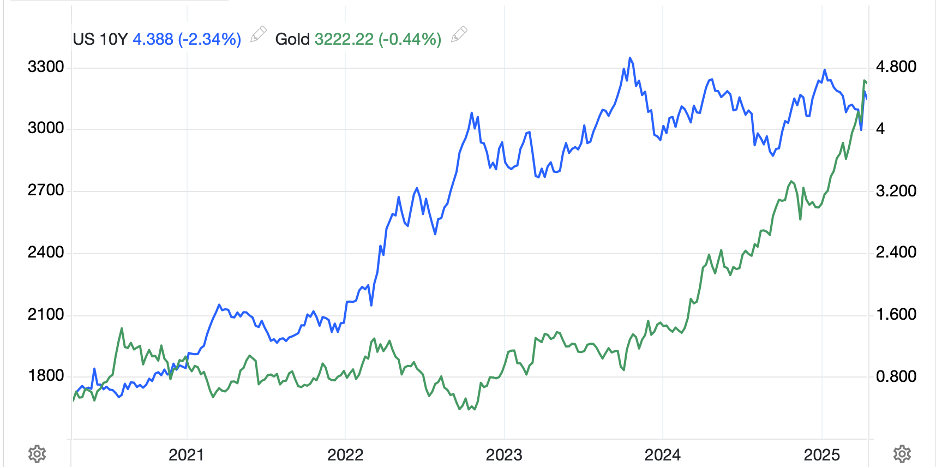
Right now, labor is in the ascendancy.  (It is ironic that labor’s ascent has been deemed right-wing, given the long history of its left-wing tendencies, but there you go).  As long as this remains the case, I think we need to consider how it will impact markets going forward.  Russell’s short-hand trade idea has been long GLD vs. short TLT (the long-bond ETF) and it has worked well for quite a while.  Can bond yields continue the rise that began in 2022?  Certainly.  Can gold continue its rally?  Of course.  Look at the chart below of gold and 10-year Treasury yields over the past 5 years.  There is nothing about the chart that says we are topping in either case.  Higher yields and higher gold prices seem contradictory, but they have been the reality for three years already.  I have explained numerous times that the world we knew is gone.  This may well be part of the new reality.  What about equities?  I have to believe multiples will be compressed which will not help them at all. And the dollar?  While higher rates seem like they should support the greenback, the case for capital flows leaving the US equity market is very real.  We could easily see the dollar decline further over time.

Source: tradingeconomics.com

Ok, let’s look at markets overnight.  Green continues to be the theme today after solid rallies yesterday in the equity markets.  I know this is not what I discussed above, but that is the long-term perspective, not the day-to-day.  Right now, the tariff pauses have traders and investors feeling a little more secure, as well as word that several nations are close to new trade deals with the US with significantly lower tariffs.  Yesterday’s modest US rally was followed by similar modest gains in Asia with the Nikkei (+0.8%) leading the way while both Hong Kong (+0.2%) and China (+0.1%) managed to gain, but only just.  Meanwhile, in Europe, the gains are somewhat better as the DAX (+1.0%) and IBEX (+1.2%) are leading the way with the FTSE 100 (+0.8%) and CAC (+0.25%) lagging a bit.  We did see some solid employment data from the UK with employment rising 206K over the past 3 months while earnings and the Unemployment Rate remained unchanged.  However, Germany is a bit more confusing given the ZEW Economic Sentiment Index there fell from 51.6 to -14.0, as the trade concerns really start to bite.  As to US futures, at this hour (7:20) they are slightly higher, about 0.15%.

In the bond markets, Treasury yields have edged higher by 1bp but remain below the recent peak at 4.50%. In Europe, we are seeing yields climb everywhere except the UK, where gilt yields are unchanged.  But Italian BTPs (+5bps), French OATs (+3bps) and German bunds (+3bps) are all under a bit of pressure this morning.  Perhaps this is a day where risk managers feel more comfortable about things, so bonds feel less compelling.

Oil (-0.4%) had a pretty big trading range yesterday but closed close to unchanged.  This morning it is slipping a bit as we continue to see demand forecasts reduced by various analysts with the IEA the latest culprit. Personally, I see prices declining from here.  As to the metals markets, gold (+0.25%) which slipped yesterday morning and rebounded all day and through the night continues to have significant support.  Silver is little changed this morning and copper (-0.7%) is backing off some of its recent gains, although is still higher by ~14% in the past week.

Finally, the dollar, which has been under general pressure lately, is stabilizing with the DXY clinging just below 100.00.  This morning, we see the euro softer but the pound and Antipodean currencies rallying, albeit not that much.  But generally, after several days of very large moves, with 2% gains for the euro and Aussie last week, most movement is 0.5% or less today and the randomness implies we are seeing positions being adjusted rather than new activity.

On the data front, here is what the rest of the week brings.

TodayEmpire State Manufacturing-14.5
WednesdayRetail Sales1.3%
 -ex Autos0.3%
 IP-0.2%
 Capacity Utilization78.0%
 Bank of Canada Rate Decision2.75% (unchanged)
ThursdayECB Rate Decision2.25% (-0..25%)
 Initial Claims225K
 Continuing Claims1870K
 Philly Fed2.0

Source: tradingeconomics.com

The only release yesterday was the NY Fed inflation expectations data which, it should be no surprise, rose to 3.6%.  I suppose that the virtual nonstop reporting that the tariff regime is going to raise inflation is having an impact.  From the Fed, yesterday we heard that patience remains a virtue and Governor Waller is in the transitory impact of tariffs on inflation camp.  There are two more Fed speakers today, Barkin and Cook, but nothing has changed my view that they are not that relevant now.

Big picture, my take is this is a reprieve before the next bout of risk selling.  The selling can last into the summer as I think it will take until then before we get a better understanding of the outcome of the trade situation.  Maybe that will be the bottom, or if trade relations worsen, perhaps another leg lower is to come.  As to the dollar, while I don’t see a collapse, I do think lower is the way.

Good luck

Adf

The Tariff Watusi

Undoubtedly, most are confused
And many portfolios bruised
The problem I fear
Is throughout this year
Both bulls and bears will be contused


Right now, it’s the tariff Watusi
With rules that seem quite loosey-goosey
So, traders are scared
While pundits declared
The president’s just too obtuse-y


But will volatility reign
All year with the requisite pain?
Or will, as Trump said
When looking ahead
The outcome be growth once again?

(Before I start, “Ball of Confusion” is brilliant and timeless.  But isn’t Billy Joel’s “We Didn’t Start the Fire” covered and updated by Fall Out Boy, really the same song for a different generation?) Now, back to our regular programming.

  • Tariffs are a tax.  So, say seemingly all the most credentialed analysts and economists around.  
  • Tariffs are inflationary.  So, say many of these same analysts and economists.  
  • Ergo, taxes are inflationary.  So, say…well none of the credentialed analysts and economists.  (H/T to Alyosha for highlighting this idea last week.)  

But it is important to recognize this dichotomy as we listen to the many pundits and analysts who are now telling us that a recession is coming, if not already here, and the world is ending.  It seems to me if you cannot recognize this connection then your views may be colored by something other than strict logic.

We are experiencing a complete regime change in both financial markets and economic outcomes around the world and as old as I am, the last time something like this occurred was long before I was born.  I am very wary of any analyst who demonstrates any certitude in their views at this point.  Frankly, I am more inclined to listen to historians than economists, as they have potentially studied previous regime changes.  Alas, I have not so I am reliant on those who I read.

The current confusion remains over tariffs, their implementation and their impact.  To me, the key point that is missing in most of the tariff discussions is the elasticity of demand for any given product.  If something is highly inelastic and tariffs are added, then the price of that item is very likely to rise.  However, if something has very elastic demand, then a tariff will do one of two things, either the producer will absorb the cost or the volume of sales will drop dramatically, but any price rise will be constrained.

I highlight this because the weekend’s ostensible pause in tariffs on electronic goods from China is the latest discussion point.  It strikes me that under the thesis tariffs are inflationary, then inflation forecasts and expectations should now be declining.  But I haven’t seen that yet.  In the end, though, I don’t believe anybody really knows how things will evolve from here, although I believe the end goal is becoming clearer.  

It appears that President Trump’s goal is seeking to isolate China from much of the developed world.  He wants to create a situation where nations declare they are either with the US or against the US when it comes to economic relations.  I read this morning that 75 nations are in negotiations with the US regarding tariff reductions.  Given that, by themselves, the G10 represent nearly 50% of global GDP, even not knowing which nations are negotiating, the group almost certainly represents upwards of 70% or more of the global economy.  

I would contend it is still very early days with respect to the results of President Trump’s actions.  There is no question he has unleashed a certain amount of chaos in the government and in markets, but I don’t believe he is greatly concerned by that, and in fact he may welcome the process.  Regime changes are always messy, and this one is no different.  Be nimble.

Ok, let’s look at how things behaved overnight.  Friday’s US equity rally was followed by strength throughout most of Asia (Japan +1.2%, Hong Kong +2.4%, China +0.2%, Korea +1.0%, India +1.8%) with Taiwan (-0.1%) the true laggard in the region.  Clearly the tariff reprieve, even if temporary, was welcomed.  In Europe, too, the gains are strong and widespread with the DAX (+2.3%) leading the way but the rest of the Continent and the UK all up at least 1.8%.  And at this hour (6:30) US futures are higher by around 1.0% as well.

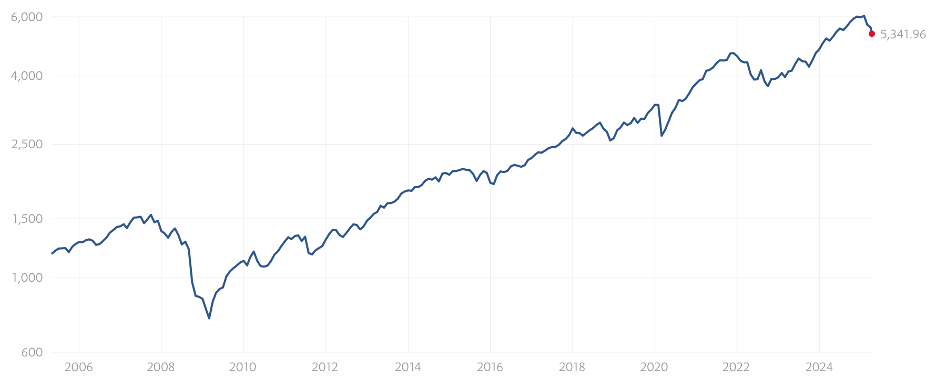
But let’s keep things in perspective.  The below chart of the S&P 500 over the past 20 years can help you understand the magnitude (or lack thereof) of the recent decline.  Yes, the index is lower by about 12% from the all-time highs set in February, and yes, uncertainty is rife.  But if you ever wanted to understand what has happened since the Fed’s response to the GFC led to the financialization of the entire economy, the latest minor dip is being described as catastrophic by the punditry.  It’s not!

Source: multpl.com

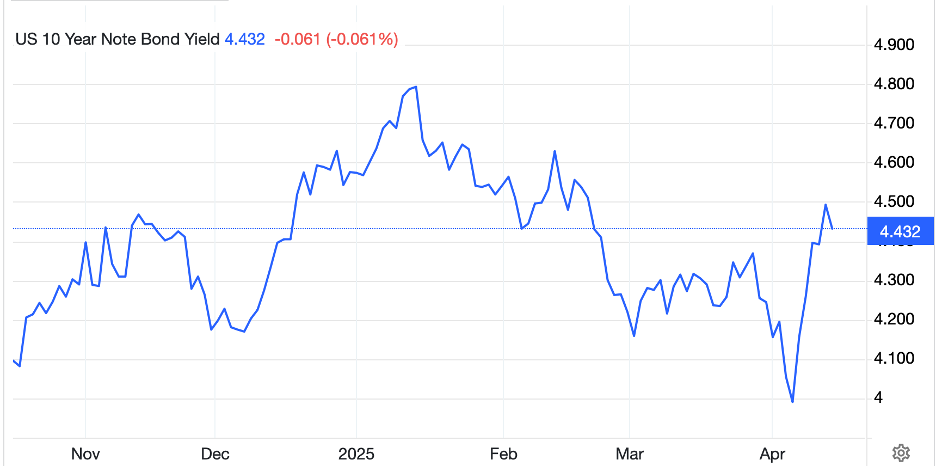
Next, the Treasury bond market has been the focus of a great deal of angst lately.  Once again, these same analysts and economists claim the world is ending because yields have risen over the past week.  I grant the movement has been sharp, but my experience tells me that when a market as liquid as 10-year Treasuries moves this sharply, it is a position liquidation that is driving the move.  In fact, both the 10-year and 30-year auctions last week seemed to have gone quite well, with strong demand.  So, I am not of the opinion the bond market is about to collapse, nor do I believe that China is liquidating their Treasury holdings.  Rather, hedge funds carrying significant leverage and being forced to unwind seems the most likely culprit here.  Too, remember that 10-year yields are right in the middle of their range for the past six months at 4.43% (-6bps today).

Source: tradingeconomics.com

In fact, European sovereign yields are also retreating this morning led by Italy and Greece (-9bps) with German bunds (-4bps) the laggard of the session.  With equity markets around the world rallying, it doesn’t appear this is safe haven buying.  However, I do believe that there are many investors who are pushing at least some of their equity portfolios into fixed income amidst overall uncertainty.

Turning to commodities, oil (+1.25%) seems to have found a bottom, at least in the short-term, just below $60/bbl.  While a recession doesn’t necessarily drive inflation lower, I am very comfortable with the idea that it reduces demand for energy and oil prices can slip.  Is the recent move a harbinger of recession?  I think there is too much noise to discern the signals the market is giving us right now, although a recession, which has been long awaited by many analysts, certainly seems possible.  

As to the metals markets, while both gold (-0.7%) and silver (-0.3%) are a bit softer this morning, one need only look at their performance in the past week (both higher by more than 7%) to recognize that there is a great deal of growing demand for precious metals.  Dr Copper (+0.9%), like oil today, is not indicating that a recession is coming as it, too, rose 7% last week and is higher by 15% YTD.  Again, there is a lot of noise to get through to find the signal.

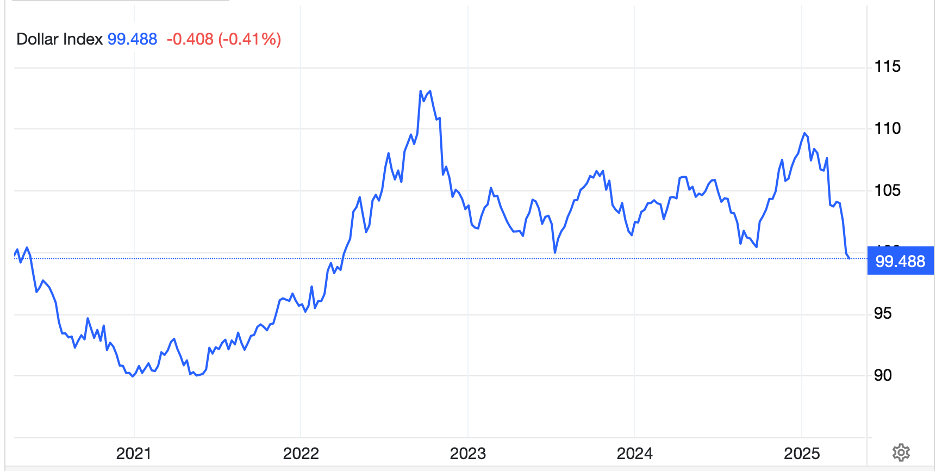
Finally, the dollar, is lower again today and is back at levels last seen…in September 2024.  And before that in July 2023 and March 2022.  In fact, if you look at the chart of the DXY below, I challenge you to show me that this decline was more dramatic than any of the three other major declines we have lived through in the past 3 years.

Source: tradingeconomics.com

Net the dollar has declined by about 10% since its recent peak in February, not insubstantial, but not unprecedented by any stretch.  In fact, over the long-term, the dollar is within spitting distance of its long-term average, which as measured by the DXY is about 104.  Looking at individual currencies, there is a strange grouping of currencies that have fallen vs. the greenback this morning, BRL (-0.85%), TRY (-0.5%), CHF (-0.5%) and CNY (-0.4%).  Given the pause in tariffs on Chinese electronic goods, CNY is confusing, as is CHF, which might imply havens are out of favor (but then why is JPY stronger?).  TRY is its own case and BRL is quite confusing.  Commodity prices have held their own or risen lately, and BRL is nothing, if not a commodity currency.  I need to search further here.  Perhaps we are seeing some carry trades being unwound.

I apologize as once again my Monday missive has grown too long for comfort.  I will highlight the data tomorrow with Retail Sales on Wednesday as the most important data release this week and the BOC and ECB meetings on Wednesday and Thursday respectively with the market looking for no change and a 25bp cut respectively.

The world is a messy place right now, with armed conflict now being joined by economic conflict.  Opinions are hardening along political lines, and I don’t see how this changes in the short run.  If you are managing risk, maintain your hedges, even if they seem expensive.  There are too many opportunities for large movements that can be costly.

Good luck

Adf

Their Own Ego Trip

The talk of the town is the “Pause”
Which led to much market applause
Though naysayers still
Say Trump’s actions will
Result in bad outcomes…because


But yesterday saw markets rip
And all those who did buy the dip
Are feeling quite smart
When viewing the chart
Of prices, their own ego trip


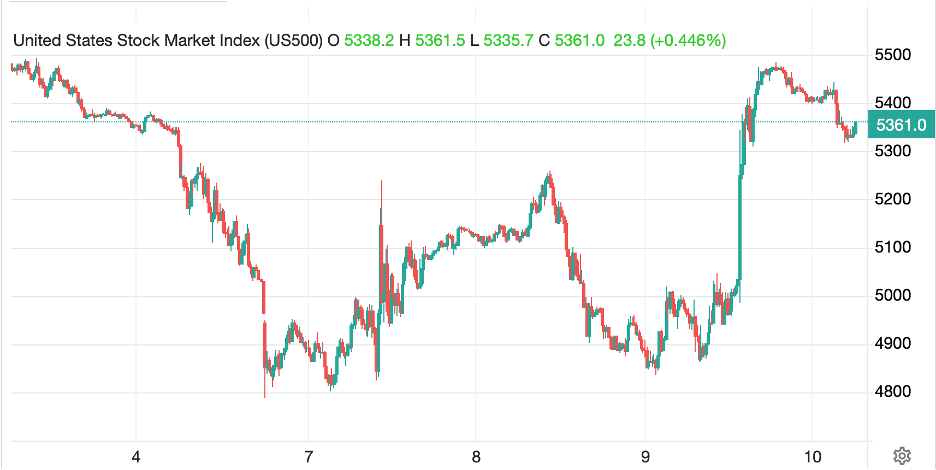
See if you can guess when President Trump posted that there would be a 90-day pause on tariffs for everyone but China.

Source: tradingeconomics.com

By now, you are almost certainly aware that equity markets in the US rebounded massively in the US, with one of the biggest gains on record as the S&P 500 rose 9.5% and the NASDAQ 12.2%.  Of course, that merely retraced the bulk of the losses seen since the beginning of the month.  In fact, the S&P 500 is still lower by about 200 points since then.  Regardless, moods are much brighter today than they were yesterday at this hour.  And those equity gains are global.

I’ve seen several interpretations of the sequence of events and like virtually everything these days, it appears to have a partisan bias to people’s views.  There are those who claim President Trump could not stand the pressure of a declining stock market and “blinked” in the game of chicken he was playing.  There are also those who claim this was part of the strategy all along, essentially moving the Overton Window substantially in his preferred direction and now he is ready to reap the benefits of this move.  

Arguably, there is evidence for both sides of this argument and I suggest we will never really know. Remember, Trump is quite comfortable making outlandish pronouncements as he level sets for a negotiation.  But he is also quite the realist and while I do not believe he was concerned with his personal or family fortune, recognized that the speed of the pain inflicted could be damaging overall.  In the end, it is not clear the rationale matters, the action stands on its own merits.  

But remember this, equity valuations were very high before the decline last week, and were still quite high, although obviously less so, after the decline.  The rebound put them back in very high territory, especially with equity analysts revising profit forecasts lower on the back of the still 10% tariffs being imposed.  A truism is that the biggest rallies in the stock market occur during bear markets.  Keep that in mind as you assess risk going forward.

But let us turn our attention to a player who is not getting much attention these days, the Fed.  Many questioned the Fed’s rate cuts back in Q4 and attributed the moves to a partisan effort to help VP Harris get elected.  Certainly, there is no love lost between Chairman Powell and President Trump.  Of late, though, the commentary has focused on patience regarding any further policy ease as the impacts of Trump’s tariff policies are unknown at this stage.  Yet, it is not hard to read these comments and get a sense that the Fed is going to work at cross purposes to Mr Trump.  

For instance, yesterday, Minneapolis Fed President Neel Kashkari released an essay with the following comments, “Given the paramount importance of keeping long-run inflation expectations anchored and thelikely boost to near-term inflation from tariffs, the bar for cutting rates even in the face of a weakening economyand potentially increased unemployment is higher.  The hurdle to change the federal funds rate one way or theother has increased due to tariffs.”  While the words here don’t appear partisan per se, Mr Kashkari is one of the most dovish FOMC members and dismissed inflation concerns regularly for a long time.  This sudden change is interesting, at the least.  

At any rate, the market, which had been pricing a 50% probability of a rate cut next month just a few days ago and a total of at least 4 cuts this year, is back down to a <20% probability of a cut in May and about 3 cuts this year.  Truly the pause that refreshes.

So, let’s look at how other markets responded to the pause.  Markets everywhere, including China, rallied last night and this morning, with Tokyo (+9.1%) and Taiwan (+9.2%) leading the way in Asia although gains were universal.  Hong Kong (+2.1%) and China (+1.3%) were the laggards with gains between 2.5% and 5.0% the norm.  In Europe, too, equities are flying this morning as the threat of much higher tariffs is removed, at least temporarily, with the UK (+4.6%) the laggard and gains between 5.0% and 6.5% the story there.  Alas, futures this morning, at 7:00am, are pointing lower by -2.0% or so.  Is that profit taking or a harbinger of the day to come?

In the bond market, which has expressly been Trump and Bessent’s main concern, yields are a bit lower this morning, -3bps in 10-year Treasuries.  But the story in Europe is confusing to me, or perhaps not.  German bunds (+6bps) have seen the largest rise while UK Gilts (-10bps) have seen a sharp decline.  Too, Italy (-4bps and Greece (-2bps) have seen yields decline.  Could this be an illustration that bunds are a better safe haven than Treasuries? And now that haven status seems less important today, they are being sold off?  JGB yields (+9bps) are also rising, perhaps on the same notion.  The corroborating evidence is that nobody thinks Gilts are a good investment, so with risk back on, they are in demand given their highest yield in the G10.

In the commodity markets, oil rebounded sharply alongside equities yesterday although it has slipped 2.4% this morning.  I have altered the Y-axis on the chart below to percentages to give an idea of the magnitude of these moves in the past days, especially relative to the past 6 months.  Despite being the most liquid commodity market around (both figuratively and literally), it is far less liquid than bonds or FX or even stocks, so as commodities are wont to do, sometimes the moves are breathtaking.

Source: tradingeconomics.com

As to the metals markets, gold (+1.0%) continues its march higher, recovering more than 5% from the lows Tuesday morning.  I maintain that much of that selling was margin based, with positions liquidated to cover margin calls in other markets.  Now that the panic has passed, demand is likely increased given the new uncertainties.  However, both silver (-0.5%) and copper (-1.3%), which rallied sharply yesterday, have slipped back a bit.  These are different stories.

Finally, the dollar is lower this morning, having yo-yoed like every other market on the tariff news.  CHF (+1.9%) and JPY (+1.4%) are the big gainers in the G10 although the euro (+1.2%) is having a day as well.  However, there are currencies with less pizzazz this morning, notably ZAR (-0.9%), KRW (-0.6%) and MXN (-0.5%), as it remains difficult to know how to proceed going forward.  JPMorgan has a global volatility index which is a useful barometer of how things are going.  As you can see below, it is not surprising that volatility in this space has also risen sharply.

Once again, I return to the idea that President Trump is the avatar of volatility, and you must always remember that volatility can happen in both directions.  While financial assets tend to collapse (yesterday being the exception) when things get out of hand, commodities go the other way as supply interruptions are the big risk. Writ large, volatility simply means a lot of movement.

We finally get some meaningful data this morning with headline CPI (exp 0.1%, 2.6% Y/Y) and Core (0.3%, 3.0% Y/Y) along with the weekly Claims data (Initial 223K, Continuing 1880K).  Given all the focus on the tariffs, though, it is not clear to me what this data will imply on a forward-looking basis.  As we have seen with the Fed getting sidelined by Mr Trump, his tariff policies have also served to overshadow economic data, at least for now.  There are a couple of more Fed speakers and a 30-year bond auction as well.  Interestingly, I expect that auction may be the most important outcome of the day.  Will there be real demand or are investors shying away?

I expect that over the next few months, tariffs will be discussed on a nation-by-nation basis as new deals are struck.  But that will impede any medium-term views on the economy as until we have a much better sense of the end results, it will be difficult to assess things.  The upshot is, we may be entering a period where we chop up and down, but don’t go anywhere until the global trade situation is clearer.  Volatility with no direction is great for traders, less so for investors.  Headline bingo is still the game we are playing.

Good luck and good weekend

Adf

End of Days

The one thing about which we’re sure
Is risk assets lost their allure
It’s not clear quite yet
How big a reset
Is coming, and what we’ll endure


Now, I don’t think its end of days
And this could be quite a short phase
But don’t be surprised
If answers devised
Result in a lack of real praise

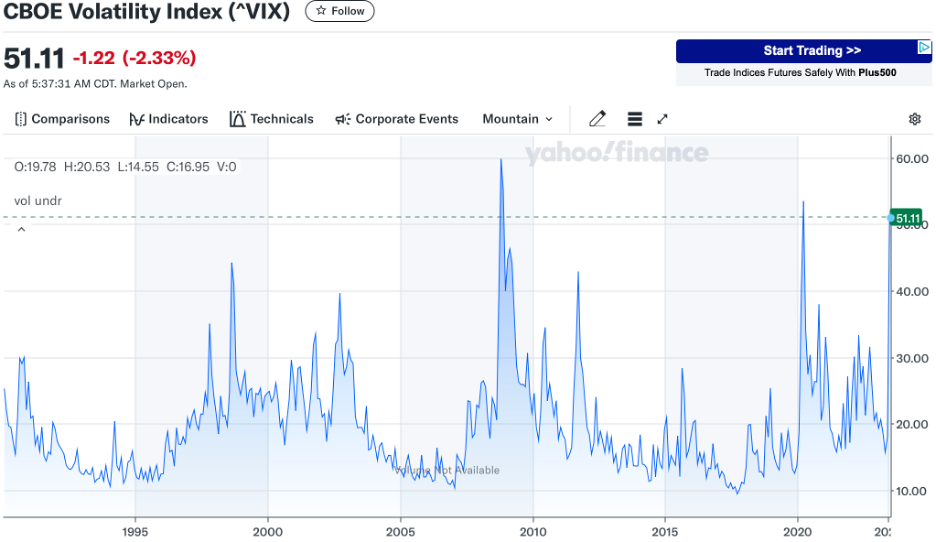
Chaos continues to reign in the markets as volatility across all asset classes has risen substantially.  Perhaps the best known indicator, the VIX, is back at levels seen last during the Covid pandemic.  Remember, the VIX is a compilation of the implied volatility of short-term equity options, 1mo – 3mo.  While markets can technically be volatile moving in either direction, the VIX has earned the sobriquet of ‘fear index’ as equity volatility most typically rises when stock markets fall.  As you can see from the below chart, the movement has not only been large, but very quick as well.

Source: finance.yahoo.com

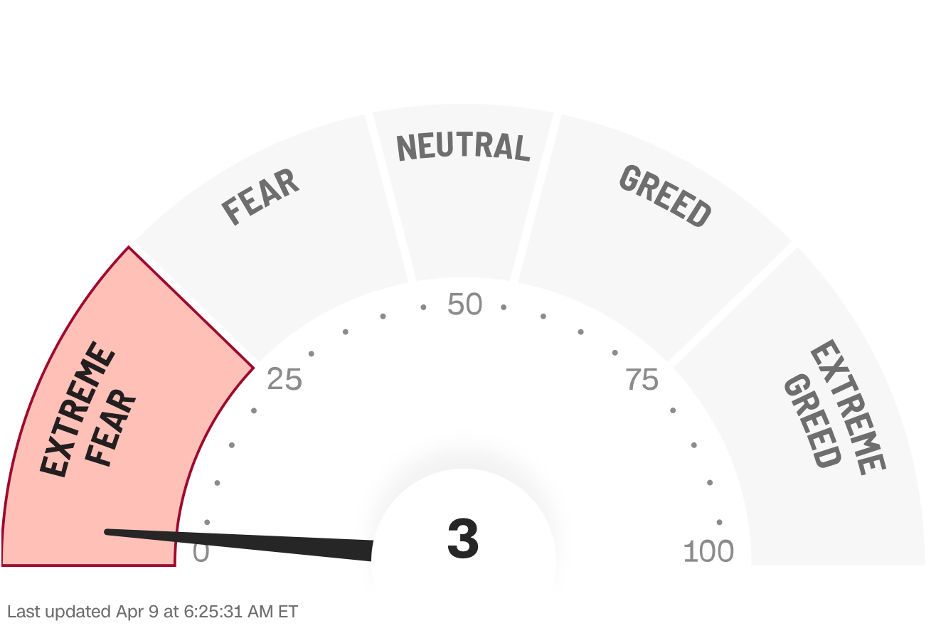
The key thing to remember is that while volatility levels can rise very quickly, as the chart demonstrates, their retracement can take quite a long time to play out.  Part of that is that even when things start to calm down, many investors and traders are worried about getting burnt again, so prefer holding options to underlying cash positions.  At least until the time decay becomes too great.  My point is that look for trepidation amidst the trading community and markets in general for a while yet, even if by Friday, the tariff situation is made perfectly clear.  Of course, with that as background, we cannot be surprised that the Fear & Greed Index has made new lows.

Source: cnn.com

However, arguably of more concern is the price action in US Treasuries, which despite the havoc in the market, are not playing their historical safe haven role.  Instead, Treasury bond yields are rising, actually trading as high as 4.50% around midnight last night although they have since retraced a bit.  The bond market has a generic volatility index as well, the MOVE index, and it, too, is trading at very high levels, the highest since the GFC.

Source: finance.yahoo.com

In many ways, this is of much greater concern to markets, as well as both the Treasury and the Fed.  The 10-year US Treasury is the benchmark long-term rate for the entire world.  A rise in the MOVE index may indicate that there is something wrong with the bond market and its inner workings, or it may be an indication that inflation expectations are rising quickly.  Whatever the reason, you can be certain the Fed is watching this far more carefully than the VIX.

I have heard two explanations for the bond market’s recent performance as follows:  first, there are those who are saying that China is selling its Treasury bonds and using the dollar proceeds to buy gold.  Now, while their holdings have been slowly shrinking, they still have just under $800 billion, so that is a lot of paper and would clearly have an impact.  The thing about this thesis is we will be able to determine its reality when China next reports their reserve numbers next month.  

The other explanation rings truer to me and that is the bond basis trade may be unwinding.  Briefly, the bond basis trade is when investors, typically hedge funds, arbitrage the difference in price between cash Treasury bonds and Treasury bond futures on the exchange.  The current positioning is these funds are long cash and short futures, and since it is a basis trade, they typically lever it up significantly, with leverage ratios of up to 100x I understand.  The total size of this trade is estimated at > $1 trillion.  Now, if this arbitrage disappears, or these funds are forced to liquidate this strategy quickly, it could be a real problem for the Treasury market.  

Ever since the GFC and the Dodd-Frank legislative response, banks no longer carry large bond risk positions and are not able to absorb large transactions seamlessly.  During Covid, you may remember that Treasury yields were all over the map, crashing and then exploding higher one day to the next, and that was caused by this basis trade unwind.  Back then, the Fed purchased nearly $1.7 trillion in QE to stabilize the market, and by all accounts, the basis trade was half the size then that it is now.

Remember, too, arguably the most important part of the Fed’s mandate is to maintain Treasury bond market stability.  Without this, the US will not be able to fund its debt and deficits.  So, whatever your view of how Chairman Powell may respond to the tariff story, which seems to be patience for now, if the bond market starts to break, you can be sure the Fed will step in.  QT will reverse to QE in a heartbeat as they offset the impact of this position unwinding.  If that is the case, I anticipate we will see further weakness in equities and the dollar, while gold will truly shine both literally and figuratively.  I’m not saying this is what is going to happen, just that this explanation makes more sense to me.  

Ok, now that tariffs have officially kicked in as of midnight last night, let’s see how markets are responding this morning.  Most equity markets continue to struggle after yesterday’s disappointing US session, where higher opens eroded all day with the major indices all closing on their session lows.  This bled into Asia where Japan (-3.9%) gave up most of yesterday’s gains although both China (+1.0%) and Hong Kong (+0.7%) held up well amid government support.  As to the rest of the region, Taiwan (-5.8%) was worst off, but other than Thailand and the Philippines, both of which managed gains, every other index was lower, often sharply.  In Europe, the realization of the tariffs is hurting with declines of -3.0% to -4.0% across the board.  As to the US futures market, at this hour (7:25), all three major indices are lower by at least -1.0%.

Bond yields are all over the place this morning with Treasuries (+8bps) continuing their recent climb amid the fears discussed above.  However, in Europe, things are such that German yields (-1bp) are doing fine while UK Gilts (+9bps) are suffering along with Treasuries.  The rest of the continent, save the Netherlands, has also seen yields rise, but much less, between 2bps and 5bps.  Overnight, JGB yields were unchanged as players are uncertain as to the next steps by the BOJ there.

In the commodity market, oil (-5.6%) is once again under major pressure.  This feels like a confluence of both technical factors (the price has broken below long-term support at $60/bbl and is now testing for lows) and fundamental factors, with OPEC raising output and the mooted recession likely to reduce demand.  Interestingly, lower oil prices are a tremendous geopolitical weapon for the US as both Russia and Iran are entirely reliant on them for financing their activities.  As to the metals complex, gold as regained its luster (sorry 😁) rallying 2.8% and well above the $3000/oz level.  This has taken silver (+3.1%) and copper (+3.5%) along for the ride.  It seems to me the copper story is not in sync with the oil story as a recession would likely drive copper prices lower, but that is this morning’s movement.

Finally, the dollar is softer again this morning with the euro (+0.8%) trading through 1.10 and the yen (+1.0%) back below 145.00.  It’s interesting because there was a story last night about how the new Mr Yen, Atsushi Mimura, was speaking to the BOJ amid concerns that the yen has been too volatile.  However, to my eye the movement has been relatively sedate, strengthening gradually and still, as can be seen in the chart below, substantially weaker than for the many years prior to the Fed beginning to tighten policy in 2022.

Source: finance.yahoo.com

The other noteworthy move is CNY (+0.5%) which after slipping to levels not seen since 2007, has retraced somewhat.  If Treasury bonds are not seen as haven assets for now, the dollar has further to fall.

On the data front, the FOMC Minutes at 2:00pm are released, but given all that has happened since then, it is hard to get excited that we will learn very much new.  We also see EIA oil inventories with a modest build expected, but this market seems likely to have adjusted those numbers outside any forecasting error bars.

The tariff story will continue to drive markets for now as investors try to determine the best way to protect themselves until things settle down.  And things will settle down, but when that will happen is the $64 trillion question.  FWIW, which is probably not much, my sense is that we have a few more weeks of significant chop, as we await clarity on the tariff policy (meaning its goals).  I still believe there will be a number of deals that will reduce the initial numbers, but the ultimate goal is to isolate China.  It is going to be messy for a while yet.  As to the dollar through all this, my sense is lower, but not dramatically so.

Good luck

Adf

Tariff’s Predations

The White House said seventy nations
Are seeking to have conversations
With President Trump
Avoiding the thump
That comes amid tariff’s predations


But China is not on the list
As Xi claims that he’ll raise his fist
To “fight to the end”
And try to defend
His nation from being dismissed

Last week, risk was anathema to one and all.  President Trump’s tariffs were upending the world economy, recession was coming to the US, and possibly the world.  I couldn’t help but be reminded of this classic on the potential outcomes.  

Leading up to the tariff announcements, nations around the world were puffing out their metaphorical chests and claiming all the things they would do to respond.  But the reality is that as I have repeatedly said, the US is the consumer of last resort, and most nations cannot afford to lose access without significantly damaging their own economies.  As such, it is not that surprising that such a long list of nations has reached out immediately, indicating a willingness to change their own policies in order to prevent these tariffs.  Arguably, China is the one outlier here, with President Xi claiming they will “fight to the end” in this trade war.

Already, a number of nations have promised to reduce their tariffs on US goods to 0.0% if that is what is required, although thus far, the President has not accepted those deals.  It is a fair question to ask what he is seeking, since apparently, it is not simply free access.  Granted, there are also numerous non-tariff barriers that are in play, and perhaps he is focused on those as well.  Or perhaps he really is looking at tariffs as a key revenue source and doesn’t want to give up that revenue opportunity.  Or perhaps he is simply waiting for enough nations to bend the knee before one large announcement when all these deals are accepted.  The latter idea would be in keeping with the idea that he is trying to isolate China.

These are just three possibilities of the many, and nobody other than President Trump himself knows how this will end up.  I find it encouraging that Treasury Secretary Bessent is leading the discussions with Japan, a key ally and trade partner, as I have great faith in his understanding and abilities.  However, in the end, it is the President’s decision so…who knows?

Of course, the end of last week brought mayhem to risk markets with equities around the world falling sharply in price.  While there had been numerous voices explaining that equity valuations in the US were far too high and unsustainable, many of those same voices were screaming the loudest at the repricing.  But, as I said yesterday, markets have a great deal of trouble trading in that manner for too long as traders and investors simply get tired and stop trading at all.  

But what was interesting was that US markets turned around after the incredibly weak opening in futures markets Sunday night, and closed mixed on the day, with the NASDAQ actually managing a tiny gain.  I’m not sure exactly what to ascribe as the cause of that reversal, maybe bargain hunters, maybe short covering, or maybe much of the forced selling from margin calls had been completed.  In the morning, there was a rumor that Trump would delay the imposition of tariffs by 90 days, but that was squelched very quickly.  You can see that price action on the chart below.

Source: tradingeconomics.com

The bounce, though, is continuing and we saw substantial rebounds overnight throughout Asia as well as in Europe this morning and with US futures pointing higher as well.  As much fear as was felt on Friday, it seems just the opposite today.  Interestingly, the Fear & Greed Index is still sitting at its all-time lows of just 4 as of this morning.  Perhaps that is the indicator driving the buying.

Source: cnn.com

To recap, many nations are offering to change their tariff policies with the US, although none of those offers have yet been accepted.  Tariffs are due to be enacted starting tomorrow, and there is still a great deal of concern around, but equity markets worldwide are rebounding from their worst levels.  For anyone who thought markets made sense, I dare you to put this puzzle together!

But let’s see how big the bounces were.  Tokyo (+6.0%) exploded higher, recouping much of Friday’s losses, although still down net since this began.  Surprisingly, China (+1.7%) and Hong Kong (+1.5%) showed much less bounce, although they didn’t fall as sharply either.  However, I have to assume that President Xi cannot be very happy as the Chinese plunge protection team was active last night, buying more than $5.7 billion in ETF’s to support the market and there was verbal support as well from the government.  Too, the yuan is sliding more aggressively but we will cover that below.  As to the rest of Asia, the picture was mixed with Taiwan, Vietnam, Thailand and Singapore falling sharply while India, Australia and New Zealand all had nice bounces.  

In Europe, there is a rebound as well, albeit not so dramatic with the FTSE 100 (+1.9%) leading the way and the DAX (+1.4%) and CAC (+1.3%) having solid sessions.  One of the offers was from the EU, saying they will take the tariffs on manufactured goods to 0.0% if the US would reciprocate, although that offer was not accepted, at least not yet.  US futures are all firmer this morning, up between 1.25% and 2.0% at this hour (7:15).  I think the message here is that nobody really knows anything else yet, and short-term trading is the driver.

In the bond market, there was a massive reversal yesterday with Treasury yields spiking more than 30bps from bottom to top during the session and closing near the highs. (see below)

Source: tradingeconomics.com

We saw similar price action throughout European sovereigns as well, although the rise was not quite as dramatic, a bit more than 20bps in German bunds although 30bps in UK gilts.  This morning, however, after all that price movement, yields are within 1bp of yesterday’s closing levels as traders and investors try to figure out what to do next.  JGB yields did rally 16bps yesterday, which given their level, was commensurate with the Treasury movement.  Arguably, looking at the chart above, what we have seen is a reset to pre-tariff levels.

In the commodity markets, oil (+0.25%) managed to close above $60/bbl, although the trend there remains lower in my eyes.  I have had a bearish overall view on oil for more than a year as I explained back in January 2024 that there was plenty of oil around, and  it was political decisions that was restricting its availability, not physical ones.  As such, it is no surprise to me that the trend here is lower, especially with President Trump’s energy policy to drill, baby, drill, and OPEC increasing production as well.  It is hard to get excited about major price rises here.  Meanwhile, gold (+1.0%) and silver (+1.0%) are rebounding, with gold back above the $3000/oz level after its short profit taking foray below that key psychological level.  Copper is still under pressure as the growth story remains uncertain, at best, for now.

Finally, the dollar is a bit softer this morning, but with some notable exceptions.  While G7 currencies are all firmer, ranging from NZD (+1.1%) down to NOK (+0.1%) and everything in between, in the EMG bloc, CNY (-0.25%) is back to the weakest levels (dollar strength) since early January and prior to that since September 2023.  

Source: tradingeconomics.com

Xi is now caught in a tough spot as given the US tariffs, which total to about 104% on Chinese imports, the natural response is to allow the yuan to depreciate.  However, he has made a big deal about the yuan being a stable store of value, so if he lets it slide, that will undermine that argument.  My money is on a weaker CNY going forward.  Elsewhere in Asia, KRW (-0.6%) and INR (-0.4%) led the way lower.

On the data front, the NFIB Small Business Optimism Index was released at a softer than expected 97.4 this morning, but there is nothing else on the calendar other than an afternoon speech by SF Fed president Daly.  

It cannot be a surprise that we had a rebound from last week’s dramatic declines.  The question, of course, is have we now seen the bottom.  My take is that is not the case, and while we may hold tight for a few sessions, further declines are still in the offing.  At least absent a major change where Mr Trump announces that he has accepted the reduction in tariffs elsewhere around the world.  Remember, even after the declines, US equities are still richly valued.  As to the dollar, that is a much harder question, and I sense that there will be much more idiosyncratic movement rather than bloc dollar movement going forward.

Good luck

Adf