No Mean Feat

On Friday, the story was gold
And PMs, which everyone sold
The question now asked
Is, has the peak passed?
Or will it still rise twentyfold?
 
The funny thing, though, is that stocks
While weak coming out of the blocks
Reversed course and rose
Right into the close
T’was like Bessent sold from Ft Knox!
 
(PMs = precious metals)


The world felt like it was ending on Friday as the early price action showed all the asset classes that have been rallying dramatically, notably gold and stocks, falling sharply.  But a funny thing happened on the way to the close.  While gold stopped declining, it had no rebound whatsoever, yet the equity market rallied sharply late in the session to close in positive territory.  The below chart (taken Sunday evening) shows that the two assets tracked each other pretty closely right up until lunchtime Thursday and then diverged sharply.

Source: tradingeconomics.com

While there continues to be an overwhelming amount of news stories that may have an impact, I believe Occam’s Razor would indicate the most likely reason that gold sold off so dramatically, slipping more than 2%, is that the rally had gone parabolic and a series of option expirations on Friday forced some real position changes.  My take is this was some profit taking and despite the decline, the bull market trend remains strong and there is no reason to believe this move is over.  After all, there has been nothing to indicate that inflation is going to be contained, nor that fiscal spending will be significantly cut, and Chairman Powell has pretty much promised another rate cut in 10 days.  Look for the correlation, which regained some vibrancy late Friday, to reassert itself going forward.

However, the activity in the other precious metals cannot be ignored, as gold was the least dramatic.  My friend JJ (Alyosha’s Market Vibes) explained that the story was silver driven as an extremely large number of SLV (the Silver ETF) call options were expiring on Friday and there were many machinations by the market makers to prevent too many from being in the money.  Read his piece above for the details, but I would argue none of these machinations change the underlying precious metals thesis.

Takaichi-san
Seems to have found a partner
History’s waiting

From Japan, the word is that Sanae Takaichi and the LDP have convinced the Japan Innovation Party to join in a governing coalition and that, in fact, Ms Takaichi will become the first female Prime Minister in Japan.  This was seen very favorably by Japanese equity markets with the Nikkei gapping higher on its open overnight and rallying 3.4% on the session.  I guess investors are excited by her run it hot plans, and given a governing majority, she should be able to implement those plans.  I suppose that given run it hot is the global consensus of policymakers right now, we shouldn’t be surprised.  FYI, the rally since the April Liberation Day decline has been just over 60%, but I’m sure there is no bubble here.🙄
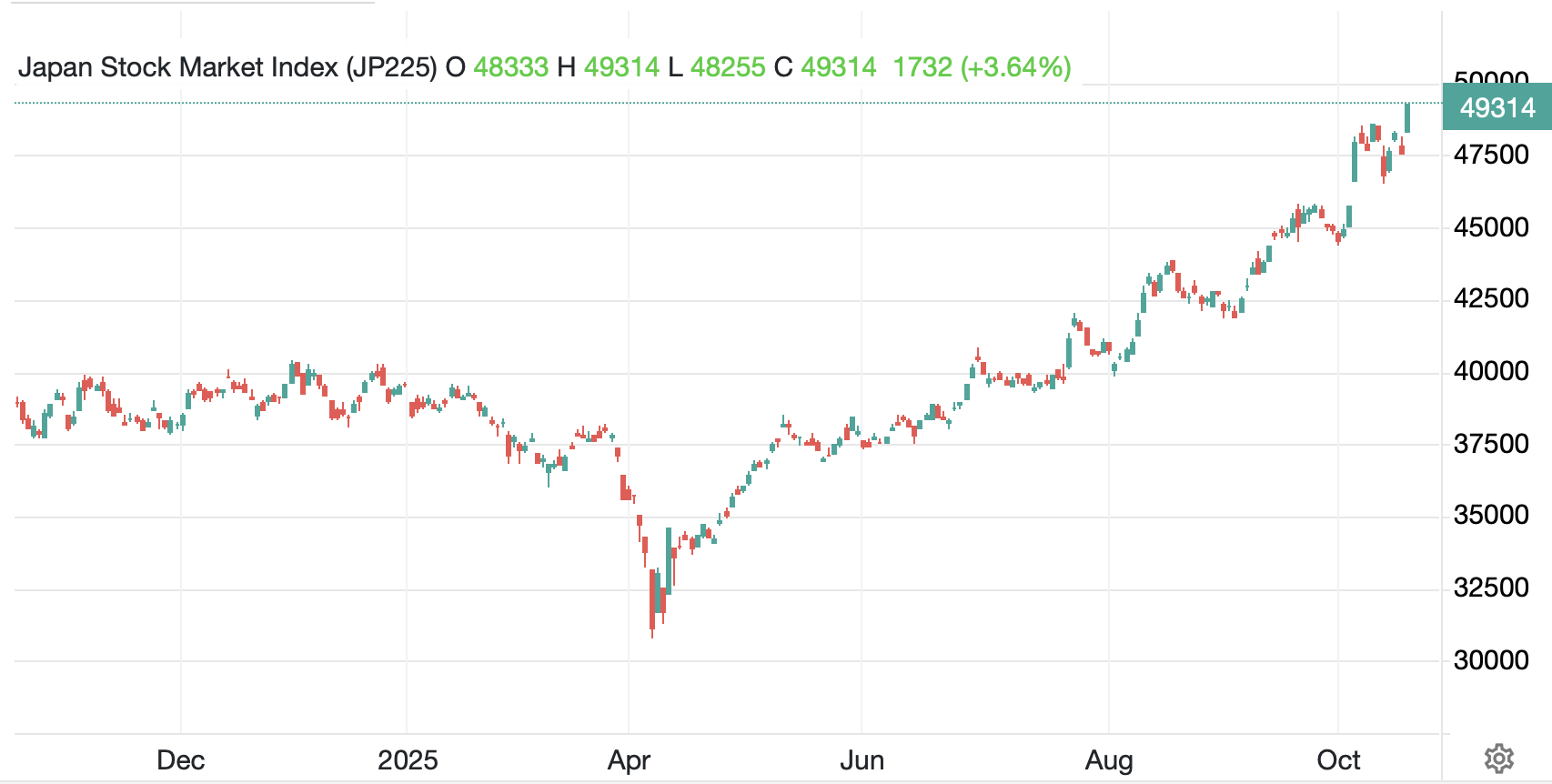
Source: tradingeconomics.com

In China, this week Xi will meet
With leaders, and though he won’t Tweet
They’ll conjure a plan
For growth, if they can
Success though, will be no mean feat

Finally, Chinese data was released overnight showing that GDP growth fell to 4.8% Y/Y in Q3 as Retail Sales remain relatively sluggish and Fixed Asset Investment (a euphemism for housing) continues to decline, falling -0.5%.  In fairness, housing prices, though they fell -2.2% across 70 major cities, have seen the rate of decline slow, but as you can see from the chart below, those prices have been falling for 3 ½ years.  it is not surprising that the people there feel less wealthy and correspondingly spend less as housing was sold as their retirement nest egg and represents some 25% of the economy.

Source: tradingeconomics.com

The Fourth Plenum is this week, which is the meeting where Xi and the CCP determine the next five-year plan.  There is much hope that they will focus on supporting domestic consumption, but history has shown that is not their strong suit.  Rather, the economic model they know is mercantilism, and I suspect that will still dominate the process going forward.  However, Chinese shares (CSI 300 +0.5%, HK +2.4%) responded positively to hopes that the US-Chinese trade situation will be ameliorated when President’s Xi and Trump meet next week.  Apparently, Secretary Bessent and Premier Li are due to meet this week as a preliminary to that meeting.

So, with all that in mind, let’s see how things so far unmentioned played out overnight. it should be no surprise that given the rallies in both Japan and China, the rest of the region performed well with Korea (+1.75%), India +(0.5%) and Taiwan (+1.4%) indicative of the price action.  Only Singapore (-0.6%) showed any contrariness although there were no obvious reasons for the move.  In Europe, we have also seen some real positive movement with the DAX (+1.3%) and IBEX (+1.5%) performing quite well on  relief that the US-China, and by extension global, trade situation seemed set to improve.  However, in Paris, the CAC (0.0%) has lagged on news that BNP Paribas has been fined >$20 million on its alleged complicity in Sudan atrocities two decades ago dragging the entire French banking sector down with them.  As to US futures, at this hour (7:10) they are pointing higher by about 0.2%.

In the bond market, yields are unchanged in the Treasury market, with the 10-year sitting at 4.01% while European sovereign yields have edged higher by 1bp, except France (+3bps).  Ostensibly, the story is the reduced trade tensions have investors leaving the ‘haven’ of bonds and getting back into equity markets.  Overnight, JGB yields rose 4bps as the news that Takaichi-san seemed set to become PM has bond investors there a bit nervous given her unfunded spending plans.

In the commodity markets, oil (-1.0%) continues to slide and is now testing the post Liberation Day lows seen in April.  Looking at the chart below, it is hard to get too bullish, and I suspect we will see lower prices going forward for the near term.

Source: tradingeconomics.com

As to the metals markets, gold (+0.2%) is choppy, but clearly has found short-term support after Friday’s decline while silver (-0.25%) and Platinum (-1.0%) are both still under modest pressure, although nothing like Friday’s moves.  If Friday’s story was all about the option expiries in SLV, which is quite viable, I don’t expect much more downside and the underlying bullish thesis is likely to reassert itself.

Finally, nobody seems to care about the FX markets these days.  The dollar has edged slightly higher this morning but as we have consistently seen for the past several weeks, daily movement is on the order 0.1% or 0.2%, and the big picture is the dollar is not a focus right now.   If we use the euro as our proxy, you can see that since June, it has basically been unchanged.  The rally from the first part of the year has ended for now, and I continue to suspect that absent a significant dovish turn by the Fed, it is likely over.

Source: tradingeconomics.com

On the data front, with the government still shut down, the only data point we will see is CPI on Friday (exp +0.4%, 3.1% Headline; +0.3%, 3.1% Core).  As well, the Fed is in their quiet period so we won’t have any distractions there.  That means that FX markets will be beholden to risk moves and trade comments, but for now, I don’t see much movement on the horizon.

Good luck

Adf
Rate Cutting Pretension

The US and China have shaken
Their hands, as trade talks reawaken
And while it’s a start
It could fall apart
For granted, not much should be taken
 
So, markets have turned their attention
To ‘flation with some apprehension
This morning’s report
Might help, or might thwart
Chair Powell’s rate cutting pretension


Starting with the trade talks between China and the US, both sides have agreed that progress was made. Here is a quote from a report on China’s state broadcaster, CCTV, last night.  “China and the US held candid and in-depth talks and thoroughly exchanged views on economic and trade issues of mutual concern during their first meeting of the China-US economic and trade consultation mechanism in London on Monday and Tuesday. The two sides have agreed in principle the framework for implementing consensus between the two heads of state during their phone talks on June 5, as well as those reached at Geneva talks. The first meeting of such consultation mechanism led to new progress in addressing each other’s economic and trade concerns.”  I highlight this because it concurs with comments from Commerce Secretary Lutnick and tells me that things are back on track.

Clearly, this is a positive, although one I suspect that equity markets anticipated as they have been rallying for the past several sessions prior to the announcements.  Certainly, this is good news for all involved as if trade tensions between the US and China diminish, it should be a net global economic positive.  While anything can still happen, we must assume that a conclusion will be reached going forward that will stabilize the trade situation.  However, none of this precludes President Trump’s stated desire to reindustrialize the US, so that must be kept in mind.  And one of the features of that process, at least initially, is likely to be upward price pressures in the economy.

Which brings us to the other key story today, this morning’s CPI report.  Expectations for headline (0.2% M/M, 2.5% Y/Y) and core (0.3% M/M, 2.9% Y/Y) are indicating that the bottom of the move lower in inflation may have been seen last month.  However, these readings, while still higher than the Fed’s target (and I know the Fed uses Core PCE, but the rest of us live in a CPI world) remain well below the 2022 highs and inflation seems to be seen as less of a problem.  Yes, there are some fears that the newly imposed tariff regime is going to drive prices higher, and I have seen several analysts explain that we are about to see that particular process begin as of today’s data.  

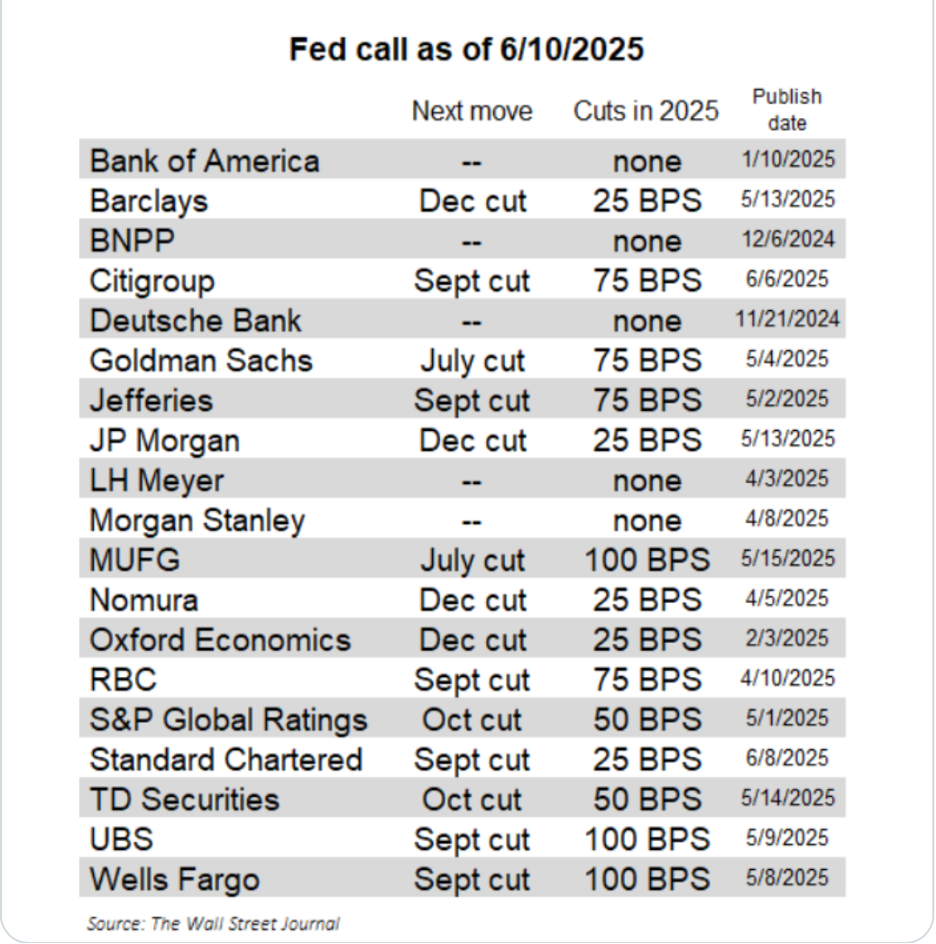
Of course, from a markets perspective, the key issue with inflation is how it will impact interest rates.  In this case, I think the following chart from Nick Timiraos in the WSJ is an excellent description of how there is NO consensus view at all.

At the same time, Fed funds futures markets are pricing in the following probabilities as of this morning.

Source: cmegroup.com

The thing about the Fed is they have proven to be far more political than they claim.  First, it is unambiguous that there is no love lost between President Trump and Chairman Powell.  Interestingly, the Fed is strongly of the belief that when they cut rates, they are helping the federal government, and more importantly, the population’s impression of what the federal government is doing.  Hence, the 100bps of cuts last summer/fall never had an economic justification, they appeared to have been the Fed’s effort to sway the electorate to maintain the status quo.  With that in mind, absent a collapse in the labor market with a significantly higher Unemployment Rate, I fall into the camp of no Fed action this year at all.  And, if as I suspect, inflation readings start to pick up further, questions about hikes are going to be raised.

Consider if the BBB is passed and it juices economic activity so nominal GDP accelerates to 6% or 7%, the Fed will be quite concerned about inflation at that point and the market will need to completely reevaluate their interest rate stance.  My point is the fact that rate cuts are currently priced does not make them a given.  Market pricing changes all the time.

So, let’s take a look at how things behaved overnight.  After a modest US rally in equities yesterday, Asia had a solid session, especially China (+0.75%) and Hong Kong (+0.8%) as both responded to the trade news. Elsewhere in the region, things were green (Nikkei +0.5%), but without the same fanfare.  I have to highlight a comment from PM Ishiba overnight where he said “[Japan] should be cautious about any plans that would deteriorate already tattered state finances.  Issuing more deficit financing bonds is not an option.”  That sounds an awful lot like a monetary hawk, although that species was long thought to be extinct in Japan.  It will be interesting to see how well they adhere to this idea.

Meanwhile, in Europe, the only equity market that has moved is Spain (-0.6%) which is declining on idiosyncratic issues locally while the rest of the continent is essentially unchanged.  As to US futures, at this hour (7:30) they are pointing slightly lower, about -0.15% across the board.

In the bond market, the somnolence continues with yields backing up in the US (+2bps) and Europe, (virtually all sovereign yields are higher by 2bps) with only UK Gilts (+5bps) under any real pressure implying today’s 10-year auction was not as well received as some had hoped.  In Japan, yields slipped -1bp overnight and I thought, in the wake of the Ishiba comments above, I would highlight Japan 40-year bonds, where yields have collapsed over the past three weeks.  Recall, back in May there was a surge in commentary about how Japanese yields were breaking out and how Japanese investors would be bringing money home with the yen strengthening dramatically.  I guess this story will have to wait.

Source: tradingeconomics.com

Turning to commodities, oil (+1.5%), which reversed course during yesterday’s session, has regained its mojo and is very close to closing that first gap I showed on the chart yesterday.  Above $65, I understand most shale drilling is profitable so do not be surprised to hear that narrative pick up again.  In the metals markets, gold (+0.2%) now has the distinction of being the second largest reserve asset at central banks around the world, surpassing the euro, although trailing the dollar substantially.  I expect this process will continue.  Silver (-0.8%) and copper (-2.1%) are both under pressure this morning although I have not seen a catalyst which implies this is trading and position adjustments, notably profit taking after strong runs in both.

Finally, the dollar is slightly stronger this morning with the euro and pound essentially unchanged, AUD, NZD and JPY all having slipped -0.25%, and some smaller currencies (KRW -0.55%, ZAR -0.5%) having fallen a bit further.  However, for those who follow the DXY, it is unchanged on the day.  The thing about the dollar is despite a lot of discussion about a break much lower, it has proven more resilient than many expected and really hasn’t gone anywhere in the past two months.  If the Fed turns hawkish as inflation rebounds, I suspect the dollar bears are going to have a tougher time to make their case (present poets included.)

In addition to the CPI at 8:30, we see EIA oil inventory data with a modest build expected although yesterday’s API data showed a draw that surprised markets.  I must admit I fear inflation data is going to start to rebound again which should get tongues wagging about next week’s FOMC meeting.  However, for today, a hot print is likely to see a knee-jerk reaction lower in stocks and bonds and higher in the dollar.  But the end of the day is a long way away and could be very different, especially given the always present headline risk.

Good luck

Adf

The Mayhem-ber

Five years ago, some will remember
George Floyd was the riotous ember
But while cities burned
What some of us learned
Was markets ignored the mayhem-ber
 
Of late, as the headlines are filled
With riots, no one’s been red-pilled
While some may disdain
Risk assets, it’s plain
That most buying stocks are still thrilled


The tragic goings on in LA remain the top story as we have now passed the fourth day of rioting.  It strikes me that ultimately, the constitutional question that may be addressed is how much power the federal government has in a situation where a state government seemingly allows rampant destruction of private property.  Of course, we saw this happen just over five years ago in the wake of George Floyd’s death in May 2020 and the ensuing riots in Minneapolis which ultimately spread to Portland, Oregon and Seattle.  

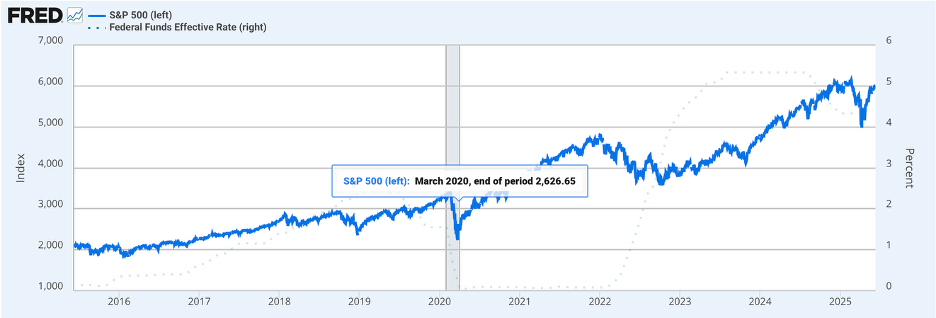
With this as a backdrop, I thought I would take a look at market behavior during that period, if for no other reason to be used as a baseline.  Of course, there are major caveats here as that was during Covid and the government had recently passed a massive stimulus bill while the Fed began to monetize that debt.  Now, we cannot ignore the BBB which looks a lot like a massive stimulus bill as well, so perhaps things are closer in kind than I originally considered.  At any rate, the chart below shows the S&P 500 leading up to and through the 2020 riots.

The huge dip before the riots began was the Covid dip, and the faint dotted line is the Fed Funds rate, so you can see things were clearly different.  However, the point I am trying to make is that despite the violence and disagreements over President Trump’s authority, I would contend the market doesn’t care at all about the situation there.  Investors remain far more concerned about the ongoing trade talks with China that are taking place in London and are “going well” according to Commerce Secretary Lutnick.  From what I read on X, it seems there is a growing expectation that a China deal of some sort will be announced soon and that will be the latest buy signal for stocks.  My larger point is that just because something dominates the headlines, it doesn’t mean that something is relevant in the financial world.

Funnily enough, because the LA riots are sucking the oxygen from every other story, there is relatively little to drive market activity, hence the relatively benign market activity we have been seeing for the past few days.  Yesterday was a perfect example with US equity markets trading either side of unchanged all day and closing pretty much in the same place as Friday.  In Asia overnight, the picture was mixed with the Nikkei (+0.3%) edging higher while both the Hang Seng (-0.1%) and CSI 300 (-0.5%) finished slightly in the red.  The one big outlier there was Taiwan (+2.1%) with other markets showing less overall interest.  I suspect this movement was on the back of the positive vibe the market is taking from the US-China trade talks.

As to Europe, the continent has a negative flavor this morning with the DAX (-0.5%) the laggard and other major indices edging lower by just -0.1% or so.  However, the FTSE 100 (+0.4%) has managed a gain after softer than expected employment data has increased discussion that the BOE will be cutting rates a bit more aggressively.  US futures are still twiddling their proverbial thumbs with no movement at this hour (7:10).

In the bond market, Treasury yields have slipped -3bps and we are seeing similar yield declines throughout the continent.  However, UK gilts (-7bps) are really embracing the slowing labor market and story of a more aggressive BOE rate cut trajectory.

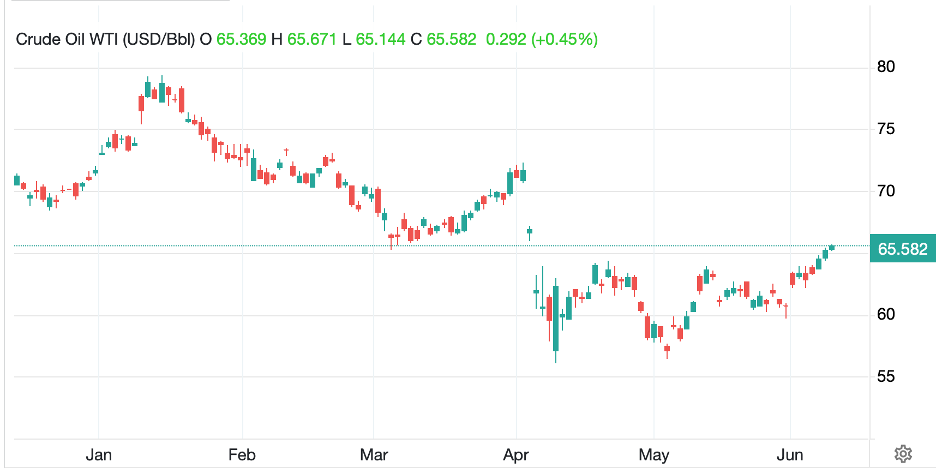
In the commodity markets, oil (+0.5%) continues to climb higher despite the alleged increases in supply and is close to filling the first gap seen back in April (see chart below from tradingeconomics.com)

Given OPEC+ and their production increases, this is a pretty impressive move, especially as the recession narrative remains largely in place.  One tidbit of information, though, is that the Baker Hughes oil rig count is down 37 rigs since the 1st of May, a sign that US production, despite President Trump’s desires for more energy, may be slipping a bit.  As to the metals markets, gold (+0.45%) keeps on trucking, with a steady grind higher although both silver and copper are little changed this morning.  I must mention platinum as well, given I discussed it yesterday, and we cannot be surprised that after a remarkable run, it is softer by -1.3% this morning taking a breather.

Finally, the dollar, like equities, is directionless overall with the pound (-0.3%) slipping on the weak labor data but the rest of the G10 within 0.1% of Monday’s closing levels.  In the EMG bloc, KRW (-0.9%) is the outlier, apparently responding to the positive signals from the US-China trade talks.  However, I question that narrative as no other APAC currency moved more than 0.1% on the session in either direction.  And truthfully, that pretty well describes the rest of the bloc in LATAM and EEMEA.

On the data front, the NFIB Small Business Optimism Index was released this morning at a better than expected 98.8, which as you can see below, is a solid reading overall, certainly compared to most of 2022-2024.

Source: tradingeconomics.com

And here is the rest of what we get this week:

WednesdayCPI0.2% (2.5% Y/Y)
 -ex food & energy0.3% (2.9% Y/Y)
ThursdayPPI0.2% (2.6% Y/Y)
 -ex food & energy0.3% (3.1% Y/Y)
 Initial Claims240K
 Continuing Claims1908K
FridayMichigan Sentiment53.5
 Michigan Inflation Expected6.6%

Source: tradingeconomics.com

However, we must take that Inflation expectation number with at least a few grains of salt (even assuming it has value as an indicator at all), as yesterday, the NY Fed released their own survey of Inflation expectations which fell to 3.2%.  A quick look at the two indicators overlaid on one another shows that the Michigan indicator, if nothing else, has much greater volatility which reduces its value as an indicator.

Source: tradingeconomics.com

It is difficult to get excited about movement in either direction right now.  At some point, the mayhem in LA will end and news sources will look for the next story.  I suspect that trade deals are going to grow in importance as Mr Trump will need to sign some more before long.  As well, the BBB, which I continue to believe will be passed in some form, is going to add some measure of certainty and stimulus to the economy, which, ceteris paribus, implies that the long-awaited reckoning in the stock market may be awaited even longer.  If that is the case, then the weak dollar story, one I understand, is likely to fade for a while as well.

Good luck

Adf

Quite Excited

The market is now quite excited
As trade talks have been expedited
With Bessent and He
Now speaking, we’ll see
If buyers last night were farsighted
 
However, do not ignore gold
Whose price is a thing to behold
The past several days
There’s been quite a craze
As sellers now rue what they’ve sold


Source: tradingeconomics.com

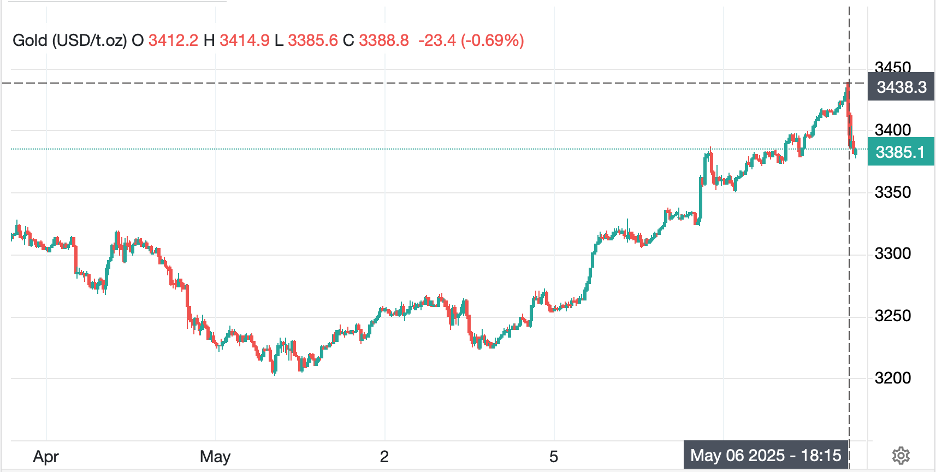
I don’t often lead with a chart, but I think it is worthwhile this morning.  I grabbed this picture at 7:00pm last night, shortly after the news hit that Treasury Secretary Bessent and Trade Representative Greer were heading to Switzerland later this week to sit down with He Lifeng, the Chinese Vice Premier and trade negotiator and begin trade talks.  Prior to that announcement, the barbarous relic had rallied more than $200/oz over the past four sessions, a pretty impressive move for something that has maintained a low overall volatility.  The first explanation of the reversal, which coincided with a sharp gain in equity futures (see chart below) is that all the fear of the world ending with corresponding equity weakness and a need to hold gold, has ended!  Hooray!!!

Source: tradingeconomics.com

Alas, just as I never believed the world was ending before, neither do I believe that everything is suddenly better.  Seemingly, this is all part of the process.  The idea that China could simply accept much of the stuff they produce would not be able to find a home in the US was never going to be the case.  I have no idea how things will work out, and they certainly will take a lot of time to come to some agreement, but it is very positive that the dialog has begun.

On the subject of which side blinked, which is a favorite for the punditry, especially those who despise dislike President Trump and believe this shows weakness on his part, I would note that the Chinese are the ones who have recently reported weaker economic data and last night the PBOC cut their 1-week reverse repo rate by 0.1% and reduced their Reserve Requirement Ratio by 50 basis points, both monetary easing measures to address the ongoing weakness in China.  Neither side benefits from this process in the short-term, but we will need to see the results of the talks, which will take many months I presume, before we know if goals have been achieved.

Away from the story on trade
The Fed story must be portrayed
Alas, it’s quite dull
As Jay and friends mull
The idea rate cuts be delayed

The only other story of note today is the FOMC meeting where they will release their policy statement at 2:00 this afternoon revealing no change in policy, and very likely almost no change in the wording, and then Chairman Powell will face the press at 2:30.  However, given the low probability of any changes, and given nothing regarding trade policy has really changed since they entered their quiet period, it seems unlikely that we will learn anything of consequence from Powell.  Today will be a complete non-event.

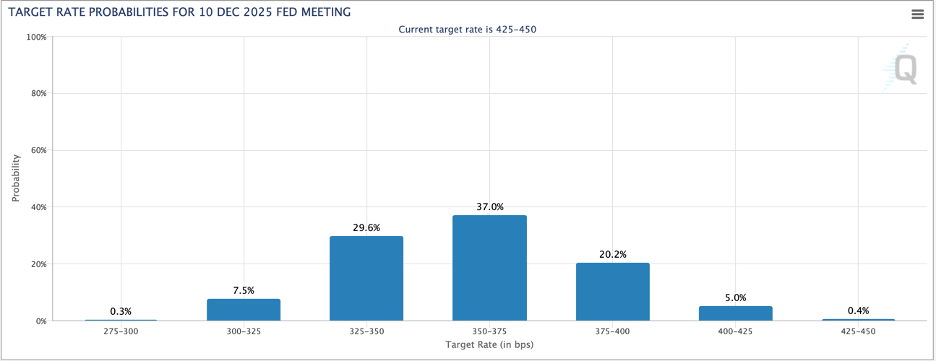
However, I cannot help but consider why the futures market appears so convinced that there are going to be rate cuts going forward this year.  As of this morning, the Fed funds futures are pricing a total of 78 basis points of cuts for the rest of this year, so three 25bp cuts as per the below chart from the CME.

Certainly, the data released thus far this year have not indicated the economy is heading into a tailspin.  Of course, there are many analysts calling for a recession to start in Q2 or Q3 as the tariff impacts ostensibly undermine the economy.  It is important to note, however, that these are the same analysts who have been calling for a recession for the past three years.  The boldest calls are for a period of stagflation, with the tariffs simultaneously killing growth and raising prices.

It is entirely possible that we see a recession this year, especially if government spending decreases given its role in supporting recent growth data.  (According to the BEA, Federal government spending in Q1 declined -5.1% while investment in the economy expanded more than 2%.). If this is the path forward, the long-term benefits will be substantial, but they must be maintained.  As well, if this is the path forward, total economic activity in the US will expand substantially and it is not clear that rate cuts will need to be part of that mix. 

Regardless, it seems that today’s activity is less likely to be impacted by the Fed than by any random headlines regarding trade or other administration maneuvers.  So, let’s see how markets have responded to the US-China trade talk news.

The China news came long after the close yesterday so the US markets closed lower on the session, approaching 1% declines, but US futures are currently higher by around 0.7% at 7:15.  In Asia, however, we did see some modest gains although the Nikkei (-0.15%) faded a bit, both China (0.6%) and Hong Kong (+0.15%) managed to rally.  As to the rest of the region, most markets were modestly higher although in a seeming sympathy move on the China news.  In Europe, bourses are softer this morning with the CAC (-0.7%) leading the way and other key indices falling less.  The data releases show Construction PMI softening on the continent as well as weak Eurozone Retail Sales (-0.1%), so I imagine that is weighing on investors’ minds today.

In the bond market, Treasury yields are 2bps firmer this morning but have been trading either side of 4.30% for the past several sessions as traders try to estimate the next big thing.  I see just as many stories about how yields are going to 10% as I do about how they are headed to 2% amid the depression coming, so my take is, we are going to range trade for a while yet.  In Europe, sovereign yields are lower by between -3bps (Germany) and -5bps (Italy) as that softer data is encouraging investors to believe that inflation will continue to decline and the ECB will cut further.

The commodity market has been where the real action is of late with oil (+0.9% today after +2.0% yesterday) rising after comments by two US oil companies that they will not be drilling any more if oil prices stay at these levels.  What I don’t understand is, what will they be doing as they are oil companies?  At any rate, this will be the tension in markets, who can afford to drill and sell oil at lower prices.  I expect we will hear from companies and pundits on both sides of this equation.  I discussed gold above, which has bounced slightly from its lowest levels overnight and I don’t believe anything will derail this train for a while yet.  However, both silver (-0.75%) and copper (-2.6%) are softer this morning, partly based on gold’s slide and partly on the weaker economy story.

Finally, the dollar is modestly firmer this morning, at least against its G10 counterparts with JPY (-0.6%) the weakest of the bunch, followed by SEK (-0.5%) and AUD (-0.3%).  The euro and pound are little changed and NOK (+0.15%) has gained on the back of oil’s strength.  In the EMG block, KRW (-1.1%) and TWD (-1.1%) have both rebounded some from their recent highs (dollar lows) in what seems more like a trading reaction than a change in policies.  Elsewhere in this bloc, though, MXN (+0.2%) is a touch stronger while ZAR (-0.5%) is a touch weaker and CNY is little changed.  There is a story making the rounds today that a well-known currency analyst, Steven Jen, is claiming that there could be as much as $2.5 trillion of excess currency reserves held by Asian nations that they may no longer need.  If this is true and these reserves were sold quickly, it would certainly drive the dollar much lower.  However, it strikes me that given the enormous amount of USD debt that has been issued by Asian companies and countries, and given these countries do not have access to Fed swap lines in emergencies, there is no reason to sell the dollars.  Rather they will simply have a ready supply without having to chase them when repayment and rollovers come due.  I would take this story with a large grain of salt.

Other than the Fed, we see EIA oil inventory data where some drawdowns are anticipated and that is really the day.  We are all awaiting the trade negotiation outcomes and I would say nobody has an inside track there.  Bigger picture, though, I do think the dollar has further to slide.

Good luck

Adf

Hope Springs Eternal

The White House and Congress have talked
‘Bout stimulus but both sides balked
Still, hope springs eternal
That both sides infernal
Intransigence will get unblocked

Throughout 2019, it seemed every other day was a discussion of the trade deal with China, which morphed into the Phase one trade deal, which was, eventually, signed early this year.  But each day, the headlines were the market drivers, with stories about constructive talks leading to stock rallies and risk accumulation, while the periodic breakdowns in talks would result in pretty sharp selloffs.  I’m certain we all remember those days.  I only bring them up because the stimulus talks are the markets’ latest version of those trade talks.  When headlines seem positive that a deal will get done, stock markets rally in the US, and by extension, elsewhere in the world.  But, when there is concern that the stimulus talks will break down, investors head for the exits.  Or at least algorithms head for the exits, its not clear if investors are following yet.

Yesterday was one of those breakdown days, where despite reports of ongoing discussions between Treasury Secretary Mnuchin and House Speaker Pelosi, the vibes were negative with growing concern that no deal would be reached ahead of the election.  Of course, adding to the problem is the fact that Senate Majority Leader McConnell has already said that the numbers being discussed by the House and Congress are far too large to pass the Senate.  Handicapping the probability of a deal being reached is extremely difficult, but I would weigh in on the side of no action.  This seems far more like political posturing ahead of the election than an attempt to address some of the current economic concerns in the country.

Yet, despite yesterday’s negativity, and the ostensible deadline of today imposed by Speaker Pelosi (we all know how little deadlines mean in politics, just ask Boris), this morning has seen a return of hope that a deal will, in fact get done, and that the impact will be a huge boost to the economy, and by extension to the stock market.  So generally, today is a risk-on session, at least so far, with most Asian markets performing nicely and most of Europe in the green, despite rapidly rising infection counts in Europe’s second wave.  Remember, though, when markets become beholden to a political narrative like this, it is extremely difficult to anticipate short-term movements.

Down Under, the RBA said
We’re thinking, while looking ahead
A negative rate
Is still on the plate
So traders, their Aussie, did shed

While the politics is clearly the top story, given the risk-on nature of markets today, and the corresponding general weakness in the dollar, it was necessary to highlight the outliers, in this case, AUD (-0.4%) and NZD (-0.5%), which are clearly ignoring the bigger narrative.  However, there is a solid explanation here.  Last night, between the RBA’s Minutes and comments from Deputy Governor Kent, the market learned that the RBA is now considering negative interest rates.  Previously, the RBA had been clear that the current overnight rate level of 0.25% was the lower bound, and that negative rates did not make sense in Australia (in fairness, they don’t make sense anywhere.)  But given the sluggish state of the recovery from the initial Covid driven recession, the RBA has decided that negative rates may well be just the ticket to goose growth once covid lockdowns are lifted.  It is no surprise that Aussie fell, and traders extended the idea to New Zealand as well, assuming that if Australia goes negative, New Zealand would have no choice but to do so as well.  Hence the decline in both currencies overnight.

But really, those are the only stories of note this morning, in an otherwise dull session.  As I mentioned, risk is ‘on’ but not aggressively so.  While the Nikkei (-0.4%) did slip, we saw modest gains in Shanghai (+0.5%) and Hong Kong (+0.1%).  Europe, too, is somewhat higher, but not excessively so.  Spain’s IBEX (+0.85%) is the leader on the continent, although we are seeing gains in the CAC (+0.4%) and the FTSE 100 (+0.3%) as well.  The DAX (-0.3%), however, is unloved today as Covid cases rise back to early April levels and lockdowns are being considered throughout the country.  Finally, the rose-tinted glasses have been put back on by US equity futures traders with all three indices higher by a bit more than 0.5% at this hour.

Bond markets, however, are following the risk narrative a bit more closely and have sold off mildly across the board.  Well mildly except for the PIGS, who have seen another day with average rises in yield of around 3 basis points.  But for havens, yields have risen just 1 basis point in the US, Germany and the UK.

Commodity prices are little changed on the session, seemingly caught between hopes for a stimulus deal and fears over increased covid cases.

And lastly, the dollar is arguably a bit softer overall, but not by that much.  Aside from Aussie and Kiwi mentioned above, only the yen (-0.15%) is lower vs. the dollar, which is classic risk-on behavior.  On the plus side, SEK and NOK (both +0.5%) are leading the way higher, although the euro has been grinding higher all session and is now up 0.4% compared to yesterday’s close.  There has been no news of note from either Sweden or Norway to drive the gains, thus the most likely situation is that both currencies are simply benefitting from their relatively high betas and the general trend of the day.  As to the euro, the technicians are in command today, calling for a move higher due to an expected (hoped for?) break of a symmetrical triangle position.  Away from these three, though, gains are extremely modest.

In the emerging markets, CZK (+0.7%) is the outlier on the high side, although there is no obvious driver as there have been neither comments by officials nor new data released.  In fact, given that Covid infections seem to be growing disproportionally rapidly there, one might have thought the Koruna would have fallen instead.  But the rest of the CE4 are also firmer, simply tracking the euro this morning as they are up by between 0.3%-0.4%.  There have been some modest losers in the space as well, with THB (-0.25%) leading the charge in that direction.  The Thai story is a combination over concerns about further stimulus there not materializing and anxiety over the political unrest and student protests gaining strength throughout the nation.

On the data front, this morning brings Housing Starts (exp 1465K) and Building Permits (1520K), as well as four more Fed speakers.  Yesterday, Chairman Powell was not focused on monetary policy per se, but rather on the concept of digital currencies, and specifically, central bank digital currencies.  This is something that is clearly coming our way, but the timing remains unclear.  One thing to keep in mind is that when they arrive, interest rates will be negative, at least in the front end, forever.  But that is a story for another day.

Today, we are beholden to the stimulus talks.  Positive news should see further risk accumulation, while a breakdown will see stocks fall and the dollar rebound.

Good luck and stay safe
Adf

Trade is the Word

Remember last year when Phase One
Was all that was needed to run
The stock market higher,
Light bears’ hair on fire
And help all the bulls to have fun?

Well, once again trade is the word
Investors are claiming has spurred
Their risk appetite
Both morning and night
While earnings and growth are deferred

Another day, another rally in equity markets as the bulls now point to revamped conversations between the US and China regarding trade as the critical feature to return the economy to a growth stance. Covid-19 was extremely effective at disrupting the phase one trade deal on two fronts. First, given a key part of the deal was the promise of substantial agricultural purchases by China, the closure of their economy in February and corresponding inability to import virtually anything, put paid to that part of the deal. Then there was the entire issue about the origin of Covid-19, and President Trump’s insistence on ascribing blame to the Chinese for its spread. Certainly, that did not help relations.

But yesterday, the White House described renewed discussions between senior officials to help ensure that the trade deal remains on track. Apparently, there was a phone conversation including Chinese Premier, Liu He, and both Treasury Secretary Mnuchin and Trade Rep Lighthizer last night. And this is the story on the lips of every buyer in the market. The thesis here is quite simple, US economic output will be goosed by a ramp up by the Chinese in buying products. Recall, they allegedly promised to purchase in excess of $50 billion worth of agricultural goods, as well as focus on the prevention of IP theft and open their economy further. Covid slowed their purchases significantly, so now, in order to meet their obligations, they need to dramatically increase their buying pace, thus supporting US growth. It’s almost as though last year’s news is driving this year’s market.

Nonetheless, that is the situation and yesterday’s US performance has carried over through Asia (Nikkei +2.6%, Hang Seng +1.0%, Shanghai + 0.8%) and on into Europe (DAX +0.9%, CAC + 0.8%). Not to worry, US futures are right in line, with all three indices currently higher by just over 1.0%.

Bond markets are rallying today as well, which after yesterday’s rally and the broader risk sentiment seems a bit out of place. But 10-year Treasury yields are down 10bps in the past two sessions, with this morning’s price action worth 3bps. Bunds have seen a similar, albeit not quite as large, move, with yields falling 5bps since Wednesday and down 1.5bps today. In the European market, though, today’s big story is Italy, where Moody’s is due to release its latest credit ratings update this afternoon. Moody’s currently has Italy rated Baa3, the lowest investment grade rating, and there is a risk that they cut Italy to junk status. However, we are seeing broad optimism in markets this morning. In fact, Italian BTP yields have fallen (bonds rallied) 8bps this morning and 14bps in the past two sessions. In other words, it doesn’t appear that there is great concern of a downgrade, at least not right now. Of course, that means any surprise by Moody’s will have that much larger of a negative impact.

Put it all together and you have the makings of yet another positive risk day. Not surprisingly, the dollar is under pressure during this move, with most G10 and EMG currencies in the black ahead of the payroll data this morning. And pretty much, the story for all the gainers is the positive vibe delivered by the trade news. That has helped oil prices to continue their recent rally and correspondingly supported CAD, RUB, MXN and NOK. And the story has helped renew hopes for a return to a pickup in international trade, which has fallen sharply during the past several months.

The data this morning is sure
To set records that will endure
For decades to come
As depths it will plumb
And question if hope’s premature

Here are the most recent median expectations according to Bloomberg:

Nonfarm Payrolls -22.0M
Private Payrolls -21.855M
Manufacturing Payrolls -2.5M
Unemployment Rate 16.0%
Average Hourly Earnings 0.5% (3.3% Y/Y)
Average Weekly Hours 33.5
Participation Rate 61.0%
Canadian Change in Employment -4.0M
Canadian Unemployment Rate 18.1%

Obviously, these are staggeringly large numbers in both the US and Canada. In fact, given the US economy is more than 12x the size of Canada, the situation north of the border looks more dire than here at home. Of course, the market has likely become somewhat inured to these numbers as we have seen Initial Claims numbers grow 30M in the past six weeks. But that does not detract from the absolute carnage that Covid-19 has caused to the economy. The question at hand, though, is whether the confirmation of economic destruction is enough to derail the idea that a V-shaped recovery is in the cards.

Once again, I look at the dichotomy of price action between the equity markets and the Treasury market in an effort to find an answer. The anticipated data this morning is unequivocal evidence of destruction of huge swathes of the US economy. We are looking at a decade’s worth of job growth disappearing in one month. In addition, it does appear likely that a significant proportion of these jobs will simply not return as they were. Instead, we are likely to see major transformations in the way business is carried out in the future. How long will it be before people are comfortable in large crowds? How long before they want to jostle each other in a bar to watch a football game? Or just go out on a Thursday night? The point is, equity markets don’t see the glass half full, they see it overflowing. However, 10-year Treasury yields at 0.60% are hardly an indication of strong economic demand. In fact, they are the opposite, an indication that future growth is going to be extremely subdued when it returns, and the fact that the entire term structure of rates is so low tells me that return is likely to take a long time. Much longer than a few quarters. To complete the analogy, the bond market sees that same glass as virtually emplty. So, stocks continue to point to a V and bonds to an L. Alas, history has shown the bond market tends to get these things right more often than the stock market.

The point is that the current robust risk appetite seems unlikely to have staying power, and that means that the current dollar weakness is likely to be fleeting. The bigger picture remains that the dollar, for the time being, will remain the ultimate haven currency. Look for its bid to return.

Good luck, good weekend and stay safe
Adf

A Dangerous Game

In ‘Nineteen the story was trade
As Presidents Trump and Xi played
A dangerous game
While seeking to blame
The other for why growth decayed

But ‘Twenty has seen both adjust
Their attitudes and learn to trust
That working together,
Like birds of a feather,
Results in an outcome, robust

In a very quiet market, the bulk of the discussion overnight has been about the upcoming signing ceremony in the East Room of the White House tomorrow, where the US and China will agree the phase one piece of a trade deal. Despite the fact that this has been widely expected for a while, it seems to be having a further positive impact on risk assets. Today’s wrinkle in the saga has been the US’ removal of China from the Treasury list of currency manipulators. Back in August, in a bit of a surprise, the US added China to that list formally, rather than merely indicating the Chinese were on notice, as President Trump sought to apply maximum pressure during the trade negotiations. Now that the deal is set to be signed, apparently the Chinese have made “enforceable commitments” not to devalue the yuan going forward, which satisfied the President and led to the change in status. The upshot is that the ongoing positive risk framework remains in place thus supporting equity markets while undermining haven assets. In other words, just another day where the politicians seek to anesthetize market behavior, and have been successful doing so.

Chinese trade data released last night was quite interesting on two fronts; first that the Chinese trade surplus with the US shrank 11%, exactly what the President was seeking, and second, that the Chinese found many substitute markets in which to sell their wares as their overall trade surplus rose to $425 billion from 2018’s $351 billion. And another positive for the global growth watch was that both exports (+7.6%) and imports (+17.7%) grew nicely, implying that economic growth in the Middle Kingdom seems to be stabilizing. As to the yuan, it has been on a tear lately, rising 1.4% this year and nearly 4.5% since early September right after the US labeled China a currency manipulator. So, here too, President Trump seems to have gotten his way with the Chinese currency having regained almost all its losses since the November 2016 election. Quite frankly, it seems likely that the yuan has further to climb as prospects for Chinese growth brightened modestly and investors continue to hunt for yield and growth opportunities.

But away from the trade story there is precious little else to discuss. The pound remains under pressure (and under 1.30) as the idea of a BOE rate cut at the end of the month gains credence. Currently the market is pricing in a 47% probability of a rate cut, which is up from 23% on Friday. After yesterday’s weak GDP data, all eyes are focused on tomorrow’s UK CPI data as well as Friday’s Retail Sales where any weakness in either one is likely to see the market push those probabilities up even further.

As haven assets are shed, the Japanese yen has finally breached the 110 level for the first time since May and quite frankly there doesn’t appear to be any reason for the yen to stop declining, albeit slowly. Barring some type of major risk-off event, which is always possible, the near term portents are for further weakness. However, as the year progresses, ongoing Fed QE should serve to reverse this movement.

Even the Emerging markets have been dull overnight, with no currency moving more than 0.3%, which in some cases is nearly the bid-ask spread. For now, most market participants have become quite comfortable that no disasters are looming and that, with the US-China trade deal about to be completed, there is less likelihood of any near-term angst on that front. While a phase two deal has been mooted, given the issues that the US has indicated are important (forced technology transfer, state subsidies), and the fact that they are essentially non-starters in China, it seems highly improbable that there will be any progress on that issue this year.

On the data front, this morning brings the first US data of the week, where NFIB Small Business Optimism actually disappointed at 102.7 and the market is now awaiting December CPI data (exp 2.4%, 2.3% ex food & energy) at 8:30. The headline forecast represents a pretty big uptick from November, but that is directly related to oil’s price rally last month. The core, however, remains unchanged and well above the 2.0% Fed target. Of course that target is based on PCE, something that is designed to print lower, and there has been abundant evidence that the Fed’s idea of the target is to miss it convincingly on the high side. In other words, don’t look for the Fed to even consider a tighter policy stance unless CPI has a 3 handle.

And that’s really it for the session. Equity futures are pointing slightly higher as European equity indices are edging in that direction as well. Treasury yields are hovering just above 1.80%, little changed on the day and showing no directional bias for the past several weeks. If anything, the dollar is slightly higher this morning, but I would be surprised if this move extends much further at all.

Good luck
Adf

Hawks Would Then Shriek

Lagarde and Chair Powell both seek
Consensus, when later this week
Their brethren convene
While doves are still keen
To ease more, though hawks would then shriek

Markets are relatively quiet this morning as investors and traders await three key events as well as some important data. Interestingly, neither the Fed nor ECB meetings this week are likely to produce much in the way of fireworks. Chairman Powell and his minions have done an excellent job convincing market participants that the temporary cyclical adjustment is finished, that rates are appropriate, and that they are watching everything closely and prepared to act if necessary. Certainly Friday’s blowout NFP data did not hurt their case that no further easing is required. By now, I’m sure everyone is aware that we saw the highest headline print since January at 266K, which was supported by upward revisions of 41K to the previous two months’ data. And of course, the Unemployment Rate fell to 3.5%, which is back to a 50-year low. In fact, forecasts are now showing up that are calling for a 3.2% or 3.3% Unemployment Rate next November, which bodes well for the incumbent and would be the lowest Unemployment Rate since 1952!

With that as the economic backdrop in the US, it is hard for the doves on the Fed to make the case that further easing is necessary, but undoubtedly they will try. In the meantime, ECB President Lagarde will preside over her first ECB meeting where there are also no expectations for policy changes. Here, however, the situation is a bit tenser as the dramatic split between the hawks (Germany, the Netherlands and Austria) and the doves (Spain, Portugal and Italy) implies there will be no further action anytime soon. Madame Lagarde has initiated a policy review to try to find a consensus on how they should proceed, although given the very different states of the relevant economies, it is hard to believe they will agree on anything.

Arguably, the major weakness in the entire Eurozone construct is that the lack of an overarching continent-wide fiscal authority means that there is no easy way to transfer funds from those areas with surpluses to those with deficits. In the US, this happens via tax collection and fiscal stimulus agreed through tradeoffs in Congress. But that mechanism doesn’t exist in Europe, so as of now, Germany is simply owed an extraordinary amount of money (~€870 billion) by the rest of Europe, mostly Italy and Spain (€810 billion between them). The thing is, unlike in the US, those funds will need to be repaid at some point, although the prospects of that occurring before the ECB bails everyone out seem remote. Say what you will about the US running an unsustainable current account deficit, at least structurally, the US is not going to split up, whereas in Europe, that is an outcome that cannot be ruled out. In the end, it is structural issues like this that lead to long term bearishness on the single currency.

However, Friday’s euro weakness (it fell 0.45% on the day) was entirely a reaction to the payroll data. This morning’s 0.15% rally is simply a reactionary move as there was no data to help the story. And quite frankly, despite the UK election and pending additional US tariffs on China, this morning is starting as a pretty risk neutral session.

Speaking of the UK, that nation heads to the polls on Thursday, where the Tories continue to poll at a 10 point lead over Labour, and appear set to elect Boris as PM with a working majority in Parliament. If that is the outcome, Brexit on January 31 is a given. As to the pound, it has risen 0.2% this morning, which has essentially regained the ground it lost after the payroll report on Friday. At 1.3165, its highest point since May 2019, the pound feels to me like it has already priced in most of the benefit of ending the Brexit drama. While I don’t doubt there is another penny or two possible, especially if Boris wins a large majority, I maintain the medium term outlook is not nearly as robust. Receivables hedgers should be taking advantage of these levels.

On the downside this morning, Aussie and Kiwi have suffered (each -0.2%) after much weaker than expected Chinese trade data was released over the weekend. Their overall data showed a 1.1% decline in exports, much worse than expected, which was caused by a 23% decline in exports to the US. It is pretty clear that the trade war is having an increasing impact on China, which is clearly why they are willing to overlook the US actions on Hong Kong and the Uighers in order to get the deal done. Not only do they have rampant food inflation caused by the African swine fever epidemic wiping out at least half the Chinese hog herd, but now they are seeing their bread and butter industries suffer as well. The market is growing increasingly confident that a phase one trade deal will be agreed before the onset of more tariffs on Sunday, and I must admit, I agree with that stance.

Not only did Aussie and Kiwi fall, but we also saw weakness in the renminbi (-0.15%), INR (-0.2%) and IDR (-0.2%) as all are feeling the pain from slowing trade growth. On the plus side in the EMG bloc, the Chilean peso continues to stage a rebound from its worst levels, well above 800, seen two weeks ago. This morning it has risen another 0.85%, which takes the gain this month to 4.8%. But other than that story, which is really about ebbing concern after the government responded quickly and positively to the unrest in the country, the rest of the EMG bloc is little changed on the day.

Turning to the data this week, we have the following:

Tuesday NFIB Small Business Optimism 103.0
  Nonfarm Productivity -0.1%
  Unit Labor Costs 3.4%
Wednesday CPI 0.2% (2.0% Y/Y)
  -ex Food & Energy 0.2% (2.3% Y/Y)
  FOMC Rate Decision 1.75%
Thursday ECB Rate Decision -0.5%
  PPI 0.2% (1.2%)
  -ex Food & Energy 0.2% (1.7%)
  Initial Claims 215K
Friday Retail Sales 0.4%
  -ex autos 0.4%

Source: Bloomberg

While there is nothing today, clearly Wednesday and Thursday are going to have opportunities for increased volatility. And the UK election results will start trickling in at the end of the day on Thursday, so if there is an upset brewing, that will be when things are first going to be known.

All this leads me to believe that today is likely to be uneventful as traders prepare for the back half of the week. Remember, liquidity in every market is beginning to suffer simply because we are approaching year-end. This will be more pronounced next week, but will start to take hold now.

Good luck
Adf

No Panacea

Fiscal stimulus
Is no panacea, but
Welcome nonetheless

At least by markets
And politicians as well
If it buys them votes!

Perhaps the MMTer’s are right, fiscal rectitude is passé and governments that are not borrowing and spending massive amounts of money are needlessly harming their own countries. After all, what other lesson can we take from the fact that Japan, the nation with the largest debt/GDP ratio (currently 236%) has just announced they are going to borrow an additional ¥26 trillion ($239 billion) to spend in support of the economy, and the market response was a stock market rally and a miniscule rise in JGB yields of just 1bp. Meanwhile, the yen is essentially unchanged.

Granted, despite the fact that this equates to nearly 5% of the current GDP, given JGB interest rates are essentially 0.0% (actually slightly negative) it won’t cost very much on an ongoing basis. However, at some point the question needs to be answered as to how they will ever repay all that debt. It seems the most likely outcome will be some type of explicit debt monetization, where the BOJ simply tears up maturing bonds and leaves the cash in the economy, thus reducing the debt and maintaining monetary stimulus. However, macroeconomic theory explains following that path will result in significant inflation. And of course, that’s the crux of the MMT philosophy, print money aggressively until inflation picks up.

The thing is, every time this process has been followed in the past, it basically destroyed the guilty country. Consider Weimar Germany, Zimbabwe and even Venezuela today as three of the most famous examples. And while inflation in Japan is virtually non-existent right now, that does not mean it cannot rise quite rapidly in the future. The point is that, currently, the yen is seen as a safe haven currency due to its strong current account surplus and the fact that its net debt position is not terribly large. But the further down this path Japan travels, the more likely those features are to change and that will be a distinct negative for the currency. Of course, this process will take years to play out, and perhaps something else will come along to change the trajectory of these long term processes, but the idea that the yen will remain a haven forever needs to be constantly re-evaluated. Just not today!

In the meantime, markets remain in a buoyant mood as additional comments from the Chinese that both sides remain in “close contact”, implying a deal is near, has the bulls ascendant. So Tuesday’s fears are long forgotten and equity markets are rallying while government bond yields edge higher. As to the dollar, it is generally on its back foot this morning as well, keeping with the theme that risk is ‘on’.

Looking at specific stories, there are several of note today. Overnight, Australia released weaker than expected GDP figures which has reignited the conversation about the RBA cutting rates in Q1 and helped to weaken Aussie by 0.3% despite the USD’s overall weakness. Elsewhere in the G10, British pound traders continue to close out short positions as the polls, with just one week left before the election, continue to point to a Tory victory and with it, finality on the Brexit issue. My view continues to be that the market is buying pounds in anticipation of this outcome, and that once the election results are final, there will be a correction. It is still hard for me to see the pound much above 1.34. However, there are a number of analysts who are calling for 1.45 in the event of a strong Tory majority, so be aware of the differing viewpoints.

On the Continent, German Factory Order data disappointed, yet again, falling 0.4% rather than rising by a similar amount as expected. This takes the Y/Y decline to 5.5% and hardly bodes well for a rebound in Germany. However, the euro has edged higher this morning, up 0.15% and hovering just below 1.11, as we have seen a number of stories rehashing the comments of numerous ECB members regarding the idea that negative interest rates have reached their inflection point where further cuts would do more harm than good. With the ECB meeting next Thursday, expectations for further rate cuts have basically evaporated for the next year, despite the official guidance that more is coming. In other words, the market no longer believes the ECB can will ease policy further, and the euro is likely edging higher as that idea makes its way through the market. Nonetheless, I see no reason for the euro to trade much higher at all, especially as the US economy continues to outperform the Eurozone.

In the emerging markets, the RBI surprised the entire market and left interest rates on hold, rather than cutting by 25bps as universally expected. The rupee rallied 0.35% on the news as the accompanying comments implied that the recent rise in inflation was of more concern to the bank than the fact that GDP growth was slowing more rapidly than previously expected. In a similar vein, PHP is stronger by 0.5% this morning after CPI printed a bit higher than expected (1.3%) and the market assumed there is now less reason for the central bank to continue its rate cutting cycle thus maintaining a more attractive carry destination. On the other side of the ledger, ZAR is under pressure this morning, falling 0.5% after data releases showed the current account deficit growing more rapidly than expected while Electricity production (a proxy for IP) fell sharply. It seems that in some countries, fiscal rectitude still matters!

On the data front this morning, we see Initial Claims (exp 215K), Trade Balance (-$48.5B), Factory Orders (0.3%) and Durable Goods (0.6%, 0.6% ex transport). Yesterday we saw weaker than expected US data (ADP Employment rose just 67K and ISM Non-Manufacturing fell to 53.9) which has to be somewhat disconcerting for Chairman Powell and friends. If today’s slate of data is weak, and tomorrow’s NFP report underwhelms, I think that can be a situation where the dollar comes under more concerted pressure as expectations of further Fed rate cuts will build. But for now, I am still in the camp that the Fed is on hold, the data will be mixed and the dollar will hold its own, although is unlikely to rally much from here for the time being.

Good luck
Adf

No Longer Appealing

Today pound bears seem to be feeling
That shorts are no longer appealing
The polls keep on showing
The Tory lead growing
Look for more complaining and squealing

As well, from the trade front we’ve heard
That progress has not been deterred
Some sources who know
Say Phase One’s a go
With rollbacks the latest watchword

Yesterday was so…yesterday. All of that angst over the trade deal falling apart after President Trump indicated that he was in no hurry to complete phase one has completely disappeared this morning after a story hit the tape citing ‘people familiar with the talks’. It seems that the president was merely riffing in front of the cameras, but the real work has been ongoing between Mnuchin, Lighthizer and Liu He, and that progress is being made. Naturally, the market response was to immediately buy back all the stocks sold yesterday and so this morning we see equity markets in Europe higher across the board (DAX +1.1%, CAC +1.3%) and US futures pointing higher as well (DJIA +0.5%, SPY +0.45%). Alas, that story hit the tape too late for Asia, which was still reeling from yesterday’s negative sentiment. Thus, the Nikkei (-1.1%), Hang Seng (-1.25%) and Shanghai (-0.25%) all suffered overnight.

At the same time, this morning has seen pound Sterling trade to its highest level since May as the latest polls continue to show the Tory lead running around twelve percentage points. Even with the UK’s first-past-the-poll electoral system, this is seen as sufficient to result in a solid majority in Parliament, and recall, every Tory candidate pledged to support the withdrawal agreement renegotiated by Boris. With this in mind, we are witnessing a steady short squeeze in the currency, where the CFTC statistics have shown the size of the short Sterling position has fallen by half in the past month. As a comparison, the last time short positions were reduced this much, the pound was trading at 1.32 which seems like a pretty fair target for the top. Quite frankly, this has all the earmarks of a buy the rumor (Tory victory next week) sell the news (when it actually happens) situation. In fact, I think the risk reward above 1.30 is decidedly in favor of a sharper decline rather than a much stronger rally. Again, for Sterling receivables hedgers, I think adding to positions during the next week will be seen as an excellent result.

Away from the pound, however, the dollar is probably stronger rather than weaker this morning. One of the reasons is that after the euro’s strong performance on Monday, there has been absolutely no follow-through in the market. Remember, that euro strength was built on the back of the dichotomy of slightly stronger than expected Eurozone PMI data, indicating stabilization on the Continent, as well as much weaker than expected US ISM data, indicating things here were not so great after all. Well, this morning we saw the other part of the PMI data, the Services indices, and across all of the Eurozone, the data was weaker than expected. This is a problem for the ECB because they are building their case for any chance of an eventual normalization of policy on the idea that the European consumer is going to support the economy even though manufacturing is in recession. If the consumer starts backing away, you can expect to see much less appealing data from the Eurozone, and the euro will be hard-pressed to rally any further. As I have maintained for quite a while, the big picture continues to favor the dollar vs. the rest of the G10 as the US remains the most robust economy in the world.

Elsewhere in the G10, Australia is today’s major underperformer as the day after the RBA left rates on hold and expressed less concern about global economic issues, they released weak PMI data, 49.7, and saw Q3 GDP print at a lower than expected 0.4%. The point here is that the RBA may be trying to delay the timing of their next rate cut, but unless China manages to turn itself around, you can be certain that the RBA will be cutting again early next year.

In the EMG bloc, the biggest loser was KRW overnight, falling 0.6% on yesterday’s trade worries. Remember, the positive story didn’t come out until after the Asian session ended. In fact, the won has been falling pretty sharply lately, down 3.5% in the past month and tracking quickly toward 1200. However, away from Korea, the EMG space is looking somewhat better in this morning’s risk-on environment with ZAR the big gainer, up 0.5%. What is interesting about this result is the South African PMI data printed at 48.6, nearly a point worse than expected. But hey, when risk is on, traders head for the highest yielders they can find.

Looking to this morning’s US session, we get two pieces of data starting with ADP Employment (exp 135K) at 8:15 and then ISM Non-Manufacturing at 10:00 (54.5). Quite frankly, both of these are important pieces of data in my mind as the former will be seen as a precursor to Friday’s NFP report and the latter will be scrutinized to determine if Monday’s ISM data was a fluke, or something for more concern. The ISM data will also offer a direct contrast to the weak Eurozone PMI data this morning, so a strong print is likely to see the euro head back toward 1.10.

And that’s really it today. Risk is back on, the pound is rolling and whatever you thought you knew from yesterday is ancient history.

Good luck
Adf