Not Persuaded

In China, Xi’s still not persuaded
The actions he’s taken have aided
The ‘conomy’s course
The outcome, perforce
Is access to money’s upgraded


In an otherwise very uninteresting session, the biggest news comes from China where the PBOC cut both the 1yr and 5yr Loan Prime Rates by a more than expected 25bps last night.  While PBOC chief Pan Gongsheng did indicate that more cuts were coming, the speed and size of this move are indicative of the fact that worries are growing about the nation’s ability to achieve their “around 5%” GDP growth target.  At least the people who will be blamed if they don’t achieve it are starting to get worried!

The interesting thing about this move is the singular lack of impact it had on Chinese markets with the CSI 300 rising a scant 0.25% for the session.  Although, perhaps it had more impact than that as the Hang Seng (-1.6%) seemed to express more concern over the need for the move than embrace any potential benefits.

Ultimately, the issue for Xi is that the breakdown of economic activity in China remains unbalanced in a manner that is no longer effective for current global politics.  China’s rapid growth since its accession to the WTO in 2001 has been based on, perhaps, the most remarkable mercantile effort in the world’s history.  But now, that mercantilist model is no longer politically acceptable to their main markets as the rest of the world has seen a significant political shift toward populism.  Populists tend not to be welcoming to foreign made goods (or people for that matter), and so Xi must now recalculate how to continue the growth miracle.

Economists have long explained that China needs to see domestic consumption, currently ~53%, rise closer to Western levels of 65% – 70% in order to stabilize their economy.  However, that has been too tall an order thus far.  It is far easier in a command economy to command businesses to produce certain amounts of stuff, than it is to command the citizens to consume a certain amount of stuff, especially if the citizens remain shell-shocked over the destruction of their personal wealth as a result of the imploding property bubble.  As much as Xi wants to change this equation, it seems clear he doesn’t feel he has the time to wait for the gradual adjustment required, as that might result in much weaker GDP growth.  Given that the most important promise he has made, at least tacitly, to his people is that by taking more power he will increase their prosperity, he cannot afford any indication that is not the path on which they are traveling.

My take is that we are going to continue to see more efforts by the Chinese to prop up the economy, but it remains unclear if the fiscal ‘bazooka’ that many in markets have anticipated will ever be fired.  History has shown the Chinese are much more comfortable with slow and steady progress, rather than massive changes in policy, at least absent an actual revolution!  Ultimately, nothing has changed my view that the ultimate relief valve is for the renminbi to depreciate over time.  Xi is fighting that for geopolitical reasons, not for economic ones, but unless or until the domestic situation there changes, I believe that will be the destiny.

Away from the China story, though, there is precious little else of note ongoing, at least in the financial markets.  As this is not a political discourse, I will not discuss the election until afterwards as only then will we have an idea of what will actually happen fiscally and economically.  Meanwhile, everything else seems status quo.  

So, let’s look at the overnight markets.  Aside from China and Hong Kong, and following Friday’s very modest rally in the US, the rest of Asia had no broad theme attached.  There were gainers (Korea, Australia, New Zealand) and laggards (India, Japan, Singapore) with movements of between 0.5% and 0.75% while the rest of the region saw much lesser activities.  In Europe, the mood is dourer with red the only color on the screen ranging from the UK (-0.2%) to virtually all the large continental bourses (CAC, DAX, IBEX) at -0.8%.  There has been no data of note to drive this decline except perhaps the fact that the dollar continues to rise, a situation typical of a risk-off environment.

In the bond markets, yields are climbing across the board this morning, a very risk-on perspective.  (This is simply more proof that the traditional views of asset performance for big picture risk on or off movements is no longer valid.)  At any rate, Treasury yields have risen 4bps while European sovereign bonds have all seen yields jump between 7bps and 8bps.  It appears that bond investors are growing somewhat concerned that central banks are going to allow inflation to run hotter than targeted over time as they are desperate to prevent any significant economic downturn.  As well, given the Treasury market leads all other bond markets, and US economic data continues to perform, that is a key global yield driver as well.

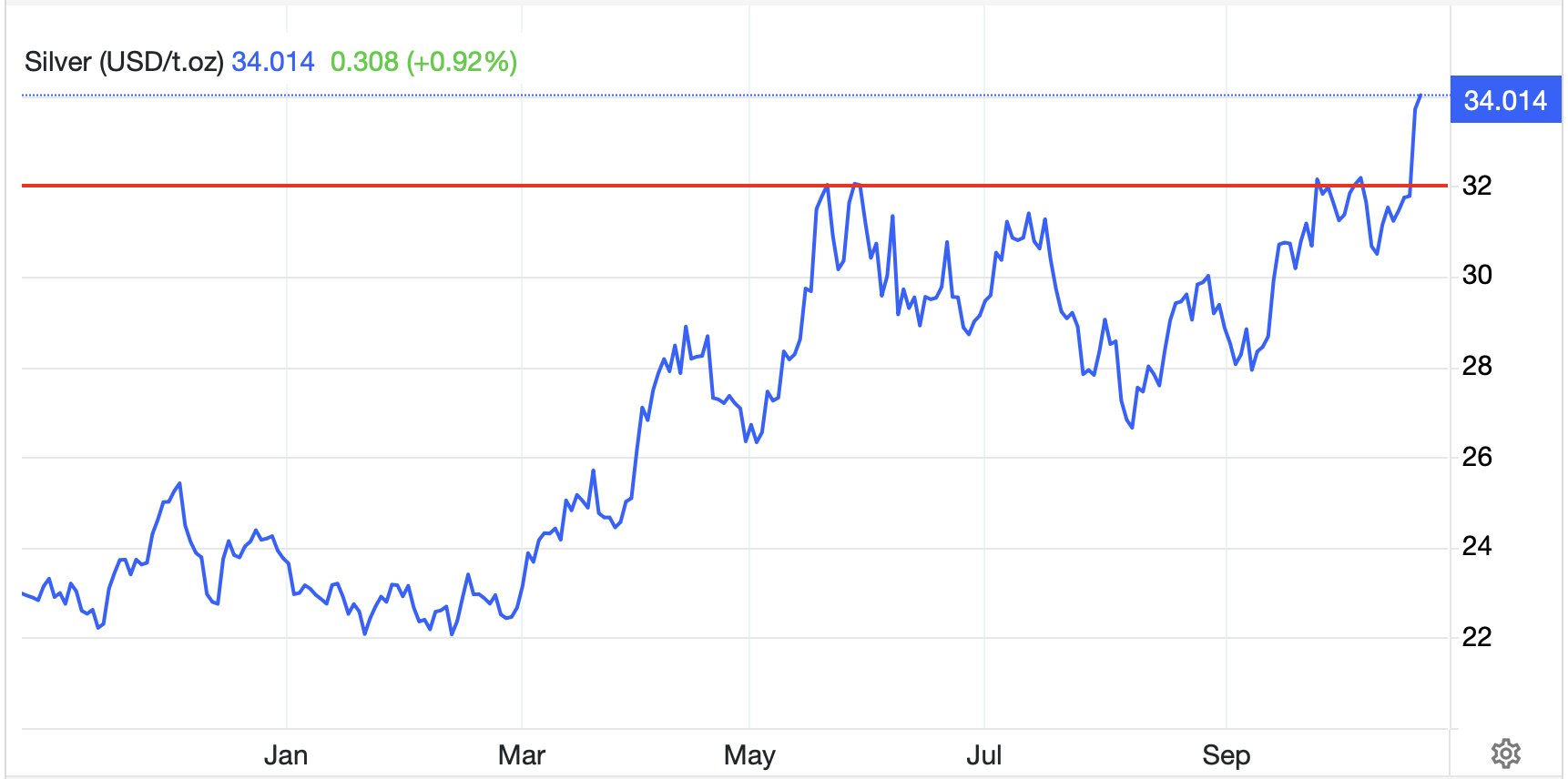
Arguably, the biggest story in markets continues to be the commodities space, specifically metals markets, as once again, and despite today’s dollar strength, we see gold (+0.5%), silver (+1.0%) and copper (+1.1%) rallying with the barbarous relic making yet another set of new all-time highs while silver has broken above a key technical resistance level at $32.00/oz as seen in the chart below.
Source: tradingeconomics.com

One of the reasons I focus on commodities so much is I believe they are telling an important story about the state of the global economy.  We have seen a decade of underinvestment in the production of stuff, especially metals, but also energy, as this has been sacrificed on the altar of ESG policies.  But the world marches on regardless, and that stuff is necessary to build all the things that people want and are willing to pay for.  As they say, the cure for high prices is high prices, meaning high prices are required to increase supply.  That is what we are witnessing, I believe, the beginning of high enough prices to encourage the investment required to increase the supply of these critical inputs to the economy.  However, given the often decade-long process to get from discovery to production of things like metals, look for these prices to continue to rise as a signal that demand is growing ahead of supply.  

As to oil prices, they too, have found legs this morning with a significant bounce (+2.2%) and back above $70/bbl.  On the energy front, we are also seeing NatGas rally sharply with gains in both the US and Europe of > 2%.

Finally, the dollar, as I mentioned, is stronger this morning with only NOK (+0.1%) outperforming the greenback in the G10 space as the dollar benefits from rising yields and continued strong growth, at least as measured by the major data points.  In the EMG bloc, it is universal with the dollar higher against all comers and the worst performers (KRW -0.75%, HUF -0.7%, MXN -0.3%) in each region continuing their recent trend declines.  Until we see a substantive change in the US economic situation, I see no reason for the dollar to fall very far at all.

On the data front, this week brings a lot more Fedspeak than hard data, but this is what we have.

TodayLeading Indicators-0.3%
WednesdayExisting Home Sales3.9M
ThursdayChicago Fed Nat’l Index0.2
 Initial Claims247K
 Continuing Claims1865K
 Flash PMI Manufacturing47.5
 Flash PMI Services55.0
 New Home Sales720K
FridayDurable Goods-0.9%
 -ex Transport-0.1%
 Michigan Sentiment69.3

 Source: tradingeconomics.com

None of this is all that exciting or likely market moving, but we will be regaled with speeches from seven more FOMC members, both governors and regional presidents.  While ordinarily I feel like these comments have limited impact, my take is the market is starting to adjust its views of future Fed actions.  After all, the rationale to cut rates is hard to understand if the economic data continues to rise alongside inflation.  As of this morning, the market is pricing in a 93% probability of a November cut and a 73% probability of a December one as well.  While I agree November is a necessity for them to save face, I think December is a much longer shot than that based on recent data.

With the last two weeks ahead of the election upon us, things are heating up further and most focus will be there.  Given the secondary nature of this week’s data, my suspicion is that absent a massive surprise, or a really consistent theme amongst the Fed speakers that rates are going to go a lot lower soon, the dollar is going to continue its recent rebound.

Good luck

Adf

Fervent Dreams

The FX Poet will be in Nashville at the AFP Conference October 21-22, speaking about effective ways to use FX options in a hedging program.  Please come to the presentation on Monday at 1:45 in Grand Ballroom C2 if you are there.  I would love to meet and speak.
 
Said Governor Waller, inflation
Is falling and so there’s temptation
To cut really fast
And if our forecast
Is right, there will be celebration
 
The problem is, if we are wrong
And price rises we do prolong
We’ll get all the blame
At which point we’ll frame
Our mandate as “jobs must be strong”
 
Meanwhile, in China it seems
That President Xi’s fervent dreams
Of finding more growth
Is stuck cause he’s loath
To listen to Pan Gongsheng’s schemes


First, a mea culpa, as while banks and the bond market were closed yesterday, the equity market was open, and the rally continued.  Although, that doesn’t really change anything I wrote yesterday.  But the stories that got the press yesterday were about Fed Governor Chris Waller and his speech.  Waller is considered one of the key FOMC members as his policy research has been consistent and more accurate than most others, as well as because he doesn’t appear to be nearly as partisan as some other governors.

At any rate, he eloquently made the case that the Fed was going to continue to cut rates, albeit perhaps more slowly than previously expected, because even though economic activity remains strong and inflation is above our goals, we remain confident that we are still going to achieve our targets.  In fact, I think his words are worth reading directly [emphasis added]:

Whatever happens in the near term, my baseline still calls for reducing the policy rate gradually over the next year. The median rate for FOMC participants at the end of 2025 is 3.4 percent, so most of my colleagues likewise expect to reduce policy over the next year. There is less certainty about the final destination…While much attention is given to the size of cuts over the next meeting or two, I think the larger message of the SEP is that there is a considerable extent of policy restrictiveness to remove, and if the economy continues in its current sweet spot, this will happen gradually.”

On to the next story, China and the still-to-come stimulus package.  According to Bloomberg, there is a new plan to allow local governments to swap up to CNY 6 trillion (~$840B) of their outstanding “hidden” debt, which is in the name of special funding vehicles, to straight local government debt, which should carry lower interest rates.  The problem is that both the size of this program and its ultimate effect are seen as insufficient to address the issues.  Certainly, reducing interest payments will help a bit, but the debt problem, along with the property problems, are so much larger than this, at least 10X the proposed CNY 6 trillion, that this will barely make a dent. 

Ultimately, the only solution that seems viable is that the central government borrows more money (its current outstanding debt is at just 25% of GDP) and funds new projects, gives it out to citizens in a helicopter money drop, or something other than investing in more production for exports.  This seemed to be where PBOC Governor Pan Gongsheng was headed several weeks ago.  Alas, President Xi has spent a decade stripping power away from the private sector and amassing his own.  I find it highly unlikely he will willingly cede any of that power simply to help his citizens.  Recent analyst updates for Chinese GDP growth in 2024 have fallen back below his 5.0% target, and I imagine they are correct.

Which brings us to this morning, where the biggest market mover is oil (-5.1%) which is falling on a combination of several things.  First, news that President Biden has convinced Israeli PM Netanyahu to not strike Iran’s oil fields, thus removing a key supply issue and war premium.  Next, the fact that China’s stimulus efforts are so weak implies lower demand from the world’s largest oil importer, and finally, OPEC just cut its forecast for oil demand for 2024 and 2025 although they have not reduced their supply estimates.  The upshot is that oil has given back all its gains of the past month and is presently back at its longer-term technical support level of $70/bbl.  Where it goes from here is anybody’s guess, but absent a resurgence of the Middle East war premium, I suspect it has further to decline.

As to the metals complex, gold (+0.2%) continues to ignore all the signs that it should be falling and is holding within 1% of its recent all-time high prints amid stories that global central banks continue to acquire the barbarous relic.  However, both silver and copper are feeling some stress amid the weaker Chinese growth story.  

In fact, that weaker Chinese growth story hit equities there hard with the CSI 300 (-2.7%) and Hang Seng (-3.7%) both falling sharply on the disappointing fiscal plans.  However, the rest of Asia took their cues from the US rally, and we saw strength virtually across the board.  Interestingly, Taiwan’s TAIEX (+1.4%) completely ignored the China story, perhaps an indication its economy is not nearly so tightly linked as in the past.  In Europe, the picture is mixed with the DAX (+0.3%) rallying on a slightly better than expected German ZEW Economic Sentiment Index (13.1, up from 3.6), while Spain’s IBEX (+0.3%) rallied on better than expected inflation data.  However, weakness is evident in France (CAC -0.8%) on weakness in the luxury goods sector (the largest part of the index) suffering from weaker Chinese demand.  US futures are essentially unchanged at this hour (7:15) as we await Retail Sales later this week.

In the bond market, yields have fallen across the board (Treasuries -3bps, Bunds -4bps, OATs -5bps) as lower oil prices and concerns over slowing growth have investors thinking inflation will continue its downward trend.  Well, at least some investors.  One of the more interesting recent market conditions is the performance of inflation swaps, which have seen implicit inflation expectations rise more than 50bps in the past five weeks as per the chart below from @parrmenidies from X (fka Twitter).

This likely explains the sharp yield rally since the Fed cut rates, but does not bode well for future inflation declining.

Finally, the dollar is little changed net this morning.  Not surprisingly, given the ongoing disappointment of China’s stimulus ,CNY (-0.5%) is amongst the worst performers of the session.  But we have seen weakness in ZAR (-0.3%), CLP (-0.4%) and KRW (-0.4%) to show that EMG currencies are under pressure.  As to the G10, movement has been much smaller with JPY (+0.3%) the biggest mover overall and one of the few gainers.

On the data front, Empire State Manufacturing (exp 2.3) is the only number coming out and we hear from three more Fed speakers (Daly, Kugler and Bostic).  That cleanest shirt analogy remains the most apt these days with the US spending its way to better short-term results and adding long-term problems.  But the market is happy for now.  With that in mind, I don’t see a reason for the dollar to suffer much in the near term.

Good luck

Adf

A Financial Home Run

Seems President Xi isn’t done
And last night he added a ton
Of new stimuli
In order to try
To hit a financial home run
 
The market response has been clear
Forget anything that’s austere
It’s buy with both hands
Ere Powell rebrands
QE as just more Christmas Cheer

Things are obviously worse in China than President Xi had been willing to let on for the past several months/years, as after two straight days of monetary policy stimulus announcements, they pulled out the big guns and got the fiscal side of the process involved.  Last night the Politburo pledged further support after a surprise meeting to discuss economic policies.  Their economic discussions have historically only occurred in April, July and December, so this was the latest indication that Xi is really concerned. 

Some of the actions include an (unspecified) effort to make the real estate market “stop declining”, limiting construction of new home projects, issuing CNY 2 trillion of special sovereign bonds to disburse funds to help fund financial assistance for low-income workers, shore up bank capital to encourage more lending and support further investment in productive capacity as well as to potentially buy up unfinished homes.  

Obviously, Xi was quite concerned that the country would not achieve his 5% GDP growth target for 2024 as an increasing number of analysts around the world were penciling in slower growth, and he decided he could not wait until December for the next policy adjustments.  Remember, too, that next week is a week-long Chinese holiday, so part of the impetus was to give cash to people to encourage more spending/activity.  While it is far too early to determine how effective these new policies will be at supporting real, organic economic activity, they did wonders for equity markets and risk assets around the world.

And really, that continues to be the main story.  With the Fed now having confirmed that lower rates are appropriate, I would look for almost every nation to boost stimulus, both monetary and fiscal, especially in the wake of recent election results which have seen incumbent after incumbent tossed from office.  After all, what good is being in power if you cannot buy your way to re-election?

So, how has all this impacted financial markets this morning?  You will not be surprised to see that risky assets are in huge demand with equity markets rallying everywhere along with metals, while haven assets see much more modest demand, with bond yields having slipped just a bit lower.

Yesterday’s mixed US market performance is but a distant memory this morning with Asian shares roaring higher (Nikkei +2.8%, Hang Seng +4.2%, CSI 300 +4.2%) and gains virtually across the region, albeit not quite as robust as those.  But after the Fed cut, this fiscal stimulus from China is seen as helping everybody.  Europe, too, is rocking this morning with gains well above 1.0% everywhere (DAX +1.2%, CAC +1.6%, IBEX +1.1%) except the UK (FTSE 100 +0.2%) which continues to struggle as the Labour government is shown to be further and further out of its depth with respect to actually running things rather than carping about how the Tories did it.  And not to worry, US futures are all racing higher as well this morning, higher by between 0.3% (DJIA) and 1.5% (NASDAQ) at this hour (7:15).

In the bond market, Treasury yields have edged lower by 2bps and remain far below the Fed funds rate.  It is not clear if this is the market anticipating a more significant economic slowdown or simply a continued manifestation of the fact that the Fed still owns a significant portion of the debt outstanding and so has restricted supply at the margin.  In Europe, yields are also lower, with the riskiest nations seeing the biggest declines as risk assets are in vogue this morning.  Thus, Italy (-7bps) and Greece (-6bps) have moved the farthest, but otherwise we are seeing movement on the order of -3bps elsewhere.  In another quirk, and a telling comment on the state of France’s finances, Spanish 10yr bonos now yield less than French 10yr OATs for the first time in more than 15 years.

Turning to commodities, oil (-2.8%) didn’t get the China rebound memo and has tumbled nearly $2/bbl falling well below the $70/bbl level.  It seems that Saudi Arabia is dropping its price target and preparing to increase production, something the market has been fearing.  As well, in Libya, which had not been producing lately due to political issues, it appears a tentative agreement is in place that will allow for more supply on the market.

But you know what really benefits from a lot of deficit spending and the effective abandonment of inflation targets?  That’s right, precious metals as gold (+0.8%) continues its steady move higher to new all-time highs and quickly approaches $2700/oz.  This has taken both silver (+2.2%) and copper (+2.2%) along for the ride and there is currently no end in sight.

Finally, the dollar is under pressure this morning in a classic risk-on reaction.  AUD (+0.9%) is the leading G10 gainer on the back of its strong metals exposure while NZD (+0.8%) is right behind.  But the dollar’s weakness is manifest in Europe (EUR +0.2%, GBP +0.5%, SEK +0.5%) as well as against most EMG currencies.  In fact, CNY (+0.55% and below 7.00) is one of the biggest movers today although we are seeing strength in KRW (+0.7%), MXN (+0.5%) and ZAR (+0.4%), an indication that this move is widespread.  As long as the perception remains that the Fed is going to lead the way to lower interest rates, I can see the dollar underperforming.  However, as soon as we see other nations become more aggressive, this move will abate.

On the data front, there is much on the calendar this morning starting with the weekly Initial (exp 225K) and Continuing (1832K) Claims data as well as the 3rd look at Q2 GDP (3.0%).  We also see Durable Goods (-2.6%, +0.1% ex-Transports) and then the ancillary data that comes with the GDP report including Real Consumer Spending (2.9%), Final Sales (2.2%) and the GDP PCE indicator (2.5% headline, 2.8% core).  But perhaps of far more importance, we hear from a host of Fed speakers this morning.  Governor Kugler and Boston Fed president Collins speak about financial inclusion, Governor Bowman discusses the economy and monetary policy, Governor Cook discusses AI and workforce development, Vice-chair Barr discusses regulation and Chairman Powell gives the opening remarks at the US Treasury Market Conference in NY. 

Yesterday, Governor Kugler added to the ‘mission accomplished’ view on inflation at the Fed and lauded the move to focus on Unemployment.  I would contend this is the key issue right now, the fact that central banks around the world, but particularly the Fed, have determined that the inflation fight is over.  While we may very well touch 2.0% core PCE in the next months, it strikes me as highly unlikely that level will be maintained.  Rather, 2.0% is now the floor and if the Unemployment Rate behaves in its historic manner, accelerating higher now that it has started to move in that direction, look for much sharper interest rate cuts, much higher inflation and a much weaker dollar.  To me, that is the biggest risk.  However, if Unemployment follows the Fed’s projected path, and stays quiescent, then the current slow decline in rates and a very gradual decline in the dollar seems more likely.

Good luck

Adf

Juiced

No doubt it was President Xi
Who leaned on the PBOC
To cut rates at last
And try to recast
The tone of its cash policy
 
So, mortgage rates will be reduced
While bank reserves, too, will be juiced
But will cutting rates
Be what motivates
The people and give growth a boost?


It’s almost as though Pan Gongsheng, head of the PBOC, read my note yesterday morning and decided that it was time to really do something big!  While obviously, we know that is not the case (at least I don’t see his name on my subscriber list), the PBOC definitely painted the tape last night with their actions.  Fortunately, Bloomberg listed them for us as per the below:

  1. The seven-day reverse repurchase rate will be lowered to 1.5% from 1.7%
  2. RRR lowered by 0.5 percentage points, unleashing 1 trillion yuan in liquidity
  3. PBOC didn’t specify when RRR cut takes effect
  4. MLF expected to be cut by 0.3 percentage points
  5. Minimum down-payment ratio cut to 15% for second-home buyers, from 25%
  6. China may cut the RRR further this year by another 0.25 to 0.5 percentage points
  7. RRR cut won’t apply to small banks
  8. LPR and deposit rates to fall by 0.2 to 0.25 percentage points
  9. The PBOC to cover 100% of loans for local governments buying unsold homes with cheap funding, up from 60%

A glossary of terms is as follows:

  • RRR is the reserve ratio requirement which describes how much leverage banks may take, with the lower the number equating to more leverage (need to hold fewer reserves).
  • MLF is the medium-term lending facility which is the program that the PBOC uses to lend money to banks in China, and the rate had been the key interest rate for policy. 
  • LPR is the loan prime rate, the rate at which banks lend to their best clients
  • Seven-day reverse repurchase rate is a relatively new rate that the PBOC uses for its monetary policy efforts, similar to the Fed funds rate, and is now deemed the PBOC’s key interest rate.

Now, that’s a lot of activity for a central bank in one day.  Consider how long it takes the Fed to decide to raise or cut the Fed funds rate and compare that to just how much was done.  

And that’s just the rate moves.  In addition, they indicated they would lend up to CNY 500 billion for funds, brokers and insurers to buy Chinese shares and another CNY 300 billion for companies to buy back their own shares.  Again, I find the irony of a strictly communist nation worrying about their stock market unbelievably delicious.  So, the government is willing to roll out significant monetary stimulus, but as yet, has not been willing to inject fiscal stimulus.  Arguably the biggest economic problem in China right now is that sentiment is weak as people are concerned over both their jobs and the value of their property, hence consumption remains weak overall.  It is not clear what Xi can do to fix that problem, but cheap money is only effective if people and companies want to borrow and spend it.  That remains to be seen, although the odds of China achieving its 5.0% GDP growth target for 2024 have improved now.

One other thought is that this likely would not have been possible for the Chinese had the Fed not cut 50bps last week.  As I have consistently explained, once the Fed gets going, central banks everywhere will feel more comfortable cutting their own rates and easing policy further.  At least in China, inflation is not a problem, so they have plenty of room to cut.  However, elsewhere inflation has proven stickier than most central bankers would like to see.  Nothing is yet carved in stone as to just how many rate cuts are in the offing.

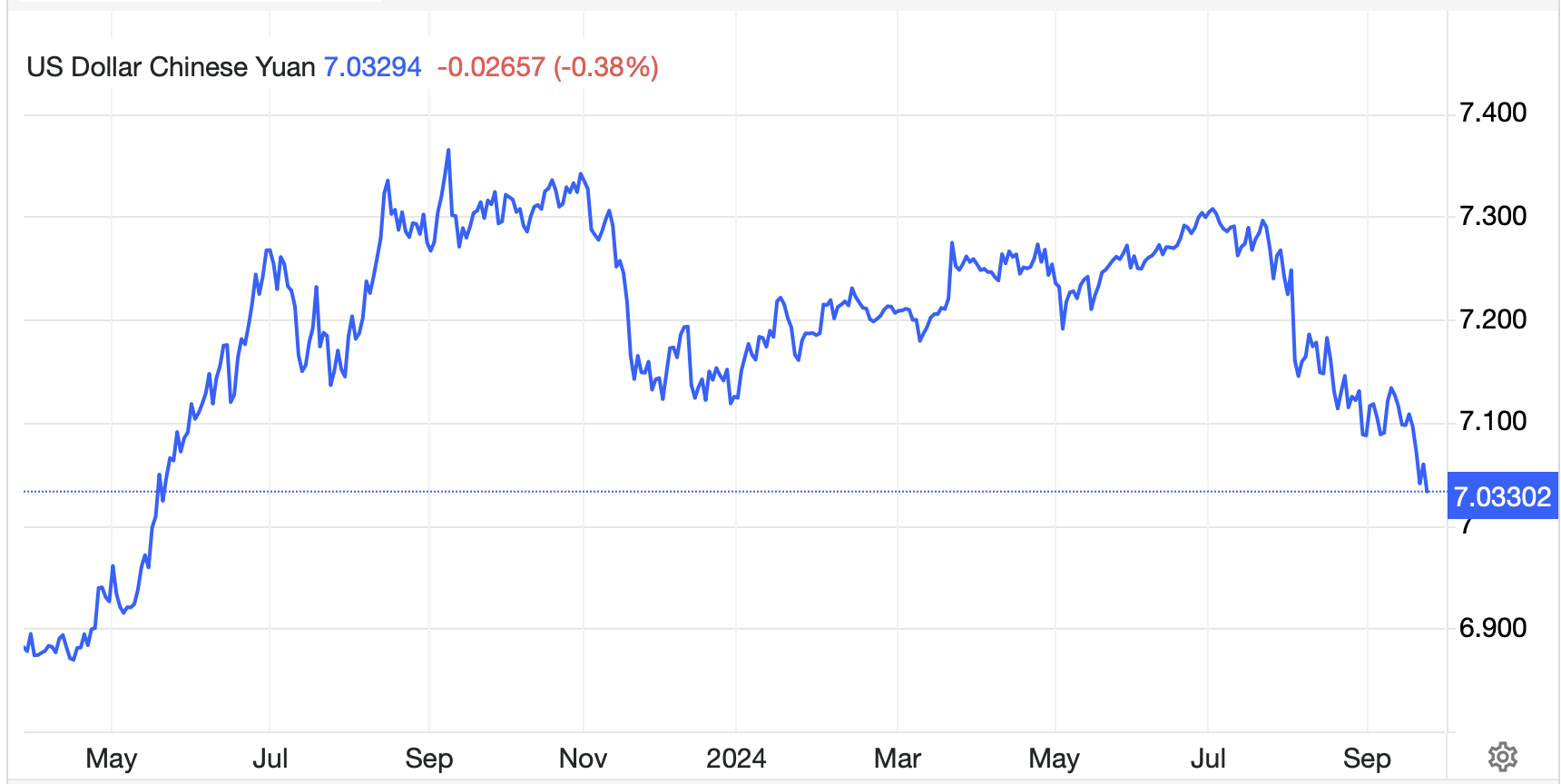
As this was the only noteworthy story, let’s look at how it impacted markets everywhere.  It can be no surprise that shares in China exploded higher given the explicit PBOC support with both the CSI 300 and Hang Seng rallying more than 4.1% on the session.  As well, Chinese yields backed up a bit, off the lows I described yesterday, but only by a few basis points.  As seen below, CNY (+0.4%) rallied nicely, trading to its strongest level since May 2023 and commodities rallied across the board with oil (+2.1%) and copper (+2.4%) the leaders although precious metals (Au +0.3%, Ag +0.8%) are also rising.

Source: tradingeconomics.com

Perhaps the most interesting thing about this story is just how little it impacted non-Chinese markets. Japanese shares (Nikkei +0.6%) rallied but given the yen’s decline (-0.3%) overnight, that likely had a bigger impact on those shares.  And the rest of Asia saw a mix of modest gains and losses, with Taiwan (+0.6%) and Korea (+1.1%) the next best performers although India, Australia and Singapore saw no benefit whatsoever.  It appears they are awaiting the fiscal boost.

In Europe, though, shares are definitely feeling the love led by the CAC (+1.6%) although even the DAX (+0.75%) is rallying despite another series of lousy data, this time the Ifo surveys all printing weaker than last month and weaker than expectations.  I guess given the importance of China as an export market for Germany, the PBOC news trumps the Ifo surveys from earlier this month.  As to US futures, after very modest gains yesterday, although some more record highs, they are essentially unchanged at this hour (7:00).

In the bond market, Treasury yields continue to back up, higher by 3bps this morning and now 15bps off the lows pre-FOMC meeting.  European sovereign yields are higher by 1bp across the board except for UK gilts (+4bps) as concerns grow that the fiscal situation in the UK may deteriorate more rapidly given the apparent confusion in the Starmer government about what to do to pay its bills.  It is also worth noting that JGB yields have slipped 3bps this morning and are now back to levels last seen back in April before the BOJ’s policy tightening got somewhat serious. 

As to the dollar, overall, it is on its back foot this morning although other than the renminbi, most of the moves have been 0.2% or less.  Today’s story is CNY for sure.

On the data front, this morning brings Case-Shiller Home Prices (exp 5.8%) and Consumer Confidence (103.8).  While there are no Fed speakers today, yesterday we heard from three (Goolsbee, Bostic and Kashkari) all of whom agreed with the 50bp cut last week and were mostly pushing for another one before the end of the year.  It seems Goolsbee has taken the mantle of chief dove on the committee, explaining there are “hundreds” of basis points left to cut before they achieve the neutral rate, however neither of the other two indicated any hesitation to cut further.  As of this morning, it is basically a 50:50 proposition as to 25bps or 50bps at the November 7th meeting according to the Fed funds futures market.

And that’s where we stand this morning.  China has opened their coffers and are adding yet more liquidity to the global system.  This should continue to help risk assets everywhere, and ultimately feed into inflation readings, although in China that is not a problem.  But what about elsewhere?  For now, it feels like the dollar is more likely to suffer given the dovish enthusiasm from the Fed speakers, but Thursday will bring 4 more speakers, including Chairman Powell, so perhaps we need to hear that before getting too excited.

Good luck

Adf

More Than a Pen

Twas just about two months ago
When President Trump was laid low
As bullets were flying
With somebody trying
To end his campaign in one blow
 
And now, yesterday, once again
A shooter used more than a pen
To try to rewrite
The vote that’s so tight
Enthused to act by CNN
 
By now, you are all aware of the second assassination attempt on former president Donald Trump’s life, this time while he was playing golf at his course in Palm Beach.  The difference, this time, is the alleged shooter was caught alive, so it will be very interesting to hear what he says under questioning and as this situation progresses.  While this is obviously newsworthy, it did not have a major market impact as investors are far more focused on the Fed coming Wednesday and then the BOJ on Friday.  As such, as I write (6:20) US equity futures are mixed with modest movements of +/-0.2%.
 
In China, poor President Xi
Is finding that his ‘conomy
Is not really growing
In fact, it is slowing
Much faster than he’d like to see

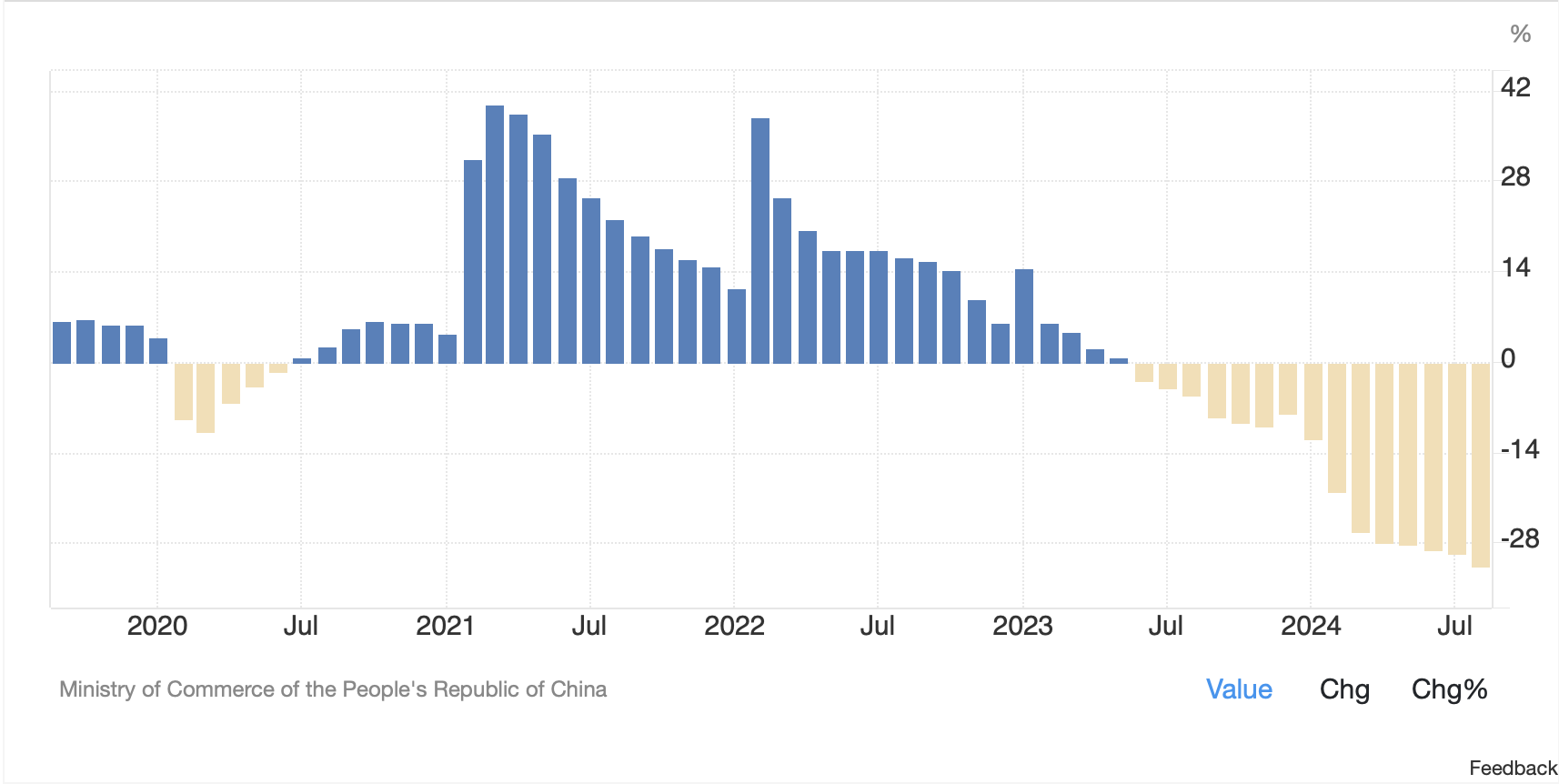
While last night there were different holidays in China, Japan and South Korea, causing all three markets to be closed, Saturday morning, the Chinese released their monthly data drop regarding IP (4.5%), Retail Sales (2.1%) and Fixed Asset Investment (3.4%) along with the Unemployment Rate (5.3%).  Then on Saturday evening here, they released their Foreign Direct Investment (-31.5%) with every one of those figures worse than the previous reading and worse than forecasts.  The evidence continues to show that the Chinese economy is slowing and seems to be slowing more quickly than previously anticipated.  In truth, from my perspective, the biggest concern Xi has is the FDI decline, which as can be seen below, has been falling (net, foreign investors are exiting China) for the past 15 months, and at an accelerating rate. 

Source: tradingeconomics.com

This bodes ill for President Xi’s 5.0% GDP growth target for 2024 and the working assumption amongst the market punditry is that he will soon announce fiscal stimulus in order to get things back on track.  Of course, one of the key problems is that not only are economies elsewhere in the world slowing down, thus reducing demand for Chinese exports, but as well, the expansion of tariffs on Chinese goods by the West continues apace, slowing that data even further.  I saw an estimate this morning that Chinese families have seen $18 trillion of wealth evaporate as the property market in China continues to decline which undoubtedly weighs on consumer sentiment and activity.  But Xi is going to have to do something to prevent a revolution, because remember, the basic Chinese Communist Party contract with the people is we will bring you economic betterment and you let us rule.  If they don’t achieve better economic growth, the population, especially the millions of unemployed young men, may get restless.  While I am not forecasting a revolution, this is typically a precursor to the process.

On Wednesday, the time will arrive
When Jay and his minions contrive
To try to explain
Their easing campaign
And hope stocks don’t take a swan dive

Now to the most important market story this week, will the Fed cut rates by 25bps or 50bps?  It’s funny, if you read independent economic analysis, both sides make their case, and not surprisingly, given the mixed data we have received over the past several months, each case makes some sense.  But…that is not the information you get when reading the press.  The WSJ, inparticular, is really banging the drum for a 50bp cut and many more to follow.  You will recall that Friday, the Fed whisperer was out with his latest piece discussing the merits of a 50bp cut.  Well, this morning there are two more articles, one by pundit Greg Ip basically begging for a 50bp cut, and one by a trio of authors laying out the case and coming down strongly on the side of 50bps.  

All this has helped push Fed funds futures to a 59% probability of a 50bp cut as of this morning.  As some have pointed out on X(fka Twitter), in the past, when there was uncertainty about a Fed move, they managed to get the word out as to what they wanted to do during the quiet period via articles like the ones above and sway markets to their preferred outcome.  As such, at this point I assume we are going to see a 50bp cut on Wednesday.

I guess the real question is what will the impact on markets be?  This morning, we are already seeing the impact in the FX market, with the dollar under pressure across the board.  Versus its G10 counterparts, it has declined by between 0.4% and 0.6% against all except CAD, which remains very tightly linked to the dollar and has gained just 0.1% this morning.  But this movement seems entirely a result of the belief that 50bps is coming.  In the EMG bloc, though, the picture is more mixed with some significant gainers (KRW +0.8%, CE4 +0.5%, ZAR +0.6%) but most other currencies little changed overall.  Nevertheless, the market is clearly pricing for 50bps across the board now and I expect that by Wednesday morning, the Fed funds futures market will reflect that as well.

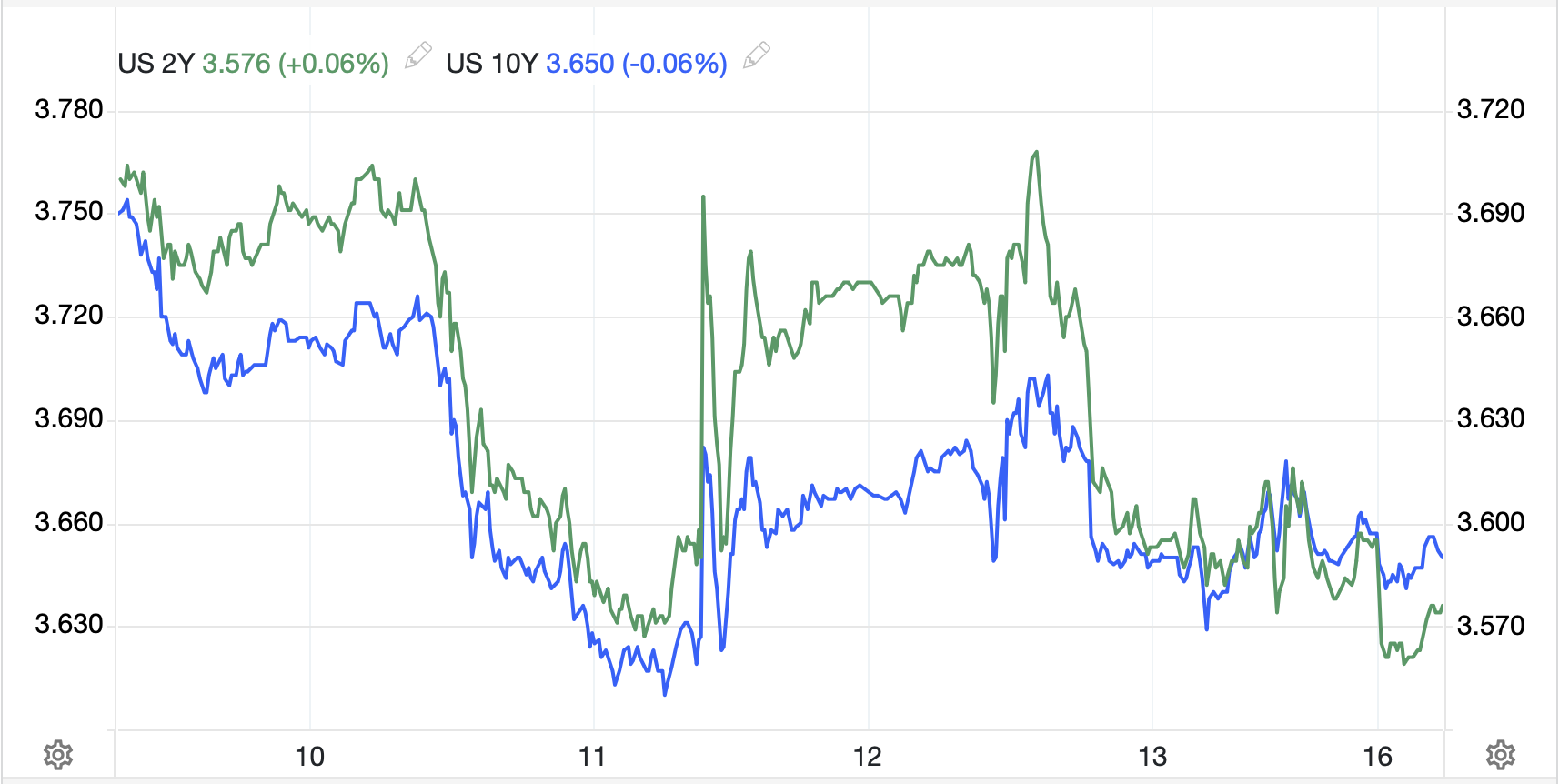
But a weaker dollar is probably not the Fed’s goal.  After all, dollar weakness can help reignite inflation, so they will be wary.  Of more interest to them is the bond market which also appears to be in agreement as the 2yr yield has now fallen to 3.56%, 10bps below the 10yr yield and a clearer sign that the two plus year inversion is behind us.  Of course, as I pointed out Friday, with 2yr yields nearly 200bps below Fed funds, it can be interpreted that the market is anticipating a recession, something I’m pretty sure the Fed wants to avoid if it can.  Perhaps you can see in the chart below how the 2yr yield (in green) fell sharply this morning, almost exactly when those WSJ articles were published.  Go figure!

Source: tradingeconomics.com

At any rate, that is the current zeitgeist, the Fed has leaked they want 50bps and are pushing the levers so when they cut 50bps on Wednesday afternoon, nobody is surprised.  The Fed hates surprises.  It will, however, be very interesting to hear Chairman Powell’s comments given that economic data remains pretty strong overall.

As to the other markets beyond bonds and FX, equity markets, after Friday’s US strength, were generally positive in those countries in Asia not celebrating a holiday (Hong Kong +0.3%, Australia +0.3%, Taiwan +0.4%).  In Europe, though, the picture is more mixed with the DAX (-0.3%) lagging while Spain’s IBEX (+0.3%) is higher although other major markets are virtually unchanged on the session.

Finally, in the commodity markets, oil prices (+0.4%) are edging higher this morning as Libya’s production has been completely shut in due to ongoing internal military conflict.  In the metals markets, gold (+0.2%) remains the biggest beneficiary of the global central bank rate cutting theme as it continues to trade at new all-time highs virtually every day.  Silver (+0.7%) is getting dragged along for the ride with many pundits calling for a much more substantial rally there and copper (+0.4%) is responding to a combination of lower rates and lower inventories in exchange warehouses raising the specter of supply shortages.

On the data front, this week is mostly about central banks, but we do get some other important numbers.

TodayEmpire State Manufacturing-3.9
TuesdayRetail Sales0.2%
 -ex autos0.3%
 IP0.0%
 Capacity Utilization77.9%
WednesdayHousing Starts1.25M
 Building Permits1.41M
 FOMC rate decision5.25% (-0.25% still median)
 Brazil interest rate decision10.75% (+0.25%!)
ThursdayBOE rate decision5.0% (no change)
 Initial Claims230K
 Continuing Claims1851K
 Philly Fed2.4
 Existing Home Sales3.85M
FridayBOJ rate decision0.25% (unchanged)

Source: tradingeconomics.com

Clearly Retail Sales will be closely scrutinized as evidence that the economy is still growing.  I would estimate that a weak number there would insure a 50bp cut, while a strong number may give some pause to those on the fence.  The other very interesting aspect of this week will be the BOJ’s communication in the wake of their meeting Friday.  They went from tough talk to just kidding in less than a week back in August.  What will Ueda-san try this time?  Japanese inflation data is released just hours before their announcement, and it remains well above the 2% target.  My sense here is they want to raise rates, they just need to prepare the market more effectively before doing so.

The dollar is already pricing a bunch of cuts as is the bond market.  If the Fed truly gets aggressive, I believe it can fall further, but if the Fed gets aggressive, you can be certain that so will the BOE, ECB and BOC at the very least.  When they start to catch up, the dollar’s decline will slow to a crawl at most.

Good luck

Adf

Unfair-ish

Well, Jay and the doves got their wish
As CPI data went squish
In fact, it’s not clear
Why cuts aren’t here
Already, it’s just unfair-ish
 
But something surprising occurred
‘Cause rallies in stocks weren’t spurred
But yields and the buck
Got hit by a truck
While gold was both shaken and stirred
 
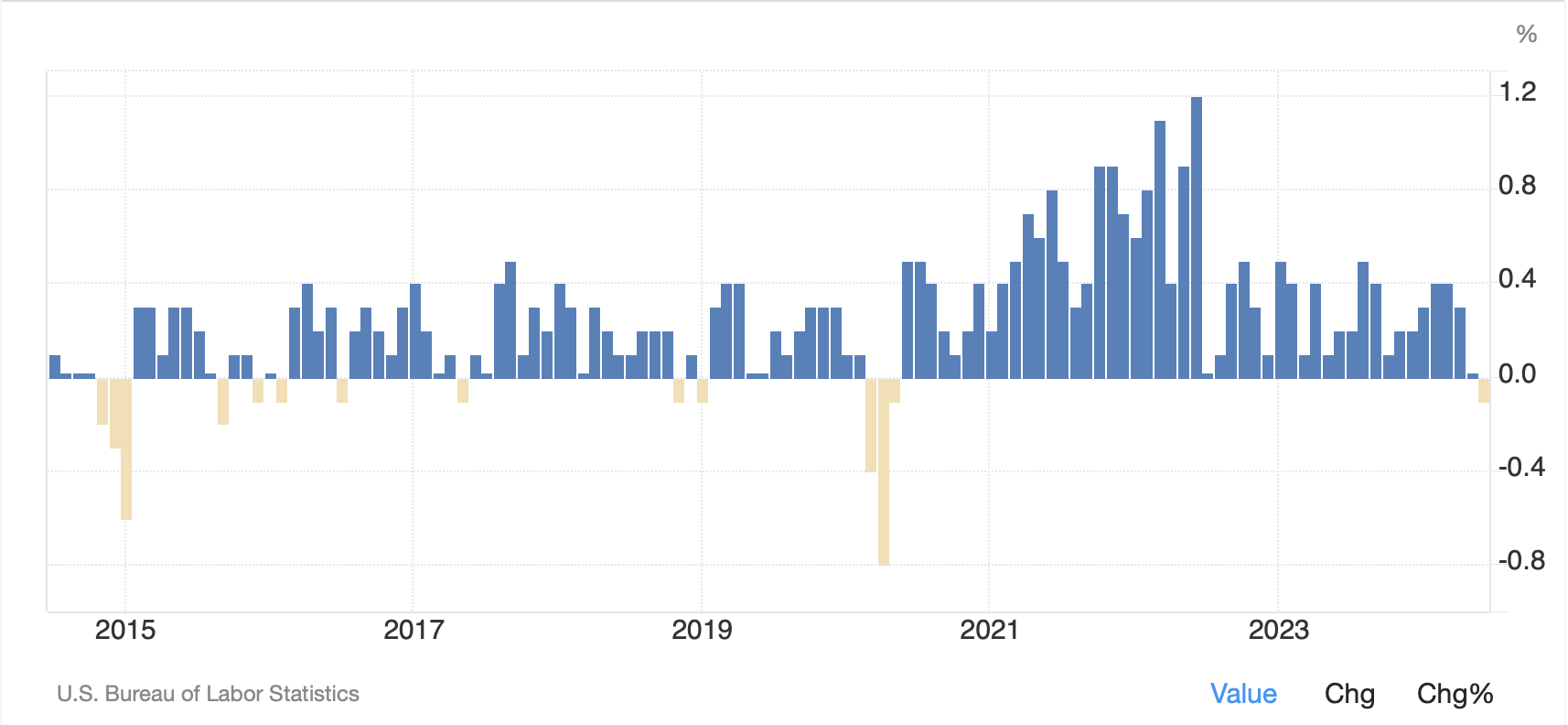
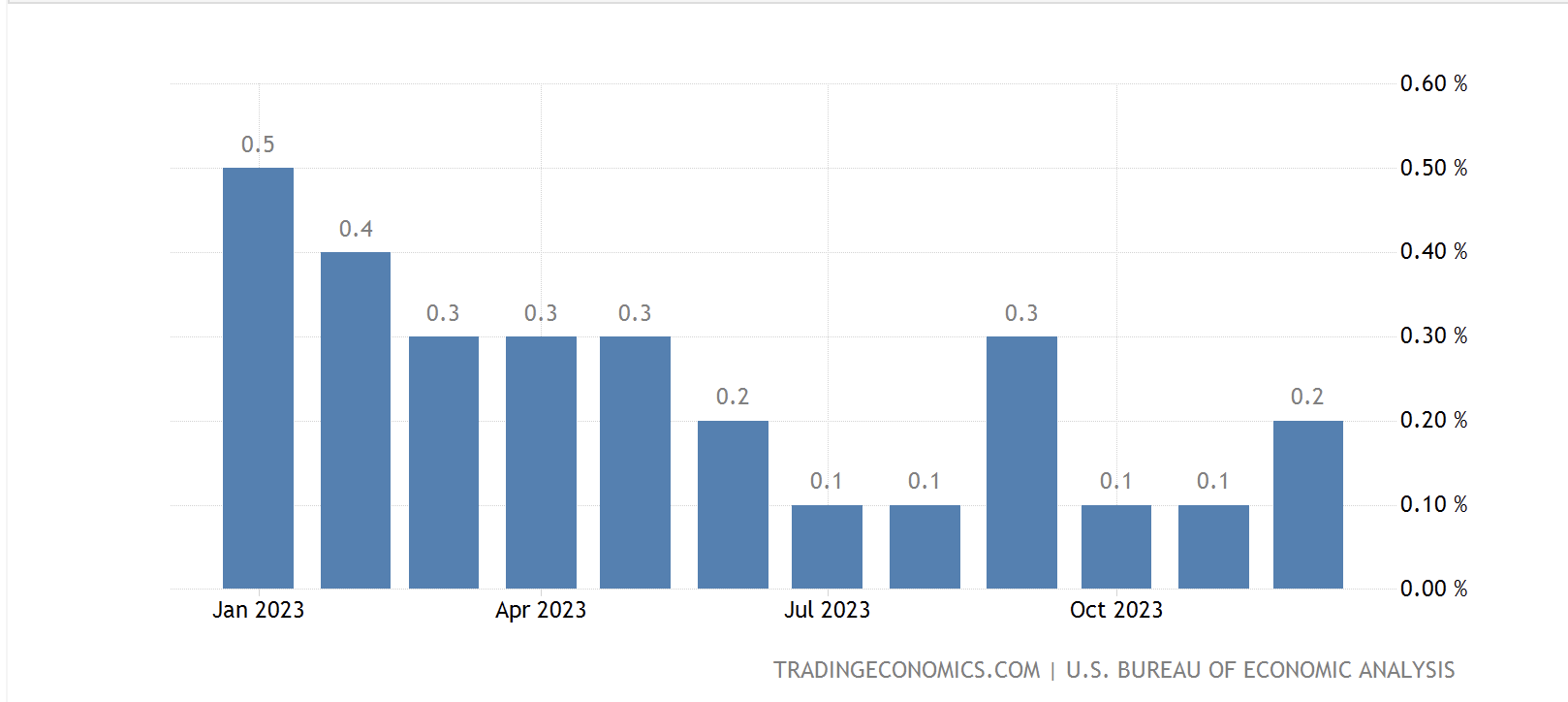
Chairman Powell must be doing his happy dance this morning as the CPI data was the softest seen since May 2020 during the height of the Covid shutdowns.  Now, after four years of steadily rising prices, the Fed is undoubtedly feeling better.  One look at the chart below, though, shows that the inflation rate since the end of Covid was clearly much higher than that to which the population became accustomed prior to Covid.


Source: tradingeconomics.com

While the annualized data for both core and headline readings remains above 3.0%, there was certainly good news in that shelter and rental costs rose more slowly than they have in nearly three years.  However, for market participants, they are far less concerned over the whys of the soft reading than in the fact that the reading was soft and so they can now anticipate a rate cut even sooner than before.  As of this morning, the Fed funds futures market is now pricing a 92.5% probability that the Fed cuts in September and a total of 61bpsof cuts by the end of the year.  

In truth, I was only partially joking at my surprise they didn’t call an emergency meeting and cut yesterday. While the market is only pricing a 6% chance of a cut at the end of this month, I think that is a pretty good bet. Speaking of bets, the trader(s) who established that big SOFR options position earlier in the week is set to have a really good weekend!

To recap, we’ve had the softest inflation reading in 4 years and the market is anticipating the end of higher for longer.  As I have written consistently, my take is when the Fed starts cutting, the dollar will fall, commodity prices will rise, yields will start to decline, but if (when?) inflation reasserts itself, those yields will head higher.  And finally, stocks are likely to see support, but a very good point was made today that if prices stop rising, then so to do profit margins at companies and profits in concert.  Perhaps, slowing inflation is not so good for the stock market, even if it means that rates can be lowered.  Ultimately, there is still a lot to learn, and this was just one number, but boy, is everyone excited!

Did the BOJ
Take advantage of the news
And sell more dollars?

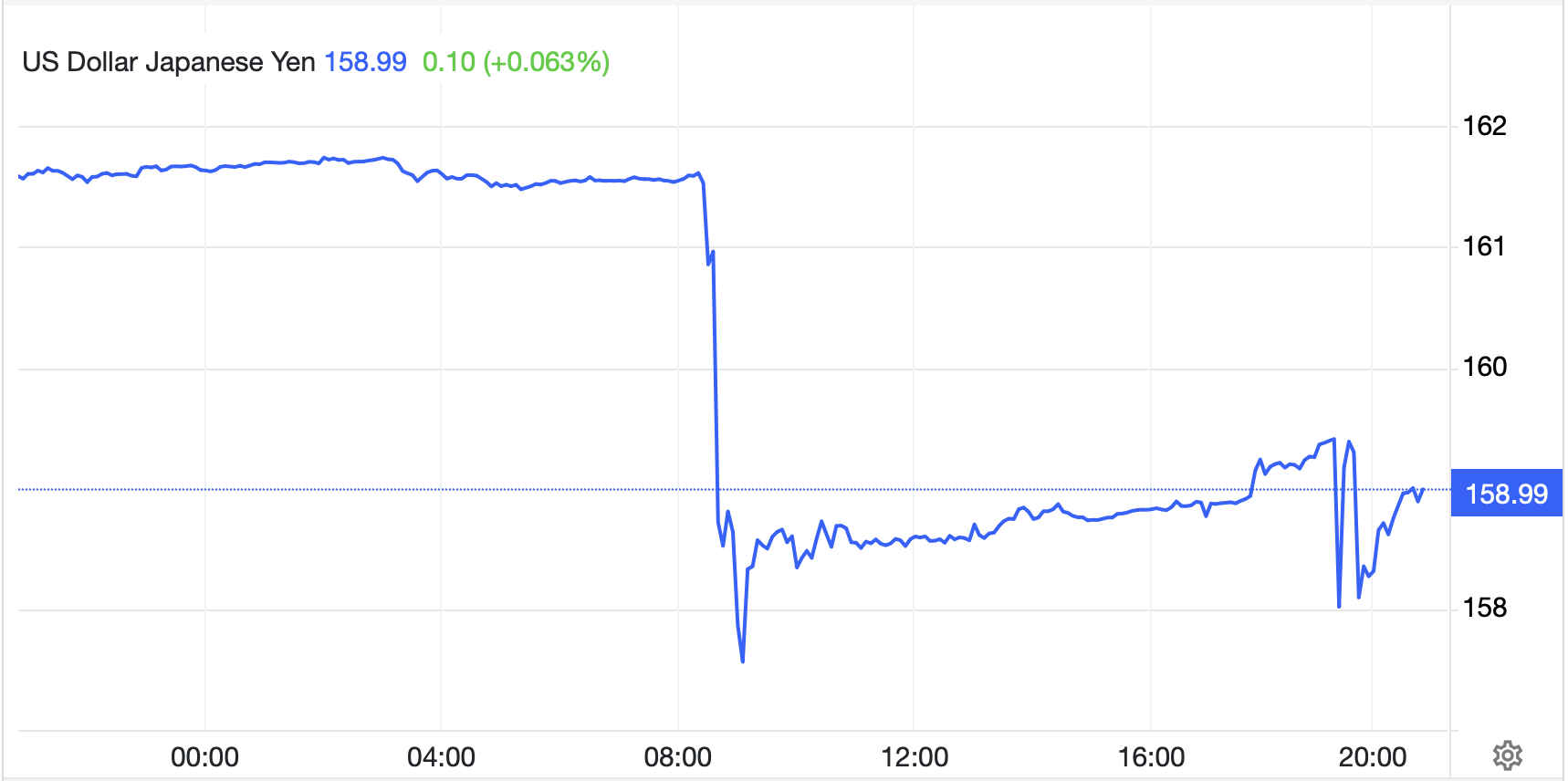
In the FX markets, the biggest mover, by far, was the yen, which at its high point of the session (dollar’s lows) had risen 4 full yen, or 2.5%.  The move was virtually instantaneous as can be seen in the chart below, and it is for that reason that I do not believe the BOJ/MOF was involved in the market.

Source: tradingeconomics.com

While I understand that the BOJ is pretty good at their jobs, it seems highly unlikely that the MOF made a decision in seconds and was able to convey that decision to Ueda-san’s team to sell dollars.  Rather, my sense is that since the short yen trade is so incredibly widespread as the yen has served as a funding currency for virtually every asset on the planet, the fact that the story about higher for longer may be ending led to instant algorithmic selling by hedge funds everywhere and a massive rally in the yen.  When the MOF was asked about intervention, Kanda-san, the current Mr Yen, gave no hint they were in and said only that people will find out when they release their accounts at the end of the month, by which time this episode will have been forgotten.  Remember, too, the yen has fallen, even after today’s rally, nearly 13% thus far in 2024.  It needs to rally a great deal further before it has any macroeconomic impact on Japan’s economy.  For my money, this was just a market that was caught long dollars and weak hands got stopped out, although Bloomberg is out with an article this morning claiming data showing it was intervention.  One thing in favor of the intervention story, though, is that this morning, USDJPY is higher by 0.6% and pushing 160.00 again.

And lastly, the story in China
Continues to give Xi angina
Domestic demand
Is stuck in quicksand
So, trade is his only lifeline-a
 
The other story that is on market minds this morning is about the Chinese data that was released last night.  The Trade Balance there expanded to $99B, much larger than last month and forecast.  A deeper look also shows that not only did exports grow more than expected but imports actually declined.  Declining imports are a sign of weak domestic demand, a harbinger of weak economic growth.  Later, they released their monetary data showing that loan growth, along with M2 growth, continue to slide as Chinese companies are reluctant to take on debt to expand.  While Xi’s government is pushing some money into the system, it is apparent that the collapsing property market remains a major obstacle to any sense of balanced economic activity in China.
 
Of course, this is a problem because of the international relation problems it continues to raise, notably with respect to charges of Chinese dumping of manufactured goods, and the proposed responses from both the US and EU on the subject.  While my crystal ball is somewhat cloudy, when viewing potential future outcomes of this situation it seems increasingly likely that both the US, regardless of the election outcomes in November, and the EU are going to impose tariffs and other restrictions on Chinese goods, if not outright bans.  Neither of these two can afford the social disruption that comes with domestic companies being forced out of business by subsidized Chinese competition.  While inflation looks better this morning than it did last month, its future is far less certain given this growing political attitude.
 
Ok, let’s see how markets have behaved in the wake of all the new information.  Arguably, the biggest surprise is that the US equity markets did not really have a good day with the NASDAQ tumbling -2.0% although the DJIA eked out a 0.1% gain.  Given the yen’s strength, it is no surprise that the Nikkei (-2.5%) fell sharply, and given the Chinese trade data, it is no surprise that the Hang Seng (+2.6%) rallied sharply.  But mainland shares were lackluster, and the rest of APAC was mixed with some gainers (Australia, India, New Zealand) and some laggards (South Korea, Taiwan, Malaysia).  European bourses, though, are all in the green as traders and investors there look to the increased odds of the US finally cutting rates, therefore allowing the ECB and other central banks to do the same, as distinct positives.  As to US futures, at this hour (7:00), they are unchanged to slightly higher.
 
In the bond market, after US yields fell sharply yesterday, with 10yr yields closing lower by 8bps, although they traded as low as 4.17%, a 12bp decline from the pre-data level, this morning, we are seeing a modest rebound with yields 1bp higher.  European sovereign yields are all firmer this morning as well as markets there closed before the US yields started to creep back up.  So, this morning’s 4bp-5bp moves are simply catching up to the US activity.  Lastly, JGB yields dipped 2bps last night as traders sought comfort in the decline in US yields.
 
In the commodity markets, yesterday saw a sharp rally immediately after the CPI print with gold jumping nearly $40/oz and back above $2400/oz, while oil had a more gradual rise, although is higher by nearly $1/bbl since the release.  This is all perfectly in line with the idea that the Fed is going to start to cut rates soon.  However, gold (-0.4%) is giving back some of those gains today.
 
Finally, the dollar, which fell sharply against all currencies after the CPI print, notably against the yen, but also against the rest of the G10 and most EMG currencies, is slightly softer overall this morning with both the euro (+0.15%) and pound (+0.3%) doing well and offsetting the yen’s weakness this morning.  Elsewhere throughout the G10 and EMG blocs the picture is far less consistent with CE4 currencies all following the euro higher although ZAR is unchanged as it suffers on gold’s weakness this morning. 
 
On the data front, this morning brings PPI (exp 0.1% M/M, 2.3% Y/Y) and its core (0.2% M/M, 2.5% Y/Y) although given yesterday’s surprisingly low CPI data and the ensuing market movements, it doesn’t feel like this number has the potential for much surprise.  After all, a soft reading would already be accounted for by the CPI and a strong one would be ignored.  We also see Michigan Sentiment (exp 68.5) at 10:00, but that, too, seems unlikely to shake things up.  There are no Fed speakers scheduled and really, the big thing today is likely to be the Q2 earnings releases from the big banks.
 
It has been an eventful week with Powell’s testimony being overshadowed by yesterday’s CPI data.  While the market is almost fully priced for a September cut, I think the best risk reward is to expect the Fed to act at the end of July.  Next week we hear from 10 Fed speakers, including Chairman Powell on Monday afternoon.  I would not be surprised to hear them start to guide markets to a July cut which would bring dollar weakness alongside commodity price strength.  As to bonds and equities, the former should do well to start, but as yesterday showed, and history has shown, equities tend to underperform when the Fed starts cutting rates.
 
Good luck and good weekend
Adf
 

Will They Return?

One-Sixty is so
Close, you can almost touch it
But, will they return?


The current Mr Yen, Masato Kanda, was on the tape last night as USDJPY creeps ever closer to the 160 level that triggered the most recent bout of inflation at the end of April. He explained, “If there are excessive currency fluctuations, it has a negative impact on the national economy.  In the event of excessive moves based on speculation, we are prepared to take appropriate action.”  At this point, the overnight high of 159.89 is just 28 pips from the peak seen prior to the last bout of intervention, although the price action this time is far more muted than what we saw then.  While the yen’s decline has been steady, as can be seen in the below chart, it hasn’t been so swift it appears out of control.

Source: tradingeconomics.com

One of the key rationales for the previous bout of intervention was that the weakening of the yen occurred too rapidly, with a 10-yen decline seen over a short six-week period.  That has not been the case this time, so I do not anticipate any MOF/BOJ action at 160, but rather somewhere closer to 165 if we see that during the summer.  Remember, the BOJ meets again at the end of July at which point they are expected to present their new bond buying program with reduced amounts of JGBs, their version of QT.  Remember, too, that there is still a huge interest rate differential between the US and Japan, and until that narrows, and is expected to narrow further, it is very difficult to see the yen showing any substantive strength.  While caution is merited here, as the BOJ can certainly enter the market at any time, based on the summary of opinions from the last BOJ meeting, which were released last night, there is no clear consensus on the pace of either QT or rate hikes.  The yen seems to have further to fall this summer.

In China, the powers that be
Are scared that their own renminbi
May fall and expose
The emperor’s clothes
Are missing, and that all might see


As things in the West are awaiting two key events at the end of the week, the PCE data in the US on Friday and the French elections on Sunday, we shall continue our look at Asia.  The CNY market onshore is frozen as it is pegged at the 2% maximum movement from the daily CFETS fixing.  Last night’s fixing of 7.1201 indicates that the highest the dollar can trade on shore is 7.2625, the level at which it is currently pegged.  In fact, given the interest rate differentials between the US and China, funding of traders’ books is becoming impossible because the one-day forward points will result in a price above the band.

While the offshore renminbi is slowly grinding lower, the pressure on the PBOC to adjust its daily fixing more rapidly grows.  This issue is a result of the following incompatible goals as defined by President Xi; support the collapsing local property markets by easing monetary policy while maintaining a stable and strong renminbi to demonstrate to the world that CNY should be a global currency (despite the capital controls in place!).  Alas for President Xi, these two ideas do not work in concert with the result that onshore FX markets are likely to remain frozen until things change.  A look at President Xi’s history tells me, at least, that like the Red Queen, he can believe multiple impossible things at the same time.  Ultimately, the great irony here is that despite Xi’s desires to demonstrate the importance of the renminbi to the world, he is entirely reliant on the Fed to cut rates in order to break this deadlock, and I strongly suspect that Chairman Powell cares not one whit about Xi Jinping and his problems.

Looking ahead, I anticipate the renminbi will grind lower over time as it remains the only outlet for the still lackluster growth in the economy with the property market problems forcing interest rates lower than otherwise would be desired.  Arguably, this is why the Chinese, in their current bout of trade talks with the EU, is demanding that Europe removes its tariffs on Chinese EVs.  Since they can’t weaken the currency further, they need to get the other side to effectively cut prices for them.

Ok, let’s review the overnight activity.  After Friday’s lackluster equity markets in the US (the NASDAQ actually fell, which I thought was illegal), the picture in Asia was mixed with the Nikkei (+0.5%) rallying a bit as the weak yen continues to support their exporters, while mainland Chinese shares (-0.5%) suffered as the ongoing weak economic data (Friday night showed Foreign direct investment fell -28.2% YTD, the weakest performance since 2009, and another indication that the renminbi is too strong).  As to the rest of the region, there were more laggards (Korea, Taiwan, Australia, New Zealand), than gainers (India, Singapore, Thailand).  However, in Europe this morning, the screens are all green as the limited data, German Ifo, indicated continued weakness raising hopes for a July rate cut by the ECB.  As to the US futures market, at this hour (7:15), they have edged slightly higher, about 0.15%.

Treasury yields have moved higher by 1bp but remain far closer to recent lows than the highs seen a month ago.  But the story in Europe is interesting as the Bund-OAT spread has narrowed by 5bps after comments by the RN party’s Jordan Bardella, the leading candidate as new PM, that were far more muted and accepting of Europe as a whole, and less populist financial goals.  This has played itself out across the entire continent with the perceived weaker countries seeing their yields slide slightly while Germany and the Netherlands have seen yields edge higher.  In Asia, JGB yields backed up 2bps to 0.98%, arguably in response to the summary statements from the BOJ.

Oil prices are continuing to show strength, up another 0.5% this morning, as the inventory draw from last week continues to support the market.  Meanwhile, after a very difficult session on Friday, metals prices are stabilizing with gold and silver both up 0.15%, although copper, which was higher earlier in the session, has now reversed course and is down -0.6%.

Lastly, the dollar is broadly, though not universally, under pressure this morning, with the euro (+0.35%) the driver in the G10 market which is also dragging the CE4 higher (PLN +0.9%, HUF +0.5%).  Bucking the trend is the rand (-1.0%) as market participants start to wonder who President Ramaphosa will be appointing to his cabinet now that he must share power.  One must be impressed with the volatility in the rand of late, that is for sure.

On the data front, while we get several indicators earlier in the week, all eyes will be on Friday’s PCE data.

TodayDallas Fed Manufacturing-13
TuesdayChicago Fed National Activity-0.4
 Case-Shiller Home Prices6.9%
 Consumer Confidence100.0
WednesdayNew Home Sales640K
ThursdayInitial Claims236K
 Continuing Claims1820K
 Durable Goods0.0%
 -ex Transports0.1%
 Q1 GDP (Final)1.3%
FridayPersonal Income0.4%
 Personal Spending0.3%
 PCE0.0% (2.6% Y/Y)
 Core PCE0.1% (2.6% Y/Y)
 Chicago PMI40.0
 Michigan Sentiment65.7

Source: tradingeconomics.com

As well as the data, we hear from five more Fed speakers with Governor Michelle Bowman speaking at three separate events this week.  However, thus far, there has been no substantive change from the Powell mantra that they need to see more evidence that inflation is slowing, several months’ worth, before considering easing policy.  Of course, if next week’s Unemployment rate were to tick up to 4.2%, I imagine that mantra might change.

On the central bank front, only Sweden’s Riksbank meets this week, and no policy change is expected.  If you recall last week, the bulk of the data was soft in the US, although the PMI data surprised to the high side.  However, if the data set is beginning to show more weakness, I suspect the Fed will begin to hint that cuts are possible sooner, rather than later.  Right now, the market is pricing about a 10% probability for the July meeting, but more than a two-thirds probability for September.  A little more weak data and I will likely adjust my views of rate cuts coming.  At that point, I think the dollar will suffer significantly.  But until we get a lot more evidence that is on the way, I think the default is the dollar is still the best bet.

Good luck

Adf

Annoyed

Seems President Xi is annoyed
His stock market has been devoid
Of buyers, so he
Has banned, by decree
The strategies quant funds employed
 
But otherwise, markets are waiting
To see if inflation’s abating
The PCE print
Will give the next hint
If cuts, Jay will be advocating


Market activity remains on the quiet side of the spectrum as all eyes continue to focus on the Fed, and by extension all central banks.  As an indication, last night the RBNZ left their OCR rate on hold, as widely expected, but sounded less hawkish in their views, dramatically lowering the probability that they may need to hike rates again.  Prior to the meeting, there was a view hikes could be the case, but now, cuts are seen as the next step.  The upshot is the NZD fell -1.2% as all those bets were unwound.  One of the reasons this was so widely watched is there are some who believe that the RBNZ has actually led the cycle, not the Fed, so if hikes remained on the table there, then the Fed may follow suit.  However, at this stage, I would say all eyes are on tomorrow’s PCE print for the strongest clues of how things will evolve.

Before we discuss that, though, it is worth touching on China, where last night “unofficially” the Chinese government began explaining to hedge funds onshore that they could no longer run “Direct Market Access” (DMA) products for external clients.  This means preventing new inflows as well as winding down current portfolios.  In addition, the proprietary books using this strategy were told they could not use any leverage.  (DMA is the process by which non broker-dealers can trade directly with an exchange’s order book, bypassing the membership requirement, and in today’s world of algorithmic trading, cutting out a step in the transaction process, thus speeding things up.)  

Apparently, this was an important part of the volume of activity in China, but also had been identified as a key reason the shares in China have been declining so much lately.  Last night was no exception with the Hang Seng (-1.5%) and CSI 300 (-1.3%) both falling sharply and the small-cap CSI 1000 falling a more impressive -6.8%.  Once again, we need to ask why the CCP is so concerned about the most capitalist thing in China.  But clearly, they are.  I suppose that it has become a pride issue as how can Xi explain to the world how great China is if its stock market is collapsing and investment is flowing out of the country.  This is especially so given the opposite is happening in their greatest rival, the US. 

But back to PCE.  It appears that this PCE print has become pivotal to many macroeconomic views.  At least that is the case based on how much discussion surrounds it from both inflation hawks and doves.  As of now, and I don’t suppose it will change, the current consensus view of the M/M Core PCE print is 0.4% with a Y/Y of 2.8%.  As can be seen from the below chart from tradingeconomics.com, this will be the highest print in a year, and it would be easy to conclude that the trend here has turned upwards.

Of greater concern, though, is the idea that just like we saw the CPI data run hotter than expected earlier this month, what if this number prints at 0.5%?  Currently, the inflation doves are making the case that the trend is lower, and that if you look at the last 3 months or 6 months, the Fed has already achieved their target.  Their answer is the Fed should be cutting rates and soon.  For them, a 0.5% print would be much harder to explain and likely force a rethink of their thesis.

On the other side of the coin, the inflation hawks would feel right at home with that type of outcome and continue to point to the idea that the ‘last mile’ on the road back to 2.0% is extremely difficult and may not even be achievable without much tighter policy.  While housing is a much smaller part of the PCE data than the CPI data, remember, CPI saw strength throughout the services sector and that will be reflected.

One thing to consider here is the impact a hot number would have on the Treasury market.  Yields have already backed up from their euphoric lows at the beginning of the month by nearly 50bps.  Given the recent poor performance in Treasury auctions, where it seems buyers are demanding higher yields, if inflation is seen to be rising again, we could see much higher yields with the curve uninverting led by higher 10-year yields.  I’m not saying this is a given, just a risk on which few are focused.  In the end, tomorrow has the chance to be quite interesting and potentially change some longer-term views on the economy and the market’s direction.

But that is tomorrow.  Looking overnight, while Chinese stocks suffered, in Japan, equity markets were largely unchanged.  In Europe this morning, there is more weakness than strength with the FTSE 100 (-0.7%) and Spain’s IBEX (-0.7%) leading the way lower although other markets on the continent have seen far less movement.  As to US futures, at this hour (8:00), they are softer by about -0.3%.

In the bond market this morning, Treasury yields have fallen 2bps, while yield declines in Europe have generally been even smaller, mostly unchanged or just -1bp.  The biggest mover in this space was New Zealand, where their 10-year notes saw yields tumble 9bps after the aforementioned RBNZ meeting.

Oil prices (-0.3%) are giving back some of their gains yesterday, when the market rallied almost 2% on stories that OPEC+ was getting set to extend their production cuts into Q2.  It is very clear that they want to see Brent crude above $80/bbl these days.  In the metals markets, while precious metals are little changed, both copper and aluminum are softer by about -0.5% this morning.  I guess they are not feeling any positive economic vibes.

Finally, the dollar is much firmer this morning against pretty much all its counterparts.  While Kiwi is the laggard, AUD (-0.7%), NOK (-0.7%) and CAD (-0.4%) are all under pressure as well.  The same is true in the EMG bloc with EEMEA currencies really suffering (ZAR -0.5%, HUF -0.7%, CZK -0.4%) although there was weakness in APAC overnight as well (KRW -0.4%, PHP -0.6%).

On the data front, this morning brings the second look at Q4 GDP (exp unchanged at 3.3%), the Goods Trade Balance (-$88.46B) and then the EIA oil inventory data.  We also hear from Bostic, Collins and Williams from the Fed around lunchtime.  Yesterday’s data was generally not a good look for Powell and friends as Durable Goods tanked, even ex-transport, while Home Prices rose even more than expected to 6.1% and Consumer Confidence fell sharply to 106.7, well below the expected 115 reading.  

As we have been observing for a while now, the data continues to demonstrate limited consistency with respect to the economic direction.  Both bulls and bears can find data to support their theses, and I suspect this will continue.  With that in mind, to my eye, there are more things driving inflation higher rather than lower and that means that the Fed seems more likely to stand pat than anything else for quite a while.  Ultimately, I think we will see the ECB and BOE decide to ease policy sooner than the Fed and that will help the dollar.

Good luck

Adf

More Dire Straits

Apparently, President Xi
Is worried that his ‘conomy
Has lost all its verve
So, throwing a curve,
Reached out to the PBOC
 
The central bank promptly cut rates
As things head toward more dire straits
Investors, though, said
Seems China’s still dead
As equity buying abates


After yesterday’s winter doldrums session, with virtually nothing going on in Europe with the US on holiday, last night we got a surprisingly large cut in the 5-year Loan Prime Rate from the PBOC.  The 25 basis point cut was the largest since this rate was created five years ago, and 10bps larger than anticipated.  This rate is the one on which mortgages in China are based, hence the effort to try to support the property market there.  The problem is, this will only be relevant for new mortgages and does not help the outstanding loans in any way.  Perhaps it will help spur some new property demand at the margin, but as evidenced by the tepid equity market response (CSI 300 +0.2%), it was hardly a panacea for the problems in China.

Ultimately, the issue there remains that decades of inflating a property bubble combined with the demographic impact of the one-child policy have led to a situation where a large proportion of China’s middle class relies almost entirely on their property investments for their retirement nest egg.  As those continue to deflate in value, the idea of increasing consumption continues to recede and the only way to deliver any economic growth is via continued reliance on production and exports.  Alas for the Chinese, the end of the globalization phase around the world has put a crimp in that plan as well.  

I suspect that this is not the last rate cut we will see from China as it remains clear more stimulus is needed to maintain their target growth rate of GDP.  At some point, I also suspect that we will see a large bout of fiscal stimulus, but clearly Xi is avoiding that over concerns regarding the net debt position in China.  Despite their efforts to eliminate the dollar as the global reserve currency, there are precious few people or nations willing to hold renminbi for that purpose, so China does not have the flexibility to be as irresponsible as the US in this case.  Ultimately, I continue to look for the renminbi to depreciate as it is the only natural outlet valve the Chinese have.  It is clear this move will take time, but that is the direction of travel in my view.

Away from that, though, there was nothing happening overnight of any consequence as will be evident when we review the overnight session.  Elsewhere in Asia, the Hang Seng. (+0.6%) had a decent session but Japanese shares were a bit softer, and the rest of the APAC nations showed no consistency with some gains (India and Taiwan) and some laggards (Korea and Australia).  Perhaps the Aussies suffered after the RBA Minutes showed they considered an additional rate hike last month and still have the thought in their minds.  In Europe, things are also quite dull with both gainers and losers with everything +/- 0.3% or less.  As to US futures, at this hour (7:30) they are softer by -0.4% or so across the board.

In the bond market, yields have edged lower with Treasuries down by 1bp and most of Europe lower by 2bps as investors await the next signals regarding central bank activity.  Interestingly, there was an article in Bloomberg News this morning that discussed the idea some traders were preparing for a potential rate hike in the US as the next move, rather than the still consensus rate cuts.  That would not surprise me greatly, but there is no doubt the equity markets are not pricing in that scenario.

Oil prices are slipping this morning, down -1.1%, but there is no obvious catalyst as the driver.  In truth, the oil market looks like it is simply trading within a range of $70-$90 and until it breaks out of that range, there is little to do but watch.  Metals markets are mixed this morning with gold (+0.5%) leading the way higher on a weaker dollar although copper (+0.5%) and aluminum (-0.75%) are showing no consistency.

Finally, the dollar is under pressure pretty much across the board with AUD and NZD leading the way higher in the G10, both advancing by 0.5%, with EUR and GBP (+0.2% each) in tow.  The only outlier is the yen which is unchanged today.  In the EMG bloc, the direction is consistent with almost all currencies a touch stronger, but the magnitude is just on the order of 0.2%.  This appears to be a dollar weakness story on the back of softening yields, rather than anything else.

On the data front, arguably the big statistic today is Canadian CPI which is expected to slip a tick from last month’s readings, but given the heat we have seen elsewhere lately, I would not be surprised to see a stronger reading.  We also see Leading Indicators (exp -0.3%), which if it remains negative, will be the 21st consecutive negative reading, traditionally a harbinger of a recession.

And that’s really it for the day.  No major data and no slated Fed speakers.  I expect things will remain quiet, with risk assets driving any FX moves. 

Good luck

Adf

Others to Blame

Apparently, President Xi
Is not very happy to see
That stocks made in China
Have lost all their shine-a
So, feels he must buy by decree
 
The upshot is two trillion yuan
Is what he will spend, whereupon
He’ll then get to claim
Twas others to blame
Though it’s his ideas that keep on
 
Last night the BOJ meeting was the non-event that was widely expected.  There was no change in policy and when looking at their forecasts, if anything they lowered their inflation views a touch for next year, thus reducing the chance of a policy change even more.  The follow-on commentary was not very inciteful either, explaining that they are prepared to take additional easing measures if necessary but uncertainties on the price outlook are high.  In other words, we still don’t know how to achieve our goal of sustainable 2% inflation so we’re going to watch a bit longer.
 
The punditry has decided that Ueda-san is going to adjust policy at the April meeting after the spring wage negotiations have been completed, but personally, i don’t believe he feels a compelling need to do anything absent a major decline in the yen from current levels.  After all, the economy is still ticking over nicely and the stock market has been rallying consistently for a year and is back at 34-year highs, approaching the 1989 bubble peak.  However, if USD/JPY were to trade back above 150 again and start to move more quickly, I suspect that might be the catalyst the BOJ and Ueda-san need to change their tune.
 
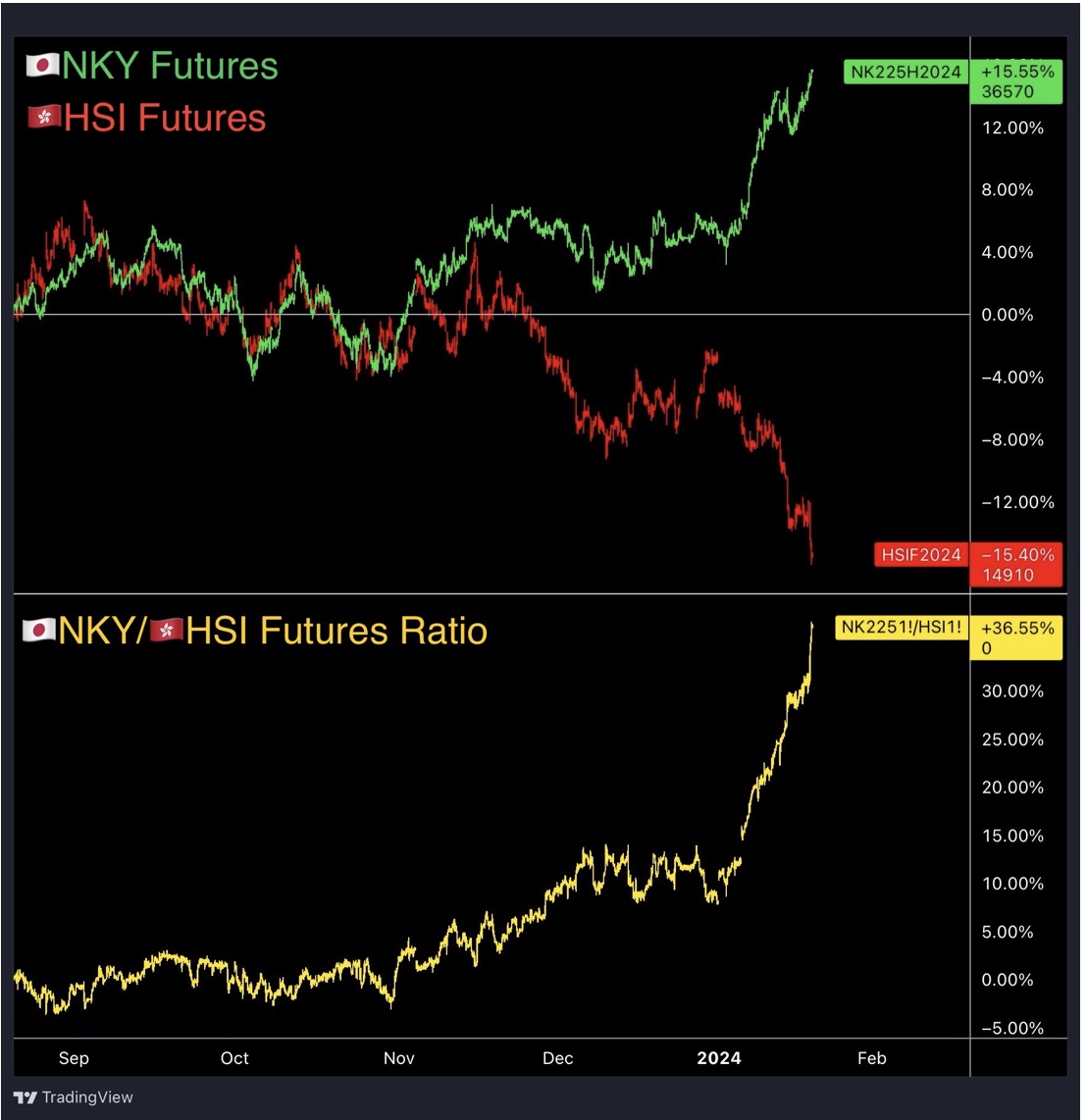
Arguably, of far more interest last night was the news that China is now considering a support package for the stock market there!  (For a communist country, it is quite ironic how much Xi Jinping cares about the most capitalistic institution there is, the stock market.)  The headline number is CNY 2 trillion (~$278 billion) which will be sourced from Chinese state-owned companies (SOEs) overseas and ostensibly will flow into the offshore market for Chinese shares as well as the Hang Seng in Hong Kong.  The below chart, courtesy of Weston Nakamura’s excellent substack is quite explanatory as to why Xi may be feeling some pressure.


The dramatic widening of the spread between Hong Kong and Japanese shares has been remarkable in the first three weeks of 2024, a substantial acceleration of what we have seen since November of last year.  My sense is Xi is taking it personally that the world is dismissing China as a serious global player as evidenced by the fact that nobody wants to invest there at all.  Obviously, there are sanction and tariff issues as well as a comprehensive effort by many western companies to reduce their reliance on China as part of their individual supply chains, but I guess this has become too much to bear for President Xi. 

While this mooted number is twice as large as the previous discussions, it remains to be seen if it will be effective beyond the knee-jerk response by the Hang Seng today (+2.6%).  After all, the Chinese property market is still a disaster, and all the other problems remain intact.  Chinese share prices have been falling for 3 years now, and my sense is it will take real policy changes rather than a buying spree by SOEs to change any views.  Perhaps communist-based stock markets are an oxymoron after all.

Away from those two stories though, not very much is ongoing.  Mainland Chinese shares also rose, but far less, just 0.4%, while Japanese shares were essentially unchanged on the day after the BOJ’s meeting.  In Europe, equity markets are a touch softer, although only about -0.2% or so across the board and after yet another positive day in the US yesterday, US futures are pointing slightly higher at this hour (7:45), about 0.2%.

In the bond market, yesterday’s price action is being reversed with yields across the US (+2bps) and Europe (+2bps across virtually all nations) backing up a bit.  As there continues to be a lack of data on which to trade, this price action seems almost like a classic risk-on take, with equities higher, the dollar softer, and bonds falling in price as well.  However, given that the movement is just 2bps, I would not get excited about any new information here.

In the commodity markets, oil (-0.75%) is slipping a bit this morning, but has been performing pretty well over the past week on the back of the ongoing tensions in the Middle East.  However, we are seeing positive price action in the metals space this morning with gold (+0.2%) and copper (+0.5%) both pushing a bit higher.

Finally, the dollar is mixed this morning, with no consistency across either the G10 or EMG blocs.  CNY (+0.3%) has rallied on the strength of the financing package while ZAR (+0.8%) is benefitting from the metals complex rally, as is CLP (+0.35%) and AUD (+0.25%).  However, the euro (-0.2%) is sliding along with several EMG currencies, notably PLN (-0.75%) and MXN (-0.5%), as idiosyncratic stories drive markets this morning rather than a broad dollar narrative.

The only marginal piece of data this morning is the Richmond Fed Manufacturing Index (exp -11), yet another manufacturing index that has been performing quite poorly.  Interestingly, there was a Twitter (X?) thread this morning from Anna Wong (@annaeconomist), a senior economist at Bloomberg, describing some potential reasons as to why the Initial Claims data, which has been running far lower than the recessionistas expect due to eligibility issues and the fact that UI pays so little, people would rather driver for Uber than collect.  This is another indirect sign that the economy is not nearly as positive as many, especially the soft-landing proponents and equity bulls, would have you believe.  Food for thought.

As to the rest of the day, given the lack of other data as well as the anticipation of the Thursday and Friday info on GDP and PCE, I anticipate a quiet session overall.  Momentum remains higher in stocks, but bonds are uncertain, and the dollar is mixed.  Don’t look for too much movement in either direction here today.

Good luck

Adf