Battlelines

The battlelines are being drawn
On one side, the dollar is gone
‘Cause debt will explode
And once down that road
They claim folks would rather the yuan
 
But others are making the case
That dollar debt has much more space
To grow and expand
As it can withstand
More stress since it’s used everyplace
 
And finally, one thing left to note
Is Europe appears set to float
A digital euro
That ought to ensure-oh
The market, its price, will demote


Friday, I highlighted an idea which I had toyed with, but never explained eloquently, but that was done so by Michael Nicoletos (@mnicoletos on X).  While I offered a link to his work Friday, I know that many never click on links in notes like this, so I am copying his page showing this perspective.  It is clear, clean and asks the proper questions.

The reason I am doing this is because this weekend, I listened to a podcast with another very smart macro guy, Luke Gromen (@lukegromen) who has a very different take on the state of the world.  In short, Luke’s belief is that the US is already past the point of no return and that a potential downward spiral, caused by excessive US debt, is going to kick off soon.  The result is that we will see the dollar decline severely (as described by the DXY), gold, bitcoin, and equities rally, and that Treasury debt, especially long dated debt, will get killed.  In essence, he is explaining the inflation trade, higher US inflation will lead to those outcomes.

Let me start by saying, I agree with Luke on certain things, like the fact that we are likely to see higher inflation going forward as the government is in no mood to cut off the liquidity taps.  If you look at the below chart of M2 from the FRED database of the St Louis Fed, you can see that this measure has set a record high and risen 7.8% since its local nadir on October 30, 2023.

So, in a bit less than 2 years, it has grown about 8% after having shrunk that much in the prior 2 years during the first phases of the Fed’s QT program.  But now, despite the fact the Fed continues to slowly shrink their balance sheet, money supply is growing again, and my take is it will continue to do so for the foreseeable future as the government needs to essentially monetize the debt.  

Back to the argument, I believe that in this scenario of run it hot, gold and equities will do well while bonds will do poorly, but the question of the dollar on the FX markets is very different.  And this is where the Nicoletos’s theory comes into play.  If he is correct, and we adjust our idea about what constitutes excess leverage for the US, then expecting the dollar to fall in the FX markets may not be the best idea.  Rather, the news that the ECB is seeking to institute a digital euro, as per a speech by Madame Lagarde two weeks’ ago, and UK PM Starmer is claiming digital ID is necessary, to be followed by a digital pound, leads me to believe that institutions and individuals may decide they want more control over their own finances, rather than governments who have proven themselves exceptionally incompetent across numerous areas (energy, finance, and defense come to mind).  That implies that the dollar is likely to find a lot more support than those claiming it is set to collapse.

Again, I ask, will developing nations really want to keep their reserves in the CNY, or store their reserves of gold in Shanghai given the long history of capriciousness that the CCP has demonstrated.  People may hate the US; yet more people want to come here than go anyplace else because they have a higher degree of faith that their property will remain their property.  

This is not to say things are great, there are huge problems worldwide, just to say that my medium- and longer-term views are the dollar will be seen as TINA if other nations go down the road they are currently claiming they will follow.

The overnight narrative’s turned
To government shutdown concerns
As Trump and Dems meet
The word on the Street
Is too many bridges are burned

As to this morning’s market activity, the most noteworthy story is the question of whether the Senate will pass a continuing resolution (CR) to keep the government operating past midnight on Tuesday when the current spending authority runs out.  The House of Representatives have passed a ‘clean’ resolution which leaves the spending levels exactly where they are and lasts for 6 weeks allowing Congress time to pass the individual spending bills.  However, in the Senate, they need 60 votes to overcome the filibuster, and the Republicans only have 53 seats.  Minority Leader Schumer has promised to shut down the government unless he gets spending promises in the CR of upwards of $1 trillion over the next 10 years, and that feels unlikely.  Too, the House of Representatives is in recess, so no changes to their bill can be made on a timely basis.

My take is the Senate will cave in, but if not, they will not be able to withstand the pressure for very long as I believe that they will ultimately receive the blame for the outcome.  Turning to the market impact of this story, the most notable move overnight has been in precious metals where Gold (+1.3%), Silver (+1.8%) and platinum (+0.8%) are all continuing their recent runs and all at recent (and for gold all-time) highs.  However, it is difficult for me to understand this as a response to the potential shutdown in isolation.

Perhaps, if we turn to the dollar, which is lower, but only by -0.2% on the DXY, we can have a better understanding as at least it would make some sense that the dollar declines if the government does shut down.  And certainly, a weaker dollar manifests as stronger commodity prices, but the metals moves are so much larger, I have to believe there is another driver there.  Some talk focuses on the fact that Friday’s PCE data was not too hot thus keeping alive the hopes for further Fed rate cuts.  Personally, I lean toward the idea that the combination of concerns over increased military activity and the ensuing inflation are much more likely to be the drivers of precious metals’ rally.

Weirdly, despite concerns over inflation, bond yields are not responding in the manner one might expect as Treasuries are lower by -3bps and we are seeing similar moves throughout all the European sovereigns this morning.  As well, there was a very interesting article in the WSJ this morning about the fact that credit markets are incredibly strong, meaning the spread between corporate and Treasury yields has shrunk to the lowest levels on record for investment grade, and near that for junk bonds.  

To sum this up, bond markets are completely unconcerned with future inflation while precious metals markets are screaming inflation is coming soon.  Of course, one possible explanation for this seemingly divergent behavior is that the amount of liquidity that continues to be pumped into markets globally by central banks is driving fixed income investors to seek investments within their remits, i.e. bonds, while others are watching and trying to prepare for the inevitable.  In a funny way, the fixed income folks may be doing the right thing because if YCC comes into play, and I am almost certain it will, then yields will be lower still!

As to the rest of markets, equities are all about more liquidity as Friday’s US rally, which is continuing this morning with futures higher by 0.5% at this hour (7:15) demonstrates.  In Asia overnight, Japan (-0.7%) did not follow suit as a BOJ member hinted that a rate hike was coming at the October meeting, and we all know how much equities hate rate hikes.  But China (+1.5%) and HK (+1.9%) both rocked as word of a new government plan to inject CNY 500 billion into local governments to spur investment made the news.  Korea also benefitted from the combination of those things although India was unchanged and Taiwan (-1.7%) seemed to respond to a story that President Xi is seeking to get President Trump to agree that Taiwan is part of China.

As to Europe, the UK (+0.55%) is the leading gainer amid stories about pharma giants there raising prices, while continental markets are +/-0.2%, really not showing much life at all.

Oil (-1.8%) is slipping on news that Kurdish oil in the amount of up to 180K bbl/day is going to start flowing to the market again, adding to supply as OPEC is also talking of increasing production.  There was, however, an interesting article in the WSJ about the fact that Russian production is starting to turn down as 3 years of war and sanctions has reduced their capability of producing absent Western technology.

Finally, the dollar, as mentioned above, is a bit softer this morning with JPY (+0.4%) and NZD (+0.4%) the G10 leaders although the rest of the bloc has seen gains on the order of 0.1% or 0.2% only.  In the EMG bloc, KRW (+0.6%) is top dog with CNY (+0.2%) actually the next best performer.  So, overall, movement here has not been that impressive despite the narrative.

I’ve gone on far too long and as there is no front-line data today, I will post it tomorrow.  Of course, payrolls come Friday and be aware of five Fed speakers today and a total of ten this week.

Good luck

Adf

A Third Fed Mandate

As Jay and his minions convene
A new man is making the scene
Now, Stephen Miran
A man with a plan
Will help restart Jay’s cash machine
 
But something that’s happened of late
Is talk of a third Fed mandate
Yes, jobs and inflation
Have been the fixation
But long-term yields need be sedate


As the FOMC begins their six-weekly meeting this morning, most market participants focus on the so-called ‘dual mandate’ of promoting the goals maximum employment and stable prices.  This, of course, is why everybody focuses on the tension between the inflation and unemployment rates and why the recent revisions to the NFP numbers have convinced one and all that a rate cut is coming tomorrow with the only question being its size.  But there is a third mandate as is clear from the below text of the Federal Reserve Act, which I have copied directly from federalreserve.gov [emphasis added]:

“Section 2A. Monetary policy objectives

The Board of Governors of the Federal Reserve System and the Federal Open Market Committee shall maintain long run growth of the monetary and credit aggregates commensurate with the economy’s long run potential to increase production, so as to promote effectively the goals of maximum employment, stable prices, and moderate long-term interest rates.

[12 USC 225a. As added by act of November 16, 1977 (91 Stat. 1387) and amended by acts of October 27, 1978 (92 Stat. 1897); Aug. 23, 1988 (102 Stat. 1375); and Dec. 27, 2000 (114 Stat. 3028).]”

One of the things we have heard consistently from Treasury Secretary Bessent is that he is highly focused on ensuring that longer-term yields do not get too high.  Lately, the market has been working to his advantage with both 10-year, and 30-year yields having declined by more than 25bps in the past month.  And more than 40bps since mid-July.  (Look at the yields listed on the top of the chart below to see their recent peaks, not just the line.)

Source: tradingeconomics.com

Now, with President Trump’s head of the CEA, Stephen Miran getting voted onto the board to fill the seat that had been held by Governor Adriana Kugler, but heretofore vacant, one would think that the tone of the conversation is going to turn more dovish.  What makes this so odd is that, by their nature, central bankers are doves and seemingly love to print money, so there should be no hesitation to cut rates further.  But…that third mandate opens an entirely different can of worms and brings into play the idea of yield curve control as a way to ensure the Fed “promote(s)…moderate long-term interest rates.”

It was Ben Bernanke, as Chair, who instigated QE during the GFC although he indicated it was an emergency measure.  It was Janet Yellen, as Chair, who normalized QE as one of the tools in the toolbox for the Fed to address its dual mandate.  I believe the case can be made that newly appointed Governor Miran will begin to bang the drum for the Fed to act to ensure moderate long-term interest rates, and there is no better policy to do that than QE/YCC.  Actually, there is a better policy, reduced government spending and less regulation that allows productivity to increase and balances the production-consumption equation, but that is out of the Fed’s hands.

At any rate, we cannot ignore that there could be a subtle change in focus to the statement and perhaps Chairman Powell will discuss this at the press conference.  If this has any validity, a big IF, the market impacts would be significant.  The dollar would start another leg lower, equities would rise sharply, and commodity prices would rise as well.  Bonds, of course, would be held in check regardless of the inflationary consequences.  Just something to keep on your bingo card!

Ok, let’s check out the overnight activity.  While it was quiet in the US yesterday, we did manage to make more new highs in the S&P 500 as all three major indices were higher.  As to Asia, Tokyo (+0.3%) had the same type of session, with modest gains as it takes aim at a new big, round number of 45,000.  China (-0.2%) and HK (0.0%) did little although there was a lot of positivity elsewhere in the region with Korea (+1.2%), India, (+0.7%) and Taiwan (+1.1%) leading the way amidst almost all markets, large and small, showing gains.  Europe, though, is a different story with red today’s color of the day, as Spain (-0.8%) and Germany (-0.6%) leading the down move despite better-than-expected German ZEW data (37.3 vs. 26.3 expected).  One of the things I read this morning was that German auto manufacturers have laid off 125,000 workers in the past 6 weeks.  That is a devastating number and bodes ill for German economic activity in the future.  As to other European bourses, -0.1% to -0.4% covers the lot.  US futures, though, continue to point higher, up 0.3% at this hour (7:30).

In the bond market, Treasury yields are unchanged this morning while European sovereign yields have edged higher by between 1bp and 2bps.  It doesn’t feel like investors there are thinking of better growth, but we did hear from several ECB members that while cuts are not impossible during the rest of the year, they are not certain.

In the commodity space, oil (+0.7%) is back in a modest upswing but still has shown no inclination to move outside that trading range of $60/$65.  It has been more than a month since that range has been broken and absent a major change in the Russia sanctions situation, where Europe actually stops buying Russian oil (as if!) I see no short-term catalyst on the horizon to change this situation.  Clearly, producers are happy enough to produce and sell at this level and demand remains robust.

Turning to the metals markets, I discuss gold (+0.4%) a lot, and given it is making historic highs, that makes sense, but silver (+0.4%) has been outperforming gold for the past month and looks ever more like it is going to make a run for its all-time highs of $49.95 set back in January 1980.  The more recent peak, set in 2011, of $48.50 looks like it is just days away based on the recent rate of climb.

Source: finance.yahoo.com

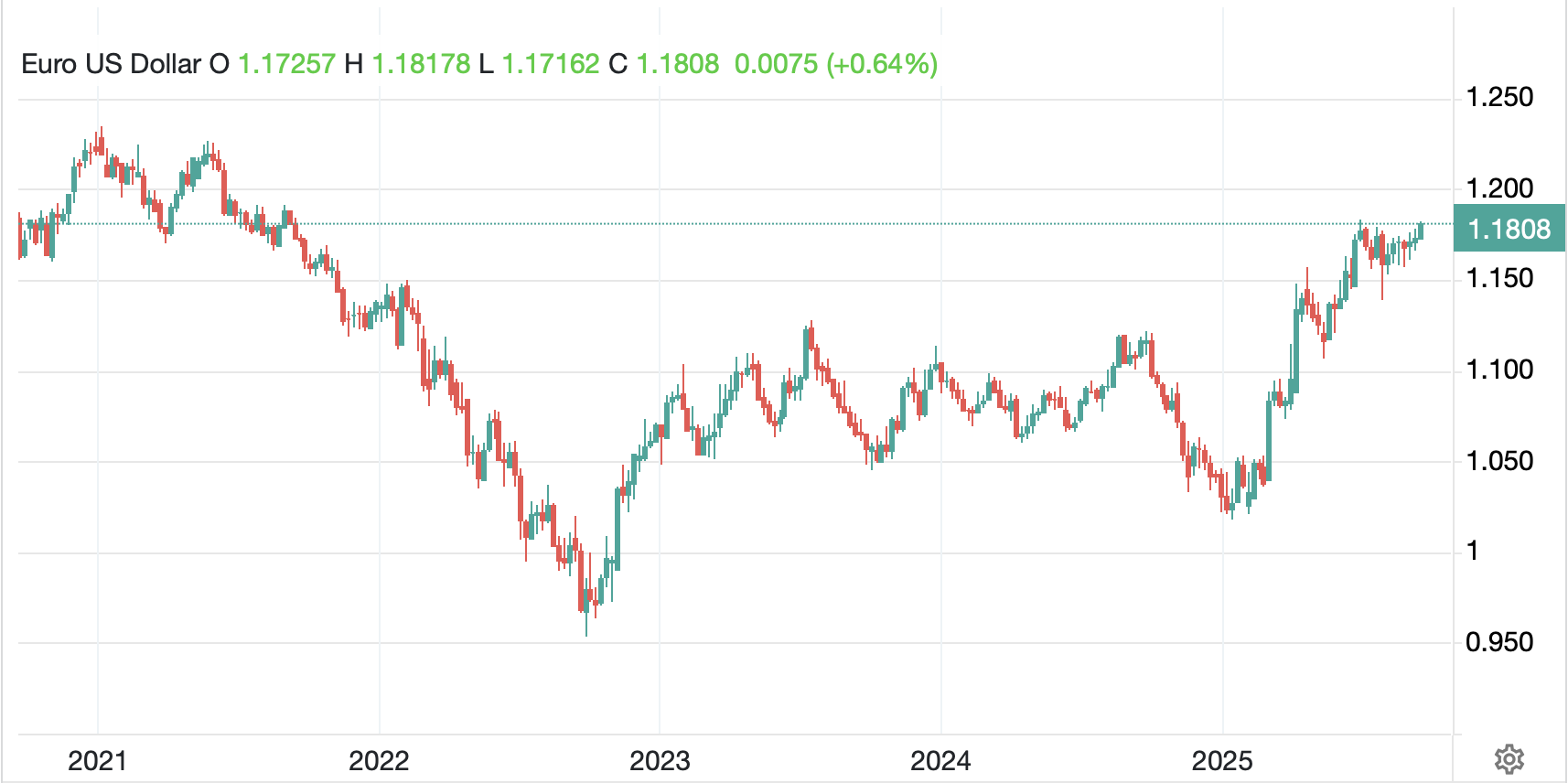
Finally, the dollar is under pressure this morning, with the euro (+0.4%) trading above 1.18 again for the first time since July 1st and there is a great deal of discussion as to how it is going to trade back to, and through, 1.20 soon, a level not seen since 2021.  

Source: tradingeconomics.com

The narrative is now that the Fed is set to begin cutting rates and the ECB is going to stand pat, the euro will rise.  This is true for GBP (+0.3%) as wel, with the Sterling chart largely the same as the euro one above.  Here’s the thing.  I understand the weak dollar thesis if the Fed gets aggressive, I discussed it above. However, if German manufacturing is contracting that aggressively, and the layoffs numbers are eye opening, can the ECB really stand pat?  Similarly, PM Starmer is under enormous, and growing, pressure to resign with the Labour party in the throes of looking to oust him for numerous reasons, not least of which is the economy is struggling.  So, please tell me why investors will flock to those currencies.  I see the dollar declining, just not as far as most.

Data this morning brings Retail Sales (exp 0.2%, 0.4% -ex autos) along with IP (-0.1%) and Capacity Utilization (77.4%).  However, it is not clear to me that markets will give this data much consideration given the imminence of the FOMC outcome tomorrow.  The current futures pricing has just a 4% probability of a 50bp cut.  I am waiting for the Timiraos article to see if that changes.  Look for it this afternoon.

Good luck

Adf

Thought-Provoking

My sight is clearing
I now see the price target
Closer than you think

With monetary easing continuing, I believe we have reached a point where attainment of the 2% price stability target is finally in sight, despite uncertainty over the Japanese economy.  It is necessary to consider shifting gears from extremely powerful monetary easing … and how we should respond nimbly and flexibly toward an exit.”  So said BOJ member Hajime Takata last night at a meeting with business leaders in western Japan.  These are the strongest words we have heard, I would argue, and the market did respond with the yen strengthening (+0.5%) and now right on the 150.00 level, while 2yr JGB yields rose another basis point, up to 0.18%, and its highest level since 2011.  I always find the BOJ wording to be odd as they try to be nimble and flexible in something that doesn’t appear to offer opportunities to behave in that manner.

Regardless, this has encouraged a more hawkish take on Japan with the probability of their first rate hike occurring in March rising to 26% from a previous level in single digits.  But despite these comments, we must remember this is from a single BOJ speaker.  Unless and until we hear this tone from multiple BOJ board members, I maintain that while an April move to 0.00% is possible, movement much beyond that seems very premature.  After all, last night saw IP in Japan fall -7.5% in January which takes the Y/Y number to -1.5%.  Recall, too, that Japan is in the midst of a technical recession.  It just doesn’t seem like tightening monetary policy is the prescription for what ails that nation.

However, the Japanese story is for the future as we have already seen the initial knee-jerk reaction.  And that means that all eyes are going to be on the US data at 8:30.

So, what if Core PCE’s smoking?
It seems that might be thought-provoking
If that is the case
We’d all best embrace
The idea the bulls will start choking

The flipside’s a cool PCE
Which winds up at zero point three
If that’s the result
The stock-buying cult
Will take every offer they see

As the market awaits this morning’s PCE data, a quick recap of yesterday seems in order.  I think you can argue that the data indicated economic activity remains at quite a high pace.  While the second look at Q4 GDP was revised down a tick, it is still at 3.2%.  The sub-indices showed that prices rose a bit more than expected and that Real Consumer spending rose a better than expected 3.0%.  The other data point was the Goods Trade Balance which showed a larger than expected deficit, a sign that imports are growing faster than exports.  This is typically a growth scenario, not a recessionary one, so nothing about the data hinted at a slowdown in things.

As well, we heard from three different Fed speakers and to a (wo)man they all explained that they remain data dependent and that the total economic situation was what they were following, not simply the inflation rate.  My point is that there is no indication that they are anywhere near ready to cut rates.

Turning to this morning’s release, expectations are as follows: Headline (0.3%, 2.4% Y/Y) and Core (0.4%, 2.8% Y/Y).  As well, we do see some other important data with Personal Income (exp 0.4%), Personal Spending (0.2%), Initial Claims (210K), Continuing Claims (1874K) and Chicago PMI (48.0).  But really, it is all about PCE.

My take is things are quite binary for a miss from expectations.  A hot print, 0.5% or more, will result in a sharp risk-off session as market participants will reduce the probability of future rate cuts.  This should see both stocks and bonds sell off, while the dollar rallies.  In contrast, a 0.3% or lower print for Core PCE will see the opposite outcome with a massive equity rally along with a huge bond rally, especially the front of the curve, and I suspect that futures markets will juice the odds of a May cut again (March is off the table no matter what.)

Of course, the last choice is a release right at the consensus view.  In that case, both sides of this argument will continue to argue their points, but my take is, based on yesterday’s price action, that equities may have a bit further to correct on the downside absent some other news that encourages the idea of stronger real growth, or an increased probability of a Fed cut.  One other thing to remember is we get four more Fed speeches today and this evening, so regardless of the outcome, there will be a lot of opportunity to reinforce their views.

Heading into the data release, a quick look at the overnight session shows us that the Asian market was quite mixed with Japan very little changed, a small decline in Hong Kong, but mainland Chinese shares rose sharply (CS! 300 +1.9%) as traders are looking for the government to announce a new fiscal stimulus package after they meet next week and roll out their growth targets for the coming year.  it strikes me there is ample opportunity for disappointment here given how unwilling Xi has been to do just that.  The European picture is equally mixed with some gainers (UK and Germany) and some laggards (France and Spain) although not a huge amount of movement in either direction.  There was a lot of Eurozone data released this morning with weak German Retail Sales, slowing growth in Scandinavia, and inflation throughout the continent coming in just a touch hotter than forecasts, although still trending lower.  And, after a lackluster day yesterday, US futures are softer by -0.2% at this hour (7:00).

In the bond market, yields are rising this morning with Treasuries (+4bps) back above 4.30% and all European sovereigns rising by at least that much.  In fact, UK Gilts (+7bps) are leading the way after some slightly better than expected housing data.  10-year JGB yields also edged up by 1bp after the Takata comments, but remain far below the 1.00% level that is still seen as a YCC cap.

Oil prices are a touch softer this morning, -0.4%, after a modest gain yesterday.  The big story remains the rumors of OPEC+ continuing to restrict their production.  In the metals markets, precious metals are under modest pressure this morning, but base metals are holding their own, with aluminum leading the way higher by 0.6%.

Finally, the dollar, away from the yen, has really done very little overall.  Looking at my screen, the only currency that has moved more than 0.2% in either direction is NZD (-0.25%) which seems to be continuing yesterday’s price action after the less hawkish RBNZ meeting outcome.  Otherwise, nada.

As we await the PCE data, and the Fedspeak later in the day, the one thing to remember is that if we see a soft number and the equity market cannot hold its early gains, that would be quite a negative signal for risk assets in the near term.  There are many who believe we are in a bubble market, especially the tech sector, and certainly there are many frothy valuations there.  It would not be hard to imagine a correction happening just because.  But if a market falls on ostensibly bullish news, that correction could have a little more oomph than most would like to see.  I’m not saying this is my expectation, just that it is something to keep in mind.  As to the dollar, that remains beholden to the monetary policy choices and so far, they haven’t changed.

Good luck
Adf

Talk the Talk

It seems that investors are waiting
For Powell, and so they’re debating
Will he be a hawk
And still talk the talk
Or will he be accommodating?

The punditry seems unpersuaded
Another rate hike could be slated
So, most views expressed
Say; time to invest!
And bearish ideas must be faded

It is almost as if we are still on holiday given the lack of price movement across most markets so far this week.  In fact, other than the Chinese markets (Hang Seng -1.0%), which are continuing to suffer from the ongoing implosion of their property bubble, market activity yesterday in the US, overnight through the rest of Asia and in Europe this morning has been quite muted.  Perhaps the tone has been very mildly bearish, with declines on the order of -0.25% or so, but that comes in the wake of gains as much as 10% or more through the month of November.  As such, it should be no surprise to see a bit of portfolio rebalancing.  Certainly, there is a lot more discussion about the soft/no-landing scenario and we are beginning to see S&P 500 prognostications for the end of 2024 being above 5000.  

The premise seems to be that inflation has been defeated, and that while the Fed may wait a few more months before cutting rates, by this time next year they will be celebrated for having achieved the elusive soft-landing.  The implication is that once they are more comfortable that inflation is dead, they will start to cut rates because…?  And that is where I get lost.  If the economy continues to grow with rates at 5%, exactly why should the Fed consider cutting them?  The only reason I can see is that the pressure from the administration grows too intense as the cost of refinancing the currently outstanding and growing debt continues to rise dramatically.  The problem with this outcome, however, is that if the Fed is seen to be cutting rates under pressure from the administration to reduce financing costs, it is likely to signal to the market that fiscal policy is in complete control (yesterday’s discussion on fiscal dominance is apropos here).  Historically, when that happens, inflation is not merely, not dead, it is ready to roar.

The implications of this policy direction are unlikely to be welcome in government, in boardrooms or in households, as rising inflation and a declining currency are a toxic mix for economic success.  Let’s think this through before cheering it on.

As we progress toward the 2024 presidential election, it is abundantly clear that the federal government is going to seek to spend as much money as possible.  Not only that but I am confident they learned the lessons from the GFC and Covid that QE simply pumps up asset prices while helicopter money is far more effective in getting cash into the hands of the voters.  Given the recent surveys that show 80% of the country believes they are worse off than prior to President Biden’s election, the recipe to address this is quite clear; give more money directly to the people.  And so, you can be sure that there will be numerous fiscal giveaways as 2024 unfolds.

The problem is that these giveaways do not create organic growth in the economy, rather they are the antithesis of organic growth.  As such, tax revenues will continue to lag, and the deficit will continue to grow ever larger.  Already, the cost of funding the outstanding ~$34 trillion in debt has reached $1 trillion, more than the government spends on defense, the largest non-entitlement program.  As well, the average tenor of US Treasury debt continues to decline with almost half needing to be refinanced by the end of 2025.  If interest rates remain at 5.5% and the Treasury continues to skew toward T-bills rather than coupons, that $1 trillion bill is going to grow to $2 trillion pretty quickly.  That will require even more debt issuance to repay, and the cycle will grow ever larger and faster.

It doesn’t take much imagination to see where this could be headed and there is a history of how it has worked in the past, notably with Weimar Germany in 1921-1923 and more recently, in Zimbabwe in 2008-2009 and again in 2019, and, of course, Argentina today.  The classic response to this problem is to institute yield curve control so that those debt payments are contained.  Of course, that means that government debt will pay negative real yields, and the Fed will wind up owning most of it*.  The natural consequence here will be that the dollar will likely decline sharply, at least against ‘real’ stuff like commodities, and a little less-so against quasi-real stuff** like equities.  Versus other currencies it is much harder to tell because if the US is in this situation, other countries are likely to be in difficult straits as well, so the FX value of the dollar may not collapse.  Of course, other countries may not have the same debt dynamics as the US, and those currencies will likely hold up better than the rest.

My fear is this is the new direction of travel.  It is not a given by any stretch, but it is going to seem quite attractive to politicians of every stripe, regardless of their political affiliation or ostensible principals because, remember, to an elected politician, the most important policy is one that gets them re-elected and they will vote for anything that they believe will help them in that cause, principals be damned. 

Will this have any impact today?  Very unlikely.  But it is important to remember this possible path as we await to hear more Fed speakers, but notably Chairman Powell on Thursday morning.  Any hint that the pressure to cut is working (and I am sure there is plenty of pressure for that from Treasury and the executive branch) and we will see a massive rally in equities, bonds and commodities as the dollar declines.  At least at first.  In fact, it is for this reason that I believe that we are going to hear much more hawkish rhetoric from all the Fed speakers this week, and that Powell will be particularly so.  They understand the potential ramifications of capitulation and are not yet ready to allow it.

As to today’s markets, bond yields are within 1bp of yesterday’s closes but leaning lower right now, US equity futures are basically unchanged as are gold and the entire metals complex although oil is edging higher on the news that Saudi Arabia is pushing for another 1mm bbl/day production cut at Thursday’s OPEC+ meeting.

On the data front, yesterday’s New Home Sales data was quite weak, with both prices and volumes falling.  This morning we see Case Shiller Home Prices (exp 4.0%) and Consumer Confidence (101.0) and we hear from four Fed speakers, Goolsbee, Waller, Bowman and Barr.  Look for that hawkish tilt.  It is also supomatsu, the day when spot FX settles on month end, so I expect FX volumes to pick up a bit, but historically, this is more of a swap exercise than a directional one, and so looking for directional movement based on this would be a mistake in my view.  

If I am correct and hawkishness is the Fed mantra today, I expect the dollar will be able to edge a bit higher along with yields, but until Powell speaks, I suspect we will remain fairly muted overall.

Good luck

Adf

*There is another possibility with regards to ownership of treasury debt to prevent the Fed from owning all of it, new rules can be instituted that require banks, insurance companies and even your 401K or IRA accounts to maintain a certain percentage of assets in treasury bonds.  So, in the latter case, which has already been discussed in Washington, you could see 20% or 30% of your retirement next egg forced into negative real yielding assets for a long time.  I assure you that will not help your retirement situation!  

** I use the term quasi-real stuff as equities represent shares in a real business, so there is underlying value to that business and its assets, although not quite the same as owning the actual hard assets they represent.

A Loose Upper Bound

One percent is now
A loose upper bound, rather
Than a key level

Yen participants
Saw a signal to sell.  Is
Intervention next?

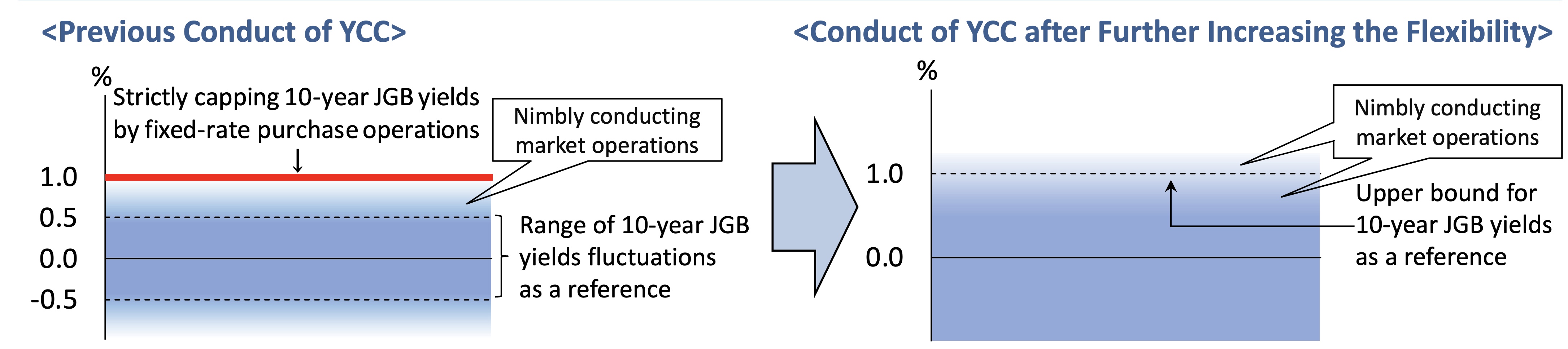
Below is what appears, to me at least, to be the critical comment from the BOJ after last night’s policy meeting.  As well, that graphic comes straight from the BOJ presentation.

“It is appropriate for the Bank to increase the flexibility in the conduct of yield-curve control, so that long-term interest rates will be formed smoothly in financial markets in response to future developments.”

The essence of this is that YCC as we knew it, where the control part was the key, is now dead.  Instead, Ueda-san is going to allow a great deal more leeway for the market to determine the yield on the 10-year JGB, and the entire yield curve there.  While they have not yet adjusted the policy rate, which remains at -0.10%, I imagine that change is only a matter of time.  Remember, though, the BOJ currently owns somewhere around 56% of the outstanding JGBs in the market.  It is very clear they are not going to sell any.  To me the question, which I did not see answered last night, is whether they will replace the bonds in their portfolio when old ones mature.  There was no mention of QT, but I guess we will have to see.  Based on their history, however, I would expect that the current balance of JGB’s they own will remain pretty constant going forward, at least on a nominal basis.  Given the Japanese government continues to run deficits, that will eventually reduce the percentage of holdings.  Of course, I suspect that this is subject to change if things get politically uncomfortable, but we shall see.

The market response was somewhat counter to what might have been expected.  Arguably, many were looking for a yen rally as higher yields in Japan would create a greater incentive for Japanese institutional investors to bring their money home.  But that is not what happened at all.  This morning, USDJPY is firmly above 150.00 with no hint that there is intervention coming anytime soon.  It seems, at least for now, that the MOF and BOJ are going to allow markets to find a new level by themselves.  If that is the case, I expect that USDJPY is going to revert to form and follow USD interest rates.  In fact, that is really the key, and something about which I have written in the past.  When the Fed turns their policy toward easier money, at that time the dollar will come under significant pressure.  However, until then, the dollar remains the place to be.

In China, the data has shown
The ‘conomy’s not really grown
Will Xi add more cash
To try for a splash
Or will he leave things on their own?

The other news overnight was from China where their PMI data proved weaker than expected for both manufacturing and services with the former falling back below the key 50.0 level at 49.5 and the latter falling to its lowest print since last December during the zero-Covid policy Xi had implemented.  It seems that slowing growth around most of the world plus a limited domestic economic impulse combined with the ongoing collapse of the Chinese property market is just too much to overcome right now.  Expectations are that Xi will agree to yet more stimulus (remember earlier this month they put forth a CNY 1 trillion (~$137 billion) plan, but that has not seemed to have had the desired impact.  At least not yet.  While Japanese equities rallied on the back of the BOJ activity, Chinese equities came under pressure, especially the Hang Seng (-1.6%) although mainland shares fell as well.  As to the renminbi, it continues to grind lower (dollar higher) and remains pegged at the 2% boundary vs. the PBOC’s daily fixing rate.  Nothing has changed my view of further weakness in the renminbi going forward, at least as long as the Fed retains its current policy stance.

If I were to sum up the situation in Asia at this time, I would suggest that the two major economies there are both very busy dealing with substantial domestic economic questions, although those questions are different in nature.  Japan is trying to come to grips with rising inflation absent substantial economic growth while China has a problem defined by weakening growth with inflation not a current issue.  But lack of growth is the common denominator here and as we have seen countless times around the world, I suspect we will see further fiscal stimulus in both nations before long.  

Of course, when it comes to fiscal stimulus, China and Japan are mere pikers compared to the US which has completely rewritten the record books on this matter.  And there is nothing that indicates the US is going to back off, at least while the current administration is in place, and likely the next regardless of the letter after the president’s name.  

On this subject, though, while yesterday I described the QRA as critical, the first part of the Treasury story was revealed yesterday morning when they announced that the funding requirement for Q4 would be $776 billion, some $75 billion less than the consensus estimates before the announcement.  But the key difference was that Secretary Yellen is aiming for an average TGA balance of “only” $750 billion, far less than some estimates of $1 trillion, and less than the current balance of $835 billion.  In fact, the difference between the current balance and the target is what makes up for the difference in the issuance estimates.  Under no circumstances should anyone believe that fiscal prudence is coming soon.

But this lower number has relieved some pressure in the bond market where we have seen yields slide a few more basis points this morning with the 10-year now trading at 4.83%.  This movement has been followed by the European sovereign market, where yields have fallen by between 4bps and 6bps across the board in sympathy.  In fact, the only major market that saw yields rise was the JGB market, where the 10yr yield is now at 0.93%, up 5 more bps from yesterday’s closing levels.  I suspect that we will be trading at 1.00% soon enough, and it will be quite interesting to see just how ‘nimble’ the BOJ will be if yields start to run higher more quickly.

As to equity markets, yesterday’s US rally has been followed by the European bourses, all up between 0.6% and 1.2% despite somewhat soft economic growth data released this morning.  However, Eurozone inflation data was also slightly softer than forecast and it seems traders are looking for the ECB to reverse to rate cuts sooner rather than later.  US futures, meanwhile, are very marginally firmer this morning as all eyes now turn toward tomorrow afternoon’s FOMC outcome.

Oil prices have bounced a bit, up 0.9%, but this seems to be a trading move rather than anything either fundamental or geopolitical.  Regarding the latter, the fact that the beginnings of the Israeli ground invasion of Gaza have not produced nearly the pyrotechnics feared, nor that the conflict has spread throughout the Middle East, at least not yet, has resulted in traders returning their attention to inventories and demand.  Slowing growth in most places around the world is likely the key driver right now.  As to gold, it has maintained its recent gains and is trading right at the $2000/oz level.  Clearly, there is a fear factor there, but remember, if the equity bulls are correct and the Fed is going to tell us they are done, that will be seen as dovish and we should see a reversal in the dollar, a rally in commodities, including gold, and an initial rally in stocks and bonds.  That is not my base case, but you cannot ignore the possibilities.

Finally, the dollar is best described as mixed today as the strength in USDJPY (+1.1%) has been offset by weakness in the greenback vs the euro (+0.4%) and the pound (+0.2%), as well as a number of EMG currencies (MXN +0.4%, PLN +0.5%, ZAR +0.6%).  If one considers the DXY, that is virtually unchanged on the day.

On the data front, this morning brings the Employment Cost Index (exp 1.0%), Case Shiller Home Prices (1.6%), Chicago PMI (45.0) and Consumer Confidence (100.0).  obviously, there are no Fed speakers as their meeting starts this morning and runs through tomorrow afternoon when we will see the statement and Powell will meet the press at 2:30.  

It seems to me like traders will be cautious ahead of the FOMC tomorrow.  I would think they would want more confirmation that the Fed has finished before running back into bonds as well as reversing the recent stock declines.  While the Fed is unlikely to do anything tomorrow, it will be all about the statement and press conference.  Til then, I suspect a quiet time.

Good luck

Adf

Just Kidding

Remember Friday
When one percent was declared
The top?  Just kidding

Much has been written about the BOJ’s surprising change in policy at their meeting last Friday, when they ostensibly widened the cap on their Yield Curve Control to 1.00% while explaining that flexibility in operations was the watchword.  They did not touch their overnight rate, which remains at -0.10% and there is no apparent belief that they are going to adjust that anytime soon. 

Neither market pricing in the OIS market nor any commentary from any BOJ official has hinted at such a move.  So, the question is, did they really change their policy?

This matters a great deal for those amongst us who care about USDJPY and its potential future direction.  The prevailing narrative has been that once the BOJ altered policy and allowed Japanese interest rates to rise to a more normal setting, investment would flow into JGBs, and the yen would strengthen rapidly.  Remember, a big part of this process is that since the yen is the last remaining currency with negative interest rates in the front end of the curve, it remains the financing currency of choice amongst the speculative and hedge fund set.  Adding to this discussion was the fact that back in December of last year, when Kuroda-san truly surprised the market by raising the YCC cap from 0.25% to 0.50%, it took less than one day for the 10-year JGB yield to test the new cap.  Expectations recently had been that a similar move was likely to be seen this time around as well.

Alas, it is Monday, so some thirty-six market hours into the new policy and already the BOJ has stepped into the market to prevent a further rise in the 10-year yield once it touched 0.60%.  Last night they stepped in with a ¥300 billion program of additional QE.  One cannot be surprised that USDJPY (+0.9%) is higher on this news as it undermines the entire thesis about imminent JPY strength once they changed policy.  And if they didn’t really change policy, as evidenced by the fact that they have already stepped into the market, then THE key pillar of the stronger yen thesis has just been removed.  The other problem for the yen bulls is that the US data last week, especially the GDP and IP data, indicate that the Fed will be under no duress if they continue to tighten policy beyond current levels.  Despite all the arguments about the Fed making another policy error, and there are sound arguments there, in Jay Powell’s eyes, until NFP starts to fall sharply, or Unemployment starts to rise sharply, or both, there are no impediments to a continuation of the current tightening policy.

It is with this in mind that I foresee continued strength in USDJPY, and while it seems likely that a very rapid move higher will see further intervention by the BOJ/MOF like we saw last autumn, another test of 150 is in the cards.  A quick look at the chart below (from tradingeconomics.com) shows that the trend higher in the dollar remains intact with the decline in the first part of July already mostly undone.  For those of you who were looking for a reversion to the 120 or 130 level, I fear that is just not in the cards for a long time to come.

Last Thursday the ECB said
That policy, looking ahead
Need not be so tight
And so, they just might
Stop raising rates, pausing instead

Though their only mandate is prices
They’ve come to a bit of a crisis
Seems growth’s really weak
And so, they will seek
A policy, sans sacrifices

The good news in Europe is that Q2 GDP was positive, which followed a negative Q4 and a flat Q1.  Hooray! The bad news about the data, which showed a 0.3% rise, is that fully half that number comes from Ireland! Now, Ireland’s weight in the Eurozone economy is tiny, about 4%, so the fact that growth there represented half the entire EZ’s growth is remarkable.  However, if you consider that this growth is more illusion than economic activity, it is easier to understand.  The growth is a result of the large profitability of US tech companies that generate their profits, from an accounting perspective, in Ireland to take advantage of the extremely low Irish corporate tax rate of 12.5%.  So, US tech companies had a good quarter driving Irish GDP higher, and by extension Eurozone GDP higher.  But they didn’t really produce that much stuff.

At the same time, Core CPI in the Eurozone printed at 5.5% this morning in July’s preliminary reading, hardly indicative of a collapse and calling into question Lagarde’s seeming dovishness last week.  In the end, the dichotomy between the US economy, where the latest data continues to show a robust outcome, and Europe, where the only thing rising is prices with economic activity lackluster at best, remains the key reason why the dollar’s demise is still a theory and not reality.  

To summarize the information that we have received from around the world in the past several days, Japan is unwilling to allow interest rates to rise very far, European growth is staggering, US growth is accelerating, the ECB is inclined to stop hiking rates and the Fed continues with ‘higher for longer’.  All of this points to the dollar maintaining its value and likely rising further.  I have yet to see anything persuasive in the dollar bear case to address all these issues. 

Now, those are the big picture views, but let’s take a quick tour of the overnight session.  Equities rallied in Asia following the US performance on Friday, but Europe has been a bit more circumspect with a couple of markets showing gains, notably France and Italy, but the rest doing nothing at all.  At the same time, US futures are little changed at this hour (7:30).

Arguably, though, it is the bond market where things are really interesting as yields continue to rebound.  US Treasuries are higher by 1.5bps and pushing back to that all important 4.00% level this morning.  There is a growing belief that if 10-year yields push above 4.10%, that may signal a new framework, a breakout in technical terms, and we could see much higher yields from there.  The Fed is likely to welcome such an event as it will help tighten financial conditions, something that they have been unable to achieve thus far.  However, I do not believe the equity markets would take kindly to that type of movement, so beware.  As to European sovereigns, they are mostly higher by about 1bp-2bps this morning and of course, JGBs saw yields finish higher by 6bps, just below 0.60%.

Oil prices (+1.0%) continue to rise on an organic basis.  By this I mean there have been no announcements, no disruptions and no news of any sort that might indicate a change in the current situation.  In other words, there is just a lot of buying going on.  WTI is well above $81/bbl and we have seen a gain of more than 16% in the past month.  Headline inflation will not be sinking on this news.  We are also seeing a little strength in the metals space this morning with gold, copper and aluminum all firmer as the week begins.  The base metals are responding to continued indications that China is going to support their economy, although direct fiscal payments don’t yet seem likely.  Just wait a few months.

Finally, the dollar is net, little changed, although we have a wide array of gainers and losers today.  In the G10, AUD (+0.9%) and NZD (+0.75%) are the leaders, rallying alongside the commodity rally, while JPY (-0.8% now), is the laggard based on the discussion above.  As to the rest of the bloc, there are more gainers than losers, but the movement has been far less impactful.  In the EMG space, MYR (+1.1%) has been the leading gainer on significant (for Malaysia) equity market inflows of ~$40mm -$50mm last night.  After that, though, the gainers have mostly been EEMEA currencies, and they have not moved that much.  On the downside, ZAR (-0.7%) is the laggard on limited news, implying more of a trading action rather than a fundamental shift.  But on this side of the ledger as well, things haven’t moved that far and net, the space is little changed.

It is an important week for data in the US culminating in the payroll report on Friday.

TodayChicago PMI43.4
 Dallas Fed Mfg-22.5
TuesdayJOLTS Job Openings9600K
 ISM Manufacturing46.9
WednesdayADP Employment183K
ThursdayInitial Claims227K
 Continuing Claims1723K
 Unit Labor Costs2.5%
 Nonfarm Productivity2.2%
 Factory Orders2.1%
 ISM Services53.0
FridayNonfarm Payrolls200K
 Private Payrolls175K
 Manufacturing Payrolls5K
 Unemployment Rate3.6%
 Average Hourly Earnings0.3% (4.2% Y/Y)
 Average Weekly Hours34.4
 Participation Rate62.6%
Source: Bloomberg

In addition to this, we get the first post-FOMC Fedspeak with just two speakers, Goolsbee and Barkin, on the calendar this week although the pace picks up next week.  As long as the data remains strong, I see no reason for the Fed to change its tune nor any reason for the dollar to back off its recent net strength.

Good luck

Adf

A Suggestion

Nought point five percent
Is not a rigid limit
It’s a suggestion

At least that is the word we got last night from Kazuo Ueda, BOJ Governor when he announced some surprising policy changes.  No longer would 10-yr JGBs be targeted to yield 0.0% +/- 0.50%, which in practice had meant a 0.50% cap.  Going forward, the BOJ would buy an unlimited amount of JGBs at 1.0%, if necessary, as its new framework.  Perhaps the most humorous part of the concept was the suggestion that they always saw the 0.50% cap “as references, not as rigid limits, in its market operations.”  That’s right, after 7 years of a seemingly explicit cap on JGB yields, with the BOJ willing to buy unlimited amounts in order to prevent yields from climbing, now they mention it was merely a suggestion, a guideline rather than a hard limit.  It is commentary of this nature that tends to undermine investor trust in central bankers.

Given the surprising nature of the policy changes, although they left their O/N financing rate at -0.10%, it should be no surprise that the market had some large, short-term responses.  JGB yields jumped 10bps on the news, trading to a new 9-year high at 0.575% before slipping back a few bps to close the week.  The Nikkei, meanwhile, fell nearly 2.5% in the immediate aftermath of the decision, but rallied back all afternoon there to close lower by just -0.4%.  It turns out the financial sector benefitted greatly as higher rates really helps them.  As to the yen, it saw substantial short-term volatility, as ahead of the meeting it weakened nearly 1.75%, trading above 141.00, but very quickly reversed course and rallied > 2% as the dollar briefly fell to 138.00.  In the end, though, the yen is just a hair stronger on the day now, back near 139.50 where things started.

The lesson, I think, is that policy shifts tend to have very immediate consequences, but the longer term impacts, especially in the currency market where we have a lot of moving pieces between the Fed, ECB and BOJ, will take longer to play out.

In Europe, inflation remains
The issue that’s caused the most pains
But growth there is stalling
So, Christine is calling
For slowing the rate hike campaigns

“We have an open mind as to what decisions will be in September and subsequent meetings…We might hike, and we might hold. And what is decided in September is not definitive, it may vary from one meeting to another,” Lagarde said.It was with these words that Madame Lagarde informed us the rate hiking cycle in the Eurozone may have ended.  Despite the fact that core CPI remains above 5.0% while their deposit rate is now at 3.75%, seemingly not high enough to effectively combat the inflation situation, it is becoming ever clearer that the European growth story is starting to slide.  This is in direct contrast to the US growth story, which based on yesterday’s extremely robust data, shows no signs of fading.

But as I have written numerous times in the past, once the Fed is perceived to have stopped raising interest rates, it was clear the ECB would be right behind them.  The entire basis of my stronger dollar thesis has been that other central banks will find it very difficult to tighten policy aggressively to fight inflation if the Fed has stopped doing so.  

In the end, no country really wants a strong currency as the mercantilist tendencies of every country, seeking to increase exports at the expense of their domestic inflation situation, remains quite strong.  Faster growth with higher inflation is a much preferred economic outcome for essentially every government than slower growth with low inflation.  Inflation can always be blamed on someone else (greedy companies, Ukraine War, OPEC+, supply chain disruptions) while faster growth can be ‘owned’ by the government.

So, between the ECB and BOJ, we did see further policy tightening in line with the Fed’s actions on Wednesday.  Arguably, the difference is that the US economic data continues to be quite strong, at least on the surface.  Yesterday’s first look at Q2 GDP printed at 2.4%, much higher than expected and showing no signs of the ‘most widely anticipated recession in history.’  The strength was seen in Government spending (IRA and CHIPS Act), Private Domestic Investment (which is directly related to that as companies build out new plant infrastructure) and Services, i.e. travel and restaurants.  Once again, I will say that as long as the US economy continues to show growth of this nature, and especially as long as the Unemployment Rate doesn’t rise sharply, the Fed will have free rein to continue to raise rates going forward if inflation does not settle back to their 2% target.

One thing to consider regarding the central bank comments and guidance is that virtually every one of them has ended the strict forward guidance we had seen in the past.  Rather, data dependence is the new watchword as none of them want to be caught out doing the wrong thing.  Alas, the result is that, by definition, if they are looking at trailing data, they will always be doing the wrong thing.  I expect that one of the key features of the past 40 years, ever reducing volatility in markets, is going to be a victim of the current framework.  It is with this in mind that I suggest hedging financial exposures, whether FX, rates, or commodities, will be far more important to company balance sheets and bottom lines than they have been in the past.

Ok, let’s see how investors are behaving today as we head into the weekend.  We’ve already discussed the Japanese market, but Chinese shares, both onshore and in HK, had a very strong day as there was more talk of official policy support for the property market there.  Ultimately, it is very clear they are going to need to spend a lot more money to prevent an even larger calamity.  European shares, though, are generally little changed this morning with investors preparing to take the month of August off, as usual there.  Finally, US futures are higher this morning after what turned out to be a surprising fall in all three major indices yesterday.  The overall positive data plus indication that the Fed may be done seemed to be the right conditions for further gains.  But markets are perverse, that much we know.  We shall see if US markets can hold onto these premarket gains.  I would say that a lower close on the day would be quite a negative for the technicians.

In the bond market, yesterday saw US 10-year yields jump 15bps, its largest rise this year, although it is giving back about 4bps of that this morning.  European sovereigns, though, are little changed this morning and have not been subject to the same volatility as the Treasury market given the far less exciting economic picture there.  If the ECB is truly finished, my take is yields there could slide a little over time.

In the commodity markets, oil (-0.35%) is a touch lower this morning, but the uptrend continues.  This certainly seems to be more about reduced supply than increased demand, although with the US data, the demand picture looks better.  Interestingly, both gold (+0.6%) and copper (+1.0%) are higher this morning despite the dollar holding its own.  Yesterday saw a sharp decline in both and I think there is a realization that was overdone.

Speaking of the dollar, it is modestly softer today after a strong gain yesterday.  In the G10, GBP (+0.6%) is the leader followed by NOK (+0.5%) although AUD (-0.6%) and NZD (-0.3%) are taking the opposite tack.  The pound seems to be benefitting from anticipation of next weeks’ BOE meeting where 25bps is a given, but the probability of a 50bp hike seems to be creeping up.  Meanwhile, NOK is just following oil’s broad trend with WTI just below $80/bbl now.  Meanwhile, Aussie seems to be suffering some malaise from the BOJ actions, at least that’s what people are saying although I’m not sure I understand the connection.  Perhaps it is the idea that higher JPY yields will result in unwinding the large AUDJPY carry trades that are outstanding.  

However, the emerging markets have seen a much wider dispersion of performance with much of the APAC bloc under pressure last night on the back of the strong dollar performance yesterday, while we are seeing strength in LATAM and EEMEA currencies this morning, which really looks an awful lot like simple trading activity with positions getting reduced after yesterday’s dollar performance.

In addition to the GDP data yesterday, we saw a lower-than-expected Initial Claims print at 221K while Durable Goods orders blew out on the high side at 4.7%!  Again, lots to like about the US data right now.  Today we see Personal Income (exp 0.5%) and Spending (0.4%) along with the Core PCE Deflator (0.2% M/M, 4.2% Y/Y) and finally Michigan Sentiment (72.6).  based on yesterday’s results, I would expect the Income and Spending data to be strong along although PCE is probably finding a bottom here.

In the end, even if the Fed has stopped hiking, although with the economy still showing strength that is not a guaranty, I find it hard to believe that the ECB will go any further, and the tendency around the world will be to slow or stop tightening as well.  I still like the dollar in the medium term.

Good luck and good weekend

Adf

Truly Mind-Blowing

Officials see no
Urgency to rock the boat
YCC ‘s still law

As reported in numerous places overnight, the BOJ has let slip that they are not considering any changes to the current policy mix at their meeting next week.  You may recall that there has been an uptick in discussion about the ongoing review that began just last month and the idea that Ueda-san was preparing to tweak YCC or to end YCC or something else.  That has been a key driving force in the recent rise in JGB yields, which had climbed 10bps, to as high as 0.47%, during July.  Short JPY positions in the currency market were getting covered in waves and we saw the yen strengthen more than 5% in the first two weeks of July.

This was all part of the narrative of the dollar’s imminent decline and used in conjunction with the rising de-dollarization narrative as part of a new world order type of argument.  Nobody wanted to hold dollars, and this was the proof!  

Oops!  Maybe this narrative will need to be tweaked a bit as not only has the BOJ thrown a serious amount of cold water on the changing YCC story, with JGB yields slipping a further 2.5bps last night, but this morning we were also treated to a story about India’s Foreign Minister explaining the country will not support any common BRICS currency for trade.  There is no doubt that Russia and China would like to see the dollar lose its global hegemonic status, but wishes are just that.  Do not dismiss the dollar at any time in the near future, it is not going to lose its current status.  However, that doesn’t mean it will stop fluctuating in FX markets, those are two different things.

There once was a great big recession
Forecast by the ‘nomics profession
The Fed had raised rates
For thirteen straight dates
And so, growth seemed out of the question

But so far the data is showing
The ‘cononmy’s seems to be growing
With joblessness sinking
Quite many are thinking
No landing.  It’s truly mind-blowing

Aside from the yen news, the market continues to try to understand the current economic cycle, which is clearly not very similar to any cycle in recent memory.  Every day I read things from very accomplished analysts about the imminent decline in the US economy and how the Fed will be forced to eat crow soon enough.  As well, if I scroll a bit further down my Fintwit feed, I find different accomplished analysts who explain that the no landing scenario is the best estimate and that the economy is on solid footing with inflation declining smoothly and heading back to its “natural” spot of 2%.  

And in fairness, one can slice the data up in many different ways to draw both conclusions.  One of the most interesting features of this situation is how different asset classes are concluding very different things from the data.  Broadly speaking, the US equity market is all-in on the no-landing scenario, trading higher almost every day (yesterday’s NASDAQ performance excepted and due to some weaker than expected earnings numbers), while the commodity space is far more circumspect over continued growth with base metals, especially, under broad pressure for the past several months.  Given the importance of copper and aluminum in the industrial process for almost every manufactured item, the pricing certainly indicates anticipated weakness in demand.  We know this because there is no excess supply on the way.

As to the bond market, I fear that the signal-to-noise ratio from bond yields has greatly diminished during the period of QE.  I am not one to easily dismiss the recession signal from the inverted yield curve, and as we currently sit at -100bps for the 2yr-10yr curve and -160bps for the 3m-10yr, both extremely large inversions, it is easy to conclude that a recession is on its way.  

But consider, if you look at all the recessions that are used as the basis for the strength of this signal, only the Covid recession occurred after the Fed began its QE program in 2009.  Prior to the GFC, the Fed just never held very many long-term Treasury bonds and $0.00 of mortgage-backed securities on its balance sheet.  It is not hard to believe that the Fed has substantially distorted the yield curve for the past 14 years, driving long-term rates far lower than they otherwise would have been based on economic conditions.  What would 10-year Treasury yields look like if the Fed didn’t own the ~$7.25 trillion of long-dated paper that currently sits on the balance sheet?  I suggest 10-year yields would be A LOT higher.  100bps?  Maybe.  Maybe more, maybe less, but 10-year yields are not really telling us that investors believe the economy is going to slow down.  Rather, I might suggest they are telling us that many players are bidding for bonds because they must for regulatory reasons (banks and insurance companies) and that there isn’t as much supply available as the gross issuance would indicate.

But, keeping that in mind, the data that gets released regularly continues to confuse.  For instance, yesterday saw Initial Claims data fall further, back to 228K and below all forecasts.  The rising trend that we had seen a few months ago seems to be reversing.  At the same time, the Philly Fed data was weaker than expected at -13.5 and Existing Home Sales fell to 4.16M.  Finally, Leading Indicators printed at -0.7%, a tick worse than forecast and the 15th consecutive negative reading of this indicator.  So, which is it?  Employment strength means growth?  Or weakening manufacturing and housing points to weakness?  As I wrote earlier this week, we need a new term to describe the current economy, as recession in the traditional view doesn’t seem right, but growth remains lackluster at best with parts of the economy, notably manufacturing, seemingly in contraction.

Well, as we head into the weekend, that is a lot to consider, and perhaps inspiration will strike and we will all understand things on Monday.  Just don’t count on it!  Meanwhile, ending the week, equities are kind of unhappy, with the Nikkei not taking kindly to the BOJ talk and probably a few more losers than gainers in Asia.  That same sentiment prevails in Europe, with both gainers and losers but leaning toward negative while US futures are bouncing from yesterday’s declines.
Bond yields are drifting a bit lower this morning, but only on the order of 1bp-2bps in the US and Europe, although Gilt yields have risen 2bps on the back of much stronger than expected UK Retail Sales data released today.  We’ve already discussed JGB’s, and I expect those yields to grind lower from here along with the yen.

Oil, however, has continued its recent strong performance, up 1.2% this morning on supply concerns as there were larger than expected draws on inventories this week.  Meanwhile, gold (-0.2%) is edging lower as the dollar regains its footing.  Today, copper and aluminum are both a bit firmer, but their recent trend continues downward.

Finally, the dollar is definitely in fine fettle this morning, rallying against all its G10 counterparts except NOK (+0.4%) which is obviously benefitting from oil’s rally.  The yen (-1.15%) is the laggard, which given the BOJ news, is no surprise.  Meanwhile, in the EMG space, it is a sea of red with THB (-1.3%) the worst performer followed by KRW (-1.1%) and TWD (-0.5%).  The baht saw a setback with the ongoing political machinations as hopes for a new government have been delayed, if not dashed, while the won saw its exports fall sharply as Chinese economic activity slows.  Taiwan is feeling the same effects as South Korea in that regard.

And that’s really it for today.  There is no data nor any speakers on the calendar, so the dollar seems likely to simply follow today’s sentiment which, given its weakness over the past several sessions, is likely to see more short covering and potentially a bit more strength.

Good luck and good weekend
Adf


Extinct

Down Under the RBA blinked
Regarding their policy linked
To Yield Curve Control
Which seemed, on the whole
To crumble and now is extinct

The question’s now how will the Fed
Address what’s become more widespread?
As prices keep rising
The market’s surmising
That rate hikes will soon go ahead

Here’s the thing, how is it that the Fed, and virtually every central bank in the developed world, have all been so incredibly wrong regarding inflation’s persistence while virtually every private economist (and markets) have been spot on regarding this issue?  Are the economists at the Fed and the other central banks really bad at their jobs?  Are the models they use that flawed?  Or, perhaps, have the central banks been knowingly trying to mislead both markets and citizens as they recognize they have no good options left regarding policy?

It is a sad situation that my fervent desire is they are simply incompetent.  Alas, I fear that central bank policy has evolved from trying to prevent excessive economic outcomes to trying to drive them.  After all, how else could one describe the goal of maximum employment other than as an extreme?  At any rate, as the saying goes, these chickens are finally coming home to roost.  The latest central bank to concede that their previous forecasts were misguided and their policy settings inappropriate was the RBA which last night ended its 20-month efforts at yield curve control while explaining,

Given that other market interest rates have moved in response to the increased likelihood of higher inflation and lower unemployment, the effectiveness of the yield target in holding down the general structure of interest rates in Australia has diminished.”

And that is how a central bank cries ‘uncle!’

Recall, the RBA targeted the April 2024 AGB to keep it at a yield of, first 0.25%, and then after more lockdowns and concerns over the impact on the economy, they lowered that level to 0.10%.  Initially, it had success in that effort as after the announcement, the yield declined from 0.55% to 0.285% in the first days and hovered either side of 0.25% until they adjusted things lower.  In fact, just this past September, the yield was right near 0.0%.  But then, reality intervened and inflation data around the world started demonstrating its persistence.  On October 25, the yield was 0.125%, still behaving as the RBA desired.  By October 29, the end of last week, the yield had skyrocketed to 0.775%!  In truth, last night’s RBA decision was made by the market, not by the RBA.  This is key to remember, however much control you may believe central banks have, the market is still bigger and will force the central bank’s hand when necessary.

Which of course, brings us to the FOMC meeting that starts this morning and whose results will be announced tomorrow afternoon at 2:00pm.  Has the market done enough to force the Fed’s hand into adjusting (read tightening) policy even faster than they have expressed?  Will the Fed find themselves forced to raise rates immediately upon completing the taper or will they be able to wait an extended length of time before acting?  The latter has been their claim all along.  Thus far, bond traders and investors have driven yields in the front end higher by 25bps in the 2-year and 35bps in the 3-year over the past 6 weeks.  Clearly, the belief is the Fed will be raising rates much sooner than had previously been considered.

The problem for the Fed is that the economic data is not showing the robust growth that they so fervently desire in order to raise interest rates.  While inflation is burning, growth seems to be slowing.  Raising rates into that environment could easily lead to even slower growth while having only a minimal impact on prices, the worst of all worlds for the Fed.  If this is the outcome, it also seems likely that risk assets may suffer, especially given their extremely extended valuations.  One must be very careful in managing portfolio risk into this situation as things could easily get out of hand quickly.  As the RBA demonstrated last night, their control over interest rates was illusory and the Fed’s may well be the same.

With those cheery thoughts in our heads, a look at markets this morning shows that risk is generally being shed, which cannot be that surprising.  In Asia, equity markets were all in the red (Nikkei -0.4%, Hang Seng -0.2%, Shanghai -1.1%) as the euphoria over the LDP election in Japan was short-lived and the market took fright at the closure of 18 schools in China over the increased spread of Covid.  In Europe, equity markets are mixed with the DAX (+0.5%) and CAC (+0.4%) both firmer on confirmation of solid PMI Manufacturing data, but the FTSE 100 (-0.5%) is suffering a bit as investors grow concerned the BOE will actually raise the base rate tomorrow.

Speaking of interest rates, given the risk-off tendencies seen today, it should be no surprise that bond yields are lower.  While Treasury yields are unchanged as traders await the FOMC, in Europe, yields are tumbling.  Bunds (-3.5bps) and OATs (-5.6bps) may be the largest markets but Italian BTPs (-10.7bps) are the biggest mover as investors seem to believe that the ECB will remain as dovish as possible after last week’s ECB confab.  Only Gilts (-0.4bps) are not joining the party, but then the BOE seems set to crash it with a rate hike, so there is no surprise there.

Once again, commodity prices are mixed this morning, with strong gains in the agricultural space (wheat >$8.00/bushel for the first time since 2008) and NatGas also firmer (+3.0%), but oil (-0.35%). Gold (-0.1%), copper (-0.5%) and the rest of the base metals softer.  In other words, there is no theme here.

Finally, the dollar is having a pretty good day, at least in the G10 as risk-off is the attitude.  AUD (-0.85%) is the worst performing currency as positions get unwound after the RBA’s actions last night.  This has dragged kiwi (-0.7%) down with it.  But NOK (-0.6%) on lower oil prices and CAD (-0.3%) on the same are also under pressure.  In fact, only JPY (+0.35%) has managed to rally as a traditional haven asset.  In emerging markets, the outlier was THB (+0.6%) which has rallied on a sharp decline in Covid cases leading to equity inflows, while the other currency gainers have all seen only marginal strength.  On the downside, RUB (-0.5%) is feeling the oil heat while ZAR (-0.2%) and MXN (-0.2%) both suffer from the metals’ markets malaise.

There is absolutely no data today, nor Fed speakers as all eyes now turn toward ADP Employment tomorrow morning and the FOMC statement and following press conference tomorrow afternoon.  At this point, my sense remains that the market perception is the Fed will be the most hawkish of all central banks in the transition from QE infinity to the end of QE.  That should generally help support the dollar for now.  however, over time, the evolution of inflation and policy remains less clear, and if, as I suspect, the Fed decides that higher inflation is better than weakening growth, the dollar could well come under much greater pressure.  I just don’t think that is on the cards for at least another six months.

Good luck and stay safe
Adf

Lower Forever’s Outdated

A little bit later today
The FOMC will convey
Its thoughts about both
Inflation and growth
And when QE might fade away

The punditry’s view has migrated
Such that ‘Low Forever’s’ outdated
Instead, many think
That QE will shrink
By Christmas, when growth’s stimulated

Attention today is entirely on the Federal Reserve as they conclude their two-day meeting and release the latest statement at 2:00pm.  Thirty minutes later, Chairman Powell will begin his press conference and market activity will slow down dramatically as all eyes and ears will be focused on his latest musings.

What makes this situation so interesting is there is absolutely no expectation for a change to monetary policy today.  Fed funds will remain between 0.00% and 0.25% and asset purchases will continue at a pace of ‘at least’ $80 billion / month of Treasuries and $40 billion / month of mortgage backed securities.  So, what’s all the hubbub?

Recent economic data has been quite strong (Retail Sales +9.8%, Philly Fed at record high 50.2, Housing Starts +19.4%) and is forecast to continue to show strength going forward.  In addition, the first glimmers of rising prices are starting to be seen (Import Price Index +6.9%, Export Price Index +9.1%) which begs the question, how long can the Fed allow things to heat up before they start to remove monetary stimulus.  As the Fed has been in its quiet period for the past two weeks, we have not heard a peep regarding their thoughts in the wake of the most recent, very strong data.  Thus, with no new Fed guidance, the fertile minds of Wall Street economists have created a narrative that explains the continued robust US growth will lead the Fed to begin to remove policy accommodation by tapering asset purchases before the end of the year.  And they well could do so.

However, while Fed policy may or may not be appropriate, the one thing that has remained consistent throughout the Fed’s history is that when they say something, they generally stick to it.  And the last words we heard from Powell were that there was no reason to consider tapering until “substantial further progress” had been made toward their goals of maximum employment and average inflation of 2.0%.  No matter how great the data has been in the past two weeks, two weeks of data will not qualify as substantial.  In fact, I doubt two months will qualify.  If forced to anticipate a timeline for the Fed, it will not be before September, earliest, and more likely December that they will begin to lay the groundwork to potentially reduce asset purchases.  I think the market is way ahead of itself on this issue.

Consider, as well, this puzzle.  The market has pushed yields higher all year in anticipation of much faster growth and inflation generated by the combination of the end of lockdowns and federal stimulus money.  As federal spending continues to massively outstrip federal revenues, the Treasury continues to issue more and more new debt, also leading to higher yields.  Naturally, the higher the level of yields, the more expensive it is for the US government to service its debt which reduces its capacity to spend money on the things it is targeting with the new debt.  One of the key expectations of many of the same pundits calling for tapered purchases is yield curve control (YCC), which is exactly the opposite of tapering, it is unlimited purchasing of bonds.  So, how can we reconcile the idea of YCC with the idea of the Fed tapering purchases?  Personally, I cannot do so, it is one or the other.

Which brings us to what can we expect today?  Based on everything we have heard from Fed speakers in the past month, I believe talk of tapering is extremely premature and the Fed will not mention anything of the sort in the statement.  As well, I expect that Chairman Powell will be quite clear in the press conference when asked (and he will be asked) that the economy is not out of the woods and that they have much further to go before even considering altering monetary policy.

Arguably, this line of conversation should be risk positive, helping equities push higher and the dollar lower, but as we have seen for at least the past several months, the 10-year Treasury yield remains the absolute key driver in markets.  If supply concerns (too much supply) continue to grow and yields resume their march higher, I expect the dollar will rally and equities will come under pressure.  However, if the bond market is assuaged by Powell’s words, then I would expect a dollar decline and all other assets priced in dollars (stocks, bonds and commodities) to continue to climb in price.  We shall see starting at 2:00 today.

As to the markets leading up to the FOMC drama this afternoon, equities are generally firmer while bond yields are rising as well along with the dollar and base metals.  Overnight, the Nikkei (+0.2%), Hang Seng (+0.45%) and Shanghai (+0.4%) all had solid sessions.  Europe has seen gains through most markets (DAX +0.35%, CAC +0.5%, FTSE 100 +0.35%) although Sweden’s OMX (-1.3%) is significantly underperforming in what apparently is a hangover from yesterday’s mildly bearish economic views by the Riksbank.

Bond markets are uniformly lower this morning, with Treasury yields higher by 1.8 basis points after a 5 basis point rally yesterday.  In Europe, Gilts (+4.7bps) are the worst performers but we are seeing weakness of at least 3bps across the board (Bunds +3.2bps, OATS +3.3bps).  There has been precious little data released to explain these price declines, and if anything, the fact that German GfK Confidence (-8.8) was released at a much worse than expected level would have argued for lower rates.  By the way, that low print seems to be a consequence of the spread of Covid in Germany and reinstituted lockdowns.

On the commodity front, oil (+0.4%) is modestly firmer and remains well above the $60/bbl level.  While gold (-0.5%) and silver (-1.3%) are underperforming, we continue to see demand for industrial metals (Al +0.65%, Sn +1.8%) although copper (-0.15%) has given back a tiny amount of its recent gargantuan run higher.

The dollar is generally firmer vs. the G10 with GBP (-0.35%) today’s laggard followed by AUD (-0.25%) and JPY (-0.2%).  The market seems to have taken sides with the doves in the BOE as virtually every member spoke today and a majority implied that policy would remain accommodative despite expectations for faster growth.  Away from these 3 currencies, movements were extremely modest although leaned toward currency weakness.

EMG currencies are a bit more mixed, with a spread of gainers and losers this morning.  On the negative side, PLN (-0.5%) is in the worst shape as investors express concern over a judicial ruling due tomorrow on the status of Swiss franc mortgages that were taken out by Polish citizens a decade ago and have caused massive pain as the franc appreciated dramatically vs the zloty.  A negative ruling could have a major impact on Poland’s banking sector and by extension the economy.  Away from that, losses in CZK (-0.3%) and KRW (-0.2%) are next on the list, but it is hard to pin the movement to news.  On the positive side, TRY (+0.5%) continues to benefit from the perceived reduction in tension with the US while traders have seemingly embraced INR (+0.4%) on the idea that despite a horrific Covid situation, relief, in the form of massive vaccine imports, is on the way to help address the situation.

Ahead of the FOMC the only data point is the Advanced Goods Trade Balance (exp -$88.0B), but that is unlikely to have an impact.  Equity futures are biding their time as are most market participants as we all await Mr Powell.  Treasury yields continue to be the main driver in my view, so if they continue to rally, they are already 10bps clear of the recent lows, I expect the dollar will continue to regain some of its recent lost ground.

Good luck and stay safe
Adf