AI is Grokking

The ‘conomy grew a bit faster
Than ‘spected by every forecaster
Consumers are rocking
While AI is Grokking
Though prices could be a disaster
 
The question this data incites
Is why cut rates from current heights?
With stocks on a tear
And ‘flation still there
The risk is the long bond ignites


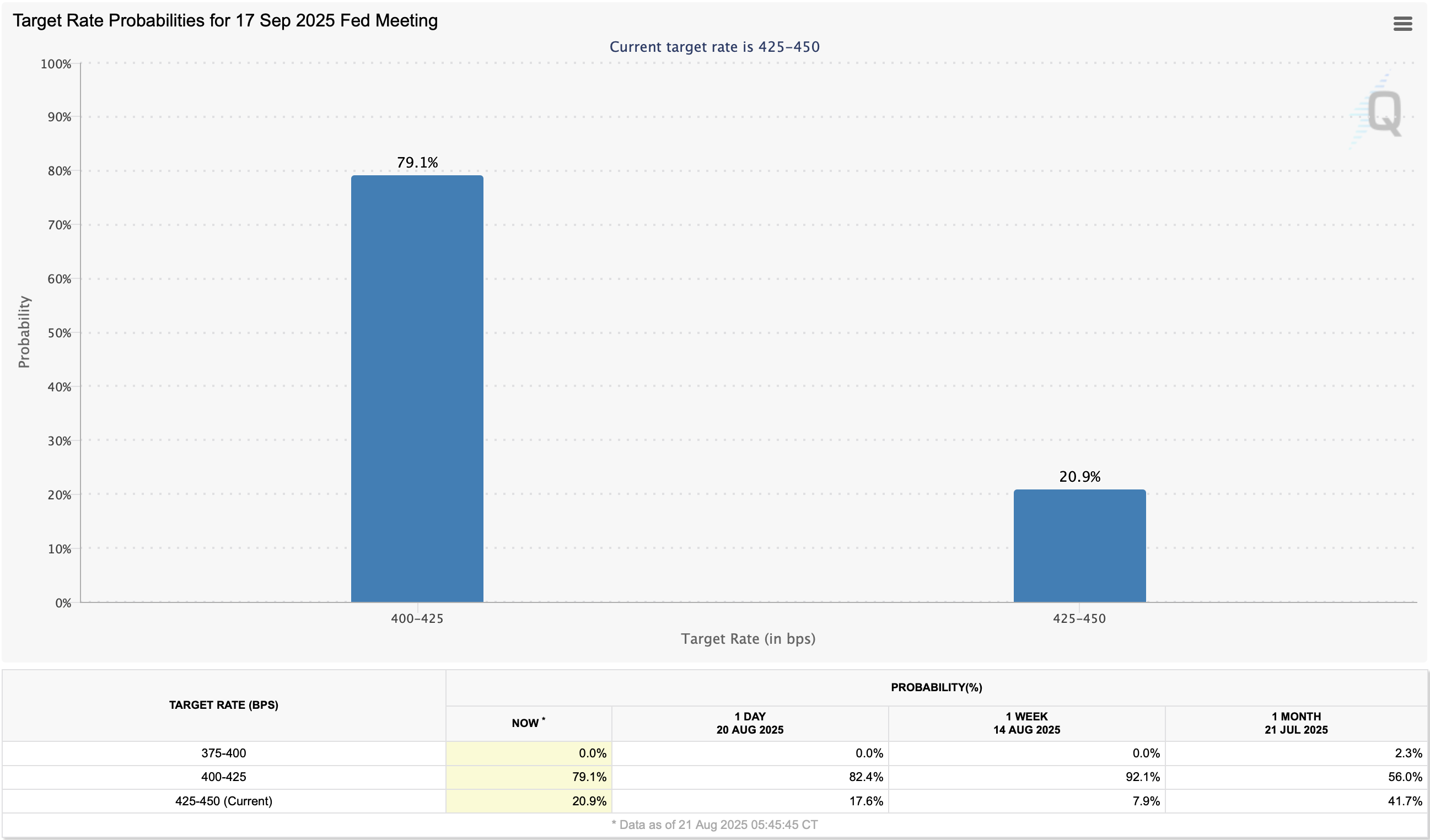
Yesterday’s GDP data indicated that both consumer spending and AI investment were larger than expected with the result being GDP activity increased more than economists had forecast.  Most would consider this good news, and the equity markets clearly saw the benefits as they continue their slow march higher.  Surprisingly, despite the positive economic data, the Fed funds futures market did not reduce the probability of a rate cut next month.  Arguably that was because Governor Waller, one of the two who voted for a cut in July, spoke yesterday and reiterated his views that a cut was appropriate to prevent a worse outcome in the employment situation.  Frighteningly, he said, “I am back on Team Transitory.”  I fear that the transitory phenomenon is going to be the reduction in inflation we have experienced over the past two years, not the initial peak seen in 2022. (As an aside, if inflation is your concern, USDi is one way to maintain the purchasing power of your funds as it mechanically tracks CPI, rising in step with the index.)

Perhaps the futures market is starting to expect that Governor Lisa Cook’s days are truly numbered with a third instance of potential mortgage fraud surfacing yesterday, a situation that has a bad look for a Fed governor.  If she is forced out soon, that would be yet another Fed governor that President Trump will get to appoint, and the tension in the Marriner Eccles building will certainly grow at that September meeting.  After all, if Trump seats two more governors, and has 4 votes for a rate cut on the board, the question will not be should they cut, but how much they should cut with 50 basis points on the table regardless of the economics.

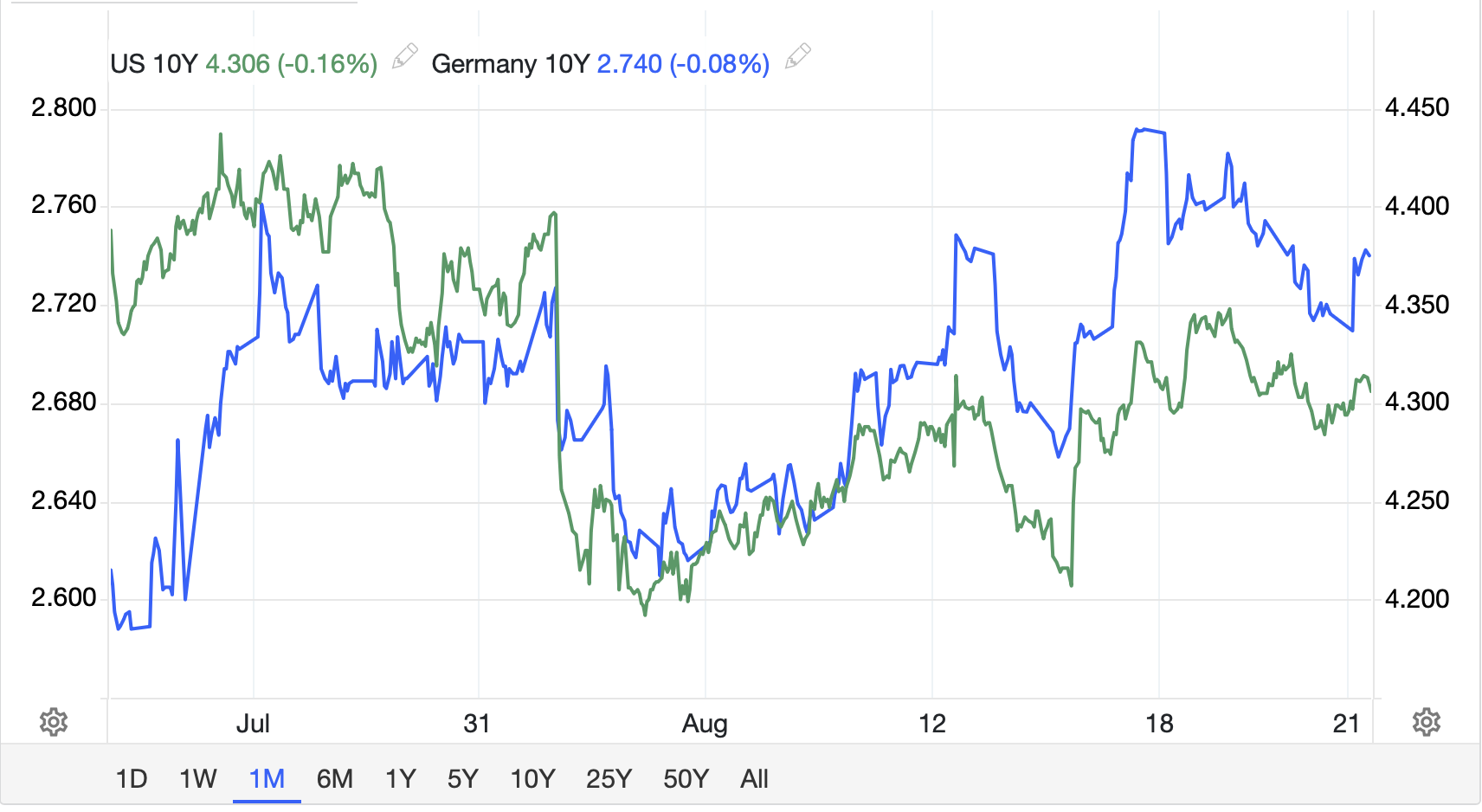
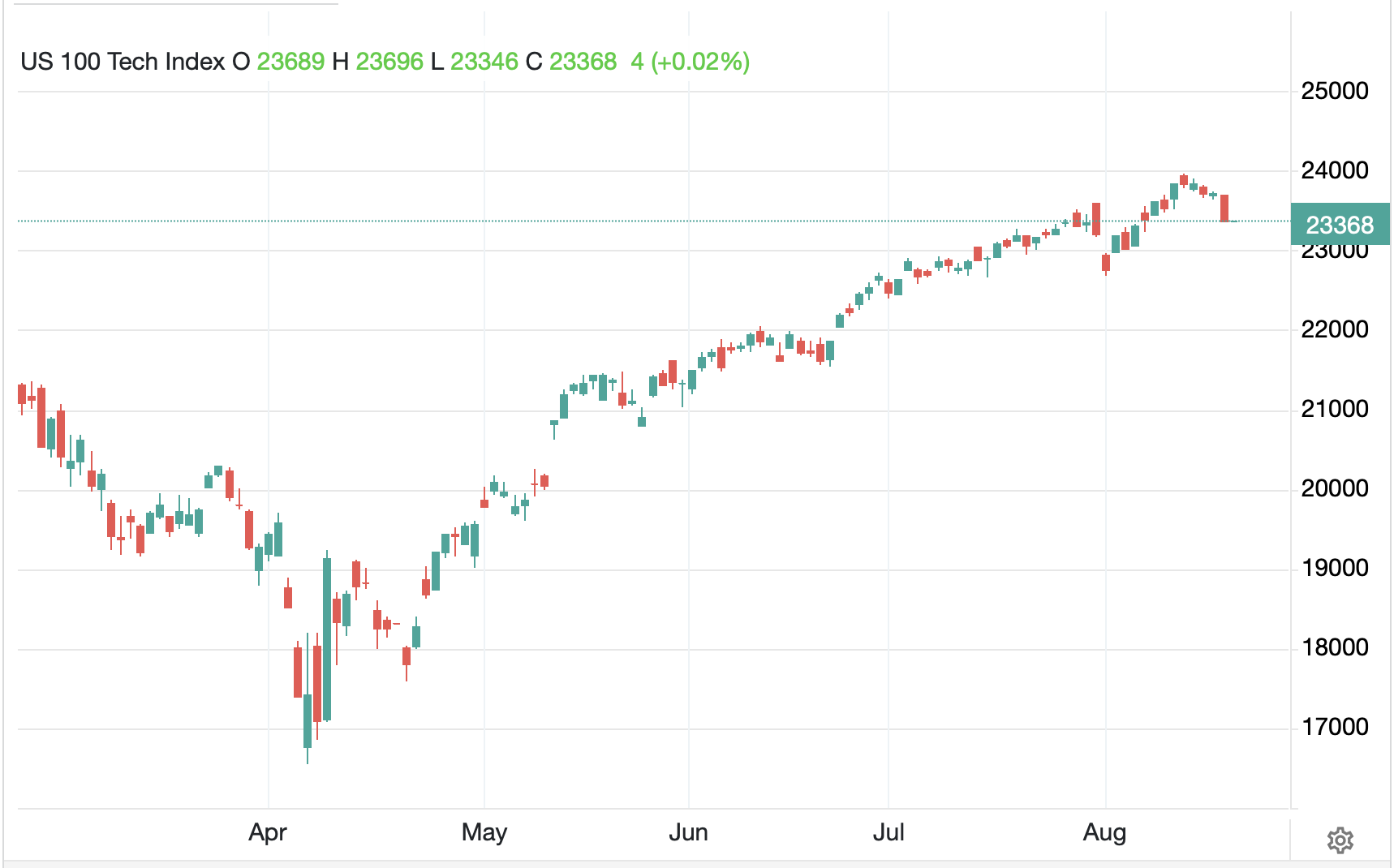
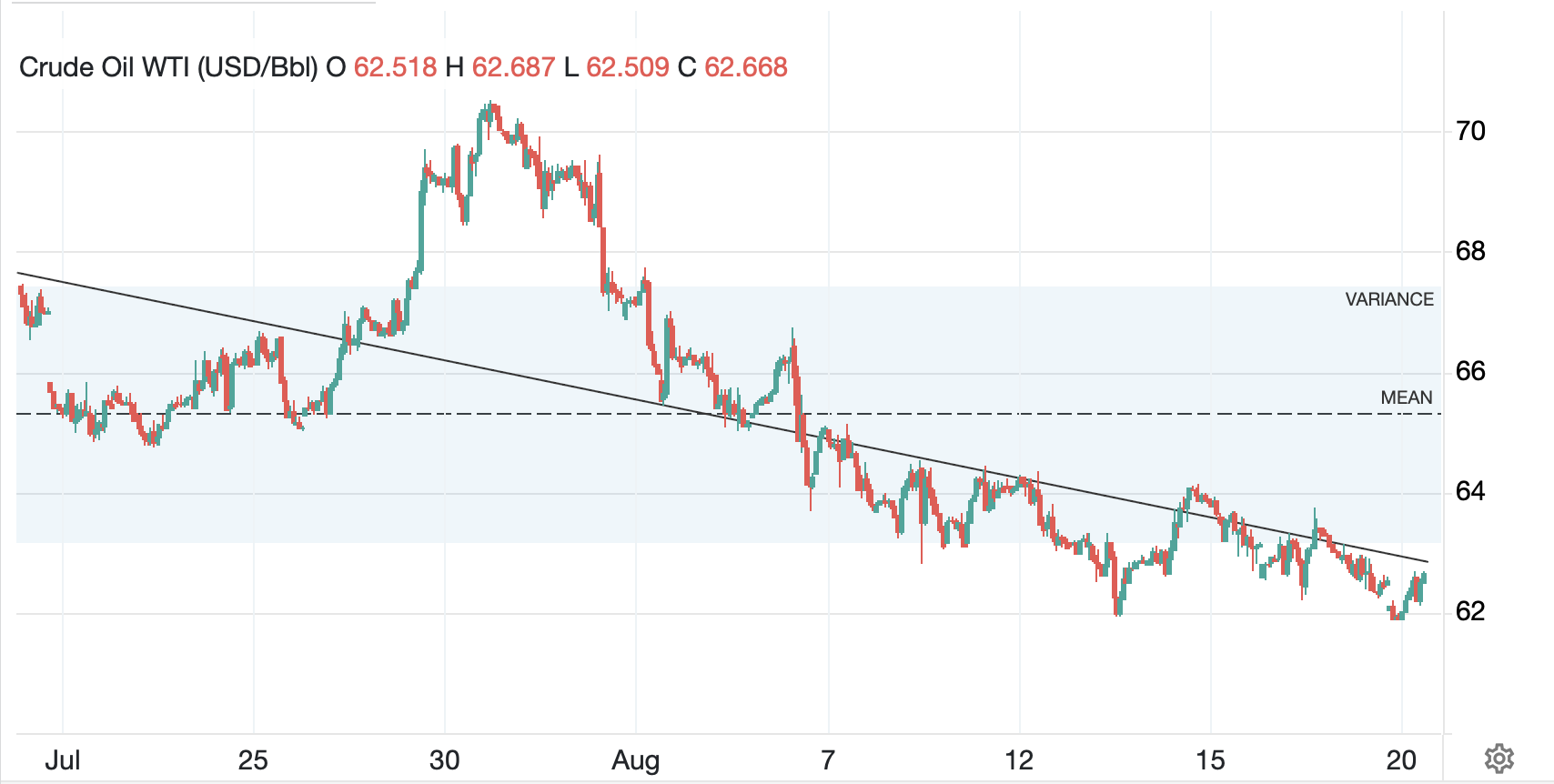
But all that is still three weeks away and based on the fact that if I look at almost every market, price action has been consolidating for the entire summer, it is hard to get excited in the short-term.  In fact, I think it is worthwhile to look at some charts so you can get a sense of just how little is going on.

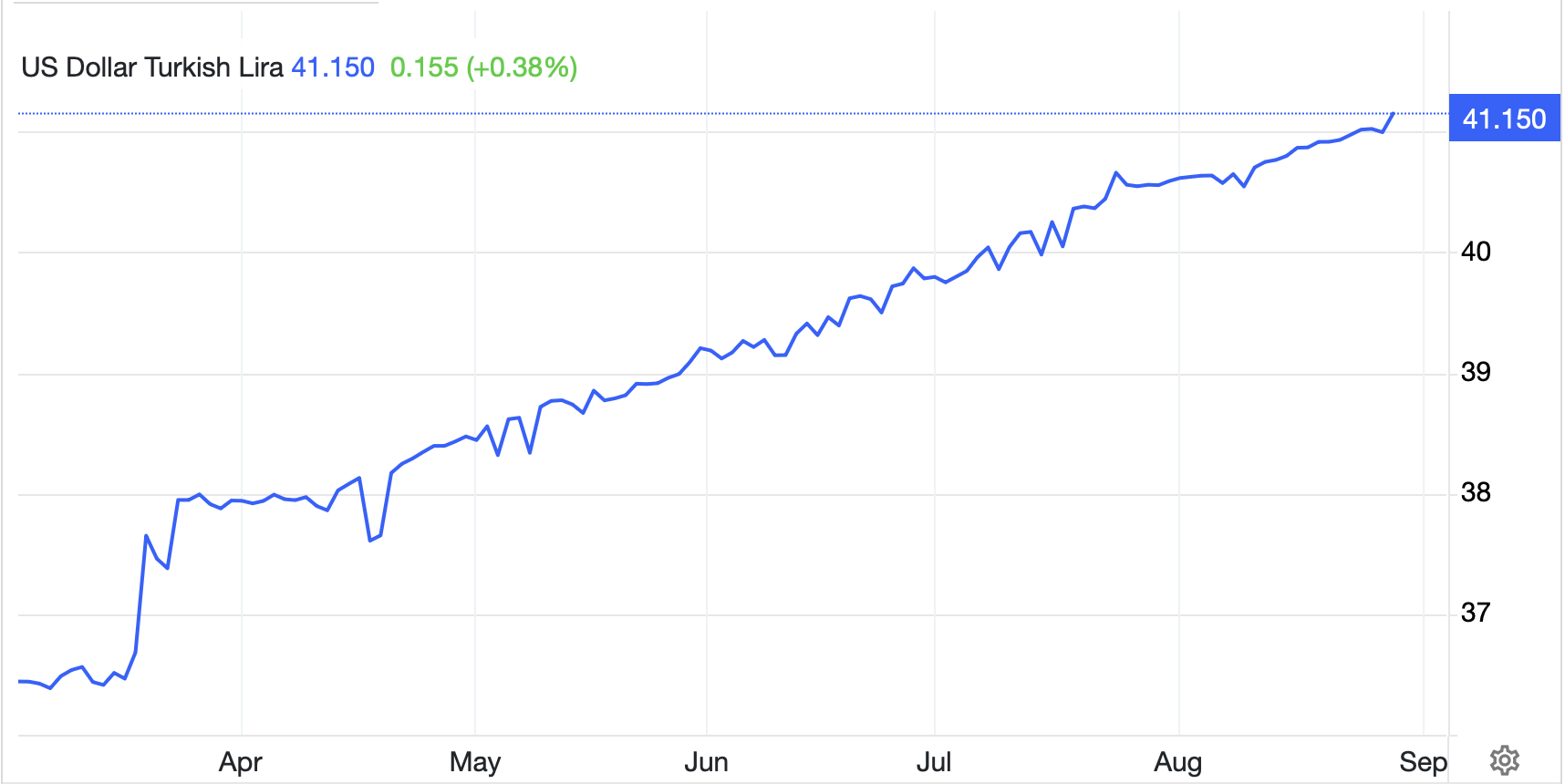
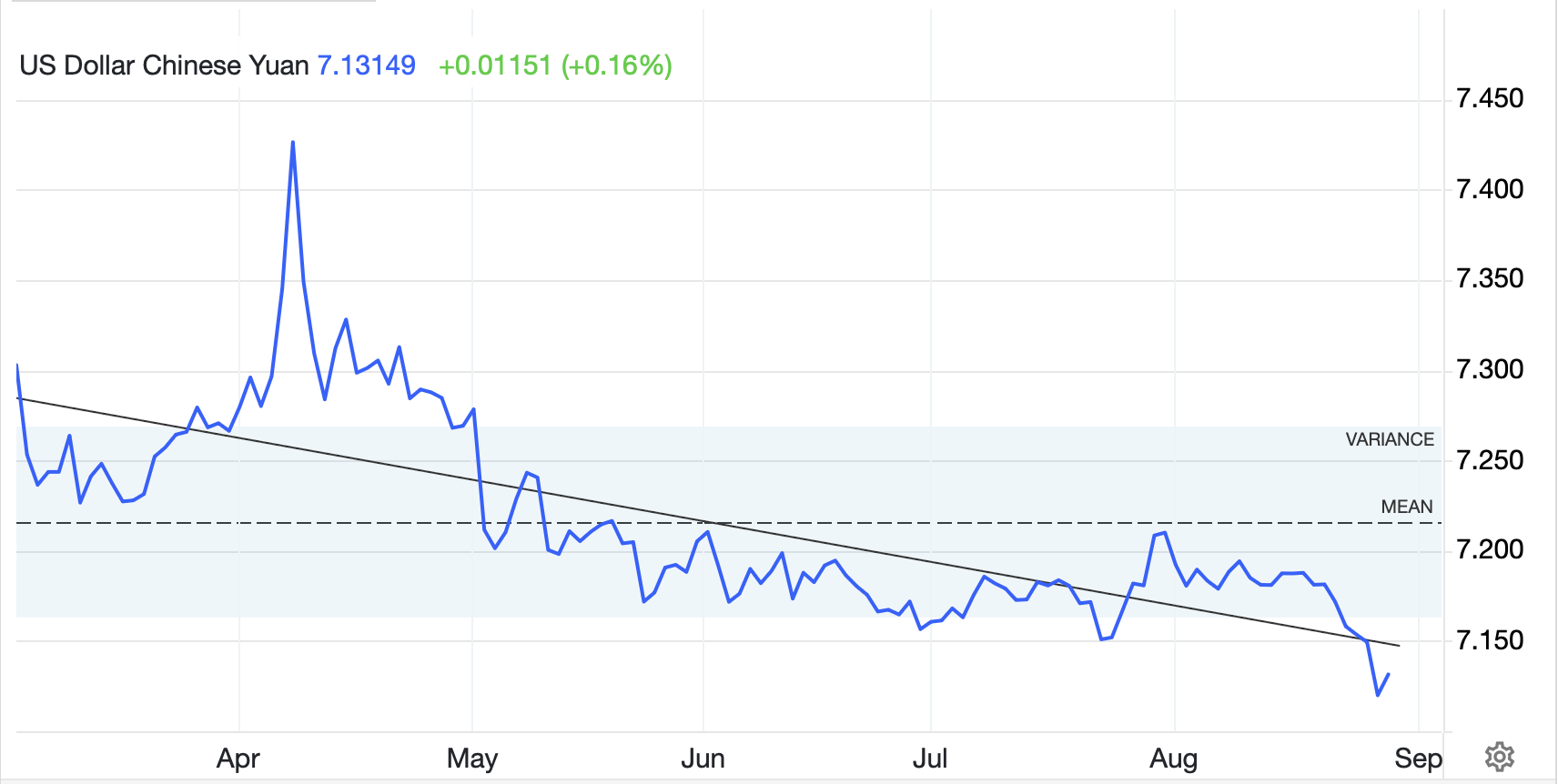
All these charts are from tradingeconomics.com and I have drawn in some recent ranges to show that over the past 6 months, only one asset class has shown any trend of note.  See if you can guess which that is.  I’ll start with the EURUSD since, after all, I am an FX guy, but go to bonds, oil, gold and equities.

Since late April, the euro has chopped back and forth despite many stories of the dollar’s incipient demise and the euro’s upcoming rally as investors flock to European equity markets.  Maybe not.
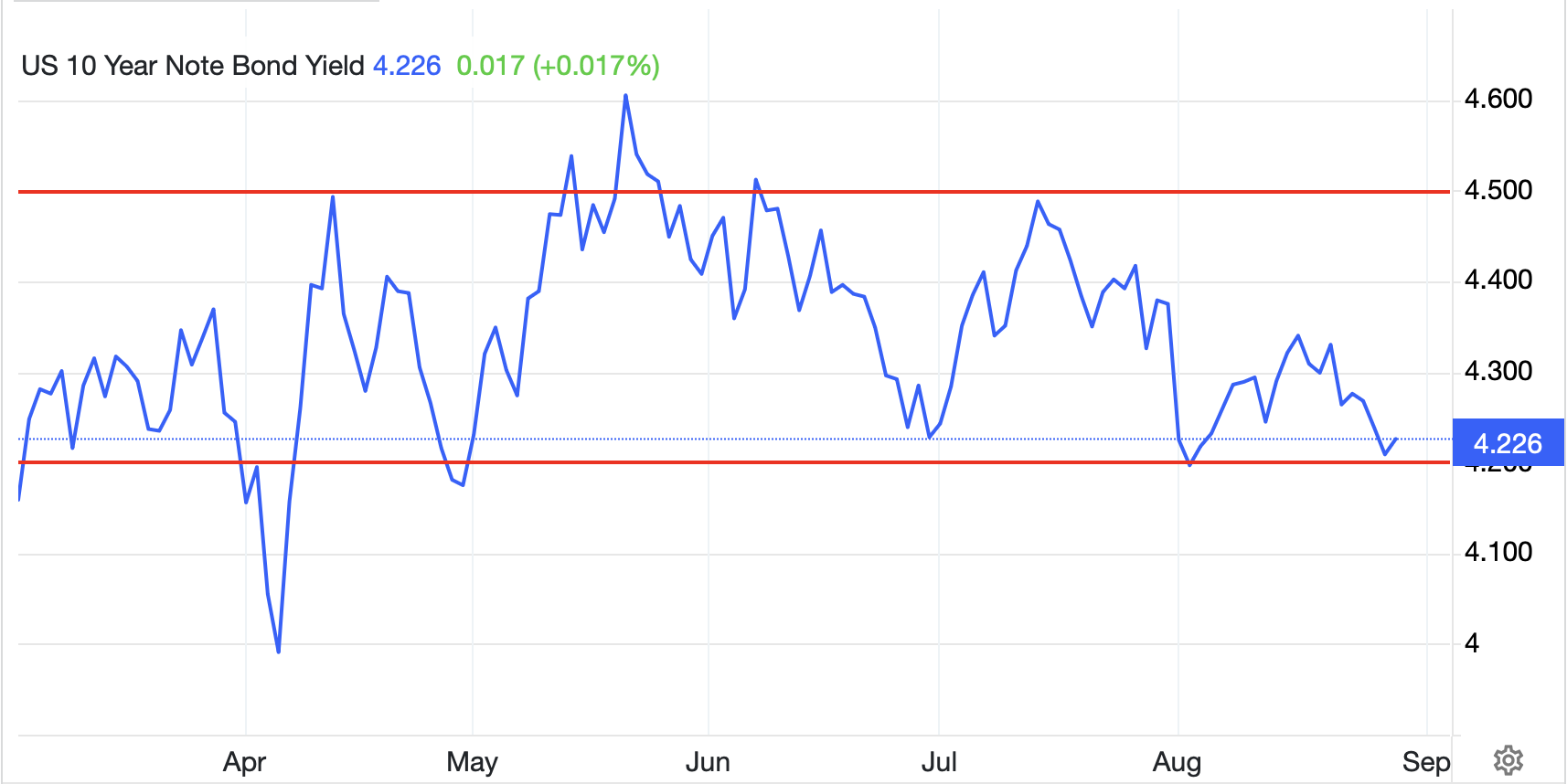
Treasury yields have also been largely range bound, and if anything, look like they are heading lower despite fears being flamed regarding massive amounts of issuance having trouble finding buyers as foreigners pull out of the market.  Maybe not.
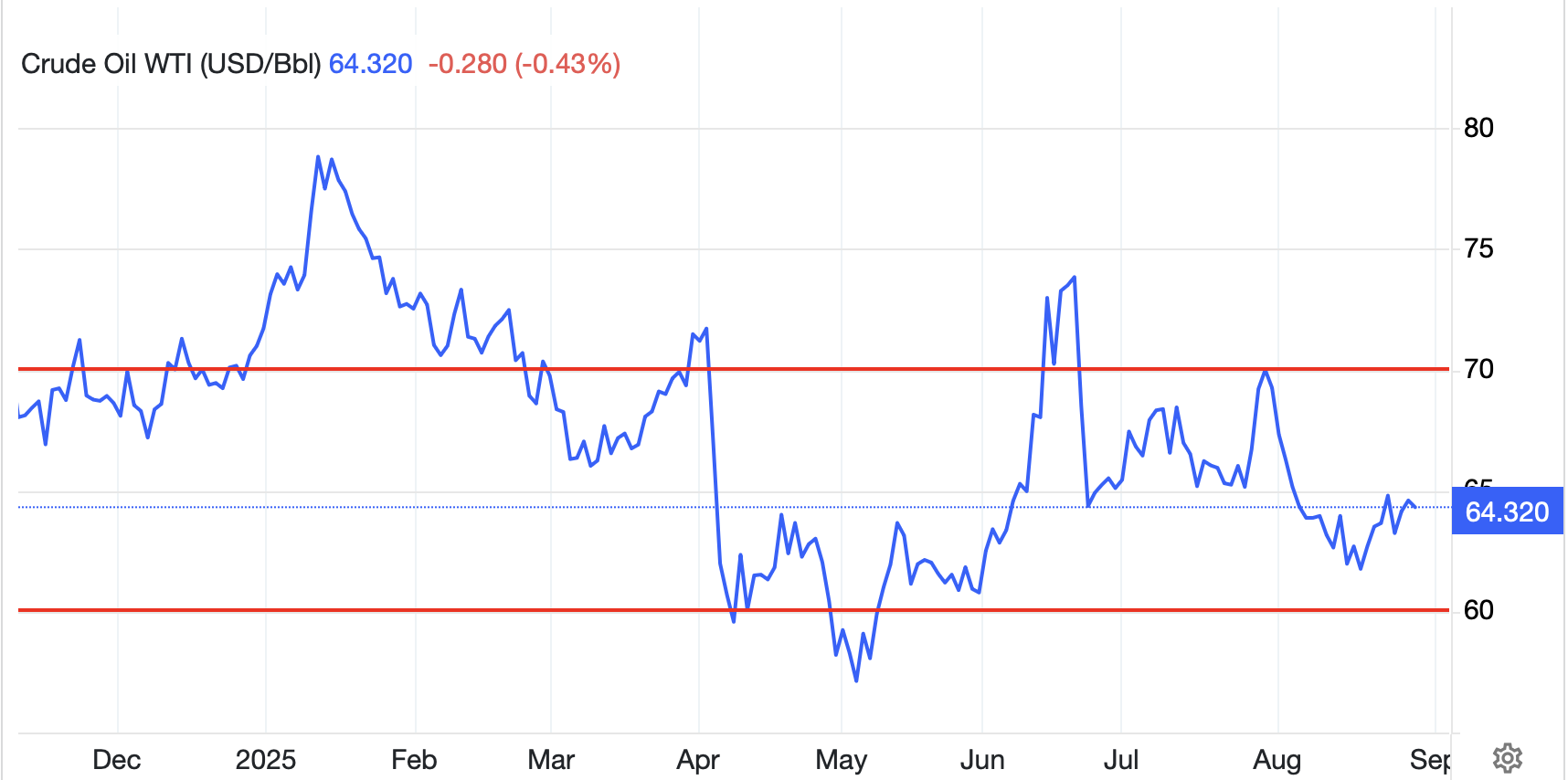
Crude has been the choppiest, and of course we did have the bombing of Iran’s nuclear facilities which inspired some fears of the beginning of a new Middle East war.  But Russia keeps pumping, OPEC put 2.2 million barrels per day of production back into the market and it appears, that for now, the market has found a balance.  I still see oil sliding over time, but for now, the range is king.

The barbarous relic has just started to pick up and broke above the $3400 range cap just two days ago but has not yet shown signs of a major breakout.  However, if the Fed cuts, especially if they go 50bps for some reason, I would look for this to change and gold (and all precious metals) to rally sharply as inflation re-enters the conversation.
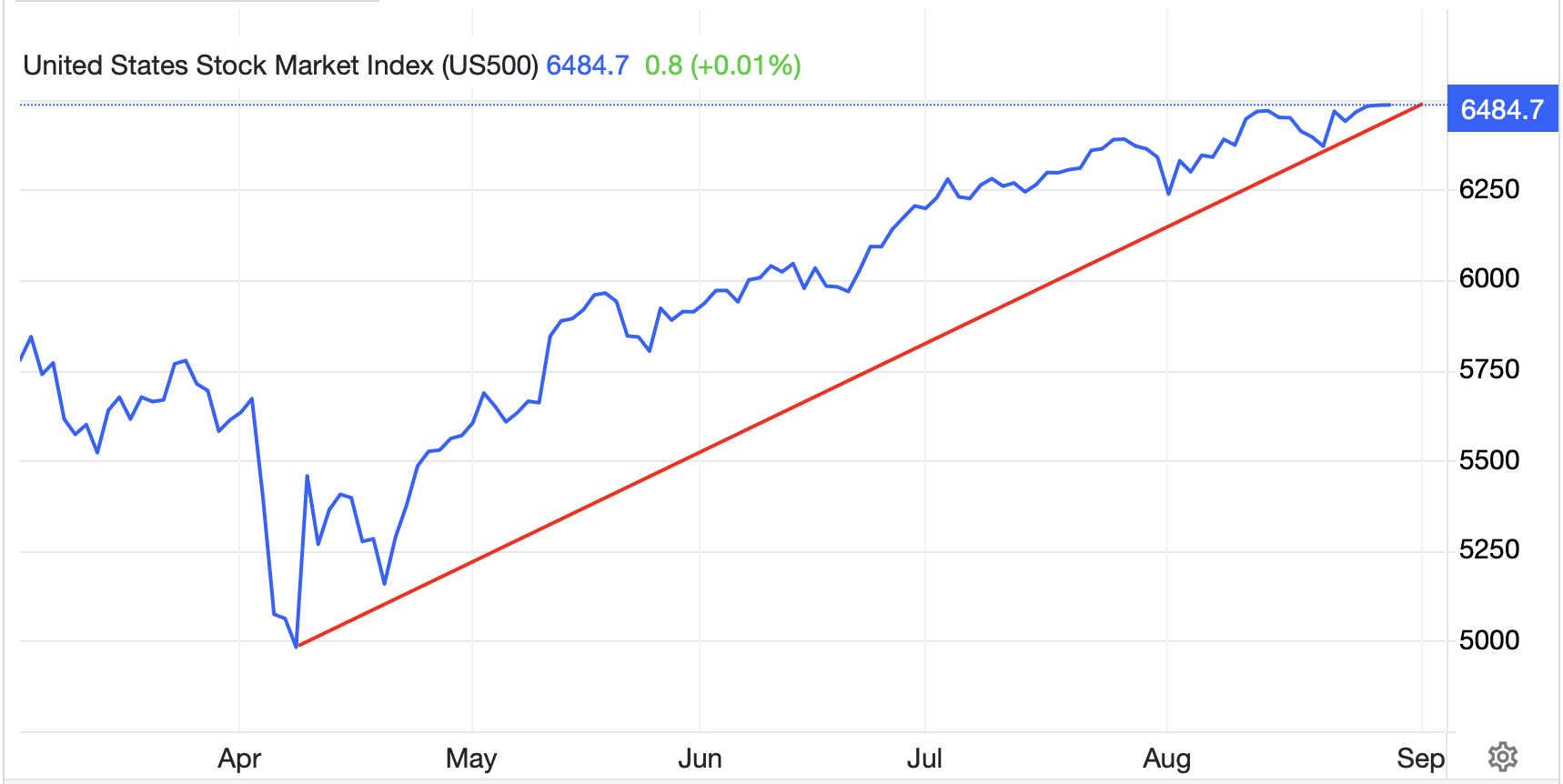
However, if we look at the US equity market, the picture is very different.  The only other market moving like this is USDTRY as the Turkish Lira steadily depreciates amid massive monetary expansion there with inflation rising sharply.  In fact, this is what many foresee for the dollar going forward, but even if the Fed cuts, it seems a bit of an exaggeration.
At this point I should note that there is one currency that is outperforming the dollar right now, the Chinese renminbi.  It appears that as trade negotiations are ongoing, the Chinese (and the Koreans amongst others) have gotten the message that they need to adjust their currency’s value if an agreement is going to be reached.  
To conclude, ranges remain the situation in most markets other than equities which continue to rally based on hopes and prayers that central bank spigots are never turned off.  With Labor Day on Monday, perhaps we will begin to see more real activity reenter the market as traders and investors come back from summer vacation.  But we will need a real catalyst to break those ranges, whether that is a shocking NFP number, a reescalation of Middle East conflict or something else (China laying siege to Taiwan?).  While I don’t know what that catalyst will be, history tells us something will come along, that’s for sure.

As we look to the NY opening, we do get more important data as follows: Personal Income (exp 0.4%); Personal Spending (0.5%); PCE (0.2%, 2.6% Y/Y); Core PCE (0.3%, 2.9% Y/Y); Goods Trade Balance (-$89.5B); Chicago PMI (46.0); and Michigan Sentiment (58.6).  There are no Fed speakers on the docket, but you can be sure that the Lisa Cook story will remain front and center, especially as I read that the judge initially selected to oversee the case was Ms Cook’s sorority sister, potentially a disqualifying factor that would cause her recusal and a new appointment. In fact, I suspect that story will have more traction than whatever the data says today.

As to the dollar, it is hard to get excited at this point.  If PCE data is softer than forecast, though, I would look for the dollar to sell off and the probability of that Fed funds rate cut to rise from its current 85%.

Good luck and have a good holiday weekend

Adf

More Drear

While many, last night, were dismayed
By Jensens’s results as displayed
Most markets worldwide
Absorbed them in stride
As buyers keep up their crusade
 
Meanwhile, Europeans still fear
That things won’t get better this year
The war in Ukraine
Is at it again
While sentiment points to more drear


Please understand, I only write about Nvidia because it is topic number one in the markets overall, albeit not very important in FX for now.  So, briefly, despite record revenues and earnings, the numbers were slightly below expectations, and the immediate result was for the share price to decline about 3% or so.  As I type this morning, though, it has already begun to recoup some of those losses and while there are many commentators claiming this was a disaster and forecasts are unrealistic, my sense is the company is going to continue to churn out chips and profits.  I read that their gross margins are 72%, a remarkably high number.  In the end, it is hard for me to look at these results and think the end is nigh.  So, let’s move on.

A moment, first, to remember the tragedy in Minneapolis where two children were killed in a church shooting on the first day of school there as well as the increase in hostilities in Ukraine where last night Russia launched a massive aerial attack on Kyiv, sending 629 missiles and drones of which 40 got through and 14 were killed along with 38 injured.  At this time, it certainly doesn’t look like hostilities in Ukraine are about to end and I think it is fair to say that the only one seeking that result is President Trump.  Clearly Putin is determined to conquer Ukraine, clearly Zelenskiy is determined to resist and apparently the entire EU wants to continue the fight regardless of the costs.

My sense is the problem for Europe is that it is a theoretical construct, not a nation.  As such, it cannot make decisions on a timely basis as a group.  So, while some want to rearm and fight, others are reluctant to do so and would rather free ride.  This lack of cohesion makes the EU a very unstable partner and will hinder their efforts to do more than continue to shovel money to Zelenskiy and Ukraine.  The war has been ongoing for more than three years and I have become of the opinion that it will not end until one side runs out of resources.  Ukraine’s attacks on Russia’s oil infrastructure are starting to have an impact, but it remains to be seen if they can keep those up while Russia continues to bombard population centers.

With that as backdrop, perhaps we should not be surprised that the data released this morning from the Eurozone showed Confidence and Sentiment indicators for both businesses and consumers falling compared to last month and relative to expectations.  Looking at the data from tradingeconomics.com, you can see that the August results were worse for everything with confidence falling but concerns over inflation rising.

                                                                                                             Actual          Previous            Estimate

While these numbers are not devastating in themselves, the trend is not positive.  Selecting just one, Consumer Confidence in this case, you can see that while not the worst it has been over the past 5 years (the initial invasion of Ukraine marked the nadir), the trend is not very friendly.  And pretty much all the charts are the same, not the worst but trending the wrong way.

Source: tradingeconomics.com

I make these points because I continue to read about negative sentiment regarding US assets and the dollar, and yet I cannot help but look at the Eurozone and see a negative situation.  I agree that if the Fed starts to get aggressive cutting rates, which seems unlikely as long as Powell remains Chair, the dollar will fall, but is Europe really where you want to be?  I’m not convinced.

Away from that, not much else has been happening (it is the last week of August, and it appears almost everyone is on holiday) so let’s look at overnight price action.  Leading up to the Nvidia earnings, equities in the US rallied, and despite the Nvidia disappointment, futures are currently (7:15) unchanged across the board.  Last night in Asia, China (+1.8%) was the leader, reversing yesterday’s declines with the talk of the town still AI and China’s new AI Plus strategy.  Meanwhile, the Hang Seng (-0.8%) disagreed with the mainland although there was no separate news.  Tokyo (+0.7%) was solid, but elsewhere in the region there were more laggards (India, Taiwan, Philippines) than winners (Korea, Australia) with the winners just barely so.

With that Eurozone data, you will not be surprised that European shares are generally softer, with the major bourses lower by between -0.2% and -0.4% and only the CAC (+0.1%) bucking the trend.  Perhaps this is because the French FinMin, Eric Lombard, claimed France would be able to pay its bills although it seems clear the current government is going to fall when the confidence vote is held on September 8th.

In the bond market, 10-year Treasury yields are unchanged this morning and edging toward the lower end of their recent trading range, with no indication that there is a funding problem for the US.  However, it is worth noting that the yield curve is steepening in the US (and everywhere else) as the 2yr-30yr spread is now 128bps and as you can see from the chart below, that spread has been widening all since July. (30yr yields are in green and the LHS Y-axis).

Source: tradingeconomics.com

When the yield curve inverted back in 2020, there was much talk of its prowess as a prognosticator of coming recessions.  However, we are still awaiting that recession.  In fact, I believe history shows it is when the curve steepens sharply that more problems occur.  It is easy to look at this and see the market is expecting inflation to continue to rise especially given the Fed seems to have put inflation in the back seat of their mandate.  Beware!

In commodities, oil (-0.1%) is stabilizing after a solid rally yesterday as the EIA data was a somewhat larger draw on inventories than expected and perhaps Ukraine’s recent successes regarding attacks on Russian oil infrastructure has some folks concerned.  However, as my friend JJ who writes Market Vibes notes, open interest is declining fast, and activity remains very slow in the space.  At the same time, gold (+0.3%) rallied all day yesterday and is continuing this morning and dragging silver (+1.1%) along for the ride.  Spot gold is back above $3400/oz, a level that had seemed toppish for quite a while.  Perhaps this is the long-awaited break higher the gold bugs have been talking about, but I think we need to see another $100/oz to make that commitment and that likely would entail a much weaker dollar, something that has not yet been happening.

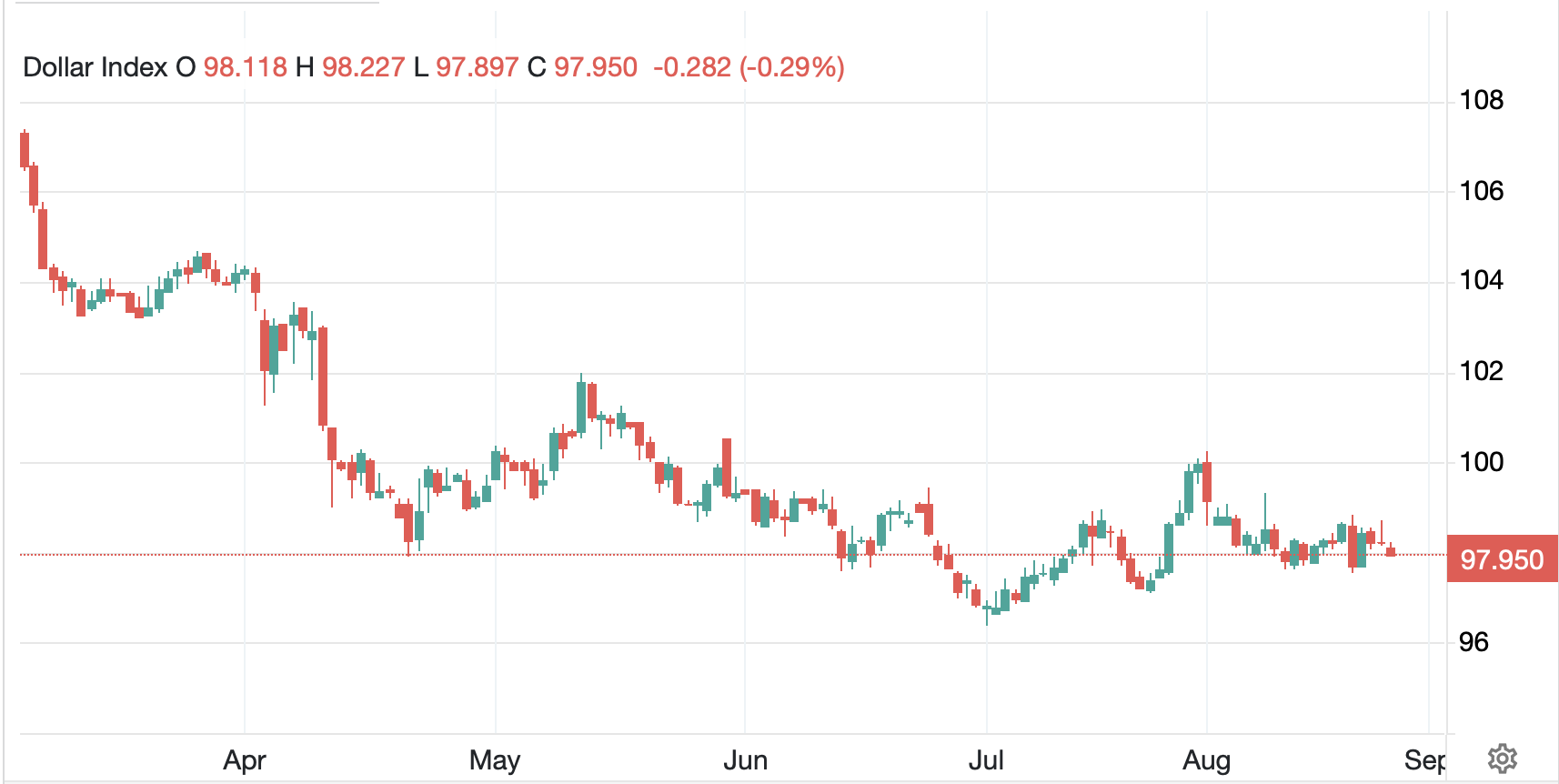
Turning to the dollar, while it is a touch softer this morning, -0.3% as per the DXY, if you look at the chart below (which resembles so many charts these days) since the post-Liberation Day volatility, it is hard to get excited about a move in either direction.  We will need a new out of the box catalyst and I just don’t know what that will be.

Source: tradingeconomics.com

While the dollar’s weakness this morning is universal, the biggest mover overnight was KRW (+0.6%) which rallied after BOK governor Rhee defended their intervention, even indicating it is part of the trade deal with the US.  Otherwise, 0.1% to 0.3% describes the entire slate of currency gains vs. the greenback.

We get some real data this morning as follows: Initial (exp 230K) and Continuing (1970K) Claims; Q2 GDP (3.1%); Q2 Real Consumer Spending (1.4%); and Q2 GDP Sales (6.3%), although this is the second look at all these numbers.  Tomorrow’s Personal Income and Spending as well as PCE data will be far more interesting.  We hear from Governor Waller as well, but we already know his views are to cut right away.

It is difficult to get too excited about much these days and there are valid arguments for movement in most markets in both directions (remember the idea that the goods and services economies are out of sync).  Net, until it is clear the Fed is going to cut aggressively, assuming that happens, the dollar is likely to drift.

Good luck

Adf

The Zeitgeist Could Shatter

While crime throughout DC has dropped
And Trump’s Fed demands haven’t stopped
The story today
That really holds sway
Is whether Nvidia’s topped
 
The war in Ukraine doesn’t matter
Nor does if the yield curve is flatter
‘Cause stonks must go higher
And that does require
Good news, or the zeitgeist could shatter


Some mornings things just are not that interesting in markets despite the ongoing events happening around the world.  Arguably, the biggest headlines revolve around the remarkable decline in crime in Washington DC, which while most of the mainstream media decried the President’s actions at first, has grown in popularity, even amongst his foes.  From a market perspective, the number of stories and editorials written about President Trump’s efforts to fire Fed governor Lisa Cook has risen exponentially, with many still trying to explain the Fed will lose its independence if Trump is successful.  (Given they have not been independent since 1987, I would take this with a grain of salt).  The other noteworthy story is that the EU is going to fast-track legislation to remove all tariffs throughout the EU on US industrial good imports, one of the results of the trade negotiations.

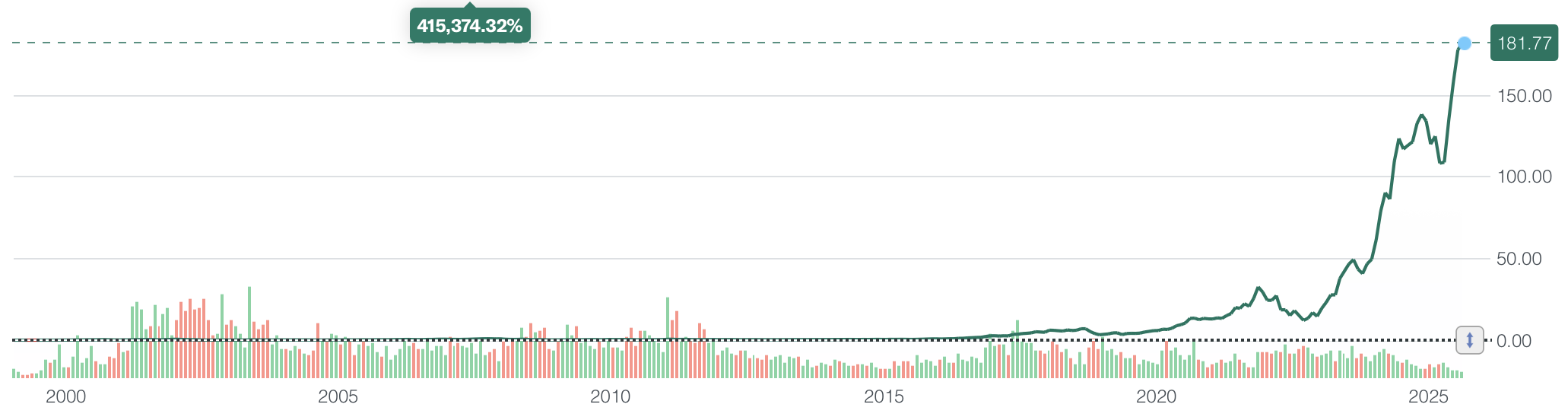
But, while those may be of passing interest, the thing in markets that really has tongues wagging is the fact that Nvidia is set to release their Q2 earnings this afternoon after the equity markets in the US close.  I must admit, thinking back to the tech bubble in 2000-01, I do not remember any single company garnering the amount of attention that Nvidia gets these days.  Perhaps Cisco Systems is the closest analogy, but it was nowhere near this level of interest and excitement.  While this is an imperfect analysis, I think it is worth looking at the charts of both Nvidia and Cisco (from finance.yahoo.com) to help you see the magnitude of the rise in each case.  It is certainly not hard to draw the conclusion that Nvidia may be peaking.  After all, if it declines by 75%, it will still have a market cap > $1 trillion!

NVDA

CSCO

I think it is reasonable to ask whether AI is a bubble.  I also think it is reasonable to ask whether the so-called hyperscalers, Meta, Microsoft, Alphabet and Amazon, are spending too much on building out their AI platforms.  This would be the case if the promised revenues never materialize.  Certainly, other than for Nvidia, those revenues are paltry at best so far.  But these are all observations from a poet who doesn’t follow the stock closely and simply cannot avoid some of the story because it is so prevalent everywhere.  FWIW, which is probably not very much, my take is that history has shown that new innovations, e.g. the automobile, electricity, the internet, can have remarkably wide-ranging implications but usually take far longer to achieve those ends than equity investors assume.  In other words, the idea that the megacap companies are overvalued seems pretty compelling.

Enough of my amateur equity analysis, and I’m sorry, but that is all that seems to be of interest today.  So, let’s look at how markets have behaved overnight ahead of the news this afternoon.  After modest afternoon rallies resulted in higher closes in the US yesterday, Japan (+0.3%) followed suit as did Australia (+0.3%), but both China (-1.5%) and Hong Kong (-1.3%) fell sharply, reversing some of their recent gains as Chinese industrial profits fell -1.7%, a worse than expected outcome, and it seemed to have triggered some profit taking.  With that in mind, I have read a number of analysts who have become of the opinion that Chinese equities are setting up for a much larger move higher based on additional stimulus as well as the fact that Chinese interest rates are the lowest in the world right now (ex-Switzerland).  Elsewhere in the region, India (-1.0%) lagged alongside China and most of the others had much less movement in either direction.

In Europe, the picture is mixed with the CAC (+0.4%) the leading gainer which looks very much like a reaction to the past two sessions’ sharp declines.  Spain (-0.4%) is lagging, although there is no particular news, and Germany (-0.15%) is also softer after the GfK Consumer Confidence report was released at a weaker than expected -23.6.  As to US futures, at this hour (7:25) they are ever so slightly higher.

In the bond market, despite all the anxiety over the Fed and Trump’s attempt to remove Governor Cook, 10-year yields are higher by 1bp after falling 3bps yesterday.  European sovereign yields are lower by -1bp across the board and JGB yields are unchanged.  In other words, while the media’s hair is on fire, clearly the market’s is not.

In the commodity space, oil (-0.1%) is little changed this morning, maintaining yesterday’s declines which appear to have been a result of Russia seeking to export more crude after Ukrainian attacks on Russian refineries have slowed output.  Gold (-0.6%) which saw a strong rally yesterday is falling back a bit, but remains in that tight range I showed yesterday, although both silver (-0.9%) and copper (-1.3%) are under more pressure this morning, likely on the back of a stronger dollar.

Speaking of the dollar, it is firmer across the board this morning, rising 0.5% vs. the euro, yen and Aussie, with slightly smaller gains vs. the other G10 currencies.  In emerging markets, ZAR (-0.85%) is the laggard, not surprisingly on the back of weaker precious metals prices, but PLN (-0.75%) is also under pressure on a combination of the weak euro and concerns over the lack of progress in the Russia/Ukraine war.  Even CNY (-0.15%) is weaker despite a renewed belief that China is going to allow the yuan to strengthen as part of any trade deal.

There is no front-line data to be released today, with only EIA oil inventories expecting a modest net draw.  Richmond Fed president Barking speaks at 12:45 but given he just explained his views yesterday, that he didn’t foresee much change in rates at all given the current state of the economy, I cannot imagine he will have changed that view.

And that’s all we have today.  I anticipate a lackluster session in all markets as traders await the Nvidia numbers later.  Of course, President Trump could surprise us all with an announcement on Russia, the Fed, or any of a number of other situations, but those are outside my ability to anticipate.  The market is still pricing an 87% chance of a September cut and an 80% chance of two cuts by December.  If the Fed gets aggressive, for whatever reason, the dollar will suffer.  But that is not yet the case, so range trading seems the best bet.

Good luck

Adf

Political War

In Washington, Cook feels the heat
As Trump wants a change in her seat
In Paris, the sitch
For Macron’s a bitch
As confidence there’s in retreat
 
These two stories plus so much more
Explain that we’re in, Turning, Four
So, all that we knew
Seems no longer true
Instead, there’s political war


The dichotomy between the general lack of price volatility in markets and the increase in political volatility over policy choices and requirements around the world is truly remarkable.  However, just like so much else that many have assumed as a baseline process for so long, this relationship appears to be changing as well.  These changes have historical precedence, as documented by Neil Howe and William Strauss back in 1997 in their seminal book, The Fourth Turning.  

Perhaps this is the best definition of what the Fourth Turning is all about [emphaisis added]:

“In the recurring loop of modern history, a final, perilous era arrives once each lifetime.  It is marked by civic upheaval and national mobilization, both traumatic and transformative.  That era, reshaping the social and political landscape, is unfolding now.

Now, read that and tell me it is not a perfect description of what we are seeing daily, not just in the US, but around the world.  If you wondered why all the models that had been built about many things, whether financial, economic or governmental are no longer offering accurate forecasts, I would point to this as the underlying premises are going through the throes of change.

For instance, consider President Trump and his relationship with the Fed.  We already know that he and Chairman Powell are at odds and have been so for months over Powell’s reluctance to cut rates.  But his attacks on the Fed are unceasing, and last night he ‘fired’ Governor Lisa Cook for cause.  That cause being the allegations that she committed mortgage fraud, which if true is certainly a concern for a Federal Reserve Board Governor.  But this has never been attempted before so will involve legal wrangling which we will watch over the next many months.

Now, some of you may remember the last time there was a scandal at the FOMC, where two different regional Fed presidents, Dallas’s Robert Kaplan and Boston’s Eric Rosengren, were trading S&P 500 futures in their personal accounts prior to FOMC announcements of which they had inside knowledge.  Both did step down and allegedly the Fed has tightened its controls on that issue as they tried to sweep it under the rug, but let’s face it, Fed members are no angels.

I have no idea how this will play out, although I suspect that Governor Cook will eventually resign as the one thing at which President Trump excels is applying public pressure.  While Powell is an experienced public figure, Ms Cook was a professor at Michigan State, not exactly a spot where you feel the withering heat of a Trumpian attack on a regular basis.  Of course, if she did lie on her mortgage applications, that is a tough look for someone charged with overseeing the financial system.

But that is just the latest issue in the US, at least involving financial markets.  This Fourth Turning is coming alive all around the Western World, perhaps no place more than Paris this morning.  There, PM Bayrou has called for a confidence vote in order to gain the power to pass an austerity budget that cuts €44 billion from spending.  While at this point, it seems long ago, his predecessor PM, Michel Barnier, lasted just 99 days with his minority government and was ousted last December.  While Bayrou has made it for 9 months, it appears his odds of making it for a full year are greatly diminished now as all the opposition parties have promised to vote against him.  Recall, he leads a minority government and if he loses the vote, there will be yet another set of elections in France.

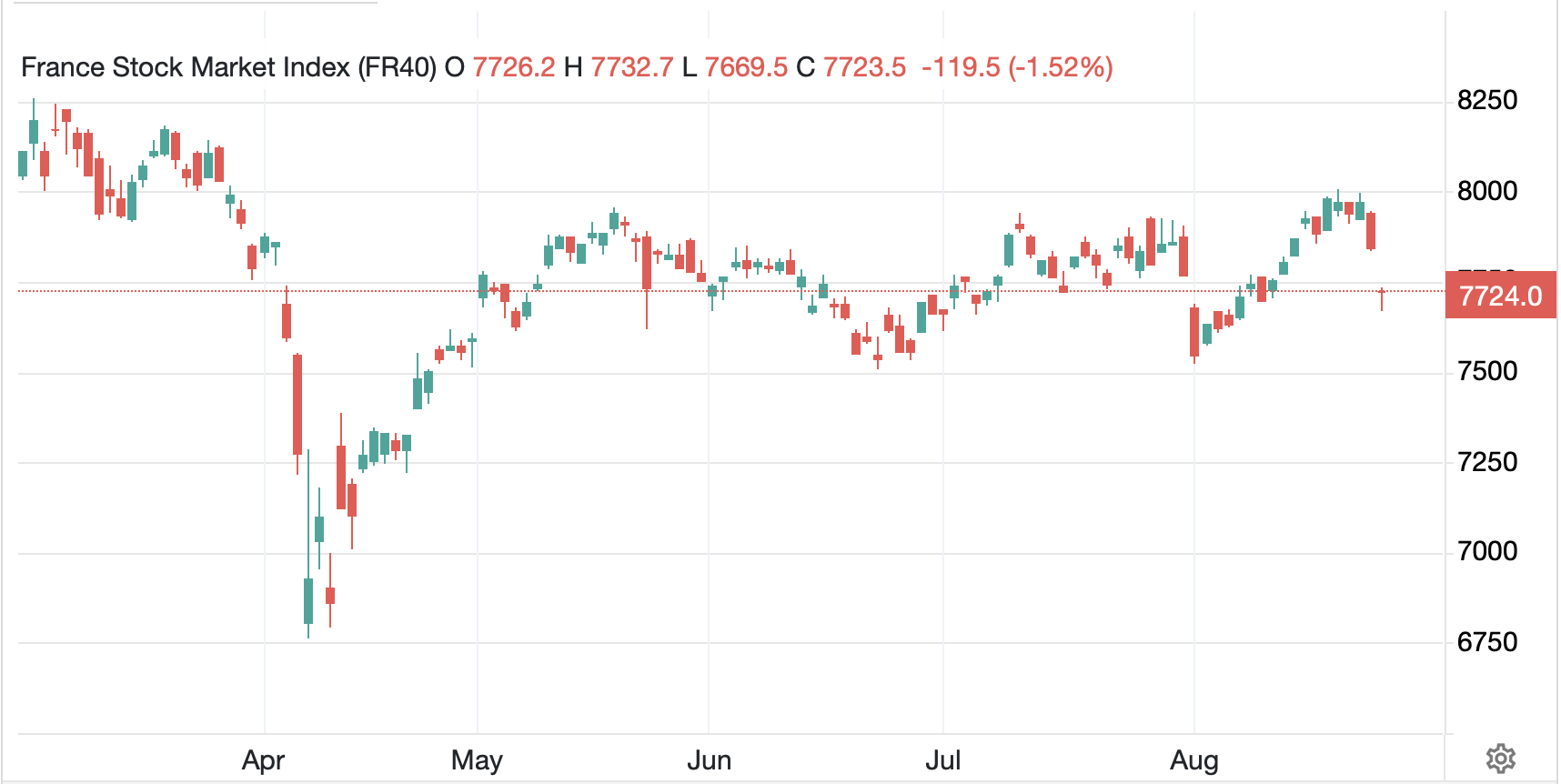
Again, this is emblematic of a Fourth Turning, where systems and institutions that have been operating for decades are suddenly coming apart.  From our perspective, the impact is more direct here with French equity markets (CAC -1.5%) falling sharply (see below) while French government bond yields soar.

Source: tradingeconomics.com

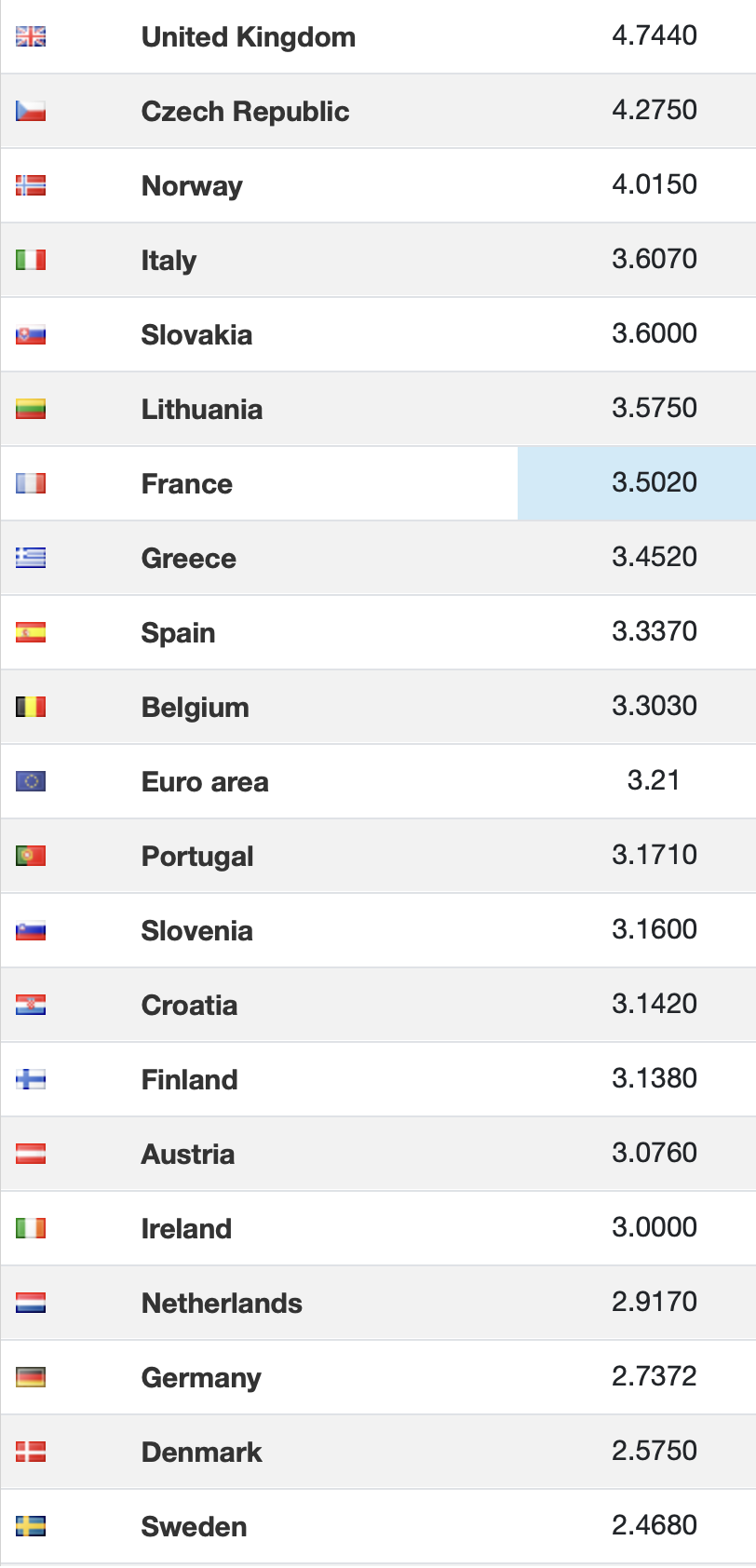
In fact, French 10-year yields now trade above almost all other EU nations including Greece and Spain, although Italian yields are still a touch higher.  Consider that during the European bond crisis of 2011-12, France was considered one of the stronger nations.  Oh, how the mighty have fallen!

Source: tradingeconomics.com

Again, my point is that much of what we thought we understood about how markets behave on both an absolute and relative basis is changing because the institutions underlying the Western economy are undergoing massive changes.  This is not merely a US phenomenon with President Trump, but we are seeing a growing nationalist fervor throughout the West as populations throughout Europe, and even Japan, increasingly reject the culmination of what has been described as the globalist agenda.  As John Steinbeck has been widely quoted, things can change gradually…and then suddenly.

So, let’s look at how other markets behaved overnight following the weakness in US equity markets yesterday.  Asian markets followed suit lower (Tokyo -1.0%, Hong Kong -1.2%, China -0.4%, Korea -1.0%, India -1.0%) with essentially the entire region in the red.  Europe, too, is under pressure this morning and while France leads the way, Germany (-0.4%), Spain (-0.8%) and the UK (-0.6%) are all declining in sync.  However, at this hour (7:10) US futures are essentially unchanged, so perhaps things will stabilize.

Those yields I picture above represent modest declines from yesterday’s levels, although that is only because European yields yesterday mostly climbed between 5bps and 7bps across the board.  As to Treasury yields, they are higher by 2bps this morning, but remain below 4.30%, so are showing no signs of a problem.

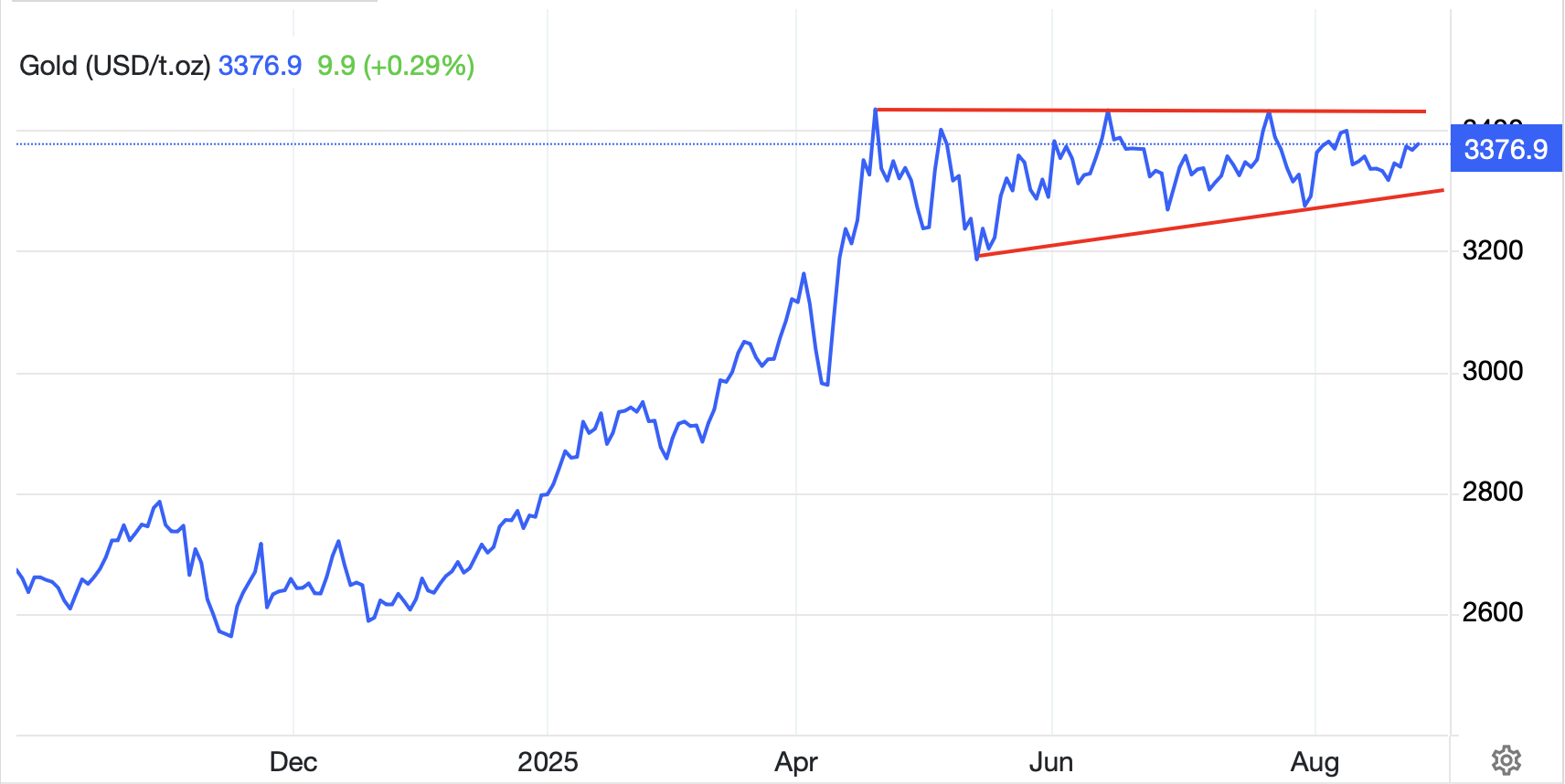
In the commodity markets, oil (-1.8%) is giving back all its gains from yesterday and a little bit more, but in the broad scheme of things, continues to trade in its recent range.  The one thing to watch here is Ukraine’s increasing ability to interrupt Russian production and shipment of oil via long-range drone strikes, as if they continue to be successful, it may well start to push prices above their recent cap at $70/bbl.  That is, however, a big if.  It is getting pretty boring describing metals markets as gold (+0.3%) has been trading in an increasingly narrow range as per the below chart.  This has been ongoing since April and feels like it could last another 5 months without a problem.  Silver’s chart is similar, albeit not quite as narrow a range.

Source: tradingeconomics.com

Finally, the dollar is a touch softer this morning, slipping against the euro (+0.3%), pound (+0.2%), and yen (+0.2%) with most of the rest of the G10 having moved less than that.  NOK (-0.3%) is the outlier following oil lower.  In the EMG bloc, +/- 0.3% is the range for the entire bloc today, so it appears that traders like other G10 currencies today for some reason I cannot fathom.

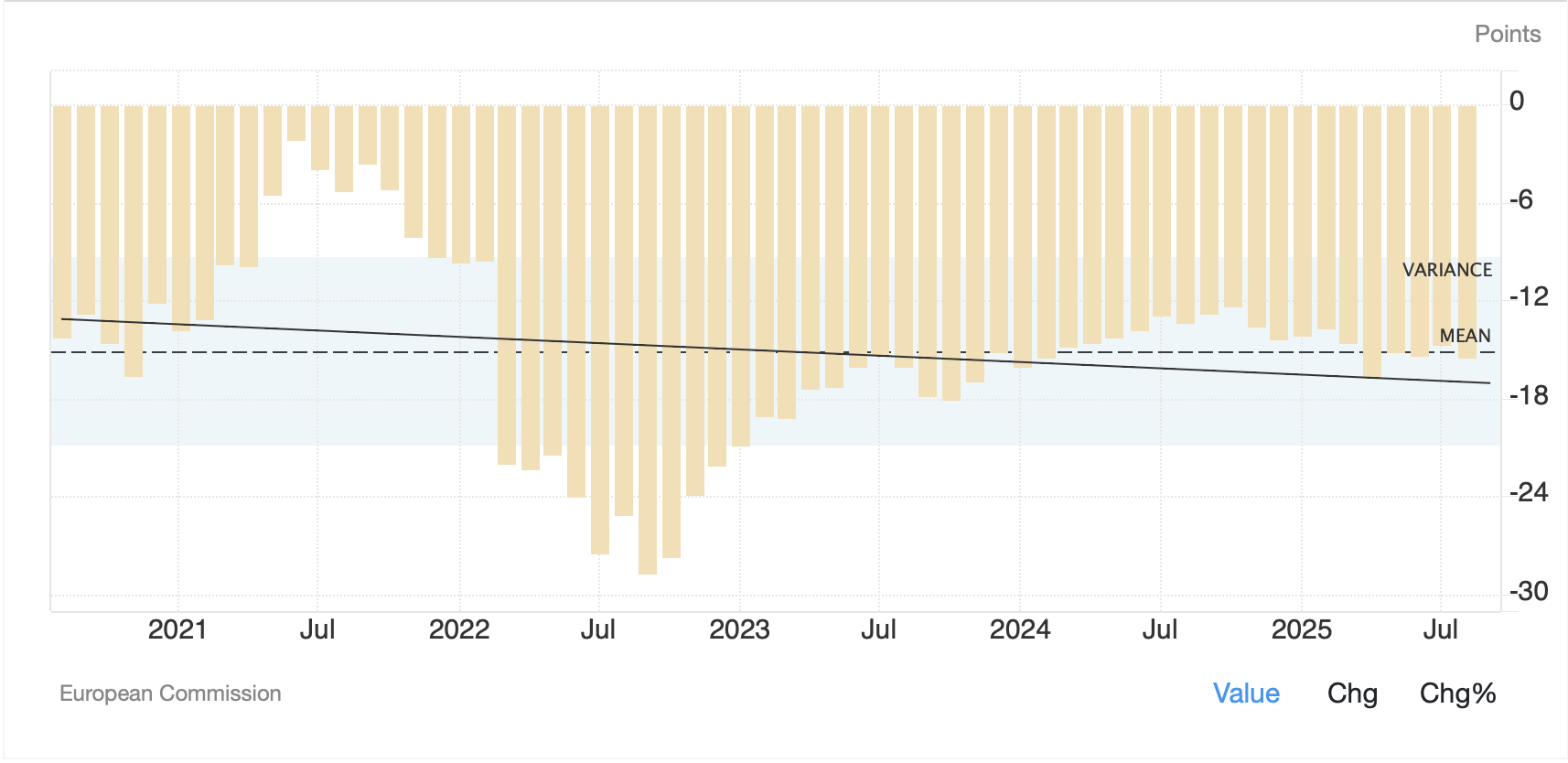
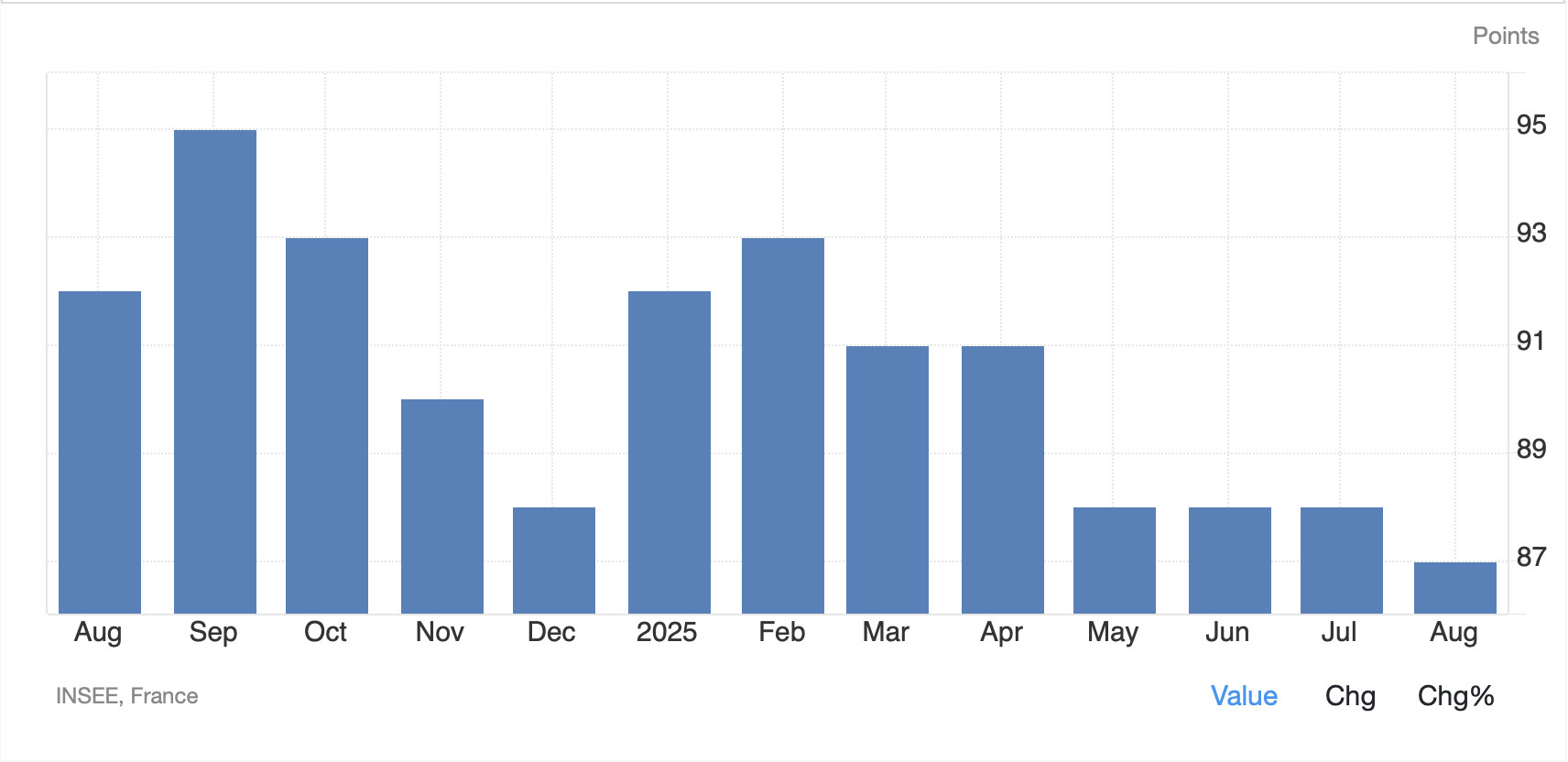
On the data front, we see Durable Goods (exp -4.0%, +0.2% ex Transport) as well as Case Shiller Home Prices (2.1%) and then Consumer Confidence (96.2).  Speaking of Consumer Confidence, in France this morning the latest reading was released at 87.0, three points lower than forecast and clearly trending down.  Perhaps the government’s problems are feeding into the national psyche.

Source: tradingeconomics.com

It is difficult to get excited by markets during the last week of August, and if we add the time of year, when vacations are rife, to the ongoing White House bingo outcomes, the best position seems to be no position at all.  As to the dollar, if the Fed does start to ease policy at this time, with inflation still sticky, I do foresee a decline.  However, it is very difficult to look around the world and think, damn, I want to own THAT currency, whatever currency that might be.  Perhaps the one exception would be the Swiss franc, where they really do work to have sane monetary policies.

Good luck

Adf

A FAIT Accompli

Said Jay, ‘twas a FAIT accompli
As all of his minions agree
The average was flawed
And now our new god
Is maximum jobs, don’t you see
 
But really, what pundits all heard
Was rate cuts would not be deferred
Instead, twenty-five
Next month is alive
And fifty would not be absurd


Although Chairman Powell clearly wanted to focus on the new Monetary Policy Framework, as it has evolved, market practitioners really don’t care much about that.  All they care about is what is going to happen to interest rates.  So, here is the paragraph from Powell’s speech on Friday that got pulses quickening and led to another set of new all-time highs in equity markets [emphasis added]:

“Putting the pieces together, what are the implications for monetary policy? In the near term, risks to inflation are tilted to the upside, and risks to employment to the downside—a challenging situation. When our goals are in tension like this, our framework calls for us to balance both sides of our dual mandate. Our policy rate is now 100 basis points closer to neutral than it was a year ago, and the stability of the unemployment rate and other labor market measures allows us to proceed carefully as we consider changes to our policy stance. Nonetheless, with policy in restrictive territory, the baseline outlook and the shifting balance of risks may warrant adjusting our policy stance.” 

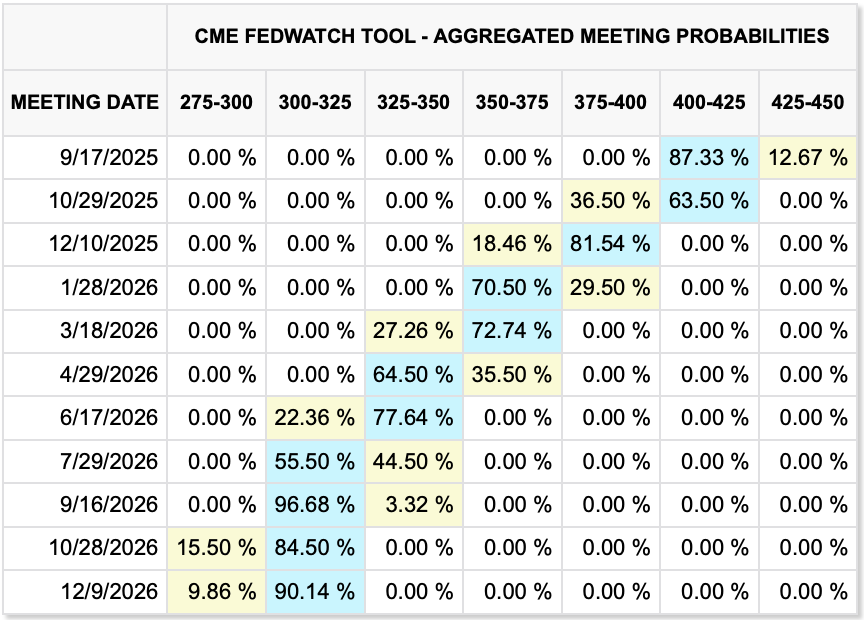
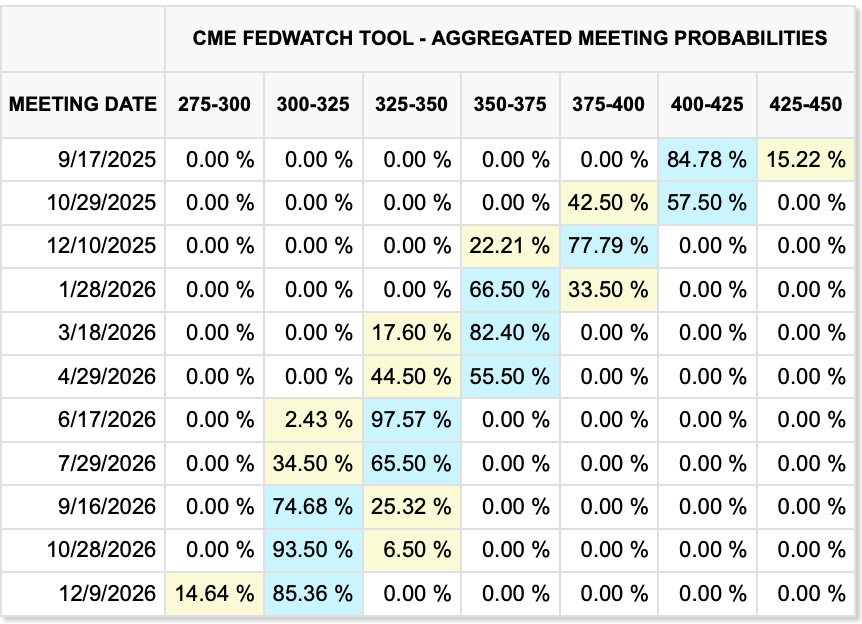
The market was quick to reprice the probability of that cut as well, with the current view up to an 87% probability, compared to 71% prior to Powell’s speech.  

Source: cmegroup.com

While I personally believe a cut is unnecessary, it does feel like he just promised one.

However, for the economists out there, those who feel above such mundane issues as the price of some stock, they were far more concerned about the Policy Framework.  It was the last review of this framework, back in 2019 which was released in early 2020 (pre-Covid) that Powell and friends harped on their concern over the Effective Lower Bound (ELB) aka zero interest rates.  Their fear was that with the then current rate structure so low, if a recession came about, they wouldn’t have the tools to address it.  So, in their definitively finite wisdom, they came up with Flexible Average Inflation Targeting (FAIT) which was designed to allow them to keep policy accommodative even if inflation was somewhat above their 2.0% goal, instead relying on the average inflation rate over time.  Of course, they didn’t describe what time constituted the period of averaging, but everyone understood that the idea was to run the economy hot.  Oops!  It turns out that wasn’t a really good idea once Covid hit, and the federal government responded by shutting down production while pumping some $5 trillion extra into the economy.  We are all still feeling the sting from that particular mistake.

Here is the pertinent commentary regarding the changes in the policy framework with shortfalls referreing to the shortfall of employment vs. full employment:

“We still have that view, but our use of the term “shortfalls” was not always interpreted as intended, raising communications challenges. In particular, the use of “shortfalls” was not intended as a commitment to permanently forswear preemption or to ignore labor market tightness. Accordingly, we removed “shortfalls” from our statement. Instead, the revised document now states more precisely that ‘the Committee recognizes that employment may at times run above real-time assessments of maximum employment without necessarily creating risks to price stability.’ Of course, preemptive action would likely be warranted if tightness in the labor market or other factors pose risks to price stability.”

In the end, I would argue all they have done is rejigger the wording of how they excuse running things hot and allowing inflation to rise.  Hence, the nearly promised rate cut and the new framework that says unemployment is the key.  

Enough about Friday.  Overnight, the key story came from China, where the city of Shanghai eased policy restrictions on home ownership to help restart that moribund market by allowing more people to buy as many homes as they would like. (It seems odd to me that after at least three years of a property problem, there would still be restrictions on home purchases, but then I never professed to understand Chinese policies.). At any rate, the very fact that there was more action on one of the key problems in the economy was a distinct positive and helped drive Chinese equity markets much higher (CSI 300 + 2.1%, Hang Seng +1.9%) with that news, along with the perception that the Fed is going to ease next month pulling the entire region higher. While Japanese shares (+0.4%) had a modest rally, Korea (+1.3%) and Taiwan (+2.2%) went gangbusters and literally every major bourse there was higher in the session.

In Europe, though, things are less bright with all the main bourses on the continent lower (DAX -0.25%, CAC -0.6%, IBEX -0.6%) although the FTSE 100 (+0.1%) is bucking the trend.  It appears there are concerns over the details of the ostensibly agreed trade deal with the US as well as concerns that the Russia-Ukraine peace negotiations are not progressing as well as hoped.  As to US futures, at this hour (6:50), they are taking a breather from Friday’s rally and currently point lower by about -0.25% across the board.

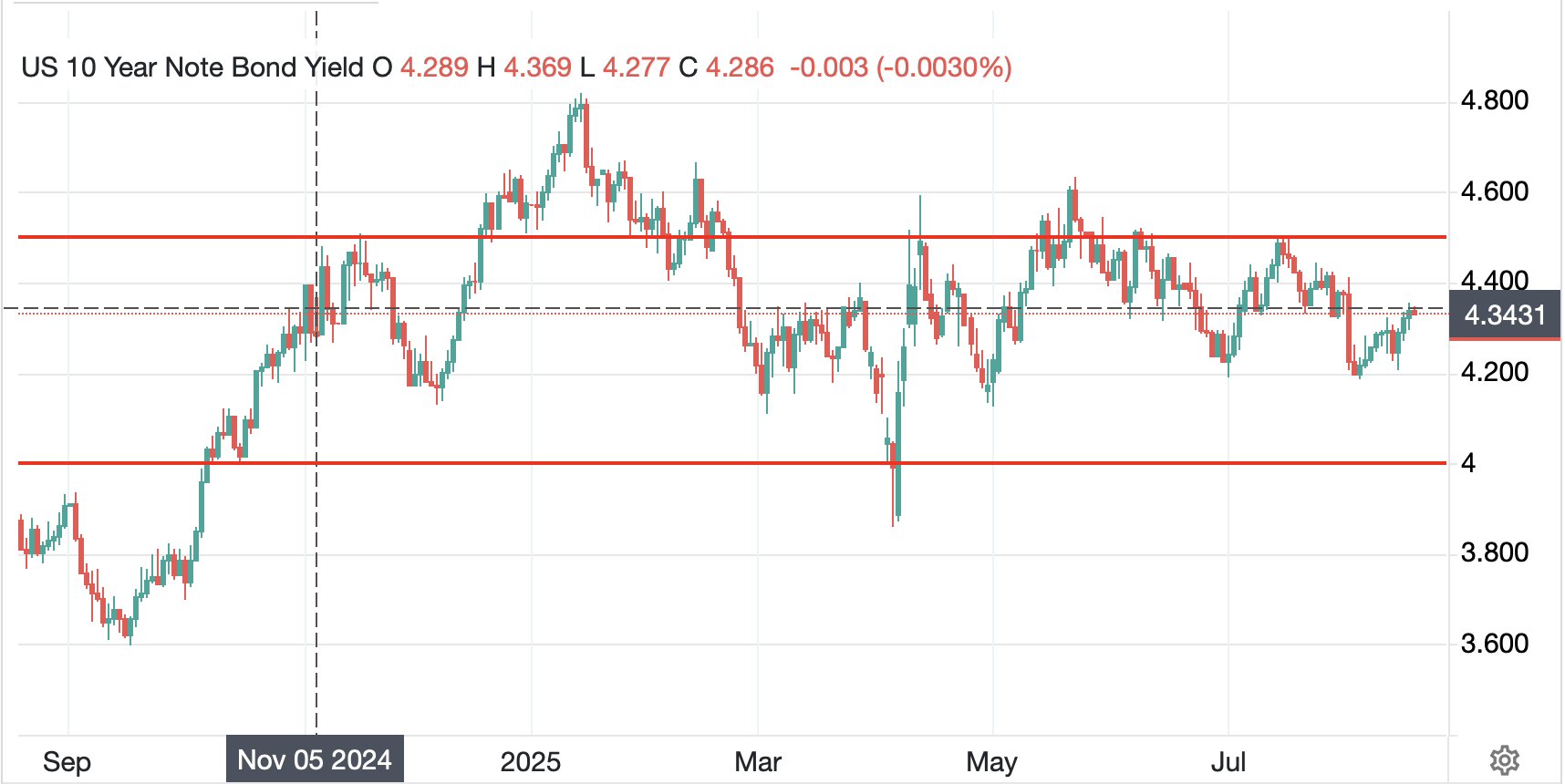
In the bond market, Treasury yields have recouped 2bps of the -3bps they fell in the wake of Chairman Powell’s speech on Friday.  However, they remain below 4.30% and continue to trade in a narrow range as per the below chart.  FYI, the mean over this period is 4.33%.

Source: tradingeconomics.com

European sovereign yields have been rising this morning, with the entire continent seeing yields higher by between 4bps and 5bps amid concerns that the mooted Fed rate cuts will not see any appreciable impact on European yields as those nations struggle with financing their promised €1 trillion of defense and infrastructure spending amid a stagnant economy.

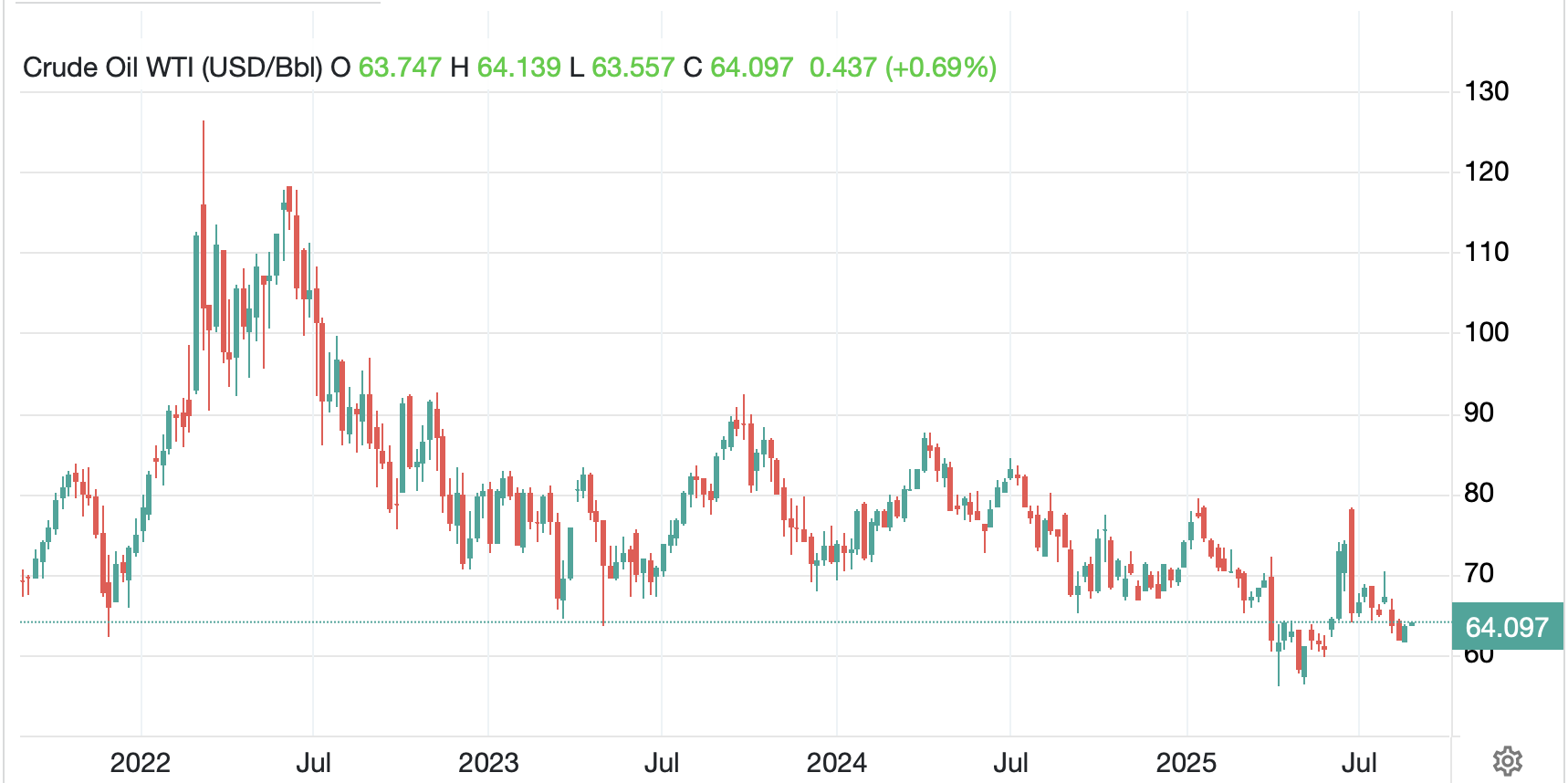
In the commodity markets, oil (+0.6%) is continuing its slow rebound from the lows seen early last week but at $64/bbl, remain well within their trading range.  There were several Ukrainian attacks on Russian refineries overnight, which arguably helped the bulls’ case, but my take remains that the trend here is lower over time.  Since shortly after the start of the Ukraine war, prices have been trending lower steadily.

Source: tradingeconomics.com

In the metals markets, Friday’s Powell speech goosed all of them higher and this morning, like equity indices, they are backing off a bit with gold (-0.2%) and sliver (-0.45%) still trading near their recent levels.  We will need some outside catalyst, I think, to shake these markets up.

Finally, the dollar is a bit firmer this morning, also reversing some of Friday’s post-Powell decline, with both the euro and pound lower by -0.2% while the yen (-0.35%) is a touch softer than that.  The biggest movers have been ZAR (-0.7%) responding to the weakness in precious metals and CZK (-0.8%) and HUF (-0.9%), both of which appear to be reflexive sales after strong moves Friday.  If the Fed is really going to pay less attention to inflation, I see that as a distinct negative for the dollar.  That has been my concern all year, although the offsetting feature was the promise of massive inward investment flows.  But the short-term view is more focused on Fed policy, so beware more confirmation by Fed speakers that they are willing to cut.

On the data front this week, probably the most impactful number is NVidia earnings Tuesday after the close, but from an economic perspective, this is what we have coming,

TodayChicago Fed Nat’l Activity-0.2
 New Home Sales630K
TuesdayDurable Goods-4.0%
 -ex Trasnport0.2%
 Case Shiller Home Prices2.2%
 Consumer Confidence96.4
ThursdayInitial Claims230K
 Continuing Claims1975K
 Q2 GDP3.1%
 Q2 GDP Sales6.3%
 Q2 Real Spending1.4%
FridayPersonal Income0.4%
 Personal Spending 0.5%
 PCE0.2% (2.6% Y/Y)
 Core PCE0.3% (2.9% Y/Y)
 Chicago PMI45.5
 Michigan Sentiment58.6

Source: tradingeconomics.com

In addition to this, we only hear from Richmond Fed President Barkin (twice) and Governor Waller.  We already know Waller wants to cut, so Barkin is the one who can give us new info.  

And that’s what we have for today.  The ongoing ructions from Powell’s speech and the question of how investors will interpret the probability of a rate cut.  As I said, if they really are going to put inflation second, then the dollar will suffer.

Good luck

Adf

Panic They’re Sowing

While eyes and ears focus on Jay
And whatever he has to say
Poor Germany’s shrinking
And it’s wishful thinking
Japan’s kept inflation at bay
 
But fears about Jay have been growing
That rate cuts he will be foregoing
If that is the case
Most traders will race
To sell things while panic they’re sowing


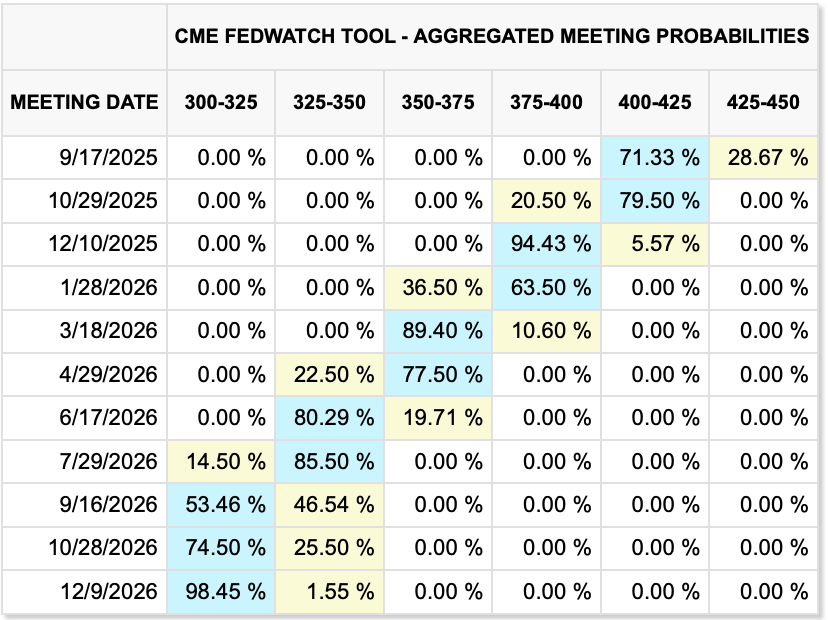
Clearly, the big story today is Chairman Powell’s speech with growing expectations that he will sound more hawkish than had previously been anticipated.  Recall, after the much weaker than expected NFP data was released at the beginning of the month, it appeared nearly certain that the Fed was going to cut at the next meeting with talk of 50bps making the rounds.  Now, a few hours before Powell steps to the podium, the futures market is pricing just a 71% probability of that rate cut with a just two cuts priced in for 2025 as per the CME’s own analysis below:

Arguably, this is one reason that equity markets have been having trouble moving higher as the Mag7 drivers of the market are amongst the longest duration assets around, so higher rates really hurt them.  While there has been a rotation into more defensive names, if opinions start to shift regarding the magnificence of AI, or perhaps just how much money they are spending on it and the potential benefits they will receive, things could get ugly.

I also find it interesting that the Fed whisperer, Nick Timiraos at the WSJ, has been running flack for Chairman Powell in this morning’s article, trying to get people to focus on the Fed’s framework as the basis of today’s speech, rather than policy per se.  Briefly, the current Fed framework, was designed right before COVID when for whatever reason they were concerned that low inflation was a problem, and they created Average Inflation Targeting (AIT) as a way to allow inflation to run above their target of 2.0% for a period if it had been below that level for too long.  We all know how well that worked out and, in fact, we are all still paying for their mistakes every day!  The word is they are going to scrap AIT although it is not clear what they will come up with next.  It is exercises like this that foment the ‘end the Fed’ calls from a growing group of monetarist economists and pundits.

At any rate, comments from other Fed speakers indicate that most are not yet ready to cut rates, so Powell will be able to have a significant impact if he turns more dovish.  But we have to wait a few more hours for that so let’s turn our attention elsewhere.

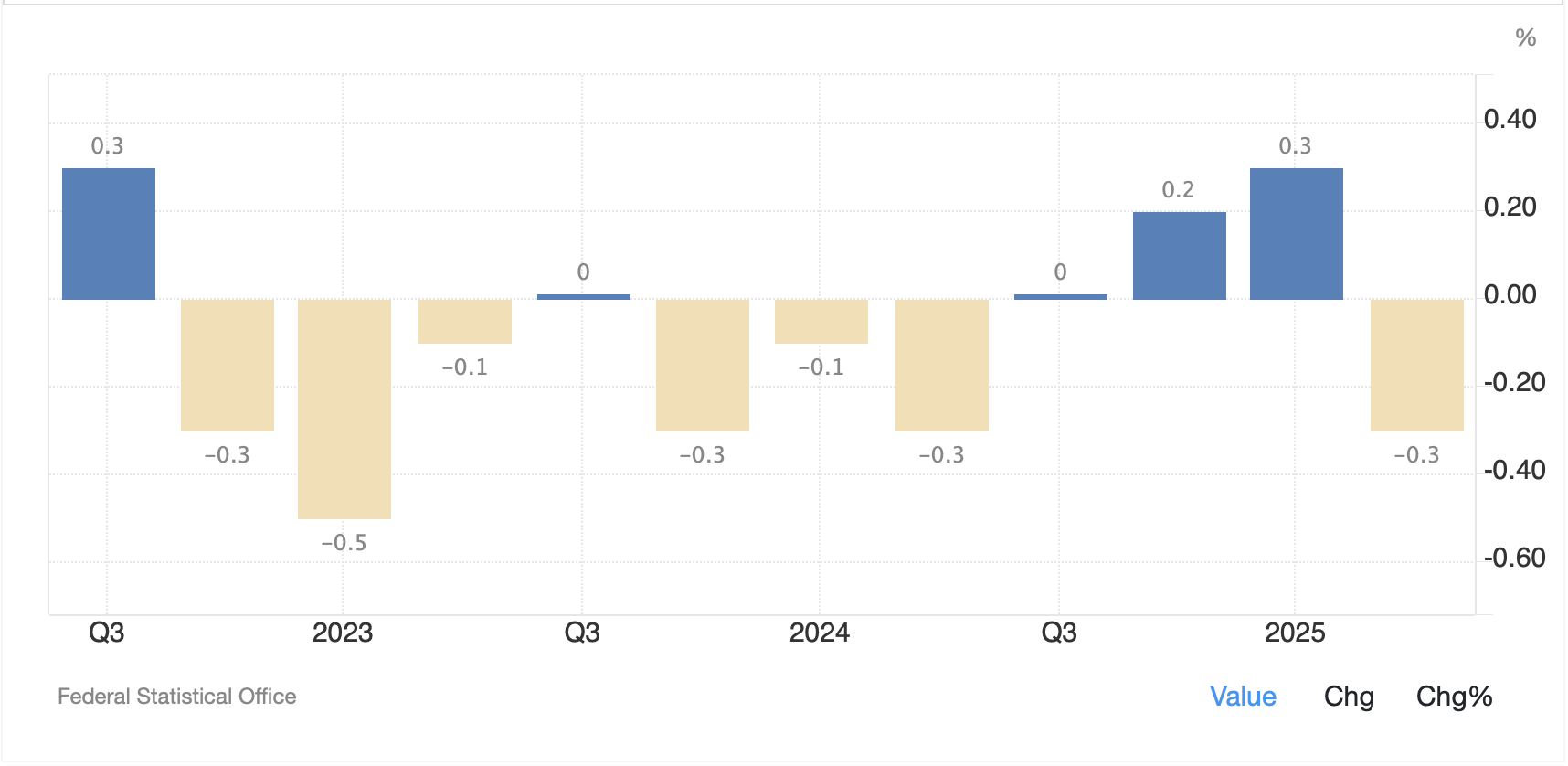
Germany GDP data (-0.3% Q/Q, +0.2% Y/Y) was a few ticks lower than expected and continues to point to an economy that has no positive momentum at all.  In fact, a look at the quarterly GDP data from Germany paints a pretty awful picture if growing your economy is the goal.

Source: tradingeconomics.com

Clearly, the US tariff changes have been quite negative, but in fairness, Germany’s insane energy policy is likely a much bigger driver of their problems as they have the most expensive power costs in the EU.  It is very difficult to have a manufacturing-based economy if you cannot power it cheaply.  Again, while the euro is more than just Germany, this does not bode well for the single currency.

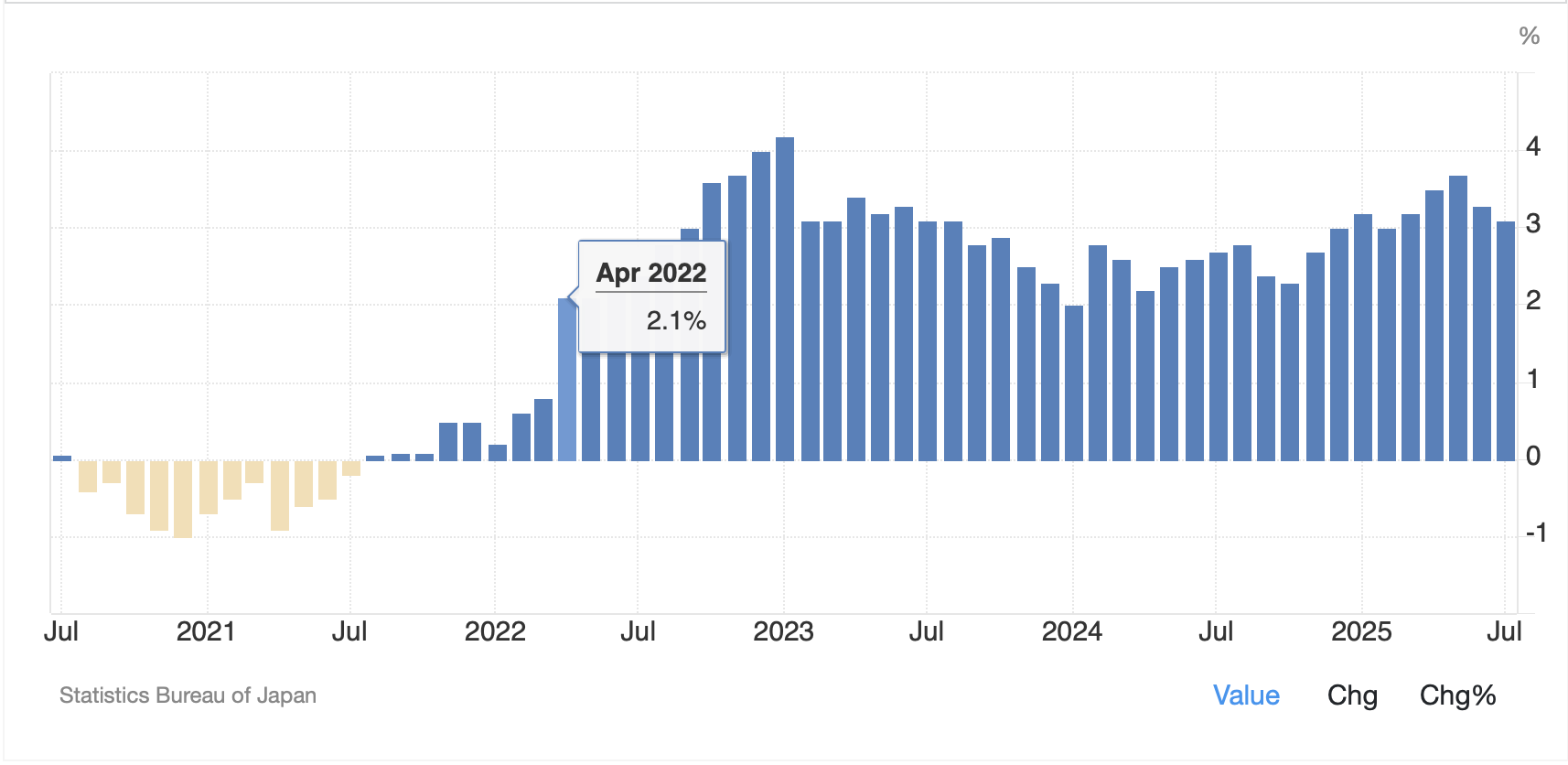
Turning to Japan, inflation continues to run far above their 2.0% target, printing last night at 3.1% on both the headline and core metrics, which while 2 ticks lower than June’s data, was still a tick higher than expected.  It has now been 40 consecutive months that core CPI in Japan has been above the BOJ’s 2.0% target and Ueda-san continues to twiddle his thumbs regarding raising rates.

Source: tradingeconomics.com

It is very hard to watch this lack of policy response to a clear problem, that from all I read is becoming a much bigger political issue for PM Ishiba, and have confidence that the yen is going to strengthen any time soon.  Back in May, the talk was of the unwinding of the carry trade.  All indications now are that it is being put back on in significant size.  FWIW I think we will see 150.00 before too long, especially if Powell sounds hawkish.

And those are really the stories today ahead of Powell and the NY open.  So, let’s see how things behaved overnight.  After a modest down day in the US yesterday, and despite the poor inflation data, Japan was unchanged overall.  However, China (+2.1%) had a huge up move apparently on the idea that US-China trade tensions are easing and despite continued weak data from the country.  Apparently, there has been a rotation from bonds to stocks by local investors driving the move.  Hong Kong (+0.9%) also had a strong session as did Korea (+1.0%) although India, Taiwan and Australia all struggled with declines between -0.6% and -1.0%.  In Europe, the. screens are green, but it is a pale green with muted gains (DAX +0.1%, CAC +0.25%, IBEX +0.4%) despite the weak German data.  Perhaps the belief is this will encourage the ECB to ease policy further.  Meanwhile, at this hour (7:15) US futures are pointing higher by 0.25% or so.

In the bond market, after climbing a few basis points yesterday, Treasury yields are unchanged, trading at 4.33%, so still range bound.  European sovereign yields are softer by -1bp to -2bps, again likely on the softer German data with hopes for a more aggressive ECB.  JGB yields edged higher by 1bp in the 10-year but the longer end of the curve there has seen yields move to new all-time highs with 30-year yields up to 3.216%. it feels like things are starting to unravel in Japanese bond markets.

Turning to commodities, oil (+0.4%) is creeping higher again this morning but remains in its downtrend and activity is lacking.  Meanwhile, the metals markets (Au -0.35%, Ag -0.5%, Cu -0.3%) are all under pressure from a combination of a strong dollar and a lack of investor interest, at least in the West.

Speaking of the dollar, it rallied yesterday and is largely continuing this morning with one notable exception, KRW (+0.75%) which benefitted from trade data showing exports rose 7.6% in the first 20 days of the month on strong semiconductor sales.  But otherwise, +/-0.3% or less is the story of the day, with most currencies within 0.1% of yesterday’s closing levels.

And that’s really it.  There is no data so we are all awaiting Powell and then anything that may come from the White House regarding trade deals, or peace, I guess.  As the summer comes to a close, unless Powell says rate hikes are coming or promises cuts, I expect that traders will have gone for the weekend by lunch time and it will be a very quiet market.

Good luck and good weekend

Adf
A Thirst for Vengeance

The talk of the town ‘bout the Fed
Was not what the Minutes had said
But rather the look
Into Lisa Cook
And whether the rules she did shred
 
It seems now both parties agree
That lawfare is how things should be
Impeachment was first
But now there’s a thirst
For vengeance ‘gainst your enemy


The FOMC Minutes released yesterday were not that informative overall.  After all, the two dissensions by Waller and Bowman have already been dissected for the past 3 weeks and reading through the Minutes, they basically said that most participants had no idea how things would play out.  They couldn’t decide if tariffs would be more inflationary, if the impact would be consistent or a one-off and so doing nothing felt right.  As to the employment situation, there too they had no clarity as to their thoughts, with some positing things could get worse while others thought the employment situation would be fine.  Anyway, with Powell speaking tomorrow, it was all old news.

However, the real Fed news came from the head of the FHFA, Bill Pulte, who revealed that he had forwarded information to the DOJ to investigate potential mortgage fraud by Fed Governor Lisa Cook.  In what has become something of a pattern, Ms Cook appears to have misrepresented the purchase of a secondary home she was planning to rent out as her primary residence in an effort to get a reduced rate on her mortgage.  This is remarkably similar to the case against NY Attorney General Letitia James as well as California Senator Adam Schiff.  While the latter two appear vengeful in that both of those two were instrumental in personal political attacks on President Trump, it is Ms Cook’s situation that may have the bigger impact.  If she is forced to resign, as has already been demanded by President Trump, then that opens another seat on the Fed for Mr Trump to fill.  Based on Trump’s current views, one would anticipate it would turn the Fed that much more dovish if that is the way things evolve.

Sitting here in the bleachers, I have no idea as to the veracity of the claims against any of these three, but it will not be a huge surprise to see charges brought in each case.  It will certainly be a sticky wicket for Chairman Powell if a Fed governor is brought up on charges of mortgage fraud given her role in monetary policy making.  At this stage, my working assumption is we will see all three served and cases brought against them.  If that is the case, we have to assume the Fed is going to become that much more dovish during the rest of the year regardless of the data.

Interestingly, one cannot look at Fed funds futures and conclude this will be the case as the probability of a rate cut next month has actually declined a bit further, now at 79% as per the below chart.  In fact, if you look at the recent history, you can see that just one week ago, that probability was 92% and the week prior to that it was over 100%.

Source: cmegroup.com

There is an irony in the idea that President Trump wants to see the Fed cut rates while describing the economy as doing great.  Arguably, if the economy is doing great with rates where they are, why change them.  The answer, I believe, is the administration’s goal to run the economy as hot as possible with the idea that faster growth in real activity will help overcome the debt problems.  Alas, part of running it hot means that inflation is unlikely to fall much further.  And that, my friends, is the conundrum.  A hot US economy will continue to draw investment and support the dollar’s strength.  While that will help moderate inflation, it will negatively impact manufacturing competitiveness.  And that is the balance that every government wants to control but is impossible to do.  This is the very essence of Triffin’s dilemma.

(PS: if you want to protect against that hotter inflation, a great tool is USDi, the only fully backed, CPI tracking cryptocurrency available.)

Turning from the political, which keeps interfering in the daily financial commentary, to the financial directly, we have continued to see pressure on the semiconductor sector drive US equity markets a bit lower, notably the NASDAQ, which continues to play out elsewhere around the world.  In Asia, the Nikkei (-0.65%) was emblematic of that with the Hang Seng (-0.25%) slipping as well, but in truth, Asia had an overall better performance as Taiwan (+1.4%), Australia (+1.1%) and Korea (+0.4%) all fared well.  I think some of this was a reversal of the previous day’s sharp declines on the semiconductor concerns although Australia was the beneficiary of some solid Flash PMI data.

In Europe, however, all markets are weaker this morning led by the CAC (-0.6%) and IBEX (-0.6%) with the DAX (-0.3%) and FTSE 100 (-0.3%) not quite as badly off after PMI data there showed things were better than last month, but still not particularly great.  It seems the commentary attached to the numbers indicated serious concerns about future activity.  As to US futures, at this hour (7:15) they are modestly lower across the board, on the order of -0.15%.

In the bond market, zzzzzz’s are the story.  While yields have edged slightly higher this morning (+1bp in Treasuries, +2bps to +3bps in Europe), the trend remains a flat line with none of these markets doing anything other than chopping around.

Source: tradingeconomics.com

The one exception here is Japan, which has seen 10-year yields march consistently higher over the past year with the past 10 sessions showing consistently higher yields.  Perhaps their debt chickens are finally coming home to roost.

Source: tradingeconomics.com

Turning to commodities, oil’s (+0.85%) modest bounce continues but it remains nearer the bottom than the top of its recent trading range.  The EIA data yesterday showed a surprisingly large draw in crude oil as well as gasoline stocks with reduced imports, so this does make sense.  In the metals markets, yesterday’s rally is being reversed this morning with the major markets all lower by about -0.4%.

Finally, the dollar remains quite uninteresting excepting two currencies; NOK (+0.6%) which is clearly benefitting from the recent rebound in oil while JPY (-0.4%) is under further pressure as there appears to be an increase in short JPY carry trades being initiated, especially against the dollar as more traders discount the idea the Fed is even going to cut 25bps next month.  Otherwise, there is nothing noteworthy here this morning.

We finally get data this week as follows: Initial (exp 225K) and Continuing (1960K) Claims, Philly Fed (7.0), Flash PMI (Manufacturing 49.5, Services 54.2) and Existing Home Sales (3.92M).  We also hear from Atlanta Fed president Bostic this morning, but I do believe the market remains almost entirely focused on Powell’s speech tomorrow.  Of course, if the semiconductor space continues to underperform, that would be an entirely different kettle of fish and likely create some serious market adjustments.  

Net, it is difficult for me to remain too bearish the dollar overall, especially if the market starts to price out a rate cut in September.

Good luck

Adf

A Final Bronx Cheer

Though markets are desperate for Jay
To cut, there is fear that he’ll say
It’s not yet the time
In this paradigm
As tariffs have caused disarray
 
But truly, Chair Jay’s greatest fear
Is that ere October this year
The Prez will have chosen
A new Chair and frozen
Him out with a final Bronx cheer


Yesterday saw the first substantial equity market move in nearly 3 weeks, with the NASDAQ declining 1.5% as concerns arose that the current extremely high valuations would have a more difficult time being maintained if the Fed does not ease policy as widely expected next month.  This resulted in all the Mag7 declining, which given they have been the driving force higher in the market, necessarily resulted in overall index declines.

Source: tradingeconomics.com

Of course, the question is, what made yesterday any different than previous sessions.  There were no earnings results of note, and arguably, the biggest tech news was the story about the US government taking a stake in Intel, something that seems likely to have been a positive.  However, there has been an increase in chatter about what Chair Powell is going to say on Friday at his Jackson Hole speech.  Notably, in the SOFR options market, there are a large, and still increasing, number of bets being placed that Powell will indicate 50bps is on the table in September.  But Wall St analysts continue to side with the patience crowd, explaining that while the current policy settings may be slightly restrictive, they are hardly suffocating for the economy.

While Powell has repeatedly blamed an uncertain impact of tariffs on his decision to maintain current policy settings, just like everything else, this is becoming extremely political.  Trump’s allies are lining up behind him and calling for immediate rate cuts to help support the economy.  At the same time, Trump’s political foes remain focused on preventing any Fed action that might help Trump, although they couch their arguments in terms of maintaining Fed ‘independence’.

However, last night was instructive in that two central banks, New Zealand and Indonesia, cut rates further while Sweden’s Riksbank, though standing pat, explained that more cuts are possible, if not likely, later this year.  While the PBOC did not cut rates, the pressure there is building as the economic situation is very clearly slowing down, as discussed last week after their data releases.  So, with most of the world cutting rates (Japan being the notable exception), pressure continues to mount on Powell and the Fed to pick up where they left off last December.

Hanging over both Powell’s speech and the September rate decision is the fact that Treasury Secretary Bessent explained yesterday that interviews for the next Fed chair would begin around Labor Day, just two weeks from now, and nearly eight months before Powell’s term ends.  This will almost certainly weaken Powell as other FOMC members and the market will look to whomever is selected for their views, with Powell serving out his term as a lame duck.  In fact, it is for this reason that my take is Powell’s speech at Jackson Hole will be less about policy and more an attempt to burnish his legacy.

And that’s where things stand.  With no data of note today, and yesterday’s housing data being mildly positive, but not enough to change macroeconomic opinions, the narrative writers are looking for something to say and Powell’s speech is where they have landed.  Absent a run of declining days, I put no stock in a change in the market temperature at this point.  So, let’s see how things behaved overnight.

In Asia, the Nikkei (-1.5%) had a rough night in a direct response to the US tech-led selloff.  Given that US markets have stabilized this morning, with futures unchanged at this hour (7:25), we need to see a continuation here before expecting a significant further decline there.  China (+1.1%), however, bucked that weaker trend, ostensibly on hopes that the ongoing trade talks with the US will prove fruitful.  Elsewhere in the region, Korea (-0.7%) and Taiwan (-3.0%) were both hit on the tech selloff blues but other markets, with less exposure to that sector were fine.  In Europe, it is a mixed picture with the DAX (-0.4%) the laggard after weaker than expected PPI indicated that current ECB policy needs to be more accommodative to help the country but may not be coming soon.  However, the rest of the continent is little changed.  surprisingly, UK stocks (+0.3%) are holding up well despite higher-than-expected CPI data which has adjusted analysts’ thoughts on whether the BOE will be able to cut again at their next meeting.

In the bond market, Treasury yields (-1bp) continue to trade in the middle of that band I showed yesterday, while European sovereign yields have also slipped between -1bp and -2bps this morning after the softer German price data.  The UK (-4bps) is a surprise as I would not have expected lower yields after a higher inflation reading.  Perhaps this is an indication that investors are expecting a much worse economic outcome from the UK going forward.

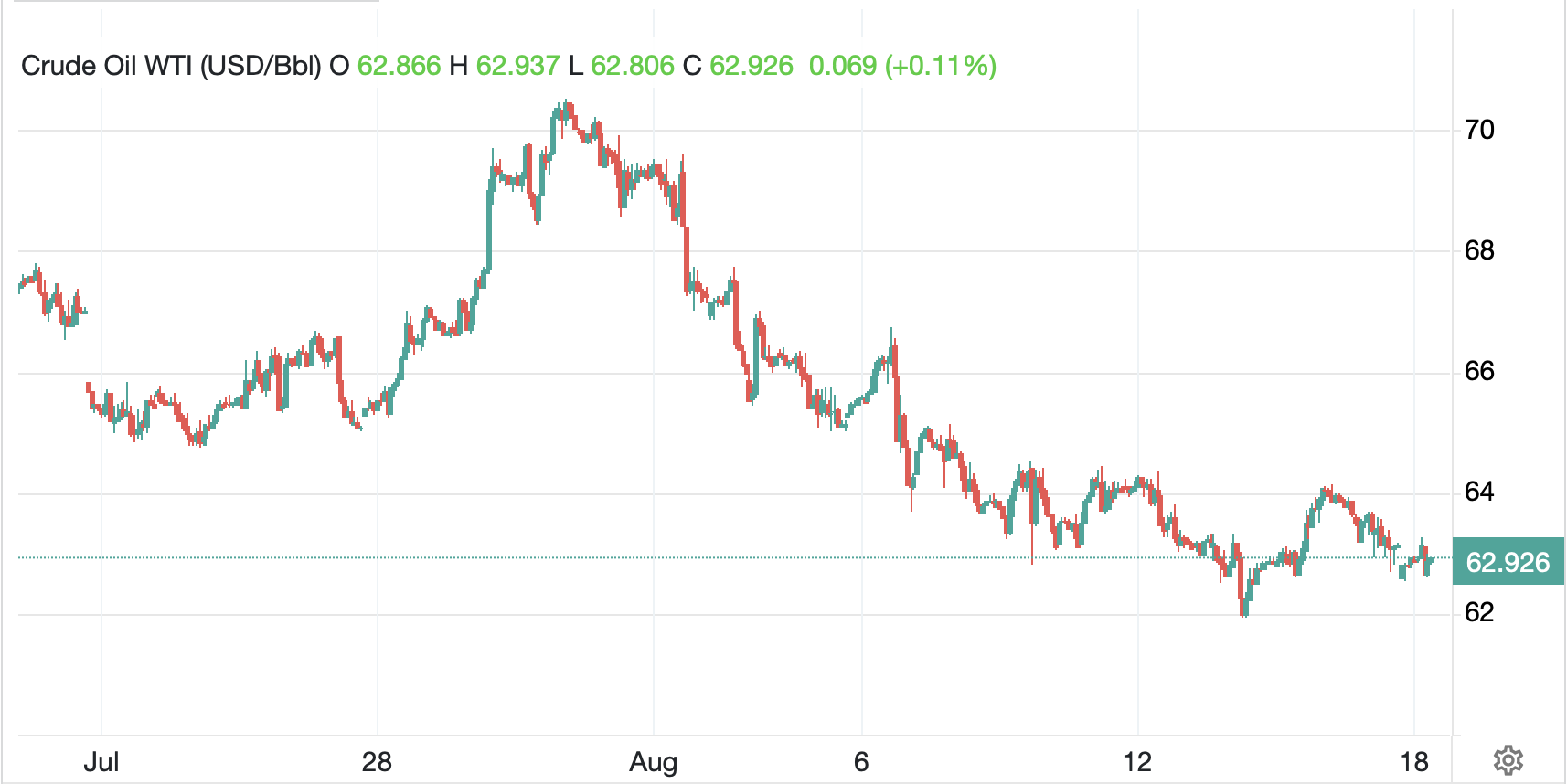
In the commodity markets, oil (+1.3%) is bouncing, but it remains in a well-defined downtrend for now as per the below chart.

Source: tradingeconomics.com

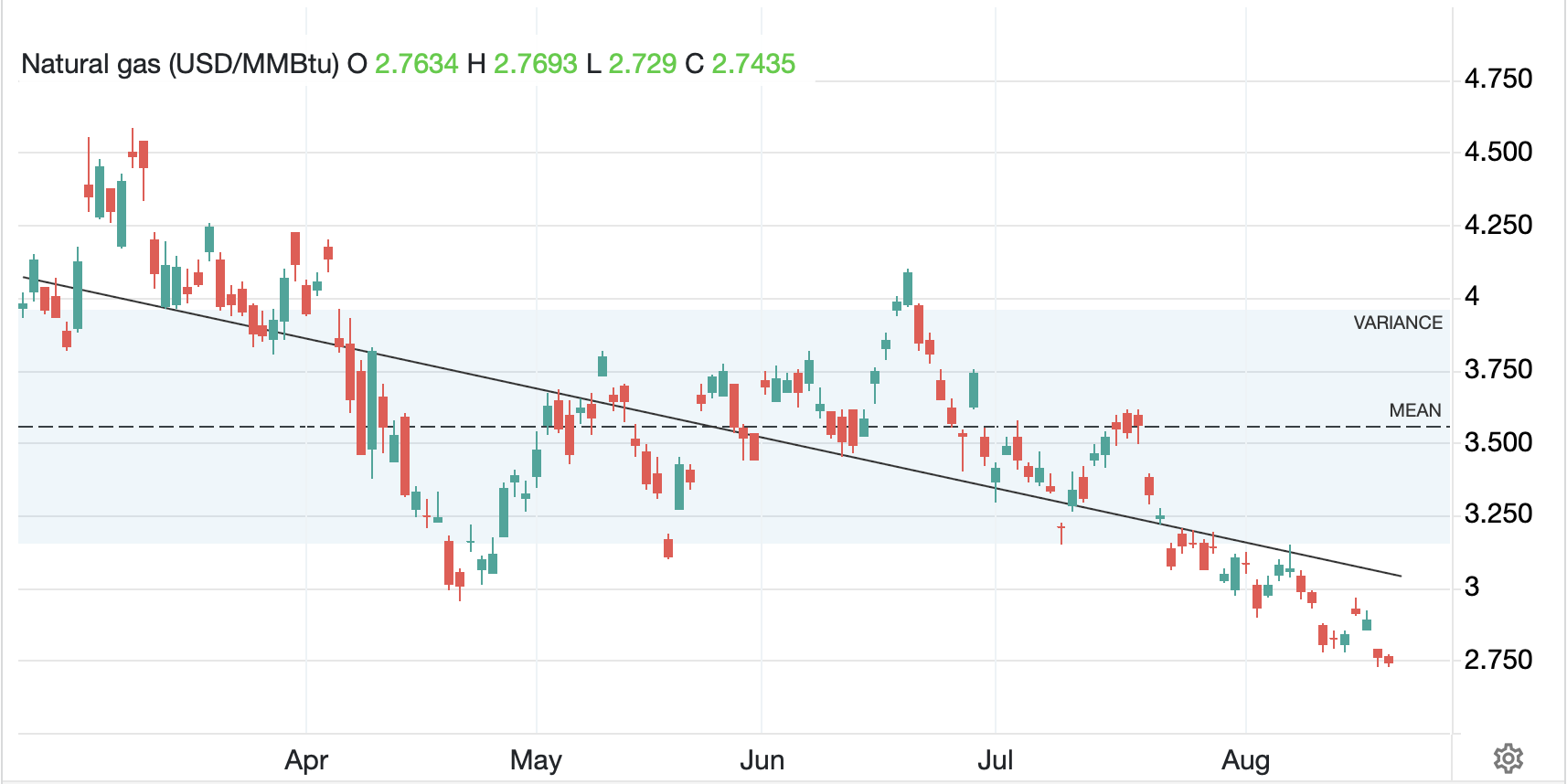
To change this trajectory, we will need to see something alter the production schedule, which with peace on the table in Ukraine seems likely to bring more oil to market not less, or we will need to see a significantly better economic outlook that drives a substantial increase in demand, something which right now seems unlikely as well.  I cannot get on board the higher oil price bandwagon at this time.  One other thing weighing on oil is the fact that NatGas has been trending lower for the past 6 months and is now at levels not seen since last November.  In fact, those two charts look remarkably similar!

Source: tradingeconomcis.com

There is a real substitution effect here and currently oil is trading at a price that is about 4X the energy price of NatGas.  Until that arbitrage closes, and it will eventually, oil will have difficulty rallying in my view. 

In the metals markets, gold (+0.4%) which sold off a few dollars yesterday is rebounding although both silver and copper are soft this morning.  These markets are just not that interesting right now.

Finally, the dollar is little changed this morning with one real outlier, NZD (-1.2%) which responded to the dovish tones of the RBNZ last night and is pricing in more interest rate cuts now.  KRW (-0.4%) also fell on concerns over trade and the semiconductor results but otherwise, there is very little ongoing here.

The only data this morning is EIA oil inventories with a small draw anticipated.  The FOMC Minutes come at 2:00 and there will be a lot of digging to see if other members seemed to agree with Bowman and Waller in their dissents at the last meeting.  Bowman spoke yesterday, but was focused on her role as chief regulator, not monetary policy, although we hear from Waller this morning.

A down day in equities is not the end of the world despite much gnashing of teeth.  It remains difficult to get excited about markets right now.  Perhaps Mr Powell will shake things up on Friday, but my sense is we will need to wait for the next NFP data to get some action.

Good luck

Adf

PS. A reader explained to me that in Australia, black swans are the norm, not the remarkable case as here in the US.  I guess we will need to find a new term to discuss an unexpected surprise.

What Would You Choose?

As summer meanders along
No market is weak, nor’s it strong
But traders keep trading
With hope masquerading
As knowledge, though they know they’re wrong
 
The question is what sort of news
Can catalyze changes in views?
Seems rate cuts will not
And peace had its shot
Dear readers, just what would you choose?


My friend JJ (he writes the Market Vibes note) made a profound comment that described the current situation so well, I think it is worth repeating: 

It is not that the news and fundamentals are uninteresting or unimportant. They are. But vol control has anesthetized every future, ETF, equity, and FX market, and the managers of it are making trillions on it. Therefore, it is likely this narcolepsy won’t end for a while.”

A point he has been making of late, and one with which I cannot argue, is that everything that is not algorithmic is dumb money as the algos drive it all.  And it is a fair point.  Market activity has ground to a halt, and while I have no proof, I would estimate it is even quieter than the typical year’s summer doldrums.  That seems remarkable given the panoply of news stories that exist and in other times would have had a major market impact.  Consider, war and peace in Ukraine, massive changes in federal regulations and administration priorities, and remarkable electoral shifts around the world, yet none of it matters.  Consider this chart of the US 10-year Treasury:

Source: tradingeconomics.com

The yield, which most afficionados agree is critical to not just US, but global, financial markets and activity, has largely traded between 4.0% and 4.5% since well before Mr Trump was elected.  The one thing that cannot be said is that the Trump administration has been boring.  More has happened on the fiscal front in the past six months than in entire presidential terms and yet yields are essentially unchanged since November 5th when Trump was elected.

JJ’s view is the massive increase in the use of options by retail traders has become the driving force.  Retail buys options, paying premium which decays away and that value accrues to the market making algorithms. The amounts of premium are huge, in the $trillions, and it is a straightforward business model that reaps huge rewards, so a lack of movement is the goal.  I cannot argue with that either.

However, the one thing I have learned over my too many years in the market is that no matter how smart you are, no matter how well you have considered the potential outcomes, reality will be different, and at some point, there will be a tipping point to change the market dynamic.  After all, Covid was not expected, nor even more importantly, the government responses to it which is what drove the market volatility.  I am pretty sure there is another true black swan out there, something nobody is discussing as it currently seems irrelevant or impossible, but which will alter the game.

I spent my trading career learning to manage risks while running a global FX options business, trying to profit, but more importantly preventing the huge drawdowns that end careers.  I spent my sales career trying to help my clients understand their FX risks and learn to mitigate them in the most cost-effective manner possible.  What I learned over that 40+ years is that while risks sometimes seem unimportant, or unimaginable, they exist.  Do not mistake the current state for the future state.  Things will change, although how I cannot currently imagine.

With that as preamble, let’s look at just how little things are moving.  Stocks did nothing in the US yesterday and movement overnight in Asia was lackluster as well (Nikkei -0.4%, Hang Seng -0.2%, CSI 300 -0.4%).  As I wrote above, there is just not that much that is exciting investors right now.  Europe, however, seems to be taking a positive stance on the Oval Office meeting with many of their leaders as perhaps peace in Ukraine, if it is coming, will be helpful for the continent.  Ostensibly, Presidents Trump and Putin discussed a closer economic relationship between the US and Russia, which if that came to pass, would undoubtedly rearrange some things in markets, largely to the benefit of Europe.  As to US futures, they are unchanged this morning, again.

Bond markets in Europe are exactly unchanged across the board, so much so that you would expect it was a holiday there.  Treasury yields have edged lower by -1bp, but as I explained above, are simply range trading.

I would argue the commodity markets are where there is the most potential for movement going forward as any type of US-Russian economic détente would almost certainly reduce oil prices substantially.  And, coincidentally, WTI (-1.25%) is falling this morning as hopes for a direct meeting between Putin and Zelensky, and with it the end of the war, are increasing.  Weirdly, gold (+0.35%) is not declining on that news, despite the idea that gold represents a haven against war.  Perhaps gold represents a haven against money supply growth, which if there is an economic détente, you can be sure will increase.  As to the other metals, very little movement there either.  In the vein of the lack of activity, perhaps the below gold chart is even a better descriptor of just how little activity has been going on since spring.

Source: tradingeconomics.com

Finally, the dollar is a touch softer this morning, but it, too, remains rangebound.  While much has been made of its weakness in the first half of the year, as though that calendar period had some special significance (it doesn’t), here too, things have simply ground to a halt.  Using the dollar index (DXY) as our proxy, you can see that this market, too, has done nothing for months.

Source: tradingeconomics.com

Whether it’s G10 or EMG currencies, the movement remains desultory at best, and catatonic may be a better description.

So, let’s look at the data this week that will precede Chairman Powell’s speech Friday morning.

TodayHousing Starts1.30M
 Building Permits1.39M
WednesdayFOMC Minutes 
ThursdayInitial Claims226K
 Continuing Claims1960K
 Philly Fed6.0
 Flash Manufacturing PMI49.5
 Flash Services PMI53.7
 Existing Home Sales3.91M
 Leading Indicators-0.1%
FridayPowell Speech 

Source: tradingeconomics.com

I think it is worthwhile to consider why we look at the Leading Indicators.  The original design was that it tracked a series of indicators that historically had presaged economic activity.  Ahead of recessions, these indicators turned lower and so it seemed a pretty good fit.  However, as you can see from the below chart from conference-board.org, the creators of the index, since 2021, when the index turned lower, it has been completely out of sync with the economy’s outcome.

As I have repeatedly written, models that were created pre-Covid, and many pre-GFC, simply no longer have any relevance to today’s reality.

On the whole, the most likely outcome today, like every day lately, is limited movement in either direction.  While I am sure a black swan exists, he is currently hibernating.

Good luck

Adf

Falling Like Rain

Trump’s meeting with Putin went well
At least that’s the best we can tell
Now, later this week
Zelenskiy will speak
With Vlad, and say you go to hell
 
So, will peace be found in Ukraine?
Or will fighting grow once again
If looking for clues
One thing we might choose
Is oil that’s falling like rain


The aftermath of the Trump-Putin meeting on Friday has certainly been interesting.  While the administration, as would be expected, highlighted any and all positives as the president pushes for an uncomfortable peace process, the administration’s opponents, which include not merely the Democratic party, but most of Europe as well, are concerned he has just sold Ukraine down the river.  I am not nearly smart enough to have an informed opinion on this issue, which is likely the case for almost every commentator as well, but I know I come down on the side of anything that moves the conversation toward an end to the war and a lasting peace, even if the terms aren’t the ones either side would like, is a step in the right direction.

But this is not a political commentary, rather we are trying to understand market behavior and remain highly cognizant of global events on markets.  With that in mind, arguably the market most directly impacted by this war is oil and based on what we have seen over the past month, during which time the peace process accelerated, the participants in the oil market appear to be saying that Russian oil is coming back to the market on an unfettered basis.  One need only look at the chart below, which shows a very clear downtrend to understand.

Source: tradingeconomics.com

Certainly, some of this price decline may be attributed to the belief that the long-awaited recession in the US is upon us, although given that has been a view for nearly three years, it is not clear to me why this month is the moment.  I understand that the payroll data was weak, but I also understand that Retail Sales data on Friday was pretty strong.  The observation that the goods and services sectors of the economy are out of sync remains appropriate, I believe.  As long as that remains the case, a significant downturn seems unlikely, but so too does a significant growth spurt.  In fact, this is one of the reasons I take the decline in the price of oil to be a harbinger of an end to the Ukraine war.  

Come Friday, we’ll hear Chairman Jay
As he tries, his views, to convey
No doubt he’ll explain
Inflation’s a bane
And that’s why, rate cuts, he’ll delay
 
But also, employment is key
And so, he will want us to see
His minions are willing
To cut, if distilling
The data less growth they foresee

Arguably, the other big market story this week is the speech that we will hear Friday morning from Chairman Powell at the Jackson Hole Symposium.  Many in the market continue to look to Powell and the Fed for their guidance although my take is the Fed’s impact on market’s has been waning over time as fiscal dominance continues apace.  Nonetheless, it is still a key moment for the market as those who have been anticipating a Fed cut in September, as well as at least two more before the end of the year, will want confirmation that the weak payroll data was the trigger.  And while some of the Fed speakers since the NFP data have started to move toward a more dovish stance, I would contend the majority is still on the patience bandwagon.  

With that in mind, a look at the Fed funds futures markets shows that although the probability being priced in for a cut next month has fallen from its peak level, it remains extremely high at 85% with a 78% probability of two cuts by December and a third cut now likely by March.

Source: cmegroup.com

Remember, the reason this is so closely watched is the strong belief that when the Fed cuts rates, equity prices rise.  However, one need only look at a chart to note that frequently, equity markets are falling sharply when the Fed is cutting Fed funds.  That makes sense because given the reactive nature of Fed funds and the Fed in general, it is typically responding to weakness that is already evident in equity prices.  Which begs the question, why does everyone want the Fed to cut if it implies a weak economy and already declining stock prices?

Many measures continue to show equity valuations quite high, and there have been numerous calls that a correction in equity markets around the world is due.  I understand that view and have even bought put protection as it is pretty cheap to do so.  But I have given up on calling for a recession.  I can only be wrong for so long before I accept the evidence that one has not yet come, nor is obviously imminent.

Ok, let’s look at markets this morning.  While there was a late selloff in the US on Friday, Asian markets saw the world as a brighter place.  Perhaps they were encouraged by the Alaska meeting, or perhaps by the view that the Fed will cut, because there was no data there of which to note.  But the Nikkei (+0.8%), CSI 300 (+0.9%) and Australia (+0.25%) all managed gains although the Hang Seng (-0.4%) slipped a bit.  There was, however, a major laggard with Korea’s KOSPI (-1.5%) suffering on the back of concerns over potential new tariffs on Korean chips.  European equities, though, are on a bit shakier footing.  Perhaps it is the concern that despite their collective voice on Ukraine, they remain largely irrelevant.  Or perhaps it is the realization that the trade surpluses they have run in the past are set to decline as evidenced by the data showing Spain’s deficit growing to -€3.59B increasing more than €1B and the Eurozone’s surplus shrinking to €7B, down from €16.5B last month.  So, declines of -0.4% to -0.8% are today’s results in major markets there.  As to the US, futures are little changed at this hour (8:00).

In the bond market, yields have been edging lower this morning with Treasury yields (-2bps) slipping despite the stronger Retail Sales and PPI data from last week, while European sovereign yields are all lower by -3bps, perhaps anticipating slower growth overall.

In the commodities space, oil (+0.5%) has bounced from its overnight lows but remains in its downtrend.  Gold (+0.3%) continues to hover at its pivot point of $3350 or so while silver (+0.15%) and copper (-0.4%) are mixed this morning.  Away from the tariff story on copper, it remains an important economic indicator, so we must watch it closely.

Finally, the dollar is ever so slightly firmer this morning with the euro (-0.25%) leading the G10 slide although both Aussie and Kiwi are slightly firmer this morning.  In the EMG bloc, MXN (-0.4%) is the laggard along with HUF (-0.4%) and CZK (-0.4%) although the rest of the bloc, while mostly softer, hasn’t moved that far.  It does feel like a dollar story.

On the data front, as I am running late and there is nothing as important as Friday’s Powell speech, I will list it tomorrow.  Overall, my take is peace is nearer than further and that should adjust spending from fighting to rebuilding but spending it will be.  I expect to hear more about recession going forward, although it is not yet clear to me one is upon us.  While the dollar’s trend remains lower, I have a feeling we are at the end of that move so beware.

Good luck

Adf