Seek the Abyss

As so often has been the case
The market is in Trump’s embrace
Will he make a deal
And sell it with zeal
Or will Putin spit in his face
 
Because of the focus on this
Though PPI data did miss
Most markets held tight
With highs still in sight
As naysayers seek the abyss


Based on the fact that equity markets in the US were all essentially unchanged yesterday, I think it is reasonable to assume that investors are waiting to see the outcome of today’s Trump-Putin meeting in Alaska.  I have no opinion on how things will work out, although I am certainly rooting for a result that includes a ceasefire and the next steps toward a lasting peace.  From a direct market perspective, arguably oil (-0.75% this morning) is the one place where the outcome will have an impact.  Any type of deal that results in the promised end to sanctions on Russian oil seem likely to push prices lower.  In this vein, we continue to see the IEA and EIA reduce their demand forecasts (although some of this is because they keep expecting BEVs to replace ICE engines and that is not happening at the pace they would like to see). However, away from oil, I expect that this will be much more important to overall sentiment than anything else.

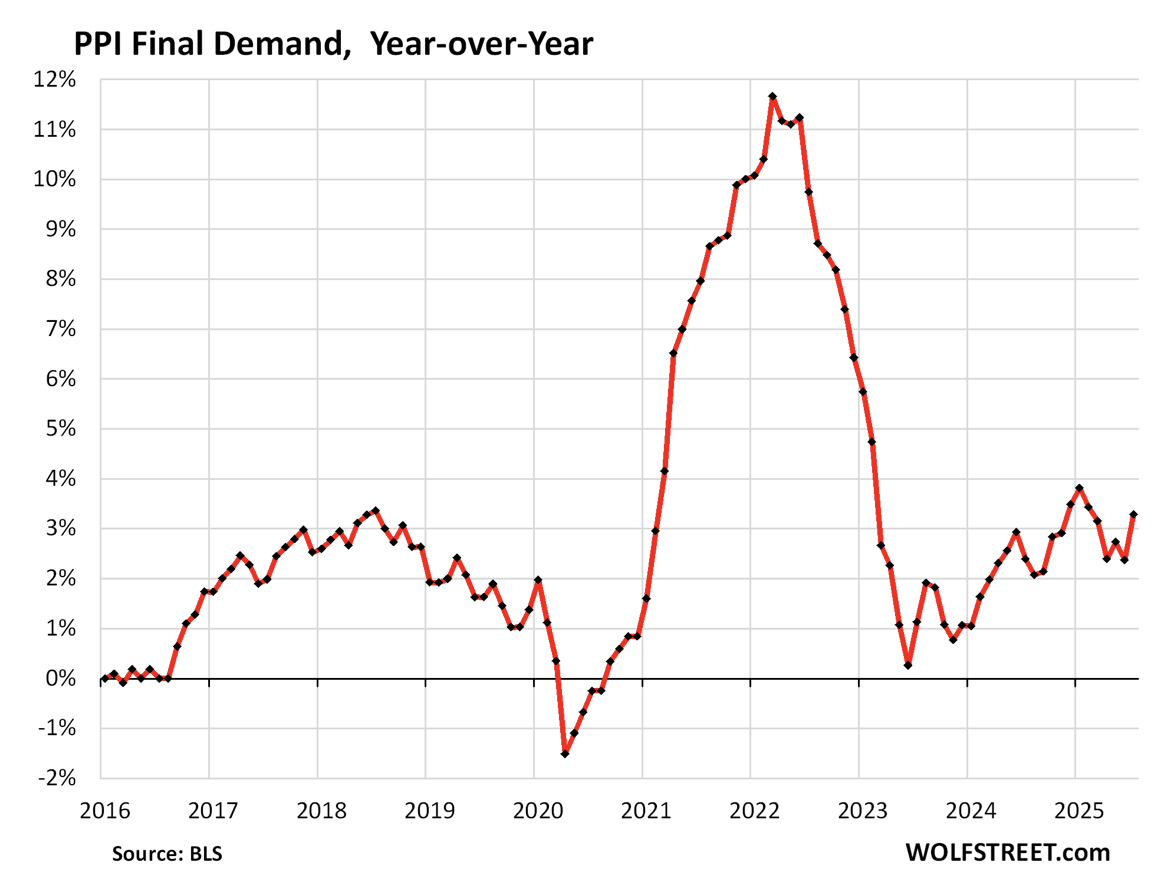
But sentiment matters a lot.  As does the attention span of traders, which as we already know, approximates the life of a fruit fly.  For instance, yesterday’s PPI data was unambiguously hotter than expected, with both headline and core monthly jumps of 0.9%.  Surprisingly for many economists, it was not goods prices that rose so much, but rather the price of services.  For the narrative, it is much harder to blame service price hikes on tariffs, than goods price hikes, but not to worry, economists are working hard to make that case.  As well, the near universal claim is that CPI is going to rise much more quickly going forward as evidenced by this rise in PPI.  A quick look at the chart below of annualized PPI shows that we are starting to rise above levels last seen in 2018, but if you recall, CPI then was very low, sub 2.0%. The relationship between the two, CPI and PPI, is not as strong as you might expect.
The contra argument here is that corporations, which were able to raise prices rapidly during the pandemic response are finding it more difficult to do so now.  We have discussed several times how corporate profit margins remain extremely high relative to history and what we may be seeing is the beginnings of those margins starting to compress as companies absorb more of the costs, be they tariffs or labor.  I also couldn’t help but notice the article in the WSJ this morning working to explain why tariffs haven’t boosted inflation as much as many economists expected.  Their answer at least according to this research, is that the many exemptions have resulted in tariffs being collected on only about half of imports, which despite all the headlines touting tariffs are now, on average, somewhere near 18%, makes the effective rate below 10%, higher than in the past, but not devastatingly so.  And remember, imports represent about 14% of GDP.  Let’s do that math.  If half of imports are excluded and the average tariff is more like 9%, we’re looking at 60 basis points of price increases, of which corporates are absorbing a great deal.  

One other thing in the article was how it highlighted the exact result that President Trump is seeking when explaining that more companies are searching for alternative sources of goods in the US.

The tariffs, are however, impacting other nations with China last night reporting a much weaker batch of data as per the below:

                                                                                                              Actual          Previous            Forecast

The property market there continues to drag on the economy, but government efforts to prop up consumption seem to be failing and clearly tariffs are impacting IP as less orders from the US result in less production.  Arguably, though, President Xi’s greatest worry is the rise in Unemployment as the one thing he REALLY doesn’t want is a lot of unemployed young males as that is what foments a revolution.  The interesting thing about the market response here is that while the Hang Seng (-1.0%) fell sharply, the CSI 300 (+0.7%) rallied, seemingly on hopes of additional stimulus being necessary and implemented.  One other thing to note about Chinese markets is that yesterday, 40-year Chinese government yields fell below 30-year Japanese yields for the first time ever, a sign that expectations of future Chinese activity are waning.  With this in mind, even though the renminbi has been gradually appreciating this year (even if we ignore the April Liberation Day spike), the Chinese playbook remains mercantilist at its heart.  I would look for a weaker CNY going forward, although the overnight move was just -0.1%.

Source: tradingeconomics.com

Ok, let’s look at the rest of markets ahead of the Alaska summit and today’s data.  Tokyo (+1.7%) had a strong session as GDP data from Japan was stronger than expected allaying worries that the tariffs would crush the economy there and bringing rate hikes back onto the table.  Australia (+0.7%), too, had a good session on solid corporate and bank earnings but the rest of the region was pretty nondescript with marginal moves in both directions.  In Europe, gains are the order of the day on the continent (DAX +0.3%, CAC 0.65%, IBEX +0.35%, FTSE MIB +1.1%) as hopes for a formalized trade deal being finalized grow.  However, UK stocks are unchanged on the session as investors here seem to be biding their time ahead of the Trump-Putin summit.  US futures are higher led by DJIA (+0.7%) although that appears to be on news that Berkshire Hathaway has taken a stake in United Health after the stock’s recent beatdown.

In the bond markets, Treasury yields are unchanged this morning although they reversed course yesterday, closing higher by 5bps rather than the -3bp opening, pre-PPI, levels.  But that rebound in yields has been seen throughout Europe where sovereigns on the continent are higher by between 3bps and 4bps and JGB yields (+2bps) rose overnight after the stronger than expected GDP data.

Away from oil, metals markets are doing very little this morning as it appears much of the activity has to do with option expirations in the ETFs SLV and GLD, so price action is likely to be choppy, but not instructive.

Finally, the dollar is softer this morning despite the higher Treasury yields.  One of the interesting things is that despite the hotter PPI data, the probability for a September cut, while falling from a chance of 50bps, to a 92.6% probability of a 25bp cut, is still pricing in an almost certain cut.  Remember, we are still a month away from that meeting and we have Jackson Hole in between as well as another NFP and CPI report so lots of potential drivers to change views.  And there is still a lot of talk of a 50bp cut, although for the life of me, I don’t understand the economic rationale there.  But softer the dollar is, falling against all its G10 brethren, on the order of 0.25% or so, and most EMG counterparts, with many having gained 0.4% or so.  But this is a dollar story today.

On the data front, ahead of the summit, which I believe starts at 2:30pm Eastern time, we see Retail Sales (exp 0.5%, 0.3% -ex autos, 0.4% Control Group) and Empire State Mfg (0.0) at 8:30, as well as IP (0.0%), Capacity Utilization (77.5%) at 9:15 and then Michigan Sentiment (62.0) at 10:00.  Retail Sales should matter most as a strong number there will encourage the equity bulls while a weak number will surely bring out the naysayers.  I still have a bad feeling about markets here, but that is my gut, not based on the data right now.  As to the dollar, there are still huge short positions out there and if rate cuts become further priced in, it can certainly decline further.

Good luck and good weekend

Adf
Crab Bisque

Though troubles worldwide haven’t ceased
Investors continue to feast
On assets with risk
As if they’re crab bisque
And appetites all have increased
 
Perhaps they believe peace is near
Or maybe they’re just cavalier
‘Cause Bitcoin has rallied
And profits they’ve tallied
Convinced them they’ll have a great year


This poet is a bit confused this morning as I watch ongoing record high equity markets in the US and elsewhere indicate a bright future, but I continue to read about the problems around the world, specifically in Ukraine and Gaza, but also throughout Africa, as well as the apparent end of democracy in the US.  Though it is showing my age, I recall during the Reagan presidency, equity markets performed well amid a sense that the world was going in the right direction.  The Cold War ended and Fed Chair Volcker had shown he had what it took to fight inflation effectively.  This combination was very effective at brightening one’s outlook on the future.

Then, leading up to the dotcom bubble, attitudes were also remarkably positive as the future held so many possibilities while peace had largely broken out around the world.  Again, the rally albeit overdone, at least had a basis that combined financial hopes with a positive geopolitical background.  Of course, the events of 9/11 put the kibosh on that for quite a while.

Leading up to the GFC, though, I would contend that the zeitgeist was a bit different, and while housing markets were on fire, the geopolitical picture was far less rosy with Russia reasserting itself and taking its first piece of Ukraine, the Middle East situation much dicier with the ongoing military action in Iraq and Afghanistan, and China beginning to flex its muscles in the South China Sea.

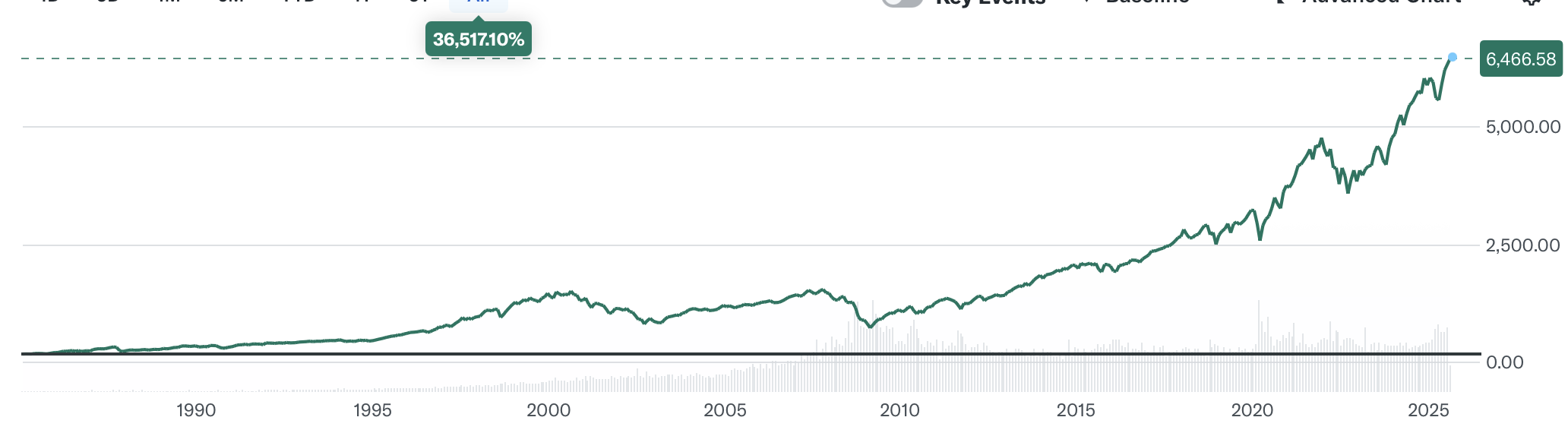
Of course, the similarity to these times is they all ended with significant equity market declines and resets of attitudes, at least for a while as per the below chart of the S&P 500.  Of course, given the exponential move over time, the early dips don’t seem so large today, although I assure you, on October 19, 1987, when the DJIA fell 22.6%, it seemed pretty consequential on the trading desk.

Source: finance.yahoo.com

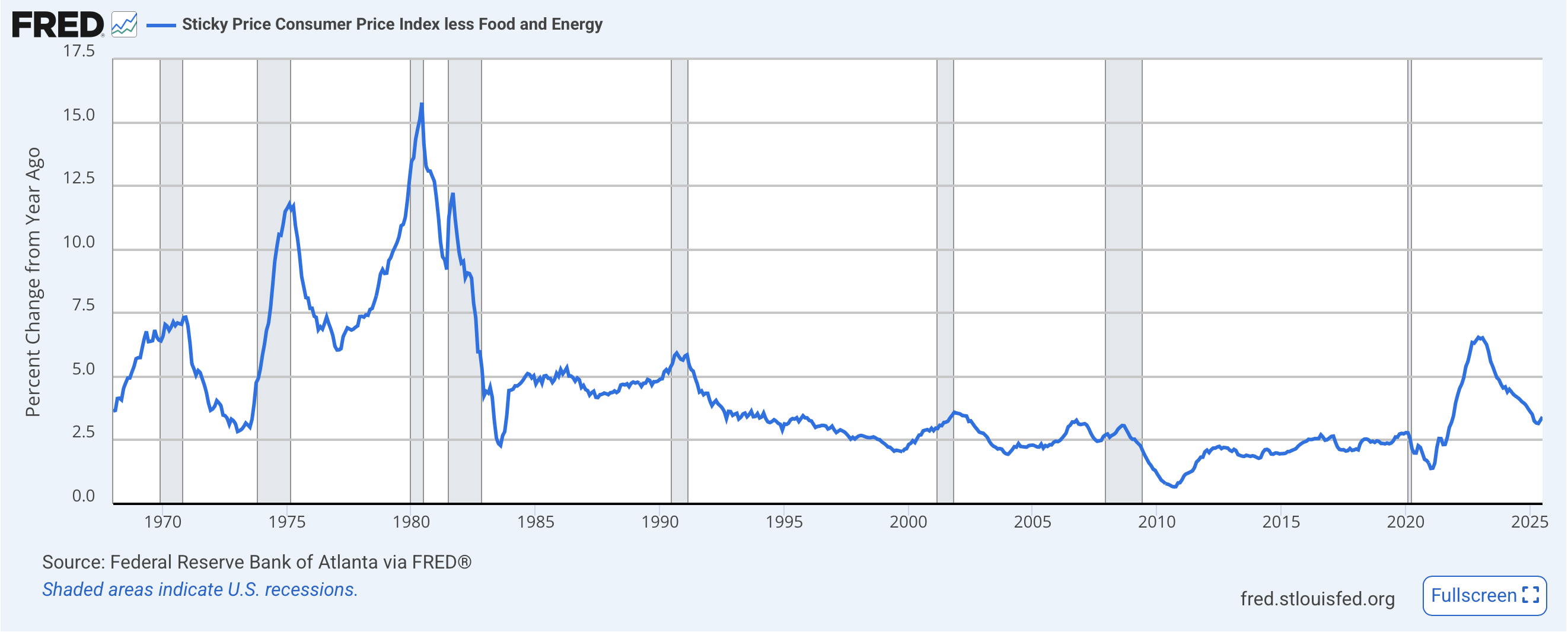
But today, I find the disconnect between market behavior and global happenings far harder to understand. Yes, there is a prospect that Presidents Trump and Putin will agree a ceasefire tomorrow when they meet in Alaska, although I’m not holding my breath for that.  At the same time, President Trump is doing his best to reorder the global economic framework, and doing a pretty good job of it, but causing significant dislocations around the world with respect to trade and finance.  Too, through all the other bubbles, consumer price inflation was not a concern of note, with CPI remaining quiescent throughout until the Covid response as per the below and, as Tuesday’s core CPI reminded us, inflation remains a specter behind all our activities.

And yet, all-time highs are the norm in markets these days, whether US equities, Japanese equities, European equities, Bitcoin or gold, prices for financial assets remain in the uppermost percentiles of their historic ranges.  Perhaps this is the YOLO view of life, or perhaps markets are telling us the technology futurists are correct, and AI will bring so much benefit to mankind that everything will be better.  Or…maybe this is simply the latest bubble in financial markets, and that permanently high plateau for asset values, as Irving Fisher explained in October 1929, is once more a mirage.  Is the value of Nvidia, at $4.466 trillion, really greater than the economic output of every nation on earth other than the US, China and Germany?  It is a comparison of this nature that has me concerned over the short- and medium-term prospects, I must admit.

However, the valuations are what they are regardless of any logic or financial comparisons.  If the Fed cuts 50bps in September, which as of now would be a huge surprise to markets based on pricing, would that really increase the value of these companies by that much?  Perhaps, as frequently has been the case, Shakespeare was correct and “something is rotten in the state of Denmark.”  Care must be taken with regard to owning risk assets I believe, as a correction of some magnitude seems a viable outcome by the end of the year.  At least to my eyes.  Just not today.

Today, this is what we’ve seen in the wake of yesterday’s ongoing US equity rally.  Tokyo (-1.45%) slipped on what certainly looked like profit-taking after reaching new highs.  China was little changed but Hong Kong (-0.4%) fell ahead of concerns over Chinese data due this evening and the idea it may not be as strong as forecast.  As to the rest of the region, the larger exchanges, Korea and India, were little changed and the smaller ones were mixed, all +/- 0.5%.  In Europe, gains are the order of the day, at least on the continent (DAX +0.5%, CAC +0.35%, IBEX +0.8%) although the FTSE 100 (0.0%) is struggling after mixed data showing stronger than expected GDP but much weaker than expected Business Investment boding ill for the future.  As to US futures, they are little changed at this hour (7:30).

In the bond markets, Treasury yields (-3bps) continue to grind lower as comments from Treasury Secretary Bessent have encouraged investors that interest rates will be declining across the curve.  Teffifyingly, there is a story that President Trump is considering Janet Yellen as the next Fed Chair, something I sincerely hope is a hoax.  European sovereign yields are lower by -1bp across the board but JGB yields (+3bps) are rising after Bessent basically said in an interview that the Japanese needed to raise rates to support the yen!

In commodities, oil (+0.4%) is stabilizing after several days of modest declines, but the trend of late remains lower.  If peace breaks out in Ukraine, I suspect the price will have further to fall as the next step will be the reduction or ending of sanctions on Russian oil.  Meanwhile, the metals markets are little changed to slightly softer this morning after a modest rally yesterday as a stronger dollar and a general lack of interest are evident.

As to that dollar, only the yen (+0.4%) is bucking the trend of a stronger dollar today although the pound is unchanged after the data dump there.  But the rest of the G10 is weaker by between -0.2% and -0.4% which is also a pretty good description of the EMG bloc, softer by those amounts.  It’s funny, once again this morning I read some comments about how the dollar’s decline in the first half of this year, where it has fallen about -10%, is the largest since the 1970’s, as though the timing within the calendar is an important part of the dollar’s value.  While I would guess that Bessent is conflicted to some extent, I believe the administration is perfectly happy with a decline in the dollar if it helps US export competitiveness as long as inflation remains under control.  Of course, that is the $64 thousand (trillion?) dollar question.

On the data front, this morning brings the weekly Initial (exp 228K) and Continuing (1960K) Claims as well as PPI (Headline 0.2%, 2.5% Y/Y and Core 0.2%, 2.9% Y/Y).  I always find that there is less interest in PPI when it is released after CPI, but a surprise, especially a hot surprise, could well impact some views.  Once again, we hear from Richmond Fed president Barkin, although so far all he has told us is he is the quintessential two-handed economist, so I’m not expecting anything new here.

Personally, I am getting uncomfortable with equity market valuations and levels based on the rest of the things ongoing and sense a correction in the offing.  As to the dollar, I suspect if I am correct, the dollar will benefit alongside bonds.  Otherwise, the summer doldrums seem likely to describe the day.

Good luck

Adf

Lest ‘Flation Has Spice

The market absorbed CPI
And equities started to fly
Though Core prices rose
T’was Headline, I s’pose
Encouraged investors to buy
 
As well, Fed funds futures now price
The Fed will cut rates this year thrice
The upshot’s the buck
Is down on its luck
Beware though, lest ‘flation has spice


Core prices rose a bit more than forecast in yesterday’s CPI report although the headline numbers were a touch softer.  The problem for the Fed, if they are truly concerned about the rate of inflation, is that the strength of the numbers came from core services less shelter, so-called Supercore, a number unimpeded by tariffs, and one that has begun to rise again.  As The Inflation Guy™ makes clear in his analysis yesterday, it is very difficult to look at the data and determine that 2% inflation is coming anytime soon.  I know the market is now virtually certain the Fed is going to cut in September, but despite President Trump’s constant hectoring, I must admit the case for doing so seems unpersuasive to me.

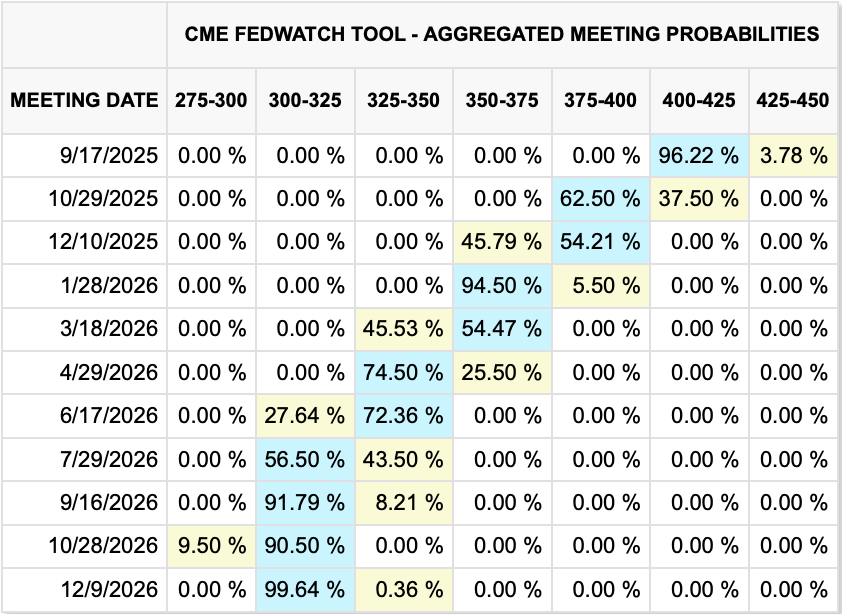
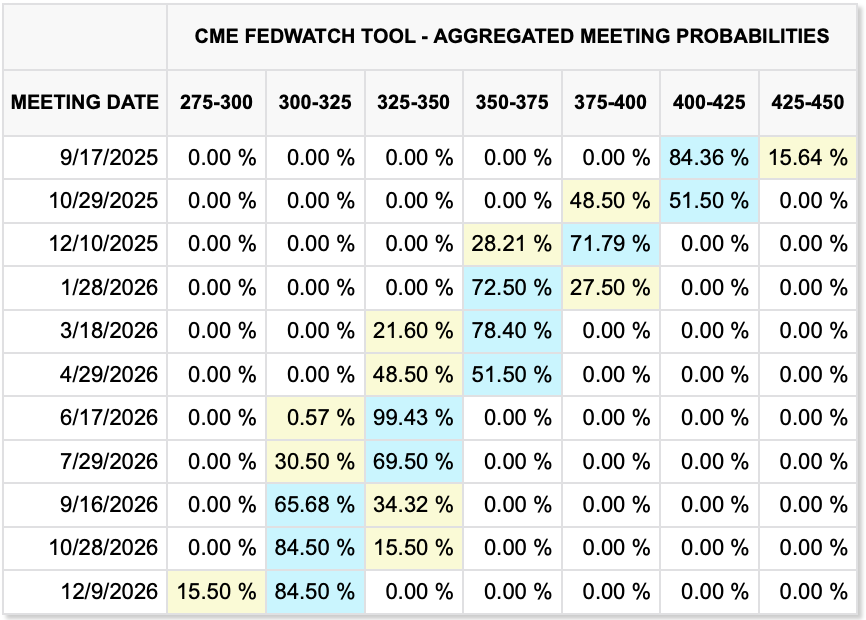
Here are the latest aggregated probabilities from the CME and before you say anything, I recognize the third cut is priced in January, but you need to allow me a little poetic license!

However, since I am just a poet and neither institutions nor algorithms listen to my views, the reality on the ground was that the lower headline CPI number appeared to be the driver yesterday and into today with equities around the world rallying in anticipation of Fed cuts.  As well, the dollar is under more severe pressure this morning on the same basis.  However, it remains difficult for me to look at the situation in nations around the world and conclude that the US economy is going to underperform in any meaningful way over time.  

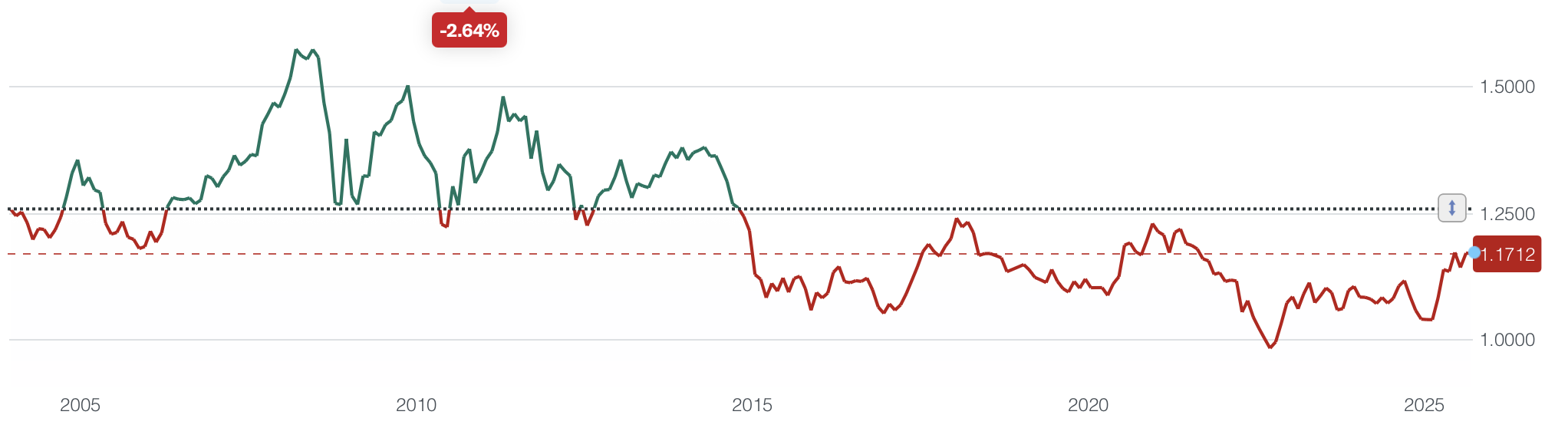
So, to the extent that a currency’s relative value is based on long-term economic fundamentals, it is difficult to accept that the dollar’s relative fiat value will decline substantially, and permanently, over time.  I use the euro as a proxy for the dollar, which is far better than the DXY in my opinion as the Dollar Index is a geometric average of 6 currencies (EUR, JPY, GBP, CAD, SEK and CHF) with the euro representing 57.6% of the basket.  And I assure you that in the FX markets, nobody pays any attention to the DXY.  Either the euro or the yen is seen as the proxy for the “dollar” and its relative value.  At any rate, if we look at a long-term chart of the euro below, we see that the twenty-year average is above the current value which pundits want to explain as a weak dollar.  Too, understand that back in 1999, when the euro made its debut, it started trading at about 1.17 or so, remarkably right where it is now!

Source: finance.yahoo.com

My point is that the dollar remains the anchor of the global financial system, and given the current trends regarding both economic activity and the likely ensuing central bank policies, as well as the ongoing performance of US assets on a financial basis, while short-term negativity on the dollar can be fine, I would be wary of expecting it to lose its overall place in the world.

Speaking of short-term views, especially regarding central bank activities, it appears clear that the market is adjusting the dollar’s value on this new idea of the Fed cutting more aggressively.  If that is, in fact, what occurs, I accept the dollar can decline relative to other currencies, but I really would be concerned about its value relative to things like commodities.  And that has been my view all along, if the Fed does cut rates, gold is going to be the big beneficiary.

Ok, let’s review how markets have absorbed the US data, as well as other data, overnight.  Yesterday’s record high closings on US exchanges were followed by strength in Tokyo (+1.3%), Hong Kong (+2.6%), China (+0.8%) despite the weakest domestic lending numbers in the history of the series back to 2005.  In fact, other than Australia (-0.6%) every market in Asia rallied.  The Australian story was driven by bank valuations which some feel are getting extreme despite the RBA promising further rate cuts, or perhaps because of that and the pressure it will put on their margins.  Europe, too, is rocking this morning with gains across the board led by Spain (+1.1%) although both Germany (+0.9%) and France (+0.6%) are doing fine.  And yes, US futures are still rising from their highs with gains on the order of 0.3% at this hour (7:45).

In the bond market, Treasury yields have slipped -3bps this morning, with investors and traders fully buying into the lower rate idea.  European sovereigns are also rallying with yields declining between -4bps and -5bps at this hour.  JGBs are the exception with yields there edging higher by 2bps, though sitting right at their recent “home” of 1.50%.  as you can see from the chart below, 1.50% appears to be the market’s true comfort level.

Source: tradingeconomics.com

In the commodity space, oil (-0.6%) continues to slide as hopes for an end to the Russia-Ukraine war rise ahead of the big Trump-Putin meeting on Friday in Alaska.  Nothing has changed my view that the trend here remains lower for the time being as there is plenty of supply to support any increased demand.

Source: tradingeconomics.com

Metals, meanwhile, are all firmer this morning with copper (+2.6%) leading the way although both gold (+0.4%) and silver (+1.7%) are responding to the dollar’s decline on the day.

Speaking of the dollar more broadly, its decline is pretty consistent today, sliding between -0.2% and -0.4% vs. almost all its counterparts, both G10 and EMG.  This is clearly a session where the dollar is the driver, not any particular story elsewhere.

On the data front, there is no primary data coming out although we will see the weekly EIA oil inventory numbers later this morning with analysts looking for a modest drawdown.  We hear from three Fed speakers, Bostic, Goolsbee and Barkin, with the latter explaining yesterday that basically, he has no idea what is going on and no strong views about cutting or leaving rates on hold.  If you ever wanted to read some weasel words from someone who has an important role and doesn’t know what to do, the following quote is perfect: “We may well see pressure on inflation, and we may also see pressure on unemployment, but the balance between the two is still unclear.  As the visibility continues to improve, we are well positioned to adjust our policy stance as needed.”  

And that’s all there is today.  The dollar has few friends this morning and I see no reason for any to materialize today.  But longer term, I do not believe a dollar weakening trend can last.

Good luck

Adf

Stock-pocalypse?

Inflation is on traders’ lips
As rate cuts now lead all their scripts
But what if it’s hot
And questions the plot?
Will that lead to stock-pocalypse?
 
Meanwhile pundits keep on complaining
That everything Trump does is straining
Their efforts to force
A narrative course
And so, their impact keeps on waning


It is CPI Day and there are several different stories in play this morning.  Naturally, the first is that President Trump’s dismissal of BLS head McEntarfar calls into question the veracity of this data, which has already been questioned because of a reduction in the headcount at the BLS.  While we cannot be surprised at this line of attack by the punditry, it seems unlikely that anything really changed at the BLS in the past week, especially since there is no new head in place yet.  

But the second question is how will this data impact the current narrative that the Fed is set to cut rates at each of the three meetings for the rest of this year?  At this hour (6:30) the probability, according to the CME futures market, of a September cut has slipped to 84.3% with a 72% probability of two cuts by year end as per the below table courtesy of cmegroup.com.

Interestingly, the market remains quite convinced that the trend in rates is much lower as there is a strong expectation of a total of 125 basis points of cuts to be implemented by the end of 2026.  I’m not sure if that is pricing in much weaker economic growth or much lower inflation, although I suspect the former given the ongoing hysteria about tariff related inflation.

To level set, here are the current median estimates for today’s release:

  • Headline: 0.2% M/M, 2.8% Y/Y
  • Core:         0.3% M/M, 3.0% Y/Y

Now, we are all well aware that the Fed uses Core PCE in their models, and that is what they seek to maintain at 2.0%.  But, historically, PCE runs somewhere between 0.3% and 0.5% below CPI, so no matter, they have not achieved their goal.  However, we continue to hear an inordinate amount of discussion and analysis as to why the latest NFP report signals that a recession is pending.  And in fairness, if one looks at indicators like the ISM employment indices, for both manufacturing and services they are at extremely low levels, 43.4 and 46.4 respectively, which have historically signaled recessions.  At the same time, concerns over inflation rising further due to tariffs and other policy changes remain front and center in the narrative.  In fact, one of the key discussion points now is the idea that the Fed will be unable to cut rates despite a weakening labor market because of rising inflation.  I’m not sure I believe that to be the case although the last time that situation arose, in the late 1970’s, Chairman Volcker raised rates to attack inflation first.  However, that doesn’t seem likely in the current environment.

Remember this, though, when it comes to the equity market, the bias remains bullish at all times.  In fact, I would suggest that most of the narratives we hear are designed with that in mind, either to attack a policy as it may undermine stocks, or to cheerlead something that is pushing them higher.  I suspect that the major reason any pundits are concerned over higher inflation is not because it is a bad outcome for the economy, but because it might delay Fed funds rate cuts which they have all concluded will lead to higher equity prices. After all, isn’t that the desired outcome for all policy?

Ok, as we await the data this morning, let’s see how things behaved overnight.  Yesterday’s lackluster US session was followed by a lot of strength in Asia.  Japan (+2.15%) led the way on a combination of stronger earnings from key companies and the news about tariff recalculations.  (remember, they were closed Monday).  China (+0.5%) and Hong Kong (+0.25%) benefitted from news that President Trump has delayed the tariff reckoning with China by 90 more days as negotiations remain ongoing.  Australia (+0.4%) was higher after the RBA cut rates 25bps, as expected, while Governor Bullard indicated further easing is appropriate going forward.  There was one major laggard in Asia, New Zealand (-1.2%) as tariffs on their exports rose to 15% and local earnings results were softer than forecast.

In Europe, the picture is mixed with Germany (-0.45%) the laggard after much weaker than expected ZEW Economic Sentiment data (34.7, down from 52.7 and below the 40.0 forecast).  As to the rest of the region, there are modest gains and losses, on the order of 0.15% or less with talk about what will come out of the Trump-Putin talks on Friday in Alaska and how that will impact the European defense situation.  As to US futures, at this hour (7:15) they are unchanged.

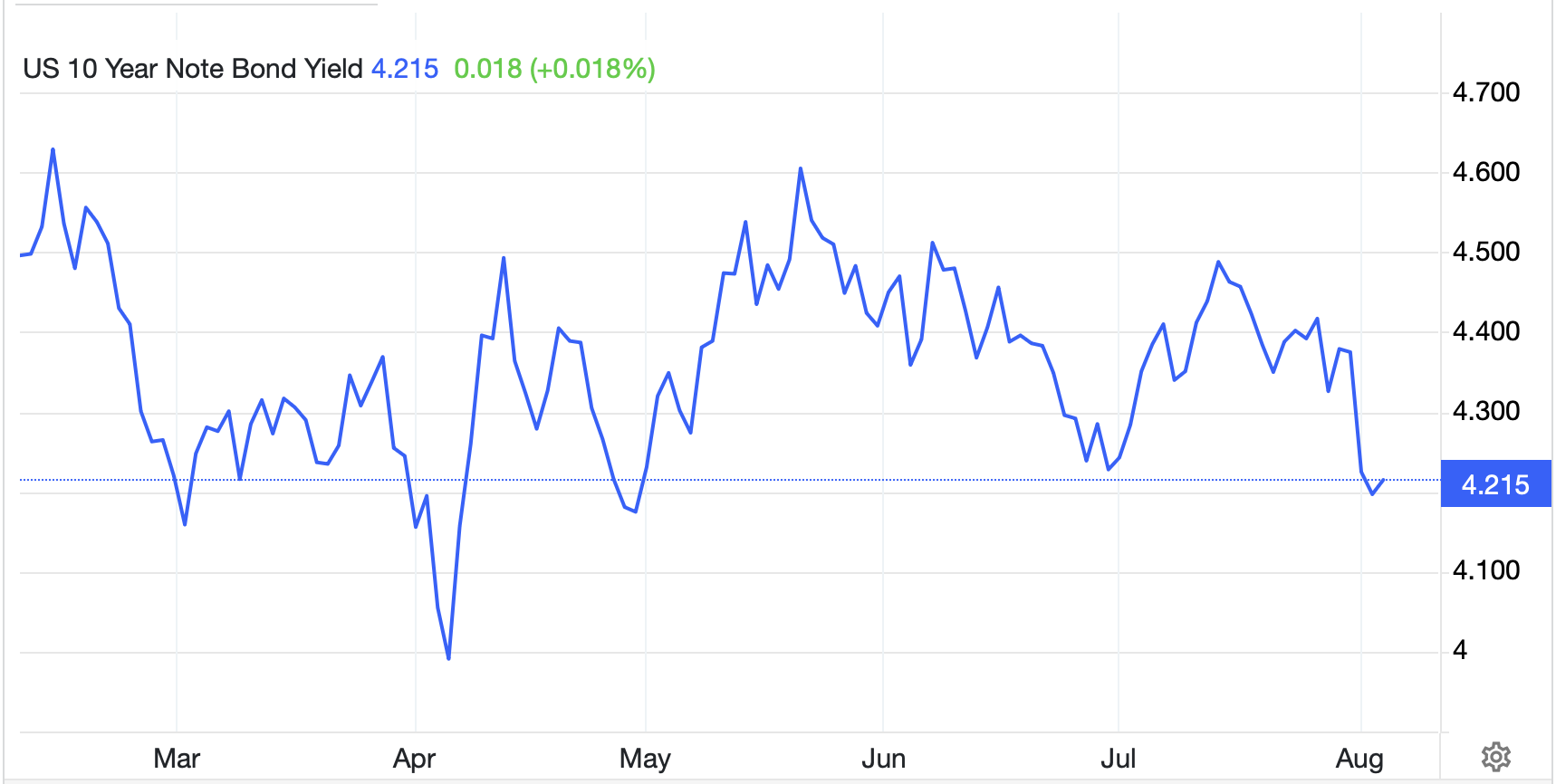
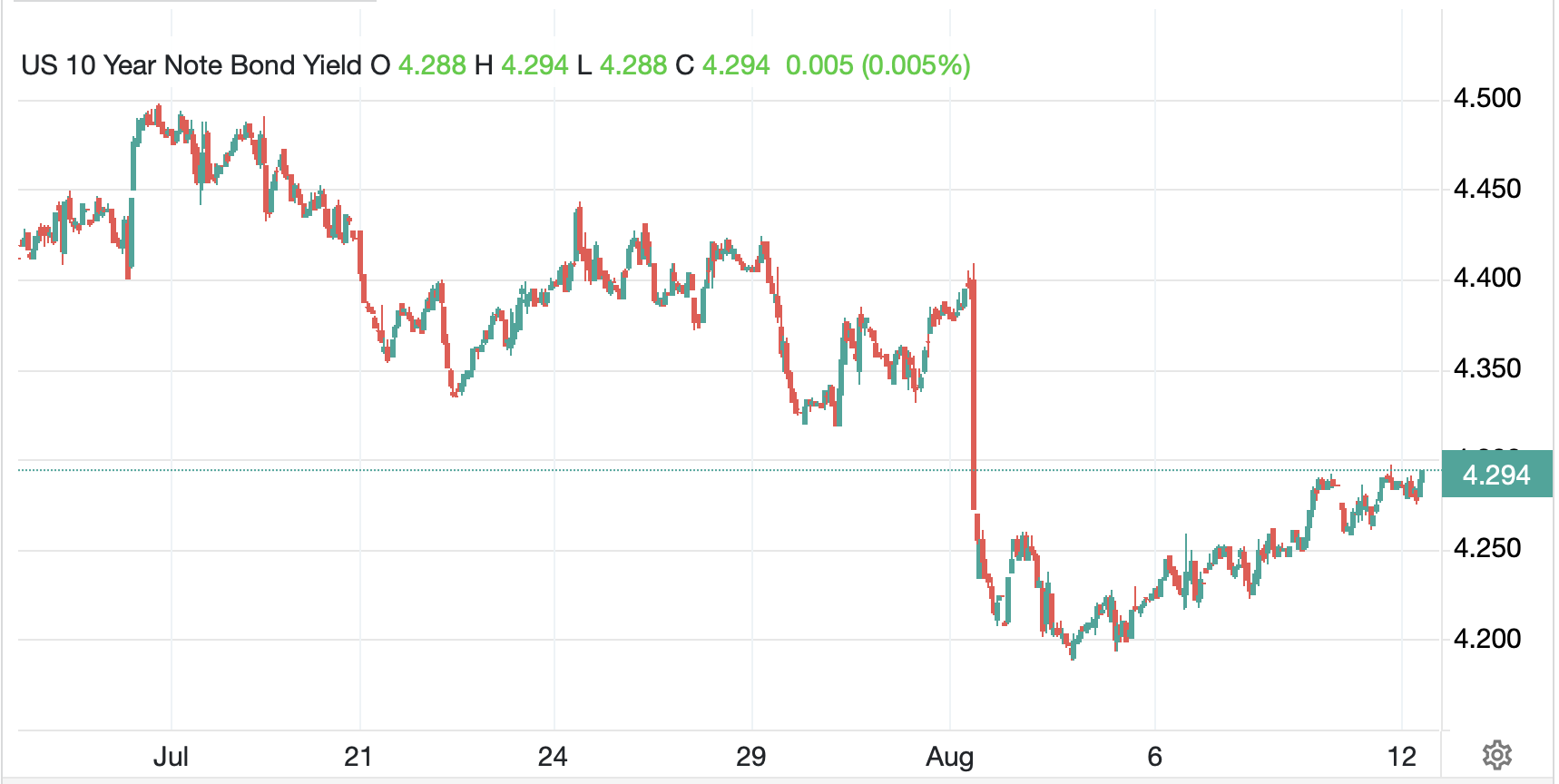
In the bond market, Treasury yields are unchanged this morning, remaining below 4.30% although still well below the recent peak at 4.50% in seen in mid-July.

Source: tradingeconomics.com

European sovereign yields are edging higher by 2bps across the board as investors show caution ahead of both the US CPI data as well as the uncertainty of what will come from the Trump-Putin talks.  However, UK gilts (+4bps) responded to better-than-expected payrolls data there, although the Unemployment Rate remained unchanged at 4.7%.

In the commodity markets, oil (-0.35%) is still in the middle of a narrow trading range as it seeks the next story, arguably to come from Friday’s talks, but potentially from this morning’s CPI data if it convinces people that a recession is imminent.  Metals markets are little change this morning, consolidating yesterday’s declines but not showing any bounce at all.

Finally, the dollar remains generally dull with the euro (-0.1%) unable to spark any life at all lately.  We did see AUD (-0.4%) slip after the rate cuts Down Under and in the EMG bloc, there is a bit of weakness, albeit not enough to note.  There was an amusing comment from Madame Lagarde as she tried to explain that now is the time for the euro to shine on a global reserve basis because of the perceived troubles of the dollar.  Not gonna happen, trust me.

And that’s really it for today.  Another summer day with limited activity as we all await both the data and the next story from the White House, as let’s face it, that is the source of virtually all action these days.  A soft print today ought to result in a rally in both equities and bonds while the dollar might slide a bit as the prognosis for a rate cut increases.  But a hot print will see the opposite as fear of stagflation becomes the story du jour.  Remember, too, two more Fed speakers, Barkin and Schmid, will be on the tape later this morning so watch for any dovishness there as both have been very clear that patience is their game.

Good luck

Adf

Widely Decried

While tariffs are widely decried
By analysts, they are worldwide
But Trump’s latest scheme
To some, seems extreme
As license fees are codified
 
So, tech names, who’ve, taxes, deflected
Are now likely to be subjected
To payment of fees
To sell overseas
And revenues will be collected


One thing you can never say about President Trump is that he lacks innovative ideas.  Consider one of the biggest complaints over the past decades regarding US corporations; the fact that the tech companies (and drug companies) have been so effective at avoiding paying taxes based on the way they have gamed utilized the tax code and international treaties.  And this was not a partisan complaint as both sides of the aisle were constantly frustrated by large companies’ ability to not pay their “fair share” as it is often described.

It appears that President Trump has come up with a solution for this, charging a licensing fee for companies to sell overseas.  The big news over the weekend was that Nvidia and AMD are both going to pay a licensing fee of 15% of REVENUE on sales of chips to China.  In the case of Nvidia, that is anticipated to be some $2.5 billion with somewhat smaller numbers for AMD.  This is an excellent description of the process by @Kobeissiletter on X. 

I have often expressed the view that corporate taxation, if we are going to have it, ought not be on profits but on revenue.  Corporations are expert at reducing taxable income, maintaining a staff of lawyers and accountants to do just that.  But gaming top line revenues is much harder.  This gambit by President Trump is moving things in that direction.  And remarkably, given these license fees are for exports, it ought to be outside the consumer price chain in the US completely.

There is an article in the WSJ this morning titled, “The US Marches Toward State Capitalism With American Characteristics,” which outlines, and mildly complains, about the changes in the way the US government is dealing with the private sector under President Trump.  It discusses the purchase of 15% of MP Materials, the only US based miner/processor of rare earth minerals, and it discusses these license fees all under the guise of implying this is a bad direction.  And I completely understand that idea as governments tend to be terrible stewards of capital.  However, 25 years of Chinese unfettered access to Western markets while they have skirted the rules codified by the WTO have resulted in some significant national security challenges that can no longer be ignored.  Full marks to President Trump for creative methods to address these challenges, despite the wailing and teeth gnashing of economists.

But other than that story, as well as the ongoing back and forth regarding potential peace talks in the Russia-Ukraine war, not all that much has happened overnight.  For a change, markets are behaving like it is the summer doldrums, so perhaps we should be thankful for the respite.  As such, let’s take a look at how things have done and what we can anticipate this week with CPI and Retail Sales set to be released.

Friday’s US equity rally combined with the news that Nvidia and AMD will be able to export some chips to China saw modest gains there (+0.4%) and in Hong Kong (+0.2%) even though another major property company in China, China South City Holdings Ltd., is being forced into liquidation.  The property situation in China will continue to weigh on the economy there and given property investment was long seen as most Chinese families’ retirement nest egg, will undermine consumption for years.  Elsewhere in the region, there were more gainers (India, Indonesia, Malaysia, Australia, New Zealand, Taiwan) than laggards (Thailand, Philippines) with Japan closed for Mountain Day, a relatively new holiday, and other markets little changed.  

In Europe, though, screens are modestly red with losses on the order of -0.35% across the CAC, DAX and IBEX amid general uncertainties regarding the future economic direction and a lack of earnings positives.  At this hour (7:00), US futures are slightly higher, by 0.2%.

In the bond market, after last week’s auctions have been absorbed, Treasury yields have edged lower this morning, down -2bps, despite Fed funds futures’ probability of that September rate cut slipping to 88% from Friday’s 93%.  In fact, Fed Governor Bowman reiterated over the weekend that she would be voting for a cut at each of the three meetings left this year.  European sovereigns though are little changed, with some having seen yields edge higher by 1bp, as this appears to be a truly lackluster summer day.

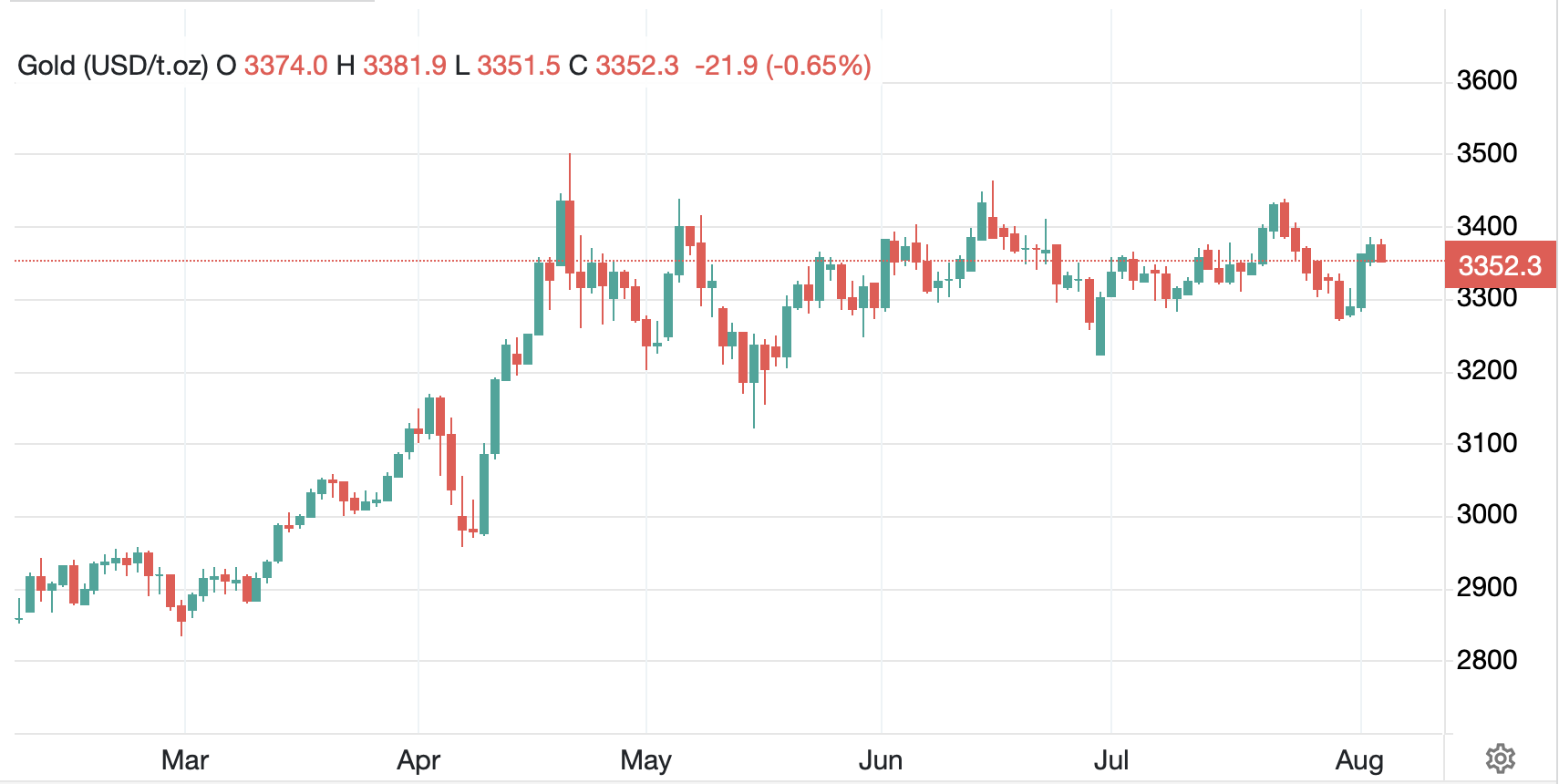
Commodities are the only market that is seeing any movement of note, and it is not oil (+0.2%) which has been trading either side of unchanged since last night.  Rather, gold (-1.2%) is suffering this morning as you can see on the chart below as the promise of a potential peace in Ukraine seems to be removing some need for its haven status.  Of course, the thing to really note about the gold market is just how choppy trading has been as conflicting narratives continue to impinge on price movement.

Source: tradingeconomics.com

This decline has pulled down both silver (-1.4%) and copper (-0.95%) with all this happening despite virtually no movement in the FX markets.

Turning to the dollar, one is hard pressed to find any substantial movement in either G10 or EMG currencies. The true outlier this morning is NOK (+0.4%) but otherwise, +/- 0.1% or less is the best description of the price action.  This is what a summer market really looks like!

On the data front, we do get some important information as follows:

TuesdayRBA Rate Decision3.60% (current 3.85%)
 CPI0.2% (2.8% Y/Y)
 Ex food & energy0.3% (3.0% Y/Y)
 Monthly Budget Statement-$140B
ThursdayPPI0.2% (2.5% Y/Y)
 Ex food & energy0.2% (2.9% Y/Y)
 Initial Claims226K
 Continuing Claims1960K
FridayRetail Sales0.5%
 Ex Autos0.3%
 IP0.0%
 Capacity Utilization77.6%
 Michigan Sentiment62.0

Source: tradingeconomics.com

With all the hoopla about the firing of Ms McEnterfar at BLS, you can be sure that there will be lots of discussion on the CPI data regardless of the outcome.  However, as the Inflation Guy pointed out last week, imputing the bottom 30% of items in the basket, which represent something on the order of 2.5% of the total price impact, is likely to have no impact whatsoever.  We also hear from a bunch of Fed speakers, four to be exact, although Richmond Fed President Barkin will regale us twice.  Now that there are more calls for a September cut, it will be interesting to see who remains patient and who is ready to move.

And that’s all there is today.  It is hard to get excited about too much movement given the lack of obvious catalysts.  Of course, one never knows what will emanate from the White House but look for a quiet one, I think.

Good luck

Adf

You Need to Squint

While data continues to print
It doesn’t give much of a hint
To where things are going
Unless you’re all-knowing
And even then, you need to squint
 
The reason for this situation
Is passive flows constant inflation
No matter the news
Or anyone’s views
The target funds need their proration


The hardest thing about macroeconomic analysis is trying to discern whether it has any impact on market movement.  For the bulk of my career, my observation was that while there were always periods when flows dominated fundamentals, they were short-lived periods and eventually those fundamentals returned to dominance in price action.  This was true in equity markets, where earnings were the long-term driver, outlasting short-term bouts or particular manias and this was true in FX markets, where economic performance and the ensuing interest rate differentials were the key long-term driver of exchange rates.  Bond markets were virtually always a reflection of inflation expectations, at least government bond markets and commodities were simple products of supply and demand of the physical stuff.

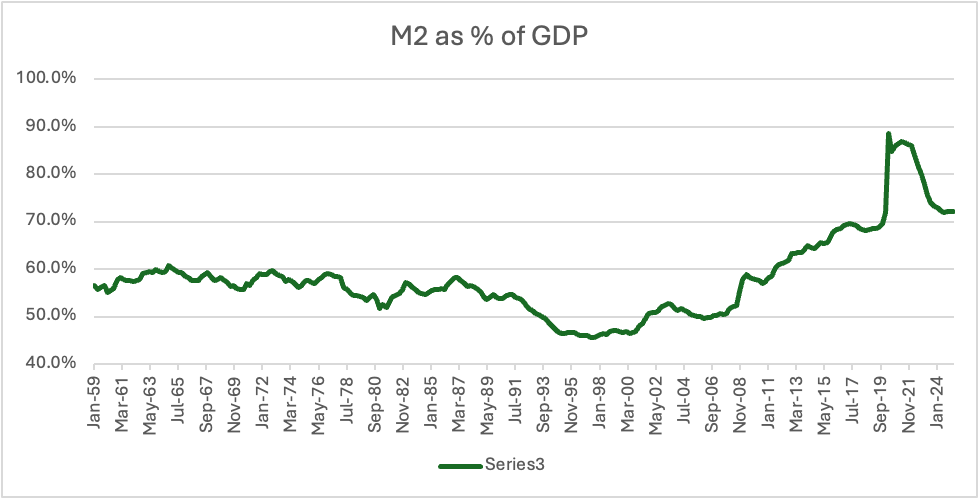
Alas, since the GFC, and more importantly, the global central bank response to the GFC, flooding financial markets with massive amounts of liquidity, G10 economies have become increasingly finanicialized to the point where the underlying fundamentals have less and less impact and funds flows are the driving force.  The below chart I have created from FRED data shows the ratio of M2 relative to GDP.  For decades, this ratio hovered between 53% and 60%, chopping back and forth with the ebbs and flows of the economy during recessions and expansions.  But the GFC changed things dramatically and then the pandemic and its ensuing response put financialization on steroids.

By 2011, this ratio hit 60% for the first time since 1965, and it has never looked back.  The result is that there is ever more money sloshing around the economy looking for a home with the best return.  This is part and parcel as to why we have seen both massive asset price inflation as well as consumer price inflation, too much money chasing too few goods.  And this is the underlying facet in why funds flows, whether between asset classes or between nations, are the new driving force of market price action.  Michael Green (@profplum99 on X) has done the most, and most impressive, work on the rise of passive investing, which is a direct consequence of this financialization.  The upshot is, as long as money comes into the system (your semi-monthly 401K flows are the largest) they continue to buy stocks regardless of anything fundamental.  And as almost all of it is capitalization weighted, they buy the Mag7 and maybe some other bits and bobs.  It doesn’t matter about fundamentals; it only matters how much they have to buy.

So, with that caveat as to why fundamental macro analysis has been doing so poorly lately, a look at the data tells us…nothing really.  As I wrote yesterday, the two main blocs of the economy, goods production and services production, are out of sync, with marginal strength in services outweighing marginal weakness in goods production and resulting in slow growth.  Whether you look at the employment situation, the ISM data or the inflation data, none of it points in a consistent and strong direction.

For instance, yesterday’s productivity and Labor cost data were better than expected, far better than last quarter’s and pointing to an improved growth outcome.  However, if we look at the past five years of this data, we can see that labor costs have grown dramatically faster than productivity as per the below chart (ULC in grey, Productivity in blue).

Source: tradingeconomics.com

Looking at this, it is no surprise that price inflation has risen so much, given labor’s impact on prices.  But, again, this is merely another impact of the massive flow of money into the economy over the past 15 years. 

Virtually every piece of data we get has been significantly impacted by this financialization which is one reason that previous econometric models, built prior to the GFC, no longer offer effective analysis.  The system is very different.  I continue to believe that over time, fundamentals will reassert themselves, but that belief structure is under increased pressure.  Perhaps YOLO and BTFD are the future, at least until our AI overlords come into their own and enslave the human population.

In the meantime, let’s look at what happened overnight.  Yesterday’s mixed, and relatively dull, US session was followed by a mixed session in Asia with Tokyo (+1.85%) soaring on news that there were going to be adjustments, in Japan’s favor as well as rebates, to the tariff schedule.  However, both the Hang Seng (-0.9%) and CSI 300 (-0.3%) saw no such love from either the Trump administration or investors.  As to the rest of the region, red (Korea, Australia, India, Thailand, Singapore) was more common than green (Malaysia).  Apparently, tariff adjustments are not universal.  In Europe, both Spain (+0.8%) and Italy (+0.8%) are having solid sessions but they are alone in that with the other major bourses (DAX 0.0%, FTSE 100 0.0%, CAC +0.2%) not taking part in the fun.  US futures, at this hour (7:30) are higher by about 0.4%.

Bond markets, meanwhile, are sleeping through the final day of the week, with Treasury yields unchanged on the day and European sovereign yields having edged higher by just 1bp across the board.  It seems, nobody cares right now.  After all, it is August and most of Europe is on vacation anyway.

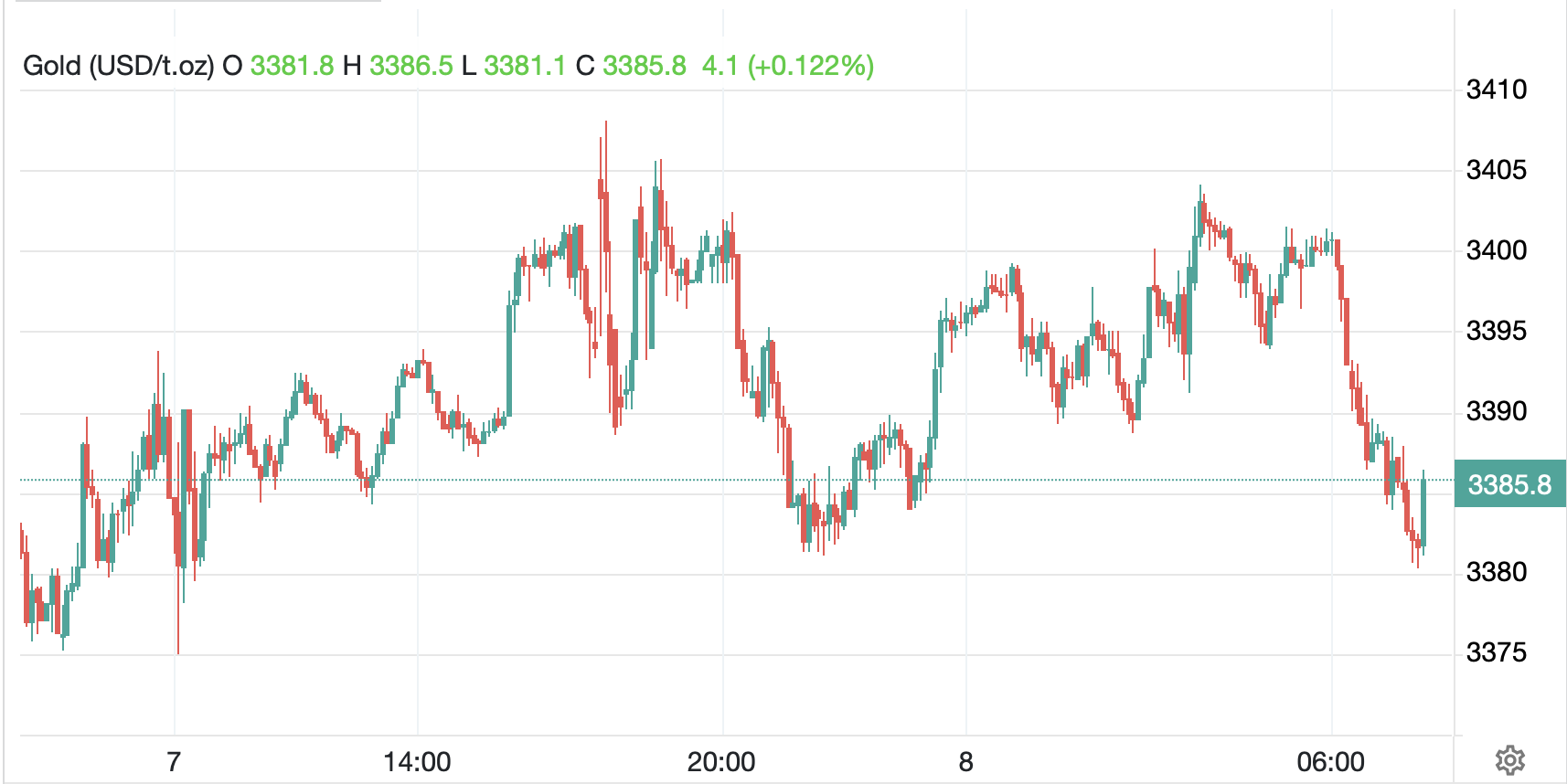
Commodity markets are showing oil (+0.6%) bouncing off its recent lows, but this seems more about trading activity than fundamental changes.  Perhaps there will be a Russia-Ukraine peace, but it is certainly not clear.  Trump’s tariffs on India for continuing to buy Russian oil are also having an impact, but as I showed yesterday, I believe the trend remains modestly lower.  Gold (-0.3%) is currently lower but has been extremely choppy as you can see from the 5-minute chart below

Source: tradingeconomics.com

This is a market where supply and demand dynamics have been impacted by both tariffs and the interplay between financialized markets (i.e. paper gold or futures) and the actual metal.  There are many theories as to different players trying to manipulate the price either higher (the Trump administration in order to revalue Ft Knox holdings) or lower (the ‘cabal’ of banks that have ostensibly been preventing the price from rising according to the gold bug conspiracy theorists).  Recently, there has apparently been less central bank demand, but that can return at any time based on political decisions.  I continue to believe that it is an important part of any portfolio, but it should be tucked away and forgotten in that vein.  As to the other metals, they are little changed this morning.

Finally, the dollar is stronger this morning, as the euro (-0.3%) and yen (-0.65%) are both under pressure and leading the way.  In fact, virtually every G10 currency is weaker (CAD is unchanged) and yet the DXY seems to be weaker as well. Something is amiss there.  Meanwhile, EMG currencies are mostly down on the session with KRW (-0.5%) the laggard, but weakness in INR (-0.2%), PLN (-0.25%) and CZK (-0.25%). 

On the data front, there is none today.  Yesterday, Atlanta Fed president Bostic explained his view that only one rate cut was likely this year, which is not what we have been hearing from other FOMC members.  Obviously, there is still uncertainty at the Fed, but they also have more than a month to decide.  Today, we hear from KC Fed president Alberto Musalem, one of the more hawkish members, so it will be interesting to see if he has changed his tune.

I would contend that confusion is the driving force in markets because data markers are not pointing in one direction nor are Fed speakers.  But it is a Friday in August so I suspect it will be a quieter day as traders look to escape to the beach for the weekend.  This morning’s trends, a higher dollar and higher stock prices, seem likely to prevail for the day.

Good luck and good weekend

Adf
A Bevy of Doves

The Fed has a bevy of doves
Whose world view was given some shoves
When Trump was elected
As they were subjected
To boxing, though without the gloves
 
But suddenly, they’ve found their voice
And rate cuts are now a real choice
So, bad news is good
And traders all should
Buy stocks every day and rejoice


Apparently, the signal has been given from on high at the Marriner Eccles building that discussing rate cuts is permitted.  Patience is no longer the virtue it was just last week.  In the past two days, three different FOMC members, Daly, Cook and Goolsbee, have returned to form and are quite open to cutting rates sooner after the recent employment data.  I would contend that rate cuts are their natural stance, but they were discouraged from expressing that view because it would put them in sync with the president, something that they very clearly have worked to avoid.  Regardless of the history, the Fed funds futures market is now pricing in a 93.2% probability of a cut next month as you can see below.  Perhaps more interesting is the fact this probability has risen from 37.7% in just the past week.  My how quickly things can change.

Source: cmegroup.com

I’m sure you recall that one of the key reasons Chairman Powell and his acolytes described the need to remain patient was the potential impact of tariffs on inflation.  This was even though the universal view was tariffs, a new tax, would be a one-off price increase, so would have no long-term impact, and that higher interest rates would do nothing to fight this particular cause of inflation, just like the price of food doesn’t respond to interest rates.  However, I want to highlight a piece from the WSJ this morning that asks a very good question, why wasn’t Powell concerned about all the tax increases from the previous administration, or for that matter, the tax increase that would have occurred had the BBB not been enacted.  Again, all the discussion that the Fed is apolitical is simply not true and never has been.

Moving on, I wanted to follow up on yesterday’s discussion as I, along with many market observers, have been trying to come to grips with the inconsistency in the data.  Some is strong, other parts are weak, and it is difficult to arrive at a broad conclusion.  My good friend, the Inflation_Guy™ put out a podcast the other day and made an excellent point, historically, there was a synchronicity between activity in the goods sector and the services sector, so when things in either sector started to decline (or rise) it took the other sector along with it.  But that is not currently the case.  

Instead, what we have seen is asynchronous behavior with the correlation between prices in the two sectors essentially independent of each other over the past five years, rather than tracking each other as they had done for the previous 30 years.  Extending the price action to overall activity, which seems a reasonable concept as prices follow the activity, depending on the data you observe, you may see strength or weakness, rather than everything heading in the same direction.  However, it is worthwhile to remember that systems in nature eventually do synchronize (see this fantastic clip) and so eventually, I suspect that both sectors will do so and a full blown recession (or expansion) will materialize.  Just not this week!

Which takes us to markets and how they have been responding to all the tariff news.  I think you can make one of the following two arguments regarding equity investors; either they have absorbed the tariff information and ensuing changes in trade behavior and have decided that earnings will continue to grow apace, or, they have no idea that there is a cliff ahead and like the lemmings they are, they are rushing toward the abyss.  Perhaps it is simply that President Trump has discussed tariffs so much that they have become the norm in any analysis thought process, and so modest adjustments don’t matter.  But whatever the reason, we continue to see strength pretty much across the board here.

The rally in the US yesterday was followed by strength across almost all of Asia with gains in Tokyo (+0.7%) and Hong Kong (+0.7%) as well as Korea, India and almost all regional bourses.  China, however, was unchanged on the session after their trade balance rose a less than expected $98.2B, as imports rose more than expected.  However, as this X post makes clear, it should be no surprise given the renminbi’s real exchange rate continues to fall, hence their exports remain quite competitive, tariffs or not.  As to Europe, strength is the word here as well (DAX +1.5%, CAC +1.2%, IBEX +0.5%) although the FTSE 100 (-0.5%) is lagging ahead of this morning’s expected BOE rate cut.  And don’t worry, US futures are higher across the board as well.

In the bond market, yields have been edging higher with Treasury yields up 2bps after yesterday’s 10-year auction was not as well received as had been hoped, but then, yields were 25 basis points lower than just a week ago, so demand was a little bit tepid.  European sovereign yields are also edging higher, mostly higher by 1bp and we saw the same thing overnight in JGBs, a 2bp rise.

In the commodity markets, oil (+0.6%) has found a short-term bottom, but is just below $65/bbl, which seems like a trading pivot of late as can be seen by the chart below from tradingeconomics.com.  As my personal bias is that the price is likely to decline going forward, the 6-month trend line heading down does appeal to me, but for now, choppy is the future.

Meanwhile, metals markets are in fine fettle this morning (Au +0.4%, Ag +1.4%, Cu +0.15%) as the dollar’s recent weakness seems to be having the expected effect on this segment of the market.

Speaking of the dollar, as more tariffs get agreed, I am confused by its weakness since I was assured that the response to higher US tariffs would be a stronger dollar.  But arguably, the fact that the Fed is suddenly appearing much more dovish is the driver right now, and while the euro is little changed this morning, we are seeing the pound (+0.4%), Aussie (+0.3%) and Kiwi (+0.4%) all move up, although the rest of the G10 space is higher by scant basis points.  In the EMG bloc, movement, while mostly higher in these currencies, is also measured in mere basis points, with INR (+0.25%) the largest mover by far.  Arguably, it is fair to say the dollar is little changed.

On the data front, the BOE did cut rates 25bps as expected, although the vote was 5/4, a bit more hawkish than forecast which is arguably why the pound is holding up so well.  US data brings Initial (exp 221K) and Continuing (1950K) Claims as well as Nonfarm Productivity (2.0%) and Unit Labor Costs (1.5%).  This is a much better mix of this data than what we saw in Q1 with productivity falling -1.5% while ULC rose 6.6%.  That was a stagflationary outcome.  In addition, we hear from two more Fed speakers, Bostic and Musalem, as the Fed gets back in gear this week.  It will be interesting to see if they are more dovish as neither would be considered a dove ex ante.

Apparently, we are back on board the bad news is good for stocks train, and it is hard to fight absent a collapse in earnings or some other catalyst.  As such, with visions of Fed cuts dancing in traders’ heads, I suspect the dollar will remain under pressure for a while.

Good luck

Adf

Bears’ Chagrin

The talk of the town is the Fed
And who Mr Trump will embed
As governor, next
Amid a subtext
That Powell, by May, will have fled
 
Meanwhile, other stories are muted
As tariffs’ impact seem diluted
And earnings have been,
To most bears’ chagrin,
Much better than had been reputed


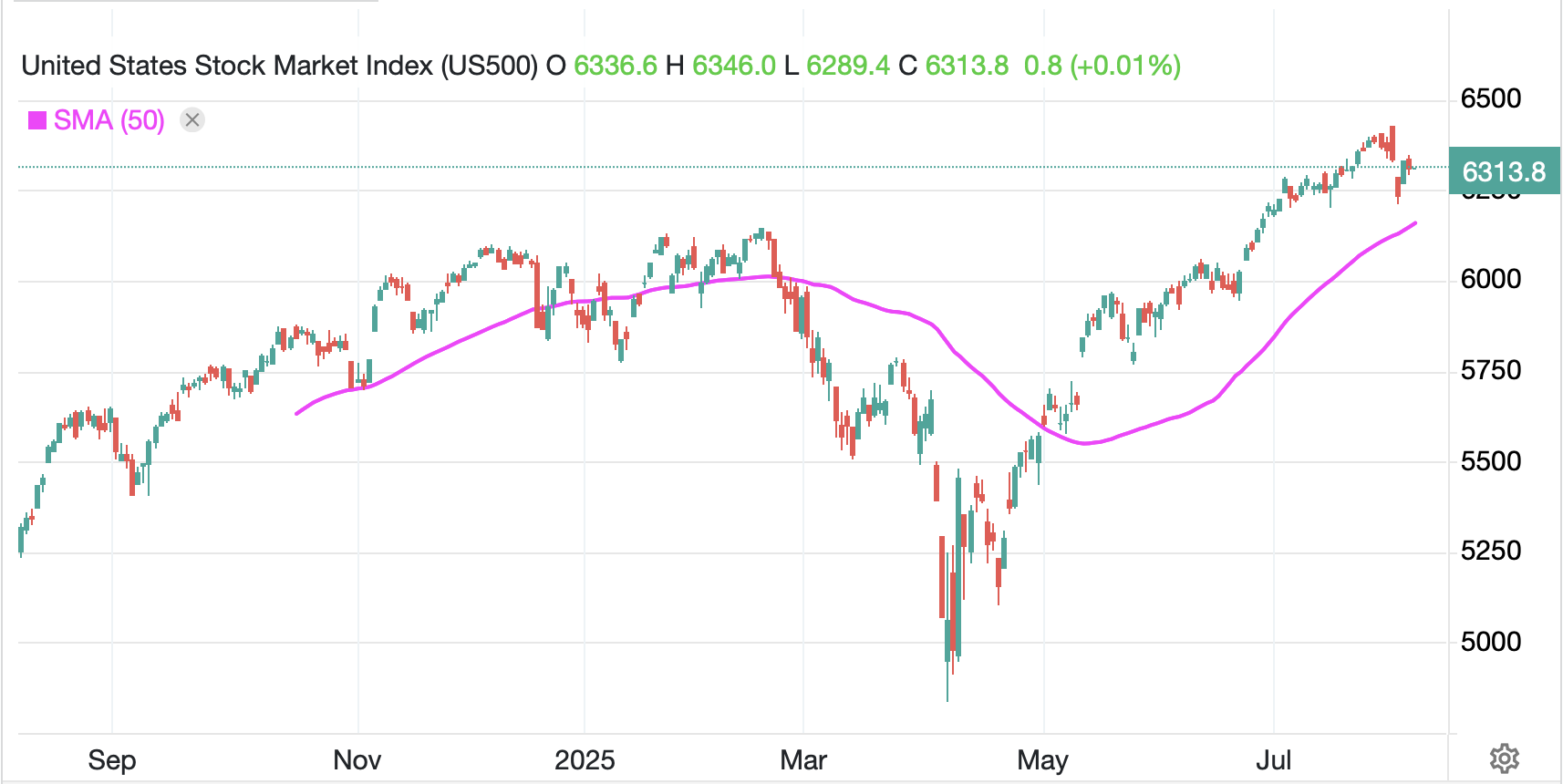
Yesterday was a modest down day in equities, although the trend remains clearly higher at this point as evidenced by the chart below.  As well, the price action remains well above the 50-day moving average, a key technical indicator defining the trend, with no indication it is set to retrace there.  As of this morning, we are sitting about 2.5% above that average, so a decline of that magnitude will be necessary to get tongues wagging about a change.

Source: tradingeconomics.com

This is not to say that everyone is sanguine about the situation as just yesterday, three investment banks, Morgan Stanley, ISI Evercore and Deutsche Bank, all put out research calling for a retracement in the near term.  Certainly, the recent data has been mixed, at best, with still a lot of discussion regarding last Friday’s weak NFP data.  Meanwhile, the ISM Services data was weak (50.1 vs 51.5 expected), while the PMI Services was strong (55.7 vs 55.2 expected).  

Corporate earnings continue to be solid, with about two-thirds of the S&P 500 having reported Q2 numbers and 82% have beaten EPS estimates, higher than the recent 5-year average, and the growth rate at 10.3% on a quarterly basis.  This does not seem indicative of the recession that many continue to claim is ongoing or imminent.

But let us take this time to briefly consider both sides of the argument regarding the future of the economy, and by extension financial market activity.

On the plus side, while the NFP number was soft, the Unemployment rate remains at 4.2%, in the lowest quintile since 1948 as per the below chart.  

As well, Initial Claims data, the most frequent labor market data that is available, remains at the 13thpercentile, an indication that despite a great deal of concern by a certain segment of analysts, the labor market is still pretty strong.  In fact, the last time Initial Claims was this low during a recession, in 1970, the US population was about 205 million compared to today’s 340 million.  After all, this has been the issue on which Powell has been hanging his hat, and why Friday’s NFP number changed the narrative regarding the Fed.

The most recent GDP data was also quite positive, with Q2 growing at 3.0%, better than expected and then yesterday we saw the Trade deficit shrink to -$60.2B, its smallest level since September 2023.  Trade, though, is a double-edged sword as a smaller deficit could indicate weaker domestic demand, or it could indicate stronger domestic supply.  Naturally, this is the president’s goal, to achieve the latter, hence his tariff blitz.

As to inflation, it is off its recent lows, and remains well above the Fed’s 2.0% target, but with core CPI at 3.0%, it is hardly hyperinflationary.  The tariff impact remains uncertain at this point as so far, it appears many companies are eating a significant portion.  I guess that will become clearer in the Q3 earnings reports, although analysts continue to forecast strong growth there.  

So, across jobs, growth and inflation, there is a case to be made that things are doing fine.  Add to this the idea that fiscal stimulus is unlikely to end, merely be redirected from the previous administration’s favorites to this one’s, and you can understand the view that things are pretty good.

However, the other side of the story continues to have many adherents as well.  Most of the negative outlook comes from digging underneath the headline numbers and extrapolating out to the negative trends that may exist there blooming into the full story.

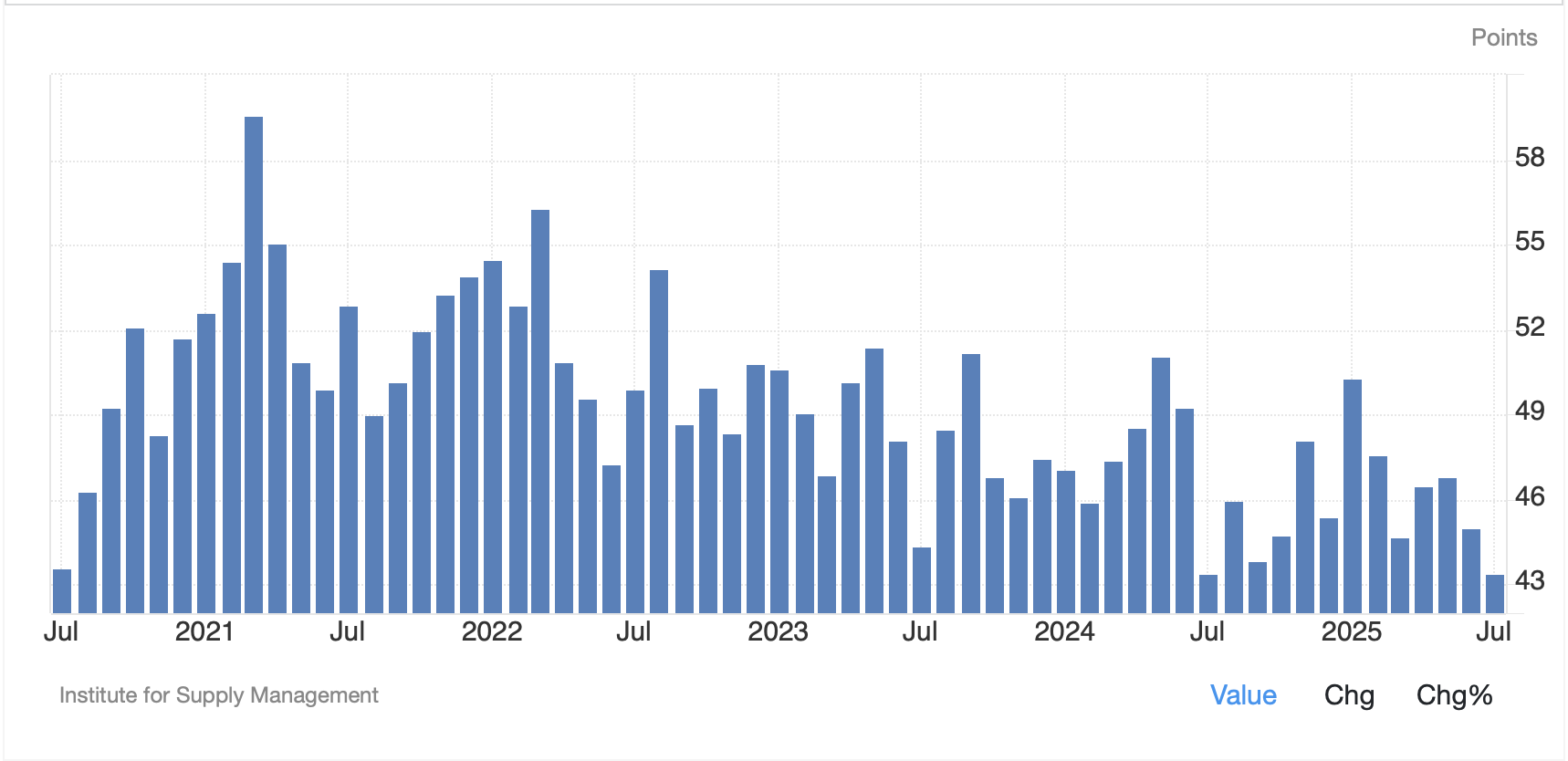
For instance, regarding employment data, while the headlines have been ok, ISM Manufacturing Employment has fallen to 43.4, its lowest level in more than 5 years and pretty clearly trending lower, even on a cyclical basis as per the below chart.

Source: tradingeconomics.com

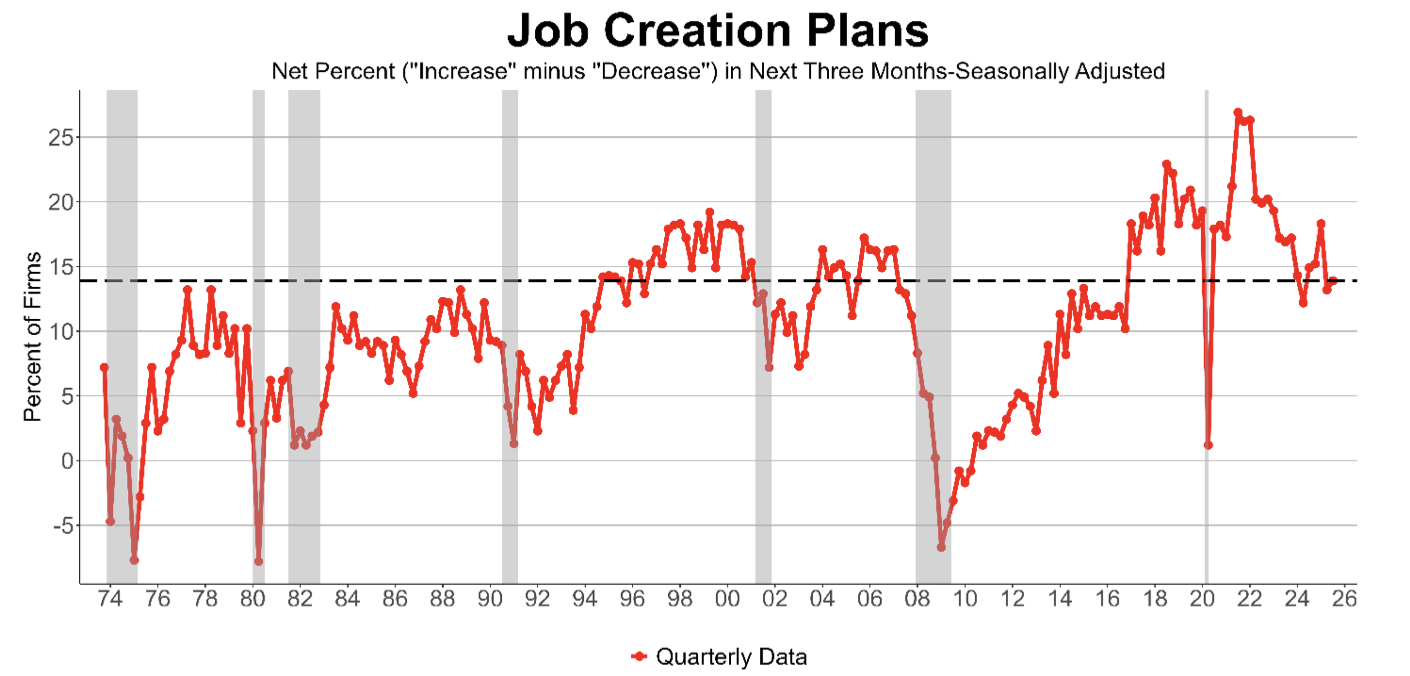
Too, ISM Services employment has fallen to 46.4 (anything under 50.0 indicates recession-type weakness). NFIB Employment surveys are negative, with small businesses planning to create fewer jobs in the next three months as per the below chart from the NFIB July report.

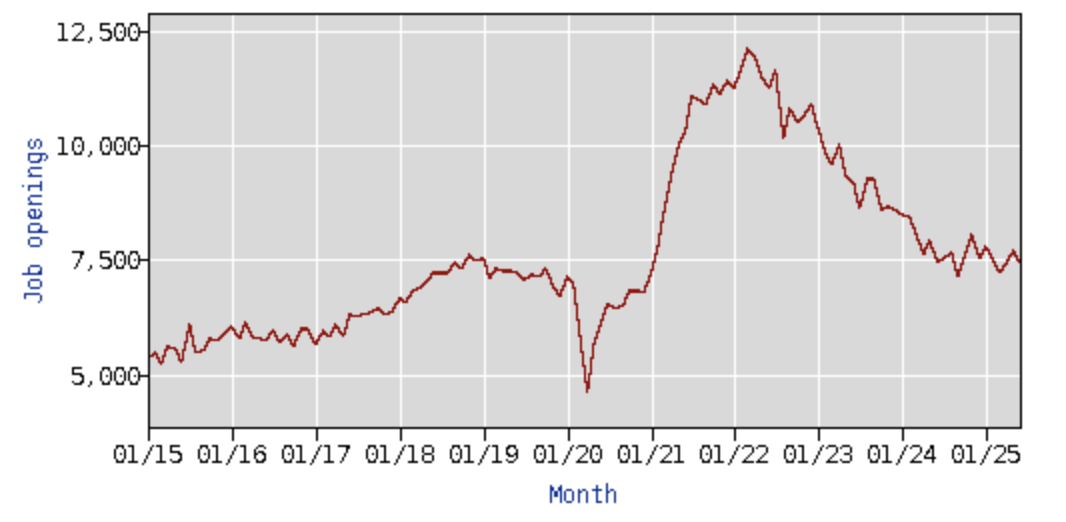
Challenger job cuts are rising again, with much of the blame put on AI.  JOLTS Job Openings have been trending lower since Covid, but it is difficult to really tell there, as the levels are far above pre-Covid data as per the below BLS chart.

There is also a hue and cry that the deportations are removing a significant number of manual workers in fields like construction and agriculture, which is likely true.  However, as I highlighted earlier in the week, the mix of employed in the US has turned to a greater proportion of US-born workers vs. foreign-born workers with net growth.  So, perhaps many of those jobs are being filled anyway.

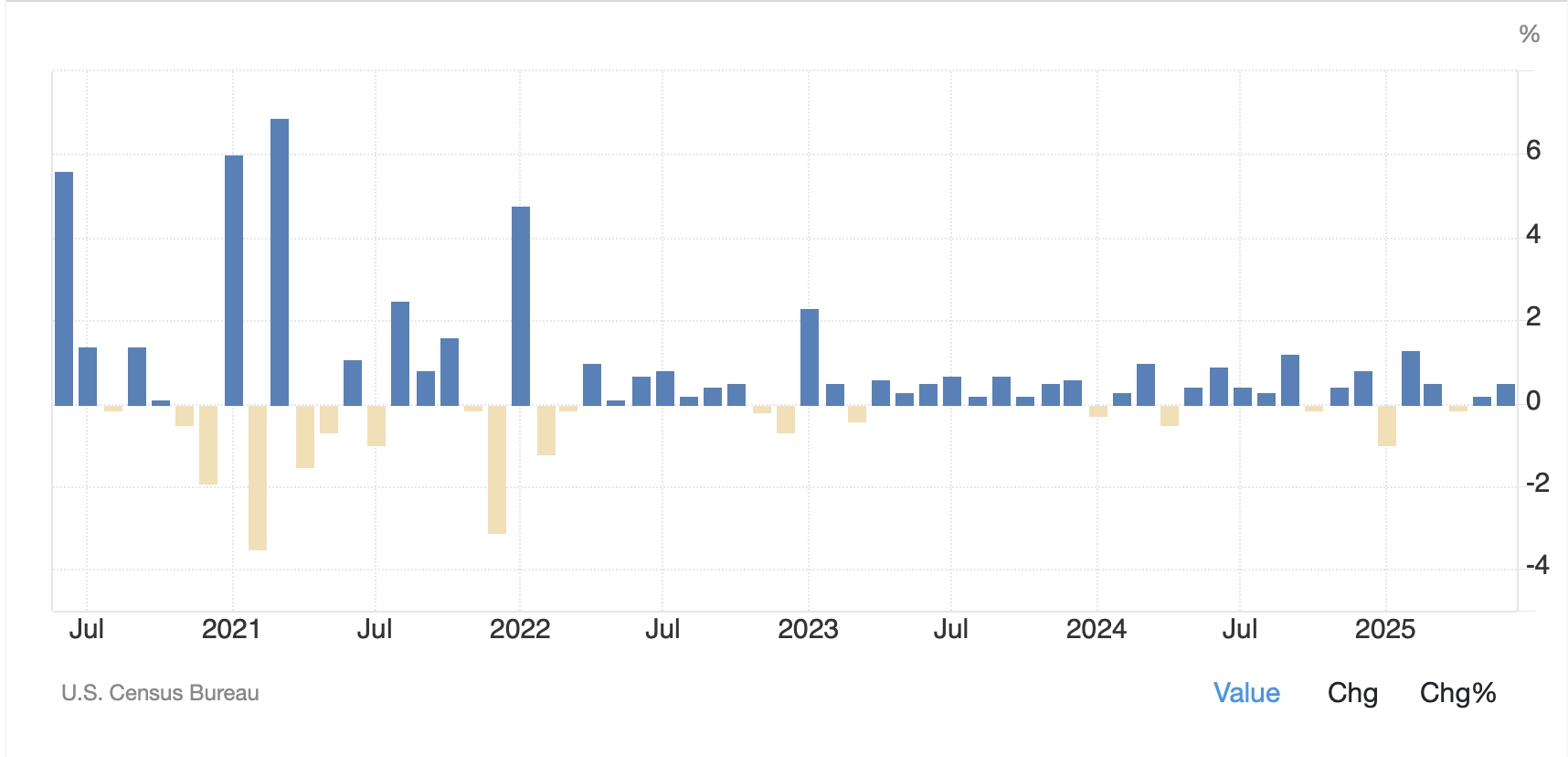
From a GDP perspective, the economic bears tend to dig into the pieces and have focused on declining consumption data although Retail Sales continues to motor along pretty well, rising 5.3% in the past twelve months when looking at the control group (excluding food services, auto dealers, building materials and gas stations) which is what is used in the GDP data.  I am hard-pressed to look at the below chart and explain a dramatic slowing in growth.

Source: tradingeconomics.com

As to inflation, there continues to be a strong set of beliefs that tariffs are going to create a significant uptick, although it has yet to appear.  ISM Prices paid did rise in Services, to 69.9, their highest level since the retreat from the 2022 “transitory inflation”.

Source: tradingeconomics.com

However, ISM Manufacturing prices appear to be stabilizing after some recent increases.  The overall ISM price data is more worrisome as tariffs are only going to be on goods, and if services prices are rising, that is likely to feed through to general inflation more directly.  

Concluding, we seem to be an awful long way from stagflation that some analysts are calling for as growth continues apace and there is no indication that fiscal stimulus is going to end.  Rather, I would expect that we will see overall hotter growth, with higher prices coming alongside, and likely higher wages as well.  I still have trouble seeing the collapsing US economy story, although things are hardly perfect.

And how will this impact markets?  Well, broadly, while equities have clearly had an impressive run, and the trend is your friend, a pullback would not be a huge surprise.  But dip buyers will be active, of that you can be sure.  

As to bonds, if the US does run things hot, unless the budget deficit starts to shrink substantially, with the next release coming on August 12, yields are very likely to continue to remain bid.  Right now, the curve is steepening because traders are banking on the Fed to cut next month so the 2yr yield has fallen sharply.  But if growth remains strong, I would say there is a floor to yields although absent a significant rise in inflation, I don’t see them exploding higher either.  And if the BBB actually does generate more revenue and reduce the budget deficit, look for yields to decline anyway.  

Finally, the dollar should do well unless the Fed become aggressive.  That story is too difficult to forecast given the machinations on the board and the questions of who the next Fed chair will be.  As I have written before, in the short and medium term, a dollar decline is quite viable, but long term, most other nations have much bigger problems than the US, and I think investment will ultimately flow in this direction.

My apologies for the length of the opening and given the fact that there is so little happening in markets, with just a little back and forth, I will skip the recap.

Good luck

Adf

Misguided

On Friday, the news was a sign
Of imminent US decline
The Fed was a hawk
And all of the talk
Was Trump’s actions wiped off the shine
 
But yesterday, markets decided
That Friday’s response was misguided
They’ve come to believe
A Fed funds reprieve
By Powell will soon be provided


As I have frequently written in the past, markets are perverse.  The narrative Friday was about the dire straits in which the US found itself with the employment situation collapsing and the recession that has been forecast for the past three years finally upon us.  Part of this story was because of the Fed’s seeming intransigence regarding interest rates as made clear by Chairman Powell’s relatively hawkish comments at the FOMC press conference last week.

But that story is sooo twenty-four hours ago. In the new world, the huge bond market rally that was seen on Friday, and equally importantly, the changing pricing of Fed funds rate cuts has the new narrative as, the Fed is going to cut so buy stonks!  Confirmation of this new narrative was provided by SF Fed President Mary Daly who remarked yesterday evening, “time is nearing for rate cuts, may need more than two.”  All I can say is wow!  

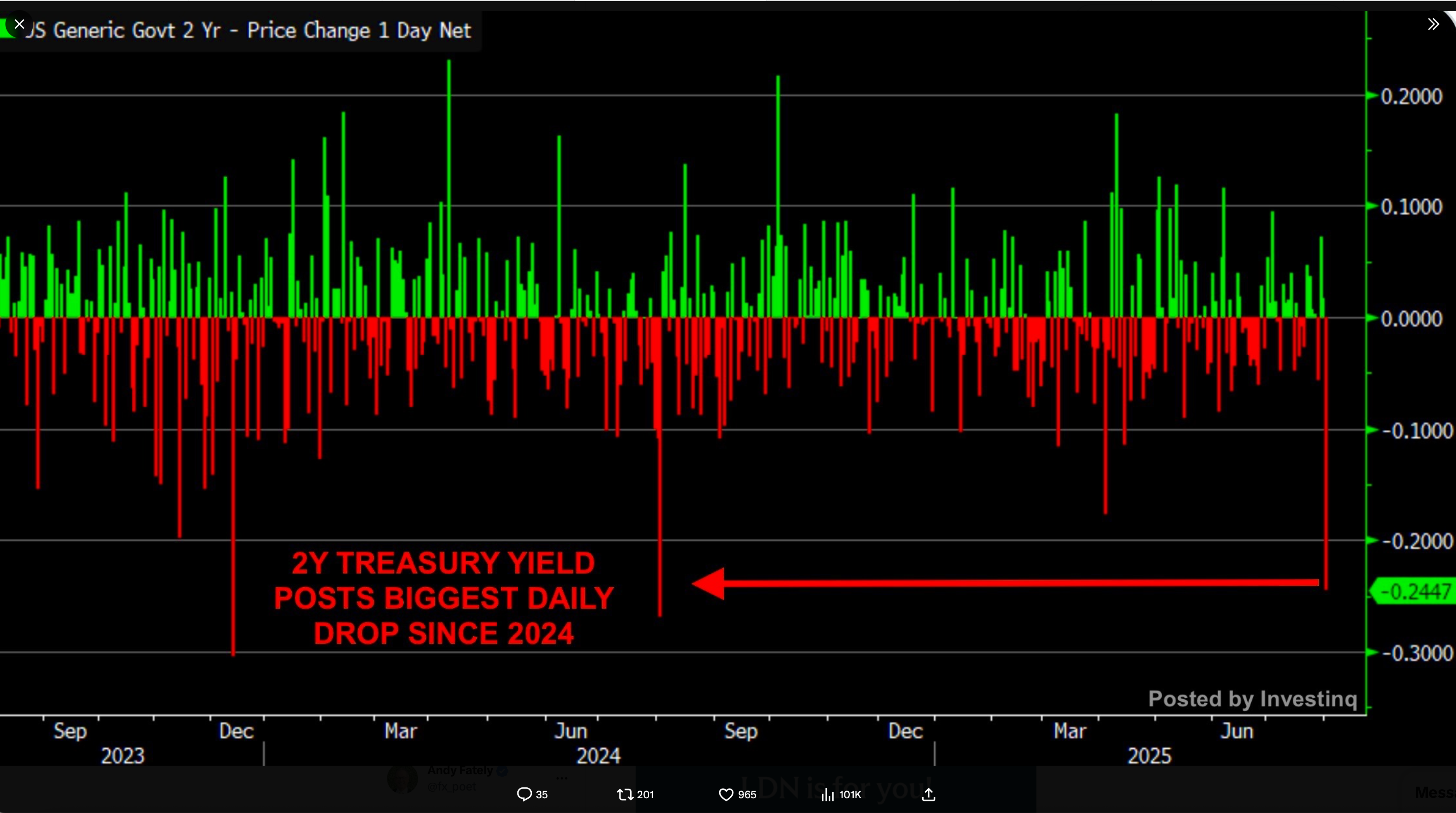
The below chart shows the daily moves, in basis points, of the 2-year Treasury note which is seen as the market’s best indicator or predictor of future Fed funds rates.  On Friday, the yield fell nearly 25bps, essentially pricing in one additional rate cut coming, and as we saw with the Fed funds futures market, that pricing is now anticipating three cuts this year.  Ms Daly merely reconfirmed that news.

Source: https://x.com/_investinq/status/1951356470877925408?s=46

Perhaps it is fair to ask why Daly has taken so long to come around to this view.  After all, she is a known dove and has been for her entire time at the Fed.  As I have asked before, why haven’t the other known doves, like Governors Cook and Jefferson, been out there talking about rate cuts?  For anyone who wants to continue to believe that the Fed is apolitical, nonpartisan or above politics, this is exhibit A as to why it is not.  In fact, if you look, only one Board member was considered a hawk in this analysis by In Touch Markets, and she just resigned.  The other hawks are all regional Fed presidents.  Perhaps this is why they were so slow to raise rates when inflation was roaring in 2022 and why they were so anxious to cut rates in 2024 on virtually no news other than the upcoming election. 

To be clear, until Friday’s NFP data, it was difficult to make the case, in my mind, for a cut because I continue to see inflationary pressures beyond any tariff impacts.  But if the labor market is weaker than had been assumed, that will certainly open the door to more cuts.  Of course, the conundrum is, if the economy is so weak that the Fed needs to cut, why are stocks rallying?  Arguably, a weak economy would foretell weaker earnings growth, a direct negative to equity valuations.  But that appears to be old-fashioned thinking.  I guess I am just an old-fashioned guy.

Ok, let’s turn to the overnight activity.  Starting with bonds, since the big move Friday, Treasury yields have been little changed, climbing 2bps overnight to 4.21%, but still hovering near the bottom of their recent trading range with only the Liberation Day announcement panic showing yields below the current level.  This is a great boon for the Treasury as auctions of 3-, 10-, and 30-year Treasuries are due this week starting with the 3-year today.

Source: tradingeconomics.com

European sovereign yields have also edged higher by 1bp across the board after PMI data was released this morning, pretty much exactly at expected levels.  The outlier last night was JGB yields which slipped -4bps and continue to slide away from designs of a BOJ rate hike.

In the equity markets, yesterday’s US rally was followed almost universally in Asia (Japan +0.65%, China +0.8%, Hong Kong +0.7%, Australia +1.2%) with only India (-0.3%) lagging there.  As to Europe, it too is having a good day with the DAX (+0.8%) leading the way although strength almost everywhere as the PMI data was good enough to keep spirits higher.

In the commodity markets, oil (-1.1%) is slipping for a fourth consecutive day, but is still right in the middle of its $60 – $70 trading range.  There remain so many potential geopolitical issues with saber rattling between the US and Russia and President Trump’s threatened excess tariffs on nations who buy Russian oil that it remains difficult to discern supply/demand characteristics.  Certainly, if the US is heading into a recession, that is likely to dampen demand for a while, but that remains unclear at this time.  As to the metals, gold (-0.65%) is giving back some of its post NFP gains but if I look at the chart below, all it shows is a relatively narrow trading range with no impetus in either direction.  

Source: tradingeconomics.com

The rest of the metals complex is being dragged lower by gold this morning, but not excessively so.

Finally, the dollar is a touch stronger today, despite the rate cut talk, as the euro (-0.4%) and yen (-0.55%) lead the G10 currencies down.  While I understand the rationale for the dollar to soften in the short- and medium-term vs its counterparts, it is very difficult for me to look at the political and economic situations elsewhere in the world and think I’d rather be investing there.  Europe is a mess as is Japan.  And don’t get me started on the emerging market bloc.  So, remember, while day-to-day movements can be all over the map and are impacted by things like data releases or announcements, structural strength or weakness remains largely in place, and the US situation appears stronger than most others for now.   Touching briefly on EMG currencies, the dollar is firmer vs. virtually all of them, mostly on the order of 0.4% or so.

On the data front, today brings the Trade Balance (exp -$61.4B) and then ISM Services (51.5) at 10:00.  We don’t get the first post-FOMC speech until tomorrow by Governor Cook, so it will be interesting to see if there are more doves who are willing to show their colors.  But in the end, as demonstrated by the quick reversal of the narrative from Friday to Monday, there remains an underlying bid to risk assets and we will need to see substantial economic weakness to remove that bid, even temporarily.

Good luck

Adf

Typically Dumb

On Friday, the market was sure
The end was nigh, and we’d be poor
The dollar was sold
And stocks mem’ry-holed
While bonds sashayed like haute couture
 
But somehow, the end did not come
As markets around the world hum
Perhaps we should learn
That markets do churn
And pundits are typically dumb


I admit to being confused this morning as by Friday evening, the entire narrative was that the recession was here, equity markets had peaked, and the dollar was set to collapse.  All the negative outcomes that have been prognosticated by doom pornsters were arriving and Friday was merely the first step.

And yet, here we are this morning, and not only did the sun rise in the East again, but equity markets throughout Asia also saw far more winners (China +0.4%, Hong Kong +0.9%, Korea +0.9%, India +0.5%, Singapore +1.0%, Thailand +1.25%, Philippines +0.7%) than laggards (Taiwan -0.2%, Malaysia -0.4%, Indonesia -1.0%, New Zealand -0.35%).  As to Europe, it is universally green (DAX +1.25%, CAC +0.8%, IBEX +1.4%, FTSE 100 +0.3%) and US futures, at this hour (6:35) are higher by 0.7% or so.  

Meanwhile, the dollar is higher against the euro (-0.15%), yen (-0.2%) and Swiss franc (-0.5%), although we have seen modest gains in some G10 currencies (GBP +0.15%, AUD +0.15%).  And if we look across the EMG bloc, while KRW (+0.4%) has rallied along with CNY (+0.2%), those are the outliers with the rest of the space softer by about -0.2% or so.  In other words, there has not yet been a wholesale rejection of the dollar on global foreign exchanges.

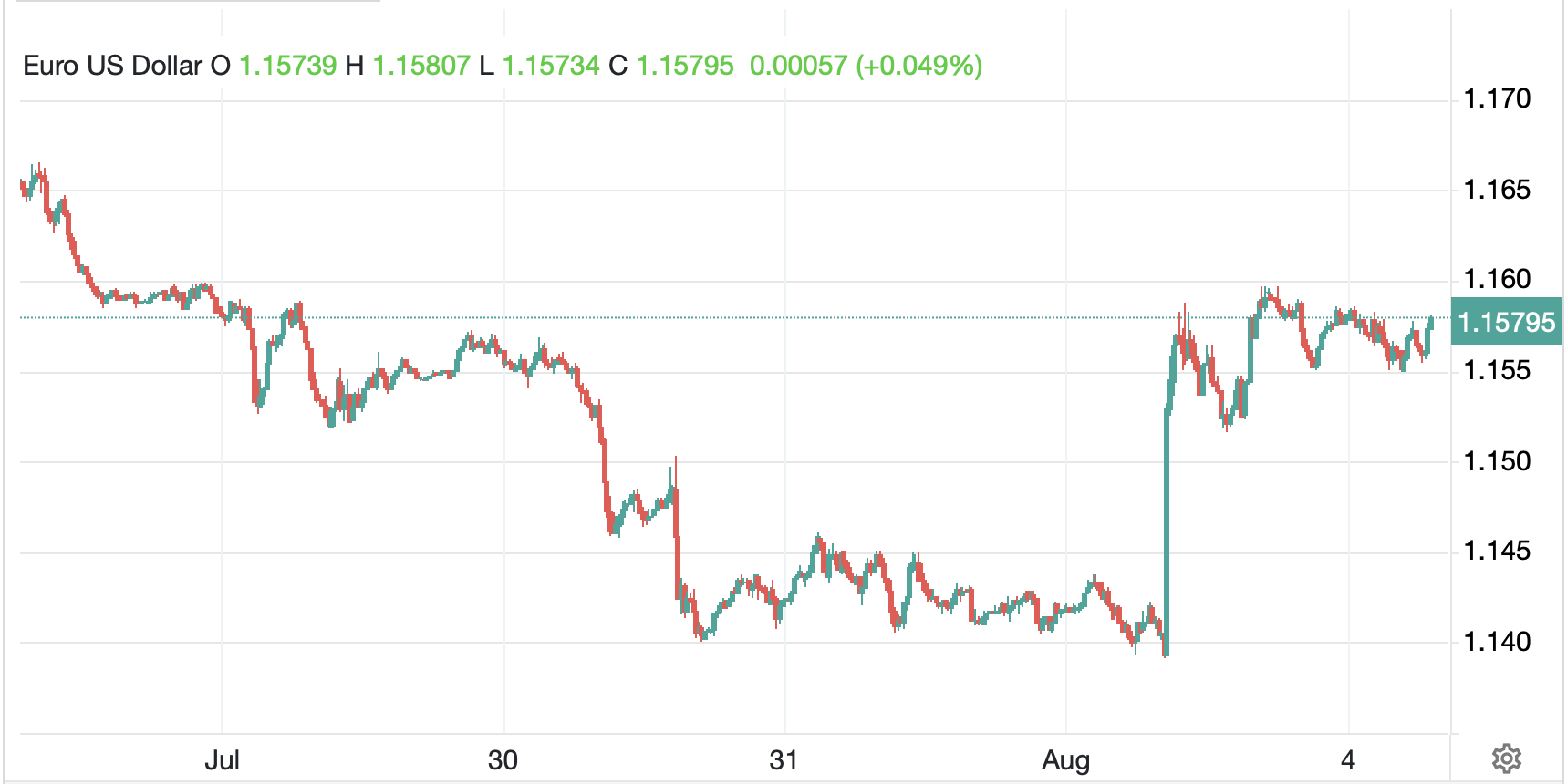
As to bond yields, after Friday’s dramatic decline, falling 15bps in the hour after the NFP report, they have largely stagnated, rising 1bp this morning.  European sovereign yields have slipped about 3bps on average as they continue the Friday move having closed before all the fun was finished.  In fact, while I have chosen the EURUSD exchange rate as a graph to depict the movement, basically every chart looks the same as this with a dislocation at the 8:30 mark on Friday and then a new range quickly established.

Source: tradingeconomics.com

I highlight this because so frequently, the narrative gets ahead of itself, and Friday was one of those days.  Yes, as I explained last night, the NFP data was weak, albeit still positive regardless of the fireworks surrounding the firing of the BLS Commissioner.  And remember, the idea that President Trump fired McEntarfar because the data displeased him does not mean she was not incompetent.  Certainly, nothing in her career demonstrates keen economic insights.  But that is still the talking point du jour.

However, that is a tired story at this point.  In fact, arguably, the reason it is getting so much press is that there is precious little else new to discuss amid the summer doldrums.  After all, the Russia Ukraine war continues apace with no end in sight, although it seems the rhetoric has increased with ex-president Medvedev seeming to threaten nuclear war and the US moving attack submarines closer to Russia.  

Texas Democratic state legislators have fled the state to avoid a special session where redistricting is due to be completed, so that has a lot of headlines, but seems likely to end like the last time this occurred, with the redistricting being completed, and Fed Governor Adriana Kugler stepped down a few months earlier than her term ends which opens another seat on the Fed for Mr Trump to fill.  

Of these stories, while our antenna should be raised given the Russia nuclear war scenario, it still seems a very low probability event, while Texas may matter in the midterm elections if they successfully redistrict as it is supposed to ensure another 5 Republican seats in the House.  But a new Fed governor, perhaps a precursor to the next Chair will have tongues wagging in the market until the seat is filled, and then until Powell is gone.

So, take your pick as to what is important.  Personally, I think the actual payroll data is the most important issue as we continue to see significant gyrations within the numbers.  Less government hiring (I read that 154,000 federal employees took the buyout) is an unalloyed good for the nation.  After all, if nothing else, given the average federal government employee salary is $106,382 (according to Grok) then that is about $16.4 billion less expenditure by the Federal government.  Every little bit helps.  In fact, all the data we have seen of late shows that the private sector continues to grow while the public sector is shrinking.  Over time, that is undoubtedly a better situation for the US and will reflect in the value of US assets.

But that’s really all there is to discuss, so let’s look at the data upcoming this week:

TodayFactory Orders-4.9%
 -ex Transport0.1%
TuesdayTrade Balance-$61.6B
 ISM Services51.5
ThursdayBOE Rate Decision4.00% (-0.25%)
 Initial Claims220K
 Continuing Claims1947K
 Nonfarm Productivity1.9%
 Unit Labor Costs1.6%
 Mexican Rate Decision7.75% (-0.25%)

Source: tradingeconomics.com

In other words, while we will hear from two more central banks as they cut rates (compared to a Fed that remains on hold, for now) it is hard to get that negative on the dollar.  Fed funds futures are pricing an 87% chance of a rate cut in September and now a 56% chance of three cuts this year, one at each meeting left, so that will weigh on the buck a bit, but if the US is cutting because recession is arriving, the economic situation elsewhere will be more dire.  After all, the US remains the consumer of last resort, and if the US pulls back, everyone else will feel it.

The big picture remains that the broader dollar trend is lower, but it is starting to make a case that trend is ending.  The data this week is largely second tier, and we need to wait until next week for CPI.  I have a feeling we will see very little net movement until then.

Good luck

Adf