Markets Are Waiting

The macro event of the day
Is actually micro I’d say
The markets are waiting
For all the debating
‘Bout Bitcoin to end in OK
 
The irony here is too great
As TradFi, the Bitcoin bros, hate
But they’re still a buyer
If number goes higher
‘Cause really, it’s all ‘bout the rate

It is a very slow day in the markets as evidenced by the fact that the biggest story is whether or not the SEC is going to approve a cash Bitcoin ETF.  Today is the deadline for the first application to be approved, or not, and the working belief is that if they are going to approve one, they will approve all 13 that have applied in order to prevent any concerns over favoritism to a particular manager.  Yesterday afternoon, there was a tweet from the SEC that indicated approvals had been made, but then within 10 minutes, the SEC denied that was the case and explained their X (Twitter) account had been hacked.

One of the interesting things of late in this space is that there has been a 20% rally in Bitcoin since the beginning of December, seemingly in anticipation of this event.  This price action has many believing we are looking at a ‘buy the rumor, sell the news’ type story with expectations that a short-term sell-off is coming after the announcement.  However, last night, after the erroneous Tweet, Bitcoin rallied more than 2% before turning back around on the retraction.

With that in mind, the more ironic issue, at least to me, is that there is so much excitement in the Bitcoin community for a traditional finance product like an ETF.  Institutionalizing Bitcoin and creating all the same structure and regulation as any other trading vehicle seems at odds with the entire concept of a new digital transaction medium that does not require a centralized system and is free to one and all.  Arguably, what it highlights is that the entire appeal of Bitcoin is that it is a highly speculative and volatile trading vehicle and is appreciated solely because its number can go up really fast!

In the end, just as the odds of a BRICS currency coming along and usurping the dollar’s throne as top currency in the world (at least when it comes to utilization) are close to zero, the same holds true here.  Bitcoin is never going to replace any fiat currency in the role of money.  Just as with every other asset, its value is entirely dependent on what someone will pay for it.  While an ETF will widen the population that is involved in the space, and perhaps ensure that the government never makes any effort to cut it off from the banking world, it will not change the world in any way, shape or form.

Away from this, the market is turning its focus toward tomorrow’s CPI report in the US as the next critical piece of information for the macro story.  Recent data elsewhere in the world has continued to show a cooling rate of inflation, with Australia’s overnight print at 4.3% a tick lower than expected while Norway’s 5.5% Core rate was also a tick lower than expected.  This follows yesterday’s Tokyo CPI which came in soft and is continuing the theme that the Fed, and central banks around the world, have successfully put the inflation genie back into the bottle.  Personally, I think it is premature to make that claim as I have seen very limited evidence that prices for rent are falling and based on the wage data we saw last week in the NFP report, wage rises, at 4.1%, remain well above the rate necessary to see a stable 2% inflation outcome.  But that is the narrative and it is being pushed hard by Yellen and the mainstream media.

As to today, yesterday’s directionless session in the US led to a mixed performance in Asia where the Nikkei continued its recent rally, up another 2% and back to levels last seen in February 1990 as the Japanese bubble was deflating.  However, Chinese shares remain under pressure with the Hang Seng (-0.6%) continuing its recent slide and mainland shares faring no better.  In Europe, the screens are a pale red, with losses on the order of -0.2% or so across the board and US futures are essentially unchanged at this hour (7:15).

In the bond market, 10-year Treasury yields have edged down 2bps this morning and are trading right on 4.00%.  European sovereign yields are little changed on the day.  After a bond sell-off (yield rally) for the past several weeks, it seems that a bit of dovish commentary from some ECB members, notably de Guindos and Centeno has calmed things down a bit.  And you will not be surprised that JGB yields have slipped another 1bp lower this morning as inflation concerns subside everywhere.

Oil prices are little changed today, holding onto yesterday’s gains but not really responding to a new wave of missile and drone attacks by the Houthis in the Red Sea against some tankers.  Too, gold prices are only edging a bit higher, 0.25%, and essentially have remained in a very narrow range for the past six weeks.  As to the base metals, copper has rallied nicely this morning, up 1% but aluminum is unchanged on the session.

Finally, the dollar is under modest pressure this morning against most currencies, but the yen is the exception, falling -0.4% with the dollar back above 145.00.  I believe you cannot separate the Nikkei rally from the yen decline and the ongoing interest rate story in Japan.  With softer inflation readings leading traders and investors to reduce the likelihood of any monetary policy change by the BOJ, those are exactly the moves that would be expected.  In the meantime, the market is staring to price in a slightly higher probability of a March rate cut by the Fed, up to 67.6% despite no indication from any Fed speaker that is on the table.  However, while this is the narrative, I expect the dollar will have a little trouble going forward against both G10 and EMG currencies.

There is no noteworthy economic data today, but we do hear from NY Fed President Williams at 3:15 this afternoon.  Yesterday’s comments by Michael Barr were interesting in that he was adamant that the BTFP (the lending facility put into place in the wake of last year’s Silicon Valley Bank collapse) was going to be wound down when its term of 1 year comes up in March.  Personally, I am skeptical that will be the case, but at the very least, we can expect it to make a quick appearance as soon as there is any other banking trouble.

And that’s really it for today.  Until tomorrow’s CPI, there is very little about which to get excited.  I don’t believe the Bitcoin story, while mildly interesting, is going to have any impact on other markets for any length of time.  So, we shall be biding our time for another twenty-four hours at least.

Good luck

Adf

Magical Stuff

A critical piece of inflation’s
Aligned with the broad expectations
Of where it will be
In one year and three
As this feeds Jay’s model’s foundations
 
So, yesterday’s data release
That showed expectations decrease
Is magical stuff
And could be enough
To make sure all tight’ning will cease


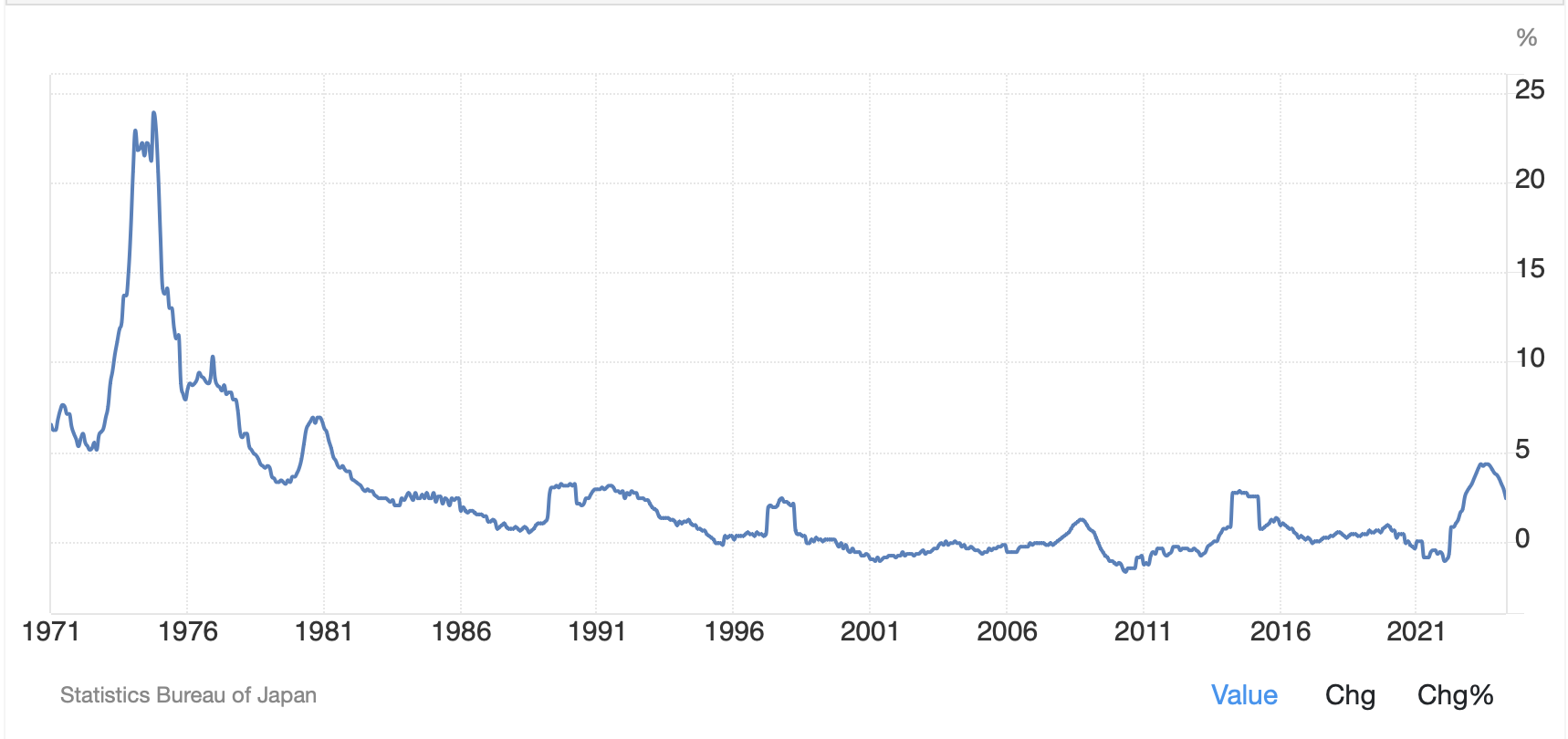
While Thursday’s CPI report remains the key data point this week, there are plenty of other data points that get released on a regular basis that can give clues to how the economy is behaving, and perhaps more importantly to how the Fed’s reaction function may respond.  One of the lesser-known inflation readings is published by the NY Fed each month and shows Consumer Inflation Expectations one year ahead.  As can be seen in the below chart from tradingeconomics.com, the trend has been very positive (lower inflation expectations) for the past two years.

This must warm Powell’s heart as it appears his efforts at anchoring inflation expectations continue to work.  When combining this data with comments from two Fed speakers, Bostic and Bowman, who both indicated some satisfaction with the recent trajectory of inflation and were comfortable with the idea of rate cuts later this year, it is easy to see why yesterday was such a bullish one for risk assets.

Perhaps of more interest, at least to me, was the Consumer Credit Change report which showed that in November, consumer credit rose by a very large $23.75B!  This was the largest increase in twelve months and plays to the idea that people are using their credit cards to purchase consumer staples because they cannot afford them anymore.  On the flip side, given the way economic growth is measured, this will be a positive for Q4 as it implies more ‘stuff’ is being bought.  To my eye, this seems to be a short-term positive, but offers the chance of being a medium-term negative as delinquency in loans is typically not seen in a beneficial light and there are already many stories of people being overextended on their credit cards.

As well, Tokyo CPI was released overnight at 2.4%, 2.1% Core, which was right on expectations, but more importantly, indicative of the fact that inflation pressures in Japan are quickly ebbing.  Perhaps the BOJ’s view that they did not see sustainable price inflation despite almost 2 years of CPI prints above their 2.0% target, is turning out to be correct.  This has huge implications as it means there is little reason for the BOJ to consider exiting its current monetary policy combination of NIRP and QE combined.  As an aside, 10-year JGB yields fell 2bps last night and are currently at 0.58%.  This does not seem like a panicky level, nor one that is necessarily going to attract a lot of internationally invested Japanese money back home.  For all the JPY bulls out there, this is not a good sign.

Away from that news, European data continues to show Germany in a world of hurt, with IP falling -0.7% in November, far worse than expected and the 6th consecutive decline in the series.  However, Eurozone unemployment fell a tick, back to 6.4% and the lowest in the history of the series.  Meanwhile, the ECB just published a report indicating that the inflation suffered by the Eurozone was due almost entirely to supply chain disruptions with a small dose of energy price spike.  It had nothing to do with their policies!  To an outsider like me, this sounds like they are preparing to cut rates as soon as they can.  I wouldn’t be surprised if Madame Lagarde was on the phone with Chairman Powell right now!

And that’s really all we have seen overnight.  After yesterday’s strong rebound in the US, the overnight equity picture was somewhat mixed with Japan having a good session on the weak inflation data although the Hang Seng continues to slide.  Overall, there was no unifed trend in Asia with gainers and losers both.  European shares, though, are in the red this morning led by Spain’s IBEX (-1.75%) although that is the outlier worst performer.  (It seems that a single stock, Grifols, a pharma name, is down -28% on some recent reports about manipulated accounting and that is dragging the whole index lower.). However, US futures are also softer, down about -0.4% at this hour (8:00).  There is still much discussion if last week’s sell-off was just a reaction to a huge late 2023 rally, or the beginning of something much bigger.

In the bond market, Treasury yields have edged up 1bp this morning but remain either side of 4.0% for now.  European yields, though, are higher across the board once again, by between another 5bps and 6bps.  Now, this move is based on yesterday’s close, which saw a drop in yields at the end of the session there.  While the trend in European yields looks higher, they are little changed from this time yesterday.

Oil prices (+3.1%) are rebounding nicely from yesterday’s sharp decline.  You may recall that Saudi Arabia cut its selling price yesterday and the market read that as a sign of weak demand.  However, this morning, that story has faded and continuing tensions in the middle east seem to be having a bigger impact.  This is confirmed by the fact that gold (+0.35%) is rebounding as well although the base metals are mixed this morning with copper slightly higher and aluminum slightly lower.

Finally, the dollar is a touch stronger this morning, but not really by much.  Versus the G10, I see gains of about 0.15% or so with NOK (+0.25%) the exception as it is responding to the rebound in oil.  Versus the EMG bloc, the picture is clearer with almost all these currencies a bit softer, albeit between -0.2% and -0.4% generally.  The dollar continues to be the least interesting asset bloc around for now and is likely to remain so until the Fed starts to actually change policy rather than simply hint at it.

On the data front, we see the Trade Balance (exp -$65.0B) and we have already seen NFIB Small Business Optimism print at a better than expected 91.9.  But, while that is a nice outcome, recall that the index is back at levels below Covid and only above those seen in 2008 and 1980!  Fed Vice-Chair for regulation, Michael Barr speaks at noon, but my guess is he will be right in line with the recent commentary that things look good, but they are not done yet.

As I wrote yesterday, with the bulk of the focus on Thursday’s CPI print, I expect that while markets might be choppy, there will not be much directional information overall.  

Good luck

Adf

Ending QT

The lady from Dallas explained
The balance sheet might be constrained
So, ending QT
Is likely to be
The way the Fed’s goals are attained
 
However, investors ain’t sure
That ending QT is the cure
So, worries abound
As traders have found
Most stocks have now lost their allure

Over the weekend, Dallas Fed President Lorie Logan, whose previous role was head of markets at the NY Fed and so knows a thing or two about the monetary plumbing, explained in a speech that QT, at its current pace, is likely going to be too restrictive going forward.  While she threw in the obligatory line about the idea the Fed may still need to raise the Fed funds rate if inflation remains too robust, I would contend that this is another sign the Fed is coming to the end of its tightening regime.  She explained that the swift decline in the Reverse Repo (RRP) facility indicated there may be a significant decline in liquidity in markets and that could have a detrimental impact on equity prices the economy’s future path and derail the widely assumed soft-landing scenario.

For some context, the RRP facility peaked almost exactly one year ago, touching about $2.55 trillion as the Fed was paying more on excess reserves than was available in short-term paper and Treasury bills.  But as the government has flooded the market with T-bills of late, and there is no indication that pace is going to slow down, the yield on bills rose above the IOER rate the Fed was paying.  As such, money market funds have pushed funds from the RRP into purchasing bills and the RRP facility now has “just” $694 billion as of Friday.  A look at the chart below from the FRED database of the St Louis Fed shows the sharp downward trajectory of the facility’s balances.  But also notice that prior to March 2021, this facility basically was at $0 for its entire history.  My point is that this facility does not have a long history of supporting market activities or liquidity, rather it is a recent construct designed to help smooth out temporary fluctuations.  It’s just that the concept of temporary here seems akin to the Fed’s concept of transitory when it comes to inflation.

At any rate, the FOMC Minutes also mentioned the idea that QT would likely need to slow down, and the committee needed to discuss the proper timing of these things.  Logan’s comments were exactly in this vein as the Fed seem like they are working very hard to prepare market participants for the beginning of an easing cycle.  It’s kind of funny that throughout November and December, the Fed seemed a bit concerned that markets were overexuberant, but after a modest equity market sell-off to start the year, much of which can probably be put down to profit-taking on a tax advantaged* basis, they seem suddenly concerned that things are falling apart.

Logan’s comments were in the wake of Friday’s data which showed NFP stronger than expected, although another month of downward revisions for previous readings, and showed wages gaining a bit more than expected.  The initial move here was that further tightening was on the way, or certainly that easing was delayed, but then the ISM Services index was released at 10:00am and it was much worse than expected, 50.6, with the Employment sub-index printing at a horrible 43.7, its lowest level excluding the Covid months, and indicative that perhaps the job market is not quite so robust.  This helped unwind the tightening discussion and Friday’s markets ultimately closed little changed.

Which brings us to this morning, where the most noteworthy price action is in the commodity space with oil (-2.8%) sharply lower after Saudi Arabia cut its pricing indicating that demand is slow, and gold (-1.25%) falling sharply although a rationale there is far harder to find given the dollar is essentially unchanged on the day and it certainly doesn’t appear that peace is breaking out in either Israel/Gaza or in Ukraine.

While there has been a bit of data released from Europe, none of it was substantially different from expectations and it showed that the status quo remains there, overall, a weak Eurozone economy with prices still on the sticky side.  As well, there have been no speakers this morning which just leaves us all unsure of the next big thing.

Now, in fairness, we do have the next big data point coming on Thursday, CPI in the US, which I am assured by so many analysts is THE critical data point.  I was also confident that NFP was critical, so perhaps CPI will be less exciting than forecast.  In the meantime, a look at the rest of the overnight session shows that Japan was on holiday so there was no market activity, but Chinese shares have continued their weak ways, falling more than -1.3% across all the indices there.  It seems to me that despite some very real efforts to inculcate fear of China by certain politicians, President Xi has an awful lot of domestic issues to address.  European shares, though, are little changed with a few very modest gainers (DAX +0.15%) and a few very modest decliners (FTSE 100 -0.2%) and everything else in between.  US futures are softer this morning as the weekend story regarding Boeing’s 737 Max being grounded is weighing on the stock and the market as a whole.

In the bond market, Treasuries are unchanged on the day while European sovereigns are all seeing yields climb between 4bps and 5bps.  This move seems like a catch-up to Friday’s US price action, which if you remember saw a sharp decline in yields early and a rebound later on.  Ultimately, this space will continue to be driven by the central banks with the Fed funds futures market still pricing in a > 60% probability of a 25bp cut in March with Europe seen likely to follow shortly thereafter.

Having already touched on commodities, a look at the dollar shows that while the euro, pound and yen are all little changed, there is a bit more movement in the dollar’s favor amongst some less liquid currencies with AUD (-0.4%), NOK (-0.85% on weak oil prices) and KRW (-0.4%) leading the way.  I continue to see the FX markets as an afterthought to the broad economic picture right now but have not changed my view that if the Fed does lead the way in easing policy, the dollar is likely to slide.

On the data front, here is what this week brings:

TodayConsumer Credit$9B
TuesdayNFIB Small Biz Optimism91.0
 Trade Balance-$65.0B
ThursdayInitial Claims210K
 Continuing Claims1853K
 CPI0.2% (3.2% Y/Y)
 -ex food & energy0.2% (3.8% Y/Y)
FridayPPI0.1% (1.3% Y/Y)
 -ex food & energy0.2% (1.9% y/Y)

Source: tradingeconomics.com

As well, we do hear from several Fed speakers this week starting with Bostic today and then Williams and Kashkari as the week progresses.  At this stage, I expect that we are likely to see less volatility as my guess is most profit adjustments have been made and all eyes are turned to CPI on Thursday.  Until then, it is likely to be a dull week (famous last words!)

Good luck

Adf

*This tax advantage is simply that taxes will not be due until April 2025, so perhaps tax deferred is a better description.

Oil’s Price is not Rising

Recession has yet to appear
And Janet has signaled, ‘all clear’
But many still worry
She’s in quite a hurry
To help Biden’s prospects this year
 
One key to this outcome, surprising
Has been oil’s price is not rising
Now, why would that be
If strong ESG
Intentions force drilling downsizing?

This note is a departure from my daily missive as I wanted to address a bigger picture concern regarding the evolution of the US, and global, economy.  I would contend that one of the underlying theses that has been part of the market narrative for quite a while is that there is a finite supply of oil and hydrocarbons available beneath the surface and that since all the easy stuff has already been found, the cost of extraction is going to rise and push the oil price higher along with those costs.  I’m confident that if you have paid any attention to the discussion, you will have heard about peak oil being forecast (the IEA just claimed it will occur in 2030, although that was pushed back from 2028 in last year’s report) and a theory known as Hubbard’s peak theory, which explains that once an oil field has produced half its reserves, its ability to continue to produce at previous levels is dramatically reduced, thus reducing output.

In fact, this was a cornerstone of my mental model regarding inflation and the economy for the past several years.  Forgetting for a moment that oil prices are quite volatile as can be seen in the below long-term chart from tradingeconomics.com, one can argue that the broader trend has been for higher oil prices.

As such, if oil prices, and the concurrent price for all types of energy, was going to continue to rise, it seems difficult to believe that inflation would stabilize.  After all, energy is an input into virtually every part of the economy and if oil was rising, stable inflation would require deflation in other areas.  Now, during the past twenty odd years, with China’s entry into the WTO and the broader global economy, their rapid expansion clearly weighed on the price of manufactured goods.  But I believe it is a fair assessment to say that factor is currently dissipating and will continue to do so going forward as evidenced by the significant rise in populist politics around the world.  After all, a key part of populism is the inward-looking aspect, supporting domestic activity and shunning imports in an effort to keep jobs in the home country.

With this as a baseline thesis, the question at hand is what can change this view?  Well, I recently read a terrific article and listened to a very interesting podcast with an analyst who goes by the name of Doomberg.  Doomberg made some really great points about some little-known features of the oil and gas markets which tend to be ignored or glossed over, but which are ultimately very important.  Arguably, the most important was to recall that technology improvements are not simply made by Apple and Microsoft, but by energy firms as well, and they have been improving their efficiency in extracting oil and oil products dramatically.  Perhaps the number that will really blow your mind is that the US, by itself, is currently producing ~20 million barrels/day of oil and oil-type products (usually described as Natural Gas liquids or NGLs) which makes the US by far the largest producer of energy on the planet, dwarfing Saudi Arabia and Russia.  And despite all the efforts by those who are desperate to end oil production completely, these numbers are almost certainly going to continue to grow as cheap energy is the most critical feature to develop a growing economy and improve living standards.

The fact that the US economy continues to plug along and avoid recession, and the fact that despite very real concerns over an escalation of the fighting in the middle east and what that might do to the short-term supply of oil, the price of oil is trading far closer to recent lows than highs, indicates to me that there is a great deal of truth in this view.  In fact, I have become persuaded that I need to adjust my world view accordingly.  You know what they say about new information and changing your mind.

So, I am going to rough out a new mental model with this new information on the key input to economic activity, the price of energy, and see how I think things may evolve over time.

The first thing to note is that global growth, writ large, is likely to outperform current estimates going forward.  After all, if cheap energy becomes more widely available, then the billions of people who live in Africa, Asia and Latin America who subsist on minuscule amounts of energy each day are going to see substantial improvements in their lives.  (Of course, I cannot account for the political machinations which may prevent this, but I believe that no matter how inept or corrupt these governments are, some portion will get through to the population.)  The upshot of this is emerging market economies are likely to grow at a more rapid clip which will require more resources and feed through to more economic activity around the world.  While there will be constraints on this growth eventually, for the next several years at least, and probably for a decade or more, I expect that the story will be a large net positive.

But perhaps more importantly for a more current economic outlook, the availability of relatively cheap energy is going to be a huge boon for the developed world.  For instance, the below graph explains a great deal about the current situation in Germany with respect to the fact that it is experiencing a recession and the fact that the populist, right-wing AfD political party is making huge gains in the polls.

Energy intensive industry that had been built on the back of cheap natural gas imported from Russia has been fleeing the country with major companies building facilities in the US to take advantage of the fact that natural gas prices in the US are <$3.00/mmBTU while in Europe they remain above $9.00/mmBTU although they have fallen from their highest levels last year.  Consider, though, what will happen if the abundance of cheap energy about which I am hypothesizing becomes reality.  Suddenly, many more countries, even those without their own natural supplies of energy, will be able to take advantage of the benefit of cheap energy.  If we know one thing it is that all the energy produced will be consumed in some manner, and the cheaper the cost of production, the more widely spread will be its availability.

I highlight Germany as an illustration of what will almost certainly occur worldwide.  In other words, reducing the cost of the key input into virtually all economic activity, namely energy, is going to support a very real increase in that activity.

As to the inflation story, here too, much of the blame falls on political efforts to control certain sectors of an economy or to show favor to others, which impedes appropriate price discovery.  And that will never change, I fear.  However, it becomes much easier to believe that if we eliminate a key plank of the long-term inflation narrative, namely resource constraints driving prices higher, that general price inflation will have far less staying power.  

Putting this together leads to a very different, and much more positive, outcome than I had envisioned previously, and than I believe, many had envisioned.  For a given level of nominal GDP growth, more will be real growth and less will be price adjustments, a truly beneficial outcome.  

The next question then is how might this impact financial markets going forward?  This is always a treacherous question given nobody really knows.  But, looking at the four main market segments; interest rates, equities, commodities and FX, here are my first thoughts.

Interest Rates – The first thing to consider is that there is an enormous amount of debt currently outstanding around the world, something on the order of $300 trillion to $350 trillion.  The two macroeconomic ways to pay back debt are to inflate it away or to generate sufficient economic activity to outstrip the accumulation of that debt.  As my contention is inflation will be lower alongside higher productivity, this is a sea change in thinking.  While I had always expected inflation to be the likely course, this opens the possibility for growth to do the work.  While debtors typically like inflation, especially governments, this new paradigm is likely to be even more effective.  Net, I expect that the general level of interest rates will decline somewhat everywhere as higher productivity should help creditworthiness as well as governments.  Faster real economic activity should generate more tax revenues and reduce issuance from that perspective thus easing the oversupply problem.

Equity markets – This outcome should be a net long-term benefit for equity markets as the underlying aspect is that economic growth should accelerate.  However, while companies may perform well at the bottom line, equity markets are a function of the underlying company and the value multiple that investors place on those companies.  Right now, valuations remain far higher than long term historical values.  For instance, the current Shiller Cyclically Adjusted PE Ratio (CAPE) is at 31.78.  This compares to a mean of 17.07 and median of 15.96 over the past 150 years.  While improved productivity on the back of cheaper energy is likely to raise the appropriate level for this statistic, it still appears quite richly valued.  For instance, if 20.00 is a more appropriate price multiple in this new world, which would be a 25% increase on the median, the market is still massively overvalued.  As such, equity prices might still decline despite this good economic outcome.  However, I would say that given emerging market, and even European market pricing is much less robust, cheaper and more abundant energy should help those markets dramatically.

Commodities – Here, the tale will be told by the political machinations going forward.  By rights, commodity prices everywhere should decline, at least initially, if energy prices decline, if for no other reason than the cost of producing them will decline.  However, the ESG mindset remains widespread and there remain a disturbingly large number of people who want to stop all commodity production activity, oil & gas, metals, and even foodstuffs.  If this group is able to maintain political power, they can prevent all the possible benefits.  But even if we assume they lose power as people decide that improved living standards are more valuable to them than concerns over global warming, the fact that there may be an extraordinary amount of cheaply available energy does not mean there is an extraordinary amount of copper, nickel or aluminum available.  At some point, we could see physical constraints manifest themselves, but at least initially, I expect that other commodity prices will follow energy prices lower.

FX – Since FX is a relative game, this outcome is all about the relative adoption of this new paradigm.  The first nations to embrace this view and see improved economic activity are likely to see their currencies strengthen as investment flows in.  The fact that they will be able to keep interest rates lower will not necessarily hurt these currencies’ value as investors will be flocking to their equity markets and real investments, not looking for currency arbitrage.  Of course, at this time, there is no way to know who will embrace this idea and lead the pack, but the US certainly has a head start given it is the source of much of the cheap energy and the concomitant technology driving it.  But you can bet that China will get on this bus quickly, once they recognize its existence, and after that, widespread adoption will drive things.  In fact, my biggest concern is that the politics will hold back Europe as they remain enthralled by their climate virtue signaling and it may take far longer to change that view.  Either that, or a really cold winter with people running out of energy.  So initially, I think this is quite dollar supportive, but over time, we will need to see the evolution of the process.

This is the essence of my evolving view, better real economic activity and increased productivity alongside lower inflation on the back of abundant, and therefore, relatively cheap energy is a growing probability in my mind. If this scenario plays out, it will have very real impacts on financial markets, but more importantly on our everyday lives, and for the latter, I expect quite positive impacts.  However, given the current state of politics, this transition will likely take much longer in some parts of the world than others.  Keep that in mind as you consider these issues.  And remember, these are my first takes.  I could well be wrong about the market impacts and welcome comments offering different views.

I apologize for the length of this note, but that is why I put it out on a Sunday rather than a weekday!

Good luck

Adf

Quite Frail

While everyone’s waiting to see
How high or low payrolls might be
The news from elsewhere
Is starting to wear
Quite thin, look at China’s Zhongzhi
 
This bankruptcy sounds the alarm
That others there might come to harm
The soft-landing tale
Which still is quite frail
Has started to lose its quaint charm

Before we start on the payroll report, I think it is important to mention a significant issue that was revealed last night in China, where Zhongzhi, one of the largest non-bank financial and investment companies on the mainland, filed for bankruptcy and liquidation.  It has been missing both interest and principal payments for the past several months and it simply became too great a problem to ignore any longer.  The data released indicates that the company had ~$31 billion more in liabilities than assets and has become one of the largest bankruptcies in China’s history.  

The company was a major player in the property market there, although its main business was high yielding investment products, essentially structured notes, where much of the property backed collateral has fallen dramatically in value and where cash flows that had underpinned the notes have now ceased amid the property collapse.  This is hardly an advertisement for the Chinese economy and another sign that things there remain in a downtrend.  While the renminbi is marginally firmer this morning, up 0.2%, that is a consequence of the PBOC establishing the CFETS fixing at a much stronger than expected level in their effort to prevent substantial weakness in the currency.  

The upshot is that the Chinese economy remains in difficult straits, and the government’s reluctance to increase fiscal support is being felt everywhere.  (On the other hand, the PBOC has added $600 billion in liquidity to the economy in the past week.)  Ongoing weakness in Europe is another problem for Chinese exporters and the ongoing disagreements and tariff wars with the US simply add additional pressure to President Xi.  Next Saturday the first big election of 2024 will be held, in Taiwan, and if the incumbent party retains control, currently the betting favorite, Xi may find himself with quite a few problems to address this year.  A weak economy, rising geopolitical tensions globally and a rejection of his entreaties to the people of Taiwan is a bad look for a megalomaniacal dictator like Xi.  Just sayin’.

OK, let’s turn to this morning’s big story, the NFP report.  Here are the analyst consensus estimates according to tradingeconomics.com:

Nonfarm Payrolls170K
Private Payrolls130K
Manufacturing Payrolls5K
Unemployment Rate3.8%
Average Hourly Earnings0.3% (3.9% Y/Y)
Average Weekly Hours34.4
Participation Rate62.7%
ISM Services 52.6
Factory Orders2.1%

Now, yesterday we saw two other pieces of employment data, the ADP (164K and much higher than expected) and Initial Claims (202K and much lower than expected).  These numbers have many in the market looking for a strong print although the correlation between ADP and NFP has been underwhelming for quite a while.  While we can discuss the merits of the estimates and the overall strength of the economy, I think we are better served, this morning, to focus on the potential impacts of a given number and how that has been evolving so far this week/year.

This morning, the 10-year yield is up to 4.04%, some 25bps above the lows touched post-Christmas, and starting to indicate that some people are having second thoughts on the idea of the Fed aggressively cutting rates this year.  As an example, while I never believed there to be a chance of a rate cut at the end of January, the market was pricing a 17.5% chance of that just a week ago.  This morning the probability is down to 4.7%.  As well, just last week the market was pricing in 6 rate cuts in 2024.  That is now down to 5 cuts and fading. One of the big stories around this morning is that someone has put on a very large option position expiring later today that the 10-year yield will be above 4.15%.  To profit, this trade will require one of the largest yield moves seen in months.

The point is that the nirvana belief set that had been driving markets since the beginning of November is clearly under a significant amount of pressure here.  After all, the NASDAQ has had 5 consecutive negative closes, bond yields, as mentioned, have rallied sharply and are breaking through short-term technical resistance, the dollar is rallying, and the bulls are feeling quite unloved.

Is this the end of the bull story?  Frankly I don’t believe that is the case.  However, risk assets got a bit overexuberant during November and December and have come a long way in a short time.  It is not surprising to see a retracement of prices to help unwind some of the froth.  Ultimately, I believe the question that matters in the medium and long term is the state of the economy and whether the recent growth trajectory will continue, or if we have peaked for now.

One of the things that has me concerned in the medium term is the fact that the government continues to run a massive fiscal deficit despite what appears to be a reasonably strong economy.  Recall, Keynes instructed governments to spend during recession, but tighten their belts during good times.  However, the new mantra is far more in line with Modern Monetary Theory, which is spend as much as you can at all times.  

A quick thought experiment regarding the underlying economy might look like this: GDP = $27 trillion, Federal spending = $10 trillion, Federal deficit = $1.7 trillion.  What if the government didn’t run a deficit, but was neutral?  Removing that much stimulus from the economy would have a significant negative impact on the US economy’s growth trajectory, which is the reason no politician wants to do that.  But the question at hand is how healthy is the economy on its own?  And are growth prospects there really that substantial?  One of the keys to the recent employment picture is that government jobs continue to grow rapidly (look at the gap between NFP and private payrolls).  As long as the US government can continue to borrow money cheaply to fund its profligate ways, it is completely realistic to expect the economy to continue to grow.  However, the reason the bond market story is so important is that the bond market is the place where it will become clear if this is possible.  If Treasury yields continue their recent climb, the pressure on the economy will increase, and the pressure from the government on the Fed to support the bond market will increase.  Forget ending QT.  If the Fed were to find itself in a place where they needed to restart QE to support the bond market, that would be an incredibly important signal that inflation was going to accelerate again, and likely commodity prices would follow.  That would also be a very negative sign for the dollar.  So, lower bonds, lower dollar, higher commodities and likely a nominal rise in equities, at least initially.  My point is there is much about which we need be concerned and wary.

In the quickest of recaps possible, equities around the world have mostly been under pressure with only Japan managing to rally but weakness in China and across all of Europe.  The same is true with US futures, all in the red this morning by about -0.3%.

Bond yields are also rising around the world (except in Japan) with gains on the order of 6bps-8bps across the continent, similar to what we saw in Australia overnight. 

Oil prices are rebounding this morning, up 1.3%, despite much larger than expected inventory builds shown in yesterday’s IEA data, but the metals markets are continuing under pressure for now with the base metals weak and gold edging lower.

And finally, the dollar is continuing its rebound led by USDJPY, where the yen is down a further 0.4% and back above 145 for the first time since early December.  In the G10 space, I would say the movement has been about -0.3% overall, but in the EMG space, things are a bit more active with average declines here of about -0.7% across the three main geographic blocs.

That’s really it.  Now we just wait for the payroll report and later this morning the ISM Services number, and then we get to hear from Tom Barkin again, but it would be shocking if his view changed from just two days ago.  For some reason, I have a feeling the payroll data will fall short this morning, but that’s just a feeling.

Good luck and good weekend

Adf

Somewhat Miffed

The Minutes did naught to explain
Why Jay might need raise rates again
But if we all harken
The Fed’s Thomas Barkin
The future seems cloudy with rain
 
So, now it seems Jay’s somewhat miffed
As he and his team try to shift
The views he expressed
That rate cuts were blessed
And markets did act sure and swift


Remember the certainty with which market participants determined that the Fed had not only finished raising interest rates, but that they would be cutting them quite soon?  That is so last year!  It seems that after a powerful Santa Claus rally that was inaugurated by Secretary Yellen’s move to issue more T-bills and less coupons, and then seemingly confirmed at the December FOMC meeting, where the dot plot showed no more rate hikes and a median expectation of three cuts this year, and where Chairman Powell, when given a chance to push back on this new narrative in the press conference, went out of his way to embrace the ‘rate cuts coming soon’ narrative, the Fed is no longer happy about the situation.  Instead, now they seem to want the market to ratchet back these expectations for a quick decline in interest rates.  At least, that’s what we heard from Richmond Fed president Tom Barkin yesterday, “The FOMC’s December meeting got a lot of attention. We acknowledged the progress on inflation and explicitly reaffirmed our willingness to hike if necessary.”  [emphasis added].

Meanwhile, the Minutes seemed to lean more hawkish than not, “It was possible that the economy could evolve in a manner that would make further increases in the target rate appropriate.  Several also observed that circumstances might warrant keeping the target range at its current value for longer than they currently anticipated.”  Arguably the best line, though, was “Participants generally perceived a high degree of uncertainty surrounding the economic outlook,” which is likely the most honest statement they have ever made.  In the end, the Minutes didn’t sound very dovish to me, but as I mentioned above, the press conference came across far more dovishly.  One other thing to note is that they mentioned QT for the first time in quite a while.  It seems that they recognize the incongruity of shrinking the balance sheet while cutting interest rates, so they have begun to consider how to message any changes there.

With this new information being absorbed, the market is now in the process of re-evaluating the idea that rate cuts are going to happen as quickly and as substantially as thought just a week ago.  At this time, there is just a 10% probability of a cut at the end of this month (it was nearer 20% last week) and the March probability is down to 70% (it was 79% last week) though the market is still pricing in 6 cuts in 2024.  FWIW, that seems outside the bounds of how things will ultimately play out, and I maintain that while a cut could easily be made by the May meeting, I do not foresee inflation cooperating which will force a lot of rethinking.

To summarize the Fed story, the market has sensed a disturbance in the easing force that had been widely assumed and a key driver of the late 2023 risk rally.  This morning, markets have stabilized after two consecutive negative days to open the year.  As such, let us keep our eyes peeled for more, new and, potentially non-narrative, information going forward. 

Looking at the latest data releases overnight and this morning, they consisted of the Services PMI data as well as German state inflation.  Regarding the former, both Australian and Japanese data were soft although Chinese data was better than expected with the Caixin Services PMI printing at 52.9, continuing its rebound from summer lows.  Across Europe, Italian (49.8), French (45.7), German (49.3) and the Eurozone composite (48.8) all showed contractionary numbers although the UK (53.4) vastly outperformed.  As to the German state-by-state inflation readings, every one of them bounced sharply from last month’s recent lows and the market is looking for a sharp rebound in the national CPI to 3.7% later this morning.  As I have written before, that combination of rising inflation and weak growth is a tough situation for Madame Lagarde.  My money is still on her to address the growth rather than the inflation, although she will likely wait until the Fed moves before doing so in Frankfurt.

With all this in mind, let’s take a look at the overnight market activity.  In Asia, the picture was mixed although there was more red than green on the screen.  While the Nikkei (-0.5%) fell, other Japanese indices held their own, and we saw some strength in Indian shares as well.  However, China remains under pressure, despite the stronger than anticipated PMI reading and that has been weighing on South Korea, Hong Kong and Australia overall.  However, in Europe, we are seeing modest gains this morning, only on the order of 0.1% or 0.2%, but green is more pleasant than the red of the past two days.  As to US futures, they are little changed at this hour, although again, better than their recent performance.

In the bond market, from the time I wrote yesterday morning, yields fell through the rest of the session by nearly 7bps in the 10yr Treasury market, and this morning, they have bounced back from the closing levels by 4bps.  We have seen similar price action throughout Europe where yesterday’s declines to closing lows have been reversed and we are now between 6bps and 9bps higher than the end of Wednesday’s session.  JGB yields, though, remain anchored at 0.60%, unchanged.

Oil (+1.0%) is continuing to rebound as the situation in the Middle East seems to be getting more complex.  The Houthis continue to attack Red Sea shipping, Israel killed a Hezbollah leader in Lebanon, potentially widening the conflict and there was a terrorist bombing in Iran (with the best guess it was internally executed by an unhappy faction) which can only serve to increase the overall tension levels.  While the broader weakness we have seen in this space is likely a response to weaker overall economic activity, especially in China, at some point, that activity will pick up and I expect oil prices to do so as well.  In the metals complex, base metals are under further pressure this morning, with both copper and aluminum down -0.6% or so, although gold (+0.2%) is bucking that trend, perhaps on the back of the dollar’s marginal weakness this morning.

Speaking of the dollar, as measured by the DXY it is -0.2% softer this morning with pretty uniform losses vs the major G10 and EMG currencies.  The one exception is the yen (-0.6%) which continues to suffer based on the idea that the BOJ will not be able to consider interest rate normalization in the wake of the recent earthquake on the country’s west coast.  In truth, the dollar seems to be quite the afterthought in markets right now, with much greater focus on the bond market and central bank actions as the drivers.  While I would carefully watch if the dollar starts to break these correlations, I don’t see it as a key driver right now.

On the data front, we see a few things this morning, starting with ADP Employment (exp 115K) and then Initial (216K) and Continuing (1883K) Claims.  As well the Services PMI data is released later this morning (51.3) and finally we get the EIA oil inventories with another large draw of 3.7 million barrels expected which ought to continue to support the black, sticky stuff.

There are no Fed speakers on the calendar although we must all be watchful for the pop-up CNBC interview if they feel their message, whatever it may currently be, is not getting proper attention.  While the first two sessions of the year were certainly uncomfortable for risk assets, I do not believe that my idea of a solid first half followed by more evident problems in the second half of the year has been dismantled.  Clearly, tomorrow’s NFP data will be critical, and we will discuss it ahead of the release.  Until then…

Good luck

Adf

Dragged Through the Mud

The year started out with a thud
As equity markets saw blood
The bond market fell
And oil’s death knell
Was sounded, whilst dragged through the mud
 
The question we now must address
Is, are markets set to regress?
Or, is this a blip
O’er which we can skip
Without adding too much new stress?


Has the narrative already changed?  That seems to be the question we really need to ask after just one day of trading in 2024.  It seems hard to believe that the macroeconomic fundamentals have changed very much, especially since we have not gotten any substantial data yet.  While ISM Manufacturing (exp 47.1) and JOLTS Job Openings (8.85M) are due later this morning, it beggar’s belief that the market is anticipating much there.  Sure, we get the payroll report on Friday, but given the goldilocks, soft-landing scenario had seemed to be the prevailing theory, have we actually seen anything that would change that view?

Of course, it is possible that market participants are fearful that the FOMC Minutes, which are released at 2:00 this afternoon are not going to reconfirm their broadly dovish views.  You may recall that at the December FOMC meeting, Chairman Powell did nothing to disabuse the markets of the idea that the Fed had not only finished tightening, but that it was getting set to ease.  From that point, the Fed funds futures market has priced in a total of six rate cuts for 2024, twice the number the median dot plot numbers showed and a pretty dramatic easing, especially if the economy does not fall into recession.

There is, of course, another possible rationale for yesterday’s weak start in risk assets; they were wildly overbought.  Since that Fed meeting in the middle of December, stocks had rallied sharply (S&P 500 +3.4% at its peak), 10-year yields fell 40bps at their trough and the dollar, as measured by the DXY, had fallen more than 2%.  The peak (trough) was seen immediately after Christmas, and we have been drifting back since then.  In fact, I think it is fair to say that markets got a bit exuberant in the wake of the FOMC meeting.

But as we get back to fully staffed trading desks and investment managers are back from their holiday breaks, I suspect that price action is going to moderate a bit while volumes improve.   As I tried to make clear yesterday, I believe that the recent uptrend in risk assets will continue broadly until we see enough data to change opinions.  There remains a pretty large group of analysts who are in the “inflation is going to 1%” camp and that will allow (force?) the Fed to cut rates more aggressively to prevent real interest rates from becoming too restrictive.  As that is a pleasing narrative, and one that the current administration would really like to see evolve, I expect that we will hear a lot about that for a while.  And maybe that is what will come to pass.

However, my suspicions and fears are that 2024 will be less idyllic than those goldilocks scenarios that are being painted by the soft-landing crowd.  I find it difficult to believe that amongst all the potential big picture problems, including escalation of the Middle East war, the Ukraine war, China’s recent threats about reunification of Taiwan, and the more than 40 elections that are due this year, culminating in the US election, there won’t be at least a few major hiccups.  In fact, the ongoing unhappiness in the US electorate is likely to be one of the biggest issues driving what I believe will be risk aversion before the year ends.  But that has not yet manifested itself, so we are likely to have interesting times ahead.

In the meantime, let’s look at the overnight price action.  After the weak US equity performance, APAC markets mostly fell, with only Japan (Nikkei -0.2%) really holding in well.  European bourses this morning are all lower, on the order of -1.0%, with the CAC (-1.5%) really suffering and US futures all in the red, led by the NASDAQ (-0.7%) although the others are down about -0.35% at this hour (7:45).  Clearly, there has been no joy yet.

As to the bond market, this morning has seen Treasury yields back up a further 4bps and they are now at 3.97%, well off the lows seen post-Christmas.  European bond markets have seen less aggressive rebounds in yields as the economic picture on the continent remains more dire than here in the US.  Arguably, the ECB has a much tougher job than the Fed right now as the inflation data in Europe remains higher than in the US while economic activity is clearly slowing much more rapidly.  (I guess if they had pumped as much fiscal stimulus into their economy as we did into ours, they wouldn’t be in this situation.  Of course, the debt situation might be worse…). Ultimately, however, I expect that the lack of growth is going to dominate the mindset in Europe and that Madame Lagarde will be cutting rates as soon as she can.  One last thing, Japan.  Remember all the stories in December about how the BOJ was getting set to normalize policy (i.e., return rates to positive territory) and that Japanese investors would be repatriating money soon?  Well, this morning 10-year JGB yields are at 0.60%, far below the 1.00% former YCC cap and the new reference rate and showing no signs of doing anything unusual.  

Turning to the oil market, while it is rebounding this morning, +0.8%, it has been under significant pressure lately despite what appears to be a serious increase in the military posture in the Red Sea amid Houthi rebel attacks on ships and the US Navy responding more aggressively.  In fact, Maersk, the largest shipping company in the world, has once again indicated it will not transit the Red Sea, an outcome that can only negatively impact the cost basis for shipping, and ultimately push upwards on inflation.  This is an area where we need to keep a close eye for new developments.  However, this morning the metals markets are under pressure as gold (-0.65%) is giving up some of its recent gains, although remains well above the $2000 level.  But we are seeing weakness in the base metals as well, with both copper and aluminum under pressure this morning.

Perhaps a key driver of the metals markets has been the fact that the dollar has continued its rebound with the DXY higher by 0.3% this morning, having rallied 1.5% from its recent post-Christmas nadir.  This has been a broad-based dollar rally with gains against both G10 and EMG currencies as it seems to be a dollar story.  The best I can figure is that there is concern/anticipation that the Minutes are going to sound more hawkish than people remember the meeting and press conference.

On the data front, we see the following:

TodayISM Manufacturing47.1
 ISM Prices Paid47.5
 ISM Employment 46.1
 JOLTS Jobs Openings8.85M
ThursdayADP Employment115K
 Initial Claims216K
 Continuing Claims1883K
FridayNonfarm Payrolls168K
 Private Payrolls130K
 Manufacturing Payrolls5K
 Unemployment Rate3.8%
 Average Hourly Earnings 0.3% (3.9% Y/Y)
 Average Weekly Hours34.4
 Participation Rate62.7%
 ISM Serv ices52.6
 Factory Orders2.1%

Source: Tradingeconomics.com

Interestingly, only Richmond’s Thomas Barkin is scheduled to speak this week, first this morning and then on Friday afternoon as well.  

Absent a new escalation in the Middle East, though, I would look for a little more profit-taking ahead of the payroll data.  However, I continue to believe the market is going to push for the bullish framework for a few months at least which means equities will rally, yields will slide, and the dollar will fall as well.

Good luck

Adf

Chairman Powell Has Struck Out

(With apologies to Ernest Lawrence Thayer)

The outlook’s quite uncertain for the ‘conomy this year
As there are those with strong belief the future’s bright and clear
But just as many seem to take a different view instead
And what they see is awful, with recession dead ahead.

The key discussion centers on inflation and its course
And whether central bankers, tighter money still endorse.
The bulls believe the Fed is done, with rate cuts coming soon
Thus, other central banks will quickly sing that selfsame tune.

The bears, however, see that global structures have now changed,
With tariffs and near-shoring rising, free trade’s now estranged.
The upshot is the bears believe that higher’s still for longer
As pricing pressures bubble thus, inflation grows much stronger.

The funny thing about this split in views is that both sides
May find that for a time this year their views will be good guides.
I think the bulls will run the show for quarters one and two
But as the year progresses weaker outcomes will come due.

Now let’s consider how the year is likely to begin;
With visions of soft-landings leading bulls to go all-in.
They see inflation sliding down to two or even one,
As yields on 10-year bonds fall back to Three before they’re done.

In sync with this they’re certain that the Dow and S&P
Will make new highs o’er 40K and 5K ‘spectively.
The dollar, in this view, has seen its highs for years to come
And so, they think the DXY, to Ninety-Five, will plumb.

This means the euro ought to trade as high as One Two-Oh
While dollar yen descends below One Thirty midst great woe
The pound is like to rise above One Forty in this wave
And pesos and reals explode as these, investors, crave.

The final data point for Goldilocks to make her case
Is oil needs to settle here and simply stay in place.
So, while good growth ought help support demand for Texas Tea
More oil will be pumped by nations recently set free.

This means the current policies where sanctions have relaxed,
Will show that barrels pumped will not have waned, but rather waxed.
And one last thing, the price of gold, will rally to new highs
As low real rates and central banks will lead gold bears’ demise.

I must admit that this sounds great if it can last all year
Alas, there are some issues which are likely to appear.
Come summer solstice cracks in this façade will start to show
And as the year winds down I fear unhappiness will grow.

The causes, proximate, will have to do with lags in time
As rate hikes o’er the past two years have changed the paradigm.
And though we’ll surely see the Fed and ECB respond
Twon’t be in time to stop the selling of the ten-year bond.

Instead, as growth conditions slacken each and every day,
The rate cuts will not be enough to halt the growth decay.
As well, a problem central banks are likely still to face
Is that inflation will go back above their target pace.

Stagflation is an awful word as it describes a state
Where prices rise too fast while growth just cannot germinate.
And this, dear friends, is what I fear will come to pass this year
By Christmas, bonds and stocks will fall while metals hit high gear.

So, what can we expect as Twenty-Four plays out in time?
The second half is likely to create a different clime
Than what we saw through June, when everything was filled with cheer
And stocks made record highs with greed ascendant over fear.

Instead, as summer turns to fall, inflation will come back
And late Q3 Chair Powell will have started to backtrack,
So rather than more rate cuts a new message will be sent
A pause, or maybe rate hikes are the future fundament.

This news will not be taken by the markets with aplomb
Instead, the first half rally will collapse like Pets.com.
And with inflation creeping higher Jay will have to choose
Twixt prices or the market, either way he’s sure to lose.

Some folks believe the ‘lection in November will impact
The Fed, though Jay will surely claim their mandate’s what they’ve tracked;
Now, if they fight inflation then the Dems will surely scream
But if they help the markets rise, poor Jay, the Pubs, will ream.

This means we need look deeply into Powell’s inner thoughts
And see if Arthur Burns or Chairman Volcker calls the shots;
My money’s on the tall one which means tighter policy
As only that can help cement Jay’s hero’s legacy.

With this in mind we’re like to see stocks peak sometime in June
And for the rest of Twenty-Four we’ll watch those markets swoon.
So, from the heights, Dow Forty K and Five K S&P
To Thirty K and Three-point-Five K Spooz, I do foresee.

As to the bond, despite the fact that growth will be lackluster,
Inflation won’t cooperate and so, Jay will be flustered.
While we may see one Fed funds cut before the summertime
The back end of the market will reverse, and yields will climb.

Come Christmas time I see the bond will yield ‘bout Five point Five
And all those levered bets are not too likely to survive.
As to the dollar, it should find its footing in the summer
And start to rise, which for the shorts, will really be a bummer.

So, think about a euro back ‘neath One Oh-Five or less;
And Dollar Yen above One Fifty, midst Ueda’s stress,
As poor Kazuo will not get to normalize his rates
And so, investment from Japan will flow back to the States.

The pound will suffer too, as like in Europe, growth will lag
And so, below One Twenty t’almost certainly will sag.
Emerging market currencies will have a better run
As rates are more supportive and no cuts need be undone.

In fact, when winter solstice on the calendar appears
Reals and pesos won’t have moved from where they closed last year.
Let’s now turn to the stuff that we can touch and see and smell;
Commodities like oil, though, for not too long we’ll dwell.

In concert, and a reason for inflation’s resurrection
Demand for oil only goes in one long-term direction.
So, more demand will drive the price back to One Hundred bucks
And if a wider war breaks out its June ‘Oh Eight redux.

The final price that I foresee in this unnerving tale
Is gold which ought to sparkle as most fiat moneys fail.
The Relic that’s called Barbarous will head above 3K,
And after this there’s just one thing I’ve really left to say.

Oh, somewhere in this great big world the sun is shining bright;
The ‘conomy is growing and inflation’s very slight.
But here at home stagflation is what Jay has brought about
There’ll be no joy in ‘Twenty-Four, Chair Powell has struck out!

To all my readers near and far, please know my sole intent
Is offering my viewpoint and it always is well-meant.
So, as we all embark upon Two Thousand Twenty-four
I thank you all for reading, for its you I all adore.

Thanks and Happy New Year
Adf

Sufficiently

Said Madame Lagarde, I don’t care

‘Bout dovishness seen over there
Though I’m not omniscient
We need rates sufficient-
Ly high til inflation is rare

The Old Lady’s governor, too
Expressed that no cuts were in view
But can both withstand
More slowing than planned
And, with their tough talk, follow through?

A little housekeeping to start this morning.  Today will be the last poetry until January 2nd when I will publish my ‘crystal ball’ viewings in a long-form poem.  For all my readers, thank you for reading and have a wonderful Christmas, Hannukah (I know it’s’ over), Kwanzaa, Festivus or whichever holiday is important as well as let’s hope 2024 is a fantastic new year.

So, let us review yesterday’s activity, and then, more broadly, the state of things as we come to the end of the year.

Arguably, the biggest news yesterday was not that the ECB left rates on hold, which was universally expected, but that Madame Lagarde tried very hard to continue to sound hawkish despite the Fed’s turn on Wednesday.  “Based on its current assessment, the Governing Council considers that the key ECB interest rates are at levels that, maintained for a sufficiently long duration, will make a substantial contribution to this goal. The Governing Council’s future decisions will ensure that its policy rates will be set at sufficiently restrictive levels for as long as necessary.” [emphasis added.]

As well, she explicitly mentioned that there was no discussion of interest rate cuts in the meeting.  The hawks on the committee managed to get a bone thrown their way with the announcement of a phased exit from the PEPP program starting in the second half of next year.  At the same time, their staff projections for GDP growth and inflation were all reduced slightly for 2024 and 2025 with low numbers penciled in for 2026.  She maintained that inflation has been “too high for too long”, clearly true, and has been unwilling to consider anything but their inflation fight.

Alas, this morning’s Flash PMI data releases make ugly reading with French, German and the Eurozone overall reading weaker than last month and weaker than expected.  The Eurozone growth engine has been stalling for quite a while despite falling energy costs.  And now, in the wake of the Fed turning dovish, energy costs are rebounding which will almost certainly negatively impact the continent’s growth trajectory.  Maybe Lagarde can hold out for another month, but I suspect if the data continues to erode in the manner, it has recently, the ECB will recognize that the worst is over and it’s time to alter policy, just like the Fed has done. As well, given the economy in Europe is in far worse shape than here in the US, I expect that they will be cutting more quickly as 2024 progresses.  That will not help the euro, but that is a story for some time next year, not for the remainder of this one.

At almost the same time, the BOE also maintained their policy rate and also indicated that they were not anywhere near ready to cut rates.  In fact, 3 voters wanted a 25bp rate hike, which given inflation in the UK is the highest in the western world, with core still at 5.7%, makes sense.  But, as on the continent, economic activity continues to stumble along, with manufacturing, according to this morning’s Flash PMI reading of 46.4 in recession although Services activity, 52.7 does seem to be rebounding.  However, here, too, I believe the gravitational pull of a dovish Fed is going to quickly weigh on the BOE and we are going to see a pivot in the first half of next year amid weaker growth and slowing inflation.

One final note from yesterday was that Retail Sales were a bit stronger than expected, rising 0.3% and failing to show the slowdown that would be expected to help reduce inflationary pressures.  And just think, that was before the Fed pivot, which has ignited a massive risk-on rally in assets and likely will juice things even more in the short-term.

The result of these policy decisions is that stocks are rallying pretty much everywhere in the world, bonds are rallying pretty much everywhere in the world, commodities prices are rallying, and the dollar is falling.  Not only that, I see nothing that is likely to change those views until somewhere toward the end of Q1 2024 at the earliest.

But let’s step back for a moment and consider the medium-term impacts of all this change.  Remember this, a soft-landing is merely the last stop in the cycle before a hard landing.  The soft-landing narrative is clearly the majority view and driving force in markets as 2023 comes to a close.  But is that a realistic outcome?  

I think a very strong case can be made that we have seen the bulk of the disinflationary forces that are coming as the combination of Covid driven supply chain issues being fixed and higher interest rates / QT has weighed on marginal demand.  It has been a fun story while it lasted and has certainly cheered markets.

But structural issues remain, many of which are outside any central bank’s abilities to address adequately.  Consider what I believe is the biggest structural change, the turn from capital-focused economic policies to labor focused economic policies.  This is inherently inflationary and regardless of what Powell or Lagarde or Ueda or anyone in that chair does, this change is going to continue.  It is a political change, and one that is only getting started.  Politically, we call it populism, and one need only read the papers to recognize this is the new world.

For 40 years, since the Reagan/Thatcher leadership, the world has seen low inflation from a combination of demographics and globalization creating downward pressure on wages and reduced taxation increasing the return on capital.  This led to the financialization of western, especially the US, economies and expanded the wealth/income gaps that are prevalent around the world today.  

But this is changing, and changing far more rapidly than the current governments in power would like to see or believe.  As I wrote earlier, 2016 was a test run for what is looming in 2024.  Consider the populist views of recent election outcomes in Argentina and the Netherlands as well as the rise in the polls of the National Front in France, AfD in Germany, and the strength of both Trump and RFK Jr in the US, with populism as the driving force.  2023 saw more labor unrest in the US than any time in the past 20 years and harkens back to conditions in the 60’s and 70’s.  The big difference between now and then is that union membership has declined so dramatically in the interim.  Do not be surprised to see unions rise again in popularity.

But populism drives more than labor unrest, and ultimately rising wages, it also encourages governments to consider trade barriers and tariffs, both of which drive consumer prices higher.  And populism is very easy for governments to adopt because it sounds so good.  Consider the key tenets; buy domestic goods, limit immigration and tax the rich so they pay their fair share.  We will hear some version of these policies in every country around the world in 2024, and not just western nations, but communist bloc countries as well.  

If this is the future, and I believe it is, then the current risk rally is merely a hiatus before things turn much worse.  In a populist driven society, profit margins are going to decline, and capital will flee to where it feels safest.  That may be whichever nations push back against this trend, although they will be few and far between, and things like real assets, commodities, and real estate.  While I believe this will be the general trend, from an FX perspective, given everything is relative there, strength or weakness will depend on the relative decisions made in each nation.  Arguably, the less populist the decision outcomes, the stronger the currency, but ex ante, there is no way to know how that will turn out.  If I had to bet now, I would suggest that the nation least susceptible to this wave is Japan, a truly homogenous society, and that bodes well for the yen going forward.

In the meantime, as I head off, here are today’s data points with Empire State Manufacturing just released at a much worse than expected -14.5.  We are due to see IP (exp 0.3%), Capacity Utilization (79.1%), and the Flash PMI’s (Mfg 49.3, Services 50.6).  Through the rest of the month, the most important data point will be the PCE data on the 22nd, but arguably, Powell already told us it is not going to be hot, that’s why he turned away from higher for longer.

Today is triple witching in the equity markets, with stock options, future options and futures all expiring, so volume should be high and movement can be surprising.  But the trend right now is positive for risk assets, and I believe that will continue through the holidays and into January.

Good luck, good weekend and have a wonderful holiday

Adf

Miles Off Base

This poet was miles off base

As Powell, more growth, wants to chase
So, hawks have been shot
With nary a thought
While doves snap all stocks up apace.

It seems clear that Jay and the Fed
Decided inflation is dead
Through Q1 at least
Bulls will have a feast
Though after, take care where you tread

It turns out that not only were my tail risk ideas wrong, I was on the wrong side of the distribution!  Powell has decided that the soft-landing narrative is the best estimator of the future and wants to make sure the Fed is not responsible for a recession.  Concerns over inflation, while weakly voiced, have clearly dissipated within the Eccles Building.  I hope they are right.  I fear they are not.

In fairness, once again, yesterday I heard a very convincing argument that inflation was not only going to decline back to the Fed’s target of 2.0%, but it would have a 1 handle or lower by the middle of 2024 based on the weakening credit impulse that we have seen over the past 18 months.  And maybe it will.  But, while there is no question that money supply has been shrinking slowly of late, which has been a key part of that weakening credit impulse story, as can be seen from the chart below based on FRED data from the St Louis Fed, compared to the pace of M2 growth for decades, there are still an extra $3 trillion or so floating around the economy.  Iit seems to me prices will have a hard time falling with that much extra cash around.

Of course, there is one other place that money may find a home, and that is in financial assets.  So, perhaps the outcome will be a repeat of the post-GFC economy, with lackluster growth, and lots of money chasing financial assets while investors lever up to increase returns.  My guess is that almost every finance official in the world would take that situation in a heartbeat, slow growth, low inflation and rising asset prices.  The problem is that series of events cannot last forever.  As is usually the case with any negative outcome, the worst problems come from the leverage, not the idea.  When things are moving in one’s favor, leverage is fantastic.  But when they reverse, not so much.

A little data is in order here.  According to Statista, current global GDP is ~$103 trillion in current USD, current global stock market capitalization is ~$108 trillion, and the total amount of current global debt is ~$307 trillion according to the WEF.  In a broad view, the current debt/equity ratio is about 3:1 and the current debt/sales ratio is the same.  While this is not a perfect analogy, usually a debt/equity ratio of 3.0 is considered pretty high and a company that runs that level of debt would be considered quite risky.  Now, ask yourself this, if economic activity only generates $108 trillion, how will that >$300 trillion of debt ever be repaid?  The most likely answer is, it never will be repaid, at least not on a real basis.

If you wonder why central bankers favor lower interest rates, this is the primary reason.  However, at some point, there is going to be more discrimination between to whom lenders are willing to lend and who will be left out because they are either too risky, or the interest rate demanded will be too high to tolerate.  When considering these facts, it becomes much easier to understand the central bank desire to get back to the post-GFC world, doesn’t it?  And so, I would contend that Chairman Powell has just forfeited his efforts to be St Jerome, inflation slayer. 

The implication of this policy shift, and I would definitely call this a policy shift, is that the near future seems likely to see higher equity prices, higher commodity prices, higher inflation, first higher, then lower bond prices and a weaker dollar.  The one thing that can prevent the inflation outcome would be a significant uptick in productivity.  While last quarter we did see a terrific number there, +5.2%, the long-term average productivity growth, since 1948 is 2.1%.  Since the GFC, that number has fallen to 1.5%.  We will need to see a lot more productivity growth to keep goldilocks alive.  I hope AI is everything the hype claims!

Today, Madame Christine Lagarde

And friends are all partying hard
Now that Jay’s explained
Inflation’s restrained
And rate cuts are in the vanguard

This means that the ECB can
Lay out a new rate cutting plan
The doves are in flight
Which ought to ignite
A rally from Stuttgart to Cannes

Let’s turn to the ECB and BOE, as they are this morning’s big news, although, are they really big news anymore?  Both these central banks have been wrestling with the same thing as the Fed, inflation running far higher than target, although they have had the additional problem of a much weaker economic growth backdrop.  As long as the Fed was tightening policy, they knew that they could do so as well without having an excessively negative impact on their respective economies.  But given that pretty much all of Europe is already in recession, and the UK is on the verge, their preference would be to cut rates as soon as possible.  

But yesterday changed everything.  Powell’s bet on goldilocks has already been felt across European markets, with rallies in both equity and bond markets in every country.  The door is clearly wide open for Lagarde and Bailey to both be far more dovish than was anticipated before the FOMC meeting.  And you can be sure that both will be so.  While there will be no rate cuts in either London or Frankfurt today, they will be coming soon, likely early next year.  

At this point, the real question is which central bank will be cutting rates faster and further, not if they will be cutting them at all.  My money is on the ECB as there is a much larger contingent of doves there and the fact that Germany and northern European nations are already in recession means that the hawks there will be more inclined to go along for the ride.  Regardless, given the Fed has now reset the central bank tone to; policy ease is ok, look for it to happen everywhere.

Right now, this is all that matters.  Yesterday’s PPI data was soft, just adding fuel to the fire.  Inflation data that was released this morning in Sweden and Spain saw softer numbers and while Retail Sales (exp -0.1%, ex autos -0.1%) are due this morning along with initial Claims (220K), none of this is going to have a market impact unless it helps stoke the fire.  Any contra news will be ignored.

Before closing, there are two things I would note that are outliers here.  First, Japanese equity markets bucked the rally trend, with the Nikkei sliding -0.7% and the TOPIX even more (-1.4%) as they could not overcome the > 2% decline in USDJPY yesterday and the further 1% move overnight.  That very strong yen is clearly going to weigh on Japanese corporate profitability.  The other thing is that there is one country that is not all-in on the end of inflation, Norway.  This morning, in the wake of the Fed’s reversing course, the Norges Bank raisedrates by 25bps in a total surprise to the markets.  This has pushed the krone higher by a further 2.3% this morning and nearly 4% since the FOMC meeting.  

As we head toward the Christmas holidays and the beginning of a new year, it seems like the early going will be quite positive for risk assets and quite negative for the dollar.  Keep that in mind as you consider your hedging activities for 2024.

Good luck

adf