
Hawk-Eyed

A landing that’s soft will require

A joblessness growth multiplier
Demand needs to slide
Enough so hawk-eyed
Fed members, rate cuts can inspire

The thing is, when looking at data
The trend hasn’t been all that great-a
While prices are falling
Growth seems to be stalling
More quickly than Jay’d advocate-a

As we await the onslaught of data starting this morning with ADP Employment and culminating in Friday’s Payroll and Michigan Sentiment reports, I thought it would be worthwhile to try to take a more holistic look at the recent data releases to see if the goldilocks/soft landing narrative makes sense, or if there is a growing probability of a more imposing slowdown in growth, aka a recession.

The problem is, when looking at the past one month’s worth of data, the trend in either direction is not that clear.  One of the things that has been true for a while is that there continues to be a dichotomy between the survey data and the hard figures.  Survey data has tended toward weakness, with one outlier, the most recent Chicago PMI print at 55.8.  But otherwise, ISM data has been quite soft for manufacturing and so-so for services.  Looking at the regional Fed surveys, it has been generally much worse with more negative outcomes than positive ones.  

At the same time, we all remember last week’s blowout GDP result for Q3 at 5.2% and we continue to see employment growth, albeit at a slowing pace to what was ongoing last year and earlier this year.  Retail Sales finally fell slightly last month, but that is after a string of much stronger than expected prints, arguably why Q3 GDP was so strong.  Perhaps the more worrying points are that the Continuing Claims data has started to grow more rapidly, meaning that people are remaining on unemployment insurance for longer and longer periods and yesterday’s JOLTS data was substantially lower than expectations and lower than the November reading.  Finally, Durable Goods and Factory Orders have been quite weak.

If I try to add it up, it seems to point to a weaker outcome than a soft-landing with the proper question, will the recession be mild or sharp?  Funnily enough I think the data highlights the Biden administration’s ‘messaging’ problem.  Surveys are generally quite negative and now hard data seems to be rolling over.  That is clearly not the story that a president running for re-election is seeking to tell.  

All this begs the question, how will the Fed respond?  And here’s the deal, at least in this poet’s view; the current market pricing of upwards of 125 basis points of rate cuts through 2024 is not the most likely outcome.  Rather, I continue to strongly believe that we will see either very little movement, as higher for longer maintains, or we will see 300-350bps of cuts as a full-blown recession becomes evident.  

To complete the exercise, let’s game out how markets may behave in those two situations.  If the Fed holds to its guns and maintains the current policy stance with Fed funds at 5.50% and QT ongoing, risk assets seem likely to have problems going forward.  It is quite easy to believe that the key driver to last month’s massive equity rally was the pricing of easier monetary policy to support the economy, and by extension profitability and the stock market.  So, if the Fed does not accommodate this view, at some point investors and traders are going to need to reevaluate the pricing of their holdings and we could see a sharp decline in equities.  As well, this would likely result in a further inversion in the yield curve as expectations for a future recession would grow.  On the commodity front, this ought to weigh on both the energy and metals complexes even further than their current pricing.  Recall, I have been highlighting that the commodities markets seem to be the only ones pricing in a recession.  As to the dollar, in this scenario I expect to see it regain its strength as the rest of the world will be sliding into recession regardless of the US outcome, so rate cuts will be on the table for the ECB, BOE, BOC, and PBOC.

Alternatively, the economic situation in the US could well deteriorate far more rapidly than the current goldilocks set believes.  In fact, I believe that is what it will take to get the much larger rate cuts that everybody seems to be pining for.  But ask yourself, do you really want rate cuts because economic activity is collapsing?  That seems a tough time to be snapping up risk assets.  In fact, historically, equity market declines through recessions occur while the central bank is cutting rates.  Be careful what you wish for here.

But, to finish the scenario analysis, much weaker economic data (think negative NFP as a first step along with Unemployment at 4.5%) will almost certainly result in cyclically declining inflation data and a dramatic fall in demand.  So, equity markets would be under pressure everywhere.  meanwhile, the normalization of the yield curve would finally occur with the front end falling far faster than the back.  In the commodity markets, I think precious metals will outperform as real rates tumble and safety is sought.  However, industrial metals would decline and likely so would energy prices, both driving inflation lower.  As to the dollar, this is much trickier.  At this point, I would argue the Eurozone is ahead of the US in the economic down wave and so will also be cutting rates.  The dollar’s performance will be a product of the relative policy response and I suspect will result in a very choppy market.  At least against G10 currencies.  Versus its EMG counterparts, I suspect the dollar will significantly underperform absent a global recession.

But enough daydreaming, let’s take a look at the overnight session.  From an equity perspective, yesterday’s late rally in the US, getting things back close to unchanged, was followed by strength in Asia, notably in Japan (Nikkei +2.0%) but also across the board with India’s Sensex making yet more new all-time highs, and modest strength in Europe despite some weak German Factory Orders data.  Or perhaps because of that as traders grow their belief the ECB is going to start cutting rates soon.  US futures are edging higher at this hour (7:00), but only by 0.2% or so.

In the bond market, after a day where yields fell sharply, this morning we are seeing a slight bounce with Treasury yields backing up by 3bps and European sovereign yields edging higher by between 1bp and 3bps.  The European bond market is clearly of the opinion that the ECB is done hiking with that confirmation coming from the Schnabel comments yesterday morning.  Now, the only question is when they start to cut.  Something else to note is that JGB yields have fallen 3bps this morning and are essentially back at levels seen in early September before the BOJ’s latest comments about the 1% cap being a guideline, not a hard cap.  Perhaps the argument that the BOJ was going to normalize its policy was a bit premature.  

On the commodity front, oil prices continue to slide, down another 0.7% this morning and nearly 8% this week.  While this is great for when we go to fill up the gas tank, it is a harbinger of a weaker economy going forward, which may not be so great overall.  Gold prices have stabilized and are still above $2000/oz and we are also seeing stabilization in the base metals prices right now.

Finally, the dollar, which rallied nicely yesterday, and in fact has been climbing for the past week, is little changed this morning stabilizing with the euro below 1.08 and USDJPY above 147.  There continues to be a narrative that is calling for the dollar’s demise, and in fact, I understand the idea based on the belief that the Fed is turning easy.  But for right now, it is also becoming clear that the rest of the world’s central banks are rolling over on their policy tightening and given the lack of a strong interest rate incentive, plus the fact that a weaker global economy will send investors looking for safe havens, the dollar is likely to maintain its recent strength, if not strengthen further going forward.  In order to see a substantial dollar decline, IMHO, we will need to see the US enter a sharp recession without the rest of the world following in our footsteps.  As I see that to be an unlikely outcome, my guess is we have seen the bottom of the dollar for the foreseeable future.

On the data front, we start today with the ADP Employment (exp 130K) and also see the Trade Balance (-$64.2B), Nonfarm Productivity (4.9%) and Unit Labor Costs (-0.9%).  From North of the Border, at 10:00 we see the Ivey PMI (their ISM data, expected at 54.2) and the BOC interest rate decision where there is no change expected and there is no press conference either.

I really wanted to get bearish on the dollar and felt that way when we heard Fed Governor Waller talk about rate cuts, but lately, the news from everywhere is negative and I just don’t see the dollar suffering in this situation.  Stable, yes; falling no.

Good luck

Adf
Two-Faced

On Tuesday the market was JOLTed
And buyers of assets revolted
But then ADP
Said, no, look at me
And bulls, toward risk assets, all bolted

Now those numbers offer a foretaste
Of how market prices are two-faced
But really the key
Is Sep’s NFP
Ahead of which, traders will stay chaste

Remember all the carnage on Tuesday?  Never mind!  In truth, it is remarkable that the market response to the Tuesday JOLTS data was so strong, given the number has historically not been a key market driver. At the same time, yesterday’s weaker than expected ADP Employment data, just 89K new jobs, had the exact opposite impact on the market.  So, bonds rallied, and yields declined sharply, with 10-yr Treasury yields lower by 14bps from the highs seen yesterday pre-data, while stocks rallied nicely, led by the NASDAQ’s 1.4% gains although the other two indices lagged that badly.

My first thought was to determine what type of relationship both numbers have with the NFP data which is set for release tomorrow morning.  I ran some simple regressions for the past year and as it happens, the Rbetween NFP and ADP is 0.5 while between NFP and JOLTS it is 0.65.  I do find it interesting that the JOLTS data, which has a bigger lag built in, has the stronger relationship, but I also remember that ADP changed its model and formulation and since they have done that, the fit to NFP is far less impressive.

It is anyone’s guess as to what tomorrow’s data is actually going to be like, but it is clearly instructive that the market was so keen to react to both of these data points so dramatically ahead of the release.  Ostensibly, the market has come around to my view that NFP is the data point on which the Fed is relying to continue their higher for longer mantra.  As such, a weak number (something like 100K or lower) seems very likely to soften the tone of Fedspeak and result in an immediate rip-roaring rally in the stock market.  Correspondingly, a strong number (200K or higher) seems more likely to bring out the hawkishness that remains widely evident on the FOMC.  The consensus view appears to be 160K, but then consensus for ADP was 150K and that missed badly.

The point is, for now, the market is hyper focused on the NFP number, and I suspect that between now and then, we are unlikely to see too much movement.  As an aside, one of the best indicators of the employment situation is Initial Claims, which is more frequent and thus timelier, and that number, which is expected at 210K this morning, has clearly been trending lower, a sign of a strong jobs market.  I believe we will need to see a lot of convincing evidence for the Fed to alter their current stance, but tomorrow’s NFP will certainly be important.

Away from that, right now other fundamentals just don’t seem to matter very much.  The dysfunction in Washington is a big issue in Washington, but not in financial markets, at least not yet.  I guess if we wind up in a situation where there is a government shutdown it may wind up mattering, but we know there is six weeks before that will come up again.  Next week is the Treasury refunding auction with $102 billion of notes and bonds coming to market.  I believe a key part of the bond market’s recent downward trend is the concern over the massive supply that is coming to market.  Next week’s realization, plus the fact that there is no end in sight should continue to weigh on bond prices and support yields.  And as long as US yields are forced higher, so too will be European sovereign, and truthfully, global yields.

On the oil front, the OPEC+ meeting came and went without incident as the production cuts that the Saudis initiated back in June are to remain in place through December, at least, with the group set to revisit the issue later in the year.  While oil (-2.0%) has been slumping badly during the past week, falling $10/bbl in that short time frame, I would contend the trend remains higher.  Remember, oil is a highly volatile commodity, both in reality and from a market price perspective.  We have heard nothing to alter my long-term conclusion that oil demand is going to continue to grow and oil supply remains constricted.  In truth, if I were a hedger, I would be looking to take advantage of the current price action, especially since the market is in backwardation (future prices are lower than current spot prices) so hedging is quite cost effective.  It’s kind of like earning the points in FX.

At the same time, metals prices remain under pressure with gold suffering from the combination of still high US yields and a strong dollar, while industrial metals like copper and aluminum are both pointing to weaker economic activity.  I continue to believe this is a short-term fluctuation in a broader long-term move higher in commodities in general, but again, if I were a hedger, current prices would be interesting.

A look at equity markets overnight showed that the Nikkei (+1.8%) approved of the US price action and that dragged much of the rest of Asia along for the ride although, recall, mainland China remains closed for their Golden Week holidays.  In Europe, today has been far less impressive with very modest gains across the continent averaging about 0.2% while US futures are little changed at this hour (7:30).  As I said before, I anticipate a slow day ahead of tomorrow’s NFP report.

Turning to the dollar, it, too, is little changed this morning after a bit of a sell-off yesterday.  For instance, the euro, which has rebounded from its recent lows, is still just barely above 1.05 and higher by just 0.1% this morning.  And those gains are similar across all the major currencies.  Now, if we look at the EMG bloc, despite the dollar’s pullback against some G10 counterparts, we see MXN (-1.0%) and ZAR (-1.25%) leading the way lower as both of those nations have large commodity sectors and the decline in prices there is more than sufficient to offset any benefit of a little bit of dollar weakness broadly.  Here, too, I see no reason to change my view on the dollar following yields higher, and the fact that yields have backed off for a day does not change the underlying reality.

In addition to the Initial Claims data, we see the Trade data (exp -$62.3B) and we hear from three more Fed speakers, Mester, Daly and Barr.  ADP did not change the world.  We will need to see more data demonstrating that growth, at least as defined by the Fed, is slowing before they are going to change their tune.  Today is shaping up as quite dull, but tomorrow, at least immediately after the 8:30 data print, could be interesting.  Remember, too, that Monday is Columbus Day, so markets will have less liquidity and be susceptible to larger movements.

Good luck

Adf

Singing the Blues

For Jay and his friends at the Fed
What they’ve overwhelmingly said
Is weakened employment
Will give them enjoyment
While helping inflation get dead

So, yesterday’s JOLTS data news
Which fell more than ‘conomists’ views
Was warmly received,
Though bears were aggrieved,
By bulls who’d been singing the blues

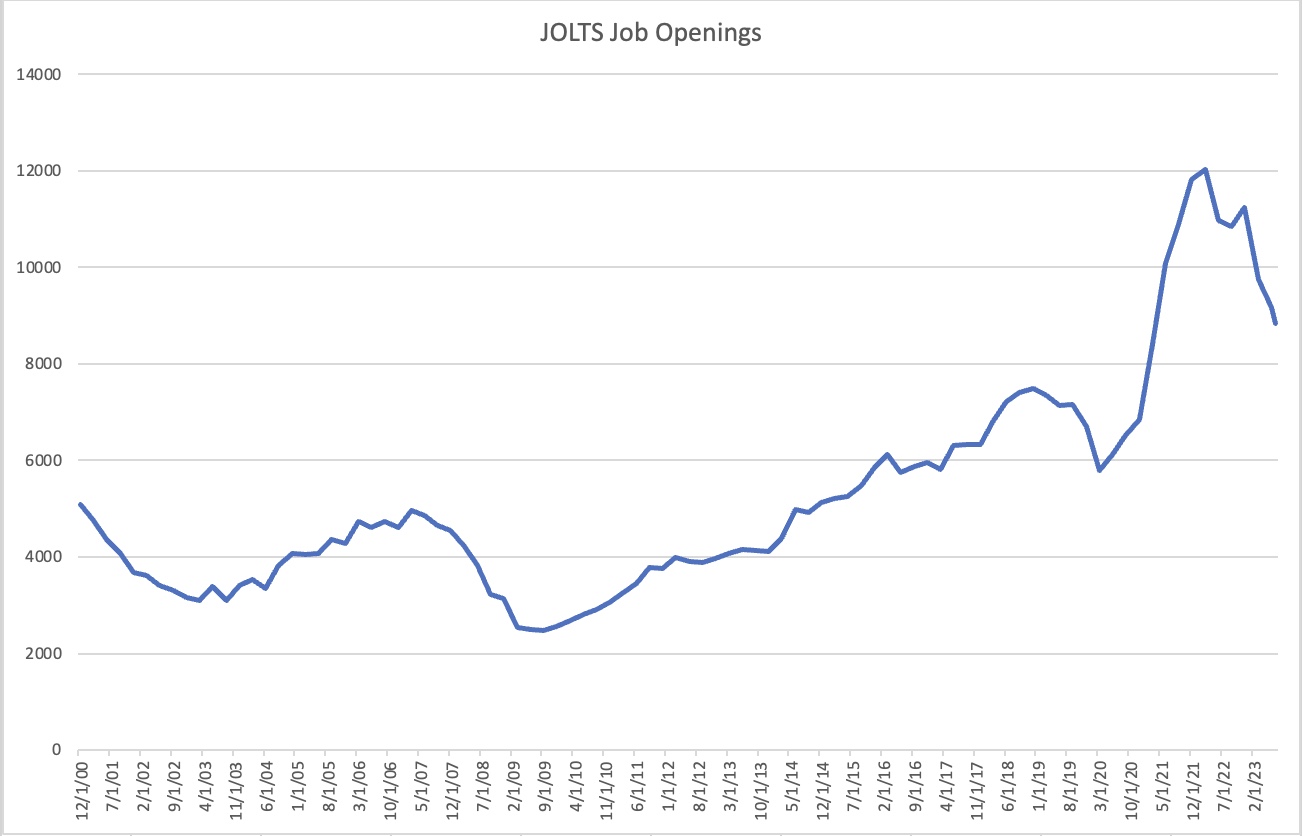
In fairness, Chairman Powell never actually said he would revel in a weaker employment picture, but he did discuss it regularly as a critical part of the Fed’s effort to drive inflation back to their 2% target.  And, in this case, more importantly, he had specifically mentioned the JOLTS data as a key indicator as an indication of the still very tight labor market.  With this in mind, it should be no surprise that when yesterday’s number came in much lower than expected, at ~8.8 million, down from a revised 9.2 million (the original print last month had been ~9.6 million), risk assets embraced the news as evidence that the Fed is, in fact, done raising rates.  Now, tomorrow and Friday’s data releases are still critical with both PCE and NFP on the calendar, so there is still plenty of opportunity for changes in opinions.  However, there is no question that the risk bulls have made up their minds and decided the Fed is done.

There is, however, a seeming inconsistency in this bullish thesis.  If the US economy is set to weaken, or perhaps is already weakening, with the jobs data starting to roll over, exactly what is there to be bullish about?  After all, China is clearly in the dumps, as is most of Europe.  While short-term interest rates are certainly likely to fall amid a recession, so too are earnings.  And if earnings are falling, explain to me again why one needs to be bullish on stocks.  I assume that the goldilocks scenario of the soft landing is the current driving force in markets, but that still remains a very low probability in my mind.  

History has shown that since they started compiling this particular labor market indicator in December 2000, peak-to-trough decline, has occurred leading directly to a recession.  This was true in 2001-02 (39% decline), 2008-09 (49% decline), 2020 (23% decline) as can be seen in the chart below, and now we are at the next sharp decline.  Thus far, the decline from the peak in March 2022 has been 27%, so there is ample room for it to fall further.  I merely suggest that if that is the case, things are probably not that great in the US economy, and therefore, are likely to have a negative impact on risk assets.  Keep that in mind as you consider potential future outcomes.

Source data: Bloomberg

The other data yesterday, Case Shiller House Prices and Consumer Confidence did little to enhance a bullish view.  Confidence fell sharply, by nearly 11 points and is not showing any trend higher.  Meanwhile, house prices fell less than expected, only about -1.2%, which has implications for the inflation picture.  After all, housing remains more than one-third of the CPI calculation, and if the widely assumed decline in house prices has ended, that doesn’t bode well for the idea inflation is going to fall further.  

Remember, Chairman Powell was quite clear that one data point would not be enough to change the Fed’s views, and while he is no doubt relieved that some of the job market pressure seems to be receding, he was also quite clear in his belief that rates needed to remain at least at current levels for quite some time to ensure success in their goal to reduce inflation.  The futures markets have reduced the probability of a September rate hike to 13% this morning, from nearly 25% before the data.  There is about a 50% chance of a hike at the November meeting.  It seems premature to determine that inflation is dead, and the Fed is getting set to cut soon, at least to my eyes.  Beware the hype.

As to the overnight session, after a strong US equity day, which saw the NASDAQ rally nearly 2% and the Dow nearly 1%, Asia had trouble following through. At least China had trouble, with virtually no movement there.  Australia rallied nicely, 1.2%, but otherwise, not much action in APAC.  In Europe this morning, there are far more losers than gainers, but the losses are on the order of -0.2%, so not substantial, but certainly not bullish.  The data out of Europe today showed inflation in Germany remains higher than desired, and confidence across the continent, whether consumer, economic or industrial, is sliding.  Not exactly bullish news.  As to US futures, they are ever so slightly softer this morning, down about -0.1% across the board.

In the bond market, it should be no surprise that bonds rallied and yields fell yesterday after the JOLTS data, with the 10yr yield falling 8bps.  However, this morning, it has bounced 3bps and European sovereign yields are higher by between 6bps and 7bps on the back of that higher than expected German inflation data.  The market is still pricing about a 50% probability of an ECB hike in September, but whether it happens in September or October, it is seen as the last one coming.

In the commodity space, oil (+0.5%) continues to hold its own, perhaps seeing support after OPEC member Gabon saw a coup yesterday, potentially reducing supply.  At the same time, we have seen several large drawdowns in inventories as well, so there seem to be some fundamentals at play.  Now, a recession is likely to dampen demand, but right now, the technicals seem to be winning out.  As to the metals markets, gold had a big rally yesterday on the back of declining real interest rates and is retaining those gains this morning.  The base metals are mixed this morning, but essentially unchanged over the past two sessions as the questions about growth vs. supply continue to be probed.

Finally, the dollar is modestly stronger this morning, but that is after a sharp decline yesterday.  With yields falling in the US it was no surprise to see the dollar under pressure.  With yields backing up, so is the dollar.  USDJPY is back above 146 again, having fallen below yesterday, but today’s movements are far more muted than yesterday’s.  As to the EMG bloc, the picture today is mixed with some gainers and some laggards, but aside from TRY and RUB, which are hyper volatile and illiquid, the gains and losses have been smaller.  One exception is ZAR (-0.5%), which fell after news the government ran a record budget deficit in July was released.

ADP Employment (exp 195K) headlines the data today, although we also see a revision of Q2 GDP (2.4%, unchanged) and the Advanced Goods Trade Balance (-$90.0B).  There are no Fed speakers on the calendar, so that ADP data will likely be the key for the day.  A weak print there will reinvigorate the Fed has finished debate, while a stronger than expected print may well see much of yesterday’s movement reversed.  With that in mind, remember that the past two months have seen very strong ADP numbers that were not matched by the NFP data, so this is likely to be taken with a little dash of salt.

We are clearly in a data dependent market right now as all eyes focus on this week’s news.  I need to see consistently weak data to alter my view that the Fed is going to step off the brakes, and it just has not yet appeared.  Until then, I still like the dollar.  

***Flash, ADP just released at 177K, with revision higher to last month’s number.  Initial move in equity futures is +0.2%, but there is a long time between now and the close.

Good luck

Adf

Demimonde

There once was a government bond
About which investors were fond
Regardless of yield
Their safety appealed
But lately, they’ve turned demimonde

So, as we await Payroll data
Demand has just started to crate-a
As yield keeps on rising
More folks are downsizing
Positions today and not late-a

It’s Payrolls Day and market participants are all anxiously awaiting the news at 8:30. Recall, last month, for the first time in more than a year, the NFP number printed slightly lower than the median forecast and that was seen as proof positive that the soft landing was on its way.  Subsequently, headline CPI fell to its lowest in two years as a confirmation of that process, and market participants decided, as one, that risk was the thing to own.  Equities rallied, bond yields fell and there was joy around the world markets. 

But lately, that story is having a rougher go of things as 10-year Treasury yields have jumped 43bps from their levels following the CPI release even though the PCE data was similarly soft.  What gives?  Arguably, part of this is because energy prices have rebounded sharply since last month, so it is increasingly clear that next week’s CPI data is going to higher than last month’s number.  As well, the growing confidence in the soft-landing scenario, which is touted across mainstream media constantly, implies that rate cuts may not be necessary.  After all, if Fed funds are at 5.5% and GDP is growing at 2.5% and Unemployment remains below 4.0%, why would the Fed change its policy rate?  The answer is, they wouldn’t.  At the same time, in the event the economy is clearly growing with positive future prospects, it is very likely that the yield curve will steepen back to a ‘normal’ shape with longer dated yields higher than short-dated yields.  If the Fed is not going to cut, that means the back end of the curve must see yields rise.  The current 2yr-10yr inversion is down to -74bps, so another 100bp rise in 10-year yields would seem realistic.

Of course, the question is, how would risk assets behave in that scenario?  And the answer there is likely to be far less positive.  After all, if risk free returns for 10 years were at 5+%, equities would need to offer a very good return opportunity to attract investors.  While there will be some companies that offer that, I suspect there are many more that would be shunned and need to reprice substantially lower to become attractive.  In other words, investors will want much lower entry prices to get involved and that could see a pretty big sell-off in the equity markets.  Just one possible scenario, but one with a decent probability of occurring, I think.

But that is all future prognostication.  In the meantime, let’s look at what the current consensus forecasts are for today:

Nonfarm Payrolls200K
Private Payrolls180K
Manufacturing Payrolls5K
Unemployment Rate3.6%
Average Hourly Earnings0.3% (4.2% Y/Y)
Average Weekly Hours34.4
Participation Rate62.6%

Source: Bloomberg

Wednesday’s ADP number was much higher than expected at 324K although the prior blowout number, 497K in June, was revised lower by 42K.  Still, 455K was much larger than the BLS report so there are many questions as to whether we will see a similar outcome today, a softer NFP number despite a very strong ADP number.  Looking at other indicators, the Initial Claims data continues to improve, hovering around 225K.  The JOLTS data was slightly softer than expected, but still right around 9.6 million and well above levels prior to the pandemic.  And finally, if you look at the employment subsets of the ISM data, they were soft in manufacturing, but solid in services, and services is a much larger part of the economy.

My take is the market is going to behave very clearly based on the actual outcome.  A strong number, anything over 225K, is likely to see the bond market sell off further and I wouldn’t be surprised to see 10-year yields, which have edged up another basis point this morning to 4.19%, trade back above the levels seen last October at 4.25% or more.  That will not be a positive for the stock markets as it will reintroduce the idea the Fed is going to continue to raise rates, something the market has completely priced out at this point.  Similarly, a soft number will open the door to a sharp equity rally and bond rally, with yields likely to even test the 4.0% level if the NFP number is soft enough.  I think we need a 100K or less number for a reaction like that.

Ahead of the data, there seems to be a growing concern over the outcome.  While Asian markets rebounded a bit, European bourses have started to fall across the board from earlier levels and are now all down by between -0.2% and -0.5%.  US futures, too, are now back to unchanged having spent the bulk of the evening higher on the back of a strong earnings report from Amazon.  

Bond markets are under pressure as energy prices around the world are rising, as are food prices, and so inflation prospects seem to be worsening.  This is despite the very earnest efforts of central banks around the world to convince us all that inflation has peaked, and they are near the end of their hiking cycles.  After the BOE raised rates by 25bps yesterday, the market has reduced the expected UK terminal rate down to 5.75%, two more hikes despite CPI running at 7.9% with Core at 6.9%.  In the Eurozone, the ECB has released a new report claiming that inflation has peaked as well, and the market has priced out any further rate hikes.  This all smacks of whistling past the graveyard in my view.

For instance, oil (+0.35%) is higher again, up more than 14% in the past month, and shows no signs of slowing down.  Not only did Saudi Arabia extend their one million bbl/day production cut for another month, but Russia now claims it will cut production by 300K bbl/day in September as well.  I haven’t discussed food prices in a while as they had eased off from the immediate post invasion highs, but the FAO Food price index rebounded last month and despite a sharp decline from its highest levels last year, is still at levels that have caused riots in the streets of African nations in the past.  Metals prices are also under pressure today, but that seems more to do with the strong dollar than anything else.  

Turning to the dollar, it is once again seeing demand as only NOK (+0.2%) has managed to gain on the greenback in the G10 space, although the other currencies’ losses are not large.  The same cannot be said for the EMG space where the APAC bloc is under real pressure led by KRW (-0.8%) and THB (-0.4%) on the dual concern of a slower growing China and broad risk-off sentiment.  One thing that seems likely is the dollar will benefit from a strong NFP print and suffer from a weak one.

And that’s really it for the day.  No Fed speakers are on the docket, but do not be surprised to hear some interviews if the number is very different from the forecasts.  In the end, nothing has changed my view that inflation will remain stickier than forecast and the Fed will hold tight thus supporting the dollar.  Remember, the combination of tight monetary and loose fiscal policy is the recipe for a strong currency.  And the US is running that in spades!

Good luck and good weekend

Adf

Much Wronger

There once was a theory on rates
Explaining, that, here in the States
Recession would cause
Chair Powell to pause
And end all soft-landing debates

But data of late has been stronger
Encouraging ‘higher for longer’
At this point it seems
Recessionist dreams
Could not have been very much wronger

Which leads to today’s NFP
The data point all want to see
If once more it’s high
Look for yields to fly
If low, look for stocks filled with glee

Recently, the US data releases have been anything but benign as they show continued economic strength in the face of many headwinds.  Yesterday’s numbers were overwhelmingly positive with the ADP Employment Change +497K, more than twice expectations and the highest since February 2022.  There is certainly no indication from this data series that companies are cutting back on their hiring.  As well, the ISM Services results were firmer than expected, with the headline jumping to 53.9, up nearly 3 points on the month and more than 2 points higher than forecast.  But more impressively, both the Employment and New Orders readings were much higher than last month indicating a more robust economy than many had been both describing and expecting.


But this is all simply a leadup to today’s NFP report, the data point upon which I have been most highly focused as the key for understanding the Fed’s reaction function.  As I have consistently highlighted, if NFP continues to grow and the Unemployment rate remains low, the Fed has ample cover to continue to tighten policy via both higher interest rates and balance sheet reduction (QT) without concern over political blowback.  After all, if jobs remain plentiful and wages continue to grow, complaints of overtightening will have no credibility.


Heading into the number, here are the latest consensus forecasts according to Bloomberg:


Nonfarm Payrolls

230K

Private Payrolls

200K

Manufacturing Payrolls

5K

Average Hourly Earnings

0.3% (4.2% Y/Y)

Average Weekly Hours

34.3

Participation Rate

62.6%


While the headline is, of course, just that, the number that will get the most press, it is worthwhile watching the Weekly Hours data which, as can be seen in the below Bloomberg chart, has been declining steadily since early 2021.  The key, though, is to recognize that the only time we have been below 34.3 is during the past two recessions, so a continuation lower in the recent trend may bode ill for future economic activity.  The thesis here is that companies will reduce the hours of their staff before actually firing them given the expense of bringing on and training new staff in the next up cycle.


In the meantime, investors and traders are taking their cues from the data already seen and are increasingly accepting of the higher for longer thesis the Fed has promulgated for the past year.  Yesterday’s price action was dramatic with Treasury yields surging through 4.0% in the 10-year and 5.0% in the 2-year.  This morning that trend continues with yields higher by another 3bps and you can be sure that if the overall employment report is strong, they will go higher still.


At the same time, equity markets are starting to feel a little pressure after what has been a remarkable rally in the first half of 2023, as the 4.0% level in 10-year Treasury yields has led to the breakage of things consistently during this cycle.  It started with the UK pension problems and Gilt market collapse in September 2022, was followed by the BOJ being forced to intervene to prevent the yen’s collapse in October 2022, then the FTX collapse in November 2022 and finally Silicon Valley Bank’s demise in March 2023.  In each of these cases, the 10-year yield traded above 4.0% ahead of the problem and was taken back down in the wake of the outcome.  This chart from the Gryning Times makes the case eloquently:

As such, it should be no surprise that equity markets fell yesterday in the US and overnight in Asia as we are clearly reaching a pain point in the market.


Of course, the question is, will this time be different?  Have investors priced in higher yields already and still comfortable paying extremely high multiples for stocks?  History has shown that this time is never different when it comes to investor behavior.  Euphoric predictions are followed by reality setting in and eventually prices adjust lower, reverting to long-term means, especially with respect to earnings mulitples.  But that is not to say things will be unable to defy gravity for longer.  As Keynes famously told us all, markets can remain irrational longer than you can remain solvent.


Based on all the data we have seen recently, there is no reason to believe that today’s NFP number is going to be weak, nor that the Unemployment Rate is going to rise sharply.  Rather, a higher than consensus number seems quite viable as a baseline expectation.


Remember, too, that the Fed continues to hammer home its message of higher for longer with Dallas Fed President Lorie Logan the latest to say so yesterday, “I remain very concerned about whether inflation will return to target in a sustainable and timely way.  I think more restrictive monetary policy will be needed to achieve the Federal Open Market Committee’s goals of stable prices and maximum employment.”  There is nothing ambiguous about that language, that is for sure.


Perhaps the most surprising thing about markets this morning is the fact that despite the rise in Treasury yields, the dollar is mixed at best, and arguably slightly lower.  Certainly, versus its G10 counterparts, it is broadly softer with the yen the biggest gainer, 0.5%.  This behavior is somewhat incongruous given the close relationship the dollar has had to US yields.  The dollar-yield relationship is much clearer in the EMG bloc where the greenback is stronger vs. virtually the entire segment.  And I expect that we are going to see a continuation of the dollar gains if US yields continue higher. 


But for now, all we can do is sit back and await the data.


Good luck and good weekend

Adf

Dire Straits

The Vice-Chair explained he foresees
A time when the Fed, by degrees
Will taper their buying
Of bonds while they’re trying
To offset the spread of disease

Soon after they finish that deed
Most members already agreed
To raise interest rates
Unless dire straits
In markets don’t let them succeed

Fed Vice-Chair Richard Clarida certainly surprised markets yesterday with his speech as he laid out his reasoning that the tapering of the Fed’s current QE purchases will occur sooner than many had previously expected.  While he started out with the caveat that the Fed will not be responding to forecasts, but rather to actual economic outcomes, he then proceeded to forecast the exact sequence of events that will occur and create the proper environment for the Fed to first, taper bond purchases and second, eventually raise interest rates.  The market response was immediate, with the bond market selling off sharply, the dollar rallying and equity markets ceding early gains alongside most commodity prices.  After all, a tighter Fed is not nearly as supportive of risk assets, but neither does it imply lower interest rates.  It is also worth noting that coincident with the release of the text of his speech was the release of the ISM Services number which printed at a much higher than expected, and record level, 64.1.  So, a positive data print and a hawkish Fed speaker were sufficient to change a lot of opinions.

But not this author’s, at least not yet.  My baseline view continues to be that the Fed remains in an extremely difficult position where inflation continues at much higher levels than which they expected or with which they are comfortable, but the employment market remains far away from their restated goal of maximum employment.  As well, as Clarida noted yesterday, and as has been repeated by numerous other Fed speakers, they promise they are not going to move on forecasts or survey data, but instead wait for actual numbers (read the NFP data and core PCE) to achieve their preferred levels before altering policy.  This means that tomorrow’s NFP data will be scrutinized even more closely than usual, as Clarida’s comments yesterday imply that even more FOMC members are ready to move.

One problem with the early taper thesis is that the data may not meet the FOMC’s requirements, at least not in the near term.  For instance, yesterday’s ADP Employment release printed at 330K, less than half the expected 690K and basically one-third of the forecasts for NFP tomorrow.  While the month to month correlation between the two data points is not perfect (0.784 over the past 5 years) it is certainly high enough to imply a strong relationship between the two.  The point is that if tomorrow’s NFP number disappoints, which cannot be ruled out, and assuming that the Fed is true to their word regarding waiting for actual data to reach their preferred levels, it would certainly suggest a delay to the tapering story.  Keep in mind, as well, that the Citi Economic Surprise Index, which measures actual releases vs. forecasts, remains in negative territory, implying that the economy is slowing further rather than extending gains seen earlier in the year.  In fact, after the much worse than expected GDP print last week, it appears that growth is already slipping back toward pre-Covid trends of 1.5% – 2.0%.  Oh yeah, none of this includes the impact of the delta variant, which has resulted in numerous lockdowns around the world and augers still slower growth.

On the flip side, though, is the fact that we have seen an increasing number of FOMC members start to accept the idea that tapering will soon be appropriate.  In addition to Clarida, yesterday we also heard from SF Fed President Daly, an avowed dove, who said, “Fed will do something on asset purchases end ’21 / early ’22.”  By my count, that makes at least six different FOMC members who have indicated tapering is coming soon.  Of this group, Clarida is by far the most important, but if even the doves like Daly are coming round to that view, tapering cannot be ruled out.

To taper or not remains the $64 trillion question for all markets, and while the recent trend of the narrative seems to be pushing in that direction, without support from ongoing improvements in employment data (after all, inflation is well through their target), it will still come to naught.

One last thing on inflation.  As the Fed tries to retake the narrative from the market, be prepared for a new description of inflation.  No longer will it be transitory, but rather, perhaps, tolerable.  In other words, they will accept that it is running hotter than their target and make the excuse that it is far more important to get the nation back to work first, at which point they can use those vaunted tools they frequently mention to address rapidly rising prices.

With all this in mind, the next question is, how will these changes impact the markets?  Yesterday’s price action is likely to be a very good case study if the data continues to support an early tapering of purchases.  Any interruption in the flow of money into the capital markets will be felt by both equities and bonds in the same way, they will fall in price, while the dollar is very likely to find a lot of support vs. both G10 and EMG counterparts.  As to commodities, my inclination is that the past year’s rally will pause, at the very least, but given they remain massively undervalued vs. other asset classes, they likely still have some upside.

On to today.  Overnight price action was mixed with the Nikkei (+0.5%) rising somewhat while Chinese shares (Hang Seng -0.8%, Shanghai -0.3%) were under pressure as stories about the next sectors to feel the wrath of regulators (sin stocks) were rampant with those falling and dragging the indices with them.  fortunately, they represent a much smaller portion of the market than the tech sector, so will have a smaller negative impact if that is, indeed, the situation.  Europe is mixed this morning (DAX +0.1%, CAC +0.35%, FTSE 100 -0.2%) as the morning data was inconclusive and investors there are far more concerned with the Fed than anything else.  As to US futures, they are all modestly higher this morning, about 0.2%.

Bond markets are showing the difference between central bank policy this morning with Treasuries consolidating yesterday’s declines and unchanged on the day, while European sovereigns (Bunds -1.0bps, OATs -1.2bps) continue to see support from an ECB that is nowhere near tightening policy.  Gilts (+2.0bps) on the other hand, are selling off a bit as the BOE meeting, just ending, revealed several things.  First, they are prepared to go to negative interest rates if they need to.  Second, they will continue their current QE pace of £3.4 billion per week, and third, that they expect inflation to reach 4.0% in Q4 of this year.  They did, however, explain that if things proceed as expected, some tightening, read higher interest rates, may be appropriate.  while the initial move in the GBP was a sharp jump higher, it has already retraced those steps and at +0.2% is only modestly up on the day.

Commodity prices are mixed with oil consolidating after yesterday’s rout and unchanged on the day.  In fact, the same is true of precious and most base metals, as traders are trying to figure out their next move, so likely waiting for tomorrow’s data.

And the dollar, interestingly, is modestly softer vs. the G10 this morning, but that is after a strong rally yesterday in the wake of the Clarida speech.  The commodity bloc is leading the way (AUD +0.35%, NOK +0.3%, NZD +0.25%) despite the lack of commodity price action.  And this also sems to ignore the 6th lockdown in Melbourne since the pandemic began last year, as the delta variant continues to wreak havoc around the world.  The rest of the G10 though, has seen much less movement.  In the emerging markets, PHP (-1.0%) was by far the worst performer overnight as the covid caseload soared to record numbers and concerns over growth expanded.  After that, TRY (-0.6%) is the next worst, as President Erdogan came out with calls for a rate cut despite rampant inflation.  However, away from those two currencies, movement has been on the order of +/- 0.2%, indicating nothing very special.  Essentially, these markets have ignored Clarida.  One last thing to note here is yesterday, the central bank of Brazil raised its SELIC rate by 1.0% to 5.25%, as inflation is exploding there.  However while BRL has been modestly stronger over the past several sessions, this was widely priced in so there was no big movement.

Data-wise, today brings Initial Claims (exp 383K), Continuing Claims (3255K) and the Trade Balance (-$74.2B), none of which seem likely to change any opinions.  Rather, at this point, all eyes are on tomorrow’s NFP data.  We also hear from two Fed speakers, Governor Waller and Minneapolis President KashKari, who is arguably the most dovish of all.  certainly if he starts talking taper, then the die is cast.  We shall see.

As I said, if tapering is on the cards, the dollar will likely test its highs from March/April, so be prepared.

Good luck and stay safe
Adf

Overkill

The talk in the market is still
‘Bout German high court overkill
While pundits debate
The bond program’s fate
The euro is heading downhill

Amid ongoing dreadful economic data, the top story continues to be the German Constitutional Court’s ruling on (rebuke of?) the ECB’s Public Sector Purchase Program, better known as QE. The issue that drew the court’s attention was whether the ECB’s actions to help support the Eurozone overall are eroding the sovereignty of its member states. Consider, if any of the bonds that are bought by the central banks default, it is the individual nations that will need to pay the cost out of their respective budgets. That means that the unelected officials at the ECB are making potential claims on sovereign nations’ finances, a place more rightly accorded to national legislatures. This is a serious issue, and a very valid point. (The same point has been made about Fed programs). However, despite the magnitude of the issues raised, the court gave the ECB just three months to respond, and if they are not satisfied with that response, they will bar the Bundesbank from participating in any further QE programs. And that, my friends, would be the end. The end of the euro, the end of the Eurozone, and quite possibly the end of the EU.

Remember, unlike the Fed, which actually executes its monetary policy decisions directly in the market, the ECB relies on each member nation’s central bank to enter the market and purchase the appropriate assets. So, the ECB’s balance sheet is really just a compilation of the balance sheets of all the national central banks. If the Bundesbank is prevented from implementing ECB policy on this score, given Germany’s status as the largest nation, and thus largest buyer in the program, the effectiveness of any further ECB programs would immediately be called into question, as would the legitimacy of the entire institution. This is the very definition of an existential threat to the single currency, and one that the market is now starting to consider more carefully. It is clearly the driving force behind the euro’s further decline this morning, down another 0.5% which makes 1.5% thus far in May. In fact, while we saw broad dollar weakness in April, as equity markets rallied and risk was embraced, the euro has now ceded all of those gains. And I assure you, if there is any doubt that the ECB will be able to answer the questions posed by the court, the euro will decline much further.

The euro is not the only instrument under pressure from this ruling, the entire European government bond market is falling today. Now, granted, the declines are not that sharp, but they are universal, with every member of the Eurozone seeing bond prices fall and yields tick higher. This certainly makes sense overall, as the ECB has been the buyer of (first and) last resort in government bond markets, and the idea that they may be prevented from acting in the future is a serious concern. Simply consider how much more debt all Eurozone nations are going to need to issue in order to pay for their fiscal programs. Across the entire Eurozone, forecasts now point to in excess of €1 trillion of new bonds this year, already larger than the ECB’s PEPP. And if there is a second wave of the virus, forcing a reclosing of economies with a longer period of lockdown, that number is only going to increase further. Without the ECB to absorb the bulk of that debt, yields in Eurozone debt will have much further to climb. The point is that this issue, which was initially seen as minor and technical, may actually be far more important than anything else. And while the odds are still with the ECB to continue with business as usual, the probability of a disruption is clearly non-zero.

Away from the technicalities of the German Constitutional Court, there is far less of interest in the markets overall. Equity markets are mixed, with gainers and losers in both the Asian session as well as Europe. US futures, at this time, are pointing higher, with all three indices looking toward 1% gains at the open. And the dollar is broadly, though not universally, higher.

Aside from the euro’s decline, we have also seen weakness in the pound (-0.4%) after the Construction PMI (the least impactful of the PMI measures) collapsed to a reading of 8.2, from last month’s dreadful 39.2. This merely reinforces what type of hit the UK economy is going to take. On the plus side, the yen is higher by 0.3%, seemingly on the back of position adjustments as given the other risk signals, I would not characterize today as a risk-off session.

In the EMG space, there are far more losers than gainers today, led by the Turkish lira (-1.0%) and the Russian ruble (-0.8%). The lira is under pressure after new economic projections point to a larger economic contraction this year of as much as 3.4%. This currency weakness is despite the central bank’s boosting of FX swaps in an effort to prevent a further decline. Meanwhile, despite oil’s ongoing rebound (WTI +3.6%) the ruble seems to be reacting to recent gains and feeling some technical selling pressure. Elsewhere in the space, we have seen losses on the order of 0.3%-0.5% across most APAC and CE4 currencies. The one exception to the rule is KRW, which rallied 0.6% overnight as expectations grow that South Korea is going to be able to reopen the bulk of its economy soon. One other positive there is that demand for USD loans (via Fed swap lines) has diminished so much the BOK is stopping the auctions for now. That is a clear indication that financial stress in the nation has fallen.

On the data front, this morning brings the ADP Employment number (exp -21.0M), which will be the latest hint regarding Friday’s payroll data. Clearly, a month of huge Initial Claims data will have taken its toll. Yesterday’s Fed speakers didn’t tell us very much new, but merely highlighted the fact that each member has their own view of how things may evolve and none of them are confident in those views. Uncertainty remains the word of the day.

For now, the narratives of the past several weeks don’t seem to have quite the strength that they did, and I would say that the focus is on the process of economies reopening. While that is very good news, the concern lies after they have reopened, and the carnage becomes clearer. Just how many jobs have been permanently erased because of the changes that are coming to our world in the wake of Covid-19? It is that feature, as well as the nature of economic activity afterwards, that will drive the long-term outcome, and as of now, no clear path is in sight. The opportunity for further market dislocations remains quite high, and hedgers need to maintain their programs, especially during these times.

Good luck and stay safe
Adf


It’s Now or Never

Like Elvis said, it’s now or never
For Boris’s Brexit endeavor
The Irish are chuffed
As Coveney huffed
He’s not, but he thinks he’s so clever

Around 7:00 this morning, PM Boris Johnson will be addressing the Tory party at their annual convention and the key focus will be on his plan to ensure a smooth Brexit. The early details call for customs checks several miles away from the border on both sides with a time limit of about four years to allow for technology to do the job more effectively. However, he maintains that the whole of the UK will be out of the EU and that there will be no special deal for Northern Ireland. His supporters in Northern Ireland, the DUP, appear to have his back. In addition, he is reportedly going to demand that an agreement be reached by October 11 so that it can be agreed in Parliament as well as throughout the EU.

Interestingly, the Irish are still playing tough, at least according to Foreign Minister Simon Coveney, who said that the leaked details formed “no basis for an agreement.” Of course, as in everything to do with this process, there are other views in Ireland with Irish PM Varadkar seemingly far more willing to use this as a basis for discussion. His problem is the Fianna Fail party, a key coalition member, is unhappy with the terms. I say this is interesting because in the event of a no-deal Brexit, Ireland’s economy will be the one most severely impacted, with estimates of 4%-5% declines in GDP in 2020.

With respect to the market, it is difficult to untangle the effect of the latest Brexit news from the dreadful economic data that continues to be released. This morning’s UK Construction PMI fell to 43.3, within ticks of the lows seen during the financial crisis in 2009. The pound has suffered, down 0.4% as I type, although it was even softer earlier in the session. The FTSE 100 is also weak, -1.8%, although that is very much in line with the rest of the European equity markets (CAC -1.6%, DAX -1.3%) and is in synch with the sharp declines seen yesterday in the US and overnight in Asia.

Speaking of yesterday’s price action, it was pretty clear what drove activity; the remarkably weak ISM Manufacturing print at 47.8. This was far worse than forecast and the lowest print since June 2009. It seems pretty clear at this point that there is a global manufacturing recession ongoing and the question that remains is, will it be isolated to manufacturing, or will it spill over into the broader economy. Remember, manufacturing in the US represents only about 11.6% of GDP, so if unemployment remains contained and services can hold up, there is no need for the US economy to slip into recession. But it certainly doesn’t help the situation. However, elsewhere in the world, manufacturing represents a much larger piece of the pie (e.g. Germany 21%, China 40%, UK 18%) and so the impact of weak manufacturing is much larger on those economies as a whole.

It is this ongoing uncertainty that keeps weighing on sentiment, if not actually driving investors to sell their holdings. And perhaps of most interest is that despite the sharp equity market declines yesterday, it was not, by any means, a classic risk-off session. I say this because the yen barely budged, the dollar actually fell and Treasuries, while responding to the ISM print at 10:00am by rallying more than half a point (yields -7bps), could find no further support and have not moved overnight. If I had to describe market consensus right now, it would be that everyone is unsure of what is coming next. Will there be positive or negative trade news? Will the impeachment process truly move forward and will it be seen as a threat to the Administration’s plans? Will Brexit be soft, hard or non-existent? As you well know, it is extremely difficult to plan with so many potential pitfalls and so little clarity on how both consumers and markets will react to any of this news. I would contend that in situations like this, owning options make a great deal of sense as a hedge. This is especially so given the relatively low implied volatilities that continue to trade in the market.

Turning to the rest of the session, a big surprise has been the weakness in the Swiss franc, which has fallen 0.6% this morning despite risk concerns. However, the Swiss released CPI data and it was softer than expected at -0.1% (+0.1% Y/Y) which has encouraged traders to look for further policy ease by the SNB, or at least intervention to weaken the currency. But just as the dollar was broadly weaker yesterday, it has largely recouped those losses today vs. its G10 counterparts. Only the yen, which is up a scant 0.15%, has managed to show strength vs. the greenback. In the EMG space, KRW has been the biggest mover, falling 0.55% overnight after North Korea fired another missile into the sea last night, heightening tensions on the peninsula there. Of course, given the negative data (negative CPI and sharply declining exports) there is also a strong case being made for the BOK to ease policy further, thus weakening the won. Beyond that, however, the EMG currency movement has been mixed and modest, with no other currency moving more than 25bps.

This morning after Boris’s speech, all eyes will turn to the ADP employment data (exp 140K) and then we have three more Fed speakers this morning, Barkin, Harker and Williams. Yesterday, we heard from Chicago Fed president Charles Evans, who explained that he felt the economy was still growing nicely and that the two rate cuts so far this year were appropriate. He did not, however, give much of a hint as to whether he thought the Fed needed to do more. Reading what I could of the text, it did not really seem to be the case. My impression is that his ‘dot’ was one of the five looking for one more cut before the September meeting.

And that’s what we have for today. Barring something remarkable from Boris, it appears that if ADP is in line with expectations, the dollar is likely to consolidate this morning’s gains. A strong print will help boost the buck, while a weak print, something on the order of 50K, could well see the dollar cede everything it has gained today and then some.

Good luck
Adf


Certainty’s Shrinking

The data from yesterday showed
That Services growth hadn’t slowed
But ADP’s number
Showed job growth aslumber
An outcome that doesn’t, well, bode

This morning it’s Mario’s turn
To placate the market’s concern
His toolkit keeps shrinking
And certainty’s sinking
That he can prevent a downturn

The glass is always half-full if you are an equity trader, that much is clear. Not only did they interpret Chairman Jay’s words on Tuesday as a rate cut was coming soon (although he said no such thing), but yesterday they managed to see the combination of strong ISM Non-Manufacturing data (56.9 vs exp 55.5) and weak ADP Employment data (27K vs exp 180K) as the perfect storm. I guess they see booming profits from Services companies alongside rate cuts from the Fed as job growth slows. At any rate, by the end of the day, equity markets had continued the rally that started Tuesday with any concerns over tariffs on Mexican imports relegated to the dustbin of last week.

Meanwhile the Treasury market continues to have a different spin on things with 10-year yields still plumbing multi-year depths (2.10%) while the 5yr-30yr spread blows out to its steepest (88bps) since late 2017. The interpretation here is that the bond market is essentially forecasting a number of Fed rate cuts as the economy heads into recession shortly. It isn’t often that markets have such diametrically opposed views of the future, but history has shown that, unfortunately in this case, the bond market has a better track record than the stock market. And there is one other little tidbit of market data worth sharing, the opposing moves of gold and oil. Last week was only the third time since at least the early 1980’s that gold prices rallied at least 5.2% while oil fell at least 8.7%, an odd outcome. The other two times? Right before the Tech Bubble burst and right before the Global Financial Crisis. Granted this is not a long track record, but boy, it’s an interesting outcome!

The point is, signs that economic growth is slowing in the US are increasing. One thing of which we can be sure is that while slowing growth elsewhere may not lead to a US recession, a US recession will absolutely lead to much slower growth everywhere else in the world. Remember, the IMF just this week reduced their GDP growth forecasts yet again for 2019, and their key concern, the deteriorating trade situation between the US and the rest of the world, is showing no signs of dissipating.

Into this mix steps Mario Draghi as the ECB meets today in Vilnius, Lithuania (part of their annual roadshow). At this point, it is clear the ECB will define the terms of the new TLTRO’s with most analysts’ views looking for very generous terms (borrowing at -0.4%) although the ECB has tried to insist that these will only last two years rather than the four years of the last program. There is also talk of the ECB investigating further rate cuts, with perhaps a tiered structure on which reserves will be subject to the new, lower rate. And there is even one bank analyst forecasting that the ECB will restart QE come January 2020. Futures markets are pricing in a rate cut by Q1 2020, which is certainly not the direction the ECB intended when they changed their forward guidance to ‘rates will remain where they are through at least the end of the year.’ At that time, they were thinking of rate hikes, but that seems highly unlikely now.

With all of this in mind, let us now consider how this might impact the FX market. As I consistently point out, FX is a relative game. This means that expectations for both currencies matter, not just for one. So, the idea that the Fed has turned dovish, ceteris paribus, would certainly imply the dollar has room to fall. But ceteris is never paribus in this world, and as we are likely to hear later today at Draghi’s press conference, the ECB is going to be seen as far more dovish than just recently supposed. (What if the TLTRO’s are for three years instead of two? That would be seen as quite dovish I think.) The point is that while the signs of a weaker US economy continue to grow, those same signs point to weakness elsewhere. In the end, while the dollar may still soften further, as expectations about the Fed race ahead of those about the ECB or elsewhere, that is a short-term result. As I wrote earlier this week, 2% or so further weakness seems quite viable, but not much more than that before it is clear the rest of the world is in the same boat and policy eases everywhere.

FX market activity overnight has shown the dollar to be under modest pressure, with the euro up 0.3% while the pound and most of the rest of the G10 are up lesser amounts (0.1%-0.2%). However, many EMG currencies remain under pressure with MXN -0.75% after Fitch downgraded its credit rating to BBB-, the lowest investment grade, and weakness in ZAR and TRY helping to support the broad dollar indices. But in the big picture, the dollar remains in a trading range as we will need to see real policy changes before there is significant movement.

Turning to this morning’s data, aside from the Draghi presser at 8:30, we also see Initial Claims (exp 215K), the Trade Balance (-$50.7B), Nonfarm Productivity (3.5%) and Unit Labor Costs (-0.8%). But the reality is that, especially after yesterday’s ADP number, all eyes will be on tomorrow’s NFP print. In the event that ADP was prescient, and we see a terrible number, watch for a huge bond market rally and a weaker dollar. But if it is more benign, around the 185K expected, then I don’t see any reason for markets to change their recent tune. Expectations of future Fed rate cuts as ‘insurance’ will help keep the dollar on its back foot while supporting equities round the world.

Good luck
Adf

Percent Twenty-Five

The story, once more’s about trade
As Trump, a new threat, has conveyed
Percent twenty-five
This fall may arrive
Lest progress in trade talks is made

President Trump shook things up yesterday by threatening 25% tariffs on $200 billion of Chinese imports unless a trade deal can be reached. This is up from the initial discussion of a 10% tariff on those goods, and would almost certainly have a larger negative impact on GDP growth while pushing inflation higher in both the US and China, and by extension the rest of the world. It appears that the combination of strong US growth and already weakening Chinese growth, has led the President to believe he is in a stronger position to obtain a better deal. Not surprisingly the Chinese weren’t amused, loudly claiming they would not be blackmailed. In the background, it appears that efforts to restart trade talks between the two nations have thus far been unsuccessful, although those efforts continue.

Clearly, this is not good news for the global economy, nor is it good news for financial markets, which have no way to determine just how big an impact trade ructions are going to have on equities, currencies, commodities and interest rates. In other words, things are likely more uncertain now than in more ‘normal’ times. And that means that market volatility across markets is likely to increase. After all, not only is there the potential for greater surprises, but the uncertainty prevailing has reduced liquidity overall as many investors and traders hew to the sidelines until they have a better idea of what to do. And, of course, it is August 1st, a period where summer vacations leave trading desks with reduced staffing levels and so liquidity is generally less robust in any event.

Moving past trade brings us straight to the central bank story, where the relative hawkishness or dovishnes of yesterday’s BOJ announcement continues to be debated. There are those who believe it was a stealth tightening, allowing higher 10-year yields (JGB yields rose 8bps last night to their highest level in more than 18 months) and cutting in half the amount of reserves subject to earning -0.10%. And there are those who believe the increased flexibility and addition of forward guidance are signals that the BOJ is keen to ease further. Yesterday’s price action in USDJPY clearly favored the doves, as the yen fell a solid 0.8% in the session. But there has been no follow-through this morning.

As to the other G10 currencies, the dollar is modestly firmer against most of them this morning in the wake of PMI data from around the world showing that the overall growth picture remains mixed, but more troubling, the trend appears to be continuing toward slower growth.

The emerging market picture is similar, with the dollar performing reasonably well this morning, although, here too, there are few outliers. The most notable is KRW, which has fallen 0.75% overnight despite strong trade data as inflation unexpectedly fell and views of an additional rate hike by the BOK dimmed. However, beyond that, modest dollar strength was the general rule.

At this point in the session, the focus will turn to some US data including; ADP Employment (exp 185K), ISM Manufacturing (59.5) and its Prices Paid indicator (75.8), before the 2:00pm release of the FOMC statement as the Fed concludes its two day meeting. As there is no press conference, and the Fed has not made any changes to policy without a press conference following the meeting in years, I think it is safe to say there is a vanishingly small probability that anything new will come from the meeting. The statement will be heavily parsed, but given that we heard from Chairman Powell just two weeks ago, and the biggest data point, Q2 GDP, was released right on expectations, it seems unlikely that they will make any substantive changes.

It feels far more likely that this meeting will have been focused on technical questions about how future Fed policies will be enacted. Consider that QE has completely warped the old framework, where the Fed would actually adjust reserves in order to drive interest rates. Now, however, given the trillions of dollars of excess reserves, they can no longer use that strategy. The question that has been raised is will they try to go back to the old way, or is the new, much larger balance sheet going to remain with us forever. For hard money advocates, I fear the answer will not be to their liking, as it appears increasingly likely that QE is with us to stay. Of course, since this is a global phenomenon, I expect the impact on the relative value of any one currency is likely to be muted. After all, if everybody has changed the way they manage their economy in the same manner, then relative values are unlikely to change.

Flash, ADP Employment prints at a better than expected 219K, but the initial dollar impact is limited. Friday’s NFP report is of far more interest, but for today, all eyes will wait for the Fed. I expect very limited movement in the dollar ahead of then, and afterwards to be truthful.

Good luck
Adf