Markets Ain’t Scared

So, NFP data was wrong
Which many have said all along
Perhaps it was proper
For Trump to just drop her
Creating McTarfer’s swan song
 
Remarkably, though, no one cared
And equity markets ain’t scared
While Treasury yields
Edged higher, it feels
That 50bps is now prepared


Like a dog with a bone, I cannot give up the NFP story even though the market clearly didn’t care about the adjustment or had fully priced it in before the release.  In fact, it seems investors, or algos at least, welcomed the fact that the number was so large as it seems to make the case for a 50 basis point cut next week that much stronger.  Certainly, Chairman Powell will have difficult saying that starting a cut cycle with 50bps would be inappropriate given his more politically driven efforts a year ago.

But one final word on this subject is worthwhile I believe, and that is; why does the market pay so much attention to this particular data point?  Consider the following:  according to the BLS, current total employment in the US is approximately 159,540,000.  In fact, that number has been above 150 million since January 2019, although Covid managed to impact that for a few months before it was quickly regained.  

Now, NFP has averaged ~125K since they started keeping records in 1939 with a median reading of 160K.  To modernize the data, since 2000 it has averaged ~93K with a median of 154K.  Consider what that means with respect to the total labor force.  Ostensibly, the most important economic data point of each month represents, on average, 0.06% of the working population.  Additionally, that number is subject to massive revisions both on a monthly basis, and then, as we saw yesterday, there is another annual revision.  I don’t know if Ms. McEntarfer was good at her job or not, but it is not unreasonable to consider that the payrolls data, as currently calculated, does not really represent anything other than statistical noise.   I prepared the below chart to help you visualize how close to zero the NFP number is relative to the working population.  Absent the Covid spike, I would argue that the information that this datapoint delivers, especially in the past 25 years, also approaches zero.

Data FRED database, calculations @fx_poet

You may recall the angst with which the firing of Ms McEntarfer was met, and given President Trump’s penchant for overstating certain things, it certainly had a bad look about it.  But the evidence seems to point to the fact that the data is not only suspect, given its revision history, but essentially inconsequential relative to the economy.  The fact that the Fed is making policy decisions based on changes in the economy that represent less than 0.1% of the working population, and half that amount of the general population, may be the much larger scandal here.  

Remember, a 4th Turning is all about tearing down old institutions because they no longer are fit for purpose and building new ones to gain trust.  Perhaps NFP as THE monthly number is an institution whose time has passed, and investors (and the Fed) need to find other data to help them evaluate the current economic situation.  Of course, the algos love a single number to which they can be programmed and respond instantaneously, so if NFP loses its cachet, and algos lose some of their power, it would be better for us all, except maybe Ken Griffin and Larry Fink!

Otherwise, the overnight market offered very little new information.  Chinese inflation data continues to show an economy in deflation with the Y/Y result of -0.4% being worse than expected and the 5th negative outcome in the past seven months.  Looking at the chart below, it is becoming clearer that President Xi, despite flowery words about consumption, has no idea how to stimulate domestic activity other than the mercantilist model to which China subscribes.  Now, they overproduce stuff and since the imposition of higher tariffs by the US on Chinese goods, it seems more of that stuff is hanging around at home and driving prices down.  Alas, it seems not enough Chinese want the things they manufacture, hence steadily declining prices.  While it is a different problem than in the US, it is a problem nonetheless for President Xi.

Source: tradingeconomics.com

And with that, let’s head to the market activity.  Yesterday’s US rally was followed by strength all around the world as it appears everybody is excited about the prospects of the FOMC cutting rates by 50bps next week. While the Fed funds futures market has barely moved, currently pricing just an 8.2% probability of that move, I am hard pressed to conclude that the rest of the economic and earnings data is so good that equities should be rallying for any other reason.

Anyway, Japan (+0.9%), China (+0.2%), HK (+1.0%), Korea (+1.7%), India (+0.4%) and Taiwan (+1.4%) are pretty definitive proof that everybody is all-in on a 50bp cut by the Fed.  In fact, the worst performer in Asia, Thailand (0.0%) was merely flat on the day.  Turning to Europe, here, too, green is today’s color with Spain (+1.3%), France (+0.6%), Germany (+0.2%) and the UK (+0.5%) all rising nicely.  Domestic issues, which abound throughout Europe, are inconsequential this morning.  and don’t worry, US futures are higher by 0.35% this morning as well.

In the bond market, while yields edged up yesterday a few basis points, this morning they are essentially unchanged across the board in the US, Europe and Japan.  Worries about excessive deficits have been set aside.  A major protest in France today is not impacting markets at all.  Word that the BOJ will consider tightening policy (as if!) despite the political uncertainty has had no impact.  Perhaps we have achieved that long sought equilibrium in rates! 🤣

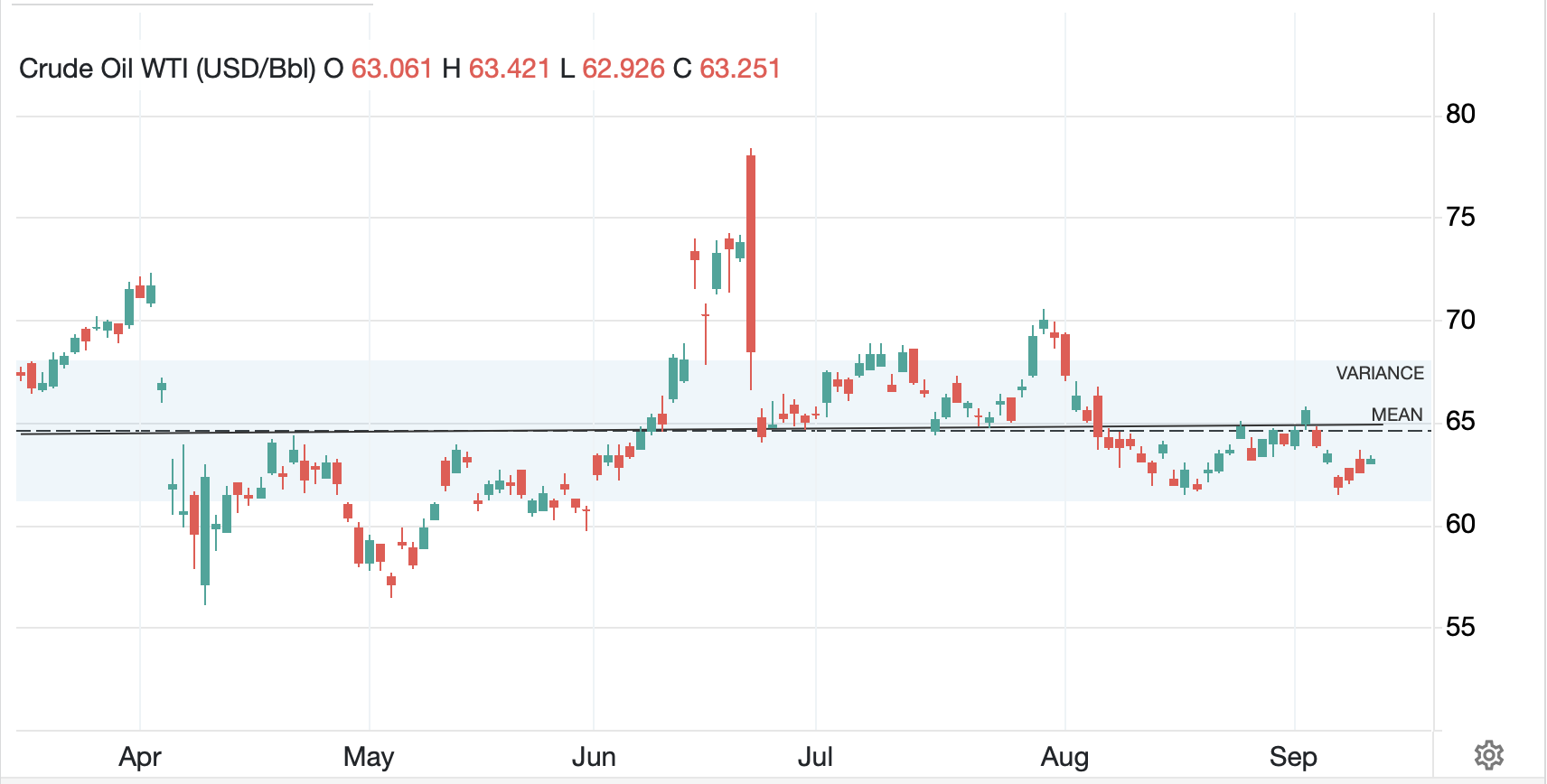
In the commodity space, oil (+1.1%) rallied after the Israeli attempt to eliminate Hamas leadership in Qatar yesterday ruffled many feathers and was seen as a potential escalation in Middle East conflicts.  But, at $63.30/bbl, WTI remains firmly in the middle of its recent trading range as per the below chart.

Source: tradingeconomics.com

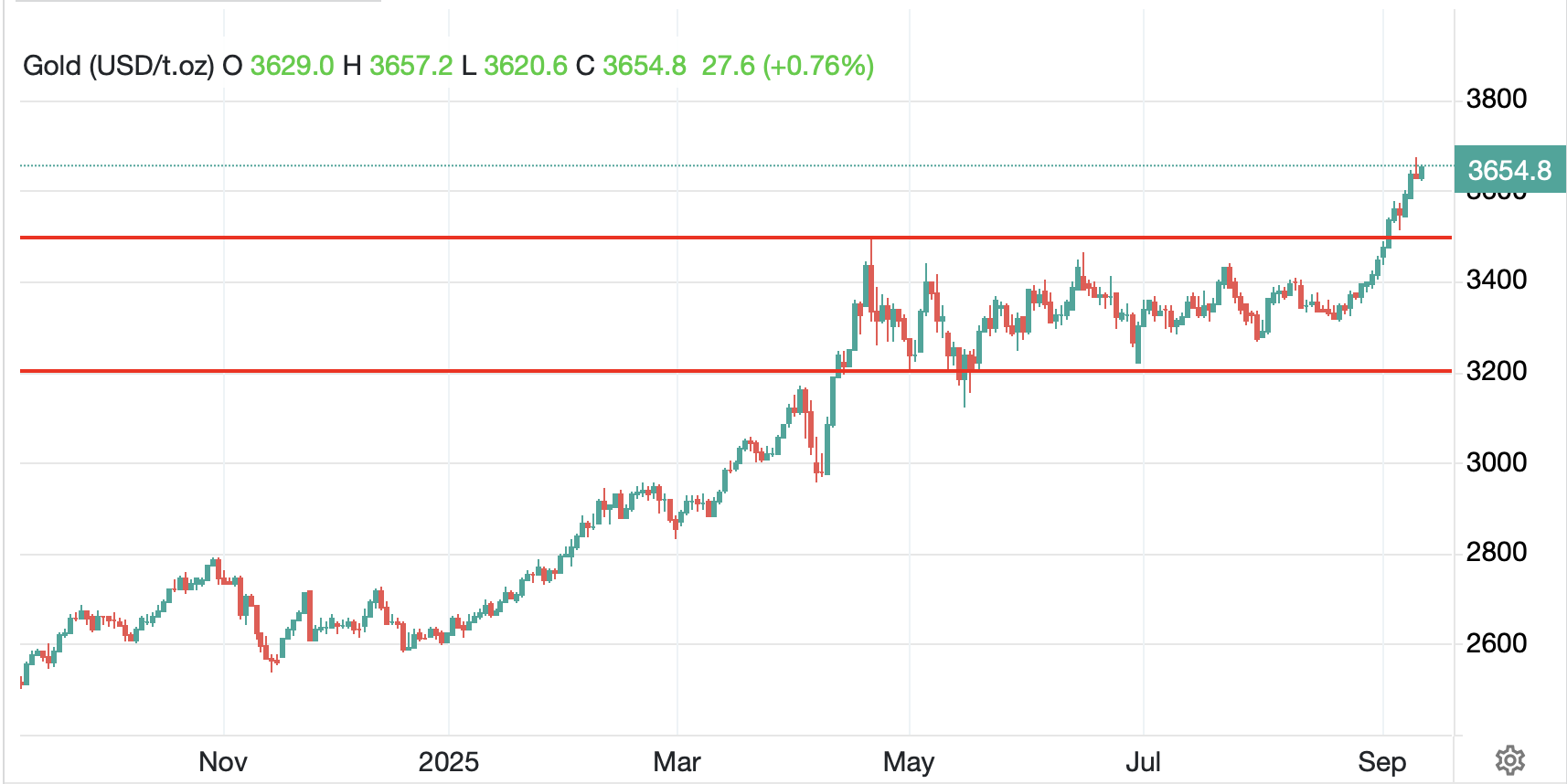
But you know what is not in the middle of its trading range, in fact the only thing with a real trend right now?  That’s right, gold.  A quick look at the below chart from tradingeconomics.com helps you understand why so many market pundits, if not investors, are excited about continued gains here.  Calls for $4000/oz and more by early next year are increasing.  As to the other metals, silver and platinum are following gold higher this morning although copper is unchanged.

Finally, the dollar is little changed vs. most major currencies with the euro and pound having moved 0.1% or less than the close and the same with JPY, CAD, CHF and MXN.  In fact, the biggest mover this morning is NOK (+0.5%) which on top of oil’s rally has benefitted from still firm inflation encouraging the idea that the Norges Bank is going to raise rates when they meet next Thursday.  If they hike after the Fed cuts 50bps, the krone will likely see further strength, at least in the short run.

On the data front this morning, PPI (exp 0.3%, 3.3% Y/Y; 0.3%, 3.5% Y/Y core) is the key release and then the EIA oil inventory data is released at 10:30 with a modest draw expected.  As we remain in the quiet period, no Fed speakers are slated, so the algos will have to live with the PPI data or any other stories they can find.

If the inflation data this week stays quiescent, I think 50bps is likely next week as the employment situation, despite my comments above, will still be seen in a negative light and I think Powell will feel forced to move.  Plus, if Stephen Miran is added to the board this week, there will be increased pressure for just such an outcome.  However, while a Fed aggressively cutting rates should be a dollar negative, I feel like that is becoming the default view, so maybe not so much movement from here.  We need another catalyst.

Good luck

Adf

Widely Decried

While tariffs are widely decried
By analysts, they are worldwide
But Trump’s latest scheme
To some, seems extreme
As license fees are codified
 
So, tech names, who’ve, taxes, deflected
Are now likely to be subjected
To payment of fees
To sell overseas
And revenues will be collected


One thing you can never say about President Trump is that he lacks innovative ideas.  Consider one of the biggest complaints over the past decades regarding US corporations; the fact that the tech companies (and drug companies) have been so effective at avoiding paying taxes based on the way they have gamed utilized the tax code and international treaties.  And this was not a partisan complaint as both sides of the aisle were constantly frustrated by large companies’ ability to not pay their “fair share” as it is often described.

It appears that President Trump has come up with a solution for this, charging a licensing fee for companies to sell overseas.  The big news over the weekend was that Nvidia and AMD are both going to pay a licensing fee of 15% of REVENUE on sales of chips to China.  In the case of Nvidia, that is anticipated to be some $2.5 billion with somewhat smaller numbers for AMD.  This is an excellent description of the process by @Kobeissiletter on X. 

I have often expressed the view that corporate taxation, if we are going to have it, ought not be on profits but on revenue.  Corporations are expert at reducing taxable income, maintaining a staff of lawyers and accountants to do just that.  But gaming top line revenues is much harder.  This gambit by President Trump is moving things in that direction.  And remarkably, given these license fees are for exports, it ought to be outside the consumer price chain in the US completely.

There is an article in the WSJ this morning titled, “The US Marches Toward State Capitalism With American Characteristics,” which outlines, and mildly complains, about the changes in the way the US government is dealing with the private sector under President Trump.  It discusses the purchase of 15% of MP Materials, the only US based miner/processor of rare earth minerals, and it discusses these license fees all under the guise of implying this is a bad direction.  And I completely understand that idea as governments tend to be terrible stewards of capital.  However, 25 years of Chinese unfettered access to Western markets while they have skirted the rules codified by the WTO have resulted in some significant national security challenges that can no longer be ignored.  Full marks to President Trump for creative methods to address these challenges, despite the wailing and teeth gnashing of economists.

But other than that story, as well as the ongoing back and forth regarding potential peace talks in the Russia-Ukraine war, not all that much has happened overnight.  For a change, markets are behaving like it is the summer doldrums, so perhaps we should be thankful for the respite.  As such, let’s take a look at how things have done and what we can anticipate this week with CPI and Retail Sales set to be released.

Friday’s US equity rally combined with the news that Nvidia and AMD will be able to export some chips to China saw modest gains there (+0.4%) and in Hong Kong (+0.2%) even though another major property company in China, China South City Holdings Ltd., is being forced into liquidation.  The property situation in China will continue to weigh on the economy there and given property investment was long seen as most Chinese families’ retirement nest egg, will undermine consumption for years.  Elsewhere in the region, there were more gainers (India, Indonesia, Malaysia, Australia, New Zealand, Taiwan) than laggards (Thailand, Philippines) with Japan closed for Mountain Day, a relatively new holiday, and other markets little changed.  

In Europe, though, screens are modestly red with losses on the order of -0.35% across the CAC, DAX and IBEX amid general uncertainties regarding the future economic direction and a lack of earnings positives.  At this hour (7:00), US futures are slightly higher, by 0.2%.

In the bond market, after last week’s auctions have been absorbed, Treasury yields have edged lower this morning, down -2bps, despite Fed funds futures’ probability of that September rate cut slipping to 88% from Friday’s 93%.  In fact, Fed Governor Bowman reiterated over the weekend that she would be voting for a cut at each of the three meetings left this year.  European sovereigns though are little changed, with some having seen yields edge higher by 1bp, as this appears to be a truly lackluster summer day.

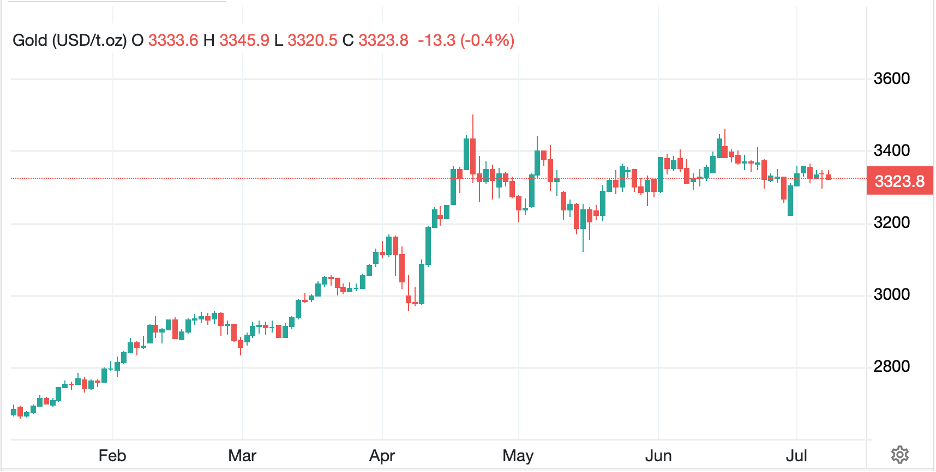
Commodities are the only market that is seeing any movement of note, and it is not oil (+0.2%) which has been trading either side of unchanged since last night.  Rather, gold (-1.2%) is suffering this morning as you can see on the chart below as the promise of a potential peace in Ukraine seems to be removing some need for its haven status.  Of course, the thing to really note about the gold market is just how choppy trading has been as conflicting narratives continue to impinge on price movement.

Source: tradingeconomics.com

This decline has pulled down both silver (-1.4%) and copper (-0.95%) with all this happening despite virtually no movement in the FX markets.

Turning to the dollar, one is hard pressed to find any substantial movement in either G10 or EMG currencies. The true outlier this morning is NOK (+0.4%) but otherwise, +/- 0.1% or less is the best description of the price action.  This is what a summer market really looks like!

On the data front, we do get some important information as follows:

TuesdayRBA Rate Decision3.60% (current 3.85%)
 CPI0.2% (2.8% Y/Y)
 Ex food & energy0.3% (3.0% Y/Y)
 Monthly Budget Statement-$140B
ThursdayPPI0.2% (2.5% Y/Y)
 Ex food & energy0.2% (2.9% Y/Y)
 Initial Claims226K
 Continuing Claims1960K
FridayRetail Sales0.5%
 Ex Autos0.3%
 IP0.0%
 Capacity Utilization77.6%
 Michigan Sentiment62.0

Source: tradingeconomics.com

With all the hoopla about the firing of Ms McEnterfar at BLS, you can be sure that there will be lots of discussion on the CPI data regardless of the outcome.  However, as the Inflation Guy pointed out last week, imputing the bottom 30% of items in the basket, which represent something on the order of 2.5% of the total price impact, is likely to have no impact whatsoever.  We also hear from a bunch of Fed speakers, four to be exact, although Richmond Fed President Barkin will regale us twice.  Now that there are more calls for a September cut, it will be interesting to see who remains patient and who is ready to move.

And that’s all there is today.  It is hard to get excited about too much movement given the lack of obvious catalysts.  Of course, one never knows what will emanate from the White House but look for a quiet one, I think.

Good luck

Adf

Why Their Economy’s Poo

With Tokyo having conceded
On trade, focus turns to what’s needed
For Europe to sign
A deal to align
Its interests and trade unimpeded
 
But headlines about the EU
Explain they have made a breakthrough
With China on carbon
Which might be a harbin-
Ger of why their economy’s poo


Yesterday’s market activity was focused on the benefits of the fact that the US and Japan had reached a trade deal, whatever the terms, and that it seemed to set the stage for other deals to come.  Naturally, all eyes turned to the EU, where negotiations are ongoing, and the working assumption is that they, too, will wind up with a 15% tariff on all goods exported to the US, like the Japanese deal, and that non-tariff barriers would be removed reduced as well.  My sense is that is a reasonable assumption as it will clarify the process going forward and allow businesses to plan and invest accordingly.

As an aside, I am curious why there is so much angst over tariffs from the economist’s community.  Generically, most economists will explain that consumption taxes are better than income taxes as they are more efficient, and fairer in many ways.  After all, if something has a high tariff, you can avoid paying it by not buying the item (I know that’s simplistic but work with me here).  However, an income tax is unavoidable if you earn income.  In fact, that is why so many economists love the VAT.  Yet when it comes to President Trump’s tariff plans, combined with the fact that the OBBB prevented a major tax hike and cut rates for certain parts of income like tips and overtime, these same economists are up in arms over the process.  I would have thought that is exactly what most economists would want to see.  But then, I am just a poet.

Ok, back to the EU, where while the trade deadline with the US is fast approaching, EU Commission president Von der Leyen was in China where she agreed with President Xi to lead the way on CO2 reduction.  Apparently, it was the only thing on which they could agree, and it is, quite frankly, hilarious.  Whatever your views on CO2’s impact on global warming, and if there even is global warming, China is by far the largest emitter of the stuff on the planet.  As of 2023 (which apparently is the most recent data available) here is a list of the top ten countries regarding emissions.

Obviously, only one EU nation is on the list, but if you sum up the entire EU, it comes in at about 2.9 million tons.  (GtCO2e = gigatons of CO2 emitted).  Meanwhile, China continues to build out its electricity infrastructure by expanding its fleet of coal-fired generation, adding 94.5 gigawatts last year.  My point is that if you wonder why Europe’s economy has lagged the US so badly for so many years, this is a perfect encapsulation of the problem.  They are highly focused on virtue signaling for something over which they have essentially no control, and the one nation that could impact things, literally doesn’t care.  For their sake, I hope they agree trade terms.

But away from that, and all the news that DNI Tulsi Gabbard is making with document declassifications and releases, markets continue to trade as though all is well.  It is noteworthy that recent concerns over US Treasury issuance and how foreign investors would be shunning the US because of its uncontrollable debt situation have not been heard in several weeks now that Treasury auctions seem to be going along fine with plenty of foreign buyers attending and buying.  Maybe the worst case is not the default case here.

Ok, so let’s see how markets are digesting the most recent news.  More record highs in the US stock market were followed by gains throughout much of Asia last night with Japan (+1.6%) continuing to benefit from the trade deal and both China (+0.7%) and Hong Kong (+0.5%) feeling some love as talk is a deal there is also getting closer.  Elsewhere in the region, there were a mix of gainers (Singapore, Korea, Malaysia) and laggards (India, Australia, Thailand) but a little bit more positivity than negativity.  In Europe, only France (-0.25%) is lagging today with the rest of the continent (DAX +0.4%, IBEX +1.7%) generally in good shape as investors await the ECB decision, although no policy change is expected.  The UK (+0.9%) is also having a solid day despite lackluster data which seems to be all about the potential US EU trade deal.  As to US futures, at this hour (7:25) they are mixed with the DJIA (-0.4%) lagging while the other two key indices are higher by about 0.25%.

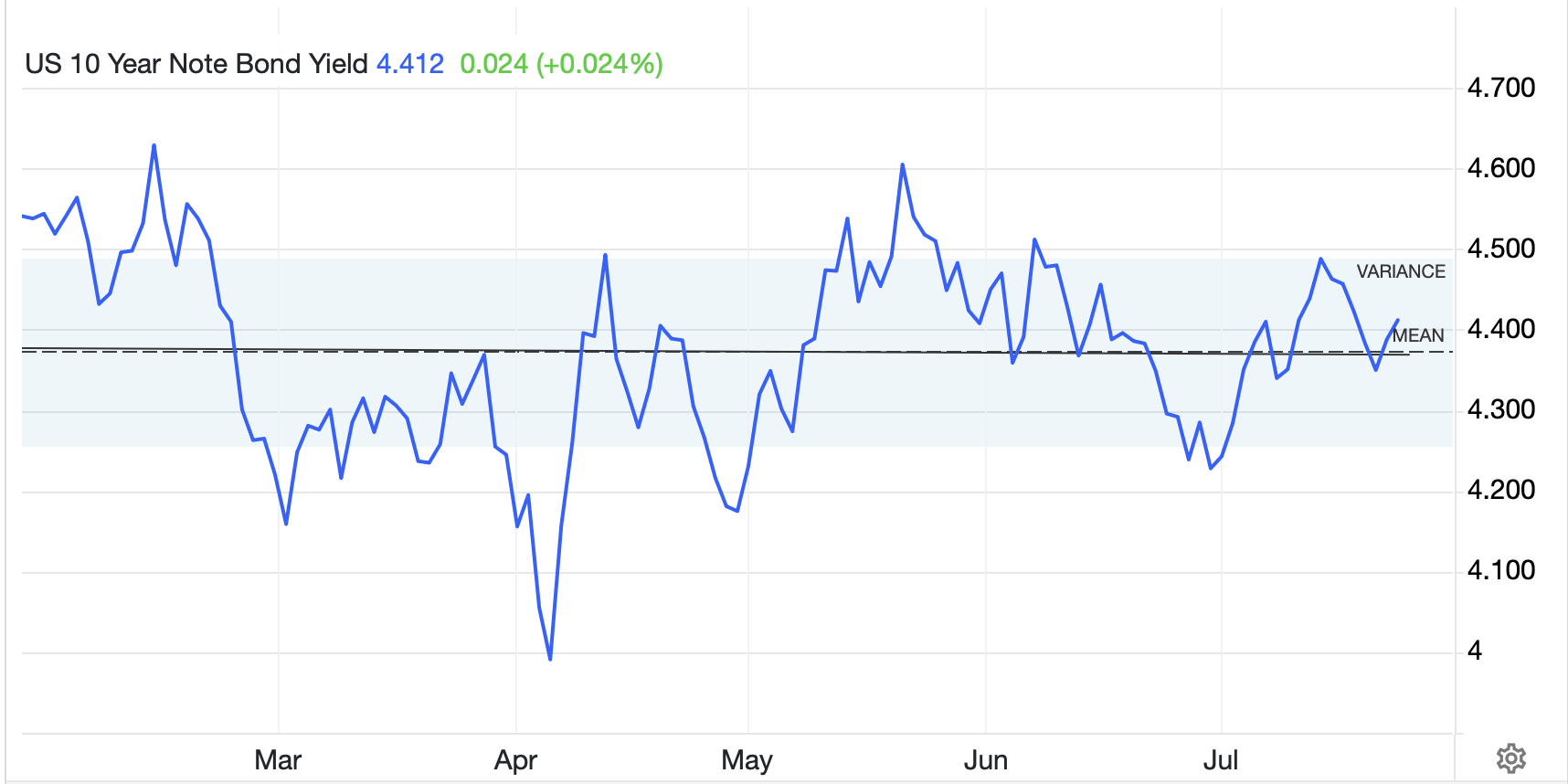
In the bond market, yields are ticking higher across the board with Treasuries (+2bps) back at 4.40%, although still below the top if its recent trading range.  In fact, I think the below chart does an excellent job of describing the fact that the bond market, despite much angst, has done nothing and is trending nowhere for the past six months.

Source: tradingeconomics.com

As to European sovereigns, yields there are higher by 4bps across the board.  The story I read tells me this is optimism that a US-EU deal will help juice the EU economy, thus driving yields higher.  I’m skeptical.

In the commodity markets, oil (+0.8%) is bouncing off its lows, allegedly also responding to the positive trade news.  I guess.  Precious metals, though, are lower (Au -0.7%, Ag -0.5%, Pt -1.25%) as either there is less fear about the future or somebody sold a lot of metals after their recent rally.  Copper (+1.0%) though, continues to benefit from the trade story as well as the underlying story regarding insufficient supply for the future electrification of the world.

Finally, the dollar is a bit firmer this morning, rising 0.2% against both the euro and pound with the yen (-0.15%) also moving in that direction.  Surprisingly, CHF (-0.3%) is the biggest mover in the G10 while ZAR (-0.4%) is the EMG laggard as it follows (leads?) precious metals lower.  This trend remains downward, although as discussed yesterday, it is possible we have seen a true break of that trend.  If Trump successfully concludes the main trade deals, I imagine that we will see significant inflows to the US and that should support the greenback.

On the data front, after the ECB announcement at 8:15, we see Initial (exp 227K) and Continuing (1960K) Claims as well as the Chicago Fed National Activity Index (-0.1) which had a terrible showing last month.  Later we get flash PMI data (Manufacturing 52.6, Services 53.0) and then New Home Sales (650K) at 10:00.

Right now, the market feels like it is embracing the potential for more trade deals to remove uncertainty.  Earnings numbers have been generally strong in the US, which continues to support the stock market, but it remains to be seen how much of the tariffs will be absorbed by corporate margins and how much will find its way into prices.  If the former, that implies earnings will start to lag.  Meanwhile, given the market is generally short dollars, and it appears the next piece of news is more likely to be dollar positive than negative, I have a feeling we could see the dollar bounce nicely in the next weeks.

Good luck

Adf

Flat On His Face

Poor Ishiba-san
Started with so much promise
Fell flat on his face


In what cannot be a major surprise in the current political zeitgeist, a fringe party that focused all its attention on inflation and immigration (where have we heard that before?) called Sanseito, captured 12 seats, enough to prevent Ishiba-san’s coalition of the LDP and Komeito from maintaining control of the Upper House of Parliament there.  The electoral loss has increased pressure on PM Ishiba with many questioning his ability to maintain his status for any extended length of time.  While he is adamant that he is going to continue in the role, and that he is fighting the good fight for Japan with respect to trade talks with the US, it appears that the population has been far more focused on the cost of living, which continues to rise, and the increase in foreign visitors in the nation.  Sanseito describe themselves as a “Japan First” party.

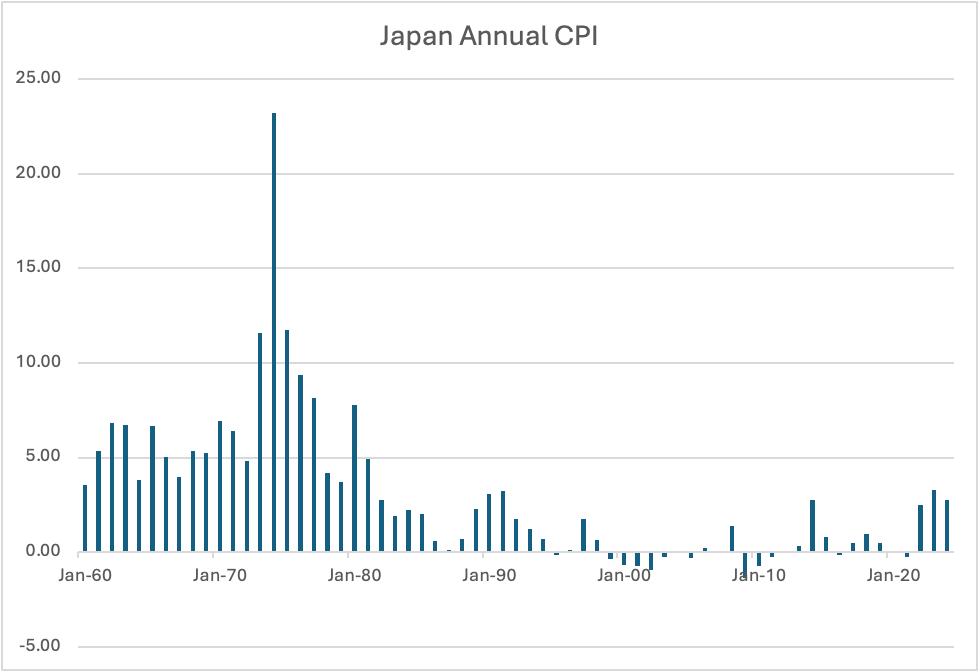
Consider, for a moment, the cost of living in Japan.  For the 30 years up until 2022, as you can see from the chart below taken from FRED data, the average annual CPI was 0.44%.  

In fact, the imperative for Japanese monetary policy was to end the decades of deflation as it was deemed a tremendous drag on the economy.  This was the genesis of their Negative Interest rate policy as well as their massive QE program, which went far beyond JGBs into equities and ETFs.  Now, while the economists and politicians hated deflation, it wasn’t such a bad thing for the folks who lived there.  Think of your life if prices for stuff that you consume rose less than 1% a year for 20-30 years.  

But now, under the guise of, be careful what you wish for, you just may get it, the Japanese government has been successful in raising the nation’s inflation rate to their 2.0% target and beyond and have shown no ability to halt the process.  After all, the Japanese overnight rate remains at 0.50% leaving real rates significantly negative, which is no way to fight inflation.   So, while Ishiba-san explained to the electorate that he was defending Japan’s pride and industry, the voters said, we want prices to stop rising.  

The biggest problem for Japan is that they now have less than 2 weeks to conclude a trade deal with the US based on the latest timeline, and their government is weak with no mandate on trade.  It is not impossible that Japan caves on most issues because if they fight, given the government’s current status, it could be a lot worse.

Now, Friday, when I discussed this possibility, I made that case that if the LDP lost the Upper House majority, it would be a distinct negative for both the yen and the JGB market.  Well, as you can see in the chart below, the first call has thus far been wrong with the USDJPY falling a full yen right away, and after an initial bounce, it has resumed that downtrend.  Like the dollar’s strength when the GFC exploded in 2008, despite the fact that the US was the epicenter of the problem, it appears that Japanese investors are bringing more money home as concern over the future increases.  Over time, I expect that the yen is likely to weaken, but I guess not yet.

Source: tradingeconomics.com

As to JGBs, Japan was on holiday last night, celebrating Sea Day, so there was no market in Tokyo.  While there is a JGB futures market, there was very little activity, and we will need to wait until this evening to learn their fate. 

The deadline for trade talks is looming
And Europe, responses, are grooming
If talks fall apart
And cut to the heart
Of what people there are consuming

The other story that is getting discussed this morning is the fast-approaching trade talk deadline of August 1st.  The EU has been actively negotiating to achieve a deal and there appears to be a decent chance that something will be concluded.  However, this morning’s stories are all about how Europe is preparing a dramatic response (“if they want war, they’ll get war” according to German Chancellor Merz) if they cannot reach a deal and the US imposes much higher tariffs on EU exports.  It is actually quite amusing to see the framing of Europe as the righteous entity being unfairly treated and forced to create a response to the American bullies.  But, that is the message from the WSJ and Bloomberg, and I’m sure from the other news sources that I don’t follow.

Every time I consider the trade situation, and the speed with which President Trump is working to conclude deals, I am amazed at how quickly this is all coming about.  Consider that the Doha Development Round of trade talks was launched in 2001 and IS STILL ONGOING with no resolution yet.  The previous framework, the Uruguay Round took 8 years to complete.  Thus, perhaps the question should be, why have trade talks taken so long in the past.  Much has been made of how President Trump blinked when the original 90-day window closed and so extended the timeline for a few weeks.  Apparently, the use of more sticks and fewer carrots is what has been needed to get these things moving along.  Otherwise, trade negotiators had cushy jobs with no accountability and no responsibility, so no incentive to come to an agreement.

Many analysts have explained that the US will suffer from these deals as inflation will rise because of tariffs and growth will slow.  Of course, these were the same analysts who explained that tariffs by the US would result in other nations’ currencies weakening to offset the tariff.  Once again, I would highlight that old analyst models are not fit for purpose in the current world situation.  I have no idea if there will be a successful conclusion of these deals, but I won’t bet against that outcome.  In the end, as I have repeatedly explained, the US has been the consumer of last resort for nations around the world, and loss of access to the US market is a major problem for everybody else.  That is a very large incentive to agree to deals.

Ok, enough, let’s see how things look this morning.  Tokyo was closed last night but we saw gains in Hong Kong (+0.7%) and China (+0.7%) as the PBOC maintained its policy ease supporting the economy.  In fact, Chinese money supply has been growing recently which should help the economy there, although it is still struggling a bit.  The rest of the region was a mixed bag with some gainers (Korea, India, Indonesia) and some laggards (Taiwan, Australia, Malaysia).  In Europe this morning, equities are under some pressure with the CAC (-0.5%) the laggard, although all bourses are lower.  This appears to be trade related with some concerns things won’t work out.  As to US futures, at this hour (7:05), they are pointing higher by about 0.25%.

In the bond market, yields are falling everywhere with Treasuries (-4bps) lagging the continent where European sovereigns have all seen 10-year yields decline by -6bps to -7bps.  It seems that there is growing hope the ECB will cut rates this Thursday, although according to the ECB’s own Watch Tool, the probability is just 2.7% of that happening.  

In the commodity space, oil is unchanged this morning as the variety of stories around leave no clear directional driver.  However, remember, it has bounced off recent lows despite production increases, and if confidence in economic growth is returning, which it seems to be, then I suspect the demand story will improve.  Meanwhile, metals markets (Au +0.65%, Ag +0.89%, Cu +1.1%, Pt +1.2%) are all having a good morning as a combination of dollar weakness and better economic sentiment are supporting the space.

As to the dollar, it is broadly lower against all its major counterparties apart from NOK (-0.2%) and INR (-0.2%) as NY walks in the door.  While the yen has been the biggest mover, the rest of the world has seen gains on the order of 0.35% or so uniformly.  The INR story apparently revolves around the trade talks with the US and concerns they may not be completed on time, but looking at the krone, after a strong rally last week following oil’s recovery, this morning looks like a bit of profit-taking there.

On the data front, there is very little coming out this week amid the summer holidays.

TodayLeading Indicators-0.2%
WednesdayExisting Home Sales4.01M
ThursdayECB Rate Decision2.00% (no change)
 Initial Claims228K
 Continuing Claims1952K
 Flash PMI Manufacturing52.5
 Flash PMI Services53.0
 New Home Sales650K
FridayDurable Goods-10.5%
 -ex Transport0.1%

Source: tradingeconomics.com

In addition to this limited calendar, it appears the FOMC is on vacation with only two speakers, Chairman Powell tomorrow morning and Governor Bowman tomorrow afternoon.  It is hard to get too excited about much in the way of market movement today.  As has been the case for the past six months, we are all awaiting the next White House Bingo call, as that is what is driving things for now.

Good luck

Adf

White House Bingo

At this point, investors don’t care
‘Bout tariffs and if they are there
The hype train is rolling
With pundits extolling
Nvidia’s four trillion share
 
So, Canada’s out in the cold
As Loonies, this morning, are sold
But energy’s boring
When folks are adoring
AI or, if bankers, then gold


The tariff machine has been switched back on with yesterday’s announcement that the US will now apply 35% tariffs to all imports from Canada that do not comply with the USMCA.  These tariffs are due to go into effect on August 1st.  It appears this is an effort by Mr Trump to push the progress of trade talks forward as they are not moving at a pace with which he is satisfied.  The Canadian response, by PM Carney, was to indicate they will redouble their efforts to get things done on a timely basis.

I understand that there are many who dislike the President’s bullying tactics as they are completely different than any previous president (or world leader really) and fall far afield from what had been previously accepted and expected in “polite” society.  Diplomats are horrified that he is forcing decisions to be made, something that has been anathema to the diplomatic community since the beginning of time.  But Mr Trump has his agenda firmly in mind and is very keen to use all the power he can to achieve it.  It turns out, the US has a great deal of power beyond its military might.

But for our purposes, the market response is the place we need to look.  First, it can be no surprise that the Canadian dollar quickly declined -0.5% on the announcement as that is the textbook response to tariffs, the country affected sees their currency weaken.  As to equity markets, as there are no TSX futures, we cannot tell exactly how stocks in Canada will be impacted but based on the fact that virtually every market is lower this morning, I expect to see weakness there as well.  in fact, a look at this listing of equity futures markets from 6:30 this morning shows exactly what is happening.  You will note that the Toronto market still reflects yesterday, but pretty much every other nation is feeling the heat of a new potential wave of tariffs from the US.

Source: tradingeconomics.com

I continue to read that European nations are getting closer to agreeing a deal with the US, something that has never occurred before and I suspect that there are a number of leaders in the EU that are growing nervous about the situation.  Again, the world was not anticipating the US to wield its power in such a brash and open manner, and many governing theories still need to be rewritten to address the new reality.

But yesterday’s story was all about Nvidia becoming the first $4 trillion market cap company, a remarkable achievement.  It seems Nvidia’s market cap is greater than the entire German stock market.  

For the longest time, I was convinced that the market concentration of the Mag7, which now account for just over 34% of the S&P 500, would ultimately lead to their demise and a major correction.  However, it is becoming harder to make the case that concentration alone is going to be the problem.  

Rather, I believe any correction will now come from a broader economic result, arguably the long forecast recession when it finally arrives.  If you recall, on Sunday I wrote about how the relative gain in corporate profits vs. labor has been a key driver in the bifurcation in the country.  I also strongly believe that President Trump is very serious about changing that situation.  The obvious solution is to reduce corporate profits.  One way to do that is to impose tariffs where companies wind up reducing their margins to maintain sales volumes. If inflation does not rise (and it has not done so yet) that is a step in the President’s direction of choice.  I have no idea whether this will work, and arguably neither does anybody else.  Virtually, every economic model is no longer viable as Mr Trump has changed the rules so completely that the underlying assumptions are almost certainly incorrect.  But remember this chart, if by the end of his term in 2028, the two lines have begun to converge more clearly, he will have changed a multi-decade trend and likely to the detriment of equity markets.

Ok, enough philosophizing, let’s see how other markets beyond equities have behaved overnight.  Bond markets have been under modest pressure with Treasury yields ticking higher by 3bps and all European sovereign yields higher by 1bp this morning.  We heard from Bundesbank, and ECB, member Isabel Schnabel that it was unlikely there would be further rate cuts from the ECB absent a major decline in Eurozone growth. Inflation has returned to their target, and she indicated her belief that current rates there were modestly accommodative, i.e. below neutral.  JGB yields have returned to 1.5% after having spent the past month below that level.  

Recall back in March and April when yields in Japan moved higher quite quickly with the 10yr touching 1.6% and the longer bonds trading above 3.0% to new all-time highs.   That panic subsided but it appears that yields are on the move again as the BOJ discusses selling its equity ETF’s in an effort to reduce their balance sheet further.  Interestingly, the yen (-0.4%) is under pressure this morning and trading back above 147 for the first time in two months.  Here’s what we know about the yen; the carry trade is still in place in significant amounts, inflation is running hot, and the BOJ clearly is uncomfortable raising rates further to address that situation.  My sense is that the yen could have further to weaken, especially if tariffs on Japanese exports are increased as per the recent letter from Mr Trump.  

Continuing with currencies, the dollar is having a good day all around, with only CNY (+0.15%) bucking the trend.  The pound (-0.45%) is under pressure after weaker than expected May GDP figures were released this morning (-0.1% vs. +0.1% expected).  We’re also seeing weakness in MXN (-0.5%) and ZAR (-0.7%) even though precious metals prices are rising this morning.  Here, too, we must keep in mind that many of the old relationships have broken down.

Finally, in the commodity space, gold (+0.65%) is back at its pivot level, taking silver (+1.4%) and platinum (+1.9%) along for the ride although copper (-2.2%) remains subject to the vagaries of exactly what those mooted 50% tariffs are going to cover.  Oil (+1.0%) which sold off yesterday after news that Saudi Arabia had been producing more than its OPEC quota, is rebounding this morning with all eyes on President Trump’s upcoming announcement regarding potential sanctions on Russia given President Putin’s unwillingness to talk peace.

And that’s all there is.  There is neither data nor scheduled Fed speakers on the calendar today, so we all await the next pronouncement from the White House.  Word is that Presidents Trump and Xi will soon be sitting down for a discussion with the opportunity to get more clarity on that situation a potential outcome.  However, White House bingo remains the game of the day, and my card has not been a winner lately.  How about yours?

Good luck and good weekend

Adf

A Reprieve

Some nations have gained a reprieve
About a month left to achieve
A deal to prevent
The extra percent
Of tariffs that Trump can conceive


The news cycle continues to be bereft of new stories regarding finance and markets as there is continued focus on the tragedy in Texas after the flash floods that were responsible for over 100 deaths.  But in our little corner of the world, tariff redux is all we have.  So, to rehash, today marks 90 days since President Trump delayed the imposition of his Liberation Day tariffs back in April with the idea of negotiating many new trade deals.  Thus far, only two have been agreed, the UK and Vietnam, while there has clearly been progress made on several key deals including Japan, South Korea, the EU, India and Australia.  As such, the president has delayed the imposition of these tariffs now to August 1st, but we shall see what happens then.

It is worth noting that trade negotiations historically have taken a very long time, years if not decades, as evidenced by the fact that any time an agreement is reached, it is met with dramatic fanfare on both sides of the deal.  Consider, for a moment, that the EU and MERCOSUR finally agreed terms in 2024, after 25 years of negotiations, although the deal has not yet been ratified by both sides.  With this in mind, it is remarkable that as much ground has been covered in this short period of time as it has.

However, if I understand correctly, many other nations will be subject to tariffs starting today.  Of course, along with these tariffs are the resumed calls for a catastrophic outcome for the US with inflation now set to advance sharply while growth stagnates.  At least the naysayers are consistent.

Away from this story, though, the market is the very picture of the summer doldrums.  After all, nothing else has really changed.  The BBB solved the debt ceiling issue, with another $5 trillion added to the mix, so funding the government should not be a problem for several years at least.  Of course, this means the monetary hawks will re-emerge and complain that the government is spending too much (which it clearly is) and that the economy will collapse under the weight of all that debt.  After all, one needs a calamity to get one’s views aired these days, and doomporn is all the rage with President Trump in office.

So, I won’t waste any more time before heading into the market recap.  Yesterday’s US equity decline, catalyzed by the display of letters written to Japan and South Korea about the imposition of 25% tariffs, was halted after the delay was announced, but the markets still closed lower.  Overnight, Asian markets managed to rally a bit with the Nikkei (+0.3%) the laggard while Korea (+1.8%) really benefitted from that delay.  Meanwhile, China (+0.8%) and Hong Kong (+1.1%) were also solid as was most of the region although Thailand (-0.7%) which did not receive a reprieve, did suffer.

In Europe, the picture is somewhat mixed with the DAX (+0.45%) rising after a slightly wider than expected trade surplus was reported this morning while the CAC (-0.1%) has been under modest pressure after the French trade deficit rose slightly.  But the bulk of the market here is modestly higher on the reprieve concept, although only about 0.2%.  As to US futures, at this hour (7:05), they are basically unchanged to slightly higher.

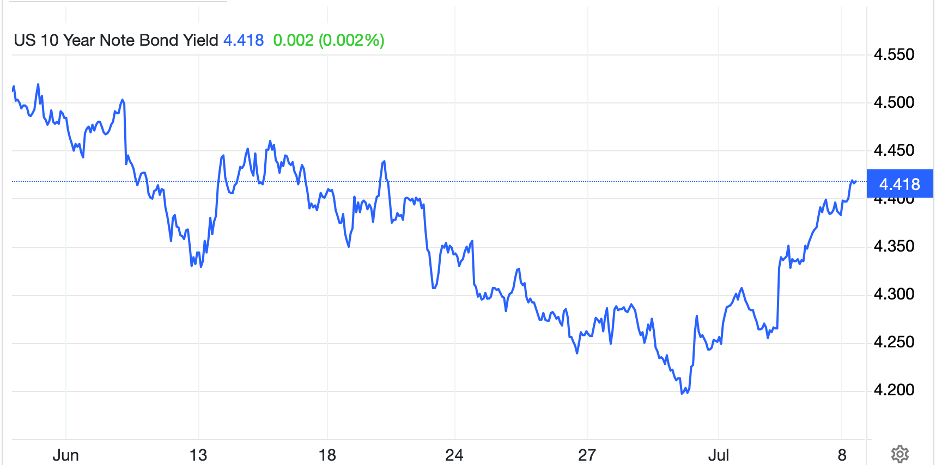
In the bond market, though, yields continue to rise around the world this morning as it appears investors are growing somewhat concerned that all the government spending that is being enacted around the world is becoming a concern.  Treasury yields have risen 3bps and European sovereigns are higher by between 4bps and 5bps.  JGB yields, too, are higher by 4bps and in Australia, an 8bp rise was seen after the RBA failed to cut their base rate last night as widely expected.  Since the beginning of the month, 10-year Treasury yields have risen by more than 20 basis points (as per the chart below) a sign that there may be concern over excess supply…or that the BBB is going to encourage faster growth.  I’m not willing to opine yet.

Source: tradingeconomics.com

In the commodity markets, oil (-0.3%) has been trading in a $4/bbl range since the end of the 12-Day War and the US destruction of Iranian nuclear facilities removed the war premium from the market.  In truth, this is surprising given the ongoing increases in production from OPEC+ and the widespread belief that the economy is suffering and heading into a recession.  But it is difficult to look at the below chart and be confident of the next move in either direction.

Source: tradingeconomics.com

Meanwhile, metals markets this morning show gold (-0.35%) giving back some of its late day gains yesterday while silver and copper remain little changed.  Again, range trading defines the price action as gold has basically gone nowhere since late April.

Source: tradingeconomics.com

Finally, the dollar is mixed this morning with AUD (+0.6%) the leading gainer after the RBA no-action outcome, although ZAR (+0.6%) has gained a similar amount which appears to have been driven by Trump rescinding his threat to add a 10% additional tariff on all BRICS nations (the S is South Africa) that seek to avoid using the dollar for trade.  On the other side of the coin, the pound (-0.3%) and yen (-0.4%) are both slipping this morning with the former suffering from domestic finance problems as the Starmer government continues to flail in its efforts to pay for its promised spending.  In Japan, the Upper House elections, which are to be held July 20th, are a problem for PM Ishiba and his minority government.  One of the key issues is despite the fact that rice prices there have risen more than 100% in the past year, and the US is keen to export rice to Japan to help mitigate the problem, the farmers bloc in Japanese politics has outsized influence and is vehemently against the proposal.  If the government falls due to election losses, agreeing a trade deal will be impossible.  Perhaps this time, the yen will weaken in the wake of tariffs.  (As an aside, are any of you old enough to remember the death of the carry trade and how the yen was going to explode higher?  I seem to recall that was a strong narrative just a few months ago, but it is certainly not evident now.)

On the data front, the NFIB Survey was released this morning at 98.6, a tick lower than expected and 2 ticks lower than last month, but basically little changed.  I don’t think it provides much new information.  Later this afternoon we see Consumer Credit (exp $11.0B), potentially a harbinger of future spending outcomes.  But really, that’s it.

Headline bingo continues to drive markets with the narratives locked in place.  The dollar’s trend is clearly lower, but it remains to be seen if the oft-predicted collapse is on the cards.  Personally, while a bit further weakness seems reasonable, getting short here, with the market already significantly positioned that way, does not feel like the right trade.

Good luck

Adf

Rate Cutting Pretension

The US and China have shaken
Their hands, as trade talks reawaken
And while it’s a start
It could fall apart
For granted, not much should be taken
 
So, markets have turned their attention
To ‘flation with some apprehension
This morning’s report
Might help, or might thwart
Chair Powell’s rate cutting pretension


Starting with the trade talks between China and the US, both sides have agreed that progress was made. Here is a quote from a report on China’s state broadcaster, CCTV, last night.  “China and the US held candid and in-depth talks and thoroughly exchanged views on economic and trade issues of mutual concern during their first meeting of the China-US economic and trade consultation mechanism in London on Monday and Tuesday. The two sides have agreed in principle the framework for implementing consensus between the two heads of state during their phone talks on June 5, as well as those reached at Geneva talks. The first meeting of such consultation mechanism led to new progress in addressing each other’s economic and trade concerns.”  I highlight this because it concurs with comments from Commerce Secretary Lutnick and tells me that things are back on track.

Clearly, this is a positive, although one I suspect that equity markets anticipated as they have been rallying for the past several sessions prior to the announcements.  Certainly, this is good news for all involved as if trade tensions between the US and China diminish, it should be a net global economic positive.  While anything can still happen, we must assume that a conclusion will be reached going forward that will stabilize the trade situation.  However, none of this precludes President Trump’s stated desire to reindustrialize the US, so that must be kept in mind.  And one of the features of that process, at least initially, is likely to be upward price pressures in the economy.

Which brings us to the other key story today, this morning’s CPI report.  Expectations for headline (0.2% M/M, 2.5% Y/Y) and core (0.3% M/M, 2.9% Y/Y) are indicating that the bottom of the move lower in inflation may have been seen last month.  However, these readings, while still higher than the Fed’s target (and I know the Fed uses Core PCE, but the rest of us live in a CPI world) remain well below the 2022 highs and inflation seems to be seen as less of a problem.  Yes, there are some fears that the newly imposed tariff regime is going to drive prices higher, and I have seen several analysts explain that we are about to see that particular process begin as of today’s data.  

Of course, from a markets perspective, the key issue with inflation is how it will impact interest rates.  In this case, I think the following chart from Nick Timiraos in the WSJ is an excellent description of how there is NO consensus view at all.

At the same time, Fed funds futures markets are pricing in the following probabilities as of this morning.

Source: cmegroup.com

The thing about the Fed is they have proven to be far more political than they claim.  First, it is unambiguous that there is no love lost between President Trump and Chairman Powell.  Interestingly, the Fed is strongly of the belief that when they cut rates, they are helping the federal government, and more importantly, the population’s impression of what the federal government is doing.  Hence, the 100bps of cuts last summer/fall never had an economic justification, they appeared to have been the Fed’s effort to sway the electorate to maintain the status quo.  With that in mind, absent a collapse in the labor market with a significantly higher Unemployment Rate, I fall into the camp of no Fed action this year at all.  And, if as I suspect, inflation readings start to pick up further, questions about hikes are going to be raised.

Consider if the BBB is passed and it juices economic activity so nominal GDP accelerates to 6% or 7%, the Fed will be quite concerned about inflation at that point and the market will need to completely reevaluate their interest rate stance.  My point is the fact that rate cuts are currently priced does not make them a given.  Market pricing changes all the time.

So, let’s take a look at how things behaved overnight.  After a modest US rally in equities yesterday, Asia had a solid session, especially China (+0.75%) and Hong Kong (+0.8%) as both responded to the trade news. Elsewhere in the region, things were green (Nikkei +0.5%), but without the same fanfare.  I have to highlight a comment from PM Ishiba overnight where he said “[Japan] should be cautious about any plans that would deteriorate already tattered state finances.  Issuing more deficit financing bonds is not an option.”  That sounds an awful lot like a monetary hawk, although that species was long thought to be extinct in Japan.  It will be interesting to see how well they adhere to this idea.

Meanwhile, in Europe, the only equity market that has moved is Spain (-0.6%) which is declining on idiosyncratic issues locally while the rest of the continent is essentially unchanged.  As to US futures, at this hour (7:30) they are pointing slightly lower, about -0.15% across the board.

In the bond market, the somnolence continues with yields backing up in the US (+2bps) and Europe, (virtually all sovereign yields are higher by 2bps) with only UK Gilts (+5bps) under any real pressure implying today’s 10-year auction was not as well received as some had hoped.  In Japan, yields slipped -1bp overnight and I thought, in the wake of the Ishiba comments above, I would highlight Japan 40-year bonds, where yields have collapsed over the past three weeks.  Recall, back in May there was a surge in commentary about how Japanese yields were breaking out and how Japanese investors would be bringing money home with the yen strengthening dramatically.  I guess this story will have to wait.

Source: tradingeconomics.com

Turning to commodities, oil (+1.5%), which reversed course during yesterday’s session, has regained its mojo and is very close to closing that first gap I showed on the chart yesterday.  Above $65, I understand most shale drilling is profitable so do not be surprised to hear that narrative pick up again.  In the metals markets, gold (+0.2%) now has the distinction of being the second largest reserve asset at central banks around the world, surpassing the euro, although trailing the dollar substantially.  I expect this process will continue.  Silver (-0.8%) and copper (-2.1%) are both under pressure this morning although I have not seen a catalyst which implies this is trading and position adjustments, notably profit taking after strong runs in both.

Finally, the dollar is slightly stronger this morning with the euro and pound essentially unchanged, AUD, NZD and JPY all having slipped -0.25%, and some smaller currencies (KRW -0.55%, ZAR -0.5%) having fallen a bit further.  However, for those who follow the DXY, it is unchanged on the day.  The thing about the dollar is despite a lot of discussion about a break much lower, it has proven more resilient than many expected and really hasn’t gone anywhere in the past two months.  If the Fed turns hawkish as inflation rebounds, I suspect the dollar bears are going to have a tougher time to make their case (present poets included.)

In addition to the CPI at 8:30, we see EIA oil inventory data with a modest build expected although yesterday’s API data showed a draw that surprised markets.  I must admit I fear inflation data is going to start to rebound again which should get tongues wagging about next week’s FOMC meeting.  However, for today, a hot print is likely to see a knee-jerk reaction lower in stocks and bonds and higher in the dollar.  But the end of the day is a long way away and could be very different, especially given the always present headline risk.

Good luck

Adf

In a Trice

While jobs data Friday was fine
The weekend has seen a decline
In positive news
As riots infuse
LA with a new storyline
 
The protestors don’t like that ICE
Is doing their job in a trice
So, Trump played a card,
The National Guard
As markets search for the right price


Despite all the anxiety regarding the state of the economy, with, once again, survey data like ISM showing things are looking bad, the most important piece of hard data, the Unemployment report, continues to show that the job market is in solid shape.  Friday’s NFP outcome of 139K was a few thousand more than forecast, but a lot more than the ADP result last Wednesday and much better than the ISM indices would have indicated.  Earnings rose, and government jobs shrunk for the first time in far too long with the only real negative the fact that manufacturing payrolls fell -8K.  But net, it is difficult to spin the data as anything other than better than expected.  Not surprisingly, the result was a strong US equity performance and a massive decline in the bond market with 10-year yields jumping 10bps in minutes (see below).

Source: tradingeconomics.com

But that is not the story that people are discussing.  Rather, the devolution of the situation in LA is the only story of note as ICE agents apparently carried out a series of court-warranted raids and those people affected took umbrage.  The face-off escalated as calls for violence against ICE officers rose while the LAPD was apparently told to stand down by the mayor.  President Trump called out the National Guard to protect the ICE agents and now we are at a point of both sides claiming the other side is acting illegally.  Certainly, the photos of the situation seem like it is out of hand, reminding me of Minneapolis in the wake of George Floyd, but I am not on site and can make no claims in either direction.  

It strikes me that for our purposes here, the question is how will this impact markets going forward.  A case could be made that the unrest is symptomatic of the chaos that appears to be growing around several cities in the US and could be blamed for investors seeking to move their capital elsewhere, thus selling US assets and the dollar.  Equally, a case could be made that haven assets remain in demand and while US equities do not fit that bill, Treasuries should.  In that case, precious metals and bonds are going to be in demand.  The one thing about which we can be sure is there will be lawsuits filed by Democratic governors against the federal government for overstepping their authority, but no injunctions have been issued yet.

However, let’s step back a few feet and see if we can appraise the broader situation.  The US fiscal situation remains cloudy as the Senate wrangles over the Big Beautiful Bill (BBB), although I expect it will be passed in some form by the end of the month.  The debt situation is not going to get any better in the near-term, although if the fiscal package can encourage faster nominal growth, it is possible to flatten the trajectory of that debt growth.  Meanwhile, the tariff situation is also unclear as to its results, with no nations other than the UK having announced a deal yet, although the administration continues to promise a number are coming soon.

If I look at these issues, it is easy to grow concerned over the future.  While it is not clear to me where in the world things are that much better, capital flows into the US could easily slow.  Yet, domestically, one need only look at the consumer, which continues to buy a lot of stuff, and borrow to do it (Consumer Credit rose by $17.9B in April) and recognize that the slowdown, if it comes, will take time to arrive.  Remember, too, that every government, everywhere, will always err on the side of reflating an economy to prevent economic weakness, and that means that the first cracks in the employment side could well lead to Fed cuts, and by extension more inflation.  (This note by StoneX macro guru Vincent Deluard discussing the Cancellation of Recessions is a must read).  I have spoken ad nauseum about the extraordinary amount of debt outstanding in the world, and how it will never be repaid.  Thus, it will be refinanced and devalued by EVERY nation.  The question is the relative pace of that adjustment.  In fact, I would argue, that is both the great unknown, and the most important question.

While answering this is impossible, a few observations from recent data are worth remembering.  US economic activity, at least per the Atlanta Fed’s GDPNow continues to rebound dramatically from Q1 with a current reading of 3.8%.  Meanwhile, Chinese trade data showed a dramatic decline in exports to the US (-35%) but an increased Trade Surplus of $103.2B as they shifted exports to other markets and more interestingly, imports declined-3.4%.  in fact, it is difficult to look at this chart of Chinese imports over the past 3 years and walk away thinking that their economy is doing that well.  Demand is clearly slowing to some extent, and while their Q1 GDP was robust, that appears to have been a response to the anticipated trade war.  Do not be surprised to see Chinese GDP slowing more substantially in Q2 and beyond.

Source: tradingeconomics.com

Europe has been having a moment as investors listen to the promises of €1 trillion or more to build up their defense industries and flock to European defense companies that had been relatively cheap compared to their US counterparts.  But as the continent continues to insist on energy suicide, the long-term prospects are suspect.  Canada just promised to raise its defense spending to 2% of GDP, finally, a sign of yet more fiscal stimulus entering the market and the UK, while also on energy suicide watch, has seen its service sector hold up well.

The common thread, which will be exacerbated by the BBB, is that more fiscal spending, and therefore increased debt are the future.  Which nation is best placed to handle that increase?  Despite everything that you might believe is going wrong in the US, ultimately the economic dynamism that exists in the US surpasses that of every other major nation/bloc.  I still fear that the Fed is going to cut rates, drive inflation higher and undermine the dollar before the year is over, but in the medium term, no other nation appears to have the combination of skills and political will to do anything other than what they have been doing already.  And that is why the long-term picture in the US remains the most enticing.  This is not to say that US asset prices will improve in a straight line higher, just that the broad direction remains clear, at least to me.

Ok, I went on way too long, sorry.  As there is no US data until Wednesday’s CPI, we will ignore that for now.  A market recap is as follows:  Asia had a broadly stronger session with Japan, China, HK, Korea and India all following in the US footsteps from Friday and showing solid gains.  Europe, though, is mostly in the red with only Spain’s 0.25% gain the outlier amongst major markets.  As to US futures, they are essentially unchanged at this hour (7:00).

Treasury yields have backed off -2bps from Friday’s sharp climb and European sovereign yields are softer by between -3bps and -4bps as although there has been no European data released; the discussion continues as to how much the ECB is going to cut rates going forward.  JGB yields were unchanged overnight.

In the commodity space, while oil (+0.3%), gold (+0.1%) and even silver (+0.8%) are edging higher, platinum has become the new darling of speculators with a 2.8% climb overnight that has taken it up more than 13.5% in the past week and 35% YTD.  Remarkably, it is still priced about one-third of gold, although there are those who believe that is set to change dramatically.  A quick look at the chart below does offer the possibility of a break above current levels opening the door to a virtual doubling of the price.  And in this environment, a run at the February 2008 all-time highs seems possible.

Finally, the dollar is softer across the board this morning, against virtually all its G10 and EMG counterparts.  AUD (+0.55%) and NZD (+0.7%) are leading the way, but the yen (+0.5%) is having a solid session as are the euro and pound, both higher by 0.25%.  In the emerging markets, PLN (+0.7%) is the leader with the bulk of the rest of the space higher by between +0.2% and +0.4%.  BRL (-0.3%) is the outlier this morning, but that looks much more like a modest retracement of recent gains than a new story.

Absent both data and any Fedspeak (the quiet period started on Friday), we are left to our own devices.  My take is there are still an equal number of analysts who are confident a recession is around the corner as those who believe one will be avoided.  After reading the Deluard piece above, I am coming down on the side of no recession, at least not in a classical sense, as no politician anywhere can withstand the pain, at least not in the G10 and China.  That tells me that while Europe may be the equity flavor of the moment, commodities remain the best bet as they are undervalued overall, and all that debt and new money will continue to devalue fiat currencies.

Good luck

Adf

Gnashing and Wailing

The narrative writers are failing
To keep their perspectives prevailing
They want to blame Trump
But if there’s no slump
They’ll find themselves gnashing and wailing
 
Economists have the same trouble
‘Cause most of their models are rubble
The change that’s been wrought
Requires more thought
Than counting on one more Fed bubble


Investors seem to be growing unhappier by the day as so many traditional signals regarding market movement no longer appear to work.  Nothing describes this better, I think, than the fact that forecasts for 10-year Treasury yields by major banks are so widely disparate.  While JPMorgan is calling for 5.00% by the end of the year, Morgan Stanley sees 2.75% by then.  What’s the right position to take advantage of that type of knowledge and foresight?

One of the most confusing things over the past months, has been the growing dichotomy between soft, survey data and hard numbers.  But even here, it is worth calling into question what we are learning.  For instance, this week we will see the NFP data along with the overall employment report.  That data comes from the establishment survey.  It seems that just 10 years ago, more than 60% of companies reported their hiring data.  Now, that is down to ~43%.  Does that number have the same predictive or explanatory power that it once did?  It doesn’t seem so.

Too, if we consider the Michigan Sentiment data, it has become completely corrupted by the political angle, with the current situation being Democrats answering the survey anticipate high inflation and weak growth while Republicans see the opposite.  Is that actually telling us anything useful from an economic perspective let alone a market perspective?  (see charts below from sca.isr.unmich.edu)

But this phenomenon is not merely a survey issue, it is an analysis issue.  At this point, I would contend there are essentially zero analysts of the US economy (poets included) who do not have a political bias built into their analysis and forecasts.  Consider that if you are in a good mood generally, then your own perspective on things tends to be brighter than if you are in a bad mood.  Well, expand that on a political basis to, if you are a Democrat, President Trump has been defined as the essence of evil and therefore your viewpoint will see all potential outcomes as bad.  If you’re a Republican, you will see much better potential.  It is who we are and has always been the case, but it appears a combination of President Trump and social media has pushed this issue to heretofore unseen extremes.

There are two problems with this.  First, for most consumers of financial information, the decision matrix is opaque.  Who should you believe?  But perhaps more concerningly, as evidenced by the decline in the response rate to hard data, for policymakers like the Fed and Treasury, what should they believe?  Are they receiving accurate readings of the economic realities on the ground?  Is the job market as strong (or weak) as currently portrayed?  Is the uncertainty in ISM data a result of political bias?  And if politics is an issue in these situations, who is to say that answers to questions will be fact-based rather than crafted to present a political viewpoint?

I would contend that the reason the narrative is breaking down everywhere is that the willingness of investors, as well as the proverbial man on the street, to listen to pronouncements from on high has diminished greatly.  After all, the mainstream media, which had always been the purveyor of the narrative, or at least its main amplifier, has lost its luster.  Or perhaps, they have lost all their credibility.  Independent media, whether on X, Substack or simply blogs that are posted all over the internet, have demonstrated far more clarity and accuracy of situations than anything coming from the NYT, WSJ, BBG or WaPo, let alone the TV “news” programs.

We are on our own to determine what is actually happening in the world, and that is true of how markets will perform going forward.  I have frequently written that volatility is going to be higher going forward across all markets.  President Trump is the avatar of volatility.  As someone whose formative years in trading were in the mid 80’s, when inflation was high, and Paul Volcker never said a word to anyone about what the Fed was doing (and even better, nobody even knew who the other FOMC members were), the best way to thrive is to maintain modest positions with limited leverage.  The time of ZIRP and NIRP will be seen as the aberration it was.  As it fades, so, too, will the ability to maintain highly levered positions because any large move can be existential.

With that cheery opening, let’s take a look at what has happened overnight.  Friday’s US session was not very noteworthy with mixed data leading to mixed results but no real movement.  Alas, things have taken a turn lower since then.  Asian markets were weaker overnight (Nikkei -1.3%, Hang Seng -0.6%, CSI 300 -0.5%) with most other regional markets having a rough go of things as well.  Concerns over further tariffs by the US (steel tariffs have been raised to 50%) and claims by both sides of the US – China trade debate claiming the other side has already breached the temporary truce have weighed on sentiment overall.  Meanwhile, PMI data from the region was less than inspiring with China, Korea, Japan and Indonesia all showing sub 50 readings for Manufacturing surveys.

In Europe, equity markets are also generally softer (DAX -0.5%, CAC -0.7%) although the FTSE 100 (0.0%) has managed to buck the trend after data this morning showed Housing Prices firmed along side Credit growth.  As investors await the US ISM/PMI data, futures are pointing lower across the board, currently down around -0.4% at 7:15.

In the bond market, yields all around the world are backing up with Treasuries (+3bps) bouncing off the lows seen on Friday, although remaining below 4.50%, while European sovereigns have climbed between 3bps and 4bps across the board.  JGB’s overnight (+2bps) also rose, although the back end of that curve saw yields slip a few bps.  It seems the world isn’t ending quite yet, although there does not seem to be any cure for government spending and debt issuance anywhere in the world.

Commodity prices, though, are on the move as it appears investors are interested in acquiring stuff that hurts if you drop it on your foot.  Gold (+1.85%), silver (+0.9%) and copper (+3.6%) are all in demand this morning, the latter ostensibly benefitting from fears that the US will impose more tariffs on other metals thus driving prices higher.  But the real beneficiary overnight has been oil (+4.0%) which rose on the back of an intensification of the Russia – Ukraine war as well as the idea that OPEC+ ‘only’ raised production by 411K barrels/day, less than the whisper numbers of twice that amount.  As I watch the situation in Ukraine, it appears to have the hallmarks of an imminent peace process as both sides are pulling out all the stops to gain whatever advantage they can ahead of the ceasefire and both recognizing that the ceasefire is going to come soon.  But despite the big jump in the price of WTI, you cannot look at the chart below and expect a breakout in either direction.  If I were trading this, I would be more likely to fade the rally than jump on board the rise.

Source: tradingeconomics.com

Finally, the dollar is under the gun this morning, falling against pretty much all its major counterparts.  Both the euro (+0.7%) and pound (+0.6%) are having strong sessions although JPY (+1.0%) and NOK (+1.3%) are leading the way in the G10.  NOK is obviously benefitting from oil’s rally, while there remains an underlying belief that Japanese investors are slowing their international investments and bringing money home.  Now, the ECB meets this week and is widely anticipated to be cutting rates 25bps, but my take is, today is a dollar hatred day, not a euro love day.  As to the EMG bloc, gains are evident across regions with CZK and HUF (both +1.0%) demonstrating their beta to the euro although PLN (+0.5%) is lagging after the presidential election there disappointed the elites with the Right leaning candidate winning the job and likely frustrating Brussels in their attempts to widen the war in Ukraine.  In Asia, CNY (+0.1%) was relatively quiet but KRW (+0.5%), IDR (+0.8%) and THB (+0.9%) all benefitted from that broad dollar weakness.  So, too, did MXN (+0.65%) although BRL has not participated.

There is plenty of data this week culminating in the payroll report on Friday.

TodayISM Manufacturing49.5
 ISM Prices Paid70.2
 Construction Spending0.3%
TuesdayJOLTS Job Openings7.1M
 Factory Orders-3.0%
 -ex Transport0.2%
WednesdayADP Employment115K
 BOC Rate Decision2.75% (current 2.75%)
 ISM Services52.0
 Fed’s Beige Book 
ThursdayECB Rate Decision2.00% (current -2.25%)
 Initial Claims235K
 Continuing Claims1910K
 Trade Balance-$94.0B
 Nonfarm Productivity-0.7%
 Unit Labor Costs5.7%
FridayNonfarm Payrolls130K
 Private Payrolls120K
 Manufacturing Payrolls-1K
 Unemployment Rate4.2%
 Average Hourly Earnings0.3% (3.7% Y/Y)
 Average Weekly Hours34.3
 Participation Rate62.6%
 Consumer Credit$10.85B

Source: tradingeconomics.com

In addition, we hear from four more Fed speakers over five venues.  The thing about this is they continue to discuss patience as the driving force, except for Governor Waller, who explained overnight that he could see rate cuts if inflation stays low almost regardless of the other data.

The trade story remains the topic of most importance in most eyes it seems, although it remains a mystery where things will wind up.  The narrative is lost for all the reasons above, but I will say that it appears risk aversion is today’s theme.  The new part is that the dollar is considered a risk asset.  

Good luck

Adf

Set Cash On Fire

On Friday, the Moody’s brain trust
At last said it’s time to adjust
America’s debt
As we start to fret
That it’s too large and might combust
 
So, Treasury yields are now higher
As pundits explain things are dire
But elsewhere, as well
Seems bonds are a sell
As governments set cash on fire


Arguably, the biggest story of the weekend happened late Friday evening as Moody’s became the third, and final, ratings agency to downgrade US government debt to Aa1 from Aaa.  S&P did the deed back in 2011 and Fitch in 2023.  The weekend was filled with analyses of the two prior incidents and how markets responded to both of those while trying to analogize those moves to today.  In a nutshell, the first move in both 2011 and 2023 was for stocks to fall and bonds to rally with the dollar falling. However, in both of those instances, those initial moves reversed over the course of the ensuing months such that within a year, markets had pretty much reversed those moves, and in some cases significantly outperformed, the situation prior to the downgrade.  

Looking at Moody’s press release, they were careful to blame this on successive US administrations, so not putting the entire blame on President Trump, but in the end, it is hard to ignore that the nation’s fiscal statistics regarding debt/GDP and debt coverage are substantially worse than that of other nations that maintain a Aaa rating.  As well, their underlying assumption is that there will be no changes in the current trajectory of deficits and so no reason to believe things can change.

The most popular weekend game was to try to estimate how things would play out this time although given the starting conditions are so different in the economy, I would contend past performance is no guarantee of future outcomes.  In this poet’s eyes, it is not clear to me that it will have a long-term material impact on any market.  We have already been hearing a great deal about how Treasuries are no longer the safe haven they were in the past.  I guarantee you that institutions looking for a haven were not relying solely on Moody’s Aaa rating for comfort.  In addition, given a key demand for Treasuries is as collateral in the financial markets, and the Aa1 rating is just as effective as a Aaa rating from a regulatory risk perspective, I see no changes coming

As to equities, I see no substantive impact on the horizon.  The equity market remains over richly valued and if it were to decline, I don’t think fingers could point to this action.  Finally, the dollar has been declining since the beginning of the year and remains in a downtrend.  Using the DXY as our proxy, if the dollar falls further, should we really be surprised?

source tradingeconomics.com

To summarize, expect lots more hyperbole on the subject, especially as many analysts and pundits will try to paint this as a failure of the Trump administration.  And while bond yields may rise further, as they are this morning, given the fact that yields are rising everywhere around the world, despite no other nations being downgraded, this is clearly not the only driver.

In fact, one could make the case that bond yields are rising around the world because, like the US, nations all over are talking about adding fiscal stimulus to their policy mix.  After all, have we not been assured that Europe is going to borrow €1 trillion or more to rearm themselves?  That is not coming out of tax revenue, that is a pure addition to the debt load.  As well, is not a key part of the ‘US will suffer more than China in the tariff wars’ story based on the idea that China will stimulate the domestic economy and increase consumption (more on that below)?  That, too, will be increased borrowing.  I might go so far as to say that the increased borrowing globally to increase fiscal stimulus will lead to higher nominal GDP growth everywhere along with higher inflation.  I guess we will all learn how things play out together. 

Ok, so now that we have a sense of THE big story, let’s see how markets behaved elsewhere.  I thought that today, particularly, it would be useful to see how bond markets around the world have behaved in the wake of the Moody’s news.  Below is a screenshot from Bloomberg this morning.  note that every major market that is open has seen bonds sell off and I’m pretty confident that Canada’s at the very least, will do so when they wake up.  Ironically, the European commission came out this morning and reduced their forecasts for GDP growth and inflation this year and next and still European sovereign yields are higher.  I have a feeling that this news is not as impactful as some would have you believe.

Turning to equity markets, Friday’s US rally is ancient history given the change in the narrative.  And as you can see below from the tradingeconomics.com page, every major market is softer this morning (those are US futures) with only Russia’s MOEX rising, hardly a major market.  Again, it appears the fallout from the ratings cut is either far more widespread, or not a part of the picture at all.  It seems you could make the case that if European growth is going to underperform previous expectations, equity markets there should underperform as well.  The other two green arrows are Canada and Mexico, neither of which is open as of 6:30 this morning.

Commodity markets are the ones that make the most sense this morning as oil (-1.3%) is under pressure, arguably on a weaker demand picture after softer Chinese data was released overnight.  While the timing of the impacts of the trade war is unsettled, there is certainly no evidence that China is aggressively stimulating its economy.  This was very clear from the decline in Retail Sales, Fixed Asset Investment and IP, although the latter at least beat expectations.  But the idea that China is changing the nature of their economy to a more consumption focused one is not yet evident.  Meanwhile, metals markets are all firmer this morning with gold (+1.2%) leading the way, arguably as a response to the ratings downgrade.  This has dragged both silver (+0.9%) and copper (+1.0%) along for the ride.  It is not hard to imagine that sovereign investors see the merit in owning storable commodities like metals in lieu of Treasuries, at least at the margin.  But also, given the dollar’s weakness, a rally in metals is not surprise.

Speaking of the dollar’s weakness, that is the strong theme of the day along with higher yields across the board.  Right now, the euro (+1.0%) and SEK (+1.0%) are leading the way higher although the pound (+0.9%) is also doing well.  Perhaps this has to do with the trade agreement signed between the UK and EU reversing some of the Brexit outcomes at least regarding food and fishing, although not regarding regulations or immigration.  JPY (+0.6%) is also rallying as is KRW (+0.75%) and THB (+0.9%) as there is a continuing narrative that stronger Asian currencies will be part of the trade negotiations.  Finally, Eastern European currencies are having a good day (RON +2.3%, HUF +1.8%, CZK +1.2%, PLN +1.0%) after the Romanians finally elected a president that was approved by the EU.  Yes, they had to nullify the first election and then ban that candidate from running again, but this is how democracy works!

On the data front, there is very little hard data to be released this week, although it appears every member of the FOMC will be on the tape ahead of the Memorial Day weekend.  Perhaps they are starting to feel ignored and want to get their message out more aggressively.

TodayLeading Indicators-0.9%
ThursdayInitial Claims230K
 Continuing Claims1890K
 Flash Manufacturing PMI50.5
 Flash Services PMI51.5
 Existing Home Sales4.1M
FridayNew Home Sales690K

Source: tradingeconomics.com

Actually, as I count, there are three members, Barr, Bowman and Waller who will not be speaking this week, although Chairman Powell doesn’t speak until next Sunday afternoon.  In the end, the narrative is going to focus on the ratings cut for a little while, at least for as long as equity markets are under pressure along with the dollar.  However, when that turns, and I am sure it will, there will be a search for the next big thing.  I have not forgotten about the potential large-scale changes I discussed on Friday, and I am still trying to work potential scenarios out there, but for now, that is not the markets’ focus.  Certainly, for now, I see no reason for the dollar to gain much strength.

Good luck

Adf