Filled With Gilding

There once was a banker named Jay
Who yesterday, tried to allay
Fears that his building
Was too filled with gilding
But Trump seemed to have final say
 
The fact that this story’s what leads
The news, when one looks through the feeds
Is proof that there’s nought
Of note to be bought
Or sold, as price action recedes


According to Merriam-Webster, this is the definition of the word frequently bandied about these days, and rightly so.  

Market activity is just not very interesting.  While there is a new battle brewing on the Thai-Cambodian border, it is unlikely to have much impact on the rest of the world, and the Russia-Ukraine war continues apace, with very little new news.  Congress is in recess, sort of, which means new legislation is not imminent.  And while the Fed meets next week, just like the ECB and the BOE and the BOJ, no policy changes are imminent.  Doldrums indeed.

Which is why the story about President Trump visiting the construction site at the Marriner Eccles Building, the home of the Federal Reserve, has received so much press.  And frankly, a quick look at this clip is so descriptive of the current relationship between Trump and Powell it is remarkable.

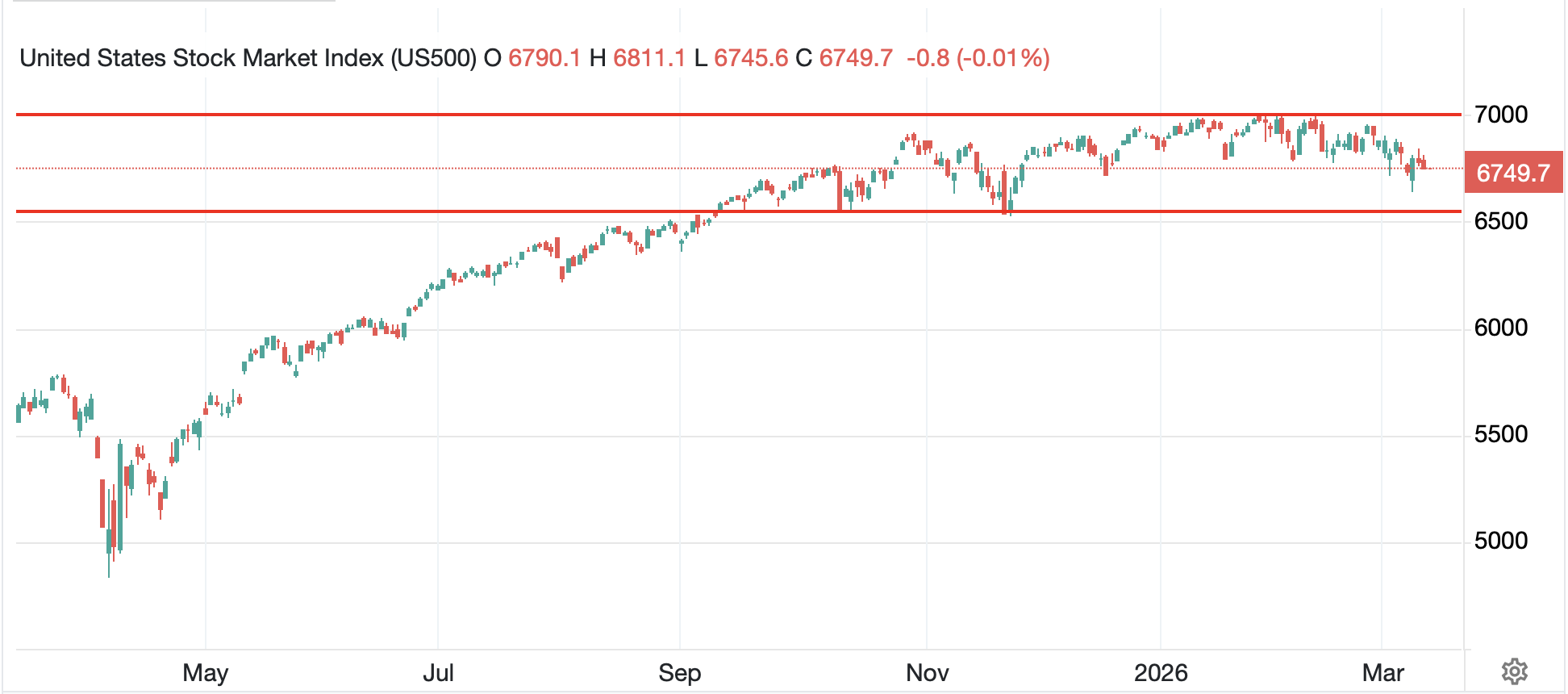
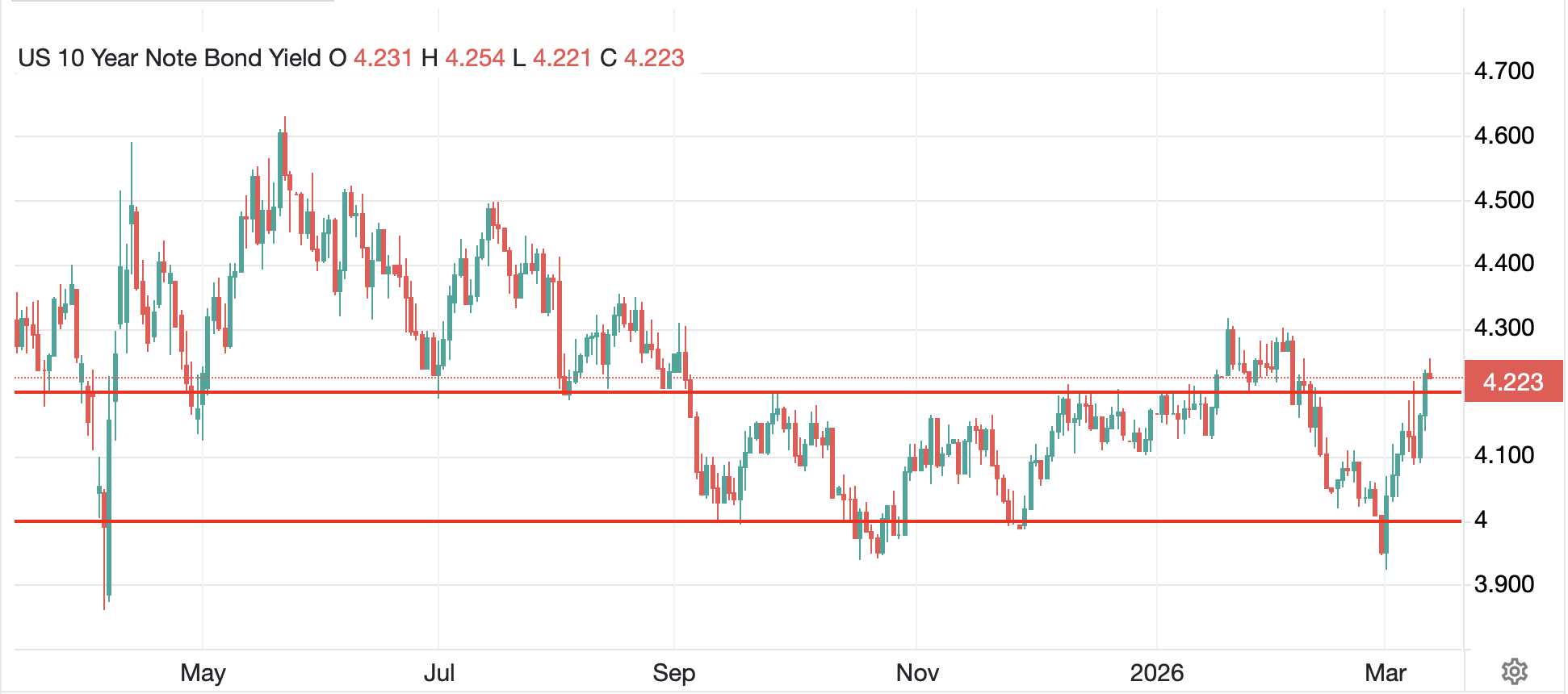
But frankly, I just don’t see much else to discuss this morning.  equity markets in the US have generally been creeping higher, the DJIA excepted, the dollar is doing a slow-motion bounce and bond yields trade within a 5bps range.  Yesterday’s jobs data was solid, with both types of claims slipping, while the Flash PMIs showed net strength, although it was entirely Services driven.  And it’s Friday, so I won’t take up too much time.

Here’s the overnight review.  Asian markets followed the Dow, not the S&P or NASDAQ with Tokyo (-0.9%), Hong Kong (-1.1%) and China (-0.5%) all under pressure.  In Japan, there are starting to be more questions asked about whether PM Ishiba can hold on, and if he cannot (my guess is he will go) there is no obvious successor as no party there has any substantial strength.  Remember, the populist Sanseito party is a new phenomenon there and really is screwing up their electoral math.  As to the rest of the region, only Korea and New Zealand managed any gains, and they were di minimis.  Red was the color of the session.

Not surprisingly, that is the story in Europe as well, with most bourses lower on the day (DAX -0.6%, FTSE 100 -0.3%, IBEX -0.5%) although the CAC is essentially unchanged despite LVMH earnings being a little soft.  German Ifo data was slightly better than June, but lower than expected and UK Retail Sales were modestly weaker than forecast on every measure.  Again, it is hard to get excited here.  As to US futures, they are pointing higher by 0.2% at this hour (7:00).

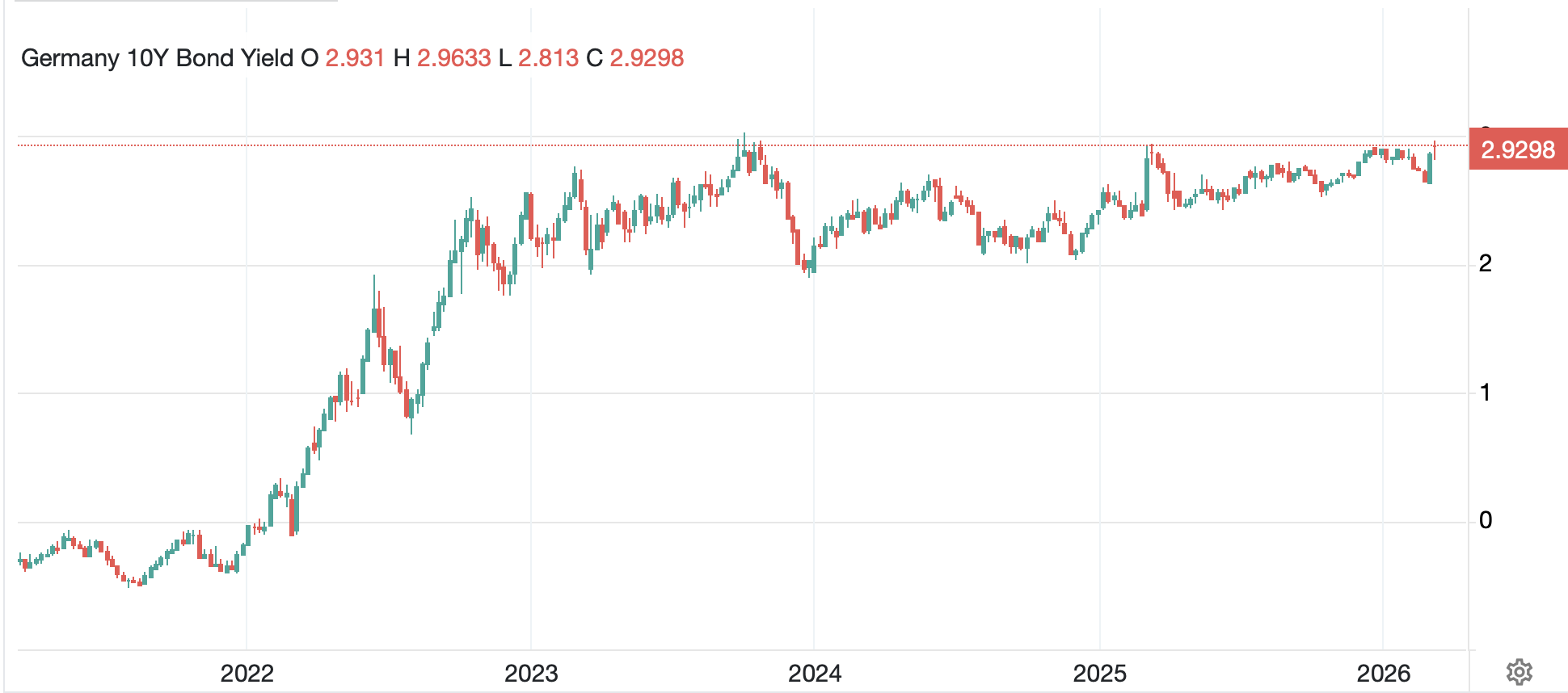
In the bond market, Treasury yields have bounced 2bps from yesterday but are still right around 4.40% while European sovereign yields are higher by 3bps across the board.  Apparently, there is residual concern over European spending plans and absent a trade agreement with the US, investors there are not sure what to do.

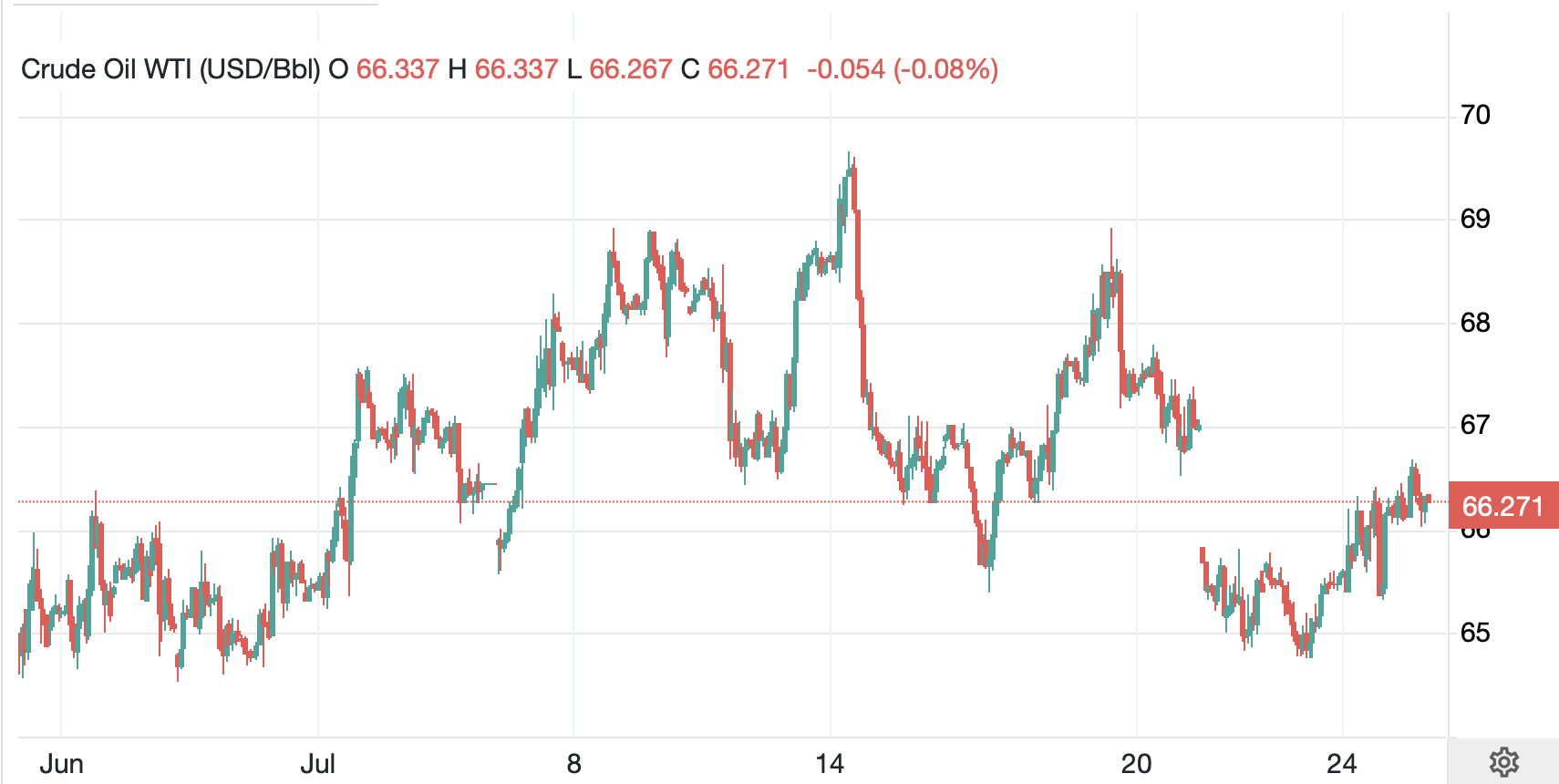
In the commodity markets, oil (+0.4%) is bouncing for a second day, but remains within that recent trading range where we have seen choppy trading but no direction.  The gap lower earlier in the week was filled, but it is hard to get excited here about a new trend either.

Source: tradingeconmics.com

Meanwhile, metals markets remain under pressure as we head into the end of the month.  They have had a solid rally this month and it looks to me like some profit taking, but this morning gold (-0.7%), silver (-0.8%) and copper (-0.7%) are all under pressure.

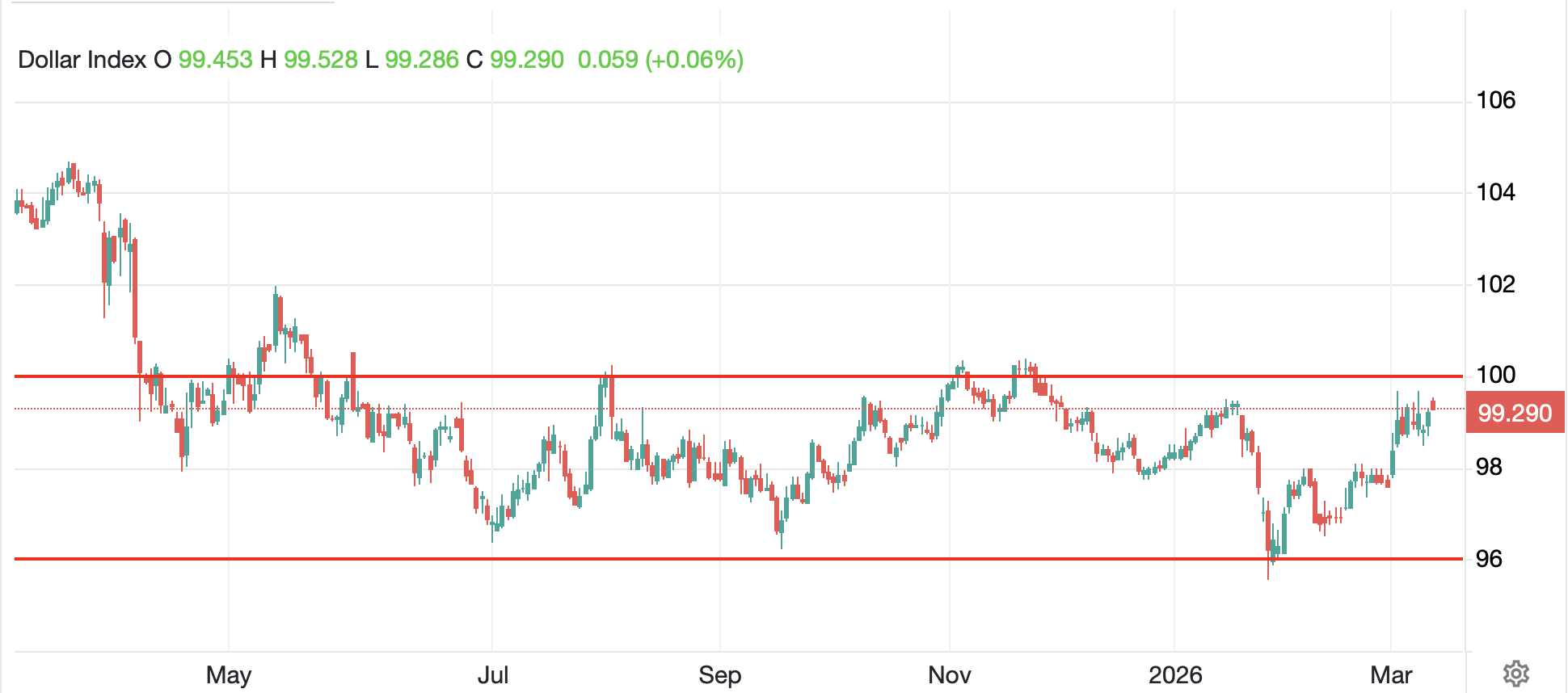
Perhaps one of the reasons that the metals are soft is the dollar is stronger today.  I know we continue to hear about the death of the dollar, but as Mark Twain remarked, “the report of [its] death was an exaggeration.” Instead, what we see this morning is a pattern in the DXY that could easily be mistaken for described as a bottoming and we are simply waiting for confirmation.

Source: tradingeconomics.com

Looking at individual currencies, the dollar is firmer against every G10 currency with the euro (-0.25%) and pound (-0.4%) indicative of the magnitude of movement.  In the EMG bloc, KRW (-0.6%) and ZAR (-0.7%) are the worst performers, with the latter clearly following precious metals lower while the former is feeling a little heat from the fact that Japan struck a trade deal while South Korea has not yet done so.   Otherwise, things are just not that interesting here either.

On the data front, this morning brings Durable Goods (exp -10.8%, 0.1% ex Transports) which tells me that a lot of Boeing deliveries were made last month when Durables rose 16.4%.  But otherwise, nothing and no Fed speakers.  As I said before, it is a summer Friday, and I suspect that most trading desks will be skeleton staffed by 3:00pm if not earlier.

Good luck and good weekend

Adf

Nobody Knows

The doldrums of summer are here
And just like occurs every year
Most markets compress
As pundits profess
The future, for them’s, crystal clear
 
But truthfully, nobody knows
The things, the next week will disclose
While there is no doubt
Big change is about
T’will likely be months (years?) til it shows


I wish there was something interesting to discuss this morning in any market, but the reality is some days the news feed has nothing of note.  Surveying the headlines shows that despite the tariff uncertainty, equity markets (as per the MSCI All-Country World Index) traded to new all-time highs.

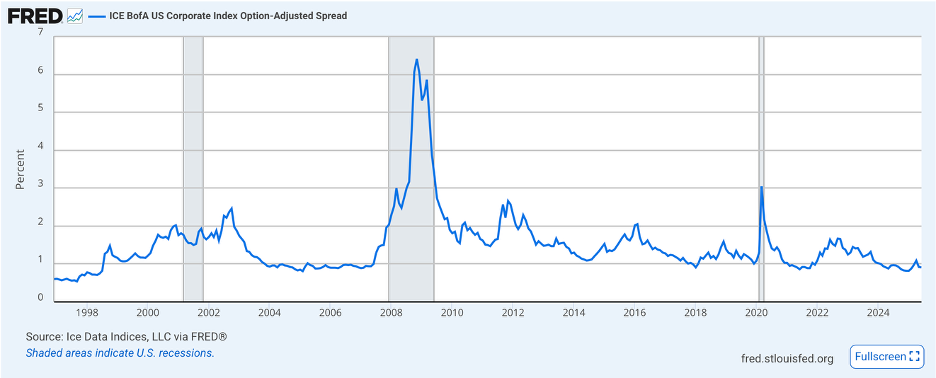
Maybe tariffs are not going to be the end of the world after all.  Adding to this story is the fact that corporate credit spreads continue to compress, a clear signal that concerns over future economic activity are not that significant.  A look at the chart below shows that the current level, below 100bps, is the exception, not the rule when it comes to perceptions of debt risk.  In fact, the current reading of 0.91% is in the 13th percentile, well below the long-term average of 1.49% and median of 1.29%.  My point is, although the political lens through which so much news is presented continues to scream that everything the Trump administration is doing is an existential threat to the global economy, it appears a majority of investors have taken a different view.

So, I guess it’s good times for all.  In other markets, the dollar’s recent modest weakness continues to be highlighted as the beginning of the end of its reserve currency status and another existential threat to the US.  But again, one cannot look at a long-term chart of the euro and believe that we are on the edge of the precipice.  The EUR/USD exchange rate has been both much higher and much lower during the euro’s lifetime which began back in 1999.

It’s summer, folks, and oftentimes throughout my career, that signaled a significant reduction in market activity, liquidity and overall movement.  This is not to say that something untoward cannot occur before Labor Day, but perhaps this year will see a summer lull.  If pressed, I would say that the key risks to the idea of a true summer of doldrums would be a significant increase in the probability of a global conflagration, where both the Russia/Ukraine and Iran talks go off the rails with more kinetic activity in either or both places.  Certainly, if China were to invade Taiwan, that would change things.  And perhaps, if the Big Beautiful Bill fails to be enacted, prospects for the US economy would decline as tax rates would rise dramatically.  My take is that would not be good for either stocks or bonds, and probably not for the dollar either.

History, however, tells us that assuming little or no change is the best bet for the immediate future, so I don’t see any of those things happening.  In fact, my take is financial markets are becoming inured to most of President Trump’s pronouncements at this stage.  Given the movement we have seen in equities and credit spreads, it appears to me there is already a strong assumption of some trade deals to be announced in the near future.  Maybe that will be a ‘sell the news’ event.  But for now, there is precious little about which to get excited.

So, let’s see how things behaved overnight.  It oughtn’t be surprising that equity markets around the world are higher since the MSCI Index, as mentioned above, is setting records.  So, solid gains in the US yesterday were followed by similar type gains in Asia (Japan +0.8%, HK +0.6%, China +0.4%, Australia +0.9%) with the latter rising despite weaker than expected GDP growth in Q1 of 1.3%.  In Europe, too, gains are the general order of the day with Germany (+0.5%) and France (+0.5%) both in fine fettle although Spain (-0.3%) is today’s aberration as PMI data there was weaker than expected (perhaps the blackout had a negative impact!). I guess we oughtn’t be surprised that US futures are pointing slightly higher at this hour as well.

In the bond market, apparently everybody took Ambien today as yields are within 1bp of yesterday’s closing levels in the US, Europe and Asia.  I will take this as no news is good news.

In the commodity complex, oil is stuck near its recent highs and unchanged on the day.  Some might argue this is a triple top as per the chart below, where a break higher would target something on the order of $70/bbl and closing that huge gap from April.  However, given the general lack of activity, there doesn’t seem an obvious catalyst for that type of move.

Source: tradingeconomics.com

As to the metals markets, the extra bond market Ambien was distributed to those traders.

Finally, the dollar is mixed with the overall situation, at least as defined by the DXY, unchanged.  So, AUD (+0.4%) has rallied a bit while JPY (-0.2%) is sliding a bit.  In fact, most currencies are within 0.2% of yesterday’s closing levels although NOK (+0.5%) is today’s big winner as continued support in the oil market helps the krone.  But there is nothing to get excited about here either.

On the data front, ADP Employment (exp 115K) is probably the most interesting number although we also get ISM Services (52.0) and then the EIA oil inventory data with a modest build expected across products.  The BOC meets and nobody expects any policy rate change there and Atlanta Fed president Bostic speaks, but again, who cares at this point?

Quiet is the name of today’s game.  It wouldn’t surprise me if that is the rest of the week’s MO as well, although at some point, we will definitely see a break in one market that is likely to be contagious.  Until then…,

Good luck

adf

Too Much Debt

In Spain, electricity failed
In Canada, Carney prevailed
But markets don’t care
As movement’s quite spare
It seems many traders have bailed
 
But problems, worldwide, still abound
Though right now, they’re in the background
There’s far too much debt
And still a real threat
That no true solutions are found


The two biggest stories of the past twenty-four hours were clearly the national scale blackout in Spain and Portugal yesterday, and the slim victory for Mark Carney in Canada, where the Liberal Party appears to have a plurality, but not a majority, and will oversee a minority government.

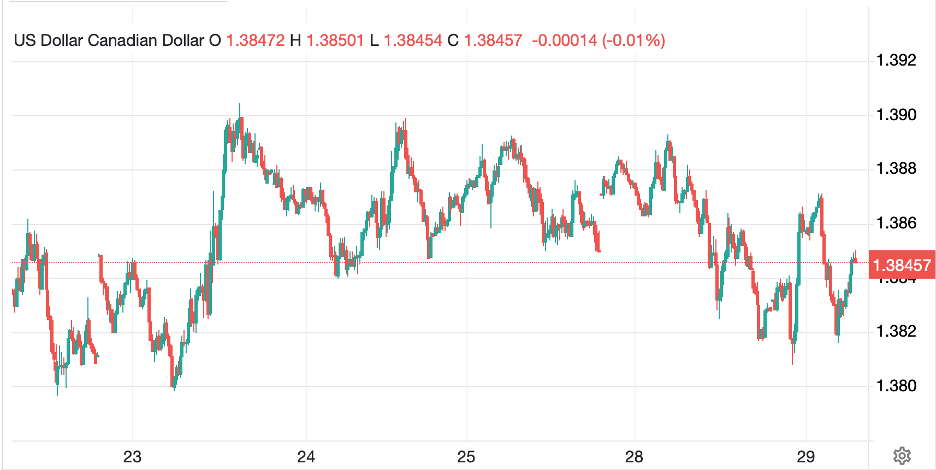
Touching on the second story first, in truth there is not much to discuss.  Much has been made of the vote being an anti-Trump statement with the idea that Carney is better placed to defend Canada from President Trump’s (imagined) predations.  However, given the lack of a majority government, it is not clear how effective this line of reasoning will prove.  As there is no futures market for the TSX, we really don’t have a sense yet of how the Canadian equity market will greet the news.  Yesterday’s modest gains of 0.35% amid a general atmosphere of modest gains doesn’t really tell much of a tale.  As to CAD (-0.1% today), a quick look at the past week shows it has done nothing even in the wake of the news. (see below).  My take is this is a nothingburger event, a perfect description for Mark Carney, a nothingburger of a politician.

Source: tradingeconomics.com

As to the story about Spain’s electricity, I think it may be more instructive on two levels.  The first is as a warning to the risks inherent of powering your electric grid with more than 25% – 30% intermittent, renewable energy sources like wind and solar.  It is somewhat ironic that just twelve days prior to the blackout, Spain’s entire electricity requirement was met by solar, wind and hydro power, the Green dream.  Alas, here we are now and while no answers have yet been forthcoming, and I assume the media will downplay any blame on too much renewable power, virtually every engineering study has shown that once a grid has more than that 25% renewables, it tends towards instability.  This issue will be argued by both sides for a while, although as always, physics will be the final arbiter.  

But I have to wonder if the sudden failure of the electric grid is an omen of sorts, for what may be happening in global markets.  If we analogize global supply chains to the electrical grid, over the course of the past 50 years, we have seen the world create a massively complex web of trade with raw materials, intermediate goods and final products all crisscrossing the world.  There have been myriad benefits to all involved with real per capita economic benefits abounding, and for everybody reading this note, the ability to essentially buy whatever you want/need with limited interference and trouble.  Certainly, the availability of everyday necessities like food and clothing is widespread.

However, underpinning that bounty were two networks.  The first being the obvious one, the supply chains which since Covid have been much discussed by the punditry.  But the second, which gets far less notice is the network of debt that is issued around the world by governments and companies, as well as taken on by individuals, and that has grown to be more than 3x the entire global economic output.  While we most often read about the US government debt which is quickly approaching $37 trillion, total global debt is much greater than that.  In fact, at this point, the debt market is not about issuing new debt to fund new investment, rather it is almost entirely a refinancing mechanism.  

It is this latter issue that should concern us all.  What happens if, one day, the ability to refinance some of that debt, whether US Treasuries, German bunds or Chinese government bonds, has a hiccup of some sort?  A failed US Treasury auction, where the Fed is required to purchase bonds, or a power outage in a key financial center that prevents trades from being confirmed/settled and moneys not moving as expected, or some other force majeure type event that disrupts the current smooth functioning of global debt markets.  

Frankly, the combination of the changes being wrought by President Trump to the global economy, where globalization is giving way to mercantilism, and the significant weight of global debt that hangs over the global economy and is given very little thought seems a potentially volatile mix.

Ironically, as much as I have lately been describing how the Fed’s role seems to have diminished, in the event that something upsets this apple cart, the Fed will be the only game in town.  While this is not a today event, it is something we must not forget.

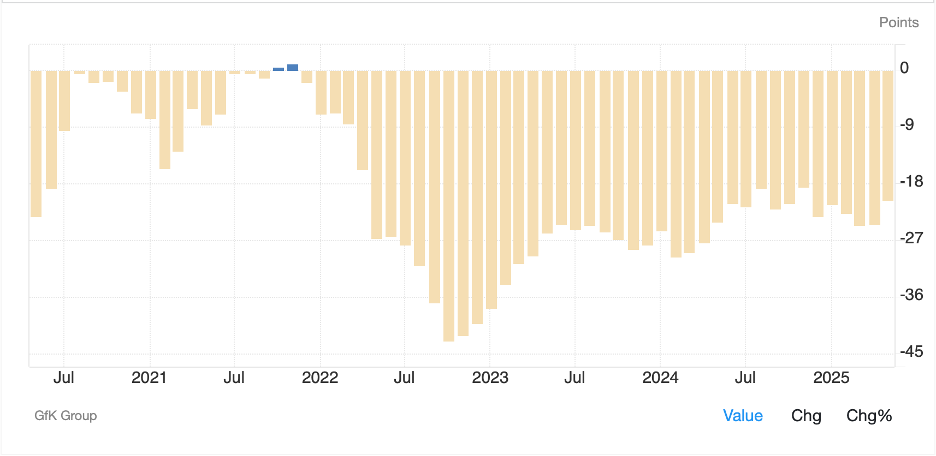
I apologize for my little diatribe, but with so little ongoing in markets, and the parallel to the Spanish electrical grid, it seemed timely.  Let’s look at markets.  Asian equity markets were mixed with the main markets very quiet but a couple of 1% gainers (Australia, Taiwan and Korea) although the rest of the region was +/- 0.3% or less.  Too, volumes were quite lethargic.  In Europe, it should be no surprise that Spain (-0.8%) is the laggard today as the first economists’ to opine on the impact of the blackout said it could be a hit of as much as 0.5% of GDP.  Germany (+0.6%) is the other side of the coin after the GfK Consumer Confidence reading came out at a better than expected -20.6.  Now, maybe it’s just me, but if I look at the past 5 years’ worth of this index, it is difficult to get excited about German economic prospects.

Source: tradingeconomics.com

Yes, this was a better reading, but either the people of Germany are manic depressive, or the index is indicative of major structural problems in the country.  Maybe a bit of both.  As to US futures, at this hour (7:10) they are basically unchanged after being basically unchanged yesterday.

In the bond market, Treasury yields have bounced 2bps this morning after touching their lowest level in 3 weeks yesterday.  European sovereign yields, though, are all softer by 1bp to 2bps this morning as comments from ECB members seem to highlight more rate cuts as Europe achieves their inflation target and are now getting concerned they will fall below the 2.0% rate.

In the commodity markets, oil (-1.7%) is under pressure this morning ostensibly on a combination of concerns over slowing growth and little movement in the US-China trade talks as well as a report that Kazakhstan is pushing up output and other OPEC+ members are talking about increasing production further when they meet next week.  Meanwhile, gold (-0.75%), which rallied back to unchanged in NY yesterday is once again finding sellers at its recent trading pivot of $3340ish (H/T Alyosha).  However, gold’s slide has not impacted either silver (+0.4%) or copper (+0.9%) at least so far in the session.

Finally, the dollar is firmer, largely across the board, this morning.  The euro (-0.3%), pound (-0.4%), JPY (-0.4%) and CHF (-0.6%) are all under some pressure, perhaps profit taking.  But in truth, other than INR (+0.15%) the rest of the major currencies, both G10 and EMG, are all softer vs. the greenback.  I guess the dollar’s demise will need to wait at least one more day.

On the data front, the Goods Trade Balance (exp -$146B), Case Shiller Home Prices (4.7%) and JOLTs Job Openings (7.48M) are the main numbers, although we also see Consumer Confidence (87.5).  But with no Fed discussions much more crucial data on Thursday (GDP, PCE) and Friday (NFP) it seems that today is setting up for not much excitement.

In fact, lack of excitement seems the best description of markets right now.  I don’t know what the next catalyst will be to change things, but absent peace in one of the wars, kinetic or trade, or another force majeure event, it feels like range trading is the order of the day for a while.  My big picture view of a slowly declining dollar is still intact, but day-to-day, it’s hard to see much right now.

Good luck

Adf

More Dire Straits

Apparently, President Xi
Is worried that his ‘conomy
Has lost all its verve
So, throwing a curve,
Reached out to the PBOC
 
The central bank promptly cut rates
As things head toward more dire straits
Investors, though, said
Seems China’s still dead
As equity buying abates


After yesterday’s winter doldrums session, with virtually nothing going on in Europe with the US on holiday, last night we got a surprisingly large cut in the 5-year Loan Prime Rate from the PBOC.  The 25 basis point cut was the largest since this rate was created five years ago, and 10bps larger than anticipated.  This rate is the one on which mortgages in China are based, hence the effort to try to support the property market there.  The problem is, this will only be relevant for new mortgages and does not help the outstanding loans in any way.  Perhaps it will help spur some new property demand at the margin, but as evidenced by the tepid equity market response (CSI 300 +0.2%), it was hardly a panacea for the problems in China.

Ultimately, the issue there remains that decades of inflating a property bubble combined with the demographic impact of the one-child policy have led to a situation where a large proportion of China’s middle class relies almost entirely on their property investments for their retirement nest egg.  As those continue to deflate in value, the idea of increasing consumption continues to recede and the only way to deliver any economic growth is via continued reliance on production and exports.  Alas for the Chinese, the end of the globalization phase around the world has put a crimp in that plan as well.  

I suspect that this is not the last rate cut we will see from China as it remains clear more stimulus is needed to maintain their target growth rate of GDP.  At some point, I also suspect that we will see a large bout of fiscal stimulus, but clearly Xi is avoiding that over concerns regarding the net debt position in China.  Despite their efforts to eliminate the dollar as the global reserve currency, there are precious few people or nations willing to hold renminbi for that purpose, so China does not have the flexibility to be as irresponsible as the US in this case.  Ultimately, I continue to look for the renminbi to depreciate as it is the only natural outlet valve the Chinese have.  It is clear this move will take time, but that is the direction of travel in my view.

Away from that, though, there was nothing happening overnight of any consequence as will be evident when we review the overnight session.  Elsewhere in Asia, the Hang Seng. (+0.6%) had a decent session but Japanese shares were a bit softer, and the rest of the APAC nations showed no consistency with some gains (India and Taiwan) and some laggards (Korea and Australia).  Perhaps the Aussies suffered after the RBA Minutes showed they considered an additional rate hike last month and still have the thought in their minds.  In Europe, things are also quite dull with both gainers and losers with everything +/- 0.3% or less.  As to US futures, at this hour (7:30) they are softer by -0.4% or so across the board.

In the bond market, yields have edged lower with Treasuries down by 1bp and most of Europe lower by 2bps as investors await the next signals regarding central bank activity.  Interestingly, there was an article in Bloomberg News this morning that discussed the idea some traders were preparing for a potential rate hike in the US as the next move, rather than the still consensus rate cuts.  That would not surprise me greatly, but there is no doubt the equity markets are not pricing in that scenario.

Oil prices are slipping this morning, down -1.1%, but there is no obvious catalyst as the driver.  In truth, the oil market looks like it is simply trading within a range of $70-$90 and until it breaks out of that range, there is little to do but watch.  Metals markets are mixed this morning with gold (+0.5%) leading the way higher on a weaker dollar although copper (+0.5%) and aluminum (-0.75%) are showing no consistency.

Finally, the dollar is under pressure pretty much across the board with AUD and NZD leading the way higher in the G10, both advancing by 0.5%, with EUR and GBP (+0.2% each) in tow.  The only outlier is the yen which is unchanged today.  In the EMG bloc, the direction is consistent with almost all currencies a touch stronger, but the magnitude is just on the order of 0.2%.  This appears to be a dollar weakness story on the back of softening yields, rather than anything else.

On the data front, arguably the big statistic today is Canadian CPI which is expected to slip a tick from last month’s readings, but given the heat we have seen elsewhere lately, I would not be surprised to see a stronger reading.  We also see Leading Indicators (exp -0.3%), which if it remains negative, will be the 21st consecutive negative reading, traditionally a harbinger of a recession.

And that’s really it for the day.  No major data and no slated Fed speakers.  I expect things will remain quiet, with risk assets driving any FX moves. 

Good luck

Adf

Beyond His Control

Next week look for Jay to extol
His record, when in Jackson Hole,
He offers the view
Equality’s skew
Is mostly beyond his control

Now keep that in mind when you hear
That China has also made clear
Division of wealth
Is better for health
Thus, taxes will soon be severe

In a market with muted price action across all asset classes overnight, two stories this morning seem to encapsulate the current zeitgeist.  First is the fact that, in what can only be described as extraordinarily ironic, when Chairman Powell regales us next week regarding the evils of inequality and all the things the Fed is heroically doing to right those wrongs, he will be doing so from the seat of the richest county in the United States.  That’s right, Teton County has the nation’s highest per capita income from wealth.  Apparently, irony is second only to hypocrisy when considering political commentary.  And make no mistake, the Fed is completely political.

The other story of note, and one that follows directly from the recent Chinese attacks on their own successful tech companies, is that China has now made clear that wealth in the country needs to be more evenly divided.  Given the fact that China is ostensibly a communist country, or at the very least clearly run by a communist party, it also seems a bit ironic that there is so much concern over wealth inequality.  One would have thought the Gini coefficient would have been far lower there.  But I guess, equality is the new freedom, a valuable political slogan if not an actual goal.  The reason this matters, however, is that it implies the recent Chinese efforts to rein in certain highly successful companies, and especially their high profile bosses, has no end in sight.  From an investment point of view, it appears the Chinese equity markets are going to have any gains severely impeded.  Look, too, for new taxes on estates and wealth there, all of which will have a decided impact on international investing.

Remarkably, beyond those stories, it is difficult to come up with anything that is truly meaningful regarding markets today.  The RBNZ did wind up leaving interest rates on hold, backing away from the expected 0.25% increase, as the fact that the nation has reverted to a complete and total lockdown due to the single case of Covid that was detected last week, has given them pause on their views of future growth.  NZD (-0.4%) is the worst G10 currency performer today on the back of that policy activity (or lack thereof), but given the tiny size of the nation, it has not had any other significant impact.

Inflation data was released in both Europe (2.2%, 0.7% core) as expected and the UK (CPI 2.0%, 1.9% core) with both of those readings 0.2% lower than forecast.  So, while inflation is seemingly running quite hot in the US, it appears to have potentially plateaued across the pond.  While we can be certain that the ECB is not going to change its current policy stance anytime soon, there has been a great deal more discussion regarding the BOE.  Hawkish vibes were emanating from Threadneedle Street recently, but if inflation is not going to rise further, then those views may soon be called into question.  However, there is a case to be made that this is a temporary lull in the CPI data and that looking ahead, readings will push up toward 4.0%, at least, as previously announced price increases start to be felt throughout the economy.  Thus far, the FX impact from this data has been essentially nil, but equity markets in Europe and the UK are all under modest pressure this morning (DAX -0.1%, CAC -0.35%, FTSE 100 -0.35%).

As to markets elsewhere, Asia saw some rebounding from its recent travails, with the Nikkei (+0.6%), Hang Seng (+0.5%) and Shanghai (+1.1%) all having their first positive day in five sessions.  We also saw a reversal in some currency activity there as KRW (+0.7%) was the best performer after comments from the central bank describing the recent weakness as an overshoot and that the Finance Ministry is monitoring things closely.

A look at bonds shows that Treasury yields have backed up 1.2bps this morning after having fallen by about 10bps in the prior three sessions.  European sovereigns, though, continue to find support as the ECB continues to hoover up virtually all the paper issued.  As such, Bunds, OATs and Gilts have all seen yields slip about 1 basis point.

Finally, the dollar can only be described as mixed this morning, with movement in the G10, aside from kiwi’s decline, pretty minimal, <0.2%, although with an equal number slightly lower and higher.  EMG currencies show the same pattern, with most movement quite limited and only one notable laggard (TRY -0.7%) which also seems to be a trading response to its recent strong rally (+3.3% in the past 5 sessions).  In other words, there is very little to discuss at all today.

On the data front, after yesterday’s disappointing Retail Sales number (-1.1%, exp -0.3%), this morning brings Housing Starts (exp 1600K) and Building Permits (1610K) and then this afternoon, we get the potentially most interesting news, the FOMC Minutes.

On the Fedspeak front, thus far, the only three FOMC members who have not advocated for tapering are Powell, Williams and Brainerd, as even Kashkari, yesterday, said he could see the case for tapering by early next year.  But Powell gave no indication he is ready to go down that road, so barring an insurrection at the Fed, one has to believe any tighter policy is still some ways away.  Today, we hear from Bullard, but he has already made his tapering bona fides known.

And that is really all there is today.  It truly has all the hallmarks of a summer doldrums day, with limited price action and limited news, unless something shocking comes from the Minutes.  My money is on nothing, and a range trading day ahead of us.

Good luck and stay safe
Adf

How Long Can They Wait?

While prices worldwide are all rising
Most central banks keep emphasizing
That they have no fear
And later this year
Their efforts will be stabilizing

But every time data’s released
It seems that inflation’s increased
How long can they wait
Ere they contemplate
It’s time QE should be deceased?

It has been another extremely dull day in financial markets as participants await the next catalyst, arguably coming tomorrow in the form of either a surprise from the ECB, a low probability event, or a surprise from the US CPI release, a higher probability event.  And yet, even if CPI surprises, will it really have much market impact?

For inspiration on the potential impact of a surprising outcome, let us quickly turn to China, where last night inflation data was released with PPI rising 9.0% Y/Y, its highest print since 2008, although CPI rose a less than expected 1.3%.  However, for the world overall, Chinese PPI is of much greater importance as it offers clues to what Chinese manufacturers may be charging for the many goods they sell elsewhere in the world.  If they start raising prices, you can be sure that prices elsewhere will be rising as well.  But the market response to this much higher than expected result was a collective yawn.  Chinese bond yields actually fell 1 basis point while the renminbi slipped 0.2%.  Chinese equities rose 0.3% in Shanghai to complete the triumvirate of markets demonstrating no concern over rising prices.

Is that what we can expect if tomorrow’s CPI data prints at a higher than expected number, perhaps even above 5.0%?  The first thing to note is that the Treasury market is certainly not demonstrating concern, at least in the classical sense of selling off into a rising inflationary situation.  In fact, yields are now back to their lowest level, 1.50%, since early March, the period during which yields were rising rapidly and eventually touched the early-April highs of 1.75%.  But here we are 25 basis points lower and the market seems to have completely bought into the Fed narrative of transitory inflation.  (As an aside, perhaps someone can explain to me why, if inflation is transitory and the Fed need not respond to the recent rises, there is a growing consensus that the Fed is going to start to taper QE purchases.  After all, the implication of transitory inflation is that current policy is fine as is, why change it and rock the boat?)

Another story that has been getting increasing play is about the growing short positions in Treasury bonds and how regardless of tomorrow’s data, we could see a short squeeze and lower yields.  Now, when I look at the CFTC data, I do see that last week open positions fell by nearly 50K contracts, but the overall outstanding position remains net long ~55K and there has been no discernible pattern of building short positions, so I’m not sure where that story has come from.  

So, when considering what we know about the current situation, near-term inflation pressures but central bank certitude it is transitory and recent price action indicating limited concern over inflation, it tells me that a high CPI print, currently forecast at 4.7%, will have no impact of note on the bond market.  As such, it seems unlikely that a high CPI print will have much impact on any market.  We will need to see a series of high prints, and they will need to continue at least through October or November before, it seems, anybody is going to believe that inflation may be more than a transitory phenomenon.  Unfortunately, we will all suffer equally due to the fact that prices are going to continue to rise, regardless of what the Fed or BLS tells us.

Turning to today’s session, price action has been generally similar to yesterday’s session, which means that there have been continued small movements in markets with strong trends difficult to identify.  For instance, equity markets overnight showed the Nikkei (-0.3%) and Hang Seng (-0.1%) both slipping a bit while Shanghai (+0.3%) managed to eke out a gain.  Hardly conclusive evidence of a theme.  Europe, however, is a bit softer, with the DAX (-0.5%) and FTSE 100 (-0.6%) both under a bit of pressure although the CAC (0.0%) has gone nowhere at all.  The German story is one of weaker than expected data, this time a smaller trade surplus with declines of both imports and exports indicating growth there is not quite so robust.  Meanwhile, Brexit issues between the EU and UK have arisen again over Northern Ireland, and this seems to be weighing on sentiment there.  As to US futures markets, they are very little changed at this hour.

Bond markets are clearly not concerned over inflation with Treasury yields down 2.7 basis points and similar declines in Europe (Bunds -2.6bps, OATs -3.0bps, Gilts -2.0bps).  Looking further afield, Italian BTPs have seen yields decline by 5 basis points with Spain and Portugal both falling 4bps or more.  It seems clear the market believes the ECB is going to continue to actively support the European government bond market.

On the commodity front, oil continues to rally with WTI (+0.4%) back over $70/bbl.  Something to consider regarding oil is that as ESG initiatives continue to grow in importance, and many of them are attacking the fossil fuel industry, seeking to prevent funding, there will be less and less exploration for and drilling of new oil sources.  But the transition to eliminating fossil fuels from the economy will take many years, (I’ve seen credible estimates of 30-50 years) meaning demand will not disappear, even if supply shrinks.  It seems pretty clear what will happen to the price of oil in this situation.  Do not be surprised if the previous high of $147/bbl is eclipsed in the coming years.

As to the rest of the commodity space, precious metals are a bit softer while base metals are more mixed today (Cu -0.9%, Al -0.15%, Ni +0.3%).  And finally, the grains are giving back some of their recent gains with all three down about 1.0%.

Finally, in FX, the dollar is broadly softer, but the movement has been very modest.  In G10 space, NOK (+0.3%) is the leader along side CAD (+0.3%) as they both follow oil’s rise.  After that, though, the movement is between 0.0% and 0.2%, with no stories to discuss.  In the Emerging Markets, HUF (+0.6%) is the big winner, as CPI continues to print above 5.0% and the central bank is tipped to raise rates at its meeting tomorrow.  But aside from that, there are more winners than losers although they are all just modest gains on the order of 0.1%-0.2%.  Weakness was seen in some APAC currencies overnight, but that, too, was very modest.

There is no important data to be released today, nor are there any Fed speakers, so my take is the market will continue to trade on the back of the Treasury market movement.  If yields continue to slide, look for the dollar to stay under some pressure.  If they reverse, I think the dollar will as well.

Good luck and stay safe
Adf


No Reprieve

Said Boris to Angela, Hon
When this year is over and done
There’ll be no reprieve
The UK will leave
The EU and start a great run

Will somebody please explain to me why every nation seems to believe that if they do not have a trade deal signed with another nation that they must impose tariffs.  After all, the WTO agreement merely defines the maximum tariffs allowable to signatories.  There is no requirement that tariffs are imposed.  And yet, to listen to the discussion about trade one would think that tariffs are mandatory if trade deals are not in place.

Consider the situation of the major aircraft manufacturer in Europe, a huge employer and key industrial company throughout the EU.  As it happens, they source their wings from the UK, which, while the UK was a member of the EU, meant there were no tariff questions.  Of course, Brexit interrupted that idea and now their wing source is subject to a tariff.  BUT WHY?  The EU could easily create legislation or a regulation that exempts airplane wings from being taxed upon importation.  After all, there’s only one buyer of wings.  This would prevent any further disruption to the manufacturer’s supply chain and seem to be a winning strategy, insuring that the airplanes manufactured remain cost competitive.  But apparently, that is not the direction that the EU is going to take.  Rather, in a classic example of cutting off one’s nose to spite their face, the EU is going to complain because the UK is not willing to cut a deal to the EU’s liking while imposing a tariff on this critical part for one of their key industrial companies.  And this is just one of thousands of situations that work both ways between the UK and the EU.  I never understand why the discussion is framed in terms of tariffs are required, rather than the reality that they are voluntarily imposed by the importing country for political reasons.

This was brought to mind when reading about the meeting between British PM Johnson and German Chancellor Merkel, where ostensibly Boris explained that he would like a deal but the EU will need to compromise on key areas like fishing rights and the influence, or lack thereof, of EU courts in UK laws, or the UK is prepared to walk with no deal.  Negotiations continue but the clock is well and truly ticking as the deadline for an extension to be agreed has long passed.

It cannot be surprising that this relatively negative news has resulted in the pound giving up some of its recent gains, although at this point of the session it is only lower by 0.2% compared to yesterday’s closing levels, a modest rebound from its earlier session lows.  The euro, on the other hand is essentially unchanged at this hour as traders look over the landscape and determine that there is very little to drive excitement for the day.

dol·drums

/ˈdōldrəmz,ˈdäldrəmz/

noun

  1. a state or period of inactivity, stagnation, or depression.

In the late 1700’s, sailors would get stuck crossing the Atlantic at the equator during the summer as the climactic conditions were of high heat and almost no wind.  This time became known as the summer doldrums, a word that came into use as a combination of dull and tantrums, or, essentially, unpredictable periods of dullness.

Well, the doldrums have arrived.  And, as the summer progresses, it certainly appears that, despite the ongoing Covid-19 emergency, the FX market is heading into a period of even greater quiet.  This is somewhat ironic as one of the favored analyst calls for the second half of the year is increasing volatility across markets.  And while that may well come to pass in Q4, right now it seems extremely unlikely.

Let’s analyze this idea for a moment.  First off, there is one market that is very unlikely to see increased volatility, Treasury notes and bonds.  For the past month, the range on 10-year yields has been 10 basis points, hardly a situation of increased volatility.  And given the Fed’s ever-increasing presence in the market, there is no reason to believe that range will widen anytime soon.  Daily movement is pretty much capped at 3 basis points these days.

Equity markets have shown a bit more life, but then they have always been more volatile than bonds historically.  Even so, in the past month, the S&P has seen a range of about 7% from top to bottom and historic volatility while higher than this time last year, at 25% is well below (and trending lower) levels seen earlier this year.  After the dislocations seen in March and April, it will take some time before volatility levels decline to their old lows, but the trend is clear.

Meanwhile, FX markets have quickly moved on from the excitement of March and April and are already back in the lowest quartile of volatility levels.  Again, looking at the past month, the range in EURUSD has been just over 2 big figures, and currently we are smack in the middle.  Implied volatility, while still above the historic lows seen just before the Covid crisis broke out, are trending back lower and have fallen in a straight line for the past month.  And this pattern has played out even in the most volatile emerging market currencies, like MXN, which while still robustly in the mid-teens, have been trending lower steadily for the past three months.

In other words, market participants are setting aside their fears of another major dislocation in the belief that the combination of fiscal and monetary stimulus so far implemented, as well as the promise of more if deemed ‘necessary’ will be sufficient to anesthetize the market.  And perhaps they are correct, that is exactly what will happen, and market activity will revert to pre-Covid norms.  But risk management is all about being prepared for the unlikely event, which is why hedging remains of critical importance to all asset managers, whether those assets are financial or real.  Do not let the lack of current activity lull you into the belief that you can reduce your hedging activities.

If you haven’t already figured this out, the reason I waxed so long on this issue is that the market is doing exactly nothing at this point.  Overnight movement was mixed and inconclusive in equities, although I continue to scratch my head over Hong Kong’s robust performance, while bond markets remain with one or two basis points of yesterday’s levels.  And the dollar is also having a mixed session with both gainers and losers, none of which have even reached 0.5%.  In fact, the only true trend that I see these days is in gold, which as breeched the $1800/oz level this morning and has been steadily climbing higher since the middle of 2018 with a three-week interruption during March of this year.  I know that the prognosis is for deflation in our future, but I would be wary of relying on those forecasts.  Certainly, my personal experience shows that prices have only gone higher since the crisis began, at least for everything except gasoline, and of course, working from home, I have basically stopped using that.

Not only has there been no market movement, there is essentially no data today either, anywhere in the world.  The point is that market activity today will rely on flows and headlines, with fundamentals shunted to the sidelines.  While that is always unpredictable, it also means that another very quiet day is the most likely outcome.

Good luck and stay safe

Adf