Divergent Views

This morning, we all must feel blessed
Nvidia is still the best
Its’s earnings were great
Which opened the gate
For buyers, much more, to invest
 
But contra to that piece of news
The Minutes showed divergent views
On whether to slash
Next month, rates for cash
Or else wait for more weakness clues


Whatever your view of AI and the entire discussion, one must be impressed with Nvidia’s performance as a company, and as an equity.  Last night’s earnings release was clearly better than expected as CEO Jensen Huang indicated that revenues for Q1 should grow to ~$65 billion as there is still significant demand for the buildout of data centers.  He also pushed back on the idea that AI was a bubble.  Of course, he would do that given he is at the center of the discussion.  Nonetheless, after modest gains in US equities yesterday, despite much more hawkish than expected FOMC Minutes (discussed below), US futures are rising sharply this morning, with NASDAQ futures currently higher by 1.6% (6:15) and taking all the indices with it.  Life is good!

Which takes us to the FOMC Minutes and our first look at dissention in the Eccles building.  I think the following paragraph, directly from the Minutes [emphasis added], does a good job in describing the wide range of views that currently exist around the table at the Fed, and make no mistake, I am hugely in favor of a wide range of views as I would contend it has been the groupthink in the past that led us to the current, unfavorable situation.

“In considering the outlook for monetary policy, participants expressed a range of views about the degree to which the current stance of monetary policy was restrictive. Some participants assessed that the Committee’s policy stance would be restrictive even after a potential 1/4 percentage point reduction in the policy rate at this meeting. By contrast, some participants pointed to the resilience of economic activity, supportive financial conditions, or estimates of short-term real interest rates as indicating that the stance of monetary policy was not clearly restrictive. In discussing the near-term course of monetary policy, participants expressed strongly differing views about what policy decision would most likely be appropriate at the Committee’s December meeting.”

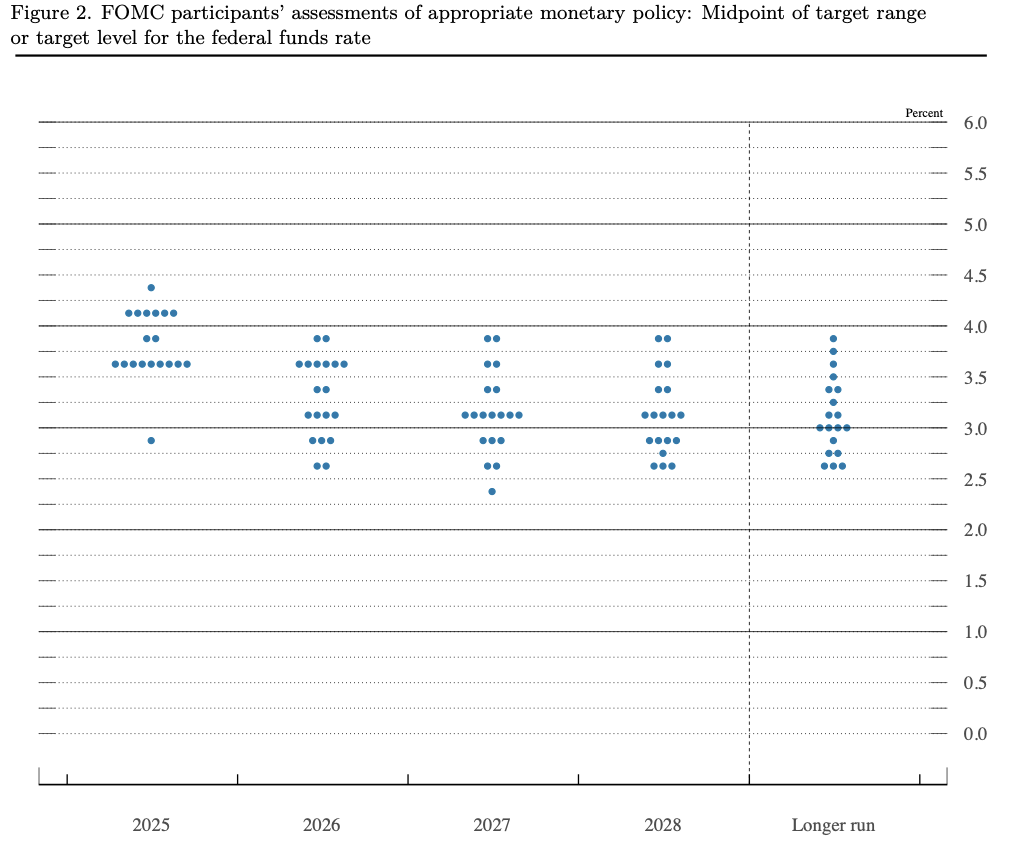
Below I have copied the dot plot from the September meeting, which contra to most previous versions shows a particularly wide range of views regarding the future level of Fed funds.  I have to wonder, though, after reading the Minutes, if those dots will be stretched even wider apart from top to bottom in the December report.
Of course, our interest is how did the market respond to this release?  Well, it can be no surprise that the Fed funds futures market repriced further and is now showing just a 32% probability for a cut next month and 78% probability of the next cut coming in January.  That said, the market remains convinced that rates must go lower over time, something that does not appear in sync with equity market growth expectations and seems to be completely ignoring the announced inward investment flows to the US from around the world.

Source: cmegroup.com

As to the equity market response, the two vertical lines show the release of the Minutes and then the release of Nvidia earnings.  You can see for yourself which matters more to the market.

Source: tradingeconomics.com

Between the GDPNow data, which continues to show growth remains robust, and more announcements of inward investment on the back of trade deals, with the Saudis ostensibly promising $1 trillion after the recent White House dinner, I will take the over on future economic activity.  Remember, too, the government is actively supporting mining, drilling and manufacturing and all of that is going to feed into economic growth here.  My view is the Fed funds futures market is completely wrong, and we will not see rates back at the 3.0% level anytime in the next few years.  I’m not suggesting we won’t see an equity market correction, just that the end is not nigh.

Each day the yen slides
Intervention creeps closer
Yen traders beware

Turning to the dollar, it continues to strengthen across the board with the DXY trading back above 100 this morning, and now that the Fed seems more hawkish, looking like it may have legs.  But let us focus on the yen, quite beleaguered of late, as it appears to be accelerating its downfall.  Not only is this evident on the chart below, but we also have heard concerns for the third time, as per the following quotes from Minoru Kihara, the chief cabinet secretary:

The yen is experiencing sudden, one-way movements that are concerning and which require close monitoring.  Excessive fluctuations and disorderly movements in exchange rates must be monitored with vigilance.  We are concerned about the recent one-way and sudden movements in the foreign exchange market. It’s important for exchange rates to remain stable, reflecting fundamentals.”

In the past six months, the yen has fallen >10% vs. the dollar and is lower by nearly 4% in the past month.  At the same time, JGB yields are starting to accelerate higher, trading to yet another 20-year high at 1.82% and the price action there is remarkably similar to that of USDJPY as per the below chart.  The problem for the JGB market is the BOJ already owns more than 50% of the outstanding debt, so buying more doesn’t seem to be a solution, whereas buying JPY in the FX market will have an impact, albeit short-term if they don’t change policies.   

Source: tradingeconomics.com

The upshot of all this is the world is awash in debt, with global debt/GDP exceeding 3x.  The lesson is that not all this debt will be repaid, in fact probably not that much at all.  Be careful as to what you hold.

Ok, let’s briefly tour the markets I have not yet touched.  Tokyo equities (+2.65%) loved the Nvidia earnings as did Korea (+1.9%), Taiwan (+3.2%) and most of Asia although China (-0.5%) and HK (0.0%) didn’t play along last night.  I guess the ongoing restrictions on sales of Nvidia chips to China is still a negative there, as are recurring concerns over the property market as there is talk of yet another attempt to fix things by the government.  Europe, too, is firmer this morning, although clearly not on tech bullishness given the lack of tech on which to be bullish.  But there is talk of a Russia/Ukraine peace deal which may be a benefit.  At any rate, gains are widespread on the order of +0.6% or so across the board.

In the bond market, Treasury yields rose a couple of ticks yesterday and are higher by 1 more basis point this morning, but still at just 4.14%.  The front of the curve rose by more on the back of the Minutes.  European yields are also higher this morning, between 2bps and 3bps with UK gilts the outlier, unchanged on the day, as softer inflation has traders expecting a rate cut at the next BOE meeting on December 18th.

Oil (+1.0%) has rebounded off its recent lows and is trading back at…$60/bbl, the level at which it is clearly most comfortable these days.  Meanwhile, gold (0.0%) gave back yesterday’s overnight rally to close mostly unchanged with the same true across the other metals although this morning silver (-0.7%) is slipping a bit further.

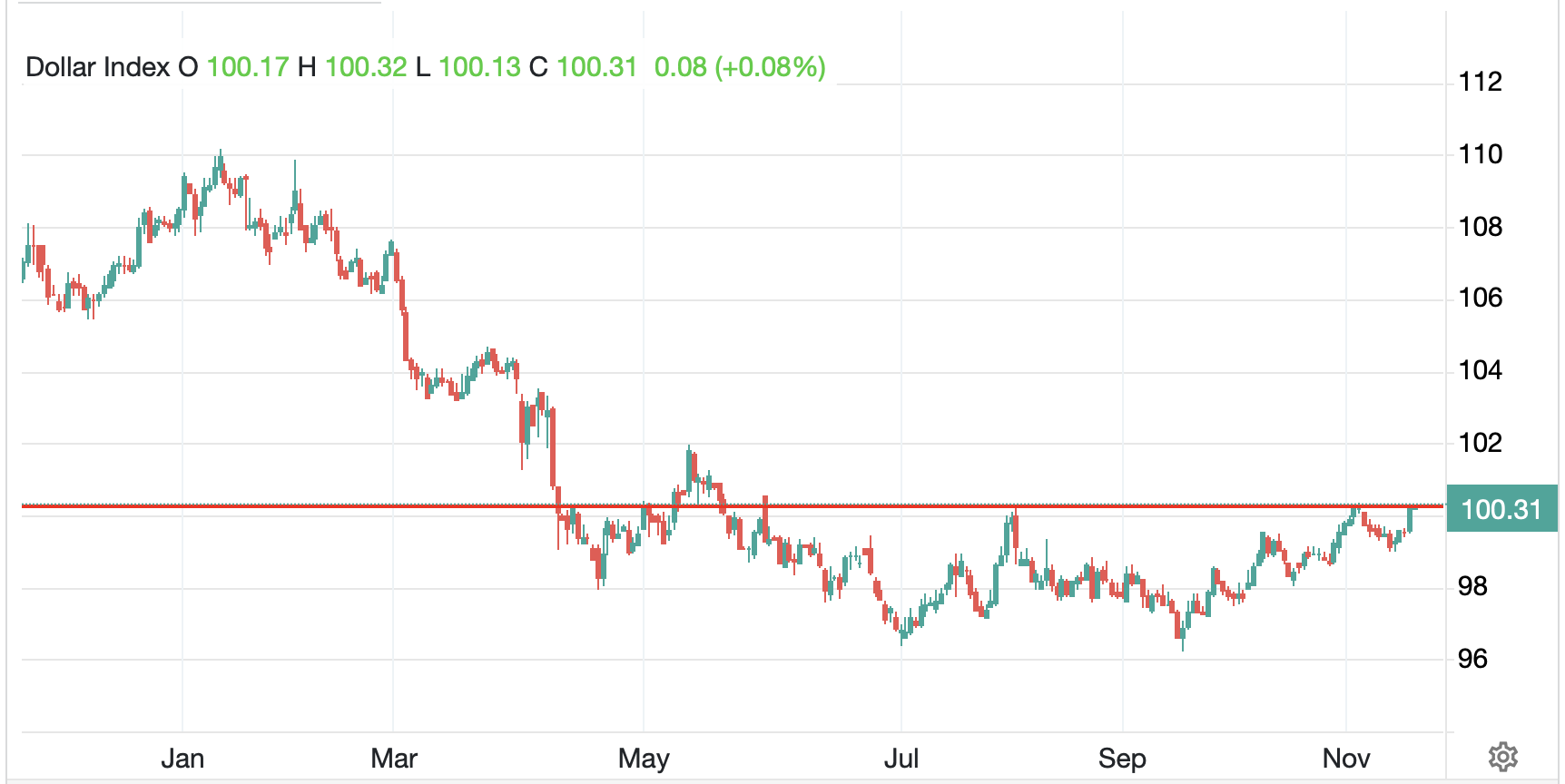
Finally, other currency movements beyond the yen (-0.3% today) are of a similar size across both the G10 and EMG blocs.  Using the DXY as proxy, this is the third test above 100 since August 1st with many analysts are calling for a breakout at last.  
Source: tradingeconomics.com

Perhaps this is true given the word is the Russia/Ukraine peace deal was negotiated entirely between the US and Russia without either Ukraine or Europe involved, demonstrating how insignificant Europe, and by extension the euro, have become.  Just a thought.

On the data front, the big news is the September employment report is going to be released this morning along with some other data:

Nonfarm Payrolls50K
Private Payrolls62K
Manufacturing Payrolls-8K
Unemployment Rate4.3%
Average Hourly Earnings0.3% (3.7% Y/Y)
Average Weekly Hours34.2
Participation Rate62.3%
Philly Fed-3.1
Existing Home Sales4.08M

Source: tradingeconomics.com

On the one hand, the data is stale.  On the other hand, it is all we have, so it will likely have greater importance than it deserves.  I have a hard time looking at the economy and seeing substantial weakness, whether because of corporate earnings, inward investment announcements or the Fed’s growing concern over higher inflation.  All that tells me the dollar is going to be in demand going forward.

Good luck

Adf

Basically Fictive

For Fedniks it must be addictive
To say rates are “somewhat restrictive”
It seems like a show
As how can they know
Since R-star is basically fictive
 
Investors, though, lap up this stuff
In fact, they just can’t get enough
Of comments that hint
There is a blueprint
For policy, though that’s a bluff


Yesterday, both Richmond Fed president Barkin and Governor Jefferson explained that current Fed policy is “somewhat restrictive”.  This takes to seven the number of FOMC members who have used this phrase with Powell, Kugler, Hammack, Schmid and Collins all having used it before, as did Jefferson two weeks ago.  And they are all referring to the concept of R-star, the mythical rate at which policy is neither restrictive nor accommodative.  In fact, R-star has become the Fed’s north star, with the key difference being, we can actually see the north star while R-star, even they will admit, is unobservable.  Of course, that hasn’t stopped them from basing policy decisions on the variable.

I highlight this because the tone of virtually every one of these speeches has been one of caution, with the implication being they are very close to their nirvana so the last steps will be small.  However, we cannot forget that though the last steps may be small, there is still confidence amongst the entire body that the direction of travel is toward lower rates. certainly, as you can see from the aggregated meeting probabilities from the Fed funds futures market below, there is zero expectation that rates will rise anytime during the next two years and a decent chance of another 100bps of cuts over that time.

Source: cmegroup.com

I might contend that is a pretty negative outlook on the US economy by the Fed.  Given the Fed’s models assume that a key to lower inflation is slowing economic growth, the idea that rates are going to fall implies slower growth to help them achieve the inflation portion of their mandate.  But that seems out of step with both the Atlanta Fed’s GDPNow forecast shown below and currently sitting at 4.1% annualized for Q3 and with earnings forecasts in the equity markets.

Asking Grok, the average current earnings growth forecasts for 2026 for the S&P 500 is somewhere in the 13% – 14% range with revenue growth running at ~6.9%, which is typically in line with nominal GDP growth.  (I understand that current forward PE ratios are extremely high at 23x, so be careful that companies hit their targets while their share prices fall anyway.)  But if nominal GDP is going to run at nearly 7%, and let’s assume inflation is at 3.5%, which I think is a reasonable possibility, then the math tells us that GDP is growing at 3.5% on a real basis.  With Fed funds currently at 4.0%, why would they need to decline further?

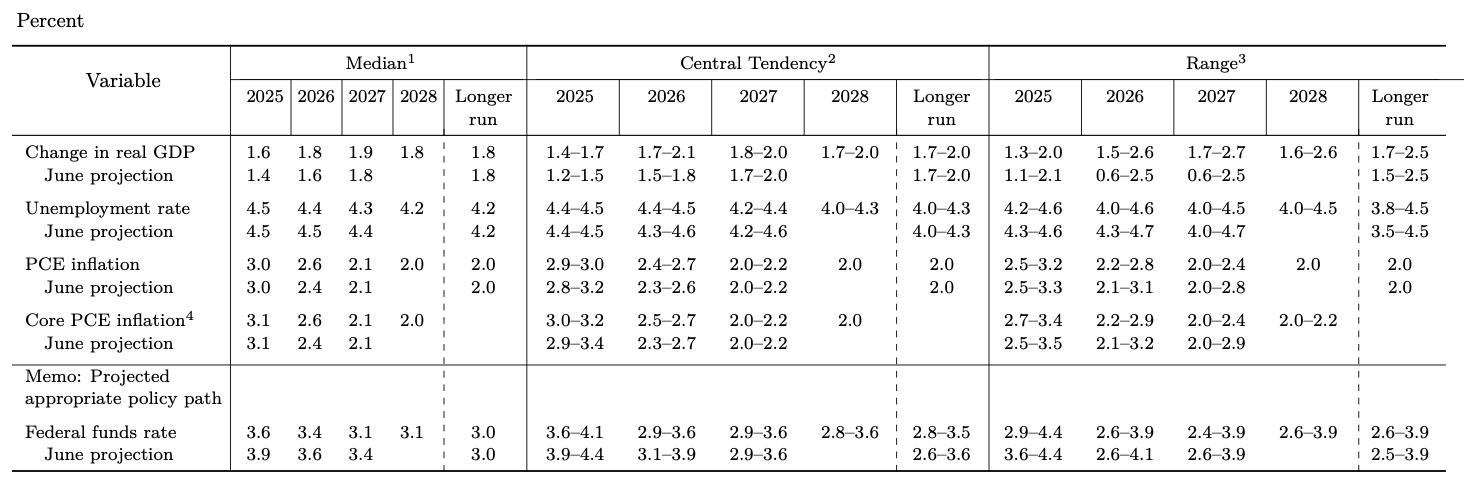
Looking back at the Fed’s September Summary of Economic Projections, it appears that the Fed sees a very different economy than the markets see.  In fact, you can see that they believe nominal GDP in the long run is going to average <4.0% (sum of longer run GDP and PCE in the table below).  

That is a really big difference, one that is the type that can lead to massive policy errors.  Now, if those 17 people cloistered in the Marriner Eccles building have a better handle on the economy than everybody else, I can understand why they believe rates need to fall further.  But is that the case?  

Here’s something else to ponder, I asked Grok about the relationship between nominal GDP and Fed funds and the below table is what it produced:

It is patently obvious how the Fed has developed its models and because of that, why they have been so wrong.  In fact, look at the SEP above and compare it to the period from 2001 – 2019, they are essentially identical.  But I would argue, and I’m not alone, that the economy from the dot.com crash up to the pandemic is no longer the reality on the ground.  The Fed’s backward-looking models seem set to make yet more errors going forward.

And with those cheery thoughts, let’s look at what happened overnight.  Yesterday’s continuation of the US stock decline seems to be finding a bottom, at least temporarily as Asian markets were mixed (Nikkei -0.3%, Hang Seng -0.4%, CSI 300 +0.4%) with the rest of the region showing a similar mixture of gainers (India, Malaysia, Indonesia, Philippines) and losers (Korea, Taiwan, Australia) as it appears the entire world is awaiting Nvidia’s earnings after the US close today.

Similarly, European bourses are edging higher this morning with the rout seemingly over for now.  This morning Spain (+0.5%) is leading the way higher followed by Germany (+0.3%) with the rest of the markets little changed overall, although leaning higher.  As to US futures, at this hour (7:30) they are pushing higher by about 0.4%.

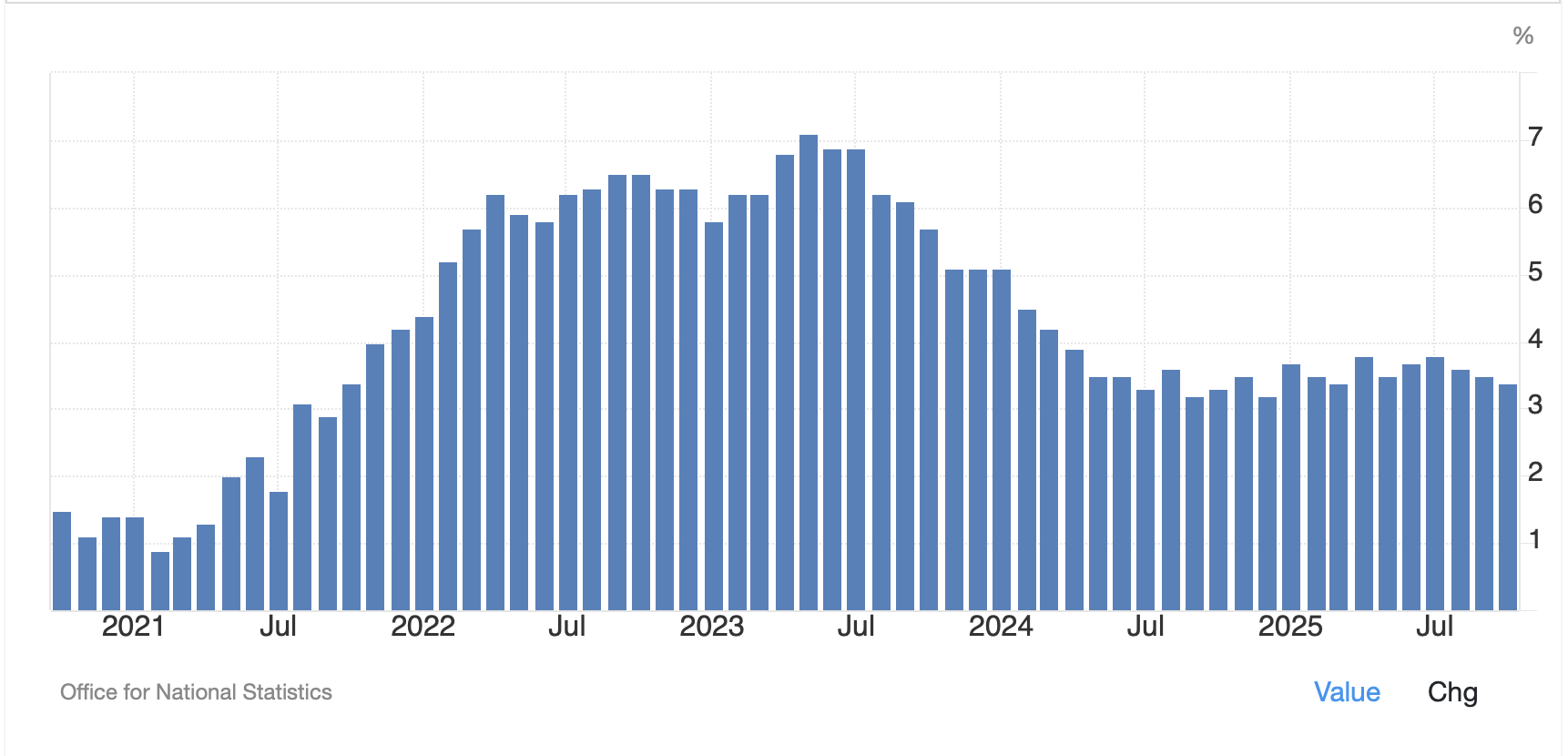
In the bond market, Treasury yields are unchanged this morning, still sitting right around that 4.10% level while European sovereigns have seen demand with yields slipping -2bps to -3bps across the continent.  The UK is the outlier here, with yields unchanged after releasing inflation data that was bang on expectations, and below last month’s readings, though remains well above their 2.0% target.  I guess if I look at the chart below, I might be able to make the case that core UK CPI is trending lower, but similarly to the Fed, the last time they were at their target was July 2021.

Source: tradingeconomics.com

I would be remiss if I didn’t mention that JGB yields have moved higher by 3bps, pushing their decade long highs further along as concerns grow over the Japanese fiscal situation.

Oil prices (-2.4%) are falling this morning, slipping to the low side of $60/bbl after API inventories showed a surprise build of 4.4 million barrels.  However, I would contend that there is very little new here.  Perhaps the dinner last night where President Trump hosted Saudi Prince MbS has some thinking OPEC will increase production more aggressively going forward.  In the metals markets, they are all shining this morning led by silver (+3.1%) and platinum (+3.0%) with gold (+1.3%) and copper (+1.3%) lagging, although remember the latter two are much larger markets so need more interest to rise as quickly.

Finally, the dollar continues to find support, despite the precious metals gains, and this morning we see the DXY (+0.15%) pushing back toward that psychological 100.00 level.  JPY (-0.5%) has traded through 156 and certainly seems like it wants to push back to its YTYD highs of 158.80.  Interestingly, there was no Japanese commentary of note last night, but I presume if this continues, the MOF will be out warning of potential future action.  Another interesting fact is that while the dollar is firmer against virtually all G10 currencies, the EMG bloc is holding its own this morning led by HUF (+0.6%), PLN (+0.25%) and ZAR (+0.15%) with the rand obviously benefitting from gold’s rally.  The forint has benefitted from the central bank maintaining policy on hold at 6.5%, one of the highest available rates in Europe and that has helped drag the zloty along for the ride.

On the data front, this morning we see the August Trade Balance (exp -$61.0B) and then the EIA oil inventories where a small draw is expected.  We also get the FOMC Minutes at 2:00pm and hear from NY Fed president Williams this afternoon.

I cannot help but look at the difference between the Fed’s very clear view and the markets expectations and feel like the Fed is on the wrong side of the trade.  It is for this reason I fear higher inflation and ultimately, a much lower likelihood of further rate cuts.  If that is the case, the dollar will find even more support.  Interesting times.

Good luck

Adf

Fading

In Germany, growth has been fading
Down Under, inflation’s upgrading
Chair Jay gave his views
But it was old news
And Trump, for more cuts, is crusading


Some days, there is less to discuss than others, and this morning that seems to be the case.  Even my X feed had very little of interest.  Arguably, the top story is German Ifo readings came out much lower than expected and have now reversed most of the gains that occurred from front-running US tariff policy changes.  Germany’s bigger problem, though, is that the trend here is abysmal, as ever since Russia’s invasion of Ukraine and the dramatic rise in energy prices there, the German economy has been under significant pressure.  A look at the 5-year history of the Ifo series does an excellent job of explaining why growth has completely stalled there.

Source: tradingeconomics.com

In fact, if we look at the last three+ years of GDP activity in Germany, as per the below chart, we see that seven of the thirteen quarters were negative while two were exactly flat and the sum total of growth was -0.9%.  It’s amazing what happens to a nation that decides to impose extreme conditions on the production of energy domestically.  Or perhaps it’s not so amazing.  After all, economic activity is merely energy transformed.  If the cost of energy is high, economic activity is going to be slow.

Source: tradingeconomics.com

I highlight this because it runs counter to the narrative that Europe is a better place to invest than the US, which has been the thesis of the ‘end of American exceptionalism’ trade.  Germany is the largest European nation by far and had been a manufacturing powerhouse.  But those days appear to have passed.  If Germany is going to continue to lag, and I see no reason for that to change based on the current political dynamic there, please explain the idea behind long-term strength in the euro.  As I wrote yesterday, if the Fed cuts aggressively, the dollar will decline in the short run, but one cannot look at the trajectories of the relative economies and claim Europe is the place to be in the long run.

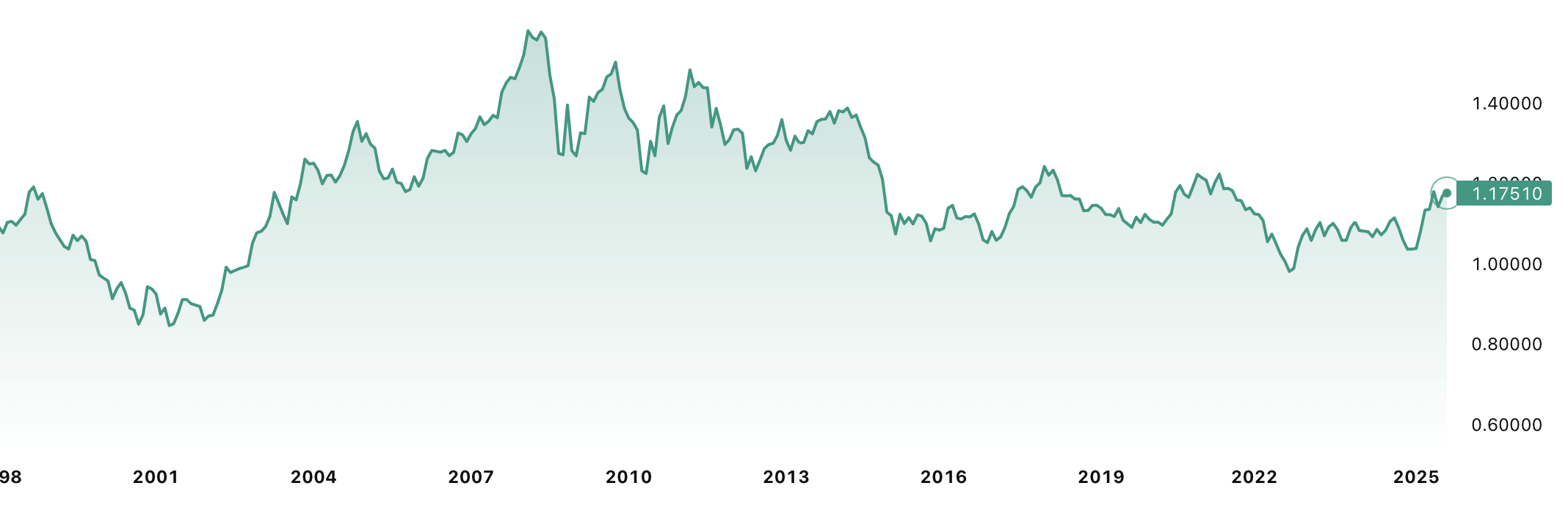
This morning, the euro (-0.5%) has responded logically to the data but the dollar is broadly stronger as well after Chair Powell’s speech yesterday where he continued the modestly hawkish tone from the FOMC press conference.  He continues to agonize over the fact that inflation won’t fall while unemployment is edging higher, although he finally admitted that tariffs would likely have a temporary, one-off impact on prices.  While there is no doubt the dollar has fallen since the beginning of the year, a 10% or 15% move is hardly unprecedented, but rather occurs pretty frequently.  A look at the below chart from the beginning of the euro’s existence in 1999 shows at least six or seven other instances when the euro rallied that much in a short period of time.

Source: tradingview.com

In fact, to demonstrate the politicization of the current world, one need only go back to the period in 2008 when the euro peaked at 1.60 or so to see that it was not seen as a global calamity, simply a period where US monetary policy had loosened dramatically relative to the rest of the world.

The other marginally interesting story this morning is Australia’s inflation rate, which came in at 3.0%, higher than expected and demonstrating what appears to be a break in the declining trend previously seen.

Source: tradingeconomics.com

This matters as AUD (+0.1%) is outperforming all its G10 peers this morning on the back of the idea that the RBA will be stuck on hold, rather than cutting rates again soon.  Too, this weighed on Australian equities (-0.9%) which underperformed other Asian markets overnight.

But that’s really all the interesting stuff, and it wasn’t that interesting, I fear.  So, let’s look at the rest of the market behavior overnight.  While I thought it was illegal, yesterday resulted in US equity markets declining on the session, albeit less than 1%.  And this morning, you’ll be happy to know, the futures are all modestly green.  As to Asian markets, Japan (+0.3%), China (+1.0%) and HK (+1.4%) all had strong sessions although it appears most of the other regional bourses declined.  The Chinese story making the rounds is the lessening in trade tensions between the US and China was seen as a key positive while HK survived Typhoon Ragasa without any major impacts.  But Korea, India, Taiwan and Singapore were all softer on the session.

In Europe, markets have generally done little with marginal declines the norm although, surprisingly, Germany’s DAX is unchanged on the day despite the weak Ifo data.  However, it is hard to get excited about anything happening there right now.

Bond yields fell yesterday with Treasuries declining -4bps although this morning they have edged back higher by 1bp.  Perhaps Powell’s tone yesterday was enough to keep the bond vigilantes on the sidelines, or perhaps there is simply not enough new information to change any views right now.  The Fed funds futures market continues to price a 94% probability of a cut at the end of next month and apparently bond investors are cool with that.  European yields are also little changed this morning as were JGB yields last night.

In the commodity space, oil (+1.1%) is heading back toward the top of the range I highlighted yesterday, but still more than $1 away and there have been no stories to drive things.  This is all just range trading in my view.  As to the metals markets, this morning gold and silver are essentially unchanged, consolidating their recent gains while copper (-.0.75%) is slipping slightly and has retraced some of its gains from earlier in the month.  Remember, copper is much more an economic play than a fear play or inflation play.

Finally, the dollar is firmer across the board this morning with gains against almost all G10 counterparts on the order of 0.5% and against EMG counterparts it is more like 0.8%.  Even CNY (-0.25%) is weakening as it appears Chinese state banks are selling renminbi in the spot market and hedging in the swap market to help mitigate its recent gains.  It is beginning to feel like the dollar’s decline this year, which has been widespread, is coming to an end.  

On the data front, today brings only New Home Sales (exp 650K) and EIA oil inventories.  Yesterday’s Flash PMI data was right in line with expectations, and my take is until NFP a week from Friday, there is going to be little of interest on the data front for markets overall.  Even PCE this week will have to be significantly different from expectations to have any impact.

It appears that absent Stephen Miran convincing the rest of the FOMC to cut rates aggressively, a very low probability event, the dollar is finding a bottom, and the next major move will be higher on the basis of stronger growth in the US vs. the rest of the world.  Of course, if the Fed does start to get more aggressive, then the dollar will suffer, I just don’t see that happening anytime soon.

Good luck

Adf

Naught to be Gained

It now seems inflation has stalled
Which has bond investors enthralled
But Fedspeak explained
There’s naught to be gained
By cutting ere its, further, falled

Meanwhile, data China released
Showed Retail Sales nearly deceased
But factories still
Produce stuff at will
Thus, exports have widely increased

It has been quite a week with respect to the data that has been released as well as regards the ongoing commentary onslaught from central bank speakers around the world.  A quick recap shows that market participants have decided they know what is going to happen in the future (the Fed is going to start cutting rates and continue doing so) while every member of the Fed who has spoken has claimed just the opposite, that there is no reason for the Fed to adjust policy at this time given the still too high inflation readings and the seeming appearance of ongoing economic strength.  I continue to marvel at the ‘narrative’ which for 15 years warned, ‘don’t fight the Fed’ which was in its historic process of driving rates to and maintaining them at essentially 0.00%.  And yet now, those very same pundits listen to every Fed speaker with bated breath and conclude that despite their insistence that rate cuts are not coming anytime soon, rate cuts are just around the corner so ignore the Fed and buy risk assets.

My observations on this conundrum are that first, the market is much bigger than the Fed or any central bank or even all the central banks put together.  So, if the market is of the mind to continue to add risk to their portfolios for whatever reason, risky assets will increase in price.  However, the central banks are not irrelevant to the process as they do control short-term interest rates (aka funding costs) directly and can have great sway on long-term interest rates through both commentary and the ability to intervene in those markets a la QE or QT.  In other words, the battle has been joined and while I expect the market will ultimately go wherever it wants to, the central banks will have something to say about the path taken to get there.  So, do not be surprised if there are some downdrafts along the way to higher prices.

Remember, too, that central banks have a great deal to do with creating inflation, not merely fighting it, and if they continue to add money and liquidity to both the economy and markets, the real value of assets will not climb nearly so far and could well decline.  While this is an age-old battle, arguably having been ongoing since the first central banks were created in the 1700’s, it does have the feeling as though we are coming to a point in time where things could get out of hand in the near future.  Perhaps not Weimar Republic out of hand, but certainly 1970’s stagflation out of hand.

Turning to the only real news overnight, Chinese data was released and the dichotomy in the Chinese economy continues to be evident to one and all.  While IP printed at a better than expected 6.7%, highlighting that Chinese factories are humming, Retail Sales fell to a 2.3% Y/Y reading, far below both last month and expectations.  In other words, while China continues to build lots of stuff, it is all for export as the domestic population is not in the mood to buy.  This has led to two consequences of note.  The first is that as the Chinese trade balance continues to expand, we have seen, and will likely see more, tariffs imposed by destination markets like Europe and the US thus straining economic ties further.  Too, this is in direct opposition to the idea of reshoring of manufacturing which continues to be the political goal throughout the West.

The second impact is that President Xi has clearly recognized that a major impediment to further Chinese economic growth is the ongoing disaster otherwise known as the Chinese property market.  This is the driving force behind the recent efforts to support things via government purchase of unfinished and unsold homes with the goal of those being converted into public housing. 

Alas, there are a few problems with this plan which may hinder a smooth application of the idea.  The first problem is that the reason these homes are unfinished or unsold is that the developers have run out of money or cannot sell them at a profit.  In other words, somebody needs to take some big losses and absent a directive from Beijing I assure you none of the developers will willingly do so.  The proposed fixes of reducing the minimum mortgage rate and size of the down payment necessary to purchase a home may help at the margin but will not solve the problem.  The problem is that the losses likely approach $1 trillion, a large amount for even the national government, and so finding those who can afford to absorb those losses is a difficult task.  Certainly, some of the state-owned banks will be in the spotlight here, but they are already insolvent (if one takes a realistic look at their non-performing loans) so don’t have that much capacity to do more. 

The critical feature here is that more time is needed for companies and banks to grow via their other businesses such that they can eventually absorb those losses.  But time is not on Xi’s side here.  All told, the underlying situation in China remains fraught, in my view, and so must be viewed with care.  While the PBOC is clearly willing to prevent the renminbi from collapsing, such an unbalanced economy is going to display a great deal of volatility going forward.

Ok, did markets do anything interesting overnight?  In truth, not really.  After yesterday’s modest declines in the US equity markets, Asian markets were mixed with Japan, Australia, Korea and Taiwan all under pressure while Chinese and Hong Kong shares rallied sharply on the back of the property proposals.  This morning, European bourses are mostly a bit softer as it seems that while a June rate cut is baked in, there has been significant push-back against a following cut in July, a story which had gained great credence lately.  Meanwhile, at this hour (6;45) US futures are ever so slightly lower, -0.1% across the board.

In the bond markets, after the post CPI yield decline in the US on Wednesday, yields have been backing up since their nadir and are now nearly 8bps higher from the bottom with 2bps this morning’s contribution.  European yields have shown similar price action, falling through Wednesday evening and bouncing since then.  As to the JGB market, yields there have backed up a bit as well, now trading at 0.95%, but have not yet been able to touch the big 1.00% level.  The irony is that USDJPY has been trading in sync with JGB yields, so as they climb, so does the dollar!  That is not what the narrative had in mind; I assure you!

In the commodity space, oil is little changed this morning but that is after rallying $1 during yesterday’s session as the market absorbed the larger than expected draw in inventories described on Wednesday.  As well, the idea that the Fed is soon going to cut rates and stimulate economic activity has pushed bullishness on the demand side.  As to the metals markets, they are edging higher again this morning with copper seeming to consolidate after its rocket higher and collapse earlier this week.  Adding to the copper story is that Goldman Sachs commodity analyst, Jeff Currie, said he was more bullish on copper than anything else during his career!  Based on my view that debasement of currencies remains a key feature of the current monetary regime globally, I expect metals to continue to rise as well.

Finally, the dollar continues to rebound from its lows seen Wednesday night late with the DXY having regained 0.8% since the bottom and the greenback higher versus nearly every one of its counterparts this morning.  I believe the dollar story remains closely tied to the Fed for now, and as long as the Fed maintains that rate cuts are a distant prospect, at best, it will retain its value.

The only data release this morning is Leading Indicators (exp -0.3%) which has been in negative territory for nearly two years and still no recession.  We also hear from Governor Waller, but all four Fed speakers yesterday were consistent that they do not yet have confidence inflation is falling to target and so higher for longer remains the base case.

It has been a volatile week and I expect that today will see far less activity as the lack of critical data and the fact that traders are tired from all the activity so far this week will lead to many leaving for an early weekend.  But the big trends remain intact, a higher for longer Fed will help support the dollar while the narrative will not be dissuaded and continue to buy risk assets.

Good luck and good weekend

Adf

Stanching Their Bleeding

For all of those pundits that claimed
inflation had died and been maimed
The data did show
What now we all know
Inflation is still quite inflamed

The upshot is all those who said
That real rates would soon force the Fed
To quickly cut rates
Are in dire straits
And stanching their bleeding instead

Wow!  Not much else you can say after yesterday’s market activities following the hotter than expected CPI data released in the morning.  As I wrote on Monday, a 0.1% difference in a monthly print is not really substantive in the broad scheme of things, but when the narrative is so strong and so many are convinced that the Fed is itching to cut rates because they don’t want to overtighten as inflation continues to fall, that 0.1% in the wrong direction means a lot.  Hence, yesterday’s price action (which I did presage in the last line of my note yesterday morning before the release.)

Of course, you are all aware that stocks got crushed, with the major indices falling -1.35% to -1.80% while the Russell 2000 small cap index fell -4.0%!  But it wasn’t just stocks, bonds joined the fun with the 10-year yield soaring 15bps to 4.30%, its highest yield since early December.  Gold got crushed, falling $30/oz and back below $2000/oz for the first time in two months, while the dollar exploded higher, rising about 1% against most currencies and almost 1.8% against the yen.

A quick analysis of the CPI data shows that the shelter component was the big surprise on the high side, although airfares also were higher than expected.  As well, wages remain much stickier than the Fed would like to see as they continue to support price increases in the services component of the data.  Forgetting the headline for a moment, a look at Median CPI, as calculated by the Cleveland Fed, shows that last month’s rise was 0.5% and the Y/Y number is +4.85%.  That feels to me like a much better estimate of what is happening than the newest darling of the bullish set, Truflation, which claims that inflation is “really” rising at only 1.39% as of yesterday.  One final thing, hopefully, all of those who claimed that the ‘real’ trend of inflation was sub 2% because the 3-month average had fallen there (please look at Monday’s note, What If?) will finally shut up for a while.

The new Mr. Yen
Said “we are closely watching”
So you don’t have to
Do not cross this line!

As mentioned above, the yen was the worst performer yesterday after the data which, not surprisingly, triggered a response from the Japanese government.  Now that USDJPY is back above 150.00, there are many who believe the MOF/BOJ will be intervening soon.  There is a terrific website called Harkster.com which aggregates all sorts of commentary and research from around the web as well as adding their own commentary.  I highly recommend it as a source for information.  At any rate, they have a very nice description of the historical actions that lead to intervention by the Japanese which I show here:

1.     Language such as “monitoring developments in currency markets”.
2.     “Sudden/abrupt/rapid” movements in currency markets are “undesirable”. In addition, markets are “not reflecting fundamentals”.
3.     “Excessive” is introduced next to describe the price movements alongside “clearly” in addition to referring to FX moves as “speculative”.
4.     Readying for action is normally reflected with the phrase “we are ready to take decisive action” which would suggest some action is imminent.
5.     Price checking is the step prior to actual intervention whereby the BoJ will call round selected Japanese banks and ask for a level of USDJPY. Even though they do not deal the act of them asking normally makes the banks, who have been contacted, sell USDJPY in anticipation of intervention and they will also spread the news around the market to encourage more selling.
6.     Same as 5 but this time the BoJ actually do sell USDJPY. This may happen in waves.
7.     Finally, coordinated intervention with other major central banks involved. This would generally happen early NY hours to include the US. This obviously has the most effect on the markets.

Arguably, we are somewhere between numbers 1 and 2 right now, but they can escalate this process quickly.  However, in the end, what matters for currencies over time are relative fiscal and monetary policy settings.  History has shown that to strengthen a currency, a country must run a tight monetary and loose fiscal policy.  To weaken a currency, the opposite is true.  Given the US 7% budget deficits and highest interest rates in the G10 + QT, it is pretty clear that the dollar should be strong.  Now, if the BOJ were to raise rates aggressively, it would have a chance to alter the trajectory of the yen, but while Ueda-san has implied that they may raise rates back to zero after the spring wage negotiations, assuming they agree large increases, unless there is a strong belief that they are going to continue to raise rates to attack inflation in Japan (which isn’t really a big problem) then absent the Fed starting to ease, there is no good reason to think the yen will strengthen very much at all.  Now, if the Fed does start cutting aggressively, that is a different story, but based on yesterday’s CPI, that feels like it is a long way in the future.

And those are the most noteworthy things to absorb.  Now, a look at the rest of the overnight session shows that Japanese stocks were softer, but the rest of Asia (absent China which is still on holiday) was mixed, with gains and losses around.  Europe, this morning, though is firmer, up about 0.5% except the UK, which is higher by 0.9% after CPI there fell more than expected, encouraging talk that the BOE will be cutting sooner.  Now remember, yesterday the UK lagged after their employment data was stronger than expected, especially wage data, so it is not clear which one to believe.  As to US futures, they are firmer at this hour (8:00), up about 0.5%.

After yesterday’s massive yield rallies, it is no surprise to see them slipping a bit today, with Treasury yields lower by 1bp and most European sovereign yields down by 3bps (UK Gilts are -6bps on that inflation data).  Overnight, the Asian session saw government bonds there slide with yields higher across the board although JGB yields were the laggard, rising just 3bps.

In the commodity markets, oil (flat today) is the only market that didn’t sell off yesterday and it has maintained those gains.  This is despite a much bigger inventory build than anticipated as it seems continued concerns over a wider Middle East war are extant, as is a new worry, as Ukraine has been able to bring the attack to Russia more effectively, sinking another Russian ship in the Black Sea last night.  Recall, they have been attacking Russian oil infrastructure and if they are successful in that effort, it will definitely give oil prices a boost.  But the rest of the commodity markets got crushed yesterday with gold, copper and aluminum all falling sharply.  This morning, though, those three markets are little changed, simply licking their wounds and not extending any losses.

Finally, the dollar is also little changed this morning, but that is after a massive rally across the board yesterday against both G10 and EMG currencies.  Against most major counterparts, it has traded back to levels last seen in mid-November, although the pound has been holding up better than most, with smaller net moves.  It is ironic that the dollar strengthens on a high inflation print as fundamentally, high inflation is supposed to weaken a currency.  Of course, this move has nothing to do with inflation per se, and everything to do with interest rate expectations.

On that subject, it is worth noting that the latest Fed funds futures rate cut probabilities are now; March 8.5%; May 37.9%; and there are now just 4 cuts priced into the year, down from 7 about a month ago.

There is no hard economic data released although the EIA oil inventories do come out later this morning.  We also hear from two Fed speakers, Goolsbee and Barr, and I imagine we could get a little ‘we told you so’ in their comments today.

If recent history is any guide, I suspect that equity markets will rebound a bit further early, but potentially drift lower as the day wears on.  The bulls were clearly shaken as their narrative took a big hit.  But this was just one data point of many.  I don’t believe the end is nigh, but in the longer term, it is not hard to believe that the Fed will remain the tightest policymaker of all the central banks and that will help the dollar while hurting risk assets.

Good luck
Adf

As Good As It Gets

Said Waller, I have no regrets
For things are “as good as it gets”
We’ve been quite outstanding
And reached that soft landing
Though rate cut forecasts won’t be met

Wow is all I can say.  While Treasury Secretary Yellen was brasher last week by explicitly saying they have achieved the mythical soft landing, Governor Waller’s speech yesterday went into great detail about his work in 2022 on Beveridge curve analysis that almost perfectly forecast the current situation.  I certainly hope he didn’t sprain his arm patting himself on the back.  The certitude that has been coming from Fed speakers and their acolytes, like ex Fed economist @claudia_sahm, is remarkable to me.  After literally a century of having no great insight into the workings of inflation, the Fed has now declared they have it under control because the past 6 months have seen price increases rise at a slowing pace.

Key Waller comments were as follows, “By late November, the latest economic data left me encouraged that there were signs of moderating economic activity in the fourth quarter, but inflation was still too high.  As of today, the data has come in even better. Real gross domestic product (GDP) is expected to have grown between 1 and 2 percent in the fourth quarter, unemployment is still below 4 percent, and core personal consumption expenditure (PCE) inflation has been running close to 2 percent for the last 6 months. For a macroeconomist, this is almost as good as it gets.”

He finished with this comment, although interestingly, the market did not applaud, “As long as inflation doesn’t rebound and stay elevated, I believe the FOMC will be able to lower the target range for the federal funds rate this year. This view is consistent with the FOMC’s economic projections in December, in which the median projection was three 25-basis-point cuts in 2024.”

Maybe the Fed really has stuck the landing and inflation is going to smoothly slide back to 2% and stay there while the economy ticks over at 2%-3% GDP growth.  Certainly, if the fiscal impulse continues to run at deficit levels of 8% of GDP, I would hope we could get 3% growth.  But to my understanding of the way the economy responds to policy actions, that 8% deficit is going to find itself into rising prices across the economy.  But then again, I’m just an FX guy.

In the end, the market heard Waller and decided that maybe higher for longer was still a thing.  The Fed funds futures market reduced its probability of a March rate cut to 60% from 70% before the speech and the bond market sold off pretty hard with yields closing at 4.07%, their highest level since the day before that December FOMC meeting when everybody was certain that the Fed had pivoted.  It seems the question now is, have they actually pivoted?

One of the problems they have is that the inflation data last month indicated the pace of price increases could be stabilizing around the 3.0%-3.5% level, rather than their target 2.0% level.  We have very consistently heard from all the acolytes that if you annualize the past 3 or 6 months’ worth of data, the Y/Y rate is pushing to 2.0%.  This, they claim, means the Fed has achieved their goal.  The problem with this argument is that the Fed’s goal is not simply touching a 2.0% inflation rate, it is to maintain it at that level over time.  That is a much more difficult landing to stick, and there is no evidence things will work out that way especially given we haven’t even reached a Y/Y rate of 2.0%!

Here’s another problem for that crew, inflation elsewhere in the world is not continuing its recent decline.  Yesterday, Canadian CPI data showed that the trend numbers, Trimmed-Mean (3.7%) and Median (3.6%) were both higher than forecast and higher than last month.  This morning, from the UK we learned that CPI rose 0.4% M/M, far more than expected with the Y/Y data rising to 4.0% headline and 5.1% core.  In both these nations, the recent trend had been lower but has now reversed.  While we have seen a significant rebalancing of markets and measured inflation has clearly fallen from its levels of the past two years, I would argue the evidence is scant that this trend is necessarily going to continue.  Wage growth continues to hold up as employees try to catch up to the huge price increases since 2019.  With the Unemployment Rate remaining near multi-decade lows, absent a major recession it appears it will be very difficult to continue to squeeze prices lower.  And this doesn’t even consider the fact that increased tensions in the Middle East and the rerouting of ships around the Cape of Good Hope in South Africa, is adding weeks and costs to any movement of goods or oil, and could last for a considerable length of time.

We have consistently heard from ECB members that rate cuts are not coming soon.  We have had a lot of pushback lately from FOMC members about the timing of any rate cuts with both sets of speakers explicitly saying the market is overexuberant in their current pricing.  As I wrote yesterday, I think we are looking at a bimodal outcome, either virtually no rate cuts, or many more because we are in a recession.  In either case, I think equity markets will need to reprice lower.  However, the impact of these two situations will be different on the dollar, the bond market and commodities.  We will discuss those outcomes tomorrow.

In the meantime, overnight was a sea of red (as opposed to the Red Sea) in equity markets with the Hang Seng (-3.7%) leading the way lower but weakness on the mainland as well (CSI -2.2%) and throughout the region.  Japanese stocks (Nikkei -0.4%) were actually the leaders in the space.  The China story was informed by their monthly data dump which showed GDP grew at a slightly weaker than forecast 5.2%, while IP (6.8%), Retail Sales (7.4%) and Fixed Asset Investment (3.0%) were all around expectations, but still soft overall and compared to last month.  The Unemployment Rate there ticked higher to 5.1%, and they put out a new version of the youth unemployment rate at 14.9%, which they insist is a better measure than the old one which was screaming higher and was discontinued when it breached 21%.

European equity markets are also under pressure, mostly down about -1.0% on the continent and lower by -1.75% in the UK after the data releases.  As to the US, after a lackluster session that was saved by a late day rally yesterday, futures this morning are lower by about -0.25% at 7:30.

In the bond market, after the large move yesterday, Treasury yields are unchanged on the day and European yields have edged up by about 1bp across the board with UK Gilts the exception, having jumped 10bps after the inflation readings.  JGBs continue their lackluster activity and while they rose 2bps overnight, they remain below 0.60% overall.  Again, slowing inflation there indicates little reason to believe they are going to change their monetary policy anytime soon.

On the commodity front, oil (-1.8%) is showing a lot more concern over demand destruction after the modestly weaker Chinese data than concern over supply issues from Middle East tensions.  Plus, with US rates higher, commodity prices tend to suffer anyway.  Gold, which got crushed yesterday amid the repricing of interest rates is unchanged this morning, licking its wounds while copper and aluminum trade either side of unchanged as the economic situation remains so uncertain right now.

Finally, the dollar remains king of all it sees this morning, rallying further after yesterday’s rally and now has retraced virtually all the weakness that came from Powell’s December “pivot”.  This has been true in both the G10 and EMG blocs as the dollar is almost universally higher this morning.  The one exception is the pound, which has managed a 0.35% rally on the back of the move in UK interest rates after the higher inflation data print this morning.  The key to remember here is that despite a great deal of chatter about the dollar’s demise, the reality is that it has moved very little, net, over the past year and is far higher than where it was 5 years ago.  If the Fed really is going to maintain higher for longer, which if inflation continues its rebound seems likely to me, then the dollar has to benefit.

Turning to the data, this morning we see Retail Sales (exp 0.4%, 0.2% ex autos), IP (0.0%) and Capacity Utilization (78.7%).  In addition, we have three Fed speakers this morning and then this afternoon we get the Fed’s Beige Book and NY Fed president Williams speaks.  Given what appears to be a change in tone from Waller, it will be interesting to see if the others follow his lead or push back.  I have to believe that we are going to see more higher for longer talk and how it is premature to talk about rate cuts in March.  If that is the case, the dollar should retain its recent strength and I expect risk assets to come under further pressure.

Good luck
Adf

Jay Powell’s Dream

As markets await the release

Of Payrolls, all things are at peace
But once it’s revealed
We need watch the yield
In 10-years lest it should decrease

While Goldilocks is still the meme
And certainly, Jay Powell’s dream
The data’s beginning
To show growth is thinning
More quickly both down and upstream

So, here’s the scoop.  Today is payrolls day and that is the only thing that anybody cares about right now, ahead of the release, and it will be the topic du jour by all the talking heads for the rest of the day.  As of 7:00am, here are the latest consensus forecasts according to tradingeconomics.com:

Nonfarm Payrolls180K
Private Payrolls153K
Manufacturing Payrolls30K
Unemployment Rate3.9%
Average Hourly Earnings0.3% (4.0% Y/Y)
Average Weekly Hours34.3
Participation Rate62.7%

Now, looking at a chart of the past year’s releases, the numbers seem to show a very gradual decline, albeit hardly in a regular manner.

But let’s take a look at some underlying data that may help us understand the bigger picture a bit better.  First off, one of the things that draws a great deal of criticism is the birth/death model that the BLS uses to estimate the number of new companies that start up, hiring people, compared to the number of companies that close with the resulting job losses.  A key reason that every month this year has seen the data revised lower is because that portion of their data continues to be revised lower.  Historically, the birth/death model is at its worst during an inflection point, when the economy is either entering or exiting a recession.  Those downward revisions are a strong clue that things are not going that well.

But there is something else worth noting and that is the BLS breaks the payroll data down on a state-by-state basis as well.  This is not something that gets a lot of press but is nonetheless important.  While this data only goes back to 1976, that is still a fairly robust series.  I highlight this because every time in the past, when all 50 states + Washington DC have seen a decline in the number of employed workers, we have been in a recession already.  And shortly thereafter, the first negative NFP prints started showing up, usually withing 2-3 months.  Well, guess what?  Last month saw every state in the union report a decrease in the number of employed persons.  This is quite a negative signal for the economy, and one that is not getting much press, certainly not from the soft-landing set.  

I’m not saying that we are going to get a negative NFP print this morning, just that it seems one is coming to a screen near you soon.  If history is any guide, then sometime in Q1 seems realistic.  And ask yourself how Chairman Powell and his friends on the FOMC will respond to that type of data.  They had better hope that the recent trend in inflation, which has clearly been on a downward trajectory, continues, because otherwise, the Chairman will have nowhere to hide.  Cut rates to address economic weakness while stoking still firm inflation?  Leave rates on hold to fight inflation and let growth crater further?  Talk about a rock and a hard place.

It seems to me that the evidence continues to pile up on the side of a recession coming early next year.  Absent another wave of MMT or helicopter money or some type of direct fiscal stimulus by the federal government, this business cycle seems destined to end soon.  The bond market has been telling us that since the beginning of last month.  The oil market has been telling us that since the beginning of last month too.  The stock market has still not gotten the message.  It will, trust me, and it won’t be pretty.  However, I don’t think today is the day it will happen.  Just be prepared.

So, how have markets performed leading up to the NFP data?  Well, following yesterday’s rally in US stocks, Asia had a mixed picture.  Japanese equities continue to be pressured by a combination of concern over tighter monetary policy and a strengthening yen.  There was, however, a bump on the road to that tighter policy thesis as Q3 GDP was revised lower to -2.9% Y/Y, with the M/M falling -0.7%.  Will they really tighten policy into a shrinking economy?  Meanwhile, despite the word from the Chinese Politburo that they would be adding more fiscal stimulus in 2024, shares in Hong Kong and on the mainland barely eked out gains of 0.1%.  The rest of APAC, though, had a decent performance, with gains ranging from 0.3%-0.9%.

European bourses are in good shape today, with green across the board, albeit some just barely (DAX +0.1%) and some more robustly (CAC +0.7%).  Finally, US futures are edging lower, -0.2% or so, as I type (7:30am).

In the bond market, yields, which as we know have been trending sharply lower since early November, are rebounding slightly this morning with Treasuries up 3bps and European sovereigns all showing increases of between 5bps and 9bps. That seems a bit odd to me as there has been no data indicating inflation is rising or growth is impressive of late.  In fact, the Eurozone inflation data continues to point to deflation as Germany’s final reading came in at -0.4% in November.  In fact, as much as markets are expecting the Fed to cut rates soon, with a 60% probability now priced in for the March meeting, I suspect that the ECB is going to be cutting before the Fed as Eurozone growth and inflation are falling rapidly.  As to JGB’s, yields there edged higher by 1bp overnight and currently sit at 0.75%, certainly not pressing on the 1.00% cap.  

Turning to the commodity markets, oil (+2.2%) has finally found its footing with WTI back above $70/bbl.  While there continue to be rumors that OPEC+ is going to cut production further, this feels much more like a trading bounce than a structural move.  Interestingly, industrial metals are having a very good day with both copper and aluminum higher by 1% or more although gold is unchanged on the day.  Ordinarily, I might attribute that to a weaker dollar except that the dollar’s not weaker this morning.

Speaking of the dollar, if you remove the yen from the equation, it has, in truth, been reasonably strong.  Perhaps a better description is that other currencies have been weak as things like European economic doldrums weigh on those currencies while declining oil prices weigh on the petro-currencies.  Now, for all the JPY bulls out there, be careful as the weakening GDP growth and the fact that the most recent CPI data, while still above target, started to decline means that there is less pressure on Ueda-san to change policy.  Yes, they have started to discuss the idea of lifting rates out of negative territory, but they have also been quite clear that they need to see wage gains and the wage story really won’t be clear there until the March wage negotiations are completed.  All I’m saying here is that we have come quite a long way in less than a month.  Do not be surprised by a sharp rebound that wipes out a lot of profit and positions.

And that’s really it for the day.  At 10:00 we also see the first cut of the Michigan Sentiment Index (exp 62.0) as well as the concurrent inflation expectations indices (1yr 4.5%, 5yr 3.3%).  But by then, I expect that the excitement will have passed, and the market will be following whatever trend develops from the payrolls.  If pressed, I expect a softer number, something like 100K and a tick higher to 4.0% on Unemployment.  If that is correct, I expect that the market will continue with its ‘bad news is good’ concept and buy stocks in anticipation of Fed rate cuts.  But remember, virtually every time the Fed is cutting rates aggressively because economic activity is declining, risk assets are being sold, not bought.

Good luck and good weekend

Adf

Already Wary

In China, the news wasn’t great

As Moody’s no longer could wait
Because of a glut
Of debt, they did cut
The outlook for China’s whole state

Investors were already wary
And as such, since last January,
Afraid of more shocks
Have been selling stocks
In quantities not arbitrary

The biggest news overnight was Moody’s downgrading their outlook for Chinese debt to negative from its previous stable view.  Moody’s currently rates the nation at A1, 4 notches below the best available of Aaa, but still a solid investment grade rating.  However, citing the property downturn in the country and the concomitant fiscal pressures that are building on local governments’ balance sheets, it appears there is a growing concern that national debt will be issued to cover the local failures.  

It must be very difficult to be a local government financial official in China as the competing pressures of ever faster growth and maintaining sound finances have become impossible to attain simultaneously.  The real question is, will President Xi determine that fiscal stability is more important than economic growth?  While that appeared to be his view last year, this year he seems to have changed his focus to growth.  Perhaps the fact that the US economy seems to be maintaining very solid growth while China is stumbling has become too much of a bad look for him to tolerate further.  (And that’s not to say things are fantastic here.) 

At any rate, his efforts to encourage more widespread economic activity while simultaneously deflating the immense property bubble there is starting to run into trouble.  As the pace of growth slows in the country, exacerbated by the demographic decline of the population (it is getting old and the population is shrinking), Xi appears to have thrown fiscal caution to the wind.  Once again, my concern is that if the domestic economy continues to deteriorate, Xi will determine that it is time for some international adventures to shore up his support at home.  I would contend that is not on anyone’s bingo card right now, but it is something to watch.

The market response to the news was to further sell Chinese equities with both onshore and Hong Kong markets suffering, each declining nearly 2%.  This weighed on Japanese markets (Nikkei -1.4%) as well as Taiwan, South Korea, and Australia, with only India ignoring the story.  It makes some sense that the China and India stories are uncorrelated given India is one of the few nations not reliant on China for much with respect to trade.  

Away from that story, however, things have been remarkably quiet on the economic front.  We saw Services PMI data from around the world with China, interestingly, one of the few nations printing above 50 (Caixin Services PMI 51.5), while all the continent remains firmly below the 50 boom-bust line save the UK which printed a much better than expected 50.9 reading.  While the market is waiting for US ISM Services data (exp 52.0) as well as JOLTS Job Openings data (9.3M), there is scant little else to discuss this morning.  Recall, though, as the week progresses, we will be receiving much more important data, notably the payroll report, which may help clarify the state of things now.

But, lacking anything else to discuss, let’s run down markets.  Away from Asia, equity markets are mixed with continental bourses all modestly firmer, on the order of 0.3%, although the FTSE 100 is lower by -0.5% despite the better than expected PMI data.  US futures are also pointing lower this morning, about -0.5% after a desultory day yesterday on Wall Street.

In the bond markets, Treasury yields have edged a bit lower this morning, -3bps, resuming what has been a powerful downtrend in yields.  In Europe, though, yields have really taken a dive, with sovereign bonds there all seeing declines of between 7bps and 9bps.  The weak PMI data has investors now bringing forward EB rate cuts to June.  Adding to this story were comments from the ECB’s Schnabel, historically one of the more hawkish members, describing the possibility of rate cuts next year as appropriate.  This seems quite similar to the Waller comments last week given Schnabel’s presumed importance on the ECB.  Finally, JGB yields are 2bps softer after slightly softer than expected Tokyo CPI data was seen as a harbinger for slowing inflation across Japan.  Once again, the idea that interest rate policy in Japan is due to normalize soon is being challenged by the facts on the ground.

Turning to commodities, oil (-0.3%) is slipping again as the weak PMI data encourages worries of an impending recession and the OPEC+ meeting was not taken seriously by the market as an effective manner to reduce supply.  Inventories have been building lately, so further pressure seems viable.  Meanwhile, metals markets are under further pressure with both copper and aluminum falling by more than -1.0% and gold, which had a remarkable session yesterday with a greater than $100 trading range, edging down a few bucks, but still well above the $2000/oz level.

Finally, the dollar refuses to obey the narrative and die.  Instead, it is higher again this morning vs. almost all its counterparts, both G10 and EMG.  The laggard today is AUD (-0.9%) which fell after the RBA left rates on hold, as expected, but apparently was not seen as hawkish as traders anticipated and the market has removed the pricing for any further rate hikes there.  The only exception to this movement has been the yen, which is now 0.1% firmer although in the wake of the Tokyo CPI data, it fell sharply.  USDJPY remains beholden to the twin narratives of declining US interest rates and normalizing monetary policy in Japan.  Right now, those stories are not working in concert, so until they do so, in either direction, I expect the yen will be choppy but not really make much headway in either direction.

Aside from the ISM and JOLTS data, we only see the API Crude Oil inventory data with a draw of 2.2 million barrels expected.  As there are no Fed speakers, it is shaping up to be a quiet day overall.  With that in mind, look for limited activity until 10:00 when the data is released and then I suspect that we remain in a ‘bad news is good’ regime.  So, weak ISM is likely to encourage risk taking on the belief the Fed will cut more aggressively and vice versa.  The same is true with the JOLTS data.  As to the dollar, I suspect it will follow the rate story, so strong data will help the buck and weak will see a bit of selling.

Good luck

Adf

Too Clever by Half

Said Jay, “it would be premature”

To think we’ve arrived at a cure
For higher inflation
Though there’s a temptation
By some to claim that we are sure

Instead, if we think it’s correct
More rate hikes we will architect
Investors, however,
Think Jay is too clever
By half and this view did reject

As we start a new week that will culminate in the payroll report on Friday, I think it is appropriate to consider how last week finished, notably how Chairman Powell left things leading into the Fed’s quiet period ahead of their next FOMC meeting on the 13th of this month.  To my ears, the two most important comments were as follows: “The strong actions we have taken have moved our policy rate well into restrictive territory, meaning that tight monetary policy is putting downward pressure on economic activity and inflation.”  A little later he explained, “It would be premature to conclude with confidence that we have achieved a sufficiently restrictive stance, or to speculate on when policy might ease. We are prepared to tighten policy further if it becomes appropriate to do so.”  

Now, interpretation is a subjective idea already, but FWIW my interpretation is he clearly understands they have tightened policy quite substantially, perhaps enough to achieve their goal of 2% inflation, but in a nod to this nation’s history, and ostensibly his hero, Paul Volcker, he is not going to get fooled by a temporary respite in inflation.  I believe he has made perfectly clear in the past that the Fed, or at least Chairman Powell, is willing to push the economy into a recession if he believes it is necessary to truly end inflation.

Of course, the biggest problem that he has is that the Fed is losing its ability to manage the situation as the Treasury continues to issue extraordinary amounts of new debt to fund spending.  This fiscal dominance results in a situation where the Fed’s actions have a diminishing impact on the macroeconomic variables they are trying to manage.  In fact, as I consider this situation it is actually a viable explanation for the fact that the market is very clearly ‘fighting the Fed’.  

One of the most common refrains from the post GFC period, when the Fed first introduced QE and kept repeating the exercise, driving asset prices substantially higher, although having very limited impact on goods and services inflation, was that investors, ‘don’t fight the Fed.’  The idea was that if the Fed was going to continue to print money, whatever the macroeconomic story was had limited impact on risk asset prices.  The Fed was the dominant factor and would continue to be so going forward. 

And that proved to be sage advice right up until the end of 2022.  The huge rally was supported by their easy money, and the reversal in 2022 was a result of them tightening policy substantially.  However, since then, and especially since the debt ceiling law was suspended until 2025, the Treasury has been able to issue as much debt as they like, and the government has been spending as quickly as possible.  While the Fed’s policy tightening was dramatic throughout 2022, it has slowed dramatically this year, and now it is being eclipsed, at least in a market response sense, by the flood of money entering the economy.  The result is that despite the Fed’s effort to maintain tight monetary policy, they are being overwhelmed by the Treasury’s profligate ways.  Hence, fighting the Fed is making sense.  It has largely worked in 2023 and while higher for longer may be the Fed’s mantra, it is being trumped by Yellen’s mantra of ‘issue another $1 trillion in T-bills just in case.’  

Setting aside, for a moment, the potential negative implications of the surge of Treasury issuance, its ability to crowd out private funding and therefore slow economic activity, from the market’s perspective, all those Federal dollars are being spent somewhere, and between the subsidies for ‘green’ energy, and the reshoring efforts across numerous manufacturing sectors, that money is circulating in the economy quite rapidly.  Since the government doesn’t really care what interest rate they pay (they will just borrow more to pay that interest), there is no financial brake on this activity.  It needs to be political.  And given there is a presidential election next year, the incentive for the incumbent administration to slow spending is not merely zero, it is negative.  

Ultimately, I believe this means that the Fed’s importance with respect to market movements overall is diminishing, although they will still have some impact.  Rather, I think we need to watch the spending plans more carefully.  One other thing to remember, especially for all the dollar bears out there, is that historically, a nation that runs tight monetary and loose fiscal policy winds up with a stronger currency.  This alone implies that news of the dollar’s demise may be greatly exaggerated.

Ok, while last week was all about Fed speak, this week is much more data focused.  Leading into the data dump, a look at markets shows that despite Friday’s strength in US equity markets, the rest of the world has been a little more suspect of things.  Both Japan and China saw weakness even though a court in HK ruled that China Evergrande had another 2 months to try to work things out before liquidation, although some other markets in Asia, notably India’s Sensex, (+2.0%) performed far better.  In Europe this morning, markets are mixed but I would argue are leaning slightly lower as both the FTSE 100 and CAC lower although the DAX and Spain’s IBEX are a touch firmer.  Finally, US futures at this hour (7:30) are pointing lower by about -0.35% across the board.

In the bond market, Treasury yields have backed up 5bps this morning, but are still at just 4.25%.  European sovereigns are also higher, albeit not quite as aggressively as Treasuries with the movement between 1bp and 3bps.  UK gilts are the outlier, also higher by 5bps.  Looking at Asia, while that 5bp rise was the norm Down Under, JGB yields are unchanged at 0.68%.  All this discussion regarding Japanese yields normalizing certainly seems to be premature at this stage.

In the commodity markets, oil (-0.6%) is slipping again as the response to the OPEC+ meeting has been less than impressive.  While production cuts were mooted, there is no clarity on which members will be cutting and by how much and for how long.  As we have been observing for the past months, the commodity market is the one that is truly pricing in a recession.  Equity markets are clearly on a different page although bond markets, given the magnitude of last month’s move, have certainly taken notice that things are slowing down.  In the metals markets, gold is little changed from Friday’s levels this morning, although Friday saw a sharp 1.5% rally.  As well, I would be remiss if I didn’t mention that in the overnight session, gold exploded to a new all-time high of $2135/oz before retracing those gains.  There is a growing interest in the barbarous relic, especially with the market’s growing belief that the Fed and other central banks are going to be cutting rates soon.  The rest of the metals complex, though, is under pressure this morning, once again pointing to concerns over a recession in the near future.

Finally, the dollar, overall, is slightly higher although there has been a mix in the components.  Notably, the yen strengthened sharply on Friday after the Powell comments but the same cannot be said of either the euro or the pound.  In fact, both of those currencies, as well as the rest of the European bloc, are under pressure as there is a growing certainty that Europe is entering, or perhaps already in, a recession, and the central banks there are going to be cutting rates soon.  As to the EMG currencies, today is a broadly dollar strength day and we are seeing virtually all of them under pressure vs. the greenback.  As I mentioned above, tight monetary and loose fiscal policies are a recipe for a currency’s strength.

Ok, let’s turn to the data story.

TodayFactory Orders-2.8%
TuesdayISM Services52.0
 JOLTS Job Openings9.35M
WednesdayADP Employment128K
 Trade Balance-$64.1B
 Nonfarm Productivity1.9%
 Unit Labor Costs-0.9%
ThursdayInitial Claims2223K
 Continuing Claims1940K
 Consumer Credit$9.0B
FridayNonfarm Payrolls180K
 Private Payrolls155K
 Manufacturing Payrolls25K
 Unemployment Rate3.9%
 Average Hourly Earnings0.3% (4.0% Y/Y)
 Average Weekly Hours34.3
 Participation Rate62.7%
 Michigan Sentiment62.0

Source: Tradingeconomics.com

So, a huge amount of new data with ISM to start the week and NFP to finish.  Perhaps there will be a decisive trend that implies either recession is coming soon or not at all but based on everything we have seen over the last 6 months, at least, I imagine there will be both hot and cold data to absorb.  Fortunately, there are no Fed speakers although keep your eyes peeled for a WSJ article from the current Fed whisperer, Nick Timiraos, if things start to point to even more aggressive rate cuts by the Fed next year (5 cuts are already priced starting in March).  

For today, my take is the market seems likely to take a breather after a remarkable risk rally last month.  Absent any real new news today, look for a quiet one.  But we need to watch the data this week carefully for clues as to whether the goldilocks or recession narrative will dominate.  Funnily enough, in either case, I feel like the dollar is likely to hold its own.

Good luck

Adf