Great Expectations

In Europe, the largest of nations
Is faltering at its foundations
The ‘conomy’s sagging
And tongues are now wagging
‘Bout voting and great expectations
 
Alas for the good German folk
The government’s turned far too woke
Their energy views
Have caused them the blues
And soon they may realize they’re broke


With elections clearly on almost everybody’s mind, it can be no surprise that the crumbling government in Germany has also finally accepted their fate and called for a confidence vote to be held on December 16 which, when Chancellor Olaf Scholz loses (it is virtually guaranteed), will lead to a general election on February 23, 2025.  As has happened in literally every election held thus far in 2024, the incumbents are set to be tossed out.  The problems that have arisen in Europe, with Germany being ground zero, is that the declarations by the mainstream parties to avoid working with the right-wing parties that have garnered approximately 25% of the population’s support almost everywhere, means that the traditional parties cannot create working coalitions that make any sense.  After all, the German government that is collapsing was a combination of the Center-left Social Democrats, the far-left Greens and the free market FDP.  That was always destined to fail so perhaps the fact it took so long is what should be noted.

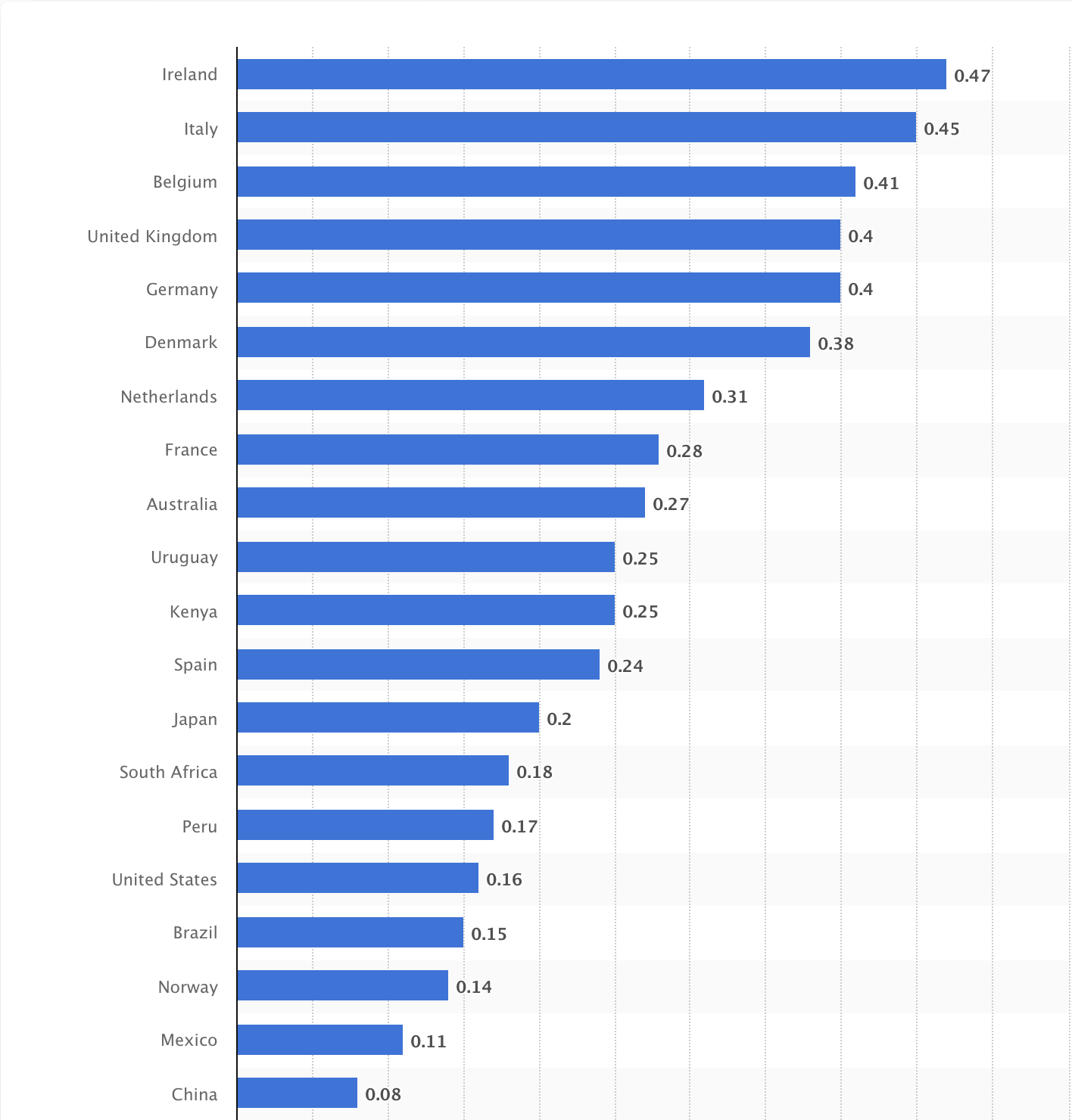
At any rate, it is not hard to understand why the people of Germany are unhappy given the economic situation there.  The economy hasn’t grown in more than two years, basically stagnating, while inflation continues to run above 2%.  Meanwhile, energy prices have risen sharply as a consequence of their Energiewende policy; the nation’s attempt to achieve net zero CO2 emissions.  However, not only did they shutter their nuclear generating fleet, the most stable source of CO2 free electricity, they decided that wind and solar were the way forward.  Given that there are, on average, between 1600 and 1700 hours of sunshine annually (4.3 to 4.5 hours per day), that seemed like a bad bet.  The results cannot be surprising as Germany energy costs are amongst the highest in the world.  The below chart shows electricity prices around the world.

Source: statista.com

If you want a good reason as to why incumbent governments around the world are falling, you don’t have to look much further than this.  Meanwhile, this morning brought the German ZEW Economic Sentiment Index which printed at 7.4, well below both last month and expectations.  As well, the Current Conditions Index fell to -91.4, which while not the lowest ever, certainly indicates concern given -100 is the end of the scale.  

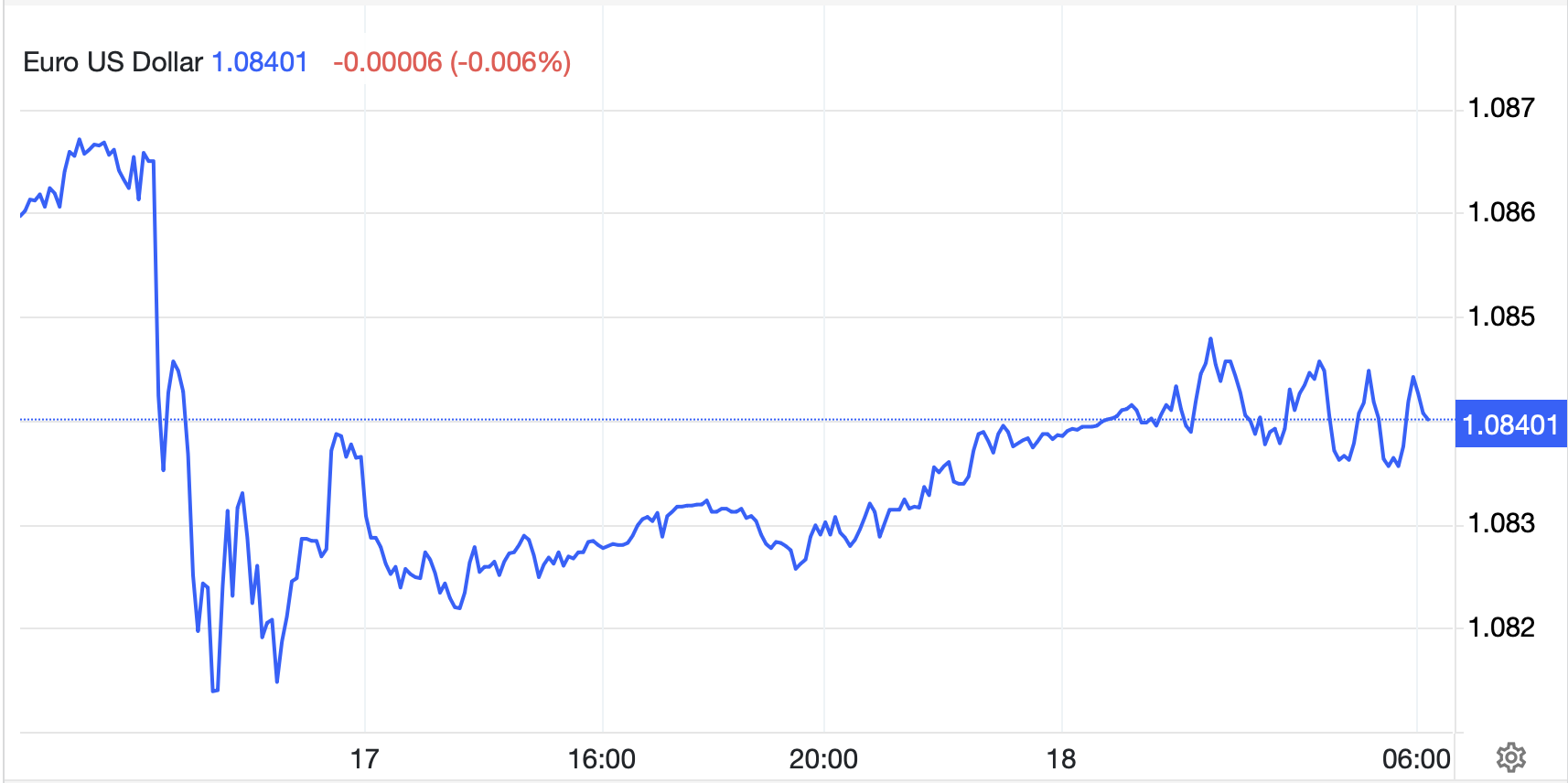
I’m sure you won’t be surprised to note that the euro (-0.4%) has fallen further this morning amid a broad-based dollar rally, that German stocks (DAX -0.8%) are falling and German bund yields (-2bps) are also falling as it becomes ever clearer that the ECB is going to need to cut rates more aggressively than previously anticipated.  Perhaps the story of Bayer Chemical today, where their earnings fell 26% and the stock has fallen 11% to a level not seen since 2009, is a marker.  Just like Volkswagen, they are set to cut costs (i.e., fire people) further.  Germany is having a rough go, and if they continue to perform like this, Europe will have a hard time going forward.

So, while the media in the US continues to focus on President-elect Trump and his activities as he fills out his cabinet posts and other government roles, elsewhere around the world, governments are trying to figure out how to respond to the changes coming here.

In that vein, the COP 29 Climate Conference is currently ongoing in Baku, Azerbaijan (a major oil drilling city) but finding much less press than previous versions.  As well, the attendee list has shrunk, especially from governments around the world.  This appears to be another consequence of the shift in voting preferences.  In fact, I expect that over the next four years, the number of discussions on climate will decline substantially.  

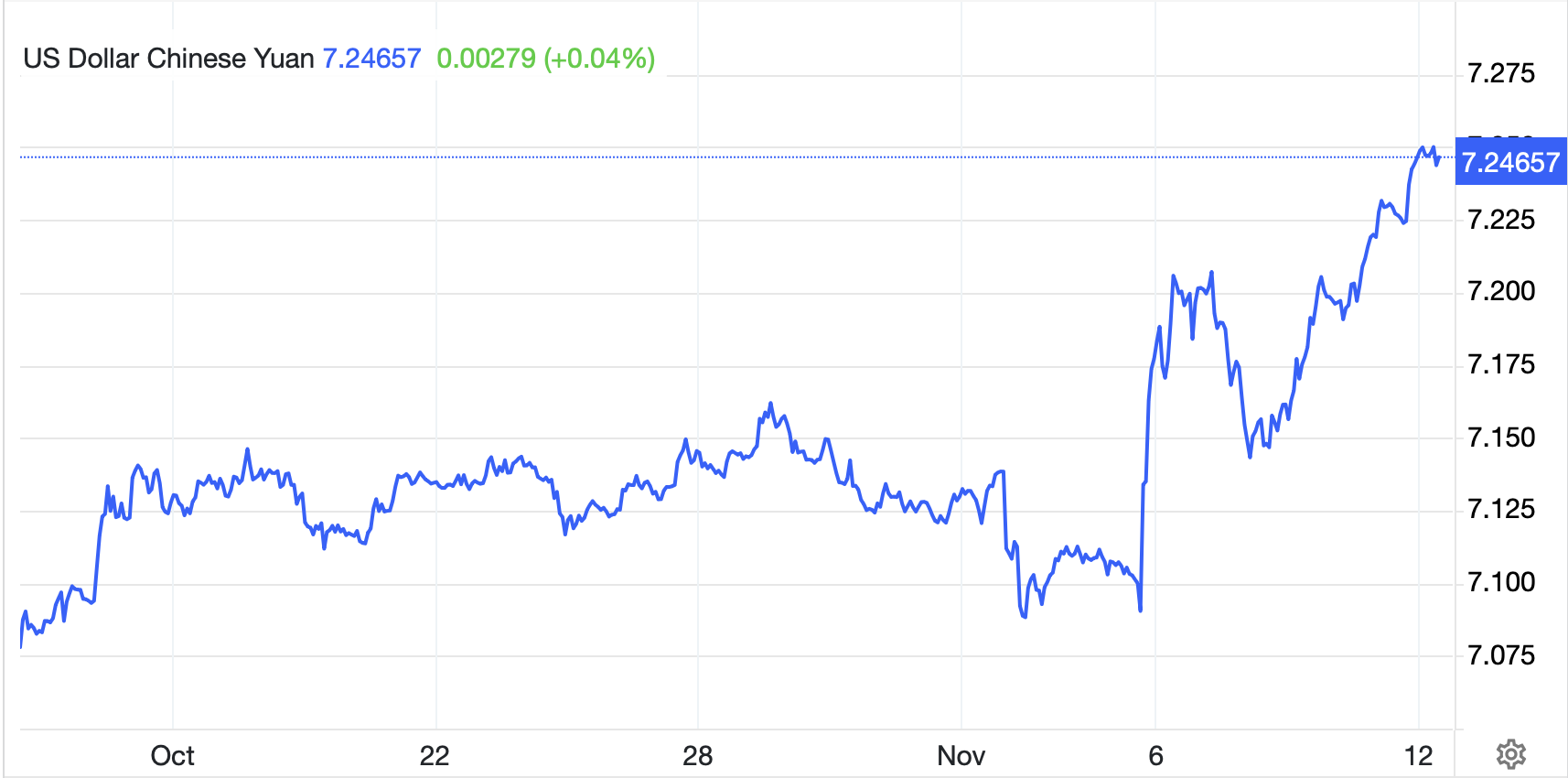
Perhaps the best place to observe how things are changing is China, as they now find themselves in the crosshairs of Trump’s policy changes and they know it.  The question is how they will respond with their own policies.  Recall, last week there were great hopes that we would finally see that big bazooka of fiscal stimulus and it was never fired.  Recent surveys of analysts, while continuing to hope for that elusive stimulus, now see a greater chance of Xi allowing the CNY to decline more rapidly to offset the impacts of tariffs.  This is something that I have expressed for a long time, that the CNY will be the relief valve for the Chinese economy as it comes under pressure.  Certainly, the market seems to be on board with this thesis as evidenced by the CNY’s movement since the election.  I expect there is further to run here.

Source: tradingeconomics.com

Ok, between Germany and China, those were the big stories away from the Trump cabinet watch.  Let’s see how markets behaved overnight in the wake of yet another set of record high closings in the US yesterday.  Despite the yen’s weakness, the Nikkei (-0.4%) was under pressure, although nothing like the pressure seen in China (Hang Seng -2.8%, CSI 300 -1.1%) or even elsewhere in Asia (Korea -1.9%, India -1.0%, Taiwan -2.3%) with pretty much the entire region in the red.  Of course, the same is true in Europe with all the major bourses under pressure (CAC -1.3%, FTSE 100 -1.0%) alongside the DAX’s decline.  As to US futures, at this hour (7:15) they are essentially unchanged as we await a series of five more Fed speeches.

In the bond market, Treasury yields (+6bps) are rising as it appears the 4.30% level is acting as a trading floor now that we have seen moves above it.  However, as mentioned above, the weaker economic prospects in Europe have seen yields across the continent soften between -1bp and -2bps.  Futures markets are now pricing more rate cuts by the ECB over the next year than the Fed although both are pricing about the same probability of a cut in December.  I think the direction of travel is less Fed cutting and more ECB cutting and that will not help the euro.

In the commodity markets, the rout in the metals markets continues with both precious (Au -0.8%, Ag -1.0%) and industrial (Cu -2.0%, Al -0.8%) finding no love.  In fairness, these had all seen very substantial rallies since the beginning of the year, so much of this is profit-taking, although there are those who believe that Trump will be able to arrest the constant rise in US debt issuance.  I’m not so sure about that.  As to oil (+0.6%) it has found a temporary bottom for now, but I do expect that it will continue to see pressure lower.

Finally, the dollar is king today, higher against every one of its counterparts in both the G10 and EMG blocs.  In the G10, the movement is almost uniform with most currencies declining between -0.4% and -0.5% although CHF (-0.1%) is trying to hang on.  In the EMG bloc, there are some larger declines (ZAR -0.8%, CZK -0.9%, HUF -0.9%) while LATAM currencies are lower by -0.5% and we saw similar movements in Asia overnight, -0.5% declines or so.  Again, it is difficult to make a case, at least in the near term, for the dollar to decline very far.  Keep that in mind when considering your hedges.

On the data front, the NFIB Small Business Optimism Index was released earlier at a better than expected 93.7, roughly the same as the July reading and potentially heading back toward the 2022 levels obtained during the recovery from the covid shutdowns.  I expect the election results had some part in this move.  Otherwise, its Fed speakers and we wait for tomorrow’s CPI.  All signs continue to point to a positive view in the US and a stronger dollar going forward.  Parity in the euro is on the cards before long.

Good luck

Adf

She Just Doesn’t Know

Though there was no change
Ueda-san hinted that
The future is known


Last night, the BOJ left policy unchanged, as universally expected, but indicated that “Our basic stance is that if our economic and price outlooks are realized, we’ll respond by raising rates.”  That seems pretty clear, and the market responded accordingly with the yen rallying nearly 1% in the immediate aftermath of the comments, although it has since retraced a bit and is now higher by just 0.5% on the session.  As well, he explained, “We’ve been looking at the downside risks to the US and overseas economies, but that fog is clearing somewhat. Needless to say, new risks could emerge depending on the policies coming from the new US president.”  The upshot is that market expectations are now for the next rate hike to take place at the January meeting (69% probability), although December cannot be ruled out.

Japanese equity markets fell modestly during the session (Nikkei -0.5%), but that could also have been more related to the US equity performance, where all three major indices fell yesterday (something that I thought had been made illegal 🤣).  As to JGB’s, they rallied slightly with the 10-year yield slipping 2bps on the session.

In the current market zeitgeist, I don’t believe the happenings in Japan are that crucial.  As Ueda-san said, US politics remains a key focus for every financial market around the world, as well as every economy, given the potential for a Trump victory and some very real changes to the current global trade and economic framework.  However, that doesn’t mean other things of note have stopped occurring.

The message from Madame Lagarde
Is further rate cuts aren’t barred
She just doesn’t know
How fast she should go
Though colleagues, more cuts, have pushed hard

The other story this morning, in the wake of some Eurozone data showing inflation ticked higher in October (headline 2.0%, core 2.7%), is the commentary from several ECB members.  Notably, Madame Lagarde explained “The objective is in sight, but I am not going to tell you that inflation is under control.  We also know that inflation will rise in the coming months, simply because of base effects.”  The punditry sees this as a middle ground between the more hawkish ECB members, like Nagel and Schnabel, who are calling for a “gradual approach” and that the ECB “mustn’t rush further steps,” and the doves, led by Panetta, who are concerned, “Monetary conditions are still tight and new cuts will be necessary.”  

The ECB is finding itself in a difficult position as they refuse to accept the idea that a recession is coming despite the lackluster economic data and the ongoing anecdotal evidence of trouble as evidenced by VW’s closing of factories and seeking wage cuts.  Meanwhile, they understand that inflation, at least optically, is due to rebound somewhat, and cutting rates while that is occurring may be more difficult to explain.

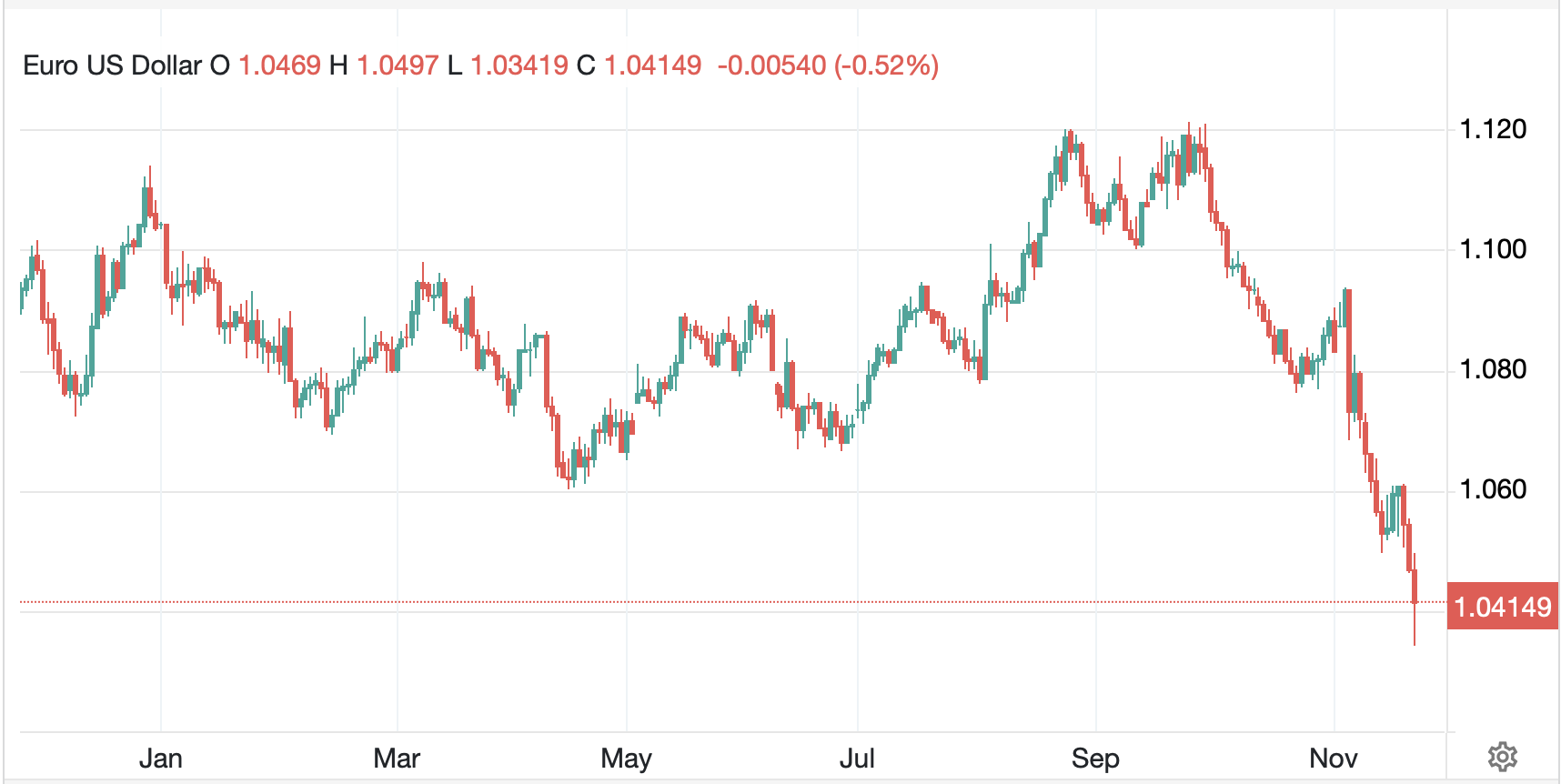
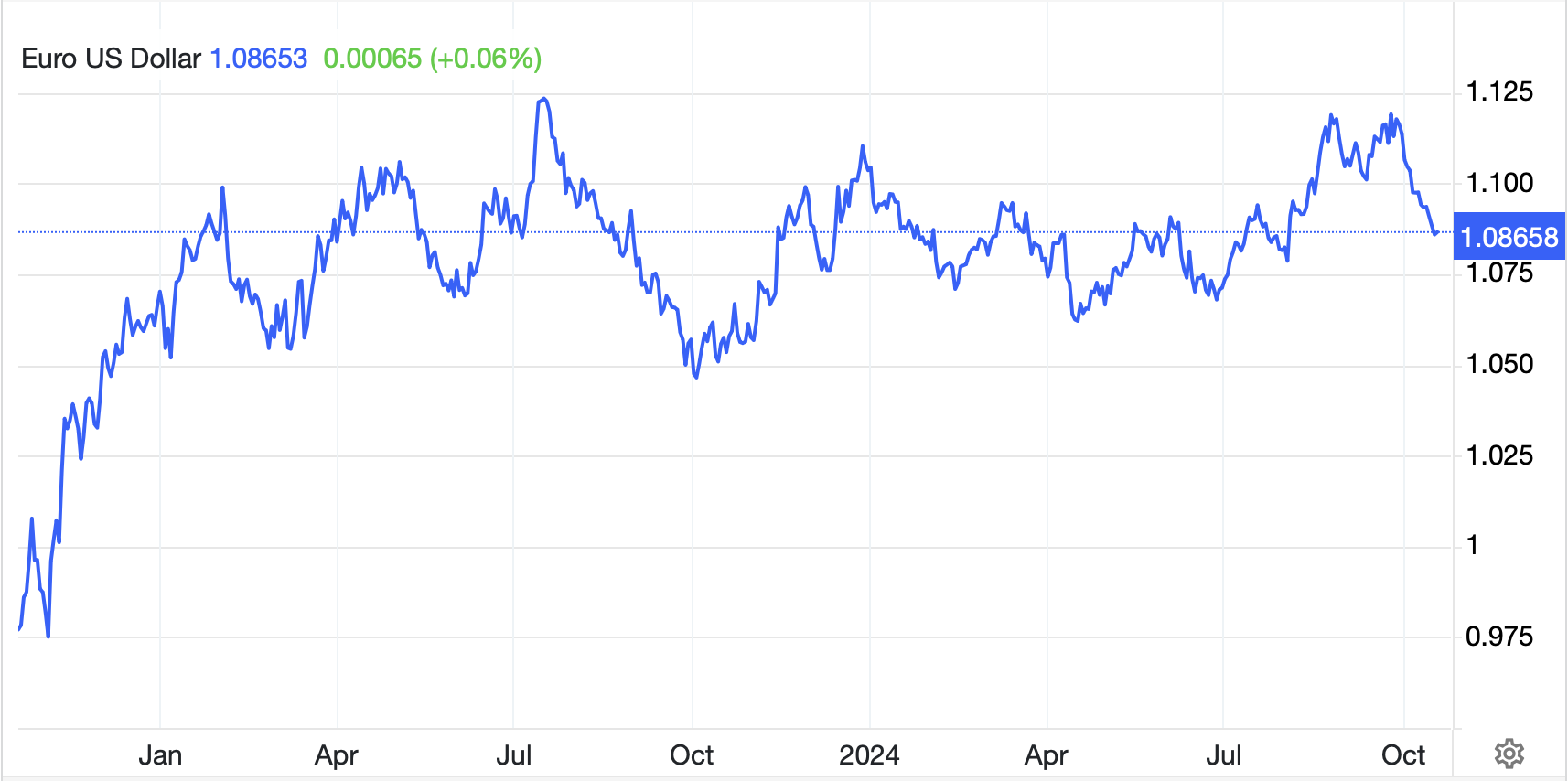
Ultimately, as we have seen repeatedly across all markets and nations, the biggest driver of almost everything is the combination of US economic activity and monetary policy.  However, that is not to say that other nations or blocs cannot demonstrate some independence for their own idiosyncratic reasons.  Regarding the euro, I find it interesting that I have seen more comments this morning about how the currency has found a bottom and is set to rebound.  However, I cannot help but look at the bigger picture (see chart below) and think nothing at all has changed.

Source: tradingeconomics.com

I continue to believe that in order for there to be any changes of substance, we will need to see the US policy change substantially.  That could take the form of an acknowledgement by the Fed that the economy remains strong and further cuts are not necessary (see yesterday’s ADP Employment number of 233K, twice expectations) or a decision by Chairman Jay that there are enough structural issues in the banking and financial system that further rate cuts are necessary despite what appears to be solid growth and still-high inflation.  If the former were to occur, I would look for the dollar to take another strong step higher and the euro to test parity along with other currencies declining commensurately.  If the opposite were to occur, the dollar would weaken substantially in my view, with the euro rising toward 1.15 or so.  However, I don’t see either of those scenarios playing out, so I believe the reality is we remain in the range we have traded in for the past two years as seen above.

And those were really the only stories to discuss away from the US election cacophony.  So, let’s see how markets behaved broadly overnight.  As mentioned above, US equities had a down day after some disappointing earnings results added to some overly long positioning.  Beyond Japanese shares, the rest of Asia was broadly negative as well, with Korea (-1.5%) and India (-0.7%) leading the way lower, but almost every market in the red.  We are seeing similar price action in Europe this morning as it appears Lagarde’s comments did not soothe any frazzled nerves, and the data was unhelpful as well.  As such, the CAC (-0.85%) is the lagging performer although the DAX (-0.5%) and FTSE 100 (-0.8%) are also under pressure.  Now, regarding the FTSE 100, that is also a product of the UK budget announcement yesterday which has been widely panned by most analysts.  It appears they have actually managed to create a situation where they increase spending and taxes but reduce growth substantially.  The upshot here is that there seems to be a little buyers’ remorse with the July election results.  Meanwhile, US futures are all pointing lower as well this morning, at least -0.5%.

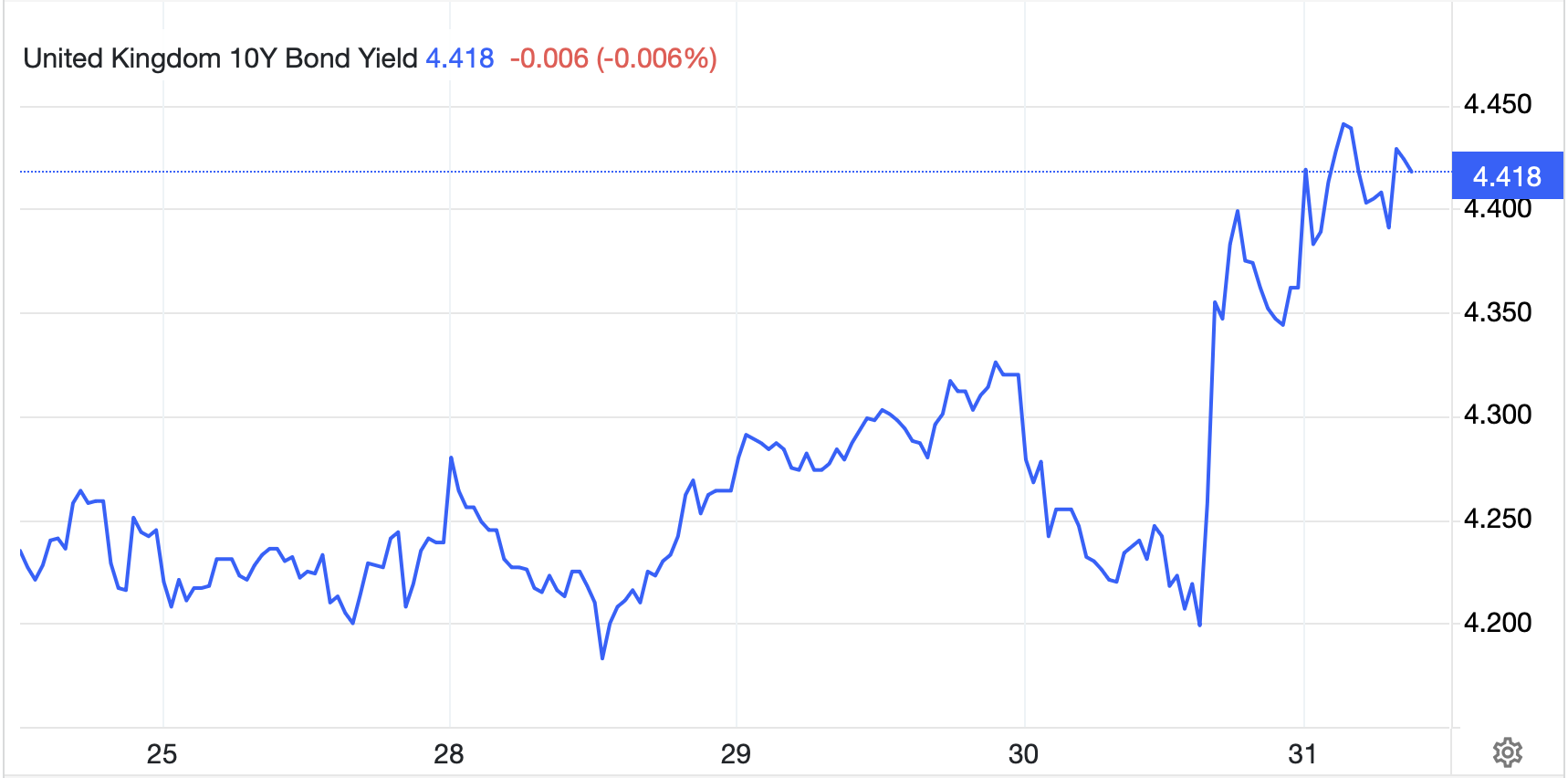
In the bond market, yesterday saw Treasury yields rebound to their recent highs at 4.30% but this morning they have slipped back lower by -2bps.  European sovereigns, however, are higher by those same 2bps as the market responds to the combination of yesterday’s Treasury movement and the higher than forecast Eurozone inflation report.  The outlier here is the UK, which after the budget has seen yields rise dramatically, a sign that markets are distinctly unimpressed with the proposals.  This is a case where a picture is truly worth 1000 words.

Source: tradingeconomics.com

I’ll let you determine when the budget was released, but one must be impressed with the more than 20bp response!

In the commodity space, oil (+0.5%) is continuing its rebound from its worst levels at the end of last week after EIA inventory saw surprising draws rather than modest builds.  As well, Chinese PMI data overnight was slightly better than expected and there are those now calling for a more robust Chinese economic rebound and increase in demand.  As to the metals markets, though, weakness is the order of the day with both precious and industrial metals slightly softer, although remember, these have rallied sharply over the course of the past month, so some trading movement lower is no surprise.

Finally, the dollar is mixed to slightly higher with only the MXN (+0.3%) showing any gains of note beyond the yen’s moves while there is more breadth in the decliners (NOK (-0.3%, ZAR -0.2%, AUD -0.2%) with almost no movement in Asian currencies overnight.

On the data front, this morning brings the weekly Initial (exp 230K) and Continuing (1890K) Claims data as well as Personal Income (0.3%), Personal Spending (0.4%) and PCE (0.2%/2.1%) and core PCE (0.3%/2.6%).  Already we are hearing that the impact of the recent hurricanes is likely to confuse the employment data, which makes sense, but I think much more attention will be paid to the Income/Spending data.  Certainly, Retail Sales have held up well, and if Personal Income continues to do well, it will call into question the need for that many more rate cuts by the Fed.  As of this morning, the futures market is pricing in a 94% probability of a cut next week and a 70% probability of another one in December.  Perhaps more interestingly, and where things could really change, is the fact the market is pricing in a total of 135bps of cuts by the end of next year.  We will need to keep an eye on how that changes for clues to the dollar’s future.

For now, the dollar appears on its back foot, but absent some much weaker than forecast data, it is hard for me to see a sharp decline.  Rather, I continue to see more reason for the dollar to maintain its broad strength going forward.

Good luck

Adf

Panic Attack

The FX Poet will be in Nashville at the AFP Conference October 21-22, speaking about effective ways to use FX options in a hedging program.  Please come to the presentation on Monday at 1:45 in Grand Ballroom C1 if you are there.  I would love to meet and speak.
 
Said Madame Lagarde, we’re “on track”
To make sure inflation gets back
Below two percent
So, we can prevent
A government panic attack
 
The subsequent news from the East
Is Chinese growth, once more, decreased
Their five-percent goal
Ain’t on cruise control
So, Xi needs more skids to be greased


See if you can find the conundrum in the ECB statement issued yesterday after they cut interest rates 25bps, as expected, taking the Deposit Rate down to 3.25%,. [emphasis added]

“The incoming information on inflation shows that the disinflationary process is well on track. The inflation outlook is also affected by recent downside surprises in indicators of economic activity. Meanwhile, financing conditions remain restrictive.

Inflation is expected to rise in the coming months, before declining to target in the course of next year. Domestic inflation remains high, as wages are still rising at an elevated pace. At the same time, labour cost pressures are set to continue easing gradually, with profits partially buffering their impact on inflation.”

While I realize that I am just an FX guy, and that my education at MIT was far more focused on numbers than words, I cannot help but read the highlighted phrases and be confused how the conclusion of high domestic inflation and expectations for it to rise means the disinflationary process is “well on track.”  Of course, it is important to remember that Madame Lagarde is a politician, not an economist nor banker nor any other background familiar with numbers, so perhaps she is the one that doesn’t understand.  Either that or as with every politician she is simply lying.

Regardless, as you can see in the chart below, the market response in the wake of the announcement was to sell the euro as interest rate traders priced in a December rate cut as well.

Source: tradingeconomics.com

The juxtaposition of US and Eurozone data remains the key here and as yesterday’s US numbers showed, the long-awaited recession continues to be postponed.  It becomes ever more difficult to see how the Fed will justify easing policy in any substantive manner if every economic print beats expectations.  (To clarify, Retail Sales printed at 0.4%, 0.5% ex-autos vs. expectations of 0.3% and 0.1% respectively. Philly Fed printed at 10.3 vs. expectations of 3.0 and Initial Claims fell to 241K despite the hurricanes, vs expectations of 260K). 

In the end, all this simply reinforces my view that the euro has further to decline going forward.  I still like the 1.05 – 1.06 level as a target by year end.

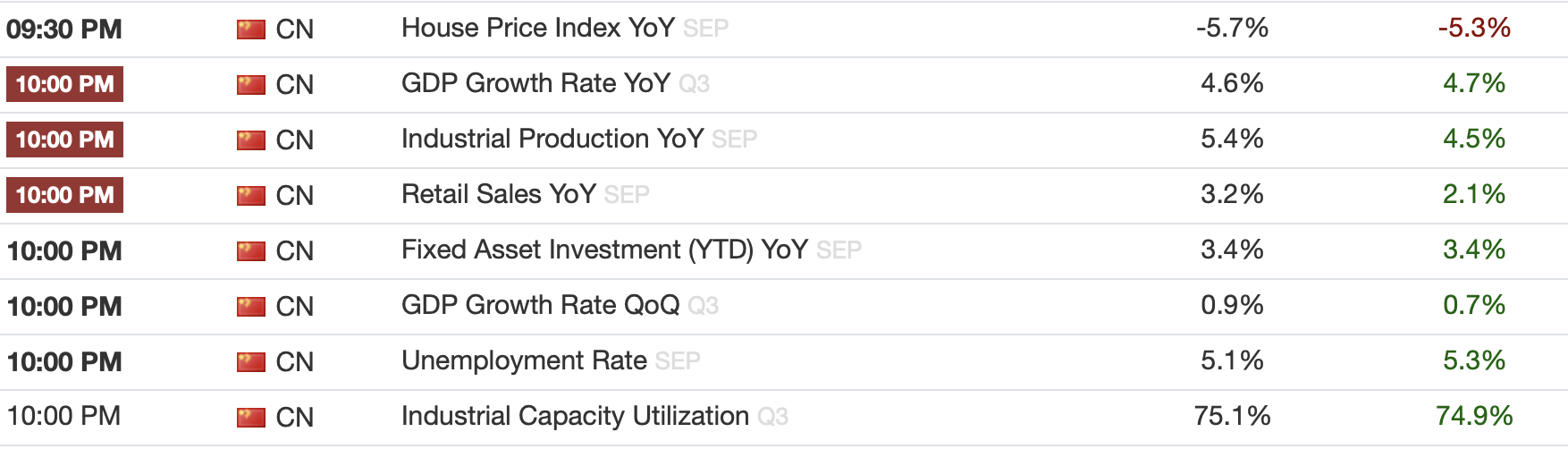
Turning to China, last night they had their monthly data dump and the numbers there continue to point to an economy struggling to gain momentum. (The first, black, number is the September data, the second, green or red, number is the August data.)

Source: tradingeconomics.com

Xi’s 5% target, or even if you use their recent “around 5%’ concept, is getting strained.  While Retail Sales there was a positive, the ongoing disintegration of the housing/property market is a major problem.  Now, all this data represents activity before the plethora of stimulus measures that have been announced.  However, recent equity market performance there, if using as an indicator of the belief that the stimulus was going to be effective, had shown a substantial decline from the early sugar highs back in September immediately following the first stimulus announcements.

With that in mind, PBOC Governor Pan Gongsheng strongly hinted that there would be another interest rate cut next week, as the government struggles to not only convince investors that they have things under control, but to also implement the measures already described.  Now, last night, after Pan hinted at the rate cuts, along with other comments regarding the funds allocated to help companies buy back shares, Chinese equity markets rose sharply in the afternoon session, as per the below chart, rising 3.6% on the day.

Source: Bloomberg.com

Once again, I will highlight the irony of the Chinese Communist Party focusing on the epitome of capitalism, the equity market, as a key means of economic improvement and a key signal that they are on the right track.

That was really all the big news since I last wrote.  Let’s look at the overall market activity.  After yesterday’ lackluster US session, Japanese shares (+0.2%) managed to edge a bit higher and Hong Kong (+3.6%) mirrored Chinese mainland shares.  The other beneficiary of the Chinese stimulus discussion was Taiwan (+1.9%) but Australia (-0.9%), Korea (-0.6%) and a host of other regional exchanges did not seem to appreciate the effort.  In Europe, only the UK (-0.3%) is really under any pressure although the gains on the continent are not terribly impressive with the CAC (+0.5%) the leader at this point.  Most other markets there are little changed to slightly higher.  As to US futures, at this hour (7:20), they are higher by about 0.25%.

In the bond market, after yesterday’s much stronger than expected US data, Treasury yields jumped 7bps and this morning have edged higher by another 1bp to get back to 4.10%.  However, on the continent, sovereign yields this morning are lower by between -2bps and -4bps after yesterday’s ECB action and comments.  The one exception here is the UK, where gilt yields are higher by 2bps after UK Retail Sales data printed much stronger than expected at +0.3% in September, vs. -0.3% expected.

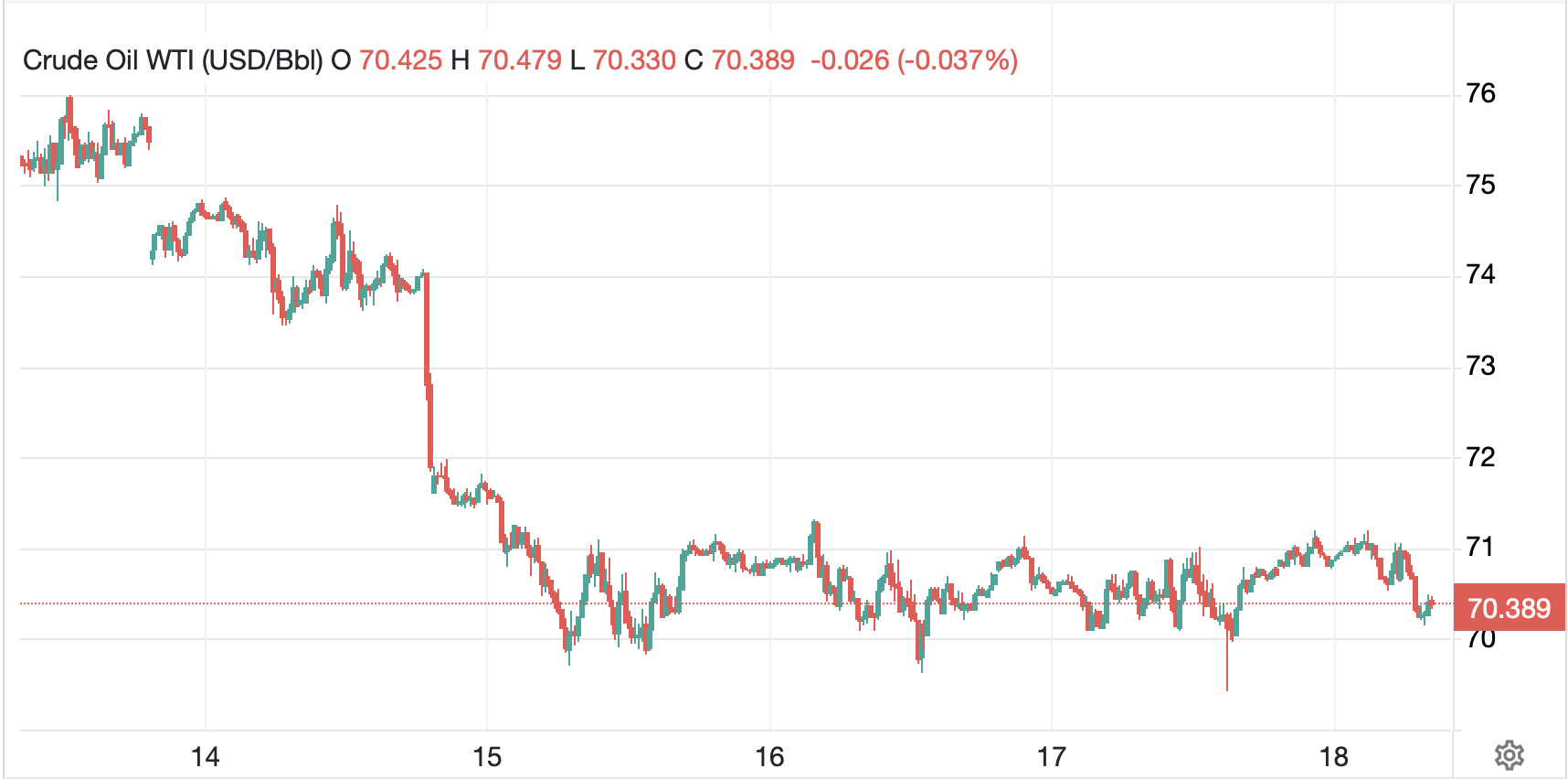
In the commodity markets, oil (-0.4%) is modestly lower this morning but really going nowhere for now as evidenced by the chart below.  Once the word had come that Israel was not going to target Iranian oil infrastructure and the price fell, it has basically been flat.

Source: tradingeconomics.com

As to the metals complex, gold (+0.6%) continues its ongoing rally and is at yet another new all-time high, above $2700/oz this morning, as demand continues to be present from all segments.  However, this morning, all the metals are rallying with silver (+1.0%) and copper (+1.5%) showing even better performance.  The combination of continued solid data from the US and hopes for a return to Chinese demand seem to be the drivers.

Finally, the dollar is closing the week on a down note, as traders reduce positions and take profits ahead of the weekend.  During the week, the dollar rose against virtually every one of its main counterparts in both the G10 and EMG blocs.  Again, the big picture here is that for the dollar, good US economic data is going to continue to benefit the greenback, and we will need to see not just one bad number, but a series of them before the dollar truly suffers.

On the data front, we see Housing Starts (exp 1.35M) and Building Permits (1.46M) at 8:30 this morning and then we hear from three more Fed speakers (Bostic, Kashkari and Waller) with Bostic making two appearances.  At this stage, despite the strong data, the Fed funds futures market is pricing in a 92% probability of a 25bp cut next month and then a 75% probability of another one in December.  I know that Powell seems desperate to cut rates, but if the data continues to show strength, the case to do so is going to be much harder to make.  That doesn’t mean he won’t do it, but if he continues down that path, it just means that inflation will return that much sooner.  

Good luck and good weekend and reach out if you are in Nashville at the AFP!

Adf

Turn Into Snails

The FX Poet will be in Nashville at the AFP Conference October 21-22, speaking about effective ways to use FX options in a hedging program.  Please come to the presentation on Monday at 1:45 in Grand Ballroom C1 if you are there.  I would love to meet and speak.
 
This morning the ECB’s meeting
And no doubt they will be repeating
The idea inflation
Is near its cessation
So, high rates will now be retreating
 
As well, we will learn the details
Of what’s occurred in Retail Sales
If strength’s what we see
The FOMC
Rate cutters may turn into snails


Yesterday was generally very quiet as investors appear to be turning their focus to the US presidential election and trying to determine the outcome and what it will mean for markets going forward.  (FWIW, this poet is not going to attempt to determine how things will play out at this stage given the fact that whatever claims or promises are made by either candidate, at least economically, they can only be accomplished through Congress, so are really just wishes right now).  The upshot is that the volume of activity is likely to remain modest until the election.  Of course, that doesn’t mean prices won’t move, just that there won’t be much conviction behind the moves.

In the meantime, central banks remain at the forefront of every market conversation and today is no different with Madame Lagarde set to regale us with the news of an ECB rate cut of 25bps later this morning.  Inflation data from the Eurozone this morning was revised down further with the headline falling to 1.7% Y/Y in September, the lowest print since April 2021.  However, the core rate, at 2.7%, remains well above their target.  Now, the ECB mandate targets headline inflation specifically, unlike the Fed which has determined by itself that core PCE is the proper metric, so a rate cut can easily be justified.  Adding to the story is the fact that Germany remains mired in recession and economic activity in the Eurozone overall remains desultory at best.  The problem the ECB has is that services inflation remains sticky, still printing near 4% and money supply is growing again which is a strong indicator that inflation is going to rise in the future.  But as we have learned over the past decades, the future is now when it comes to central banks, and they will respond to the moment.

One of the problems for the ECB, though, is that despite the Fed’s mistaken 50bp rate cut, the data in the US we have seen since indicates that the economy continues to motor along fairly well.  This means that although the Fed seems likely to cut 25bps in November, I think it will be doing so reluctantly.  After all, if they didn’t cut, it would basically be an admission that they made a mistake with the 50bp cut in September, and you know as well as I that they will never admit a mistake.  

My point is that with the ECB feeling greater pressure to cut with their inflation reading below target and growth slowing, and the Fed likely to back away from an aggressive rate cutting path, the euro is likely to continue to suffer.  For instance, this morning, though it is unchanged, it sits below the 1.09 level (last seen in August) and certainly appears as though it is in a strong downtrend as per the below chart.  If I were to guess, I think a move toward 1.06 is in the cards as a measured move around that long-term 1.09 pivot level.

Source: tradingeconomics.com

The problem for the ECB is that a weakening currency is likely to add upward inflation pressures before it helps the exporters in Europe expand market share, and boosts growth.  Stagflation is such an ugly word, but one that may well come to describe the Eurozone.  As an aside, when the US was in stagflation in the late 1970’s, that is when the dollar was at its weakest point historically.

Of course, this also makes this morning’s Retail Sales (exp 0.3%, 0.1% ex autos) so important.  You may recall that last month, this number beat expectations and was another in the list of surprisingly strong US data releases.  Another strong print will really cement the difference between the US and the Eurozone, to the dollar’s advantage I believe.  

But will any of this really matter to markets?  Certainly, Lagarde’s comments can have an impact on Eurozone markets, but my take is we will not see major investment swings, regardless of the data, ahead of the election.

Ok, let’s see how things played out overnight.  Despite the rebound in the US yesterday, Asia was having none of it with most markets in the red.  Japan (-0.7%) fell despite the US strength and the yen’s weakness (JPY pushing back to 150 for the first time since August) and China continues to see the recent bubble of stimulus expectations deflate (CSI 300 -1.1%, Hang Seng -1.0%).  Elsewhere in the region, the results were mixed with some gainers (Australia, New Zealand, Singapore) and some laggards (India, Korea, Philippines).  In Europe, though, green is today’s theme with gains across the board, led by the CAC (+1.2%) but strength everywhere as investors are betting on a more dovish ECB.  In the US futures market, we are all green as well, with strong gains (+0.5% or more) at this hour (7:30).

In the bond markets, after dipping back to the 4.0% level yesterday, 10-year Treasuries are 2bps higher this morning and we are seeing similar price action across all the European sovereign markets.  This seems like a classic risk-on move.  In Japan, JGB yields edged higher by 1bp and are now at 0.95%, perhaps as the market anticipates the BOJ is set to get more aggressive with the yen steadily falling for the past several months.  I don’t believe 150 is a line in the sand, but it cannot be making Ueda-san feel any better about things.

Turning to commodities, the one truism is that gold (+0.5%) continues to rally.  The number of different storylines (central bank buying, reduced mining activity, western investors waking up, Asian investors accelerating) about the shiny metal continues to increase and every one of them is bullish.  This continues to help Silver, although copper (-0.6%) remains far more reliant on a positive economic story, something that remains in doubt.  As to oil (+0.25%) it is holding that $70/bbl level although its grip does seem tenuous at times.  However, I would contend there is virtually no war premium in the price at this point.

Finally, the dollar has net softened a bit this morning, but that is in the context of a more than 3-week long steady rally.  So, AUD (+0.5%) is the big winner this morning in the G10 and as I am typing, GBP (+0.2%) has recaptured the 1.30 level, but those trends remain lower.  In the EMG markets, KRW (-0.55%) is today’s laggard although we are seeing weakness in both ZAR (-0.3%) and MXN (-0.3%) despite that metals strength.  Remember, FX markets are perverse.

In addition to the Retail Sales data, we see Initial (exp 260K) and Continuing (1870K) Claims and Philly Fed (3.0) at 8:30 with IP (-0.2%) and Capacity Utilization (77.8%) at 9:15.  Also, because of the holiday Monday, we see EIA oil inventory data this morning as well with a slight draw expected.  Only one Fed speaker is on the docket (Goolsbee) who will undoubtedly explain that more cuts are coming.

While the dollar may be under modest pressure this morning, I see upward pressure overall for the time being until policies change.

Good luck

Adf

Nearly Obscene

The FX Poet will be in Nashville at the AFP Conference October 21-22, speaking about effective ways to use FX options in a hedging program.  Please come to the presentation on Monday at 1:45 in Grand Ballroom C1 if you are there.  I would love to meet and speak.
 
While here in the States we have seen
Inflation that’s nearly obscene
In Europe, inflation
In ‘bout every nation
Has fallen much more than foreseen
 
The narrative there has adjusted
As all of their models seem busted
So, cuts with more speed
We’ll soon see proceed
Though central banks still aren’t trusted

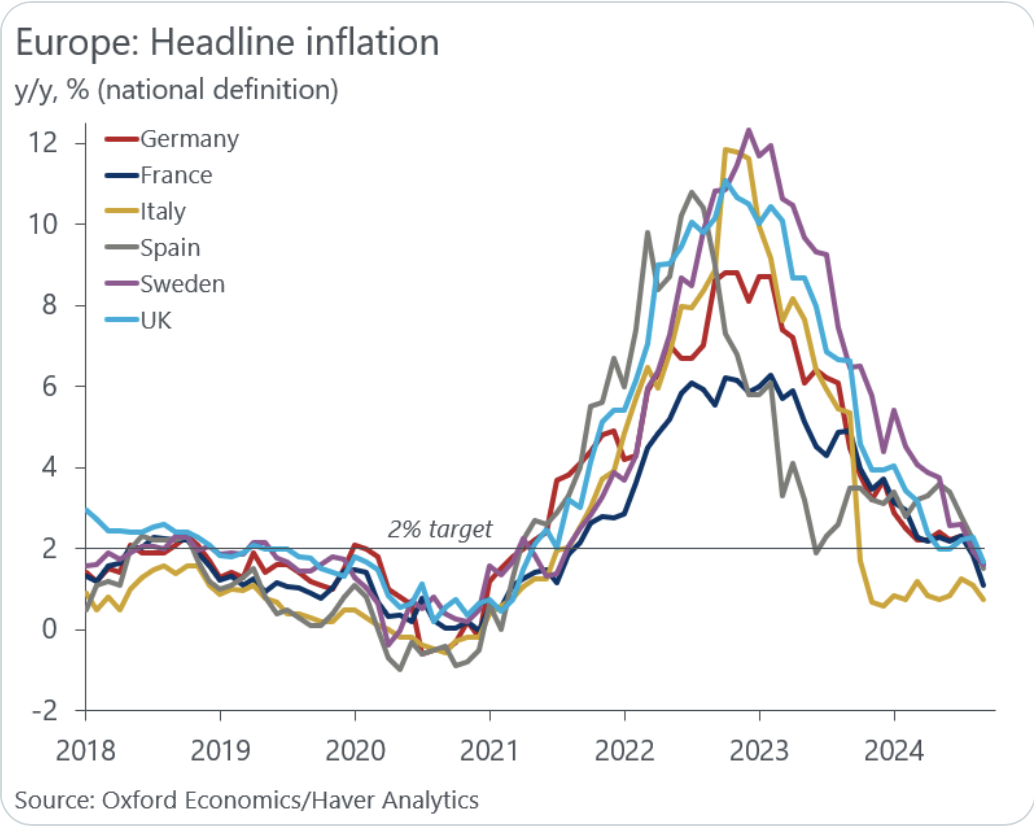
While Fed speakers are trying to claim victory over inflation, whether or not that is reality, the situation in Europe is a bit different.  In fact, headline inflation has fallen quite dramatically virtually across the board as evidenced by the below chart.

Now, a critical piece of this decline is the fact that energy prices have fallen dramatically in the past year with Brent Crude (-16.5%) and TTF NatGas (-18.9%) leading the way lower.  In fact, core inflation data, for the few nations that show it, remains above that 2% target with the UK (Core 3.2% Y/Y) the latest to report this morning.  One other thing to remember is that in the wake of the Covid pandemic, no nation printed and spent nearly as much money as the US on a relative basis, let alone an absolute basis, so there was less fiscal largesse elsewhere.

Yet, the fact remains that headline inflation throughout Europe and the UK has fallen below the 2% targets and so the narrative has now shifted to see more aggressive rate cuts by the central banks everywhere.  This will be part of the discussion tomorrow at the ECB, where most analysts are looking for a 25bp cut although some are calling for 50bps, and the market is pricing more than 40bps at this point.

You know what else is pricing a larger rate cut by the ECB?  The FX market.  Yesterday, the euro fell below the 1.09 level for the first time in more than two months (remember that chart of the double top formation from Monday?) and the single currency has fallen more than 2% in the past month.  Similarly, the pound, after today’s softer than expected CPI readings, has fallen -0.35% this morning, the worst performer in the G10, and is now lower by nearly -1.5% in the past month and looking like it has reversed the uptrend that existed through the summer and early autumn.

Ultimately, my point is that the narrative about rate cuts is shifting to a more accelerated mode in Europe and the UK (where talk of a 50bp cut is making the rounds as well) while here in the States, a 25bp cut is not fully priced in even after yesterdays’ much weaker than expected Empire State Manufacturing Index (-11.9 vs. exp 3.8 and last month’s +11.5).  If you want a reason to explain the dollar’s resilience, you could do worse than the fact that economies elsewhere in the world are lagging the performance here.

Speaking of the Fed, yesterday’s surprise Fedspeak came from Raphael Bostic, Atlanta Fed president, when he explained that he only foresees one more rate cut in 2024.  That is quite a different story than we have been hearing from the rest of the FOMC speakers, who seem completely on board with at least 50bps of cuts and seemingly could be persuaded to head toward 75bps.  There is still much to learn between now and the next FOMC meeting the day after the election here, but despite Bostic’s comments, I believe the minimum we will see before the end of the year will be 50bps.

Ok, that was really all the action overnight.  Yesterday’s disappointing US equity performance, with all three major indices lower by at least -0.75% (I thought that was outlawed 🤣) was followed by similarly weak performance in Asia with the Nikkei (-1.8%) leading the way lower as tech shares underperformed, but further weakness in China (-0.6%) as Godot seems more likely to arrive than the Chinese stimulus.  Throughout the region, only Thailand (+1.2%) managed any gains after the central bank there cut rates 25bps in a surprise move seeking to foster a better growth situation.  In Europe, only the UK (+0.6%) is rallying on the strength of the idea that lower inflation will encourage a 50bp cut from the BOE when they meet the day after the Fed. But otherwise, red is the color of the day in Europe with losses ranging from -0.1% (Spain) to -0.6% (France).  Meanwhile, US futures are a touch firmer at this hour (7:15), by just 0.2%.

In the bond market, yields are lower across the board after that weak Empire State number encouraged the slowing economy narrative and the lower inflation prints in Europe and the UK have weighed on yields there this morning.  So, Treasury yields (-2bps) are lagging most of Europe (Bunds -3bps, OATs -3bps) and UK Gilts (-8bps) are all about the data this morning.  Even JGB yields (-1bp) got into the act.

In the commodity space, oil (-0.5%) is continuing its recent decline, although yesterday it managed to bounce a bit and close above the $70/bbl level where it still sits, barely.  But the metals complex is having another good day with gold (+0.6%) pushing to new all-time highs as western investors are finally following Chinese and Indian investors as well as global central banks.  The lower interest rates certainly help here.  Similarly, we are seeing gains in the other metals (Ag +1.2%, Cu +1.1%) as stories regarding shortages for both metals in the long-term resurface given the lack of new mining activity and increased demand driven by the idea of increased solar and electricity needs respectively.

Finally, the dollar, overall, is little changed, holding onto its recent gains although with a mixed performance this morning.  ZAR (+0.5%) is this morning’s leader on the back of the metals market gains, and we have seen strength in KRW (+0.3%) as well.  However, elsewhere, movement is small and favoring the dollar (HUF -0.2%, CZK -0.2%) and we’ve already discussed the euro and pound.  Interestingly, the THB (+0.45%) rallied after the rate cut on the back of equity inflows.

There is no major data set to be released this morning and no Fed speakers on the current calendar, although as always, I suspect we will still hear from some of them.  Madame Lagarde speaks this afternoon, and given the ECB meeting tomorrow, there will be many interested listeners.

Overall, the themes seem to be that Eurozone inflation is sinking and rate cuts are coming.  That should keep some downward pressure on European currencies vs. the dollar, at least until we see or hear something that describes a more aggressively dovish Fed.  The one truly consistent feature of these markets has been the rally in gold which seems to benefit from fear, inflation and lower rates, all of which appear to be in our future.

Good luck

Adf

New Calculation

The markets in China retraced
One-fifth of their rally post-haste
Not everyone’s sure
The promise du jour
Is where traders’ trust can be placed
 
In Europe, attention’s now turned
To lesson’s the ECB’s learned
Their new calculation
Shows Europe’s inflation
No longer has members concerned


Let’s take a trip down memory lane.  Perhaps you can remember the time when the Chinese economy seemed to be faltering, and the Chinese stock markets were massively underperforming their peers.  That combination of events was enough to get President Xi to change his tune regarding stimulus and over the course of several days, first the PBOC and then the government announced a series of measures to support both the economy and the stock market specifically.  In fact, way back on September 24th I described the measures taken in this post.  Yep, that was two whole weeks ago!  The initial response was a rip-roaring rally in Chinese equity markets (~34%), and substantial strength in the renminbi.  Analysts couldn’t sing Xi’s praises loudly enough as they were certain that the government there was finally doing what was necessary to address the myriad issues within the Chinese economy.

But a funny thing happened on the way to this new nirvana, investors realized that all the hype was just that and the announced measures, while likely to help at the margins, were not going to change the big picture.  Ultimately, China remains in a difficult situation as its entire economic model of mercantilistic practices is running into populist uprisings everywhere else in the world.  And since domestic Chinese demand remains lackluster given the estimated $10 trillion that has evaporated in the local property markets, people at home are never going to be able to be a sufficiently large market for all the stuff that China makes.  

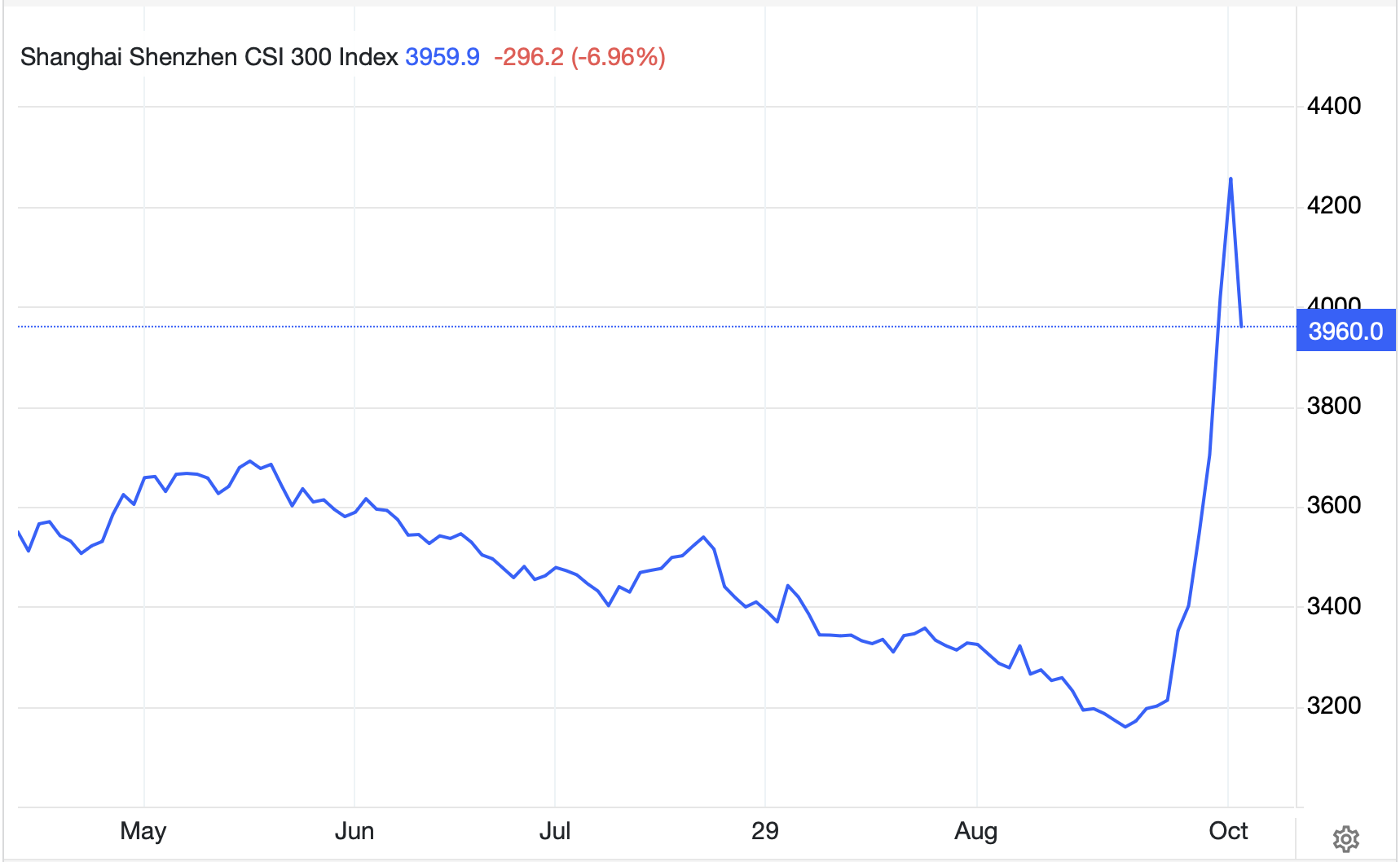
As this realization sets in, there is no better picture of this change of heart than the chart below showing the recent performance of the CSI 300.

Source: tradingeconomics.com

Last night’s 7% decline, which followed a similar one in Hong Kong the night before, has certainly stifled some of the ebullience that existed two weeks ago.  Now, the market has still gained a very healthy 25% from its lows last month, certainly nothing to sneeze at, but are the prospects really that great going forward?  Only time will tell, but I am not confident absent another significant bout of fiscal stimulus, something on the order of a helicopter money drop.  And that doesn’t seem like Xi’s cup of tea.

Turning to Europe, the economy there remains in the doldrums with some nations far worse off than others. Germany remains Europe’s basket case, as evidenced by this morning’s Trade Balance release there.  While the balance grew to €22.5B, that was because imports fell a larger than expected -3.4%, a signal that domestic activity is still lagging.  With the ECB set to meet next week, the market is currently pricing a 90% probability of a 25bp rate cut with talk of another cut coming at the following meeting as well.

You may remember that Madame Lagarde was insistent that there was no guaranty that the ECB would be cutting rates at every meeting once they started, rather that they would be data dependent.  But with the combination of slowing economic activity, especially in Germany, and the ensuing political angst it has created amongst the governments throughout Europe, it seems that many more ECB members have seen the inflation light and have declared a much higher degree of confidence that it will be at, or even below, their 2% target soon enough.  And maybe it will be.  However, similar to the Fed’s prognosticatory record, the ECB has a horrific track record of anticipating future economic variables.  A key problem for Europe is the suicidal energy policies they continue to promulgate.  Granted, some nations are figuring out that wind and solar are not the answer, but Germany is not one of them, at least not yet.  And as long as these policies remain in place and electricity prices continue to rise (they are already the highest in the world) then inflation pressures are going to continue.

Bringing this conversation around to more than macroeconomic questions, the market impact of recent data is becoming clearer.  While the US economy continues to show resilience, as evidenced by that blowout NFP report last Friday, and Europe continues to falter, the previous assumptions on rate movements with the Fed being the most aggressive rate cutter around are changing.  The result is the euro, which has slipped more than 2% in the past two weeks, is likely to continue to fall further, putting upward pressure on Eurozone inflation and putting the ECB in a bind.

Ok, those seem to be the drivers in markets today as we all look forward to tomorrow’s US CPI report.  A tour of the rest of the overnight session shows that Japan (+0.9%) continues to rebound from its worst levels a month ago as worries of aggressive monetary policy tightening continue to abate.  The latest view is the BOJ won’t move until January at the earliest.  The rest of Asia was mixed with the biggest gainer being New Zealand (+1.7%) which responded to the RBNZ cutting rates by 50bps, as expected, but explaining that further cuts were in line as they expected inflation to head below the middle of their 1% – 3% target range.  In Europe, the picture is mixed with more gainers than laggards but no movement of more than 0.3%, a signal that not much is happening.  US futures are similarly little changed at this hour (7:45) this morning.

In the bond market, Treasury yields have edged higher by 1bp and continue to trade above 4.00%, a level that had been seen as critical when the market moved below that point.  Given the overall lack of activity today, it should be no surprise that European sovereigns are also within 1bp of yesterday’s closing levels while JGB yields, following suit, rose a single basis point overnight.  It feels like the market is awaiting the CPI data tomorrow to make its next moves.

Oil prices were clobbered yesterday, falling nearly 6% at one point on the session before a modest late bounce.  This morning, they are slipping another -0.5% as market participants seem tired of waiting for a Middle East conflagration and instead have focused on the fact that more supply is coming on the market amidst softening demand.  Libya is back to full output of 1.2mm bpd and OPEC is still planning to increase production while China and Europe show softer growth.  That China story continues to undermine copper (-1.6%) although the precious metals, after downdrafts yesterday, are little changed this morning.

Finally, the dollar continues to find support on the strength of reduced Fed rate cut expectations alongside growing expectations for cuts elsewhere.  NZD (-1.0%) is today’s laggard though the rest of the G10 are all showing declines.  In the EMG bloc, the dollar is also higher universally, but the moves here are more modest.  In fact, away from NZD, the next largest declines have been seen in NOK (-0.6%) and SEK (-0.5%), but LATAM, APAC and EEMEA are all softer as well.

On the data front, this morning brings EIA oil inventories, with a net draw expected and then at 2:00 we see the FOMC Minutes from the last meeting.  But those are stale given the payroll report.  Instead, we hear from seven more Fed speakers today which will set the tone.  Yesterday’s speakers seemed to have been on the same page as Monday’s, with caution the watchword but rate cuts described as necessary despite the payroll report.  Whatever there mental model is, it is clearly pointing to rate cuts are necessary.

It feels like today is going to be quiet as markets await tomorrow’s CPI data.  The dollar seems likely to retain its bid, though, as the US is still the ‘cleanest shirt in the dirty laundry’ and global investors seem determined to own assets here.

Good luck

Adf

Powell’s Dream Team

The punditry’s dominant theme
Is whether Chair Powell’s dream team
Will cut twenty-five
And try to contrive
A reason a half’s a pipe dream
 
But there’s something getting no press
The balance sheet shrinking process
They’re still in QT
But what if QE
Is something they’ll now reassess?


With all the data of note now passed (PPI was largely in line although tending a bit higher than forecast) and the ECB having cut their deposit facility rate by 25bps, as widely expected, the market discussion is now on whether the Fed will cut by one-quarter or one-half percent next week.  The Fed funds futures market, which you may recall had been pricing as little as a 15% probability for that 50bp cut earlier this week, is currently a coin toss between the two outcomes.  In addition, the Fed whisperer, Nick Timiraos of the WSJ, had a front page article on the subject this morning, although he drew no conclusions.

But something that is getting virtually no airtime is the Fed’s balance sheet and its ongoing shrinkage.  You may recall that the current level of QT is $25 billion/month, which was reduced from the original amount of $60 billion/month back in June as the FOMC started to grow cautious regarding the appropriate amount of reserves and liquidity in the system.  

The issue is nobody knows what number constitutes the right amount of reserves.  Fed research is of the belief that somewhere between 10% and 12% of GDP (currently about $2.7 trillion to $3.3 trillion) should be sufficient to ensure that economic activity does not grind lower due to a lack of liquidity.  This has been the rationale behind the slow reduction in balance sheet assets.  But that research may not be accurate, and the underlying assumption was that the economy continued to grow at its trend rate.  In the event of a slowdown or recession, you can be sure that the Fed will add liquidity back as well as cut rates.

Now, working against my thesis is the Fed has not discussed this idea at all, at least publicly, and so a complete surprise is not their typical MO.  However, they have found themselves in a place where the market is pricing in more than 100 basis points of cuts over the next three meetings, including next week’s, which if they stick to their 25bp increments, means that one of these meetings needs a 50bp cut.  As I have written before, the bond market is pricing nearly 200bps of cuts in the next two years (see chart below), which would indicate that the likelihood of an economic slowdown is high.  

Source: tradingeconomics.com

At the same time, equity markets are trading near all-time highs with earnings estimates indicating that economic growth expectations remain quite robust.  Both of those scenarios cannot be true at the same time.

Source: LSEG

This is the landscape through which Chairman Powell must navigate the Fed’s policies as well as his communication of those policies.  In Jackson Hole, he virtually promised a rate cut was coming next week, and one is certainly on its way.  The magnitude of that cut, though, will offer the best clues as to the Fed’s thinking with respect to the future trajectory of the economy and which market, stocks or bonds, is right. 

There is one other thing to consider, though, as an investor. Given the bond market is pricing a significant slowdown, if that is your view, bonds will not offer much return if you are correct.  And if you are wrong, and growth is strong, it will be ugly.  Similarly, if you are of the view that there is no recession, but rather a soft- or no-landing is the likely outcome, then being long stocks, which have already priced for that outcome will likely have only a modest benefit.  However, in the event that the economy does fold and recession arrives, stocks are likely to sell-off sharply.  Arguably, the best positioning for a trader is to be short both stocks and bonds, as whichever outcome prevails, one asset will fall substantially while the other has limited upside, at least for a while.  For a hedger, this is the time that options make a lot of sense as the asymmetry they provide is what allows a hedger to prevent locking in the worst outcomes.

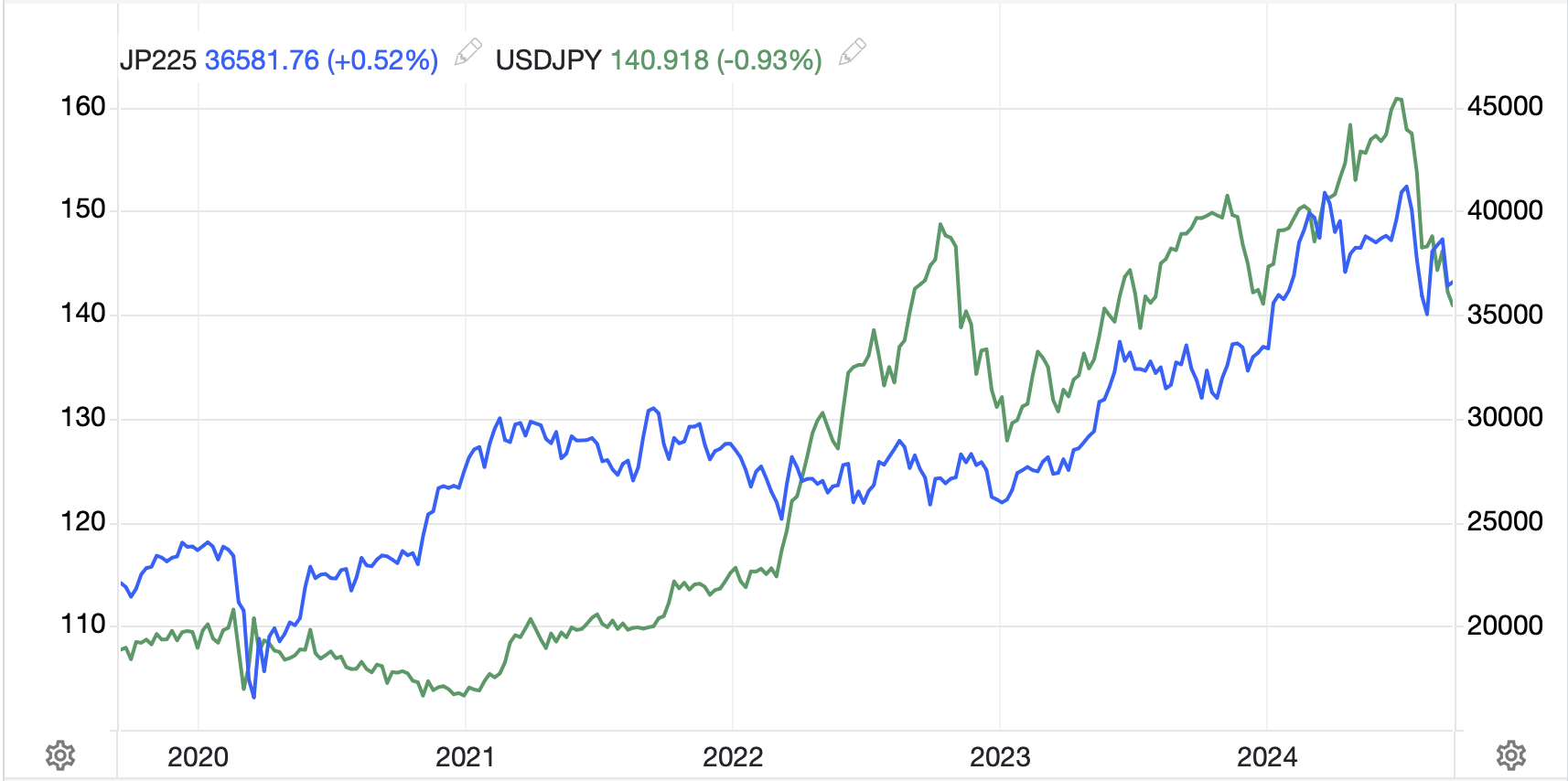
Ok, with that behind us, let’s look at the overnight session to see how things followed yesterday’s risk rally in the US.  In Asia, the Nikkei (-0.7%) has been struggling lately on the back of continued JPY strength.  As you can see from the below chart, that relationship has been pretty strong for a while, and last night, USDJPY traded to new lows for the year, erasing the entire gain (yen decline) that peaked at the end of June.

Source: tradingeconomics.com

As to the rest of Asia, mainland Chinese shares (CSI 300 -0.4%) continue to underperform although HK shares managed a rally (+0.75%) while most of the rest of the region showed very modest strength, certainly nothing like the US performance, but at least in the green.  In Europe, equity markets are all higher this morning with Spain’s IBEX (+0.8%) leading the way although solid gains of 0.3% – 0.5% prevalent elsewhere.  As to US futures, at this hour (7:45) they are creeping higher by about 0.1%.

In the bond market, Treasury yields are lower by 2bps this morning and European sovereign yields are generally little changed to lower by 2bps across the continent.  Yesterday’s ECB outcome was universally expected, and Madame Lagarde explained they remain data dependent and promised no timeline for potential further rate cuts, if they are even to come (they will).  As to JGB yields, they too fell 2bps last night, once again confusing those who are looking for policy tightening in Tokyo.

In the commodity markets, oil (+1.4%) is rallying for the third consecutive day as Hurricane Francine shut in about 40% of gulf production and the timing of its return is still uncertain.  Despite the US equity markets’ clear economic bullishness, the weak growth/demand story is still a major part of this discussion.  In the metals markets, gold (+0.3% overnight, +3.2% in the past week) continues to set new price records daily with a story making the rounds that SAMA, Saudi Arabia’s central bank, secretly bought 160 tons of gold last quarter, soaking up much supply.  This has helped drag silver back above $30/oz although copper (-0.5%) is stumbling a bit this morning.

Finally, it should be no surprise that the dollar is under some pressure this morning as the talk of more aggressive Fed easing grows.  While the euro and pound are little changed, JPY (+0.5%) is leading the way in the G10 with AUD (+0.45%), NZD (+0.4%), NOK (+0.2%) and SEK (+0.3%) all firmer on the back of commodity strength.  In the EMG bloc, the story is a bit more nuanced with ZAR (-0.15%) bucking the trend on domestic political concerns, although we saw strength in KRW (+0.5%) overnight and MXN (+0.35%) as the Fed rate cut story plays out across most currencies.

On the data front, only Michigan Sentiment (exp 68.0) is on the docket so once again, the dollar will be subject to the equity market behavior and the strength of narrative regarding just how dovish the Fed will wind up behaving next week.  I will say that a 50bp cut is likely to see some short-term dollar weakness, probably enough for it to fall to multi-year lows vs. its major counterparts.  But remember, if the Fed starts getting aggressive, other central banks will feel comfortable following that lead, so the dollar’s weakness may not be that long-lived.

Good luck and good weekend

Adf
The New Norm

The CPI data was warm
But not warm enough to deform
The view that the Fed
Was moving ahead
With rate cuts which are the new norm
 
While fifty seems out for next week
Investors, by year end, still seek
A full percent cut
Just when, though, is what
Defines why we need Jay to speak


It turns out that core CPI printed a tick higher than expected on the monthly result, although the Y/Y number was right in line with most forecasts.  In the broad scheme of things, it is not clear to me that a 0.1% difference in one month matters all that much, but markets are virtually designed to overreact to ‘surprising’ data.  At least, the algorithms that drive so much trading are designed to do so, or so it seems.  However, as can be seen by the chart below, it was a pretty short-lived dip and then the march higher in equity prices continued.

Source: tradingeconomics.com

While Fed funds futures pricing has adjusted the probability of a 50bp cut next week by the Fed down to just 15%, that market is still pricing in 100bps of cuts by the December meeting which means that there needs to be a 50bp cut in either November or December as they are the only two meetings left after next week.  As @inflation_guy highlighted in his always perceptive writeups on the CPI report, yesterday’s number ought not have changed the Fed’s thinking.  And perhaps that is exactly what we saw from the equity market, the realization that 50bps is still on the table for next week, especially since there is a growing feeling that’s what Powell wants to do.  I’m confident if Powell pushes for 50bps, he will have no trouble gaining quick acceptance around the table.

Ultimately, I think the problem with focusing on CPI is that the Fed doesn’t focus on CPI, even when they are worried about inflation.  However, especially now that they seem to believe they have achieved victory in that part of their mandate, it strikes me that the numbers about which they really care are the employment numbers.  Last week’s NFP report was mixed at best, although the actual NFP data was the weakest part of the report.  This morning, we get the weekly Claims data (exp Initial 230K, Continuing 1850K), but those numbers have been very stable of late, and not pointing to serious difficulties at all.  To my eye, from the perspective of the economic data that we continue to see, there is limited reason for the Fed to cut at all, especially with inflation still well above their target, but Powell promised a cut, and we have seen nothing since his Jackson Hole speech that could have changed view.  

A better question is, are they really going to cut 250bps by the end of 2025?  That would imply, at least to me, that the economy has slowed substantially, and likely headed into recession.  And, if the data turns recessionary, I can assure you that the Fed will have cut far more than 250bps by the end of next year, probably more like 350bps-400bps.  My point is I cannot look at the market pricing of interest rates and make it fit with the economic outlook at this time.  What I can do, however, is feel confident that if the Fed starts to cut rates aggressively with economic activity at current levels (remember, the GDPNow forecast is at 2.5% for Q3), inflation is likely to pick back up more quickly than people anticipate and the dollar, and bond market, will suffer while commodities and gold rise.

In the meantime, in a short while we will hear from Madame Lagarde as she follows up the almost certain 25bp rate cut they will declare today with her press conference.  I would argue the bigger news out of Europe is the ongoing discussion about increasing Eurozone debt issuance, as suggested by Mario (whatever it takes) Draghi in his report I discussed on Monday.  A look at the recent data from the continent shows that Unemployment is currently at historic lows for Europe, although that is still 6.4%, and inflation has fallen to 2.2%, just barely above their 2.0% target.  As such, here too it seems that the data is not screaming out for action.  Now, the punditry is looking for a so-called hawkish cut, one where the commentary does not discuss future cuts as a given, and I think that would be a sensible outcome.  But not dissimilar to the US situation, where a key driver of rate cut desires is the governments who are the biggest borrowers, there is intense political pressure to cut rates and reduce interest expense.  In fact, I believe that is a key reason behind Draghi’s report, to gain support and remove some of that direct interest rate expense from certain countries’ cost structure.  Thinking it through, net this should benefit the euro in the FX market as the Fed seems hell-bent on cutting and the ECB a bit less so.  We shall see,

Ok, so let’s turn to the overnight sessions to see where things are now.  After the US rebounded yesterday afternoon on the back of strength in the tech sector, we saw a huge rally in Tokyo (Nikkei +3.4%) on the same premise.  And while the Hang Seng (+0.8%) had a good session, once again, mainland Chinese shares (CSI 300 -0.4%) did not participate.  In fact, most of Asia was in the green, once again highlighting the weakness in the Chinese market, and the perception of that weakness in the Chinese economy.  As to Europe, it too has seen strength everywhere with gains between 0.8% (FTSE 100, CAC) and 1.20% (DAX).  This story is one of following the US, hopes for a bit more dovishness from the ECB, and a growing story about the potential for bank mergers in Europe with news that Italy’s UniCredit Bank has taken a stake in, and is considering buying, Germany’s Commezbank.  As to the US futures market, at this hour (7:20) they are all very modestly in the green.

In the bond markets, yields continue to back up slowly from the lows seen earlier this week with both Treasury (+2bps) and most European sovereign (Bunds +2bps, Gilts +2bps, OATs +1bp) slightly higher this morning.  Overnight, we saw JGB yields tick up only 1bp despite a relatively hawkish speech from BOJ member Naoki Tamura.  He indicated that rates should be raised to 1.0% by the end of their current forecast cycle, which sounds like a lot until you realize that is the end of 2027!  Maybe the 1bp move is appropriate after all.

In the commodity markets, oil (+1.7%) is continuing yesterday’s rally as questions about how quickly Gulf of Mexico production will restart in the wake of Hurricane Francine are driving markets.  While the weak demand story still has proponents, the reality is that oil prices have fallen more than 12% in the past month, a pretty large decline overall, so a bounce cannot be surprising.  In the metals markets, after a solid session yesterday, metals prices are higher in both the precious and industrial spaces.

Finally, the dollar is doing very little this morning, but if forced to define the move, it would be slightly softer.  While most currencies in both the G10 and EMG blocs are just a touch firmer, between 0.1% and 0.2%, the biggest mover, ironically is a decline, ZAR (-0.4%), although other than short term trading and positioning, there doesn’t seem to be a clear catalyst for the decline.

On the data front, in addition to the Claims data noted above, we see PPI (exp headline 0.1% M/M, 1.8% Y/Y; core 0.2% M/M, 2.5% Y/Y). Of course, there are no Fed speakers, but after the ECB announcement and press conference, we will hear from some ECB speakers as well.  Right now, the dichotomy between what the bond market is expecting (much lower rates anticipating weaker economic activity) and the stock market is expecting (ever higher earnings growth amid economic strength) remains wide.  While there are decent arguments on both sides, my sense is the bond market is more likely correct than the stock market.  And that is probably a dollar negative, at least at first.

Good luck

Adf

German Malaise

With central bank meetings ahead
Tonight BOJ, then the Fed
The discourse today’s
On German malaise
And why vs. the PIGS its widespread


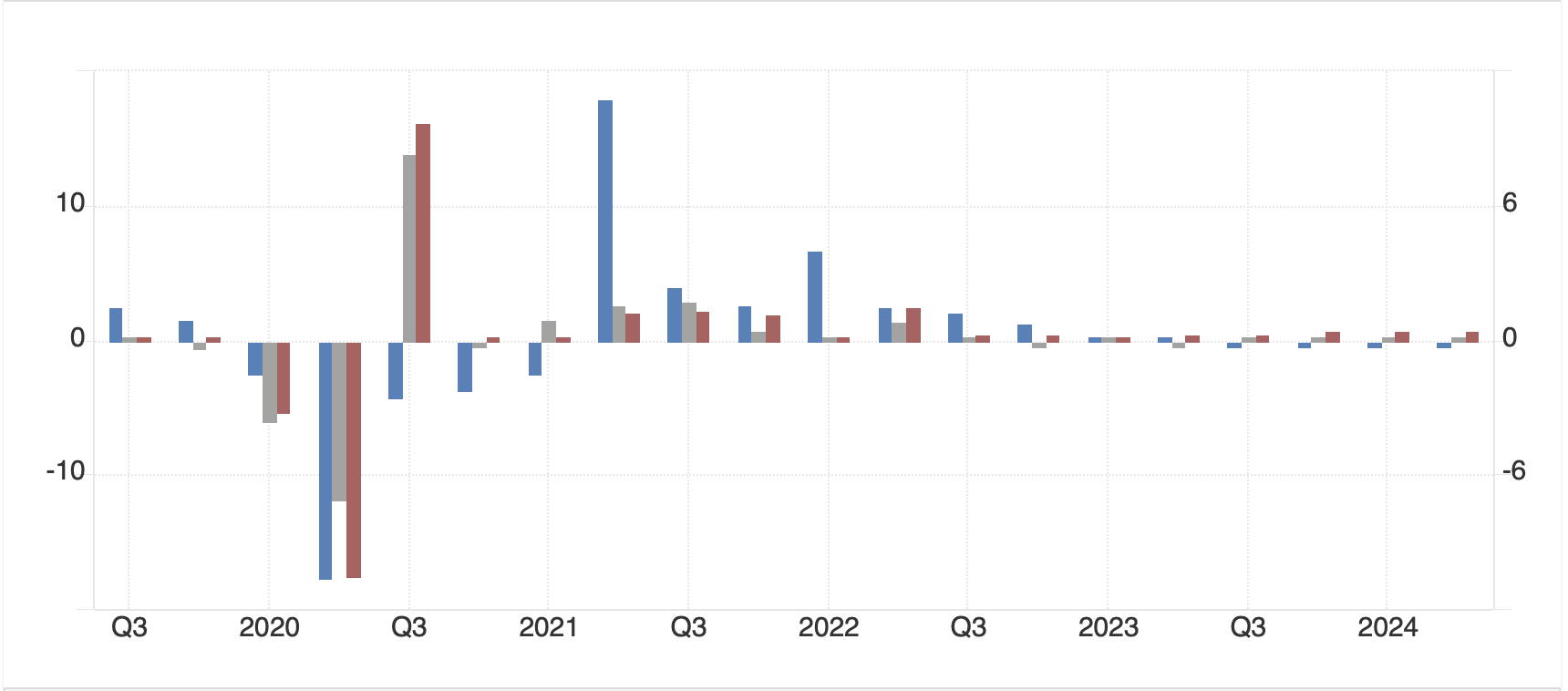
As investors await the news from Ueda-san tonight and Chairman Powell tomorrow, the market discussion has revolved around the potential problems that Madame Lagarde is going to have going forward given the split in economic outcomes within the Eurozone.  As can be seen in the below graph, German GDP growth (grey bars) has been running at a negative rate for the past 4 quarters.  But you can also see that the situation in both Spain (red bars) and Italy (blue bars) has been the opposite, with both of those nations maintaining a steady pace of growth.


Source: tradingeconomics.com

So, while Germany is the largest single economy within the Eurozone, its current trajectory is very different than much of the rest of the bloc, ironically specifically the PIGS.  Should the ECB ignore German weakness and manage monetary policy toward the overall group?  Or should they ease more aggressively in order to support the Germans while risking a rebound in still sticky inflation?

Perhaps the first thing to answer is why Germany has been suffering for so long. This is an easy question to answer. Germany’s energy policy, Energiewende, has been an unmitigated disaster.  Their efforts to address climate change have led to the highest energy costs in Europe which, not surprisingly, has resulted in a massive reduction in manufacturing activity.  Areas where Germany had been supreme, like chemicals and autos, are hugely energy intensive industries, so as their cost of production rose, the companies moved their activities elsewhere.  Adding to the insanity was the policy to shutter their nuclear fleet, which had produced 10% of the nation’s electricity, during the post Ukraine invasion energy crisis.  And ultimately, this is the problem.  The cost of money is not Germany’s economic problem, it is their policies which have undermined their own growth ability.  While the ECB cannot ignore Germany outright, there is nothing they can do that will help the nation rebound in any meaningful way.  With that in mind, I would contend Lagarde needs to focus on the rest of the bloc to make sure policy suits them.  But that is a political discussion.

What are the likely impacts of this situation?  Eurozone growth, overall, surprised on the high side despite the lagging German data.  As well, inflation readings released thus far this month have shown that prices remain sticky on the continent.  With that in mind, the idea the ECB needs to cut aggressively seems to make little sense.  This is not to say they will maintain tighter policy, just that it doesn’t seem justified to ease.  But right now, the market zeitgeist is all about easing monetary policy (except in Japan) so I expect they will do just that going forward.  With this in mind, it strikes that the euro (+0.15%) is going to struggle to rally from current levels absent a dramatic shift in Fed policy to aggressive rate cuts.  As to European bourses, I suspect that they will reflect each nations’ own circumstances, so the DAX seems likely to lag going forward.

Will he, or won’t he?
Though inflation’s been falling
Hiking pressure’s real
 
A quick thought regarding tonight’s BOJ meeting and whether Ueda-san believes that further rate hikes are appropriate for the Japanese economy.  As with many things Japanese, the proper move is not necessarily the obvious one.  A dispassionate view of the recent data trends shows that inflation (2.8%) has been sliding slowly, GDP growth (-0.5%) has been falling more quickly and Unemployment (2.5%) remains at levels consistent with the economy’s situation given the shrinking population.   On the surface, this does not seem like a situation where hiking is desperately needed except for one thing, the yen remains broadly weak.  The chart below shows that since the advent of Abenomics in 2011, the yen has lost 50% of its value. 


Source: tradingeconomics.com

Now, initially, that was a key plank of the Abenomics platform, weakening the yen to end deflation.  Well, kudos to them, 13 years later they have achieved that result.  But where do they go from here?  There is a growing belief that the BOJ is going to hike by 15bps tonight and bring their base rate up to 0.25%.  I disagree with this theory given the very clear recent direction of travel in the inflation data in Japan as despite the yen’s weakness, it dispels any notion that a rate hike is needed to push things along.  One positive of the weak yen is that the balance of trade has returned to surplus in Japan.  

Source: tradingeconomics.com

For decades, Japan ran a large positive trade balance but since the GFC, that situation has been far less consistent.  However, the trade balance remains an important domestic signal as to the strength of the economy and its recent return to surplus is welcomed by the Kishida government.  It is not clear how raising interest rates will help that situation.  Net, with inflation sliding and the economy under pressure, hiking interest rates does not make any sense to me.

Ok, let’s take a look at how markets have behaved overnight.  Yesterday’s lackluster US equity market performance was followed by very modest strength in Japan (+0.15%), although weakness throughout the rest of Asia with the Hang Seng (-1.4%) the laggard, although mainland Chinese (-0.6%) and Australian (-0.5%) shares also suffered.  Meanwhile, in Europe this morning bourses on the continent are higher by about 0.4% across the board after the Eurozone GDP data seemed to encourage optimism.  The UK (FTSE 100 -0.2%), however, is under a bit of pressure amid ongoing discussions in the new Labour government about the need for austerity.  At this hour (7:20) US futures are edging higher by about 0.25%.

In the bond market, after yesterday’s sharp decline in yields around the world, it has been far less exciting with Treasury yields edging down another basis point and European sovereigns either unchanged or 1bp lower.  Perhaps the most interesting things is that JGB yields fell 2bps overnight and the 10yr yield is now back below 1.00%.  That doesn’t seem like a market preparing for a rate hike there.

In the commodity space, everybody still hates commodities with oil (-0.5%) continuing its recent slide.  In fact, it is down nearly 10% in the past month (which is good for us as we refill our gas tanks).  In the metals markets, copper continues to slide, down another -1.5% this morning as optimism over economic and manufacturing activity around the world remains absent, especially in China.  For instance, the Politburo there met yesterday and pledged to help the domestic economy, although they did not lay out specific actions they would take.  Recall last week’s Third Plenum was also a disappointment, so until the market perceives China is back and growing rapidly, or that the global growth impulse without them is picking up, it seems that industrial metals will remain under pressure.  Gold (+0.4%) however, remains reasonably well bid as continued Asian central bank buying along with retail interest in Asia props up the price.

Finally, the dollar is generally under modest pressure although the outlier is the yen (-0.6%) which does not appear to be expecting a BOJ hike tonight.  But elsewhere, the movements in both the G10 and EMG blocs have been pretty limited overall, on the order of 0.15% – 0.35%.  It is hard to find an interesting story about any particular currency as a driver today.

On the data front, this morning brings the Case-Shiller Home Price Index (exp +6.7%), JOLTs Job Openings (8.0M) and the Consumer Confidence Index (99.7).  I keep looking at that Case-Shiller index and wondering when the housing portion of the inflation readings is going to decline given its consistent strength.  But really, I suspect that all eyes will be on Microsoft’s earnings this afternoon along with the other hundred plus names that are reporting today.  With the Fed coming tomorrow, macro is not important right now.  So, more lackluster trading seems the most likely outcome today, although with the opportunity for some fireworks starting around midnight when the BOJ statement comes out.

Good luck

Adf

A Bruising

While many consider AI
The future, and can’t wait to buy
The stocks that convey
The future’s today
Perhaps that result’s not yet nigh
 
For instance, today’s biggest news
Is Windows is stuck with, screen, blues
What’s happened is that
A bug, not a gnat
Disrupted what most people use

Oops!  That seems to be the response so far by Microsoft and Crowdstrike as they try to troubleshoot and fix an apparent bug in the most recent release of their software.  The result of this bug is that computers all over the world that use Microsoft Windows as their operating system have, this morning, the dreaded ‘blue screen of death’, something with which far too many of us are familiar.  This problem has affected airports, airlines, banks and businesses of all stripes, essentially shutting down key processes and by extension the businesses themselves.  And consider, this is allegedly because of a single bug in a new rollout of security software.
 
We all know that bugs are an inherent part of the computing world, and most of us have lived through glitches in the past.  The difference this time, though, is that as more and more businesses move more and more of their computing operations into the cloud, the impact of any imperfection in the computer code grows exponentially.  This will not stop the migration of business operations to the cloud, of that I am certain.  But perhaps it will force some businesses to rethink what it means to be secure.
 
Additionally, given the hype surrounding AI, and the growing belief amongst a subset of businesses and investors, that companies which are not utilizing AI are going to wither and die due to its absence, perhaps this situation will cause some to rethink the pace of that utilization.  Remember, the essence of the AI hype is that the computers will be able to replace humans in many jobs, thus increasing efficiency and with it, profitability.  However, not only is the jury still out, but I would contend it has not yet started deliberations as; to date, I have not seen a single application where the results from AI are so superior to human actions, that the vast expenses to train and run AI applications make economic sense.  There is no killer app. 
 
Rather, the best analogy I have seen is that AI represents an advance similar to Microsoft Excel, where prior to the existence of spreadsheets, calculations by hand were incredibly time consuming and correspondingly expensive, but once Excel came along, analyzing data became a routine and much less expensive task.  The difference is Excel was cheap to buy and didn’t use much power to run.  AI is hugely expensive to train and then to run as well.  And bringing this full circle, removing operations from human oversight opens the door to situations like today, where things just don’t work.  Also, consider that Nvidia has sold ~$60 billion of chips in the past year, which means that companies like Microsoft, Alphabet, Apple and Meta have spent that much money on those chips as they build out their AI capabilities.  However, their revenues have not increased by nearly that much, certainly not from any AI initiatives.  Maybe the “killer” in killer app refers to what it is going to do to company profitability for those firms trying to lead this charge.
 
And, since this is a note about money and finance, let’s consider one other issue, the drive by many governments to eliminate cash.  Consider how things would be if cash was gone and all payments were electronic, but then a bug in the system resulted in banking and payments software shutting down.  Exactly how will firms conduct business?  I’m not talking about large-scale manufacturing operations, but rather about the grocery store or the McDonalds or pizza place where you want to get something to eat.  If there is no cash, what do you do?  Money is truly a remarkable invention and until the point when computer systems work 100% of the time, not 99.9%, the absence of a physical medium of exchange has the potential to be devastating to many people if the network goes down.  Just sayin’.
 
For many it was quite confusing
That stocks could absorb such a bruising
But data keeps hinting
That nobody’s minting
More profits, they just might be losing
 
Ok, let’s take a look at markets as we try to prepare for today’s activities.  It seems that as of 7:00am in NY, the bug has been fixed and things are starting to get back to normal.  But this is going to leave a mark.  Yesterday saw the first down day across the board in US markets in weeks with the DJIA (-1.3%) leading the way lower.  Most of Asia followed this move although Japanese declines (Nikkei -0.2%) were mitigated by the release of CPI data that showed no acceleration in prices in Japan.  The Hang Seng (-2.0%) reflected the tech sell-off and equities throughout the region were lower with one exception, mainland Chinese shares rose 0.5% after the end of the Third Plenum.  While many had hoped for some new economic stimulus, it seems that President Xi believes he is already on the right path and will not change.  As to European bourses, they are all lower this morning, following the trend started in the US yesterday while US futures are little changed right now.
 
Treasury yields, which traded higher during yesterday’s session despite the sharp sell-off in stocks, are unchanged this morning and European sovereigns, which closed before the full move was complete in the US have edged up the last 1bp to 2bps to maintain their relative spreads.  The ECB left rates on hold, as universally expected, but Madame Lagarde disappointed the doves by not promising a cut in September.  Despite weakening growth on the continent, inflation remains uncomfortably high it seems.  The same is not true in the US, though, where more Fed speakers gave the same message that things are going well, they are watching unemployment, and a rate cut is likely coming in the not too distant future.
 
In the commodity markets, oil edged lower yesterday after a nice rally Wednesday, and is continuing that this morning, down a further -0.5%.  But the pain trade is in metals with gold (-1.2%) and silver (-1.8%) leading the way lower on what appears to be some market technical issues rather than specific fundamental questions.  Both copper and aluminum are also softer this morning, but that is reflective of the continued concerns over economic growth.
 
Finally, the dollar is firmer again this morning, despite the modestly more hawkish discussion from the ECB and despite the ongoing belief that the Fed is preparing to cut rates at the September meeting.  Yesterday saw some impressive movement with BRL (-1.0%) and CLP (-2.0%) amid that broad-based dollar strength.  However, this morning, the worst performers are SEK (-0.6%) and NOK (-0.4%) with the rest of both the G10 and EMG blocs within 0.2% of Thursday’s closing levels.  The NOK is clearly following oil lower, and SEK is following NOK, as there has been no news or commentary from either nation that would offer a solid rationale for the move.  As I often explain, sometimes currency markets are simply perverse.
 
There is no US data due this morning, but we do hear from two more Fed speakers, Williams and Bostic. However, both have already spoken this week and there certainly hasn’t been any data that would likely have changed their views.  It seems all eyes will be on the equity markets this morning.  If they follow yesterday’s moves lower, I think we may see a more traditional risk-off outcome, but even if stocks rebound, it is hard to get too negative on the greenback.
 
Good luck and good weekend
Adf