A FAIT Accompli

Said Jay, ‘twas a FAIT accompli
As all of his minions agree
The average was flawed
And now our new god
Is maximum jobs, don’t you see
 
But really, what pundits all heard
Was rate cuts would not be deferred
Instead, twenty-five
Next month is alive
And fifty would not be absurd


Although Chairman Powell clearly wanted to focus on the new Monetary Policy Framework, as it has evolved, market practitioners really don’t care much about that.  All they care about is what is going to happen to interest rates.  So, here is the paragraph from Powell’s speech on Friday that got pulses quickening and led to another set of new all-time highs in equity markets [emphasis added]:

“Putting the pieces together, what are the implications for monetary policy? In the near term, risks to inflation are tilted to the upside, and risks to employment to the downside—a challenging situation. When our goals are in tension like this, our framework calls for us to balance both sides of our dual mandate. Our policy rate is now 100 basis points closer to neutral than it was a year ago, and the stability of the unemployment rate and other labor market measures allows us to proceed carefully as we consider changes to our policy stance. Nonetheless, with policy in restrictive territory, the baseline outlook and the shifting balance of risks may warrant adjusting our policy stance.” 

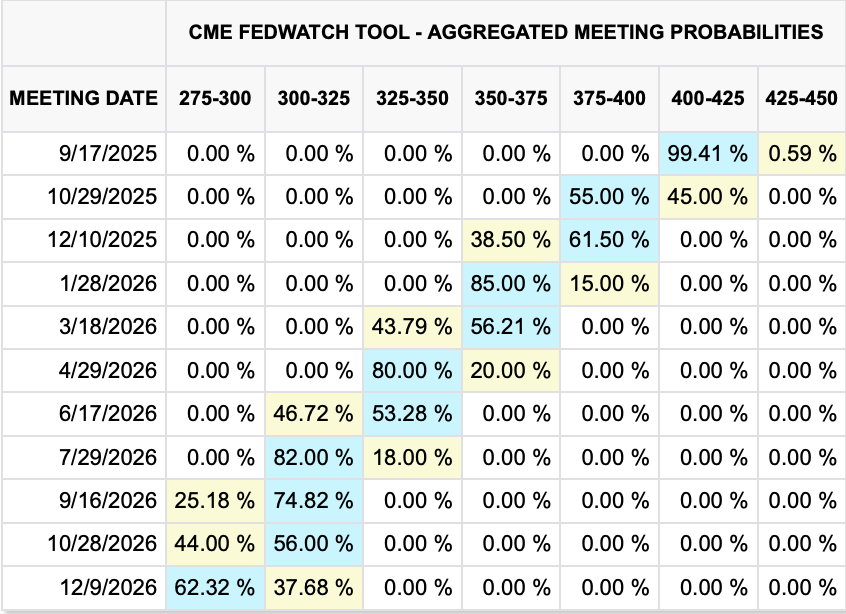
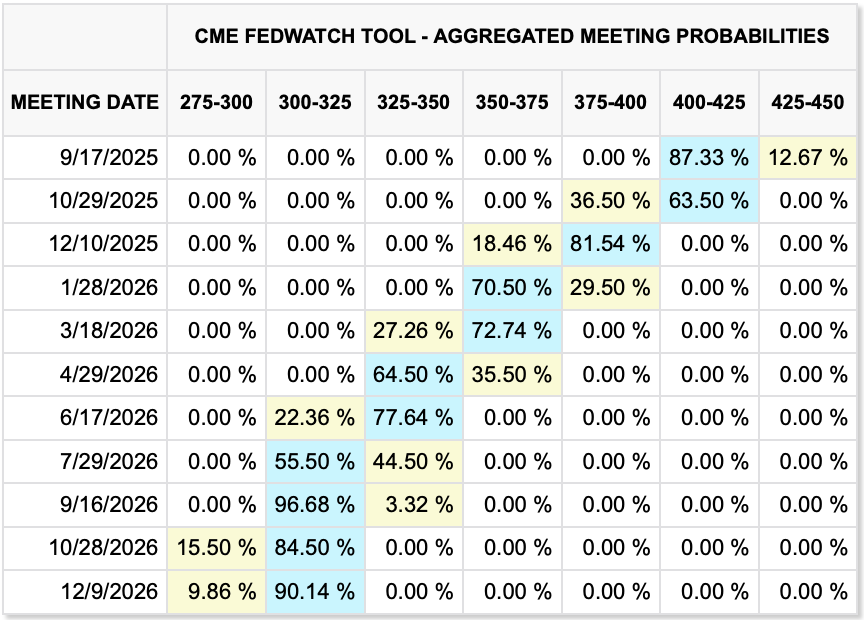
The market was quick to reprice the probability of that cut as well, with the current view up to an 87% probability, compared to 71% prior to Powell’s speech.  

Source: cmegroup.com

While I personally believe a cut is unnecessary, it does feel like he just promised one.

However, for the economists out there, those who feel above such mundane issues as the price of some stock, they were far more concerned about the Policy Framework.  It was the last review of this framework, back in 2019 which was released in early 2020 (pre-Covid) that Powell and friends harped on their concern over the Effective Lower Bound (ELB) aka zero interest rates.  Their fear was that with the then current rate structure so low, if a recession came about, they wouldn’t have the tools to address it.  So, in their definitively finite wisdom, they came up with Flexible Average Inflation Targeting (FAIT) which was designed to allow them to keep policy accommodative even if inflation was somewhat above their 2.0% goal, instead relying on the average inflation rate over time.  Of course, they didn’t describe what time constituted the period of averaging, but everyone understood that the idea was to run the economy hot.  Oops!  It turns out that wasn’t a really good idea once Covid hit, and the federal government responded by shutting down production while pumping some $5 trillion extra into the economy.  We are all still feeling the sting from that particular mistake.

Here is the pertinent commentary regarding the changes in the policy framework with shortfalls referreing to the shortfall of employment vs. full employment:

“We still have that view, but our use of the term “shortfalls” was not always interpreted as intended, raising communications challenges. In particular, the use of “shortfalls” was not intended as a commitment to permanently forswear preemption or to ignore labor market tightness. Accordingly, we removed “shortfalls” from our statement. Instead, the revised document now states more precisely that ‘the Committee recognizes that employment may at times run above real-time assessments of maximum employment without necessarily creating risks to price stability.’ Of course, preemptive action would likely be warranted if tightness in the labor market or other factors pose risks to price stability.”

In the end, I would argue all they have done is rejigger the wording of how they excuse running things hot and allowing inflation to rise.  Hence, the nearly promised rate cut and the new framework that says unemployment is the key.  

Enough about Friday.  Overnight, the key story came from China, where the city of Shanghai eased policy restrictions on home ownership to help restart that moribund market by allowing more people to buy as many homes as they would like. (It seems odd to me that after at least three years of a property problem, there would still be restrictions on home purchases, but then I never professed to understand Chinese policies.). At any rate, the very fact that there was more action on one of the key problems in the economy was a distinct positive and helped drive Chinese equity markets much higher (CSI 300 + 2.1%, Hang Seng +1.9%) with that news, along with the perception that the Fed is going to ease next month pulling the entire region higher. While Japanese shares (+0.4%) had a modest rally, Korea (+1.3%) and Taiwan (+2.2%) went gangbusters and literally every major bourse there was higher in the session.

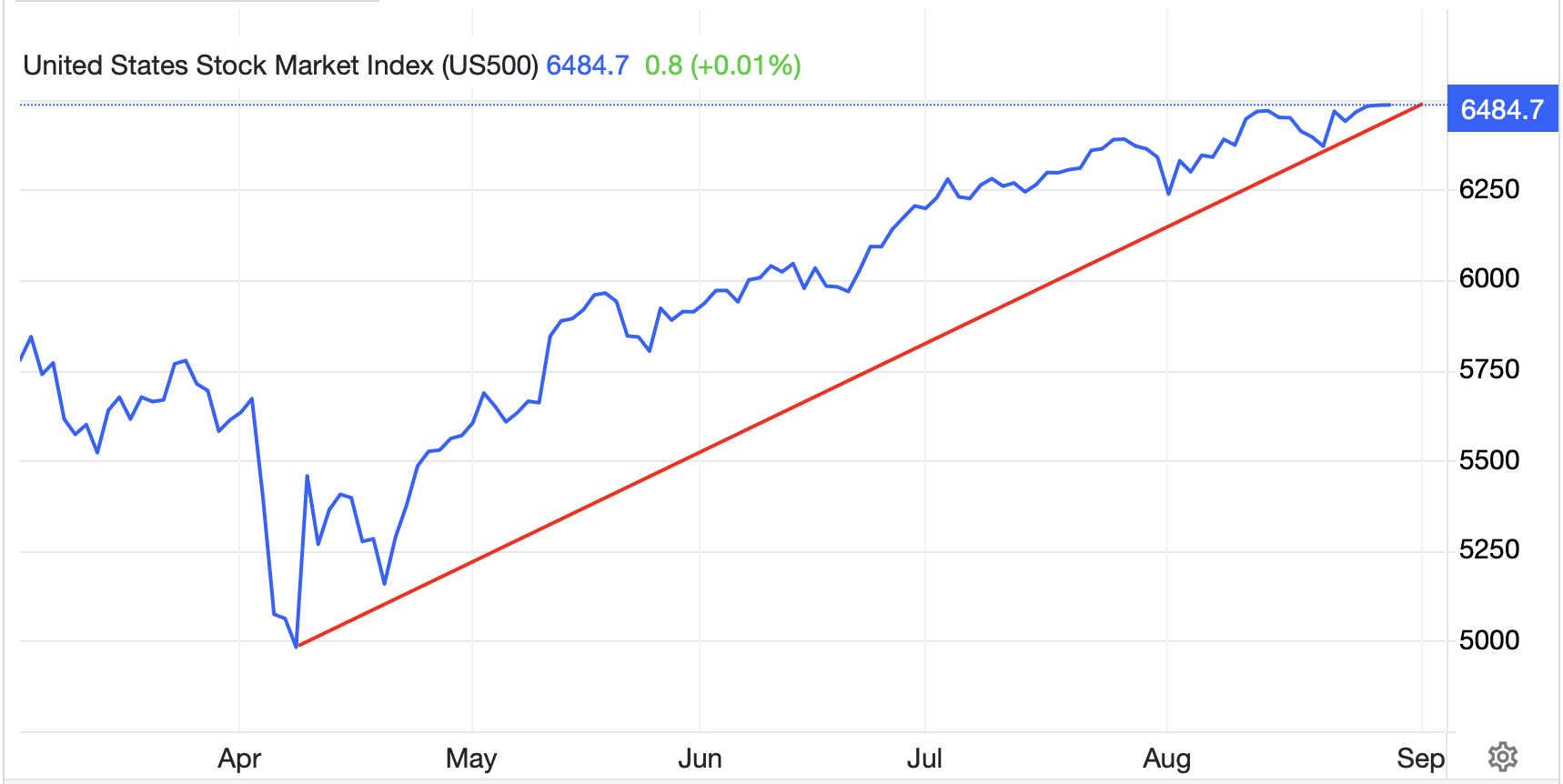
In Europe, though, things are less bright with all the main bourses on the continent lower (DAX -0.25%, CAC -0.6%, IBEX -0.6%) although the FTSE 100 (+0.1%) is bucking the trend.  It appears there are concerns over the details of the ostensibly agreed trade deal with the US as well as concerns that the Russia-Ukraine peace negotiations are not progressing as well as hoped.  As to US futures, at this hour (6:50), they are taking a breather from Friday’s rally and currently point lower by about -0.25% across the board.

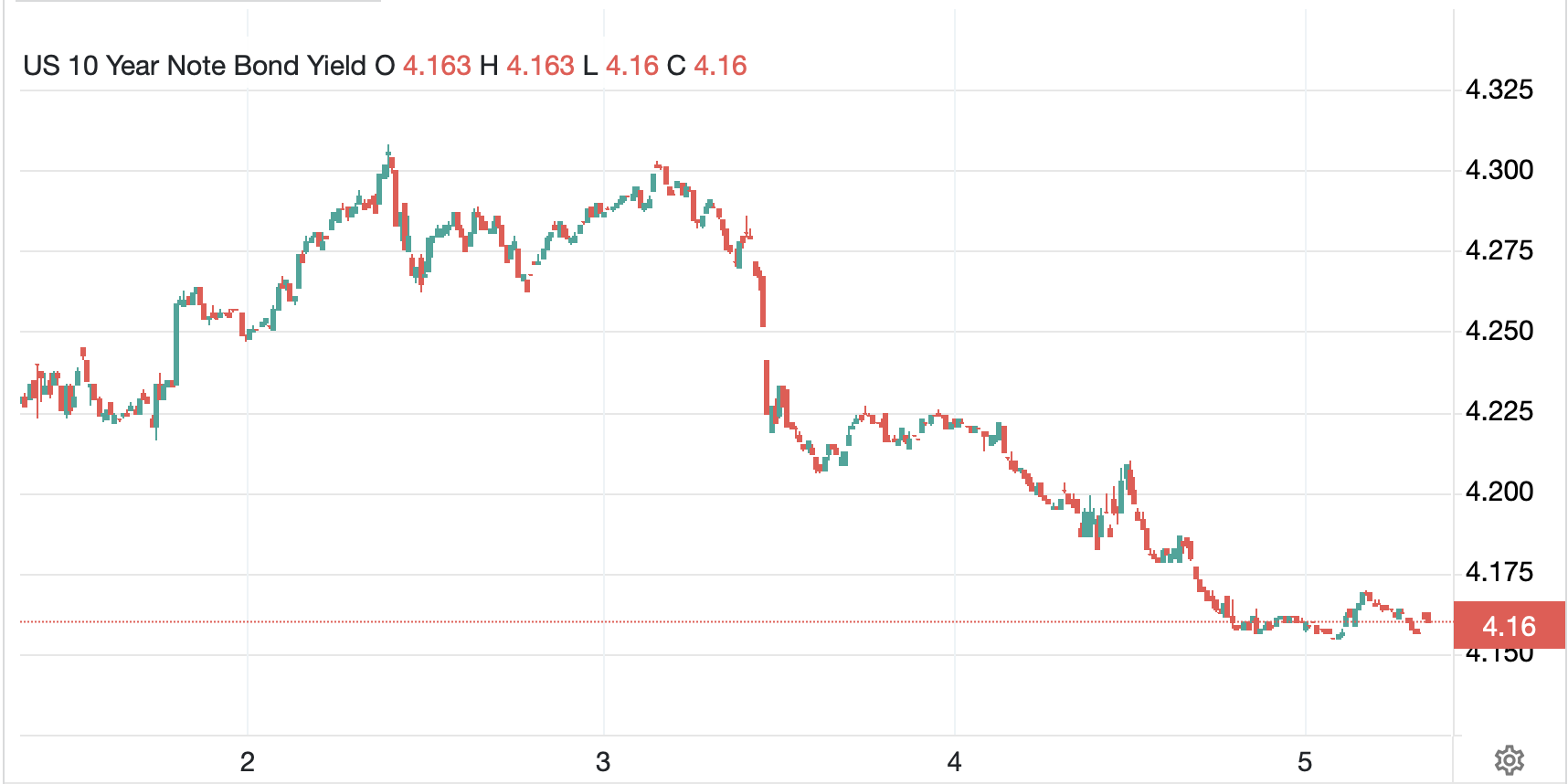
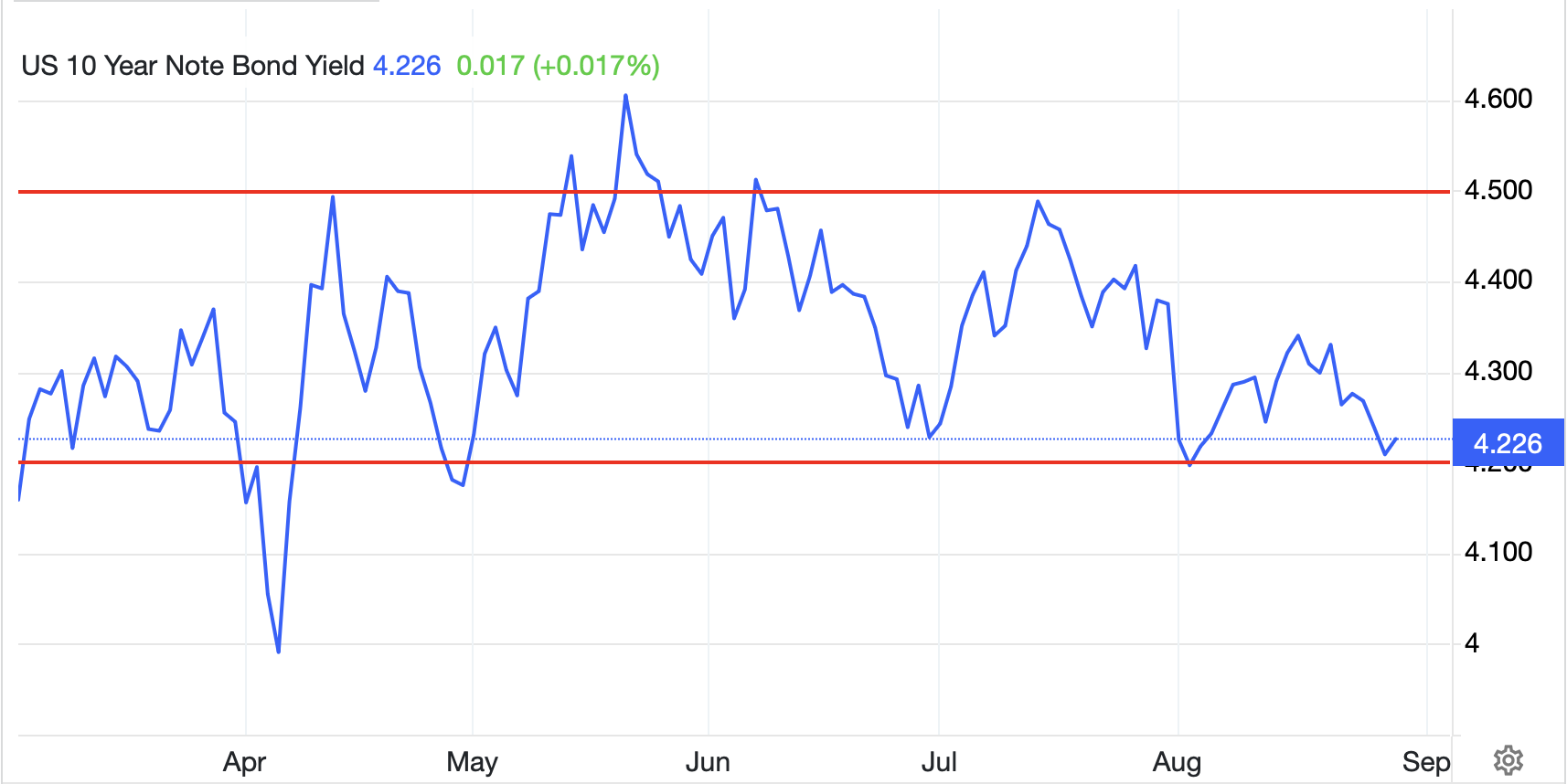
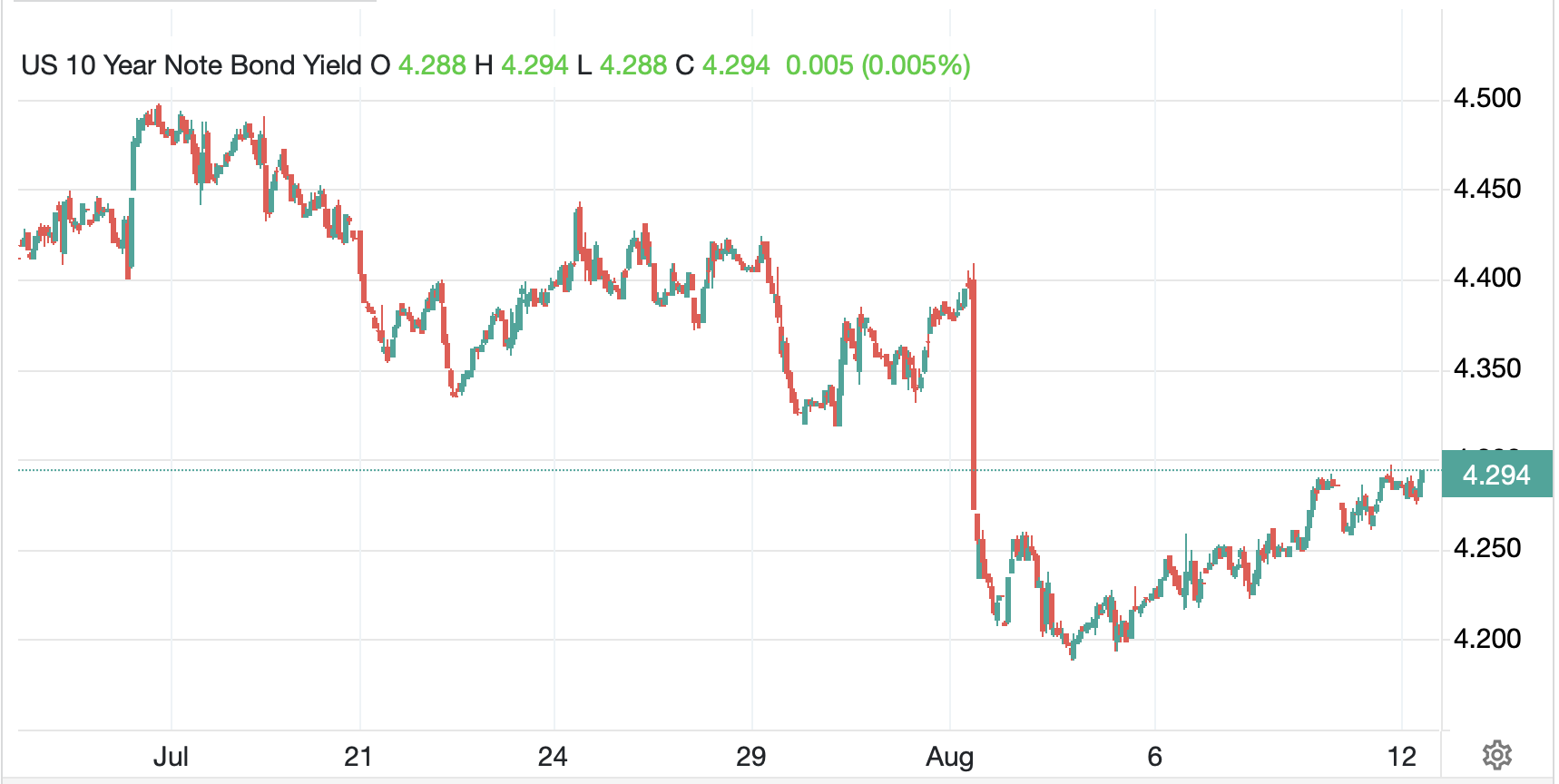
In the bond market, Treasury yields have recouped 2bps of the -3bps they fell in the wake of Chairman Powell’s speech on Friday.  However, they remain below 4.30% and continue to trade in a narrow range as per the below chart.  FYI, the mean over this period is 4.33%.

Source: tradingeconomics.com

European sovereign yields have been rising this morning, with the entire continent seeing yields higher by between 4bps and 5bps amid concerns that the mooted Fed rate cuts will not see any appreciable impact on European yields as those nations struggle with financing their promised €1 trillion of defense and infrastructure spending amid a stagnant economy.

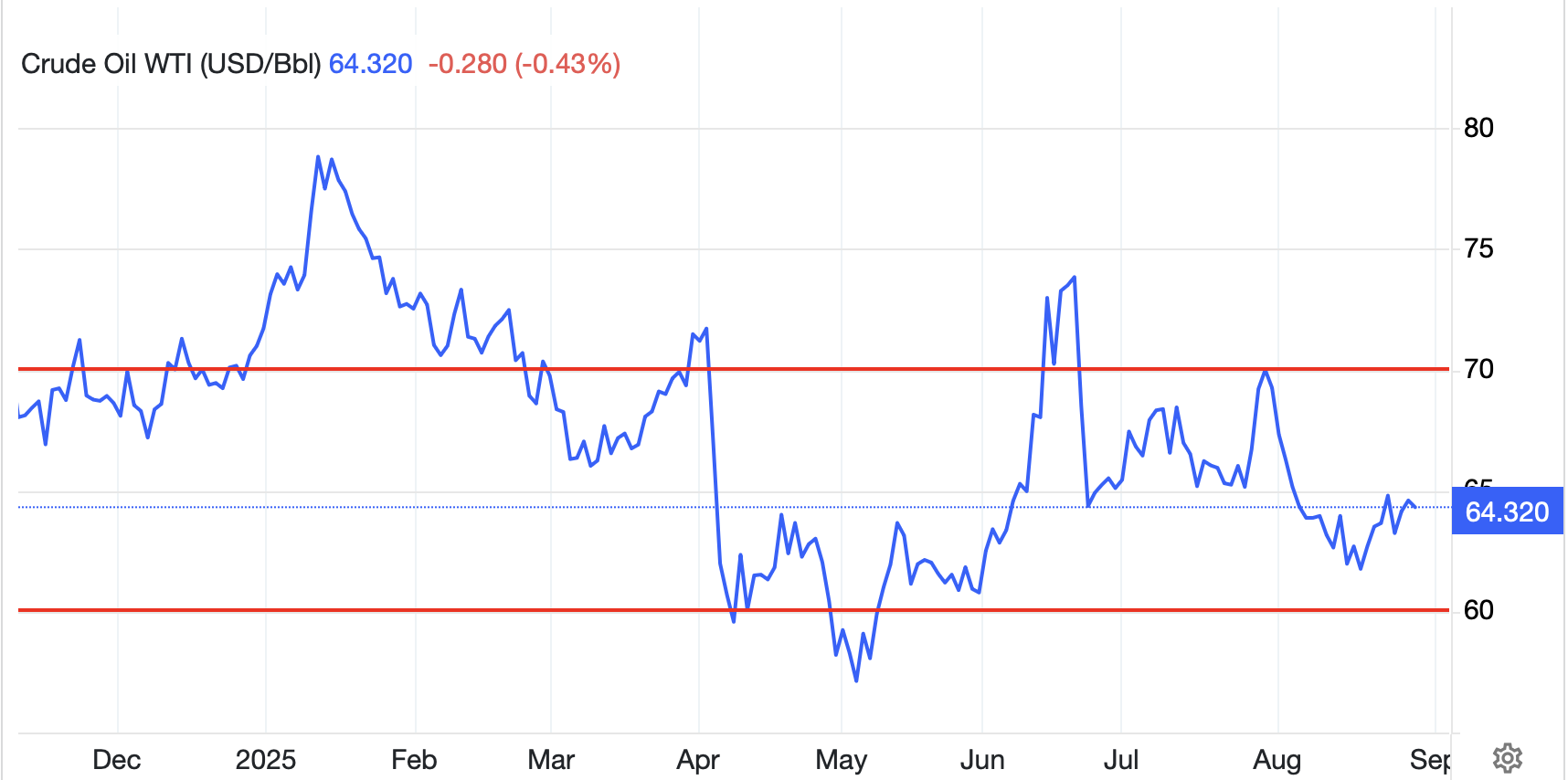
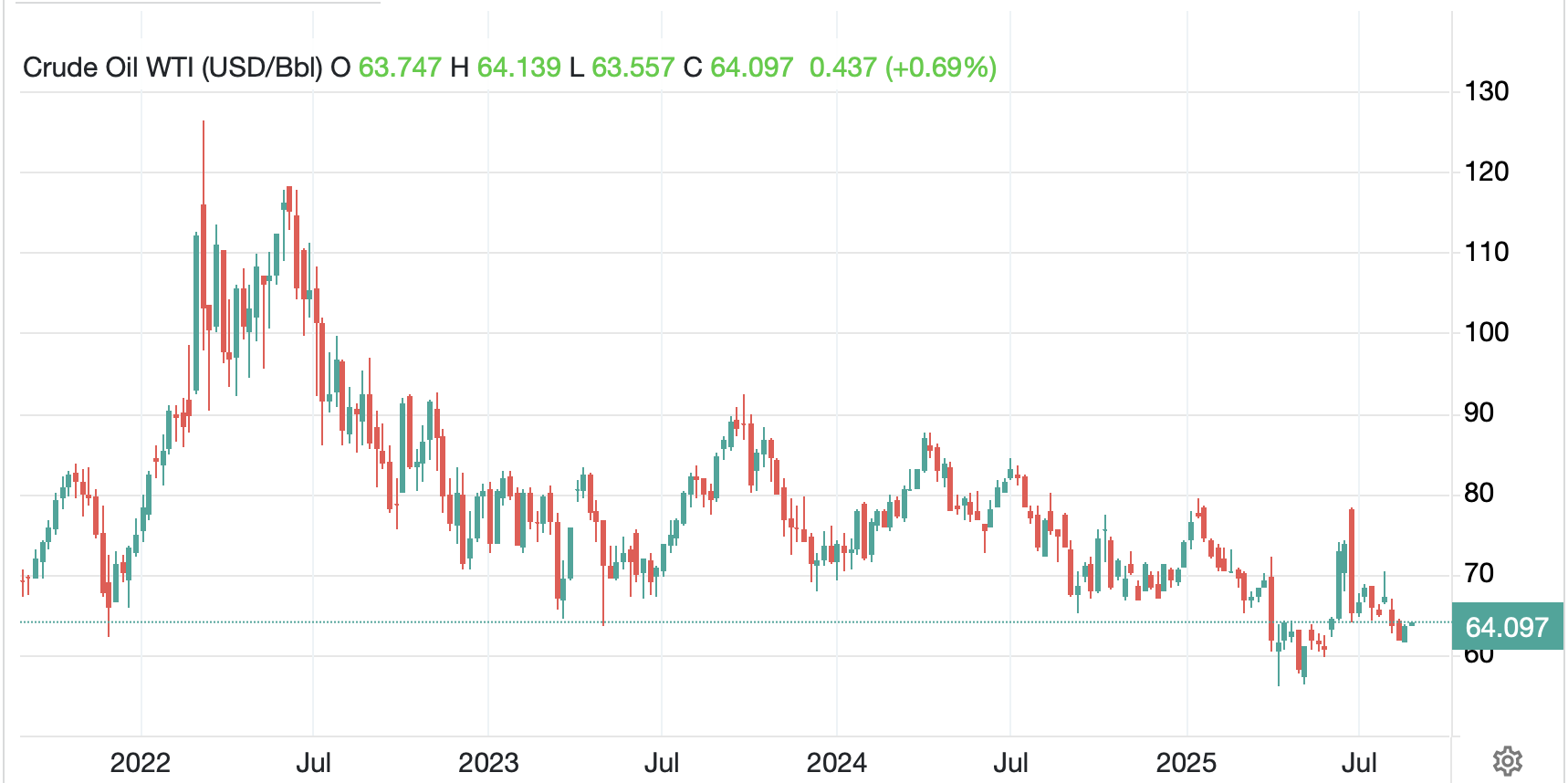
In the commodity markets, oil (+0.6%) is continuing its slow rebound from the lows seen early last week but at $64/bbl, remain well within their trading range.  There were several Ukrainian attacks on Russian refineries overnight, which arguably helped the bulls’ case, but my take remains that the trend here is lower over time.  Since shortly after the start of the Ukraine war, prices have been trending lower steadily.

Source: tradingeconomics.com

In the metals markets, Friday’s Powell speech goosed all of them higher and this morning, like equity indices, they are backing off a bit with gold (-0.2%) and sliver (-0.45%) still trading near their recent levels.  We will need some outside catalyst, I think, to shake these markets up.

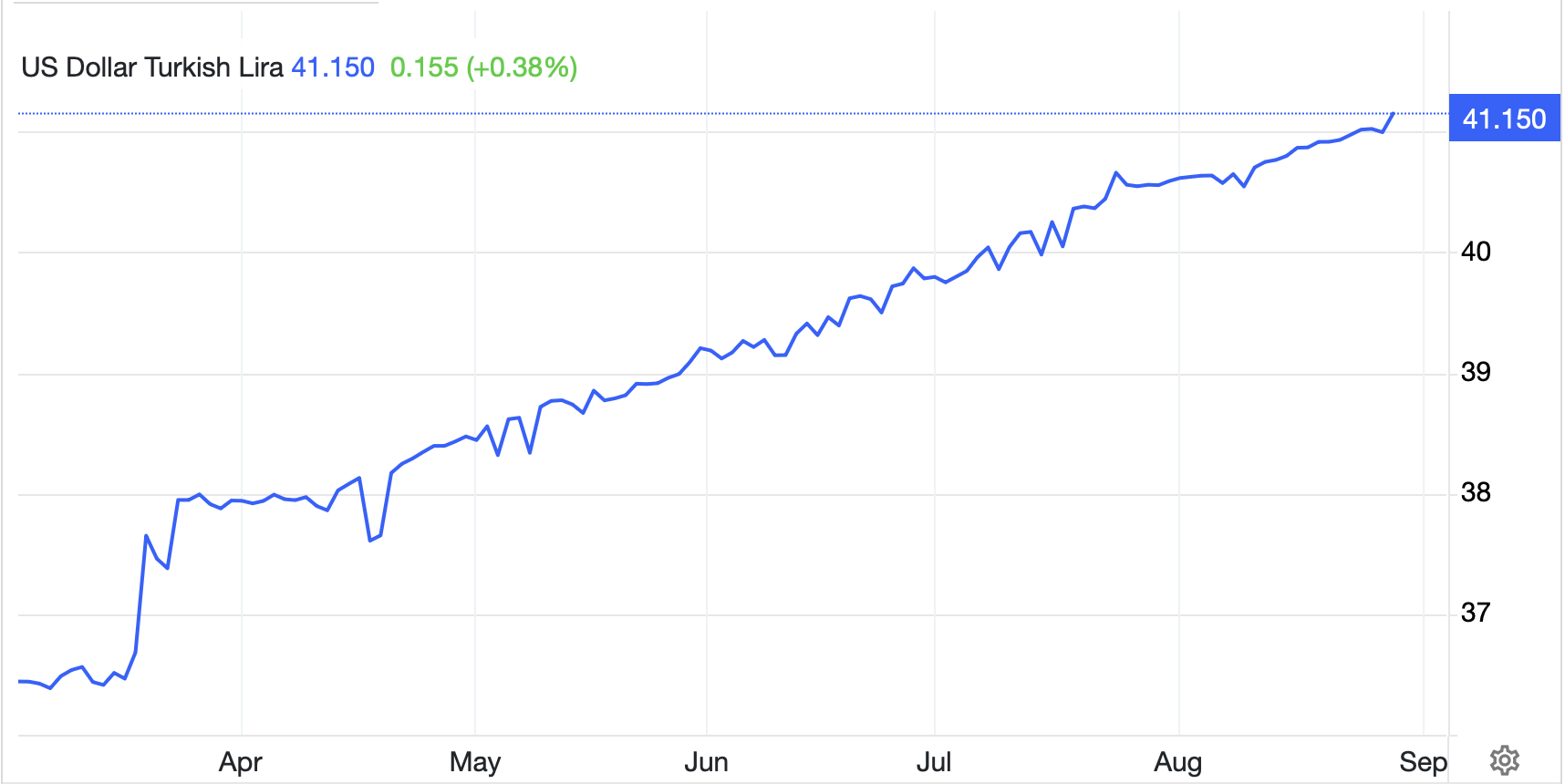
Finally, the dollar is a bit firmer this morning, also reversing some of Friday’s post-Powell decline, with both the euro and pound lower by -0.2% while the yen (-0.35%) is a touch softer than that.  The biggest movers have been ZAR (-0.7%) responding to the weakness in precious metals and CZK (-0.8%) and HUF (-0.9%), both of which appear to be reflexive sales after strong moves Friday.  If the Fed is really going to pay less attention to inflation, I see that as a distinct negative for the dollar.  That has been my concern all year, although the offsetting feature was the promise of massive inward investment flows.  But the short-term view is more focused on Fed policy, so beware more confirmation by Fed speakers that they are willing to cut.

On the data front this week, probably the most impactful number is NVidia earnings Tuesday after the close, but from an economic perspective, this is what we have coming,

TodayChicago Fed Nat’l Activity-0.2
 New Home Sales630K
TuesdayDurable Goods-4.0%
 -ex Trasnport0.2%
 Case Shiller Home Prices2.2%
 Consumer Confidence96.4
ThursdayInitial Claims230K
 Continuing Claims1975K
 Q2 GDP3.1%
 Q2 GDP Sales6.3%
 Q2 Real Spending1.4%
FridayPersonal Income0.4%
 Personal Spending 0.5%
 PCE0.2% (2.6% Y/Y)
 Core PCE0.3% (2.9% Y/Y)
 Chicago PMI45.5
 Michigan Sentiment58.6

Source: tradingeconomics.com

In addition to this, we only hear from Richmond Fed President Barkin (twice) and Governor Waller.  We already know Waller wants to cut, so Barkin is the one who can give us new info.  

And that’s what we have for today.  The ongoing ructions from Powell’s speech and the question of how investors will interpret the probability of a rate cut.  As I said, if they really are going to put inflation second, then the dollar will suffer.

Good luck

Adf

Panic They’re Sowing

While eyes and ears focus on Jay
And whatever he has to say
Poor Germany’s shrinking
And it’s wishful thinking
Japan’s kept inflation at bay
 
But fears about Jay have been growing
That rate cuts he will be foregoing
If that is the case
Most traders will race
To sell things while panic they’re sowing


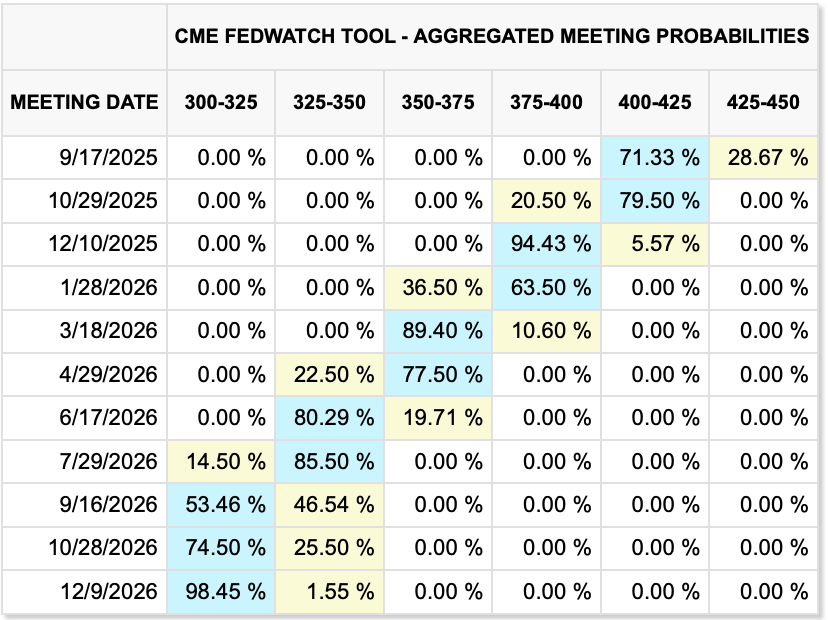
Clearly, the big story today is Chairman Powell’s speech with growing expectations that he will sound more hawkish than had previously been anticipated.  Recall, after the much weaker than expected NFP data was released at the beginning of the month, it appeared nearly certain that the Fed was going to cut at the next meeting with talk of 50bps making the rounds.  Now, a few hours before Powell steps to the podium, the futures market is pricing just a 71% probability of that rate cut with a just two cuts priced in for 2025 as per the CME’s own analysis below:

Arguably, this is one reason that equity markets have been having trouble moving higher as the Mag7 drivers of the market are amongst the longest duration assets around, so higher rates really hurt them.  While there has been a rotation into more defensive names, if opinions start to shift regarding the magnificence of AI, or perhaps just how much money they are spending on it and the potential benefits they will receive, things could get ugly.

I also find it interesting that the Fed whisperer, Nick Timiraos at the WSJ, has been running flack for Chairman Powell in this morning’s article, trying to get people to focus on the Fed’s framework as the basis of today’s speech, rather than policy per se.  Briefly, the current Fed framework, was designed right before COVID when for whatever reason they were concerned that low inflation was a problem, and they created Average Inflation Targeting (AIT) as a way to allow inflation to run above their target of 2.0% for a period if it had been below that level for too long.  We all know how well that worked out and, in fact, we are all still paying for their mistakes every day!  The word is they are going to scrap AIT although it is not clear what they will come up with next.  It is exercises like this that foment the ‘end the Fed’ calls from a growing group of monetarist economists and pundits.

At any rate, comments from other Fed speakers indicate that most are not yet ready to cut rates, so Powell will be able to have a significant impact if he turns more dovish.  But we have to wait a few more hours for that so let’s turn our attention elsewhere.

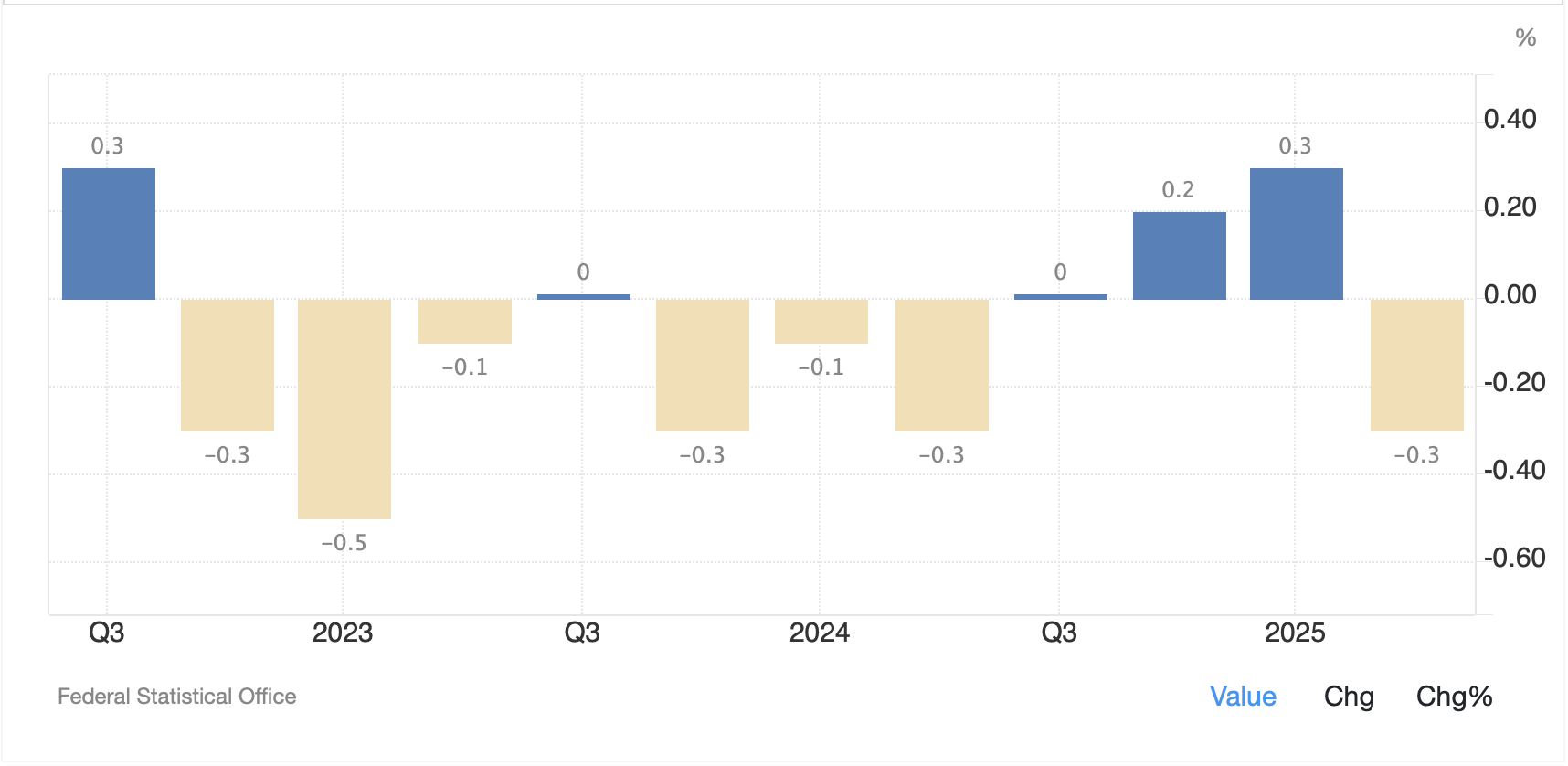
Germany GDP data (-0.3% Q/Q, +0.2% Y/Y) was a few ticks lower than expected and continues to point to an economy that has no positive momentum at all.  In fact, a look at the quarterly GDP data from Germany paints a pretty awful picture if growing your economy is the goal.

Source: tradingeconomics.com

Clearly, the US tariff changes have been quite negative, but in fairness, Germany’s insane energy policy is likely a much bigger driver of their problems as they have the most expensive power costs in the EU.  It is very difficult to have a manufacturing-based economy if you cannot power it cheaply.  Again, while the euro is more than just Germany, this does not bode well for the single currency.

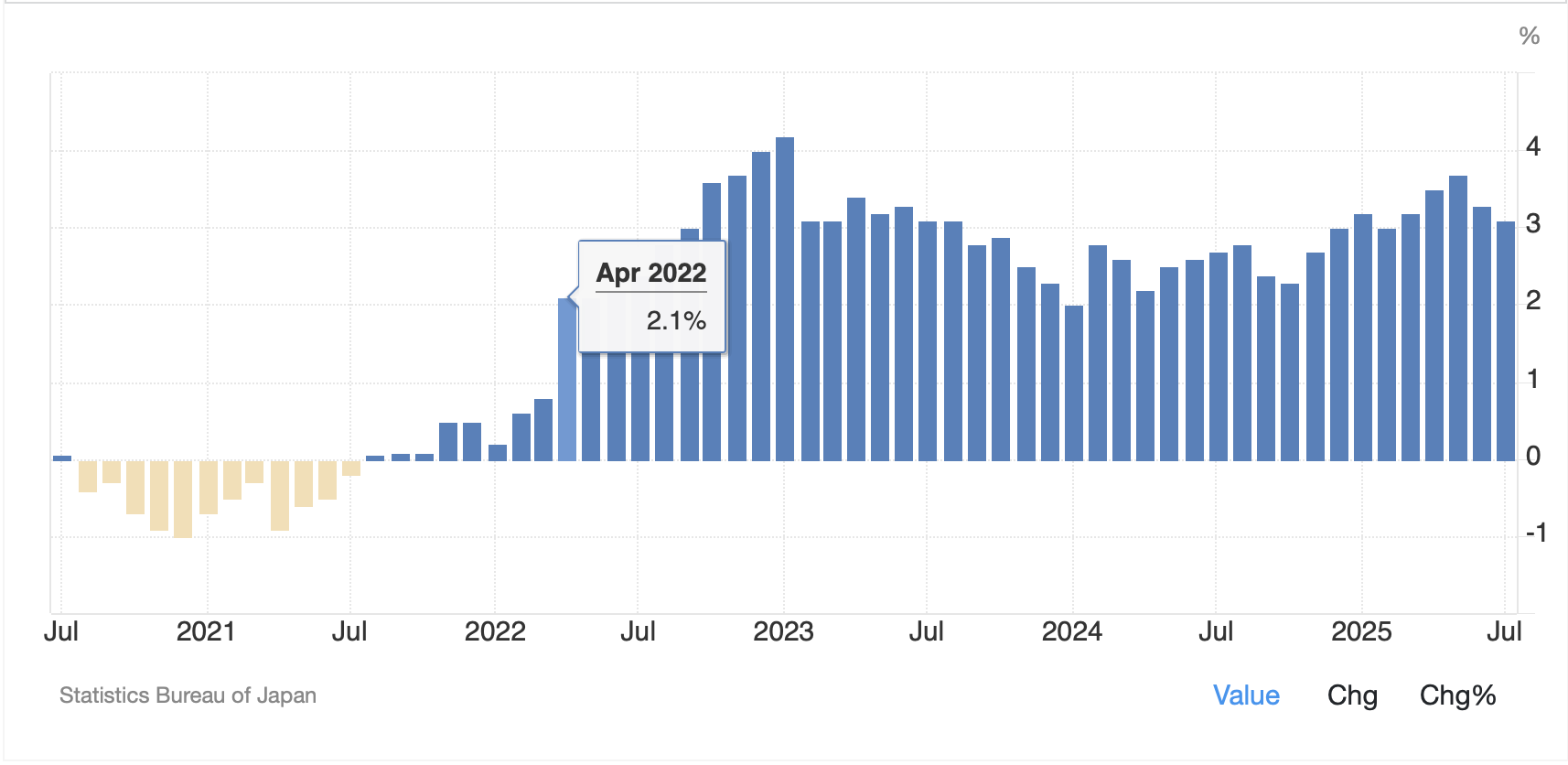
Turning to Japan, inflation continues to run far above their 2.0% target, printing last night at 3.1% on both the headline and core metrics, which while 2 ticks lower than June’s data, was still a tick higher than expected.  It has now been 40 consecutive months that core CPI in Japan has been above the BOJ’s 2.0% target and Ueda-san continues to twiddle his thumbs regarding raising rates.

Source: tradingeconomics.com

It is very hard to watch this lack of policy response to a clear problem, that from all I read is becoming a much bigger political issue for PM Ishiba, and have confidence that the yen is going to strengthen any time soon.  Back in May, the talk was of the unwinding of the carry trade.  All indications now are that it is being put back on in significant size.  FWIW I think we will see 150.00 before too long, especially if Powell sounds hawkish.

And those are really the stories today ahead of Powell and the NY open.  So, let’s see how things behaved overnight.  After a modest down day in the US yesterday, and despite the poor inflation data, Japan was unchanged overall.  However, China (+2.1%) had a huge up move apparently on the idea that US-China trade tensions are easing and despite continued weak data from the country.  Apparently, there has been a rotation from bonds to stocks by local investors driving the move.  Hong Kong (+0.9%) also had a strong session as did Korea (+1.0%) although India, Taiwan and Australia all struggled with declines between -0.6% and -1.0%.  In Europe, the. screens are green, but it is a pale green with muted gains (DAX +0.1%, CAC +0.25%, IBEX +0.4%) despite the weak German data.  Perhaps the belief is this will encourage the ECB to ease policy further.  Meanwhile, at this hour (7:15) US futures are pointing higher by 0.25% or so.

In the bond market, after climbing a few basis points yesterday, Treasury yields are unchanged, trading at 4.33%, so still range bound.  European sovereign yields are softer by -1bp to -2bps, again likely on the softer German data with hopes for a more aggressive ECB.  JGB yields edged higher by 1bp in the 10-year but the longer end of the curve there has seen yields move to new all-time highs with 30-year yields up to 3.216%. it feels like things are starting to unravel in Japanese bond markets.

Turning to commodities, oil (+0.4%) is creeping higher again this morning but remains in its downtrend and activity is lacking.  Meanwhile, the metals markets (Au -0.35%, Ag -0.5%, Cu -0.3%) are all under pressure from a combination of a strong dollar and a lack of investor interest, at least in the West.

Speaking of the dollar, it rallied yesterday and is largely continuing this morning with one notable exception, KRW (+0.75%) which benefitted from trade data showing exports rose 7.6% in the first 20 days of the month on strong semiconductor sales.  But otherwise, +/-0.3% or less is the story of the day, with most currencies within 0.1% of yesterday’s closing levels.

And that’s really it.  There is no data so we are all awaiting Powell and then anything that may come from the White House regarding trade deals, or peace, I guess.  As the summer comes to a close, unless Powell says rate hikes are coming or promises cuts, I expect that traders will have gone for the weekend by lunch time and it will be a very quiet market.

Good luck and good weekend

Adf
A Final Bronx Cheer

Though markets are desperate for Jay
To cut, there is fear that he’ll say
It’s not yet the time
In this paradigm
As tariffs have caused disarray
 
But truly, Chair Jay’s greatest fear
Is that ere October this year
The Prez will have chosen
A new Chair and frozen
Him out with a final Bronx cheer


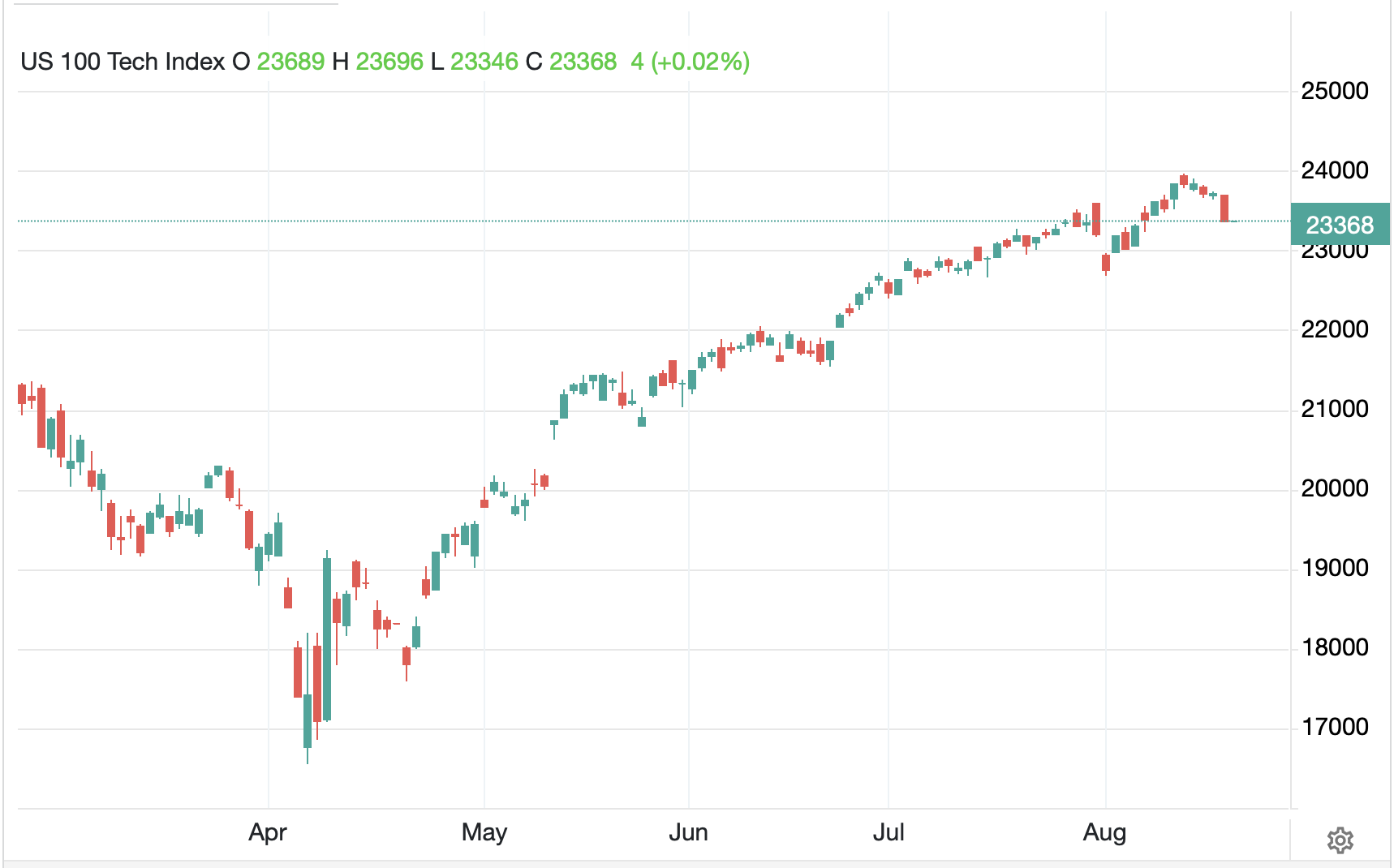
Yesterday saw the first substantial equity market move in nearly 3 weeks, with the NASDAQ declining 1.5% as concerns arose that the current extremely high valuations would have a more difficult time being maintained if the Fed does not ease policy as widely expected next month.  This resulted in all the Mag7 declining, which given they have been the driving force higher in the market, necessarily resulted in overall index declines.

Source: tradingeconomics.com

Of course, the question is, what made yesterday any different than previous sessions.  There were no earnings results of note, and arguably, the biggest tech news was the story about the US government taking a stake in Intel, something that seems likely to have been a positive.  However, there has been an increase in chatter about what Chair Powell is going to say on Friday at his Jackson Hole speech.  Notably, in the SOFR options market, there are a large, and still increasing, number of bets being placed that Powell will indicate 50bps is on the table in September.  But Wall St analysts continue to side with the patience crowd, explaining that while the current policy settings may be slightly restrictive, they are hardly suffocating for the economy.

While Powell has repeatedly blamed an uncertain impact of tariffs on his decision to maintain current policy settings, just like everything else, this is becoming extremely political.  Trump’s allies are lining up behind him and calling for immediate rate cuts to help support the economy.  At the same time, Trump’s political foes remain focused on preventing any Fed action that might help Trump, although they couch their arguments in terms of maintaining Fed ‘independence’.

However, last night was instructive in that two central banks, New Zealand and Indonesia, cut rates further while Sweden’s Riksbank, though standing pat, explained that more cuts are possible, if not likely, later this year.  While the PBOC did not cut rates, the pressure there is building as the economic situation is very clearly slowing down, as discussed last week after their data releases.  So, with most of the world cutting rates (Japan being the notable exception), pressure continues to mount on Powell and the Fed to pick up where they left off last December.

Hanging over both Powell’s speech and the September rate decision is the fact that Treasury Secretary Bessent explained yesterday that interviews for the next Fed chair would begin around Labor Day, just two weeks from now, and nearly eight months before Powell’s term ends.  This will almost certainly weaken Powell as other FOMC members and the market will look to whomever is selected for their views, with Powell serving out his term as a lame duck.  In fact, it is for this reason that my take is Powell’s speech at Jackson Hole will be less about policy and more an attempt to burnish his legacy.

And that’s where things stand.  With no data of note today, and yesterday’s housing data being mildly positive, but not enough to change macroeconomic opinions, the narrative writers are looking for something to say and Powell’s speech is where they have landed.  Absent a run of declining days, I put no stock in a change in the market temperature at this point.  So, let’s see how things behaved overnight.

In Asia, the Nikkei (-1.5%) had a rough night in a direct response to the US tech-led selloff.  Given that US markets have stabilized this morning, with futures unchanged at this hour (7:25), we need to see a continuation here before expecting a significant further decline there.  China (+1.1%), however, bucked that weaker trend, ostensibly on hopes that the ongoing trade talks with the US will prove fruitful.  Elsewhere in the region, Korea (-0.7%) and Taiwan (-3.0%) were both hit on the tech selloff blues but other markets, with less exposure to that sector were fine.  In Europe, it is a mixed picture with the DAX (-0.4%) the laggard after weaker than expected PPI indicated that current ECB policy needs to be more accommodative to help the country but may not be coming soon.  However, the rest of the continent is little changed.  surprisingly, UK stocks (+0.3%) are holding up well despite higher-than-expected CPI data which has adjusted analysts’ thoughts on whether the BOE will be able to cut again at their next meeting.

In the bond market, Treasury yields (-1bp) continue to trade in the middle of that band I showed yesterday, while European sovereign yields have also slipped between -1bp and -2bps this morning after the softer German price data.  The UK (-4bps) is a surprise as I would not have expected lower yields after a higher inflation reading.  Perhaps this is an indication that investors are expecting a much worse economic outcome from the UK going forward.

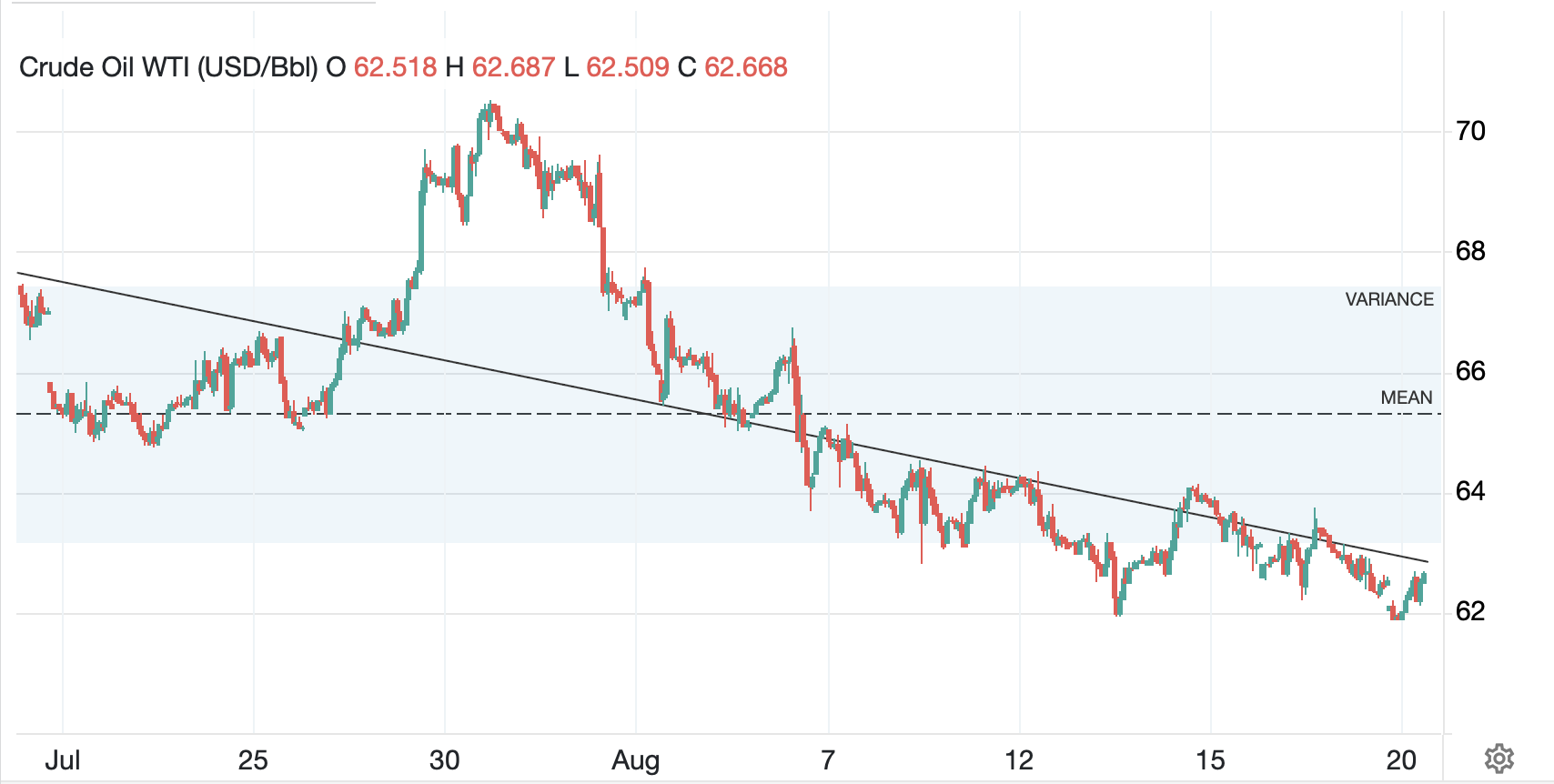
In the commodity markets, oil (+1.3%) is bouncing, but it remains in a well-defined downtrend for now as per the below chart.

Source: tradingeconomics.com

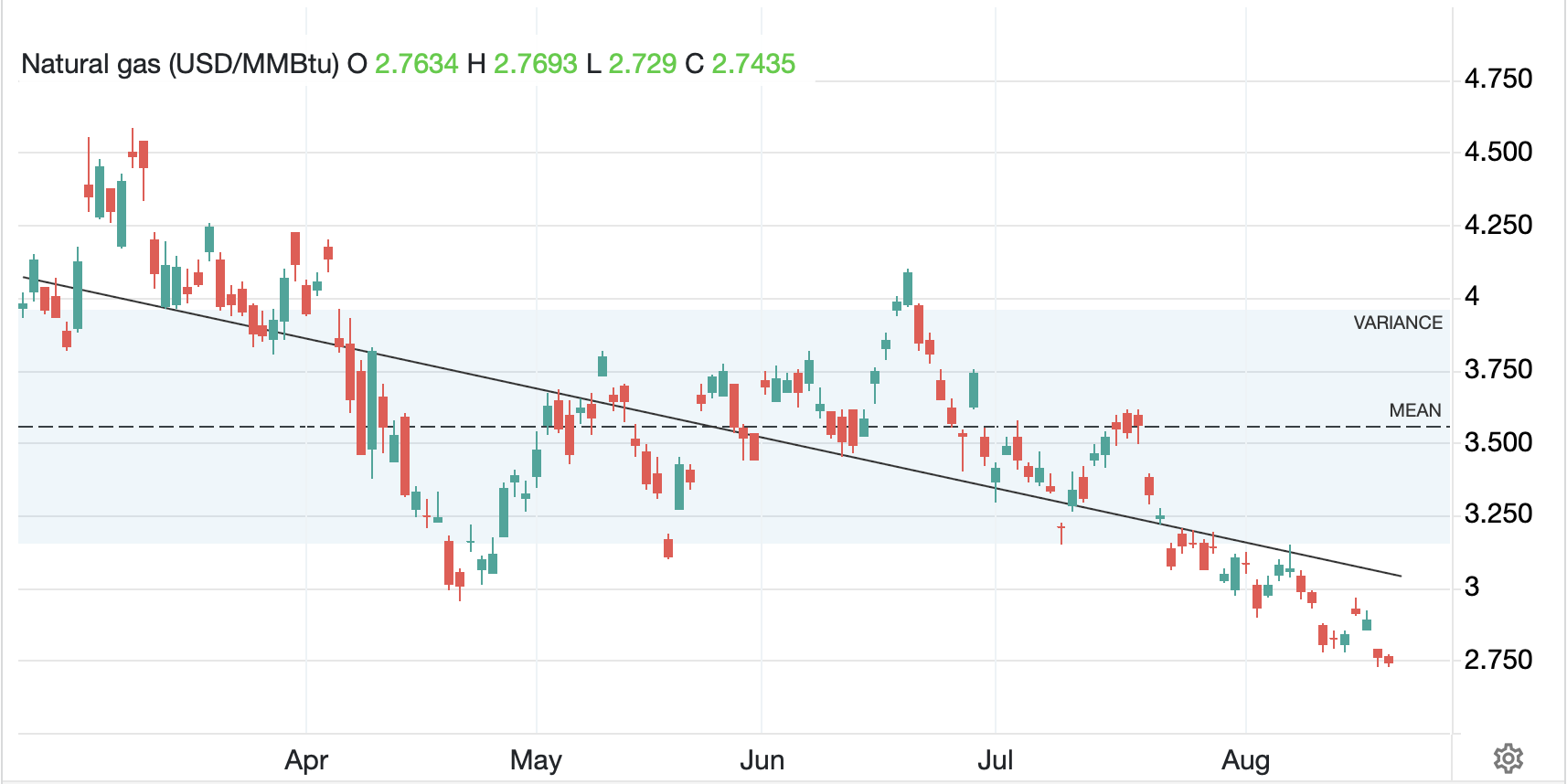
To change this trajectory, we will need to see something alter the production schedule, which with peace on the table in Ukraine seems likely to bring more oil to market not less, or we will need to see a significantly better economic outlook that drives a substantial increase in demand, something which right now seems unlikely as well.  I cannot get on board the higher oil price bandwagon at this time.  One other thing weighing on oil is the fact that NatGas has been trending lower for the past 6 months and is now at levels not seen since last November.  In fact, those two charts look remarkably similar!

Source: tradingeconomcis.com

There is a real substitution effect here and currently oil is trading at a price that is about 4X the energy price of NatGas.  Until that arbitrage closes, and it will eventually, oil will have difficulty rallying in my view. 

In the metals markets, gold (+0.4%) which sold off a few dollars yesterday is rebounding although both silver and copper are soft this morning.  These markets are just not that interesting right now.

Finally, the dollar is little changed this morning with one real outlier, NZD (-1.2%) which responded to the dovish tones of the RBNZ last night and is pricing in more interest rate cuts now.  KRW (-0.4%) also fell on concerns over trade and the semiconductor results but otherwise, there is very little ongoing here.

The only data this morning is EIA oil inventories with a small draw anticipated.  The FOMC Minutes come at 2:00 and there will be a lot of digging to see if other members seemed to agree with Bowman and Waller in their dissents at the last meeting.  Bowman spoke yesterday, but was focused on her role as chief regulator, not monetary policy, although we hear from Waller this morning.

A down day in equities is not the end of the world despite much gnashing of teeth.  It remains difficult to get excited about markets right now.  Perhaps Mr Powell will shake things up on Friday, but my sense is we will need to wait for the next NFP data to get some action.

Good luck

Adf

PS. A reader explained to me that in Australia, black swans are the norm, not the remarkable case as here in the US.  I guess we will need to find a new term to discuss an unexpected surprise.

What Would You Choose?

As summer meanders along
No market is weak, nor’s it strong
But traders keep trading
With hope masquerading
As knowledge, though they know they’re wrong
 
The question is what sort of news
Can catalyze changes in views?
Seems rate cuts will not
And peace had its shot
Dear readers, just what would you choose?


My friend JJ (he writes the Market Vibes note) made a profound comment that described the current situation so well, I think it is worth repeating: 

It is not that the news and fundamentals are uninteresting or unimportant. They are. But vol control has anesthetized every future, ETF, equity, and FX market, and the managers of it are making trillions on it. Therefore, it is likely this narcolepsy won’t end for a while.”

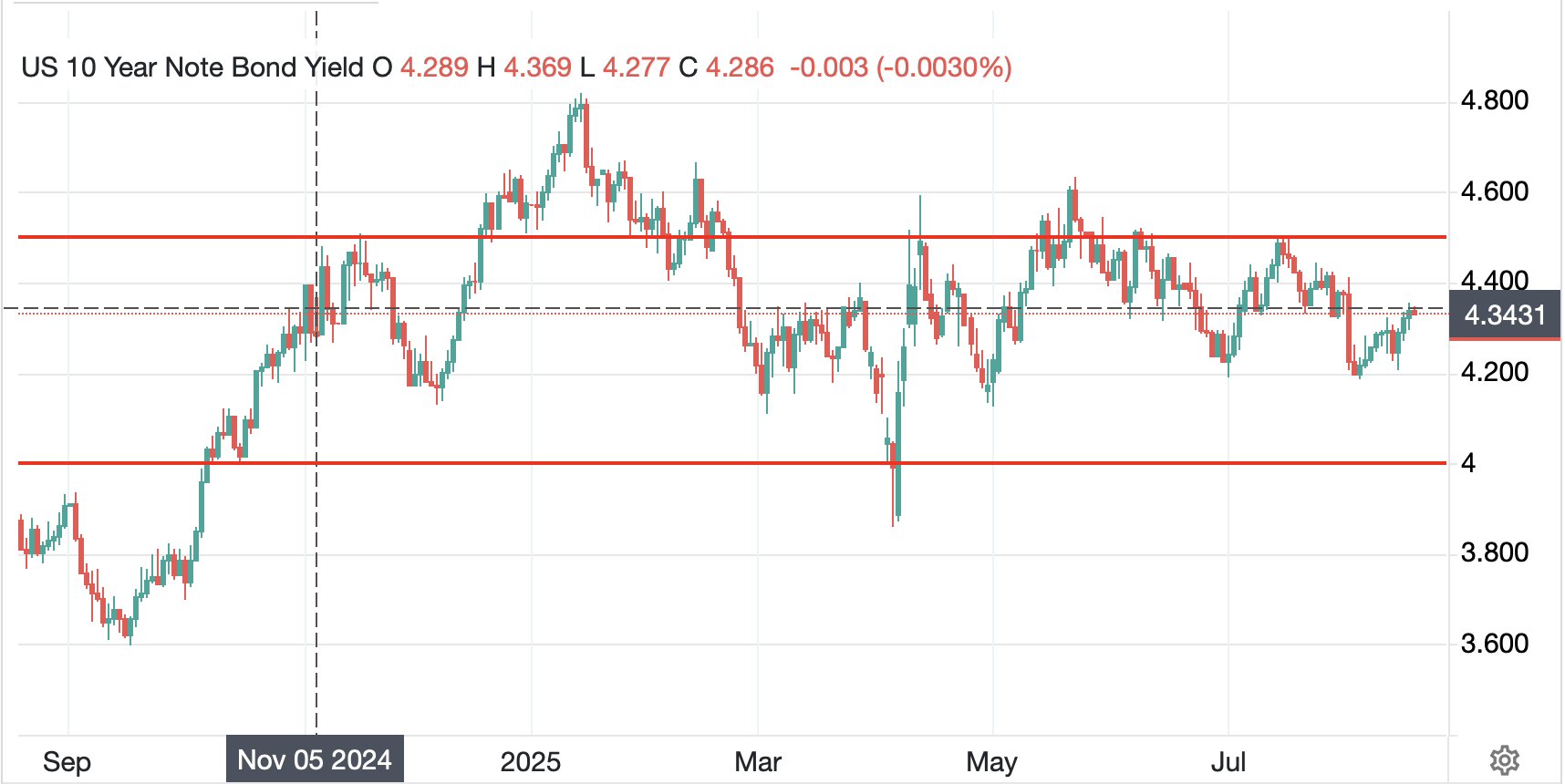
A point he has been making of late, and one with which I cannot argue, is that everything that is not algorithmic is dumb money as the algos drive it all.  And it is a fair point.  Market activity has ground to a halt, and while I have no proof, I would estimate it is even quieter than the typical year’s summer doldrums.  That seems remarkable given the panoply of news stories that exist and in other times would have had a major market impact.  Consider, war and peace in Ukraine, massive changes in federal regulations and administration priorities, and remarkable electoral shifts around the world, yet none of it matters.  Consider this chart of the US 10-year Treasury:

Source: tradingeconomics.com

The yield, which most afficionados agree is critical to not just US, but global, financial markets and activity, has largely traded between 4.0% and 4.5% since well before Mr Trump was elected.  The one thing that cannot be said is that the Trump administration has been boring.  More has happened on the fiscal front in the past six months than in entire presidential terms and yet yields are essentially unchanged since November 5th when Trump was elected.

JJ’s view is the massive increase in the use of options by retail traders has become the driving force.  Retail buys options, paying premium which decays away and that value accrues to the market making algorithms. The amounts of premium are huge, in the $trillions, and it is a straightforward business model that reaps huge rewards, so a lack of movement is the goal.  I cannot argue with that either.

However, the one thing I have learned over my too many years in the market is that no matter how smart you are, no matter how well you have considered the potential outcomes, reality will be different, and at some point, there will be a tipping point to change the market dynamic.  After all, Covid was not expected, nor even more importantly, the government responses to it which is what drove the market volatility.  I am pretty sure there is another true black swan out there, something nobody is discussing as it currently seems irrelevant or impossible, but which will alter the game.

I spent my trading career learning to manage risks while running a global FX options business, trying to profit, but more importantly preventing the huge drawdowns that end careers.  I spent my sales career trying to help my clients understand their FX risks and learn to mitigate them in the most cost-effective manner possible.  What I learned over that 40+ years is that while risks sometimes seem unimportant, or unimaginable, they exist.  Do not mistake the current state for the future state.  Things will change, although how I cannot currently imagine.

With that as preamble, let’s look at just how little things are moving.  Stocks did nothing in the US yesterday and movement overnight in Asia was lackluster as well (Nikkei -0.4%, Hang Seng -0.2%, CSI 300 -0.4%).  As I wrote above, there is just not that much that is exciting investors right now.  Europe, however, seems to be taking a positive stance on the Oval Office meeting with many of their leaders as perhaps peace in Ukraine, if it is coming, will be helpful for the continent.  Ostensibly, Presidents Trump and Putin discussed a closer economic relationship between the US and Russia, which if that came to pass, would undoubtedly rearrange some things in markets, largely to the benefit of Europe.  As to US futures, they are unchanged this morning, again.

Bond markets in Europe are exactly unchanged across the board, so much so that you would expect it was a holiday there.  Treasury yields have edged lower by -1bp, but as I explained above, are simply range trading.

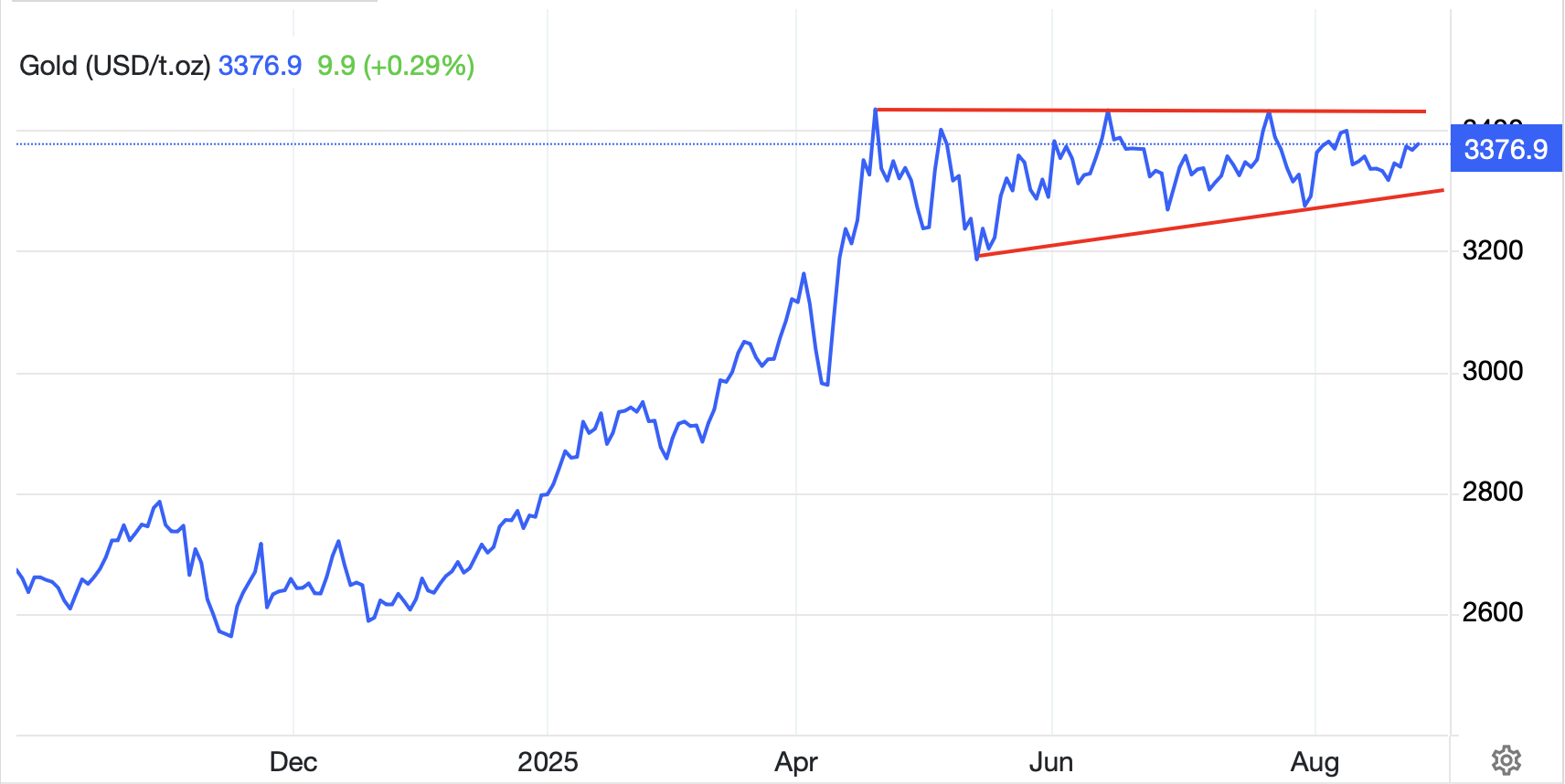
I would argue the commodity markets are where there is the most potential for movement going forward as any type of US-Russian economic détente would almost certainly reduce oil prices substantially.  And, coincidentally, WTI (-1.25%) is falling this morning as hopes for a direct meeting between Putin and Zelensky, and with it the end of the war, are increasing.  Weirdly, gold (+0.35%) is not declining on that news, despite the idea that gold represents a haven against war.  Perhaps gold represents a haven against money supply growth, which if there is an economic détente, you can be sure will increase.  As to the other metals, very little movement there either.  In the vein of the lack of activity, perhaps the below gold chart is even a better descriptor of just how little activity has been going on since spring.

Source: tradingeconomics.com

Finally, the dollar is a touch softer this morning, but it, too, remains rangebound.  While much has been made of its weakness in the first half of the year, as though that calendar period had some special significance (it doesn’t), here too, things have simply ground to a halt.  Using the dollar index (DXY) as our proxy, you can see that this market, too, has done nothing for months.

Source: tradingeconomics.com

Whether it’s G10 or EMG currencies, the movement remains desultory at best, and catatonic may be a better description.

So, let’s look at the data this week that will precede Chairman Powell’s speech Friday morning.

TodayHousing Starts1.30M
 Building Permits1.39M
WednesdayFOMC Minutes 
ThursdayInitial Claims226K
 Continuing Claims1960K
 Philly Fed6.0
 Flash Manufacturing PMI49.5
 Flash Services PMI53.7
 Existing Home Sales3.91M
 Leading Indicators-0.1%
FridayPowell Speech 

Source: tradingeconomics.com

I think it is worthwhile to consider why we look at the Leading Indicators.  The original design was that it tracked a series of indicators that historically had presaged economic activity.  Ahead of recessions, these indicators turned lower and so it seemed a pretty good fit.  However, as you can see from the below chart from conference-board.org, the creators of the index, since 2021, when the index turned lower, it has been completely out of sync with the economy’s outcome.

As I have repeatedly written, models that were created pre-Covid, and many pre-GFC, simply no longer have any relevance to today’s reality.

On the whole, the most likely outcome today, like every day lately, is limited movement in either direction.  While I am sure a black swan exists, he is currently hibernating.

Good luck

Adf

Stock-pocalypse?

Inflation is on traders’ lips
As rate cuts now lead all their scripts
But what if it’s hot
And questions the plot?
Will that lead to stock-pocalypse?
 
Meanwhile pundits keep on complaining
That everything Trump does is straining
Their efforts to force
A narrative course
And so, their impact keeps on waning


It is CPI Day and there are several different stories in play this morning.  Naturally, the first is that President Trump’s dismissal of BLS head McEntarfar calls into question the veracity of this data, which has already been questioned because of a reduction in the headcount at the BLS.  While we cannot be surprised at this line of attack by the punditry, it seems unlikely that anything really changed at the BLS in the past week, especially since there is no new head in place yet.  

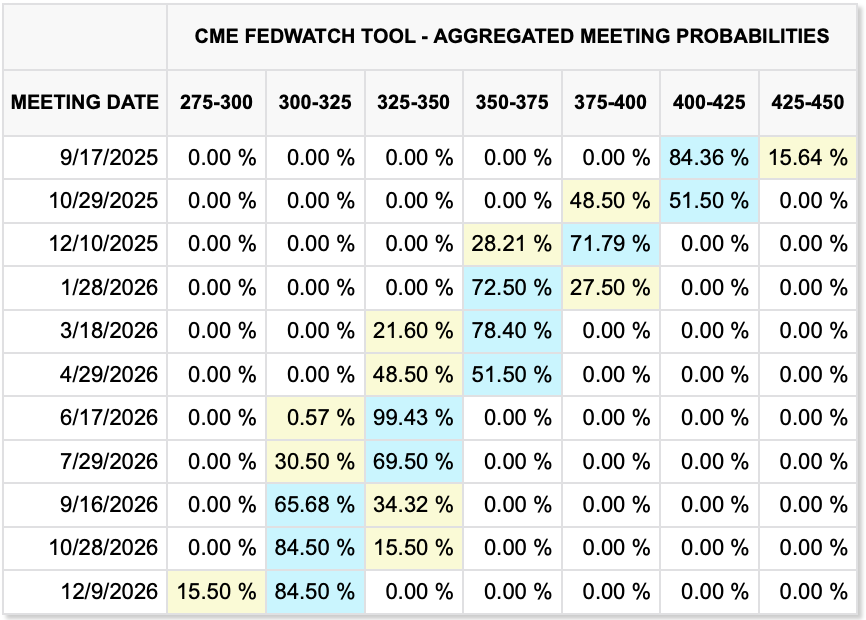
But the second question is how will this data impact the current narrative that the Fed is set to cut rates at each of the three meetings for the rest of this year?  At this hour (6:30) the probability, according to the CME futures market, of a September cut has slipped to 84.3% with a 72% probability of two cuts by year end as per the below table courtesy of cmegroup.com.

Interestingly, the market remains quite convinced that the trend in rates is much lower as there is a strong expectation of a total of 125 basis points of cuts to be implemented by the end of 2026.  I’m not sure if that is pricing in much weaker economic growth or much lower inflation, although I suspect the former given the ongoing hysteria about tariff related inflation.

To level set, here are the current median estimates for today’s release:

  • Headline: 0.2% M/M, 2.8% Y/Y
  • Core:         0.3% M/M, 3.0% Y/Y

Now, we are all well aware that the Fed uses Core PCE in their models, and that is what they seek to maintain at 2.0%.  But, historically, PCE runs somewhere between 0.3% and 0.5% below CPI, so no matter, they have not achieved their goal.  However, we continue to hear an inordinate amount of discussion and analysis as to why the latest NFP report signals that a recession is pending.  And in fairness, if one looks at indicators like the ISM employment indices, for both manufacturing and services they are at extremely low levels, 43.4 and 46.4 respectively, which have historically signaled recessions.  At the same time, concerns over inflation rising further due to tariffs and other policy changes remain front and center in the narrative.  In fact, one of the key discussion points now is the idea that the Fed will be unable to cut rates despite a weakening labor market because of rising inflation.  I’m not sure I believe that to be the case although the last time that situation arose, in the late 1970’s, Chairman Volcker raised rates to attack inflation first.  However, that doesn’t seem likely in the current environment.

Remember this, though, when it comes to the equity market, the bias remains bullish at all times.  In fact, I would suggest that most of the narratives we hear are designed with that in mind, either to attack a policy as it may undermine stocks, or to cheerlead something that is pushing them higher.  I suspect that the major reason any pundits are concerned over higher inflation is not because it is a bad outcome for the economy, but because it might delay Fed funds rate cuts which they have all concluded will lead to higher equity prices. After all, isn’t that the desired outcome for all policy?

Ok, as we await the data this morning, let’s see how things behaved overnight.  Yesterday’s lackluster US session was followed by a lot of strength in Asia.  Japan (+2.15%) led the way on a combination of stronger earnings from key companies and the news about tariff recalculations.  (remember, they were closed Monday).  China (+0.5%) and Hong Kong (+0.25%) benefitted from news that President Trump has delayed the tariff reckoning with China by 90 more days as negotiations remain ongoing.  Australia (+0.4%) was higher after the RBA cut rates 25bps, as expected, while Governor Bullard indicated further easing is appropriate going forward.  There was one major laggard in Asia, New Zealand (-1.2%) as tariffs on their exports rose to 15% and local earnings results were softer than forecast.

In Europe, the picture is mixed with Germany (-0.45%) the laggard after much weaker than expected ZEW Economic Sentiment data (34.7, down from 52.7 and below the 40.0 forecast).  As to the rest of the region, there are modest gains and losses, on the order of 0.15% or less with talk about what will come out of the Trump-Putin talks on Friday in Alaska and how that will impact the European defense situation.  As to US futures, at this hour (7:15) they are unchanged.

In the bond market, Treasury yields are unchanged this morning, remaining below 4.30% although still well below the recent peak at 4.50% in seen in mid-July.

Source: tradingeconomics.com

European sovereign yields are edging higher by 2bps across the board as investors show caution ahead of both the US CPI data as well as the uncertainty of what will come from the Trump-Putin talks.  However, UK gilts (+4bps) responded to better-than-expected payrolls data there, although the Unemployment Rate remained unchanged at 4.7%.

In the commodity markets, oil (-0.35%) is still in the middle of a narrow trading range as it seeks the next story, arguably to come from Friday’s talks, but potentially from this morning’s CPI data if it convinces people that a recession is imminent.  Metals markets are little change this morning, consolidating yesterday’s declines but not showing any bounce at all.

Finally, the dollar remains generally dull with the euro (-0.1%) unable to spark any life at all lately.  We did see AUD (-0.4%) slip after the rate cuts Down Under and in the EMG bloc, there is a bit of weakness, albeit not enough to note.  There was an amusing comment from Madame Lagarde as she tried to explain that now is the time for the euro to shine on a global reserve basis because of the perceived troubles of the dollar.  Not gonna happen, trust me.

And that’s really it for today.  Another summer day with limited activity as we all await both the data and the next story from the White House, as let’s face it, that is the source of virtually all action these days.  A soft print today ought to result in a rally in both equities and bonds while the dollar might slide a bit as the prognosis for a rate cut increases.  But a hot print will see the opposite as fear of stagflation becomes the story du jour.  Remember, too, two more Fed speakers, Barkin and Schmid, will be on the tape later this morning so watch for any dovishness there as both have been very clear that patience is their game.

Good luck

Adf

You Need to Squint

While data continues to print
It doesn’t give much of a hint
To where things are going
Unless you’re all-knowing
And even then, you need to squint
 
The reason for this situation
Is passive flows constant inflation
No matter the news
Or anyone’s views
The target funds need their proration


The hardest thing about macroeconomic analysis is trying to discern whether it has any impact on market movement.  For the bulk of my career, my observation was that while there were always periods when flows dominated fundamentals, they were short-lived periods and eventually those fundamentals returned to dominance in price action.  This was true in equity markets, where earnings were the long-term driver, outlasting short-term bouts or particular manias and this was true in FX markets, where economic performance and the ensuing interest rate differentials were the key long-term driver of exchange rates.  Bond markets were virtually always a reflection of inflation expectations, at least government bond markets and commodities were simple products of supply and demand of the physical stuff.

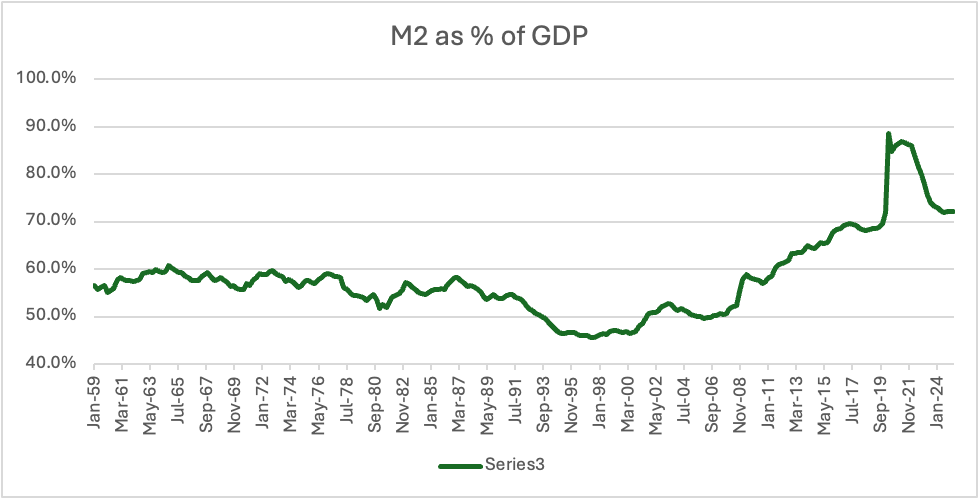
Alas, since the GFC, and more importantly, the global central bank response to the GFC, flooding financial markets with massive amounts of liquidity, G10 economies have become increasingly finanicialized to the point where the underlying fundamentals have less and less impact and funds flows are the driving force.  The below chart I have created from FRED data shows the ratio of M2 relative to GDP.  For decades, this ratio hovered between 53% and 60%, chopping back and forth with the ebbs and flows of the economy during recessions and expansions.  But the GFC changed things dramatically and then the pandemic and its ensuing response put financialization on steroids.

By 2011, this ratio hit 60% for the first time since 1965, and it has never looked back.  The result is that there is ever more money sloshing around the economy looking for a home with the best return.  This is part and parcel as to why we have seen both massive asset price inflation as well as consumer price inflation, too much money chasing too few goods.  And this is the underlying facet in why funds flows, whether between asset classes or between nations, are the new driving force of market price action.  Michael Green (@profplum99 on X) has done the most, and most impressive, work on the rise of passive investing, which is a direct consequence of this financialization.  The upshot is, as long as money comes into the system (your semi-monthly 401K flows are the largest) they continue to buy stocks regardless of anything fundamental.  And as almost all of it is capitalization weighted, they buy the Mag7 and maybe some other bits and bobs.  It doesn’t matter about fundamentals; it only matters how much they have to buy.

So, with that caveat as to why fundamental macro analysis has been doing so poorly lately, a look at the data tells us…nothing really.  As I wrote yesterday, the two main blocs of the economy, goods production and services production, are out of sync, with marginal strength in services outweighing marginal weakness in goods production and resulting in slow growth.  Whether you look at the employment situation, the ISM data or the inflation data, none of it points in a consistent and strong direction.

For instance, yesterday’s productivity and Labor cost data were better than expected, far better than last quarter’s and pointing to an improved growth outcome.  However, if we look at the past five years of this data, we can see that labor costs have grown dramatically faster than productivity as per the below chart (ULC in grey, Productivity in blue).

Source: tradingeconomics.com

Looking at this, it is no surprise that price inflation has risen so much, given labor’s impact on prices.  But, again, this is merely another impact of the massive flow of money into the economy over the past 15 years. 

Virtually every piece of data we get has been significantly impacted by this financialization which is one reason that previous econometric models, built prior to the GFC, no longer offer effective analysis.  The system is very different.  I continue to believe that over time, fundamentals will reassert themselves, but that belief structure is under increased pressure.  Perhaps YOLO and BTFD are the future, at least until our AI overlords come into their own and enslave the human population.

In the meantime, let’s look at what happened overnight.  Yesterday’s mixed, and relatively dull, US session was followed by a mixed session in Asia with Tokyo (+1.85%) soaring on news that there were going to be adjustments, in Japan’s favor as well as rebates, to the tariff schedule.  However, both the Hang Seng (-0.9%) and CSI 300 (-0.3%) saw no such love from either the Trump administration or investors.  As to the rest of the region, red (Korea, Australia, India, Thailand, Singapore) was more common than green (Malaysia).  Apparently, tariff adjustments are not universal.  In Europe, both Spain (+0.8%) and Italy (+0.8%) are having solid sessions but they are alone in that with the other major bourses (DAX 0.0%, FTSE 100 0.0%, CAC +0.2%) not taking part in the fun.  US futures, at this hour (7:30) are higher by about 0.4%.

Bond markets, meanwhile, are sleeping through the final day of the week, with Treasury yields unchanged on the day and European sovereign yields having edged higher by just 1bp across the board.  It seems, nobody cares right now.  After all, it is August and most of Europe is on vacation anyway.

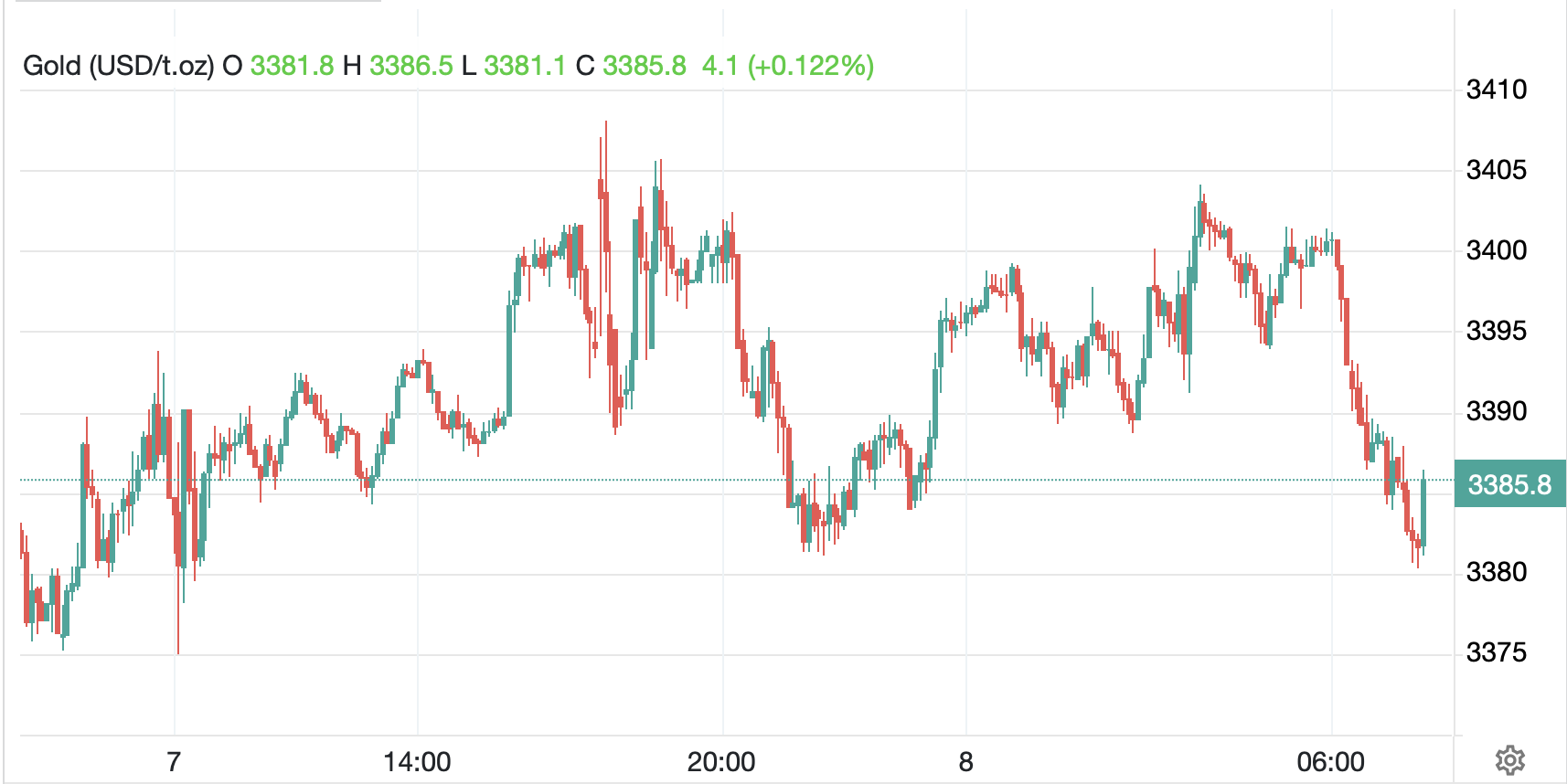
Commodity markets are showing oil (+0.6%) bouncing off its recent lows, but this seems more about trading activity than fundamental changes.  Perhaps there will be a Russia-Ukraine peace, but it is certainly not clear.  Trump’s tariffs on India for continuing to buy Russian oil are also having an impact, but as I showed yesterday, I believe the trend remains modestly lower.  Gold (-0.3%) is currently lower but has been extremely choppy as you can see from the 5-minute chart below

Source: tradingeconomics.com

This is a market where supply and demand dynamics have been impacted by both tariffs and the interplay between financialized markets (i.e. paper gold or futures) and the actual metal.  There are many theories as to different players trying to manipulate the price either higher (the Trump administration in order to revalue Ft Knox holdings) or lower (the ‘cabal’ of banks that have ostensibly been preventing the price from rising according to the gold bug conspiracy theorists).  Recently, there has apparently been less central bank demand, but that can return at any time based on political decisions.  I continue to believe that it is an important part of any portfolio, but it should be tucked away and forgotten in that vein.  As to the other metals, they are little changed this morning.

Finally, the dollar is stronger this morning, as the euro (-0.3%) and yen (-0.65%) are both under pressure and leading the way.  In fact, virtually every G10 currency is weaker (CAD is unchanged) and yet the DXY seems to be weaker as well. Something is amiss there.  Meanwhile, EMG currencies are mostly down on the session with KRW (-0.5%) the laggard, but weakness in INR (-0.2%), PLN (-0.25%) and CZK (-0.25%). 

On the data front, there is none today.  Yesterday, Atlanta Fed president Bostic explained his view that only one rate cut was likely this year, which is not what we have been hearing from other FOMC members.  Obviously, there is still uncertainty at the Fed, but they also have more than a month to decide.  Today, we hear from KC Fed president Alberto Musalem, one of the more hawkish members, so it will be interesting to see if he has changed his tune.

I would contend that confusion is the driving force in markets because data markers are not pointing in one direction nor are Fed speakers.  But it is a Friday in August so I suspect it will be a quieter day as traders look to escape to the beach for the weekend.  This morning’s trends, a higher dollar and higher stock prices, seem likely to prevail for the day.

Good luck and good weekend

Adf
A Bevy of Doves

The Fed has a bevy of doves
Whose world view was given some shoves
When Trump was elected
As they were subjected
To boxing, though without the gloves
 
But suddenly, they’ve found their voice
And rate cuts are now a real choice
So, bad news is good
And traders all should
Buy stocks every day and rejoice


Apparently, the signal has been given from on high at the Marriner Eccles building that discussing rate cuts is permitted.  Patience is no longer the virtue it was just last week.  In the past two days, three different FOMC members, Daly, Cook and Goolsbee, have returned to form and are quite open to cutting rates sooner after the recent employment data.  I would contend that rate cuts are their natural stance, but they were discouraged from expressing that view because it would put them in sync with the president, something that they very clearly have worked to avoid.  Regardless of the history, the Fed funds futures market is now pricing in a 93.2% probability of a cut next month as you can see below.  Perhaps more interesting is the fact this probability has risen from 37.7% in just the past week.  My how quickly things can change.

Source: cmegroup.com

I’m sure you recall that one of the key reasons Chairman Powell and his acolytes described the need to remain patient was the potential impact of tariffs on inflation.  This was even though the universal view was tariffs, a new tax, would be a one-off price increase, so would have no long-term impact, and that higher interest rates would do nothing to fight this particular cause of inflation, just like the price of food doesn’t respond to interest rates.  However, I want to highlight a piece from the WSJ this morning that asks a very good question, why wasn’t Powell concerned about all the tax increases from the previous administration, or for that matter, the tax increase that would have occurred had the BBB not been enacted.  Again, all the discussion that the Fed is apolitical is simply not true and never has been.

Moving on, I wanted to follow up on yesterday’s discussion as I, along with many market observers, have been trying to come to grips with the inconsistency in the data.  Some is strong, other parts are weak, and it is difficult to arrive at a broad conclusion.  My good friend, the Inflation_Guy™ put out a podcast the other day and made an excellent point, historically, there was a synchronicity between activity in the goods sector and the services sector, so when things in either sector started to decline (or rise) it took the other sector along with it.  But that is not currently the case.  

Instead, what we have seen is asynchronous behavior with the correlation between prices in the two sectors essentially independent of each other over the past five years, rather than tracking each other as they had done for the previous 30 years.  Extending the price action to overall activity, which seems a reasonable concept as prices follow the activity, depending on the data you observe, you may see strength or weakness, rather than everything heading in the same direction.  However, it is worthwhile to remember that systems in nature eventually do synchronize (see this fantastic clip) and so eventually, I suspect that both sectors will do so and a full blown recession (or expansion) will materialize.  Just not this week!

Which takes us to markets and how they have been responding to all the tariff news.  I think you can make one of the following two arguments regarding equity investors; either they have absorbed the tariff information and ensuing changes in trade behavior and have decided that earnings will continue to grow apace, or, they have no idea that there is a cliff ahead and like the lemmings they are, they are rushing toward the abyss.  Perhaps it is simply that President Trump has discussed tariffs so much that they have become the norm in any analysis thought process, and so modest adjustments don’t matter.  But whatever the reason, we continue to see strength pretty much across the board here.

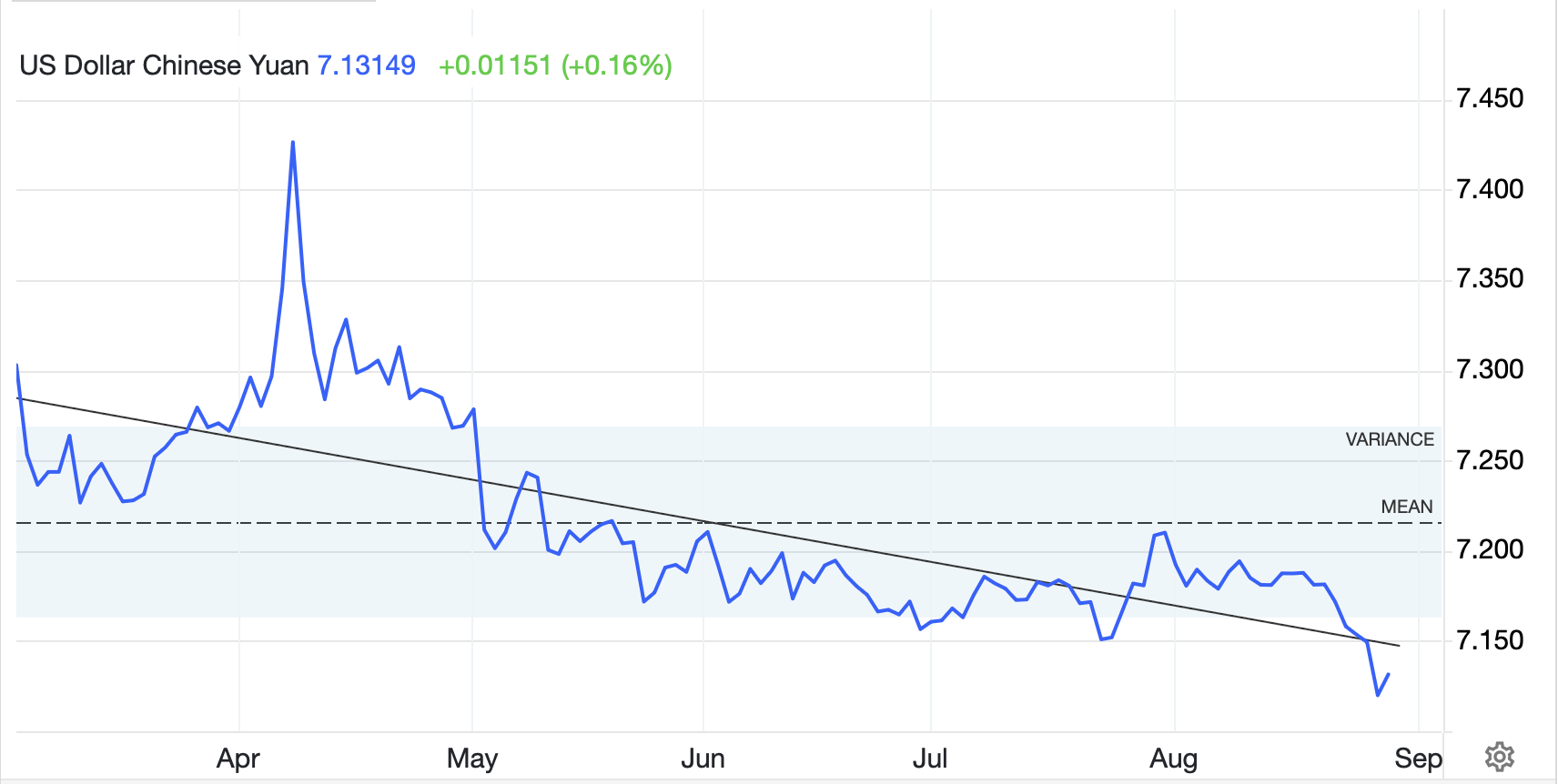
The rally in the US yesterday was followed by strength across almost all of Asia with gains in Tokyo (+0.7%) and Hong Kong (+0.7%) as well as Korea, India and almost all regional bourses.  China, however, was unchanged on the session after their trade balance rose a less than expected $98.2B, as imports rose more than expected.  However, as this X post makes clear, it should be no surprise given the renminbi’s real exchange rate continues to fall, hence their exports remain quite competitive, tariffs or not.  As to Europe, strength is the word here as well (DAX +1.5%, CAC +1.2%, IBEX +0.5%) although the FTSE 100 (-0.5%) is lagging ahead of this morning’s expected BOE rate cut.  And don’t worry, US futures are higher across the board as well.

In the bond market, yields have been edging higher with Treasury yields up 2bps after yesterday’s 10-year auction was not as well received as had been hoped, but then, yields were 25 basis points lower than just a week ago, so demand was a little bit tepid.  European sovereign yields are also edging higher, mostly higher by 1bp and we saw the same thing overnight in JGBs, a 2bp rise.

In the commodity markets, oil (+0.6%) has found a short-term bottom, but is just below $65/bbl, which seems like a trading pivot of late as can be seen by the chart below from tradingeconomics.com.  As my personal bias is that the price is likely to decline going forward, the 6-month trend line heading down does appeal to me, but for now, choppy is the future.

Meanwhile, metals markets are in fine fettle this morning (Au +0.4%, Ag +1.4%, Cu +0.15%) as the dollar’s recent weakness seems to be having the expected effect on this segment of the market.

Speaking of the dollar, as more tariffs get agreed, I am confused by its weakness since I was assured that the response to higher US tariffs would be a stronger dollar.  But arguably, the fact that the Fed is suddenly appearing much more dovish is the driver right now, and while the euro is little changed this morning, we are seeing the pound (+0.4%), Aussie (+0.3%) and Kiwi (+0.4%) all move up, although the rest of the G10 space is higher by scant basis points.  In the EMG bloc, movement, while mostly higher in these currencies, is also measured in mere basis points, with INR (+0.25%) the largest mover by far.  Arguably, it is fair to say the dollar is little changed.

On the data front, the BOE did cut rates 25bps as expected, although the vote was 5/4, a bit more hawkish than forecast which is arguably why the pound is holding up so well.  US data brings Initial (exp 221K) and Continuing (1950K) Claims as well as Nonfarm Productivity (2.0%) and Unit Labor Costs (1.5%).  This is a much better mix of this data than what we saw in Q1 with productivity falling -1.5% while ULC rose 6.6%.  That was a stagflationary outcome.  In addition, we hear from two more Fed speakers, Bostic and Musalem, as the Fed gets back in gear this week.  It will be interesting to see if they are more dovish as neither would be considered a dove ex ante.

Apparently, we are back on board the bad news is good for stocks train, and it is hard to fight absent a collapse in earnings or some other catalyst.  As such, with visions of Fed cuts dancing in traders’ heads, I suspect the dollar will remain under pressure for a while.

Good luck

Adf

Bears’ Chagrin

The talk of the town is the Fed
And who Mr Trump will embed
As governor, next
Amid a subtext
That Powell, by May, will have fled
 
Meanwhile, other stories are muted
As tariffs’ impact seem diluted
And earnings have been,
To most bears’ chagrin,
Much better than had been reputed


Yesterday was a modest down day in equities, although the trend remains clearly higher at this point as evidenced by the chart below.  As well, the price action remains well above the 50-day moving average, a key technical indicator defining the trend, with no indication it is set to retrace there.  As of this morning, we are sitting about 2.5% above that average, so a decline of that magnitude will be necessary to get tongues wagging about a change.

Source: tradingeconomics.com

This is not to say that everyone is sanguine about the situation as just yesterday, three investment banks, Morgan Stanley, ISI Evercore and Deutsche Bank, all put out research calling for a retracement in the near term.  Certainly, the recent data has been mixed, at best, with still a lot of discussion regarding last Friday’s weak NFP data.  Meanwhile, the ISM Services data was weak (50.1 vs 51.5 expected), while the PMI Services was strong (55.7 vs 55.2 expected).  

Corporate earnings continue to be solid, with about two-thirds of the S&P 500 having reported Q2 numbers and 82% have beaten EPS estimates, higher than the recent 5-year average, and the growth rate at 10.3% on a quarterly basis.  This does not seem indicative of the recession that many continue to claim is ongoing or imminent.

But let us take this time to briefly consider both sides of the argument regarding the future of the economy, and by extension financial market activity.

On the plus side, while the NFP number was soft, the Unemployment rate remains at 4.2%, in the lowest quintile since 1948 as per the below chart.  

As well, Initial Claims data, the most frequent labor market data that is available, remains at the 13thpercentile, an indication that despite a great deal of concern by a certain segment of analysts, the labor market is still pretty strong.  In fact, the last time Initial Claims was this low during a recession, in 1970, the US population was about 205 million compared to today’s 340 million.  After all, this has been the issue on which Powell has been hanging his hat, and why Friday’s NFP number changed the narrative regarding the Fed.

The most recent GDP data was also quite positive, with Q2 growing at 3.0%, better than expected and then yesterday we saw the Trade deficit shrink to -$60.2B, its smallest level since September 2023.  Trade, though, is a double-edged sword as a smaller deficit could indicate weaker domestic demand, or it could indicate stronger domestic supply.  Naturally, this is the president’s goal, to achieve the latter, hence his tariff blitz.

As to inflation, it is off its recent lows, and remains well above the Fed’s 2.0% target, but with core CPI at 3.0%, it is hardly hyperinflationary.  The tariff impact remains uncertain at this point as so far, it appears many companies are eating a significant portion.  I guess that will become clearer in the Q3 earnings reports, although analysts continue to forecast strong growth there.  

So, across jobs, growth and inflation, there is a case to be made that things are doing fine.  Add to this the idea that fiscal stimulus is unlikely to end, merely be redirected from the previous administration’s favorites to this one’s, and you can understand the view that things are pretty good.

However, the other side of the story continues to have many adherents as well.  Most of the negative outlook comes from digging underneath the headline numbers and extrapolating out to the negative trends that may exist there blooming into the full story.

For instance, regarding employment data, while the headlines have been ok, ISM Manufacturing Employment has fallen to 43.4, its lowest level in more than 5 years and pretty clearly trending lower, even on a cyclical basis as per the below chart.

Source: tradingeconomics.com

Too, ISM Services employment has fallen to 46.4 (anything under 50.0 indicates recession-type weakness). NFIB Employment surveys are negative, with small businesses planning to create fewer jobs in the next three months as per the below chart from the NFIB July report.

Challenger job cuts are rising again, with much of the blame put on AI.  JOLTS Job Openings have been trending lower since Covid, but it is difficult to really tell there, as the levels are far above pre-Covid data as per the below BLS chart.

There is also a hue and cry that the deportations are removing a significant number of manual workers in fields like construction and agriculture, which is likely true.  However, as I highlighted earlier in the week, the mix of employed in the US has turned to a greater proportion of US-born workers vs. foreign-born workers with net growth.  So, perhaps many of those jobs are being filled anyway.

From a GDP perspective, the economic bears tend to dig into the pieces and have focused on declining consumption data although Retail Sales continues to motor along pretty well, rising 5.3% in the past twelve months when looking at the control group (excluding food services, auto dealers, building materials and gas stations) which is what is used in the GDP data.  I am hard-pressed to look at the below chart and explain a dramatic slowing in growth.

Source: tradingeconomics.com

As to inflation, there continues to be a strong set of beliefs that tariffs are going to create a significant uptick, although it has yet to appear.  ISM Prices paid did rise in Services, to 69.9, their highest level since the retreat from the 2022 “transitory inflation”.

Source: tradingeconomics.com

However, ISM Manufacturing prices appear to be stabilizing after some recent increases.  The overall ISM price data is more worrisome as tariffs are only going to be on goods, and if services prices are rising, that is likely to feed through to general inflation more directly.  

Concluding, we seem to be an awful long way from stagflation that some analysts are calling for as growth continues apace and there is no indication that fiscal stimulus is going to end.  Rather, I would expect that we will see overall hotter growth, with higher prices coming alongside, and likely higher wages as well.  I still have trouble seeing the collapsing US economy story, although things are hardly perfect.

And how will this impact markets?  Well, broadly, while equities have clearly had an impressive run, and the trend is your friend, a pullback would not be a huge surprise.  But dip buyers will be active, of that you can be sure.  

As to bonds, if the US does run things hot, unless the budget deficit starts to shrink substantially, with the next release coming on August 12, yields are very likely to continue to remain bid.  Right now, the curve is steepening because traders are banking on the Fed to cut next month so the 2yr yield has fallen sharply.  But if growth remains strong, I would say there is a floor to yields although absent a significant rise in inflation, I don’t see them exploding higher either.  And if the BBB actually does generate more revenue and reduce the budget deficit, look for yields to decline anyway.  

Finally, the dollar should do well unless the Fed become aggressive.  That story is too difficult to forecast given the machinations on the board and the questions of who the next Fed chair will be.  As I have written before, in the short and medium term, a dollar decline is quite viable, but long term, most other nations have much bigger problems than the US, and I think investment will ultimately flow in this direction.

My apologies for the length of the opening and given the fact that there is so little happening in markets, with just a little back and forth, I will skip the recap.

Good luck

Adf

Full Schmooze

The temperature’s starting to fall
With Israel and Iran’s brawl
On hold for the moment
Though either could foment
Resumption, and break protocol
 
But that truce combined with the news
That Trump’s team are pushing full schmooze
On trade, has the markets
Increasing their bull bets
While skeptics are singing the blues


President Trump is having a pretty remarkable week.  The successful attack and destruction of Iran’s nuclear enrichment facilities combined with the news that the US and China have agreed the details of the trade framework that was outlined in Geneva and followed up in London has market participants feeling a lot better about the world this morning.  Add to that the news that a particularly onerous part of the BBB, Section 899, which was nicknamed the Revenge clause for its tax targeting anybody from nations that imposed excess taxes on US companies internationally, being stripped after negotiations with European leaders, and the fact that NATO has gone all-in on increasing their spending, and Mr Trump must be feeling pretty good this morning.  Certainly, most markets are feeling that, except those that thrive on chaos and fear, like precious metals.

In fact, this morning it seems that the entire discussion is a rehash of what has occurred all week with very little new added to the mix.  Data from the US yesterday was mixed, with Claims a bit softer and Durable Goods quite strong while the third look at Q1 GDP was revised lower on more trade data showing imports were greater than first measured while Consumer Spending and Final Sales were a bit weaker than expected.  Net, there was not enough to push a view of either substantial strength or weakness in the economy, so investors and their algorithms continue to buy shares.

The other story that continues to get airplay is the pressure on Chairman Powell and questions about whether at the July meeting Fed governors are going to vote against the Chairman.  Apparently, it has been 32 years since that has occurred (and you thought they were actual votes!) and the punditry is ascribing the dissent to politics, not economics.  It should, of course, be no surprise that there is a political angle as there is a political angle to every story these days, but the press is particularly keen to point out that the two most vocal Fed governors discussing rate cuts were appointed by Trump.

However, despite all the talk, the futures market does not appear to have adjusted its opinion all that much as evidenced by the CME chart of probabilities below.  In fact, over the past month, the probability of a cut has declined slightly.  Rather, I would contend that on a slow news Friday, the punditry is looking for a story to get clicks.

The last story of note is about the dollar and its ongoing weakness.  This is an extension of the Fed story as there is alleged concern that if the Fed is perceived to lose some of its independence, that will be a negative for the dollar in its own right, as well as the fact that the loss of independence would be confirmed by a rate cut when one is not necessary (sort of like last autumn prior to the election.  Interestingly, I don’t recall much discussion about the Fed’s loss of independence then.)

But, in fairness, the dollar has continued to decline with the euro trading to its highest level, above 1.17, in nearly four years.  It is hard to look at the story in Europe and think, damn, what a place to invest with high energy costs and massive regulatory impediments, so it is reasonable to accept that what had been a very long dollar position is getting unwound.  But look at the next two charts (source: tradingeconomics.com) of the euro, showing price action for one year and for five years, and more importantly notice the trend lines that the system has drawn.  There is no doubt the dollar is under pressure right now, but I am not in the camp that believes this is the beginning of the end of the dollar’s global status.  Remember, too, that President Trump would like to see the dollar soften to help the export competitiveness of the US, and so I would not expect to hear anything from the Treasury on the matter.

However, while these medium and long-term trends are clear, the overnight session was far less exciting with the largest move in any major currency the ZAR (+0.5%) which is despite the decline in gold and platinum prices.  Otherwise, today’s movement is basically +/- 0.2% across both G10 and EMG currencies.

Speaking of the metals, though, they are taking it on the chin this morning as we approach month end and futures roll action.  Gold (-1.3%), silver (-1.7%), copper (-0.9%) and platinum (-4.4%) are all under pressure, although all remain significantly higher YTD.  However, to the extent that they represent a haven and the fact that havens seem a little less necessary this morning seems to be the narrative driver adding to the month end positioning.  Meanwhile, oil (+0.5%) continues to bounce ever so slowly off the lows seen immediately in the wake of the bombing attacks.

Circling back to equity markets, after a nice day in the US yesterday, with gains across the board approaching 1% and the S&P 500 pushing to within points of a new all-time high, Japan (+1.4%) followed suit as did much of the region (India, Taiwan, New Zealand, Indonesia) but China (-0.6%) and Hong Kong (-0.2%) didn’t play along.  Europe, though, is having a positive session with gains ranging from 0.65% (DAX) to 1.3% (CAC) and everything in between.  It seems that the NATO spending news continues to support European arms manufacturers and the cooling of tensions in the Middle East has lessened energy concerns.  US futures are also bright this morning, up about 0.5% at this hour (7:40).

Finally, bond markets are selling off slightly after a further rally yesterday and yields since the close have risen basically 3bps in both Treasury and European sovereign markets.  There is still no indication that any government is going to stop spending, rather more increases are on the horizon, but there is also no indication that central banks are going to stop supporting this action.  No central bank is going to allow their nation’s bond market to become unglued, regardless of the theories of what they can do and what they control.  Ultimately, they control the entire yield curve.

On the data front, this morning brings Personal Income (exp 0.3%), Personal Spending (0.1%) the PCE data (Core 0.1%, 2.6% Y/Y; Headline 0.1%, 2.3% Y/Y) and at 10:00 Michigan Consumer Sentiment (60.5) and Inflation Expectations (1yr 5.1%, 5yr 4.1%).  There are several more Fed speakers, including Governor Cook, a Biden appointee who is a very clear dove, but has not yet agreed that rate cuts make sense.  It will be interesting to see what she has to say.

It is a summer Friday toward the end of the month.  Unless the data is dramatically different than forecast, I expect that the dollar will continue to slide slowly for now, although I do expect the metals complex to find a bottom and turn.  As to equities, apparently there is no reason not to buy them!

Good luck and good weekend

Adf
Not Yet Foregone

The US has not yet been drawn
To war, though it’s not yet foregone
That won’t be the case
While Persians now brace
For busters of bunkers at dawn
 
But until such time as we learn
That outcome, the current concern
Is Jay and the Fed
And what will be said
At two o’clock when they adjourn


So, every top headline this morning discusses the idea that President Trump is considering whether to initiate US military action in Iran, specifically to drop the so-called bunker buster bombs to destroy Iran’s nuclear enrichment and bomb-making facilities.  There is certainly a lively discussion on both sides of the argument with the best description of the problem that I’ve seen being a poll showing that 74% approve Trump’s position that Iran must not get nuclear weapons, but 60% oppose US involvement in the war.  I’m glad I don’t have to thread that needle!

Obviously, there are market implications if the US does get involved but given the complete lack of clarity on the situation at this point, I do not believe I can add much to the discussion.  The only thing I will say is that the longer-term trends for both oil (lower) and metals (higher) are still intact, but we are likely to see some significant volatility along the way.

Which takes us to the next most important market discussion, the FOMC meeting that ends today and the potential market impacts.  It is universally assumed that there will be no policy change at the meeting, either interest rates or QT, which means that now the punditry is focused on the arcana of Fed policy.  As this is a quarter end meeting, the Fed will release its latest SEP (summary of economic projections) and dot plot, and with nothing else to discuss until the war in Iran either ends or intensifies, those are the key discussion points in the market.  

I have long maintained that one of the greatest blunders of the Bernanke era was the institution of forward guidance.  While it may have served its purpose initially, it has now become a major distraction.  Far too much attention is paid to the dot plot, where if one member adjusts their view by 25bps, it can impact markets which have built algorithms to respond to the median outcome.

Below is the March dot plot which showed a median “expectation” of Fed funds for the end of 2025 at 3.875%, or 50 basis points lower than the current level.  However, if two more FOMC members (out of 17) thought there was only going to be one cut, that would have shifted the median “expectation” as well as the narrative.

As such, the importance of the dot plot feels overstated compared to its actual value.  After all, no FOMC member has an impressive track record with respect to their analysis of the economy and its future outcomes, let alone what the appropriate rate structure should be at any given time.  In fact, nobody has that, which is the argument for restricting the Fed’s duties to be lender of last resort and allow markets to determine the proper level of interest rates based on the supply and demand of money.  But this is the world in which we live.  My one observation is that the post GFC era has greatly distorted views on the economy and appropriate monetary policy.  It is hard not to look at the below history of Fed funds and see the anomaly that occurred during the initial QE phase.  

Concluding, regardless of my, or anyone not on the FOMC’s, views on appropriate policy, it doesn’t matter one whit.  They are going to do what they deem appropriate, and while I don’t doubt their sincerity, I do doubt they have the tools for the mission.  Perhaps the most interesting thing that could come from this meeting is further information on their assessment of the current Fed process, including their communication policy.  I remain strongly in favor of them all shutting up and letting markets do their job although that seems unlikely.  But perhaps they will get rid of the dots which seem to have outlived any value they may have had initially.

Before we go to markets, I have to highlight one other market discussion this morning with Bloomberg publishing two different articles, here and here,  on the end of the dollar’s hegemony.  The first highlights a speech by PBOC governor Pan Gongsheng and his vision of a multicurrency world which, of course, includes the renminbi as a major part of the process.  I will believe that is a possibility as soon as China opens its capital accounts completely and allows flows into and out of the country with no restrictions.  (I’m not holding my breath.)  The second takes the Michael Bloomberg Trump hatred in the direction of the president is destroying the dollar’s reign because of his policies and to highlight the dollar has fallen 10% already this year!  But let us look at a long-term chart of the dollar, using the DXY as a proxy, and you tell me if you can see the recent move as being outsized in any sense of the word.  In fact, the dollar’s recent price action is indistinguishable from anywhere in its history, and it is not anywhere near to its historic lows.  In fact, it is just a few percent below its long-term average.

Ok, now let’s look at markets.  Yesterday’s selloff in equities seemed to be based on concerns over the escalation in Iran, but as that drags out, traders don’t know what to do.  They are certainly not pushing things much further.  In fact, overnight saw the Nikkei (+0.9%) have a solid gain although HK (-1.1%) followed the US lower.  Elsewhere in the region, South Korea and Taiwan performed well, while India and Indonesia lagged and the rest were +/-20bps or less.  Europe, though, is softer this morning with declines on the order of -0.4% on the continent across the board.  I think investors here are also waiting on the potential events in Iran.  But US futures are actually pointing slightly higher at this hour (7:30).

In the bond market, yields around the world are slipping with Treasuries falling -2bps and most of Europe seeing declines between -1bp and -3bps.  This is after a few basis point decline yesterday as well.  I guess the fear of too much US debt is in abeyance this morning.

In commodity markets, oil, which rallied sharply yesterday on fears of the US entering the war, is little changed on the day after that climb as while there has been lots of talk, oil continues to flow through the Strait of Hormuz, and everybody is pumping nonstop to take advantage of the current relatively high prices.  Gold is unchanged although the other metals (Ag +0.25%, Cu +0.7%, Pt +2.4%) continue to see significant support.  In fact, platinum this morning has broken above the top of an 11-year range and many now see an opportunity for a significant rally from here.

Finally, the dollar is somewhat softer this morning, slipping about 0.2% against the pound, euro and yen, with similar declines against most other currencies.  The exceptions to this are the KRW (+0.45%) which seems to be benefitting from a growing hope that a trade deal will be completed between the US and Korea shortly, and ZAR (-0.5%) as CPI data release there this morning shows inflation under control and no reason for SARB to consider tightening policy further.

On the data front, because of tomorrow’s Juneteenth holiday, we see Initial (exp 245K) and Continuing (1940K) Claims as well as Housing Starts (1.36M) and Building Permits (1.43M).  And of course, at 2:00 it’s the Fed.  My sense is absent a US escalation in Iran, it will be quiet until the Fed, and probably thereafter as well given the lack of reason for any policy changes.  After all, there is no certainty as to either war or trade policy right now, so why would they do anything.

If I had to opine, I would say the dollar is likely to decline over the next year, but that in the longer run, it will be firmer than today.  

Good luck

Adf