Tariff Redux

While many have called for stagflation
The ‘stag’ story’s lost its foundation
Q2 turned out great
With growth, three point eight
While ‘flation showed some dissipation
 
Meanwhile, Mr Trump’s on a roll
As he strives to still reach his goal
It’s tariff redux
On drugs and on trucks
While ‘conomists tally the toll


Analysts worldwide have decried President Trump’s policies as setting up to lead the US to stagflation with the result being the dollar would ultimately lose its status as the world’s reserve currency while the economy’s growth fades and prices rise.  “Everyone” knew that tariffs were the enemy of sane fiscal and trade policy and would slow growth leading to higher unemployment and inflation while the Fed would be forced to choose which issue to address.  In fact, when Q1 GDP was released at -05%, there was virtual glee from the analyst community as they were preening over how prescient they were.

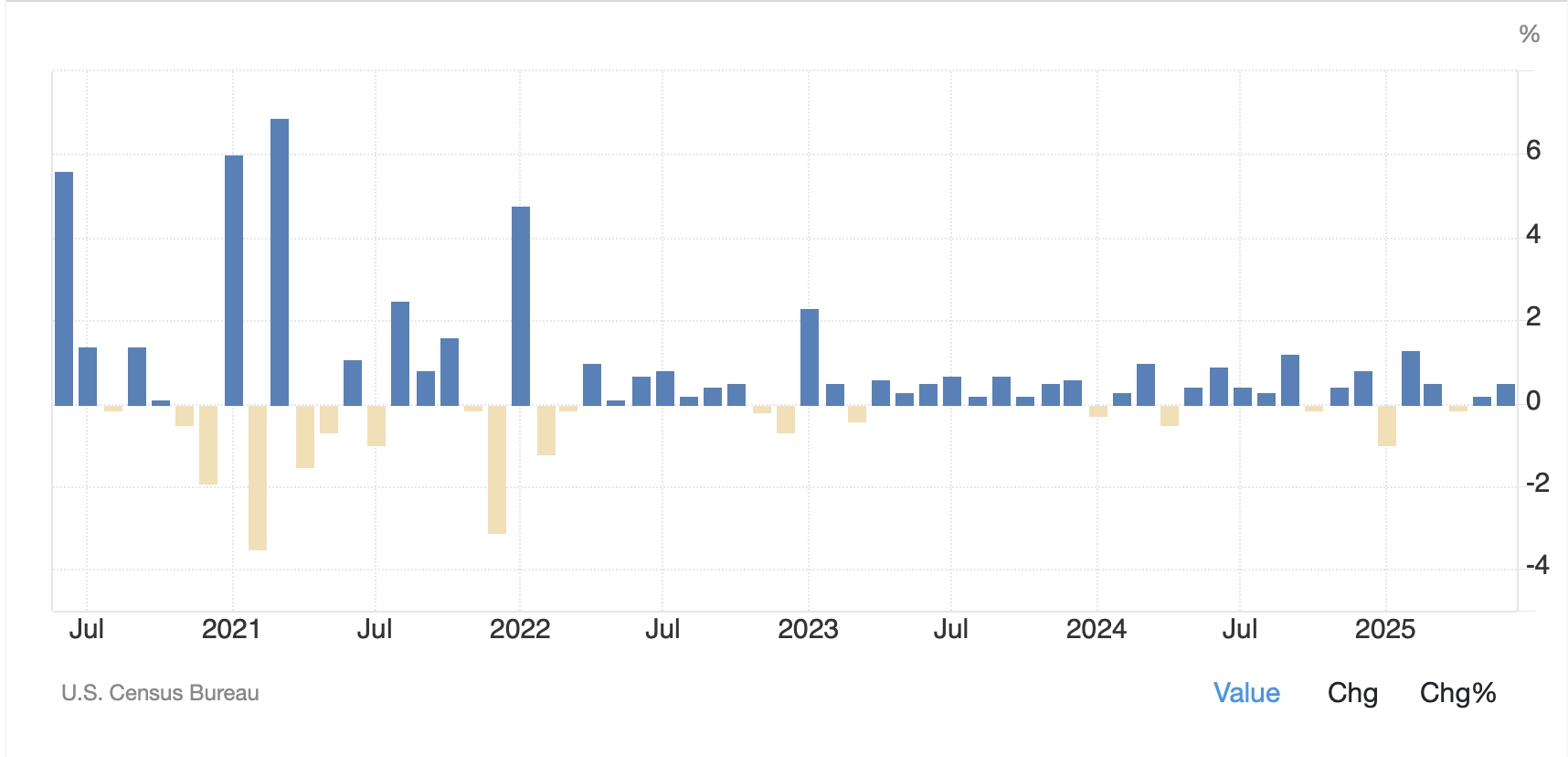
But yesterday, we learned that things may not be as bad as widely hoped proclaimed by the analyst community after all.  Q2 GDP was revised up to +3.8% annualized growth, substantially higher than even the first estimate of 3.0% back in July.  Not only that, Durable Goods Orders rose 2.9% with the ex-Transport piece rising 0.4% while the BEA’s inflation calculations, also confusingly called PCE rose 2.1%.  Initial Claims rose only 218K, well below estimates and indicative that the labor market, while not hot, is not collapsing.  Finally, the Goods Trade Balance deficit was a less than expected -$85.5B, certainly not great, but moving in President Trump’s preferred direction.

In truth, that was a pretty strong set of economic data, better than expectations across the entire set of releases, and clearly not helping those trying to write the stagflation narrative.  Now, Trump is never one to sit around and so promptly imposed new tariffs on medicines, heavy trucks and kitchen cabinets to try to bring the manufacture of those items back into the US.  Whatever your opinion of Trump, you must admit he is consistent in seeking to achieve his goal of returning manufacturing prowess to the US.

Meanwhile, down in Atlanta, their GDPNow Q3 estimate is currently at 3.3%, certainly not indicating a slowing economy.  
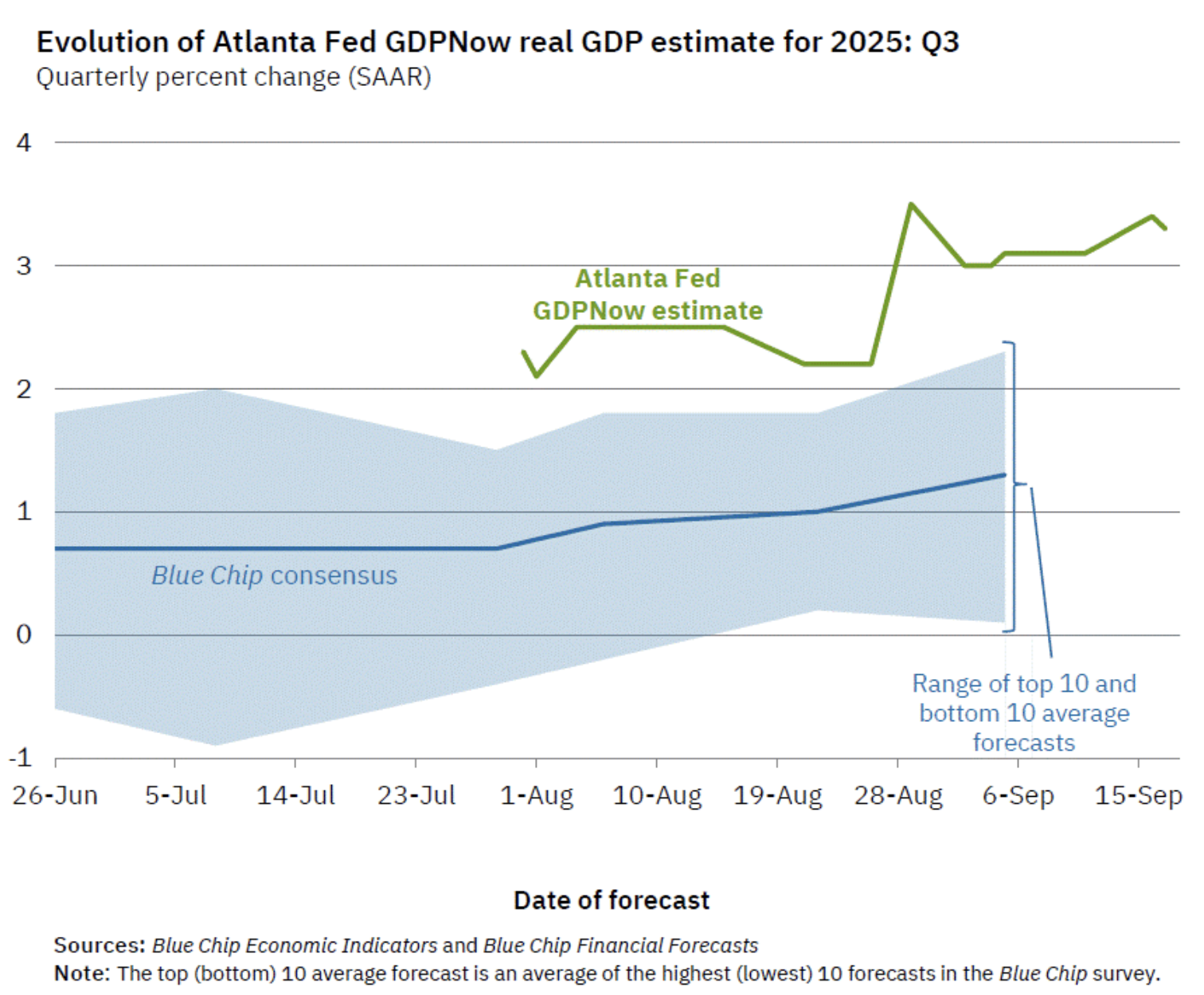
In fact, if that pans out, it would be only the 14th time this century that there were two consecutive quarters of GDP growth of at least 3.3%, of which 4 of those were in the recovery from the Covid shutdown.

It would be very easy to make the case that the US economy seems to be doing pretty well, at least based on the data releases.  I recognize that there is a great deal of angst about, and I have highlighted the asynchronous nature of the economy lately, but what this is telling me is that things may be syncing up in a positive manner.

So, what does this mean for markets?  Perhaps the first place to look is the Fed funds futures market as so much stock continues to be put into the Fed’s next move.  Not surprisingly, earlier exuberance over further rate cuts has faded a bit, with the probability of an October cut slipping to 85%, down about 10 points in the wake of the data, and a total of less than 40bps now priced in for the rest of the year.  Recall, it was not that long ago that people were considering 100bps in the last three meetings of the year.
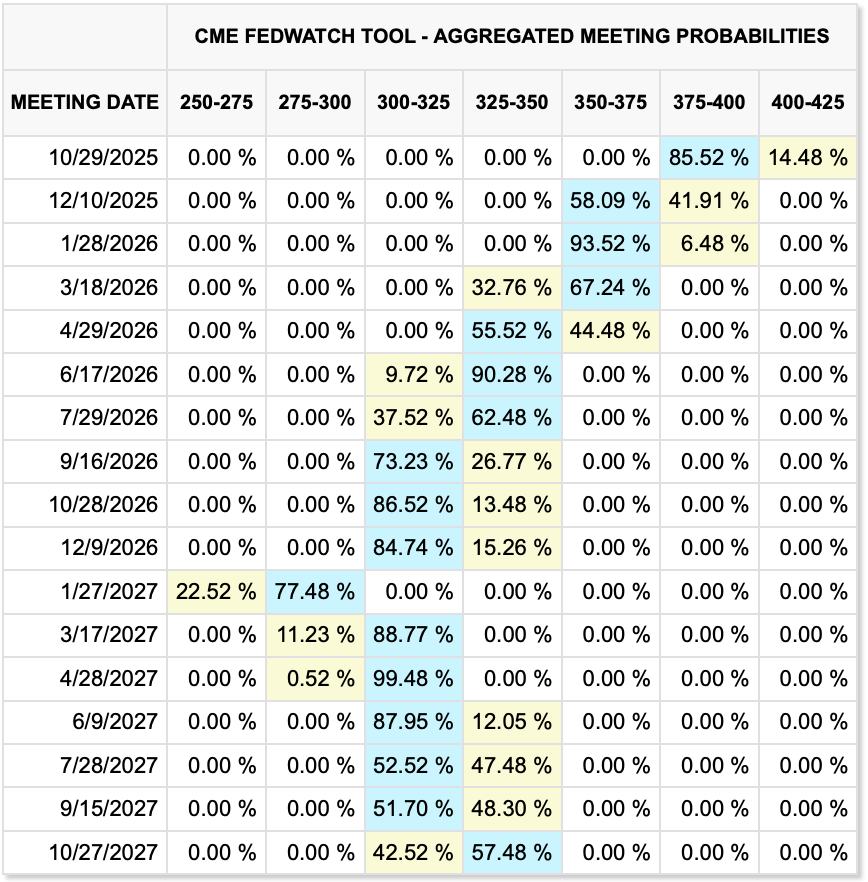
Source: cmegroup.com

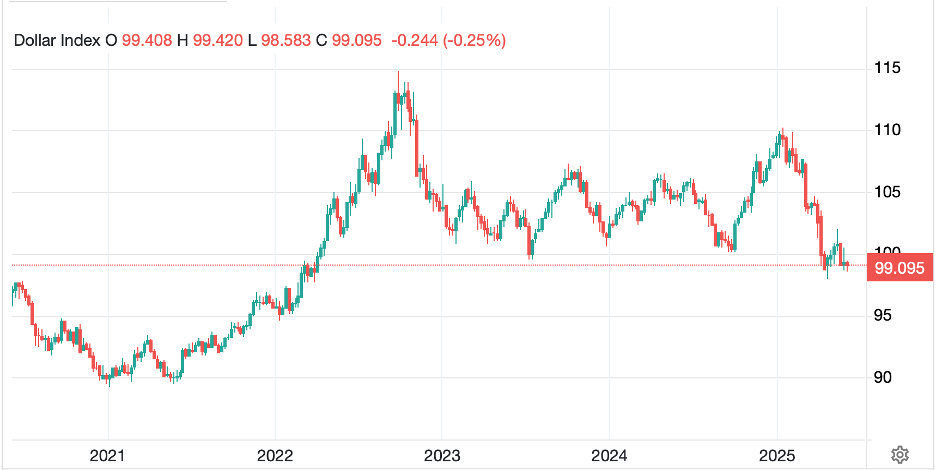
The next place to look is at the foreign exchange markets, where the dollar’s demise has been widely forecast amid changing global politics with many pundits highlighting the idea that the BRICS nations would be moving their business away from dollars.  For a long time, I have highlighted that the dollar is currently within a few percent of its long-term average price, neither particularly strong nor weak, and that fears of a collapse were unwarranted.  However, I have also recognized that a dovish Fed could easily weaken the dollar for a period of time.  Short dollar positions remain large as the leveraged community continues to bet on that outcome, although I have to believe it is getting expensive given they are paying the points to maintain that view.

But if we look at how the dollar has performed over the past several sessions, using the DXY as our proxy, we can see that despite a very modest -0.1% decline overnight, it appears that the dollar may be breaking its medium-term trend line lower as per the chart below from tradingeconomics.com
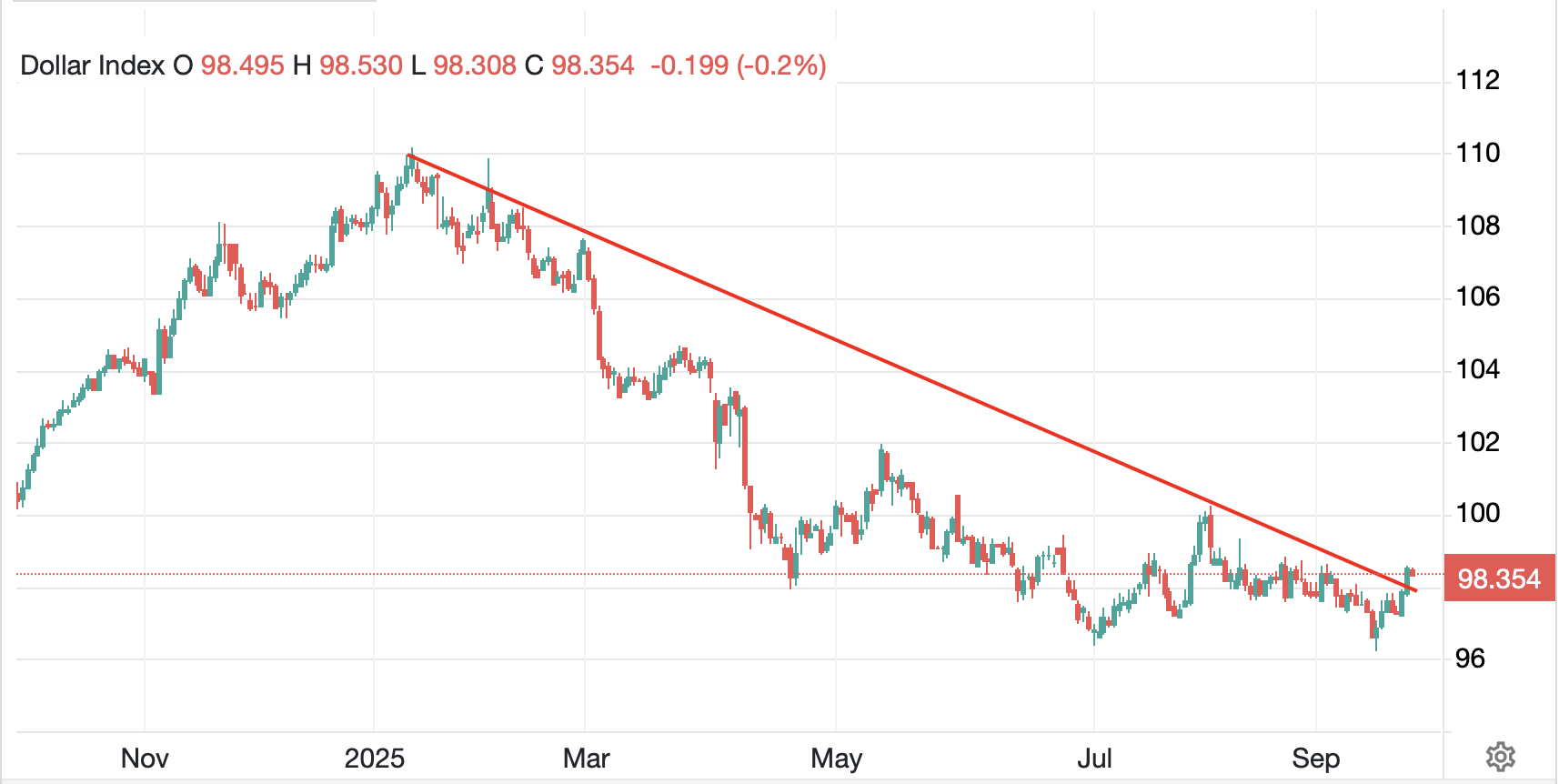
Again, my point is that the idea that the US is facing a catastrophic outcome with a recession due and a collapsing dollar is just not supported by the data or the markets.  And here’s an interesting thought from a very smart guy, Mike Nicoletos (@mnicoletos on X) regarding some of the key drivers of the current orthodoxy regarding the dollar, notably the debt and deficit.  What if, given the dollar’s overwhelming importance to the world economy, we should be comparing those things to its global scale, not just the domestic scale.  If using that framework, as he describes here, the debt ratio falls to 58% and the budget deficit is down to 2.9%, much less worrying and perhaps why markets and analysts are out of sync.

Markets are going to go where they will, but having a solid framework as to how the economy impacts them is a very helpful tool when managing money and risk.  Perhaps this needs to be considered overall.

Ok, a really quick tour.  Yesterday was the third consecutive down day in the US, although all told, the decline has been less than -2%, so hardly devastating.  Asia mostly fell overnight as concerns over both tariffs and a Fed less likely to cut rates weighed on equities there with Japan (-0.9%), China (-1.0%) and HK (-1.35%) all under pressure.  The story was worse for other regional bourses with Korea (-2.5%), India (-0.9%) and Taiwan (-1.7%) indicative of the price action.

However, Europe has taken a different route with modest gains across the board (DAX +0.3%, CAC +0.45%, IBEX +0.6%) as investors seem to be looking through the tariff concerns.  US futures are also edging higher at this hour (7:45).

In the bond market, Treasury yields have slipped -1bp this morning, and while they remain above the levels seen immediately in the wake of the FOMC last week, they appear to be finding a home at current levels of 4.15% +/-.  European sovereigns are all seeing yields slip -3bps this morning as today’s story is focusing on how most developed nations are reducing the amount of long-dated paper they are selling to restrict supply and keep yields down.  This has been decried by many since then Treasury Secretary Yellen started this process, but as with most government actions, the expedience of the short-term benefit far outweighs the potential long-term consequences and so everybody jumps on board.

Turning to commodities, oil (-0.1%) is still trading below the top of its range and while it has traded bottom to top this week, there is no sign of a breakout yet.  I read yet another explanation yesterday as to why peak oil demand is going to be seen this year, or next year, or soon, which will drive prices lower.  While I do think prices eventually slide lower, I take the other side of that supply-demand idea and believe it will come from increased supply (Argentina, Guyana, Brazil, Alaska) rather than reduced demand.  In the metals markets, yesterday saw silver (-0.2%) jump nearly 3% to yet another new high for the move as traders set their sights on $50/oz.  Meanwhile gold (0.0%) continues to grind higher in a far less flashy manner than either silver or platinum (+10% this week) as regardless of my explanation of relative dollar strength vs. other fiat currencies, against stuff, all fiat remains under pressure.

And finally, the dollar after a nice rally yesterday, is consolidating this morning.  The currency I really want to watch is the yen, where CPI last night was released at 2.5%, lower than expected and which must be giving Ueda-san pause with respect to the next rate hike.  Most analysts are still convinced they will hike in October, but if inflation has stopped rising, will they?  I would not be surprised to see USDJPY head well above 150, a level it is fast approaching, over the next month.

On the data front, this morning’s BLS version of PCE (exp 0.3%, 2.7% Y/Y) and Core PCE (0.2%, 2.9% Y/Y) is released at 8:30 along with Personal Income (0.3%) and Personal Spending (0.5%).  Then at 10:00, Michigan Sentiment (55.4) is released and somehow, I have a feeling that could be better than forecast.  We hear from a bunch more Fed speakers as well although a pattern is emerging that indicates they are ready to cut again next month, at least until they see data that screams stop.

The world is not ending and in fact, may be doing just fine, at least economically. Meanwhile, the dollar is finding its legs so absent a spate of very weak data, I think we may see another 2% or so rebound in the greenback over the next several weeks.

Good luck and good weekend

Adf

AI is Grokking

The ‘conomy grew a bit faster
Than ‘spected by every forecaster
Consumers are rocking
While AI is Grokking
Though prices could be a disaster
 
The question this data incites
Is why cut rates from current heights?
With stocks on a tear
And ‘flation still there
The risk is the long bond ignites


Yesterday’s GDP data indicated that both consumer spending and AI investment were larger than expected with the result being GDP activity increased more than economists had forecast.  Most would consider this good news, and the equity markets clearly saw the benefits as they continue their slow march higher.  Surprisingly, despite the positive economic data, the Fed funds futures market did not reduce the probability of a rate cut next month.  Arguably that was because Governor Waller, one of the two who voted for a cut in July, spoke yesterday and reiterated his views that a cut was appropriate to prevent a worse outcome in the employment situation.  Frighteningly, he said, “I am back on Team Transitory.”  I fear that the transitory phenomenon is going to be the reduction in inflation we have experienced over the past two years, not the initial peak seen in 2022. (As an aside, if inflation is your concern, USDi is one way to maintain the purchasing power of your funds as it mechanically tracks CPI, rising in step with the index.)

Perhaps the futures market is starting to expect that Governor Lisa Cook’s days are truly numbered with a third instance of potential mortgage fraud surfacing yesterday, a situation that has a bad look for a Fed governor.  If she is forced out soon, that would be yet another Fed governor that President Trump will get to appoint, and the tension in the Marriner Eccles building will certainly grow at that September meeting.  After all, if Trump seats two more governors, and has 4 votes for a rate cut on the board, the question will not be should they cut, but how much they should cut with 50 basis points on the table regardless of the economics.

But all that is still three weeks away and based on the fact that if I look at almost every market, price action has been consolidating for the entire summer, it is hard to get excited in the short-term.  In fact, I think it is worthwhile to look at some charts so you can get a sense of just how little is going on.

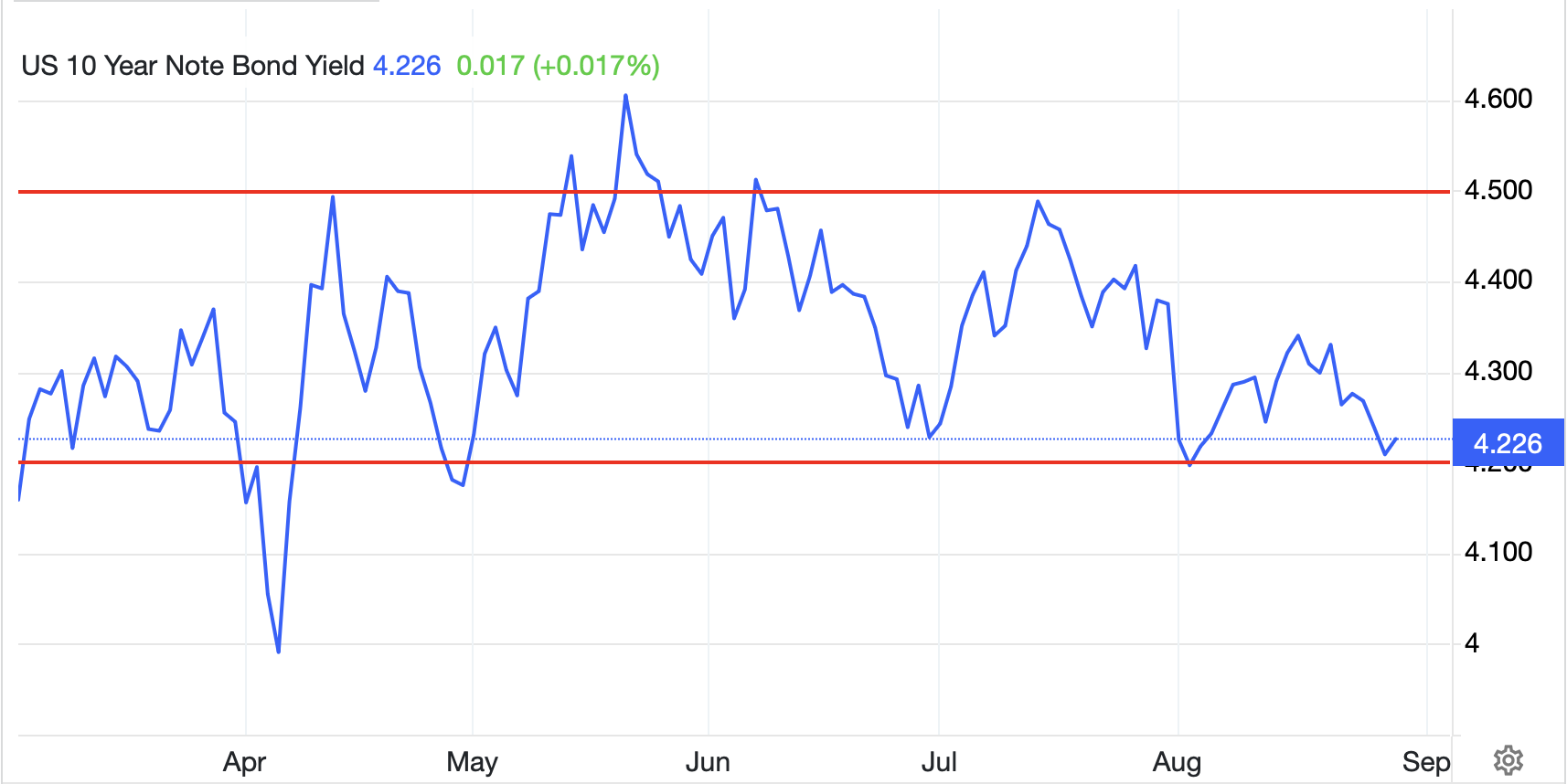
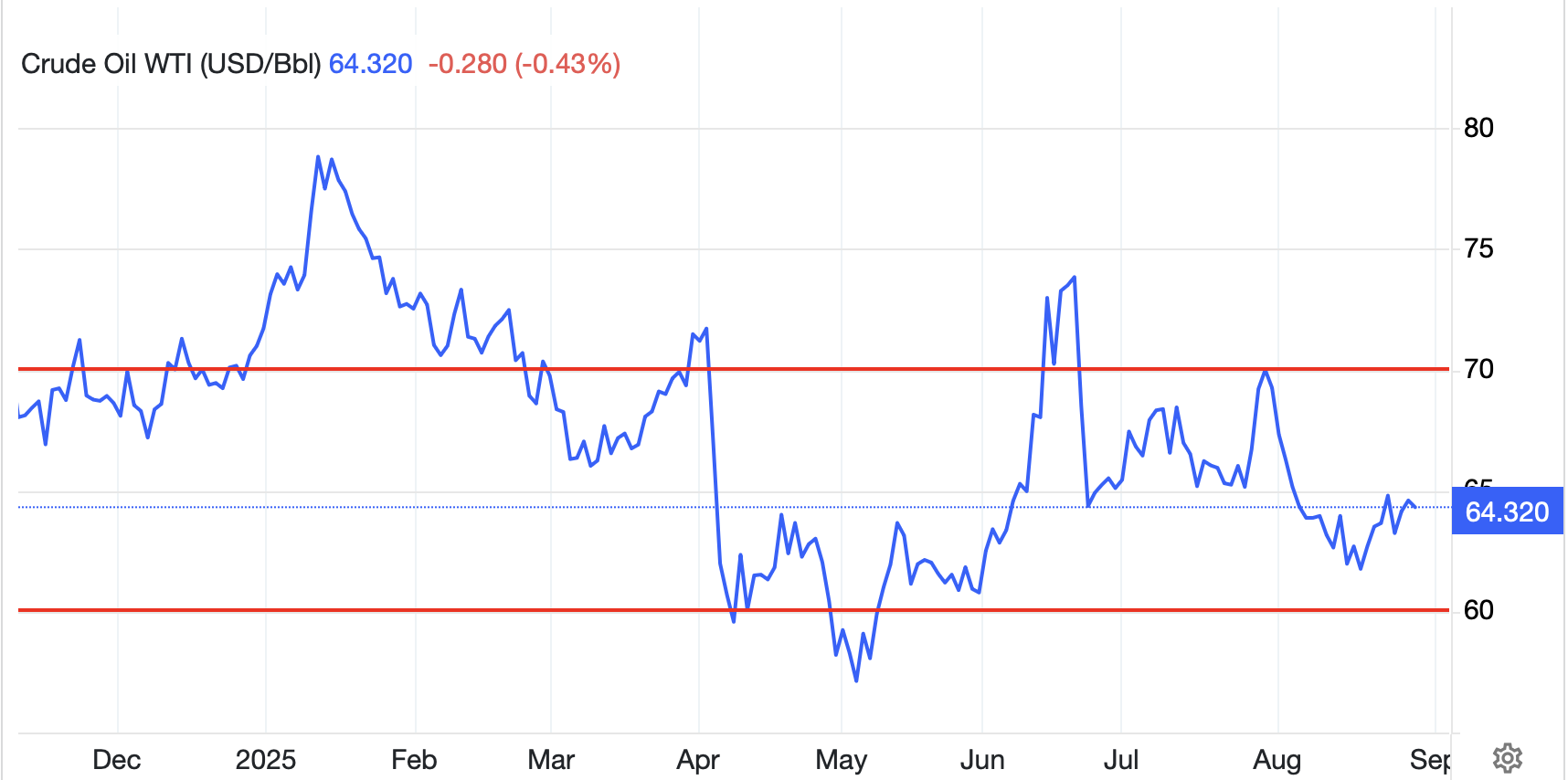
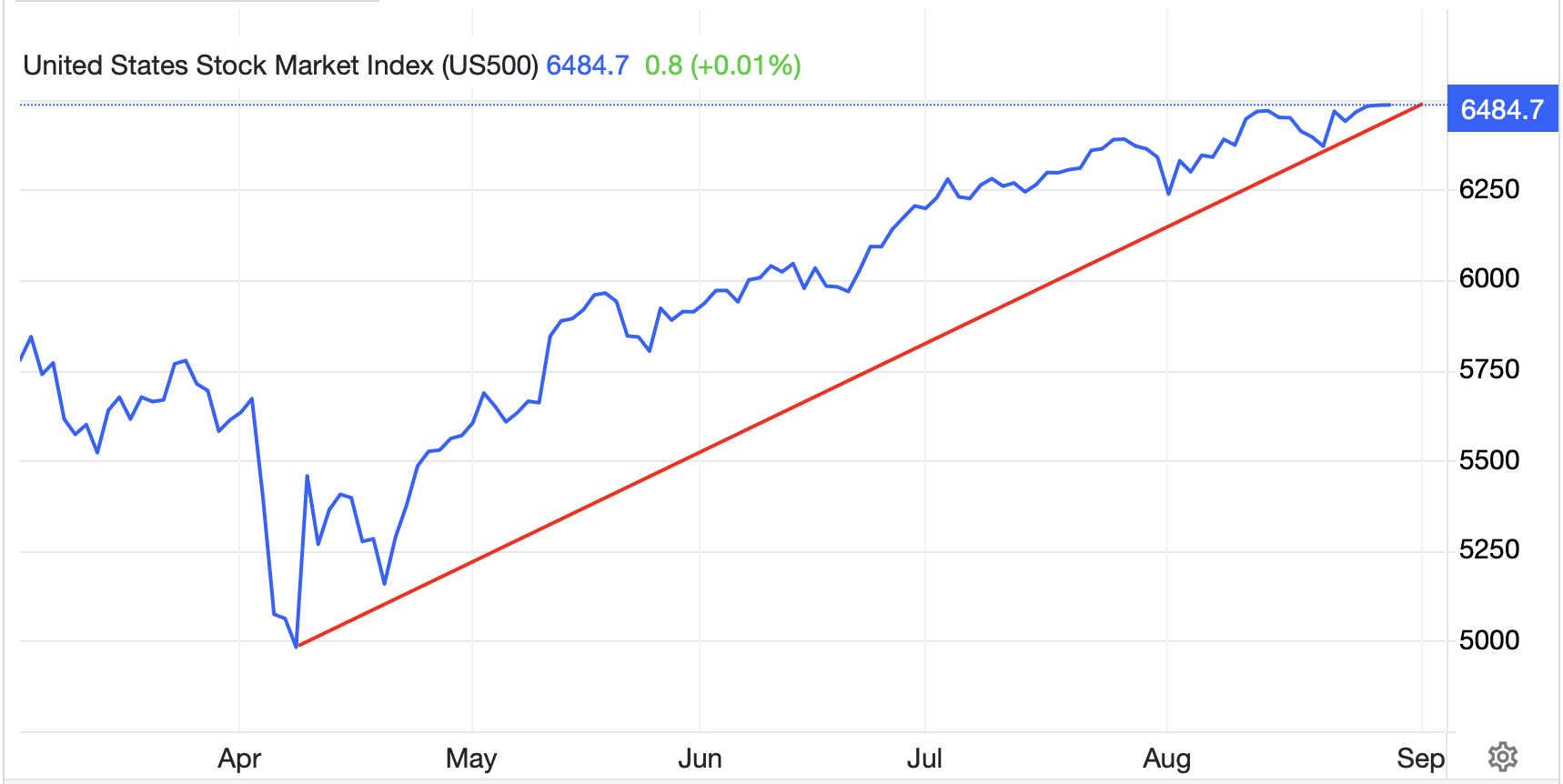
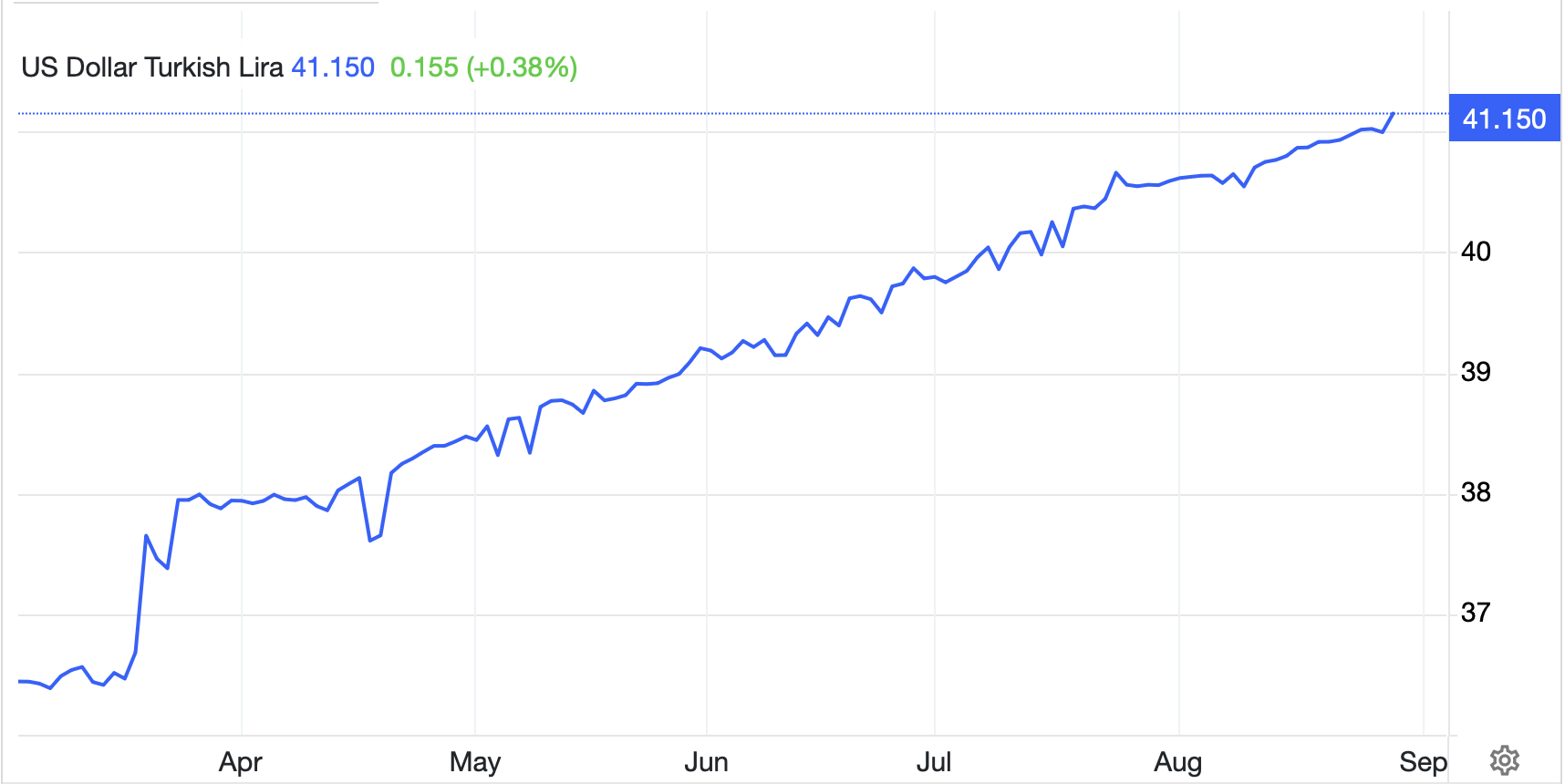
All these charts are from tradingeconomics.com and I have drawn in some recent ranges to show that over the past 6 months, only one asset class has shown any trend of note.  See if you can guess which that is.  I’ll start with the EURUSD since, after all, I am an FX guy, but go to bonds, oil, gold and equities.

Since late April, the euro has chopped back and forth despite many stories of the dollar’s incipient demise and the euro’s upcoming rally as investors flock to European equity markets.  Maybe not.

Treasury yields have also been largely range bound, and if anything, look like they are heading lower despite fears being flamed regarding massive amounts of issuance having trouble finding buyers as foreigners pull out of the market.  Maybe not.

Crude has been the choppiest, and of course we did have the bombing of Iran’s nuclear facilities which inspired some fears of the beginning of a new Middle East war.  But Russia keeps pumping, OPEC put 2.2 million barrels per day of production back into the market and it appears, that for now, the market has found a balance.  I still see oil sliding over time, but for now, the range is king.

The barbarous relic has just started to pick up and broke above the $3400 range cap just two days ago but has not yet shown signs of a major breakout.  However, if the Fed cuts, especially if they go 50bps for some reason, I would look for this to change and gold (and all precious metals) to rally sharply as inflation re-enters the conversation.

However, if we look at the US equity market, the picture is very different.  The only other market moving like this is USDTRY as the Turkish Lira steadily depreciates amid massive monetary expansion there with inflation rising sharply.  In fact, this is what many foresee for the dollar going forward, but even if the Fed cuts, it seems a bit of an exaggeration.

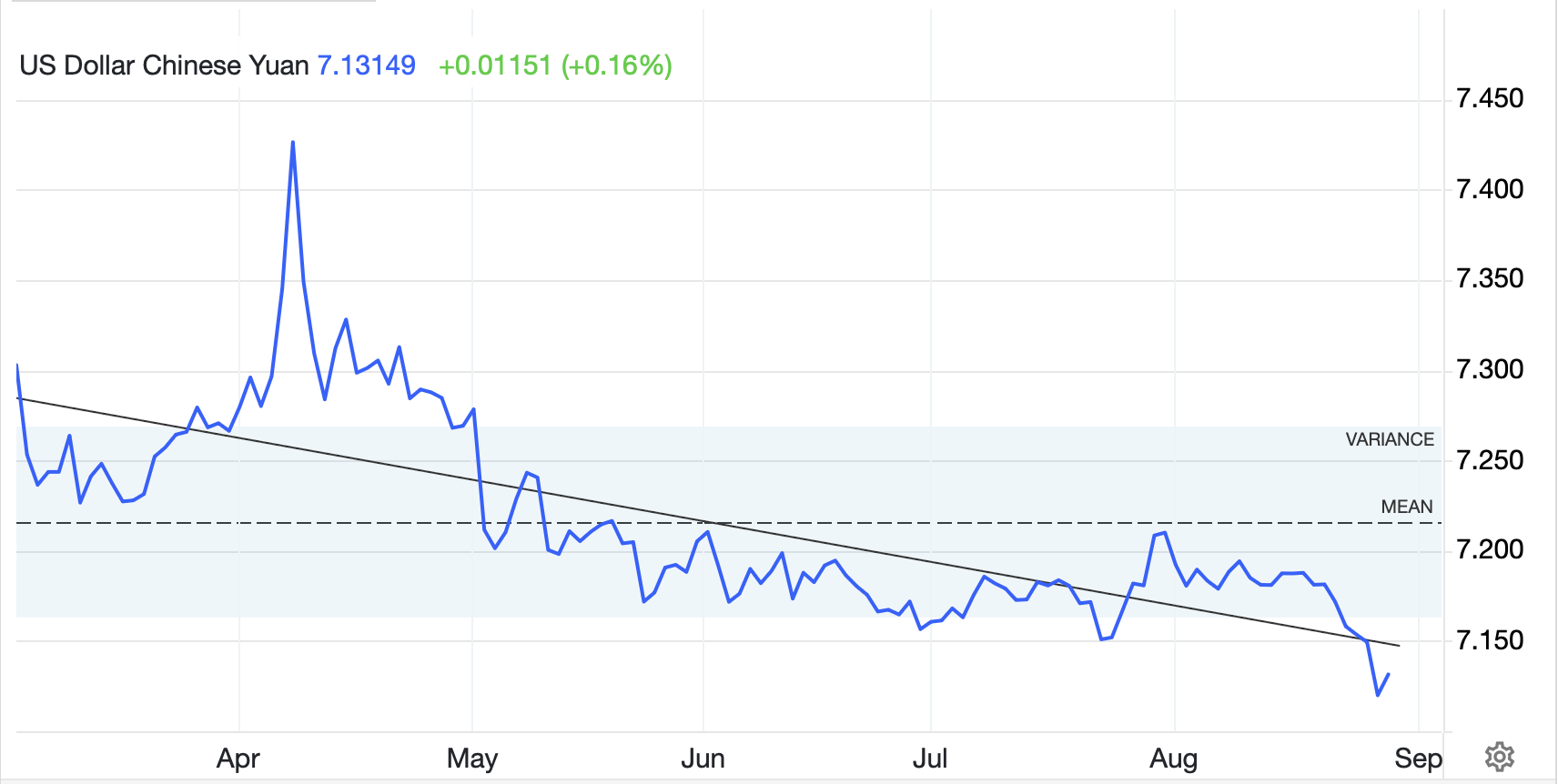
At this point I should note that there is one currency that is outperforming the dollar right now, the Chinese renminbi.  It appears that as trade negotiations are ongoing, the Chinese (and the Koreans amongst others) have gotten the message that they need to adjust their currency’s value if an agreement is going to be reached.  

To conclude, ranges remain the situation in most markets other than equities which continue to rally based on hopes and prayers that central bank spigots are never turned off.  With Labor Day on Monday, perhaps we will begin to see more real activity reenter the market as traders and investors come back from summer vacation.  But we will need a real catalyst to break those ranges, whether that is a shocking NFP number, a reescalation of Middle East conflict or something else (China laying siege to Taiwan?).  While I don’t know what that catalyst will be, history tells us something will come along, that’s for sure.

As we look to the NY opening, we do get more important data as follows: Personal Income (exp 0.4%); Personal Spending (0.5%); PCE (0.2%, 2.6% Y/Y); Core PCE (0.3%, 2.9% Y/Y); Goods Trade Balance (-$89.5B); Chicago PMI (46.0); and Michigan Sentiment (58.6).  There are no Fed speakers on the docket, but you can be sure that the Lisa Cook story will remain front and center, especially as I read that the judge initially selected to oversee the case was Ms Cook’s sorority sister, potentially a disqualifying factor that would cause her recusal and a new appointment. In fact, I suspect that story will have more traction than whatever the data says today.

As to the dollar, it is hard to get excited at this point.  If PCE data is softer than forecast, though, I would look for the dollar to sell off and the probability of that Fed funds rate cut to rise from its current 85%.

Good luck and have a good holiday weekend

Adf

Bears’ Chagrin

The talk of the town is the Fed
And who Mr Trump will embed
As governor, next
Amid a subtext
That Powell, by May, will have fled
 
Meanwhile, other stories are muted
As tariffs’ impact seem diluted
And earnings have been,
To most bears’ chagrin,
Much better than had been reputed


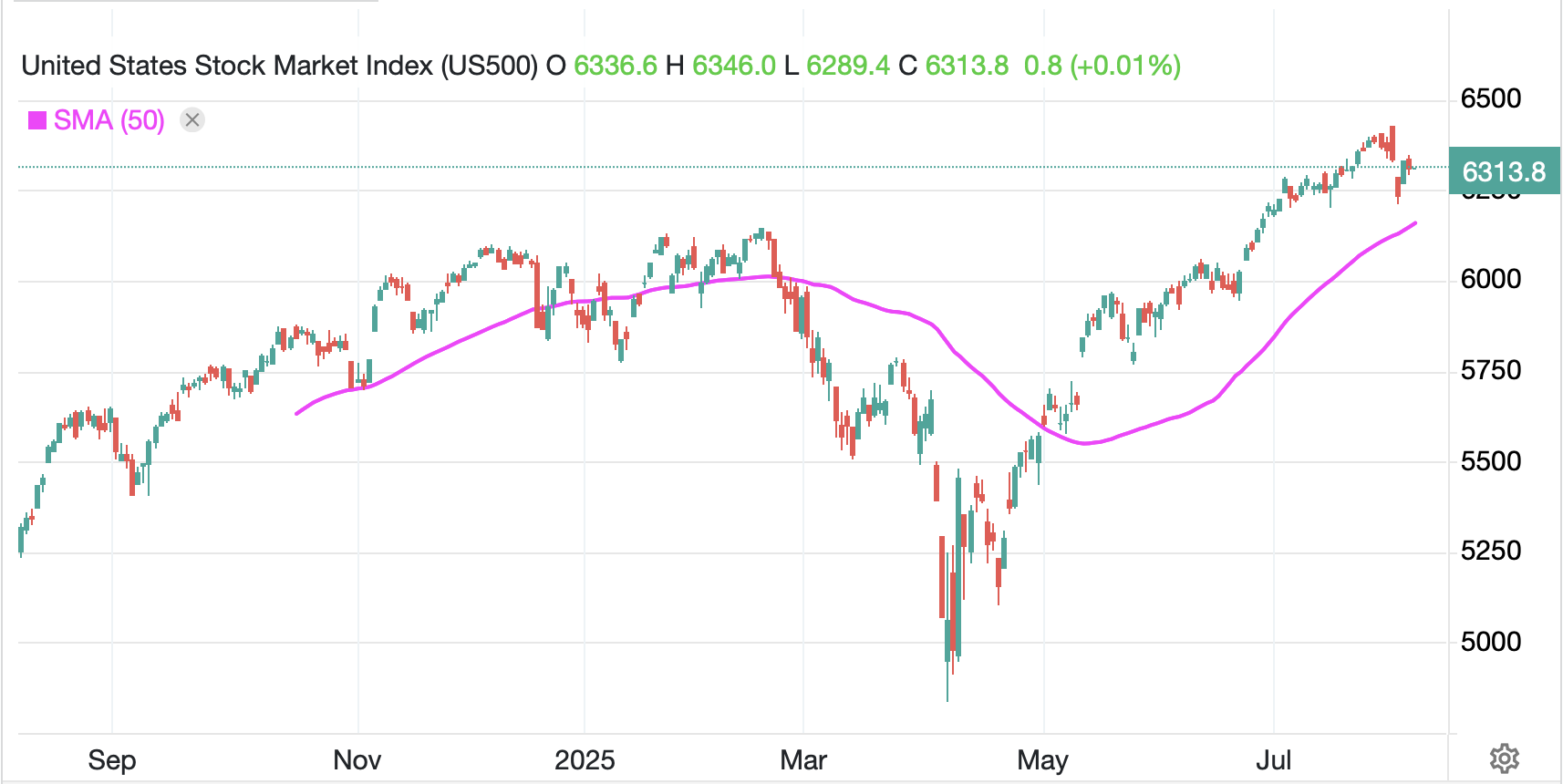
Yesterday was a modest down day in equities, although the trend remains clearly higher at this point as evidenced by the chart below.  As well, the price action remains well above the 50-day moving average, a key technical indicator defining the trend, with no indication it is set to retrace there.  As of this morning, we are sitting about 2.5% above that average, so a decline of that magnitude will be necessary to get tongues wagging about a change.

Source: tradingeconomics.com

This is not to say that everyone is sanguine about the situation as just yesterday, three investment banks, Morgan Stanley, ISI Evercore and Deutsche Bank, all put out research calling for a retracement in the near term.  Certainly, the recent data has been mixed, at best, with still a lot of discussion regarding last Friday’s weak NFP data.  Meanwhile, the ISM Services data was weak (50.1 vs 51.5 expected), while the PMI Services was strong (55.7 vs 55.2 expected).  

Corporate earnings continue to be solid, with about two-thirds of the S&P 500 having reported Q2 numbers and 82% have beaten EPS estimates, higher than the recent 5-year average, and the growth rate at 10.3% on a quarterly basis.  This does not seem indicative of the recession that many continue to claim is ongoing or imminent.

But let us take this time to briefly consider both sides of the argument regarding the future of the economy, and by extension financial market activity.

On the plus side, while the NFP number was soft, the Unemployment rate remains at 4.2%, in the lowest quintile since 1948 as per the below chart.  

As well, Initial Claims data, the most frequent labor market data that is available, remains at the 13thpercentile, an indication that despite a great deal of concern by a certain segment of analysts, the labor market is still pretty strong.  In fact, the last time Initial Claims was this low during a recession, in 1970, the US population was about 205 million compared to today’s 340 million.  After all, this has been the issue on which Powell has been hanging his hat, and why Friday’s NFP number changed the narrative regarding the Fed.

The most recent GDP data was also quite positive, with Q2 growing at 3.0%, better than expected and then yesterday we saw the Trade deficit shrink to -$60.2B, its smallest level since September 2023.  Trade, though, is a double-edged sword as a smaller deficit could indicate weaker domestic demand, or it could indicate stronger domestic supply.  Naturally, this is the president’s goal, to achieve the latter, hence his tariff blitz.

As to inflation, it is off its recent lows, and remains well above the Fed’s 2.0% target, but with core CPI at 3.0%, it is hardly hyperinflationary.  The tariff impact remains uncertain at this point as so far, it appears many companies are eating a significant portion.  I guess that will become clearer in the Q3 earnings reports, although analysts continue to forecast strong growth there.  

So, across jobs, growth and inflation, there is a case to be made that things are doing fine.  Add to this the idea that fiscal stimulus is unlikely to end, merely be redirected from the previous administration’s favorites to this one’s, and you can understand the view that things are pretty good.

However, the other side of the story continues to have many adherents as well.  Most of the negative outlook comes from digging underneath the headline numbers and extrapolating out to the negative trends that may exist there blooming into the full story.

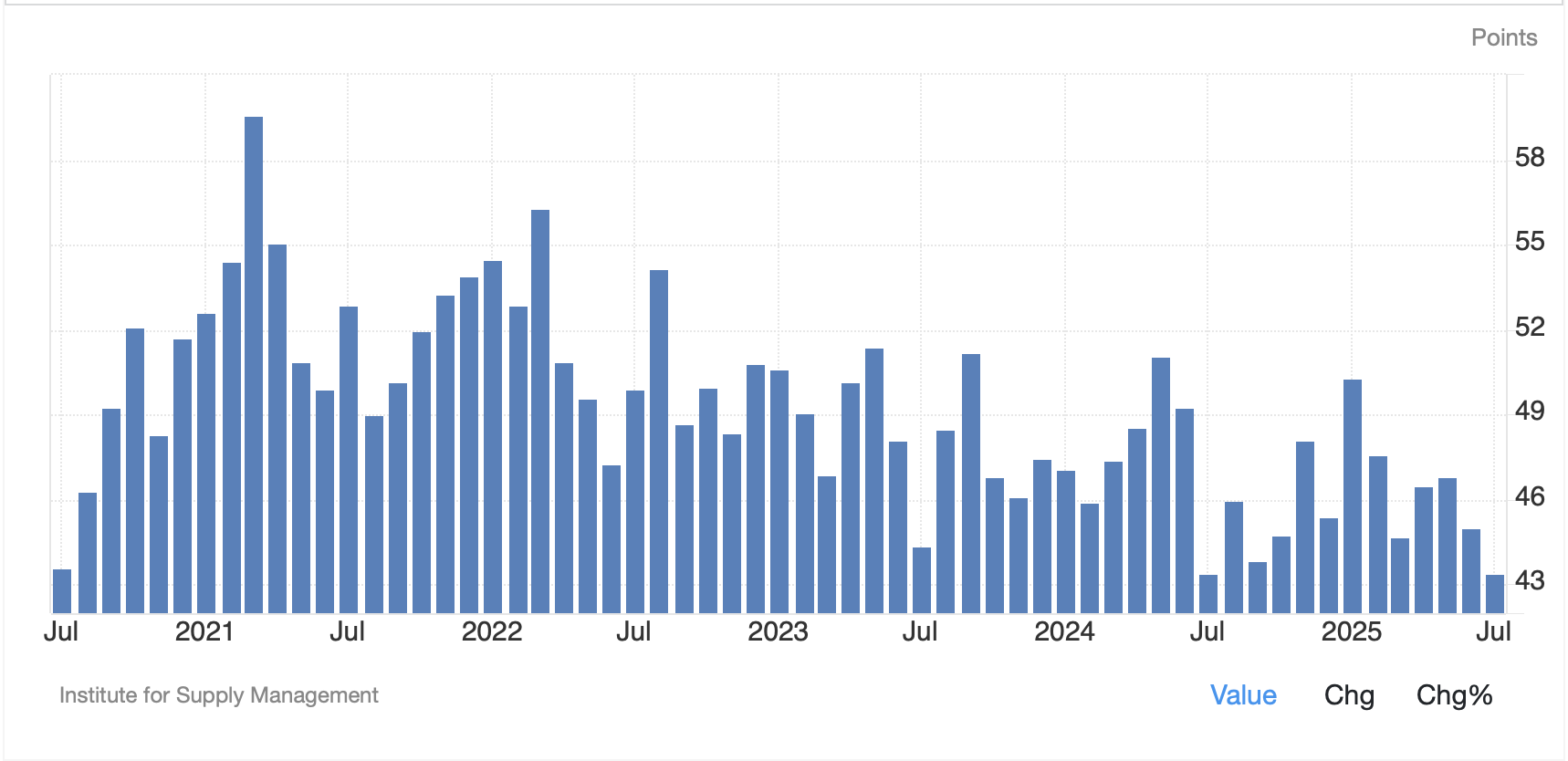
For instance, regarding employment data, while the headlines have been ok, ISM Manufacturing Employment has fallen to 43.4, its lowest level in more than 5 years and pretty clearly trending lower, even on a cyclical basis as per the below chart.

Source: tradingeconomics.com

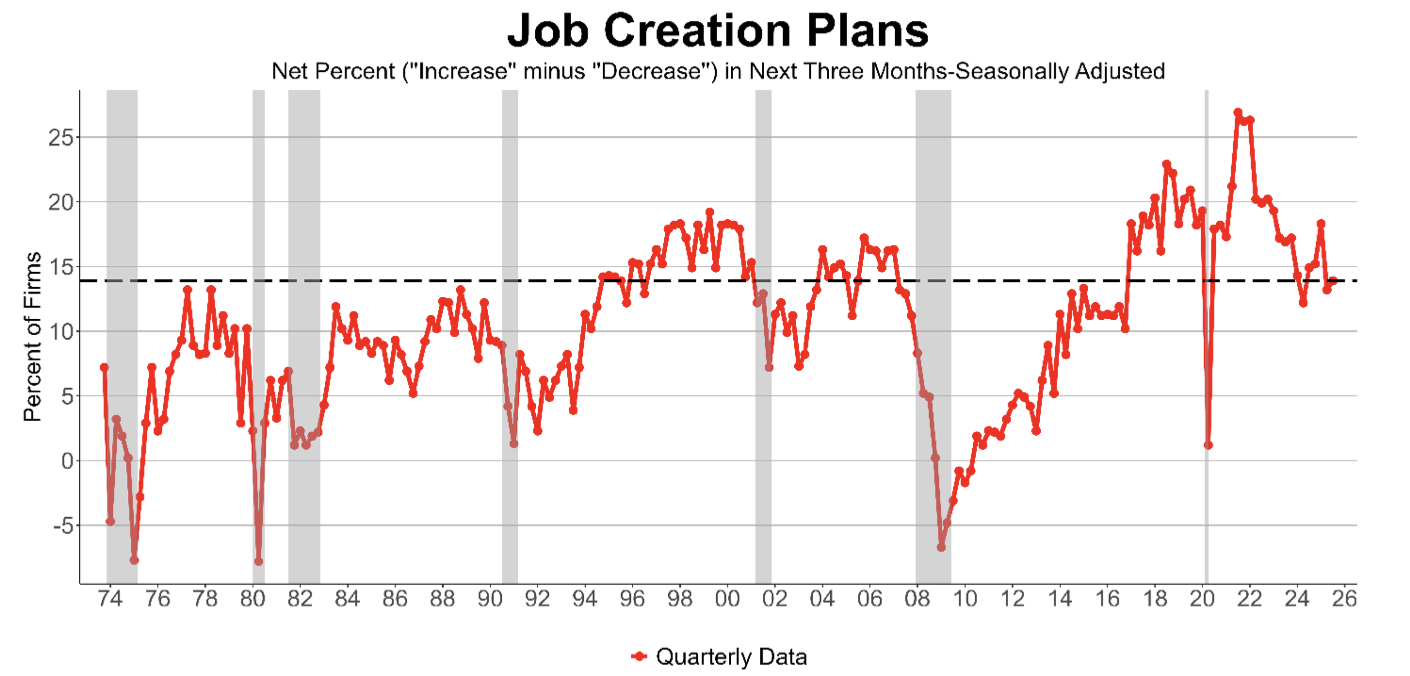
Too, ISM Services employment has fallen to 46.4 (anything under 50.0 indicates recession-type weakness). NFIB Employment surveys are negative, with small businesses planning to create fewer jobs in the next three months as per the below chart from the NFIB July report.

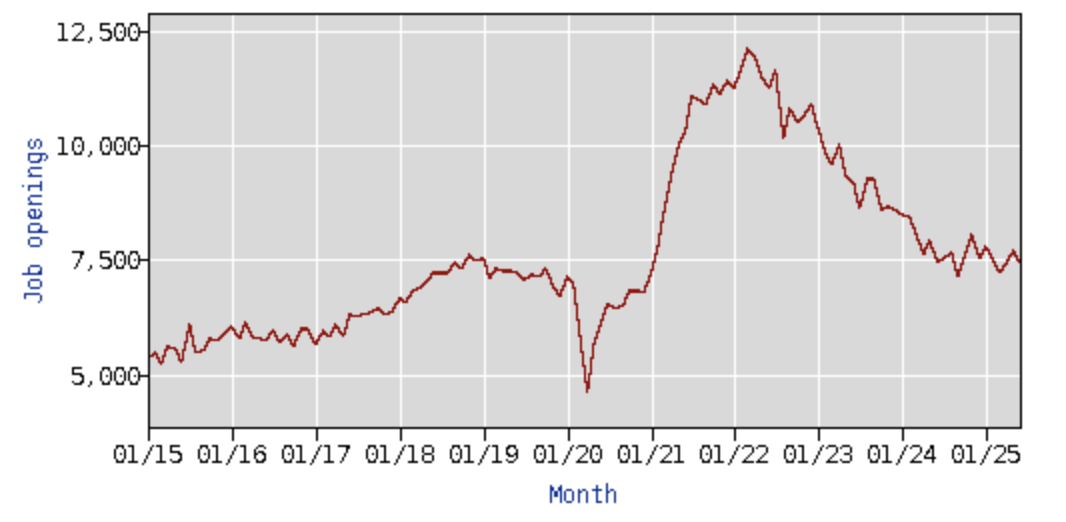
Challenger job cuts are rising again, with much of the blame put on AI.  JOLTS Job Openings have been trending lower since Covid, but it is difficult to really tell there, as the levels are far above pre-Covid data as per the below BLS chart.

There is also a hue and cry that the deportations are removing a significant number of manual workers in fields like construction and agriculture, which is likely true.  However, as I highlighted earlier in the week, the mix of employed in the US has turned to a greater proportion of US-born workers vs. foreign-born workers with net growth.  So, perhaps many of those jobs are being filled anyway.

From a GDP perspective, the economic bears tend to dig into the pieces and have focused on declining consumption data although Retail Sales continues to motor along pretty well, rising 5.3% in the past twelve months when looking at the control group (excluding food services, auto dealers, building materials and gas stations) which is what is used in the GDP data.  I am hard-pressed to look at the below chart and explain a dramatic slowing in growth.

Source: tradingeconomics.com

As to inflation, there continues to be a strong set of beliefs that tariffs are going to create a significant uptick, although it has yet to appear.  ISM Prices paid did rise in Services, to 69.9, their highest level since the retreat from the 2022 “transitory inflation”.

Source: tradingeconomics.com

However, ISM Manufacturing prices appear to be stabilizing after some recent increases.  The overall ISM price data is more worrisome as tariffs are only going to be on goods, and if services prices are rising, that is likely to feed through to general inflation more directly.  

Concluding, we seem to be an awful long way from stagflation that some analysts are calling for as growth continues apace and there is no indication that fiscal stimulus is going to end.  Rather, I would expect that we will see overall hotter growth, with higher prices coming alongside, and likely higher wages as well.  I still have trouble seeing the collapsing US economy story, although things are hardly perfect.

And how will this impact markets?  Well, broadly, while equities have clearly had an impressive run, and the trend is your friend, a pullback would not be a huge surprise.  But dip buyers will be active, of that you can be sure.  

As to bonds, if the US does run things hot, unless the budget deficit starts to shrink substantially, with the next release coming on August 12, yields are very likely to continue to remain bid.  Right now, the curve is steepening because traders are banking on the Fed to cut next month so the 2yr yield has fallen sharply.  But if growth remains strong, I would say there is a floor to yields although absent a significant rise in inflation, I don’t see them exploding higher either.  And if the BBB actually does generate more revenue and reduce the budget deficit, look for yields to decline anyway.  

Finally, the dollar should do well unless the Fed become aggressive.  That story is too difficult to forecast given the machinations on the board and the questions of who the next Fed chair will be.  As I have written before, in the short and medium term, a dollar decline is quite viable, but long term, most other nations have much bigger problems than the US, and I think investment will ultimately flow in this direction.

My apologies for the length of the opening and given the fact that there is so little happening in markets, with just a little back and forth, I will skip the recap.

Good luck

Adf

Hard to Resolve

The OECD has declared
That growth this year will be impaired
By tariffs, as trade
Continues to fade
And no one worldwide will be spared
 
The funny thing is, the US
This quarter is showing no stress
But how things evolve
Is hard to resolve
‘Cause basically it’s just a guess


The OECD published their latest economic outlook and warned that global economic growth is likely to slow down because of the changes in tariff policies initiated by the Trump administration.  Alas for the OECD, the only people who listen to what they have to say are academics with no policymaking experience or authority.  It is largely a talking shop for the pointy-head set.  Ultimately, their biggest problem is that they continue to utilize econometric models that are based on the last 25-30 years of activity and if we’ve learned nothing else this year, it is that the world today is different than it has been for at least a generation or two.

At the same time, a quick look at the Atlanta Fed’s GDPNow forecast for Q2 indicates the US is in the midst of a very strong economic quarter.

Now, while the US does not represent the entire OECD, it remains the largest economy in the world and continues to be the driver of most economic activity elsewhere.  As the consumer of last resort, if another nation loses access to the US market, they will see real impairment in their own economy.  I would argue this has been the underlying thesis of the Trump administration’s tariff negotiations, change your ways or lose access, and that is a powerful message for many nations that rely on selling to the US.

Of course, it can be true that the US performs well while other nations suffer but that is not the OECD call.  Rather, they forecast US GDP growth will fall to 1.6% this year, down from 2.4% last year and previous forecasts of 2.2%.

But perhaps now is a good time to ask about the validity of GDP as a marker for everyone.  You may recall that in Q1, US GDP fell -0.2% (based on the most recent update received last Thursday) and that the media was positively gleeful that President Trump’s policies appeared to be failing.  Now, if Q2 GDP growth is 4.6% (the current reading), do you believe the media will trumpet the success?  Obviously, that is a rhetorical question.  But a better question might be, does the current calculation of GDP measure what we think it means?

If you dust off your old macroeconomics textbook, you will see that GDP is calculated as follows:

Y = C + I + G + (X – M)

Where:

Y = GDP

C = Consumption

I = Investment

G = Government Spending

X = Exports

M = Imports

In the past I have raised the question of the inclusion of G in the calculation, as there could well be a double counting issue there, although I suppose that deficit spending should count.  But the huge disparity between Q1 and Q2 this year is based entirely on Net Exports (X -M) as in Q1, companies rushed to over order imports ahead of the tariffs and in Q2, thus far, imports have fallen dramatically.  But all this begs the question, is Q2 really demonstrating better growth than Q1?  Remember, the GDP calculation was created by John Maynard Keynes back in the 1930’s as a policy tool for England after WWI.  The world today is a far different place than it was nearly 100 years ago, and it seems plausible that different tools might be appropriate to measure how things are done.  

All this is to remind you that while the economic data matters a little, it is not likely to be the key driver of market activity.  Instead, capital flows typically have a much larger impact on market movements which is why central bank policies are so closely watched.  For now, capital continues to flow into the US, although one of the best arguments against President Trump’s policy mix (and goals really) is that they could discourage those flows and that would have a very serious negative impact on financial markets.  Of course, he will trumpet the real investment flows, with current pledges of between $4 trillion and $6 trillion (according to Grok) as offsetting any financial outflows.  And in fairness, I believe the economy will be better served if the “I” term above is real foreign investment rather than portfolio flows into the S&P 500 or NASDAQ.

There is much yet to be written about the way the economy will evolve in 2025.  I remain hopeful but many negative things can still occur to prevent progress.

Ok, let’s take a look at how markets are absorbing the latest data and forecasts.

The barbarous relic and oil
Spent yesterday high on the boil
While bond yields are tame
These rallies may frame
A future where risk may recoil

I’ll start with commodities this morning where we saw massive rallies in both the metals and energy complexes yesterday as gold (-0.8% this morning) rallied nearly 2% during yesterday’s session and both silver (-1.4%) and copper (-1.7%), while also slipping this morning, saw even bigger gains with silver touching its highest level since 2012.  Copper, too, continues to trade near all-time highs as there is an underlying bid for real assets as opposed to fiat currencies.  Meanwhile, oil (+0.3%) rallied nearly 4% yesterday and is still trending higher, although remains in the midst of its trading range.  Given the bearish backdrop of declining growth expectations and OPEC increasing production, something isn’t making much sense.  Lower oil prices have been a key driver of declining inflation readings around the world.  If this reverses, watch out.

Turning to equities, yesterday’s weak US start turned into a modest up day although the follow through elsewhere in the world has been less consistent.  Tokyo was basically flat while Hong Kong (+1.5%) was the leader in Asia on the back of the story that Presidents Trump and Xi will be speaking this week as well as some solid local news.  But elsewhere in Asia, the picture was more mixed with modest gains and losses in various nations.  In Europe, despite a softer than expected inflation reading this morning, with headline falling to 1.9%, equity indices have been unable to gain much traction in either direction.  This basically cements a 25bp cut by the ECB on Thursday, but clearly the trade situation has investors nervous.  Meanwhile, US futures are pointing slightly lower at this hour (7:25), but only on the order of -0.2%.

Bond yields, which backed up yesterday, are sliding this morning with -2bps the standard move in Treasuries, European sovereigns and JGBs overnight.  We did hear from Ueda-san last night and he promised to adjust monetary policy only when necessary, although given base rates there are 0.5% and CPI is running at 3.5%, I’m not sure what he is looking at.  The very big picture remains there is too much debt in the world and the big question is how it will be resolved.  But my take is that won’t happen anytime soon.

Finally, the dollar, which had been under pressure yesterday has rebounded this morning, regaining much of the losses seen Monday.  The euro (-0.5%) and pound (-0.4%) are good proxies for the magnitude of movement we are seeing although SEK (-0.7%) is having a little tougher time.  In fairness, though, SEK has been the best performing G10 currency so far this year, gaining more than 13%.  In the EMG bloc, PLN (-1.0%) is the laggard, perhaps on the election results with the right-wing candidate winning and now calling into question the current government there and its ability to continue to move closer to the EU policy mix.  It should also be noted that the Dutch government fell this morning as Geert Wilders, the right-wing party leader, and leading vote getter in the last election, pulled out of the government over immigration and asylum issues.  (and you thought that was just a US thing!). In the meantime, I will leave you with the following 5-year chart of the DXY to allay any concerns that the dollar is about to collapse.  While we are at the bottom of the range of the past 3 years, we have traded far below here pretty recently, let alone throughout history.

Source: tradingeconomics.com

On the data front, JOLTs Job Openings (exp 7.1M) and Factory Orders (-3.0%, 0.2% ex Transport) are on the docket and we hear from 3 more Fed speakers.  But again, Fed comments just don’t have the same impact as they did even last year.  In the end, I do like the dollar lower, but don’t be looking for a collapse.

Good luck

Adf

Much More Desirous

The world that we knew ere the virus
Was different, and much more desirous
‘Cause we got to ease
Whenever we’d please
And ‘flation was rare as papyrus


A few disparate thoughts this morning as there doesn’t seem to be a real theme in markets.  

Starting with Chairman Powell’s comments yesterday regarding the Fed’s policy framework and how they were reviewing the current framework established in 2020, to see if it was still appropriate.  It was during that policy discussion that the Fed came up with the idea of average inflation targeting, rather than maintaining a stable rate.  However, Chairman Powell was candid yesterday when he explained, “The idea of an intentional, moderate overshoot proved irrelevant to our policy discussions and has remained so through today.”  Ya think?

Of course, being the consummate central banker, he made sure to explain that their future failures would not be their fault.  As explained in the WSJ by the Fed whisperer himself, Nick Timiraos, Powell explained that higher real interest rates might “reflect the possibility that inflation could be more volatile going forward than in the intercrisis period of the 2010sWe may be entering a period of more frequent, and potentially more persistent, supply shocks—a difficult challenge for the economy and for central banks.” 

However, unlike the pre-Trump era, it’s not clear the market paid much attention to Mr Powell.  Going forward, I do expect the Fed to have more market sway again, but it may be a little while before that is the case.  But I think it is worthwhile for us to understand how they are thinking.

While pundits expressed they were certain
The US is who would be hurtin’
From tariffs and Trump
It turns out the slump
Is elsewhere, as he’d been assertin’

One of the themes following President Trump’s “Liberation Day” tariff announcements amongst much of the punditry was that the US was shooting itself in the foot and the US economy would be the loser in the end.  My thesis had been that the US, as the consumer of last resort, was far more important to other nations’ economic growth than vice versa.  Now, we know that the first look at Q1 GDP in the US was a negative number, but we also know that was entirely the result of the uptick in imports that came ahead of the tariffs.  Meanwhile, private economic activity in the US grew and government activity shrank, both distinct economic positives.

Well, it turns out that the rest of the world is finding that when the US market is not as welcoming of their exports as previously seen, those economies find themselves under pressure.  Yesterday we saw weaker Eurozone GDP and last night Japanese GDP declined much more than expected, -0.2% in Q1 leading to a -0.7% Y/Y result.  The change in trade relations and weaker exports were the driver.  Now, this is just one quarter, and not necessarily a trend, especially if trade negotiations conclude on a timely basis.  But Japanese inflation remains sticky on the high side while growth is ebbing.  The BOJ is unlikely to change policy anytime soon as they, like most central banks, try to figure out the underlying trends. 

My take is this is going to be the scenario through the summer, and likely into the early autumn as trade deals get concluded but their impacts will take time to feel.  I suspect that central banks will be reluctant to be too aggressive in either direction given the propensity of President Trump to upset the applecart of policy decisions.  Ultimately, I see this as the backdrop that will result in more market volatility in both directions in response to the currently unknown policy announcements that are sure to come.  If you are a hedger, maintain those hedge ratios, even if they are a little pricey, the alternative could be far worse.  If you are a speculator, keep your positions smaller than you might think.  Wrong is only a Trump tweet away.

And finally, let’s talk of peace
Which most folks would like to increase
Could we really see
A Trump policy
That gets global fighting to cease?

I’m going to don my tinfoil hat for a paragraph or two here, but I think we must consider the possibilities that Mr Trump has far larger plans for a geopolitical realignment than most are aware.  I discussed the remarkable Iranian proposal to re-enter the brotherhood of nations yesterday.  The recent history of war shows that it is a) hugely profitable for a select number of companies and b) generally inflationary.  Mr Trump’s overtures throughout the Middle East this week, as he seems to be cementing relationships with the leadership there could well have a motive beyond lower oil prices.  I read a remarkable piece from Dr Pippa Malmgrenyesterday that pulled together many threads as to potential motivations for Trump’s activities and they were framed as the enemy is not necessarily Russia or China or Iran, but rather the deep-state in the US (I told you it was tinfoil hat territory).  There is a group in government who profits immensely from the ongoing war footing and who are not interested in seeing peace break out all over.  

I have no idea if Mr Trump can be successful in this endeavor, but if he is, the implications for markets will be significant.  Oil prices will be far lower, as will commodity prices generally given the result could easily see more access granted for mining/drilling/growing.  Inflation will remain under control which would reduce interest rates, and by extension remove some pressure from the US budget situation.  As well, reduced defense requirements would also help the budget.  The dollar would maintain its status as the global reserve currency and focus would return to economic growth rather than geopolitical mischief.  And this feels like a pretty good state for equities, at least those that are not defense focused.  Maybe crazy…but maybe not.

Ok, really quick around the world.  In equities, mixed is the best description of the US yesterday and Asia overnight with no real outstanding movers in either direction.  Europe is all green this morning, with gains on the order of 0.6%, but I think that is based on the idea the ECB is going to continue to cut rates going forward given inflation there remains low and growth is declining.  US futures, at this hour (7:15) are pointing slightly higher, 0.25%.

Bond markets rallied yesterday with Treasury yields sliding 10bps and falling another -3bps this morning.  European sovereign yields tracked Treasuries yesterday and are actually leading the way today with yield declines on the order of -4bps to -6bps across the entire continent and the UK.  Even JGB yields fell -2bps overnight.

In the commodity space, oil (+0.25%) bounced from its worst levels of the morning during the session yesterday but has created a new gap above the price to add to the really big gap from the beginning of April.

Source: tradingeconomics.com

My take is the market sees the possibility of lower oil prices going forward as supply is set to increase further.  There has been some discussion about how low oil prices will reduce capex in the space, and that is probably true, but what are oil companies going to do if they don’t drill for oil?  My view is they will still drill.  Meanwhile, gold is under pressure again as fear seems to be abating around the world.  This morning the barbarous relic is lower by -2.0% and that is taking both copper and silver along with similar declines.

Finally, the dollar is a bit softer this morning, with NZD (+0.5%) the biggest mover in either the G10 or EMG blocs.  JPY, EUR, MXN, ZAR are all just basis points different this morning than yesterday with a few gainers and a few laggards but no real trend to note here.  I think it is very clear Mr Trump would like to see the dollar’s value decline in the FX markets for competitiveness reasons, but right now, uncertainty is the driving force.

On the data front, yesterday’s big surprise in PPI (-0.5%) seemed to be the driving force behind the bond market rally.  But there was also a huge surprise in the Philly Fed New Orders sub-index, which jumped 41.7 points, a 4.3SD move and the largest in the history of the series.  Perhaps things aren’t as negative as some would have us believe.  As to this morning, we get Housing Starts (exp 1.37M) and Building Permits (1.45M) at 8:30 followed by Michigan Consumer Sentiment (53.4) at 10:00.  

It is very difficult to determine if the recent equity rally is just a bear market rally, or if things are going to be fine.  Given the still uncertain policy outcomes both domestically and globally, there are still many possible paths forward.  I wonder if gold, which had been a harbinger of concerns about the future is now telling us that the worst has passed.  Certainly, a movement toward peace in the Middle East is going to be a net positive for risk appetite, which when I translate that back to the dollar, implies my view of weakness going forward remains intact.

Good luck and good weekend

Adf
No Longer Concern

Seems tariffs no longer concern
The markets, as mostly they yearn
For Jay and the Fed,
When looking ahead
To cut rates when next they adjourn
 
Alas, there’s no hint that’s the case
As prices keep rising apace
In fact, come this morning
There could be a warning
If CPI starts to retrace


I am old enough to remember when President Trump’s actions on tariffs combined with DOGE was set to collapse the US economy.  I’m sure that was the case because it was headline news every day.  Equity markets fell sharply, the dollar fell sharply, gold rallied, and the clear consensus was the “end of American exceptionalism” in finance.  That was the description of how investors around the world flocked to the US equity markets as they held the best opportunities.  But the punditry was certain President Trump had killed that idea and were virtually licking their lips writing the obits for the US economy and President Trump’s plans.  In fact, I suspect all of you are old enough to remember that as well.  The chart below highlights the timing.

Source: tradingeconomics.com

But that is such old news it seems a mistake to even mention it.  The headlines this morning are all about how the stock market is now set to make new highs!  Bloomberg led with, Traders Model Bullish Moves for S&P 500 With Tariff Tensions Easing, although it is the theme everywhere.  So, is the world that much better today than a month ago?  Well, certainly the tariff situation continues to evolve, and we have moved away from the worst outcomes there it seems.  But recession probabilities remain elevated in all these econometric models, with current forecasts of 35%-50% quite common.  

Is a recession coming?  Well, the same people who have been telling us for the past 3 years that a recession was right around the corner, and some have even said we are currently living through one, are telling us that one is right around the corner.  Their track record isn’t inspiring.  In fact, these are the same people who are telling us that store shelves will be empty by the summer.  Personally, I take solace in the fact that the underlying numbers from the Q1 GDP data showed that despite a negative outcome, the positives of a huge increase in private investment and a reduction in government spending, were far more important to the economy than the fact that the trade deficit grew as companies rushed to stock up before the threatened tariffs.  Less government spending and more private investment are a much better mix for the economy’s performance going forward.  Let’s hope it stays that way.

But what about prices?  This morning’s CPI data (exp 0.3%, 2.4% Y/Y Headline, 0.3%, 2.8% Y/Y Core) will give us further hints about how the Fed will behave going forward.  As of now, there is no indication that the Fed is concerned about a growth slowdown of such magnitude that they need to cut rates.  In fact, Fed funds futures have reduced the probability of a June cut to just 8% and have reduced the total cuts for 2025 to just 2 now, down from 3 just a week ago.  Yesterday, Fed Governor Adriana Kugler reiterated the old view that tariffs could raise prices and reduce growth although gave no indication that cutting rates was the appropriate solution.  Arguably of more importance to the market will be Chairman Powell’s comments when he speaks Thursday morning.  My take here, though, is that the rate of inflation has bottomed and that the Fed is going to remain on hold all year long.  In fact, as I wrote back in the beginning of the year, I would not be surprised to ultimately see a rate hike before the year is over.  A rebound in growth and inflation remaining firm will change the narrative before too long, probably by the end of summer.  Of course, remember, I am just a poet and not nearly as smart as all those pundits, so take my views with at least a grain of salt.

Ok, let’s look at how markets have behaved in the new world order.  Yesterday’s massive US equity rally did not really see much follow through elsewhere although the Nikkei (+1.4%) had a solid session.  In fact, the Hang Seng (-1.9%) saw a reversal after a string of 8 straight gains as both profit-taking and some concerns about slowing growth in China seemed to be the main talking points there.  Elsewhere in the region, Malaysia and the Philippines had strong sessions while India lagged.  

In Europe, other than Spain’s IBEX (+0.8%), which has rallied purely on market internals, the rest of the continent and the UK are virtually unchanged this morning.  The most interesting comment I saw was from Treasury Secretary Bessent who dismissed the idea that a trade deal with the EU would be coming soon, “My personal belief is Europe may have a collective action problem; that the Italians want something that’s different than the French. But I’m sure at the end of the day, we will reach a satisfactory conclusion.”  That sounds to me like Europe is not high on the list of nations with whom the US is seeking to complete a deal quickly.  Finally, US futures are a touch softer this morning, although after the huge rallies yesterday, a little pullback is no surprise.

In the bond market, Treasury yields have backed off 2bps this morning, but in reality, they are higher by nearly 30bps so far this month as you can see below.

Source: tradingeconomics.com

This cannot please either Trump or Bessent but ultimately the question is, what is driving this price action?  If this is a consequence of investors anticipating faster US growth with inflation pressures building, that may be an acceptable outcome, especially if the administration can slow government spending.  But if this is the result of concern over the full faith and credit of the US government, or a liquidation by reserve holders around the world, that is a very different situation and one that I presume would be addressed directly by the Trump administration.  As to European sovereign yields, today has seen very modest rises, 1bp or 2bps across the board.  The biggest news there was the German ZEW survey which, while the Current Conditions Index fell to -82, saw the Economic Sentiment Index jump 39 points to +25.2, far better than expected.  It seems there is a lot of hope for the rearmament of Germany and the economic knock-on effects that will may bring.

In the commodity markets, oil (+0.6%) continues to grind higher as it looks set to test the recent highs near $64/bbl and from a technical perspective, may have put in a double bottom just above $56/bbl.  There is still a huge gap above the market that would need to be filled (trading above $70/bbl) in order to break this downtrend, at least in my mind.  But that doesn’t mean we can’t chop back and forth between $60 and $65 for a long time.  As to gold (+0.7%) after a sharp decline yesterday as the world was no longer scared about the future, it is bouncing back.  Whether this is merely technical, and we are heading lower, or yesterday’s price action was the aberration is yet to be determined.  Meanwhile, silver (+1.3%) and copper (+1.0%) are both having solid sessions as well.

Finally, the dollar is giving back a tiny bit of yesterday’s massive gains.  The euro (+0.2%) and pound (+0.25%) are emblematic of the overall movement although we have seen a few currencies with slightly stronger profiles this morning (SEK +0.8%, AUD +0.6%, CHF +0.5%).  In the EMG bloc, the movement has actually been far less impressive with ZAR (-0.45%) and KRW (-0.4%) bucking the trend of dollar softness but gains in MXN (+0.4%) and CZK (+0.4%) the best the bloc can do.  

One thing I will say about this administration is they have the ability to really change the tone of the discussion in a hurry.  If they are ultimately successful in reordering US economic activity away from the government and to the private sector, that is going to destroy my dollar weakness thesis.  I freely admit I didn’t expect anything like this to happen, but the early evidence points in that direction.  We will know more when Q2 GDP comes out and we find out if private sector activity is really increasing like the hints from Q1.  If that is the case, then the idea of American exceptionalism is going to make a major comeback in the punditry, although I suspect markets will have figured it out before then.

Other than the CPI, there is no other data and there are no Fed speakers on the docket.  While the dollar is soft this morning, I expect that any surprises in CPI will be the driver.  Otherwise, as I just mentioned, I am becoming concerned about my dollar weakness view.

Good luck

adf

Scapegoated

The people of Germany voted
With Friedrich Merz, at last, promoted
The nation, to lead
Though sure to misread
The sitch, with the Right still scapegoated


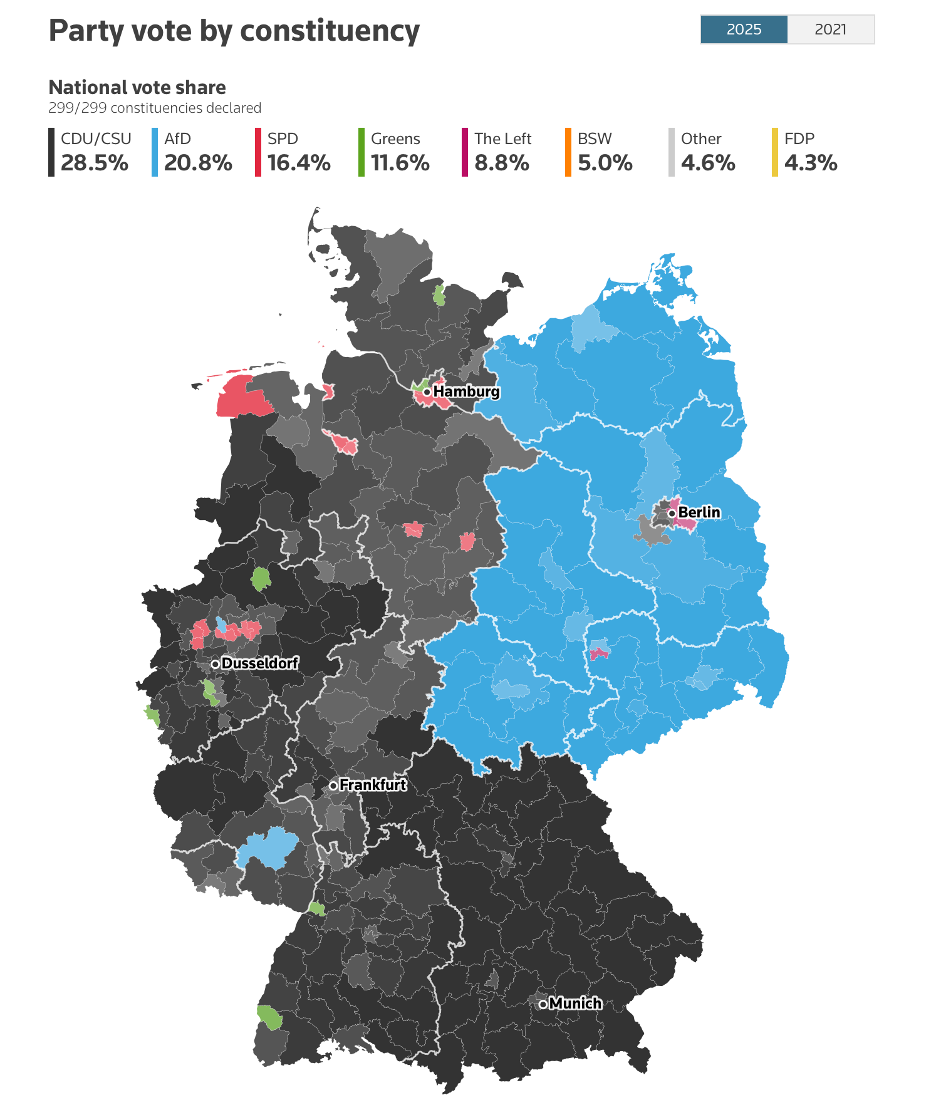
The result of the German Federal elections was very much as expected, the CDU/CSU won 28.5% of the votes and the largest share while AfD garnered 20.8%, the SPD just 16.4% (it’s worst showing in modern times) and the Greens gaining 11.6%.  A tail of other mostly very left-leaning parties made up the balance.  However, one cannot look at a map of the distribution of votes without noticing that the part of the country that was East Germany prior to the fall of the Berlin Wall, still sees things very differently than the rest of the nation.

Source: Reuters.com

Regardless of the distribution, however, the outcome will result in some sort of coalition government, almost certainly to be a combination of the CDU and SPD.  On the surface, it would seem this left-right coalition will be doomed to failure, and that could well be the case, but because the consensus amongst the ‘right-thinking’ people in politics is that AfD is the devil incarnate, or perhaps more accurately, Hitler incarnate, Herr Merz will not be able to rule with a sure majority of conservative voters.

As with virtually every election, the economy is a top priority of the voters, especially since GDP growth, as measured, has essentially been zero for the past three years as per the below chart, and is mooted to stay there on present policies.

Source: tradingeconomics.com

One of the key issues that is currently under discussion there is the constitutionally enshrined ‘debt-brake’ which prevents the German government from running deficits of greater than 0.35% of GDP in any fiscal year.  In order to change the constitution, there needs to be a 2/3’s approval in the Bundestag, but AfD holds a blocking minority and one of their policy platforms has been fiscal prudence.

Arguably, this begs a larger question, what exactly constitutes economic growth?  For instance, if government debt is rising more quickly than economic output, is that actually a growing economy?  And is that process sustainable going forward?  It is quite interesting to look at the government debt dynamics of different nations and ask that question, especially since Germany’s situation really stands out.  

Perhaps, after looking at this group of charts, it is worth reevaluating exactly how much actual growth has been occurring and how much economic activity has simply been government borrowing recycled into the economy across all these nations.  Of course, this process has not been restricted to G-7 nations, it is a global phenomenon, with China doing exactly the same thing as are virtually all nations.  In fact, Germany is unique amongst large nations for bucking the trend.

The reason this issue matters is there is a limit to how far a government can increase its leverage ratio.  At some point, investors will stop buying debt which will force the central bank to buy the debt.  Of course, they will do so by printing more money and devaluing the currency.  We know this because we have seen it happen before many times throughout history with Germany’s Weimar Republic in 1923, Argentina in the 1980’s and Zimbabwe in 2007-2008 as just the most recent examples.  In fact, the reason the Germans have the debt brake is that there is a national memory of that hyperinflation from a century ago.

Circling back to the growth question, what is it that constitutes economic growth?  If you remember your college macroeconomics classes, this is the equation that is used to calculate economic activity in an economy:

            Y = C + I + G + NX

Where:

Y = GDP

C = Consumption

I = Investment

G = Government spending

NX = Net Exports

This equation is taken as gospel in the economics and political worlds.  However, it is not often recalled that it was created in the 1930’s by John Maynard Keynes.  It is not a law of nature, but merely was Keynes’ way of expressing something that had not been effectively measured previously.  Nearly 100 years later, though, perhaps it is time to reevaluate the process.  Remember, economies grew prior to Keynes creating this equation when government activity was a much smaller proportion of the economy.  But as we can see by the dramatic rise in government debt, that is no longer the case.  Perhaps Germany is a peek behind the GDP curtain that shows absent constantly increasing government borrowing, economic growth is stagnant.  Neil Howe’s Fourth Turning could well be the conclusion of this period of government excess, where things will be extremely volatile during the change, but less government will be the norm on the other side, at least for a few generations!

Ok, sorry for the history and theoretical discussion, but that chart of German government debt vs. the rest of the world was really eye-opening.  Let’s turn to markets from the overnight session.

After Friday’s sharp downward movement in the US, the picture in Asia was far more mixed.  Japan (+0.25%) managed a small gain while Hong Kong (-0.6%) and China (-0.2%) both lagged.  Elsewhere in the region, New Zealand (-1.8%) stood out for its weakness, although Korea, India and Taiwan were all softer in the session as well.  Ironically, it seems that better than expected Retail Sales data in NZ hurt sentiment for further policy ease by the RBNZ and concerns over trade with China given US pronouncements is also hurting the situation there, at least for today.

In Europe, Germany’s DAX (+0.9%) is leading the way higher after IfO Expectation data was released a touch better than forecast at 85.4.  However, it is important to remember that while this was a positive outcome, the average reading prior to Covid was between 95 and 103.  As to the rest of Europe, there are more gainers than laggards but little of real note absent any other data.  US futures at this hour (7:00) are pointing higher by at least 0.5% across the board.

In the bond market, Friday saw a very sharp decline in yields, -10bps in Treasuries, after weak readings in the Flash PMI data, especially services at 49.7, Existing Home Sales and Michigan sentiment.  That helped bring global yields lower.  This morning, Treasuries have bounced just 1bp and we are seeing similar rises in most of Europe.  JGB yields are also unchanged and have continued to consolidate near recent highs.

In the commodity markets, after a sharp sell-off on Friday on the back of stories about increased supply from Kurdistan, oil (0.0%) is unchanged this morning.  Meanwhile gold (+0.5%) is rebounding from its regular Friday sell-off, almost as though there were efforts by some to depress the price at the end of every week.  It will be interesting to see what happens this Friday which is month end as well.  As to silver and copper, they are little changed and dull this morning.

Finally, the dollar is asleep this morning, with very limited movement vs. almost any of its counterparts.  USDJPY remains below 150, but the yen has actually fallen -0.3% on the session, while the biggest movers are in Eastern Europe (CZK +0.8%, HUF +0.4%, PLN +0.35%), perhaps on the back of the German election results offering hope for a more useful German government.  We shall see about that.  Otherwise, nobody is concerned over the dollar right now.

On the data front this week, it is a quiet one with PCE data the highlight on Friday.

TodayChicago Fed Natl Activity0.21
TuesdayCase Shiller Home Prices4.4%
 Consumer Confidence103.0
WednesdayNew Home Sales680K
ThursdayInitial Claims220K
 Continuing Claims1874K
 Q4 GDP (2nd look)2.3%
 Real Consumer Spending4.2%
 Durable Goods2.5%
 -ex Transport0.3%
FridayPersonal Income0.3%
 Personal Spending0.2%
 PCE0.3% (2.5% Y/Y)
 Core PCE0.3% (2.6% Y/Y)
 Chicago PMI41.5

Source: tradingeconomics.com

In addition to the data, we also hear from seven Fed speakers over 9 venues, but again, are they really going to change the cautious approach at this stage?  And does it even matter?  For now, financial markets are far more focused on President Trump and his cabinet’s activities than interest rate policy which seems set to remain in place for a while.

When it comes to the dollar, nothing has changed my perspective on relative interest rates in the front end, with US rates likely to be far stickier at current levels than others, but the back end has a potentially different outcome.  Recall that Bessent and Trump are focused on the 10-year yield and getting that lower and seem far less concerned over the Fed for now.  To achieve that they will need to demonstrate the ability to reduce spending and the deficit situation.  While a promising start has been seen with DOGE, we are still a long way from a balanced budget.  My take is the dollar, writ large, is going to take its cues from the 10-year yield for now, so bonds are the market to watch.  If we see yields head back toward 4.0%, the dollar will decline and any significant move higher in yields will likely see the dollar climb as well.

Good luck

Adf

Quite Vexatious

The data remains quite vexatious
As some shows that growth is bodacious
But other releases
Are closer to feces
Implying the first stuff’s fallacious
 
For instance, the GDP print
At two point eight offered no hint
Recession is nearing
Yet stocks aren’t cheering
For bears, in their eyes, there’s a glint
 
But Durable Goods was abysmal
At minus six plus, cataclysmal
And more survey data
Implied that pro rata
The story ‘bout growth’s truly dismal


In the past week, we have seen a decent amount of data, and the upshot is that there is still no clarity on the US economic condition.  Many analysts accept the data at face value, and with today’s GDP print as the latest installment, dismiss the idea of a recession coming soon.  Others look at the headline, and then the underlying pieces and detect that ‘something is rotten in Denmark the US’.

 A quick review of the recent data shows the housing market is weakening further, with both New and Existing Home Sales declining on a monthly and annual basis.  As well, the Survey data showed the Richmond and Kansas City Fed’s Manufacturing Indices falling deeper into negative territory as well as a weak Flash PMI Manufacturing print.  Durable Goods headline fell -6.6%, which while it is a volatile series (depending largely on airplane deliveries by Boeing), was still a terrible outcome.  Absent transports, though, it rose 0.5%, which seems more in line with the first look at Q2 GDP, showing a 2.8% annualized growth rate.  (One thing to watch in that GDP report is the PCE index that is implied and showed a surprising rise.  Keep this in mind for tomorrow’s PCE report.). Alas, final Sales in the GDP report only rose 2.0%, a potential harbinger of future weakness.  

If we go back and look at the CPI data, which was soft, or the NFP data, which was strong, there continue to be underlying pieces of almost every report which indicate weakness compared to headline strength or vice versa.  So, which is it, recession or no?

Unfortunately, we will not know until the next recession has likely finished given the NBER’s methodology of declaring a recession.  (It is important to understand in the US, the rule of thumb, two consecutive quarters of negative real GDP growth is not the definition.)  Regardless, we haven’t even had one quarter of negative growth.  This poet’s view is that the economy is clearly slowing down with respect to activity but does not seem like it has yet tipped into recession.  Perhaps things will be clearer in Q3, but for now, the arguments are going to continue.

Tokyo prices
Keep on decelerating
Why will they tighten?

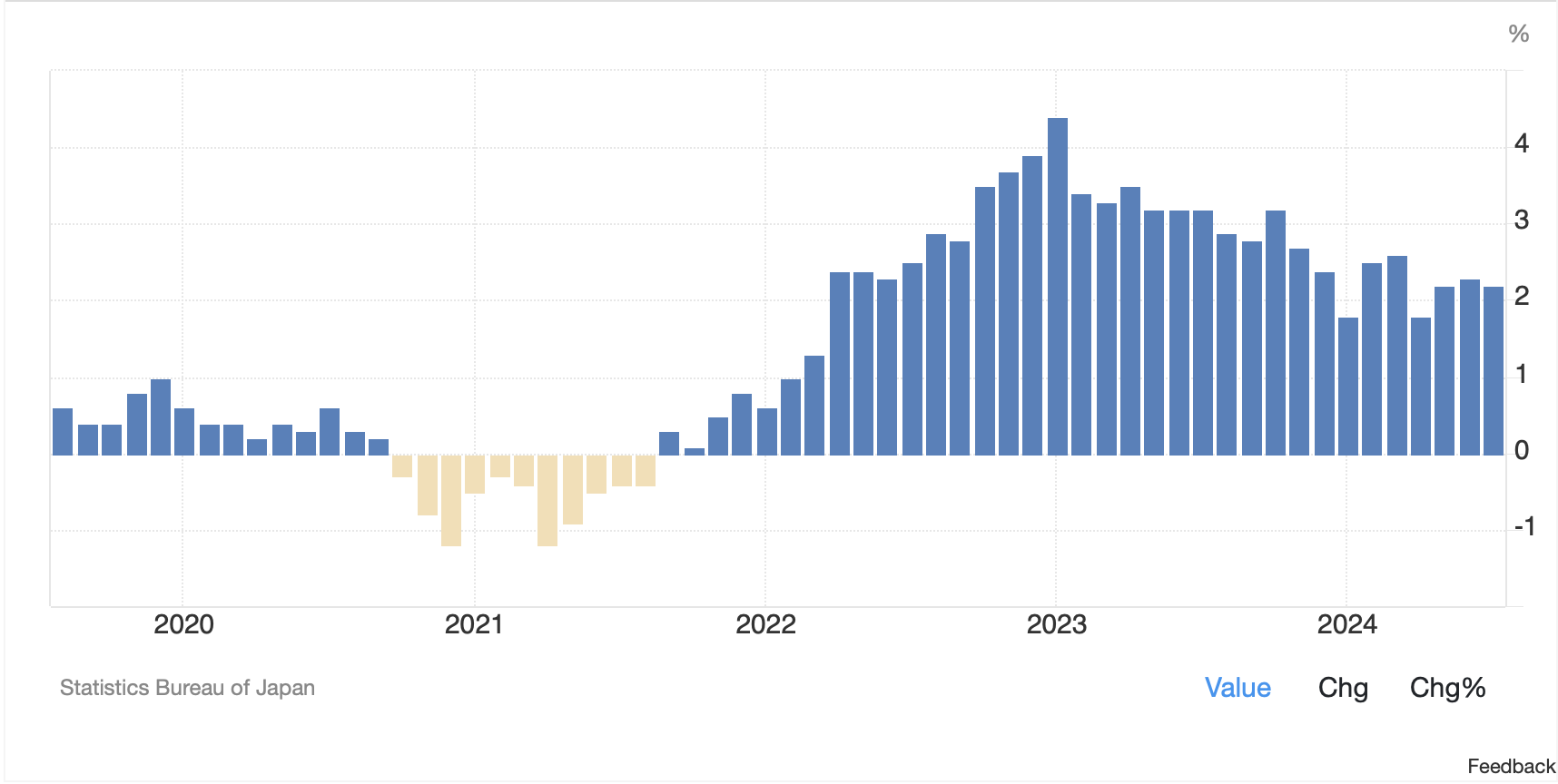
Tokyo CPI data was released overnight and once again, it was a touch softer than expected with both headline and core printing at 2.2%.  In fact, the ex-food & energy index rose only 1.1% Y/Y!  The Tokyo data is typically a harbinger of the national number and when looking at the data, it is easy to understand why Ueda-san is reluctant to tighten further.  As per the chart below, the trend here remains toward lower inflation without any further policy adjustments.  

Source: tradingeconomics.com

So, why would they move next week?  This is especially so given the yen has rebounded nearly 6% over the past several weeks, relieving pressure on the biggest current concern.  I know it is fashionable to think that the BOJ is going to tighten policy while the Fed cuts, but it is not difficult to make the case that the US economy is continuing to tick along and so higher for longer remains appropriate, while in Japan, price pressures are easing without any further policy tightening.  There is increasing analyst discussion the BOJ is going to move, but I remain suspect, at least at this point.  Rather, I expect that there is probably more short-covering to come in the JPY and that is going to further relieve pressure on the BOJ to act.

This morning, we get PCE
The data most pundits agree
Will license the Fed
To cut rates ahead
At least that’s the stock market’s plea
 
The final big story today is the release of the PCE data.  As we all know by now, this is the inflation metric the Fed uses in their models.  Current median expectations are as follows: Headline (+0.1% M/M, 2.5% Y/Y) and Core (+0.1% M/M, 2.5% Y/Y).  In both cases, that would represent a tick lower in the annual number compared to last month, and based on the current narrative, would add to the Fed’s confidence that inflation is coming under control.  And maybe that will be the case.  After all, the past two inflation reports have come in below the median expectations. 
 
However, there is another PCE report that is published alongside the GDP data.  Essentially, it is the number that determines how much of nominal GDP is actual growth and how much is price growth.  As part of yesterday’s GDP release, the core PCE index rose at a 2.9% rate, lower than Q1 but above expectations.  I’m merely pointing out that as seen above, there is a lot of conflicting data out there.  It would be premature to assume that inflation is under complete control in my view, although that is the growing market belief.
 
Ok, let’s look at what happened overnight.  Equity markets are trying to figure out what everything means right now.  Yesterday’s US performance was mixed, with Tech stocks still under pressure although the DJIA managed to gain on the day.  Overnight, Japanese stocks (-0.5%) continued their recent decline, following the NASDAQ lower, but both Hong Kong and China managed small gains on the session.  As to Europe, most major indices are in the green led by the CAC (+0.85%) despite the terrorist attacks on the high-speed rail network as the Olympics begin there.  But after several down days, investors feel like the correction has run its course and are coming back.  This is evidenced by US futures which are higher by upwards of 1% at this hour (6:30).
 
After yesterday’s more aggressive risk-off session, this morning bond yields are little changed to slightly higher around the world.  Treasuries are unchanged and European sovereigns have seen yields rise by either one or two basis points.  JGB yields, too, are higher by 1bp, as it appears investors have been exhausted by this week’s volatility.  Of course, a surprising number this morning will almost certainly get things moving again.
 
In the commodity markets, oil, which managed to rebound at the end of the day yesterday, is lower by -0.4% this morning.  Given the volatility across all markets right now, it is difficult to come up with a coherent story about the situation here in the short run.  Gold (+0.4%) which got decimated yesterday, has run into technical support and is rebounding, but the same is not true for silver or copper, both of which remains near their recent lows.  I will say this about copper; as it remains one of the most important industrial metals, its weakness does not seem to bode well for economic growth going forward, and yet as we saw yesterday, US GDP is running above trend.  This is simply more evidence that confusion reigns in market views.
 
Finally, the dollar is generally lower this morning. While the yen (-0.55%) is giving back some of its recent gains, almost all of the other major currencies in both the G10 and EMG blocs are a touch stronger.  MXN (+0.7%) is the leader followed by ZAR (+0.5%) with most others gaining much smaller amounts.  The thing is, aside from the US data, there has been precious little other data of note that would drive things.  One might make the argument that the rebound in gold is helping the rand, but that seems tenuous.  Right now, with risk being re-embraced, my take is the dollar is simply softening a bit.
 
In addition to the PCE data we also see Personal Income (exp 0.4%) and Personal Spending (0.3%) and then at 10:00 we get the Michigan Sentiment Index (66.0).  But all eyes will be on PCE.  I look at the GDP data and think we could see something a bit hotter than currently forecast and desperately hoped for.   If that is the case, I suspect that stocks may falter and bonds as well although the dollar should regain ground.
 
Good luck and good weekend
Adf


The Fat Lady

Is the fat lady
Starting to sing?  Listen for
More threats to be sure


Tell me if you’ve heard this one before, “It’s desirable for exchange rates to move stably. Rapid, one-sided moves are undesirable. In particular, we’re deeply concerned about the effect on the economy.”

Or this one, “We are watching moves with a high sense of urgency, analyzing the factors behind the moves, and will take necessary actions.”

Of course, the answer is yes, these are essentially verbatim of what Shunichi Suzuki, Japanese FinMin, said earlier this week, as well as several times back in April prior to their last bout of intervention.  It is probably step 3 on the 7-step program that leads to eventual intervention by the MOF/BOJ.   And those are his direct comments from last night in the wake of USDJPY trading to yet another new high (160.88) for the move.  The last time the currency was that weak vs. the dollar was in 1986.  

Now, perhaps I can help him analyze the factors behind the moves.  Why look, the entire interest rate complex in Japan remains significantly below the same metrics anywhere else in the world, but from a G10 perspective, specifically vs. the US.  As well, the commentary from the various Fed speakers we have heard just this week continues to indicate higher for longer remains the play.  Recall, Governor Bowman even suggested the possibility of raising rates if circumstances dictated.  I might suggest to Suzuki-san, that as long as the BOJ maintains ZIRP, and continues to hold 50% of the JGB market, the yen will remain under pressure. 

The question remains, just how high can USDJPY go?  And the answer remains much higher.  I continue to believe that we will need to see a quick move to 163, at least, before the MOF tries to slow things down again, meaning by Monday latest.  If, instead, the market simply hangs around at this new level, I expect more jawboning but no action.  The one caveat is that next Thursday is July 4th, when all banks in NY will be closed and market liquidity will be extremely suspect.  It would not be a surprise if they were to take advantage of those thin markets and aggressively sell dollars then.  It would certainly have an outsized impact.  We shall see.

Today’s likely to be at peace
As folks eye tomorrow’s release
Of PCE data
And so, options’ theta
Is vanishing like Credit Suisse

The truth is, away from the yen story, there is very little of consequence ongoing as the market sets its sights on tomorrow’s PCE data.   This evening’s Presidential debate will certainly be interesting and likely be entertaining, but it is not clear it will impact markets.  And while we continue to see gyrations in various markets, the big themes remain stable.  The Fed is not about to change its stripes as we have heard repeatedly since the FOMC meeting, the economy continues to move along, albeit at a somewhat slower pace than Q1, but not showing any hint of recession at this stage, and the geopolitical situation is constant with Russia/Ukraine and Israel/Gaza continuing to wreak havoc and destruction mostly in the background.  As such, I expect that we are going to be subject to more idiosyncratic movements in markets for now.
 
So, let’s look at what happened overnight.  After yesterday’s very limited equity moves in the US, most of Asia was in the red led by the Hang Seng (-2.1%) as tech shares were under pressure.  But the Nikkei (-0.8%) and Shanghai (-0.75%) also fell with the former a bit surprising given both the weaker yen and the surprisingly better than expected Retail Sales data released, while the latter seemed to respond to declining Industrial Profit data that was released.  As it happens, Australia shares were also softer as inflation data there continues to show stubborn strength squashing any ideas of an RBA rate cut soon.  In Europe, red is also the most common color with the CAC (-0.5%) and IBEX in Spain (-0.5%) leading the way lower.  Most other markets are softer although the DAX (+0.1%) is bucking the trend, despite lacking an obvious catalyst for the move.  And let’s face it, 0.1% is not really relevant to anything.  At this hour (7:00), US futures are pointing slightly lower ahead of the weekly Claims data.
 
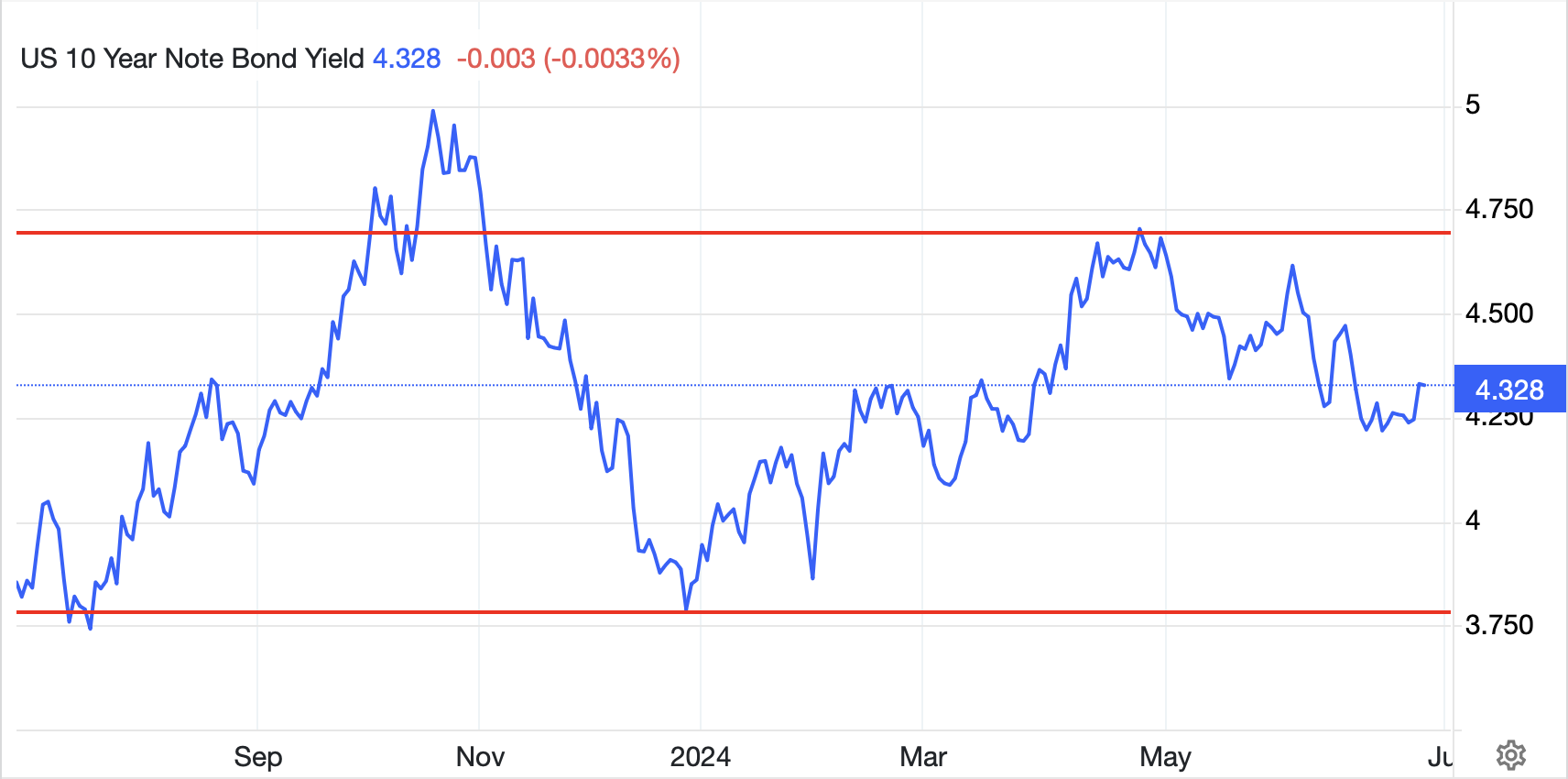
In the bond markets, yields in the US backed up by 5bps and have stayed there this morning.  in Europe, the markets closed before the US move finished, so this morning, yields across the continent are higher by 3bps or so as they catch up to the US.  In Asia, the movement was stronger with JGBs +5bps and Australian bonds +10bps on the back of the US move as well as Australia’s growing inflation concerns (Consumer Inflation Expectations rose to 4.4%).  It strikes me, looking at the chart below, that yields have been in a wide range, about 90 basis points, for the past year and that we are currently pretty much in the middle of that range.  It is hard to get too excited about things until we break this range in my view.

Source: tradingeconomics.com

In the commodity space, oil (+0.35%) is rebounding slightly this morning after weakness in the wake of larger than expected inventory data released yesterday, with an over 6-million-barrel increase compared to expectations of a 5.5-million-barrel drawdown.  As to the metals markets, gold (+0.7%), which suffered on the back of the strong dollar yesterday, is rebounding and taking silver with it, although the industrial metals remain under pressure.

Finally, the dollar, which was king of the hill yesterday, with the Dollar Index trading back above 106 for a while, is softening a touch this morning, probably about 0.2% or so against its major counterparts.  However, while that is the general result today, there is one outlier, ZAR (-1.15%) which continues to demonstrate remarkable volatility amidst the political situation with no cabinet yet named.  Perhaps the driver this morning was the softening inflation picture enticing traders to believe that SARB may be considering rate cuts soon.

On the data front, this morning brings the weekly Initial (exp 236K) and Continuing (1820K) Claims data along with Durable Goods (-0.1%, +0.2% ex Transport), final Q1 GDP (1.4%) and its components of note like Final Sales (1.7%) and its Price Index (3.3%).  Remarkably, there are no Fed speakers due today either.  I think we need to keep a close eye on the employment situation as it has been slowly worsening overall.  It wasn’t that long ago when Initial Claims were pegged at 212K every week.  Now they have grown by more than 20K and any lurch higher will be noticed.  Next week’s NFP is going to be critical with the potential for a significant impact as it will be released the day after the July 4th holiday, a day when trading desks will be very lightly staffed.

For today, it is hard to get excited about anything, but if we continue to see the slow deterioration of US data, that will eventually feed into the rate picture and the dollar’s value as well.

Good luck

Adf

The Ocular Veil

In NY, the jury has spoken
And folks who run risk have awoken
Now looking ahead
Investors may dread
That property rights have been broken
 
For markets, what this may entail
Is loss of the ocular veil
The full faith and credit
Of Treasury debit
Just might not be seen as so hale


If you have suffered through my daily writings long enough, at least past the poetry up front, you have probably surmised that my views are in accord with free markets and capitalism.  In addition, regardless of the political insanity that continues to top headlines in every publication in the US, and across much of the world, I only try to touch on it if I believe it is going to have an impact on market behavior, whether short or long term.  For instance, during the runup to Brexit, I focused on the issue because I felt certain the outcome would impact the value of the pound as well as UK interest rates and equity markets.

Well, I might argue that another Rubicon has been crossed in the US, and one that I fear may have negative long-term implications for US assets of all stripes.  The guilty verdicts that were announced yesterday afternoon against former President Donald Trump are a new, and very disturbing outcome.  Whatever your view of the man, and whether you would like to see him be re-elected or not, the idea that a sitting government in the US would throw all its effort into imprisoning its major opponent seems far more akin to the actions of dictators like Vladimir Putin, Nicolas Maduro and Xi Jinping.  And yet here we are today with that being the biggest story in the world.

What, you may ask, is the market angle here?  Consider the other thing that has happened during this administration with respect to the Russian central bank’s reserve assets at the time of Russia’s invasion of Ukraine in the winter of 2022.  While freezing them was the first step, recent comments by Treasury secretary Yellen and her compatriots in the G7 indicate that they are going to start to confiscate those assets and give them to Ukraine to help them fight the war against Russia.  Irony aside, the bigger picture, which has been discussed numerous times since the initial action, is that the move calls into question the safety of foreign government assets held in the US and other G7 nations, especially those held in the most liquid, and ostensibly safest, debt instruments in the world, US Treasury securities.  If other nations begin to worry that the full faith and credit concept has a political angle, rather than purely a financial one, it will change asset allocations all over the world.

We have seen this already as China and Russia have been transacting between themselves in CNY, and we have seen India seek to pay Russia in rupees for the oil they have been buying.  Saudi Arabia has also been willing to accept CNY for oil sales in a major change to agreements made back in the 1970’s between the US and the Kingdom.  Of course, this has been the genesis of all the talk of the end of the dollar and dollar hegemony, and the idea that an alternative reserve currency will soon be coming to fruition.

Let me give you my take, at least at this early stage.  The connection between the Trump verdict and the Russian reserves is that arguably the bedrock of the US economy and one of the fundamental keys to its long-term success has been the knowledge, by friend and foe alike, that the rule of law is deeply imbedded into all business dealings here.  We know that other nations can be capricious and confiscate foreign-owned assets, or stomp on domestic businesses for political reasons.  But in the US, historically, while politics was part of the economic process, that strand was never before in doubt.  I fear that has changed irreparably now with the Trump verdict in combination with the Russian reserve assets decisions.

Going forward, will foreign investors truly believe that the rule of law, as written in the Constitution protecting property rights, is sacrosanct?  And if that is not the case, or there is doubt that is the case, will foreign investors (and domestic ones for that matter) be as anxious to purchase and hold US assets, whether they are equities or debt?  It is way too early to answer that question, but the fact that it needs to be asked is an entirely new and disconcerting situation.

I know this may seem like a big assertion based on limited evidence.  This will especially be true if you are of the belief that Trump is a crook, the NY DA was exactly correct, and the trial outcome was appropriate.  However, I am confident that this outcome will be seen very differently than that by many citizens and investors around the world and that very question of property rights and the rule of law will be raised again and again.  And that cannot be good for US risk assets.

If we add this new political angle to what has been a recent spate of weaker than expected economic data, it is quite possible, and I believe we are already moving in this direction, that soon, “bad news will be bad”.  This means that weak economic data will not encourage the bulls to buy quickly on the thesis that the Fed is going to start cutting rates sooner than the current view, but rather that a weak economy with still sticky inflation means that company earnings are going to suffer greatly, and equity multiples will rerate lower to reflect that.  Not necessarily today or Monday, but over time.  I am going to go out on a limb and predict that the highs for US equities are now in.  So, S&P 500 at 5341, DJIA at 40,077 and NASDAQ 100 at 17,032 are all we are going to get in this move with a substantial correction far more likely than a rally extension.  I also believe that the dollar will start to suffer more aggressively going forward, that the Treasury market will suffer as well, so much so that the Fed is going to be buying bonds again before the year ends, and that commodities are going to trade much higher.

Back in January, my view was just this, that we would peak around mid-year, that the Fed might get one rate cut in, but that was all, and that risk assets would finish the year much lower.  That was based on a belief that the economy would roll over.  Now, clearly the economy, while softening a bit, is not showing signs of a significant downturn.  After all, given how much money the government is pumping into it, it would be difficult to wind up with nominal GDP falling much at all.  But this is an entirely different reason, and one that is far more worrisome in my eyes, and likely to be more gradual in its impact, but more long-lasting.  As I said, a Rubicon has been crossed and not in a good way!

My apologies for that rant, but I am truly concerned for the way that things play out going forward.  However, let’s turn to the financial and economic issues rather than the political now.  US equities were under pressure all day yesterday, closing lower across the board as concerns over a lack of Fed policy ease joined with additional weaker-than-expected US data.  While the GDP revision was exactly as expected, Final Sales and Real Consumer Spending were both softer than forecast, and in the end, those are the critical drivers of economic activity.  The Trump verdict was released after the market close, so had no direct impact.  But following the US session, Asian stocks went their own way.  The Nikkei (+1.1%) performed well despite (because?) Tokyo CPI -ex food & energy printed at 2.2%, higher than last month, but continuing its broad downtrend from early last year.  Australia and New Zealand also performed quite well, but the rest of the region had a tougher time with both Hong Kong (-0.8%) and Mainland (-0.4%) shares under pressure and losses almost everywhere else in Asia.  

In Europe, the picture is one of mostly very small declines with the UK (+0.3%) the outlier in response to some solid UK housing data as well as growth in Mortgage Lending.  As to US futures, at this hour (6:00) they are little changed as we all await the PCE data.

In the bond markets, yesterday’s decline in yields is being reversed this morning as Treasuries creep back higher by 1bp while European sovereigns are seeing more selling pressure after Eurozone CPI was released at a hotter than forecast 2.6% (2.9% core).  While all the ECB commentary is still focused on a cut next week, this cannot have been a welcome result for the doves there.

Turning to the commodity markets, oil is slightly lower this morning following yesterday’s decline that was based on the significant build in gasoline inventories.  This was quite the surprise given the start of the summer driving season and may reflect softer overall demand (remember the weak GDP data).  As to the metals markets, gold, after a modest bounce yesterday is unchanged while silver (+0.25%) and copper (-0.5%) are responding differently to yesterday’s declines and weak data.  However, as I indicated earlier, I foresee these seeing continued structural strength.

Finally, the dollar fell yesterday on the back of softer US yields, at least versus the G10 currencies.  As I highlighted yesterday, several EMG currencies are also under pressure and we continue to see that this morning, notably KRW (-0.7%) which cannot get out of its own way as worries over Chinese growth (last night Chinese PMI data was weak across the board with Manufacturing printing at 49.5) continue to weigh on its export prospects.  But I would say that broadly, the dollar is on its back foot right now and unless US yields start to climb again, will remain so.

This morning’s key data is, of course, PCE (exp 0.3% M/M for both Headline and Core with 2.7% and 2.8% expectations for the Y/Y respectively.)  As well we see Personal Income (0.3%), Personal Spending (0.3%) and Chicago PMI (41.0).  Finally, the last Fed speaker before the quiet period will be Raphael Bostic from the Atlanta Fed, whom we have heard half a dozen times in the past two weeks and seems unlikely to change his tune.  However, I must note that there is some dissent on the FOMC as evidenced by dueling comments yesterday from Dallas’s Lorie Logan and NY’s Jonathan Williams.  Logan continues to be concerned over the pace of decline in inflation and exhorts the committee to remain flexible and consider hikes if necessary.  Williams was adamant that inflation would achieve their target by next year and easing policy was appropriate.  In truth, that has been the most dovish commentary we have heard from a Fed speaker in a while.

One last thing regarding elections.  Yesterday’s South African results show that the ANC, which has led the country since Apartheid, is now scrambling to put together a coalition government which will be much weaker, or at least less able, when it comes to implementing any agenda.  Meanwhile, this weekend, Mexico goes to the polls and AMLO’s hand-chosen successor, Claudia Sheinbaum, seems set to win in a landslide with very little change in the nation’s international stance.

As I said at the top, the changes I foresee will be gradual, but I believe the direction of travel has changed.  Today will be a response to the PCE data, where a hot number is very likely to see concerns rise over the Fed’s future actions and risky assets decline, while a cooler than forecast number could well see a short-term rally.  But do not lose sight of the big picture.

Good luck and good weekend 

Adf