Nothing is Clear

Though next week the Fed will cut rates
The bond market’s in dire straits
‘Cause nothing is clear
‘Bout growth, and Jay’s fear
Is he’ll miss on both his mandates


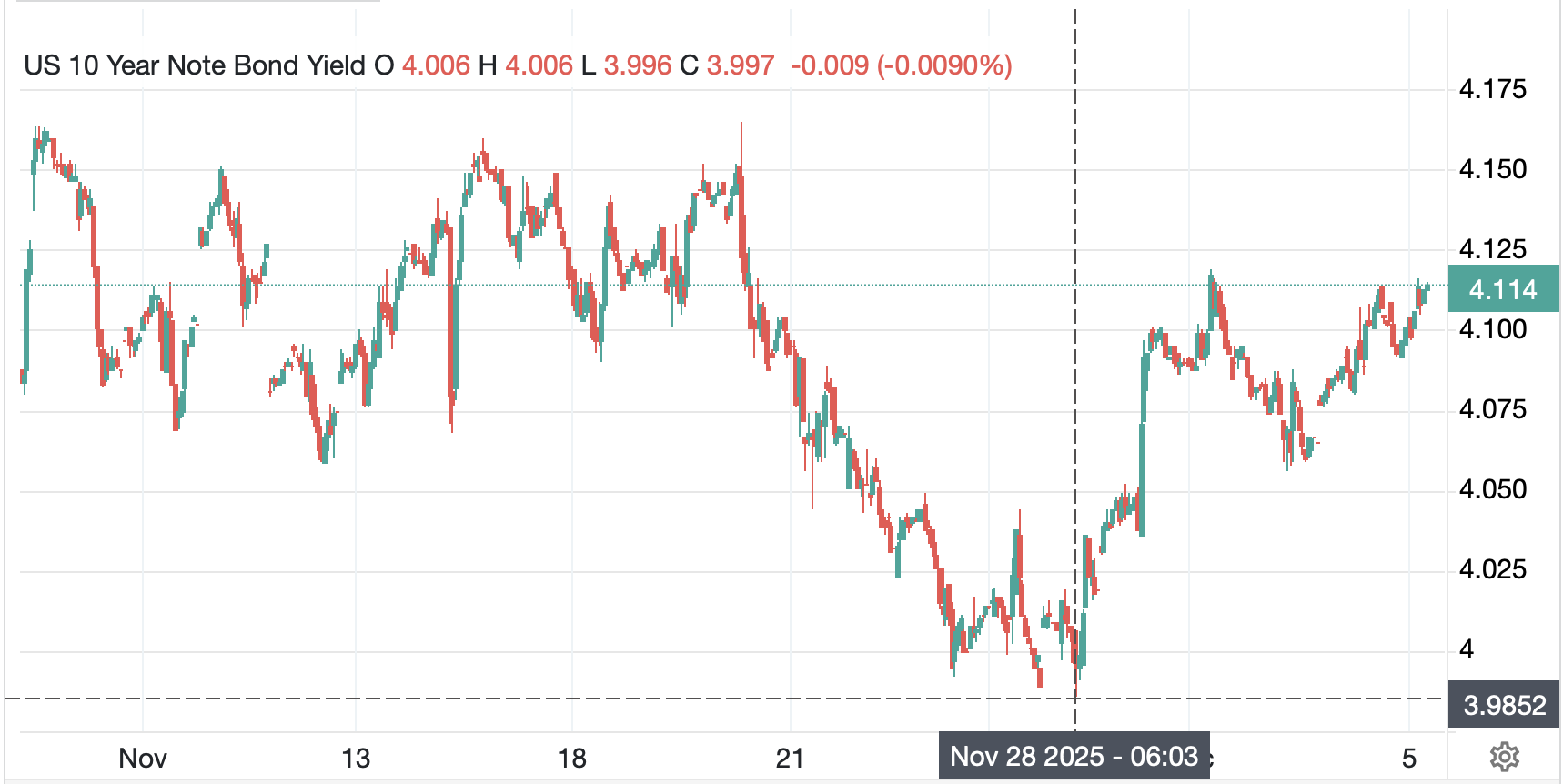
In the past week, 10-year Treasury yields have risen 13bps, as per the below chart, even though market pricing of a Fed rate cut continues to hover around 88%.  Much to both the Fed’s and the President’s chagrin, it appears the bond market is less concerned with the level of short-term rates than they are of the macroeconomics of deficit spending, and total debt, as well as the potential for future inflation.
Source: tradingeconomics.com

I don’t think it is appropriate to describe the current bond market as being run by the bond vigilantes, at least not in the US (Japan may be another story) but it is unquestionable that there is a growing level of discomfort in the administration.  This morning, we will see the September PCE data (exp 0.3%, 2.8% Y/Y headline; 0.2% 2.9% Y/Y Core) which will do nothing to comfort those FOMC members who quaintly still believe that inflation matters.

It’s funny, while the President consistently touts how great things are in the economy, both he and Secretary Bessent continue to push hard for lower interest rates, which historically had been a sign of a weak economy.

But as I have highlighted before, the data is so disparate, every analyst can find something to support their pet theory.  For instance, on the employment front, the weak ADP reading on Wednesday indicated that small businesses were under pressure, yet the Initial Claims data yesterday printed at a remarkably low 191K, which on the surface indicates strong labor demand.  Arguably, that print was impacted by the Thanksgiving holiday so some states didn’t get their data in on time, and we will likely see revisions next week.  But revisions are not nearly as impactful as initial headlines.  Nonetheless, for those pushing economic strength, yesterday’s Claims number was catnip.

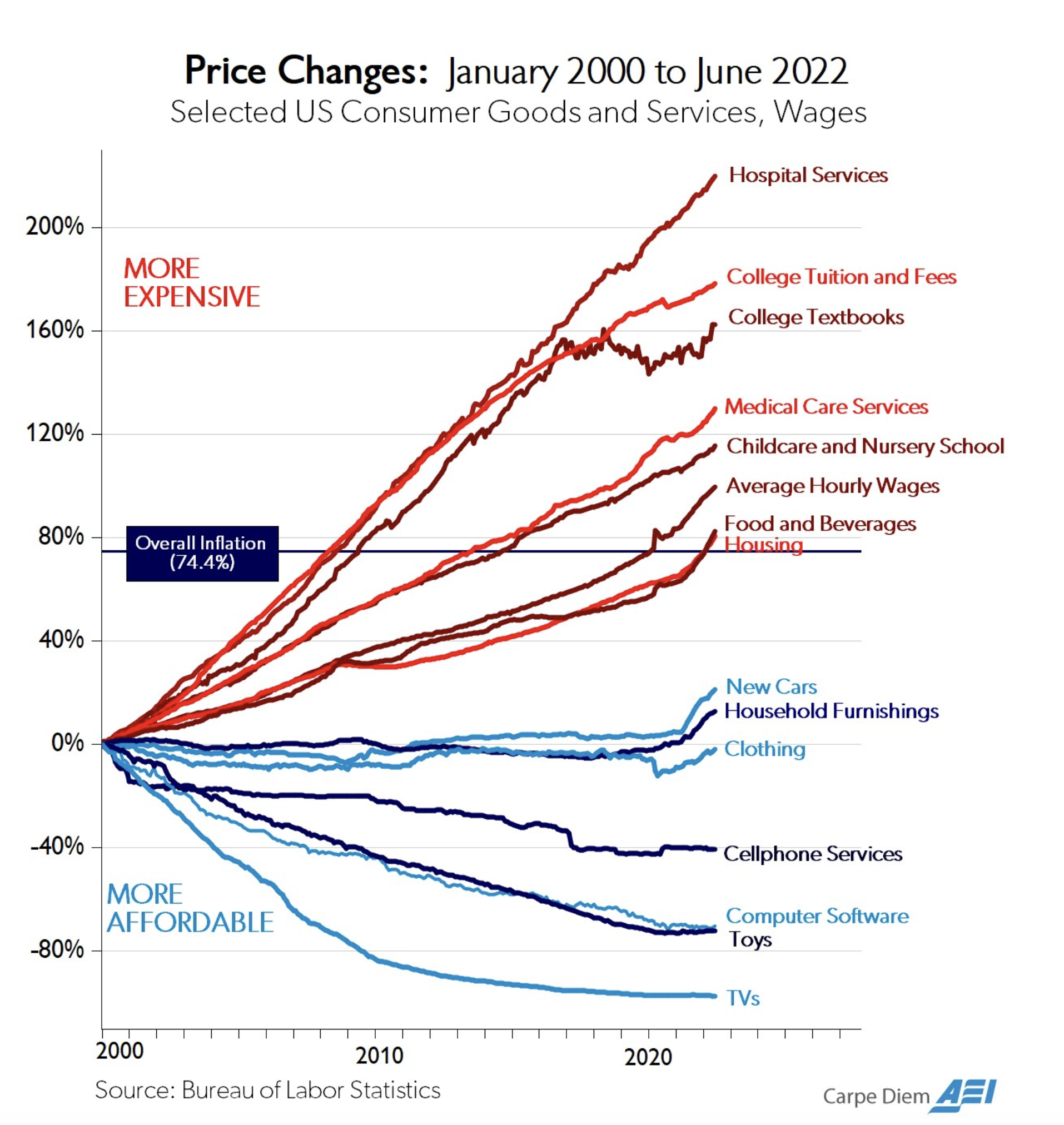
So, which is it?  Is the economy strong or weak?  My amateur observation is that we no longer have an ‘economy’ but rather we have multiple industrial and business sectors, each with its own dynamics and cycles, some of which are related but others which are independent.  And so, similar to the idea that the inflation rate that is reported is an average of subcomponents, each of which can have very different trajectories than the others (as illustrated in the chart below), the economy writ large is exactly the same.  So, an analogy might be that AI is akin to Hospital Services in the below chart while heavy industry is better represented by the TV’s line.
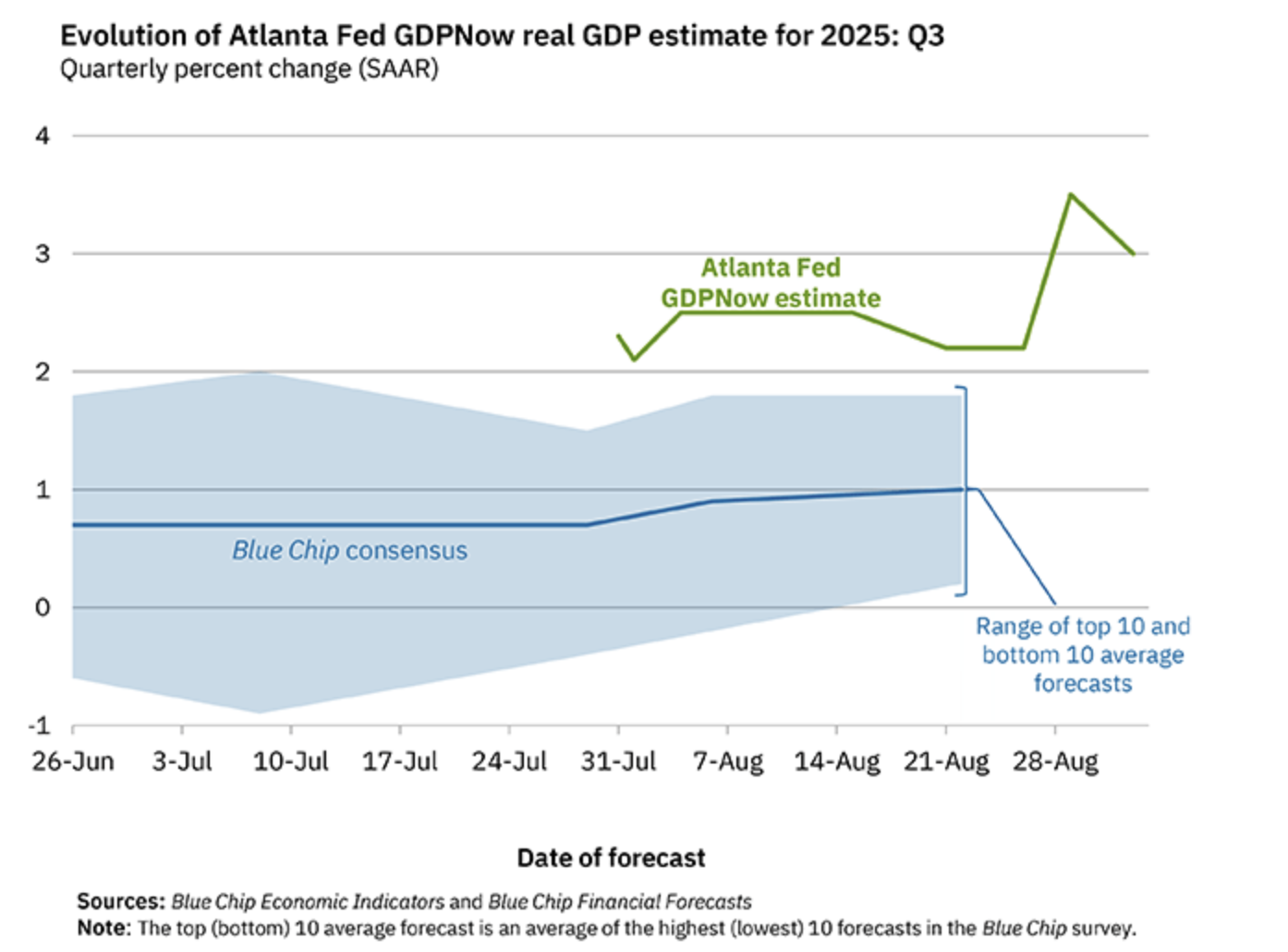
But, when we look at the Atlanta Fed’s GDPNow forecast below, it continues to show a much stronger economic impulse than the pundits expect.
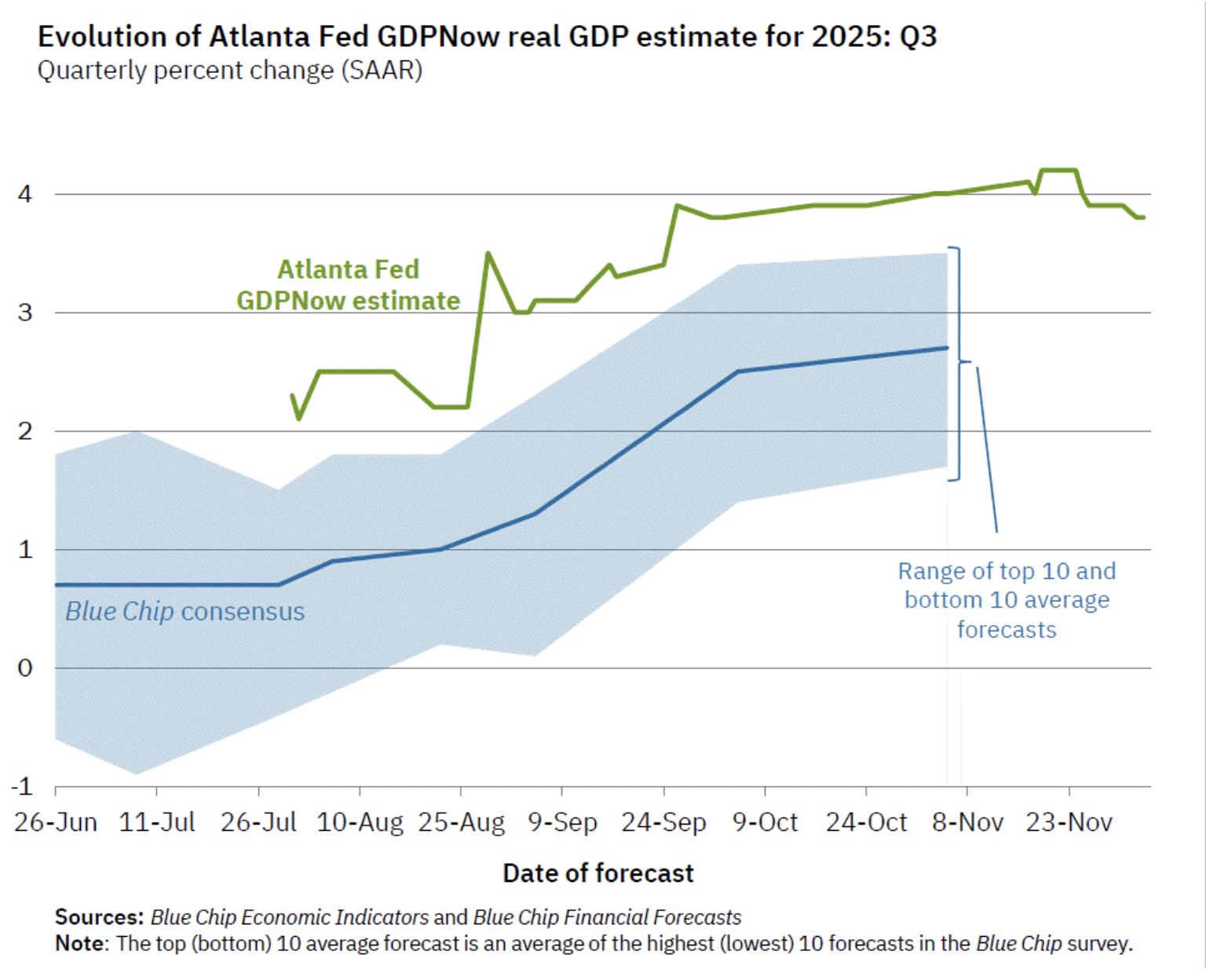
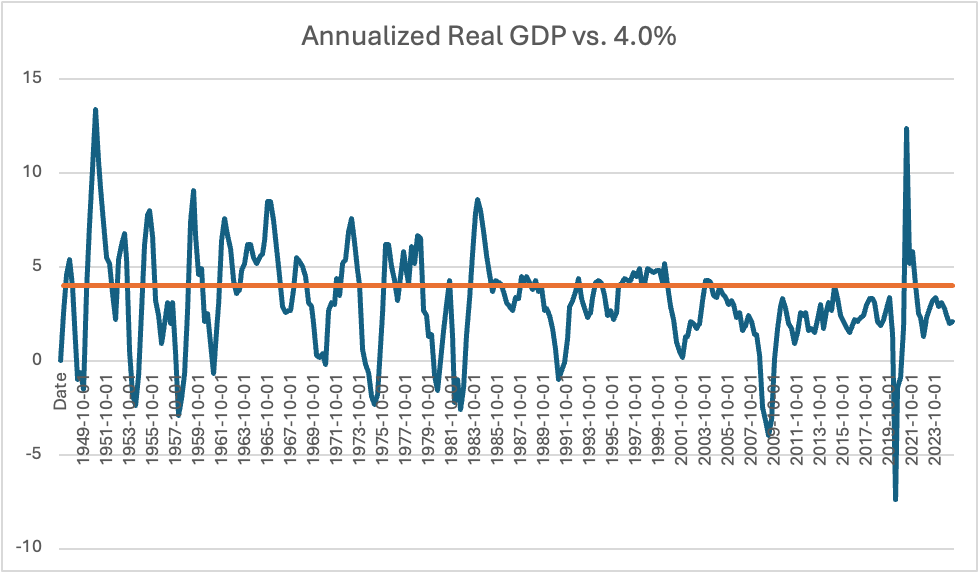
And quite frankly, if 3.8% is the real growth rate, that is quite strong, certainly relative to the last two decades in the US as evidenced by the below chart I created from FRED data.  The orange line represents 4% and you can see that other than the Covid reopening, we haven’t been at that level for quite a while.
What is the reality?  Everybody has their own reality, just like everybody has their own personal inflation rate.  However, markets have been inclined to believe that the future is bright, which given my ongoing view of every nation ‘running it hot’ makes sense, so keep that in mind regardless of your personal situation.

Ok, let’s look at how markets behaved overnight.  Yesterday’s nondescript day in the US was followed by a mixed Asian session with Tokyo (-1.0%) slipping on concerns that the BOJ is going to raise rates.  I’m not sure why that is news suddenly, but there you go.  However, China (+0.8%), HK (+0.6%), Korea (+1.8%), India (+0.5%) and Taiwan (+0.7%) all continued their recent rallies.  The RBI did cut rates by 25bps, as expected, but that doesn’t seem to have been the driver.  Just good vibes for now.

In Europe, screens are also green this morning, albeit not dramatically so.  Frankfurt (+0.6%) leads the way but Paris (+0.3%), Madrid (+0.2%) and London (+0.1%) are all on the right side of the ledger.  Eurozone growth in Q3 was revised up to 0.3% on the quarter, although that translated into an annual rate of 1.4%, lower than Q2, but the positive revision was enough to get the blood flowing.  That and the idea that European defense companies are going to come back into vogue soon.  And as has been their wont, US futures are higher by 0.2% at this hour (7:35).

In the bond market, Treasury yields are higher by 2bps this morning and European sovereign yields are getting dragged along for the ride, up 1bp to 2bps across the board.  JGB yields also continue to climb and show no sign of stopping at any maturity.  A BOJ rate hike of 25bps is not going to be enough to stop the train of spending and borrowing in Japan, so I imagine there is much further to go here.

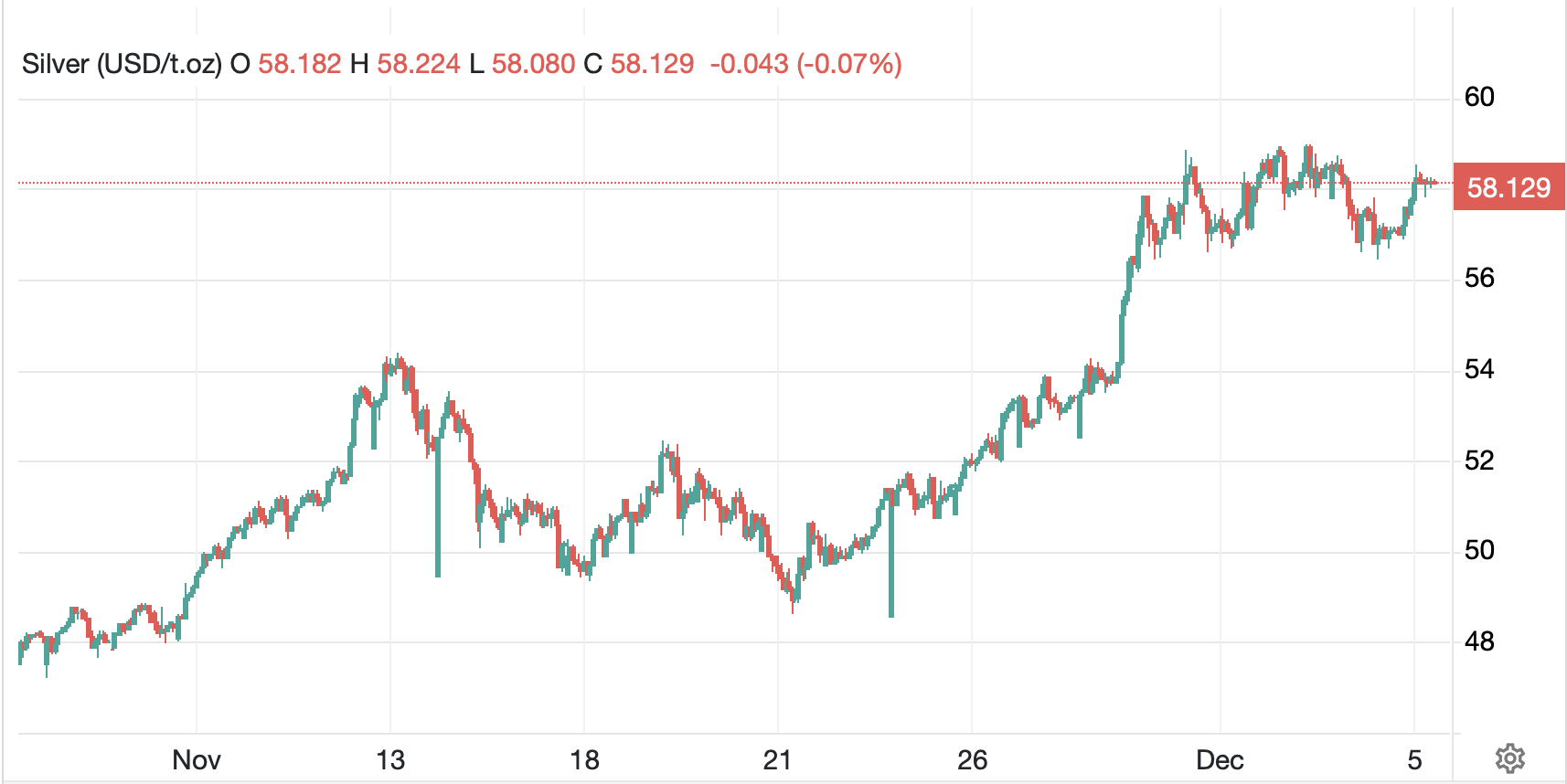
In the commodity space, silver (+1.8%) has been getting a lot more press than gold lately as there are ongoing stories about big banks, notably JPM, having large short futures positions that were designed to keep a lid on prices there, but the structural shortage of the metal has started to cause delivery questions on the exchanges all around the world.  So, while it has not yet breached $60/oz, my take is that is the direction and beyond.
Source: tradingeconomics.com

Gold’s (+0.4%) story has been told so many times, it is not nearly as interesting now, central bank buying and broader fiat debasement concerns continue to be the key here.  Copper (+1.8%) is also trading at new highs in London and the demand story here knows no bounds, at least not as long as AI and electrification are part of the mix.  As to oil (-0.25%), it is a dull and boring market and will need to see something of note (regime change in Venezuela or peace in Ukraine seem the most likely stories) to wake it up.

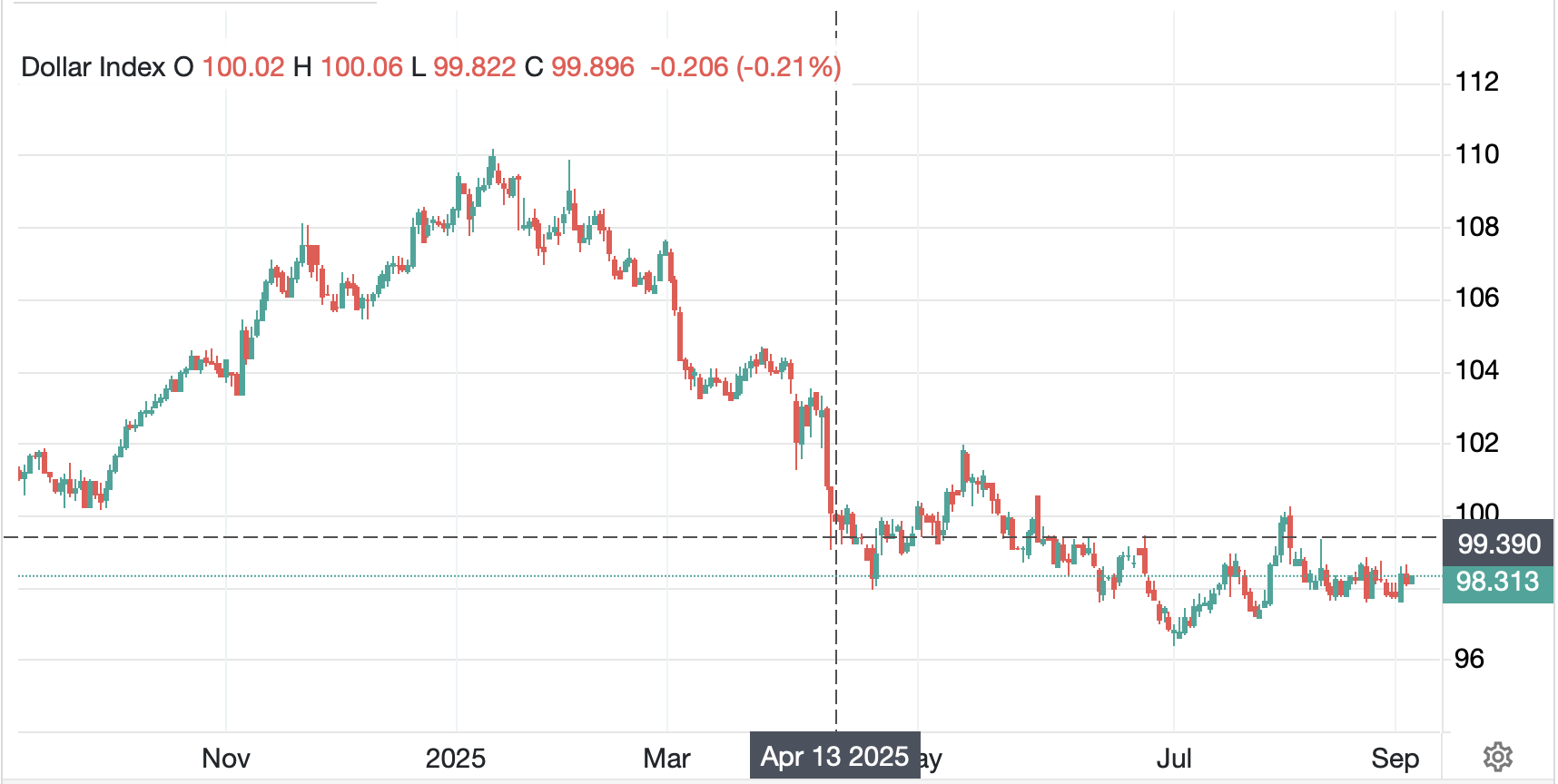
Finally, the dollar is still there.  The DXY is trading at 99, below its recent highs but hardly collapsing.  Looking for any outliers today ZAR (+0.4%) is benefitting from the gold rally (platinum rallying too) but otherwise there is nothing of note.  INR (-0.2%) continues to trade around its new big figure of 90.00, but has stopped falling for now, and everything else is dull.

As well as the PCE data, we get September Personal Income (exp 0.3%), Personal Spending (0.3%) and Michigan Sentiment (52.0) with only the Michigan number current.  We are approaching the end of the year and while with this administration, one can never rule out a black swan, my take is positions are being lightened up starting now, and when the December futures contracts mature, we may see very little of interest until the new year.  In the meantime, nothing has changed my big picture view.  For now, absent a very aggressive FOMC cutting rates, the dollar is still the best of a bad bunch.

Good luck and good weekend

Adf
Little Enjoyment

The Beige Book reported inflation
Was modest across the whole nation
And growth and employment
Found little enjoyment
While JOLTs data showed retardation
 
The upshot is traders were caught
Offsides, which is why bonds were bought
But so too was gold
And as things unfold
Be nimble or you’ll be distraught


Bonds rallied on both soft data, Factory Orders falling and JOLTs Job openings declining as well as a Beige Book that described modest economic activity across the nation.  Some cherry-picked quotes are as follows:

  • Most of the twelve Federal Reserve Districts reported little or no change in economic activity since the prior Beige Book period.
  • Eleven Districts described little or no net change in overall employment levels, while one District described a modest decline.
  • Ten Districts characterized price growth as moderate or modest. The other two Districts described strong input price growth that outpaced moderate or modest selling price growth.

Actually, these were the first lines from each of the key segments, Overall Economic Activity, Labor Markets and Prices.  But if you read them, it is hard to get excited about either growth or inflation as both seem pretty lackluster.  This is at odds with the Q2 GDP results as well as the early Q3 estimates from the Atlanta Fed’s GDPNow forecast as per the below showing 3.0% growth.

While the JOLTS data has always been confusing, and I think is even less reliable these days given the number of phantom job openings (just ask anybody looking for a job using LinkedIn), the Factory Orders data seems to have lost some of its information content given current tariff policies, and their substantive changes on short notice, have upset a lot of apple carts.  I had the system draw a trend line in the below data because it was difficult for me to eyeball it, but FWIW this does not seem a positive result.  Arguably, this is exactly why President Trump is seeking to bring manufacturing back to the US.

Source: tradingeconomics.com

Meanwhile, with ADP jobs this morning (exp 65K) and NFP tomorrow (exp 75K), it is difficult to get too excited about the JOLTS data.  One interesting thing about this data is how it is undermining the higher bond yield narrative that has been rampant (I wrote about it on Tuesday) with yields around the world slipping yesterday in the US and then everywhere else overnight.  For instance, 10-year Treasury yields are lower by -9bps since yesterday morning with virtually all European sovereign yields having fallen about -5bps over the same period.  This is true even in France which auctioned €11 billions of 10yr through 30yr debt this morning.   Compared to their last auction, yields are 30bps to 40bps higher, a strong indication that investors are concerned over the French fiscal situation.

Of course, these two narratives can be simultaneously correct with timing the key difference.  While the short-term view is weaker economic activity will dampen demand and reduce yields, the long-term trajectory of government spending and debt issuance almost ensures that yields will go higher.  Corroborating the long-term story is gold (-0.6% this morning, +3.6% this week) as though some profit taking is evident right now, the barbarous relic has managed to trade to new all-time highs yet again.  That is not a sign of confidence in government finances.

And truthfully, that last sentence continues to be the overriding issue to my mind.  No matter what we hear from any government (perhaps Switzerland should be excluded here), spending is on a sharp upward trajectory, and no government wants to slow it down.  What they want to do is sound like they are doing things to slow it down, but politicians see too much personal benefit from increased government spending to ever stop.  And so, this will continue until such time as it no longer can.  Yesterday I mentioned YCC and I remain convinced that is coming to every major economy over time.  But different nations will respond on different timelines and that is what will drive FX rates given they are the ultimate relative relationship asset class.  I wish I could paint a cheerier picture, but I just don’t see it at this point.

So, let’s see how other markets behaved overnight.  Yesterday’s US equity rally (mostly anyway) seemed entirely on the back of Google’s legal victory allowing it to keep Chrome, where spinning it off was one of the proposed penalties in the anti-trust case, and which saw the share price rally more than 9% in the session.  That move helped Japan (+1.5%) and Australia (+1.0%) but China (-2.1%) and Hong Kong (-1.1%) both suffered on rumors that the government was growing concerned with excess speculation and would soon be implementing rules to prevent further inflating the stock market.  These two markets have had a very nice run since April, rising on the order of 25% each as per the below.

Source: tradingeconomics.com

As to the rest of the region, Korea (+0.5%) was the next best performer with lots of nothing elsewhere, +/-0.3% or so.  In Europe, the DAX (+0.7%) and IBEX (+0.6%) are having solid sessions although the CAC (-0.2%) seems to be feeling pressure from the bond auctions and concerns over the future government situation.  European data was largely in line with expectations and secondary in nature at best.  Meanwhile, at this hour (7:20) US futures are little changed to slightly higher.

We’ve already discussed bonds, but I should mention that even JGB yields slid -4bps overnight as the status of the Ishiba government remains unclear as well.

In the commodity space, oil (-1.3%) continues to chop around in its recent trading range as yesterday’s concerns over OPEC increasing production seem to be giving way to today’s story about weaker demand and growing inventories available in the US.  It’s tough to keep up without a scorecard, that’s for sure.  It should not be surprising that the other metals (Ag -0.75%, Cu -1.2%) are also slipping this morning after they also rallied sharply along with gold yesterday.  In fact, as is often the case, silver’s recent moves have been much more aggressive than gold’s, although in the same direction.

Finally, the dollar is a bit firmer this morning after a modest decline yesterday.  If we use the DXY as our proxy, while there is no doubt the dollar fell sharply during the first half of the year, arguably, since just past Liberation Day in early April, it has gone nowhere.  

Source: tradingeconomics.com

The short-term story for the dollar revolves around the Fed and its behavior.  After yesterday’s data, Fed funds futures increased the probability of a cut on the 17th to 97.6% with a one-third probability of a total of 75bps by year end.  If the Fed were to become more aggressive, perhaps after a much weaker than expected NFP number on Friday, then the dollar would have room to fall.  But you cannot show me the combined fiscal and economic situations elsewhere in the world and explain those are better places to hold assets at this time.

As to today’s movements, the laggards are ZAR (-0.9%) following the precious metals complex lower, and NOK (-0.6%) suffering on the back of oil’s decline.  Otherwise, there is a lot of -0.2% across the board with no terribly interesting stories.

This morning’s data brings Initial (exp 230K) and Continuing (1960K) Claims along with ADP as well as the Trade Balance (-$75.7B), Nonfarm Productivity (2.7%), Unit Labor Costs (1.2%) and finally ISM Services (51.0).  Two more Fed speakers are on the docket, Williams and Goolsbee, but the Fed story is much more about President Trump’s ability to fire Governor Cook than about the nuances these speakers are trying to get across.

Weak data should reflect as a weaker dollar in the near term, and the opposite is true as well.  My sense is a very weak number on Friday will result in the market starting to ramp up the odds of a 50bp cut later this month and that will undermine the buck.  But if that number is solid, I need another reason to sell dollars and I just don’t have it yet.

Good luck

Adf

Hard to Resolve

The OECD has declared
That growth this year will be impaired
By tariffs, as trade
Continues to fade
And no one worldwide will be spared
 
The funny thing is, the US
This quarter is showing no stress
But how things evolve
Is hard to resolve
‘Cause basically it’s just a guess


The OECD published their latest economic outlook and warned that global economic growth is likely to slow down because of the changes in tariff policies initiated by the Trump administration.  Alas for the OECD, the only people who listen to what they have to say are academics with no policymaking experience or authority.  It is largely a talking shop for the pointy-head set.  Ultimately, their biggest problem is that they continue to utilize econometric models that are based on the last 25-30 years of activity and if we’ve learned nothing else this year, it is that the world today is different than it has been for at least a generation or two.

At the same time, a quick look at the Atlanta Fed’s GDPNow forecast for Q2 indicates the US is in the midst of a very strong economic quarter.

Now, while the US does not represent the entire OECD, it remains the largest economy in the world and continues to be the driver of most economic activity elsewhere.  As the consumer of last resort, if another nation loses access to the US market, they will see real impairment in their own economy.  I would argue this has been the underlying thesis of the Trump administration’s tariff negotiations, change your ways or lose access, and that is a powerful message for many nations that rely on selling to the US.

Of course, it can be true that the US performs well while other nations suffer but that is not the OECD call.  Rather, they forecast US GDP growth will fall to 1.6% this year, down from 2.4% last year and previous forecasts of 2.2%.

But perhaps now is a good time to ask about the validity of GDP as a marker for everyone.  You may recall that in Q1, US GDP fell -0.2% (based on the most recent update received last Thursday) and that the media was positively gleeful that President Trump’s policies appeared to be failing.  Now, if Q2 GDP growth is 4.6% (the current reading), do you believe the media will trumpet the success?  Obviously, that is a rhetorical question.  But a better question might be, does the current calculation of GDP measure what we think it means?

If you dust off your old macroeconomics textbook, you will see that GDP is calculated as follows:

Y = C + I + G + (X – M)

Where:

Y = GDP

C = Consumption

I = Investment

G = Government Spending

X = Exports

M = Imports

In the past I have raised the question of the inclusion of G in the calculation, as there could well be a double counting issue there, although I suppose that deficit spending should count.  But the huge disparity between Q1 and Q2 this year is based entirely on Net Exports (X -M) as in Q1, companies rushed to over order imports ahead of the tariffs and in Q2, thus far, imports have fallen dramatically.  But all this begs the question, is Q2 really demonstrating better growth than Q1?  Remember, the GDP calculation was created by John Maynard Keynes back in the 1930’s as a policy tool for England after WWI.  The world today is a far different place than it was nearly 100 years ago, and it seems plausible that different tools might be appropriate to measure how things are done.  

All this is to remind you that while the economic data matters a little, it is not likely to be the key driver of market activity.  Instead, capital flows typically have a much larger impact on market movements which is why central bank policies are so closely watched.  For now, capital continues to flow into the US, although one of the best arguments against President Trump’s policy mix (and goals really) is that they could discourage those flows and that would have a very serious negative impact on financial markets.  Of course, he will trumpet the real investment flows, with current pledges of between $4 trillion and $6 trillion (according to Grok) as offsetting any financial outflows.  And in fairness, I believe the economy will be better served if the “I” term above is real foreign investment rather than portfolio flows into the S&P 500 or NASDAQ.

There is much yet to be written about the way the economy will evolve in 2025.  I remain hopeful but many negative things can still occur to prevent progress.

Ok, let’s take a look at how markets are absorbing the latest data and forecasts.

The barbarous relic and oil
Spent yesterday high on the boil
While bond yields are tame
These rallies may frame
A future where risk may recoil

I’ll start with commodities this morning where we saw massive rallies in both the metals and energy complexes yesterday as gold (-0.8% this morning) rallied nearly 2% during yesterday’s session and both silver (-1.4%) and copper (-1.7%), while also slipping this morning, saw even bigger gains with silver touching its highest level since 2012.  Copper, too, continues to trade near all-time highs as there is an underlying bid for real assets as opposed to fiat currencies.  Meanwhile, oil (+0.3%) rallied nearly 4% yesterday and is still trending higher, although remains in the midst of its trading range.  Given the bearish backdrop of declining growth expectations and OPEC increasing production, something isn’t making much sense.  Lower oil prices have been a key driver of declining inflation readings around the world.  If this reverses, watch out.

Turning to equities, yesterday’s weak US start turned into a modest up day although the follow through elsewhere in the world has been less consistent.  Tokyo was basically flat while Hong Kong (+1.5%) was the leader in Asia on the back of the story that Presidents Trump and Xi will be speaking this week as well as some solid local news.  But elsewhere in Asia, the picture was more mixed with modest gains and losses in various nations.  In Europe, despite a softer than expected inflation reading this morning, with headline falling to 1.9%, equity indices have been unable to gain much traction in either direction.  This basically cements a 25bp cut by the ECB on Thursday, but clearly the trade situation has investors nervous.  Meanwhile, US futures are pointing slightly lower at this hour (7:25), but only on the order of -0.2%.

Bond yields, which backed up yesterday, are sliding this morning with -2bps the standard move in Treasuries, European sovereigns and JGBs overnight.  We did hear from Ueda-san last night and he promised to adjust monetary policy only when necessary, although given base rates there are 0.5% and CPI is running at 3.5%, I’m not sure what he is looking at.  The very big picture remains there is too much debt in the world and the big question is how it will be resolved.  But my take is that won’t happen anytime soon.

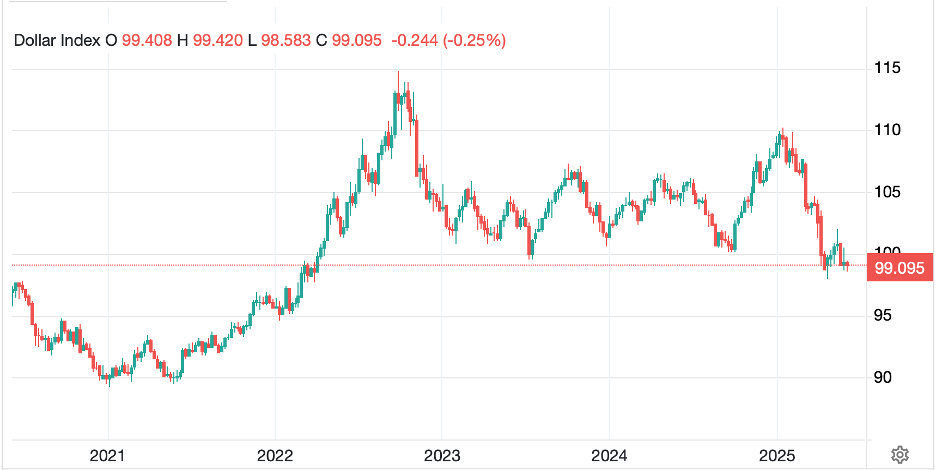
Finally, the dollar, which had been under pressure yesterday has rebounded this morning, regaining much of the losses seen Monday.  The euro (-0.5%) and pound (-0.4%) are good proxies for the magnitude of movement we are seeing although SEK (-0.7%) is having a little tougher time.  In fairness, though, SEK has been the best performing G10 currency so far this year, gaining more than 13%.  In the EMG bloc, PLN (-1.0%) is the laggard, perhaps on the election results with the right-wing candidate winning and now calling into question the current government there and its ability to continue to move closer to the EU policy mix.  It should also be noted that the Dutch government fell this morning as Geert Wilders, the right-wing party leader, and leading vote getter in the last election, pulled out of the government over immigration and asylum issues.  (and you thought that was just a US thing!). In the meantime, I will leave you with the following 5-year chart of the DXY to allay any concerns that the dollar is about to collapse.  While we are at the bottom of the range of the past 3 years, we have traded far below here pretty recently, let alone throughout history.

Source: tradingeconomics.com

On the data front, JOLTs Job Openings (exp 7.1M) and Factory Orders (-3.0%, 0.2% ex Transport) are on the docket and we hear from 3 more Fed speakers.  But again, Fed comments just don’t have the same impact as they did even last year.  In the end, I do like the dollar lower, but don’t be looking for a collapse.

Good luck

Adf

Our Future’s Austere#debate,#china,

This evening there’ll be a debate
And markets are willing to wait
To see if the polls
Will change who controls
The future, and all of our fate
 
Until then, it seems pretty clear
Investors are waiting to hear
Amid all the lies
If taxes will rise
And whether our future’s austere


It seems that all eyes have begun to focus on this evening’s debate between former President Trump and Vice-president Harris, with both sides bombarding every source of information available to the average person with their own spin.  Within the market context, the debate is about which candidate’s policies will be better for the economy and by extension equity markets.  As I am just a poet, this is all far above my pay grade.  Trying to be somewhat objective (and I’m sure you have figured out I lean toward the traditional conservative view of less government is better), from what I have read, neither side paints a particularly enticing picture.  

Tariffs have never proven effective, but the concept of taxing unrealized capital gains is abhorrent, and if enacted would be extremely detrimental to the nation.  Ultimately, I think the phrase, energy is the economy, is one to keep in mind as understanding that idea leads to an understanding of how policy choices will impact economic activity over time.  One need only look at Germany’s economic suicide following their Energiewende policy that has raised the price of electricity dramatically (it is 3x US prices) and led to a slow-motion collapse of the nation’s once strong manufacturing sector, to get a glimpse of the future without cheap and abundant energy.

So, with the Fed in their quiet period, let’s turn our attention overseas for any other news of note.  Chinese trade data was released overnight and showed a further increase in their trade surplus ($91B), news which probably did not brighten President Xi’s day as imports remain incredibly weak, a strong signal that the domestic economy is still stumbling along poorly under the weight of the ongoing collapse in the property bubble there.  The problem was highlighted by Exports growing 8.7% while Imports grew just 0.5%.  Chinese markets were largely unimpressed with this as the CSI 300 rose just 0.1% (although that is better than many of its recent sessions) and the renminbi slipped 0.1% despite a broader trend of modest dollar weakness.

The other notable data was from the UK where the employment situation continues to improve, with the Unemployment Rate falling to 4.1% while wages keep growing at 5.1% and there was a significant uptick in Employment by 265K with all of that data at least as good as expectations with some exceeding them.  When combining the resilience of the employment situation with the fact that inflation remains well above target in the UK, it continues to be difficult to understand the near desperation that the BOE has to cut interest rates.

In fact, that last comment can be applied to the US as well.  A look at the data shows that the job market, while not as robust as it had been last year, remains pretty solid, at least according to the BLS and the recent NFP report, while inflation, no matter how it is measured, remains well above the Fed’s 2.0% target.  In fact, the Atlanta Fed’s GDPNow data moved higher after the NFP report and is now sitting at 2.5% for the current quarter, which would follow the 3.0% Q2 measure.  Again, other than Powell’s promise to cut rates at Jackson Hole, it is not clear the data is pointing to that, at least not the data on the surface.  In fact, Torsten Slok, a well-known economist at Apollo Group, has put out a very interesting compilation of very current data showing that the economy seems to be doing fine.  My point is from the Fed’s perspective, this incredible desire to cut rates seems odd.

But that is the reality, central banks everywhere really want to cut rates, and come Thursday, the ECB will be the next to do so.  The question of 25bps or 50bps for the Fed next week seems almost moot compared to the fact that the market is pricing in 250bps of cuts by the end of next year.  Here’s the problem with that pricing; if the Fed does stick the soft landing, that seems like far too much policy ease without driving a significant uptick in inflation screwing up the soft landing theme.  However, if the economy does fall into recession, they will cut a lot more than that, probably on the order of 350bps to 400bps (Fed funds falling to 1.50% – 2.00%).  And one more thing to remember, QT continues in the background as the Fed gradually reduces the size of its balance sheet.  But can they continue to remove that liquidity while cutting rates as much as the market anticipates?  That feels like a very tough task and in truth, if the Fed is cutting rates, I think we are more likely to see QT turn into QE than anything else.  

So, regardless of the lack of activity today, there is much still to come.  As to today, let’s survey the rest of the markets outside China.  After yesterday’s solid rallies across US equity indices, other than Japan (-0.2%) and Korea (-0.5%), the rest of Asia had solid performances with gains ranging between 0.2% (HK) and 0.75% (Indonesia).  Europe, too, is mixed this morning with some modest gains (CAC, IBEX) and some modest declines (DAX, FTSE 100) with the latter more surprising given the solid employment data.  Perhaps that is the market showing concern the BOE will not cut rates as much as previously expected.  As to US futures, they are little changed at this hour (7:50).

In the bond market, Treasury yields are higher by 1bp this morning and we have seen similar rises across the entire European sovereign market.  Of more interest is the fact that the US 2yr-10yr yield curve is now positively sloped by 3bps this morning, with the long inversion finally having ended.  At least at those maturities.  But if you look at the 3mo (4.98%) – 2yr (3.68%) spread of -130bps, that is dramatically inverted with the market pricing in a huge amount of Fed rate cuts coming ahead.  I cannot help but look at that and be confused about equity analysts’ collective view of significant profit growth going forward.  One of those seems wrong.

In the commodity markets, oil (-1.2%) which had a nice bounce yesterday on concerns over Hurricane Francine hitting the Gulf of Mexico tomorrow, has given it all back after the weaker Chinese consumption data.  Meanwhile, metals prices, which also rallied yesterday amid the general good feelings, are little changed overall this morning.

Finally, the dollar is little changed net this morning as the euro has edged down a few pips while the pound has rallied a similar amount.  In fact, in the G10, only NOK (+0.45%) is showing any movement of substance after lower-than-expected inflation data has reduced the probability of further rate cuts by the central bank there.  Amazingly, in the EMG bloc, movements have been even smaller with really nothing of note to discuss amid overall changes of +/-0.2% or less.

On the data front, the NFIB Small Business Optimism Index was released earlier this morning at 91.2, more than 2 points below last month and expectations and an indication that the small business community remains concerned about future economic activity.  There are no speakers and no other data this morning, so I expect the currency markets to do little until after the debate this evening.  If one candidate is particularly effective, we may see some movement, but otherwise, I sense that people are awaiting tomorrow’s CPI for the next catalyst to make a move.

Good luck

Adf

Equity’s Epitaph

Each day as more data arrives
And pundits perform their deep dives
The talk of recession
Has forced some to question
How anyone bullish survives
 
But stock bulls have had the last laugh
Just look at a stock market graph
However, fixed income
Has started to look glum
Is this equity’s epitaph?
 
The only thing one can say about the recent data is that there is no clear direction of travel.  For instance, in the past week we have seen better than forecast results from Consumer Confidence, Durable Goods, Chicago PMI and Michigan Confidence while the Richmond Fed, New Home Sales. Building Permits, Personal Income and ISM Manufacturing all printed on the soft side of things.  The biggest data point, PCE, was essentially right on the money, so didn’t alter this equation.  However, perhaps the best way to sum up this mix of data is to look at the Atlanta Fed’s GDPNow calculation, and as can be seen in the chart below, it is heading lower.


Source: Atlantafed.org

The history of this calculation is that early in the quarter, it has limited predictive ability, but as the quarter ends, which it just did on Friday, it becomes a much better predictor of the actual results to come.  If I were to characterize this statistic it shows that the economy is slowing down but is not yet looking at a recession.

Is this the fabled goldilocks outcome of a soft landing?  Perhaps, but personally, I have my doubts.  To explain, let’s discuss the yield curve for a moment.  As you are all well aware by now, when the yield curve inverts (short end rates are higher than long end rates) that has been a reliable indication that a recession is coming.  We continue to be in that situation and in fact, the current inversion between the 2yr and 10yr Treasury, one of the most common measures, has been inverted for a record long period, more than 16 months.  

However, one thing that is widely misunderstood about the yield curve signal is that it is not a description of a current recession, rather it is a harbinger of a future one.  That recession tends to be coincident with the steepening of the yield curve back to its more normal shape.  And the question right now is, will the yield curve steepen because the front end of the curve sees rates decline, a so-called bull steepener, or because the back end of the curve sees rates rise, a much more uncomfortable situation known as a bear steepener.  

The soft-landing view is that the former is in our future as the Fed will cut rates to help stabilize the economy while 10yr yields hang around the 3.5% – 4.0% level.  It certainly appears that has been a critical piece of the equity market bullish story.  However, the alternative, where long end rates rise despite economic weakness, seems equally probable right now, and based on the bond market’s moves over the past several sessions, may well be taking over the narrative.  In this situation, the Fed continues to see inflationary pressures as too great to ignore and maintains higher for longer.  At the same time, the fiscal profligacy that is evident right now, and shows no signs of ending regardless of the election outcome, starts to bite.  Investors demand ever higher yields to hold Treasuries for any extended length of time and the 10yr rises to 5.0% – 5.5% or higher.

While the Fed’s record of preventing a recession by cutting rates is quite poor (perhaps one positive outcome in their history in 1995), their record of seeing a recession hit when they don’t cut rates, or even raise them to fight stubborn inflation, is even worse.  While two days is not yet a trend, it is certainly important of us to watch how the bond market behaves.  If long end rates start to rise more aggressively, that would be a signal that investors are turning more negative on the future.  It is at this point where we will learn the answer to the question of exactly how the Fed’s reaction function works.  History has shown that the unemployment rate rises with bear steepeners, and that is what forces the Fed to respond by cutting rates.

However, remember, if inflation remains stubbornly high and the Fed decides to cut rates to address unemployment, I believe that is the worst of all worlds.  We would be in a weakening economy with high inflation and a Fed that is far behind the curve amid a government that is spending money with no limits.  In that scenario, which, alas, has a reasonably high probability of occurring, the dollar should decline, bonds will decline (yields rise), commodities will rally, and equities will likely start to rise, but as earnings falter, so will prices.  This is not where we want to go.

We are not there yet, so let’s look at how things played out overnight instead.  Japanese shares continue to rally (+1.1%) with the Nikkei reclaiming the 40K level.  This continues to be on the back of the uber-weak yen (discussed below) as so many companies are exporters and benefit from the weak yen.  However, Chinese shares did not fare as well, edging lower as investors begin to wonder what will come from the Third Plenum due to take place in two weeks’ time.  Elsewhere in the region, there was far more red than green on the screens.  The red seems to have been contagious as all of Europe is under water this morning, with most falling more than -1.0%.  This is not really a data story, rather this seems to be a re-evaluation of this weekend’s French second round elections and growing fears that Marine Le Pen and her RN party are going to win the day.  We just saw a right-wing party take power in the Netherlands and have seen the same throughout Scandinavia.  I continue to be baffled at why investors are more concerned regarding spending by right leaning governments than left leaning ones, but that is clearly the current situation.  As to US futures, at this hour (7:30) they are sliding by -0.45% or so.

Bond markets are consolidating after yesterday’s rout with Treasury yields unchanged this morning while most of Europe has seen yields edge higher by just one or two basis points.  However, global bond markets have been under pressure all this week and while today may provide a respite, I sense further stress to come.  JGB yields rallied 3bps overnight and are now at their highest level since July 2011.  Alas, these higher Japanese yields have not helped the yen.

In the commodity markets, oil (+0.7%) continues to rally although the current story is focused on Hurricane Beryl which is heading into the Caribbean and the Gulf of Mexico and likely to shut in some offshore production there for a while, reducing supply.  However, precious metals are under pressure amid a rising dollar though copper (+0.6%) is holding its own on inventory concerns.

Finally, the dollar is firmer this morning against virtually all its counterparts in both G10 and EMG blocs.  The euro (-0.15%), which had rallied a bit on Monday amid hopes that the RN would not capture a majority in France, has given that back as the story ebbs and flows.  But really, JPY (-0.1% today, -1.2% in the past week) is the story as traders gain confidence that the MOF is not ready to respond yet and with US yields climbing, the carry trade continues to be extremely attractive.  Today’s dollar rally is broad, but the large moves are limited with ZAR (-0.6%) the worst performer although there are numerous currencies that have slipped -0.25% or so.  But it’s a dollar thing today.

On the data front, today only brings JOLTS Job Openings data (exp 7.91M) although perhaps more importantly, we hear from Chairman Powell this morning at 9:30.  The thing is, I don’t see any reason for him to have gained confidence that inflation is reliably heading back to target, and until we see Friday’s payroll report, there is no reason to believe that they are concerned about that.  In fact, that brings up the issue that Friday’s data release is likely to be extremely important to the narrative and has the chance to be quite disruptive given the high likelihood that staffing across all desks in the US will be light.  Remember, too, that the UK election will be held on Thursday, so more change is afoot.

Right now, the dollar seems healthy, but there is much to be learned this week and it will help inform how things evolve.

Good luck

Adf

Not Well Understood

The ISM data was weak
And traders, more bonds, did soon seek
The oil price fell
The dollar, as well
But stocks ended close to their peak
 
So, is now bad news really good?
‘Cause Jay will cut rates, or he should
Or is it the case
That growth’s slowing pace
Means risk is not well understood


The narrative had a little hiccup yesterday as the ISM data was released far weaker than expected.  The headline number, 48.7, fell vs. last month and was a full point below market expectations.  The real problem was that while the Employment sub-index was solid, New Orders tanked, and Prices remained high.  If you add this to the Chicago PMI data from Friday, which at 35.4, was the lowest print since the pandemic in May 2020 and back at levels seen in the recessions of 2001 and 2008, it is fair to question just how strong the US economy is right now.

Adding to this gloom is the news that the Atlanta Fed’s GDPNow estimate slipped to 1.8% for Q2, down from 2.7% last Friday, and the trend, as per the below chart, is not very pretty.

Given the data, it can be no surprise that the Treasury market rallied sharply, with yields declining 8 basis points on the session, although they are little changed this morning.  After all, if the economy is slowing, the theory is that inflationary pressures will decline, and the Fed will be able to cut rates sooner rather than later.   And maybe that is true.  But when we last heard from the FOMC membership, most were pretty convinced they needed to see more proof that inflation was actually lower, rather than simply that slowing growth should help their cause.  And I might argue that a weak ISM print, especially with the prices portion remaining high, is hardly the proof they require.

But yesterday’s markets were a bit confusing overall.  While the initial response to the weak data led to immediate selling across all equity markets, by the end of the day, those losses were reversed such that the NASDAQ had a fine day, rising 0.5%.  Ask yourself the question, why would stocks rebound despite further evidence that the economy is slowing down.  The obvious answer is that a slower economy will lead to slowing inflation and allow the Fed to reduce interest rates before long.  Of course, the flip side of that story is that a slower economy implies companies will lose pricing power as demand slides, thus reducing available profit margins and overall profits.  It seems hard to believe that stock prices will rally amid declining earnings, although these days, anything is possible.

While the Fed’s quiet period has many advantages (in truth I wish the entire time between meetings was the quiet period) one of its key attributes is that the narrative can run wild in whatever direction it likes.  As we will be receiving quite a bit of data this week, I suspect the narrative will have a few more twists and turns yet to come, although there is no question that the bulls remain in control of the conversation.  

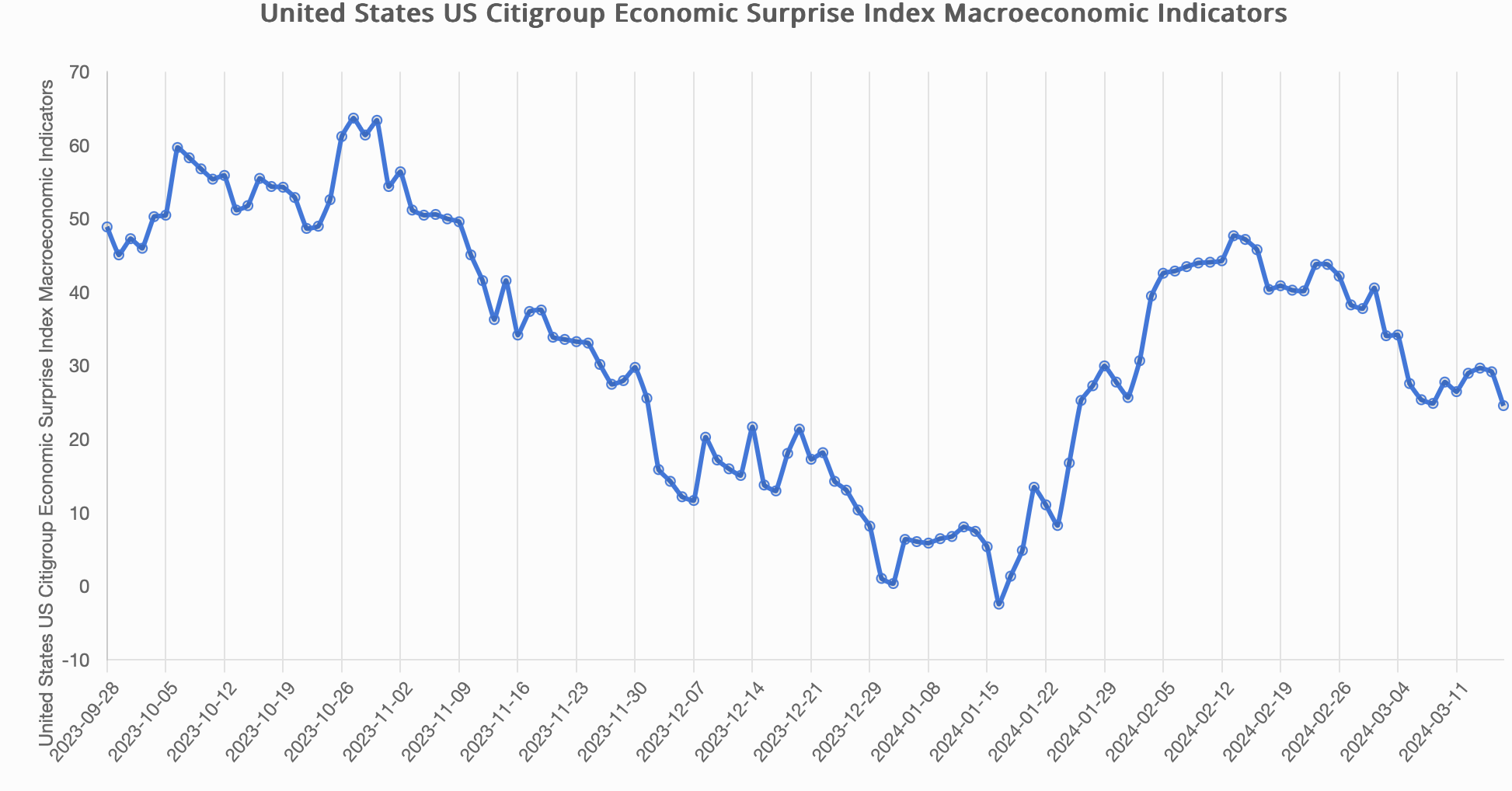
One other thing to keep in mind about that ISM data is that while the US data was weak, the PMI data elsewhere in the world indicated that the worst had been seen elsewhere.  While it is not full speed ahead yet in Europe or the UK or China, the trend is far better than in the US.  Remember, a key part of the narrative is that the US is the ‘cleanest shirt in the dirty laundry’ and so funds continue to flow into US equities and the dollar by extension supporting both.  But what if other nations are starting to see an uptick in their growth stories while the US is starting to slide a bit?  Perhaps the non-stop bullishness for the NASDAQ will find a limit after all.  Perhaps another way to consider this is to look at the Citi Economic Surprise Index, which is designed to compare actual data releases with the forecasts before the release.  As such, a high number shows better than expected data and vice versa.  As you can see from the below chart, the trend here is lower.

Source: macrovar.com

One interesting aspect of this chart is that you can see during Q1, when the equity markets rallied and bullishness was rife, this index was rallying as well.  But remember what we learned last week regarding Q1’s GDP, it was revised lower to just 1.3% annualized.  So, if better than expected data still led to weak growth, what will declining data do?  

In the end, at least in my view, the economy is struggling overall, although not collapsing.  If I am correct, then it leads to several potential, if not likely, outcomes.  While the Fed has continuously claimed they remain focused on inflation, if growth starts to decline more sharply, and unemployment starts to rise more rapidly, they will cut rates regardless of CPI or PCE, and they may well end QT if not start QE again.  The clear loser here will be the dollar.  Equity markets are likely to initially react to the rate cuts and rise, but if earnings suffer, I think that will reverse.  Bond markets, too, will rally initially, but if inflation rebounds, which seems highly likely if the Fed eases policy, I don’t think the long end of the yield curve will be very happy, and we could easily see 5.0% or higher in 10-year yields.  Finally, commodities will see a lot of love and rally across the board.

Ok, let’s look at what happened overnight, as other markets responded to the surprisingly weak US data.  Asia wound up mixed, similar to the US indices, as Japan (-0.25%) slipped while China (+0.75%) rallied along with Hong Kong (+0.25%).  But the big mover overnight was India (-5.75
%) which fell sharply as the election results there indicated that PM Narendra Modi, while winning a third term, saw a decline in his support that left him somewhat weakened.  The rupee (-0.5%) also slipped, although nothing like what we saw yesterday in Mexico.  As to the rest of the region, we saw winners (Indonesia, Malaysia) and laggards (Taiwan, Korea, Australia) so no real trend.  In Europe, this morning, there is a trend, and it is all red, with losses ranging from -0.4% in the UK to -1.1% in Spain.  The only data here was employment in both Spain and Germany, and while both numbers were a touch soft, neither seemed dramatic.  And, as I type (8:00), US futures are all lower by -0.3%.

In the bond markets, yesterday’s Treasury rally was mimicked by European sovereigns, with yields there falling as well, albeit not quite as much as in the US.  This morning, the European market is extremely quiet, with yields +/-1bp from yesterday’s closes.  However, overnight, we did see Asian government bond yields fall, with JGB’s -3bps and greater declines elsewhere in the space.

Oil prices (-1.85%) are under severe pressure this morning, following on yesterday’s $3/bbl decline, falling another $1.50/bbl.  It seems the combination of the weak ISM data and the OPEC+ discussion of an eventual return of more production to market next year was enough to convince a lot of long positioning to throw in the towel.  As is its wont, the oil market can move very sharply and overshoot in either direction.  It feels to me this could be one of those cases.  But commodity prices are getting killed everywhere this morning as although metals held up well yesterday, this morning we are seeing blood in the water.  Both precious (Au -0.9%, AG -3.4% and back below $30/oz) and industrial (Cu -2.3%, Al -0.5%) are falling as slowing growth and the belief that it will reduce inflationary pressures is today’s story.

Finally, the dollar, which sold off sharply yesterday in the wake of the ISM data, is bouncing a bit this morning, at least against most of its counterparts.  While most of the G10 is softer, led by NOK (-1.2%), the outlier is JPY (+0.85%) which is suddenly behaving like a safe haven amid troubled times.  I think that the increased uncertainty amid Japanese investors as to the state of the global economy may have them bringing home their funds, especially now that 10yr JGB yields are above 1.0% with no hedging costs.  As to the EMG bloc, MXN (-1.7%) remains under severe pressure but today they are not alone with all EEMEA currencies and other LATAM currencies declining as well.

The two data points this morning are the JOLTS Jobs Openings (exp 8.34M) and Factory Orders (0.6%), both released at 10:00.  Obviously, there is no Fedspeak, so I expect that equities will be the driver, and if fear starts to grow, we could get an old-fashioned risk off day with stocks falling, bonds rallying and the dollar gaining as well.

Good luck

Adf

All We’ve Endured

“Legal changes” have now been “secured”
Which, following all we’ve endured
Encouraged the buying
Of pounds, clarifying
The thought that soft Brexit’s assured

In the ongoing game of chicken, otherwise known as the Brexit negotiations, it seems the EU was the one who flinched. Last night, British PM Theresa May returned from a Strasbourg meeting with European Commission President Jean-Claude Juncker after obtaining potentially substantial modifications to the Irish backstop portion of the negotiated deal. If you recall, this has been the sticking point because the twin objectives of first; preventing a hard border between Ireland and Northern Ireland; and second, insuring that if the UK is outside the EU customs union, appropriate tariffs can be collected, and goods inspected were leading to opposite solutions. The Irish backstop was designed to help alleviate British concerns they would be stuck in the customs union forever. However, as it had previously been written, that did not seem to be the case. Now comes some new language, touted as legally binding, that ostensibly insures that the UK can opt out of the customs union if desired. While I am no lawyer, and thus not qualified to give a legal opinion, my reading of the plain language leaves the impression that nothing much has changed.

This morning, the UK Attorney General, Geoffrey Cox, is going over the package and will be giving his far more qualified opinion to Parliament shortly. (**FLASH – GEOFFREY COX SAYS THE LEGAL RISK OF THE NEW IRISH BACKTOP IS UNCHANGED**) The vote on the deal is still scheduled for 7:00pm this evening (3:00pm EDT) although there are some MP’s who would like a one-day delay in order to be able to read and understand it themselves. In the interim, the market has had quite a wild ride. From yesterday morning, when the pound was trading below 1.30, we have seen a more than 2.0% rally which in the past two hours has completely unwound! Thus, 1.2975 => 1.3250 => 1.3015 has been the movement in the past twenty-four hours. It seems the initial euphoria is being replaced by a more skeptical view that these changes will be enough to turn the Brexit tide in Parliament. At this point, it’s a mug’s game to try to forecast the outcome of this vote. The last I saw was that the deal would lose by 50 votes or so, a much better performance than last time, but still a loss. My gut tells me that a hard Brexit is still a possible outcome, and that there is no certainty whatsoever that Parliament will be able to prevent that.

But away from the pound, the only other currency that has shown any real movement has been the Philippine peso, which has declined a sharp 1.65% overnight. This occurred after the new President of the central bank there explained that the peso had strengthened as much as it could and that given low inflation readings, further rate cuts were on the table. At least this market movement makes sense!

Ongoing stories include the US-China trade talks, where there has been no additional progress, at least none publicized. The Chinese remain concerned that any meeting between the Presidents be just a signing ceremony rather than finalizing negotiations as they are worried that President Trump might reject a deal at the final moments with President Xi thus losing face in the process. I am confident we will hear more on this subject in the next days, and the latest signs point to a positive outcome, but here, too, nothing is certain.

The other ongoing story of note is the rapid change of tack by the world’s central banks. At this point in time, there is only one central bank that is remotely hawkish, the Norgesbank in Norway, where inflation has been running above target, and more importantly, has seen a rising trajectory. However, beyond that, the rest of the world is firmly in the dovish camp. In fact, at this point, the question seems to be just how much more dovish they will become as it grows increasingly clear that global growth is slowing rapidly. While there is the odd positive surprise on the data front, the weight of evidence is pointing to further slowing. The problem the ECB and BOJ have is that they have very little ammunition left to fight slowing growth. While the Fed could certainly cut rates if necessary, that would be quite an abrupt turn of events, given it has been barely three months since they last raised them, and would damage their credibility further. And the PBOC definitely has some room, but they continue to fight their battle against overleverage, and so are stuck between the Scylla of slowing growth and the Charibdis of excess debt. In the end, look for Scylla to win this battle.

Turning to the data story, yesterday’s Retail Sales report printed at +0.2%, after a downward revision of the December print to -1.6%. While there was significant disbelief in the December data point when it was first released, it looks like it was real. The most immediate impact was to the Atlanta Fed’s GDP Now tracker, which fell sharply and is now estimating a 0.5% GDP growth rate for Q1. As to today, CPI is due shortly, with the market expecting 1.6% headline and 2.2% core readings. The Fed remains concerned that they have been unable to generate sufficient inflation. Personally, I think we have too much inflation, but that’s just one man’s opinion.

The upshot of all this is that nothing has changed in the big picture with regard to the dollar. While risk has been embraced in the past two sessions, the dollar story remains one of relative monetary policy stances, and in that camp, the Fed reigns supreme, and by extension, the dollar!

Good luck
Adf