Very Near Future

The “very near future” is when
The US and China, again
Will restart their talks
Assuming no balks
By either of these august men
 
That’s all that the market required
For buyers to get so inspired
Can this idea last?
Or will it have passed
Ere market resolve has expired


While all and sundry have been very confident that President Trump’s attempt to alter the structure of the global economy and world trade to a more beneficial one, in his view for the US, will fail dismally and that we are doomed to stagflation as prices rise and the economy sinks, it seems these same economic analysts have forgotten that there are two sides to the supply/demand equation.  I have written before that despite all the slings and arrows that have been aimed at Trump, the US has a very strong hand in the trade game given it is THE CONSUMER OF LAST RESORT.  Virtually every nation in the world has built an economy designed to be able to manufacture stuff cheaply and sell it into the largest economy in the world.

And US consumers are remarkable in their ability to continue to consume at high levels despite what appear to be significant headwinds, whether high financing costs, limited savings or slowing economic activity.  But a funny thing is happening on the way to this mooted US stagflation, it’s not happening yet.  In fact, as described by economist Daniel Lacalle in his most recent post, it seems that the biggest problem is not that Americans cannot find what they want to buy, it is that they only bought all this stuff because it was cheap.  They will not accept significant price rises and so inventory is building up at factories while ships are stuck with containers full of stuff nobody wants, at the price.  Could it be that President Trump read the room better than the economists?

I use this as preamble to yesterday’s massive equity rebound which was, ostensibly, triggered by comments from Treasury Secretary Bessent that substantive trade talks with China would begin in the “very near future.”  Subsequent soothing comments by the President indicated that the days of 125% tariffs were numbered but there would be tariffs in place.  As well, Mr Trump explicitly said he has no intention to fire Fed Chair Powell, despite his recent diatribe that Powell is always late to the party and should cut rates.  Certainly, I agree the Fed is, and will always be, late to the party as long as they use a data driven approach.  After all, by the time economic change is reflected in the data, whatever is going to change has already done so.  However, I don’t yet see the rationale for cutting rates given the current economic data and the fact that inflation remains a problem.

As of this morning, following significant equity rallies around the world, one might come to believe that all the world’s problems have been successfully addressed.  The fact that one would be wrong in that belief is the best example of ‘the market is not the economy’.  But, hey, let’s take the rallies when they come!

From a market perspective, that was really the big story yesterday and continuing into today.  Flash PMI data is not that exciting, and all the other headlines revolve around the ongoing immigration/deportation issues plus RFK Jr’s edict to remove petroleum-based food coloring from foods.  So, let’s look at the markets and recap the action.

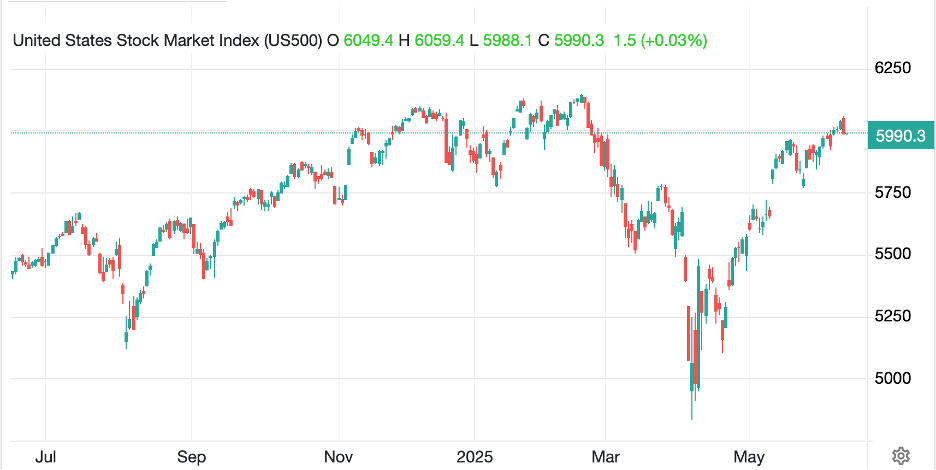
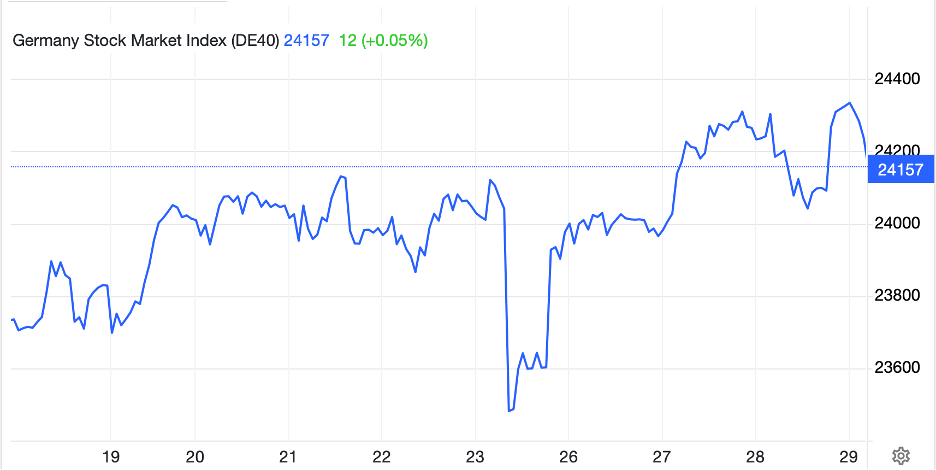
The 2.5% to 3.0% gains in the US were followed by Tokyo (+1.9%) and Hong Kong (+2.4%) performing well but nothing like Taiwan (+4.5%).  The laggard last night was China (+0.1%) with other regional exchanges showing gains between 0.5% and 1.5%.  Net, I suppose everybody was happy.  In Europe this morning, the screens are green as well, with Germany (+2.6%) leading the way followed by France (+2.2%) and the UK (+1.3%).  Again, the trade story appears to be the leading driver.  And, adding to the joy, US futures are also higher between 2.0% (DJIA) and 3.0% (NASDAQ) this morning as of 6:50.  And to think, just two days ago I was assured that the end was nigh.  A quick look at the S&P 500 chart below does give a flavor for just how much volatility we have seen on a day-to-day basis and how narrative changes continue to have huge impacts.

Source: tradingecomics.com

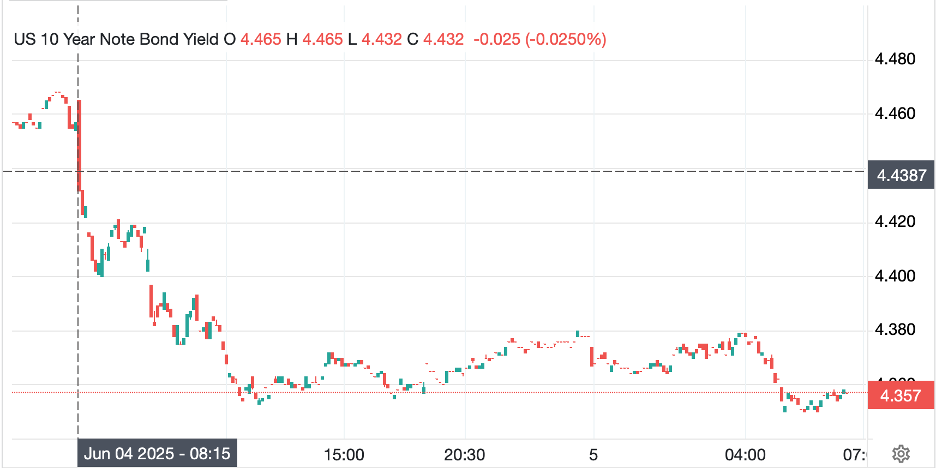
At the same time, Treasury yields have been retracing, lower by -8bps this morning with UK gilts (-6bps) also performing well, although continental European sovereigns are not seeing the same demand with bunds (+3bps) the laggard despite the weakest PMI readings with both Manufacturing and Services below 50.0, lower than last month and far lower than forecasts.  The narrative of money leaving the US and heading back to Europe is certainly appealing, and seems quite reasonable as a long-term metric, but it is not clear to me that it will be driving daily price action in any market.

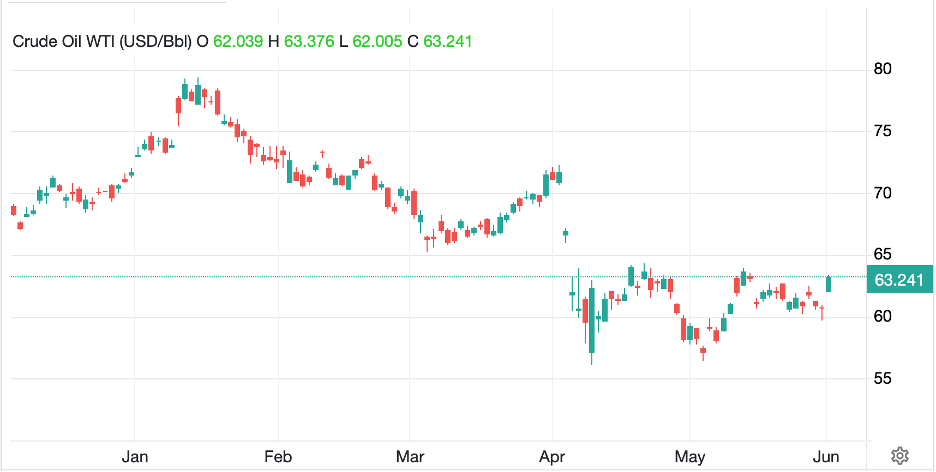
In commodities, oil (+1.0%) continues to edge higher although it has not yet come close to filling that massive gap lower from the beginning of the month.  

Source: tradingeconomics.com

From a fundamental perspective, fears of a US recession, which remain high, as well as the IMF recently reducing their global growth forecast seem to be undermining the demand side of the equation.  Meanwhile, the opportunity for significant new supply (Iran deal, Russia peace) seems quite real.  I’m no oil trader but it strikes me the risk-reward here is for a further drop in prices.  As to the metals markets, gold (-0.4%) fell more than $100/oz yesterday, so perhaps my view that the parabolic move was too much was correct.  However, I believe this is a short-term, and much needed, correction with the long-term story fully intact.  Meanwhile, silver (+1.4%) and copper (+0.4%) are modestly higher after quiet sessions yesterday.

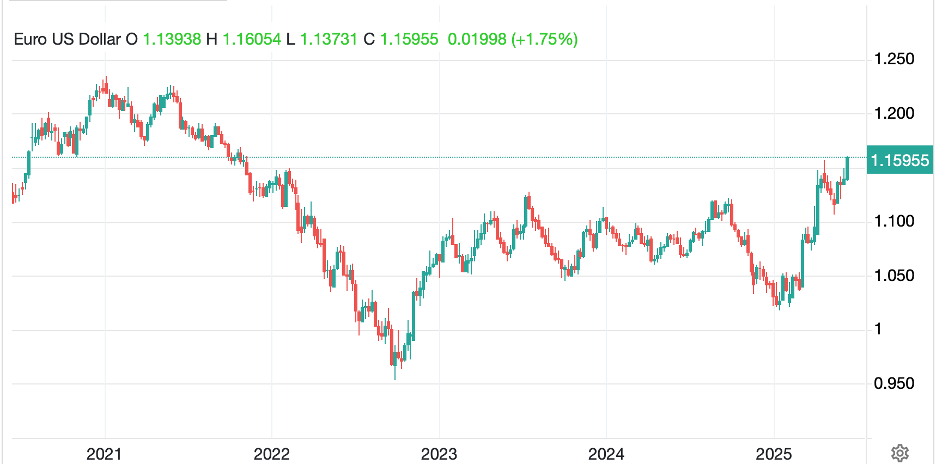
Finally, the dollar is firmer this morning against most of its counterparts, but this is not a universal situation.  While both the euro and pound have fallen -0.25%, AUD (+0.6%) is showing some oomph as it figures to be one of the key beneficiaries of a trade agreement between the US and China, no matter how far in the future.  Other key gainers are KRW (+0.6%) and CNY (+0.3%), with both clearly benefitting from that same trade story.  But otherwise, the dollar is mostly ascendent.  

An aside here on the yen (-0.4%) which just two days ago traded below the key psychological level of 140 and this morning is back above 142.  It strikes me that this is the first currency that will be reactive to any trade deal.  As you can see from the below, long-term chart of the yen, it has spent the bulk of its time at far higher (dollar lower) levels.  I suspect that any trade deal will include an effort to revalue the yen higher vs. the dollar, perhaps to its longer-term average of around 120.

Moving on to today’s data, we have New Home Sales (exp 680K) and then the Fed’s Beige Book at 2:00pm. I’m not sure when the surveys were taken for the Beige Book, but you can be sure they will express a great deal of uncertainty and discuss how it will reduce economic activity.  You can also be sure that this will be hyped in the press.  But now that everything is better (just look at the stock market) is this old news?

If we try to look past the daily gyrations to the bigger picture, I would contend the following is the case.  Equity markets remain overvalued and are likely to weaken, the dollar is likely to slide as well as foreign investors slowly reallocate funds away from the US.  Quite frankly, the Treasury story is much harder as the interplay between inflation and potential reduced government expenditure is highly uncertain right now, although one will eventually dominate.  Finally, commodities remain far more important than their current relative weight in the global asset basket and I believe they have much further to climb in price.  One poet’s views.

Good luck

Adf

This is the End

Apparently, this is the end
So says every article penned
The markets are tanking
But nobody’s banking
On help to arrest the downtrend
 
The pundits’ unanimous line
Is things before Trump were just fine
Yes, debt was insane
But that gravy train
Allowed them to drink the best wine


Every financial website lead this morning is how President Trump’s policies are causing the worst slide in equity prices in forever, with my favorite today in the WSJ describing this as the worst performance in April since 1932!  Much has been made about how President Trump is undermining the Fed’s credibility, as though the Fed has that much credibility to undermine.  This is the group that declared stable prices to be an increase in their favored indicator, core PCE, of 2.0% annually, and complained vociferously when inflation was slightly below that level for a decade.  In order to adjust things, they changed their target to an average of 2.0% over time, then watched their metrics, in the wake of the Covid fiscal response, explode higher.  Now, after more than four years of their target metric above their target, they are concerned they are losing their credibility because of President Trump.  

Source: tradingeconomics.com

Certainly, if they had been achieving their goals any time during the past four years, this argument might have had some force.  However, given the history, I am suspect.

Nonetheless, this is today’s narrative, that equity markets are falling sharply because of Trump.  It has nothing to do with the fact that US equity markets have been overvalued by nearly every measure since November 2012, (the last time the S&P 500 P/E ratio was at its mean of 16.14 vs today’s still very high 25.64).  This is not to say that the president’s tactics have necessarily been the best possible, but we have all long known that a catalyst would come along and adjust prices to a more sustainable level.  

Source: multpl.com

Once again, I will highlight that President Trump was elected with a mandate to make substantial changes to the way things work in the US, both the economy and other issues like immigration.  Remember, too, that many of his supporters are not heavily invested in equity markets, so this is not really a problem for them.  I believe he can tolerate a lot more downside in equity prices before feeling it necessary to address them.  And if he is successful in signing some trade deals during his 90-day time frame, I expect that things will calm down quite quickly.

But right now, investors are very unhappy, and since virtually everyone in the media is an investor, we are going to hear a lot more on this topic, especially since they almost certainly didn’t vote for President Trump.

Here’s the thing about markets, overvaluations correct over time.  In fact, often they result in under valuations as markets tend to overshoot in both directions.  However, you have probably heard of the Buffett Indicator, which is Warren Buffett’s shorthand way of determining stock valuations.  He simply divides the total market capitlaization of US equities by GDP.  His view is that when that ratio is between 110% and 130%, equity markets are fairly valued.  Below that, things are cheap, and it is a good time to buy stocks.  Above that, like today, and good values are hard to find.  You are also probably aware that Berkshire Hathaway is currently holding its largest cash position ever, a sign that he still thinks things are overvalued.  One need only look at the below chart to see that while the recent decline in stocks has brought the indicator lower, its current level of 173% remains extremely overvalued.

Source: buffettindicator.net

All I am trying to do is offer some perspective on the recent movement.  Risk appetite was over extended while the US ran 7% budget deficits and issued a massive amount of debt to fund it.  Much of that funding went into risk assets.  That situation has clearly changed, or at least that is the goal of the Trump administration.  It is a painful transition, but likely one that we need to absorb for longer term fiscal and economic health.

Ok, let’s see how market behaved overnight, after a rout in the US yesterday, now that everybody is back at their desks.  Major Asian markets were very quiet, with limited movement in Japan, China, Korea, Australia and India, although we did see sharp declines in Taiwan (-1.6%) and New Zealand (-2.25%) with the latter seeming to be one of the few markets tracking the US directly.  The only news there was a larger than expected trade surplus, which doesn’t seem the type of thing to cause a sell-off.  Meanwhile, in Europe, there is also little net movement with a couple of modest gainers (Spain, UK) and a couple of modest laggards (France Germany) with everything trading less than 0.5% different than their last closes.  Interestingly, US futures are all higher by about 1.0% at this hour (7:05).

In the bond market, this morning is quiet everywhere with movements of +/-1bp the norm although yesterday did see Treasury yields climb 6bps in the session.  Something that is starting to move in fixed income markets are credit spreads, which have been abnormally tight for a long time and may be starting to widen out to previous historical levels.  If spreads start to widen, that will not help equity markets at all, and that could be the signal that policy adjustments are coming, both from the administration and the Fed.  We will keep an eye here.

In the commodity markets, nothing is stopping the gold train, up another 0.7% this morning to another new high.  This movement is parabolic and that cannot last very long.  Beware of a correction.  

source: tradingeconomics.com

In the meantime, silver (-0.2%) and copper (+0.5%) are still hanging around, but without the same panache as gold.  In the oil market, WTI (+1.3%) has rebounded from yesterday’s decline as the latest stories are that capex by the oil majors is going to decline and with it, we will see a reduction in supply, hence higher prices.  On the flip side, if a deal with Iran is signed and their oil comes back on the market freely, that will weigh on prices for at least a while.

Finally, the dollar, which along with equities, has been sold aggressively of late, is bouncing slightly this morning.  This story remains perfectly logical as one of the reasons the dollar had been so strong was foreign investors bought dollars to buy the Mag7 and US equities in general.  With US equities weakening, these foreigners are likely to start to sell more and take their money home, or elsewhere, but nonetheless, they don’t need those dollars.  Certainly nothing has changed my bearish view here with today’s gains a modest correction.  There are two outliers this morning, with MXN (+0.6%) and ZAR (+0.5%) the only currencies of note rallying against the greenback, both seemingly following the commodity rally.

On the data front, there is nothing noteworthy this morning, but a bit of data later in the week.

WednesdayFlash Manufacturing PMI49.4
 Flash Services PMI52.8
 New Home Sales680K
 Fed’s Beige Book 
ThursdayInitial Claims221K
 Continuing Claims1880K
 Durable Goods2.0%
 -ex Transport0.2%
 Existing Home Sales4.13M
FridayMichigan Sentiment50.8
 Michigan Inflation Expected6.7%

Source: tradingeconomics.com

In addition, we have 7 Fed speakers over 8 venues this week, with four of them today.  However, it is not clear that they have much impact these days.  Expectations for a cut next month are down to 9% although the market is pricing 90bps of cuts this year.  But, once President Trump started implementing his policies, the Fed slipped into the shadows.  It is interesting that there are questions about the Fed’s credibility as lately, nobody has listened to them anyway.  I don’t expect anything other than patience from them for now as they await the “inevitable” decline in the economy.  However, until the data really starts to show something, and there is nothing forecast in this week’s releases, that points to economic weakness of note, they are on the sidelines.

Overall, I expect more volatility in risk assets, and I do believe the trend for foreign investors to reduce their exposure to the US will continue.  That, too, will weigh on the dollar.  Maybe not today, but another 10% this year is quite viable.

Good luck

Adf

Squealed Like Stuck Pigs

What many just don’t comprehend
Is tariffs are not near the end
Of policy changes
As Trump rearranges
The world into foe and to friend
 
And while Wall Street squealed like stuck pigs
Trump’s boosters just don’t give two figs
They’re willing to try
The Trump calculi
If they see it hurts the bigwigs


I’m old enough to remember when Nonfarm Payrolls were the most important thing to market participants regardless of the asset class.  Ahh, those were the days.  It is remarkable that across major business headlines, I haven’t seen anything discussing the release for later this morning.  Don’t misunderstand me, I’m not upset about that fact, I think there has been far too much focus on that data point for far too long, but I am surprised.  This may be the best indicator that we are in a new regime for finance and economics.  It appears that most of the things the analyst community used to consider important are now merely afterthoughts.

I thought the WSJ had the most consequential article in this morning’s ‘paper’ asking, who is going to buy the $400 billion of stuff that China makes that will no longer be price competitive in the US?  They weren’t mentioned explicitly, but I imagine that Temu and Shein are both going to find their business models significantly impaired.  But will other “free trading’ nations allow all that stuff across their borders tariff free?  The Chinese mercantilist model was built with the idea that if they could produce stuff more cheaply than other nations, whether through subsidy or efficiency, other nations would welcome that stuff.  It remains to be seen how well that model holds up given the changes wrought by President Trump.

On a different note, I have read many comparisons of yesterday’s market declines to the March 2020 Covid panic, but my take is it is far more akin to the September 2008 Lehman Brothers collapse, at least from the tone of the market.  Covid was an exogenous event while Lehman and the tariffs were home-made.  The issue with the GFC and the current time was/is that they are systemic alterations which means that things will be different going forward in finance and economics.  Covid clearly changed our lives based on the government response, but it didn’t change the way markets behaved.  

At this point, there is no indication that President Trump is going to change his tune, and why would he? Again, amongst the key financial market goals he and Secretary Bessent have touted were a reduction in 10-year yields, lower by 75bps since inauguration, (✔️), a reduction in the price of oil, lower by $14/bbl or 18%,  (✔️) and a lower dollar relative to other currencies lower by 6.5%,(✔️).  Ask yourself, do you really think they are unhappy with the current situation?

I have no idea how things will play out from here, and in reality, neither does anybody else.  Reliance on models that were built with past assumptions does not inspire confidence.  As well, we have barely seen the response to these tariffs, although just moments ago China indicated they would be imposing 34% tariffs on all US goods entering their country.  But anybody who believes they know the end game is delusional.  This is the beginning of the change, and there will be much more to come across many different aspects of the economy and markets as the year progresses.  Interesting times indeed.

With that in mind, let’s see how day two of the new world order is playing out (and to think, there were all those conspiracy theories about a new world order before, but this was not what they had in mind.)  Green is a hard color to find on screens again today as after yesterday’s rout in US markets, the follow-through in Asia was almost complete.  Indonesia (+0.6%) managed a gain somehow, but every other major market declined, some quite substantially.  Singapore (-3.0%), Thailand (-3.6%) and Tokyo (-3.1%) were the biggest losers, but shares everywhere fell with most declining more than -1.0% on the session.  Interestingly, European shares are having a much worse session today than yesterday with Italy’s FTSE MIB (-7.1%) leading the way although Spain’s IBEX (-5.5%), the DAX (-4.5%), CAC (-3.8%) and FTSE 100 (-3.5%) are not exactly loving life today either.  As to US futures, they are pointing much lower again today, -3.0% or so for all the major indices.

Bonds, however, are in great demand with yields virtually collapsing as investors seek anyplace that is not equities to find shelter from this storm.  Treasury yields have fallen a further 15bps this morning and you can see in the chart below, just how large this decline has been.  In fact, yields have almost retraced to the level just before the Fed started cutting rates last September!

Source: tradingeconomics.com

But bonds everywhere in the world are in demand with yields on European sovereigns lower by between -7bps (Italy and Greece) and -15bps (Germany) as credit quality has also entered the picture there.  Finally, JGB yields have also tumbled, down -18bps overnight, as Japanese investors flee global markets and bring their money home.

Arguably, though, the biggest move has been in oil (-6.9%) which is now down to levels not seen since it was rebounding from Covid inspired lows back in 2022.

Source: tradingeconomics.com

I would contend this is almost entirely a recession fear, lack of forward demand story, although I believe OPEC+ is still planning on reducing its production cuts as the year progresses.  I imagine the latter is subject to change based on the economic outcomes.  In the metals markets, gold (+0.15%) after a sell-off yesterday, is consolidating for now.  Given the amount of leverage that abounds and given that when margin calls come, folks sell what they can, not what they want to, I suspect much of gold’s selling yesterday was forced rather than based on fear.  Rather, I suspect gold will outperform as it maintains its ultimate haven status.  The same, though, is not true for other metals with silver (-1.5%) and copper (-4.2%) both sharply lower this morning.  Certainly, in copper’s case, given the increased recession fears, it can be no surprise that its price is declining.

Finally, turning to the dollar, after a sharp decline yesterday, largely across the board, this morning the picture is a bit more mixed with a rebound against some currencies (AUD -3.0%, NZD -2.5%, SEK -1.7%, NOK (-2.1% although also inspired by oil’s precipitous decline.). However, both the yen (+1.0%) and Swiss franc (+1.25%) are continuing to display their haven attributes, while the euro (-0.1%) seems caught in the middle.  In the EMG bloc, though, the dollar is quite solid this morning with MXN (-1.9%), ZAR (-1.7%) and CLP (-1.0%) all falling.  Of note, CNY (0.0%) has barely moved throughout the entire process.

As I mentioned above, today we do see the NFP report, although my take is a strong report will be ignored as old regime, while a weak report will be ‘proof positive’ a recession is near.  Here are the expectations as of this morning:

Nonfarm Payrolls135K
Private Payrolls127K
Manufacturing Payrolls4K
Unemployment Rate4.1%
Average Hourly Earnings0.3% (3.9% Y/Y)
Average Weekly Hours34.2
Participation Rate62.4%

Source: tradingeconomics.com

Will the data really matter?  I don’t think so, at least not to policy makers as they realize (I hope) the world today is different than when this data was collected.  At this point, the market is now pricing in a full 75bps of rate cuts by year end from the Fed with a ~30% probability of a cut early next month.  But Powell and company don’t have any idea how this will play out either.  I fear that we are in a market situation where volatility is the dominant theme, in both directions.  Remember, Donald Trump is best thought of as the avatar of volatility.  He has earned that nickname.  This is why I harp on maintaining hedges, the world is a tricky place.

Good luck and good weekend

Adf

Quite Miffed

By now, each of you is aware
More tariffs, the Prez did declare
Some nations will scream
While others will scheme
To Trump, though, in war all is fair
 
The market reaction was swift
With equities in a downshift
While Treasuries rallied
Pure gold, lower, sallied
And everyone worldwide’s quite miffed


Once again, President Trump did exactly what he told us he was going to do from the start.  He applied reciprocal tariffs on virtually every nation in the world, although at a rate claimed to be ~50% of their tariffs on the US, (as calculated by the White House and which included quotas and non-tariff barriers as well.)  In addition to Israel, which pledged to reduce tariffs to 0% on US goods if the US would do the same, it appears Canada has also agreed that deal.  I expect that we will hear different responses from nations all around the world, but remember, the one thing the president has made clear is that retaliation by other nations will be met with a significantly higher response from the US.  I expect that smaller nations may find themselves in very difficult straits, although larger ones have more potential to respond.  But, in the end, the US remains the consumer of last resort, and every nation on the list realizes that losing the US market will not help their economies.

The market response was immediate with US equity futures plummeting on the open of the evening session and sharp declines in Asian equities as well.  Treasury yields fell along with the dollar, while gold after an initial rally, reversed course and is now lower on the day as well.

Analysts around the world are out with early forecasts of the “likely” impacts of these tariffs although I would take them with a grain of salt.  Remember, analyst macro models have been pretty useless for a while, ever since the underlying conditions changed as I described earlier this week, so it is not clear to me that applying broken models to a new event is likely to offer accurate estimates of future activity.  However, there is a pretty clear consensus, which is that inflation is going to rise while economic activity is going to decline, probably into a recession.  Personally, I am confused by this analysis as every one of these analysts continues to believe that a recession drives prices lower and reduces inflation, but I’m just reporting on what I have seen.

If pressed, I expect that we will see several nations reduce their tariff structures in response to this, similar to Canada and Israel, and US tariffs will decline there as well.  Other nations will dig in their heels and trade activity between the US and those nations will decline.  But I will not even hazard a guess as to which nations will do what.  Political pain is a funny thing, and different leaders respond differently.

My sincere hope is that now that the tariffs have been imposed, we can move on with our lives and discuss other issues because frankly, I am really tired of this topic.

Masked by the tariff mania was news that the US Senate has moved forward on its budget resolution bill which if passed and combined with the House, will allow the process to start to legislate for fiscal year 2026.  Both versions maintain the 2017 tax cuts, both seek unspecified spending reductions and while each has a different price tag, my take is this process will be completed before too long.  It would truly be miraculous if Congress actually submitted department spending bills on a timely basis, rather than the omnibus bills that have been the norm for quite a while.  That would be true progress in how the government works.

Anyway, let’s see where things stand this morning.  The one thing we know is that despite President Trump’s constant discussion on tariffs, market participants were not prepared.  Ironically, yesterday saw modest gains in US equity indices but as of now (6:40) US futures are sharply lower (NASDAQ -3.8%, SPX -3.6%, DJIA -2.6%).  Of course, the damage has been significant everywhere with equities lower worldwide.

In Asia, Vietnam (-7.2%) was the worst hit index, actually the worst in the world, as tariffs there rose to 46%.  Given Vietnam has been a way station for exports from China to the US, I expect that we will see some swift action by the government there to address the situation.  But elsewhere in Asia, while the losses were universal, they were not as bad as might be expected.  Tokyo (-2.6%) led the way lower with Chinese shares (Hang Seng -1.5%, CSI 300 -0.6%) also falling, but not collapsing.  Korea (-0.8%) and India (-0.4%) fell but were also not devastated.

In Europe, though, the pain is more consistent and larger, net, than Asia as per the below snapshot from Bloomberg.  This will be the most interesting thing to watch as there has been a great deal of huffing and puffing about a response, but will European nations, who sell a great deal into the US, risk a worse outcome, or will they reduce their own tariffs?

Something else that has declined sharply is bond yields around the world.  Treasury yields are lower by a further -6bps, and that is the basic decline seen across Europe as well.  Asia saw even greater drops in yields with JGB’s (-12bps) breaking the trendline that had been in place since the BOJ first started hiking rates last year and Governor Ueda made clear his intention to continue to do so.  

Source: tradingeconomics.com

It appears that investors are anticipating a global recession, at least based on the movements in government bond yields around the world.

In the commodity space, oil (-4.7%) has reversed much of its recent gains as the recession narrative has eclipsed the Iran war/sanctions narrative.  However, despite the sharp decline, oil remains nearly $3/bbl above the lows seen at the beginning of March, just one month ago.  In the metals market, gold, which initially traded to new highs on the tariff announcement reversed course about lunchtime in Asia and is now down by more than -2.0%.  My take is this is a short-term impact as investors sell liquid assets with gains to cover margin calls, rather than any negative feelings about gold in the wake of the news.  Instead, I suspect that the barbarous relic will regain its footing shortly as the ultimate haven asset in difficult times, and clearly many now see difficult times ahead.  Silver (-3.9%) and copper (-0.4%) are also softer, much more on the economic concerns than the risk concerns.

Finally, the dollar, shockingly, is broadly lower this morning.  While we have been consistently informed that a very clear response to the US imposing tariffs would be other currencies weakening vs. the dollar to offset the impact, apparently that model is also broken.  Versus it’s G10 counterparts, the dollar is under severe pressure today.  EUR (+1.75%), JPY (+1.7%), CHF (+2.1%), SEK (+2.1%) and even NOK (+1.1%) despite the collapse in oil prices, have all moved to within 1% of the dollar’s lows seen last September.  But to keep things in perspective, I don’t know that I would call the dollar “weak” here.  The below chart of DXY shows that even over the past 20 years, the dollar has been MUCH lower and only spent a relatively small amount of time above current levels.  

Source: Koyfin.com

Interestingly, other than the CE4, which track the euro closely, most EMG currencies have not seen the same boost vs. the dollar, although most are somewhat higher.  MXN (+0.6%), KRW (+0.6%) and INR (+0.5%) have all gained modestly.  ZAR (0.0%) and CNY (-0.2%) are the only currencies that have bucked the trend and followed the economic theory.  

Turning to the data, this morning brings the weekly Initial (exp 225K) and Continuing (1860K) Claims as well as the Trade Balance (-$123.5B) at 8:30.  Then at 10:00 we see ISM Services (53.0).  The thing about this data is it ought to have no impact whatsoever as last night’s tariff announcements completely changed the playing field.  So whatever things were, they are not representative of the future, at least the near future.  There are also a couple of Fed speakers, but again, there is no way they can determine how they will react until the real economic effects of these tariffs start to play out.

There have been many analysts who continue to believe that President Trump will not be able to tolerate a substantial decline in the equity market despite the fact that he has not discussed it at all, and he, along with Treasury Secretary Bessent have consistently said their goal is a lower yield on 10-year Treasuries.  Well, they are getting their wish right now, regardless of the reason.  

The president has done virtually everything he said he was going to do regarding the border, government efficiency and now tariffs.  There are many skeptics who believe that he is out to force economic change on the backs of the bottom 90% of earners to benefit himself and others in the top 1%.  But he has consistently said his goal is to help the middle class.  His view of reindustrialization and more self-sufficiency while reduced international adventures continues to be the driving force of his policies.  There is no reason to believe he is going to change that view.  Do not look for a reversal of what he has done simply because the S&P 500 declines.  I think the trend is going to be for the dollar to continue to decline along with interest rates, while commodities rally.  Equity markets are going to be a tale of two markets, likely with previous highflyers suffering and previously overlooked companies benefitting.  

The world is changing a lot, so the best thing you can do is maintain your hedges to mitigate the impact.

Good luck

Adf

Nobody Knows

The punditry’s now out in force
As they hope, their views, we’ll endorse
When tariffs arrive
On Wednesday they’ll strive
To claim they were right, but of course
 
The problem is nobody knows
Exactly what Trump will propose
So, models will fail
While Trump haters wail
More chaos is all that he sows


Well, folks, it’s month and quarter end today and many are decrying that President Trump’s policies have derailed the bull market in risk assets.  And they are almost certainly correct.  Yet, at the same time, there has been a broad recognition across a wide spectrum of analysts and politicians that the situation he inherited was unsustainable.  Whether the 7% budget deficits, the $36+ trillion in government debt or the ongoing inflationary pressures, the only people who were happy were those who saw their equity portfolios rise against all odds.  (I guess the gold holders have been pretty happy too, in fairness.)

However, the underlying reality of a situation is rarely enough to alter a good story, or a story that somebody wants to tell.  For instance, the Michigan Consumer Survey was released on Friday, and it fell more than expected to a reading of 57.0, its lowest reading since July 2022, when inflation was peaking.

Source: tradingeconomics.com

But the story that has been getting all the press is the extraordinary rise in inflation expectations.  As you can see below, both 1-year (blue line) and 5-year (grey line) have risen sharply in 2025.  Conveniently for the mainstream media this has been blamed on President Trump’s policies given their efforts to discredit everything the president does.

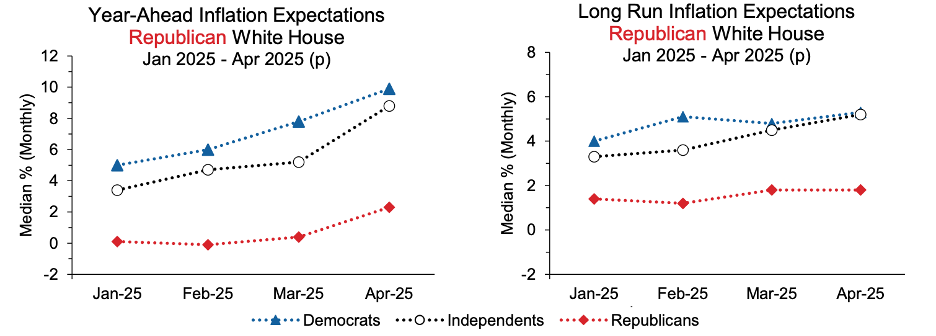
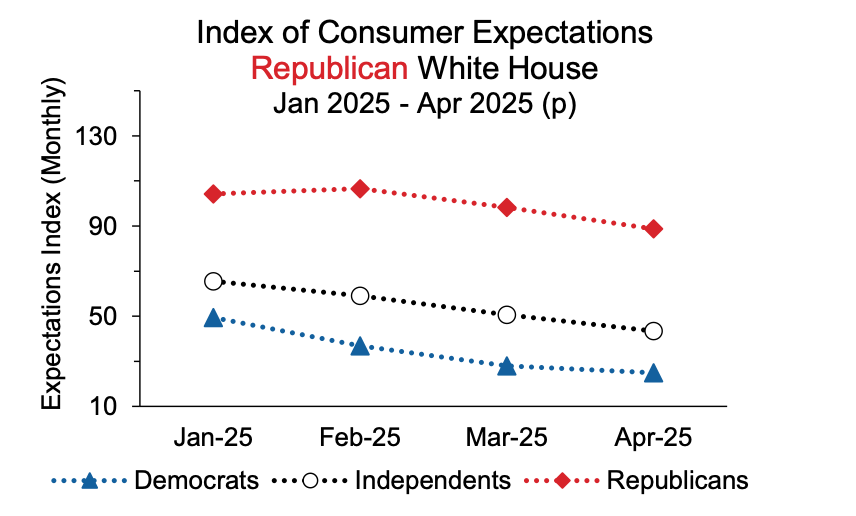
However, the Michigan Survey, while having a long pedigree, isn’t that large a survey.  As such, it is possible that non-economic factors may be impacting the results.  For instance, when the survey is taken, the respondents’ political leanings are asked as well.  Now, take a look at the data when split by political views as per the below.  Perhaps, we need to take this survey with a grain or two of salt as it appears the question may be seen as a way to express one’s opinion about the current administration rather than unbiased views of future inflation.

This is especially true when we look at other measures of expected inflation, like the NY Fed’s Consumer inflation survey shown below with the green line compared to that Michigan survey in red.

Source: zerohedge.com

My point is, we need to be careful to notice the non-economic factors that enter into things like expectations surveys.  As well, the idea that inflation expectations are a critical driver of future inflation, although a staple of current central bank thinking, does not have much empirical backing.  For instance, my friend Mike Ashton, the Inflation Guy™, explained in this article way back in 2015, that inflation expectations do not have much empirical proof of effectively forecasting future inflation.  But perhaps, if you don’t believe him, you will consider a scholarly paper by a Fed economist, Jeremy Rudd, written in 2021 that is pretty damning with respect to the idea that the Fed relies on this data as part of their policy toolkit.  

In the end, the one truism of which I am highly confident is that pretty much all the models that have been utilized for the past twenty plus years are no longer reflective of the reality on the ground today.  Not just for inflation, but for growth and trade and every other aspect.  President Trump has not merely upset the applecart; he has broken it into pieces and burned them all to cinders.  All the fiscal problems mentioned above are still extant, but President Trump appears set on changing them in the direction desired by almost all mainstream economists.  They don’t like his methods, but it’s not clear how changes of this magnitude can be made smoothly.  So, perhaps the proper question is just how rough things are going to be.  If the overnight session is any indication, they could get pretty rough.

The dominant feature today
Is fear is what’s now holding sway
As markets decline
More pundits consign
The blame on Trumps tariff pathway

Investors have risk indigestion this morning, as their appetite to own equities anywhere in the world has significantly diminished.  After a rough week ending session on Friday in the US, equity markets in Asia have almost universally declined led by Tokyo (-4.05%) but with sharp declines seen in Korea (-3.0%), Taiwan (-4.2%), Australia (-1.75%), Malaysia (-1.45%) and Thailand (-1.5%).  Chinese (-0.7%) and Hong Kong (-1.3%) shares also fell, although perhaps not quite as far as others.  The entire conversation today is about President trump’s promise to impose tariffs around the world on Wednesday, with many analysts trying to estimate what damage will occur despite no clarity on the size and breadth of the tariffs.  But investors have decided that havens are a better place to hide for now.

European bourses are also sharply lower, although more in the -1.7% to -2.0% range, with every major index in Germany, France, Spain and Italy down by those amounts.  There continues to be a great deal of discussion amongst the European leadership about how they will respond to the mooted tariffs, but of course, like everybody else, they have no idea exactly what they will be.  As to US futures, at this hour (6:45) the picture is grim with declines between -0.6% (DJIA) and -1.3% (NASDAQ).  Right now, the only people who are happy are those holding puts.

Of course, in this risk-off environment, it should be no surprise that bond yields have slipped a bit as, at the margin, investors are flocking to own Treasuries (-5bps) and European sovereigns (Bunds -3bps, OATs -2bps, Gilts -4bps).  Even JGBs (-5bps) saw yields decline last night with any thoughts of the BOJ hiking rates in the near term fading away completely.  

On the other hand, commodities are finding a lot more interest this morning with gold (+1.15%) leading the way higher and proving itself to continue to be one of the most consistent safe havens available.  Interestingly, oil (+0.5%) is rallying this morning despite a number of Wall Street analysts upping their estimate of the probability of a US recession.  However, offsetting the potential future demand weakness is the news that President Trump is “pissed off” at Vladimir Putin for his ongoing aggression in Ukraine and seeming unwillingness to move to a ceasefire.  This has raised the specter of further sanctions on Russian oil output, potentially reducing supply.  As well, the Trump administration continues to tighten the noose on both Iranian and Venezuelan oil sales, so potentially reducing supply even further.  I guess this morning, the supply story is bigger than the demand story.

Finally, as we turn to the currency markets, the dollar is generally firmer this morning, although by widely varying amounts depending on the currency.  For instance, in the G10, NOK (-0.75%) is the laggard despite oil’s gains, followed by AUD (-0.6%) and NZD (-0.55%), with all three of these being major commodity producers at a time when commodities are doing well.  As to the rest of this bloc, JPY (+0.35%) is off its best levels, but behaving as a haven, and the others are just marginally changed from Friday’s closing levels.  In the EMG bloc, ZAR (+0.25%) is the exception this morning, clearly benefitting from gold’s ongoing run to new all-time high prices, but otherwise, most of these currencies are modestly softer (MXN -0.2%, PLN -0.2%, KRW -0.25%).

Speaking of currencies, though, there is an article on this morning’s Bloomberg website that is worth reading, I believe, for everyone involved in the FX market.  The gist of the article is something that I have been discussing for the past several years, the fact that market liquidity here, despite the extraordinary volumes that trade on average each day (currently estimated by the BIS at $7.5 trillion across all FX products) is not nearly as deep as might be anticipated.  

My observation from my time on bank desks was that while there was a great deal of electronic flow, likely driven by HFT firms seeking to extract the last tenth of a pip out of thousands of transactions, when a real client, generally a corporate, had a need to do something specific to address a business need, and that amounted to more than $100 million equivalent, the liquidity situation was far more suspect. 

My personal theory was as follows: bank consolidation reduced the net amount of risk-taking appetite as larger banks did not increase their risk-taking commensurate with the reduction that occurred by small banks being gobbled up.  Combining this with the introduction of high-frequency trading firms in the business, who had no underlying client base to whom they owed a price, and therefore, could turn off their machines in a difficult market, further reducing liquidity, led to a situation where liquidity was a mile wide and an inch deep.  My point is for all the corporates out there who have significant transactions to execute, you must carefully consider the best way to approach the situation to avoid a potentially significant increase in execution costs.

Turning to the data, before we look at this week, which ends with NFP, a quick word on Friday’s core PCE data, which came in at a hotter than expected 0.4% taking the YY number to 2.8%.  The Fed cannot be happy with this outcome as a quick look at the recent readings makes it hard to accept inflation is continuing its decline from the 2022 highs.  Rather a look at the below chart, at least to my eye, shows me a stability in Core PCE of somewhere between 2.5% and 3.0%, well above the Fed’s target range, and hardly a cause to cut rates further.

Source: tradingeconomics.com

As this note has already gotten a bit longer than I like, I will list the week’s data tomorrow but note that Chicago PMI (exp 45.4) is the only noteworthy data point to be released today.  

Absent a complete reversal of Trump’s tariff plans, I see nothing positive on the horizon for risk assets, and expect that equities will maintain, and probably extend the overnight losses while gold and bonds both rally, at least for now.  As to the dollar, my take is it will not benefit universally in this risk-off scenario, although there are currencies that will clearly suffer.  Remarkably, despite the performance of Aussie and Kiwi overnight, I do believe the commodity bloc has the best prospects for now.

Good luck

Adf

I Am Your Savior

Investors are showing concern
‘Bout tariffs and Trump, so they spurn
The riskiest stuff
But that’s not enough
To help generate a return
 
Seems most of the holdings in favor
Are no longer risk takers’ flavor
How long before Jay
Will finally say
QE is here, I am your savior


Have you bailed out on your risk exposures yet?  Because if not, it certainly seems you are behind the curve!  At least, that’s what it feels like this morning as trepidation underlies every player’s market activity.  Based on the commentary, as well as the Fear & Greed Index, you might think we are in a depression!

Source: cnn.com

But are things really that bad?  I know that the past week has seen a modest drawdown in equity prices, but after all, on February 20th, they reached yet another new all-time high, at least as per the S&P 500.  Since then, as you can see below, the decline has been less than 5%.  And while the market has traded below its 50-day moving average (blue line), a key technical indicator, it remains well above both the 200-day version of the same (purple line) and the longer-term trend line.  My point is it feels like the narrative is overstating the magnitude of the move thus far.

Source: tradingeconomics.com

Is this the beginning of the end?  While you can never rule that out, as major corrections can occur at any time, I have no reason to believe this will be the case.  Much has been made of yesterday’s Initial Claims print at 242K, much higher than forecast as a harbinger of future economic weakness.  However, looking at the past 3 years of weekly data here, while certainly in the upper levels of readings, it is not nearly the only occurrence and not nearly the highest reading.

Source: tradingeconomics.com

One data point does not make a trend and to my eye, looking at this chart, there is no discernible trend in either direction.  Yet part of the narrative evolution is that the DOGE cuts in government jobs, along with all the headline spending cuts, is setting the economy up for much slower growth in the short run.

In fact, this issue goes back to one about which I wrote several days ago here regarding the impact of government spending on actual economic activity.  The current view of economic activity includes government spending.  If President Trump’s goal is to reduce that spending, regardless of the net long-term benefits of such actions, GDP readings are going to decline initially.  Yes, there will be more productive use of capital with less regulation and less government, but that will take some time to become evident.  In the meantime, weaker economic activity is likely to be the outcome.

I have frequently written that there has not been a market clearing event since, arguably, October 1987, when equity markets plunged and erased significant excess and speculation.  Alas, newly minted (at the time) Fed Chair Greenspan stepped in and promised to support markets with ample liquidity the next day which opened the way for far more Fed intervention in markets leading up to Ben Bernanke and the first QE programs in the wake of the GFC in 2009 and every QE version since then.  While the movement so far does not remotely indicate the end of the world, based on the Fed’s history, once equity markets correct about 20%, they tend to become far more active in supporting the markets economy.  Will this time be different?  Given the Fed’s seeming underlying desperation to cut rates to begin with, my take is if the correction reaches 15% – 20%, we will see just that.

To sum things up, risk assets are under pressure on the basis of 1) excessive valuations, 2) the Trump efforts to reduce wasteful spending (which while wasteful is still spending and counted as economic activity), and 3) the idea that Trump’s imposition of tariffs is going to dramatically raise inflation and slow growth further.  Given the mainstream media’s inherent hatred of the president, they will certainly be playing up this theme for as long as they can as they try to force Trump to change tack.  But Trump, and Treasury Secretary Bessent, have been clear that their concern is 10-year bond yields, and getting them to lower levels.  A natural corollary of the current risk-off sentiment is that bond yields tend to decline.   Look at the chart below which shows that since Trump’s inauguration, 10-year yields are down nearly 40bps.  I would argue that Trump and Bessent are perfectly comfortable with the market right now.

Source: tradingeconomics.com

Ok, let’s move on to the overnight activity.  Sticking to the bond theme, while Treasuries, this morning, are unchanged, they did decline all yesterday afternoon and this morning European sovereigns are all lower by -2bps.  As well, JGB yields have also slipped by -3bps as we are seeing risk aversion evident all around the world.  Of course, the problem with all G10 nations (Germany excepted) is that they all have very high debt/GDP ratios and in Europe, especially, this is a problem as they have begun to realize they need to spend a great deal more on defense than they have in the past.  And all that spending is going to be funded by more borrowing.  The tension between additional issuance driving yields higher and risk aversion driving yields lower is going to be the theme of European bond markets for a while.

In the equity world, it is not a pretty picture anywhere in the world.  After yesterday’s US rout, with the NASDAQ (-2.8%) leading the way lower, Asian bourses were all in the red.  Japan (-2.9%), Hong Kong (-3.3%), China (-2.0%), Korea (-3.4%), India (-1.9%)… the list goes on across the entire region with only New Zealand (+0.5%) bucking the trend on some better than expected local earnings and consumer confidence data.  European markets, though, are in a bit better shape as they suffered yesterday and are consolidating those losses this morning with most markets trading +/- 0.3% on the session.  We have seen a lot of European inflation data this morning, most of it lower than forecast which has encouraged the view that the ECB will be cutting rates more aggressively going forward.  US futures, too, are higher at this hour (7:00), on the order of 0.5% as they bounce from yesterday’s, and truly the past week’s, declines.

In the commodity markets, oil (-1.25%) is back under pressure and back under $70/bbl.  The latest fear is that slowing economic activity around the world will reduce demand for the black sticky stuff and drive prices lower still.  Remember this, oil supply is restricted not by geology, but by politics.  As nations determine that cheaper energy is critical to their future, expect to see more effort to produce more oil.  Meanwhile, metals markets are also under pressure with gold (-0.5%) still falling despite its ostensible risk profile.  However, the barbarous relic remains well above $2800/oz and I continue to believe that this correction is just that, and not the reversal of a trend.  Too many things are happening around the world to induce more fear and in that scenario, gold is the oldest store of value around.  The rest of the metals complex is also under pressure with copper (-1.2%) slipping back a bit.  It is important to remember, though, that despite the recent declines, all the major metals are still nicely higher on the month.  

Finally, the dollar is a bit firmer again this morning after a rally yesterday as well.  In classic risk-off fashion, investors flocked to the dollar, arguably to buy Treasuries.  So, we are seeing weakness in NZD (-0.6%), JPY (-0.4%) and CHF (-0.3%) in the G10 and weakness in KRW (-0.5%), ZAR (-0.2%) amongst others in the EMG bloc.  Here the story remains the impacts of Trump’s tariffs and how they will be applied, if they will be applied, as well as a general fear factor which tends to help the dollar.  Consider, too, ideas that the ECB is going to cut rates will not help the single currency.

On the data front, this morning brings Personal Income (exp +0.3%), Personal Spending (0.1%), and the PCE data where Headline (0.3%, 2.5% Y/Y) and Core (0.3%, 2.6% Y/Y) will be the most important data points.  As well, we will see Chicago PMI (40.6) which has been below 50.0 in every month but one since August 2022.  

There is no question that the economic data has been softening lately.  We saw that with the Citi Surprise Index as well as the continuous stream of commentary by the economic bears who point to underlying pieces of data that point in that direction (whether housing or employment indicators and the recent weak PMI data).  

Consider this, an early recession in Trump’s term can be blamed on the Biden administration as well as set things up for future growth, certainly in time for the mid-term elections.  As well, it will likely help reduce the yield on the 10-year, an explicit goal.  This scenario likely means short-term weakness with an eye to longer term growth.  The dollar is likely to benefit early on, at least until the Fed steps in.

Good luck and good weekend

Adf

Hard to Kill

Inflation just won’t go away
As evidenced by the UK
This year started out
Removing all doubt
The Old Lady’s work’s gone astray
 
And elsewhere, the problem is still
Inflation is quite hard to kill
Though central banks want
More rate cuts to flaunt
Those goals are quite hard to fulfill


While most eyes remain on President Trump with his ongoing efforts to reduce the size of the US government, as well as his tariff discussions and efforts to negotiate a lasting peace in Ukraine, we cannot ignore the other things that go on around the world.  One of the big issues, which has almost universally been acclaimed a problem, is that inflation is higher than most of the world had become accustomed to pre-Covid.  As well, the virtual universal central bank goal remains the local inflation rate, however calculated, to be at 2.0%.  Alas for the central bankers in their seats today, that remains quite a difficult reach.  A quick look at the most recent headline CPI readings across the G20 shows that only 5 nations (counting the Eurozone as a bloc since they have only one monetary policy) are at or below that magic level as per the below table.

Source: tradingeconomics.com

Of those nations who are below, two, China and Switzerland, are actually quite concerned about the lack of price pressure and seeking to raise the inflation rate, and the other three (Canada, Singapore and Saudi Arabia) are right on the number, with core inflation readings tending higher than the headline reported here.

Perhaps a better way to highlight the problem is to look at the 10-year bonds of most countries and see how they have been behaving of late as an indication of whether investors are comfortable with the inflation fighting efforts by each nation.  While it is not universal, you can look at the column on the far right of the below table and see that 10-year yields have been rising for the past year.

Source: tradingeconomics.com

I only bring this up because, despite the fact that I have been downplaying central bank, especially the Fed’s, impact on markets, ultimately, every nation tasks their central bank to manage inflation.  That seems reasonable since inflation, as Milton Friedman explained to us in 1963, is “always and everywhere a monetary phenomenon.”  But perhaps you don’t believe that and are schooled in the idea that faster growth leads to higher wages and therefore higher inflation.  Certainly, Paul Samuelson’s iconic textbook (as an aside, Dr Samuelson was my Economics 101 professor in college) made clear that was the pathway.  Alas, as my good friend, @inflation_guy Mike Ashton, wrote yesterday, there is no evidence that is the case.  Read the article, it is well worth it and can help you start looking elsewhere for causes of inflation, like perhaps the growth in the money supply!

Of course, the reason that we continue to come back to inflation in our discussions is because it is critical to the outcomes in financial markets.  And that is our true focus.  It is the reason there is so much discussion regarding President Trump’s mooted tariffs and how inflationary they will be.  It is the reason that parties out of power continue to highlight any prices that have risen substantially in an effort to disparage the parties in power.  And it is the reason that central banks remain central to the plot of all financial markets, at least based on the current configuration of the global economy.  If there was only one financial lesson from the pandemic response, it is that Magical Money Tree Modern Monetary Theory is a failed concept of how to run policy.  This poet’s fervent hope is that Treasury Secretary Bessent is smart enough to understand that and will address fiscal issues in other manners.  I believe that to be the case.

Back to the UK, where CPI printed at 3.0%, 2 ticks higher than the median forecast, while core CPI printed at 3.7%.  This cannot be comforting for the BOE as most of the MPC remain committed to helping PM Starmer’s government find growth somehow and are keen to cut rates in support.  The problem they have is that inflation will not fade despite extremely lackluster GDP growth.  Recall, last week, even though the Q/Q GDP print of 0.1% beat forecasts, it was still just 0.1%.  Not falling into recession hardly seems a resounding victory for policy in the UK, especially since stagnation, or is it now stagflation, is the end result.  It should be no surprise that market participants have sold off the pound (-0.3%), Gilts (+5bps) and UK equities (-0.4%) and it is hard to find a positive way to spin any of this.  Again, while I have adjusted my views on Japan, the UK falls squarely in the camp of in trouble and likely to see a weaker currency.

Ok, let’s look elsewhere to see how things behaved overnight.  After a very modest rise in US equity indices yesterday, the Asian markets were mixed with the Nikkei (-0.3%) and Hang Seng (-0.15%) slacking off a bit although the CSI 300 (+0.7%) managed to find buyers after President Xi met with business leaders and the expectation is for further government stimulus, as well as a reduction in regulations, to help support the economy.  Australia (-0.7%) is still under pressure despite yesterday’s RBA rate cut as the post-meeting statement was quite hawkish, indicating caution is their approach for now given still sticky inflation.  (Where have we heard that before?)

In Europe, the only color on the screen is red with declines of between -0.4% and -0.9% as investors seem to be taking some profits after a solid run in most of these markets.  I guess the fact that European governments have been shown to be powerless in the world has not helped investor sentiment either as it appears these nations may be subject to more outside forces than they will be able to address adequately.  Lastly, US futures are unchanged at this hour (7:40).

In the bond market, as per the table above, yields are higher across the board with Treasuries (+2bps) the best performer as virtually all European sovereign issues have seen yields rise between 5bps and 7bps.  It simply appears that confidence in the Eurozone is slipping and demand for Eurozone assets is falling alongside that.

In the commodity markets, it should be no surprise that gold (+0.1%) continues to edge higher.  The barbarous relic continues to find price support despite the fact that interest in gold, at least in Western economies, remains lackluster at best.  There is much discussion now about an audit of the US’s gold reserves at Fort Knox and in the NY Fed, something that has not been performed since 1953.  Not surprisingly, there are rumors that there is much less gold in storage than officially claimed (a little over 8 tons) and rumors that there is much more which has not been reported but was obtained via seizures throughout history.  This story has legs as despite the lack of institutional interest in the US, it is picking up a retail following and we are seeing the punditry increasingly raise their price forecasts for the coming years.  As to oil (+0.8%) it is higher again this morning but remains in a tight trading range with market technicians looking at the $70/bbl level as a key support to hold.  A break there could well see a quick $5/bbl decline.

Finally, the dollar is modestly firmer this morning against most of its counterparts with most G10 currencies showing declines similar to the pound’s -0.2%, although the yen (+0.15%) is bucking that trend.  However, versus its EMG counterparts, the dollar is having a much better day, rising vs. PLN (-0.9%), ZAR (-0.7%) and BRL (-0.5%) on various idiosyncratic stories.  The zloty seems to be suffering from its proximity to Ukraine and the uncertainty with the future regarding a potential peace effort.  The rand is falling after the FinMin delayed the budget speech as internal squabbling in the governing coalition seems to be preventing a coherent message while the real is under pressure as inflation remains above target and the central bank’s tighter policy has been negatively impacting growth in the economy.

On the data front, this morning brings Housing Starts (exp 1.4M) and Building Permits (1.46M) and then this afternoon we see the FOMC Minutes from the January meeting.  That will be intensely parsed for a better understanding of what the committee is thinking.  We do hear from Governor Jefferson after the market closes, but generally, the cautious stance remains the most popular commentary.

Has anything really changed?  The market remains uncertain over Trump’s moves, the Fed remains on hold and cautious, and data shows that the economy continues to tick along nicely with price pressures unwilling to dissipate.  I see no reason to abandon the dollar at this point.

Good luck

Adf

A Fifth Wheel

Confusion is clearly what reigns
As even the punditry strains
To understand whether
Investors will tether
Their future to stocks or take gains


As there was no activity in the US financial markets yesterday, it seems there was time for analysts to consider the current situation and make pronouncements as to investor behavior.  Ironically, we saw completely opposite conclusions from two major players.  On the one hand, BofA posted the following chart showing that investors’ cash holdings are at 15-year lows, implying they remain fully invested and quite bullish.

Meanwhile, the WSJ this morning has a lead article on how bearish investors are, claiming they are the most bearish since November 2023 according to the American Association of Individual Investors.  Apparently, 47.3% of investors surveyed believe stock prices will fall over the next 6 months.

So, which is it?  Are investors bullish or bearish?  To me this is a perfect description of the current situation.  Everyone is overloaded with information, much of which is contradictory, and so having a coherent view has become extremely difficult.  This is part and parcel of my view that the only thing we can clearly expect going forward is an increase in volatility.  In fact, someone said that Donald Trump is the avatar of volatility, and I think that is such an apt description.  Wherever he goes, mayhem follows.  Now, I also believe that people knew what they were voting for as change was in demand.  But for those of us who pay close attention to financial markets, it will take quite the effort to keep up with all the twists and turns.

Fed speakers are starting to feel
Like they have become a fifth wheel
So, let’s get prepared
For Fed speaking squared
As they work, their views, to reveal

Away from the conundrum above, the other noteworthy thing is that FOMC members are starting to feel left out of the conversation.  Prior to President Trump’s inauguration, market practitioners hung on their every word, and they apparently loved the power that came with that setting.  However, now virtually every story is about the President and his policies with monetary policy falling to a distant issue on almost all scorecards.  Clearly, for a group that had grown accustomed to moving markets with their words, this situation has been deemed unacceptable.  The solution, naturally, is to speak even more frequently, and I fear believe this is what we are going to see (or hear) going forward.  

Yesterday was a perfect example, where not only, on a holiday, did we have multiple speakers, but they actually proffered different messages.  From the hawkish side of the spectrum, Governor Michelle Bowman, the lone dissenter to the initial 50bp rate cut back in September, explained caution was the watchword when it comes to acting alongside President Trump’s mooted tariff and other policies, “It will be very important to have a better sense of these policies, how they will be implemented, and establish greater confidence about how the economy will respond in the coming weeks and months.”  That does not sound like someone ready to cut rates anytime soon.

Interestingly, from the dovish side of the spectrum, Governor Christopher Waller, an erstwhile hawk, explained in a speech in Australia (on the day the RBA cut rates by 25bps for their first cut of the cycle and ending an 18 month period of stable rates) that, “If this wintertime lull in progress [on inflation] is temporary, as it was last year, then further policy easing will be appropriate.”  I find it quite interesting that Governor Waller suddenly sounds so dovish as many had ascribed to him the intellectual heft amongst the governors.  This is especially so given that is not the message that Chairman Powell articulated either after the last meeting or at his Humphrey-Hawkins testimony recently.  

So, which is it?  Is the Fed staying hawkish or are they set for a turn?  That will be the crux of many decision-making processes going forward, not just in markets but also in businesses.  We will keep tabs going forward.

Ok, on to the market’s overnight performances.  Lacking a US equity market to follow, everybody was on their own last night which showed with the mixed results.  Japan (+0.25%) showed modest gains while the Hang Seng (+1.6%) rocketed higher on the belief that President Xi is going to be helping the economy, notably the tech firms in China, many of which are listed in Hong Kong.  Alas, the CSI 300 (-0.9%) didn’t get that memo with investors apparently still concerned over the Trump tariff situation.  Elsewhere in the region, Korea and Taiwan rallied while Australia lagged despite the rate cut.  In Europe, unchanged is the story of the day with most bourses just +/-0.1% different than yesterday’s close.  Right now, in Europe, the politicians are trying to figure out how to respond to the recent indication that the US is far less interested in Europe than in the past, and not paying close attention to financial issues.  As to the US, futures at this hour (7:25) are pointing higher with the NASDAQ leading the way, +0.5%.

In the bond market, yields are climbing led by Treasuries (+4bps) with most of Europe seeing yields edge higher by 1bp or 2bps as well.  Remember, yesterday European sovereign yields rose smartly across the board.  Also, I must note JGB yields (+4bps) which have made further new highs for the move and continue to rise.  It appears last night’s catalyst was a former BOJ member, Hiroshi Nakaso, explained he felt more rate hikes were coming with the terminal rate likely to be well above 1.0%.  While I believe the Fed will be cautious going forward, I still think they are focused on rate cuts for now.  With that in mind and the ongoing change in Japanese policy, I am increasingly comfortable with my new stance on the yen.

In the commodity markets, last Friday’s sell-off in the metals markets is just a bad memory with gold (+0.5%) rallying again and up more than 1% since Friday’s close.  I continue to believe those moves were positional and not fundamental.  Too, we are seeing gains in silver (+0.2%) and copper (+0.6%) to complete the triad.  Meanwhile, oil (-0.25%) continues to lag, holding above its recent lows but having a great deal of difficulty finding any buying impulse.  Whether that is due to a potential peace in Ukraine and the end of sanctions on Russian oil, or concerns over demand growth going forward is not clear to me, but the trend, as seen in the chart below, is clearly downward and has been so for the past year.

Source: tradingeconomics.com

Finally, in the FX markets, the dollar is firmer this morning rising against all its G10 counterparts with NZD (-0.6%) the laggard.  But losses of -0.2% are the norm this morning.  In the EMG bloc, we are seeing similar price behavior in most markets although MXN (+0.2%) is bucking the trend, seemingly benefitting from what appears to be a hawkish stance by Banxico and the still highly elevated interest rate differential in the peso’s favor.

On the data front, Empire State Manufacturing (exp -1.0) is the only data point although we will hear from two more Fed speakers, Daly and Barr.  I cannot believe that they have really changed their tune and expect that caution will remain their guiding principle for now, although I expect to hear that repeated ad nauseum as they try to regain their place in the spotlight.

Aside from my yen view, I still find it hard to be excited about many other currencies for now.  There is still no indication the Fed is going to move anytime soon, and other central banks are clearly in easing mode.  That bodes well for the dollar going forward.

Good luck

Adf

Shattered His Dreams

The data was hot yesterday
And that put the pressure on Jay
It shattered his dreams
‘Bout all of his schemes
To help keep inflation at bay


By now, I am sure you are aware that the CPI data was higher than forecast, and certainly higher than would have made Chairman Powell comfortable.  The outcome, showing Headline rising to 3.0% and core rising to 3.3% with correspondingly higher monthly rises was sufficient to alter the narrative at least a little bit.  Chair Powell even mentioned it in his House testimony, noting, “We are close, but not there on inflation…. So, we want to keep policy restrictive for now.”  Essentially, the data makes clear that the Fed is not going to be cutting the Fed funds rate anytime soon.  The futures market got the message as it is now pricing just 29bps of cuts this year, with December the likely date.

It will be no surprise that the stock market’s initial response was to sell off substantially, but as per the chart below, it spent the rest of the day clawing back the losses and wound up little changed on the day.  This morning, it remains basically unchanged as well.

Source: tradingeconomics.com

Treasury bonds, though, had a less fruitful session, falling (yields rising) sharply on the print, but never really regaining their footing with yields jumping almost 15bps at one point although finishing the day about 10bps higher and have given back 2bps more this morning.

Source: tradingeconomics.com

Now, we all know that the Fed doesn’t target CPI, but rather PCE.  However, after this morning’s PPI data release, most economists (although not poets) will be able to reasonably accurately estimate that data point for later this month, as will the Fed.  And that number is not going to be moving closer to their 2.0% target.  What seems very clear at this point is that every Fed speaker for the time being is going to be harping on the caution with which they are going to move forward.

If we look at this from a political perspective, something which is unavoidable these days, it is important to remember that Treasury Secretary Bessent has made clear that he and the president are far more focused on the 10-year yield than on the Fed funds rate.  To that end and given the fact that all this data was from a time preceding President Trump’s inauguration, I don’t think they are too worried.  I would look for the President to continue his drive to reduce waste and fraud in the government and attack that deficit.  Certainly, the news to date is there is a great deal of both waste and fraud to reduce, and if the president is successful, I believe that will play out in significantly lower 10-year yields, if for no other reason than the deficit is reduced or closed.  This story is just beginning to be written.

Now, Putin and Trump had a call
As Trump tries to end Russia’s brawl
They’re slated to meet
So, they can complete
A treaty with Europe awol

Under any interpretation, I believe the news that Presidents Trump and Putin are going to meet in an effort to hammer out an end to the Russia/Ukraine war is good news.  Beyond the simple fact that less war is an unadulterated good, I think it is very clear that this particular war has had significant market impacts, hence our interest here.  Obviously, energy prices have been impacted, as both oil and NatGas prices are higher than they would otherwise be given the removal of some portion of Russia’s exports from the global markets and economy.  As such, the end of this conflict, with one likely consequence being Western Europe reopening themselves to Russian energy imports, is likely to see prices decline.  

This matters for more reasons than the fact it will be cheaper to fill up your tank at the gas (petrol) station, it is very likely to have a very positive impact on inflation writ large.  As you can see from the chart below, there is a very strong correlation between the price of oil and US inflation expectations.  Declining oil prices are very likely to help people perceive a less inflationary future and will reduce the rate of inflation by definition.  

Source: ISABELNET

Inflation is an insidious process, and once entrenched is very hard to reduce, just ask Chairman Powell.  I also know that there has been much scoffing at President Trump’s claims he will reduce inflation, especially with his imposition of tariffs all over the place. (It is important to understand that tariffs are not necessarily inflationary by themselves as well explained by my friend the Inflation guy in this article.). However, between his strong start on reducing government expenditures and the potential for an end to the Russia/Ukraine war leading to lower energy prices, these are longer term effects that may do just that.

Ok, let’s move on to the market activities in the wake of yesterday’s CPI and ahead of this morning’s PPI data.  As discussed above, yesterday’s US markets rebounded from their worst levels of the morning and closed modestly lower with the NASDAQ actually unchanged.  In Asia, Japanese shares (+1.3%) had a solid day as the weak yen helped things along although Chinese shares (HK -0.2%, CSI 300 -0.4%) did not fare as well on the day with tariffs still top of mind.  Elsewhere in the region, other than Korea (+1.4%) movement was mixed and modest.  In Europe, the possibility of peace breaking out in Ukraine has clearly got investors excited as both Germany (+1.5%) and France (+1.2%) are seeing strong inflows. The UK (-0.7%) however, continues to suffer from economic underperformance with no discernible benefits shown from the governments weak efforts to right the ship.  GDP was released this morning and while they avoided recession, it’s very hard to get excited over 0.1% Q/Q growth.  As to the US futures market, at this hour (7:20), they are essentially unchanged.

In the bond market, we’ve already discussed Treasury yields, but another benefit of the prospects for a Ukrainian peace is that sovereign yields have fallen substantially, between -5bps and -8bps, throughout the continent.  Once again, the impact of that phone call between Trump and Putin has been quite significant.  Consider that not only are energy prices likely to slide, but the required government spending to prosecute the war is likely to diminish as well.

In the commodity markets, it should be no surprise that oil (-1.3%) prices are sliding as are NatGas prices in Europe (TTF -7.5%) as the opportunity for cheap Russian gas to flow to Europe is once again in view.  To highlight the impact that this has had on Europe, prior to the Ukraine war and the halting of gas flows, the TTF contract hovered between €5 and €25 per MWh.  Since the war broke out, even after the initial shock, it has been between €25 and €55 per MWh.  This is all you need to know about why Europe, and Germany especially, is deindustrializing.  As to the metals markets, after a few days of consolidation, gold (+0.4%) is on the move again although it has not yet recaptured the highs seen early Tuesday morning.  Give it time.  Copper (+0.6%), too, is back on the move and indicating that economic activity is set to continue to grow.

Finally, the dollar is mixed this morning, although arguably a touch softer overall, as the Russia news has traders looking for less negativity in Europe.  So modest gains in the euro and pound, about 0.15% each is offsetting larger losses in AUD (-0.3%) and NZD (-0.6%), although given the much smaller market size of the latter two, they matter much less.  JPY (+0.4%) is rebounding after yesterday’s sharp decline on the back of the jump in Treasury yields, and it is noteworthy that CHF (+0.65%) is gaining after its CPI data showed a decline in prices last month.  In the EMG bloc, CLP (+0.7%) is stronger on that copper rally, while ZAR (+0.1%) seems to be edging higher as gold continues to perform well. MXN (-0.4%) though is still struggling with the potential negative impact of tariffs and otherwise, there is not much to report.

This morning brings PPI (exp 0.3%. 3.3% Y/Y headline; 0.3%, 3.5% Y/Y core) as well as the weekly Initial (215K) and Continuing (1880K) Claims data.  There are no Fed speakers on the docket, but at this point, I expect the Fed will be fading into the background since they are clearly on hold and President Trump commands the spotlight.  Unless the data starts to veer dramatically away from what we have seen, it appears that the market is going to continue to respond to Trumpian headlines, which of course are impossible to predict.  But remember, most of the rest of the world is still in cutting mode so the dollar should continue to hold its own.

Good luck

Adf

Much Havoc

Colombia tried to prevent
Deportees, who homeward were sent
But Trump’s strong response
Meant that in a nonce
Gustavo, his knee quickly bent
 
Meanwhile, all the talk of AI
This weekend has pundits awry
The Chinese DeepSeek
Could very well wreak
Much havoc in stocks priced sky-high


If there was any doubt that things were going to be different under a Trump administration than virtually any previous administration, even his first term, they were dispelled this weekend.  By now you will all have heard the story of the Colombian president, Gustavo Petro (he of the 26% local approval rating) and his refusal to allow two US C-17 military transports filled with Colombian deportees, land in Bogota.  Apparently, when Trump was informed while playing golf, after birdieing the 3rd hole, he tweeted that the US would immediately impose 25% tariffs on everything Colombia exports to the US, rising to 50% in one week if this policy was not changed.  By the time he finished the 6th hole, President Petro reversed his policy and even offered the Colombian presidential plane to come and pick up the deportees.

While the golf portion of the story is amusing, the lesson to the rest of the world is that President Trump is very serious about his electoral promises, and he will utilize the entire might of the US government to achieve his goals.  For smaller nations with little power and leverage, it means that toeing the line is the only solution.  For larger nations, it certainly is a wakeup call to the idea that the US attitude toward international relations has dramatically changed.  As Machiavelli explained, it is better to be feared than loved, and it seems abundantly clear that President Trump understands that.

Perhaps the biggest takeaway from this situation, though, is that the US government is no longer the slow-moving behemoth to which it had evolved over the past decades.  The rest of the world is going to find itself needing to respond very quickly to things that in the past were sent to committees for study and review but now are decided instantly.  If you want to understand why I believe volatility is set to increase across all asset classes, this is the crux of the issue.

Turning to the tech world, the buzz is all about DeepSeek, which is a Chinese AI model that allegedly outperforms OpenAI’s top model, or performs just as well, although it costs a fraction of what OpenAI and others (Microsoft, Google, etc.) spent to train the model and it uses far less advanced chips which are also much less expensive and less power hungry.  Because this is all a new story, it remains unclear if DeepSeek will be an effective replacement for the others, or if it excels in only one or two areas and still lags elsewhere.  

But the market impact has been instantaneous and dramatic.  At this hour (6:00am), the NASDAQ (-4.5%) is leading US equity markets lower with the S&P (-2.4%) along for the ride.  Nvidia (-10.6% in premarket trading) is leading the way, but I suspect that this news will be negative for the entire US tech sector.  After all, it was certainly priced at premium levels.  

Source: tradingeconomics.com

In the short term, I expect we are going to hear a lot more analysis of why this is a game changing event and how the future that was so clear just last week is now cloudy.  However, while this will almost certainly take the shine off the megacap tech companies for a while, I think it would be a mistake to dismiss their futures because of this.  Two things in their favor are they still have virtually infinite resources, and they have dramatically large installed networks which means that changing things will be very difficult.  While their equity prices can decline a lot, it doesn’t mean their businesses are going to collapse.

PS, spare a thought for the impact on the energy sector here as well.  One of the narratives that has been fed lately is that all this AI will require gobs of power that will need a lot more power production.  It was a key feature of the Uranium story as nuclear is seen as one of the few sources capable of delivering the reliable power necessary.  I suspect that this part of the narrative will need to adjust as well if the AI story has actually changed.  But keep in mind that with efficiency comes more demand, so perhaps this is just a temporary downdraft.  Again, volatility is the name of the game.

Ok, let’s see how these stories have impacted the rest of the world.  With all the news over the weekend, you may not recall that US equity markets edged lower on Friday.  Well, Asian markets were mixed overnight with the Nikkei (-0.9%) following the US, although also reacting to the fact that the yen (+1.3%) rallied sharply as well.  Meanwhile, Hong Kong (+0.7%) managed to gain while mainland Chinese shares (-0.4%) certainly showed no benefit from the changing attitudes in tech.  Elsewhere in the region, Korea (+0.9%) and Taiwan (+1.0%) rallied while India (-1.1%) and Indonesia (-0.9%) fell and the rest of the region batted back and forth. In Europe, red is the dominant color, likely on the generally weak US performance although there are no European tech companies of note (perhaps ASML).  But the DAX (-1.2%) is leading the way down followed by the CAC (-0.9%) and the bulk of the rest of the continent and the UK.  Let’s just say that equities are not in favor this morning.

However, what we are seeing is a major bond market rally as Treasury yields (-12bps) tumble as risk is very definitely off.  European sovereign yields are also lower, by between -5bps and -7bps, and JGB yields (-2bps) also slipped, although relative to the rest of the world, they held up pretty well.  Interestingly, with all the talk about DeepSeek and the impact on the tech community, there has been virtually no discussion about the myriad central bank meetings this week, including, of course, the Fed on Wednesday where the market still sees no chance of a rate cut.

Commodity markets are relatively calm this morning as oil (-0.6%) is a touch lower although there has been no news of note.  The background story is that President Trump and Saudi Arabia’s Mohammed bin Salman are talking about increasing production to drive oil prices lower, but that remains more rumor than anything else.  As the polar vortex has passed, and forecasts are for warmer weather, NatGas (-6.2%) is sliding.  In the metals markets, very little movement is ongoing as traders try to determine what all the new news means.

Finally, the dollar is under some pressure this morning despite the risk off attitude that prevails.  I suppose it is because one of the recent drivers of the dollar’s strength has been the insatiable demand for the megacap tech stocks.  It seems that for now, that demand has been satiated.  So, the yen is behaving in its traditional safe haven role, as is the CHF (+0.85%) but the euro (+0.15%) and pound (+0.15%) are both a touch higher.  That said, we are definitely seeing emerging market currencies under pressure as they have nothing to do with tech and everything to do with the very obvious change in attitude regarding how the US is going to deal with smaller nations that don’t accede to US demands, especially regarding immigration.  So, MXN (-1.0%), COP (-1.1%), ZAR (-1.4%) and BRL (-0.6%) are all under significant pressure.  CE4 currencies, though, are not in the line of fire, so are little changed this morning.  

On the data front, remarkably, it almost seems an afterthought given what we just saw this weekend, but along with the Fed, BOC and ECB, we get PCE on Friday.

TodayNew Home Sales670K
TuesdayConsumer Confidence106.0
WednesdayBank of Canada Rate Decision3.0% (current 3.25%)
 FOMC Rate Decision4..5% (current 4.5%)
ThursdayECB Rate Decision2.75% (current 3.0%)
 Initial Claims220K
 Continuing Claims1885K
 Q4 GDP2.8%
FridayPersonal Income0.4%
 Personal Spending0.5%
 PCE0.3% (2.6% Y/Y)
 Core PCE0.2% (2.8% Y/Y)
 Chicago PMI40.0

Source: tradingeconomics.com

At this point, the central bank story is background noise, not the major theme, but by Wednesday I expect that all eyes will be on Chairman Powell as he describes the Fed’s thoughts at the press conference.  Of course, that assumes that there are no other political earthquakes, which may not be a very good assumption these days.  I think we are in a seismic zone for now.  

As to the dollar, if DeepSeek really is an Nvidia killer, then it is not hard to derive a scenario that says, US equity markets are going to decline, along with growth expectations.  The Fed will cut more aggressively, and the dollar will start to really fall as well.  I’m not forecasting that, just highlighting a possible, if not likely, scenario in the event the world believes the AI story is not going to be as expensive and profitable for the Mag7 as they thought last week.  Once again, the key is to hedge your risks, because as you learned this weekend, things change, and they can change quickly!

Good luck

Adf