Remarkable Fragility

JGB yields have
Risen to multi-year heights
Is this why stocks fell?


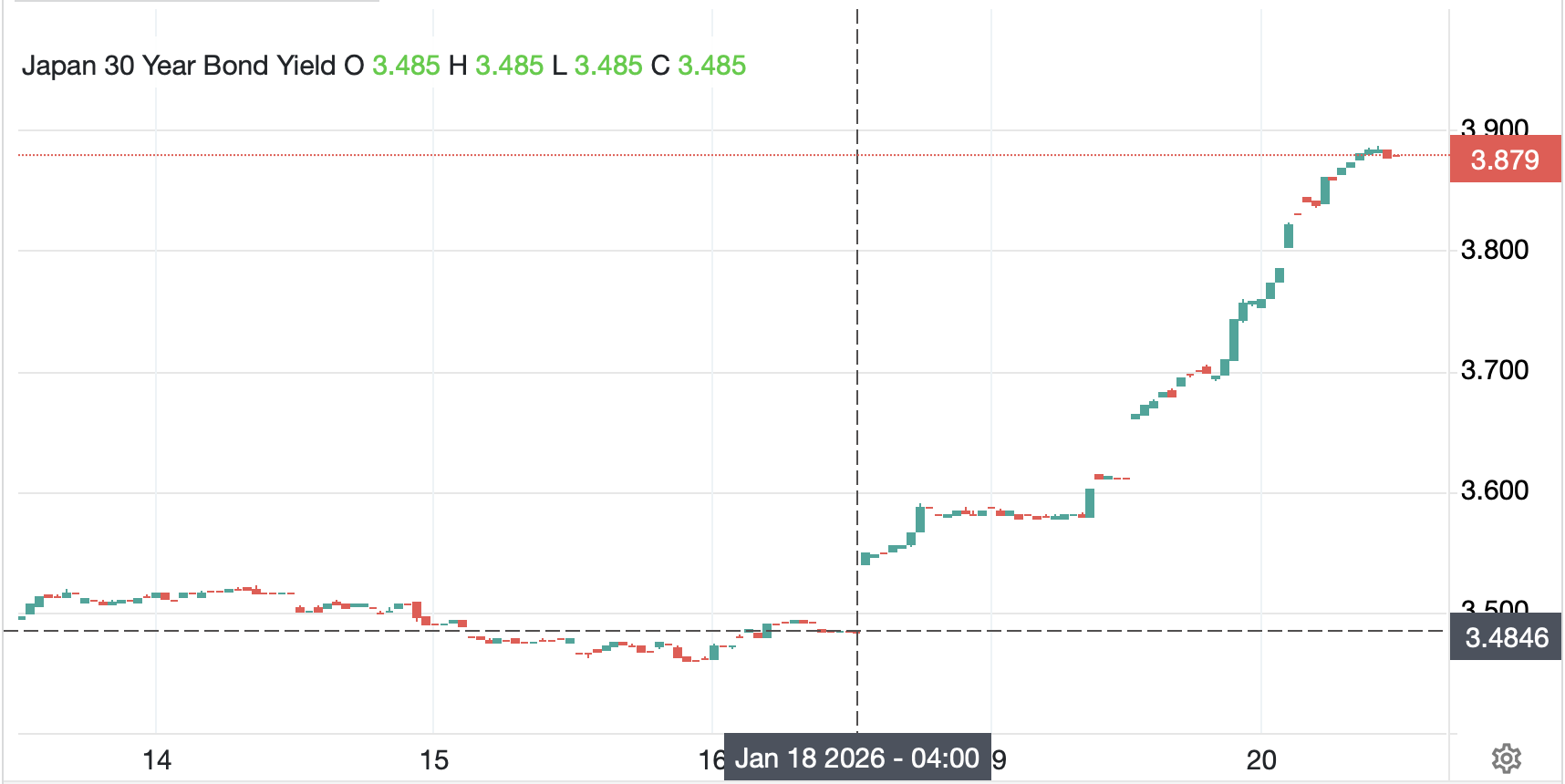
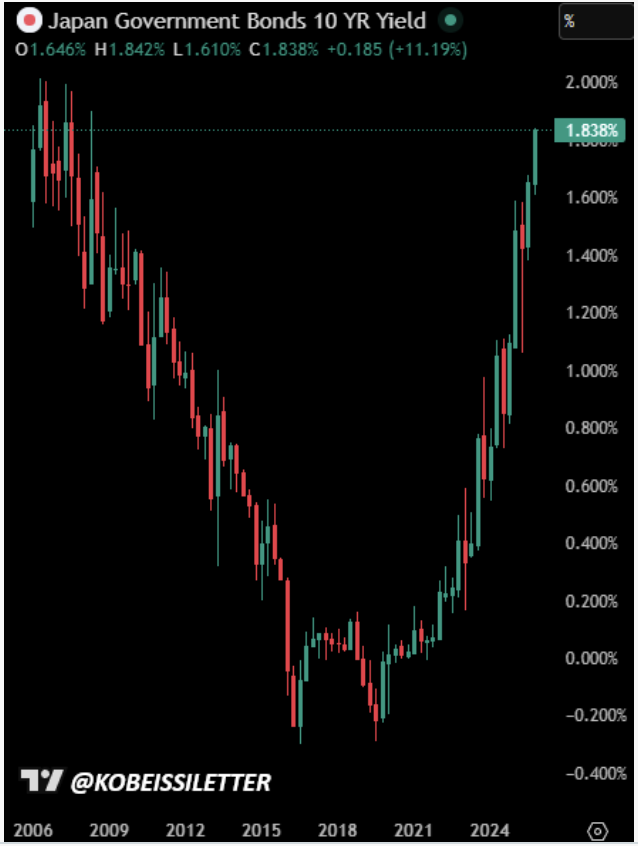
Yesterday I highlighted that 10-year JGB yields had risen to their highest level since 2008.  As you can see below, the same is true for 30-year JGBs and essentially the entire curve there.

Source: tradingeconomics.com

Ostensibly, this move was triggered by comments from BOJ Governor Ueda indicating that a rate hike was coming this month.  However, the thing I find more interesting is that this move in JGB yields has become the bête noire of markets, now being blamed for every negative thing that happened yesterday.  

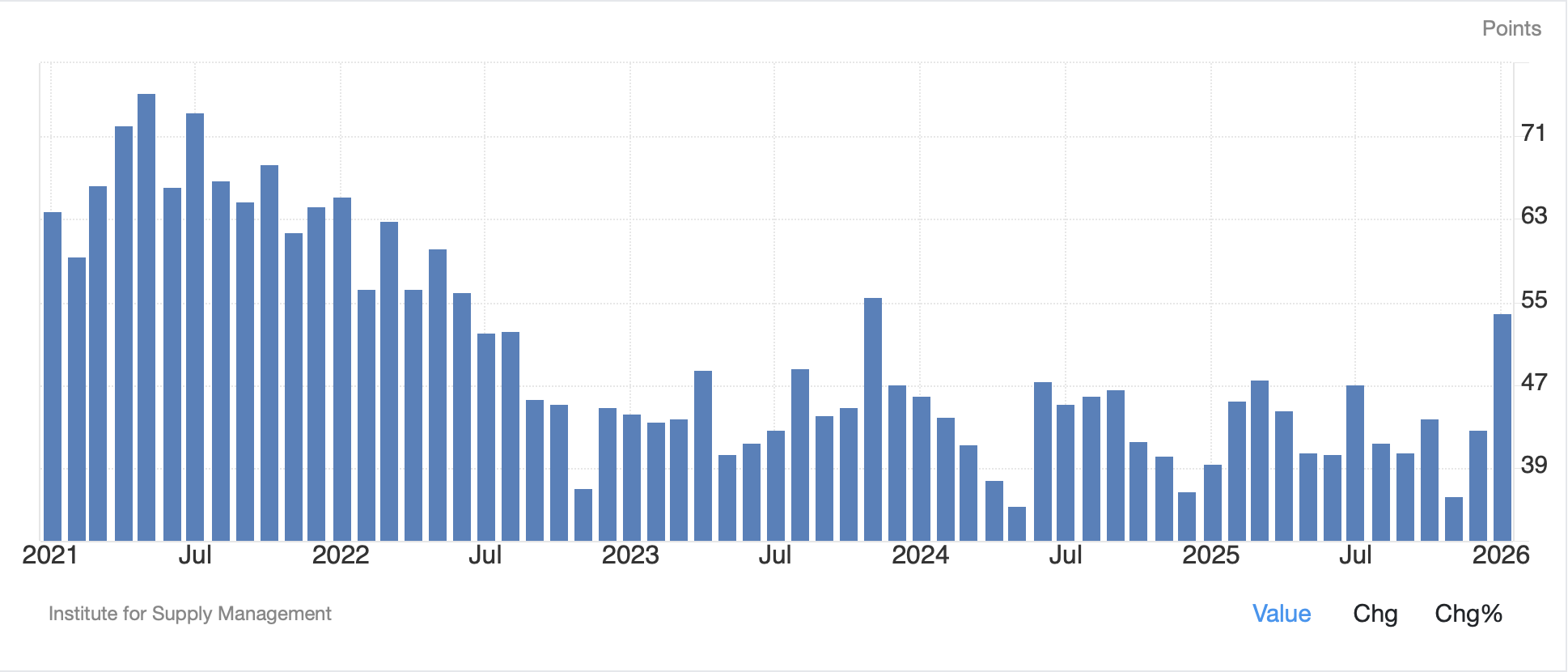
For instance, Treasury yields yesterday rose 7bps despite ISM data indicating that manufacturing activity remains sluggish at best.  In fact, the initial response to that data was that it confirmed the Fed will be cutting rates next week.  But the narrative seems to be that Japanese investors are now willing to repatriate funds, selling Treasuries to buy JGBs, in order to invest locally because they are finally getting paid to do so.  Certainly, looking at the chart above shows that Japanese yields had been tantamount to zero for a long time prior to 2024, and even then, have only started to show any real value in the most recent few months.  Of course, real 10-year yields in Japan remain significantly negative based on the latest inflation reading of 3.0%.  The upshot is, rising JGB yields are deemed the cause of Treasury market weakness.

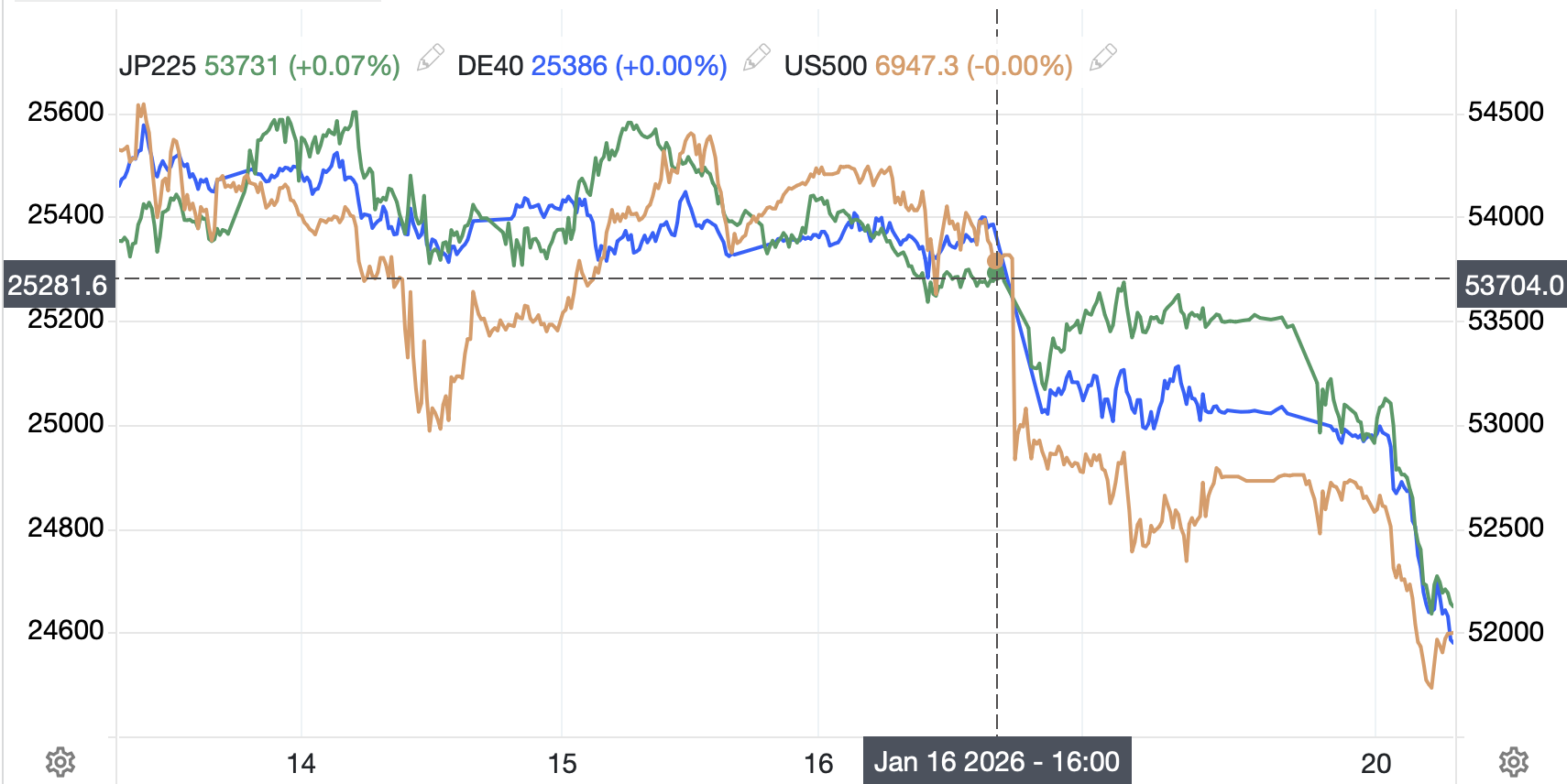
Turning to risk assets, the story is the same for both stocks (which saw US equities decline across the board yesterday) and cryptocurrencies, notably Bitcoin.  Ostensibly, the rise in yields, and the prospect of a rate hike by the BOJ (to just 0.75% mind you) has been cited as the driver of an unwinding in leveraged trades as hedge funds seek to get ahead of having their funding costs rise thus crimping their margins.  

There is no doubt in my mind that the yen has been a critical funding currency for a wide array of carry trades, that is true.  In fact, that has been the case for several decades.  But is 25 basis points really enough to destroy all the strategies that rely on that process?  If so, it demonstrates a remarkable fragility in markets, and one that portends much worse outcomes going forward.  

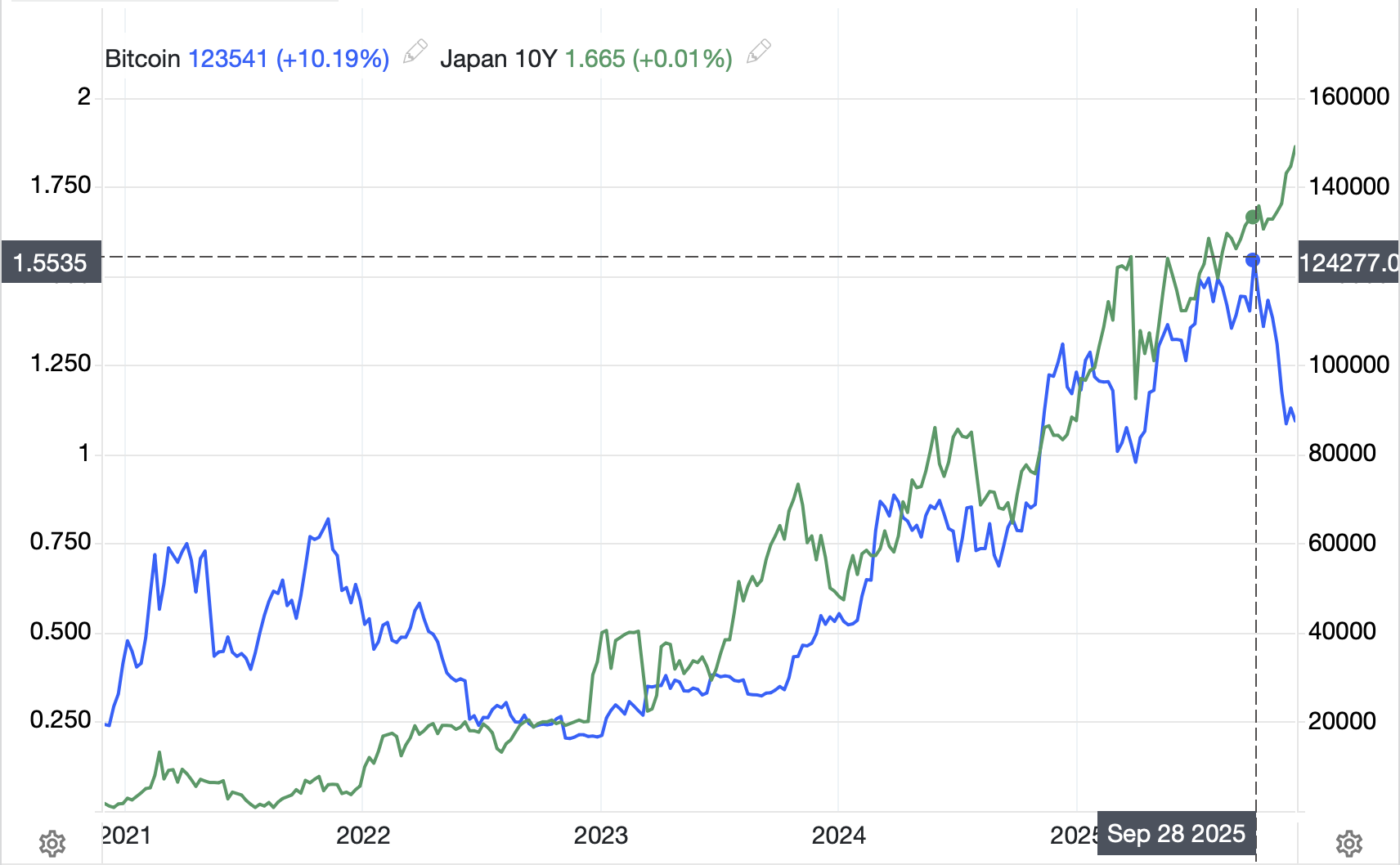
If we look at the relationship between Bitcoin and 10-year JGBs, it appears that there has been a significant change in tone.  For the past two months, while JGB yields have continued to climb, BTC has broken its correlation with JGBs and has fallen dramatically instead. (see below chart from tradingeconomics.com). When it comes to crypto, I am confident that leverage levels are higher than anywhere else, in fact that seems part of the attraction, so it should not be as surprising to see something of this nature.  But again, it speaks to a very fragile market situation given there was no discernible change in the Japanese yield trend to drive a Bitcoin adjustment.

The upshot here, too, is that rising JGB yields are claimed to be the reason Bitcoin is declining.  In fact, nearly all the commentary of late seems to be focusing on JGBs as the driver of everything.  While I concede that Japanese yields are an important part of the USDJPY discussion, it is difficult for me to assign them blame for everything else.  I have seen numerous commentators explaining that the Japanese have been selling Treasuries because they don’t trust the US, and this has been ongoing for years.  I have also seen commentators explain that because Japanese surpluses had been invested internationally for years and funding so much of the world’s activity, now that they can invest at home, liquidity everywhere will dry up, and asset prices will fall.  

Responding to the first issue, especially with new PM Sanae Takaichi, I do not believe that is a concern at all.  If anything, I expect that the relationship between the US and Japan will deepen.  As to the second issue, that may have more import but the one thing of which we can be sure is that central banks around the world will not allow liquidity to dry up in any meaningful fashion.  Remember, the Fed ended QT yesterday and it won’t be long before the balance sheet starts to grow again, adding liquidity to the system.  One thing I have learned in my many years observing and trading in markets is, there doesn’t need to be a catalyst for markets to move in an unexpected direction.  Certainly not a big picture catalyst.

And with that, let’s look at how markets responded overnight to yesterday’s risk-off session in the US.  Looking at the bond market first, yesterday’s rise in yields was nearly universal with European sovereigns all following the Treasury market’s lead.  And this morning, across the board sovereigns are higher by 1bp, the same as Treasury yields.  While JGB yields didn’t budge overnight, we did see Australia and other regional yields catch up to yesterday’s rise.  I fear bond investors are stuck as they see the potential for inflation, but they also see weakening economic activity as a moderator there.  As an example, the OECD just reduced its US GDP forecast for 2026 to 2.9% this morning, from 3.2%.  Personally, I don’t think anything has changed the run it hot scenario.

In the equity markets, Asian bourses were mixed with Korea (+1.9%) and Taiwan (+0.8%) the notable gainers while elsewhere movement was much less substantial (Japan 0.0%, HK +0.2%, China -0.4%).  There was no single story driving things there.  As to Europe, things are brighter this morning led by Spain (+1.0%) and Italy (+0.5%) although there is no single driving issue here either.  US futures are edging higher at this hour as well, +0.2%, so perhaps yesterday was more like a little profit taking after last week’s strong rally, than anything else.

In the commodity sector, oil (-0.3%) is slipping after yesterday’s rally.  I suppose the potential peace in Ukraine is bearish, but that story has been dragging on for a while so I’m not sure when it will come to fruition.  In the metals markets, after a gangbusters rally yesterday, with silver trading to $59/oz, we are seeing a modest retracement this morning across the board (Au -0.6%, Ag -1.2%, Pt -2.0%) although copper (+0.4%) is holding its gains.  Nothing indicates that these metals have topped.

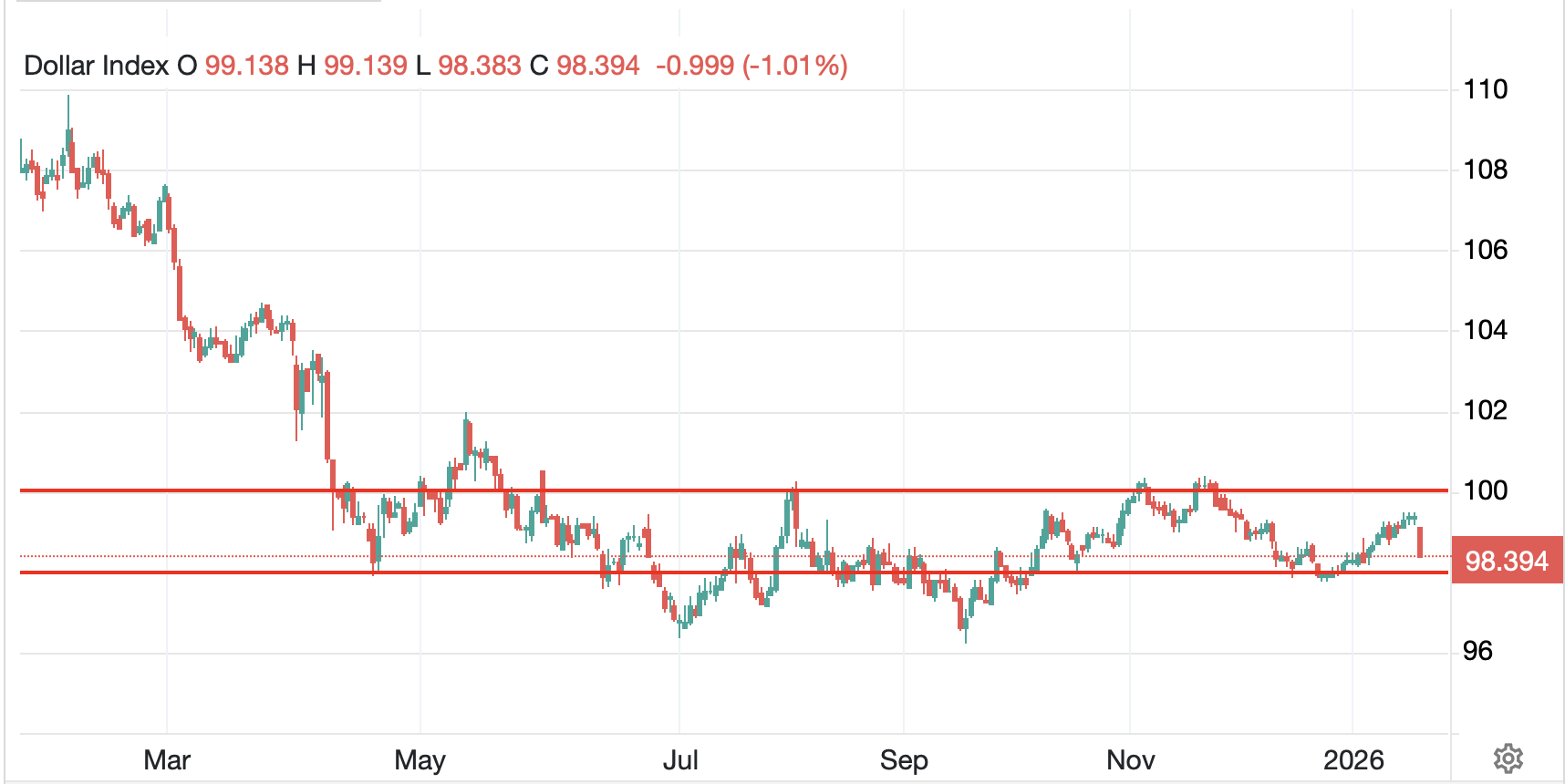
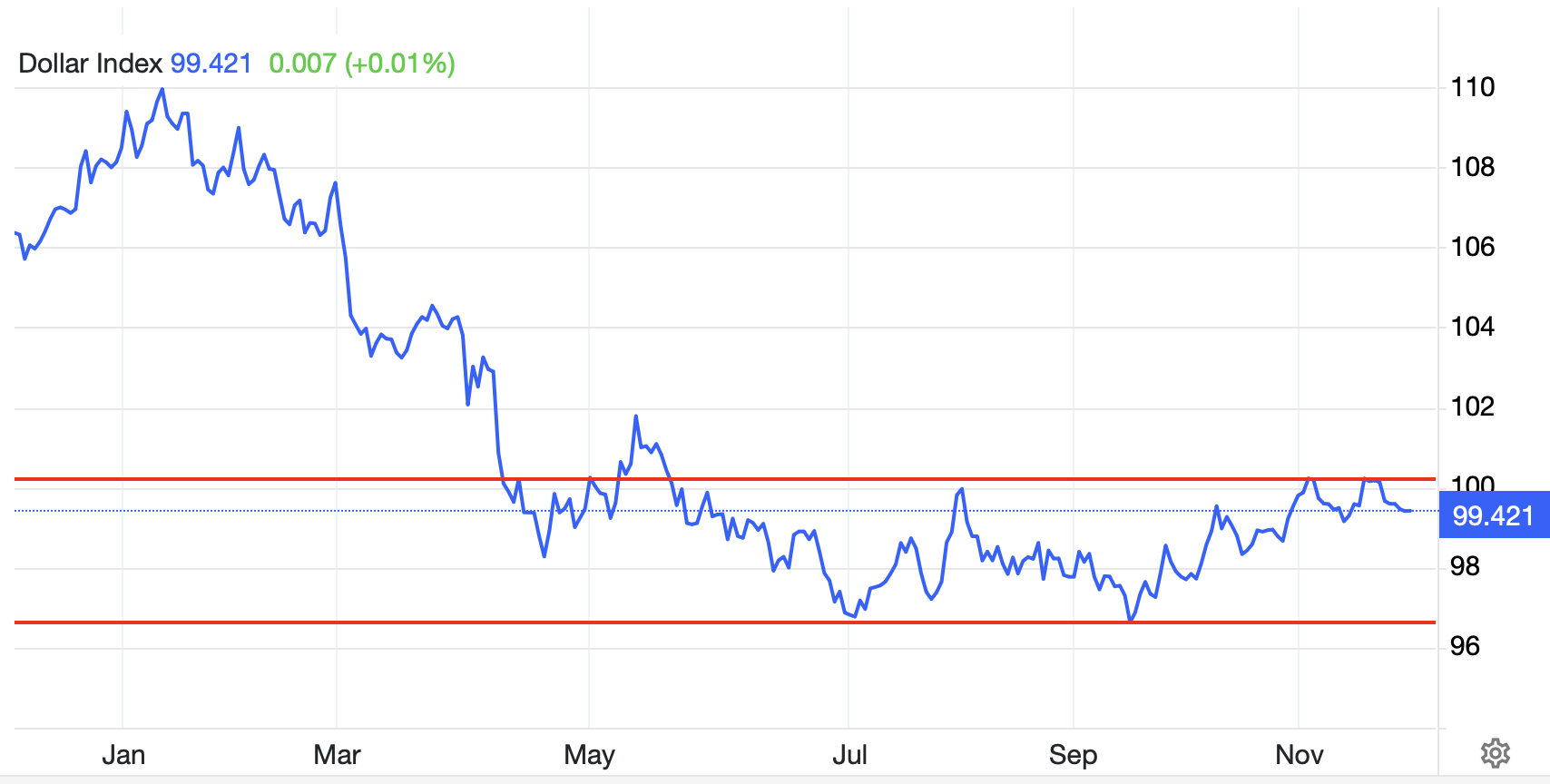
Finally, the dollar is little changed as I write, giving back some early modest strength.  JPY (-0.3%) continues to be amongst the worst performers, and although it has bounced from its recent lows, remains within a few percent of those levels.  My take here is we will need to see both a more aggressive Fed and a more aggressive BOJ to get USDJPY back to 150 even, let alone further than that.  If we look at the DXY, it is sitting at 99.45, and still well within its trading range for the past 6+ months as per the below.  For now, the dollar remains a secondary story.

Source: tradingeconomics.com

On the data front, here’s what comes the rest of this week:

WednesdayADP Employment 10K
 IP0.1%
 Capacity Utilization77.3%
 ISM Services52.1
ThursdayInitial Claims220K
 Continuing Claims1960K
 Trade Balance -$65.5B
FridayPersonal Income (Sep)0.4%
 Personal Spending (Sep)0.4%
 PCE (Sep)0.3% (2.8% Y/Y)
 -ex food & energy0.2% (2.9% Y/Y)
 Michigan Expectations51.2
 Consumer Credit$10.5B

Source: tradingeconomics.com

As the Fed is in its quiet period, there are no Fed speakers until Powell at the presser next week.  Given the age of the PCE data, I don’t see it having much impact.  Rather, ADP and ISM are likely the things that matter most for now.

Ultimately, I believe more liquidity is going to come to the market via central banks around the world, and that will support risk assets, as well as prices for the things we buy.  Nothing has changed in my view of the dollar either.

Good luck

Adf

A Latent Grim Reaper

The zeitgeist, of late, has been leaning
Toward welcoming gov intervening
Because costs have soared
So, folks once abhorred
Like Socialists, seem more well-meaning
 
Perhaps, though, the story’s much deeper
And points to a latent grim reaper
Elites on one side
Claim Trump’s only lied
While Populists serve as gatekeeper


Quite frankly, I feel like markets have become very secondary to an understanding of what is happening in the economy, and while there is intrigue over who may be the next Fed Chair, and correspondingly, if Mr Powell will resign from the FOMC when his chairmanship is up, I believe that pales in comparison to much larger macroeconomic issues with which we all have to deal on a daily basis.  Once again, my weekend reading has highlighted two key pieces that I believe do an excellent job of explaining much of what is going on, not just in the economy, but in the streets.

Last week, I highlighted Michael Green’s piece regarding a new estimate of what the poverty line looks like, putting paid to the idea that the official government level of $31,500 is appropriate, and that in suburban NJ (Caldwell to be exact) it is more like $140K.  Now, you will not be surprised that his piece garnered a great deal of attention given its premise, but I will not go into that.  However, he did write a follow-up piece which is worth reading and where he discusses the reaction.  In brief, whatever number is correct, it is clear that $31.5K is laughably low.   Ultimately, I believe this work has quantified the concept of the “vibecession” which has been making the rounds for a while.  People are allegedly making a decent living and yet are living paycheck to paycheck because the cost of living (not inflation) has risen so remarkably over time and priced many folks out of previously ordinary levels of attainment.

Which brings me to the second key piece I read this weekend, this from Dr Pippa Malmgren, which does a remarkable job explaining how the nation (and not just in the US, but we are more familiar here) has (d)evolved into two groups; Elites and Populists.  The former are the old guard politicians (both Democrats and Republicans), the global organizations like the World Bank, IMF, UN and WEF, and more perniciously in my mind, the so-called deep state.  The latter are personified by President Trump, but include NYC Mayor-elect Mamdani, AfD in Germany, Marine LePen in France and Victor Orban in Hungary, and their followers, to name a few.

The frightening conclusion Dr Malmgren drew was that there is no ability for a nation to continue to operate successfully if the population is split in this manner, and that eventually, one side is going to wind up victorious.  I would say this is the very definition of the 4th Turning and we are living through it.

So, we must ask, what are the potential ramifications from a financial markets perspective with this backdrop?  I have repeatedly highlighted that the Trump administration is going to “run it hot” going forward, meaning the goal will be to increase nominal GDP fast enough to outweigh the inevitable rise in prices.  The idea is if incomes rise quickly enough, people will be able to tolerate rising prices more easily.  

But the one thing of which I am increasingly confident is that prices and their rate of change are going to rise under this scenario.  As central banks leave policy easy, or ease further in an effort to support their respective economies, that is going to be the outcome.  A look at the chart below from the FRED data base of the St Louis Fed shows there is a very strong relationship between CPI and nominal GDP.  In fact, I ran the numbers and the correlation for the past 75 years has been 0.975!  Prices are going to rise friends, alongside M2.

What does this mean?  It means that the debasement of fiat currency is going to continue apace and so commodities, notably precious metals, but also base metals and property are going to be recognized as better stores of wealth.  If you wonder why gold (+0.9%) and silver (+2.2%) are continuing to rocket higher, look no further than this.  What about equities?  For now, I expect they will continue to perform well as all that liquidity will be looking for a home although this morning, not so much as US futures are lower by -0.5% across the board.  Bonds?  This is a tougher call, and I suspect that the yield curve will steepen further as central banks press short rates lower, but inflation undermines long duration fixed income assets.  Finally, the dollar remains, in my view, one of the best of the fiat currencies, but like all of them, will continue to degrade vs. gold and hard assets.

Keeping that in mind, there are two other stories of note this morning, only one of which is impacting markets.  The non-impactful one is that apparently President Trump has selected Kevin Hassett, currently the White House Economic Council Director, as the man to succeed Jay Powell in the chair.  He is a long-time political operative with deep ties in Washington and I presume will get through the vetting and be confirmed on a timely basis.  As I wrote above, it is not clear to me the Fed matters as much as other things in the current environment, although we will continue to hear about it.  In this light, the Fed funds futures market is currently pricing an 87.5% probability of a 25bp cut next week and is back to a 58% probability of a total of 100bps of cuts by the end of 2026 as per the below from the CME.

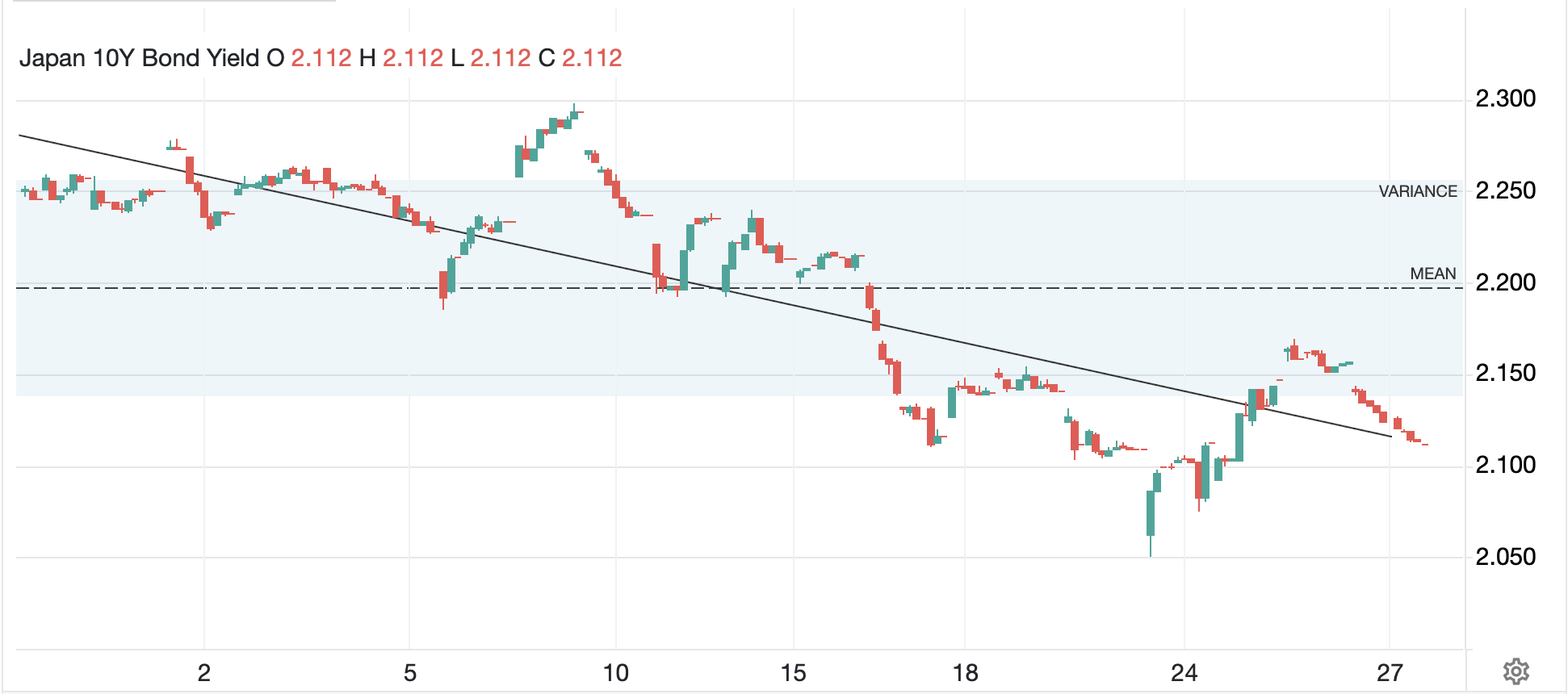
The other story of note, this one definitely impacting markets, is the news that Ueda-san hinted more definitively at a Japanese rate hike later this month, with Japanese swaps market raising the probability of that hike to 80% from about 60% last week.  The knock-on effects were that 10-year JGB yields jumped 7bps, to 1.86%, their highest level since 2008 and as you can see from the chart below, continue to trend strongly higher.  Of course, given that inflation in Japan remains well above target, it is not that surprising that yields are climbing.  

Too, the other outcome here has been the yen (+0.7%) gaining a little ground, as per the below chart from tradingeconomics.com, and perhaps we have seen a short-term low in the currency.  Certainly, the increasing probability of US rate cuts is weighing on the dollar overall, so that is part of the story, but it remains to be seen if there are going to be wholesale changes in investment allocations that would be necessary to completely reverse the yen’s remarkable weakness over the past nearly four years.

The move in JGB yields has been blamed for the rise in yields around the world with Treasury and European Sovereign yields uniformly higher by 3bps this morning while some other regional Asian yields climbed between 4bps and 6bps.  In the end, inflation remains a problem almost everywhere in the world and I think that is what we are witnessing here.

As well, the JGB move was seen as the cause for Japanese equities’ (-1.9%) very weak performance which also dragged down some other regional markets (Taiwan, Australia, Philippines) but was not enough to undermine the rest of the region.  The flip side of that weakness was China (+1.1%) and HK (+0.7%) where it appears that hopes for a Fed rate cut more than offset weaker than forecast PMI data from China.  Another interesting story from the mainland was that the monthly Housing price data that was compiled by two key private companies was squashed by the Chinese government after China Vanke, one of the largest Chinese property companies, explained they would be late on an interest rate payment.  One can only imagine what that data looked like!

Meanwhile, in Europe, red is the color led by Germany’s DAX (-1.5%) although with weakness across the board (CAC -0.8%, IBEX -0.6%, FTSE MIB -0.9%).  Apparently, the story that progress has been made regarding peace talks in Ukraine is not seen as a positive there.  After all, if there is peace, will European governments still be so keen to build out their military, spending billions of euros at local defense and manufacturing firms?  It seems after a very strong close to the month in November, there is a bit of profit taking underway this morning.

In the commodity space, oil (+1.3%) is bouncing back to its trend line after OPEC confirmed it will not be increasing production in Q1 next year at a meeting yesterday.  I would expect that a real peace deal would be negative for this market as some part of that would be the relaxation of sanctions, I would assume.  But maybe I’m wrong there.  However, I continue to believe the trend is modestly lower going forward as there is far more supply available.  As to the other metals, both copper (+0.6%) and platinum (+1.5%) are continuing their runs higher with no end currently in sight.

Finally, the dollar is softer overall this morning, and while the yen (+0.7%) is the leader, the euro (+0.3%), SEK (+0.3%) and CHF (+0.25%) are also nicely up on the day with the rest of the G10 little changed.  The real movement, though, has been in the EMG bloc with CZK (+0.75%), HUF (+0.5%), PLN (+0.5%), and CLP (+0.4%) all benefitting from the Fed rate cut story as well as Chile’s benefits from copper’s rally.  While a cut seems highly likely, I suspect the real dollar story will be about the dot plot and SEP as well as Powell’s presser next week.

I’ve already run too long so will just mention that ISM Manufacturing (exp 48.9) is due this morning and I will review the week’s data expectations tomorrow.  

The world is changing and I expect that we will continue to see volatility across markets as investors come to grips with those changes, whether simple central bank rate decisions or more complex social movements and electoral outcomes that lead to major policy changes.  Be careful out there.

Good luck

Adf

Jobs is Passe

The usual story today
Would be NFP’s on its way
But with BLS
On furlough, I guess
The story on jobs is passe
 
But ask yourself, if we don’t get
A data point always reset
That’s only a fraction
Of total job action
Is this something ‘bout we need fret?


I guess the question is, is the government shutdown impacting markets?  Frankly, it’s hard for me to see that is the case. Today offers a perfect scenario to see if it is true.  After all, if the government was working, the BLS would have released the weekly Claims data yesterday and market participants would be waiting with bated breath for today’s NFP number.  As I said yesterday, while Ken Griffin is likely quite annoyed because I’m sure Citadel makes a fortune on NFP days, the rest of the world seems to be getting along just fine.  In fact, maybe this is exactly what market participants need to learn that the data points on which they rely don’t really matter.  

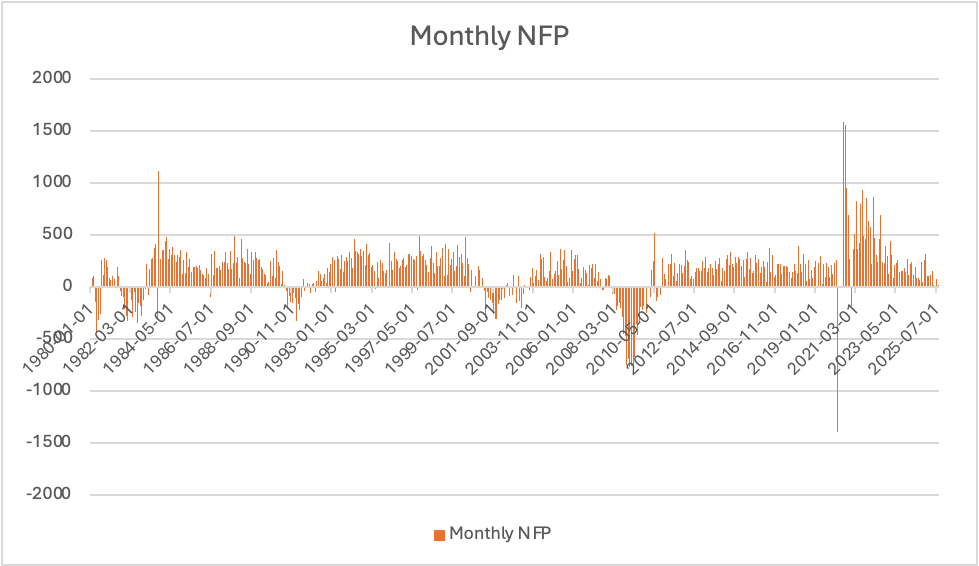
With NFP in particular, the monthly number, which since 1980 has averaged 125K with a median of 179K seems insignificant relative to the number of people actually employed, which as of August 2025 was recorded as 159.54 million.  Now I grant, that the employed population has grown greatly in the past 45 years, so when I take it down to percentages, the average monthly NFP result is 0.10% of the workforce during that period, with the median a whopping 0.14%.  The idea that business decisions are made, and more importantly, monetary policy decisions are made on such a tenuous thread is troublesome, to say the least.  Did this report really tell us that much of importance?  Especially given its penchant for major revisions.

Below is a graphic history of NFP (data from FRED) having removed the Covid months given they really distorted the chart.

And below is a chart showing total payrolls (in 000’s) on the RHS axis with the % of total payrolls represented by the monthly change in NFP on the LHS.  Notice that almost the entire NFP series, as a %age of total employment, remains either side of 0 with only a few outcomes as much as even 0.5%.  My point is, perhaps the inordinate focus on this data point by markets and policymakers alike, has been misguided, especially as the accuracy of the initial releases seems to have worsened over time.  Maybe everybody will be able to figure out that they can still do their jobs even without this data.  (Ken Griffiin excepted. 🤣)

Food for thought.

Like swallows return
To Capistrano, Japan
Votes again this year


The other notable news story is tomorrow’s election in Japan’s LDP for president of the party and the likely next Prime Minister.  While there are technically 5 candidates, apparently, it is really between two, Sanae Takaichi, a former economic security minister and a woman who would be the first female PM in the nation’s history, and Shinjiro Koizumi, son of former PM Junichiro Koizumi, and a man who would become the nation’s youngest prime minister.  There are several others, but these are the front runners.  From what I gather, Takaichi-san is the defense hawk and the more conservative of the two, an updated version of Margaret Thatcher, to whom she will constantly be compared if she wins.  Meanwhile, Koizumi is more of the same they have had in the past.

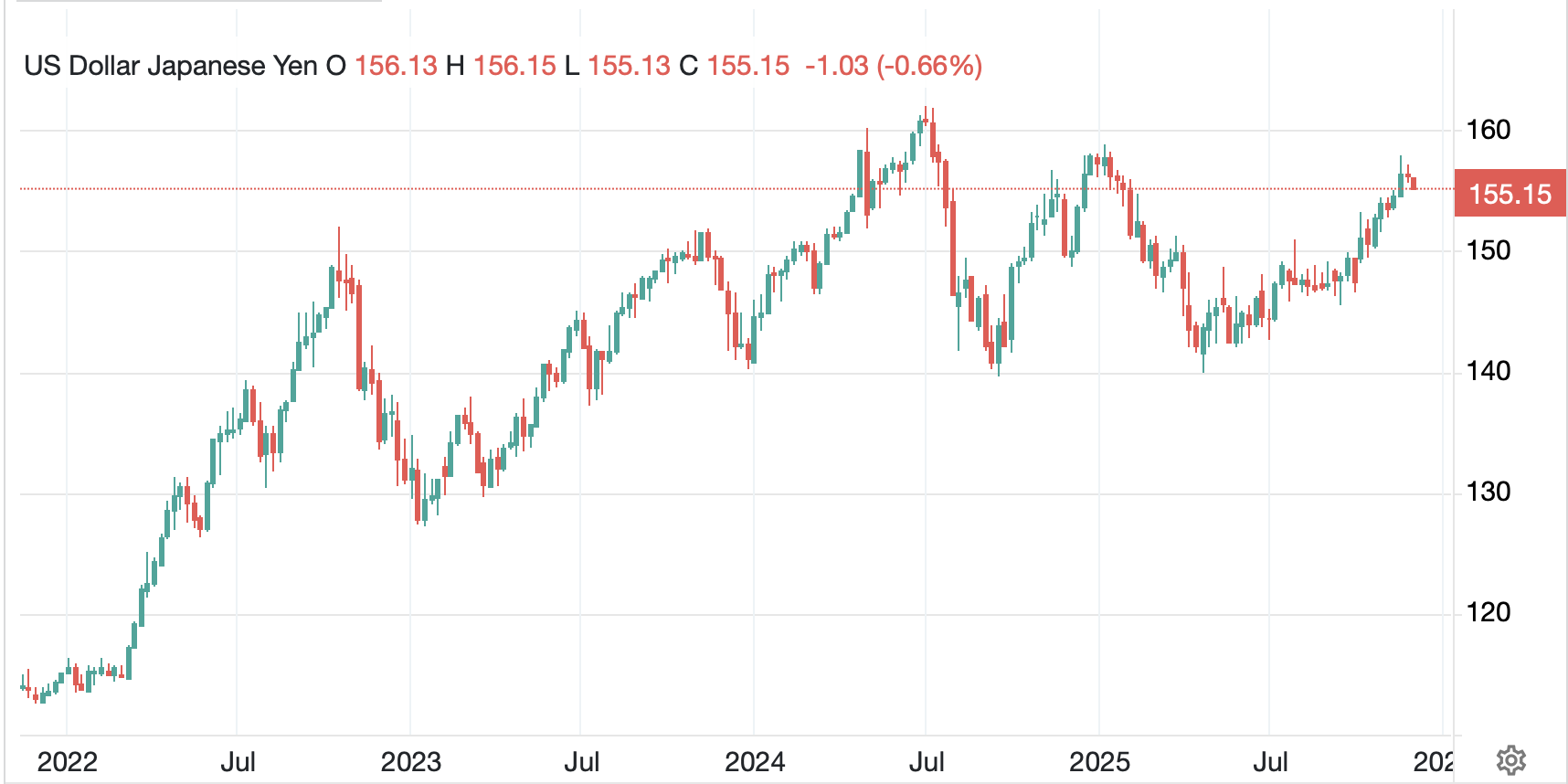
There are some analysts who are trying to make the case that this election has had a major impact on Japanese markets, and one might think that makes sense.  But if I look at USDJPY (0.0% today), as per the below chart, I am hard pressed to see that the election campaign has had any impact of note.

Source: tradingeconomics.com

If we turn to the Nikkei (+1.9%) which made a new high last night, it seems that is tracking US technology shares and is unconcerned over the election.  

Source: tradingeconomics.com

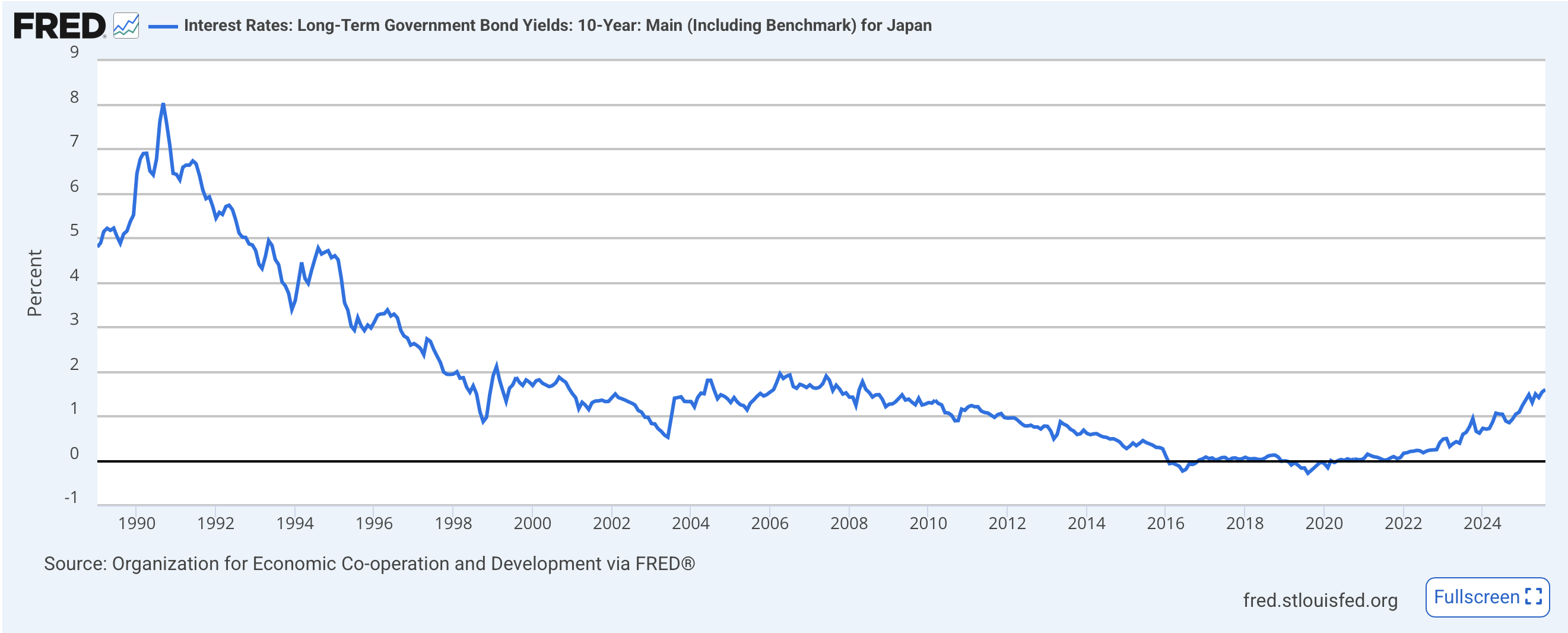
Arguably, if the equity market is forward looking (which I think is true) investors are indifferent to the next PM.  Finally, a look at JGBs shows that yields continue to climb there, albeit quite slowly, but consistently make new highs for the move and are back to levels last seen in 2008.

In fact, like almost everything since the GFC, perhaps the recent run of incredibly low yields in Japan is the aberration, not the rule!  But the argument for higher Japanese yields is more about the fact that inflation there is running at 3.5% and the base rate remains at 0.50%.  Investors remain concerned that the recent history of virtually zero inflation in Japan may be a thing of the past and so are demanding higher yields to hold Japanese debt.

I have no idea who will win this election, although I suspect that Takaichi-san may wind up on top.  But will it change the BOJ?  I don’t think so.  And the fact that the LDP does not have a working majority means not much may get done afterwards anyway.  All told, it is hard to be excited about holding yen in my eyes.

Ok, let’s look at the rest of the world quickly.  Despite a soft start, US equity markets managed to close in the green and this morning all three major indices are pointing higher by 0.25%.  Away from Japan, Chinese markets are closed for their holiday, and most of the rest of Asia followed the US higher, notably Korea (+2.7%) and Taiwan (+1.5%).  The only outlier was HK (-0.5%) which looked to be some profit taking after a sharp run higher in the past week.  In Europe, Spain (+0.8%) and the UK (+0.6%) are the best performers despite (because of?) slightly softer PMI Services data.  Either that, or they are caught up in the US euphoria.

The bond market saw yields slip a few basis points yesterday and this morning, while Treasury yields are unchanged at 4.08%, European sovereigns are sliding -1bp across the board.  I think the slightly softer data is starting to get some folks itching for another ECB rate cut, or at least a BOE cut.

In the commodity markets, oil (+0.4%) which continued to fall throughout yesterday’s session to just above $60/bbl, looks like it is trying to stabilize for now.  There continues to be discussion about more OPEC+ production increases, and it seems that whatever damage Ukraine has done to Russia’s oil infrastructure is not considered enough to change the global flows.  As to the metals, gold (+0.2%) and silver (+1.2%) absorbed a significant amount of selling yesterday in London, which may well have been one account, as they reversed course late morning and have been climbing ever since.  Copper (+1.1%) is also pushing higher and the entire argument about the defilement of fiat currencies remains front and center.  I guess JP is now calling it the debasement trade as Gen Z, if I understand correctly, is selling other assets and buying a combination of gold and bitcoin.

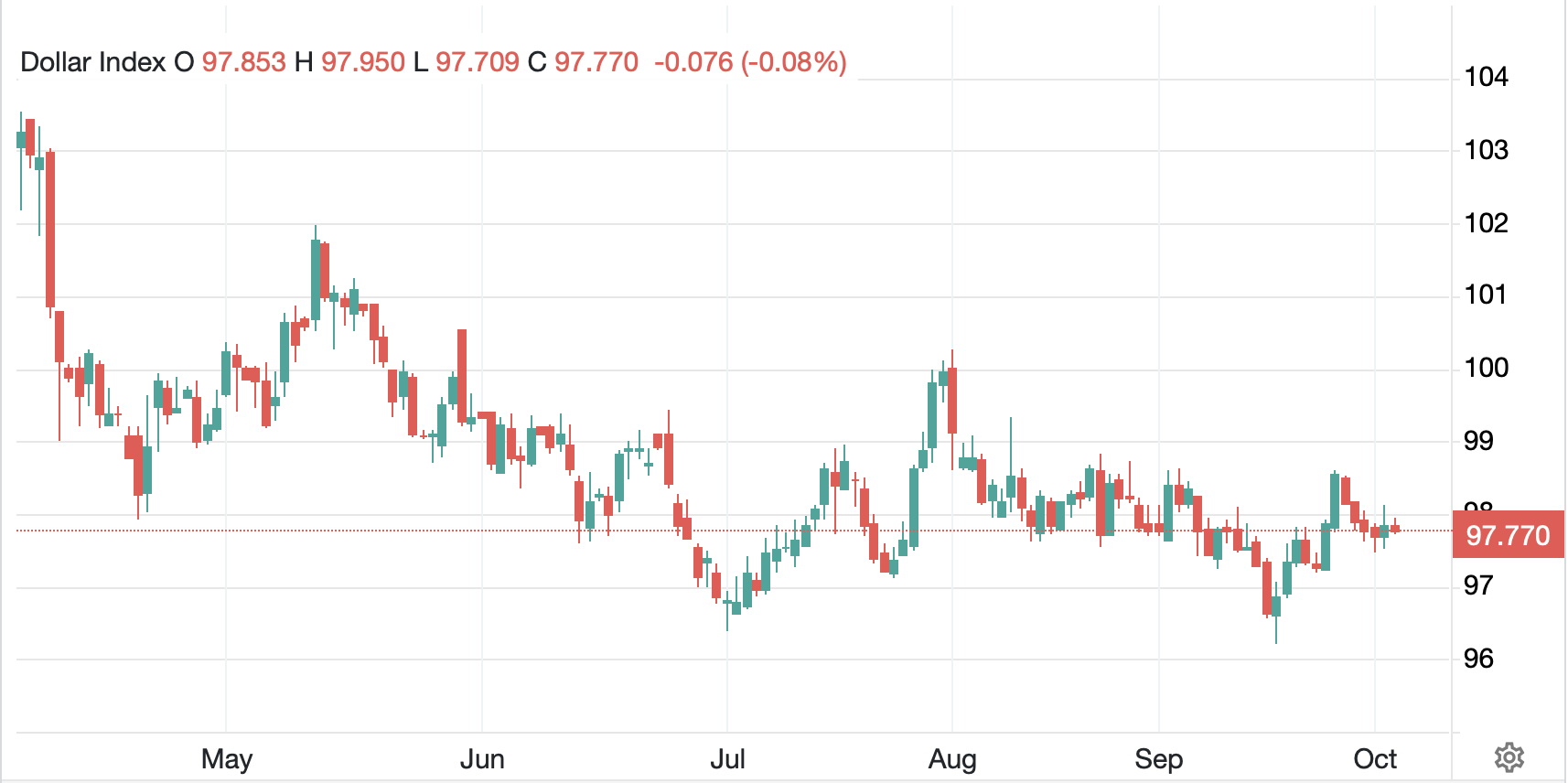
Finally, the dollar is…the dollar.  Back on April 20, DXY was at 98.08.  This morning it is 97.75.  look at the chart below from tradingeconomics.com and tell me you can get excited about any movement at all.  We will need a major outside catalyst, I believe, to change any views and right now, I see nothing on the horizon.

And that’s really all there is.  We do get ISM data this morning as it’s privately compiled and released (exp 51.7) and Fed speakers apparently will never shut up.  What is interesting there is that Lorrie Logan, Dallas Fed president, has come out much more hawkish than some of her colleagues.  That strikes me as a disqualification for being elevated to Fed chair.

I continue to read lots of bear porn and doom porn, and it all sounds great and markets clearly don’t care.  The government shutdown has been irrelevant and that should make a lot of people in Washington nervous given this administration.  President Trump has been angling to reduce government, and if it is out of action and nobody notices, it will make his job a lot easier.  But for now, nothing stops this train with higher risk assets the way forward.

Good luck and good weekend

Adf

Struggling…Juggling

For users of Bloomberg worldwide
This morning, the service has died
So, traders are struggling
As it’s like they’re juggling
With one hand, behind their back, tied


While market activity continues, it seems that the single issue receiving the most attention today is that the Bloomberg professional service is not working almost anywhere in the world.  From what I have seen so far, there is no explanation other than technical problems, and on the Bloomberg website that I reference (the professional service is way too expensive for poets) the only mention has been oblique in the news that auctions in the UK and Europe have been extended in time until the service is operational again.  However, on X, the memes are wonderful.  I’m sure they will fix things shortly, and the financial world will go back to worrying about things like interest rates and equity valuations, but right now, this is the story!

JGB markets
Are garnering far more press
Than Ueda wants


Yesterday’s story about JGB yields continues to be a key market issue this morning, and likely will be so for some time to come.  Yields there continue to climb and as we all know, the fiscal situation in Japan has been tenuous at best.  The Japanese government debt/GDP ratio is somewhere around 263%.  Consider that when the US has been deemed the height of fiscal irresponsibility with a number half that high.  Granted, Japan is a net creditor nation, which is why they have been able to maintain this situation for so long, but as with every other situation where trends seem to go on forever, at some point they simply stop. 

Sourve: tradingeconomics.com

The thing that seemed to allow Japan to continue for so long was the fact that inflation there had remained quiescent, for decades.  It has been more than twenty years since official Japanese policy was to raise inflation.  Alas, to paraphrase HL Mencken, be careful what you wish for, you just may get it good and hard.  It appears that the good people of Japan are beginning to feel what it is like when a government achieves a policy goal after twenty years.  Notably, the key issue is that inflation, after literally decades of negative or near zero outcomes, has risen back to levels not seen since the early 1990’s, arguably two generations ago.  (The blip in 2014 was the result of the rise in Japan’s GST, their version of VAT, to 10%, which was a one-off impact on prices that dissipated within 12 months.)

This lack of inflation was deemed the fatal flaw in the Japanese economy, despite the fact that things there seem to work pretty well.  The infrastructure is continuously modernized and works well and while my understanding is that a part of the population was frustrated because their nominal incomes weren’t rising, with inflation averaging 0.0% or less for 20 years, they weren’t falling behind.  However, the broad macroeconomic view from policy analysts around the world was that Japan, a nation with an actual shrinking population, needed to do everything they could to push inflation higher in order to better the lives of its citizens.  Well, they have done so with inflation there now higher than the most recent readings in the US.  I fear that the good people of Japan are going to be asking many more questions about why the government thought this was a good idea as prices continue to rise.  It is already apparent in the approval numbers of the current government with readings on the order of 27%.

So, now we must ask, how will different markets interpret the ongoing rise in inflation.  We are already seeing what is happening in long-dated JGB markets, with the 30yr and 40yr yields rising to record levels, albeit below, and barely at current inflation readings respectively.  But, as I mentioned yesterday, the broader market question will be at what point will Japanese investors, who are one of the key sources of global capital, decide that the yield at home is sufficient to bring assets back from around the world, notably the US.  That level has not yet been reached although I suspect we are beginning to see the first signs of that.  

In the event this occurs, and I believe it will do so, what will be the impact on markets?  The first, and most obvious outcome will be a significant rise in the JPY (+0.6%).  As you can see below, while the yen has strengthened compared to levels seen in mid and late 2024, it remains far weaker than levels seen over the past 30+ years, where the average has been 112.62, more than 20% stronger than the current levels.

As to Treasury markets, Japan remains the largest non-US holder of Treasuries and while I doubt they will sell them aggressively, it would certainly be realistic to see them allow current positions to mature and not buy new ones but rather bring those funds home (stronger yen) while removing a key bid for the market (Kind of like their version of QT!).  Higher US yields are a real possibility here.  As to equities, these will likely be sold, although the Japanese proportion of holdings is not as large relative to others, but with rising yields and a falling dollar, it doesn’t feel like a good environment for equities.

Of course, all of this is dependent on the status quo in US policy remaining like it is today.  If President Trump can get Congress to implement his policies and they are successful at reinvigorating the US domestic economy, two big Ifs, these views will be subject to change.  The key to remember about markets, especially currency markets, is that there are two sides to every story, and expecting a particular outcome because one side of the equation moves may be quite disappointing if the other side moves and was unanticipated.

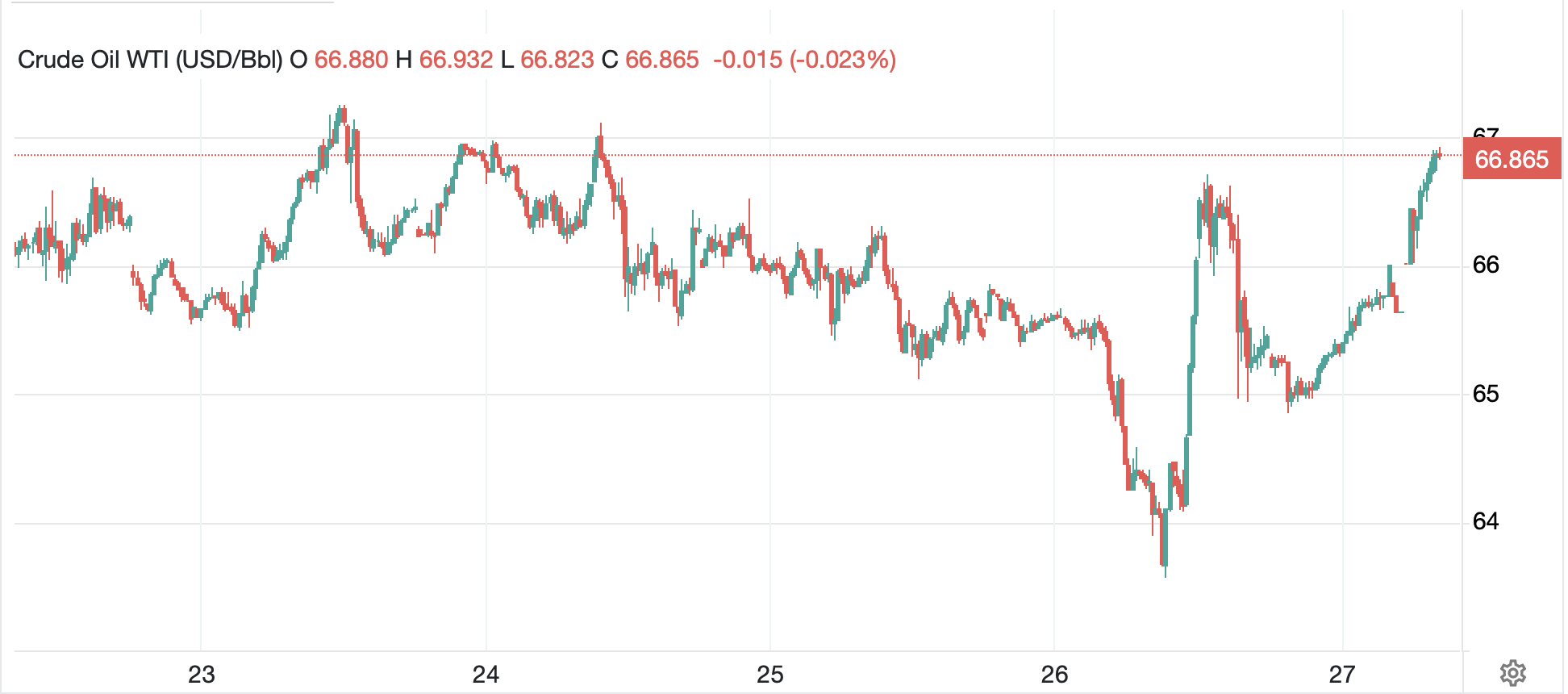
Ok, I spent far too long there, but not that much else is exciting.  The other story with some press has been driving oil markets higher (WTI +0.85%) with a gap up on news that Israel was considering a strike against Iranian nuclear facilities.  Naturally, this has been denied, and oil’s price has retreated from the early highs seen below.

Source: tradingeconomics.com

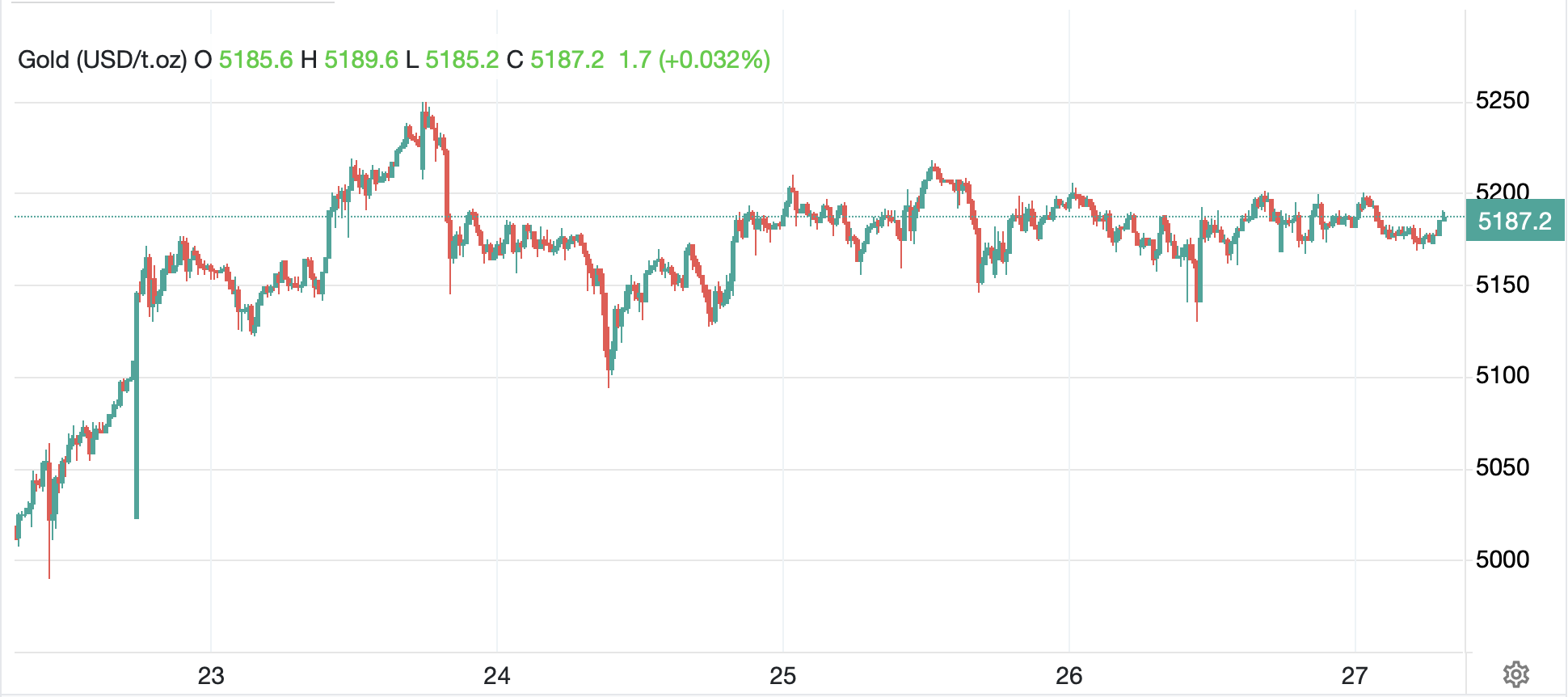
Sticking with commodities, gold (+0.5%) continues to rally, perhaps on fears of that Israeli news, or perhaps simply because more and more investors around the world want to own something they can hold onto and has maintained its value for millennia.

In the equity markets, yesterday’s modest US declines were followed by weakness in Japan (-0.6%) but strength in China (+0.5%) and Hong Kong (+0.6%).  As to the rest of the region, there were many more gainers (Korea, India, Taiwan, Australia) than laggards (Malaysia, Thailand) so a net positive tone.  In Europe, though, modest declines are the order of the day with the CAC (-0.5%) the worst performer and the FTSE 100 (-0.1%) the best.  US futures are also pointing lower at this hour (7:50) down on the order of -0.5% across the board.

Treasury yields (+4bps) have moved higher again this morning and have taken the entire government bond complex along with them as all European sovereign yields are higher by between 4bps (Germany, Netherlands) and 6bps (Switzerland, UK).  We have already discussed JGB yields where 10yr yields have moved higher by 2bps.

Finally, the dollar is softer across the board this morning with the DXY (-0.45%) a good proxy of what is happening.  The outliers are KRW (+1.2%) and NOK (+1.1%) with the latter an obvious beneficiary of oil’s rise while the former seems to be climbing in anticipation of something coming out of the G10 FinMin meeting in Canada this week.  Otherwise, that 0.45% move is a good proxy for most things.

On the data front, we have another day sans anything important although EIA oil inventories will be released with a solid draw expected.  Fed speakers were pretty consistent yesterday explaining that patience remains a virtue in a world where they have no idea what is going on.  Fed funds futures markets have pushed the probability of a June cut down to 5% and only 50bps are priced in for all of 2025.  (Personally, I see no reason that a cut is coming.)

The dollar remains on its back foot, and I expect that the combination of pressure from the Trump administration to keep it that way is all that is going to be necessary to see things continue with this trend.  Of course, an Israeli strike on Iran would change things dramatically in terms of risk perception and likely support the dollar, but absent that, right now, lower is still the call.

Good luck

Adf

Likely Passé

The markets continue to snooze
Although today we’ll get some news
But Home Sales don’t spark
A narrative arc
About which most folks would enthuse
 
As well, given all that they’ve said
Those dozens of folks from the Fed
The Minutes today
Are likely passé
So, markets will head back to bed


Another very lackluster session yesterday resulting in marginal equity gains in the US as the dearth of new information continues to weigh on trading volumes and overall activity.  Of course, the one thing we did get yesterday was another tsunami of Fedspeak but all of it was the same as what we have already heard.  There is no need to go into details but suffice to say that the theme remains, April’s CPI reading was encouraging, but not nearly enough to consider rate cuts soon.  Instead, while they all believe that inflation will continue to head back to their 2% goal (although none of them have explained why they believe that) it appears that the first cut is not likely to be warranted before the fourth quarter.  In fact, it seems that several FOMC members are lining up with a December cut in mind although the Fed funds futures market continues to price a 60% probability of that first cut coming in September.

But here’s the thing I don’t understand; why are they so keen to cut rates at all?  This is the actual language in the Federal Reserve Act as amended in 1977 [emphasis added]:

“The Board of Governors of the Federal Reserve System and the Federal Open Market Committee shall maintain long run growth of the monetary and credit aggregates commensurate with the economy’s long run potential to increase production, so as to promote effectively the goals of maximum employment, stable prices and moderate long-term interest rates.”

As is typical with legislation, there is no specificity as to what each of these terms mean and thus, they are open to interpretation by each Fed chair.  For instance, prior to 2012, the concept of stable prices did not have a numeric attachment, and, in fact, when Alan Greenspan was Fed chair, he explicitly mentioned that 0% inflation was indicated.  However, Ben Bernanke determined that in the wake of the GFC, a numeric definition would be appropriate and that is how we got the 2% target.

On the employment question, the economic concept of NAIRU (non-accelerating inflation rate of unemployment) had been the north star for the Fed for decades and that number had typically been estimated at 5% +/- a bit.  The concept is that there is a theoretical unemployment rate below which wage pressures will rise and drive inflation higher and above which the opposite will occur.  However, just like the Fed’s other imaginary friend, R*, NAIRU is not observable, and nobody knows where it is.  Recent indications are that it is at a much lower level than previously thought as evidenced by the fact that Unemployment (ignoring the pandemic activity) was able to hover below 4% without any inflationary pressures of note.  At least that was true until the pandemic response flooded the economy with massive amounts of liquidity and funding directly to the population via stimulus checks.  But, as I said, nobody really knows what that level is, and so the concept of maximum employment is extremely nebulous.

Finally, moderate long-term interest rates are another bridge too far for the Fed given its ordinary operations.  While the Fed clearly controls the short end of the curve via the Fed funds markets and its interest payments on reserves, the long end of the interest rate curve is a completely different story.  Certainly, QE was a direct effort to impact long-term interest rates and was quite successful at lowering them, although the definition of moderate remains missing in action.  For instance, a look at the below chart with data from the FRED database shows that the long-term average 10-year yield (my definition of long-term interest rates in this context) is 5.56%.

Source: data FRED database; calculations @fx_poet

With this in mind, the current level of 4.45% or so remains relatively low, not high, and so the idea that rate cuts are necessary to meet the Fed’s mandate seems disingenuous at best.  This is especially true given that inflation is still well above their target of 2%.  Unless there has been a complete sea change of economic theories at the Fed where suddenly higher interest rates are inflationary*, not deflationary, it seems that there is something else at play here.

In the end, my point is that Fedspeak, which is widely followed, usually highlights that there is no guiding star as to what they want to achieve.  As well, their definitions are apt to change quickly if there is a perceived political expedient.  However, I will say that at the current moment, it certainly appears the entire committee is on the same page and wants to cut rates but cannot come up with an excuse they believe the market will accept as real.

Essentially, this was all a preamble to today’s FOMC Minutes release, which given just how much Fedspeak there has been between the meeting and today indicates there is very little new information likely to be revealed.  In the meantime, markets overall remain quiet and rangebound with commodities the lone exception.

Equity markets overnight were mixed in Asia while European bourses are marginally lower (albeit still near all-time highs) and US futures are essentially unchanged yet again.  Bond yields are rising a bit with Treasuries higher by 3bps and European yields higher by 4bps with an outlier UK rise of 10bps after a much hotter than expected inflation reading this morning (3.9% vs. 3.6% expected) reduced the chance of a rate cut next month.  And finally, 10-year JGB yields broke through the 1.00% level last night although the JPY (-0.15%) is actually weaker on the news.

Commodities, though, continue to be the most interesting story around with oil (-0.7%) slipping further after a bigger than expected inventory build from the API data as well as news that the Biden administration is looking to release a portion of gasoline inventories into the market to lower prices ahead of the election.  In the metals markets, the big three are softer again this morning (Au -0.4%, Ag -085%, Cu -2.3%) although on the charts, all remain above key support levels.  It can be no surprise that they are consolidating after their massive runs of the past week or two.

Finally, the dollar is tracking Treasury yields higher with strength almost across the board.  The notable exception is NZD (+0.4%) which has rallied after the RBNZ, while maintaining interest rates unchanged, was far more hawkish in their commentary and indicated they discussed further rate hikes given inflation’s stubbornness overall.  But otherwise, ZAR (-0.8%) is the worst performer, which given the metals market moves should be no surprise, but the dollar’s strength is otherwise universal.

On the data front, as well as the Minutes this afternoon, we see Existing Home Sales (exp 4.21M) at 10:00 and then the EIA oil inventory data at 10:30.  Mercifully, there are no Fed speakers scheduled today, although I wouldn’t be surprised if one gets interviewed somewhere.

Rumors of the dollar’s demise seem badly overblown, and it remains tightly linked to the move in US yields.  Unless we see yields take a serious step lower, I suspect the dollar is likely to remain well bid overall.

Good luck

Adf

*As an aside, several years ago Turkish President Erdogan made this case and kept firing central bankers who wanted to raise interest rates in Turkey to fight their significant inflation problems.  At that time, the economics profession ridiculed the idea completely.  However, lately, there have been a number of articles published that have made the case Erdogan was correct.  Of course, that seems to be an effort to encourage the Fed to cut rates despite high inflation.  As of yet, this brainworm has not infected Chairman Powell, but who knows what will happen as the election approaches.

Quickly Slowing

We will take action
Threatened Vice FinMin Kanda
If you speculate

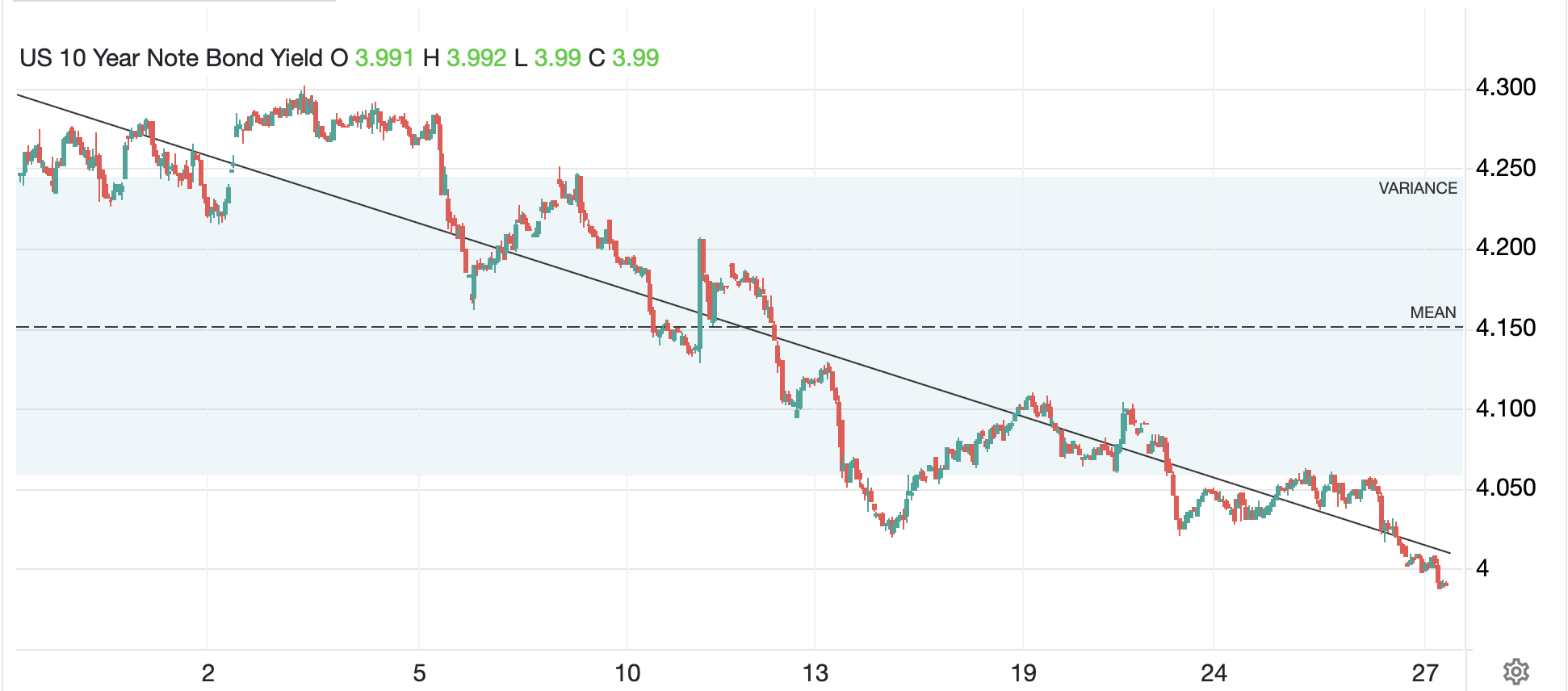
If these moves continue, the government will deal with them appropriately without ruling out any options.”  So said Vice FinMin Masato Kanda, the current Mr Yen.  Based on these comments, one might conclude that ‘evil’ speculators were taking over the FX market and distorting the true value of the yen.  One would be wrong.  The below chart shows the yields for 10yr JGBs vs 10yr Treasuries.  You may be able to see that the most recent readings show a widening in that yield spread in the Treasury’s favor.  It cannot be a surprise that investors continue to seek the highest return and the yen most certainly does not offer that opportunity.

While I don’t doubt there is a place where the BOJ/MOF will intervene, they know full well that the yen’s weakness is a policy choice, not a speculative outcome.  They simply don’t want to admit it.  The upshot is that the yen edged a bit higher overnight, just 0.2%, as market realities are simply too much for words to overcome.  The yen has further to fall unless/until the BOJ changes its monetary policy and ends YCC while allowing yields in Japan to rise.  Until then, nothing they can say will prevent this move.

While ECB hawks keep on screeching
More rate hikes are not overreaching
The data keeps showing
That growth’s quickly slowing
So, comments from Knot are just preaching

I continue to think that hitting our inflation target of 2% at the end of 2025 is the bare minimum we have to deliver.  I would clearly be uncomfortable with any development that would shift that deadline even further out.  And I wouldn’t mind so much if it shifted forward a little bit.”   These are the words of Dutch central bank chief and ECB Governing Council member Klaas Knot.  As well, he intimated that the market might be underestimating the chance of a rate hike next week, which at the current time is showing a 33% probability. Another hawk, Slovak central bank chief Peter Kazimir also called for “one more step” next week on rates.  

The thing about these comments is they came in the wake of a German Factory Orders number that was the second worst of all time, -11.7%, which was only superseded by the Covid period in March 2020.  Otherwise, back to 1989, Factory Orders have never fallen so quickly in a month.  This is hardly indicative of an economy that is going to grow anytime soon.  Rather, it is indicative of an economy that has inflicted extraordinary harm to itself through terrible energy policies which have forced producers to leave the country.  

The key unknown is whether the slowing economic growth will also slow price growth.  Given oil’s continued recent strength, with no reason to think that process is going to change given the supply restrictions we have seen from the Saudis and Russia, I fear that Germany is setting up for a very long, cold winter in both meteorological and economic terms.  With the largest economy in the Eurozone set to decline further, it is very difficult to be excited at the prospect of a stronger euro at any point in time.  It feels to me like the late summer downtrend in the single currency has much further to go.  

This is especially true if the US economy is actually as resilient in Q3 as some economists are starting to say.  Yesterday, I mentioned the Atlanta Fed GDPNow number at 5.6%, but we are seeing mainstream economists start to raise their Q3 forecasts substantially at this point given the strength that was seen in July and August.  Not only will this weigh on the single currency, and support the dollar overall, but it may also put a crimp in the view that the Fed is done hiking rates.  Consider, if GDP in Q3 is 3.5% even, it will not encourage the Fed that inflation is going to slow naturally.  And while they may pause again this month, it seems highly likely they would hike again in November with that type of data.

Which takes us to the markets’ collective response to all this news.  Risk is definitely under some pressure as the combination of stickier inflation and slowing growth around the world is weighing on investors’ minds.  The only market to manage a gain overnight was the Nikkei (+0.6%) which continues to benefit from the weaker yen, ironically.  But China, which is also growing increasingly concerned over the renminbi’s slide, remains under pressure as do all the European bourses and US futures.  Good news is hard to find right now.

Meanwhile, bond investors are in a tough spot.  High inflation continues to weigh on prices, but softening growth, everywhere but in the US it seems, implies that yields should be softening with bond buyers more evident.  This morning, 10yr Treasury yields are lower by 2bp, but that is after rallying 16bps in the past 3 sessions, so it looks like a trading pullback, not a fundamental discussion.  But in Europe, sovereign yields are edging higher as concern grows the ECB will not be able to rein in inflation successfully.  As to JGB yields, they seem to have found a new home around 0.65%, certainly not high enough to encourage yen buying.

Oil prices (-0.1%) while consolidating this morning, continue to rally on the supply reduction story and WTI is back to its highest level since last November.  Truthfully, there is nothing that indicates oil prices are going to decline anytime soon, so keep that in mind for all needs.  At the same time, metals prices are mixed this morning with copper a bit softer and aluminum a bit firmer while gold is unchanged.  It seems like the base metals are torn between weak global economic activity and excess demand from the EV mandates that are proliferating around the world.  Lastly a word on uranium, which continues to trend higher as more and more countries recognize that if zero carbon emissions is the goal, nuclear power is the best, if not only, long term solution.  The price remains below the marginal cost of most production but is quickly climbing to a point where we may see new mining projects announced.  For now, though, it seems this price is going to continue to rise.

Finally, the dollar is mixed this morning, having fallen slightly vs. most G10 currencies, but rallied slightly vs. most EMG currencies.  This morning we will hear from the Bank of Canada, with expectations for another pause in their hiking cycle, but promises to hike again if needed.  Meanwhile, the outlier in the EMG bloc is MXN (-0.7%) which seems to be a victim of the overall risk situation as well as the belief that its remarkable strength over the past year might be a bit overdone.  In truth, this movement, five consecutive down days, looks corrective at this stage.

On the data front, we see the Trade Balance (exp -$68.0B) and ISM Services (52.5) ahead of the Beige Book this afternoon.  We also hear from two FOMC members, Boston’s Susan Collins and Dallas’s Lorrie Logan.  Yesterday, Fed Governor Waller indicated that while right now, the data doesn’t point to a compelling need to hike, he is also unwilling to say they have finished their task.  However, that is a far cry from the Harker comments about cutting in 2024 seems appropriate.  I suspect Harker is the outlier for now, at least until the data truly turns down.

Net, the big picture remains that the US economy is outperforming the rest of the world and the Fed is likely to retain the tightest monetary policy around, hence, the dollar still has legs in my view.

Good luck

Adf

Truly Mind-Blowing

Officials see no
Urgency to rock the boat
YCC ‘s still law

As reported in numerous places overnight, the BOJ has let slip that they are not considering any changes to the current policy mix at their meeting next week.  You may recall that there has been an uptick in discussion about the ongoing review that began just last month and the idea that Ueda-san was preparing to tweak YCC or to end YCC or something else.  That has been a key driving force in the recent rise in JGB yields, which had climbed 10bps, to as high as 0.47%, during July.  Short JPY positions in the currency market were getting covered in waves and we saw the yen strengthen more than 5% in the first two weeks of July.

This was all part of the narrative of the dollar’s imminent decline and used in conjunction with the rising de-dollarization narrative as part of a new world order type of argument.  Nobody wanted to hold dollars, and this was the proof!  

Oops!  Maybe this narrative will need to be tweaked a bit as not only has the BOJ thrown a serious amount of cold water on the changing YCC story, with JGB yields slipping a further 2.5bps last night, but this morning we were also treated to a story about India’s Foreign Minister explaining the country will not support any common BRICS currency for trade.  There is no doubt that Russia and China would like to see the dollar lose its global hegemonic status, but wishes are just that.  Do not dismiss the dollar at any time in the near future, it is not going to lose its current status.  However, that doesn’t mean it will stop fluctuating in FX markets, those are two different things.

There once was a great big recession
Forecast by the ‘nomics profession
The Fed had raised rates
For thirteen straight dates
And so, growth seemed out of the question

But so far the data is showing
The ‘cononmy’s seems to be growing
With joblessness sinking
Quite many are thinking
No landing.  It’s truly mind-blowing

Aside from the yen news, the market continues to try to understand the current economic cycle, which is clearly not very similar to any cycle in recent memory.  Every day I read things from very accomplished analysts about the imminent decline in the US economy and how the Fed will be forced to eat crow soon enough.  As well, if I scroll a bit further down my Fintwit feed, I find different accomplished analysts who explain that the no landing scenario is the best estimate and that the economy is on solid footing with inflation declining smoothly and heading back to its “natural” spot of 2%.  

And in fairness, one can slice the data up in many different ways to draw both conclusions.  One of the most interesting features of this situation is how different asset classes are concluding very different things from the data.  Broadly speaking, the US equity market is all-in on the no-landing scenario, trading higher almost every day (yesterday’s NASDAQ performance excepted and due to some weaker than expected earnings numbers), while the commodity space is far more circumspect over continued growth with base metals, especially, under broad pressure for the past several months.  Given the importance of copper and aluminum in the industrial process for almost every manufactured item, the pricing certainly indicates anticipated weakness in demand.  We know this because there is no excess supply on the way.

As to the bond market, I fear that the signal-to-noise ratio from bond yields has greatly diminished during the period of QE.  I am not one to easily dismiss the recession signal from the inverted yield curve, and as we currently sit at -100bps for the 2yr-10yr curve and -160bps for the 3m-10yr, both extremely large inversions, it is easy to conclude that a recession is on its way.  

But consider, if you look at all the recessions that are used as the basis for the strength of this signal, only the Covid recession occurred after the Fed began its QE program in 2009.  Prior to the GFC, the Fed just never held very many long-term Treasury bonds and $0.00 of mortgage-backed securities on its balance sheet.  It is not hard to believe that the Fed has substantially distorted the yield curve for the past 14 years, driving long-term rates far lower than they otherwise would have been based on economic conditions.  What would 10-year Treasury yields look like if the Fed didn’t own the ~$7.25 trillion of long-dated paper that currently sits on the balance sheet?  I suggest 10-year yields would be A LOT higher.  100bps?  Maybe.  Maybe more, maybe less, but 10-year yields are not really telling us that investors believe the economy is going to slow down.  Rather, I might suggest they are telling us that many players are bidding for bonds because they must for regulatory reasons (banks and insurance companies) and that there isn’t as much supply available as the gross issuance would indicate.

But, keeping that in mind, the data that gets released regularly continues to confuse.  For instance, yesterday saw Initial Claims data fall further, back to 228K and below all forecasts.  The rising trend that we had seen a few months ago seems to be reversing.  At the same time, the Philly Fed data was weaker than expected at -13.5 and Existing Home Sales fell to 4.16M.  Finally, Leading Indicators printed at -0.7%, a tick worse than forecast and the 15th consecutive negative reading of this indicator.  So, which is it?  Employment strength means growth?  Or weakening manufacturing and housing points to weakness?  As I wrote earlier this week, we need a new term to describe the current economy, as recession in the traditional view doesn’t seem right, but growth remains lackluster at best with parts of the economy, notably manufacturing, seemingly in contraction.

Well, as we head into the weekend, that is a lot to consider, and perhaps inspiration will strike and we will all understand things on Monday.  Just don’t count on it!  Meanwhile, ending the week, equities are kind of unhappy, with the Nikkei not taking kindly to the BOJ talk and probably a few more losers than gainers in Asia.  That same sentiment prevails in Europe, with both gainers and losers but leaning toward negative while US futures are bouncing from yesterday’s declines.
Bond yields are drifting a bit lower this morning, but only on the order of 1bp-2bps in the US and Europe, although Gilt yields have risen 2bps on the back of much stronger than expected UK Retail Sales data released today.  We’ve already discussed JGB’s, and I expect those yields to grind lower from here along with the yen.

Oil, however, has continued its recent strong performance, up 1.2% this morning on supply concerns as there were larger than expected draws on inventories this week.  Meanwhile, gold (-0.2%) is edging lower as the dollar regains its footing.  Today, copper and aluminum are both a bit firmer, but their recent trend continues downward.

Finally, the dollar is definitely in fine fettle this morning, rallying against all its G10 counterparts except NOK (+0.4%) which is obviously benefitting from oil’s rally.  The yen (-1.15%) is the laggard, which given the BOJ news, is no surprise.  Meanwhile, in the EMG space, it is a sea of red with THB (-1.3%) the worst performer followed by KRW (-1.1%) and TWD (-0.5%).  The baht saw a setback with the ongoing political machinations as hopes for a new government have been delayed, if not dashed, while the won saw its exports fall sharply as Chinese economic activity slows.  Taiwan is feeling the same effects as South Korea in that regard.

And that’s really it for today.  There is no data nor any speakers on the calendar, so the dollar seems likely to simply follow today’s sentiment which, given its weakness over the past several sessions, is likely to see more short covering and potentially a bit more strength.

Good luck and good weekend
Adf