Divergent Views

This morning, we all must feel blessed
Nvidia is still the best
Its’s earnings were great
Which opened the gate
For buyers, much more, to invest
 
But contra to that piece of news
The Minutes showed divergent views
On whether to slash
Next month, rates for cash
Or else wait for more weakness clues


Whatever your view of AI and the entire discussion, one must be impressed with Nvidia’s performance as a company, and as an equity.  Last night’s earnings release was clearly better than expected as CEO Jensen Huang indicated that revenues for Q1 should grow to ~$65 billion as there is still significant demand for the buildout of data centers.  He also pushed back on the idea that AI was a bubble.  Of course, he would do that given he is at the center of the discussion.  Nonetheless, after modest gains in US equities yesterday, despite much more hawkish than expected FOMC Minutes (discussed below), US futures are rising sharply this morning, with NASDAQ futures currently higher by 1.6% (6:15) and taking all the indices with it.  Life is good!

Which takes us to the FOMC Minutes and our first look at dissention in the Eccles building.  I think the following paragraph, directly from the Minutes [emphasis added], does a good job in describing the wide range of views that currently exist around the table at the Fed, and make no mistake, I am hugely in favor of a wide range of views as I would contend it has been the groupthink in the past that led us to the current, unfavorable situation.

“In considering the outlook for monetary policy, participants expressed a range of views about the degree to which the current stance of monetary policy was restrictive. Some participants assessed that the Committee’s policy stance would be restrictive even after a potential 1/4 percentage point reduction in the policy rate at this meeting. By contrast, some participants pointed to the resilience of economic activity, supportive financial conditions, or estimates of short-term real interest rates as indicating that the stance of monetary policy was not clearly restrictive. In discussing the near-term course of monetary policy, participants expressed strongly differing views about what policy decision would most likely be appropriate at the Committee’s December meeting.”

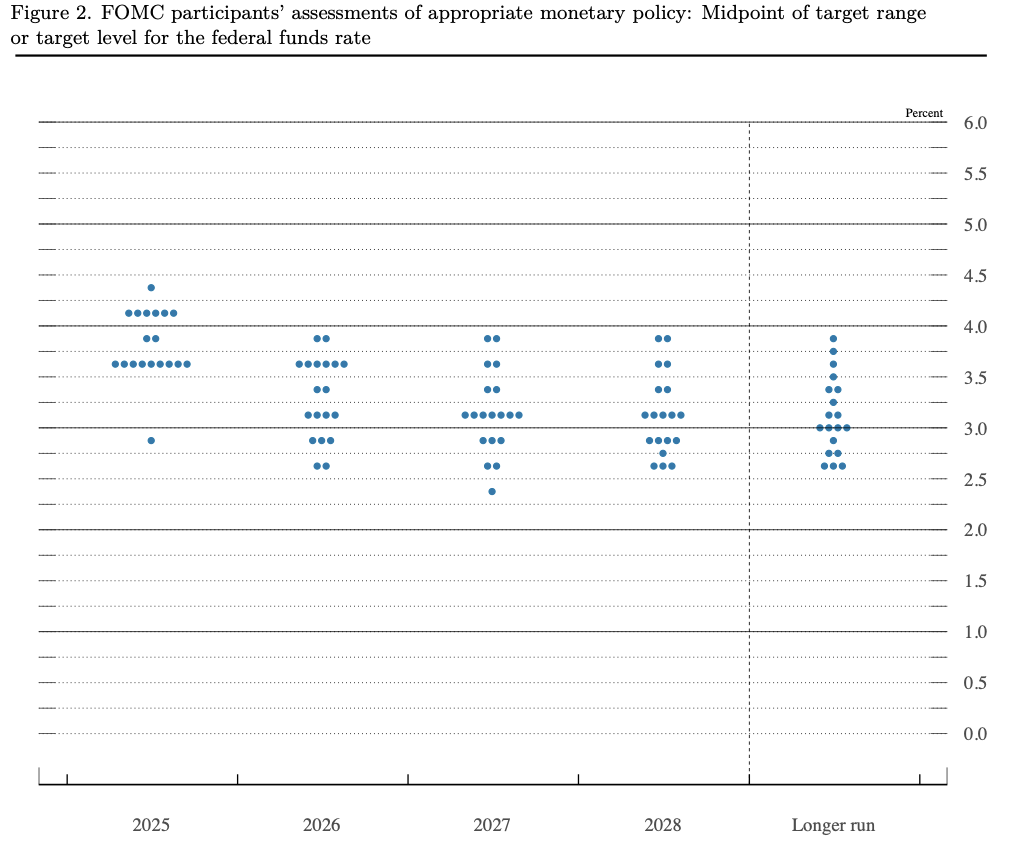
Below I have copied the dot plot from the September meeting, which contra to most previous versions shows a particularly wide range of views regarding the future level of Fed funds.  I have to wonder, though, after reading the Minutes, if those dots will be stretched even wider apart from top to bottom in the December report.
Of course, our interest is how did the market respond to this release?  Well, it can be no surprise that the Fed funds futures market repriced further and is now showing just a 32% probability for a cut next month and 78% probability of the next cut coming in January.  That said, the market remains convinced that rates must go lower over time, something that does not appear in sync with equity market growth expectations and seems to be completely ignoring the announced inward investment flows to the US from around the world.

Source: cmegroup.com

As to the equity market response, the two vertical lines show the release of the Minutes and then the release of Nvidia earnings.  You can see for yourself which matters more to the market.

Source: tradingeconomics.com

Between the GDPNow data, which continues to show growth remains robust, and more announcements of inward investment on the back of trade deals, with the Saudis ostensibly promising $1 trillion after the recent White House dinner, I will take the over on future economic activity.  Remember, too, the government is actively supporting mining, drilling and manufacturing and all of that is going to feed into economic growth here.  My view is the Fed funds futures market is completely wrong, and we will not see rates back at the 3.0% level anytime in the next few years.  I’m not suggesting we won’t see an equity market correction, just that the end is not nigh.

Each day the yen slides
Intervention creeps closer
Yen traders beware

Turning to the dollar, it continues to strengthen across the board with the DXY trading back above 100 this morning, and now that the Fed seems more hawkish, looking like it may have legs.  But let us focus on the yen, quite beleaguered of late, as it appears to be accelerating its downfall.  Not only is this evident on the chart below, but we also have heard concerns for the third time, as per the following quotes from Minoru Kihara, the chief cabinet secretary:

The yen is experiencing sudden, one-way movements that are concerning and which require close monitoring.  Excessive fluctuations and disorderly movements in exchange rates must be monitored with vigilance.  We are concerned about the recent one-way and sudden movements in the foreign exchange market. It’s important for exchange rates to remain stable, reflecting fundamentals.”

In the past six months, the yen has fallen >10% vs. the dollar and is lower by nearly 4% in the past month.  At the same time, JGB yields are starting to accelerate higher, trading to yet another 20-year high at 1.82% and the price action there is remarkably similar to that of USDJPY as per the below chart.  The problem for the JGB market is the BOJ already owns more than 50% of the outstanding debt, so buying more doesn’t seem to be a solution, whereas buying JPY in the FX market will have an impact, albeit short-term if they don’t change policies.   

Source: tradingeconomics.com

The upshot of all this is the world is awash in debt, with global debt/GDP exceeding 3x.  The lesson is that not all this debt will be repaid, in fact probably not that much at all.  Be careful as to what you hold.

Ok, let’s briefly tour the markets I have not yet touched.  Tokyo equities (+2.65%) loved the Nvidia earnings as did Korea (+1.9%), Taiwan (+3.2%) and most of Asia although China (-0.5%) and HK (0.0%) didn’t play along last night.  I guess the ongoing restrictions on sales of Nvidia chips to China is still a negative there, as are recurring concerns over the property market as there is talk of yet another attempt to fix things by the government.  Europe, too, is firmer this morning, although clearly not on tech bullishness given the lack of tech on which to be bullish.  But there is talk of a Russia/Ukraine peace deal which may be a benefit.  At any rate, gains are widespread on the order of +0.6% or so across the board.

In the bond market, Treasury yields rose a couple of ticks yesterday and are higher by 1 more basis point this morning, but still at just 4.14%.  The front of the curve rose by more on the back of the Minutes.  European yields are also higher this morning, between 2bps and 3bps with UK gilts the outlier, unchanged on the day, as softer inflation has traders expecting a rate cut at the next BOE meeting on December 18th.

Oil (+1.0%) has rebounded off its recent lows and is trading back at…$60/bbl, the level at which it is clearly most comfortable these days.  Meanwhile, gold (0.0%) gave back yesterday’s overnight rally to close mostly unchanged with the same true across the other metals although this morning silver (-0.7%) is slipping a bit further.

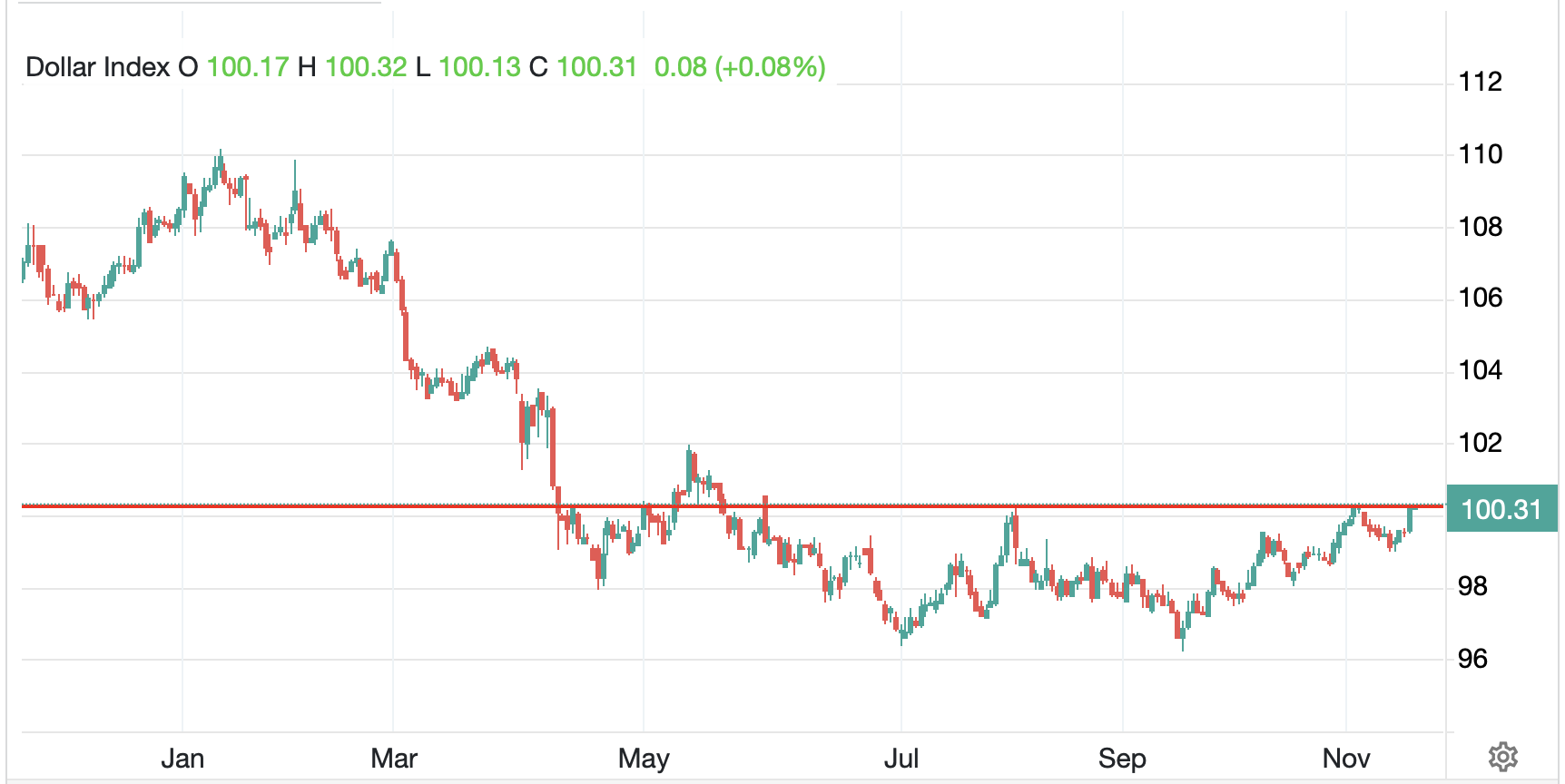
Finally, other currency movements beyond the yen (-0.3% today) are of a similar size across both the G10 and EMG blocs.  Using the DXY as proxy, this is the third test above 100 since August 1st with many analysts are calling for a breakout at last.  
Source: tradingeconomics.com

Perhaps this is true given the word is the Russia/Ukraine peace deal was negotiated entirely between the US and Russia without either Ukraine or Europe involved, demonstrating how insignificant Europe, and by extension the euro, have become.  Just a thought.

On the data front, the big news is the September employment report is going to be released this morning along with some other data:

Nonfarm Payrolls50K
Private Payrolls62K
Manufacturing Payrolls-8K
Unemployment Rate4.3%
Average Hourly Earnings0.3% (3.7% Y/Y)
Average Weekly Hours34.2
Participation Rate62.3%
Philly Fed-3.1
Existing Home Sales4.08M

Source: tradingeconomics.com

On the one hand, the data is stale.  On the other hand, it is all we have, so it will likely have greater importance than it deserves.  I have a hard time looking at the economy and seeing substantial weakness, whether because of corporate earnings, inward investment announcements or the Fed’s growing concern over higher inflation.  All that tells me the dollar is going to be in demand going forward.

Good luck

Adf
Eighty-Sixed

The data remains rather mixed
But traders are still all transfixed
By tariffs and trade
As JGBs fade
And new ideas get eighty-sixed
 
Despite signs that peace in Ukraine
Is further away and hopes wane
It seems all that matters
Is whether Huang flatters
Investors, so stock markets gain


Apparently, at least based on yesterday’s equity market performance, concerns over the eventual outcome of the current global fiscal and monetary regimes remains far down everyone’s list of worries.  Rising inflation?  Bah, doesn’t matter.  Increasing tensions between Presidents Trump and Putin as Russia continues, and arguably increases its aggression?  No big deal.  But you know what has tongues wagging this morning?  Nvidia earnings are to be released after the close, and as we all know, if they are strong (everyone is counting on Jensen Huang, the CEO), then every other concern pales in significance.  After all, a global conflagration is no match in the imagination compared to your stock portfolio increasing in value!

Once upon a time, investors in the stock market sought companies that had good business models and good management who were able to grow their businesses.  These investors were buying a piece of a business in which they believed.  Analysts looked at metrics like P/E ratios and book value to determine if the price paid offered future opportunities as an investment, but the underlying company was the focus.  Of course, that is simply a quaint relic of times long ago, pre GFC.  Today, there is only one metric that matters, ‘NUMBER GO UP’!  While this concept was originally ascribed to Bitcoin and the crypto universe, it has spread across virtually all financial markets.  Nobody cares what a ticker symbol represents, they only care if the number next to the ticker symbol rises, and how rapidly it does so.  Welcome to the future.

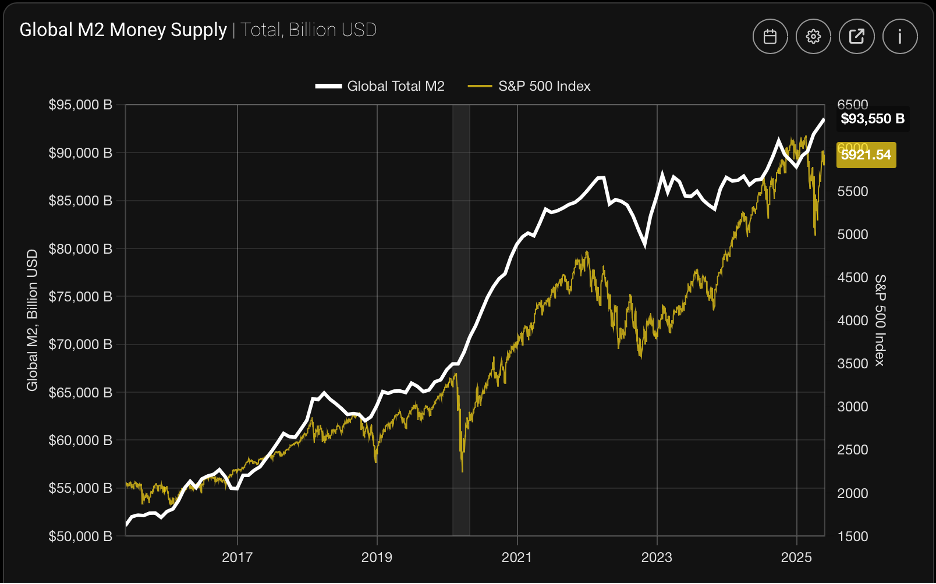
I highlight this because it has become increasingly clear that the macroeconomic landscape is an anachronism for analyzing financial markets.  At this point, whether or not a recession is on the horizon, or inflation is rising, or unemployment is rising or falling seems to have only a fleeting impact on market movements.  Rather, the true driver appears to be the flow of all that money that has entered the global financial system since the GFC.  The below chart from streetstats.finance shows the last 10 years of the growth in the global money supply and the corresponding move in the S&P 500.  You may not be surprised at the tight correlation.

My point is that all the news items that draw our attention may not matter at all in the broad scheme of things.  As long as money continues to be printed and injected into the financial system, while some assets will outperform others, the trend remains sharply from the lower left to the upper right.  Going back to my discussion yesterday, since the overriding goal of every global central bank is to ensure that their governments can issue bonds to finance their spending, I see no end to this trend.  While the speed of the increase may ebb and flow slightly, the direction will only change under the most egregious circumstances, something like the aftermath of WWIII.

In a funny way, this highlights that FX markets have the opportunity to be the most interesting trading markets going forward given the relativity of their underlying basis.  Assets, whether debt, equity or commodity, are all priced on demand functions while FX is priced on relative demand for each side of the cross.  Perhaps FX will be the last bastion of macroeconomic analysis.

But not today!  Starting with FX, the dollar is little changed to slightly higher this morning, consolidating yesterday’s gains but things are quiet.  In fact, across the main markets, the largest movement in either direction is NZD (+0.25%) after the RBNZ cut rates as expected by 25bps, but the market reduced the probability of another rate cut in July.  But away from that move, +/-0.1% is the norm today.  Discussion about tariffs continues to be the major talking point, but as of now, it appears nobody has a clue as to how things will evolve, so everybody is just hunkering down.  

Turning to equities, while yesterday saw a very large rally in the US, that sentiment was absent overnight with Asian markets generally drifting slightly lower although New Zealand (-1.7%) was clearly unhappy with the RBNZ mild hawkish view.  But elsewhere, movement was far less than 1.0%.  In Europe, it is a similar tale, very modest declines across the board as data showed German Unemployment rising slightly, Eurozone Consumer Inflation Expectations also rising slightly while French GDP disappointed on the downside, just 0.6% Y/Y.  You can appreciate the lack of enthusiasm there, although the story that Madame Lagarde is considering stepping down from the ECB to take over WEF should put a spring in the step of European investors as perhaps the next ECB president will understand economics and central banking.  As to US futures, they are little changed at this hour (7:35).

In the bond market, after a session where yields slid across the board yesterday, this morning brings a modest reversal with Treasuries (+2bps) right in line with most of Europe (+1bp across the board) although JGB’s (+5bps) suffered after another lousy long-dated auction last night where 40-year JGBs saw pretty weak demand overall.  The Japanese bond market remains a serious issue for many and a potential signal for the timing of next big move.  While risk assets rallied yesterday, nothing changed my description of the problems that exist globally.

Finally, in the commodity markets, oil (+0.7%) is modestly higher this morning but continues to trade within its range and shows no sign of breaking out in the near term.  Metals markets, which sold off aggressively yesterday have stopped falling, but are hardly rebounding, at least as of now.  

Let’s look at the data for the rest of the week though.

TodayFOMC Minutes 
ThursdayInitial Claims230K
 Continuing Claims1900K
 Q1 GDP (2nd estimate)-0.3%
FridayPersonal Income0.3%
 Personal Spending0.2%
 PCE0.1% (2.2% Y/Y)
 Core PCE0.1% (2.5% Y/Y)
 Goods Trade Balance-$141.5B
 Chicago PMI45.0
 Michigan Sentiment51.0

Source: tradingeconomics.com

In addition to the data, with all eyes really on Friday’s numbers, we hear from six more Fed speakers, although, again, will they really change their tune about patience in watching what the impact of tariffs are going to be on the economy?  I think not.  In the Fed funds futures market, the probability of a cut in June has fallen to just 2% while the market is now pricing just 47bps of cuts this year, the lowest amount in forever.  Unless the data completely fall off the map, I don’t see why they would cut at all, and that has just not happened yet.

The summer is upon us (although you wouldn’t know by the weather in the Northeast) and that typically leads to a bit less activity overall.  At this point, much depends on Congress and its ability to complete the budget bill to move the legislative process along.  Then the hard part of spending bills will be the next topic and you can expect a lot of screaming then.  In the meantime, though, I expect that we will hear of a number of other trade deals getting completed and a good portion of the trade anxiety ebbing from market views.  Alas, the peace/war equation is far more difficult to handicap as so many in power clearly benefit from war.

The prevailing view in the market is that the dollar has further to decline going forward as I think a majority of players are anticipating a recession in the US and the Fed to respond.  Under that scenario, a softer dollar feels right.  But is that the right scenario?

Good luck

Adf

Stardom is Fleeting

Remarkably few people care
That Jay and the Fed will soon share
Their latest impressions
On growth and recessions
An outcome, of late, that’s quite rare
 
Does this mean that ere the next meeting
There will be an increase in bleating
By every Fed speaker
Each one a fame seeker
As they realize stardom is fleeting?


I wonder how the atmosphere in the meeting room at the Marriner Eccles building has changed today vs. what it has been for the past decade at least.  Usually, the FOMC meets, and financial markets are riveted by the potential and then everything comes to a virtual standstill as traders and investors await the wisdom of the Fed Chair to help determine where markets are likely to go.  I am reminded of the crop report scene in Trading Places, where the entire pit stops to watch the news and then springs back into action. 

One of the consequences of this evolution is that every member of the FOMC feels it is their duty to reiterate their views as frequently as possible, whether they are changing or not, because they are trying to increase their profile to ensure a lucrative future gig want to make sure that the American people understand just how much the Fed is doing to help them and the nation.  This is why for the first four weeks after a Fed meeting, virtually every day we have at least one if not two or three FOMC members repeating themselves ad nauseum.

But suddenly, they have real competition for airtime.  President Trump, no shrinking violet he, is incredibly adept at forcing all the world’s attention on himself, to the exclusion of formerly important voices like Alberto Musalem or Lisa Cook.  Now, the fact that you can probably not remember who those two people are is exactly my point.  FOMC members speak constantly, but it is the office, not the voice, to which people are listening.  And right now, fewer and fewer people are listening to the Fed because President Trump is commanding all the attention.  In fact, to the extent the Fed is discussed, it is generally in relation to how they are going to respond to Trump’s next moves.

But, in an effort to maintain our focus on markets and not politics, to the extent that is possible right now, the Fed still has a role to play in both expectations of how things are going to evolve as well as actual pricing.  A quick summation of where we have been with Powell and friends is that last year, starting in September they cut rates for the first time in nearly two years and have since reduced the Fed funds rate by 100bps.  A key issue here is the fact that the economy is showing no signs of slowing down, unemployment remains modest at best, and inflation has been, at best, bottoming well above their 2.0% target, if not rising again.  Hence, there have been many questions as to why they cut rates at all.

At this point, though, the Fed’s narrative prior to the quiet period, was one of increased caution that further rate cuts may not be necessary, or certainly not imminent, given the ongoing positivity in the economic situation.  As such, there is no expectation for a rate cut today, and according to the Fed funds futures market, only a 30% probability of a March cut, with basically two full cuts priced in for all of 2025.  I would argue that based on the data we have seen, it is not clear why there would be any further cuts, and, in fact, believe that by mid-year, we are likely to start to hear talk of a rate hike before the end of the year.  This will be dependent on the data, but if inflation continues to remain sticky (see chart of Core PCE below), the bar for cuts will move higher still.  Certainly, to my non-PhD trained eye, it doesn’t really look like their key metric is declining anymore.

Source: tradingeconomics.com

Perhaps the most remarkable thing about this Fed meeting is that I have seen virtually nothing regarding expectations of how the statement may change or forecasts may change.  FWIW, which is probably not much, my take is the statement will be virtually identical given no real changes in the data trends, and that Chairman Powell will go out of his way to say absolutely nothing at the presser, especially when asked about President Trump and his policies.  Of course, this will not prevent the cacophony of Fedspeak that will come between now and the next meeting, but there may be fewer folks paying attention.

Ok, let’s turn to markets.  While Monday was a tech stock rout, yesterday was the reverse with the NASDAQ shaking off the DeepSeek fears or actually embracing them based on Jevon’s Paradox (the idea that the more efficient something becomes, the greater the need/desire for it and therefore the increase in its price) leading to the new narrative that Nvidia’s chips will be in more demand.  But regardless, everybody was happier!  Asian markets responded with the Nikkei (+1.0%) regaining some luster on the tech story as well as the weaker JPY, which saw the dollar rally a full yen on the session, although it is little changed overnight.  While not universal, there was a lot more green than red in Asia, although Chinese shares (-0.4%) did not participate.

In Europe, most bourses are showing gains this morning although the CAC (-0.3%) is lagging after luxury goods makers saw weaker growth than expected.  But the DAX (+0.75%) and IBEX (+1.0%) are both stronger as is the FTSE 100 (+0.3%) as Chancellor Reeves continues to try to explain that growth is Labour’s goal despite all their policies that seem to point in the other direction.  As to US futures, at this hour (7:30) they are higher led by the NASDAQ (+0.5%).

In the bond market, the fear from Monday is gone although the bounce in yields was modest yesterday and this morning Treasury yields are unchanged on the session.  I suspect that there is some waiting for the Fed involved here.  European sovereign yields, though, are all a bit lower, down between -2bps and -3bps, as investors anticipate tomorrow’s ECB rate cut and are looking for a dovish message going forward.

In the commodity space, yesterday modest rebound in oil (-0.6%) is being reversed this morning while NatGas (0.0%) is consolidating after a dramatic decline in the past week of more than 20% given the latest weather models are now calling for much warmer temperatures in the northern hemisphere.  In the metals markets, gold (-0.2%) is consolidating yesterday’s gains as is silver (+0.2%) and copper (-0.1%).  For now, these are not all that interesting.

Finally, in the FX markets, the dollar continues to regain momentum higher with the euro (-0.3%) sliding back below 1.04 this morning and the DXY (+0.2%) back above 108.00.  However, looking across both the G10 and EMG blocs, while the dollar’s strength is widespread, it is not dramatic, with AUD (-0.5%) and PLN (-0.5%) the biggest movers of the session.  It should be no surprise that there is confusion here given the uncertainty sown by President Trump and his tariff discussions.

On the data front, the only numbers today, aside from the FOMC meeting and the BOC meeting (expected 25bp cut) is the Goods Trade Balance (exp -$105.4B).  We also get the EIA oil data with inventory builds anticipated.  But really, despite the seeming lack of interest leading up to today’s FOMC meeting, it is the only game in town.  To me, the risk is something more dovish as that part of the narrative seems to be ebbing lately, so will be a real surprise.  If that is the case, then I suspect the dollar will suffer somewhat.

Good luck

Adf

Eclipse

This morning, the question on lips
Is where did DeepSeek get their chips
As well, there’s concern
That China will learn
Our secrets, and so, us, eclipse


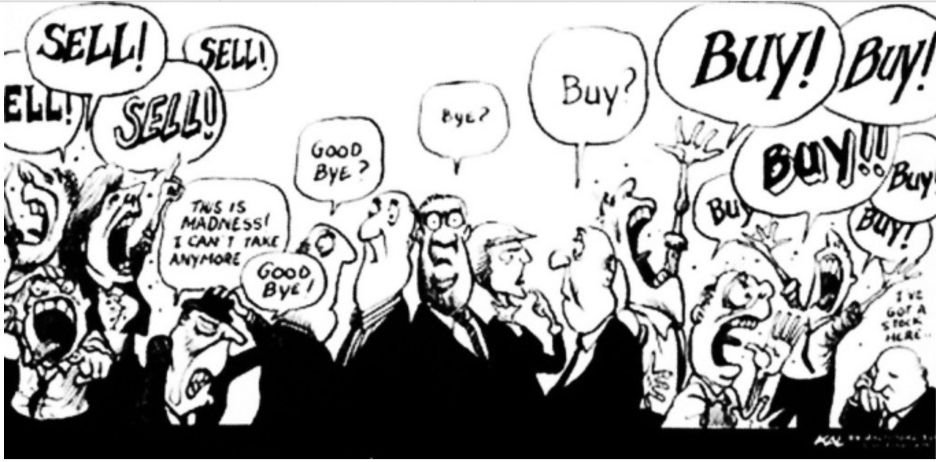
Narratives are funny things.  They seemingly evolve from nowhere, with no centralization, but somehow, they quickly become the only thing people discuss.  I’ve always been partial to the below comic as a perfect representation of how narratives evolve for no apparent reason.

Of course, yesterday’s narrative was that the Chinese LLM, DeepSeek, was built by a hedge fund manager with older NVDA chips and for far less money than the other announced models from OpenAI or Google and performed just as well if not better.  While equity traders were not going to wait around to determine if this was true or not, hence the remarkable selling on the open of all things AI, a little time has resulted in some very interesting questions being raised about the veracity of how DeepSeek was built, what type of chips they use and who actually built it.

For instance, a quick look at NVDA’s 10Q shows that, remarkably, Singapore is a major source of revenue, and it has been growing dramatically.

Source: SEC.gov

Now, it is entirely possible that Singapore is a hotbed of AI development, but from what I have read, that is not the case.  In fact, there is basically one lab there that has resources on the order of just $70mm.  But despite that lack of local investment, at least reported local investment, Nvidia shows that chip sales in Singapore nearly quadrupled in the last year.  Far be it from me to suggest that the narrative may change again, but who is buying those chips, more than $17 billion worth?  The idea that they have been trans shipped to China is quite plausible and they may well be what underpins DeepSeek.

Again, I have no first-hand knowledge of the situation but it is not beyond the pale to make the connection that China has been effectively circumventing US export controls through Singapore, have built their own LLM model using the exact same chips as OpenAI and others, but propagated a narrative that they have built something better for much less in order to undermine the US tech sector equity performance and call into question some underlying beliefs in the US market and economy.  Now, maybe this Chinese hedge fund manager did what he said.  But the one thing we know about China is, it is opaque in everything it does, so perhaps we need to take this story and dig deeper.  I am sure others will do so, and more information will be forthcoming, but it highlights that narratives continue to drive markets, but can also, at times, be constructed rather than simply evolve.

The thing is, this is still the only story of note in the market.  Scott Bessent was confirmed as Treasury Secretary yesterday, and indicated he was a fan of gradual tariff increases, perhaps 2.5% per month, rather than large initial tariffs, but that does not seem all that exciting.  And while Trump has not slowed down one iota, his focus has been on things like browbeating California into allowing reconstruction of LA rather than international issues, at least for the past twenty-four hours.  The upshot is that markets, which even yesterday closed far above their worst levels from the opening, are rebounding further today with many of yesterday’s moves reversing, at least to some extent.

Starting in the equity markets, despite the weakness in the tech sector, US market closes were far higher than the opens with the DJIA actually gaining 0.65% on the session.  However, while Japanese shares (-1.4%) definitely felt the pain of the tech sector, the rest of Asia saw some decent performance (Korea +0.85%, India +0.7%, Taiwan +1.0%) although Chinese shares (-0.4%) struggled.  Of course, one reason for that may be that the largest Chinese property company, Vanke, reported humongous losses and both the Chairman and CEO stepped down.

In Europe, though, all is well with every major exchange in the green led by Spain’s IBEX (+1.0%) although gains of 0.5% – 0.7% are the norm.  Now, remember, there is effectively no tech sector in Europe to be negatively impacted by the AI story, and it should be no surprise that these shares have followed the DJIA higher.  And this morning in the US futures market, at this hour (6:50), we are seeing gains on the order of 0.4% across the board.

In the bond market, yesterday’s early rally in prices (decline in yields) backed off as stocks bounced from their lows although Treasury yields still fell 10bps on the day.  This morning, the bounce in yields continues with Treasury yields higher by another 3bps and European sovereign yields rising between 1bp and 2bps on the session.  It will be very interesting to watch the bond market now that Bessent has been confirmed as Treasury Secretary given his goal to extend the maturity of the US debt outstanding.  Arguably, that should push up back-end yields, so we will see how effective he can be in reaching that goal.  

Turning to commodities, yesterday saw a rout there as well with both oil and the metals markets suffering greatly.  However, this morning, like many other markets, things are reversing course.  Oil (+0.75%) has bounced off its lows from yesterday, and despite a pretty rough past two weeks, is still higher than it was at the beginning of the year.  Gold and silver are unchanged from yesterday’s closing levels, and while off their recent highs, remain much higher in the past month.  Copper, too, is bouncing slightly and still much higher this month.  Perhaps yesterday’s price action was a catalyst for lightening up positions rather than changing views.

Finally, the dollar has rebounded vs. the G10 this morning, rising alongside US yields with the euro (-0.7%) and AUD (-0.8%) lagging the field, although dollar gains of 0.5% are the norm across the entire G10 this morning.  In the EMG bloc, the CE4 are all tracking the euro lower, with all down around -0.6% to -0.8%, but yesterday’s biggest laggards, MXN, COP and BRL are little changed this morning, not rebounding, but not falling further.  With the Fed expected to remain on hold while both the BOC tomorrow and ECB on Thursday are set to cut rates, perhaps the FX market is reverting to its more fundamental interest rate drivers than the hysteria of AI models.  If that is the case, then we are likely to turn our attention to Chairman Powell’s press conference as the next critical piece of news.

On the data front this morning, we see Durable Goods (exp 0.8%, 0.4% -ex Transport), Case Shiller Home Prices (+4.3%) and Consumer Confidence (105.6).  Yesterday saw New Home Sales rise more than expected but still resulted in the smallest number of sales for the year since 1995 when the population was far smaller.  

Once again, depending on where you look, you can find data that supports either economic strength or weakness.  It strikes me that today’s data will be of little consequence as traders will be focused on the equity market to see if the rebound has legs, as well as further news regarding DeepSeek.  Tomorrow, however, the Fed will take center stage.

Good luckAdf

Much Havoc

Colombia tried to prevent
Deportees, who homeward were sent
But Trump’s strong response
Meant that in a nonce
Gustavo, his knee quickly bent
 
Meanwhile, all the talk of AI
This weekend has pundits awry
The Chinese DeepSeek
Could very well wreak
Much havoc in stocks priced sky-high


If there was any doubt that things were going to be different under a Trump administration than virtually any previous administration, even his first term, they were dispelled this weekend.  By now you will all have heard the story of the Colombian president, Gustavo Petro (he of the 26% local approval rating) and his refusal to allow two US C-17 military transports filled with Colombian deportees, land in Bogota.  Apparently, when Trump was informed while playing golf, after birdieing the 3rd hole, he tweeted that the US would immediately impose 25% tariffs on everything Colombia exports to the US, rising to 50% in one week if this policy was not changed.  By the time he finished the 6th hole, President Petro reversed his policy and even offered the Colombian presidential plane to come and pick up the deportees.

While the golf portion of the story is amusing, the lesson to the rest of the world is that President Trump is very serious about his electoral promises, and he will utilize the entire might of the US government to achieve his goals.  For smaller nations with little power and leverage, it means that toeing the line is the only solution.  For larger nations, it certainly is a wakeup call to the idea that the US attitude toward international relations has dramatically changed.  As Machiavelli explained, it is better to be feared than loved, and it seems abundantly clear that President Trump understands that.

Perhaps the biggest takeaway from this situation, though, is that the US government is no longer the slow-moving behemoth to which it had evolved over the past decades.  The rest of the world is going to find itself needing to respond very quickly to things that in the past were sent to committees for study and review but now are decided instantly.  If you want to understand why I believe volatility is set to increase across all asset classes, this is the crux of the issue.

Turning to the tech world, the buzz is all about DeepSeek, which is a Chinese AI model that allegedly outperforms OpenAI’s top model, or performs just as well, although it costs a fraction of what OpenAI and others (Microsoft, Google, etc.) spent to train the model and it uses far less advanced chips which are also much less expensive and less power hungry.  Because this is all a new story, it remains unclear if DeepSeek will be an effective replacement for the others, or if it excels in only one or two areas and still lags elsewhere.  

But the market impact has been instantaneous and dramatic.  At this hour (6:00am), the NASDAQ (-4.5%) is leading US equity markets lower with the S&P (-2.4%) along for the ride.  Nvidia (-10.6% in premarket trading) is leading the way, but I suspect that this news will be negative for the entire US tech sector.  After all, it was certainly priced at premium levels.  

Source: tradingeconomics.com

In the short term, I expect we are going to hear a lot more analysis of why this is a game changing event and how the future that was so clear just last week is now cloudy.  However, while this will almost certainly take the shine off the megacap tech companies for a while, I think it would be a mistake to dismiss their futures because of this.  Two things in their favor are they still have virtually infinite resources, and they have dramatically large installed networks which means that changing things will be very difficult.  While their equity prices can decline a lot, it doesn’t mean their businesses are going to collapse.

PS, spare a thought for the impact on the energy sector here as well.  One of the narratives that has been fed lately is that all this AI will require gobs of power that will need a lot more power production.  It was a key feature of the Uranium story as nuclear is seen as one of the few sources capable of delivering the reliable power necessary.  I suspect that this part of the narrative will need to adjust as well if the AI story has actually changed.  But keep in mind that with efficiency comes more demand, so perhaps this is just a temporary downdraft.  Again, volatility is the name of the game.

Ok, let’s see how these stories have impacted the rest of the world.  With all the news over the weekend, you may not recall that US equity markets edged lower on Friday.  Well, Asian markets were mixed overnight with the Nikkei (-0.9%) following the US, although also reacting to the fact that the yen (+1.3%) rallied sharply as well.  Meanwhile, Hong Kong (+0.7%) managed to gain while mainland Chinese shares (-0.4%) certainly showed no benefit from the changing attitudes in tech.  Elsewhere in the region, Korea (+0.9%) and Taiwan (+1.0%) rallied while India (-1.1%) and Indonesia (-0.9%) fell and the rest of the region batted back and forth. In Europe, red is the dominant color, likely on the generally weak US performance although there are no European tech companies of note (perhaps ASML).  But the DAX (-1.2%) is leading the way down followed by the CAC (-0.9%) and the bulk of the rest of the continent and the UK.  Let’s just say that equities are not in favor this morning.

However, what we are seeing is a major bond market rally as Treasury yields (-12bps) tumble as risk is very definitely off.  European sovereign yields are also lower, by between -5bps and -7bps, and JGB yields (-2bps) also slipped, although relative to the rest of the world, they held up pretty well.  Interestingly, with all the talk about DeepSeek and the impact on the tech community, there has been virtually no discussion about the myriad central bank meetings this week, including, of course, the Fed on Wednesday where the market still sees no chance of a rate cut.

Commodity markets are relatively calm this morning as oil (-0.6%) is a touch lower although there has been no news of note.  The background story is that President Trump and Saudi Arabia’s Mohammed bin Salman are talking about increasing production to drive oil prices lower, but that remains more rumor than anything else.  As the polar vortex has passed, and forecasts are for warmer weather, NatGas (-6.2%) is sliding.  In the metals markets, very little movement is ongoing as traders try to determine what all the new news means.

Finally, the dollar is under some pressure this morning despite the risk off attitude that prevails.  I suppose it is because one of the recent drivers of the dollar’s strength has been the insatiable demand for the megacap tech stocks.  It seems that for now, that demand has been satiated.  So, the yen is behaving in its traditional safe haven role, as is the CHF (+0.85%) but the euro (+0.15%) and pound (+0.15%) are both a touch higher.  That said, we are definitely seeing emerging market currencies under pressure as they have nothing to do with tech and everything to do with the very obvious change in attitude regarding how the US is going to deal with smaller nations that don’t accede to US demands, especially regarding immigration.  So, MXN (-1.0%), COP (-1.1%), ZAR (-1.4%) and BRL (-0.6%) are all under significant pressure.  CE4 currencies, though, are not in the line of fire, so are little changed this morning.  

On the data front, remarkably, it almost seems an afterthought given what we just saw this weekend, but along with the Fed, BOC and ECB, we get PCE on Friday.

TodayNew Home Sales670K
TuesdayConsumer Confidence106.0
WednesdayBank of Canada Rate Decision3.0% (current 3.25%)
 FOMC Rate Decision4..5% (current 4.5%)
ThursdayECB Rate Decision2.75% (current 3.0%)
 Initial Claims220K
 Continuing Claims1885K
 Q4 GDP2.8%
FridayPersonal Income0.4%
 Personal Spending0.5%
 PCE0.3% (2.6% Y/Y)
 Core PCE0.2% (2.8% Y/Y)
 Chicago PMI40.0

Source: tradingeconomics.com

At this point, the central bank story is background noise, not the major theme, but by Wednesday I expect that all eyes will be on Chairman Powell as he describes the Fed’s thoughts at the press conference.  Of course, that assumes that there are no other political earthquakes, which may not be a very good assumption these days.  I think we are in a seismic zone for now.  

As to the dollar, if DeepSeek really is an Nvidia killer, then it is not hard to derive a scenario that says, US equity markets are going to decline, along with growth expectations.  The Fed will cut more aggressively, and the dollar will start to really fall as well.  I’m not forecasting that, just highlighting a possible, if not likely, scenario in the event the world believes the AI story is not going to be as expensive and profitable for the Mag7 as they thought last week.  Once again, the key is to hedge your risks, because as you learned this weekend, things change, and they can change quickly!

Good luck

Adf

Just Simply Don’t Care

On Tuesday, six Fed members spoke
And none of them, from the pack, broke
While May’s CPI
Caught everyone’s eye
No ideas of cuts did it stoke
 
But markets just simply don’t care
Instead, all is well, traders swear
Nvidia rose
And at Tuesday’s close
No other firm could quite compare


Another day, another new all-time high for the S&P 500 and the NASDAQ (boy, my call from two weeks ago didn’t age well!).  And so it goes, the Fed imagines it is maintaining tight financial conditions and is trying to rein in spending and price pressures, and equity investors simply buy more NVDA every day.  Yesterday, the chipmaker became the most valuable company in the world, or at least the one with the largest market capitalization, cresting Microsoft and Apple, although all three are now worth about $3.3 trillion each.  I raise the point because it is such a perfect description of market sentiment.  It seems that everyone has placed their hopes (and potentially future wealth) on the back of a single company.  I’m sure it will work out well 😱.

In fact, as the investing community narrows its focus to an ever-smaller number of companies, and news elsewhere appears to show cracks in the façade of a solid economy, I suspect that problems may be coming our way.  For instance, remember Battery Electric Vehicles, and how they were the future?  Not just Tesla, but all these companies like Lucid, Polestar, Nikola, VinFast and Fisker?  Well, every name on this list has either gone bankrupt or is on the edge with Fisker being the latest to file Chapter 11.  The point is that in an environment where liquidity is abundant, or overly so, investment decisions tend to be less well thought out.  While the Fed has certainly tightened policy dramatically and been resolute in its efforts to maintain that tighter policy while inflation still percolates, the federal government’s excessive largesse (the CBO just announced they now expect a budget deficit this fiscal year of $1.9 trillion, up from the $1.5 trillion estimate last quarter) is too much for the Fed to stop.

One other thing to note about Nvidia, and AI in general, is that in China, Ali Baba has reduced the charge for using its AI function and it appears that AI, rather than being a new revenue stream for companies may simply become increased overhead of doing business.  In that world, as margins of the Apples and Microsofts and Googles compress, perhaps there will be more discernment before the next order of Nvidia chips.  There are many imbalances in this market, and it appears most of them are a result of the mania for AI.  When this passes, and it will pass, be prepared for some repricing of risk.

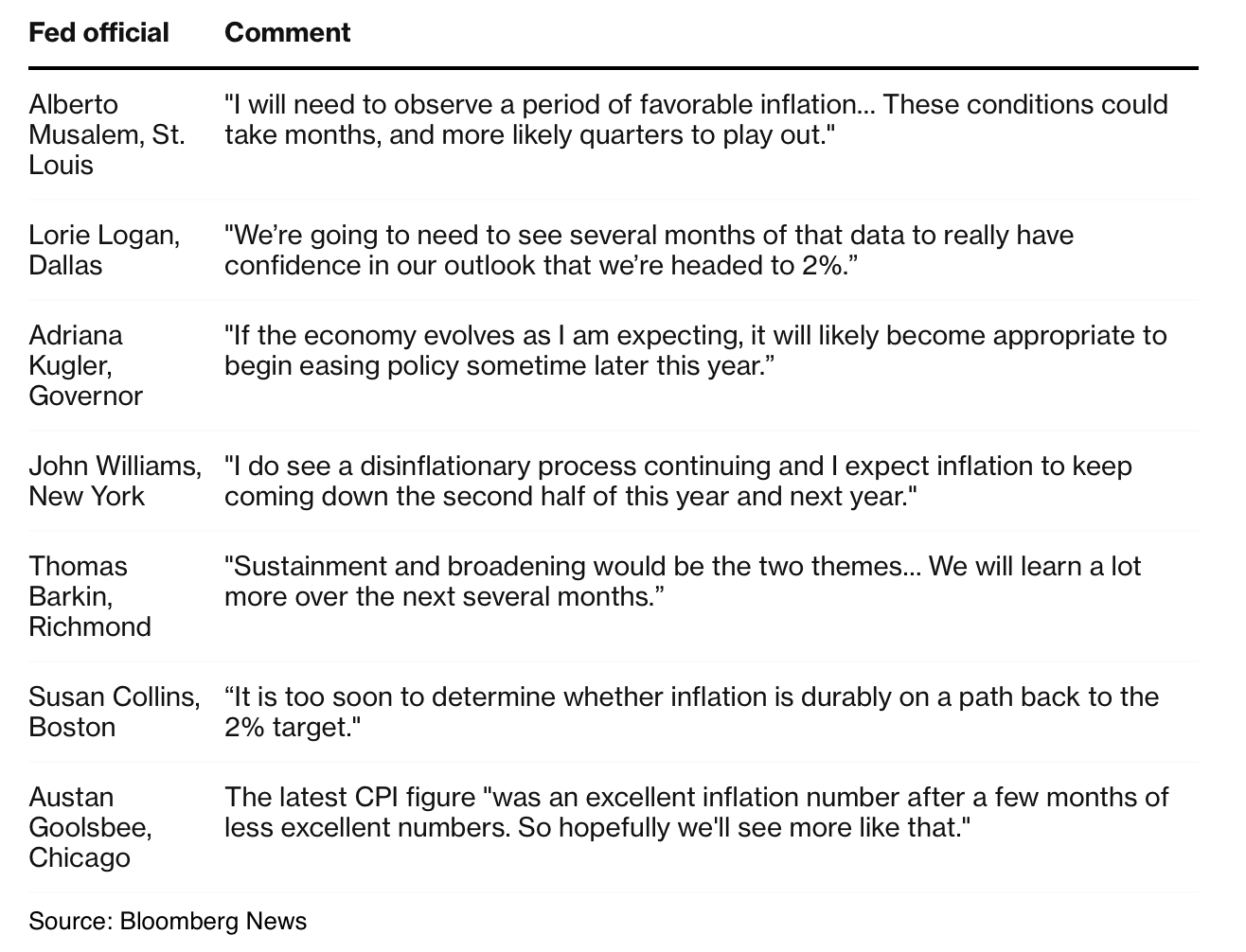
Ok, but back to the other stuff, namely the overwhelming amount of Fedspeak that keeps coming from all these FOMC members.  Yesterday, we actually had seven members speak, NY’s John Williams was not on the calendar ahead of time, and to a (wo)man, they explained that patience remains a virtue.  Happily, Bloomberg News put together the following list of key comments from the entire group:

Despite the modestly softer than expected CPI data last week, and even yesterday’s somewhat softer than expected Retail Sales data, it is hard to look at this grouping of comments and expect a rate cut is coming anytime soon.  Now, the one thing we can never forget is that markets can move incredibly quickly when it comes to readjusting its views on a subject.  In addition, history has shown that when the Fed figures out they are behind the curve and the economy is beginning to slow, they have the ability to cut rates very quickly as well.  But right now, I just don’t see the roadmap for a rate cut before the end of the year.  If this is the case, the one thing that seems most evident is that the dollar will maintain its overall bid.  Despite all the talk that the dollar is losing its reserve status, and that too much debt is going to destroy it, the reality remains there is no viable alternative as a means to store wealth and for governments to store reserves.  I don’t doubt the day will come when a substitute is found, but I do doubt I will be around to see it.

Ok, let’s see how the rest of the world celebrated the new leader in the market cap sweepstakes.  In Asia, the Nikkei (+0.25%) edged higher but the Hang Seng (+2.9%) had a fantastic run as the tech stocks resident there seemed to follow Nvidia.  Not surprisingly, Taiwan and Korea had good days, but elsewhere in the region, there was far more red than green as tech stocks are not the basis of those markets.  As to Europe, it is a mixed picture there but probably more red than green.  UK (+0.15%) stocks have edged higher after the UK inflation report showed that the headline number touched 2.0% for the first time in three years, but it doesn’t appear that will be enough to get the Tories re-elected next month.  However, we have seen most of the continent bleed lower after the European Commission warned a series of nations (including France and Italy) that they needed to address their budget deficits which are far above the 3% “limit” that was embedded in the entire Eurozone project.  Meanwhile, despite the fact that the US equity markets will be closed today for the Juneteenth holiday, futures are trading although they are little changed at this hour (7:45).

It is also a bank holiday here, so there will be no bond trading in the US, but in Europe, yields are a bit higher this morning, between 2bps and 4bps, bucking the trend from yesterday’s Treasury market and seeming to demonstrate a little concern over the ongoing political ructions on the continent.  However, there is one place where yields are having difficulty finding a base, Japan.  Despite all the talk that the BOJ was going to allow yields to rise more aggressively, or that there was no cap at 1.00%, JGBs fell 1bp overnight and have shown no inkling of moving higher in any substantial amount.  With this in mind, look for the yen to remain under pressure.

In the commodity markets, the early part of the month, which saw oil prices slide is just a memory now as once again, WTI (+0.1%) is holding onto its gains from yesterday and is now firmly above $81/bbl.  It appears that demand figures are starting to improve and inventory draws are being seen now.  Watch at the pump.  In the metals markets, after rallies yesterday, the precious set are holding the gains, up just 0.1% each, but copper has rebounded a further 1.5%, again an indication that economic activity seems better than feared.

Finally, the dollar is slightly softer this morning, slipping a touch against most of its G10 and EMG counterparts, but the noteworthy thing is that no currency has moved more than 0.25% in either direction.  In other words, nobody seems to care this morning here.

There is no data and no Fed speakers given the holiday so not only will things slow quickly by 11:00am, it seems a safe bet that movement will be di minimus.  Tomorrow brings a reawakening, but for today, enjoy the sunshine.

Good luck

Adf

Ne’er Have Nightmares

Said Harker, it’s likely one cut
Is all that we’ll need this year, but
Depending on data
My current schemata
Might wind up by changing somewhat
 
However, in truth no one cares
‘Bout Harker and views that he shares
As long as, stocks, tech
Don’t suddenly wreck
Investors will ne’er have nightmares


“If all of it happens to be as forecasted, I think one rate cut would be appropriate by year’s end.  Indeed, I see two cuts, or none, for this year as quite possible if the data break one way or another.  So, again, we will remain data dependent.”  These sage words from Philadelphia Fed president Patrick Harker are exactly in line with the message from Chairman Powell last week, as well as the dot plot release.  In other words, there was nothing new disclosed.  Now, today, we will hear from six more Fed speakers (Barkin, Collins, Kugler, Logan, Musalem, and Goolsbee) and I will wager that none of them will offer a substantially different take.  

At this point, market participants seem to feel quite confident they understand the Fed’s current reaction function and so will respond to data that they believe will drive different Fed actions than those defined by Harker above.  But if the trend of data remains stable, the Fed will not be the driving force in the market going forward.

In fact, there appears to be just one thing (or maybe two) that matters to every market, the share prices of Nvidia and Apple.  As long as they continue to rise, everything will be alright.  At least that’s what a growing share of investors and analysts have come to believe.  Alas, this poet has been in the market far too long to accept this gospel as truth.  I assure you there are other issues extant; they are simply hidden by the current Nvidia-led zeitgeist.

For example, Europe remains on tenterhooks for several reasons, only one of which is likely to be settled very quickly, the upcoming French election.  But remember, there is still a war in Ukraine and NATO and European nations have just upped the ante by allowing their weapons to be used to attack into Russia in addition to supplying F-14 fighter jets as part of the package.  In an almost unbelievable outcome so far, while Russian piped natural gas to Europe has fallen to essentially nil, Russia has become Europe’s largest supplier of LNG, surpassing cargoes from both the US and UAE.  I’m not sure I understand the idea behind sanctioning Russian oil and buying their gas, but then I am not a European politician, so perhaps there are nuances that escape me.  But the point is that Russia can cut that off as well, and once again disrupt the already weak Eurozone economy.

At the same time, Germany, still the largest economy in Europe, remains in economic purgatory as evidenced by today’s ZEW data (Sentiment 47.5, exp 50.0; Current Conditions -73.8, exp -65) as well as the fact that Germany’s largest union, IG Metall, is now demanding a 7% wage increase for this year, far above the inflation rate and exactly the sort of thing that, if agreed, will delay further rate cuts by the ECB.  Productivity growth throughout Europe remains lackluster and combining that with the structurally high cost of energy due to European energy policies like Germany’s Energiewend, is certain to keep the continent and its finances under pressure.  Right now, equity markets in Europe are following US markets higher, but they lack a champion like Nvidia or Apple, and are likely to be subject to a few hiccups going forward.

Or perhaps we can gaze eastward to China, where economic activity remains lackluster, at best as evidenced by the slowdown in Fixed Asset Investment and IP, as well as by the fact that the PBOC continues to try to create support for the still declining property sector without cutting rates further and inflating a bubble elsewhere.  The onshore renminbi continues to trade at the limit of the 2% band as the PBOC adjusts the currencies level weaker by, literally, one pip a day, and the offshore version is trading 0.25% through the band and has been there for the past month.  The economic pressure for the Chinese to weaken their currency is great, but obviously, the political goal is to maintain stability, hence the incremental movements.

My point is that Nvidia is not the only thing in the world and while its stock price performance has been extraordinary, I would contend it is not emblematic of the current global situation.  Rather, it is an extreme outlier.  Not only that, but when other things break, they will have deleterious impacts on many financial markets, probably including the NASDAQ.  Just sayin’!

However, despite my warnings that things will not always be so bright, so far in this session, they have been.  Overnight, Japanese stocks (+1.0%) followed the US higher as did Australia (+1.0%) and much of Asia other than Hong Kong (-0.1%) which slipped a bit.  Meanwhile, as all sides in the French election try to pivot toward the center to gather votes, European bourses are all in the green as well, somewhere between 0.25% and 0.5%.  As to US futures, at this hour (7:30), they are little changed.

Bond yields have continued to rebound from the lows seen Friday, with Treasury yields edging up another basis point this morning.  However, European sovereigns have seen demand with yields slipping a few bps, perhaps on the idea that growth remains lackluster as evidenced by the ZEW report, or perhaps on the idea that the French election may not be as terrible as first discussed.  Meanwhile, JGB yields edged up 1bp but remain below the 1.00% level despite Ueda-san explaining that a rate hike was on the table for July and that QT and rate hikes were different processes and independent decisions.

In the commodity markets, oil is unchanged this morning but that is after a strong rally yesterday in NY with WTI closing above $80/bbl for the first time since the end of April, as suddenly, the story is oil demand is improving while supply will remain tight on the back of OPEC+ measures.  I’m not sure how that jives with the IEA’s recent comments that there would be a “massive”oil supply glut going forward, (which I find ridiculous), and perhaps market participants have turned to my view.  Metals, though, remain in the doghouse falling yet again across the board.  Something else I don’t understand is how the demand story for metals can be weak while the demand story for oil can be improving given both are critical to economic activity.  

Finally, the dollar continues to find support, despite its oft-expected demise, as it gains vs. virtually all of its counterparts both G10 and EMG.  The biggest laggards this morning are NZD (-0.6%) and NOK (-0.4%) in the G10 while we have seen weakness in the CE4 (HUF -0.5%, CZK -0.55%, PLN -0.5%) as well as most Asian currencies.  The outliers here are ZAR (+0.5%) which continues to benefit from the re-election of President Ramaphosa and his coalition with centrist parties, and MXN (+0.4%) which seems to be finding a floor after its extraordinary decline in the wake of the election there two weeks ago.

On the data front, this morning we see Retail Sales (exp 0.2%, 0.2% ex autos), IP (0.3%) and Capacity Utilization (78.6%) in addition to all those Fed speakers.  While Retail Sales can be impactful, it would need to be extraordinary, in my view, to alter the current Fed viewpoint of wait for lots more data.  

My take is it will be a quiet session today, and likely for the rest of the week, as the next important data point is not until PCE on June 28th.  Til then, trading ranges seem the most likely outcome, although if I had to choose a side, I would be looking for the dollar to continue to grind higher.

Good luck

Adf

Much Pain

There once was a nation quite strong

Whose policies worked for so long

But war in Ukraine

Inflicted much pain

And now it seems they were all wrong

Relying on, energy, cheap

They rose to the top of the heap

But when prices rose

They’d naught to propose

‘Bout how to, advantages, keep

It turns out that Germany has fallen into a recession after all.  The German Statistics office revised down their Q4 2022 GDP reading from stagnation at 0.0%, to a -0.5% reading after adjusting for a substantial decline in government spending.  Meanwhile, Q1 GDP growth fell -0.3%, so Germany is solidly in a recession, at least based on the traditional definition of two consecutive quarters of negative GDP growth.  It certainly is remarkable that an economy that predicated itself on levering cheap, imported energy into the manufacture of steel, chemicals and machinery would encounter any problems simply because it became totally reliant on raw materials from a communist regime…NOT!  But in fairness, the Germans have hamstrung themselves by spending hundreds of billions of euros in their Energiewende program to reduce greenhouse gas emissions.  Unfortunately, this included shuttering their entire nuclear power fleet, which had produced upwards of 25% of their electricity with zero emissions and replacing it with heavily subsidized solar and wind power generation.  (By the way, whoever thought that solar power was a good idea in Northern Europe?  Arizona I get, Germany not so much.)

Granted, prior to Vladimir Putin invading Ukraine, things were going along swimmingly.  China was soaking up so much of what Germany was producing, and of course the rest of Europe were huge customers as well.  But it turns out risk management is a real thing, and not just when it comes to your foreign exchange or interest rate risks.  If we learned nothing else from the Covid pandemic it is that surety of supply of critical products or inputs is worth a lot, perhaps just as much as the price of that supply.  

Once Russia invaded, though, the world changed dramatically, and a critical flaw in the German economy was exposed.  Prior to the invasion, because of Energiewende, German electricity prices were the highest in Europe and approaching the highest in the world.  And that included cheap Russian gas as a source.  Now those prices are higher still and major manufacturers are picking up stakes and moving their facilities to places where they can get reliable, and relatively inexpensive, energy.  BASF moving key production to both China and Saudi Arabia is merely indicative of the problems Germany will have going forward.  It strikes me that Germany has a long road to hoe in order to get their economy back working as effectively as it had in the past.  This does not bode well for the euro (-0.2%) which is continuing its slow grind lower this morning, as the dollar continues to buck the majority analyst view of USD weakness.

The future belongs to AI

At least that’s what bulls glorify

So, last night we learned

Nvidia earned

A ton helping futures to fly

Obviously, this is not an equity piece and so I rarely cover specific names, but the buzz on Nvidia’s earnings is having a significant impact on markets overall.  The most instructive thing is to look at the performance of the NASDAQ vs. that of the Dow, at least in the pre-market futures trading.  At this hour (7:30), NASDAQ futures are higher by 2.0% while Dow futures are lower by -0.4%.  This dichotomy continues to grow on a daily basis, with the tech megacaps generating virtually all of the equity market performance seen this year, hence the relative outperformance of the NASDAQ vs. both the S&P 500 and the Dow.  The narrowing breadth of the market’s performance, with 7 names accounting for more than the entire S&P 500 gains this year means the other 493 names are actually lower.  From a more macro point of view, historically, price action of this nature has preceded significant bear markets every time it has occurred.  It is very easy to look at the totality of information including still high US inflation, softening growth metrics and a stock market that is reliant on just 7 names for its performance, and conclude a reckoning is coming.  Oh yeah, did I mention that the Fed remains committed to keeping its policy at current, relatively tight levels?  It is no wonder that the recession that is forecast to come soon is so widely forecast.

Quickly, the FOMC Minutes yesterday indicated that while there was a lot of discussion as to whether or not rates needed to go higher, there was zero discussion that rates would need to decline anytime soon.  The commentary we have heard since the last meeting has certainly had a less conclusive tone regarding further hikes, with several members indicating they thought a pause for observation was worthwhile.  But unless the economy craters, and Unemployment spikes much higher, there is no reason  to believe the Fed is going to change course.  And that, my friends, will continue to support the greenback for quite a while.

As to the overnight session, after a weak US equity performance yesterday, Asia was mixed and most European bourses are edging lower on the order of -0.2%.  It is certainly no surprise that the DAX is falling, and we have also seen lackluster data from France weighing on the CAC.  The problem for Europe is they don’t have any megacap tech stocks to support the indices.

Bond yields continue to mostly edge higher with gains on the order of 1bp this morning although there was a standout here, Gilt yields have risen by 9bps, still feeling the hangover from yesterday’s inflation data.

Meanwhile, in commodities, recession is the watchword as oil prices (-1.2%) are giving back some of their recent gains, although copper has seen a trading bounce.  

And finally, in the FX markets, the dollar continues to perform well, rising against all its G10 and most EMG counterparts.  Remarkably, the debt ceiling concerns seem to be the driver as the dollar is still considered the safest of havens despite the issues here.  There have been no outstanding stories to note other than the risk-off nature of things.

On the data front, we see Initial (exp 245K) and Continuing (1800K) Claims as well as the second look at Q! GDP (1.1%).  Also, Chicago Fed  National Activity (-0.2) is released, which has been pointing to slowing economic growth for a while now.   Two Fed speakers, Barkin and Collins are on the slate today, but I feel that mixed message continues unabated and won’t be changed here.

Ultimately, until the Fed backs off, the dollar is going to continue to perform well, keep that in mind.

Good luck

Adf