More Drear

While many, last night, were dismayed
By Jensens’s results as displayed
Most markets worldwide
Absorbed them in stride
As buyers keep up their crusade
 
Meanwhile, Europeans still fear
That things won’t get better this year
The war in Ukraine
Is at it again
While sentiment points to more drear


Please understand, I only write about Nvidia because it is topic number one in the markets overall, albeit not very important in FX for now.  So, briefly, despite record revenues and earnings, the numbers were slightly below expectations, and the immediate result was for the share price to decline about 3% or so.  As I type this morning, though, it has already begun to recoup some of those losses and while there are many commentators claiming this was a disaster and forecasts are unrealistic, my sense is the company is going to continue to churn out chips and profits.  I read that their gross margins are 72%, a remarkably high number.  In the end, it is hard for me to look at these results and think the end is nigh.  So, let’s move on.

A moment, first, to remember the tragedy in Minneapolis where two children were killed in a church shooting on the first day of school there as well as the increase in hostilities in Ukraine where last night Russia launched a massive aerial attack on Kyiv, sending 629 missiles and drones of which 40 got through and 14 were killed along with 38 injured.  At this time, it certainly doesn’t look like hostilities in Ukraine are about to end and I think it is fair to say that the only one seeking that result is President Trump.  Clearly Putin is determined to conquer Ukraine, clearly Zelenskiy is determined to resist and apparently the entire EU wants to continue the fight regardless of the costs.

My sense is the problem for Europe is that it is a theoretical construct, not a nation.  As such, it cannot make decisions on a timely basis as a group.  So, while some want to rearm and fight, others are reluctant to do so and would rather free ride.  This lack of cohesion makes the EU a very unstable partner and will hinder their efforts to do more than continue to shovel money to Zelenskiy and Ukraine.  The war has been ongoing for more than three years and I have become of the opinion that it will not end until one side runs out of resources.  Ukraine’s attacks on Russia’s oil infrastructure are starting to have an impact, but it remains to be seen if they can keep those up while Russia continues to bombard population centers.

With that as backdrop, perhaps we should not be surprised that the data released this morning from the Eurozone showed Confidence and Sentiment indicators for both businesses and consumers falling compared to last month and relative to expectations.  Looking at the data from tradingeconomics.com, you can see that the August results were worse for everything with confidence falling but concerns over inflation rising.

                                                                                                             Actual          Previous            Estimate

While these numbers are not devastating in themselves, the trend is not positive.  Selecting just one, Consumer Confidence in this case, you can see that while not the worst it has been over the past 5 years (the initial invasion of Ukraine marked the nadir), the trend is not very friendly.  And pretty much all the charts are the same, not the worst but trending the wrong way.
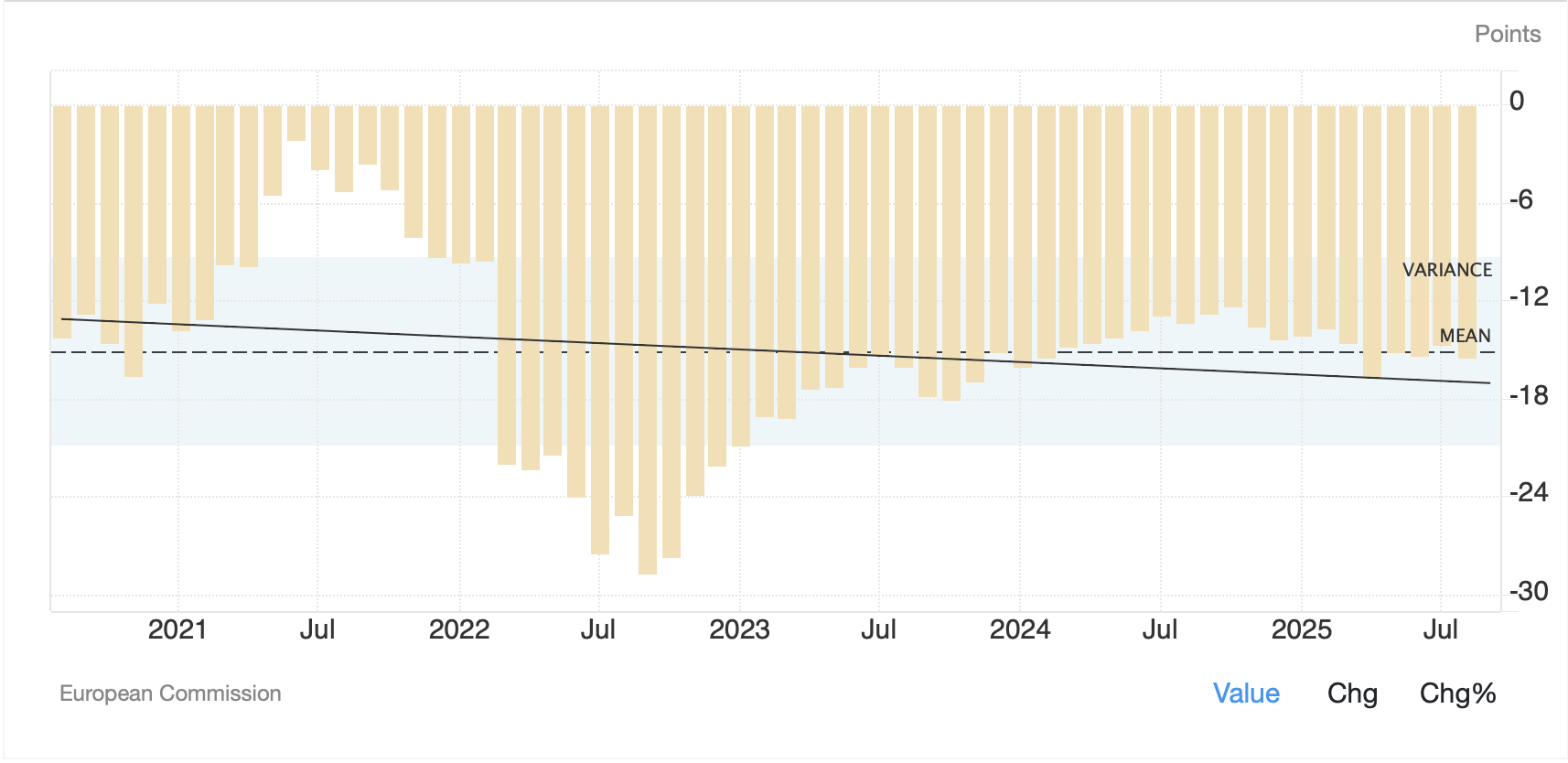
Source: tradingeconomics.com

I make these points because I continue to read about negative sentiment regarding US assets and the dollar, and yet I cannot help but look at the Eurozone and see a negative situation.  I agree that if the Fed starts to get aggressive cutting rates, which seems unlikely as long as Powell remains Chair, the dollar will fall, but is Europe really where you want to be?  I’m not convinced.

Away from that, not much else has been happening (it is the last week of August, and it appears almost everyone is on holiday) so let’s look at overnight price action.  Leading up to the Nvidia earnings, equities in the US rallied, and despite the Nvidia disappointment, futures are currently (7:15) unchanged across the board.  Last night in Asia, China (+1.8%) was the leader, reversing yesterday’s declines with the talk of the town still AI and China’s new AI Plus strategy.  Meanwhile, the Hang Seng (-0.8%) disagreed with the mainland although there was no separate news.  Tokyo (+0.7%) was solid, but elsewhere in the region there were more laggards (India, Taiwan, Philippines) than winners (Korea, Australia) with the winners just barely so.

With that Eurozone data, you will not be surprised that European shares are generally softer, with the major bourses lower by between -0.2% and -0.4% and only the CAC (+0.1%) bucking the trend.  Perhaps this is because the French FinMin, Eric Lombard, claimed France would be able to pay its bills although it seems clear the current government is going to fall when the confidence vote is held on September 8th.

In the bond market, 10-year Treasury yields are unchanged this morning and edging toward the lower end of their recent trading range, with no indication that there is a funding problem for the US.  However, it is worth noting that the yield curve is steepening in the US (and everywhere else) as the 2yr-30yr spread is now 128bps and as you can see from the chart below, that spread has been widening all since July. (30yr yields are in green and the LHS Y-axis).

Source: tradingeconomics.com

When the yield curve inverted back in 2020, there was much talk of its prowess as a prognosticator of coming recessions.  However, we are still awaiting that recession.  In fact, I believe history shows it is when the curve steepens sharply that more problems occur.  It is easy to look at this and see the market is expecting inflation to continue to rise especially given the Fed seems to have put inflation in the back seat of their mandate.  Beware!

In commodities, oil (-0.1%) is stabilizing after a solid rally yesterday as the EIA data was a somewhat larger draw on inventories than expected and perhaps Ukraine’s recent successes regarding attacks on Russian oil infrastructure has some folks concerned.  However, as my friend JJ who writes Market Vibes notes, open interest is declining fast, and activity remains very slow in the space.  At the same time, gold (+0.3%) rallied all day yesterday and is continuing this morning and dragging silver (+1.1%) along for the ride.  Spot gold is back above $3400/oz, a level that had seemed toppish for quite a while.  Perhaps this is the long-awaited break higher the gold bugs have been talking about, but I think we need to see another $100/oz to make that commitment and that likely would entail a much weaker dollar, something that has not yet been happening.

Turning to the dollar, while it is a touch softer this morning, -0.3% as per the DXY, if you look at the chart below (which resembles so many charts these days) since the post-Liberation Day volatility, it is hard to get excited about a move in either direction.  We will need a new out of the box catalyst and I just don’t know what that will be.
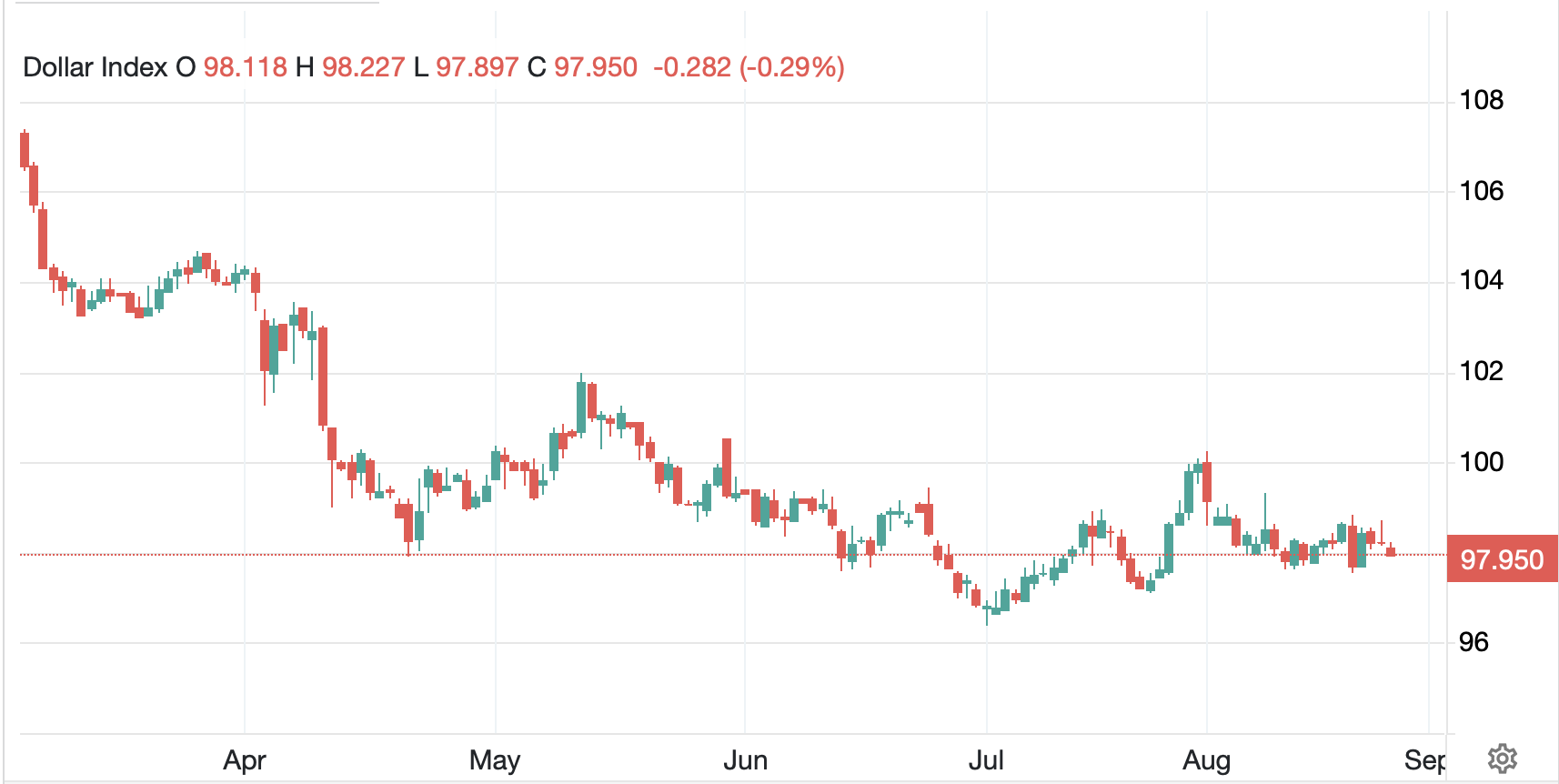
Source: tradingeconomics.com

While the dollar’s weakness this morning is universal, the biggest mover overnight was KRW (+0.6%) which rallied after BOK governor Rhee defended their intervention, even indicating it is part of the trade deal with the US.  Otherwise, 0.1% to 0.3% describes the entire slate of currency gains vs. the greenback.

We get some real data this morning as follows: Initial (exp 230K) and Continuing (1970K) Claims; Q2 GDP (3.1%); Q2 Real Consumer Spending (1.4%); and Q2 GDP Sales (6.3%), although this is the second look at all these numbers.  Tomorrow’s Personal Income and Spending as well as PCE data will be far more interesting.  We hear from Governor Waller as well, but we already know his views are to cut right away.

It is difficult to get too excited about much these days and there are valid arguments for movement in most markets in both directions (remember the idea that the goods and services economies are out of sync).  Net, until it is clear the Fed is going to cut aggressively, assuming that happens, the dollar is likely to drift.

Good luck

Adf
The Zeitgeist Could Shatter

While crime throughout DC has dropped
And Trump’s Fed demands haven’t stopped
The story today
That really holds sway
Is whether Nvidia’s topped
 
The war in Ukraine doesn’t matter
Nor does if the yield curve is flatter
‘Cause stonks must go higher
And that does require
Good news, or the zeitgeist could shatter


Some mornings things just are not that interesting in markets despite the ongoing events happening around the world.  Arguably, the biggest headlines revolve around the remarkable decline in crime in Washington DC, which while most of the mainstream media decried the President’s actions at first, has grown in popularity, even amongst his foes.  From a market perspective, the number of stories and editorials written about President Trump’s efforts to fire Fed governor Lisa Cook has risen exponentially, with many still trying to explain the Fed will lose its independence if Trump is successful.  (Given they have not been independent since 1987, I would take this with a grain of salt).  The other noteworthy story is that the EU is going to fast-track legislation to remove all tariffs throughout the EU on US industrial good imports, one of the results of the trade negotiations.

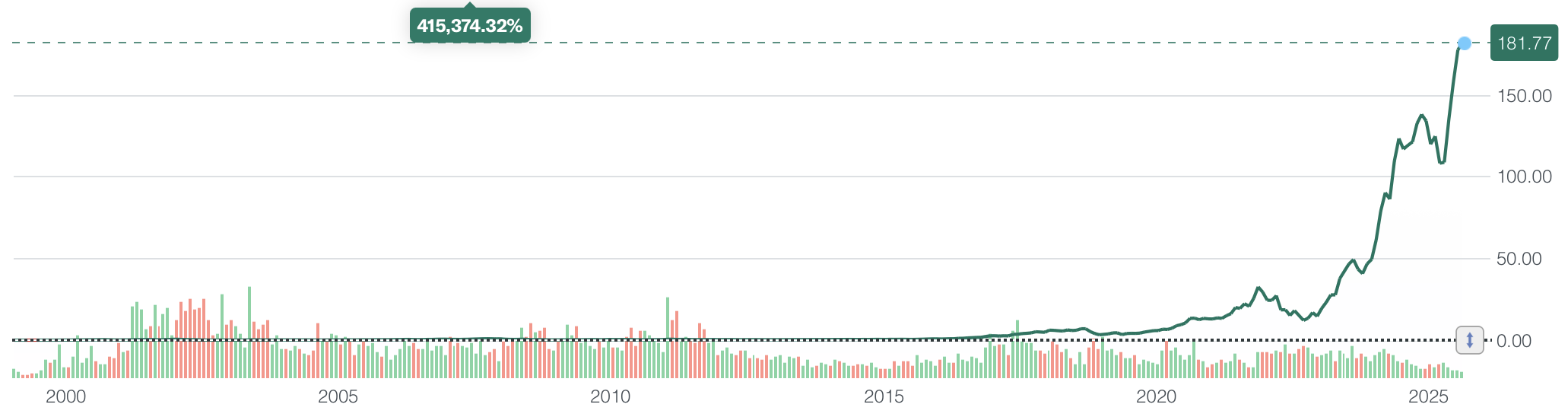
But, while those may be of passing interest, the thing in markets that really has tongues wagging is the fact that Nvidia is set to release their Q2 earnings this afternoon after the equity markets in the US close.  I must admit, thinking back to the tech bubble in 2000-01, I do not remember any single company garnering the amount of attention that Nvidia gets these days.  Perhaps Cisco Systems is the closest analogy, but it was nowhere near this level of interest and excitement.  While this is an imperfect analysis, I think it is worth looking at the charts of both Nvidia and Cisco (from finance.yahoo.com) to help you see the magnitude of the rise in each case.  It is certainly not hard to draw the conclusion that Nvidia may be peaking.  After all, if it declines by 75%, it will still have a market cap > $1 trillion!

NVDA

CSCO

I think it is reasonable to ask whether AI is a bubble.  I also think it is reasonable to ask whether the so-called hyperscalers, Meta, Microsoft, Alphabet and Amazon, are spending too much on building out their AI platforms.  This would be the case if the promised revenues never materialize.  Certainly, other than for Nvidia, those revenues are paltry at best so far.  But these are all observations from a poet who doesn’t follow the stock closely and simply cannot avoid some of the story because it is so prevalent everywhere.  FWIW, which is probably not very much, my take is that history has shown that new innovations, e.g. the automobile, electricity, the internet, can have remarkably wide-ranging implications but usually take far longer to achieve those ends than equity investors assume.  In other words, the idea that the megacap companies are overvalued seems pretty compelling.

Enough of my amateur equity analysis, and I’m sorry, but that is all that seems to be of interest today.  So, let’s look at how markets have behaved overnight ahead of the news this afternoon.  After modest afternoon rallies resulted in higher closes in the US yesterday, Japan (+0.3%) followed suit as did Australia (+0.3%), but both China (-1.5%) and Hong Kong (-1.3%) fell sharply, reversing some of their recent gains as Chinese industrial profits fell -1.7%, a worse than expected outcome, and it seemed to have triggered some profit taking.  With that in mind, I have read a number of analysts who have become of the opinion that Chinese equities are setting up for a much larger move higher based on additional stimulus as well as the fact that Chinese interest rates are the lowest in the world right now (ex-Switzerland).  Elsewhere in the region, India (-1.0%) lagged alongside China and most of the others had much less movement in either direction.

In Europe, the picture is mixed with the CAC (+0.4%) the leading gainer which looks very much like a reaction to the past two sessions’ sharp declines.  Spain (-0.4%) is lagging, although there is no particular news, and Germany (-0.15%) is also softer after the GfK Consumer Confidence report was released at a weaker than expected -23.6.  As to US futures, at this hour (7:25) they are ever so slightly higher.

In the bond market, despite all the anxiety over the Fed and Trump’s attempt to remove Governor Cook, 10-year yields are higher by 1bp after falling 3bps yesterday.  European sovereign yields are lower by -1bp across the board and JGB yields are unchanged.  In other words, while the media’s hair is on fire, clearly the market’s is not.

In the commodity space, oil (-0.1%) is little changed this morning, maintaining yesterday’s declines which appear to have been a result of Russia seeking to export more crude after Ukrainian attacks on Russian refineries have slowed output.  Gold (-0.6%) which saw a strong rally yesterday is falling back a bit, but remains in that tight range I showed yesterday, although both silver (-0.9%) and copper (-1.3%) are under more pressure this morning, likely on the back of a stronger dollar.

Speaking of the dollar, it is firmer across the board this morning, rising 0.5% vs. the euro, yen and Aussie, with slightly smaller gains vs. the other G10 currencies.  In emerging markets, ZAR (-0.85%) is the laggard, not surprisingly on the back of weaker precious metals prices, but PLN (-0.75%) is also under pressure on a combination of the weak euro and concerns over the lack of progress in the Russia/Ukraine war.  Even CNY (-0.15%) is weaker despite a renewed belief that China is going to allow the yuan to strengthen as part of any trade deal.

There is no front-line data to be released today, with only EIA oil inventories expecting a modest net draw.  Richmond Fed president Barking speaks at 12:45 but given he just explained his views yesterday, that he didn’t foresee much change in rates at all given the current state of the economy, I cannot imagine he will have changed that view.

And that’s all we have today.  I anticipate a lackluster session in all markets as traders await the Nvidia numbers later.  Of course, President Trump could surprise us all with an announcement on Russia, the Fed, or any of a number of other situations, but those are outside my ability to anticipate.  The market is still pricing an 87% chance of a September cut and an 80% chance of two cuts by December.  If the Fed gets aggressive, for whatever reason, the dollar will suffer.  But that is not yet the case, so range trading seems the best bet.

Good luck

Adf

Missiles are Flying

Apparently, nerves are on edge
Though pundits, no worries, allege
But missiles are flying
So, traders are buying
Safe havens as they start to hedge
 
So, it cannot be that surprising
The dollar and gold keep on rising
While sales are quite brisk
For assets with risk
Like stocks with investors downsizing


While some of you may be concerned over the news that Russia has launched an intercontinental ballistic missile in an its latest attack on Ukraine (as an aside, since both Russia and Ukraine are in Europe, was it really intercontinental?), by focusing on mundane aspects of life and death, you may have missed the truly important news release from yesterday afternoon, Nvidia’s guidance was disappointing and its stock price declined!  It is for situations like this that I write this morning missive, to make sure you focus on the important stuff.

All kidding aside, the knock-on effects of the escalation of the fight in Ukraine are likely to be more impactful over time, especially for Europe.  Consider the fact that most of Europe has recently been blanketed by a major winter storm with much colder than normal temperatures, and another one is forecast for the coming days.  As well, part of this weather pattern is weaker than normal wind speeds, so much of the continent is suffering a dunkelflaute again.  The energy implications are significant as both wind and solar power are virtually non-existent which means they are hugely reliant on NatGas to both keep the lights on and keep warm.  

However, Europeans continue their energy suicide and have recently closed one of the only domestic sources of NatGas to satisfy their Green tendencies.  This means they will be buying more LNG and competing more aggressively with Asia for cargoes.  While NatGas prices in the US have risen sharply in the past month, ~46%, they remain far below prices in Europe, less than one-quarter as expensive.  It is exactly this reason that an increasing number of companies in Europe are looking to relocate to areas with less expensive energy, like the US, and why investment in the US continues to outpace investment elsewhere.  Look no further than this to understand a key ingredient of the dollar’s ongoing strength.

Of course, there is another story that is dominating the press, the ongoing Trump cabinet picks and all the prognostications as to what they all mean for the future of US policies.  You literally cannot read a story without someone elsewhere in the world quoted as explaining they are awaiting the inauguration to see how things evolve and so they are postponing any new actions.  This is true for both governments and private companies (although obviously, the Biden administration is taking the opposite tack of trying to do as much as possible before the inauguration, like starting WWIII it seems).  

And that is the world this morning, anxiety over the escalation in Ukraine, disappointment that Nvidia didn’t beat the most optimistic forecast expectations and uncertainty over what President-elect Trump is going to do once he is in office.  It is with this in mind that we look at markets and see that the best performances are coming from havens and necessities.  On days like this, risk does not seem as appetizing.

Let’s start in the commodity markets this morning, where oil (+2.0%) is responding to both the Russia/Ukraine escalation and the US veto of a UN ceasefire resolution in Gaza with both of these prompting increased concerns of a short-term supply disruption.  While yesterday’s US inventory data showed some builds, for now, fear is the greater factor.  Meanwhile, NatGas (+6.3%) is skyrocketing amid forecasts for colder weather as a polar blast hits both Europe and the West Coast.  While the longer-term implications of a Trump presidency are for energy prices to stabilize or decline on the back of increased supply, that is not yet the case.  Meanwhile, gold (+0.5%) continues its rebound from its recent correction as havens are clearly in demand.  Remember, too, that almost every central bank remains in easing mode as they all convince themselves they have beaten inflation.

However, a look at equity markets shows a less resilient picture, at least from Asia where we saw the Nikkei (-0.85%) slip after that Nvidia result and the Hang Seng (-0.5%) also feel that pain.  Remember, these indices are very tech focused and Nvidia remains the tech bellwether.  While mainland Chinese shares were little changed, there was weakness in India, Taiwan, Malaysia and Indonesia, as a taste of how things behaved overnight.  Europe, though, is managing to shake off some of its concerns and most markets have edged higher, between 0.2% and 0.4% although the CAC (-0.15%) is lagging.  The latter is somewhat ironic given that French Business Confidence rose more than expected to 97, although that is merely back toward the long-term average of that series.  Arguably, the European move is on the back of US futures, which had been lower all evening but at this hour (7:30) are now all in the green by at least 0.2%.

However, under the heading havens are in demand, bond yields are backing off a bit with Treasury yields lower by -2bps and most European sovereigns lower by between -1bp and -3bps.  The tension in this market remains between recent declines in some inflation readings and growing concerns over the potential inflationary policies that President Trump will enact when he gets into office.  Nothing has changed my view that inflation is not dead and that a grind higher in yields seems the most likely outcome.

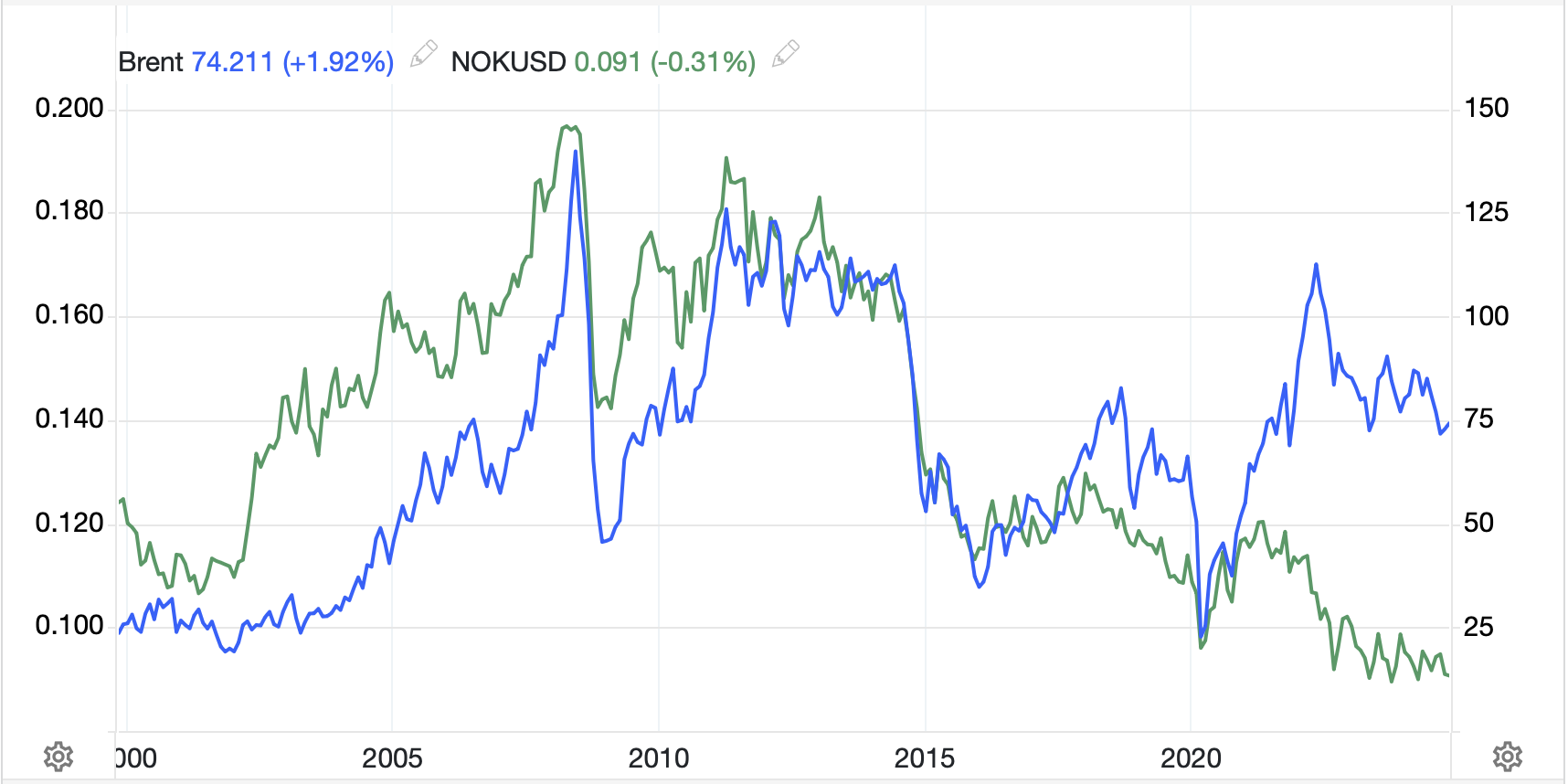
Finally, the dollar continues to find support versus almost all its counterparts, although this morning the yen (+0.5%) is demonstrating its own haven characteristics.  But broadly, the DXY is higher by 0.1% with the euro creeping ever closer to 1.0500 and the pound to 1.2600.  As well, NOK (+0.3%) is benefitting from the oil’s rise. This latter relationship, which makes perfect economic sense given the importance of oil to Norway’s economy, has been quite strong for a long time as can be seen in the chart below.  While daily wiggles may be different, the only true disruption was the start of the Ukraine war where oil jumped massively, and NOK did not follow along given its proximity to the war.  But otherwise, it’s pretty clear.

Source: tradingeconomics.com (NOKUSD is the inverse of what you typically see)

As to the emerging markets, we are seeing weakness in LATAM (BRL -0.8%, MXN -0.5%) as well as EEMEA (PLN -0.3%, CZK -0.5%, HUF -0.5%) although ZAR (+0.2%) seems to be benefitting from the ongoing rise in gold.  Asian currencies were much less impacted overnight and have not moved much at all.

On the data front, this morning brings the weekly Initial (exp 220K) and Continuing (1870K) Claims data as well as Philly Fed (8.0) and then at 10:00 Existing Home Sales (3.93M) and Leading Indicators (-0.3%).  Chicago Fed president Goolsbee speaks this afternoon, but again, it would be quite a surprise if he veers away from Powell’s comments last week.  This morning, the Fed funds futures are pricing a 55.7% probability of that December rate cut, and today’s data seems unlikely to change that.  Next week’s PCE data will be far more important.

It is interesting to see the equity market rebound but there is a huge amount of belief that Mr Trump is going to fix everything.  While I hope his policies improve the situation, and there is much to improve, it will take time before we see any truly positive impacts I believe.  I understand that markets are forward looking, but clarity remains elusive at this time.  The one thing that remains clear to me, though, is the demand for dollars is likely to continue for a while yet.

Good luck

Adf

Wasn’t Whizzbang

There once was a time in the past
When earnings reports were forecast
If companies beat
It was quite a treat
If not, CEOs were harassed
 
But that was before Jensen Huang
Described the AI bell he rang
Nvidia now
Is what defines tao
Alas, last night wasn’t whizzbang


In what cannot be that great a surprise, given the remarkable hype that continues to surround Nvidia, their earnings were great, but not great enough to exceed the outsized expectations that have become commonplace.  And while revenues and earnings more than doubled, and their profit margins are above 50%, it wasn’t enough to satisfy the underlying belief that exists.  What is that belief?  The best I can tell is that the true believers are certain Nvidia will be the only company left on earth when AI takes over, and so it’s value will equate to global economic activity, currently approximately $105 trillion, so it has much further to climb.  Perhaps the oddest result was that there were actual ‘watch parties’ for the earnings release.  It is not clear to me if that is more hype than a Jensen Huang fan asking him to sign her breast or not, but it is certainly a lot of hype.
 
And yet, the world continues to turn this morning despite the disappointment and US stock futures are actually higher after a lackluster day yesterday where all three main indices declined. As is always the case, in hindsight, the hype is revealed for just what it was, but usually the rest of our lives feel no impact.  That said, it was clearly the market driver yesterday and will almost certainly continue to have an outsized impact on things for a while yet.  But let’s move on.
 
Said Bostic, I need to see more
Results on inflation before
I’m banging the drum
For that cut to come
‘Cause I don’t know what more’s in store

Back in the macro world, we heard from Atlanta Fed president Bostic last night and he was far more circumspect of a rate cutting cycle than the market currently believes was signaled by Chairman Powell last week in Jackson Hole.  As of this morning, the market continues to price a one-third probability of a 50bp cut in September, a total of 100bps of cuts in the rest of 2024 and a total of 225bps of cuts by the end of 2025.  Meanwhile, Mr Bostic explained, “I don’t want us to be in a situation where we cut and then we have to raise rates again.  So, if I’m going to err on one side, it’s going to be waiting longer just to make sure that we don’t have that up and down.”

Now, I know I’m not a Fed funds trader, or even a fixed income trader (I’m just an FX guy) but these comments didn’t sound like he was ready to start slashing rates anytime soon.  Bostic is a voter this year, and while I’m pretty sure the Fed is going to cut next month, I remain in the 25bp camp, and I might suggest that there are still several FOMC members who see no reason to cut rates quickly.  After all, absent a serious downturn in the labor market, and given the economy continues to perform reasonably well, at least according to the data they watch, what is the rationale for a cut?  And remember, if the Fed is cutting rates quickly it means they are responding to economic difficulties.  That doesn’t seem like an outcome we want to see.

Beyond those two stories, though, once again, there is a dearth of new information on which to make decisions.  China continues to struggle and there are now more bank analysts (UBS being the latest) who are lowering their forecasts for GDP growth there to the 4.5% range, well below President Xi’s 5.0% target.  The ongoing implosion of the Chinese property market continues to weigh heavily on the economy there and, as the chart below shows, the Chinese stock market.

A graph with blue lines and numbers

Description automatically generated

Source: Bloomberg.com

Aside from the irony of a strictly communist country even having the very essence of capitalism, an equity market, I believe the incredibly poor performance in Chinese shares is an ongoing signal that not all is well in China, regardless of what official statistical data they present.  President Xi has many problems to address, and I expect he will spend far more of his time trying to smooth international trade relations than anything else for the time being.  After all, the blank paper protests that led to the end of Covid restrictions in China are evidence that Xi is still subject to some popular sentiment.  If the economy were to crater, it would become a major problem for his power, and potentially his health.

Ok, let’s run through the overnight price action.  Asian markets were a mixed bag overnight with Japan essentially unchanged while China (-0.3%) continues to lag virtually all other markets.  The Hang Seng (+0.5%) managed a rally alongside India and Singapore, but there were more laggards including Australia, Korea, Indonesia and New Zealand.  But that is not the story in Europe this morning with all markets in the green led by the CAC (+0.7%) and DAX (+0.6%) on the back of somewhat softer German state inflation data (the national number is released at 8:00am) and what appears to be modestly better than expected Eurozone sentiment indices regarding services and industry, although consumers are still a bit unhappy.

In the bond market, everyone is asleep it seems as there has been no movement of more than 1 basis point in any major market.  Given the lack of new economic inputs, this should not be a great surprise.  I suspect that this morning’s US data, and especially tomorrow’s PCE data may shake things up if there are any unusual outcomes.

In the commodity markets, oil (+0.3%) has stopped falling for now as yesterday’s EIA inventory data showed a total draw of more than 4 million barrels, the 9th drawdown in the past 10 weeks and an indication that supply is falling to meet the alleged weakening demand.  Gold (+0.6%), which started off under pressure yesterday rebounded in the afternoon and continues this morning dragging silver along for the ride.  Copper (-1.9%) however, remains under pressure on both the softening demand story and a technical trading move.

Finally, the dollar, at least the DXY, is continuing to rebound from its Tuesday lows although there is a lot of mixed activity here with some gainers (AUD +0.55%, NZD +0.5%, ZAR +0.85%, CNY +0.6%) and some laggards (EUR -0.25%) along with the CE4 showing weakness.  The big outlier is CNY, which is showing one of its largest single day gains in the past year.  This seems a bit odd given the ongoing lackluster equity market performance and the data showing that foreign investment into China has reversed course and is now divestment.  None of that speaks to a currency’s strength, but as yet, I have not found a good rationale for the renminbi’s strength.  I will keep looking.

On the data front, we finally see some things this morning starting with Initial (exp 232K) and Continuing (1870K) Claims, the second look at Q2 GDP (2.8%) and all the attendant data that comes with that release (Real Consumer Spending +2.3%, PCE +2.6%, 2.9% core).  As well, Mr Bostic as back at it this afternoon at 3:30.  

My take is given the elevated importance of the employment report, today’s data that really matters will be the Claims numbers with any substantial miss (>15k different than forecast) leading to some price action and potential concerns.  But otherwise, Bostic certainly won’ change his tune in less than 24 hours, and the current market zeitgeist appears to be that the dollar, while headed lower, is going to chop to get there.  If we do see a high Claims number, above 245K, look for the dollar to fall more sharply, retracing its overnight bounce.

Good luck

Adf

Numb

It seems that nobody is willing
To trade, ere Nvidia’s spilling
The beans on their income
So, markets remain numb
Awaiting an outcome, fulfilling


Some days it is extremely difficult to find a noteworthy story at all, and today is one of those days.  The combination of a lack of new economic data on which to build theories and models, along with most of the central banking community taking their summer vacations has left the trading and investment communities without any new catalysts for action.  Arguably, the story that will soon drive things is this afternoon’s Nvidia earnings report, but that is far outside this poet’s lane of travel.  With this in mind, it should be no surprise that market movement overnight has been quite limited.

Perhaps the most interesting story was a speech given by BOJ Deputy Governor Ryozo Himino (the Japanese don’t typically take off all of August) describing that the BOJ would continue to “normalize” policy, albeit at an indeterminate rate.  Speaking in Yamanashi prefecture, west of Tokyo, he said [emphasis added], “The bank’s basic stance on the future conduct of monetary policy is that it will examine the impact of market developments and the July rate hike and that, if it has growing confidence that its outlook for economic activity and prices will be realized, it will adjust the degree of monetary accommodation.”  You will not be surprised after a ‘powerful’ statement like that, the Nikkei managed a 0.2% rally while JGB yields edged higher by 2bps.  Perhaps the latter qualifies as a large move although the 10yr yield there remains well below 1.00%.

Otherwise, passing comments by two different ECB bankers, one a hawk (Knot saying he wants more data before deciding on a September cut) and one a dove (Centeno saying it is clear another cut is due) were the best that we had.  Perhaps that was enough to generate some excitement as the dollar has managed to rebound from the lows seen yesterday, although that is just as likely a trading bounce as a change in sentiment.

So, with this very limited amount of new information in mind, and prospects for a quiet day ahead, let’s look at what happened overnight.  While US markets did edge slightly higher yesterday, the movement was tiny, less than 0.2%.  And that type of movement was the rule of thumb in Asian markets as well with one exception, both China (-0.6%) and Hong Kong (-1.0%) continue to lag global markets as ongoing concerns over the pace of growth in the Chinese economy weigh on markets there.  I believe one of the new concerns is that Western nations (Canada being the latest) are coming together as one with respect to tariffs on Chinese goods in an effort to prevent a massive onslaught that damages their own companies.

In fairness, European shares have seen some more positive performance, notably the DAX (+0.8%), although that is due to some slightly better than expected corporate earnings releases rather than any broader macro story.  Looking across the rest of the continent, and the UK, there is a mix of gainers and laggards with nothing more than 0.2% in either direction.  Again, not much excitement here.  As to the US, futures are essentially unchanged at this hour (7:10) as all eyes are on the tape after the close when Nvidia releases its earnings.

In the bond market, yields, which backed up a few basis points yesterday, are ceding those gains this morning.  10-year Treasuries are lower by 1bp while European sovereigns are down by as much as 4bps to 5bps.  However, that is tracking what Treasuries did yesterday afternoon after the European close.  In the end, fixed income markets in the G10 remain rangebound in yield as investors continue to try to determine the timing of the widely anticipated rate cuts.  Yields have clearly declined from levels seen in the spring, but I believe for much further movement will need to see a far more aggressive rate cutting stance by central banks.

In the commodity markets, oil (-2.0%) is giving back its recent gains as supply disruption fears that were piqued by the shutdown of part of Libya’s production seem to have dissipated, or at least have been overwhelmed by the weak demand story on slowing growth in China and Europe.  At this point, it is very difficult for me to get too bullish on oil as there appears to be ample spare production capacity in OPEC to prevent disruptions and the global economic outlook is clearly fading.  Arguably of more interest is the metals markets which are under pressure this morning with gold (-0.8%) giving back some of its recent gains, although remaining above $2500/oz, while both silver (-1.8%) and copper (-3.6%) feel far more pressure on the weak economic story.  

One other potential drag on the metals markets is the dollar, which has bounced nicely from its lows yesterday.  For instance, the euro (-0.5%) is the G10 laggard although that is after testing the round number of 1.12 again yesterday.  It seems that Klaas Knot is not seen as a viable spokesman for the ECB with visions of rate cuts coming.  But we are seeing weakness in the pound (-0.25%), yen (-0.3%) and even Swiss franc (-0.2%).  In other words, it is pretty broad-based dollar strength.  In the EMG bloc, the CE4 are all substantially weaker, more than -0.5%, while KRW (-0.6%) led most APAC currencies down.  The one exception this morning is MXN (+1.0%) which is rallying nicely on the back of Banxico comments that they will maintain restrictive monetary policy for the time being.  

The data calendar has only the EIA oil inventories coming at 10:30, with more drawdowns expected, and then much later this evening, Atlanta Fed president Bostic speaks.  As trading desks remain lightly staffed given the Labor Day holiday approaching next week and given that there is important data coming after the close as well as tomorrow (Initial Claims) and Friday (PCE), today has all the hallmarks of a sleeper.

Good luck

Adf

Things Went to Hell

There once was a company, strong
Whose shares, everyone had gone long
But things went to hell
Nvidia fell
And folks wonder now, were they wrong?
 
The narrative hasn’t adjusted
Though certainly some are disgusted
AI, after all
To which they’re in thrall
Is perfect, so why’s it seem busted?


Times are tough for macro pundits and analysts, like this poet, as there is so little ongoing at the moment.  Data releases are sparse, and generally of a secondary nature and even commentary has been less active.  Truly, the summer doldrums have arrived.

With this in mind, perhaps it is a good time to consider what the broad risk asset narrative looks like these days, especially since the most recent version was exceedingly clear; Nvidia is the only company that matters in the world and its stock price should go to 10,000.  While there had been pushback on this idea, with the naysayers comparing the stock to Cisco and Qualcomm during the dot com bubble in 2000, the true believers countered with the fact that Nvidia was wildly profitable and given the race by companies all over the world to embrace AI, would continue to grow at its extraordinary recent pace.  But consider…

Back in the 1970’s, there was a group of companies described as the Nifty Fifty that represented the growth companies of the time.  And they were great companies, with most of them still around today including American Express, Coca-Cola, IBM and Walt Disney, to name just a few.  The thesis at the time was that these companies represented the future, and that if an investor didn’t own them, they were missing out.  The thing that was ignored at the time (and in truth is ignored in every bubble) is there is a difference between the company and its share price.  Overpaying for a good company can result in poor investment performance even if the underlying company continues to have magnificent results.

I mention this era as there are certainly parallels to the current mania for the Supremes (Nvidia, Apple, Microsoft) and the narrative at that time.  There is nothing inconsistent with understanding that these companies, and especially Nvidia, have created something special, but that they cannot possibly sustain their current valuations and so their share prices may fall.  And they can fall a lot.  After all, Nvidia has retraced 13% in just 3 sessions.  As much momentum as these shares have had on the way up, they can have that much and more on the way back down.  I’m not saying this is what is going to happen today, simply highlighting that trees don’t grow to the sky.  Perhaps we have now seen how tall they can grow.  

One thing I sense is that if this correction continues, it is likely to broaden out.  Perceptions are funny things, and if the zeitgeist changes, even if the companies continue to put up terrific numbers, the share prices can go a lot lower.  Consider that if the Supremes each fall 50%, they will still have market caps of $1.5 trillion and be amongst the largest companies in the world.  In fact, if they fall 50%, I’m pretty confident so would most of the rest of the market, so they would likely maintain their relative crowns of size, just at a smaller number. 

At any rate, this is an important discussion as the equity markets have been key drivers of all markets, and a change there will naturally result in some different opinions elsewhere.  Arguably, the biggest question is, if the stock market falls sharply, but the economic data don’t respond in the same way, will the Fed really cut rates?  There are many who remain firmly in the camp that the ‘Fed put’ is still intact, and they will come to the rescue.  Personally, my take is if there is a Fed put, the strike price is a lot lower, maybe S&P 3500, not S&P 5000.  Chairman Powell has enough other problems to address so that the value of the S&P is probably not job one.  In fact, it could become quite a political problem for him if the Fed is seen as rescuing Wall Street again while so many on Main Street struggle.

Ok, it’s time to look at the freshly painted wall and watch it dry overnight session.  Yesterday’s US session was unusual for its composition as the DJIA had a solid day, gaining 0.7%, while the NASDAQ suffered, falling -1.0%.  Asia, too, had an interesting session with the Nikkei (+1.0%) and Australia (+1.3%) both rallying while the Hang Seng was little changed and China (-0.5%) fell.  One possible explanation is that the tech sectors are getting unwound while money flows into less exciting areas like natural resources and manufacturing.  Of course, given there are no tech shares of which to speak in Europe, the fact that every bourse on the continent, and the UK as well, is lower, led by the DAX’s -1.0% decline, I am searching for another explanation.  At this hour (7:20) US futures are a touch firmer, 0.3%, but I don’t put much stock in this given the past several sessions.

In concert with the risk-off theme, bond markets are seeing a bid with corresponding yield declines.  Treasury yields are lower by 1bp with European sovereigns lower by between -2bps and -4bps.  There is still a great deal of anxiety, at least according to the press, about the French elections, but given the political bias of most mainstream media, which is decidedly against the idea that Marine Le Pen’s RN should win, it is possible that the actual situation is far less concerning.  The fact that the Bund-OAT spread continues to narrow at the margins tells me that there are fewer concerns than immediately following Macron’s call for the snap election.

Oil prices (-0.6%) are retracing yesterday’s modest gains as there continues to be uncertainty over the demand situation and whether economic activity is slowing offset by what appears to be a modest escalation in the Russia/Ukraine war with concerns that could impact supply.  As to the metals markets, prices there are little changed this morning after having edged higher yesterday.  My take here is that traders are keenly focused on Friday’s PCE data as an indication to whether the Fed will be cutting sooner rather than later.  The sooner the cut, the better metals prices should perform.

Finally, the dollar is almost unchanged this morning after having fallen modestly yesterday.  All eyes continue to focus on USDJPY, although it has slipped back this morning to 159.50.  Right now, my sense is there are many ‘tourists’ in the FX market trying to play for the next intervention, but as I said yesterday, I do not believe the MOF is going to be as concerned as they were in April/May given the pace of the move has been so much more modest.  For instance, last night FinMin Suzuki explained, “[the MOF] will continue to respond appropriately to excessive FX moves.  It is desirable for FX to move stably.”  Now, aside from the oxymoron of stable movement, this type of commentary is typically not indicative of any immediate concerns.  As to the rest of the G10, modest gains and losses define the day although we have seen both MXN (-0.65%) and ZAR (-0.4%) slide this morning, although given the amount of money involved in the carry trade for both these currencies, this is likely just positions adjusting rather than a fundamental change.

This morning brings more tertiary data with the Chicago Fed National Activity Index (exp -0.4), Case Shiller Home Prices (6.9%) and Consumer Confidence (100).  We also hear from two speakers, Governors Cook and Bowman.  Perhaps the most interesting thing yesterday was that SF Fed President Daly specifically touched on Unemployment in her comments, explaining that though there was still insufficient confidence that inflation was declining to target, she was paying close attention to the Unemployment rate, “so far, the labor market has adjusted slowly, and the unemployment rate has only edged up. But we are getting nearer to a point where that benign outcome could be less likely.”  I have a feeling that the employment report a week from Friday is going to have a lot more riding on it than in the recent past.  Any weakness there could really change the tone of the market regarding the economy and the Fed’s actions.

It is difficult to get too excited about today although if the recent correction in Nvidia continues and widens to some other names (a distinct possibility) do not be surprised if there are some fireworks later on.  In that case, I would look for a traditional risk-off session with the dollar higher while bond yields and stocks fall.

Good luck

Adf

Just Swell!

The markets were truly surprised
As yesterday’s Minutes advised
That higher for longer
Intent was much stronger
Than prior belief emphasized
 
The market response was to sell
Risk assets and thus, prices fell
But after the close
Nvidia rose
And now everything is just swell!


It turns out that Chairman Powell’s press conference had a distinctly more dovish feel to it than the tone of the FOMC meeting at the beginning of the month.  At least that appears to be the situation based on the Minutes of the meeting that were released yesterday afternoon.  In truth, it is somewhat surprising that given all the comments we have heard by virtually every member of the FOMC in the intervening three weeks, a reading of the Minutes resulted in altered opinions of how policy would evolve going forward.

While every Fed speaker has maintained the view that higher for longer remains the baseline, at the press conference, Powell essentially ruled out further rate hikes.  But in the Minutes, it turns out “various” members indicated a willingness to raise rates if necessary.  In addition, “a few” members would have supported continuing the QT process at the previous $60 billion/month runoff rather than adjusting it lower.  Finally, “many” questioned just how restrictive current monetary policy actually is, and whether it is sufficient to drive inflation back to their target.  Net, it appears there was quite a lively discussion in the room and the hawks are not willing to be ignored.

With this more hawkish stance now more widely understood, it cannot be surprising that risk assets sold off yesterday afternoon.  While I grant that the equity declines were modest, between -0.2% and -0.5% in the US, the tone of conversation clearly changed.  Meanwhile, the real damage occurred in the commodity markets where the recent sharp rise in metals prices ran into a proverbial buzzsaw and all of them fell sharply.  For instance, gold fell -1.5% yesterday and is lower by another -0.7% this morning.  Silver was a bit more volatile, losing -3.0% yesterday and down a further -1.25% today and the king of this move was copper, which tumbled more than -4% yesterday although it seems to be basing for now.

While there are several pundits who are describing these commodity price moves as a reaction to the dollar’s rebound, I actually see it more as a response to the idea that the Fed may be willing to fight inflation more aggressively than previously thought.  Remember, a key to the metals markets’ rally is the idea that the Fed is going to allow inflation to run hotter than target going forward, with 3% as the new 2%, and the widely mooted rate cuts would simply hasten that outcome.  In that scenario, ‘real’ stuff will retain its value better than paper assets and metals are as real as it gets.  However, if the Fed is truly going to stay the course and is willing to raise rates further to achieve their 2% goal, that is a very different stance which will support the dollar and paper assets far better.

Of course, none of this really mattered because the most important news yesterday was after the equity market close when Nvidia reported even stronger than expected results and also split their stock 10:1.  And, so, all is now right in the universe because…AI!  

Alas, this poet is not an equity analyst and has no useful opinion on the merits of the current valuations of AI stocks, so I will continue to focus on the macroeconomic story and try to interpret how things may evolve going forward.

Keeping in mind that the Fed may well be more hawkish than previously thought, that is quite a change in mindset compared to most other central banks where rate cuts appear far more likely as the summer progresses.  For instance, yesterday Madame Lagarde explained, “I’m really confident that we have inflation under control. The forecast that we have for next year and the year after that is really getting very, very close to target, if not at target. So, I am confident that we’ve gone to a control phase.”  This is her rationale for essentially promising, once again, that the ECB will cut rates next month.  However, we continue to get pushback from the ECB hawks that a June cut does not mean a July cut or any other cuts afterwards.  Now, I am inclined to believe that while they may skip July, they will cut again in September and probably consistently after that.

Of course, this is a very different stance than what was indicated by the FOMC Minutes, and I expect that there should be a greater divergence between European and US markets going forward because of this.  In fact, I am quite surprised that the FX market has not taken this to heart and that the euro remains as well bid as it is.  While the single currency has slipped about 2% since the beginning of the year, it is higher this morning by 0.2% and well above the lows seen back in mid-April.  Today’s price action has been driven by slightly better than expected Flash PMI data, but the big picture strikes me that there is more room for the euro to fall than rise.

And really, isn’t that the entire discussion overall, relative policy stances by the main central banks?  I continue to see that as the key driving force in markets at this time, and the macro data helps inform what those stances are likely to be.  If the US growth story is accelerating vs. other G7 countries, then we should expect to see continued outperformance by US assets and the dollar.  However, if the rest of the G7 is catching up, perhaps those tables will turn.  While PMI data has not been a particularly good indicator lately, the fact that European data (and Japanese data overnight) were slightly better than forecast may be an indication that things are changing.  Later this morning we will see the US version (exp 50.0 Manufacturing, 51.3 Services, 51.1 Composite) so it will be interesting to see if the market responds to any surprises there.

As to the rest of the overnight session, markets in Asia were mixed with more gainers (Japan, India, South Korea, Taiwan) than laggards (China, Hong Kong, Australia) with the gainers generally benefitting from somewhat better than expected PMI data and the laggards the opposite.  European bourses are mostly higher on the back of that better data as well.  As to US futures, at this hour (7:30) Nvidia has pulled the entire complex higher with the NASDAQ (+1.1%) leading the way.

In the bond markets, most major countries have seen essentially zero movement this morning with the UK (-3bps) the one exception as the PMI data there was a touch softer than expected.  Of course, you may recall that yields rose sharply in the UK yesterday after the hotter than expected CPI data, so this is a bit of a give-back.  JGB yields, interestingly, slipped back 1bp and are now back below 1.00% despite a modestly better than expected PMI reading.

Oil prices (+0.7%) are bouncing slightly after a string of down days and despite slightly larger than expected inventory builds in the US.  But for now, it seems clear there is ample supply.  And, of course, we already discussed the metals markets.

Finally, the dollar is a touch softer overall this morning with most of the movement as you might expect.  For instance, NOK (+0.7%) is rallying alongside oil and adding to the dollar’s broad weakness.  However, ZAR (-0.5%) remains beholden to the metals complex and is still under pressure.  Of minor note is the fact that the CNY fixing last night at 7.1098 was the weakest renminbi fix since January and some are claiming this is a harbinger of the PBOC relaxing its control of the currency.  While that may be true, I suspect it will be extremely gradual.  And the yen continues to tend weaker, not stronger, as the interest rate differential is too wide for traders and investors to ignore.  As well, it is fair to ask if Japan is really concerned about the level of the yen, or if they truly are only concerned with a slow and steady movement.  

Before the PMI data, we see Initial (exp 220K) and Continuing (1799K) Claims and the Chicago Fed National Activity Index (0.16).  Then, at 10:00 we see New Home Sales (680K) which are following yesterday’s much softer than expected Existing Home Sales data.  It seems clear that there is an ongoing problem in the housing market.  Finally, this afternoon, Atlanta Fed president Rafael Bostic speaks, and it will be quite interesting to hear his views now in the wake of the Minutes.

While actions speak louder than words, yesterday’s FOMC Minutes certainly have given me pause regarding my view that they were going to ease policy more quickly than inflation data may warrant.  That should help support the dollar and keep pressure on risk assets.  Of course, given the ongoing euphoria over AI and the Nvidia earnings, I don’t expect equity traders to care much about that at all.

Good luck

Adf

What’s the Rush?

Said Waller, my god “what’s the rush?”
‘Cause things are OK at first blush
The ‘conomy’s roaring
The stock market’s soaring
And so, dreams of cuts, I must crush

But really, does anyone care
What Powell or Waller declare?
NVIDIA rallied
And gains have been tallied
So, rate cuts don’t have savoir faire

I am old enough to remember when the inherent strength of the US economy was based on its diversity of industry and geography as well as its bounty of abundant natural resources.  The governmental framework of property rights and the rule of law were critical aspects of what made this nation stand out.  But that is sooooo last week.  Instead, let me recount a famous scene from the movie, The Graduate, but updated for today:

Mr McGuire: I just want to say one word to you.  Just one word.
Benjamin: Yes, sir.
Mr McGuire: Are you listening?
Benjamin: Yes, I am.
Mr McGuire: Plastics NVIDIA

At this point, I might refute the idea of the Magnificent 7 stocks, first because Tesla hasn’t been following the script all year, but second because the reality is there is only one true god stock, NVIDIA.  It appears that the entire nation’s economy is reliant on that single company continuing to outperform analyst expectations and grow at 100% annually.  As long as it continues, the US will maintain its status as the world’s most important economy.  Seems pretty simple.  In fact, it is not clear to me why anyone would own any other stock than NVIDIA at this point, perhaps with a small percentage of assets in Bitcoin.  Only then will an investor be ready for the future!

Of course, this is not what I believe, nor would I ever suggest that someone consider this approach.  But, boy, if there is another piece of news that is remotely as important, I am still searching for it.  Every market seems to take its cues from the stock and government policies seem to be designed to either support its growth or inhibit its products from getting into the wrong hands.  Perhaps it is time to rename our nation to The United States of NVIDIA and be done with it.

Alas for this poet, equity markets are not my primary focus so I will try to look through the other scraps of information and see if there is anything interesting.  Top of the list were the assorted commentaries by four different Fed speakers yesterday, all of whom said essentially the same thing, while they expect rate cuts at some point this year, it is still too early as they are not yet confident that inflation will sustainably return to their 2% target.  That was the message from Wednesday’s FOMC Minutes, that was the message from Powell at the press conference and that has been the consistent message since the last meeting.

Happily, it appears that the markets are starting to understand this idea as a look at the Fed funds futures market shows the probabilities of rate cuts continues to decline, now 2.5% in March, 21% in May and just 66% in June.  In fact, for the full year, the market is now pricing just 85bps total, not much more than the last dot plot’s median outcome showed.

From my perspective, I remain uncertain as to why they are even considering cutting interest rates.  After all, GDP continues to power along, financial conditions continue to ease with a rising equity market, and inflation has many earmarks of remaining sticky.  Absent a collapse in the commercial real estate market that drags down a number of banks, or some other true black swan type event, it appears that the need to cut rates in the US is limited at best.  Do not be surprised to see the dot plot in March show just 2 rate cuts as the median end-2024 outcome as the hawks will have to reevaluate their stance given the economy’s strength since December.  And as I have said before, if inflation really does start to tick higher again, a rate hike seems possible, which is clearly not on very many bingo cards right now.

But really, the Fed discussion pales in comparison to the NVIDIA discussion and the impact on equity markets in general.  Since there has been very little other data even released, let’s recap the overnight session and head into the weekend.

After the massive rally in the US yesterday, with all 3 major indices setting new all-time highs, most markets in Asia were unable to follow through in any real manner, with very modest gains everywhere that was open (Japan was closed for a holiday).  In Europe, the picture is mixed with some gainers (CAC +0.6%), some losers (IBEX -0.5%) and some nothings (FTSE 100 and DAX unchanged). As there was limited data to drive things and the ECB speakers are trying to hew the line that they, too, will remain patient, nothing has changed there of late.  I continue to believe that the ECB will cut before the Fed because the Eurozone economy is in much worse shape than the US economy.  As to US futures, at this hour (7:30) they are basically unchanged.

In the bond market, after yields rising yesterday afternoon by some 6bps, Treasuries are unchanged this morning.  There are growing concerns that the supply question is going to begin to impact yields in the US, with more than $500 billion of new coupon issuance due over the rest of the year.  It is possible yields will need to rise to find buyers for all that.  As to Europe, yields there are higher by 3bps or so this morning as they missed most of the US move.

Commodity markets are under some pressure this morning with oil (-1.7%) giving up any recent strength and now lower on the week.  However, I believe it remains rangebound and need to see compelling evidence of something changing to see a real move here.  In the metals markets, gold, which slid a bit yesterday is edging higher this morning but both copper and aluminum are under pressure on demand concerns.

Finally, the dollar, which did recover yesterday to finish roughly flat on the session, is beginning to soften a bit as NY is walking in after an extremely quiet overnight session.  But overall, the movement here remains marginal with most currencies, both G10 and EMG, remaining within a +/-0.25% range from yesterday.  With monetary policies around the world seemingly on hold for now, it is unrealistic to look for large moves in the FX market.  We will need to see a change in central bank tunes to make this happen.  (either that or Jensen Huang, NVIDIA’s CEO, will need to explain that the dollar needs to move in one direction or another to boost earnings!)

There is no US data to be released and there are no Fed speakers on the calendar either.  With that in mind, equity markets are going to be the driver of note.  If the rally continues, and risk is embraced, I suspect the dollar can slide a bit further.  However, if there is any late week profit-taking, perhaps the dollar finds a bid.

Good luck and good weekend
Adf

Bears’ Great Dismay

Their confidence clearly was lacking
So, now on rate cuts they’re backtracking
As well, they’re concerned
Some banks have not learned
To manage their risk and need smacking
 
But really the news of the day
Is AI remains the key play
NVIDIA beat
And all of Wall Street
Is buying to bears’ great dismay
 
Starting with the FOMC Minutes, the two things that stood out to me were these two lines, “The staff provided an update on its assessment of the stability of the U.S. financial system and, on balance, characterized the system’s financial vulnerabilities as notable. The staff judged that asset valuation pressures remained notable, as valuations across a range of markets appeared high relative to fundamentals.”  Arguably, this was why the Fed removed the line from the statement about “The U.S. banking system is sound and resilient,” which had been included since the Silicon Valley Bank debacle.  Perhaps they see something amiss.  As well, there was discussion regarding the timing of the end of QT with July seeming to be the latest thinking for its initial reduction.  But otherwise, as evidenced by the fact that virtually every Fed speaker has indicated they lack confidence inflation is dead, and that while policy is currently restrictive, it is still too soon to think about cutting rates, was clearly the broad theme of the meeting.  Next week we see the PCE data so perhaps that can change some opinions, but right now, given what we have just seen from CPI/PPI, they cannot have gained confidence it is time to cut.
 
As to NVIDIA, huge results, beating expectations and the word from the CEO is that demand will outstrip supply at least through the end of the year.  The market response here has been as one would expect; a big rally in stocks, especially tech.  ‘Nuff said.
 
Nikkei all-time high
Thirty-four years in waiting
Has finally come

Under the heading a picture is worth 1000 words, behold the relationship between NVIDIA and Nikkei 225 (chart from Weston Nakamura’s Across the Spread substack):

Pretty tight correlation, no?  Arguably, the question is which is driving which?  Does a stronger Nikkei drive NVIDIA’s performance or the other way around?  The first thing to note is that breaking down the Nikkei’s performance, similar to the NASDAQ, there are a handful of AI related stocks that have been the drivers of the move.  If you read Nakamura-san’s take, he believes that it is the Nikkei which is driving things, but I would argue while the Nikkei’s move happens earlier in the global day, the reality is that everything is an echo of the current AI craze which NVIDIA started.  

The next question is, just how long can this continue?  Remember two things here; first, trees don’t grow to the sky, and neither will NVIDIA’s stock; and second, new technologies take MUCH longer to assimilate than the initial hype would have you believe.  We are already seeing issues with Google’s Gemini AI with respect to drawing remotely accurate historical images of US presidents, as an example.  We are still in the very early innings of the AI phenomenon and there will be more hiccups along the way.  One last thing regarding AI is its power consumption, which is off the charts high.  If the world is going to be run by AI, we need a lot more electricity than is currently being produced and that alone will slow its incorporation into things.

Ok, on to more macro views, last night and this morning saw the release of the Flash PMI data all around the world.  Of the seven major releases thus far, only India is in expansion with it continuing to motor along in the low 60’s.  Otherwise, everything else (Australia, Japan, Germany, France, the Eurozone and the UK) are all in contraction in manufacturing.  Services is more mixed with several slightly above the 50 boom/bust line, but overall, while things might be seen as slightly improving, they are still pointing to recessions in Europe, Japan and the UK.

Despite this weakening data, virtually every one of these nations’ currencies is stronger vs. the dollar this morning.  In fact, the dollar is having a pretty rough session, down between 0.3% and 0.5% against most G10 counterparts with a slightly smaller decline vs. its EMG counterparts.  One of the odd things about this is that US yields have not really fallen much (Treasuries -1bp) which is right in line with the price action in European sovereigns and what we saw overnight in Asia across the board.

Add to the bond story the message from the Fed of higher for longer and it doesn’t appear that interest rates are today’s driver of the markets.  We already have seen that equity markets are rocking with the Nikkei (+2.2%), Hang Seng (+1.5%), CSI 300 (+0.9%), and most of Europe higher by 0.9% or more.  US futures, of course, are really flying with the NASDAQ (+2.2%) leading the way, but everything in the green.  I grant that a typical risk-on reaction is a weaker dollar but given the amount of funds that are flowing into the US equity markets, it is very hard to understand why the dollar is under pressure.  Something seems amiss.

If we look at the commodity markets, energy is softer across the board with oil (-0.2%) edging lower and basically unchanged on the week, while NatGas (-2.7%) is suffering as well.  As to the metals markets, gold (+0.2%) is edging higher on the back of the weaker dollar but both copper and aluminum are little changed on the day, less than 0.1% different from yesterday’s closing levels.  

Perhaps this is the new risk-on look, strong equity markets, a weak dollar and nobody cares about bonds.  But bonds have been far too important a driver of market activity to suddenly be ignored.  Now, yesterday, the Treasury auctioned some 20-year bonds and it did not go well, with a tail of 3.3bps, implying demand for the long-end remains tepid.  Given my personal view on inflation, that makes perfect sense, but arguably, the longest duration assets around are tech stocks and the divergence between bonds and those stocks is hard to reconcile.  I guess we will learn more as time progresses, but for now, I would be at least a little wary.  Absent a change in the inflation narrative back to the Fed has won, it does feel like there is still some risk to be seen.

On the data front, this morning brings the Chicago Fed National Activity Index (exp -0.15) which is a comprehensive view of financial conditions around the country and closely followed by the Fed.  As well we get Initial (218K) and Continuing (1885K) Claims and the Flash PMI’s (50.5 Manufacturing, 52.0 Services).  We close with Existing Home Sales (3.97M) and the oil inventory data and throughout the day we hear from four different Fed speakers, Jefferson, Harker, Cook and Kashkari.  Will any of this data matter?  I doubt it.  Can we expect anything new from the Fed speakers?  I kind of doubt that as well as there has been exactly zero evidence that the economy is slowing and dragging inflation lower since last week’s CPI and PPI data.   So, look for that lack of confidence in the demise of inflation to be widespread.

As to the dollar, something doesn’t smell right today.  I feel like it should be better bid and expect that by the end of the day, it will see that type of movement.

Good luck

Adf

The NASDAQ in Tatters

The only thing that really matters
Is whether NVIDIA shatters
It’s forecasted earnings
And market bulls’ yearnings
Else watch for the NASDAQ in tatters
 
Of lesser importance we see
The thoughts from the FOMC
Since last they all met
Stock bulls have beset
The rate hawks with obvious glee


While I know this is a macro focused discussion, and that is what this poet understands best, unquestionably, the biggest market news for the day, for all markets, is the NVIDIA earnings release after the close this afternoon.  There has been more press about this particular number, and more commentary on Fintwit (FinX?) than any other single stock earnings number I can remember.  And let me be clear, I have no idea what is forecast, let alone what the whisper number is, nor do I really care.  But I am definitely in the minority.  My take is that there are many analysts who will consider adjusting their big picture view of the economy and markets based on one company’s earnings.  This might be a sign that things are somewhat unhinged in markets.  

Before then, absent any hard statistical data, we will see the FOMC Minutes from the January 31st meeting.  You may remember that as the one where Chairman Powell flopped back to hawkish after he flipped to a dovish pivot in December.  Since then, there has been a pretty steady drumbeat from all the FOMC members that they are still not confident they have beaten inflation and so want to wait further before they cut rates.  And it’s a good thing they have had that view as last week we all saw that inflation was not cooling quite like the doves had expected.  In fact, they look pretty smart right now because of their reluctance to join the rate cutting mania.

A review of the Fed funds futures this morning shows that the probability for a March cut has fallen to just 6.5% while May is down to a 37.3% probability.  As a demonstration of just how much things have changed in the past month, in the middle of January, March was priced for a 46% probability and May for an 85% probability of the first cut in the cycle.  As well, we have seen the number of cuts priced for the full year fall from 6 down to just under 4, not far from the dot plot guidance we received back in December.  So far, the Fed has been successful in getting its message across despite a great deal of wailing and gnashing of teeth that if they didn’t cut soon, the world would end.

This begs the question, why is everybody so keen to see the Fed cut rates at all?  Consider the issue from the perspective of the saver and retiree.  Things are much better when one’s money market account yields 5% than 0% so I expect that most retirees are pretty happy at the current state of affairs.  From the equity market’s perspective, the very fact that we have set 11 new S&P 500 all-time highs so far in 2024 indicates that the current level of interest rates is not that big a problem broadly speaking.  Yes, there are segments of the market that have underperformed but that is always the case.  

On the flipside, of course, Janet Yellen would like to see rates decline as it would cut her interest rate bill, and certainly all those commercial property holders with mortgages coming due this year, a number that has grown to ~$960 billion I understand, are desperate for lower rates, but that is a pretty small subset of the country.  All I’m saying is that if the current rate structure is benefitting savers and also putting downward pressure on the rate of inflation, it’s just not clear why so many are desperate for a change.  And what if, just for argument’s sake, PCE is hot as is the February CPI print which comes ahead of the next FOMC meeting?  Rate hikes are going to start to get discussed a lot more frequently.

One other thing to keep in mind is that the US economy is currently the only major one that is showing any real life.  Europe, the UK and Japan are all in recession and China’s growth is effectively stagnating.  Other nations are desperate to cut interest rates to help support their economies but are unwilling to do so for fear that their currencies will fall further and invite even more inflation (China excluded) onto their shores.  So, they really want the Fed to cut so they can follow along without the concomitant problem of a falling currency.  But is the Fed responsible for the problems in Europe or Japan?  I think not.

At any rate, we will not solve this dilemma today, and all we can do is observe how things play out over the coming weeks and months.  FWIW, which is probably not a huge amount, I have seen precious little evidence that inflation is going to collapse, and rather expect it to stay here or edge higher.  In that case, I think the Fed may maintain their current rates for far longer than even June.  Absent a banking crisis, perhaps started by more trouble in the commercial real estate sector, my view remains, at most, one token cut this year.  Of course, if we do see that banking crisis, then 300bps will be the minimum.

Ok, overnight, most markets remain in thrall to the NVIDIA earnings story with one exception, China, where the regulators there tightened things even further instituting a new rule that there can be no net selling by institutional accounts in the first 30 minutes of trading or the last 30 minutes of trading.  This was in response to an algorithmic hedge fund selling a huge chunk of shares Tuesday ($350mm) in just a one-minute window and pressuring the whole market lower.  Apparently, they have been fined and prevented from trading for the rest of the week.  The idea behind the rule seems to be that if there can be no net selling in the last 30 minutes, the Chinese plunge protection team can work its magic unimpeded and push things higher on command.  I continue to wonder why the Chinese Communist Party is so keen to support the very essence of capitalism, but there you have it.  

With this in mind, you will not be surprised to know that the CSI 300 rallied 1.4% and the Hang Seng 1.6% overnight.  But the rest of Asia was less positive with most markets following the US lead lower.  Europe, though, except for the UK’s -0.85% performance, is higher on the day despite an absence of any major data or news.  The scuttlebutt is that there is a positive vibe for NVIDIA earnings.  Seriously!  As to the US futures, at this hour (7:45), they are continuing yesterday’s decline with the NASDAQ leading the way lower by -0.65%.

In the bond market, Treasury yields are softer by 1bp this morning while most European yields are higher by 1bp, so in other words, not much movement overall.  Asia saw a similar lack of movement as traders are awaiting the Minutes, NVIDIA and the uptick in Fedspeak tomorrow.

Oil prices (-0.4%) are a bit lower this morning but are just giving up yesterday’s small gains.  In fact, they are essentially unchanged so far in February as concerns over weakening global growth have been offset by concerns over an uptick in the middle east anxiety.  Speaking of energy, what I haven’t mentioned is NatGas, which while higher today by 10%, given it has fallen to $1.75/MMBtu, the move is not that impressive.  Warmer than expected weather has really undermined the price action lately.  In the metals markets, gold (+0.3%) continues to creep higher and today copper (+0.3%) is following suit.  As to aluminum, it is much higher, +2.4%, as concerns over fresh US sanctions on Russian aluminum have raised the risk of overall market disruption.

Finally, the dollar is little changed against most of its counterparts, G10 and EMG.  The biggest mover I see is ZAR (+0.4%) after core CPI ticked higher than expected and raised thoughts of tighter monetary policy there.  In the G10, NZD (+0.25%) is also responding to a higher-than-expected PPI print bringing a rate hike more sharply into focus there.  Otherwise, nada.

Aside from the Minutes, there is nothing else of note on the data calendar.  We do hear from Atlanta’s Raphael Bostic and Governor Michelle Bowman today, but I don’t expect either to waver from the current lack of confidence story.  It feels like it is going to be a quiet session overall, with the real fireworks reserved for 4:15 or so when NVIDIA reports.

Good luck

Adf