Is That the Fear?

Regarding the payroll report
The fear is jobs coming up short
But is that the fear?
Or will traders cheer
As 50bps they will exhort
 
With clarity at the Fed lacking
Because of Ms Cook’s recent sacking
And markets at highs
It seems to be wise
To hedge some exposure you’re tracking


Another month, another payroll day.  It certainly seems that the market has not lost any of its appetite for this particular data point, although one must be impressed with the ongoing rally to continuous record highs in share prices.  So, as we get started, let’s look at what expectations are for this morning’s numbers:

Nonfarm Payrolls75K
Private Payrolls75K
Manufacturing Payrolls-5K
Unemployment Rate4.3%
Average Hourly Earnings0.3% (3.7% Y/Y)
Average Weekly Hours34.3
Participation Rate62.1%

Source: tradingeconomics.com

Yesterday’s ADP Employment number was a bit softer than forecast at 54K with a very slight revision higher to the previous month’s reading.  And of course, poor Ms McEntarfer was fired last month after the massive downward revisions to the previous data so as much scrutiny as this number ordinarily receives, it feels like even that has been turned up to 11 this month.  If we look at the Initial Claims data for a signal, (or the 4-week average which removes situations where individual states are late to report) it is hard to get excited about a major problem in the labor market as per the below chart from tradingeconomics.com.
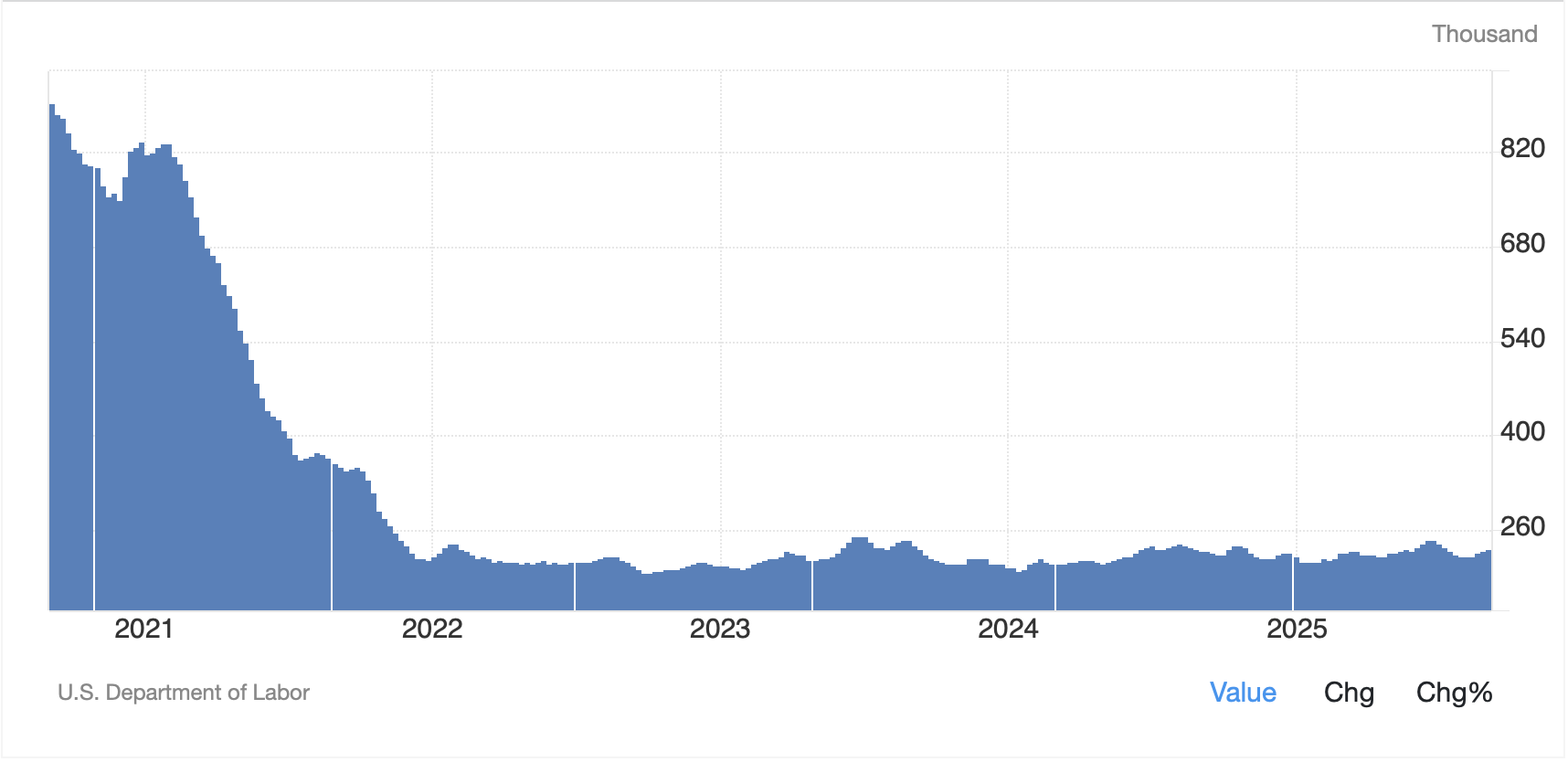
It has pretty much flatlined since the end of the Covid aberration.  Even more impressively, the number is low by much longer-term historical standards when the absolute population was smaller, yet Claims data were typically somewhat higher.  (I capped the Covid situation so you could get a flavor for the rest of the series).  It is hard to look at the last 58 years and describe Initial Claims as pointing to a problem.  While I didn’t shade the chart, you can see the recessions in 1970, 1973, 1980, 1982, 1990, 2001, 2008-9 as the periods when Claims peaked.  Again, it is difficult to look at this data and conclude a recession is around the corner, at least the traditional definition of one.
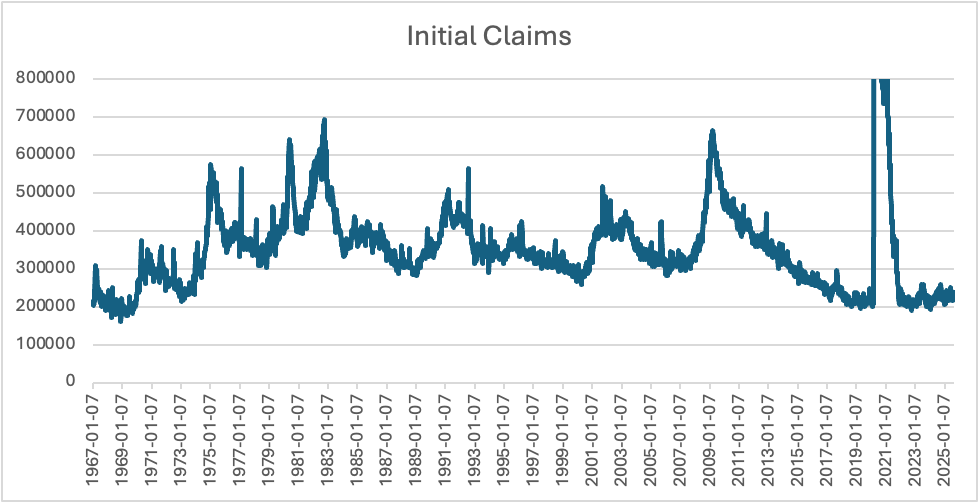
Source: FRED database

Of course, there is a very different vibe these days regarding employment as evidenced by the discussions you see on LinkedIn or even the stories in the WSJ regarding the unwillingness of people to leave a job as they fear finding a new one.

All this is just my way of saying that the asynchronous nature of the economy means we really don’t know what to expect.  But we can anticipate market reactions depending on the outcome.  FWIW, and remember, I am just a poet:

NFPBondsFed funds futuresStocksDollarGold
>75K4.30%20bps-1%0.50%-1%
35K – 75K4.15%25bps0%0%0%
0K – 35K4.10%35bps1%-0.5%0.20%
<0K3.95%50bps-1%-1.50%1.50%

So, there you have it, one man’s guesses as to how the markets will respond depending on the data.  In essence, it seems to me that the market has been anticipating enough support to cut rates to protect the economy without assuming the economy is going to crash.  That’s why a negative number will be such a problem because that will force a reevaluation of the economic situation and stocks cannot abide a repricing of that risk given the rich valuations. It will demonstrate that the Fed is behind the curve, at least in traders’ minds, and the result will not be pretty.  We shall see.

In the meantime, after yesterday’s rally in the US, equity markets around the world are all in the green this morning despite some mediocre data from Europe.  But starting with Asia, Japan (+1.0%) had a nice session although China (+2.2%) and Hong Kong (+1.4%) put it to shame.  While Japan benefitted from a reduction to 15% on automobile tariffs vs. Japanese cars, Chinese shares jumped on word from the PBOC that they would inject CNY1 trillion into the system and reduced fears of efforts to hold back the rally.  Elsewhere in the region, other than India, which was unchanged on the day, everything else was nicely higher following the main exchanges’ leads.  As to Europe, while all the bourses are higher, the gains are de minimis, on the order of 0.1% or so, with traders caught between hopes of a US rally and ongoing meh data at home.

In the bond markets, Treasury yields are down to 4.15%, lower by -1bp today, but as you can see from the chart below, down 15bps this week as anticipation of either soft data or 50bps, I’m not sure which, builds.
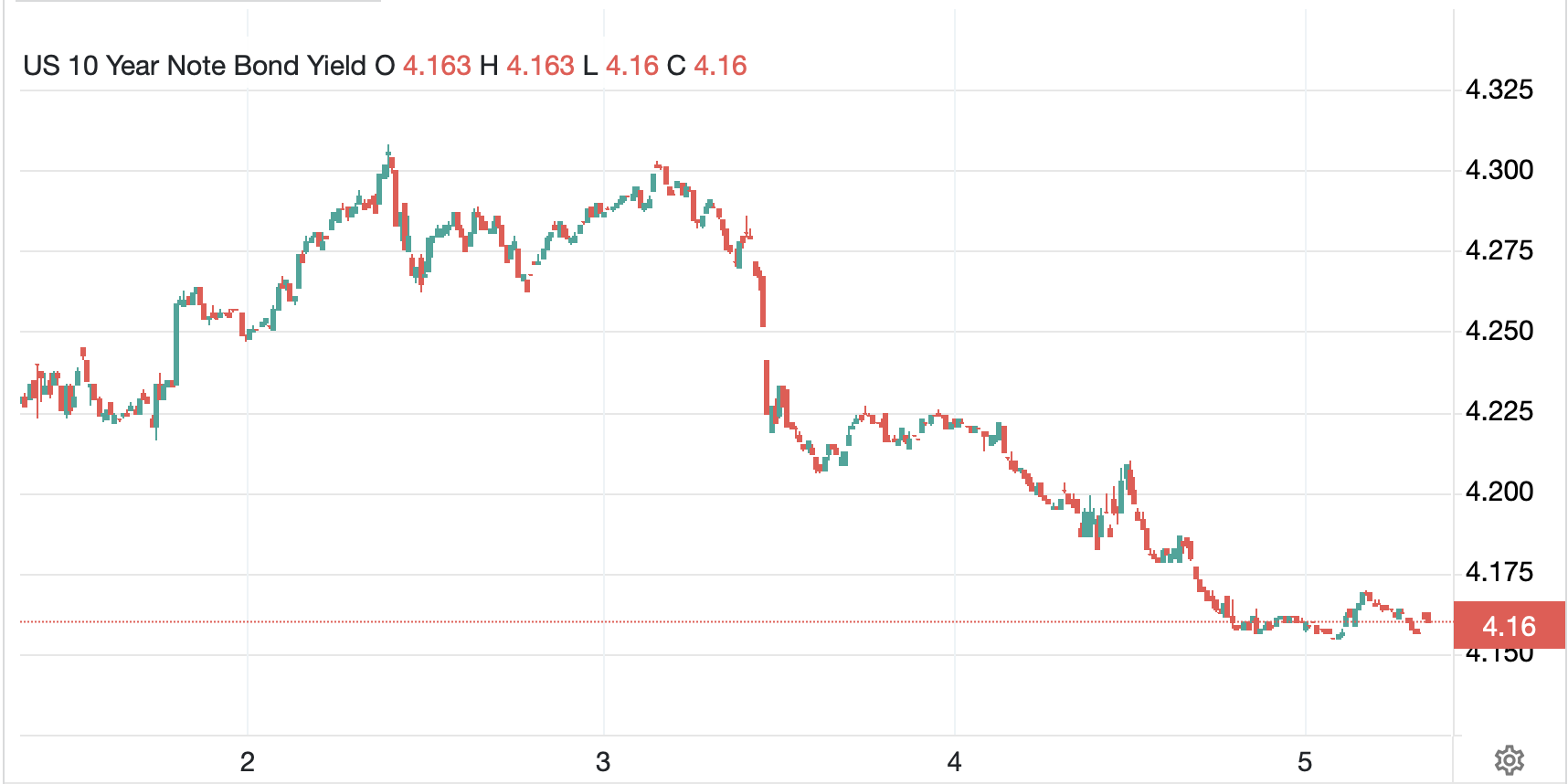
Source: tradingeconomics.com

In Europe, sovereign yields are all lower by -2bps this morning and we saw the same price behavior overnight in Asia with JGB’s and Australian bond yields slipping as well.  Maybe inflation is dead! (just kidding)

In the commodity markets, oil (-0.7%) continues to slide and has given back all the gains that accrued based on the idea that OPEC+ was going to cut production further.  Gold (+0.1%) continues to find support and drag silver and copper along for the ride as the yellow stuff sits at new historic highs.

Finally, the dollar is softer this morning, down about 0.2% to 0.3% vs. the G10 with similar declines across most of the EMG bloc.  I have a feeling this is the market that is anticipating a weak NFP print and a more aggressive Fed come the meeting in two weeks.  Futures, right now, are pointing to a 99% probability of a 25bp cut and a 55% probability of another cut in October.  Any weak print this morning is going to really show up here, as I explained above.
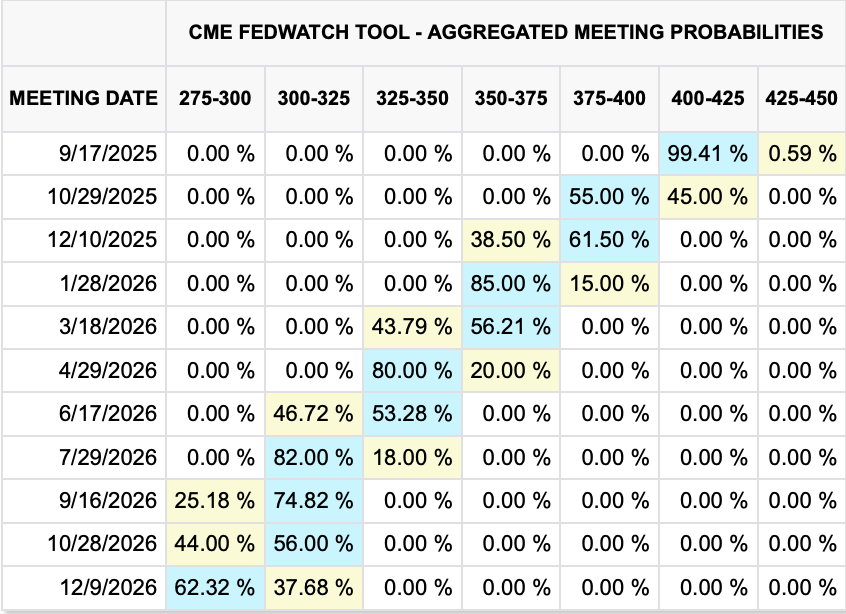
Source: cmegroup.com

And that’s what we have.  There are no Fed speakers lined up, and after today, the Fed enters its quiet period, so we won’t hear anything until the meeting on the 17th.  NFP will set the tone, so until then, all we can do is wait.

Good luck and good weekend

Adf

Under Real Threat

The PCE data was warm
And still well above Powell’s norm
The problem for Jay
Despite what folks say
Is tariffs ain’t causing the storm
 
Instead, service prices keep rising
With wages not yet stabilizing
And so, long-date debt
Is under real threat
As traders, those bonds, are despising


Under the rubric, economic synchronization remains MIA, I think it is worth looking at the performance of 30-year bond yields across all major nations as per the below chart.  While the actual rates may be different, the inescapable conclusion is that yields across the board continue to rise to their highest levels in more than five years and the trend remains strongly in that direction.  Regardless of central bank actions, or perhaps more accurately because of their attempts to keep rates low, it is increasingly clear that confidence in government debt, the erstwhile safest assets around, continues to slide.  

Arguably, this is a direct response to the fact that despite their vaunted independence, central banks around the world have very clearly abandoned their inflation targets and are now doing all they can to support their respective economies with relatively easy money.  Friday’s PCE data is merely the latest in a long line of data points showing that although most of these banks are allegedly targeting 2.0% Y/Y inflation, the outcomes have been higher than target, yet excuses to cut rates are rife.  If you are wondering why gold continues to rally, look no further than this.

Source: tradingeconomics.com

In fact, this morning’s Eurozone CPI reading of 2.1%, 2.3% core, is merely another chink in the armor as it was a tick higher than expected.  One of the problems, I believe, is that there remains a very strong belief that the key driver of inflation is economic growth, not money supply growth, despite all evidence to the contrary.  But it is a Keynesian fundamental belief, and every central bank around the world is convinced that slowing economic activity will result in declining inflation rates.  Alas, as long as central banks continue to support their domestic government bond markets, inflation will remain.  

This is where the synchronicity, or lack thereof, of the economy is having its biggest impact.  The fact that certain parts of the economy, notably AI investment, continues to run at record pace and continues to support excess demand for certain things offsets weakness in other parts of the economy, for instance, commercial property, which is looking at a significant deterioration in its finances.  A look (see chart below) at Commercial Mortgage-Backed Securities (CMBS) for office buildings shows that the delinquency rate has reached an all-time high, higher even than the GFC, as the changes in the US working population and the increase in work-from-home have devastated the value of many office buildings.

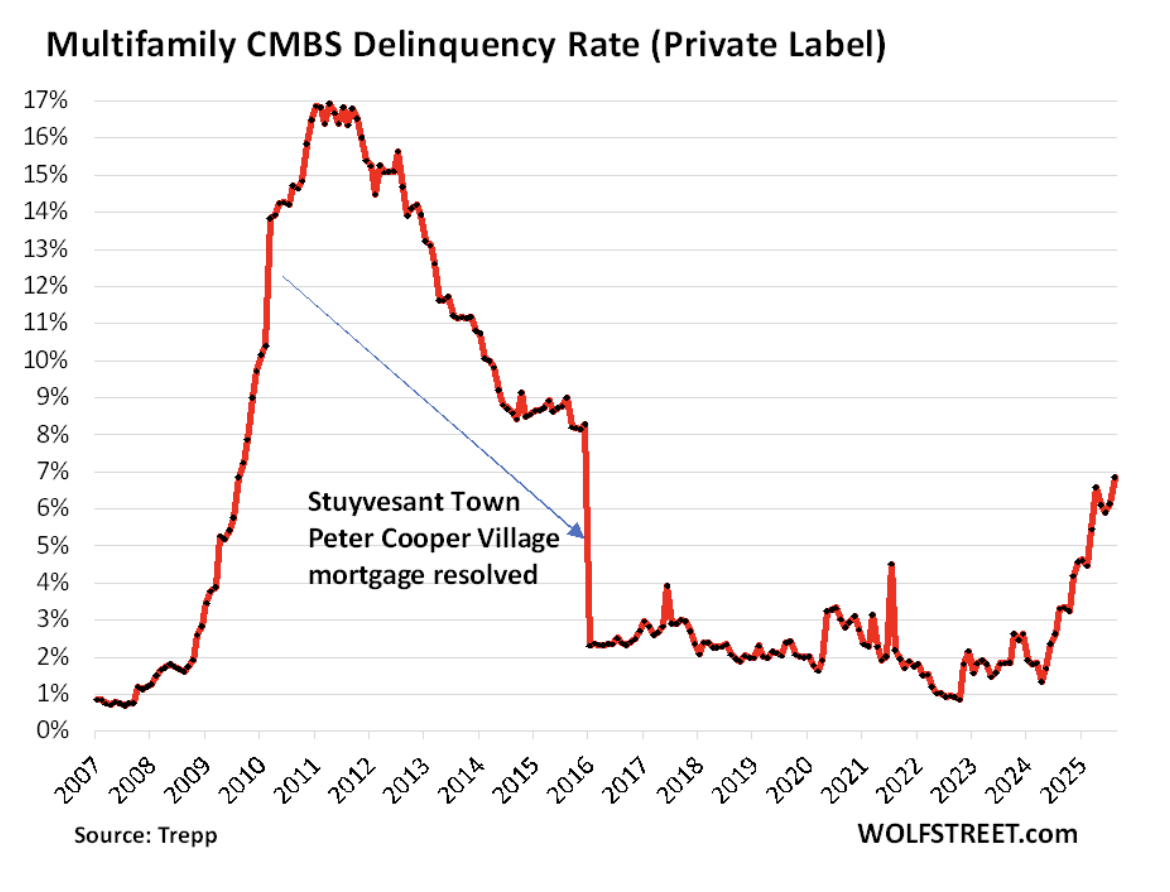
Perhaps more interesting is the fact that multifamily CMBS (financing for apartment buildings) is also suffering despite a housing shortage and rising rents.  While delinquency rates have not reached GFC levels, as you can see, they are rising rapidly as well.

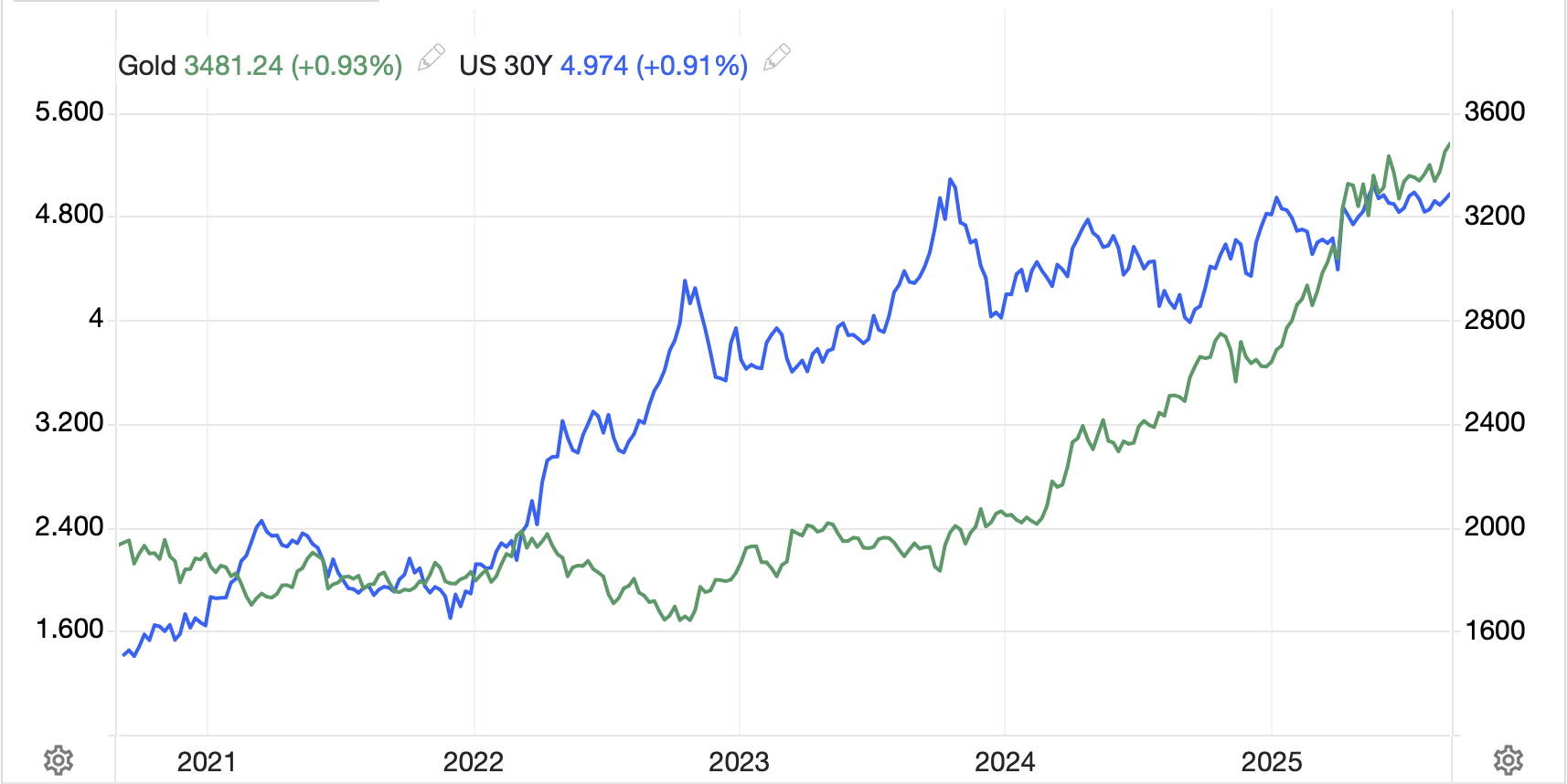
So, which is it?  Are yields rising because growth is driving inflation higher (the Keynesian view of the world)?  How does that accord with rising delinquencies if growth is the driver?  In the end, there is no single, simple answer to explain the dynamics of an extraordinarily complex system like the economy.  I do not envy policymakers’ current situation as there are no correct answers, merely tradeoffs (just like all economics).  But it is increasingly clear that investors are losing their interest in holding onto government debt as they seemingly lose faith in governments’ ability to manage their respective finances.  Which brings us to one more chart, the barbarous relic (which for those of you who don’t know, was Keynes’ term of derision for gold).  I thought it might be instructive to see how gold and 30-year Treasury yields seem to have the same trajectory as the shiny metal regains its all-time highs this morning.

Source: tradingeconomics.com

With that cheery thought after a beautiful Labor Day weekend, let’s see how markets are behaving now that September is upon us.  Friday’s selloff in the US (a disappointing way to end the month) was followed by a mixed session in Asia with the Nikkei (+0.3%) managing to rally although China (-0.75%) and Hong Kong (-0.5%) followed the US lower despite a slightly better than expected RatingDog (formerly Caixin) PMI of 50.5 released Sunday night.  Elsewhere in the region, Korea (+0.95%) was the big winner with modest losses almost everywhere else in the region.  As to Europe, the DAX (-1.25%) is the worst performer, although Spain’s IBEX (-0.95%) is giving it a run for its money as the higher Eurozone inflation squashed hopes that the ECB may cut rates again soon.  Interestingly, French shares are unchanged this morning, significantly outperforming the rest of the continent despite continued concerns over the status of the French government which seems likely to collapse next week after the confidence vote on Monday.  Perhaps the idea that the government will not be able to do anything is seen as a benefit!  As to US futures, negative is the vibe this morning, with all the major indices pointing lower by at least -0.6%.

In the bond market, based on my commentary above, you won’t be surprised that Treasury yields are higher by 6bps this morning and European sovereign yields are all higher by between 4bps and 6bps.  The big story here is that French yields are rising to Italian levels as the former’s finances are crumbling while Italy has stabilized things for the time being.  Of course, all this pales compared to UK yields (+4bps) where 30-year yields have climbed to their highest level since 1998 and the 10-year yields are now nearly 200 basis points higher than during the ‘Liz Truss’ moment of 2022 as per the below.  It is not clear to me if the UK or France will collapse first, but I suspect that both may be begging at the IMF soon!

Source: tradingeconomics.com

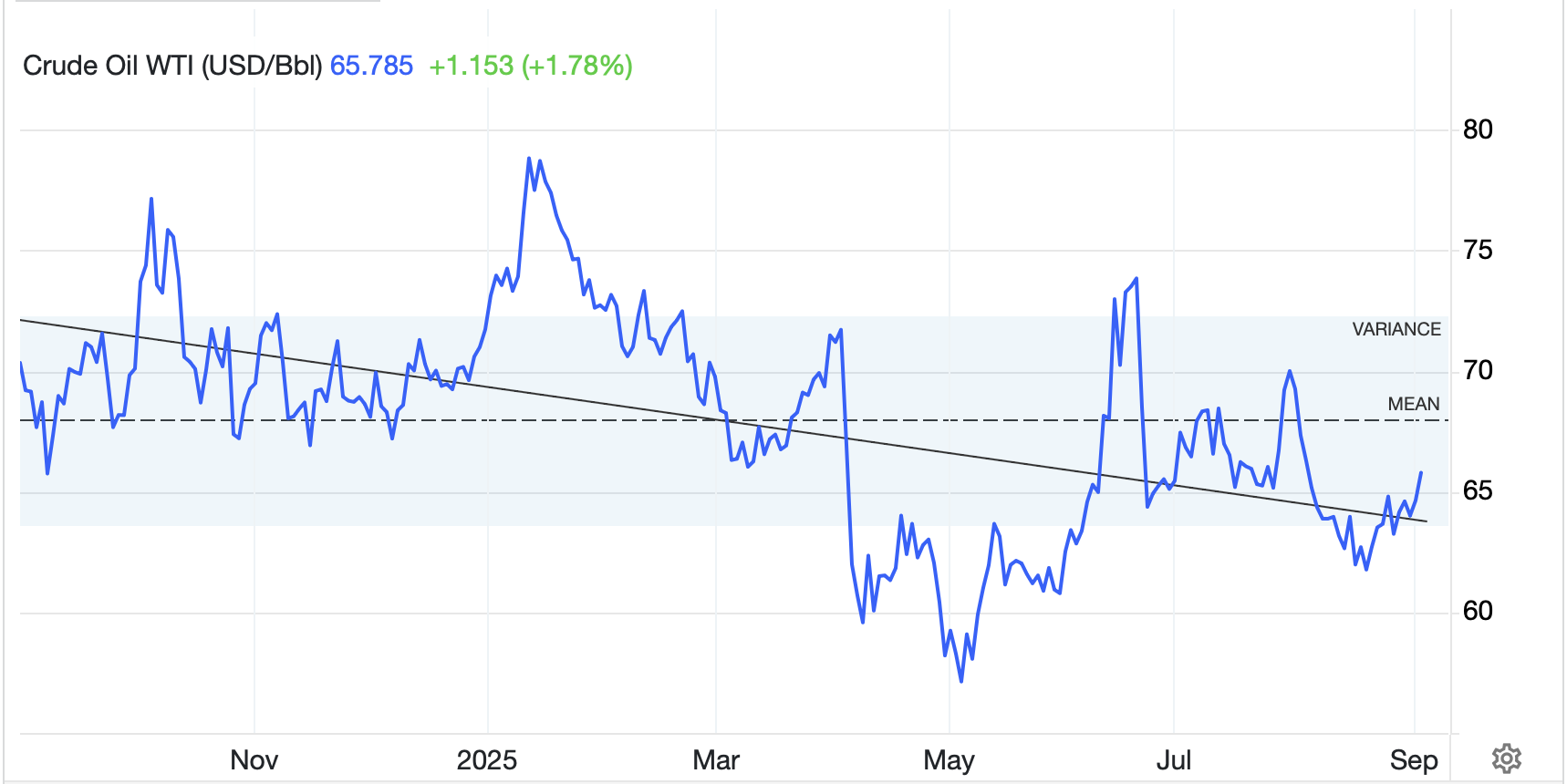
Oil prices (+1.8%) continue to rise as Russia and Ukraine intensify their fighting with Ukraine attacking Russian refining capacity, apparently shutting down up to 17% of their output.  However, while we have seen oil rebound over the past several weeks, the longer-term trend remains lower.

Source: tradingeconomics.com

As to metals, this morning gold (+0.2%) continues to set new highs while silver (-0.4%) is backing off of its recent multi-year highs, although remains well above $40/oz.  Precious metals are in demand and likely to stay that way for a long time to come in my view.

Finally, the dollar is much firmer this morning with the pound (-1.25%) the laggard across both G10 and EMG currencies as investors flee from the ongoing policy insanity there (between the zeal with which they are trying to reduce CO2 and the crackdown on free speech, it seems the government is trying to alienate the entire native population.). But the euro (-0.7%), Aussie (-0.7%), yen (-1.0%) and SEK (-0.75%) are all under pressure in the G10 bloc.  The UK is merely the worst of the lot.  As to the EMG bloc, MXN (-0.7%), ZAR (-0.7%) and PLN (-0.9%) are also sharply lower although Asian currencies (KRW -0.2%, INR -0.2%, CNY -0.15%) are faring a bit better overall.

On the data front this week, we have a bunch culminating in payrolls on Friday.

TodayISM Manufacturing49.0
 ISM Prices Paid 65.3
WednesdayJOLTS Job Openings7.4M
 Factory Orders-1.4%
 Fed’s Beige Book 
ThursdayInitial Claims230K
 Continuing Claims1960K
 Trade Balance-$75.3B
 Nonfarm Productivity2.7%
 Unit Labor Costs1.2%
 ISM Services51.0
FridayNonfarm Payrolls75K
 Private Payrolls75K
 Manufacturing Payrolls-5K
 Unemployment Rate4.3%
 Average Hourly Earnings0.3% (3.7% Y/Y)
 Average Weekly Hours34.3
 Participation Rate62.1%

Source: tradingeconomics.com

In addition, we hear from four Fed speakers with NY Fed president Williams likely the most impactful.  The current probability for a Fed funds cut according to CME futures is 92%.  A weak print on Friday will juice that and get people talking about 50bps to start.  A strong number will stop that talk in its tracks.  But until then, it is difficult to look at the messes everywhere else in the world and feel like you would rather own other currencies than the dollar (maybe the CHF).

Good luck

Adf

Falling Like Rain

Trump’s meeting with Putin went well
At least that’s the best we can tell
Now, later this week
Zelenskiy will speak
With Vlad, and say you go to hell
 
So, will peace be found in Ukraine?
Or will fighting grow once again
If looking for clues
One thing we might choose
Is oil that’s falling like rain


The aftermath of the Trump-Putin meeting on Friday has certainly been interesting.  While the administration, as would be expected, highlighted any and all positives as the president pushes for an uncomfortable peace process, the administration’s opponents, which include not merely the Democratic party, but most of Europe as well, are concerned he has just sold Ukraine down the river.  I am not nearly smart enough to have an informed opinion on this issue, which is likely the case for almost every commentator as well, but I know I come down on the side of anything that moves the conversation toward an end to the war and a lasting peace, even if the terms aren’t the ones either side would like, is a step in the right direction.

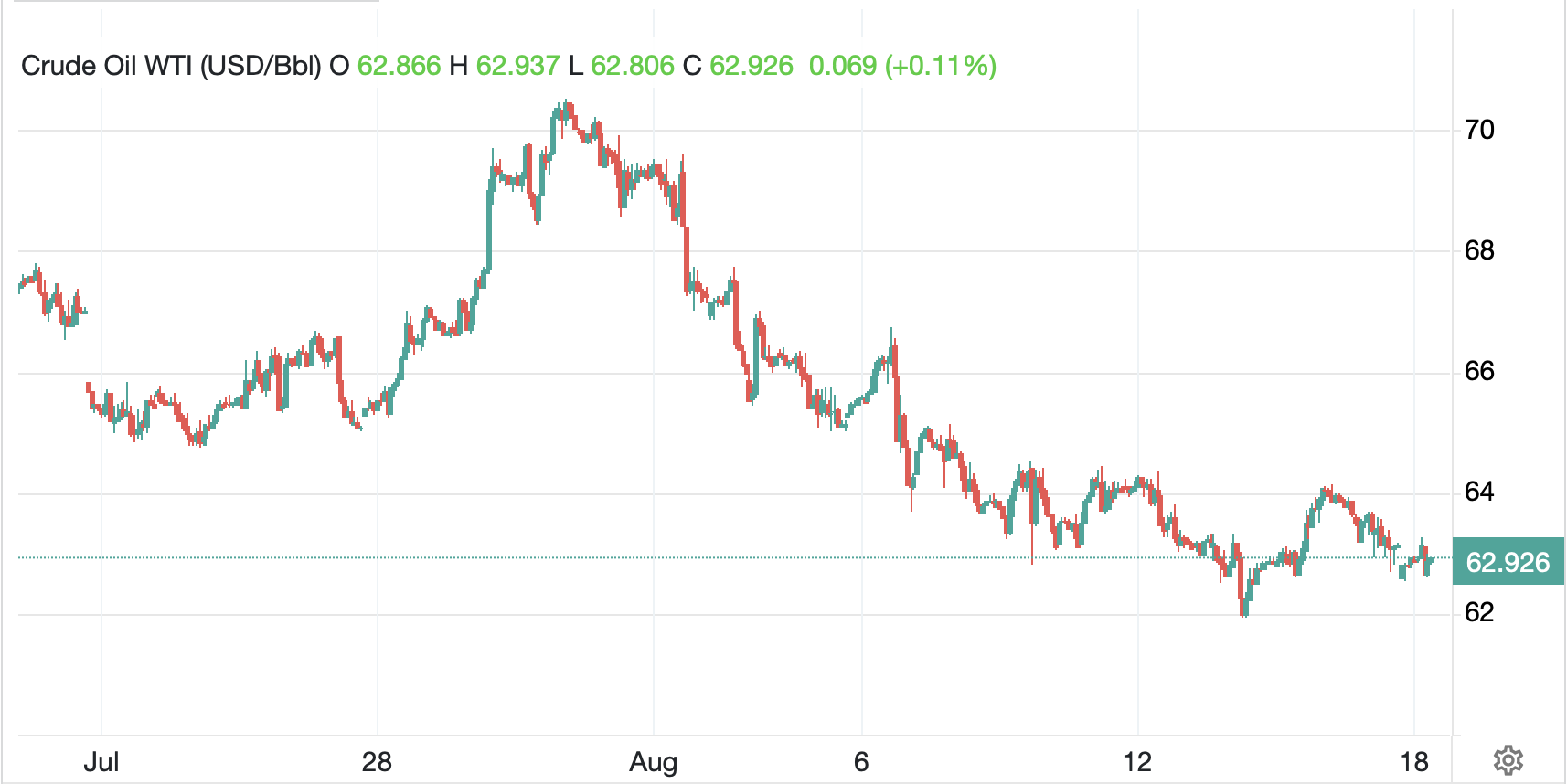
But this is not a political commentary, rather we are trying to understand market behavior and remain highly cognizant of global events on markets.  With that in mind, arguably the market most directly impacted by this war is oil and based on what we have seen over the past month, during which time the peace process accelerated, the participants in the oil market appear to be saying that Russian oil is coming back to the market on an unfettered basis.  One need only look at the chart below, which shows a very clear downtrend to understand.

Source: tradingeconomics.com

Certainly, some of this price decline may be attributed to the belief that the long-awaited recession in the US is upon us, although given that has been a view for nearly three years, it is not clear to me why this month is the moment.  I understand that the payroll data was weak, but I also understand that Retail Sales data on Friday was pretty strong.  The observation that the goods and services sectors of the economy are out of sync remains appropriate, I believe.  As long as that remains the case, a significant downturn seems unlikely, but so too does a significant growth spurt.  In fact, this is one of the reasons I take the decline in the price of oil to be a harbinger of an end to the Ukraine war.  

Come Friday, we’ll hear Chairman Jay
As he tries, his views, to convey
No doubt he’ll explain
Inflation’s a bane
And that’s why, rate cuts, he’ll delay
 
But also, employment is key
And so, he will want us to see
His minions are willing
To cut, if distilling
The data less growth they foresee

Arguably, the other big market story this week is the speech that we will hear Friday morning from Chairman Powell at the Jackson Hole Symposium.  Many in the market continue to look to Powell and the Fed for their guidance although my take is the Fed’s impact on market’s has been waning over time as fiscal dominance continues apace.  Nonetheless, it is still a key moment for the market as those who have been anticipating a Fed cut in September, as well as at least two more before the end of the year, will want confirmation that the weak payroll data was the trigger.  And while some of the Fed speakers since the NFP data have started to move toward a more dovish stance, I would contend the majority is still on the patience bandwagon.  

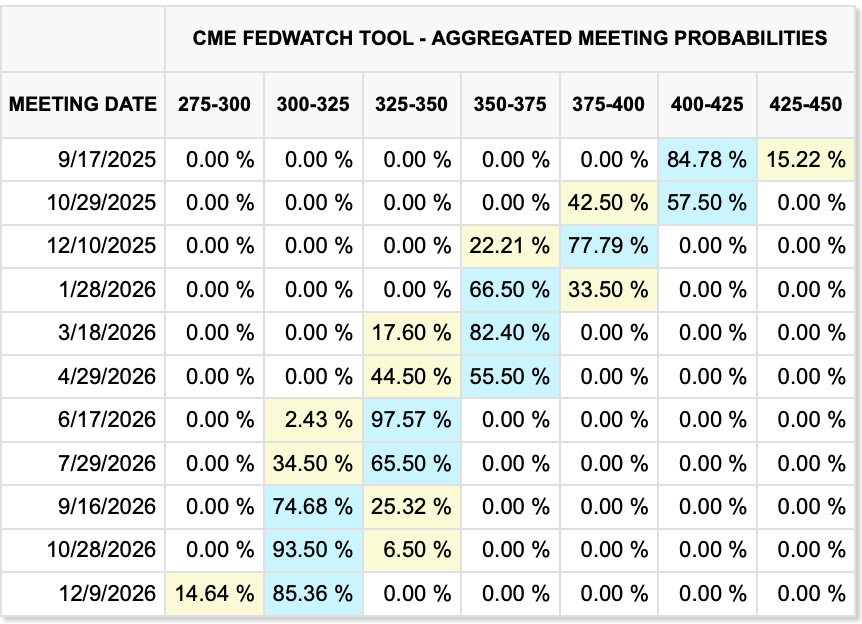
With that in mind, a look at the Fed funds futures markets shows that although the probability being priced in for a cut next month has fallen from its peak level, it remains extremely high at 85% with a 78% probability of two cuts by December and a third cut now likely by March.

Source: cmegroup.com

Remember, the reason this is so closely watched is the strong belief that when the Fed cuts rates, equity prices rise.  However, one need only look at a chart to note that frequently, equity markets are falling sharply when the Fed is cutting Fed funds.  That makes sense because given the reactive nature of Fed funds and the Fed in general, it is typically responding to weakness that is already evident in equity prices.  Which begs the question, why does everyone want the Fed to cut if it implies a weak economy and already declining stock prices?

Many measures continue to show equity valuations quite high, and there have been numerous calls that a correction in equity markets around the world is due.  I understand that view and have even bought put protection as it is pretty cheap to do so.  But I have given up on calling for a recession.  I can only be wrong for so long before I accept the evidence that one has not yet come, nor is obviously imminent.

Ok, let’s look at markets this morning.  While there was a late selloff in the US on Friday, Asian markets saw the world as a brighter place.  Perhaps they were encouraged by the Alaska meeting, or perhaps by the view that the Fed will cut, because there was no data there of which to note.  But the Nikkei (+0.8%), CSI 300 (+0.9%) and Australia (+0.25%) all managed gains although the Hang Seng (-0.4%) slipped a bit.  There was, however, a major laggard with Korea’s KOSPI (-1.5%) suffering on the back of concerns over potential new tariffs on Korean chips.  European equities, though, are on a bit shakier footing.  Perhaps it is the concern that despite their collective voice on Ukraine, they remain largely irrelevant.  Or perhaps it is the realization that the trade surpluses they have run in the past are set to decline as evidenced by the data showing Spain’s deficit growing to -€3.59B increasing more than €1B and the Eurozone’s surplus shrinking to €7B, down from €16.5B last month.  So, declines of -0.4% to -0.8% are today’s results in major markets there.  As to the US, futures are little changed at this hour (8:00).

In the bond market, yields have been edging lower this morning with Treasury yields (-2bps) slipping despite the stronger Retail Sales and PPI data from last week, while European sovereign yields are all lower by -3bps, perhaps anticipating slower growth overall.

In the commodities space, oil (+0.5%) has bounced from its overnight lows but remains in its downtrend.  Gold (+0.3%) continues to hover at its pivot point of $3350 or so while silver (+0.15%) and copper (-0.4%) are mixed this morning.  Away from the tariff story on copper, it remains an important economic indicator, so we must watch it closely.

Finally, the dollar is ever so slightly firmer this morning with the euro (-0.25%) leading the G10 slide although both Aussie and Kiwi are slightly firmer this morning.  In the EMG bloc, MXN (-0.4%) is the laggard along with HUF (-0.4%) and CZK (-0.4%) although the rest of the bloc, while mostly softer, hasn’t moved that far.  It does feel like a dollar story.

On the data front, as I am running late and there is nothing as important as Friday’s Powell speech, I will list it tomorrow.  Overall, my take is peace is nearer than further and that should adjust spending from fighting to rebuilding but spending it will be.  I expect to hear more about recession going forward, although it is not yet clear to me one is upon us.  While the dollar’s trend remains lower, I have a feeling we are at the end of that move so beware.

Good luck

Adf

Stock-pocalypse?

Inflation is on traders’ lips
As rate cuts now lead all their scripts
But what if it’s hot
And questions the plot?
Will that lead to stock-pocalypse?
 
Meanwhile pundits keep on complaining
That everything Trump does is straining
Their efforts to force
A narrative course
And so, their impact keeps on waning


It is CPI Day and there are several different stories in play this morning.  Naturally, the first is that President Trump’s dismissal of BLS head McEntarfar calls into question the veracity of this data, which has already been questioned because of a reduction in the headcount at the BLS.  While we cannot be surprised at this line of attack by the punditry, it seems unlikely that anything really changed at the BLS in the past week, especially since there is no new head in place yet.  

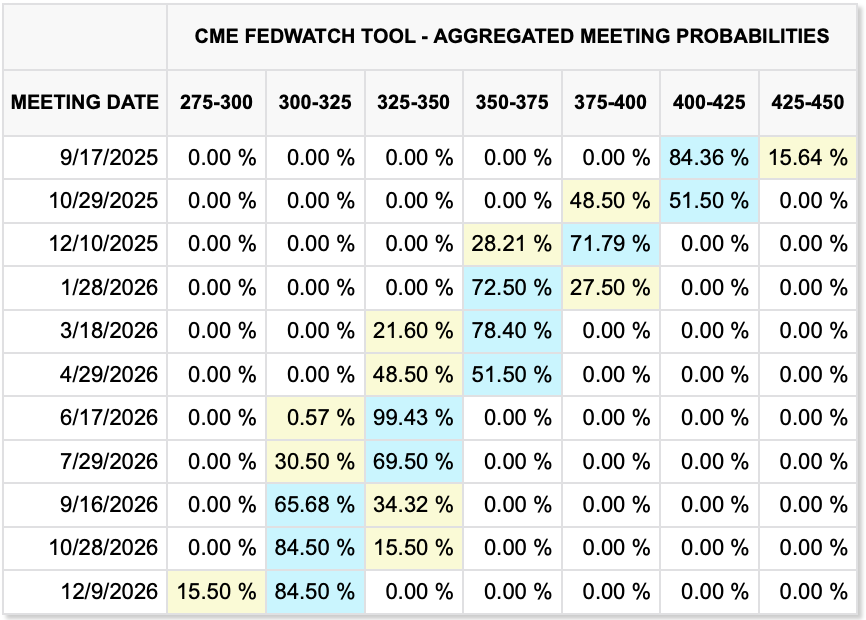
But the second question is how will this data impact the current narrative that the Fed is set to cut rates at each of the three meetings for the rest of this year?  At this hour (6:30) the probability, according to the CME futures market, of a September cut has slipped to 84.3% with a 72% probability of two cuts by year end as per the below table courtesy of cmegroup.com.

Interestingly, the market remains quite convinced that the trend in rates is much lower as there is a strong expectation of a total of 125 basis points of cuts to be implemented by the end of 2026.  I’m not sure if that is pricing in much weaker economic growth or much lower inflation, although I suspect the former given the ongoing hysteria about tariff related inflation.

To level set, here are the current median estimates for today’s release:

  • Headline: 0.2% M/M, 2.8% Y/Y
  • Core:         0.3% M/M, 3.0% Y/Y

Now, we are all well aware that the Fed uses Core PCE in their models, and that is what they seek to maintain at 2.0%.  But, historically, PCE runs somewhere between 0.3% and 0.5% below CPI, so no matter, they have not achieved their goal.  However, we continue to hear an inordinate amount of discussion and analysis as to why the latest NFP report signals that a recession is pending.  And in fairness, if one looks at indicators like the ISM employment indices, for both manufacturing and services they are at extremely low levels, 43.4 and 46.4 respectively, which have historically signaled recessions.  At the same time, concerns over inflation rising further due to tariffs and other policy changes remain front and center in the narrative.  In fact, one of the key discussion points now is the idea that the Fed will be unable to cut rates despite a weakening labor market because of rising inflation.  I’m not sure I believe that to be the case although the last time that situation arose, in the late 1970’s, Chairman Volcker raised rates to attack inflation first.  However, that doesn’t seem likely in the current environment.

Remember this, though, when it comes to the equity market, the bias remains bullish at all times.  In fact, I would suggest that most of the narratives we hear are designed with that in mind, either to attack a policy as it may undermine stocks, or to cheerlead something that is pushing them higher.  I suspect that the major reason any pundits are concerned over higher inflation is not because it is a bad outcome for the economy, but because it might delay Fed funds rate cuts which they have all concluded will lead to higher equity prices. After all, isn’t that the desired outcome for all policy?

Ok, as we await the data this morning, let’s see how things behaved overnight.  Yesterday’s lackluster US session was followed by a lot of strength in Asia.  Japan (+2.15%) led the way on a combination of stronger earnings from key companies and the news about tariff recalculations.  (remember, they were closed Monday).  China (+0.5%) and Hong Kong (+0.25%) benefitted from news that President Trump has delayed the tariff reckoning with China by 90 more days as negotiations remain ongoing.  Australia (+0.4%) was higher after the RBA cut rates 25bps, as expected, while Governor Bullard indicated further easing is appropriate going forward.  There was one major laggard in Asia, New Zealand (-1.2%) as tariffs on their exports rose to 15% and local earnings results were softer than forecast.

In Europe, the picture is mixed with Germany (-0.45%) the laggard after much weaker than expected ZEW Economic Sentiment data (34.7, down from 52.7 and below the 40.0 forecast).  As to the rest of the region, there are modest gains and losses, on the order of 0.15% or less with talk about what will come out of the Trump-Putin talks on Friday in Alaska and how that will impact the European defense situation.  As to US futures, at this hour (7:15) they are unchanged.

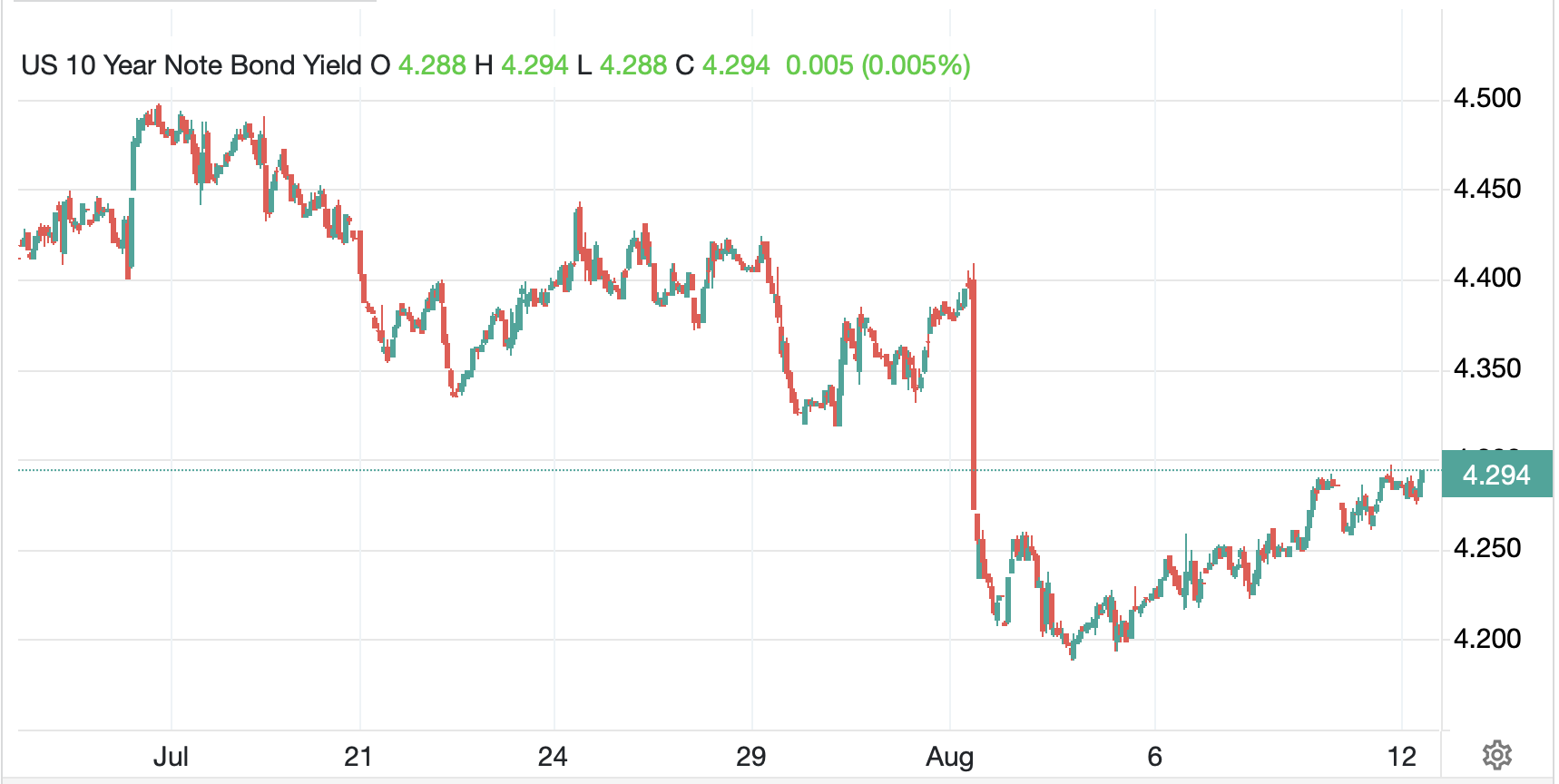
In the bond market, Treasury yields are unchanged this morning, remaining below 4.30% although still well below the recent peak at 4.50% in seen in mid-July.

Source: tradingeconomics.com

European sovereign yields are edging higher by 2bps across the board as investors show caution ahead of both the US CPI data as well as the uncertainty of what will come from the Trump-Putin talks.  However, UK gilts (+4bps) responded to better-than-expected payrolls data there, although the Unemployment Rate remained unchanged at 4.7%.

In the commodity markets, oil (-0.35%) is still in the middle of a narrow trading range as it seeks the next story, arguably to come from Friday’s talks, but potentially from this morning’s CPI data if it convinces people that a recession is imminent.  Metals markets are little change this morning, consolidating yesterday’s declines but not showing any bounce at all.

Finally, the dollar remains generally dull with the euro (-0.1%) unable to spark any life at all lately.  We did see AUD (-0.4%) slip after the rate cuts Down Under and in the EMG bloc, there is a bit of weakness, albeit not enough to note.  There was an amusing comment from Madame Lagarde as she tried to explain that now is the time for the euro to shine on a global reserve basis because of the perceived troubles of the dollar.  Not gonna happen, trust me.

And that’s really it for today.  Another summer day with limited activity as we all await both the data and the next story from the White House, as let’s face it, that is the source of virtually all action these days.  A soft print today ought to result in a rally in both equities and bonds while the dollar might slide a bit as the prognosis for a rate cut increases.  But a hot print will see the opposite as fear of stagflation becomes the story du jour.  Remember, too, two more Fed speakers, Barkin and Schmid, will be on the tape later this morning so watch for any dovishness there as both have been very clear that patience is their game.

Good luck

Adf

Recession Repression

Though many conclude that recession
Is coming, this poet’s impression
Cannot overcome
A key rule of thumb
More jobs mean recession repression
 
As well, on the fourth of July
The naysayers all went awry
The BBB’s law
As Trump oversaw
Parades and a massive fly-by


I will be brief this morning.  First, Thursday’s NFP report was much stronger than expected, with 147K new jobs and the Unemployment Rate falling to 4.1%.  This is clearly not pointing in a recessionary direction, although as would be expected by all those who have made that call, there was much analysis about the underlying makeup of the jobs report, with more government hires and less private sector ones.  And I agree, I would much rather see private sector hiring, but I don’t recall as much angst in the previous administration when they hired into the government extremely rapidly.  It is difficult for me to look at the below chart of government hiring over the past five years and conclude that this administration is being anywhere nearly as profligate.

Source: tradingeconomics.com

Second, despite all the naysaying by the punditry, President Trump got his Big, Beautiful Bill through Congress and he was able to sign it on his schedule, July 4th.  Whether you love Trump or hate him, you must admit that he is a remarkable political force, greater than any other president I can remember, although Mr Reagan was certainly able to accomplish many things with a very different style.  And perhaps, that is the issue, Trump’s style is unique in our lifetimes as a president, although I understand that throughout our history, there have been some presidents with a similarly brash manner, I guess Andrew Jackson is the best known.  And it is that style, I would say that leads to the Trump Derangement Syndrome, although his attack on the Washington elite is also a key driver there.

Thus far, the articles I have read about the legislation all focus on how many people are going to die because Medicaid is requiring able-bodied adults to work, volunteer or go to school 20 hours/week in order to remain eligible.  It would be helpful if these ‘news’ sources could keep a running tally so we can all see the results.  Given the law simply sets priorities, and not actual appropriations yet, my take is all this death and destruction may take a few months yet to materialize.

But after those two stories, there is a growing focus on the upcoming Tariff deadline this Wednesday, with a mix of views.  There is both a growing concern that the original level of tariffs is going to be put back in place, and that will disrupt global commerce, and there is a story gaining traction that the deadline will be delayed again.  The administration hinted there would be some notable deal signings this week, so we shall see.

As that’s all there is, let’s look at markets overnight.  Thursday’s US rally in the wake of the NFP data is ancient history.  Overnight in Asia, the major markets (Japan -0.6%, Hang Seng -0.1%, CSI 300 -0.4%) were under pressure but the rest of the region was mixed with some gainers (Korea, Indonesia, Singapore) and some laggards (Taiwan, Malaysia, Australia) although none of the movement was very large, 0.5% or less in either direction.  In Europe this morning, the DAX (+0.65%) is far and away the leader after a stronger than expected IP reading of +1.2%.  However, the rest of the continent and the UK are all tantamount to unchanged in the session.  US futures at this hour (7:00) are pointing slightly lower, about -0.025%.

In the bond market, Treasury yields which rallied 5bps on Thursday after the data are higher by one more basis point this morning.  European sovereign yields are all higher this morning as well, between 2bps and 3bps, as concerns over the timing of tariffs has investors cautious.  The rumors are solid progress has been made in these negotiations.

In the commodity space, oil (+0.7%) is higher this morning which is a bit of a surprise given that OPEC+ raised their production quotas by a more than expected 548K barrels/day at their meeting this weekend.  At this point, they are well on their way to eliminating those production cuts completely.  I guess demand must be real despite the recession calls.  Metals markets, though, are all lower this morning (Au -1.0%, Ag -2.0%, Cu -0.6%) as hopes for trade deals has reduced some haven demand.  Of course, copper’s decline doesn’t jibe with oil’s rally on a demand note, but the movements have not been that large, so it is probably just random fluctuations.

Finally, the dollar is stronger this morning, which is also weighing on the metals markets.  ZAR (-1.1%) is the biggest loser overnight although NZD (-0.9%) and AUD (-0.7%) are doing their best to catch up.  But the euro (-0.35%) and pound (-0.3%) are both under pressure as is the yen (-0.7%) and CAD (-0.5%) and MXN (-0.5%). In other words, the dollar’s strength is quite broad-based.  On this note, I couldn’t help but chuckle at this article in Bloomberg, Misfiring Models Leave Wall Street Currency Traders Flying Blind, which describes how all the old models no longer work in the current world.  This is a theme I have harped on for a while, mostly with the Fed, but also with the punditry in general.  The world today is a different place, and I might ascribe the biggest difference to the fact that for 20+ years, inflation had fallen to 2% or lower in most of the western world and markets behaved accordingly.  But now, inflation is higher, and those relationships no longer hold.

On the data front, this may be the least active week I have ever seen.

TuesdayNFIB Small Biz Optimism98.7
 Consumer Credit$10.5B
WednesdayFOMC Minutes 
ThursdayInitial Claims235K
 Continuing Claims1980K

Source: tradingeconomics.com

There are only 3 Fed speakers as well so pretty much, Washington is on vacation this week.  It is very hard to get excited about much right now.  We will all need to see the outcomes of the trade negotiations and which countries will see tariffs applied or not.  I have no forecasts for any of that.  In the meantime, I think the fact that implied volatilities are relatively low across most asset classes offers the opportunity for hedgers to protect themselves at reasonable prices.

Good luck

Adf

Mugwump

The feud between Elon and Trump
Show’s Musk has become a mugwump
But though there’s much drama
It’s not clear there’s trauma
As markets continue to pump
 
So, turning our eyes toward today’s
Report about jobs, let’s appraise
The call for recession
That’s been an obsession
Of some for six months of Sundays


Clearly the big headlines are all about the escalating war of words between President Trump and Elon Musk.  I guess it was inevitable that two men with immense wealth and power would ultimately have to demonstrate that one of them was king.  But other than the initial impact on Tesla’s stock price, it is not clear to me what the market impacts are going to be here.  After all, President Trump has attacked others aggressively in the past when they didn’t toe his line, and it is not a general market problem, only potentially the company with which that person is associated.  As such, I don’t think this is the place to hash out the issue.

However, I think it is worth addressing one point that Musk raised regarding the Big Beautiful Bill.  The thing about reconciliation is it only addresses non-discretionary spending, meaning Social Security, Medicare, Medicaid and the interest on the debt.  All the other stuff that DOGE made headlines for, USAID etc., could never be part of this bill.  That requires recission packages where Congress specifically passes laws rescinding the previously enacted payments.  So, if this was a part of the blowup, it was senseless.  I will say, though, that the Trump administration did not communicate this fact effectively as I read all over how people are upset that Congress is not addressing these other things.  At any rate, this is not a political commentary, but I thought it was worth understanding because I only learned of this in the past weeks and I don’t believe it is widely understood.

Onward to the major market news today, the payroll report.  As of this morning, according to tradingeconomics.com, here are the forecast outcomes:

Nonfarm Payrolls130K
Private Payrolls120K
Manufacturing Payrolls-1K
Unemployment Rate4.2%
Average Hourly Earnings0.3% (3.7% Y/Y)
Average Weekly Hours34.3
Participation Rate62.6%

Of course, Wednesday’s ADP Employment number was MUCH lower than expected, so the whispers appear to be for a smaller outcome.  As well, the key wildcard in this data is the BLS Birth-Death model which is how the BLS estimates the number of jobs that have been created by small businesses which aren’t surveyed directly.  As with every model, especially post-Covid, what used to be is not necessarily what currently is.  The most accurate, after the fact, representation of employment is the Quarterly Census of Employment and Wages (QCEW) but that isn’t released until 6 months after the quarter it is addressing, so it is not much of a timing tool.  It is also the genesis of all the revisions.  

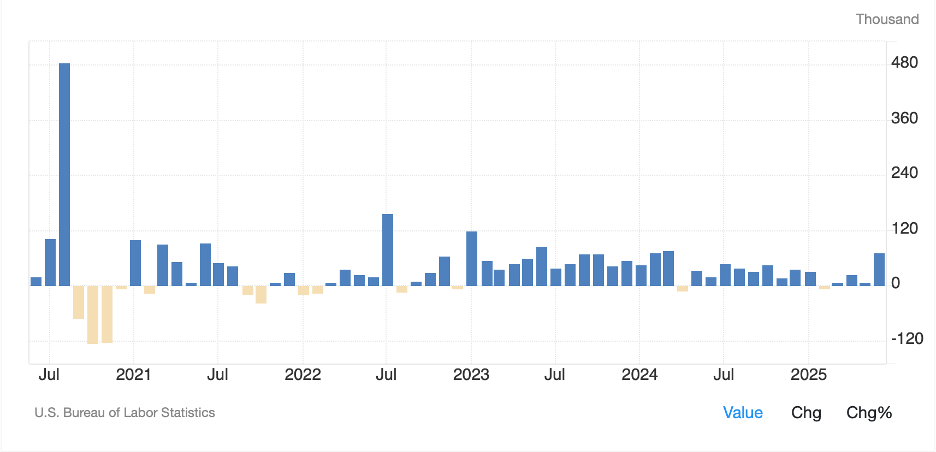
Here’s the thing, a look at the chart below shows that the BLS Birth-Death model appears to still be substantially overstating the payroll situation.  Given the datedness of its model, that cannot be a real surprise, but I assure you, if there is a major revision lower in that number, and NFP prints negative, it WILL be a surprise to markets.  I am not forecasting such an occurrence, merely highlighting the risk. 

If that were to be the case, I imagine the market reaction would be quite negative for stocks and the dollar, positive for bonds (lower yields) and likely continue to push precious metals higher, although oil would likely suffer.  I guess we will all have to wait and see at 8:30 how things go.

In the meantime, ahead of the weekend, let’s see how markets behaved overnight.  Yesterday’s modest sell-off in the US was followed by a mixed session in Asia (Nikkei +0.5%, Hang Seng -0.5%, CSI 300 -0.1%) but strength in Korea (+1.5%) and India (+0.9%).  Trade discussions still hang over the market and there are increasing bets that both India and Korea are going to be amongst the first to come to the table.  As well, the RBI cut rates by 50bps last night with the market only expecting 25bps, so that clearly supported the SENSEX.  In Europe, no major index has moved even 0.2% in either direction as positive European GDP data was unable to get people excited and there is now talk that the ECB will not cut rates again until September.  As to US futures, at this hour (6:50) they are pointing higher by about 0.3% across the board.  It appears that the Tesla fears are abating.

In the bond market, yields continue to slide with Treasuries falling -1bp and European sovereign yields down between -3bps and -5bps despite the stronger than expected Eurozone data which also included Retail Sales (+2.3%) growing more rapidly than expected.  But this is a global trend as recession discussions increase while we also saw JGB yields slip -2bps overnight.  It feels like the bond markets around the world are anticipating much slower economic activity.

In the commodity space, oil (0.0%) is unchanged this morning and continuing to hang around at its recent highs, but unable to break above that $63+ level.  It strikes me that if slower economic activity is on the horizon, that should push oil prices lower as there appears to be ample supply.  But I read that Spain has stopped importing Venezuelan crude as US secondary sanctions are about to come into effect there.  As to the metals markets, silver (+1.5%) and platinum (+2.6%) have been the leaders for the past few sessions although gold (+0.2%) continues to grind higher.  The loser here has been copper (-0.8%) which if the economic forecasts of slowing growth are correct, makes some sense.  Of course, there is a strong underlying narrative about insufficient copper supplies for the electrification of everything, but right now, payroll concerns are the story.

Finally, the dollar is a bit firmer this morning, but only just, with G10 currencies slipping between -0.2% and -0.3% while EMG currencies have shown even less movement.  INR (+0.25%) stands out for being the only currency strengthening vs. the dollar after the rate cut and positive growth story, but otherwise, this is a market waiting for its next cue.

In addition to the payroll report, we get Consumer Credit (exp $10.85B) a number which gets little attention but may grow in importance if economic activity does start to decline.  As well, I cannot ignore yesterday’s Trade data which saw the deficit fall much more than expected, to -$61.6B, its smallest outturn since September 2023.  While I didn’t see any White House comments on the subject, I expect that President Trump is happy about that number.

Are we headed into a recession or not?  Will today’s data give us a stronger sense of that?  These are the questions that we hope to answer later this morning.  FWIW, which is probably not that much, my take is while economic activity has likely slowed a bit, I do not believe a recession is upon us, and as I do believe the reconciliation bill will be passed which extends the tax cuts, as well as adds a few like no tax on tips or Social Security, I expect that will turn any weakness around quickly.  What does that mean for the dollar?  Right now, it is piling up haters so a further decline is possible, but I cannot rule out a reversal if/when the tax legislation is finalized.

Good luck and good weekend

Adf
Be Quite Scared

The pundits have now all declared
That everyone should be quite scared
It will be a bummer
When shelves, come this summer
Are empty, so please be prepared
 
As well, a recession’s in view
Although, that seems like déjà vu
For three years at least
The pundits increased
The odds that this bill would come due


Apparently, the only thing you need to know this morning is that by summertime, shelves across the country will be barren as imports from China halt.  The upshot, at least according to the sources that I have read, is that you should blame President Trump and join the media chorus in hating the man and his policies.

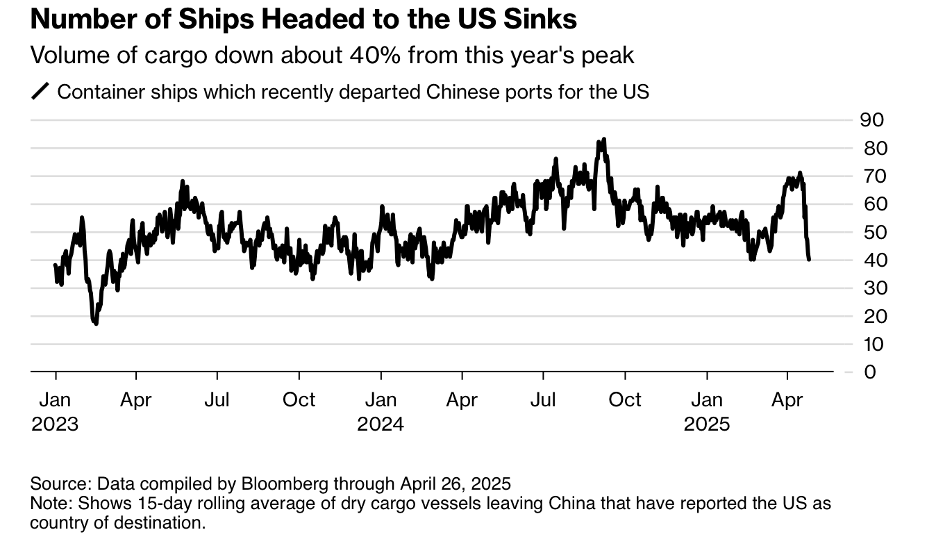
Now, I am no logistics expert, but the concern stems from the significant decline in shipping as evidenced by port activity in both China and the US.  As you can see from the chart below, there has certainly been a significant decline in the number of ships leaving China on their way to the US.

I guess the question is just how much of what is on store shelves comes from China?  Much will depend on what kind of store one considers.  Certainly, toy stores seem likely to have less inventory, as will Best Buy with electronics potentially suffering, although as I recall President Trump exempted electronics initially.  Arguably, clothing shelves and racks may be sparser as well.  But based on official data, Chinese imports (~$463B) accounted for approximately 1.7% of the US’s $26.9T GDP in 2024.  This may be an overreaction.

Potentially a bigger issue will be the impact on intermediate goods that are imported from China and elsewhere and incorporated into products finalized in the US.  However, I cannot calculate that, nor have I seen any data of this issue, although I have read many stories about the end of this particular world as well.

One of the things to remember about the punditry is that they make their living describing the worst possible outcome because that gets them recognition.  However, I’m confident we all remember that a recession was forecast for 2022, 2023 and 2024 by much of the punditry and yet one was never officially declared by the NBER.  In fact, you may recall that in Q1 and Q2 of 2022, US Real GDP growth was -0.2% for both quarters, thus two consecutive quarters of negative growth.  Historically, that has defined a recession.  However, subsequent data revisions did remove that as you can see below with Q2 revised higher.

Source: tradingeconomics.com

The one thing I do know is that there is a group of analysts/economists who have been forecasting the next recession consistently for several years.  They point to data like changes in the housing market, the JOLTs Quits rate shrinking and various other secondary and tertiary data points and sources, all of which have been pointing in that direction for several years.  And I grant, reading that ~40% of GenZ is using BNPL to buy their groceries, and then run late on payments, is a frightening statistic (although perhaps one that highlights financial illiteracy more than economic reality).

In the end, what you need to know is you should be terrified because the punditry is almost certain that this time, they have it right.  But our concern is how will this scenario impact markets.

Basically, despite all this huffing and puffing, it appears markets are whistling past this particular graveyard.  Friday’s US equity rally was followed by general strength in Asia and strength this morning in Europe.  Last night, Tokyo (+0.4%), Mumbai (+1.3%), Taiwan (+0.8%) and Australia (+0.4%) all had solid performances although neither Hong Kong (-0.1%) nor China (-0.15%) could find any real buying support.  A less reported story is that China is exempting a number of US imports from its 125% tariffs on the US as clearly, this trading relationship is deep and complex.

As to Europe, all markets are ahead this morning, with the UK (+0.4%) the laggard and most of the continent higher by between 0.7% and 0.8%.  There are headlines around as to how the ECB is preparing to cut rates further on the assumption that global economic activity is going to slow and thus hurt Europe, while the consistent message is that US tariffs will be deflationary in Europe, so less concerns about their inflation mandate.  Finally, US futures are pointing slightly softer (-0.2%) at this hour (6:45).

In the bond market, 10-year Treasury yields have fallen 30bps in the past two and one-half weeks, sliding 5bps on Friday before bouncing 3bps overnight. However, the recent trend does seem lower.

Source: tradingeconomics.com

But yields are climbing in Europe as well today, higher by 5bps across the board on the continent, although UK Gilts have only edged higher by 2bps.  It’s funny, despite all the doom and gloom regarding the economy because of US tariffs, as well as growing expectations of an ECB rate cut at the early June meeting, investors appear to be growing concerned about something.  Perhaps they have pivoted back to the promised fiscal spending increases as their driver today.

In the commodity markets, oil (-0.35%) continues to trade in its recent $60 – $63/bbl range with limited signs that this will soon change.  Peace in Ukraine does not seem at hand yet and reports are that the initial discussions between the US and Iran, while constructive, still have a ways to go before completion.  Both of those seem likely to weigh on oil prices if completed.  However, the more unusual thing to me is that with the rising chorus of recession calls, oil’s price has not fallen further.  To date, markets have not yet agreed with the economists’ view that recession is imminent.  In the metals markets, gold (-1.0%) is continuing its rough week, although remains nicely higher on the month.  You may recall my view a week ago Friday that the move seemed parabolic and due for a correction.  Recent price action is exactly that, corrective, as I believe the underlying thesis to own the barbarous relic remains intact.  The other main metals are a touch softer this morning, but really nothing to discuss.

Finally, the dollar is mixed this morning with modest strength against the euro (-0.15%) but softness vs. the pound (+0.15%) and those size moves are representative of most of the price action across both G10 and EMG currencies this morning. The outlier is KRW (-0.4%), which seems to be suffering from comments that no trade deal will be completed before June’s election there.

Overall, despite ongoing doom and gloom by much of the punditry, it is not obvious to me that investors are anticipating major changes.  Perhaps they are wrong, and the pundits are correct.  But as yet, there is no evidence to support that conclusion.

Ok, let’s turn to the data this week, which starts slowly but ends on NFP.

TuesdayGoods Trade Balance-$146.0B
 Case-Shiller Home Prices4.8%
 JOLTs Job Openings7.5M
WednesdayADP Employment108K
 Q1 GDP0.4%
 Q1 Employment Cost Index0.9%
 Chicago PMI45.5
 Personal Income0.4%
 Personal Spending0.6%
 PCE0.0% (2.2% Y/Y)
 Core PCE0.1% (2.6% Y/Y)
ThursdayInitial Claims225K
 Continuing Claims1860K
 ISM Manufacturing48.0
 ISM Prices Paid70.2
FridayNonfarm Payrolls135K
 Private Payrolls127K
 Manufacturing Payrolls-5K
 Unemployment Rate4.2%
 Average Hourly Earnings0.3% (3.9% Y/Y)
 Average Weekly Hours34.2
 Participation Rate62.5%
 Factory Orders4.5%

Source: tradingeconomics.com

As well as NFP, we get the PCE data, which looks like it has changed to a 10:00am release from its traditional 8:30am time.  The Fed is in its quiet period, but nobody has been listening to them anyway.  Secretary Bessent, along with President Trump, has been the most important voice lately.  Again, for now, the data has not indicated recession, although Q1 GDP is slated to be soft.  Markets, too, have been unwilling to get behind the recession call completely. 

Ultimately, the one thing we know is that the nature of the global economy has changed since President Trump’s election.  Globalization is in retreat and mercantilism is the new normal.  It is not clear to me that existing econometric models will accurately portray how that works, so I need to see more data before recognizing the end of times.  In the meantime, these myriad views are a sign that hedging for risk managers remains the only path forward.

Good luck

Adf

Quite Miffed

By now, each of you is aware
More tariffs, the Prez did declare
Some nations will scream
While others will scheme
To Trump, though, in war all is fair
 
The market reaction was swift
With equities in a downshift
While Treasuries rallied
Pure gold, lower, sallied
And everyone worldwide’s quite miffed


Once again, President Trump did exactly what he told us he was going to do from the start.  He applied reciprocal tariffs on virtually every nation in the world, although at a rate claimed to be ~50% of their tariffs on the US, (as calculated by the White House and which included quotas and non-tariff barriers as well.)  In addition to Israel, which pledged to reduce tariffs to 0% on US goods if the US would do the same, it appears Canada has also agreed that deal.  I expect that we will hear different responses from nations all around the world, but remember, the one thing the president has made clear is that retaliation by other nations will be met with a significantly higher response from the US.  I expect that smaller nations may find themselves in very difficult straits, although larger ones have more potential to respond.  But, in the end, the US remains the consumer of last resort, and every nation on the list realizes that losing the US market will not help their economies.

The market response was immediate with US equity futures plummeting on the open of the evening session and sharp declines in Asian equities as well.  Treasury yields fell along with the dollar, while gold after an initial rally, reversed course and is now lower on the day as well.

Analysts around the world are out with early forecasts of the “likely” impacts of these tariffs although I would take them with a grain of salt.  Remember, analyst macro models have been pretty useless for a while, ever since the underlying conditions changed as I described earlier this week, so it is not clear to me that applying broken models to a new event is likely to offer accurate estimates of future activity.  However, there is a pretty clear consensus, which is that inflation is going to rise while economic activity is going to decline, probably into a recession.  Personally, I am confused by this analysis as every one of these analysts continues to believe that a recession drives prices lower and reduces inflation, but I’m just reporting on what I have seen.

If pressed, I expect that we will see several nations reduce their tariff structures in response to this, similar to Canada and Israel, and US tariffs will decline there as well.  Other nations will dig in their heels and trade activity between the US and those nations will decline.  But I will not even hazard a guess as to which nations will do what.  Political pain is a funny thing, and different leaders respond differently.

My sincere hope is that now that the tariffs have been imposed, we can move on with our lives and discuss other issues because frankly, I am really tired of this topic.

Masked by the tariff mania was news that the US Senate has moved forward on its budget resolution bill which if passed and combined with the House, will allow the process to start to legislate for fiscal year 2026.  Both versions maintain the 2017 tax cuts, both seek unspecified spending reductions and while each has a different price tag, my take is this process will be completed before too long.  It would truly be miraculous if Congress actually submitted department spending bills on a timely basis, rather than the omnibus bills that have been the norm for quite a while.  That would be true progress in how the government works.

Anyway, let’s see where things stand this morning.  The one thing we know is that despite President Trump’s constant discussion on tariffs, market participants were not prepared.  Ironically, yesterday saw modest gains in US equity indices but as of now (6:40) US futures are sharply lower (NASDAQ -3.8%, SPX -3.6%, DJIA -2.6%).  Of course, the damage has been significant everywhere with equities lower worldwide.

In Asia, Vietnam (-7.2%) was the worst hit index, actually the worst in the world, as tariffs there rose to 46%.  Given Vietnam has been a way station for exports from China to the US, I expect that we will see some swift action by the government there to address the situation.  But elsewhere in Asia, while the losses were universal, they were not as bad as might be expected.  Tokyo (-2.6%) led the way lower with Chinese shares (Hang Seng -1.5%, CSI 300 -0.6%) also falling, but not collapsing.  Korea (-0.8%) and India (-0.4%) fell but were also not devastated.

In Europe, though, the pain is more consistent and larger, net, than Asia as per the below snapshot from Bloomberg.  This will be the most interesting thing to watch as there has been a great deal of huffing and puffing about a response, but will European nations, who sell a great deal into the US, risk a worse outcome, or will they reduce their own tariffs?

Something else that has declined sharply is bond yields around the world.  Treasury yields are lower by a further -6bps, and that is the basic decline seen across Europe as well.  Asia saw even greater drops in yields with JGB’s (-12bps) breaking the trendline that had been in place since the BOJ first started hiking rates last year and Governor Ueda made clear his intention to continue to do so.  

Source: tradingeconomics.com

It appears that investors are anticipating a global recession, at least based on the movements in government bond yields around the world.

In the commodity space, oil (-4.7%) has reversed much of its recent gains as the recession narrative has eclipsed the Iran war/sanctions narrative.  However, despite the sharp decline, oil remains nearly $3/bbl above the lows seen at the beginning of March, just one month ago.  In the metals market, gold, which initially traded to new highs on the tariff announcement reversed course about lunchtime in Asia and is now down by more than -2.0%.  My take is this is a short-term impact as investors sell liquid assets with gains to cover margin calls, rather than any negative feelings about gold in the wake of the news.  Instead, I suspect that the barbarous relic will regain its footing shortly as the ultimate haven asset in difficult times, and clearly many now see difficult times ahead.  Silver (-3.9%) and copper (-0.4%) are also softer, much more on the economic concerns than the risk concerns.

Finally, the dollar, shockingly, is broadly lower this morning.  While we have been consistently informed that a very clear response to the US imposing tariffs would be other currencies weakening vs. the dollar to offset the impact, apparently that model is also broken.  Versus it’s G10 counterparts, the dollar is under severe pressure today.  EUR (+1.75%), JPY (+1.7%), CHF (+2.1%), SEK (+2.1%) and even NOK (+1.1%) despite the collapse in oil prices, have all moved to within 1% of the dollar’s lows seen last September.  But to keep things in perspective, I don’t know that I would call the dollar “weak” here.  The below chart of DXY shows that even over the past 20 years, the dollar has been MUCH lower and only spent a relatively small amount of time above current levels.  

Source: Koyfin.com

Interestingly, other than the CE4, which track the euro closely, most EMG currencies have not seen the same boost vs. the dollar, although most are somewhat higher.  MXN (+0.6%), KRW (+0.6%) and INR (+0.5%) have all gained modestly.  ZAR (0.0%) and CNY (-0.2%) are the only currencies that have bucked the trend and followed the economic theory.  

Turning to the data, this morning brings the weekly Initial (exp 225K) and Continuing (1860K) Claims as well as the Trade Balance (-$123.5B) at 8:30.  Then at 10:00 we see ISM Services (53.0).  The thing about this data is it ought to have no impact whatsoever as last night’s tariff announcements completely changed the playing field.  So whatever things were, they are not representative of the future, at least the near future.  There are also a couple of Fed speakers, but again, there is no way they can determine how they will react until the real economic effects of these tariffs start to play out.

There have been many analysts who continue to believe that President Trump will not be able to tolerate a substantial decline in the equity market despite the fact that he has not discussed it at all, and he, along with Treasury Secretary Bessent have consistently said their goal is a lower yield on 10-year Treasuries.  Well, they are getting their wish right now, regardless of the reason.  

The president has done virtually everything he said he was going to do regarding the border, government efficiency and now tariffs.  There are many skeptics who believe that he is out to force economic change on the backs of the bottom 90% of earners to benefit himself and others in the top 1%.  But he has consistently said his goal is to help the middle class.  His view of reindustrialization and more self-sufficiency while reduced international adventures continues to be the driving force of his policies.  There is no reason to believe he is going to change that view.  Do not look for a reversal of what he has done simply because the S&P 500 declines.  I think the trend is going to be for the dollar to continue to decline along with interest rates, while commodities rally.  Equity markets are going to be a tale of two markets, likely with previous highflyers suffering and previously overlooked companies benefitting.  

The world is changing a lot, so the best thing you can do is maintain your hedges to mitigate the impact.

Good luck

Adf

Tripping Off Tongues

Recession is tripping off tongues
And pundits ain’t twiddling their thumbs
Political shades
Are driving tirades
And screams at the top of their lungs
 
But are we that likely to see
A minus in our ‘conomy?
We certainly could
And probably should
But life doesn’t always agree


The major discussion point over the weekend has been recession, and how likely we are to see one in the US in the coming months.  Of course, this matters to the punditry not because of any concern over the negative impacts a recession has on the population, but ‘more importantly’ because recessions tend to result in sharp declines in equity values.  And let’s face it, do you honestly believe that the editors of the New York Times or the Wall Street Journal are remotely interested in the condition of the majority of the population?  Me neither. 

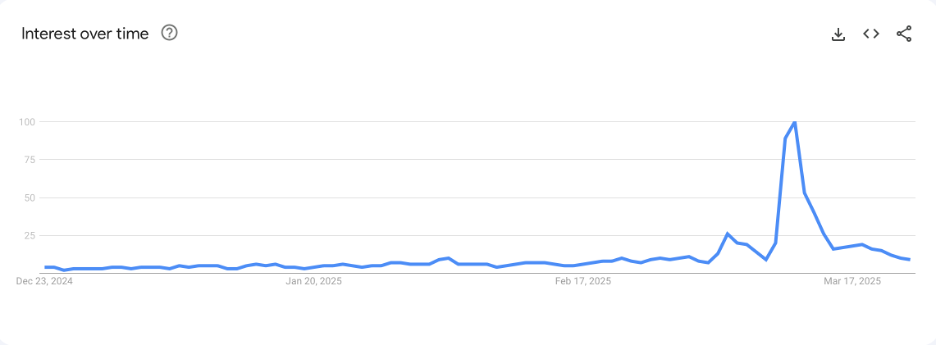
However, if they can call out something that they believe can impede President Trump, or detract from his current high ratings, they will play that over and over and over.  Funnily enough, when I went to Google Trends, I looked up “recession” over the past 90 days with the result below:

That peak was on March 11 although there was no data of note that day compared to a reading of 9 today. Looking at the news of that day, even CNN had a hard time finding bad news with the four top stories being 1) the Continuing Resolution vote in the House being passed, 2) the Department of Education announcing a 50% RIF, 3) 25% tariffs on steel and aluminum being imposed and 4) Ukraine accepting terms for a 30-day ceasefire.  From an economic perspective, the tariffs clearly will have an impact, but it seems a leap that the average American can go from 25% tariffs on imported steel and aluminum to recession in one step.  And based on the positive responses that continue to be seen regarding President Trump’s efforts to reduce the size of government, I doubt the DOE cuts were seen as the beginning of the end of the economy.  

And yet, recession was the talk of the punditry this weekend.  To try to better understand why this is the case, I created the following table of several major economic indicators and their evolution since December, prior to President Trump’s inauguration.

Key indicatorsDecJanFeb
NFP323125151
Unemployment Rate4.10%4.00%4.10%
CPI2.90%3.00%2.80%
Core CPI3.20%3.30%3.10%
PCE2.60%2.50% 
Core PCE2.90%2.60% 
IP1.10%0.30%0.70%
Capacity Utilization77.60%77.70%78.10%
ISM Mfg49.250.950.3
ISM Services5452.853.5
Retail Sales0.70%-1.20%0.20%

Source: tradingeconomics.com

Once again, while I am certainly no PhD economist, this table doesn’t strike me as one demonstrating a clear trend in worsening data, certainly not on an across-the-board basis.  Rather, while you might say January was soft, the February data has largely rebounded.  My point is that despite ABC, NBC, Bloomberg, the BBC and CNN all publishing articles or interviews on the topic this weekend, I’m not yet convinced that is the obvious outcome.

My good friend the Inflation Guy™, Mike Ashton, made an excellent point in a recent podcast of his that is very well worth remembering.   The breadth of the US economy is extraordinarily wide and covers areas from manufacturing to agriculture to finance to energy and technology along with the necessary housing markets as well as the entire population consuming both goods and services.  Added to the private sector, the government sector is also huge, although President Trump and Elon Musk are trying hard to shrink it.  But the point is that it is not merely possible, but likely, that while some areas of the economy may go through weak patches, that doesn’t mean the entire economy is going to sink into the abyss.

If we think back to the last two recessions, the most recent was Covid inspired, which resulted from the government literally shutting down the economy for a period of several months, while giving out money.  Net, things weakened, but even then, there were stronger parts and weaker parts.  Go back to the GFC and the housing bubble popped and dragged banks along with it.  That was the problem because banking weakness inhibits the free flow of money and that will impact everyone.

The question to be asked now, I would suggest is, are we likely to see another catalyst that will have such widespread impacts?  Higher tariffs are not going to do the trick.  Shrinking government, although I believe it is critical for a better long-term trajectory for the economy, will have a short-term impact, but it is not clear to me that it will negatively impact the economy writ large.  Certainly, the Washington DC area, but will it impact the Rocky Mountain area?  Or Texas and Florida?  

Now, a recession could well be on the way.  Running 7% budget deficits was capable of papering over many holes in the economy and pumping lots of liquidity into it as well.  If those deficits shrink, meaning spending shrinks, the pace of activity will slow.  But negative?  It seems a stretch to me, at least based on what we have seen so far.  One last thing here, is how might this potential weakening economic growth impact inflation? Now, we all ‘know’ that a recession causes inflation to decline, don’t we?  Hmmm. While that makes intuitive sense, and we hear it a lot, perhaps the Inflation Guy™ can help here as well.  Back in February he wrote a very good explanation about how that is not really the case at all, at least based on the macroeconomic data.  The truth is economic growth and inflation have very little correlation at all.

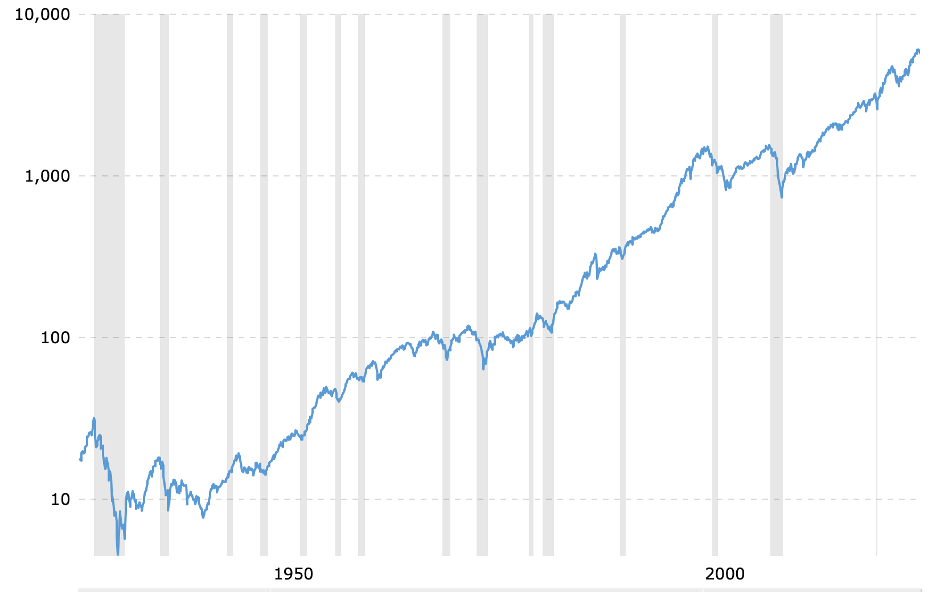
Of course, perhaps the most critical issue for the punditry is, will a recession drive stock prices lower?  Here the news is far less sanguine if you are a shareholder and believe there is going to be a recession.  As you can see from the below chart of the S&P 500, pretty much every recession for the last 100 years has resulted in a decline in stock market indices.

Source: macrotrends.net

This is a log chart so some of those dips don’t seem that large, but the average downturn during a recession is about 30%, although that number can vary widely.  To sum it up, while the data doesn’t scream recession to me, it cannot be ruled out.  As well, both President Trump and Secretary Bessent have indicated that weakness is likely going to be a result of their early actions, although the idea is to pave the way for a more stable economic performance ahead.  As I have written repeatedly, volatility is likely the only thing of which we can be certain as all these changes occur.  Hedge your exposures!

Ok, let’s look at the overnight activity.

The rumor is Trump may delay
His tariffs as he tries to weigh
How much he should charge
And how much, writ large,
These nations are going to pay

Equity futures in the US are higher this morning as the big story is that President Trump is considering narrowing the scope of nations who will have tariffs imposed on April 2nd.  Apparently, his administration has identified the “dirty fifteen” nations with the largest bilateral imbalances and they will be first addressed.  The telling comment in the WSJ article I read was when Trump said, “Once you give exemptions for one company, you have to do that for all. The word flexibility is an important word. Sometimes there’s flexibility, there’ll be flexibility.”  To my ear, the final plans are not in place, but my sense is he will impose then remove tariffs, rather than avoid them initially.  Interestingly, that story was written last night, yet Asian equity markets were not that ebullient.  Japan (-0.2%) saw no benefit although Chinese shares (HK +0.9%, CSI 300 +0.5%) fared better. Things elsewhere in the region were mixed with both gainers (India, Thailand) and laggards (Korea, Taiwan, Indonesia) with many bourses little changed overall.

In Europe, green is the predominant color this morning but movement is modest with Spain’s IBEX (+0.4%) the leader and lesser gains elsewhere.  While US futures are all higher by about 1% or more at this hour (6:45) apparently the Europeans aren’t as excited at the tariff delay process.

In the bond market, yields have backed up virtually across the board with Treasuries (+4bps) leading the way higher and most European sovereigns showing yields rising by 1bp or 2bps.  It’s interesting, while there has been much discussion regarding German yields having traded substantially higher in the wake of the effective end of the debt brake and anticipation of much further issuance, a look at the chart below tells me that after that gap higher on the news, concerns over German finances have not deteriorated at all.  And after all, the difference is about 25bps higher, hardly the end of the world.

Source: tradingeconomics.com

In the commodity markets, oil (+0.7%) is continuing its gradual rebound from the lows seen on, ironically, March 11th.  Arguably, what this tells us is that despite the weekend barrage of recession focused articles, the market doesn’t really see that outcome.  In the metals, strength is the word, again, with copper (+1.25%) making new all-time highs on the back of China’s stated goals of growing its strategic stockpile.  Not surprisingly, both gold (+0.2%) and silver (+0.6%) are also climbing this morning alongside copper as commodities remain in greater demand than a recession would indicate.

Finally, the dollar is a bit softer despite rising Treasury yields with both the euro (+0.3%) and pound (+0.4%) bouncing after last week’s modest declines.  And this is despite lackluster Flash PMI readings this morning out of Europe.  The biggest winner is NOK (+0.6%) which given the dollar’s broad weakness and oil’s rebound makes perfect sense.  Otherwise, while the dollar’s weakness is broad, it is no deeper than the aforementioned currencies.

Given the length of this note already (my apologies) and the dearth of data to be released, with only the Chicago Fed National Activity Index (exp +0.08), I will cover data tomorrow as we do end the week with GDP and PCE data.

Headline bingo remains the key concern for all market participants, but ultimately, my altered view of a softer dollar and higher commodities remains intact.

Good luck

Adf

Recession in Sight

There once was a policy view
That tariffs, we all should eschew
But President Trump
Explained on the stump
To this idea, he wouldn’t hew
 
And so, as the clock struck midnight
Trump’s tariffs once more saw the light
Most analysts say
The tariffs will weigh
On growth, with recession in sight


By now you are all aware that as of 12:01 EST this morning, 25% tariffs have been imposed on all imports from both Canada and Mexico except energy products, which have seen 10% tariffs imposed.  As well, all Chinese imports have been hit with an additional 10% tariff.  Once again, President Trump has proven to be a man of his word, promising these tariffs during his election campaign and imposing them now.

The mainstream view is that these tariffs are a disaster and will send the economy into a recession.  In fact, the International Chamber of Commerce said a depression was likely.  As well, there is much concern that inflation will rise during the recession, which for Keynesians must be a very difficult concept to grasp given their strongly held belief that a recession will result in declining inflation.

Now remember, I am just a poet, so please take that into account when I offer my views here.  First, we have no idea how things will play out.  The one thing about which I am extremely confident is that there will be numerous behavioral changes by everyone because of these tariffs.  The first question is who will absorb the cost of the tariffs.  Remember, essentially the definition of a recession is that demand is declining.  Will companies be able to pass through the higher costs?  In some instances, they likely will, but in others probably not.  Anecdotally, there was a story in the WSJ that Chipotle will see its costs rise because of the tariff on avocados from Mexico but will not change their prices to account for that.  I’m confident they are not the only company who will absorb those costs.

However, there will certainly be companies that believe they can raise prices and maintain their sales and will try to do that.  My point is each company will evaluate the environment under which they operate and respond in the profit-maximizing manner, but each company’s scenario will be different.

Second, let’s consider the reason that President Trump is such a strong believer in tariffs.  He sees them as the stick to achieve his goals.  I would argue there are two goals in sight.  With Canada and Mexico, he is still unsatisfied with their efforts on the border and with fentanyl smuggling and is very keen to push that to completion.  However, the broader goal is to return manufacturing to America from its decampment overseas, mostly to Southeast Asia, during the past forty years.  And remember, he is seeking to implement a carrot as well, looking to cut corporate taxes to 15% going forward, which would put the US in the lowest quartile of corporate tax rates in the world.  While this morning the headlines are all about the tariffs and their potential destruction, just yesterday, Taiwan Semiconductor announced they would be investing $100 billion to build new fabrication plants in Arizona.  That is exactly the response Trump is seeking.

We all recognize that the world today is very different than it was even two months ago as President Trump has taken an extraordinary number of steps to implement the ideas upon which he was elected.  Interestingly, a large majority of the public remains strongly in his camp with approval ratings for many of his policies well above 60% and as high as 80%.  While markets are clearly unhappy as they have no idea how things will play out, and companies are now faced with far more uncertainty as they attempt to plan for their future, there is no reason to believe this process is going to change anytime soon.  

Keep one other thing in mind, unlike Trump’s first term in office, where he was constantly touting the strength of the stock market as a vote of confidence, this time around he and Treasury Secretary Bessent have been entirely focused on the 10-year yield and getting that rate down.  After a 7bp decline yesterday, he has been successful there. (see chart below) I would be surprised if Trump speaks about the stock market much at all for a while.

Source: tradingeconomics.com

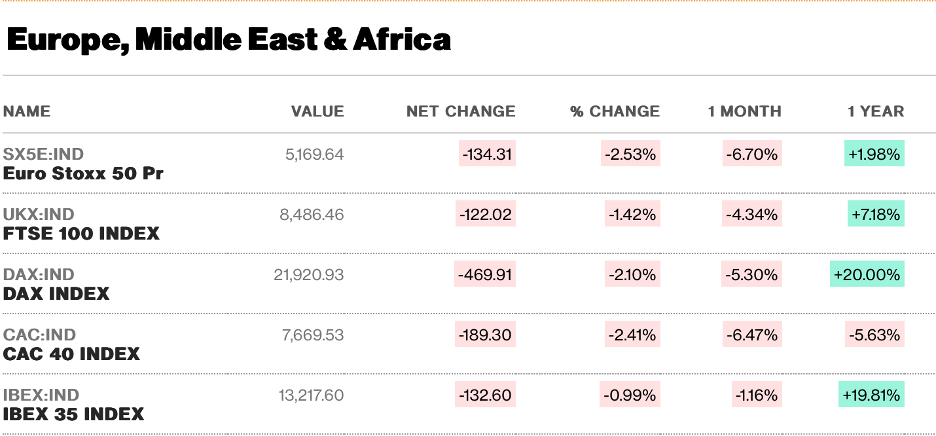
With that in mind, let’s see how markets have been handling the tariff imposition.  After yesterday’s rout in the US, where a higher open morphed into a sharply lower close on the day, we saw red throughout Asia (Nikkei -1.2%, Hang Seng -0.3%, CSI 300 -0.1%) and Europe (DAX -2.1%, CAC -1.2%, IBEX -2.3%).  In fact, it is far harder to find a market that has rallied at all, although US futures at this hour (6:40) are pointing slightly higher.  However, after the sharp declines, an early bounce is not uncommon though not necessarily a harbinger of activity for the day.  All of this makes sense as public companies are likely going to see impacts on their profitability either because of reduced sales or reduced margins, or both, with tariffs now in place.  (Well, private companies are going to feel the same pressures, but there are no markets for them to worry about.). The worry for investors is given the extremely high price multiples that currently exist across so many companies, margin pressures can be problematic for stock prices.  For the near term, it is easy to make the case that equities have further to fall.

In the bond market, after yesterday’s Treasury yield decline, there has been a modest 1bp bounce, although as per the above chart, the trend remains lower.  In Europe, the news just hit the tape that the Eurozone is creating a plan to rearm the continent allowing for European countries to exceed debt restrictions to enable them to borrow and spend the money on this task.  The mooted amount is €800 billion, meaning that markets can expect that much new debt issuance across the continent in the coming months and years.  However, it appears investors are viewing the situation overall and are far more concerned with potential slowing growth than on increased issuance as yields have slipped one or two basis points across all nations in Europe.  Perhaps that is a signal that there is little belief in the likelihood of this new plan coming to fruition.

In the commodity markets, oil (-1.4%) continues its slide as a combination of worries over future growth due to the US tariffs and the OPEC+ announcement that they would start to bring production back online beginning in April (just 138K bbl/day, but the signal is quite clear that more is on the way) has traders unnerved.  Certainly, this is part of what President Trump is seeking, lower oil prices to help keep a lid on inflation, and there is no doubt he has pressured OPEC+ on the issue.  Remember, too, that if gasoline prices fall at the pump, that is a key driver of inflation perceptions for everyone.  As to the metals markets, we are seeing a split this morning with precious (Au +1.0%, Ag +0.65%) rallying on uncertainty and fear while copper (-1.2%) seems to be suffering on recession fears.

Finally, the dollar is lower again this morning with the DXY breaking back below 106 for the first time since early December as a signal of the broad trend.  This is interesting as the textbooks claim that if the US imposes tariffs, the dollar will strengthen, or more accurately other currencies will weaken, to offset those tariffs, and yet this morning CNY (+0.55%) and CAD (+0.45%) are bucking that trend although MXN (-0.2%) is behaving as most would expect.  But the dollar’s weakness is broad based, and my take is given the movement in interest rates, which are suddenly declining far more rapidly than anticipated just a week ago (Fed funds futures are now pricing in 75bps of cuts this year with a 11% probability of a cut in March, up from 2% last week) the dollar bull case is under real pressure.  I have maintained all along that if the Fed reignited their easing policy, the dollar would suffer.  Funnily enough, despite any angst between Chairman Powell (remember him?) and President Trump, they both may see lower rates as their preferred outcome.  In that case, the dollar has further to fall.

There is no hard data set to be released today although we do hear from NY Fed President Williams this afternoon.  This could be the first hint that the Fed’s caution is abating, and further rate cuts are in store.  Of course, with Powell on the calendar for Friday, if there is a change in tone, most market participants will be waiting to hear it from him.

The watchword has shifted from caution to uncertainty.  The tariffs have thrown sand into the gears of the economy and markets.  It remains to be seen how much impact they will have, but for now, fear is rising although the dollar is not following suit.  I think Trump must be happy, but I’m not sure how many in the markets are.

Good luck

Adf