The World is Ending

The world is ending
At least, that’s the way it feels
Owning equities
 
The narrative writers are caught
‘Cause stories those writers had wrought
No longer apply
And folks now decry
The idea that dips should be bought


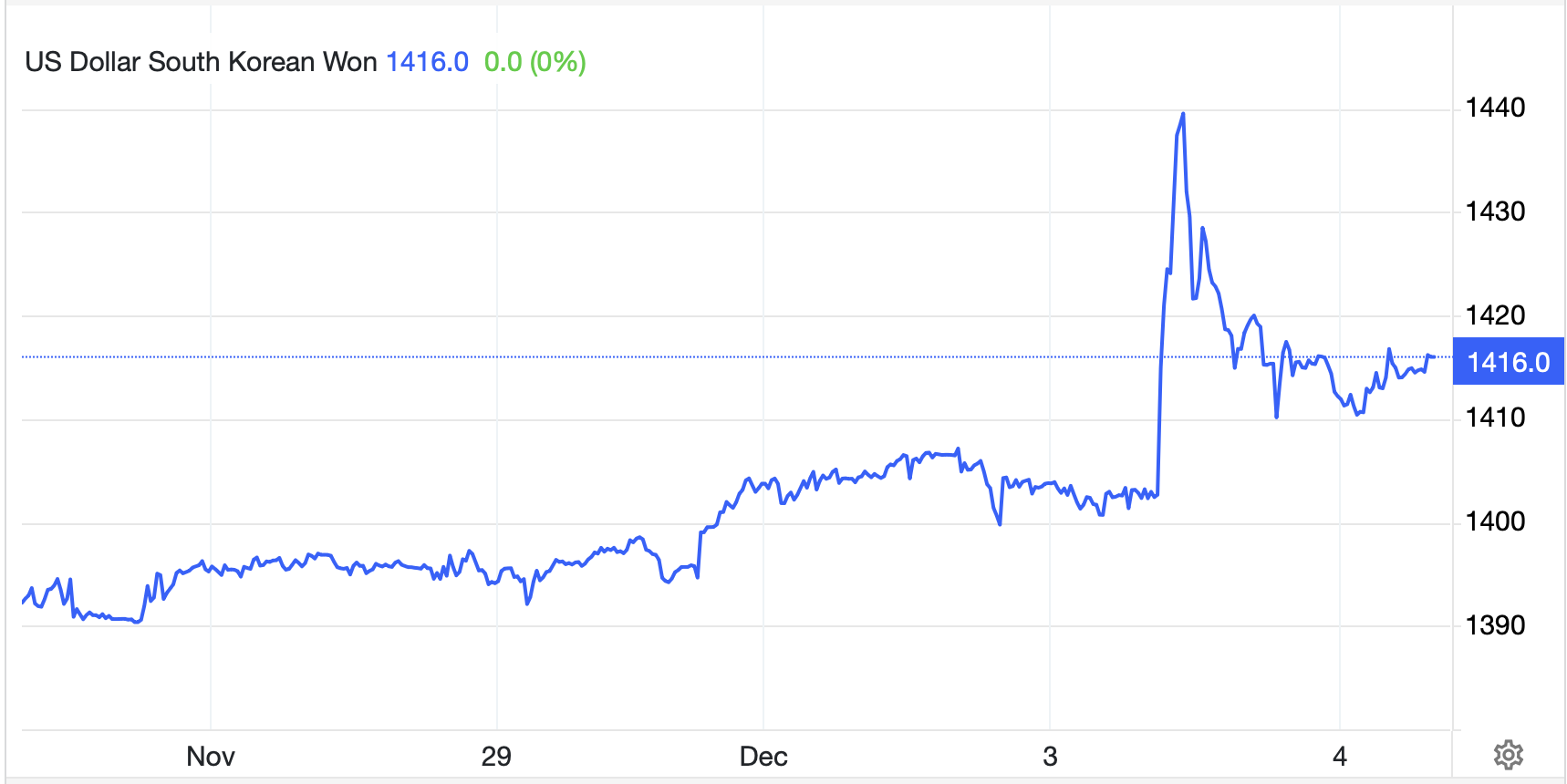
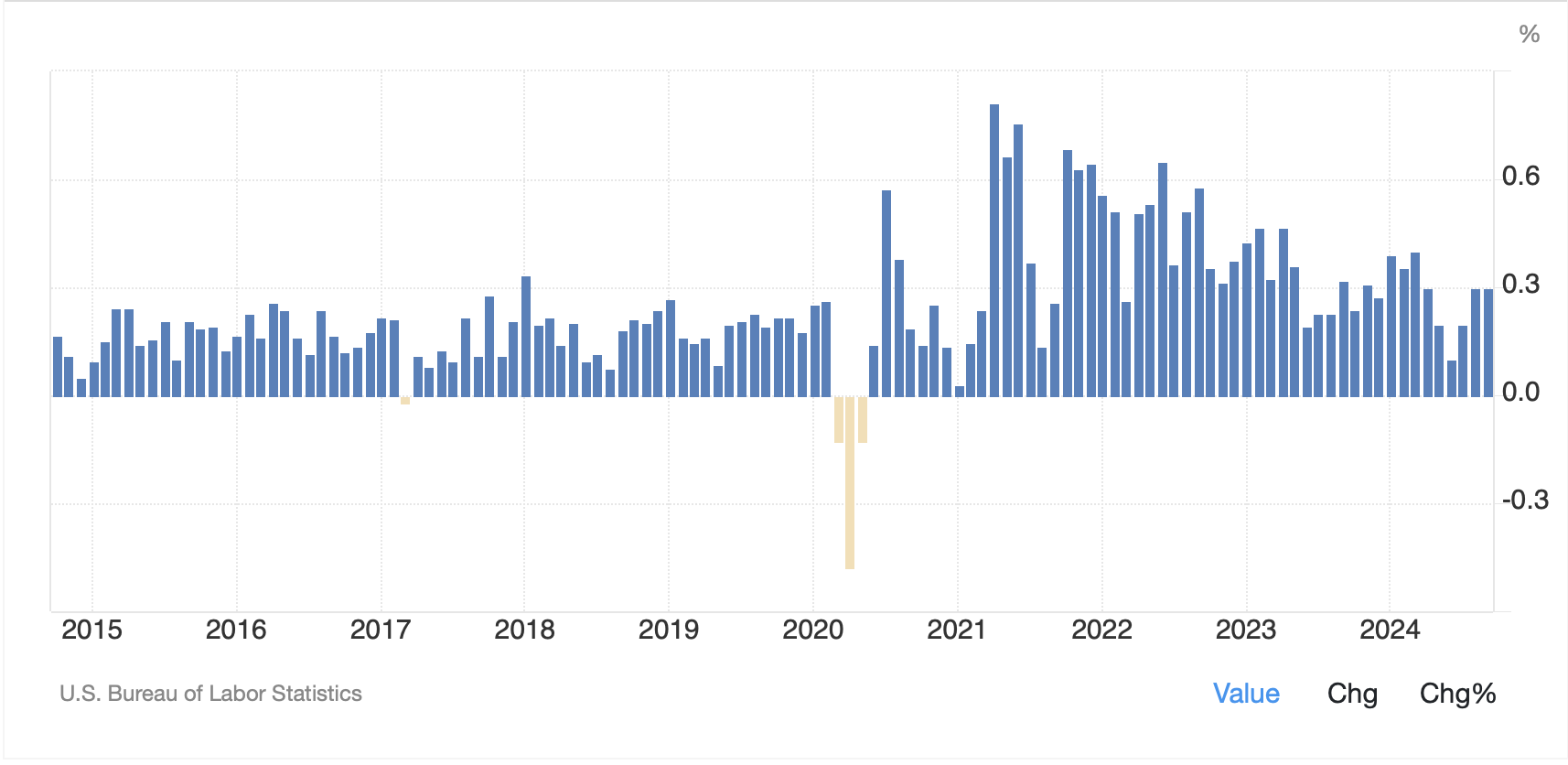
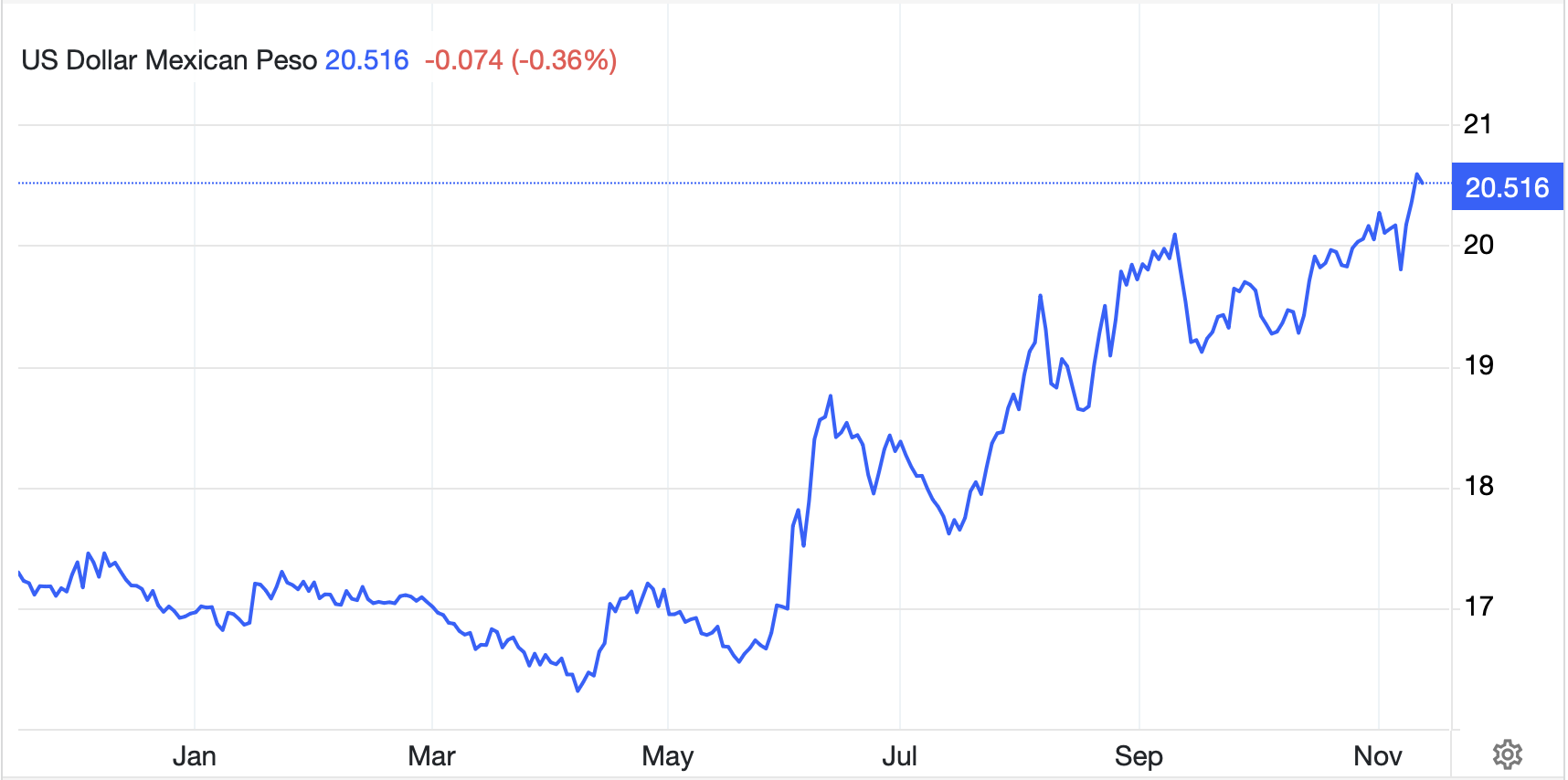
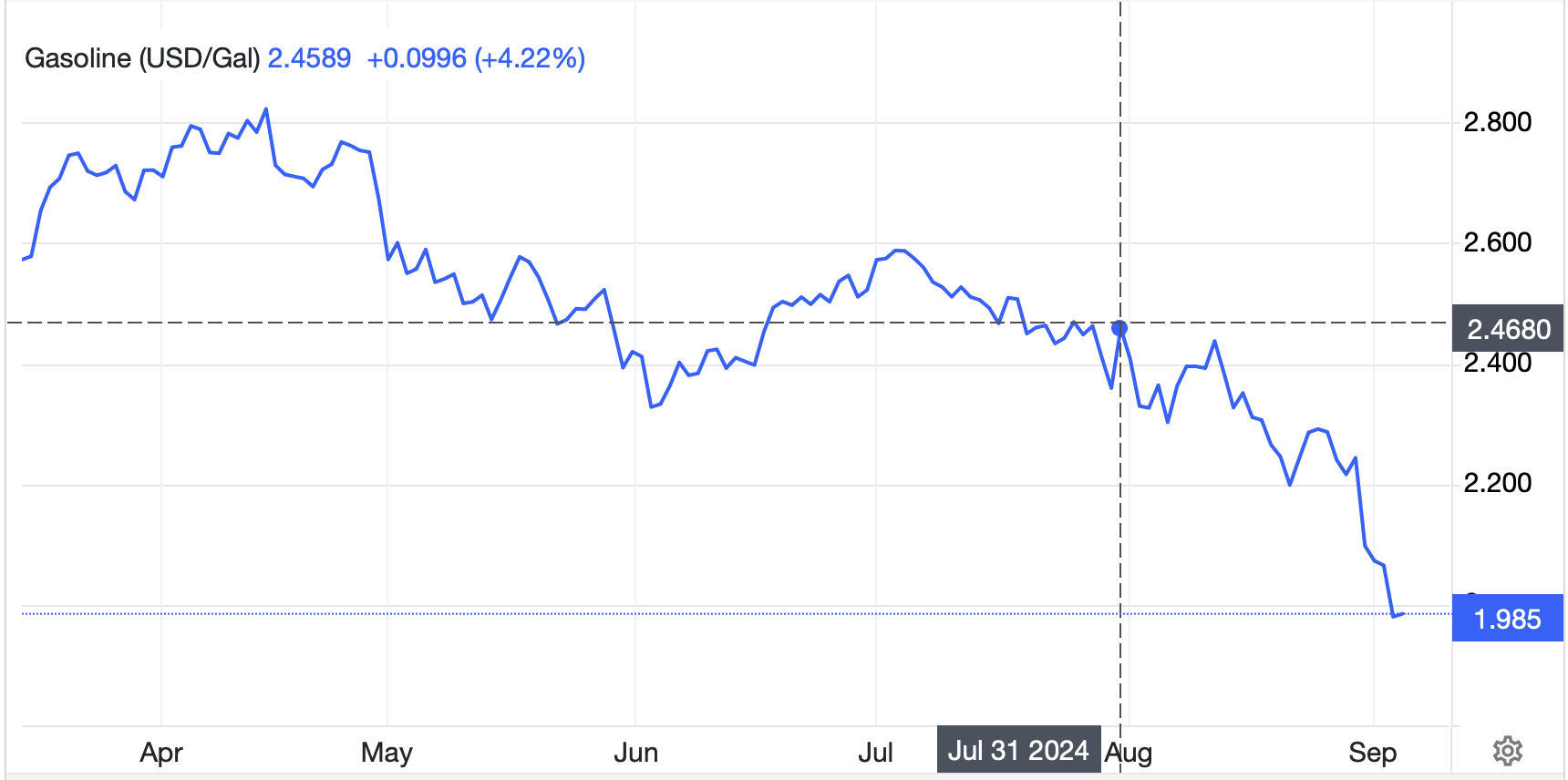
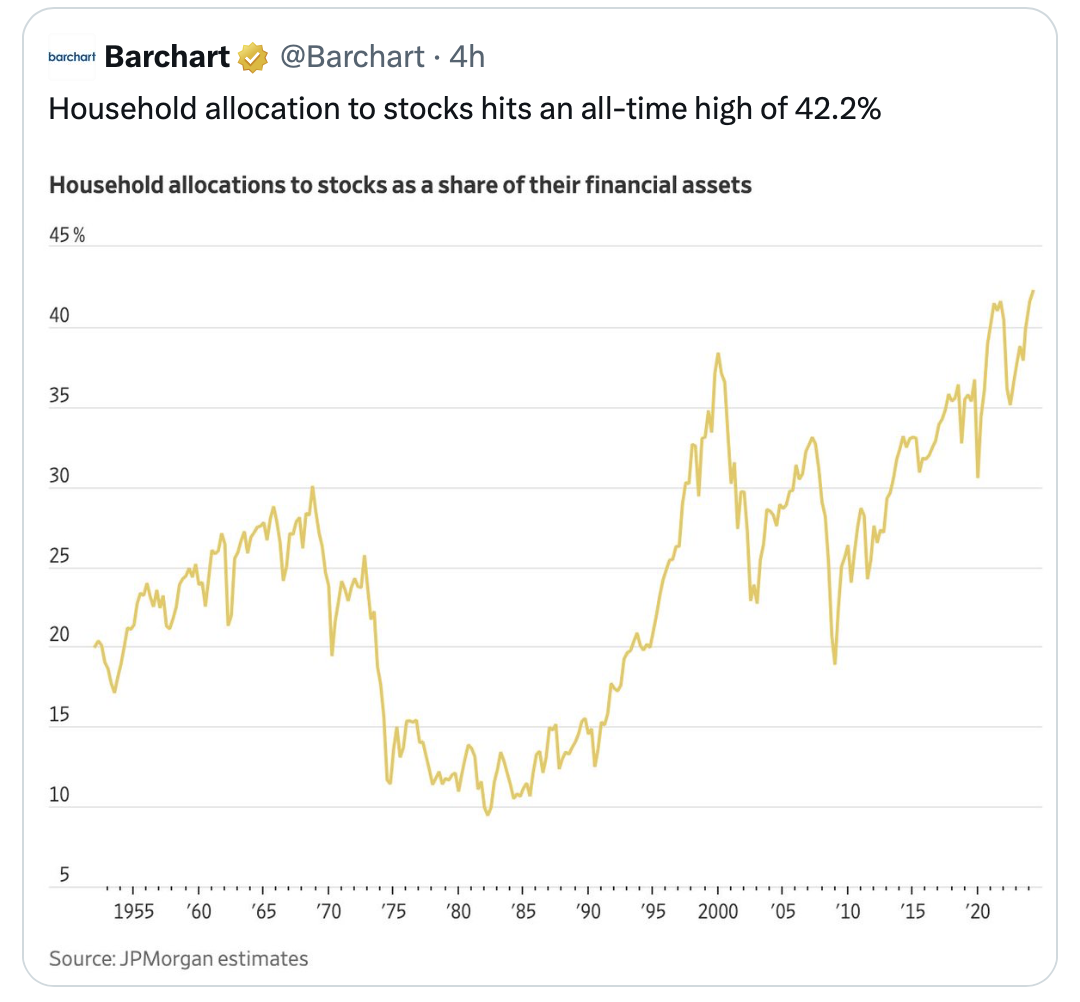
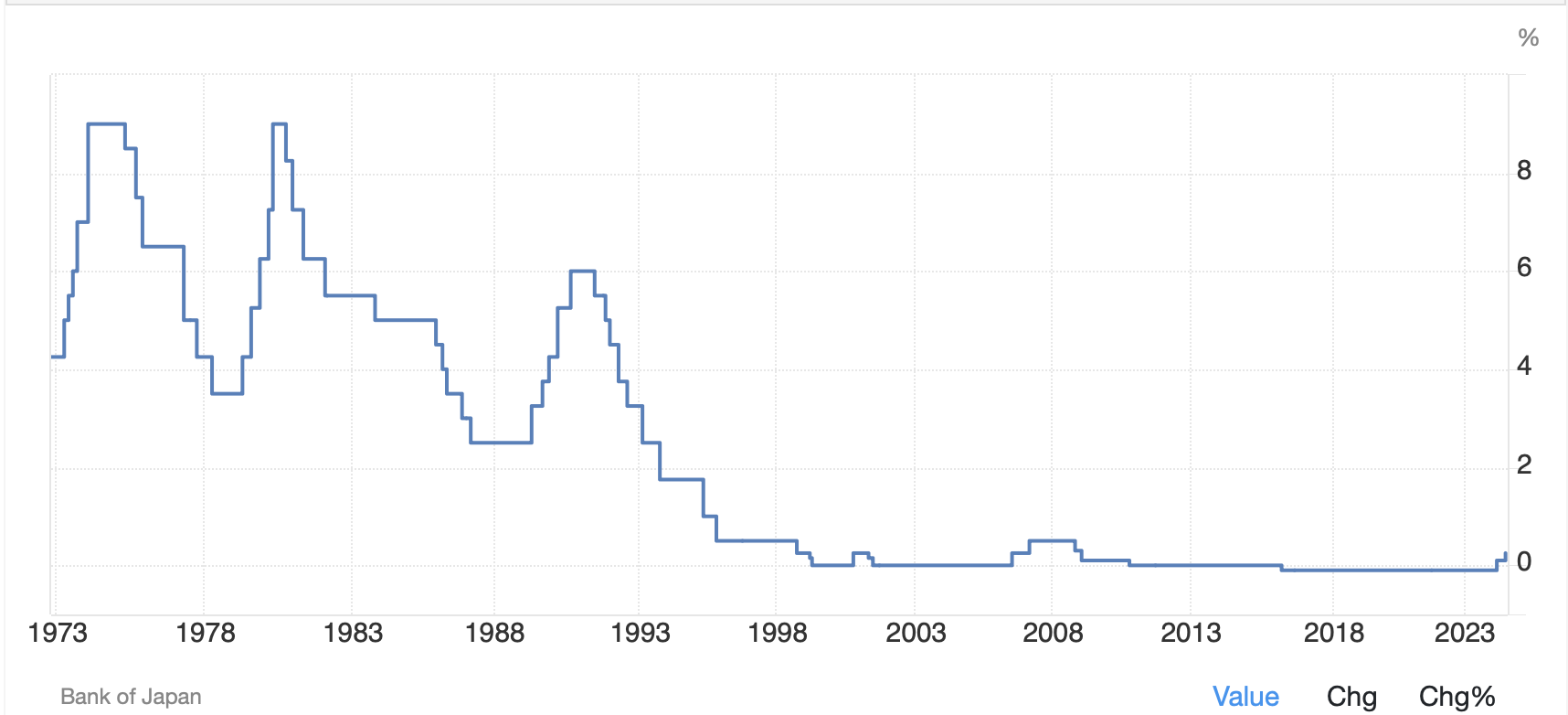
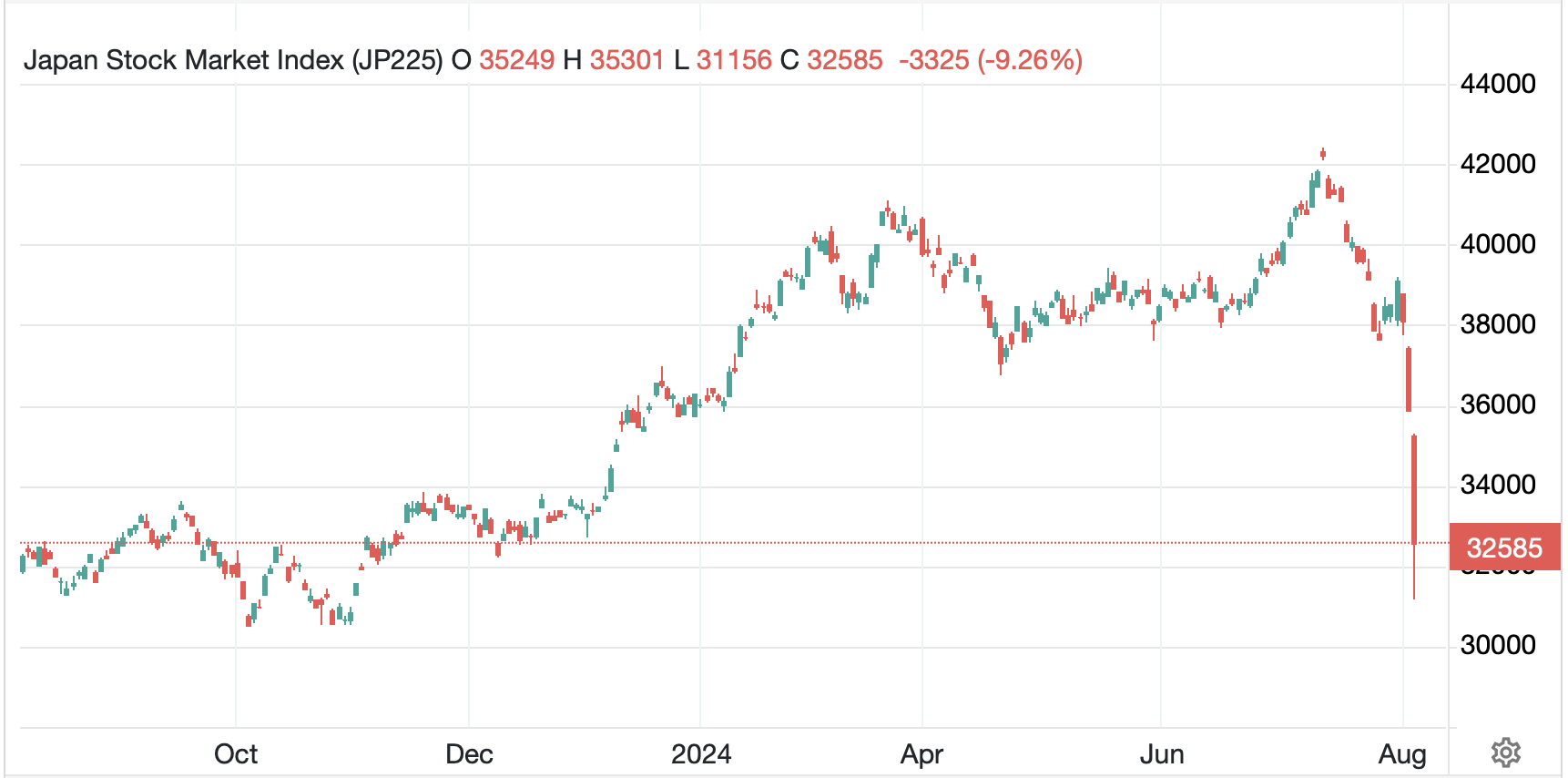
Remember the idea of the summer doldrums where everybody is on vacation, so markets move very little? Yeah, neither do I!  Here’s a different idea though, when risk is under pressure, all correlations go to 1.0.  Look at the following three charts (source: tradingeconomics.com) and explain to me how they behave independently:

There is rioting in the streets today, perhaps not in your neighborhood directly, but in many places around the world (the UK, Bangladesh, Kenya, others), as the global order that we have known for the past X years gets tested.  How big is X?  There will be many different answers to that question, but in this poet’s mind, what we are witnessing in its full glory today is the beginning of the unwinding of the market excesses that began when global interest rates headed to 0.00% in the wake of the GFC in 2009, so X=15 years.  

It is easy to wax philosophical on this subject, discussing the merits of moderating the business cycle and why interest rate policy is a net benefit, and you can be sure that before this week is over, we will get policy interventions.  But ultimately, markets need to clear to function effectively, and I would argue that the last time markets actually cleared was in 1974.  The next big opportunity to allow markets to clear was in October 1987 and the Maestro, although he had not yet earned that moniker, stepped in after that Black Monday and promised unlimited liquidity to prevent too much damage. 

Ever since then, central bankers around the world, led by the Federal Reserve, but do not forget actions like Mario Draghi’s “whatever it takes” moment, have decided that they need to manage the global economy, and market responses, and that markets were only effective if they were going higher.  (It’s ironic that TradFi people scoffed at the crypto maxim ‘number go up’, yet they believed exactly the same thing, only in a different wrapper.) As well, we all know that the concept of political will does not exist anymore, at least not in the West, as no elected politician will ever choose to fight for a policy that has short-term pain and long-term gain.  The result of this constant intervention and guidance from policymakers is that things get overdone, and bubbles inflate.  And it is much easier to inflate a bubble when you maintain policy rates at 0.00% (or negative rates in some cases).  

At this point, you will read many stories about which particular catalyst drove this market reaction, whether it was last week’s BOJ meeting where Ueda-san surprised the market and hiked rates as well as promised to reduce QQE, or whether it was the fact that Chairman Powell did not cut rates, or if it was the weak payroll report.  Others will point to the escalation in hostilities in Ukraine and the Middle East as flashpoints getting people to exit risk positions.  But in the end, the catalyst is not important.  As I wrote on Friday, and is so well explained in Mark Buchanan’s book, Ubiquity, the market was rife with ‘fingers of instability’ and an avalanche has begun.

To this poet’s eye, there needs to be more excess wrung from the market.  After all, given the underlying trade of virtually the entire bull market has been the JPY carry trade, where traders and investors borrowed JPY at 0.00%, converted it to another currency and either held that currency to earn the interest rate differential, or for the truly aggressive, used the currency to buy other risky assets (NVDA anyone?), and that trade has been building for years.  Deutsche Bank has estimated that it grew to $20 trillion in size.  I assure you it is not completely unwound!

However, as I mentioned above, I am confident that central bankers are already getting intense pressure from their respective governments to ‘do something’ to stop the rout.  But central bankers are already (save Japan) in cutting mode.  And the Fed just passed on cutting rates last week.  If they were to cut today, no matter what they said, it would remove any doubt that the only thing they care about is the stock market.  It would destroy whatever credibility they still retain.  But do not count out that response, at this stage, it’s probably 50:50 they cut this week if things continue.  After all, the Fed funds futures market is now pricing in a 95% probability of a 50bp cut in September and a total of 125bps of cuts by December!

I will be the first to say I have no idea where things are going to head from here because while market internals point to further unwinding of risky assets, policy responses have not yet been seen.  So, the best advice I can offer if you are not leveraged is do not panic.  If you are, you have probably been stopped out already anyway.  In the meantime, let’s take a look at the damage overnight.

Equity Markets in Asia:

  • Nikkei 225       -12.4%
  • Hang Seng       -1.5%
  • CSI 300            -1.2%
  • ASX 300           -3.7%   
  • KOSPI               -8.8%
  • TAIEX               -8.3%
  • Nifty 50           -2.7%

In other words, it was quite the rout, with tech shares getting hammered everywhere.  Perhaps the most surprising thing to me as that the CSI 300 didn’t fall further, although I suspect that there was significant intervention by the government to prevent that from happening.  (After all, you don’t need to be a western government to want the number to go up!)

Equity Markets in Europe:

  • DAX                 -2.6%   
  • CAC                 -2.4%
  • FTSE 100         -2.4%
  • IBEX                 -2.8%’
  • FTSE MIB         -3.0%

This tells me that these markets were not nearly as leveraged as Asian markets, likely because prospects throughout Europe have been relatively less interesting to many investors.  After all, if you are leveraging up via borrowing yen, you want to buy growth, not value, stocks, and there aren’t that many growth names in Europe.

Finally, US futures, at this hour (7:00) are lower by:

  • S&P 500          -3.0%
  • NASDQ            -4.5%
  • DJIA                 -2.1%

Bond markets are also seeing very significant movement, in the opposite direction as they are performing their safe haven role brilliantly today.  While the movements today are solid, with Treasury and European sovereign yields all lower by between 5bps and 7bps, to see the real story, you need to see the move since Friday’s opening (these are all 10-year yields).

  • US                    -20bps
  • Germany         -10bps
  • UK                   -9bps
  • Japan               -20bps
  • Australia          -17bps

The US yield curve, at least the 2yr-10yr measurement, is virtually flat today and 30yr yields are now higher than both of those maturities.  Also, look at JGB yields, down to 0.77%, as Japanese investors take their toys and go home.  The thing about this move, and the reason I don’t believe the unwinding is over yet, is that once the Japanese investment community starts to move, it takes a long time for them to get to be where they want given the amount of the assets involved.  And despite all the clutching of pearls about the US ability to sell the amount of debt they need to fund themselves; it won’t be a problem for right now.  Many people around the world will be all too happy to buy Treasury bonds regardless of some political foibles in the US.

Commodity markets are under pressure this morning, but not seeing the same type of pain as equity markets. The story here is that commodities are not directly impacted by the current movements (if anything declining interest rates should help them) but when margin calls come, people sell whatever they can that is liquid.  So, gold (-1.6%) is being liquidated to cover margin calls, not because people don’t want it.  Oil (-1.6%) is likely feeling pressure because these equity moves presage potential economic weakness and a reduction in demand, and we are seeing the same response from the industrial metals.  My take is gold is the one thing, besides bonds, that people are going to be willing to hold, and will rebound first.

Finally, the dollar is under pressure, net, but we are seeing massive movements in both directions.

  • JPY       +2.5%
  • EUR     +0.4%
  • GBP     -0.3%   
  • AUD     -0.9%
  • MXN    -3.3%
  • NOK     -1.0%
  • ZAR      -2.0%
  • CNY     +0.8%  
  • CHF      +0.8%
  • KRW    -0.5%

See if you can determine which were the favorite currencies to hold long against short JPY (AUD, MXN, ZAR). Meanwhile, the renminbi is able to gain as it continues to weaken, net against the yen, its most important competitor.  Remember, currencies are the outlet valves for economies when other markets cannot move enough.  The thing to keep in mind, especially as a hedger, is that volatility is going to be very high for a while yet.  This will not all quiet down and go away in a week’s time. 

At this point, it’s fair to ask, does data matter anymore?  Probably not today, but it will be key for the central banks if for no other reason than to cloak their actions in some fundamental story.  Alas for the Fed, there is virtually nothing to be released this week.  All we see is:

TodayISM Services51.0
TuesdayTrade Balance-$72.4B
ThursdayInitial Claims250K
 Continuing Claims1880K

Source: tradingeconomics.com

As well, and perhaps remarkably, so far on the calendar we only have three Fed speakers, Goolsbee, Daly and Barkin.  However, it seems almost certain we will hear from others, especially if the rout continues.

Right now, fundamentals do not matter.  My sense is we will see a bounce of some sort after the first wave ends, perhaps as soon as tomorrow, but the narrative of the soft landing has been discarded.  Look for more political pressure on the Fed to act, and to act soon.  Also, do not be surprised if the rest of the week ultimately sees a slower, but steady, decline in risk assets as those who haven’t panicked react to the situation and reevaluate just how much they love their positions.  Consider, Warren Buffet sold some of his favorite positions last week and is loaded with cash to act.  But there is nobody who is more patient than he.  

Good luck

Adf

Destined for Sloth

The Chinese are starting to worry
That if they don’t act in a hurry
Their ‘conomy’s growth
Is destined for slowth
Explaining their rate cutting flurry


Sunday night, the PBOC surprised markets by cutting both their 1-year and 5-year Loan Prime Rates by 10 basis points each.  As well, they cut the rate on their newly developed 7-day repo rate by 10bps as they endeavor to shorten the maturity of their money market operations. At the time, it was taken as a response to the Third Plenum and the only concrete action seen as new support for the economy.  As its name suggests, those rates represent the cost to borrow for credit worthy companies.  A quick look at the history of this rate (the blue line), which was first tracked toward the end of 2013, shows that over time, it has done nothing but decline.  I have overlayed a chart of USDCNY in the chart (the grey line) to help appreciate the long-term trend in that as well which, not surprisingly, shows a steady weakening of the renminbi (rise in the dollar).

Source: tradingeconomics.com

But the reason I bring this up is that last night, the PBOC surprised markets yet again by cutting its One-Year Medium-Term Lending Facility by 20 basis points, to 2.30%.  Not only was this the largest cut since the pandemic, but it was also done at an extraordinary meeting and combined with an injection of CNY235 billion (~$32B) into the economy.  Arguably, this is the most aggressive monetary policy stance that has been effected by the PBOC since the summer of 2015 when they surprisingly devalued the renminbi 2%.  Apparently, the PBOC is trying to adjust its policy actions to be more in line with the G7 where central banks use short term rates as their tools.  One other thing this implies is that President Xi remains steadfastly against any fiscal stimulus of substance at this point.  On the one hand, you must admire that effort, but I fear that the domestic Chinese economy remains so weighed down by the ongoing property sector problems, achieving their 5.0% GDP growth target is going to become that much more difficult as the year progresses.

For our purposes, though, the story is all about the CNY (+0.7%), which rallied sharply after the announcement, continuing its movement from the Monday rate cuts which totals 1.1%.  Now, ordinarily one might think that a country cutting its rates would lead to a weaker currency, ceteris paribus, However, given the market outcome, there is much discussion about how the PBOC “requested” Chinese banks to more aggressively buy CNY to support the currency.  Interestingly, the fixing rate on shore overnight (7.1321) continues to weaken ever so slightly overall, but now the spread between the fix and the market has fallen to just over 1%, well within the +/- 2% band and an indication there is less pressure on the currency.  My take is this is just window dressing, but I would not fight it.  I expect that we will see USDCNY slowly return to higher levels over time, with the key being it will take lots of time.

The ongoing rout
In tech stocks has another
Victim, dollar-yen

Under the guise, a picture is worth a thousand words, the below chart showing the NASDAQ 100 (blue line) and USDJPY (green line) overlaid is quite interesting.

Source: Tradingeconomics.com

While there is an ongoing argument amongst market practitioners as to whether it is the decline in the tech sector that is driving USDJPY’s decline or the other way round, what is clear is that there is a strong correlation between the two.  If you think about what the USDJPY trade represents, it is the purest form of a carry trade, shorting the cheapest currency and using the funds to buy a much higher yielding currency with maximum liquidity.  But another thing to do with those funds obtained from borrowing yen and buying dollars was to use the dollars to jump on the tech stock bandwagon.  After all, that added another 30% to the trade since the beginning of the year.  

However, over the past two weeks, nearly one-third of the NASDAQ gains have been erased and that has been made worse by the >6% rise in the yen.  At this stage, it no longer matters which is driving which, the reality is that we are seeing significant short covering in the yen with sales in other assets required to unwind the trade.  Arguably, this is why we are seeing virtually every risk asset lower this morning, although bonds are holding up as havens, as all have been funded with short yen.  Given that relationship, I am coming down on the side of the yen being the driver, but as I said, I don’t think it matters.  

The real question is can it continue?  It is important to understand that when markets achieve excessive levels like we saw in USDJPY, they rarely simply unwind to some concept of fair value.  Rather they typically overshoot dramatically in the other direction.  As such, if we assume PPP is fair value, and PPP for USDJPY is currently around 110.00, it appears there is ample room for USDJPY to decline much further.  Consider, this movement has happened, and the Fed has not even started to cut rates.  If we do, indeed, fall into recession, the Fed will respond, and I expect that we could see a very sharp decline in USDJPY.  Something to consider looking ahead.

While that was a lot about the currency markets, they seem to be the current drivers, so are quite important.  But let’s look at everything else.

Equity market pain has been universal with Japan (-3.3%), Hong Kong (-1.8%) and China (-0.6%) all following the US lower overnight and in Europe, this morning, it is no better with the CAC (-2.2%) the worst performer, but all the major indices falling sharply.  US futures are little changed at this hour (7:00), but remember, we are awaiting key GDP data and more earnings numbers, which have been the driver.

As mentioned above, bond markets are rallying with Treasury yields lower by 5bps and most European sovereigns seeing declines of -3bps or -4bps.  Credit is an issue as Italian BTPs are the laggard this morning, with yields there only lower by 1bp.  Equally of interest is the fact that the US yield curve inversion has been reduced to just 14bps and has been normalizing dramatically for the past several sessions.  One thing to remember about the yield curve is that when it inverts, it indicates a recession is coming, but when it uninverts, it indicates the recession has arrived!  This is all of a piece with softer economic data and expectations of Fed policy ease coming soon to a screen near you.

In the commodity markets, nobody wants to own anything.  Oil (-1.3%) is continuing its recent poor performance despite EIA data showing significant inventory reductions.  This is not a sign of strong demand.  But we are also seeing weakness across the entire metals space with gold (-1.0%) breaking back below $2400/oz and silver and copper under severe pressure.  Right now, nobody wants to hold these, although I suspect that the long-term supply/demand situation remains bullish.

Finally, the dollar is mixed overall.  While we have seen strength in JPY and CNY, as discussed above, and CHF (+0.8%) is also showing its haven status and use as a funding currency, there are numerous currencies under pressure, notably AUD (-0.8%), NOK (-0.8%), MXN (-0.8%), ZAR (-0.7% and SEK (-0.6%) all of which are commodity linked to some extent.  Yesterday, the BOC cut rates by 25bps, as expected, but the Loonie has been steadily weakening for the past two weeks, so yesterday’s decline and today’s is just of a piece with that.  Ultimately, we are watching a serious risk-off event, and I expect the dollar will hold its own vs. most currencies, although JPY and CHF seem to have room to run yet.

On the data front, once again yesterday’s data was on the soft side with the Flash Manufacturing PMI falling to 49.5, well below expectations and New Home Sales slipping to 617K.  In fact, it is difficult to find the last strong piece of data, perhaps the ex-autos Retail Sales number from last week.  This morning, we see Initial (exp 238K) and Continuing (1860K) Claims, Q2 GDP (2.0%), and Durable Goods (0.3%, 0.2% ex transport).  The Atlanta Fed’s GDPNow tool is indicating GDP in Q2 was 2.6%, well above the forecasts.  However, I think of much more interest will be to see how it starts out for Q3.  We have had a spate of weak data, and those recession calls are growing louder.

This is a tough market, but I expect we have not yet seen the last of the risk-off trade (just consider how long the risk-on trade has been going on) so further dollar strength against most currencies, except for JPY and CHF, and further weakness in commodities and equities seem the most likely direction.

Good luck

Adf

A Bruising

While many consider AI
The future, and can’t wait to buy
The stocks that convey
The future’s today
Perhaps that result’s not yet nigh
 
For instance, today’s biggest news
Is Windows is stuck with, screen, blues
What’s happened is that
A bug, not a gnat
Disrupted what most people use

Oops!  That seems to be the response so far by Microsoft and Crowdstrike as they try to troubleshoot and fix an apparent bug in the most recent release of their software.  The result of this bug is that computers all over the world that use Microsoft Windows as their operating system have, this morning, the dreaded ‘blue screen of death’, something with which far too many of us are familiar.  This problem has affected airports, airlines, banks and businesses of all stripes, essentially shutting down key processes and by extension the businesses themselves.  And consider, this is allegedly because of a single bug in a new rollout of security software.
 
We all know that bugs are an inherent part of the computing world, and most of us have lived through glitches in the past.  The difference this time, though, is that as more and more businesses move more and more of their computing operations into the cloud, the impact of any imperfection in the computer code grows exponentially.  This will not stop the migration of business operations to the cloud, of that I am certain.  But perhaps it will force some businesses to rethink what it means to be secure.
 
Additionally, given the hype surrounding AI, and the growing belief amongst a subset of businesses and investors, that companies which are not utilizing AI are going to wither and die due to its absence, perhaps this situation will cause some to rethink the pace of that utilization.  Remember, the essence of the AI hype is that the computers will be able to replace humans in many jobs, thus increasing efficiency and with it, profitability.  However, not only is the jury still out, but I would contend it has not yet started deliberations as; to date, I have not seen a single application where the results from AI are so superior to human actions, that the vast expenses to train and run AI applications make economic sense.  There is no killer app. 
 
Rather, the best analogy I have seen is that AI represents an advance similar to Microsoft Excel, where prior to the existence of spreadsheets, calculations by hand were incredibly time consuming and correspondingly expensive, but once Excel came along, analyzing data became a routine and much less expensive task.  The difference is Excel was cheap to buy and didn’t use much power to run.  AI is hugely expensive to train and then to run as well.  And bringing this full circle, removing operations from human oversight opens the door to situations like today, where things just don’t work.  Also, consider that Nvidia has sold ~$60 billion of chips in the past year, which means that companies like Microsoft, Alphabet, Apple and Meta have spent that much money on those chips as they build out their AI capabilities.  However, their revenues have not increased by nearly that much, certainly not from any AI initiatives.  Maybe the “killer” in killer app refers to what it is going to do to company profitability for those firms trying to lead this charge.
 
And, since this is a note about money and finance, let’s consider one other issue, the drive by many governments to eliminate cash.  Consider how things would be if cash was gone and all payments were electronic, but then a bug in the system resulted in banking and payments software shutting down.  Exactly how will firms conduct business?  I’m not talking about large-scale manufacturing operations, but rather about the grocery store or the McDonalds or pizza place where you want to get something to eat.  If there is no cash, what do you do?  Money is truly a remarkable invention and until the point when computer systems work 100% of the time, not 99.9%, the absence of a physical medium of exchange has the potential to be devastating to many people if the network goes down.  Just sayin’.
 
For many it was quite confusing
That stocks could absorb such a bruising
But data keeps hinting
That nobody’s minting
More profits, they just might be losing
 
Ok, let’s take a look at markets as we try to prepare for today’s activities.  It seems that as of 7:00am in NY, the bug has been fixed and things are starting to get back to normal.  But this is going to leave a mark.  Yesterday saw the first down day across the board in US markets in weeks with the DJIA (-1.3%) leading the way lower.  Most of Asia followed this move although Japanese declines (Nikkei -0.2%) were mitigated by the release of CPI data that showed no acceleration in prices in Japan.  The Hang Seng (-2.0%) reflected the tech sell-off and equities throughout the region were lower with one exception, mainland Chinese shares rose 0.5% after the end of the Third Plenum.  While many had hoped for some new economic stimulus, it seems that President Xi believes he is already on the right path and will not change.  As to European bourses, they are all lower this morning, following the trend started in the US yesterday while US futures are little changed right now.
 
Treasury yields, which traded higher during yesterday’s session despite the sharp sell-off in stocks, are unchanged this morning and European sovereigns, which closed before the full move was complete in the US have edged up the last 1bp to 2bps to maintain their relative spreads.  The ECB left rates on hold, as universally expected, but Madame Lagarde disappointed the doves by not promising a cut in September.  Despite weakening growth on the continent, inflation remains uncomfortably high it seems.  The same is not true in the US, though, where more Fed speakers gave the same message that things are going well, they are watching unemployment, and a rate cut is likely coming in the not too distant future.
 
In the commodity markets, oil edged lower yesterday after a nice rally Wednesday, and is continuing that this morning, down a further -0.5%.  But the pain trade is in metals with gold (-1.2%) and silver (-1.8%) leading the way lower on what appears to be some market technical issues rather than specific fundamental questions.  Both copper and aluminum are also softer this morning, but that is reflective of the continued concerns over economic growth.
 
Finally, the dollar is firmer again this morning, despite the modestly more hawkish discussion from the ECB and despite the ongoing belief that the Fed is preparing to cut rates at the September meeting.  Yesterday saw some impressive movement with BRL (-1.0%) and CLP (-2.0%) amid that broad-based dollar strength.  However, this morning, the worst performers are SEK (-0.6%) and NOK (-0.4%) with the rest of both the G10 and EMG blocs within 0.2% of Thursday’s closing levels.  The NOK is clearly following oil lower, and SEK is following NOK, as there has been no news or commentary from either nation that would offer a solid rationale for the move.  As I often explain, sometimes currency markets are simply perverse.
 
There is no US data due this morning, but we do hear from two more Fed speakers, Williams and Bostic. However, both have already spoken this week and there certainly hasn’t been any data that would likely have changed their views.  It seems all eyes will be on the equity markets this morning.  If they follow yesterday’s moves lower, I think we may see a more traditional risk-off outcome, but even if stocks rebound, it is hard to get too negative on the greenback.
 
Good luck and good weekend
Adf


Things Went to Hell

There once was a company, strong
Whose shares, everyone had gone long
But things went to hell
Nvidia fell
And folks wonder now, were they wrong?
 
The narrative hasn’t adjusted
Though certainly some are disgusted
AI, after all
To which they’re in thrall
Is perfect, so why’s it seem busted?


Times are tough for macro pundits and analysts, like this poet, as there is so little ongoing at the moment.  Data releases are sparse, and generally of a secondary nature and even commentary has been less active.  Truly, the summer doldrums have arrived.

With this in mind, perhaps it is a good time to consider what the broad risk asset narrative looks like these days, especially since the most recent version was exceedingly clear; Nvidia is the only company that matters in the world and its stock price should go to 10,000.  While there had been pushback on this idea, with the naysayers comparing the stock to Cisco and Qualcomm during the dot com bubble in 2000, the true believers countered with the fact that Nvidia was wildly profitable and given the race by companies all over the world to embrace AI, would continue to grow at its extraordinary recent pace.  But consider…

Back in the 1970’s, there was a group of companies described as the Nifty Fifty that represented the growth companies of the time.  And they were great companies, with most of them still around today including American Express, Coca-Cola, IBM and Walt Disney, to name just a few.  The thesis at the time was that these companies represented the future, and that if an investor didn’t own them, they were missing out.  The thing that was ignored at the time (and in truth is ignored in every bubble) is there is a difference between the company and its share price.  Overpaying for a good company can result in poor investment performance even if the underlying company continues to have magnificent results.

I mention this era as there are certainly parallels to the current mania for the Supremes (Nvidia, Apple, Microsoft) and the narrative at that time.  There is nothing inconsistent with understanding that these companies, and especially Nvidia, have created something special, but that they cannot possibly sustain their current valuations and so their share prices may fall.  And they can fall a lot.  After all, Nvidia has retraced 13% in just 3 sessions.  As much momentum as these shares have had on the way up, they can have that much and more on the way back down.  I’m not saying this is what is going to happen today, simply highlighting that trees don’t grow to the sky.  Perhaps we have now seen how tall they can grow.  

One thing I sense is that if this correction continues, it is likely to broaden out.  Perceptions are funny things, and if the zeitgeist changes, even if the companies continue to put up terrific numbers, the share prices can go a lot lower.  Consider that if the Supremes each fall 50%, they will still have market caps of $1.5 trillion and be amongst the largest companies in the world.  In fact, if they fall 50%, I’m pretty confident so would most of the rest of the market, so they would likely maintain their relative crowns of size, just at a smaller number. 

At any rate, this is an important discussion as the equity markets have been key drivers of all markets, and a change there will naturally result in some different opinions elsewhere.  Arguably, the biggest question is, if the stock market falls sharply, but the economic data don’t respond in the same way, will the Fed really cut rates?  There are many who remain firmly in the camp that the ‘Fed put’ is still intact, and they will come to the rescue.  Personally, my take is if there is a Fed put, the strike price is a lot lower, maybe S&P 3500, not S&P 5000.  Chairman Powell has enough other problems to address so that the value of the S&P is probably not job one.  In fact, it could become quite a political problem for him if the Fed is seen as rescuing Wall Street again while so many on Main Street struggle.

Ok, it’s time to look at the freshly painted wall and watch it dry overnight session.  Yesterday’s US session was unusual for its composition as the DJIA had a solid day, gaining 0.7%, while the NASDAQ suffered, falling -1.0%.  Asia, too, had an interesting session with the Nikkei (+1.0%) and Australia (+1.3%) both rallying while the Hang Seng was little changed and China (-0.5%) fell.  One possible explanation is that the tech sectors are getting unwound while money flows into less exciting areas like natural resources and manufacturing.  Of course, given there are no tech shares of which to speak in Europe, the fact that every bourse on the continent, and the UK as well, is lower, led by the DAX’s -1.0% decline, I am searching for another explanation.  At this hour (7:20) US futures are a touch firmer, 0.3%, but I don’t put much stock in this given the past several sessions.

In concert with the risk-off theme, bond markets are seeing a bid with corresponding yield declines.  Treasury yields are lower by 1bp with European sovereigns lower by between -2bps and -4bps.  There is still a great deal of anxiety, at least according to the press, about the French elections, but given the political bias of most mainstream media, which is decidedly against the idea that Marine Le Pen’s RN should win, it is possible that the actual situation is far less concerning.  The fact that the Bund-OAT spread continues to narrow at the margins tells me that there are fewer concerns than immediately following Macron’s call for the snap election.

Oil prices (-0.6%) are retracing yesterday’s modest gains as there continues to be uncertainty over the demand situation and whether economic activity is slowing offset by what appears to be a modest escalation in the Russia/Ukraine war with concerns that could impact supply.  As to the metals markets, prices there are little changed this morning after having edged higher yesterday.  My take here is that traders are keenly focused on Friday’s PCE data as an indication to whether the Fed will be cutting sooner rather than later.  The sooner the cut, the better metals prices should perform.

Finally, the dollar is almost unchanged this morning after having fallen modestly yesterday.  All eyes continue to focus on USDJPY, although it has slipped back this morning to 159.50.  Right now, my sense is there are many ‘tourists’ in the FX market trying to play for the next intervention, but as I said yesterday, I do not believe the MOF is going to be as concerned as they were in April/May given the pace of the move has been so much more modest.  For instance, last night FinMin Suzuki explained, “[the MOF] will continue to respond appropriately to excessive FX moves.  It is desirable for FX to move stably.”  Now, aside from the oxymoron of stable movement, this type of commentary is typically not indicative of any immediate concerns.  As to the rest of the G10, modest gains and losses define the day although we have seen both MXN (-0.65%) and ZAR (-0.4%) slide this morning, although given the amount of money involved in the carry trade for both these currencies, this is likely just positions adjusting rather than a fundamental change.

This morning brings more tertiary data with the Chicago Fed National Activity Index (exp -0.4), Case Shiller Home Prices (6.9%) and Consumer Confidence (100).  We also hear from two speakers, Governors Cook and Bowman.  Perhaps the most interesting thing yesterday was that SF Fed President Daly specifically touched on Unemployment in her comments, explaining that though there was still insufficient confidence that inflation was declining to target, she was paying close attention to the Unemployment rate, “so far, the labor market has adjusted slowly, and the unemployment rate has only edged up. But we are getting nearer to a point where that benign outcome could be less likely.”  I have a feeling that the employment report a week from Friday is going to have a lot more riding on it than in the recent past.  Any weakness there could really change the tone of the market regarding the economy and the Fed’s actions.

It is difficult to get too excited about today although if the recent correction in Nvidia continues and widens to some other names (a distinct possibility) do not be surprised if there are some fireworks later on.  In that case, I would look for a traditional risk-off session with the dollar higher while bond yields and stocks fall.

Good luck

Adf

A Quagmire?

For those who believe a recession
Is coming, the data’s digression
From strength’s getting clearer
And rate cuts are nearer
Though maybe that begs a new question
 
Can equity markets go higher
If profits fall in a quagmire?
Though many agree
Rate cuts will bring glee
The past has shown they can be dire


The data of late have not been positive.  Interestingly, this is not simply a US phenomenon, but appears to be spreading elsewhere in the world as evidenced by this morning’s much weaker than expected Flash PMI data out of Australia (Mfg 47.5 vs. 49.7), Japan (50.1 vs. 50.6) and Europe (Germany 43.4/46.4, France 45.3/46.8, Eurozone 45.6/47.9).  This follows the US trend where yesterday we saw the weakest Building Permits and Housing Starts data since the pandemic in June 2020 as well as a weaker than forecast Philly Fed result and higher than forecast Initial Claims data.  Prior to the Juneteenth holiday, Retail Sales were also quite soft, and another harbinger is the Citi Surprise Index, which Citibank created to measure actual data vs. the forecasts ahead of the release.  Typically, as it declines, it indicates weakening growth and vice versa.  As you can see from the below chart, this indicator has fallen to its lowest level in two years.

Source: Bloomberg

Summing it up, the strength of the economy is clearly being called into question by the data releases. However, as we have seen for the past several years, this is not a universal phenomenon.  For instance, who can forget the recent NFP print which beat expectations handily.  As well, the Atlanta Fed’s GDPNow indicator remains at 3.0% after yesterday’s housing data, still far above the forecasts by most economists, and an outcome that would be welcomed by almost everyone.

(As an aside and related to yesterday’s discussion about how politics intrudes on, or at least colors, so much of the financial market commentary, there have been numerous articles ‘blaming’ the weak PMI data on the results of the European Parliament elections and the ensuing call by French President Macron for next week’s snap election.  While one can make the case that is the situation in France, given the inherent uncertainty of the outcome, it seems a stretch to say that is why Germany’s data suffered.  After all, it is possible that all the talk of Eurozone tariffs on Chinese goods and the demonstrated incompetence of the current German government are sufficient to dissuade businesses there from investment and growth.)

So, what are we to believe?  The first thing I would highlight is that the idea of two separate economies seems to gain validity by the day.  For the haves, however you want to describe them but arguably the top 10% of income and wealth, the current situation has been fine.  While inflation is annoying, they can afford the higher prices given their asset portfolios, whether real estate or equities, have risen so dramatically.  The wealth effect for them is quite real.  

However, for the rest of the nation, things are far less positive.  The Retail Sales data tell a tale of reduced purchases of stuff (remember, that data is not inflation adjusted, so higher sales and higher inflation could well indicate less stuff sold but more money paid for it).  Additionally, the employment data is also a mixed bag as although NFP was strong, the household survey indicated less people were working and the trend in the Unemployment Rate is clearly up and to the right as per the chart below.

Source: tradingeconomics.com

Adding to this mix we have the Fed, who continue to look at the inflation data, and while they were pleasantly surprised by the slightly softer tone of the CPI data earlier this month as well as the PCE data last month, are still not prepared to address potential weakness in the economy.  This was made evident again yesterday when Richmond Fed President Barkin said, “my personal view is let’s get more conviction before moving.”  In other words, as we have heard consistently, patience remains a virtue at the Eccles Building.

If pressed, my personal view is that the economy has peaked for this cycle and we are going to start to see more data show weakness going forward, not strength.  The bigger problem with this is that while inflation has ebbed from its highest levels, it appears to me that the idea it will reach, and remain at, the 2.0% target is extremely unlikely.  Rather, I remain in the camp that the new level of inflation is somewhere between 3% and 4% as defined by CPI, and that over time, the Fed is going to bless that as an appropriate description of stable prices.  Given the Fed’s clear desire to cut rates, I fear that they are going to act earlier than would otherwise be prudent and that while economic activity will decline, prices will rebound.  Absent a massive recession, something like we saw in 2008-09, I do not see prices falling back to the current target.

And here’s the problem with that view from a market’s perspective, if the recession comes, the Fed will cut rates and cut them relatively quickly.  This can be seen in the chart below showing Fed funds behavior relative to recessions.

Source FRED data base

Alas, for equity markets, during a recession, equity markets tend to fall, with declines of 30%-50% quite common and much greater as well (NASDAQ fell 88% during 2001-02 recession).  The road ahead appears to be filled with difficulty, so keep that in mind as you go forward.

Ok, sorry that ran on so long, but sometimes it is important to dig a little deeper I feel.  Let’s do a really quick turn of the overnight session.  Japanese equities were little changed but Hong Kong fell sharply (-1.7%) and the mainland drifted lower.  The rest of Asia was broadly under pressure although Australia (+0.35%) managed to eke out small gains.  In Europe, following the weak PMI data red is the color of the day with every market lower on the session, including the UK which released surprisingly positive Retail Sales data, although their PMI data was also soft.  At this hour, US futures are little changed awaiting the Triple Witching Day of expiries of futures, options and options on futures.

In the bond market, yields are lower across the board led by Treasuries (-3bps) and all of Europe as those PMI data are a harbinger of slower growth and will likely be an encouragement for more rate cuts by the ECB.  In fact, Klaas Knot, one of the more hawkish ECB members indicated he could see three more cuts this year, which is even more dovish than the market is pricing.

In the commodity markets, oil is essentially unchanged this morning, maintaining its recent gains as inventory data showed more draws than expected.  In the metals markets, gold (+0.2%) is holding onto its recent rebound, but given the weaker economic data story, both silver and copper are under pressure.

Finally, the dollar is gaining this morning as European currencies suffer from weak data and rate cut dreams, although there are two real outliers, MXN (+0.45%) on the back of surprising strength in recent economic data (Retail Sales and IP) and ZAR (+0.55%) as it appears more investors are turning to the rand as the pre-eminent carry trade earner vs. the yen and reducing their MXN exposures after the recent elections.

On the data front, the Flash PMI’s are due at 9:45 (exp 51.0 Mfg, 53.7 Services) and then at 10:00 we see both Existing Home Sales (4.10M) and Leading Indicators (-0.3%).  While there are no Fed speakers on the calendar, I fully expect to hear from someone before the end of the day as they simply cannot shut up.

Overall, risk is off, and I suspect that we could see some equity selling during today’s session, following yesterday’s moves.  With that, bonds are likely to perform as well as the dollar, and I think gold holds on, though the rest of the commodity complex is likely to suffer further losses.

Good luck and good weekend

Adf

Ain’t

Ueda explained
Buying bonds is still our bag
But buying yen ain’t


The last of the major central banks met last night as the BOJ held their policy meeting.  As expected, they left the policy rate unchanged between 0.00% and 0.10%.  However, based on the April meeting comments, as well as a “leak” in the Nikkei news, the market was also anticipating guidance on the BOJ’s efforts to begin reducing its balance sheet.  Remember, they still buy a lot of JGBs every month, so as part of the overall normalization process, expectations were high they would indicate how much they would be reducing that quantity.

Oops!  Here is their statement on their continuing QQE program [emphasis added]:

Regarding purchases of Japanese government bonds (JGBs), CP, and corporate bonds for the intermeeting period, the Bank will conduct the purchases in accordance with the decisions made at the March 2024 MPM. The Bank decided, by an 8-1 majority vote, that it would reduce its purchase amount of JGBs thereafter to ensure that long-term interest rates would be formed more freely in financial markets. It will collect views from market participants and, at the next MPM, will decide on a detailed plan for the reduction of its purchase amount during the next one to two years or so. 

In other words, they have delayed the onset of their version of QT by another month and based on the nature of their process, where they pre-announce the bond buying schedule on a quarterly basis, it is entirely possible that the delay could be a bit longer.  You will not be surprised to know the yen fell sharply on the news, as per the below chart.

Source: tradingeconomics.com

In fact, it traded to its weakest (dollar’s highest) level since just prior to the intervention events in April.  However, as you can also see, that move was reversed during the press conference as it became clear to Ueda-san that his delay did not result in a desired outcome.  The issue was the belief that the BOJ cannot make decisions on interest rates and QT simultaneously (although for the life of me, I cannot figure out why that was the belief), and so Ueda addressed it directly, “We will present a concrete plan for long-term JGB buying operations in July. Of course, it’s possible for us to raise the short-term interest rate and adjust the degree of monetary easing at the same time depending on the information available then on the economy and prices.”

In the end, the only beneficiary of this was the Japanese stock market, which managed a modest rally of 0.25%.  Certainly, this did not help either Ueda’s or the BOJ’s credibility that they are prepared to normalize policy, and it also left the entirety of currency policy in the lap of the MOF.  The problem for Ueda-san is that until the Fed decides it is time to start cutting interest rates, a prospect which seems further and further distant, the yen is very likely to remain under pressure.  I am beginning to suspect that despite Ueda’s stated goal of normalizing monetary policy, the reality is that, just like every other central banker today, his bias is toward dovishness, and he cannot let go.  I fear the risk is that the yen could weaken further from here rather than it will strengthen dramatically, at least until there are real policy changes.  FYI, JGB yields closed 3bps lower after the drama.

Away from that, the overnight session informed us that Chinese economic activity appears to be slowing, at least based on their loan growth, or lack thereof.  Loans fell, as did the pace of M2 Money Supply and Vehicle Sales.  While none of these are typically seen as major data releases, when combined, it seems to point to slowing domestic activity.  The upshot is a growing belief that the PBOC will ease policy further thus supporting Chinese equities (+0.45%) and maintaining pressure on the renminbi which continues to trade at the limit of its 2% band vs. the daily CFETS fixing.

As to Europe, it is becoming clearer by the day that investors around the world have begun to grow concerned over what the future of Europe is going to look like.  Despite the ECB having cut their interest rates last week, the results of the European Parliament elections continue to be the hot topic and we are seeing European equity markets slide across the board, with France (-2.5% today, -5.8% this week) leading the way lower as President Macron’s Renaissance Party looks set to be decimated in the snap elections at the end of the month.  But the entire continent is under pressure with Italy (-2.8% today, -5.7% this week) showing similar losses and the other major nations coming in only slightly better (Germany -2.75% this week, Spain -3.9% this week).  You will not be surprised to know that the euro (-0.4%) is also under pressure this morning, extending its losses to -1.0% this week with thoughts it can now test the lows seen last October.

There is a great irony that the G7 is meeting this week as so many of the leaders there, Italy’s Giorgia Meloni and Japan’s Kishida-san excepted, looks highly likely to be out of office within a year.  Macron, Olaf Sholz, Justin Trudeau, President Biden and Rishi Sunak are all far behind in the polls.  One theory is that the blowback from the draconian policies put in place during the pandemic restricting freedom of movement and speech within these nations, as well as the ongoing immigration crisis, which is just as acute in Europe and the UK as it is in the US, has turned the tide on the belief that globalization is the best way forward.  

Earlier this year I forecast that there would be very severe repercussions during the multitude of elections that have already taken place and are yet to come.  Certainly, nothing has occurred that has changed that opinion, and in fact, I have a feeling the changes are going to be larger than I thought.  

The reason this matters is made clear by today’s market price action.  If the world is turning away from globalization, with a corresponding reduction in trade, equity markets which have been a huge beneficiary of this process (or at least large companies have directly) are very likely to come under further pressure.  As well, fiscal policies are going to put more pressure on central banks as the natural response of politicians is to spend more money when times are tough, and we could see some major realignments in market behaviors.   This will lead to ongoing inflationary pressures, thus weaker bond prices and higher yields, weaker equity prices, much strong commodity prices and the dollar, ironically, likely to do well as it retains its haven status.  Certainly, the euro is going to be under pressure, but very likely so will many other currencies.  This is a medium to long-term concept, certainly not something that is going to play out day-to-day right now, but I remain firmly in the camp that many changes are coming.

As to the rest of the markets overnight, yields are falling everywhere (Treasuries -5bps, Gilts -9bps, Bunds -12bps, OATs -6bps, Italian BTPs -1bp) as investors are seeking havens and for now, bonds seem better than stocks.  You will also notice that the spread between Bunds and other European sovereigns is widening as there is clear discernment about individual nation risk.  This is not a sign that everything is well.

Maintaining the risk-off thesis, gold (+1.25%) and silver (+1.00%) are rallying despite a much stronger dollar this morning and we are also seeing some strength in oil (+0.2%).

As to the dollar, it is stronger vs. almost every one of its counterparts this morning, most by 0.3% or more with CE4 currencies really under pressure (PLN -1.0%, HUF -0.8%).  However, there are two currencies that are bucking this trend, CHF (+0.25%) which is showing its haven characteristics and ZAR (+0.5%) where the market is responding to the news that the ANC has put together a coalition and that President Ramaphosa is going to remain in office.

Yesterday’s PPI data showed softness similar to the CPI on Wednesday but more surprisingly, the Initial Claims number jumped to 242K, its highest print since August 12, 2023, and a big surprise to one and all.  The combination of data certainly added to yesterday’s feel that growth and inflation were ebbing.  This morning, we get the Michigan Sentiment (exp 72.0) and then a couple of Fed speakers (Goolsbee and Cook) later on during the day.

I should note that equity futures are all in the red this morning, with the Dow continuing to lag the other markets, probably not a great signal of future strength.  Arguably, part of today’s price movement is some profit taking given US equity markets have rallied this week and month.  But do not discount the bigger issues discussed above as I believe they will be with us for quite a while to come and put increasing pressure on risk assets with support for havens.  As such, I think you have to like the dollar given both the geopolitical issues and the positive carry.

Good luck and good weekend

Adf

Not Well Understood

The ISM data was weak
And traders, more bonds, did soon seek
The oil price fell
The dollar, as well
But stocks ended close to their peak
 
So, is now bad news really good?
‘Cause Jay will cut rates, or he should
Or is it the case
That growth’s slowing pace
Means risk is not well understood


The narrative had a little hiccup yesterday as the ISM data was released far weaker than expected.  The headline number, 48.7, fell vs. last month and was a full point below market expectations.  The real problem was that while the Employment sub-index was solid, New Orders tanked, and Prices remained high.  If you add this to the Chicago PMI data from Friday, which at 35.4, was the lowest print since the pandemic in May 2020 and back at levels seen in the recessions of 2001 and 2008, it is fair to question just how strong the US economy is right now.

Adding to this gloom is the news that the Atlanta Fed’s GDPNow estimate slipped to 1.8% for Q2, down from 2.7% last Friday, and the trend, as per the below chart, is not very pretty.

Given the data, it can be no surprise that the Treasury market rallied sharply, with yields declining 8 basis points on the session, although they are little changed this morning.  After all, if the economy is slowing, the theory is that inflationary pressures will decline, and the Fed will be able to cut rates sooner rather than later.   And maybe that is true.  But when we last heard from the FOMC membership, most were pretty convinced they needed to see more proof that inflation was actually lower, rather than simply that slowing growth should help their cause.  And I might argue that a weak ISM print, especially with the prices portion remaining high, is hardly the proof they require.

But yesterday’s markets were a bit confusing overall.  While the initial response to the weak data led to immediate selling across all equity markets, by the end of the day, those losses were reversed such that the NASDAQ had a fine day, rising 0.5%.  Ask yourself the question, why would stocks rebound despite further evidence that the economy is slowing down.  The obvious answer is that a slower economy will lead to slowing inflation and allow the Fed to reduce interest rates before long.  Of course, the flip side of that story is that a slower economy implies companies will lose pricing power as demand slides, thus reducing available profit margins and overall profits.  It seems hard to believe that stock prices will rally amid declining earnings, although these days, anything is possible.

While the Fed’s quiet period has many advantages (in truth I wish the entire time between meetings was the quiet period) one of its key attributes is that the narrative can run wild in whatever direction it likes.  As we will be receiving quite a bit of data this week, I suspect the narrative will have a few more twists and turns yet to come, although there is no question that the bulls remain in control of the conversation.  

One other thing to keep in mind about that ISM data is that while the US data was weak, the PMI data elsewhere in the world indicated that the worst had been seen elsewhere.  While it is not full speed ahead yet in Europe or the UK or China, the trend is far better than in the US.  Remember, a key part of the narrative is that the US is the ‘cleanest shirt in the dirty laundry’ and so funds continue to flow into US equities and the dollar by extension supporting both.  But what if other nations are starting to see an uptick in their growth stories while the US is starting to slide a bit?  Perhaps the non-stop bullishness for the NASDAQ will find a limit after all.  Perhaps another way to consider this is to look at the Citi Economic Surprise Index, which is designed to compare actual data releases with the forecasts before the release.  As such, a high number shows better than expected data and vice versa.  As you can see from the below chart, the trend here is lower.

Source: macrovar.com

One interesting aspect of this chart is that you can see during Q1, when the equity markets rallied and bullishness was rife, this index was rallying as well.  But remember what we learned last week regarding Q1’s GDP, it was revised lower to just 1.3% annualized.  So, if better than expected data still led to weak growth, what will declining data do?  

In the end, at least in my view, the economy is struggling overall, although not collapsing.  If I am correct, then it leads to several potential, if not likely, outcomes.  While the Fed has continuously claimed they remain focused on inflation, if growth starts to decline more sharply, and unemployment starts to rise more rapidly, they will cut rates regardless of CPI or PCE, and they may well end QT if not start QE again.  The clear loser here will be the dollar.  Equity markets are likely to initially react to the rate cuts and rise, but if earnings suffer, I think that will reverse.  Bond markets, too, will rally initially, but if inflation rebounds, which seems highly likely if the Fed eases policy, I don’t think the long end of the yield curve will be very happy, and we could easily see 5.0% or higher in 10-year yields.  Finally, commodities will see a lot of love and rally across the board.

Ok, let’s look at what happened overnight, as other markets responded to the surprisingly weak US data.  Asia wound up mixed, similar to the US indices, as Japan (-0.25%) slipped while China (+0.75%) rallied along with Hong Kong (+0.25%).  But the big mover overnight was India (-5.75
%) which fell sharply as the election results there indicated that PM Narendra Modi, while winning a third term, saw a decline in his support that left him somewhat weakened.  The rupee (-0.5%) also slipped, although nothing like what we saw yesterday in Mexico.  As to the rest of the region, we saw winners (Indonesia, Malaysia) and laggards (Taiwan, Korea, Australia) so no real trend.  In Europe, this morning, there is a trend, and it is all red, with losses ranging from -0.4% in the UK to -1.1% in Spain.  The only data here was employment in both Spain and Germany, and while both numbers were a touch soft, neither seemed dramatic.  And, as I type (8:00), US futures are all lower by -0.3%.

In the bond markets, yesterday’s Treasury rally was mimicked by European sovereigns, with yields there falling as well, albeit not quite as much as in the US.  This morning, the European market is extremely quiet, with yields +/-1bp from yesterday’s closes.  However, overnight, we did see Asian government bond yields fall, with JGB’s -3bps and greater declines elsewhere in the space.

Oil prices (-1.85%) are under severe pressure this morning, following on yesterday’s $3/bbl decline, falling another $1.50/bbl.  It seems the combination of the weak ISM data and the OPEC+ discussion of an eventual return of more production to market next year was enough to convince a lot of long positioning to throw in the towel.  As is its wont, the oil market can move very sharply and overshoot in either direction.  It feels to me this could be one of those cases.  But commodity prices are getting killed everywhere this morning as although metals held up well yesterday, this morning we are seeing blood in the water.  Both precious (Au -0.9%, AG -3.4% and back below $30/oz) and industrial (Cu -2.3%, Al -0.5%) are falling as slowing growth and the belief that it will reduce inflationary pressures is today’s story.

Finally, the dollar, which sold off sharply yesterday in the wake of the ISM data, is bouncing a bit this morning, at least against most of its counterparts.  While most of the G10 is softer, led by NOK (-1.2%), the outlier is JPY (+0.85%) which is suddenly behaving like a safe haven amid troubled times.  I think that the increased uncertainty amid Japanese investors as to the state of the global economy may have them bringing home their funds, especially now that 10yr JGB yields are above 1.0% with no hedging costs.  As to the EMG bloc, MXN (-1.7%) remains under severe pressure but today they are not alone with all EEMEA currencies and other LATAM currencies declining as well.

The two data points this morning are the JOLTS Jobs Openings (exp 8.34M) and Factory Orders (0.6%), both released at 10:00.  Obviously, there is no Fedspeak, so I expect that equities will be the driver, and if fear starts to grow, we could get an old-fashioned risk off day with stocks falling, bonds rallying and the dollar gaining as well.

Good luck

Adf

The Ocular Veil

In NY, the jury has spoken
And folks who run risk have awoken
Now looking ahead
Investors may dread
That property rights have been broken
 
For markets, what this may entail
Is loss of the ocular veil
The full faith and credit
Of Treasury debit
Just might not be seen as so hale


If you have suffered through my daily writings long enough, at least past the poetry up front, you have probably surmised that my views are in accord with free markets and capitalism.  In addition, regardless of the political insanity that continues to top headlines in every publication in the US, and across much of the world, I only try to touch on it if I believe it is going to have an impact on market behavior, whether short or long term.  For instance, during the runup to Brexit, I focused on the issue because I felt certain the outcome would impact the value of the pound as well as UK interest rates and equity markets.

Well, I might argue that another Rubicon has been crossed in the US, and one that I fear may have negative long-term implications for US assets of all stripes.  The guilty verdicts that were announced yesterday afternoon against former President Donald Trump are a new, and very disturbing outcome.  Whatever your view of the man, and whether you would like to see him be re-elected or not, the idea that a sitting government in the US would throw all its effort into imprisoning its major opponent seems far more akin to the actions of dictators like Vladimir Putin, Nicolas Maduro and Xi Jinping.  And yet here we are today with that being the biggest story in the world.

What, you may ask, is the market angle here?  Consider the other thing that has happened during this administration with respect to the Russian central bank’s reserve assets at the time of Russia’s invasion of Ukraine in the winter of 2022.  While freezing them was the first step, recent comments by Treasury secretary Yellen and her compatriots in the G7 indicate that they are going to start to confiscate those assets and give them to Ukraine to help them fight the war against Russia.  Irony aside, the bigger picture, which has been discussed numerous times since the initial action, is that the move calls into question the safety of foreign government assets held in the US and other G7 nations, especially those held in the most liquid, and ostensibly safest, debt instruments in the world, US Treasury securities.  If other nations begin to worry that the full faith and credit concept has a political angle, rather than purely a financial one, it will change asset allocations all over the world.

We have seen this already as China and Russia have been transacting between themselves in CNY, and we have seen India seek to pay Russia in rupees for the oil they have been buying.  Saudi Arabia has also been willing to accept CNY for oil sales in a major change to agreements made back in the 1970’s between the US and the Kingdom.  Of course, this has been the genesis of all the talk of the end of the dollar and dollar hegemony, and the idea that an alternative reserve currency will soon be coming to fruition.

Let me give you my take, at least at this early stage.  The connection between the Trump verdict and the Russian reserves is that arguably the bedrock of the US economy and one of the fundamental keys to its long-term success has been the knowledge, by friend and foe alike, that the rule of law is deeply imbedded into all business dealings here.  We know that other nations can be capricious and confiscate foreign-owned assets, or stomp on domestic businesses for political reasons.  But in the US, historically, while politics was part of the economic process, that strand was never before in doubt.  I fear that has changed irreparably now with the Trump verdict in combination with the Russian reserve assets decisions.

Going forward, will foreign investors truly believe that the rule of law, as written in the Constitution protecting property rights, is sacrosanct?  And if that is not the case, or there is doubt that is the case, will foreign investors (and domestic ones for that matter) be as anxious to purchase and hold US assets, whether they are equities or debt?  It is way too early to answer that question, but the fact that it needs to be asked is an entirely new and disconcerting situation.

I know this may seem like a big assertion based on limited evidence.  This will especially be true if you are of the belief that Trump is a crook, the NY DA was exactly correct, and the trial outcome was appropriate.  However, I am confident that this outcome will be seen very differently than that by many citizens and investors around the world and that very question of property rights and the rule of law will be raised again and again.  And that cannot be good for US risk assets.

If we add this new political angle to what has been a recent spate of weaker than expected economic data, it is quite possible, and I believe we are already moving in this direction, that soon, “bad news will be bad”.  This means that weak economic data will not encourage the bulls to buy quickly on the thesis that the Fed is going to start cutting rates sooner than the current view, but rather that a weak economy with still sticky inflation means that company earnings are going to suffer greatly, and equity multiples will rerate lower to reflect that.  Not necessarily today or Monday, but over time.  I am going to go out on a limb and predict that the highs for US equities are now in.  So, S&P 500 at 5341, DJIA at 40,077 and NASDAQ 100 at 17,032 are all we are going to get in this move with a substantial correction far more likely than a rally extension.  I also believe that the dollar will start to suffer more aggressively going forward, that the Treasury market will suffer as well, so much so that the Fed is going to be buying bonds again before the year ends, and that commodities are going to trade much higher.

Back in January, my view was just this, that we would peak around mid-year, that the Fed might get one rate cut in, but that was all, and that risk assets would finish the year much lower.  That was based on a belief that the economy would roll over.  Now, clearly the economy, while softening a bit, is not showing signs of a significant downturn.  After all, given how much money the government is pumping into it, it would be difficult to wind up with nominal GDP falling much at all.  But this is an entirely different reason, and one that is far more worrisome in my eyes, and likely to be more gradual in its impact, but more long-lasting.  As I said, a Rubicon has been crossed and not in a good way!

My apologies for that rant, but I am truly concerned for the way that things play out going forward.  However, let’s turn to the financial and economic issues rather than the political now.  US equities were under pressure all day yesterday, closing lower across the board as concerns over a lack of Fed policy ease joined with additional weaker-than-expected US data.  While the GDP revision was exactly as expected, Final Sales and Real Consumer Spending were both softer than forecast, and in the end, those are the critical drivers of economic activity.  The Trump verdict was released after the market close, so had no direct impact.  But following the US session, Asian stocks went their own way.  The Nikkei (+1.1%) performed well despite (because?) Tokyo CPI -ex food & energy printed at 2.2%, higher than last month, but continuing its broad downtrend from early last year.  Australia and New Zealand also performed quite well, but the rest of the region had a tougher time with both Hong Kong (-0.8%) and Mainland (-0.4%) shares under pressure and losses almost everywhere else in Asia.  

In Europe, the picture is one of mostly very small declines with the UK (+0.3%) the outlier in response to some solid UK housing data as well as growth in Mortgage Lending.  As to US futures, at this hour (6:00) they are little changed as we all await the PCE data.

In the bond markets, yesterday’s decline in yields is being reversed this morning as Treasuries creep back higher by 1bp while European sovereigns are seeing more selling pressure after Eurozone CPI was released at a hotter than forecast 2.6% (2.9% core).  While all the ECB commentary is still focused on a cut next week, this cannot have been a welcome result for the doves there.

Turning to the commodity markets, oil is slightly lower this morning following yesterday’s decline that was based on the significant build in gasoline inventories.  This was quite the surprise given the start of the summer driving season and may reflect softer overall demand (remember the weak GDP data).  As to the metals markets, gold, after a modest bounce yesterday is unchanged while silver (+0.25%) and copper (-0.5%) are responding differently to yesterday’s declines and weak data.  However, as I indicated earlier, I foresee these seeing continued structural strength.

Finally, the dollar fell yesterday on the back of softer US yields, at least versus the G10 currencies.  As I highlighted yesterday, several EMG currencies are also under pressure and we continue to see that this morning, notably KRW (-0.7%) which cannot get out of its own way as worries over Chinese growth (last night Chinese PMI data was weak across the board with Manufacturing printing at 49.5) continue to weigh on its export prospects.  But I would say that broadly, the dollar is on its back foot right now and unless US yields start to climb again, will remain so.

This morning’s key data is, of course, PCE (exp 0.3% M/M for both Headline and Core with 2.7% and 2.8% expectations for the Y/Y respectively.)  As well we see Personal Income (0.3%), Personal Spending (0.3%) and Chicago PMI (41.0).  Finally, the last Fed speaker before the quiet period will be Raphael Bostic from the Atlanta Fed, whom we have heard half a dozen times in the past two weeks and seems unlikely to change his tune.  However, I must note that there is some dissent on the FOMC as evidenced by dueling comments yesterday from Dallas’s Lorie Logan and NY’s Jonathan Williams.  Logan continues to be concerned over the pace of decline in inflation and exhorts the committee to remain flexible and consider hikes if necessary.  Williams was adamant that inflation would achieve their target by next year and easing policy was appropriate.  In truth, that has been the most dovish commentary we have heard from a Fed speaker in a while.

One last thing regarding elections.  Yesterday’s South African results show that the ANC, which has led the country since Apartheid, is now scrambling to put together a coalition government which will be much weaker, or at least less able, when it comes to implementing any agenda.  Meanwhile, this weekend, Mexico goes to the polls and AMLO’s hand-chosen successor, Claudia Sheinbaum, seems set to win in a landslide with very little change in the nation’s international stance.

As I said at the top, the changes I foresee will be gradual, but I believe the direction of travel has changed.  Today will be a response to the PCE data, where a hot number is very likely to see concerns rise over the Fed’s future actions and risky assets decline, while a cooler than forecast number could well see a short-term rally.  But do not lose sight of the big picture.

Good luck and good weekend 

Adf

Worries Abound

That smell in the market is fear
In truth, for the first time this year
As both bonds and stocks
Are now on the rocks
And no sign t’will soon disappear
 
The Fed is remaining on hold
Though elsewhere, rate cuts are foretold
But worries abound
As risk is unwound
That everything soon will be sold


It is very difficult to get excited about much in the markets these days as we see stocks, bonds and commodities all slide in price.  The fear in markets is palpable as investors and traders clearly remember 2022, when both stocks and bonds fell sharply and those holding the traditional 60/40 portfolio got crushed.  This is not to say that we are seeing the same thing right now, but the very fact that we can have both asset classes suffer simultaneously, even for a few days, is disconcerting to everyone.

It is difficult to pin down a specific driving force right now as opposed to the 2022 scenario when the Fed was raising the Fed funds rate aggressively amid a serious bout of inflation.  But currently, there are a relatively equal number of pundits and analysts on both sides of the inflation and growth debate.  With this as the case, it doesn’t seem logical that there would be a significant trend shift.

So, this morning let’s try to consider the current stories that may be driving this recent bout of investor skepticism.  On the macro side of things, while recent data hasn’t been awful, it has hardly been scintillating.  For instance, the recent Dallas Fed Manufacturing Index was quite weak, similar to what we saw with Philly and Empire State, but the Richmond number rebounded.  While we all await this morning’s second look at Q1 GDP (exp 1.3%, down from the initial reading of 1.6%), there is much more focus on tomorrow’s PCE data.  In fact, given the dour mood in the market, it is hard to remember that the CPI data earlier this month was seen as a slight positive.  

But bigger problems reside in the Retail Sales and consumption story on the micro side of things as we have been hearing from an increasing number of companies that customers are balking at higher prices.  Retail Sales were flat in April, hardly a sign of strength, and just this morning we had Walgreens say they will be cutting prices on 1500 items in their stores in an effort to stimulate sales.  We heard bad tidings from Target earlier this month, as well as McDonalds, Starbucks and Walmart.  

It is certainly difficult to hear these reports and come away feeling bullish about either the economy or the equity markets.  Yesterday’s Fed Beige Book was its usual mix of some good and some bad, but no strong trend in either direction.  Atlanta Fed president Bostic explained yesterday that “My outlook is that if things go according to what I expect — inflation goes slowly, the labor market slowly and orderly moves back into a sort of a weaker stance, but a stable-growth stance — I’m looking at the end of the year, the fourth quarter, as the time where we might actually think about and be prepared to reduce rates.”  That sounds like a December cut, a far cry from expectations just last week, let alone the beginning of the year.

In fact, I challenge you to come up with a bullish piece of news that may drive sentiment back toward overall risk bullishness.  Arguably, the only thing around is Nvidia, which is pretty thin gruel on which to sustain a global economy!  And ask yourself, how much of that is overdone?

Looking elsewhere in the world doesn’t make you feel much better either.  For instance, in Europe, while a rate cut next week seems certain, this morning’s Unemployment release showing a decline to 6.4%, the lowest level ever recorded, is hardly cause for the ECB to get aggressive in cutting rates further.  Similarly to the US, with unemployment so low, and inflation remaining well above target, please explain why any central bank would feel compelled to cut rates.

Summing up, it is quite easy to make the case that risk assets have gotten far ahead of themselves on the hope that the global interest rate structure was going to decline thus allowing the leverage that had been implemented during the post-Covid ZIRP and NIRP regimes to be refinanced at more attractive levels.  However, as the data continues to show more resilience than expected in both the employment and inflation regimes, central banks find themselves with few good reasons to cut rates despite their very clear bias to do so.  And now that each move and utterance they make is scrutinized so closely, they have limited incentive to act.  Here’s my take; while we may see some initial rate cuts by the ECB, BOE and BOC, do not look for a long cycle absent a significant decline in inflation or sharp rise in unemployment, neither of which seems imminent.

Ok, the negativity in the US yesterday followed through to Asia with all markets lower there, some by a bunch like the Nikkei (-1.3%) and the Hang Seng (-1.3%) while others were merely down by -0.5% or so.  However, in Europe this morning, bourses have edged a bit higher with one outlier, Spain’s IBEX (+1.25%) the biggest beneficiary after inflation numbers from that nation proved cooler than expected.  Alas, at this hour (7:30) US futures are lower by -0.5% or so after a weak Salesforce earnings report last night.

In the bond market, the last two days of higher yields has halted for now with Treasury yields lower by 2bps and European sovereigns trading in a similar manner.  Yesterday’s 7-year Treasury auction was also soft, although the bid-to-cover ratio was 2.37, not as low as the 5-year the day before.  However, confidence in the ability of the market to continue to absorb the number of Treasuries required to fund the government deficit appears to be slipping, at least a little.

In the commodity markets, oil is unchanged this morning, consolidating its recent gains as traders await the latest OPEC news from a meeting scheduled for next week.  In the metals markets, gold is also little changed this morning but both silver and copper are under pressure as they continue to give back some of their recent substantial gains.  For instance, even after today’s -2.2% performance in silver, it is higher by 4% in the past week and 17% in the past month.  

Finally, the dollar is under some pressure this morning following several days of strength on the back of the higher US yield story.  The biggest G10 movers are CHF (+0.7%) and JPY (+0.6%) as the former responds to comments from the SNB hinting that further rate cuts may be delayed over concerns of the franc weakening too quickly, while the latter looks mostly like a trading response as there were no comments or data to drive things. After all, despite the threat of intervention, the yen has been sliding consistently of late.  In the EMG bloc, it is a different story as the only noteworthy gainer is CNY (+0.25%) while ZAR (-0.7%) on the back of uncertainty regarding the election outcome, and KRW (-0.5%) on the back of continued weakness in the KOSPI index, cannot find any support today.

On the data front, in addition to the GDP data mentioned above, we see the weekly Initial (exp 218K) and Continuing (1800K) Claims as well as the Goods Trade Balance (-$91.8B).  Alongside the GDP data are a series of other indices like Final Sales (2.0%) and Real Consumer Spending (2.5%) which are important numbers to get a more holistic view of the economy.  Of course, it wouldn’t be a day ending in “Y” if we didn’t have more Fed speakers, with two more on the docket, Williams and Logan.

It is tough to fight a sentiment that is turning negative.  While I would expect the dollar to benefit from this, right now it is a mixed picture.  I doubt either Fed speaker will break new ground, so I fear that the overall negativity is going to be today’s key theme.  Lower stocks, lower bonds and a mixed dollar like we’ve seen overnight seem likely to be what we see in the US.

Good luck

Adf

Losing Some Steam

While equity bulls all still dream
The Fed has a rate cutting scheme
All ready to go
That going’s been slow
And clearly is losing some steam
 
Kashkari’s the latest to say
That higher for longer will stay
The policy choice
Of every Fed voice
Thus, bonds had a terrible day


Arguably, the most impactful news from yesterday’s session was the fact that the Treasury auctions of 2-year and 5-year Notes was so poorly received.  The tails on both auctions were more than 1 basis point, which for short-dated paper is highly unusual.  As well, the bid-to-cover ratio for the 5-year was just 2.3, well below the longer-term average of 2.45 resulting in dealers taking down more of the auction than either expected or wanted.  The overall bond market response was to see 10-year yields rise 7bps, although the 2-year yields only edged higher by about 2bps, thus steepening the yield curve a bit.

Of course, the question at hand is, what happened?  Not surprisingly, there are as many answers to this question as people asked, but a few of the logical responses ranged from the short-term concept that recent data has shown more robust growth than anticipated thus reducing the chance of any rate cuts soon to the long-term view that the Treasury is issuing so much debt they have overwhelmed the market and buyers are reluctant to step in at current levels given the ongoing deficit spending and lack of prospects for that to end regardless of the election results in November.

Of course, there may have been a more direct answer after Minneapolis Fed president Kashkari, added some quite hawkish commentary from an event in London.  Comments like, “I don’t think anybody has totally taken rate increases off the table.  I think the odds of us raising rates are quite low, but I don’t want to take anything off the table,” got tongues wagging, as well as, “Wage growth is still quite robust relative to ultimately what we think would be consistent with the 2% inflation target,” and “I want to get all the data I can get before the next FOMC meeting before I reach any conclusions, but I can tell you this, it certainly won’t be more than two cuts.”  This certainly didn’t warm the cockles of bond bulls’ hearts.  Stock bulls either, as other than Nvidia, equity markets gave up early gains after the comments.

Whatever the specific driver(s), the end result was that bonds sold off, and both stocks and metals markets gave up early gains.  In fact, the only beneficiaries on the day were the dollar, on the back of those higher interest rates and less prospects for future cuts, and oil, which continues to benefit from re-escalating tensions in Gaza and expectations that OPEC+ will continue producing at its current reduced rates.  

However, in truth, market activity remains lackluster overall.  The funny thing is that despite most risk asset markets still hovering near all-time highs, the mood has become far dourer than you might expect.  My take on reading headlines as well as my X(nee Twitter) feed is that there is much less bullishness around than just a week or two ago.  Certainly, the FOMC Minutes released last week didn’t help sentiment, but in fairness, the Fed commentary has been consistent since the last meeting, higher for longer has been the default option for every speaker.  So, let us look elsewhere for the catalysts.

Overnight, the Australian inflation rate rose to 3.6% unexpectedly with the result that traders have increased the odds of a rate hike Down Under although the Aussie dollar did not benefit at all, actually falling -0.25%. The bulls’ basic problem is that inflation throughout the Western economies is simply not cooperating with respect to heading back to central bank targets, and the prospect of rate cuts is slipping away.  In fact, in Japan, a BOJ member, Seiji Adachi, even indicated that the BOJ may be forced to act if the yen continues to weaken, even though he is not confident that the inflation rate is going to be sustainably at 2.0% anytime soon.  The point is, central banks, which had been almost universally expected to cut rates aggressively this year based on the idea that inflation was receding, are beginning to abandon those views and have continued to put rate hikes back in play, at least verbally.  While markets have not really started pricing hikes in yet, the number of rate cuts expected has fallen dramatically.  Keep in mind that if the future has higher rates in store, it seems likely that many risk assets will struggle.

Ok, let’s review last night’s price action to flesh out this bearishness.  In Asia, Japanese (Nikkei -0.8%) and Hong Kong (-1.8%) stocks were under pressure alongside Australian (-1.3%), Korean (-1.7%), Indian (-0.9%) and Taiwanese (-0.9%) shares.  In fact, the only market that managed to hold its own was China’s CSI 300 (+0.1%) after the IMF upgraded their GDP forecast to 5.0% for 2024. Not surprisingly given the overall tone, European bourses are all lower as well, ranging from -0.25% in the UK to -1.0% in Paris.  The most relevant data seems to be German inflation with the States reporting slightly higher than last month although the national number isn’t released for a little while yet.  Meanwhile, at this hour (7:30) US futures are in the red by about -0.6% across the board.

In the bond market, yesterday’s rally in yields is continuing with Treasuries higher by another 2bps and European sovereign yields all higher by between 4bps and 7bps.  Even JGB yields rose 5bps overnight to new highs but the biggest move was seen in Australia at +14bps after that inflation data.  While the future remains uncertain, I still don’t see any evidence that inflation is ebbing further and so there is no reason for bond yields to decline sharply.

In the commodity markets this morning, as mentioned above, oil (+0.1%) continues to edge higher while metals (Au -0.7%, Ag -0.35%, Cu -1.3%) are under pressure with higher interest rates all around the world.  But in fairness, these metals are all still solidly within their recent upward trends, so this seems like consolidation rather than a change in theme.

Finally, the dollar continues to benefit from the higher yield story in the US with gains this morning tacking onto yesterday’s moves.  While none of the moves have been very large, the movement has been universal, with only the yen, which is unchanged on the day, holding its own.  Aside from the interest rate story we also have South African elections today where the ANC, which has led the government since the end of Apartheid, appears set to lose its majority as Unemployment and Inflation rage there and the rand (-0.3%, today, -1.7% in the past week) is suffering accordingly.  Otherwise, there are precious few new stories to note here.

On the data front, the most noteworthy release is the Fed Beige Book this afternoon and we also hear from two more Fed speakers, Williams and Bostic, although it would be shocking if they didn’t repeat the higher for longer mantra.

Summing it all up, the recent Fed speakers seem to be leaning even more hawkish than the Minutes seemed to be, US yields continue to shake off every effort to sell them as the data has held in well enough to prevent any major fears of a sharp decline in the economy and quite frankly it is very difficult to look at the current situation and conclude that the US economy is in any trouble or that the dollar is going to suffer.  Can equities fell some pain?  Certainly, that is possible, but it is hard to see investors fleeing to bonds in that situation.

Good luck

Adf