Has Bug Met Windshield?

So, once again, we were misled
By all those who told us, with dread,
The ratings reduction
Would cause much destruction
With both stocks and bonds, money, dead
 
Instead, what we saw yesterday
Was traders jumped into the fray
Despite all the gloom
It seems there’s still room
Where bullish investors hold sway


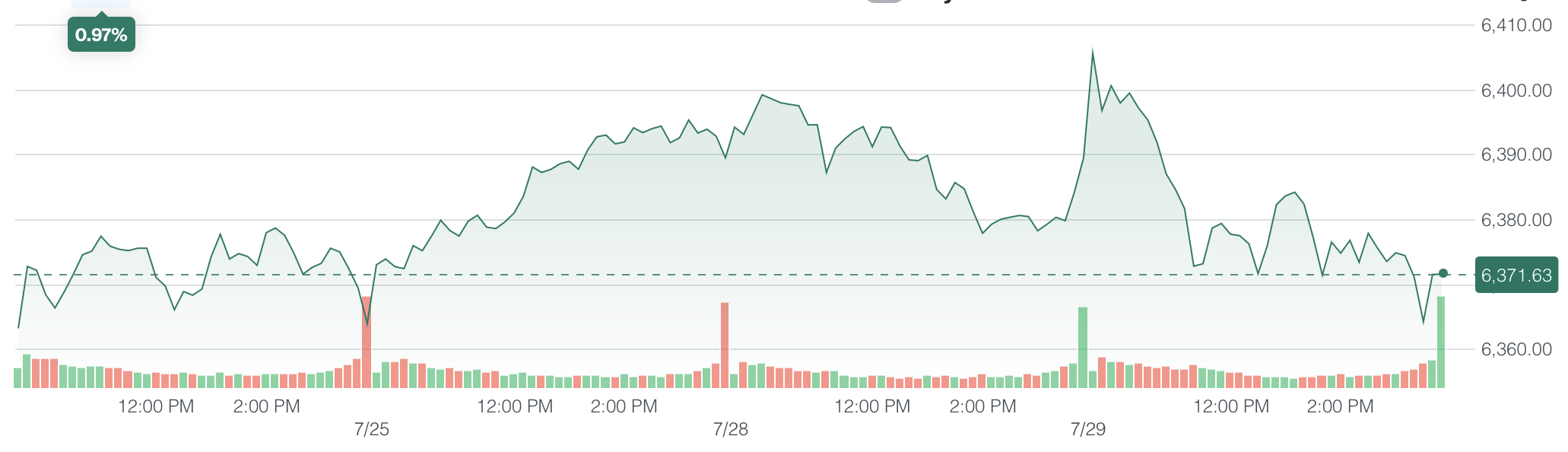
I know it is hard to believe, but it seems that all the angst that was fomented over the weekend following Moody’s ratings downgrade of US Treasury debt was for naught.  In fact, the decline in both stocks and bonds didn’t even last one session, let alone weeks or months as both markets closed the session essentially unchanged on the day, recouping the early losses seen.  A quick look at the chart below shows the price action in S&P 500 futures from the time of the announcement through yesterday’s close and then this morning.  It seems the market is concerned about things other than the US credit rating.

Source: tradingeconomics.com

In fact, I am willing to say that we are unlikely to hear anything more about the downgrade until such time that equity prices fall on some other catalyst, and the punditry will add in the ratings story to help bolster whatever claim they are making at that time.  Please remember, as well, that I am quite concerned that equity valuations remain rich and that a decline is quite possible, if not likely.  It’s just that the ratings downgrade story is not going to be the driver of that move.

In Japan, it seems
No one’s buying JGBs
Has bug met windshield?

Last night, Japan auctioned 20-year JGBs with the yield coming at 2.52%, the highest since these bonds were first issued back in 1999.  As well, yields in 30-year and 40-year JGBs also soared, rising 12bps in each case to the highest yield in more than 25 years as per the below chart of the 30-year bond.

While the selloff in JGBs has been accelerating, real yields there are still negative with CPI running at 3.6%.  This presents quite a conundrum for Japanese investors as despite the negative real yield, the ability to borrow cheaply (remember short term rates in Japan are 0.50%) and invest in long-dated bonds and earn 3.0% is quite tempting.  250 basis points of carry with no currency risk is now going to compete with 450 basis points of carry (US 30-year yields of ~5.0% – 0.50% funding costs in Japan) with FX risk.

What makes this especially tricky for Japanese investors is that the dollar’s future path, which had been clearly higher for longer, appears to have adjusted.  It seems evident the Trump administration is keen to see the dollar decline, or perhaps more accurately, see other currencies appreciate, especially if those nations run significant trade surpluses with the US.  Japan certainly fits that bill.  And the thing about currency risk is that FX can move swiftly enough to wipe out any carry benefits before institutional investors can even organize meetings to determine if they want to change their strategy.

One of the things that we have heard regularly for the past several years (decades?) is that the US fiscal situation has put the nation in a precarious position, relying on investment by foreigners to fund the massive budget deficits that the government has been running.  The problem with these warnings is they have been ongoing for so long, nobody really pays them any attention.  It is not to say the theory is incorrect, just that there have been other things that have offset that factor and attracted capital to the US anyway.  It is also not apparent that Moody’s ratings cut has changed that dynamic.

But, if at the margin, Japanese investors start to focus more on the JGB market to reduce currency risk, rather than on the highest yield available in major nations, that would likely have a negative impact on the Treasury market.  That is, of course, a big IF and there is no evidence yet that is the situation.  It is something, though, we must watch closely.  

Remember, too, global debt/GDP is more than 300% across all types of debt, public and private.  That tells me it will never be repaid, only rolled over.  The question is at what point will investors decide that holding debt is too great a risk at current yields?  While I assure you governments around the world will work hard to prevent that outcome, including changing regulations to force purchases, it is not clear how much higher that ratio can go without more seriously negative consequences.  We will need to watch this closely.

With that in mind, let’s turn to markets and see how things have behaved in the wake of the reversal in US markets yesterday.  Asian equities were mixed with Japan essentially unchanged, China (+0.5%) and Hong Kong (+1.5%) showing the best performance in the region while India (-1.0%) was the laggard.  Otherwise, there were both gainers and losers of limited note.  In Europe, though, equity markets are rallying across the board led by Spain’s IBEX (+1.6%) despite another infrastructure disaster where half the nation lost telecoms for several hours as Telefonica (Spain’s major telecom company) messed up a systems upgrade.  The rest of the continent has seen shares rise on the order of 0.4% to 0.5% as ECB comments seem to be encouraging the idea of another rate cut coming soon and European Current Account data showed a greater surplus than expected.  US futures, though, are ever so slightly lower at this hour (7:15), down about -0.1% across the board.

In the bond market, in the 10-year space, yields are within 1bp of yesterday’s closing for Treasuries (+1bp), European sovereigns (-1bp) and JGBs (+1bp).  It seems that despite all the talk of the end of times, investors haven’t given up yet, at least not in the 10yr space.  However, the evidence is growing that fixed income investors are growing leery of tenors longer than that.

In the commodity markets, oil (-0.6%) is slightly softer but remains well within its recent trading range amid the slightest of downtrends.  In truth, I find this chart to be an excellent description of my feelings of this market, a really slow decline over time.

Source: tradingeconomics.com

As to the metals markets, gold (+0.6%) is continuing its rebound from the worst levels seen last Thursday and is currently more than $100/oz higher than those recent lows.  This has helped silver (+0.5%) as well although copper (-0.5%) is not playing along today.

Finally, the dollar, remarkably, did not collapse in the wake of the Moody’s downgrade.  In fact, similar to the price action in both stocks and bonds yesterday, the dollar retraced much of its early losses.  This morning, it remains on the soft side, but movement is much less pronounced across both the G10 and EMG blocs.  However, the worst performer today is AUD (-0.7%) which some may attribute to the fact that the RBA cut their base rate by 25bps last night (although that was widely expected).  But I would point to the law that was recently enacted by the Albanese government in Australia to begin taxing UNREALIZED capital gains.  This idea has been floated by other governments but never actually enacted.  I fear that the consequences for Australia will be dire as it becomes clear the policy is extraordinarily destructive.  Capital will flee and that bodes ill for the currency.  If they truly follow through with this, be very careful.

There is no data today, but we hear from six different Fed speakers as they are all participating in an Atlanta Fed symposium.  However, I do not expect anything other than patience is the watchword as they observe the Trump administration policies unfold.

In the end, the predicted doom did not come to pass.  However, for my money, I would pay closest attention to Australia.  I fear the negative consequences of this policy will be extreme.

Good luck

Adf

Set Cash On Fire

On Friday, the Moody’s brain trust
At last said it’s time to adjust
America’s debt
As we start to fret
That it’s too large and might combust
 
So, Treasury yields are now higher
As pundits explain things are dire
But elsewhere, as well
Seems bonds are a sell
As governments set cash on fire


Arguably, the biggest story of the weekend happened late Friday evening as Moody’s became the third, and final, ratings agency to downgrade US government debt to Aa1 from Aaa.  S&P did the deed back in 2011 and Fitch in 2023.  The weekend was filled with analyses of the two prior incidents and how markets responded to both of those while trying to analogize those moves to today.  In a nutshell, the first move in both 2011 and 2023 was for stocks to fall and bonds to rally with the dollar falling. However, in both of those instances, those initial moves reversed over the course of the ensuing months such that within a year, markets had pretty much reversed those moves, and in some cases significantly outperformed, the situation prior to the downgrade.  

Looking at Moody’s press release, they were careful to blame this on successive US administrations, so not putting the entire blame on President Trump, but in the end, it is hard to ignore that the nation’s fiscal statistics regarding debt/GDP and debt coverage are substantially worse than that of other nations that maintain a Aaa rating.  As well, their underlying assumption is that there will be no changes in the current trajectory of deficits and so no reason to believe things can change.

The most popular weekend game was to try to estimate how things would play out this time although given the starting conditions are so different in the economy, I would contend past performance is no guarantee of future outcomes.  In this poet’s eyes, it is not clear to me that it will have a long-term material impact on any market.  We have already been hearing a great deal about how Treasuries are no longer the safe haven they were in the past.  I guarantee you that institutions looking for a haven were not relying solely on Moody’s Aaa rating for comfort.  In addition, given a key demand for Treasuries is as collateral in the financial markets, and the Aa1 rating is just as effective as a Aaa rating from a regulatory risk perspective, I see no changes coming

As to equities, I see no substantive impact on the horizon.  The equity market remains over richly valued and if it were to decline, I don’t think fingers could point to this action.  Finally, the dollar has been declining since the beginning of the year and remains in a downtrend.  Using the DXY as our proxy, if the dollar falls further, should we really be surprised?

source tradingeconomics.com

To summarize, expect lots more hyperbole on the subject, especially as many analysts and pundits will try to paint this as a failure of the Trump administration.  And while bond yields may rise further, as they are this morning, given the fact that yields are rising everywhere around the world, despite no other nations being downgraded, this is clearly not the only driver.

In fact, one could make the case that bond yields are rising around the world because, like the US, nations all over are talking about adding fiscal stimulus to their policy mix.  After all, have we not been assured that Europe is going to borrow €1 trillion or more to rearm themselves?  That is not coming out of tax revenue, that is a pure addition to the debt load.  As well, is not a key part of the ‘US will suffer more than China in the tariff wars’ story based on the idea that China will stimulate the domestic economy and increase consumption (more on that below)?  That, too, will be increased borrowing.  I might go so far as to say that the increased borrowing globally to increase fiscal stimulus will lead to higher nominal GDP growth everywhere along with higher inflation.  I guess we will all learn how things play out together. 

Ok, so now that we have a sense of THE big story, let’s see how markets behaved elsewhere.  I thought that today, particularly, it would be useful to see how bond markets around the world have behaved in the wake of the Moody’s news.  Below is a screenshot from Bloomberg this morning.  note that every major market that is open has seen bonds sell off and I’m pretty confident that Canada’s at the very least, will do so when they wake up.  Ironically, the European commission came out this morning and reduced their forecasts for GDP growth and inflation this year and next and still European sovereign yields are higher.  I have a feeling that this news is not as impactful as some would have you believe.

Turning to equity markets, Friday’s US rally is ancient history given the change in the narrative.  And as you can see below from the tradingeconomics.com page, every major market is softer this morning (those are US futures) with only Russia’s MOEX rising, hardly a major market.  Again, it appears the fallout from the ratings cut is either far more widespread, or not a part of the picture at all.  It seems you could make the case that if European growth is going to underperform previous expectations, equity markets there should underperform as well.  The other two green arrows are Canada and Mexico, neither of which is open as of 6:30 this morning.

Commodity markets are the ones that make the most sense this morning as oil (-1.3%) is under pressure, arguably on a weaker demand picture after softer Chinese data was released overnight.  While the timing of the impacts of the trade war is unsettled, there is certainly no evidence that China is aggressively stimulating its economy.  This was very clear from the decline in Retail Sales, Fixed Asset Investment and IP, although the latter at least beat expectations.  But the idea that China is changing the nature of their economy to a more consumption focused one is not yet evident.  Meanwhile, metals markets are all firmer this morning with gold (+1.2%) leading the way, arguably as a response to the ratings downgrade.  This has dragged both silver (+0.9%) and copper (+1.0%) along for the ride.  It is not hard to imagine that sovereign investors see the merit in owning storable commodities like metals in lieu of Treasuries, at least at the margin.  But also, given the dollar’s weakness, a rally in metals is not surprise.

Speaking of the dollar’s weakness, that is the strong theme of the day along with higher yields across the board.  Right now, the euro (+1.0%) and SEK (+1.0%) are leading the way higher although the pound (+0.9%) is also doing well.  Perhaps this has to do with the trade agreement signed between the UK and EU reversing some of the Brexit outcomes at least regarding food and fishing, although not regarding regulations or immigration.  JPY (+0.6%) is also rallying as is KRW (+0.75%) and THB (+0.9%) as there is a continuing narrative that stronger Asian currencies will be part of the trade negotiations.  Finally, Eastern European currencies are having a good day (RON +2.3%, HUF +1.8%, CZK +1.2%, PLN +1.0%) after the Romanians finally elected a president that was approved by the EU.  Yes, they had to nullify the first election and then ban that candidate from running again, but this is how democracy works!

On the data front, there is very little hard data to be released this week, although it appears every member of the FOMC will be on the tape ahead of the Memorial Day weekend.  Perhaps they are starting to feel ignored and want to get their message out more aggressively.

TodayLeading Indicators-0.9%
ThursdayInitial Claims230K
 Continuing Claims1890K
 Flash Manufacturing PMI50.5
 Flash Services PMI51.5
 Existing Home Sales4.1M
FridayNew Home Sales690K

Source: tradingeconomics.com

Actually, as I count, there are three members, Barr, Bowman and Waller who will not be speaking this week, although Chairman Powell doesn’t speak until next Sunday afternoon.  In the end, the narrative is going to focus on the ratings cut for a little while, at least for as long as equity markets are under pressure along with the dollar.  However, when that turns, and I am sure it will, there will be a search for the next big thing.  I have not forgotten about the potential large-scale changes I discussed on Friday, and I am still trying to work potential scenarios out there, but for now, that is not the markets’ focus.  Certainly, for now, I see no reason for the dollar to gain much strength.

Good luck

Adf

Very Near Future

The “very near future” is when
The US and China, again
Will restart their talks
Assuming no balks
By either of these august men
 
That’s all that the market required
For buyers to get so inspired
Can this idea last?
Or will it have passed
Ere market resolve has expired


While all and sundry have been very confident that President Trump’s attempt to alter the structure of the global economy and world trade to a more beneficial one, in his view for the US, will fail dismally and that we are doomed to stagflation as prices rise and the economy sinks, it seems these same economic analysts have forgotten that there are two sides to the supply/demand equation.  I have written before that despite all the slings and arrows that have been aimed at Trump, the US has a very strong hand in the trade game given it is THE CONSUMER OF LAST RESORT.  Virtually every nation in the world has built an economy designed to be able to manufacture stuff cheaply and sell it into the largest economy in the world.

And US consumers are remarkable in their ability to continue to consume at high levels despite what appear to be significant headwinds, whether high financing costs, limited savings or slowing economic activity.  But a funny thing is happening on the way to this mooted US stagflation, it’s not happening yet.  In fact, as described by economist Daniel Lacalle in his most recent post, it seems that the biggest problem is not that Americans cannot find what they want to buy, it is that they only bought all this stuff because it was cheap.  They will not accept significant price rises and so inventory is building up at factories while ships are stuck with containers full of stuff nobody wants, at the price.  Could it be that President Trump read the room better than the economists?

I use this as preamble to yesterday’s massive equity rebound which was, ostensibly, triggered by comments from Treasury Secretary Bessent that substantive trade talks with China would begin in the “very near future.”  Subsequent soothing comments by the President indicated that the days of 125% tariffs were numbered but there would be tariffs in place.  As well, Mr Trump explicitly said he has no intention to fire Fed Chair Powell, despite his recent diatribe that Powell is always late to the party and should cut rates.  Certainly, I agree the Fed is, and will always be, late to the party as long as they use a data driven approach.  After all, by the time economic change is reflected in the data, whatever is going to change has already done so.  However, I don’t yet see the rationale for cutting rates given the current economic data and the fact that inflation remains a problem.

As of this morning, following significant equity rallies around the world, one might come to believe that all the world’s problems have been successfully addressed.  The fact that one would be wrong in that belief is the best example of ‘the market is not the economy’.  But, hey, let’s take the rallies when they come!

From a market perspective, that was really the big story yesterday and continuing into today.  Flash PMI data is not that exciting, and all the other headlines revolve around the ongoing immigration/deportation issues plus RFK Jr’s edict to remove petroleum-based food coloring from foods.  So, let’s look at the markets and recap the action.

The 2.5% to 3.0% gains in the US were followed by Tokyo (+1.9%) and Hong Kong (+2.4%) performing well but nothing like Taiwan (+4.5%).  The laggard last night was China (+0.1%) with other regional exchanges showing gains between 0.5% and 1.5%.  Net, I suppose everybody was happy.  In Europe this morning, the screens are green as well, with Germany (+2.6%) leading the way followed by France (+2.2%) and the UK (+1.3%).  Again, the trade story appears to be the leading driver.  And, adding to the joy, US futures are also higher between 2.0% (DJIA) and 3.0% (NASDAQ) this morning as of 6:50.  And to think, just two days ago I was assured that the end was nigh.  A quick look at the S&P 500 chart below does give a flavor for just how much volatility we have seen on a day-to-day basis and how narrative changes continue to have huge impacts.

Source: tradingecomics.com

At the same time, Treasury yields have been retracing, lower by -8bps this morning with UK gilts (-6bps) also performing well, although continental European sovereigns are not seeing the same demand with bunds (+3bps) the laggard despite the weakest PMI readings with both Manufacturing and Services below 50.0, lower than last month and far lower than forecasts.  The narrative of money leaving the US and heading back to Europe is certainly appealing, and seems quite reasonable as a long-term metric, but it is not clear to me that it will be driving daily price action in any market.

In commodities, oil (+1.0%) continues to edge higher although it has not yet come close to filling that massive gap lower from the beginning of the month.  

Source: tradingeconomics.com

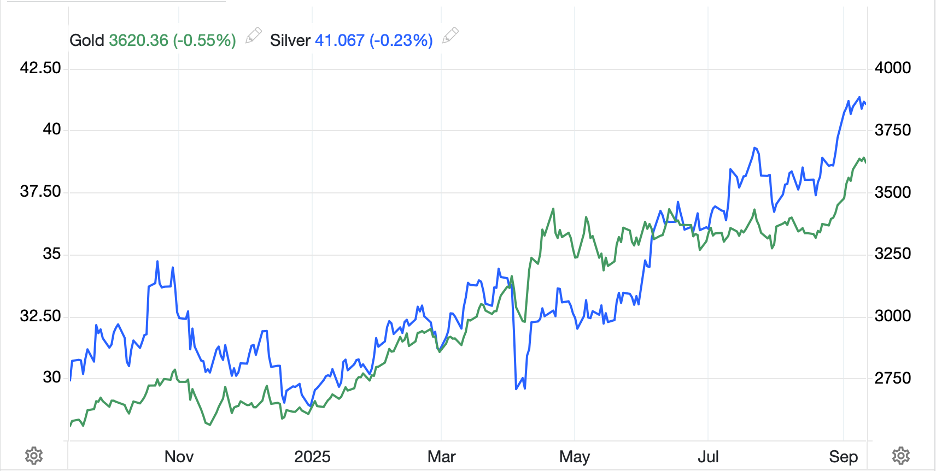
From a fundamental perspective, fears of a US recession, which remain high, as well as the IMF recently reducing their global growth forecast seem to be undermining the demand side of the equation.  Meanwhile, the opportunity for significant new supply (Iran deal, Russia peace) seems quite real.  I’m no oil trader but it strikes me the risk-reward here is for a further drop in prices.  As to the metals markets, gold (-0.4%) fell more than $100/oz yesterday, so perhaps my view that the parabolic move was too much was correct.  However, I believe this is a short-term, and much needed, correction with the long-term story fully intact.  Meanwhile, silver (+1.4%) and copper (+0.4%) are modestly higher after quiet sessions yesterday.

Finally, the dollar is firmer this morning against most of its counterparts, but this is not a universal situation.  While both the euro and pound have fallen -0.25%, AUD (+0.6%) is showing some oomph as it figures to be one of the key beneficiaries of a trade agreement between the US and China, no matter how far in the future.  Other key gainers are KRW (+0.6%) and CNY (+0.3%), with both clearly benefitting from that same trade story.  But otherwise, the dollar is mostly ascendent.  

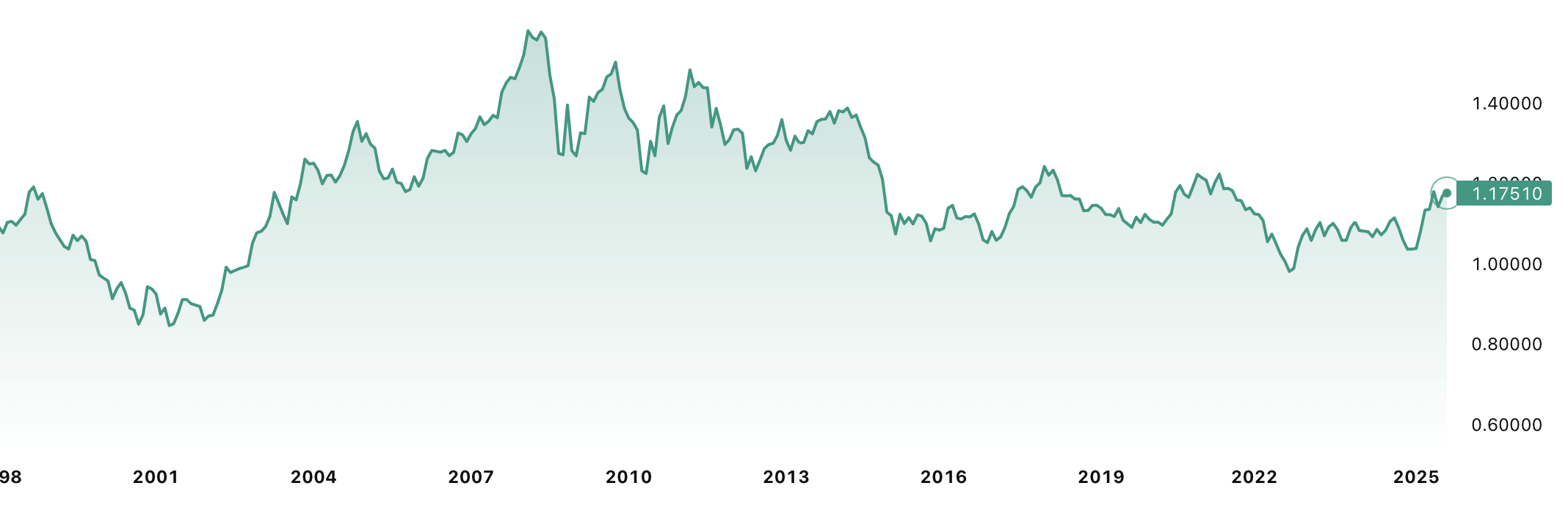
An aside here on the yen (-0.4%) which just two days ago traded below the key psychological level of 140 and this morning is back above 142.  It strikes me that this is the first currency that will be reactive to any trade deal.  As you can see from the below, long-term chart of the yen, it has spent the bulk of its time at far higher (dollar lower) levels.  I suspect that any trade deal will include an effort to revalue the yen higher vs. the dollar, perhaps to its longer-term average of around 120.

Moving on to today’s data, we have New Home Sales (exp 680K) and then the Fed’s Beige Book at 2:00pm. I’m not sure when the surveys were taken for the Beige Book, but you can be sure they will express a great deal of uncertainty and discuss how it will reduce economic activity.  You can also be sure that this will be hyped in the press.  But now that everything is better (just look at the stock market) is this old news?

If we try to look past the daily gyrations to the bigger picture, I would contend the following is the case.  Equity markets remain overvalued and are likely to weaken, the dollar is likely to slide as well as foreign investors slowly reallocate funds away from the US.  Quite frankly, the Treasury story is much harder as the interplay between inflation and potential reduced government expenditure is highly uncertain right now, although one will eventually dominate.  Finally, commodities remain far more important than their current relative weight in the global asset basket and I believe they have much further to climb in price.  One poet’s views.

Good luck

Adf
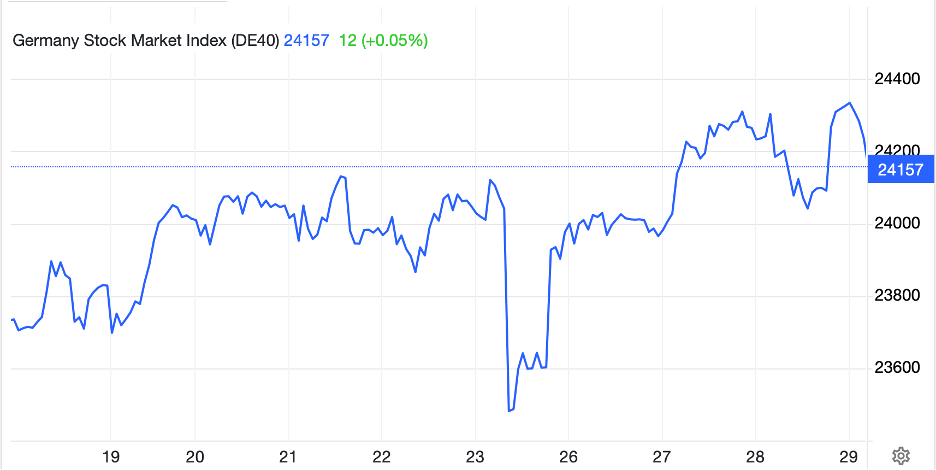
This is the End

Apparently, this is the end
So says every article penned
The markets are tanking
But nobody’s banking
On help to arrest the downtrend
 
The pundits’ unanimous line
Is things before Trump were just fine
Yes, debt was insane
But that gravy train
Allowed them to drink the best wine


Every financial website lead this morning is how President Trump’s policies are causing the worst slide in equity prices in forever, with my favorite today in the WSJ describing this as the worst performance in April since 1932!  Much has been made about how President Trump is undermining the Fed’s credibility, as though the Fed has that much credibility to undermine.  This is the group that declared stable prices to be an increase in their favored indicator, core PCE, of 2.0% annually, and complained vociferously when inflation was slightly below that level for a decade.  In order to adjust things, they changed their target to an average of 2.0% over time, then watched their metrics, in the wake of the Covid fiscal response, explode higher.  Now, after more than four years of their target metric above their target, they are concerned they are losing their credibility because of President Trump.  

Source: tradingeconomics.com

Certainly, if they had been achieving their goals any time during the past four years, this argument might have had some force.  However, given the history, I am suspect.

Nonetheless, this is today’s narrative, that equity markets are falling sharply because of Trump.  It has nothing to do with the fact that US equity markets have been overvalued by nearly every measure since November 2012, (the last time the S&P 500 P/E ratio was at its mean of 16.14 vs today’s still very high 25.64).  This is not to say that the president’s tactics have necessarily been the best possible, but we have all long known that a catalyst would come along and adjust prices to a more sustainable level.  

Source: multpl.com

Once again, I will highlight that President Trump was elected with a mandate to make substantial changes to the way things work in the US, both the economy and other issues like immigration.  Remember, too, that many of his supporters are not heavily invested in equity markets, so this is not really a problem for them.  I believe he can tolerate a lot more downside in equity prices before feeling it necessary to address them.  And if he is successful in signing some trade deals during his 90-day time frame, I expect that things will calm down quite quickly.

But right now, investors are very unhappy, and since virtually everyone in the media is an investor, we are going to hear a lot more on this topic, especially since they almost certainly didn’t vote for President Trump.

Here’s the thing about markets, overvaluations correct over time.  In fact, often they result in under valuations as markets tend to overshoot in both directions.  However, you have probably heard of the Buffett Indicator, which is Warren Buffett’s shorthand way of determining stock valuations.  He simply divides the total market capitlaization of US equities by GDP.  His view is that when that ratio is between 110% and 130%, equity markets are fairly valued.  Below that, things are cheap, and it is a good time to buy stocks.  Above that, like today, and good values are hard to find.  You are also probably aware that Berkshire Hathaway is currently holding its largest cash position ever, a sign that he still thinks things are overvalued.  One need only look at the below chart to see that while the recent decline in stocks has brought the indicator lower, its current level of 173% remains extremely overvalued.

Source: buffettindicator.net

All I am trying to do is offer some perspective on the recent movement.  Risk appetite was over extended while the US ran 7% budget deficits and issued a massive amount of debt to fund it.  Much of that funding went into risk assets.  That situation has clearly changed, or at least that is the goal of the Trump administration.  It is a painful transition, but likely one that we need to absorb for longer term fiscal and economic health.

Ok, let’s see how market behaved overnight, after a rout in the US yesterday, now that everybody is back at their desks.  Major Asian markets were very quiet, with limited movement in Japan, China, Korea, Australia and India, although we did see sharp declines in Taiwan (-1.6%) and New Zealand (-2.25%) with the latter seeming to be one of the few markets tracking the US directly.  The only news there was a larger than expected trade surplus, which doesn’t seem the type of thing to cause a sell-off.  Meanwhile, in Europe, there is also little net movement with a couple of modest gainers (Spain, UK) and a couple of modest laggards (France Germany) with everything trading less than 0.5% different than their last closes.  Interestingly, US futures are all higher by about 1.0% at this hour (7:05).

In the bond market, this morning is quiet everywhere with movements of +/-1bp the norm although yesterday did see Treasury yields climb 6bps in the session.  Something that is starting to move in fixed income markets are credit spreads, which have been abnormally tight for a long time and may be starting to widen out to previous historical levels.  If spreads start to widen, that will not help equity markets at all, and that could be the signal that policy adjustments are coming, both from the administration and the Fed.  We will keep an eye here.

In the commodity markets, nothing is stopping the gold train, up another 0.7% this morning to another new high.  This movement is parabolic and that cannot last very long.  Beware of a correction.  

source: tradingeconomics.com

In the meantime, silver (-0.2%) and copper (+0.5%) are still hanging around, but without the same panache as gold.  In the oil market, WTI (+1.3%) has rebounded from yesterday’s decline as the latest stories are that capex by the oil majors is going to decline and with it, we will see a reduction in supply, hence higher prices.  On the flip side, if a deal with Iran is signed and their oil comes back on the market freely, that will weigh on prices for at least a while.

Finally, the dollar, which along with equities, has been sold aggressively of late, is bouncing slightly this morning.  This story remains perfectly logical as one of the reasons the dollar had been so strong was foreign investors bought dollars to buy the Mag7 and US equities in general.  With US equities weakening, these foreigners are likely to start to sell more and take their money home, or elsewhere, but nonetheless, they don’t need those dollars.  Certainly nothing has changed my bearish view here with today’s gains a modest correction.  There are two outliers this morning, with MXN (+0.6%) and ZAR (+0.5%) the only currencies of note rallying against the greenback, both seemingly following the commodity rally.

On the data front, there is nothing noteworthy this morning, but a bit of data later in the week.

WednesdayFlash Manufacturing PMI49.4
 Flash Services PMI52.8
 New Home Sales680K
 Fed’s Beige Book 
ThursdayInitial Claims221K
 Continuing Claims1880K
 Durable Goods2.0%
 -ex Transport0.2%
 Existing Home Sales4.13M
FridayMichigan Sentiment50.8
 Michigan Inflation Expected6.7%

Source: tradingeconomics.com

In addition, we have 7 Fed speakers over 8 venues this week, with four of them today.  However, it is not clear that they have much impact these days.  Expectations for a cut next month are down to 9% although the market is pricing 90bps of cuts this year.  But, once President Trump started implementing his policies, the Fed slipped into the shadows.  It is interesting that there are questions about the Fed’s credibility as lately, nobody has listened to them anyway.  I don’t expect anything other than patience from them for now as they await the “inevitable” decline in the economy.  However, until the data really starts to show something, and there is nothing forecast in this week’s releases, that points to economic weakness of note, they are on the sidelines.

Overall, I expect more volatility in risk assets, and I do believe the trend for foreign investors to reduce their exposure to the US will continue.  That, too, will weigh on the dollar.  Maybe not today, but another 10% this year is quite viable.

Good luck

Adf

Downward, Crawling

The trends in the market of late
Continue, and there’s no debate
The dollar keeps falling
With stocks, downward, crawling
While gold never has looked so great
 
The latest concerns are that Trump
Chair Powell, is looking to dump
The narrative shows
That if Powell goes
That Treasuries clearly will slump


Europe remains closed today for its Easter Monday holiday, as was Hong Kong last night, but the rest of Asia and the US are open.  With that in mind, though, I’m guessing there are many who would prefer markets to remain closed given the price action.  At least those who remain invested in the US as equity futures are pointing lower, yet again, this morning, with all three major indices down by about -1.0% at this hour (6:00).  But really, the market story that is atop the headlines today is the dollar and its continued weakening.  Since President Trump’s inauguration, so basically in the past three months, the euro (+1.3% today) has climbed about 11% as you can see in the chart below.

Source: tradingeconomics.com

While that is not an unprecedented move, it is certainly swift in the world of foreign exchange.  Of course, it is important to remember that the current level, and higher levels, were extant for more than a year (July 2020 – November 2021) not all that long ago.  My point is perspective is key, and while the dollar has been declining sharply of late, this is not unexplored territory.  In fact, stepping back a bit, as I’ve shown before, the euro remains in the lowest quartile of its value over the past twenty years.

Source: finance.yahoo.com

One of the interesting ways in which the narrative has changed has been that prior to the imposition of tariffs by President Trump, when they were only threatened, the economic intelligentsia were convinced that the only outcome would be other currencies declining in value sufficiently to offset the tariff, thus a stronger dollar with the end result that US exports would no longer be competitive.  Now those same analysts are explaining that the weaker dollar is a problem because imports will be more expensive, thus raising the inflation rate.  

However, the lesson I have learned throughout my career is that movement in the dollar, while important on a very micro level for businesses and foreign earnings calculations, is rarely a driver of any macroeconomic trend.  In fact, it is a response.  Other things happen and the dollar adjusts based on the flows that occur. While theoretically, at the margin, a weaker dollar will tend to result in higher import prices, and ceteris paribus, that would feed through to the inflation rate, no ceteris is paribus these days.  For one thing, oil prices are lower by nearly 18% since the inauguration and oil prices have a far larger impact on inflation than does the value of the dollar.  My point is that neither the dollar’s level nor the fact that it is declining is a sign of the end of times.

Source: tradingeconomics.com

Of more concern to many is the Treasury bond market as that is a true Achilles heel for the US.  Given the massive amount of debt outstanding, and the fact that there is so much to roll over this year, and the fact that the budget is still running a massive deficit, the need to refinance is the biggest issue facing the US economy in my view.  Of course, the US will be able to refinance, the question is the price.  

Since we’ve been measuring things from Trump’s inauguration, a look at 10-year Treasury yields shows they have declined a modest 28bps as of this morning’s pricing.  There has also been some volatility, but again, hardly unprecedented volatility.

Source: tradingeconomics.com

For instance, a widely followed measure of bond market volatility is the MOVE Index, currently produced by BofA.  At Friday’s close, it sat at 114.64.  A quick look at this chart shows the index, and by extension bond market volatility, is in the upper one-third of its range since inflation kicked off in 2022.  Again, it has spent a lot of time at higher levels and a lot of time at lower levels.

Source: finance.yahoo.com

There are numerous stories being written these days about reduced liquidity in the bond market, and there are many stories being written about how the Chinese, or the Japanese, or Europeans are selling Treasury bonds as a signal that all is not well.  First, we know all is not well, so that should not be a surprise.  Second, there has been no indication that Treasury auctions are failing, in fact the opposite, with the most recent 10-year and 30-year auctions showing substantial foreign demand.  

The funny thing about the bond market is to many it is a Rorschach test as people see what they want to see. To some, it is entirely about inflation and inflation expectations, so rising yields portend inflation on the horizon.  To others, it is a recession/growth indicator, which for most people is a coincident indicator, higher growth leads to higher inflation in that view.  But these days, much ink is spilled discussing how it is now and indicator of confidence in the US, especially with the growing antagonism between President Trump and Chairman Powell.  The same folks who lambasted Powell for keeping rates too high, now seem to be cheering him on to keep rates “too” high as a sign of his independence.

There is no doubt that despite the fact that the Fed’s press has diminished, and the market’s focus on the Fed has waned, their actions remain important to the US economy.  But is Jay Powell the last bastion of confidence in the US?  That, too, seems a stretch.

Trying to summarize, things in the US are quite messy right now.  For many investors, and hedgers, the previous status quo was so comfortable, and actions were easy to take.  However, Donald Trump’s election back in November was a very clear signal that things were going to change.  And they are changing.  In situations like this, investors tend to bring their money as close to home as possible.  This process has only just begun.  Since March, I have maintained that I see the dollar lower, and for a long time that the equity market was overvalued.  While the recent speed of movement is unlikely to be maintained, I expect the direction is pretty clear.

Ok, a really quick tour of markets overnight.  In Tokyo (-1.3%) equity markets slumped further as the yen strengthened and the status of the trade talks with the US remains unclear.  Chinese shares (+0.3%) edged higher and the rest of Asia that was open was mixed.  With all of Europe closed today, all eyes will be on the States where things are pointing to a lower opening.

Treasury yields have risen 4bps this morning and European sovereign markets are all closed.  Last night, JGB yields edged higher by 1bp, but the narrative of Japanese interest rates rising closer to other national levels has not had much press lately.

The commodity markets have been where all the action is, with oil (-2.5%) lower this morning as I have seen comments that the US-Iran talks are making progress.  As well, it appears that the Russia / Ukraine peace talks are reaching a denouement.  Successful conclusions in either, or both, of these discussions would very likely point to a lot more available crude on the market, and lower prices ahead.  I still think $50/bbl is in the cards.  But gold (+1.9%) is the story of the day here as the barbarous relic makes yet another new all-time high vs. the dollar dragging silver (+1.3%) and copper (+3.9%) along for the ride.  Not only are foreign central banks continuing to buy, as well as populations in China, India and elsewhere in Asia, but it appears that US retail is waking up to the fact that gold has been the best performing asset for the past year (+45%).  I continue to see the metals complex benefitting from the current macro environment.

Finally, we have already discussed the dollar which is lower this morning against virtually all its counterpart currencies in Europe and Asia.  As it happens, LATAM currencies are gaining the least and BRL (-0.1%) has even managed a slight decline on the opening.  But overall, this is a dollar selling day.

On the data front, today brings Leading Indicators (exp -0.5%) at 10:00 and that is all that is on the calendar.  It is a quiet week, and I will outline the rest tomorrow.

It should be a quiet market given Europe’s absence, and given how far the dollar has fallen leading into the open, I wouldn’t be surprised to see a modest bounce, but the trend, as I explained, remains clearly for a lower dollar going forward.

Good luck

Adf
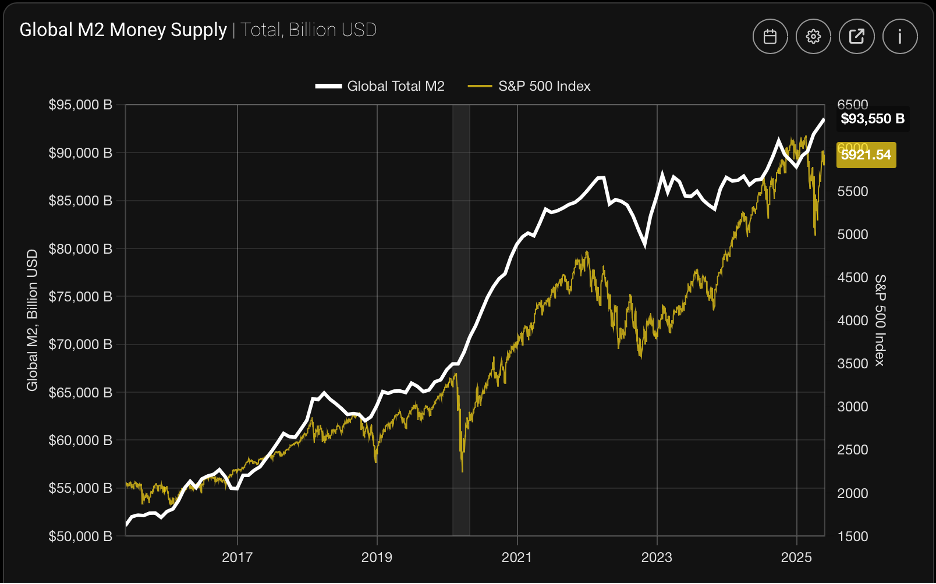
Likely to Bleed

By now, everyone is aware
The world we had known is not there
While populist views
Are turning the screws
On governments ‘bout everywhere
 
The upshot is capital’s lead
O’er labor is like to recede
So, wages will rise
With yields, and surprise
Risk assets are likely to bleed


For the first time in quite a few sessions, certainly since ‘Liberation Day’, market activity has calmed down a bit.  It is not that markets have stopped moving, just that the wild gyrations have disappeared for the moment.  I would estimate that for most investors, and certainly for risk managers with hedging requirements, this is a blessing.  However, for the trading desks at Wall Street firms, maybe not so much.  I couldn’t help but notice the lead headline in the WSJ this morning, “Bank Trading Desks Are Minting Money From Tariff Chaos”  

Now, we cannot be surprised by this, as volatile markets are what traders, especially bank traders with customer flow, live for.  This is where they truly have an edge, even over the algos, because they have information the algos don’t have, the order flow.  This got me to thinking about the idea, one which I have embraced, that President Trump is concerned with Main Street, not Wall Street.  Well, if Wall Street is going to play second fiddle, I’m sure many there are perfectly comfortable with this situation.  Arguably, if this continues, we are going to see many internecine battles at the big Investment Banks as traders gain power at the expense of bankers, but the firms overall will be just fine.  (I know you were all worried 🤣.)

But let’s go back to the Main Street, Wall Street question.  Someone who I have been following on Substack, Russell Clark, a UK hedge fund manager, has described this point very well.  In the battle between labor and capital for corporate resources, Wall Street benefits when capital is favored by legislation/regulation while Main Street benefits when the rules turn in labor’s favor.  

For the past 25 years, the rules have been helping capital at labor’s expense.  Especially since the GFC, when the financialization of the economy really took off, this has been the case.  Just look at the extraordinary rise in corporate profits during this period compared to the long history.  This is a direct result of the globalization effort, with the outsourcing of much manufacturing to China and other low-wage nations.

Source: fred.stlouisfed.org

But let us consider what we have seen fomenting for the past decade, arguably since President Trump’s first election and Brexit occurred in 2016.  Those were populist outcomes.  And we have seen populism rise around the world.  It is couched as right-wing fascism by many in the media, but whether in Germany, France, Italy, the Netherlands, here in the US or many other Western nations, the people’s voice is being heard.  And what they are saying is, labor wants a bigger piece of the pie.

This idea offers solid explanations for several current situations.  Labor, aka Main Street, wants government to work for them, to protect their jobs and incomes.  They care far less about a company’s share price and far more about the company investing in the business and expanding.  Capital, aka Wall Street, wants the government to work for them, to keep financing costs down to increase capital productivity and drive share prices higher, whether through share repurchase or reduced expenses (aka job cuts).  

Right now, labor is in the ascendancy.  (It is ironic that labor’s ascent has been deemed right-wing, given the long history of its left-wing tendencies, but there you go).  As long as this remains the case, I think we need to consider how it will impact markets going forward.  Russell’s short-hand trade idea has been long GLD vs. short TLT (the long-bond ETF) and it has worked well for quite a while.  Can bond yields continue the rise that began in 2022?  Certainly.  Can gold continue its rally?  Of course.  Look at the chart below of gold and 10-year Treasury yields over the past 5 years.  There is nothing about the chart that says we are topping in either case.  Higher yields and higher gold prices seem contradictory, but they have been the reality for three years already.  I have explained numerous times that the world we knew is gone.  This may well be part of the new reality.  What about equities?  I have to believe multiples will be compressed which will not help them at all. And the dollar?  While higher rates seem like they should support the greenback, the case for capital flows leaving the US equity market is very real.  We could easily see the dollar decline further over time.

Source: tradingeconomics.com

Ok, let’s look at markets overnight.  Green continues to be the theme today after solid rallies yesterday in the equity markets.  I know this is not what I discussed above, but that is the long-term perspective, not the day-to-day.  Right now, the tariff pauses have traders and investors feeling a little more secure, as well as word that several nations are close to new trade deals with the US with significantly lower tariffs.  Yesterday’s modest US rally was followed by similar modest gains in Asia with the Nikkei (+0.8%) leading the way while both Hong Kong (+0.2%) and China (+0.1%) managed to gain, but only just.  Meanwhile, in Europe, the gains are somewhat better as the DAX (+1.0%) and IBEX (+1.2%) are leading the way with the FTSE 100 (+0.8%) and CAC (+0.25%) lagging a bit.  We did see some solid employment data from the UK with employment rising 206K over the past 3 months while earnings and the Unemployment Rate remained unchanged.  However, Germany is a bit more confusing given the ZEW Economic Sentiment Index there fell from 51.6 to -14.0, as the trade concerns really start to bite.  As to US futures, at this hour (7:20) they are slightly higher, about 0.15%.

In the bond markets, Treasury yields have edged higher by 1bp but remain below the recent peak at 4.50%. In Europe, we are seeing yields climb everywhere except the UK, where gilt yields are unchanged.  But Italian BTPs (+5bps), French OATs (+3bps) and German bunds (+3bps) are all under a bit of pressure this morning.  Perhaps this is a day where risk managers feel more comfortable about things, so bonds feel less compelling.

Oil (-0.4%) had a pretty big trading range yesterday but closed close to unchanged.  This morning it is slipping a bit as we continue to see demand forecasts reduced by various analysts with the IEA the latest culprit. Personally, I see prices declining from here.  As to the metals markets, gold (+0.25%) which slipped yesterday morning and rebounded all day and through the night continues to have significant support.  Silver is little changed this morning and copper (-0.7%) is backing off some of its recent gains, although is still higher by ~14% in the past week.

Finally, the dollar, which has been under general pressure lately, is stabilizing with the DXY clinging just below 100.00.  This morning, we see the euro softer but the pound and Antipodean currencies rallying, albeit not that much.  But generally, after several days of very large moves, with 2% gains for the euro and Aussie last week, most movement is 0.5% or less today and the randomness implies we are seeing positions being adjusted rather than new activity.

On the data front, here is what the rest of the week brings.

TodayEmpire State Manufacturing-14.5
WednesdayRetail Sales1.3%
 -ex Autos0.3%
 IP-0.2%
 Capacity Utilization78.0%
 Bank of Canada Rate Decision2.75% (unchanged)
ThursdayECB Rate Decision2.25% (-0..25%)
 Initial Claims225K
 Continuing Claims1870K
 Philly Fed2.0

Source: tradingeconomics.com

The only release yesterday was the NY Fed inflation expectations data which, it should be no surprise, rose to 3.6%.  I suppose that the virtual nonstop reporting that the tariff regime is going to raise inflation is having an impact.  From the Fed, yesterday we heard that patience remains a virtue and Governor Waller is in the transitory impact of tariffs on inflation camp.  There are two more Fed speakers today, Barkin and Cook, but nothing has changed my view that they are not that relevant now.

Big picture, my take is this is a reprieve before the next bout of risk selling.  The selling can last into the summer as I think it will take until then before we get a better understanding of the outcome of the trade situation.  Maybe that will be the bottom, or if trade relations worsen, perhaps another leg lower is to come.  As to the dollar, while I don’t see a collapse, I do think lower is the way.

Good luck

Adf

Their Own Ego Trip

The talk of the town is the “Pause”
Which led to much market applause
Though naysayers still
Say Trump’s actions will
Result in bad outcomes…because


But yesterday saw markets rip
And all those who did buy the dip
Are feeling quite smart
When viewing the chart
Of prices, their own ego trip


See if you can guess when President Trump posted that there would be a 90-day pause on tariffs for everyone but China.

Source: tradingeconomics.com

By now, you are almost certainly aware that equity markets in the US rebounded massively in the US, with one of the biggest gains on record as the S&P 500 rose 9.5% and the NASDAQ 12.2%.  Of course, that merely retraced the bulk of the losses seen since the beginning of the month.  In fact, the S&P 500 is still lower by about 200 points since then.  Regardless, moods are much brighter today than they were yesterday at this hour.  And those equity gains are global.

I’ve seen several interpretations of the sequence of events and like virtually everything these days, it appears to have a partisan bias to people’s views.  There are those who claim President Trump could not stand the pressure of a declining stock market and “blinked” in the game of chicken he was playing.  There are also those who claim this was part of the strategy all along, essentially moving the Overton Window substantially in his preferred direction and now he is ready to reap the benefits of this move.  

Arguably, there is evidence for both sides of this argument and I suggest we will never really know. Remember, Trump is quite comfortable making outlandish pronouncements as he level sets for a negotiation.  But he is also quite the realist and while I do not believe he was concerned with his personal or family fortune, recognized that the speed of the pain inflicted could be damaging overall.  In the end, it is not clear the rationale matters, the action stands on its own merits.  

But remember this, equity valuations were very high before the decline last week, and were still quite high, although obviously less so, after the decline.  The rebound put them back in very high territory, especially with equity analysts revising profit forecasts lower on the back of the still 10% tariffs being imposed.  A truism is that the biggest rallies in the stock market occur during bear markets.  Keep that in mind as you assess risk going forward.

But let us turn our attention to a player who is not getting much attention these days, the Fed.  Many questioned the Fed’s rate cuts back in Q4 and attributed the moves to a partisan effort to help VP Harris get elected.  Certainly, there is no love lost between Chairman Powell and President Trump.  Of late, though, the commentary has focused on patience regarding any further policy ease as the impacts of Trump’s tariff policies are unknown at this stage.  Yet, it is not hard to read these comments and get a sense that the Fed is going to work at cross purposes to Mr Trump.  

For instance, yesterday, Minneapolis Fed President Neel Kashkari released an essay with the following comments, “Given the paramount importance of keeping long-run inflation expectations anchored and thelikely boost to near-term inflation from tariffs, the bar for cutting rates even in the face of a weakening economyand potentially increased unemployment is higher.  The hurdle to change the federal funds rate one way or theother has increased due to tariffs.”  While the words here don’t appear partisan per se, Mr Kashkari is one of the most dovish FOMC members and dismissed inflation concerns regularly for a long time.  This sudden change is interesting, at the least.  

At any rate, the market, which had been pricing a 50% probability of a rate cut next month just a few days ago and a total of at least 4 cuts this year, is back down to a <20% probability of a cut in May and about 3 cuts this year.  Truly the pause that refreshes.

So, let’s look at how other markets responded to the pause.  Markets everywhere, including China, rallied last night and this morning, with Tokyo (+9.1%) and Taiwan (+9.2%) leading the way in Asia although gains were universal.  Hong Kong (+2.1%) and China (+1.3%) were the laggards with gains between 2.5% and 5.0% the norm.  In Europe, too, equities are flying this morning as the threat of much higher tariffs is removed, at least temporarily, with the UK (+4.6%) the laggard and gains between 5.0% and 6.5% the story there.  Alas, futures this morning, at 7:00am, are pointing lower by -2.0% or so.  Is that profit taking or a harbinger of the day to come?

In the bond market, which has expressly been Trump and Bessent’s main concern, yields are a bit lower this morning, -3bps in 10-year Treasuries.  But the story in Europe is confusing to me, or perhaps not.  German bunds (+6bps) have seen the largest rise while UK Gilts (-10bps) have seen a sharp decline.  Too, Italy (-4bps and Greece (-2bps) have seen yields decline.  Could this be an illustration that bunds are a better safe haven than Treasuries? And now that haven status seems less important today, they are being sold off?  JGB yields (+9bps) are also rising, perhaps on the same notion.  The corroborating evidence is that nobody thinks Gilts are a good investment, so with risk back on, they are in demand given their highest yield in the G10.

In the commodity markets, oil rebounded sharply alongside equities yesterday although it has slipped 2.4% this morning.  I have altered the Y-axis on the chart below to percentages to give an idea of the magnitude of these moves in the past days, especially relative to the past 6 months.  Despite being the most liquid commodity market around (both figuratively and literally), it is far less liquid than bonds or FX or even stocks, so as commodities are wont to do, sometimes the moves are breathtaking.

Source: tradingeconomics.com

As to the metals markets, gold (+1.0%) continues its march higher, recovering more than 5% from the lows Tuesday morning.  I maintain that much of that selling was margin based, with positions liquidated to cover margin calls in other markets.  Now that the panic has passed, demand is likely increased given the new uncertainties.  However, both silver (-0.5%) and copper (-1.3%), which rallied sharply yesterday, have slipped back a bit.  These are different stories.

Finally, the dollar is lower this morning, having yo-yoed like every other market on the tariff news.  CHF (+1.9%) and JPY (+1.4%) are the big gainers in the G10 although the euro (+1.2%) is having a day as well.  However, there are currencies with less pizzazz this morning, notably ZAR (-0.9%), KRW (-0.6%) and MXN (-0.5%), as it remains difficult to know how to proceed going forward.  JPMorgan has a global volatility index which is a useful barometer of how things are going.  As you can see below, it is not surprising that volatility in this space has also risen sharply.

Once again, I return to the idea that President Trump is the avatar of volatility, and you must always remember that volatility can happen in both directions.  While financial assets tend to collapse (yesterday being the exception) when things get out of hand, commodities go the other way as supply interruptions are the big risk. Writ large, volatility simply means a lot of movement.

We finally get some meaningful data this morning with headline CPI (exp 0.1%, 2.6% Y/Y) and Core (0.3%, 3.0% Y/Y) along with the weekly Claims data (Initial 223K, Continuing 1880K).  Given all the focus on the tariffs, though, it is not clear to me what this data will imply on a forward-looking basis.  As we have seen with the Fed getting sidelined by Mr Trump, his tariff policies have also served to overshadow economic data, at least for now.  There are a couple of more Fed speakers and a 30-year bond auction as well.  Interestingly, I expect that auction may be the most important outcome of the day.  Will there be real demand or are investors shying away?

I expect that over the next few months, tariffs will be discussed on a nation-by-nation basis as new deals are struck.  But that will impede any medium-term views on the economy as until we have a much better sense of the end results, it will be difficult to assess things.  The upshot is, we may be entering a period where we chop up and down, but don’t go anywhere until the global trade situation is clearer.  Volatility with no direction is great for traders, less so for investors.  Headline bingo is still the game we are playing.

Good luck and good weekend

Adf

End of Days

The one thing about which we’re sure
Is risk assets lost their allure
It’s not clear quite yet
How big a reset
Is coming, and what we’ll endure


Now, I don’t think its end of days
And this could be quite a short phase
But don’t be surprised
If answers devised
Result in a lack of real praise

Chaos continues to reign in the markets as volatility across all asset classes has risen substantially.  Perhaps the best known indicator, the VIX, is back at levels seen last during the Covid pandemic.  Remember, the VIX is a compilation of the implied volatility of short-term equity options, 1mo – 3mo.  While markets can technically be volatile moving in either direction, the VIX has earned the sobriquet of ‘fear index’ as equity volatility most typically rises when stock markets fall.  As you can see from the below chart, the movement has not only been large, but very quick as well.

Source: finance.yahoo.com

The key thing to remember is that while volatility levels can rise very quickly, as the chart demonstrates, their retracement can take quite a long time to play out.  Part of that is that even when things start to calm down, many investors and traders are worried about getting burnt again, so prefer holding options to underlying cash positions.  At least until the time decay becomes too great.  My point is that look for trepidation amidst the trading community and markets in general for a while yet, even if by Friday, the tariff situation is made perfectly clear.  Of course, with that as background, we cannot be surprised that the Fear & Greed Index has made new lows.

Source: cnn.com

However, arguably of more concern is the price action in US Treasuries, which despite the havoc in the market, are not playing their historical safe haven role.  Instead, Treasury bond yields are rising, actually trading as high as 4.50% around midnight last night although they have since retraced a bit.  The bond market has a generic volatility index as well, the MOVE index, and it, too, is trading at very high levels, the highest since the GFC.

Source: finance.yahoo.com

In many ways, this is of much greater concern to markets, as well as both the Treasury and the Fed.  The 10-year US Treasury is the benchmark long-term rate for the entire world.  A rise in the MOVE index may indicate that there is something wrong with the bond market and its inner workings, or it may be an indication that inflation expectations are rising quickly.  Whatever the reason, you can be certain the Fed is watching this far more carefully than the VIX.

I have heard two explanations for the bond market’s recent performance as follows:  first, there are those who are saying that China is selling its Treasury bonds and using the dollar proceeds to buy gold.  Now, while their holdings have been slowly shrinking, they still have just under $800 billion, so that is a lot of paper and would clearly have an impact.  The thing about this thesis is we will be able to determine its reality when China next reports their reserve numbers next month.  

The other explanation rings truer to me and that is the bond basis trade may be unwinding.  Briefly, the bond basis trade is when investors, typically hedge funds, arbitrage the difference in price between cash Treasury bonds and Treasury bond futures on the exchange.  The current positioning is these funds are long cash and short futures, and since it is a basis trade, they typically lever it up significantly, with leverage ratios of up to 100x I understand.  The total size of this trade is estimated at > $1 trillion.  Now, if this arbitrage disappears, or these funds are forced to liquidate this strategy quickly, it could be a real problem for the Treasury market.  

Ever since the GFC and the Dodd-Frank legislative response, banks no longer carry large bond risk positions and are not able to absorb large transactions seamlessly.  During Covid, you may remember that Treasury yields were all over the map, crashing and then exploding higher one day to the next, and that was caused by this basis trade unwind.  Back then, the Fed purchased nearly $1.7 trillion in QE to stabilize the market, and by all accounts, the basis trade was half the size then that it is now.

Remember, too, arguably the most important part of the Fed’s mandate is to maintain Treasury bond market stability.  Without this, the US will not be able to fund its debt and deficits.  So, whatever your view of how Chairman Powell may respond to the tariff story, which seems to be patience for now, if the bond market starts to break, you can be sure the Fed will step in.  QT will reverse to QE in a heartbeat as they offset the impact of this position unwinding.  If that is the case, I anticipate we will see further weakness in equities and the dollar, while gold will truly shine both literally and figuratively.  I’m not saying this is what is going to happen, just that this explanation makes more sense to me.  

Ok, now that tariffs have officially kicked in as of midnight last night, let’s see how markets are responding this morning.  Most equity markets continue to struggle after yesterday’s disappointing US session, where higher opens eroded all day with the major indices all closing on their session lows.  This bled into Asia where Japan (-3.9%) gave up most of yesterday’s gains although both China (+1.0%) and Hong Kong (+0.7%) held up well amid government support.  As to the rest of the region, Taiwan (-5.8%) was worst off, but other than Thailand and the Philippines, both of which managed gains, every other index was lower, often sharply.  In Europe, the realization of the tariffs is hurting with declines of -3.0% to -4.0% across the board.  As to the US futures market, at this hour (7:25), all three major indices are lower by at least -1.0%.

Bond yields are all over the place this morning with Treasuries (+8bps) continuing their recent climb amid the fears discussed above.  However, in Europe, things are such that German yields (-1bp) are doing fine while UK Gilts (+9bps) are suffering along with Treasuries.  The rest of the continent, save the Netherlands, has also seen yields rise, but much less, between 2bps and 5bps.  Overnight, JGB yields were unchanged as players are uncertain as to the next steps by the BOJ there.

In the commodity market, oil (-5.6%) is once again under major pressure.  This feels like a confluence of both technical factors (the price has broken below long-term support at $60/bbl and is now testing for lows) and fundamental factors, with OPEC raising output and the mooted recession likely to reduce demand.  Interestingly, lower oil prices are a tremendous geopolitical weapon for the US as both Russia and Iran are entirely reliant on them for financing their activities.  As to the metals complex, gold as regained its luster (sorry 😁) rallying 2.8% and well above the $3000/oz level.  This has taken silver (+3.1%) and copper (+3.5%) along for the ride.  It seems to me the copper story is not in sync with the oil story as a recession would likely drive copper prices lower, but that is this morning’s movement.

Finally, the dollar is softer again this morning with the euro (+0.8%) trading through 1.10 and the yen (+1.0%) back below 145.00.  It’s interesting because there was a story last night about how the new Mr Yen, Atsushi Mimura, was speaking to the BOJ amid concerns that the yen has been too volatile.  However, to my eye the movement has been relatively sedate, strengthening gradually and still, as can be seen in the chart below, substantially weaker than for the many years prior to the Fed beginning to tighten policy in 2022.

Source: finance.yahoo.com

The other noteworthy move is CNY (+0.5%) which after slipping to levels not seen since 2007, has retraced somewhat.  If Treasury bonds are not seen as haven assets for now, the dollar has further to fall.

On the data front, the FOMC Minutes at 2:00pm are released, but given all that has happened since then, it is hard to get excited that we will learn very much new.  We also see EIA oil inventories with a modest build expected, but this market seems likely to have adjusted those numbers outside any forecasting error bars.

The tariff story will continue to drive markets for now as investors try to determine the best way to protect themselves until things settle down.  And things will settle down, but when that will happen is the $64 trillion question.  FWIW, which is probably not much, my sense is that we have a few more weeks of significant chop, as we await clarity on the tariff policy (meaning its goals).  I still believe there will be a number of deals that will reduce the initial numbers, but the ultimate goal is to isolate China.  It is going to be messy for a while yet.  As to the dollar through all this, my sense is lower, but not dramatically so.

Good luck

Adf

Demoralizing

Complaints among traders are rising
That markets are demoralizing
Liquidity’s shrinking
And now they are thinking
They might need to alter trade sizing
 
But can anyone be surprised
That markets are not immunized
From ongoing impacts
Of tariffs and new tax
Which President Trump advertised?


While headlines around the world have focused on the ongoing trade war negotiations, and peace talks between Russia and Ukraine and all of the political machinations in the US as President Trump continues to fight both the courts and Democrats to implement his agenda, markets are generally at a loss as to what to do.  Is the news bullish for stocks?  Bearish? What about bonds or the dollar or oil?  I cannot remember a time when there was so little clarity on expected future outcomes.  Well, I can actually, but it was a very long time ago.  Prior to the Black Monday stock market crash in the US in October 1987, the reality was there were many views fighting to be heard, but rarely consensus as to what would happen in markets.  Successful traders were those with trading intuition and positions were sized much smaller because you never knew when you might need to reverse course.

Since then, however, we have seen a steady diet of central bank intervention every time there is an indication that growth may be slowing, or markets may be having a bad day.  This process went into overdrive in the wake of the GFC (which, BTW, was a product of that central bank intervention warping markets) when QE was implemented in the US and then elsewhere throughout the G10.  In fact, then Chairman Bernanke was explicit that this was his goal.  He called it the portfolio rebalance channel and the idea was the Fed would buy all the Treasuries, driving yields lower and promise to keep rates very low for a long time thus forcing encouraging investors to move up the risk scale to corporate debt, high-yield debt and equities.  As well, QE pumped enormous amounts of liquidity into the financial system.  This combination of actions led to a huge expansion of risk taking and the creation of strategies like risk parity which were designed to lever up assets to increase returns.

It was all great as long as the Fed and other central banks kept expanding the available liquidity.  Alas, trees don’t grow to the sky and when the Fed, in 2018/19 tried to finally reduce the balance sheet and initiated their first QT program, things got hairy in September and halted them in their tracks.  It turns out that markets had become addicted to liquidity continually increasing and like any addict, responded negatively to the loss of its fix.

Of course, Covid ensued and the next gusher of liquidity, this time both fiscal and monetary, was initiated by governments and central banks around the world, so any idea that investors and traders were chastised by the events of 2019 were quickly forgotten and position sizes ramped up again along with market performance.

But there is a new sheriff in town, as has been mentioned by many in the Trump administration, and the old rules are not likely to work in the new environment.  As the US government has taken hold of virtually all the market’s bandwidth, relegating the Fed to a sideshow, traders and investors are suddenly finding that the old ways of doing things, buy the dip and lever up, are no longer the best way to get along.  With the ongoing efforts by the Trump administration to shrink the government and reduce flows to financial markets, the lessons of the post-GFC financial market are losing their validity.  

This was perfectly expressed in a Bloomberg article this morning where traders were complaining that when they wanted to adjust a position they had to “wait longer to execute an order until there’s better liquidity in certain instances.”  Of course, we all know how difficult it is to wait so I’m sure that you are just as sympathetic towards these traders as I am.  There was an interesting chart in the article (below) showing that futures liquidity in S&P 500 contracts had fallen to the lowest in two years and was clearly at the lower end of the recent spectrum.  Doesn’t your heart just bleed?

I have been clear that President Trump is the virtual avatar of volatility and one of the key characteristics of a volatile market is that liquidity dries up.  While prices may not move much on a particular day, trends disappear and when moves occur, they tend to be large, and often discontinuous.  This is true in all markets, so be prepared as we go forward.

As it happens, yesterday was a day with very little net movement, although some decent gyrations intraday in some markets.  For instance, in the bond market, yields, which opened the day much higher fell sharply after weaker than anticipated data then rebounded throughout the day finishing little changed from Monday’s levels.  The chart below shows the 7bp range resulting in zero movement net.

Source: tradingeconomics.com

Too, US equity markets traded both sides of unchanged all day, with some choppiness but no net directional movement.

Source: tradingeconomics.com

My point is that this is likely a portent of the future.  There are too many known unknowns for traders and investors to have confidence in taking a side.  Now, we are only two months into the new administration, and they have been working hard to get things done quickly.  It is possible that the fight drags on for the rest of the year or longer, with no clear outcomes on key issues regarding extending the tax cuts and a finalized tariff policy.  In this case, I would anticipate market activity to continue to be lower volumes and choppy price action with a lack of direction.  Or perhaps, lower risk asset prices as investors get scared.  The lesson is the processes that had become normalized in the post GFC world are clearly no longer in play.  Hedge accordingly.

So, as we look at overnight activity, yesterday’s US market activity didn’t inspire much movement in Asia where we saw some gainers (Nikkei +0.65%, Hang Seng +0.6%) and laggards (CSI 300 -0.3%, India -0.9%) but no consistency at all.  The PBOC is subtly altering their monetary policy toolkit which some are seeing as a modest ease, but clearly equity markets didn’t get that message.  Meanwhile, comments from the newest BOJ member, Koeda, explained she was not sure her previous analysis of the economy leaving the zero-rate world is valid now that rates are all the way up to 0.50%!

European shares are softer on the continent, down about -0.5% in most places but UK shares have gained slightly, +0.2%, after inflation data was released a tick lower than expected across both headline and core measures.  While the BOE stood pat last week, as expected, this has encouraged some traders to believe that a cut could come sooner than previously thought.  As to US futures, at this hour (7:45), they are basically unchanged.

Treasury yields, after yesterday’s choppiness, are creeping higher today (+3bps) but that is not following through in Europe, where sovereign yields are all flat to slightly lower today.  It seems difficult for investors to get excited about Germany’s rearming plan if the overall economy remains in the doldrums.  As well, tariff tensions have investors uncertain what to do, so doing nothing is the default.

In the commodity markets, oil (+0.9%) is higher from the close yesterday, but yesterday’s close was slightly softer than when I last wrote.  As such, we have still not quite made it to $70/bbl.  There are many crosscurrents in this market between tariffs, sanctions, potential Ukraine peace and Trump’s goal of drill, baby, drill.  As to metals, the star of the show continues to be copper (+1.5% today, +15% in the past month) which is now trading at all-time highs across the entire curve.  This has helped support both gold (+0.3%) and silver (+0.3%) although the former doesn’t need that much help, I think.

Finally, the dollar is mixed this morning, with the pound (-0.3%) lagging on the idea that the BOE may ease again sooner than previously thought, while AUD (+0.3%), CAD (+0.2%) and CLP (+0.3%) are all firmer on the commodity market strength.  Here, too, I expect that liquidity will diminish and trends will be hard to find until there is more clarity on policy outcomes in the US.

On the data front, this morning brings Durable Goods (exp -1.0%, +0.2% ex Transport) and then the EIA oil inventory data with a small build expected.  We also hear from two more Fed speakers, but they are just not driving markets right now.  Choppiness is the rule here, with short-term direction very difficult to discern.  I am still on board my ultimate lower dollar, higher commodity train, but that is subject to change if policies change as well.

Good luck

Adf

Not Fraught

The Retail Sales data did nought
To clarify anyone’s thought
‘Bout growth or inflation
While anticipation
Of Jay, for a change, is not fraught
 
Meanwhile, tariffs are, once again
A question of how much, not when
Just two weeks from now
The president’s vow
For more, has disturbed market zen


In a remarkable situation, at least these days, there is precious little new news impacting financial markets.  Perhaps that is why equities around the world are rallying, the absence of bad news is seen as good.  Here in the States, the biggest story continues to be the controversy over the deportation of several hundred Venezuelan and Salvadorean gang members that some claim ignored a judge’s order.  I’m confident this will get top billing for at least another day, but after that, we will move on.  However, market related stories are sparser.

For instance, we can look at yesterday’s Retail Sales data, which was not terrible, but not great, as the headline number rose a less than expected 0.2%, but that still translated into 3.1% growth Y/Y.  One of the things weighing on the data was the fact that gasoline prices fell, thus despite modest growth in volume, total dollar sales declined.  The same was true with autos, where allegedly prices declined though volumes remained solid.  (Remember, Retail Sales measures the dollar value of sales, not the quantity of items sold.). At any rate, investors absorbed the data and decided that the recent market declines, to the extent they are a reflection of concerns over rapidly slowing economic activity, were overdone.  The result, happily, is that equities rallied most of the day yesterday and that has followed through around the world overnight.

Alas, the other string of stories in headlines today is the Trump administration’s efforts to determine exactly how they want to implement the promised reciprocal tariffs which are due to be put in place on April 2.  It seems the fact the US trades with over 180 nations, each with their own tariff schedules, makes the details of the proposal difficult to shape and implement.  However, my take is, absent some major shifts by other nations, these tariffs will be imposed.

Ultimately, given the US is the ‘buyer of last resort’ for pretty much every other nation on earth with regards to any of their exports, I expect that there will be a number of nations that choose to adjust their own schedules rather than have diminished access to the US market.  But ex ante, there is no way to determine which nations will blink.

As a testament to just how much things have changed in the market, and just as importantly, the market narrative, the fact that three major central banks are meeting this week with the potential to adjust policy, is basically a footnote.  The FOMC starts their meeting today and tomorrow afternoon they will announce rates are unchanged.  Some attention will be paid to the dot plot, to try to see if the recent discussions of patience translate into higher long-term rate expectations, but quite frankly, it is not clear to me that Chairman Powell can say anything that is going to move markets absent a surprise rate adjustment.  The Fed funds futures market continues to price in basically one rate cut each quarter for the rest of the year at this point.

But before that, this evening the BOJ will announce their latest policy updates and, not surprisingly, there is no anticipation of a move there either.  While there has been much discussion in Japan of how companies will be, on average, increasing pay by 5.46% this year, that has not resulted in any expectations for the BOJ to adjust policy in response.  And in fairness to Ueda-san and his crew, the fact that the yen (-0.3% today) has been relatively stable of late, having rebounded from its dramatic lows last summer and held a good portion of those gains, concerns over a much weaker yen have diminished.

Source: tradingeconomics.com

Looking at the chart above, while I am no market technician, there seem to be several overhead resistance levels starting with that recent trend line.  The absence of concern over a declining yen (rising dollar) will leave the BOJ on hold for a while I think.

And let us not forget Thursday morning, where the BOE will convene, also with no policy changes expected. While GDP remains desultory there, printing at 1.0% Y/Y last week for Q4, inflation refuses to fall to their 2% target and so Governor Bailey is caught between that proverbial rock and hard place.  In such a scenario, no action is the most likely outcome.

Ok, let’s turn to the overnight market activity, which has all investors excited given the fact that markets everywhere are embracing risk today.  A solid day in the US was followed by strong gains throughout Asia (Nikkei +1.2%, Hang Seng +2.5%, CSI 300 +0.3%) with the mainland a little disappointing.  There has been more discussion recently that despite some splashy headlines about more Chinese stimulus, it is less than meets the eye.  That is a view with which I agree.  The exception to this rule was Indonesia (-3.9%) which fell after concerns over slowing growth and a widening budget deficit spooked foreign investors.  In Europe, things are also bright with all markets firmly higher led by Germany (+1.2%) as continued belief in the end of the debt brake has investors anxious to take advantage of all the government spending set to come.  We shall see how that works out, but if the US is the template, it probably has some room to run.  However, all these bourses are higher this morning in a general risk-on mood.  The crimp in the story is US indices are all slightly softer this morning ahead of Housing data.

In the bond market, yields are climbing with Treasury yields up by 1bp and European sovereign yields all higher by 3bps.  Again, this seems to be focused on the mooted extra government spending which is coming down the pike, although yields have backed off the levels seen after the initial announcements as per the below.  In fact, I read a forecast this morning about German bund yields rising to 4% by the end of next year after all the borrowing.

Source: tradingeconomics.com

In the commodity bloc, gold (+0.9%) is unstoppable for now, and taking silver (+1.1%) and copper (+0.4%) along for the ride.  Whatever else is ongoing, it appears that more and more investors have decided that having some portion of their portfolios in the barbarous relic is the right trade. After all, it is higher by more than 15% just since the beginning of the year and more than 40% over the past twelve months.  Oil (+1.1%) is also managing to hold above its recent lows but continues to run into resistance below $70/bbl.  The biggest news today is that Saudi Aramco has seen its stock price falling to 5-year lows, down 50% from its highs of 2022 after cutting dividends earlier this month.

Finally, the dollar is little changed at this hour (7:45), rebounding from modest weakness earlier in the session.  The euro and pound are unchanged, and the yen remains slightly softer.  However, MXN (-0.5%) and KRW (-0.5%) are both feeling the heat of the tariff story.  In the opposite camp, CL (+0.6%) continues to benefit from the rally in copper prices.  The big picture here remains unchanged, with the dollar likely to remain on its back foot as capital flows toward Europe’s government spending bonanza and away from the US, which appears to be pushing for fiscal tightness. 

On the data front, this morning we see Housing Starts (exp 1.38M) and Building Permits (1.45M) at 8:30 then at 9:15 we get IP (0.2%) and Capacity Utilization (77.8%).  With the Fed meeting ongoing, the only headlines will come from the White House, and those are virtually random these days.  Tight fiscal and loose monetary policy tends to weaken a currency and given that is the best description of the US these days, it remains my default position.

Good luck

Adf