What Would You Choose?

As summer meanders along
No market is weak, nor’s it strong
But traders keep trading
With hope masquerading
As knowledge, though they know they’re wrong
 
The question is what sort of news
Can catalyze changes in views?
Seems rate cuts will not
And peace had its shot
Dear readers, just what would you choose?


My friend JJ (he writes the Market Vibes note) made a profound comment that described the current situation so well, I think it is worth repeating: 

It is not that the news and fundamentals are uninteresting or unimportant. They are. But vol control has anesthetized every future, ETF, equity, and FX market, and the managers of it are making trillions on it. Therefore, it is likely this narcolepsy won’t end for a while.”

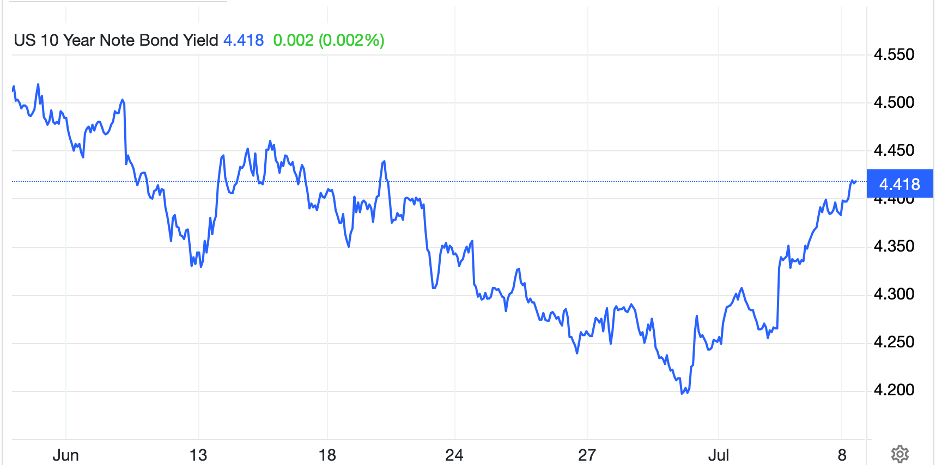
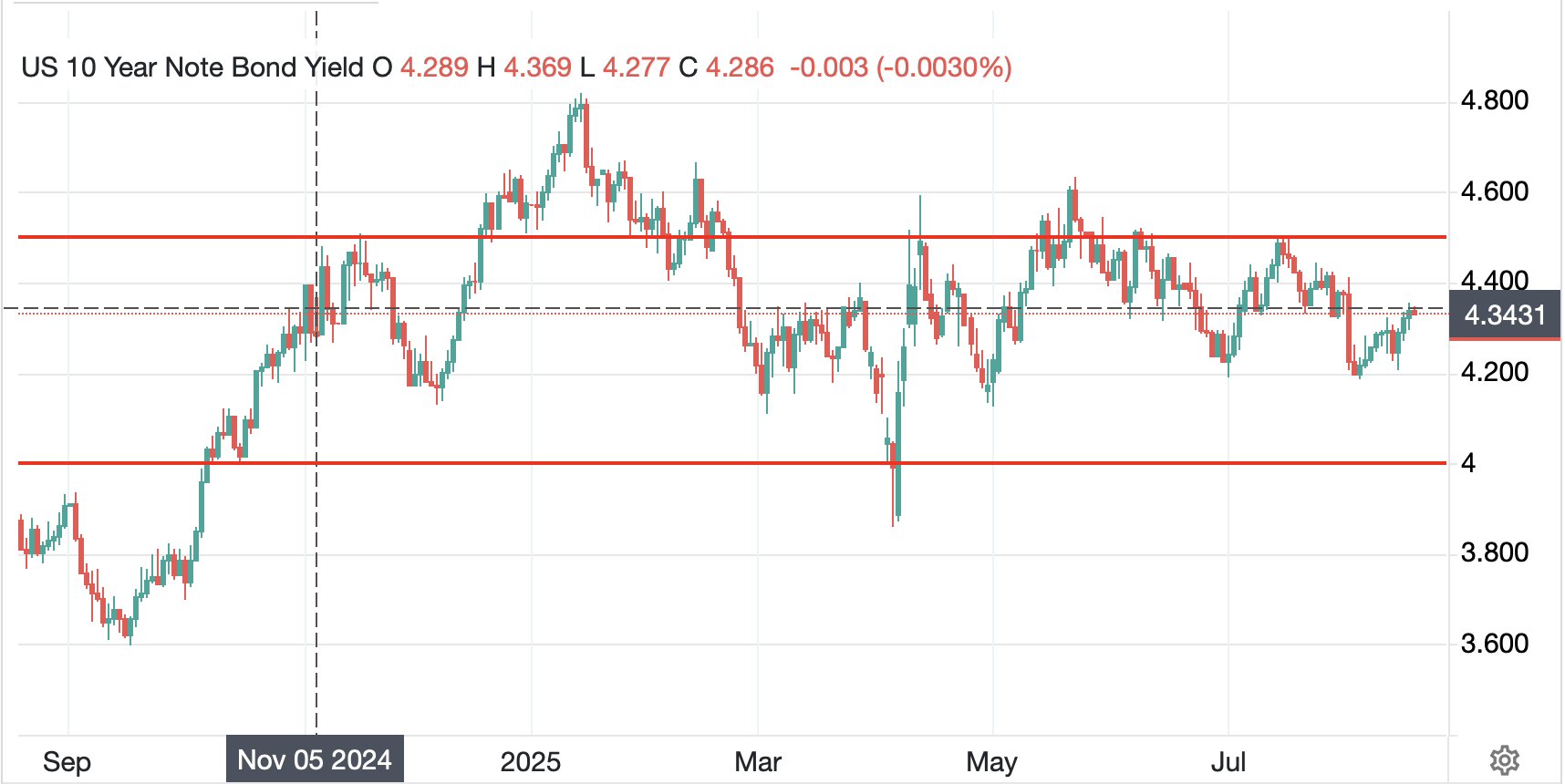
A point he has been making of late, and one with which I cannot argue, is that everything that is not algorithmic is dumb money as the algos drive it all.  And it is a fair point.  Market activity has ground to a halt, and while I have no proof, I would estimate it is even quieter than the typical year’s summer doldrums.  That seems remarkable given the panoply of news stories that exist and in other times would have had a major market impact.  Consider, war and peace in Ukraine, massive changes in federal regulations and administration priorities, and remarkable electoral shifts around the world, yet none of it matters.  Consider this chart of the US 10-year Treasury:
Source: tradingeconomics.com

The yield, which most afficionados agree is critical to not just US, but global, financial markets and activity, has largely traded between 4.0% and 4.5% since well before Mr Trump was elected.  The one thing that cannot be said is that the Trump administration has been boring.  More has happened on the fiscal front in the past six months than in entire presidential terms and yet yields are essentially unchanged since November 5th when Trump was elected.

JJ’s view is the massive increase in the use of options by retail traders has become the driving force.  Retail buys options, paying premium which decays away and that value accrues to the market making algorithms. The amounts of premium are huge, in the $trillions, and it is a straightforward business model that reaps huge rewards, so a lack of movement is the goal.  I cannot argue with that either.

However, the one thing I have learned over my too many years in the market is that no matter how smart you are, no matter how well you have considered the potential outcomes, reality will be different, and at some point, there will be a tipping point to change the market dynamic.  After all, Covid was not expected, nor even more importantly, the government responses to it which is what drove the market volatility.  I am pretty sure there is another true black swan out there, something nobody is discussing as it currently seems irrelevant or impossible, but which will alter the game.

I spent my trading career learning to manage risks while running a global FX options business, trying to profit, but more importantly preventing the huge drawdowns that end careers.  I spent my sales career trying to help my clients understand their FX risks and learn to mitigate them in the most cost-effective manner possible.  What I learned over that 40+ years is that while risks sometimes seem unimportant, or unimaginable, they exist.  Do not mistake the current state for the future state.  Things will change, although how I cannot currently imagine.

With that as preamble, let’s look at just how little things are moving.  Stocks did nothing in the US yesterday and movement overnight in Asia was lackluster as well (Nikkei -0.4%, Hang Seng -0.2%, CSI 300 -0.4%).  As I wrote above, there is just not that much that is exciting investors right now.  Europe, however, seems to be taking a positive stance on the Oval Office meeting with many of their leaders as perhaps peace in Ukraine, if it is coming, will be helpful for the continent.  Ostensibly, Presidents Trump and Putin discussed a closer economic relationship between the US and Russia, which if that came to pass, would undoubtedly rearrange some things in markets, largely to the benefit of Europe.  As to US futures, they are unchanged this morning, again.

Bond markets in Europe are exactly unchanged across the board, so much so that you would expect it was a holiday there.  Treasury yields have edged lower by -1bp, but as I explained above, are simply range trading.

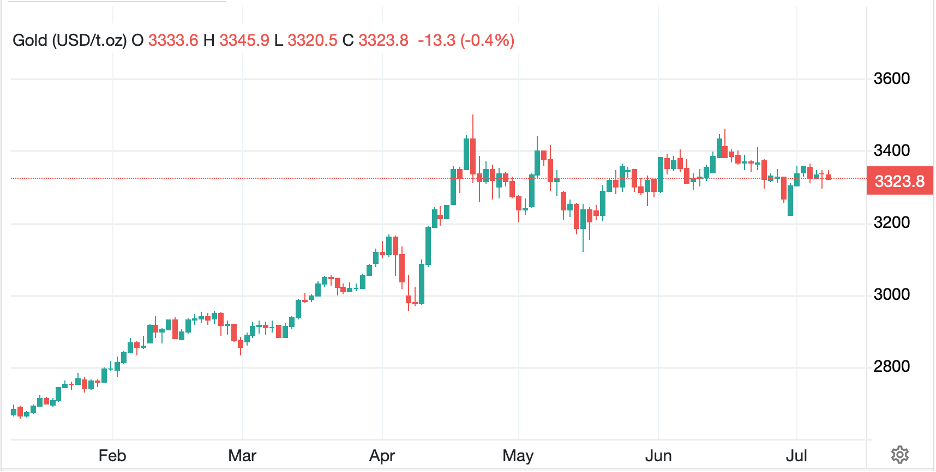
I would argue the commodity markets are where there is the most potential for movement going forward as any type of US-Russian economic détente would almost certainly reduce oil prices substantially.  And, coincidentally, WTI (-1.25%) is falling this morning as hopes for a direct meeting between Putin and Zelensky, and with it the end of the war, are increasing.  Weirdly, gold (+0.35%) is not declining on that news, despite the idea that gold represents a haven against war.  Perhaps gold represents a haven against money supply growth, which if there is an economic détente, you can be sure will increase.  As to the other metals, very little movement there either.  In the vein of the lack of activity, perhaps the below gold chart is even a better descriptor of just how little activity has been going on since spring.

Source: tradingeconomics.com

Finally, the dollar is a touch softer this morning, but it, too, remains rangebound.  While much has been made of its weakness in the first half of the year, as though that calendar period had some special significance (it doesn’t), here too, things have simply ground to a halt.  Using the dollar index (DXY) as our proxy, you can see that this market, too, has done nothing for months.

Source: tradingeconomics.com

Whether it’s G10 or EMG currencies, the movement remains desultory at best, and catatonic may be a better description.

So, let’s look at the data this week that will precede Chairman Powell’s speech Friday morning.

TodayHousing Starts1.30M
 Building Permits1.39M
WednesdayFOMC Minutes 
ThursdayInitial Claims226K
 Continuing Claims1960K
 Philly Fed6.0
 Flash Manufacturing PMI49.5
 Flash Services PMI53.7
 Existing Home Sales3.91M
 Leading Indicators-0.1%
FridayPowell Speech 

Source: tradingeconomics.com

I think it is worthwhile to consider why we look at the Leading Indicators.  The original design was that it tracked a series of indicators that historically had presaged economic activity.  Ahead of recessions, these indicators turned lower and so it seemed a pretty good fit.  However, as you can see from the below chart from conference-board.org, the creators of the index, since 2021, when the index turned lower, it has been completely out of sync with the economy’s outcome.

As I have repeatedly written, models that were created pre-Covid, and many pre-GFC, simply no longer have any relevance to today’s reality.

On the whole, the most likely outcome today, like every day lately, is limited movement in either direction.  While I am sure a black swan exists, he is currently hibernating.

Good luck

Adf

Widely Decried

While tariffs are widely decried
By analysts, they are worldwide
But Trump’s latest scheme
To some, seems extreme
As license fees are codified
 
So, tech names, who’ve, taxes, deflected
Are now likely to be subjected
To payment of fees
To sell overseas
And revenues will be collected


One thing you can never say about President Trump is that he lacks innovative ideas.  Consider one of the biggest complaints over the past decades regarding US corporations; the fact that the tech companies (and drug companies) have been so effective at avoiding paying taxes based on the way they have gamed utilized the tax code and international treaties.  And this was not a partisan complaint as both sides of the aisle were constantly frustrated by large companies’ ability to not pay their “fair share” as it is often described.

It appears that President Trump has come up with a solution for this, charging a licensing fee for companies to sell overseas.  The big news over the weekend was that Nvidia and AMD are both going to pay a licensing fee of 15% of REVENUE on sales of chips to China.  In the case of Nvidia, that is anticipated to be some $2.5 billion with somewhat smaller numbers for AMD.  This is an excellent description of the process by @Kobeissiletter on X. 

I have often expressed the view that corporate taxation, if we are going to have it, ought not be on profits but on revenue.  Corporations are expert at reducing taxable income, maintaining a staff of lawyers and accountants to do just that.  But gaming top line revenues is much harder.  This gambit by President Trump is moving things in that direction.  And remarkably, given these license fees are for exports, it ought to be outside the consumer price chain in the US completely.

There is an article in the WSJ this morning titled, “The US Marches Toward State Capitalism With American Characteristics,” which outlines, and mildly complains, about the changes in the way the US government is dealing with the private sector under President Trump.  It discusses the purchase of 15% of MP Materials, the only US based miner/processor of rare earth minerals, and it discusses these license fees all under the guise of implying this is a bad direction.  And I completely understand that idea as governments tend to be terrible stewards of capital.  However, 25 years of Chinese unfettered access to Western markets while they have skirted the rules codified by the WTO have resulted in some significant national security challenges that can no longer be ignored.  Full marks to President Trump for creative methods to address these challenges, despite the wailing and teeth gnashing of economists.

But other than that story, as well as the ongoing back and forth regarding potential peace talks in the Russia-Ukraine war, not all that much has happened overnight.  For a change, markets are behaving like it is the summer doldrums, so perhaps we should be thankful for the respite.  As such, let’s take a look at how things have done and what we can anticipate this week with CPI and Retail Sales set to be released.

Friday’s US equity rally combined with the news that Nvidia and AMD will be able to export some chips to China saw modest gains there (+0.4%) and in Hong Kong (+0.2%) even though another major property company in China, China South City Holdings Ltd., is being forced into liquidation.  The property situation in China will continue to weigh on the economy there and given property investment was long seen as most Chinese families’ retirement nest egg, will undermine consumption for years.  Elsewhere in the region, there were more gainers (India, Indonesia, Malaysia, Australia, New Zealand, Taiwan) than laggards (Thailand, Philippines) with Japan closed for Mountain Day, a relatively new holiday, and other markets little changed.  

In Europe, though, screens are modestly red with losses on the order of -0.35% across the CAC, DAX and IBEX amid general uncertainties regarding the future economic direction and a lack of earnings positives.  At this hour (7:00), US futures are slightly higher, by 0.2%.

In the bond market, after last week’s auctions have been absorbed, Treasury yields have edged lower this morning, down -2bps, despite Fed funds futures’ probability of that September rate cut slipping to 88% from Friday’s 93%.  In fact, Fed Governor Bowman reiterated over the weekend that she would be voting for a cut at each of the three meetings left this year.  European sovereigns though are little changed, with some having seen yields edge higher by 1bp, as this appears to be a truly lackluster summer day.

Commodities are the only market that is seeing any movement of note, and it is not oil (+0.2%) which has been trading either side of unchanged since last night.  Rather, gold (-1.2%) is suffering this morning as you can see on the chart below as the promise of a potential peace in Ukraine seems to be removing some need for its haven status.  Of course, the thing to really note about the gold market is just how choppy trading has been as conflicting narratives continue to impinge on price movement.

Source: tradingeconomics.com

This decline has pulled down both silver (-1.4%) and copper (-0.95%) with all this happening despite virtually no movement in the FX markets.

Turning to the dollar, one is hard pressed to find any substantial movement in either G10 or EMG currencies. The true outlier this morning is NOK (+0.4%) but otherwise, +/- 0.1% or less is the best description of the price action.  This is what a summer market really looks like!

On the data front, we do get some important information as follows:

TuesdayRBA Rate Decision3.60% (current 3.85%)
 CPI0.2% (2.8% Y/Y)
 Ex food & energy0.3% (3.0% Y/Y)
 Monthly Budget Statement-$140B
ThursdayPPI0.2% (2.5% Y/Y)
 Ex food & energy0.2% (2.9% Y/Y)
 Initial Claims226K
 Continuing Claims1960K
FridayRetail Sales0.5%
 Ex Autos0.3%
 IP0.0%
 Capacity Utilization77.6%
 Michigan Sentiment62.0

Source: tradingeconomics.com

With all the hoopla about the firing of Ms McEnterfar at BLS, you can be sure that there will be lots of discussion on the CPI data regardless of the outcome.  However, as the Inflation Guy pointed out last week, imputing the bottom 30% of items in the basket, which represent something on the order of 2.5% of the total price impact, is likely to have no impact whatsoever.  We also hear from a bunch of Fed speakers, four to be exact, although Richmond Fed President Barkin will regale us twice.  Now that there are more calls for a September cut, it will be interesting to see who remains patient and who is ready to move.

And that’s all there is today.  It is hard to get excited about too much movement given the lack of obvious catalysts.  Of course, one never knows what will emanate from the White House but look for a quiet one, I think.

Good luck

Adf

Qualm(s)

As all of us wait for the Fed
And try to absorb what’s been said
Investors are calm
Though pundits have qualm(s)
Their warnings of problems are dead
 
While no move is likely today
So many continue to pray say
A rate cut is coming
To keep markets humming
So, shorts best get out of the way


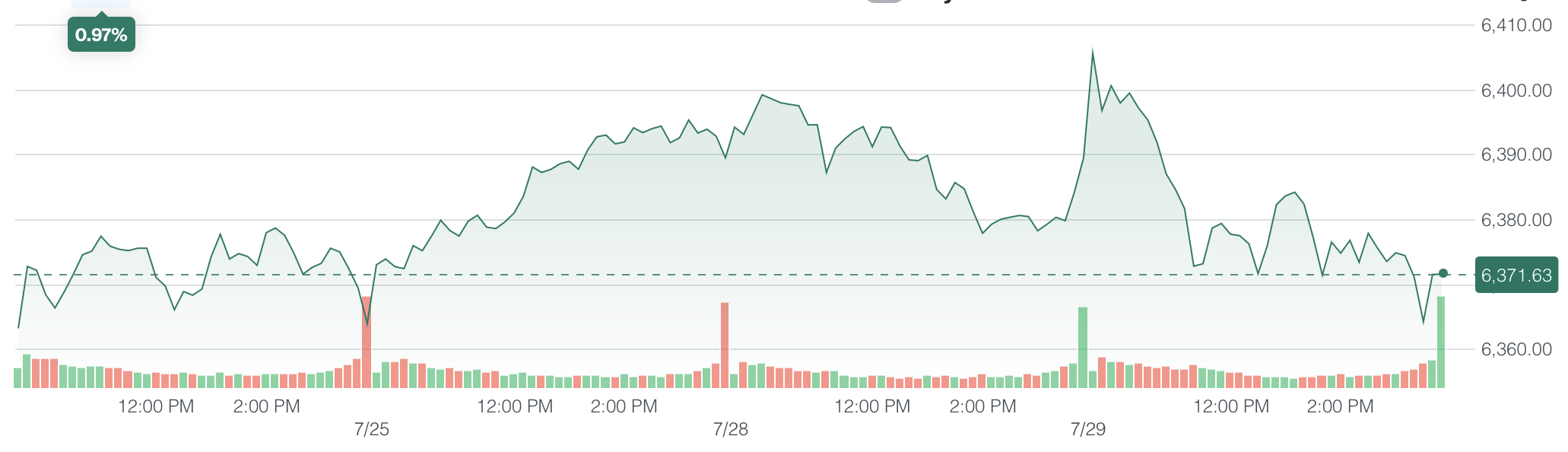
Markets have been in wait and see mode, at least equity markets have, for the past week as investors, traders and algorithms seek something new to discuss.  In fact, a look at the chart below shows that the S&P 500 has moved the grand total of 9 points over the past week!

Source: finance.yahoo.com

Yes, there have been some earnings announcements, with a couple of key ones this afternoon (MSFT and META), but there continues to be an increasing focus on the FOMC which will announce their policy decision (no change) this afternoon.  The focus is really on what Chair Powell will hint at in the ensuing press conference.  At this point, I would say it is baked in the cake that two governors, Waller and Bowman, are going to dissent seeking a 25bp rate cut.

Ironically, if markets are looking for a catalyst from this FOMC meeting, I believe they are looking in the wrong place.  Chairman Powell will do everything he can to not answer any question about anything whatsoever, whether on the likely trajectory of future policy decisions or whether he will resign or be fired.  And so, we will need to look elsewhere for market moving catalysts.

Of course, there is always the White House, which has proven to be a rich source of uncertainty, and then there is the data onslaught starting today through Friday, which if it comes in differently than forecast, will have the opportunity to move markets.  Regarding the former, I will not even attempt to guess what the next story will be.  However, the latter is a potentially rich vein to be mined for insight.

To set the table, a look at yesterday’s outcomes is worthwhile.  The Goods Trade Balance fell to -$86B, substantially less than forecast, on the back of a significant decline in consumer goods imports.  While the data still shows a deficit, I imagine Mr Trump is pleased with the direction.  Certainly, compared to the trend prior to his election (as well as the front-running of tariffs early this year) it seems a modest improvement, or at least a reduction. (see chart below)

Source: tradingeconomics.com

Otherwise, Home Prices rose less than forecast and continue to slow their pace of increase and job openings were withing spitting distance of forecast at 7.44M, although somewhat lower than last month.  Finally, Consumer Confidence continues to rebound.  While equity markets were nonplussed, with US markets slipping a bit on the day, Treasury bonds rallied nicely with 10-year yields sliding -8bps on the day.  The bulk of that rally was based on a very positive 7-year auction, with the bid-to-cover ratio rising to 2.79, and dealers only getting 4% of the issue, the lowest level recorded since 2004.  In other words, investors took in virtually the entire $44 billion.  This morning, we will also learn about Treasury’s planned quarterly issuance, although estimates are there will be no increase in long-term bonds, with T-bills continuing to be the main financing vehicle for now.

Too, this morning we will get the ADP Employment report (exp 75K) and the first look at Q2 GDP (2.4% after -0.5% in Q1).  While all of that could have an impact, my sense is that tomorrow’s PCE data and Friday’s NFP will be of much more import.  A final though this morning is that the BOC is going to complete their policy meeting, but no change is expected there.

If we consider this information, absent a new surprise from the White House on your bingo card, it seems to me Friday is the most likely timing for any substantive movement in equities or bonds.  And with that in mind, let’s look at how other markets have been responding to things.

Yesterday’s modest declines in the US were followed by a mixed picture in Asia with both Japan and China little changed on the day although Hong Kong (-1.4%) was under pressure as the US-China trade talks stumbled for now.  But much of the rest of the region had a solid session with Australia (+0.6%) rallying after better-than-expected inflation data encouraged traders to price in a rate cut by the RBA at their next meeting.  But there were gains in Korea, India and Taiwan as well with only Indonesia really lagging.  In Europe, it is a mixed session with the CAC (+0.45%) leading the way higher while both the IBEX (-0.2%) and FTSE 100 (-0.3%) are lagging as Eurozone data was mixed with inflation edging higher in Spain although Eurozone GDP came in a tick better than forecast.  However, the big discussion there continues to revolve around the details of the trade deal.  As to US futures, they are a touch higher at this hour (7:40), about 0.25%.

In the bond market, after yesterday’s rally, US yields are unchanged on the day, trading at the low end of their recent range, while European sovereign yields are all lower by -2bps (Gilts are -5bps) as the US move came later in the day and Europe didn’t really participate yesterday.  Overnight, JGB yields slipped -1bp, but Australian govies fell -7bs as thoughts of rate cuts danced in traders’ heads.

In the commodity markets, oil (-0.65%) is giving back some of its gains that were catalyzed by President Trump’s threats to Russia if they don’t sit down in the next 10 days, rather than the original 50-day window.  As to metals markets, gold is unchanged this morning, still trading in the middle of its range, although we have seen some weakness in both silver (-0.9%) and copper (-0.8%) but it seems more in line with ordinary trading than with any new news.

Finally, the dollar is continuing its rebound as the euro (-0.2%) retreats further from its recent highs and is now lower by more than -2% in the past week.  In fact, the DXY has traded back above 99.0 for the first time since early June as the bottoming formation that I have highlighted over the past several days continues to prove prescient.  In fact, some might say the dollar is starting to accelerate higher!  Once again, I would highlight that the descriptions of the dollar’s demise were greatly exaggerated.

Source: tradingeconomics.com

And that’s pretty much all there is to discuss.  We are firmly in the middle of the summer doldrums where market activity remains subdued at best.  Given the prominence of algorithms in trading most markets, it will require something new and unexpected to get things going.  Of course, perhaps this evening’s earnings data will start some movement, but I’m still focused on Friday.

Good luck

Adf

Oh So Knurled

Most pundits assure us the world
Will end, because Trump has unfurled
A tariff barrage
Which will sabotage
World trade, which is now oh so knurled
 
But so far, the data have shown
The ‘conomy, widely, has grown
Just wait, they all say
There will come a day
When our forecasts will set the tone!


Market activity remains quite dull lately and yesterday was no exception.  Equity markets are generally creeping higher, but ever so slowly.  Meanwhile, all the forecasts of President Trump’s tariff policy creating imminent economic destruction have yet to prove true.  In fact, the WSJ this morning even published an article complaining explaining that things seem to be working out so far despite the tariffs as the global economy is more resilient than most economists’ models had assumed.  (I know we are all shocked that economists’ models have proven unworthy).  While this doesn’t suit the narrative they have been pushing, or that, in fact pretty much every mainstream media outlet has been pushing, at least they have been willing to recognize that the world has not yet collapsed.

Of course, the great question is can this continue or are the doomsayers correct, and we just have not yet felt the impacts of all these (terrible) policy choices that have been made?  My experience tells me that Trump’s designs for his best-case scenario will not be achieved, but neither will the worst-case scenarios painted by the punditry.  In fact, history has shown that it takes a remarkable amount of effort to completely destroy an economy and that usually takes many years of incredibly stupid policies.  

After all, it took nearly 60 years for Argentina to destroy itself with socialist policies (see chart below from latinaer.springeropen.com), and the same was true for Venezuela.  

In fact, some might say that Europe is well on its way to destroying its economy as they implement more and more central control, but it will take decades to completely collapse things.  My point is that it would be a mistake to assume that because you do, or don’t, like a political regime, that they will change the nature of an economy so quickly that it will impact your life.  Perhaps the exception to that rule is the current situation in Argentina where in one year’s time, President Milei’s free market policies have reversed decades of stagnation.  But going the other direction takes a long time to affect.

Turning back to the developed world, we are in the midst of the summer doldrums with a limited amount of data to be released and the headlines in the US focused on either Coldplay concerts or questions about the actions of the Obama government in the last days of his administration.  None of them are financial or market related (the Powell firing story has taken a breather) and while the tariff deadline looms next week, we continue to hear that more deals are on the way.

So, let’s take a quick look at what happened overnight (not much) and how things are setting up for the US session.  Yesterday’s mixed US performance, with not much movement in either direction was followed by a lack of movement in Tokyo (-0.1%) and Australia (+0.1%) although both Hong Kong (+0.5%) and Chinese (+08%) shares managed to continue their recent rally.  But arguably, things were generally worse in Asia as Korea (-1.3%), Taiwan (-1.5%) and New Zealand (-1.0%) all lagged badly with the other regional bourses showing no life whatsoever.  This feels tariffy to me.  In Europe, the DAX (-1.0%) and CAC (-0.75%) are both under pressure this morning with tariffs the clear concern.  As of now, while Commerce Secretary Lutnick has expressed confidence a deal with Europe will be done, if not, tariffs on European goods will rise to 30% next week.  I guess that has focused the minds of investors on the continent.  As to the UK, stocks there are unchanged this morning as, recall, they have already struck a deal.  Of course, the UK has many problems on its own to prevent its economy from growing.  Meanwhile, at this hour (7:10), US futures are essentially unchanged.

In the bond market, yesterday saw yields slide across the board, with Treasury yields slipping 5bps.  This morning, though, there is a little bounce in yields with Treasuries and most European sovereigns seeing yields rise 2bps.  JGB yields, though, fell -2bps last night, as the response to the LDP losing the Upper House election was quite benign.  It seems that so far, investors are not that worried about major changes in Japan

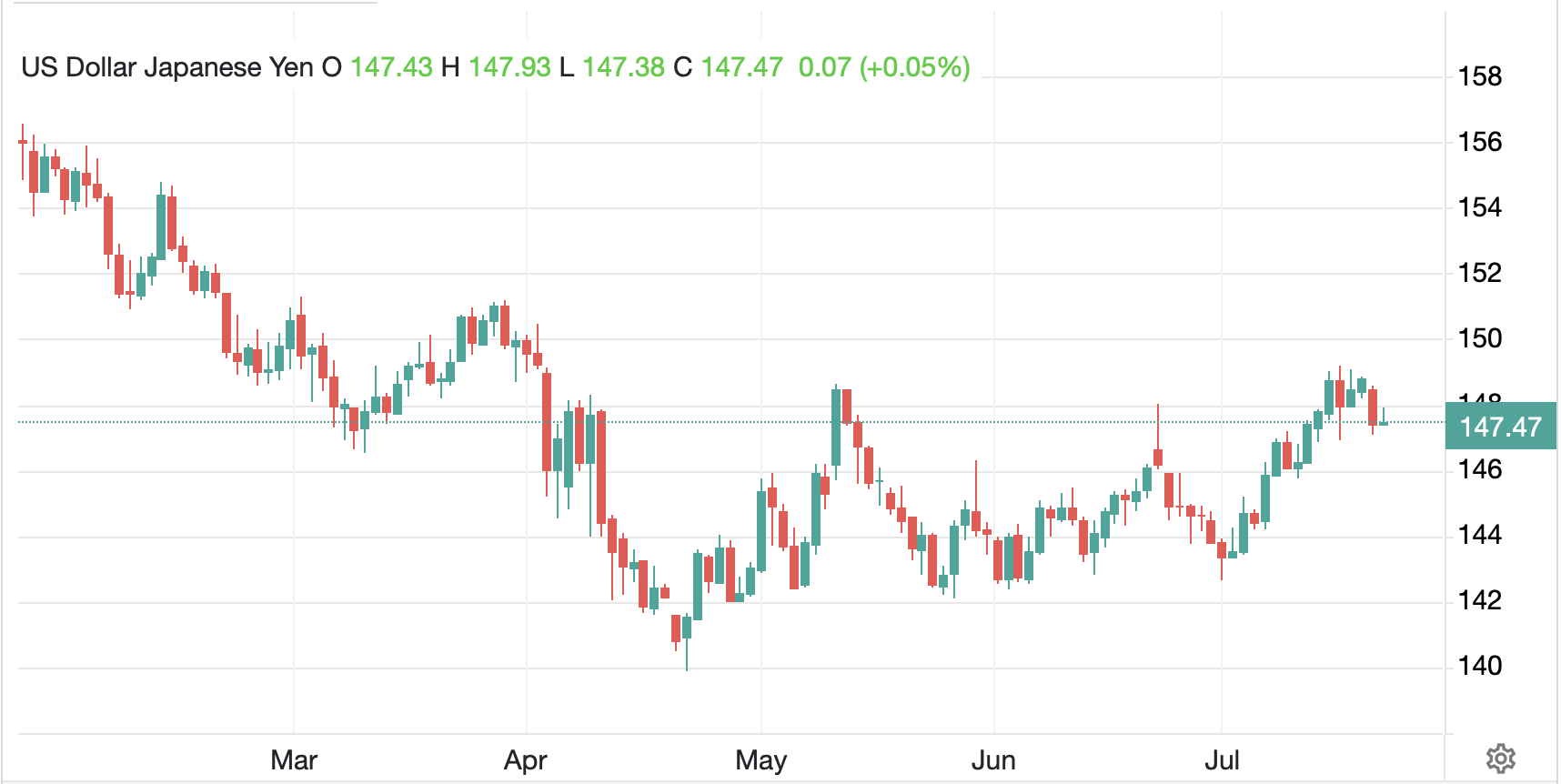
That Japan story is confirmed by the fact that the yen is essentially unchanged today.  In fact, looking at the chart of USDJPY over the past 6 months, it is hard to get excited about much.

Source: tradingeconomics.com

Remember the talk about the carry trade being unwound?  Yeah, me neither.  Arguably, there are two potential drivers of a substantial move in USDJPY, either the Fed will have to start cutting rates, and more aggressively than the 2 cuts currently priced in for the rest of the year, or the BOJ will need to start hiking rates, and quite frankly, neither seems likely anytime soon.  As to the rest of the currency market, sleepy overstates the amount of movement we are seeing this morning.  In fact, it is hard to find a currency that has moved 0.2% in either direction.  FX traders are on summer holiday.

Finally, commodity markets are a bit softer this morning on the open with oil (-0.85%) leading the way after a slide yesterday.  While the narrative discusses concerns over trade and a reduction in demand, market insiders (notably Alyosha) continue to describe the evolution of the crack spread and the fact that the futures contract is rolling over today as being far more impactful to the price right now.  Perhaps the narrative will matter again soon, but that is not the discussion in the marketplace.  As to metals, they had a very strong day yesterday and are consolidating this morning with gold (-0.3%) and silver (-0.15%) slipping slightly, although both metals are closing in on highs.  The big picture in the precious metals space remains that there is more demand and insufficient supply.

On the data front, arguably, Chairman Powell’s speech this morning is the most widely anticipated feature of the day.  However, he is merely making opening remarks at a conference on capital framework for large banks, which while important seems unlikely to touch on monetary policy.

And that’s really it for the day.  There is no reason to believe that anything remarkable will happen but in this age of White House Bingo, we can never rule out some unforeseen event.  The talk in the FX market is that the dollar’s recent countertrend rally is failing and folks are starting to put on bearish bets.  Maybe, but it is hard to get excited in either direction right now.

Good luck

Adf

A Reprieve

Some nations have gained a reprieve
About a month left to achieve
A deal to prevent
The extra percent
Of tariffs that Trump can conceive


The news cycle continues to be bereft of new stories regarding finance and markets as there is continued focus on the tragedy in Texas after the flash floods that were responsible for over 100 deaths.  But in our little corner of the world, tariff redux is all we have.  So, to rehash, today marks 90 days since President Trump delayed the imposition of his Liberation Day tariffs back in April with the idea of negotiating many new trade deals.  Thus far, only two have been agreed, the UK and Vietnam, while there has clearly been progress made on several key deals including Japan, South Korea, the EU, India and Australia.  As such, the president has delayed the imposition of these tariffs now to August 1st, but we shall see what happens then.

It is worth noting that trade negotiations historically have taken a very long time, years if not decades, as evidenced by the fact that any time an agreement is reached, it is met with dramatic fanfare on both sides of the deal.  Consider, for a moment, that the EU and MERCOSUR finally agreed terms in 2024, after 25 years of negotiations, although the deal has not yet been ratified by both sides.  With this in mind, it is remarkable that as much ground has been covered in this short period of time as it has.

However, if I understand correctly, many other nations will be subject to tariffs starting today.  Of course, along with these tariffs are the resumed calls for a catastrophic outcome for the US with inflation now set to advance sharply while growth stagnates.  At least the naysayers are consistent.

Away from this story, though, the market is the very picture of the summer doldrums.  After all, nothing else has really changed.  The BBB solved the debt ceiling issue, with another $5 trillion added to the mix, so funding the government should not be a problem for several years at least.  Of course, this means the monetary hawks will re-emerge and complain that the government is spending too much (which it clearly is) and that the economy will collapse under the weight of all that debt.  After all, one needs a calamity to get one’s views aired these days, and doomporn is all the rage with President Trump in office.

So, I won’t waste any more time before heading into the market recap.  Yesterday’s US equity decline, catalyzed by the display of letters written to Japan and South Korea about the imposition of 25% tariffs, was halted after the delay was announced, but the markets still closed lower.  Overnight, Asian markets managed to rally a bit with the Nikkei (+0.3%) the laggard while Korea (+1.8%) really benefitted from that delay.  Meanwhile, China (+0.8%) and Hong Kong (+1.1%) were also solid as was most of the region although Thailand (-0.7%) which did not receive a reprieve, did suffer.

In Europe, the picture is somewhat mixed with the DAX (+0.45%) rising after a slightly wider than expected trade surplus was reported this morning while the CAC (-0.1%) has been under modest pressure after the French trade deficit rose slightly.  But the bulk of the market here is modestly higher on the reprieve concept, although only about 0.2%.  As to US futures, at this hour (7:05), they are basically unchanged to slightly higher.

In the bond market, though, yields continue to rise around the world this morning as it appears investors are growing somewhat concerned that all the government spending that is being enacted around the world is becoming a concern.  Treasury yields have risen 3bps and European sovereigns are higher by between 4bps and 5bps.  JGB yields, too, are higher by 4bps and in Australia, an 8bp rise was seen after the RBA failed to cut their base rate last night as widely expected.  Since the beginning of the month, 10-year Treasury yields have risen by more than 20 basis points (as per the chart below) a sign that there may be concern over excess supply…or that the BBB is going to encourage faster growth.  I’m not willing to opine yet.

Source: tradingeconomics.com

In the commodity markets, oil (-0.3%) has been trading in a $4/bbl range since the end of the 12-Day War and the US destruction of Iranian nuclear facilities removed the war premium from the market.  In truth, this is surprising given the ongoing increases in production from OPEC+ and the widespread belief that the economy is suffering and heading into a recession.  But it is difficult to look at the below chart and be confident of the next move in either direction.

Source: tradingeconomics.com

Meanwhile, metals markets this morning show gold (-0.35%) giving back some of its late day gains yesterday while silver and copper remain little changed.  Again, range trading defines the price action as gold has basically gone nowhere since late April.

Source: tradingeconomics.com

Finally, the dollar is mixed this morning with AUD (+0.6%) the leading gainer after the RBA no-action outcome, although ZAR (+0.6%) has gained a similar amount which appears to have been driven by Trump rescinding his threat to add a 10% additional tariff on all BRICS nations (the S is South Africa) that seek to avoid using the dollar for trade.  On the other side of the coin, the pound (-0.3%) and yen (-0.4%) are both slipping this morning with the former suffering from domestic finance problems as the Starmer government continues to flail in its efforts to pay for its promised spending.  In Japan, the Upper House elections, which are to be held July 20th, are a problem for PM Ishiba and his minority government.  One of the key issues is despite the fact that rice prices there have risen more than 100% in the past year, and the US is keen to export rice to Japan to help mitigate the problem, the farmers bloc in Japanese politics has outsized influence and is vehemently against the proposal.  If the government falls due to election losses, agreeing a trade deal will be impossible.  Perhaps this time, the yen will weaken in the wake of tariffs.  (As an aside, are any of you old enough to remember the death of the carry trade and how the yen was going to explode higher?  I seem to recall that was a strong narrative just a few months ago, but it is certainly not evident now.)

On the data front, the NFIB Survey was released this morning at 98.6, a tick lower than expected and 2 ticks lower than last month, but basically little changed.  I don’t think it provides much new information.  Later this afternoon we see Consumer Credit (exp $11.0B), potentially a harbinger of future spending outcomes.  But really, that’s it.

Headline bingo continues to drive markets with the narratives locked in place.  The dollar’s trend is clearly lower, but it remains to be seen if the oft-predicted collapse is on the cards.  Personally, while a bit further weakness seems reasonable, getting short here, with the market already significantly positioned that way, does not feel like the right trade.

Good luck

Adf

The World is Aghast

At one time, not long in the past
New York was a finance dynast
But yesterday’s vote
Does naught to promote
Its future. The world is aghast
 
As well, yesterday, Chairman Jay
Had nothing of note new to say
He’s watching quite keenly
And somewhat serenely
But rate cuts are not on the way


I must start this morning on the results from the NYC mayoral primary election where Zohran Kwame Mamdani won the Democratic primary and is now favored to win the general election.  His main rival was former NY state governor, Andrew Cuomo, a flawed man in his own right, but one with the usual political peccadillos (greed, grift and sexual misconduct).  Mamdani, however, is a confirmed socialist whose platform includes rent freezes, city owned grocery stores (to keep costs down) a $30/hour minimum wage (not sure how that will keep grocery prices down) and a much higher tax rate, especially on millionaires.  In addition, he wants to defund the police.  Apparently, his support was from the younger generations which is a testament to the failures of the education system in the US, or at least in NYC.

I mention this because if he does, in fact, become the mayor of NYC, and can enact much of his agenda, the financial markets are going to be interrupted in a far more dire manner than even Covid or 9/11 impacted things.  I expect that we will see a larger and swifter exodus from NYC of both successful people and companies as they seek other places that are friendlier to their needs.

Now, even though he is running as a Democrat, it is not a guarantee that he will win.  Current mayor, Eric Adams is running as an independent, and while many in the city dislike him, he may seem to be a much better choice for those somewhere in the middle of the spectrum.  As well, even if he wins, his ability to enact his agenda is not clear given his inexperience and lack of connections within the city’s power centers. Nonetheless, it is a real risk and one that needs to be monitored closely.  

As to Chairman Powell, as well as the other six FOMC members who spoke yesterday, the generic view is that while policy may currently be slightly tight, claimed to be 25bps to 50bps above neutral across all of them, they are in no hurry to adjust things until they have more clarity regarding the impact of tariffs on inflation and the economy.  They paid lip service to the employment situation, explaining that if things took a turn for the worse there, it would change the calculus, but right now, they’re pretty happy.  It can be no surprise that there were zero deep questions from the Senate committee members, and I expect the same situation this morning when he sits down in front of the House.  

Since the cease fire between Iran and Israel seems to be holding, market participants are now searching for the next catalyst for market movement.  In the meantime, let’s look at how things are behaving.  The “peace’ in the Middle East saw the bulls return with a vengeance yesterday in the US, with solid gains across all major indices, but the follow through was less robust.  While Chinese shares (Hang Seng +1.2%, CSI 300 +1.4%) both fared well, the Nikkei (+0.4%) was less excited and the rest of the region was more in line with Japan than China, mostly modest gains.  From Japan, we heard from BOJ member Naoki Tamura, considered the most hawkish, that raising interest rates was necessary…but not right away.  That message was not very well received.

However, Europe this morning is on the wrong side of the ledger with Spain’s IBEX (-1.25%) leading the way lower although other major bourses are not quite as poorly off with the DAX (-0.4%) and CAC (-0.2%) just drifting down.  NATO is meeting in The Hague, and it appears that they are finalizing a program to spend 5% of respective national GDP’s on defense, a complete turnaround from previous views.  This is, of course, one reason that European bond markets have been under pressure, but I expect it would help at least portions of the equity markets there given more government spending typically ends up in that bucket eventually.  As to US futures, at this hour (7:10) they are little changed to slightly higher.

In the bond market, US Treasury yields continue to slide, down another -1bp this morning and now under 4.30%.  Despite President Trump’s hectoring of Chairman Powell to lower Fed funds, perhaps the fact that Powell has remained firm has encouraged bond investors that he really is fighting inflation.  It’s a theory anyway, although one I’m not sure I believe.  European sovereigns have seen yields edge higher this morning, between 1bp and 2bps as the spending promises continue to weigh on sentiment.  However, even keeping that in mind, after the spike in yields seen in early March when the German’s threw away their debt brake, European yields have essentially gone nowhere.

Source: tradingeconomics.com

While this is the bund chart, all the major European bond markets have tracked one another closely.  Inflation in Europe has fallen more rapidly than in the US and the ECB’s base rate is sitting 200bps below Fed funds, so I suppose this is to be expected.  However, if Europe actually goes through with this massive military spend (Spain has already opted out) I expect yields on the continent to rise.  €1 trillion is a quite significant ask and will have an impact.

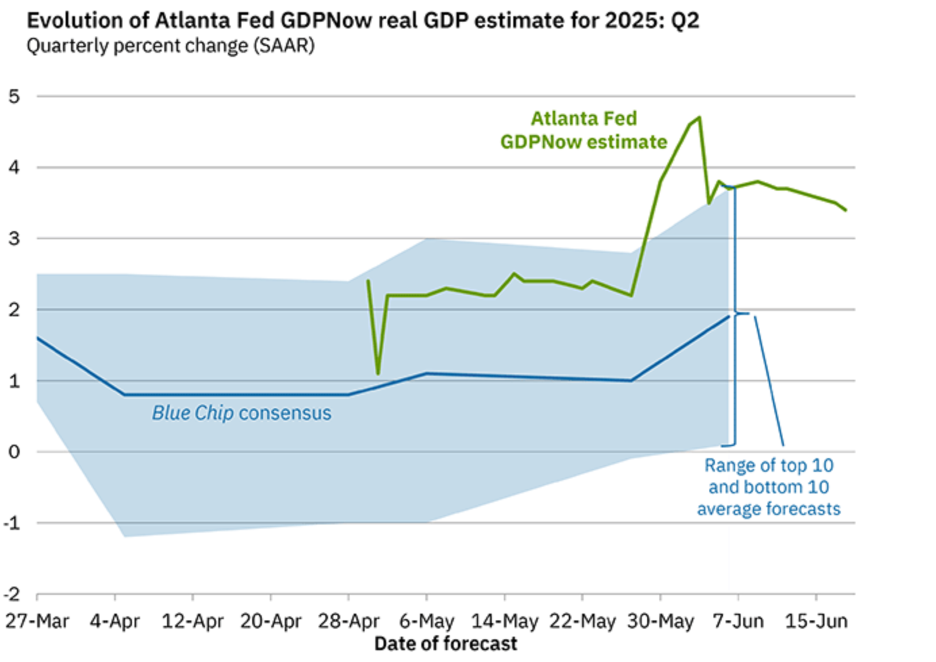
Moving to commodity markets, after its dramatic decline yesterday, oil (+0.8%) is bouncing somewhat, but that is only to be expected on a trading basis.  Again, absent the closure of the Strait of Hormuz, I suspect that the supply/demand dynamics are pointing to lower prices going forward, at least from these levels.  In the metals markets, gold (+0.15%) which sold off yesterday as fear abated, is finding its footing while silver (-0.5%) is slipping and copper is unchanged.  It feels like metals markets are looking for more macroeconomic data to help decide if demand is going to grow in the near term or not.  A quick look at the Atlanta Fed’s GDPNow estimates for Q2 show that growth remains quite solid.

Source: atlantafed.org

However, another indicator, the Citi Economic Surprise Index, looks far less promising as it has moved back into negative territory and has been trending lower for the past 9 months.

Source: cbonds.com

At this point, my take is a great deal depends on the outcome of the BBB in Congress and if it can get agreed between the House and Senate and onto President Trump’s desk in a timely manner.  If that does happen, I think we are likely to see sentiment increase, at least in the short term.  That should help all economically sensitive items like commodities.

Finally, the dollar is modestly firmer this morning, rebounding from yesterday’s declines although still trending lower.  The price action this morning is broad based with modest moves everywhere.  The biggest adjustment is in JPY (-0.6%) but otherwise, 0.2% pretty much caps the movement.  Right now, the dollar is not that interesting, although I continue to read a lot about how it is losing its luster as the global reserve currency.  There is an article this morning in Bloomberg explaining how China is trying to take advantage of the current situation to globalize the yuan, but until they open their capital markets, and not just for $50K equivalents, but in toto, it will never be the case.

On the data front, aside from Chair Powell’s House testimony, we see New Home Sales (exp 690K) and then EIA oil inventories with a modest draw expected there.  There are no other Fed speakers and certainly Powell is not going to change his tune.  To my eyes, it is setting up as a very quiet session overall.

Good luck

Adf

Waiting for Jay

While everyone’s waiting for Jay
And hope he’s got good things to say
No stories of note
Have lately been wrote
And bulls keep on getting their way
 
The only place that’s not been true
Is China, where, policies, new
Allow new home prices
To make sacrifices
And slide hoping sales follow through


Although there has been a dearth of new information to drive activity, at least with respect to hard data, equity markets are mostly trading higher as the rebound from the early August correction continues.  In the US this week, the big news won’t be out until Friday, when Chairman Powell speaks at the Jackson Hole symposium.  Elsewhere, while we do see things like both Japanese and Canadian inflation as well as the flash PMI data, so much importance has been attributed to the Powell speech, it is hard for traders to get excited about very much.  For instance, early this morning the Swedish Riksbank cut their policy rate by 25bps, as expected, and indicated that there could be another 3 cuts during 2024, but nobody really cared.  In fact, the Swedish stock market is lower on the day, simply proving that rate cuts are not a stock market panacea.

However, not every nation is using the same playbook right now, and while Japan may be the biggest outlier, attempting to tighten monetary policy, albeit not as successfully as they had hoped, China is taking a different approach to fiscal and economic policy.  As I have mentioned before and has been widely reported for the past several years, the property market in China has been under severe stress.  What has become a bit clearer in that time is that much of the Chinese growth miracle was the result of massive overinvestment in housing.  The stories about ghost cities, that were built but where nobody lived, which had made the rounds for a while turned out to be true. 

In essence, a key driver of the Chinese economy was the property market.  Cities and states would sell land to property developers, using the funds to help themselves develop infrastructure.  Meanwhile, property developers had a ready market for their homes (mostly condos in high rises) as the Chinese people felt more comfortable with property as a savings vehicle than banks or the stock market.  Looking at the performance of the Shanghai Composite below, it is no wonder that people gravitated toward property.  After a peak in the summer of 2015, the PBOC devalued the renminbi 2%, stocks fell nearly 50% in the ensuing six months, and have remained at that lower level ever since.

A graph with numbers and lines

Description automatically generated

Source: tradingeconomics.com

But for the past four years, since China Evergrande, a major property developer, started to crumble, the desire of the Chinese people to own property has greatly diminished.  This has had a major impact on Chinese local government finances as the demand for property they were selling to fund themselves collapsed.  At this point, there is a glut of unfinished homes around as developers ran out of funding, so the country is in a bad spot.  Not surprisingly, one of the problems is regulatory, as Chinese city and state governments have had restrictions on new home prices, trying to prevent them from declining thus keeping the cycle of new homes funding the cities ongoing.  But recently, some major cities and states have relaxed those restrictions and suddenly, new home prices have fallen to make them competitive with resales.  Remarkably, sales volumes are picking up.  Who would have thunk?  

It is ironic that Communist China is defaulting to market pricing activity to help markets clear while in the ostensibly capitalist US, we have a major party seeking to intervene in housing markets to achieve a social goal of home ownership, regardless of the fact it will push prices higher.  At any rate, the upshot is that property prices in China continue to decline which is weighing on the share prices of those developers that have not already gone bust.  And that is dragging down the entire Chinese stock market and adding to that underperformance we see above.

But you can tell it is a slow day if that is the most interesting story I can discuss!  So, without further ado, let’s take a look at the overnight activity as we await the NY open.  While the CSI 300 (-0.7%) and Hang Seng (-0.3%) were both in the red, the rest of Asia followed the US higher with Japan (+1.8%) and Korea (+0.8%) leading the way higher.  As to European bourses, it is much less exciting as continental exchanges are all +/- 0.1% from yesterday’s close although the FTSE 100 (-0.6%) is under a bit of pressure with the energy sector weighing on the index amid the decline in oil prices.  As to US futures, they are essentially unchanged at this hour (7:20).

In the bond market, the doldrums also describe the price action with Treasury yields unchanged on the day and the same virtually true across all of Europe and Asia.  This is a situation where it is very clear that both traders and investors are waiting anxiously for Godot Powell.

While oil prices have stopped their slide this morning, they have fallen -6.0% in the past week as the slowing growth/recession story is on the minds of traders everywhere.  Concerns over supply on the back of either Ukraine/Russia or Israel/Iran are clearly no longer part of the discussion.  It feels to me like that is somewhat short-sighted, but I am not an oil trader.  In the metals markets, the barbarous relic (+0.85%) continues to pull all metals higher as it is trading at yet another new all-time high this morning ($2525/0z) and dragging silver (+1.3%) and copper (+0.2%) along for the ride.  While the silver movement makes some sense given it has precious characteristics, copper is wholly an industrial metal, so it is giving opposite signals to the oil market.  They both cannot be right.

Finally, the dollar remains under pressure, with the euro (-0.1% today, +0.75% this week) pushing toward its end 2023 highs.  Remember, back then, markets were pricing 6-7 Fed rate cuts this year, something which is clearly not going to happen.  As well, we are seeing the strength in CHF (+0.3%), SEK (+0.3% despite the rate cut and threats of more) and JPY (+0.2%). Interestingly, in the EMG space, ZAR (-0.6%) and MXN (-0.6%) are both under pressure this morning despite the rally in metals markets.  As well, I guess given the general malaise in China, it can be no surprise that the renminbi (-0.2%) has fallen.  Perhaps a more interesting thing to consider is the fact that the renminbi fixing has been right around current market levels, an indication that pressure on the PBOC to devalue has faded, and a sign that the dollar is losing some fans.  In fact, I suspect that this is a key feature of the dollar’s recent softness, and if the Fed does get aggressive, do not be surprised if the market pushes USDCNY to the other side of the +/- 2% trading band around the fix.

On the data front, there is no US data today at all, with the most interesting thing to be released being the Canadian inflation report (exp 2.5%).  We do hear from two Fed speakers this afternoon, Atlanta Fed president Raphael Bostic and Governor Michael Barr, but with Powell on the horizon, it would be hard for them to get much traction in my view.  As an aside, the Atlanta Fed’s GDPNow has fallen to 2.0% as of last Friday, down nearly 1% last week.  This, of course, is another brick in the recession story.

Net, today seems like it will be a quiet one, with markets biding their time until Friday.  Of course, given that these days, biding their time means equities will keep rallying and the dollar keep sliding, I think that seems like the best bet for now.

Good luck

Adf

A Future, Austere

So, what if the payroll report
Was wrong, and job numbers fall short
When they are revised
And so, they disguised
The ‘conomy’s on life support
 
Will this mean recession is here
And Jay will get rate cuts in gear?
But if that’s the case
Are stocks the right place
To hide with a future, austere?


After last week’s remarkable rally that has reversed so much of the negativity inspired by the BOJ/yen carry trade unwind/end of the world scenarios from just two weeks ago, this week is starting off in a fairly muted manner.  Add to this the fact that the data stream this week is limited, and you have all the makings of a quiet, summer doldrums-like, period.  Except…Thursday begins the KC Fed’s Jackson Hole symposium and Friday morning at 10:00am EDT, Chairman Powell will be speaking.  This speech often has great significance as historically, Fed chairs will give strong clues about policy changes coming at this exact opportunity.  This is not to say Powell is going to give us a schedule of his planned rate cuts, but more that he has the chance to explain his (and by extension the Fed’s) reaction function to future data releases.

It is this topic that is critical for us to monitor as lately there have been several articles regarding the nature of the annual benchmark revisions to the payroll reports that will be coming early next year.  The punch line is that expectations are growing that much of the NFP growth seen thus far in 2024, currently totaling ~1.4 million new jobs, may be erased, with estimates of downward revisions rising to 1 million or more.  For instance, in California, the Legislative Analyst’s Office, which is a non-partisan (assuming such a thing exists) group under the auspices of the California state legislature, has revised down their job growth estimates for all of 2023 to just 9K from well in excess of 100K in the initial reporting.  Given California’s status as the largest state in the union and its general importance to the economy, this is quite concerning.  

The BLS revisions will not be released until March 2025, but there have been numerous concerns registered by economists and analysts of all stripes indicating that the BLS model, specifically the birth-death portion regarding new businesses, is wildly out of sync with the reality on the ground.  One of the things that has allowed the Fed to maintain their higher for longer stance is their belief, based on the BLS data, that the employment situation is still quite solid in the US.  Of course, the recent rise in the Unemployment Rate is beginning to raise some eyebrows, but those who believe there is no recession will point to the increase in job seekers in the latest report, essentially raising the numerator rather than reducing the denominator in that data point. And maybe that is true.  However, the vibe that appears to be growing around the country is that the job situation is not as robust as the numbers might indicate.

The implications of this are that it is entirely possible that the minority of analysts who claim we are already in a recession will turn out to have been correct, and the NBER will backdate the beginning of the recession to early this year.  As to the Fed, they will find themselves in a much different place and be forced to cut rates far more aggressively than what seems to be the current belief in the Eccles building.

Right now, the Fed funds futures market is pricing in a bit more than 200 basis points of cuts by September 2025.  While that seems like a lot, if the economy is actually in recession already, that is likely understating the case.  When it comes to the tradeoff between inflation and recession, while Powell was able to talk tough regarding recession when it didn’t seem to be coming, methinks he will have a different tone if these job numbers are revised as dramatically as some are contending.  And let’s face it, if the California government is explaining that is the case, along with some research by the Philly Fed, which is also indicating less job growth than initially reported, this could well be the 2025 story of note.

To summarize, questions regarding actual job growth vs. reported job growth are starting to be asked.  If the answers lean toward the negative end of the spectrum, the likelihood of more aggressive Fed easing rises. However, the specter of inflation looms large in the background as despite its seeming recent quiescence, it is not nearly back at the Fed’s target level.  Can the Fed cut aggressively if inflation remains above target?  Of course they can, and if the economic situation deteriorates rapidly, they almost certainly will.  But that will not solve the inflation problem.  If, and it is a big if, this is the case going forward, my longstanding contention of a significant decline in the dollar versus commodities will likely play out.  As well, I would not want to own duration in the bond market, and while stocks might start out ok, recession does not pad profit margins, it impairs them, so stocks will have trouble as well.

In the meantime, let’s look at what happened overnight.  Friday’s continuation rally in the US saw some follow through in Asia, but it was truly a mixed picture there.  Japan’s Nikkei 225 (-1.8%) fell sharply as the yen rallied more than 1%.  Remember, about 40% of the Nikkei’s profits come from international sales and activity, and as the yen strengthens, it impairs those earnings in local terms.  Elsewhere, China (+0.3%) and Hong Kong (+0.8%) fared well, but Korea (-0.85%) suffered.  The other markets showed marginal gains.  In Europe, though, Spain (+1.0%) is leading the way higher although the rest of the continent is seeing much more limited gains, on the order of +0.25%, as a lack of new data or commentary seems to be allowing for a follow-on from the US session Friday.  UK shares are unchanged and so are US futures as traders await the big Powell speech on Friday.

In the bond market, Treasury yields are lower by 1bp, and we are seeing slightly larger yield declines in Europe, with sovereign yields down by between -2bps and-4bps.  Again, a lack of data and commentary means this is trading inspired, and not based on new information.  JGB yields rose 1bp, perhaps in sync with the yen’s rise overnight.

In the commodity markets, oil (-0.9%) continues to suffer as the slow growth, slowing demand story is the driver with absolutely no concern over the potential for an increase in supply tensions based on the ongoing wars in Ukraine and Israel/Gaza.  Meanwhile, gold (-0.8%) which closed above $2500/oz on Friday for the first time ever, is consolidating a bit and dragging silver (-0.5%) with it.  Interestingly, copper (+0.5%) is holding its own despite the slowing growth story.  That seems to be much more of a technical trading story than a fundamental one, although the long-term fundamentals remain quite bullish in my view.

Finally, the dollar is under further pressure this morning, falling against all its G10 counterparts and many of its EMG counterparts as well.  it should be no surprise that CNY (+0.3%) is stronger alongside the yen, but we also saw KRW (+0.85%) really benefit and almost every EMG currency, save MXN (-0.3%), which is today’s ultimate laggard.  If the story is turning to more aggressive US rate cuts, the dollar will continue its decline.

On the data front this week, there is not much other than the Jackson Hole symposium, but here it is for you:

TodayLeading Indicators-0.3%
WednesdayFOMC Minutes 
ThursdayInitial Claims230K
 Continuing Claims1881K
 Flash Manufacturing PMI49.5
 Flash Services PMI54.0
 Existing Home Sales3.92M
FridayNew Home Sales630K

Source: tradingeconomics.com

So, as you can see, other than Powell on Friday, and three other Fed speakers (Waller, Bostic and Barr), earlier in the week, there is not much to see.  My take is the rate cut narrative is building momentum and that we are going to see further pressure on the dollar until either the data indicates no cuts are coming, or we have a more significant risk-off event where people run to dollars to hide.

Good luck

Adf

A Bummer

The narrative writers have turned
Their focus, as markets they’ve spurned
It’s politics now
That they all endow
With ideas we need be concerned
 
And so, if the pricing is right
Come next week, the Fed will sit tight
The rest of the summer
Could well be a bummer
For traders, with volumes quite light


It is not uncommon for the summer months to lack interesting new information for market participants.  While the regular monthly cycle of data continues to be released, the fact remains that there seems to be less interest overall.  This is not to say there have never been summer surprises, but the very fact we call them surprises is indicative of their relative scarcity.  

This year, especially, seems likely to have even fewer financial or economic discussions than usual given the ongoing drama in the US political cycle.  And while this poet has opinions as to how things may work out (and of course what I would like to see) that is not what this morning missive is all about.  Rather, I continue to try to find the stories that drive market activity and alert you to what is happening.  But the ongoing political narrative is now so dominant, everything else pales in comparison.  And as I wrote yesterday, while political narratives can have some market impact, it is not typically that significant.

I mention this because there were exactly zero stories of any market consequence overnight.  Much was written about the US elections and there were some ‘thought’ pieces on issues like the long-term impacts of President Xi’s iron grip on China and what that means for the economy there, but there was no data to excite, there were no comments of note and basically, it was all quite dull.  For instance, I’ll bet you were unaware that the G20 is meeting in Rio de Janeiro because it is almost impossible to find a story on the meeting.  I suspect that Thursday’s GDP and Friday’s PCE data are going to be the most exciting things that occur this week.  

Unless, of course, there is a real summer surprise.  It is earnings season with the Mega-cap tech companies set to report this week and next, but those are generally not market wide movers.  So, with that in mind, let’s take a look at the overnight market activity and call it a day.

After US equity markets showed their resilience yesterday, laughing off the concept of a rotation out of tech or the beginning of a serious correction, Asian markets mostly followed that same line of thinking if you ignore Japan (flat) and China (CSI 300 -2.1%, Hang Seng -1.0%) as the rest of the region was in the green, with some markets really enjoying a boost, notably Taiwan (+2.75%).  The Chinese story seems to be ongoing disappointment that the Third Plenum did nothing to indicate support for the economy and the 10bp rate cuts were seen as insufficient.  As to Japan, the tension between the rebound in tech shares and the strengthening in the yen led to no net movement.  In Europe, though, bourses are all following the US lead and rising nicely, led by the DAX (+1.2%) as hints by some ECB members indicate that a cut is coming in September despite Madame Lagarde’s insistence that no decisions have been made.  As to the US futures markets, at this hour (7:15) they are little changed overall.

Bond markets have seen yields decline this morning with Treasuries (-2bps) the laggard compared to Bunds (-4bps) and OATs (-3bps).  Of course, this follows yesterday’s session where yields edged higher by a few basis points and basically shows that investors are unwilling to take any directional views until we at least see the PCE data, if not until the FOMC next Wednesday.  Since the beginning of the month, Treasury yields have been choppy in a range of 4.15% – 4.30% and are currently sitting right in the middle.  There continue to be two longer term views, with the recessionistas calling for a sharp decline in yields as it becomes clear the US economy is slowing and the Fed will cut rates to stimulate, while the fiscal policy bears keep pointing to the massive deficits and issuance that accompanies those deficits, and explains that at some point, demand will not meet supply and yields will rise sharply.  My own view is that both of these outcomes will obtain, with the first recession signals helping to send yields lower before longer-term troubles emerge for the US fiscal picture.  But right now, it’s hard to get excited in either direction.

In the commodity space, oil (-0.3%) remains under pressure although today’s decline is far less severe than we’ve seen in the past several sessions.  Rumors of OPEC increasing production in Q4 seem to be one driver as well as forecasts for inventory builds in the US this week.  Gold (+0.6%) continues to find buyers and remains above $2400/oz as Asian demand, from both central banks and individuals remains a key driver.  Copper (-1.0%) on the other hand continues to suffer, down more than -6.0% this month, as the slowdown in China’s economy weighs on demand for the red metal.

Finally, the dollar, which has been written off more times than I can count, is firmer again, back above 104.00 on the DXY.  For all the discussion about how the dollar is set to decline, a quick look at the DXY over the past year tells me that there is no discernible downtrend at all (nor is there an uptrend).  

Source: tradingeconomics.com

There has been an uptick in the long-term ‘dollar will die’ narrative, but certainly that has not had any impact on the ordinary activity that we watch regularly.  As to today’s activity, NOK (-0.5%) is leading the G10 lower although we are seeing declines averaging -0.25% elsewhere with one exception, JPY (+0.5%) which is bucking the trend.  From a currency perspective, one might think it is a risk off day, with investors flocking to havens, but given equity market strength, that is clearly not the case.  As to the EMG bloc, ZAR (-0.9%) continues to demonstrate impressive volatility overall, suffering on weakness in commodity markets and the CE4 are also soft, tracking the euro’s decline.

On the data front, we see Existing Home Sales (exp 3.99M) at 10:00 this morning and that is all she wrote.  It is difficult to get excited about today’s market and I suspect that absent some terrible earnings data that causes a real stock market decline, tomorrow when we wake up, things will be close to where they are now.

Good luck

Adf

Birds of a Feather

We all know that birds of a feather
Eventually will flock together
So, yesterday’s color
From Williams and Waller
Implied cuts are when and not whether


As I described yesterday morning, and have been observing since Chairman Powell’s Congressional testimony, all the members of the FOMC are on the same page.  Yesterday it was NY Fed president John Williams and Governor Chris Waller who explained that [Williams] “It is not really a story about a ‘last mile’ or some part that’s particularly sticky.”  [Different inflation measures are] “all moving in the right direction and doing that pretty consistently,” and [Waller] “The time to lower the policy rate is drawing closer.  Right now, the labor market is in a sweet spot.  We need to keep the labor market in this sweet spot.”

This is the same message Powell gave us in his testimony and on Monday.  It is what we have heard from Barkin, Kugler, Daly and Goolsbee so far this week and are likely to hear from Daly and Williams again today and Bowman and Bostic before they all go quiet ahead of the July 31st meeting.  While there are those who are calling for a cut at the July meeting (Goldman Sachs analysts explained their reasons and in this morning’s WSJpundit Greg Ip did the same), and, even though I think it is an interesting risk/reward opportunity, with less than a 5% probability currently priced into the market, I do not believe that the FOMC is going to cut even if next week’s PCE data is extremely soft.  

Consider, though, that between now and the September FOMC meeting, we will receive two more each of CPI, PCE and payroll reports as well as hear all the talk from the Jackson Hole Symposium.  If, and it’s a big if, the economy shows that it is slowing more rapidly than currently seems to be the case, I would not rule out a 50bp cut then, although that is clearly not my base case.

I think it says a great deal about the market’s narrative overall that the ECB is meeting as I write and will release their policy statement and actions, if any, shortly and it is not a top ten topic of conversation right now. There is no expectation of movement, and the market has lined up for a September cut there as well.  In other words, everything remains all about the Fed.

Well, the Fed and the US stock market.  Since its high print a week ago, the NASDAQ is down by 4% with some of its key constituents (NVDA -14.3%, MSFT -5.1%, GOOGL -5.6%) having fallen much further.  At the same time, the DJIA has rallied 3.7% as the new discussion is a rotation from growth to value stocks as the latter will ostensibly be better served by the Fed’s now-imminent rate cuts.  At least, that’s the story that has become the universal belief set.  It certainly sounds good and is logical so let’s go with it.  However, I guess the question we need to answer is, can it continue?  

Can it continue for another day or two?  Certainly, given positioning that exists and the fact this new idea has developed some momentum, it can go a bit further.  But is this the beginning of an entirely new trend?  Somehow, I do not see that being the case.  Remember, the Magnificent-7 story had evolved from an idea into a cult, not dissimilar to the Bitcoin story.  People believed and were rewarded for doing so.  Plus, they had the benefit of feeling like they were taking part in the cutting edge of technology and economic activity.  But buying the Dow Jones, the very definition of old-line manufacturing and traditional service companies, is not something that inspires that same fervor.  My take is this narrative will soon end.  The thing for which we must all watch out, though, is that investors have now seen that their golden stocks, specifically NVDA, can go down, and go down quickly.  The thing about momentum is that once it gets going in either direction, it can continue for quite a while.  Stay alert.

Ok, let’s see how all this has impacted markets elsewhere in the world.  In Asia, the Nikkei (-2.4%) continued its recent struggles even though the yen (-0.5%) has slipped a bit overnight.  But just like in the US, the momentum in the Nikkei seems to be pointing lower for now as it tracks the NASDAQ.  Meanwhile, Chinese stocks showed modest gains with the rest of the region showing wildly disparate outcomes, (Korea -0.7%, Taiwan -1.6%, India +0.8%, Indonesia +1.3%) so it is hard to take a consistent message from here.  However, European bourses are all in the green this morning as they resemble the DJIA far more than the NASDAQ.  Granted, the gains have been modest (CAC +0.5%, FTSE 100 +0.7%, DAX +0.2%) but that is better than the red they have been showing lately.  Lastly, US futures at this hour (7:15) are reverting to the DJIA under pressure while the NASDAQ futures are higher by 0.4%.

In the bond market, yields are edging higher, pretty much by 2bps across the board in both Treasuries and European sovereigns.  However, I would contend that price action here has been a mere consolidation over the past several sessions after a sharp decline in yields since the beginning of the month.  In truth, during the past 3 sessions, there has been no net movement.

Commodity markets are mostly little changed this morning as oil, which rallied yesterday on further inventory draws according to the EIA, is unchanged and gold and silver are also unchanged this morning.  The one outlier is copper (-1.8%) which is continuing its recent declines as it seems the market is calling into question the demand side of the story.  While supply is currently adequate, Chinese economic weakness has been a major drag on the perception of demand.  I suspect that will change over time, but right now, the chart looks awful.

Source: tradingeconomics.com

Finally, the dollar is rebounding a bit this morning with modest gains against most of its G10 counterparts, although other than the yen, those gains are on the order of 0.1% to 0.2%.  In the EMG bloc, it is basically the same story, very modest USD gains with no outliers of which to speak.  One broader picture comment is that there have been several analysts who have discussed the dollar selling off sharply recently and how that is a harbinger of the end of the dollar’s dominance as the world’s reserve currency.  To put things in context, using the DXY as our proxy (which is very imperfect), for the past year, the DXY has traded between 101 and 107 and this morning it is trading at 103.8.  This is neither the story of a major move in either direction, nor of a trend of any consequence.  In order for things to change, we will need to see the Fed change its policy at a much different pace than the rest of the world’s central banks, and that is not yet an obvious outcome.

On the data front this morning, we get the weekly Initial (exp 230K) and Continuing (1860K) Claims data as well as Philly Fed (2.9) and the Leading Indicators (-0.3%).  I think we already know what the Fed speakers are going to tell us, as per the opening monologue, so absent some new piece of news, today is shaping up to be a very dull one.  The summer doldrums are clearly here.

Good luck

Adf