Buy or Go Short?

The question on tariffs today
Is what will the Court, Supreme, say
Will they agree Trump
Has power to pump
Up taxes with no Senate sway?
 
Or otherwise, will the top court
Decide to, Trump’s tariffs, abort?
And if they decide
That Trump is offside
Is it time to buy or go short?


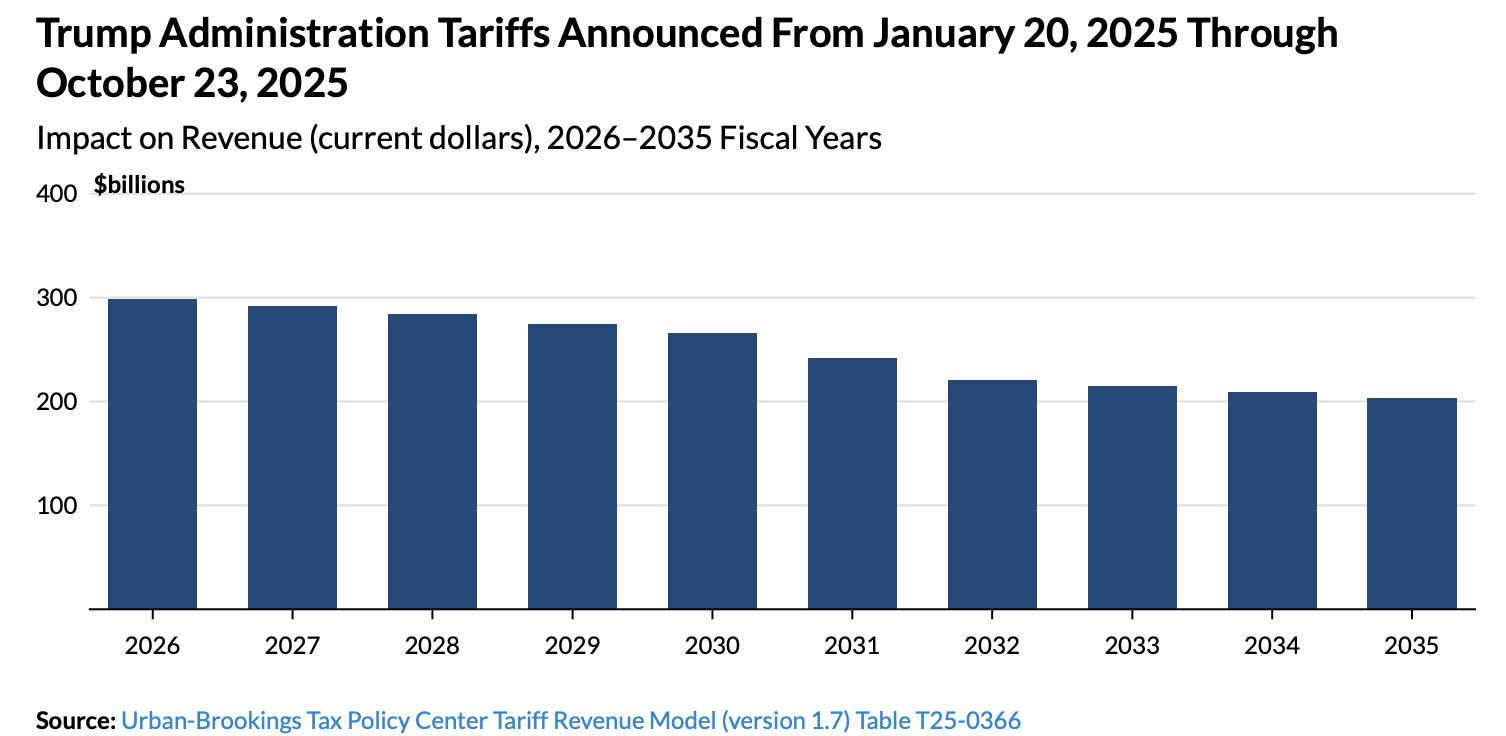
As testament to the idea that no matter the shock to a system, if it is a dynamic system, it will manage to adapt to the new reality, today’s existential question is, what happens if the Supreme Court decides that President Trump’s tariffs are unconstitutional?  Let’s forget for a moment, the fact that they have generated approximately $200 billion in government revenue since their imposition and are forecast to generate upwards of $300 billion next year and $2.5 trillion in the next decade, at least according to the Tax Policy Center (see chart below from taxpolicycenter.org).  Obviously, this is a good chunk of change for a government that has been running $2 trillion annual deficits.

Rather, let us consider the features that have accompanied the tariff negotiations, notably the promised inward investment to the United States.  Although there are several figures that have been mooted, with President Trump claiming $10 trillion, it appears that a fair estimate of the number is half that, so $5 trillion, to be invested in the US, notably in manufacturing capabilities, over time.  That, my friends, is a lot of money.

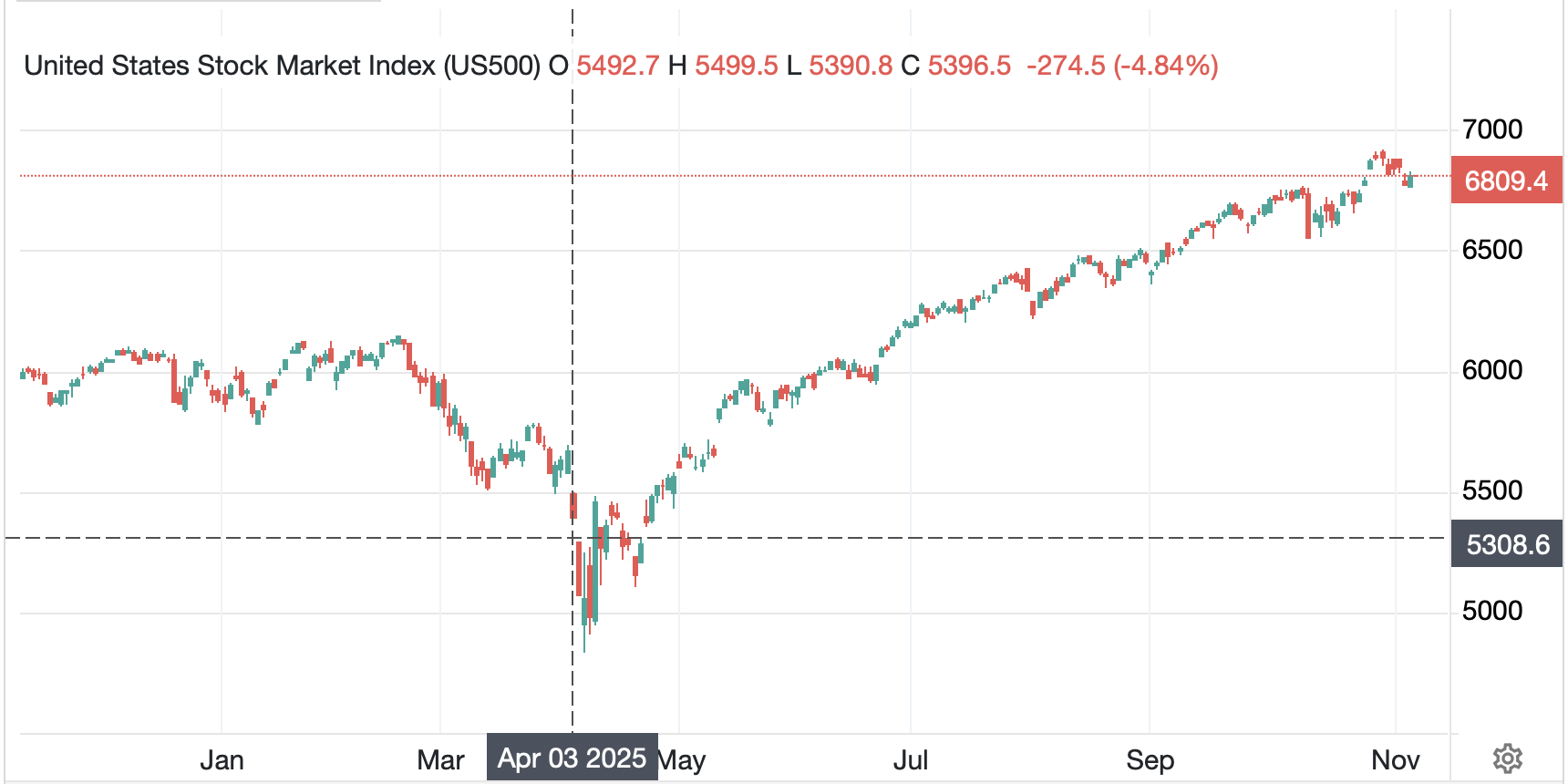
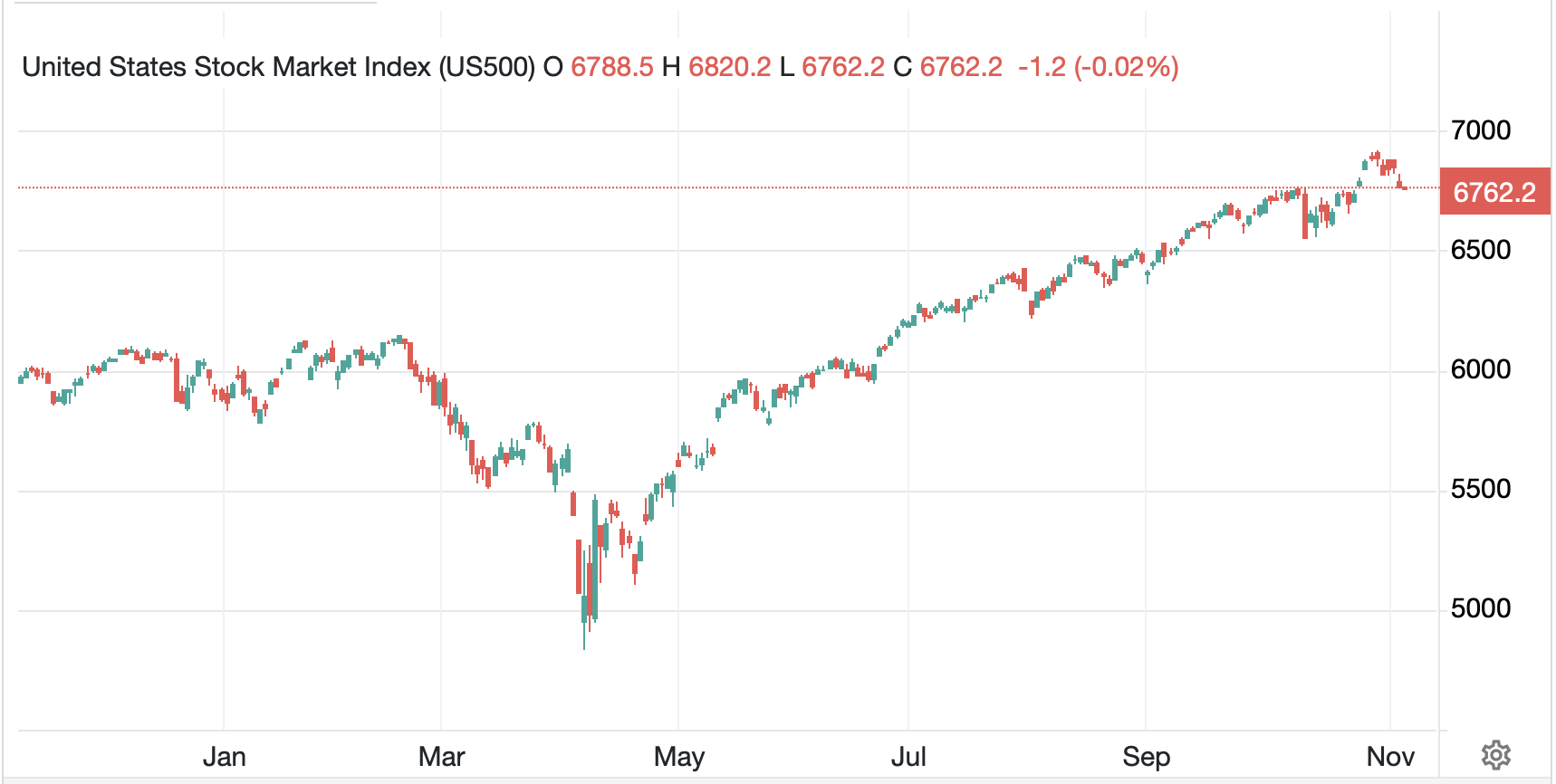
Now, we all remember what happened when Mr Trump announced those tariffs on Liberation Day back in April, but here is a chart of the S&P 500 to remind us of the size of the initial decline in equity markets.

Source: tradingeconomics.com

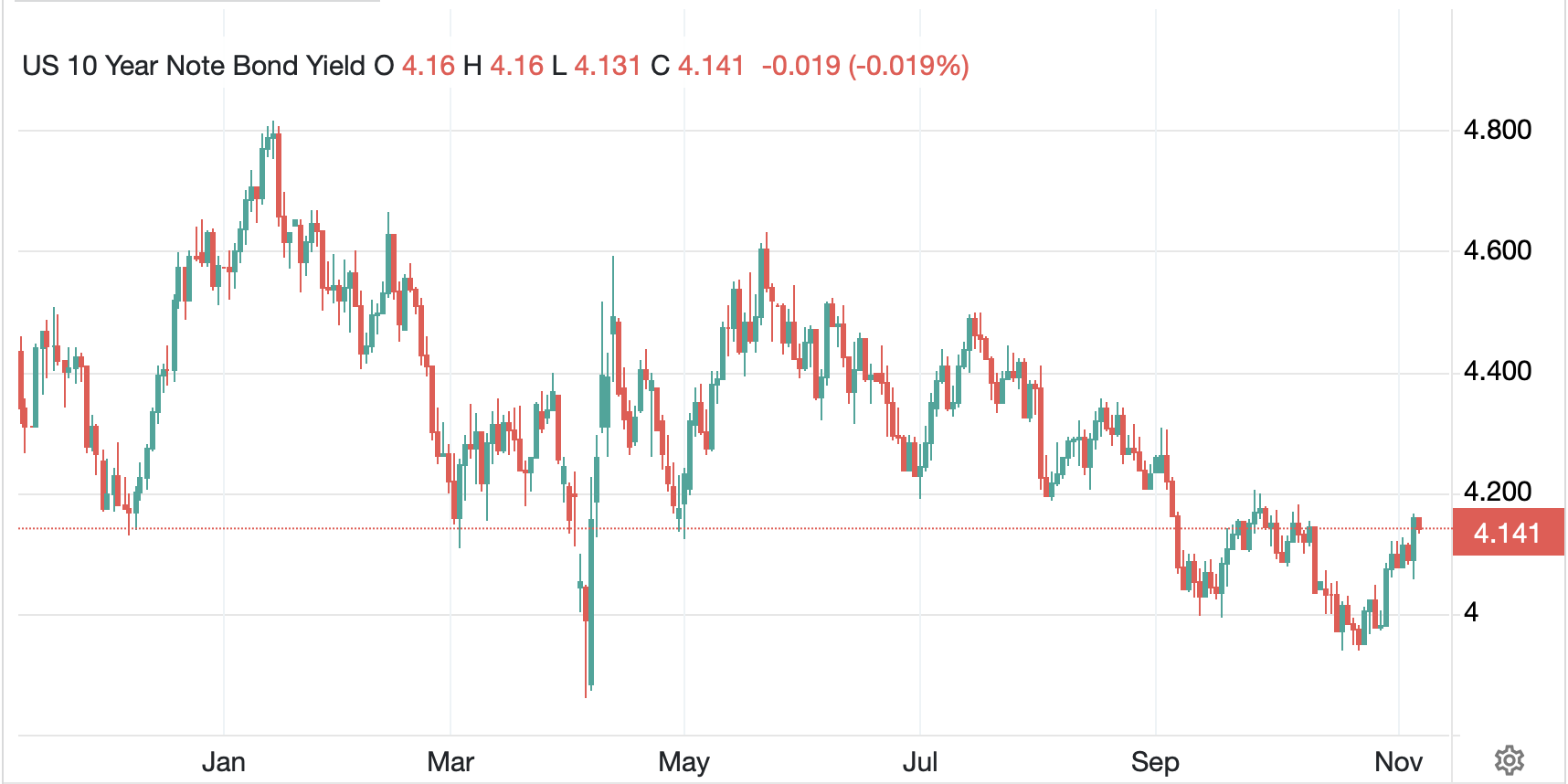
The decline from the close on April 2nd to the low on April 7th was ~12%, at which point, things were put on hold for 90 days and a series of furious negotiations began.  But we saw similar dramatic moves across all markets.  For instance, 10-year Treasury yields fell 33bps during that time, before rebounding sharply.

Source: tradingeconomics.com

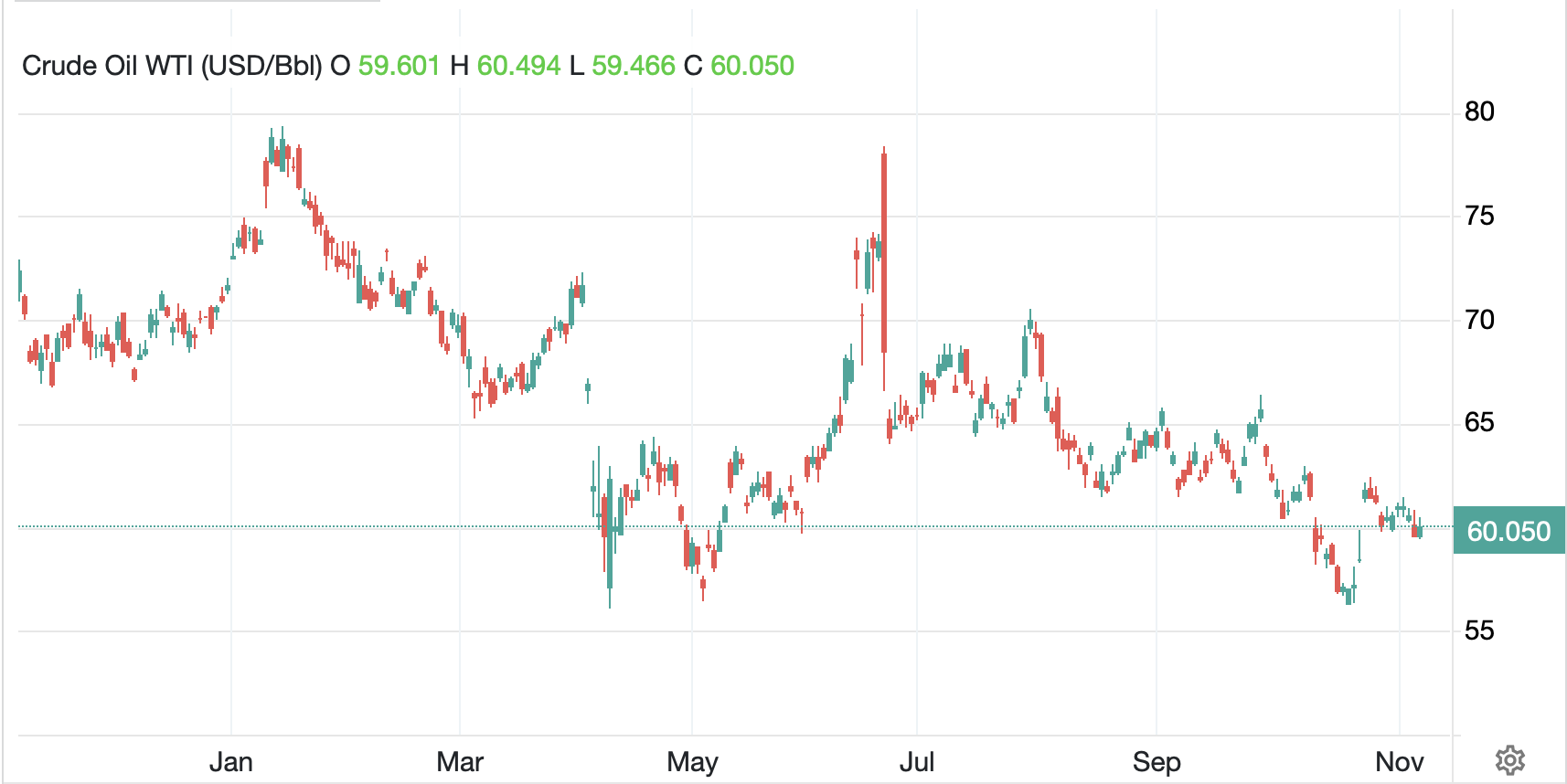
Oil also collapsed on the news, falling from nearly $72/bbl to $56/bbl in that stretch as the announcement shook up virtually all financial markets around the world.

Source: tradingeconomics.com

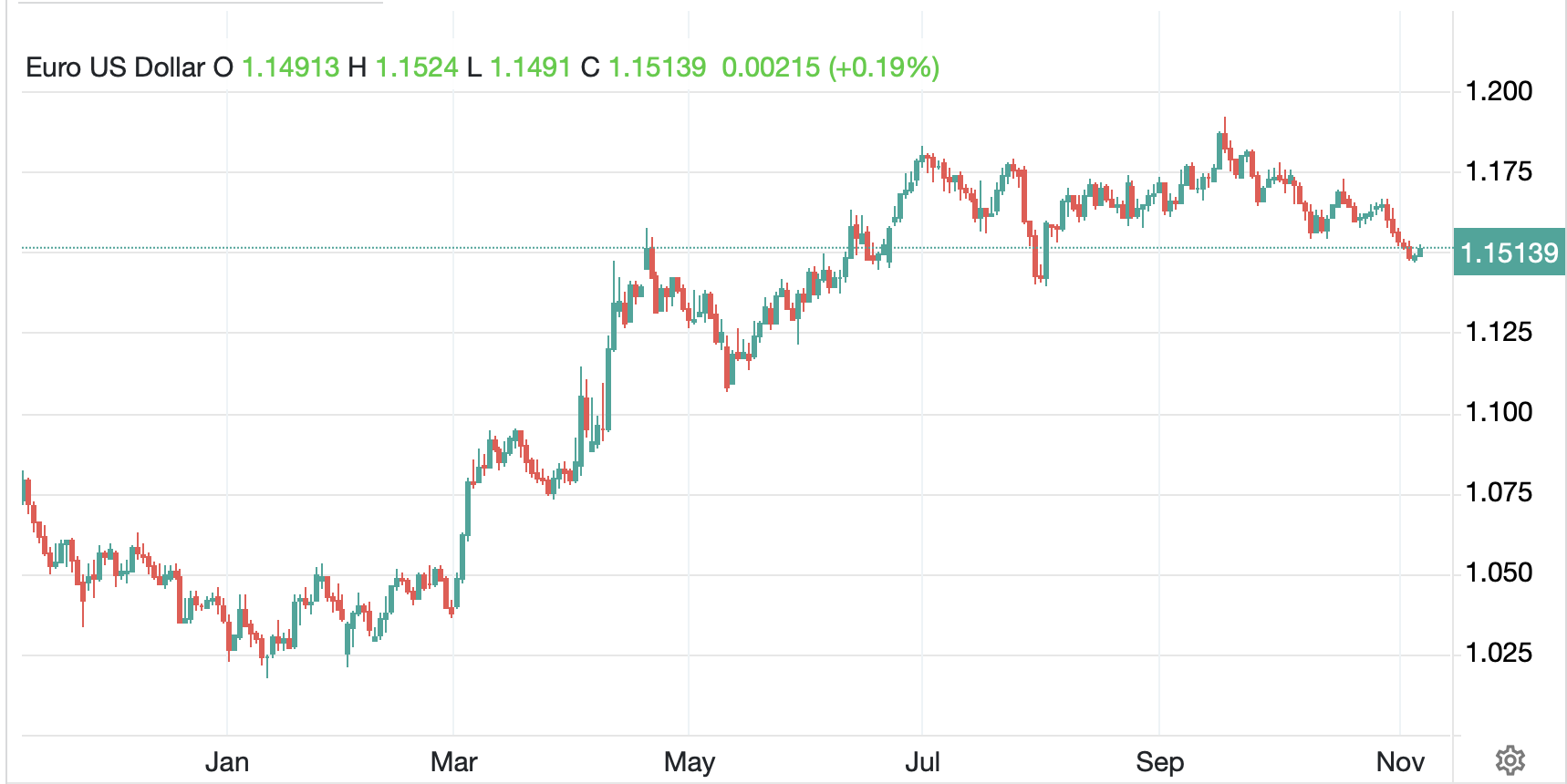
Perhaps the most surprising outcome was that the dollar actually fell about 3% during that period despite every economist and every textbook explaining that the impact of tariffs on currency markets would be that those countries whose goods were tariffed would see their currencies decline while the one imposing the tariffs would see strength.  (Yet another reason to pay little heed to economists and their theories which sound great but rarely seem to describe reality.)

Source: tradingeconomics.com

I highlight all this movement because the market behavior since then has been nothing but positive.  Equity markets have decided that things are great and rallied dramatically.  Bond markets have absorbed the information and decided it doesn’t matter that much or perhaps priced in the new revenue model as part of finding a new equilibrium around 4%.  Oil markets have other things about which to worry, with the current theme the alleged glut of oil that is around, and the dollar, while it continued to decline a bit further over the ensuing three months, has now seemingly found a bottom, and if anything looks like it is preparing to climb.

But…what if the tariffs must go?  And what if the government must repay those already collected?  If you recall, the narrative about tariffs back in April was that they were the end of the US economy and a disaster.  Obviously, that has not turned out to be the case.  Is the new narrative that the end of tariffs will be a disaster?  That feels like a pretty big reversal of opinion.    

To my thinking, one of the keys to the recent optimism for the US economy, at least for those who are optimistic, is that the inward investment is going to have very positive medium- and long-term impacts on the economy.  They are going to be critical in the reshoring of American manufacturing, whether Japanese investment into US Steel, or Korean investment into shipbuilding or Taiwanese investment into semiconductor manufacturing.  All these things are unalloyed positives for the nation and its future.  But if the tariffs are revoked, will the investments disappear?  That is the $5 trillion question, and one that I believe would be incredibly detrimental to both the nation and its financial markets.  Stocks would fall sharply and so would bonds as growth prospects would shrink and the fiscal imbalance likely grow even further.  The dollar would suffer between the capital outflows, and the fiscal problems and oil would likely fall amid a dramatic reduction in US demand.  Arguably, the only thing that would prosper would be gold, the historic safe haven.  

Which brings the question back to the Supremes (not these Supremes, although the sentiment is right!), will they unleash that chaos?  Or will they find a way to avoid it?  

With so much to consider, let’s do a brief twirl around the world overnight.  Yesterday saw a solid US equity rally across the board which was followed by strength throughout most of Asia (Nikkei +1.3%, Hang Seng +2.1%, CSI 300 +1.4%) with generally lesser gains elsewhere in the region.  Europe, though, is on its back foot with modest declines (UK -0.4%, Germany -0.1%, France -0.4%) after weaker than expected Construction PMI data across the board.  As to US futures, at this hour (7:00) they are very slightly firmer across the board, 0.1% or so.

In the bond market, yesterday saw US yields climb about 6bps after the ADP Employment data was released at a stronger than expected 42K with modest revisions higher to the previous months.  Remember, last month’s revisions lower were for an entire year, not specifically the past two months, so it appears that job growth is still decent, just not quite as strong as last year.  That data helped push yields up around the world, notably with JGB yields higher by 3bps.  But this morning, yields have backed off -3bps in the US and are unchanged across the entire continent and UK.  As to the UK, they left rates on hold at 4.0%, as expected, but the vote was 5 – 4 with 4 votes looking for a cut, so a more dovish signal.

In the commodity markets, oil (+0.8%) is rebounding after a decline yesterday based on a much larger than expected build in EIA inventories while NatGas also climbed on forecasts for colder weather and increased LNG demand in Europe and Asia.  Gold (+0.9%) and silver (+1.4%) continue their rebound from recent lows and seem like they are getting comfortable in their new “homes” of $4000 and $48.00 respectively.

Finally, the dollar is under modest pressure this morning, with the DXY slipping barely below the 100.00 level (currently 99.94) while the euro (+0.25%) and pound (+0.2%) both edge higher.  It appears that the dollar’s recent strength is on hold for today, although my take is it will resume shortly.  While a negative Supreme Court ruling on tariffs is likely to really undercut the greenback, I don’t see anything else in the near term to do the job.

There is no data of note to be released today, but we have an onslaught of Fed speakers, six in total starting at 11:00 this morning.  The Fed funds futures contract is now pricing just a 65% probability of a rate cut next month, as the ADP number encouraged some folks to change their views.  My take is we are going to hear a lot about caution given the absence of data, but I might contend the market is already somewhat cautious, at least the bond market is.

The thing about the tariff issue is it won’t be decided for at least several weeks, if not months, so may hang over the market like the Sword of Damocles.  I have no idea how they will rule, and the commentary from observers of the hearing gave different views based on their political biases, so it is hard to know.  But it is going to matter a lot.  In the meantime, I expect the recent trends to remain in place, so equity strength, little bond movement, little oil movement and dollar strength.

Good luck

Adf

Turned to Sh*t

While headlines are all ‘bout elections
And some have discussed stock corrections
The dollar keeps climbing
As some think pump priming
By Jay will find no real objections
 
The punditry, though, remains split
One side claims things have turned to sh*t
The other side, though
Is really gung-ho
And weakness they will not admit


The Democrats had a good election, sweeping the big three races in NYC, NJ and Virginia and many down ticket ones as well.  One spin is this is all a vote against President Trump but given that those three venues are all heavily Democratic to begin with, that may be an exaggeration.  Of the three, my concern turns to NYC as having lived there prior to Mayor Rudy Giuliani’s cleanup of the city, I can tell you, things were not fantastic.  Mayor-elect Mamdani’s stated plans have failed every time they have been tried around the world and I suspect that will be the situation here as well. Alas, that will not prevent him from trying.  Ironically, regarding high rents, it is possible that the increased outmigration from the city by those in the center and on the right will reduce housing demand and arguably housing costs.  We will all watch as it unfolds.

But will that directly impact markets?  Of that I am far less concerned.  I read that JPMorgan already had more employees in Texas than NY prior to the election and given that the concept of a physical exchange has basically disappeared, trading can relocate quickly.  My take is, this will get the talking heads quite excited for a while but will have a minimal impact on markets.

Which takes us to yesterday’s price action and its drivers.  First off, one might have thought that we experienced another Black Monday based on some of the hysteria in commentaries, but in the end, US equity indices only fell between -0.5% (DJIA) and -2.0% (NASDAQ).  In fact, using the S&P 500, a look at the chart shows that the decline over the past several sessions amounts to just -2.3% there, hardly calamitous!

Source: tradingeconomics.com

I continue to read about the K-shaped economy with the massive split between the top 10% of income/wealth representing 87% of spending and enjoying life while the bottom 90% struggle immensely.  This has been made possible by the ongoing support of financial assets by the Fed (and other central banks) which has accrued to asset holders, i.e. the top 10%.  In fact, this is a far more likely rationale for Zoran Mamdani’s victory yesterday, he has promised to help those who are struggling by freezing rents, offering free stuff and taking over the grocery stores to remove the profit motive and lower prices.  And when it comes to elections, the bottom 90% have a lot more votes!

Here is as good an explanation of the forces driving this narrative as any:

While equity and asset prices continue to climb, the working class is finding life increasingly difficult as job opportunities seem to be shrinking.  This latter issue seems only to be exacerbated by the growth in AI spending and the announcements by numerous companies that they will be reducing staffing because of the efficiencies created by AI in their operations.

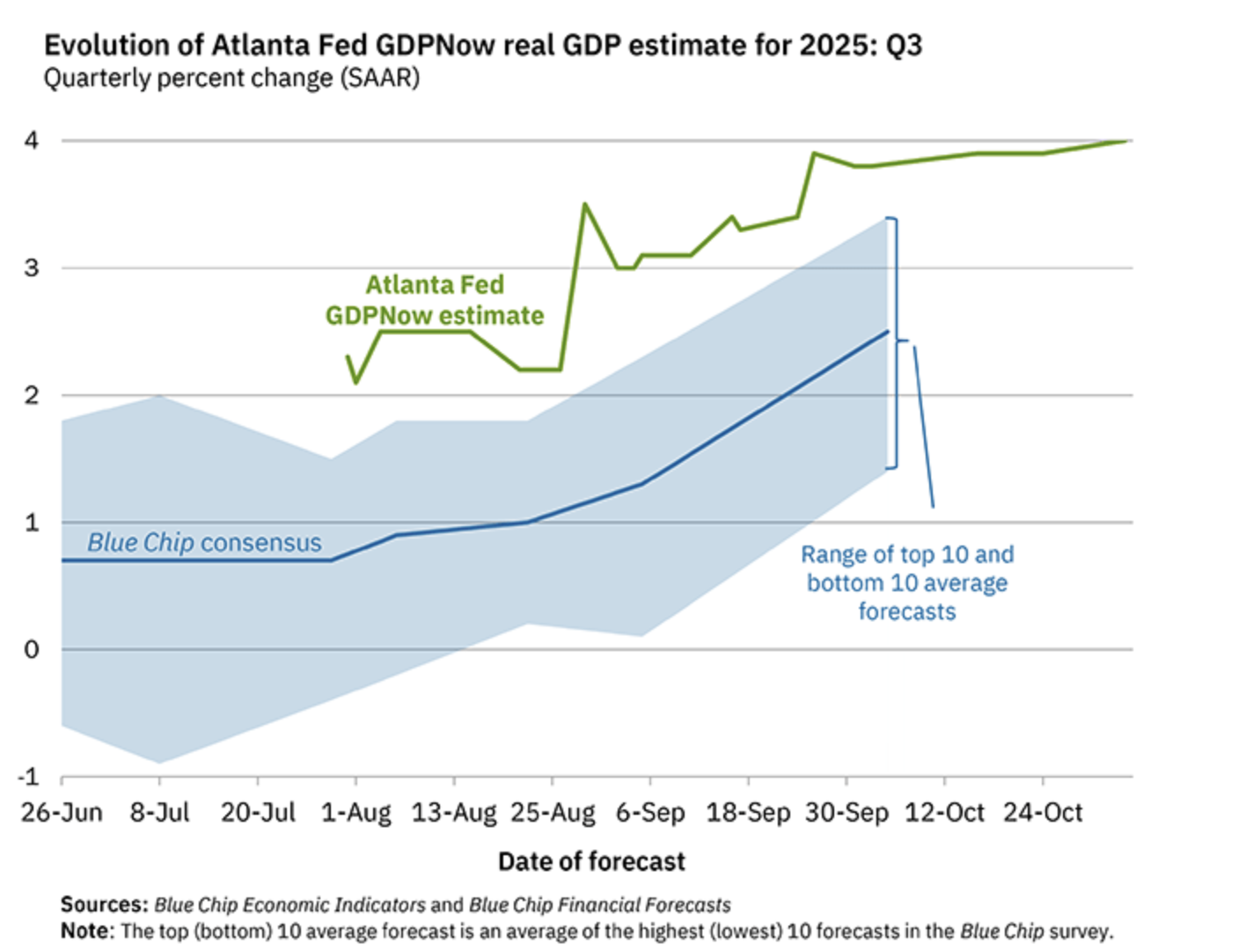
Arguably, the reason we have seen such a large dichotomy between analyst views is that some are focused on data that represents the bottom leg of the ‘K’ and see a recession around the corner, if not already upon us.  Meanwhile, others see the arm of the ‘K’ and see good times ahead.  Certainly, if we look at the broad-based GDP readings, at least based on the Atlanta Fed’s GDPNow forecast, Q3 was remarkably strong at real GDP growth of 4.0% annualized (see below chart).  Calling for a recession with that as backdrop is a very difficult case to make, in my view, but that won’t stop some analysts from trying.

Net, while nobody likes to see their portfolios’ value shrink, the declines so far have been very modest.  It is entirely reasonable to expect a correction of 10% – 15%, especially if we look at the chart at the top showing a 36% rally with limited drawdowns over the past 6 months.  It feels too early to panic.

And with that in mind, let’s see how markets behaved overnight.  Asian markets followed US ones lower with Tokyo (-2.5%) leading the way, although that was well off the early session lows which touched -4.0%.  Korea (-2.9%) and Taiwan (-1.4%) both suffered as well although the rest of the region was far less impacted.  Both China and HK were little changed and other gains and losses were on the order of +/-0.5% or less.  European bourses are all in the red as well this morning, although the one thing of which we can be sure is it is not related to the tech selloff given Europe has no tech industry of which to speak.  But Spain (-0.9%) and Germany (-0.75%) are both down despite reasonable Services PMI data from both nations and better than expected German Factory Orders (+1.1%).  UK equities are unchanged, and the rest of the continent is somewhere between unchanged and Spain.  Negative sentiment has clearly carried over, but there have been no strong reasons to sell aggressively.

In the bond market, Zzzzzz is today’s message.  Every major government bond is within 1bp of yesterday’s close, and yesterday’s price action was only worth 1bp to 2bps.  In fact, as you can see from the chart below, since the FOMC and Powell’s hawkish press conference, nothing has changed.  This is true from Fed funds futures as well, with a 71% probability still price for a December cut.

Source: tradingeconomics.com

In the commodity space, oil (-0.3%) seems to be lower every morning when I write, but continues to trade in a narrow range around $60/bbl.  Perhaps the most interesting thing I read this morning was Javier Blas’ op-ed in Bloombergregarding the rationale for a US-led regime change in Venezuela given it is the nation with the largest known oil reserves.  If you are President Trump and seeking to get oil prices lower, that could be a very effective source of the stuff.  As to the metals markets, yesterday saw a sharp decline in precious metals and this morning they are rebounding with both gold and silver higher by 0.9%.  Copper (+0.25%), too is rising a bit, although remains well off the highs seen when gold peaked.

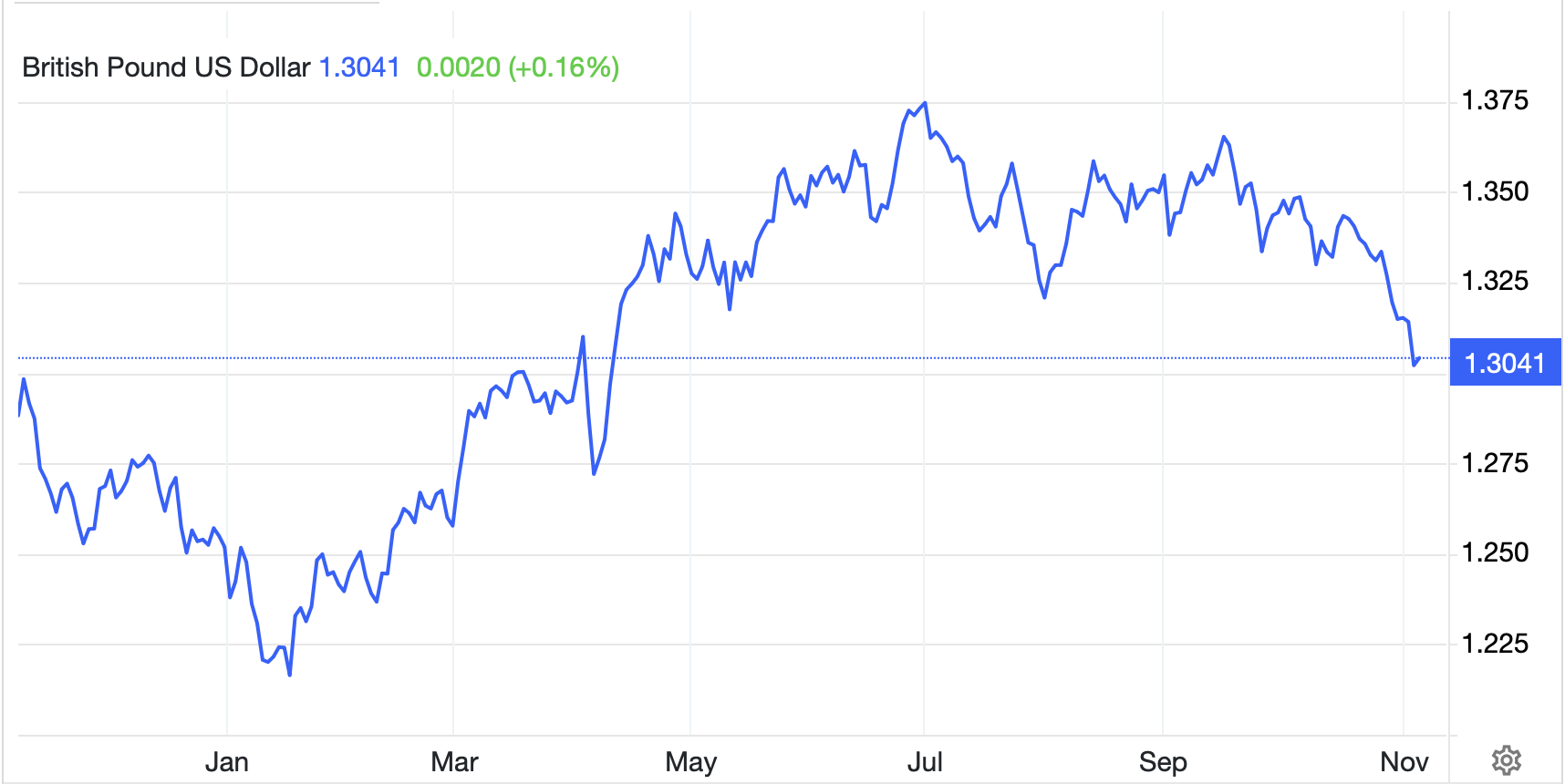
Finally, the dollar continues to impress.  While this morning it is little changed against most of its counterparts, it is, apparently, consolidating its recent gains.  The DXY remains above 100.00, which many have seen as a key resistance level.  The pound (+0.2%) while bouncing slightly this morning is hovering just above 1.30, a level last seen on Liberation Day, and certainly appears to be working its way lower from its summer peak.  If I consider the fiscal problems and the energy policy in the UK, it is very difficult to expect a significant amount of demand for the pound.

Source: tradingeconomics.com

Elsewhere, ZAR (+0.4%) is responding to the rise in gold prices and otherwise, +/-0.2% is today’s trading story.  Over time, given the promised investments into the US based on trade deals that have been signed, I expect there will be consistent demand for the greenback.  And as I wrote yesterday, the idea of a two-currency world in the future cannot be dismissed.

We do have data today with ADP Employment (exp 25K), ISM Services (50.8) and then the EIA oil inventory data where limited net change is expected although the API data yesterday showed a large build of 6.5mm barrels.  Remarkably, there are no scheduled Fed speakers, but that story remains caution but a tendency toward cutting.

For all the election hype, I don’t perceive that things have changed very much at all.  Perhaps the Supreme Court hearings on the legality of President Trump’s tariffs are the real story today, but regardless of the hearings, no verdict will be rendered for many weeks.  Which leaves us with a world in which tech is still dominant in equity markets and the US is still dominant in tech.  With the perception of the Fed being somewhat more hawkish, I don’t see a good reason to sell dollars.

Good luck

Adf

Rare Earths No More

Said Xi, we’ll sell rare earths no more
Said Trump, well that means we’re at war
The stock market puked
As traders got spooked
And Trump imposed tariffs galore
 
The question is just why would Xi
Get feisty when things seemed to be
Improved for both sides
With fewer divides
Did Mideast peace kill his esprit?


Let’s talk about markets for a moment.  Sometimes they go down and go down fast when you’re not expecting it.  That is their very nature, so it is important to understand that Friday’s price action, while dramatic relative to what we have seen over the past 6 months, is not that uncommon at all over time.  It appears the proximate cause of the market decline was the word from China that they would stop selling and exporting rare earth minerals. 

It can be no surprise that President Trump immediately responded by threatening an additional 100% tariffs on all Chinese exports and new controls on software, all to be implemented on November 1st.  There is a lot of tit-for-tat in the dueling messages from China and the Trump administration and it is hard to tell what is real and what isn’t.  However, equity markets clearly weren’t prepared for a break in the previous expectations that the US and China were closing in on a more lasting trade stance.

But weekends are a long time for markets as so much can happen while they are closed.  This weekend was a perfect example.  After the carnage on Friday, we cannot be that surprised that both sides of this new tiff modified their responses.

First we saw this on Truth Social:

Then China backed off clarified that what they are really doing is require licensing for all rare earth minerals and products that contain them in exports.  China claims that applications that meet regulations will be approved although the regulations have not yet been defined. Ostensibly this is for national security reasons, and it is unclear exactly who will receive licenses, but this is clearly not the same as ending exports.  

And just like that, many of the fears that were fomented on Friday have been alleviated as evidenced by this morning’s equity market moves in the futures markets.

Source: tradingeconomics.com

But why did Xi make this move in the first place?  I have no idea, nor does anyone but Xi, although here are two completely different thought processes, one very conspiratorial and one rooted in the broader escalation of geopolitical affairs.

As to the first, (Beware, you will need your tinfoil hat here!) consider if the Israel-Gaza peace settlement, (with the hostages returned as of the time I am writing this morning at 5:30) does not serve China’s interest.  First, the one Middle East nation that will be on the outside is their ally, Iran.  Second, the ongoing problems there were always a distraction for the US, something that clearly suits Xi and China.  After all, if the US is focused there, they will have more difficulty paying attention to things Xi cares about like Taiwan and the South China Sea.  If the peace in Israel-Gaza holds, and the Abraham Accords extend to the bulk of the rest of the region, Xi loses a major distraction that cost him virtually nothing.  Plus, this opens the door for tightening sanctions on Iran even further, which could negatively impact China’s oil flows.  

The second is much more esoteric and I read about it this weekend from Dr Pippa Malmgren, someone who has a deep insight into global politics from her time as a presidential advisor as well as from her father, Harold Malmgren, who advised four presidents.  In her most recent Substack post she explained the importance of Helium-3 (3He), a rare isotope of helium that has major energy and military implications and where the largest deposit of the stuff known to man is on the moon.  Her claim is this is the foundation of the recent acceleration in the space race between the US and China and without rare earth minerals, the US ability to achieve its goals and obtain this element would be greatly hampered opening the door for China to get ahead.

Are either of these correct?  It is not clear, but I would contend each contains some logic.  In the end, though, as evidenced by the quick retreat on both sides, I suspect that the trade situation between the US and China will move forward in a positive manner, although there could well be a few more hiccups along the way.  And those hiccups could easily see equity markets decline such that there is a real correction of 15% to 20%.  Just not today.

So, what is happening today?  Let’s look.  First, I would be remiss if I didn’t highlight the following Bloomberg headline: ‘Buy the Dip’ Call Grows Louder as China Selloff Seen Containedas it perfectly encapsulates the ongoing mindset in equity markets.  At least in US equities.  Asia had a much rougher session despite the backtracking with HK (-1.5%) and China (-0.5%) under pressure and weakness virtually universal in the time zone (Korea -0.7%, India -0.2%, Taiwan -1.4%, Australia -0.8%). Tokyo was closed.  It appears there are either still concerns over the trade situation, or perhaps the fact that globally, markets have had long rallies has led to some profit taking amid rising uncertainties.  

European bourses, though are all in the green, with the continent seeing gains of 0.5% or so across the board although the UK is lagging with a miniscule 0.05% gain at this hour (6:30).  As to US futures, as seen above, gains range from 1.0% (DJIA) to 2.0% (NASDAQ).

Meanwhile, bond yields also saw a dramatic move on Friday, tumbling -8bps and back to their lowest level seen in a month as per the below chart from tradingeconomics.com

This morning, those yields are unchanged.  European sovereign yields, which followed Treasury yields lower on Friday are also little changed at this hour, down another -1bp as concerns begin to arise that economic growth is going to be impaired by the escalation in trade tension between the US and China.  

I would argue that commodities are the one area where the back and forth is raising the most concern.  At least that is true in metals markets, with gold, which rallied 1% Friday amid the equity carnage, higher by another 1.6% this morning, to more new highs and we are seeing silver (+1.6%), copper (+4.2%) and Platinum (+3.6%) all in sync.  To me, this is the clearest indicator that there is an underlying fear pervading markets.  Oil (+1.8%) has rebounded from Friday’s rout as the easing of trade tensions appears to have calmed the market somewhat, although WTI remains just below $60/bbl at this point.  

Finally, the dollar is firmer again this morning as, although it softened slightly Friday, it has since regained most of those losses and is back on its recent uptrend as you can see below.

Source: tradingeconomics.com

While Tokyo was closed overnight, we did see further JPY weakness as the yen retraced most of its Friday gains like the rest of the market.  The biggest G10 mover was CHF (-0.9%) followed by AUD (-0.7%) and JPY (-0.7%) with other currencies less impacted and NOK (+0.2%) benefitting from the oil rally.  However, the EMG bloc has seen a much wider dispersion with MXN (+0.5%), ZAR (+1.1%) and CLP (+0.8%) all rallying sharply on the metals rally while PLN (-0.5%) and CZK (-0.4%) lag as they follow the euro lower.

And that’s enough for today.  With the government still on hiatus, no official statistics will be released although we do get a little bit of stuff as follows:

TuesdayNFIB Small Business Index100.5
WednesdayEmpire State Manufacturing-1.8
 Fed’s Beige Book 
ThursdayPhilly Fed Manufacturing9.1

Source: tradingeconomics.com

But, with the lack of data, it appears Chairman Powell has instructed his minions to flood the airwaves with a virtual cacophony of speeches this week, I count 18 on the calendar including the big man himself on Tuesday afternoon.  It seems difficult to believe that their opinions on the economy will have changed very much given the lack of new data.  The market is still pricing a 98% chance of a cut at the end of this month and another 91% chance of a cut in December.  With the increased trade tension, there is much more discussion regarding a slower economic course ahead, which would play into further rate cuts.  However, while that would clearly help precious metals as it ends any ideas of an inflation fight, it is not clear it will weaken the dollar very much as everybody else will almost certainly follow along.

Good luck

Adf

Tariff Redux

While many have called for stagflation
The ‘stag’ story’s lost its foundation
Q2 turned out great
With growth, three point eight
While ‘flation showed some dissipation
 
Meanwhile, Mr Trump’s on a roll
As he strives to still reach his goal
It’s tariff redux
On drugs and on trucks
While ‘conomists tally the toll


Analysts worldwide have decried President Trump’s policies as setting up to lead the US to stagflation with the result being the dollar would ultimately lose its status as the world’s reserve currency while the economy’s growth fades and prices rise.  “Everyone” knew that tariffs were the enemy of sane fiscal and trade policy and would slow growth leading to higher unemployment and inflation while the Fed would be forced to choose which issue to address.  In fact, when Q1 GDP was released at -05%, there was virtual glee from the analyst community as they were preening over how prescient they were.

But yesterday, we learned that things may not be as bad as widely hoped proclaimed by the analyst community after all.  Q2 GDP was revised up to +3.8% annualized growth, substantially higher than even the first estimate of 3.0% back in July.  Not only that, Durable Goods Orders rose 2.9% with the ex-Transport piece rising 0.4% while the BEA’s inflation calculations, also confusingly called PCE rose 2.1%.  Initial Claims rose only 218K, well below estimates and indicative that the labor market, while not hot, is not collapsing.  Finally, the Goods Trade Balance deficit was a less than expected -$85.5B, certainly not great, but moving in President Trump’s preferred direction.

In truth, that was a pretty strong set of economic data, better than expectations across the entire set of releases, and clearly not helping those trying to write the stagflation narrative.  Now, Trump is never one to sit around and so promptly imposed new tariffs on medicines, heavy trucks and kitchen cabinets to try to bring the manufacture of those items back into the US.  Whatever your opinion of Trump, you must admit he is consistent in seeking to achieve his goal of returning manufacturing prowess to the US.

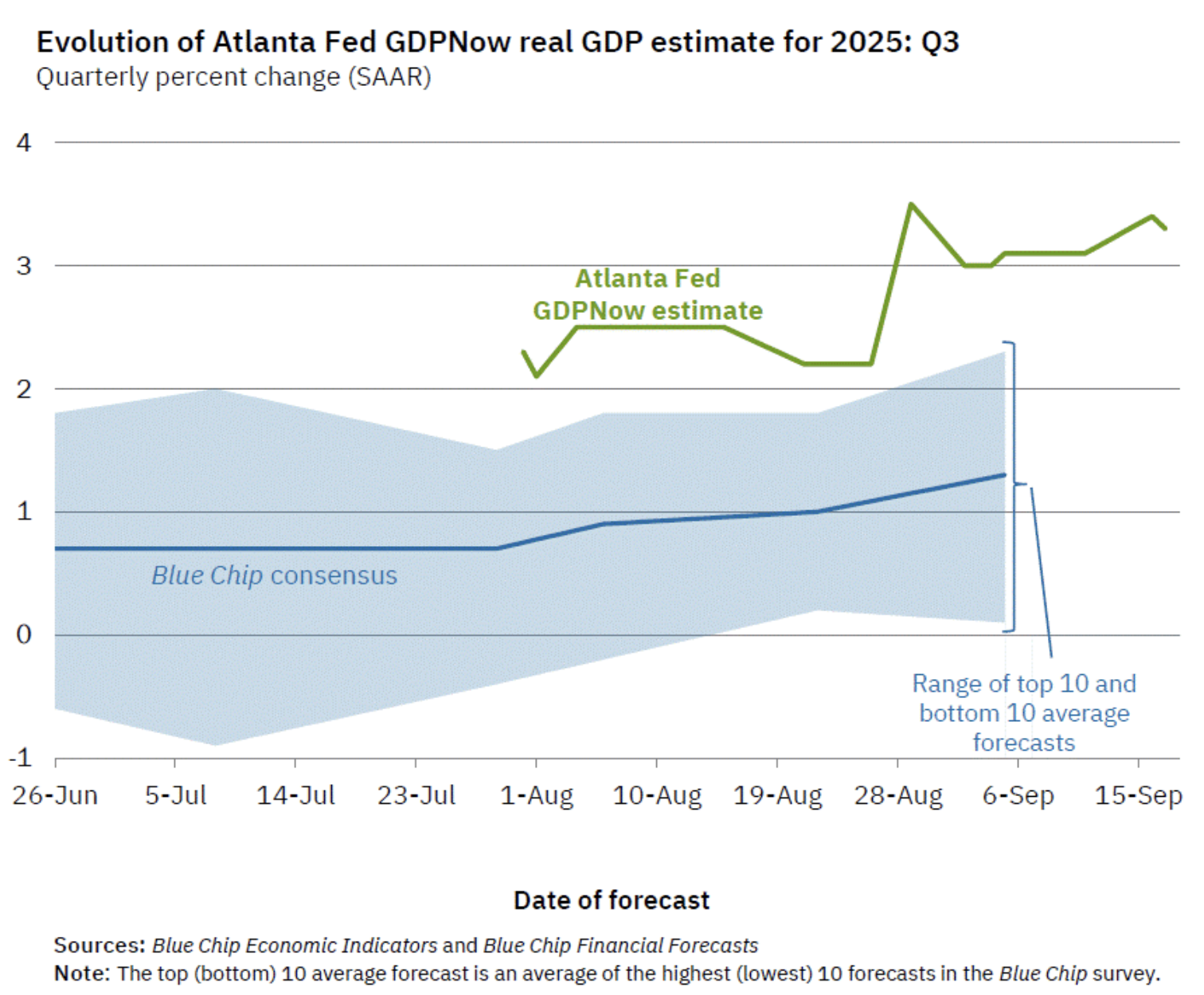
Meanwhile, down in Atlanta, their GDPNow Q3 estimate is currently at 3.3%, certainly not indicating a slowing economy.  

In fact, if that pans out, it would be only the 14th time this century that there were two consecutive quarters of GDP growth of at least 3.3%, of which 4 of those were in the recovery from the Covid shutdown.

It would be very easy to make the case that the US economy seems to be doing pretty well, at least based on the data releases.  I recognize that there is a great deal of angst about, and I have highlighted the asynchronous nature of the economy lately, but what this is telling me is that things may be syncing up in a positive manner.

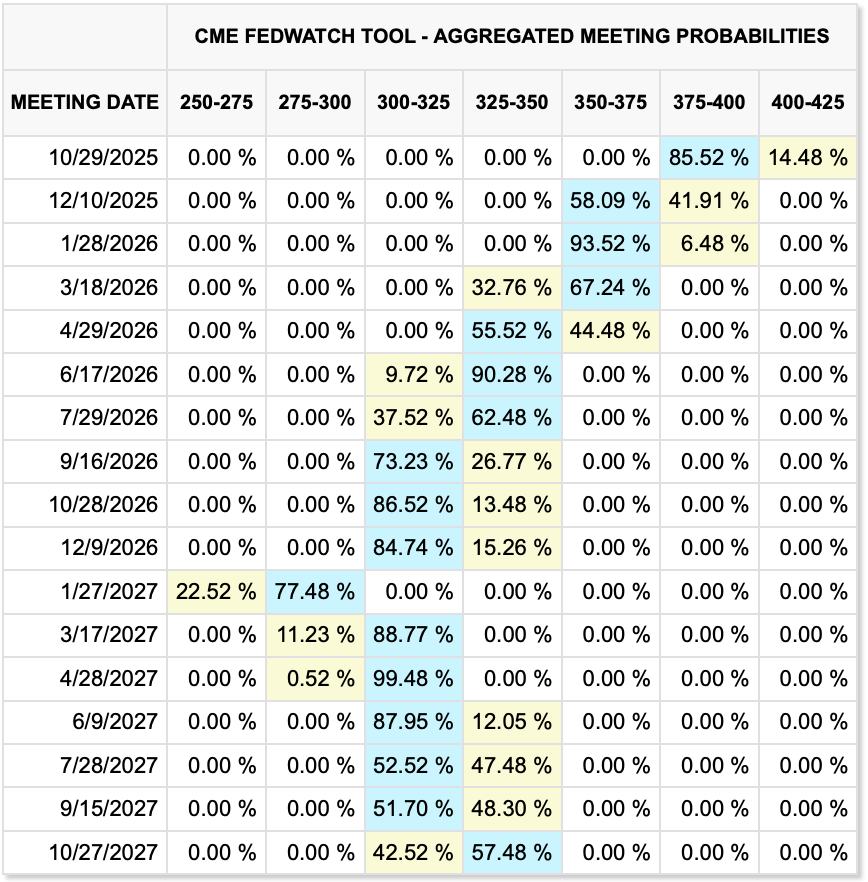
So, what does this mean for markets?  Perhaps the first place to look is the Fed funds futures market as so much stock continues to be put into the Fed’s next move.  Not surprisingly, earlier exuberance over further rate cuts has faded a bit, with the probability of an October cut slipping to 85%, down about 10 points in the wake of the data, and a total of less than 40bps now priced in for the rest of the year.  Recall, it was not that long ago that people were considering 100bps in the last three meetings of the year.

Source: cmegroup.com

The next place to look is at the foreign exchange markets, where the dollar’s demise has been widely forecast amid changing global politics with many pundits highlighting the idea that the BRICS nations would be moving their business away from dollars.  For a long time, I have highlighted that the dollar is currently within a few percent of its long-term average price, neither particularly strong nor weak, and that fears of a collapse were unwarranted.  However, I have also recognized that a dovish Fed could easily weaken the dollar for a period of time.  Short dollar positions remain large as the leveraged community continues to bet on that outcome, although I have to believe it is getting expensive given they are paying the points to maintain that view.

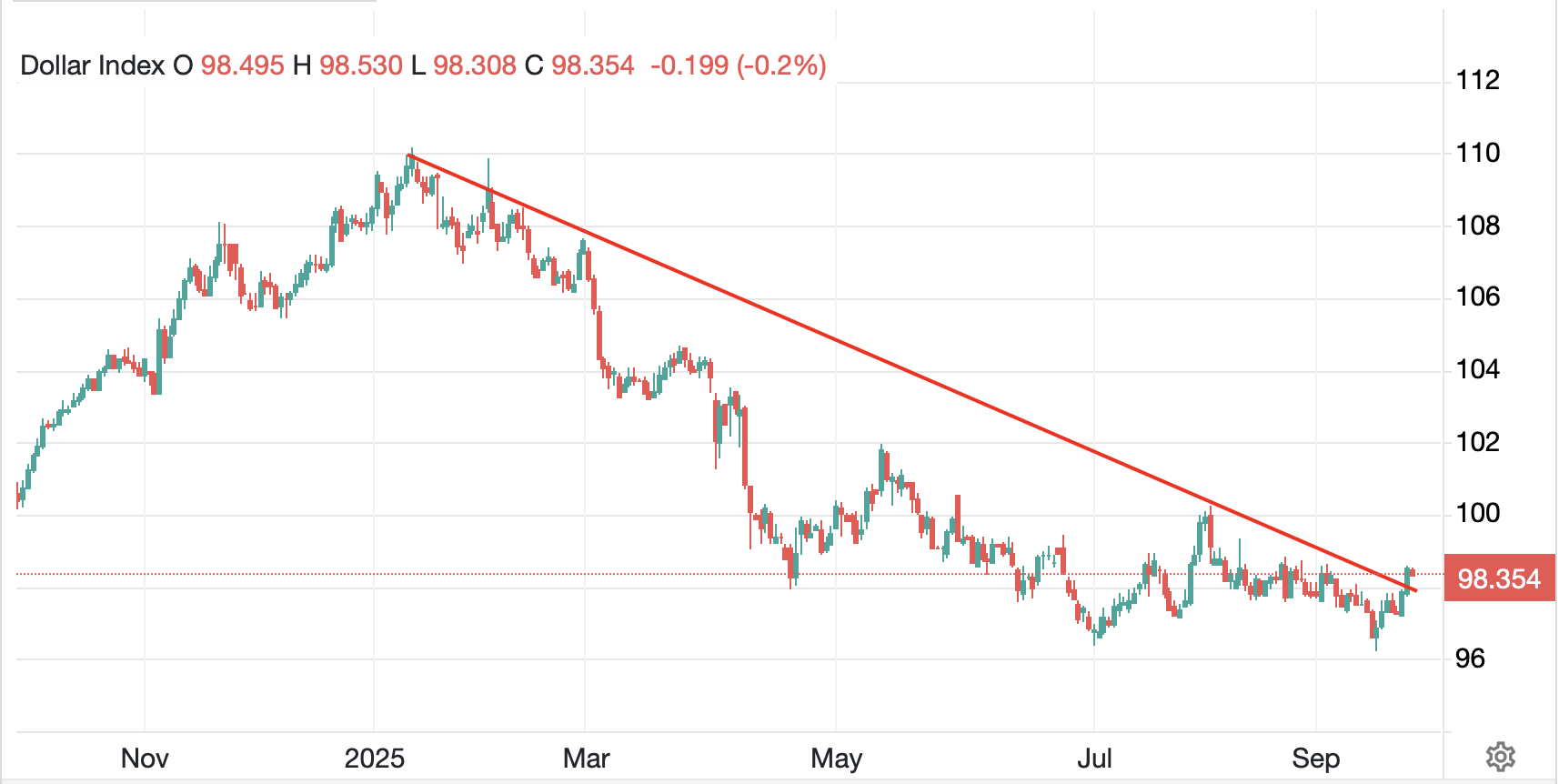
But if we look at how the dollar has performed over the past several sessions, using the DXY as our proxy, we can see that despite a very modest -0.1% decline overnight, it appears that the dollar may be breaking its medium-term trend line lower as per the chart below from tradingeconomics.com

Again, my point is that the idea that the US is facing a catastrophic outcome with a recession due and a collapsing dollar is just not supported by the data or the markets.  And here’s an interesting thought from a very smart guy, Mike Nicoletos (@mnicoletos on X) regarding some of the key drivers of the current orthodoxy regarding the dollar, notably the debt and deficit.  What if, given the dollar’s overwhelming importance to the world economy, we should be comparing those things to its global scale, not just the domestic scale.  If using that framework, as he describes here, the debt ratio falls to 58% and the budget deficit is down to 2.9%, much less worrying and perhaps why markets and analysts are out of sync.

Markets are going to go where they will, but having a solid framework as to how the economy impacts them is a very helpful tool when managing money and risk.  Perhaps this needs to be considered overall.

Ok, a really quick tour.  Yesterday was the third consecutive down day in the US, although all told, the decline has been less than -2%, so hardly devastating.  Asia mostly fell overnight as concerns over both tariffs and a Fed less likely to cut rates weighed on equities there with Japan (-0.9%), China (-1.0%) and HK (-1.35%) all under pressure.  The story was worse for other regional bourses with Korea (-2.5%), India (-0.9%) and Taiwan (-1.7%) indicative of the price action.

However, Europe has taken a different route with modest gains across the board (DAX +0.3%, CAC +0.45%, IBEX +0.6%) as investors seem to be looking through the tariff concerns.  US futures are also edging higher at this hour (7:45).

In the bond market, Treasury yields have slipped -1bp this morning, and while they remain above the levels seen immediately in the wake of the FOMC last week, they appear to be finding a home at current levels of 4.15% +/-.  European sovereigns are all seeing yields slip -3bps this morning as today’s story is focusing on how most developed nations are reducing the amount of long-dated paper they are selling to restrict supply and keep yields down.  This has been decried by many since then Treasury Secretary Yellen started this process, but as with most government actions, the expedience of the short-term benefit far outweighs the potential long-term consequences and so everybody jumps on board.

Turning to commodities, oil (-0.1%) is still trading below the top of its range and while it has traded bottom to top this week, there is no sign of a breakout yet.  I read yet another explanation yesterday as to why peak oil demand is going to be seen this year, or next year, or soon, which will drive prices lower.  While I do think prices eventually slide lower, I take the other side of that supply-demand idea and believe it will come from increased supply (Argentina, Guyana, Brazil, Alaska) rather than reduced demand.  In the metals markets, yesterday saw silver (-0.2%) jump nearly 3% to yet another new high for the move as traders set their sights on $50/oz.  Meanwhile gold (0.0%) continues to grind higher in a far less flashy manner than either silver or platinum (+10% this week) as regardless of my explanation of relative dollar strength vs. other fiat currencies, against stuff, all fiat remains under pressure.

And finally, the dollar after a nice rally yesterday, is consolidating this morning.  The currency I really want to watch is the yen, where CPI last night was released at 2.5%, lower than expected and which must be giving Ueda-san pause with respect to the next rate hike.  Most analysts are still convinced they will hike in October, but if inflation has stopped rising, will they?  I would not be surprised to see USDJPY head well above 150, a level it is fast approaching, over the next month.

On the data front, this morning’s BLS version of PCE (exp 0.3%, 2.7% Y/Y) and Core PCE (0.2%, 2.9% Y/Y) is released at 8:30 along with Personal Income (0.3%) and Personal Spending (0.5%).  Then at 10:00, Michigan Sentiment (55.4) is released and somehow, I have a feeling that could be better than forecast.  We hear from a bunch more Fed speakers as well although a pattern is emerging that indicates they are ready to cut again next month, at least until they see data that screams stop.

The world is not ending and in fact, may be doing just fine, at least economically. Meanwhile, the dollar is finding its legs so absent a spate of very weak data, I think we may see another 2% or so rebound in the greenback over the next several weeks.

Good luck and good weekend

Adf

Widely Decried

While tariffs are widely decried
By analysts, they are worldwide
But Trump’s latest scheme
To some, seems extreme
As license fees are codified
 
So, tech names, who’ve, taxes, deflected
Are now likely to be subjected
To payment of fees
To sell overseas
And revenues will be collected


One thing you can never say about President Trump is that he lacks innovative ideas.  Consider one of the biggest complaints over the past decades regarding US corporations; the fact that the tech companies (and drug companies) have been so effective at avoiding paying taxes based on the way they have gamed utilized the tax code and international treaties.  And this was not a partisan complaint as both sides of the aisle were constantly frustrated by large companies’ ability to not pay their “fair share” as it is often described.

It appears that President Trump has come up with a solution for this, charging a licensing fee for companies to sell overseas.  The big news over the weekend was that Nvidia and AMD are both going to pay a licensing fee of 15% of REVENUE on sales of chips to China.  In the case of Nvidia, that is anticipated to be some $2.5 billion with somewhat smaller numbers for AMD.  This is an excellent description of the process by @Kobeissiletter on X. 

I have often expressed the view that corporate taxation, if we are going to have it, ought not be on profits but on revenue.  Corporations are expert at reducing taxable income, maintaining a staff of lawyers and accountants to do just that.  But gaming top line revenues is much harder.  This gambit by President Trump is moving things in that direction.  And remarkably, given these license fees are for exports, it ought to be outside the consumer price chain in the US completely.

There is an article in the WSJ this morning titled, “The US Marches Toward State Capitalism With American Characteristics,” which outlines, and mildly complains, about the changes in the way the US government is dealing with the private sector under President Trump.  It discusses the purchase of 15% of MP Materials, the only US based miner/processor of rare earth minerals, and it discusses these license fees all under the guise of implying this is a bad direction.  And I completely understand that idea as governments tend to be terrible stewards of capital.  However, 25 years of Chinese unfettered access to Western markets while they have skirted the rules codified by the WTO have resulted in some significant national security challenges that can no longer be ignored.  Full marks to President Trump for creative methods to address these challenges, despite the wailing and teeth gnashing of economists.

But other than that story, as well as the ongoing back and forth regarding potential peace talks in the Russia-Ukraine war, not all that much has happened overnight.  For a change, markets are behaving like it is the summer doldrums, so perhaps we should be thankful for the respite.  As such, let’s take a look at how things have done and what we can anticipate this week with CPI and Retail Sales set to be released.

Friday’s US equity rally combined with the news that Nvidia and AMD will be able to export some chips to China saw modest gains there (+0.4%) and in Hong Kong (+0.2%) even though another major property company in China, China South City Holdings Ltd., is being forced into liquidation.  The property situation in China will continue to weigh on the economy there and given property investment was long seen as most Chinese families’ retirement nest egg, will undermine consumption for years.  Elsewhere in the region, there were more gainers (India, Indonesia, Malaysia, Australia, New Zealand, Taiwan) than laggards (Thailand, Philippines) with Japan closed for Mountain Day, a relatively new holiday, and other markets little changed.  

In Europe, though, screens are modestly red with losses on the order of -0.35% across the CAC, DAX and IBEX amid general uncertainties regarding the future economic direction and a lack of earnings positives.  At this hour (7:00), US futures are slightly higher, by 0.2%.

In the bond market, after last week’s auctions have been absorbed, Treasury yields have edged lower this morning, down -2bps, despite Fed funds futures’ probability of that September rate cut slipping to 88% from Friday’s 93%.  In fact, Fed Governor Bowman reiterated over the weekend that she would be voting for a cut at each of the three meetings left this year.  European sovereigns though are little changed, with some having seen yields edge higher by 1bp, as this appears to be a truly lackluster summer day.

Commodities are the only market that is seeing any movement of note, and it is not oil (+0.2%) which has been trading either side of unchanged since last night.  Rather, gold (-1.2%) is suffering this morning as you can see on the chart below as the promise of a potential peace in Ukraine seems to be removing some need for its haven status.  Of course, the thing to really note about the gold market is just how choppy trading has been as conflicting narratives continue to impinge on price movement.

Source: tradingeconomics.com

This decline has pulled down both silver (-1.4%) and copper (-0.95%) with all this happening despite virtually no movement in the FX markets.

Turning to the dollar, one is hard pressed to find any substantial movement in either G10 or EMG currencies. The true outlier this morning is NOK (+0.4%) but otherwise, +/- 0.1% or less is the best description of the price action.  This is what a summer market really looks like!

On the data front, we do get some important information as follows:

TuesdayRBA Rate Decision3.60% (current 3.85%)
 CPI0.2% (2.8% Y/Y)
 Ex food & energy0.3% (3.0% Y/Y)
 Monthly Budget Statement-$140B
ThursdayPPI0.2% (2.5% Y/Y)
 Ex food & energy0.2% (2.9% Y/Y)
 Initial Claims226K
 Continuing Claims1960K
FridayRetail Sales0.5%
 Ex Autos0.3%
 IP0.0%
 Capacity Utilization77.6%
 Michigan Sentiment62.0

Source: tradingeconomics.com

With all the hoopla about the firing of Ms McEnterfar at BLS, you can be sure that there will be lots of discussion on the CPI data regardless of the outcome.  However, as the Inflation Guy pointed out last week, imputing the bottom 30% of items in the basket, which represent something on the order of 2.5% of the total price impact, is likely to have no impact whatsoever.  We also hear from a bunch of Fed speakers, four to be exact, although Richmond Fed President Barkin will regale us twice.  Now that there are more calls for a September cut, it will be interesting to see who remains patient and who is ready to move.

And that’s all there is today.  It is hard to get excited about too much movement given the lack of obvious catalysts.  Of course, one never knows what will emanate from the White House but look for a quiet one, I think.

Good luck

Adf

You Need to Squint

While data continues to print
It doesn’t give much of a hint
To where things are going
Unless you’re all-knowing
And even then, you need to squint
 
The reason for this situation
Is passive flows constant inflation
No matter the news
Or anyone’s views
The target funds need their proration


The hardest thing about macroeconomic analysis is trying to discern whether it has any impact on market movement.  For the bulk of my career, my observation was that while there were always periods when flows dominated fundamentals, they were short-lived periods and eventually those fundamentals returned to dominance in price action.  This was true in equity markets, where earnings were the long-term driver, outlasting short-term bouts or particular manias and this was true in FX markets, where economic performance and the ensuing interest rate differentials were the key long-term driver of exchange rates.  Bond markets were virtually always a reflection of inflation expectations, at least government bond markets and commodities were simple products of supply and demand of the physical stuff.

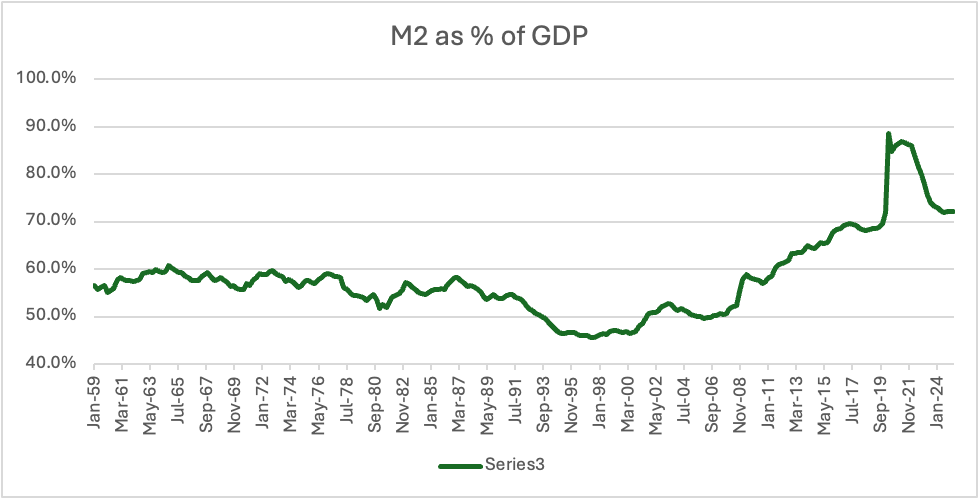
Alas, since the GFC, and more importantly, the global central bank response to the GFC, flooding financial markets with massive amounts of liquidity, G10 economies have become increasingly finanicialized to the point where the underlying fundamentals have less and less impact and funds flows are the driving force.  The below chart I have created from FRED data shows the ratio of M2 relative to GDP.  For decades, this ratio hovered between 53% and 60%, chopping back and forth with the ebbs and flows of the economy during recessions and expansions.  But the GFC changed things dramatically and then the pandemic and its ensuing response put financialization on steroids.

By 2011, this ratio hit 60% for the first time since 1965, and it has never looked back.  The result is that there is ever more money sloshing around the economy looking for a home with the best return.  This is part and parcel as to why we have seen both massive asset price inflation as well as consumer price inflation, too much money chasing too few goods.  And this is the underlying facet in why funds flows, whether between asset classes or between nations, are the new driving force of market price action.  Michael Green (@profplum99 on X) has done the most, and most impressive, work on the rise of passive investing, which is a direct consequence of this financialization.  The upshot is, as long as money comes into the system (your semi-monthly 401K flows are the largest) they continue to buy stocks regardless of anything fundamental.  And as almost all of it is capitalization weighted, they buy the Mag7 and maybe some other bits and bobs.  It doesn’t matter about fundamentals; it only matters how much they have to buy.

So, with that caveat as to why fundamental macro analysis has been doing so poorly lately, a look at the data tells us…nothing really.  As I wrote yesterday, the two main blocs of the economy, goods production and services production, are out of sync, with marginal strength in services outweighing marginal weakness in goods production and resulting in slow growth.  Whether you look at the employment situation, the ISM data or the inflation data, none of it points in a consistent and strong direction.

For instance, yesterday’s productivity and Labor cost data were better than expected, far better than last quarter’s and pointing to an improved growth outcome.  However, if we look at the past five years of this data, we can see that labor costs have grown dramatically faster than productivity as per the below chart (ULC in grey, Productivity in blue).

Source: tradingeconomics.com

Looking at this, it is no surprise that price inflation has risen so much, given labor’s impact on prices.  But, again, this is merely another impact of the massive flow of money into the economy over the past 15 years. 

Virtually every piece of data we get has been significantly impacted by this financialization which is one reason that previous econometric models, built prior to the GFC, no longer offer effective analysis.  The system is very different.  I continue to believe that over time, fundamentals will reassert themselves, but that belief structure is under increased pressure.  Perhaps YOLO and BTFD are the future, at least until our AI overlords come into their own and enslave the human population.

In the meantime, let’s look at what happened overnight.  Yesterday’s mixed, and relatively dull, US session was followed by a mixed session in Asia with Tokyo (+1.85%) soaring on news that there were going to be adjustments, in Japan’s favor as well as rebates, to the tariff schedule.  However, both the Hang Seng (-0.9%) and CSI 300 (-0.3%) saw no such love from either the Trump administration or investors.  As to the rest of the region, red (Korea, Australia, India, Thailand, Singapore) was more common than green (Malaysia).  Apparently, tariff adjustments are not universal.  In Europe, both Spain (+0.8%) and Italy (+0.8%) are having solid sessions but they are alone in that with the other major bourses (DAX 0.0%, FTSE 100 0.0%, CAC +0.2%) not taking part in the fun.  US futures, at this hour (7:30) are higher by about 0.4%.

Bond markets, meanwhile, are sleeping through the final day of the week, with Treasury yields unchanged on the day and European sovereign yields having edged higher by just 1bp across the board.  It seems, nobody cares right now.  After all, it is August and most of Europe is on vacation anyway.

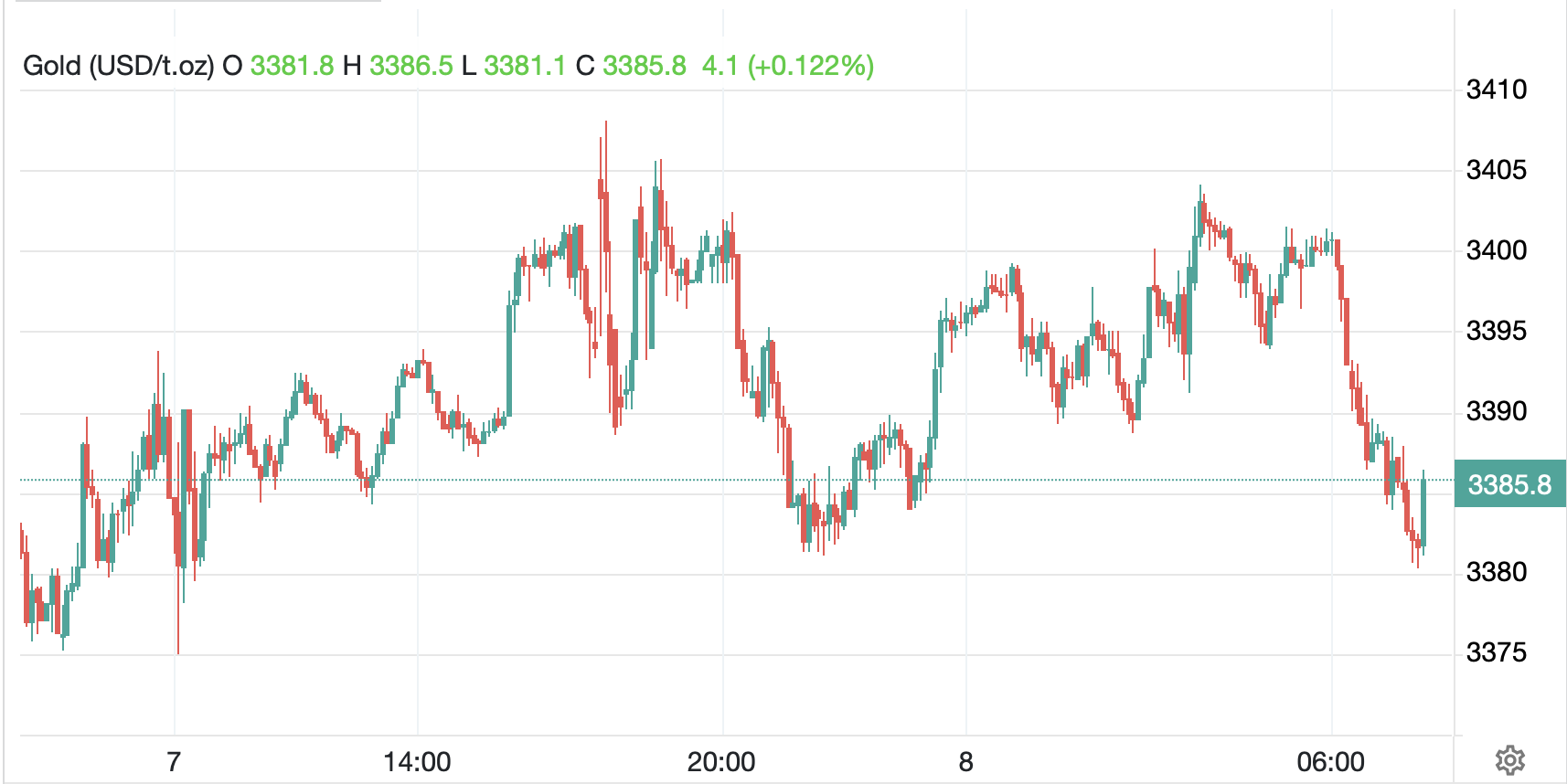
Commodity markets are showing oil (+0.6%) bouncing off its recent lows, but this seems more about trading activity than fundamental changes.  Perhaps there will be a Russia-Ukraine peace, but it is certainly not clear.  Trump’s tariffs on India for continuing to buy Russian oil are also having an impact, but as I showed yesterday, I believe the trend remains modestly lower.  Gold (-0.3%) is currently lower but has been extremely choppy as you can see from the 5-minute chart below

Source: tradingeconomics.com

This is a market where supply and demand dynamics have been impacted by both tariffs and the interplay between financialized markets (i.e. paper gold or futures) and the actual metal.  There are many theories as to different players trying to manipulate the price either higher (the Trump administration in order to revalue Ft Knox holdings) or lower (the ‘cabal’ of banks that have ostensibly been preventing the price from rising according to the gold bug conspiracy theorists).  Recently, there has apparently been less central bank demand, but that can return at any time based on political decisions.  I continue to believe that it is an important part of any portfolio, but it should be tucked away and forgotten in that vein.  As to the other metals, they are little changed this morning.

Finally, the dollar is stronger this morning, as the euro (-0.3%) and yen (-0.65%) are both under pressure and leading the way.  In fact, virtually every G10 currency is weaker (CAD is unchanged) and yet the DXY seems to be weaker as well. Something is amiss there.  Meanwhile, EMG currencies are mostly down on the session with KRW (-0.5%) the laggard, but weakness in INR (-0.2%), PLN (-0.25%) and CZK (-0.25%). 

On the data front, there is none today.  Yesterday, Atlanta Fed president Bostic explained his view that only one rate cut was likely this year, which is not what we have been hearing from other FOMC members.  Obviously, there is still uncertainty at the Fed, but they also have more than a month to decide.  Today, we hear from KC Fed president Alberto Musalem, one of the more hawkish members, so it will be interesting to see if he has changed his tune.

I would contend that confusion is the driving force in markets because data markers are not pointing in one direction nor are Fed speakers.  But it is a Friday in August so I suspect it will be a quieter day as traders look to escape to the beach for the weekend.  This morning’s trends, a higher dollar and higher stock prices, seem likely to prevail for the day.

Good luck and good weekend

Adf

A Bevy of Doves

The Fed has a bevy of doves
Whose world view was given some shoves
When Trump was elected
As they were subjected
To boxing, though without the gloves
 
But suddenly, they’ve found their voice
And rate cuts are now a real choice
So, bad news is good
And traders all should
Buy stocks every day and rejoice


Apparently, the signal has been given from on high at the Marriner Eccles building that discussing rate cuts is permitted.  Patience is no longer the virtue it was just last week.  In the past two days, three different FOMC members, Daly, Cook and Goolsbee, have returned to form and are quite open to cutting rates sooner after the recent employment data.  I would contend that rate cuts are their natural stance, but they were discouraged from expressing that view because it would put them in sync with the president, something that they very clearly have worked to avoid.  Regardless of the history, the Fed funds futures market is now pricing in a 93.2% probability of a cut next month as you can see below.  Perhaps more interesting is the fact this probability has risen from 37.7% in just the past week.  My how quickly things can change.

Source: cmegroup.com

I’m sure you recall that one of the key reasons Chairman Powell and his acolytes described the need to remain patient was the potential impact of tariffs on inflation.  This was even though the universal view was tariffs, a new tax, would be a one-off price increase, so would have no long-term impact, and that higher interest rates would do nothing to fight this particular cause of inflation, just like the price of food doesn’t respond to interest rates.  However, I want to highlight a piece from the WSJ this morning that asks a very good question, why wasn’t Powell concerned about all the tax increases from the previous administration, or for that matter, the tax increase that would have occurred had the BBB not been enacted.  Again, all the discussion that the Fed is apolitical is simply not true and never has been.

Moving on, I wanted to follow up on yesterday’s discussion as I, along with many market observers, have been trying to come to grips with the inconsistency in the data.  Some is strong, other parts are weak, and it is difficult to arrive at a broad conclusion.  My good friend, the Inflation_Guy™ put out a podcast the other day and made an excellent point, historically, there was a synchronicity between activity in the goods sector and the services sector, so when things in either sector started to decline (or rise) it took the other sector along with it.  But that is not currently the case.  

Instead, what we have seen is asynchronous behavior with the correlation between prices in the two sectors essentially independent of each other over the past five years, rather than tracking each other as they had done for the previous 30 years.  Extending the price action to overall activity, which seems a reasonable concept as prices follow the activity, depending on the data you observe, you may see strength or weakness, rather than everything heading in the same direction.  However, it is worthwhile to remember that systems in nature eventually do synchronize (see this fantastic clip) and so eventually, I suspect that both sectors will do so and a full blown recession (or expansion) will materialize.  Just not this week!

Which takes us to markets and how they have been responding to all the tariff news.  I think you can make one of the following two arguments regarding equity investors; either they have absorbed the tariff information and ensuing changes in trade behavior and have decided that earnings will continue to grow apace, or, they have no idea that there is a cliff ahead and like the lemmings they are, they are rushing toward the abyss.  Perhaps it is simply that President Trump has discussed tariffs so much that they have become the norm in any analysis thought process, and so modest adjustments don’t matter.  But whatever the reason, we continue to see strength pretty much across the board here.

The rally in the US yesterday was followed by strength across almost all of Asia with gains in Tokyo (+0.7%) and Hong Kong (+0.7%) as well as Korea, India and almost all regional bourses.  China, however, was unchanged on the session after their trade balance rose a less than expected $98.2B, as imports rose more than expected.  However, as this X post makes clear, it should be no surprise given the renminbi’s real exchange rate continues to fall, hence their exports remain quite competitive, tariffs or not.  As to Europe, strength is the word here as well (DAX +1.5%, CAC +1.2%, IBEX +0.5%) although the FTSE 100 (-0.5%) is lagging ahead of this morning’s expected BOE rate cut.  And don’t worry, US futures are higher across the board as well.

In the bond market, yields have been edging higher with Treasury yields up 2bps after yesterday’s 10-year auction was not as well received as had been hoped, but then, yields were 25 basis points lower than just a week ago, so demand was a little bit tepid.  European sovereign yields are also edging higher, mostly higher by 1bp and we saw the same thing overnight in JGBs, a 2bp rise.

In the commodity markets, oil (+0.6%) has found a short-term bottom, but is just below $65/bbl, which seems like a trading pivot of late as can be seen by the chart below from tradingeconomics.com.  As my personal bias is that the price is likely to decline going forward, the 6-month trend line heading down does appeal to me, but for now, choppy is the future.

Meanwhile, metals markets are in fine fettle this morning (Au +0.4%, Ag +1.4%, Cu +0.15%) as the dollar’s recent weakness seems to be having the expected effect on this segment of the market.

Speaking of the dollar, as more tariffs get agreed, I am confused by its weakness since I was assured that the response to higher US tariffs would be a stronger dollar.  But arguably, the fact that the Fed is suddenly appearing much more dovish is the driver right now, and while the euro is little changed this morning, we are seeing the pound (+0.4%), Aussie (+0.3%) and Kiwi (+0.4%) all move up, although the rest of the G10 space is higher by scant basis points.  In the EMG bloc, movement, while mostly higher in these currencies, is also measured in mere basis points, with INR (+0.25%) the largest mover by far.  Arguably, it is fair to say the dollar is little changed.

On the data front, the BOE did cut rates 25bps as expected, although the vote was 5/4, a bit more hawkish than forecast which is arguably why the pound is holding up so well.  US data brings Initial (exp 221K) and Continuing (1950K) Claims as well as Nonfarm Productivity (2.0%) and Unit Labor Costs (1.5%).  This is a much better mix of this data than what we saw in Q1 with productivity falling -1.5% while ULC rose 6.6%.  That was a stagflationary outcome.  In addition, we hear from two more Fed speakers, Bostic and Musalem, as the Fed gets back in gear this week.  It will be interesting to see if they are more dovish as neither would be considered a dove ex ante.

Apparently, we are back on board the bad news is good for stocks train, and it is hard to fight absent a collapse in earnings or some other catalyst.  As such, with visions of Fed cuts dancing in traders’ heads, I suspect the dollar will remain under pressure for a while.

Good luck

Adf

Stroke of a Pen

While NFP’s top of the list
For traders this morning, the gist
Of recent releases
Show more price increases
A trend that cannot be dismissed
 
As well, Tariff Man, once again
Imposed more by stroke of a pen
While stocks are declining
The dollar’s inclining
To rise vs. the euro and yen


Let’s get the upcoming data out of the way first as the Employment report is due to be released at 8:30. Current median expectations are as follows:

Nonfarm Payrolls110K
Private Payrolls100K
Manufacturing Payrolls-3K
Unemployment Rate4.2%
Average Hourly Earnings0.3% (3.8% Y/Y)
Average Weekly Hours34.2
Participation Rate62.3%
ISM Manufacturing49.5
ISM Prices Paid70.0
Michigan Sentiment62.0

Source: tradingeconomics.com

This report is obviously of great importance as the Fed continues to rely on a solid labor market as its key justification for not cutting rates.  At least that’s its public stance.  Recall, too, that last month’s result of 147K was significantly higher than forecast and really backed them up.  In fact, I would contend that one of the reasons that Chairman Powell was willing to sound mildly hawkish on Wednesday is because of the labor market’s ongoing performance.  

It is interesting to juxtapose this strength with the increasing number of stories about how the increase in investment and usage of AI, especially at tech firms, is driving a significant amount of personnel reductions.  And yet, the broad data continue to point to a solid labor economy.

However, I think it is worth taking a closer look at recent inflation focused data as that, too, is going to be a key driving force in the central bank debate worldwide.  Yesterday’s PCE data was largely as expected but resulted in a faster pace of inflation on both the headline and core bases.  If we consider the trend over the past three years, as per the Core PCE chart below, it appears that the nadir was reached back in June of last year, and while not every print has been higher, I will contend the trend is starting to point upwards.

Source: tradingeconomics.com

Meanwhile, if we turn our attention to European inflation data, while this morning’s Eurozone flash print was unchanged from last month, it was higher than expected.  We saw the same trend in individual Eurozone nations yesterday with Germany, Italy and France all showing the recent disinflationary trend stopping, at least for the past month.  With these recent releases, the analyst community is of the mind that the ECB is likely to hold rates steady again in September, extending the pause on their previous rate cutting cycle.  The strong belief is that US tariffs are going to dampen economic activity and, with that, inflation pressures.

As to the US, with President Trump having announced another wave of tariffs yesterday, as the 90-day window closed, once again the analyst community is calling for inflation to rise here.  Ironically, these analysts may be correct that US inflation is going to be slowly heading higher, but whether that is due to tariffs, or perhaps the fact that more than ample liquidity remains in the economy and services prices continue to rise has yet to be determined.

At this point, I think it might be useful to break out an updated version of a chart that has made the rounds before showing price changes since 2000 broken down by categories.  Virtually every sector that has seen significant price rises is on the service side of the ledger while most goods saw either deflation or very modest (~1% per annum) inflation.

Housing, which is both a good and a service, and textbooks, which are directly linked to tuition, are the two outliers.  Now, many will complain that something like New Cars having risen only 24.7% since 2000 is crazy given their much higher sticker prices, and that is clearly hedonic adjustments doing its job.  But if you consider the key expenses in your life, housing, food and health care are generally top of the requirements.  It is abundantly clear from this chart that the American angst on prices is well founded.  With that in mind, tariffs are exclusively imposed on goods, not services, so given services represent 77.6% of the US economy as of 2022 (as per Grok), the inflationary impact of tariffs seems like it might not be quite as high as the hysteria indicates.

(This is a perfect time to remind you of a great way to manage your inflation risk if you participate in the cryptocurrency markets by buying USDi, the only fully backed inflation tracking coin available.  Learn more at www.usdi.com.  It is essentially inflation-linked cash.)

Coming back around to the market, I think it is a good time to review one of the other major narrative themes, that the dollar is collapsing as foreigners flee because of the massive debt load, and that the dollar will soon lose its reserve status.  You know I have dismissed this idea from the beginning as nothing more than doom porn and an effort by some analysts to get clicks.  

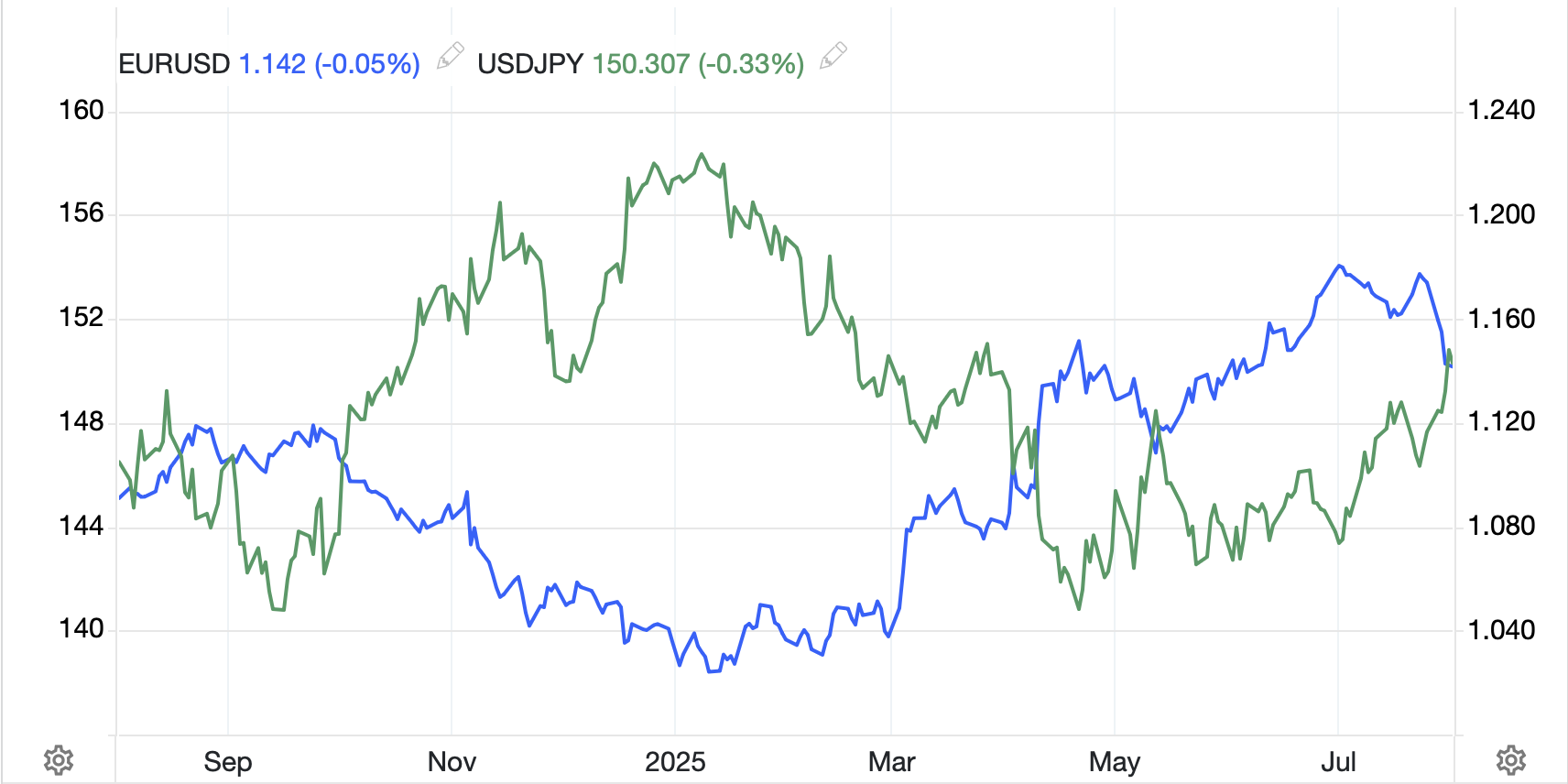
There is no doubt that there had been a downtrend in the dollar for the first six months of 2025, and as has been written repeatedly, the decline was the largest during the first half of the year since the 1980’s.  As well, my concern over the dollar has been based on the idea that the Fed would indeed be cutting rates despite no need to do so, and that would undermine its yield advantage.  But a funny thing happened on the way to the death of the dollar, it stopped falling.  While I have been using the DXY chart as my proxy, pretty much every chart looks the same as per the below of both the euro and yen, where the nadir was at the beginning of July and the dollar has risen vs. both somewhere between 3% and 5%.

Source: tradingeconomics.com

In fact, as I look down my board, the dollar has risen against every major currency over the past month, with even tightly controlled CNY declining -0.8%, and the yen falling furthest, down nearly -5.0%.  Combine this with the news that Treasury auctions have been well attended with significant foreign interest, and it is hard to conclude the end is nigh for the US economy.

Ok, a really quick turn to markets here as this has gone on longer than I expected.  Equities are red everywhere this morning after yesterday’s US declines.  Japan (-0.7%), China (-0.5%) after weak PMI data, Hong Kong (-1.1%) and Australia (-0.9%) set the tone for Asia.  In Europe, it is even worse with the CAC (-2.2%) and DAX (-1.9%) both under more pressure as a combination of increased worries over trade (although given they ostensibly have a deal, I’m not sure what the issue is) and companies there reporting weaker than forecast results have been the problem.  US futures at this hour (7:30) are all pointing lower by about -0.85%.

Despite the fear in stocks, bonds are not seen as the answer this morning with Treasury yields edging higher by 1bp and European sovereign yields all higher by between 3bps and 5bps.  I guess the inflation reading has a few traders nervous.  Interestingly, if you look at the ECB’s own website showing rate change probabilities, there is a 14% probability of a rate HIKE priced in for the September meeting!  JGB yields have also edged higher by 1bp as the BOJ, in their policy briefing yesterday, raised their inflation forecasts for 2026, ostensibly as a precursor to the next rate hike there.  I’ll believe it when I see it!

As to commodities, oil (-1.1%) after touching $70/bbl yesterday has rejected the level.  While secondary sanctions on Russian oil exports continue to be discussed, they have not yet been implemented.  I continue to believe the price ought to be lower, but clearly there is a risk premium for now.  In the metals markets, gold (+0.4%) continues to find support despite weakness in other markets (Ag -0.6%, Cu -0.9%) as its millennia-long status as the only true safe haven is reasserting itself.  After all, Bitcoin (-0.6%) has not been able to match the relic’s performance of late despite its modern twist.

And that’s really all there is (I guess that’s enough) as we head into the weekend.  The market tone will be set by the NFP data, where my take is a strong report will see the dollar rally, bonds suffer, and stocks suffer as well as hopes for a rate cut fade further.  Conversely, a weak report should see the opposite impacts.

Good luck and good weekend

adf

Europe Has Folded

Last week Japan finally agreed
To tariffs as they did concede
Now Europe has folded
Their cards as Trump molded
A deal despite pundits’ long screed
 
So, now this week there’s lots of news
That ought to give markets more cues
Four central banks speak
And late in the week
Inflation and jobs we’ll peruse


All the talk this morning revolves around the announcement yesterday of a US-EU trade deal where the basics are a 15% tariff on all EU exports to the US and an EU promise to buy US energy and defense products totaling some $550 billion.  Many have said that the agreement means nothing because for it to become law, it requires both the European parliament and each nation to vote to agree on the deal.  As well, we are hearing from various nations how it is a terrible deal (French farmers are furious, German pharmaceutical manufacturers are furious and unions all over the continent are unhappy) and certain politicians (notably Marine Le Pen) are also extremely unhappy.  

It is far too early to understand if the deal will be implemented in full, but the precedent has been set that European exports to the US are going to be subject to higher tariffs than any time since prior to WWI and that is true whether the deal is ratified or not.  As analyst/trader Andreas Steno Larsen explained well this morning, “The EU vs. US trade deal highlights that the EU primarily exports ‘nice-to-have’ products rather than essential ‘need-to-have’ ones.  And if you think about it, arguably the best-known EU companies are luxury goods makers, whether in fashion or autos.  So, while there are women who swear they ‘need’ that Birkin bag, the reality is far different.  

Expect to hear a lot more about this deal going forward, but the market response has been quite positive with European equity markets (IBEX +1.0%, FTSE MIB +0.9%, CAC +0.6%, DAX +0.4%) all higher along with US futures (+0.3%).  Interestingly, Asian markets were mixed overnight as Japanese (-1.1%) and Indian (-0.7%) equities suffered, perhaps on the idea that their deals were no longer that special.  China (+0.2%) and Hong Kong (+0.7%), though, did well amid news that another meeting was scheduled between the US and China, this time in Stockholm, to continue the trade dialog.

Away from the trade discussion, market focus this week is going to be on a significant amount of news and data to be released as follows:

TuesdayTrade Balance-$98.4B
 Case Shiller Home Prices3.0%
 JOLTS Job Openings7.55M
 Consumer Confidence95.8
WednesdayADP Employment78K
 Q2 GDP2.4%
 Treasury QRA 
 BOC Interest Rate Decision2.75% (unchanged)
 FOMC Interest Rate Decision4.50% (unchanged)
 Brazil Interest Rate Decision15.0% (unchanged)
ThursdayBOJ Interest Rate Decision0.50% (unchanged)
 Initial Claims224K
 Continuing Claims19660K
 Personal Income0.2%
 Personal Spending0.4%
 PCE0.3% (2.5% Y/Y)
 Core PCE0.3% (2.7% Y/Y)
 Chicago PMI42.0
FridayNonfarm Payrolls102K
 Private Payrolls86K
 Manufacturing Payrolls0K
 Unemployment Rate4.2%
 Average Hourly Earnings0.3% (3.6% Y/Y)
 Average Weekly Hours34.2
 Participation Rate62.3%
 ISM Manufacturing49.6
 ISM Prices Paid66.5
 Michigan Sentiment61.8

Source: tradingeconomics.com

In addition to all of this, there are Eurozone GDP and inflation data, Japanese inflation data and PMI data from all around the world.  Happily, there is virtually no central bank speaking beyond the post meeting press conferences as I presume all of them will be seeking an escape.

There is far too much data to discuss in any depth this morning, but my take is that President Trump has managed to move the Overton Window significantly over the course of his first 6 months in office.  If you recall, it was on “Liberation Day” back in April, when he announced his reciprocal tariffs on the rest of the world, that the global economic community had a collective meltdown and proclaimed the end of the economy as we know it.  Equity markets around the world plummeted and the future seemed bleak, at least according to every economist and pundit who could get their views heard.  Now, here we are a bit more than three months later and tariffs of 15% on the entire EU as well as Japan, 10% on the UK and higher on other nations is seen as a solid outcome, sidestepping the worst cases promulgated, and the world is moving on.

It appears, at least for the moment, that Mr Trump understood that most nations need to export to the US more than the US needs to export to them. I would contend that is why these deals, which in many eyes seem unfavorable to the US counterparts, are being agreed.  It is far too early to ascertain if things will work out as Trump expects, as the naysayers expect or somewhere in between (or entirely different) but thus far, you have to admit that the president has largely gotten his way.

So, as we open the week, we have already seen equity markets are generally in a positive mood.  Bond markets are also behaving well, with Treasury yields edging higher by 1bp, still glued to that 4.40% level, while European sovereign yields have mostly slipped -2bps or so on the session.  And last night, JGB yields fell -4bps.  It appears that bond investors are not as concerned about the trade deals as some would have you believe.

In fact, the market with the biggest reaction overnight has been FX, where the dollar is showing strength against virtually all its counterparts in both G10 and EMG spaces.  EUR (-0.8%) is the G10 laggard, although CHF (-0.8%) is right there with the single currency as clearly, Switzerland will be impacted by the EU tariff deal.  But AUD (-0.6%), JPY (-0.5%) and SEK (-0.65%) are all under pressure as well as the DXY (+0.6%) continues its bounce.

Source: tradingeconomics.com

I continue to read about all the reasons why the dollar is losing its luster in the global community, because of tariffs, because of the Treasury’s actions freezing Russian assets after the invasion of Ukraine, because China and the BRICS are seeking other payment means to eliminate the dollar from their economies, because American exceptionalism is dead, and yet, while I am no market technician, I cannot help but look at the chart of the DXY above and see a broken downward trendline, indicating a move higher, and a bottoming in the moving average, also indicating further potential gains.  I am confident that if the FOMC cuts rates (which full disclosure I don’t believe makes sense given the current amount of available liquidity and global equity market performance) that the dollar will decline further.  But all those traders who are short dollars (and it is a very crowded position) are paying away between 25bps (long GBP) and 450bps (long CHF) on an annual basis so need to see the dollar’s previous downtrend resume pretty quickly. (see current overnight rates across major economies below from tradingeconomics.com)

The market is pricing just a 2% probability of a rate cut on Wednesday, and about 60% of a September cut. Unless this week’s data screams recession, I am having a hard time seeing the case for the dollar to fall much further, at least in the short and medium term.  And this includes the fact that it is pretty clear President Trump would like to see a lower dollar to help US export competitiveness.

Finally, a look at commodities shows that while oil (+1.3%) is having a solid session, it remains in the middle of its trading range for the past several weeks.  Meanwhile, metals prices (Au -0.1%, Ag -0.2%, Cu -0.4%) are feeling a little strain from the dollar’s strength but generally holding up well overall.  Too, while there has historically been a strong negative correlation between the dollar and metals, given the large short dollar positions that are outstanding, it would not be hard to see both cohorts rally in sync for a while going forward.

And that’s really all for today.  The data doesn’t really start until tomorrow, and as its summer, trading desks are already lightly staffed.  Look for a quiet session today and the potential for choppiness this week if the data is away from expectations.

Good luck

Adf

Why Their Economy’s Poo

With Tokyo having conceded
On trade, focus turns to what’s needed
For Europe to sign
A deal to align
Its interests and trade unimpeded
 
But headlines about the EU
Explain they have made a breakthrough
With China on carbon
Which might be a harbin-
Ger of why their economy’s poo


Yesterday’s market activity was focused on the benefits of the fact that the US and Japan had reached a trade deal, whatever the terms, and that it seemed to set the stage for other deals to come.  Naturally, all eyes turned to the EU, where negotiations are ongoing, and the working assumption is that they, too, will wind up with a 15% tariff on all goods exported to the US, like the Japanese deal, and that non-tariff barriers would be removed reduced as well.  My sense is that is a reasonable assumption as it will clarify the process going forward and allow businesses to plan and invest accordingly.

As an aside, I am curious why there is so much angst over tariffs from the economist’s community.  Generically, most economists will explain that consumption taxes are better than income taxes as they are more efficient, and fairer in many ways.  After all, if something has a high tariff, you can avoid paying it by not buying the item (I know that’s simplistic but work with me here).  However, an income tax is unavoidable if you earn income.  In fact, that is why so many economists love the VAT.  Yet when it comes to President Trump’s tariff plans, combined with the fact that the OBBB prevented a major tax hike and cut rates for certain parts of income like tips and overtime, these same economists are up in arms over the process.  I would have thought that is exactly what most economists would want to see.  But then, I am just a poet.

Ok, back to the EU, where while the trade deadline with the US is fast approaching, EU Commission president Von der Leyen was in China where she agreed with President Xi to lead the way on CO2 reduction.  Apparently, it was the only thing on which they could agree, and it is, quite frankly, hilarious.  Whatever your views on CO2’s impact on global warming, and if there even is global warming, China is by far the largest emitter of the stuff on the planet.  As of 2023 (which apparently is the most recent data available) here is a list of the top ten countries regarding emissions.

Obviously, only one EU nation is on the list, but if you sum up the entire EU, it comes in at about 2.9 million tons.  (GtCO2e = gigatons of CO2 emitted).  Meanwhile, China continues to build out its electricity infrastructure by expanding its fleet of coal-fired generation, adding 94.5 gigawatts last year.  My point is that if you wonder why Europe’s economy has lagged the US so badly for so many years, this is a perfect encapsulation of the problem.  They are highly focused on virtue signaling for something over which they have essentially no control, and the one nation that could impact things, literally doesn’t care.  For their sake, I hope they agree trade terms.

But away from that, and all the news that DNI Tulsi Gabbard is making with document declassifications and releases, markets continue to trade as though all is well.  It is noteworthy that recent concerns over US Treasury issuance and how foreign investors would be shunning the US because of its uncontrollable debt situation have not been heard in several weeks now that Treasury auctions seem to be going along fine with plenty of foreign buyers attending and buying.  Maybe the worst case is not the default case here.

Ok, so let’s see how markets are digesting the most recent news.  More record highs in the US stock market were followed by gains throughout much of Asia last night with Japan (+1.6%) continuing to benefit from the trade deal and both China (+0.7%) and Hong Kong (+0.5%) feeling some love as talk is a deal there is also getting closer.  Elsewhere in the region, there were a mix of gainers (Singapore, Korea, Malaysia) and laggards (India, Australia, Thailand) but a little bit more positivity than negativity.  In Europe, only France (-0.25%) is lagging today with the rest of the continent (DAX +0.4%, IBEX +1.7%) generally in good shape as investors await the ECB decision, although no policy change is expected.  The UK (+0.9%) is also having a solid day despite lackluster data which seems to be all about the potential US EU trade deal.  As to US futures, at this hour (7:25) they are mixed with the DJIA (-0.4%) lagging while the other two key indices are higher by about 0.25%.

In the bond market, yields are ticking higher across the board with Treasuries (+2bps) back at 4.40%, although still below the top if its recent trading range.  In fact, I think the below chart does an excellent job of describing the fact that the bond market, despite much angst, has done nothing and is trending nowhere for the past six months.

Source: tradingeconomics.com

As to European sovereigns, yields there are higher by 4bps across the board.  The story I read tells me this is optimism that a US-EU deal will help juice the EU economy, thus driving yields higher.  I’m skeptical.

In the commodity markets, oil (+0.8%) is bouncing off its lows, allegedly also responding to the positive trade news.  I guess.  Precious metals, though, are lower (Au -0.7%, Ag -0.5%, Pt -1.25%) as either there is less fear about the future or somebody sold a lot of metals after their recent rally.  Copper (+1.0%) though, continues to benefit from the trade story as well as the underlying story regarding insufficient supply for the future electrification of the world.

Finally, the dollar is a bit firmer this morning, rising 0.2% against both the euro and pound with the yen (-0.15%) also moving in that direction.  Surprisingly, CHF (-0.3%) is the biggest mover in the G10 while ZAR (-0.4%) is the EMG laggard as it follows (leads?) precious metals lower.  This trend remains downward, although as discussed yesterday, it is possible we have seen a true break of that trend.  If Trump successfully concludes the main trade deals, I imagine that we will see significant inflows to the US and that should support the greenback.

On the data front, after the ECB announcement at 8:15, we see Initial (exp 227K) and Continuing (1960K) Claims as well as the Chicago Fed National Activity Index (-0.1) which had a terrible showing last month.  Later we get flash PMI data (Manufacturing 52.6, Services 53.0) and then New Home Sales (650K) at 10:00.

Right now, the market feels like it is embracing the potential for more trade deals to remove uncertainty.  Earnings numbers have been generally strong in the US, which continues to support the stock market, but it remains to be seen how much of the tariffs will be absorbed by corporate margins and how much will find its way into prices.  If the former, that implies earnings will start to lag.  Meanwhile, given the market is generally short dollars, and it appears the next piece of news is more likely to be dollar positive than negative, I have a feeling we could see the dollar bounce nicely in the next weeks.

Good luck

Adf