Decidedly Glum

The mood is decidedly glum
In markets, as traders succumb
To views that the world
Is coming unfurled
And fears that the game’s zero-sum
 
So, stories ‘bout regional banks
With problems are joining the ranks
Of reasons to sell
Ere things go to hell
And why folks are buying Swiss francs


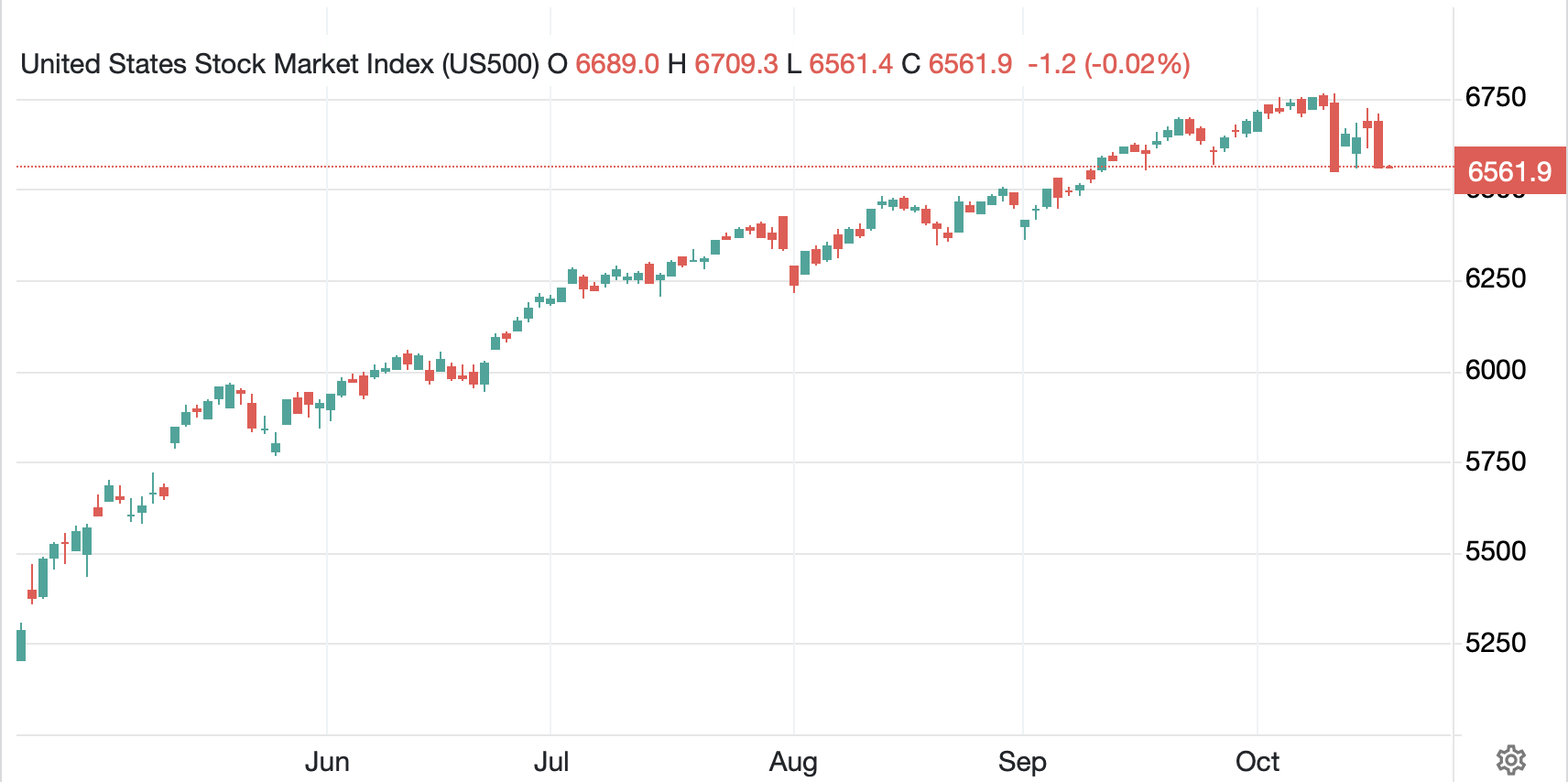
It doesn’t seem that long ago when equity markets were trading at all-time highs, arguably a sign of significant positive attitudes, and yet here we are this morning with equity markets around the world under significant pressure.  Of course, the reason it doesn’t feel like it was that long ago is BECAUSE IT WASN’T.  In fact, as you can see from the chart below, it was just last week!
Source: tradingeconomics.com

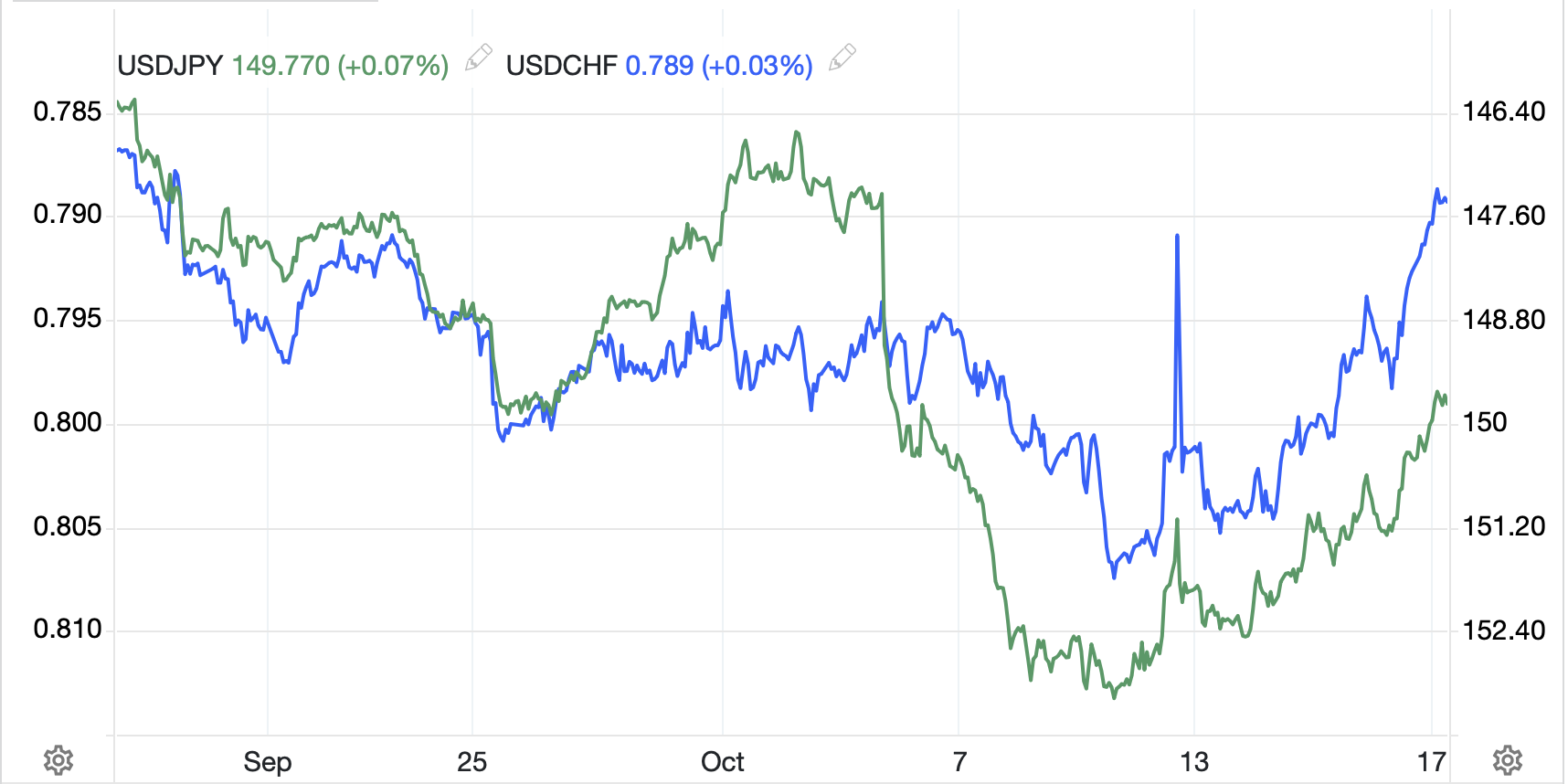
And understand, that even with futures pointing lower by -1.0% this morning, the S&P 500 is only 3% off its highs.  That hardly seems like a collapse, but the vibe I am getting is decidedly negative.  Certainly, haven assets are in demand this morning with both the yen (+0.5%) and the Swiss franc (+0.45%) rising sharply after bottoming on the same day as the S&P’s top, with both currencies back to their levels from a month ago.
Source: tradingeconomics.com

Is the world ending?  Probably not today but that doesn’t make it feel any better.  After all, we have been living through an unprecedented growth in leverage, with margin debt growing to new record highs every week, despite a backdrop of massive global uncertainty regarding trade, economic activity and kinetic conflict.  It is hard to believe that the fact that the FOMC is likely to cut rates by 25bps at the end of the month and again in December was enough to convince investors that future earnings were going to rise dramatically.

But that is where things stand this morning.  I must admit I have seen and read more stories about the idea that the AI hype train has run too far and needs to correct, and while that has probably been the case for a while, it is only in the past few days that those stances are becoming public.  There has also been an uptick in chatter about bad debt and more insidiously, fraud, that has been underlying some of the recent hype.  The First Brands bankruptcy is reverberating and now two regional banks, Zion and Western Alliance, have indicated that some recent loan losses may be tied to fraud.  While the amounts in question for the latter two are not enough to be a real problem for either institution, numbering in the $10’s of millions, history has shown that fraud tends to arise when money/lending standards are just too easy, and a sign that the end of good times may be nigh.

Again, it is a big leap to say that because some fraud was uncovered that signals the top.  But history has also shown that there is never just one cockroach, and if the lights are coming on, we are likely to see others.  While big bank earnings were solid, that was for last quarter.  And that’s just the market internal story for one industry.

If we add things like concerns over a potential conflict between the US and Venezuela, which is the top article in the WSJthis morning, or the idea that the US may send Tomahawk missiles, with ranges of up to 1500 miles, to Ukraine, it is unlikely to calm any fears.  And adding to that we continue to have the government shut down, although I personally tend to think of that as a benefit and since it doesn’t seem to be helping the Democrat party, the MSM stopped covering it, and we have the escalating trade conflict with China.  Looking at all the potential problems, it cannot be that surprising that some investors are a bit concerned about things and lightening their exposures.  Too, it is a Friday in October, and we have seen some particularly bad outcomes over weekends in October, notably in 1987!

I’m not forecasting anything like that, believe me, just reminding everyone that while history may not repeat, it often rhymes.  So, let’s look at the overnight session, which had a decidedly risk-off tone.  While the declines in the US markets weren’t that large, they left a bad taste everywhere in Asia with only India (+0.6%) managing to rise on the session.  Otherwise, Japan (-1.4%), China (-2.25%), HK (-2.5%), Taiwan (-1.25%), Australia (-0.8%) and virtually all the rest of the markets declined with Korea managing to close unchanged.  Fear was rampant, especially in China on the ongoing trade concerns.

In Europe, it should be no surprise that equity markets are also sharply lower led by the DAX (-2.1%) and FTSE 100 (-1.2%) with Paris (-0.7%) and Madrid (-0.95%) also under pressure.  The causes here are the same as everywhere, worries that things have gotten ahead of themselves while fears over escalations in both the trade and kinetic conflicts grow.  As well, the banking sector here is under pressure as credit concerns grow globally.  As to US futures, at this hour (7:15), they have bounced off their worst levels and are lower by just -0.25% to -0.5%.

Bond markets have been a major beneficiary of the growing fear with Treasury yields bouncing just 1bp this morning and sitting just below 4.00% after a -7bp decline yesterday.  European sovereign yields also fell sharply yesterday and are finding a near-term bottom as they retrace between 1bp and 2bps higher on the session.  If fear is growing, despite all the budget deficits, the default process is to buy bonds!

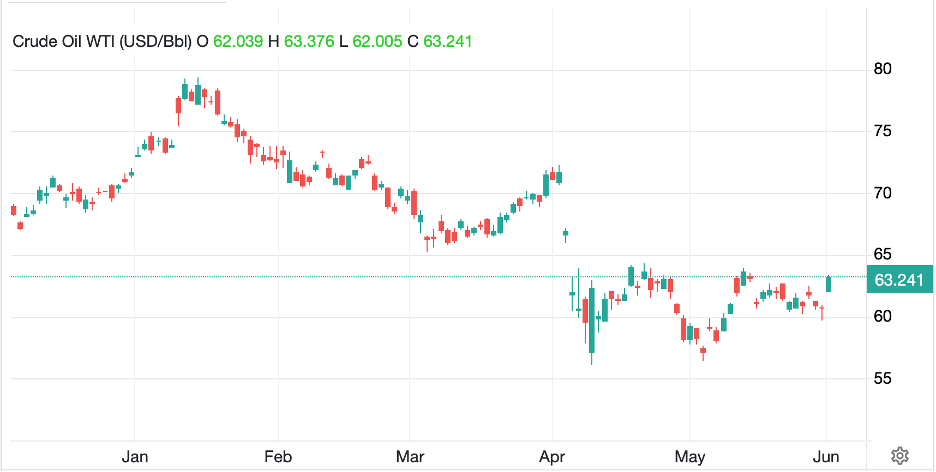
In the commodity markets, oil (-0.3%) has bounced off its lowest levels of the session which coincide with the lows seen back in April, post Liberation Day.  (see tradingeconomics.com chart below). It seems that not only are there economic concerns, but API inventory data showed a surprising build there.

Turning to the metals markets, gold (-0.2%) had a remarkable day yesterday, rising $100/oz, more than 2%, so a little consolidation here can be no surprise.  In fact, all the metals saw gains yesterday and are backing off a bit this morning in very volatile, and what appear to be illiquid markets.  Looking at the screen, the price is rising and falling $5/oz on a tick.  This 5-minute chart shows just how choppy things are.

Source: tradingeconomics.com

Finally, the dollar is softer, which on the one hand is surprising given its traditional haven status, but on the other hand, given the ongoing decline in yields and the fear pervading markets, is probably not that surprising.  Remember, one of the drivers for the dollar is capital flows and if US equity markets decline, we are going to see foreign investors sell, and then likely sell those dollars as well.  However, I would take exception with the Bloomberg headline explaining that the dollar is weakening because of Fed rate cut expectations given those expectations have been with us for several weeks.  At any rate, the weakness this morning is broad-based, but shallow with the two havens mentioned above the exception and most other currencies gaining 0.1% or 0.2% at most.  It seems President Trump has also made a comment about the trade war indicating that the current tariffs are unsustainable and he confirmed he would be meeting President Xi in a few weeks.

And that’s really all there is to end the week.  There is no data at all, and the only Fed speaker is KC Fed president Musalem.  The general takeaway from the Fedspeak this week is that they are prepared to cut rates but given the lack of data, will not be aggressive.

The world is a messy place.  No matter your political views, when viewing markets, it is important to focus on the reality of what is happening.  We know that leverage has been growing and helping to drive stock market indices to record highs.  We know that gold and other precious metals have been rallying on a combination of central bank (price insensitive) and growing retail buying as fears grow of impending inflation.  We have seen several instances of what appears to be lax lending standards, something that historically has led to substantial chaos in markets.  The advice I can offer here is maintain position hedges, especially those of you who are corporate risk managers.  Yes, volatility has risen a bit, but I assure you, if things really come undone, that will be insignificant compared to the benefit of the hedge.

And with those cheery words, I wish you all 

Good luck and a good weekend

Adf

Old Theses Are Reeling

The temperature’s rising on trade
As China, rare earths, did blockade
It seems they believe
That they can achieve
A triumph with cards that they’ve played
 
Investors worldwide are now feeling
Concern as old theses are reeling
This new world now shows
It’s capital flows
And trust, which is why gold’s appealing


Escalation in the trade war between the US and China is clearly the top story.  There are a growing number of analysts who believe that currently, China may have the upper hand in this battle given the recent history of deindustrialization in the US and the West.  Obviously, rare earth minerals, which are critical to manufacturing everything from magnets to weapons, and semiconductors, are China’s big play.  They believe this is the bottleneck that will force the US and the West to back down and accept their terms.  The Chinese have spent decades developing the supply chain infrastructure for just this situation while the West blithely ignored potential risks of this nature and either sought lower costs or virtue signals.

Before discussing the market take, there is one area where China lacks capacity and will find themselves greatly impaired, ultra-pure silicon that is used to manufacture semiconductors.  The global supply is almost entirely made in Japan, Germany and the US, and without it, Chinese semiconductor manufacturing will encounter significant problems.  So don’t count the West out yet.

Anyway, the interesting question is why have equity markets continued to behave so well in the face of this growing bifurcation in the global economy?  After all, it is clear why gold (+0.75%) continues to rise as central banks around the world continue to buy the barbarous relic for their reserves while individual investors are starting to jump on board if for no other reason than the price has been rising dramatically.  (As an aside, the gold price chart can fairly be called parabolic at this point, and history has shown that parabolic rallies don’t last forever and reverse course dramatically.)

Source: tradingeconomics.com

But equity prices are alleged to represent the discounted value of estimated future cash flows, and those are certainly not parabolic.  Of course, there is something that has been rising rapidly that feeds directly into financial markets, and that is liquidity.  Consider the process by which money is created; it is lent into existence by banks and used to purchase either financial or real assets.  The greater the amount of money that is created, the more upward pressure that exists for asset prices (as well as retail prices).  This is the essence of the idea that inflation is the result of too much money chasing too few goods.

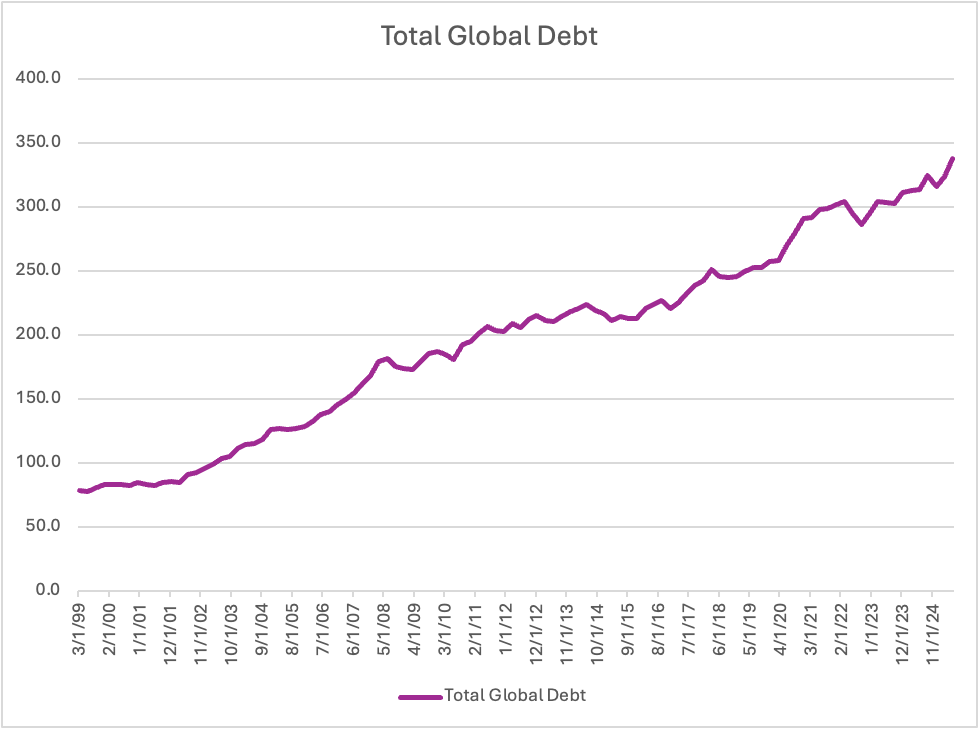
Turning to the IIF for its latest statistics, it shows, as you can see in the chart below, that global liquidity continues to rise, and there is nothing to indicate this rise is going to slow down.  The chart below shows global debt across all sectors (government and private) has reached $337.8 trillion at the end of Q2 2025, which is 324% of global GDP.  If you are wondering why asset prices continue to rise in the face of increased global macroeconomic risks, look no further than this chart.

And if you think about the fact that literally every major nation around the world, whether developed or EMG, is running a public budget deficit, this number is only going to grow further.  It is very difficult to make the case for a reversal unless this liquidity starts to dry up.  And the one thing central bankers around the world have figured out is that they cannot turn off the liquidity flow without causing severe problems.  As to CPI inflation, some portion of this liquidity will continue to seep into prices paid for things other than securities and financial assets.  Ironically, if President Trump succeeds in dramatically reducing the budget and trade deficits, the impact on global financial markets would be quite severely negative.  This is the best reason to assume it will never happen…by choice.

In the meantime, this is the world in which we live, and financial markets are subject to these flows so let’s see how they behaved overnight.  After yesterday’s modest gains in the US markets, Tokyo (+1.3%) continued its recent rally despite a growing concern that Takaichi-san will not become the first female PM in Japan as all the opposition parties seem to be coming together simply to prevent that outcome, rather than because they share a grand vision.  HK (-0.1%) and China (+0.25%) had lackluster sessions as the trade war will not help either of their economies either, while the rest of the region had a strong session across Korea (+2.5%), India (+1.0%), Taiwan (+1.4%), Australia (+0.9%) and Indonesia (+0.9%).  One would almost think things are great there!

As to Europe, France (+0.75%) is the leader today as PM LeCornu survived a no-confidence vote by agreeing not to raise the retirement age from 62 to 64 despite this being seen as President Macron’s crowning achievement.  (I cannot help but look at public finances around the world and see that something is going to break down, and probably pretty soon.  Promises to continue spending while economic activity stagnates are destined to collapse.  Of course, the $64 trillion question is, when?).  As to the rest of Europe, equity markets are little changed, +/- 0.15% or less.  At this hour (7:40) US futures are pointing nicely higher though, about 0.5% across the board.

In the bond market, the place where the growth in liquidity should be felt most acutely, there is no obvious concern by investors at this stage.  Yields across the board in the US and Europe are essentially unchanged in the session and there was no movement overnight in JGBs.  It feels as though the entire situation is becoming more precarious for investors, but thus far, no real cracks are visible.  However, you can be sure that if they start to develop, we will see the next wave of QE to support these markets.

Away from gold, this morning silver (+0.1%) and copper (-0.1%) are little changed although platinum (+0.7%) is working to keep up with both of the better-known precious metals and doing a pretty good job of it.  Oil (+0.9%) is bouncing off recent lows but remains below $60/bbl and seems to have lost the interest of most pundits and traders, at least for now.  

Finally, the dollar continues to edge lower, with most G10 currencies a touch higher (GBP +0.2%, SEK +0.2%, NOK +0.3%, EUR +0.05%) although the yen (-0.15%) and CHF (-0.2%) are both slipping slightly.  But the reality is there has been no noteworthy movement here.  Even in the EMG bloc, movement is 0.2% or less virtually across the board this morning.  The dollar is an afterthought today.

On the data front, Philly Fed (exp 10.0) is the only data release with some positive thoughts after yesterday’s Empire State Manufacturing Index rose a much better than expected 10.7.  We also hear from a whole bunch more Fed speakers (Barkin, Barr, Miran, Waller, Bowman) as the IMF / World Bank meetings continue.  Yesterday, to nobody’s surprise, Mr Miran said that rates needed to be lower to address growing uncertainties in the economy.  I suspect he will repeat himself this morning.  But the market is already pricing two cuts for this year, and absent concrete data that the economy is falling off a cliff, it is hard to make the case for any more (if that much) given inflation’s stickiness.

The world is a messy place.  Debt and leverage are the key drivers in markets and will continue to be until they are deemed too large.  However, it is in nobody’s interest to make that determination, not investors nor governments.  This could go on for a while.

Good luck

adf

In a Trice

While jobs data Friday was fine
The weekend has seen a decline
In positive news
As riots infuse
LA with a new storyline
 
The protestors don’t like that ICE
Is doing their job in a trice
So, Trump played a card,
The National Guard
As markets search for the right price


Despite all the anxiety regarding the state of the economy, with, once again, survey data like ISM showing things are looking bad, the most important piece of hard data, the Unemployment report, continues to show that the job market is in solid shape.  Friday’s NFP outcome of 139K was a few thousand more than forecast, but a lot more than the ADP result last Wednesday and much better than the ISM indices would have indicated.  Earnings rose, and government jobs shrunk for the first time in far too long with the only real negative the fact that manufacturing payrolls fell -8K.  But net, it is difficult to spin the data as anything other than better than expected.  Not surprisingly, the result was a strong US equity performance and a massive decline in the bond market with 10-year yields jumping 10bps in minutes (see below).

Source: tradingeconomics.com

But that is not the story that people are discussing.  Rather, the devolution of the situation in LA is the only story of note as ICE agents apparently carried out a series of court-warranted raids and those people affected took umbrage.  The face-off escalated as calls for violence against ICE officers rose while the LAPD was apparently told to stand down by the mayor.  President Trump called out the National Guard to protect the ICE agents and now we are at a point of both sides claiming the other side is acting illegally.  Certainly, the photos of the situation seem like it is out of hand, reminding me of Minneapolis in the wake of George Floyd, but I am not on site and can make no claims in either direction.  

It strikes me that for our purposes here, the question is how will this impact markets going forward.  A case could be made that the unrest is symptomatic of the chaos that appears to be growing around several cities in the US and could be blamed for investors seeking to move their capital elsewhere, thus selling US assets and the dollar.  Equally, a case could be made that haven assets remain in demand and while US equities do not fit that bill, Treasuries should.  In that case, precious metals and bonds are going to be in demand.  The one thing about which we can be sure is there will be lawsuits filed by Democratic governors against the federal government for overstepping their authority, but no injunctions have been issued yet.

However, let’s step back a few feet and see if we can appraise the broader situation.  The US fiscal situation remains cloudy as the Senate wrangles over the Big Beautiful Bill (BBB), although I expect it will be passed in some form by the end of the month.  The debt situation is not going to get any better in the near-term, although if the fiscal package can encourage faster nominal growth, it is possible to flatten the trajectory of that debt growth.  Meanwhile, the tariff situation is also unclear as to its results, with no nations other than the UK having announced a deal yet, although the administration continues to promise a number are coming soon.

If I look at these issues, it is easy to grow concerned over the future.  While it is not clear to me where in the world things are that much better, capital flows into the US could easily slow.  Yet, domestically, one need only look at the consumer, which continues to buy a lot of stuff, and borrow to do it (Consumer Credit rose by $17.9B in April) and recognize that the slowdown, if it comes, will take time to arrive.  Remember, too, that every government, everywhere, will always err on the side of reflating an economy to prevent economic weakness, and that means that the first cracks in the employment side could well lead to Fed cuts, and by extension more inflation.  (This note by StoneX macro guru Vincent Deluard discussing the Cancellation of Recessions is a must read).  I have spoken ad nauseum about the extraordinary amount of debt outstanding in the world, and how it will never be repaid.  Thus, it will be refinanced and devalued by EVERY nation.  The question is the relative pace of that adjustment.  In fact, I would argue, that is both the great unknown, and the most important question.

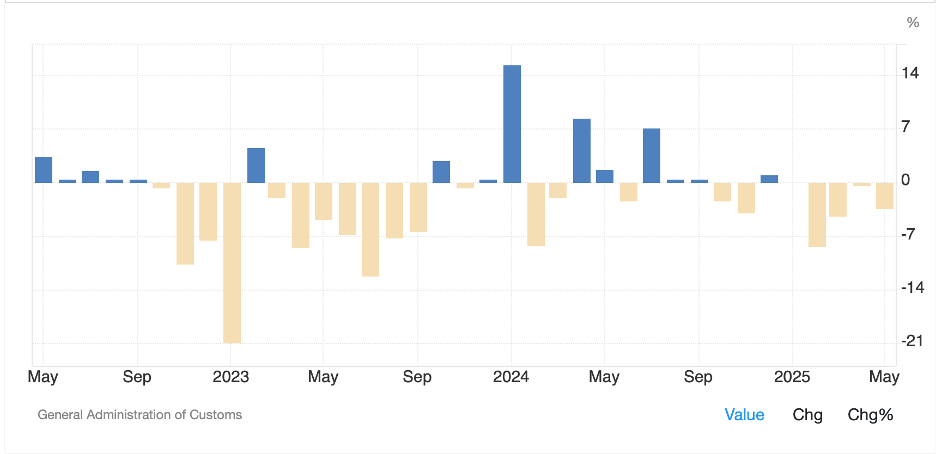
While answering this is impossible, a few observations from recent data are worth remembering.  US economic activity, at least per the Atlanta Fed’s GDPNow continues to rebound dramatically from Q1 with a current reading of 3.8%.  Meanwhile, Chinese trade data showed a dramatic decline in exports to the US (-35%) but an increased Trade Surplus of $103.2B as they shifted exports to other markets and more interestingly, imports declined-3.4%.  in fact, it is difficult to look at this chart of Chinese imports over the past 3 years and walk away thinking that their economy is doing that well.  Demand is clearly slowing to some extent, and while their Q1 GDP was robust, that appears to have been a response to the anticipated trade war.  Do not be surprised to see Chinese GDP slowing more substantially in Q2 and beyond.

Source: tradingeconomics.com

Europe has been having a moment as investors listen to the promises of €1 trillion or more to build up their defense industries and flock to European defense companies that had been relatively cheap compared to their US counterparts.  But as the continent continues to insist on energy suicide, the long-term prospects are suspect.  Canada just promised to raise its defense spending to 2% of GDP, finally, a sign of yet more fiscal stimulus entering the market and the UK, while also on energy suicide watch, has seen its service sector hold up well.

The common thread, which will be exacerbated by the BBB, is that more fiscal spending, and therefore increased debt are the future.  Which nation is best placed to handle that increase?  Despite everything that you might believe is going wrong in the US, ultimately the economic dynamism that exists in the US surpasses that of every other major nation/bloc.  I still fear that the Fed is going to cut rates, drive inflation higher and undermine the dollar before the year is over, but in the medium term, no other nation appears to have the combination of skills and political will to do anything other than what they have been doing already.  And that is why the long-term picture in the US remains the most enticing.  This is not to say that US asset prices will improve in a straight line higher, just that the broad direction remains clear, at least to me.

Ok, I went on way too long, sorry.  As there is no US data until Wednesday’s CPI, we will ignore that for now.  A market recap is as follows:  Asia had a broadly stronger session with Japan, China, HK, Korea and India all following in the US footsteps from Friday and showing solid gains.  Europe, though, is mostly in the red with only Spain’s 0.25% gain the outlier amongst major markets.  As to US futures, they are essentially unchanged at this hour (7:00).

Treasury yields have backed off -2bps from Friday’s sharp climb and European sovereign yields are softer by between -3bps and -4bps as although there has been no European data released; the discussion continues as to how much the ECB is going to cut rates going forward.  JGB yields were unchanged overnight.

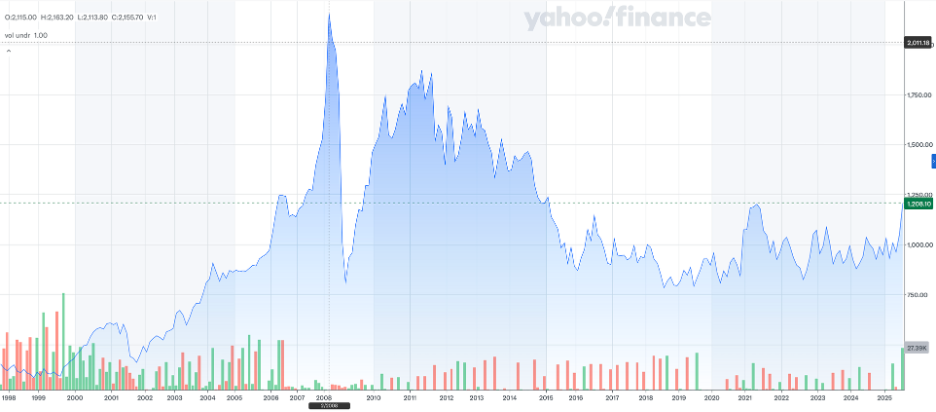
In the commodity space, while oil (+0.3%), gold (+0.1%) and even silver (+0.8%) are edging higher, platinum has become the new darling of speculators with a 2.8% climb overnight that has taken it up more than 13.5% in the past week and 35% YTD.  Remarkably, it is still priced about one-third of gold, although there are those who believe that is set to change dramatically.  A quick look at the chart below does offer the possibility of a break above current levels opening the door to a virtual doubling of the price.  And in this environment, a run at the February 2008 all-time highs seems possible.

Finally, the dollar is softer across the board this morning, against virtually all its G10 and EMG counterparts.  AUD (+0.55%) and NZD (+0.7%) are leading the way, but the yen (+0.5%) is having a solid session as are the euro and pound, both higher by 0.25%.  In the emerging markets, PLN (+0.7%) is the leader with the bulk of the rest of the space higher by between +0.2% and +0.4%.  BRL (-0.3%) is the outlier this morning, but that looks much more like a modest retracement of recent gains than a new story.

Absent both data and any Fedspeak (the quiet period started on Friday), we are left to our own devices.  My take is there are still an equal number of analysts who are confident a recession is around the corner as those who believe one will be avoided.  After reading the Deluard piece above, I am coming down on the side of no recession, at least not in a classical sense, as no politician anywhere can withstand the pain, at least not in the G10 and China.  That tells me that while Europe may be the equity flavor of the moment, commodities remain the best bet as they are undervalued overall, and all that debt and new money will continue to devalue fiat currencies.

Good luck

Adf

Gnashing and Wailing

The narrative writers are failing
To keep their perspectives prevailing
They want to blame Trump
But if there’s no slump
They’ll find themselves gnashing and wailing
 
Economists have the same trouble
‘Cause most of their models are rubble
The change that’s been wrought
Requires more thought
Than counting on one more Fed bubble


Investors seem to be growing unhappier by the day as so many traditional signals regarding market movement no longer appear to work.  Nothing describes this better, I think, than the fact that forecasts for 10-year Treasury yields by major banks are so widely disparate.  While JPMorgan is calling for 5.00% by the end of the year, Morgan Stanley sees 2.75% by then.  What’s the right position to take advantage of that type of knowledge and foresight?

One of the most confusing things over the past months, has been the growing dichotomy between soft, survey data and hard numbers.  But even here, it is worth calling into question what we are learning.  For instance, this week we will see the NFP data along with the overall employment report.  That data comes from the establishment survey.  It seems that just 10 years ago, more than 60% of companies reported their hiring data.  Now, that is down to ~43%.  Does that number have the same predictive or explanatory power that it once did?  It doesn’t seem so.

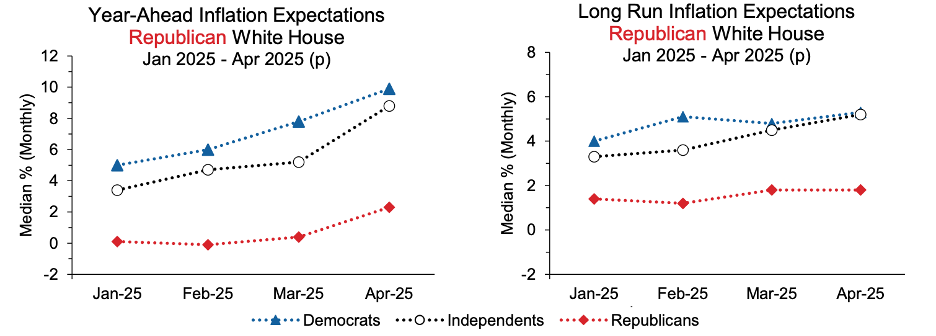
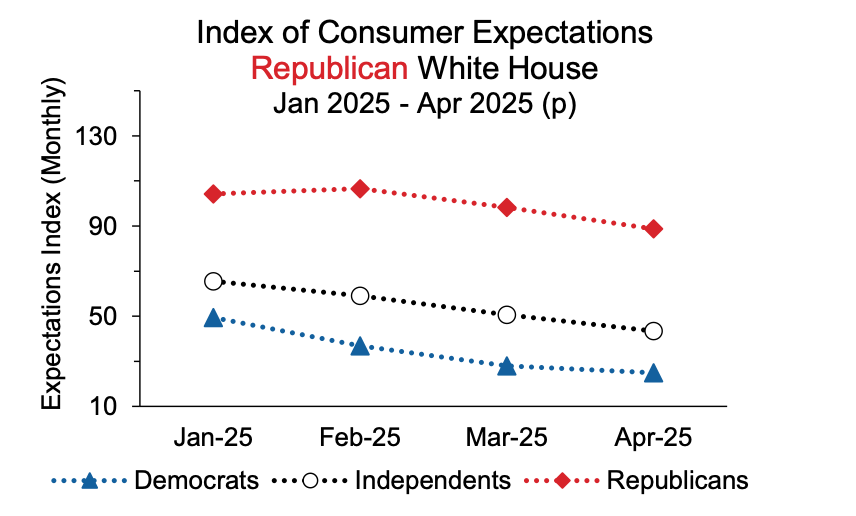
Too, if we consider the Michigan Sentiment data, it has become completely corrupted by the political angle, with the current situation being Democrats answering the survey anticipate high inflation and weak growth while Republicans see the opposite.  Is that actually telling us anything useful from an economic perspective let alone a market perspective?  (see charts below from sca.isr.unmich.edu)

But this phenomenon is not merely a survey issue, it is an analysis issue.  At this point, I would contend there are essentially zero analysts of the US economy (poets included) who do not have a political bias built into their analysis and forecasts.  Consider that if you are in a good mood generally, then your own perspective on things tends to be brighter than if you are in a bad mood.  Well, expand that on a political basis to, if you are a Democrat, President Trump has been defined as the essence of evil and therefore your viewpoint will see all potential outcomes as bad.  If you’re a Republican, you will see much better potential.  It is who we are and has always been the case, but it appears a combination of President Trump and social media has pushed this issue to heretofore unseen extremes.

There are two problems with this.  First, for most consumers of financial information, the decision matrix is opaque.  Who should you believe?  But perhaps more concerningly, as evidenced by the decline in the response rate to hard data, for policymakers like the Fed and Treasury, what should they believe?  Are they receiving accurate readings of the economic realities on the ground?  Is the job market as strong (or weak) as currently portrayed?  Is the uncertainty in ISM data a result of political bias?  And if politics is an issue in these situations, who is to say that answers to questions will be fact-based rather than crafted to present a political viewpoint?

I would contend that the reason the narrative is breaking down everywhere is that the willingness of investors, as well as the proverbial man on the street, to listen to pronouncements from on high has diminished greatly.  After all, the mainstream media, which had always been the purveyor of the narrative, or at least its main amplifier, has lost its luster.  Or perhaps, they have lost all their credibility.  Independent media, whether on X, Substack or simply blogs that are posted all over the internet, have demonstrated far more clarity and accuracy of situations than anything coming from the NYT, WSJ, BBG or WaPo, let alone the TV “news” programs.

We are on our own to determine what is actually happening in the world, and that is true of how markets will perform going forward.  I have frequently written that volatility is going to be higher going forward across all markets.  President Trump is the avatar of volatility.  As someone whose formative years in trading were in the mid 80’s, when inflation was high, and Paul Volcker never said a word to anyone about what the Fed was doing (and even better, nobody even knew who the other FOMC members were), the best way to thrive is to maintain modest positions with limited leverage.  The time of ZIRP and NIRP will be seen as the aberration it was.  As it fades, so, too, will the ability to maintain highly levered positions because any large move can be existential.

With that cheery opening, let’s take a look at what has happened overnight.  Friday’s US session was not very noteworthy with mixed data leading to mixed results but no real movement.  Alas, things have taken a turn lower since then.  Asian markets were weaker overnight (Nikkei -1.3%, Hang Seng -0.6%, CSI 300 -0.5%) with most other regional markets having a rough go of things as well.  Concerns over further tariffs by the US (steel tariffs have been raised to 50%) and claims by both sides of the US – China trade debate claiming the other side has already breached the temporary truce have weighed on sentiment overall.  Meanwhile, PMI data from the region was less than inspiring with China, Korea, Japan and Indonesia all showing sub 50 readings for Manufacturing surveys.

In Europe, equity markets are also generally softer (DAX -0.5%, CAC -0.7%) although the FTSE 100 (0.0%) has managed to buck the trend after data this morning showed Housing Prices firmed along side Credit growth.  As investors await the US ISM/PMI data, futures are pointing lower across the board, currently down around -0.4% at 7:15.

In the bond market, yields all around the world are backing up with Treasuries (+3bps) bouncing off the lows seen on Friday, although remaining below 4.50%, while European sovereigns have climbed between 3bps and 4bps across the board.  JGB’s overnight (+2bps) also rose, although the back end of that curve saw yields slip a few bps.  It seems the world isn’t ending quite yet, although there does not seem to be any cure for government spending and debt issuance anywhere in the world.

Commodity prices, though, are on the move as it appears investors are interested in acquiring stuff that hurts if you drop it on your foot.  Gold (+1.85%), silver (+0.9%) and copper (+3.6%) are all in demand this morning, the latter ostensibly benefitting from fears that the US will impose more tariffs on other metals thus driving prices higher.  But the real beneficiary overnight has been oil (+4.0%) which rose on the back of an intensification of the Russia – Ukraine war as well as the idea that OPEC+ ‘only’ raised production by 411K barrels/day, less than the whisper numbers of twice that amount.  As I watch the situation in Ukraine, it appears to have the hallmarks of an imminent peace process as both sides are pulling out all the stops to gain whatever advantage they can ahead of the ceasefire and both recognizing that the ceasefire is going to come soon.  But despite the big jump in the price of WTI, you cannot look at the chart below and expect a breakout in either direction.  If I were trading this, I would be more likely to fade the rally than jump on board the rise.

Source: tradingeconomics.com

Finally, the dollar is under the gun this morning, falling against pretty much all its major counterparts.  Both the euro (+0.7%) and pound (+0.6%) are having strong sessions although JPY (+1.0%) and NOK (+1.3%) are leading the way in the G10.  NOK is obviously benefitting from oil’s rally, while there remains an underlying belief that Japanese investors are slowing their international investments and bringing money home.  Now, the ECB meets this week and is widely anticipated to be cutting rates 25bps, but my take is, today is a dollar hatred day, not a euro love day.  As to the EMG bloc, gains are evident across regions with CZK and HUF (both +1.0%) demonstrating their beta to the euro although PLN (+0.5%) is lagging after the presidential election there disappointed the elites with the Right leaning candidate winning the job and likely frustrating Brussels in their attempts to widen the war in Ukraine.  In Asia, CNY (+0.1%) was relatively quiet but KRW (+0.5%), IDR (+0.8%) and THB (+0.9%) all benefitted from that broad dollar weakness.  So, too, did MXN (+0.65%) although BRL has not participated.

There is plenty of data this week culminating in the payroll report on Friday.

TodayISM Manufacturing49.5
 ISM Prices Paid70.2
 Construction Spending0.3%
TuesdayJOLTS Job Openings7.1M
 Factory Orders-3.0%
 -ex Transport0.2%
WednesdayADP Employment115K
 BOC Rate Decision2.75% (current 2.75%)
 ISM Services52.0
 Fed’s Beige Book 
ThursdayECB Rate Decision2.00% (current -2.25%)
 Initial Claims235K
 Continuing Claims1910K
 Trade Balance-$94.0B
 Nonfarm Productivity-0.7%
 Unit Labor Costs5.7%
FridayNonfarm Payrolls130K
 Private Payrolls120K
 Manufacturing Payrolls-1K
 Unemployment Rate4.2%
 Average Hourly Earnings0.3% (3.7% Y/Y)
 Average Weekly Hours34.3
 Participation Rate62.6%
 Consumer Credit$10.85B

Source: tradingeconomics.com

In addition, we hear from four more Fed speakers over five venues.  The thing about this is they continue to discuss patience as the driving force, except for Governor Waller, who explained overnight that he could see rate cuts if inflation stays low almost regardless of the other data.

The trade story remains the topic of most importance in most eyes it seems, although it remains a mystery where things will wind up.  The narrative is lost for all the reasons above, but I will say that it appears risk aversion is today’s theme.  The new part is that the dollar is considered a risk asset.  

Good luck

Adf

The Future As Fraught

Though I’ve been away near a week
From what I read things are still bleak
Two months have gone by
Since stocks touched the sky
And traders all want a new peak
 
Meanwhile, GDP fell ‘neath nought
And lots see the future as fraught
The popular claim
Is Trump is to blame
And rue all the things he has wrought


I worked hard not to pay close attention to markets while I was away last week in an effort to get some true relaxation.  And now that I’m back at my desk, I can see that I didn’t miss anything at all.  The narratives remain the same, the split between those who believe everything the president says/does is a disaster and those who believe everything he says/does is brilliant has not changed at all.  In other words, life continues as do all the arguments.

A review of the data last week showed two key outcomes, the labor market remains far more resilient than the recessionistas will accept and jobs continue to be created.  For some reason, that seems like good news to me, but then I am not a highly paid economist with a narrative to stoke.  On the other hand, Q1 GDP printed at -0.3%, the first negative print in 3 years, but also one that is easily explained by the rush of imports that occurred prior to the imposition of tariffs in early April.  Remember, imports subtract from Gross DomesticProduct.  However, a look under the hood of this number shows that the positive news was government activity declined while private sector investment exploded higher.  It strikes me that this is the best possible direction for the US economy going forward.

In China, it seems Xi’s decided
That data has been too one-sided
So, henceforth they’ll furnish
Just data to burnish
The views Xi and friends have provided

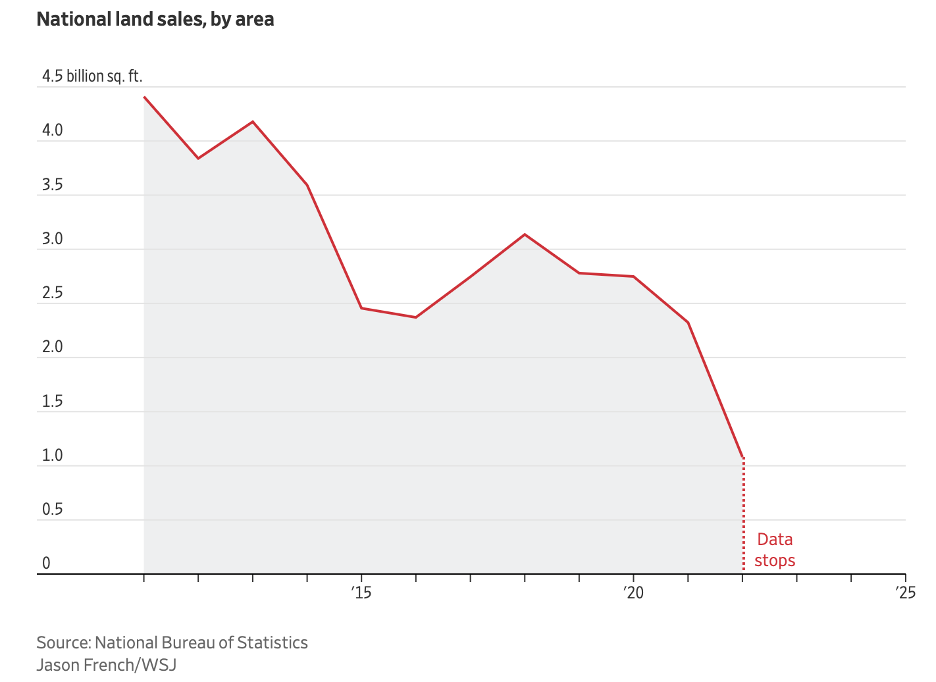
Turning to the more recent stories, though, the WSJ had a very interesting take on the fact that China’s statistical output is shrinking quite rapidly as data that has been trending lower suddenly stops being produced.  The below chart from the article on National Land Sales is an excellent depiction of things, and likely an indication that land sales, which are critical to local government finances, have become even a bigger problem over the past three years than when the property market first started melting down in early 2021.

It is worth noting that in this trade war between the US and China, while much of the punditry continues to insist that China has the upper hand as the stuff they sell to the US is more critical and less replaceable than the stuff the US sells to them, I have maintained things are not necessarily that easy.  The US is facing a supply shock, and will need time to work it through, but the US economy is the most dynamic in the world, and these issues will be resolved.  China faces a demand shock, which in economic theory should be easier to address, but which in China’s reality has not proven to be the case.  Consider that Xi and the CCP have been creating fiscal stimulus plans since Covid without any serious success.  In fact, the Chinese have openly stated that they are seeking to shift the production/consumption mix of the nation closer to Western standards of 60%-70% consumption from their current 45%-50% level.  It hasn’t worked yet, and I see no reason to believe that is going to change.  We must never forget the US is the consumer of last resort, and if China doesn’t have access to this market, it is a major problem for them.

I have no inside knowledge of how things are evolving on this issue, but here’s my take; while Xi doesn’t need to worry about being elected, he still needs to ensure that China’s economy grows sufficiently to increase the well-being of his population.  Whatever the official statistics have shown, it is clear that things in China are not what they would have the rest of the world believe and that is a problem for Xi.  Meanwhile, Trump will not face another election and was elected with a pretty broad mandate.  I believe given the timing of the mid-term elections, he has another 9-12 months to get things done and will play hardball with China to do so.  In fact, I have a feeling that Trump may have the upper hand.  This will be settled by the autumn is my view.

Ok, let’s turn to markets and what happened in the overnight session.  Looking first at currencies for a change, I couldn’t help but notice the following chart.

Source: tradingeconomics.com

I also couldn’t help but notice the following comment from the Taiwanese central bank in response to a question about whether the FX rate is on the table in the trade negotiations.  (As an aside, @PIQSuite is an excellent follow on X.  Key market headlines on a real-time basis with other things available as well.)

The question of whether FX rates would be part of the trade talks seems to have been answered, and the answer is yes.  Perhaps there will not need to be a Mar-a-Lago accord after all regarding revaluing gold and terming out bonds.  Instead, the pressures will be relieved on a country-by-country basis with each trade deal.  

While the TWD revaluation of 10% over the past 2 sessions is the most dramatic, the dollar is generally lower this morning against both G10 and EMG currencies.  In the G10, AUD (+0.85%) leads the way but JPY (+0.7%), NOK (+0.6%) and CHF (+0.5%) are all pushing higher.  This must be music to President Trump’s ears.  As to the emerging markets, KRW (+2.5%), is the next biggest mover although they admitted that FX rates were part of the trade discussions.  SGD (+0.8%) has also seen a relatively large move and INR (+0.4%) is moving in that direction.  It seems clear that Asia is the focus of both the administration and the markets this morning.  The rest of the EMG bloc has seen much smaller gains, between +0.25% and +0.5%, with CNY (+0.15%) really doing very little.

Turning to the equity markets, last week clearly finished on a strong note and, in fact, since I last wrote, the S&P 500 has rallied a bit more than 2% and is higher by more than 14% since April 8th.  Apparently, the world has not yet ended, but there hasn’t been a new high in the stock market in more than 3 months, and people are edgy!  As to the overnight session, the Nikkei (+1.0%) rallied along with the Hang Seng (+1.75%) although Mainland shares (CSI 300 -0.1%) showed little life.  Elsewhere in the region, Taiwan (-1.25%) and Australia (-1.0%) felt the most pressure and the rest were mixed with much smaller movements.  In Europe, indices are mixed as earnings data from each country are the drivers amid a lack of broad-based news.  So, the UK (+1.2%) and Germany (+0.6%) are firmer while France (-0.6%) is lagging on the back of some weaker earnings numbers.  As to the US, futures are pointing lower by about -0.7% across the board at this hour (7:15).

In the bond market, last week saw Treasury yields jump sharply after the better-than-expected payroll report, finishing the day 9bps higher, although still within the middle of the trading range since February and lower on the year.  This morning, they are basically unchanged while European sovereign yields have slipped by about -2bps across the board. The picture there continues to focus on the uptick in fiscal spending that is expected and the borrowing that will be needed to pay for it.  However, there is still a strong view that the ECB will be cutting rates going forward.

Lastly, in the commodity markets, oil (-1.15%) is sliding again as OPEC+ has promised to continue to increase production.  There are two takes on this activity, both of which probably have some truth.  First is the idea that President Trump has made a deal with MBS in Saudi Arabia to increase production and drive prices lower. Remember, lower energy prices are a boon to the US (and the world).  But added to that is the idea that MBS agreed so he can help force fracking production to pull back and regain market share for OPEC+.  However, regardless of the rationale, nothing has changed my view that oil prices are heading lower, and I still like the $50/bbl level as a target.  As to the metals, gold (+2.3%) which has been under pressure for several weeks in a correction, seems to have found support below $3300/oz and could well be setting up for another leg higher. This has taken silver (+1.3%) and copper (+.8%) along for the ride.  If the dollar is going to continue lower, metals prices should remain quite firm.

On the data front, today only brings ISM Services (exp 50.6), but really, all eyes will be on the FOMC meeting on Wednesday.  I will highlight the rest of the week’s data tomorrow morning.

The past month has seen significant volatility in markets as participants did not correctly estimate the potential moves in trade policy.  At this point, it seems those questions are being answered, with President Trump even hinting some deals could be finalized this week.  I believe we are going to see trade announcements that include new FX goals, and they will be pushing the dollar lower across the board.  While I don’t see a collapse coming, that is the trend for now.

Good luck

Adf

Too Much Debt

In Spain, electricity failed
In Canada, Carney prevailed
But markets don’t care
As movement’s quite spare
It seems many traders have bailed
 
But problems, worldwide, still abound
Though right now, they’re in the background
There’s far too much debt
And still a real threat
That no true solutions are found


The two biggest stories of the past twenty-four hours were clearly the national scale blackout in Spain and Portugal yesterday, and the slim victory for Mark Carney in Canada, where the Liberal Party appears to have a plurality, but not a majority, and will oversee a minority government.

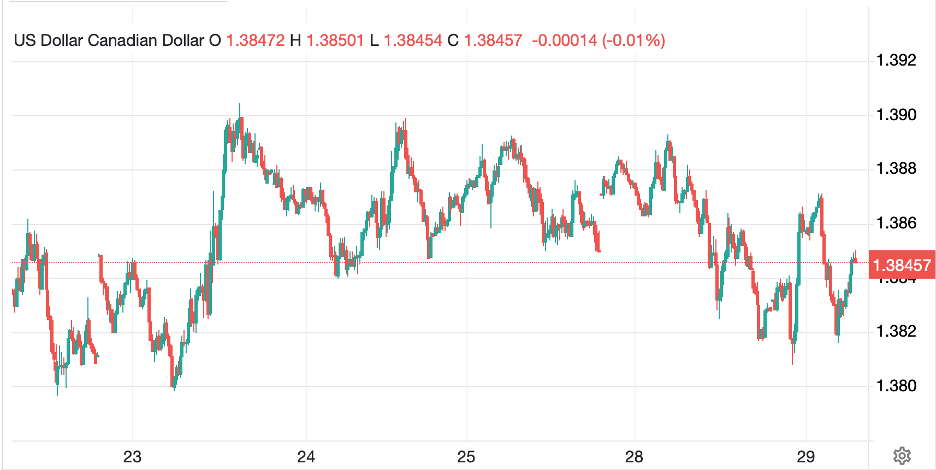
Touching on the second story first, in truth there is not much to discuss.  Much has been made of the vote being an anti-Trump statement with the idea that Carney is better placed to defend Canada from President Trump’s (imagined) predations.  However, given the lack of a majority government, it is not clear how effective this line of reasoning will prove.  As there is no futures market for the TSX, we really don’t have a sense yet of how the Canadian equity market will greet the news.  Yesterday’s modest gains of 0.35% amid a general atmosphere of modest gains doesn’t really tell much of a tale.  As to CAD (-0.1% today), a quick look at the past week shows it has done nothing even in the wake of the news. (see below).  My take is this is a nothingburger event, a perfect description for Mark Carney, a nothingburger of a politician.

Source: tradingeconomics.com

As to the story about Spain’s electricity, I think it may be more instructive on two levels.  The first is as a warning to the risks inherent of powering your electric grid with more than 25% – 30% intermittent, renewable energy sources like wind and solar.  It is somewhat ironic that just twelve days prior to the blackout, Spain’s entire electricity requirement was met by solar, wind and hydro power, the Green dream.  Alas, here we are now and while no answers have yet been forthcoming, and I assume the media will downplay any blame on too much renewable power, virtually every engineering study has shown that once a grid has more than that 25% renewables, it tends towards instability.  This issue will be argued by both sides for a while, although as always, physics will be the final arbiter.  

But I have to wonder if the sudden failure of the electric grid is an omen of sorts, for what may be happening in global markets.  If we analogize global supply chains to the electrical grid, over the course of the past 50 years, we have seen the world create a massively complex web of trade with raw materials, intermediate goods and final products all crisscrossing the world.  There have been myriad benefits to all involved with real per capita economic benefits abounding, and for everybody reading this note, the ability to essentially buy whatever you want/need with limited interference and trouble.  Certainly, the availability of everyday necessities like food and clothing is widespread.

However, underpinning that bounty were two networks.  The first being the obvious one, the supply chains which since Covid have been much discussed by the punditry.  But the second, which gets far less notice is the network of debt that is issued around the world by governments and companies, as well as taken on by individuals, and that has grown to be more than 3x the entire global economic output.  While we most often read about the US government debt which is quickly approaching $37 trillion, total global debt is much greater than that.  In fact, at this point, the debt market is not about issuing new debt to fund new investment, rather it is almost entirely a refinancing mechanism.  

It is this latter issue that should concern us all.  What happens if, one day, the ability to refinance some of that debt, whether US Treasuries, German bunds or Chinese government bonds, has a hiccup of some sort?  A failed US Treasury auction, where the Fed is required to purchase bonds, or a power outage in a key financial center that prevents trades from being confirmed/settled and moneys not moving as expected, or some other force majeure type event that disrupts the current smooth functioning of global debt markets.  

Frankly, the combination of the changes being wrought by President Trump to the global economy, where globalization is giving way to mercantilism, and the significant weight of global debt that hangs over the global economy and is given very little thought seems a potentially volatile mix.

Ironically, as much as I have lately been describing how the Fed’s role seems to have diminished, in the event that something upsets this apple cart, the Fed will be the only game in town.  While this is not a today event, it is something we must not forget.

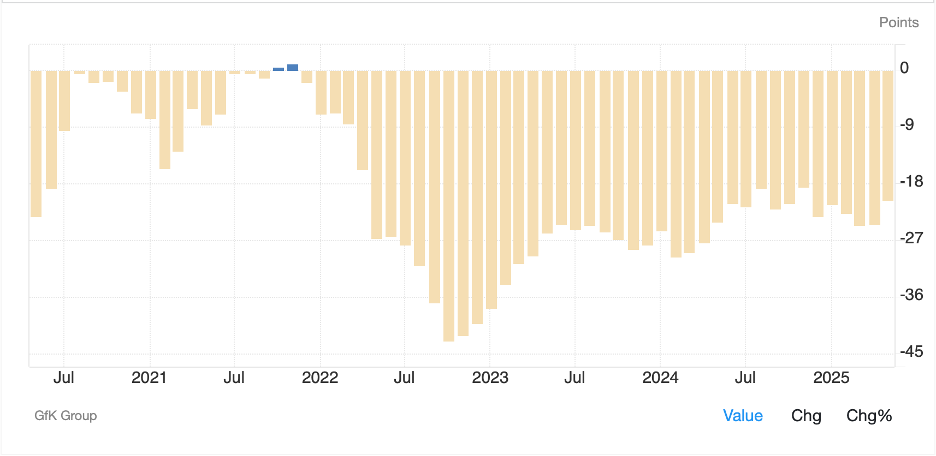
I apologize for my little diatribe, but with so little ongoing in markets, and the parallel to the Spanish electrical grid, it seemed timely.  Let’s look at markets.  Asian equity markets were mixed with the main markets very quiet but a couple of 1% gainers (Australia, Taiwan and Korea) although the rest of the region was +/- 0.3% or less.  Too, volumes were quite lethargic.  In Europe, it should be no surprise that Spain (-0.8%) is the laggard today as the first economists’ to opine on the impact of the blackout said it could be a hit of as much as 0.5% of GDP.  Germany (+0.6%) is the other side of the coin after the GfK Consumer Confidence reading came out at a better than expected -20.6.  Now, maybe it’s just me, but if I look at the past 5 years’ worth of this index, it is difficult to get excited about German economic prospects.

Source: tradingeconomics.com

Yes, this was a better reading, but either the people of Germany are manic depressive, or the index is indicative of major structural problems in the country.  Maybe a bit of both.  As to US futures, at this hour (7:10) they are basically unchanged after being basically unchanged yesterday.

In the bond market, Treasury yields have bounced 2bps this morning after touching their lowest level in 3 weeks yesterday.  European sovereign yields, though, are all softer by 1bp to 2bps this morning as comments from ECB members seem to highlight more rate cuts as Europe achieves their inflation target and are now getting concerned they will fall below the 2.0% rate.

In the commodity markets, oil (-1.7%) is under pressure this morning ostensibly on a combination of concerns over slowing growth and little movement in the US-China trade talks as well as a report that Kazakhstan is pushing up output and other OPEC+ members are talking about increasing production further when they meet next week.  Meanwhile, gold (-0.75%), which rallied back to unchanged in NY yesterday is once again finding sellers at its recent trading pivot of $3340ish (H/T Alyosha).  However, gold’s slide has not impacted either silver (+0.4%) or copper (+0.9%) at least so far in the session.

Finally, the dollar is firmer, largely across the board, this morning.  The euro (-0.3%), pound (-0.4%), JPY (-0.4%) and CHF (-0.6%) are all under some pressure, perhaps profit taking.  But in truth, other than INR (+0.15%) the rest of the major currencies, both G10 and EMG, are all softer vs. the greenback.  I guess the dollar’s demise will need to wait at least one more day.

On the data front, the Goods Trade Balance (exp -$146B), Case Shiller Home Prices (4.7%) and JOLTs Job Openings (7.48M) are the main numbers, although we also see Consumer Confidence (87.5).  But with no Fed discussions much more crucial data on Thursday (GDP, PCE) and Friday (NFP) it seems that today is setting up for not much excitement.

In fact, lack of excitement seems the best description of markets right now.  I don’t know what the next catalyst will be to change things, but absent peace in one of the wars, kinetic or trade, or another force majeure event, it feels like range trading is the order of the day for a while.  My big picture view of a slowly declining dollar is still intact, but day-to-day, it’s hard to see much right now.

Good luck

Adf

Be Quite Scared

The pundits have now all declared
That everyone should be quite scared
It will be a bummer
When shelves, come this summer
Are empty, so please be prepared
 
As well, a recession’s in view
Although, that seems like déjà vu
For three years at least
The pundits increased
The odds that this bill would come due


Apparently, the only thing you need to know this morning is that by summertime, shelves across the country will be barren as imports from China halt.  The upshot, at least according to the sources that I have read, is that you should blame President Trump and join the media chorus in hating the man and his policies.

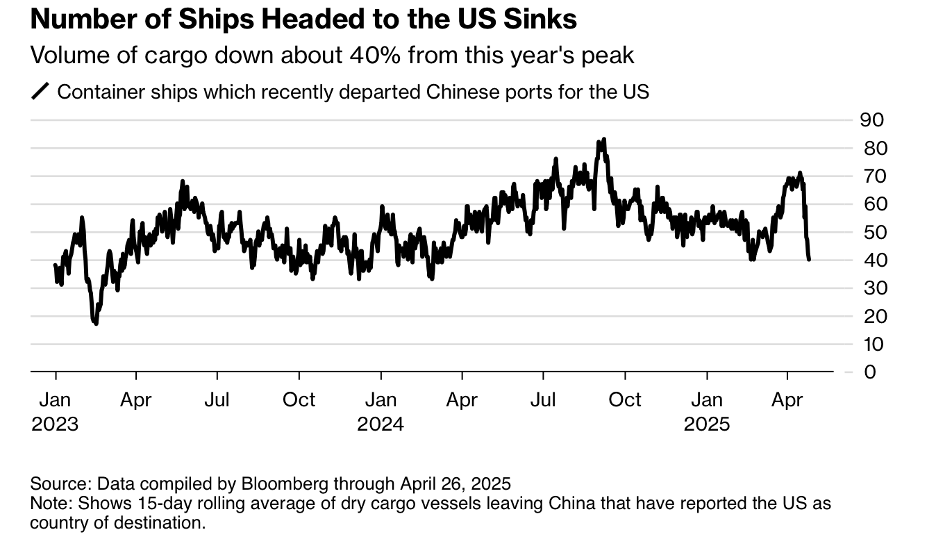
Now, I am no logistics expert, but the concern stems from the significant decline in shipping as evidenced by port activity in both China and the US.  As you can see from the chart below, there has certainly been a significant decline in the number of ships leaving China on their way to the US.

I guess the question is just how much of what is on store shelves comes from China?  Much will depend on what kind of store one considers.  Certainly, toy stores seem likely to have less inventory, as will Best Buy with electronics potentially suffering, although as I recall President Trump exempted electronics initially.  Arguably, clothing shelves and racks may be sparser as well.  But based on official data, Chinese imports (~$463B) accounted for approximately 1.7% of the US’s $26.9T GDP in 2024.  This may be an overreaction.

Potentially a bigger issue will be the impact on intermediate goods that are imported from China and elsewhere and incorporated into products finalized in the US.  However, I cannot calculate that, nor have I seen any data of this issue, although I have read many stories about the end of this particular world as well.

One of the things to remember about the punditry is that they make their living describing the worst possible outcome because that gets them recognition.  However, I’m confident we all remember that a recession was forecast for 2022, 2023 and 2024 by much of the punditry and yet one was never officially declared by the NBER.  In fact, you may recall that in Q1 and Q2 of 2022, US Real GDP growth was -0.2% for both quarters, thus two consecutive quarters of negative growth.  Historically, that has defined a recession.  However, subsequent data revisions did remove that as you can see below with Q2 revised higher.

Source: tradingeconomics.com

The one thing I do know is that there is a group of analysts/economists who have been forecasting the next recession consistently for several years.  They point to data like changes in the housing market, the JOLTs Quits rate shrinking and various other secondary and tertiary data points and sources, all of which have been pointing in that direction for several years.  And I grant, reading that ~40% of GenZ is using BNPL to buy their groceries, and then run late on payments, is a frightening statistic (although perhaps one that highlights financial illiteracy more than economic reality).

In the end, what you need to know is you should be terrified because the punditry is almost certain that this time, they have it right.  But our concern is how will this scenario impact markets.

Basically, despite all this huffing and puffing, it appears markets are whistling past this particular graveyard.  Friday’s US equity rally was followed by general strength in Asia and strength this morning in Europe.  Last night, Tokyo (+0.4%), Mumbai (+1.3%), Taiwan (+0.8%) and Australia (+0.4%) all had solid performances although neither Hong Kong (-0.1%) nor China (-0.15%) could find any real buying support.  A less reported story is that China is exempting a number of US imports from its 125% tariffs on the US as clearly, this trading relationship is deep and complex.

As to Europe, all markets are ahead this morning, with the UK (+0.4%) the laggard and most of the continent higher by between 0.7% and 0.8%.  There are headlines around as to how the ECB is preparing to cut rates further on the assumption that global economic activity is going to slow and thus hurt Europe, while the consistent message is that US tariffs will be deflationary in Europe, so less concerns about their inflation mandate.  Finally, US futures are pointing slightly softer (-0.2%) at this hour (6:45).

In the bond market, 10-year Treasury yields have fallen 30bps in the past two and one-half weeks, sliding 5bps on Friday before bouncing 3bps overnight. However, the recent trend does seem lower.

Source: tradingeconomics.com

But yields are climbing in Europe as well today, higher by 5bps across the board on the continent, although UK Gilts have only edged higher by 2bps.  It’s funny, despite all the doom and gloom regarding the economy because of US tariffs, as well as growing expectations of an ECB rate cut at the early June meeting, investors appear to be growing concerned about something.  Perhaps they have pivoted back to the promised fiscal spending increases as their driver today.

In the commodity markets, oil (-0.35%) continues to trade in its recent $60 – $63/bbl range with limited signs that this will soon change.  Peace in Ukraine does not seem at hand yet and reports are that the initial discussions between the US and Iran, while constructive, still have a ways to go before completion.  Both of those seem likely to weigh on oil prices if completed.  However, the more unusual thing to me is that with the rising chorus of recession calls, oil’s price has not fallen further.  To date, markets have not yet agreed with the economists’ view that recession is imminent.  In the metals markets, gold (-1.0%) is continuing its rough week, although remains nicely higher on the month.  You may recall my view a week ago Friday that the move seemed parabolic and due for a correction.  Recent price action is exactly that, corrective, as I believe the underlying thesis to own the barbarous relic remains intact.  The other main metals are a touch softer this morning, but really nothing to discuss.

Finally, the dollar is mixed this morning with modest strength against the euro (-0.15%) but softness vs. the pound (+0.15%) and those size moves are representative of most of the price action across both G10 and EMG currencies this morning. The outlier is KRW (-0.4%), which seems to be suffering from comments that no trade deal will be completed before June’s election there.

Overall, despite ongoing doom and gloom by much of the punditry, it is not obvious to me that investors are anticipating major changes.  Perhaps they are wrong, and the pundits are correct.  But as yet, there is no evidence to support that conclusion.

Ok, let’s turn to the data this week, which starts slowly but ends on NFP.

TuesdayGoods Trade Balance-$146.0B
 Case-Shiller Home Prices4.8%
 JOLTs Job Openings7.5M
WednesdayADP Employment108K
 Q1 GDP0.4%
 Q1 Employment Cost Index0.9%
 Chicago PMI45.5
 Personal Income0.4%
 Personal Spending0.6%
 PCE0.0% (2.2% Y/Y)
 Core PCE0.1% (2.6% Y/Y)
ThursdayInitial Claims225K
 Continuing Claims1860K
 ISM Manufacturing48.0
 ISM Prices Paid70.2
FridayNonfarm Payrolls135K
 Private Payrolls127K
 Manufacturing Payrolls-5K
 Unemployment Rate4.2%
 Average Hourly Earnings0.3% (3.9% Y/Y)
 Average Weekly Hours34.2
 Participation Rate62.5%
 Factory Orders4.5%

Source: tradingeconomics.com

As well as NFP, we get the PCE data, which looks like it has changed to a 10:00am release from its traditional 8:30am time.  The Fed is in its quiet period, but nobody has been listening to them anyway.  Secretary Bessent, along with President Trump, has been the most important voice lately.  Again, for now, the data has not indicated recession, although Q1 GDP is slated to be soft.  Markets, too, have been unwilling to get behind the recession call completely. 

Ultimately, the one thing we know is that the nature of the global economy has changed since President Trump’s election.  Globalization is in retreat and mercantilism is the new normal.  It is not clear to me that existing econometric models will accurately portray how that works, so I need to see more data before recognizing the end of times.  In the meantime, these myriad views are a sign that hedging for risk managers remains the only path forward.

Good luck

Adf

Declines and Duress

In France, there’s a government mess
That lately’s been causing some stress
For French sovereign debt
With stocks under threat
Of further declines and duress


In one of the most colossal political blunders in recent memory, French President Emmanuel Macron completely misread the country and called a snap election after the European Parliament elections sent his party and allies to a significant defeat in June.  In what should not have been a surprise to anyone, his party was decimated in the national election, although the results have been even more unfortunate for the people of France as they have basically left the nation without a working government.  While there is currently a caretaker PM in place, Monsieur Barnier is almost certainly going to lose a no-confidence vote tomorrow as both the left and right express their displeasure at the situation.

Alas, the pattern we observe of late is that European citizens have been generally unhappy with the decisions made by their governments, with a universal issue being immigration policies, and when elections have been held, the parties in power have been shown the door.  Or they would have been except that they are extremely reluctant to leave office and are willing to do anything at all, except work with the anti-immigration parties (typically on the right) to govern their nations.  The result has been a series of election results with very weak minority governments and no power to do anything to help their citizens by addressing key issues.  Budgets are a problem; massive debt loads are constraining and economic activity is shrinking.  

France is merely the current fracas although we have seen the same things occur in Germany, the Netherlands, Austria, Sweden and much of Eastern Europe.  From our perspective, the issue here is what does it mean for the economic prospects of the euro (and other European currencies) and how might the ECB respond.  Consider that as poorly as things are going in Germany, and they are really having a tough time, a quick look at the performance of the DAX and CAC (as well as the S&P 500) shows that France is really a laggard right now.

Source: tradingeconmics.com

Since the dip in the beginning of August, French equities are essentially unchanged while even German equities have risen 15% alongside their US brethren.  During that same period, French 10-year yields have been rising relative to their German counterparts as fears over a French fiscal disaster rise.  In fact, there is now discussion that the ECB will need to use their TPI program, originally designed to support Italian debt, to prevent the spread between French and German yields from widening too far.  

If you were wondering why the euro has been having problems lately, this has clearly been a piece of the puzzle, and likely a key piece.  While the single currency has rallied slightly this morning, up 0.2%, the below chart speaks volumes as to the direction of travel.

Source: tradingeconomics.com

While yesterday I explained why I thought over time the dollar might eventually decline, right now, I think we need to look for the euro to test parity and potentially go below for the first time since November 2022.

As well, there’s another key nation
That’s seeking its ‘nomic salvation
Their currency’s falling
As pundits are calling
For stimulus midst their frustration

This brings our attention to China, where next week, the Central Economic Work Conference will be held as President Xi tries to shake the nation out of its economic lethargy.  There are high hopes for yet more stimulus despite the fact that the efforts so far have had a limited impact at best.  Perhaps the Chinese problem can best be described as they produce far too many goods for their own consumption and so run large trade surpluses angering their trade partners.  While President-elect Trump gets most of the press regarding his complaints about China’s economic behavior, it turns out that many countries around the world are pushing back.  This morning’s WSJ had an article on this very issue and it seems possible that President Xi may find himself even more isolated on the issue than before.

The natural solution is for China to consume more of what it produces, but that is far easier said than done, especially as the youth unemployment rate in China remains quite high, above 17%, while demographics continue to work against the country.  Arguably, one way to solve this issue would be for the renminbi to strengthen dramatically, simultaneously increasing the price of Chinese exports, so likely reducing demand, while increasing demand for imports.  Unfortunately, as can be seen below, the currency is moving in the opposite direction as the tariff threats from the US and elsewhere feed into the market psyche.

Source: tradingeconomics.com

It will be interesting to see if the PBOC is comfortable allowing the renminbi to weaken further.  It is currently at its weakest point since July, but also at levels where historically, the PBOC has entered the market over the past several years to prevent further declines.  With tariffs imminent, will this time be different?

Ok, let’s turn to the overnight market activity.  Asian equity markets were all strong overnight led by Japan (+1.9%) although we saw gains throughout the region (Korea +1.9%, India +0.75%, Taiwan +1.3%).  In China, Hong Kong (+1.1%) fared far better than the mainland (+0.1%) although both these markets closed well off early session lows after discussion of the economic conference and more subsidies made the rounds.  In Europe, screens are green this morning as well, seemingly on growing hopes that the ECB will be cutting more aggressively as data there remains soft, and comments from Fed Governor Waller yesterday indicated he was on board with further cuts despite the current data showing solid performance.  However, US futures are little changed at this hour (7:30) as focus begins to turn toward Friday’s NFP report.

In the bond markets, yields are edging higher with 10-year Treasuries up 2bps while most European sovereigns are higher by between 1bp and 3bps.  France is an exception this morning as that TPI talk has traders thinking there will be a price insensitive bid for OATs soon.

In the commodity markets, oil (+1.2%) is rebounding nicely from yesterday’s selloff although continues to trade below that $70/bbl level.  In the metals market, yesterday’s declines, which seemed to have been driven by the much stronger dollar, are being reversed in silver (+0.8%) and copper (+1.0%) although gold is essentially unchanged on the day.

Finally, the dollar, after a ripping rally yesterday, is backing off a bit, but not very much.  In fact, there are a number of currencies which are still sliding somewhat, notably CNY (-0.2%) and SEK (-0.2%) with the only gainer of note this morning being CLP (+0.6%) as it follows the price of copper higher.  Broadly speaking, the current setup remains quite positive for the dollar I believe.

On the data front, this morning brings only the JOLTS Job Openings report (exp 7.48M) and a bit more Fedspeak.  Yesterday’s ISM data was stronger than expected but still, at 48.4, below the key 50.0 level indicating manufacturing is still in a funk.  Perhaps better news was that the Prices Paid survey declined to 50.3, potentially indicating reduced inflation pressures.

While the market keenly awaits Chairman Powell’s speech on Wednesday as well as the NFP release on Friday, I sense that there is limited appetite to take on new positions.  Implied volatility is climbing as uncertainty reigns over the market but has not yet reached extremely high levels.  For hedgers, this is when options make the most sense.

Good luck

Adf

It’s Over

“It’s over”, Navarro replied
When asked if the trade deal had died
The stock market’s dump
Forced President Trump
To tweet the deal’s still verified

What we learned last night is that the market is still highly focused on the trade situation between the US and China. Peter Navarro, the Director of Trade and Manufacturing Policy, was interviewed and when asked if, given all the issues that have been ongoing between the two countries, the trade deal was over, he replied, “it’s over, yes.” The market response was swift, with US equity futures plummeting nearly 2% in minutes, with similar price action seen in Tokyo and Sydney, before the president jumped on Twitter to explain that the deal was “fully intact.”

One possible lesson to be gleaned from this story is that the market has clearly moved on from the coronavirus, per se, and instead is now focusing on the ramifications of all the virus has already wrought. The latest forecasts from the OECD show trade volumes are expected to plummet by between 10% and 15% this year, although are expected to rebound sharply in 2021. The key is that infection counts and fatality rates are no longer market drivers. Instead, we are back to economic data points.

Arguably, this is a much better scenario for investors as these variables have been studied far more extensively with their impact on economic activity reasonably well understood. It is with this in mind that I would humbly suggest we have moved into a new phase of the Covid impact on the world; from fear, initially, to panicked government response, and now on to economic fallout. Its not that the economic impact was unimportant before, but it came as an afterthought to the human impact. Now, despite the seeming resurgence in infections in many spots around the world, at least from the global market’s perspective, we are back to trade data and economic stories.

This was also made evident by all the talk regarding today’s preliminary PMI data out of Europe, which showed French numbers above 50 and the Eurozone, as a whole, back to a 47.5 reading on the Composite index. However, this strikes me as a significant misunderstanding of what this data describes. Remember, the PMI question is, are things better, worse or the same as last month? Now, while April was the nadir of depression-like economic activity, last month represented the second worst set of numbers recorded amidst global shutdowns across many industries. It is not a great stretch to believe that this month is better than last. But this does not indicate in any manner that the economy is back to any semblance of normal. After all, if we were back to normal, would we all still be working from home and wearing masks everywhere? So yes, things are better than the worst readings from April and May, but as we will learn when the hard data arrives, the economic situation remains dire worldwide.

But while the economic numbers may be awful, that has not stopped investors traders Robinhooders from taking the bull by the horns and pouring more energy into driving stocks higher still. Of course, they are goaded on by the President, but they seem to have plenty of determination on their own. Here’s an interesting tidbit, the market cap of the three largest companies, Apple, Microsoft and Amazon now represents more than 20% of US GDP! To many, that seems a tad excessive, and will be pointed to, after prices correct, as one of the greatest excesses created in this market.

And today is no different, with the risk bit in their teeth, equity markets are once again trading higher across the board. Once the little trade hiccup had passed, buyers came out of the woodwork and we saw Asia (Nikkei +0.5%, Hang Seng +1.6%, Shanghai +0.2%) and Europe (DAX +2.7%, CAC +1.6%, FTSE 100 +1.2%) all steam higher. US futures are also pointing in that direction, currently up between 0.6% and 0.8%. Treasury yields are edging higher as haven assets continue to lose their allure, with 10-year Treasury yields up another basis point and 2bp rises seen throughout European markets. Interestingly, there is one haven that is performing well today, gold, which is up just 0.15% this morning, but has rallied more than 5% in the past two weeks and is back to levels not seen since 2012.

Of course, the gold explanation is likely to reside in the dollar, which in a more typical risk-on environment like we are currently experiencing, is sliding with gusto. Yesterday’s weakness has continued today with most G10 currencies firmer led by NOK (+0.9%) and SEK (+0.75%) on the back of oil’s ongoing rebound and general optimism about future growth. It should be no surprise that the yen has declined again, but its 0.1% fall is hardly earth shattering. Of more interest is the pound (-0.3%) which after an early surge on the back of the UK PMI data (Mfg 50.1), has given it all back and then some as talk of the UK economy faring worse than either the US or Europe is making the rounds.

In the EMG bloc, the dollar’s weakness is broad-based with MXN and KRW (+0.6% each) leading the way but INR an PLN (+0.5% each) close behind. As can be seen, there is no one geographic area either leading or lagging which is simply indicative of the fact that this is a dollar story, not a currency one.

On the data front in the US, while we also get the PMI data, it has never been seen as quite as important as the ISM data due next week. However, expectations are for a 50.0 reading in the Manufacturing and 48.0 in the Services indices. We also see New Home Sales (exp 640K) which follow yesterday’s disastrous Existing Home Sales data (3.91M, exp 4.09M and the worst print since 2010 right after the GFC.) We hear from another Fed speaker today, James Bullard the dove, but I have to admit that Chairman Powell has everybody on the FOMC singing from the same hymnal, so don’t expect any surprises there.

Instead, today is very clearly risk-on implying that the dollar ought to continue to trade a bit lower. My hypothesis about the dollar leading stocks last week has clearly come a cropper, and we are, instead, back to the way things were. Risk on means a weaker dollar and vice versa.

Good luck and stay safe
Adf

Yesterday’s Mess

As riots engulf the US
The stock market’s feeling no stress
The bond market’s flat
The dollar’s gone splat
And Covid is yesterday’s mess

Risk is on this morning, and it appears that neither riots across most major cities in the US nor increased tensions between the US and China will do anything to dissuade investors from that mantra. I guess TINA is alive and well and living in every major financial center around the world. Of course, she does have a sugar daddy, the central bank community, who continue to spend on her by pumping massive amounts of liquidity into markets while cutting interest rates ever lower. Since April 1st, when lockdowns were beginning to spread rapidly around the world and social distancing became the watchword for personal interactions, every major equity market worldwide is higher, most by double digit percentages. Even Hong Kong’s Hang Seng Index is higher by 0.5% in that time, despite the fact that China has changed the law regarding the island’s quasi-independent status and certainly undermined a great deal of trust in the sanctity of private property there.

So why should today be any different than what we have seen for the past two months? One thought was all the rioting in the US. While there is absolutely no justification for the behavior of the Minneapolis policeman whose actions triggered this situation, there is also no justification for the looting and destruction of private property across the country. And, consider the timing; just as many businesses were starting to prepare to reopen, along comes a mob with the result being massive destruction of private property. This will certainly slow down the reopening of the economy to everyone’s detriment. I guess using the ‘broken windows’ theory of economics, the repair of all that damage and destruction will increase economic activity and be a net positive. (Alas, in 1850, Frederic Bastiat showed the fallacy in that theory by simply asking what those resources could have been used for had they not been needed to repair something that was perfectly fine beforehand.) The point is, the riots are a clear net negative to the economy.

And yet, after nearly two months of an incapacitated economy, which brought with it record unemployment levels along with record low readings across almost every economic statistic, the idea that equity markets around the world have recouped nearly two-thirds of the losses seen when the impact of Covid-19 was just beginning to be recognized is remarkable. Add to that equation the increasing tensions between the US and China, not merely the Hong Kong situation but also word that China is now halting purchases of US agricultural products and the potential death knell of the phase one trade agreement, and one is left scratching their head as to exactly what basis investors are using to make decisions. Since economic activity is clearly not the current driver, the only other choice is an unshakeable belief that the central banks, notably the Fed, will never allow the stock markets to decline substantially.

But that is where we are this morning, with equity markets in Asia having rallied after Friday’s presidential press conference made only vague threats about US retaliation for China’s actions regarding Hong Kong. In fact, the Hang Seng was the leading gainer, up 3.35%, but Shanghai (+2.2%) and the Nikkei (+0.85%) also enjoyed gains. Europe has generally followed along with both the CAC and FTSE 100 higher by 1.1% this morning. However, the DAX is having a more difficult session, falling 1.6% after final May PMI data showed Germany is lagging the Eurozone’s overall growth response. Meanwhile, US futures are basically flat on the day although they have rallied back from earlier losses in the overnight session.

Bond markets are behaving as one would expect in a risk-on session, with yields generally higher (Treasury +1bp, Bunds +3bps) but risk bonds, like Italian BTP’s seeing buying interest and declining yields (-3bps). In fact, another possible explanation for the DAX’s difficulties is the growing realization that Germany is going to be supporting all of the rest of Europe financially, which likely means that German companies may see less government support.

Finally, FX markets are really showing the diminished concerns regarding risk across all markets. Remember, during the peak of the concerns in March, foreign companies and countries were desperate to get access to dollars to continue servicing the trillions of dollars of USD denominated debt they had outstanding. As the basis moved further against them, they ultimately simply bought dollars in the FX market to satisfy those claims. Naturally, the dollar rallied strongly on all that demand. But to the rescue rode Jay Powell and his $4 trillion of liquidity and, voilá, the need to hoard dollars disappeared. So, with that in mind, one cannot be surprised that the dollar is softer across the board this morning.

Starting with the G10, Aussie is leading the way higher, up 0.95%, after its PMI data printed slightly better than expected and the market turns its attention to the RBA’s meeting this evening, where expectations are for no further policy ease for the time being. But we are also seeing strength in CAD (+0.5%), NZD (+0.4%) and GBP (+0.3%), as a combination of firming commodity prices and modest upward revisions to PMI data have helped underpin sentiment. The rest of the bloc is actually higher, but by 0.1% or less, and hardly worth mentioning.

In the EMG bloc, KRW (+1.1%) leads the way after announcing a $62 billion economic support package to help further mitigate the impact of Covid on the economy. That news was seen as far more important than the fact that their export data continues to crater amid ongoing slowdowns in global trade. But we are also seeing strength in RUB (+0.9%) and MXN (+0.75%) with the ruble benefitting from government encouragement for citizens to vacation in Russia rather than traveling abroad (thus reducing supply of RUB on the market) while the peso seems to simply be following its recent strengthening trend (+11.5% in May) amid an overall sense of dollar weakness. But here, too, the entire bloc is in the green, with the dollar simply under pressure universally.

Turning to the data front, this will be a big week as Friday brings the latest employment picture. But leading up to that, we have plenty to see as follows:

Today ISM Manufacturing 43.7
  ISM Prices Paid 42.0
Wednesday ADP Employment -9.0M
  Factory Orders -14.2%
  ISM Non- Manufacturing 44.5
Thursday Initial Claims 1.8M
  Continuing Claims 19.04M
  Trade Balance -$49.1B
Friday Nonfarm Payrolls -8.0M
  Private Payrolls -7.65M
  Manufacturing Payrolls -400K
  Unemployment Rate 19.6%
  Average Hourly Earnings 0.9% (8.5% Y/Y)
  Average Weekly Hours 34.3

Source: Bloomberg

In addition to this data, tonight we hear from the RBA and Thursday brings the ECB, where expectations are for a €500 billion increase in the PEPP program to go along with the EU’s €750 billion spending program. Meanwhile, the Fed is in their quiet period ahead of the June 10th meeting, so, mercifully, we will not hear from any Fed speakers all week. Obviously, all eyes will be focused on Friday’s employment report in the US, but I sense that the ECB is really this week’s biggest event. Until then, the momentum certainly seems to be in favor of more risk, and accordingly, a softer dollar this week.

Good luck and stay safe
Adf