A Strong Sense of Urgency

Katayama said
“A strong sense of urgency”
Informs our views now


Source: tradingeconomics.com

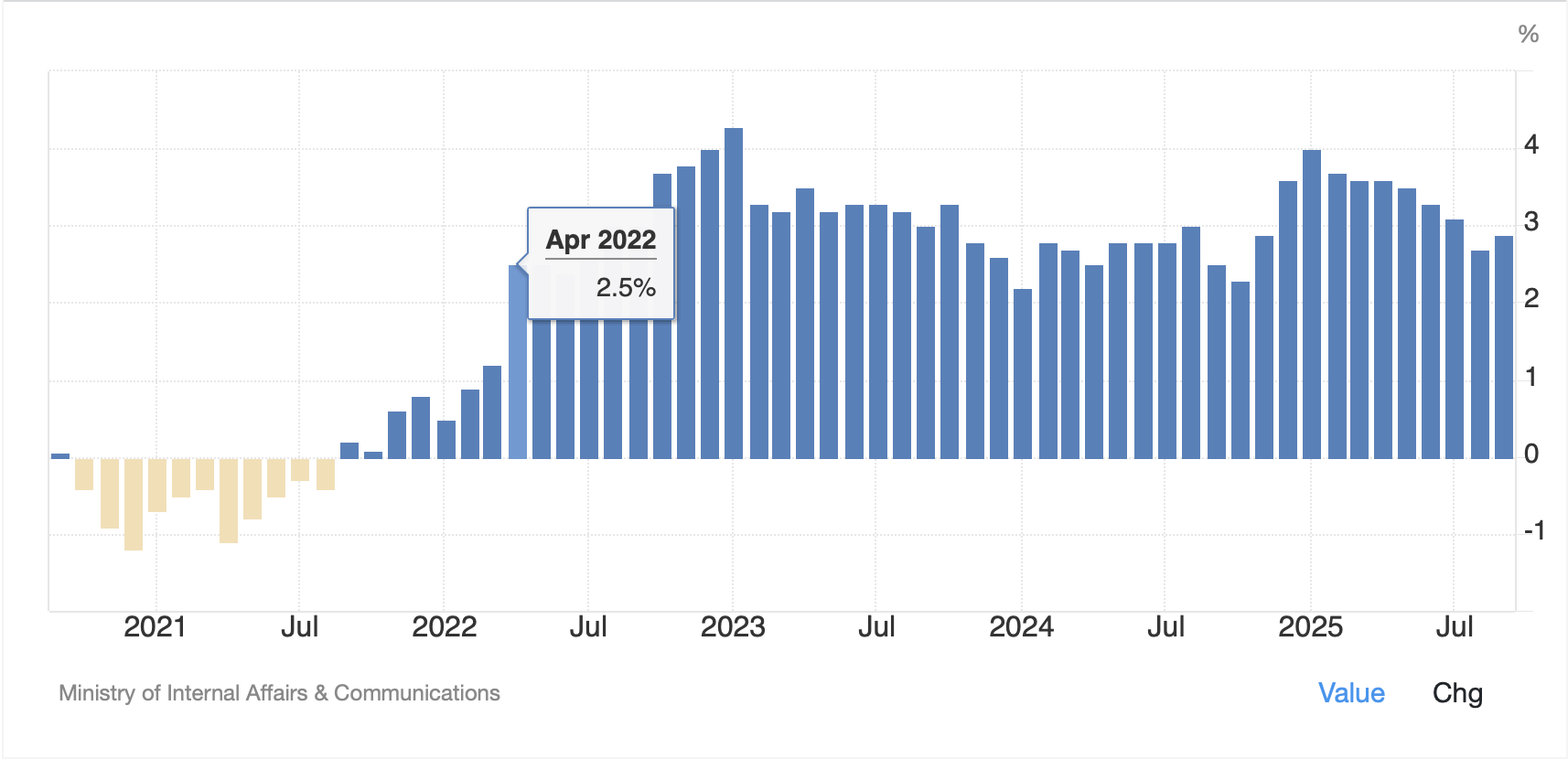
But this is the first step in their typical seven step plan before intervention.  And I get it, the combination of Chairman Powell suddenly sounding hawkish on Wednesday afternoon, telling us a December rate cut was not a foregone conclusion and the BOJ continuing to sit on its hands despite inflation running at 2.9%, the 42nd consecutive month (see below) that it has been above their 2.0% target (sound familiar?), indicates that the current policy stances will likely lead to further dollar strength vs. the yen.  
Source: tradingeconomics.com

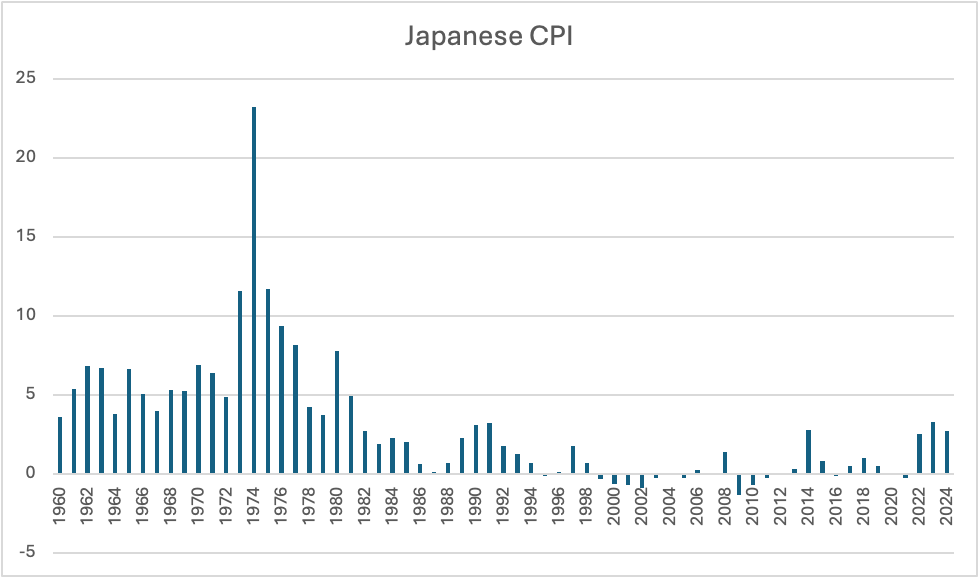
There is something of an irony in the current situation in Japan.  Recall that for years, the Japanese economy was in a major funk, with deflation the norm, not inflation, as government after government issued massive amounts of debt to try to spend their way to growth.  In fact, Shinzo Abe was elected in 2012, his second stint as PM, based on his three arrows plan to reinflate the economy because things were perceived so poorly.  If you look at the chart below, which takes a longer-term view of Japanese inflation, prior to 2022, the two positive spikes between 1992 and 2022 were the result of a hike in the Japanese VAT (they call it the Goods and Services Tax) which raised prices.  In fact, during that 30-year period, the average annual CPI was 0.25%.  And the Japanese government was desperate to raise that inflation rate.  Of course, we know what HL Mencken warned us; be careful what you wish for, you just may get it…good and hard.  I have a sense the Japanese government understands that warning now.
Data source: worldbank.org

Net, it is hard to make a case that the yen is going to reverse course soon.  For receivables/asset hedgers, keep that in mind.  At least the points are in your favor!

So, now that a trade deal’s agreed
Can China reverse from stall speed?
The data last night
Sure gave Xi a fright
More stimulus is what they need!

The other noteworthy macro story was Chinese PMI data coming in weaker than expected with the Manufacturing number falling to 49.0, vs 49.8 last month, with all the subcategories (foreign sales, new orders, employment and selling prices) contracting as well.  The Chinese mercantilist model continues to struggle amid widespread efforts by most developed nations to prevent the Chinese from dumping goods into their own economies via tariffs and restrictions.  The result is that Chinese companies are fighting on price, hence the deflationary situation there as too many goods are chasing not enough demand (money).  

There have been many stories lately about how the Chinese have the upper hand in their negotiations with the US, and several news outlets had stories this morning about how the US got the worst of the deal just agreed between Trump and Xi.  As well, this poet has not been to China for a very long time, so my observations are from afar.  However, things in China do not appear to be going swimmingly.  While there continues to be talk, and hope, that the government there is going to stimulate domestic consumer spending, that has been the story for the past 3 or 4 years and it has yet to occur in any effective manner.  The structural imbalances in China remain problematic as so many people relied upon their real estate investments as their nest egg and the real estate bubble continues to deflate 3 years after the initial shock.  Chinese debt remains extremely high and is growing, and while they certainly produce a lot of stuff, if other nations are reluctant to buy that stuff, that production is not very efficient for economic growth.

Many analysts continue to describe the US-China situation as China is playing chess while the US is playing checkers, implying the Chinese are thinking years ahead.  If that is so, please explain the one-child policy and the decimation of their demographics.  Just sayin.

Ok, let’s look at markets overnight.  While yesterday’s US markets were blah, at best, strong earnings from Amazon and Apple has futures rocking this morning with NASDAQ higher by 1.3% at this hour (7:40).  Those earnings, plus the euphoria over the Trade deal with the US sent Japanese shares (+2.1%) to another new all-time high which dragged along Korea (+0.5%) and New Zealand (+0.6%) but that was all.  The rest of Asia was under pressure as the weak Chinese PMI data weighed on both HK (-1.4%) and mainland (-1.5%) indices and that bled to virtually every other market. Meanwhile, European bourses are all somewhat lower as well, albeit not dramatically so, as the tech euphoria doesn’t really apply here.  So, declines between -0.1% (Spain) and -0.4% (UK) are the order of the day.

In the bond markets, yields have essentially been unchanged since the FOMC response with treasury yields edging 1bp higher this morning, now at 4.10%, while European sovereign yields are either unchanged or 1bp higher.  The ECB was a nothingburger, as expected, and going forward, all eyes will be on the data to see if any stances need change.

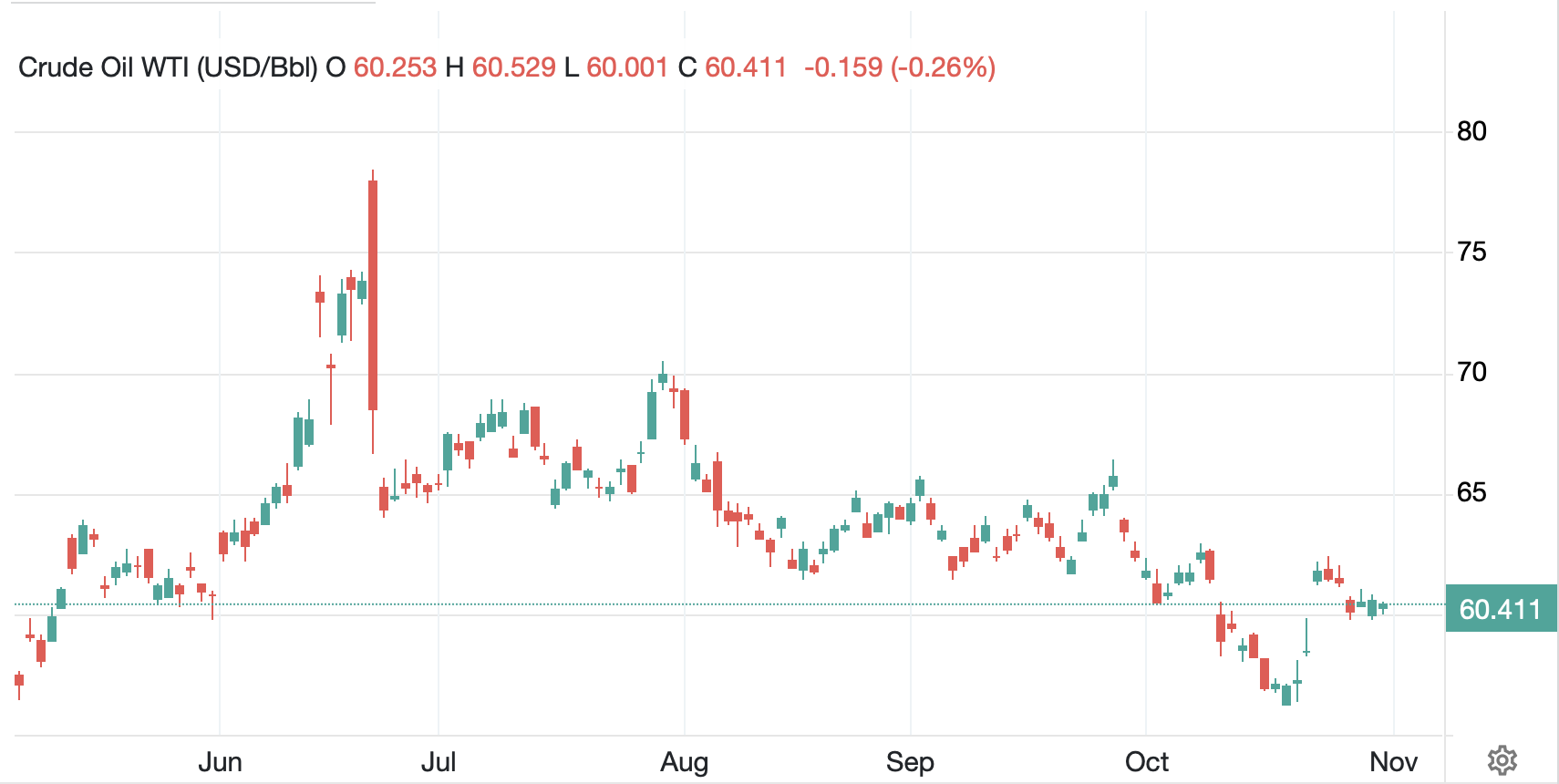
The commodity markets continue to be the place of most excitement with choppiness the rule.  Oil (-0.25%) is a touch softer this morning but continues to hover around the $60/bbl level.  I’m not sure what will get it moving, but right now, neither war nor peace seems to matter.  Regime change in Venezuela maybe?
Source: tradingeconomics.com

In the metals markets, volatility is still the norm with gold (-0.45%) lower this morning after a nice rebound yesterday and currently trading just above $4000/oz.  Silver and copper are unchanged this morning with platinum (-0.9%) following gold.  However, regardless of the recent market chop, the charts for all these metals remain distinctly bullish and the theme of debased fiat currencies is still alive.  Run it hot is still the US playbook, and that is going to support all commodity prices.

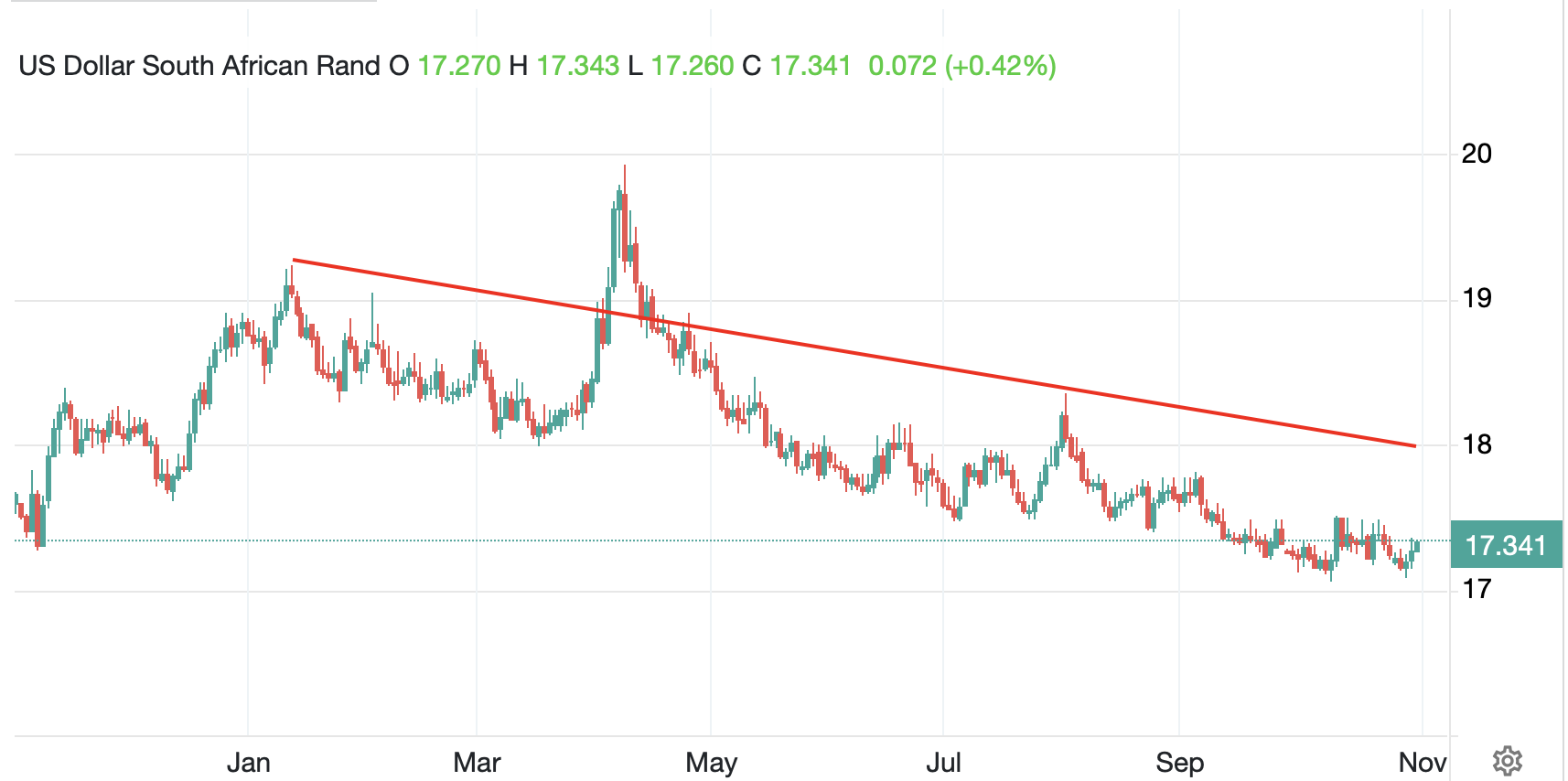
Finally, the dollar, after another step higher yesterday, is little changed this morning.  Both the euro and yen are unchanged and the rest of the G10 has slipped by between -0.1% and -0.2%.  In truth, today’s outlier is ZAR (-0.4%).  Now, let’s look at two ZAR charts, the past year and the long term, which tell very different stories.  In fact, it is important to remember that this is often the case, not merely a rand situation.  First, the past year shows the rand with a strengthening trend as per the below from tradingeconomics.com.  That spike was the response to Liberation Day.
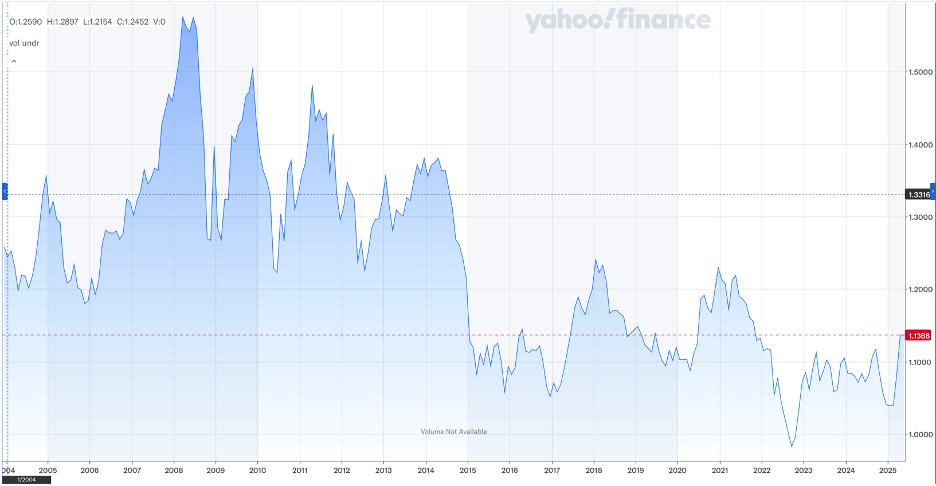
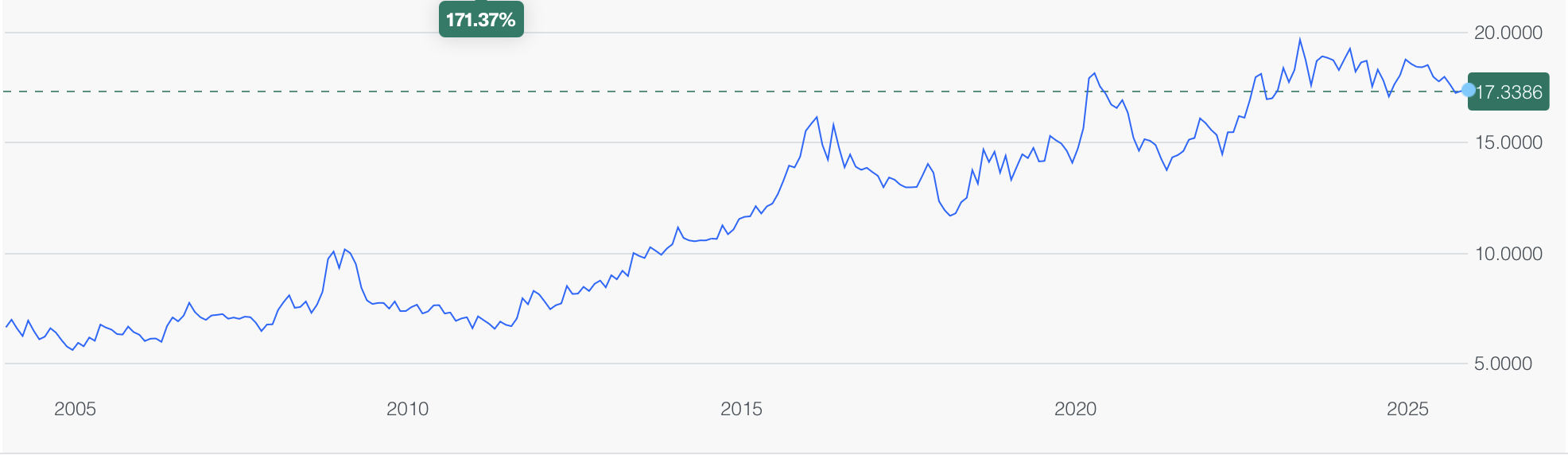
But now, let’s look at a longer-term chart of the rand, showing the past 21 years.
Source: finance.yahoo.com

Like most emerging market currencies, the rand has been steadily depreciating vs. the dollar for decades.  It’s not that we haven’t seen a few periods of modest strength, but always remember that in the big picture, most EMG currency’s slide over time.  This is merely one example, and it is a BRICS currency.  The demise of the dollar remains a long way into the future.

On the data front, Chicago PMI (exp 42.3) is the only release, and we hear from three more Fed speakers.  It appears every FOMC member wants to get their view into the press as quickly as possible since there seem to be so many differing views.  In the end, I continue to think the Fed cuts in December, and nothing has changed.  But for now, there is less certainty as this morning, the probability of a cut is down to 66%.  I guess we’ll see.  But regardless, I still like the dollar for now.

Good luck and good weekend

Adf

No Mean Feat

On Friday, the story was gold
And PMs, which everyone sold
The question now asked
Is, has the peak passed?
Or will it still rise twentyfold?
 
The funny thing, though, is that stocks
While weak coming out of the blocks
Reversed course and rose
Right into the close
T’was like Bessent sold from Ft Knox!
 
(PMs = precious metals)


The world felt like it was ending on Friday as the early price action showed all the asset classes that have been rallying dramatically, notably gold and stocks, falling sharply.  But a funny thing happened on the way to the close.  While gold stopped declining, it had no rebound whatsoever, yet the equity market rallied sharply late in the session to close in positive territory.  The below chart (taken Sunday evening) shows that the two assets tracked each other pretty closely right up until lunchtime Thursday and then diverged sharply.

Source: tradingeconomics.com

While there continues to be an overwhelming amount of news stories that may have an impact, I believe Occam’s Razor would indicate the most likely reason that gold sold off so dramatically, slipping more than 2%, is that the rally had gone parabolic and a series of option expirations on Friday forced some real position changes.  My take is this was some profit taking and despite the decline, the bull market trend remains strong and there is no reason to believe this move is over.  After all, there has been nothing to indicate that inflation is going to be contained, nor that fiscal spending will be significantly cut, and Chairman Powell has pretty much promised another rate cut in 10 days.  Look for the correlation, which regained some vibrancy late Friday, to reassert itself going forward.

However, the activity in the other precious metals cannot be ignored, as gold was the least dramatic.  My friend JJ (Alyosha’s Market Vibes) explained that the story was silver driven as an extremely large number of SLV (the Silver ETF) call options were expiring on Friday and there were many machinations by the market makers to prevent too many from being in the money.  Read his piece above for the details, but I would argue none of these machinations change the underlying precious metals thesis.

Takaichi-san
Seems to have found a partner
History’s waiting

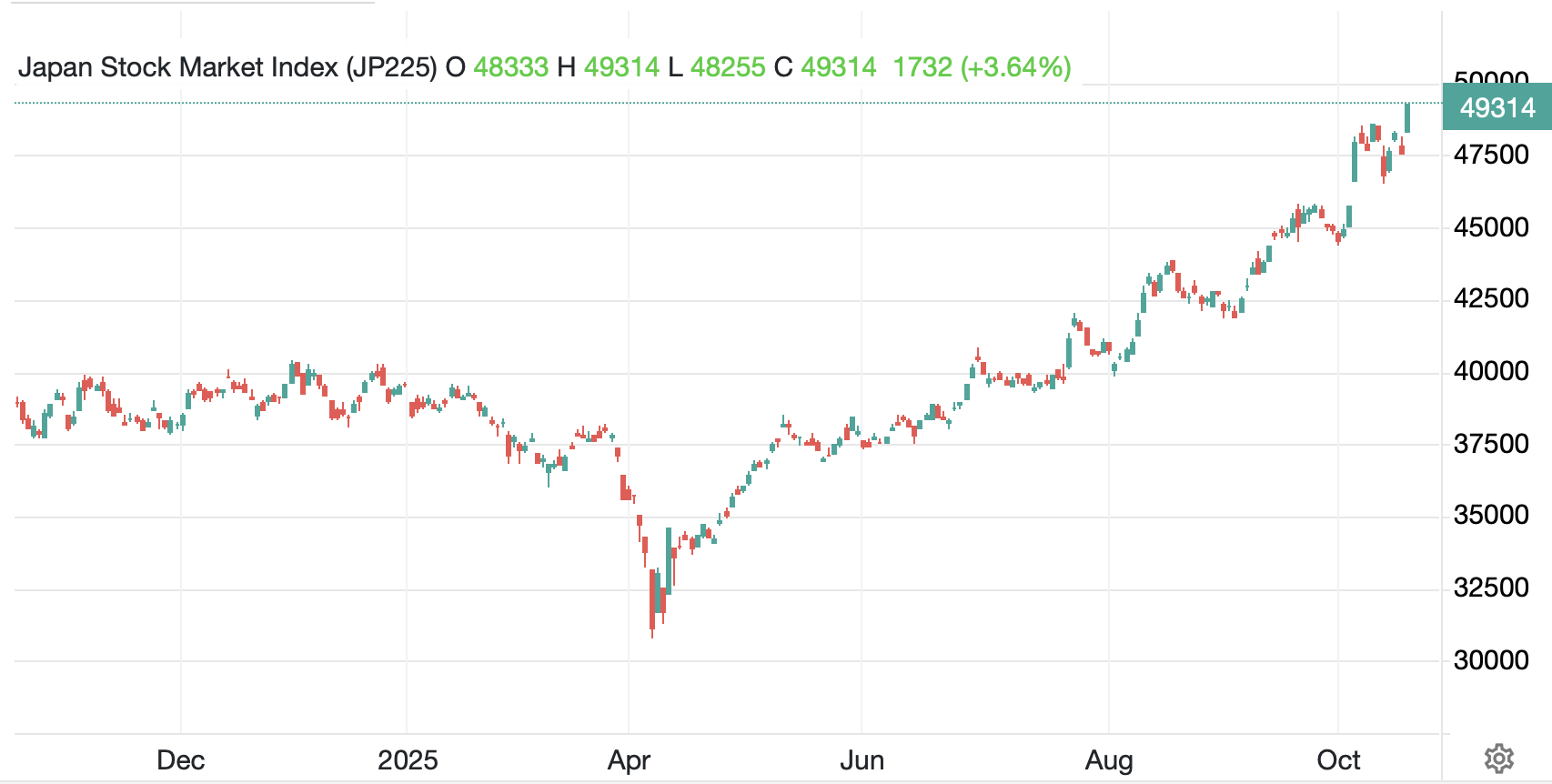
From Japan, the word is that Sanae Takaichi and the LDP have convinced the Japan Innovation Party to join in a governing coalition and that, in fact, Ms Takaichi will become the first female Prime Minister in Japan.  This was seen very favorably by Japanese equity markets with the Nikkei gapping higher on its open overnight and rallying 3.4% on the session.  I guess investors are excited by her run it hot plans, and given a governing majority, she should be able to implement those plans.  I suppose that given run it hot is the global consensus of policymakers right now, we shouldn’t be surprised.  FYI, the rally since the April Liberation Day decline has been just over 60%, but I’m sure there is no bubble here.🙄

Source: tradingeconomics.com

In China, this week Xi will meet
With leaders, and though he won’t Tweet
They’ll conjure a plan
For growth, if they can
Success though, will be no mean feat

Finally, Chinese data was released overnight showing that GDP growth fell to 4.8% Y/Y in Q3 as Retail Sales remain relatively sluggish and Fixed Asset Investment (a euphemism for housing) continues to decline, falling -0.5%.  In fairness, housing prices, though they fell -2.2% across 70 major cities, have seen the rate of decline slow, but as you can see from the chart below, those prices have been falling for 3 ½ years.  it is not surprising that the people there feel less wealthy and correspondingly spend less as housing was sold as their retirement nest egg and represents some 25% of the economy.

Source: tradingeconomics.com

The Fourth Plenum is this week, which is the meeting where Xi and the CCP determine the next five-year plan.  There is much hope that they will focus on supporting domestic consumption, but history has shown that is not their strong suit.  Rather, the economic model they know is mercantilism, and I suspect that will still dominate the process going forward.  However, Chinese shares (CSI 300 +0.5%, HK +2.4%) responded positively to hopes that the US-Chinese trade situation will be ameliorated when President’s Xi and Trump meet next week.  Apparently, Secretary Bessent and Premier Li are due to meet this week as a preliminary to that meeting.

So, with all that in mind, let’s see how things so far unmentioned played out overnight. it should be no surprise that given the rallies in both Japan and China, the rest of the region performed well with Korea (+1.75%), India +(0.5%) and Taiwan (+1.4%) indicative of the price action.  Only Singapore (-0.6%) showed any contrariness although there were no obvious reasons for the move.  In Europe, we have also seen some real positive movement with the DAX (+1.3%) and IBEX (+1.5%) performing quite well on  relief that the US-China, and by extension global, trade situation seemed set to improve.  However, in Paris, the CAC (0.0%) has lagged on news that BNP Paribas has been fined >$20 million on its alleged complicity in Sudan atrocities two decades ago dragging the entire French banking sector down with them.  As to US futures, at this hour (7:10) they are pointing higher by about 0.2%.

In the bond market, yields are unchanged in the Treasury market, with the 10-year sitting at 4.01% while European sovereign yields have edged higher by 1bp, except France (+3bps).  Ostensibly, the story is the reduced trade tensions have investors leaving the ‘haven’ of bonds and getting back into equity markets.  Overnight, JGB yields rose 4bps as the news that Takaichi-san seemed set to become PM has bond investors there a bit nervous given her unfunded spending plans.

In the commodity markets, oil (-1.0%) continues to slide and is now testing the post Liberation Day lows seen in April.  Looking at the chart below, it is hard to get too bullish, and I suspect we will see lower prices going forward for the near term.

Source: tradingeconomics.com

As to the metals markets, gold (+0.2%) is choppy, but clearly has found short-term support after Friday’s decline while silver (-0.25%) and Platinum (-1.0%) are both still under modest pressure, although nothing like Friday’s moves.  If Friday’s story was all about the option expiries in SLV, which is quite viable, I don’t expect much more downside and the underlying bullish thesis is likely to reassert itself.

Finally, nobody seems to care about the FX markets these days.  The dollar has edged slightly higher this morning but as we have consistently seen for the past several weeks, daily movement is on the order 0.1% or 0.2%, and the big picture is the dollar is not a focus right now.   If we use the euro as our proxy, you can see that since June, it has basically been unchanged.  The rally from the first part of the year has ended for now, and I continue to suspect that absent a significant dovish turn by the Fed, it is likely over.

Source: tradingeconomics.com

On the data front, with the government still shut down, the only data point we will see is CPI on Friday (exp +0.4%, 3.1% Headline; +0.3%, 3.1% Core).  As well, the Fed is in their quiet period so we won’t have any distractions there.  That means that FX markets will be beholden to risk moves and trade comments, but for now, I don’t see much movement on the horizon.

Good luck

Adf

White House Bingo

At this point, investors don’t care
‘Bout tariffs and if they are there
The hype train is rolling
With pundits extolling
Nvidia’s four trillion share
 
So, Canada’s out in the cold
As Loonies, this morning, are sold
But energy’s boring
When folks are adoring
AI or, if bankers, then gold


The tariff machine has been switched back on with yesterday’s announcement that the US will now apply 35% tariffs to all imports from Canada that do not comply with the USMCA.  These tariffs are due to go into effect on August 1st.  It appears this is an effort by Mr Trump to push the progress of trade talks forward as they are not moving at a pace with which he is satisfied.  The Canadian response, by PM Carney, was to indicate they will redouble their efforts to get things done on a timely basis.

I understand that there are many who dislike the President’s bullying tactics as they are completely different than any previous president (or world leader really) and fall far afield from what had been previously accepted and expected in “polite” society.  Diplomats are horrified that he is forcing decisions to be made, something that has been anathema to the diplomatic community since the beginning of time.  But Mr Trump has his agenda firmly in mind and is very keen to use all the power he can to achieve it.  It turns out, the US has a great deal of power beyond its military might.

But for our purposes, the market response is the place we need to look.  First, it can be no surprise that the Canadian dollar quickly declined -0.5% on the announcement as that is the textbook response to tariffs, the country affected sees their currency weaken.  As to equity markets, as there are no TSX futures, we cannot tell exactly how stocks in Canada will be impacted but based on the fact that virtually every market is lower this morning, I expect to see weakness there as well.  in fact, a look at this listing of equity futures markets from 6:30 this morning shows exactly what is happening.  You will note that the Toronto market still reflects yesterday, but pretty much every other nation is feeling the heat of a new potential wave of tariffs from the US.

Source: tradingeconomics.com

I continue to read that European nations are getting closer to agreeing a deal with the US, something that has never occurred before and I suspect that there are a number of leaders in the EU that are growing nervous about the situation.  Again, the world was not anticipating the US to wield its power in such a brash and open manner, and many governing theories still need to be rewritten to address the new reality.

But yesterday’s story was all about Nvidia becoming the first $4 trillion market cap company, a remarkable achievement.  It seems Nvidia’s market cap is greater than the entire German stock market.  

For the longest time, I was convinced that the market concentration of the Mag7, which now account for just over 34% of the S&P 500, would ultimately lead to their demise and a major correction.  However, it is becoming harder to make the case that concentration alone is going to be the problem.  

Rather, I believe any correction will now come from a broader economic result, arguably the long forecast recession when it finally arrives.  If you recall, on Sunday I wrote about how the relative gain in corporate profits vs. labor has been a key driver in the bifurcation in the country.  I also strongly believe that President Trump is very serious about changing that situation.  The obvious solution is to reduce corporate profits.  One way to do that is to impose tariffs where companies wind up reducing their margins to maintain sales volumes. If inflation does not rise (and it has not done so yet) that is a step in the President’s direction of choice.  I have no idea whether this will work, and arguably neither does anybody else.  Virtually, every economic model is no longer viable as Mr Trump has changed the rules so completely that the underlying assumptions are almost certainly incorrect.  But remember this chart, if by the end of his term in 2028, the two lines have begun to converge more clearly, he will have changed a multi-decade trend and likely to the detriment of equity markets.

Ok, enough philosophizing, let’s see how other markets beyond equities have behaved overnight.  Bond markets have been under modest pressure with Treasury yields ticking higher by 3bps and all European sovereign yields higher by 1bp this morning.  We heard from Bundesbank, and ECB, member Isabel Schnabel that it was unlikely there would be further rate cuts from the ECB absent a major decline in Eurozone growth. Inflation has returned to their target, and she indicated her belief that current rates there were modestly accommodative, i.e. below neutral.  JGB yields have returned to 1.5% after having spent the past month below that level.  

Recall back in March and April when yields in Japan moved higher quite quickly with the 10yr touching 1.6% and the longer bonds trading above 3.0% to new all-time highs.   That panic subsided but it appears that yields are on the move again as the BOJ discusses selling its equity ETF’s in an effort to reduce their balance sheet further.  Interestingly, the yen (-0.4%) is under pressure this morning and trading back above 147 for the first time in two months.  Here’s what we know about the yen; the carry trade is still in place in significant amounts, inflation is running hot, and the BOJ clearly is uncomfortable raising rates further to address that situation.  My sense is that the yen could have further to weaken, especially if tariffs on Japanese exports are increased as per the recent letter from Mr Trump.  

Continuing with currencies, the dollar is having a good day all around, with only CNY (+0.15%) bucking the trend.  The pound (-0.45%) is under pressure after weaker than expected May GDP figures were released this morning (-0.1% vs. +0.1% expected).  We’re also seeing weakness in MXN (-0.5%) and ZAR (-0.7%) even though precious metals prices are rising this morning.  Here, too, we must keep in mind that many of the old relationships have broken down.

Finally, in the commodity space, gold (+0.65%) is back at its pivot level, taking silver (+1.4%) and platinum (+1.9%) along for the ride although copper (-2.2%) remains subject to the vagaries of exactly what those mooted 50% tariffs are going to cover.  Oil (+1.0%) which sold off yesterday after news that Saudi Arabia had been producing more than its OPEC quota, is rebounding this morning with all eyes on President Trump’s upcoming announcement regarding potential sanctions on Russia given President Putin’s unwillingness to talk peace.

And that’s all there is.  There is neither data nor scheduled Fed speakers on the calendar today, so we all await the next pronouncement from the White House.  Word is that Presidents Trump and Xi will soon be sitting down for a discussion with the opportunity to get more clarity on that situation a potential outcome.  However, White House bingo remains the game of the day, and my card has not been a winner lately.  How about yours?

Good luck and good weekend

Adf

The Future As Fraught

Though I’ve been away near a week
From what I read things are still bleak
Two months have gone by
Since stocks touched the sky
And traders all want a new peak
 
Meanwhile, GDP fell ‘neath nought
And lots see the future as fraught
The popular claim
Is Trump is to blame
And rue all the things he has wrought


I worked hard not to pay close attention to markets while I was away last week in an effort to get some true relaxation.  And now that I’m back at my desk, I can see that I didn’t miss anything at all.  The narratives remain the same, the split between those who believe everything the president says/does is a disaster and those who believe everything he says/does is brilliant has not changed at all.  In other words, life continues as do all the arguments.

A review of the data last week showed two key outcomes, the labor market remains far more resilient than the recessionistas will accept and jobs continue to be created.  For some reason, that seems like good news to me, but then I am not a highly paid economist with a narrative to stoke.  On the other hand, Q1 GDP printed at -0.3%, the first negative print in 3 years, but also one that is easily explained by the rush of imports that occurred prior to the imposition of tariffs in early April.  Remember, imports subtract from Gross DomesticProduct.  However, a look under the hood of this number shows that the positive news was government activity declined while private sector investment exploded higher.  It strikes me that this is the best possible direction for the US economy going forward.

In China, it seems Xi’s decided
That data has been too one-sided
So, henceforth they’ll furnish
Just data to burnish
The views Xi and friends have provided

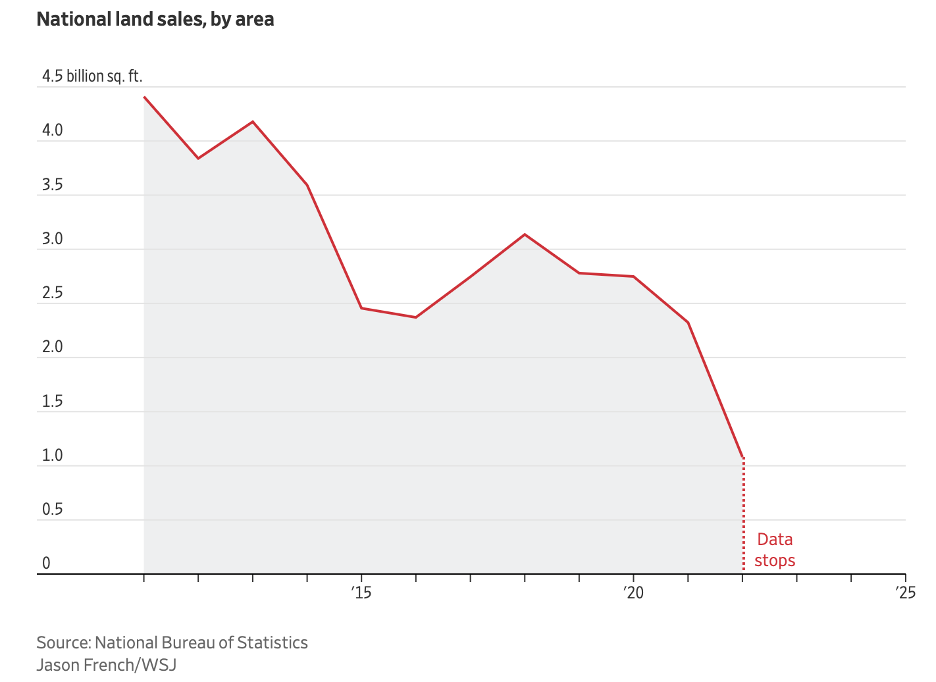
Turning to the more recent stories, though, the WSJ had a very interesting take on the fact that China’s statistical output is shrinking quite rapidly as data that has been trending lower suddenly stops being produced.  The below chart from the article on National Land Sales is an excellent depiction of things, and likely an indication that land sales, which are critical to local government finances, have become even a bigger problem over the past three years than when the property market first started melting down in early 2021.

It is worth noting that in this trade war between the US and China, while much of the punditry continues to insist that China has the upper hand as the stuff they sell to the US is more critical and less replaceable than the stuff the US sells to them, I have maintained things are not necessarily that easy.  The US is facing a supply shock, and will need time to work it through, but the US economy is the most dynamic in the world, and these issues will be resolved.  China faces a demand shock, which in economic theory should be easier to address, but which in China’s reality has not proven to be the case.  Consider that Xi and the CCP have been creating fiscal stimulus plans since Covid without any serious success.  In fact, the Chinese have openly stated that they are seeking to shift the production/consumption mix of the nation closer to Western standards of 60%-70% consumption from their current 45%-50% level.  It hasn’t worked yet, and I see no reason to believe that is going to change.  We must never forget the US is the consumer of last resort, and if China doesn’t have access to this market, it is a major problem for them.

I have no inside knowledge of how things are evolving on this issue, but here’s my take; while Xi doesn’t need to worry about being elected, he still needs to ensure that China’s economy grows sufficiently to increase the well-being of his population.  Whatever the official statistics have shown, it is clear that things in China are not what they would have the rest of the world believe and that is a problem for Xi.  Meanwhile, Trump will not face another election and was elected with a pretty broad mandate.  I believe given the timing of the mid-term elections, he has another 9-12 months to get things done and will play hardball with China to do so.  In fact, I have a feeling that Trump may have the upper hand.  This will be settled by the autumn is my view.

Ok, let’s turn to markets and what happened in the overnight session.  Looking first at currencies for a change, I couldn’t help but notice the following chart.

Source: tradingeconomics.com

I also couldn’t help but notice the following comment from the Taiwanese central bank in response to a question about whether the FX rate is on the table in the trade negotiations.  (As an aside, @PIQSuite is an excellent follow on X.  Key market headlines on a real-time basis with other things available as well.)

The question of whether FX rates would be part of the trade talks seems to have been answered, and the answer is yes.  Perhaps there will not need to be a Mar-a-Lago accord after all regarding revaluing gold and terming out bonds.  Instead, the pressures will be relieved on a country-by-country basis with each trade deal.  

While the TWD revaluation of 10% over the past 2 sessions is the most dramatic, the dollar is generally lower this morning against both G10 and EMG currencies.  In the G10, AUD (+0.85%) leads the way but JPY (+0.7%), NOK (+0.6%) and CHF (+0.5%) are all pushing higher.  This must be music to President Trump’s ears.  As to the emerging markets, KRW (+2.5%), is the next biggest mover although they admitted that FX rates were part of the trade discussions.  SGD (+0.8%) has also seen a relatively large move and INR (+0.4%) is moving in that direction.  It seems clear that Asia is the focus of both the administration and the markets this morning.  The rest of the EMG bloc has seen much smaller gains, between +0.25% and +0.5%, with CNY (+0.15%) really doing very little.

Turning to the equity markets, last week clearly finished on a strong note and, in fact, since I last wrote, the S&P 500 has rallied a bit more than 2% and is higher by more than 14% since April 8th.  Apparently, the world has not yet ended, but there hasn’t been a new high in the stock market in more than 3 months, and people are edgy!  As to the overnight session, the Nikkei (+1.0%) rallied along with the Hang Seng (+1.75%) although Mainland shares (CSI 300 -0.1%) showed little life.  Elsewhere in the region, Taiwan (-1.25%) and Australia (-1.0%) felt the most pressure and the rest were mixed with much smaller movements.  In Europe, indices are mixed as earnings data from each country are the drivers amid a lack of broad-based news.  So, the UK (+1.2%) and Germany (+0.6%) are firmer while France (-0.6%) is lagging on the back of some weaker earnings numbers.  As to the US, futures are pointing lower by about -0.7% across the board at this hour (7:15).

In the bond market, last week saw Treasury yields jump sharply after the better-than-expected payroll report, finishing the day 9bps higher, although still within the middle of the trading range since February and lower on the year.  This morning, they are basically unchanged while European sovereign yields have slipped by about -2bps across the board. The picture there continues to focus on the uptick in fiscal spending that is expected and the borrowing that will be needed to pay for it.  However, there is still a strong view that the ECB will be cutting rates going forward.

Lastly, in the commodity markets, oil (-1.15%) is sliding again as OPEC+ has promised to continue to increase production.  There are two takes on this activity, both of which probably have some truth.  First is the idea that President Trump has made a deal with MBS in Saudi Arabia to increase production and drive prices lower. Remember, lower energy prices are a boon to the US (and the world).  But added to that is the idea that MBS agreed so he can help force fracking production to pull back and regain market share for OPEC+.  However, regardless of the rationale, nothing has changed my view that oil prices are heading lower, and I still like the $50/bbl level as a target.  As to the metals, gold (+2.3%) which has been under pressure for several weeks in a correction, seems to have found support below $3300/oz and could well be setting up for another leg higher. This has taken silver (+1.3%) and copper (+.8%) along for the ride.  If the dollar is going to continue lower, metals prices should remain quite firm.

On the data front, today only brings ISM Services (exp 50.6), but really, all eyes will be on the FOMC meeting on Wednesday.  I will highlight the rest of the week’s data tomorrow morning.

The past month has seen significant volatility in markets as participants did not correctly estimate the potential moves in trade policy.  At this point, it seems those questions are being answered, with President Trump even hinting some deals could be finalized this week.  I believe we are going to see trade announcements that include new FX goals, and they will be pushing the dollar lower across the board.  While I don’t see a collapse coming, that is the trend for now.

Good luck

Adf

The Tariff Explosion

In China, Xi’s ‘conomy grew
Quite nicely, but now in Q2
The tariff explosion
Ought lead to erosion
Of growth, lest we see a breakthrough


Chinese economic data was released last night, and the numbers were far better than expected, well most of them were.  The below table from tradingecoomics.com highlights the big numbers showing strength in GDP, IP and Retail Sales although Capacity Utilization was soft.

But this is Q1 data, and pretty early at that, just two weeks past the end of the quarter.  As well it reflected activity prior to the tariffs imposed by President Trump, and subsequently the Chinese themselves.  Just as we saw massive increases in the trade deficit here, as companies were front-running the tariff threat, I imagine we saw a lot more activity brought forward by the Chinese to both satisfy that front-running, as well as some front-running of their own.  I guess the question to ask is, how much information does this data provide regarding potential future outcomes and I suspect the answer is, not much.  

Already we are seeing global economists reducing their forecasts for Chinese annual GDP growth this year, with the lowest number I have seen at 3.5% (Goldman).  That is far below the ‘about 5%’ that President Xi targeted back in February and clearly assumes tariffs will remain in place.  And perhaps that is the biggest unknown.  The current state of play between Trump and Xi is that Trump said, call me, maybe and we can talk while Xi has said, show some respect and we can talk.

At this point, it is all theater, with both men playing to their bases and trying to show strength.  I do believe that Trump is seeking to isolate China, but the ultimate end game may well be to get them to alter their behavior.  If history is any guide, I imagine that this won’t be settled quickly, but that by summer, both sides will be feeling the heat on the economy.  Alas, that’s a long time from now and there is ample opportunity for significant market gyrations between now and then.

Like Fujiyama
Successful trade talks will be
A beautiful thing

On the other side of the tariff sheet is Japan, which is priority number one for the US.  PM Ishiba has sent his chief trade negotiator, Ryosei Akazawa, to the US to sit down with Treasury Secretary Bessent who has been named the lead in these negotiations.  While there is much discussion on autos, another very sticky subject is rice, on which Japan imposes a very high tariff.  President Trump claims it is 700%, others say less, more like 400%, but whatever it is, clearly the Japanese are protecting their rice farmers.  Ironically, Japan is in the middle of a rice shortage and has been pulling from strategic stockpiles to prevent prices there from rising too sharply.  Meanwhile, the US has ample export capacity.  It seems like a win-win opportunity, but politics is convoluted and from what I have read, the Japanese farmers don’t want to cede any market share to imports.  

Nonetheless, I expect that this will be a successful outcome as it is too important to fail.  While President Trump continues his bluster, he needs a win economically, and if Japanese talks are successful, we will see many more versions completed within the 90-day period in my view.  Things won’t go back to the way they were before Liberation Day, but if trade questions are answered, all eyes will turn to the budget, which is going to be a different kind of messy.  As I have written before, the greatest potential irony from this tariff war is that we could see lower tariffs around the world, something that all that WTO hobknobbing could never obtain.

One other mooted issue between the US and Japan is the exchange rate, which, while the yen has strengthened more than 10% since its low (dollar high) back just before the inauguration, remains far above levels seen before the Covid inspired inflation resulted in the Fed tightening policy aggressively.  The chart below is quite clear in displaying just how weak, relative to the past 30 years of history, the yen remains.  That last little dip is the move so far this year.

Of course, given the yen’s most recent bout of weakness dates from 2022, when US interest rates started to climb, if Treasury Secretary Bessent is successful in getting rates lower, that will be a natural driver of a weaker dollar, stronger yen.  Especially if Ueda-san does tighten policy further.

We have much to anticipate as the year progresses.  Ok, let’s turn to the overnight session and see what’s happening.  Yesterday’s lackluster US equity performance was followed by a terrible earnings discussion for Nvidia and much more extended weakness in Asia.  The Nikkei (-1.0%) and Hang Seng (-1.9%) fell sharply as did Korea (-1.2%) and Taiwan (-2.0%).  China (+0.3%), however, bucked the trend likely on the support of the plunge protection team there buying to prevent a rout.  Certainly, the positive data didn’t hurt, but I doubt that was enough.  In Europe, screens are all red as well, with declines on the order of -0.3% (UK and Spain) to -0.6% (Germany and France).  It is, however, universal with every market there declining.  As to US futures, while the DJIA is unchanged, both the NASDAQ and SPX are down sharply on that Nvidia news.

In the bond market, yields have been edging lower despite (because of?) all the tariff anxiety.  While Treasuries are unchanged this morning, they drifted off 3bps yesterday.  European sovereign yields are all lower by -2bps to -3bps and the big news was JGB yields tumbling -10bps last night.  There continues to be a great deal of discussion about China using its Treasury holdings as a weapon, but I find that highly unlikely.  Unless they could literally find a bid for all of them at once, to prevent further losses, it would self-inflict too much damage.  My take is they are essentially performing their own version of QT, allowing Treasuries to mature and slowly replacing them with other things, Bunds, gold, oil, copper.  One of the biggest problems is there are precious few asset classes that are large enough to absorb all that money, so they will continue to hold Treasuries in some relatively large amount, probably forever.

Turning to commodities, oil (+1.0%) continues to trade quietly and hang around just above $60/bbl.  It feels to me like there is a lot more room on the downside than the upside, but that is just me.  In the metals markets, gold (+1.5%) is glittering again, making yet another new all-time high this morning.  Remember a week ago when the market was correcting and there was discussion about gold losing its luster?  Me neither!

Source: tradingeconomics.com

This chart is a perfect example of the idea that nothing goes up in a straight line.  But the trend here is strong.  Silver (+1.6%) is following in gold’s footsteps today but copper (-0.4%) is lagging.  No matter, I continue to think commodities have more strength ahead.

One of the reasons is that the dollar remains under pressure.  Last night, further weakness was manifest with the euro trading back close to the highs touched on Friday at the 1.14 level.  Prior to Friday, the last time the euro was here was in February 2022.  But again, like the yen chart above, the euro’s strength is a very recent, short-term phenomenon.  A look at the chart below demonstrates just how “weak” the dollar is vs. the single currency on a long-term basis.  The answer is not very.

But overall, the dollar is weaker this morning across the board against both G10 and EMG currencies.  I do agree with the idea that foreign investors have been liquidating their US equity holdings slowly and repatriating the funds home.  If that continues, and it could, a continued decline in the dollar, especially if US yields slide, is likely.

On the data front, Retail Sales (exp 1.3%, 0.3% ex-autos) is the headliner at 8:30 then IP (-0.2%) and Capacity Utilization (78.0%) at 9:15.  We also hear from the BOC, although they are expected to leave their base rate on hold at 2.75%.  EIA oil inventory data is due later this morning with a decent sized draw of more than 5mm barrels across products expected.  There are Fed speakers including Chair Powell at 1:30 this afternoon, but they have just not had much sway lately, and I think they are ok with that.

Putting it all together, at least in the FX framework, my take is the dollar has further to fall.  There is no collapse coming, but steady weakness seems realistic.  However, given the overall uncertainty at the current time, I would be maintaining hedges rather than anticipating that weak dollar.

Good luck

Adf

Aren’t Just Rumors

Give plaudits to President Xi
Who’s trying to show it is he
That’s offering deals
To help grease the wheels
Of trade, which he claims will be free
 
The problem is Chinese consumers
Have not been in very good humors
And history shows
The Chinese impose
Restrictions that are aren’t just rumors


Market activity can well be described as lackluster, with equity indices generally slipping lower while bond markets wobble and the dollar retraces some of its recent losses.  In fact, the only markets really showing a trend right now are gold (+0.4%), silver (-0.1%) and copper (-0.2%), all of which have rallied sharply over the past month and year.  Obviously, the major discussion point is President Trump’s tariff policy and how that will impact economies around the world.  Recent focus has been on how other nations will respond with a variety of poses taken by different leaders, from conciliatory to combative.

So, it is with great interest that we see another impact of the Trump administration, the sight of China’s communist party leader, Xi Jinping, trying to convince foreign company CEO’s that investing in China is a good deal.  A lead article in Bloomberg this morning describes a large gathering in China where President Xi hosted CEO’s of numerous companies from around the world in an effort to portray China’s policies as investment friendly.

This makes sense given the trend in foreign direct investment toward China over the past years.  As can be seen in the chart below from the Bloomberg article, it has not been a pretty sight.  And remember, this all occurred before President Trump was elected.  Clearly, there were concerns prior to Mr Trump escalating the trade conflicts with the US.  

I find it somewhat ironic, though, that Xi is trying to promote Chinese policy as an island of stability in the world.  Consider how he has capriciously destroyed the private education market, or even the tech market until reversing course after the DeepSeek announcement, all while the housing market continues to implode.  Given the rest of the world has lost patience with China’s mercantilist policies and the flood of cheap goods they produce with government support, I am at a loss to understand the appeal of investing in China.  Using it as an export base is a nonstarter, and history has shown that nearly every foreign company that looked at China’s population as a great untapped market for their products has been hugely disappointed.  The exceptions are the luxury goods makers, where the global brand and cachet were too strong for domestic competitors to overcome.  But that is a small segment of the market.  

Instead, the usual outcome is forced technology transfer which results in a state-supported competitor for their products around the rest of the world.  I am confident there will be companies that choose to invest, if for no other reason than to curry favor with Xi and open the doors to further potential sales, but the trend of late is not promising.  Ultimately, property laws and their enforcement are the keystone for inward investment into any nation and China has no history of treating foreign companies fairly, or domestic ones for that matter.

But really, the flow of direct market news and economic data has been secondary with far more political news leading conversations.  The impact of tariffs on economic activity and inflation, as well as on market performance remains unclear with arguments being made on both sides as to potential benefits or detriments.  FWIW, which is probably not much, my take is the impacts will be very unevenly spread, and how that impacts broad based numbers is unknowable at this time.  I fear we will all need to be reactive for now, although for those with outstanding exposures, there is no better argument for maintaining robust hedge ratios given the overall uncertainty.

Ok, let’s take a look at the overnight action in markets.  After yesterday’s US declines, we saw much of Asia follow suit with Tokyo (-1.8%) particularly hard hit as PM Ishiba thought that he was making headway with President Trump but found out that Japanese auto manufacturers were going to be subject to those tariffs as well.  Adding to the pressure were the “Minutes” from the last BOJ meeting which implied further rate hikes are on the horizon. Both Hong Kong (-0.65%) and China (-0.45%) also slipped and, in fact, almost every major market in Asia (Korea, India, Taiwan, Malaysia, Singapore and Thailand) also fell, some quite sharply.  Apparently, Xi’s efforts at creating that stability haven’t yet been successful.  

In Europe, red is also the dominant color with most continental bourses lower by around -0.6%, also on the tariff story.  The one exception here is the UK, which released a passel of data showing growth was modestly firmer than expected at 1.5% led by Retail Sales growing 1.0%, rather than declining by -0.3% as expected.  As to US futures, at this hour (7:15) they are pointing slightly lower, about -0.2%.

In the bond market, yields are backing off around the world with Treasuries (-3bps) lagging European price action where sovereigns have seen yields decline between -4bps and -6bps.  Even JGB yields have slipped -4bps.  In Europe, inflation data from France and Spain came in softer than expected which has encouraged the move there, and we even heard arch ECB hawk, Robert Holzmann, explain that funding defense spending via bond purchases (i.e. QE) was viable.

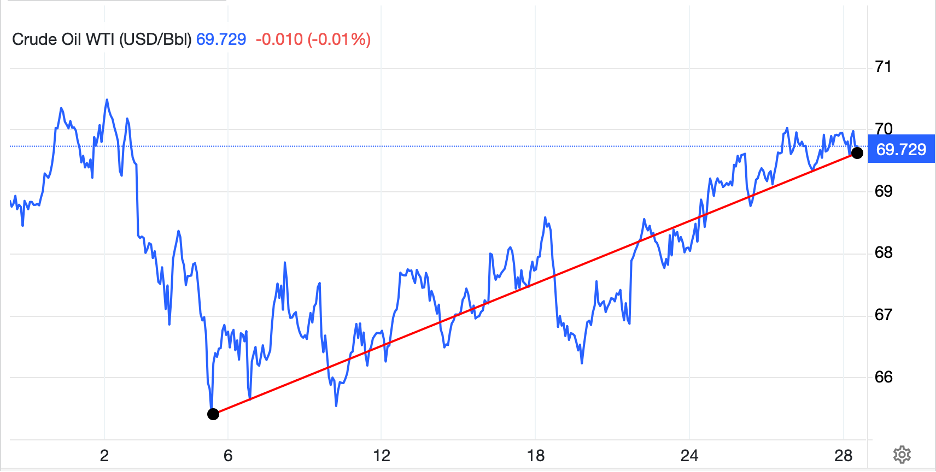
In the commodity markets, oil (-0.2%) which rallied yesterday to touch the elusive $70/bbl level is slipping back a bit, but the trend remains clearly higher as per the below.

Source: tradingeconomics.com

Finally, in the currency markets, the dollar is firmer once again with modest rallies vs. the euro (-0.3%) and pound (-0.2%) as well as strength against the Scandies (SEK -0.6%, NOK -0.3%).  However, the picture in the EMG bloc is more mixed with ZAR (+0.35%) showing strength alongside gold’s rally, and INR (+0.2%) bucking the trend after having agreed to reduce tariffs on US products.  Throughout the rest of the bloc, there has been generally little change.

Turning to the data this morning, there is plenty that will be keenly watched.  Personal Income (exp 0.4%), Personal Spending (0.5%) and the PCE data (headline 0.3%, 2.5% Y/Y and core 0.3%, 2.7% Y/Y) all get released at 8:30.  Then at 10:00 we see Michigan Sentiment (57.9) and you can be sure people will be talking about the Inflation Expectations piece (1yr 4.9%, 5yr 3.9%), especially if it syncs with their narrative.  There are two more Fed speakers, Governor Barr and Atlanta Fed president Bostic, but nothing any Fed speaker has uttered has mattered at all, maybe since Trump was inaugurated.

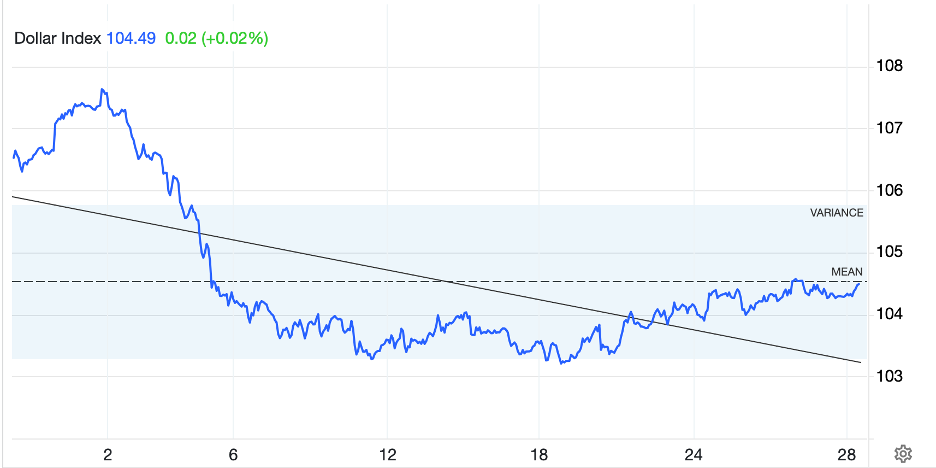
My read on overall sentiment is that investors are wary of the future, but not yet ready to abandon the stocks only go up narrative.  Regarding the dollar, the recent trend remains modestly lower, as per the below, but it is hard to get excited about large moves, at least for today.  Again, Trump clearly wants it lower and seems likely to get his way, at least to some extent.  The one thing I truly do like is commodities, which I believe will remain well bid overall.

Source: tradingeconomics.com

Good luck and good weekend

Adf

Quite Clearly Concerned

The data on Friday exceeded
All forecasts, and has now impeded
The idea the Fed
When looking ahead
Believes further rate cuts are needed
 
Meanwhile from the Chinese we learned
Their exports are still widely yearned
But imports are falling
As growth there is stalling
And Xi is quite clearly concerned


Under the rubric, even a blind squirrel finds an acorn occasionally, my prognostications on Friday morning turned out to be correct as the NFP number was much stronger than expected, the Unemployment Rate fell, and signs of labor market strength were everywhere.  One of the most interesting is the number of quits rose to 13.8%, its highest level in several years and an indication that there is growing confidence amongst the labor force that jobs are available if needed.  As well, as you all are certainly aware, the market responded by selling equities and bonds while reducing the probability of Fed rate cuts this year.  In fact, this morning, the market is pricing in just 24 basis points of cuts for all of 2025, in other words, one cut only.  

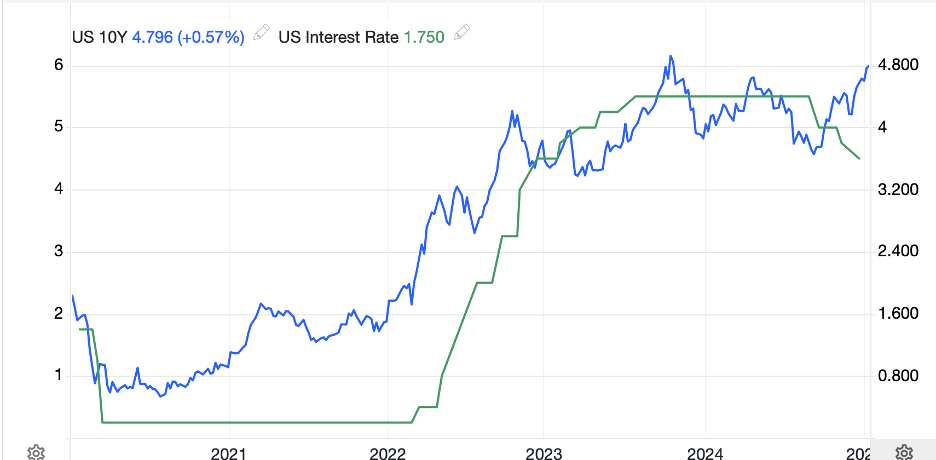
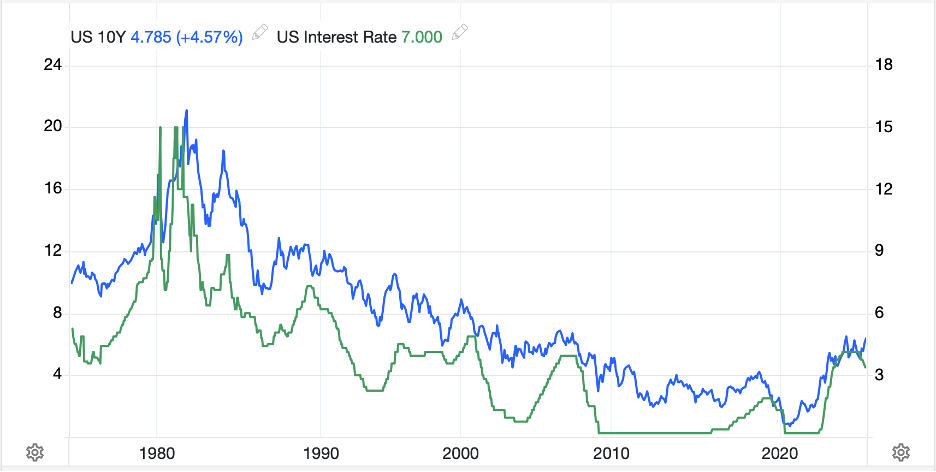
Meanwhile, the bond market continues to sell off with yields rising another 2bps this morning.  the chart below shows the dichotomy between Fed funds and 10-year Treasury yields.  Historically, when the Fed was cutting or raising rates, the bond market followed.  But not this time.

Source: tradingeconomics.com

There have been many explanations put forth by analysts as to why this is the case, but to me, the most compelling is that investors disagree with the Fed’s analysis of the economy and, more specifically, with their pollyannaish tone that inflation is going to magically return to 2% because their models say so.  In fact, when looking back over the past 50-years of data, this is the only time that I can see when this dichotomy even existed.

Source: tradingeconomics.com

If I had to guess, there is going to be a lot more volatility coming as previous market signals, and more importantly, Fed market tools, no longer seem to be working as desired.  Nothing has changed my view that 10-year yields head to 5.5%, and if I am correct, look for equity markets to suffer, perhaps quite a bit.

The other story of note overnight was the Chinese trade surplus, which expanded to $104.8 billion in December which took the 2024 surplus to $1.08 trillion.  Now, much of this seems to be preordering of Chinese goods ahead of Trump’s inauguration and the promised tariffs.  But China’s surplus with other Asian economies also grew dramatically last year.  Remember, President Xi is desperate to achieve 5% growth (even on their accounting) and since the Chinese public remains unenthusiastic about spending any money given the $10 trillion hole in their collective savings accounts due to the property market collapse, Xi is reliant on exporting as much as possible.  While this is not making him any friends anywhere else in the world, it is an existential issue for him, so he doesn’t really care.  It will be very interesting to see just how the Trump-Xi relationship moves forward and what concessions are made on either side.

In the end, while the renminbi is basically unchanged this morning, it remains pegged against its 2% limit vs. the CFETS fixing onshore and is 2.35% weaker in the offshore market.  That pressure is going to continue until either the Chinese step up, apply significant stimulus to the domestic economy and start to rebalance the trade process or the PBOC lets the currency go.  Remember, too, Xi is in a tough position because he continuously explained that the renminbi is a good store of value and has been asking his trading partners to use it rather than the dollar.  But if he lets it slide, that will destroy that entire narrative, a real loss of face at the very least, and potentially a much bigger economic problem.  Interesting times.

And so, let us turn to the overnight market activity and see how things are shaping up for today and the rest of the week.  Friday’s sharp decline in US equity indices was followed by similar price action throughout Asia (Nikkei -1.05%, Hang Seng -1.0%, CSI 300 -0.3%, Australia -1.25%) as the narrative is struggling to come up with a positive spin absent further US rate cuts.  European bourses have also come under pressure (DAX -0.7%, CAC -0.8%, IBEX -0.7%, FTSE 100 -0.4%) despite the fact that ECB talking heads continue to explain that more rate cuts are coming, they just won’t be coming quite as quickly as previously expected.  At this point, the market is pricing in 84bps of cuts by the ECB this year.  And yes, US futures are also in the red at this hour (7:00), falling between -0.5% (DJIA) and -1.1% (NASDAQ).

It seems that the narrative writers are struggling to put together a bullish story right now as inflation refuses to fall while growth, at least in Europe, continues to abate.  At least, a bullish story for equities and bonds.  The dollar, on the other hand, has gained many adherents.

Turning to bonds, yields continue to climb across the board with European sovereign yields rising between 2bps (Germany) and 8bps (Greece) and everything in between.  It seems nobody wants to hold bonds right now.  The same was true overnight in Asia where the best performer was the JGB, which was unchanged, but other regional bond markets all saw yields rise between 3bps (Korea) and 9bps (Australia).  Even Chinese yields edged higher by 1bp!

In the commodity space, oil (+2.0%) is en fuego, as the impact of further sanctions on the Russian tanker fleet is being felt worldwide.  It seems the Biden administration has added another 150 Russian tankers to the sanctions list along with insurance companies, and so China and India, who have been the main recipients of Russian oil, are seeking supplies elsewhere.  As long as this continues, it appears oil has further to run.  Meanwhile NatGas (+3.8%) has blasted through $4.00/MMBtu and is now at its highest level since December 2022.  Despite all those global warming fears, the recent arctic blast has increased demand dramatically!

As to the metals markets, the story is different with gold (-0.5%) sliding alongside silver (-2.1%) and copper also trickling lower (-0.15%).  Part of this is clearly the dollar’s strength, which is impressive again today, and part is likely concern over how things are going to play out going forward between the US and China as well as the overall global economy.  Certainly, a case can be made that growth is going to be much slower going forward.

Finally, the dollar is king again, rallying sharply against the euro (-0.5%) and pound (-0.8%) with smaller gains against the rest of the G10 (JPY excepted as it rallied 0.2% on haven flows).  But we are also seeing gains against virtually all EMG currencies (CLP -0.6%, PLN -0.7%, ZAR -0.4%, INR -0.6%) as concerns grow that these other nations will not be able to ably fund their dollar debt as the dollar continues to rise.  FYI, the DXY (+0.35% to 110.07) is at its highest level since October 2022 and looking for all the world like it is going to take out the highs of that autumn at 113.20.

On the data front, this week brings CPI and PPI as well as Retail Sales.  In addition, I was mistaken, and the Fed is not in their quiet period so we will hear a lot more from them this week as well.

TuesdayNFIB Small Biz Optimism100.8
 PPI0.3% (3.4% Y/Y)
 Ex food & energy0.3% (3.7% Y/Y)
WednesdayCPI0.3% (2.8% Y/Y)
 Ex food & energy0.2% (3.3% Y/Y)
 Empire State Manufacturing4.5
 Fed’s Beige Book 
ThursdayInitial Claims214K
 Continuing Claims1870K
 Retail Sales0.5%
 Ex autos0.4%
 Philly Fed-4.0
FridayHousing Starts1.32M
 Building Permits1.46M
 IP0.3%
 Capacity Utilization76.9%

Source: tradingeconomics.com

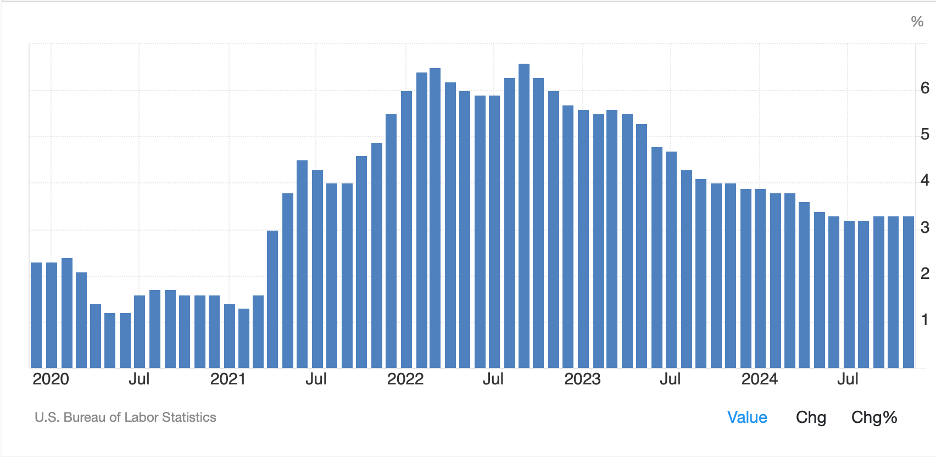
As well, we hear from five Fed speakers over six venues.  Now, the message from the Fed has been pretty unified lately, that caution and patience are appropriate regarding any further rate cuts but that to a (wo)man they all believe that inflation is heading back down to 2.0%.  I’m not sure why that is the case because if you look at the data, it certainly has the feeling that it has bottomed, and inflation rates are turning higher as you can see from the below chart of core CPI.

Source: tradingeconomics.com

And this is before taking into account that energy prices have been soaring lately!  I realize I’m not smart enough to be an FOMC member, but they certainly seem to be willfully blind on this issue.

At any rate, certainly all things still point to a higher dollar going forward, and I imagine we are going to test some big levels soon enough (parity in the euro, 1.20 in the pound) but I am beginning to get uncomfortable as so many analysts have come around to my view.  Historically, if everybody thinks something is going to happen, typically the opposite occurs.  Remember, markets are perverse!

Good luck

Adf

Falling Further

Like a stone toward earth
The yen keeps falling further
Beware Kato-san


While we have not discussed the yen much lately, its recent weakness, in concert with the dollar’s broad strength, has begun to cause some discomfort in Japan.  Last night, Japanese FinMin Katsunobu Kato explained, “We will take appropriate action if there are excessive movements in the currency market.”  He went on that he is “deeply concerned” by the recent weakness, especially moves driven by those evil pesky speculators.

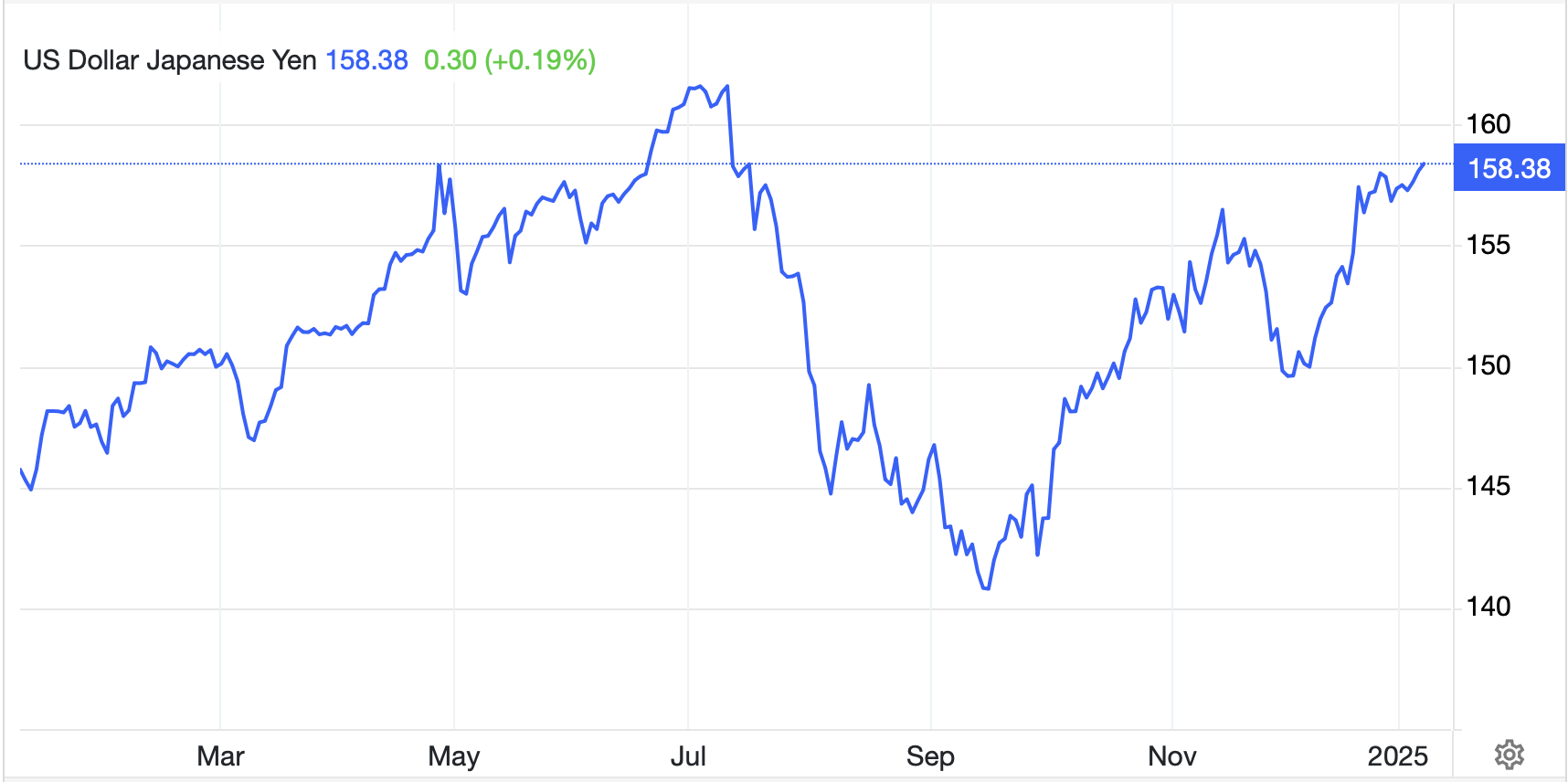
The problem, of course, is that all those expectations that the BOJ would be tightening policy to fight domestic inflation while the Fed would continue to ease policy since they “beat” inflation, with the result being the yen would regain its footing, have proven to be false hope.  Instead, as you can see from the below chart, since the Fed first cut rates back in September, the yen has tumbled nearly 13% and very much looks like it is going to test the previous four-decade highs seen last summer.

Source: tradingeconomics.com

Last year, the MOF/BOJ spent about $100 billion in their efforts to stem the yen’s weakness.  They still have ample FX reserves to continue with that process, but ultimately, history has shown that maintaining a cap on a currency that is weakening for fundamental reasons is nigh on impossible.  If a weak yen is truly seen as existential in Tokyo, then Ueda-san needs to be far more aggressive in tightening monetary policy.  This is especially so given the Fed continues to back away from earlier expectations that it would be aggressively loosening policy.  Now, while JGB yields have moved higher over the past several sessions, trading now at 1.18%, which is their highest level since April 2011, that is not going to be enough to stem this tide.  From what I read, inflation is an issue, but not the same as it was in the US in 2022, so Ueda-san is not getting the same pressure to address it as Powell did back then.  My read is the BOJ remains on hold this month and hikes rates in March while the yen continues its decline.  Look for another bout of intervention when we test the 162 level, but that will not stop the rot.  Nothing has changed my view of 170 or higher in USDJPY by year end.

Though Treasury yields have been rising
Most credit spreads have been downsizing
So, corporate supply
Is ever so high
An outcome that’s somewhat surprising

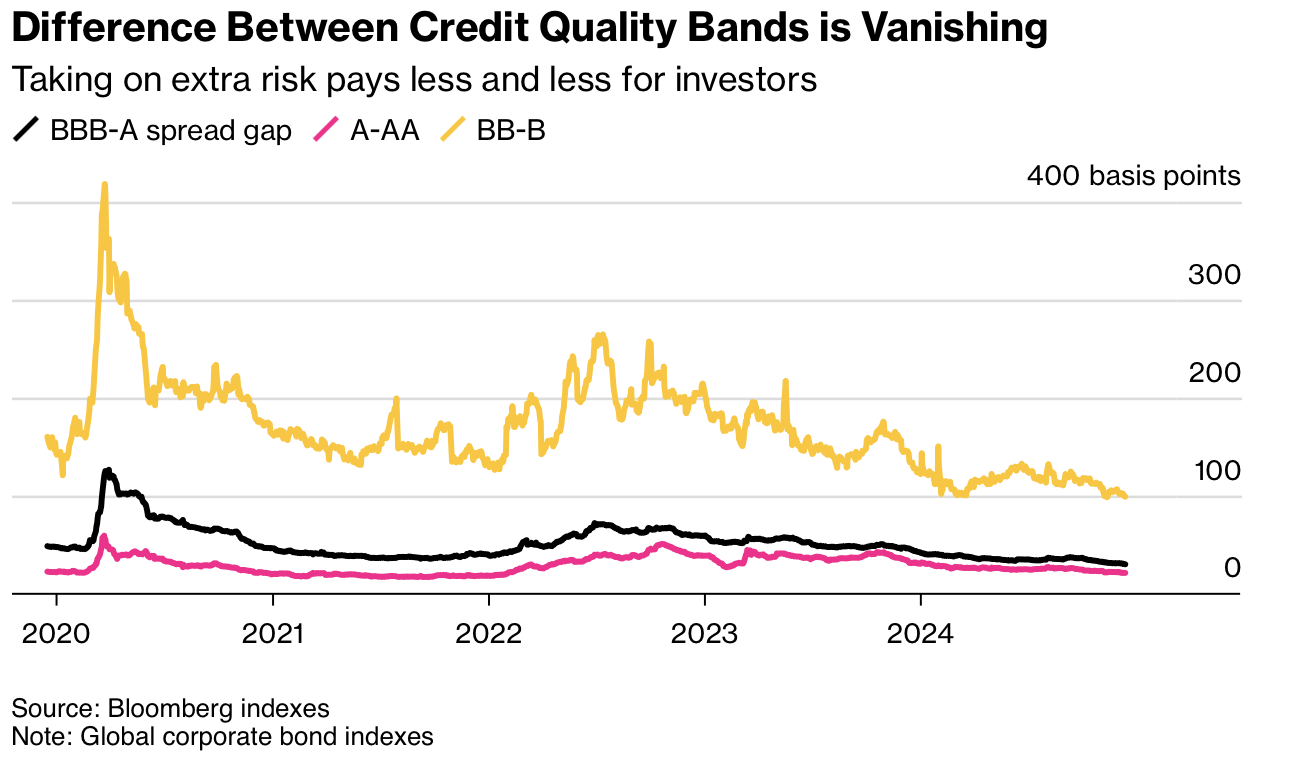
In the bond market, government bond yields continue to rise around the world (China excepted) as investors increase their demands in order to hold the never-ending supply of new bonds.  Ironically, despite this ongoing rout in government bonds across the board, corporate debt issuance looks as though it will set new records this month.  One thing to remember here is that corporates have a lot of debt coming due over the next two years as all that issuance during the ZIRP period needs to be rolled over.  But the other thing to recognize is that corporate credit spreads, the amount of yield investors require to own risky corporate bonds vis-à-vis “safe” government bonds, has fallen to its lowest levels in years, and as can be seen in the chart below, the extra yield available for high-yield investors is shrinking faster than for investment grades.

Potentially, one reason for this is the dramatic increase in the amount of Private Credit, the latest investment fad where weaker credits go directly to funds designed to lend money rather than to their banks, and investors ostensibly remove one of the middlemen from the process.  As such, there is less of this debt around than there otherwise might be, hence increasing demand and reducing that credit spread.  But the other reason is that there continues to be a significant amount of investable assets looking for a home, and with global yields near the highest they have been in a decade or more, and with the equity market dividend yield down to just 1.27% or so, a record low, there are lots of investors who are comfortable with clipping 5% or 5.5% coupons on BBB corporate bonds.

The question I would ask is, if government bond yields continue to climb, and I see no reason for that to stop given the trend in inflation and necessary issuance, at what point are investors going to get scared?  We are likely still a long way from that point, but beware if the new Treasury Secretary, Scott Bessent, follows through with his hinted views of reducing T-bill issuance and increasing coupon issuance, yields could go much higher absent the Fed implementing QE.  That would cause some serious market ructions!

Ok, let’s see how things look around markets this morning after yesterday’s sell-off in the US equity markets.  It seems Japanese stocks were caught between the weaker yen (generally a stock positive) and the tech sell-off (generally a stock negative) with the Nikkei closing lower by -0.25% on the session.  Meanwhile, the Hang Seng (-0.9%) suffered a bit more on the tech move, although Mainland shares (-0.2%) were not as badly affected.  An interesting story here is that the chief economist at state-owned SDIC Securities made comments at an international forum run by the Peterson Institute that really pissed off President Xi.  Gao Shanwen said the quiet part out loud when he claimed that actual GDP growth in China for the past several years has likely been much closer to 2% than the 5% published.  That story has been widespread in the West, although has never been given official credence.  And for Xi, 2% growth is not going to get it done, what with the property bubble still imploding and consumption declining despite promises of more stimulus.  Stay tuned to this story to see if we start to see more Western analysts reduce their expectations.  Elsewhere in Asia, the picture was mixed with gainers (Korea, Australia, Singapore) and laggards (Taiwan, Malaysia, Philippines).

In Europe, red is today’s color, led by the CAC (-1.0%) although we are seeing losses across the board. Eurozone data showed declining Consumer Confidence, Economic Sentiment and Industrial Sentiment all while inflation expectations remain stubbornly high.  That stagflationary hint is typically not an equity market benefit so these declines should be expected.  The story on the continent is not a positive one and I maintain that the ECB is going to have to cut rates more aggressively than their inflation mandate would suggest.  That might support equities a bit, but it will be hell on the euro!  Finally, US futures are a touch softer (-0.2%) at this hour (7:05) although they were higher most of the overnight session before this.

As mentioned above, bond yields are higher with Gilts (+9bps) leading the way as not only is the economy suffering from some very poor policy decisions by the Starmer government, but it seems that the ongoing political crisis regarding grooming gangs has investors shying away.  But yields continue to rise across the board with continental yields up between 3bps and 6bps, Treasury yields higher by another 1bp this morning after a 10bp rise in the previous two sessions, and JGB yields, as mentioned, higher by 5bps.  This trend is very clear!

In the commodity markets, oil (+0.5%) keeps on keeping on, as API data showed a greater than 4mm barrel draw on inventories, far more than expected and indicating a reduced supply around.  Cold temperatures are keeping NatGas (+5.0%) firm as well.  In the metals markets, both precious and base are under a touch of pressure this morning, down less than -0.2%, largely in response to the dollar’s rebound.

Speaking of the dollar, it is higher against all its counterparts this morning with the pound (-1.2%) the G10 laggard although weakness on the order of 0.5% is pretty common this morning.  In the EMG bloc, ZAR (-1.5%) is the worst performer, after weaker than expected PMI data called into question the economic path forward.  But here, too, we are seeing weakness like MXN (-0.9%), CLP (-0.8%), PLN (-0.8%) and KRW (-0.5%).  I would be remiss to ignore CNY (-0.25%), which is trading below (dollar above) 7.3600 in the offshore market, and is now 2.4% weaker than last night’s fixing rate.  This is also the weakest the renminbi has been since it touched this level back in September and then November 2007 prior to that.  Those Chinese problems are coming home to roost for President Xi.

On the data front, ADP Employment (exp 140K) leads the day followed by Initial (218K) and Continuing (1870K) Claims.  These are being released this morning because of tomorrow’s quasi holiday regarding the late President Carter, when US markets will be closed.  This afternoon, the FOMC Minutes arrive and will be scrutinized closely to see just how hawkish they have become.  We also hear from Governor Waller this morning with caution being the watchword from virtually every Fed speaker of late.

It is all playing out like I anticipated, with the ISM data showing strength yesterday, not just in the headline number, but also in the Prices Paid number.  The Fed will have no chance to cut rates again, and I look for the dollar to continue to rise.

Good luck

Adf

Havoc the Dollar Will Wreak

Apparently, President Xi
Is starting to listen to me 🤣
His currency’s falling
As he stops forestalling
The weakness in his renminbi
 
But it’s not just yuan that is weak
The havoc the dollar will wreak
Is set to keep growing
As funds keep on flowing
To US investments, still chic


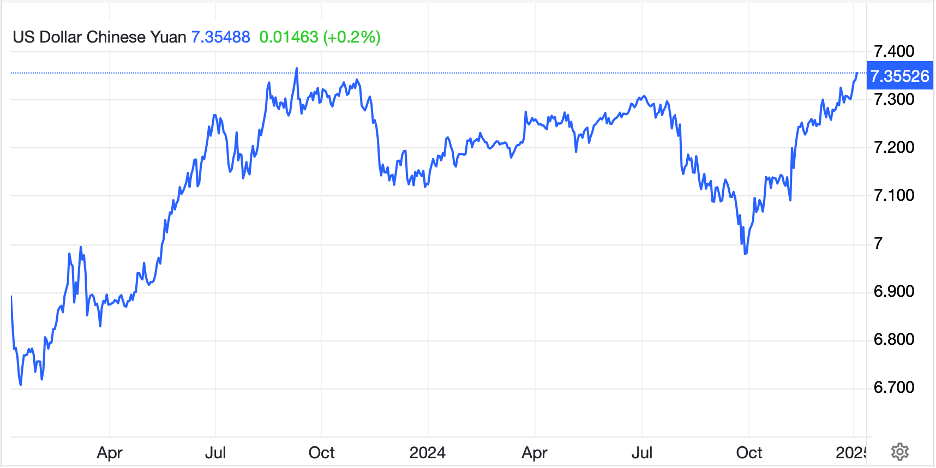
It seems that one of President Xi Jinping’s New Year’s resolutions was to finally allow the renminbi to resume its longer-term decline.  While 7.30 has been the line in the sand for a while, as can be seen from the first chart below, suddenly, as the calendar page turned to 2025, it appears that the PBOC is going to allow for the renminbi to weaken further.  Thus far, the PBOC has been adamant about fixing the Chinese currency at levels much stronger than anyone wants to pay for it, and even last night that was the case, with a fixing rate of 7.1878.  However, while the onshore market must trade within +/- 2% of that fixing rate, no such restriction limits the offshore market, and this morning, the offshore renminbi is trading 2.3% weaker than the fixing, above 7.35 to the dollar.

Much has been made of the “chess” moves that are ongoing between the US and China regarding currency policy with many pundits blankly claiming that if Trump is to impose the threatened tariffs, the renminbi will simply weaken to offset them.  However, while I do believe the CNY has much further to fall, that is not the driving case I see.  Rather, Xi’s problem is that his economy is not in nearly as good condition as he needs it to be and confidence in the consumer sector continues to wane.  This is largely a result of the ongoing destruction of the property bubble that was blown for decades.

Remember, Chinese investors have tied up significant personal wealth in second and third homes as stores of value.  This was encouraged as cities could sell property to developers, get paid a bunch to help finance their operations, and since demand was so high, prices kept rising so everyone was happy.  Alas, as with all bubbles (I’m looking at you, too, NASDAQ) eventually the air comes out.  For the past three years the Chinese have been trying to deal with this collapsing property market, but house prices continue to decline thus reducing investor wealth and confidence.  I read that there are an estimated 80 million empty homes that have been built over the past decades and are now in disrepair in the countryside.  These are the ghost cities that were all part of the Chinese growth miracle, but in fact were simply massive malinvestment.

While the prescription for China has long been to increase its consumer sector of the economy, Xi and his minions at the central committee have no idea how to do that (given they are communist, this is not that surprising) and so continue to support the means of production.  The problem is they have now seemingly gone too far in that space as well with not merely the Western world, but also much of the developing world starting to push back on all the excess stuff that is coming from China.  

Xi’s other problem is that as he rails against the dollar and seeks others to use the renminbi in their trade, if the currency starts to fall sharply, that will be a difficult ask.  Given the US FX policy remains benign neglect, it is entirely upon China to solve their own problems.  While it is unlikely to happen in a big devaluation a la August 2015, weakness is the trend to bet here this year.

Source: tradingeconomics.com

Source: tradingeconomics.com

Away from that news, though, the year is starting off in a fairly modestly.  Most of the world’s focus is on the upcoming Trump inauguration as well as the political machinations that will begin today as Trump’s Cabinet nominees start to go through their paces in front of the Senate.  New Year’s Eve’s horrifying terrorist attack in New Orleans has just upped the ante with respect to Trump getting his picks through the process.  

So, let’s review the overnight market activity to get a sense of what today could bring.  The first day of the US trading year resulted in modest declines across the board in equities, although as I type (7:30), they appear to be retracing those losses and are slightly higher.  The bigger news was from Asia where both the Nikkei (-1.0%) and CSI 300 (-1.2%) showed weakness with the former feeling the pain of some profit taking after gains last week, although Chinese shares seem to be succumbing to the troubles I have described above.  Elsewhere in the region there was no consistency with gainers (Hong Kong, Taiwan, Korea and Australia) and losers (India, New Zealand, Malaysia) with other exchanges little changed.  In Europe this morning, there is more red than green with the CAC (-0.8%) the biggest laggard amid concerns over the fiscal situation in France.  But the DAX (-0.35%) and FTSE MIB (-0.45%) are also lagging with only Spain’s IBEX (0.0%) bucking the trend.

In the bond market, Treasury yields have slipped 2bps this morning, but remain above 4.50%, something that continues to vex Chairman Powell as he and the Fed seemed certain that by cutting the Fed funds rate, he would drive the entire yield curve lower.  I wonder if he will learn this lesson about the relation between a made-up rate (Fed funds) and market rates (bond yields) anytime soon.  In Europe, French yields are 2bps higher, widening their spread vs. German bunds and perhaps more remarkably, at least from a nominal perspective, well above Greek government bond yields now! (Remember, there are far fewer GGB’s around than OAT’s so there is a scarcity bid there). Certainly, Madame Lagarde must be getting a bit concerned over her native nation’s profligacy and I suspect that the fiscal ‘need’ for lower Eurozone interest rates is one of the features of the discussion regarding the ECB’s future path (lower).  As to JGB’s, they are unchanged, sitting at 1.07% and showing no sign of rising anytime soon.  One last thing, Chinese 10yr bonds now yield a new record low of 1.61%, 2bps lower on the day and pretty convincing evidence that not all is well in the Middle Kingdom’s economy.

On the commodity front, oil (-0.2%) is consolidating yesterday’s strong gains which were ostensibly based on the idea that President Xi will successfully implement more stimulus and aid growth in China.  History shows otherwise, but we shall see.  Gold (-0.1%) is also consolidating yesterday’s strong gains as it appears there has been renewed central bank buying activity to start the year.  The other metals also benefitted yesterday with silver (+0.8%) continuing this morning.

Finally, the dollar is retracing some of yesterday’s gains but remains much stronger than we saw just last week, and certainly since the last time I wrote.  Looking at the Dollar Index, it is hovering near 109 this morning, having traded well above that yesterday afternoon.  The next obvious technical target is 112, about 3% higher and there are now many calls for a test of the 2002 highs of 120.  I assure you, if the DXY gets to those levels, EMG currencies are going to come under a great deal of pressure.  As an example, we already see several EMG currencies (CLP, BRL) trading at or near all-time lows (dollar highs) and there is nothing to think this will change soon.  As well, check out the euro at 1.03 this morning, which while 0.3% higher on the session, appears as though it could well test those October 2022 lows (dollar highs) sooner rather than later, especially if the ECB continues to lean more dovish than the Fed.  If you are a receivables hedger, currency puts seem like a pretty good idea these days.

On the data front, ISM Manufacturing (exp 48.4) and Prices Paid (51.7) are all we have today and late this morning Richmond Fed president Barkin speaks.  Interestingly, tomorrow evening and Sunday we hear from SF Fed President Daly and tomorrow evening Governor Kugler will be joining Daly.  I guess they can’t go but so long without hearing their voices in the echo chamber!

There is nothing to suggest that the dollar, while modestly softer today, is set to turn around soon.  Keep that in mind.

Good luck and good weekend

Adf
This is the Vibe

In DC, the IMF tribe
Is meeting, and this is the vibe
Leave China alone
While they all bemoan
Das Trump to whom, problems, ascribe
 
Meanwhile in Beijing, Xi’s delayed
His policies as he’s afraid
If Trump wins the vote
More tariffs, he’ll float
Reducing Xi’s winnings in trade


With the US election fast approaching, it appears that virtually every aspect of life now hinges on the outcome.  This is even true in ostensibly neutral NGOs like the IMF.  As an example, the title of this Bloomberg article, Trump 2.0 Haunts World Economy Chiefs Gathering in Washington Before Vote is enough to make you question the neutrality of both Bloomberg and the ongoing activity at the IMF.  Briefly, in this article, the authors quote several meeting participants explaining that a Trump victory could disrupt the current global “stability” in trade.  (I’m not sure why they think the current situation is stable given the ongoing increases in tariffs already being implemented by the Eurozone as well as the US vs. Chinese manufactured goods, but they all are certain it will be a problem only if Trump is elected.)

In fact, earlier this week, the IMF explicitly said that a Trump victory would be negative for the global economy and that his policies would be worse for the US as well when compared to Harris’s policies.  My first thought is, how do they know Harris’s policies as she hasn’t been able to articulate any, but second, the idea that a supranational organization would express its electoral preferences leading up to a major national vote is remarkable.  Clearly the concept of neutrality no longer exists.

At any rate, as I explained yesterday, the US election remains THE topic on both investors’ and traders’ minds.  As well, it is THE topic on every other government’s mind around the world.  As such, arguably until the vote is complete and a victor declared, I suspect that all markets will see plenty of volatility with each change in the polls but limited additional secular movement.

One of the ongoing activities that passes for analysis these days is the forecasting of future bond yields or equity returns based on the winner.  This is generally explained as this market will rise if one wins and fall if the other does, or vice versa.  My take is this is simply another way for analysts to proffer their political views under the guise of economic analysis and as such, while I get a chuckle from these earnest descriptions of the future, I certainly don’t see them as rigorous analysis.  

But really, this week, that is all that is happening.  Next week, we do see a lot of data, including the NFP report as well as PCE readings and the BOJ’s interest rate decision, so perhaps there will be more market focused discussion.  But right now, virtually everything you read revolves around the election and the possible results.

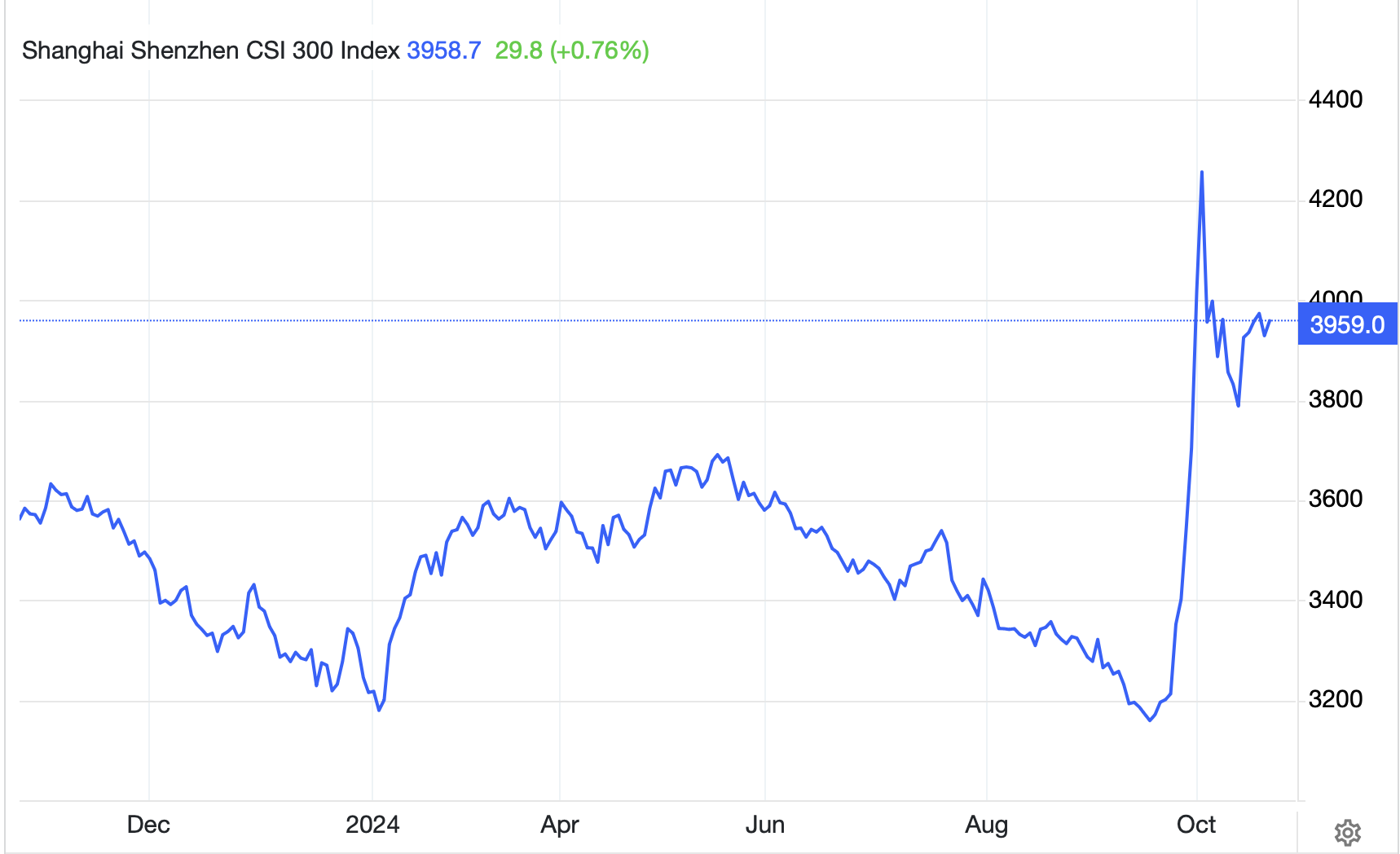
So, with that in mind, let’s take a look at what happened overnight.  Yesterday’s mixed US session, with the DJIA slipping while the other major indices rallied a bit, led to a mixed picture in Asia as well.  Japanese shares (-0.6%) suffered a bit as Japan, too, is heading toward a general election and questions about whether new PM Ishiba will be able to win a majority in the Diet are very real this time.  Apparently, even in a homogenous society like Japan, there are questions about the ruling party and how much it is focused on helping the population.  As to the rest of Asia, both China (+0.7%) and Hong Kong (+0.5%) managed modest gains, but there are still many questions as to exactly how much stimulus China is going to inject into the economy there.  In fact, you can see the market asking those questions by the chart below, where the spike was the initial euphoria that something was going to be done, and the retracement is the realization that it was hope and not policy that drove things.

Source: tradingeconomics.com

The numbers show that after a >30% rally in a few sessions, investors have unwound about one-third of the climb as they await the outcome of the National People’s Congress meeting to see if a new fiscal package will be approved.  (Cagily, they have set the dates for the meeting to be November 4-8 to make sure that they can encompass the outcome of the US election in their decisions.  The rest of Asia saw a mix of gainers (Taiwan, Philippines, Australia) and laggards (India, Singapore, Malaysia) with other markets barely moving.

Meanwhile, in Europe, this morning is a down day, although the losses are quite modest (CAC -0.3%, IBEX -0.4%, FTSE 100 -0.2%) as traders head into the weekend with limited confidence on how things will play out going forward.  As to the US, at this hour (7:30), futures are pointing slightly higher, 0.2% or so.

In the bond market, Treasury yields (-2bps) have backed off their highs from earlier in the week but remain far above the levels seen prior to the Fed’s rate cut in September.  A view growing in popularity is that the 10yr yield will rise above 5.0% if Trump is elected while it will decline to 3.5% in a Harris victory.  Personally, I cannot see any outcome that doesn’t boost yields as there seems to be scant evidence that either side will slow spending and the Fed has made it clear that higher inflation is ok, at least by their actions, if not yet by their words.  As an aside, I couldn’t help but notice comments from Secretary Yellen explaining that the budget deficit was getting out of hand and “something” needed to be done about it, as though she had no part in the situation!  Meanwhile, European sovereign yields are mostly edging higher this morning, but only by 1bp or 2bps, as they continue to hold onto the gains that came alongside the Treasury market.  In the end, Treasury yields remain the key global driver.

In the commodity markets, oil (+0.7%) is bouncing slightly this morning after yesteray’s decline.  The talk in the market is that the Saudis are considering opening a price war to regain market share after they have withheld so much production.  That would certainly be a different tack than their recent activities and I imagine that President Putin would not be pleased, but that is one rumor.  As to the metals markets, they are under pressure this morning with all the major metals somewhat softer (Au -0.2%, Ag -0.9%, Cu -0.2%) as we continue to see profit taking in the space after a very large run higher over the course of the entire year.

Finally, the dollar is little changed overall this morning with no G10 currency having moved even 0.2% since the close yesterday although we have seen a couple of EMG currencies (KRW -0.7%, ZAR +0.3%) with a little dynamism.  The won fell further after weaker than forecast GDP encouraged traders to look for further rate cuts by the BOK while the rand’s movement appears more trading than fundamentally focused as there was neither data nor commentary to drive things.

On the data front, this morning brings Durable Goods (exp -1.0%, ex Transport -0.1%) and Michigan Sentiment (69.0).  As explained above, the data doesn’t seem to matter right now with all eyes on the election.  There are no Fed speakers scheduled but it is not clear that all their chatter this week had any impact.  The market is still pricing a 25bp cut in November and a 75% probability of another one in December, which is what it has been doing for a while.

It is very difficult to observe recent market activity and come away with a strong directional view.  My take continues to be that the December rate cut will lose its support based on the data and the dollar will appreciate accordingly.  But right now, that is a minority view.

Good luck and good weekend

Adf