Fervent Dreams

The FX Poet will be in Nashville at the AFP Conference October 21-22, speaking about effective ways to use FX options in a hedging program.  Please come to the presentation on Monday at 1:45 in Grand Ballroom C2 if you are there.  I would love to meet and speak.
 
Said Governor Waller, inflation
Is falling and so there’s temptation
To cut really fast
And if our forecast
Is right, there will be celebration
 
The problem is, if we are wrong
And price rises we do prolong
We’ll get all the blame
At which point we’ll frame
Our mandate as “jobs must be strong”
 
Meanwhile, in China it seems
That President Xi’s fervent dreams
Of finding more growth
Is stuck cause he’s loath
To listen to Pan Gongsheng’s schemes


First, a mea culpa, as while banks and the bond market were closed yesterday, the equity market was open, and the rally continued.  Although, that doesn’t really change anything I wrote yesterday.  But the stories that got the press yesterday were about Fed Governor Chris Waller and his speech.  Waller is considered one of the key FOMC members as his policy research has been consistent and more accurate than most others, as well as because he doesn’t appear to be nearly as partisan as some other governors.

At any rate, he eloquently made the case that the Fed was going to continue to cut rates, albeit perhaps more slowly than previously expected, because even though economic activity remains strong and inflation is above our goals, we remain confident that we are still going to achieve our targets.  In fact, I think his words are worth reading directly [emphasis added]:

Whatever happens in the near term, my baseline still calls for reducing the policy rate gradually over the next year. The median rate for FOMC participants at the end of 2025 is 3.4 percent, so most of my colleagues likewise expect to reduce policy over the next year. There is less certainty about the final destination…While much attention is given to the size of cuts over the next meeting or two, I think the larger message of the SEP is that there is a considerable extent of policy restrictiveness to remove, and if the economy continues in its current sweet spot, this will happen gradually.”

On to the next story, China and the still-to-come stimulus package.  According to Bloomberg, there is a new plan to allow local governments to swap up to CNY 6 trillion (~$840B) of their outstanding “hidden” debt, which is in the name of special funding vehicles, to straight local government debt, which should carry lower interest rates.  The problem is that both the size of this program and its ultimate effect are seen as insufficient to address the issues.  Certainly, reducing interest payments will help a bit, but the debt problem, along with the property problems, are so much larger than this, at least 10X the proposed CNY 6 trillion, that this will barely make a dent. 

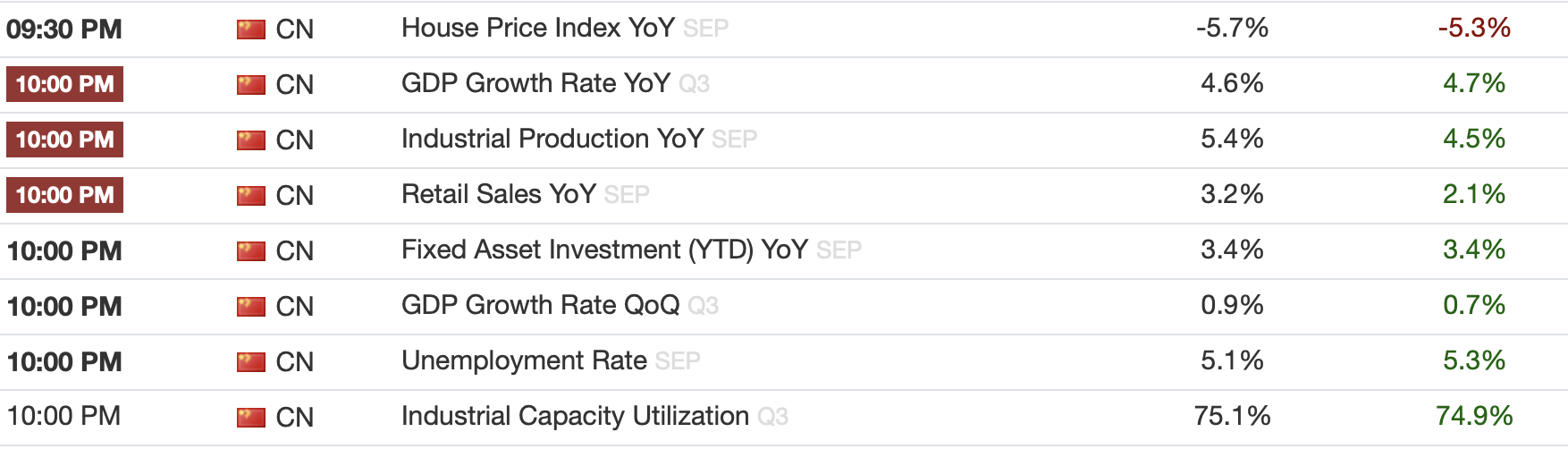
Ultimately, the only solution that seems viable is that the central government borrows more money (its current outstanding debt is at just 25% of GDP) and funds new projects, gives it out to citizens in a helicopter money drop, or something other than investing in more production for exports.  This seemed to be where PBOC Governor Pan Gongsheng was headed several weeks ago.  Alas, President Xi has spent a decade stripping power away from the private sector and amassing his own.  I find it highly unlikely he will willingly cede any of that power simply to help his citizens.  Recent analyst updates for Chinese GDP growth in 2024 have fallen back below his 5.0% target, and I imagine they are correct.

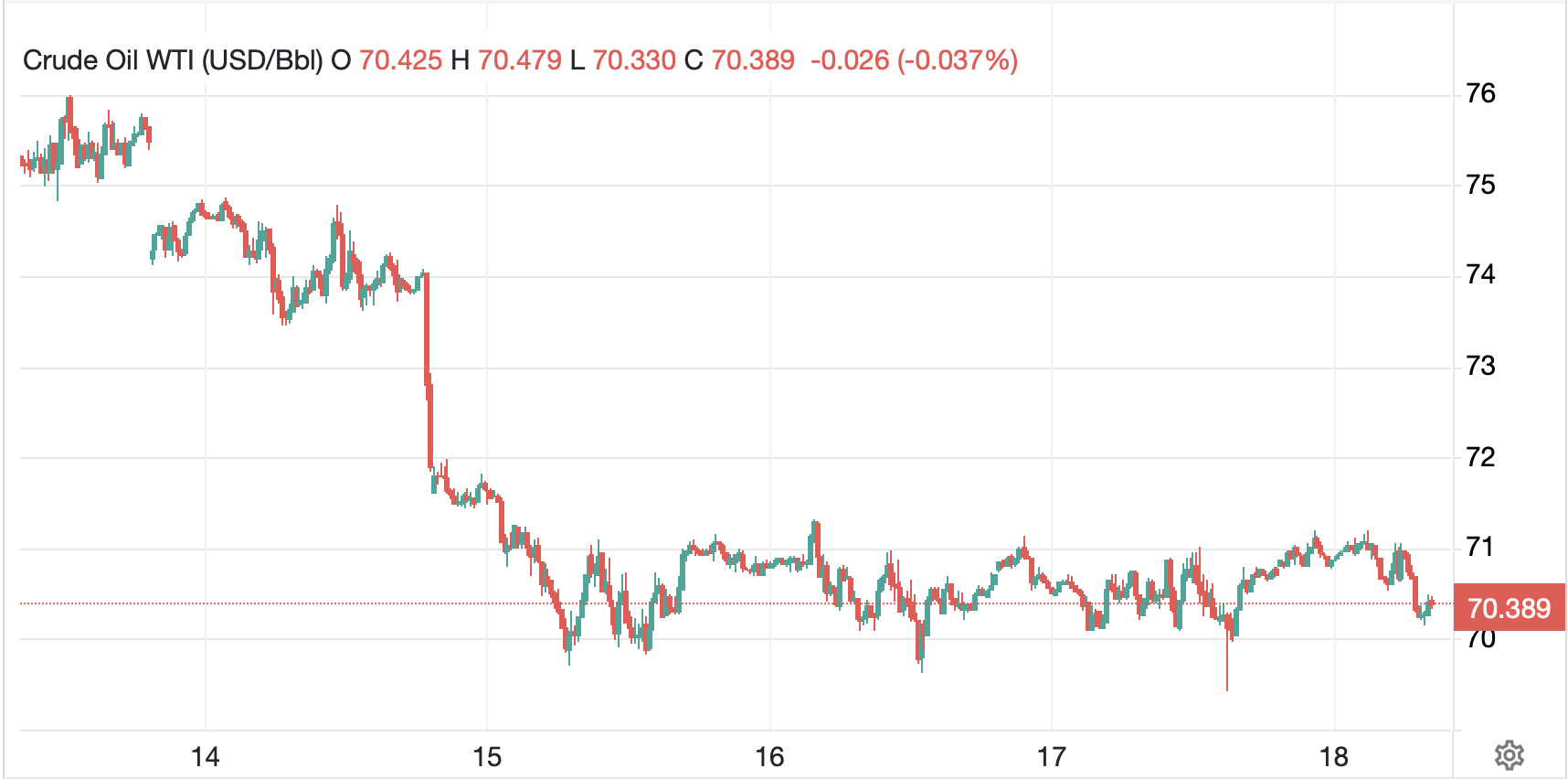
Which brings us to this morning, where the biggest market mover is oil (-5.1%) which is falling on a combination of several things.  First, news that President Biden has convinced Israeli PM Netanyahu to not strike Iran’s oil fields, thus removing a key supply issue and war premium.  Next, the fact that China’s stimulus efforts are so weak implies lower demand from the world’s largest oil importer, and finally, OPEC just cut its forecast for oil demand for 2024 and 2025 although they have not reduced their supply estimates.  The upshot is that oil has given back all its gains of the past month and is presently back at its longer-term technical support level of $70/bbl.  Where it goes from here is anybody’s guess, but absent a resurgence of the Middle East war premium, I suspect it has further to decline.

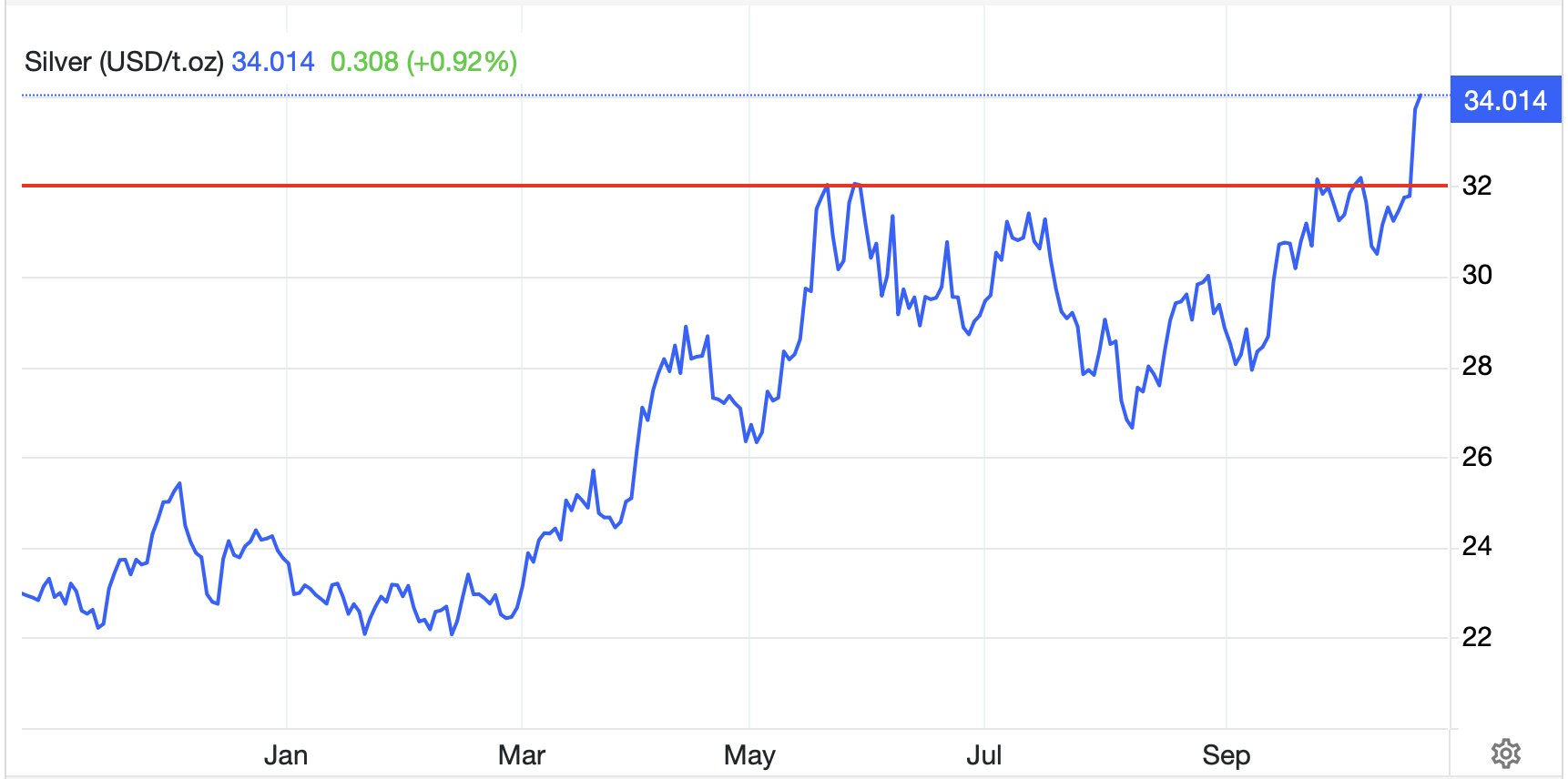
As to the metals complex, gold (+0.2%) continues to ignore all the signs that it should be falling and is holding within 1% of its recent all-time high prints amid stories that global central banks continue to acquire the barbarous relic.  However, both silver and copper are feeling some stress amid the weaker Chinese growth story.  

In fact, that weaker Chinese growth story hit equities there hard with the CSI 300 (-2.7%) and Hang Seng (-3.7%) both falling sharply on the disappointing fiscal plans.  However, the rest of Asia took their cues from the US rally, and we saw strength virtually across the board.  Interestingly, Taiwan’s TAIEX (+1.4%) completely ignored the China story, perhaps an indication its economy is not nearly so tightly linked as in the past.  In Europe, the picture is mixed with the DAX (+0.3%) rallying on a slightly better than expected German ZEW Economic Sentiment Index (13.1, up from 3.6), while Spain’s IBEX (+0.3%) rallied on better than expected inflation data.  However, weakness is evident in France (CAC -0.8%) on weakness in the luxury goods sector (the largest part of the index) suffering from weaker Chinese demand.  US futures are essentially unchanged at this hour (7:15) as we await Retail Sales later this week.

In the bond market, yields have fallen across the board (Treasuries -3bps, Bunds -4bps, OATs -5bps) as lower oil prices and concerns over slowing growth have investors thinking inflation will continue its downward trend.  Well, at least some investors.  One of the more interesting recent market conditions is the performance of inflation swaps, which have seen implicit inflation expectations rise more than 50bps in the past five weeks as per the chart below from @parrmenidies from X (fka Twitter).

This likely explains the sharp yield rally since the Fed cut rates, but does not bode well for future inflation declining.

Finally, the dollar is little changed net this morning.  Not surprisingly, given the ongoing disappointment of China’s stimulus ,CNY (-0.5%) is amongst the worst performers of the session.  But we have seen weakness in ZAR (-0.3%), CLP (-0.4%) and KRW (-0.4%) to show that EMG currencies are under pressure.  As to the G10, movement has been much smaller with JPY (+0.3%) the biggest mover overall and one of the few gainers.

On the data front, Empire State Manufacturing (exp 2.3) is the only number coming out and we hear from three more Fed speakers (Daly, Kugler and Bostic).  That cleanest shirt analogy remains the most apt these days with the US spending its way to better short-term results and adding long-term problems.  But the market is happy for now.  With that in mind, I don’t see a reason for the dollar to suffer much in the near term.

Good luck

Adf

Open and Shut

The FX Poet will be in Nashville at the AFP Conference October 21-22, speaking about effective ways to use FX options in a hedging program.  Please come to the presentation on Monday at 1:45 in Grand Ballroom C2 if you are there.  I would love to meet and speak.
 
The great thing about recent data
Is nobody thinks it will matta
It’s open and shut
The Fed’s gonna cut
As ‘flation ambitions they shatta
 
In Jay’s mind, the risk tradeoff’s clear
As stocks work to find a new gear
However, for debt
They’re making the bet
The problems won’t hit til next year

On this Columbus Day holiday, US cash markets are closed although futures are trading, so no stock or bond market activity today.  The FX market will be open, as always, although I suspect liquidity will be less than usual, especially once Europe goes home at noon so hopefully, you don’t have much to do today in the way of hedging.

As it happens, there was not a lot of news overnight to discuss, although China did manage to once again disappoint with respect to their fiscal support announcement on Saturday, not offering up even a big picture number, let alone specific programs, that they are considering.  Interestingly, this did not deter the new China stock bulls, with the CSI 300 (+1.9%) rallying sharply, but this is becoming a sentiment story, not a data driven one.  Someone on X asked the question about why Xi was not doing more, and my view has become that he recognizes to truly get the economy going again he will need to cede some of the power he has spent the past 10 years amassing.  I sincerely doubt he is willing to do that, and since his life won’t change regardless of the amount of stimulus, in the end, holding power is far more important to him.

But let’s go back to the data driven approach and its pluses and minuses.  This morning’s WSJ had an articleby James Mackintosh titled, “The Fed Has a Dependency Problem That Needs Fixing”, and it is his view that data dependence is the current Achilles Heel for Powell and friends.  Now, I won’t dispute that the market’s tendency to extrapolate one data point out to infinity can have market consequences, but I think the point Mr Mackintosh misses is that this is a problem entirely of the Fed’s own making.  Nobody instructed them to offer their views, other than the semi-annual testimony before Congress.  Nobody is forcing FOMC members to be out blathering virtually every day (in fact, two of them, Waller and Kashkari, will be speaking today despite markets being closed).  Forward Guidance was Benny the Beard’s brainstorm, it is not a Congressional mandate, it is not in the Fed’s charter, it is entirely their own.

So, if too much forward guidance is a problem, the Fed can simply stop it.  There is no doubt the recent data releases have been somewhat confusing, with more strength than most economists and analysts have forecast, and there is no doubt that any given month’s data point is subject to certain random fluctuations and revisions.  However, consider if the Fed was not trying to guide the market to whatever their preferred outcome may be.

If there was no Forward Guidance, then each individual investor would have to analyze the current situation themselves, get their best estimate of how they anticipated the future to evolve, and position themselves accordingly.  In today’s world, there is a lot of data pointing in different directions.  Absent the Fed trying to sway opinion, position sizes would be greatly reduced, and the large reversals in markets like we saw in the wake of the recent rate cut and subsequent NFP and CPI releases, would likely be far less significant.  

When the Fed explains that they are going to keep rates lower for longer (as they did in the wake of the GFC and again post covid) that is a clear signal to investors to load up on assets that perform well in a low-rate environment (i.e. stocks).  When they change that view…oops!  That is what we saw in 2022 when they flipped the script and went from transitory inflation to persistent inflation.  Everybody who was long both stocks and bonds suffered.  

But let’s run a thought experiment.  If the Fed gave no Forward Guidance, and merely adjusted rates as they saw fit, investors would have had significantly less confidence that regardless of what had clearly become an inflation problem, the Fed was going to maintain low interest rates.  There would have been a much more gradual move out of risk assets as investors determined inflation was a problem, and the Fed wouldn’t have had all that egg on their face when they had to admit they made a mistake about inflation.

In the end, I disagree with Mackintosh that the Fed should essentially ignore the data, but I agree that they shouldn’t talk about it at all.  In fact, I think we would all be far better off if none of them ever said a word!

Enough of my diatribe.  Let’s see how the rest of the world’s markets behaved overnight.  While mainland Chinese stocks performed well, Hong Kong (-0.75%) did not.  Japan was closed for National Sports Day, although the broad Asia look was that markets there followed Friday’s US rally as well.  However, this morning in Europe, the picture is mixed with some gainers (DAX, IBEX) and some laggards (CAC, FTSE 100) and none of the moves more than 0.3%.  The only data overnight was Chinese Trade (reduced Trade surplus of $81.7B) and Chinese financing which was modestly disappointing despite the recent efforts at goosing things there.  US futures are trading this morning and at this hour (7:00) they are mixed with modest gains and losses of ~0.25%.

With Japan closed along with the US, it should be no surprise that bond market activity is extremely limited with yields essentially unchanged this morning from where they were at Friday’s close.  However, remember that 10-year Treasury yields are higher by nearly 50bps since the day before the FOMC meeting.  This is an important signal that market participants are far more concerned about inflation than the Fed.  On this subject, I think the market is correct.

In the commodity markets, oil (-2.4%) continues its recent decline as the long awaited and feared Israeli response to Iran’s missile attacks seems to have been postponed further.  The absence of that supply concern alongside the lack of Chinese stimulus, and by extension demand, has weighed heavily on the market.  Gold is unchanged this morning although we are seeing some softness in the industrial metals with both silver and copper softer today.

Part of that metals weakness is due to the fact that the dollar continues to rise against all forecasts.  This weekend there was a meeting of the old Soviet nations, the CIS (absent Ukraine of course) and they pledged to stop using dollars in their trade.  This is in the lead-up to the BRICS conference to be held next week in Kazan, Russia, where once again many claim that this group of nations will create their own currency in their efforts to get away from the dollar’s hegemony.  Whether or not they formally do so, I have yet to see a path that includes a cogent rationale for anyone to use this currency, especially if it is backed by a series of nonconvertible currencies like the CNY, BRL and INR.  But it does generate clicks in the doomporn sphere.  

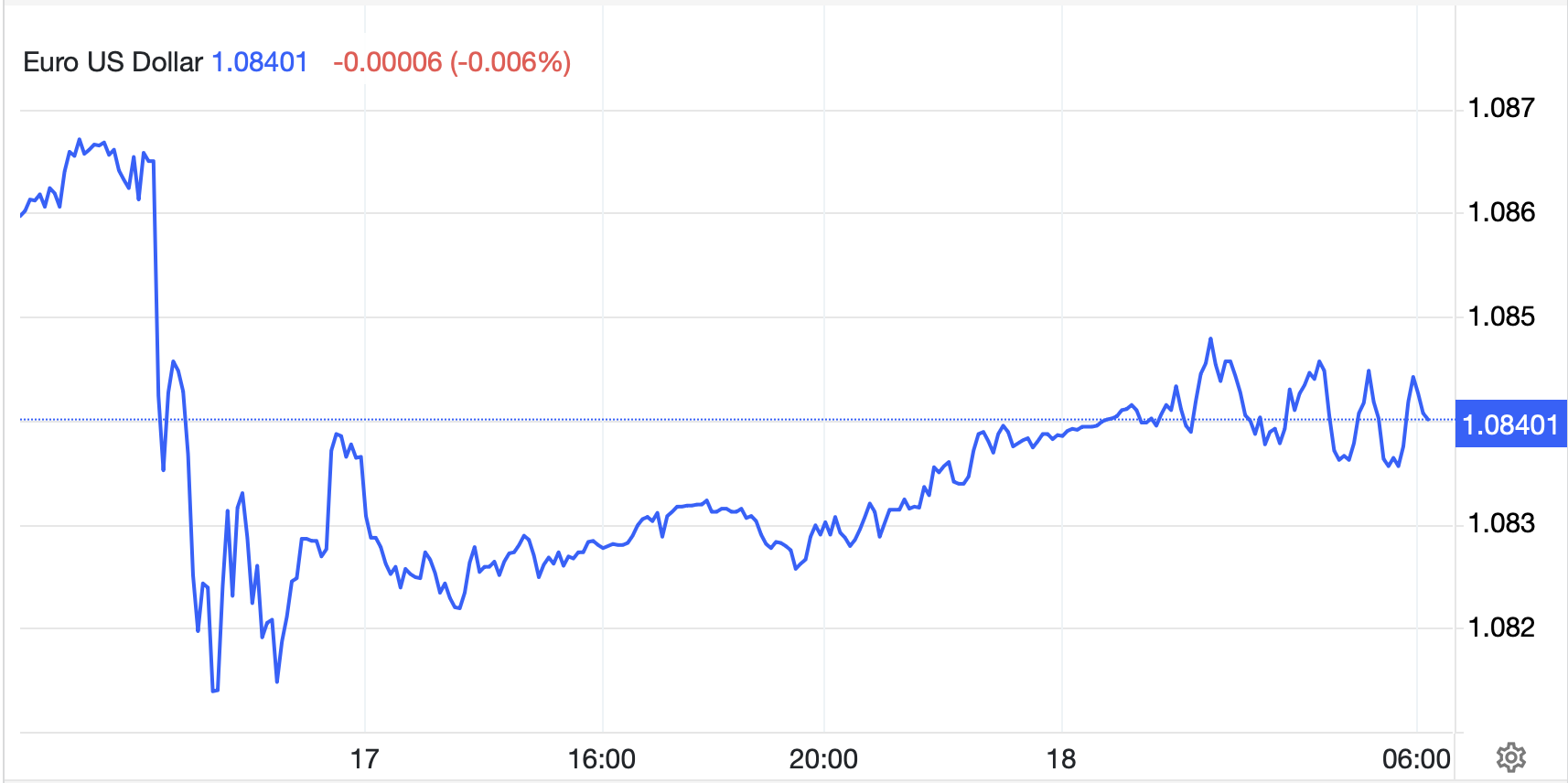
But back in the real world, the dollar is just grinding higher vs everything this morning with NOK (-0.8%) suffering on oil’s weakness and AUD (-0.5%) and NZD (-0.5%) under pressure because of metals weakness and lack of Chinese stimulus.  ZAR (-0.8%) is also feeling the metals weakness but JPY (-0.4%) and CNY (-0.35%) are all softer this morning.  In other words, it is business as usual.  In fact, for those of you with a market technical bias, a quick look at the euro chart seems to define the concept of a double top.

Source: tradingeconomics.com

On the data front, aside from loads more Fedspeak this week, and the ECB monetary meeting on Thursday, the big data print in the US is Retail Sales, also on Thursday.

TuesdayEmpire State Manufacturing2.3
ThursdayECB Rate Decision3.25% (current 3.5%)
 Initial Claims255K
 Continuing Claims1870K
 Retail Sales0.3%
 -ex Autos0.2%
 Philly Fed3.0
 IP-0.1%
 Capacity Utilization77.8%
FridayHousing Starts1.35M
 Building Permits1.45M

Source: tradingeconomics.com

Adding to today’s Fedspeak, we hear from eight more speakers this week. With the Fed funds futures market pricing a 14% probability of no cut at all in November, which would be remarkable given the 50bp cut they made last month, it strikes me that there will be very little new from the speakers.  Rather, if the data this week comes in hotter than forecast, that is going to be the market driver.  I think it is fair to say the Fed has made a hash of things lately.  As long as the data continues to look good, though, I have to believe that fears of renewed inflation and higher rates are going to support the dollar.

Good luck

Adf

Inflation’s Not Dead

It turns out inflation’s not dead
Despite what we’ve heard from the Fed
Will Jay now admit
His forecasts are sh*t
Or are there more rate cuts ahead?
 
To listen to some of his friends
They’re still focused on the big trends
Which they claim are lower
Though falling much slower
If viewed through the right type of lens


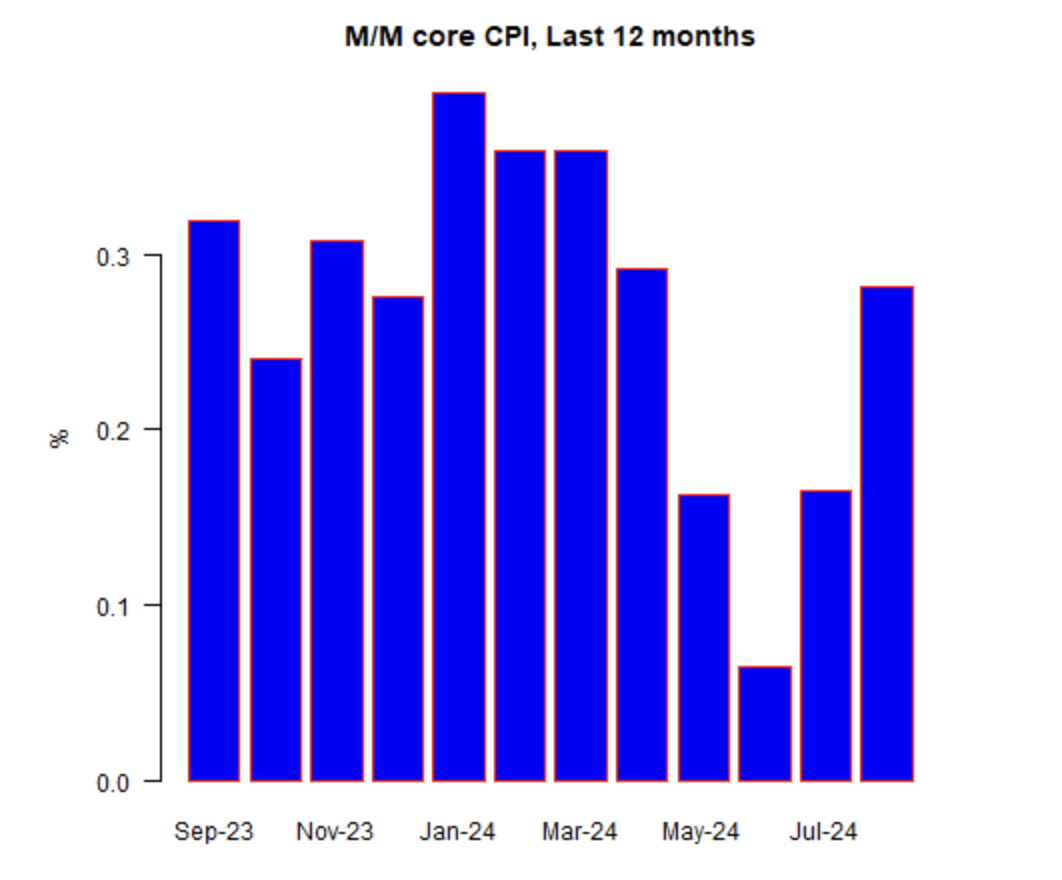
I guess if you squint just the right way, the trend in inflation remains lower.  I only guess that because that’s what we heard from three Fed speakers yesterday, Williams, Goolsbee and Barkin, but to my non-PhD trained eye, it doesn’t really look that way.  Borrowing the chart from my friend @inflation_guy, Mike Ashton, below are the monthly readings for the past twelve months for Core CPI.

As I said, and as he mentioned in his CPI report yesterday, it is much easier to believe that the outliers are May through July than the rest of the series.  But remember, I am not a trained PhD economist, so it is entirely possible that I simply don’t understand the situation.

At any rate, both the core and headline numbers printed higher than forecast which saw bonds sell off and the dollar rally while stocks edged lower.  Arguably, the big surprise was that commodity prices raced ahead with oil (+3.0% yesterday) and gold (+0.75% yesterday) both showing strength.  It seems that both of these markets, though, benefitted from rumors that Israel is getting set to finally retaliate against Iran for the missile bombardment last week, and fears of a significant disruption in oil markets, as well as a general rise in the level of uncertainty, has been sufficient to squeeze out a bunch of recent short positions.

In China, investors are waiting
For details on how stimulating
The plans Xi’s unveiled
Will truly be scaled
And if they’ll be growth generating

The other topic du jour is China, where tomorrow, FinMin Lan Fo’an is due to announce the details of the fiscal stimulus that was sketched out right before the Golden Week holiday, and which has been a key driver in the extraordinary rise in Chinese equities since then.  Alas, last night, as traders and investors prepared for these announcements, selling was the order of the day and the CSI 300 (-2.8%) fell sharply amid profit taking.  I find it telling that they are waiting to make these announcements while markets are not open, a sign, to me at least, that they are likely to be underwhelming.  Current expectations are for CNY 2 trillion (~$283 billion) of fiscal stimulus, which while a large number, is not that much relative to the size of the Chinese economy, currently measured at about $17 trillion.  And unless they address the elephant in the room, the decimated housing market, it seems unlikely to have a major positive impact over the long term. 

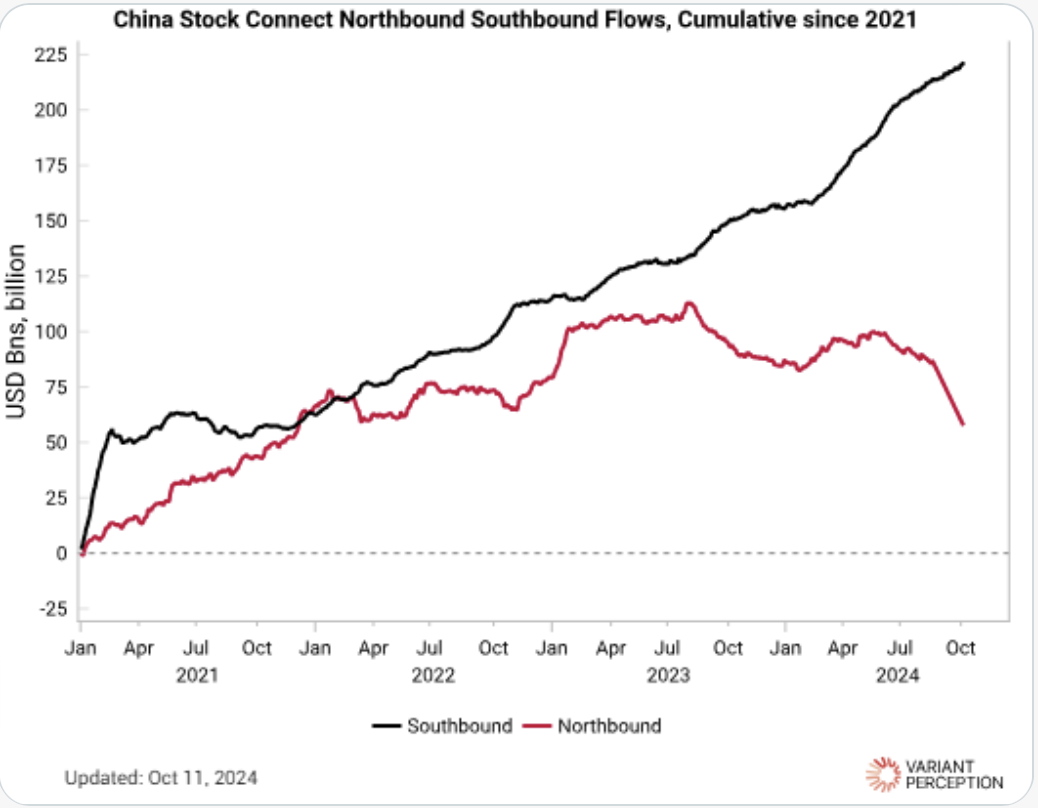
That said, Chinese stocks have become one of the hottest themes in the market with many analysts claiming they are vastly undervalued relative to US stocks.  However, I saw a telling chart this morning on X, showing that flows into Chinese stocks from outside the nation, the so-called northbound flows from Hong Kong, especially when compared to flows from the mainland to Hong Kong, have been awful, despite this recent rally.  As with many things regarding the Chinese economy and markets, the headlines can be deceiving at times in an effort to make things look better than they are.

While we did see the renminbi rally sharply after those initial stimulus announcements, it has since retraced most of those gains.  I cannot look at the situation there without seeing an economy that has serious structural imbalances and a terrible demographic future.  Meanwhile, the biggest problem is that President Xi has spent the past decade consolidating his power and eliminating much of the individual vibrancy that had helped the nation grow so rapidly.  Ultimately, I see CNY slowly depreciating as it remains the only relief valve the Chinese have on an international basis.

With that in mind, let’s take a look at how markets responded to the US CPI data and what other things may be having impacts.  Ultimately, US equity markets regained the bulk of their early losses yesterday to close marginally lower.  We’ve already mentioned China’s equity woes and Hong Kong was closed last night for a holiday.  Tokyo (+0.6%) managed a small gain, tracking the weakness in the yen (-0.25%) while the bulk of the region drifted modestly lower.  It seems many traders are awaiting this Chinese news to see how it will impact the rest of Asia.  As to European bourses, the movement here has also been di minimus with the FTSE 100 (-0.2%) the biggest mover after its data releases showing that GDP continues to trudge along slowly, growing only 1.0% Y/Y.  Continental exchanges are +/- 0.1% from yesterday, so no real movement there.  US futures, too, are essentially unchanged at this hour (7:00).

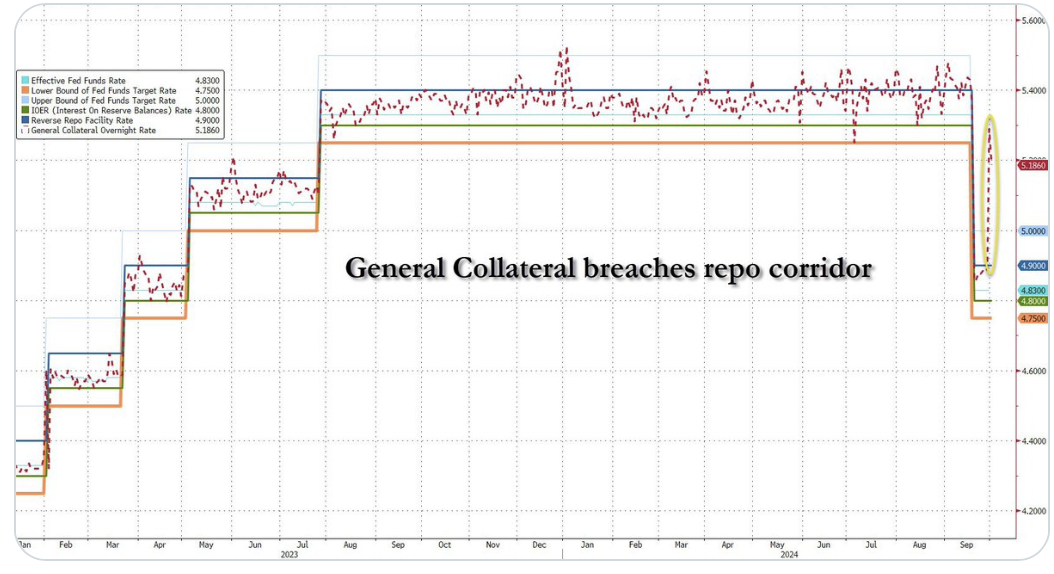
In the bond market, yields continue to edge higher with Treasuries gaining 3bps and European sovereigns all looking at gains of between 3bps and 5bps.  An interesting interest rate phenomenon that has not gotten much press is that the fact that at the end of September, the General Collateral Repo rate surged through the upper bound of the Fed funds rate, a condition that describes a potential dearth of liquidity in the markets.  

Source: zerohedge.com

The implication is that QT may well be ending soon in order for the Fed to be certain that there are sufficient bank reserves available for banks to meet their regulatory targets and not starve the economy of capital.  It has always been unclear how the Fed can start cutting rates while continuing to shrink the balance sheet as that was simultaneously tightening and easing policy, but it appears that we are much closer to universal policy ease, something else that will weigh on the dollar and support commodity prices over time.

Speaking of commodities, after yesterday’s rally, this morning, the metals complex is continuing modestly higher (Au +0.3%, cu +0.4%) but oil (-0.8%) is backing off a bit.  So much of the oil trade appears linked to the Middle East it is very difficult to discern the underlying supply/demand dynamics right now.

Finally, the dollar, after several days of strength, is consolidating and is little changed to slightly higher.  The DXY is trading right at 103 and the euro is hovering just above 1.09 with USDJPY at 149.00.  Several weeks ago, these numbers would have seemed ridiculous given the then current view of the Fed aggressively cutting rates.  But now, all that bearishness is fading, and it is true vs. almost every currency, G10 or EMG this morning.

On the data front, PPI leads the way this morning although given we already got the CPI data, it will have virtually no impact I would expect.  Estimates are for headline (0.1% M/M, 1.6% Y/Y) and core (0.2% M/M, 2.7% Y/Y).  As well, we get Michigan Sentiment (70.8) at 10:00 and we will hear from several more Fed speakers, including Governor Bowman, the dissenter at the FOMC meeting who looks quite prescient now.  One thing to note is yesterday’s Initial Claims data was much higher than expected at 258K, but that was attributed to the effects of Hurricane Helene, and now that Hurricane Milton has hit, I expect that those claims numbers will be a mess for a few more weeks before all the impact has passed through.

While Fedspeak remains far more dovish than the data, my take is if the data continues to show economic strength, especially if the next NFP release, which is just before the FOMC meeting, is strong again, the Fed will be hard pressed to cut even 25bps then.  For now, good economic news should support the dollar and weigh on bonds.

Good luck and good weekend

Adf

New Calculation

The markets in China retraced
One-fifth of their rally post-haste
Not everyone’s sure
The promise du jour
Is where traders’ trust can be placed
 
In Europe, attention’s now turned
To lesson’s the ECB’s learned
Their new calculation
Shows Europe’s inflation
No longer has members concerned


Let’s take a trip down memory lane.  Perhaps you can remember the time when the Chinese economy seemed to be faltering, and the Chinese stock markets were massively underperforming their peers.  That combination of events was enough to get President Xi to change his tune regarding stimulus and over the course of several days, first the PBOC and then the government announced a series of measures to support both the economy and the stock market specifically.  In fact, way back on September 24th I described the measures taken in this post.  Yep, that was two whole weeks ago!  The initial response was a rip-roaring rally in Chinese equity markets (~34%), and substantial strength in the renminbi.  Analysts couldn’t sing Xi’s praises loudly enough as they were certain that the government there was finally doing what was necessary to address the myriad issues within the Chinese economy.

But a funny thing happened on the way to this new nirvana, investors realized that all the hype was just that and the announced measures, while likely to help at the margins, were not going to change the big picture.  Ultimately, China remains in a difficult situation as its entire economic model of mercantilistic practices is running into populist uprisings everywhere else in the world.  And since domestic Chinese demand remains lackluster given the estimated $10 trillion that has evaporated in the local property markets, people at home are never going to be able to be a sufficiently large market for all the stuff that China makes.  

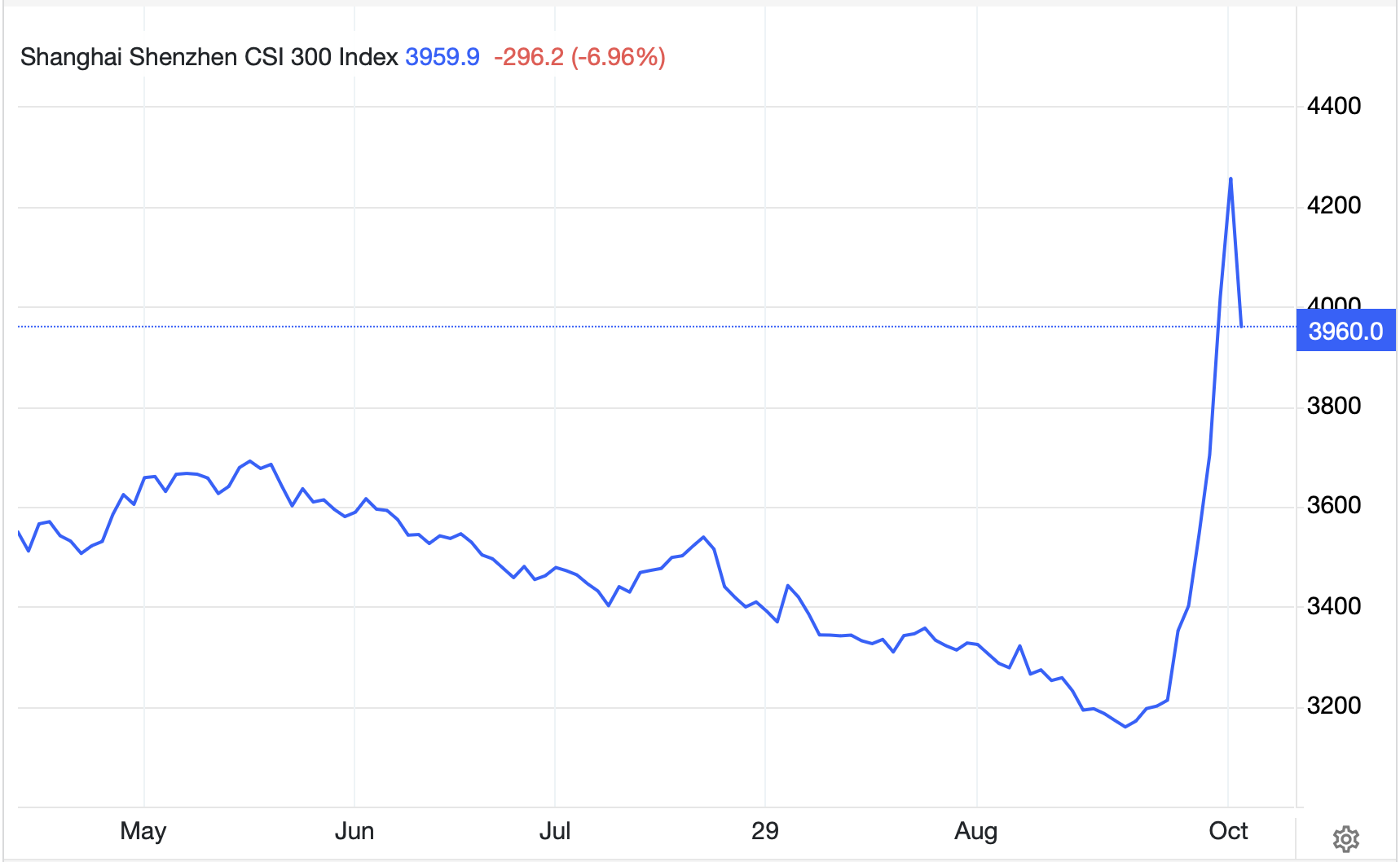
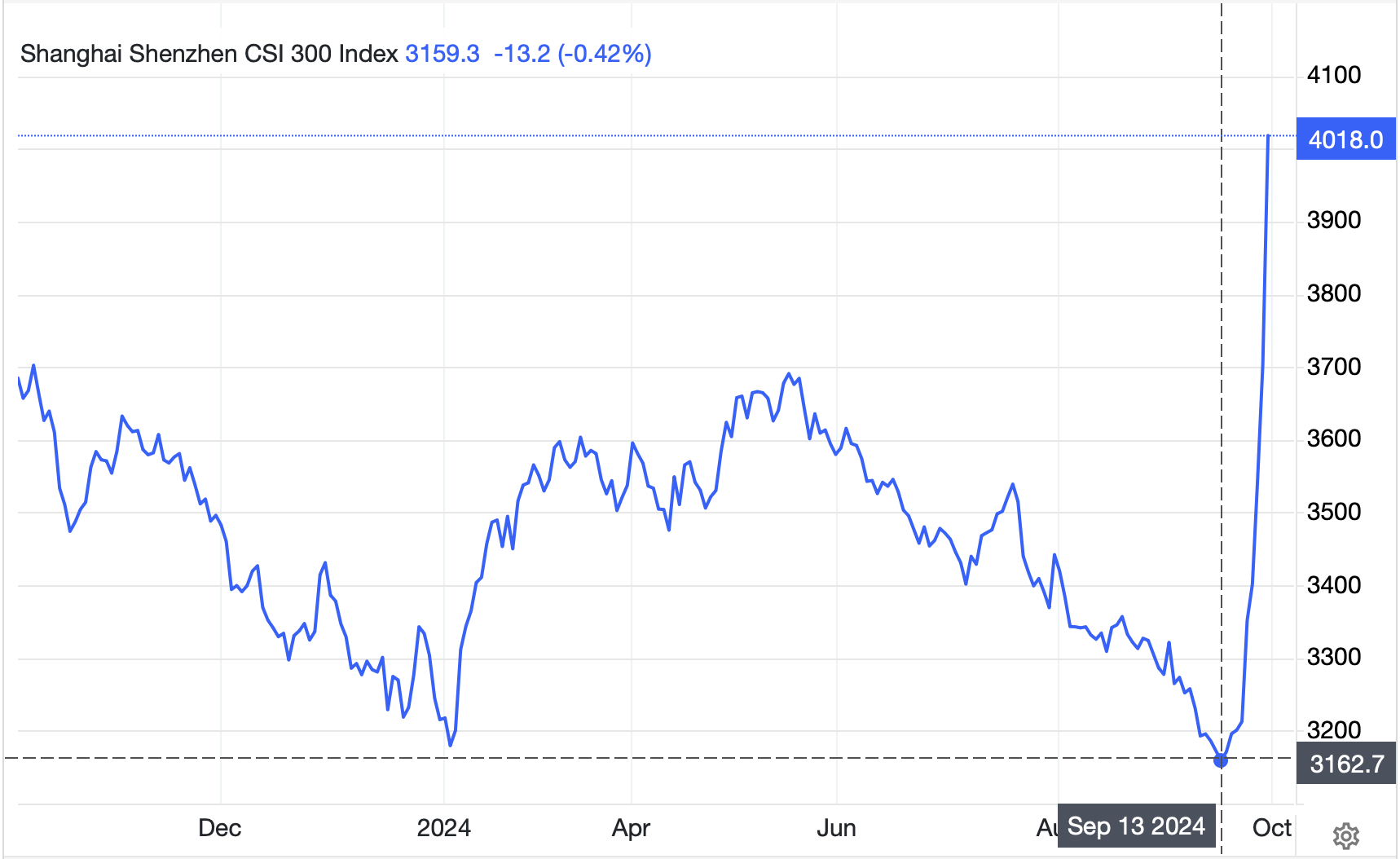
As this realization sets in, there is no better picture of this change of heart than the chart below showing the recent performance of the CSI 300.

Source: tradingeconomics.com

Last night’s 7% decline, which followed a similar one in Hong Kong the night before, has certainly stifled some of the ebullience that existed two weeks ago.  Now, the market has still gained a very healthy 25% from its lows last month, certainly nothing to sneeze at, but are the prospects really that great going forward?  Only time will tell, but I am not confident absent another significant bout of fiscal stimulus, something on the order of a helicopter money drop.  And that doesn’t seem like Xi’s cup of tea.

Turning to Europe, the economy there remains in the doldrums with some nations far worse off than others. Germany remains Europe’s basket case, as evidenced by this morning’s Trade Balance release there.  While the balance grew to €22.5B, that was because imports fell a larger than expected -3.4%, a signal that domestic activity is still lagging.  With the ECB set to meet next week, the market is currently pricing a 90% probability of a 25bp rate cut with talk of another cut coming at the following meeting as well.

You may remember that Madame Lagarde was insistent that there was no guaranty that the ECB would be cutting rates at every meeting once they started, rather that they would be data dependent.  But with the combination of slowing economic activity, especially in Germany, and the ensuing political angst it has created amongst the governments throughout Europe, it seems that many more ECB members have seen the inflation light and have declared a much higher degree of confidence that it will be at, or even below, their 2% target soon enough.  And maybe it will be.  However, similar to the Fed’s prognosticatory record, the ECB has a horrific track record of anticipating future economic variables.  A key problem for Europe is the suicidal energy policies they continue to promulgate.  Granted, some nations are figuring out that wind and solar are not the answer, but Germany is not one of them, at least not yet.  And as long as these policies remain in place and electricity prices continue to rise (they are already the highest in the world) then inflation pressures are going to continue.

Bringing this conversation around to more than macroeconomic questions, the market impact of recent data is becoming clearer.  While the US economy continues to show resilience, as evidenced by that blowout NFP report last Friday, and Europe continues to falter, the previous assumptions on rate movements with the Fed being the most aggressive rate cutter around are changing.  The result is the euro, which has slipped more than 2% in the past two weeks, is likely to continue to fall further, putting upward pressure on Eurozone inflation and putting the ECB in a bind.

Ok, those seem to be the drivers in markets today as we all look forward to tomorrow’s US CPI report.  A tour of the rest of the overnight session shows that Japan (+0.9%) continues to rebound from its worst levels a month ago as worries of aggressive monetary policy tightening continue to abate.  The latest view is the BOJ won’t move until January at the earliest.  The rest of Asia was mixed with the biggest gainer being New Zealand (+1.7%) which responded to the RBNZ cutting rates by 50bps, as expected, but explaining that further cuts were in line as they expected inflation to head below the middle of their 1% – 3% target range.  In Europe, the picture is mixed with more gainers than laggards but no movement of more than 0.3%, a signal that not much is happening.  US futures are similarly little changed at this hour (7:45) this morning.

In the bond market, Treasury yields have edged higher by 1bp and continue to trade above 4.00%, a level that had been seen as critical when the market moved below that point.  Given the overall lack of activity today, it should be no surprise that European sovereigns are also within 1bp of yesterday’s closing levels while JGB yields, following suit, rose a single basis point overnight.  It feels like the market is awaiting the CPI data tomorrow to make its next moves.

Oil prices were clobbered yesterday, falling nearly 6% at one point on the session before a modest late bounce.  This morning, they are slipping another -0.5% as market participants seem tired of waiting for a Middle East conflagration and instead have focused on the fact that more supply is coming on the market amidst softening demand.  Libya is back to full output of 1.2mm bpd and OPEC is still planning to increase production while China and Europe show softer growth.  That China story continues to undermine copper (-1.6%) although the precious metals, after downdrafts yesterday, are little changed this morning.

Finally, the dollar continues to find support on the strength of reduced Fed rate cut expectations alongside growing expectations for cuts elsewhere.  NZD (-1.0%) is today’s laggard though the rest of the G10 are all showing declines.  In the EMG bloc, the dollar is also higher universally, but the moves here are more modest.  In fact, away from NZD, the next largest declines have been seen in NOK (-0.6%) and SEK (-0.5%), but LATAM, APAC and EEMEA are all softer as well.

On the data front, this morning brings EIA oil inventories, with a net draw expected and then at 2:00 we see the FOMC Minutes from the last meeting.  But those are stale given the payroll report.  Instead, we hear from seven more Fed speakers today which will set the tone.  Yesterday’s speakers seemed to have been on the same page as Monday’s, with caution the watchword but rate cuts described as necessary despite the payroll report.  Whatever there mental model is, it is clearly pointing to rate cuts are necessary.

It feels like today is going to be quiet as markets await tomorrow’s CPI data.  The dollar seems likely to retain its bid, though, as the US is still the ‘cleanest shirt in the dirty laundry’ and global investors seem determined to own assets here.

Good luck

Adf

Condemned to Damnation

The Chinese returned from vacation
But hopes for more subsidization
Were rapidly dashed
With early gains trashed
And Hong Kong condemned to damnation
 
Meanwhile, what we heard from the Fed
Was further rate cuts are ahead
They all still believe
That they will achieve
Their goal and inflation is dead


Talk about buzzkill.  The Chinese Golden Week holiday is over and all the hopes that the National Development and Reform Commission Briefing would highlight new stimulus as well as further details of the programs announced prior to the holiday week were dashed.  Instead, this group simply confirmed that they were going to implement the previously announced plans and insisted that it would be enough to get the economy back to its target growth rate of 5.0%.  You may recall that the government had promised funds to support the stock market and some efforts to support the housing market, but there was little in the way of direct support for consumers.  While the initial market response to the stimulus measures was quite positive, there is a rapidly growing concern that those measures will now fall short.  In the end, much of the joy attached to the stimulus story has evaporated.  

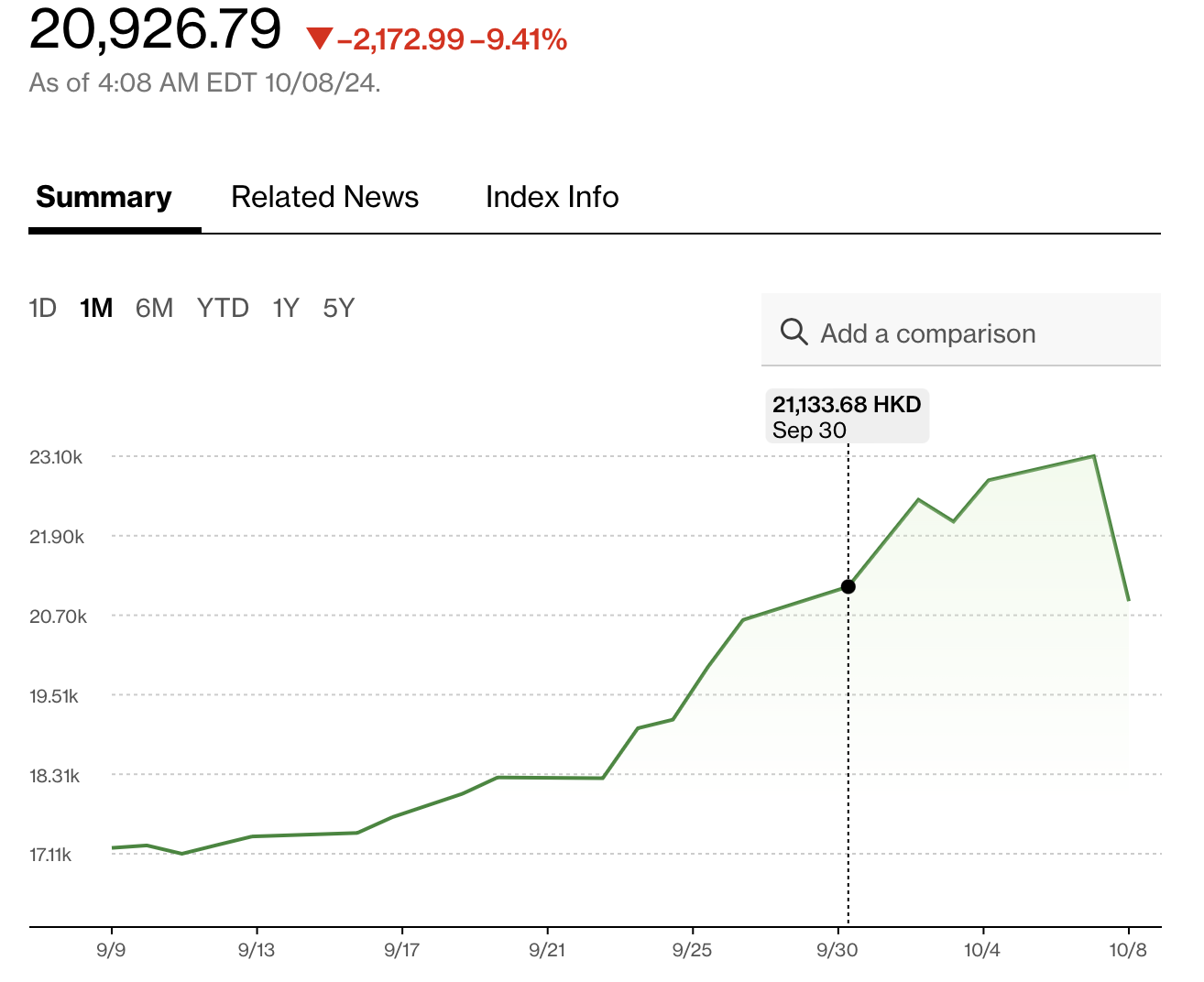
The market response was telling as while onshore stocks rallied (CSI 300 +5.9%) they closed far below their early session highs and the Hang Seng (-9.4%) in Hong Kong, which had been open all during the Golden Week holiday and rallied steadily through that time, retraced sharply, giving back all those gains and then some (see below). 

Source: Bloomberg.com

In the end, it is difficult to look at the Chinese story and feel confident that the currently announced stimulus packages are going to be sufficient to make a major dent in the problems there.  It appears that the limits of a command economy may have been reached, a situation that will not benefit anyone.

Turning to the first batch of Fed speakers, yesterday we heard from Governor Adriana Kugler, St Louis Fed president Alberto Musalem and Chicago Fed president Austan Goolsbee.  While Mr Goolsbee explained, “I am not seeing signs of resurgent inflation,” it does not appear he is really looking.  As to Ms Kugler, she “strongly supported” the 50bp cut and when asked about the strong NFP report explained that looking through the data, “several metrics point toward labor-market cooling”, despite the strong report.  Finally, Mr Musalem, although he supported the 50bp cut, remarked, “Given where the economy is today, I view the costs of easing too much too soon as greater than the costs of easing too little too late.”

Net, it appears that recent data upticks have not had any impact on their views that they must cut rates further and are prepared to do so every meeting going forward.  The Fed funds futures market has now priced 25bp rate cuts into both the November and December meetings, although that is reduced significantly from the nearly 100bps that was priced prior to the NFP report.

Away from those stories, though, there was not much other news of note overnight.  Russia/Ukraine has moved to page 32 of the newspapers and is not even discussed anymore.  Israel/Hamas/Hezbollah/Iran has more tongues wagging but at this point, it has become a waiting game for Israel to respond to the missile barrage from Iran last week.  Given we are between Rosh Hashanah and Yom Kippur, it seems unlikely to me that we will see anything prior to the weekend.  China fizzled after vacation.  The US election remains a tight race at this point with no clear outcome.  Hurricane Helene and the aftermath is being superseded by Hurricane Milton, due to hit the Tampa area shortly, but again, the latter two, while horrific tragedies, or potential tragedies, are not really market stories.

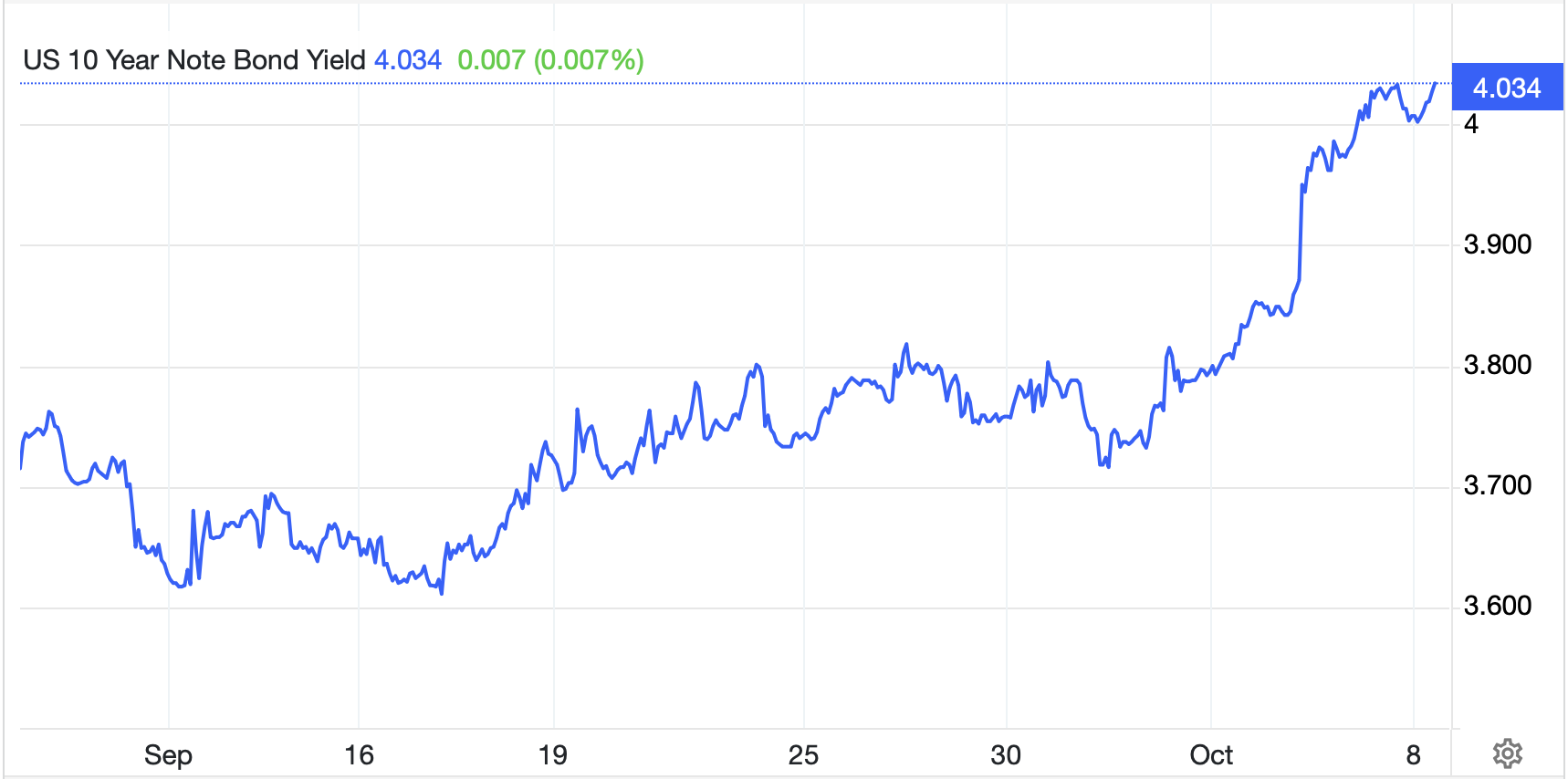
So, what’s driving things?  Arguably, interest rate policies and bond markets are having the biggest impact on financial markets right now.  With that in mind, the fact that 10-year Treasury yields are now back above 4.0% for the first time since August seems to be the main event.  Why, you may ask, would bond yields have backed up so far so fast?  Ultimately, it appears that bond investors are losing confidence in the central bank inflation story, the idea that they have it under control.  First off, oil prices, though lower today by -1.9%, have still gained more than 8.3% in the past week with gasoline prices higher by nearly 7% in the same period.  This does not bode well for lower inflation prints going forward.  Second, the combination of the much stronger than expected NFP report and the Fed’s willful ignorance of the implications is also tipping the marginal investor toward seeing more inflation going forward.

Ok, so how have these things impacted markets?  Well, aside from China/HK and following yesterday’s US declines, there were far more laggards (Japan, Singapore, Korea, Australia) than leaders (India) across Asia with Tokyo (-1.0%) the next worst performer.  In Europe, all the screens are red this morning led by the UK (-1.1%) but with losses between -0.2% in Germany after a much better than expected IP reading, to -0.6% in France.  Oftentimes, it seems like Europe is trading on yesterday’s US news, and that is the case today as US futures are pointing higher by about 0.4% at this hour (7:40).

Bond yields, which have been climbing for the past week, are little changed this morning, with neither Treasuries nor European sovereigns showing any movement of note.  However, one need only look at the chart below to see the trend over the past month.

Source: tradingeconomics.com

Aside from the oil retreat mentioned above, which seems to be a response to the absence of that Israeli action so widely expected, copper (-2.6%) is the laggard as disappointment over the Chinese stimulus dud pushed down demand expectations.  Gold (+0.3%) though, remains in demand and is hovering just below its recent all-time highs.

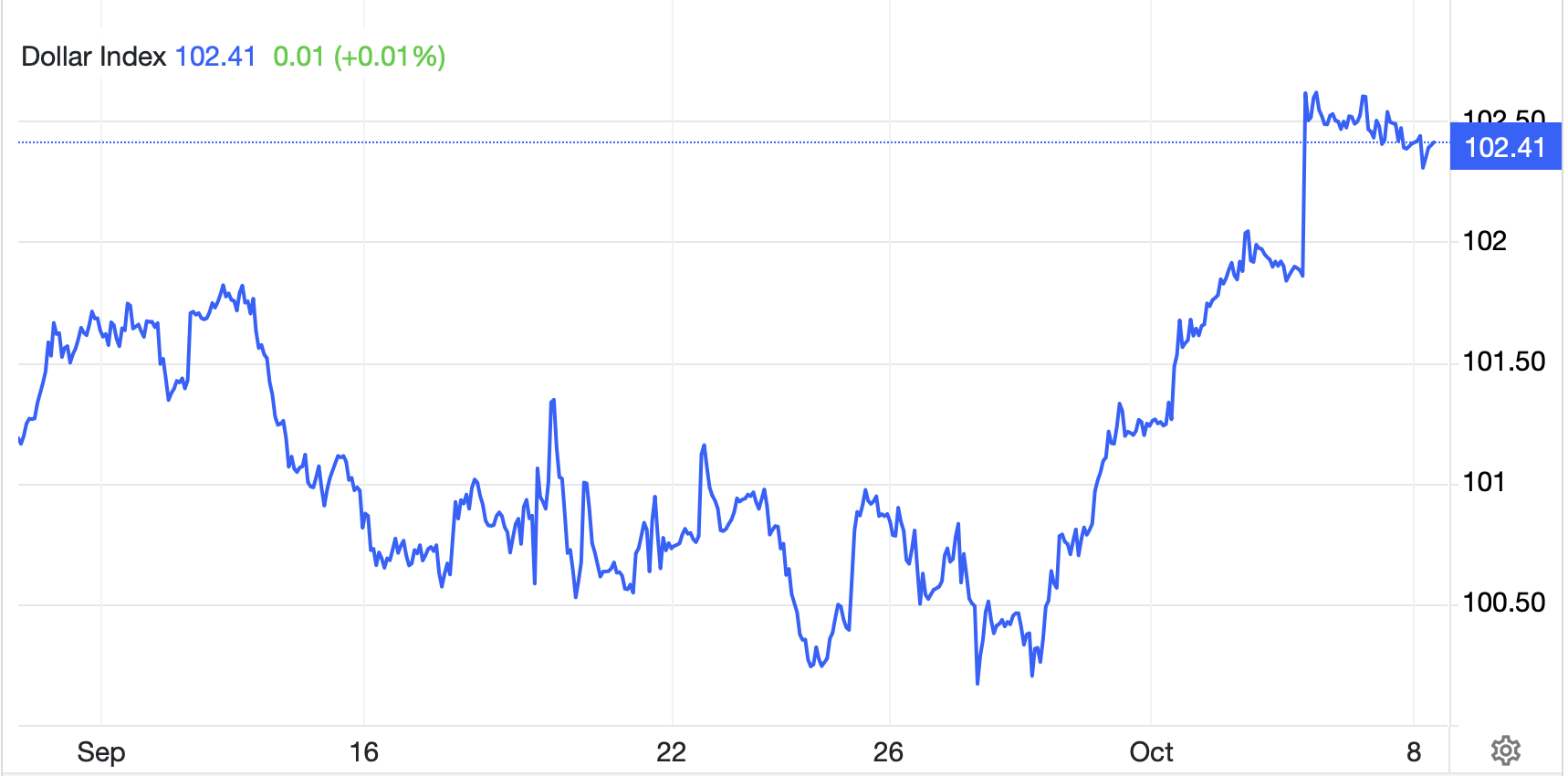
Finally, the dollar is backing off a bit this morning, although as evidenced by the chart below of the DXY, it has been on a bit of a tear for the past week, so consolidation should not be a surprise.

Source: tradingeconomics.com

However, overall, today’s price activity has been relatively muted with all G10 currencies within 0.2% of yesterday’s closing levels and the biggest movers in the EMG bloc (PLN +0.4%, ZAR -0.4%) hardly showing much more motion.  One exception is IDR, where the central bank intervened overnight after six consecutive days of rupiah weakness which saw the currency decline -4.5%.

On the data front this morning, the NFIB Small Business Optimism Index was released at a slightly softer than expected 91.5 although the Uncertainty sub index it a record high of 103 indicating small businesses are in a tough spot.  Otherwise, the only number is the Trade Balance (exp -$70.6B) and then a bunch more Fed speakers, all different ones than yesterday.  We also see the 3-year Note auction, so that may give us some clues as to the demand story for Treasuries ahead of the CPI data on Thursday.

The ongoing conflicting data has many, if not most, investors confused.  I believe that people will be seeking more clarity on Thursday and so until then, absent another geopolitical shock, we are likely to see modest market movements overall.  However, with the Fed hell-bent on cutting, I continue to fear inflation starting to reaccelerate and the dollar starting a more substantive decline.

Good luck

Adf

A Brand New Zeitgeist

Although it’s the number two nation
Of late its shown real desperation
Seems Xi did appraise
The recent malaise
And ordered growth maximization
 
So, mortgage rates there have been sliced
And refi’s are now getting priced
It’s different this time
The bulls, in sync, chime
As Xi seeks a brand new zeitgeist


As China gets set to head off for a week-long holiday, President Xi wanted to make sure everybody there felt great and would start to spend money again.  His latest move came via the PBOC where they loosened the regulations regarding refinancing of home mortgages, now allowing them for everybody starting November 1st.  The key housing rate in China is the 5-year Loan Prime Rate, and while that has fallen steadily over the past two years, down nearly 1%, all the people who were swept up in the property bubble that began to burst three years ago have not been able to take advantage of the lower rates.  This is what is changing, and I presume there will be quite a bit of refi activity for the rest of the year.

So, to recap what China has done in the past week, they have cut interest rates across the board, guaranteed loans to be used for stock repurchases, changed regulations to allow lower down payments on mortgages for first and second homes and now allowed more aggressive refinancing of existing mortgages.  As well, they reduced the RRR, freeing up capital for banks, and relaxed rules for regional governments to be able to spend more.  Now matter how this ultimately ends up, you must give Xi full marks for finally figuring out that in a command economy, he needed to command some more stimulus.  The latest mortgage news has simply excited the equity market even more and there was another huge rally last night (CSI 300 +8.5%), which when looking at a chart of that index shows an impressive rally in the past two weeks, slightly more than 27%!

Source: tradingeconomics.com

However, before we get too carried away, a little perspective may be in order.  The below chart is the 5-year view, and while the recent rebound is quite impressive, it simply takes us back to the level from July 2023 and remains more than 30% below the highs seen in February 2021.  I might argue that even if all of these policies work out as planned, something which rarely ever happens, until the economic data start to prove it out, things here feel a bit overbought for now.  Putting an exclamation on the last point, last night China released its monthly PMI data which showed just why Xi has become so aggressive.  Every reading, from both Caixin and the National Bureau of Statistics, was weaker than last month and weaker than expected.  Xi certainly needed to do something.

Source: tradingeconomics.com

Gravity remains
An unyielding force, even
For Japanese stocks

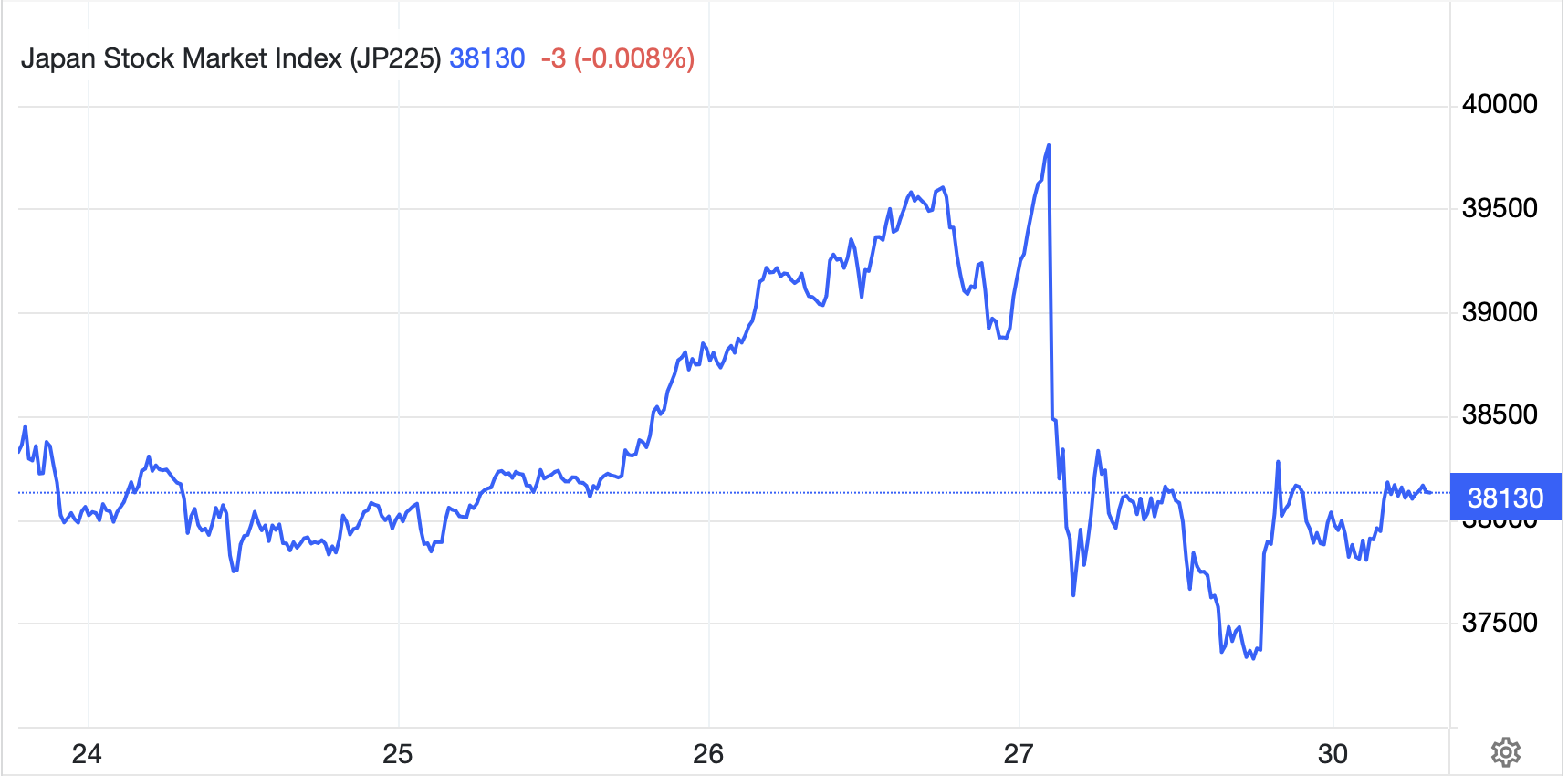
Now, a quick mea culpa from Friday’s note as I was in error on my analysis of the Japanese stock market in the wake of the election of Ishiba-san.  It seems that the announcement of his victory was not made until after the cash equity market was closed for the day. At that time, Sanae Takaichi remained the odds-on favorite to win the vote, and the market was anticipating a more dovish approach to things. Hence, the idea of the return to Abenomics and a much slower policy tightening was welcomed by the equity market at the same time the yen weakened.  But with Ishiba-san’s surprise victory, all of that got tossed out the window.  

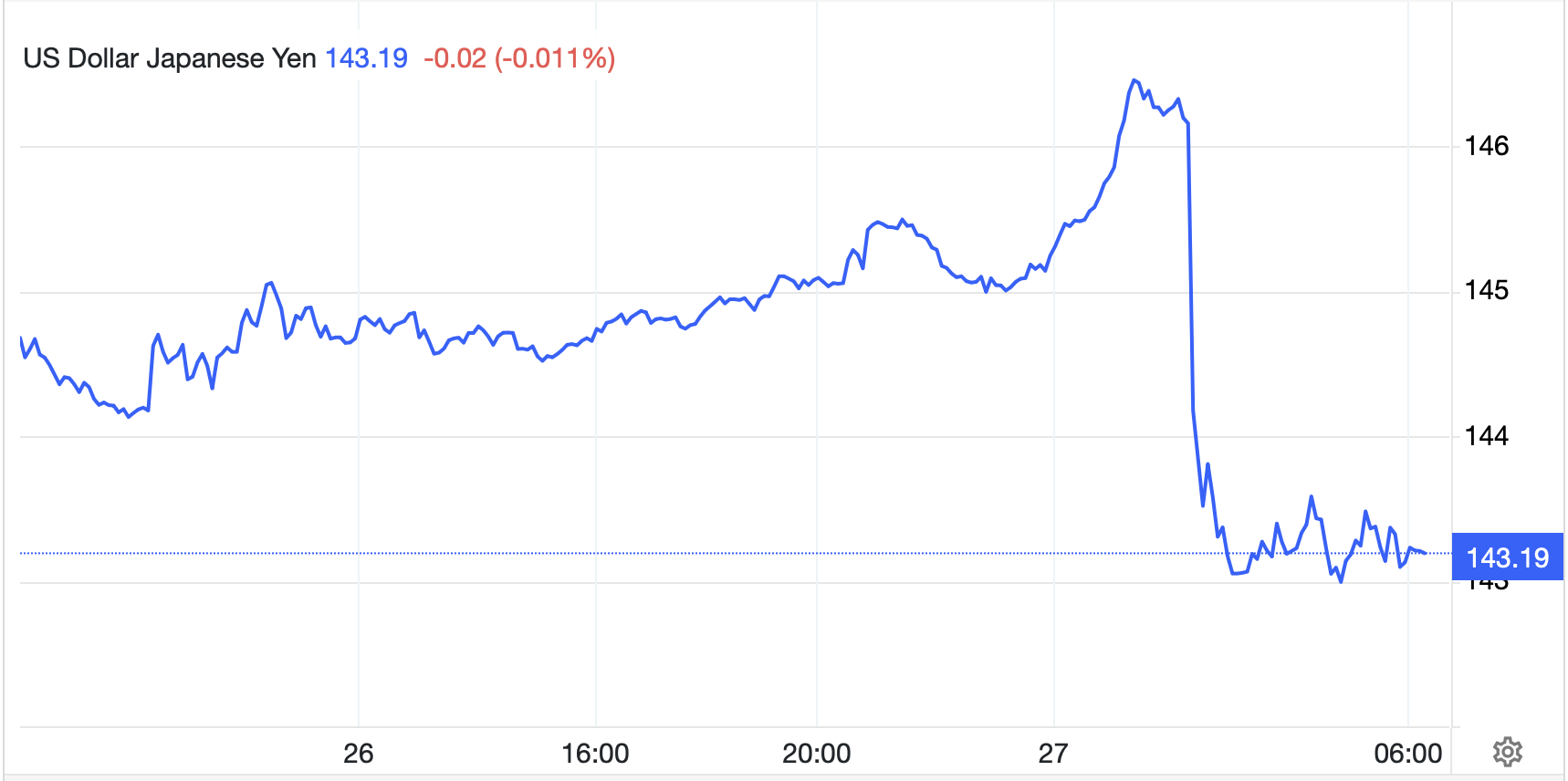
Of course, USDJPY was able to respond instantly, hence the sharp reversal in the market I showed in a chart on Friday.  However, the futures market sold off sharply on the election news and now that has been reflected in the overnight session with the Nikkei (-4.8%) giving back all the gains it had made in the previous two sessions in anticipation of a dovish turn.  So, as you can see in the below chart for the Nikkei 225 over the past week, we are basically exactly where things started before the Takaichi expectations built.  Truly much ado about nothing.

Source: tradingeconomics.com

As to the rest of the overnight session, beyond the Chinese data, we saw German state CPI readings which continue to fall as the German economy continues to slow appreciably.  We also saw UK GDP data, which was slightly softer than forecast, although at 0.9% Y/Y, still well ahead of Germany’s pace.  But otherwise, not very much else.  Last Friday’s PCE data was largely in line and quite frankly, most of the market seems to be focused on China right now, not the US, as that has become the newest idea on how to get rich quick.

So, here’s a quick recap of the session thus far.  Away from China and Japan, we saw more weakness than strength in Asia with both Korea and India falling more than -1.0%, although the rest of the region was mixed with much smaller moves.  Australia (+0.8%), though, benefitted from the China story as the price of iron ore, one of its major exports, rose 11% overnight on the idea that Chinese construction was coming back.  However, European bourses are under pressure this morning led by the CAC (-1.6%) with the rest of the continent also soft on the back of weaker earnings forecasts and announcements from European companies.  As to US futures, at this hour (7:20), they are pointing lower by -0.25%.

In the bond market, with all the excitement over renewed growth in China and continued tightening in Japan, yields are backing up slightly with virtually every G10 government seeing yields higher by 2bps this morning.  Ultimately, for Treasuries my fear is with the Fed cutting rates now and no real sign that the economy is slowing rapidly, we are going to see a quicker rebound in inflation than they are anticipating and that will not help the long end of the curve at all.

In the commodity markets, we are following Friday’s declines with further moves lower this morning as oil (-0.55%) continues to struggle on the weak demand story (this time from Europe, not China) while metals markets are also under pressure with all three biggies down (Au -0.75%, Ag -1.4%, Cu -0.7%).  This is a bit confusing for two reasons.  First, with the euphoria that the Chinese reflation story has generated, I would have expected copper to continue to rally alongside iron ore, but second, the dollar is softer today, and that generally supports the metals markets.

So, a quick look at the dollar shows the DXY is looking to test 100.00, a level it last briefly touched in July 2023 but spend most of 2020 and 2021 below.  This is concurrent with the euro (+0.3%) testing 1.12 and the pound (+0.3%) testing 1.35, with the former showing virtually the same pattern as the DXY and the latter making new highs for the past two years.  But there is some schizophrenia in the G10 with JPY (-0.2%), CHF (-0.3%), NOK (-0.35%) and SEK (-0.2%) all under pressure today.  While NOK and SEK make sense given the commodity moves, that doesn’t explain gains in AUD and NZD.  Some days are just like that.  In the EMG bloc, in truth, the dollar is showing more strength than weakness with ZAR (-0.35%), CNY (-0.2%) and KRW (-0.15%) although MXN (+0.3%) is bucking that trend.  On the one hand, it is quite confusing to see so many contrary moves amongst the currencies that typically track closely together.  On the other, though, none of the moves are very large, so there can be idiosyncratic explanations for all of this without changing the big picture story.

On the data front, we get a bunch of stuff culminating in NFP on Friday.

TodayChicago PMI46.2
 Dallas Fed Manufacturing-4.5
TuesdayISM Manufacturing47.5
 ISM Prices Paid53.7
 JOLTS Job Openings7.67M
WednesdayADP Employment120K
ThursdayInitial Claims220K
 Continuing Claims1837K
 ISM Services51.6
 Factory Orders0.1%
FridayNonfarm Payrolls140K
 Private Payrolls120K
 Manufacturing Payrolls-5K
 Unemployment Rate4.2%
 Average Hourly Earnings0.3% (3.8% Y/Y)
 Average Weekly Hours34.3
 Participation Rate62.9%

Source: tradingeconomics.com

As well as all that, we hear from nine different Fed speakers over 13 different speeches this week, including Chairman Powell this afternoon at 2:00pm.  It’s not clear that we have learned enough new information for Powell to change his tune although given all of China’s moves there could be some belief that the Fed doesn’t need to be so aggressive.  Now, as of this morning, the Fed funds futures market is pricing a 41% probability of a 50bp cut in November and a 50:50 chance of a total of 100bps by the end of the year.  but, if China is easing so aggressively, does the Fed need to as well?

Right now, the story is all China.  However, I still detect a lot of positive sentiment in the US and expectations that the Fed is going to continue to ease and boost growth, inflation be damned.  It still strikes me that you cannot be bullish both stocks and bonds here as they are going to respond quite differently to the future.  As to the dollar, it is clearly on its back foot as the pricing of further Fed ease undermines it for now, but remember, as other central banks follow the Fed more aggressively, any dollar declines will be muted.

Good luck

Adf

More Money to Mint

As an eagle soars
So too did the yen after
Ishiba-san won


Political change in Japan is far less bombastic and exciting than here in the US as evidenced by the election of Shigeru Ishiba as the new leader of the Liberal Democratic Party (LDP) last night.  Given the LDP’s large majority in the Diet (Japan’s parliament), as the new leader, Ishiba-san is now all but certain to be the new Prime Minister. This will likely be confirmed by a vote as early as next Tuesday, but sometime very soon regardless.

Ishiba’s background, a party veteran and former defense minister, seems to have been the right focus at the right time as strains with China have recently increased and the electorate (LDP members, not the general population) are clearly hearing about security concerns more than other issues.  The implication is that economic issues were not the driving force here, but in that vein, Ishiba’s views appear to be to allow the BOJ and Governor Ueda to continue their normalization process, finally ending the decade plus of Abenomics that worked to raise inflation.  

Now, as it happens, last night Tokyo inflation was released with the headline falling to 2.2% and the core falling to 2.0%, as expected.  It also appears that one of his key opponents, Sanae Takaichi, had been an advocate of pressuring the BOJ to slow its policy normalization, so with the results, market participants reacted swiftly, and the yen rallied sharply on the news as per the below chart while the Nikkei after an initial sharp decline, rebounded and closed higher by 2.3%.

Source: tradingeconomics.com

Going forward, it seems unlikely that the yen is going to be a focus of the new Ishiba administration.  Rather, he is clearly focused on defense strategy so Ueda-san will be able to continue his normalization efforts at his own pace.  As evidence, JGB yields stopped their recent slide and backed up 2bps overnight.  I suspect that we will see a very gradual move higher here with key drivers to be purely economic issues rather than political ones, at least for a while.

This morning, the PCE print
Will help give another key hint
To whether the Fed
When looking ahead
Will soon start, more money, to mint

The other story for the day is the PCE report to be released at 8:30. Current expectations are for a 0.1% M/M, 2.3% Y/Y rise in the headline number and a 0.2% M/M, 2.7% Y/Y rise in the ex-food & energy reading.  If these are the realized outcomes, the trend lower in inflation will remain on track and all the Fed speakers will feel vindicated that the 50bp cut last week was appropriate.  But I think it is worthwhile to take a quick look at a chart of how this number (core PCE) has evolved over time to help us better understand where things are in relation to the pre-pandemic economy. 

Source: tradingeconomics.com

Now, while there is no doubt that we are well below the highest levels seen two years ago, it is not difficult to look at this chart and see a potential basing formation, well above the pre-pandemic levels.  In fact, today’s expectations on the core reading are for a bounce higher of 0.1% which would only reinforce the idea that we have seen the bottom in this reading.  Of course, any one month’s data is not definitive as everything is subject to revisions, and simply looking at the chart, it is easy to see both ebbs and flows in the data well before the pandemic.  But I continue to be concerned that the Fed’s very clear ‘mission accomplished’ attitude on inflation is a big mistake that will come back to haunt us all sooner than you think.

Ahead of the data, a look at the overnight session shows that the ongoing rally in risk assets that started with the Fed and has been goosed by China’s efforts this week, remains the dominant theme.  In fact, Chinese shares had another gargantuan session last night (CSI 300 +4.5%, Hang Seng +3.6%) as hedge funds who had been quite short the Chinese stock market prior to the announcements this week continue to scramble to cover those shorts as well as get long for the rest of the expected ride.  But away from China and Japan, the rest of Asia was far less excited with declines seen in India, Korea and Australia leading most indices lower there.  As to European bourses, they are firmer this morning led by the DAX (+0.8%) but green everywhere after preliminary inflation data for September from France and Spain saw declines well below expectations to 1.5% and investors increased the probability of an October ECB rate cut substantially.  While some ECB members remain concerned over the stickiness of services prices, which continue to hover above 4%, if the headline numbers are falling below 2%, I think it will be very difficult for Madame Lagarde to push back against another cut next month.  Meanwhile, ahead of the data, US futures are unchanged.

In the bond market, Treasury yields have edged lower by 1bp while European sovereign yields have moved a similar amount except for French OATs which have slipped 3bps.  The story about French debt yielding more than Spain, one of the original PIGS has gotten a lot of press and it seems deeper thinkers disagree with the idea and are buying ‘undervalued’ French OATs.  

In the commodity markets, oil (+0.15%) has finally stopped falling, at least for the moment, although the recent trend is anything but encouraging for oil bulls.  Crude is lower by -4.5% in the past week and -9.0% in the past month, clearly helping the headline inflation readings.  As to the metals markets, after another strong day yesterday, they are consolidating with very modest declines (Au -0.2%, Ag -0.1%, Cu -0.4%) although the trend in all three remains firmly higher.

Finally, the dollar, after several sessions under a lot of pressure, is also bouncing slightly, at least against most of its counterparts.  We have already discussed the yen’s gains, but vs. the rest of the G10, it is firmer by roughly 0.15% or so while vs. its EMG counterparts some are seeing losses  (CE4 -0.3% to -0.4%) while there are others with modest gains (ZAR +0.3%, MXN +0.4%).  For now, the trend remains for a lower dollar, and if we see a soft PCE reading this morning, I expect that to reassert itself as thus far, today’s price action appears more like a trading response to the recent weakness.

In addition to the PCE data, we also see Personal Income (exp 0.4%), Personal Spending (0.3%), the Goods Trade Balance (-$99.4B) and Michigan Sentiment (69.3).  Mercifully, on the Fed front, only Governor Bowman speaks, she of the dissent at the last meeting, although yesterday’s plethora of Fed speakers taught us nothing new at all.  

I don’t have a strong opinion as to how this data will play out, but I would caution that if PCE is firmer than expected, look for a hiccup in the recent euphoria over stocks and bonds, while the dollar consolidates its support.  However, if we see a softer print than forecast, watch out for a much bigger rally in stocks and a much weaker dollar.

Good luck and good weekend

Adf

A Financial Home Run

Seems President Xi isn’t done
And last night he added a ton
Of new stimuli
In order to try
To hit a financial home run
 
The market response has been clear
Forget anything that’s austere
It’s buy with both hands
Ere Powell rebrands
QE as just more Christmas Cheer

Things are obviously worse in China than President Xi had been willing to let on for the past several months/years, as after two straight days of monetary policy stimulus announcements, they pulled out the big guns and got the fiscal side of the process involved.  Last night the Politburo pledged further support after a surprise meeting to discuss economic policies.  Their economic discussions have historically only occurred in April, July and December, so this was the latest indication that Xi is really concerned. 

Some of the actions include an (unspecified) effort to make the real estate market “stop declining”, limiting construction of new home projects, issuing CNY 2 trillion of special sovereign bonds to disburse funds to help fund financial assistance for low-income workers, shore up bank capital to encourage more lending and support further investment in productive capacity as well as to potentially buy up unfinished homes.  

Obviously, Xi was quite concerned that the country would not achieve his 5% GDP growth target for 2024 as an increasing number of analysts around the world were penciling in slower growth, and he decided he could not wait until December for the next policy adjustments.  Remember, too, that next week is a week-long Chinese holiday, so part of the impetus was to give cash to people to encourage more spending/activity.  While it is far too early to determine how effective these new policies will be at supporting real, organic economic activity, they did wonders for equity markets and risk assets around the world.

And really, that continues to be the main story.  With the Fed now having confirmed that lower rates are appropriate, I would look for almost every nation to boost stimulus, both monetary and fiscal, especially in the wake of recent election results which have seen incumbent after incumbent tossed from office.  After all, what good is being in power if you cannot buy your way to re-election?

So, how has all this impacted financial markets this morning?  You will not be surprised to see that risky assets are in huge demand with equity markets rallying everywhere along with metals, while haven assets see much more modest demand, with bond yields having slipped just a bit lower.

Yesterday’s mixed US market performance is but a distant memory this morning with Asian shares roaring higher (Nikkei +2.8%, Hang Seng +4.2%, CSI 300 +4.2%) and gains virtually across the region, albeit not quite as robust as those.  But after the Fed cut, this fiscal stimulus from China is seen as helping everybody.  Europe, too, is rocking this morning with gains well above 1.0% everywhere (DAX +1.2%, CAC +1.6%, IBEX +1.1%) except the UK (FTSE 100 +0.2%) which continues to struggle as the Labour government is shown to be further and further out of its depth with respect to actually running things rather than carping about how the Tories did it.  And not to worry, US futures are all racing higher as well this morning, higher by between 0.3% (DJIA) and 1.5% (NASDAQ) at this hour (7:15).

In the bond market, Treasury yields have edged lower by 2bps and remain far below the Fed funds rate.  It is not clear if this is the market anticipating a more significant economic slowdown or simply a continued manifestation of the fact that the Fed still owns a significant portion of the debt outstanding and so has restricted supply at the margin.  In Europe, yields are also lower, with the riskiest nations seeing the biggest declines as risk assets are in vogue this morning.  Thus, Italy (-7bps) and Greece (-6bps) have moved the farthest, but otherwise we are seeing movement on the order of -3bps elsewhere.  In another quirk, and a telling comment on the state of France’s finances, Spanish 10yr bonos now yield less than French 10yr OATs for the first time in more than 15 years.

Turning to commodities, oil (-2.8%) didn’t get the China rebound memo and has tumbled nearly $2/bbl falling well below the $70/bbl level.  It seems that Saudi Arabia is dropping its price target and preparing to increase production, something the market has been fearing.  As well, in Libya, which had not been producing lately due to political issues, it appears a tentative agreement is in place that will allow for more supply on the market.

But you know what really benefits from a lot of deficit spending and the effective abandonment of inflation targets?  That’s right, precious metals as gold (+0.8%) continues its steady move higher to new all-time highs and quickly approaches $2700/oz.  This has taken both silver (+2.2%) and copper (+2.2%) along for the ride and there is currently no end in sight.

Finally, the dollar is under pressure this morning in a classic risk-on reaction.  AUD (+0.9%) is the leading G10 gainer on the back of its strong metals exposure while NZD (+0.8%) is right behind.  But the dollar’s weakness is manifest in Europe (EUR +0.2%, GBP +0.5%, SEK +0.5%) as well as against most EMG currencies.  In fact, CNY (+0.55% and below 7.00) is one of the biggest movers today although we are seeing strength in KRW (+0.7%), MXN (+0.5%) and ZAR (+0.4%), an indication that this move is widespread.  As long as the perception remains that the Fed is going to lead the way to lower interest rates, I can see the dollar underperforming.  However, as soon as we see other nations become more aggressive, this move will abate.

On the data front, there is much on the calendar this morning starting with the weekly Initial (exp 225K) and Continuing (1832K) Claims data as well as the 3rd look at Q2 GDP (3.0%).  We also see Durable Goods (-2.6%, +0.1% ex-Transports) and then the ancillary data that comes with the GDP report including Real Consumer Spending (2.9%), Final Sales (2.2%) and the GDP PCE indicator (2.5% headline, 2.8% core).  But perhaps of far more importance, we hear from a host of Fed speakers this morning.  Governor Kugler and Boston Fed president Collins speak about financial inclusion, Governor Bowman discusses the economy and monetary policy, Governor Cook discusses AI and workforce development, Vice-chair Barr discusses regulation and Chairman Powell gives the opening remarks at the US Treasury Market Conference in NY. 

Yesterday, Governor Kugler added to the ‘mission accomplished’ view on inflation at the Fed and lauded the move to focus on Unemployment.  I would contend this is the key issue right now, the fact that central banks around the world, but particularly the Fed, have determined that the inflation fight is over.  While we may very well touch 2.0% core PCE in the next months, it strikes me as highly unlikely that level will be maintained.  Rather, 2.0% is now the floor and if the Unemployment Rate behaves in its historic manner, accelerating higher now that it has started to move in that direction, look for much sharper interest rate cuts, much higher inflation and a much weaker dollar.  To me, that is the biggest risk.  However, if Unemployment follows the Fed’s projected path, and stays quiescent, then the current slow decline in rates and a very gradual decline in the dollar seems more likely.

Good luck

Adf

The Hits Keep on Coming

In China, the hits keep on coming
As Gongsheng adjusts China’s plumbing
Last night he cut rates
As he navigates
A way to help growth there keep humming
 
Combined with the Fed’s latest act
Worldwide it is clearly a fact
Liquidity’s growing
With stock markets showing
Why traders just love the impact


As virtually promised the other night, PBOC Governor Pan Gongsheng cut the medium-term lending facility rate to 2.0% from its previous level of 2.3% last night, the largest single cut in the history of this rate’s existence.  Of course, that only takes us back to 2016 when the PBOC rolled out this concept, but nonetheless, it is a clear expression of an aggressive easing policy by the central bank.  In fact, pundits are calling for further rate cuts this year as Xi’s government struggles with rekindling the animal spirits in China.  For equity investors there, this continues to be good news as the CSI 300 rallied another 1.5% and is now within spitting distance of being flat for the year.  As well, the renminbi rallied further, briefly trading through the 7.00 level and currently about 0.35% stronger than yesterday’s close.

Alas for President Xi, while all these measures are likely to have positive short-term impacts on economic statistics, especially the way they report them over there, it is unclear if they will help restart truly organic domestic economic activity.  Ultimately, that is a direct product of the level of confidence people have in their current employment situation as well as their perception of the prospects for better opportunities going forward.  Having the government pay you back for things that were supposed to rise in price forever is welcome, but not sufficient to do the trick, I think.  Clearly the current situation is that Chinese assets are going to perform in the short run, and it is very likely commodity prices will rise as well given the perception that Chinese demand will now increase, but personally, I suspect that the longevity of this price action, at least for the Chinese assets, may be limited.

Commodity prices, on the other hand, are getting boosts from all over the place, notably from the fact that virtually every country on earth, except perhaps Japan, has entered a monetary easing cycle.  Now that the Fed has begun, and gone big to start, other central banks will feel empowered to ease policy further with the confidence that their own currencies will not collapse amid a US rate cutting cycle.  And let’s face it, so far, everything we have heard in the wake of the FOMC move last week is that they are not afraid to cut rates a lot more.

Under the guise, actions speak louder than words, even though Powell explicitly said they had not declared victory over high inflation, listening to the four speakers since the meeting, it actually appears they have done just that.  Now, there is one market that seems to disagree with them, at least so far, and that is the 30-year Treasury bond. As you can see in the chart below, the yield there is now higher by 20bps since the first stories about the Fed cutting 50bps made their way into the press.  Whatever PCE holds in store for us later this week, the combination of commodity price rises and the yield on the long bond offer strong hints that inflation is going to make an inglorious return.

Source: tradingeconomics.com

But for now, be joyful because stock markets are continuing to rally.  This economic cycle is clearly unlike any others given the still subtle ripples from Covid policies and the fact that the housing market remains stuck with so many homeowners locked into their homes due to the exceptionally low mortgage rates they hold.  The result has been two very opposite views of how things are evolving, with one camp still celebrating the fact there has been no appreciable slowdown and all-in on the soft-landing while the other digs under the headlines and finds numerous issues with hiring and debt.  Perhaps next week’s NFP print will bring clarity although I doubt that will be the case.  In the meantime, we need to observe and react as it is all we have.  It is times like these that define why hedging is so important.

Ok, let’s look at the overnight activity.  After yesterday’s modest US rally, aside from China, the picture was far more mixed in Asia with the Nikkei (-0.2%) slipping slightly while the Hang Seng (+0.7%) continued its rally on the back of the China news.  But Singapore, Korea and the Antipodes all suffered although Taiwan (+1.5%) took heart in the Chinese news.  In Europe, the picture is also mixed with both the DAX (-0.4%) and CAC (-0.3%) slipping while the FTSE 100 (+0.4%) is higher despite a complete lack of data.  Well, that’s not completely true as French Consumer Confidence rose to 95, its highest level since February 2022, but apparently that is not so important.  Meanwhile, US futures are essentially unchanged at this hour (7:30).

In the bond market, Treasury yields are leading the way higher with 10-year yields higher by 3bps and pretty much all European sovereign yields higher by either 1bp or 2bps.  Bond investors are very clearly concerned over inflation’s prospects given the wholesale turn to monetary ease seen worldwide.  The outlier here was JGB yields (-1bp) as the market there continues to respond to Ueda-san’s comments from yesterday regarding the lack of urgency to tighten further, especially given the yen’s recent rebound.

In the commodity markets, oil (-1.3%) is fading this morning, perhaps because there has been no further escalation of hostilities in the middle east, they remain at a steady level, or perhaps because we have seen a 9% rally in the past two weeks, so traders are simply taking a rest.  Metals markets, too, are softer this morning, but that is also after a very strong rally and gold (-0.1%) continues to maintain the bulk of its daily new all-time high prints.  But both silver and copper have had very strong weeks as well.  One other thing to note is that NatGas is higher by 13% this week, perhaps an indication that supply concerns are growing.

As to the dollar, after several soft sessions, it is rallying this morning.  Weakness in currencies is broad-based with the pound (-0.4%), Aussie (-0.5%), yen (-1.0%) and Swiss franc (-0.9%) all retracing some of their recent gains.  We are seeing similar price action in the EMG bloc with MXN (-0.6%), KRW (-0.5%) and PLN (-0.3%) all under pressure but with one exception, ZAR (+0.4%) which continues to benefit from the combination of still high interest rates, so the carry trade, as well as a growing belief that the new government is going to be quite business, and by extension market, friendly.

On the data front, only New Home Sales (exp 700K) is on the docket although we also see the weekly EIA oil inventory data with further drawdowns forecast.  There are no scheduled Fed speakers, but I expect we will hear from one or two anyway.  While the dollar is bouncing today, I believe the current mindset is the Fed is going to lead the way lower in this rate cycle and that the dollar will suffer accordingly.  Just be careful as with everyone cutting rates, expecting a sharp dollar decline from here seems suspect.

Good luck

Adf

Juiced

No doubt it was President Xi
Who leaned on the PBOC
To cut rates at last
And try to recast
The tone of its cash policy
 
So, mortgage rates will be reduced
While bank reserves, too, will be juiced
But will cutting rates
Be what motivates
The people and give growth a boost?


It’s almost as though Pan Gongsheng, head of the PBOC, read my note yesterday morning and decided that it was time to really do something big!  While obviously, we know that is not the case (at least I don’t see his name on my subscriber list), the PBOC definitely painted the tape last night with their actions.  Fortunately, Bloomberg listed them for us as per the below:

  1. The seven-day reverse repurchase rate will be lowered to 1.5% from 1.7%
  2. RRR lowered by 0.5 percentage points, unleashing 1 trillion yuan in liquidity
  3. PBOC didn’t specify when RRR cut takes effect
  4. MLF expected to be cut by 0.3 percentage points
  5. Minimum down-payment ratio cut to 15% for second-home buyers, from 25%
  6. China may cut the RRR further this year by another 0.25 to 0.5 percentage points
  7. RRR cut won’t apply to small banks
  8. LPR and deposit rates to fall by 0.2 to 0.25 percentage points
  9. The PBOC to cover 100% of loans for local governments buying unsold homes with cheap funding, up from 60%

A glossary of terms is as follows:

  • RRR is the reserve ratio requirement which describes how much leverage banks may take, with the lower the number equating to more leverage (need to hold fewer reserves).
  • MLF is the medium-term lending facility which is the program that the PBOC uses to lend money to banks in China, and the rate had been the key interest rate for policy. 
  • LPR is the loan prime rate, the rate at which banks lend to their best clients
  • Seven-day reverse repurchase rate is a relatively new rate that the PBOC uses for its monetary policy efforts, similar to the Fed funds rate, and is now deemed the PBOC’s key interest rate.

Now, that’s a lot of activity for a central bank in one day.  Consider how long it takes the Fed to decide to raise or cut the Fed funds rate and compare that to just how much was done.  

And that’s just the rate moves.  In addition, they indicated they would lend up to CNY 500 billion for funds, brokers and insurers to buy Chinese shares and another CNY 300 billion for companies to buy back their own shares.  Again, I find the irony of a strictly communist nation worrying about their stock market unbelievably delicious.  So, the government is willing to roll out significant monetary stimulus, but as yet, has not been willing to inject fiscal stimulus.  Arguably the biggest economic problem in China right now is that sentiment is weak as people are concerned over both their jobs and the value of their property, hence consumption remains weak overall.  It is not clear what Xi can do to fix that problem, but cheap money is only effective if people and companies want to borrow and spend it.  That remains to be seen, although the odds of China achieving its 5.0% GDP growth target for 2024 have improved now.

One other thought is that this likely would not have been possible for the Chinese had the Fed not cut 50bps last week.  As I have consistently explained, once the Fed gets going, central banks everywhere will feel more comfortable cutting their own rates and easing policy further.  At least in China, inflation is not a problem, so they have plenty of room to cut.  However, elsewhere inflation has proven stickier than most central bankers would like to see.  Nothing is yet carved in stone as to just how many rate cuts are in the offing.

As this was the only noteworthy story, let’s look at how it impacted markets everywhere.  It can be no surprise that shares in China exploded higher given the explicit PBOC support with both the CSI 300 and Hang Seng rallying more than 4.1% on the session.  As well, Chinese yields backed up a bit, off the lows I described yesterday, but only by a few basis points.  As seen below, CNY (+0.4%) rallied nicely, trading to its strongest level since May 2023 and commodities rallied across the board with oil (+2.1%) and copper (+2.4%) the leaders although precious metals (Au +0.3%, Ag +0.8%) are also rising.

Source: tradingeconomics.com

Perhaps the most interesting thing about this story is just how little it impacted non-Chinese markets. Japanese shares (Nikkei +0.6%) rallied but given the yen’s decline (-0.3%) overnight, that likely had a bigger impact on those shares.  And the rest of Asia saw a mix of modest gains and losses, with Taiwan (+0.6%) and Korea (+1.1%) the next best performers although India, Australia and Singapore saw no benefit whatsoever.  It appears they are awaiting the fiscal boost.

In Europe, though, shares are definitely feeling the love led by the CAC (+1.6%) although even the DAX (+0.75%) is rallying despite another series of lousy data, this time the Ifo surveys all printing weaker than last month and weaker than expectations.  I guess given the importance of China as an export market for Germany, the PBOC news trumps the Ifo surveys from earlier this month.  As to US futures, after very modest gains yesterday, although some more record highs, they are essentially unchanged at this hour (7:00).

In the bond market, Treasury yields continue to back up, higher by 3bps this morning and now 15bps off the lows pre-FOMC meeting.  European sovereign yields are higher by 1bp across the board except for UK gilts (+4bps) as concerns grow that the fiscal situation in the UK may deteriorate more rapidly given the apparent confusion in the Starmer government about what to do to pay its bills.  It is also worth noting that JGB yields have slipped 3bps this morning and are now back to levels last seen back in April before the BOJ’s policy tightening got somewhat serious. 

As to the dollar, overall, it is on its back foot this morning although other than the renminbi, most of the moves have been 0.2% or less.  Today’s story is CNY for sure.

On the data front, this morning brings Case-Shiller Home Prices (exp 5.8%) and Consumer Confidence (103.8).  While there are no Fed speakers today, yesterday we heard from three (Goolsbee, Bostic and Kashkari) all of whom agreed with the 50bp cut last week and were mostly pushing for another one before the end of the year.  It seems Goolsbee has taken the mantle of chief dove on the committee, explaining there are “hundreds” of basis points left to cut before they achieve the neutral rate, however neither of the other two indicated any hesitation to cut further.  As of this morning, it is basically a 50:50 proposition as to 25bps or 50bps at the November 7th meeting according to the Fed funds futures market.

And that’s where we stand this morning.  China has opened their coffers and are adding yet more liquidity to the global system.  This should continue to help risk assets everywhere, and ultimately feed into inflation readings, although in China that is not a problem.  But what about elsewhere?  For now, it feels like the dollar is more likely to suffer given the dovish enthusiasm from the Fed speakers, but Thursday will bring 4 more speakers, including Chairman Powell, so perhaps we need to hear that before getting too excited.

Good luck

Adf