Wasn’t Whizzbang

There once was a time in the past
When earnings reports were forecast
If companies beat
It was quite a treat
If not, CEOs were harassed
 
But that was before Jensen Huang
Described the AI bell he rang
Nvidia now
Is what defines tao
Alas, last night wasn’t whizzbang


In what cannot be that great a surprise, given the remarkable hype that continues to surround Nvidia, their earnings were great, but not great enough to exceed the outsized expectations that have become commonplace.  And while revenues and earnings more than doubled, and their profit margins are above 50%, it wasn’t enough to satisfy the underlying belief that exists.  What is that belief?  The best I can tell is that the true believers are certain Nvidia will be the only company left on earth when AI takes over, and so it’s value will equate to global economic activity, currently approximately $105 trillion, so it has much further to climb.  Perhaps the oddest result was that there were actual ‘watch parties’ for the earnings release.  It is not clear to me if that is more hype than a Jensen Huang fan asking him to sign her breast or not, but it is certainly a lot of hype.
 
And yet, the world continues to turn this morning despite the disappointment and US stock futures are actually higher after a lackluster day yesterday where all three main indices declined. As is always the case, in hindsight, the hype is revealed for just what it was, but usually the rest of our lives feel no impact.  That said, it was clearly the market driver yesterday and will almost certainly continue to have an outsized impact on things for a while yet.  But let’s move on.
 
Said Bostic, I need to see more
Results on inflation before
I’m banging the drum
For that cut to come
‘Cause I don’t know what more’s in store

Back in the macro world, we heard from Atlanta Fed president Bostic last night and he was far more circumspect of a rate cutting cycle than the market currently believes was signaled by Chairman Powell last week in Jackson Hole.  As of this morning, the market continues to price a one-third probability of a 50bp cut in September, a total of 100bps of cuts in the rest of 2024 and a total of 225bps of cuts by the end of 2025.  Meanwhile, Mr Bostic explained, “I don’t want us to be in a situation where we cut and then we have to raise rates again.  So, if I’m going to err on one side, it’s going to be waiting longer just to make sure that we don’t have that up and down.”

Now, I know I’m not a Fed funds trader, or even a fixed income trader (I’m just an FX guy) but these comments didn’t sound like he was ready to start slashing rates anytime soon.  Bostic is a voter this year, and while I’m pretty sure the Fed is going to cut next month, I remain in the 25bp camp, and I might suggest that there are still several FOMC members who see no reason to cut rates quickly.  After all, absent a serious downturn in the labor market, and given the economy continues to perform reasonably well, at least according to the data they watch, what is the rationale for a cut?  And remember, if the Fed is cutting rates quickly it means they are responding to economic difficulties.  That doesn’t seem like an outcome we want to see.

Beyond those two stories, though, once again, there is a dearth of new information on which to make decisions.  China continues to struggle and there are now more bank analysts (UBS being the latest) who are lowering their forecasts for GDP growth there to the 4.5% range, well below President Xi’s 5.0% target.  The ongoing implosion of the Chinese property market continues to weigh heavily on the economy there and, as the chart below shows, the Chinese stock market.

A graph with blue lines and numbers

Description automatically generated

Source: Bloomberg.com

Aside from the irony of a strictly communist country even having the very essence of capitalism, an equity market, I believe the incredibly poor performance in Chinese shares is an ongoing signal that not all is well in China, regardless of what official statistical data they present.  President Xi has many problems to address, and I expect he will spend far more of his time trying to smooth international trade relations than anything else for the time being.  After all, the blank paper protests that led to the end of Covid restrictions in China are evidence that Xi is still subject to some popular sentiment.  If the economy were to crater, it would become a major problem for his power, and potentially his health.

Ok, let’s run through the overnight price action.  Asian markets were a mixed bag overnight with Japan essentially unchanged while China (-0.3%) continues to lag virtually all other markets.  The Hang Seng (+0.5%) managed a rally alongside India and Singapore, but there were more laggards including Australia, Korea, Indonesia and New Zealand.  But that is not the story in Europe this morning with all markets in the green led by the CAC (+0.7%) and DAX (+0.6%) on the back of somewhat softer German state inflation data (the national number is released at 8:00am) and what appears to be modestly better than expected Eurozone sentiment indices regarding services and industry, although consumers are still a bit unhappy.

In the bond market, everyone is asleep it seems as there has been no movement of more than 1 basis point in any major market.  Given the lack of new economic inputs, this should not be a great surprise.  I suspect that this morning’s US data, and especially tomorrow’s PCE data may shake things up if there are any unusual outcomes.

In the commodity markets, oil (+0.3%) has stopped falling for now as yesterday’s EIA inventory data showed a total draw of more than 4 million barrels, the 9th drawdown in the past 10 weeks and an indication that supply is falling to meet the alleged weakening demand.  Gold (+0.6%), which started off under pressure yesterday rebounded in the afternoon and continues this morning dragging silver along for the ride.  Copper (-1.9%) however, remains under pressure on both the softening demand story and a technical trading move.

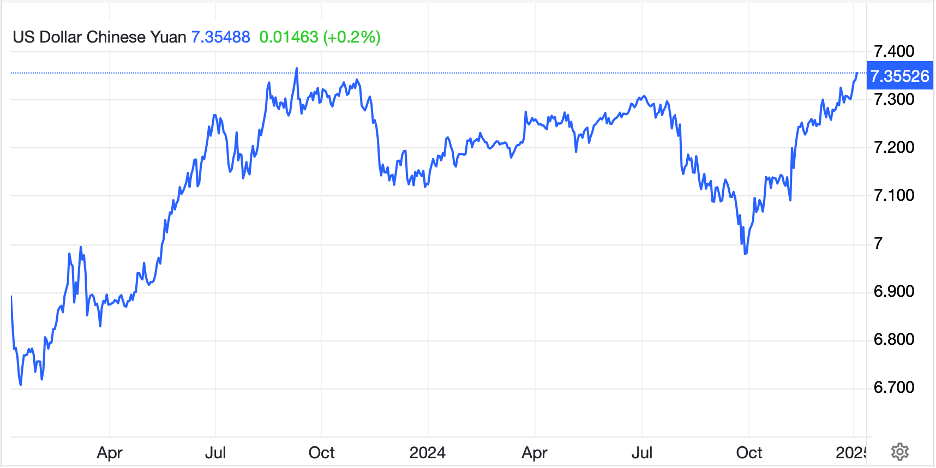
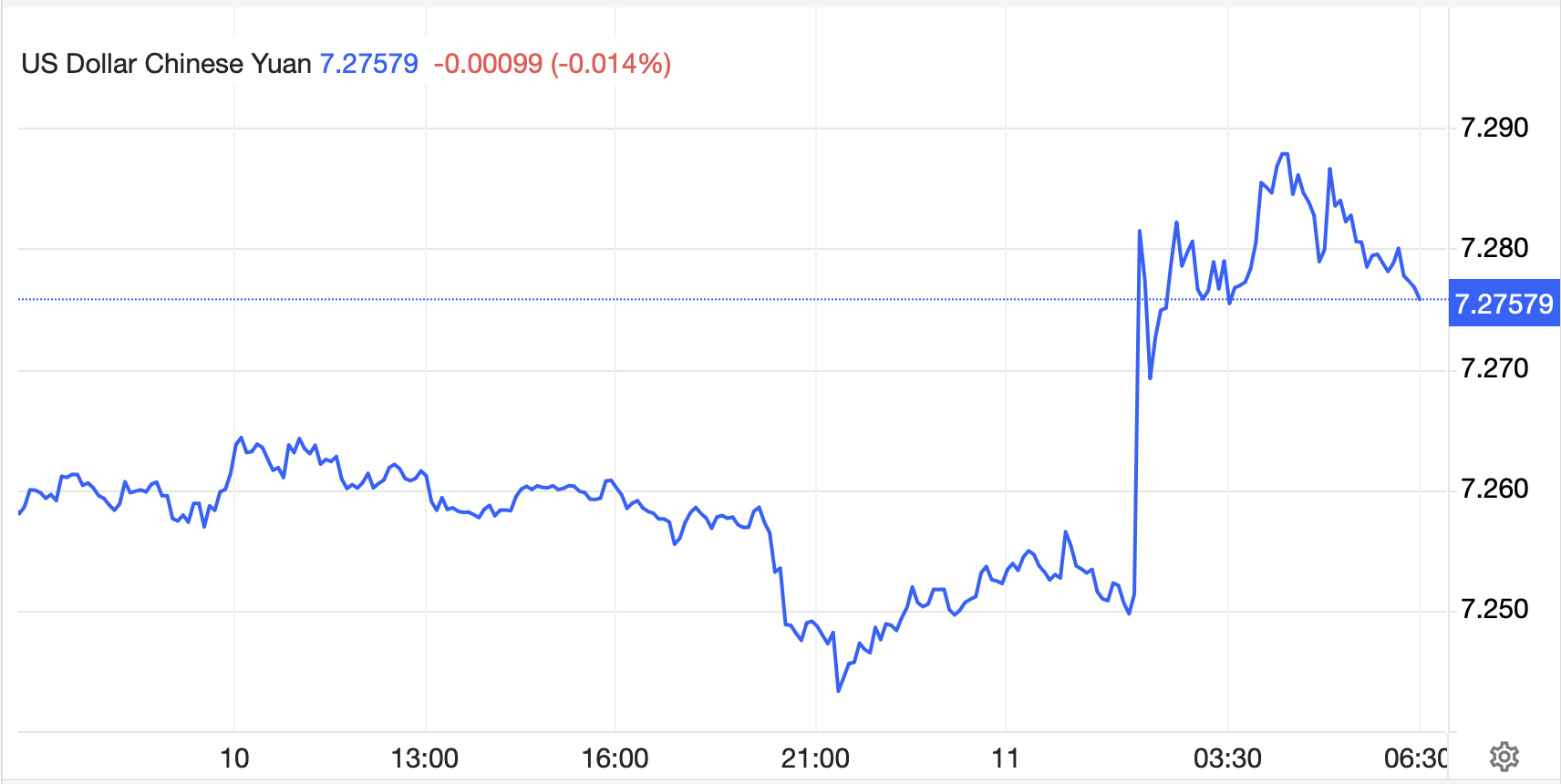
Finally, the dollar, at least the DXY, is continuing to rebound from its Tuesday lows although there is a lot of mixed activity here with some gainers (AUD +0.55%, NZD +0.5%, ZAR +0.85%, CNY +0.6%) and some laggards (EUR -0.25%) along with the CE4 showing weakness.  The big outlier is CNY, which is showing one of its largest single day gains in the past year.  This seems a bit odd given the ongoing lackluster equity market performance and the data showing that foreign investment into China has reversed course and is now divestment.  None of that speaks to a currency’s strength, but as yet, I have not found a good rationale for the renminbi’s strength.  I will keep looking.

On the data front, we finally see some things this morning starting with Initial (exp 232K) and Continuing (1870K) Claims, the second look at Q2 GDP (2.8%) and all the attendant data that comes with that release (Real Consumer Spending +2.3%, PCE +2.6%, 2.9% core).  As well, Mr Bostic as back at it this afternoon at 3:30.  

My take is given the elevated importance of the employment report, today’s data that really matters will be the Claims numbers with any substantial miss (>15k different than forecast) leading to some price action and potential concerns.  But otherwise, Bostic certainly won’ change his tune in less than 24 hours, and the current market zeitgeist appears to be that the dollar, while headed lower, is going to chop to get there.  If we do see a high Claims number, above 245K, look for the dollar to fall more sharply, retracing its overnight bounce.

Good luck

Adf

Destined for Sloth

The Chinese are starting to worry
That if they don’t act in a hurry
Their ‘conomy’s growth
Is destined for slowth
Explaining their rate cutting flurry


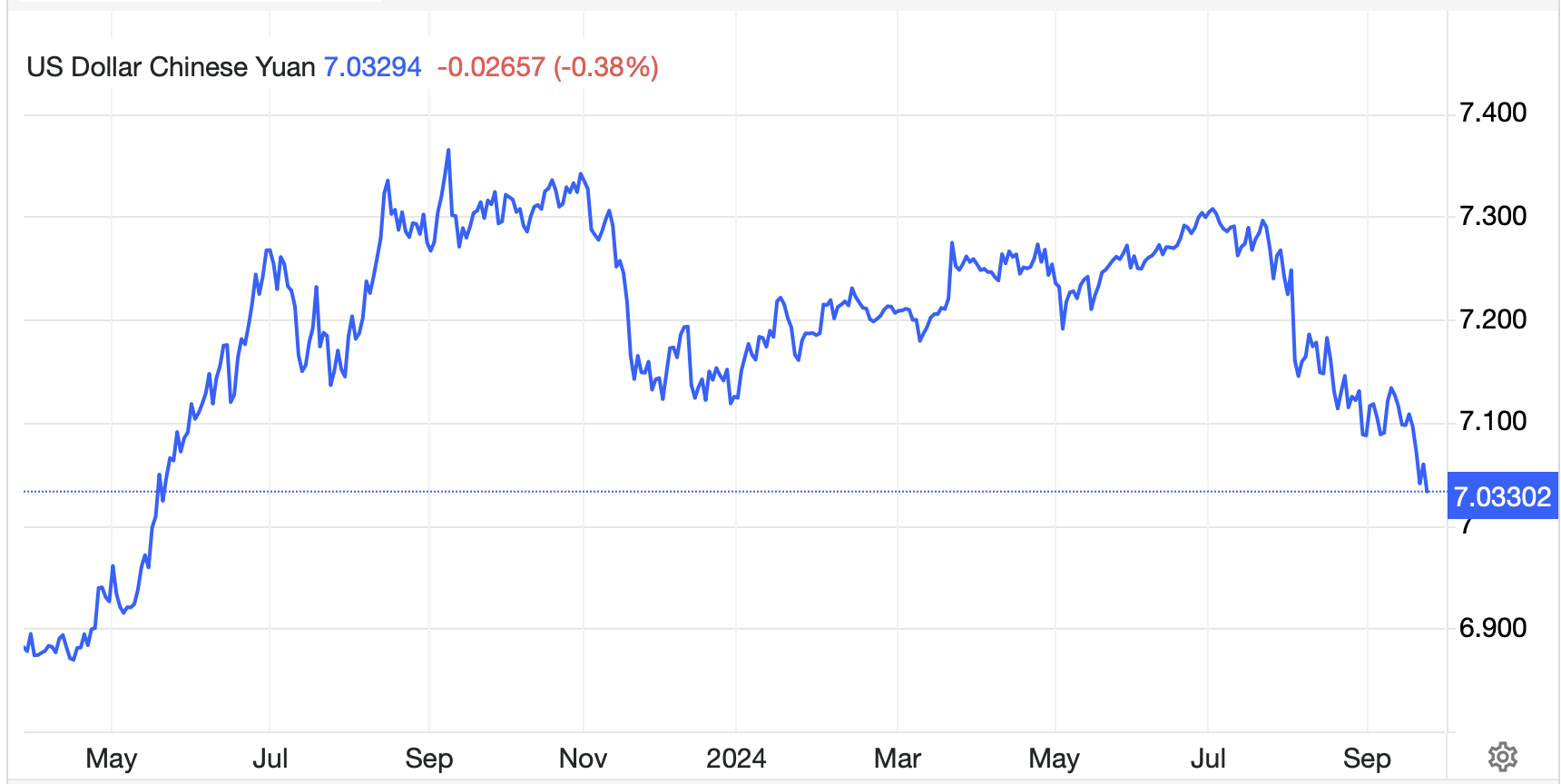
Sunday night, the PBOC surprised markets by cutting both their 1-year and 5-year Loan Prime Rates by 10 basis points each.  As well, they cut the rate on their newly developed 7-day repo rate by 10bps as they endeavor to shorten the maturity of their money market operations. At the time, it was taken as a response to the Third Plenum and the only concrete action seen as new support for the economy.  As its name suggests, those rates represent the cost to borrow for credit worthy companies.  A quick look at the history of this rate (the blue line), which was first tracked toward the end of 2013, shows that over time, it has done nothing but decline.  I have overlayed a chart of USDCNY in the chart (the grey line) to help appreciate the long-term trend in that as well which, not surprisingly, shows a steady weakening of the renminbi (rise in the dollar).

Source: tradingeconomics.com

But the reason I bring this up is that last night, the PBOC surprised markets yet again by cutting its One-Year Medium-Term Lending Facility by 20 basis points, to 2.30%.  Not only was this the largest cut since the pandemic, but it was also done at an extraordinary meeting and combined with an injection of CNY235 billion (~$32B) into the economy.  Arguably, this is the most aggressive monetary policy stance that has been effected by the PBOC since the summer of 2015 when they surprisingly devalued the renminbi 2%.  Apparently, the PBOC is trying to adjust its policy actions to be more in line with the G7 where central banks use short term rates as their tools.  One other thing this implies is that President Xi remains steadfastly against any fiscal stimulus of substance at this point.  On the one hand, you must admire that effort, but I fear that the domestic Chinese economy remains so weighed down by the ongoing property sector problems, achieving their 5.0% GDP growth target is going to become that much more difficult as the year progresses.

For our purposes, though, the story is all about the CNY (+0.7%), which rallied sharply after the announcement, continuing its movement from the Monday rate cuts which totals 1.1%.  Now, ordinarily one might think that a country cutting its rates would lead to a weaker currency, ceteris paribus, However, given the market outcome, there is much discussion about how the PBOC “requested” Chinese banks to more aggressively buy CNY to support the currency.  Interestingly, the fixing rate on shore overnight (7.1321) continues to weaken ever so slightly overall, but now the spread between the fix and the market has fallen to just over 1%, well within the +/- 2% band and an indication there is less pressure on the currency.  My take is this is just window dressing, but I would not fight it.  I expect that we will see USDCNY slowly return to higher levels over time, with the key being it will take lots of time.

The ongoing rout
In tech stocks has another
Victim, dollar-yen

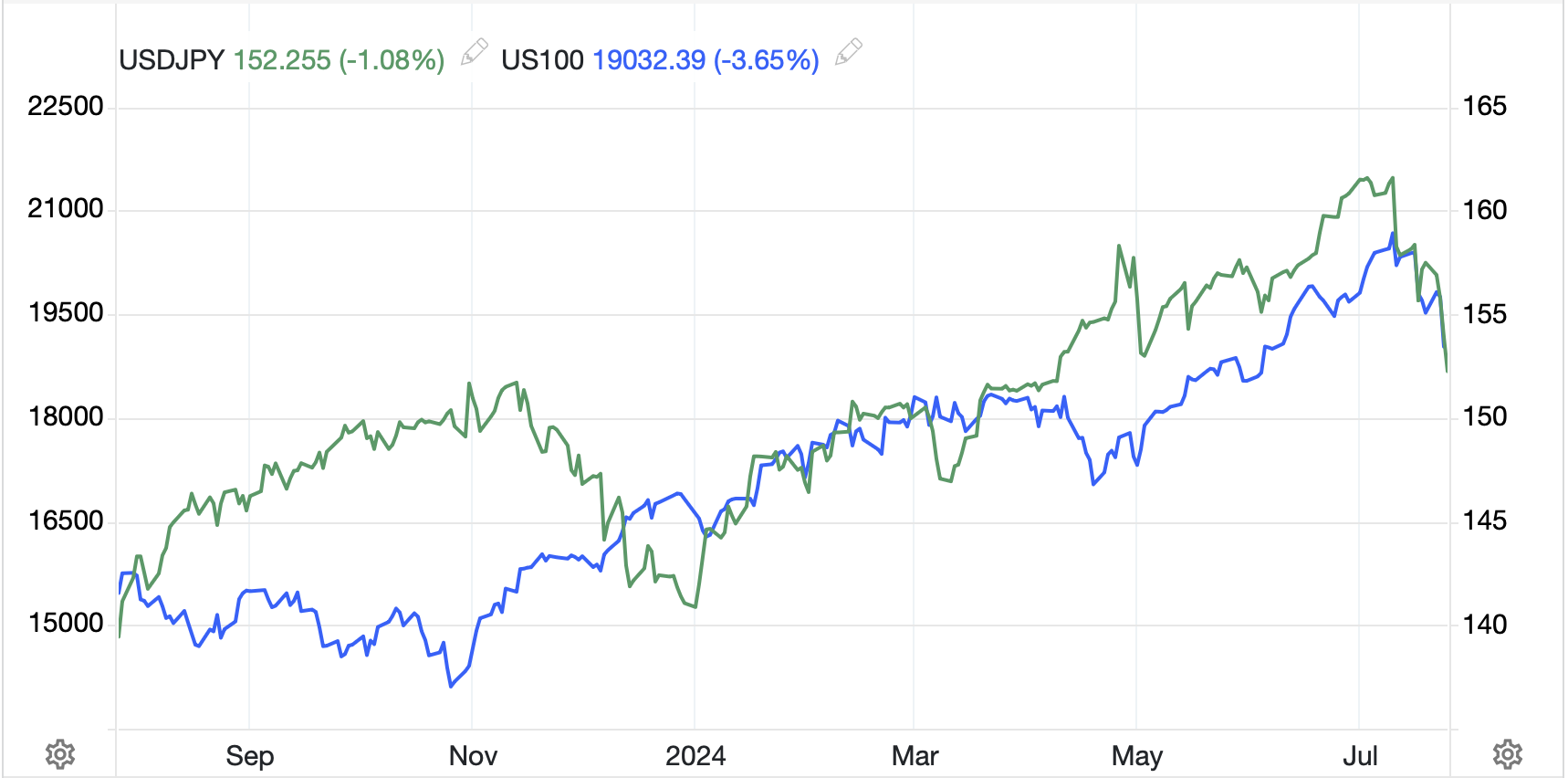
Under the guise, a picture is worth a thousand words, the below chart showing the NASDAQ 100 (blue line) and USDJPY (green line) overlaid is quite interesting.

Source: Tradingeconomics.com

While there is an ongoing argument amongst market practitioners as to whether it is the decline in the tech sector that is driving USDJPY’s decline or the other way round, what is clear is that there is a strong correlation between the two.  If you think about what the USDJPY trade represents, it is the purest form of a carry trade, shorting the cheapest currency and using the funds to buy a much higher yielding currency with maximum liquidity.  But another thing to do with those funds obtained from borrowing yen and buying dollars was to use the dollars to jump on the tech stock bandwagon.  After all, that added another 30% to the trade since the beginning of the year.  

However, over the past two weeks, nearly one-third of the NASDAQ gains have been erased and that has been made worse by the >6% rise in the yen.  At this stage, it no longer matters which is driving which, the reality is that we are seeing significant short covering in the yen with sales in other assets required to unwind the trade.  Arguably, this is why we are seeing virtually every risk asset lower this morning, although bonds are holding up as havens, as all have been funded with short yen.  Given that relationship, I am coming down on the side of the yen being the driver, but as I said, I don’t think it matters.  

The real question is can it continue?  It is important to understand that when markets achieve excessive levels like we saw in USDJPY, they rarely simply unwind to some concept of fair value.  Rather they typically overshoot dramatically in the other direction.  As such, if we assume PPP is fair value, and PPP for USDJPY is currently around 110.00, it appears there is ample room for USDJPY to decline much further.  Consider, this movement has happened, and the Fed has not even started to cut rates.  If we do, indeed, fall into recession, the Fed will respond, and I expect that we could see a very sharp decline in USDJPY.  Something to consider looking ahead.

While that was a lot about the currency markets, they seem to be the current drivers, so are quite important.  But let’s look at everything else.

Equity market pain has been universal with Japan (-3.3%), Hong Kong (-1.8%) and China (-0.6%) all following the US lower overnight and in Europe, this morning, it is no better with the CAC (-2.2%) the worst performer, but all the major indices falling sharply.  US futures are little changed at this hour (7:00), but remember, we are awaiting key GDP data and more earnings numbers, which have been the driver.

As mentioned above, bond markets are rallying with Treasury yields lower by 5bps and most European sovereigns seeing declines of -3bps or -4bps.  Credit is an issue as Italian BTPs are the laggard this morning, with yields there only lower by 1bp.  Equally of interest is the fact that the US yield curve inversion has been reduced to just 14bps and has been normalizing dramatically for the past several sessions.  One thing to remember about the yield curve is that when it inverts, it indicates a recession is coming, but when it uninverts, it indicates the recession has arrived!  This is all of a piece with softer economic data and expectations of Fed policy ease coming soon to a screen near you.

In the commodity markets, nobody wants to own anything.  Oil (-1.3%) is continuing its recent poor performance despite EIA data showing significant inventory reductions.  This is not a sign of strong demand.  But we are also seeing weakness across the entire metals space with gold (-1.0%) breaking back below $2400/oz and silver and copper under severe pressure.  Right now, nobody wants to hold these, although I suspect that the long-term supply/demand situation remains bullish.

Finally, the dollar is mixed overall.  While we have seen strength in JPY and CNY, as discussed above, and CHF (+0.8%) is also showing its haven status and use as a funding currency, there are numerous currencies under pressure, notably AUD (-0.8%), NOK (-0.8%), MXN (-0.8%), ZAR (-0.7% and SEK (-0.6%) all of which are commodity linked to some extent.  Yesterday, the BOC cut rates by 25bps, as expected, but the Loonie has been steadily weakening for the past two weeks, so yesterday’s decline and today’s is just of a piece with that.  Ultimately, we are watching a serious risk-off event, and I expect the dollar will hold its own vs. most currencies, although JPY and CHF seem to have room to run yet.

On the data front, once again yesterday’s data was on the soft side with the Flash Manufacturing PMI falling to 49.5, well below expectations and New Home Sales slipping to 617K.  In fact, it is difficult to find the last strong piece of data, perhaps the ex-autos Retail Sales number from last week.  This morning, we see Initial (exp 238K) and Continuing (1860K) Claims, Q2 GDP (2.0%), and Durable Goods (0.3%, 0.2% ex transport).  The Atlanta Fed’s GDPNow tool is indicating GDP in Q2 was 2.6%, well above the forecasts.  However, I think of much more interest will be to see how it starts out for Q3.  We have had a spate of weak data, and those recession calls are growing louder.

This is a tough market, but I expect we have not yet seen the last of the risk-off trade (just consider how long the risk-on trade has been going on) so further dollar strength against most currencies, except for JPY and CHF, and further weakness in commodities and equities seem the most likely direction.

Good luck

Adf

Will They Return?

One-Sixty is so
Close, you can almost touch it
But, will they return?


The current Mr Yen, Masato Kanda, was on the tape last night as USDJPY creeps ever closer to the 160 level that triggered the most recent bout of inflation at the end of April. He explained, “If there are excessive currency fluctuations, it has a negative impact on the national economy.  In the event of excessive moves based on speculation, we are prepared to take appropriate action.”  At this point, the overnight high of 159.89 is just 28 pips from the peak seen prior to the last bout of intervention, although the price action this time is far more muted than what we saw then.  While the yen’s decline has been steady, as can be seen in the below chart, it hasn’t been so swift it appears out of control.

Source: tradingeconomics.com

One of the key rationales for the previous bout of intervention was that the weakening of the yen occurred too rapidly, with a 10-yen decline seen over a short six-week period.  That has not been the case this time, so I do not anticipate any MOF/BOJ action at 160, but rather somewhere closer to 165 if we see that during the summer.  Remember, the BOJ meets again at the end of July at which point they are expected to present their new bond buying program with reduced amounts of JGBs, their version of QT.  Remember, too, that there is still a huge interest rate differential between the US and Japan, and until that narrows, and is expected to narrow further, it is very difficult to see the yen showing any substantive strength.  While caution is merited here, as the BOJ can certainly enter the market at any time, based on the summary of opinions from the last BOJ meeting, which were released last night, there is no clear consensus on the pace of either QT or rate hikes.  The yen seems to have further to fall this summer.

In China, the powers that be
Are scared that their own renminbi
May fall and expose
The emperor’s clothes
Are missing, and that all might see


As things in the West are awaiting two key events at the end of the week, the PCE data in the US on Friday and the French elections on Sunday, we shall continue our look at Asia.  The CNY market onshore is frozen as it is pegged at the 2% maximum movement from the daily CFETS fixing.  Last night’s fixing of 7.1201 indicates that the highest the dollar can trade on shore is 7.2625, the level at which it is currently pegged.  In fact, given the interest rate differentials between the US and China, funding of traders’ books is becoming impossible because the one-day forward points will result in a price above the band.

While the offshore renminbi is slowly grinding lower, the pressure on the PBOC to adjust its daily fixing more rapidly grows.  This issue is a result of the following incompatible goals as defined by President Xi; support the collapsing local property markets by easing monetary policy while maintaining a stable and strong renminbi to demonstrate to the world that CNY should be a global currency (despite the capital controls in place!).  Alas for President Xi, these two ideas do not work in concert with the result that onshore FX markets are likely to remain frozen until things change.  A look at President Xi’s history tells me, at least, that like the Red Queen, he can believe multiple impossible things at the same time.  Ultimately, the great irony here is that despite Xi’s desires to demonstrate the importance of the renminbi to the world, he is entirely reliant on the Fed to cut rates in order to break this deadlock, and I strongly suspect that Chairman Powell cares not one whit about Xi Jinping and his problems.

Looking ahead, I anticipate the renminbi will grind lower over time as it remains the only outlet for the still lackluster growth in the economy with the property market problems forcing interest rates lower than otherwise would be desired.  Arguably, this is why the Chinese, in their current bout of trade talks with the EU, is demanding that Europe removes its tariffs on Chinese EVs.  Since they can’t weaken the currency further, they need to get the other side to effectively cut prices for them.

Ok, let’s review the overnight activity.  After Friday’s lackluster equity markets in the US (the NASDAQ actually fell, which I thought was illegal), the picture in Asia was mixed with the Nikkei (+0.5%) rallying a bit as the weak yen continues to support their exporters, while mainland Chinese shares (-0.5%) suffered as the ongoing weak economic data (Friday night showed Foreign direct investment fell -28.2% YTD, the weakest performance since 2009, and another indication that the renminbi is too strong).  As to the rest of the region, there were more laggards (Korea, Taiwan, Australia, New Zealand), than gainers (India, Singapore, Thailand).  However, in Europe this morning, the screens are all green as the limited data, German Ifo, indicated continued weakness raising hopes for a July rate cut by the ECB.  As to the US futures market, at this hour (7:15), they have edged slightly higher, about 0.15%.

Treasury yields have moved higher by 1bp but remain far closer to recent lows than the highs seen a month ago.  But the story in Europe is interesting as the Bund-OAT spread has narrowed by 5bps after comments by the RN party’s Jordan Bardella, the leading candidate as new PM, that were far more muted and accepting of Europe as a whole, and less populist financial goals.  This has played itself out across the entire continent with the perceived weaker countries seeing their yields slide slightly while Germany and the Netherlands have seen yields edge higher.  In Asia, JGB yields backed up 2bps to 0.98%, arguably in response to the summary statements from the BOJ.

Oil prices are continuing to show strength, up another 0.5% this morning, as the inventory draw from last week continues to support the market.  Meanwhile, after a very difficult session on Friday, metals prices are stabilizing with gold and silver both up 0.15%, although copper, which was higher earlier in the session, has now reversed course and is down -0.6%.

Lastly, the dollar is broadly, though not universally, under pressure this morning, with the euro (+0.35%) the driver in the G10 market which is also dragging the CE4 higher (PLN +0.9%, HUF +0.5%).  Bucking the trend is the rand (-1.0%) as market participants start to wonder who President Ramaphosa will be appointing to his cabinet now that he must share power.  One must be impressed with the volatility in the rand of late, that is for sure.

On the data front, while we get several indicators earlier in the week, all eyes will be on Friday’s PCE data.

TodayDallas Fed Manufacturing-13
TuesdayChicago Fed National Activity-0.4
 Case-Shiller Home Prices6.9%
 Consumer Confidence100.0
WednesdayNew Home Sales640K
ThursdayInitial Claims236K
 Continuing Claims1820K
 Durable Goods0.0%
 -ex Transports0.1%
 Q1 GDP (Final)1.3%
FridayPersonal Income0.4%
 Personal Spending0.3%
 PCE0.0% (2.6% Y/Y)
 Core PCE0.1% (2.6% Y/Y)
 Chicago PMI40.0
 Michigan Sentiment65.7

Source: tradingeconomics.com

As well as the data, we hear from five more Fed speakers with Governor Michelle Bowman speaking at three separate events this week.  However, thus far, there has been no substantive change from the Powell mantra that they need to see more evidence that inflation is slowing, several months’ worth, before considering easing policy.  Of course, if next week’s Unemployment rate were to tick up to 4.2%, I imagine that mantra might change.

On the central bank front, only Sweden’s Riksbank meets this week, and no policy change is expected.  If you recall last week, the bulk of the data was soft in the US, although the PMI data surprised to the high side.  However, if the data set is beginning to show more weakness, I suspect the Fed will begin to hint that cuts are possible sooner, rather than later.  Right now, the market is pricing about a 10% probability for the July meeting, but more than a two-thirds probability for September.  A little more weak data and I will likely adjust my views of rate cuts coming.  At that point, I think the dollar will suffer significantly.  But until we get a lot more evidence that is on the way, I think the default is the dollar is still the best bet.

Good luck

Adf

Fearmongers Now Say

A question that’s going around
Is where will the buyers be found
For all the new debt
That nations are set
To issue as budgets compound
 
As well, the fearmongers now say
A crisis is coming our way
If voters elect
The folks who reject
The status quo finance cliché


As markets return from yesterday’s US holiday, activity remains somewhere between muted and ordinary in most markets.  At times like these, it is interesting to take note of the tone of the articles in financial journals, whether the WSJ, Bloomberg or the New York Times, as they are the place where I find politics is inserted into the discussion.  

For instance, there have been several articles regarding the pending French election and the market’s concern about a victory by Marine Le Pen on the right.  The thesis seems to be if her RN party wins and takes over parliament, that her plans will result in a collapse in French finances based on the promises she has made throughout the campaign.  There are many analogies to what occurred in October 2022 in the UK, when the newly elected PM, Liz Truss, put forth a program of unfunded spending and the Gilt market fell sharply.  You may recall the result was that the BOE had to step in to buy Gilts even though at that time, they had just begun to sell them to reduce the size of their balance sheet. 

Of course, what gets far less press is the fact that UK insurance companies had levered up their balance sheets because of ZIRP as they tried to earn a sufficient return to match their pension liabilities and when the BOE started tightening policy, those companies were already in trouble.  Certainly, the market response accelerated the problem, but even without Truss, as the BOE kept raising rates, the outcome would likely have been the same.  However, it was politically expedient for the press to blame Truss and the Tories.

Now consider the US, where government profligacy is truly breathtaking as the current government is borrowing $1 trillion every 100 days or so.  Certainly, this topic has been reported, although it is difficult to find a discussion from the mainstream media that makes the leap that spending as much as is currently happening is the underlying cause.  (Yes, there are many stories of this from conservative media as well as on Twitter, but not on the CBS Nightly News.)  However, those same mainstream sources threaten everyone that in the event Donald Trump is elected, it will spell the end of the bond market and the US economy because of his policy proposals of tax cuts and supporting energy growth.

It is commentary of this nature that, in my opinion, has reduced the value of mainstream media via the constant politicization of every subject.  This is also why alternate media sources, like the numerous excellent articles on Substack, have become so popular and widely read.  Analysts who are not beholden to a corporate policy and politics are able to give much more accurate and politically unbiased views.

At any rate, there was much concern ahead of this morning’s French bond auctions (they issued €10.5 billion across various maturities from 3-8 years) as this was the first attempt to sell debt since President Macron called his snap election after his European Parliament electoral disaster.  However, happily for all involved (except the doom mongers) things went just fine with a solid bid-to-cover ratio and a modest decline in market spreads.  All told, while nobody knows the future, it is difficult to expect that a Le Pen government will be any worse financially than the current Macron led government.  After all, France has just been warned by the European Commission that it must reduce its budget deficit from the current 5.5% to 3.0% as per the Maastricht Treaty, and there is no “far-right” influence on the current government.

Enough politics, let’s recap the overnight markets.  Asian markets were mixed as the Nikkei edged higher (+0.15%) but the Hang Seng (-0.5%) gave back some of yesterday’s spectacular rally.  The laggard, though, was mainland China (-0.7%).  In Europe this morning, despite the fears of a Le Pen victory, the CAC (+1.0%) is the leading gainer as either we are seeing a trading bounce after a terrible week last week, or maybe the initial hysteria is being seen for what it was, unfounded hysteria.  Meanwhile, as the BOE just left rates on hold, as widely expected, the FTSE 100 has bounced about 0.3% in the first 15 minutes since the announcement and is up 0.5% on the day.  Overall, Europe is having a good day with the DAX and virtually all markets ahead.  US futures, too, are firmer this morning, with both the NASDAQ and S&P higher by 0.5% or more although the Dow continues to lag.

In the bond market, Treasury yields have backed up 2bps this morning but the picture in Europe is much more mixed.  German yields are higher by 3bps, but UK yields have slipped a similar amount.  In fact, looking at all the nations there, it appears that there is slightly less concern over Europe as a whole as French yields are only higher by 1bp and Italian yields have slipped 1bp, thus narrowing the spread with Germany overall.  Turning to Asia, JGB yields rose 2bps, following USDJPY higher, or perhaps anticipating a higher inflation reading tonight.

In the commodity markets, crude oil (+0.15%) is edging higher this morning, although it slipped in futures trading yesterday (the only market open).  This morning brings the inventory data which is anticipating a draw of 2M barrels.  Metals markets are solid again with gold (+0.4%), silver (+1.7
%) and copper (+0.2%) all continuing their rebound from the dramatic decline two weeks ago.

Finally, the dollar is stronger this morning against most of its counterparts, notably the JPY (-0.3%) and CNY (-0.1%).  I highlight these because the yen story remains critical to the global financial markets, and it appears that Japanese investors are beginning to turn back toward Treasuries and away from JGBs supporting the moves in those markets and USDJPY.  

Regarding China, last night the PBOC fixing was at 7.1192, its highest level since November 2023 and the largest move (33 pips) in weeks.  It appears that there are numerous changes being considered and ongoing in China regarding its domestic bond market (the PBOC is looking to become more involved to support liquidity) as well as the overall monetary structure (there is talk that they will be adjusting the framework of three different rates to something more akin to what Western central banks use with a single policy rate).  In the end, given the ongoing lackluster performance of the Chinese economy, a weaker CNY remains my base case and while it may be gradual, it seems it is the PBOC’s view as well.  The onshore market continues to trade at the edge of the 2% allowable band and the offshore market is a further 35bps higher (weaker CNY) than that.  

Elsewhere, ZAR (-0.85%) which has had a good run on the back of the ultimate electoral outcome, seems to be afflicted with some profit-taking and then most of the rest of the currencies are softer vs. the dollar by about 0.2%.  One last exception is CHF (-0.65%) which has slipped after the SNB cut their policy rate by 25bps, as expected, to 1.25%.

On the data calendar today, we see Initial (exp 235K) and Continuing (1810K) Claims, Philly Fed (5.0), Housing Starts (1.37M) and Building Permits (1.45M), all at 8:30.  Then, later this afternoon, Thomas Barkin of the Richmond Fed will undoubtedly remind us that things are moving in the right direction, but patience is required.

Summing it all up, while I didn’t specifically mention it, the key thing in financial markets continues to be Nvidia, which is much higher in pre-market trading again, and apparently is the driver of everything.  However, traditional relationships have been under strain as although it appears to be a risk-on day, both the dollar and precious metals are firmer.  Overall, nothing has changed my view that the Fed is going to remain firm for now, and that (too) much credence will be assigned to next Friday’s PCE data.  But such is the state of the world.

Good luck

Adf

Top of Mind

Will they or won’t they?
The intervention question
Is now top of mind


As we approach Japanese Fiscal Year end, and while we all await Friday’s PCE data, the FX markets have taken on more importance, at least for now.  The big question is, will there be intervention by the Japanese?  Late last night, USDJPY traded to a new thirty-four year high of 151.96, one pip higher than the level touched in September 2022 which catalyzed the last intervention by the BOJ/MOF.  Recall, last week the BOJ “tightened” monetary policy by exiting their 8-year experiment with negative interest rates and ‘promised’ that they were just getting started.  Granted, they didn’t indicate things would move quickly in this direction and they also explained they would remain accommodative, but they did seem confident that this would change a lot of opinions.  Remember, too, that the market response to that policy shift was to weaken the currency further while JGB yields actually drifted lower.

So, here we are a bit more than a week later and the yen has fallen to new lows.  What’s a country to do?  In the timeless fashion of governments everywhere with respect to currency moves, they immediately started jawboning.  Last night we heard from BOJ Board member Naoki Tamura as follows, “The handling of monetary policy is extremely important from here on for slow but steady progress in normalization to fold back the extraordinarily large-scale monetary easing.  The continuation of an easy financial environment doesn’t mean there won’t be any more rate hikes at all.”  Traders did not exactly quake in fear that the BOJ was suddenly going to tighten aggressively, let’s put it that way, and so nothing has really changed.  One other thing to note is that Tamura-san is seen as the most hawkish member of the current BOJ, at least per Bloomberg Intelligence’s analysts.  Take a look at their views below.

But wait, there’s more!  We also heard from Japanese FinMin, Shunichi Suzuki, that the government would take “decisive steps” if they deemed it necessary to respond to recent currency movement.  And the, the coup de grace, an emergency meeting between the MOF, the BOJ and the Financial Services Agency (FSA) is ongoing as I type (6:30) to help come up with a plan.  

Does this mean intervention is coming soon to a screen near you?  While it is certainly possible, the ultimate issue remains that the relative monetary policy settings between the US (higher for longer) and Japan (still at ZIRP with a hike expected in…October) remain such that the yen is very likely to remain under pressure.  Remember, too, that Japan is in the midst of a technical recession, so tightening monetary policy is not likely to be appreciated by Mr and Mrs Watanabe.  At the end of the day, the politics of inflation are very different in the US and Japan, and I would contend that in Japan, it is still not the type of existential problem for the government that it appears to be in the US.

FWIW, which is probably not much, I expect the MOF to follow their playbook, talk tougher, check rates and ultimately intervene over the next several days.  They will take advantage of the upcoming Easter holiday weekend and the reduced liquidity in markets to seek an outsized impact for the least amount of money possible.  But I do not see them changing their monetary policy before the autumn and so I look for continued yen weakness over time.  Be careful in the short run, but the direction of travel is still the same, USDJPY will rise.

For China, the fact the yen’s weak
Has Xi and his staff set to freak
They’re all quite dismayed
‘Cause Japanese trade
Has lately been on a hot streak
 

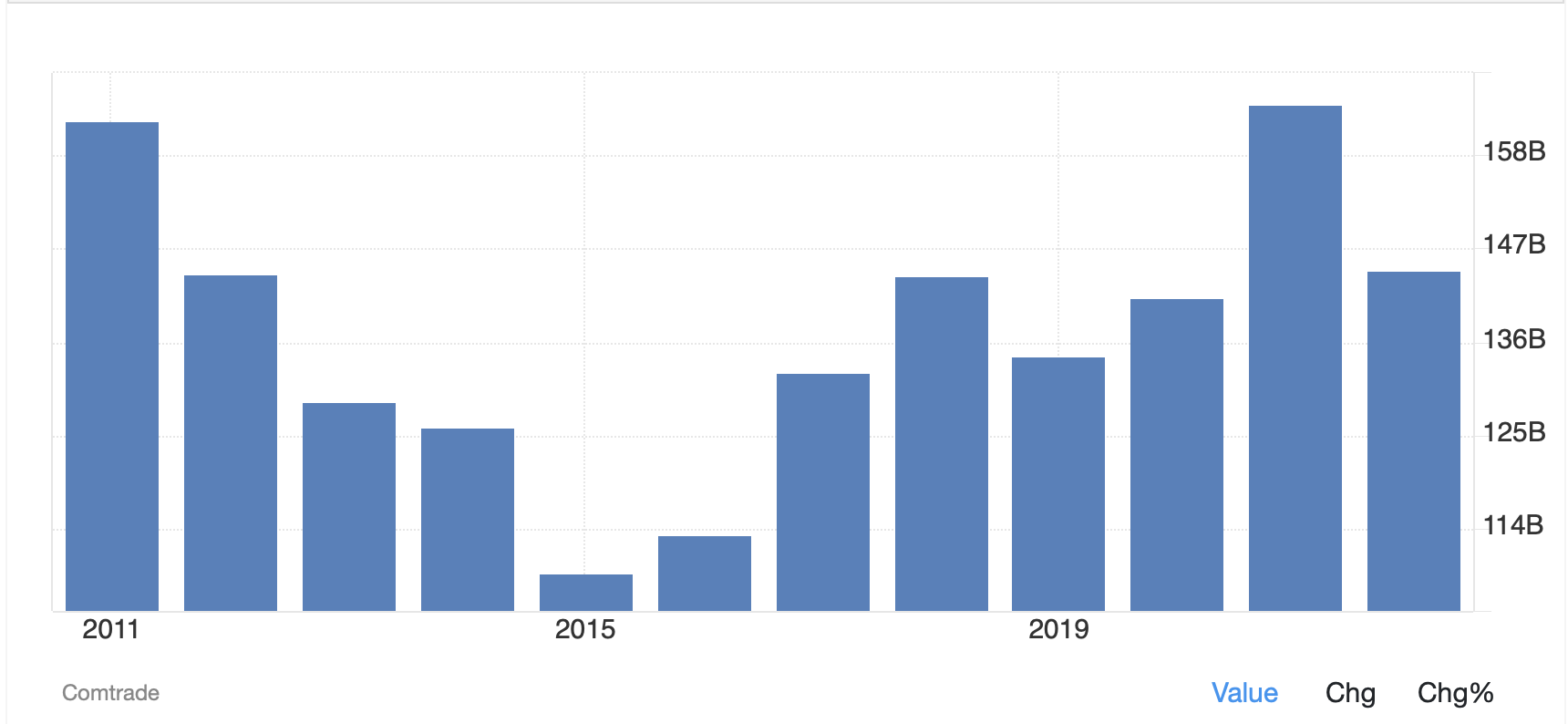
The other story in markets has been the ongoing ructions in the Chinese renminbi market.  It is key to understand that this is directly related to the yen story above as China and Japan are fierce competitors in many of their export activities.  But of even more concern to Xi and his gang is that Japanese exports to China are growing so rapidly and Japan ran a trade surplus with China in December (the last month with data released).  When you are a mercantilist nation like China, having a key competitor, like Japan, allow its currency to weaken dramatically against your own is a major problem.  Last week I highlighted the dramatic decline of the yen vs. the renminbi, and that has not changed.  Below is a chart from tradingeconomics.com showing Japanese exports to China ($billions) showing just how much this trend has changed and continues to do so.

Ultimately, both of these countries rely on exports as a critical part of their economic growth and activity, and in both cases, exports to the US and Europe are crucial markets.  If the Japanese continue to allow the yen to weaken, China has a problem.  Remember, Japan does not have capital controls, so while they don’t want the yen to collapse, they are perfectly comfortable with capital outflows in general.  China, on the other hand, is terrified of massive outflows if they were to even consider relaxing capital controls.  The fact is both companies and individuals work very hard to get their money out of the country.  This is one reason that gold is favored there by the population, and the reason that the government banned bitcoin as it was an open channel for funds to leave the country. 

This battle has just begun and seems likely to last for quite a while going forward.  The Chinese are caught between wanting to devalue the renminbi to compete more effectively and maintaining a stable exchange rate to demonstrate there are no fiscal or economic problems in the country.  Alas for Xi and the PBOC, never the twain shall meet.  I would look for a continuation of the recent market volatility here as they will use that uncertainty to discourage large position taking by speculators.  But, as I have maintained for a long time, I expect that USDCNY will trade to 7.50 and beyond as time progresses.

And that’s really it for today.  Ultimately, very little happened in markets overnight, certainly there were no changes in the recent data trajectory nor in any commentary from speakers (other than that mentioned above).  It is a holiday week and a key piece of data, PCE, is set to be released on a broad market holiday this Friday.  Do not look for large moves before then.

There is no US data due today but we do hear from Fed Governor Christopher Waller this afternoon so there is an opportunity for some market movement then.  But for now, consolidation seems the most likely outcome.

Good luck

Adf

Threw in the Towel

There once was a banker named Powell
Who fought, prices, high with a growl
Then going got tough
So he said, “enough”
And basically, threw in the towel
 
His problem’s inflation’s alive
And truthfully, starting to thrive
The worry is he
Will soon say that three
Percent’s the rate for which he’ll strive


With several days to digest the latest FOMC meeting results, and more importantly, the Powell press conference, my take is the Chairman recognizes that to get to 2.0% is going to be extremely painful, too painful politically during this fraught election cycle.  And so, while he tried very hard to convince us all that the Fed was going to get to 2.0%, he stressed it will “take time”.  The subtext of that is, it’s not going to happen in the next several years, at least, and this poet’s view is it may not happen again for decades.  The key to recognizing this subtle shift is to understand that despite increased forecasts for both growth and inflation, the Fed remains hell-bent on cutting interest rates.  Even the neo-Keynesian views which the Fed follows would not prescribe rate cuts in the current economic situation.  But rate cuts are clearly on the table, at least for now.

This begs the question, why is he so determined to cut interest rates with the economy growing above trend?  At this stage, the explanation that makes the most sense to me is…too much debt that needs to be refinanced in the coming years.

Consider, current estimates for total debt around the world are on the order of $350 trillion.  That compares to global GDP of just under $100 trillion.  Many estimates indicate that the average maturity of that debt is about 5 years which means that something on the order of $70 trillion of debt needs to be refinanced each year.  Now, the US portion of that debt is estimated at about $100 trillion, of which ~$34.5 trillion is Treasury debt, and the rest is made up of corporate, mortgage, municipal and private debt.  Remember, too, that total US GDP is currently about $28 trillion as of the end of February (according to the FRED database from the St Louis Fed), so the ratio here is similar to the global ratio.  [Note, this does not include unfunded mandates like Social Security and Medicare, just loans and bonds outstanding.]

Here’s the problem, we have all heard about the fact that the US debt service has climbed above $1 trillion per annum and given the underlying principle is growing, that debt service is growing as well.  In addition, on the private side, there is a huge proportion of corporate debt that has become a serious problem for banks and investors, notably the loans made for commercial real estate, but personal and credit card debt as well.  The Fed cannot look at this situation and conclude that higher rates, or even higher for longer, is going to help all the debtors.  And if the debtors default…that is going to be an economic disaster of epic proportions.Add it up and the only logical answer is Powell is going to gaslight everyone with the idea that the Fed is going to remain vigilant regarding inflation.  And they will right up until the time when the pain becomes too great, or too imminent and they cut.  I think that we are seeing the first signals from markets this is going to be the case from both gold and bitcoin.  But if I am correct, and the Fed cuts despite still elevated inflation readings, look for the dollar to decline sharply, at least initially until other central banks cut as well, look for bonds to fall sharply and look for hard assets to rally.  As to stocks, I expect that initially it will be seen as a positive and juice the rally, but that over time, stocks will begin to lag hard assets.  Quite frankly, this looks like it is a 2024 event, so perhaps if that first cut really comes in June, the summer is going to be far more interesting than anybody at the Fed would like to see.

Kanda told us all
“We are always prepared” to
Prevent yen weakness
 
Meanwhile in Beijing
The central bank responded
Nothing to see here


“The current weakening of the yen is not in line with fundamentals and is clearly driven by speculation. We will take appropriate action against excessive fluctuations, without ruling out any options.”  So said Masato Kanda, the current Mr Yen at the MOF.  It seems possible, if not likely, the yen’s decline in the wake of the BOJ move last week came as a bit of a surprise.  This morning, the yen (+0.1%) has edged away from its lows from last week, but USDJPY remains above the 151 level and very close to the level when the MOF/BOJ intervened in October 2022.  Adding to the pressure was Friday’s very surprising sharp decline in the CNY, which many in the market took to mean the PBOC was comfortable with a weaker yuan. 

Economically, a weaker yuan seems to make sense, but the PBOC’s concern is that it could lead to increased capital outflows, something which they are desperate to prevent.  As such, last night, the CNY fixing was nearly 1200 points stronger than expected, with the dollar rate below 7.10, and we saw significant dollar selling by the large Chinese banks.  Apparently, Friday’s movement was a bit too much.  I suspect that these two currencies will continue to track each other at this point with both currently at levels which, in the past, have been demarcation lines for intervention.   

Here’s a conspiratorial thought, perhaps the Fed’s dovishness is a response to the weakness in the yen and Powell’s best effort to help the BOJ avoid having to intervene again.  The thing about intervention is it, by definition, represents a failure of monetary policy, at least in the market’s eyes.  And in the end, all G10 central banks are in constant communication.

Ok, let’s survey the markets overnight.  All the currency activity seemed to put a damper on equity investors as Asia saw weakness across the board with Japan (Nikkei -1.2%) falling, although still above 40K, and both Hong Kong and mainland shares in the red.  In Europe this morning, red is also the predominant color, although the declines are more muted, ranging from -0.1% (DAX) to -0.4% (CAC).  Finally, US futures, at this hour (7:00) are also slipping lower, down 0.25% on average.

In the bond market, Treasury yields are backing up 3bps this morning, bouncing off the critical 4.20% technical level again.  As well, in Europe, sovereign yields are rising between 2bps and 3bps across the board.  There has been no data of note, but we have heard a bit more from ECB bankers with a surprising comment from Austria’s Holtzmann that he saw no reason for rate cuts at all.  That is an outlier view!  And despite what is happening in the FX markets, JGB yields remain unchanged yet again.

Turning to commodities, oil (+0.3%) is edging higher this morning as, after a strong rally early in the month and a small correction, it appears that $80/bbl is a new floor for the price.  In the metals markets, after last week’s pressure lower, this morning both precious (gold +0.3%) and base (copper +0.1%) metals are edging higher.  There has not been much in the way of news driving things in this session.

Finally, the dollar is a touch softer this morning, but that is after a strong week last week.  We’ve already touched on the Asian currencies, and it is true the entire bloc, which had been under pressure, is a bit stronger this morning.  But we are seeing strength across the board with G10 currencies higher on the order of 0.2% and most EMG currencies firmer by between 0.1% and 0.2%.  So, while the movement is broad, it is not very deep.  I maintain this is all about US yields and the fact that despite Powell’s newfound dovishness, the Fed remains the tightest of the bunch.

On the data front, there is a lot of information to be released, but I suspect all eyes will be on Friday’s PCE data.  

TodayChicago Fed Nat’l Activity-0.9
 New Home Sales680K
TuesDurable Goods1.0%
 -ex Transport0.4%
 Case Shiller Home Prices6.8%
 Consumer Confidence106.7
ThursdayInitial Claims215K
 Continuing Claims1808K
 Q4 GDP3.2%
 Chicago PMI46.0
 Michigan Sentiment76.5
FridayPersonal Income0.4%
 Personal Spending0.4%
 PCE0.4% (2.4% Y/Y)
 Core PCE0.3% (2.8% Y/Y)
Source: tradingeconomics.com

In addition to that menu, Fed speakers will be about with five scheduled including Chairman Powell on Friday morning.  Remember, too, that Friday is a holiday, Good Friday, with market liquidity likely to be somewhat impaired as Europe will be skeleton staffed.  As well, it is month end, so my take is if Powell veers from the script, or perhaps reinforces the dovish theme, we could see an outsized move.  Just beware.

Recent activities by the BOJ and PBOC indicate that the market has found a sore spot for the central banks.  If the data this week doesn’t cooperate, meaning it remains stronger than forecast, it will be very interesting to hear what Chairman Powell has to say on Friday.  Cagily, he speaks after the PCE data, so he will be able to respond.  But especially if that data comes in hot, we are likely to see more volatile markets going forward.  However, today, it is hard to get too excited.

Good luck

Adf

Vaporized

The powers-that-be are concerned
That Argentine voters have spurned
Advice they’ve provided
And rather decided
It’s time some new lessons were learned

And so, we cannot be surprised
The media pundits advised
Milei should step back
And take a new tack
Lest talking points get vaporized

It has been quite a slow session overnight.  There has been precious little new in the way of data or commentary of note with respect to the current economic story.  At the same time, the Thanksgiving holiday has trading desks thinly staffed and the Fed is noteworthy in its absence from the tape.  As such, the news cycle has been filled with the OpenAI saga, something far outside the scope of this poet, the ongoing political infighting that is a constant thrum in the background, and one very interesting thing, the mainstream response to the election of Javier Milei as president of Argentina.

Given the dearth of other news, and the fact that I believe this has the opportunity to be quite impactful going forward, I thought I would take a little time and discuss this further.

According to Wikipedia, which in this case I have no reason to disbelieve, Milei, while new to politics, is a serious economist.  He has earned two masters degrees in the subject, taught at university and is a widely published author on the subject.  The point is, he has very clear ideas on how economies work from a theoretical perspective and having grown up in Argentina during one of its earlier hyperinflations, from a practical aspect as well.

What makes all this so fascinating is the deluge of articles that have been published in the WSJ, Bloomberg, CNN, the New York Times, et al. which are quite keen to highlight that his views are highly unorthodox and will fail dramatically, dragging the nation into an even deeper hole.  In fact, I cannot find a single mainstream media source that believes his ideas will succeed.  However, 56% of the voters in Argentina, who are actually living through the economic disaster of the mainstream views, thought differently.

Perhaps the clearest signal of this disagreement is that the Merval, Argentina’s main equity index, rose 7.1% yesterday on the news of his election.  One need not be a conspiracy theorist to understand that if Milei is successful in righting the Argentine ship by throwing out the current orthodoxies, it will call into question everything that finance ministries throughout the G10 have been claiming and doing.  As I wrote yesterday, I believe this election has the potential to signal a beginning of a significant change in the make-up of governments around the world.  Do not be surprised when there is significant support for 3rd party candidates in the US; when AfD wins an outright majority in a state election or two in Germany; and if Mexico throws the ruling PRI out of office.  As Neil Howe and William Strauss wrote in their tour de force, The Fourth Turning, this is the time when major upheavals occur.  Be prepared for more volatility in financial markets as these changes make their way into the system.  In other words, stay hedged!

Ok, back to the markets as they currently sit.  Yesterday’s strong US equity performance found limited follow-through around the world.  Asian indices were mostly slightly lower and European indices are mixed with the DAX (+0.2%) edging higher while the CAC (-0.25%) and FTSE 100 (-0.5%) are both under pressure.  As to US futures this morning, at this hour (7:30), they are ever so slightly softer, -0.1%.

In the bond market, Treasury yields edged lower yesterday amid a relatively quiet session and are a further 1bp softer this morning.  European sovereign yields are also a touch softer, somewhere between -2bps and -4bps, generally speaking, while JGB yields fell a further 5pbps overnight and are now down to 0.69%.  This is certainly a far cry from the idea of tighter Japanese policy, although the yen continues to strengthen.  Two noteworthy aspects in the Treasury market are that the 20yr auction yesterday went off without a hitch as the tail was actually negative (the highest yield was lower than the when-issued price) and dealers only took down 9.5% of the auction.  This is a far cry from the terrible 30-year auction we saw last week.  But the other thing that is not getting much press is the fact that the yield curve continues to reinvert with the 2yr-10yr spread back to -48bps this morning.  Recall, this had fallen as low as -15bps and looked like it was about to normalize just a few weeks ago.  Arguably, investors are telling us that the prognosis for future growth is declining although they are still uncertain as to when the Fed will begin cutting rates.

Oil prices, which have rallied for the past several sessions, are a touch softer this morning as the market has become confused to the key drivers.  Does OPEC+ and its production matter more than economic activity?  Are supplies tight or loose?  I expect that we are going to continue to see uncertainty and volatile price action until something clearer shows up.  As to the metals markets, gold and silver have both rallied this morning with gold creeping back toward that $2000/oz level, although not yet breaking through.  But base metals are mixed with very minor movement.  While equity investors remain convinced the soft landing is a given, the commodity space is far less certain.

Finally, the dollar remains under pressure as sliding Treasury yields weigh on the greenback.  Once again JPY (+055%) is the leading gainer in the G10 and remarkably, CNY (+0.35%) is leading the way in the EMG space.  What is quite interesting here is that the spot USDCNY rate in the market has fallen below the fixing rate for the first time since June.  You may recall that the spot rate had been hovering at the 2% band limit for quite a while.  This is another indication that the near-term outlook for the dollar remains lower.

On the data front, we get the Chicago Fed National Activity Index (exp 0.02) and Existing Home Sales (3.9M) this morning and then the FOMC Minutes at 2:00 this afternoon.  You may recall that the Statement in the beginning of the month was seen as hawkish, but the press conference was seen as dovish and they talked about how financial conditions had tightened and helped the Fed along.  But now, those conditions have eased again.  Also, we have heard from so many Fed speakers in the interim, it is hard to believe that whatever they said three weeks ago is newsworthy.

So, with more eyes on the clock ,as folks want to get away for the holiday and are worried about travel conditions, than market conditions, I suspect today, and tomorrow and Friday, will be very quiet indeed.

Good luck

Adf

Could Cause Contraction

A story that’s gained lots of traction
Is Jay will soon jump into action
By cutting the rates
They charge for short dates
Cause high real rates could cause contraction

In fact, this idea ‘s gone mainstream
And it’s now a favorite theme
But history shows
The ‘conomy grows
Despite real rates high with esteem

After a spate of slightly softer than expected data in the US, it is very clear the consensus in markets is that not only is the Fed finished raising rates, but that cuts are coming soon.  At this point, based on pricing on the CME for Fed funds futures, the Fed is going to cut rates by 100 basis points next year.  While I’m certainly no PhD economist (thank goodness!), this strikes me as a mistake.  Consider the following:

  1. If the economy really does go into recession in Q1 or Q2 of next year, where GDP turns negative and the Unemployment Rate rises close to 5.0%, it strikes me that the Fed is going to cut a lot more than 100bps.  In fact, the one thing we know is that Fed funds tend to decline much more rapidly than they rise as the Fed is usually responding late to some crisis.  So, a simple model can be created that shows 100bps of rate cuts is made up of a 20% probability of no movement at all; a 60% probability of 50bps of cuts next year as they try to tweak policy at the margin, and a 20% probability of 350bps of cuts as they respond to a recession and get aggressive.  Now, you can adjust those probabilities in any number of ways, but that seems reasonable to me.  However, that is not the market narrative.  Rather, the narrative is that the Fed is going to start to cut rates because policy is already overtight (real rates are positive) and they will want to get ahead of the curve.
  2. However, exactly why will the Fed need to cut, absent a full-blown recession?  Going back to 1982, these are the highest and lowest levels for real 10Yr yields, real Fed funds (defined as Fed funds – CPI) and Y/Y GDP each quarter:
 Real 10YrReal Fed fundsGDP Y/Y
Max7.60%8.30%9.60%
Min-0.35%-7.90%-2.20%

            Data: FRED database, calculations Fxpoet

So, we have seen real yields, both short- and long-term much higher and much lower than the current situation.  But the funny thing is, the relationship between GDP growth and real interest rates, whether 10Yr or overnight, is basically zero.  In fact, I ran the numbers and came up with an R2 of just 0.03 which tells me that there is no relationship of which to speak.  My point is just because real rates have risen to a positive level in the past year does not mean that the Fed has ‘overtightened’.  It just means that they have tightened policy trying to address what they still see as too high inflation.  It also does not indicate that because real yields have risen over the past quarters, that the economy is about to crash.  That’s not to say we are going to necessarily avoid recession, but the point is it will take much more than modestly higher real interest rates to push us over the edge.  At least that’s my view.

But for now, most markets are getting quite excited about the idea that peak interest rates are behind us and that the upcoming lower interest rates are going to support risk assets, especially equities, aggressively.  I feel a lot can go wrong with that model, but then I’m just an FX guy.

The Argentine people have spoken
As they want to fix what’s been broken
So, starting today
The new prez, Milei
Must change more than merely a token

A brief comment on this electoral outcome.  While Argentina’s economy is quite small on the global scale, I believe this is a harbinger of far more electoral shake-ups in 2024 and 2025.  We need only go back to 2015 when the Austrian presidential election was initially called for the complete outlier candidate, a non-politician as well as a right-wing firebrand, before being overturned by the courts there.  That story preceded the Brexit vote and then, of course, the election of Donald J Trump as US President in 2016.  People were very clearly tired of the political elite explaining why the masses needed to suffer while the elite got along just fine.  

The ensuing resistance by the entrenched politicians was fierce and so we saw Trump lose his reelection bid amidst great turmoil and then the election and collapse of Liz Truss in the UK.  But it appears that things have gotten worse in the broad populace’s collective mind, with inflation remaining stubbornly high, and perceptions of opportunity shrinking.  Combining those features with a growing distrust of media and government pronouncements after the Covid situation, where vaccines did not prove as efficacious as promised and, in fact, seemed to result in at least as many harms as benefits, and people are ready for a new look.

So, be prepared for some more non-traditional electoral winners next year.  Presidential elections are due in Taiwan, Mexico and the US with major regional elections throughout Germany, Canada, South Korea, India and the UK as well as the European Parliament.  Many people are quite pissed off at the incumbents around the world so look for more fragmentation and new faces.

This implies that much of how we consider the macroeconomic picture could well change.  And that means market volatility seems likely to increase further.  Just something to keep in mind, and an even more important reason to maintain hedges for major exposures, whether FX or interest rates.

Ok, it was easy to spend time on these issues as there is really nothing else going on.  Overnight, the only news was that the PBOC left their Loan Prime rates unchanged, as expected, so not really newsworthy.  Else, the biggest news over the weekend was arguably the Argentine elections.

It should not be surprising that market movement has been quite muted with the biggest equity move in Hong Kong (+1.85%) which is just a retracement of its recent woes.  Otherwise, Japanese markets fell somewhat (-0.6%) and the rest of APAC was very muted.  In Europe, there is a mix of gains and losses with nothing more than +/- 0.25%, so no real news and US futures are essentially unchanged at this hour (7:00).

Bond yields are, overall, a touch firmer this morning with Treasury and most European sovereign yields up 3bps.  But that is after another decline on Friday, and the 10yr remains quite close to its new home of 4.50%.  The ‘inflation is dead’ theme had a lot of proponents last week, but as we head into this, holiday shortened, week with limited new economic data, I suspect that things are going to be quiet without any new trends taking hold.  The market technicians explain that 4.33% and then 4.00% are the key yield supports.  So far, the first has held and I expect we will need to see much softer data to break it.

Oil prices are rebounding further this morning, up 1.5%, as there is talk that OPEC+ may be set to cut production even further with the price now below the level when they first initiated cuts in the summer.  There seems to be a disconnect between the official supply and demand data and the price, where the data would indicate prices should be higher.  One possible explanation has been that more Iranian oil has been reaching the market than officially allowed and so weighing on prices.  Alas, that is a very hard story to prove.  As to the metals markets, precious metals are softer this morning, but still retain the bulk of their recent gains while copper (+0.4%) is higher after Chinese demand indicators started to show strength.  

Finally, the dollar is starting to edge lower this morning as NY walks in the door after a very quiet overnight session.  USDJPY is the leader here, falling -0.8%, and we are seeing a large decline in USDCNY (-0.55%) as well.  Recently, there has been a distinct uptick in the number of pundits who are calling for a sharp decline in USDJPY.  Much is predicated on reading between the lines on Ueda-san’s pronouncements and expecting that QQE is finally going to end there.  Ironically, 10yr JGB yields are down to 0.74%, well below the highs seen at the beginning of the month and do not appear to be headed higher, at least for now.  To the extent that the Japanese MOF actually does want a stronger yen, something about which I am not at all certain, one must beware the idea that they could come in and intervene now, when they are jumping on the bandwagon rather than trying to stop a rush against them.  It would certainly be a lot more effective and would likely change a lot of opinions.  The one thing I have learned in my time in the markets is that when USDJPY starts to move lower, it can do so very quickly and for quite a long way.  

Away from those two currencies, both Aussie and Kiwi are firmer by about 0.6%, benefitting from strength in the renminbi as well as most commodity prices.  Not surprisingly, NOK (+0.5%) is rallying although it is a bit more surprising that CAD is essentially unchanged on the day.  Also remarkable is that CNY is the biggest mover in the EMG space, with most other currencies just barely changed on the day.

During this holiday week, there is very little data to be released with Existing Home Sales (exp 3.9M) tomorrow along with the FOMC Minutes and then Durable Goods (-3.2%, +0.1% ex transport) on Wednesday along with the Claims data.  Happily, it appears that the FOMC has taken this week off and will not be adding to their recent commentary.

Overall, the short-term trend appears to favor softness in interest rates leading to modest strength in risk assets and weakness in the dollar.  I am not yet convinced that is the long-term view, but for this week, I think that’s a fair bet.

Good luck

Adf

Weakness is Fate

The punditry’s all of a piece
That growth in the future will cease
But ‘flation still reigns
And Jay’s been at pains
To force prices, soon, to decrease

There is a website, Seeking Alpha, that publishes a great deal of macroeconomic and market commentary on a daily basis.  Yesterday morning’s top headlines under the Economy section included the following list.

  1. Is Recent GDP Data Overestimating U.S. Growth?
  2. U.S. Stagflation Risks Rise as Service Sector Falters Alongside Manufacturing Downturn
  3. Global PMI Shows Recovery Fading Further in August as Developed World Output Falls
  4. The Unemployment Rate Just Signaled that a Recession May Occur Within the Next 6 Months
  5. German Industrial Production Goes from Bad to Worse
  6. The Economy is Not ‘Running Hot’
  7. U.S Labor Market Activity: Slowing, Not Weakening

The authors ranged from Investment firms like Neuberger Berman and ING to individuals with decent reputations and large numbers of followers (for whatever that is worth.)  My point is there is a lot of negativity in the analyst community regarding the near-term future of economic activity.  My question is, are people really concerned about the growth trajectory?  Or are they just trying to make the case that the Fed will consider cutting interest rates sooner rather than later in an effort to support the equity market?  

While I understand the negativity based on anecdotal evidence, the headline data continues to print at better than expected levels.  For instance, yesterday’s Initial and Continuing Claims data both fell sharply during the most recent week, indicating that the labor market remains quite robust.  It remains very difficult for me to see a case for the Fed to even consider cutting anytime soon.  Rather, the case for another rate hike seems to be growing, and if next week’s CPI print is at all hot, look for that to be the market discussion going forward.  

Of course, my opinions don’t sway markets.  The important voices are those of the Fed members themselves and yesterday, we heard from several of them that a pause is in the offing.  Based on the comments from John Williams (voter), Lorrie Logan (voter), Raphael Bostic (non-voter) and Austan Goolsbee (voter), it seems that the market pricing of < 7% probability of a hike on September 20th is appropriate.  However, the views of Fed actions in the ensuing meetings are beginning to diverge.  There are those (Logan, Bowman and Waller) who have been clear that further rate hikes past September may still be appropriate depending on the totality of the data.  Meanwhile, there are others who are quite ready to call the top and one (Harker) who is already calling for cuts in 2024.  In the end, though, Chairman Powell’s views remain the most important and the last we heard from him was that higher for longer remains the story and more hikes are possible.

The pressure’s been simply too great
For Xi’s central bank to dictate
The yuan shouldn’t sink
Which led them to blink
And now further weakness is fate

The PBOC cried uncle last night when they fixed the renminbi at its weakest level since early July as the pressures had simply grown too great to withstand.  The onshore yuan fell further and the spread between the fix and the spot rate there remains just below 2%.  The offshore market shows an even weaker CNY and looks like it will soon be trading more than 2% weaker.  As well, the CNY lows (dollar highs) seen in October 2022 are in jeopardy of being breeched quite soon.  Clearly, there is a steady flow of capital out of China at the current time and given the lackluster economic performance there along with the structural problems in the property market, it is hard to make a case that China is a good spot for investment right now.  And just think, this is all happening while the market belief is the Fed is finished raising rates.  What happens if we do see hotter inflation data and the Fed decides another hike is appropriate?  As I have maintained for quite a while, I expect the renminbi to continue to slide and a move to 7.50 or beyond to occur over the rest of 2023.  In fact, today I saw the first analyst say 8.00 is in the cards before this move is over.  Hedgers beware.

So, what comes next?  Well, on a day with no noteworthy economic data and no Fed speakers scheduled, with the FOMC set to enter their quiet period, market participants will be forced to look elsewhere for catalysts.  My take on the current zeitgeist is that the negativity seen in those headlines listed above is seeping into risk attitudes overall.  Not only that, but that there is nothing in the near-term that will serve to change that viewpoint.  We will need to see a very cool CPI print next Wednesday to get people excited and given the combination of base effects and oil’s recent price trajectory, that seems unlikely.  Anyway, let’s look at the overnight sessions results.

Equities continue to perform poorly overall as yesterday’s broad weakness in the US was followed by weakness in Asia across the board while European bourses are also all in the red.  In fairness, the European session, while uniform in direction, has not seen significant declines.  Rather, markets are down by -0.25% or so on average.  Alas, US futures are still under pressure at this hour (7:30), but here, too, the losses are modest so far.

Bond markets are not doing very much this morning as yields in the US and Europe are within 1 basis point of yesterday’s closing levels.  Yesterday we did see 10yr Treasury yields slide 4bps, but we remain at 4.25%, a level that is not indicative of expectations of rapidly declining inflation.  The odd thing about this is that if you look at inflation expectation metrics, they almost all are looking at inflation heading back to the 2% level within a year or two.  Something seems amiss here although exactly what is not clear.

Oil prices are rebounding this morning as the recent uptrend resumes.  If we continue to see better than expected US data and the soft landing or no landing thesis remains in play, it is hard to accept the idea that oil demand will decline very much.  Add to that the very clear efforts by OPEC+ to push prices higher and it seems there is further room to rise here.  But once again, the rest of the commodity space is telling a different story with base metals softer along with agricultural prices in general.  That is much more of a recession story than a growth one.  This is just another of the many conundra in markets these days.

Lastly, the dollar is softer this morning overall, although not dramatically so, at least not against its major counterparts.  The biggest gainer today is MXN (+0.7%) which is benefitting from one thing, the highest real yields available for investment at 5.5%, while overcoming another, comments from the opposition presidential candidate, Xochitl Galvez, that the peso is too strong and is hurting exports.   (There is a presidential election next year in Mexico and AMLO is prohibited from running as they have a one-term limit in place there.)  Regarding the peso, unless Banxico starts to cut rates aggressively, of which there is no sign, I expect it will continue to perform well.  As to the rest of the EMG bloc, there are more gainers than losers, but the movements have not been substantial.  In the G10, it is no surprise that NOK (+0.4%) is higher on the back of the rise in oil prices, and we have also seen NZD (+0.5%) rally, although that looks more like a trading rebound than a fundamental move.  Given the dollar’s relative strength over the past several sessions, it is no surprise to see it drift back at the end of the week.

There is no data of consequence on the docket and no Fed speakers.  This implies that the FX market will be looking for its catalysts elsewhere and that usually means the stock market.  If we continue to see weakness in equities, I suspect the dollar will regain a little ground, but in truth, ahead of next week’s key CPI data, I don’t anticipate very much activity at all today.

Good luck and good weekend

Adf

No Certitude

The efforts from Xi haven’t yet
For locals, their appetites whet
So, more were announced
And equities bounced
But still there is just too much debt

Meanwhile, elsewhere things are subdued
As traders have no certitude
‘Bout data this week
And if it will wreak
More havoc on everyone’s mood

As the week progresses, we will get a raft of data culminating in Friday’s payroll report.  But for now, the market is looking elsewhere for its catalysts and China continues to provide fodder for the trading community.  Last night, the news hit that Chinese banks were going to be reducing their mortgage rates for mortgages on first homes by up to 60 basis points in order to help support domestic consumption.  At the same time, they are also likely to reduce deposit rates by between 5bps and 20bps as they try to maintain their lending margins, but net, it appears the move should free up some cash for the Chinese consumer.

This should certainly be a positive for the nation’s economy and the equity market in China responded accordingly, with the CSI 300 rallying 1.0% while the Hang Seng jumped nearly 2.0%.  However, Xi’s actions continue to be small beer, tweaking policies at the margin, while he apparently remains adamantly opposed to any broad fiscal stimulus.  Now, in the long-term, this is probably a pretty sensible move for China as they already have a massive amount of debt outstanding, especially in the property market, and if national debt were piled on top, it could lead to much worse long-term outcomes.  However, in the short run, a 50bp cut in mortgage rates is unlikely to change consumption patterns by very much, and more domestic consumption is what they need.  This is especially true given the ongoing economic weakness in Europe, which has become their largest trading partner.

While Xi continues to fiddle with minor policy adjustments, the PBOC is desperately trying to prevent more severe weakness in the renminbi.  Last night, for instance, they fixed USDCNY at 7.1851, far below the market’s calculated expectations and 1.65% lower than the market is actually trading.  Remember, the onshore rules are that spot can only trade within a +/- 2.0% band compared to that CFETS fix, and it has been pushing that boundary for a while now as can be seen in the chart below (source Bloomberg):

The spread between the blue and orange lines continues to increase, but more importantly, the trends are moving in opposite directions.  Given how close the spread already is to the 2% limit, it appears that there is the potential for some fireworks in the future.  At this point, I cannot see how the PBOC will not ultimately allow a weaker CNY.  This is especially true if (when?) the Fed raises the Fed funds rate again.  Nothing has changed my view of 7.50 and beyond.

But, away from the ongoing recalibrations in the Chinese financial systems, there is precious little else on which to focus.  Generally, markets seem to have absorbed the idea that the Fed may continue to tighten further and remain resolutely bullish on risk.  It seems that the no-landing scenario is the current market fave.  And so, last night aside from the Chinese share gains, we saw green everywhere else as well, just not nearly as excited with rises on the order of 0.2% to 0.5%.  In Europe, it is also a positive morning with most gains relatively modest, of the 0.3% variety, with only the FTSE 100 (+1.45%) showing more substantial gains as the UK catches up with yesterday’s rally after their bank holiday.  Alas, US futures are actually leaning slightly negative this morning, but only just, as traders await the first pieces of data this week.  I would contend that the JOLTS data (exp 9.5M) is the most important as a key jobs indicator frequently mentioned by Powell, but we also see Case Shiller Home Prices (-1.60%) and Consumer Confidence (116.0).  Things pick up a bit tomorrow with ADP and then GDP on Thursday ahead of NFP on Friday.

In the bond market, lackluster describes things quite well with Treasury yields higher by 1 basis point and even lesser moves across the European sovereign space.  JGB’s, meanwhile are starting to drive a bit lower, but continue to hang around near 0.6%.  Traders and investors are awaiting this week’s data now that they have absorbed the Fed commentary.  If we see a surprisingly strong NFP print, do not be surprised to see yields back up toward their recent highs of 4.35% as many will assume at least one more hike is coming soon.  Correspondingly, a soft print will likely see a test of 4.00%, at least initially.

Oil prices continue to hold their own, perhaps getting a boost from the China story as any stimulus there is welcome and seen as a fillip for demand.  Metals prices, which had been a touch firmer earlier in the session, have given up those modest gains and at this hour (8:00), are basically flat on the day.

Finally, the dollar is mixed to slightly stronger this morning, but overall movement has been muted, like all the other markets.  While NOK (+0.15%) is managing some gains on oil’s strength, the rest of the G10 bloc is a touch softer, although other than JPY (-0.3%), which has managed to trade above 147 this morning, the movement is tiny.  In the EMG bloc, there is a more mixed view, but none of the movement is very large in either direction, with the biggest gainers and losers at +/- 0.3% on the day, effectively nothing in this space. Here, too, all eyes are on the data this week.

The only Fed speaker today is Michael Barr, and he is talking about banking services, with no policy discussions expected. Adding it all up leads to a conclusion of a pretty quiet session overall unless today’s data is dramatically surprising.  Remember, though, quiet sessions are good days to hedge.

Good luck

Adf