A New Denouement

The story is that the Chinese
Will speed up their policy ease
Creating for Yuan
A new denouement
Of currency weakness disease
 
Their problem is that in the past
That weakness could happen too fast
So, how far will Xi
Be willing to see
Renminbi decline at long last?


As we await the US CPI data this morning, the story du jour in markets revolves around the Chinese renminbi and whether President Xi will allow, or encourage, the PBOC to weaken the currency.  Strategically, Xi has made a big deal to the rest of the world that the Chinese currency will remain strong and stable as he seeks other nations to increase their use of the renminbi in commercial transactions as well as a store of value.  I believe part of this is a legitimate goal but that there is also a significant fear underlying these actions as history has shown the Chinese people will flee the currency if it starts to weaken too quickly.  It is the latter issue that has been the primary driver of the PBOC’s efforts to continuously fix the renminbi at stronger than market levels.
 
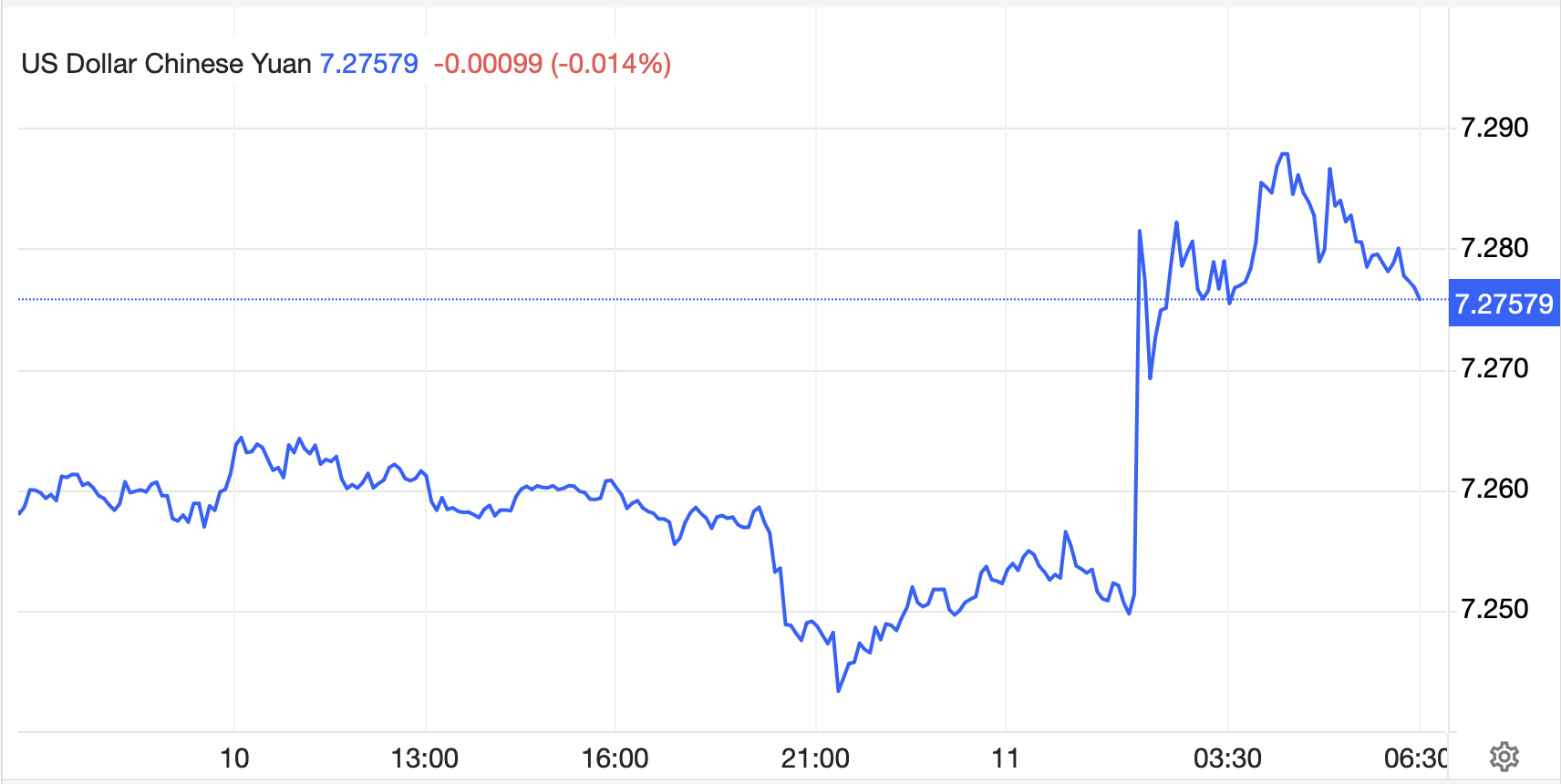
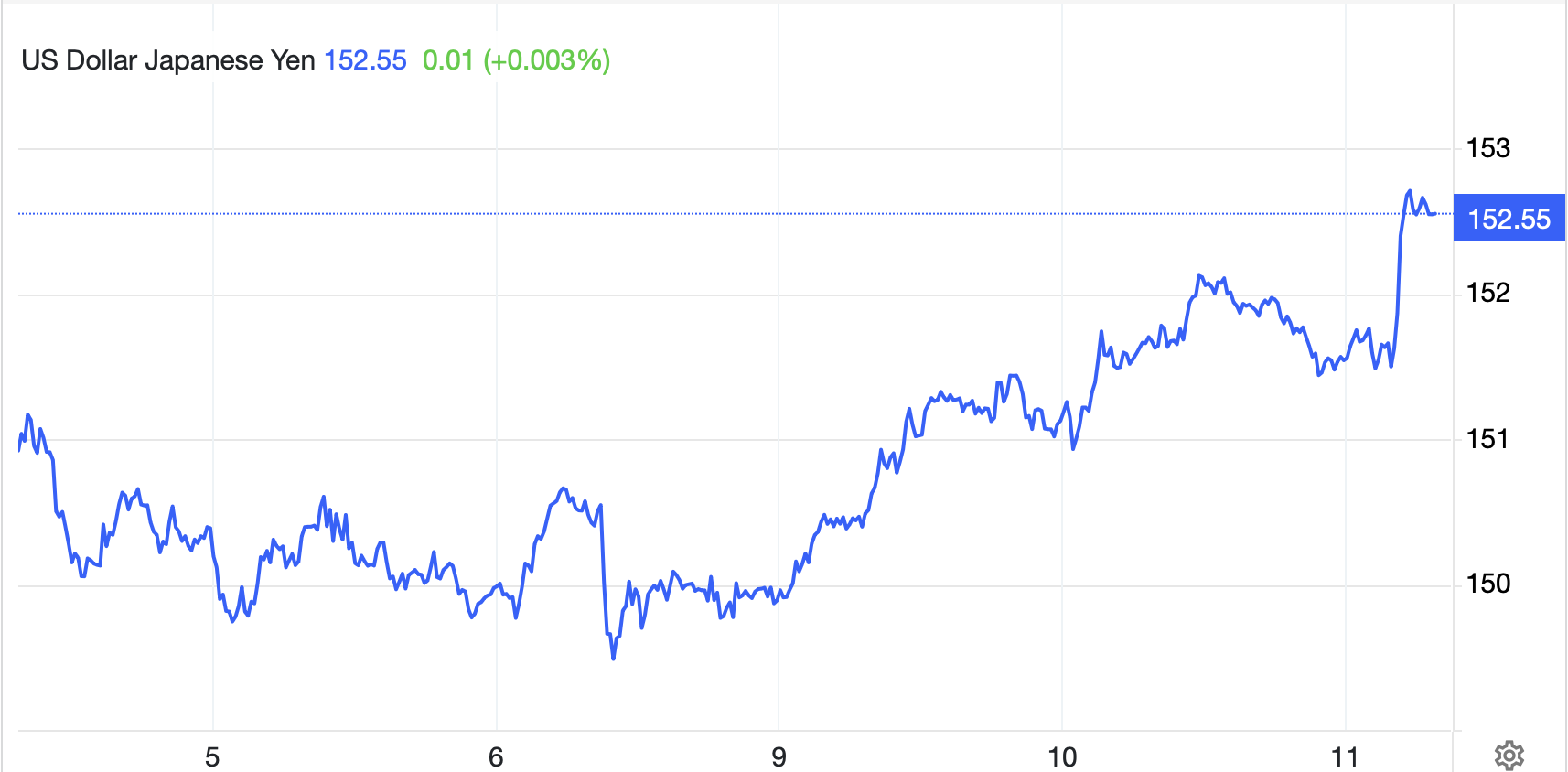
This process worked well enough for the past four years as the Biden administration, while certainly not friendly to China, was not aggressively attacking the nation’s efforts to expand its influence.  However, that situation is about to change with the Trump administration and as Mr Trump has already threatened numerous new tariffs on various parts of China’s production economy, Xi’s calculus must change.  This puts Xi in a difficult situation; allow the currency to weaken more aggressively to offset the impact of any tariffs and suffer through capital flight or maintain the renminbi’s value and see exports decline along with overall economic activity.  It is easy to see in the chart below when the story about allowing a weaker currency hit the tape.  However, there is not nearly enough information to take a longer-term view on the subject.


Source: tradingeconomics.com

One other thing to remember is that Chinese interest rates are continuing to decline with 10-year yields trading to yet another new low last night at 1.88%.  As the spread between US and Chinese yields continues to widen, by itself that will put pressure on the renminbi to decline.  The problem for Xi is that no matter the control the PBOC has over the FX markets in China, now that there is an offshore market, if the Chinese people become concerned over the value of the renminbi, it has the ability to decline far more quickly than the government would want to allow.

For those of you with Chinese assets on your balance sheet or Chinese denominated revenues, I would be looking to maximize my hedges for now.  As an aside, there were a number of forecast changes by major banks overnight with many calls for USDCNY to reach 7.50 or higher by the end of next year now.

The market’s convinced
A rate hike is on the way
Why won’t the yen rise?

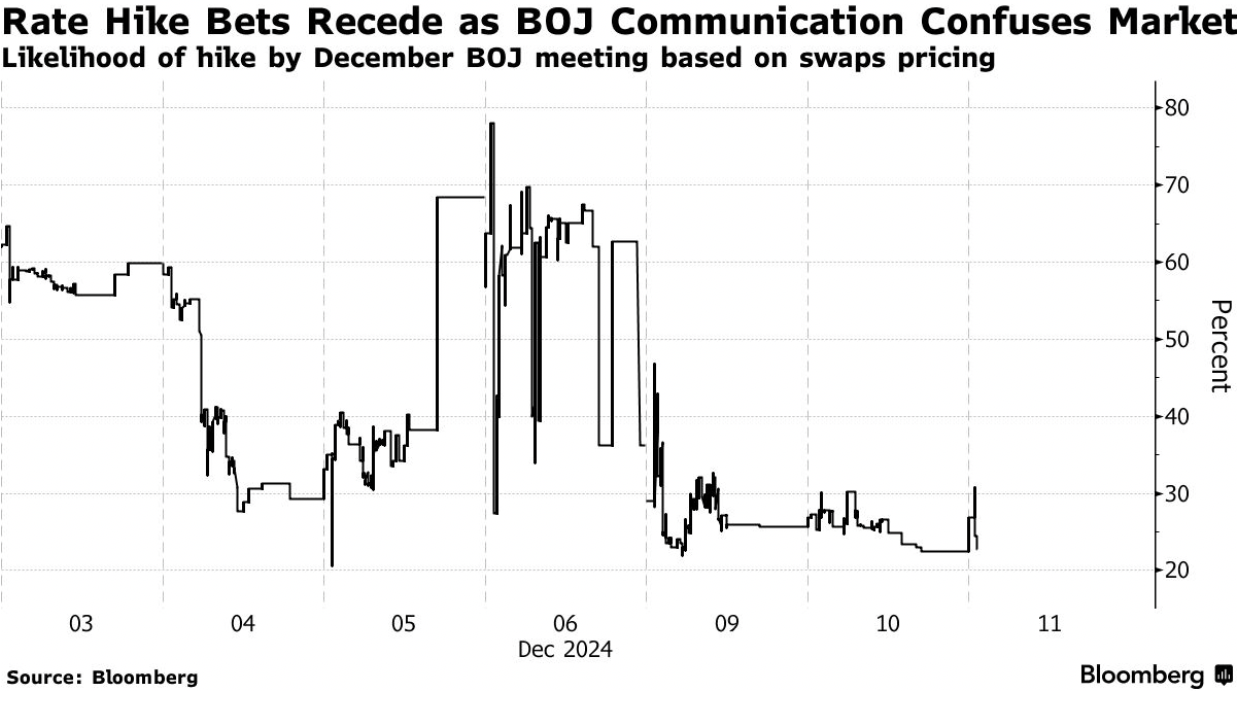
The other story overnight focused on Japan, or more precisely the BOJ meeting to be held in one week’s time.  It seems that there is a lot of dissent amongst the analyst community regarding whether or not the BOJ will hike rates.  As an example of how thin all the analyst gruel really is, one of the key rationales for the belief in a rate hike was that last week, Toyoaki Nakamura, perceived as the most dovish BOJ board member, indicated he didn’t object to a rate hike, although wanted to see more data before declaring one was appropriate for December.  However, just last night the BOJ added a speech and press briefing to their calendar for Deputy Governor Ryozo Himino right before the January meeting.  This has the punditry now expecting the BOJ to wait until then rather than move next week.  The below chart shows the change in the market’s expectations for a rate hike over the past week.

As I said, the tea leaves that the punditry are reading really don’t say very much at all.  Perhaps we can look at the economic data to get a sense.  Over the past month, we have seen CPI for both the nation and Tokyo print higher than forecast and continue to slowly climb.  As well, PPI printed higher and GDP continues to grow, albeit at a modest pace.  Of greater concern is that earnings data is lagging the CPI data.  

A look at the FX market would indicate that traders are losing their taste for a rate hike next week, at least as evidenced by the yen’s recent weakness.  As you can see in the past week, it has slipped nearly 2%, hardly a sign that higher Japanese rates are expected.  But something that is not getting much press is the potential Trump impact, where the incoming president would like to see the yen, specifically, strengthen as it is truly historically undervalued.  FWIW, which is probably not that much, I am in the rate hike camp for next week and expect the yen will find some support soon.

Source: tradingeconomics.com

Ok, enough Asian currency talk.  Let’s see how everything else behaved ahead of this morning’s data.  Yesterday’s modest US equity declines were followed by virtually no movement in Japanese shares although most of the rest of Asia followed the US lower.  Hong Kong (-0.8%) and Taiwan (-1.0%) were the worst performers and the one outlier the other way was Korea (+1.0%) as the KOSPI continues to recoup the losses made after the martial law fiasco.  European bourses are mostly little changed on the day with Spain’s IBEX (-1.1%) the lone exception which has been negatively impacted by Q3 results from Inditex (the parent company of Zara).  As to US futures, at this hour (7:25) they are little changed.

In the bond market, yields continue to edge higher in Treasuries (+2bps) and European sovereigns with gains on the order of 1bp to 2bps across the board.  While there is some discussion regarding fiscal questions in Europe, ultimately, nothing has broken the connection between US and European yields, and I would contend they are all awaiting this morning’s CPI.

In the commodity markets, oil (+1.4%) is rebounding although remains below $70/bbl, which seems to be a trading pivot for now.  The China stimulus story remains the key in the market with a growing belief that if China does successfully stimulate, oil demand will increase.  Meanwhile in the metals markets, gold is unchanged this morning after another nice rally yesterday while both silver and copper are under modest pressure.  I would contend, however, that the trend for all metals remains slightly upward.

Finally, the dollar is firmer against virtually all its counterparts this morning with most G10 currencies softer on the order of -0.3% or so although CAD and CHF are little changed on the session.  In the EMG bloc, KRW (+0.3%) is rebounding alongside the KOSPI as the excesses from the martial law story last week continue to be unwound, but elsewhere in the bloc, modest weakness, between -0.2% and -0.4%, is the rule.  However, this is all dollar focused today.

On the data front, it is worth noting that yesterday’s NFIB Small Business Optimism Index shot higher in November in the wake of the election results, heading back toward its long-term average just above 100.  As to this morning, forecasts for Headline (exp 0.3%, 2.7% Y/Y) and Core (0.3%, 3.3% Y/Y) CPI continue to indicate that the Fed may be overstating the case in their belief that inflation pressures are ebbing.  Rather, I continue to believe that we have seen the bottom in the rate of inflation and a gradual increase is in our future.  Two other things of note are the BOC rate decision (exp 50bps cut) this morning and then the Brazilian Central Bank rate decision (exp 75bp HIKE) this afternoon.  The latter is clearly an attempt to rein in the BRL’s recent dramatic decline.

With no Fed speakers, if the data this morning is significantly different than expectations, I would look for the Fed Whisperer, Nick Timiraos, to publish something before the end of the day in order to get the Fed’s latest views into the market.  Absent that, nothing has gotten in the way of the higher dollar at this stage so stay sharp.

Good luck

Adf

All Goes to Hell

The Turning is coming much faster
Than forecast by every forecaster
Now Syria’s fallen
And pundits are all in
Iran will soon be a disaster
 
However, the impact on trading
Is naught, with no pundits persuading
Investors to sell
As all goes to hell
Is narrative power now fading?


The suddenness of the collapse of Bashar Al-Assad’s control of Syria was stunning, essentially happening in on week, maybe less.  But it has happened, and it appears that there are going to be long-running ramifications from this event.  At the very least, the Middle East power structure has changed dramatically as Russia and Iran both abandoned someone who had been a key ally in their networks.  Russia is clearly otherwise occupied and did not have the wherewithal to help Assad, but it is certainly more interesting that Iran did not step up.  Rumors are that the government there is growing concerned that an uprising is coming that may change the Middle East even more dramatically.

I have previously discussed the idea of the Fourth Turning when events arise that shake up the status quo, and this is proof positive that Messrs. Howe and Strauss were onto something when they published their book back in 1997.  The thing is, even those who believed the idea and did their homework on the timing of events have been caught out by the speed of recent activities.  Most of the punditry in this camp, present poet included, didn’t expect things to become unruly until much closer to the end of the decade.  And maybe it will be the case that the collapse of Syria is just an appetizer to a much larger conflagration.  (I sincerely hope not!). But my take is these events were not on many bingo cards, certainly not in the financial punditry world.

Now, the humanitarian situation in Syria has been a disaster for the past 13 years, ever since the civil war there really took shape and fomented the European migration crisis.  Alas, it seems likely to worsen for the unfortunate souls who still live there.  But for our purposes, the question at hand is will this have an impact on markets?

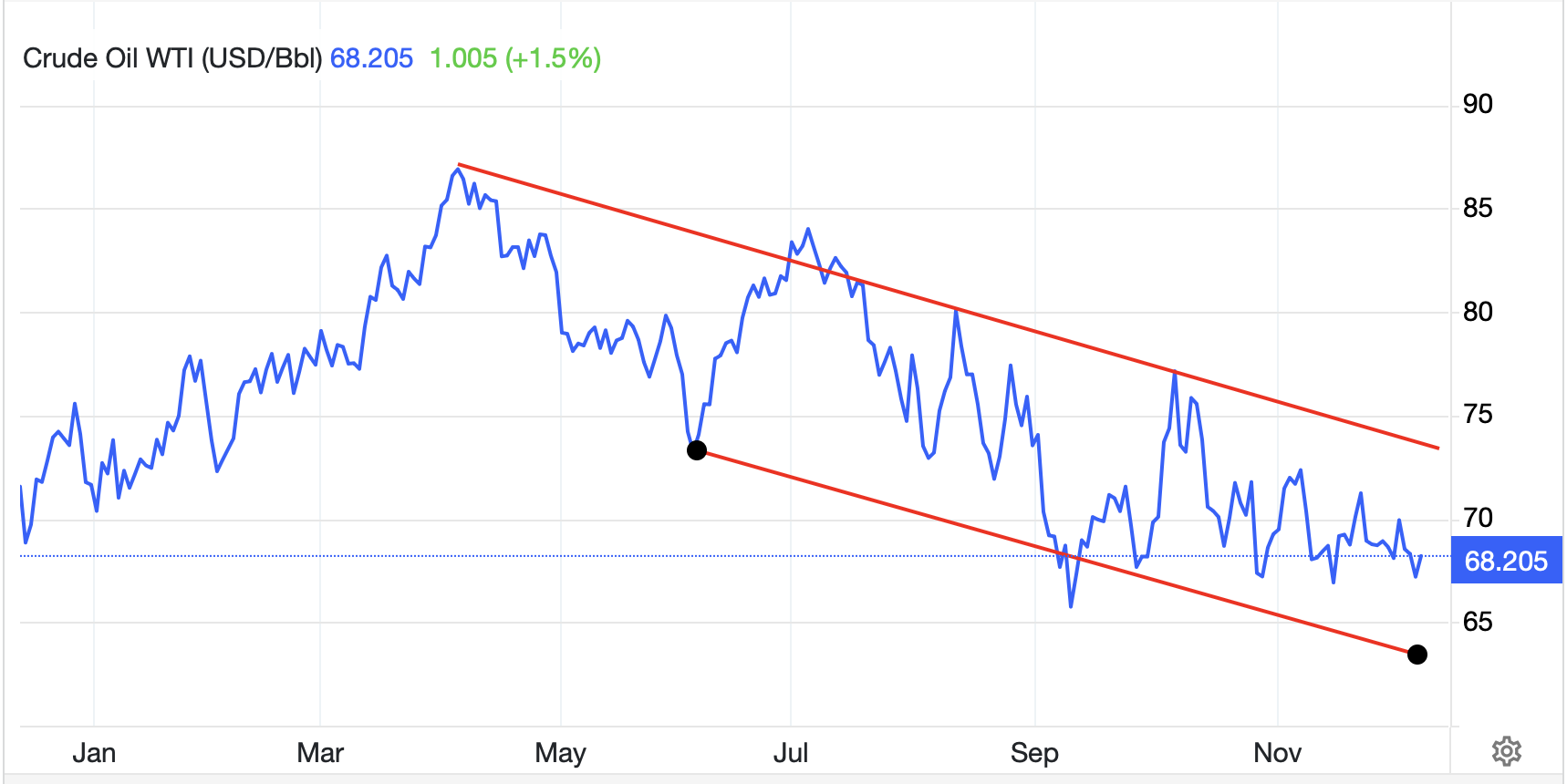
Interestingly, the answer, so far, is none whatsoever.  The obvious first concern would be in oil markets given the proximity to the major oil producing regions in that part of the world.  However, while oil (+1.4%) is a bit higher this morning, it remains well below $70/bbl and while I am no technical analyst, certainly appears to be well within a downtrend as per the below chart.

Source: tradingeconomics.com

Next on our list would be the FX markets, perhaps with expectations that haven currencies would be in demand.  Yet, the dollar is sliding against most of its counterparts this morning, with the notable exception of the yen (-0.3%) which is the one currency under more pressure.  That is the exact opposite behavior of a market that is demonstrating concern over future disruptions.  As to securities markets, they are much further removed from the situation and while US futures are edging lower at this hour (6:20), slipping about -0.15%, overnight activity showed no major concerns and European bourses are mixed, but all within 0.3% of Friday’s closing levels.  

Finally, bond markets are essentially unchanged this morning, with Treasury yields higher by 1bp and European sovereigns almost all unchanged on the day.  We did see yields slip a few bps in Asia, likely on the back of the weaker than forecast Chinese inflation data, but the bond market is certainly showing no signs of concern over the geopolitics of the moment.

On Sunday the Chinese did meet
And promised they’d finally complete
Their stimulus drive
And therefore revive
The growth that has been in retreat

A story that has had an impact on markets this morning is the Chinese Politburo’s comments that they are going to implement a “more proactive” fiscal policy in the upcoming year along with “moderately loose” monetary policy as President Xi scrambles to both improve the growth impulse and prepare for whatever President-elect Trump has in store for China once he is inaugurated.  Now, we have heard these words before and to date, each effort has been, at the very least, disappointing, if not irrelevant.  But hope is a trader’s constant companion and so once again we saw specific markets respond to the news.

Interestingly, mainland Chinese shares did not respond as enthusiastically as one might have expected with the CSI 300 actually slipping -0.2%.  But the Hang Seng (+2.75%) embraced the news warmly.  In the FX markets, early weakness in CNY was reversed although the renminbi closed the onshore session essentially unchanged on the day.  The big winners were AUD (+0.9%) and NZD (+0.5%) as traders bid up the currencies of the two nations likely to benefit most given their export profiles of commodities to China.  But beyond those market moves; it is hard to make a case that anyone was listening.

Ok, let’s look at the rest of the overnight session and see what we can anticipate in the week ahead. Japanese shares (Nikkei +0.2%) were little changed overnight while the big mover in Asia was Korea (-2.8%) as the ructions from the brief interlude of martial law last week continue to weigh on the short-term future of the government and economy there.  However, away from those markets, the rest of Asia saw movement of just +/- 0.3% or less, hardly newsworthy.  In Europe, the story is also mixed with the CAC (+0.5%) leading the way higher, perhaps on the back of the successful reopening of the Notre Dame cathedral, or more likely on the back of hopes that the luxury goods sector would improve based on Chinese stimulus supporting that economy.  As to the rest of the continent, more laggards than winners but movement has been small, 0.2% or less, although the FTSE 100 (+0.4%) is also higher this morning led by the mining shares in the index, also related to Chinese stimulus.

We have already discussed the bond market, which has been extremely quiet ahead of this week’s CPI and next week’s FOMC meeting so let’s turn to the commodity markets, where not only is oil rallying, perhaps more related to China than the Middle East, but we are seeing metals markets rally as well with both precious (Au +0.9%, Ag +2.2%) and industrial (Cu +1.6%, Zn +2.0%) performing well.  Surprisingly, aluminum (-0.25%) is not playing along this morning but if the China story is real, it should follow suit.

Finally, the rest of the currency story shows KRW (-0.5%) continuing to feel the pain, along with its stock market, from the politics last week.  At the same time, we are seeing solid gains in ZAR (+1.1%) on the metals moves and NOK (+0.4%) on the back of oil’s rally.  Elsewhere, while the dollar is broadly softer, it is of a much lesser magnitude, maybe 0.2% or so.

On the data front, this week brings two central banks (BOC and ECB) and a bunch of stuff, although CPI on Wednesday will be the most impactful.

TuesdayNFIB Small Biz Optimism94.2
 Nonfarm Productivity2.2%
 Unit Labor Costs1.9%
WednesdayCPI0.2% (2.7% Y/Y)
 -ex food & energy0.3% (3.3% Y/Y)
 BOC Meeting3.25% (current 3.75%)
ThursdayECB meeting3.0% (current 3.25%)
 Initial Claims220K
 Continuing Claims1870K
 PPI0.3% (2.6% Y/Y)
 -ex food & energy0.2% (3.3% Y/Y)

Source: tradingeconomics.com

Last week saw what appeared to be stronger payroll data on the surface, with the NFP rising 227K and upward revisions, while the Unemployment Rate rose the expected 1 tick to 4.2%.  As well, Average Hourly Earnings rose more than expected, to 4.0%.  And yet, the Fed funds futures market raised the probability of a rate cut next week to 87% (it was over 90% for a while in the session).  Now, there has been a group of analysts who have been claiming that the headline payroll data is very misleading and actually the jobs market is much weaker than the administration is portraying, and it seems they got a bit more traction in their case last week.  Nonetheless, it is hard for me to look at the data and justify another rate cut by the Fed, at least if their objective is to push inflation back to 2.0%.  Of course, that is another question entirely!

Mercifully, the Fed is in their quiet period so we will not hear from them until they pronounce things at the FOMC meeting a week from Wednesday.  Until then, I expect that the China story, as well as assorted Trump related stories, will drive things although keep a wary eye on the Middle East for anything more explosive.  As to the dollar, I have consistently explained that if the Fed eases in the face of rising inflation, that will undermine the greenback.  It will be very interesting to see how things play out this week and next as a set-up for 2025.  For now, I don’t see a good reason for a large move, but if I were a hedger, I would make sure that I am as hedged as I am allowed to be.

Good luck

Adf

Right On Humming

So, CPI didn’t decline
And may not be quite so benign
As Jay and the Fed
Consistently said
When hinting more rate cuts are fine
 
However, that will not deter
Chair Powell, next month, to confer
Another rate cut
Though it is somewhat
Unclear if his colleagues concur


Despite the fact the narrative is pushing Unemployment as the primary focus of the FOMC, yesterday’s CPI report, which seemingly refuses to decline to the Fed’s preferred levels, had Fed speakers beginning to hedge their bets regarding just how quickly rates would be coming down from here. [Emphasis added.]

St. Louis Fed President Alberto Musalem explained, “The strength of the economy is likely to provide the space for there to be a gradual easing of policy with little urgency to try and find where the neutral rate may be.

Dallas Fed President Lorrie Logan commented (using a series of maritime metaphors for some reason) “After a voyage through rough waters, we’re in sight of the shore: the FOMC’s Congressionally mandated goals of maximum employment and stable prices, but we haven’t tied up yet, and risks remain that could push us back out to sea or slam the economy into the dock too hard.”  

Finally, Kansas City Fed President Jeff Schmid told us, “While now is the time to begin dialing back the restrictiveness of monetary policy, it remains to be seen how much further interest rates will decline or where they might eventually settle.”  

If we ignore the oddity of the maritime metaphor, my takeaway is that the Fed is still looking to cut rates further as directed by Chairman Powell, but the speed with which they will act seems to be slowing down.  As I have maintained in the past, given the current data readings, it still doesn’t make that much sense to me that they are cutting rates at all, but arguably, that’s just another reason I am not a member of the FOMC.  Certainly, the market is on board as futures pricing increased the probability of that cut from 62% before the release to 82% this morning.  There is still a long way to go before the next meeting, with another NFP, PCE and CPI report each to be released, as well as updates on GDP and Retail Sales and all the monthly figures, so this story is subject to change.  But for now, a rate cut seems likely.

One other thing, I couldn’t help but notice a headline that may pour a little sand into the gears of the rate cutting apparatus at the Eccles Building.  This is on Bloomberg this morning: Manhattan Apartment Rents Rise to Highest Level Since July.  Again, the desperation to cut rates seems misplaced.

Despite the fact rate cuts are coming
The dollar just keeps right on humming
This morning it’s rising
Which ain’t that surprising
As more depths, the euro is plumbing

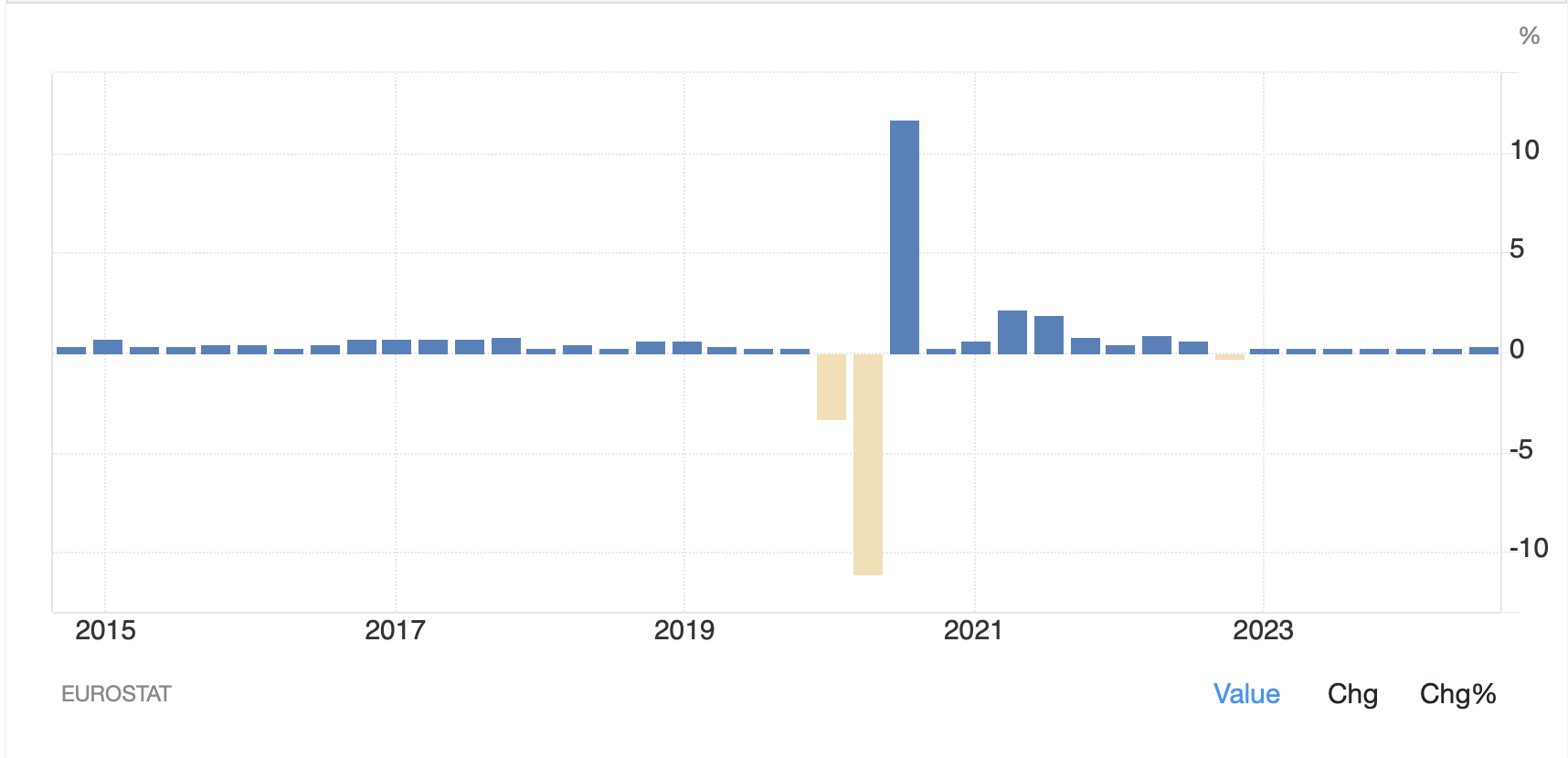
Turning our attention to the continent, European GDP figures were released this morning, and they remain disheartening, to say the least.  While the quarterly number rose to 0.4%, as you can see from the chart below, it has been several years since the continent showed any real growth, and that was really just the rebound from the Covid lockdowns.  Prior to Covid, growth was still lackluster.

Source: tradingeconomics.com

While these are the quarterly numbers, when looking at the Y/Y results, real GDP grew less than 1% in Q3 for the past 6 quarters and, in truth, shows little sign of improving.  After all, virtually every nation in the Eurozone is keen to continue their economic suicide via energy policy and regulation.  This thread on X (formerly Twitter)is a worthwhile read to get an understanding of the situation on the continent.  I show it because this morning, the euro has fallen yet further, and is touching the 1.05 level, seemingly on its way to parity and below.  It highlights that since just before the GFC, the Eurozone economy has fallen from virtually the same size as the US economy, to just 60% as large, and explains the key reasons.  Read it and you will be hard-pressed to consider the euro as a safe store of value, at least relative to the dollar.  And remember, the dollar has its own issues, but at least the US economy remains dynamic.

But the dollar is king, again, this morning, rising against virtually all its counterparts on the session.  Versus the G10, the average movement is on the order of 0.3% or so, but it is uniform.  USDJPY is now pushing 156.00, the pound seems headed for 1.2600 and Aussie is below 0.65.  My point is concerns about the dollar and its status in the world seem misplaced in the current environment.  If we look at the EMG bloc, the dollar is stronger nearly across the board as well, with similar gains as the G10.  MXN (-0.5%), ZAR (-0.4%) and CNY (-0.2%) describe the situation which has been a steady climb of the greenback since at least the Fed rate cut, and for many of these currencies, for the past 6 months.  Nothing about President-elect Trump’s expected policies seems likely to change this status for now.

If we look at equity markets, yesterday’s US outcomes were essentially little changed on the day.  However, when Asia opened, with the dollar soaring, we saw a lot more weakness than strength, notably in China with the CSI 300 (-1.7%) and Hang Seng (-2.0%) leading the way lower although the Nikkei (-0.5%) also lagged along with most other Asian markets.  While there were some modest gainers (Australia +0.4%, Singapore +0.5%) red was the predominant color on screens.  In Europe, however, investors are scooping up shares with the DAX (+1.2%) leading the way although all the major bourses are higher on the session.  It seems that there is a growing consensus that the ECB is going to cut 25bps in December and then another 25bps in January, which has some folks excited.  US futures, meanwhile, are slightly firmer at this hour (7:00).

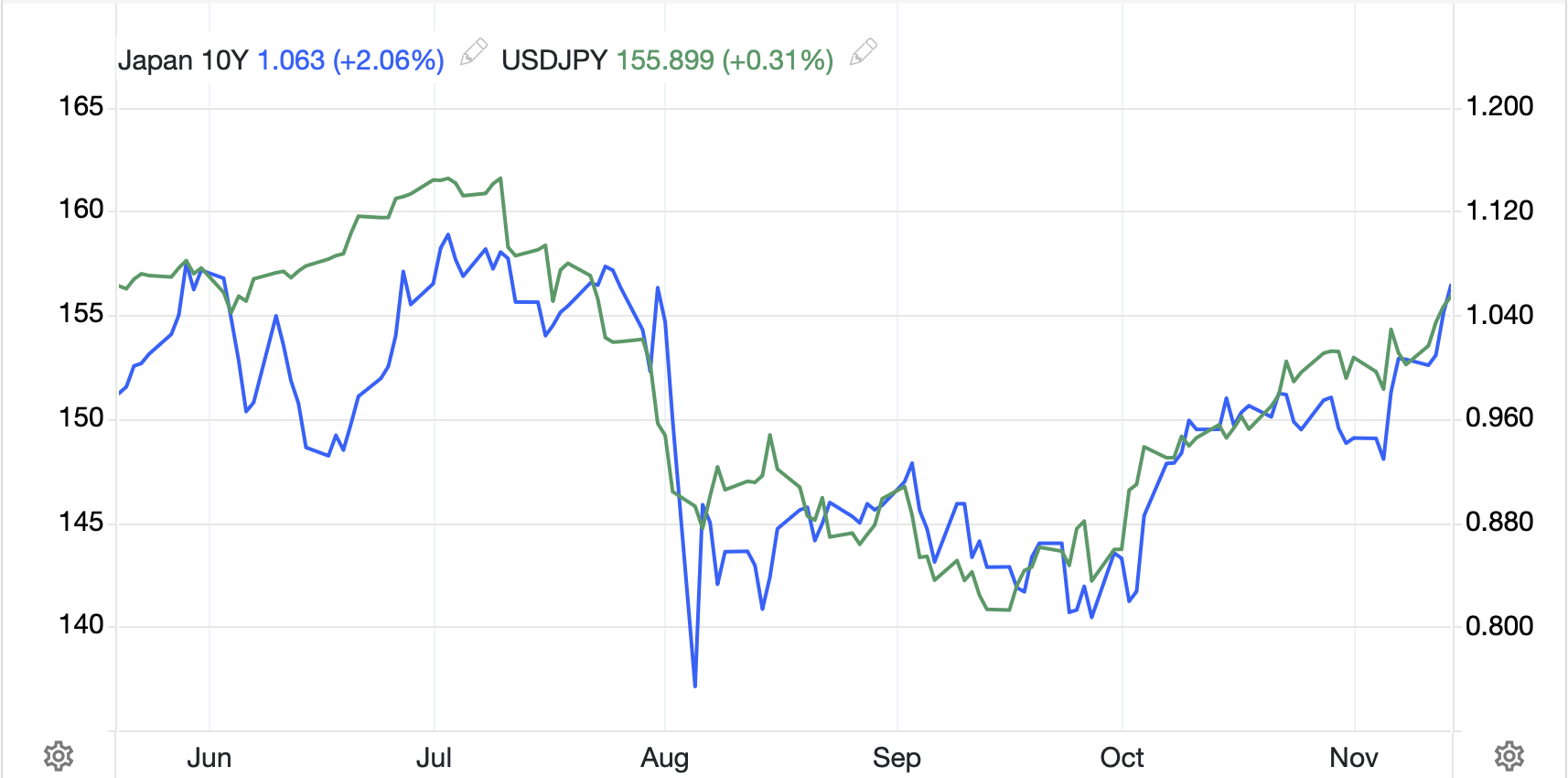
All this is happening against a backdrop of a continued climb in yields around the world.  Yesterday, again, yields rose with 10yr Treasuries trading as high as 4.48%, their highest level since May, and that helped drag most European yields higher as well.  This morning, we are seeing some consolidation with Treasury yields backing off 1bp and European sovereign yields lower by -2bps across the board.  The one place not following is Japan, where JGB yields edged higher by 1bp and now sit at 1.05%.    Consider, though, that despite those rising yields, the yen continues to slide.  In fact, that is the correlation that exists, weaker JPY alongside higher JGB yields as you can see in the below chart.

Source: tradingeconomics.com

While it is open to question which leads and which follows, my money is on Japanese investors searching for higher yields, selling JGB’s and buying dollars to buy Treasuries.

Finally, the commodity space continues to get blitzed, or at least the metals markets continue that way as once again both precious and industrial metals are all lower this morning.  In fact, in the past week, gold (-5.7%), silver (-6.4%) and copper (-9.1%) have all retraced a substantial portion of their YTD gains.  It is unclear to me whether this is a lot of latecomers to the trade getting stopped out or a fundamental change in thinking.  My view is it is the former, as if the Trump administration is able to support growth, I expect that will reveal the potential shortages that exist in the metals space.  Oil (+0.4%) is a different story as it continues to consolidate, but here I think the odds are we see lower prices going forward as more US drilling brings supply onto the market.

On the data front, this morning brings the weekly Initial (exp 223K) and Continuing (1880K) Claims data along with PPI (0.2%, 2.3% Y/Y) and core PPI (0.3%, 3.0% Y/Y).  In addition, the weekly EIA oil data is released with modest inventory builds expected and then we hear from Chair Powell at 3:00pm this afternoon.  Arguably, that is the event of the day as all await to see if the trajectory of rate cuts is going to flatten out or not.

I cannot look at the data and conclude that the Fed will be very aggressive cutting rates going forward.  The futures market is now pricing in about 75bps of cuts, total, by the end of 2025.  That is a 50bp reduction in that view during the past month and one of the reasons the dollar remains strong.  I would not be surprised if there are even fewer cuts.  Right now, everything points to the dollar continuing to outperform virtually every other currency.

Good luck

Adf

A Warning

Though Trump has been leading the news
With folks asking who he will choose
As agency chiefs
That share his beliefs
For markets, today brings new cues
 
Inflation will soon be released
And though Jay claims he killed this beast
The data this morning
May well be a warning
Inflation, in fact, has not ceased


Source: tradingeconomics.com

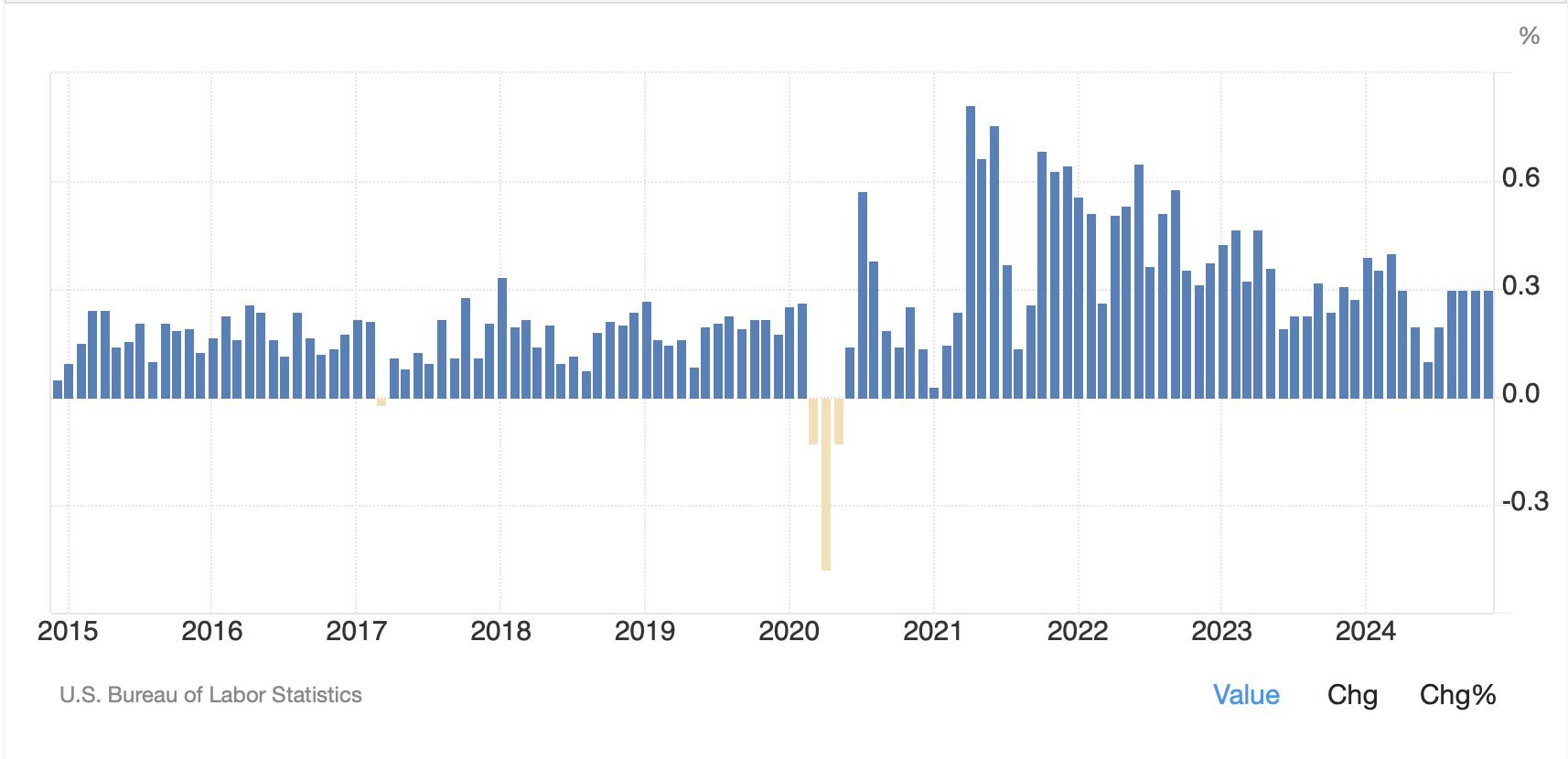
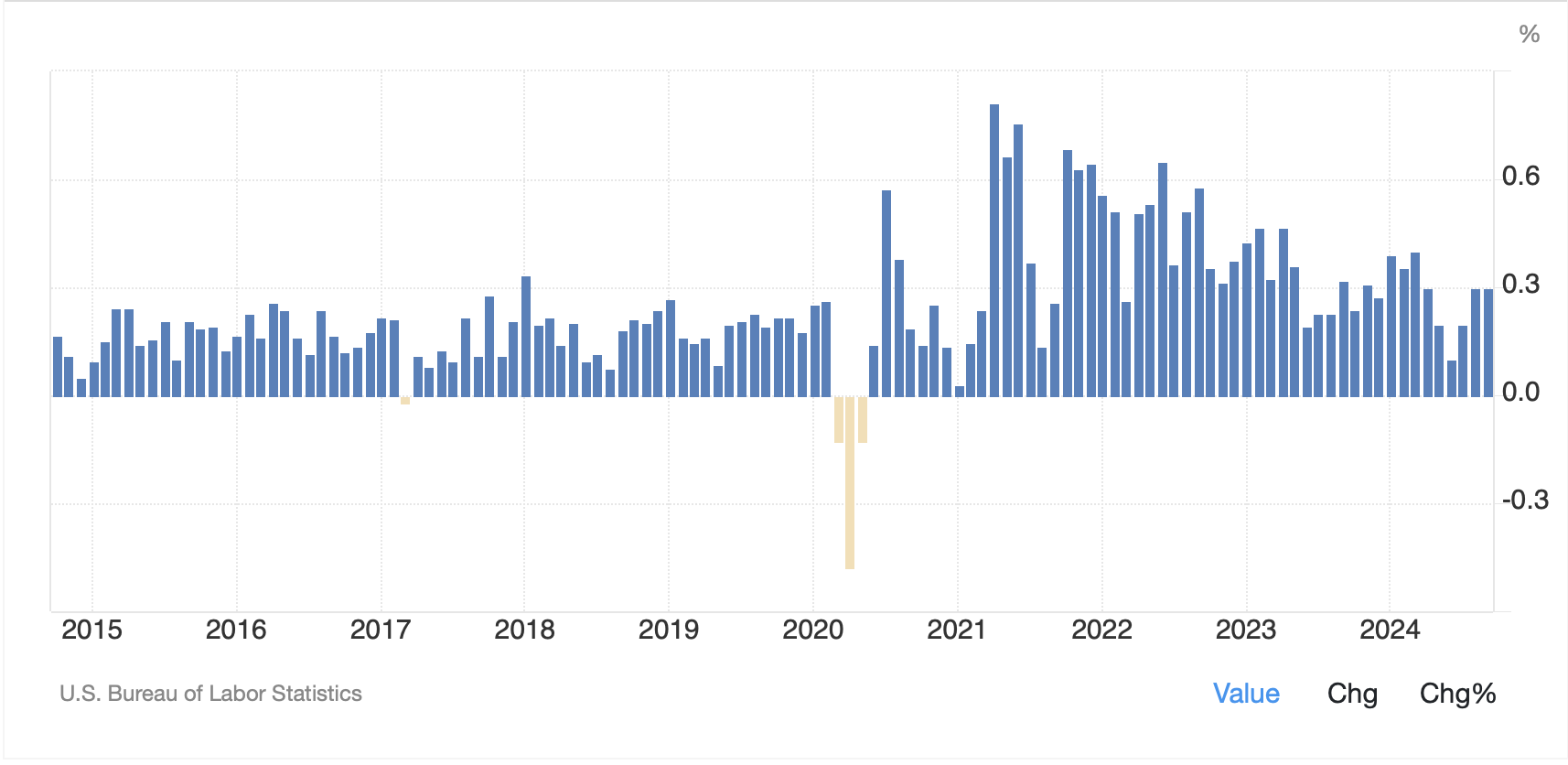
Beauty (and everything else) is in the eye of the beholder.  So, what are we to make of the above chart which shows the past ten years’ worth of monthly Core CPI readings prior to this morning’s release.  Some eyes will travel to the peak in April 2021 (0.812%) and see a downward sloping line from there.  The implication is that the trend is your friend and that things are going well.  Others will gravitate to the June 2023 print (0.195%) and see that except for a blip lower in June 2024 (0.1%), the series looks like it may have bottomed and, if anything, has found a new home.

Remember, that if the monthly print is 0.3%, that annualizes to 3.7% Core CPI.  That seems pretty far above the 2.0% target that the Fed is shooting for and would call into question exactly why they are cutting interest rates.  In fact, you can look at the above chart and see that prior to the pandemic, core CPI on a monthly basis was below 0.3% every month except one, with many clearly down near the 0.1% level.

As much as Powell and his minions want to convince us that inflation is heading back to their goal and everything is ok, the evidence does not yet seem to be pointing in that direction.  For today, current median analyst expectations are for a headline of 0.2% M/M, 2.6% Y/Y and a core of 0.3% M/M, 3.3% Y/Y.  Even if the data comes as expected, it would seem very difficult to justify continuing to cut rates given the equity market remains essentially at all-time highs, while Treasury yields (-1bp today, +12bps yesterday) seem like they are starting to price in higher long-term inflation.

However, something interesting seems to be happening with the Fed speakers.  Richmond Fed President Barkin yesterday explained that things look pretty good, but declined to even consider forecasting where things will go.  As well, Minneapolis Fed President Kashkari indicated that while inflation has declined, it does not yet seem dead.  The Fed funds futures market is now pricing just a 62% probability of a rate cut in December.  One month ago, it was pricing an 84% probability.  As I have maintained, it seems increasingly difficult for the Fed to make the case that rate cuts are necessary given the economic data that we continue to see.  I understand that there are still a large group of pundits who believe things are much worse when you dig under the surface of the data, and I also understand that most people in the country don’t believe that things are going that well, hence the landslide election results for Mr Trump.  However, based on the data that the Fed allegedly follows, rate cuts seem difficult to support.  Today will be another piece of the puzzle.  If the data is hot, I expect risk assets to suffer more and the dollar to continue its rally.  If the data is soft, look for new records in stocks while the dollar retraces some of its recent gains.

With that in mind, let’s look at what happened overnight in markets.  Yesterday’s modest declines in the US market were followed by more selling than buying in Asia with the Nikkei (-1.7%) leading the way lower but weakness also seen in Australia (-0.75%), Korea (-2.65%), India (-1.25%) and Taiwan (-0.5%) as an indication of the general sense in the time zone.  The outlier here was mainland China (+0.6%) where hope remains eternal that the government will fire their bazooka.  In Europe, though, this morning is seeing a hint of red with most major indices lower by just -0.1% and Spain’s IBEX (+0.2%) even managing a small gain.  The commentary from the continent is over fears of how things will evolve with the new Trump administration and his threat of more tariffs on European exports.

But here’s something to consider.  If Trump is successful in quickly negotiating an end to the Russia/Ukraine war, won’t that be a huge benefit to Europe?  After all, if the war is over, they will be able to restart imports of cheap Russian NatGas which should have an immediate impact on their overall cost of energy, especially Germany, and help the economies there substantially.  I know they love to scream because they all hate Trump, but it seems like he could help them a lot if they would let him.  Oh yeah, US futures are a touch lower, -0.2%, at this hour (7:10).

Anyway, in the bond market, after yesterday’s rout in the US, yields are little changed this morning but in Europe, yields are climbing as they weren’t able to keep up with US yields yesterday.  So, on the continent, yields are higher between 2bps and 4bps after rising 4bps – 6bps yesterday.  In Asia, JGB yields jumped 4bps on the global rise in bond yields and are now back above 1.0%.  However, that has not been nearly enough to help the yen (-0.2%), which continues to weaken and is pushing back above 155.00 this morning.  

In the commodity markets, oil (+0.2%) is edging higher, but that seems to be consolidation after what has been a pretty awful week for the black sticky stuff.  OPEC reduced its demand forecasts for the 4th consecutive month, something else that is weighing on the price and, of course, the Trump administration is going to seek to make it much easier to explore for and produce more oil.  In the metals markets, gold (+0.5%) seems to have found a temporary bottom along with silver (+0.8%) although the damage has been substantial this week.  However, copper and aluminum remain under pressure as fears over continued weakness in China seem to be weighing on the price.

Finally, the dollar has stopped rising sharply, although it is not really declining very much, at least not vs. the G10 currencies.  In fact, vs. the G10, the dollar is softer by just 0.1% or so vs. the entire bloc other than the yen mentioned above.  However, vs. the EMG bloc, the dollar has ceded some more gains with KRW (+0.7%) the leader but MXN (+0.4%), CNY (+0.35%) and ZAR (+0.6%) all bouncing back after a week of substantial declines.  We all know nothing goes up or down in a straight line, so this consolidation is just that, it is not a trend change by any stretch.  A quick look at the MXN chart below, which is essentially what we have seen everywhere, explains just how insignificant the overnight movement has been relative to the recent trend.

Source: tradingeconomics.com

On the data front, aside from the CPI data, we hear from three more Fed speakers (Logan, Musalem and Schmid) so it will be interesting to see if they are starting to change their sense of how things are going to progress.  Of course, all eyes will be on Powell’s speech Thursday afternoon, but perhaps there are some clues to be had here.

It is not clear to me that anything has changed in the big picture.  The US economy continues to be the strongest one around and now has the added impetus of expectations for more positivity with the change in the administration.  In that environment, my long-term view on the dollar remains it has further to run.

Good luck

Adf

Inflation’s Not Dead

It turns out inflation’s not dead
Despite what we’ve heard from the Fed
Will Jay now admit
His forecasts are sh*t
Or are there more rate cuts ahead?
 
To listen to some of his friends
They’re still focused on the big trends
Which they claim are lower
Though falling much slower
If viewed through the right type of lens


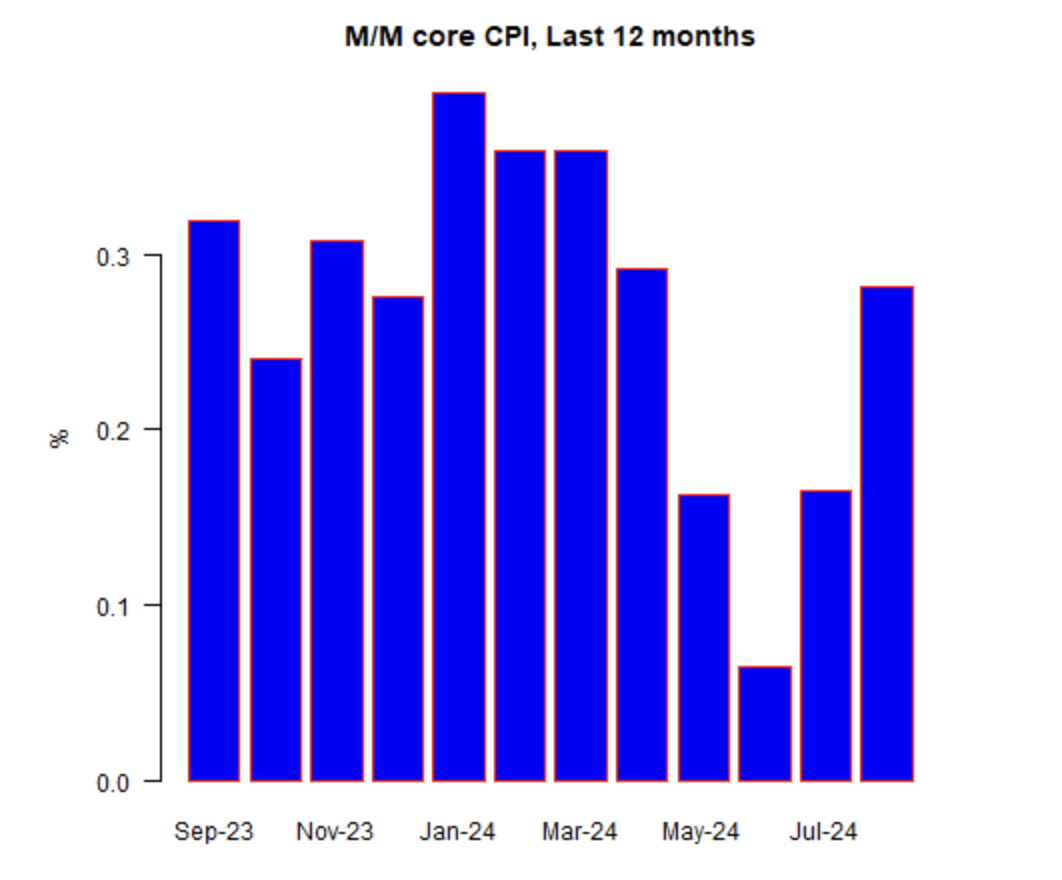
I guess if you squint just the right way, the trend in inflation remains lower.  I only guess that because that’s what we heard from three Fed speakers yesterday, Williams, Goolsbee and Barkin, but to my non-PhD trained eye, it doesn’t really look that way.  Borrowing the chart from my friend @inflation_guy, Mike Ashton, below are the monthly readings for the past twelve months for Core CPI.

As I said, and as he mentioned in his CPI report yesterday, it is much easier to believe that the outliers are May through July than the rest of the series.  But remember, I am not a trained PhD economist, so it is entirely possible that I simply don’t understand the situation.

At any rate, both the core and headline numbers printed higher than forecast which saw bonds sell off and the dollar rally while stocks edged lower.  Arguably, the big surprise was that commodity prices raced ahead with oil (+3.0% yesterday) and gold (+0.75% yesterday) both showing strength.  It seems that both of these markets, though, benefitted from rumors that Israel is getting set to finally retaliate against Iran for the missile bombardment last week, and fears of a significant disruption in oil markets, as well as a general rise in the level of uncertainty, has been sufficient to squeeze out a bunch of recent short positions.

In China, investors are waiting
For details on how stimulating
The plans Xi’s unveiled
Will truly be scaled
And if they’ll be growth generating

The other topic du jour is China, where tomorrow, FinMin Lan Fo’an is due to announce the details of the fiscal stimulus that was sketched out right before the Golden Week holiday, and which has been a key driver in the extraordinary rise in Chinese equities since then.  Alas, last night, as traders and investors prepared for these announcements, selling was the order of the day and the CSI 300 (-2.8%) fell sharply amid profit taking.  I find it telling that they are waiting to make these announcements while markets are not open, a sign, to me at least, that they are likely to be underwhelming.  Current expectations are for CNY 2 trillion (~$283 billion) of fiscal stimulus, which while a large number, is not that much relative to the size of the Chinese economy, currently measured at about $17 trillion.  And unless they address the elephant in the room, the decimated housing market, it seems unlikely to have a major positive impact over the long term. 

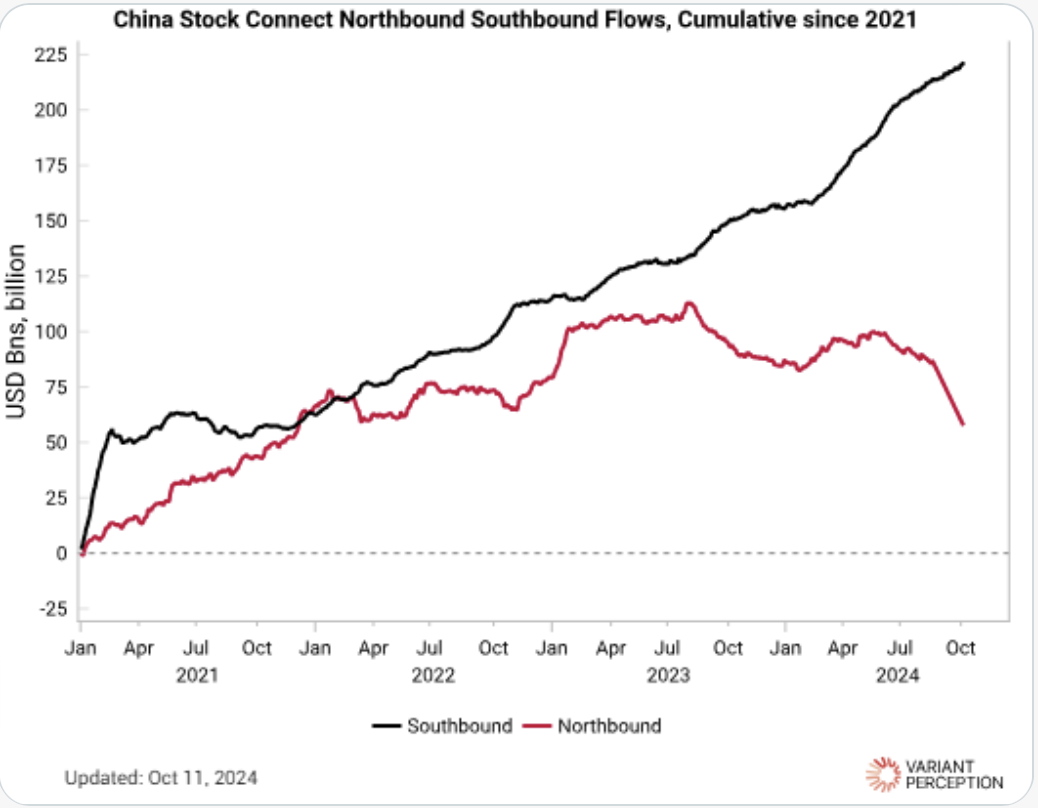
That said, Chinese stocks have become one of the hottest themes in the market with many analysts claiming they are vastly undervalued relative to US stocks.  However, I saw a telling chart this morning on X, showing that flows into Chinese stocks from outside the nation, the so-called northbound flows from Hong Kong, especially when compared to flows from the mainland to Hong Kong, have been awful, despite this recent rally.  As with many things regarding the Chinese economy and markets, the headlines can be deceiving at times in an effort to make things look better than they are.

While we did see the renminbi rally sharply after those initial stimulus announcements, it has since retraced most of those gains.  I cannot look at the situation there without seeing an economy that has serious structural imbalances and a terrible demographic future.  Meanwhile, the biggest problem is that President Xi has spent the past decade consolidating his power and eliminating much of the individual vibrancy that had helped the nation grow so rapidly.  Ultimately, I see CNY slowly depreciating as it remains the only relief valve the Chinese have on an international basis.

With that in mind, let’s take a look at how markets responded to the US CPI data and what other things may be having impacts.  Ultimately, US equity markets regained the bulk of their early losses yesterday to close marginally lower.  We’ve already mentioned China’s equity woes and Hong Kong was closed last night for a holiday.  Tokyo (+0.6%) managed a small gain, tracking the weakness in the yen (-0.25%) while the bulk of the region drifted modestly lower.  It seems many traders are awaiting this Chinese news to see how it will impact the rest of Asia.  As to European bourses, the movement here has also been di minimus with the FTSE 100 (-0.2%) the biggest mover after its data releases showing that GDP continues to trudge along slowly, growing only 1.0% Y/Y.  Continental exchanges are +/- 0.1% from yesterday, so no real movement there.  US futures, too, are essentially unchanged at this hour (7:00).

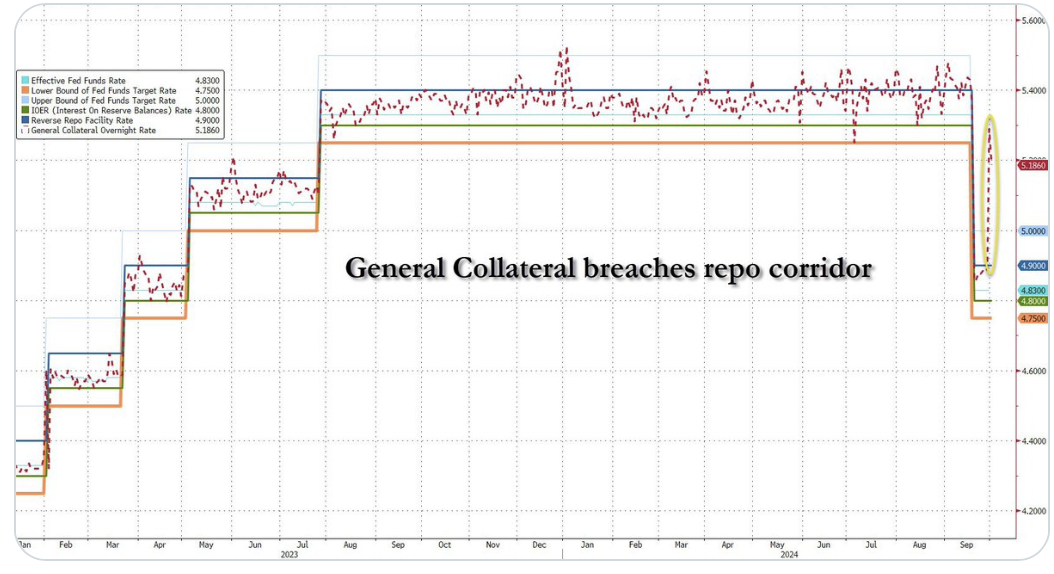
In the bond market, yields continue to edge higher with Treasuries gaining 3bps and European sovereigns all looking at gains of between 3bps and 5bps.  An interesting interest rate phenomenon that has not gotten much press is that the fact that at the end of September, the General Collateral Repo rate surged through the upper bound of the Fed funds rate, a condition that describes a potential dearth of liquidity in the markets.  

Source: zerohedge.com

The implication is that QT may well be ending soon in order for the Fed to be certain that there are sufficient bank reserves available for banks to meet their regulatory targets and not starve the economy of capital.  It has always been unclear how the Fed can start cutting rates while continuing to shrink the balance sheet as that was simultaneously tightening and easing policy, but it appears that we are much closer to universal policy ease, something else that will weigh on the dollar and support commodity prices over time.

Speaking of commodities, after yesterday’s rally, this morning, the metals complex is continuing modestly higher (Au +0.3%, cu +0.4%) but oil (-0.8%) is backing off a bit.  So much of the oil trade appears linked to the Middle East it is very difficult to discern the underlying supply/demand dynamics right now.

Finally, the dollar, after several days of strength, is consolidating and is little changed to slightly higher.  The DXY is trading right at 103 and the euro is hovering just above 1.09 with USDJPY at 149.00.  Several weeks ago, these numbers would have seemed ridiculous given the then current view of the Fed aggressively cutting rates.  But now, all that bearishness is fading, and it is true vs. almost every currency, G10 or EMG this morning.

On the data front, PPI leads the way this morning although given we already got the CPI data, it will have virtually no impact I would expect.  Estimates are for headline (0.1% M/M, 1.6% Y/Y) and core (0.2% M/M, 2.7% Y/Y).  As well, we get Michigan Sentiment (70.8) at 10:00 and we will hear from several more Fed speakers, including Governor Bowman, the dissenter at the FOMC meeting who looks quite prescient now.  One thing to note is yesterday’s Initial Claims data was much higher than expected at 258K, but that was attributed to the effects of Hurricane Helene, and now that Hurricane Milton has hit, I expect that those claims numbers will be a mess for a few more weeks before all the impact has passed through.

While Fedspeak remains far more dovish than the data, my take is if the data continues to show economic strength, especially if the next NFP release, which is just before the FOMC meeting, is strong again, the Fed will be hard pressed to cut even 25bps then.  For now, good economic news should support the dollar and weigh on bonds.

Good luck and good weekend

Adf

Clouded and Blurry

The Minutes explained twenty-five
Would likely still let markets thrive
But Powell demanded
A half, lest they landed
The ‘conomy in a crash dive


Yesterday’s release of the FOMC Minutes was enlightening to the extent it showed Chairman Powell did not have everybody in agreement for his 50bp rate cut last month.  In the Fed’s own words, “…a substantial majority of participants supported lowering the target range for the federal funds rate by 50 basis points to 4-3/4 to 5 percent.  However, noting that inflation was still somewhat elevated while economic growth remained solid and unemployment remained low, some participants observed that they would have preferred a 25 basis point reduction of the target range at this meeting, and a few others indicated that they could have supported such a decision.”  

Remember, too, that this meeting was held two days prior to the NFP report which changed a great deal of thinking on the subject, not least by the Fed funds futures market which as of this morning is pricing a 20% probability of no cut at the November meeting.  Looking at the GDPNow calculation from the Atlanta Fed, that NFP number increased the estimate to 3.4%, although recent inventory data has seen it slip back a tick as you can see below.  

Source: atlantafed.org

Despite that last little dip, though, the estimate remains far stronger than economists’ forecasts and paints a picture of a resilient economy.  (Perhaps adding $1.8 trillion via the budget deficit has something to do with that, but that is a story for a different time.). While the Fed is clearly anxious, if not desperate, to cut rates further, the economic case, with inflation remaining above their targets and the employment situation looking better amid solid economic growth, seems to be waning.

Three weeks ago, Jay and the Fed
Said joblessness was their, flag, red
Explaining inflation
Had taken vacation
So, more cutting rates was ahead
 
This morning we’ll learn if that’s true
Or if, like employment, their view
Is clouded and blurry
Which could cause some worry
For bulls and for Biden’s whole crew

Which leads us to the other key market story today (clearly the devastation from Hurricane Milton is the most important news of the day and my thoughts and prayers go to all those in its path), the CPI report.  Current consensus expectations are for a 0.1% rise in the monthly headline reading which translates to a 2.3% Y/Y increase and a 0.2% rise in the monthly core reading which translates into a 3.2% Y/Y increase.  

Looking at some obvious pieces of the puzzle, gasoline prices fell 8.4% in September, which is one of the reasons the headline number is below the core number.  The thing is, gasoline prices this morning are almost exactly where they were at the beginning of September, which informs us that the headline number could easily retrace somewhat next month.  The point is, we need to keep our eye on the core number (after all, the reason they created it was because food and energy prices were volatile and monetary policy’s impact on them virtually nonexistent, so they needed something that might give them a better feel for the reality elsewhere).  And I don’t know about you, but if the target is 2.0% then 3.2% doesn’t seem that close.  I know they are focused on core PCE, but even that remains well above their target.

One of the stories around this morning is that used car prices have stopped declining and that could have an outsized impact resulting in a higher than otherwise reading.  But in reality, I question whether this matters at all.  What we have learned from the Fed over the past month is that they are going to cut rates no matter what.  While the pace of those cuts may be faster or slower depending on some data, every Fed speaker this week, and even a review of the Minutes, points to the fact that they are all desperate to keep cutting rates.

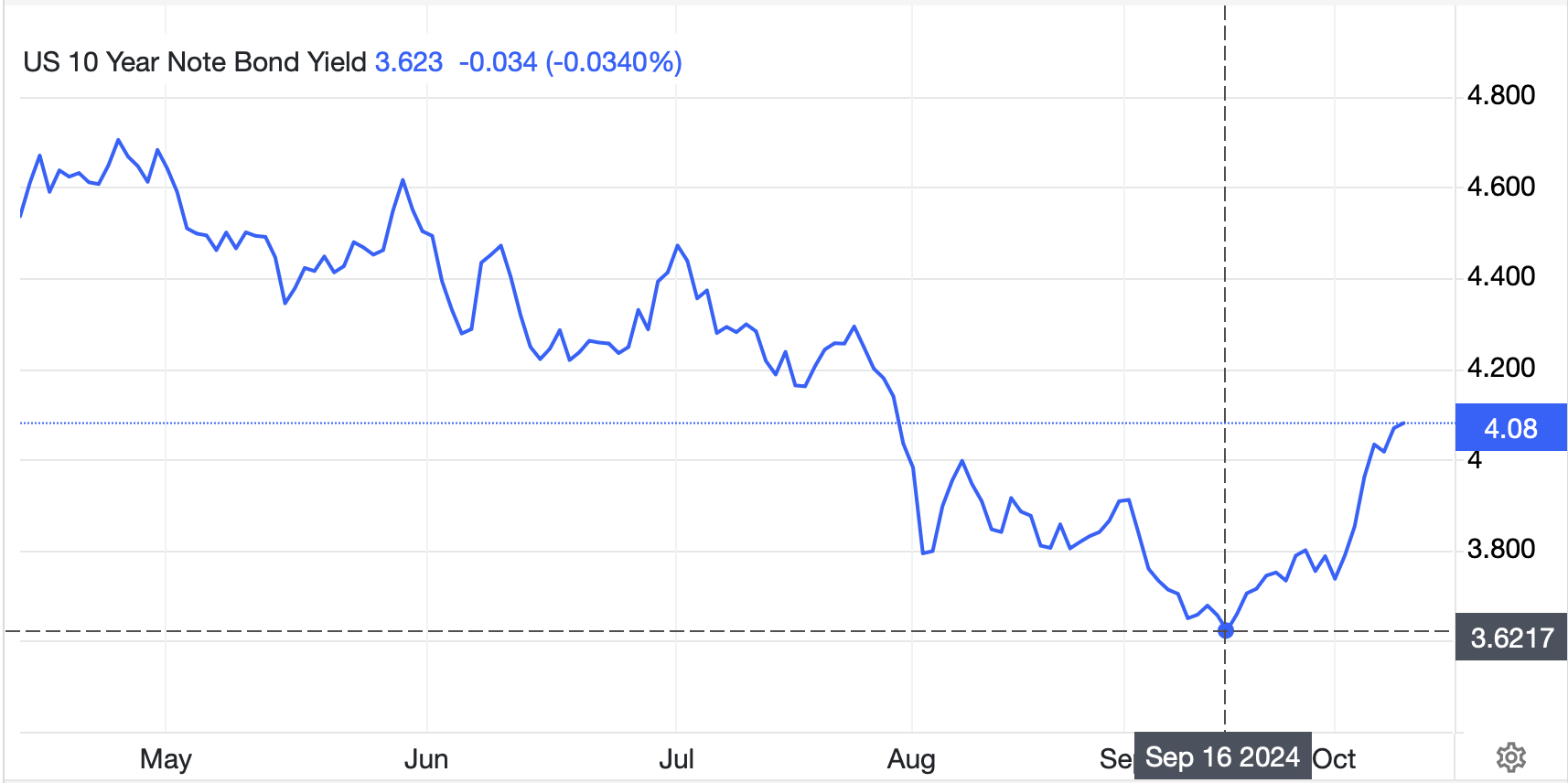
But you know who is taking exception to that stance?  The bond market.  Perhaps the bond vigilantes of late 90’s fame have been resurrected, or perhaps investors are simply looking at the fiscal situation in the US, where deficit spending continues to increase which means more and more Treasury debt will need to be issued and decided that even 4.0% is no longer a reasonable nominal return on their investment.

As you can see below, 10-year Treasury yields have risen 46bps since just before the last FOMC meeting as the stronger US data combined with the Fed’s clear focus on cutting rates has made investors nervous.  

Source: tradingeconomics.com

You may recall the discussion about the inverted yield curve, where 2yr yields traded above 10yr yields for more than two full years, a record amount of time.  This fostered many recession calls as historically this has been a harbinger of a future recession.  However, a key question was whether the disinversion would be a bull (falling 2yr yields) or bear (rising 10yr yields) steepener.  Things started as a bull steepener with the Fed cutting rates, but lately, as we watch 10yr yields rise, fears are growing that inflation is making a comeback and the bond bears are going to drive this process.  A bear steepening is not going to be a welcome result for Powell and friends, nor especially for Ms Yellen, as the cost of debt will continue to rise.  It also speaks to concerns that the Fed has lost control of the narrative.  It is still too early to declare the outcome, but the original, widely held view of a bull steepener is fraying at the seams.

Ok, let’s quickly touch on overnight markets.  Yesterday’s US rally saw follow through in Japan (+0.25%) alongside a weakening yen (-0.75% yesterday, +0.2% this morning) and in China (+1.1%) and Hong Kong (+3.0%) after the PBOC detailed the support they would be giving to equity market players and indicated that more could follow.  As to the rest of the region, there were more gainers than laggards but nothing of real note.  In Europe, although most markets are little changed on the day, if leaning slightly lower, Spain’s IBEX (-0.9%) is the outlier on what seems to be profit taking ahead of the US CPI number after a strong 5-day run higher.  And at this hour (7:10) US futures are pointing slightly lower, about -0.2%.

In the bond market, yields continue to climb around the world with Treasuries adding 1bp and most of Europe seeing yields rise 2bps – 3bps.  The largest mover there, though is the UK (+6bps) as the market there prepares for Chancellor Rachel Reeves’ first budget and implies they are not expecting fiscal prudence.  In Japan, JGB yields rose 2bps and are now at 0.94% as given the turnaround in rates globally, expectations are growing for the BOJ to consider another hike.  In fact, ex-BOJ member Kazuo Momma was quoted last night saying that if USDJPY goes back above 150, the BOJ is likely to move before the January meeting currently expected.

Commodity markets are taking a breather from their recent rout with oil (+1.4%) leading the energy group higher while gold (+0.4%) leads the metals complex.  It has been a rough week for commodity bulls (this poet included) but nothing has changed the long-term picture in my view.  This is especially true if the Fed does cut rates regardless of the stronger data.

Finally, the dollar is continuing to show strength with the DXY pushing back to 103 and the euro back down near 1.09.  It seems clear the market is adjusting its views as to how much the Fed is going to cut based on the data, not the Fedspeak, and that turn, from an uber dovish Fed to one less dovish is going to support the greenback.  ZAR (+0.45%) is this morning’s outlier as it follows gold prices higher, but that is the largest movement across either the G10 or EMG blocs.  It seems everybody is awaiting the CPI data.

In addition to the CPI, we see the weekly Initial (exp 230K) and Continuing (1830K) Claims data and we hear from Gvoernor Lisa Cook, one of the more dovish Fed governors.  But for now, it is all CPI all the time.  My take is a soft number will be seen as a signal the Fed will be cutting aggressively and help stocks and commodities while undermining the dollar with a strong number doing the opposite.  Bonds, though, are much trickier here as I think there are a lot of fiscal concerns being priced in, and lower inflation won’t solve that problem in the short run.

Good luck

Adf

New Calculation

The markets in China retraced
One-fifth of their rally post-haste
Not everyone’s sure
The promise du jour
Is where traders’ trust can be placed
 
In Europe, attention’s now turned
To lesson’s the ECB’s learned
Their new calculation
Shows Europe’s inflation
No longer has members concerned


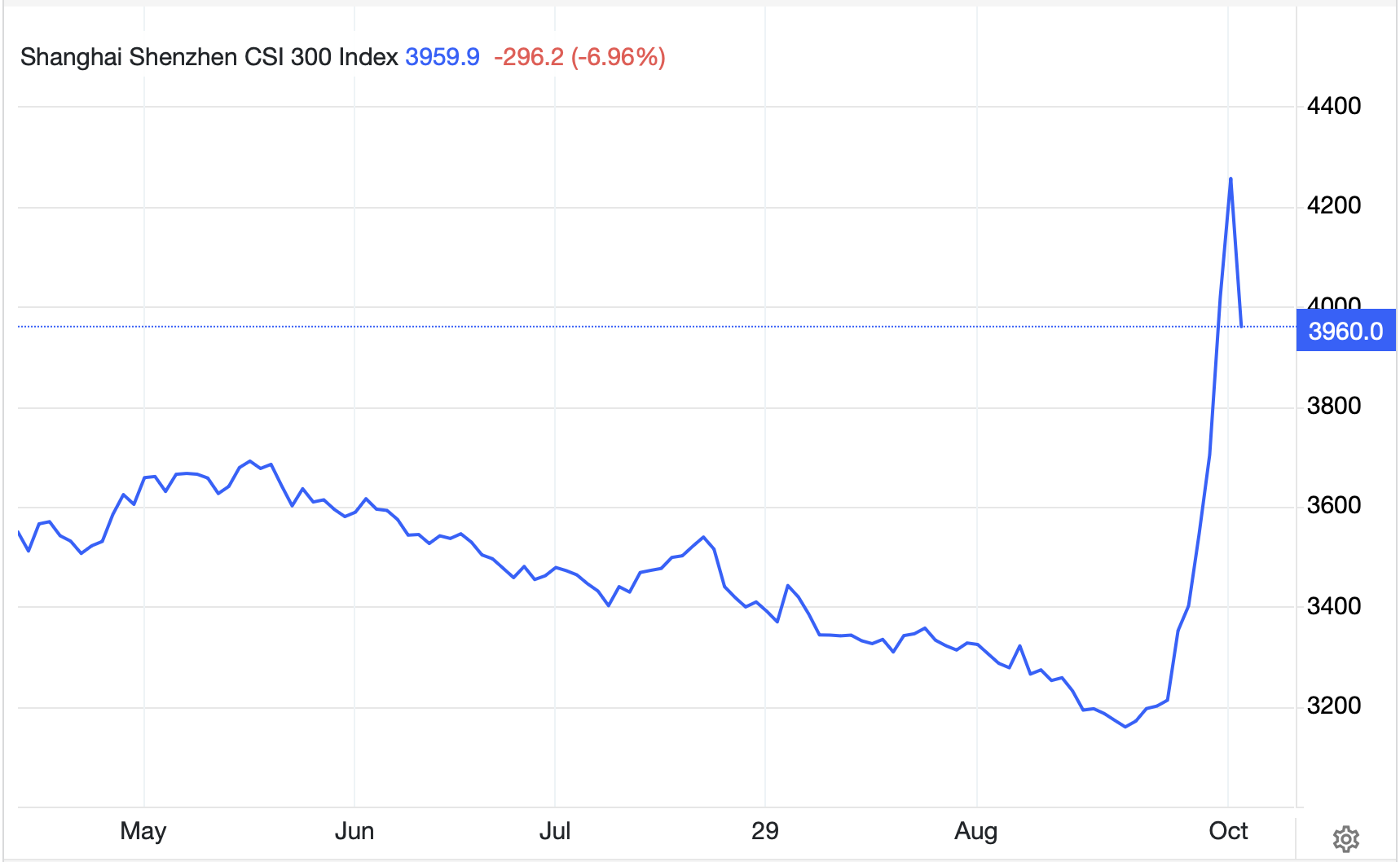
Let’s take a trip down memory lane.  Perhaps you can remember the time when the Chinese economy seemed to be faltering, and the Chinese stock markets were massively underperforming their peers.  That combination of events was enough to get President Xi to change his tune regarding stimulus and over the course of several days, first the PBOC and then the government announced a series of measures to support both the economy and the stock market specifically.  In fact, way back on September 24th I described the measures taken in this post.  Yep, that was two whole weeks ago!  The initial response was a rip-roaring rally in Chinese equity markets (~34%), and substantial strength in the renminbi.  Analysts couldn’t sing Xi’s praises loudly enough as they were certain that the government there was finally doing what was necessary to address the myriad issues within the Chinese economy.

But a funny thing happened on the way to this new nirvana, investors realized that all the hype was just that and the announced measures, while likely to help at the margins, were not going to change the big picture.  Ultimately, China remains in a difficult situation as its entire economic model of mercantilistic practices is running into populist uprisings everywhere else in the world.  And since domestic Chinese demand remains lackluster given the estimated $10 trillion that has evaporated in the local property markets, people at home are never going to be able to be a sufficiently large market for all the stuff that China makes.  

As this realization sets in, there is no better picture of this change of heart than the chart below showing the recent performance of the CSI 300.

Source: tradingeconomics.com

Last night’s 7% decline, which followed a similar one in Hong Kong the night before, has certainly stifled some of the ebullience that existed two weeks ago.  Now, the market has still gained a very healthy 25% from its lows last month, certainly nothing to sneeze at, but are the prospects really that great going forward?  Only time will tell, but I am not confident absent another significant bout of fiscal stimulus, something on the order of a helicopter money drop.  And that doesn’t seem like Xi’s cup of tea.

Turning to Europe, the economy there remains in the doldrums with some nations far worse off than others. Germany remains Europe’s basket case, as evidenced by this morning’s Trade Balance release there.  While the balance grew to €22.5B, that was because imports fell a larger than expected -3.4%, a signal that domestic activity is still lagging.  With the ECB set to meet next week, the market is currently pricing a 90% probability of a 25bp rate cut with talk of another cut coming at the following meeting as well.

You may remember that Madame Lagarde was insistent that there was no guaranty that the ECB would be cutting rates at every meeting once they started, rather that they would be data dependent.  But with the combination of slowing economic activity, especially in Germany, and the ensuing political angst it has created amongst the governments throughout Europe, it seems that many more ECB members have seen the inflation light and have declared a much higher degree of confidence that it will be at, or even below, their 2% target soon enough.  And maybe it will be.  However, similar to the Fed’s prognosticatory record, the ECB has a horrific track record of anticipating future economic variables.  A key problem for Europe is the suicidal energy policies they continue to promulgate.  Granted, some nations are figuring out that wind and solar are not the answer, but Germany is not one of them, at least not yet.  And as long as these policies remain in place and electricity prices continue to rise (they are already the highest in the world) then inflation pressures are going to continue.

Bringing this conversation around to more than macroeconomic questions, the market impact of recent data is becoming clearer.  While the US economy continues to show resilience, as evidenced by that blowout NFP report last Friday, and Europe continues to falter, the previous assumptions on rate movements with the Fed being the most aggressive rate cutter around are changing.  The result is the euro, which has slipped more than 2% in the past two weeks, is likely to continue to fall further, putting upward pressure on Eurozone inflation and putting the ECB in a bind.

Ok, those seem to be the drivers in markets today as we all look forward to tomorrow’s US CPI report.  A tour of the rest of the overnight session shows that Japan (+0.9%) continues to rebound from its worst levels a month ago as worries of aggressive monetary policy tightening continue to abate.  The latest view is the BOJ won’t move until January at the earliest.  The rest of Asia was mixed with the biggest gainer being New Zealand (+1.7%) which responded to the RBNZ cutting rates by 50bps, as expected, but explaining that further cuts were in line as they expected inflation to head below the middle of their 1% – 3% target range.  In Europe, the picture is mixed with more gainers than laggards but no movement of more than 0.3%, a signal that not much is happening.  US futures are similarly little changed at this hour (7:45) this morning.

In the bond market, Treasury yields have edged higher by 1bp and continue to trade above 4.00%, a level that had been seen as critical when the market moved below that point.  Given the overall lack of activity today, it should be no surprise that European sovereigns are also within 1bp of yesterday’s closing levels while JGB yields, following suit, rose a single basis point overnight.  It feels like the market is awaiting the CPI data tomorrow to make its next moves.

Oil prices were clobbered yesterday, falling nearly 6% at one point on the session before a modest late bounce.  This morning, they are slipping another -0.5% as market participants seem tired of waiting for a Middle East conflagration and instead have focused on the fact that more supply is coming on the market amidst softening demand.  Libya is back to full output of 1.2mm bpd and OPEC is still planning to increase production while China and Europe show softer growth.  That China story continues to undermine copper (-1.6%) although the precious metals, after downdrafts yesterday, are little changed this morning.

Finally, the dollar continues to find support on the strength of reduced Fed rate cut expectations alongside growing expectations for cuts elsewhere.  NZD (-1.0%) is today’s laggard though the rest of the G10 are all showing declines.  In the EMG bloc, the dollar is also higher universally, but the moves here are more modest.  In fact, away from NZD, the next largest declines have been seen in NOK (-0.6%) and SEK (-0.5%), but LATAM, APAC and EEMEA are all softer as well.

On the data front, this morning brings EIA oil inventories, with a net draw expected and then at 2:00 we see the FOMC Minutes from the last meeting.  But those are stale given the payroll report.  Instead, we hear from seven more Fed speakers today which will set the tone.  Yesterday’s speakers seemed to have been on the same page as Monday’s, with caution the watchword but rate cuts described as necessary despite the payroll report.  Whatever there mental model is, it is clearly pointing to rate cuts are necessary.

It feels like today is going to be quiet as markets await tomorrow’s CPI data.  The dollar seems likely to retain its bid, though, as the US is still the ‘cleanest shirt in the dirty laundry’ and global investors seem determined to own assets here.

Good luck

Adf

The New Norm

The CPI data was warm
But not warm enough to deform
The view that the Fed
Was moving ahead
With rate cuts which are the new norm
 
While fifty seems out for next week
Investors, by year end, still seek
A full percent cut
Just when, though, is what
Defines why we need Jay to speak


It turns out that core CPI printed a tick higher than expected on the monthly result, although the Y/Y number was right in line with most forecasts.  In the broad scheme of things, it is not clear to me that a 0.1% difference in one month matters all that much, but markets are virtually designed to overreact to ‘surprising’ data.  At least, the algorithms that drive so much trading are designed to do so, or so it seems.  However, as can be seen by the chart below, it was a pretty short-lived dip and then the march higher in equity prices continued.

Source: tradingeconomics.com

While Fed funds futures pricing has adjusted the probability of a 50bp cut next week by the Fed down to just 15%, that market is still pricing in 100bps of cuts by the December meeting which means that there needs to be a 50bp cut in either November or December as they are the only two meetings left after next week.  As @inflation_guy highlighted in his always perceptive writeups on the CPI report, yesterday’s number ought not have changed the Fed’s thinking.  And perhaps that is exactly what we saw from the equity market, the realization that 50bps is still on the table for next week, especially since there is a growing feeling that’s what Powell wants to do.  I’m confident if Powell pushes for 50bps, he will have no trouble gaining quick acceptance around the table.

Ultimately, I think the problem with focusing on CPI is that the Fed doesn’t focus on CPI, even when they are worried about inflation.  However, especially now that they seem to believe they have achieved victory in that part of their mandate, it strikes me that the numbers about which they really care are the employment numbers.  Last week’s NFP report was mixed at best, although the actual NFP data was the weakest part of the report.  This morning, we get the weekly Claims data (exp Initial 230K, Continuing 1850K), but those numbers have been very stable of late, and not pointing to serious difficulties at all.  To my eye, from the perspective of the economic data that we continue to see, there is limited reason for the Fed to cut at all, especially with inflation still well above their target, but Powell promised a cut, and we have seen nothing since his Jackson Hole speech that could have changed view.  

A better question is, are they really going to cut 250bps by the end of 2025?  That would imply, at least to me, that the economy has slowed substantially, and likely headed into recession.  And, if the data turns recessionary, I can assure you that the Fed will have cut far more than 250bps by the end of next year, probably more like 350bps-400bps.  My point is I cannot look at the market pricing of interest rates and make it fit with the economic outlook at this time.  What I can do, however, is feel confident that if the Fed starts to cut rates aggressively with economic activity at current levels (remember, the GDPNow forecast is at 2.5% for Q3), inflation is likely to pick back up more quickly than people anticipate and the dollar, and bond market, will suffer while commodities and gold rise.

In the meantime, in a short while we will hear from Madame Lagarde as she follows up the almost certain 25bp rate cut they will declare today with her press conference.  I would argue the bigger news out of Europe is the ongoing discussion about increasing Eurozone debt issuance, as suggested by Mario (whatever it takes) Draghi in his report I discussed on Monday.  A look at the recent data from the continent shows that Unemployment is currently at historic lows for Europe, although that is still 6.4%, and inflation has fallen to 2.2%, just barely above their 2.0% target.  As such, here too it seems that the data is not screaming out for action.  Now, the punditry is looking for a so-called hawkish cut, one where the commentary does not discuss future cuts as a given, and I think that would be a sensible outcome.  But not dissimilar to the US situation, where a key driver of rate cut desires is the governments who are the biggest borrowers, there is intense political pressure to cut rates and reduce interest expense.  In fact, I believe that is a key reason behind Draghi’s report, to gain support and remove some of that direct interest rate expense from certain countries’ cost structure.  Thinking it through, net this should benefit the euro in the FX market as the Fed seems hell-bent on cutting and the ECB a bit less so.  We shall see,

Ok, so let’s turn to the overnight sessions to see where things are now.  After the US rebounded yesterday afternoon on the back of strength in the tech sector, we saw a huge rally in Tokyo (Nikkei +3.4%) on the same premise.  And while the Hang Seng (+0.8%) had a good session, once again, mainland Chinese shares (CSI 300 -0.4%) did not participate.  In fact, most of Asia was in the green, once again highlighting the weakness in the Chinese market, and the perception of that weakness in the Chinese economy.  As to Europe, it too has seen strength everywhere with gains between 0.8% (FTSE 100, CAC) and 1.20% (DAX).  This story is one of following the US, hopes for a bit more dovishness from the ECB, and a growing story about the potential for bank mergers in Europe with news that Italy’s UniCredit Bank has taken a stake in, and is considering buying, Germany’s Commezbank.  As to the US futures market, at this hour (7:20) they are all very modestly in the green.

In the bond markets, yields continue to back up slowly from the lows seen earlier this week with both Treasury (+2bps) and most European sovereign (Bunds +2bps, Gilts +2bps, OATs +1bp) slightly higher this morning.  Overnight, we saw JGB yields tick up only 1bp despite a relatively hawkish speech from BOJ member Naoki Tamura.  He indicated that rates should be raised to 1.0% by the end of their current forecast cycle, which sounds like a lot until you realize that is the end of 2027!  Maybe the 1bp move is appropriate after all.

In the commodity markets, oil (+1.7%) is continuing yesterday’s rally as questions about how quickly Gulf of Mexico production will restart in the wake of Hurricane Francine are driving markets.  While the weak demand story still has proponents, the reality is that oil prices have fallen more than 12% in the past month, a pretty large decline overall, so a bounce cannot be surprising.  In the metals markets, after a solid session yesterday, metals prices are higher in both the precious and industrial spaces.

Finally, the dollar is doing very little this morning, but if forced to define the move, it would be slightly softer.  While most currencies in both the G10 and EMG blocs are just a touch firmer, between 0.1% and 0.2%, the biggest mover, ironically is a decline, ZAR (-0.4%), although other than short term trading and positioning, there doesn’t seem to be a clear catalyst for the decline.

On the data front, in addition to the Claims data noted above, we see PPI (exp headline 0.1% M/M, 1.8% Y/Y; core 0.2% M/M, 2.5% Y/Y). Of course, there are no Fed speakers, but after the ECB announcement and press conference, we will hear from some ECB speakers as well.  Right now, the dichotomy between what the bond market is expecting (much lower rates anticipating weaker economic activity) and the stock market is expecting (ever higher earnings growth amid economic strength) remains wide.  While there are decent arguments on both sides, my sense is the bond market is more likely correct than the stock market.  And that is probably a dollar negative, at least at first.

Good luck

Adf

Feelings of Doubt

Two candidates took to the stage
But neither of them could assuage
The feelings of doubt
‘bout how things turn out
And how we can all turn the page
 
Meanwhile there’s news south of the border
Where AMLO, the courts, did reorder
This has raised some fears
That in coming years
The nation will lack law & order


Before I start, please take a moment to remember those 2,977 nnocent lives lost on this horrible day 23 years ago, this generation’s day of infamy.

Now, on to the market discussion.  I don’t know about you, if you watched the debate, but frankly I was pretty bored and disappointed by the whole thing.  I heard many platitudes from both sides, many accusations from both sides, and couldn’t help but notice how the moderators interjected themselves consistently in favor of Vice-president Harris via their “fact-checking”.  All in all, I don’t think we learned that much, although Harris is certainly more coherent than Biden was.  My guess is that very few undecided voters changed their minds.  As to the market’s reaction, perhaps the only notable result was that gold rallied slightly as no matter who wins the election, the idea that fiscal prudence is on the agenda remains anathema to both sides.  Equity futures were slightly lower when the debate started, and still slightly lower when it ended, as well as this morning.  It ought not be surprising as the impact of politics on equity markets has always been unclear in the short run.

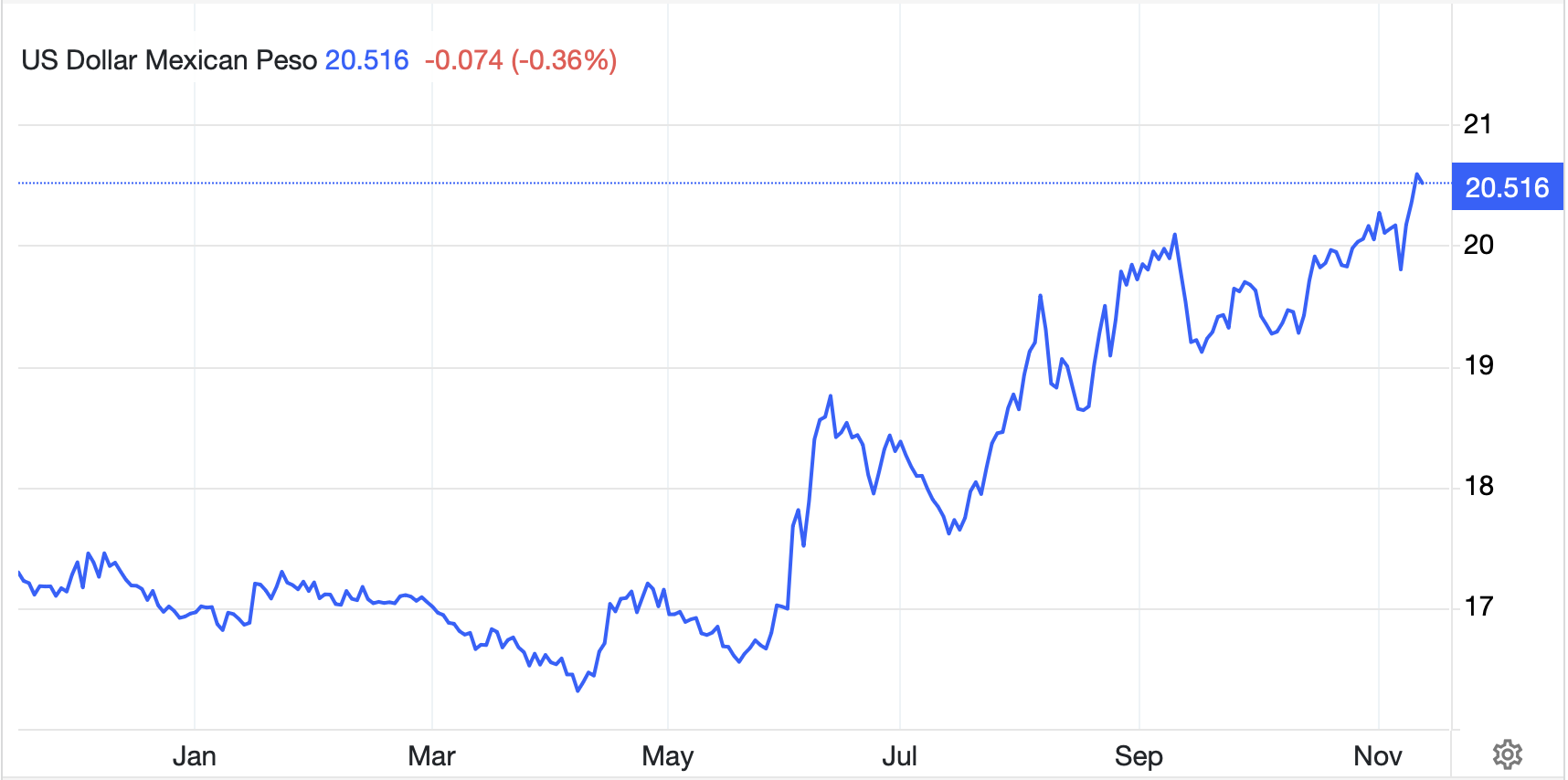
The other political story of note was that in Mexico, AMLO, who remains president for a few more weeks, was able to finally get the change to the constitution he has been seeking his entire term, which now allows for judges, including supreme court justices there, to be elected rather than appointed.  The concern is that this will politicize the judicial system.  An independent judiciary is a key ingredient for international investors as they seek some comfort that business decisions can be fairly considered.  However, judicial elections may call that into question and that is likely to have a longer-term negative impact on the Mexican economy.  As you can see from the chart below, the peso has been massively underperforming since April, falling more than 22% and breaching the 20.00 peso level for the first time in more than 2 years, as concerns over this issue have grown.  Add to this the fact that inflation in Mexico has drifted slowly lower and expectations are rising for more aggressive rate cuts by Banxico, and you have the recipe for a weaker currency.  While the peso has bounced 0.9% this morning, this trend lower remains clear for now.

Source: tradingeconomics.com

With all that out of the way, it is time to turn to this morning’s big news, the August CPI report.  Current median expectations are for a 0.2% M/M, 2.6% Y/Y rise in the headline number and a 0.2% M/M, 3.2% Y/Y rise in the ex-food & energy reading.  However, I have seen estimates ranging from 0.0% M/M to 0.3% M/M based on various subcomponents like used cars, apparel and shelter.  Ahead of the release, I have no further information than that, but let’s consider what can happen in either situation.

First, we know that the Fed is going to cut rates next week, regardless of the number today.  Currently, the Fed funds futures market is pricing a 29% probability of a 50bp cut.  A quick look at the below table from the CME shows this is close to the lower end of the range of expectations over the past month, which back in August were at 51%.

source: cmegroup.com

The current working assumption seems to be that a soft number will virtually assure a 50bp cut regardless of any other economic data, while a 0.3% print will lock in a 25bp cut.  Once again, given the apparent resilience of the economy, the rationale for cutting rates aggressively remains elusive.  The cynic in me might point to the fact that Chairman Powell is a private equity guy, someone who made his fortune in that space, and he has been receiving pressure from all his old friends and colleagues to cut rates to help resurrect the sales activity in that market.   While that may seem glib, given the way things work in the corridors of power in Washington, it cannot be ruled out.  However, history has shown that when the Fed begins a cutting cycle with 50 bps, it is generally because they are behind the curve and recession is already here.  If that is the situation, while next week a 50bp cut may be well received by equity investors, the medium-term outlook is not nearly as bright.  At this point, the question is, how will markets respond to the data.

Let’s start with looking at how things behaved overnight.  Yesterday’s mixed US session, with the DJIA slipping while both the S&P and NASDAQ rallied was followed by uniform weakness in Asia.  Perhaps nobody there was enamored of the debate, which was taking place while those markets were open, but we saw the Nikkei (-1.5%) fall sharply with weakness also in the Hang Seng (-0.75%) and CSI 300 (-0.3%). In fact, only Singapore (+0.5%) managed any gains during the session with every other regional market declining.  But that is not the story in Europe, where all markets are higher, albeit not that much higher.  Spain’s IBEX (+0.65%) is the leader with other markets showing gains of between 0.1% (FTSE 100) to 0.3% (DAX).  For those who are concerned that a Trump victory may isolate Europe more than a Harris victory, perhaps there was more encouragement she could win after the debate.

In the bond market, after some significant declines in yields yesterday, where Treasury yields fell nearly 10bps, this morning they have fallen a further 2bps and are now back to their lowest level since June 2023.  At 3.6%, nearly 200bps below Fed funds, the bond market seems to be pricing in a recession.  Interestingly, neither stocks nor credit spreads are pricing that same outcome.  European sovereign yields also fell sharply yesterday, although not as much as Treasury yields, more like 5bps, and this morning they are a bit lower again, somewhere between -1bp and -3bps.  Perhaps the most interesting outcome is that JGB yields have slipped 4bps, once again delaying the idea that the BOJ is going to tighten policy soon.

In the commodity markets, oil (+2.6%) has rebounded sharply this morning as concerns over Hurricane Francine shutting in Gulf of Mexico production rise ahead of expected landfall later today.  However, the trend here remains lower as demand concerns remain front and center and supply continues to grow.  My sense is that the declining demand is a signal that economic activity is slowing, but it will return with a return to more robust global growth.  In the metals markets, everything is back in the green with gold (+0.2%) once again pushing toward its recent all-time highs, while both silver and copper show strength this morning.  I believe those moves are related to the anticipation of larger cuts by the Fed and other central banks coming soon.

Finally, the dollar is under pressure across the board this morning, also playing along with the theme of the Fed cutting rates more aggressively going forward.  In fact, literally every currency in both the G10 and EMG blocs are stronger today with most modestly so, on the order of 0.2%, although we have seen MXN (+0.85%) rebounding from its recent declines discussed above, and ZAR (+0.45%) benefitting from the strength in metals markets.

Aside from the CPI data, the only other news is the EIA oil inventories, where last week saw a large draw overall, and the only forecast I see is for a modest build of <1mm barrels.  However, CPI will determine today’s price action.  I think we are in a ‘good news is good’ scenario so a soft number should see a rally in stocks, bonds and commodities while the dollar suffers further.  On the flip side, a high print should see the opposite reaction.

As I reread my note, it appears to be an accurate description of the fact that there are features in the data pointing to further economic strength and other pointing to weakness.  Truly, nobody knows what lies ahead.

Good luck

Adf

A Joyous Occasion

For those of a certain persuasion
Wednesday was a joyous occasion
Though CPI rose
The doves did propose
That rate cuts complete their equation
 
They claim that the speed of its rise
Is slowing, so Jay should surmise
It’s time to cut rates
Cause everyone hates
When stocks don’t make further new highs


Yesterday’s CPI reading was, on the surface, slightly softer than markets had been expecting.  The headline reading of 2.9% was the slowest increase Y/Y since March 2022.  Of course, back then we were repeatedly told inflation was transitory.  However, looking at the chart below, created by wolfstreet.com, it seems pretty clear that the main driver of the recent decline in the CPI readings has been Durable Goods.

A graph of a number of lines

Description automatically generated with medium confidence

I guess it’s possible that durable goods prices continue to deflate going forward, but that seems unlikely, at least based on the historical record.  While the auto industry, a key segment of the durable goods data, has obviously struggled lately, with significant unsold inventories of EV’s building up and dealer incentives to sell them driving prices down, if you’ve looked for a new washer/dryer or refrigerator lately, I haven’t seen the same price action for those goods.  As to the largest driver of the CPI readings, the shelter component, those numbers were higher than last month and more in line with the overall trend we have seen there for the past several years.  Owners Equivalent Rent, the biggest piece of this puzzle, rose 0.4% in July, just what it has been doing for the previous two plus years prior to the June reading.

In the end, while it was nice to see a headline print below 3.0%, it is not clear to me that inflation is defeated.  Other than the fact that Powell essentially promised he would be cutting rates next month, the data released since the last meeting is not screaming out for more support.  Certainly, the employment report was softer than the forecasts, but it was not indicative that we are in a recession.  And the CPI report, while ever so slightly softer than forecast, is also not a clear signal that things are collapsing in the economy.  I’m pretty confident that Powell will cut next month, but absent some really awful August data, released in early September ahead of the next FOMC meeting, it seems like 25bps is all we should expect.  Even the Fed funds futures market is slowly turning toward that view with the probability of a 50bp cut falling to 37.5% this morning.

The other news of note last night was the monthly Chinese data dump which was, on the whole, not very inspiring.  The best news was that Retail Sales there rose 2.7% Y/Y in July, slightly more than expected.  However, IP and Fixed Asset Investment were both weaker than forecast and weaker than last month although higher than Retail Sales.  Meanwhile, Housing prices continue to decline, -4.9% Y/Y, and the Unemployment Rate ticked up to 5.2%.  As yet, there has been no significant commentary from the government, but the ongoing weakness has encouraged some traders and investors to expect that President Xi will authorize some much larger stimulus in the near future.  At least that’s the story behind the rally in the CSI 300 (+1.0%) last night, because there are few other highlights from the Middle Kingdom.

With this in mind, and as we await this morning’s US data releases, let’s tour the markets to see how things played out after the modest US equity rally yesterday.  Aside from China, in Asia Japanese stocks did well (Nikkei +0.8%) although Hong Kong did not go along with the Chinese story.  Australian employment data was released, arguably a touch better than expected but that good news reduced the chances for a rate cut so equities there only edged higher by 0.2%.  As to the rest of the region, there were some gainers (Korea, New Zealand, Singapore) and some laggards (Taiwan, Indonesia).  

In Europe this morning, the story is one of a seeming lack of interest with no major market having moved more than 0.2%, whether higher or lower, on the session.  On the data front there, the UK GDP data was just a touch softer than the forecast, and the Y/Y output of 0.7% shows that problems remain in the economy.  It will be interesting to see if the new government there can adopt policies that help rejuvenate the nation.  As to the FTSE 100, it is basically unchanged on the day, arguably tension between weaker growth prospects clashing with hopes for rate cuts to support things.  Meanwhile, on the continent there was nothing of note and no major movement.  And lastly, US futures, at this hour (7:00), are little changed awaiting the US data.

In the bond market, Treasury yields, after a little early gyration following the CPI release, basically closed the day unchanged and remain at those levels this morning.  the yield curve remains mildly inverted, just -11bps this morning, but it seems it will require the Fed to actually cut rates, or much worse economic data, to get that process complete and normalize the curve.  In Europe, sovereign yields are largely unchanged, or perhaps higher by 1bp this morning amid very little activity.  Also, a quick look at JGBs shows that while the yield edged up 1bp overnight, the level is still just 0.82%.  I would contend that any ideas of a quick normalization of interest rates in Japan are fading away.

In the commodity space, oil (+0.85%) is rebounding after data showed net draws across all products yesterday.  Obviously, the Iran/Israel situation remains live, but it feels like markets are losing interest in that story.  As to the metals, gold (0.4%) is recouping yesterday’s losses and both silver and copper are firmer this morning, not so much on the demand story, but more on the supply story with potential strikes at key mines in Chile and Peru.

As to the dollar, it is little changed, net, on the day, although it is no surprise to see the commodity bloc performing well (AUD +0.5%, ZAR +0.5%, NOK +0.4%).  But away from those currencies, the euro is unchanged, though the pound (+0.3%) seems to be benefitting from the GDP data.  The yen, too, is unchanged on the day while CNY (-0.2%) is under pressure from the weak data there.  Again, I will note that CNY’s volatility has definitely increased over the course of the past several months.  Partly this is because all currency volatility has moved higher, but I believe there is some real China specific aspect to this change.  Beware as this could continue going forward.

On the data front, this morning brings a bunch here at home:

Initial Claims235K
Continuing Claims1880K
Retail Sales0.3%
-ex autos0.1%
Empire State Manufacturing-6.0
Philly Fed7.0
IP-0.3%
Capacity Utilization78.5%

Source: tradingeconomics.com

You may recall that last week’s Initial Claims number was seen as a savior when it printed a bit lower than forecasts.  However, if the Unemployment Rate is truly heading higher, it would seem that we should see this number resume its climb.  Right now, it is not clear to me if good news is good or bad and vice versa. Generically, the narrative still wants to push for as many rate cuts as quickly as possible, I think, but if the data starts to collapse, that will not be a positive either.  I suspect that Retail Sales is today’s key release.  A strong number there will further reduce the probability of a 50bp cut in September and may weigh on equity markets.  

We also hear from St Louis Fed President Alberto Musalem this morning, one of the newer members of the FOMC who has not spoken much.  However, he appears to be more on the hawkish side thus far.  In my view, markets are looking for reasons to continue to push equities higher but are not getting all the love they need.  The problem is that it is not clear what the right medicine for that is right now.  Strong data may support the economy but reduces the probability of rate cuts, or at least the amount of rate cutting that will come.  As to the dollar, it has been under some pressure of late and I think it will be very clear that weak data will encourage dollar selling and vice versa.

Good luck

Adf