Crazier Still

There once was a time when the Fed
When meeting, and looking ahead
All seemed to agree
The future they’d see
And wrote banal statements, when read
 
But this time is different, it’s true
Though those words most folks should eschew
‘Cause nobody knows
Which way the wind blows
As true data’s hard to construe
 
So, rather than voting as one
Three members, the Chairman, did shun
But crazier still
The dot plot did kill
The idea much more can be done


I think it is appropriate to start this morning’s discussion with the dot plot, which as I, and many others, expected showed virtually no consensus as to what the future holds with respect to Federal Reserve monetary policy.  For 2026, the range of estimates by the 19 FOMC members is 175 basis points, the widest range I have ever seen.  Three members see a 25bp hike in 2026 and one member (likely Governor Miran) sees 150bps of cuts.  They can’t all be right!  But even if we look out to the longer run, the range of estimates is 125bps wide.

Personally, I am thrilled at this outcome as it indicates that instead of the Chairman browbeating everyone into agreeing with his/her view, which had been the history for the past 40 years, FOMC members have demonstrated they are willing to express a personal view.

Now, generally markets hate uncertainty of this nature, and one might have thought that equity markets, especially, would be negatively impacted by this outcome.  But, since the unwritten mandate of the Fed is to ensure that stock markets never decline, they were able to paper over the lack of consensus by explaining they will be buying $40 billion/month of T-bills to make sure that bank reserves are “ample”.  QT has ended, and while they will continue to go out of their way to explain this is not QE, and perhaps technically it is not, they are still promising to pump nearly $500 billion /year into the economy by expanding their balance sheet.  One cannot be surprised that initially, much of that money is going to head into financial markets, hence today’s rally.

However, if you want to see just how out of touch the Fed is with reality, a quick look at their economic projections helps disabuse you of the notion that there is really much independent thought in the Marriner Eccles Building.  As you can see below, they continue to believe that inflation will gradually head back to their target, that growth will slow, unemployment will slip and that Fed funds have room to decline from here.

I have frequently railed against the Fed and their models, highlighting time and again that their models are not fit for purpose.  It is abundantly clear that every member has a neo-Keynesian model that was calibrated in the wake of the Dot com bubble bursting when interest rates in the US first were pushed down to 0.0% while consumer inflation remained quiescent as all the funds went into financial assets.  One would think that the experience of 2022-23, when inflation soared forcing them to hike rates in the most aggressive manner in history, would have resulted in some second thoughts.  But I cannot look at the table above and draw that conclusion.  Perhaps this will help you understand the growth in the meme, end the fed.

To sum it all up, FOMC members have no consensus on how to behave going forward but they decided that expanding the balance sheet was the right thing to do.  Perhaps they do have an idea, but given inflation is showing no signs of heading back to their target, they decided that the esoterica of the balance sheet will hide their activities more effectively than interest rate announcements.

One of the key talking points this morning revolves around the dollar in the FX markets and how now that the Fed has cut rates again, while the ECB is set to leave them on hold, and the BOJ looks likely to raise them next week, that the greenback will fall further.  Much continues to be made of the fact that the dollar fell about 12% during the first 6 months of 2025, although a decline of that magnitude during a 6-month time span is hardly unique, it was the first such decline that happened during the first 6 months of the year, in 50 years or so.  In other words, much ado about nothing.  

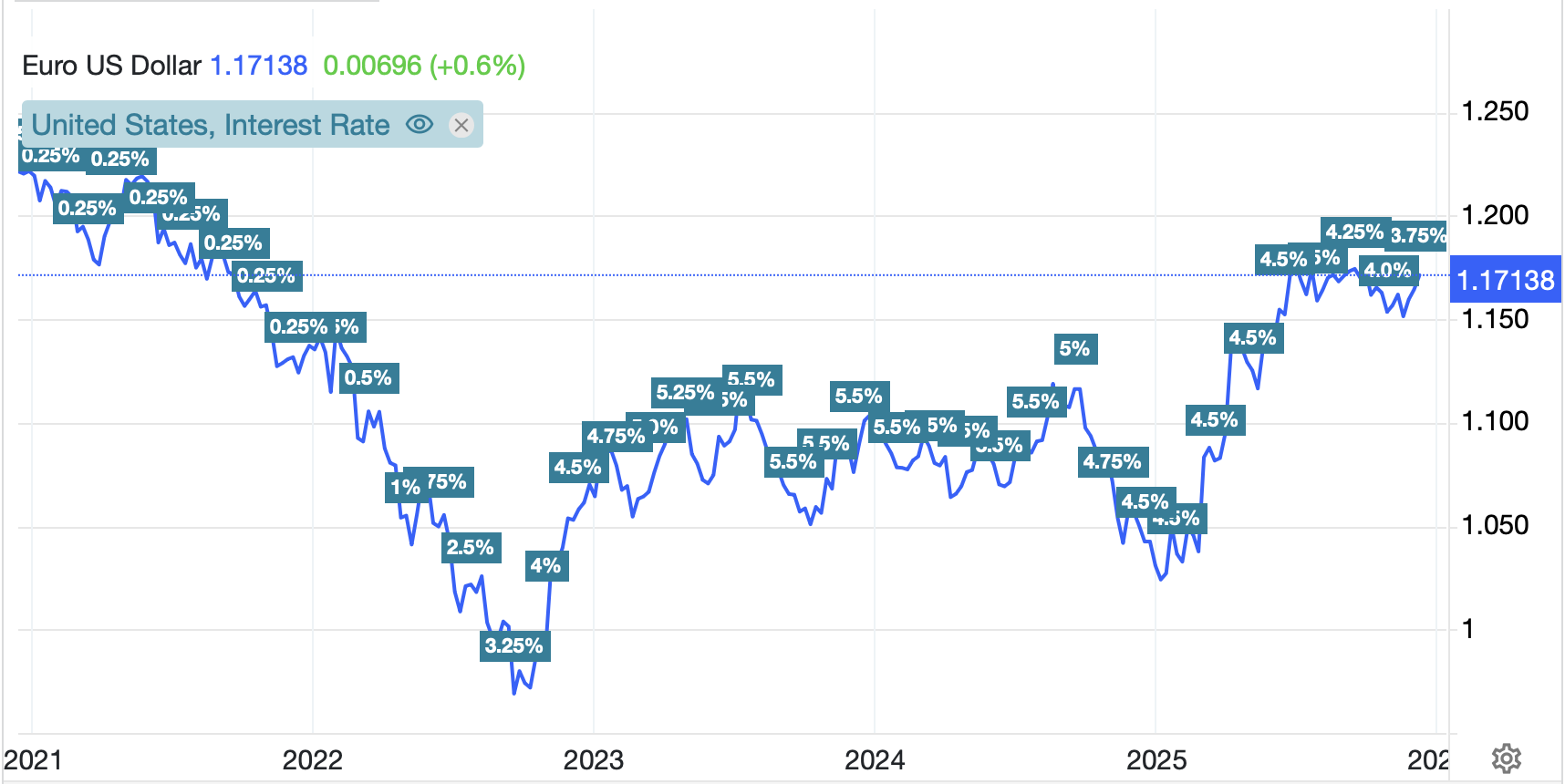
The latest spin, though, is look for the dollar to decline sharply after the rate cut.  I have a hard time with this concept for a few reasons.  First, given the obvious uncertainty of future Fed activity, as per the dot plot, it is unclear the Fed is going to aggressively cut rates from this level anytime soon.  And second, a look at the history of the dollar in relation to Fed activity doesn’t really paint that picture.  The below chart of the euro over the past five years shows that the single currency fell during the initial stages of the Fed’s panic rate hikes in 2022 then rallied back sharply as they continued.  Meanwhile, during the latter half of 2024, the dollar rallied as the Fed cut rates and then declined as they remained on hold.   My point is, the recent history is ambiguous at best regarding the dollar’s response to a given Fed move.

Source: tradingeconomics.com

I have maintained that if the Fed cuts aggressively, it will undermine the dollar.  However, nothing about yesterday’s FOMC meeting tells me they are about to embark on an aggressive rate cutting binge.

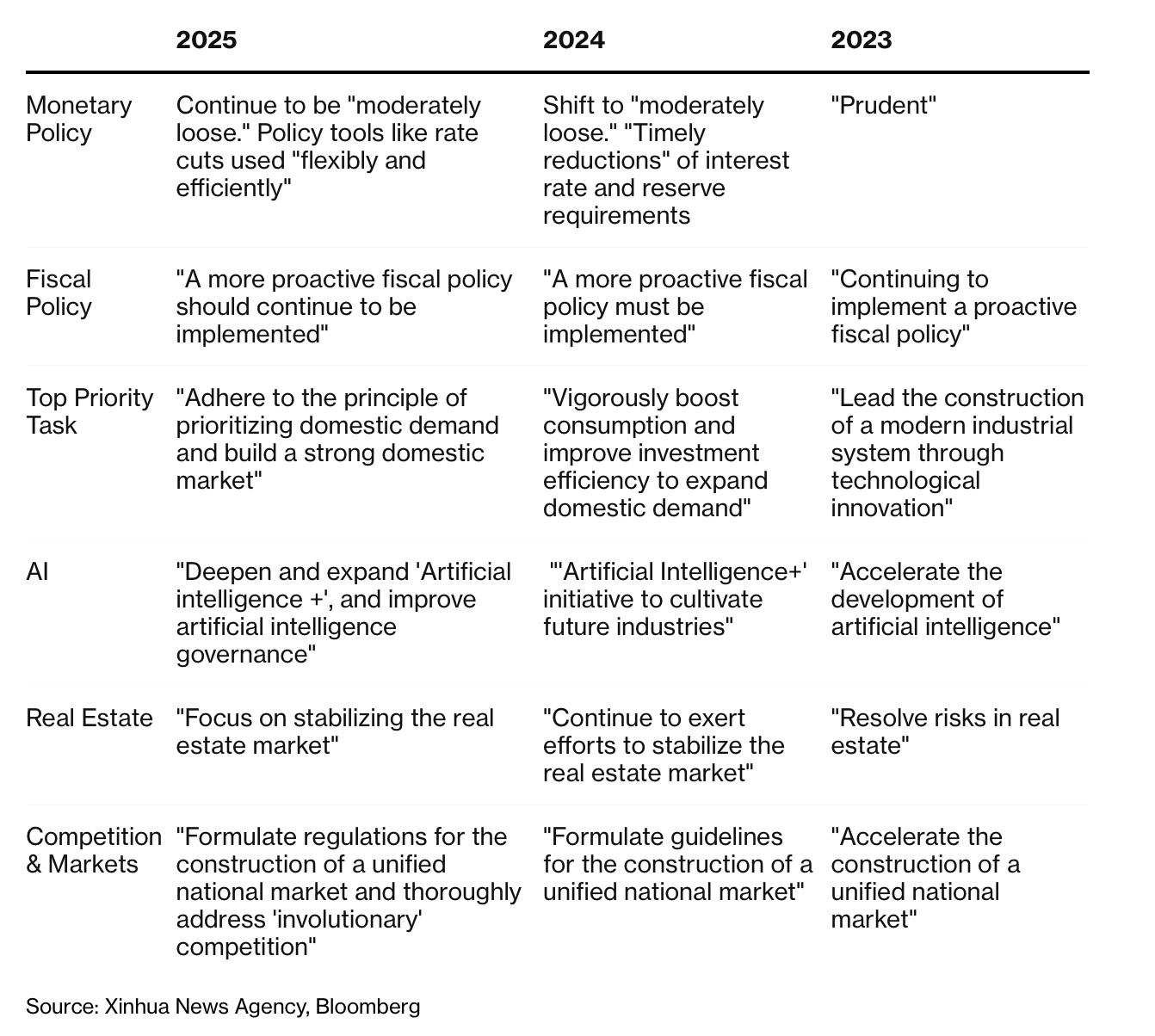
The other noteworthy story this morning is the outcome from China’s Central Economic Work Conference (CEWC).  I have described several times that the President Xi’s government claims they are keen to help support domestic consumption and the housing market despite neither of those things having occurred during the past several years.  Well, Bloomberg was nice enough to create a table highlighting the CEWC’s statements this year and compare them to the past two years.  I have attached it below.

In a testament to the fact that bureaucrats speak the same language, no matter their native tongue, a look at the changes in Fiscal Policy or Top Priority Task, or even Real Estate shows that nothing has changed but the order of the words.  The very fact that they need to keep repeating themselves can readily be explained by the fact that the previous year’s efforts failed.  Why will this time be different?

Ok, a quick tour of markets.   Apparently, Asia was not enamored of the FOMC outcome with Tokyo (-0.9%) and China (-0.9%) both sliding although HK managed to stay put.  Elsewhere in the region, both Korea (-0.6%) and Taiwan (-1.3%) were also under pressure as most markets here were in the red.  The exceptions were India, Malaysia and the Philippines, all of which managed gains of 0.5% or so.  

In Europe, things are a little brighter with modest gains the order of the day led by Spain (+0.5%) and France (+0.4%) although both Germany and the UK are barely higher at this hour.  There was no data released in Europe this morning although the SNB did meet and leave rates on hold at 0.0% as universally expected.  There has been a little bit of ECB speak, with several members highlighting that ECB policy is independent of Fed policy but that if Fed cuts force the dollar lower, they may feel the need to respond as a higher euro would reduce inflation.  Alas for the stock market bulls in the US, futures this morning are pointing lower led by the NASDAQ (-0.7%) although that is on the back of weaker than expected Oracle earnings results last night.  Perhaps promising to spend $5 trillion on AI is beginning to be seen as unrealistic, although I doubt that is the case 🤔.

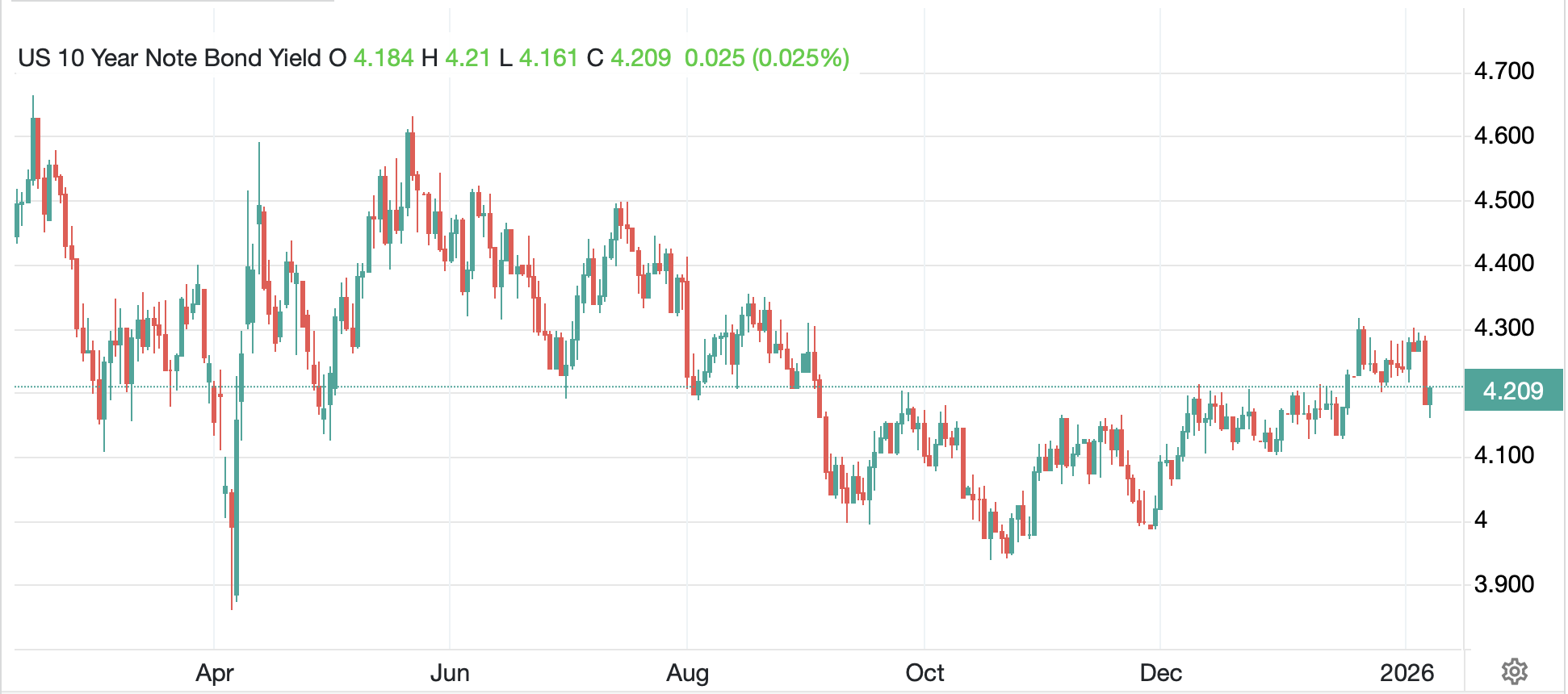
Turning to the bond market, Treasury yields have slipped -2bps overnight after falling -5bps yesterday.  Similar price action has been seen elsewhere with European sovereign yields slipping slightly and even JGB yields down -2bps overnight.  Personally, I am a bit confused by this as I have been assured that the Fed cutting rates in this economy would result in a steeper yield curve with long-dated rates rising even though the front end falls.  Perhaps I am reading the data wrong.

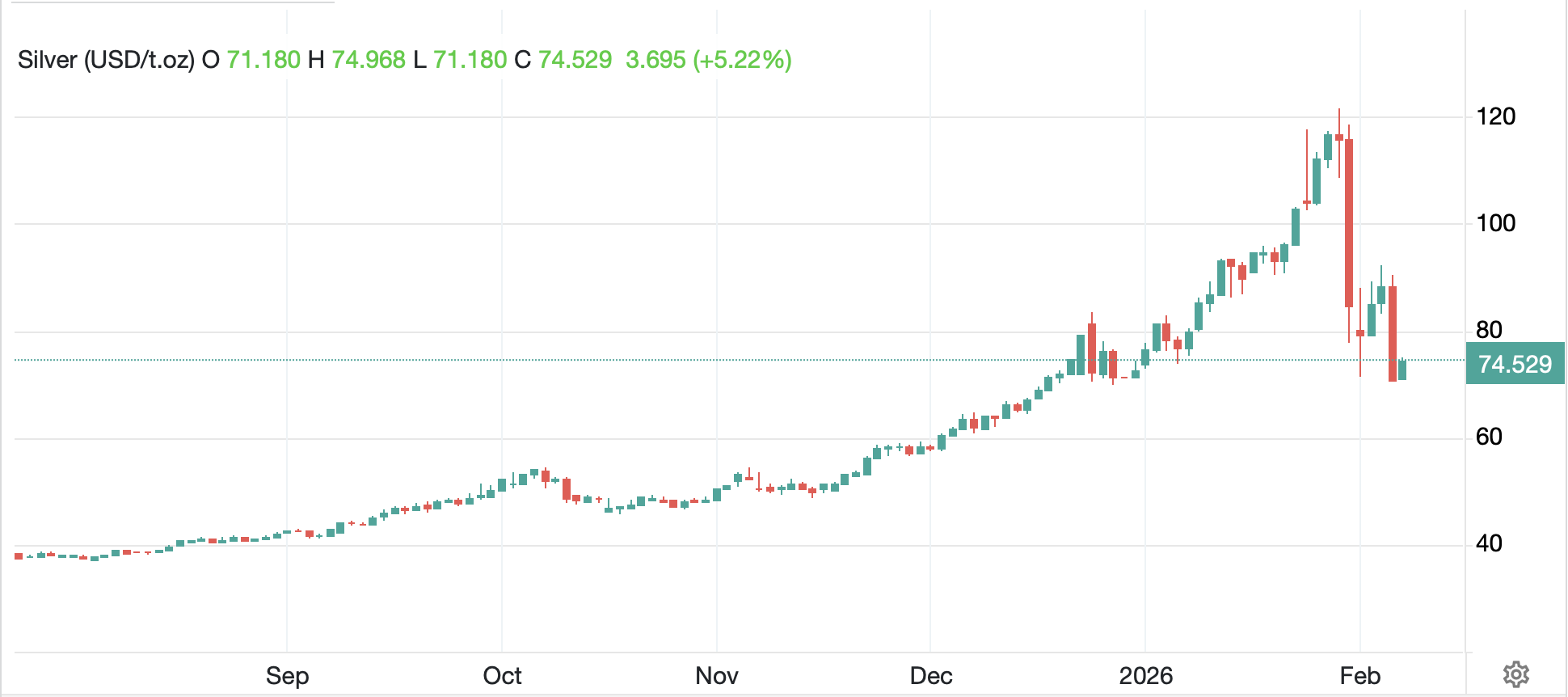
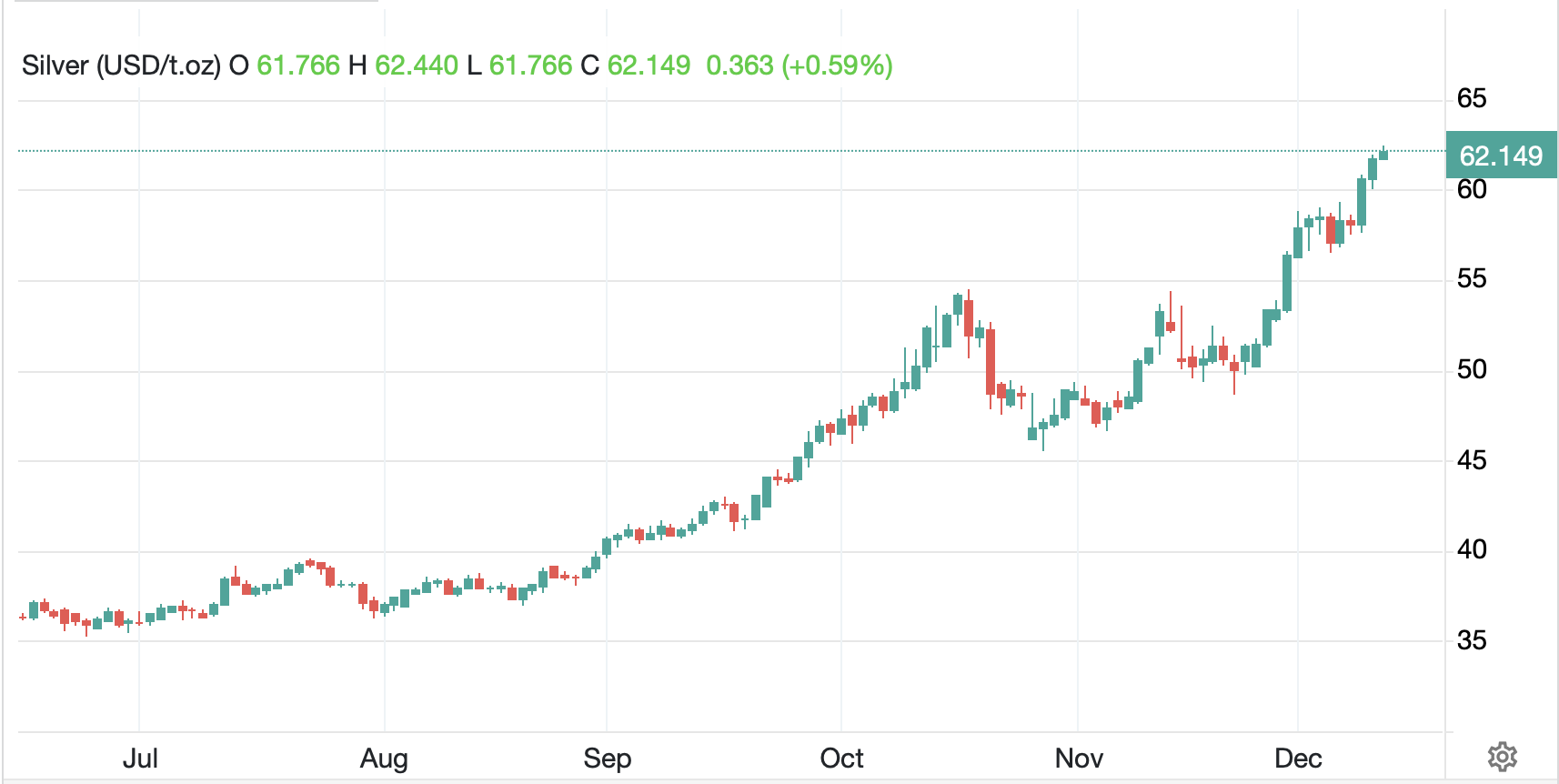
In the commodity markets, the one truth is that there are no sellers in the silver market.  It is higher by another 0.5% this morning and above $62/oz as whatever games had been played in the past to cap its price seem to have fallen apart.  Physical demand for the stuff outstrips new supply by about 120 million oz /year, and new mines are scarce on the ground.  This feels like there is further room to run.

Source: tradingeconomics.com

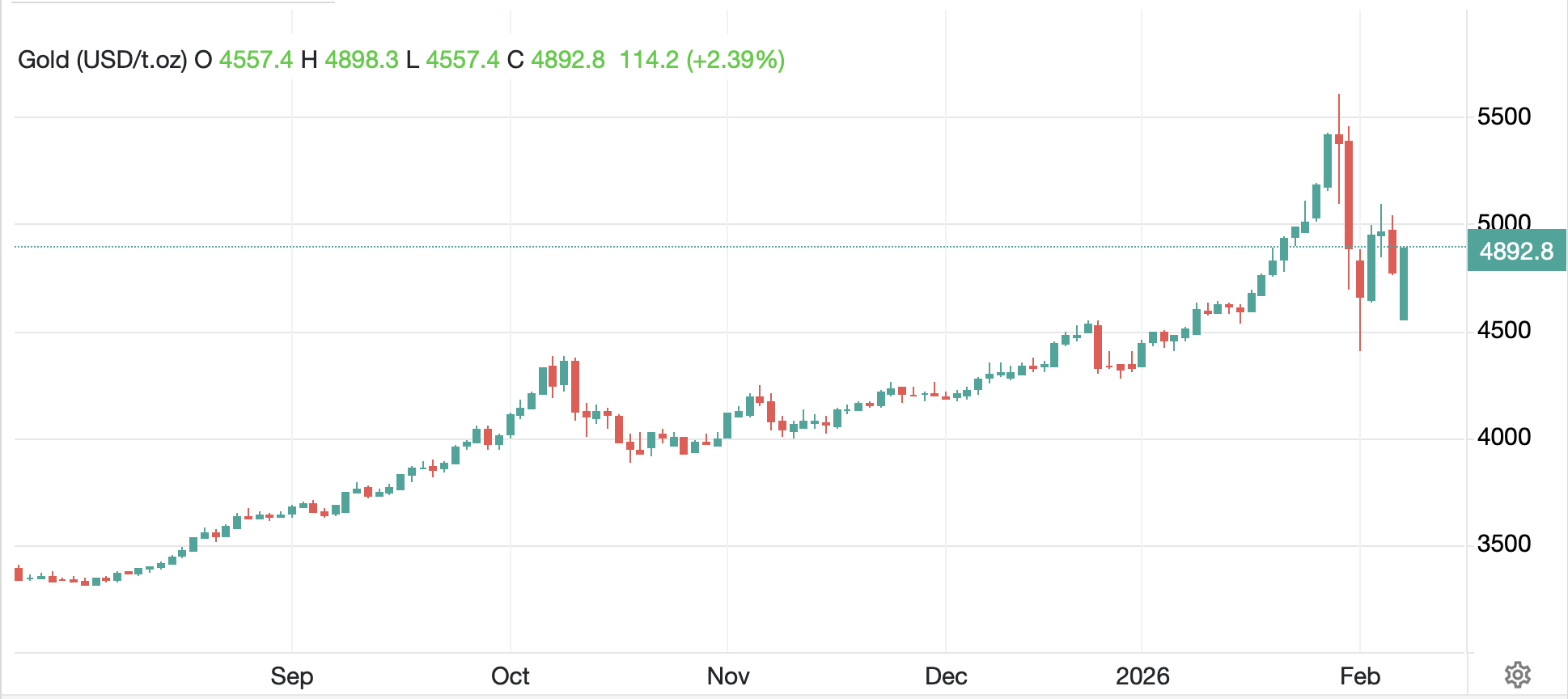
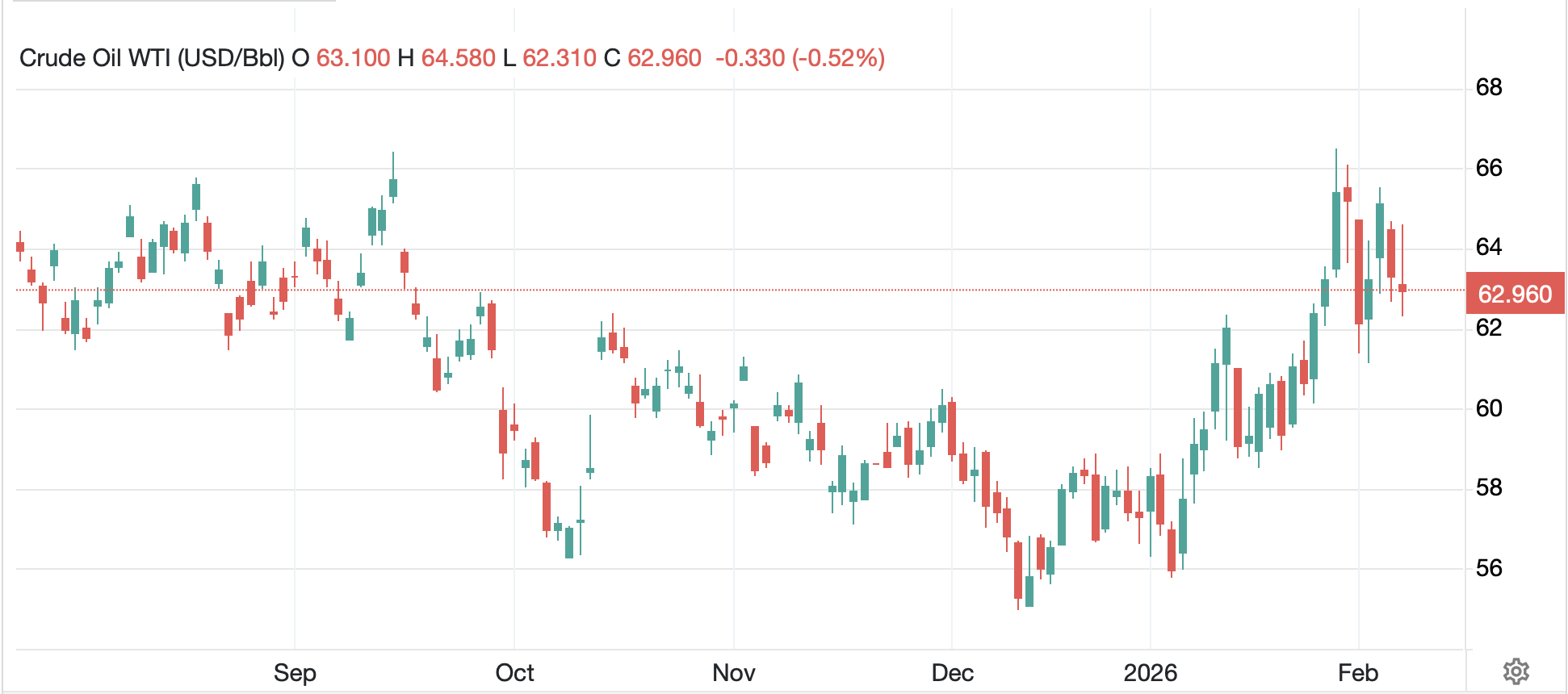
As to the rest of the space, gold (-0.2%) which had a nice day yesterday is consolidating, as is copper.  Turning to oil (-1.1%) it continues to drift lower, dragging gasoline along for the ride, something that must make the president quite happy.  You know my views here.

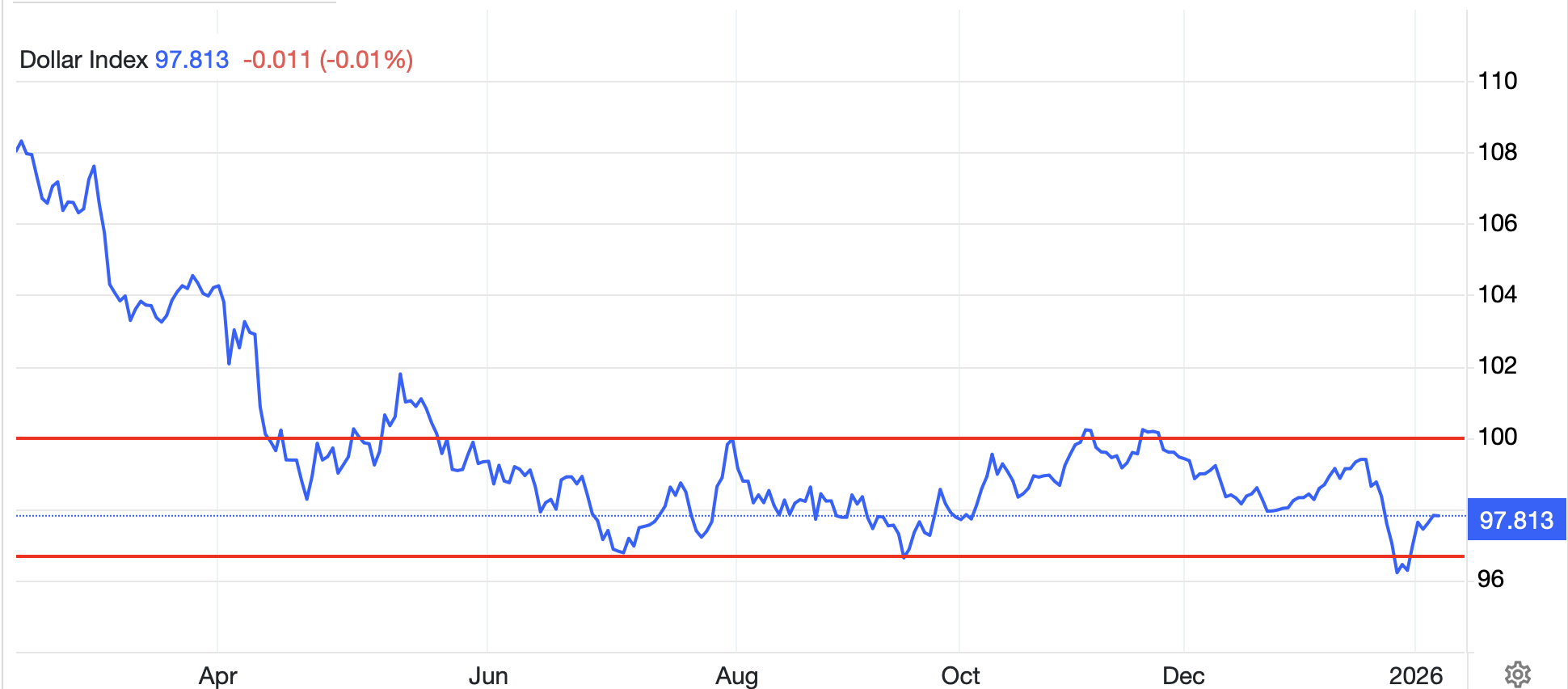
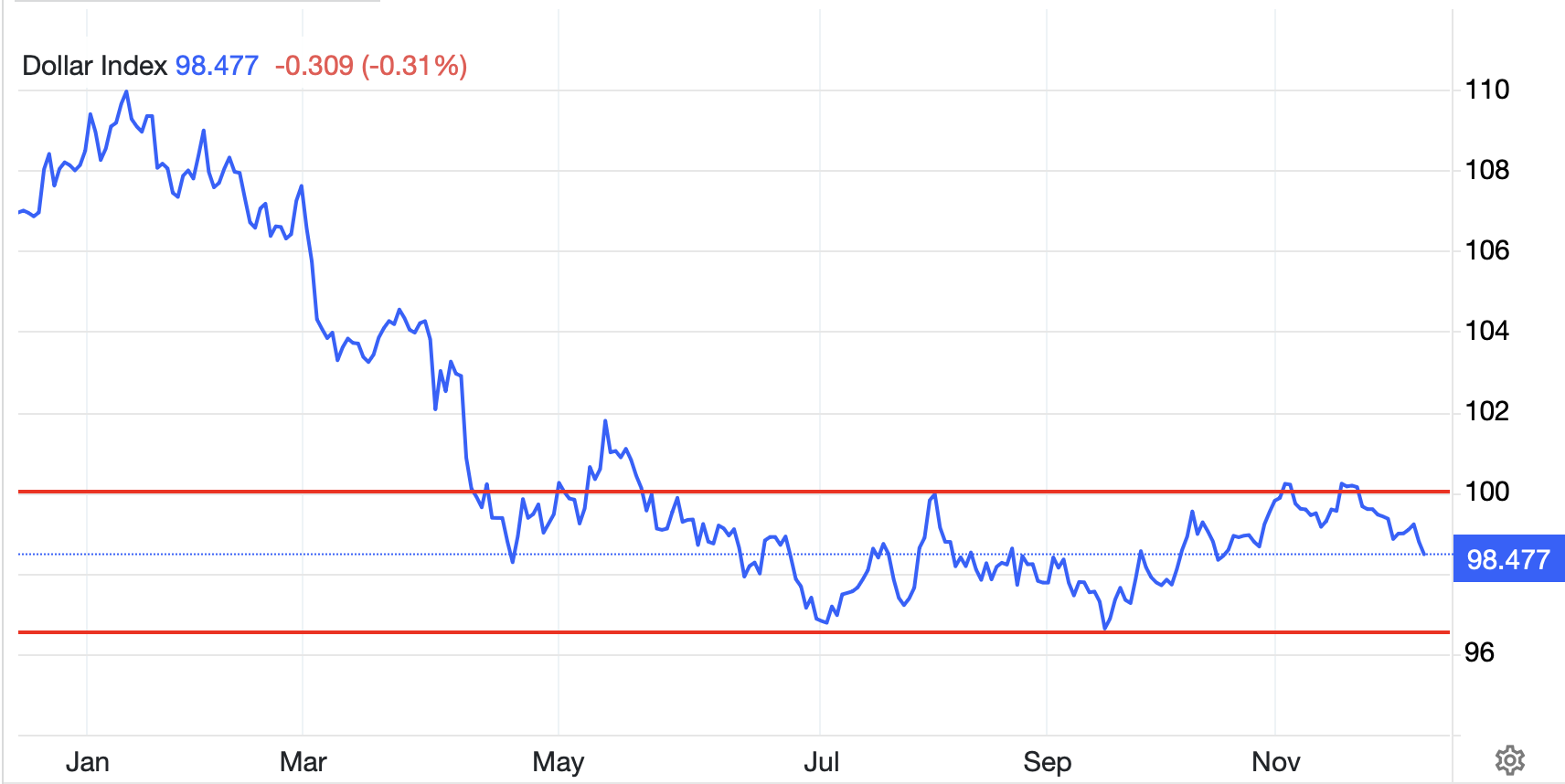
As to the dollar writ large, while it sold off a bit yesterday, as you can see from the below DXY (-0.3%) chart, it is hardly making new ground, rather it is back to the middle of its 6-month range.  

Source: tradingeconomics.com

This morning more currencies are a bit stronger but in the G10, CHF (+0.45%) is the leader with everything else far less impactful.  And on the flip side, INR (-0.7%) has traded to yet another historic low (USD high) as the new RBI governor has decided not to waste too much money on intervention.  Oh yeah, JPY (+0.2%) has gotten some tongues wagging as now that the Fed cut and the BOJ is ostensibly getting set to hike, there is more concern about the unwind of the carry trade.  My view is, don’t worry unless the BOJ hikes 50bps and promises a lot more on the way.  After all, if the Fed has finished cutting, something that cannot be ruled out, this entire thesis will be destroyed.

On the data front, Initial (exp 220K) and Continuing (1950K) Claims are coming as well as the Trade Balance (-$63.3B).  There are no Fed speakers on the docket, but I imagine we will hear from some anyway, as they cannot seem to shut up.  

It would not surprise me to see the dollar head toward the bottom of this trading range, but I think we need a much stronger catalyst than uncertainty from the Fed to break the range.

Good luck

Adf

Throw in the Towel

All eyes are on Chairman Jay Powell
And if he will throw in the towel
Or will he still fight
Inflation? Oh, right
He caved as the hawks all cried foul!
 
So, twenty-five’s baked in the cake
While fifty would be a mistake
If fighting inflation
Is his obligation
Though half may, Trump’s thirst, somewhat slake


Well, it’s Frabjous Fed Day and there will be a great deal of commentary on what may happen and what it all means.  Of course, none of us really knows at this point, but I assure you by this afternoon, almost all pundits will explain they had it right.  

At any rate, my take is as follows, FWIW.  I believe the huge revision to NFP data has got the FOMC quite concerned.  Prior to that, they were smug in their contention that patience was a virtue and their caution because of the uncertain price impact of tariffs was warranted given the underlying strength in the jobs market.  Now, not only has that underlying strength been shown to be a mirage, but the import price data released yesterday, showing that Y/Y, import prices are flat, is further evidence that tariffs have not been a significant driver of inflation.  If you look at the chart below of Y/Y import prices for the past 5 years, you can see that since April’s ‘Liberation Day’ tariff announcements, they have not risen at all.

Source: tradingeconomics.com

With that in mind, if you are the Fed, and you are data dependent, as they claim to be, and the data shows weakening employment and stable prices in the area you had been highlighting, you have no choice but to cut.  The question then becomes, 25bps or 50bps?  While the market is pricing just a 6% probability of a 50bp cut, given there are almost certainly three Governor votes for 50bps (Waller, Bowman and Miran) and the underlying central bank tendency is toward dovishness, I am going to go out on a limb and call for 50bps.  Powell and the Fed have already been proven wrong, and the only thing worse for them than seeming to cave to pressure from the White House would be standing pat and being blamed for causing a recession.  

With that in mind, my prognostications for market responses are as follows:

  • The dollar will weaken pretty much across the board with a move as much as -1% possible
  • Precious metals will rally sharply, making new highs for the move as this will be proof positive that the Fed has tacitly raised its inflation target from the previous 2%.  In fact, my take is 3% is the new 2%, at least until we spend a long time at 4%.
  • Equity markets will take the news well, at least initially, as the algos will be programmed to buy, but the concern will have to grow that slowing economic activity will impair earnings going forward, and multiples will suffer with higher inflation.  I continue to fear a correction here.
  • Bonds are tricky here as they have been rallying aggressively for the past six weeks and that could well have been ‘buying the rumor’ ahead of the meeting.  So, it is not hard to make the case that bonds sell off, and long end yields rise in response to 50bps.

On the other hand, if they cut 25bps, and sound hawkish in the statement or Powell’s presser, I don’t imagine there will be much movement of note.   I guess we’ll see in a while.

Until then, let’s look at the overnight price action.  Yesterday’s modest declines in US equities looked far more like consolidation after strong runs higher than like the beginning of the end.  The follow on in Asia was mixed with Tokyo (-0.25%) after export data was weak, especially in the auto sector, while HK (+1.8%) and China (+0.6%) both rallied on the prospect of reduced trade tensions between the US and China based on the upcoming meeting between Presidents Trump and Xi.  Elsewhere in the region, Korea, Taiwan and Australia fell while India, Malaysia and Indonesia all rallied, the latter on the back of a surprise 25bp rate cut by Bank Indonesia.

In Europe, the picture is also mixed with Germany (-0.2%), France (-0.4%) and Italy (-1.2%) all under pressure, with Italy noticeably feeling the pain of potential domestic moves that will hurt bank profitability with increased taxes there to offset tax cuts for individuals.  Spain is flat and the UK (+0.25%) slightly firmer after inflation data there showed 3.8% Y/Y headline, and 3.6% Y/Y core, as expected and still far higher than the BOE’s 2.0% target.  While the BOE meets tomorrow, and no policy change is expected, if the Fed cuts 50bps, do not be surprised to see 25bps from the Old Lady.  US futures at this hour (7:30) are essentially unchanged.

In the bond market, Treasury yields continue to creep lower ahead of the meeting, slipping another 2bps this morning and now trading at 4.01%, the lowest level since Liberation Day and the initial fears of economic disaster in the US.

Source: tradingeconomics.com

You can see the trend for the past six months remains lower and appears to be accelerating right now. Meanwhile, as is often the case, European sovereign yields are following Treasury yields and they are lower by between -1bp and -2bps across the board.  Nothing to see here.

Commodity markets have seen the most movement overnight with oil (-0.7%) topping a bit while gold (-0.65%), silver (-2.5%) and copper (-1.8%) have all seen some profit taking ahead of the FOMC meeting.  Now, there are plenty of profits to take given the 10% rallies we have seen in gold and silver in the past month.  In fact, I lightened up some of my gold position yesterday as well!

Finally, the dollar, which fell pretty sharply yesterday is bouncing a bit this morning.  Using the DXY as proxy, it came close to the lows seen back on July 1st, as you can see in the chart below. 

Source: tradingeconomics.com

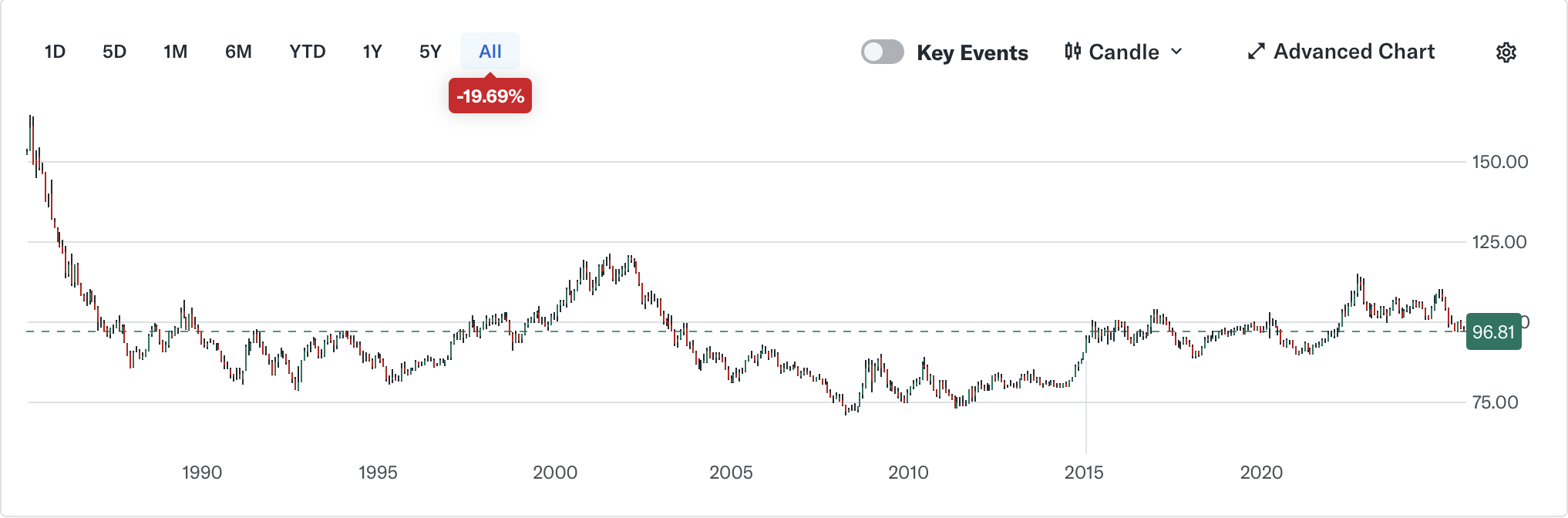
But remember, as you step away from the day-to-day, the dollar is hardly weak.  Rather, it is much closer to the middle of its long-term price action as evidenced by the longer view below.

Source: finance.yahoo.com

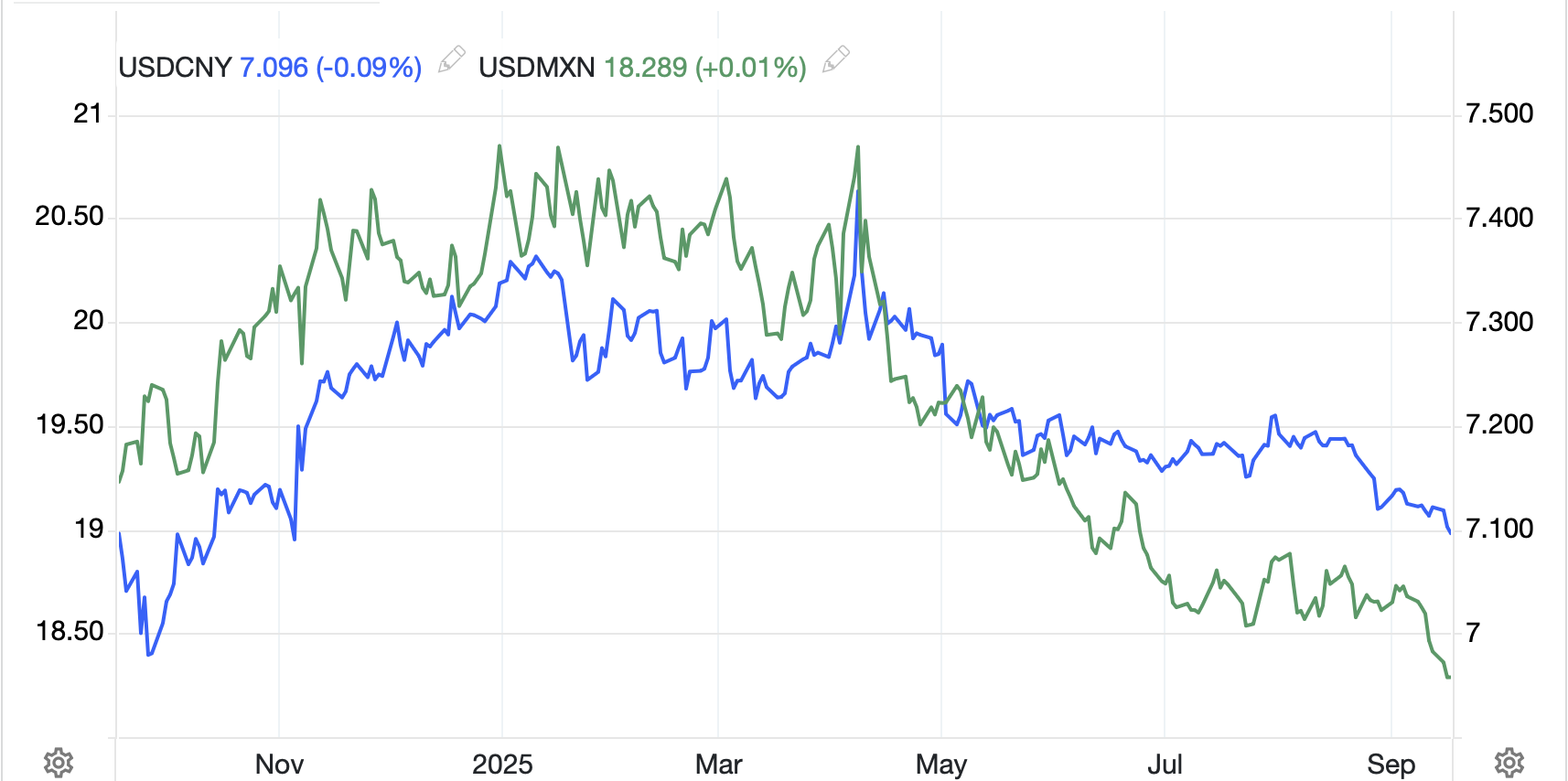
There is a lot of discussion on FinX (nee FinTwit) about whether we are about to bounce or if the dollar is going to collapse.  But it is hard to look at the chart directly above and get the feeling that things are out of hand in either direction.  Now, relative to some other currencies, there are trends in place that don’t impact the DXY, but matter.  Notably, CNY and MXN have both been strengthening slowly for the bulk of the year and are now at levels not seen for several years.  given the importance of both these nations with respect to trade with the US, this is where Mr Trump must be happiest as it clearly is weighing on their export statistics.

Source: tradingeconomics.com

Ahead of the FOMC meeting, we do get a few data points, with Housing Starts (exp 1.37M) and Building Permits (1.37M) leading off at 8:30.  Then at 9:45 the BOC interest rate decision comes, with a 25bp cut expected and finally the Fed at 2:00.  Housing will not have any impact on the market in my view but the BOC, if they surprise, could matter, especially if they pre-emptively cut 50bps as that will get the juices flowing for the Fed to follow suit.  But otherwise, we will have to wait for Powell and friends for the next steps.

Good luck

Adf

You Need to Squint

While data continues to print
It doesn’t give much of a hint
To where things are going
Unless you’re all-knowing
And even then, you need to squint
 
The reason for this situation
Is passive flows constant inflation
No matter the news
Or anyone’s views
The target funds need their proration


The hardest thing about macroeconomic analysis is trying to discern whether it has any impact on market movement.  For the bulk of my career, my observation was that while there were always periods when flows dominated fundamentals, they were short-lived periods and eventually those fundamentals returned to dominance in price action.  This was true in equity markets, where earnings were the long-term driver, outlasting short-term bouts or particular manias and this was true in FX markets, where economic performance and the ensuing interest rate differentials were the key long-term driver of exchange rates.  Bond markets were virtually always a reflection of inflation expectations, at least government bond markets and commodities were simple products of supply and demand of the physical stuff.

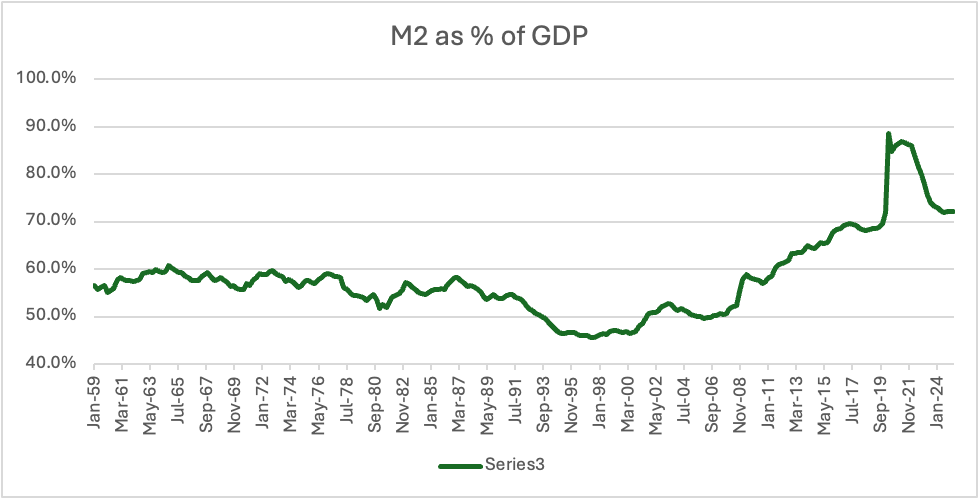
Alas, since the GFC, and more importantly, the global central bank response to the GFC, flooding financial markets with massive amounts of liquidity, G10 economies have become increasingly finanicialized to the point where the underlying fundamentals have less and less impact and funds flows are the driving force.  The below chart I have created from FRED data shows the ratio of M2 relative to GDP.  For decades, this ratio hovered between 53% and 60%, chopping back and forth with the ebbs and flows of the economy during recessions and expansions.  But the GFC changed things dramatically and then the pandemic and its ensuing response put financialization on steroids.

By 2011, this ratio hit 60% for the first time since 1965, and it has never looked back.  The result is that there is ever more money sloshing around the economy looking for a home with the best return.  This is part and parcel as to why we have seen both massive asset price inflation as well as consumer price inflation, too much money chasing too few goods.  And this is the underlying facet in why funds flows, whether between asset classes or between nations, are the new driving force of market price action.  Michael Green (@profplum99 on X) has done the most, and most impressive, work on the rise of passive investing, which is a direct consequence of this financialization.  The upshot is, as long as money comes into the system (your semi-monthly 401K flows are the largest) they continue to buy stocks regardless of anything fundamental.  And as almost all of it is capitalization weighted, they buy the Mag7 and maybe some other bits and bobs.  It doesn’t matter about fundamentals; it only matters how much they have to buy.

So, with that caveat as to why fundamental macro analysis has been doing so poorly lately, a look at the data tells us…nothing really.  As I wrote yesterday, the two main blocs of the economy, goods production and services production, are out of sync, with marginal strength in services outweighing marginal weakness in goods production and resulting in slow growth.  Whether you look at the employment situation, the ISM data or the inflation data, none of it points in a consistent and strong direction.

For instance, yesterday’s productivity and Labor cost data were better than expected, far better than last quarter’s and pointing to an improved growth outcome.  However, if we look at the past five years of this data, we can see that labor costs have grown dramatically faster than productivity as per the below chart (ULC in grey, Productivity in blue).

Source: tradingeconomics.com

Looking at this, it is no surprise that price inflation has risen so much, given labor’s impact on prices.  But, again, this is merely another impact of the massive flow of money into the economy over the past 15 years. 

Virtually every piece of data we get has been significantly impacted by this financialization which is one reason that previous econometric models, built prior to the GFC, no longer offer effective analysis.  The system is very different.  I continue to believe that over time, fundamentals will reassert themselves, but that belief structure is under increased pressure.  Perhaps YOLO and BTFD are the future, at least until our AI overlords come into their own and enslave the human population.

In the meantime, let’s look at what happened overnight.  Yesterday’s mixed, and relatively dull, US session was followed by a mixed session in Asia with Tokyo (+1.85%) soaring on news that there were going to be adjustments, in Japan’s favor as well as rebates, to the tariff schedule.  However, both the Hang Seng (-0.9%) and CSI 300 (-0.3%) saw no such love from either the Trump administration or investors.  As to the rest of the region, red (Korea, Australia, India, Thailand, Singapore) was more common than green (Malaysia).  Apparently, tariff adjustments are not universal.  In Europe, both Spain (+0.8%) and Italy (+0.8%) are having solid sessions but they are alone in that with the other major bourses (DAX 0.0%, FTSE 100 0.0%, CAC +0.2%) not taking part in the fun.  US futures, at this hour (7:30) are higher by about 0.4%.

Bond markets, meanwhile, are sleeping through the final day of the week, with Treasury yields unchanged on the day and European sovereign yields having edged higher by just 1bp across the board.  It seems, nobody cares right now.  After all, it is August and most of Europe is on vacation anyway.

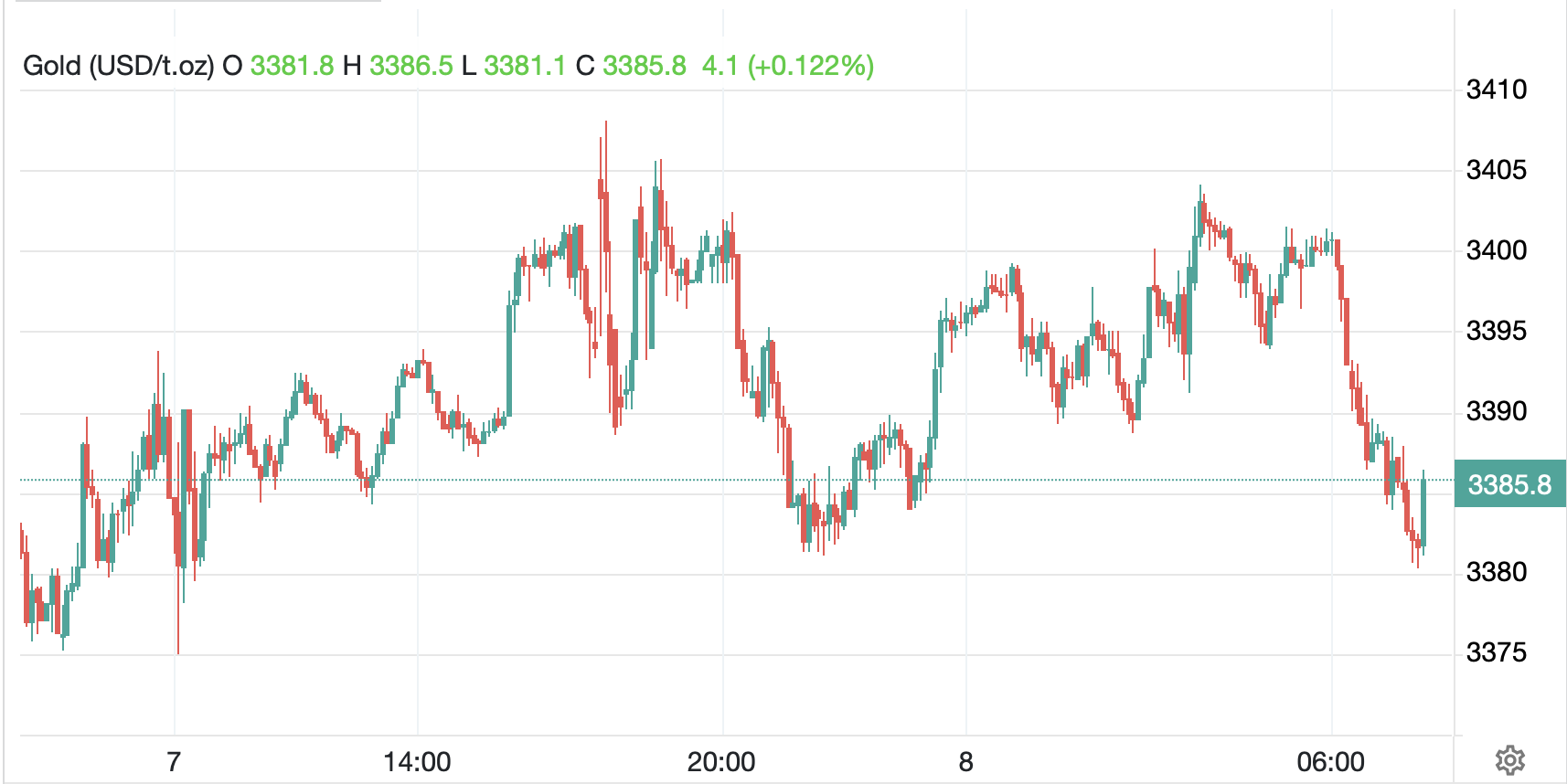
Commodity markets are showing oil (+0.6%) bouncing off its recent lows, but this seems more about trading activity than fundamental changes.  Perhaps there will be a Russia-Ukraine peace, but it is certainly not clear.  Trump’s tariffs on India for continuing to buy Russian oil are also having an impact, but as I showed yesterday, I believe the trend remains modestly lower.  Gold (-0.3%) is currently lower but has been extremely choppy as you can see from the 5-minute chart below

Source: tradingeconomics.com

This is a market where supply and demand dynamics have been impacted by both tariffs and the interplay between financialized markets (i.e. paper gold or futures) and the actual metal.  There are many theories as to different players trying to manipulate the price either higher (the Trump administration in order to revalue Ft Knox holdings) or lower (the ‘cabal’ of banks that have ostensibly been preventing the price from rising according to the gold bug conspiracy theorists).  Recently, there has apparently been less central bank demand, but that can return at any time based on political decisions.  I continue to believe that it is an important part of any portfolio, but it should be tucked away and forgotten in that vein.  As to the other metals, they are little changed this morning.

Finally, the dollar is stronger this morning, as the euro (-0.3%) and yen (-0.65%) are both under pressure and leading the way.  In fact, virtually every G10 currency is weaker (CAD is unchanged) and yet the DXY seems to be weaker as well. Something is amiss there.  Meanwhile, EMG currencies are mostly down on the session with KRW (-0.5%) the laggard, but weakness in INR (-0.2%), PLN (-0.25%) and CZK (-0.25%). 

On the data front, there is none today.  Yesterday, Atlanta Fed president Bostic explained his view that only one rate cut was likely this year, which is not what we have been hearing from other FOMC members.  Obviously, there is still uncertainty at the Fed, but they also have more than a month to decide.  Today, we hear from KC Fed president Alberto Musalem, one of the more hawkish members, so it will be interesting to see if he has changed his tune.

I would contend that confusion is the driving force in markets because data markers are not pointing in one direction nor are Fed speakers.  But it is a Friday in August so I suspect it will be a quieter day as traders look to escape to the beach for the weekend.  This morning’s trends, a higher dollar and higher stock prices, seem likely to prevail for the day.

Good luck and good weekend

Adf