The Whisperer’s Roar

Most focus is still on the Fed
And what every Fed speaker said
But do not ignore
The Whisperer’s roar
That Jay’s got the votes, rates to shred
 
And this is why markets are soaring
While bond vigilantes are snoring
But, too, it’s why gold
Is bought and not sold
The question is, whose ox Jay’s goring?


One thing that is very clear right now, the demand for lower interest rates is extremely widespread, regardless of one’s political persuasion.  People may despise everything that President Trump has done or claims he will do, but those same folks are desperate for him to be able to force the Fed to cut rates further.  At least that’s my observation.  

But putting that aside, the narrative around next month’s FOMC meeting seems to be coming to a clearer point; a cut is in the cards, but a potentially long delay in the next move will follow.  While there were no Fed speakers on the calendar, at least the calendar I use, yesterday, we did hear from two more, the presidents of San Francisco and Boston, and though the former, renowned dove Mary Daly, was far more forthright in her views a cut was appropriate, the latter, centrist Susan Collins, clearly was amenable to the idea, though not forcefully so.  But we know that Chair Powell cares since the Fed Whisperer, Nick Timiraos, got top billing in this morning’s WSJ with the following article, “Fed Chair Powell’s Allies Provide Opening for December Rate Cut.”  

As this story was coming into view yesterday, we saw equity markets rise sharply in the US, or at least the tech portion (the DJIA managed only a 0.4% gain compared to the NASDAQ’s 2.7% jump).  We also have seen the Fed funds futures market up the pricing of a rate cut to 81% as of this morning, with the concerns last week about Powell’s hawkishness quickly forgotten.  One other thing of note was the strong rally in precious metals, with gold (0.0% this morning, +1.8% yesterday) and silver (-0.3% this morning, +2.6% yesterday) responding to the imminent further debasement of the dollar.  While both remain somewhat below their October highs, nothing indicates that their trends higher have ended.

Source: tradingeconomics.com

There continues to be a lot of discussion on two fronts, the state of the economy and the rationale for further equity market gains, and interestingly, they are completely independent discussions.  For the former, the dribs and drabs of data that have been released since the end of the government shutdown have been inconclusive as to what is going on, at least officially.  Yesterday brought nothing new, although this morning we are due to see September data on Retail Sales (exp 0.3%, 0.3% ex autos), PPI (2.7% for both headline and core) and House Prices (+1.4% Case Shiller) along with November Consumer Confidence (93.5, down slightly from last month).  It hardly seems this will change any views

But the market conversation is completely different.  Between talk of a Santa rally, the popping of the AI bubble (assuming there is such a thing) and growing certainty that a Fed cut will help goose the stock market, that economic uncertainty means nothing.  There remains a large swath of investors who are certain the Fed will not allow equity markets to fall in any meaningful fashion and who are prepared to continue to buy the dip.  

Interestingly, the place where these two issues meet, earnings forecasts, shows that while fixed income investors may feel uncertain about the economy’s future, 2026 earnings estimates of 14% growth have equity investors in a very different place.  While I don’t know which side is correct, I suspect that the ‘run it hot’ philosophy which has been driving everything this administration does will favor equities over bonds.  While a correction is still likely in my mind, there is still nothing to stop this train!  

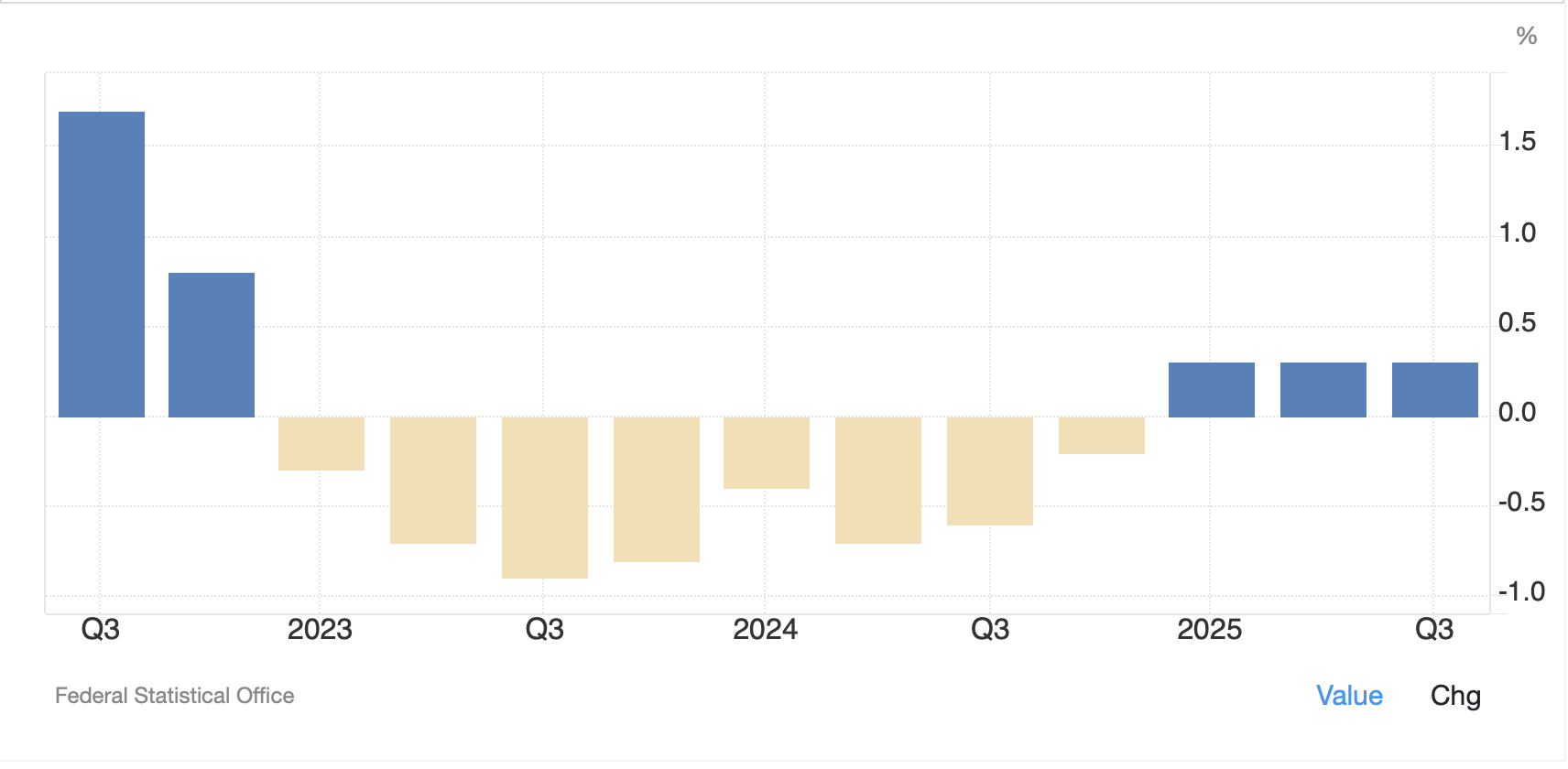
Ok, let’s turn to market performance overnight.  Japan (+0.1%) didn’t love the US tech story, which is somewhat surprising, although that may be because there continues to be growing concern regarding the JGB market and the spat with China.  China (+1.0%) and HK (+0.7%) however, both rallied on the US rate cut plus tech rally story.  Taiwan (+1.5%) and Thailand (+1.3%) also liked that story, but the rest of Asia was nonplussed, and more exchanges saw weakness than strength.  As to Europe, nobody there has a strong view this morning with every major bourse +/- 0.15% or less.  The only data was German GDP, which rose to…0.0% for Q3 and clocked in at +0.3% Y/Y! Look at the history of German economic activity over the past 3 years below and ask yourself if this is the powerhouse of Europe, why would anyone want to own any European assets?
Source: tradingeconomics.com

As well, the increased focus on a potential peace in Ukraine may be a negative for the continent.  While it has the potential to help them on the energy side, much of the rally seen across these nations was predicated on the military buildup that was coming.  However, if there is peace, I sense it will be difficult for a group of nations that are massively in debt to convince their populations to borrow more to defend themselves since the threat has abated.  After all, I’m willing to wager there isn’t a single person in the EU who if given the choice between defense spending for a potential future threat or an increased pension will opt for the former.  As to US futures, at this hour (7:25) they are unchanged.

In the bond market, Treasury yields are unchanged this morning after slipping another few basis points yesterday and are sitting at 4.03%.  Either the market is sanguine about the ongoing federal deficit spending or…everybody assumes the Fed is going to restart QE in some form or another if things start to deteriorate.  European sovereign yields are slipping this morning, down between -1bp and -3bps, with the UK on the larger end despite (because of?) tomorrow’s Budget announcement.  

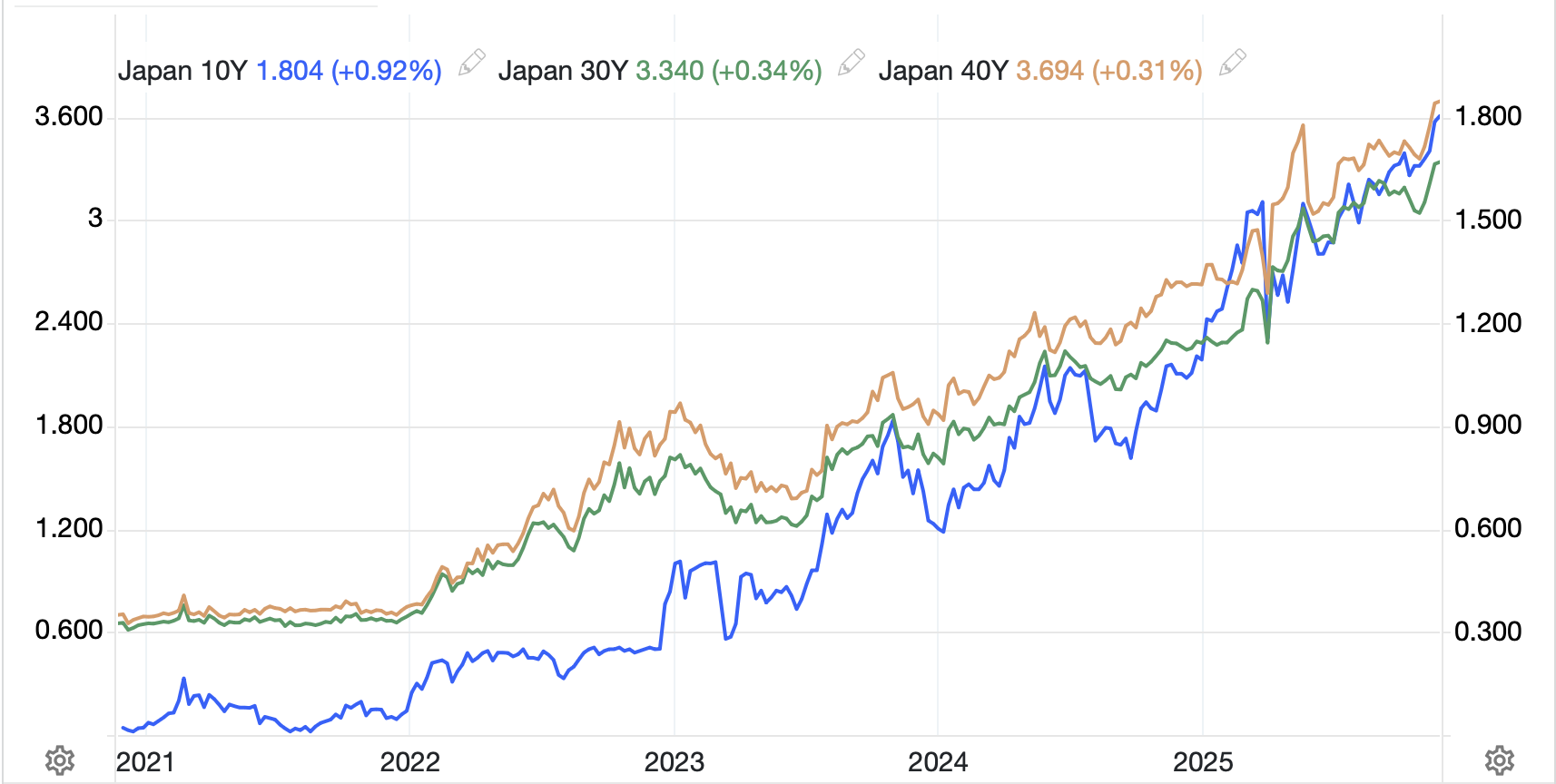
While you may think the US has a fiscal problem, and it does, at least it has the global reserve currency and with it, the ability to live beyond its means for a long time.  The UK, however, simply has the first part, a fiscal problem, which they have exacerbated by adopting the most idiotic energy policies in the world (who would ever have thought that solar power made sense in the UK given the fact it rains, on average, 50% of the days in the year.)  It is unclear to me what the UK can do to right the ship with the current government and its stated priorities.  I suppose that we will see new regulations requiring UK financial institutions to hold more Gilts as otherwise nobody will buy them.  Before I leave this asset class, I cannot ignore the JGB market where back-end yields continue to climb.  As you can see from the below chart, the 10-, 30-, and 40-year yields are all at record highs and show no signs of stopping their multi-year rise.
Source: tradingeconomics.com

I had a long conversation with Charlie Garcia on Substack, someone you should all follow as he has very sharp ideas, on the causes, ramifications and potential outcomes of this unprecedented rise in yields there.  Needless to say, the end game will not be very good for anyone, but the timing remains in question.  As Keynes warned us all, markets can remain wrong longer than you can remain solvent.  But Japan has its own, unique fiscal problems along with every other nation in the world.

Turning to commodities, oil (-0.3%) continues to be the least interesting thing around, drifting slowly lower, but at an increasingly leisurely pace.  The glut narrative has calmed down, but I think there is more concern over the weakening economic story.  Hard for me to say from the outside, but lower is the direction of travel here.  The opposite is true for NatGas (-3.3%) which despite today’s decline is up 55% since October 16th!

Finally, the dollar is under modest pressure today with both the euro and pound stronger by 0.2%, a move that describes almost the entire G10.  One outlier here is NOK (-0.2%) which is clearly suffering on oil’s ongoing weakness.  In the EMG bloc, though, there has been more substantial movement with KRW (+0.7%) rising as traders position for the BOK to remain on hold while the Fed gets ready to cut, thus reversing some of the recent 7% decline in the won over the past quarter.  The CE3 have also rallied nicely, on the order of 0.5%, as they continue to demonstrate their excessive beta with the euro and even CNY (+0.3%) is moving this morning on the back of a potential thaw in relations between the US and China after Presidents Xi and Trump spoke by phone yesterday.  While my long-term perspective on the dollar remains positive, if the Fed does get aggressive, the greenback can certainly come under short-term pressure.

And that’s really all there is today.  With Thanksgiving coming, I expect that volumes will begin to decline so keep that in mind when trying to execute any trades.

Good luck

Adf
Japanese Tao

Japanese prices
Are rising ever higher
Probably nothing!
 
Meanwhile Ueda
Explained QE can still be
The Japanese Tao


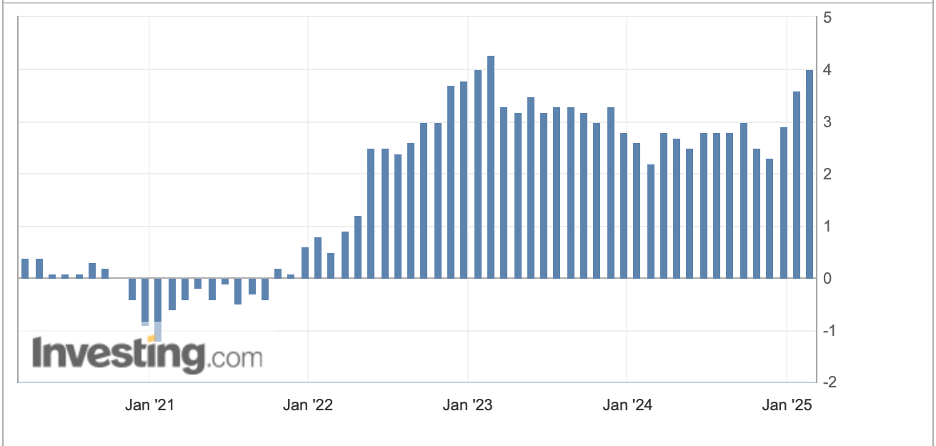
Japanese inflation data was released last night, and the picture was not very pretty.  In fact, let me show you.  The first chart shows the monthly readings of annual inflation for the past 5 years.  Last night’s 4.0% reading was not the highest in that period, (that distinction belongs to Feb 2023 at 4.3%), but it is pretty clear that any sense of declining inflation is beginning to dissipate and has been doing so for the past year.  PS, remember, Japanese interest rates range from 0.5% in the overnight to 1.425% in the 10-year, so real rates remain highly negative regardless of your timeframe.

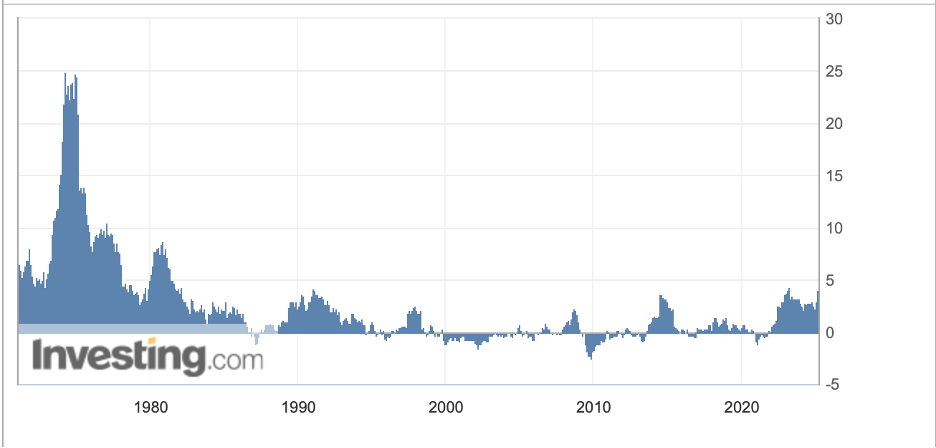
The second picture takes a longer-term perspective to help us better understand the long history of inflation in Japan.  While a decade ago, inflation showed an uptick of nearly the recent magnitude, that was driven specifically by the government raising the GST (goods and services tax) which was Japan’s answer to a VAT.  It was highly controversial at the time but was also understood to have a truly transitory impact as it was a one-off rise in prices.  However, beyond that period, the Japanese have been living with inflation somewhere between -2.2% in the wake of the GFC and 2.0% since the turn of the century.  In fact, going back to the 1990’s, inflation didn’t reach current levels, and one must head back to 1981 to see significant inflation in Japan.  This means there are two generations of people who have basically never seen prices rise in the current manner.

So, what do you think the central bank is considering?  Let me give you Ueda-san’s own words, [emphasis added] “In exceptional cases where long-term interest rates rise sharply in a way somewhat different from normal movements, we will flexibly increase purchases of government bonds to promote stable formation of interest rates in the market.”  You read that correctly inflation is rising sharply, JGB yields are rising in sync and the BOJ’s response is to BUY MORE BONDS!!!  You cannot make this stuff up.  I guess old habits die hard.

The market response to this was as you might expect.  JGB yields dipped 2bps, Japanese equities managed a modest rally (+0.3%) as they seem caught between lower rates and higher inflation, and the yen ( -0.5%) weakened.  In essence, it appears the combination of a strengthening yen and rising interest rates has the potential to wreck the Japanese government’s budget, and the BOJ went back to form and discussed more QE as a response.  This is simply more proof that there isn’t a central bank in the world that truly cares about inflation.  While stable inflation may be a mandate, it is the last of their concerns.

Inflation is, however, not the last of our concerns, at least as we try to live day to day.  This is what has me concerned about Chairman Powell and his minions at the Fed, they continue to believe that the current interest rate structure is restrictive and despite the fact there is virtually no evidence prices are ever going to get back to their target of 2.0%, let alone true stability, still see cuts as the way forward.  Perhaps I am mistaken to believe that the Fed will see the light and maintain current policy levels or even tighten as inflation rebounds.  If that is the case, my entire dollar thesis is going to come under a lot of pressure!

Ok, away from the Japanese antics overnight, a brief word about China.  Last night, Premier Li Qiang explained that China will look to “vigorously” improve the services sector of the economy, specifically education, health care, culture and sports, as they once again try to adjust the balance of economic activity to a more domestic focus rather than their historical mercantilist process.  Earlier this week the PBOC reiterated their support for the property market, although for both these efforts, this is not the first time they have been discussed, and the evidence thus far is all their efforts have been fruitless.  But for one day, at least, these comments have been embraced as the Hang Seng (+4.0%) and CSI 300 (+1.3%) both rallied sharply on the news of more domestic support for the Chinese economy.  The Chinese are set to hold a key economic confab as they try to plan how to shake things up a bit, and these comments, as well as a seeming promise the PBOC is going to cut rates again, are all of a piece.  Maybe they will be successful this time, but I am not holding my breath.

Otherwise, the only other noteworthy economic news came from the Flash PMI’s across Europe which were soggy at best, certainly not indicative of significant growth coming soon.  With that in mind, let’s look at the rest of the markets’ overnight performance.  The rest of Asia’s equity markets were mixed with Taiwan’s the best performer and several modest declines elsewhere including India, Australia and New Zealand.  In Europe, though, despite those modest PMI outcomes, most markets are higher led by the CAC (+0.5%).  Perhaps, the view is the ongoing weakness will force the ECB to cut rates more quickly, and we have heard several ECB members indicate further cuts are coming.  However, counter to that, Isabel Schnabel, one of the more hawkish members, mentioned this morning that she believed they were already at neutral, and more cuts may not be necessary.  While that is not the consensus view yet, it is worth remembering.  As to the US futures market, at this hour (7:00), all three major indices are basically unchanged.

In the bond market, yields have fallen across the board with Treasuries, after sliding yesterday, down another 2bps this morning and back below 4.50% for the first time in a week.  In a Bloomberg interview yesterday, Secretary Bessent explained that although his goal is to reduce the issuance of T-bills and term out debt, given the situation which he inherited from the previous administration, that process will take longer than some had considered previously.  In other words, there won’t be a large increase in 10-year issuance any time soon. European sovereign yields are also much softer, down between -3bps and -5bps on those further rate cut hopes, or perhaps the lackluster PMI data.

In the commodity markets, oil (-0.8%) is backing off its recent rally highs, but remains quiet overall and well within its ever-tightening trading range.  It seems traders don’t know how to handicap the constant discussions from the Trump administration and whether Russian sanctions will end or not, as well as how quickly OPEC may ramp up production and what is happening to demand.  While none of these things are ever certain, right now they seem particularly fraught.  In the metals space, gold (-0.4%) is backing off from yesterday’s latest all-time highs, and taking both silver and copper with it, but the uptrend in all three of these metals remains quite strong.

Finally, the dollar is higher this morning gaining ground against all its G10 counterparts with the yen being the worst performer, but also against all its EMG counterparts with HUF (-1.0%) the true laggard although the entire CE4 are under pressure, arguably responding to the mayhem over how the Ukraine situation plays out.  After all, they are the closest in proximity and likely to be the most impacted.

On the data front, this morning brings Flash PMI data (exp manufacturing 51.5. Services 53.0), Existing Home Sales 4.12M) and Michigan Sentiment (67.8).  We also hear from two more Fed speakers, Jefferson and Daly, but again, caution and stasis are the story until further notice, and that notice is not coming from Mary Daly but rather from Jay Powell.

Perhaps the most interesting thing happening right now is that although tariffs remain a major economic force and are clearly on the table, they are not even the 4th most important topic in the market.  Back to my earlier comments, I sincerely hope that the BOJ’s overwhelming dovish stance is not a harbinger of things to come here in the States.  Right now, I don’t think so, but I am far less confident than I was earlier this week.

Good luck and good weekend

Adf

The Hits Keep on Coming

In China, the hits keep on coming
As Gongsheng adjusts China’s plumbing
Last night he cut rates
As he navigates
A way to help growth there keep humming
 
Combined with the Fed’s latest act
Worldwide it is clearly a fact
Liquidity’s growing
With stock markets showing
Why traders just love the impact


As virtually promised the other night, PBOC Governor Pan Gongsheng cut the medium-term lending facility rate to 2.0% from its previous level of 2.3% last night, the largest single cut in the history of this rate’s existence.  Of course, that only takes us back to 2016 when the PBOC rolled out this concept, but nonetheless, it is a clear expression of an aggressive easing policy by the central bank.  In fact, pundits are calling for further rate cuts this year as Xi’s government struggles with rekindling the animal spirits in China.  For equity investors there, this continues to be good news as the CSI 300 rallied another 1.5% and is now within spitting distance of being flat for the year.  As well, the renminbi rallied further, briefly trading through the 7.00 level and currently about 0.35% stronger than yesterday’s close.

Alas for President Xi, while all these measures are likely to have positive short-term impacts on economic statistics, especially the way they report them over there, it is unclear if they will help restart truly organic domestic economic activity.  Ultimately, that is a direct product of the level of confidence people have in their current employment situation as well as their perception of the prospects for better opportunities going forward.  Having the government pay you back for things that were supposed to rise in price forever is welcome, but not sufficient to do the trick, I think.  Clearly the current situation is that Chinese assets are going to perform in the short run, and it is very likely commodity prices will rise as well given the perception that Chinese demand will now increase, but personally, I suspect that the longevity of this price action, at least for the Chinese assets, may be limited.

Commodity prices, on the other hand, are getting boosts from all over the place, notably from the fact that virtually every country on earth, except perhaps Japan, has entered a monetary easing cycle.  Now that the Fed has begun, and gone big to start, other central banks will feel empowered to ease policy further with the confidence that their own currencies will not collapse amid a US rate cutting cycle.  And let’s face it, so far, everything we have heard in the wake of the FOMC move last week is that they are not afraid to cut rates a lot more.

Under the guise, actions speak louder than words, even though Powell explicitly said they had not declared victory over high inflation, listening to the four speakers since the meeting, it actually appears they have done just that.  Now, there is one market that seems to disagree with them, at least so far, and that is the 30-year Treasury bond. As you can see in the chart below, the yield there is now higher by 20bps since the first stories about the Fed cutting 50bps made their way into the press.  Whatever PCE holds in store for us later this week, the combination of commodity price rises and the yield on the long bond offer strong hints that inflation is going to make an inglorious return.

Source: tradingeconomics.com

But for now, be joyful because stock markets are continuing to rally.  This economic cycle is clearly unlike any others given the still subtle ripples from Covid policies and the fact that the housing market remains stuck with so many homeowners locked into their homes due to the exceptionally low mortgage rates they hold.  The result has been two very opposite views of how things are evolving, with one camp still celebrating the fact there has been no appreciable slowdown and all-in on the soft-landing while the other digs under the headlines and finds numerous issues with hiring and debt.  Perhaps next week’s NFP print will bring clarity although I doubt that will be the case.  In the meantime, we need to observe and react as it is all we have.  It is times like these that define why hedging is so important.

Ok, let’s look at the overnight activity.  After yesterday’s modest US rally, aside from China, the picture was far more mixed in Asia with the Nikkei (-0.2%) slipping slightly while the Hang Seng (+0.7%) continued its rally on the back of the China news.  But Singapore, Korea and the Antipodes all suffered although Taiwan (+1.5%) took heart in the Chinese news.  In Europe, the picture is also mixed with both the DAX (-0.4%) and CAC (-0.3%) slipping while the FTSE 100 (+0.4%) is higher despite a complete lack of data.  Well, that’s not completely true as French Consumer Confidence rose to 95, its highest level since February 2022, but apparently that is not so important.  Meanwhile, US futures are essentially unchanged at this hour (7:30).

In the bond market, Treasury yields are leading the way higher with 10-year yields higher by 3bps and pretty much all European sovereign yields higher by either 1bp or 2bps.  Bond investors are very clearly concerned over inflation’s prospects given the wholesale turn to monetary ease seen worldwide.  The outlier here was JGB yields (-1bp) as the market there continues to respond to Ueda-san’s comments from yesterday regarding the lack of urgency to tighten further, especially given the yen’s recent rebound.

In the commodity markets, oil (-1.3%) is fading this morning, perhaps because there has been no further escalation of hostilities in the middle east, they remain at a steady level, or perhaps because we have seen a 9% rally in the past two weeks, so traders are simply taking a rest.  Metals markets, too, are softer this morning, but that is also after a very strong rally and gold (-0.1%) continues to maintain the bulk of its daily new all-time high prints.  But both silver and copper have had very strong weeks as well.  One other thing to note is that NatGas is higher by 13% this week, perhaps an indication that supply concerns are growing.

As to the dollar, after several soft sessions, it is rallying this morning.  Weakness in currencies is broad-based with the pound (-0.4%), Aussie (-0.5%), yen (-1.0%) and Swiss franc (-0.9%) all retracing some of their recent gains.  We are seeing similar price action in the EMG bloc with MXN (-0.6%), KRW (-0.5%) and PLN (-0.3%) all under pressure but with one exception, ZAR (+0.4%) which continues to benefit from the combination of still high interest rates, so the carry trade, as well as a growing belief that the new government is going to be quite business, and by extension market, friendly.

On the data front, only New Home Sales (exp 700K) is on the docket although we also see the weekly EIA oil inventory data with further drawdowns forecast.  There are no scheduled Fed speakers, but I expect we will hear from one or two anyway.  While the dollar is bouncing today, I believe the current mindset is the Fed is going to lead the way lower in this rate cycle and that the dollar will suffer accordingly.  Just be careful as with everyone cutting rates, expecting a sharp dollar decline from here seems suspect.

Good luck

Adf

No Choice

Data indicates
The BOJ intervened
Did they have no choice?


Last night, Masato Kanda, the Vice Minister of Finance for International Affairs, colloquially known as Mr Yen explained, “I have no choice but to respond appropriately if there are excessive moves caused by speculators.”  He also explained, “We are communicating very closely with the authorities of each country and complying with international agreements, so there has been no criticism from other countries.”  In other words, while he did not actually come out and say that the BOJ intervened on behalf of the MOF, it seems pretty clear that is the case.  Certainly, a look at the price action again last night, as per the below chart, shows that is a viable reality.

Source: tradingeconomics.com

You may recall that USDJPY fell sharply in the wake of the CPI data last week and there was substantial question as to whether there was intervention at the time.  My view was the BOJ would not have been able to act on a timely basis and attributed the move to an overly long dollar positioned market and some algorithmic selling.  However, it appears that data from the BOJ’s accounts have since been released showing approximately ¥6 trillion (~$38.4 billion) was spent at the end of last week.  Now, given the Kanda comments above, the reality is that the MOF is drawing a line in the sand at 162.  

In fairness, this seems a propitious time to do so given the growing certainty that the Fed is finally going to begin its policy easing.  Of course, the main reason that the yen had weakened so much is that, not only had the interest rate differential widened substantially, allowing for, and even encouraging, the growth of the ‘carry trade’ where investors were happy to simply hold long forward USDJPY positions and wait for the time to pass and the profits to roll in.  But as well, there was no indication that the Fed was going to change its stance while the BOJ, though it had threatened to begin tightening policy, was doing so at a glacial pace.  However, that CPI number has dramatically altered opinions, not only of the trading community, but more importantly, of the Fed.  All the Fed comments we have heard since that data point have indicated a much greater willingness to consider easing policy.  Talk about both the goods and labor markets coming into balance are indicators they are ready to roll.  

We still have seven more Fed speakers this week ahead of the quiet period and I would wager that to a (wo)man, they will all say their confidence is growing that price pressures are receding, and they are watching the employment situation carefully.  As I wrote yesterday, the CME Fed funds futures market is pricing a 100% probability of a 25bp cut in September with some folks looking for 50bps.  Given the totality of the recent data where the probability of a recession seems to be growing, I agree a September cut looks likely.  This is not to say every data point is going to be pointing to weaker economic activity (e.g., yesterday’s Retail Sales data was much stronger below the headline number), just that will be the broad trend.

In this situation, with the market starting to believe that higher for longer is truly dead, the initial reaction will be for further dollar weakness.  Of course, once it is clear the Fed has begun to ease policy, we will see other central banks increase their pace of policy ease at which point the dollar’s decline will likely slow or stop.  Remember, FX is a relative game, so if everybody is easing policy at the same time, those interest rate differentials are not going to change very much at all.  However, commodity prices, especially precious metals prices, are likely to be the biggest beneficiaries.  As to stocks and bonds, the former have a much less certain path given the impact of declining inflation on profits, especially for the mega cap names, but bonds should perform well (yields declining) at least as long as inflation remains tame.  Just beware of a slow reversal of the inflation story.  Nothing has changed my view that 3.0% is the new 2.0%.

Aside from the yen news, last night was decidedly lacking in new information.  We saw UK inflation data print at the expected levels showing it has fallen back close to their target of 2%.  We saw final Eurozone inflation also confirming a 2.5% inflation rate.  While the ECB has essentially ruled out a rate cut tomorrow, a September cut seems highly likely at this time, especially if they have confidence the Fed is going to cut then as well.

So, let’s look at the overnight session.  After more record highs in the US, with the DJIA approaching 41K, the tone in Asia was more mixed.  Japanese shares (Nikkei -0.4%) fell as the yen’s strength continues to hamper profit expectations for the many exporters in the index.  Chinese shares, both in Hong Kong and on the mainland, edged higher by less than 0.1% as investors continue to wait to hear the results of the Third Plenum.  As to the rest of the region, gains in Australia and New Zealand were offset by losses in South Korea with most other markets little changed.  however, in Europe this morning, the screens remain red with losses across the board, albeit not as significant as we have seen in the past several sessions.  The DAX (-0.4%) is the laggard although all the major markets are lower.  Finally, at this hour (7:20), US futures are suffering led by the NASDAQ (-1.5%) although they are all under pressure.  It seems that the story about increased tariffs on Chinese goods as well as a ban on selling additional semiconductors to China doesn’t help the prospects of semiconductor companies that rely on China for their sales.

Interestingly, the bond market has seen yields edge higher this morning with Treasuries higher by 2bps and most of Europe up by 1bp.  Given the small size of the movement, I wouldn’t attribute much fundamental thought to today’s price action, and after all, 10-year Treasury yields have fallen 30bps since the first of the month, so a lack of continuation is not that surprising.

In the commodity markets, oil (+0.5%) is rebounding after a rough couple of days.  The weakening economy story is weighing on perceived demand and there is ample supply around.  Gold (+0.1%) is continuing to rally after closing at another all-time high yesterday while silver (-0.9%), which followed gold yesterday, is giving back a bit this morning.  Industrial metals are little changed this morning as they await further confirmation of the economic situation.

Finally, the dollar is under pressure this morning, falling substantially against almost all of its major counterparts, both G10 and EMG.  Aside from the yen (+1.1%) which we discussed above, the pound (+0.5%) is leading the way along with SEK (+0.6%) although the euro (+0.35%) is also firm.  In fact, the pound has risen above 1.30 for the first time in a year while the euro pushes the top of its 1.0650/1.0950 2024 trading range.  The laggard in the G10 space is CAD, which is unchanged on the day as market participants tie its performance directly to the dollar and anticipate the BOC to match the Fed going forward.  In the EMG bloc, though, there are two outliers which have suffered today, despite the dollar’s broad weakness, MXN (-0.6%) and ZAR (-0.7%).  The peso seems to be feeling the effects of weaker than expected economic data lately which has put Banxico into a difficult position as inflation remains above their target.  Will they cut to support the economy and undermine the currency?  That is the question.  As to the rand, aside from its status as the most volatile currency, the market seems to be reacting to a sharp decline in Retail Sales last month, -0.7%.

On the data front, this morning brings Housing Starts (exp 1.3M), Building Permits (1.4M), IP (0.3%) and Capacity Utilization (78.4%) along with the EIA oil inventories.  In addition, we will hear from Richmond’s Thomas Barkin and Governor Waller and then at 2:00 the Fed’s Beige Book will be released.  The current market narrative has quickly shifted to rate cuts, and more tariffs.  The upshot is the dollar is likely to remain under pressure while equities will have a more difficult time going forward.  If inflation remains quiescent, then bonds can do well, but the big winner through it all should be commodities.

Good luck

Adf

Hawk-Eyed

A landing that’s soft will require

A joblessness growth multiplier
Demand needs to slide
Enough so hawk-eyed
Fed members, rate cuts can inspire

The thing is, when looking at data
The trend hasn’t been all that great-a
While prices are falling
Growth seems to be stalling
More quickly than Jay’d advocate-a

As we await the onslaught of data starting this morning with ADP Employment and culminating in Friday’s Payroll and Michigan Sentiment reports, I thought it would be worthwhile to try to take a more holistic look at the recent data releases to see if the goldilocks/soft landing narrative makes sense, or if there is a growing probability of a more imposing slowdown in growth, aka a recession.

The problem is, when looking at the past one month’s worth of data, the trend in either direction is not that clear.  One of the things that has been true for a while is that there continues to be a dichotomy between the survey data and the hard figures.  Survey data has tended toward weakness, with one outlier, the most recent Chicago PMI print at 55.8.  But otherwise, ISM data has been quite soft for manufacturing and so-so for services.  Looking at the regional Fed surveys, it has been generally much worse with more negative outcomes than positive ones.  

At the same time, we all remember last week’s blowout GDP result for Q3 at 5.2% and we continue to see employment growth, albeit at a slowing pace to what was ongoing last year and earlier this year.  Retail Sales finally fell slightly last month, but that is after a string of much stronger than expected prints, arguably why Q3 GDP was so strong.  Perhaps the more worrying points are that the Continuing Claims data has started to grow more rapidly, meaning that people are remaining on unemployment insurance for longer and longer periods and yesterday’s JOLTS data was substantially lower than expectations and lower than the November reading.  Finally, Durable Goods and Factory Orders have been quite weak.

If I try to add it up, it seems to point to a weaker outcome than a soft-landing with the proper question, will the recession be mild or sharp?  Funnily enough I think the data highlights the Biden administration’s ‘messaging’ problem.  Surveys are generally quite negative and now hard data seems to be rolling over.  That is clearly not the story that a president running for re-election is seeking to tell.  

All this begs the question, how will the Fed respond?  And here’s the deal, at least in this poet’s view; the current market pricing of upwards of 125 basis points of rate cuts through 2024 is not the most likely outcome.  Rather, I continue to strongly believe that we will see either very little movement, as higher for longer maintains, or we will see 300-350bps of cuts as a full-blown recession becomes evident.  

To complete the exercise, let’s game out how markets may behave in those two situations.  If the Fed holds to its guns and maintains the current policy stance with Fed funds at 5.50% and QT ongoing, risk assets seem likely to have problems going forward.  It is quite easy to believe that the key driver to last month’s massive equity rally was the pricing of easier monetary policy to support the economy, and by extension profitability and the stock market.  So, if the Fed does not accommodate this view, at some point investors and traders are going to need to reevaluate the pricing of their holdings and we could see a sharp decline in equities.  As well, this would likely result in a further inversion in the yield curve as expectations for a future recession would grow.  On the commodity front, this ought to weigh on both the energy and metals complexes even further than their current pricing.  Recall, I have been highlighting that the commodities markets seem to be the only ones pricing in a recession.  As to the dollar, in this scenario I expect to see it regain its strength as the rest of the world will be sliding into recession regardless of the US outcome, so rate cuts will be on the table for the ECB, BOE, BOC, and PBOC.

Alternatively, the economic situation in the US could well deteriorate far more rapidly than the current goldilocks set believes.  In fact, I believe that is what it will take to get the much larger rate cuts that everybody seems to be pining for.  But ask yourself, do you really want rate cuts because economic activity is collapsing?  That seems a tough time to be snapping up risk assets.  In fact, historically, equity market declines through recessions occur while the central bank is cutting rates.  Be careful what you wish for here.

But, to finish the scenario analysis, much weaker economic data (think negative NFP as a first step along with Unemployment at 4.5%) will almost certainly result in cyclically declining inflation data and a dramatic fall in demand.  So, equity markets would be under pressure everywhere.  meanwhile, the normalization of the yield curve would finally occur with the front end falling far faster than the back.  In the commodity markets, I think precious metals will outperform as real rates tumble and safety is sought.  However, industrial metals would decline and likely so would energy prices, both driving inflation lower.  As to the dollar, this is much trickier.  At this point, I would argue the Eurozone is ahead of the US in the economic down wave and so will also be cutting rates.  The dollar’s performance will be a product of the relative policy response and I suspect will result in a very choppy market.  At least against G10 currencies.  Versus its EMG counterparts, I suspect the dollar will significantly underperform absent a global recession.

But enough daydreaming, let’s take a look at the overnight session.  From an equity perspective, yesterday’s late rally in the US, getting things back close to unchanged, was followed by strength in Asia, notably in Japan (Nikkei +2.0%) but also across the board with India’s Sensex making yet more new all-time highs, and modest strength in Europe despite some weak German Factory Orders data.  Or perhaps because of that as traders grow their belief the ECB is going to start cutting rates soon.  US futures are edging higher at this hour (7:00), but only by 0.2% or so.

In the bond market, after a day where yields fell sharply, this morning we are seeing a slight bounce with Treasury yields backing up by 3bps and European sovereign yields edging higher by between 1bp and 3bps.  The European bond market is clearly of the opinion that the ECB is done hiking with that confirmation coming from the Schnabel comments yesterday morning.  Now, the only question is when they start to cut.  Something else to note is that JGB yields have fallen 3bps this morning and are essentially back at levels seen in early September before the BOJ’s latest comments about the 1% cap being a guideline, not a hard cap.  Perhaps the argument that the BOJ was going to normalize its policy was a bit premature.  

On the commodity front, oil prices continue to slide, down another 0.7% this morning and nearly 8% this week.  While this is great for when we go to fill up the gas tank, it is a harbinger of a weaker economy going forward, which may not be so great overall.  Gold prices have stabilized and are still above $2000/oz and we are also seeing stabilization in the base metals prices right now.

Finally, the dollar, which rallied nicely yesterday, and in fact has been climbing for the past week, is little changed this morning stabilizing with the euro below 1.08 and USDJPY above 147.  There continues to be a narrative that is calling for the dollar’s demise, and in fact, I understand the idea based on the belief that the Fed is turning easy.  But for right now, it is also becoming clear that the rest of the world’s central banks are rolling over on their policy tightening and given the lack of a strong interest rate incentive, plus the fact that a weaker global economy will send investors looking for safe havens, the dollar is likely to maintain its recent strength, if not strengthen further going forward.  In order to see a substantial dollar decline, IMHO, we will need to see the US enter a sharp recession without the rest of the world following in our footsteps.  As I see that to be an unlikely outcome, my guess is we have seen the bottom of the dollar for the foreseeable future.

On the data front, we start today with the ADP Employment (exp 130K) and also see the Trade Balance (-$64.2B), Nonfarm Productivity (4.9%) and Unit Labor Costs (-0.9%).  From North of the Border, at 10:00 we see the Ivey PMI (their ISM data, expected at 54.2) and the BOC interest rate decision where there is no change expected and there is no press conference either.

I really wanted to get bearish on the dollar and felt that way when we heard Fed Governor Waller talk about rate cuts, but lately, the news from everywhere is negative and I just don’t see the dollar suffering in this situation.  Stable, yes; falling no.

Good luck

Adf

Cause Regret

Again China’s leading the news
With stories ‘bout financing blues
So, terms on old debt
Which now cause regret
Have lengthened, more pain to defuse

Meanwhile, from the FOMC
Three speakers were clear as can be
Rate hikes are in store
This month, and then more
On this much, they all did agree

One of the key themes earlier this year that was supposed to have a big market impact was the China reopening story.  You may recall back in February when President Xi Jinping responded to the mass protests with blank papers held aloft, by deciding that permanently locking down a billion people was no longer an effective strategy, and a tacit declaration was made that there were no more Covid restrictions to be imposed or enforced.  Everybody assumed that the Chinese economy would vault out of the gates and that commodity demand would rocket higher while overall global economic activity increased.  Alas, that is not how things played out at all.  Instead, Chinese economic activity has disappointed at every turn with an initial blip higher and then a gradual slide back to less substantial activity.


Part of the problem has clearly been the efforts made by companies and countries around the world to reduce or eliminate China’s impact on supply chains.  But part of the problem, and arguably the larger part, was self-inflicted.  That was the massive debt buildup on the back of a two decades long leveraging of the Chinese property market.  You may recall China Evergrande, the first of the big property companies to come under pressure, but it has been an ongoing process for several years now.  The problem, in a nutshell, is that the model that had been used, buy huge swathes of land from city governments with leverage, promise to build housing (whose price had been rising nonstop for two decades) and then sell these flats to people on a highly leveraged basis, collapsed along with the covid lockdowns.  Suddenly, Chinese home buyers were out of work and could no longer afford the previously purchased homes.  As well, the construction companies could not complete the projects given all the workers were locked up in their own homes and unable to get to the construction sites.  However, debt remained a constant and was due regardless of the other issues.


The outcome was a significant slowdown in Chinese construction activity, an enormous number of unfinished (or even not yet started) apartment projects, and a lot of losses for both individuals and the property companies.  Now, as China emerged from its covid lockdowns, the government did try to relax some of its previous policy strictures but things in the property sector remain quite soft.  For China, where the property sector represented more than 25% of GDP, this is a problem.  As such, last night we saw the next steps by the Chinese government in this process with further easing on repayment terms by extending the maturity of a large amount of debt by one year, from 2024 to 2025.  It seems that the Chinese were paying attention to the Biden administration’s efforts regarding student loan payment delays and thought, we’ll do that too.  Of course, there is no Supreme Court in China to overturn this policy.  Do not be surprised if next summer, we hear about a further extension of these loans as can kicking is a government’s true superpower. 


A perfect encapsulation of this policy was the Chinese loan data released last night where new loans rose by CNY 3.05 trillion, far more than expected and aggregate financing also exploded higher, by CNY 4.2 trillion.  These are strong indications that the Chinese government is back offering substantial fiscal support to the economy in order to help get things moving again.  It should be no surprise that Chinese share prices rallied, nor that the renminbi has rallied a bit as well, pulling away from its recent multi-month lows.  It seems that the market has pushed things far enough to get a policy reaction rather than merely words.  At this point, the big question is, have we seen the end of the recent CNY weakening trend?  If the dollar continues its recent broad decline, then that is a quite probable scenario.  However, if the Fed continues to hew to its higher for longer mantra, and keeps pushing rates higher, be careful, of assumptions of a dollar collapse.


Speaking of the Fed, yesterday saw three Fed speakers, Barr, Daly and Mester, all explain that more tightening was still needed to push inflation back to their target. [emphasis added.]

Michael Barr: “we’ve made a lot of progress in monetary policy, the work that we need to do, over the last year.  I would say we’re close, but we still have a bit of work to do.”

Mary Daly: “We’re likely to need a couple more rate hikes over the course of this year to really bring inflation back into a path that along a sustainable 2% path.”

Loretta Mester: “in order to ensure that inflation is on a sustainable and timely path back to 2%, my view is that the funds rate will need to move up somewhat further from its current level and then hold there for a while as we accumulate more information on how the economy is evolving.”


It’s almost as if they are all reading from the same script!  At any rate, it seems very clear that regardless of tomorrow’s CPI print, they are going to hike by 25bps later this month.  The real question is, will the data continue to show the strength necessary to drive several more hikes after that?  As I have repeatedly explained, NFP is the most important number.  As long as Powell and the Fed can point to the employment situation and say there is no jobs recession, they will have cover to continue to tighten policy, maybe much higher.  6% or even higher is not out of the question.


And yet, despite the ongoing hawkishness from the Fed, the market is no longer concerned, at least that seems to be the case today.  Equity markets in the US managed to eke out gains yesterday and overnight saw Asia with bolder moves higher (Japan excepted as the strengthening yen is weighing on Japanese corporate profitability.). European bourses are higher, although the FTSE 100 is under pressure after mildly disappointing UK labor data this morning where the Unemployment Rate jumped to 4.0% for the first time since December 2021 when it was falling post covid.  US futures are a touch higher at this hour (8:00) but seem to be biding their time for tomorrow’s CPI data.


Bond markets, though, have rallied with 10-year Treasury yields lower today by a further 3bps and now back below the all-important 4.0% level, albeit just barely.  European sovereigns are also seeing some demand with yields sliding between 1bp and 2bps across the continent.  Even JGB yields edged a bit lower in a global bond buying spree.


Commodity prices are broadly higher with oil (+0.6%) continuing its rebound of the past week, while gold (+0.5%) is feeling a little love on the back of the dollar’s broad weakness today.  As to the base metals, they are ever so slightly firmer, retaining yesterday’s gains.


And finally, the dollar is softer across the board this morning as it seems to be following treasury yields lower and ignoring the Fed commentary.  The dollar’s weakness is evident in both the G10 and EMG blocs with JPY and NOK (both +0.6%) the leading gainers while only NZD (-0.4%) is under any pressure as traders prepare for the RBNZ meeting this evening and seem to be reducing their positions.  As to the emerging markets, KRW (+1.0%) was the leading gainer on the back of the Chinese fiscal policy story, although we saw strength throughout the APAC bloc.  Both EMEA and LATAM are a bit more mixed with much less significant movement, so seemingly following the bigger trend.


Today’s only data point has already been released, the NFIB Small Business Optimism Index, which printed at a higher than expected 91.0.  While this is a good sign, it is important to understand that the long history of this index shows an average near 100 and the current readings still mired near the lowest levels in its history, only surpassed by the massive recessions of 1980-1982 and the GFC in 2009.


There are no Fed speakers scheduled today, although we get a bunch more tomorrow after the CPI report is released.  For now, the market is looking askance at the dollar while Treasury yields sink.  My take is there is further upside in yields and therefore in the dollar.  However, that is not today’s trade. 


Good luck

Adf

Their Latest Excuse

While prices worldwide keep on rising
Most central banks are still devising
Their latest excuse
For why money, loose,
Is still the least unappetizing

On Wednesday Chair Powell explained
That QE would slowly be drained
Then Thursday the Bank
Of England helped sank
Gilt yields, leaving traders bloodstained

Now Friday’s arrived and we’re all
Concerned that a Payrolls curveball
Could quickly defuse
The new dovish views
With hawks back for their curtain call

If you sell stuff in the UK, or hold assets there, I sure hope you’ve hedged your currency exposure.  In what can only be described as shocking, the Bank of England left policy on hold yesterday after numerous hints from members, including several explicitly from Governor Andrew Bailey, that something needed to be done about rising inflation. The combination of rising inflation prints, rising inflation forecasts and comments from BOE members had the market highly convinced that a 0.15% base rate hike was coming yesterday, with the idea it would then allow the central bank to hike further in 25 basis point increments with futures pointing to the base rate at 1.00% come next December.  But it was not to be.  Instead, in a 7-2 vote, the BOE left policy rates unchanged and will continue its current QE program which has £20 billion left to buy to reach their target.

The result was a massive repricing of markets as interest rates tumbled across the entire curve and the pound tumbled along side them.  In what is perhaps the most brazen lie audacious statement from a major central banker lately, Bailey explained in a Bloomberg TV interview that it was “not our job to steer markets.”  Seriously?  That is all every central banker ever tries to do.  If financial stability is one of the goals enumerated for central banks, the BOE failed dismally yesterday.  Tallying up the impact shows that 10-year Gilt yields fell 13 basis points (and another 4.1 this morning), OIS markets saw the 1-year interest rate decline 20 basis points and the pound fell 1.4% yesterday and a further 0.5% this morning.  It was ugly.

Perhaps the lesson to learn here is that as central banks around the world try to adjust monetary policy going forward, there are going to be a lot more bumps along the way, with market expectations being left unfulfilled and severe market reactions accordingly.  Forward guidance, which has become a critical tool for central banks over the past decade plus is no longer going to be as effective.  When Ben Bernanke highlighted the idea in 2009, it was thought to be a great addition to the central bank toolkit, the ability to adjust markets without adjusting policy.  And while that may have been true when monetary policy was being eased for years, it turns out that forward guidance is a bit more difficult to handle in the other direction.  Market volatility, across all markets, is likely to increase over the next couple of years as the coordinated central bank activities we have become used to seeing disappear.  Consider that while the Fed, ECB, BOJ and BOE have all pushed back on raising rates soon, the Norgesbank, BOC, RBNZ, RBA and a host of emerging market central banks are starting the process or already well along the way.

Turning to this morning’s data, if you recall, the last two NFP numbers were quite disappointing, with both coming in well below expectations.  The only thing we know about the labor market is that we don’t really know what is going on there anymore.  Clearly, based simply on the JOLTS data we know there are more than 10 million job openings in the country.  (That is also made obvious whenever you leave your home and see all the help wanted signs in store windows.)  But despite clearly rising wages, it has thus far not been enough to entice many people back into the labor force.  So, the Unemployment Rate remains far higher than it was pre-pandemic, but there are plenty of jobs available.  In this situation I feel for the Fed, as there is no clarity available with conflicting data rampant.  At any rate, here are the forecasts heading into the release:

Nonfarm Payrolls 450K
Private Payrolls 420K
Manuacturing Payrolls 30K
Unemployment Rate 4.7%
Average Hourly Earnings 0.4% (4.9% Y/Y)
Average Weekly Hours 34.8
Participation Rate 61.7%

Source: Bloomberg

One interesting thing is that excluding the pandemic stimulus checks, the current Y/Y Earnings data is the highest since the series began in 2006.  And worse still, it is lagging CPI by at least a half-point.  My sense is that we are likely to see another weaker than expected number as the kinks in the labor market have not yet been worked out.

Ok, a quick look at markets shows that Asia had a rough go of it last night (Nikkei -0.6%, Hang Seng -1.4%, Shanghai -1.0%) as continued concerns over the Chinese property market weigh on the economy there while Japan looks more like position adjustment ahead of the weekend.  Europe, on the other hand, is doing much better (DAX +0.15%, CAC +0.6%, FTSE 100 +0.55%) despite much weaker than expected IP data from both Germany (-1.1%) and France (-1.3%) in September.  Too, Eurozone Retail Sales (-0.3%) badly missed expectations in September, but revisions helped ameliorate some of those losses.  Regardless, I would argue that the weak data has encouraged investors and traders to believe that all the talk of tightening to address inflation is ebbing.  Meanwhile, US futures, which had spent the bulk of the evening essentially unchanged are now higher by about 0.25%.

Bond yields are generally lower again this morning with most European sovereigns seeing declines of around 1 basis point except for Gilts, pushing 4bps.  Treasuries, which had seen softer yields earlier in the session have now turned around and edged lower (higher yields) but are still less than a basis point different from yesterday’s close.

Commodity prices also had a wild session yesterday with oil initially rallying $2/bbl before abruptly reversing and falling $5/bbl to close back below $80 for the first time in a month.  Given that backdrop, this morning’s 0.6% rise seems less interesting and it is still below $80.  NatGas (-0.5%) has slipped this morning, while the rest of the commodity complex is showing no trends whatsoever, with both gainers and losers.  Like every other market, traders are trying to come to grips with the new central bank situation.

The one consistency has been the dollar, which rallied yesterday and is continuing today.  In the G10, the pound (-0.5%) is the worst performer but we are seeing weakness in AUD (-0.4%), CHF (-0.4%) and NOK (-0.35%) as well with the entire bloc under pressure.  NOK is clearly still being impacted by yesterday’s oil moves while the others seem to be feeling the heat from suddenly more dovish thoughts regarding policy.  In the EMG space, PHP (+0.55%) is the outlier, rallying on comments from the central bank that it will continue to support the economy and news that the Covid infection rate has been falling.  Otherwise, the bulk of the bloc is in the red led by ZAR (-0.45%), PLN (-0.4%) and MXN (-0.35%).  Of these, the most noteworthy is PLN, where the central bank, which had just been touting its hawkish bona fides, has completely reversed and indicated that further rate hikes may not be necessary.  This seems odd given inflation is running at 6.8%, and forecast to top 8.0% next year, while the base rate was just raised to 1.25%.  It feels to me like PLN could fall further.

So, for now, we all await the payroll data and then get to reevaluate our views and expectations of Fed actions.  Nothing has changed my view that inflation will continue higher and nothing has changed my view that growth is going to slow.  So, while the Fed may begin to taper, I still believe they will stop before the end.  However, for now, the Fed is the most hawkish dove out there, so the dollar can continue to rally.

Good luck, good weekend and stay safe
Adf

Their Bond Vigilantes

Down Under, the RBA bought
Four billion in bonds as they fought
Their bond vigilantes
Who came back from Dante’s
Ninth circle with havoc they wrought

Investors responded by buying
More bonds and more stocks fortifying
The view central banks
All still deserve thanks
For making sure markets keep flying

Atop the reading list of every G10 central banker is the book written by Mario Draghi in 2012 and titled, How to Keep Interest Rates Lower for Longer*, and every one of those bankers is glued to page one.  At this point, there is no indication that higher interest rates will be tolerated for any length of time, and while jawboning is always the preferred method of moving markets in the desired direction, sometimes these bankers realize they must act.  And act they did, well at least Phillip Lowe, the RBA Governor, did.  Last night, the RBA bought $4 billion in 3-year ACGB’s, doubling the normal and expected amount of purchases as he fought back against the idea that the RBA would not be able to maintain control of the yield curve as they have announced.  The response must have been quite gratifying as not only did 3-year yields nose back below 0.10%, the target, but 10-year yields tumbled 0.25% as investors regained their confidence and took advantage of the sudden increase in yields available to increase their holdings.

So, last week’s price action is now deemed to have been nothing more than a hiccup, or a bad dream, with market activity today seen as the reality.  At least that is the story all the world’s central banks keep telling themselves, and arguably will continue to do for as long as possible.  It seems that the fact the RBA was willing to be so aggressive was seen by investors as a harbinger of what other central banks are willing and capable of enacting with the result being a massive asset rally worldwide.  Think about that for a moment, the purchase of an extra $1.5 billion of ACGBs has resulted in asset price increases on the order of $1 trillion worldwide.  That, my friends, is bang for your buck!

Of course, the question that remains is, will investors continue to accept this worldview, or will data, and ever-increasing debt supply, return us to last week’s market volatility and force a much bigger response by much bigger players?  My money is on the latter, as there is no sign that deficit spending is being reined in, and the signs of higher inflation remain clear, even in Europe!

But clearly, today is not one for calling out central bankers.  While ongoing conversations in Tokyo highlight the question of whether the BOJ needs to intervene ahead of their mid-month meeting when they are to present their Policy Review, and ECB members continue to warn about unwarranted tightening of financial conditions, thus far, we have not seen any increase in activity by either central bank.  However, at 9:45 this morning we will see the latest data from the ECB regarding their purchases during the last week in the PEPP, and it will be instructive to see if those purchases increased, or if they simply maintained their regular pace of activity.  An increase could be taken positively, shoring up investor belief that the ECB has their back, but given how poorly the European government bond market performed last week, it could also be seen as a sign that the ECB is losing its sway in markets.

The one truism is that market volatility, despite central banks’ fervent desire for it to decrease, remains on a higher trajectory as the possible economic outcomes for the world as a whole, as well as for individual countries, diverge.  And this is, perhaps, the hardest thing for investors to accept and understand; after a forty year period of declining inflation and volatility, if the cycle is turning back higher for both of these characteristics, which have a high correlation, then the future will be more difficult to navigate than the recent past.

So, just how impressive was the RBA’s action?  Pretty impressive.  For instance, equity markets in Asia all rose sharply (Nikkei +2.4%, Hang Sent +1.6%, Shanghai +1.2%) and are all higher in Europe as well (DAX +0.7%, CAC +1.1%, FTSE 100 +1.0%).  US futures, meanwhile, are powering ahead by approximately 1.0% across the board.

As to bonds, while the ACGB move was the most impressive, we did see a halt to the rise in 10-year JGB yields, and in Europe, the rally is powerful with Bunds (-5.0bps), OATs (-5.5bps) and Gilts (-4.1bps) all paring back those yield hikes from last week.  Interestingly, Treasury yields (+2.2bps) are not holding to this analysis, as perhaps the news that the $1.9 trillion stimulus package passed the House this weekend has investors a bit more nervous.  After all, passage implies increased issuance of $1.9 trillion, and it remains an open question as to how much demand there will be for these new bonds, especially after last week’s disastrous 7-year auction.  And that’s really the key question, will there be natural demand for all this additional paper, or will the Fed need to expand QE in order to prevent yields from rising further?

On the commodity front, we are seeing strength across the board with oil (+1.0%) leading energy higher on the reflation idea, both base and precious metals markets rallying and agricultural products seeing their ongoing rallies continue.  Stuff continues to cost more, despite the Fed’s claims of low inflation.

As to the dollar, it is mixed this morning, with commodity currencies performing well (NOK +0.4%, CAD +0.35%, AUD +0.3%) while the European commodity users are all under pressure (SEK -0.5%, CHF -0.5%, EUR -0.25%).  The euro’s weakness seems a bit strange given the manufacturing PMI data released this morning was positive and better than expected.  As well, German CPI, which is released on a state by state basis, is showing a continued gradual increase.

In the emerging markets, TRY (+2.5%) is the runaway leader as the lira offers the highest real yields around and as fear recedes, hot money flows there quickest.  But away from that, RUB (+0.6%) on the back of oil’s rally, and CLP (+0.45%) on the back of copper’s ongoing rally are the best performers.  With the euro softer, the CE4 are all weaker and we saw desultory price action in Asian currencies overnight.

On the data front, this is a big week, culminating in the payroll report.

Today ISM Manufacturing 58.6
ISM Prices Paid 80.0
Wednesday ADP Unemployment 180K
ISM Services 58.6
Fed’s Beige Book
Thursday Initial Claims 755K
Continuing Claims 4.3M
Nonfarm Productivity -4.7%
Unit Labor Costs 6.7%
Factory Orders 1.8%
Friday Nonfarm Payrolls 180K
Private Payrolls 190K
Manufacturing Payrolls 10K
Unemployment Rate 6.4%
Participation Rate 61.4%
Average Hourly Earnings 0.2% (5.3% Y/Y)
Average Weekly Hours 34.9
Trade Balance -$67.4B
Consumer Credit $12.0B

Source: Bloomberg

In addition to all this, we hear from Chairman Powell on Thursday, as well as six other Fed speakers a total of nine times this week.  But we already know what they are going to say, rising long end yields are a positive sign of growth and with unemployment so high, we are a long way from changing our policy.  History shows that the market will test those comments, especially once the Fed goes into its quiet period at the end of the week.

As for today, risk is quite clearly ‘on’ and it seems unlikely that will change without a completely new catalyst.  The RBA has fired the shot across the bow of the pessimists, and for now it is working.  While the euro seems to be under pressure on the assumption the ECB will act as well, as long as commodities continue to rally, that is likely to support the growth story and commodity currencies.

Good luck and stay safe
Adf

*a fictional work conceived by the author

Cash Will Be Free

The Chairman was, once again, clear
The theory to which they adhere
Is rates shall not rise
Until they apprise
That joblessness won’t reappear

The market responded with glee
Assured, now, that cash will be free
The dollar got whacked
And traders, bids, smacked
In bonds, sending yields on a spree

It does not seem that Chairman Powell could have been any clearer as to what the future holds in store for the FOMC…QE shall continue, and Fed Funds shall not rise under any circumstance.  And if there was any doubt (there wasn’t) that this was the committee’s view, Governor Brainerd reiterated the story in comments she made yesterday.  The point is that the Fed is all-in on easy money until maximum employment is achieved.

What is maximum employment you may ask?  It is whatever they choose to make it.  From a numerical perspective, it appears that the FOMC is now going to be looking at the Labor Force Participation rate as well as the U-6 Unemployment Rate, which counts not only those actively seeking a job (the familiar U-3 rate), but also those who are unemployed, underemployed or discouraged from looking for a job.  As an example, the current Unemployment Rate, or U-3, is 6.8% while the current U-6 rate is 12.0%.  Given the current estimated labor force of a bit over 160 million people, that difference is more than 8 million additional unemployed.

When combining this goal with the ongoing government lockdowns throughout the country, it would seem that the Fed will not be tightening policy for a very long time to come.  There is, of course, a potential fly in that particular ointment, the inflation rate.  Recall that the Fed’s mandate requires them to achieve both maximum employment and stable prices, something which they have now defined as average inflation, over an indefinite time, of 2.0%.  As I highlighted yesterday, the Fed remains sanguine about the prospects of inflation rising very far for any length of time.  In addition, numerous Fed speakers have explained that they have the tools to address that situation if it should arise.

But what if they are looking for inflation in all the wrong places?  After all, since 1977, when the Fed’s current mandate was enshrined into law, the U-3 Unemployment Rate was the benchmark.  Now, it appears they have determined that no longer tells the proper story, so they have widened their focus.  In the same vein, ought not they ask themselves if Core PCE is the best way to monitor price movement in the economy?  After all, it consistently underreports inflation relative to CPI and has done so 86% of the time since 2000, by an average of almost 0.3%.  Certainly, my personal perspective on prices is that they have been rising smartly for a number of years despite the Fed’s claims.  (I guess I don’t buy enough TV’s or computers to reap the benefits of deflation in those items.)  But the word on the street is that the Fed’s models all “work” better with PCE as the inflation input rather than CPI, and so that is what they use.

Carping by pundits will not change these things, nor will hectoring from Congress, were they so inclined.  In fact, the only thing that will change the current thinking is a new Fed chair with different views, a reborn Paul Volcker type.  Alas, that is not coming anytime soon, so the current Fed stance will be with us for the foreseeable future.  And remember, this story is playing out in a virtually identical manner in every other major central bank.

Which takes us to the market’s response to the latest retelling of, ‘How to Stop Worrying (about prices) and Start Keep Easing.’ (apologies to Dale Carnegie).  It can be no surprise that after the Fed chair reiterated his promise to keep the policy taps wide open that equity markets around the world rallied, that commodity prices continued to rise, and that the dollar has come under pressure.  Oh yeah, bond markets worldwide continue to sell off sharply as yields, from 10 years to 30 years, all rise.

Let’s start this morning’s tour in the government bond market where yields are not merely higher, but mostly a LOT higher in every major country.  The countdown looks like this:

US Treasuries +7.5bps
UK Gilts +7.3bps
German Bunds +5.4bps
French OATs +5.9bps
Italian BTPs +8.0bps
Australian ACGBs +11.8bps
Japanese JGBs +2.5bps

Source: Bloomberg

Folks, those are some pretty big moves and could well be seen as a rejection of the central banks preferred narrative that inflation is not a concern.  After all, even JGB’s, which the BOJ is targeting in the YCC efforts has found enough selling pressure to move the market.  Suffice it to say that current yields are the highest in the post-pandemic markets, although there is no indication that they are topping anytime soon.

On the equity front, Asia looked great (Nikkei +1.7%, Hang Seng +1.2%, Shanghai +0.5%) but Europe, which started off higher, is ceding those early gains and we now see the DAX (-0.4%), CAC (0.0%) and FTSE 100 (+0.2%) with quite pedestrian showings.  Perhaps a bit more ominous is the US futures markets where NASDAQ futures are -1.0%, although the S&P (-0.3%) and DOW (0.0%) are not showing the same concerns.  It seems the rotation from tech stocks to cyclicals is in full swing.

Commodity prices continue to rise generally with oil up, yet again, by a modest 0.25%, but base metals all much firmer as copper leads the way higher there on the reflation inflation trade.  Precious metals, though, are suffering (Gold -1.0%, Silver -0.2%) as it seems investors are beginning to see the value in holding Treasury bonds again now that there is actually some yield to be had.  For the time-being, real yields have been rising as nominal yields rise with no new inflation data.  However, once that inflation data starts to print higher, and it will, look for the precious metals complex to rebound.

Finally, the dollar is…mixed, and in quite an unusual fashion.  In the G10, the only laggard is JPY (-0.25%) while every other currency is firmer.  SEK (+0.55%) leads the way, but the euro (+0.5%) is right behind.  Perhaps the catalyst in both cases were firmer than expected Confidence readings, especially in the industrial space.  You cannot help but wonder if the central banks even understand what the markets are implying, but if they do, they are clearly willing to ignore the signs of how things may unfold going forward.

Anyway, in the G10 space, currencies have a classic risk-on stance.  But in the EMG space, things are very different.  The classic risk barometers, ZAR (-1.8%) and MXN (-1.4%) are telling a very different story, that risk is being shunned.  And the thing is, there is no story that I can find attached to either one.  For the rand, there is concern over government fiscal pledges, but I am confused by why fiscal prudence suddenly matters.  The only Mexican news seems to be a concern that the economy there is slower in Q1, something that I thought was already widely known.  At any rate, there are a number of other currencies in the red, BRL (-0.3%), TRY (-0.9%) that would also have been expected to perform well today.  The CE4 is tracking the euro higher, and Asian currencies were generally modestly upbeat.

As to data today, we see Durable Goods (exp 1.1%, 0.7% ex transport), Initial Claims (825K),  Continuing Claims (4.46M) and GDP (Q4 4.2%) all at 8:30.  Beware on the Claims data as the deep freeze and power outages through the center of the country could easily distort the numbers this week.  On the Fed front, now that Powell has told us the future, we get to hear from 5 more FOMC members who will undoubtedly tell us the same thing.

While the ECB may be “closely monitoring” long-term bond yields, for now, the market does not see that as enough of a threat to be concerned about capping those yields.  As such, all FX eyes remain on the short end of the curve, where Powell’s promises of free money forever are translating into dollar weakness.  Look for the euro to test the top of its recent trading range at 1.2350 in the coming sessions, although I am not yet convinced we break through.

Good luck and stay safe
Adf

More Havoc

Said Jay, ‘don’t know why you believe
That just because people perceive
Inflation is higher
That we would conspire
To raise rates, that’s really naïve

Instead, interest rates will remain
At zero until we attain
The outcome we seek
Although that may wreak
More havoc than financial gain

The economy is a long way from our employment and inflation goals, and it is likely to take some time for substantial further progress to be achieved.”  So said Federal Reserve Chairman Jerome Powell at his Senate testimony yesterday morning.  If that is not a clear enough statement that the Fed will not be adjusting policy, at least in a tightening direction, for years to come, I don’t know what is.  Essentially, after he said that, the growing fears that US monetary policy would be tightening soon quickly dissipated, and the early fears exhibited in the equity markets, where the NASDAQ fell almost 4% at its worst level, were largely reversed.

However, the much more frightening comment was the hubris he demonstrated regarding inflation, “I really do not expect that we’ll be in a situation where inflation rises to troubling levels.  Inflation dynamics do change over time, but they don’t change on a dime, and so we don’t really see how a burst of fiscal support or spending that doesn’t last for many years would actually change those inflation dynamics.” [author’s emphasis].  Perhaps he has forgotten the 2017 tax cut package or the $2.2 trillion CARES act or the $900 billion second stimulus package last December, but it certainly seems like we have been adding fiscal support for many years.  And, of course, if the mooted $1.9 trillion stimulus bill passes through Congress, that would merely be adding fuel to the fire.

If one wanted an explanation for why government bond yields around the world are rising, one needs look no further than the attitude expressed by the Chairman.  Bond investors clearly see the threat of rising prices as a much nearer term phenomenon than central bankers.  The irony is that these rising prices are the accompaniment to a more robust recovery than had been anticipated by both markets and central bankers just months ago.  In other words, this should be seen as good news.  But the central banks fear that market moves in interest rates will actually work against their interests and have made clear they will fight those moves for a long time to come.  We have heard this from the ECB, the BOE, the RBA and the RBNZ just in the past week.  Oh yeah, the BOJ made clear that continued equity market purchases on their part will not be stopping either.  History has shown that when inflation starts to percolate, it can rise extremely rapidly in a short period of time, even after central bank’s change their policies.  Ignoring this history has the potential to be quite problematic.

But for now, the central banks have been able to maintain their control over markets, and every one of them remains committed to keeping the monetary taps open regardless of the data.  So, while the longest dated debt is likely to continue to see rising yields, as that is the point on the curve where central banks generally have the least impact, the fight between inflation hawks and central banks at the front of the curve is very likely to remain a win for the authorities, at least for now.

Turning our attention to today’s session we see that while Asian equity markets were uniformly awful (Nikkei -1.6%, Hang Seng -3.0%, Shanghai -2.0%), part of the problem was the announcement of an increased stamp duty by the Hong Kong government, meaning the tax on share trading was going higher.  Look for trading volumes to decrease a bit and prices to lag for a while.  Europe, however, has shown a bit more optimism, with the DAX (+0.6%) benefitting from a slightly better than expected performance in Q4 2020, where GDP was revised higher to a 0.3% gain from the original 0.1% estimate.  While Q1 2021 is going to be pretty lousy, forecast at -1.5% due to the lockdowns, Monday’s IFO Survey showed growing confidence that things will get better soon.  Meanwhile, the CAC (0.0%) and FTSE 100 (-0.1%) are not enjoying the same kind of performance, but they are certainly far better than what we saw in Asia.  And finally, US futures are mixed as NASDAQ futures (-0.2%) continue to lag the other indices, both of which are flat at this time.  Rising bond yields are really starting to impact the NASDAQ story.

Speaking of bonds, Treasury yields, after a modest reprieve yesterday, are once again selling off, with the 10-year seeing yields higher by 2.6bps.  Similarly, Gilts (+2.6bps) are under pressure as inflation expectations rise in the UK given their strong effort in vaccinating the entire population.  However, both Bunds and OATs are little changed this morning, as the ECB continues to show concern over rising yields, “closely monitoring” them which is code for they will expand purchases if yields rise too much.

On the commodity front, oil continues to rally, up a further 0.5%, and we are seeing a bit of a bid in precious metals as well (gold +0.2%).  Base metals have been more mixed, although copper continues to soar, and the agricultural space remains well bid.  Food costs more.

As to the dollar, mixed is a good description today with NZD (+0.7%) the leading gainer after some traders read the RBNZ comments as an indication less policy ease was needed.  As well, NOK (+0.5) is benefitting from oil’s ongoing rally, with CAD (+0.25%) a lesser beneficiary.  On the flip side, JPY (-0.5%) is the laggard, as carry trades using the yen as funding currency are gaining adherents again.  I would be remiss if I did not mention the pound (+0.2%), for its 13th trading gain in the past 15 sessions, during which it has risen over 4.3%.

In the EMG bloc, it is the commodity currencies that are leading the way higher with RUB (+1.2%) on the back of oil’s strength on top of the list, followed by CLP (+0.7%) on copper’s continued rally, MXN (+0.7%), oil related, and ZAR (+0.5%) on general commodity strength.  The only notable loser today is TRY (-0.8%), after comments by President Erdogan that Turkey is determined to reduce inflation and cut interest rates.

On the data front, New Home Sales (exp 856K) is the only release, although we hear from Chairman Powell again, as well as vice-Chairman Clarida.  Powell’s testimony to the House is unlikely to bring anything new and he will simply reiterate that their job is not done, and they will maintain current policy for a long time to come.

It seems to me that the dollar is trapped in its recent trading range and will need a significant catalyst to change opinions.  If the US yield curve continues to steepen, which seems likely, and that results in equity markets repricing to some extent, I think the dollar could retest the top of its recent range.  However, as long as the equity narrative continues to play out, that the Fed will prevent any sharp declines and the front end of the yield curve will stay put for years to come, I think an eventual break down in the dollar is likely.  That will be accelerated as inflation data starts to print higher, but that remains a few months away.  So, range trading it is for now.

Good luck and stay safe
Adf